

Submitted:
02 July 2025
Posted:
03 July 2025
You are already at the latest version
Abstract
Industry 5.0 introduces a new paradigm where digital technologies support sustainable and human-centric industrial development. Within this context, Resilience-Based Maintenance (RBM) emerges as a forward-looking maintenance strategy focused on system adaptability, fault tolerance, and recovery capacity under uncertainty. This article presents a systematic literature review (SLR) on RBM in the context of Maintenance 5.0. The review follows the PRISMA methodology and incorporates bibliometric and content-based analyses of selected publications. Key findings highlight the integration of AI methods, such as machine learning and digital twins, in enhancing system resilience. The results demonstrate how RBM aligns with the pillars of Industry 5.0, sustainability, and human-centricity, by reducing resource consumption and improving human-machine interaction. Research gaps are identified in AI explainability, sector-specific implementation, and ergonomic integration. The article concludes by outlining directions for developing Maintenance 5.0 as a strategic concept for resilient, intelligent, and inclusive industrial systems.
Keywords:
resilience-based maintenance
; maintenance 5.0
; industry 5.0
; artificial Intelligence
; sustainable maintenance
; human-centric systems
; digital twin
; predictive maintenance
; PRISMA review
; maintenance strategies.
Introduction
The dynamic development of industrial systems in recent years has been increasingly shaped by the transition from Industry 4.0, characterized by digitalization, automation, and connectivity, to the emerging paradigm of Industry 5.0, which emphasizes the integration of technological advancement with social and environmental responsibility [1]. Industry 5.0 promotes a human-centric, sustainable, and resilient approach to designing and operating technical systems. In this new context, traditional approaches to maintenance, historically focused on minimizing downtime or maximizing reliability through reactive, preventive, or predictive strategies, are no longer sufficient. Instead, maintenance must evolve toward a more adaptive and systemic form capable of supporting resilience in complex, volatile environments [2,3].
One promising approach is Resilience-Based Maintenance (RBM), which emphasizes a system’s ability to withstand disturbances, recover operational capabilities, and learn from disruptions [4]. RBM incorporates adaptability, redundancy, and self-organization principles beyond fault prediction and condition monitoring [5]. The growing accessibility of Artificial Intelligence (AI) techniques, such as Machine Learning (ML), Digital Twins (DT), or hybrid intelligent systems, enables the implementation of RBM in practice by providing the tools needed to model, forecast, and dynamically manage system behavior under uncertainty [6]. However, despite increasing interest in resilience as a property of engineered and socio-technical systems, the scientific literature has yet to produce a coherent and systematic overview of RBM in the specific framework of Maintenance 5.0 [1,7]. In addition, considering the main pillars of the Industry 5.0 concept, the novel maintenance strategies must also adapt sustainability principles [8].
Current review articles often focus on narrow topics such as Predictive Maintenance (PdM) (see, e.g., [9,10,11,12,13]), Reliability-Centered Maintenance (RCM) (see, e.g., [8,14,15]), or AI applications in diagnostics (see, e.g., [16,17,18,19]). Analyses of the evolution of maintenance practices from Industry 4.0 to Industry 5.0 context are presented, e.g., in [7,20,21]. In addition, recent developments in the area of Maintenance 5.0 concept implementation challenges and possibilities are discussed, e.g., in [22,23].
Some recent works have begun to address broader conceptual frameworks, such as Maintenance 5.0 or Smart Maintenance, in relation to sustainability and resilience. For example, Jasiulewicz-Kaczmarek et al. [24,25] explored how Maintenance 4.0 technologies support sustainability goals, while Werbińska-Wojciechowska and Winiarska [2] provided a bibliometric and systematic analysis of smart maintenance performance in Industry 4.0 environments. Saihi et al. [26] presented a modeling-based review of sustainable maintenance, identifying key indicators and trade-offs. Bastas [27] contributed to understanding sustainability-oriented production technologies without directly addressing maintenance. In addition, sustainable maintenance in the context of Industry 4.0 concept implementation is also discussed, e.g., in [28,29,30]. The aspects of resilience-based maintenance are reviewed, e.g., in [5,31].
It is worth taking note that there are also works on human-centricity in maintenance management. For example, the authors in [32] focused on the Operator 4.0 concept, analyzing the occupational risks workers face and the proposed solutions to support them by leveraging the key enabling technologies of Industry 4.0. This problem is continued in [33], where the authors provided a literature review on human-centricity in Industry 5.0. Socio-economic dimensions are also reviewed in [34].
However, these existing contributions offer only fragmented perspectives and do not provide a structured approach to integrating resilience, sustainability, and human-centricity into maintenance strategies. Moreover, they often lack a dedicated focus on the domain of industrial maintenance, which is a critical enabler of operational continuity, especially under disruptive conditions. There is a notable gap in the literature regarding linking these principles with modern AI-based tools to form a cohesive framework that aligns with the Industry 5.0 paradigm.
This article addresses this gap by introducing a structured and focused approach to Resilience-Based Maintenance in industrial maintenance management. The study’s novelty lies in its comprehensive examination of RBM as a strategic concept for ensuring operational continuity, system resilience, and sustainable development, supported by AI technologies and embedded within the Industry 5.0 vision. Table 1 summarizes existing review articles exploring key directions in the evolution of maintenance, particularly regarding resilience, sustainability, and AI integration. While each of these studies addresses a subset of the domain, none has provided an integrative view of RBM, sustainability, and Maintenance 5.0 under a unified framework, which this paper aims to develop and present.
In response to the identified gap, this article aims to present the results of a Systematic Literature Review (SLR) on Resilience-Based Maintenance (RBM) with a specific focus on industrial maintenance systems, analyzed within the emerging framework of Maintenance 5.0 and its foundational pillars: resilience, sustainability, and human-centricity. The review synthesizes the current body of knowledge and introduces a structured and integrative approach to understanding how RBM can be implemented to ensure operational continuity, adaptability, and long-term value creation in volatile industrial environments. Special attention is given to the role of Artificial Intelligence (AI) in enabling adaptive maintenance strategies and supporting decision-making processes.
To guide the analysis, the following research questions (RQs) are posed:
- RQ1: What is the current state of research on Resilience-Based Maintenance in industrial and infrastructure systems?
- RQ2: Which Artificial Intelligence methods and tools are employed in RBM to support decision-making, adaptability, and learning?
- RQ3: How is RBM aligned with the pillars of Industry 5.0, particularly sustainability and human-centricity?
- RQ4: What are the key research challenges, gaps, and directions for future studies in this area?
A systematic review was carried out using the PRISMA protocol to answer these questions, ensuring transparency and reproducibility of the selection and evaluation process [35]. The search strategy was supplemented with a snowball sampling method to capture relevant studies that may not have been identified through standard database queries alone [36]. The content of selected articles was analyzed using a dual approach: bibliometric analysis to identify publication trends and clusters, and content-based analysis to extract thematic insights and assess the role of AI in RBM implementation.
The structure of the paper is organized as follows: Section 2 presents the theoretical background of maintenance evolution, the concept of Maintenance 5.0, and a detailed overview of RBM. Section 3 explains the review methodology, including data sources, inclusion criteria, and analytical procedures. Section 4 summarizes the results of the SLR, combining bibliometric and content-based perspectives. Section 5 discusses the findings regarding the research questions, including identifying knowledge gaps and future development areas. Section 6 explores the implications of RBM in the context of sustainability and human-centric industrial systems. Finally, Section 7 concludes the paper by highlighting key contributions and recommendations for researchers and practitioners.
2. Theoretical Background
2.1. Evolution of Maintenance Concepts
Maintenance strategies have been profoundly transformed over the past decades, evolving from reactive, corrective practices into data-driven and intelligence-supported approaches that contribute directly to industrial systems' performance, sustainability, and resilience [2,37]. According to IEC 60300-3-14, maintenance can be defined as the combination of all technical, administrative, and managerial actions intended to retain or restore an item to a state where it can perform its required function [38]. As industrial environments have become increasingly complex and digitalized, maintenance has shifted from a reactive necessity to a strategic, proactive, and knowledge-based function [39].
The historical development of maintenance strategies is often described through the lens of generational models [40]. The first generation was characterized by reactive maintenance, where interventions were implemented only after failure. While once acceptable in the era of simple machinery and short production cycles, this approach resulted in significant losses, safety risks, and unplanned costs. The second generation introduced preventive maintenance based on predefined schedules and usage intervals. Although more systematic, this model often led to unnecessary component replacements and did not account for system condition variability [41].
A paradigm shift occurred with the advent of condition-based and predictive maintenance strategies, marking the beginning of the third generation. These approaches leverage sensor data, diagnostic methods, and statistical models to assess the equipment’s condition and anticipate failures [42,43]. Predictive maintenance, in particular, utilizes machine learning algorithms, prognostic models, and remaining useful life (RUL) estimations to support timely and cost-effective interventions. Integrating such approaches with Enterprise Resource Planning (ERP) and computerized maintenance management systems (CMMS) laid the foundation for a more intelligent and responsive maintenance function [9].
The fourth generation of maintenance emerged in Industry 4.0, characterized by integrating cyber-physical systems, industrial IoT, and cloud computing. This model, known as Smart Maintenance, emphasizes connectivity, autonomy, and real-time decision-making. Maintenance is no longer seen as a standalone function but as part of a continuous cyber-physical production ecosystem in which machines, sensors, and algorithms interact. This generation introduced advanced tools such as digital twins, augmented reality, and edge analytics, enabling real-time diagnostics, prescriptive maintenance, and system-level optimization [44,45,46].
Today, industrial systems are entering the fifth generation of maintenance development - commonly referred to as Maintenance 5.0. This emerging paradigm aligns with the broader principles of Industry 5.0, which emphasize sustainability, resilience, and human-centricity [1]. In this context, maintenance is expected to contribute to environmental goals, system robustness, and ethical integration of automation with human work. Maintenance 5.0 integrates sustainability principles through life cycle-aware planning, resource efficiency, and environmental impact assessment. Simultaneously, it supports human well-being and agency by embedding ergonomics, transparency, and collaborative interfaces into maintenance processes. It also embraces resilience engineering, recognizing the necessity of adapting to disruptions, managing complexity, and recovering from unforeseen events [7,47].
To support the clarity of this conceptual development, a graphical illustration (Figure 1) depicts the evolution of maintenance strategies from the first to the fifth generation, highlighting the main drivers, technologies, and goals associated with each stage. In addition, a comparative table (Table 1) synthesizes the distinguishing features across these generations in terms of dominant paradigms, maintenance objectives, enabling technologies, data requirements, and the role of human operators.

Table 2.
Evolution of Maintenance Strategies: From Reactive to Maintenance 5.0. Source: Own contribution based on [2,37,48].
| Generation | Main Paradigm | Objective | Key Technologies/ Tools | Data Dependency | Role of Human Operator | Integration Aspects |
|---|---|---|---|---|---|---|
| 1st Gen | Reactive (Breakdown) | Restore function after failure | Manual inspection, basic tools | Very low | Manual diagnosis and repair | Isolated maintenance process |
| 2nd Gen | Preventive (Time-based) | Reduce unexpected failures | Maintenance schedules, usage logs | Low | Planner and executor | Linked to production planning |
| 3rd Gen | Predictive/ Condition-based | Predict failures before they occur | Sensors, SCADA, diagnostics, RUL estimation | Moderate to high | Data interpreter, condition assessor | Integrated with condition monitoring systems |
| 4th Gen | Smart Maintenance | Real-time, autonomous decision-making | IoT, AI/ML, edge/cloud analytics, digital twins, CMMS | High | Decision supervisor, system integrator | Embedded in cyber-physical production systems |
| 5th Gen | Maintenance 5.0 | Sustainable, resilient, human-centric | AI, knowledge graphs, human-AI collaboration, LCA tools, XR interfaces | Very high | Ethical co-designer, cognitive collaborator | Interdisciplinary and system-wide, resilience-focused |
SCADA – Supervisory Control and Data Acquisition; RUL – Remaining Useful Life; LCA – Life Cycle Assessment; XR – Extended Reality (AR/VR).
Recent review articles underscore this transition and identify the need for integrated maintenance strategies that combine technological innovation with resilience and sustainability. For instance, Aktef et al. [3] emphasize that shifting from Maintenance 4.0 to Maintenance 5.0 requires digital transformation and a deeper embedding of human-centric and sustainable values into maintenance frameworks. Their systematic literature review identifies emerging concepts such as Resilience-Based Maintenance and Sustainable Maintenance as key enablers of this paradigm shift. Similarly, Murtaza et al. [7] highlight that predictive maintenance and condition monitoring practices must evolve from pure data-driven models toward more context-aware and adaptive systems that support long-term operational resilience. Their study reveals a lack of unified frameworks that fully integrate resilience, sustainability, and human-centricity.
Farsi et al. [8] propose that Reliability-Centered Maintenance should be redefined under Industry 5.0 to explicitly account for environmental impact and human well-being, going beyond cost and risk optimization. Meanwhile, based on interview studies, Kans and Campos [21] demonstrate that while many organizations invest in digital capabilities, there is still limited alignment between technological innovation and strategic goals related to sustainability and social responsibility in maintenance. Moreover, Aktef et al. [22] also explore the implementation challenges of Maintenance 5.0 through interpretive structural modeling (ISM) and fuzzy MICMAC analysis, showing that successful transition depends on both technological enablers and organizational readiness for adopting human-centric and sustainable maintenance practices.
To illustrate this conceptual shift, a conceptual framework is proposed in Figure 2, showing how Maintenance 5.0 integrates sustainability, resilience, and human-centricity as guiding pillars in the context of Industry 5.0. These pillars are further elaborated and discussed in the subsequent subsections of this article, highlighting their implications for the design and implementation of future-oriented maintenance strategies.
2.2. Resilience-Based Maintenance Approach
Maintenance strategies have gradually evolved from reactive and scheduled maintenance towards more proactive, data-driven approaches, such as predictive and condition-based maintenance. However, as industrial systems become increasingly complex, interconnected, and exposed to uncertain disruptions, traditional maintenance frameworks often prove insufficient in ensuring long-term system robustness and adaptability [41]. In response to these challenges, Resilience-Based Maintenance has emerged as an advanced and integrative approach, emphasizing the ability of a system not only to prevent or predict failures but also to dynamically adapt, absorb disturbances, recover performance, and learn from disruptions [4].
The theoretical foundations of RBM are deeply rooted in resilience engineering [49,50,51], complex systems theory [52,53], and risk-informed asset management [54,55]. Resilience in this context refers to the system’s capacity to maintain or rapidly recover its function in the face of perturbations [56,57]. RBM addresses the limitations of linear, failure-centric models by integrating four fundamental resilience capabilities [56,58,59]:
adaptability: the ability to adjust maintenance strategies and resource allocations dynamically in response to changing operational environments,
redundancy: the design and maintenance of alternative pathways or components (e.g., backup pumps, auxiliary control systems) to ensure continued function during partial failures,
learning: the use of historical and real-time data to continuously improve maintenance policies and failure response mechanisms,
recovery: the capacity to restore full system functionality rapidly following an adverse event.
These dimensions, which have been extensively explored in safety-critical domains [56,59,60], are increasingly being translated into maintenance contexts, particularly in sectors characterized by high-reliability demands and volatile operating environments. This shift marks a conceptual departure from linear failure models and introduces a dynamic systems perspective that accounts for known and unknown risks [61]. The system architecture of RBM is shown in Figure 3.
RBM is gaining momentum as a research field. Recent review articles have synthesized the growing body of work on maintenance resilience, demonstrating the increasing relevance of this paradigm across industrial domains. For example, Leng et al. [63] systematically map resilience strategies in manufacturing systems, identifying maintenance as a critical yet underdeveloped dimension. Similarly, the study by Pawar et al. [64] introduces resilience engineering principles in different fields of industrial systems, including maintenance areas. In work [65], the authors focus on strategies to manage failures and disruptions in manufacturing and industrial processes. The resilience strategies were discussed in the context of the Industry 4.0 vision. This problem is continued in [66], where the aspects of reliability, robustness, and resilience are investigated as the guardians of efficient maintenance in the era of Industry 4.0 and Industry 5.0. The necessity of integrating risk, uncertainty, and organizational learning into maintenance planning is highlighted - a core tenet of RBM. These contributions reinforce the need for a conceptual and practical framework that bridges traditional asset management with real-time system behavior under stress [4,5,67].
RBM distinguishes it from Reliability-Centered Maintenance and Predictive Maintenance (PdM) because of its explicit focus on system-level adaptability and human-machine interaction under dynamic and uncertain conditions [68,69]. While RCM relies primarily on structured failure mode analysis and expert knowledge to design preventive strategies [70,71,72], it often lacks the flexibility to respond to emerging disruptions. Predictive Maintenance, on the other hand, utilizes sensor data and machine learning techniques to estimate the remaining useful life of components, offering significant benefits in condition monitoring. Yet, it focuses on specific assets or subsystems rather than the broader organizational context. RBM, in contrast, incorporates systemic foresight, learning feedback loops, and flexible resource reallocation, aligning with the principles of resilient socio-technical systems.
To better understand the positioning of RBM in the landscape of maintenance strategies, it is essential to compare it with two established approaches, Reliability-Centered Maintenance (RCM) and Predictive Maintenance (PdM), in a tabular form (Table 3).
Integrating Artificial Intelligence into RBM further strengthens its potential [8,19]. AI methods are not merely tools for predictive diagnostics but are instrumental in modeling system dynamics, simulating recovery scenarios, and supporting decision-making under uncertainty. For instance, machine learning algorithms detect early warning signals and degradation patterns that are not easily identifiable through classical models. Reinforcement learning provides mechanisms for optimizing maintenance schedules in environments with stochastic disruptions and competing objectives. Digital twins, which replicate industrialassets’ physical and functional characteristics, enable continuous monitoring, adaptive control, and real-time testing of maintenance strategies. Moreover, knowledge graphs offer a semantic framework for representing causal relationships among system components, failure modes, operational context, and human roles — supporting context-aware reasoning and resilience-informed interventions [3,47].
Recent studies have begun to explore these AI-driven capabilities within the RBM paradigm.
The work of Kaewunruen et al. [73] highlights the potential of digital twins in enhancing resilience in railway maintenance, while studies by Ejjami & Khaoula [74] and Wiese [75] examine how AI-driven predictive maintenance can be used for improving the resilience of critical infrastructure and manufacturing systems. Additionally, the potential of AI in enhancing resilience across multiple domains is developed in [76].
Despite the growing interest, a comprehensive integration of resilience thinking into operational maintenance frameworks remains challenging. The literature suggests that while various elements of resilience (e.g., adaptability, redundancy) are being addressed in isolation, a unified, system-level maintenance model that encompasses all four resilience potentials is still lacking. Moreover, most empirical studies focus on individual technologies (e.g., AI tools or predictive analytics) without embedding them into a broader resilience framework. This review thus aims to bridge this gap by synthesizing theoretical and practical perspectives on RBM, identifying methodological trends, and highlighting critical enablers - particularly those rooted in AI and Industry 5.0 principles - that support the transition toward human-centric, adaptive maintenance systems.
In summary, RBM represents a paradigm shift toward maintenance as a resilience enabler, playing a pivotal role in ensuring operational continuity, sustainability, and human-centric system design. This concept provides the theoretical and practical basis for this article’s subsequent review and classification of AI-based RBM strategies.
2.3. Sustainable Maintenance Approach
The concept of sustainability has become an indispensable element in transforming maintenance strategies, particularly within the Maintenance 5.0 paradigm [1,7]. As industries strive to meet environmental responsibility requirements, economic viability, and social equity, maintenance is no longer viewed solely as a technical function but as a strategic enabler of sustainable value creation. Sustainable maintenance refers to systematically integrating environmental, economic, and social criteria into maintenance planning, execution, and evaluation, ensuring that maintenance contributes to industrial systems’ long-term resilience and ethical operation [26,77]. Recent surveys on sustainable maintenance problems are presented, e.g., in [24,25,26,28]. Key issues include six main research areas investigated: green maintenance circular economy approach, energy efficiency, human-centered approach, Life Cycle Assessment (LCA) principles implementation, and Industry 4.0 technologies, including IoT, AI, and digital twins development. Additionally, regulatory and policy compliance ensures maintenance aligns with environmental regulations and corporate sustainability goals [78].
Figure 4 illustrates the conceptual framework of Sustainable Maintenance, structured around the three core pillars of the Triple Bottom Line (TBL) [79]: environmental, economic, and social sustainability. The model highlights how maintenance practices can simultaneously contribute to ecological efficiency, economic performance, and social responsibility. In addition, Table 4 introduces the key indicators of sustainable maintenance under the TBL Framework.
From an environmental standpoint, sustainable maintenance emphasizes minimizing ecological footprints through energy-efficient processes, life cycle-oriented spare part management, reduced material consumption, and the prevention of environmentally harmful failures. This includes the application of predictive and prescriptive analytics to optimize asset life cycles, using biodegradable lubricants or recyclable components, and the implementation of condition-based interventions that reduce unnecessary resource use [80]. Additionally, integrating digital technologies such as digital twins, AI-enabled monitoring systems, and green analytics allows organizations to track environmental impacts in real time and align maintenance operations with broader sustainability reporting frameworks [25].
Economically, sustainable maintenance aims to reduce the Total Cost of Ownership (TCO) by extending asset life, preventing costly breakdowns, and optimizing resource allocation [81]. Tools such as Life Cycle Costing (LCC), risk-based maintenance, and AI-driven decision support systems contribute to achieving cost-efficient and performance-driven maintenance strategies. These tools also support better inventory management, spare parts logistics, and service contract optimization, directly linking maintenance actions with financial performance and asset management efficiency [82,83,84,85].
The social dimension of sustainable maintenance encompasses human well-being, ethical working conditions, and competence development. As outlined by the principles of Industry 5.0, sustainable maintenance recognizes the role of maintenance personnel as executors of tasks and critical knowledge holders and co-creators of intelligent systems. This involves promoting safety, ergonomics, transparency in decision-making, inclusion of workers in the design of smart maintenance tools, and lifelong learning opportunities. Worker-centric approaches, such as integrating augmented reality (AR) for task assistance or collaborative robots (cobots) in physically demanding tasks, also reduce physical and cognitive strain while enhancing job satisfaction and retention [86,87].
Figure 4.
Conceptual model of Sustainable Maintenance integrating environmental, economic, and social dimensions within Industry 5.0. Source: Own contribution based on [77,78,88].
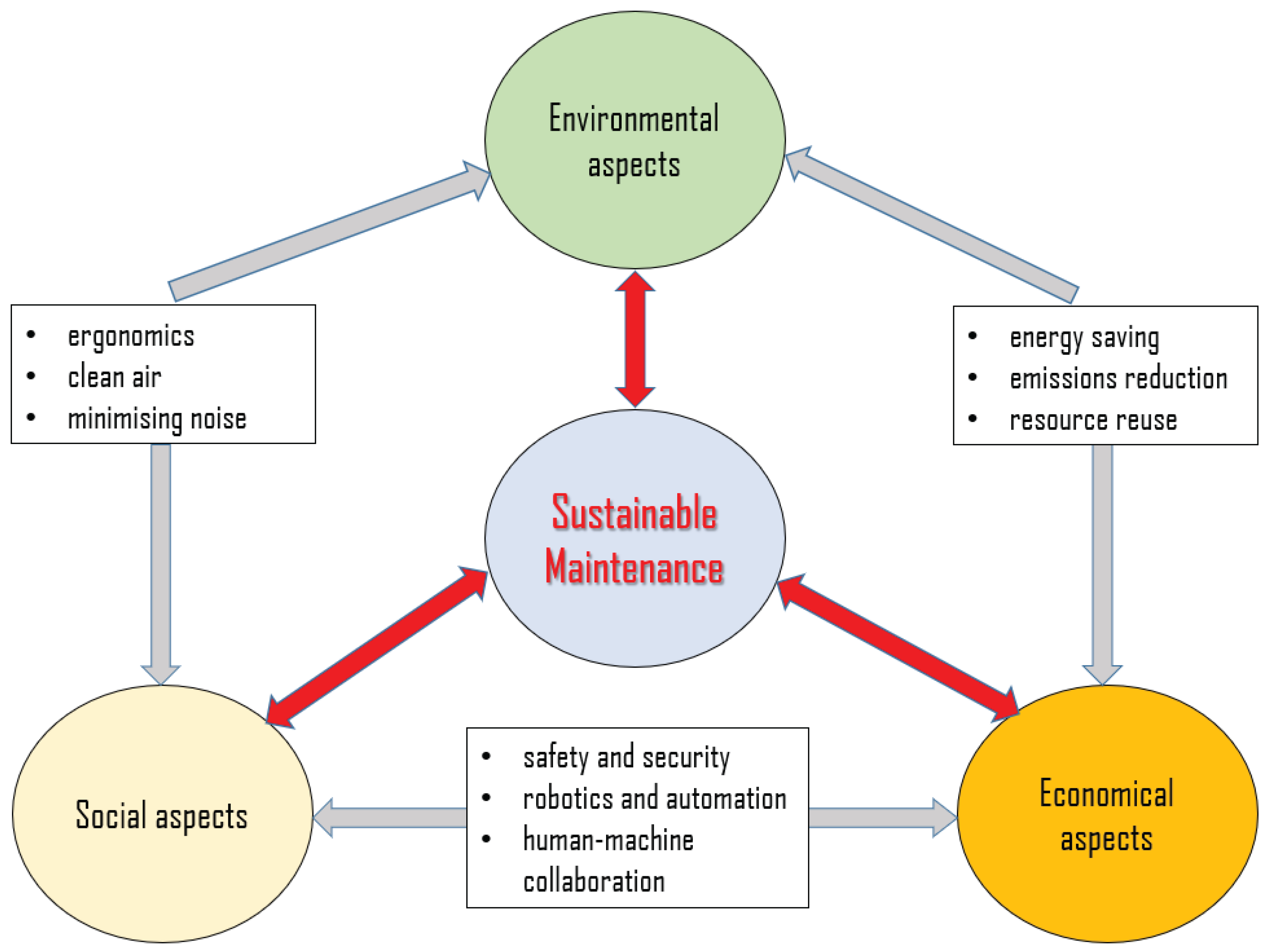
Table 4.
Key indicators of sustainable maintenance under the Triple Bottom Line (TBL) framework. Source: Own contribution based on [79,89].
| Dimension | Category | Indicator | Unit/Type | Description |
|---|---|---|---|---|
| Environmental | Energy efficiency | Energy consumption per maintenance activity | kWh/task | Measures the energy used per maintenance intervention |
| Material sustainability | Percentage of recycled/reused parts | % | Share of reused or recycled components in total replaced items | |
| Environmental risk | Number of environmentally harmful incidents | count/year | Tracks incidents causing environmental harm (e.g., spills, emissions) | |
| Emissions reduction | The carbon footprint of maintenance operations | kg CO₂ eq./month | Estimates GHG emissions from maintenance-related activities | |
| Economic | Cost-effectiveness | Total cost of ownership (TCO) | currency/unit | A sum of acquisition, maintenance, and disposal costs over the asset lifecycle |
| Downtime minimization | Average unplanned downtime | hours/month | Measures operational losses due to unexpected maintenance needs | |
| Maintenance productivity | Mean time to repair (MTTR) | hours | Reflects the average time required to complete maintenance interventions | |
| Asset longevity | Asset life extension due to maintenance | % or years | Measures improvement in asset lifespan thanks to effective maintenance | |
| Social | Worker well-being | Number of safety incidents during maintenance | incidents/year | Tracks injuries or accidents during maintenance tasks |
| Ergonomics and workload | Physical/cognitive strain assessment (survey-based) | qualitative (Likert scale) | Subjective or assessed level of strain experienced by workers | |
| Competence development | Training hours per maintenance employee | hours/year | Measures annual training and upskilling efforts | |
| Human-machine collaboration | Adoption of ergonomic/assistive technologies (e.g., cobots, AR) | binary / % of tasks supported | Tracks implementation of human-assistive tech in daily maintenance operations |
To better understand the distinguishing characteristics and underlying paradigms of evolving maintenance approaches, a comparative overview is presented in Table 5. This table contrasts the traditional, smart (Industry 4.0-based), and sustainable (Industry 5.0-aligned) maintenance models across key dimensions such as strategic focus, decision-making logic, enabling technologies, environmental and social considerations, and the role of human operators. By synthesizing the evolution from cost- and availability-driven strategies to those embedding broader values of sustainability and resilience, this comparative framework highlights how maintenance practices are progressively aligning with the principles of long-term value creation, ethical responsibility, and adaptive capability. The table serves as a conceptual bridge connecting technological transformation with the expanding expectations of industrial maintenance in the context of digitalization and socio-environmental responsibility.
Despite the growing interest in sustainable maintenance, recent literature highlights several challenges, including the lack of standardized indicators, fragmented data on environmental and social impacts, and limited integration of sustainability metrics in current maintenance management systems [79]. Multi-criteria decision-making (MCDM) methods (e.g., [88]), fuzzy logic-based evaluation models (e.g., [90]), and hybrid sustainability frameworks (e.g., [6]) are being proposed to overcome these barriers. These methods allow for aggregating qualitative and quantitative sustainability indicators and help organizations balance competing objectives across the triple bottom line (TBL).
In summary, sustainable maintenance is a multidimensional concept extending traditional maintenance boundaries toward broader sustainability goals. It operates at the intersection of ecological responsibility, economic efficiency, and social equity, thus aligning maintenance operations with the principles of Industry 5.0. In the following sections, the interconnections between sustainable maintenance, resilience engineering, and human-centric approaches are further examined, particularly in the context of AI-enabled decision-making and system adaptability.
2.4. Human-Centric Maintenance
As industrial systems evolve toward Industry 5.0, the human dimension is no longer peripheral but central to the design, implementation, and evaluation of advanced maintenance strategies [34]. Human-centric maintenance is a paradigm that emphasizes the well-being, competence, and ethical inclusion of human operators in technologically advanced maintenance environments [13,91]. It recognizes that while digital tools such as AI, IoT, and cyber-physical systems enhance decision-making and efficiency, they must be developed and applied in ways that support rather than replace human agency and judgment [92].
Figure 5 illustrates the key dimensions of human-centric maintenance, highlighting the interaction between cognitive support, physical augmentation, human-in-the-loop (HITL) design, and ethical alignment. This conceptualization places the operator at the core of intelligent maintenance systems, emphasizing transparency, adaptability, and shared control. In addition, to further illustrate how emerging technologies embed human-centric features in maintenance, Table 5 presents selected examples of such technologies, their corresponding human-oriented elements, and typical applications. It shows how modern tools, ranging from AR and VR to AI-based decision support, enhance efficiency and promote cognitive clarity, ergonomic safety, and user empowerment.
This approach is closely linked to the Operator 4.0 concept, introduced by Romero et al. [96], which describes a set of human roles augmented by smart technologies in the context of smart factories. Within maintenance, Operator 4.0 may act as a super-strength operator (supported by exoskeletons), virtual operator (interacting through AR/VR), collaborative operator (working alongside robots or cobots), or analytical operator (supported by AI-based decision tools). These roles expand human capabilities while preserving the need for meaningful human participation, especially in decision-critical maintenance tasks.
A key principle of human-centric maintenance is human-in-the-loop (HITL) design. This involves embedding human operators into feedback loops within AI and automated maintenance systems, ensuring that human judgment can override, refine, or contextualize algorithmic decisions [97]. HITL is crucial for scenarios involving safety, ethical ambiguity, or uncertainty, where rigid automation might fall short. It also supports explainability, allowing users to understand how maintenance recommendations are generated and to trust AI systems accordingly [98,99]. The implementation of humans-in-the-loop in maintenance contexts is critically analyzed in works such as [100] and, more broadly, in production automation in [101].
Recent systematic literature reviews have highlighted the growing importance of this paradigm. For example, in [98], the authors focus on integrating AI with humans to enhance sustainability and customization in manufacturing. Human-centered AI issues are also reviewed in [102,103]. Another review by Verma [94] focused on human-centric and sustainable industrial revolutions in relation to the Industry 5.0 concept. It emphasizes that Industry 5.0’s human-centricity is not merely about user interfaces but a shift toward organizational culture, governance models, and participatory design. Similarly, the authors in [95,104] review human-centric smart manufacturing, emphasizing that the sustainability of human-centered systems and collaboration in hybrid environments will pose major challenges in future industrial systems. In addition, Pizon et al. [105] focus on the challenges of human-centered manufacturing, classifying them into four groups: social, technical, safety-related, and legal and ethical dimension.
Furthermore, human-centric maintenance prioritizes ergonomics, safety, and worker satisfaction [106]. It calls for both efficient but physically and cognitively adaptive systems, reducing fatigue, preventing injuries, and minimizing stress caused by complex digital interfaces. This includes intuitive HMIs (Human-Machine Interfaces), AR-assisted diagnostics, and digital twins that help visualize machine states in user-friendly formats [107,108]. Recent reviews that summarize a human-centric approach in Industry 5.0 are, among others, [109,110].
Table 6 presents a comparative view of human-centric attributes across maintenance generations from Maintenance 1.0 to Maintenance 5.0 to contextualize human-centricity within the historical evolution of maintenance practices. This table shows the shift from reactive, operator-driven maintenance (low formal support, high physical burden) to cyber-physical. These ethically integrated systems empower and protect the human worker within intelligent infrastructures.
In summary, human-centric maintenance embodies a strategic and ethical alignment of technological advancement with human values. It reinforces the idea that intelligent maintenance systems should enhance - not replace - human capacity, embedding transparency, collaboration, inclusivity, and adaptability into their core functions.
3. Review Methodology
3.1. Review Design and Protocol
This systematic literature review was conducted in accordance with the Preferred Reporting Items for Systematic Reviews and Meta-Analyses (PRISMA 2020) guidelines [35,111], which provide a structured and transparent framework for reporting evidence-based reviews. Adopting this protocol ensures methodological rigor, transparency of reporting, and reproducibility of the search and selection processes, minimizing bias and improving the validity of findings.
The overarching aim of this review was to critically examine the evolution and current state of Resilience-Based Maintenance (RBM) within the broader transition toward Maintenance 5.0. Particular attention was paid to integrating artificial intelligence (AI) technologies, human-centric and sustainable design principles, and their interplay with resilience engineering and maintenance strategy development. The review also identifies gaps, limitations, and future research directions by mapping existing studies to key theoretical domains and application areas.
A structured review protocol was developed to guide the process in five main stages and was designed according the principles given in [112,113,114,115]. These stages are illustrated in Figure 6, which presents the overall methodological framework used in this review:
- definition of research objectives and questions – establishing the scope of the evaluation, including the conceptual focus on RBM and its relation to other maintenance paradigms under Industry 5.0,
- search strategy development – formulating a comprehensive query string and selecting relevant databases (Scopus, Web of Science),
- screening and eligibility assessment – applying inclusion and exclusion criteria, removing duplicates, and performing title/abstract and full-text screenings,
- supplementary search – using snowballing techniques (both backward and forward citation tracking) to enhance literature coverage,
- data extraction, synthesis, and classification – analyzing and categorizing the final set of articles by themes, methods, application domains, and contributions.
This five-step workflow enabled a focused and replicable identification of scholarly contributions relevant to RBM, emphasizing theoretical advancements and practical implementations. In subsequent sections, the detailed execution of each stage is described, and the search results are summarized using a PRISMA flow diagram (Figure 7).
3.2. Identification – Search Strategy
The identification stage of this systematic literature review focused on capturing a broad yet thematically coherent set of publications relevant to the evolving field of Resilience-Based Maintenance (RBM) within the context of Industry 5.0. The search strategy was designed to reflect the interdisciplinary nature of the subject, combining technical, organizational, and human-centric perspectives.
To ensure methodological transparency and relevance, the search process was carried out in two leading academic databases: Web of Science (WoS) and Scopus. These databases were selected due to their comprehensive indexing of high-impact, peer-reviewed publications across engineering, manufacturing, and management domains. The searches were conducted during the period from June 1st to June 15th, 2025.
The selection of keywords and Boolean logic operators was based on an initial scoping review of the literature, during which representative papers from different disciplines (maintenance engineering, resilience theory, human factors, AI applications) were reviewed to identify recurring terms, concepts, and taxonomy. This preliminary phase ensured that the final query captured the diversity of terminologies used across academic communities while aligning with the conceptual focus of this study.
The final search string was organized around six major thematic blocks, using the ALL fields search mode:
- Resilience engineering: resilience OR robustness OR adaptability OR recoverability,
- Maintenance domain: maintenance OR upkeep OR repair OR service OR fault OR failure OR diagnostics OR diagnosis OR prognosis OR inspection OR monitoring,
- Sustainability dimension: sustainable OR eco-friendly OR green OR environmental-friendly OR circular OR energy-efficient,
- Industrial context: industrial systems OR manufacturing OR production OR operations OR industrial processes,
- Industry 5.0 and human-centricity: Industry 5.0 OR human-centric OR human-centered OR user-centered OR people-oriented OR social OR human factor OR human-machine interaction OR human-in-the-loop OR anthropocentric OR ergonomics,
- Advanced intelligent technologies: Artificial Intelligence OR AI OR digital twin OR smart system OR intelligent system OR Machine Learning OR cyber-physical system OR IoT OR big data OR cloud computing OR edge computing OR augmented reality OR AR OR virtual reality OR VR OR blockchain.
Each term group was connected using the Boolean AND operator to ensure conceptual coherence across resilience, maintenance, sustainability, human-centric design, and smart technologies.
In Web of Science, this initial query returned 237 records. Applying a publication date filter (2015–2025) narrowed this number to 198. Review papers and non-original research documents were then excluded, yielding 174 articles. Subsequently, publications falling outside the technical and engineering scope (particularly in medicine and chemistry) were eliminated, leaving 174 (unchanged due to query refinement). A detailed relevance screening based on titles, abstracts, and keywords led to the selection of 52 articles for full-text review.
In Scopus, the initial search retrieved 2,022 records, spanning publication years from 1963 to 2025. These were first limited to the 2015–2025 range and filtered by document type, excluding review papers, book chapters, and conference papers. This reduced the dataset to 827 documents. Further exclusions targeted irrelevant subject areas such as medicine, humanities, and the arts, leaving 762 articles. Additional filters were applied to ensure consistency: only English-language documents (755) published in peer-reviewed journals (706) were retained. Following the same screening process based on titles, abstracts, and keywords, 79 articles were deemed relevant for full-text analysis. After removing 11 duplicates across both databases, a final pool of 120 unique publications was established for in-depth evaluation.
3.3. Screening – Eligibility Criteria
The screening process consisted of two phases a) preliminary filtering based on metadata and b) content-based eligibility assessment, conducted to ensure methodological rigor and thematic consistency.
In the preliminary phase, exclusion criteria were applied to eliminate documents that did not meet basic methodological or topical thresholds. Specifically, papers that were (1) not published in peer-reviewed journals, (2) not written in English, or (3) classified as review articles, conference papers, book chapters, or editorials were excluded. Subject area filters were also employed to discard articles unrelated to engineering, manufacturing, operations, or maintenance, most notably those focused on medical, biological, or chemical applications.
In the second phase, all remaining articles were evaluated for eligibility based on thematic relevance, using a set of predefined inclusion criteria. Publications were retained if they addressed one or more of the following topics:
- resilience, robustness, adaptability, or recovery in the context of industrial maintenance,
- integration of sustainable or circular principles into maintenance strategies,
- human-centric approaches (e.g., human-in-the-loop, Operator 4.0, ergonomics) in industrial systems,
- application of smart or intelligent technologies such as AI, digital twins, IoT, or cyber-physical systems in maintenance practices.
This phase relied on a detailed manual review of titles, abstracts, and keywords. The process was guided by a protocol aimed at maximizing both precision (removal of non-relevant articles) and recall (preservation of diverse but related studies).
Ultimately, 120 articles (after removing duplications) met all eligibility criteria and formed the basis for the subsequent synthesis and classification phases of the review.
3.4. Inclusion – Full-Text Review and Selection
The final step of the selection process involved a full-text review of the remaining articles, ensuring that each included study met the quality standards and contributed substantially to the review's objectives.
A total of 120 records (68 from Scopus and 52 from Web of Science) were considered for full-text evaluation. After detailed reading and critical appraisal, approximately 62 publications were retained for qualitative synthesis. These studies provided a comprehensive representation of current trends, challenges, and future directions in resilience-based maintenance and related approaches under digital, sustainable, and human-centered paradigms.
The full-text review followed these detailed criteria:
- relevance: articles had to present explicit models, frameworks, case studies, or methodologies related to RBM, predictive maintenance, or sustainability in industrial systems.,
- methodological soundness: publications were assessed for clarity of objectives, rigor in methodology, and robustness of results,
- contribution to knowledge: only articles that offered conceptual advances, empirical findings, or practical insights were included.
The evaluation was performed by two independent reviewers with expertise in the fields of maintenance engineering and system resilience. A collaborative spreadsheet was used to track decisions and notes, and any discrepancies were resolved through dialogue and reference to the study’s relevance criteria.
This multi-stage inclusion process ensured a rigorous and transparent selection of high-quality sources that formed the foundation for the subsequent synthesis and discussion.
3.5. Snowball Process – Final Selection
To complement the database-driven search strategy and to ensure the inclusion of relevant but potentially overlooked literature, the snowballing technique was employed as an additional retrieval method. This approach followed guidelines proposed by Wohlin [36] for systematic literature reviews in software and engineering domains, and it was executed in both backward and forward directions.
Backward snowballing involved screening the reference lists of all publications that were shortlisted after the full-text review stage (Section 3.4). Each cited work was evaluated for potential relevance to resilience-based maintenance (RBM), predictive or sustainable maintenance approaches, and applications within industrial contexts aligned with Industry 4.0 and 5.0 paradigms. If a referenced article met the previously established inclusion criteria (e.g., relevance, peer-reviewed status, methodological rigor), it was retrieved and subjected to the same screening and inclusion process.
Forward snowballing was conducted using Scopus citation tracking tools, which allowed for the identification of publications that had cited the initially selected core articles. This step was particularly useful for identifying emerging studies published after the core literature, including high-impact conceptual or empirical contributions to the development of RBM, AI-enhanced maintenance strategies, and the integration of human-centric or sustainable principles.
Through snowballing, an additional set of relevant articles was retrieved and considered for inclusion. While the majority of relevant literature was captured through the structured search queries in Scopus and WoS, snowballing added both depth and breadth to the review, uncovering niche studies and older seminal works frequently cited in contemporary research. Finally, 15 articles were selected for final review.
3.6. Documenting the SLR Study
This stage corresponds to steps 7, 8, and 9 of the systematic literature review (SLR) process and focuses on the documentation, analysis, and synthesis of the selected literature. Following the selection of eligible papers, a bibliometric analysis was conducted to gain deeper insight into the intellectual structure and thematic distribution of the field. Bibliometric methods, widely used in scientometric research, apply statistical and mathematical techniques to assess scientific activity and identify trends, influential contributors, institutional affiliations, and geographic distribution of research outputs.
In this study, bibliometric mapping and analysis were performed using VOSviewer (v. 1.6.18) [116] and Microsoft Excel (Professional Plus 2019). VOSviewer enables the construction and visualization of bibliometric networks, particularly focusing on co-authorship, keyword co-occurrence, citation relationships, and country-level collaboration [117]. These analyses helped identify dominant research clusters, recurring keywords (e.g., “resilience,” “predictive maintenance,” “Industry 5.0”), and key contributing countries and institutions. The keyword co-occurrence map and author collaboration network generated in VOSviewer are presented and discussed in Section 4.
The selected corpus of articles was further organized and managed using Mendeley reference management software [118], which facilitated both qualitative review and traceability. Each entry was tagged with metadata such as publication year, journal or conference source, research type (empirical, conceptual, review), and relevance to the key research themes outlined in Section 2.
Step 8 of the SLR process involved the content-based synthesis of findings in alignment with the review’s objectives and guiding questions. The synthesis process examined how the themes of resilience, AI integration, and sustainable maintenance were conceptualized and operationalized across various studies. These insights inform the thematic analysis presented in Section 4 and Section 5.
Finally, step 9 involved the reflection on limitations and the identification of future research directions. Limitations included a potential exclusion of relevant works not indexed in the selected databases or published in non-English languages, as well as the inherent subjectivity in interpreting conceptual overlap across domains such as resilience and predictive maintenance. These limitations and the derived future research avenues are critically discussed in Section 6.
4. Systematic Literature Review Results
This section includes the results of the conducted systematic review according to the defined research methodology (Figure 6). As a result, in the next subsections, bibliometric analysis and content-based analysis are presented.
4.1. Bibliometric Analysis
This section presents the quantitative and network-based characteristics of the selected literature to provide an overview of the scientific landscape in the field of Resilience-Based Maintenance (RBM) within the broader context of Industry 5.0, which integrates sustainability, human-centricity, and intelligent technologies.
The bibliometric analysis was performed on a consolidated dataset of 93 unique articles, retrieved from the Scopus and Web of Science (WoS) databases, including snowball analysis and covering the publication period 2015–2025. The bibliographic data were exported in compatible formats and processed using VOSviewer (version 1.6.18), a specialized tool for constructing and visualizing bibliometric maps. The largest number of articles (19 papers) was in two of the defined areas: Systems and Supply chains resilience enhancement, and Maintenance-related aspects. The number of analyzed publications in the other areas is as follows: Human-centric maintenance —18 papers; Fault detection and diagnostics/CBM—13 papers; Predictive maintenance in Industry 4.0 —12 publications; and Sustainable management of assets and environmental impact —12 publications.
The analysis of the selected articles focused on the following dimensions:
- publication dynamics and source distribution – to identify temporal patterns and the increasing attention toward RBM-related topics, as well as to examine the scientific outlets (journals and conference proceedings) in which these studies are most frequently published, thereby revealing the disciplinary focus and visibility of the field,
- country-level collaboration – to examine the geographic spread and international cooperation in RBM research,
- co-authorship networks – to explore collaboration patterns among authors and institutions,
- co-occurrence of keywords – to identify thematic clusters, trends, and emerging research areas.
In particular, keyword co-occurrence analysis was used to visualize the conceptual structure of the field. The threshold was set to include terms appearing at least 1 time in the dataset, which resulted in a network of interconnected keywords grouped into several major clusters. These clusters reflect distinct yet interrelated themes such as Industry 4.0, Industry 5.0, resilience, predictive, and sustainability in industrial systems.
The network visualization maps generated using VOSviewer illustrate the relative importance of terms (node size), their co-occurrence strength (link thickness), and thematic proximity (color-coded clusters). The results provide an empirical foundation for interpreting the knowledge structure of RBM and its positioning within Maintenance 5.0 discourse.
First, the publication dynamics were investigated. In the conducted review, the authors selected 93 publications that were published between 2015 and 2025. Figure 8 illustrates the distribution of the publications according to their publication year. As we can see, the distribution of publications by year starts from 2018 and is slightly increasing year by year. This is connected with the fact that before 2018, the problem of Maintenance 4.0 in joint relation to resilience and sustainability had not been investigated at all. The first publications in this field were observed in 2018 and related to robustness in terms of resilience or sustainability. The highest number of publications falls within the period 2023–2025, with 58 publications accounting for 62% of all publications selected for analysis. On one hand, the observed trend is consistent with global research and innovation agendas, which have increasingly emphasized resilient, sustainable, and digital industrial systems. On the other hand, the formal introduction of the Industry 5.0 paradigm in 2021 by the European Commission has catalyzed a broader conceptual shift. Since then, greater attention has been directed toward integrating digitalization not only with resilience but also with sustainability and human-centricity.
This renewed focus has significantly influenced the maintenance domain, where traditional optimization-centered strategies are being re-evaluated in light of ethical, environmental, and social considerations. Consequently, scholarly contributions are now more likely to adopt interdisciplinary perspectives that combine artificial intelligence, circular economy principles, and human-machine collaboration, marking a paradigm shift toward Maintenance 5.0.
Moreover, the analyzed articles were published across 55 different journals, reflecting the wide-ranging and interdisciplinary nature of the research on Resilience-Based Maintenance (RBM) within the broader framework of Industry 5.0. Figure 9 illustrates the distribution of journals that included at least two publications relevant to the topic.
In total, 48 articles from 17 journals met this criterion and were considered in the source distribution analysis. The dataset included both journal articles and peer-reviewed conference proceedings, with IFAC-PapersOnLine, a leading venue for automation and control research, being the most represented source.
Among the sources, IFAC-PapersOnLine emerged as the most frequent publication outlet, contributing seven articles to the selected corpus. The journal Sustainability (Switzerland) ranked second with five publications, followed by the International Journal of Production Research with four articles. Additionally, Applied Sciences, Computers and Industrial Engineering, Safety Science, and Scientific Reports each contributed three publications, indicating a consistent, albeit dispersed, interest across various fields.
This broad distribution of publication venues confirms the interdisciplinary character of the field, bridging areas such as industrial engineering, production management, artificial intelligence, safety science, and sustainability. The prominence of IFAC-PapersOnLine underlines the relevance of the topic within automation and control systems communities, while the presence of journals like Sustainability and Scientific Reports suggests an increasing emphasis on the integration of environmental and societal dimensions into maintenance research.
Such dispersion also implies that research on RBM is still emerging and expanding, not yet consolidated around a small number of flagship journals. This may offer opportunities for wider dissemination, but also indicates the need for more focused publication channels as the field matures.
To assess the scientific influence of the reviewed publications, citation metrics were calculated using Scopus citation counts. Among journals with at least three publications in the selected corpus, Sustainability and the International Journal of Production Research (IJPR) stood out in terms of citation performance.
For articles published in Sustainability that have received at least 10 citations, the average citation count was 21.3 citations per article, with a median of 19. In comparison, articles published in IJPR achieved an average of 26.8 citations, with a median of 23. These figures indicate that research on Resilience-Based Maintenance (RBM), particularly when linked to sustainability and production systems, is gaining substantial visibility and scholarly traction. Figure 10 presents the most cited journals from the dataset.
The citation performance reflects both the growing relevance of RBM in the context of Industry 5.0 and the role of these journals as preferred publication venues for interdisciplinary studies at the intersection of AI, resilience engineering, and maintenance strategy.
As part of the bibliometric analysis, the geographical origin of the selected publications was examined to understand the global distribution and intensity of research activity related to Resilience-Based Maintenance (RBM) in the context of Industry 5.0. The results show a wide international interest in this emerging area, with contributions from 45 countries across six continents.
Europe is the most prominent region, accounting for approximately 54% of all analyzed publications (175 documents), followed by Asia with 24% (77 publications), and Africa with a notable 9% (28 publications). The remaining contributions are from North and South America (22 and 20 publications, respectively), and Australia/Oceania, which together represent a smaller but still relevant share (14 publications).
At the country level, the top contributors are Italy (40 publications), China (37), and the United Kingdom (36), followed by France (24) and India (23). The United States, often leading in digital innovation, appears with a moderate contribution of 17 publications. Other countries with visible activity include Portugal (14), Saudi Arabia (13), Australia (11), Spain (9), and Morocco (9). Notably, countries such as Germany, Poland, Finland, and Brazil each contributed seven articles, reflecting a balanced representation between highly industrialized nations and those undergoing digital transformation.
This distribution reflects the growing relevance of RBM not only in traditional centers of technological advancement but also in emerging economies and regions where industrial resilience and sustainable practices are becoming increasingly important. The presence of countries such as Morocco, Pakistan, and Romania demonstrates the expanding global engagement with Industry 5.0 principles and maintenance modernization.
From a regional perspective, Europe’s leadership in publication volume may be attributed to its strong policy emphasis on sustainable development, digitalization, and human-centric technologies, as reflected in EU-level initiatives supporting Industry 5.0 research. Asia’s significant share, with major contributions from China and India, indicates the region's rapid technological adoption and increasing interest in resilience-based strategies across sectors. Africa’s representation, unusually high compared to other technical domains, may point to growing awareness of infrastructure sustainability and capacity-building in critical industries.
Figure 11 presents the distribution of RBM-related publications across the top contributing countries and their relative publication output.
To complement the bibliometric exploration, co-authorship patterns were examined. In total, the dataset included 93 articles, co-authored by a diverse pool of researchers. The number of authors per article was analyzed to identify collaboration intensity. As shown in Figure 12, the most common authorship model includes three authors (35 articles), followed by four (20 articles) and two (13 articles). Notably, single-author contributions were relatively rare (5 articles), suggesting a high degree of collaborative research in the analyzed field. In addition, articles with larger teams (six or more authors) represented only 10.7% of the total sample (10 articles), indicating that although collaboration is prevalent, extensive multi-author projects are less frequent in the RBM and Maintenance 5.0 literature.
In the next step, a co-authorship network was constructed using VOSviewer to identify the most collaborative researchers within the dataset.
The top 15 authors by total link strength and number of joint publications were extracted. The analysis reveals that collaboration networks are predominantly localized within country-specific clusters (e.g., Italy, China, India), with emerging transnational links in European-funded or interdisciplinary studies.
In order to supplement the conducted analysis, a co-occurrence of authors was investigated using VOSviewer software and Excel software. A total of 328 authors were identified from the selected papers. Figure 13 shows the results for the top 10 authors with the highest number of co-authorship connections. The authors presented in this cluster have the largest total link strength (9).
The final part of the bibliometric investigation was dedicated to keyword co-occurrence analysis based on author-provided keywords, using VOSviewer software. In total, 294 unique keywords were identified across the analyzed publications, forming 28 distinct clusters. These clusters were connected through 1,102 co-occurrence links with a total link strength of 1,168, reflecting a dense and multidimensional thematic structure (Figure 14).
The most frequently used terms included Industry 5.0 (80 links), Industry 4.0 (75), resilience (72), sustainability (66), predictive maintenance (48), and machine learning (43). These keywords clearly reflect the prevailing focus areas within the field, indicating a strong alignment between human-centric innovation, advanced digital technologies, and proactive maintenance strategies.
The largest cluster (red one, 20 items) is centered around the role of human capital and cyber-physical integration in the context of Industry 5.0. It emphasizes the transformation of maintenance systems through technologies such as automation, collaborative robotics (cobots), and advanced cyber-physical systems, supporting human-machine cooperation. The second largest cluster (green one, 19 items) pertains to asset management supported by artificial intelligence, reflecting a growing emphasis on intelligent decision support systems in resilient maintenance frameworks. The third cluster (light blue, 18 items) encompasses terms related to the integration of AI, IoT, and data analytics into predictive maintenance, which form the foundation of many Industry 4.0-driven solutions.
Another important thematic area (yellow cluster, 18 items) highlights sustainability and environmental considerations, emphasizing issues such as circular economy, energy efficiency, and eco-friendly maintenance practices. This is complemented by a fifth cluster (magenta, 17 items) focused on optimization and decision-making, particularly in AI-enabled industrial systems. Equally significant is the sixth cluster (cyan, 17 items), which addresses resilience engineering and risk management, underlining the role of proactive strategies to enhance system reliability under uncertainty. The seventh major cluster (orange, 17 items) shifts attention toward human factors, highlighting topics such as ergonomics, deep learning, and computer vision, especially in the context of monitoring and supporting operator performance.
The remaining clusters, each comprising between three and sixteen keywords, reflect niche areas such as digital twins, maintenance optimization, reliability analysis, and the implementation of circular economy principles. Together, these findings present a comprehensive overview of how research in resilience-based and sustainable maintenance is structured around interconnected yet distinguishable thematic pillars, offering insights into the future directions of the field.
The presented bibliometric investigation enhances understanding of how RBM research has evolved and which directions are emerging, while also supporting the formulation of content-based insights discussed in Section 4.2.
4.2. Content-Based Analysis
As a result of the conducted research, following the methodology adopted (Figure 6), we focus on the content-based analysis.
The identification of the main problems and issues raised in the context of Maintenance 5.0 was based on an extensive review of the available literature. As a result of the research carried out, six core research areas were defined, which have been most extensively developed over the last twenty years (Figure 15).
A significant body of literature within the reviewed sample contributes to the thematic area of Predictive Maintenance in Industry 4.0, revealing a multidimensional and technologically rich research stream. These studies collectively emphasize the integration of artificial intelligence, machine learning, Internet of Things (IoT), and digital twin technologies to support advanced, data-driven maintenance strategies. Many works in this cluster highlight the transition from traditional condition-based monitoring toward more intelligent, predictive, and even proactive maintenance frameworks. For instance, the development of hybrid learning models for lithium-ion batteries [119], integration of predictive algorithms in composite smart structures [120], and the use of model-based systems engineering in mining maintenance [121] illustrate the sector-specific implementations of such approaches.
Moreover, publications increasingly link predictive maintenance to Industry 5.0 principles, such as human-centricity and system adaptability. For example, vision transformers integrated with digital twins are explored in the context of human-in-the-loop maintenance systems [122], while behavioral aspects of predictive maintenance are examined through a work system lens [13]. The role of AIoT communication and digital twin synchronization as well as IoT is illustrated in bridge maintenance applications [123,124], while resilient pharmaceutical manufacturing is addressed through digital twin-driven strategies in uncertain environments [125].
Further contributions include conceptual frameworks and applied models that leverage predictive maintenance in the context of Industry 4.0. These range from general strategic models [75,126] to scenario-specific approaches focusing on sustainability [127] and resilience-driven methodologies [128]. Together, this group of publications reflects a research trend toward predictive maintenance as a foundational element of digital transformation in industrial systems, aligning operational goals with sustainability, resilience, and human-system collaboration.
Taking one step further, a significant thematic cluster within the analyzed body of literature is centered on fault detection and diagnostics, closely linked to condition-based maintenance (CBM) approaches. This body of research focuses on the development of methods and technologies that enable the early identification of equipment faults, degradation patterns, and anomalies in various industrial environments. The growing adoption of artificial intelligence and advanced machine learning models has notably enhanced the predictive and diagnostic capabilities of modern maintenance systems.
Several studies explore hybrid or ensemble AI frameworks that integrate neural networks, genetic algorithms, and ensemble methods to improve the accuracy and robustness of diagnostic models, particularly in complex or novel applications, such as reinforced concrete structures [129]. Others focus on visual analytics for fault detection in manufacturing lines [130], transportation systems [131] or develop health indicators and pattern recognition methods to optimize diagnostics in smart manufacturing environments [132].
The role of digital twins is also prominent in CBM applications. They are used to support real-time fault monitoring and asset diagnostics in transportation systems, such as railway maintenance [73,133]. These studies illustrate how data fusion and digital models can support the lifecycle management of complex systems, including RL-enhanced strategies for infrastructure reliability [134].
Research on intelligent monitoring systems also shows significant progress, particularly in robotics and machinery. Monitoring of multi-axis robots [135] and fault-tolerant synchronization in multi-robot systems [136] are key topics reflecting Industry 5.0's increasing emphasis on collaborative robotics. Similarly, deep learning techniques have proven effective for diagnostics in data-scarce or resource-constrained environments [137], and CNN-based methods are applied for defect detection in photovoltaic panels [138].
Moreover, studies such as the one by Zhang et al. [82] offer comprehensive overviews of prognostics and health management (PHM), highlighting the integration of AI for both real-time and long-term failure prediction across engineering systems. Other authors stress the importance of CBM in critical infrastructure, promoting it as a robust and sustainable strategy to enhance system resilience and operational continuity [139].
Collectively, the reviewed literature in this thematic cluster reveals a strong interdisciplinary focus on combining AI, sensor data, and simulation technologies to push the boundaries of fault detection, with applications spanning transportation, energy, robotics, smart manufacturing, and critical infrastructure.
The third thematic area that emerged strongly in the reviewed literature is human-centric maintenance, aligning closely with the principles of Industry 5.0. This research stream highlights the increasing recognition of human roles in smart maintenance environments, focusing on safety, well-being, decision empowerment, and collaborative interaction with intelligent systems.
Several studies propose frameworks and mechanisms that actively involve operators in decision loops and system adaptations. For example, [140,141] outline development guidelines that ensure maintenance tasks are aligned with operator capabilities and sustainable goals. Under crisis conditions, [93] and [100] demonstrate how explainable AI can empower workers with transparent recommendations. Artificial intelligence-based human-centric decision support framework under pandemic environments was proposed in [93], whereas [100] illustrates how human-centric AI can be used to enhance resilience, flexibility, and transparency in decision-making processes.
Studies such as [105,110] identify organizational and cognitive barriers, advocating for participatory design and continuous feedback. Real-time control strategies are exemplified by [142], while [95,143] showcase augmented reality interfaces that reduce cognitive load and enhance situational awareness.
In addition, a significant body of research also explores digital twin technologies with a human-oriented perspective, particularly in enhancing operators’ skills, safety, and productivity. The use of digital twins for operator training and safety receives attention in works [144,145,146]. Indeed, [144,146] propose simulation models and frameworks that replicate human capabilities and interactions within digital manufacturing ecosystems.
Ergonomics and safety are also central to this thematic area. Papers such as [147,148] address physical and cognitive ergonomics in maintenance and operational tasks, utilizing sensors, computer vision, and data-driven safety models. In addition, the authors in [149] highlight how sensor data can be translated into actionable insights.
Lastly, human-centricity is embedded in broader conceptual frameworks that link digitalization and sustainable manufacturing. For example, [140,150,151] explore how human values, competencies, and needs should shape the design of future maintenance and service systems. In addition, works [148,150] integrate ergonomic, safety, and sustainability considerations into end-to-end maintenance workflows. Together, these works illustrate a concerted shift toward socio-technical systems in which humans are not only beneficiaries of technology but active partners in maintaining and evolving industrial assets.
This body of literature reflects an ongoing shift from technology-centric paradigms toward integrated, socio-technical systems where human expertise, collaboration, and well-being are central design elements.
The thematic area of sustainable management of assets and environmental impact reflects a convergence of efforts to align maintenance practices with broader environmental and resilience goals. One of the key research directions involves the development of maintenance frameworks that incorporate sustainability indicators and resilience classifications. For instance, models supporting policy integration and multi-criteria decision-making contribute to aligning maintenance with sustainable development goals [152]. Likewise, the integration of standardized performance frameworks, such as EN 15341:2019, has been proposed to structure sustainable maintenance assessments [89].
Another prominent stream of research emphasizes the interplay between circular manufacturing systems and maintenance planning. Studies have highlighted how machine learning and intelligent design approaches can support sustainable operations through predictive analytics and the optimization of resource use [153]. This is complemented by work on robust layout planning using Big Data, which supports efficient facility configuration while reducing environmental footprint [154].
Environmental considerations in remanufacturing systems have also been explored through integrated production and maintenance models that consider uncertainty and degradation of components [155]. At the same time, specific sectors such as hydropower offer conceptual frameworks to assess the sustainability of maintenance management practices [156].
Emerging technologies play a central role in this thematic area. The adoption of secure digital infrastructures, such as zero-trust network-based access control systems, supports data integrity and environmental efficiency within Industry 4.0 [157]. Additionally, the application of machine learning in environmental monitoring is helping industries improve their operational resilience and environmental awareness, particularly in energy-intensive processes [158]. On the other hand, in [159] the authors focused on the impact of Maintenance 4.0 on sustainable development in the context of three dimensions: economy, environment and risk.
The literature also reflects a strategic shift toward transformative resilience, where maintenance is embedded in adaptive strategies for sustainable industrial systems. This perspective positions resilience not just as risk mitigation, but as a catalyst for innovation and long-term ecological balance [160]. Furthermore, a case study from the automotive sector illustrates how Maintenance 4.0 approaches can form the foundation of sustainable manufacturing policies [161].
Finally, the integration of Industry 5.0 principles into product–service systems demonstrates a shift toward lifecycle thinking and the co-creation of sustainable value through intelligent maintenance planning [162]. These diverse contributions collectively underscore a dynamic and interdisciplinary research field, where asset management is increasingly positioned as a key enabler of environmental sustainability and system resilience.
It is also worth mentioning that a growing body of literature addresses the multifaceted challenge of enhancing resilience in both physical systems and supply chain networks, particularly under the transformative pressures of Industry 4.0 and 5.0. One key research avenue involves the integration of digital twin frameworks to anticipate disruptions and strengthen operational continuity. This includes proposals for digital twin–based support in the recovery and resilience of supply chains [163], as well as models enhancing factory resilience and optimization in future-oriented production environments [164]. Advanced decision-making tools are also being developed, such as a decision support framework that balances resilience and sustainability in service design [165], and a multi-criteria optimization approach for resilience-based maintenance, leveraging knapsack methods [62].
Supply chain-specific resilience has been further explored through AI-driven transformation strategies in Industry 5.0 [166], and predictive models for anticipating inbound logistics disruptions in volatile environments [167]. Several studies emphasize digital twins as enablers of sustainable and resilient manufacturing networks [168] and propose frameworks that merge blockchain with cognitive analytics to ensure robustness in additive manufacturing supply chains [169]. Blockchain technologies have also been considered essential to transforming supply chain management in Industry 5.0 for innovation and sustainability [170].
Beyond manufacturing and logistics, resilience is also considered in sector-specific contexts. Offshore wind turbine maintenance is addressed through a new risk management model emphasizing proactive resilience [171], while port expressways are studied for vehicle traffic resilience via lane management strategies [172]. Similarly, resilience in cooling tower operations has been optimized using data-driven process analysis [173], and in fleet systems, the evaluation of critical equipment maintenance strategies has been advanced [31].
The role of organizational dynamics is highlighted by research exploring robustness and resilience as catalysts for innovation in smart service factories [174], and frameworks that connect product–service system design with automated guided vehicles to promote resilient performance [175]. Capitalizing on AI capabilities to foster proactive adaptation to disruptive events is also being explored [176], along with multi-criteria decision approaches for improving global supply chain performance through Industry 4.0 integration [177].
The conceptual development of resilience assessment methods continues to evolve, including fuzzy-logic-supported maintenance strategies within the resilience-based maintenance paradigm [4] and systemic resilience assessment–driven maintenance strategy definition [5]. Altogether, these studies demonstrate the broad and interdisciplinary nature of resilience enhancement, encompassing digital modeling, intelligent systems, logistics optimization, and proactive risk management across diverse industrial and infrastructure contexts.
Finally, the last thematic area concerning maintenance-related concepts reflects a broad and multidimensional research scope that explores evolving approaches to managing maintenance in the context of digital transformation, sustainability, and resilience. Several studies highlight the theoretical and practical challenges in implementing next-generation maintenance paradigms such as Maintenance 5.0, particularly in balancing human involvement, automation, and sustainability goals [22]. For instance, the concept of adversarial maintenance has been proposed as a way to safeguard reliability and robustness in cyber-physical environments [66], while other works stress the role of Industry 5.0 principles in developing sustainable reliability-centered maintenance strategies [8].
The integration of new technologies is another major stream of research. Studies propose the application of augmented reality in facilitating maintenance operations [178], as well as intelligent software sensing in predictive and preventive strategies for IoT systems [179]. Maintenance optimization strategies in the context of Industry 4.0 are also widely explored, focusing on improving resource allocation, minimizing downtime, and enabling condition-based approaches [180]. Complementary to this, lean principles are analyzed in synergy with digital technologies to enhance sustainability in maintenance management [181].
A notable research direction is the integration of resilience into maintenance models and frameworks. Examples include resilient maintenance optimization for offshore wind turbines [171], port expressway operations [172], and complex buildings [128]. The resilience of safety management systems in building maintenance has also been conceptually addressed [182], and further developed in the context of plant process safety and sustainability [183].
From a systems perspective, some contributions focus on task scheduling and workforce coordination in dynamic maintenance environments [184,185], while others explore multi-dimensional integration, such as combining Total Productive Maintenance with Industry 4.0 technologies for achieving global sustainability goals [186]. The remanufacturing of lithium-ion batteries as a sustainable maintenance practice within the Industry 5.0 paradigm is also examined [187].
Finally, the role of proactive and transformative strategies is evident in multiple works that emphasize future-oriented frameworks, aligning maintenance with long-term resilience, circular economy, and sustainability visions [160,188].
To sum up, the content-based analysis of the reviewed literature revealed a diverse and evolving landscape of research related to Resilience-Based Maintenance (RBM) in the context of Industry 4.0 and 5.0. Six major thematic areas were identified.
Research on predictive maintenance focuses on integrating AI, IoT, and digital twins to anticipate failures, optimize maintenance actions, and enhance asset performance, particularly in complex or safety-critical infrastructures. Fault detection and diagnostics/CBM studies address advanced monitoring techniques, health indicators, and data fusion methods that support condition-based strategies in real-time environments. The human-centric maintenance domain highlights the increasing importance of operator engagement, ergonomics, human–machine interaction, and digital tools that support human-in-the-loop decision-making within sustainable and resilient manufacturing systems.
A substantial body of literature explores sustainable asset management, linking maintenance practices with environmental concerns, circular economy strategies, and the use of big data or machine learning to improve the sustainability and robustness of industrial operations. The area of systems and supply chain resilience emphasizes frameworks for managing disruptions, improving logistics and service design, and integrating technologies like digital twins, AI, and blockchain to foster adaptive capabilities. Finally, publications categorized under maintenance-related concepts address a wide range of emerging issues such as Maintenance 5.0, augmented reality applications, optimization algorithms, and conceptual frameworks for proactive and resilient strategies across sectors.
Together, these thematic areas underline the multidimensional nature of RBM and its alignment with digitalization, human factors, sustainability, and operational robustness. In the following section, a focused discussion is conducted based on the formulated research questions to identify key research challenges and gaps within this domain.
5. Discussion: Insights and Research Gaps
The reviewed literature provides a comprehensive view of the current landscape of Resilience-Based Maintenance (RBM) and its evolution within the broader contexts of Industry 4.0 and Industry 5.0. Through the thematic classification of over 100 publications, several key insights can be drawn regarding the state of research, employed technologies, alignment with emerging paradigms, and existing research gaps.
In response to RQ1, the current state of RBM research reflects a mature but still fragmented field that is rapidly evolving. The six thematic areas identified, indeed, predictive maintenance, fault detection and diagnostics/CBM, human-centric maintenance, sustainable asset management, systems and supply chain resilience, and emerging maintenance-related concepts, demonstrate the growing multidimensionality of maintenance science. Although many studies provide advanced technical solutions or conceptual frameworks, few adopt a holistic, system-level view of resilience. There is a clear need for integrative models that align operational, strategic, and environmental resilience objectives across asset lifecycles.
The concept of Resilience-Based Maintenance (RBM) has gained considerable attention over the last decade, emerging at the intersection of asset management, risk engineering, and systems resilience. The literature indicates that RBM is not a singular methodology but rather an evolving paradigm shift in maintenance thinking, transitioning from reactive and predictive strategies to holistic approaches that account for adaptability, robustness, recoverability, and long-term operational continuity.
In industrial and infrastructure systems, resilience is increasingly being framed as a strategic requirement, not only for handling disruptions (e.g., failures, supply chain shocks, cyber threats), but also for sustaining performance under uncertainty. A wide array of studies conceptualize resilience from technical, organizational, and systemic perspectives, with growing interest in how maintenance contributes to system-wide resilience capacity.
Research to date shows that RBM is still relatively fragmented. Many studies introduce resilience as an auxiliary concept, often linked to condition-based maintenance, redundancy, or risk-based inspection, but lack a comprehensive integration of resilience indicators or structured evaluation frameworks. For instance, while fault-tolerant design and robust diagnostics are frequently referenced, the literature rarely operationalizes resilience using clear metrics (e.g., time to recovery, system degradation tolerance, performance under stress).
Nevertheless, there is a noticeable convergence of RBM with digital technologies, especially digital twins, simulation modeling, and AI-based decision support systems. These tools are increasingly used to model the behavior of systems under disturbances, optimize maintenance schedules based on risk and vulnerability profiles, and test recovery strategies in virtual environments. Several publications also point to multi-criteria decision-making methods (e.g., AHP, fuzzy logic, GINA, MICMAC) as mechanisms to support resilient maintenance planning, particularly in complex or safety-critical sectors.
Additionally, sector-specific research in transport, energy, water infrastructure, and manufacturing reflects tailored applications of RBM principles. Case studies highlight its relevance in railway systems, offshore wind turbine maintenance, cooling tower operations, and smart factories, often emphasizing the integration of resilience into both physical assets and cyber-physical systems.
In summary, the current state of RBM research reveals a rich but developing field, where the conceptual foundations are in place, but methodological consistency, implementation strategies, and measurement frameworks are still lacking. There is a strong emphasis on resilience as a qualitative or scenario-based objective, but fewer empirical studies provide validated models that can guide practitioners in designing, monitoring, and improving resilient maintenance strategies. Bridging this gap remains a key challenge and opportunity for future work in both academic and industrial contexts.
In addressing RQ2, artificial intelligence has become a cornerstone of RBM strategies. A wide range of methods, including neural networks, genetic algorithms, ensemble models, deep learning, reinforcement learning, and fuzzy logic, are deployed across use cases such as condition monitoring, predictive analytics, diagnostics, fault detection, and decision support. These tools are increasingly integrated with IoT, digital twins, and edge computing, enhancing real-time responsiveness and adaptive capacity. However, interoperability, scalability, and the quality of input data remain challenges in AI-enabled RBM systems, particularly in legacy industrial infrastructures or small and medium-sized enterprises (SMEs).
Taking a broader view, Artificial Intelligence (AI) plays a central role in enabling Resilience-Based Maintenance (RBM) by enhancing the system's ability to sense, interpret, adapt, and respond to uncertainties in dynamic industrial and infrastructure environments. The reviewed literature reveals a diverse landscape of AI techniques that are increasingly embedded into maintenance strategies to support decision-making, improve diagnostics, and enable learning mechanisms. Among the most prevalent AI methods used in RBM are machine learning (ML) algorithms, particularly supervised learning techniques such as decision trees, support vector machines (SVMs), random forests, and ensemble models. These methods are widely employed for fault classification, predictive diagnostics, and prognostics, often utilizing time-series data from sensors (e.g., vibration, temperature, acoustic signals). For instance, hybrid learning frameworks have been developed to support predictive maintenance of batteries, smart structures, and robotics systems, enhancing system adaptability to evolving conditions.
Deep learning (DL), including convolutional neural networks (CNNs) and recurrent neural networks (RNNs), has been increasingly applied in resource-constrained or data-scarce environments to detect complex patterns or anomalies. Applications include fault detection in photovoltaic panels, robotic arm diagnostics, and visual analytics in production lines. These models offer high performance in environments where resilience requires rapid and accurate detection of failure modes.
In the context of learning and adaptability, reinforcement learning (RL) and its deep variants (DRL) have emerged as promising tools for optimizing maintenance policies in stochastic or non-stationary environments. RL-based models enable systems to autonomously learn optimal maintenance actions by interacting with their environment, adjusting to changes in degradation rates or operating conditions. One study even integrates RL with lifecycle management strategies to support sustainable infrastructure resilience.
In addition, explainable AI (XAI) tools are gaining traction, especially in human-centric maintenance applications. These tools not only support technical resilience but also empower human operators by offering interpretable recommendations and traceable decision logic. This is particularly important under uncertain conditions (e.g., pandemics, cyber threats), where transparency enhances trust and collaboration between humans and AI systems.
The use of fuzzy logic, Bayesian networks, and multi-criteria decision-making (MCDM) approaches (e.g., AHP, TOPSIS, GINA) is also significant in RBM. These methods handle uncertainty and imprecise data, supporting decision processes where risk, system vulnerability, or resilience trade-offs must be evaluated. Such approaches are essential for integrating subjective expert knowledge and heterogeneous data sources into maintenance planning.
Moreover, AI is often coupled with digital twin (DT) platforms, enabling dynamic modeling of system behavior and virtual testing of maintenance scenarios. AI-enhanced digital twins allow for real-time monitoring, failure prediction, and resilience evaluation, thus fostering proactive interventions and simulation-based decision support.
To summarize, RBM research demonstrates an evolving and multidisciplinary application of AI, where tools are selected and tailored according to the complexity, criticality, and resilience goals of the system. Future developments are likely to focus on integrating adaptive AI models, real-time learning capabilities, and AI-human collaboration interfaces, paving the way for robust and intelligent maintenance ecosystems that sustain operational performance amid increasing uncertainty. The summary of techniques applied in RBM is given in Table 7.
With regard to the alignment of Resilience-Based Maintenance with Industry 5.0 pillars (RQ3), a noticeable trend in the literature is the alignment of RBM with the pillars of Industry 5.0, especially human-centricity and sustainability. Human-in-the-loop systems, operator-centered interfaces, ergonomic risk reduction, and the use of AR/VR for decision support highlight how maintenance is becoming more people-oriented. At the same time, frameworks integrating circular economy principles, low-emission strategies, and sustainable production objectives demonstrate how RBM is being positioned as a driver of environmental and social responsibility. Still, many solutions remain in the conceptual or prototype phase, and their practical implementation across sectors requires further validation and standardization.
One of the strongest points of convergence lies in sustainability. Numerous studies emphasize that RBM enables resource optimization, extends asset life cycles, and reduces environmental footprint by anticipating failures and supporting proactive interventions. Through predictive and condition-based strategies, RBM reduces unnecessary maintenance activities, spare part consumption, and energy-intensive repairs. Integration with circular manufacturing concepts, as seen in works applying machine learning for sustainable operations or robust layout planning, illustrates how maintenance functions are reoriented to support both economic and ecological resilience. Moreover, RBM is increasingly embedded in multi-criteria sustainability frameworks that consider environmental, social, and economic trade-offs in decision-making.
The human-centric pillar of Industry 5.0 is also strongly reflected in RBM literature. RBM systems are designed not only to adapt to technical disturbances but also to empower human operators and maintenance personnel. Studies on Human-in-the-Loop (HITL) frameworks, AR-enabled interfaces, ergonomic safety, and digital twins tailored for operator training demonstrate how RBM fosters collaboration between people and intelligent systems. Human-machine interaction is no longer incidental but essential, with humans acting as active participants in adaptive maintenance loops. For example, explainable AI (XAI) is used to make decisions interpretable, reducing cognitive overload and enhancing trust in automated recommendations.
Additionally, resilience in RBM is interpreted not only as a system's capacity to recover from disruptions but also as a means of organizational learning and continuous improvement. This resonates with Industry 5.0’s vision of socio-technical ecosystems that are adaptable, inclusive, and oriented toward long-term value. Conceptual models of RBM include feedback loops, learning mechanisms, and resilience indicators that align with human competencies and organizational agility. Moreover, the systemic inclusion of ethics, worker safety, and mental well-being into maintenance planning signals a deepening of human-centric principles.
In sum, RBM is no longer a purely engineering-driven discipline but a strategic function that integrates technological intelligence, environmental stewardship, and human collaboration. The reviewed literature supports a growing consensus that RBM, as envisioned within the Industry 5.0 framework, is a key enabler of transformative resilience, creating value not only through operational continuity but also through ethical, sustainable, and participatory industrial practices.
Finally, in response to RQ4, several research gaps and future directions have emerged. Despite the growing body of literature on Resilience-Based Maintenance (RBM), several key research gaps and challenges remain that limit its widespread and effective implementation across industrial and infrastructure systems. These gaps span theoretical, methodological, technological, and practical dimensions, pointing to promising directions for future investigations.
One major challenge is the fragmentation of RBM conceptualizations. While resilience is often invoked in maintenance contexts, its interpretation varies widely, ranging from recovery time after failure to adaptability of systems to robustness under uncertainty. There is a lack of unified frameworks that integrate resilience with reliability, sustainability, and asset management principles in a consistent way. Furthermore, resilience indicators and metrics remain underdeveloped, particularly those that can quantify both technical and organizational aspects of RBM in real-time systems.
Another significant gap concerns the integration of human and organizational factors into RBM. Although Industry 5.0 emphasizes human-centricity, relatively few studies provide concrete models for incorporating human behavior, decision-making variability, or cognitive load into resilience strategies. Future research should focus on human-in-the-loop models, participatory approaches, and ergonomics-informed RBM frameworks that consider both physical and mental demands on operators and maintenance staff.
Methodologically, limited work has been done on cross-sector validation of RBM frameworks. Most case studies are sector-specific, often focusing on energy, manufacturing, or transportation. Comparative studies across industries and infrastructure domains are needed to develop generalizable insights and modular RBM architectures. Additionally, RBM in small- and medium-sized enterprises (SMEs) remains underexplored, especially regarding scalability, cost-effectiveness, and access to AI and sensor technologies.
From a technological standpoint, while there is progress in using AI, digital twins, and IoT, the challenge lies in real-time data fusion, interoperability of digital ecosystems, and cybersecurity in RBM applications. Research should address how to handle incomplete or noisy data in resilience decision-making, how to ensure ethical use of AI in maintenance, and how to build trust in autonomous decision-support systems.
Finally, future studies should focus on developing maturity models, such as resilience or maintenance maturity frameworks, that help organizations benchmark their current capabilities and guide RBM implementation over time. Such models can be enriched by using multi-criteria decision-making, fuzzy logic, or Bayesian networks to deal with uncertainty and dynamic operational environments.
In summary, while RBM has made considerable advances, its further development demands a transdisciplinary approach, combining systems engineering, organizational psychology, sustainability science, and data science. Future work should prioritize building adaptive, explainable, and inclusive RBM systems that align with the complex demands of Industry 5.0.
To conclude, the current body of research reflects strong momentum toward transforming maintenance into a resilient, sustainable, and intelligent function of industrial systems. Nevertheless, to fully operationalize RBM within the frameworks of Industry 4.0 and 5.0, future research should address system-level integration, practical deployment, human-technology co-evolution, and long-term environmental impacts.
6. Conclusions
This article presents a systematic literature review focused on resilience-based maintenance (RBM) in the context of emerging digital and intelligent technologies. By analyzing recent scientific publications from 2015 to 2025, the study provides an integrated overview of how concepts such as resilience engineering, sustainability, and human-centricity are being translated into novel maintenance practices. The primary aim of the review was to identify key research streams, co-authorship dynamics, keyword trends, and thematic clusters emerging from the RBM research landscape.
The results highlight a growing interest in human-centric and sustainable maintenance strategies that enhance the adaptive capacity of technical systems. Among the six dominant research areas, the most represented were human-centric maintenance, fault detection and diagnostics, predictive maintenance aligned with Industry 4.0, and sustainable asset management with a focus on environmental impact. Other prominent areas include resilience engineering and risk-informed maintenance planning, as well as decision support systems based on optimization and AI. These thematic fields reflect the increasing complexity and interdisciplinary nature of maintenance systems, which must simultaneously address technical performance, human factors, and long-term sustainability.
A wide range of artificial intelligence methods has been employed to support RBM, including machine learning, deep learning, fuzzy logic, hybrid reasoning, and reinforcement learning. These tools are frequently integrated into decision-making processes, enabling predictive diagnostics, maintenance scheduling, and real-time system adaptability. Notably, AI is often deployed in tandem with technologies such as digital twins, sensor networks, and Internet of Things (IoT) platforms, which together form the digital backbone of intelligent maintenance systems.
Keyword co-occurrence analysis revealed seven major clusters, with dominant themes around Industry 5.0, Industry 4.0, resilience, sustainability, predictive maintenance, and machine learning. The largest cluster reflects research on human capital and cyber-physical systems in the context of automation and collaborative technologies. Other clusters focus on AI-supported asset management, environmental and sustainability challenges, and optimization frameworks for resilient operations. Additional areas, such as ergonomics, computer vision, circular economy, and maintenance optimization, also play a significant role in the broader research landscape.
The co-citation network analysis confirms the interdisciplinary character of RBM, with influential publications linking concepts from reliability engineering, operations research, digital transformation, and sustainability science. It also illustrates the gradual shift from reactive to proactive and resilience-oriented maintenance models, which are better suited to dynamic and uncertain operating environments.
Despite the substantial progress, several research gaps remain. The fragmentation of definitions and frameworks, the limited inclusion of real-time human feedback in adaptive systems, and the lack of standardized assessment methods for resilience maturity pose challenges for both theory development and industrial implementation. Moreover, while digital twins and AI are increasingly integrated into maintenance ecosystems, their full potential for learning-based, long-term resilience optimization is not yet fully realized.
This review underscores the critical role of RBM in supporting the transition toward Industry 5.0, where sustainability, human well-being, and intelligent decision-making converge. The continued evolution of this field will require stronger methodological integration, broader cross-sectoral applications, and greater attention to ethical, organizational, and environmental implications.
Future research on Resilience-Based Maintenance (RBM) should prioritize the development of unified conceptual and operational frameworks that integrate resilience, predictive strategies, and sustainability in a coherent and transferable manner. Despite increasing interest in RBM, the current landscape remains fragmented, lacking standardized metrics and consistent methodologies. A crucial research avenue lies in further advancing the role of humans in the maintenance loop, particularly in the context of cognitive resilience, decision support, and adaptive learning, by leveraging technologies such as augmented and virtual reality or wearable sensors. Moreover, integrating digital twins with learning-based systems, such as reinforcement learning, offers great promise for building self-evolving maintenance solutions capable of adapting to dynamic operational conditions. Finally, future work must address the often-overlooked trade-offs between resilience and sustainability, identifying models that can optimize short-term recovery without compromising long-term environmental goals.
Currently, the authors are working on the development of an integrated Resilience-Based Maintenance (RBM) framework that consolidates the key thematic areas identified in the literature review, particularly human-centric design, AI-supported decision-making, and sustainability principles. The next stages of the research will focus on translating this conceptual model into practical applications through pilot implementations, expert-based validation, and case studies conducted in industrial and infrastructure contexts. This approach aims to bridge the gap between theory and practice, enabling the deployment of resilient and intelligent maintenance strategies that are aligned with the transformative goals of Industry 5.0.
Supplementary Materials
The following supporting information can be downloaded at the website of this paper posted on Preprints.org, Table S1: title.
Author Contributions
Conceptualization, L.B. and S.W-W.; methodology, L.B. and S.W-W.; formal analysis, L.B. and S.W-W.; resources, S.W-W.; data curation, S.W-W.; writing—original draft preparation, L.B. and S.W-W.; writing—review and editing, L.B. and S.W-W.; visualization, L.B. and S.W-W.; supervision, L.B.. All authors have read and agreed to the published version of the manuscript.
Funding
This research received no external funding.
Acknowledgments
The authors would like to thank the reviewers for their insightful comments.
Conflicts of Interest
The authors declare no conflict of interest.
Abbreviations
The following abbreviations are used in this manuscript:
| Abbreviation | Full Description |
| AHP AI AR CBM CM CMMS CNNs CPS CR DL DRL DT ERP GHG GINA HITL HMI HSM IoT ISM KPI LCA LCC MCDM MICMAC ML MTTR |
Analytical Hierarchy Process Artificial Intelligence Augmented Reality Condition-Based Maintenance Condition Monitoring Computerized Maintenance Management Systems Convolutional Neural Networks Cyber-physical System Corrective Maintenance Deep Learning Deep Reinforcement Learning Digital Twin Enterprise Resource Planning Greenhouse Gases Grey Influence Analysis Human-in-the-loop Human Machine Interface Health Status Monitoring Internet of Things Interpretive Structural Modeling Key Performance Indicator Life Cycle Assesment Life Cycle Costing Multi-criteria Decision-making Matrix of Cross-Impact Multiplications Applied to Classification Machine Learning Mean Time To Repair |
| O&M PdM PHM PM |
Operation and Maintenance Predictive Maintenance Prognostics and Health Management Preventive Maintenance |
| PRISMA RBM RCM RL RNNs RUL SCADA |
Preferred Reporting Items for Systematic Reviews and Meta-Analyzes Resilience-based Maintenance Reliability Centered Maintenance Reinforcement Learning Recurrent Neural Networks Residual Lifetime Supervisory Control and Data Acquisition |
| SLR SMEs SVMs TBL TCO VR XR WoS |
Systematic Literature Review Small and Medium Enterprises Support Vector Machines Triple Bottom Line Total Cost of Ownership Virtual Reality Extended Reality Web of Science |
Appendix A
Appendix A.1
Table A1.
Number of citations per selected papers according to Scopus database (papers with minimum 1 citation).
Table A1.
Number of citations per selected papers according to Scopus database (papers with minimum 1 citation).
| No. | Ref. title | Source | Citation number according to Scopus database |
|---|---|---|---|
| 1 | A new concept of digital twin supporting optimization and resilience of factories of the future | Applied Sciences (Switzerland) | 140 |
| 2 | Artificial intelligence in prognostics and health management | Engineering Applications of Artificial Intelligence | 107 |
| 3 | Maintenance optimization in industry 4.0 | Reliability Engineering and System Safety | 107 |
| 4 | Predictive Maintenance Planning for Industry 4.0: Framework and Case Study | Sustainability (Switzerland) | 103 |
| 5 | Sustainable robust layout using Big Data approach | Journal of Cleaner Production | 98 |
| 6 | Artificial intelligence-based human-centric decision support framework under pandemic environments | Annals of Operations Research | 60 |
| 7 | Pattern recognition method of fault diagnostics for smart manufacturing | Mechanical Systems and Signal Processing | 53 |
| 8 | AIoT-informed digital twin communication for bridge maintenance | Automation in Construction | 51 |
| 9 | Predictive maintenance for industry 5.0: behavioural inquiries from a work system perspective | International Journal of Production Research | 49 |
| 10 | A new resilient risk management model for Offshore Wind Turbine maintenance | Safety Science | 42 |
| 11 | On sustainable predictive maintenance: Exploration of key barriers | Sustainable Production and Consumption | 37 |
| 12 | Process resilience analysis based data-driven maintenance optimization: cooling tower operations | Computers and Chemical Engineering | 35 |
| 13 | Resilience of process plant for safety and sustainability | Sustainability (Switzerland) | 35 |
| 14 | Human-oriented maintenance and disassembly in sustainable manufacturing | Computers and Industrial Engineering | 33 |
| 15 | Machine learning integrated design for resilient circular manufacturing systems | Computers and Industrial Engineering | 28 |
| 16 | Leveraging Blockchain for sustainability and supply chain resilience | Computers and Industrial Engineering | 25 |
| 17 | Digital twins for managing railway maintenance and resilience | Open Research Europe | 25 |
| 18 | Environmental issue in integrated production/remanufacturing systems | International Journal of Production Research | 22 |
| 19 | Condition-based monitoring as a robust strategy towards sustainable and resilient infrastructure | Sustainable and Resilient Infrastructure | 22 |
| 20 | Using fuzzy logic to support maintenance decisions according to resilience-based maintenance concept | Eksploatacja i Niezawodnosc | 21 |
| 21 | Contribution of Maintenance 4.0 in Sustainable Development with an Industrial Case Study | Sustainability (Switzerland) | 21 |
| 22 | Sustainability of maintenance management practices in hydropower plant | Materials Today: Proceedings | 20 |
| 23 | Developing resilience for safety management in building repair and maintenance | Safety Science | 20 |
| 24 | Integrating Industry 4.0 and Total Productive Maintenance for global sustainability | TQM Journal | 20 |
| 25 | Towards Human Digital Twins to enhance workers' safety and production system resilience | IFAC-PapersOnLine | 18 |
| 26 | A Human–Machine Interaction Mechanism: Additive Manufacturing for Industry 5.0 | Sustainability (Switzerland) | 18 |
| 27 | AI-Driven Supply Chain Transformation in Industry 5.0 | Journal of the Knowledge Economy | 16 |
| 28 | Machine Learning Aided Rail Corrugation Monitoring for Railway Track Maintenance | Structural Monitoring and Maintenance | 15 |
| 29 | Digital twins in condition-based maintenance apps: A case study for train axle bearings | Computers in Industry | 13 |
| 30 | Challenges of Human-Centered Manufacturing in Industry 5.0 | IFAC-PapersOnLine | 13 |
| 31 | XAI Sustainable Human in the Loop Maintenance | IFAC-PapersOnLine | 13 |
| 32 | Fast Augmented Reality Authoring for Maintenance Operations | IEEE Access | 12 |
| 33 | Simulation-Based Digital Twins Enabling Smart Services for Machine Operations | International Journal of Human-Computer Interaction | 12 |
| 34 | Fleet resilience: evaluating maintenance strategies in critical equipment | Applied Sciences (Switzerland) | 11 |
| 35 | Intelligent monitoring of multi-axis robots for online diagnostics | Journal of Intelligent Manufacturing | 11 |
| 36 | A Zero-Trust Network-Based Access Control Scheme for Industry 4.0 | IEEE Access | 10 |
| 37 | The Confluence of Digital Twin and Blockchain Technologies in Industry 5.0 | Journal of the Knowledge Economy | 10 |
| 38 | Proposal of Industry 5.0-Enabled Sustainability of Product–Service Systems | Processes | 10 |
| 39 | A fusion of neural, genetic and ensemble machine learning approaches for engineering predictive capabilities | Powder Technology | 9 |
| 40 | Synergies between Lean and Industry 4.0 for Enhanced Maintenance | Processes | 9 |
| 41 | Information technologies in complex socio-technical systems based on functional variability | Applied Sciences (Switzerland) | 7 |
| 42 | Toward sustainability and resilience with Industry 5.0 | Frontiers in Manufacturing Technology | 7 |
| 43 | Integration of MBSE into Mining Industry: Predictive Maintenance System | International Journal of Emerging Technology and Advanced Engineering | 6 |
| 44 | Deep learning based approaches for intelligent industrial machinery health management | Scientific Reports | 6 |
| 45 | A conceptual digital twin framework for supply chain recovery | Supply Chain Analytics | 6 |
| 46 | Human-in-the-loop control strategy for smart manufacturing using fuzzy control | Procedia Computer Science | 5 |
| 47 | Resilient manufacturing systems enabled by AI support to AR equipped operator | 2021 IEEE ICE/ITMC | 4 |
| 48 | Maintenance Strategies Definition Based on Systemic Resilience Assessment: A Fuzzy Approach | Mathematics | 4 |
| 49 | A human-centric approach to aid in assessing maintenance from the sustainable manufacturing perspective | Procedia Computer Science | 4 |
| 50 | A resilience-based maintenance optimisation framework using multiple criteria | Reliability Engineering and System Safety | 4 |
| 51 | Analyzing the role of digital twins in developing a resilient sustainable manufacturing supply chain | Technological Forecasting and Social Change | 4 |
| 52 | Integration of inspection and monitoring data for RL-enhanced life-cycle management | Structure and Infrastructure Engineering | 3 |
| 53 | Resilient Design of Product Service Systems with Automated Guided Vehicles | Vehicles | 3 |
| 54 | Fostering lithium-ion battery remanufacturing through Industry 5.0 | International Journal on Interactive Design and Manufacturing | 2 |
| 55 | A Framework for Integrating Vision Transformers with Digital Twins | Machines | 2 |
| 56 | Hybrid machine learning framework for predictive maintenance in lithium-ion batteries | Scientific Reports | 2 |
| 57 | How to Predict Disruptions in the Inbound Supply Chain | Advances in Transdisciplinary Engineering | 1 |
| 58 | A Decision Support Framework for Resilient and Sustainable Service Design | Global Journal of Flexible Systems Management | 1 |
| 59 | Architecture for Fault Detection in Sandwich Panel Production Using Visual Analytics | Hybrid Artificial Intelligent Systems | 1 |
| 60 | Embracing resilience in pharmaceutical manufacturing: “digital twins” | International Journal of Pharmaceutical and Healthcare Marketing | 1 |
| 61 | Distributed maintenance task scheduling for multiple technician teams | International Journal of Production Research | 1 |
| 62 | Guardians of Reliability, Robustness, and Resilience | Procedia Computer Science | 1 |
| 63 | Validation of computer vision-based ergonomic risk assessment in industrial settings | Scientific Reports | 1 |
| 64 | Proactive Maintenance Strategy Based on Resilience Empowerment for Complex Buildings | Smart Innovation, Systems and Technologies | 1 |
References
- Psarommatis, F.; May, G.; Azamfirei, V. Envisioning Maintenance 5.0: Insights from a Systematic Literature Review of Industry 4.0 and a Proposed Framework. J. Manuf. Syst. 2023, 68, 376–399. [CrossRef]
- Werbińska-Wojciechowska, S.; Winiarska, K. Maintenance Performance in the Age of Industry 4.0: A Bibliometric Performance Analysis and a Systematic Literature Review. Sensors 2023, 23, 1409. [CrossRef]
- Aktef, Z.; Cherrafi, A.; Elfezazi, S.; Skalli, D. Exploring the Transition from Maintenance 4.0 Towards Maintenance 5.0: A Systematic Literature Review BT - Industrial and Logistics Systems Design and Efficient Operation. In Industrial and Logistics Systems Design and Efficient Operation. SIL 2024. Lecture Notes in Networks and Systems, vol 1332; Benmoussa, R., Benazzouz, T., Dahbi, S., Eds.; Springer Nature Switzerland: Cham, 2025; pp. 181–190 ISBN 978-3-031-87309-6.
- Bukowski, L.; Werbińska-Wojciechowska, S. Using Fuzzy Logic to Support Maintenance Decisions According to Resilience-Based Maintenance Concept. Eksploat. i Niezawodn. - Maint. Reliab. 2021, 23, 294–307. [CrossRef]
- Durán, O.; Vergara, B. Maintenance Strategies Definition Based on Systemic Resilience Assessment: A Fuzzy Approach. Mathematics 2022, 10. [CrossRef]
- Briatore, F.; Braggio, M. Resilience and Sustainability Plants Improvement through Maintenance 4.0: IoT, Digital Twin and CPS Framework and Implementation Roadmap. IFAC-PapersOnLine 2024, 58, 365–370. [CrossRef]
- Ahmed Murtaza, A.; Saher, A.; Hamza Zafar, M.; Kumayl Raza Moosavi, S.; Faisal Aftab, M.; Sanfilippo, F. Paradigm Shift for Predictive Maintenance and Condition Monitoring from Industry 4.0 to Industry 5.0: A Systematic Review, Challenges and Case Study. Results Eng. 2024, 24, 102935. [CrossRef]
- Farsi, M.; Mishra, R.K.; Erkoyuncu, J.A. Industry 5.0 for Sustainable Reliability Centered Maintenance. SSRN Electron. J. 2021. [CrossRef]
- Achouch, M.; Dimitrova, M.; Ziane, K.; Sattarpanah Karganroudi, S.; Dhouib, R.; Ibrahim, H.; Adda, M. On Predictive Maintenance in Industry 4.0: Overview, Models, and Challenges. Appl. Sci. 2022, 12. [CrossRef]
- Zonta, T.; da Costa, C.A.; da Rosa Righi, R.; de Lima, M.J.; da Trindade, E.S.; Li, G.P. Predictive Maintenance in the Industry 4.0: A Systematic Literature Review. Comput. Ind. Eng. 2020, 150, 106889. [CrossRef]
- Pech, M.; Vrchota, J.; Bednář, J. Predictive Maintenance and Intelligent Sensors in Smart Factory: Review. Sensors 2021, 21, 1–39. [CrossRef]
- Toumi, H.; Meddaoui, A.; Hain, M. The Influence of Predictive Maintenance in Industry 4.0: A Systematic Literature Review. In Proceedings of the 2022 2nd International Conference on Innovative Research in Applied Science, Engineering and Technology, IRASET 2022; IEEE, 2022; pp. 1–13.
- van Oudenhoven, B.; Van de Calseyde, P.; Basten, R.; Demerouti, E. Predictive Maintenance for Industry 5.0: Behavioural Inquiries from a Work System Perspective. Int. J. Prod. Res. 2023, 61, 7846–7865. [CrossRef]
- Devaraj Naik, B.; Soni, K. Research Review on Reliability Centred Maintenance. Int. J. Innov. Res. Sci. Eng. Technol. 2007, 5, 9605–9612.
- 15. Guide for Surveys Based on Machinery Reliability and Maintenance Techniques; 2016;
- Çinar, Z.M.; Nuhu, A.A.; Zeeshan, Q.; Korhan, O.; Asmael, M.; Safaei, B. Machine Learning in Predictive Maintenance towards Sustainable Smart Manufacturing in Industry 4.0. Sustain. 2020, 12. [CrossRef]
- Regona, M.; Yigitcanlar, T.; Hon, C.; Teo, M. Artificial Intelligence and Sustainable Development Goals: Systematic Literature Review of the Construction Industry. Sustain. Cities Soc. 2024, 108, 105499. [CrossRef]
- Foresti, R.; Rossi, S.; Magnani, M.; Guarino Lo Bianco, C.; Delmonte, N. Smart Society and Artificial Intelligence: Big Data Scheduling and the Global Standard Method Applied to Smart Maintenance. Engineering 2020, 6, 835–846. [CrossRef]
- Ucar, A.; Karakose, M.; Kırımça, N. Artificial Intelligence for Predictive Maintenance Applications: Key Components, Trustworthiness, and Future Trends. Appl. Sci. 2024, 14, 898. [CrossRef]
- Di Nardo, M.; Donini, A.; Federico, V.; Gallab, M. Comparative Analysis Of Maintenance Practices In Industry 4.0 And Industry 5.0: Bridging Gaps. In Advances in Reliability, Safety and Security, ESREL 2024 Monograph Book Series; Polish Safety and Reliability Association, 2024; Vol. Part 6, pp. 37–46 ISBN 9788368136180.
- Kans, M.; Campos, J. Digital Capabilities Driving Industry 4.0 and 5.0 Transformation: Insights from an Interview Study in the Maintenance Domain. J. Open Innov. Technol. Mark. Complex. 2024, 10, 100384. [CrossRef]
- Aktef, Z.; Cherrafi, A.; Elfezazi, S. Analysis of Maintenance 5.0 Implementation Challenges: An Interpretive Structural Modeling (ISM) and Fuzzy MICMAC. In Intelligent and Fuzzy Systems. INFUS 2024. Lecture Notes in Networks and Systems, vol. 1089; Kahraman, C., Cevik Onar, S., Cebi, S., Oztaysi, B., Tolga, A.C., Ucal Sari, I., Eds.; Springer Nature Switzerland, 2024; pp. 649–657 ISBN 978-3-031-67195-1.
- Silvestri, L.; Forcina, A.; Introna, V.; Santolamazza, A.; Cesarotti, V. Maintenance Transformation through Industry 4.0 Technologies: A Systematic Literature Review. Comput. Ind. 2020, 123, 103335. [CrossRef]
- Jasiulewicz-Kaczmarek, M.; Voisin, A.; Franciosi, C.; Roda, I.; Bocewicz, G. Recent Advances in Smart and Sustainable Maintenance. In Proceedings of the 10th International Federation of Automatic Control (IFAC) Conference; 2021; p. 2021.
- Jasiulewicz-Kaczmarek, M.; Gola, A. Maintenance 4.0 Technologies for Sustainable Manufacturing - An Overview. IFAC-PapersOnLine 2019, 52, 91–96. [CrossRef]
- Saihi, A.; Ben-Daya, M.; As’ad, R.A. Maintenance and Sustainability: A Systematic Review of Modeling-Based Literature. J. Qual. Maint. Eng. 2023, 29, 155–187. [CrossRef]
- Bastas, A. Sustainable Manufacturing Technologies: A Systematic Review of Latest Trends and Themes. Sustain. 2021, 13. [CrossRef]
- Franciosi, C.; Iung, B.; Miranda, S.; Riemma, S. Maintenance for Sustainability in the Industry 4.0 Context: A Scoping Literature Review. IFAC-PapersOnLine 2018, 51, 903–908. [CrossRef]
- Franciosi, C.; Voisin, A.; Miranda, S.; Riemma, S.; Iung, B. Measuring Maintenance Impacts on Sustainability of Manufacturing Industries: From a Systematic Literature Review to a Framework Proposal. J. Clean. Prod. 2020, 260, 121065. [CrossRef]
- Vrignat, P.; Kratz, F.; Avila, M. Sustainable Manufacturing, Maintenance Policies, Prognostics and Health Management: A Literature Review. Reliab. Eng. Syst. Saf. 2022, 218. [CrossRef]
- Durán, O.; Aguilar, J.; Capaldo, A.; Arata, A. Fleet Resilience: Evaluating Maintenance Strategies in Critical Equipment. Appl. Sci. 2021, 11, 1–17. [CrossRef]
- Ciccarelli, M.; Papetti, A.; Germani, M. Exploring How New Industrial Paradigms Affect the Workforce: A Literature Review of Operator 4.0. J. Manuf. Syst. 2023, 70, 464–483. [CrossRef]
- Madzik, P.; Falat, L.; Jum’a, L.; Vrábliková, M.; Zimon, D. Human-Centricity in Industry 5.0 – Revealing of Hidden Research Topics by Unsupervised Topic Modeling Using Latent Dirichlet Allocation. Eur. J. Innov. Manag. 2024, 28, 113–138. [CrossRef]
- Singh, D.; Cohen, V. Socio-Economic Dimensions and Human Centricity in Industry 5.0: A Study on Manufacturing Sectors in Central and Eastern European Economies. J. Econ. Stud. 2024. [CrossRef]
- Page, M.J.; McKenzie, J.E.; Bossuyt, P.M.; Boutron, I.; Hoffmann, T.C.; Mulrow, C.D.; Shamseer, L.; Tetzlaff, J.M.; Akl, E.A.; Brennan, S.E.; et al. The PRISMA 2020 Statement: An Updated Guideline for Reporting Systematic Reviews. BMJ 2021, 372. [CrossRef]
- Wohlin, C. Guidelines for Snowballing in Systematic Literature Studies and a Replication in Software Engineering. In Proceedings of the ACM International Conference Proceeding Series; 2014.
- Nowakowski, T.; Tubis, A.; Werbińska-Wojciechowska, S. Evolution of Technical Systems Maintenance Approaches – Review and a Case Study. In Intelligent Systems in Production Engineering and Maintenance. ISPEM 2018. Advances in Intelligent Systems and Computing; Burduk, A., Chlebus, E., Nowakowski, T., Tubis, A., Eds.; 2019; Vol. 835, pp. 161–174 ISBN 9783319974897.
- IEC 60300-3-14:2004 Dependability Management-Part 3-14: Application Guide-Maintenance and Maintenance Support; 2004;
- Giacotto, A.; Marques, H.C.; Martinetti, A. Prescriptive Maintenance: A Comprehensive Review of Current Research and Future Directions. J. Qual. Maint. Eng. 2025, 31, 129–173. [CrossRef]
- Sala, R.; Francalanza, E.; Arena, S. A Review on Three Decades of Manufacturing Maintenance Research: Past, Present and Future Directions. Prod. Manuf. Res. 2025, 13. [CrossRef]
- Werbińska-Wojciechowska, S. Technical System Maintenance. Delay-Time-Based Modelling; Springer Nature Switzerland, 2019; ISBN 978-3-030-10788-8.
- Deepak Prabhakar, P.; Jagathy Raj, V.P. CBM , TPM , RCM and A-RCM - A Qualitative Comparison of Maintenance Management Strategies. Int. J. Manag. Bus. Stud. 2014, 4, 49–56.
- Prajapati, A.; Bechtel, J.; Ganesan, S. Condition Based Maintenance: A Survey. J. Qual. Maint. Eng. 2012, 18, 384–400. [CrossRef]
- Nordal, H.; El-Thalji, I. Modeling a Predictive Maintenance Management Architecture to Meet Industry 4.0 Requirements: A Case Study. Syst. Eng. 2021, 24, 34–50. [CrossRef]
- Ravnå, R.; Schjolberg, P. Industry 4.0 and Maintenance; 2016;
- Al-Najjar, B.; Algabroun, H.; Jonsson, M. Maintenance 4.0 to Fulfill the Demands of Industry 4.0 and Factory of the Future. Basim Al-Najjar J. Eng. Res. Appl. 2018, 8, 20–31.
- Aktef, Z.; Cherrafi, A.; Elfezazi, S. Analysis of Maintenance 5.0 Implementation Challenges: An Interpretive Structural Modeling (ISM) and Fuzzy MICMAC BT - Intelligent and Fuzzy Systems.; Kahraman, C., Cevik Onar, S., Cebi, S., Oztaysi, B., Tolga, A.C., Ucal Sari, I., Eds.; Springer Nature Switzerland: Cham, 2024; pp. 649–657.
- Roda, I.; Macchi, M. Maintenance Concepts Evolution: A Comparative Review towards Advanced Maintenance Conceptualization. Comput. Ind. 2021, 133, 103531. [CrossRef]
- Hollnagel, E. From Safety-I to Safety-II : A Brief Introduction to Resilience Engineering. J. Oper. Res. Soc. Japan 2014, 59, 435–439.
- Bhamra, R.; Dani, S.; Burnard, K. Resilience: The Concept, a Literature Review and Future Directions. Int. J. Prod. Res. 2011, 49, 5375–5393. [CrossRef]
- Burnard, K.; Bhamra, R.; Tsinopoulos, C. Building Organizational Resilience: Four Configurations. IEEE Trans. Eng. Manag. 2018, 65, 351–362. [CrossRef]
- Fraccascia, L.; Giannoccaro, I.; Albino, V. Resilience of Complex Systems: State of the Art and Directions for Future Research. Complexity 2018, 2018, 1–44. [CrossRef]
- Sheffi, Y. The Resilient Enterprise: Overcoming Vulnerability for Competitive Advantage; the MIT Press, Cambridge, Massachusetts, London, England, 2007;
- Boudreau, J.F.; Abdul Nour, G.; Komljenovic, D. Risk-Informed Decision-Making in Asset Management as a Complex Adaptive System of Systems. Int. J. Strateg. Eng. Asset Manag. 2019, 3, 198. [CrossRef]
- de Almeida, N.M.; Silva, M.J.F.; Salvado, F.; Rodrigues, H.; Maletič, D. Risk-informed Performance-based Metrics for Evaluating the Structural Safety and Serviceability of Constructed Assets against Natural Disasters. Sustain. 2021, 13. [CrossRef]
- Hollnagel, E.; Woods, D.D.; Leveson, N. Resilience Engineering : Concepts and Precepts; CRC Press, 2006;
- Hollnagel, E. Resilience Engineering: A New Understanding of Safety. J. Ergon. Soc. Korea 2016, 35, 185–191. [CrossRef]
- Hollnagel, E. Resilience Engineering and the Built Environment. Build. Res. Inf. 2014, 42, 221–228. [CrossRef]
- Woods, D.D. Four Concepts for Resilience and the Implications for the Future of Resilience Engineering. Reliab. Eng. Syst. Saf. 2015, 141, 5–9. [CrossRef]
- Leveson, N.; Dulac, N.; Zipkin, D.; Cutcher-Gershenfeld, J.; Carroll, J.; Barrett, B. Engineering Resilience into Safety-Critical Systems. In Resilience Engineering: Concepts and Precepts; Hollnagel, E., Woods, D.D., Leveson, N., Eds.; CRC PRess, 2012; pp. 95–124 ISBN 9780754681366.
- Hollnagel, E. Risk + Barriers = Safety? Saf. Sci. 2008, 46, 221–229. [CrossRef]
- Karar, A.N.; Labib, A.; Jones, D. A Resilience-Based Maintenance Optimisation Framework Using Multiple Criteria and Knapsack Methods. Reliab. Eng. Syst. Saf. 2024, 241, 109674. [CrossRef]
- Leng, J.; Xie, J.; Li, R.; Zhou, X.; Gu, X.; Liu, Q.; Chen, X.; Zhang, W.; Kusiak, A. Resilient Manufacturing: A Review of Disruptions, Assessment, and Pathways. J. Manuf. Syst. 2025, 79, 563–583. [CrossRef]
- Pawar, B.; Park, S.; Hu, P.; Wang, Q. Applications of Resilience Engineering Principles in Different Fields with a Focus on Industrial Systems: A Literature Review. J. Loss Prev. Process Ind. 2021, 69, 104366. [CrossRef]
- Wachter, C.; Beckschulte, S.; Hinrichs, M.P.; Sohnius, F.; Schmitt, R.H. Strategies for Resilient Manufacturing: A Systematic Literature Review of Failure Management in Production. IFAC-PapersOnLine 2024, 58, 1393–1402. [CrossRef]
- Terziyan, V.; Kaikova, O. Guardians of Reliability, Robustness, and Resilience: Adversarial Maintenance in the Era of Industry 4.0 and 5.0. Procedia Comput. Sci. 2025, 253, 13–24. [CrossRef]
- Sun, H.; Yang, M.; Wang, H. Resilience-Based Approach to Maintenance Asset and Operational Cost Planning. Process Saf. Environ. Prot. 2022, 162, 987–997. [CrossRef]
- Selvik, J.T.; Aven, T. A Framework for Reliability and Risk Centered Maintenance. Reliab. Eng. Syst. Saf. 2011, 96, 324–331. [CrossRef]
- Reliability-Centered Maintenance (RCM) Handbook; Direction of Commander,Naval Sea Systems Command, 2007; Vol. S9081-AB-G;
- Backlund, F. Reliability-Centred Maintenance. Identification of Management and Organisational Aspects of Importance When Introducing RCM, Lulea University of Technology, 1999.
- Rose, A. What Is Reliability Centered Maintenance ? A Brief History of RCM RCM in the Facility and Utility Arena. 2002.
- RCM Guide. Reliability-Centered Maintenance Guide for Facilities and Collateral Equipment; 2008;
- Kaewunruen, S.; Sresakoolchai, J.; Lin, Y. Digital Twins for Managing Railway Maintenance and Resilience. Open Res. Eur. 2021, 1, 91. [CrossRef]
- Ejjami, R.; Boussalham, K. Industry 5.0 in Manufacturing: Enhancing Resilience and Responsibility through AI-Driven Predictive Maintenance, Quality Control, and Supply Chain Optimization. Int. J. Multidiscip. Res. 2024, 6, 0–31. [CrossRef]
- Wiese, T.L. Predictive Maintenance Using Artificial Intelligence in Critical Infrastructure: A Decision-Making Framework. Int. J. Eng. Bus. Manag. 2024, 1–4. [CrossRef]
- Rane, N.L.; Choudhary, S.P.; Rane, J. Artificial Intelligence for Enhancing Resilience. J. Appl. Artif. Intell. 2024, 5, 1–33. [CrossRef]
- Hami, N.; Shafie, S.M.; Omar, S.; Ibrahim, Y.M.; Abdulameer, S.S.; Muhamad, M.R. A Review of Sustainable Maintenance in the Manufacturing Companies. Int. J. Supply Chain Manag. 2020, 9, 935–944.
- Franciosi, C.; Roda, I.; Voisin, A.; Miranda, S.; Franciosi, C.; Roda, I.; Voisin, A.; Miranda, S.; Macchi, M. Sustainable Maintenance Performances and EN 15341:2019: An Integration Proposal. In Proceedings of the FIP International Conference on Advances in Production Management Systems, APMS 2021; 2021; pp. 401–409.
- Ahmad, S.; Wong, K.Y.; Rajoo, S. Sustainability Indicators for Manufacturing Sectors: A Literature Survey and Maturity Analysis from the Triple-Bottom Line Perspective. J. Manuf. Technol. Manag. 2019, 30, 312–334. [CrossRef]
- Sandu, G.; Varganova, O.; Samii, B. Managing Physical Assets: A Systematic Review and a Sustainable Perspective. Int. J. Prod. Res. 2023, 61, 6652–6674. [CrossRef]
- Roda, I.; Garetti, M. The Link between Costs and Performances for Total Cost of Ownership Evaluation of Physical Asset: State of the Art Review. In Proceedings of the 2014 International Conference on Engineering, Technology and Innovation: Engineering Responsible Innovation in Products and Services, ICE 2014; IEEE, 2014; pp. 1–8.
- Ochella, S.; Shafiee, M.; Dinmohammadi, F. Artificial Intelligence in Prognostics and Health Management of Engineering Systems. Eng. Appl. Artif. Intell. 2022, 108, 104552. [CrossRef]
- Kunttu, S.; Reunanen, M.; Raukola, J.; Frankenhaeuser, K.; Frankenhaeuser, J. Engineering Asset Management - Systems, Professional Practices and Certification; 2014; Vol. 19; ISBN 978-3-319-09506-6.
- Arunraj, N.S.; Maiti, J. Risk-Based Maintenance-Techniques and Applications. J. Hazard. Mater. 2007, 142, 653–661. [CrossRef]
- Fitt, D. Adopting Risk-Based Maintenance: Enabled by SAP Asset Strategy and Performance Management 2019.
- Cortés-Leal, A.; Cárdenas, C.; Del-Valle-Soto, C. Maintenance 5.0: Towards a Worker-in-the-Loop Framework for Resilient Smart Manufacturing. Appl. Sci. 2022, 12, 11330. [CrossRef]
- Kayan, B.A.; Ashraf, N.N. Evaluating the Environmental Maintenance Impact (EMI): A Carbon Life Cycle Assessment (LCA) of the Singgora Roof Tiles Repair in Heritage Buildings. Int. J. Build. Pathol. Adapt. 2023, 41, 905–925. [CrossRef]
- Patalas-Maliszewska, J.; Łosyk, H. An Approach to Maintenance Sustainability Level Assessment Integrated with Industry 4.0 Technologies Using Fuzzy-TOPSIS: A Real Case Study. Adv. Prod. Eng. Manag. 2022, 17, 455–468. [CrossRef]
- Franciosi, C.; Roda, I.; Voisin, A.; Miranda, S.; Macchi, M.; Iung, B. Sustainable Maintenance Performances and EN 15341:2019: An Integration Proposal. In Advances in Production Management Systems. Artificial Intelligence for Sustainable and Resilient Production Systems. APMS 2021. IFIP Advances in Information and Communication Technology, vol 633; Dolgui, A., Bernard, A., Lemoine, D., von Cieminski, G., Romero, D., Eds.; Springer International Publishing: Cham, 2021; pp. 401–409 ISBN 978-3-030-85910-7.
- Jasiulewicz-Kaczmarek, M.; Żywica, P.; Gola, A. Fuzzy Set Theory Driven Maintenance Sustainability Performance Assessment Model: A Multiple Criteria Approach. J. Intell. Manuf. 2021, 32, 1497–1515. [CrossRef]
- Ali, I.; Nguyen, K.; Oh, I. Systematic Literature Review on Industry 5.0: Current Status and Future Research Directions with Insights for the Asia Pacific Countries. Asia Pacific Bus. Rev. 2025, 00, 1–28. [CrossRef]
- Tóth, A.; Nagy, L.; Kennedy, R.; Bohuš, B.; Abonyi, J.; Ruppert, T. The Human-Centric Industry 5.0 Collaboration Architecture. MethodsX 2023, 11. [CrossRef]
- Chen, J.; Lim, C.P.; Tan, K.H.; Govindan, K.; Kumar, A. Artificial Intelligence-Based Human-Centric Decision Support Framework: An Application to Predictive Maintenance in Asset Management under Pandemic Environments. Ann. Oper. Res. 2021. [CrossRef]
- Verma, D. Industry 5.0: A Human-Centric and Sustainable Approach to Industrial Development. Int. J. Soc. Relev. Concern 2024, 12, 17–21. [CrossRef]
- Yang, J.; Liu, Y.; Morgan, P.L. Human–Machine Interaction towards Industry 5.0: Human-Centric Smart Manufacturing. Digit. Eng. 2024, 2, 100013. [CrossRef]
- Romero, D.; Bernus, P.; Noran, O.; Stahre, J.; Fast-berglund, Å.; Romero, D.; Bernus, P.; Noran, O.; Stahre, J.; Operator, Å.F.T. The Operator 4.0: Human Cyber-Physical Systems Adaptive Automation Towards Human-Automation Symbiosis Work Systems. In Proceedings of the IFIP International Conference on Advances in Production Management Systems (APMS).; 2016; pp. 677–686.
- Bajestani, M.S.; Mahdi, M.M.; Mun, D. Human and Humanoid-in-the-Loop (HHitL) Ecosystem: An Industry 5.0 Perspective. Machines 2025, 13, 510. [CrossRef]
- Chen, S.C.; Chen, H.M.; Chen, H.K.; Li, C.L. Multi-Objective Optimization in Industry 5.0: Human-Centric AI Integration for Sustainable and Intelligent Manufacturing. Processes 2024, 12. [CrossRef]
- Wajid, U.; Nizamis, A.; Anaya, V. Towards Industry 5.0 – A Trustworthy AI Framework for Digital Manufacturing with Humans in Control. In Proceedings of the Proceedings of the Workshop of I-ESA’22; CEUR Workshop Proceedings, 2022; Vol. 3214, pp. 0–5.
- Turner, C.; Okorie, O.; Oyekan, J. XAI Sustainable Human in the Loop Maintenance. IFAC-PapersOnLine 2022, 55, 67–72. [CrossRef]
- Fröhlich, P.; Mirnig, A.; Zafari, S.; Baldauf, M. The Human in the Loop in Automated Production Processes: Terminology, Aspects and Current Challenges in HCI Research. In Proceedings of the AutomationXP23: Intervening, Teaming, Delegating – Creating Engaging Automation Experiences; CEUR Workshop Proceedings, 2023; Vol. 3394, pp. 1–5.
- Passalacqua, M.; Pellerin, R.; Magnani, F.; Doyon-Poulin, P.; Del-Aguila, L.; Boasen, J.; Léger, P.M. Human-Centred AI in Industry 5.0: A Systematic Review; Taylor & Francis, 2024; Vol. 7543; ISBN 9783031217074.
- Fragiadakis, G.; Diou, C.; Kousiouris, G.; ... Evaluating Human-AI Collaboration: A Review and Methodological Framework. arXiv Prepr. 2024, arXiv:2407.19098. [CrossRef]
- Zhang, C.; Wang, Z.; Zhou, G.; Chang, F.; Ma, D.; Jing, Y.; Cheng, W.; Ding, K.; Zhao, D. Towards New-Generation Human-Centric Smart Manufacturing in Industry 5.0: A Systematic Review. Adv. Eng. Informatics 2023, 57, 102121. [CrossRef]
- Pizon, J.; Witczak, M.; Gola, A.; Swic, A. Challenges of Human-Centered Manufacturing in the Aspect of Industry 5.0 Assumptions. IFAC-PapersOnLine 2023, 56, 156–161. [CrossRef]
- Adel, A. Future of Industry 5.0 in Society: Human-Centric Solutions, Challenges and Prospective Research Areas. J. Cloud Comput. 2022, 11. [CrossRef]
- Valette, E.; Bril El-Haouzi, H.; Demesure, G. Industry 5.0 and Its Technologies: A Systematic Literature Review upon the Human Place into IoT- and CPS-Based Industrial Systems. Comput. Ind. Eng. 2023, 184, 109426. [CrossRef]
- Trstenjak, M.; Benešova, A.; Opetuk, T.; Cajner, H. Human Factors and Ergonomics in Industry 5.0—A Systematic Literature Review. Appl. Sci. 2025, 15, 1–53. [CrossRef]
- Bhattacharya, M.; Penica, M.; O’Connell, E.; Southern, M.; Hayes, M. Human-in-Loop: A Review of Smart Manufacturing Deployments. Systems 2023, 11, 1–25. [CrossRef]
- Dehbozorgi, M.H.; Postell, J.; Ward, D.; Leardi, C.; Sullivan, B.P.; Rossi, M. Human in the Loop: Revolutionizing Industry 5.0 with Design Thinking and Systems Thinking. In Proceedings of the International Design Conference - Design 2024, Proceedings of the Design Society; 2024; Vol. 4, pp. 245–254.
- Agrawal, S.; Oza, P.; Kakkar, R.; Tanwar, S.; Jetani, V.; Undhad, J.; Singh, A. Analysis and Recommendation System-Based on PRISMA Checklist to Write Systematic Review. Assess. Writ. 2024, 61, 100866. [CrossRef]
- Kitchenham, B. Procedures for Performing Systematic Reviews; 2004;
- Madhukar, P.; McCulloch, M.; Gorman, J.; Pai, N.P.; Enanoria, W.T.A.; Kennedy, G.E.; Tharyan, P.; Colford, J.M. Systematic Reviews and Meta-Analyses: An Illustrated, Step-by-Step Guide. Natl. Med. J. India 2004, 17, 86–95.
- Lame, G. Systematic Literature Reviews: An Introduction. Proc. Int. Conf. Eng. Des. ICED 2019, 2019-Augus, 1633–1642. [CrossRef]
- Gray, A. Body as Voice: Restorative Dance/Movement Psychotherapy with Survivors of Relational Trauma. Routledge Int. Handb. Embodied Perspect. Psychother. Approaches from Danc. Mov. Body Psychother. 2019, 147–160. [CrossRef]
- VOSviewer, Https://Www.Vosviewer.Com/.
- van Eck, N.J.; Waltman, L. Software Survey: VOSviewer, a Computer Program for Bibliometric Mapping. Scientometrics 2010, 84, 523–538. [CrossRef]
- Silva, A.A. da; Pedrosa, M.R. Using Reference Manager ( Mendeley ) in Systematic Reviews 2018.
- Kumar, R.S.; Singh, A.R.; Narayana, P.L.; Chandrika, V.S.; Bajaj, M.; Zaitsev, I. Hybrid Machine Learning Framework for Predictive Maintenance and Anomaly Detection in Lithium-Ion Batteries Using Enhanced Random Forest. Sci. Rep. 2025, 15, 1–20. [CrossRef]
- Sun, J.; Yang, L.; Alnowibet, K.A. Optimizing Structural Resilience of Composite Smart Structures Using Predictive Artificial Intelligence and Carrera Unified Formulation: A New Approach to Improve the Efficiency of Smart Building Construction. Mech. Adv. Mater. Struct. 2025, 0, 1–20. [CrossRef]
- Guerroum, M.; Zegrari, M.; Amalik, H.; Elmahjoub, A.A. Integration of MBSE into Mining Industry: Predictive Maintenance System. Int. J. Emerg. Technol. Adv. Eng. 2022, 12, 170–180. [CrossRef]
- Kovari, A. A Framework for Integrating Vision Transformers with Digital Twins in Industry 5.0 Context. Machines 2025, 13. [CrossRef]
- Gao, Y.; Li, H.; Xiong, G.; Song, H. AIoT-Informed Digital Twin Communication for Bridge Maintenance. Autom. Constr. 2023, 150, 104835. [CrossRef]
- Zheng, H.; Paiva, A.R.; Gurciullo, C.S. Advancing from Predictive Maintenance to Intelligent Maintenance with AI and IIoT. In Proceedings of the Proc. of KDD’20, San Diego, Califorinia USA; 2020; pp. 1–6.
- Avinash, B.; Joseph, G. Embracing Resilience in Pharmaceutical Manufacturing: “Digital Twins” – Forging a Resilient Path in the VUCA Maze. Int. J. Pharm. Healthc. Mark. 2025. [CrossRef]
- Abidi, M.H.; Mohammed, M.K.; Alkhalefah, H. Predictive Maintenance Planning for Industry 4.0 Using Machine Learning for Sustainable Manufacturing. Sustain. 2022, 14. [CrossRef]
- Karuppiah, K.; Sankaranarayanan, B.; Ali, S.M. On Sustainable Predictive Maintenance: Exploration of Key Barriers Using an Integrated Approach. Sustain. Prod. Consum. 2021, 27, 1537–1553. [CrossRef]
- Rota, F.; Talamo, M.C.L.; Paganin, G. Proactive Maintenance Strategy Based on Resilience Empowerment for Complex Buildings; Springer International Publishing, 2020; Vol. 177 SIST; ISBN 9783030528683.
- Chen, Y.; Zeng, J.; Jia, J.; Jabli, M.; Abdullah, N.; Elattar, S.; Khadimallah, M.A.; Marzouki, R.; Hashmi, A.; Assilzadeh, H. A Fusion of Neural, Genetic and Ensemble Machine Learning Approaches for Enhancing the Engineering Predictive Capabilities of Lightweight Foamed Reinforced Concrete Beam. Powder Technol. 2024, 440, 119680. [CrossRef]
- Florez, S.L.; Silva, M.S.; González-Briones, A.; Chamoso, P. Architecture for Fault Detection in Sandwich Panel Production Using Visual Analytics. In Proceedings of the Hybrid Artificial Intelligent Systems: 17th International Conference, HAIS 2022, Salamanca, Spain, September 5–7, 2022, Proceedings; García Bringas, P., Pérez García, H., Martínez de Pisón, F.J., Villar Flecha, J.R., Troncoso Lora, A., de la Cal, E.A., Herrero, Á., Martínez Álvarez, F., Psaila, G., Quintián, H., Corchado, E., Eds.; Springer International Publishing: Cham, 2022; pp. 286–297.
- Kaewunruen, S.; Sresakoolchai, J.; Zhu, G. Machine Learning Aided Rail Corrugation Monitoring for Railway Track Maintenance. Struct. Monit. Maint. 2021, 8, 151–166. [CrossRef]
- Soualhi, M.; Nguyen, K.T.P.; Medjaher, K. Pattern Recognition Method of Fault Diagnostics Based on a New Health Indicator for Smart Manufacturing. Mech. Syst. Signal Process. 2020, 142, 106680. [CrossRef]
- CRESPO MARQUEZ, A.; MARCOS ALBERCA, J.A.; GUILLÉN LÓPEZ, A.J.; DE LA FUENTE CARMONA, A. Digital Twins in Condition-Based Maintenance Apps: A Case Study for Train Axle Bearings. Comput. Ind. 2023, 151. [CrossRef]
- Lei, X.; Dong, Y.; Frangopol, D.M. Integration of Inspection and Monitoring Data for RL-Enhanced Sustainable Life-Cycle Management of Infrastructure Networks. Struct. Infrastruct. Eng. 2025, 0, 1–15. [CrossRef]
- Soualhi, M.; Nguyen, K.T.P.; Medjaher, K.; Lebel, D.; Cazaban, D. Intelligent Monitoring of Multi-Axis Robots for Online Diagnostics of Unknown Arm Deviations. J. Intell. Manuf. 2023, 34, 1743–1759. [CrossRef]
- Urrea, C.; Sari, P. Symmetry-Driven Fault-Tolerant Synchronization in Multi-Robot Systems: Comparative Simulation of Adaptive Neural and Classical Controllers. Symmetry (Basel). 2025, 17. [CrossRef]
- Saeed, A.; A. Khan, M.; Akram, U.; J. Obidallah, W.; Jawed, S.; Ahmad, A. Deep Learning Based Approaches for Intelligent Industrial Machinery Health Management and Fault Diagnosis in Resource-Constrained Environments. Sci. Rep. 2025, 15, 1–30. [CrossRef]
- Mislav, S.; Mirko, T.; Leo, M. Using CNNs for Photovoltaic Panel Defect Detection via Infrared Thermography to Support Industry 4.0. Bus. Syst. Res. 2024, 15, 45–66. [CrossRef]
- Yodo, N.; Afrin, T.; Yadav, O.P.; Wu, D.; Huang, Y. Condition-Based Monitoring as a Robust Strategy towards Sustainable and Resilient Multi-Energy Infrastructure Systems. Sustain. Resilient Infrastruct. 2023, 8, 170–189. [CrossRef]
- Almeida, J.C.; Ribeiro, B.; Cardoso, A. A Human-Centric Approach to Aid in Assessing Maintenance from the Sustainable Manufacturing Perspective. Procedia Comput. Sci. 2023, 220, 600–607. [CrossRef]
- Rani, S.; Jining, D.; Shoukat, K.; Shoukat, M.U.; Nawaz, S.A. A Human–Machine Interaction Mechanism: Additive Manufacturing for Industry 5.0—Design and Management. Sustain. 2024, 16. [CrossRef]
- Fatehi Karjou, P.; Stupperich, F.; Stoffel, P.; Müller, D. Human-in-the-Loop Control Strategy for IoT-Based Smart Thermostats with Deep Reinforcement Learning. Energy AI 2025, 20, 100490. [CrossRef]
- Sesana, M.; Tavola, G. Resilient Manufacturing Systems Enabled by AI Support to AR Equipped Operator. In Proceedings of the 2021 IEEE International Conference on Engineering, Technology and Innovation, ICE/ITMC 2021 - Proceedings; IEEE, 2021; pp. 1–5.
- Berti, N.; Finco, S.; Guidolin, M.; Battini, D. Towards Human Digital Twins to Enhance Workers’ Safety and Production System Resilience. IFAC-PapersOnLine 2023, 56, 11062–11067. [CrossRef]
- Verdugo-Cedeño, M.; Jaiswal, S.; Ojanen, V.; Hannola, L.; Mikkola, A. Simulation-Based Digital Twins Enabling Smart Services for Machine Operations: An Industry 5.0 Approach. Int. J. Hum. Comput. Interact. 2023, 40, 6327–6343. [CrossRef]
- Denu, M.; David, P.; Mangione, F.; Landry, A. Towards Human-Centric Digital Simulation: Guidelines to Simulate Operators Skills Acquisition and Health in Circular Manufacturing Systems. IFAC-PapersOnLine 2024, 58, 445–450. [CrossRef]
- Agostinelli, T.; Generosi, A.; Ceccacci, S.; Mengoni, M. Validation of Computer Vision-Based Ergonomic Risk Assessment Tools for Real Manufacturing Environments. Sci. Rep. 2024, 14, 1–19. [CrossRef]
- Sbaragli, A.; Tomelleri, F.; Picariello, F.; Picariello, E.; Pilati, F. Safe Operator 5.0 Digital Architecture: Towards Resilient Human-Centric Manufacturing Systems. IFAC-PapersOnLine 2024, 58, 265–270. [CrossRef]
- de Souza, I.T.; Rosa, A.C.; Vidal, M.C.R.; Najjar, M.K.; Hammad, A.W.A.; Haddad, A.N. Information Technologies in Complex Socio-Technical Systems Based on Functional Variability: A Case Study on Hvac Maintenance Work Orders. Appl. Sci. 2021, 11, 1–20. [CrossRef]
- Siew, C.Y.; Chang, M.M.L.; Ong, S.K.; Nee, A.Y.C. Human-Oriented Maintenance and Disassembly in Sustainable Manufacturing. Comput. Ind. Eng. 2020, 150, 106903. [CrossRef]
- Slavic, D.; Romero, D.; Pezzotta, G.; Marjanovic, U.; Savkovic, B.; Popan, I.A.; Rakic, S. Towards Human-Centric Digital Services: A Development Framework. In Proceedings of the Advances in Production Management Systems. Production Management Systems for Volatile, Uncertain, Complex, and Ambiguous Environments. APMS 2024. IFIP Advances in Information and Communication Technology, vol 732; Thürer, M., Riedel, R., von Cieminski, G., Romero, D., Eds.; Springer Nature Switzerland: Cham, 2024; pp. 184–197.
- Azevedo, A.; Couto, P.; Silva, J.; Salvado, F.; Lima, R. Maintenance and Asset Management Improvement Based on Resilience and Sustainability Classification Systems. OMAINTEC J. 2023, 4, 93–103. [CrossRef]
- Paraschos, P.D.; Xanthopoulos, A.S.; Koulinas, G.K.; Koulouriotis, D.E. Machine Learning Integrated Design and Operation Management for Resilient Circular Manufacturing Systems. Comput. Ind. Eng. 2022, 167, 107971. [CrossRef]
- Kumar, R.; Singh, S.P.; Lamba, K. Sustainable Robust Layout Using Big Data Approach: A Key towards Industry 4.0. J. Clean. Prod. 2018, 204, 643–659. [CrossRef]
- Ndhaief, N.; Nidhal, R.; Hajji, A.; Bistorin, O. Environmental Issue in an Integrated Production and Maintenance Control of Unreliable Manufacturing/Remanufacturing Systems. Int. J. Prod. Res. 2020, 58, 4182–4200. [CrossRef]
- Singh, P.; Singh, S.; Vardhan, S.; Patnaik, A. Sustainability of Maintenance Management Practices in Hydropower Plant: A Conceptual Framework. Mater. Today Proc. 2020, 28, 1569–1574. [CrossRef]
- Abuhasel, K.A. A Zero-Trust Network-Based Access Control Scheme for Sustainable and Resilient Industry 5.0. IEEE Access 2023, 11, 116398–116409. [CrossRef]
- Bamdad, S. Leveraging Machine Learning and Decision Analytics for Sustainable and Resilient Environmental Monitoring in Metal Processing Industries: A Step towards Industry 5.0. Int. J. Prod. Res. 2025, 7543. [CrossRef]
- El kihel, Y.; El kihel, A.; Bouyahrouzi, E.M. Contribution of Maintenance 4.0 in Sustainable Development with an Industrial Case Study. Sustain. 2022, 14. [CrossRef]
- Caillaud, E.; Goepp, V.; Berrah, L. Towards “Transformative” Resilience for the Sustainability of Industry 4.0. IFAC-PapersOnLine 2024, 58, 391–396. [CrossRef]
- Fallahiarezoudar, E.; Ahmadipourroudposht, M.; Bagherian Rafi, M.H.; Ngadiman, N.H.A. A Systematic Approach of Maintenance 4.0 Towards a Sustainable Manufacturing Policy: A Case Study on an Automobile Company. Process Integr. Optim. Sustain. 2025. [CrossRef]
- Jin, Q.; Chen, H.; Hu, F. Proposal of Industry 5.0-Enabled Sustainability of Product–Service Systems and Its Quantitative Multi-Criteria Decision-Making Method. Processes 2024, 12. [CrossRef]
- Ogunsoto, O.V.; Olivares-Aguila, J.; ElMaraghy, W. A Conceptual Digital Twin Framework for Supply Chain Recovery and Resilience. Supply Chain Anal. 2025, 9, 100091. [CrossRef]
- Bécue, A.; Maia, E.; Feeken, L.; Borchers, P.; Praça, I. A New Concept of Digital Twin Supporting Optimization and Resilience of Factories of the Future. Appl. Sci. 2020, 10. [CrossRef]
- Chowdhury, M.M.H.; Aliahmadi, S.Z.; Quaddus, M.A.; Ansaripoor, A.H.; Mirjalili, S. A Decision Support Framework for Resilient and Sustainable Service Design. Glob. J. Flex. Syst. Manag. 2024, 26, 25–55. [CrossRef]
- Wu, H.; Liu, J.; Liang, B. AI-Driven Supply Chain Transformation in Industry 5.0: Enhancing Resilience and Sustainability; Springer US, 2024; Vol. 0; ISBN 1313202401.
- Malmstedt, A.; Bäckstrand, J. How to Predict Disruptions in the Inbound Supply Chain in a Volatile Environment. Adv. Transdiscipl. Eng. 2022, 21, 638–649. [CrossRef]
- Singh, G.; Rajesh, R.; Misra, S.C.; Singh, S. Analyzing the Role of Digital Twins in Developing a Resilient Sustainable Manufacturing Supply Chain: A Grey Influence Analysis (GINA) Approach. Technol. Forecast. Soc. Change 2024, 209, 123763. [CrossRef]
- Shukla, S.; KC, S. Leveraging Blockchain for Sustainability and Supply Chain Resilience in E-Commerce Channels for Additive Manufacturing: A Cognitive Analytics Management Framework-Based Assessment. Comput. Ind. Eng. 2023, 176, 108995. [CrossRef]
- Zhen, Z.; Yao, Y. The Confluence of Digital Twin and Blockchan Technologies in Industry 5.0: Transforming Supply Chain Management for Innovation and Sustainability. J. Knowl. Econ. 2024, 5295–5321. [CrossRef]
- Mentes, A.; Turan, O. A New Resilient Risk Management Model for Offshore Wind Turbine Maintenance. Saf. Sci. 2019, 119, 360–374. [CrossRef]
- Sun, Y.; Bai, D.; Han, G.; Feng, R.; Hao, J.; Yao, B. Resilience Maintenance Strategy for Mixed Vehicle Traffic on Port Expressway Based on Lane Management. Ocean Coast. Manag. 2025, 265, 107645. [CrossRef]
- Jain, P.; Pistikopoulos, E.N.; Mannan, M.S. Process Resilience Analysis Based Data-Driven Maintenance Optimization: Application to Cooling Tower Operations. Comput. Chem. Eng. 2019, 121, 27–45. [CrossRef]
- Maurer, F.; Schumacher, J. Organizational Robustness and Resilience as Calatyst to Boost Innovation in Smart Service Factories of the Future. In Proceedings of the 2018 IEEE International Conference on Engineering, Technology and Innovation (ICE/ITMC), Stuttgart, Germany; 2018; pp. 1–9.
- Stetter, R. Resilient Design of Product Service Systems with Automated Guided Vehicles. Vehicles 2023, 5, 780–801. [CrossRef]
- Arias-Vargas, M.; Sanchis, R.; Poler, R. Capitalising Artificial Intelligence Capabilities to Foster Disruptive Events Anticipation and Proactive Resilience. In Proceedings of the Decision Sciences. DSA ISC 2024. Lecture Notes in Computer Science, vol 14778; Juan, A.A., Faulin, J., Lopez-Lopez, D., Eds.; Springer Nature Switzerland: Cham, 2025; pp. 306–319.
- Štreimikienė, D.; Bathaei, A.; Streimikis, J. Enhancing Sustainable Global Supply Chain Performance: A Multi-Criteria Decision-Making-Based Approach to Industry 4.0 and AI Integration. Sustain. 2025, 17. [CrossRef]
- Palmarini, R.; Del Amo, I.F.; Ariansyah, D.; Khan, S.; Erkoyuncu, J.A.; Roy, R. Fast Augmented Reality Authoring: Fast Creation of AR Step-by-Step Procedures for Maintenance Operations. IEEE Access 2023, 11, 8407–8421. [CrossRef]
- Minea, M.; Minea, V.; Semenescu, A. Smart Preventive Maintenance of Hybrid Networks and IoT Systems Using Software Sensing and Future State Prediction. Sensors 2023, 23, 1–9.
- Pinciroli, L.; Baraldi, P.; Zio, E. Maintenance Optimization in Industry 4.0. Reliab. Eng. Syst. Saf. 2023, 234, 109204. [CrossRef]
- Mendes, D.; Gaspar, P.D.; Charrua-Santos, F.; Navas, H. Synergies between Lean and Industry 4.0 for Enhanced Maintenance Management in Sustainable Operations: A Model Proposal. Processes 2023, 11, 2691. [CrossRef]
- Pilanawithana, N.M.; Feng, Y.; London, K.; Zhang, P. Developing Resilience for Safety Management Systems in Building Repair and Maintenance: A Conceptual Model. Saf. Sci. 2022, 152, 105768. [CrossRef]
- Pasman, H.; Kottawar, K.; Jain, P. Resilience of Process Plant: What, Why, and How Resilience Can Improve Safety and Sustainability. Sustain. 2020, 12, 1–21. [CrossRef]
- Lu, S.; Chen, Y.; Zheng, R.; Yan, B.; Liu, X. Distributed Maintenance Task Scheduling for Multiple Technician Teams Considering Uncertain Durations and Deterioration Effects towards Industry 5.0. Int. J. Prod. Res. 2025, 7543. [CrossRef]
- He, J.J.; Wu, J.; Siau, K.L. Task Scheduling Strategy for 3DPCP Considering Multidynamic Information Perturbation in Green Scene. J. Glob. Inf. Manag. 2024, 32, 1–23. [CrossRef]
- Samadhiya, A.; Agrawal, R.; Garza-Reyes, J.A. Integrating Industry 4.0 and Total Productive Maintenance for Global Sustainability. TQM J. 2024, 36, 24–50. [CrossRef]
- Neri, A.; Butturi, M.A.; Tomasin da Silva, L.; Lolli, F.; Gamberini, R.; Sellitto, M.A. Fostering Lithium-Ion Battery Remanufacturing through Industry 5.0. Int. J. Interact. Des. Manuf. 2025. [CrossRef]
- Aheleroff, S.; Huang, H.; Xu, X.; Zhong, R.Y. Toward Sustainability and Resilience with Industry 4.0 and Industry 5.0. Front. Manuf. Technol. 2022, 2, 1–20. [CrossRef]
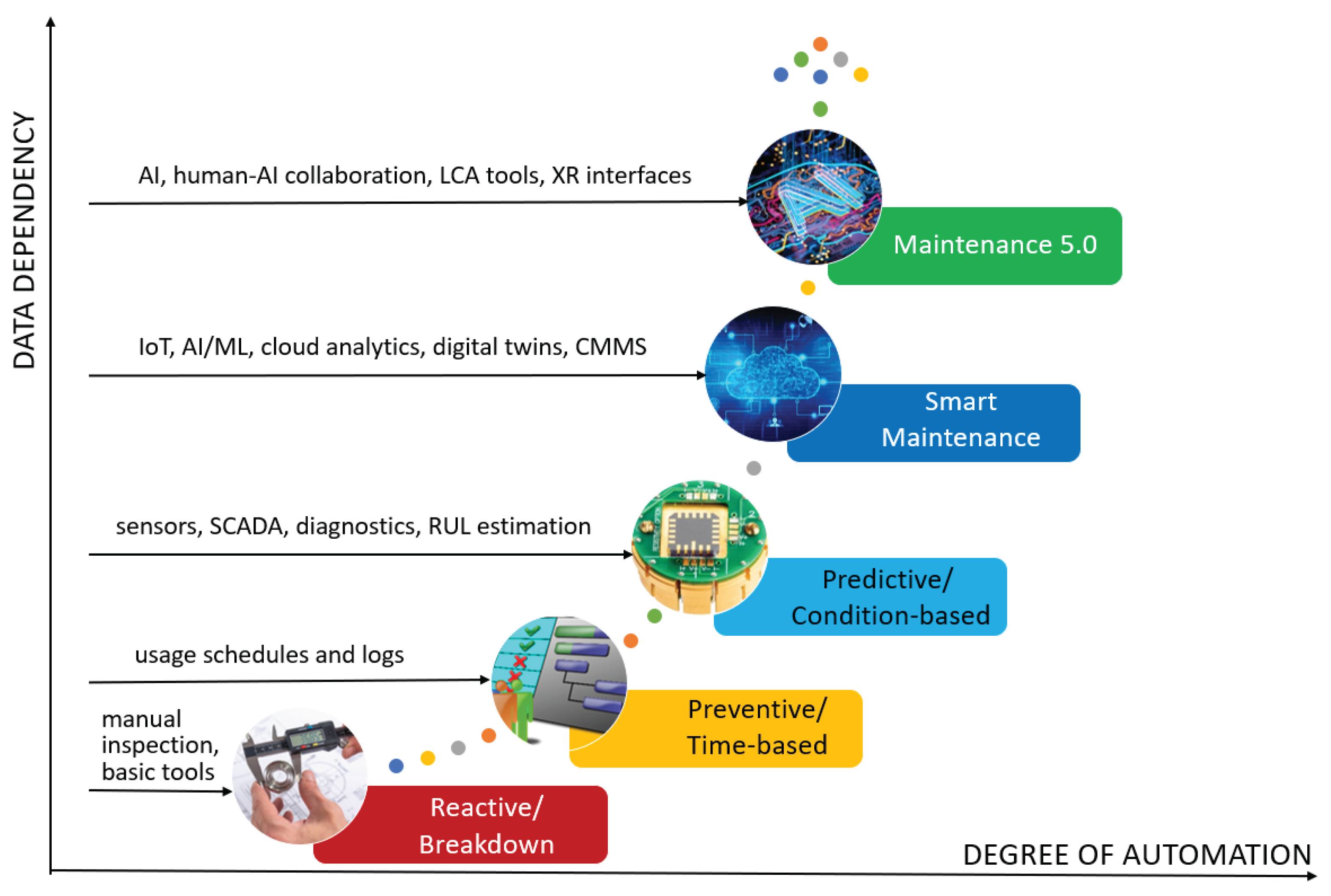

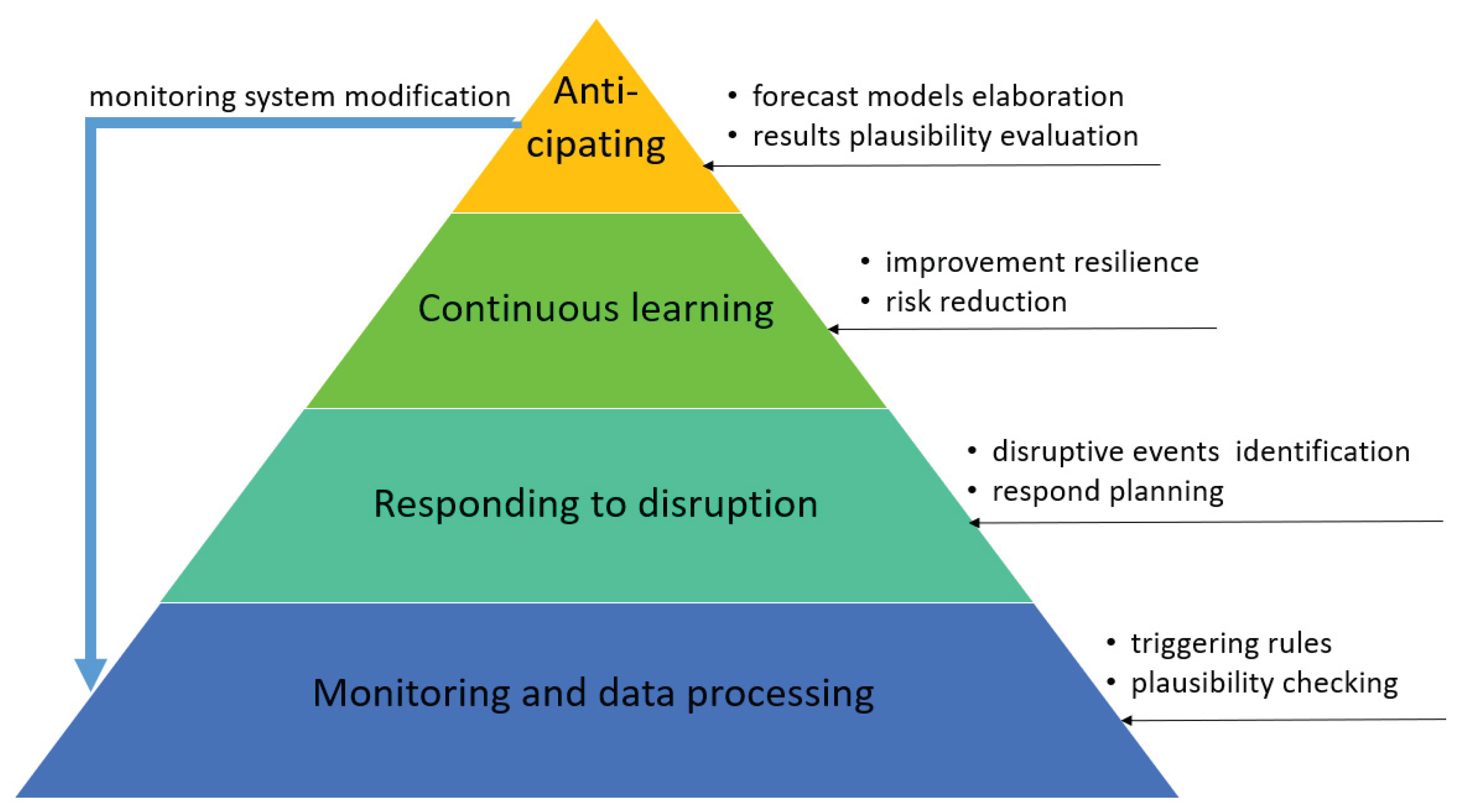
Figure 5.
Key Dimensions of Human-Centric Maintenance. Source: Own contribution based on: [13,93,94].
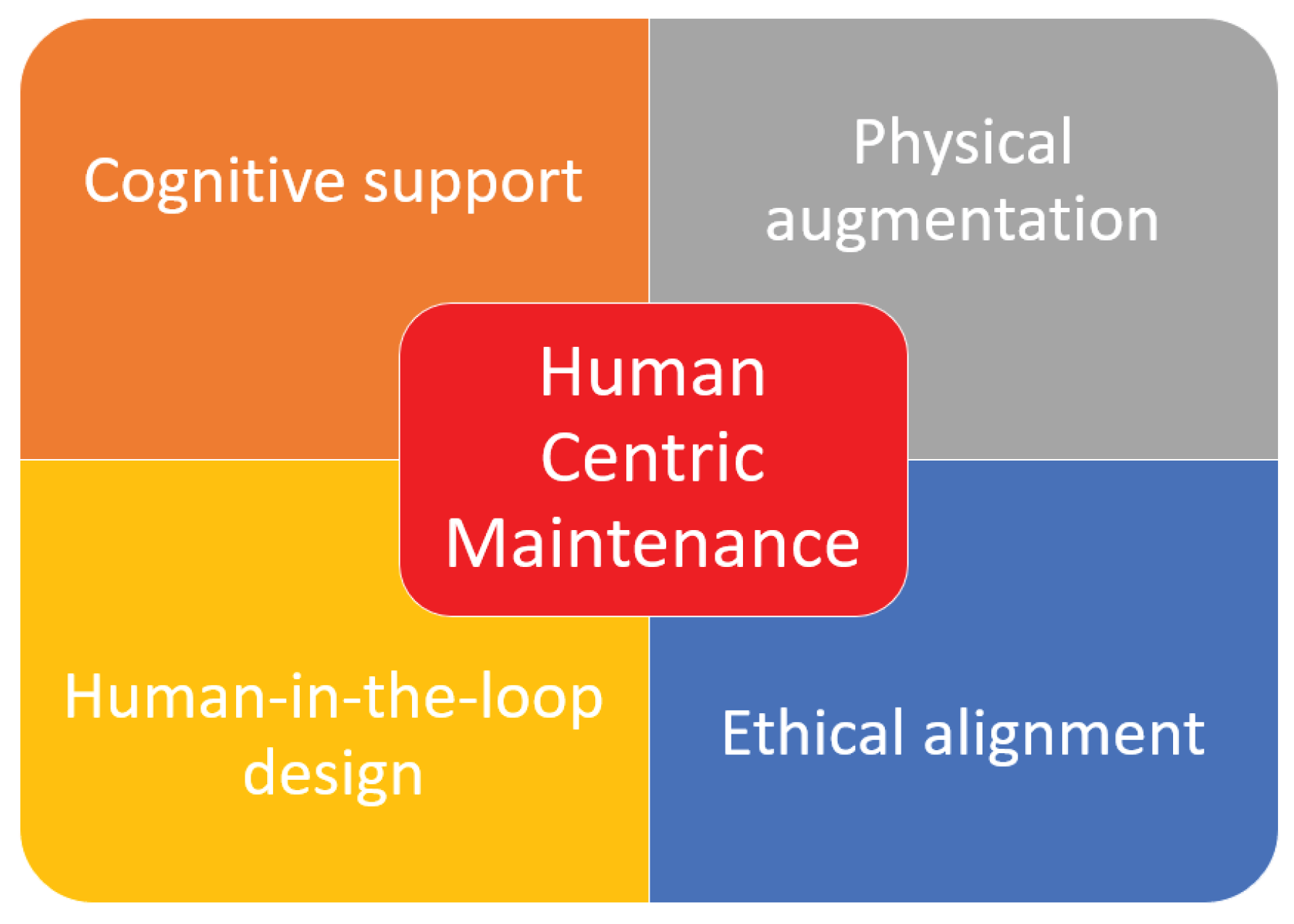
Figure 6.
Research framework and methods/tools used for systematic literature review. Source: own contribution.
Figure 6.
Research framework and methods/tools used for systematic literature review. Source: own contribution.
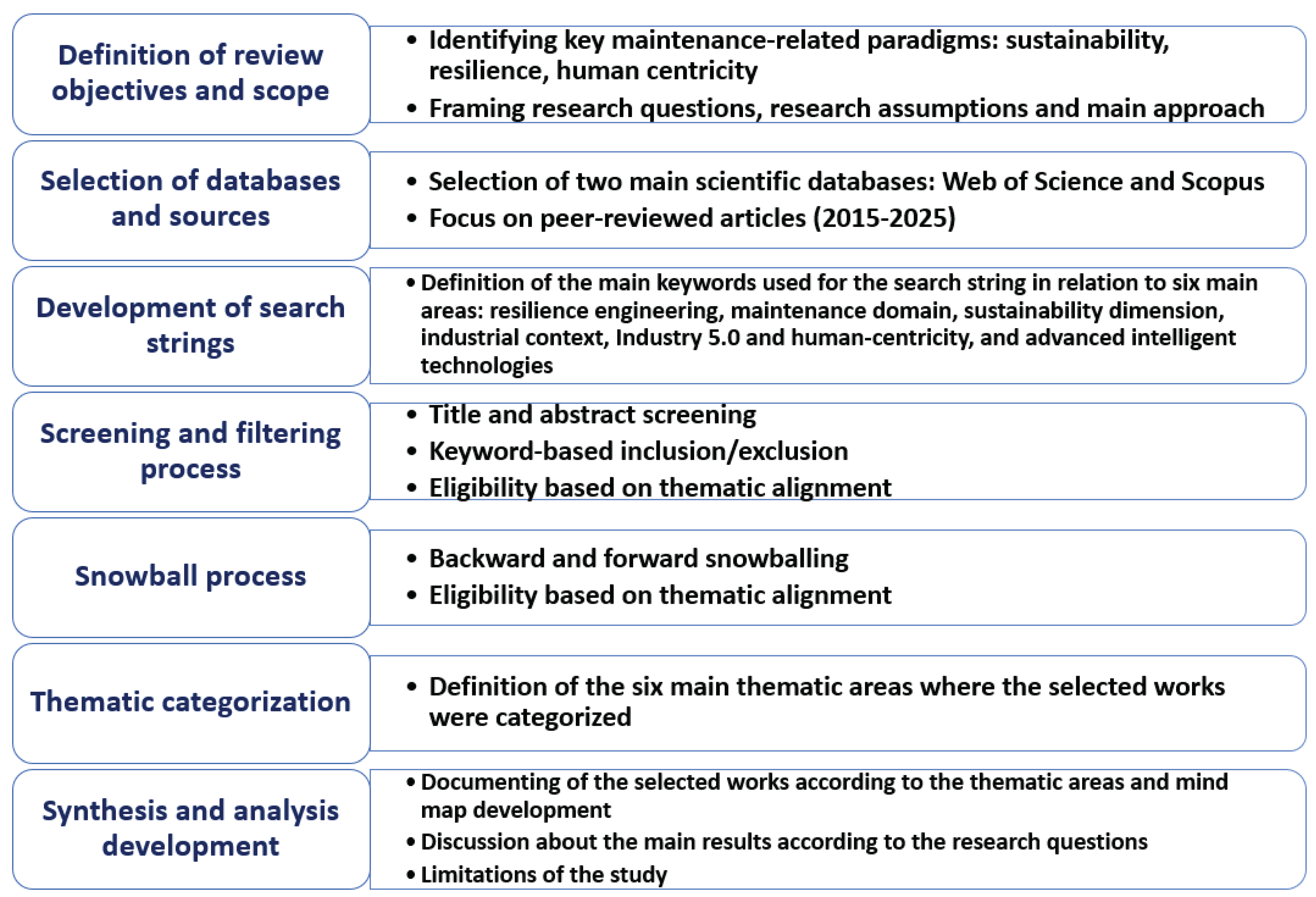
Figure 7.
PRISMA-based flowchart of systematically selecting relevant studies in the analyzed research area. Source: own contribution based on [35].
Figure 7.
PRISMA-based flowchart of systematically selecting relevant studies in the analyzed research area. Source: own contribution based on [35].
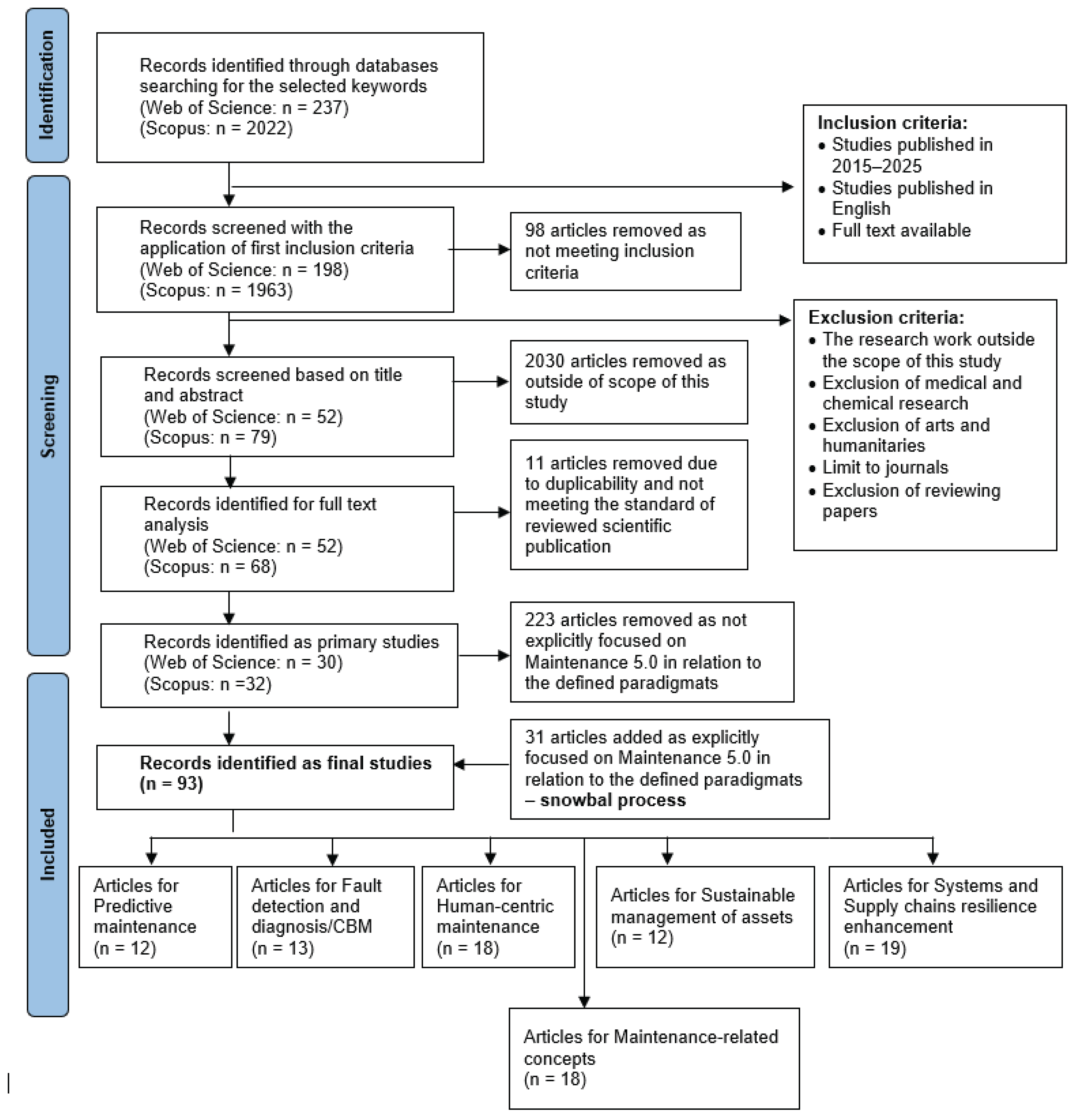
Figure 8.
Distribution of publications by year.
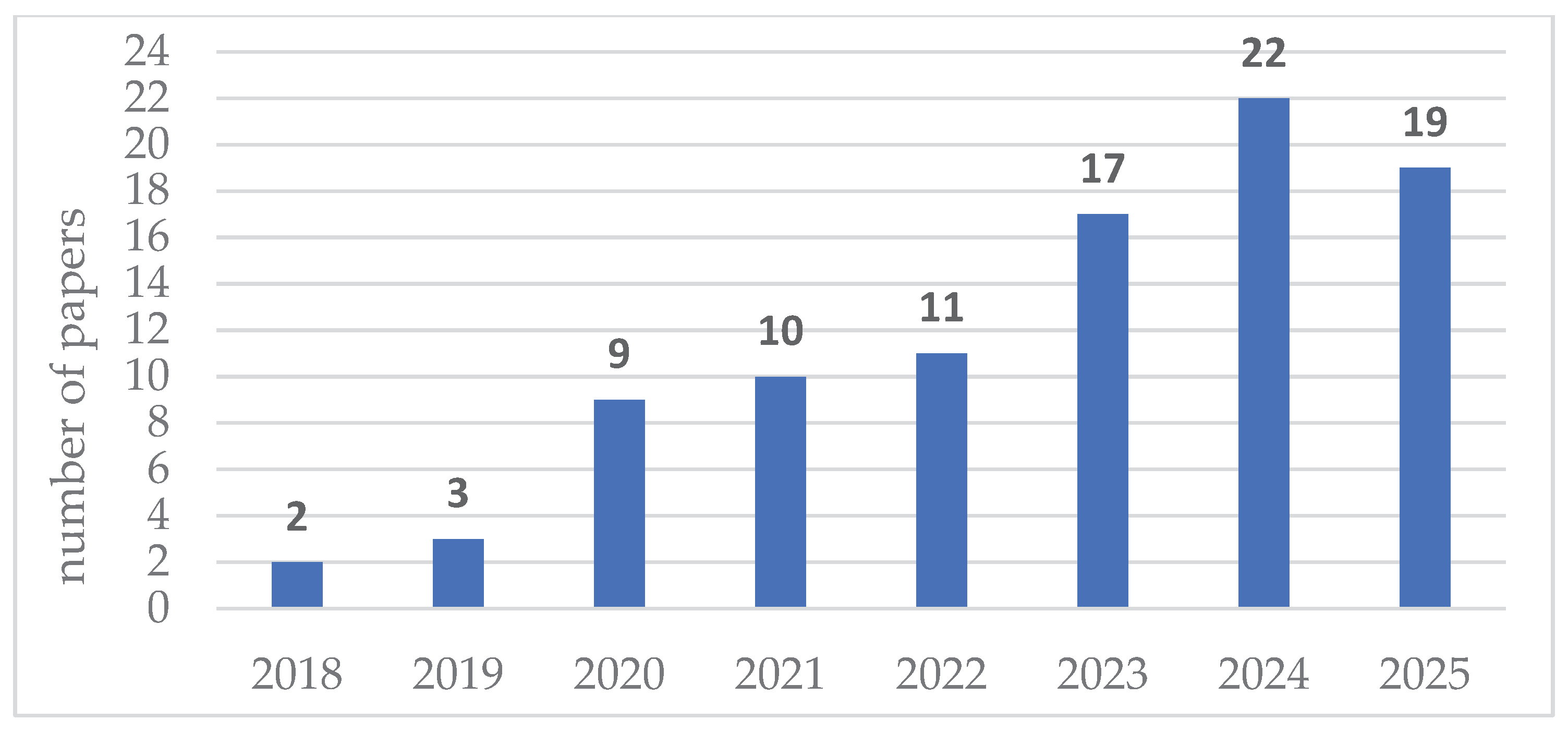
Figure 9.
Number of publications with journal sources (for journals with at least two published articles out of the 93 articles analyzed).
Figure 9.
Number of publications with journal sources (for journals with at least two published articles out of the 93 articles analyzed).
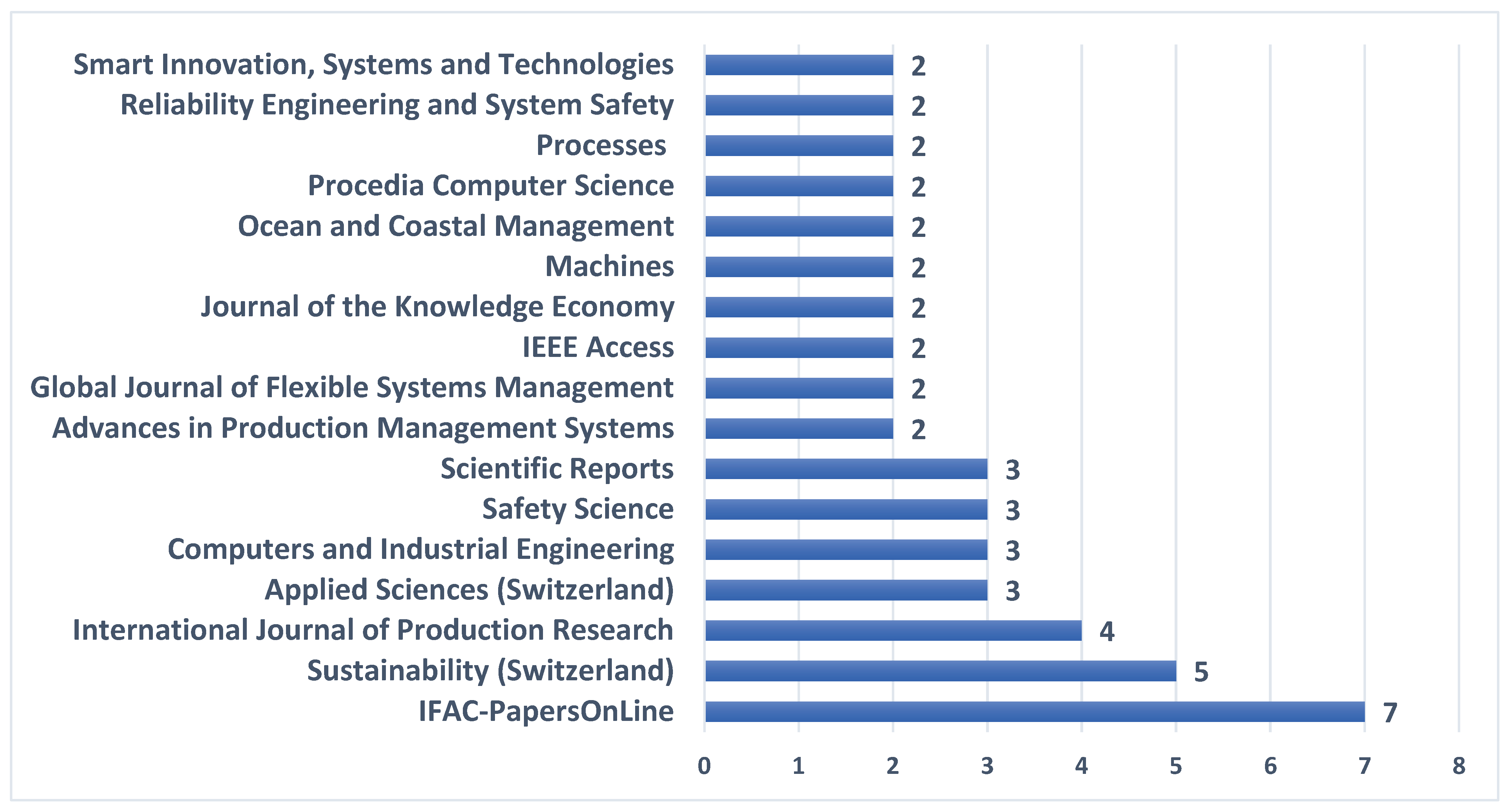
Figure 10.
The number of citations for the analyzed journals (top-cited journals from the dataset).
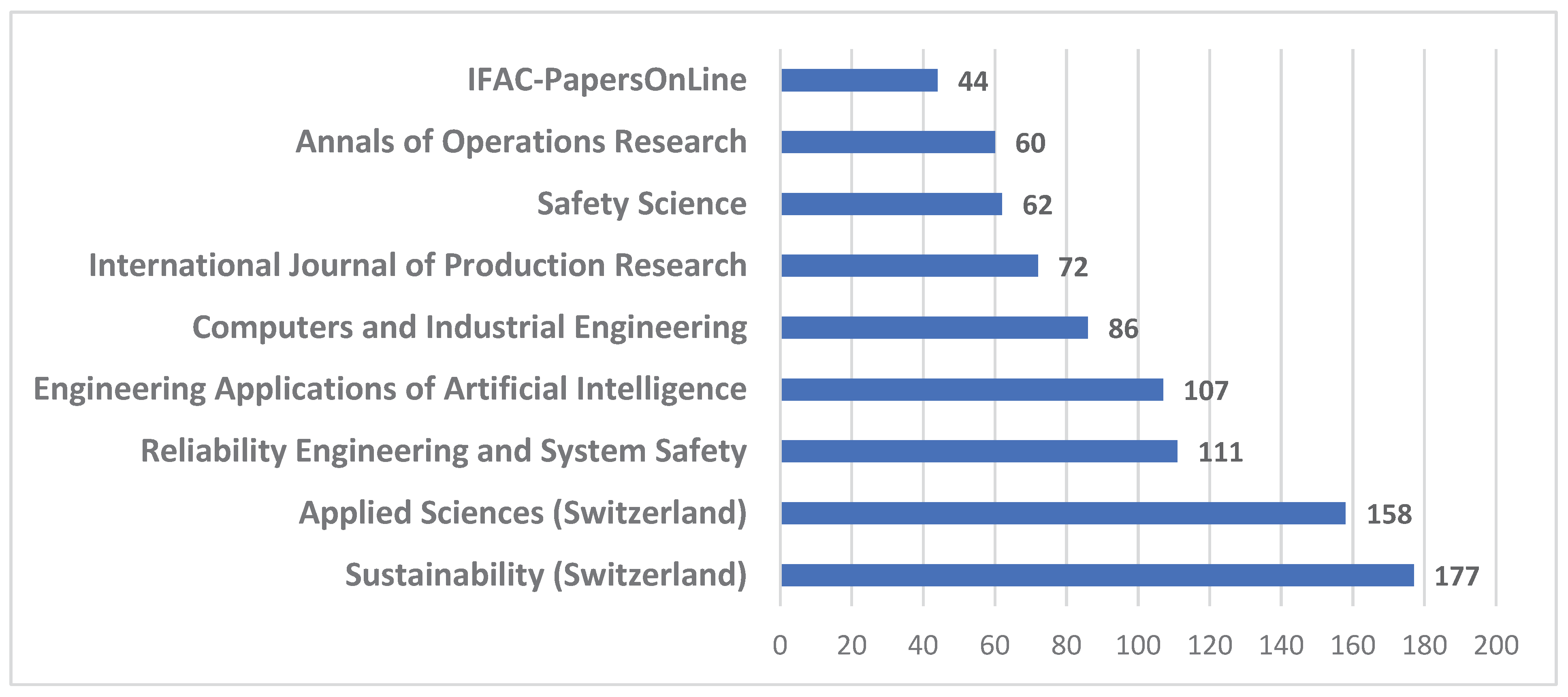
Figure 11.
The number of papers by the location where the investigated study took place.
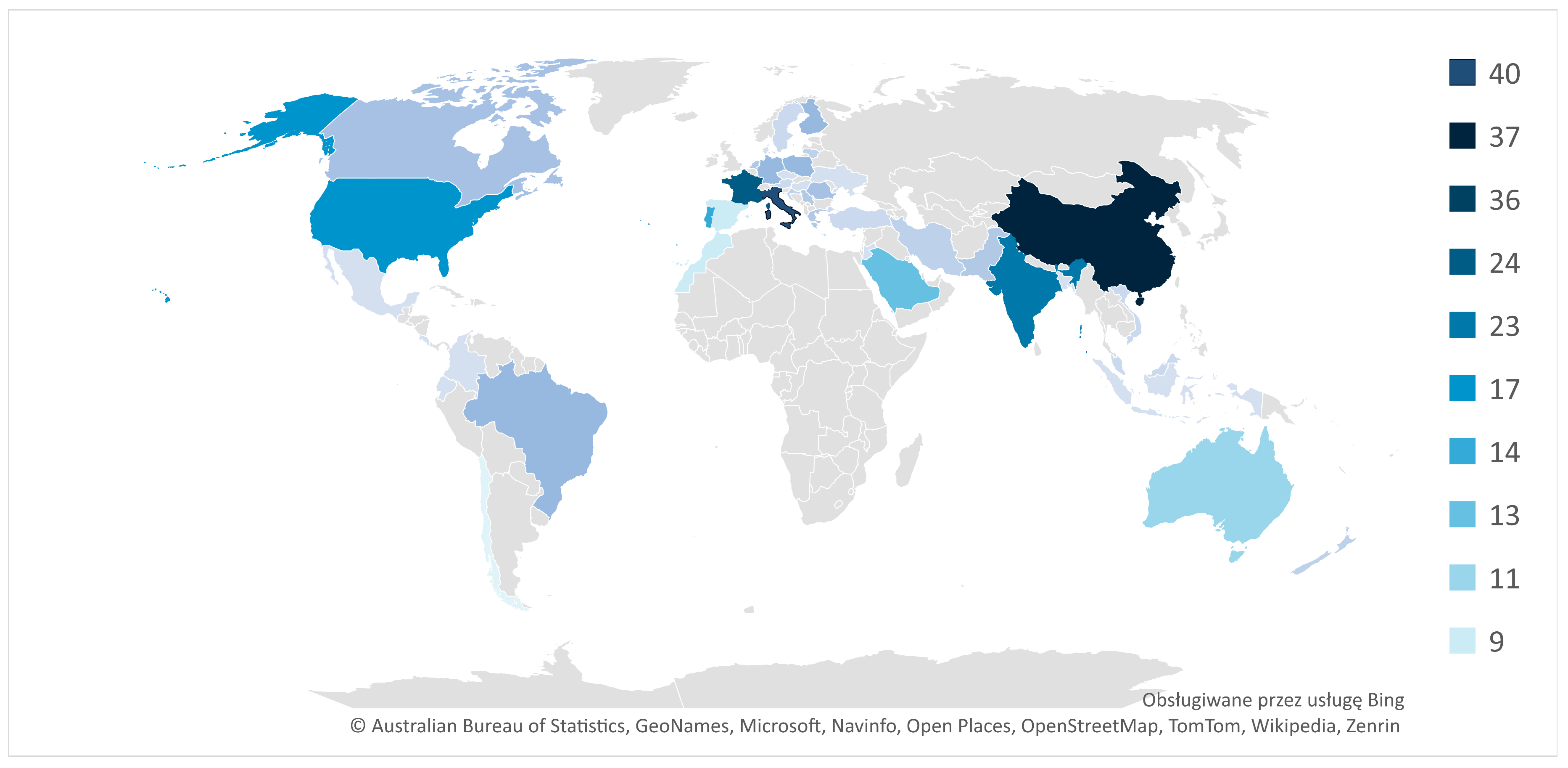
Figure 12.
Distribution of publications per number of authors.
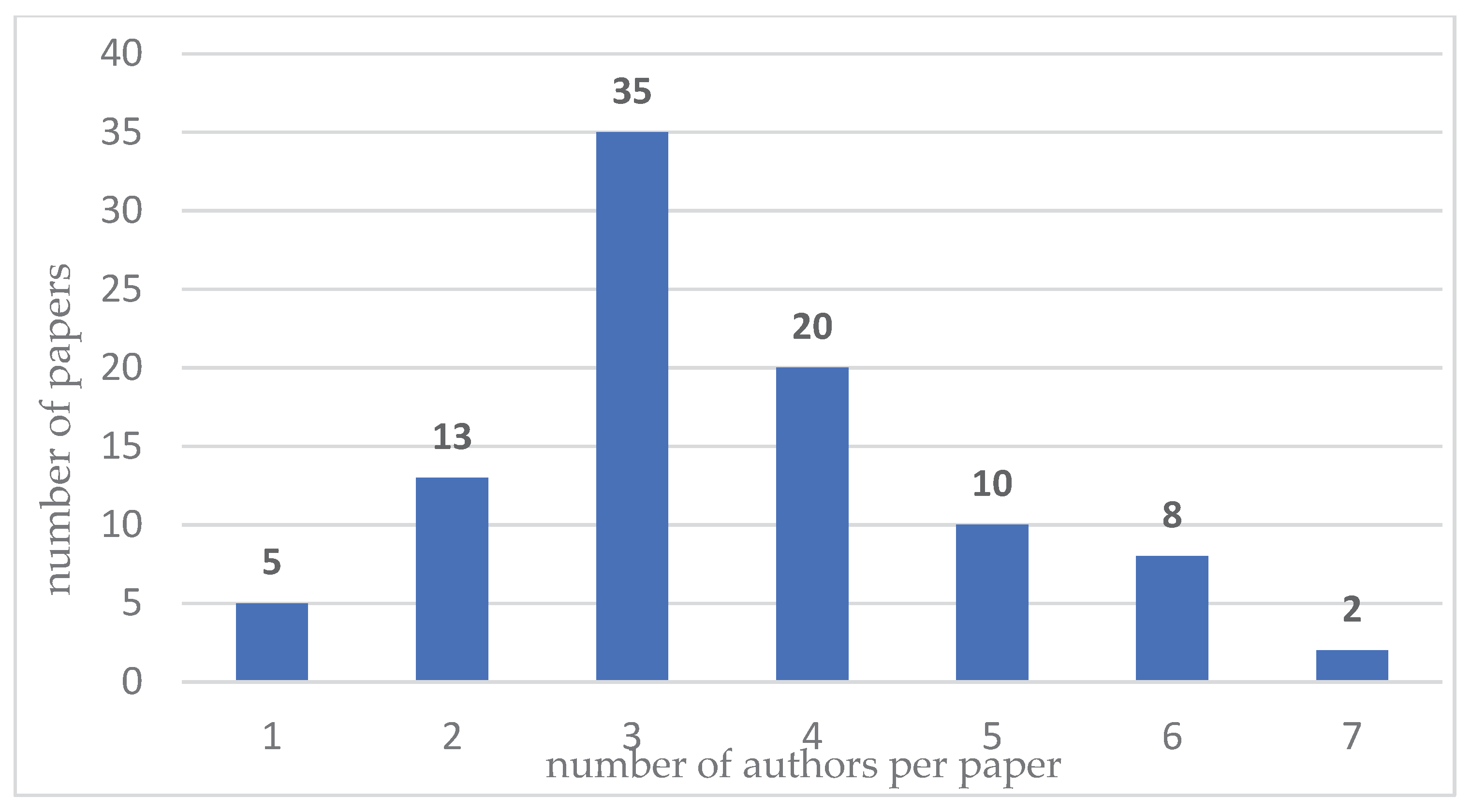
Figure 13.
The largest set of connected items based on co-authorship links. Source: own development using VOSviewer software [116].
Figure 13.
The largest set of connected items based on co-authorship links. Source: own development using VOSviewer software [116].
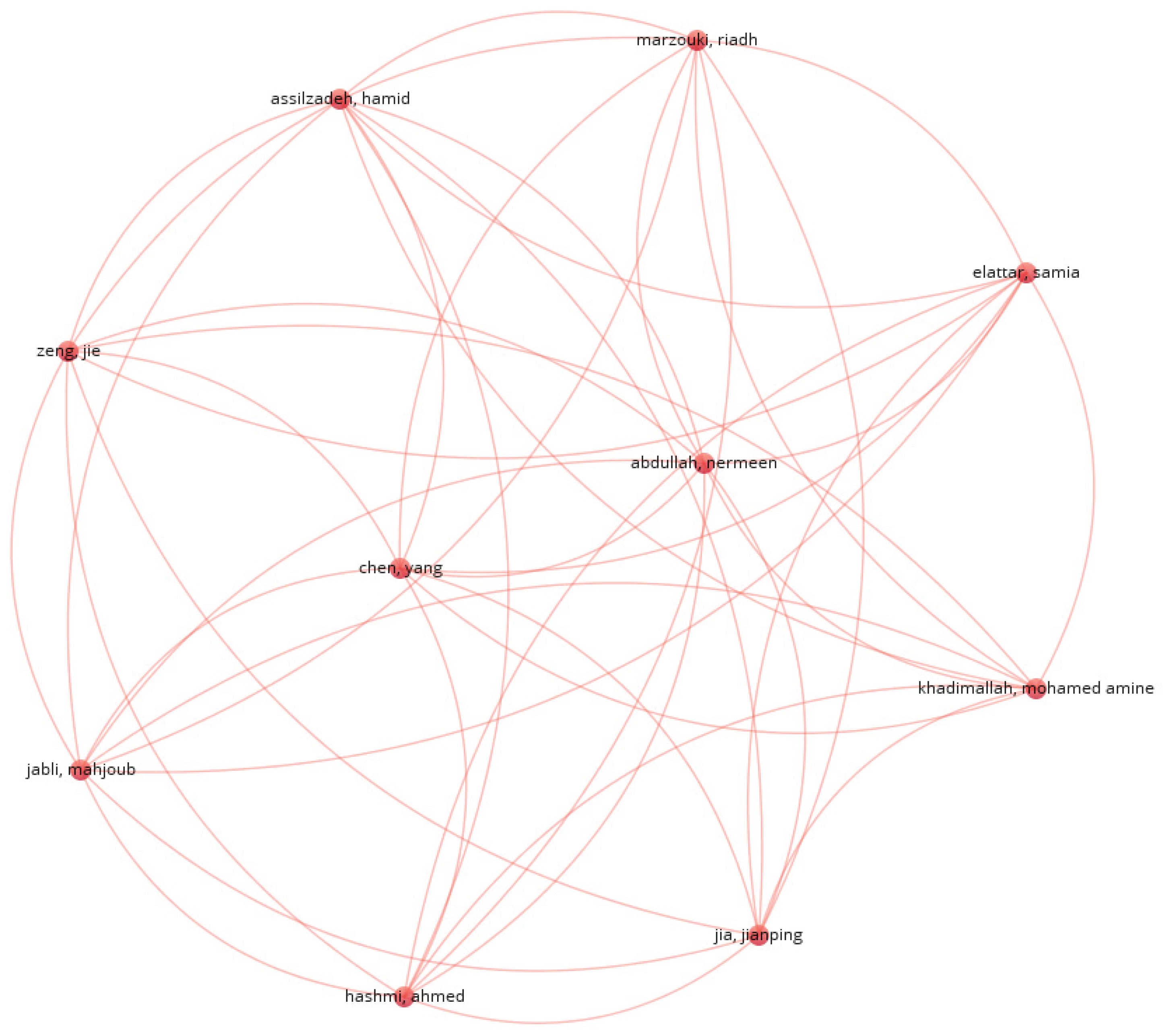
Figure 14.
Mapping of the keywords that have occurred in the selected publications at least once. Source: own development using VOSviewer software [116].
Figure 14.
Mapping of the keywords that have occurred in the selected publications at least once. Source: own development using VOSviewer software [116].
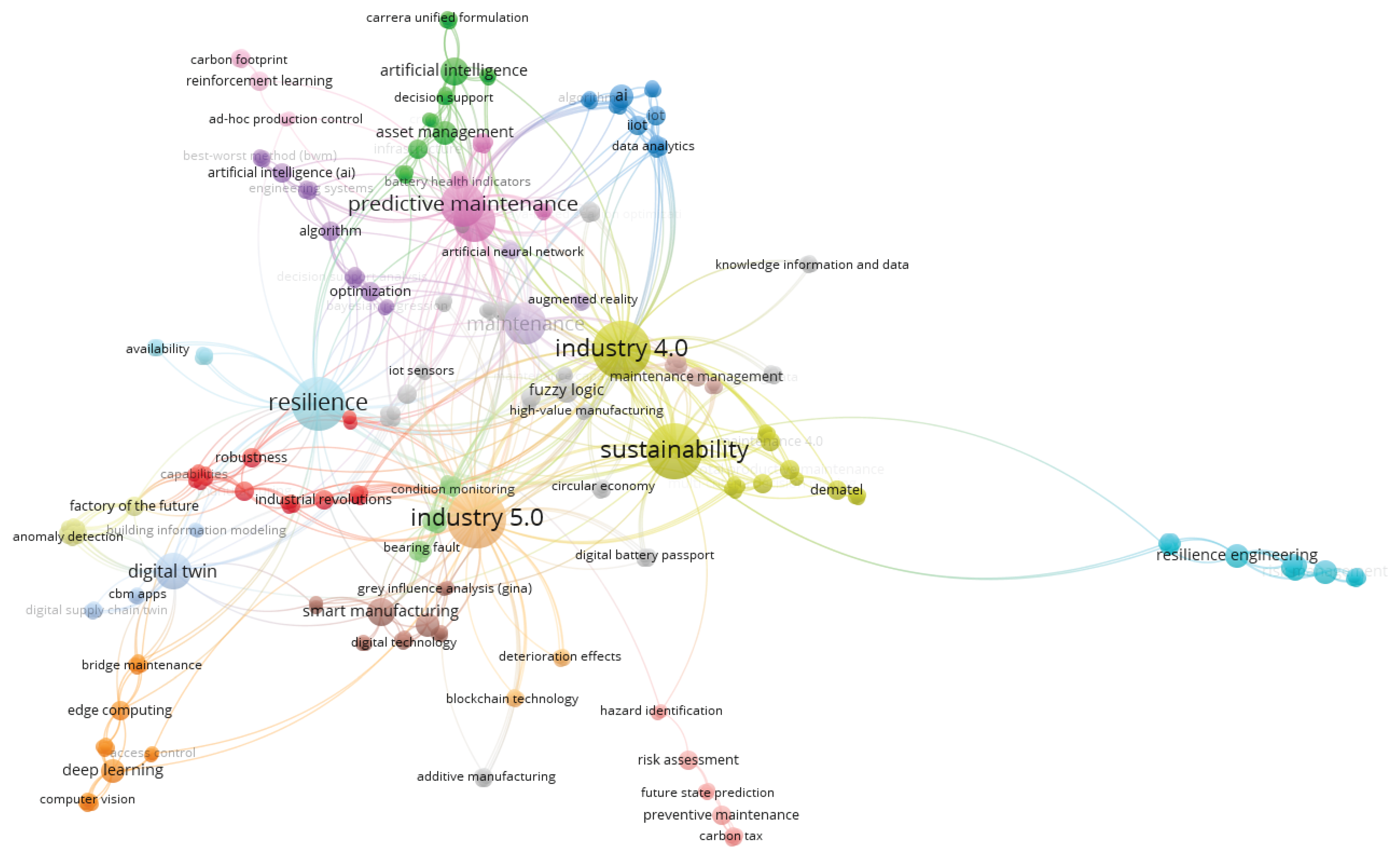
Figure 15.
Mind map presenting the six major thematic areas of Resilience-Based Maintenance (RBM) in the context of Industry 4.0 and 5.0, including key research topics and associated publications. Source: Own contribution with the use of the draw.io app.
Figure 15.
Mind map presenting the six major thematic areas of Resilience-Based Maintenance (RBM) in the context of Industry 4.0 and 5.0, including key research topics and associated publications. Source: Own contribution with the use of the draw.io app.
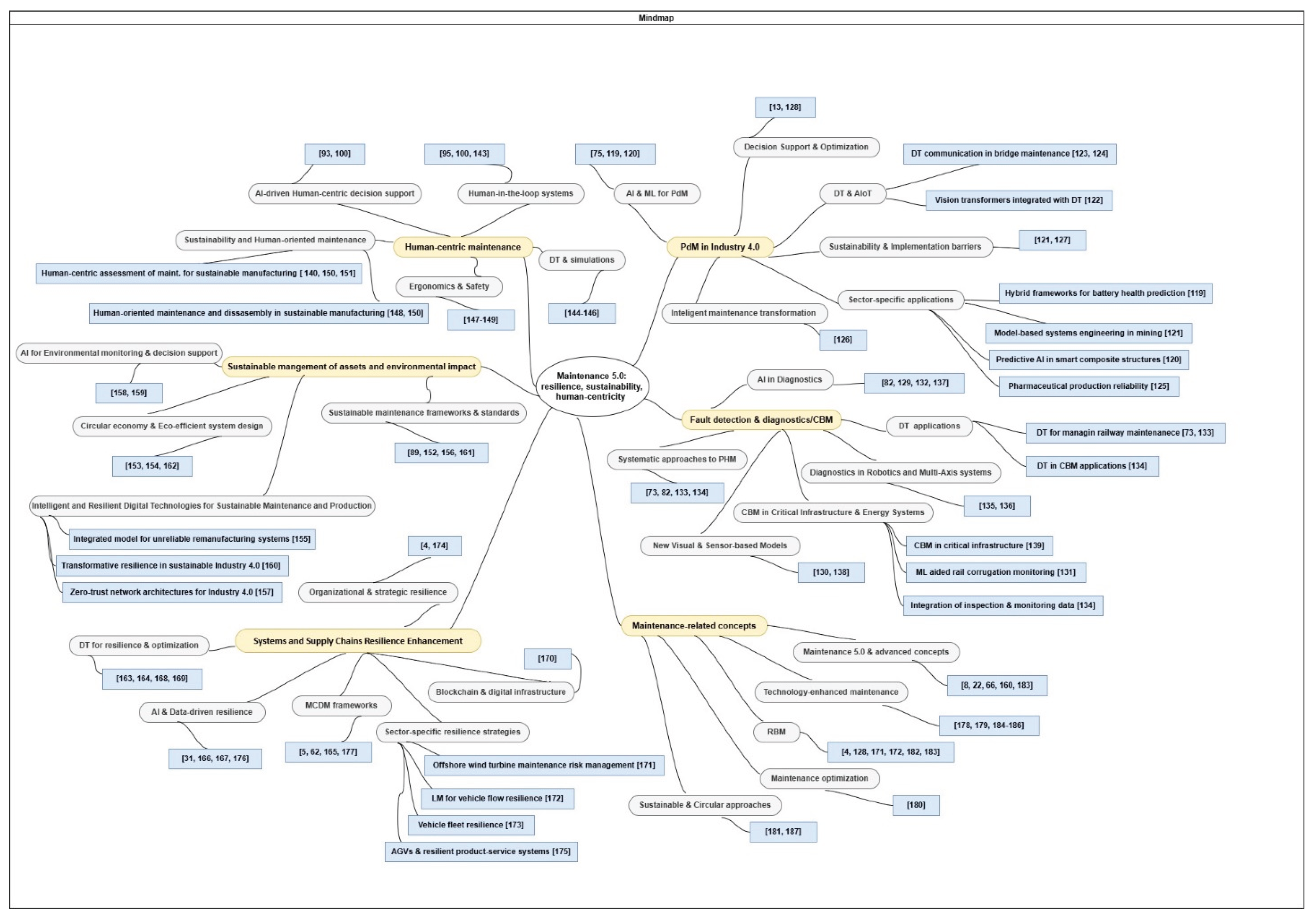
Table 1.
A summary of the recent papers focused on the literature overview on resilience-based, sustainable-based maintenance in relation to Industry 4.0/5.0.
Table 1.
A summary of the recent papers focused on the literature overview on resilience-based, sustainable-based maintenance in relation to Industry 4.0/5.0.
| Ref. | Publ. Year | Research Objectives | Maintenance focus | Scope/ Industry context | Review type | Identified Gaps |
|---|---|---|---|---|---|---|
| [25] | 2019 | To explore how Maintenance 4.0 technologies support sustainable manufacturing by enhancing equipment longevity, reducing downtime, and addressing economic, environmental, and social dimensions of value creation. | Maintenance 4.0 & Sustainability | Sustainable manufacturing | Overview review | Lack of practical tools and digital maturity models |
| [10] | 2020 | To systematically review and classify predictive maintenance initiatives in Industry 4.0, highlighting methods, standards, and challenges while proposing a novel taxonomy to guide multidisciplinary research. | Predictive maintenance methods and tools | Industry 4.0 | Systematic Literature Review | Does not address future shift toward Industry 5.0; lacks coverage of human and cyber dimensions |
| [27] | 2021 | To identify trends in sustainable manufacturing technologies through a systematic literature review and develop a conceptual research framework. | Sustainable Manufacturing | Production, eco-innovation | Systematic Review | Lack of integration of human-centric approach and workers’ experience |
| [9] | 2022 | To review and categorize intelligent predictive maintenance models and workflows in Industry 4.0 and propose a decision-support platform to enhance smart maintenance practices. | Predictive maintenance – models and technical challenges | Industry 4.0 | Systematic Literature Review | Little focus on human and sustainability dimensions; lacks Industry 5.0 alignment |
| [12] | 2022 | To conduct a systematic review of predictive maintenance challenges and propose a new classification framework, emphasizing its ongoing relevance in Industry 4.0 environments. | Predictive Maintenance | Industry 4.0, smart factories | Systematic Literature Review | Focused only on predictive maintenance in I4.0 environments |
| [1] | 2023 | To develop an integrated Maintenance 5.0 framework that bridges traditional and advanced maintenance strategies by addressing sustainability, human-centricity, and the adoption of Industry 4.0 technologies, especially in SMEs. | Transition from Maintenance 4.0 to 5.0 (human-centric, AI-driven, sustainable) | Global manufacturing, focus on SMEs and Zero-Defect Manufacturing | Systematic Literature Review | Lack of sustainability/environmental KPIs, limited integration of human factors, and missing transition paths for SMEs |
| [2] | 2023 | To systematically review and categorize key technological domains of Maintenance 4.0 - AR/VR, system architecture, data-driven decisions, Operator 4.0, and cybersecurity - to identify research trends and gaps guiding future studies. | Maintenance performance indicators in Industry 4.0 context | Broad industrial context | Bibliometric + Systematic Review | Weak mapping of human-centric aspects |
| [13] | 2023 | To investigate human, task, and organizational factors affecting Predictive Maintenancesystems’ acceptance and identify key enablers for successful PdM adoption through literature synthesis and expert interviews. | Predictive Maintenance with a human-centric approach | Human-machine collaboration in Industry 5.0 | Conceptual review with empirical elements | Need for human-behaviour integration in maintenance planning and execution |
| [26] | 2023 | To review and analyze sustainable maintenance decision-making models, focusing on integrating economic, environmental, and social dimensions, and to identify research trends, gaps, and opportunities for developing implementable, data-driven solutions. | Sustainability in Maintenance | Modeling-based academic research | Systematic Literature Review | Limited integration of sustainability indicators into maintenance decision models |
| [7] | 2024 | To develop a multi-layered framework integrating Industry 5.0 principles with predictive maintenance and condition monitoring to enhance sustainability, resilience, and human-centricity. | Predictive maintenance and condition monitoring evolution | Industry-wide + case study | Systematic Review + Case Study | Weak attention to cybersecurity |
| [20] | 2024 | To compare maintenance strategies in Industry 4.0 and Industry 5.0, evaluate their technological, procedural, and human-centric shifts, and guide industrial stakeholders in adapting maintenance approaches for enhanced resilience and competitiveness. | Comparative: I4.0 vs I5.0 Maintenance | Industrial evolution toward human-centric and sustainable systems | Comparative Review | Lack of clear transition models, human-role redefinition, and socio-technical frameworks |
| [3] | 2025 | To review the evolution from Maintenance 4.0 to 5.0 by analyzing sustainability integration and human-centric challenges in the transition framework. | Shift toward Maintenance 5.0, human and sustainability dimensions | Cross-industry, Industry 5.0 | Systematic Literature Review | Lack of integration of social and human dimensions; limited guidance for technological-human convergence |
| Feature / Strategy | Reliability-Centered Maintenance (RCM) | Predictive Maintenance (PdM) | Resilience-Based Maintenance (RBM) |
|---|---|---|---|
| Primary Objective | Failure prevention | Failure prediction | System adaptability and recovery |
| Analytical Focus | Failure modes and criticality | Degradation patterns, sensor data | System behavior under uncertainty |
| Risk Consideration | Known risks | Partially known (data-driven) risks | Known + unknown risks |
| Data Usage | Historical data, expert judgment | Real-time condition monitoring | Multi-source data, simulation, feedback |
| Role of AI | Limited (e.g., FMEA support) | Prognostics, ML-based diagnostics | RL, Digital Twins, Knowledge Graphs |
| Human-Centric Integration | Minimal | Limited | Strong (decision support, cognitive AI) |
| Reaction to Unexpected Events | Low | Moderate | High (adaptive, learning-based) |
| Maintenance Action Type | Prescriptive | Predictive | Adaptive and Resilient |
Table 5.
Comparative overview of traditional, smart, and sustainable maintenance approaches. Source: Own contribution based on [77,78,88].
| Aspect | Traditional Maintenance | Smart Maintenance (4.0) | Sustainable Maintenance (5.0) |
|---|---|---|---|
| Paradigm | Reactive/Preventive | Predictive/Prescriptive | Human-centric, sustainable, and resilient |
| Primary Goal | Restore function | Optimize asset performance | Balance performance with sustainability and social impact |
| Decision-making | Human-driven, rule-based | Data-driven, algorithm-based | Context-aware, value-based, collaborative |
| Technology Enablers | Basic sensors, manual tools | IoT, AI, Digital Twins, AR | Integrated CPS, green analytics, worker-assistive tech |
| Data Usage | Limited or non-existent | Extensive, real-time | Real-time + LCA metrics, social impact data |
| Environmental Focus | Minimal | Efficiency-oriented | Lifecycle optimization, emission minimization |
| Economic Perspective | Short-term cost reduction | Asset efficiency, reduced downtime | Lifecycle cost optimization and circular economy |
| Social Considerations | Low (focus on output) | Medium (operator efficiency) | High (safety, training, inclusion, job satisfaction) |
| Resilience Integration | Absent | Indirect (redundancy, alerts) | Direct (resilience engineering, adaptability, human-in-the-loop) |
| Role of Human | Executor | Supervisor/Monitor | Partner/Collaborator in hybrid systems |
Table 5.
Human-Centric Elements in Maintenance Technologies. Source: Own contribution based on [13,92,95].
| Technology | Human-Centric Element | Example Application |
|---|---|---|
| AR-based Diagnostics | Reduced cognitive load | Step-by-step AR-guided pump inspection |
| AI Decision Support | Explainability, confidence rating | Predictive maintenance with user validation |
| Digital Twin | Visual feedback, intuitive interaction | Operator-controlled system simulations |
| Exoskeletons/Cobots | Physical support and safety | Assisting in heavy part replacement tasks |
| VR-based Training | Skill development and scenario rehearsal | Emergency repair simulations for new workers |
Table 6.
Human-Centricity across Maintenance Generations (1.0–5.0). Source: Own contribution based on: [2,104].
| Aspect | Maintenance 1.0 | Maintenance 2.0 | Maintenance 3.0 | Maintenance 4.0 | Maintenance 5.0 |
|---|---|---|---|---|---|
| Operator Role | Manual execution of repairs | Schedule-based execution, low autonomy | Increasing involvement in diagnostics, still reactive | Role shifts toward data interpretation and system oversight | Active co-decision-maker; empowered, context-aware, and ergonomically supported |
| Decision-Making Model | Fully manual decisions post-failure | Based on rules and fixed intervals | Data-informed decisions with human supervision | AI-supported decisions with limited human feedback | Human-in-the-loop and human-on-the-loop frameworks fully integrated |
| Human-Technology Interaction | Tools only, no digital interface | Paper-based logs, basic CMMS | Use of sensors and dashboards | IoT interfaces, AR/VR systems, mobile apps | Seamless and personalized interfaces (wearables, XR, cognitive support) |
| Safety and Ergonomics | Minimal, reactive | Basic compliance-based ergonomics | Condition monitoring supports safety | Real-time alerts, digital twins for safe task execution | Proactive ergonomics, well-being analytics, worker co-designed systems |
| Learning and Skills Development | Learning through experience, manuals | Structured training programs | Training in digital tools, early simulations | Digital learning platforms, AR-based instruction | Continuous, AI-driven upskilling; personalized and inclusive learning pathways |
| Ethics and Inclusion | Not considered | Rarely addressed | Initial considerations in system design | Inclusion as a feature in HMI design | Core principle: equity, transparency, inclusion, and ethics embedded from design to operation |
Table 7.
AI techniques applied in Resilience-Based Maintenance (RBM).
| AI Technique | Application in RBM | Benefits in RBM | Example Studies |
|---|---|---|---|
| Machine Learning (ML) | Predictive modeling of failures; estimation of Remaining Useful Life (RUL) | Improves failure anticipation; supports dynamic maintenance planning | [119,153,158,180] |
| Deep Learning (DL) | Fault detection in complex systems; diagnostics based on image/signal data | High accuracy in anomaly detection; effective in unstructured data environments | [137,138,142] |
| Reinforcement Learning (RL) | Adaptive maintenance scheduling; autonomous decision-making in uncertain conditions | Enables learning-based optimization; adapts to changing operational contexts | [134,142,179] |
| Fuzzy Logic | Modeling expert knowledge; decision-making under uncertainty | Captures imprecise criteria; facilitates resilience modeling with linguistic variables | [4,5,66] |
| Hybrid Models (e.g., ML + Fuzzy + RL) | Robust diagnostics; multi-objective maintenance optimization | Combines interpretability and adaptability; enhances model performance in uncertain settings | [66,129,134,180] |
| Explainable AI (XAI) | Transparent support for maintenance decisions; human-centric diagnostics | Enhances trust; enables operator involvement; supports regulatory requirements | [93,100] |
| Genetic Algorithms/ Evolutionary Methods | Optimization of maintenance scheduling and resource allocation | Efficient in complex search spaces; supports multi-criteria resilience planning | [62,129] |
| Computer Vision/ CNNs | Visual inspection of assets; ergonomic and defect detection | Enables non-invasive diagnostics; enhances safety and reliability assessment | [130,138,147,148] |
| Digital Twins (DTs) + AI | Predictive simulation; dynamic decision-making and system modeling | Supports resilience scenarios; integrates real-time data for continuous system awareness | [122,123,125,144,164,168] |
| AIoT (AI + Internet of Things) | Autonomous diagnostics; condition monitoring in cyber-physical systems | Real-time data-driven insights; improves responsiveness and situational awareness | [124,158,176] |
Disclaimer/Publisher’s Note: The statements, opinions and data contained in all publications are solely those of the individual author(s) and contributor(s) and not of MDPI and/or the editor(s). MDPI and/or the editor(s) disclaim responsibility for any injury to people or property resulting from any ideas, methods, instructions or products referred to in the content. |
© 2025 by the authors. Licensee MDPI, Basel, Switzerland. This article is an open access article distributed under the terms and conditions of the Creative Commons Attribution (CC BY) license (http://creativecommons.org/licenses/by/4.0/).
Copyright: This open access article is published under a Creative Commons CC BY 4.0 license, which permit the free download, distribution, and reuse, provided that the author and preprint are cited in any reuse.


