

Submitted:
02 July 2025
Posted:
04 July 2025
You are already at the latest version
Preprints on COVID-19 and SARS-CoV-2
Abstract
This study aims to reveal how ecotourists’ general perceptions, concerns, and intentions to act regarding climate change have been shaped in the context of their personality domains following the COVID-19 pandemic. Data were collected from 409 participants who took part in nature walking activities in Turkey in 2024 using a survey method. The data were analyzed using quantitative methods such as structural equation modeling (SEM) and multiple regression analyses. The findings reveal statistically significant relationships between ecotourists’ personality domains (Extraversion, Agreeableness, Conscientiousness, Emotional Stability, and Openness to Experience) and their perceptions of climate change, concerns, intentions to act, and ecotourism intentions. The results reveal that attitudes toward climate change have become more pronounced, especially in the post-pandemic period, and that personality domains are a strong determinant in shaping these attitudes. This study is important for the development of sustainable tourism policies and for providing strategic recommendations to managers in the field of ecotourism.
Keywords:
ecotourism
; climate change
; personality domains
; COVID-19
; sustainability
1. Introduction
The literature on climate change and tourism is growing rapidly as scientific understanding and societal responses to the climate crisis evolve [1]. While early studies focused directly on the effects of climate on tourism, recent years have seen an increase in research on topics such as changes in tourist behavior and demand responses [2]. However, studies that comprehensively address climate change in the context of ecotourism remain limited [3]. Despite the increased importance of studies addressing two current issues (climate change and pandemics) following a paradigm-shifting development such as the COVID-19 pandemic, and the presentation of different approaches [4], it is observed that the examination of these two phenomena from an ecotourism perspective remains limited.
At the same time, although ecotourism is a type of tourism that is gaining more attention, studies examining the effect of personality domains on these behaviors are also quite limited [5]. On the other hand, personality domains are among the fundamental factors influencing tourists’ decision-making processes [6]. Atzeni and colleagues [3] examined the effects of variables such as ecotourists’ environmental values, materialism, and climate change perceptions on ecotourism intention in their study; however, they emphasized that psychographic structures such as personality domains should be addressed in future research. The same study noted that the pandemic created a breaking point that triggered value transformations in individuals, leading to more environmentally friendly, sustainability-oriented, and ecotourism-oriented tendencies in tourist behavior. However, it was noted that, despite the frequent emphasis of these theoretical assumptions in literature, the extent to which these assumptions were reflected in attitudes and behaviors in the context of ecotourism in the post-pandemic period has not yet been sufficiently investigated empirically.
In this study, in response to the aforementioned call, the relationships between the big-five personality domains and the general perceptions, concerns, intentions to act to cope with climate change, and ecotourism intentions are tested through SEM, thereby contributing to the literature in both theoretical and practical terms.
2. Literature Review
In the literature review section of this study, relevant studies were examined under the headings of the relationship between ecotourism and climate change, environmental attitudes and behaviors in the context of the Big-Five Personality Domains, the impact of the COVID-19 pandemic on environmental attitudes.
2.1. Ecotourism and Climate Change
Climate change is emerging as a multifaceted threat with environmental, economic, social, and psychological dimensions that are increasingly affecting the global scale [7]. Climate change, which gained international legal status with the United Nations Framework Convention on Climate Change (UNFCCC) in the early 1990s, is defined as follows [8]: “Climate change means a change of climate which is attributed directly or indirectly to human activity that alters the composition of the global atmosphere and which is in addition to natural climate variability observed over comparable time periods.” In recent years, due to its increasing impact, the Paris Agreement, which emerged as part of the joint fight against climate change, was adopted in 2015 with the participation of 196 countries and is the first comprehensive climate agreement with legal binding force at the global level. It aims to transition to clean energy, move towards low-carbon economies, and build a climate-resilient and socially just future in line with the 2030 Sustainable Development Goals [9]. In this context, the Paris Agreement and similar global mechanisms clearly reveal the multidimensional nature of the climate crisis, which threatens the common future of humanity [10]. Lastly, The Glasgow Declaration on Climate Action in Tourism [11], the first tourism-focused climate declaration aligned with the Paris Agreement, urges all tourism stakeholders to cut emissions by 50% by 2030 and achieve Net Zero as early as possible before 2050, aligning climate action plans with five strategic pathways: measurement, decarbonization, regeneration, collaboration, and finance.
Tourism, one of the world’s fastest growing industries, is highly sensitive to climate change due to its close relationship with the environment and climate [2]. Climate change and extreme weather events are having significant impacts on tourism destinations, events, businesses, and tourist behavior, and will continue to be a critical factor directly affecting the attractiveness, accessibility, and sustainability of tourism destinations in the future [12]. This is because tourism is highly dependent on climatic and natural resources and is severely affected by climate change [13]. Therefore, understanding tourists’ perceptions and responses to the effects of climate change is critical for anticipating spatial and seasonal changes in tourism demand, as well as transformations in specific tourism markets and the competitive strength of destinations and businesses [14].
Climate change is significantly affecting the tourism sector on a global scale; at the same time, tourism-related greenhouse gas emissions are accelerating this process [15]. Climate plays a decisive role in a wide range of factors, from the physical environment of the area where tourism takes place to the timing of activities, transportation and infrastructure conditions to tourists’ psychological and physiological responses, and these elements also play a central role in tourism planning by influencing critical factors such as tourist satisfaction, health, safety, and destination choice [16]. Tourism is largely dependent on climatic and natural resources [17]. On the other hand, the tourism sector is both a contributor to climate change and a sector that is seriously affected by it [18]. It is anticipated that tourists are likely to change their destinations due to the emergence of climate risks, and that potential environmental damage will significantly reduce the preference for vacationing in affected destinations [4].
Climate change affects ecosystems at various levels and environmental threats such as biodiversity loss, water scarcity, and ecosystem degradation threaten the future of ecology-based ecotourism [19]. Ecotourism is a small-scale alternative form of tourism that offers nature-based experiences, promotes education and awareness, and whose most important component is sustainable tourism [20,21,22]. A detailed definition of ecotourism is as follows [23] (p. 197): “an activity where the authorities, the tourism industry, tourists, and local people cooperate to make it possible for tourists to travel to genuine areas in order to admire, study, and enjoy nature and culture in a way that does not exploit the resource but contributes to sustainable development.” According to Scheyvens’ [24] (p. 247) empowerment framework, a successful ecotourism application not only provides material income to local communities; it also supports psychological empowerment by increasing respect for individuals’ cultural identities, enhances social cohesion by fostering intra-community solidarity and a sense of common benefit, and encourages political participation by enabling the active involvement of local communities in decision-making processes. When these dimensions are considered together, ecotourism emerges as a comprehensive tool for development and sustainability at both the individual and social levels.
2.2. Big-Five Personality Domains and Environmental Concerns and Attitudes
The importance of personality domains in explaining environmentally friendly attitudes and behaviors at the individual level has been emphasized in many studies in the literature, and the Big-Five Personality Domains Model provides a frequently used theoretical framework in this context [25]. Additionally, this model demonstrates cross-cultural validity in understanding the behavioral manifestations of personality domains, offering a universal structural foundation [26]. Comprising five core dimensions—Extraversion, Agreeableness, Conscientiousness, Neuroticism (Emotional Stability), and Openness—this model systematically classifies personality differences [27] (p. 85). Short scales used to measure personality domains (e.g., Ten-Item Personality Inventory-TIPI) are effective tools, particularly in field research where time constraints are a factor. Gosling, Rentfrow, and Swann Jr. [28] demonstrated that the Big-Five dimensions can be measured validly and reliably using 10-item short forms. In particular, TIPI and similar short scales can be effectively used in multivariate models and large-scale studies, establishing meaningful relationships with external variables such as environmental attitudes [28].
The first study to test pre-pandemic ecotourism behaviors (i.e., environmentally responsible actions taken by tourists during travel), Kvasova’s study [29], which is considered the first to test these behaviors using the Big-Five personality domains, found that the personality dimensions of Extraversion, Agreeableness, Conscientiousness, and Neuroticism have significant effects on eco-friendly tourist behaviors. In particular, Agreeableness emerged as the strongest determinant, while openness to experience, contrary to expectations, did not show a significant relationship. This finding demonstrates that personality domains influence environmental behavior in the context of tourist experiences and highlights the importance of designing ecotourism policies that take individual differences into account.
Environmental concern, which includes climate change, expresses an individual’s awareness and sensitivity toward environmental protection and is meaningfully and positively related to ecotourism intentions [30] (p. 1144). It has been determined that individuals with strong environmental concerns reflect these values in their purchasing decisions and are more inclined to choose products with environmental labels [31]. In this context, tourists who are concerned about environmental protection, climate change, and environmental impacts are more likely to be interested in a destination with local cultural and environmental sensitivity. Therefore, they have higher intentions to experience ecotourism and revisit [32] (p. 1867).
In the literature, the Big-Five Personality Domains are seen to provide an important framework for understanding environmental concerns. It is known that personality domains have a positive and significant effect on environmental concern [33]. Hirsh’s study [34] revealed that the domains most strongly associated with environmental concern within the Big-Five Personality Domains Model are Agreeableness and Openness to Experience; these individuals are empathetic, open to new experiences, and sensitive to environmental values. Additionally, it has been determined that individuals with high levels of Conscientiousness adhere more to environmentally friendly norms, while those with high levels of Neuroticism develop greater anxiety toward environmental threats. On the other hand, no significant relationship was found between Extraversion and environmental attitudes. In the context of climate change, the Openness to Experience dimension among the Big-Five Personality Domains shows the strongest relationship with positive attitudes toward climate change. It has been found that individuals with high levels of Openness are more likely to engage in environmentally friendly behaviors [35].
Research on the psychological determinants of environmental attitudes and sustainable behaviors has revealed that individuals’ personality domains play an important role in these processes. Among these personality domains, Agreeableness, Conscientiousness, and Openness to Experience have been found to be particularly significant. Milfont and Sibley [36] have demonstrated that the domain of agreeableness is one of the strongest psychological determinants of environmental sensitivity, primarily through empathy, helpfulness, and a focus on social benefit. Conscientiousness is a personality domain that emphasizes environmental responsibility behaviors in the context of long-term planning, self-discipline, and conformity to social norms. Openness to experience establishes a link among environmental awareness and artistic sensitivity, openness to universal values, and intellectual curiosity, enabling individuals to develop a more flexible and inclusive attitude toward nature. These findings suggest that personality-based approaches should be considered not only at the individual level but also in the development of sustainable tourism policies, including ecotourism.
2.3. COVID-19 Pandemic and Environmental Attitudes & Personality Domains
Studies comprehensively addressing climate change in the context of ecotourism have been limited [3]. A similar situation applies to studies addressing both issues together in the aftermath of global development such as the COVID-19 pandemic. The COVID-19 pandemic brought global tourism to a sudden and unprecedented halt in late March 2020 with the rapid spread of travel restrictions and stay-at-home orders [37]. In this context, the strategic importance of tourism development has become even more apparent during the pandemic, revealing it to be a critical sector for ensuring economic resilience in times of crisis [38].
In the post-pandemic period, consumer behavior in the tourism sector has undergone significant changes [39]. It is widely acknowledged that the pandemic has not only transformed the tourism sector but also altered individuals’ sensitivity to environmental crises. Gössling, Scott, and Hall [40] (p. 14) highlight the structural similarities between this crisis and climate change, noting that environmental threats are now perceived as concrete and increasingly systemic risks rather than abstract concepts.
Individuals’ travel behaviors during extraordinary periods such as Covid-19 are shaped not only by environmental factors but also by personality domains. Talwar et al. [41] examined individuals’ travel intentions during and after the COVID-19 pandemic in the context of the Five-Factor Personality Model and revealed the decisive effect of personality domains on travel decisions. The study found that during the pandemic, extraversion had the strongest positive effect on travel intentions, while openness to experience emerged as the most influential factor post-pandemic. In contrast, individuals with high levels of neuroticism exhibited a tendency to avoid travel during the pandemic, but this effect weakened post-pandemic. This study is significant in that it demonstrates that individuals’ behavioral responses to crises differ based on personality. These findings suggest that individuals’ perceptions of climate change, concerns, and sustainable tourism trends may also vary in a similar manner depending on personality domains in the context of environmental crises.
3. Materials and Methods
The aim of this study is to examine the relationship between tourists’ personality domains and their general perspectives on climate change, concerns about climate change, and intentions to cope with climate change, as well as how ecotourism intention mediates this relationship. In this regard, a quantitative research method was adopted to conduct the study.
3.1. The Research Model
In line with the literature review, seven main hypotheses were created based on the purpose of the study. Before examining the mediating role of the variable “ecotourism intention”, the direct effects of “tourists’ personality domains” (agreeableness, emotional stability, extraversion, conscientiousness, openness to experience) on “general perspectives of climate change,” “concerns about climate change,” and “intentions to act to cope with climate change” were investigated. Subsequently, the mediating role of “ecotourism intention” in these relationships was examined. Accordingly, the Research Model, which is presented in Figure 1 below, was developed.
Considering the research model and objectives, seven main hypotheses were formed and presented as follows.
H1:
There is a significant relationship between the dimensions of the big-five personality domains and the general perceptions of climate change.
H1a:
Agreeableness is positively associated with the general perceptions of climate change.
H1b:
Emotional stability is negatively associated with the general perceptions of climate change.
H1c:
Extraversion is negatively associated with the general perceptions of climate change.
H1d:
Conscientiousness is positively associated with the general perceptions of climate change.
H1e:
Openness to experience is positively associated with the general perceptions of climate change.
H2:
There is a significant relationship between the dimensions of the big-five personality domains and the concerns about climate change.
H2a:
Agreeableness is positively associated with the concerns about climate change.
H2b:
Emotional stability is negatively associated with the concerns about climate change.
H2c:
Extraversion is negatively associated with the concerns about climate change.
H2d:
Conscientiousness is positively associated with the concerns about climate change.
H2e:
Openness to experience is positively associated with the concerns about climate change.
H3:
There is a significant relationship between the dimensions of the big-five personality domains and the intentions to act to cope with climate change.
H3a:
Agreeableness is positively associated with the intentions to act to cope with climate change.
H3b:
Emotional stability is negatively associated with the intentions to act to cope with climate change.
H3c:
Extraversion is positively associated with the intentions to act to cope with climate change.
H3d:
Conscientiousness is positively associated with the intentions to act to cope with climate change.
H3e:
Openness to experience is positively associated with the intentions to act to cope with climate change.
H4:
There is a significant relationship between the dimensions of the big-five personality domains and the ecotourism intention.
H4a:
Agreeableness is positively associated with the ecotourism intention.
H4b:
Emotional stability is positively associated with the ecotourism intention.
H4c:
Extraversion is positively associated with the ecotourism intention.
H4d:
Conscientiousness is positively associated with the ecotourism intention.
H4e:
Openness to experience is positively associated with the ecotourism intention.
H5:
There is a significant relationship between the ecotourism intention and the general perceptions of climate change.
H6:
There is a significant relationship between the ecotourism intention and the concerns about climate change.
H7:
There is a significant relationship between the ecotourism intention and the intentions to act to cope with climate change.
3.2. Data Collection Tool
The data collection tool used in the research consists of two main sections. The first section includes items compiled from the relevant literature to measure the latent variables of tourists’ personality domains, general perspectives of climate change, concerns about climate change, intentions to act to cope with climate change, and ecotourism intentions. This part was developed in line with established scales from previous research to ensure high content validity. Personality domains were measured by making use of the scale presented by Gosling, Rentfrow, & Swann Jr. [28]. Within the scope of the Big-Five personality domains model, a total of 10-item scale was used in which each personality domain was measured with two items, one linear and the other reverse coded. On the other hand, Atzeni, Kim, Chiappa, & Wassler’s study [3] was used to measure general perspectives of climate change (13 items), concerns about climate change (3 items), intentions to act to cope with climate change (3 items). Lastly, Lu, Gursoy, & Chiappa’s [42] study was utilized to measure ecotourism intention. It consists of 4 items. All items in the research model were measured with a five-point Likert-type scale.
The second section contains questions designed to determine the demographic characteristics of the participants. This section presents the demographic information of the participants, including age, gender, marital status, education level, income level, and occupation. It also examines how the participants organized their trips, the average length of their trips, and their preferred nature-based tourism activities.
3.3. Population and Sample
The target population of the study consists of domestic tourists who participated in hiking tours at ecotourism destinations in Turkey in 2024. Since the participants are Turkish, the data collection tool (questionnaire form) was translated from English to Turkish using the back-translation method. Three individuals were involved in the back-translation process. These individuals were selected based on their graduation from departments of English language and literature, and their experience of teaching for at least one year in faculties of tourism. Subsequently, the questionnaire was reviewed by four professors specialized in tourism guidance and tourism management, and minor revisions were made to ensure the consistency of the content. Finally, the comprehensibility of the questionnaire was tested with two individuals who actively engage in hiking at ecotourism destinations. In this way, the measurement tool was ensured to be compatible both with the Turkish language and with the tourist profile participating in hiking tours in Turkey.
Before conducting the field research, the required sample size for the study was calculated. For this purpose, both the G*Power software and the a-priori sample size calculator for Structural Equation Models developed by Soper [43], based on the studies of Cohen [44] and Westland [67], were utilized. As stated above, the study includes five latent variables and 33 observed variables. Considering the number of latent and observed variables, the required sample size according to Soper’s [43] tool was determined to be 308 individuals (a-priori analysis; anticipated effect size: 0.3 (RMSEA = .05); desired statistical power level: .8 (β = .20) [44]). When analyzed through the G*Power software, which is commonly used to calculate statistical power, and considering the relevant number of variables (a-priori analysis; F test - Linear multiple regression, effect size (f2) = 0.15; significance level = 0.05; statistical power = .95 [44]). The minimum required sample size was found to be 138 participants. In addition to these calculations, the literature also suggests that the sample size in social sciences should typically range between 300 and 400 participants [45,46].
After determining the minimum required sample size, within the scope of the study, individuals participating in hiking tours at ecotourism destinations in Turkey were reached through professional tourist guides, and data were collected using the purposive sampling method. A QR code containing the online questionnaire form was distributed to the professional tourist guides, and they were requested to collect data on a voluntary basis from individuals participating in their tours. Eventually, a total of 425 people were reached in the survey conducted between September and December 2025. Sixteen questionnaires which were determined to be filled incompletely were excluded from the study, and as a result 409 questionnaire forms were accepted for analysis.
3.4. Data Analysis
Within the scope of the study, descriptive statistics were first obtained. Then, the fit of the measurement model was determined using Confirmatory Factor Analysis (CFA), and the reliability and validity of the scale were tested.
Structural Equation Modeling (SEM) was used to analyze the correlations between latent constructs and to test the research model. Model fit was evaluated through SEM, and the hypotheses developed within the study were tested. In addition, the mediating role of ecotourism intention was assessed based on the results of the model.
4. Results
In this section, firstly descriptive statistics regarding the sample were given. Then, reliability and validity values were obtained through CFA. Finally, hypothesis tests and results regarding the mediating role were conveyed through SEM.
4.1. Descriptive Statistics
In this study, data obtained from 409 people were examined. During the data collection process, surveys were collected from 425 people, but 16 surveys with incomplete and/or incorrect answers were excluded from the study. The study examined various aspects of the participants, such as age, gender, marital status, education level, income level, and occupation. It also addressed how the participants organized their trips, and the average length of their stays.
As seen in Table 1 below, it was observed that 254 individuals (62.1%) were female and 155 individuals (37.9%) were male; 179 individuals (43.8%) were married, while 230 individuals (56.2%) were single. Additionally, it was found that 24 individuals (5.9%) were under the age of 25, 80 individuals (19.6%) were between 25–35 years old, 88 individuals (21.5%) were between 36–45 years old, 112 individuals (27.4%) were between 46–55 years old, and 105 individuals (25.7%) were between 56–65 years old. Among the participants, 35 individuals (8.6%) had completed high school, 39 (9.5%) had an associate degree, 209 (51.1%) held a bachelor’s degree, 88 (21.5%) had a master’s degree, and 38 (3.8%) had earned a doctorate. When the monthly income distribution is examined, it is observed that 47 individuals had an income equal to or below the minimum wage in Turkey (440 USD or less), 120 individuals (29.3%) earned between 440 and 1,030 USD, 134 individuals (32.8%) earned between 1,030 and 1,550 USD, 51 individuals (12.5%) earned between 1,550 and 2,060 USD, and 57 individuals (13.9%) had a monthly income of 2,060 USD or more. Regarding participants’ professions, 29 individuals (7.1%) were students, 16 (3.9%) were unemployed, 56 (13.7%) were self-employed, 122 (29.8%) worked in the public sector, 88 (21.5%) worked in the private sector, and 98 (24.0%) were retired.
Also, as seen in Table 1, when examining how participants organized their attendance at relevant tours, it was found that 212 individuals (51.8%) answered “I plan and manage my own schedule,” 149 individuals (36.4%) stated “I join programs organized by friends and/or clubs,” 33 individuals (8.1%) said “I receive professional support from travel agencies,” and 15 individuals (3.7%) responded “all of the above.” Lastly, when it comes to average length of stay, 45 individuals (11.0%) took day trips, 170 individuals (41.6%) stayed for 1–3 nights, 152 individuals (37.2%) stayed for 4–6 nights, and 42 individuals (10.3%) stayed for 7 nights or more.
4.2. Measurement Model
In this section, information regarding CFA results is presented.
4.2.1. Reliability
In order to test the reliability of the scale, the average Cronbach’s Alpha (α) values were calculated for all items collectively and for each construct individually. It is widely accepted that Cronbach’s Alpha should be greater than .70 for a scale to be considered reliable [47]. When examining the value ranges used to interpret the reliability of a scale, it is considered that .60 ≤ α < .80 indicates acceptable reliability, while .80 ≤ α < 1.00 indicates high reliability [48]. In this study, Cronbach’s α coefficient for all items was found to be .93. Additionally, Cronbach’s α coefficients for general perspectives of climate change, concerns about climate change, intentions to act to cope with climate change, ecotourism intention, and personality domains were calculated as .91, .93, .92, .87, and .75 respectively. Based on these results, it was concluded that the constructs are reliable.
4.2.2. Normality
As part of the study, the normality of the dataset was examined, and it was observed that the result of the Kolmogorov-Smirnov test was p > 0.05, and the skewness and kurtosis coefficients fell within the range of -2 to +2. Accordingly, it was concluded that the data exhibited a normal distribution [49,50], and Maximum Likelihood (ML) was chosen as the estimation method for DFA. The reason for this is that ML is the most commonly used estimation method for structures consisting of continuous data and demonstrating a normal distribution [51].
Furthermore, to assess the suitability of the data for factor analysis, the Kaiser-Meyer-Olkin (KMO) test and Bartlett’s Test of Sphericity were examined. A review of the literature indicates that the KMO value should range between 0 and 1; if it is greater than .5, the data is considered suitable for factor analysis, and a value above .8 indicates excellent suitability [52,53,54]. For suitability in factor analysis, the result of Bartlett’s Test of Sphericity is expected to be p < .05. In this study, the KMO value was found to be .94, and the result of Bartlett’s Test of Sphericity was p < .05 (χ2= 7182; df=253; p<.001), thus confirming the data’s suitability for factor analysis.
4.2.3. Model Fit Indices
Through the fit indices calculated within the scope of the DFA, it was observed that the model falls within acceptable limits [47,55,56,57,58]. The model’s fit indices are listed as follows: χ 2 /df = 575/146 = 3.94 < 5.00; Comparative Fit Index (CFI) = .93 > .90; Root Mean Square Error of Approximation (RMSEA) = .06 < .08; Standardized Root Mean Square Residual (SRMR) = .04 < .10; Normed Fit Index (NFI) = .96 > .90; Non-Normed Fit Index (NNFI) = .96 > .95).
4.2.4. Convergent Validity and Discriminant Validity
For convergent validity, composite reliability (CR) and average variance extracted (AVE) values are taken into consideration. In this regard, it is recommended that the AVE value be greater than 0.50 and the CR value be greater than 0.70 [47,59,60]. Additionally, it is emphasized that composite reliability should be greater than the average variance extracted (CR > AVE) [47,61]. The results regarding the convergent validity of the study are presented in Table 2 below.
When Table 2 is examined, it is observed that in all factors of the scale, the CR values are greater than 0.70 and the AVE values are greater than 0.50, and that the condition CR > AVE is met for each factor. Based on this, it can be concluded that the scale demonstrates convergent validity.
To establish discriminant validity, according to the criterion of Fornell and Larcker [61], the square root of the average variance extracted (AVE) for each factor must be greater than the correlation values between the factors. Accordingly, the results of the analysis conducted based on the Fornell & Larcker Criterion are presented in Table 3 below.
When Table 3 is examined, it is observed that the square root of the AVE for each factor is higher than its correlation values with other factors. Based on the results presented in the table, it can be concluded that the scale also demonstrates discriminant validity.
4.3. Structural Model
In the relevant study, the effects of “personality domains (PDs)” on “general perspectives of climate change (GPERC)”, “concerns about climate change (CONC)”, and the “intentions to act to cope with climate change (ACT)” were examined. In addition, “ecotourism intention (ECOINT)” was used as a mediating variable. Thus, the results of the structural equation model developed in this context are presented in this section.
4.3.1. SEM Model Fit Indices
Considering the indices calculated for the model, it is observed that the model generally falls within the acceptable range [47,55,56,57,58]. The model’s fit indices are listed as follows: χ 2 /df = 3.19 < 5.00; Comparative Fit Index (CFI) = .91 > .90; Root Mean Square Error of Approximation (RMSEA) = .07 < .08; Standardized Root Mean Square Residual (SRMR) = .05 < .10; Normed Fit Index (NFI) = .92 > .90; Non-Normed Fit Index (NNFI) = .96 > .95; PRATIO = .88 > .85; IFI = .91 > .90).
4.3.2. Path Diagram
The path diagram of the model proposed in the study is presented in Figure 2 below.
After presenting the model fit indices and path diagram, information on the hypothesis test results and the results of the mediation effect were provided.
4.3.3. Hypothesis Test
The results of the hypothesis test for the proposed model in the study are given in Table 4.
H1 examines the relationship between Big-Five personality domains and general perceptions of climate change. The results related to H1 can be summarized as follows: Agreeableness (β = 2.88, t = 5.75), Emotional Stability (β = –1.49, t = –2.99), Extraversion (β = –4.79, t = –9.58), and Conscientiousness (β = 8.00, t = 15.99) had significant effects in expected directions. Openness to Experience did not show a significant relationship. (p > .05). In other words, H1e is rejected, and the other sub-hypotheses (H1a-H1d) are accepted.
H2 examines the relationship between Big-Five personality domains and concerns about climate change. The results obtained within the scope of this hypothesis are as follows: Emotional Stability (β = –1.34, t = –2.68), Extraversion (β = –4.42, t = –8.83), Conscientiousness (β = 7.27, t = 14.54), and Openness to Experience (β = 1.78, t = 2.97) were significant. Agreeableness had a significant negative effect (β = –2.70, t = –5.40), contrary to the hypothesis. In other words, H2a is rejected while the other sub-hypotheses (H2b-H2e) are accepted.
The relationship between Big-Five personality domains and intentions to act to cope with climate change is examined by H3. The results of the sub-hypotheses generated within the scope of H3 are as follows: Agreeableness (β = 2.49, t = 4.98), Emotional Stability (β = –1.21, t = –2.41), Extraversion (β = 4.08, t = 8.16), and Conscientiousness (β = 6.76, t = 13.52) had significant effects. Openness to Experience was not significant (β = -0,68, t = -1.36). In other words, H3e is rejected, and the other sub-hypotheses (H3a-H3d) are accepted.
The relationship between Big-Five personality domains and ecotourism intention is examined by H4. All sub-hypotheses related to H4 are accepted. All personality domains significantly predicted ecotourism intention: Agreeableness (β = 1.34, t = 2.68), Emotional Stability (β = 1.76, t = 2.53), Extraversion (β = 2.04, t = 4.07), Conscientiousness (β = 3.54, t = 7.09), and Openness to Experience (β = 1.19, t = 3.37).
H5, H6 and H7 examined the effects of ecotourism intention on general perceptions of climate change, concerns about climate change, and intentions to act to cope with climate change, respectively. Ecotourism intention significantly predicted general perceptions of climate change (β = 2.32, t = 4.64) and concerns about climate change (β = 2.28, t = 4.56). However, it did not predict intentions to act to cope with climate change (β = 0.24, t = 0.48, p > .05). While H5 and H6 are accepted, H7 is rejected.
Overall, the structural equation model revealed that many of the hypothesized relationships were supported. The Big-Five personality dimensions had significant predictive effects on individuals’ general perceptions of climate change, concerns about climate change, intentions to act to cope with climate change, and ecotourism intentions in the expected directions in most cases. Especially, Conscientiousness emerged as a strong positive predictor across all climate-related outcomes. Agreeableness and Extraversion exhibited mixed effects (enhancing some outcomes while reducing others), and Emotional Stability (the inverse of neuroticism) was associated with lower perceived threat and concern about climate change, as expected, but positively related to ecotourism intention. Openness to Experience was found to be related only to concerns about climate change and ecotourism intention. It was found that there was a significant relationship between ecotourism intention and all five personality domains. Finally, individuals’ ecotourism intentions were positively linked to their general perceptions of climate change and their level of concern about climate change. However, ecotourism intention did not significantly predict intentions to act to cope with climate change.
The mediating role of ecotourism intention was examined in the relationships between personality domains and climate change–related outcomes. Based on this, it is considered that the intention toward ecotourism may reflect environmental sensitivity stemming from personality domains and could serve as a mediator in strengthening general perceptions and concerns about climate change. However, it appears that the intention toward ecotourism alone is not sufficient to shape individuals’ behavioral intentions to cope with climate change. This suggests that while the ecotourism intention is effective on a cognitive and emotional level, it remains limited in reaching the behavioral level. When evaluated within the scope of each personality domain, it can be interpreted as follows. Agreeableness positively predicts general perceptions regarding climate change, but unexpectedly, it shows a negative direct relationship with climate-related concerns. Nevertheless, its positive effect on ecotourism intention, which in turn significantly increases concern, indicates compensatory mediation. In other words, ecotourism intention can reverse the undesired negative effects on concern. Also, Emotional Stability is negatively associated with general perceptions of climate change, concerns, and coping intentions. This aligns with the notion that emotionally stable individuals experience less concern and threat perception. However, a higher level of ecotourism intention contributed positively to both perception and concern outcomes. Thus, indirect effects through ecotourism intention serve as a corrective mechanism that softens the direct negative relationships. Besides, Extraversion is negatively related to general perceptions and concerns about climate change but positively predicts ecotourism intention. This pattern suggests that ecotourism serves as a channel that allows extroverted individuals – despite their initially low sensitivity – to become more engaged with climate issues. Conscientiousness showed strong and positive direct effects on all climate-related outcomes, along with a significant positive impact on ecotourism intention. It also further strengthened general perceptions and concerns about climate change. Accordingly, it proposed that the ecotourism intention acts as a complementary mediator, with direct and indirect effects being consistent and mutually reinforcing. Lastly, Openness to Experience showed only a modest direct positive effect on concerns about climate change. However, its positive relationship with ecotourism intention indirectly contributed to increased concern, indicating a partial mediation specific to that outcome.
5. Discussion
In this study, the relationships between the Five Factor Personality Domains and perceptions, concerns, intention to cope, and intention to participate in ecotourism in relation to climate change were analyzed using SEM. According to the findings, Conscientiousness emerged as a strong and positive predictor of all climate-related outcomes, while Agreeableness and Extraversion showed positive effects on some variables and negative effects on others. Emotional Stability, as expected, showed a negative relationship with threat perception and anxiety level, but a positive relationship with ecotourism intention. Openness to Experience showed a significant relationship only with climate change concern and ecotourism intention. These findings indicate that personality domains have both direct and indirect effects on environmental sensitivity and intentions; particularly, they reveal that ecotourism intention functions as a factor that enhances cognitive and emotional awareness but only moderately influences behavioral change.
This study directly responds to the call for a more comprehensive examination of individuals’ psychographic characteristics in the context of ecotourism, as suggested by Atzeni and colleagues [3]. The present study, focusing on personality domains (the Big-Five personality domains), has revealed that these domains are an important explanatory variable in explaining ecotourists’ perceptions, concerns, and behavioral tendencies regarding climate change. Thus, it has contributed to empirically testing the transformations in individual values caused by the pandemic and how these transformations coincide with environmentally friendly tendencies. This relationship, which is frequently emphasized in the literature but lacks sufficient empirical evidence, has been supported by quantitative analyses in our study; it has been demonstrated that personality-based factors may play a decisive role in shaping ecotourism intentions in the post-pandemic period.
The findings of this study appear to be largely consistent with previous literature. The study shows that individuals’ intentions toward ecotourism and their attitudes toward climate change are significantly related to personality domains. In Kvasova’s study [29], Extraversion, Agreeableness, Conscientiousness, and Neuroticism were positively associated with environmentally friendly behavior, while Openness did not show a significant relationship. Similarly, in this study, Conscientiousness had a strong and consistent effect on all climate change-related variables; Extraversion and Agreeableness, on the other hand, influenced some results positively and others negatively. However, in the present study, Openness to Experience, contrary to Kvasova’s findings, exhibited significant positive relationships with concerns about climate change and ecotourism intentions. On the other hand, the findings of this study are consistent with the findings in the literature on ecotourism intention and concern. This is consistent with the study by Rafiq et al. [5], which showed that Extraversion, a personality domain, has a direct positive effect on ecotourism intention and environmental concern. Similarly, the personality dimension referred to as “Neuroticism” in the related study but referred to as “Emotional Stability” in this study, was also found to have direct effects on ecotourism intention and environmental concern. The findings show that individuals’ personality-based tendencies are decisive in understanding environmental awareness and ecotourism behavior, and that structures such as Conscientiousness strengthen participation in ecotourism through direct and indirect effects. On the other hand, as seen in the studies by Chen et al. [33], Pham and Khanh [30], Rafiq et al. [5], and Luong and Nguyen [62], a significant relationship was also found between environmental concern and ecotourism intention in this study. Similarly, another study also found a significant relationship between climate change anxiety and the intention to stay at eco-friendly accommodations [63]. In this context, transforming environmental concern into conscious choices through environmental education and awareness campaigns in ecotourism strategies plays a critical role in both destination sustainability and long-term visitor loyalty [62].
In terms of personality domains, Rafiq et al. [5] found that Extroversion and Neuroticism have direct positive effects on environmental concern. On the other hand, Agreeableness and Openness to Experience also have significant effects on environmental concern [34,64]. Milfont and Sibley [36] have demonstrated that levels of environmental concern are significantly associated with Agreeableness, Conscientiousness, Openness to Experience, and, in certain cases, Neuroticism personality domains. The findings of this study also indicate that all personality domains have significant effects on anxiety.
The findings of Tucholska and colleagues [65] reveal the decisive effects of personality domains on climate anxiety and environmental behavior tendencies. In particular, the observation that cognitive and emotional dysfunction increases with increasing levels of neuroticism is consistent with our finding that emotional stability is negatively related to general perceptions of the environment, supporting the notion that emotional instability plays an important role in anxiety about the climate crisis. Furthermore, low conscientiousness has been associated with functional impairment, which is consistent with our findings that higher levels of responsibility strengthen positive perceptions of the environment. On the other hand, both in this study and in our research, openness was positively associated with planned environmental behaviors; this indicates that open individuals are more inclined toward sustainable living practices in the future due to their capacity for abstract thinking.
According to the findings of this study, personality domains were found to be effective on climate change perception. Similarly, according to the findings of Rothermich and colleagues [35], individuals with the openness domain showed the strongest relationship with positive attitudes toward climate change, and these individuals were found to believe more frequently that climate change is real and will harm them. On the other hand, this study is consistent with the findings of Cipriani and colleagues [66] regarding proactive behaviors toward climate change. According to the findings of the relevant study, the personality dimension most strongly associated with proactive behaviors is Openness to Experience, followed by Extraversion, Neuroticism, and Agreeableness. Similarly, in this study, all five personality dimensions showed significant effects on climate change action intentions. In this regard, it is observed that individuals’ cognitive, emotional, and behavioral responses to the climate crisis can be shaped by their personality domains, with Openness to Experience playing a decisive role in this process.
6. Conclusions
This study was conducted to explain the effects of individuals’ personality traits on their perceptions, anxieties, and behavioral intentions regarding climate change, as well as their tendencies toward ecotourism in the post-COVID-19 period. The analyses were conducted within the framework of the Big-Five Personality Domains Theory, and it was revealed that the trait of Conscientiousness emerged as the strongest and most consistent predictor across all outcome variables related to climate change. Extraversion, Emotional Stability, and Agreeableness showed positive effects on some variables and negative effects on others. Openness to Experience produced significant results only regarding climate change anxiety and ecotourism intention.
The research contributes to filling theoretical gaps in the field by demonstrating that personality-based psychographic factors are significant variables in understanding individuals’ environmental sensitivity and sustainable tourism behaviors. The relationship between post-pandemic value transformations and environmental attitudes was supported by quantitative methods in this study, emphasizing the impact of personality traits related to abstract thinking—such as Openness to Experience—on future sustainable living practices.
The findings obtained are consistent with similar studies in the literature. However, some differing results suggest that the impact of personality traits on climate change-related anxieties and behavioral intentions may vary across cultural contexts. In this regard, it is evident that in promoting environmentally friendly behaviors, not only the level of knowledge but also individuals’ personality tendencies should be considered. Particularly, transforming environmental anxiety into ecotourism behavior through educational and awareness-focused approaches is critically important for sustainable destination management.
Based on the findings of this study, various practical and theoretical implications can be drawn. First, the determining effects of personality traits such as conscientiousness and extraversion on climate change perception and ecotourism intention indicate that psychographic profiling should be considered in sustainable tourism strategies. Environmental communication and participation campaigns designed in alignment with personality traits are thought to increase awareness and engagement. Second, the fact that ecotourism intention does not automatically translate into broader climate actions points to the need for strategies that convert intention into behavior. Methods such as gamification, nudging, and environmental education could serve as effective tools to bridge this gap. Furthermore, future studies are encouraged to examine mediating and moderating variables (e.g., environmental self-efficacy, moral responsibility) that explain the relationship between personality traits and environmental behaviors. Longitudinal and cross-cultural studies may reveal how these effects vary over time and context. Also, mixed-method approaches supported by qualitative data will also help deepen our understanding of the relationship between personality and sustainability behaviors.
In conclusion, this study provides valuable insights for both academic research and practical tourism policies by revealing that individual-level responses to environmental issues are shaped by personality-based traits. Stakeholders involved in strategy development within the ecotourism field are advised to analyze tourist profiles not only from a demographic perspective but also from a psychographic one, which will contribute to the development of more targeted and effective sustainability practices.
Author Contributions
Conceptualization, literature review, and data collection, M. K.; methodology, materials, findings, I. I. C. All authors have read and agreed to the published version of the manuscript.
Funding
This research received no external funding.
Data Availability Statement
The data supporting the findings of this study are available from the corresponding author upon reasonable request.
Acknowledgments
During the preparation of this work, the authors used ChatGPT for translation and abstracting purposes. The authors reviewed and edited the output and are fully responsible for the content of this publication.
Conflicts of Interest
The authors declare no conflicts of interest.
Abbreviations
The following abbreviations are used in this manuscript:
| SEM | Structural equation modeling |
| ECOINT | Ecotourism intention |
| GPERC | General perceptions of climate change |
| CONC | Concerns about climate change |
| ACT | Intentions to act to cope with climate change |
| PDs | Personality domains |
References
- Scott, D.; Gössling, S. A review of research into tourism and climate change - Launching the annals of tourism research curated collection on tourism and climate change. Annals of Tourism Research 2022, 95, 103409. [Google Scholar] [CrossRef]
- Fang, Y.; Yin, J.; Wu, B. Climate change and tourism: A scientometric analysis using CiteSpace. Journal of Sustainable Tourism 2018, 26, 108–126. [Google Scholar] [CrossRef]
- Atzeni, M.; Kim, S.; Del Chiappa, G.; Wassler, P. Ecotourists’ intentions, worldviews, environmental values: Does climate change matter? Journal of Destination Marketing & Management 2022, 25, 100723. [Google Scholar] [CrossRef]
- León, C.J.; Hernández, M.M.G.; Lam-González, Y. COVID-19 effects on travel choices under climate risks. Annals of Tourism Research 2023, 103, 103663. [Google Scholar] [CrossRef]
- Rafiq, F.; Adil, M.; Wu, J. Examining ecotourism intention: The role of tourists’ traits and environmental concerns. Frontiers in Psychology 2022, 13, 940116. [Google Scholar] [CrossRef]
- Huang, L.; Gursoy, D.; Xu, H. Impact of personality traits and involvement on prior knowledge. Annals of Tourism Research 2014, 48, 42–57. [Google Scholar] [CrossRef]
- Becken, S. ; J. Hay. In Climate change and tourism: From policy to practice; Routledge: London, United Kingdom, 2012. [Google Scholar]
- United Nations Framework Convention on Climate Change [UNFCCC]. Available online: https://unfccc.int/ (accessed on 12.06.2025).
- Kioupi, V.; Voulvoulis, N. Education for sustainable development: A systemic framework for connecting the SDGs to educational outcomes. Sustainability 2019, 11, 6104. [Google Scholar] [CrossRef]
- Ekardt, F.; Wieding, J.; Zorn, A. Paris agreement, precautionary principle and human rights: Zero emissions in two decades? Sustainability 2018, 10, 2812. [Google Scholar] [CrossRef]
- Glasgow Declaration on Climate Action in Tourism. Available online: https://www.unwto.org/the-glasgow-declaration-on-climate-action-in-tourism (accessed on 11.06.2025).
- Buckley, R.; Gretzel, U.; Scott, D.; Weaver, D.; Becken, S. Tourism megatrends. Tourism Recreation Research 2015, 40, 59–70. [Google Scholar] [CrossRef]
- Becken, S. Climate change. In Encyclopedia of Tourism, 1st ed.; Jafari, J., Xiao, H., Eds.; Springer: Cham, Switzerland, 2016; pp. 154–155. [Google Scholar] [CrossRef]
- Gössling, S.; Scott, D.; Hall, C.M.; Ceron, J.P.; Dubois, G. Consumer behaviour and demand response of tourists to climate change. Annals of Tourism Research 2012, 39, 36–58. [Google Scholar] [CrossRef]
- Pan, S. L.; Wu, L.; Morrison, A.M. A review of studies on tourism and climate change from 2007 to 2021. International Journal of Contemporary Hospitality Management 2024, 36, 1512–1533. [Google Scholar] [CrossRef]
- Gómez Martín, M.B. Weather, climate and tourism a geographical perspective. Annals of Tourism Research 2005, 32, 571–591. [Google Scholar] [CrossRef]
- Gössling, S.; Hall, C.M. Uncertainties in predicting tourist flows under scenarios of climate change. Climatic Change 2006, 79, 163–173. [Google Scholar] [CrossRef]
- Scott, D.; Hall, C.M.; Gössling, S. Tourism and climate change: Impacts, adaptation and mitigation, 1st ed.; Routledge: New York, NY, United States of America, 2012. [Google Scholar]
- Weaver, D. Can sustainable tourism survive climate change? Journal of Sustainable Tourism 2011, 19, 5–15. [Google Scholar] [CrossRef]
- Blamey, R.K. Principles of ecotourism. In The Encyclopedia of Ecotourism; Weaver, D.B., Ed.; Cabi Publishing: Wallingford, United Kingdom, 2001; pp. 5–22. [Google Scholar] [CrossRef]
- Buckley, R. Ecotourism. In Encyclopedia of Tourism; Jafari, J., Xiao, H., Eds.; Springer: Cham, Switzerland, 2014; pp. 1–3. [Google Scholar] [CrossRef]
- Lu, A.C.C.; Gursoy, D.; Del Chiappa, G. The influence of materialism on ecotourism attitudes and behaviors. Journal of Travel Research 2016, 55, 176–189. [Google Scholar] [CrossRef]
- Björk, P. Ecotourism from a conceptual perspective, an extended definition of a unique tourism form. International Journal of Tourism Research 2000, 2, 189–202. [Google Scholar] [CrossRef]
- Scheyvens, R. Ecotourism and the empowerment of local communities. Tourism Management 1999, 20, 245–249. [Google Scholar] [CrossRef]
- Markowitz, E.M.; Goldberg, L.R.; Ashton, M.C.; Lee, K. Profiling the pro-environmental individual: A personality perspective. Journal of Personality 2012, 80, 81–111. [Google Scholar] [CrossRef]
- Schmitt, D.P.; Allik, J.; McCrae, R.R.; Benet-Martínez, V. The geographic distribution of big five personality traits: Patterns and profiles of human self-description across 56 nations. Journal of Cross-Cultural Psychology 2007, 38, 173–212. [Google Scholar] [CrossRef]
- McCrae, R. R.; Costa, P.T. Validation of the five-factor model of personality across instruments and observers. Journal of Personality and Social Psychology 1987, 52, 81–90. [Google Scholar] [CrossRef]
- Gosling, S.D.; Rentfrow, P.J.; Swann Jr, W.B. A very brief measure of the Big-Five personality domains. Journal of Research in Personality 2003, 37, 504–528. [Google Scholar] [CrossRef]
- Kvasova, O. The big five personality traits as antecedents of eco-friendly tourist behavior. Personality and Individual Differences 2015, 83, 111–116. [Google Scholar] [CrossRef]
- Pham, H.S.T.; Khanh, C.N.T. Ecotourism intention: The roles of environmental concern, time perspective and destination image. Tourism Review 2021, 76, 1141–1153. [Google Scholar] [CrossRef]
- Kim, Y.; Choi, S.M. Antecedents of green purchase behavior: An examination of collectivism, environmental concern, and PCE. Advances in Consumer Research 2005, 32, 592–599. [Google Scholar]
- Huang, Y.C.; Liu, C.H.S. Moderating and mediating roles of environmental concern and ecotourism experience for revisit intention. International Journal of Contemporary Hospitality Management 2017, 29, 1854–1872. [Google Scholar] [CrossRef]
- Chen, Y.S.; Lin, Y.H.; Wu, Y.J. How personality affects environmentally responsible behaviour through attitudes towards activities and environmental concern: Evidence from a national park in Taiwan. Leisure Studies 2020, 39, 825–843. [Google Scholar] [CrossRef]
- Hirsh, J.B. Personality and environmental concern. Journal of Environmental Psychology 2010, 30, 245–248. [Google Scholar] [CrossRef]
- Rothermich, K.; Johnson, E.K.; Griffith, R.M.; Beingolea, M.M. The influence of personality traits on attitudes towards climate change: An exploratory study. Personality and Individual Differences 2021, 168, 110304. [Google Scholar] [CrossRef]
- Milfont, T.L.; Sibley, C.G. The big five personality traits and environmental engagement: Associations at the individual and societal level. Journal of Environmental Psychology 2012, 32, 187–195. [Google Scholar] [CrossRef]
- Scott, D. Sustainable tourism and the grand challenge of climate change. Sustainability 2021, 13, 1966. [Google Scholar] [CrossRef]
- Dube, K. El niño’s implications for the Victoria Falls Resort and tourism economy in the era of climate change. Sustainability 2024, 16, 5087. [Google Scholar] [CrossRef]
- Ho, P.T.; Ho, M.T.; Huang, M.L. Understanding the impact of tourist behavior change on travel agencies in developing countries: Strategies for enhancing the tourist experience. Acta Psychologica 2024, 249, 104463. [Google Scholar] [CrossRef]
- Gössling, S.; Scott, D.; Hall, C.M. Pandemics, tourism and global change: A rapid assessment of COVID-19. Journal of Sustainable Tourism 2021, 29, 1–20. [Google Scholar] [CrossRef]
- Talwar, S.; Srivastava, S.; Sakashita, M.; Islam, N.; Dhir, A. Personality and travel intentions during and after the COVID-19 pandemic: An artificial neural network (ANN) approach. Journal of Business Research 2022, 142, 400–411. [Google Scholar] [CrossRef] [PubMed]
- Lu, A.C.C.; Gursoy, D.; Del Chiappa, G. The influence of materialism on ecotourism attitudes and behaviors. Journal of Travel Research 2016, 55, 176–189. [Google Scholar] [CrossRef]
- Soper, D.S. A-priori sample size calculator for structural equation models. Available online: https://www.danielsoper.com/statcalc (accessed on 06.01.2025).
- Cohen, J. Statistical Power Analysis for the Behavioral Sciences, 2nd ed.; Lawrence Earlbaum Associates: Hillsdale, NJ, United States of America, 1988. [Google Scholar]
- DeVellis, R.F.; Thorpe, C.T. Scale Development: Theory and Applications; Thousand Oaks, CA, USA: Sage, 2022. [Google Scholar]
- Johnson, R.L.; Morgan, G.B. Survey Scales: A Guide to Development, Analysis, and Reporting; The Guilford Press: New York, NY, USA, 2016. [Google Scholar]
- Hair, J.F.; Black, W.C.; Babin, B.J.; Anderson, R.E. Multivariate Data Analysis, 7th ed.; Pearson: New York, NY, USA, 2010. [Google Scholar]
- Nunnally, J.C. Psychometric Theory, 2nd ed.; McGraw Hill: New York, NY, USA, 1978. [Google Scholar]
- Field, A. Discovering Statistics Using IBM SPSS Statistics, 4th ed.; Sage: Thousand Oaks, CA, USA, 2017. [Google Scholar]
- George, D.; Mallery, M. SPSS for Windows Step by Step: A Simple Guide and Reference - 17.0 Update, 10th ed.; Pearson: New York, NY, USA, 2010. [Google Scholar]
- Çapık, C. Geçerlik ve güvenirlik çalışmalarında doğrulayıcı faktör analizinin kullanımı. Anadolu Hemşirelik ve Sağlık Bilimleri Dergisi 2014, 17, 196–205. [Google Scholar]
- Hadjichambis, A.C.; Paraskeva-Hadjichambi, D. Environmental citizenship questionnaire (ECQ): The development and validation of an evaluation instrument for secondary school students. Sustainability 2020, 12, 821. [Google Scholar] [CrossRef]
- Kaiser, H.F.; Rice, J. Little Jiffy, Mark IV. Educational and Psychological Measurement 1974, 34, 111–117. [Google Scholar] [CrossRef]
- Yaşlıoğlu, M.M. Sosyal bilimlerde faktör analizi ve geçerlilik: Keşfedici ve doğrulayıcı faktör analizlerinin kullanılması. İstanbul Üniversitesi İşletme Fakültesi Dergisi 2017, 46, 74–85. [Google Scholar]
- Kline, R.B. Principles and Practice of Structural Equation Modeling, 4th ed.; The Guilford Press: New York, NY, USA, 2015. [Google Scholar]
- Shi, D.; DiStefano, C.; Maydeu-Olivares, A.; Lee, T. Evaluating SEM model fit with small degrees of freedom. Multivariate Behavioral Research 2021, 57, 179–207. [Google Scholar] [CrossRef]
- Ximénez, C.; Maydeu-Olivares, A.; Shi, D.; Revuelta, J. Assessing cutoff values of SEM fit indices: Advantages of the unbiased SRMR index and its cutoff criterion based on communality. Structural Equation Modeling: A Multidisciplinary Journal 2022, 29, 368–380. [Google Scholar] [CrossRef]
- Yılmazdoğan, O.C.; Doğan, R.Ş.; Altıntaş, E. The impact of the source credibility of Instagram influencers on travel intention: The mediating role of parasocial interaction. Journal of Vacation Marketing 2021, 27, 299–313. [Google Scholar] [CrossRef]
- Byrne, B.M. Adaptation of assessment scales in cross-national research: Issues, guidelines, and caveats. International Perspectives in Psychology 2016, 5, 51–65. [Google Scholar] [CrossRef]
- Shrestha, N. Factor analysis as a tool for survey analysis. American Journal of Applied Mathematics and Statistics 2021, 9, 4–11. [Google Scholar] [CrossRef]
- Fornell, C.; Larcker, D.F. Evaluating structural equation models with unobservable variables and measurement error. Journal of Marketing Research 1981, 18, 39–50. [Google Scholar] [CrossRef]
- Luong, T.B.; Nguyen, D.T.A. Future time perspective, eco-destination image, environmental concern, ecotourism behavioral intention in Vietnamese ecotourists: The moderating role of environmental knowledge. International Journal of Tourism Research 2025, 27, e70031. [Google Scholar] [CrossRef]
- Shimul, A.S.; Faroque, A.R.; Teah, K.; Azim, S.M.F.; Teah, M. Enhancing consumers’ intention to stay in an eco-resort via climate change anxiety and connectedness to nature. Journal of Cleaner Production 2024, 442, 141096. [Google Scholar] [CrossRef]
- Hirsh, J.B.; Dolderman, D. Personality predictors of consumerism and environmentalism: A preliminary study. Personality and Individual Differences 2007, 43, 1583–1593. [Google Scholar] [CrossRef]
- Tucholska, K.; Gulla, B.; Ziernicka-Wojtaszek, A. Climate change beliefs, emotions and pro-environmental behaviors among adults: The role of core personality traits and the time perspective. PLoS ONE 2024, 19, e0300246. [Google Scholar] [CrossRef]
- Cipriani, E.; Frumento, S.; Gemignani, A.; Menicucci, D. Personality traits and climate change denial, concern, and proactivity: A systematic review and meta-analysis. Journal of Environmental Psychology 2024, 95, 102277. [Google Scholar] [CrossRef]
- Westland, J.C. Lower bounds on sample size in structural equation modeling. Electronic Commerce Research and Applications 2010, 9, 476–487. [Google Scholar] [CrossRef]
Figure 1.
Research Model.
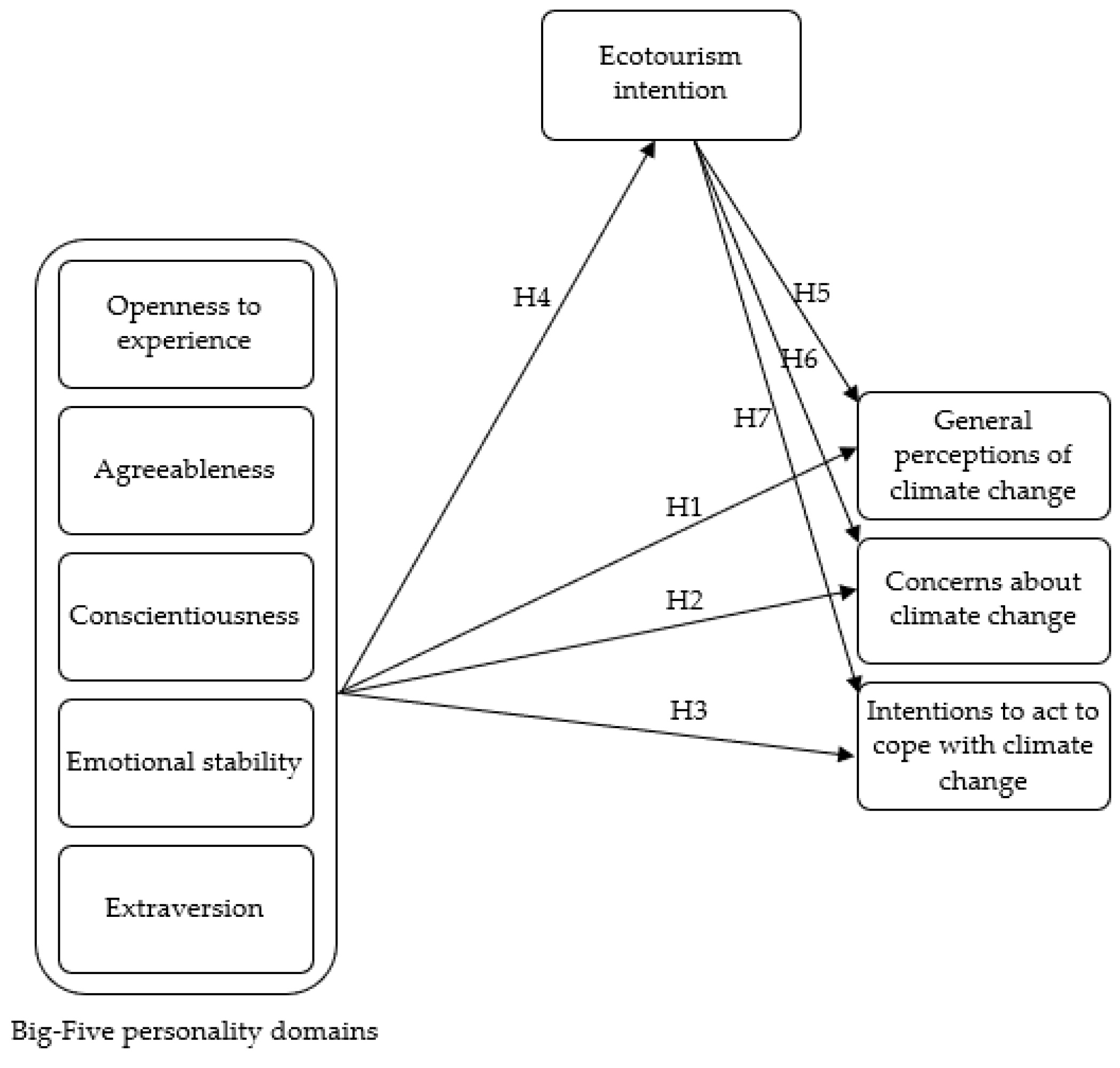
Figure 2.
Path diagram. Note: Agreeableness: PD1; Emotional stability: PD2; Extraversion: PD3; Conscientiousness: PD4; Openness to experience: PD5; Ecotourism intention: ECOINT; General perceptions of climate change: GPERC; Concerns about climate change: CONC; Intentions to act to cope with climate change: ACT.
Figure 2.
Path diagram. Note: Agreeableness: PD1; Emotional stability: PD2; Extraversion: PD3; Conscientiousness: PD4; Openness to experience: PD5; Ecotourism intention: ECOINT; General perceptions of climate change: GPERC; Concerns about climate change: CONC; Intentions to act to cope with climate change: ACT.
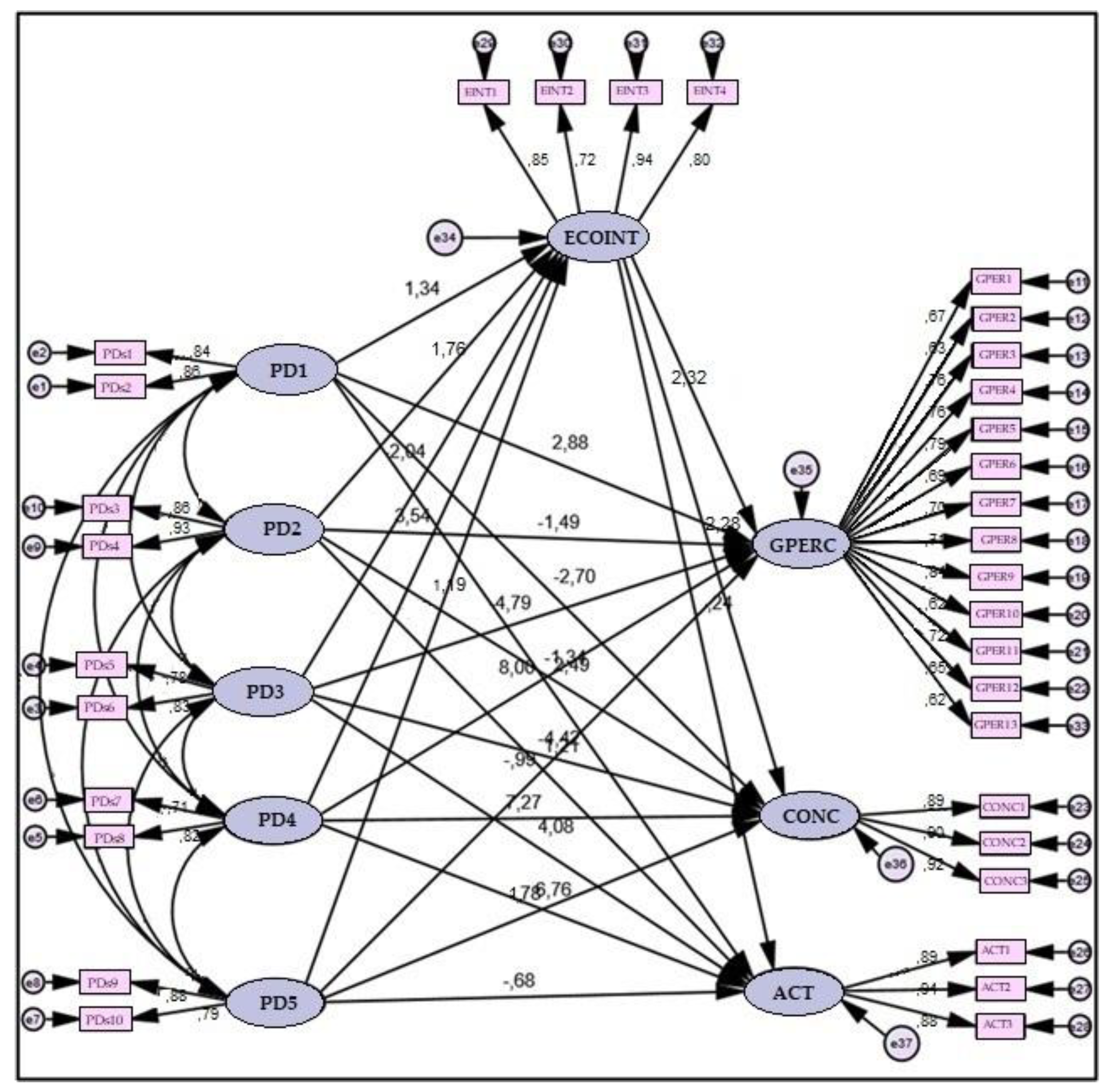

Table 1.
Descriptive statistics of the sample.
| Category | Frequency | Percentage (%) | |
|---|---|---|---|
| Gender | Female | 254 | 62,1% |
| Male | 155 | 37,9% | |
| Marital Status | Married | 179 | 43,8% |
| Single | 230 | 56,2% | |
| Age | Under 25 years | 24 | 5,9% |
| 25–35 years | 80 | 19,6% | |
| 36–45 years | 88 | 21,5% | |
| 46–55 years | 112 | 27,4% | |
| 56–65 years | 105 | 25,7% | |
| Education Status | High school | 35 | 8,6% |
| Associate degree | 39 | 9,5% | |
| Bachelor’s degree | 209 | 51,1% | |
| Master’s degree | 88 | 21,5% | |
| Doctorate | 38 | 9,3% | |
| Monthly Income | Minimum wage or below (440 USD or less) |
47 | 11,5% |
| 440-1,030 USD | 120 | 29,3% | |
| 1,030-1,550 USD | 134 | 32,8% | |
| 1,550-2,060 USD | 51 | 12,5% | |
| 2,060 USD or more | 57 | 13,9% | |
| Profession | Student | 29 | 7,1% |
| Unemployed | 16 | 3,9% | |
| Entrepreneur | 56 | 13,7% | |
| Public sector | 122 | 29,8% | |
| Private sector | 88 | 21,5% | |
| Retired | 98 | 24,0% | |
| Tour Organization | I plan and manage my own schedule | 212 | 51,8% |
| I join programs organized by friends and/or clubs | 149 | 36,4% | |
| I receive professional support from travel agencies | 33 | 8,1% | |
| All of the above | 15 | 3,7% | |
| Average Length of Stay | Day trip | 45 | 11,0% |
| 1-3 nights | 170 | 41,6% | |
| 4-6 nights | 152 | 37,2% | |
| 7 nights or more | 42 | 10,3% |
Table 2.
Convergent validity: CR and AVE values.
| Factor Loads | CR | AVE | |
|---|---|---|---|
| Factor 1: GPERC | 0.928 | 0.500 | |
| GPERC1 | 0.67 | ||
| GPERC2 | 0.63 | ||
| GPERC3 | 0.76 | ||
| GPERC4 | 0.76 | ||
| GPERC5 | 0.79 | ||
| GPERC6 | 0.69 | ||
| GPERC7 | 0.70 | ||
| GPERC8 | 0.71 | ||
| GPERC9 | 0.84 | ||
| GPERC10 | 0.62 | ||
| GPERC11 | 0.72 | ||
| GPERC12 | 0.65 | ||
| GPERC13 | 0.62 | ||
| Factor 2: CONC | 0.930 | 0.816 | |
| CONC1 | 0.89 | ||
| CONC2 | 0.90 | ||
| CONC3 | 0.92 | ||
| Factor 3: ACT | 0.930 | 0.817 | |
| ACT1 | 0.89 | ||
| ACT2 | 0.94 | ||
| ACT3 | 0.88 | ||
| Factor 4: ECOINT | 0.899 | 0.691 | |
| ECOINT1 | 0.85 | ||
| ECOINT2 | 0.72 | ||
| ECOINT3 | 0.94 | ||
| ECOINT4 | 0.80 | ||
| Factor 5: PDs | 0.957 | 0.692 | |
| PDs1 | 0.84 | PD1 (CR: 0.839; AVE: 0.72) | |
| PDs2 | 0.86 | ||
| PDs3 | 0.86 | PD2 (CR: 0.890; AVE: 0.802) | |
| PDs4 | 0.93 | ||
| PDs5 | 0.78 | PD3 (CR: 0.787; AVE: 0.649) | |
| PDs6 | 0.83 | ||
| PDs7 | 0.71 | PD4 (CR: 0.740; AVE: 0.588) | |
| PDs8 | 0.82 | ||
| PDs9 | 0.88 | PD5 (CR: 0.823; AVE: 0.699) | |
| PDs10 | 0.79 | ||
* GPERC: General perspectives of climate change, CONC: Concerns about climate change, ACT: Intentions to act to cope with climate change, ECOINT: Ecotourism intention, PDs: Personality domains; PD1: Openness to experience, PD2: Agreeableness, PD3: Consciousness, PD4: Emotional stability, PD5: Extraversion.
Table 3.
Discriminant validity: Fornell & Larcker criterion.
| Constructs | GPERC | CONC | ACT | ECOINT | PDs |
|---|---|---|---|---|---|
| GPERC | 0.707 | ||||
| CONC | 0.696 | 0.903 | |||
| ACT | 0.668 | 0.683 | 0.904 | ||
| ECOINT | 0.270 | 0.241 | 0.285 | 0.831 | |
| PDs | 0.161 | 0.196 | 0.168 | 0.170 | 0.832 |
| AVE | 0.500 | 0.816 | 0.817 | 0.691 | 0.692 |
* AVE: Average variance extracted. The diagonal elements marked in bold are the square root of the AVE, and the elements outside the diagonal (not marked in bold) are the correlations between constructs.
Table 4.
Results of the hypothesis test.
| Constructs | Confirmed | β | t-value |
|---|---|---|---|
| H1 | |||
| H1a | Yes | 2.876 | 5.75*** |
| H1b | Yes | -1.494 | -2.99*** |
| H1c | Yes | -4.79 | -9.58*** |
| H1d | Yes | 7.996 | 15.99*** |
| H1e | No | -0.985 | -1.97** |
| H2 | |||
| H2a | No | -2.700 | -5.4NS |
| H2b | Yes | -1.338 | -2.68*** |
| H2c | Yes | -4.416 | -8.83*** |
| H2d | Yes | 7.272 | 14.54*** |
| H2e | Yes | 1.784 | 2.97*** |
| H3 | |||
| H3a | Yes | 2.488 | 4.98*** |
| H3b | Yes | -1.207 | -2.41** |
| H3c | Yes | 4.081 | 8.16*** |
| H3d | Yes | 6.759 | 13.52*** |
| H3e | No | -0.680 | -1.36NS |
| H4 | |||
| H4a | Yes | 1.339 | 2.68*** |
| H4b | Yes | 1.764 | 2.53** |
| H4c | Yes | 2.036 | 4.07*** |
| H4d | Yes | 3.544 | 7.09*** |
| H4e | Yes | 1.187 | 2.37** |
| H5-H6-H7 | |||
| H5 | Yes | 2.321 | 4.64*** |
| H6 | Yes | 2.283 | 4.56*** |
| H7 | No | 0.242 | 0.48NS |
Note: ***p < .01 (|t| > 2.58), **p < .05 (|t| >1.96), tNS: t value is not significant.
Disclaimer/Publisher’s Note: The statements, opinions and data contained in all publications are solely those of the individual author(s) and contributor(s) and not of MDPI and/or the editor(s). MDPI and/or the editor(s) disclaim responsibility for any injury to people or property resulting from any ideas, methods, instructions or products referred to in the content. |
© 2025 by the authors. Licensee MDPI, Basel, Switzerland. This article is an open access article distributed under the terms and conditions of the Creative Commons Attribution (CC BY) license (http://creativecommons.org/licenses/by/4.0/).
Copyright: This open access article is published under a Creative Commons CC BY 4.0 license, which permit the free download, distribution, and reuse, provided that the author and preprint are cited in any reuse.


