

Submitted:
30 June 2025
Posted:
02 July 2025
You are already at the latest version
Abstract
This study aimed to investigate the effect of gender on the pharmacokinetics of meloxicam in goats following intravenous (IV, 0.5 mg/kg) and oral (PO, 1 mg/kg) administration. A crossover design was used with 12 clinically healthy Saanen goats (6 females, 6 males). Plasma samples were collected up to 96 hours post-administration and analysed with an HPLC for meloxicam concentrations. Pharmacokinetic parameters were calculated and statistically compared between genders and administration routes. Results showed that male goats exhibited significantly longer terminal half-life (T1/2λz), mean residence time (MRT0–∞), and higher systemic exposure (AUC0–∞) than females, particularly after oral administration. Oral bioavailability was calculated as 77.43% in females and 104.73% in males. These differences may be linked to gender-based variations in hepatic metabolism, enterohepatic recirculation, and hormone-mediated modulation of cytochrome P450 activity. The findings are consistent with previous research demonstrating that gender can influence drug disposition through hormonal and enzymatic mechanisms. This study underscores the importance of considering gender as a biological variable in pharmacokinetic assessments of veterinary drugs, especially those used in food-producing animals, to optimise dosing strategies and ensure both therapeutic efficacy and food safety.
Keywords:
Meloxicam
; goat
; gender
; pharmacokinetics
; intravenous
; oral
1. Introduction
Non-steroidal anti-inflammatory drugs (NSAIDs), which are widely used in veterinary medicine, play a significant role, particularly in managing pain, inflammation, and fever. They are often preferred in conditions such as postoperative pain, musculoskeletal diseases (e.g., osteoarthritis and laminitis), visceral pain (e.g., colic), inflammatory diseases (e.g., pneumonia and mastitis), and fever reduction [1]. NSAIDs mainly suppress prostaglandin synthesis by inhibiting cyclooxygenase (COX) enzymes, thereby reducing pain, fever, and inflammation [2]. While COX-1 is involved in normal physiological functions, COX-2 is induced during inflammation. Consequently, COX-2 selective NSAIDs (e.g., meloxicam, firocoxib) have fewer gastrointestinal side effects [1,2]. The most common adverse effects linked with NSAID use include gastrointestinal ulceration, renal toxicity, hepatotoxicity, hematologic disorders, and irritation at injection sites [2]. Although NSAIDs are highly effective and essential drugs widely used in veterinary medicine, they should be administered with caution and awareness. Meloxicam belongs to the enolic acid group of NSAIDs and exhibits analgesic, anti-inflammatory, and antipyretic effects [3]. It preferentially inhibits COX-2 over COX-1, but it is not entirely COX-2 selective; thus, at higher doses, its selectivity for the COX-2 isoenzyme diminishes [4]. Meloxicam is extensively metabolised in the liver and undergoes significant enterohepatic recirculation [5]. Its metabolites have not been found to possess any pharmacological activity [6]. Meloxicam is an approved NSAID for cattle, horses, cats, and dogs, while it is used off-label in sheep and goats. Recent pharmacological research increasingly highlights gender-based differences in drug absorption, distribution, metabolism, and excretion. Incorporating gender as a crucial variable in dosage adjustment is important. Moyer et al. [7] discussed how gender chromosomes and endogenous steroid hormones modulate drug transporters, metabolic enzymes, and receptors, thereby influencing pharmacokinetics and adverse drug responses. Moreover, Bosch et al. [8] stated that female sex hormones, particularly estrogen, significantly impact drug metabolism mediated by CYP and UGT enzyme activity. These factors are especially relevant for orally administered drugs due to the influence of first-pass hepatic metabolism affected by estrogenic activity. Data on gender-dependent pharmacokinetics of drugs used in ruminants remains limited. It is scientifically and clinically valuable to explore how the pharmacokinetics of meloxicam, a commonly used NSAID in veterinary medicine, are affected by gender in food-producing species like goats. While existing literature addresses gender differences in humans and laboratory animals, no prior studies have focused on meloxicam in goats. Therefore, our research aimed to assess whether and how the pharmacokinetic parameters of meloxicam differ between female and male Saanen goats following intravenous (0.5 mg/kg) and oral (1.0 mg/kg) administration.
2. Materials and Methods
2.1. Chemicals
Analytical standards of meloxicam (99.2%, CAS: 71125-38-7) and piroxicam (99.7%, CAS: 36322-90-4) were obtained from LGC Standards. HPLC grade acetonitrile (99.9%), methanol (99.9%), magnesium sulphate heptahydrate (99.9%) and phosphoric acid (89%) were supplied by Sigma-Aldrich (Steinheim, Germany).
2.2. Animals
This study involved a total of 12 Saanen goats, comprising six females and six males, all approximately one year of age. The average body weight was 28.19 ± 3.35 kg for the female goats and 36.87 ± 4.58 kg for the males. Before the experiment, each animal underwent a comprehensive clinical evaluation along with hematological testing to ensure they were in good health. None of the goats had been treated with any medications for two months prior to the experiment. The animals were divided into two groups according to gender. Throughout the study period, they were provided with commercial concentrate feed, and both dry forage and water were available ad libitum. The experiments with the males were performed in late autumn, as the endogenous testosterone levels are at a maximum at this time. The experiments with the females were undertaken during the same period. The study protocol was approved by the Ethics Committee of Cukurova University, Health Sciences Experimental Application and Research Centre.
2.3. Study Design
The study was conducted using a crossover design consisting of two experimental phases, separated by a 10-day washout period between administration routes in both female and male Saanen goats. Meloxicam was administered in two commercially available formulations: oral tablets (Melox Fort, 15 mg/tablet, Nobel Pharmaceuticals) at a dose of 1.0 mg/kg and an injectable solution (Metacam, 20 mg/mL, Boehringer Ingelheim) at a single intravenous dose of 0.5 mg/kg. In the first phase, animals received the oral formulation, followed by intravenous administration in the second phase. All treatments were administered in the morning before feeding with a meloxicam-free commercial concentrate. Animals were closely observed for any adverse effects following both oral and intravenous administration of meloxicam. Blood samples (3 mL) were collected into heparinized tubes before the treatment (0) and subsequently at 5, 15, 30 and 45 minutes, and 1, 1.5, 2, 4, 6, 8, 10, 16, 24, 36, 48, 72 and 96 hours post-administration. The samples were subjected to centrifugation within 60 minutes of collection, and the plasma was stored at -80°C until further analysis.
2.4. Analytical Procedure
2.4.1. Instrumentation
Chromatographic analyses were performed by using an Agilent 1260 HPLC system (Agilent, Germany) consisting of a binary high-pressure gradient system used for the analysis of meloxicam. An Agilent binary pump (G1312B) was used to deliver the mobile phase to the analytical column. Sample injection was performed via an Agilent autosampler (G1367E) coupled with an injection valve (Rheodyne®, USA) equipped with a 100-µl variable loop. Detection was achieved by a diode array detector (G4212B) in compliance with the data acquisition ChemStation Software by Agilent (Germany). Degassing of the mobile phase was achieved by an Agilent vacuum degasser unit (G4225A). Operations and functions of the whole HPLC system were controlled by ChemStation® Software (C.01.08, Agilent, Germany).
All evaporations following sample extraction were performed at 50 °C using a vacuum evaporator (Maxi-Dry Plus, Hettich, Germany). A vortex mixer (622, Isolab, Germany), a centrifuge (Hettich Rotina® 380R, Germany) were used for the extraction procedure.
2.4.2. Chromatographic Conditions
The separation of meloxicam was achieved through the use of an analytical column (Eclipse XDB-C18, 5 µm, 250 mm x 4.6 mm, Agilent) with a Nucleosil C18 guard column (Phenomenex, UK), which was maintained at 50°C during analysis in a column oven (G1316A). The mobile phase consisted of ultra-pure water (H2O): methanol: acetonitrile (40:30:30, v/v/v) (pH: 3.5 with phosphoric acid) and was delivered in an isocratic fashion at a flow rate of 1 ml/min. A photodiode array detector (G4212B) was at a wavelength of 355 nm. The volume of injection was 50 µl throughout the analysis, and a chromatographic analysis was completed in 9 min for samples following injection.
2.4.3. Preparation of Standard Solution
Stock analytical standard solutions (100 µg/ml) of meloxicam and the internal standard piroxicam (5 µg/ml) for plasma samples were prepared in acetonitrile:ultra-pure water and stored in glass bottles at 4°C. Stock analytical standard solution of meloxicam was diluted with acetonitrile:ultra-pure water to give solutions for plasma samples 0.1, 0.5, 1, 5, 10 and 50 µg/mL. These standards were used to spike drug-free samples at various concentrations to generate standard curves and determine extraction recovery rates.
2.4.4. Sample Preparations and Extraction
The plasma levels of meloxicam were analysed by HPLC with a diode array detector following liquid-liquid phase extraction procedures according to Karademir et al. [9] and Bae et al. [10] with small modifications described below. Accordingly, blank plasma samples (0.25 mL) were spiked with 25 µL of meloxicam standard solution to reach the following final concentrations: 0, 0.01, 0.05, 0.1, 0.5, 1, 5 and 10 µg/mL (for intravenous route), 0, 0.01, 0.05, 0.1, 0.5 and 1 µg/mL (for per os route). The plasma samples were combined with 50 µL of internal standard (piroxicam 5 µg/mL). Subsequently, magnesium sulphate heptahydrate (0.1 g) was added and vortexed for 1 min and then 1 mL of acetonitrile was added for the deproteinization of plasma samples and then vortexed for 1 min and centrifuged at 12,000 rpm for 5 min. The upper phase was transferred to a 10-mL tube and evaporated using a vacuum concentrator set at 50 °C. Once the residue was completely dried, it was dissolved in 200 µL of the mobile phase and vortexed for 15 seconds. Finally, 50 µL of this solution was injected into the chromatographic system for analysis.
2.4.5. Validation of Analytical Method
Analytical validation was conducted to determine meloxicam levels in plasma samples in accordance with the International Conference on Harmonization (ICH) guidelines for validating analytical procedures [11]. The analyte was identified based on the retention times of a pure reference standard. Recoveries of the substance under study were assessed by comparing the peak areas from spiked plasma samples with those obtained from direct injections of standards prepared in a mixture of acetonitrile and ultra-pure water. To evaluate the inter- and intra-assay precision of the extraction and chromatography procedures, replicate aliquots of drug-free goat plasma samples containing known amounts of meloxicam were processed on different days. A calibration graph for meloxicam was created, demonstrating a linear range of 0.01 to 10 µg/mL for intravenous administration and 0.01 to 1 µg/mL for oral administration. The slope of the line relating peak areas to drug concentration was determined using least squares linear regression, and both the correlation coefficient (r) and the coefficient of variation (CV) were calculated. Linearity was established to confirm the relationship between meloxicam concentration and detector response. The detection limit (LOD) for meloxicam was determined through HPLC analysis of blank plasma samples fortified with the standard. This involved measuring the baseline noise at the retention time of the peak. The LOD was defined as the mean baseline noise at the peak retention time plus three standard deviations (SDs). Additionally, the limit of quantification (LOQ) was defined as the mean baseline noise plus six SDs.
2.5. Pharmacokinetics and Statistical Analysis of Data
The plasma concentrations versus. time curves obtained following each administration route in individual animals were fitted with the WinNonlin software program (Version 5.2, Pharsight Corporation, Mountain View, CA, USA). The pharmacokinetic parameters for each animal were analysed using non-compartmental model analysis. The maximum plasma concentration (Cmax) and time to reach maximum concentration (Tmax) were obtained from the plotted concentration-time curve of the drug in each animal. The trapezoidal rule was used to calculate the area under the plasma concentration-time curve (AUC). The fraction of dose absorbed (ie, F) was calculated by use of mean AUCs calculated for each route of administration by use of the following equation, following dose normalisation:
F = (AUCPO/AUCIV) x 100
Pharmacokinetic parameters are presented as mean±SD. Harmonic means were calculated for T1/2λz, MRTlast and MRT0-∞. For the comparison of administration routes, non-normally distributed data were analyzed using the non-parametric Wilcoxon signed-rank test, while normally distributed data were assessed using the paired t-test. When comparing gender, non-normally distributed data were compared with the non-parametric Mann-Whitney U test, and normally distributed data were analyzed using the independent t-test. All statistical analyses were performed using SPSS Statistics version 23.0 (IBM Corp).
3. Results
The validation parameters of meloxicam for the analysis of plasma samples of goats are given in Table 1.
During the study, no adverse effects were observed in any goat due to meloxicam administration. Gender-related differences were observed in several pharmacokinetic parameters following IV and PO administration of meloxicam at a dose of 0.5 mg/kg and 1.0 mg/kg, respectively, in Saanen goats (Table 2). Although the initial plasma concentration (C0), area under the curve (AUC0–∞), clearance (Cl), mean residence time (MRT), and area under the first moment curve (AUMC) values were similar between female and male goats, the terminal elimination half-life (T1/2λz) was notably longer in males (10.09 ± 0.97 h vs. 11.72 ± 0.74 h). Following PO administration of meloxicam at a dose of 1.0 mg/kg, notable pharmacokinetic differences were observed between female and male Saanen goats. Although the maximum plasma concentration (Cmax) and time to reach Cmax (Tmax) were similar across genders, significant differences emerged in elimination and exposure parameters. The T1/2λz was significantly longer in male goats (13.10 ± 2.01 h) compared to females (9.87 ± 0.85 h). In parallel, MRT0–∞ was also significantly prolonged in males (22.18 ± 3.47 h) relative to females (17.12 ± 1.73 h). Significant differences were observed between the pharmacokinetic parameters obtained after intravenous (IV, 0.5 mg/kg) and oral (PO, 1.0 mg/kg) administration of meloxicam to female and male goats. No difference was observed in T1/2λz after IV and PO meloxicam administration in both female and male goats. AUC, AUMC and MRT parameters were determined to be significantly higher after PO administration. It has also been determined that meloxicam has a high bioavailability when administered orally in both female (77.43%) and especially male goats (104.73%).
4. Discussion
It is imperative to comprehend how gender influences drug disposition to optimize therapeutic strategies, ensure animal welfare, and refine dosage recommendations, particularly in food-producing species such as goats. In both genders, pharmacokinetic variability can have both clinical and regulatory implications. The present study was conducted to evaluate the pharmacokinetics of meloxicam, a commonly used NSAID in veterinary medicine, in male and female Saanen goats following both IV and PO administration.
Following IV administration of meloxicam at 0.5 mg/kg, a statistically significant difference was observed in the T1/2λz between female and male goats. The T1/2λz was notably longer in males (11.72 ± 0.74 h) than in females (10.09 ± 0.97 h), suggesting that meloxicam is cleared more slowly in male goats. This prolonged elimination could reflect gender-based differences in hepatic metabolism, protein binding, or renal excretion rates. Despite the absence of statistically significant differences in other pharmacokinetic parameters, such as C0, AUC0–∞, Cl, and volume of distribution (Vss), between the genders, the consistently higher MRT0–∞ and AUMC values observed in males provide further evidence that supports the hypothesis of a slower drug disposition in males. These findings indicate that, despite similar initial plasma concentrations and exposure levels, meloxicam remains in the system for a prolonged persistence in male goats. It is imperative to consider the implications of this prolonged systemic persistence on both therapeutic efficacy and withdrawal time considerations. A recent study investigated the pharmacokinetic differences of meloxicam between male and female sheep following IV administration. The results showed that the total clearance (ClT) and Vdss were significantly higher in male sheep, while the half-life (T1/2λz) was significantly shorter compared to female sheep [12]. In our study, meloxicam was administered at a dose of 0.5 mg/kg IV to Saanen goats, whereas Corum et al. [12] employed a 1.0 mg/kg IV dose in Romanov sheep. Despite this difference in dosing, both studies reveal that gender significantly influences meloxicam disposition, particularly in terms of T1/2λz. In male goats, the T1/2λz (11.72 ± 0.74 h) was longer than that observed in male sheep (9.47 ± 0.25 h), while female goats had a T1/2λz (10.09 ± 0.97 h) slightly shorter than female sheep (11.96 ± 0.33 h). The fact that the T1/2λz is longer in male goats than in male sheep is a surprising result because studies have shown that goats metabolize and eliminate compounds faster than sheep [13,14,15,16]. Although male sheep exhibited faster clearance (8.72 ± 1.34 mL/h/kg) and larger volume of distribution (Vdss: 100.95 ± 14.73 mL/kg) than females, such pronounced differences were not observed in goats. In our study, both Cl and Vd values were similar across genders, suggesting that species-related physiological or metabolic factors may play a more prominent role in drug disposition than gender alone in goats. Another notable distinction concerns the extent of systemic exposure. In sheep, female animals showed significantly higher AUC0–∞ values (224.68 ± 28.22 μg·h/mL) compared to males (117.25 ± 20.38 μg·h/mL), indicating a marked gender-based difference in meloxicam exposure. In contrast, in goats, AUC values were comparable between genders (females: 25.57 ± 6.76 vs. males: 26.43 ± 4.30 μg·h/mL), further underscoring the interspecies variability in meloxicam pharmacokinetics. These differences could be attributed not only to species-specific hepatic enzyme activity (such as CYP2C9-mediated metabolism) but also to variations in plasma protein binding, tissue distribution, and renal excretion patterns between goats and sheep. Both studies highlight the importance of gender in determining the pharmacokinetics of meloxicam; however, the results again demonstrate that these effects are species-dependent.
In the present study, gender-related pharmacokinetic differences were also observed in Saanen goats following a single PO administration of meloxicam at a dose of 1.0 mg/kg. Male goats exhibited a significantly longer T1/2λz (13.10 ± 2.01 h) compared to females (9.87 ± 0.85 h), indicating slower clearance of the drug. This was further supported by the longer MRT0–∞ observed in males (22.18 ± 3.47 h vs. 17.12 ± 1.73 h in females), suggesting extended systemic persistence of meloxicam in male animals. In addition, although Cmax was similar between genders, total drug exposure represented by AUC0–∞ was higher in males (55.36 ± 22.38 μg·h/mL) than in females (39.59 ± 7.45 μg·h/mL), although not statistically significant, but with a high degree of inter-individual variability. These findings suggest that meloxicam is more systemically available in males than females following PO administration in goats. Meloxicam is subject to complete metabolic conversion to four pharmacologically inactive metabolites, primarily through the cytochrome P450 2C pathway [17]. Thus, the observed differences in elimination and exposure in male and female animals may be attributable to gender-based variations in hepatic enzyme activity, enterohepatic recirculation, gastrointestinal transit times, or hormonal influences affecting drug metabolism and excretion.
A thorough evaluation of meloxicam pharmacokinetics after IV and PO administration in both female and male Saanen goats shows significant differences in drug disposition based on the route of administration and gender. While T1/2λz values remained generally consistent across genders and administration routes—suggesting similar elimination kinetics once meloxicam enters the systemic circulation—statistically significant differences emerged in drug exposure and MRT, especially following PO administration. In both genders, PO administration of meloxicam at 1.0 mg/kg resulted in significantly higher systemic exposure compared to 0.5 mg/kg IV administration. This was evident in the AUC0–∞ values, which increased from 25.57 ± 6.76 to 39.59 ± 7.45 μg·h/mL in females and from 26.43 ± 4.30 to 55.36 ± 22.38 μg·h/mL in males. Correspondingly, AUMC0–∞ and MRT0–∞ values were significantly elevated after PO dosing in both genders, indicating prolonged systemic presence of meloxicam via the oral route. Notably, the increase in MRT0–∞ from IV to PO was more pronounced in males (14.27 h vs. 22.18 h) than in females (12.77 h vs. 17.12 h), suggesting that male goats may exhibit a slower drug turnover and more sustained drug retention after PO administration. Interestingly, the calculated absolute bioavailability (F) of oral meloxicam was 77.43% in females and 104.73% in males. While the high F value in males may partly reflect nonlinear pharmacokinetics at the higher dose or enterohepatic recirculation, it also highlights inter-individual variability and possible differences in gastrointestinal absorption or hepatic metabolism between genders. The consistent Tmax values (7.33 ± 1.03 h in females vs. 8.33 ± 1.51 h in males) suggest a delayed yet efficient absorption profile for oral meloxicam across both genders, with slightly slower absorption kinetics in males. From a clinical standpoint, these findings underscore that although both genders achieve therapeutic plasma levels of meloxicam after PO administration, male goats may maintain these levels for a longer duration due to prolonged MRT and higher AUC. While T1/2λz remained unaffected by the administration route, the overall pharmacokinetic behavior was modulated by both the administration route and gender, reinforcing the need to account for these variables in designing dosage regimens, determining dosing intervals, and establishing withdrawal periods for food-producing animals.
The observed gender-related pharmacokinetic differences in meloxicam disposition in goats may be partially attributed to hormonal modulation of drug metabolism, as supported by previous studies using model compounds such as antipyrine. In their comparative work, Witkamp et al. [18] demonstrated that the metabolism and clearance of antipyrine varied significantly not only between species (goat, cattle, rabbit, rat) but also between genders within a species. In goats, although gender differences in antipyrine plasma clearance were inconsistent across years, females tended to eliminate the drug more rapidly than males in some instances. Importantly, metabolite profiling revealed that the production of certain oxidative metabolites (e.g., 3-hydroxymethyl antipyrine and norantipyrine) was consistently lower in males, suggesting a potential gender-linked difference in cytochrome P450 isoenzyme activity. Extending these findings, Witkamp et al. [19] showed that exogenous administration of gonadal hormones in dwarf goats selectively affected the formation of specific antipyrine metabolites. Testosterone treatment in female goats and castrated males significantly suppressed the production of 3-hydroxymethyl antipyrine, nor antipyrine, and 4,4’-dihydroxy antipyrine, while estradiol administration in intact males reduced the clearance of 4-hydroxy antipyrine. These results support the hypothesis that gonadal steroids can modulate specific metabolic pathways, most likely by altering the expression or activity of hepatic P450 enzymes involved in phase I oxidation reactions. These data are consistent with our findings, where male goats exhibited longer elimination half-lives and higher systemic exposure to meloxicam, especially after PO administration. Although the elimination rate of meloxicam was not drastically different between genders after IV administration, the prolonged MRT and elevated AUC values in males suggest that endogenous hormonal differences may influence drug clearance capacity. In particular, testosterone-mediated suppression of hepatic oxidative metabolism -as observed with antipyrine- may be extrapolated to meloxicam, a drug extensively metabolized by the liver in ruminants.
Farkouh et al. [20] stated that there are differences in basic pharmacokinetic parameters such as bioavailability, volume of distribution and clearance between both genders in commonly prescribed drugs, and emphasized that these differences may lead to gender-specific changes in the effect of some drugs. A previous study showed that there were notable gender-related differences in the plasma disposition of ivermectin between male and female goats after pour-on administration [21]. While Cmax, Tmax, and AUC values did not differ significantly between the genders, the half-life (T1/2λz) and mean residence time (MRT) were considerably longer in male goats compared to female goats. Moyer et al. [7] highlighted that gender chromosomes and steroid hormones modulate various pharmacokinetic processes, including hepatic enzyme expression (e.g., cytochrome P450 isoforms), transporter activity, and receptor signaling. These molecular differences can alter both the rate and extent of drug metabolism, particularly for drugs with high hepatic extraction or those undergoing first-pass metabolism, such as meloxicam. Importantly, the influence of gender on pharmacokinetics becomes more pronounced with orally administered drugs, due to potential differences in gastrointestinal physiology (e.g., pH, motility), enzyme activity, and portal blood flow, all of which may explain the extended MRT and increased AUC observed in male goats in this study.
Bosch et al. [8] reviewed the modulatory role of estrogens and other female sex hormones on drug metabolism and pharmacokinetics. They reported that estrogens can induce or inhibit specific metabolic pathways, especially those involving CYP and UGT enzymes, leading to faster clearance in females in some contexts. This may help explain the more rapid elimination of meloxicam in female goats, particularly after oral dosing. Furthermore, these hormonal effects can vary dynamically with reproductive status and age factors that may contribute to inter-individual variability, even within the same gender. In our study, PO administration (1.0 mg/kg) resulted in disproportionately greater systemic exposure and longer MRT in males than in females, despite the same dosing and formulation. While part of this difference may stem from dose-dependent kinetics or enterohepatic recirculation, the consistency of the gender effect across multiple parameters supports a biologically rooted difference in metabolism. Interestingly, the bioavailability of meloxicam was calculated as 77.43% in females and 104.73% in males, suggesting more complete and sustained absorption in males, which may further support a hormonal influence on drug disposition. Gleiter and Gundert-Remy [22] reported that CYP3A4 activity is higher in females, whereas phase II conjugation reactions (e.g., glucuronidation) are more dominant in males. These enzymatic differences are consistent with the slower meloxicam clearance and longer MRT observed in male goats in our study. Scandlyn et al. [23] examined the gender-specific CYP isoform distribution in humans and showed that CYP1A2 and CYP2E1 were more active in men, while the CYP3A family was more dominant in women.
Schwartz [24] emphasized that these differences are gender-based not only at the enzyme level but also in physiological parameters such as body composition, plasma volume, fat/muscle ratio, renal function and gastrointestinal motility; this revealed that pharmacokinetic processes are affected by gender. It has been suggested that these physiological and biochemical variables may lead to significant pharmacokinetic variations, especially in orally administered drugs [25]. Soldin and Mattison [26] also stated that male-female differences in pharmacokinetic and pharmacodynamic processes are at a level that can affect clinical outcomes, and these differences should be taken into account, especially in hepatic metabolism, renal elimination and tissue distribution of the drug. Spoletini et al. [27] explained how hormonal balances that change throughout life affect drug effects and metabolic pathways; they showed that estrogen can accelerate the hepatic clearance of drugs by increasing CYP3A4 expression. In the study conducted by Martin et al. [28], differences in pain biomarkers and plasma meloxicam levels were observed following meloxicam administration in male and female calves, demonstrating that pharmacokinetic differences were directly reflected in pharmacodynamic results. These data suggest that gender-specific dosing strategies may affect not only clinical efficacy but also drug residual duration and food safety.
Taken together, these findings underscore the need to incorporate gender as a biological variable in pharmacokinetic studies, particularly for veterinary drugs administered orally in food-producing animals. The integration of literature findings with our data suggests that sex hormones can affect the activity of hepatic enzymes involved in meloxicam metabolism, which may lead to clinically relevant differences in drug exposure and clearance. These findings could have significant implications for adjusting dosage regimens and withdrawal periods to ensure both therapeutic efficacy and food safety.
Author Contributions
Conceptualization, Z.O.K., C.G. and P.P.B.; Methodology, C.G. and B.A.A.; Data Curation, Z.O.K, S.M. and P.P.B.; Writing – Original Draft Preparation, Z.O.K., C.G. and P.P.B.; Writing – Review & Editing, Z.O.K., C.G. and P.P.B.; Project Administration, Z.O.K.
Animal welfare and ethics statement
All protocols in animals were approved (approval code: 1, approval date: 28.05.2024) by the Ethics Committee of the Cukurova University, Health Sciences Experimental Application and Research Center and carried out in accordance with the European Directive (2020/63/UE).
Acknowledgments
This study was supported by the Coordination Unit of Scientific Research Projects, the University of Cukurova (Project No TKB-2024-16859).
References
- Mathews, K.A. Non-steroidal anti-inflammatory analgesics: a review of current.
- practice. Journal of Veterinary Emergency and Critical Care. 2002, 12, 89–97.
- Curry, S.L.; Cogar, S.M.; Cook, J.L. Nonsteroidal antiinflammatory drugs: a review. J Am Anim Hosp Assoc. 2005, 41, 298–309. [Google Scholar] [PubMed]
- Luger, P.; Daneck, K.; Engel, W.; Trummlitz, G.; Wagner, K. Structure and physicochemical properties of meloxicam, a new NSAID. Eur J Pharm Sci. 1996, 4, 175–187. [Google Scholar]
- Del Tacca, M.; Colucci, R.; Fornai, M.; Blandizzi, C. Efficacy and tolerability of meloxicam, a COX-2 preferential nonsteroidal anti-inflammatory drug: A review. Clinical Drug Investigation. 2002, 22, 799–818. [Google Scholar]
- Gates, B.J.; Nguyen, T.T.; Setter, S.M.; Davies, N.M. Meloxicam: a reappraisal of.
- pharmacokinetics, efficacy and safety. Expert Opin Pharmacother. 2005, 6, 2117–2140.
- Furst, D.E. Meloxicam: selective COX-2 inhibition in clinical practice. Semin Arthritis Rheum. 1997, 26, 21–27. [Google Scholar]
- Moyer, A.M.; Matey, E.T.; Miller, V.M. Individualized medicine: Sex, hormones, genetics, and adverse drug reactions. Pharmacol Res Perspect. 2019, 7, e00541. [Google Scholar]
- Bosch, E.; Sommer, I.; Touw, D. The influence of female sex and estrogens on drug pharmacokinetics: what is the evidence? Expert Opin Drug Metab Toxicol. 2025, 21, 637–647. [Google Scholar]
- Karademir, U.; Erdogan, H.; Boyacioglu, M.; Kum, C.; Sekkin, S.; Bilgen, M. Pharmacokinetics of meloxicam in adult goats: a comparative study of subcutaneous, oral and intravenous administration. N Z Vet J. 2016, 64, 165–168. [Google Scholar]
- Bae, J.-W.; Kim, M.-J.; Jang, C.-G.; Lee, S.-Y. Determination of meloxicam in human plasma using a HPLC method with UV detection and its application to a pharmacokinetic study. J Chromatogr B Analyt Technol Biomed Life Sci. 2007, 859, 69–73. [Google Scholar]
- International Conference on Harmonization (ICH), 2005. Technical requirements for the registration of pharmaceutical for human use, validation of analytical procedures; text and methodology Q2 (R1). http://www.ema.europa.eu./Q2 (R1) Validation of Analytical Procedures: Text and Methodology (europa.eu) (accessed June 2025).
- Corum, O.; Uney, K.; Durna Corum, D.; Coskun, D.; Akin, F.; Oguz, H.; Elmas, M. Effect of Gender on the Pharmacokinetics of Meloxicam in Sheep. J Vet Pharmacol Ther. 2025.
- Bogan, J.; Benoit, E.; Delatour, P. Pharmacokinetics of oxfendazole in goats: a comparison with sheep. J Vet Pharmacol Ther. 1987, 10, 305–309. [Google Scholar] [PubMed]
- . Aksit, D.; Yalinkilinc, H.S.; Sekkin, S.; Boyacioğlu, M.; Cirak, V.Y.; Ayaz, E.; Gokbulut, C. Comparative pharmacokinetics and bioavailability of albendazole sulfoxide in sheep and goats, and dose-dependent plasma disposition in goats. BMC Vet Res. 2015, 11, 1–11. [Google Scholar]
- Gokbulut, C.; Yalinkilinc, H.S.; Aksit, D.; Veneziano, V. Comparative pharmacokinetics of levamisole-oxyclozanide combination in sheep and goats following per os administration. Can J Vet Res. 2014, 78, 316–320. [Google Scholar]
- Fadel, C.; Łebkowska-Wieruszewska, B.; Serih, F.; Lisowski, A.; Poapolathep, A.; Giorgi, M. Comparative pharmacokinetic evaluation of metronidazole in sheep and goats. Res Vet Sci. 2025, 184, 105507. [Google Scholar]
- Fleischmann, R.; Iqbal, I.; Slobodin, G. Meloxicam. Expert Opin Pharmacother. 2002, 3, 1501–1512. [Google Scholar]
- Witkamp, R.; Lohuis, J.; Nijmeijer, S.; Kolker, H.; Noordhoek, J.; Van Miert, A. Species-and sex-related differences in the plasma clearance and metabolite formation of antipyrine. A comparative study in four animal species: cattle, goat, rat and rabbit. Xenobiotica. 1991, 21, 1483–1492. [Google Scholar]
- Witkamp, R.; Nijmeijer, S.; Kolker, H.; Noordhoek, J.; van Miert, A.S. Effect of gonadal hormones on the plasma clearance and metabolite formation of antipyrine in the dwarf goat. J Vet Pharmacol Ther. 1993, 16, 164–173. [Google Scholar]
- Farkouh, A.; Riedl, T.; Gottardi, R.; Czejka, M.; Kautzky-Willer, A. Sex-related differences in pharmacokinetics and pharmacodynamics of frequently prescribed drugs: a review of the literature. Adv Ther. 2020, 37, 644–655. [Google Scholar]
- Gokbulut, C.; Bilgili, A.; Hanedan, B.; Aksit, D.; Aksoy, A.M.; Turgut, C. Sex-related plasma disposition of ivermectin following pour-on administration in goats. Vet Parasitol. 2009, 162, 342–345. [Google Scholar]
- Gleiter, C.; Gundert-Remy, U. Gender differences in pharmacokinetics. Eur J Drug Metab Pharmacokinet. 1996, 21, 123–128. [Google Scholar]
- Scandlyn, M.J.; Stuart, E.C.; Rosengren, R.J. Sex-specific differences in CYP450 isoforms in humans. Expert Opin Drug Metab Toxicol. 2008, 4, 413–424. [Google Scholar] [PubMed]
- Schwartz, J.B. The influence of sex on pharmacokinetics. Clin Pharmacokinet. 2003, 42, 107–121. [Google Scholar] [PubMed]
- Meibohm, B.; Beierle, I.; Derendorf, H. How important are gender differences in pharmacokinetics? Clin Pharmacokinet. 2002, 41, 329–342. [Google Scholar] [PubMed]
- Soldin, O.P.; Mattison, D.R. Sex differences in pharmacokinetics and pharmacodynamics. Clin Pharmacokinet. 2009, 48, 143–157. [Google Scholar]
- Spoletini, I.; Vitale, C.; Malorni, W.; Rosano, G.M. Sex differences in drug effects: interaction with sex hormones in adult life. Handb Exp Pharmacol. 2012, 91–105. [Google Scholar]
- Martin, M.S.; Kleinhenz, M.D.; Edwards-Callaway, L.N.; Engle, T.E.; Guimaraes, O.; Schafer, D.W.; Montgomery, S.R.; Curtis, A.K.; Weeder, M.M.; Jacobs, D.R. The effect of breed, sex, and oral meloxicam administration on pain biomarkers following hot-iron branding in Hereford and Angus calves. J Anim Sci. 2022, 100, skac038. [Google Scholar]
Figure 1.
Comparative mean (±SD) plasma concentration vs. time curves of meloxicam in female and male goats following intravenous administrations at a dose of 0.5 mg/kg (n = 6).
Figure 1.
Comparative mean (±SD) plasma concentration vs. time curves of meloxicam in female and male goats following intravenous administrations at a dose of 0.5 mg/kg (n = 6).
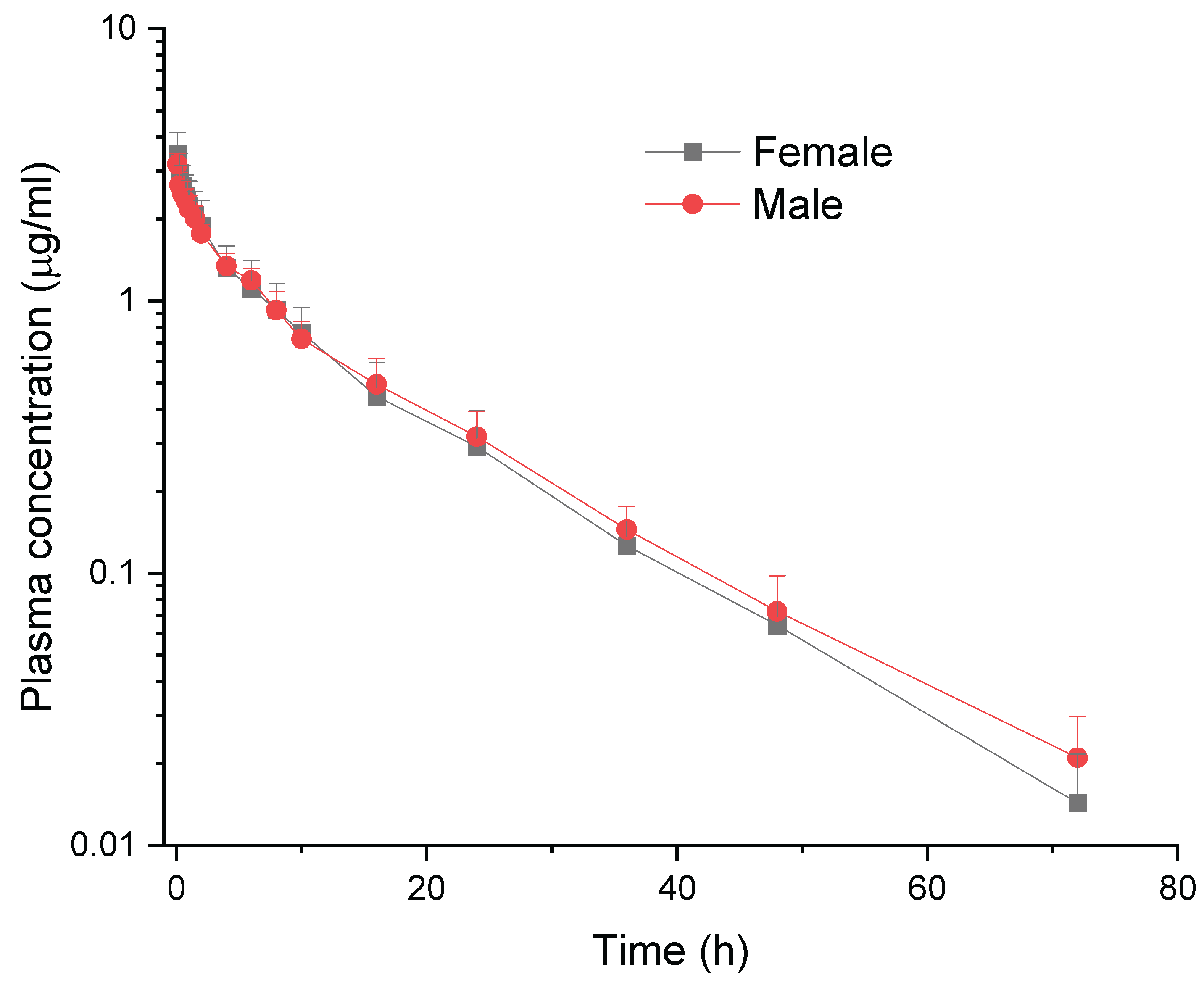
Figure 2.
Comparative mean (±SD) plasma concentration vs. time curves of meloxicam in female and male goats following per os administrations at a dose of 1.0 mg/kg (n = 6).
Figure 2.
Comparative mean (±SD) plasma concentration vs. time curves of meloxicam in female and male goats following per os administrations at a dose of 1.0 mg/kg (n = 6).
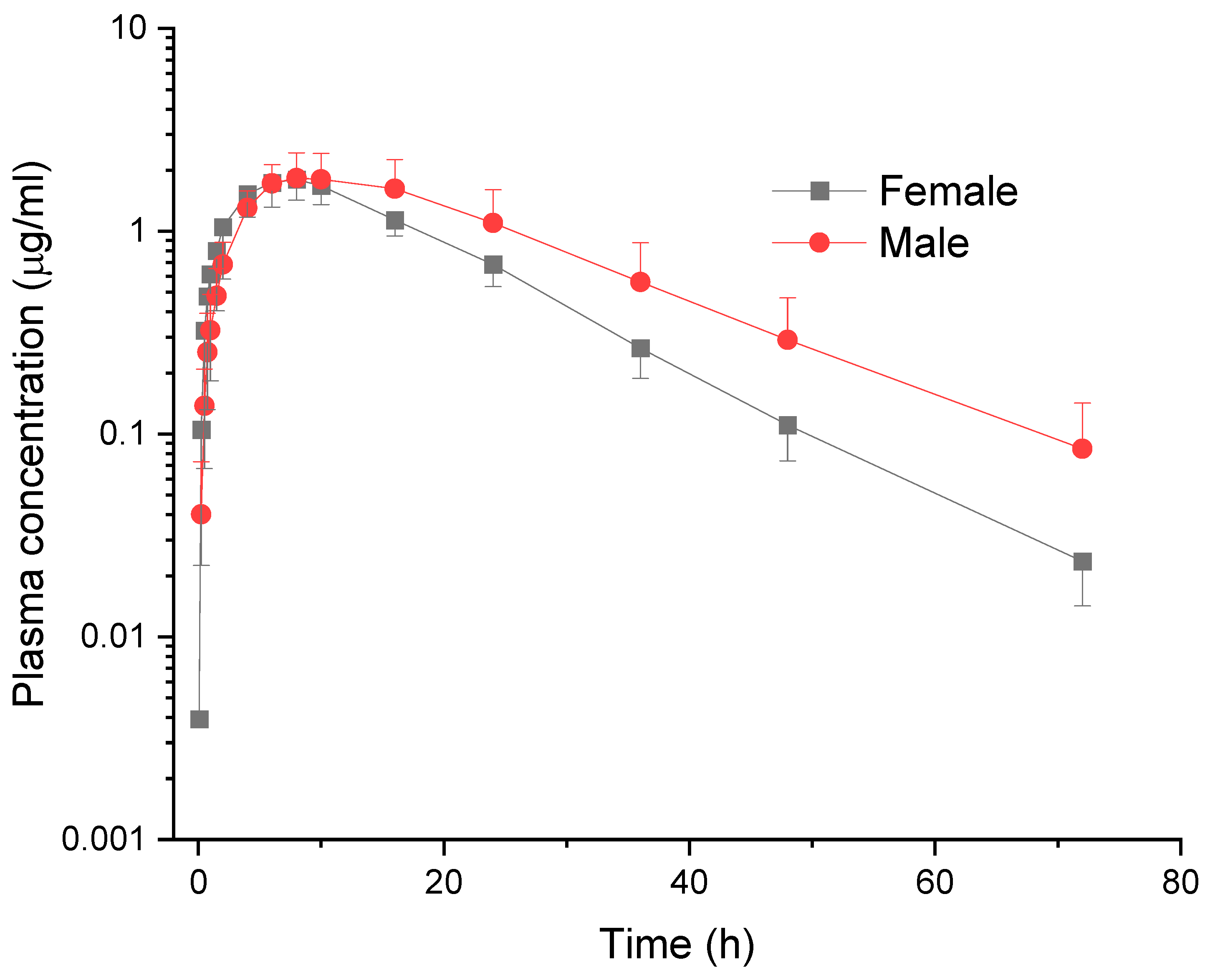

Table 1.
Validation parameters of the analytical method used to determine meloxicam in plasma samples.
Table 1.
Validation parameters of the analytical method used to determine meloxicam in plasma samples.
| Parameters | Meloxicam |
|---|---|
| LOD (µg/mL) | 0.0031 |
| LOQ (µg/mL) | 0.01 |
| Range of linearity (µg/mL) | 0.01-10.00 |
| Linearity (r2) | 0.9987-1.0000 |
| Recovery (%) | 85.85 (2.91) |
| Coefficient of variation (%) | 4.51 (0.73) |
LOD: Limit of detection, LOQ: Limit of quantification, r: correlation coefficient. Values in the brackets represent the standard deviations for the recovery assays (n=8).
Table 2.
Pharmacokinetic parameters of meloxicam after intravenous (IV, 0.5 mg/kg) and oral (PO, 1.0 mg/kg) administration to female and male goats (n=6).
Table 2.
Pharmacokinetic parameters of meloxicam after intravenous (IV, 0.5 mg/kg) and oral (PO, 1.0 mg/kg) administration to female and male goats (n=6).
| Parameters | IV administration | PO administration | ||
|---|---|---|---|---|
| Female | Male | Female | Male | |
| T1/2λz (h)a | 10.09 ± 0.97 | 11.72 ± 0.74* | 9.87 ± 0.85 | 13.10 ± 2.01* |
| C0 (µg/mL) | 3.76 ± 0.82 | 3.47 ± 0,39 | - | - |
| Tmax (h) | - | - | 7.33 ± 1.03 | 8.33 ± 1.51 |
| Cmax (µg/mL) | - | - | 1.87 ± 0.38 | 1.90 ± 0.50 |
| AUClast (µg.h/mL) | 25.35 ± 6.65 | 26.07 ± 4.14 | 39.24 ± 7.36 | 53.60 ± 21.12 |
| AUC0-∞ (µg.h/mL) | 25.57 ± 6.76 | 26.43 ± 4.30 | 39.59 ± 7.45 | 55.36 ± 22.38 |
| Vz (mL/kg) | 302.08 ± 66.15 | 325.47 ± 36.97 | - | - |
| Cl (mL/h/kg) | 20.69 ± 5.20 | 19.30 ± 2.83 | - | - |
| AUMClast (µg.h2/mL) | 319.66 ± 113.72 | 351.23 ± 82.09 | 654.61 ± 141.85 | 1147.71 ± 556.79 |
| AUMC0-∞ (µg.h2/mL) | 338.73 ± 124.71 | 383.57 ± 97.28 | 684.96 ± 153.68 | 1311.62 ± 685.47 |
| MRTlast (h)a | 12.22 ± 1.50 | 13.30 ± 0.97 | 16.55 ± 1.52 | 20.35 ± 2.55* |
| MRT0-∞ (h)a | 12.77 ± 1.74 | 14.27 ± 1.26 | 17.12 ± 1.73 | 22.18 ± 3.47* |
| Vss (L/kg) | 263.27 ± 52.26 | 274.50 ± 24.70 | - | - |
| F (%) | - | - | 77.43 | 104.73 |
T1/2λz: terminal half-life; C0: calculated concentration at time zero of IV administration, Tmax: time to reach peak plasma concentration, Cmax: peak plasma concentration, AUC: area under the (zero moment) curve from time 0 to the last detectable concentration, Vz, volume of distribution; Cl, clearance of drug, AUMC: area under the moment curve from time 0 to t last detectable concentration, MRT: mean residence time; Vss: apparent volume of distribution at steady state, F, bioavailability. aHarmonic mean. *The kinetic parameters in male goats are significantly different (P < 0.05) from those in female goats.
Disclaimer/Publisher’s Note: The statements, opinions and data contained in all publications are solely those of the individual author(s) and contributor(s) and not of MDPI and/or the editor(s). MDPI and/or the editor(s) disclaim responsibility for any injury to people or property resulting from any ideas, methods, instructions or products referred to in the content. |
© 2025 by the authors. Licensee MDPI, Basel, Switzerland. This article is an open access article distributed under the terms and conditions of the Creative Commons Attribution (CC BY) license (http://creativecommons.org/licenses/by/4.0/).
Copyright: This open access article is published under a Creative Commons CC BY 4.0 license, which permit the free download, distribution, and reuse, provided that the author and preprint are cited in any reuse.