

Submitted:
30 June 2025
Posted:
02 July 2025
You are already at the latest version
Abstract
In Ghana, tobacco use kills over 6,000 people annually, with an associated economic burden equivalent of 0.2% of Gross Domestic Product (GDP). Yet, the tobacco industry uses employment creation as one of the bases to prevent tobacco control measures such as tax and non-tax tools. Due to scant data on employment in the tobacco sector in Ghana, policymakers and advocates find it challenging countering industry arguments on employment in their quest to make informed decisions on tobacco control. This study attempted to provide some statistics on employment generated by the tobacco industry in Ghana using descriptive analysis of data from the World Bank, and both published and grey literature. We found that tobacco manufacturing employment declined by 83% between 1993 and 2006. However, the decline was compensated for by a 425% growth in manufacturing employment in other sectors during the period. Manufacturing employment has consistently increased even in the absence of tobacco manufacturing in Ghana after 2006. Tobacco farming employment declined by about 22.5% during 2005 – 2019, a decline compensated for by diversification and, in most cases, shifting to other crops such as garden eggs, pepper, among others. Tobacco sector employment constitutes only about 0.16% of the 11.2 million jobs in Ghana. We conclude that the decline in tobacco sector jobs in Ghana has been compensated for by employment growth in other sectors and diversification of portfolios. Therefore, the tobacco industry’s employment argument, as part of the SCARE tactics, should not prevent effective tobacco control measures in Ghana. In summary, decision-makers in Ghana must be aware of the tobacco industry SCARE tactics and seek regional and global support when designing policies to improve tobacco control in Ghana.
Keywords:
tobacco employment
; Ghana
; tobacco control
; tobacco farming
; tobacco industry activities
Introduction
Tobacco use is a leading cause of preventable deaths worldwide, killing more than 8 million people each year [1]. Annually, tobacco use costs the global economy an estimated US$ 1.4 trillion in healthcare costs, lost productivity, as well as fire and environmental damages caused by cigarette litter [2,3].
Daily, over 800,000 Ghanaian adults (15 years and over) smoked cigarettes in 2015, with about 780,000 male smokers [4], indicating that smoking is largely a male phenomenon in Ghana. Among children aged between 10 and 14 years, about 6,000 smoked cigarettes in the same year [4]. Even though cigarettes remain the most commonly used tobacco product in Ghana, other tobacco products such as chewing tobacco and shisha exist [4,5]. The economic cost of smoking (direct costs related to healthcare expenditures and indirect costs related to lost productivity due to early mortality, and morbidity) in Ghana is estimated to be US$PPP 123 million in 2012 [2]. A recent analysis shows that tobacco use costs Ghana an estimated GH¢668 million in morbidity and mortality costs, representing 0.2% of the country’s GDP [6]. This is because on the average, each year, tobacco kills over 6,000 people and causes about 193,000 years of disability in Ghana [7]. Even though in Ghana, the proportion of students aged 13-15 years who reported current use of cigarettes declined from about 4.2% in 2000 to 2.8% in 2017 [8,9], new forms of tobacco products like shisha (hookah) and e-cigarettes are slowly becoming a norm [8].
E-cigarettes are marketed as a safer alternative to traditional tobacco smoking because they are less harmful and hold potential as a harm reduction tool, helping current smokers who are unable or unwilling to quit [10]. Indeed, Ghana’s Food and Drugs Authority recognizes Electronic Nicotine Delivery Systems (ENDS) including VAPES or e-cigarettes as cessation as a potential measure to assist smokers to quit and not for recreation purposes. The ENDS must be registered as prescription-only medicine for the purposes of cessation therapy before they can be sold on the Ghanaian market [11]. However, there is a growing concern about their safety and potential health effects, including respiratory irritation and young people who may be attracted to the flavors and design of these products [10]. For instance, a recent study showed that e-cigarettes are reducing smoking cessation rates and expanding the nicotine usage by attracting young people [12]. Emerging evidence also suggests that e-cigarettes may damage biological systems of the body [13].
Considering the burden that tobacco places on the Ghanaian economy, Ghana has implemented policies to curb its use through a combination of tax and non-tax measures, as outlined in Articles 6-17 of the World Health Organization (WHO) Framework Convention on Tobacco Control (FCTC) [14]. Indeed, Ghana was one of the first five African countries and the 39th country globally to become a party to the WHO FCTC [15], having signed and ratified the WHO FCTC on 20th June 2003 and 29th November 2004, respectively.
While governments make efforts to enact laws and policies to control tobacco use, the industry generally uses SCARE1 tactics [16] to discourage governments and undermine tobacco control efforts. In a recent tobacco tax reform in Ghana, the industry interfered in the policymaking process, arguing that reforming and/or raising tobacco taxes would result in increased smuggling and illicit trade of tobacco products, knowing very well that it is the same industry flooding the market with illicit activities [17,18]. The industry has employed this strategy globally [19]; however, empirical evidence refutes such arguments [20]. The tobacco industry does this to prevent fiscal policies (i.e., taxation) and other regulations (e.g., plain packaging) aimed at reducing tobacco consumption so their profits can be maintained or increased.
A key issue of contention in tobacco control has to do with tobacco sector employment and the tobacco industry uses this as part of its SCARE tactics to ward off government regulation. The tobacco industry frames tobacco reduction policies as an economic issue instead of a public health concern. The industry commonly argues that because of its contribution to the national economy through job creation and pay taxes, tobacco control policies aimed at demand reduction can lead to massive overall unemployment in the economy [21,22]. Thus, because effective tobacco control policies such as taxation reduce consumption, the reduced demand may eventually cause job losses. In South Africa for example, the job losses argument has featured prominently in many debates regarding tobacco control legislation and taxation [23]. In the United Kingdom, key players in the tobacco industry argued that implementing plain packaging for tobacco products would lead to about 3,500 job losses in the convenience retail sector and close about 3,850 jobs (or even higher) in tobacco manufacturing [24,25]. The industry rhetoric on employment, made to legislators or other government officials either written or orally, create some form of fear among governments to effectively control tobacco use.
Admittedly, in some countries, a large number of people depend on tobacco for their livelihood, while in other countries tobacco sector employment constitutes a small proportion of overall employment. For instance, in countries like Zimbabwe and Malawi (Africa’s major leaf producers), it is estimated that tobacco industry provides livelihood to about 3 million people (in Zimbabwe) [26] and about 20% of households (in Malawi) [27]. However, the Government of Malawi and German Development Agency GIZ are promoting a transition to soybeans, groundnuts, sunflower, and other food crops [28]. Similarly, the Malaysian Government has developed kenaf as an alternative crop to tobacco since 2005 [29]. This is in line with article 17 of the WHO FCTC guidelines that recommends governments to promote economically viable alternatives for tobacco workers, growers, and individual sellers to safeguard their livelihoods [14].
There are many challenges that impede tobacco control in Ghana including the tobacco industry inference in policymaking processes [17], the government's capacity to enforce and monitor tobacco control policies, potential conflicts of interest and data paucity on key economic indicators such as employment to counter tobacco industry arguments.
Data paucity on employment statistics impacts effective tobacco control policies. Indeed, data on tobacco sector employment is difficult to obtain even in countries where tobacco is widely cultivated and manufactured, a concern also expressed by the International Labor Organization (ILO). Indeed, where some data do exist, they are fraught with substantial gaps as well as infrequent and unsystematic reporting [30], making it difficult to access data to inform policy. Ghana’s situation, in terms of data availability on tobacco sector employment, is even more precarious as data is scant. Therefore, this study sought to provide employment statistics in the tobacco sector in Ghana. We focus on direct employment such as leaf growing (farmers) and manufacturing (formal sector employment) as well as partial employment (wholesale and retail). Doing so helps in revealing the extent of employment provided by the tobacco industry in Ghana, hence, informing policymakers on the soundness of the employment argument often made by the tobacco industry against tobacco control measures. Although tobacco-related expenditure may induce employment in other sectors of the economy, research has shown that, overall, tobacco is weak in generating jobs in other sectors of the economy [31].
Methodology
Data Sources and Assumptions
We curated data from several secondary sources through in-depth review of tobacco policy and academic documents on tobacco use and control in Ghana. Also, databases of the World Bank (World Development Indicators) [32], United Nations Industrial Development Organization (UNIDO, INDSTAT 2 2023, ISIC Revision 3) [33] and Wellington et al. [34] were accessed for data. Data were curated for the following variables: total manufacturing and tobacco manufacturing employment, total agricultural sector employment as percentage of total employment, and sales employment (i.e., distribution, wholesale and retail).
The data covered the period 1963–2021. For some variables, the latest available year for data is 2019, whilst some variables have data as far back as 1963. Therefore, even though the analysis period covers 1963–2021 not all variables in the analysis covered this period. Where there were gaps in the data, a linear interpolation was used to fill the gaps within those years. We assumed that the rate of decline in total agricultural sector employment will be the same as that of tobacco leaf growing (i.e., farmers). Further, decline in tobacco consumption may cause the demand for leaf production to fall which will consequently cause farmers to diversify or completely shift to the production of other crops. This will in turn affect other jobs that are partially linked to the sector.
Estimation Strategy
In 2005, BAT Ghana engaged 250 distributors, 1,800 wholesalers and 20,000 retailers. The company also had 1,300 registered tobacco farmers and 260 full-time staff [34].
Over the years, agricultural sector employment in Ghana has been on the decline. The agricultural sector employment as share of total employment in Ghana declined from 64% in 1991 to 39.98% in 2021 [32]. This shows that more people are leaving the agricultural sector. We assumed that this decline in total agricultural sector employment affected tobacco leaf production. Therefore, we first calculated the annual percentage decline in agricultural sector employment from 2005–2019 (baseline data on tobacco farmers exist for 2005). We then multiply this percentage by the baseline number of tobacco farming jobs that existed in 2005 to obtain the number of farmers in 2006. Subsequently, we reduced the annual tobacco farming jobs by the annual rate of decline in total agricultural sector jobs. The employment at any specific year is obtained as follows: Et = Et-1 *(1 – d), where Et is current years employment; Et-1 is previous years employment and d is the annual rate of decline in agricultural employment.
Based on the assumptions and reasoning applied to the estimation of tobacco leaf growers from 2005 to 2019 and coupled with the fact that all tobacco manufacturing activities ceased since 2006, we estimated the number of workers engaged in tobacco distribution, wholesaling, and retailing.
Results and Discussion
Tobacco Manufacturing Versus Total Manufacturing Jobs
Between 1963 and 1969, tobacco manufacturing employment increased from 1,200 to 1,679, representing about 40% growth (Figure 1). However, this employment level declined to less than 1,000 workers during the period 1970-1976, an average of 5% decline per annum (p.a.). With regard to total manufacturing employment, it, however, grew by about 8% annually, from 1970-1976. This suggests that job losses in the tobacco manufacturing sector were compensated for by employment creation in other manufacturing sectors. Since 1993, employment in tobacco manufacturing has been on the decline, from 1,060 workers in 1993 to 180 workers in 2006 and zero from 2007 onwards. While tobacco manufacturing jobs were declining, the total number of manufacturing jobs increased significantly during the period (1993 – 2006), about 425% growth.
Tobacco Farming or Leaf Production Employment
Tobacco leaf is one of the cash crops in Ghana. However, leaf growing forms a small percentage of total agricultural production, indicating that the share of agricultural workers involved in leaf production is small. At the same time, the overall agricultural sector employment has been declining (1.4% p.a. during 1991 – 2021 and 1.8% during 2005 – 2019). We assume that the number of leaf growers will also fall in line with these overall trends in the agricultural sector.
In 2005, it was reported that British American Tobacco (BAT) Ghana (the major tobacco firm in Ghana responsible for over 80% [35] of tobacco production/importation) had about 1,300 registered farmers involved in leaf production [34]. Using the rate of 1.8% annual decline in agricultural sector employment, we assumed that the number of farmers engaged in tobacco leaf cultivation also declined by 1.8% over the same period. The resulting estimates of the number of tobacco leaf growers (reduced by 1.8% each year) are presented in Table 1. Many former tobacco farmers now cultivate garden eggs and pepper. For those who continue to cultivate tobacco, other crops have been added which is a step in the right direction, as it supports the WHO FCTC recommendations on alternative livelihood for all tobacco farmers in order to save lives and provide economic stability among farmers [14].
As observed in Table 1, tobacco sector employment is relatively low. From an estimated 1,300 farmers in 2005, the number declined steadily in the succeeding years to reach an estimated 1,008 workers in 2019. The exit of BAT Ghana in 2006 meant a significant blow to formal tobacco sector jobs as well as jobs in the wholesale, distribution, and retail value chain. Indeed, the exit of BAT Ghana necessarily also affected tobacco leaf growers since BAT Ghana was the major buyer of the produce of these farmers. Thus, many tobacco leaf growers must have shifted to other crops. However, in some parts of Ghana, like Gbefi in the Volta Region, tobacco growing is active and it is the main crop [36].
Tobacco Sales and Distribution Employment
There are many people involved in general distribution of goods and services in Ghana, ranging from industrial goods and agricultural products. These distributors or traders are involved in multiple products of which tobacco may form a small fraction of their portfolio. We estimate that about 18,107 workers were engaged in tobacco distribution, wholesaling and retailing in 2019 (Table 1).
Employment Income
Tobacco farmers also earn income from leaf growing. According to Appiah [36] a typical tobacco farmer earned about GH¢2,500 annually in 2015. This constituted over 80% of housekeeping money for many households in 2015. As pointed out by a respondent in the study by Appiah [36] in Ghana, “Tobacco money is basically the money we use for everything in this community” suggesting the key role tobacco plays in the economic lives of tobacco farming communities. Using information in Table 1, we estimated that farmers earned GH¢2.7 million cedis in 2015 (=GH¢2,500*1,084). Overall, workers in the sector (Table 1) earned about GH¢46.3 million (=18107 workers*GH¢10.65*20 working days * 12 months) in 2019 based on a minimum wage of GH¢10.65 and 240 working days in a year. This represented about 0.01% of Ghana’s GDP in 2019. Our study indicates that tobacco farming plays a significant role in the economic lives of the farming communities in Ghana, indicating the need for intense crop diversification in tobacco growing farming communities.
Limitations of the Study
This study is not without limitations. Tobacco may be only a part of the portfolio of farmers, distributors, wholesalers, and retailers, suggesting that these people may not depend solely on tobacco for their livelihood. Therefore, the employment estimates may be thought of as people who rely partly and/or solely on tobacco. The employment estimates are based on the baseline figures obtained from the literature and therefore any errors and inaccuracies in the literature may affect the current estimates. While these earnings may seem substantial, several factors (e.g., cost of labor and other inputs) are to be considered when evaluating whether tobacco farmers gain from leaf growing. This study did not assess the profitability or otherwise of tobacco farming compared to other crops.
Conclusion
Data on employment in the tobacco sector is scant in Ghana, which poses a challenge for policymakers in making informed decisions. This study attempted to provide some statistics on employment in the tobacco sector. We found that, overall employment in the tobacco sector has declined in the last two decades, largely on the back of a decline in agricultural sector employment and the closure of tobacco manufacturing activities in Ghana. However, the decline in the sector has been compensated for by growth in total manufacturing jobs in other sectors. Those involved in tobacco leaf growing have diversified and, in most cases, shifted to other crops such as garden eggs, pepper, among others.
Our findings are consistent with a previous study that shows that eliminating the domestic tobacco industry results in net job gains [21], and in Mexico where declining tobacco sector has not had any significant impact on overall employment [38,39]. However, because the tobacco industry’s goal is to undermine public health policies and increase profits, employment is continually used as a counterargument against increasing taxes and other tobacco control policies in many countries. Overall, we conclude jobs losses in Ghana’s tobacco sector have been compensated for by growth in economic opportunities in other sectors of the economy.
Aside from data paucity on employment which the tobacco industry uses in its SCARE tactics, interference in policymaking processes, challenges in enforcing tobacco control regulations are some of the factors endangering tobacco control in Ghana. In fact, the tobacco industry uses the same tactics in all countries to protect their interests [16,40].
We suggest strengthening the capacity of government agencies such as Food and Drugs Authority, Ghana Revenue Authority to curb illicit trade, tax compliance, among others. Further, increasing transparency in tobacco policymaking, and fostering partnerships between public health organizations and policymakers would contribute significantly to controlling tobacco use in Ghana. Further, monitoring economic indicators such as employment and revenue is crucial for the countries' ongoing effectiveness of tobacco control policies. In summary, decision-makers in Ghana must be aware of the tobacco industry SCARE tactics and seek regional and global support when designing fiscal and economic policies to improve tobacco control efforts in Ghana.
Author Contributions
Conceived the research: MKB, MI, A-AI, EA, LMM, RK. Data analysis: MKB, A-AI. Contributed to analysis/materials: MKB, MI, A-AI, EA, LMM, RK. Wrote the first draft: DL, MWD. Provided critical review and edited drafts: MKB, MI, A-AI, EA, LMM, RK, DL, MWD. All authors read and approved the final version of the manuscript submitted.
Funding
Vision for Alternative Development, Ghana (VALD Ghana) received financial support from Bill and Mellinda Gates Foundation through Tax Justice Network Africa (TJNA) for this study.
Ethics Approval and consent to participate
Not applicable.
Consent for publication
Not Applicable
Data Availability
All data analyzed in the study are publicly available in the references cited in the study. Data will also be available on reasonable request to the authors.
Acknowledgments
The authors wish to thank Zunda Chisha and Kirsten van der Zee of Research Unit on the Economics of Excisable Products (REEP), University of Cape Town for valuable comments on this paper. The insightful comments from the anonymous reviewers are gratefully acknowledged. The usual caveat applies.
Conflict of Interest
The authors declare that they have no conflict of interest.
| 1 | S – Smuggling & Illicit Trade, C – Court & Legal Challenges, A – Anti-poor Rhetoric R – Revenue Reduction, E – Employment Impact. |
References
- World Health Organization: WHO report on the global tobacco epidemic 2019: Offer help to quit tobacco use. 2019.
- Goodchild, M.; Nargis, N.; d'Espaignet, E.T. Global economic cost of smoking-attributable diseases. Tobacco Control 2018, 27, 58–64. [Google Scholar] [CrossRef] [PubMed]
- The economics of tobacco. [https://www.euro.who.int/en/health-topics/disease-prevention/tobacco/publications/the-economics-of-tobacco].
- Ghana Country Facts. [https://files.tobaccoatlas.org/wp-content/uploads/pdf/ghana-country-facts-en.pdf].
- Singh, A.; Owusu-Dabo, E.; Mdege, N.; McNeill, A.; Britton, J.; Bauld, L. A situational analysis of tobacco control in Ghana: progress, opportunities and challenges. Journal of global health reports 2020, 4. [Google Scholar] [CrossRef] [PubMed]
- United Nations Development Programme (UNDP): Investment Case for Tobacco Control in Ghana. In.; 2024.
- Global Burden of Disease Collaborative Network: Global Burden of Disease Study 2019 (GBD 2019) Smoking Tobacco Use Prevalence 1990-2019.. In., 2021 edn. Seattle, United States of America: Institute for Health Metrics and Evaluation (IHME). 2021.
- CDC; WHO; MOH. GLOBAL YOUTH TOBACCO SURVEY: Factsheet, Ghana 2017. 2018. [Google Scholar]
- GLOBAL YOUTH TOBACCO SURVEY, Ghana 2000: Factsheet.
- Yayan, J.; Franke, K.-J.; Biancosino, C.; Rasche, K. Comparative systematic review on the safety of e-cigarettes and conventional cigarettes. Food Chem Toxicol 2024, 185. [Google Scholar] [CrossRef] [PubMed]
- Ghana Food and Drugs Authority. FDA Strengthens Regulation on Electronic Nicotine Delivery Systems (ENDS)/VAPES; Ghana Food and Drugs Authority: Accra, 2023. [Google Scholar]
- Glantz, S.A.; Bareham, D.W. E-cigarettes: use, effects on smoking, risks, and policy implications. Annual review of public health 2018, 39, 215–235. [Google Scholar] [CrossRef]
- Hamann, S.L.; Kungskulniti, N.; Charoenca, N.; Kasemsup, V.; Ruangkanchanasetr, S.; Jongkhajornpong, P. Electronic Cigarette Harms: Aggregate Evidence Shows Damage to Biological Systems. International Journal of Environmental Research and Public Health 2023, 20. [Google Scholar] [CrossRef]
- WHO framework convention on tobacco control. [ www.who.int/tobacco/framework/WHO_FCTC_english.pdf (accessed: Jan 28, 2019)].
- Tumwine, J. Implementation of the framework convention on tobacco control in Africa: current status of legislation. International Journal of Environmental Research and Public Health 2011, 8, 4312–4331. [Google Scholar] [CrossRef] [PubMed]
- The Economics of Tobacco Control: NCI Monograph Symposium [https://www.economicsforhealth.org/files/research/402/Chaloupka_SRNT_Monograph-Symposium_March-9-2017.pdf].
- Vision for Alternative Development - Ghana (VALD Ghana). The Excise Duty Amendment Act 2023 and the Tobacco Industry Interference in Ghana, VALD Ghana: Accra, 2023.
- Boachie, M.K.; Immurana, M.; Iddrisu, A.-A.; Ayifah, E. Economics of Tobacco Control in Ghana; Vision for Alternative Development: Accra, 2022. [Google Scholar]
- Illicit Tobacco Trade [https://www.tobaccotactics.org/article/illicit-tobacco-trade/].
- World Bank. Confronting Illicit Tobacco Trade: a Global Review of Country Experiences; World Bank: Washington DC, 2019. [Google Scholar]
- Vulovic, V. Tobacco Control Policies and Employment. A Tobacconomics Policy Brief; Tobacconomics, Health Policy Center, Institute for Health Research and Policy, University of Illinois at Chicago: Chicago, IL, 2018. [Google Scholar]
- Warner, K.E. The economics of tobacco: myths and realities. Tobacco Control 2000, 9, 78–89. [Google Scholar] [CrossRef]
- Zatoński, M.Z.; Egbe, C.O.; Robertson, L.; Gilmore, A. Framing the policy debate over tobacco control legislation and tobacco taxation in South Africa. Tobacco Control 2023, 32, 450–457. [Google Scholar] [CrossRef]
- Centre for Economics and Business Research Ltd. Quantification of the economic impact of plain packaging for tobacco products in the UK; Centre for Economics and Business Research Ltd: London, 2013. [Google Scholar]
- Japan Tobacco International. Response to the Department of Health's Consultation on the Standardised Packaging of Tobacco Products; Japan Tobacco International: London, 2012. [Google Scholar]
- Climate change is smoking Zimbabwe’s valuable tobacco crop. [https://allianceforscience.org/blog/2022/01/climate-change-is-smoking-zimbabwes-valuable-tobacco-crop/].
- Malawi’s Tobacco Sector Standing on One Strong Leg is Better Than on None [https://documents1.worldbank.org/curated/en/505031468757241265/pdf/267380AFR0wp55.pdf].
- Alternatives to tobacco – a closer look at legumes and sunflower in Malawi [https://unfairtobacco.org/wp-content/uploads/2018/09/Legumes-and-Sunflower-in-Malawi_a4.pdf].
- Alternatives to tobacco – a closer look at Kenaf in Malaysia [https://unfairtobacco.org/wp-content/uploads/2018/09/Kenaf-in-Malaysia_en_a4.pdf].
- International Labour Organization. Tobacco sector employment statistical update; International Labour Organization: Geneva, 2014; pp. 1–112. [Google Scholar]
- Ahsan, A.; Wiyono, N. An analysis of the impact of higher cigarette prices on employment in Indonesia; University of Indonesia: Indonesia, 2007. [Google Scholar]
- [https://databank.worldbank.org/reports.aspx?source=2&series=SP.POP.TOTL&country=SWZ# ].
- United Nations Industrial Development Organization. INDSTAT 2 2023, ISIC Revision 3; United Nations Industrial Development Organization: Geneva, 2023. [Google Scholar]
- Wellington, E.; Gyapong, J.; Twum-Barima, S.; Aikins, M.; Britton, J. Tobacco control in Africa: People, politics and policies. Anthem Press: Ghana. London, UK, 2011.
- GlobalData: Cigarettes in Ghana, 2020. In.: GlobalData; 2020.
- Appiah, S.O. Child labour or child work? Children and tobacco production in Gbefi, Volta Region. GHANA SOCIAL SCIENCE 2018, 15, 147. [Google Scholar]
- Ghana Statistical Service. Quaterly Labour Force Report; Ghana Statistical Service: Accra, 2022. [Google Scholar]
- Huesca, L.; Sobarzo, H.; Llamas, L. A general equilibrium analysis of the macroeconomic impacts of tobacco taxtation in Mexico In.; 2021.
- Waters, H.; Miera BSd Ross, H.; Shigematsu, L.R. The Economics of Tobacco and Tobacco Taxation in Mexico; International Union Against Tuberculosis and Lung Disease (The Union): Paris, 2010. [Google Scholar]
- Tobacco Industry Tactics [https://www.tobaccotactics.org/article/tobacco-industry-tactics/].
Figure 1.
Trends in Total manufacturing and tobacco manufacturing employment in Ghana. Source: United Nations Industrial Development Organization [33].
Figure 1.
Trends in Total manufacturing and tobacco manufacturing employment in Ghana. Source: United Nations Industrial Development Organization [33].
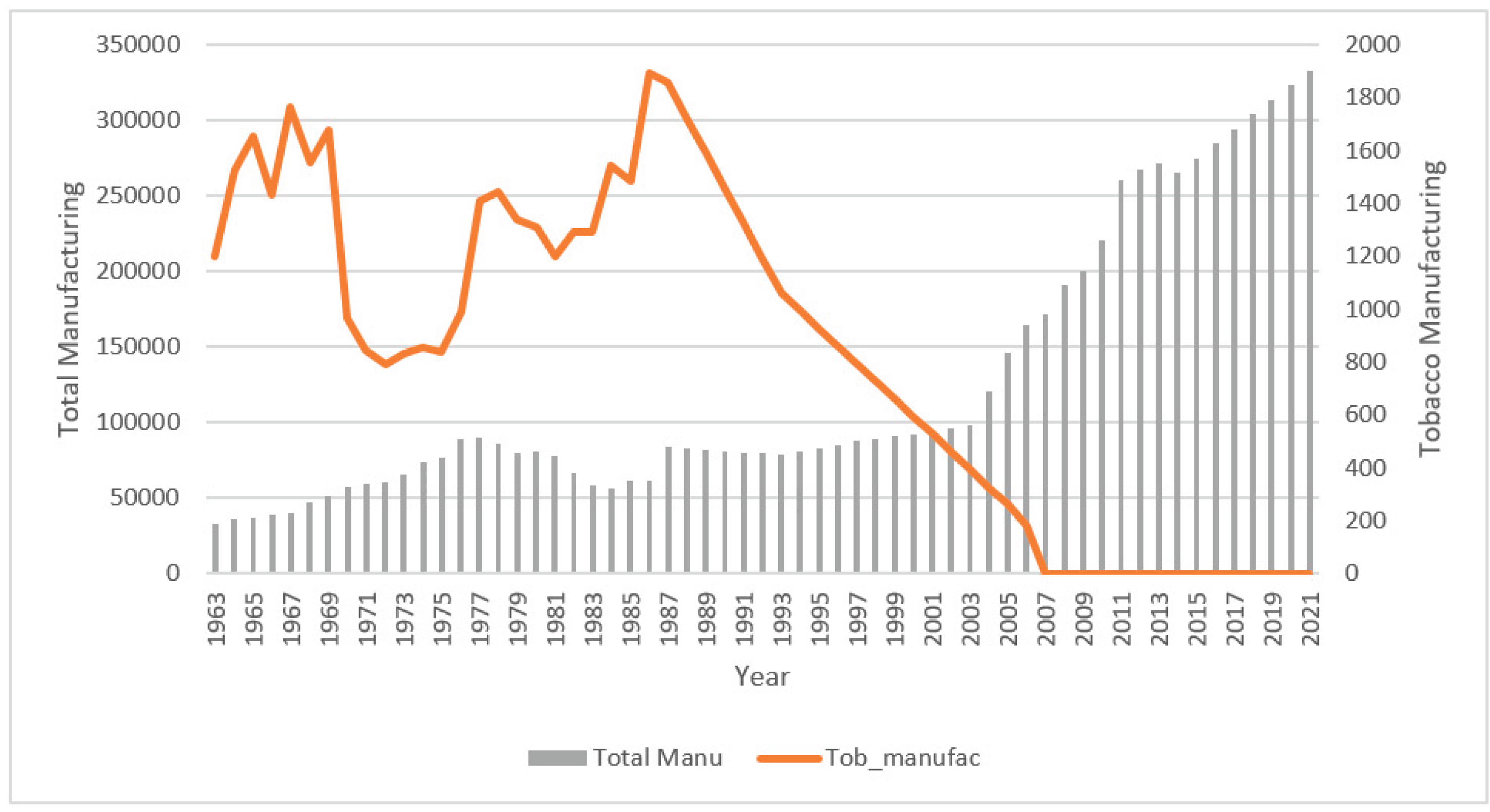

Table 1.
Estimates of tobacco-related employment.
| Year | Farmers | Distributors | Wholesalers | Retailers | Total |
| 2005 | 1,300 | 250 | 1,800 | 20,000 | 23,350 |
| 2006 | 1,277 | 246 | 1,768 | 19,640 | 22,930 |
| 2007 | 1,254 | 241 | 1,736 | 19,286 | 22,517 |
| 2008 | 1,231 | 237 | 1,705 | 18,939 | 22,112 |
| 2009 | 1,209 | 232 | 1,674 | 18,598 | 21,714 |
| 2010 | 1,187 | 228 | 1,644 | 18,264 | 21,323 |
| 2011 | 1,166 | 224 | 1,614 | 17,935 | 20,939 |
| 2012 | 1,145 | 220 | 1,585 | 17,612 | 20,562 |
| 2013 | 1,124 | 216 | 1,557 | 17,295 | 20,192 |
| 2014 | 1,104 | 212 | 1,529 | 16,984 | 19,829 |
| 2015 | 1,084 | 208 | 1,501 | 16,678 | 19,472 |
| 2016 | 1,065 | 205 | 1,474 | 16,378 | 19,121 |
| 2017 | 1,045 | 201 | 1,447 | 16,083 | 18,777 |
| 2018 | 1,027 | 197 | 1,421 | 15,794 | 18,439 |
| 2019 | 1,008 | 194 | 1,396 | 15,509 | 18,107 |
Source: Authors’ estimates.
Disclaimer/Publisher’s Note: The statements, opinions and data contained in all publications are solely those of the individual author(s) and contributor(s) and not of MDPI and/or the editor(s). MDPI and/or the editor(s) disclaim responsibility for any injury to people or property resulting from any ideas, methods, instructions or products referred to in the content. |
© 2025 by the authors. Licensee MDPI, Basel, Switzerland. This article is an open access article distributed under the terms and conditions of the Creative Commons Attribution (CC BY) license (http://creativecommons.org/licenses/by/4.0/).
Copyright: This open access article is published under a Creative Commons CC BY 4.0 license, which permit the free download, distribution, and reuse, provided that the author and preprint are cited in any reuse.


