

Submitted:
30 June 2025
Posted:
01 July 2025
You are already at the latest version
Abstract

Background/Objectives: Anxiety before ophthalmic surgery under local anesthesia may hinder patient cooperation and surgical outcomes. Nurse-led auditory interven-tions offer a promising non-pharmacological approach to perioperative anxiety man-agement. This study evaluated the effectiveness of superimposed binaural beats (SBB)—classical music layered with frequency differentials—in reducing anxiety during pterygium surgery with conjunctival autograft. Methods: In this randomized controlled trial, 111 adult patients scheduled for elective pterygium excision with conjunctival autograft under local anesthesia were allocated to one of three groups: SBB, plain music (PM), or silence (control). A trained perioperative nurse administered all auditory in-terventions. Anxiety was assessed using the State-Trait Anxiety Inventory-State (STAI-S), and physiological parameters (blood pressure, heart rate, respiratory rate, oxygen saturation) were recorded before and after surgery. Results: The SBB group showed significantly greater reductions in STAI-S scores (p < 0.001), systolic blood pressure (p = 0.011), heart rate (p = 0.003), and respiratory rate (p = 0.009) compared to the PM and control groups. No adverse events occurred. Conclusions: SBB is a safe, nurse-delivered auditory intervention that significantly reduces perioperative anxiety and supports physiological stability. Its integration into routine nursing care for minor ophthalmic surgeries is both feasible and beneficial.
Keywords:
nursing-led intervention
; binaural beats
; perioperative anxiety
; music therapy
; pa-tient-centered care
; pterygium surgery
; local anesthesia
1. Introduction
Pterygium is a prevalent ocular condition characterized by a wedge-shaped fibrovascular proliferation extending from the bulbar conjunctiva toward the cornea. Clinically, it can manifest as mild symptoms—such as ocular irritation, redness, and the sensation of a foreign body—or progress to significant visual impairment when the lesion encroaches upon the visual axis [1]. Its prevalence and associated risk factors vary by geographic region, age, sex, and environmental exposure [2]. The pathogenesis of pterygium is multifactorial, involving chronic ultraviolet (UV) radiation, viral infections, and heightened expression of inflammatory mediators and growth factors. Additional mechanisms—including oxidative stress, tumor suppressor gene dysfunction, apoptosis, and neuropeptide activity—have also been implicated in the abnormal proliferation of conjunctival tissue across the cornea [3].
Surgical excision remains the standard treatment for progressive pterygium and is typically performed under local anesthesia in outpatient settings. Within these environments, nurses play a central role in patient preparation and psychological support, ensuring emotional readiness and procedural cooperation. Despite the minimally invasive nature of the procedure, ophthalmic surgeries often provoke considerable anxiety, stemming from fears of vision loss, unfamiliar surgical settings, or concerns about intraoperative discomfort and postoperative recovery [4]. Such psychological distress can activate the sympathetic nervous system, leading to elevations in blood pressure, heart rate, and respiratory rate—physiological responses that may compromise patient cooperation and surgical outcomes [5].
Managing perioperative anxiety is therefore a critical aspect of comprehensive patient care. In outpatient ophthalmology, where pharmacologic sedation is rarely utilized, nurse-led interventions become essential in mitigating psychological distress. Through environmental control, psychological reassurance, and the implementation of evidence-based, non-pharmacological strategies, nurses contribute significantly to perioperative emotional stabilization [6].
Auditory stimulation—particularly binaural beats within the alpha frequency range (8–12 Hz)—has demonstrated efficacy in reducing anxiety by facilitating cortical relaxation [7]. A growing body of evidence supports the clinical application of such interventions across diverse perioperative contexts [8,9]. The integration of binaural beats with music may produce synergistic anxiolytic effects, as observed in ophthalmic procedures such as cataract surgery [10].
Superimposed binaural beats (SBB) represent an emerging auditory intervention designed to transition brainwave activity toward relaxed states more efficiently than conventional binaural beats. Unlike traditional binaural beats—typically produced by differentiating two pure-tone sine wave frequencies—SBB incorporate additional layers of stimulation. In this study, supplementary beats were synthesized from frequency-shifted sound waves of classical musical instruments, creating a richer and more dynamic auditory experience [11]. Despite their promising neurophysiological mechanisms, the clinical application of SBB as a nurse-delivered modality remains underexplored, particularly in ophthalmic surgical populations.
This study aimed to evaluate the anxiolytic efficacy of SBB among patients undergoing pterygium surgery under local anesthesia. Using a randomized controlled design, we investigated whether a structured, nursing-led auditory intervention could reduce perioperative anxiety and stabilize physiological responses. Findings from this research support the integration of sensory-based, non-pharmacological strategies into routine nursing care, thereby reinforcing the evolving role of nurses in delivering holistic, patient-centered interventions in outpatient surgical settings.
2. Materials and Methods
2.1. Study Design and Participants
This study employed a parallel-group, randomized controlled trial (RCT) design with a double-blinded, superiority framework to evaluate the efficacy of superimposed binaural beats (SBB) in reducing perioperative anxiety. The trial was approved by the Dhurakij Pundit University Human Research Ethics Committee (Approval Code: COA No. 007/67) and conducted in full accordance with the approved protocol. The trial was prospectively registered in the Thai Clinical Trials Registry (TCTR) under the identifier TCTR20240118001 on January 25, 2025.
Participant recruitment was conducted between January and May 2025 at Phra Ajan Baen Thanagro Hospital, Thailand. Eligible individuals were adults aged 30 years or older scheduled for elective pterygium excision with conjunctival autograft under local anesthesia—a surgical technique requiring extended operative time and increased patient cooperation due to autologous tissue harvesting and graft placement. Exclusion criteria included complex pterygium morphology, auditory impairment, active ear infections, a prior history of epilepsy or cognitive dysfunction, and preoperative blood pressure exceeding 160/100 mmHg.
Participants were randomly allocated into three groups using a computer-generated randomization scheme: (1) the SBB group, which received classical music embedded with superimposed binaural frequencies; (2) the plain music (PM) group, which received the same music without binaural components; and (3) the control group, which wore headphones without audio input.
Of the 111 participants enrolled, 108 were assigned using block randomization (block size of six) to maintain balanced group distribution. The remaining three were assigned via simple randomization (1:1:1 ratio). All allocations were conducted by a designated perioperative nurse who had exclusive access to the password-protected allocation file and was not involved in outcome assessment.
The operating ophthalmologist, the four rotating perioperative nurses responsible for questionnaire administration and vital sign monitoring, and all outcome assessors were blinded to group allocation. Although the intervention nurse could not be blinded due to the nature of the auditory protocol, all participants remained masked to their assigned group in order to minimize expectation bias.
No interim analyses or stopping rules were implemented. The study proceeded without deviation from the registered protocol. Potential adverse effects—such as dizziness, headache, nausea, or discomfort from headphone use—were pre-specified and continuously monitored throughout the perioperative period. Monitoring was embedded into routine nursing surveillance procedures throughout the intervention period.
2.2. Interventions
Prior to enrollment, all participants underwent audiometric screening using the MAICO Audiometer MA 25 (MAICO Diagnostics GmbH, Berlin, Germany) to confirm normal hearing function. All individuals passed the screening, with auditory thresholds ≤25 dB HL at 500–2000 Hz, ensuring accurate perception of the auditory stimuli.
SBB Group: Participants assigned to this group received a custom-designed auditory track developed and licensed by Chiang Mai University, Thailand. The audio incorporated ambient natural sounds—such as water streams, forest ambiance, and ocean waves—combined with superimposed binaural layers. These additional layers were synthesized by frequency-shifting the sound waves of individual musical instruments, supplementing the primary binaural beat, which was generated via pure-tone sine wave differentiation. Using the SHARM self-hypnosis system (Cyber Team Ltd., Version 2.4), the auditory sequence began at 20 Hz (beta range) for the first 5 minutes, gradually decreased to 10 Hz (alpha range) over the next 5 minutes, and then remained at 10 Hz for the remainder of the session. Participants listened to the audio throughout the surgical procedure and continued wearing the headphones for up to 15 minutes postoperatively. Although the full 60-minute track was not always completed, auditory exposure remained consistent across participants. All files were encoded in MP3 format, with binaural layering rendered imperceptible to conscious awareness.
PM Group: Participants in the plain music (PM) group listened to the same musical composition used in the SBB group, but without embedded binaural frequencies. The musical and ambient elements were preserved, while the frequency differentials necessary for binaural beat generation were intentionally excluded. Audio parameters—such as volume, duration, and structural progression—were matched to those of the SBB track to ensure comparability between groups.
Control Group: Participants assigned to the control group wore identical headphones but did not receive any auditory input, serving as a sham intervention. This setup controlled for environmental and equipment-related variables without introducing auditory stimulation.
Delivery Method and Timing: All participants used the same standardized audio equipment, comprising the Sony NW-A306 A300 Walkman® (Sony Corporation, Tokyo, Japan) connected via Bluetooth to Bose QuietComfort® 45 noise-canceling headphones (Bose Corporation, Framingham, MA, USA). In both the SBB and PM groups, auditory interventions were initiated 10 minutes prior to the surgical procedure, continued throughout the operation, and extended for an additional 15 minutes postoperatively. The audio volume was initially preset at a soft level—approximately 10 out of 30 on the Walkman® interface—corresponding to a sound level comparable to soft conversation speech. This level ensures auditory perception while minimizing risk of discomfort or hearing fatigue. Before initiating playback, the responsible nurse performed an informal sound check to confirm that each participant could perceive the audio comfortably. Minor individual adjustments were permitted to accommodate personal listening preferences. During the procedure, participants were also allowed to fine-tune the volume within a comfortable range. The headphones were set to “Aware Mode” to ensure participants remained responsive to intraoperative verbal instructions, thereby maintaining communication and patient safety.
Anesthesia Protocol: Topical anesthesia was applied using 2% lidocaine jelly (Xylocaine® Jelly 2%, AstraZeneca, Södertälje, Sweden) prior to the procedure, followed by a subconjunctival injection of 1% lidocaine with 1:100,000 adrenaline (Xylocaine® with Adrenaline, AstraZeneca, Södertälje, Sweden) at the time of surgery.
Monitoring: Physiological parameters—including systolic and diastolic blood pressure (SBP, DBP), heart rate (HR), respiratory rate (RR), and oxygen saturation (SpO₂)—were assessed at two time points: (1) immediately before headphone placement, and (2) 15 minutes after surgery completion, while participants were still wearing the assigned headphones. All measurements were performed using the Nihon Kohden Life Scope Monitor (PVM-400; Nihon Kohden Corporation, Tokyo, Japan) by a team of four rotating perioperative nurses trained in standardized measurement protocols to ensure consistency and minimize inter-provider variability.
All auditory interventions were embedded within a structured, nurse-led perioperative care protocol to ensure fidelity, standardization, and feasibility. A single, trained perioperative nurse was responsible for administering the audio intervention, including device setup, initial volume calibration, and comfort verification. Participant masking was preserved across all groups through the use of visually identical headphones and standardized implementation procedures, as outlined in Section 2.1.
2.3. Assessment of Anxiety
The State-Trait Anxiety Inventory (STAI), a widely validated instrument for assessing anxiety in clinical populations, was employed to evaluate the anxiolytic effects of the superimposed binaural beats (SBB) intervention. The STAI consists of two subscales: the Trait Anxiety Scale (STAI-T), which measures general susceptibility to anxiety, and the State Anxiety Scale (STAI-S), which assesses transient, situational anxiety. Each subscale comprises 20 items, yielding scores ranging from 20 to 80, with higher scores indicating greater anxiety severity. The Thai-adapted version of the STAI was administered under a research license obtained from Mind Garden, Inc., in full compliance with all licensing and copyright requirements [12,13].
On the day of surgery, participants first completed baseline assessments, including medical history, otologic and ophthalmologic examinations, followed by the STAI-T. The STAI-S was then administered approximately 10 minutes before entry into the operating room, immediately prior to the start of the assigned auditory intervention. Following surgery, physiological parameters were recorded while participants were still listening to the audio stimulus. The STAI-S was subsequently re-administered immediately after headphone removal.
All postoperative assessments were conducted within 15 minutes after the completion of surgery. This standardized timing was implemented to ensure consistency across participants and to minimize variability in anxiety measurement. It also served to reduce potential confounding effects related to prolonged auditory exposure or environmental influences beyond the intervention window.
2.4. Outcomes
As outlined in Section 2.3, the primary outcome of this study was the change in state anxiety levels, assessed through pre- and postoperative scores on the State-Trait Anxiety Inventory-State (STAI-S). This outcome was selected to capture the immediate anxiolytic effect of the auditory intervention.
Secondary outcomes included changes in physiological parameters—namely systolic and diastolic blood pressure (SBP and DBP), heart rate (HR), respiratory rate (RR), and peripheral oxygen saturation (SpO₂)—measured at the same time points. In addition, operative duration, intraoperative complications, and adverse events were recorded to facilitate safety monitoring and provide contextual clinical insights.
All primary and secondary outcomes were pre-specified in the study protocol and were consistently applied throughout the study period. No amendments to the outcome measures were made following trial initiation, ensuring protocol adherence and data integrity.
2.5. Randomization and Blinding
Randomization Method: The random allocation sequence was generated using block randomization with a fixed block size of six to ensure balanced group distribution throughout the recruitment phase. A computer-generated randomization list was utilized for the first 108 participants, and the final three were assigned using simple randomization with a 1:1:1 allocation ratio. All allocations were performed by a single designated perioperative nurse responsible for managing the randomization process and intervention setup.
Allocation Concealment: The randomization list was securely stored in a password-protected database, accessible only to a single designated perioperative nurse. Neither the personnel involved in participant enrollment, the operating ophthalmologist, nor the team of four rotating perioperative nurses had access to the allocation sequence. This approach ensured rigorous allocation concealment and minimized the risk of selection bias.
Implementation: The randomization sequence was prepared by the study statistician. Participant enrollment was carried out by a registered nurse from the outpatient department, who was not involved in intervention delivery or outcome assessment and remained blinded to group allocation. Group allocation and delivery of auditory interventions were performed by the same designated perioperative nurse, who was structurally separated from outcome assessment and surgical activities. This procedural separation was implemented to preserve methodological independence and reduce the potential for performance and detection bias.
Blinding: Participants, the operating ophthalmologist, and the perioperative nursing team—including the four rotating nurses responsible for physiological monitoring and questionnaire administration—were all blinded to group allocation. Auditory interventions (SBB, plain music, and silence) were administered using visually identical audio devices and noise-canceling headphones to ensure both visual and auditory masking. While the intervention nurse could not be blinded due to the nature of the task, her involvement was strictly confined to group assignment and audio setup. All outcome assessments were performed by blinded personnel, and the data analyst remained unaware of group allocations. The use of standardized protocols and indistinguishable equipment further minimized the potential for bias across study arms.
2.6. Statistical Analysis
Sample size calculation was performed using the power command in Stata (StataCorp LLC, College Station, TX, USA), with a significance level (α) of 0.05 and statistical power set at 80% (β = 0.20). Reference values were obtained from a prior study by Opartpunyasarn et al. [14], which reported a mean reduction in STAI-S scores of 7.26 ± 9.31 in the intervention group and 1.12 ± 9.21 in the control group. Assuming equal group allocation (1:1 ratio), the minimum required sample size was determined to be 29 participants per group. To account for an anticipated 20% dropout rate, the final sample size was increased to 37 per group, resulting in a total of 111 participants across the three study arms. A one-sided hypothesis test was applied during power estimation.
All statistical analyses were conducted using Stata version 19.0 (StataCorp LLC, College Station, TX, USA). Categorical variables were compared between groups using Fisher’s exact test, appropriate for small sample sizes or low expected cell counts. For continuous variables, overall group differences were assessed using one-way analysis of variance (ANOVA). Where significant group differences were observed, pairwise comparisons were performed using Bonferroni-adjusted post hoc tests. Within-group comparisons of pre- and post-intervention outcomes were conducted using paired t-tests. A p-value of < 0.05 was considered statistically significant for global tests, while a stricter threshold of p < 0.0167 was applied for pairwise comparisons to control for type I error.
All analyses followed the intention-to-treat (ITT) principle, whereby participants were analyzed in the groups to which they were originally assigned, regardless of intervention adherence. This approach preserved the benefits of randomization and enhanced the external validity of the results. No interim analyses were conducted, and no formal stopping rules were implemented. Missing data were handled using listwise deletion, and no imputation methods were applied.
3. Results
All participants were recruited between January and May 2025. A total of 111 patients scheduled for elective pterygium excision were screened for eligibility. Six were excluded for not meeting the inclusion criteria—two due to documented auditory impairment and four due to baseline blood pressure exceeding 160/100 mmHg. The remaining 105 eligible participants were randomly assigned into three groups using a computer-generated randomization sequence: SBB (n = 35), PM (n = 35), and control (n = 35). Two participants—one from the PM group and one from the control group—were excluded from the final analysis due to missing postoperative STAI-S data, resulting in 103 participants included in the final analysis (Figure 1).
All surgical procedures were performed by a single ophthalmologist to ensure consistency in operative technique. A team of four rotating perioperative nurses implemented a standardized protocol encompassing preoperative assessments (vital signs and STAI-T/STAI-S), intraoperative nursing support, and postoperative evaluations (vital signs and STAI-S), all of which were integrated into routine clinical care.
Auditory interventions were administered according to standardized protocols by a single trained perioperative nurse who also managed group assignments. This approach ensured fidelity to the intervention protocol, minimized inter-provider variability, and standardized headphone placement, audio setup, volume calibration, and timing across all participants. All participants completed their assigned auditory interventions without interruption, and no cases of premature headphone removal or protocol deviations were recorded.
Postoperative assessments—including STAI-S scores and physiological parameters—were completed within approximately 15 minutes after surgery. At that point, participants continued to wear the headphones, although the 60-minute auditory track had not necessarily concluded.
All participants received standard perioperative care, including topical 2% lidocaine jelly and subconjunctival injection of 1% lidocaine with 1:100,000 adrenaline. No sedatives, anxiolytics, or additional pharmacologic agents were administered during the perioperative period in any group.
The trial proceeded as planned without interim analyses or early termination and concluded upon achieving the predefined sample size specified in the study protocol.
Baseline psychological and physiological measures were comparable across groups. Initial STAI-T scores showed no significant differences (Table 1), and pre-intervention STAI-S scores were similar among groups: 37.5 ± 5.5 in the SBB group, 36.5 ± 4.5 in the PM group, and 36.1 ± 5.2 in the control group (p = 0.525; Table 1). Likewise, baseline physiological parameters—including SBP (p = 0.945), DBP (p = 0.874), HR (p = 0.838), RR (p = 0.276), and SpO₂ (p = 0.545)—did not differ significantly (Table 1).
Following the intervention, the SBB group demonstrated the greatest reduction in STAI-S scores (–10.6 ± 4.9), followed by the PM group (–4.9 ± 4.6), and the control group (–0.9 ± 4.3), with a statistically significant overall group difference (p < 0.001; Table 2).
In terms of physiological responses, the SBB group exhibited significant reductions in systolic blood pressure (SBP; –5.6 ± 12.2 mmHg, p = 0.011), heart rate (HR; –5.8 ± 7.0 bpm, p = 0.003), and respiratory rate (RR; –0.9 ± 2.7 breaths/min, p = 0.009). A modest increase in peripheral oxygen saturation (SpO₂; +0.4 ± 2.2%, p = 0.025) was also observed, whereas changes in diastolic blood pressure (DBP; –1.3 ± 7.4 mmHg, p = 0.222) were not statistically significant (Table 2; Figure 2).
Bonferroni-adjusted post hoc analyses confirmed that the SBB group experienced significantly greater reductions in STAI-S scores (p < 0.001), SBP (p = 0.008), HR (p = 0.003), and RR (p = 0.010) compared to the control group. However, differences in DBP (p = 0.250) and SpO₂ (p = 0.020) did not meet the corrected significance threshold (p < 0.0167). No statistically significant pairwise differences were observed between the SBB and PM groups or between the PM and control groups for any of the measured outcomes (Table 3).
No adverse events, protocol violations, or unintended effects were reported during the intervention or surgical procedures in any group.
4. Discussion
This randomized controlled trial provides novel evidence supporting the effectiveness of a structured, nursing-led auditory intervention using superimposed binaural beats (SBB) in reducing perioperative anxiety among patients undergoing pterygium surgery under local anesthesia. Compared to both plain music and silence, the SBB group achieved the most pronounced improvements in STAI-S scores, highlighting the potential of this approach to go beyond the effects of conventional music therapy. These findings underscore the value of integrating sensory-based, non-pharmacological strategies into perioperative nursing protocols, especially in outpatient ophthalmic settings where nurse-led care is pivotal.
Our results are consistent with prior studies by Loong et al. [15], Parodi et al. [16], and Menziletoglu et al. [17], which demonstrated the anxiolytic benefits of binaural auditory stimulation in surgical contexts. However, our study is the first, to our knowledge, to examine the clinical impact of a nursing-led SBB intervention in patients undergoing pterygium excision. Notably, all participants underwent pterygium excision with conjunctival autograft, a standard technique that involves harvesting autologous conjunctival tissue and requires a longer operative duration and heightened patient cooperation compared to simpler methods such as bare sclera excision or amniotic membrane grafting. The increased procedural complexity reinforces the clinical relevance of anxiety reduction strategies aimed at enhancing patient stability and compliance under local anesthesia. The observed psychological improvements were paralleled by significant reductions in physiological stress indicators—namely systolic blood pressure (SBP), heart rate (HR), and respiratory rate (RR)—reflecting modulation of autonomic nervous system (ANS) activity [18]. These effects are clinically meaningful and can be reliably monitored by perioperative nurses to evaluate stress and hemodynamic stability.
Although pairwise comparisons between the SBB and PM groups did not reach statistical significance for all physiological parameters, the greater magnitude of improvement in the SBB group suggests a potential additive effect from the embedded binaural frequencies. This finding supports the theory of enhanced neural entrainment not elicited by music alone and warrants further investigation in larger, multicenter studies.
A modest increase in peripheral oxygen saturation (SpO₂) was also noted in the SBB group, although it did not meet the threshold for significance after Bonferroni correction. This may suggest improved ventilatory function and reduced sympathetic drive, although technical and environmental factors must be considered when interpreting this parameter [19].
The underlying neurophysiological mechanism of SBB likely involves frequency-following response (FFR), wherein cortical activity synchronizes with external rhythmic auditory stimuli. The alpha-frequency range (8–12 Hz), targeted in this intervention, has been associated with reduced arousal and increased relaxation [20]. By employing a structured auditory sequence that transitions from beta (20 Hz) to alpha (10 Hz), this study’s protocol was specifically designed to support such entrainment during the perioperative period.
Several strengths reinforce the validity of our findings. The study adhered to rigorous RCT methodology with standardized protocols for surgical care, nursing delivery, and audio setup. Intervention fidelity was maintained by limiting audio administration to a single trained nurse, and outcome assessments were performed by blinded personnel. Importantly, the intervention was well tolerated, with no reported adverse effects or protocol deviations. These outcomes affirm the feasibility and safety of SBB as a nurse-administered, non-pharmacological adjunct to perioperative care.
The applicability of these results extends to adult patients undergoing minor ophthalmic procedures under local anesthesia, particularly in resource-limited settings where access to pharmacologic sedation may be restricted. Moreover, the ease of implementation and the minimal resource requirements of SBB support its integration into broader nursing practice. These findings advance the role of perioperative nurses in delivering patient-centered, evidence-based interventions aimed at emotional stabilization and improved surgical experiences.
Nonetheless, limitations should be acknowledged. The study’s single-center design and exclusion criteria may restrict generalizability. Additionally, interindividual differences in sensory perception and emotional responsiveness could have influenced outcomes. While noise-canceling headphones enhanced standardization, they may have attenuated external stimuli that contribute to anxiety. Furthermore, the absence of electroencephalographic (EEG) validation limits the confirmation of cortical entrainment, and long-term psychological outcomes were not assessed.
Future research should explore the incorporation of neurophysiological tools such as EEG to confirm entrainment mechanisms, evaluate the comparative efficacy of SBB versus pharmacologic anxiolytics, and assess patient-centered outcomes such as satisfaction, pain perception, and recovery trajectories. Expanding nursing-led innovations in anxiety management holds potential for elevating holistic care practices across surgical disciplines.
5. Conclusions
This study demonstrates that superimposed binaural beats (SBB), delivered as a structured, nursing-led auditory intervention, effectively reduce perioperative anxiety and stabilize physiological responses in patients undergoing pterygium surgery under local anesthesia. The SBB group showed significantly greater improvements in both subjective (STAI-S scores) and objective (SBP, HR, RR) indicators compared to plain music and silence, suggesting enhanced neural entrainment beyond conventional music therapy.
As a safe, non-invasive, and cost-effective modality, SBB aligns with the principles of holistic nursing care and can be readily integrated into perioperative workflows without the need for additional pharmacologic agents. Its successful implementation by trained perioperative nurses highlights the expanding role of nursing professionals in leading evidence-based, patient-centered interventions that promote emotional well-being and procedural cooperation.
Future research should validate these findings using neurophysiological tools such as EEG, explore comparisons with pharmacologic anxiolytics, and assess long-term patient-centered outcomes. Broadening the scope of nurse-led sensory interventions may contribute to more responsive and resource-efficient models of care across outpatient surgical settings.
Supplementary Materials
The following supporting information can be downloaded at Zenodo via the following DOI: https://doi.org/10.5281/zenodo.15734529, Figure S1. Sample format of the Thai-adapted State-Trait Anxiety Inventory-State (STAI-S), showing item layout and response scale. Note: Only a partial view is presented for illustrative purposes due to copyright restrictions. Full version available upon request with appropriate permissions; Table S1: Dummy table illustrating the planned structure for comparative analysis of primary (STAI-S scores) and secondary (physiological) outcomes. This table does not include actual patient data.
Author Contributions
Conceptualization, P.R., J.K., M.M. and P.N.; methodology, P.R., P.N. and J.K.; software, M.M. and P.K.; validation, P.R., J.K. and P.K.; formal analysis, P.N. and M.M.; investigation, P.R. and P.N.; resources, J.K. and P.K.; data curation, P.K. and P.N.; writing—original draft preparation, P.R., M.M. and P.N.; writing—review and editing, P.K., P.N. and J.K.; visualization, P.R., M.M., and P.N.; supervision, P.N. and M.M.; project administration, P.R. and P.N. All authors have read and agreed to the published version of the manuscript.
Funding
This research received no external funding.
Institutional Review Board Statement
The study was conducted in accordance with the Declaration of Helsinki, and approved by the Institutional Review Board of Dhurakij Pundit University Human Research Ethics Committees (COA No. 007/67 and approved on 18 September 2024).
Data Availability Statement
The data are available from the corresponding author upon reasonable request.
Public Involvement Statement
No patients or members of the public were involved in any aspect of this research.
Guidelines and Standards Statement
This manuscript was drafted in accordance with the CONSORT 2025 Statement for reporting parallel-group randomized trials.
Use of Artificial Intelligence
ChatGPT-4o was utilized for language refinement and grammar editing during manuscript preparation. All content was reviewed and validated by the authors, who accept full responsibility for the accuracy and integrity of the final manuscript.
Acknowledgments
The authors gratefully acknowledge the perioperative nursing team at Phra Ajan Baen Thanagro Hospital, Thailand, for their dedicated support in patient preparation, data collection, and implementation of the auditory intervention. Appreciation is also extended to Chiang Mai University for providing the licensed audio materials used in this study.
Conflicts of Interest
The authors declare no conflict of interest.
Abbreviations
The following abbreviations are used in this manuscript:
| SBB | Superimposed Binaural Beats |
| PM | Plain Music |
| STAI-S | State-Trait Anxiety Inventory – State |
| STAI-T | State-Trait Anxiety Inventory – Trait |
| SBP | Systolic Blood Pressure |
| DBP | Diastolic Blood Pressure |
| HR | Heart Rate |
| RR | Respiratory Rate |
| SpO₂ | Peripheral Oxygen Saturation |
| BMI | Body Mass Index |
| ASA | American Society of Anesthesiologists |
| ANOVA | Analysis of Variance |
| ITT | Intention-to-Treat |
Appendix A
Thai-Adapted STAI Questionnaire
The Thai version of the State-Trait Anxiety Inventory (STAI) utilized in this study was translated and provided by Mind Garden, Inc., under a research license obtained by the principal investigator. In accordance with copyright regulations, the full questionnaire is not reproduced here but was administered in compliance with the licensing terms.
Appendix B
Appendix B.1 Superimposed Binaural Beat (SBB) Audio Composition
The SBB track used in this study followed the structure below:
- -
- 0–5 minutes: 20 Hz (Beta-range) for alertness reduction
- -
- 5–10 minutes: Gradual shift to 10 Hz (Alpha-range)
- -
- 10–60 minutes: Maintained at 10 Hz
- -
- Postoperative: Continuation for 15 minutes
The audio was generated using the SHARM self-hypnosis system (Cyber Team Ltd.), combining ambient natural sounds (e.g., forest, ocean) with sine wave-based binaural frequency differentials. The SBB track was custom-developed and licensed for academic research use by Chiang Mai University, Thailand. Redistribution or reproduction outside the scope of this study is not permitted.
Appendix B.2 Plain Music (PM) Audio Composition
The plain music (PM) track used in this study was identical to the SBB version in terms of musical composition, ambient nature sounds, audio duration, and volume. However, all binaural frequency differentials were omitted. The PM track retained the same structural flow and auditory environment as the SBB version to ensure consistency across intervention groups while isolating the effect of binaural beat stimulation. This audio was also developed and licensed for research purposes by Chiang Mai University.
References
- Ha, D.H.; Kim, K.W. Impact of pterygium morphological profiles on dry eye parameters. Sci Rep. 2025, 15, 9661. [CrossRef]
- Lu, P.; Chen, X.; Kang, Y.; Ke, L.; Wei, X.; Zhang, W. Pterygium in Tibetans: a population-based study in China. Clin Exp Ophthalmol 2007, 35, 828-833.
- Ding, P.; Wang, R.; He, Y. Risk factors for pterygium: Latest research progress on major pathogenesis. Exp Eye Res 2024, 243, 109900. [CrossRef]
- Wang, S.; Du, Z.; Lai, C.; Seth, I.; Wang, Y.; Huang, Y.; Fang, Y.; Liao, H; Hu, Y.; Yu, H.; Zhang, X. The association between cataract surgery and mental health in older adults: a review. Int J Surg 2024, 110, 2300-2312. [CrossRef]
- Yuzkat, N.; Soyalp, C.; Turk, O.; Keskin, S.; Gulhas, N. Effects of showing the operating room on preoperative anxiety and hemodynamics among patients with hypertension: A randomized controlled trial. Clin Exp Hypertens 2020, 42, 553-558. [CrossRef]
- Jang, Y.J.; Choi, Y.J. Effects of Nursing Care Using Binaural Beat Music on Anxiety, Pain, and Vital Signs in Surgery Patients. J Perianesth Nurs 2022, 37, 946-951.
- Katmah, R.; Al-Shargie, F.; Tariq, U.; Babiloni, F.; Al-Mughairbi, F.; Al-Nashash, H. A Review on Mental Stress Assessment Methods Using EEG Signals. Sensors (Basel) 2021, 21, 5043. [CrossRef]
- Salehabadi, N.; Pakravan, A.; Rasti, R.; Pourasghar, M.; Mousavi, S.J.; Saravi, M.E. Can Binaural Beat Music Be Useful as a Method to Reduce Dental Patients' Anxiety? Int Dent J 2024, 74, 553-558.
- Demirci, S.; Sezer, S. Effect of Binaural Beats on Anxiety and Tolerance in Patients Undergoing Upper Gastrointestinal Endoscopy Without Sedation: A Randomized Controlled Trial. J Integr Complement Med 2024, 30, 1209-1216. [CrossRef]
- Wiwatwongwana, D.; Vichitvejpaisal, P.; Thaikruea, L.; Klaphajone, J.; Tantong, A.; Wiwatwongwana, A. Medscape. The effect of music with and without binaural beat audio on operative anxiety in patients undergoing cataract surgery: a randomized controlled trial. Eye (Lond) 2016, 30, 1407-1414. [CrossRef]
- Chairinkam, W.; Thaikruea, L.; Klaphajone, J; Lerttrakarnnon, P. Effects of newly-developed superimposed binaural beat on anxiety in university students in Thailand: A Randomized controlled trial. CMU J Nat Sci 2019, 18, 122-130. [CrossRef]
- Spielberger, C.D.; Gorusch, R.; Lushene, R. (1970). State-Trait Anxiety Inventory Manual. Palo Alto, CA: Consulting Psychologists Press.
- Spielberger, C. D. (1989). State-Trait Anxiety Inventory: Bibliography (2nd ed.). Palo Alto, CA: Consulting Psychologists Press.
- Opartpunyasarn, P.; Vichitvejpaisal, P.; Oer-Areemitr, N. The effect of binaural beat audio on anxiety in patients undergoing fiberoptic bronchoscopy: A prospective randomized controlled trial. Medicine (Baltimore) 2022, 101, e29392.
- Loong, L.J.; Ling, K.K.; Tai, E.L.M.; Kueh, Y.C.; Kuan, G.; Hussein, A. The Effect of Binaural Beat Audio on Operative Pain and Anxiety in Cataract Surgery under Topical Anaesthesia: A Randomized Controlled Trial. Int J Environ Res Public Health 2022, 19, 10194. [CrossRef]
- Parodi, A.; Fodde, P.; Pellecchia, T.; Puntoni, M.; Fracchia, E.; Mazzella, M. A randomized controlled study examining a novel binaural beat technique for treatment of preoperative anxiety in a group of women undergoing elective caesarean section. J Psychosom Obstet Gynaecol 2021, 42, 147-151. [CrossRef]
- Menziletoglu, D.; Guler, A.Y.; Cayır, T.; Isik, B.K. Binaural beats or 432 Hz music? which method is more effective for reducing preoperative dental anxiety? Med Oral Patol Oral Cir Bucal 2021, 26, e97-e101.
- Koivunen, K.; Löppönen, A.; Palmberg, L.; Rantalainen, T.; Rantanen, T.; Karavirta L. Autonomic nervous system and postural control regulation during orthostatic test as putative markers of physical resilience among community-dwelling older adults. Exp Gerontol 2023, 182, 112292. [CrossRef]
- Talke, P.; Stapelfeldt, C. Effect of peripheral vasoconstriction on pulse oximetry. J Clin Monit Comput 2006, 20, 305-309.
- Attar, E.T. Review of electroencephalography signals approaches for mental stress assessment. Neurosciences (Riyadh) 2022, 27, 209-215. [CrossRef]
Figure 1.
CONSORT flow diagram study subjects.
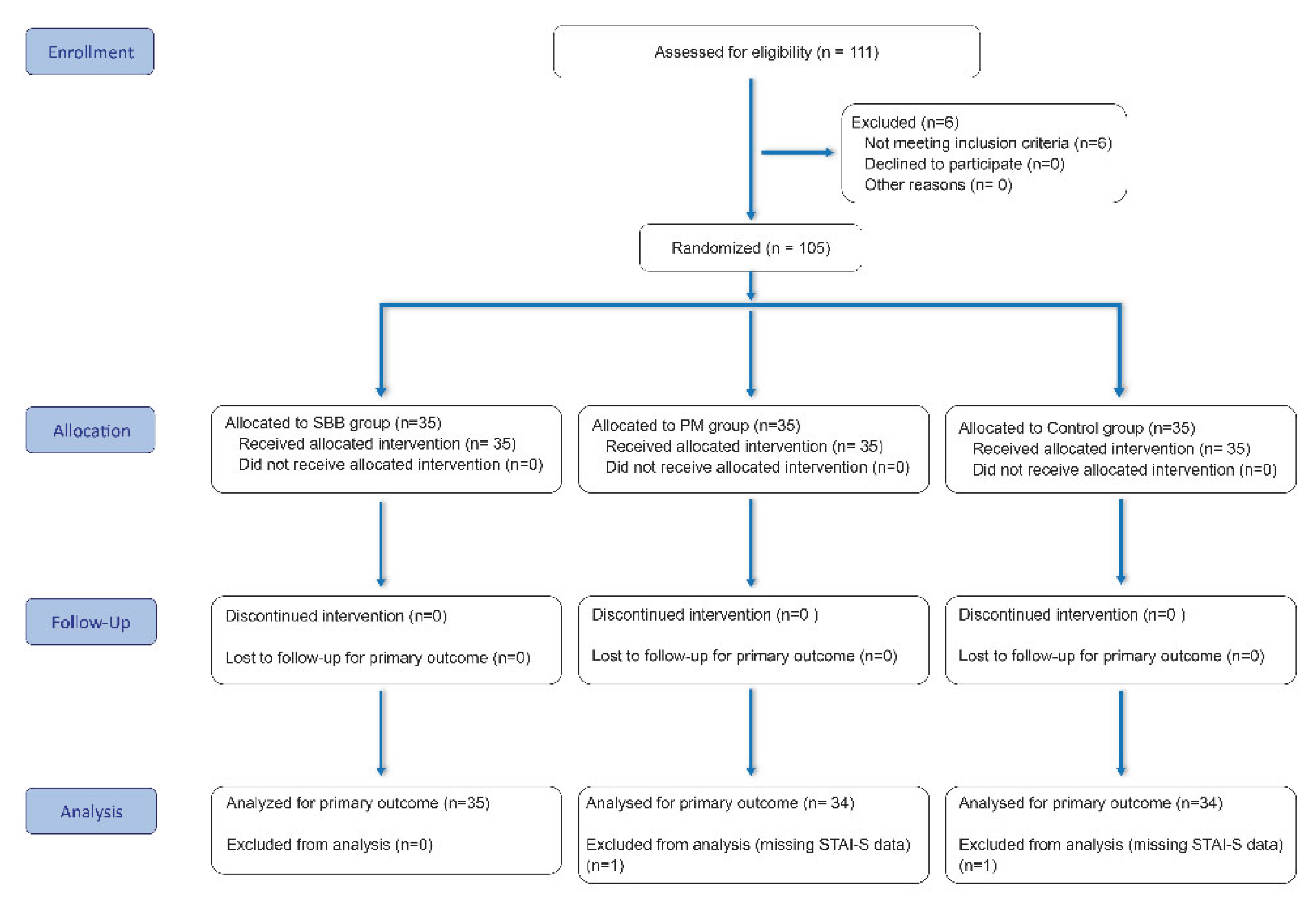
Figure 2.
Mean change in STAI-S scores, SBP, HR, RR and SpO2 across study groups.
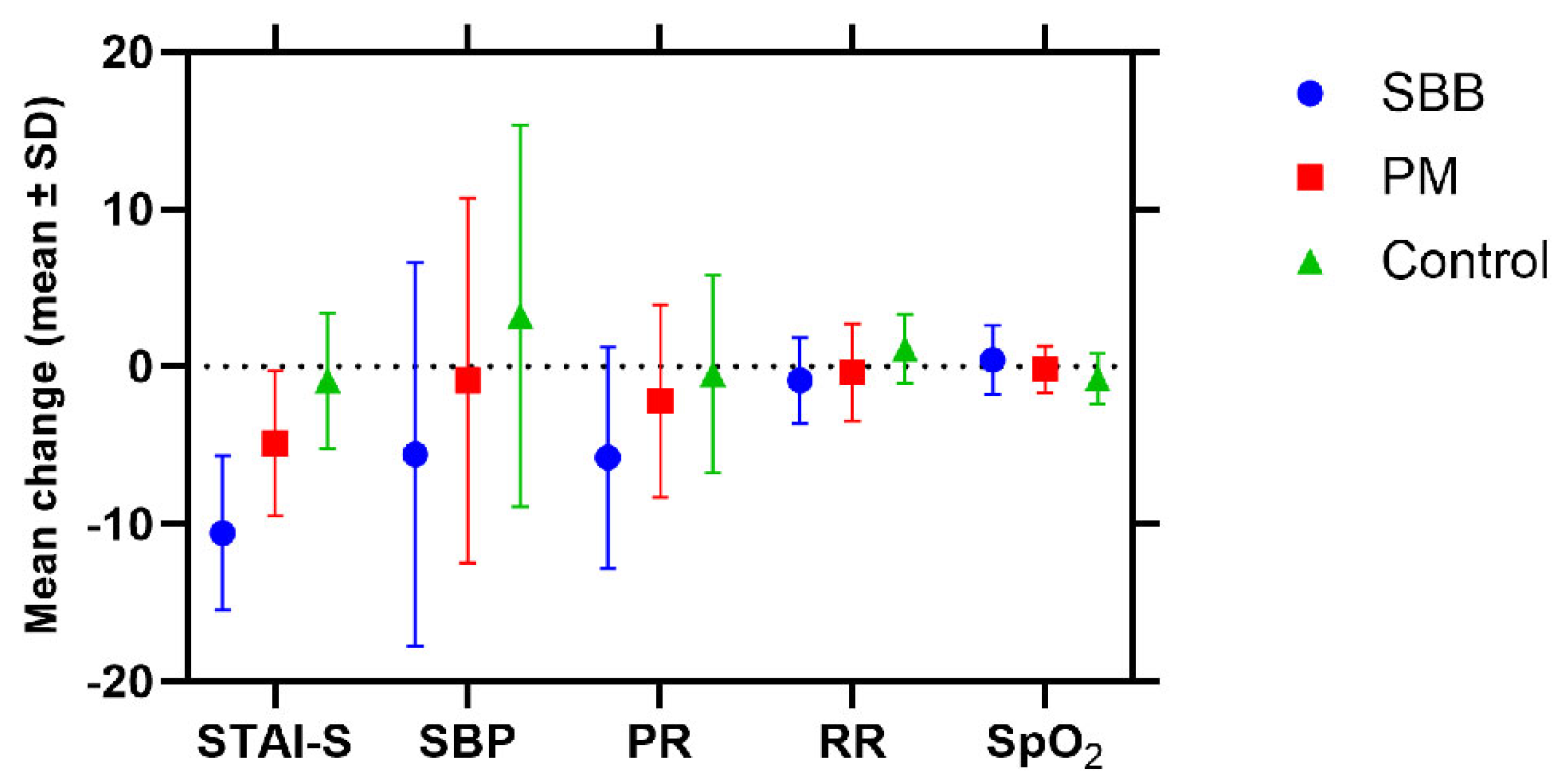

Table 1.
Demographic data.
| Variables | SBB (n = 35) | PM (n = 34) | Control (n = 34) | p-value |
|---|---|---|---|---|
| Age (years) | 57.5 ± 9.6 | 57.5 ± 9.3 | 57.8 ± 10.0 | 0.991 |
| Sex Male |
7 (20.0%) |
9 (26.5%) |
11 (32.4%) |
0.500 |
| Underlying disease DM HT CVD Others |
6 (17.1%) 11 (31.4%) 0 (0.0%) 7 (20.0%) |
4 (11.8%) 12 (35.3%) 1 (2.9%) 12 (35.3%) |
7 (20.6%) 9 (26.5%) 2 (5.9%) 8 (23.5%) |
0.640 0.747 0.320 0.335 |
| Drug use Beta blocker Anxiolytic drug |
2 (5.7%) 0 (0.0%) |
0 (0.0%) 1 (2.9%) |
2 (5.9%) 1 (2.9%) |
0.542 0.547 |
| BMI (kg/m2) | 25.3 ± 4.8 | 25.1 ± 4.3 | 23.6 ± 3.5 | 0.192 |
| ASA Classification I II |
15 (42.9%) 20 (57.1%) |
15 (44.1%) 19 (55.9%) |
17 (50.0%) 17 (50.0%) |
0.880 |
| Pterygium grading II III IV |
21 (60.0%) 7 (20.0%) 7 (20.0%) |
23 (67.7%) 7 (20.6%) 4 (11.8%) |
20 (58.8%) 7 (20.6%) 7 (20.6%) |
0.885 |
| STAI-T scores | 42.0 ± 3.8 | 42.8 ± 4.0 | 42.5 ± 4.9 | 0.764 |
| Operation time (minutes) | 25.2 ± 4.5 | 25.7 ± 5.3 | 25.0 ± 4.9 | 0.808 |
Values are presented as mean ± SD and number (%).
Table 2.
STAI-S scores, SBP, DBP, HR, RR, and SpO2.
| Variables | SBB (n = 35) | PM (n = 35) | Control (n = 34) |
p-value |
|---|---|---|---|---|
| STAI-S scores Pre Post Mean change p-value (within group) |
37.5 ± 5.5 26.9 ± 3.7 -10.6 ± 4.9 <0.001 |
36.5 ± 4.5 31.6 ± 4.5 -4.9 ± 4.6 <0.001 |
36.1 ± 5.2 35.3 ± 4.9 -0.9 ± 4.3 0.130 |
0.525 <0.001 <0.001 |
| SBP Pre Post Mean change p-value (within group) |
139.5 ± 16.2 133.9 ± 16.0 -5.6 ± 12.2 0.005 |
140.8 ± 16.0 139.9 ± 15.5 -0.9 ± 11.6 0.336 |
140.4 ± 16.0 143.6 ± 18.3 +3.2 ± 12.1 0.934 |
0.945 0.054 0.011 |
| DBP Pre Post Mean change p-value (within group) |
82.1 ± 9.1 80.8 ± 10.3 -1.3 ± 7.4 0.157 |
83.2 ± 9.4 83.4 ± 9.5 +0.2 ± 6.9 0.556 |
83.1 ± 10.6 84.9 ± 9.9 +1.8 ± 7.7 0.910 |
0.874 0.224 0.222 |
| HR Pre Post Mean change p-value (within group) |
71.3 ± 12.0 65.5 ± 9.9 -5.8 ± 7.0 <0.001 |
72.0 ± 10.8 69.8 ± 10.0 -2.2 ± 6.1 0.022 |
73.0 ± 12.6 72.5 ± 11.4 -0.5 ± 6.3 0.313 |
0.838 0.026 0.003 |
| RR Pre Post Mean change p-value (within group) |
17.1 ± 3.6 16.2 ± 2.9 -0.9 ± 2.7 0.035 |
15.8 ± 3.5 15.4 ± 3.3 -0.4 ± 3.1 0.222 |
17.1 ± 4.1 18.1 ± 3.6 +1.1 ± 2.2 0.997 |
0.276 0.003 0.009 |
| SpO2 Pre Post Mean change p-value (within group) |
97.4 ± 1.8 97.8 ± 1.9 +0.4 ± 2.2 0.846 |
97.8 ± 1.5 97.6 ± 1.3 -0.2 ± 1.5 0.253 |
97.4 ± 1.7 96.6 ± 1.8 -0.8 ± 1.6 0.002 |
0.545 0.009 0.025 |
Values are presented as mean ± SD.
Table 3.
Comparison of mean change in STAI-S scores, SBP, DBP, HR, RR, and SpO2 across study groups.
Table 3.
Comparison of mean change in STAI-S scores, SBP, DBP, HR, RR, and SpO2 across study groups.
| Variables | Mean change (mean ± SD) | p-value | ||||
| SBB | PM | Control | SBB vs. PM | SBB vs. Control | PM vs. Control | |
| STAI-S scores | -10.6 ± 4.9 | -4.9 ± 4.6 | -0.9 ± 4.3 | <0.001 | <0.001 | 0.002 |
| SBP | -5.6 ± 12.2 | -0.9 ± 11.6 | +3.2 ± 12.1 | 0.295 | 0.008 | 0.494 |
| DBP | -1.3 ± 7.4 | +0.2 ± 6.9 | +1.8 ± 7.7 | 1.000 | 0.250 | 1.000 |
| HR | -5.8 ± 7.0 | -2.2 ± 6.1 | -0.5 ± 6.3 | 0.067 | 0.003 | 0.866 |
| RR | -0.9 ± 2.7 | -0.4 ± 3.1 | +1.1 ± 2.2 | 1.000 | 0.010 | 0.070 |
| SpO2 | +0.4 ± 2.2 | -0.2 ± 1.5 | -0.8 ± 1.6 | 0.588 | 0.020 | 0.450 |
Values are presented as mean ± SD.
Disclaimer/Publisher’s Note: The statements, opinions and data contained in all publications are solely those of the individual author(s) and contributor(s) and not of MDPI and/or the editor(s). MDPI and/or the editor(s) disclaim responsibility for any injury to people or property resulting from any ideas, methods, instructions or products referred to in the content. |
© 2025 by the authors. Licensee MDPI, Basel, Switzerland. This article is an open access article distributed under the terms and conditions of the Creative Commons Attribution (CC BY) license (http://creativecommons.org/licenses/by/4.0/).
Copyright: This open access article is published under a Creative Commons CC BY 4.0 license, which permit the free download, distribution, and reuse, provided that the author and preprint are cited in any reuse.


