

Submitted:
27 June 2025
Posted:
01 July 2025
Read the latest preprint version here
Abstract
The Otukpo Burnt Brick Factory has remained dormant for thirty years, despite several attempts by the government to revive it. Given the region’s rich clay deposits and the growing demand for sustainable, affordable construction materials, in this study, we investigate Otukpo soil’s suitability for alternative uses such as uncalcined brick production and its pozzolanic potential for use as a supplementary cementitious material (SCM). While the Unconfined Compressive Strength (UCS) results, which ranged from 5 to 10% for the cement-stabilized samples, fell short of the required threshold for building walls, the soil achieved cube strengths of up to 1.1 N/mm² at 14 days, demonstrating a promising strength performance early on. In contrast, stabilization with 5-10% NaOH provided less than half the strength achieved with an equivalent cement content, indicating that standalone alkali activation has limited potential for improving Otukpo soil’s mechanical properties. However, the high total SiO₂, Al₂O₃, and Fe₂O₃ content (> 70%) strongly supports the material’s potential as an SCM in blended cement systems. These findings highlight the importance of continued research into low-energy, uncalcined/minimally processed brick production and cementitious uses of Otukpo soil, alongside the establishment of standardized practices. Together, these efforts could reveal the intrinsic value of this locally abundant material in compensating for regional disparities in brick supply while fostering job creation through decentralized, community-driven industries.
Keywords:
burnt bricks
; uncalcined
; low-energy
; minimally processed
; pozzolanic
; cement
; Alkali-Activation
; SCM
1. Introduction and Literature Review
1.1. Introduction
In Nigeria, sandcrete blocks are the predominant walling material but remain largely unaffordable for many. Their inconsistent quality and substandard performance across manufacturers have raised concerns, as commercial blocks frequently fall below regulatory benchmarks. As highlighted by [1], even the most lenient cement mix ratios are often disregarded in practice. In contrast, burnt bricks typically exceed strength requirements and offer a cheaper alternative, positioning them as a potentially more sustainable solution for affordable housing.
The Benue Valley region, particularly Otukpo, has a rich legacy of burnt brick production using local materials and wood-fired kilns. Despite their superior mechanical properties and lower cost, the environmental consequences of traditional burnt brick production—deforestation, soil depletion, and greenhouse gas emissions—are significant. The now-defunct Otukpo Burnt Brick Factory, which once symbolized industrial promise, has remained dormant since the 1990s despite revival attempts [2,3]. This backdrop has motivated the current study, in which we will explore more sustainable and culturally resonant alternatives rooted in minimally processed, uncalcined mud bricks.
This investigation focuses on the mineralogical, chemical, and mechanical characterization of soils from Otukpo to evaluate their potential for use as natural pozzolans and in producing unfired bricks. Laboratory tests—including XRD, TGA, SEM-EDS, and compression tests - are employed to identify key phases and assess the soils’ behavior under stabilization with cement and NaOH. The aim is to reduce cement use in construction, minimize the environmental impact, cut costs, and honor local building traditions, while also enabling possible uses in ceramics, paint, and other mineral-based industries.
1.2. Literature Review
The increasing demand for sustainable building materials has necessitated the re-evaluation of legacy soil samples, particularly those historically used for burnt brick production. In regions such as the Benue Valley in Nigeria, traditional brick-making practices have relied heavily on locally available clayey soils and rudimentary firing methods. While these practices offer economic advantages, environmental concerns and inconsistent product quality necessitate a more scientific approach to material selection and processing. The latter also applies to the more conventional sandcrete blocks.
Burnt bricks, produced by firing clayey soils at high temperatures, have historically been favored for their durability and thermal insulation properties [4]. However, the environmental cost of firing and deforestation due to firewood consumption has provided the impetus for this study, in which alternative low-carbon options will be explored. The sustainability of clay-based building materials can be enhanced leveraging pozzolanic reactions to improve the brick’s mechanical strength while minimizing the energy consumption [5] and Pozzolans are siliceous or aluminous materials that, while not cementitious on their own, react chemically with calcium hydroxide in the presence of water to form compounds possessing cementitious properties [6]. Common pozzolanic materials include fly ash, calcined clays, and volcanic ash. Recent studies have highlighted the potential of natural soils, especially those with high proportions of SiO₂, Al₂O₃, and Fe₂O₃, to serve as supplementary cementitious materials (SCMs) [7]. In Nigeria, many of the clays traditionally used for burnt brick production exhibit significant levels of kaolinite and goethite, indicative of potential pozzolanic activity [8]. However, raw soils often require either mechanical activation (through grinding), thermal treatment (calcination), or chemical activation (e.g., alkali stimulation) to become effective pozzolans [9]. The authors of [10] showed that even uncalcined kaolinitic clays, when finely ground and blended, exhibit considerable reactivity when incorporated into cement systems.
Sandcrete blocks in Nigeria often fall short of modern regulatory standards such as NIS 87:2007, which mandates a minimum UCS of 2.5 N/mm² for non-load-bearing blocks [11]. However, stabilization techniques using minimal cement or alkali activators have demonstrated the potential to bridge this performance gap using traditionally available materials while maintaining a lower carbon footprint. In [12], the authors studied locally produced burnt bricks in Makurdi, Benue State, Nigeria. They found that the soil is lateritic soil, and the brick production process involves burning the bricks using wood for fuel. Their results indicated that burnt bricks exhibit good engineering properties such as a compressive strength of 3.46 N/mm² and 11.74 N/mm², water absorption of 8.58% and 16.49%, and abrasion resistance of 9.32 and 33.67 for the two samples tested, respectively. They concluded that the burnt bricks were cost-efficient since they provided a 70% saving compared to sandcrete blocks. For comparison, the measured strengths of sandcrete blocks used in many parts of Nigeria range from 0.5 to 1 N/mm² [11]. Despite these obvious advantages over sandcrete blocks, the authors recommended that further studies be carried out to improve brick-burning and prevent/reduce environmental degradation.
The legacy soils used in past burnt brick operations, such as those in Otukpo and Makurdi, often possess the mineralogical and chemical profiles necessary for pozzolanic reactivity [12]. Still, many such soils have yet to be rigorously assessed for their suitability for use in SCMs. The re-evaluation of these soils, therefore, offers the dual benefit of preserving local knowledge and practices while contributing to the global movement toward greener construction.
The continued dormant state of the Otukpo Burnt Brick Factory, which has been out of operation for three decades, underscores the limitations of relying solely on government-led revival efforts [13]. Given this prolonged inactivity, it is more pragmatic to explore alternative, sustainable alternatives that can revive brick production, support the growing demand for building bricks, and stimulate local employment through cottage industries set up for this purpose. This is a compelling case for redirecting attention toward unlocking the potential of the region’s clay-rich soils through innovative, low-energy applications such as uncalcined, minimally processed bricks or supplementary cementitious materials (SCMs).
Unlike standardized modern construction materials like well-made sandcrete blocks, traditional earthen building materials are highly variable in composition. Their effective use requires thorough characterization and modification tailored to specific applications [14]. This is essential for their integration into the mainstream and for standardization. For example, the compressive strength of earth blocks and rammed earth walls varies between 0.49 and 4.90 N/mm², depending on the clay type, grain size distribution, and processing methods used [14]. These strength values are mostly lower than those prescribed in modern code requirements such as NIS 87:2007, which stipulates 2.5 N/mm² for non-load-bearing sandcrete blocks. Moreover, rainfall and moisture ingress pose substantial challenges to earthen structures, necessitating the use of stabilization and other strategies.
To improve the structural performance and water resistance of earthen materials, researchers have explored mechanical, thermal, and chemical activation methods [9]. Among these, chemical activation has been widely shown to enhance the pozzolanic reactivity of natural soils and clays. However, the efficiency of such treatments is influenced by mineralogy and specific surface area (SSA), where a higher SSA often indicates greater cohesive forces and potentially improved compressive strength [15]. The use of uncalcined clay has been revisited as a highly sustainable alternative, particularly when well-dispersed, as this leads to filler effects that boost the brick’s early-age strength, though care must be taken due to the water absorption tendencies of certain clays like kaolinite or bentonite, which may impair bricks’ long-term strength [15].
The increasing use of SCMs to partially replace cement in concrete has been driven by the need to reduce construction’s environmental footprint [16]. SCMs include both natural pozzolans and industrial by-products such as fly ash, silica fume, metakaolin, and GGBFS [7]. SCMs derived from clays are of special interest in tropical regions, where volcanic or kaolinitic soils are abundant. Their filler effect accelerates hydration by providing nucleation sites and enhances the product’s mechanical properties and durability.
An illustrative case is Chile, where 85% of the cement production incorporates Portland–pozzolan cement, utilizing native volcanic ash [5]. Research by [7] further demonstrated that calcining kaolinite at 700 °C for 1 hour produces high-quality SCMs. However, this process still demands a significant energy input. The study followed ASTM C618-12 specifications, using the Strength Activity Index (SAI) and DTG (Differential Thermogravimetry) to evaluate the pozzolanic potential. Their key findings indicated that kaolinite-derived SCMs, properly calcined and milled, could replace up to 20% of the cement content in mortar without compromising the structural integrity.
In accordance with ASTM C618-12, Class N pozzolans must satisfy stringent criteria, including SiO₂ + Al₂O₃ + Fe₂O₃ > 70%, SO₃ ≤ 4%, and SAI ≥ 75%, among others [7]. These benchmarks are critical in assessing the suitability of Otukpo soils for SCM development. To establish this, in this study, we employed multiple complementary material characterization techniques to analyze the pozzolanicity and engineering potential of Otukpo soil: X-ray Fluorescence (XRF) for oxide composition; X-ray Diffraction (XRD) to identify crystalline and amorphous phases [17]; Scanning Electron Microscopy (SEM) for microstructural morphology [18]; Thermogravimetric Analysis (TGA) for thermal behavior and mass loss; Particle Size Distribution (PSD) to assess granulometry and surface activity [19]; Unconfined Compressive Strength (UCS) for stabilization performance with cement and alkali; Cube Compressive Strength to simulate construction conditions and evaluate early-age mechanical behavior; and additional pozzolanicity indicators including SAI, DTG, FAST, Frattini, and R3 testing may also be used [20,21].
2. Materials and Methods
2.1. Sample Collection
Two 40 Kg bags of representative soil samples, labeled as OT1 and OT2, were collected from the borrow pits of the defunct Benue Burnt Bricks Factory in Otukpo within the vicinity of the coordinate 8.168925° N, 7.209435° E. They were collected in a manner that ensured the exclusion of topsoil and organic substances. Cement used for this study was Portland limestone cement with product designation SOKCEM II-42.5N for normal or general-purpose use, manufactured by BUA Cement at their plant in Sokoto State, Nigeria.
2.2. Experiments and Sample Preparation
The soil samples were air-dried and fine-ground. The chemical, thermal, physical, and mechanical tests were carried out at various laboratories of the Ahmadu Bello University, Zarion. Chemical tests carried out were XRD, XRF, and SEM diffractometery [25,26]. The thermal test, TGA, was also carried out at the same laboratory, while the rest were carried out at the Geotechnical Engineering and Concrete Laboratories of the Ahmadu Bello University, Zaria.
The XRD was performed with Rigaku Mini Flex benchtop system to determine the microstructure of the soil samples. XRD helps to identify minerals in soil samples based on the diffraction of X-rays off crystal planes within the soil particles. Each mineral has a unique diffraction pattern based on its atomic structure. This is essential for soil mineralogy, particularly for identifying clay minerals that influence soil plasticity and stability. The XRD trace is presented in Table 1. The diffraction pattern was carried out using Cu radiation (λ = 1. 54056 Å), with patterns recorded at 2θ intervals (values) taken between 12o and 51o. AI (Copilot) was used to assist with the compilation of the various results in the table.
The chemical composition of the untreated soil samples was determined using Xenemetrix's Genius IF (Secondary Targets) Energy-Dispersive X-Ray Fluorescence (EDXRF) spectrometer. SEM analyses were carried out using the Oxford PhenomProx (ABU, Zaria). Scanning Electron Microscopy (SEM) offers high-resolution imaging for studying soil microstructure, particle morphology, and bonding in soils, particularly those with unique mineralogical characteristics. TGA was performed using PerkinElmer MES-TGA TGA4000, manufactured in the Netherlands. TGA measures soil weight loss or thermal decomposition under controlled heating, identifying moisture, organic content, and mineral stability. Different materials lose weight at specific temperatures, revealing composition changes.
For the Particle Size Distribution, both dry and sedimentation analysis were performed to adequately capture the full range of particle sizes per the requirements of ASTM D 6913: Standard Test Method for Particle Size Distribution (Gradation) of Soils using Sieve Analysis (ASTM D 6913 2017). For the Atterberg limits and related tests, ASTM D 4318: Standard Test Method for Liquid Limit, Plastic Limit, and Plasticity Index of Soils (ASTM D 4318 2018) in conjunction with ASTM D 698: Standard Test Method for Laboratory Compaction Characteristics of Soil (ASTM D 698 2021). The Unconfined Compression Strength (UCS) tests were carried out using a Load Frame UCS machine in line with BS 1377(1990): Method of Testing Soils for Civil Engineering Purpose, British Standard Institute, BSI, London (BS 1377 1990), and ASTM D 2166, 2010: Standard Test Method for Unconfined Compressive Strength of Cohesive Soil.
Chloride ion penetration tests were carried out in line with the requirements of ASTM C1202 using the Norton Clipper CFW 0251 manufactured by Norton Construction, which has a spindle speed of 3250 RPM. The air-dried cubes (samples) were immersed in a prepared sodium chloride solution (35%) for twenty-eight (28) days to allow chloride ions to penetrate therefore simulating a marine-like chloride concentration.
3. Results
3.1. Chemical and Thermal Tests
The range of parameters used for performing XRD on the samples and the key parameters associated with the five peaks observed are displayed in Table 1. The analysis shows a wide range of crystallographic characteristics with 2θ values between 12° and 51°, interplanar spacing (d) between 1.82 Å and 7.17 Å, and peak intensities up to 2770 counts per second (cps). The crystallite size ranges significantly from 95 Å to 549 Å, indicating significant variation in the crystalline domains and suggesting the presence of multiple phases or differing degrees of crystallinity within the sample.
Table 2 represents the results of the XRD analysis, showing the minerology and corresponding content (wt. %) of the various phases. Expectedly, the difference with cement is clearly shown by the dominance of calcite and alite in SOKCEM, especially alite (67.1%), which is a synthetic material used in cement production [27].
Figure 1 provides more details of the XRD results in the form of pie charts, from which the lower and upper limits of the various phases can be inferred.
Further deductions may be made from the results of the XRF, shown in Table 3, which contains the elemental and chemical compositions (oxides) side by side.
3.2. Chloride Ion Penetration Test
A chloride penetration test was performed on the sample to evaluate its resistance to chloride penetration after exposure to concentrated saline conditions. The appearance of white precipitates demonstrated the chloride ion penetration depth, and only the 10% cement samples remained intact for testing. The other cubes all crumbled, giving an indication of their susceptibility to chloride penetration/detrimental impacts. Hence, the samples, in their raw form, even with stabilization, do not meet the durability requirements, particularly for reinforced concrete.
3.3. Physico-Mechanical Tests
3.3.1. Soil Classification Tests and Moisture Content
Sieve analyses and Atterberg limit tests were carried out for all the samples to aid in their classification, and to examine their gradation. The optimum moisture content was also determined. These laboratory analyses revealed a range of properties. The results of the Particle Size Distribution are captured in Table 4 and Figure 3, from which the percentage of residues retained on a 45µm sieve can be extrapolated as 20% and 10%, respectively. This meets the ASTM C618-12 requirement that caps this value at 34% for pozzolans that can be utilized for SCMs.
Table 5 shows more physical properties and soil classification details. OT1 is classified as CH, which is fat clay in the Universal Soil Classification System (USCS).
3.3.2. Unconfined Compressive Test
The equipment used for conducting the UCS tests includes an automatic loading machine with a maximum capacity of 50 kN and load cells of 10 kN and 50 kN capacities. The UCS and required compaction tests were carried out in accordance with the BS 1377 requirements. The 7-, 14-, and 28-day UCS results, shown in Table 6, show varying impacts of the soil sample’s stabilization with different percentages of NaOH and cement.
Table 7 shows the results of the cube strength tests carried out.
4. Discussion
The XRD results show that quartz is the dominant crystalline phase in both OT1 and OT2, with respective contents of 48% and 42%, indicating that silica-based minerals are abundant in these soil samples. Surprisingly, kaolinite was either undetectable (0%) in OT1 or present in such trace amounts in OT2 that it fell below the threshold for XRD detection. This contradicts the expected clay-rich composition typical in this region and suggests the presence of at least two distinct stratigraphic horizons beneath the topsoil, each with differing mineralogical profiles. The authors of [29] explain this vertical variation by proposing that kaolinite commonly forms in upper horizons through in situ weathering of feldspars and micas, while the lower layers tend to retain original, less-weathered silicate minerals. Interestingly, [30] noted the inverse in some profiles—kaolinite appearing predominantly in the deeper zones—further affirming the site-specific variability of tropical weathering pathways.
From the chemical composition in Table 3, the combined oxides of SiO₂, Al₂O₃, and Fe₂O₃ exceed 70%, thus meeting a core requirement of ASTM C618 for natural pozzolans. Additionally, the SO₃ content is well below the 4% threshold. The relatively high silicon content points to the potential for C-S-H gel formation, while aluminum is widely known to support early strength development. Iron, although abundant, may act as a reactivity suppressor but imparts the typical lateritic coloration to the soils. The calcium content is below 3%, reinforcing the need for chemical or mechanical activation. Minor elements such as Cl, S (in the form of SO₃), and P appear in small but notable quantities; their presence, although not disqualifying, warrants careful handling in manufacturing to prevent adverse effects on both material performance and worker safety.
The results from SEM align with the XRD findings, illustrating a microstructure dominated by silica, alumina, and iron phases, with no evidence of kaolinite detected in the OT1 sample. Mechanical testing shows that the unstabilized samples (0% additive) recorded the lowest strength values. When stabilized with 5–10% NaOH, there was a visible yet marginal improvement, particularly at 10%, though this was not substantial enough to drive major performance gains. Importantly, the materials exhibited relatively low Strength Activity Index (SAI) values when benchmarked against the control samples, indicating limited early pozzolanic reactivity. While this might constrain their standalone use as SCMs, the broader compositional and structural properties noted support their potential when blended or mechanically enhanced in more sophisticated formulations.
5. Conclusions
This study evaluated the compressive strength performance of two uncalcined soils, OT1 and OT2, under various stabilizing treatments. The results indicated that, while both soils responded positively to additives over time, OT2 exhibited a better performance across all categories, achieving a higher early-age strength. Cement, especially at 10%, proved significantly more effective than sodium hydroxide in enhancing strength. However, neither soil met the reference standard’s requirement for pozzolanic classification, suggesting the need for complementary activation strategies in future research.
Importantly, these findings offer an alternative development model in response to the dormancy of the Benue Burnt Brick factory in Otukpo. Rather than reviving large-scale infrastructure, the results support the emergence of decentralized cottage industries that utilize stabilized earth blocks or compressed pozzolanic bricks made with locally sourced materials. Such industries could empower communities, provide affordable housing solutions, and drive rural employment, further cementing the long-term history of earth-based construction in the Benue Valley in a more sustainable manner.
To ensure long-term viability, however, this opportunity must be underpinned by regional standardization. Establishing clear benchmarks for strength, particle gradation, and mix design will guarantee quality across production sites, not only for Otukpo, but for the Gboko and Makurdi axes too. Standardization not only builds market trust and construction safety but also opens doors to government adoption, financing, and private sector scaling.
Ultimately, OT2 demonstrates a stronger SCM potential than OT1, thanks to its finer Particle Size Distribution, superior early strength, and enhanced responsiveness to cement stabilization. While neither soil fully qualifies as a conventional SCM per ASTM criteria, OT2 could be effectively used as a partial cement replacement in low-load or non-structural applications. By coupling this material advantage with community-based production and a standardized regional framework, this research lays the groundwork for a localized, sustainable approach to construction that bridges technical innovation and economic regeneration in the Benue Valley. Further studies should include more comprehensive UCS and cube tests for a better comparison, and a more extensive investigation of the SCM potential. Furthermore, there is the need for a more robust regulatory framework to enforce quality standards for burnt bricks, mud bricks, and sandcrete blocks. It is important to emphasize the reduction/elimination of calcination and/or optimum calcination temperatures to minimize the fuel required in the kilns.
Author Contributions
Conceptualization, J.A.; methodology, J.A.; validation, S.O.; formal analysis, J.A.; investigation, J.A.; resources, J.A.; data curation, J.A.; writing—original draft preparation, J.A.; writing—review and editing, S.O.; visualization, J.A.; supervision, S.O.; project administration, J.A.; funding acquisition, J.A. All authors have read and agreed to the published version of the manuscript.
Funding
This research received no external funding.
Data Availability Statement
The datasets generated and/or analyzed during the current study are included in this submission and are also available on the authors’ computers and can be made available upon request via email to the authors.
Acknowledgments
During the preparation of this manuscript/study, the author(s) used Microsoft Copilot for the purposes of compilating the results of the chemical tests, and rephrasing portions of the abstract and the conclusions. The authors have reviewed and edited the output and take full responsibility for the content of this publication.
Conflicts of Interest
The authors declare no conflicts of interest
References
- Ubi, S.E., Nyah, E.D. & Agbor, R.B., 2022. Determination of mechanical properties of sandcrete block made with sand, polystyrene, laterite and cement. International Journal of Advances in Engineering and Management (IJAEM) [online]. Available online: https://ijaem.net/issue_dcp/Determination%20of%20Mechanical%20Properties%20of%20Sandcrete%20Block%20Made%20With%20Sand,%20Polystyrene,%20Laterite%20and%20Cement.pdf (accessed on 24 June 2025).
- Daily Post Nigeria, 2015. Governor Ortom pledges to revive Taraku Mills, others. Daily Post Nigeria [online]. Available online: https://dailypost.ng/2015/06/20/governor-ortom-pledges-to-revive-taraku-mills-others/ (accessed on 24 June 2025).
- Daily Trust, 2023. Encounter with Benue burnt brick makers. Daily Trust [online]. Available online: https://dailytrust.com/encounter-with-benue-burnt-brick-makers/ (accessed on 24 June 2025).
- Tse, T.A., 2012. Comparative evaluation of fired and unfired clay bricks in Benue. Journal of Building Materials, 8(2), pp.101–109.
- Day, R.L., 1990. Pozzolans for use in low-cost housing in developing countries. In: Malhotra, V.M. ed., Supplementary Cementing Materials for Concrete. Ottawa: Canadian Government Publishing Centre, pp.241–268.
- ASTM C618, 2023. Standard Specification for Coal Fly Ash and Raw or Calcined Natural Pozzolan for Use in Concrete. ASTM International.
- Ayininuola, G.M. & Adekitan, T.O., 2016. Development of kaolinite as supplementary cementitious material by thermal activation. Journal of King Saud University – Engineering Sciences, 31(2), pp.174–181.
- Amah, A.N., Ejeh, S.P. & Lawal, A.A., 2011. Pozzolanic activity of selected clay samples in Nigeria. Journal of Engineering and Technology, 6(2), pp.77–84.
- Shi, C., 2001. Activator types and mechanisms of alkaline activation of slag. Cement and Concrete Research, 31(5), pp.741–748.
- Mette, K. & Emmanuel, O.S., 2019. Chemical and mechanical activation of uncalcined kaolinitic clays for cementitious applications. Journal of Materials in Civil Engineering, 31(4), p.04019017.
- Okigbo, C.C. & Gana, M., 2017. Evaluation of locally made burnt bricks in compliance with building code standards. Nigerian Journal of Construction Technology and Management, 3(1), pp.22–29.
- Olawuyi, B.J., Babatunde, O.S. & Bolarinwa, A.K., 2013. Assessment of pozzolanic activities of selected clay samples for potential use in cement production. Nigerian Journal of Technology, 32(1), pp.93–100.
- Ameh, S., 2016. Benue to hand over moribund Otukpo bricks to investors. Premium Times [online], 12 August. Available online: www.premiumtimesng.com (accessed on 24 June 2025).
- Minke, G., 2005. Building with Earth: Design and Technology of a Sustainable Architecture. Basel: Birkhäuser.
- Geiker, M.R. & Gallucci, E., 2019. Reactivity of clay-based supplementary cementitious materials: Overview and gaps in knowledge. Cement and Concrete Research, 124, p.105807.
- Applied Testing and Geosciences LLC, 2024. Supplementary Cementitious Materials (SCMs): A Guide for Sustainable Construction. Applied Testing and Geosciences LLC Publications.
- Feng, M., He, C. & Zhang, X., 2004. Mineralogical characterization of natural pozzolans. Cement and Concrete Research, 34(5), pp.869–872.
- Justice, J.M. & Kurtis, K.E., 2007. Characterization of cementitious materials using SEM techniques. Cement and Concrete Composites, 29(2), pp.142–145.
- Neville, A.M., 2011. Properties of Concrete. 5th ed. Harlow: Pearson Education Limited.
- Alujas, A., Fernández, R., Skibsted, J. & Steger, S., 2015. Fast determination of pozzolanic activity using electrical conductivity and colorimetry. Cement and Concrete Composites, 64, pp.17–24.
- Pinheiro, A., Toledo Filho, R.D., Köhler, C. & Silva, I., 2023. Multi-scale assessment of pozzolanic reactivity: Bridging the gap in SCM testing. Construction and Building Materials, 370, p.130731.
- Elsen, J., Van Balen, K. & Van Gemert, D., 2011. Hydration reactions in hydraulic lime mortars: The role of additives. Cement and Concrete Research, 41(12), pp.1234–1242.
- Sherwood, P., 1993. Soil Stabilization with Cement and Lime. London: HMSO/Transport Research Laboratory.
- Makusa, G.P., 2012. Soil Stabilization Methods and Materials in Engineering Practice: State of the Art Review. Luleå University of Technology, Sweden.
- Iorfa, T.F., Iorfa, K.F., McAsule, A.A. & AKaayar, M.A., 2020. Extraction and characterization of nanocellulose from rice husk. International Journal of Applied Physics (IJAP), 7(1). Available online: https://www.internationaljournalssrg.org/IJAP/2020/Volume7-Issue1/IJAP-V7I1P117.pdf (accessed on 24 June 2025).
- Moussa, M., Carminati, M., Borghi, G., Demenev, E., Gugiatti, M., Pepponi, G., Crivellari, M., Ficorella, F., Ronchin, S., Zorzi, N., Borovin, E., Lutterotti, L. & Fiorini, C., 2022. 32-channel silicon strip detection module for combined X-ray fluorescence spectroscopy and X-ray diffractometry analysis. Frontiers in Physics, 10. Available online: https://www.frontiersin.org/articles/10.3389/fphy.2022.910089/full (accessed on 24 June 2025).
- Dodson, V.H., 1990. Concrete Admixtures. New York: Van Nostrand Reinhold.
- Mitchell, J.K. & Soga, K., 2005. Fundamentals of Soil Behavior. 3rd ed. Hoboken, NJ: John Wiley & Sons.
- Balan, E., Fritsch, E., Allard, T. & Calas, G., 2007. Inheritance vs. neoformation of kaolinite during lateritic soil formation: A case study in the middle Amazon basin. Clays and Clay Minerals, 55(3), pp.253–259. Available online: https://link.springer.com/article/10.1346/CCMN.2007.0550303 (accessed on 24 June 2025).
- Beauvais, A. & Bertaux, J., 2002. In situ characterization and differentiation of kaolinites in lateritic weathering profiles using infrared microspectroscopy. Clays and Clay Minerals, 50(3), pp.314–330. Available online: https://www.cambridge.org/core/services/aop-cambridge-core/content/view/DE825374356C9BFBAA50EA9C495198FB/S0009860400023892a.pdf (accessed on 24 June 2025).
Figure 1.
Mineralogical phases according to XRD results for OT1 and OT2.
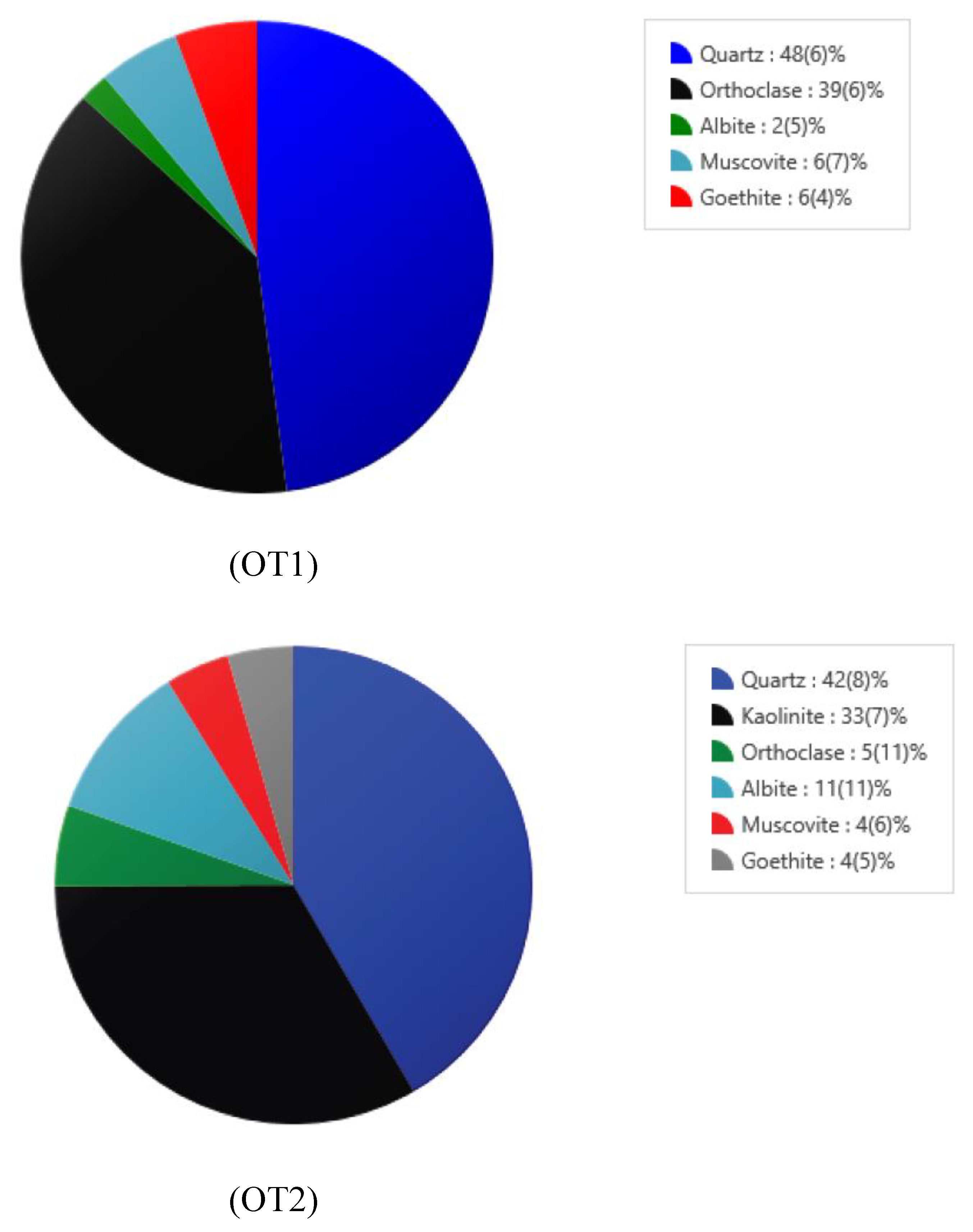
Figure 2.
SEM surface morphology and microstructure for OT1.
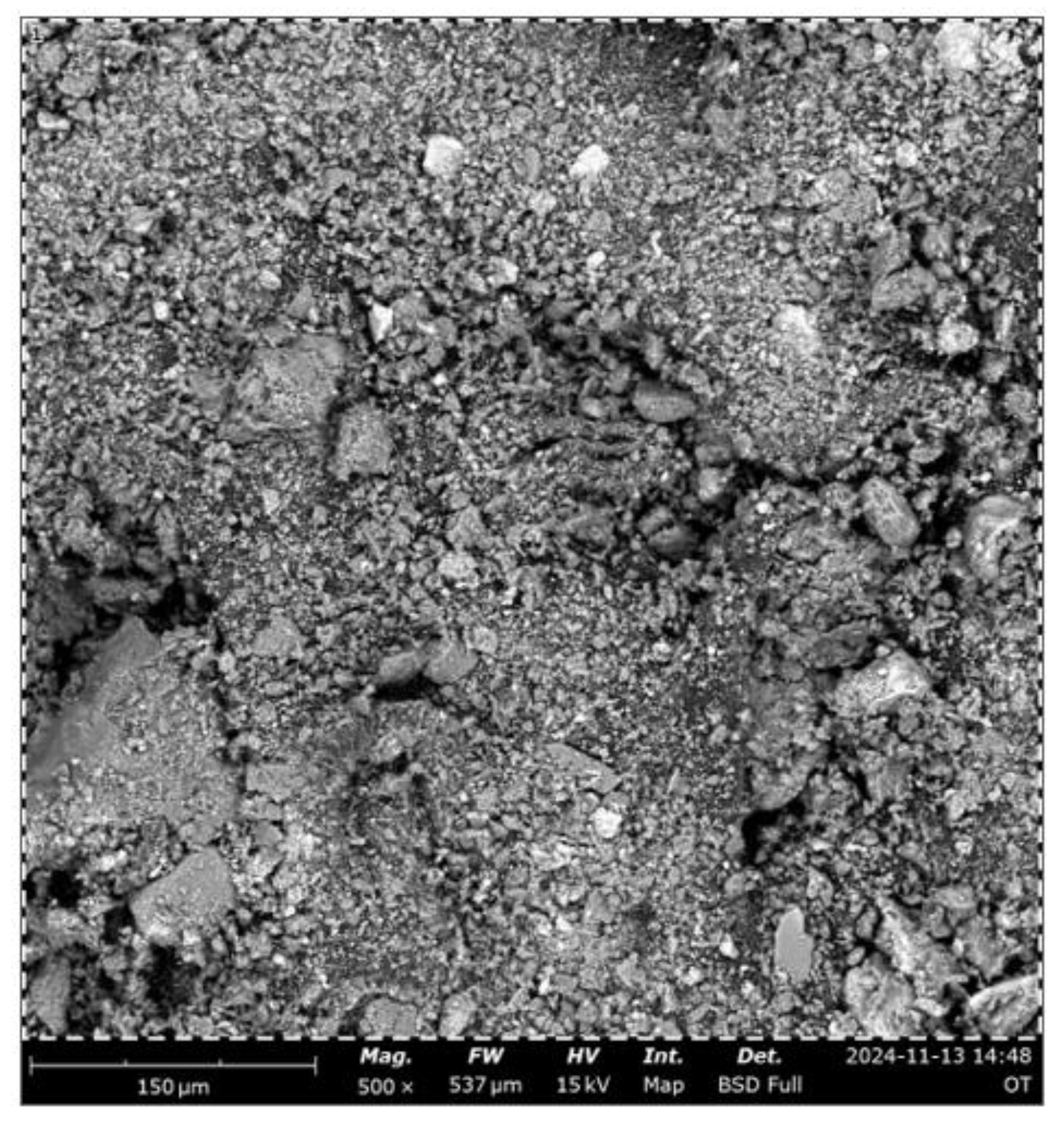
Figure 3.
Particle Size Distribution for OT1 and OT2.
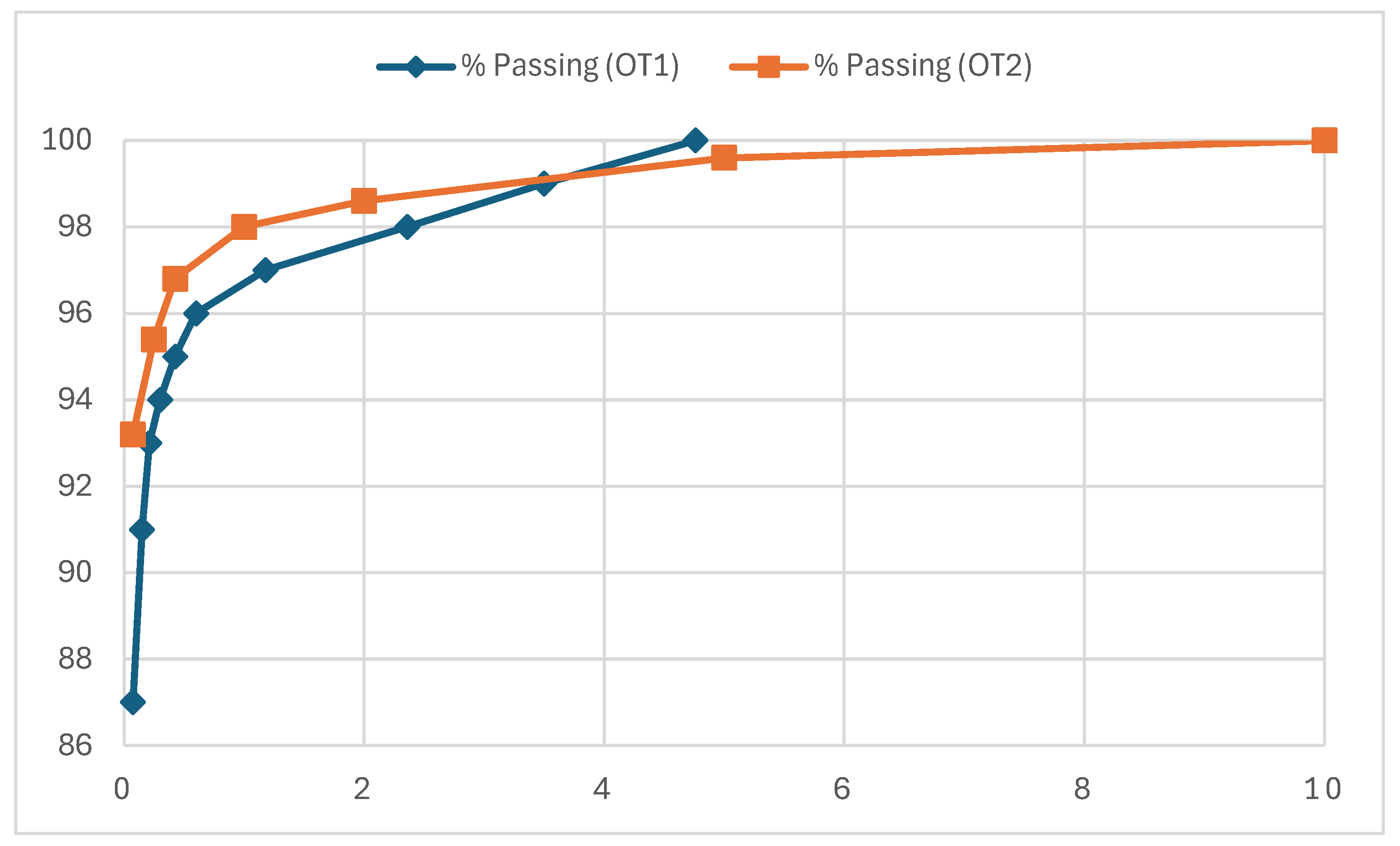

Table 1.
Minimum and maximum range of XRD parameters and associated peaks (OT1).
| Parameter | Minimum Value (Peak No.) |
Maximum Value (Peak No.) |
|---|---|---|
| 2θ (°) | 12.33 ± 0.05 (Peak 1) | 50.08 ± 0.03 (Peak 5) |
| d-spacing (Å) | 1.8200 ± 0.0009 (Peak 5) | 7.17 ± 0.03 (Peak 1) |
| Height (cps) | 291 ± 28 (Peak 5) | 2770 ± 164 (Peak 4) |
| FWHM (°) | 0.155 ± 0.013 (Peak 4) | 0.88 ± 0.11 (Peak 2) |
| Integrated Intensity (cps·°) | 58 ± 23 (Peak 5) | 905 ± 62 (Peak 2) |
| Integral Width (°) | 0.20 ± 0.10 (Peaks 4 and 5) | 1.9 ± 0.3 (Peak 2) |
| Asymmetry | 0.5 ± 0.8 (Peak 5) | 1.5 ± 0.7 (Peak 4) |
| Decay (nL/mL) | 0.0 ± 0.2 (Peak 5) | 1.55 ± 0.16 (Peaks 2 and 3) |
| Decay (nH/mH) | 0.0 ± 0.17 (Peak 5) | 1.55 ± 0.18 (Peaks 2 and 3) |
| Crystallite Size (Å) | 95 ± 12 (Peak 2) | 549 ± 45 (Peak 4) |
Abbreviations: FWHM: full width at half maximum. cps: counts per second (relative values). Decay Constant: ηL = low angle tail, ηH = high angle tail. Å: Angstrom, unit used for measuring interplanar spacing. 2θ: diffraction angle. See Section 4 for detailed results.
Table 2.
Minerology of the samples showing average content values (wt.%).
| Sample | Quartz (%) | Albite (%) | Orthoclase (%) | Goethite (%) | Muscovite (%) | Kaolinite (%) | Calcite (%) | Alite (%) |
| OT1 | 48 | 2 | 39 | 6 | 6 | 0 | 0 | 0 |
| OT2 | 42 | 11 | 5 | 4 | 4 | 33 | 0 | 0 |
| SOKCEM 11-42.5N | 13.6 | 0 | 0 | 0 | 0 | 0 | 19.3 | 67.1 |
Table 3.
Elemental and chemical compositions according to XRF results for OT1.
| Elements/Chemical Components | OT1 (wt.%) | SOKCEM 11-42.5N (wt.%) |
| O | 44.645 | 32.68 |
| Mg/MgO | 0.424 / 0.375 | 0 |
| Al/Al2O3 | 10.697 / 23.208 | 3.029/5.724 |
| Si/SiO2 | 23.827 / 48.567 | 5.181/11.085 |
| P/P2O5 | 0.106 / 0.046 | 0 |
| S/SO3 | 0.096 / 0.166 | 0.923/2.304 |
| Cl | 0.825 / 0.717 | 1.327/0 |
| K/K2O | 4.529 / 0.887 | 0.421/0.507 |
| Ca/CaO | 1.580 / 0.407 | 52.076/72.864 |
| Ti/TiO2 | 1.669 / 2.740 | 0.248/0.414 |
| V/V2O5 | 0.085 / 0.179 | 0.044/0.079 |
| Cr/Cr2O3 | 0.012 / 0.044 | 0.003/0.005 |
| Mn/MnO | 0.228 / 0.041 | 0.122/0.157 |
| Fe/Fe2O3 | 11.004 / 22.007 | 3.308/4.729 |
| Co/CoO | 0.042 / 0.081 | 0.035/0.044 |
| Ni/NiO | 0.009 / 0.000 | 0.004/0.005 |
| Cu/CuO | 0.042 / 0.049 | 0.03/0.037 |
| Zn/ZnO | 0.019 / 0.007 | 0.012/0.015 |
| Rb/Rb2O | 0.238 / 0.040 | 0.007/0.008 |
| Sr/SrO | 0.046 / 0.094 | 0.047/0.056 |
| Zr/ZrO2 | 0.238 / 0.148 | 0.048/0.065 |
| Nb/Nb2O5 | 0.047 / 0.021 | 0.021/0.03 |
| Ag/Ag2O | 0.000 / 0.000 | 0/0 |
| Sn/SnO2 | 0.000 / 0.000 | 0.395/0.501 |
| Ba/BaO | 0.068 / 0.000 | 0/0 |
| Ta/Ta2O5 | 0.018 / 0.033 | 0.017/0.021 |
| W/WO3 | 0.003 / 0.000 | 0.008/0.01 |
| Pb/PbO | 0.014 / 0.036 | 0.007/0.007 |
| S + A + F | 93.782 |
Table 4.
Results of Particle Size Distribution analyses.
| Sieve size (mm) | OT1 (Passing %) | OT2 (Passing %) |
| 0.075 | 87 | 93.2 |
| 0.15 | 91 | - |
| 0.212 | 93 | - |
| 0.25 | - | 95.4 |
| 0.3 | 94 | - |
| 0.425 | 95 | 96.8 |
| 0.6 | 96 | - |
| 1.0 | - | 98 |
| 1.18 | 97 | - |
| 2.0 | - | 98.6 |
| 2.36 | 98 | - |
| 4.76 | 100 | - |
| 5.0 | - | 99.6 |
| 10.0 | - | 100 |
Table 5.
Physical properties and soil classification.
| Sample | LL (%) | PL (%) | PI (%) | LS (%) | MDD (g/cm3) | OMC (%) | USCS classification |
| OT1 | 72 | 26 | 46 | 14 | 1.69 | 22 | CH (Fat Clay) |
Abbreviations: LL: Liquid Limit. PL: Plastic Limit. PI: Plasticity Index. LS: Shrinkage Limit.
Table 6.
UCS results for OT1.
| Curing Period | Natural (kPa) | 5% NaOH (kPa) | 10% NaOH (kPa) | 5% Cement (kPa) | 10% Cement (kPa) |
| 7 Days | 73 | 75 | 99 | 153 | 104 |
| 14 Days | 87 | 72 | 105 | 240 | 338 |
| 28 Days | 96 | 122 | 153 | 512 | 796 |
Table 7.
Cube strength test results for OT2.
| Days | 0% (Natural) (kPa) | 5% NaOH (kPa) | 10% NaOH (kPa) | 5% Cement (kPa) | 10% Cement (kPa) |
| 7 | 100 | 200 | 400 | 800 | 1000 |
| 14 | 100 | 300 | 500 | 1100 | 1300 |
Disclaimer/Publisher’s Note: The statements, opinions and data contained in all publications are solely those of the individual author(s) and contributor(s) and not of MDPI and/or the editor(s). MDPI and/or the editor(s) disclaim responsibility for any injury to people or property resulting from any ideas, methods, instructions or products referred to in the content. |
© 2025 by the authors. Licensee MDPI, Basel, Switzerland. This article is an open access article distributed under the terms and conditions of the Creative Commons Attribution (CC BY) license (http://creativecommons.org/licenses/by/4.0/).
Copyright: This open access article is published under a Creative Commons CC BY 4.0 license, which permit the free download, distribution, and reuse, provided that the author and preprint are cited in any reuse.


