

Submitted:
28 June 2025
Posted:
30 June 2025
You are already at the latest version
Abstract
Hydrogen is a promising clean energy carrier because it is abundant, has high energy density, and can be used for near-zero emissions. Though it has many benefits, the shift to a low-carbon hydrogen (LCH) economy is confronted with major economic, technological, environmental, and policy hurdles. This review synthesizes current opinion regarding hydrogen production, storage, and usage, critically examines the green versus blue hydrogen dichotomy, and considers policy options influencing future demand for hydrogen. It also discerns gaps in current research, compares economic viability, and proposes a framework for a viable LCH economy. The review ends with an outline of recommendations for filling in the gaps and stepping up the deployment of hydrogen as a central element of decarbonization worldwide.
Keywords:
low-carbon hydrogen
; hydrogen economy
; green hydrogen
; blue hydrogen
; hydrogen production
; hydrogen storage
; policy implementation
1. Introduction
Hydrogen, discovered in 1776 by Cavendish, is the universe’s most abundant element and has been transformed from a fossil fuel-derived (grey, blue, turquoise hydrogen) as well as a coal-derived product (black hydrogen) to sustainable energy sources (green hydrogen) and nuclear (pink hydrogen) (Das et al., 2022; Williams et al., 2019; Yang et al., 2019). Its biggest selling point is its ability to substantially lower the world’s carbon dioxide emissions, as energy sources are responsible for more than 73% of all emissions. Low-carbon hydrogen and hydrogen’s transition are crucial to decarbonizing industry, transport, and electricity. A complete hydrogen system depends on production, conversion, transport, and end-use developments (Azni et al., 2023; Salvi & Subramanian, 2015; Shafiee & Topal, 2009).
2. Comprehending the Colours of Hydrogen and Their Emissions
Hydrogen is sorted by “colour” depending on its production process and resulting emissions: green (renewable), blue (fossil with carbon capture), turquoise (methane pyrolysis), and others. Whereas green hydrogen is usually regarded as being emission-free, life cycle analyses show that even renewable-based production (e.g., wind, solar) can lead to non-negligible greenhouse gas emissions due to production and installation activities (see Figure 1) (Feyer et al., 2010; Vezirolu & Barbir, 1992; Yanxing et al., 2019). Hence, there has to be a subtle distinction between hydrogen types, beyond naive colour codes, to one based on greater specificity of emissions (Glenna et al., 2023; Gür, 2022; Yan et al., 2019).
3. Hydrogen Demand: Current Policies and Promised Commitments
Global demand for hydrogen was more than 94 million tonnes in 2021, greater than 91 million tonnes in 2019, and most of the increase has occurred in established sectors like refining and chemicals. However, hydrogen remains mostly produced from fossil fuels, limiting its climate benefits since low-carbon hydrogen accounts for less than 1% of production. Uptake in new markets like heavy industry, transport, and power generation is still extremely low-less than 0.04% of total demand in 2021-despite China’s experience of significant deployment of fuel cell vehicles (Chew et al., 2023; Leachman et al., 2009; Zhang et al., 2008). Future projections to 2030 vary depending on policy direction. Based on the Current Policies Perspective (CPP), global demand for hydrogen would be 115 million tonnes, and growth would be primarily from the conventional applications. The Promised Pledges Perspective (PPP), based on governments fulfilling their climate commitments, projects much higher demand, led especially by new consumers like transport, buildings, and power generation, as shown in Figure 2. This underscores the urgent need for firm policy action (Demirbas, 2008; Mittal et al., 2024; Rahimirad & Sadabadi, 2023).
4. Economic and Technological Hurdles to Hydrogen Up-Take
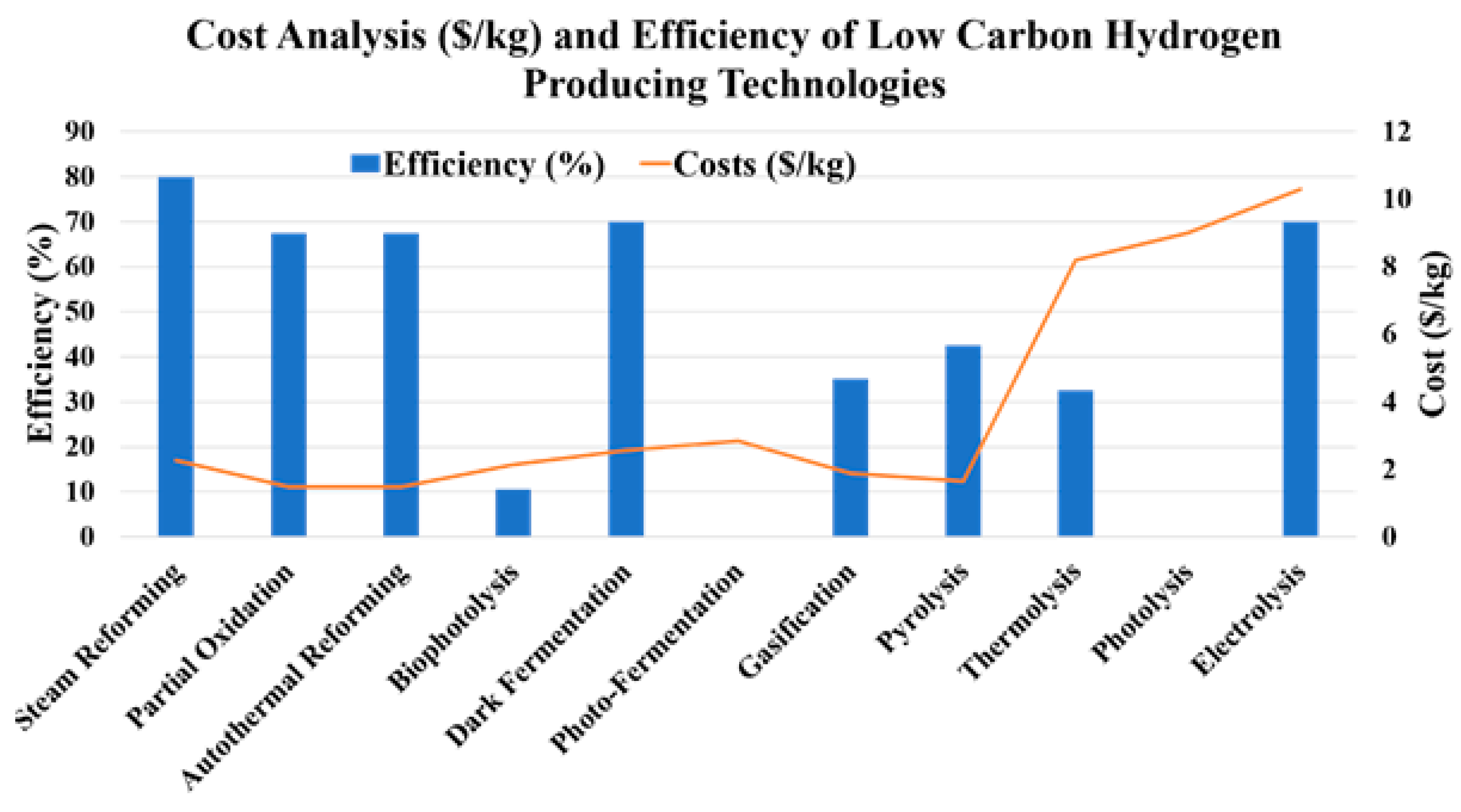
Even as hydrogen is so promising, there are still a series of issues. Green hydrogen production by electrolysis remains five times more costly than traditional production, and storage facilities are technically demanding and expensive (Baykara, 2018; Jiang et al., 2015; Yadav, Sehrawat, et al., 2025). It would take 3–4 times more storage space to replace natural gas with hydrogen by 2050, at an estimated cost of $637 billion. Even blue hydrogen, which involves carbon capture, has high costs and losses of efficiency. The economic viability of hydrogen is based on lowering the costs of production and storage while increasing efficiency and scalability (see Figure 3) (Clark & Rifkin, 2006; Liu et al., 2022; Panchenko et al., 2023).
5. Life Cycle and Environmental Impacts
While hydrogen does provide a route to decarbonization, how much and if at all it will lower the impact on the environment will depend on the production method. Hydrogen produced using steam methane reforming (SMR) produces high amounts of CO₂ unless it is used with efficient carbon capture and storage (CCS) (Mittal et al., 2025; Rout et al., 2025; Thomare, Magadum, et al., 2025). Even hydrogen production based on renewables is not completely emission-free because of embodied emissions in wind turbines and solar panels (see Figure 2a–d). Life cycle assessments need to be thorough to guarantee that the hydrogen transition brings real climate benefits (Thomare, Nagappagol, et al., 2025; Yadav, Mittal, et al., 2025a, 2025b).
6. Policy Implementation and the Role of Governance
Policy structures are the most important element in driving the hydrogen economy. Existing policies frequently fall behind innovations, and so the low-carbon hydrogen tends to be adopted at a slower pace. A successful implementation of policy calls for policymakers, researchers, and business stakeholders to coordinate (McNeil et al., 1989; Ren et al., 2023; Xiao et al., 2015). A range of incentives to produce green hydrogen, infrastructure investments, and targeted emissions regulations must be tapped to drive the process. A hierarchical policy action framework, from local to global, is proposed in the report to fill gaps and support a strong LCH economy (Deepanshu et al., 2025; Murgod et al., 2025; Sehrawat et al., 2025; Yadav et al., 2025).
7. Bridging Research Gaps and Future Directions
Despite nearly two centuries of hydrogen research, there is no globally green, efficient, and affordable production method yet. Cost control, infrastructure development, and environmental protection are the key research areas (Arena et al., 2007; Griffiths et al., 2021; Saeidi et al., 2017; Urakawa et al., 2007). These have to be addressed through interdisciplinarity, innovation in production and storage technology, as well as robust policy backing. The new strategy focuses on continuing research, public-private cooperation, and international cooperation to tap the full potential of hydrogen as a pillar of the low-carbon energy transition (Borgarello et al., 1985; Gondal et al., 2018; Rahmad et al., 2022).
8. Conclusion
The path to a low-carbon hydrogen economy is one of potential as much as complexity. Hydrogen is widespread, versatile, and energy-dense, which are compelling characteristics in a decarbonization tool for hard-to-abate uses such as industry, transport, and power. The transition will not be seamless, though, as the incumbent dominance of hydrogen from fossil fuels underscores the critical need for technologies to break through and reduce costs in green and blue hydrogen production. Life cycle assessments demonstrate that even hydrogen produced from renewables is not fully emissions-free, and that underlines the need for open emissions accounting and ongoing process optimisation. The high production, storage, and infrastructure costs are the principal deterrents. Closing the research and policy loopholes means inducing innovation, imposing enforceable emissions limits, and opening investment across the value chain of hydrogen. Eventually, it will be the concerted effort of researchers, industry, policymakers, and the public that brings a low-carbon hydrogen future into existence, with hydrogen emerging as a cornerstone of global decarbonization and a cleaner, more secure energy system for future generations.
References
- Arena, F., Barbera, K., Italiano, G., Bonura, G., Spadaro, L., & Frusteri, F. (2007). Synthesis, characterization and activity pattern of Cu–ZnO/ZrO2 catalysts in the hydrogenation of carbon dioxide to methanol. Journal of Catalysis. [CrossRef]
- Azni, M. A., Md Khalid, R., Hasran, U. A., & Kamarudin, S. K. (2023). Review of the Effects of Fossil Fuels and the Need for a Hydrogen Fuel Cell Policy in Malaysia. Sustainability, 15(5), 4033. [CrossRef]
- Baykara, S. Z. (2018). Hydrogen: A brief overview on its sources, production and environmental impact. International Journal of Hydrogen Energy. [CrossRef]
- Borgarello, E., Borgarello, E., Borgarello, E., Borgarello, E., Serpone, N., Grätzel, M., & Pelizzetti, E. (1985). Hydrogen production through microheterogeneous photocatalysis of hydrogen sulfide cleavage. The thiosulfate cycle. International Journal of Hydrogen Energy. [CrossRef]
- Chew, Y. E., Cheng, X. H., Loy, A. C. M., How, B. S., & Andiappan, V. (2023). Beyond the Colours of Hydrogen: Opportunities for Process Systems Engineering in Hydrogen Economy. Process Integration and Optimization for Sustainability, 7(4), 941–950. [CrossRef]
- Clark, W. W., & Rifkin, J. (2006). A green hydrogen economy. Energy Policy, 34(17), 2630–2639. [CrossRef]
- Das, K., Waiba, S., Jana, A., & Maji, B. (2022). Manganese-catalyzed hydrogenation, dehydrogenation, and hydroelementation reactions. Chemical Society Reviews, 51(11), 4386–4464. [CrossRef]
- Deepanshu, Garg, K., Mittal, H., Yadav, V., & Kushwaha, O. S. (2025). Solar Panel Degradation Prediction using Machine Learning: A Comprehensive Approach. [CrossRef]
- Demirbas, A. (2008). Biofuels sources, biofuel policy, biofuel economy and global biofuel projections. Energy Conversion and Management, 49(8), 2106–2116. [CrossRef]
- Feyer, V., Vesselli, E., Rizzi, M., Rogatis, L. De, Ding, X.-L., Baraldi, A., Comelli, G., Savio, L., Vattuone, L., Rocca, M., Fornasiero, P., Baldereschi, A., & Peressi, M. (2010). Hydrogen-Assisted Transformation of CO2 on Nickel: The Role of Formate and Carbon Monoxide. Journal of Physical Chemistry Letters. [CrossRef]
- Glenna, D. M., Jana, A., Xu, Q., Wang, Y., Meng, Y., Yang, Y., Neupane, M., Wang, L., Zhao, H., Qian, J., & Snyder, S. W. (2023). Carbon Capture: Theoretical Guidelines for Activated Carbon-Based CO2 Adsorption Material Evaluation. Journal of Physical Chemistry Letters, 10693–10699. [CrossRef]
- Gondal, I. A., Masood, S. A., & Khan, R. (2018). Green hydrogen production potential for developing a hydrogen economy in Pakistan. International Journal of Hydrogen Energy, 43(12), 6011–6039. [CrossRef]
- Griffiths, S., Sovacool, B. K., Kim, J., Bazilian, M., & Uratani, J. M. (2021). Industrial decarbonization via hydrogen: A critical and systematic review of developments, socio-technical systems and policy options. Energy Research & Social Science, 80, 102208. [CrossRef]
- Gür, T. M. (2022). Carbon Dioxide Emissions, Capture, Storage and Utilization: Review of Materials, Processes and Technologies. Progress in Energy and Combustion Science, 89, 100965. [CrossRef]
- Jiang, X., Koizumi, N., Koizumi, N., Koizumi, N., Guo, X., & Song, C. (2015). Bimetallic Pd–Cu catalysts for selective CO2 hydrogenation to methanol. Applied Catalysis B-Environmental. [CrossRef]
- Leachman, J., Jacobsen, R. T., Penoncello, S. G., & Lemmon, E. W. (2009). Fundamental Equations of State for Parahydrogen, Normal Hydrogen, and Orthohydrogen. Journal of Physical and Chemical Reference Data. [CrossRef]
- Liu, W., Wan, Y., Xiong, Y., & Gao, P. (2022). Green hydrogen standard in China: Standard and evaluation of low-carbon hydrogen, clean hydrogen, and renewable hydrogen. International Journal of Hydrogen Energy. [CrossRef]
- McNeil, M. A., Schack, C. J., & Rinker, R. G. (1989). Methanol synthesis from hydrogen, carbon monoxide and carbon dioxide over a CuO/ZnO/Al2O3 catalyst: II. Development of a phenomenological rate expression. Applied Catalysis. [CrossRef]
- Mittal, H., Sehrawat, A., & Kushwaha, O. (2025). Energy, Environment and Biomedical Applications of Boron Nitride and Boron Nitride Carbon Nanotubes: A Sustainable Industrial Scale-Up Exegesis. [CrossRef]
- Mittal, H., Verma, S., Bansal, A., & Singh Kushwaha, O. (2024). Low-Carbon Hydrogen Economy Perspective and Net Zero-Energy Transition through Proton Exchange Membrane Electrolysis Cells (PEMECs), Anion Exchange Membranes (AEMs) and Wind for Green Hydrogen Generation. Qeios. [CrossRef]
- Murgod, S., Garg, K., Magadum, T., Yadav, V., Mittal, H., & Kushwaha, O. (2025). AI Powered Renewable Energy Balancing, Forecasting and Global Trend Analysis using ANN-LSTM Integration. [CrossRef]
- Panchenko, V. A., Daus, Yu. V., Kovalev, A. A., Yudaev, I. V., & Litti, Yu. V. (2023). Prospects for the production of green hydrogen: Review of countries with high potential. International Journal of Hydrogen Energy, 48(12), 4551–4571. [CrossRef]
- Rahimirad, Z., & Sadabadi, A. A. (2023). Green hydrogen technology development and usage policymaking in Iran using SWOT analysis and MCDM methods. International Journal of Hydrogen Energy, 48(40), 15179–15194. [CrossRef]
- Rahmad, E. U., Girsang, C., Khairunnisa, A., Suci, D. H., Prima, W., & Faradina, R. (2022). HYDROGEN DRY CELL GENERATOR FOR HYDROGEN PRODUCTION BY SPLITING WATER. ELECTROLYTE, 1(01), 41–49. [CrossRef]
- Ren, Y., Yang, Y., & Wei, M. (2023). Recent Advances on Heterogeneous Non-noble Metal Catalysts toward Selective Hydrogenation Reactions. In ACS Catalysis (Vol. 13, Issue 13, pp. 8902–8924). American Chemical Society. [CrossRef]
- Rout, D., Shyamsukha, N., Mittal, H., & Kushwaha, O. S. (2025). Solar energy generation and power prediction through computer vision and machine intelligence. In Computer Vision and Machine Intelligence for Renewable Energy Systems (pp. 103–123). Elsevier. [CrossRef]
- Saeidi, S., Najari, S., Fazlollahi, F., Nikoo, M. K., Sefidkon, F., Klemeš, J. J., & Baxter, L. L. (2017). Mechanisms and kinetics of CO2 hydrogenation to value-added products: A detailed review on current status and future trends. Renewable & Sustainable Energy Reviews. [CrossRef]
- Salvi, B. L., & Subramanian, K. A. (2015). Sustainable development of road transportation sector using hydrogen energy system. Renewable & Sustainable Energy Reviews. [CrossRef]
- Sehrawat, A., Bhatnagar, R. M., Magadum, T., Mittal, H., & Kushwaha, O. (2025). Comparative Analysis of Bio-Based and Traditional Plastics: Life Cycle Assessment, Cost-Benefit Analysis, and Health Impact Evaluation. [CrossRef]
- Shafiee, S., & Topal, E. (2009). When will fossil fuel reserves be diminished. Energy Policy. [CrossRef]
- Thomare, C., Magadum, T., & Mittal, H. (2025). Conversion of Cow Dung to Electricity: Process Analysis and Energy Yield Assessment. [CrossRef]
- Thomare, C., Nagappagol, A., Magadum, T., Mittal, H., & Kushwaha, O. (2025). Simulation and Parametric Analysis of Microbial Fuel Cells Using MATLAB-Based Mathematical Modelling. [CrossRef]
- Urakawa, A., Jutz, F., Laurenczy, G., & Baiker, A. (2007). Carbon Dioxide Hydrogenation Catalyzed by a Ruthenium Dihydride: A DFT and High-Pressure Spectroscopic Investigation. Chemistry: A European Journal. [CrossRef]
- Vezirolu, T., & Barbir, F. (1992). Hydrogen: the wonder fuel. International Journal of Hydrogen Energy. [CrossRef]
- Williams, N. J., Williams, N. J., Seipp, C. A., Brethomé, F. M., Ma, Y.-Z., Ma, Y.-Z., Ivanov, A. S., Ivanov, A. S., Bryantsev, V. S., Kidder, M. K., Martin, H., Holguin, E., Garrabrant, K. A., & Custelcean, R. (2019). CO2 Capture via Crystalline Hydrogen-Bonded Bicarbonate Dimers. Chem. [CrossRef]
- Xiao, J., Mao, D., Guo, X., Guo, X., Yu, J., & Yu, J. (2015). Methanol Synthesis from CO2 Hydrogenation over CuO–ZnO–TiO2 Catalysts: The Influence of TiO2 Content. Energy Technology. [CrossRef]
- Yadav, V., Deepanshu, Mittal, H., Shah, V., & Kushwaha, O. S. (2025). Fuel Cell Degradation Prediction Using Machine Learning Models: A Study on Proton Exchange Membrane (PEM) Fuel Cell Dataset. [CrossRef]
- Yadav, V., Mittal, H., Shah, V., & Kushwaha, O. S. (2025a). Environmental Conversation and Safety Analysis of Ammonia Storage Tanks: An Indian Perspective from Lab to Industrial Scale. [CrossRef]
- Yadav, V., Mittal, H., Shah, V., & Kushwaha, O. S. (2025b). Sustainability Analysis of Polymers, Fibres and Nanomaterials for Ballistic Applications. [CrossRef]
- Yadav, V., Sehrawat, A., Magadum, T., Mittal, H., Shah, V., & Kushwaha, O. (2025). Green Hydrogen Generation Through Novel Electrolysers Towards Low Carbon Economy: An Opiniated Perspective. [CrossRef]
- Yan, J., Wood, D. A., Zhang, Z., & Zhang, Z. (2019). Carbon Capture, Utilization and Storage (CCUS). Applied Energy. [CrossRef]
- Yang, C., Mu, R., Wang, G., Song, J., Tian, H., Zhao, Z.-J., & Gong, J. (2019). Hydroxyl-mediated ethanol selectivity of CO2 hydrogenation. Chemical Science. [CrossRef]
- Yanxing, Z., Maoqiong, G., Yuan, Z., Xueqiang, D., & Jun, S. (2019). Thermodynamics analysis of hydrogen storage based on compressed gaseous hydrogen, liquid hydrogen and cryo-compressed hydrogen. International Journal of Hydrogen Energy. [CrossRef]
- Zhang, Y., Tian, Q.-F., Liu, S.-S., & Sun, L.-X. (2008). The destabilization mechanism and de/re-hydrogenation kinetics of MgH2–LiAlH4 hydrogen storage system. Journal of Power Sources, 185(2), 1514–1518. [CrossRef]
Figure 1.
Comparative greenhouse gas emissions and air pollutant impacts of wind turbines and solar photovoltaic systems.
Figure 1.
Comparative greenhouse gas emissions and air pollutant impacts of wind turbines and solar photovoltaic systems.
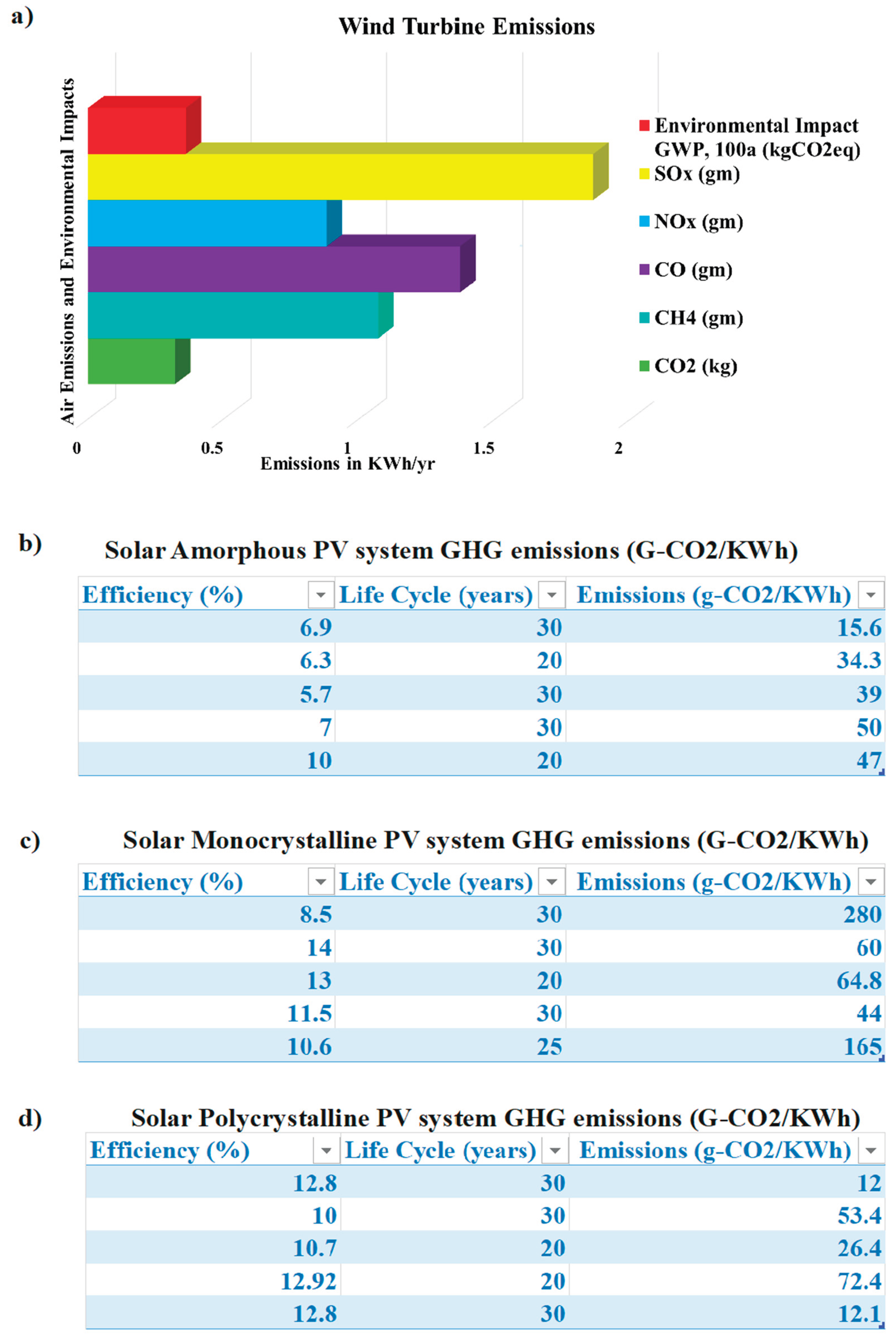
Figure 2.
Current and projected global hydrogen demand: 2019–2021 Trends and 2030 Policy-Based projections.
Figure 2.
Current and projected global hydrogen demand: 2019–2021 Trends and 2030 Policy-Based projections.
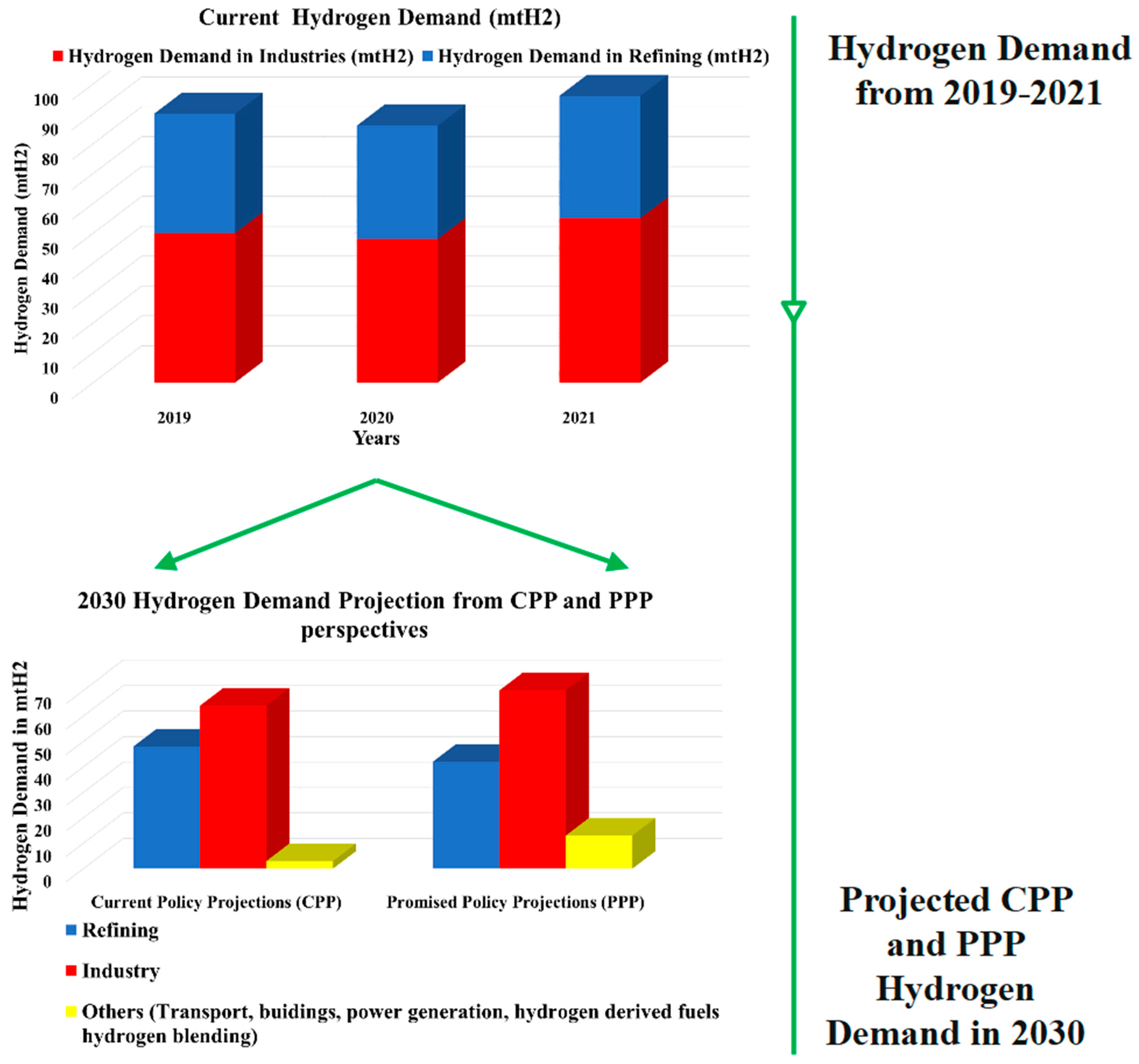
Figure 3.
Comparison of cost and efficiency of Low-Carbon hydrogen production technologies.
Disclaimer/Publisher’s Note: The statements, opinions and data contained in all publications are solely those of the individual author(s) and contributor(s) and not of MDPI and/or the editor(s). MDPI and/or the editor(s) disclaim responsibility for any injury to people or property resulting from any ideas, methods, instructions or products referred to in the content. |
© 2025 by the authors. Licensee MDPI, Basel, Switzerland. This article is an open access article distributed under the terms and conditions of the Creative Commons Attribution (CC BY) license (http://creativecommons.org/licenses/by/4.0/).
Copyright: This open access article is published under a Creative Commons CC BY 4.0 license, which permit the free download, distribution, and reuse, provided that the author and preprint are cited in any reuse.