

Submitted:
29 June 2025
Posted:
30 June 2025
You are already at the latest version
Abstract
Sensor-enabled digital twins (DTs) are reshaping precision dairy nutrition by seamlessly integrating real-time barn telemetry with advanced biophysical simulations in the cloud. Drawing insights from 122 peer-reviewed studies spanning 2010–2025, this systematic review reveals how DT architectures for dairy cattle are conceptualized, validated, and deployed. We introduce a novel five-dimensional classification framework—spanning application domain, modeling paradigms, computational topology, validation protocols, and implementation maturity—to provide a coherent comparative lens across diverse DT implementations. Hybrid edge-cloud architectures emerge as optimal solutions, with lightweight CNN-LSTM models embedded in collar or rumen-bolus microcontrollers achieving over 90% accuracy in recognizing feeding and rumination behaviors. Simultaneously, remote cloud systems harness mechanistic fermentation simulations and multi-objective genetic algorithms to optimize feed composition, minimize greenhouse gas emissions, and balance amino-acid nutrition. Field-tested prototypes indicate significant agronomic benefits, including 15–20% enhancements in feed conversion efficiency and water use reductions of up to 40%. Nevertheless, critical challenges remain: effectively fusing heterogeneous sensor data amid high barn noise, ensuring millisecond-level synchronization across unreliable rural networks, and rigorously verifying AI-generated nutritional recommendations across varying genotypes, lactation phases, and climates. Overcoming these gaps necessitates integrating explainable AI with biologically grounded digestion models, federated learning protocols for data privacy, and standardized PRISMA-based validation approaches. The distilled implementation roadmap offers actionable guidelines for sensor selection, middleware integration, and model lifecycle management, enabling proactive rather than reactive dairy management—an essential leap toward climate-smart, welfare-oriented, and economically resilient dairy farming.
Keywords:
digital twin
; precision dairy nutrition
; livestock monitoring
; edge computing in agriculture
; hybrid modeling
; sensor fusion
; smart farming
; sustainable livestock systems
; real-time data integration
1. Introduction
Digital transformation has emerged as a prominent global trend, spurring innovations across numerous technological domains. Among these, digital twin (DT) technology is particularly notable, having garnered significant interest due to its transformative capabilities ([1,2,3,4,5]). A Digital Twin represents a dynamic, virtual counterpart of a physical entity or system, sustained by continuous, real-time data integration and exchange between its digital and physical dimensions.
Originally pioneered within manufacturing and aerospace industries, the digital twin concept has rapidly expanded into diverse sectors, including agriculture, healthcare, urban planning, and smart infrastructure. More than a conventional simulation, a digital twin serves as an adaptive, data-driven model, dynamically mirroring real-world conditions to facilitate real-time monitoring, predictive analytics, and informed decision-making.
Grieves and Vickers [6] initially defined DTs within the framework of product lifecycle management, highlighting their significance in virtual representation and closed-loop optimization. Extending this perspective, Kritzinger et al. [7] characterized digital twins as actively connected virtual replicas, distinct from traditional, static simulations due to their continuous bidirectional data exchange and concurrent evolution. Negri et al. [8] further clarified distinctions between conceptual models, digital shadows, and true digital twins, asserting that authentic twins necessitate synchronized, real-time data streams coupled with feedback mechanisms. Figure 1 depicts a general digital twin architecture adapted specifically to dairy farming applications, illustrating sequential data flow from sensor-based data acquisition through preprocessing, computational modeling, and simulation, culminating in actionable decision-making and iterative system refinement.
In agriculture, particularly dairy farming, digital twins are increasingly investigated for real-time modeling of animal behavior, metabolic dynamics, and precision feeding. However, few existing deployments satisfy the rigorous technical and practical criteria necessary for robust commercial implementation.
1.1. Evolution of Digital Twin Technology
The Digital Twin paradigm has significantly evolved over the last two decades, shifting from offline simulation tools toward intelligent, autonomous systems. Originally conceptualized at NASA to manage spacecraft systems, DTs have since become foundational to Industry 4.0, underpinned by the integration of IoT sensors, big data analytics, AI and edge computing.
In the early 2000s, DTs were primarily used for design-time and post-failure analysis. With the rise of virtual-physical systems, DTs transformed into real-time systems capable of predictive diagnostics, anomaly detection and operational optimization. Jeong et al. [9] outlined this trajectory as the shift from “descriptive” to “prescriptive” digital twins. Wu et al. [10] described a layered framework describing the evolution of technology ranging from data acquisition and connectivity to autonomy and self-optimization. The technological evolution [11] of Digital Twins from NASA’s early applications to AI-integrated edge systems is depicted in Figure 2, highlighting key milestones that underpin the paradigm’s transition from simulation to autonomy.
As DTs mature into intelligent systems, their adaptation to livestock applications requires rethinking their computational architecture to account for real-time biological variability, heterogeneous sources and on farm edge constraints. These challenges remain unexplored in the literature.
1.2. Importance of Digital Twins in Various Sectors
Digital Twin systems are central to digital transformation strategies across many domains including agriculture, manufacturing, healthcare and urban planning. Their ability to combine real-time sensing, simulation and integration of Artificial Intelligence enables precise control and prediction in complex environments. While digital twin technology has gained popularity in healthcare, planning and manufacturing, this review concentrates on its emerging role in precision agriculture. DTs specially in dairy systems enables real time monitoring of individual cows, personalised nutrition and early disease prediction.
In agriculture, DTs are used to model livestock behaviour, optimize precision nutrition and reduce greenhouse gas emissions. In dairy farming, DTs simulate individual cow physiology and behaviour to personalize feeding and predict health issues [12]. Figure 3 contrasts traditional dairy farming with DT-enabled dairy farming, emphasizing how Digital Twins transform the system from reactive and siloed to proactive, integrated, and personalized. In manufacturing, DTs support predictive maintenance, fault detection and real-time production optimization [13], while in healthcare, emerging applications range from personalized medicine to mental health care [14] such as PsyDT [15] builds a digital twin of a psychological counselor using LLMs for adaptive counseling.
Jones et al. [16] categorize the DT application domains across sectors such a urban planning, manufacturing and energy systems, and provides a structured framework to evaluate DT maturity in each based on real-time responsiveness, integration level and decision automation. Similarly, Qi and Tao’s [17] research underscores the role of networking infrastructure, cybersecurity and data interoperability in the effectiveness of a digital twin.
While these insights offer valuable architectural blueprints, their direct application to livestock and dairy systems requires careful adaptation. Precision dairy farming introduces unique challenges ranging from biological variability and physiological dynamics to fragmented on-farm connectivity and stringent ethical considerations related to animal welfare that demand a context-aware restructuring of existing DT frameworks.
1.3. Objectives of the Review
This review seeks to critically explores the current landscape of the digital twin technology, with a particular focus on computational architectures, modelling techniques and deployment frameworks for precision dairy nutrition and sustainable agriculture. It integrates technological foundations and sector-specific case studies from over 100 journal articles.
Research Questions:
- What conceptual and architectural models define a digital twin across domains and how can they be tailored to livestock systems?
- How are digital twins implemented in agricultural and livestock contexts, particularly for nutrition and health prediction?
- What are the current technical limitations in dairy nutrition modeling?
- What are the key technical, infrastructural and ethical challenges in deploying digital twins on commercial dairy farms?
- What future opportunities exist for integrating AI, edge computing and simulation technologies into next generation dairy digital twins?
The review aims to bring together the key technologies and frameworks that make these DT systems possible, compare how they are applied across different sectors and highlight the major gaps, challenges and future research priorities in implementing them. It provides a comprehensive synthesis of digital twin technologies with an emphasis on computational design, modelling approaches and deployment strategies tailored to precision nutrition in dairy cows.
2. Methodology
This literature review paper follows a systematic methodology based on best practices. The goal was to identify, evaluate and synthesize scholarly work relevant to the application of DTs in precision dairy nutrition.
2.1. Literature Classification Approach
The review adopts a structured methodology to critically evaluate the current state of digital twin technologies as applied to precision dairy nutrition. In contrast to the lifecycle-based classifications often used in industrial digital twin reviews, this work organizes the literature around computational and functional dimensions that directly impact modeling, implementation and real-time utility of dairy focused digital twin. The classification framework was iteratively developed after reviewing foundational literature across domains and then refined to align with the unique demands of dairy systems particularly the need for modeling biological variability, feed behaviour and metabolic processes in livestock.
Five interrelated classification dimensions guided the analysis. First, studies were categorized by application domain, distinguishing between general agriculture, livestock-focused work and specifically dairy-oriented applications. This ensured that conclusions drawn from industrial or crop-based DTs were not over-generalized to biologically dynamic systems like dairy cows. The second dimension of classification was the modeling approach, which grouped works based on whether they relied on physics-based models (like mechanistic digestion simulators), machine learning techniques (LSTMs for rumination detection) or hybrid approaches that integrate empirical and theoretical logic. The third dimension is computational architecture. This involved classifying systems according to their data infrastructure including centralized cloud-based designs, modular layered systems or edge-enabled frameworks designed for intermittent connectivity typical in rural farm environments. This classification was crucial to understand how real-time decision support scales across different dairy farm sizes. The fourth axis concerned validation methodology, differentiating between conceptual studies, simulation-only validations and field-tested deployments with real-time farm data. Finally, studies were classified by implementation maturity whether the proposed digital twin remained at the theoretical stage or was validated through prototypes or had been implemented in working farm environments with full feedback integration.
By mapping each article to these five dimensions, the review creates a comparative framework that highlights technical gaps, architectural bottlenecks and domain-specific trade-offs in the deployment of digital twin systems for precision nutrition in dairy cattle.
2.2. Search Strategy for Identifying Relevant Papers
The review followed a multi-phase process designed to ensure both comprehensive coverage as well as relevance to the review’s specific computational focus. The first stage involved a systematic search of academic databases including IEEE Xplore, Scopus, SpringerLink, Web of Science, arXiv, and PubMed, with a search window spanning from 2010 to early 2025. Search queries were structured around combinations of terms such as “digital twin”, “livestock monitoring”, “precision dairy nutrition”, “cow behaviour modeling”, “feed optimization algorithms”, “sensor fusion in agriculture” and “edge computing in farm environments”. Boolean search strings were constructed to combine key thematic terms for example- (“digital twin” OR “DT”) AND (“livestock” OR “dairy” OR “precision feeding” OR “cow behavior” OR “rumination monitoring” OR “feed optimization”) AND (“sensor fusion” OR “IoT” OR “edge computing” OR “real-time system”). These queries were tailored slightly across databases based on syntax requirements and were refined iteratively to reduce noise while ensuring inclusivity across domains.
An initial pool of 300+ papers was retrieved, which was then narrowed down to 280 after removing duplicates. In the second stage, titles and abstracts were read to assess whether the work addressed digital twin systems in a technical or application-driven manner. This left a refined set of 200 candidate papers. The third phase involved a detailed full-text analysis to determine fit with the review’s scope. Papers were retained if they provided insight into modeling rumination and feeding patterns, data integration architectures, metabolic simulation frameworks or real-time decision processes in livestock environments. In the final phase, 122 papers were included for structured analysis. These were organized thematically according to the classification framework in Section 2.1. Figure 4 shows the PRISMA-based flowchart summarizing this screening and selection process, including detailed exclusion criteria.
This methodological approach balances breadth with technical specificity, offering a rigorous foundation for evaluating the architectural, computational and deployment challenges in designing digital twins for precision dairy nutrition.
2.3. Overview of the Data Sources
The literatures surveyed in this review draws from a diverse array of data sources, both real-world and simulated, reflecting the interdisciplinary nature of digital twin systems. Within agriculture most of the diary focused research relies on sensor-driven datasets collected either on commercial farms or controlled experimental platforms. These include motion data from accelerometers, rumination logs from bolus or collar sensors, ambient temperature and humidity readings, and synchronized feeding events recorded through IoT-enabled feeders and milking systems.
Public datasets like the MMCows [18] provide annotated time-series logs from accelerometer devices, while platforms such as SmartCow (Zenodo) offer multimodal sensor streams combining rumen temperature, motion, and feed intake metrics. Several high-impact studies like IUMENTA [19] and Feeding Behaviour DT [20] use a mix of real-farm telemetry and synthetic data modeled through Bluetooth or LoRaWAN-based edge infrastructure to simulate biologically accurate digital twins.
Beyond dairy, broader agri-digital twin systems such as AgriLoRa [21] uses telemetry collected from GPS-tagged tractors, irrigation control systems and weather stations. These typically operate at minute-to-hour resolution and are often integrated with environmental data such as soil moisture or temperature gradients.
The data formats across the reviewed studies are heterogeneous, including structured CSV/JSON time-series, SQL relational logs for health or production cycles, and unstructured data like thermal images or video feeds in animal behaviour modeling. Advanced systems like IUMENTA [19] or FIWARE-based twins [22] use semantic models to represent relationships between farm components such as animals, devices and environmental variables.
Data frequencies vary by domain. Dairy DTs tend to operate on hourly or daily cycles tied to feeding, rumination and milking. Manufacturing twins typically log at sub-second intervals while environmental or health-related twins may operate episodically or asynchronously. Several studies emphasize preprocessing requirements such as temporal alignment, sensor fusion and filtering for noise. For instance, the Feeding Behaviour DT [20] project employs Kalman smoothing to clean accelerometer data, while others use interpolation methods to harmonize bolus, thermal and motion data streams.
Overall, digital twin systems in dairy nutrition must accommodate a wide variety of data formats and resolutions. Their computational pipelines must be designed to support both low-latency decision-making (like in real-time feeding adjustments) and high-resolution historical modeling (nutrition vs performance trends across lactation cycles). This diversity underscores the architectural flexibility required for deploying digital twins at scale in dairy environments.
3. Digital Twin Architecture
3.1. Overview of DT Architecture
The foundational architecture of a Digital Twin (DT) comprises three interdependent layers- data acquisition, virtual modeling and real-time connectivity. These components serve as the pillars of the digital twin system that allows real-time monitoring, simulation and optimization of the physical entities. In the context of dairy systems, these architectures must be adapted to handle high-frequency, biologically variable and spatially distributed data sources while ensuring responsiveness and scalability under resource constraints. According to Grieves and Vickers [6], the DT model should be grounded in a closed-loop feedback structure where the digital model mirrors the physical asset and responds dynamically to changes in its state.
Tao et al. [23] and Wu et al. [10] propose that digital twins evolve through five layers: physical layer where data is collected via sensors and actuators, the communication layer which is responsible for transmitting this data via LoRaWAN, Bluetooth or Wi-Fi, the data infrastructure layer where raw data is filtered, integrated and stored, the modeling layer which performs the simulation, prediction and inferences and finally the decision or application layer where insights are converted into actions such as feed ration adjustments, health alerts or farm level reports.
In industrial applicational, DTs often rely on centralized cloud-based platforms. However, in agricultural and dairy contexts hybrid edge-cloud architectures are increasingly favored due to constraints in connectivity, latency sensitivity (for applications like health monitoring) and the need for processing the data real time and on-site. Dairy specific DTs typically delegate simple classification and preprocessing tasks to on-farm edge devices like embedded microcontrollers or Raspberry Pi board while offloading more complex metabolic simulations or optimization routines to cloud infrastructure.
Figure 5 presents a reference architecture adapted for dairy digital twins, illustrating how data flows from cow-mounted and environmental sensors through edge processing modules, cloud-based inference layers and finally to user interfaces or automated actuators. This layered approach enables modular deployment, which is essential for accommodating diverse farm sizes and technical capabilities.
These layered frameworks have since been adopted across domains including manufacturing, urban infrastructure and agriculture to enable increasingly autonomous, intelligent and scalable systems.
Recent implementations, such as Digital Twin as a Service (DTaaS), modularize these layers into plug-and-play services for faster deployment and reuse, especially in simulation-heavy environments like autonomous driving and digital livestock systems. Frameworks like IUMENTA [19] are designed for animal digital twins to exemplify a new generation of DT platforms where each component can be independently configured and scaled across species, environments and resolution levels.
3.2. Components of Dairy Nutrition Digital Twin
A digital twin designed for precision dairy nutrition integrates multiple system components across several layers, each responsible for handling a specific aspect of data acquisition, processing, modeling, or intervention. Figure 5 presents a five-layer reference architecture designed to meet the unique requirements of real-time dairy environment like multimodal sensor integration, physiological modeling and feedback mechanisms.
The Sensor Infrastructure Layer captures real-time data from various sources within the physical farm environment. Animal sensors, such as wearable RFID tag collars, rumen boluses, accelerometers and thermal cameras measure motion, rumination and physiological responses. Feed sensors such as weighing scales and NIR spectrometers collect data on ration intake. Environmental sensors monitor barn climate, air quality and thermal conditions. Milk analyzers track milk yield and composition. Together, these inputs provide the raw observational basis for the digital twin's functioning. Livestock-oriented systems like IUMENTA [19] and dairy behaviour recognition frameworks [24] demonstrated effective use of multi-sensor fusion by integrating data from various embedded and environmental devices. In industrial setups like Siemens PLM [4] or AutoDRIVE [25], various sensors monitor motion, temperature, vibration and energy consumption, feeding data at millisecond-level resolution.
The Data Pipeline Layer handles the ingestion, preprocessing and storage of sensor data. Data ingestion components include IoT gateways and message queues that receive data streams from the field. Data processing modules perform noise filtering (e.g., Kalman smoothing), normalization, and feature extraction to prepare the data for modeling. This layer handles data integration tasks such as temporal alignment across sensors and applies encryption and authentication mechanisms to ensure data security and privacy before they are input into modeling layers.
At the core of the system lies the Computational Module Layer, where real-time system behaviour is simulated, predicted or optimized. This layer is composed of four main modules. The Nutrition Models ([26,27,28]) simulate digestion, fermentation and feed efficiency using compartmental or mechanistic models. The AI/ML Engine includes neural networks, ensemble methods and deep learning models trained to predict feeding behaviour or detect anomalies. The Digital Twin Core orchestrates real-time simulations of virtual cows, combining inputs from both nutrition models and live sensor data. Finally, an analytics module conducts trend detection, pattern recognition and predictive modeling for performance benchmarking.
Traditional physics-based models are commonly employed in engineering-focused twins such as Smart Manufacturing systems [29], where machine behaviour is mathematically deterministic [30]. In contrast, agriculture and healthcare applications favor data-driven and hybrid modeling due to biological variability. Techniques include BiLSTM and GANs [31] (COVID-19 twins), reinforcement learning and neural implicit representations [32] for behaviour prediction and optimization. Recently, Digital Twin-Driven Teat Localization and Shape Identification [33] proposed using convolutional networks to locate and segment anatomical features in dairy cows, improving the precision of robotic milking systems. Similarly, Cow Daily Behaviour Recognition Based on Multimodal Data [34] employed thermal imaging and accelerometry to classify behaviour states using deep CNNs and attention modules. In swine farming, the Digital Twin Application: Making a Virtual Pig House [35] integrates temperature, light and sound feedback into the behaviour simulation loop to enhance comfort-based automation. These developments collectively reinforce the shift toward more adaptive, self-calibrating twin models, particularly in biological systems where behaviour and response are context dependent.
Hybrid models leverage both first-principles physics and learned behaviours to maximize predictive accuracy while retaining interpretability. Conceptual Digital Twin Modeling Based on TRIZ Function Model [10] provides a methodology for innovation-driven modeling, bridging conventional control theory with inventive problem solving. Digital Twin: Generalization, Characterization and Implementation [36] emphasizes adaptability by enabling component-wise modeling across biological and engineered systems. Such flexibility is essential in environments like dairy farming, where both routine and stochastic events impact outcomes.
Table 1 consolidates representative modeling techniques from both agricultural and cross-domain digital twin systems, summarizing their purpose, algorithmic type and the domains in which they are applied.
The Feedback Mechanisms Layer closes the loop by transforming insights into actions. Decision support tools generate recommendations for ration adjustments or health alerts. Interfaces such as dashboards or mobile applications can deliver these insights to farmers and veterinarians. Automated control systems may directly operate feed mixers, climate control systems or dosing equipment based on model output. Finally, a dedicated module handles feedback loops, ensuring continuous model adaptation through parameter updates and performance monitoring.
Feedback loops in digital twins for dairy nutrition are essential for maintaining real-time coherence between the physical cow and its virtual representation. Various studies ([12,13,14,15,16,17,18,19,20,21,22,23,24,25,26,27,28,29,30,31,32,33,34,35,36,37]) illustrate the deployment of real-time data from wearable sensors feeding back into the virtual model, which in turn informs feeding decisions or health alerts. Similarly, the IUMENTA architecture [19] employs a loop where bolus sensor input modulates digestion models to fine-tune nutrient delivery.
This modular breakdown of the architecture ensures that the digital twin can support both short-term decisions like feed adjustments and long-term planning like herd health optimization. Moreover, the layered architecture enables scalability across different dairy farm sizes and infrastructure levels, making it adaptable from research stations to commercial farm deployments.
3.3. Computational Requirements of a Dairy Digital Twin System
The deployment of digital twin systems in dairy farming requires careful consideration of computational trade-offs, particularly because of the need for architecture that is capable of handling heterogeneous data streams, supporting real-time inference, and operating under the infrastructural constraints typical of agricultural environments. Unlike industrial digital twins that are deployed in high-connectivity and resource-rich settings, dairy digital twins must address the realities of rural deployment like variable network connectivity, limited on-site computational power and the biological variability inherent in livestock systems. This section delineates the computational demands of various digital twin components in terms of memory requirements, update frequency, processing complexity and deployment topology.
Modules responsible for real-time behaviour monitoring, such as rumination detection and feeding activity classification, are generally deployed at the edge due to latency constraints. These models process high-frequency data from the accelerometer and bolus sensors and require lightweight architectures to operate efficiently on embedded systems with limited memory and connectivity. Zhang et al. [20] proposed a behaviour recognition framework method using a time-series neural network architecture trained on a single collar mounted sensor per cow. The system achieved high classification accuracy (above 94%) using 5-second windows and demonstrated effective performance in a lightweight hardware-software configurations which is also suitable for small scale farms. The authors emphasize on the platforms low cost, ease of deployment and compatibility with real time monitoring in real farm environments with limited technological infrastructure making it relevant for scalable digital twin applications in livestock systems.
Similarly, Han et al. [37] implemented a hybrid CNN-LSTM architecture to classify cow behaviours (standing, sitting, lying or walking) based on time series data from wearable motion sensors. The model was systematically optimized for key hyperparameters, including hidden neuron count and number of LSTM layers, to balance predictive accuracy and computational efficiency. Their experimental results validated using real-world sensor data collected from cows in commercial settings and demonstrated that the system could achieve accurate classification while maintaining a low average test loss under a modest model complexity of 128 hidden units and 2 LSTM layers. The authors highlighted the model's suitability for use in IoT-enabled livestock environments and its potential for edge deployment in smart farming scenarios where continuous behaviour recognition and low-latency inference are essential. While explicit latency figures were not reported, the work provides a framework for real-time, resource-constrained behaviour classification in digital twin systems for cattle management.
Conversely, computationally intensive components such as metabolic process modeling and feed optimization are typically centralized and executed in cloud environments. These modules require access to historical datasets, integration of external factors such as environmental conditions and inventory data as well as the execution of computationally demanding algorithms. For instance, in the IUMENTA [19] framework the authors implement a cloud-hosted optimization engine using genetic algorithms that simulate multiple feeding scenarios based on a cow’s energy expenditure. The pipeline architecture supports modular data merging across inputs from multiple channels, model training, and report generation. The paper details the pipeline’s scalability and the system’s ability to operate distributed components both locally and on the cloud. These architectural choices ensure flexibility and extensibility of digital twin models across different animal species and hardware configurations. Tzachor et al. [38] highlights the role of reinforcement learning agents in agri-food digital twins for optimizing agricultural inputs and decision-making across the agri-food supply chain. Their system-level perspective emphasizes the potential of DTs to simulate crop-environment interactions, reduce greenhouse gas emissions and manage food waste through AI-enhanced control strategies. While the work focuses more on policy and environmental optimization than on dairy-specific nutritional modeling, its framework provides a conceptual basis integrating decision intelligence into livestock-oriented digital twins.
Zhang et al. [34] describe a multimodal behavioral recognition system that integrates thermal imaging and accelerometer data to classify daily activities in dairy cows. Their model pipeline incorporates temporal alignment, Kalman filtering and feature-level sensor fusion, enabling robust interpretation of complex animal behaviors in varying environmental conditions. The architecture supports efficient deployment for continuous monitoring in livestock environments.
Latency and communication overhead are persistent bottlenecks in digital twin implementations, particularly in rural agricultural settings. Menges et al. [39] address these challenges through a thermal imaging-based predictive digital twin framework that leverages edge devices to perform local inference. This approach enhances responsiveness and minimizes data transfer delays, allowing for real-time alert generation and on-site decision-making.
The computational profiles of these modules differ not only in their function but also in the required frequency and immediacy of updates. Behavior monitoring and health alerts operate on low-latency intervals and demand continuous data ingestion, while optimization and analytics processes such as lactation curve tracking or performance benchmarking typically function on longer cycles, cloud-based data warehouse and can be executed asynchronously via batch processing.
Table 2 presents an overview of the computational requirements across major modules in precision dairy digital twins. These estimates are derived from reported system specifications ([24,34,39,40]) and technical parameters identified in digital twin pilot implementations for cattle behavior, nutrition modeling and environmental monitoring. While exact resource usage depends on implementation and hardware variation, the ranges here reflect consensus values from field-deployed systems and benchmarks. Complexity measures follow standard algorithmic profiling based on input size (n), while memory and data rates are based on sensor resolution and sampling frequencies reported in practice.
The heterogeneity of these demands necessitates a modular deployment strategy. Smaller farms may prioritize localized infrastructure with batch synchronization, whereas large-scale operations benefit from distributed edge-cloud ecosystems. Designing these systems requires careful alignment of computational efficiency, inference latency and model interpretability with practical limitations in bandwidth, energy use, and technical capacity. Precision dairy digital twins must function as distributed, modular systems, combining the immediacy of edge inference with the analytical depth of cloud platforms. Successful implementation depends on the coordinated execution of memory-aware modeling, adaptive scheduling mechanisms, and robust data communication protocols tailored to farm-scale environments. Precision dairy digital twins must be engineered not as monolithic platforms but as distributed systems, optimized for real-time responsiveness at the edge and analytical depth in the cloud. A successful deployment hinges on the seamless coordination between memory-aware modeling, context-sensitive scheduling, and adaptive communication protocols.
3.4. Communication, Middleware and Standards
Effective communication infrastructure and middleware form the operational spine of digital twin ecosystems, enabling seamless data exchange between physical systems, edge analytics modules, and centralized computational services. In dairy-specific digital twins, these requirements are heightened by the need to maintain low-latency synchronization across heterogeneous devices deployed in bandwidth-limited rural environments.
Middleware protocols such as MQTT (Message Queuing Telemetry Transport), OPC-UA (Open Platform Communications - Unified Architecture) and DDS (Data Distribution Service) are commonly used due to their lightweight footprint, publish-subscribe architecture and support for asynchronous updates. These frameworks facilitate real-time telemetry integration from wearable livestock sensors, milking robots as well as environmental monitors into central or edge-based models. In the context of smart agriculture, systems such as AgriLoRa [21] and SmartCow demonstrate the use of LoRaWAN-based communication for connecting distributed sensor networks across vast pastures, while urban-scale digital twins like Herrenberg rely on 5G and NB-IoT networks to coordinate higher-bandwidth modalities like video and LiDAR feeds.
From a software abstraction standpoint, communication middleware is often coupled with semantic integration frameworks, including FIWARE and IUMENTA [19], which utilize RDF (Resource Description Framework) and OWL-based ontologies to maintain machine-readable representations of physical farm entities. Despite this progress, the lack of universally adopted open standards and inconsistent data schemas continues to limit interoperability and scalability across platforms and domains.
A comparative evaluation by Kritzinger et al. [7] and the technical review “Connecting the Twins” [43] explicitly benchmarked communication stacks based on latency, jitter, and bandwidth trade-offs, affirming the trade-off between decentralized responsiveness and centralized robustness. As dairy DTs evolve towards real-time behavioural prediction and metabolic decision support, efficient, fault-tolerant communication architectures will be critical for maintaining continuous operation in the face of rural connectivity challenges.
3.5. Integration with AI, Cloud, Edge and Big Data
Modern digital twin implementations are hybrid systems that combine the distributed strengths of edge computing, cloud-based analytics, and AI-driven reasoning models. Particularly in dairy environments, this architecture enables computational segmentation by placing time-sensitive behavioral recognition tasks at the edge (rumination classification) and offloading the heavier population-level optimization and historical trend analysis to the cloud.
AI integration is reshaping digital twin intelligence. Studies by Zhang et al. [20] and Han et al. [37] have shown how LSTM, CNN, and hybrid CNN-LSTM models can perform real-time behavioral analysis from raw accelerometer data with over 85% accuracy. These models are deployed on edge devices with relatively less memory and low inference latency enabling responsive decision-making in isolated farm environments.
At the cloud layer, genetic algorithms and linear programming engines are used to solve multi-objective optimization problems, such as balancing feed composition against cost, availability, and animal metabolism. In more experimental systems like Real2Sim2Real [44] and AutoDRIVE [25], the bidirectional transfer of learning from simulation to real-world contexts enables adaptive behavior modeling and autonomous control. This is still nascent in dairy applications but presents promising avenues for cross-modal generalization and digital prototyping.
The computational convergence of AI, edge analytics, and cloud services is enabling closed-loop feedback architectures in digital twins and is linking sensing, reasoning, actuation, and learning in an adaptive cycle.
3.6. Strengths and Limitations of Current DT Architectures
Digital twin architectures offer compelling advantages for precision livestock farming, particularly through their modular, layered design. This architecture allows different subsystems such as behavior analysis, environmental sensing and feed optimization to operate asynchronously yet cooperatively. This modularity supports incremental deployment in farms with varying levels of technological readiness.
However, critical limitations persist. Synchronization between various asynchronous data sources such as bolus sensors, accelerometers and feed intake logs remain technically complex, especially in the absence of standardized timestamps or sampling frequencies. Furthermore, many commercial twin frameworks operate as closed ecosystems, restricting interoperability and increasing vendor lock-in.
From a computational perspective, high-frequency models such as those used for behavior recognition impose energy and memory constraints when deployed at the edge, while cloud-based optimization engines can suffer from delayed responsiveness due to connectivity gaps in rural infrastructure. The interpretability of AI models, especially deep neural networks, is also a concern. Current DT deployments often act as “black boxes” which reduces trust among veterinarians, farm managers and regulators.
Addressing these challenges will require the use of open, interpretable architectures by using Explainable AI. It will require edge-first deployment strategies and federated learning protocols to minimize data transfer latency while retaining predictive accuracy. Emerging frameworks like IUMENTA [19] advocate for open, standards-based interfaces with reusable ontologies to encourage ecosystem-wide integration and innovation.
4. Computational Methods in Precision Dairy Digital Twins
The implementation of digital twins (DTs) in precision dairy nutrition requires a multidisciplinary integration of biological models, data analytics and system level computing and hence relies heavily on a diverse set of computational techniques. These methods span real-time behavior recognition, metabolic modeling, optimization of nutritional inputs and scalable edge-cloud analytics frameworks. This section synthesizes the algorithmic and system-level approaches used in contemporary research, focusing specifically on their utility and application within the dairy sector.
4.1. Rumination and Feeding Behavior Recognition
Accurate behavioral modeling in dairy cows is a critical first step in constructing an accurate digital representation. Time-series classification techniques especially those leveraging deep learning architectures like CNNs and LSTMs are commonly used for detecting rumination, eating and resting behaviors from accelerometer and bolus data.
Zhang et al. [20] proposed a lightweight CNN-LSTM hybrid model trained on multivariate sensor streams to classify eight core behaviors in dairy cows from tri-axial accelerometer and bolus sensor data. Their architecture utilizes 5-second sliding window intervals and is optimized for real-time inference on resource-constrained edge devices and achieved accuracies over 90%. The study highlights the model's edge suitability through low inference times, low memory utilization and low costs.
Han et al. [37] extended this by using LSTM models for multi-behaviour classification using wearable sensors, with a focus on latency aware design architecture. The implementation supports real-time updates from the custom collar around the cows’ neck, allowing for dynamic state transitions to be captured without centralized cloud computation. These techniques often require preprocessing steps such as Kalman filtering [45], signal smoothing and feature extraction are essential for modeling behavioral state transitions that inform nutritional demand.
4.2. Metabolic Modeling Techniques
A core component of digital twin frameworks for dairy applications lies in the modeling of metabolic processes. It acts as the nutritional feedback loop in a DT by simulating internal physiological states based on sensor input and historical patterns. They simulate feed intake, rumen fermentation and nutrient partitioning in dairy cattle. Physics-based models employing compartmental dynamics and differential equations are widely used. They reflect the structured dynamic flow of substances through the digestive and metabolic pathways.
McNamara [46] provides a foundational review of ruminant systems modeling using compartmental differential equations, highlighting their predictive utility and biological fidelity. These models divide the ruminant body into subsystems integrating nutrient kinetics over time. The simulations can be executed iteratively in farms using inputs like feed intake, pH, rumen temperature and milk yield to maintain up to date metabolic states. The author also notes their utility not only in academic modeling but also in precision nutrition applications when combined with dynamic data and on-site computing capacity. Similarly, Johnson et al. [47] demonstrated early use of dynamic simulation to teach systemic metabolic control, which has since been adapted into digital twin contexts. These simulations are now updated hourly using live data inputs ruminal pH, feed composition, temperature, milk yield and executed on farm-side GPUs to enable near-real-time updates
Studies Kebreab et al. [48,49] and Muñoz-Tamayo et al. [41] further advanced metabolic model modeling using mass balance frameworks and fermentation system dynamics. In particular, Muñoz proposed a multi compartmental rumen fermentation model that simulates substrate degradation, microbial dynamics and volatile fatty acid (VFA) production based on in vitro experimental validation. This model had been referenced as a strong candidate for real time digital twin integration because of its mechanistic fidelity and adaptability to sensor inputs.
Further, González et al. [50] propose a Bayesian calibration approach for parameter estimation in metabolic models of ruminants, specifically to manage the biological variability between different cows. This method enables real-time updating of model parameters using streaming data such as ruminal pH, body temperature and milk components which are key for adaptive digital twin operations.
Lastly, from an implementation perspective, these models are computationally expensive. Real-time implementation of these models typically occurs on local servers or edge devices equipped with GPUs, as seen in Zhang et al. [34] where thermal imaging and metabolic inference are fused to derive individualized twins that mirror behaviors.
4.3. Optimization Algorithms for Feed Formulation
Once behavioral and metabolic states are inferred, optimization algorithms guide the formulation of feed rations giving actionable feeding strategies. These algorithms are tasked with formulating feed rations that not only satisfy nutritional needs but also account for operational costs, resource availability and environmental goals such as methane mitigation. Among the most widely adopted techniques are linear programming (LP), dynamic programming and genetic algorithms (GAs).
Linear programming has a long-standing role in livestock nutrition optimization. It enables cost minimization under a set of nutrient constraints, relying on predefined feed composition values and predicted animal requirements. These systems encode nutritional requirements as inequality constraints and solve for cost- minimizing feed blends using updated coefficients observed from the digital twin. Youseff et al. [19] describe a feed management subsystem where updated feed models are automatically triggered by behaviour classification outputs and physiological indicators like reduced chewing duration or anomalous rumen temperature fluctuations.
Where linear models struggle with nonlinear interactions and incomplete information, metaheuristic methods like genetic algorithms (GAs) offer a flexible alternative. They can handle more complex and non-linear optimization challenges. Atıcı and Elen [40] developed a GA based system that minimized feed cost while adhering to nutritional constraints such as metabolizable energy, crude protein, fiber fractions (ADF, NDF), calcium and phosphorus. Their model selected from a library of feed components and demonstrated the GA’s ability to effectively navigate large combinatorial spaces. GAs is particularly suitable for digital twins requiring flexibility in objective functions and variable constraints, such as those factoring in methane emissions or feed availability. This adaptability makes them especially useful in cloud-based digital twin architectures designed for multi-farm or cooperative networks.
Recent advances also explore hybrid approaches that couple reinforcement learning (RL) with classical solvers. These agents can simulate the long-term metabolic and economic consequences of various feeding strategies in silico before applying them to real animals. Such pipelines are under exploration in several academic prototypes and early commercial deployments, though publicly available documentation remains limited.
These optimization engines typically operate on daily or on-demand cycles, balancing the need for up-to-date nutrition decisions with computational overhead and latency considerations. In edge-deployed scenarios, lightweight LP solvers are favored for near-real-time updates, while more computationally intensive GA-based systems are run centrally and synchronized periodically.
In summary, optimization modules in digital twins are evolving from static calculators to intelligent, self-adaptive systems. They serve as the decision-making core of precision nutrition pipelines, integrating continuous sensor feedback, behavioral forecasts and metabolic simulations to guide dietary interventions with increasing autonomy and precision.
4.4. Edge Computing and Real-Time Infrastructure
Digital twins for precision dairy nutrition must operate in environments with stringent latency, bandwidth, and energy constraints. These limitations make edge computing essential for ensuring timely model inference, robust system responsiveness and reduced dependency on unreliable rural connectivity.
A representative implementation is described in the thermal imaging-based DT system by Menges et al. [39], where local edge devices were used for on-site image processing and behavioral inference. Their architecture was designed specifically for livestock monitoring and reported a 70% latency reduction compared to traditional cloud-based pipelines. The reduction was primarily achieved by deploying CNN-based detection models directly on embedded GPUs located within the barn infrastructure, enabling continuous health status monitoring without requiring full video upload to the cloud. In addition, data orchestration between devices is handled using robust event streaming frameworks. Technologies such as Apache Kafka and Apache Spark support high-throughput, fault-tolerant message passing and batch analytics. These are often deployed alongside lightweight containerization platforms like Docker, which facilitate modular service deployment across heterogeneous hardware environments ranging from NVIDIA Jetson modules at the edge to centralized data lakes in cloud clusters.
Shen et al. [51] developed an edge-based system capable of recognizing cow ruminating behavior in real time using a custom edge device equipped with a three-axis accelerometer and STM32 microcontroller. This system processed behavioral data locally and only transmitted summarized results to the cloud every two hours, reducing network traffic by 99.9% compared to raw data uploads and achieving an accuracy of 96.1% for behavior classification substantially improving responsiveness and energy efficiency in continuous health monitoring scenarios. Complementing this, Alonso et al. [52] introduced the SmartDairyTracer platform based on the Global Edge Computing Architecture (GECA), which integrates IoT, edge and blockchain technologies in a modular, multi-layered setup. Their system demonstrated effective real-time monitoring of both livestock and feed grain, enhanced data traceability, and reduced latency through edge-local AI-driven analytics on mixed dairy farms in Spain.
Collectively, these systems illustrate a paradigm shift from cloud-centric to edge-first strategies in digital twins. The cumulative advantage of edge computing lies not only in reduced latency but also in enhanced system autonomy and fault tolerance. By offloading the bulk of computation to on-site infrastructure, farms become less dependent on external servers and gain the ability to sustain critical operations during cloud service outages or network instability.
4.5. System Integration and Middleware Design
Effective deployment of DTs depends on seamless integration with farm management systems and bridge heterogeneous data sources, legacy infrastructure and modern analytics platforms. Middleware architecture plays a critical role in bridging these technical layers.
FIWARE-based frameworks and IUMENTA provide API-first designs that ensure compatibility across devices and vendors. These platforms support modular extension, where new devices or subsystems such as milking robots or feeding control units can be integrated without major reconfiguration like a plug and play model. The IUMENTA framework provides a semantic layer that supports data standardization and knowledge modeling for multi-domain interoperability when combining behavioral, nutritional and health data streams.
Communication protocols like MQTT [53] and OPC-UA support asynchronous messaging between modules. These allow system components to operate semi independently and maintain functionality during network disruptions. This middleware is often bundled with lightweight brokers like ioBroker and Node-RED to manage real time control and dashboard visualization with minimal computational overhead.
The ASABE study by Treiber et al. [54] presents a compelling case for middleware-driven integration using a digital broker model implemented at the TUM dairy research farm. Their setup integrates a wide array of wireless sensor networks (WSNs), actuator systems, and external farm management systems (FMIS) into a single interface. This model utilizes Raspberry Pi-based local brokers to unify data from multiple proprietary systems via API connectors, and it supports real-time control, historical storage and dashboard visualization through Node-RED and custom UI layers.
Connectivity and interoperability remain a challenge, especially in rural or resource-constrained regions. To address synchronization issues under intermittent connectivity middleware must support fault-tolerant communication. Lightweight messaging protocols such as AMQP and MQTT ensure queued delivery and retransmission of missed packets, while semantic representations using RDF/OWL enable data contextualization across modules. These ontologies define inter-variable relationships and power rule-based alert systems and predictive models.
Security architecture for digital twins in precision livestock farming must align with both information security best practices and the unique constraints of operational technology [58]. Authentication and encryption standards such as TLS 1.3, secure device provisioning via X.509 certificates, and role-based access control are becoming standard within platforms like Azure IoT and AWS Greengrass. These measures ensure end-to-end integrity and confidentiality, particularly in systems transmitting biometric and health data. [59]
Legacy system integration presents another major technical challenge. Many farms still rely on proprietary herd management software or siloed data storage solutions. Middleware bridges such as OPC-UA gateways or schema translation modules have been proposed to convert legacy data into standardized ontologies like SAREF-Agri or SSN/SOSA. These can be implemented via ETL (Extract, Transform, Load) processes that run in background intervals, ensuring backward compatibility while enabling integration into modern DT pipelines.
To understand the computational methods used in precision dairy nutrition, we compare four key modeling approaches in Table 3. Each approach has its strengths and weaknesses depending on the application, data requirements, and computational efficiency. Together, these middleware strategies ensure that the digital twin ecosystems remain resilient, secure and extensible across varying farm sizes, infrastructure maturity levels and evolving hardware landscapes.
5. Digital Twin Integration Framework for Farm Management System
The successful deployment of Digital Twin (DT) systems in precision dairy farming requires more than modeling accuracy. It relies on robust integration with heterogeneous on-farm systems, modular architecture and staged implementation. This section outlines a comprehensive integration framework while embedding a phased implementation roadmap aligned with current field-tested practices.
Modern DT platforms for dairy are increasingly adopting modular API-first designs that support seamless interoperability with farm management information systems (FMIS), IoT sensor networks, and cloud analytics platforms. These ensure that services can interact dynamically across different layers of the DT architecture, even under variable network conditions.
Phase 1: Infrastructure and Interoperability Setup
Initial implementation focuses on establishing foundational connectivity. Lightweight brokers such as ioBroker or Node-RED, deployed on devices like Raspberry Pi, allow for local integration of milking units, collar-based sensors, and feed controllers into a unified middleware layer. Protocols like MQTT and OPC-UA provide fault-tolerant communication, buffering messages during disconnections and ensuring reliable delivery a critical capability in low-connectivity rural areas.
Phase 2: Semantic Modeling and Synchronization
Once data pipelines are operational, the system must support meaningful data integration. This is accomplished through ontology-based data modeling using RDF/OWL standards. Ontologies like SAREF-Agri and SSN/SOSA offer a formal schema to encode domain knowledge, enabling multi-domain interoperability across behavior, health, and nutrition monitoring systems. These semantic layers empower rule-based alerts and automated decision-making, allowing the DT to reason about contextual changes in animal physiology or environment.
Phase 3: Edge-Cloud Optimization and Data Governance
Edge computing strategies are then introduced to reduce latency and bandwidth usage. Case studies such as Menges et al. [39] demonstrate how edge-based thermal imaging DTs achieve over 70% latency reduction compared to cloud-centric models by executing inferences locally. At this stage, data governance policies must also be defined ensuring farm data sovereignty, secure access (TLS 1.3, X.509), and privacy-preserving analytics via federated learning[60].
Phase 4: Feedback Loop and Farm-Centric Customization
The final stage involves creating a bi-directional feedback system where DT insights drive actionable interventions, personalized feed allocation, early disease alerts or labor reallocation. Middleware like OPC-UA serves as a bridge for legacy herd management software, enabling ETL processes that convert proprietary formats into standardized digital twin schemas without disrupting existing workflows.
Overall, the ideal system architecture for DT-enabled dairy farms is hybrid: combining loosely coupled services at the edge for time-sensitive operations, with centralized cloud-based orchestration ([61]) for long-term analytics and cross-farm coordination. Resilience, scalability, and interoperability are achieved through containerized deployment of APIs, semantic data modeling, and adaptive middleware that can negotiate synchronization, security, and translation across diverse farm assets.
6. Validation Methodologies for Precision Dairy Nutrition Digital Twins
Robust validation is critical for ensuring the reliability safety, and generalizability of digital twins in precision dairy nutrition. Unlike static modeling efforts, DTs operate continuously with real-time data streams, requiring multidimensional evaluation protocols that assess both predictive performance and operational resilience. Validation frameworks must be tailored to both the temporal complexity and physiological nuances of livestock nutrition.
Recent studies have emphasized the importance of both offline and online validation methods to ensure the fidelity of digital twin models throughout their lifecycle. Traditional statistical validation methods fall short in capturing transient or localized mismatches between digital representations and real-world dairy system behaviors. Consequently, hybrid approaches that combine data-driven inference, simulation realism, and dynamic trace comparison have gained traction.
6.1. Benchmark Datasets and Performance Metrics
Effective DT validation begins with access to standardized datasets representative of real-world farm variability. Public datasets such as the SmartCow project and the ISAEW 2021 proceedings data archive provide labeled behavior and physiological data for cows across regions and seasons. These datasets include synchronized rumen pH, feed intake, milk yield, and accelerometer data, offering suitable inputs for evaluating feeding behavior recognition and metabolic modeling modules. Metrics must be chosen based on module function. Behavior detection models [34] are validated using F1-score, precision-recall and confusion matrices across behavior classes like rumination, feeding, and lying. Metabolic simulators are validated using root mean square error (RMSE), normalized mean bias (NMB) and Pearson correlation coefficients comparing simulated vs. measured milk yield, nitrogen balance, or methane production ([41,48]). Feed optimization engines using linear programming or genetic algorithms are evaluated using cost-efficiency ratios, nutrient compliance scores and predicted vs. actual productivity response curves.
Lugaresi et al. [62] propose validation using inter-departure time sequences and material flow traces in manufacturing systems. This approach can be adapted to dairy settings by substituting KPIs with nutrition-specific outputs like milk protein or fat yield and rumen fermentation profiles. Measuring similarity between these real and simulated time-series enables the detection of anomalies or model drift even with limited data availability.
6.2. Comparative Evalaution Protocols
Validation of dairy DTs should include ablation studies to isolate the contribution of individual subsystems (e.g., removing pH input from the rumen model or disabling accelerometer-based behavior detection). Comparative baselines can be drawn from rule-based or empirical models, allowing digital twins to be benchmarked against simpler but widely used alternatives. They can also be assessed using sequence-based similarity indicators such as Levenshtein [63] or Dynamic Time Warping distances between real-world dairy performance and simulated outputs. As advocated by Lugaresi et al. [62] validation should distinguish between input accuracy (e.g., ration composition) and model logic fidelity (e.g., digestion kinetics, nutrient partitioning models) to locate the source of discrepancies effectively.
6.3. Cross Validation with Biological Variability
In dairy systems, physiological variation due to lactation stage, parity or genotype demands validation that generalizes across heterogeneous cohorts. Hua et al. [65] stress on the need for continuous and probabilistic validation frameworks that incorporate real-time IoT-derived data to dynamically update and test model performance. Bayesian calibration and trace-driven simulations allow model parameters to adapt to incoming data while preserving biological realism. Furthermore, they recommend coupling data-driven calibration with logic-based anomaly detection to guard against model overfitting or conceptual drift.
6.4. Continuous Model Improvement Frameworks
Digital twins in dairy nutrition are not static artifacts but evolving systems. Lugaresi et al. [62] recommend real-time model updates via online validation that distinguishes short-term deviations from structural errors. For instance, a sudden drop in predicted milk urea levels, uncorrelated with feed nitrogen inputs, may signal model degradation or sensor misalignment. Incorporating sliding window-based validation metrics ensures models maintain predictive accuracy over time.
For ongoing validation and continuous improvement, feedback loops must be implemented using live farm telemetry. This includes monitoring of deviations between predicted and observed values, automatic reweighting of training data, and re-triggering of calibration workflows. In precision nutrition, where feed costs and cow health are tightly coupled, such mechanisms are not only beneficial but essential to ensuring model trustworthiness and avoiding economic losses due to misestimation.
7. Applications of Digital Twin
Digital Twin (DT) technology has found diverse applications across sectors, ranging from industrial automation to agriculture, healthcare and urban planning. Digital Twins enable continuous monitoring, simulation and control by integrating real-time sensing with AI driven modeling, visualization and feedback systems. Additionally, its flexibility enables domain-specific customization. This section critically analyzes the breadth and depth of DT applications by domain, drawing from various published works and highlighting specific technologies, outcomes and implementation strategies.
7.1. Industrial Applications
Manufacturing is the most mature domain for DT implementations, particularly under the umbrella of Industry 4.0 initiatives and cyber physical integration. The earliest DTs were conceived for machine health diagnostics and virtual commissioning of production lines.
Predictive maintenance and machine optimization were among the first use cases. Studies by Tao et al. [29] and Khajavi et al. [4] demonstrated the use of DTs for predictive maintenance, production optimization and real-time machine monitoring. Digital twins of industrial lines, such as Siemens PLM [4] support fault diagnosis and asset lifecycle management with remote supervision. The AutoDRIVE ecosystem [25] and Digital Twin-based virtual commissioning [66] highlight advanced simulation and control strategies integrated with cyber-physical systems. The AutoDRIVE Digital Twin Platform is a fully integrated and extensible cyber-physical testbed designed to simulate autonomous driving in realistic smart-city environments. It has been deployed in field-like educational and experimental scenarios, combining real-time SLAM, V2X communication, multi-agent coordination, and vehicle-in-the-loop (VIL) simulation using RViz. The platform emphasizes reproducibility and hybrid cloud-edge orchestration through ROS-based APIs and containerized modules, validated through 10+ test deployments in autonomous parking, obstacle avoidance, and traffic signal response.
Other implementations, such as the Smart Factory case studies ([17,67]) documented the integration of SCADA, OPC-UA middleware and digital replicas for energy optimization and logistics planning. Applications to electric mobility and mechanical systems have also been demonstrated [68].
Most recent DTs are focused on energy efficiency, supply chain coordination and quality control. Energy Digital Twins in smart manufacturing Systems [69] use IoT energy meters and real-time analytics to reduce downtime and carbon emissions. Smart Manufacturing with DT [70] deploys ML models to detect defects, optimize task sequences and simulate environmental impact. Digital twin for Smart Grid Lifecycle Management [71] connects energy infrastructure to broader industrial DTs for fault prediction and load balancing. These industrial examples reflect the transition from static models to autonomous, AI augmented control systems.
7.2. Healthcare Applications
Digital twins in healthcare are less mature but rapidly expanding. Healthcare digital twins are emerging for both personalized medicine and population-level public health. PsyDT [15] is one of the first examples of a LLM-powered digital counsellor. It applies large language models to simulate psychological counselors, enabling personalized digital therapy. Digital Twins in Precision Public Health by Boulos and Zhang [72] demonstrated how DTs ca be used to model the progression of chronic diseases like diabetes or cardiovascular illness by integrated EHRs, genomics and wearable data. Digital Twin for COVID-19 Forecasting [31] predicted infection trajectories using real world epidemiological data using BiLSTM and GANs. This DT combined a modified SEIRS epidemiological model with Bidirectional LSTM (BiLSTM) and Generative Adversarial Networks (GANs) to simulate and forecast pandemic spread in an idealized UK town. The BiLSTM was trained to learn infection dynamics from real UK virus transmission data, while the GAN generated realistic infection trajectories. These AI-enhanced digital twins provided fast, adaptive, and spatially-aware simulations that outperformed static epidemiological models in both prediction accuracy and speed an approach that could be extended to new pandemics or applied at municipal levels.
Hospital Resource Optimization Twins (Minerva et al. [2]) model hospital-level implementations to optimize bed occupancy, ventilator usage and emergency routing.
These systems often integrate wearable IoT data with clinical databases to enable dynamic patient-specific simulations. Healthcare DTs often use multimodal data (like EHRs, wearable sensor logs, NLP outputs), time-series prediction (symptom escalation, medication compliance) and synthetic patient generation for testing clinical workflows or AI models. Challenges include regulatory constraints, interpretability, and patient privacy. Digital Twins in Healthcare: Theory and Practice [73] outlines these in detail and proposes solutions involving federated learning and edge AI.
7.3. Urban Planning and Smart Cities
Urban digital twins are revolutionizing how cities plan, simulate and manage infrastructure. The Herrenberg case study [74] utilized real-time citizen feedback loops for smart traffic and mobility systems. The system was rendered in virtual reality and integrated with COVISE for collaborative planning, enabling residents and stakeholders to interact with and modify urban planning scenarios in real time. This participatory model reduced the gap between technical planners and non-experts and enhanced democratic engagement in the town’s 2030 mobility plan.
Sensors embedded in traffic signals, buses and air quality monitors are fed into a unified control dashboard. Studies from Bogotá [75] and AEC-FM industry reviews [17] illustrate how BIM and GIS integration allowing planners to model energy demand under different infrastructure proposals. CitySim [76] uses a drone based vehicle trajectory dataset for vehicle behaviour modeling which is useful for mobility planning and traffic safety policy testing. The project collected over 23 hours of video across six diverse urban intersections using UAVs, extracting more than 5 million vehicle trajectories. The digital twin simulates real-time interactions among vehicles, mapping turning patterns, speed distributions, and near-miss events. It supports safety-oriented urban planning, such as evaluating the effectiveness of redesigned intersections or speed calming interventions. CitySim's architecture integrates edge-based video processing with cloud-based scenario simulations, demonstrating the role of digital twins in enabling proactive, data-driven traffic policy decisions. The dataset and platform are openly accessible, encouraging reproducibility and cross-city comparison.
A review of DT in the AEC-FM industry [77] discussed the use of DTs in smart building management, predictive maintenance and energy budgeting. The projects used 3D scanning, BIM and thermal mapping to create DTs for municipal buildings. Smart grid and transportation integrations ([71,78]) outlined the interaction between electric vehicle charging and public transit demand. Urban DTs integrate sensor networks (traffic, pollution, energy meters, noise), citizen feedback portals and high resolution 3D modelling using LiDAR.
Limitations in this domain include scaling infrastructure, data governance and inter-agency interoperability.
7.4. Agricultural Applications
Agricultural applications, particularly in livestock management, leverage DTs for behaviour analysis, precision feeding and sustainability tracking. Several emerging works illustrate this evolution toward multi-layered, cyber-physical farm intelligence.
Livestock DTs include systems like IUMENTA [19] offers a species-agnostic DT framework that simulates physiological status, behaviour and welfare metrics using multimodal senor inputs. Smart Livestock Farms using DT [12] explored wearables like rumen sensors, accelerometers to monitor feed intake, locomotion and temperature. Its plugin-based architecture supports cross-device compatibility and promotes generalizability across species, addressing a major scalability bottleneck in livestock DT deployment. Feeding Behaviour DTs [20] use deep learning and edge processing to detect anomalies in chewing and rumination patters which is crucial for early disease detection. AI based DT for Cattle Caring [37] models each cow’s stress, hydration and feed efficiency to dynamically adjust rations via smart feeding systems. Digital Twin Perception for Cattle Feeding [34] uses thermal and motion fusion for assessing group behaviour under variable climate conditions.
A notable real-world implementation is the Digital Twin Pig House developed by Jeong et al. [35], which virtually replicates a commercial pig facility and synchronizes it with live sensor data to dynamically optimize HVAC systems. By simulating various environmental conditions and actuator responses, the DT reduced energy usage by up to 26.8% while maintaining optimal thermal comfort for the pigs. This system integrates weather forecasts, behavioral patterns, and indoor environmental feedback, and demonstrates how DTs can be used not only for monitoring but also automated control and predictive operation in livestock infrastructure.
For crop and Infrastructure DTs, AgriLoRa [21] integrated LoRaWAN sensors, reinforcement learning and local climate data to simulate crop and soil health. It supports precision irrigation and fertilizer scheduling. Digital Twin Assisted Greenhouse Irrigation [79] uses soil moisture and weather forecasting to optimize irrigation cycles and reduce water waste. Emerging horticulture-focused DTs extend these methods to root-zone monitoring [80] From Bytes to Farm [81] describes the adaptation of industrial twins to farming applications using open source telemetry platforms and modular machine learning models.
These case studies confirm digital twin supported systems help in reducing methane output, improving feed to milk ratios, lowering veterinary interventions, forecasting yields under climate variability. However, key challenges include connectivity in rural zones, sensor accuracy and farmer training. Solutions like FIWARE-based twins, semantic APIs [19] and low power LoRa [21] devices are being tested to address the barriers.
Table 4 presents additional agriculture-focused DT frameworks, demonstrating the diversity of design and scope across livestock and crop systems.
These case studies confirm that the industries are moving from traditional data analysis to proactive, twin-driven decision support systems. However, each sector continues to face unique barriers, ranging from rural connectivity in agriculture to data governance in urban planning and regulatory constraints in healthcare. Table 5 presents a comparative overview of digital twin applications across major sectors, outlining their primary functional roles, representative studies, data sources, and implementation challenges. This highlights how each domain tailors digital twin design based on specific infrastructure maturity, sensor types, and operational demands.
8. Challenges and Limitations
Despite their transformative potential, Digital Twin systems face numerous challenges that hinder their widespread adoption and effective deployment. These challenges are both technical and contextual including issues like - data privacy, computational complexity, legacy system integration and real-time analytics. They range from technical and infrastructural limitations to regulatory, ethical and cost related concerns. This section critically assesses these limitations based on an analysis of key papers and real-world case studies.
8.1. Data Privacy and Security Concerns
One of the most cited concerns is data security and user privacy, especially in healthcare and livestock DTs where sensitive biological and behavioural data are involved. The continuous bi-directional data exchange that defines a DT raises substantial privacy risks.
In SmartAgriFood and Fractals [22] demonstrated that data governance and ownership disputes are common in cooperative agricultural systems. Farmers are often wary of cloud-based twins, fearing data misuse by equipment vendors or government agencies. PsyDT [15], which models psychological interactions using LLMs, had to rely on generated datasets to avoid violating patient confidentiality. In smart cities like Herrenberg [74], personal mobility traces and audio data from sensors could reveal identities, necessitating differential privacy mechanism.
Cybersecurity attacks on DT infrastructure are also increasing. Digital Twin for Smart Grid Lifecycle Management [71] highlights how compromised DTs could misreport [83] energy loads or divert critical flows, creating cascading blackouts. Digital Twins: State of the Art [29] says that health telemetry streams can be intercepted unless secured with end to end encryption and access control protocols. Cybersecurity frameworks are still evolving to match the scale and heterogeneity of DT ecosystems [17], including Federated digital twin models, blockchain secured audit trails and edge AI for privacy preserving inference.
8.2. Real-time Data Processing and Analysis
DTs depend on the continuous flow of real-time data, yet processing this information at high speeds remains difficult particularly for complex environments like cities or farms. Latency and bandwidth constraints in edge-to-cloud pipelines [4] hinder real-time feedback. Solutions like edge analytics and federated learning are being tested but require further standardization. Computational demands also grow with data volume, requiring scalable infrastructure and high-performance computing platforms.
AgriLoRa [21] uses LoRaWAN and edge devices to enable low-bandwidth, asynchronous data delivery but even this had limitations during high-throughput or event based scenarios. Digital Twin architecture evaluation for intelligent fish farms [83] showed that data lags caused by rural LTE and underwater sensors impaired the ability of DTs to predict behaviour. Digital twin in Smart Manufacturing [82] papers highlight the use of Apache Kafka, DDS and Spark to handle millisecond resolution data, but these require heavy infrastructure investments.
In From Bytes and Farm [81] the transferability of industrial DT tools to rural agricultural environments was constrained by the lack of real time edge gateways. Weather data, cow rumination logs and greenhouse CO2 levels often arrive with significant temporal misalignment degrading model performance.
8.3. Integration with Legacy Systems
Many industrial and agricultural facilities operate on legacy control systems that were not designed for digital interfacing. Traditional farms, hospitals and factories were not designed for real-time telemetry, modular APIs or semantic data models.
Digital Twin: Proof of concept [84] discusses the mismatch between domain specific operational workflows and cross domain DT models. Studies like 'Digital Twin Architecture Evaluation for Fish Farms' [83] and 'Connecting the Twins' [43] reveal frequent incompatibility between DT middleware and old PLCs or SCADA systems.
8.4. High Cost and Complexity
DT implementation demands significant upfront investment in sensors, computing infrastructure, modeling software and human expertise. This is particularly burdensome for SMEs and small-scale farmers.
Recent studies have estimated the cost of implementing digital twins in agriculture across 4 main configurations. These figures, while not standardized across geographies, are extrapolated from prototype implementations and academic trial deployments rather than commercial-scale rollouts. Basic IoT systems with wireless sensors can be deployed for $1000-$4000 making them accessible to small medium farms [85]. In contrast, cloud integrated DT platforms with continuous data streaming, cloud analytics and SaaS support can go above $10,00 in setup costs. Edge AI hybrid systems, which allow real-time inference on farm, incur higher costs around $20,000 due to advanced hardware requirements. These costs are highly variable and depend on factors such as region, data granularity, and infrastructure maturity. Table 6 summarizes the estimated costs and infrastructure requirements for different digital twin deployment models in precision livestock farming, extrapolated from sources. Modular, open source deployments can reduce the cost but often at the expense of accuracy and reliability [86].
Papers such as 'Digital Twin Technology Challenges and Applications' [87] discuss the economic barrier to adoption. Although no explicit figures are reported, studies such as From Bytes to Farm [81] and AgriLoRa indicate that the combined expenses of drone based imaging, IoT infrastructure, and predictive analytics in precision farming can exceed $20,000 per deployment depending on scale and resolution requirements.
In Digital Twins in Sustainable Forestry [88], implementation was delayed due to lack of funding for permanent sensors towers and real-time meteorological integration. Forest Digital Twin [89] and Smart Farming platforms ([90,91,92]) show that pilot deployments often remain isolated due to cost constraints. Furthermore, AutoRetail Checkout DT [93] and Product Manufacturing DTs reveal that training ML models for object recognition or assembly fault lines often requires thousands of labeled samples, which are expensive to curate.
Simplified DT toolkits and open-source platforms may help mitigate these issues. Promisingly, recent advances in federated learning, low-power edge AI, and open-source model libraries are beginning to reduce setup costs and ease deployment for resource-constrained farms, especially in low-and middle-income countries (LMICs), where traditional infrastructure is limited. [60,94])
8.5. Model Interpretability and Stakeholder Trust
In the sectors like healthcare, agriculture and governance, decision-making needs to be explainable and transparent. However, ML-driven DTs especially those using deep learning often act as black boxes. Digital Twins in Healthcare: Challenges and Future Directions [95] argues that clinics will not adopt opaque models unless they are interpretable, auditable and regulated. In farming, Digital Twin Perception of Cattle Behaviour [34] notes that while CNNs accurately classify motion states, farmers struggle to understand why a cow was flagged as “stressed”. In smart cities, Citizen-Centered Urban Twins ([74,75]) [Herrenberg, Bogotá] reported resistance from residents when recommendations were unexplained or seemingly biased.
To address these issues, several solutions have been proposed. Digital Twin for Psychological Counseling (PsyDT) [15] integrates attention-based visualizations to explain language model decisions. IUMENTA [19] provides feedback loops where farmers can annotate system predictions to train more human-aligned models. Researchers propose hybrid twins that combine rules + ML, allowing stakeholders to trace logic chains while preserving adaptability. Recently, Jox et al. [96] proposed a conceptual framework for predictive digital twins in dairy, emphasizing hybrid modeling architectures and explainable AI layers to balance real-time predictive performance with stakeholder interpretability. Their design uses modular logic chains that can be traced and audited by farm operators while remaining adaptive to new sensor inputs.
Beyond interpretability, it is also important to recognize that several architectural choices directly respond to the broader systemic adoption challenges outlined above. While architectural elements like edge computing, middleware, and modular APIs have been mentioned in domain-specific contexts above, they merit cross-domain reflection as deliberate responses to systemic barriers. Edge-cloud balance mitigates real-time data bottlenecks and reduces connectivity demands in rural zones. Middleware frameworks like FIWARE and OPC UA address legacy integration challenges while modular, open-source architectures reduce cost and increase customization flexibility. These strategies highlight a shift from monolithic DT implementations to scalable, layered architectures that align with stakeholder constraints. Rather than being just technical optimizations, such choices enable ethical, affordable, and maintainable deployments across diverse sectors.
In conclusion, Digital Twin systems face substantial hurdles related to data integrity, real-time synchronization, legacy integration, cost and trust. However, the ecosystem is maturing. Low-cost sensor packages, edge inference and open DT frameworks (like FIWARE, IUMENTA) are making adoption easier. Explainable AI, federated learning and semantic ontologies are closing the gap between automation and human judgment. Addressing these challenges is not optional it is critical to ethical, scalable and sustainable deployment of DTs across domains. To consolidate these challenges, Table 7 summarizes the major technical implementation barriers identified in recent literature, their effects on system performance, existing solutions and future research directions.
9. Ethical Considerations
The implementation of DT systems in precision livestock nutrition raises complex ethical issues that require attention beyond their technological potential. A major concern involves data ownership and governance, especially as sensor-driven DTs collect continuous, high-resolution data streams from animals, equipment, and environmental systems. Without clear frameworks, data rights may default to technology providers rather than farmers, potentially undermining producer autonomy and creating dependencies [85]. Additionally, the increased reliance on algorithmic decision-making in feeding systems can diminish the role of farmer intuition and experiential knowledge. This raises questions of agency and accountability, particularly when recommendations are not transparent and difficult to interpret due to black-box AI models ([101,102]).The transparency of decision logic becomes even more critical in high-stakes scenarios, such as ration formulation, where nutritional errors can harm animal health. Ensuring that these systems are built on explainable AI (XAI) and include human-in-the-loop override capacity is essential to maintaining trust and responsible use [103].
Further, there are concerns of farms with limited access to connectivity, capital or technical literacy which may be excluded from DT-enabled benefits, exacerbating inequality across regions and operation scales [104]. Ethical deployment must therefore consider scalability, affordability and inclusivity in DT design.
Finally, there are ecological and welfare trade-offs. DTs designed to optimize feed efficiency and productivity may unintentionally promote over-intensive systems, ignoring broader sustainability concerns such as methane emissions, nutrient runoff, or long-term soil degradation [105]. A responsible DT framework must integrate multi-objective goals that focus on economic optimization as well as environmental benefits and ethical treatment of animals.
10. Current Trends and Future Directions
As Digital Twin technology evolves, emerging trends and innovations continue to expand its capabilities and applicability. They focused on virtual monitoring and failure prediction, and are now progressing toward self-learning, autonomous systems that evolve in real-time, adapt to contextual data and enable closed-loop optimization across biological, mechanical and social systems. This section explores how recent developments in artificial intelligence (AI), edge computing, simulation techniques and integration with Industry 4.0 are shaping the future of DT systems. Additionally, it highlights open research gaps and proposes future research directions to address existing limitations and maximize the potential of DTs.
10.1. The Role of Artificial Intelligence and Machine Learning
On of the most significant shifts in DT systems is their growing reliance on AI/ML models for perception, prediction and control. These are increasingly central to the development of intelligent, predictive digital twins.
DTs are evolving from deterministic rule bases systems to data driven models that learn behaviours from experience. AI models such as LSTM, GANs and transformers are being used to model complex time-series behaviours, forecast anomalies and guide autonomous decision-making.
In livestock, AI powered DT for cattle caring and Feeding behaviour DT [20] use CNNs to predict stress, optimize feed schedules and detect anomalies. PsyDT [15] is a breakthrough in healthcare DTs and Real2Sim2Real for autonomous vehicle simulation and deployment.
Recent literature [96]emphasizes the need for and importance of explainable and generalizable AI to improve trust, stakeholder aligned model design and usability across sectors.
10.2. Edge Computing in Digital Twins
Edge computing is a major enabler for real-time DTs by reducing latency and bandwidth usage. Edge architectures are particularly effective in remote environments such as dairy farms and smart greenhouses where real-time decisions (e.g., feeding, irrigation) are critical.
Studies such as AutoDRIVE [25], real time vehicular feedback loops are handled by onboard microcontrollers and fog gateways ([106,107]), pushing alerts upstream only when needed. Digital Twin for Smart Farming [21] leverage edge devices to support low-power, high-frequency data processing closer to the data source.
Challenges in deploying such architectures persist. Edge hardware is constrained by power, memory and processing capabilities. Furthermore, managing distributed models across cloud and edge devices introduces complexity in terms of version control as well as security. However, the trade-off between responsiveness and centralization is increasingly favoring fog and edge-based designs for real-world agricultural digital twins.
Several recent papers emphasize the importance of hybrid deployment, where the edge node preprocesses data- noise filtering and anomaly detection, then forwards enriched, lower-volume payloads to cloud layers. This architecture not only reduces bandwidth consumption but also ensures more data privacy by minimizing the exposure of the raw data. As 5G, LoRaWAN and satellite internet become more accessible, the edge-cloud divide may become increasingly seamless, empowering more farms to deploy high-fidelity DTs without requiring industrial-grade infrastructure.
10.3. Advanced Simulation Techniques
Simulation technologies are advancing toward greater realism and interactivity. Tools like Unity, Unreal Engine and Simulink are being integrated with DT platforms for immersive training and high-fidelity testing environments. Neural implicit representations by Wang et al. [32] and procedural digital humans are being used in applications such as psychological counseling and rehabilitation modeling.
In disease and public health contexts, the use of GANs (Generative Adversarial Networks) and LSTM models to simulate alternate trajectories, as seen in COVID-19 twin studies [31], has implications for livestock health modeling. For example, stress-induced illness progression or nutritional deficiency onset could be pre-simulated in a virtual cow. This would allow farmers to test "what-if" scenarios before implementing costly or risky real-world interventions. These techniques allow more nuanced simulations of non-linear systems.
Despite their potential, simulation-based digital twins face considerable limitations. Generating realistic virtual environments require massive, labeled datasets which are usually unavailable or expensive to collect [108]. Synthetic simulation also raises concerns about model validity if the virtual twin is trained on unrepresented data, its recommendations may be misleading. Moreover, integrating simulation engines with real-time operational data streams, especially in multi-modal input systems (vision, temperature, pH, behaviour) presents architectural challenges.
10.4. Industry 4.0 and the Future of Digital Twin Systems
The convergence of DTs with Industry 4.0 technologies such as IoT, cyber-physical systems, cloud platforms and blockchain is driving a new era of intelligent infrastructure. Standardized DT toolchains and open-source frameworks (e.g, FIWARE [22], IUMENTA [19]) are expected to reduce barriers to adoption. Research is also exploring integration with generative AI for autonomous system design and scenario exploration [109]. Key priorities moving forward include cross-domain interoperability, ethical governance, sustainability metrics and democratized access for small and medium enterprises.
11. Conclusions
Digital Twin (DT) technology represents a transformative innovation across diverse sectors including manufacturing, healthcare, urban infrastructure, and notably, agriculture and livestock management. In particular, DTs have demonstrated substantial potential in precision dairy farming, significantly advancing the ability to monitor animal behaviour, optimize individualized nutrition, and reduce environmental impacts such as greenhouse gas emissions. Central architectural advancements—comprising robust sensing capabilities, sophisticated data-driven modeling, and efficient connectivity through integrated edge-cloud frameworks—have positioned DTs as indispensable tools for real-time, predictive management of complex biological systems.
Despite these advances, several critical challenges remain unresolved. Interoperability across platforms continues to hinder the seamless integration of heterogeneous systems, particularly in rural settings where network infrastructure is limited. High implementation costs and the complexity of real-time data synchronization further complicate widespread adoption, especially among resource-constrained small and medium enterprises. Ethical concerns surrounding data privacy, governance, and transparent decision-making processes also persist, necessitating frameworks that balance technological advancement with stakeholder trust and animal welfare.
Future research must prioritize the development of lightweight, interpretable AI models suitable for deployment in constrained farm environments. Progress toward standardized, cross-domain interoperability protocols and the establishment of open-source, modular DT frameworks is crucial to enable widespread, equitable adoption. Additionally, rigorous quantitative validation of DT technologies in active farming environments—with tangible metrics for performance, usability, and sustainability—is essential for transitioning from theoretical or experimental prototypes toward reliable, commercial-scale implementations.
Industry stands to benefit significantly from DT adoption through enhanced predictive maintenance, optimized operational processes, and the ability to deliver highly tailored products and services. In the agricultural sector, the integration of DTs promises substantial improvements in feed efficiency and significant reductions in methane emissions per animal, aligning closely with critical global sustainability objectives such as Zero Hunger, Responsible Consumption, and Climate Action outlined by the United Nations Sustainable Development Goals. Academia will play a pivotal role in this transformation, responsible for providing interdisciplinary education, developing open-access data repositories, and fostering collaborative platforms for robust validation and knowledge dissemination.
Ultimately, digital twins have transcended their conceptual origins, emerging as integral components of digital infrastructure essential for sustainable development and intelligent management of physical systems. To fully realize their promise, DT technologies must become universally accessible, overcoming barriers of complexity and cost, and thereby enabling sustainable, equitable, and intelligent solutions across sectors.
Author Contributions
“Conceptualization, X.X. and Y.Y.; methodology, X.X.; software, X.X.; validation, X.X., Y.Y. and Z.Z.; formal analysis, X.X.; investigation, X.X.; resources, X.X.; data curation, X.X.; writing—original draft preparation, X.X.; writing—review and editing, X.X.; visualization, X.X.; supervision, X.X.; project administration, X.X.; funding acquisition, Y.Y. All authors have read and agreed to the published version of the manuscript.”
Funding
The authors sincerely thank the Natural Sciences and Engineering Research Council of Canada (R37424) and the New Brunswick Department of Agriculture, Aquaculture and Fisheries (NB2425-0025) for funding this study.
Institutional Review Board Statement
Not applicable
Informed Consent Statement
Not applicable
Data Availability Statement
Not applicable
Conflicts of Interest
The authors declare no conflicts of interest.
Abbreviations
The following abbreviations are used in this manuscript:
| AI | Artificial Intelligence |
| CNN | Convolutional Nueral Network |
| DDS | Data Distribution Service |
| DT | Digital Twin |
| DTaaS | Digital Twin as a Service |
| ETL | Extract Transform and Load |
| FMS | Farm Management Systems |
| GAN | Generative Adversarial Network |
| GECA | Global Edge Computing Architecture |
| GPU | Graphics Processing Unit |
| IoT | Internet of Things |
| KPI | Key Performance Indicators |
| LMIC | low-and middle-income countries |
| LP | Linear Programming |
| LSTM | Long Short-Term Memory |
| ML | Machine Learning |
| MQTT | Message Queuing Telemetry Transport |
| NLP | Natural Language Processing |
| NMB | normalized mean bias |
| OPC-UA | Open Platform Communications - Unified Architecture |
| RAM | Random Access Memory |
| RDF | Resource Description Framework |
| RL | Reinforcement Learning |
| RMSE | root mean square error |
| SVM | Support Vector Machine' |
| VFA | Volatile Fatty Acid |
| VIL | Vehicle-in-the-loop |
| WAN | Wide Area Network |
| WSN | Wireless Sensor Networks |
| XAI | Explainable Artificial Intelligence |
| XGBoost | Extreme Gradient Boost |
References
- Fuller, A.; Fan, Z.; Day, C.; Barlow, C. Digital Twin: Enabling Technologies, Challenges and Open Research. IEEE Access 2020, 8, 108952–108971. [Google Scholar] [CrossRef]
- Minerva, R.; Lee, G.M.; Crespi, N. Digital Twin in the IoT Context: A Survey on Technical Features, Scenarios, and Architectural Models. Proc. IEEE 2020, 108, 1785–1824. [Google Scholar] [CrossRef]
- Wanasinghe, T.; Wroblewski, L.; Petersen, B.; Gosine, R.; James, L.; De Silva, O.; Mann, G.K.I.; Warrian, P. Digital Twin for the Oil and Gas Industry: Overview, Research Trends, Opportunities, and Challenges. IEEE Access 2020, 8, 104175–104197. [Google Scholar] [CrossRef]
- Khajavi, S.H.; Motlagh, N.H.; Jaribion, A.; Werner, L.C.; Holmstrom, J. Digital Twin: Vision, Benefits, Boundaries, and Creation for Buildings. IEEE Access 2019, 7, 147406–147419. [Google Scholar] [CrossRef]
- Jeon, S.M.; Schuesslbauer, S. Digital Twin Application for Production Optimization. In Proceedings of the 2020 IEEE International Conference on Industrial Engineering and Engineering Management (IEEM), Singapore, Singapore, 14–17 December 2020; pp. 542–545. [Google Scholar] [CrossRef]
- Grieves, M.; Vickers, J. Digital Twin: Mitigating Unpredictable, Undesirable Emergent Behavior in Complex Systems. In Transdisciplinary Perspectives on Complex Systems. In Transdisciplinary Perspectives on Complex Systems; Kahlen, J., Flumerfelt, S., Alves, A., Eds.; Springer: Cham, Switzerland, 2017; pp. 85–113. [Google Scholar] [CrossRef]
- Kritzinger, W.; Karner, M.; Traar, G.; Henjes, J.; Sihn, W. Digital Twin in Manufacturing: A Categorical Literature Review and Classification. IFAC-PapersOnLine 2018, 51, 1016–1022. [Google Scholar] [CrossRef]
- Negri, E.; Fumagalli, L.; Macchi, M. A Review of the Roles of Digital Twin in CPS-Based Production Systems. Procedia Manufacturing 2017, 11, 939–948. [Google Scholar] [CrossRef]
- Jeong, D.-Y.; Baek, M.-S.; Lim, T.-B.; Kim, Y.-W.; Kim, S.-H.; Lee, Y.-T.; Jung, W.-S.; Lee, I.-B. Digital Twin: Technology Evolution Stages and Implementation Layers With Technology Elements. IEEE Access 2022, 10, 52609–52620. [Google Scholar] [CrossRef]
- Wu, C.; Zhou, Y.; Pereia Pessôa, M.V.; Peng, Q.; Tan, R. Conceptual Digital Twin Modeling Based on an Integrated Five-Dimensional Framework and TRIZ Function Model. J. Manuf. Syst. 2021, 58, 79–93. [Google Scholar] [CrossRef]
- Grieves, M. Origins of the Digital Twin Concept. 2016. [CrossRef]
- Neethirajan, S.; Kemp, B. Digital Twins in Livestock Farming. Animals 2021, 11, 1008. [Google Scholar] [CrossRef]
- Qi, Q.; Tao, F.; Zuo, Y.; Zhao, D. Digital Twin Service towards Smart Manufacturing. Procedia CIRP 2018, 72, 237–242. [Google Scholar] [CrossRef]
- Kamel Boulos, M.N.; Zhang, P. Digital Twins: From Personalised Medicine to Precision Public Health. J. Pers. Med. 2021, 11, 745. [Google Scholar] [CrossRef] [PubMed]
- Xie, H.; Chen, Y.; Xing, X.; Lin, J.; Xu, X. PsyDT: Using LLMs to Construct the Digital Twin of Psychological Counselor with Personalized Counseling Style for Psychological Counseling. arXiv 2024, arXiv:2412.13660. https://arxiv.org/abs/2412.13660. [Google Scholar]
- Jones, D.; Snider, C.; Nassehi, A.; Yon, J.; Hicks, B. Characterising the Digital Twin: A Systematic Literature Review. CIRP J. Manuf. Sci. Technol. 2020, 29, 36–52. [Google Scholar] [CrossRef]
- Qi, Q.; Tao, F.; Hu, T.; Anwer, N.; Liu, A.; Wei, Y.; Wang, L.; Nee, A.Y.C. Enabling Technologies and Tools for Digital Twin. J. Manuf. Syst. 2021, 58, 3–21. [Google Scholar] [CrossRef]
- Vu, H.; Prabhune, O.; Raskar, U.; Panditharatne, D.; Chung, H.; Choi, C.Y.; Kim, Y. MmCows: A Multimodal Dataset for Dairy Cattle Monitoring. In Proceedings of the 37th Conference on Neural Information Processing Systems (NeurIPS 2024); Globerson, A., Mackey, L., Belgrave, D., Fan, A., Paquet, U., Tomczak, J., Zhang, C., Eds.; Curran Associates, Inc.: Red Hook, NY, USA, 2024; Volume 37, pp. 59451–59467. [Google Scholar]
- Youssef, A.; Vodorezova, K.; Aarts, Y.; Agbeti, W.E.K.; Palstra, A.P.; Foekema, E.; Aguilar, L.; da Silva Torres, R.; Grübel, J. IUMENTA: A Generic Framework for Animal Digital Twins within the Open Digital Twin Platform. arXiv 2024, arXiv:2411.10466. https://arxiv.org/abs/2411.10466. [Google Scholar]
- Zhang, Y.; Zhang, Y.; Gao, M.; Dai, B.; Kou, S.; Wang, X.; Fu, X.; Shen, W. Digital Twin Perception and Modeling Method for Feeding Behavior of Dairy Cows. Comput. Electron. Agric. 2023, 214, 108181. [Google Scholar] [CrossRef]
- Angin, P.; Anisi, M.H.; Göksel, F.; Gürsoy, C.; Büyükgülcü, A. AgriLoRa: A Digital Twin Framework for Smart Agriculture. J. Wirel. Mob. Netw. Ubiquitous Comput. Dependable Appl. 2020, 11, 77–96. [Google Scholar] [CrossRef]
- Verdouw, C.; Kruize, J.W. Digital Twins in Farm Management: Illustrations from the FIWARE Accelerators SmartAgriFood and Fractals. 2017. https://edepot.wur. 4400. [Google Scholar]
- Tao, F.; Xiao, B.; Qi, Q.; Cheng, J.; Ji, P. Digital Twin Modeling. J. Manuf. Syst. 2022, 64, 372–389. [Google Scholar] [CrossRef]
- Zhang, Q. (Ed.) Encyclopedia of Digital Agricultural Technologies, 1st ed.; Springer: Cham, Switzerland, 2023; ISBN 978-3-031-24860-3. [Google Scholar] [CrossRef]
- Samak, T.V.; Samak, C.V.; Kandhasamy, S.; Krovi, V.; Xie, M. AutoDRIVE: A Comprehensive, Flexible and Integrated Digital Twin Ecosystem for Enhancing Autonomous Driving Research and Education. Robotics 2023, 12, 77. [Google Scholar] [CrossRef]
- Rangaswamy, C.; Monisha, K.; Rajini, H.S.; Rakshitha, B.A. Automation of Cattle Livestock. In Proceedings of the 2024 International Conference on Knowledge Engineering and Communication Systems (ICKECS), Chikkaballapur, India; 2024; pp. 1–6. [Google Scholar] [CrossRef]
- Tylutki, T.P.; Fox, D.G.; Durbal, V.M.; Tedeschi, L.O.; Russell, J.B.; Van Amburgh, M.E.; Overton, T.R.; Chase, L.E.; Pell, A.N. Cornell Net Carbohydrate and Protein System: A Model for Precision Feeding of Dairy Cattle. Anim. Feed Sci. Technol. 2008, 143, 174–202. [Google Scholar] [CrossRef]
- National Academies of Sciences, Engineering, and Medicine. Nutrient Requirements of Beef Cattle: Eighth Revised Edition; The National Academies Press: Washington, DC, USA, 2016. [Google Scholar] [CrossRef]
- Tao, F.; Zhang, H.; Liu, A.; Nee, A.Y.C. Digital Twin in Industry: State-of-the-Art. IEEE Trans. Ind. Inform. 2019, 15, 2405–2415. [Google Scholar] [CrossRef]
- Schleich, B.; Anwer, N.; Mathieu, L.; Wartzack, S. Shaping the Digital Twin for Design and Production Engineering. CIRP Ann. Manuf. Technol. 2017, 66, 141–144. [Google Scholar] [CrossRef]
- Quilodrán-Casas, C.; Silva, V.L.S.; Arcucci, R.; Heaney, C.E.; Guo, Y.; Pain, C.C. C. Digital Twins Based on Bidirectional LSTM and GAN for Modelling the COVID-19 Pandemic. Neurocomputing 2022, 470, 11–28. [Google Scholar] [CrossRef]
- Wang, Y.; Zhang, T.; Guo, X.; Shen, Z. Gradient Based Feature Attribution in Explainable AI: A Technical Review. 2024. [CrossRef]
- Hao, Y.; Yuan, T.; Yang, Y.; Gupta, A.; Wieland, M.; Birman, K.; Basran, P. AI-Based Teat Shape and Skin Condition Prediction for Dairy Management. arXiv 2024, arXiv:2412.17142. [Google Scholar] [CrossRef]
- Zhang, Y.; Zhang, Y.; Jiang, H.; Du, H.; Xue, A.; Shen, W. New Method for Modeling Digital Twin Behavior Perception of Cows: Cow Daily Behavior Recognition Based on Multimodal Data. Comput. Electron. Agric. 2024, 226, 109426. [Google Scholar] [CrossRef]
- Jeong, D.Y.; Jo, S.K.; Lee, I.B.; Shin, H.; Kim, J.G. Digital Twin Application: Making a Virtual Pig House Toward Digital Livestock Farming. IEEE Access 2023, 11, 121592–121602. [Google Scholar] [CrossRef]
- VanDerHorn, E.; Mahadevan, S. Digital Twin: Generalization, Characterization and Implementation. Decis. Support Syst. 2021, 145, 113524. [Google Scholar] [CrossRef]
- Han, X.; Lin, Z.; Clark, C.; Vucetic, B.; Lomax, S. AI Based Digital Twin Model for Cattle Caring. Sensors 2022, 22, 7118. [Google Scholar] [CrossRef]
- Tzachor, A. Transforming Agrifood Production Systems and Supply Chains with Digital Twins. NPJ Sci. Food 2022, 6, 62. [Google Scholar] [CrossRef]
- Menges, D.; Stadtmann, F.; Jordheim, H.; Rasheed, A. Predictive Digital Twin for Condition Monitoring Using Thermal Imaging. arXiv 2024, arXiv:2411.05887. https://arxiv.org/abs/2411.05887. [Google Scholar]
- Atıcı, E.; Elen, A. Optimization of Feed Ration Cost in Dairy Cattle by Genetic Algorithm. Mühendislik Bilimleri ve Araştırma Dergisi 2024, 6, 65–76. [Google Scholar] [CrossRef]
- Muñoz-Tamayo, R.; Giger-Reverdin, S.; Sauvant, D. Mechanistic Modelling of In Vitro Fermentation and Methane Production by Rumen Microbiota. Anim. Feed Sci. Technol. 2016, 220, 1–21. [Google Scholar] [CrossRef]
- Arulmozhi, E.; Deb, N.C.; Tamrakar, N.; Kang, D.Y.; Kang, M.Y.; Kook, J.; Basak, J.K.; Kim, H.T. From Reality to Virtuality: Revolutionizing Livestock Farming Through Digital Twins. Agriculture 2024, 14, 2231. [Google Scholar] [CrossRef]
- Mashaly, M. Connecting the Twins: A Review on Digital Twin Technology and Its Networking Requirements. Procedia Comput. Sci. 2021, 184, 299–305. [Google Scholar] [CrossRef]
- Samak, C.V.; Samak, T.V. Autonomy Oriented Digital Twins for Real2Sim2Real Autoware Deployment. arXiv 2024, arXiv:2402.14739. https://arxiv.org/abs/2402.14739. [Google Scholar]
- Li, S.; Zhang, M.; Ji, Y.; Zhang, Z.; Cao, R.; Chen, B.; Li, H.; Yin, Y. Agricultural Machinery GNSS/IMU-Integrated Navigation Based on Fuzzy Adaptive Finite Impulse Response Kalman Filtering Algorithm. Comput. Electron. Agric. 2021, 191, 106524. [Google Scholar] [CrossRef]
- McNamara, J.P. Models in Nutritional Research. In Reference Module in Food Science; Elsevier: Amsterdam, The Netherlands, 2022. [Google Scholar] [CrossRef]
- Johnson, H.; Maas, J.; Calvert, C.; Baldwin, R. Use of Computer Simulation to Teach a Systems Approach to Metabolism. J. Anim. Sci. 2008, 86, 483–499. [Google Scholar] [CrossRef]
- Kebreab, E.; Mills, J.A.N.; Crompton, L.A.; Bannink, A.; Dijkstra, J.; Gerrits, W.J.J.; France, J. An Integrated Mathematical Model to Evaluate Nutrient Partition in Dairy Cattle between the Animal and Its Environment. Anim. Feed Sci. Technol. 2004, 112, 131–154. [Google Scholar] [CrossRef]
- Kebreab, E.; Clark, K.; Wagner-Riddle, C.; France, J. Methane and Nitrous Oxide Emissions from Canadian Animal Agriculture: A Review. Can. J. Anim. Sci. 2006, 86, 135–157. [Google Scholar] [CrossRef]
- González, J.P.; Sanchez-Londoño, D.; Barbieri, G. A Monitoring Digital Twin for Services of Controlled Environment Agriculture. IFAC-Pap. Online 2022, 55, 85–90. [Google Scholar] [CrossRef]
- Shen, W.; Sun, Y.; Zhang, Y.; Fu, X.; Hou, H.; Kou, S.; Zhang, Y. Automatic Recognition Method of Cow Ruminating Behaviour Based on Edge Computing. Comput. Electron. Agric. 2021, 191, 106495. [Google Scholar] [CrossRef]
- Alonso, R.S.; Sittón-Candanedo, I.; García, Ó.; Prieto, J.; Rodríguez-González, S. An Intelligent Edge-IoT Platform for Monitoring Livestock and Crops in a Dairy Farming Scenario. Ad Hoc Netw. 2020, 98, 102047. [CrossRef]
- Dizdarević, J.; Carpio, F.; Jukan, A.; Masip-Bruin, X. A Survey of Communication Protocols for Internet of Things and Related Challenges of Fog and Cloud Computing Integration. ACM Comput. Surv. 2019, 51, 116. [Google Scholar] [CrossRef]
- Treiber, M.; Höhendinger, M.; Rupp, H.; Schlereth, N.; Bauerdick, J.; Bernhardt, H. Connectivity for IoT Solutions in Integrated Dairy Farming in Germany. In Proceedings of the ASABE Annual International Meeting, Boston, MA, USA, 7–10 July 2019. [Google Scholar] [CrossRef]
- Ding, L.; Lv, Y.; Jiang, R.; Zhao, W.; Li, Q.; Yang, B.; Yu, L.; Ma, W.; Gao, R.; Yu, Q. Predicting the Feed Intake of Cattle Based on Jaw Movement Using a Triaxial Accelerometer. Agriculture 2022, 12, 899. [Google Scholar] [CrossRef]
- Ellis, J.L.; Jacobs, M.; Dijkstra, J.; van Laar, H.; Cant, J.P.; Tulpan, D.; Ferguson, N. Review: Synergy between Mechanistic Modelling and Data-Driven Models for Modern Animal Production Systems in the Era of Big Data. Animal 2020, 14 (Suppl. 2), s223–s237. [Google Scholar] [CrossRef]
- González, L.A.; Kyriazakis, I.; Tedeschi, L.O. Review: Precision Nutrition of Ruminants: Approaches, Challenges and Potential Gains. Animal 2018, 12, s246–s261. [Google Scholar] [CrossRef] [PubMed]
- Chaurasia, N.; Kumar, P. A Comprehensive Study on Issues and Challenges Related to Privacy and Security in IoT. e-Prime Adv. Electr. Eng. Electron. Energy 2023, 4, 100158. [Google Scholar] [CrossRef]
- Sicari, S.; Rizzardi, A.; Grieco, L.A.; Coen-Porisini, A. Security, Privacy and Trust in Internet of Things: The Road Ahead. Comput. Netw. 2015, 76, 146–164. [Google Scholar] [CrossRef]
- Kondaveeti, H.K.; Sai, G.B.; Athar, S.A.; Vatsavayi, V.K.; Mitra, A.; Ananthachari, P. Federated Learning for Smart Agriculture: Challenges and Opportunities. In Proceedings of the 2024 Third International Conference on Distributed Computing and Electrical Circuits and Electronics (ICDCECE), Ballari, India; 2024; pp. 1–7. [Google Scholar] [CrossRef]
- Thames, L.; Schaefer, D. Software-Defined Cloud Manufacturing for Industry 4.0. Procedia CIRP 2016, 52, 12–17. [Google Scholar] [CrossRef]
- Lugaresi, G.; Gangemi, S.; Gazzoni, G.; Matta, A. Online Validation of Digital Twins for Manufacturing Systems. Comput. Ind. 2023, 150, 103942. [Google Scholar] [CrossRef]
- Yang, L.; Fu, S.; Luo, Y.; Wang, Y.; Zhao, W. A Clustering Method of Encrypted Video Traffic Based on Levenshtein Distance. In Proceedings of the 2021 IEEE International Conference on Mobile Ad Hoc and Sensor Networks (MSN), Exeter, UK, 13–15 December 2021; pp. 77–82. [Google Scholar] [CrossRef]
- Li, B.; Thompson, M.; Partridge, T.; Xing, R.; Cutler, J.; Alhnaity, B.; Meng, Q. AI-Powered Digital Twin for Sustainable Agriculture and Greenhouse Gas Reduction. In Proceedings of the 21st International Conference on High Capacity Optical Networks and Enabling/Emerging Technologies (HONET), Islamabad, Pakistan, 26–28 February 2024; pp. 55–60. [Google Scholar] [CrossRef]
- Hua, E.; Lazarova-Molnar, S.; Francis, D. Validation of Digital Twins: Challenges and Opportunities. In Proceedings of the 2022 Winter Simulation Conference (WSC), Singapore, 11–14 December 2022; pp. 2192–2203. [Google Scholar] [CrossRef]
- Barbieri, G.; Bertuzzi, A.; Capriotti, A.; Macchi, M.; Matta, A. A Virtual Commissioning Based Methodology to Integrate Digital Twins into Manufacturing Systems. Prod. Eng. Res. Devel. 2021, 15, 397–412. [Google Scholar] [CrossRef]
- Lu, Y.; Liu, C.; Wang, K.; Huang, H.; Xu, X. Digital Twin-Driven Smart Manufacturing: Connotation, Reference Model, Applications and Research Issues. Robot. Comput. Integr. Manuf. 2019, 61, 101837. [Google Scholar] [CrossRef]
- Brandtstädter, H.; Ludwig, C.; Hubner, L.; Tsouchnika, E.; Jungiewicz, A.; Wever, U. Digital Twins for Large Electric Drive Trains. In Proceedings of the 2018 IEEE International Conference on Power Electronics, Intelligent Control and Energy Systems (ICPEICES), Delhi, India, 22–24 October 2018; pp. 1–5. [Google Scholar] [CrossRef]
- Billey, A.; Wuest, T. Energy Digital Twins in Smart Manufacturing Systems: A Literature Review. Manuf. Lett. 2023, 35 (Suppl.), 1318–1325. [Google Scholar] [CrossRef]
- Soori, M.; Arezoo, B.; Dastres, R. Digital Twin for Smart Manufacturing: A Review. Sustain. Manuf. Serv. Econ. 2023, 2, 100017. [Google Scholar] [CrossRef]
- Jafari, M.; Kavousi-Fard, A.; Chen, T.; Karimi, M. A Review on Digital Twin Technology in Smart Grid, Transportation System and Smart City: Challenges and Future. IEEE Access 2023, PP, 1–1. [Google Scholar] [CrossRef]
- Zhang, L.; Zhou, L.; Horn, B.K.P. Building a Right Digital Twin with Model Engineering. J. Manuf. Syst. 2021, 59, 151–164. [Google Scholar] [CrossRef]
- Sharma, A.; Kosasih, E.; Zhang, J.; Brintrup, A.; Calinescu, A. Digital Twins: State of the Art Theory and Practice, Challenges, and Open Research Questions. J. Ind. Inf. Integr. 2022, 30, 100383. [Google Scholar] [CrossRef]
- Dembski, F.; Wössner, U.; Letzgus, M.; Ruddat, M.; Yamu, C. Urban Digital Twins for Smart Cities and Citizens: The Case Study of Herrenberg, Germany. Sustainability 2020, 12, 2307. [Google Scholar] [CrossRef]
- Ochoa Guevara, N.; Díaz, C.; Davila Sguerra, M.; Herrera Martínez, M.; Acosta, O.; Rios Suarez, J.; Munar Rodríguez, A.; Acuña, G.; López, A. Towards the Design and Implementation of a Smart City in Bogota, Colombia. Rev. Fac. Ing. Univ. Antioq. 2019, 93, 1–10. [Google Scholar] [CrossRef]
- Zheng, O.; Abdel-Aty, M.; Yue, L.; Abdelraouf, A.; Wang, Z.; Mahmoud, N. CitySim: A Drone-Based Vehicle Trajectory Dataset for Safety-Oriented Research and Digital Twins. Transp. Res. Rec. 2023, 2678, 606–621. [Google Scholar] [CrossRef]
- Hosamo, H.; Imran, A.; Cardenas-Cartagena, J.; Svennevig, P.; Svidt, K.; Nielsen, H. A Review of the Digital Twin Technology in the AEC-FM Industry. Adv. Civ. Eng. 2022, 2022, 1–17. [Google Scholar] [CrossRef]
- White, G.; Zink, A.; Codecá, L.; Clarke, S. A Digital Twin Smart City for Citizen Feedback. Cities 2021, 110, 103064. [Google Scholar] [CrossRef]
- Kantaros, A.; Piromalis, D. Setting up a Digital Twin Assisted Greenhouse Architecture. Am. J. Eng. Appl. Sci. 2022, 15, 230–238. [Google Scholar] [CrossRef]
- Postolache, S.; Sebastião, P.; Viegas, V.; Postolache, O. Instrumentation and Measurement Systems: Digital Twin for Horticulture Farm: Concept and Requirements. IEEE Instrum. Meas. Mag. 2025, 28, 14–22. [Google Scholar] [CrossRef]
- Manivasagam, V.S. From Bytes to Farm: Transferability of Industrial Digital Twins in Agricultural Systems. J. Biosyst. Eng. 2025, 50, 130–144. [Google Scholar] [CrossRef]
- Guerra-Zubiaga, D.; Moser, S.; Fyfe, M.; Desarzens, S.; Donato, L. Digital Twin Using Siemens PLCS and PLM Software: A Manufacturing Material System Case Study. In Proceedings of the International Mechanical Engineering Congress & Exposition (IMECE 2018), Pittsburgh, PA, USA, 9–15 November 2018; ASME: New York, NY, USA, ; 9 pp, 2019. [Google Scholar]
- Lan, H.-Y.; Ubina, N.A.; Cheng, S.-C.; Lin, S.-S.; Huang, C.-T. Digital Twin Architecture Evaluation for Intelligent Fish Farm Management Using Modified Analytic Hierarchy Process. Appl. Sci. 2023, 13, 141. [Google Scholar] [CrossRef]
- Haag, S.; Anderl, R. Digital Twin – Proof of Concept. Manuf. Lett. 2018, 15, 64–66. [Google Scholar] [CrossRef]
- Wolfert, S.; Ge, L.; Verdouw, C.; Bogaardt, M.-J. Big Data in Smart Farming – A Review. Agric. Syst. 2017, 153, 69–80. [Google Scholar] [CrossRef]
- Kamilaris, A.; Kartakoullis, A.; Prenafeta-Boldú, F.X. A Review on the Practice of Big Data Analysis in Agriculture. Comput. Electron. Agric. 2017, 143, 23–37. [Google Scholar] [CrossRef]
- Botín-Sanabria, D.M.; Mihaita, A.-S.; Peimbert-García, R.E.; Ramírez-Moreno, M.A.; Ramírez-Mendoza, R.A.; Lozoya-Santos, J.d.J. Digital Twin Technology Challenges and Applications: A Comprehensive Review. Remote Sens. 2022, 14, 1335. [Google Scholar] [CrossRef]
- Nie, J.; Wang, Y.; Li, Y.; Chao, X. Artificial Intelligence and Digital Twins in Sustainable Agriculture and Forestry: A Survey. Turk. J. Agric. For. 2022, 46, 5. [Google Scholar] [CrossRef]
- Jiang, X.; Jiang, M.; Gou, Y.; Li, Q.; Zhou, Q.; Zhou, Q. Forestry Digital Twin with Machine Learning in Landsat 7 Data. Front. Plant Sci. 2022, 13, 916900. [Google Scholar] [CrossRef]
- Akshay, M.J.; Premasudha, B.G.; Hegde, S.B. IoT to Digital Twin: A Futuristic Smart Farming. Proceedings of the 2024 International Conference on Smart Systems for Applications in Electrical Sciences (ICSSES), 2024. [Google Scholar] [CrossRef]
- Alves, R.G.; Souza, G.; Maia, R.; Tran, A.; Kamienski, C.; Soininen, J.-P.; Aquino Junior, P.; Lima, F. A Digital Twin for Smart Farming. In Proceedings of the 2019 IEEE Global Humanitarian Technology Conference (GHTC), Seattle, WA, USA, 17–20 October 2019; pp. 1–6. [Google Scholar] [CrossRef]
- Verdouw, C.; Tekinerdogan, B.; Beulens, A.; Wolfert, S. Digital Twins in Smart Farming. Agricultural Systems 2021, 189, 103046. [Google Scholar] [CrossRef]
- Yao, Y.; Tian, X.; Tang, Z.; Biswas, S.; Lei, H.; Gedeon, T.; Zheng, L. Training with Product Digital Twins for AutoRetail Checkout. arXiv 2023, arXiv:2308.09708. [Google Scholar] [CrossRef]
- Angaraj, A.; Rajyalakshmi, C.; Reddy, M.; Narendra, B.; Kumar Rao, B.N. Enabling Smart Farming Through Edge Artificial Intelligence (AI). In Handbook of Research on Deep Learning Techniques for Cloud-Based Industrial IoT; IGI Global: Hershey, PA, USA, 2024. [Google Scholar] [CrossRef]
- Meijer, C.; Uh, H.-W.; el Bouhaddani, S. Digital Twins in Healthcare: Methodological Challenges and Opportunities. J. Pers. Med. 2023, 13, 1522. [Google Scholar] [CrossRef] [PubMed]
- Jox, D.; Hummel, D.; Hinrichs, J.; Krupitzer, C. A Conceptual Framework for Predictive Digital Dairy Twins: Integrating Explainable AI and Hybrid Modeling. Proceedings of the 10th International Food Operations & Processing Simulation Workshop, 2024. [Google Scholar] [CrossRef]
- Debauche, O.; Saïd, M.; Mahmoudi, S.; Manneback, P.; Bindelle, J.; Lebeau, F. Edge Computing for Cattle Behavior Analysis. In Proceedings of the 2020 International Conference on Edge Computing and IoT: Systems, Management and Security (EDiS); IEEE, 2020; pp. 1–6. [Google Scholar] [CrossRef]
- Liu, N.; Qi, J.; An, X.; Wang, Y. A Review on Information Technologies Applicable to Precision Dairy Farming: Focus on Behavior, Health Monitoring, and the Precise Feeding of Dairy Cows. Agriculture 2023, 13, 1858. [Google Scholar] [CrossRef]
- Kalyani, Y.; Bermeo, N.V.; Collier, R. Digital Twin Deployment for Smart Agriculture in Cloud-Fog-Edge Infrastructure. Int. J. Parallel Emerg. Distrib. Syst. 2023, 38, 461–476. [Google Scholar] [CrossRef]
- de Oliveira, F.M.; Ferraz, G.A.e.S.; André, A.L.G.; Santana, L.S.; Norton, T.; Ferraz, P.F.P. Digital and Precision Technologies in Dairy Cattle Farming: A Bibliometric Analysis. Animals 2024, 14, 1832. [Google Scholar] [CrossRef]
- Manning, L.; Brewer, S.; Craigon, P.J.; Frey, J.; Gutierrez, A.; Jacobs, N.; Kanza, S.; Munday, S.; Sacks, J.; Pearson, S. Artificial Intelligence and Ethics within the Food Sector: Developing a Common Language for Technology Adoption across the Supply Chain. Trends Food Sci. Technol. 2022, 125, 33–42. [Google Scholar] [CrossRef]
- Sparrow, R.; Howard, M.; Degeling, C. Managing the Risks of Artificial Intelligence in Agriculture. NJAS Impact Agric. Life Sci. 2021, 93, 172–196. [Google Scholar] [CrossRef]
- Samek, W.; Wiegand, T.; Müller, K.-R. Explainable Artificial Intelligence: Understanding, Visualizing and Interpreting Deep Learning Models. arXiv 2017, arXiv:1708.08296. [Google Scholar] [CrossRef]
- Phillips, P.W.B.; Relf-Eckstein, J.A.; Jobe, G.; Wixted, B. Configuring the New Digital Landscape in Western Canadian Agriculture. NJAS Wageningen J. Life Sci. 2019, 90–91, 1–11. [Google Scholar] [CrossRef]
- Silva, J.V.; Reidsma, P.; Baudron, F.; Laborte, A.G.; Giller, K.E.; van Ittersum, M.K. How Sustainable Is Sustainable Intensification? Assessing Yield Gaps at Field and Farm Level across the Globe. Glob. Food Secur. 2021, 30, 100552. [Google Scholar] [CrossRef]
- Yi, S.; Li, C.; Li, Q. A Survey of Fog Computing: Concepts, Applications and Issues. In Proceedings of the 2015 Workshop on Mobile Big Data (Mobidata '15), Hangzhou, China, 2015; Association for Computing Machinery: New York, NY, USA, pp. 37–42. pp. 37–42. [CrossRef]
- Lin, Y.-J.; Lan, C.-B.; Huang, C.-Y. A Realization of Cyber-Physical Manufacturing Control System through Industrial Internet of Things. Procedia Manuf. 2019, 39, 287–293. [Google Scholar] [CrossRef]
- Liu, X.; David, I. AI Simulation by Digital Twins: Systematic Survey of the State of the Art and a Reference Framework. In Proceedings of the ACM/IEEE 27th International Conference on Model Driven Engineering Languages and Systems; ACM: New York, NY, USA, 2024; pp. 401–412. [Google Scholar] [CrossRef]
- Pan, X.; Charron, N.; Yang, Y.; Peters, S.; Whelan, T.; Kong, C.; Parkhi, O.; Newcombe, R. ; Carl; Ren. Aria Digital Twin: A New Benchmark Dataset for Egocentric 3D Machine Perception. arXiv 2023, arXiv:2306. [Google Scholar] [CrossRef]
- Singh, M.; Srivastava, R.; Fuenmayor, E.; Kuts, V.; Qiao, Y.; Murray, N.; Devine, D. Applications of Digital Twin across Industries: A Review. Appl. Sci. 2022, 12, 5727. [Google Scholar] [CrossRef]
- Purcell, W.; Neubauer, T.; Mallinger, K. Digital Twins in Agriculture: Challenges and Opportunities for Environmental Sustainability. Curr. Opin. Environ. Sustain. 2023, 61, 101252. [Google Scholar] [CrossRef]
- Yakovenko, Y.; Shaptala, R. Study of Digital Twins as the Driving Force of Digital Transformation and Achieving the Goals of Sustainable Development. Technol. Audit Prod. Reserv. 2024, 2, 11–20. [Google Scholar] [CrossRef]
Figure 1.
A high-level schematic illustrating the fundamental components and processes of a digital twin (DT) system in dairy nutrition applications. The diagram depicts the continuous data exchange between real-world sensors capturing animal and environmental data, and the virtual modeling environment that facilitates predictive simulations, real-time analytics, and informed decision-making.
Figure 1.
A high-level schematic illustrating the fundamental components and processes of a digital twin (DT) system in dairy nutrition applications. The diagram depicts the continuous data exchange between real-world sensors capturing animal and environmental data, and the virtual modeling environment that facilitates predictive simulations, real-time analytics, and informed decision-making.
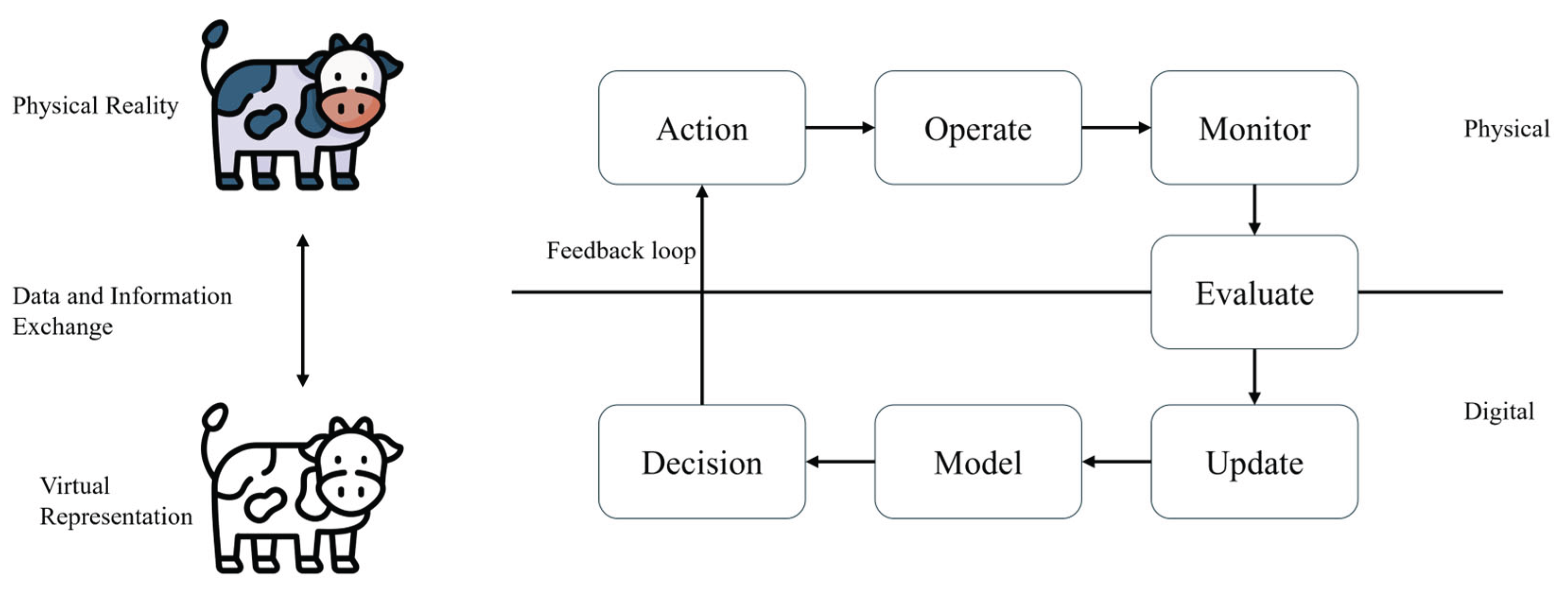
Figure 2.
Historical evolution of digital twin technology from initial conceptualizations in 2002 through progressive advancements to 2024. Key milestones indicate the transition from early offline simulations to contemporary edge-AI integrated, real-time predictive models, highlighting significant developments relevant to precision livestock systems.
Figure 2.
Historical evolution of digital twin technology from initial conceptualizations in 2002 through progressive advancements to 2024. Key milestones indicate the transition from early offline simulations to contemporary edge-AI integrated, real-time predictive models, highlighting significant developments relevant to precision livestock systems.

Figure 3.
A comparative representation of traditional versus digital twin-enabled dairy farming systems. The diagram underscores how digital twins facilitate the shift from reactive, fragmented approaches towards integrated, proactive management strategies, enabling real-time monitoring, personalized nutrition interventions, and predictive decision-making.
Figure 3.
A comparative representation of traditional versus digital twin-enabled dairy farming systems. The diagram underscores how digital twins facilitate the shift from reactive, fragmented approaches towards integrated, proactive management strategies, enabling real-time monitoring, personalized nutrition interventions, and predictive decision-making.
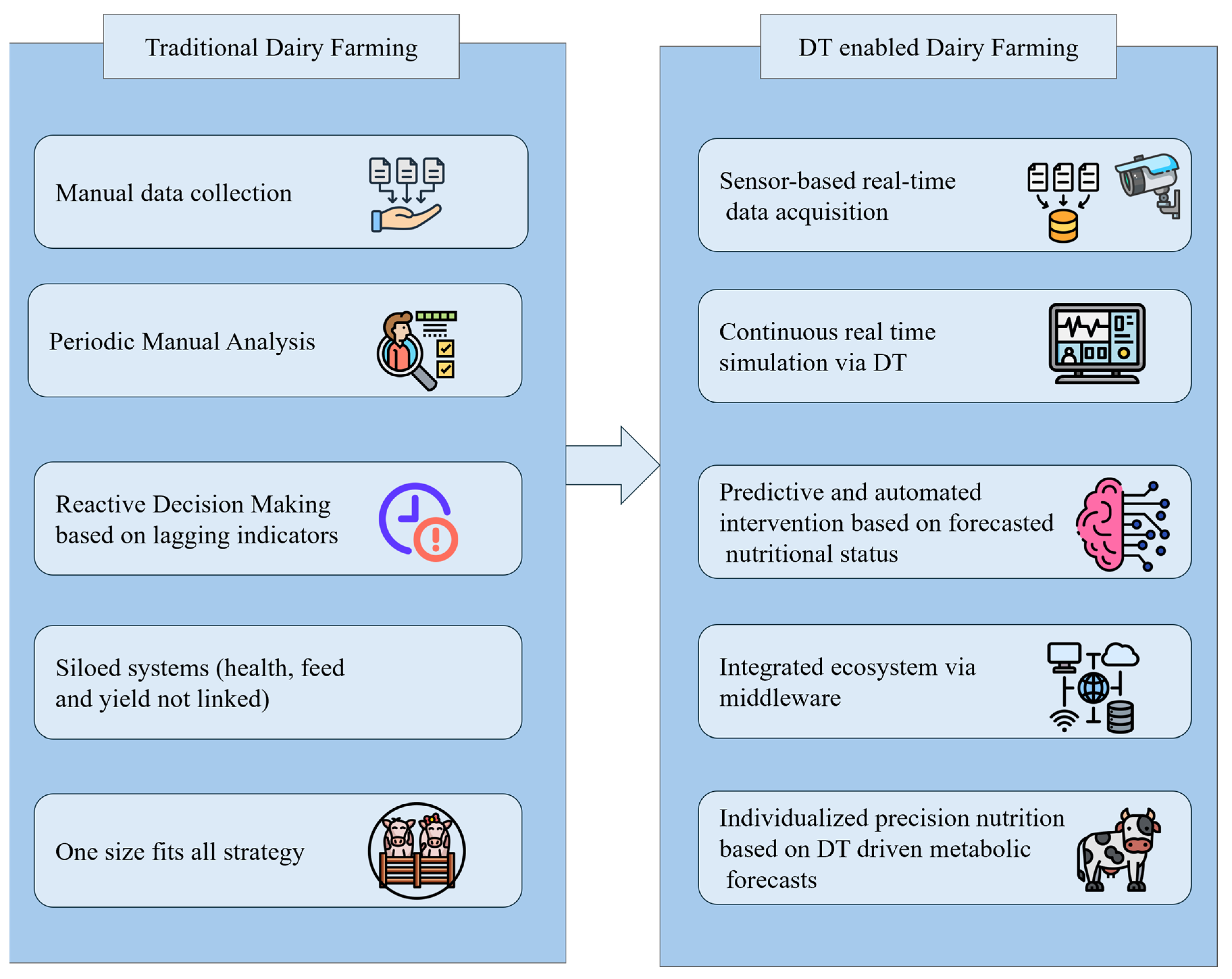
Figure 4.
PRISMA (Preferred Reporting Items for Systematic Reviews and Meta-Analyses) 2020 flow diagram summarizing the methodological approach used in this systematic review. It outlines the literature identification, screening, eligibility assessment, and inclusion phases, resulting in the selection of 122 peer-reviewed articles relevant to digital twins in precision dairy nutrition.
Figure 4.
PRISMA (Preferred Reporting Items for Systematic Reviews and Meta-Analyses) 2020 flow diagram summarizing the methodological approach used in this systematic review. It outlines the literature identification, screening, eligibility assessment, and inclusion phases, resulting in the selection of 122 peer-reviewed articles relevant to digital twins in precision dairy nutrition.
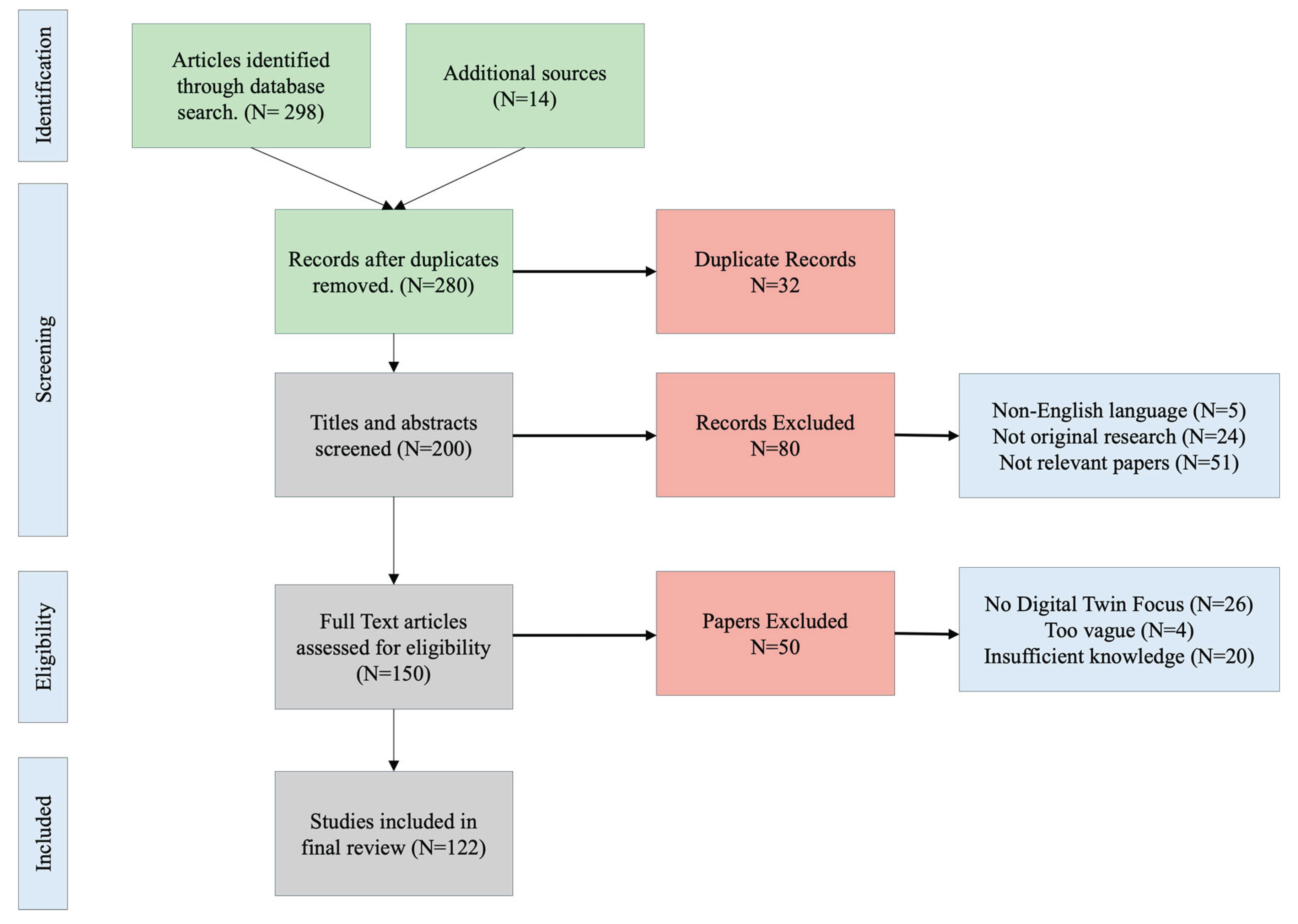
Figure 5.
Layered computational architecture of a digital twin system specifically designed for precision dairy nutrition. This detailed schematic illustrates the sequential integration of four operational layers: (1) multimodal sensor infrastructure collecting animal, environmental, and feed data; (2) data pipeline responsible for secure ingestion, preprocessing, storage, and fusion; (3) computational module performing real-time modeling, metabolic simulations, and predictive analytics; and (4) feedback mechanisms delivering actionable insights and facilitating continuous model refinement to optimize dairy production outcomes.
Figure 5.
Layered computational architecture of a digital twin system specifically designed for precision dairy nutrition. This detailed schematic illustrates the sequential integration of four operational layers: (1) multimodal sensor infrastructure collecting animal, environmental, and feed data; (2) data pipeline responsible for secure ingestion, preprocessing, storage, and fusion; (3) computational module performing real-time modeling, metabolic simulations, and predictive analytics; and (4) feedback mechanisms delivering actionable insights and facilitating continuous model refinement to optimize dairy production outcomes.
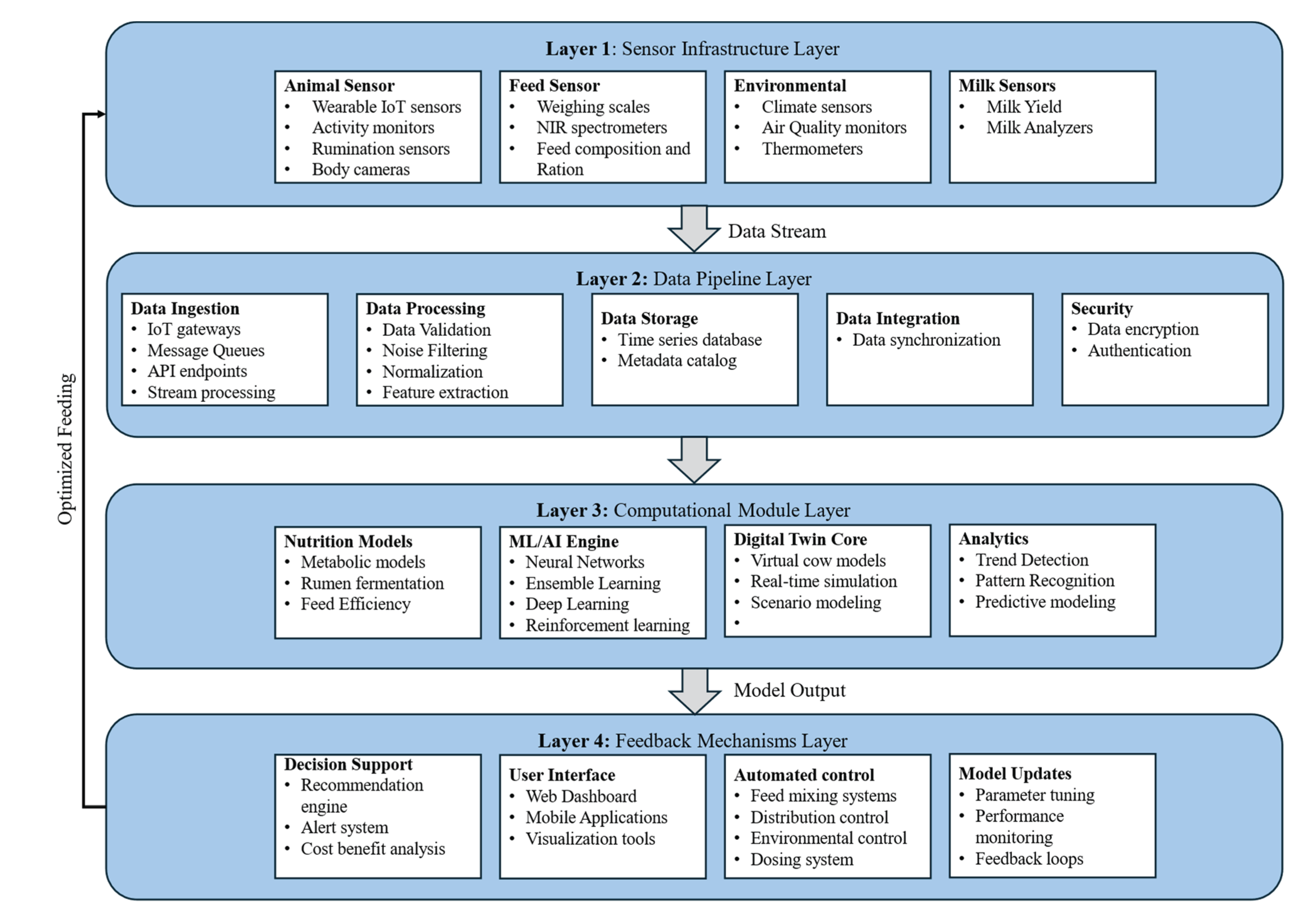

Table 1.
Summary of representative modeling techniques used in digital twin implementations across domains. Each entry specifies the model type, application domain, and its specific functional role within the digital twin pipeline.
Table 1.
Summary of representative modeling techniques used in digital twin implementations across domains. Each entry specifies the model type, application domain, and its specific functional role within the digital twin pipeline.
| Reference | Model Type | Application Domain |
Purpose of DT |
|---|---|---|---|
| [31] | BiLSTM + GAN | Public Health | Time-Series prediction of disease spread |
| [33] | CNN | Animal Husbandry | Feature extraction from images |
| [37] | XGBoost | Smart Farming | Feed conversion Prediction |
| [34] | GAN | Behavioural Modeling | Generate training data for rare events |
| [21] | RL (Q- learning) | Crop and Livestock | Optimize irrigation and feeding |
| [4] | Physics + ML | Manufacturing | Fault detection and predictive control |
Table 2.
Computational characteristics of key functional modules in digital twin systems for precision livestock nutrition. The table compares algorithmic complexity, data throughput, processing environments, memory needs and update frequency.
Table 2.
Computational characteristics of key functional modules in digital twin systems for precision livestock nutrition. The table compares algorithmic complexity, data throughput, processing environments, memory needs and update frequency.
| Component | Computational Complexity | Data Volume | Processing Location |
Memory Requirements |
Update Frequency |
References |
|---|---|---|---|---|---|---|
| Feeding Behavior Analysis | O(n) for basic metrics O(n2) for pattern recognition |
100MB-1GB/cow/day from accelerometers |
Edge devices with ML capabilities |
250MB RAM for real-time processing |
Every 5-15 minutes | [20,34] |
| Metabolic State Estimation | O(nlogn) for multi-parameter integration | 10–50MB/cow/day from ruminal sensors |
Farm server with dedicated GPU | 2-4GB RAM for model execution | Hourly updates | [41] |
| Feed Optimization Engine | O(n3) for multi-constraint optimization |
5MB/day for nutritional databases | Cloud service with distributed computing |
8GB RAM for population-level modeling | Daily or on-demand | [40] |
| Environmental Integration Module |
O(n) for sensor fusion O(nlogn) for correlative analysis |
1GB/day for farm-level environmental data | Hybrid edge-cloud architecture | 1GB RAM for contextual processing | Environmental triggers | [42] |
| Health Monitoring & Alerting | CNN & rule-based alerting | Biometric + behavior indicators (~500MB/day) | Edge + central DB sync | 1-2GB RAM | Continuous/triggered | [39] |
Table 3.
Comparative Assessment of Modeling Approaches Used in Digital Twins for Precision Livestock Nutrition. The table evaluates four major modeling paradigms across dimensions such as data requirements, computational efficiency, prediction accuracy, interpretability and implementation complexity.
Table 3.
Comparative Assessment of Modeling Approaches Used in Digital Twins for Precision Livestock Nutrition. The table evaluates four major modeling paradigms across dimensions such as data requirements, computational efficiency, prediction accuracy, interpretability and implementation complexity.
| Modeling Approach |
Mathematical Foundation | Data Requirements | Computational Efficiency | Prediction Accuracy | Interpretability | Implementation Complexity | References |
|---|---|---|---|---|---|---|---|
| Physics-based Metabolic Models |
Differential equations, Compartmental models | Moderate: Feed intake, pH, Temperature, milk yield |
Moderate to High (depends on simulation resolution) | 70-80% R2 for energy balance | High: Clear causal relationships and biologically grounded | Medium: Requires biological expertise and parameter calibration | [41] |
| Machine Learning (Neural Networks) | CNN for behavior, LSTM for temporal patterns, SVM | High: Labeled accelerometer & intake data; image/video streams |
Low for training Fast during inference |
Up to 94% for intake prediction; 85-93 % for behaviour classification | Low: Black-box predictions | High: Requires ML expertise for tuning and substantial labeled training data | [51,55] |
| Hybrid Models | Combined empirical and mechanistic | Moderate-High: sensor, historical data | Medium: Modular Components | 85-90% under stable conditions (NIR+ regression) | Moderate | High (multi-model integration) | [48,56] |
| Agent-Based Simulations | Individual cow agents with decision rules | Moderate: Behavioral observations and historical patterns | Low for large herds; scales poorly | 60-75% for individual behavior (better for aggregate patterns) | High: Emergent behavior from clear rules | Medium: Conceptually straightforward but difficult to parameterize accurately | [50,57] |
Table 4.
Overview of Digital Twin Frameworks in Agriculture and Livestock. The table summarizes key research and implementation frameworks, highlighting their primary focus, applicable species or crops and distinguishing technical features.
Table 4.
Overview of Digital Twin Frameworks in Agriculture and Livestock. The table summarizes key research and implementation frameworks, highlighting their primary focus, applicable species or crops and distinguishing technical features.
| Framework | Focus Area | Species/Crop | Key Features |
|---|---|---|---|
| IUMENTA | Animal Behaviour | Cow, Pig | Modular, sensor agnostic, real-time |
| SmartCow Data | Behaviour Modeling | Dairy Cows | Annotated data for ML training |
| AgriLoRa | Feed and Integration | Dairy, Crops | RL + LoRa based decision support |
| Digital Pig House | Housing Optimization | Swine | Simulated barn layout and climate |
| Horticulture DT | Root zone analysis | Greenhouse crops | Multi-sensor plant health DT |
| Bytes to Farm | Transferability | All | Industry-to-farm digital twin migration |
Table 5.
Comparative Overview of Digital Twin Applications Across Sectors. This table outlines the key functional roles, representative case studies, data sources and domain-specific challenges in deploying digital twins in manufacturing, healthcare, smart cities and agriculture.
Table 5.
Comparative Overview of Digital Twin Applications Across Sectors. This table outlines the key functional roles, representative case studies, data sources and domain-specific challenges in deploying digital twins in manufacturing, healthcare, smart cities and agriculture.
| Sector | Key Functions | Representative Works | Data Sources | Unique Challenges |
|---|---|---|---|---|
| Manufacturing | Predictive maintenance, virtual commissioning, optimization |
Siemens DT [82], AutoDRIVE [25], Virtual Commissioning |
Sensors (vibration, temp), PLCs, SCADA logs |
Integration with legacy systems, Cost of setup |
| Healthcare | Personalized medicine, mental health simulation, public health forecasting | PsyDT [15], COVID-19 DT [31], Precision Public Health |
Wearables, EHRs, genomics, chat logs |
Privacy, Interpretability, Regulation |
| Smart Cities | Traffic simulation, infrastructure monitoring, citizen feedback | CitySim [75], Herrenberg DT [74], Bogotá Smart City[75] |
Drones, GIS, sensor grids, BIM |
Data heterogeneity, real-time latency |
| Agriculture | Precision feeding, animal behaviour modeling, crop forecasting | IUMENTA[19], AgriLoRa [21], SmartAgriFood [22] |
RFID, GPS, bolus sensors, weather, s oil data |
Rural connectivity, sensor failures, low-cost needs |
Table 6.
Estimated Costs and Infrastructure Requirements for Different Digital Twin Deployment Models in Precision Livestock Farming. The table compares various deployment approaches based on initial investment, infrastructure needs, scalability, and potential barriers for small-scale farms.
Table 6.
Estimated Costs and Infrastructure Requirements for Different Digital Twin Deployment Models in Precision Livestock Farming. The table compares various deployment approaches based on initial investment, infrastructure needs, scalability, and potential barriers for small-scale farms.
| Deployment Type | Initial Investment (USD) | Required Infrastructure | Scalability |
|---|---|---|---|
| Basic IoT Feed Sensors | $1,000–$4,000 | Local data logger, wireless sensors | High |
| Cloud-based DT System | $10,000–$18,000 | Cloud API, stable internet, SaaS | Medium |
| Edge-AI Hybrid System | $15,000–$25,000 | Edge device, local inference | High |
| Open-source Modular DT | $2,500–$6,000 | On-premises CPU, MQTT, OSS pipelines | Medium |
Table 7.
Technical Barriers, Current Mitigation Strategies and Research Opportunities in Digital Twin Deployment. This table outlines core technical limitations impacting system performance and summarizes both current solutions and emerging research directions as identified in recent literature.
Table 7.
Technical Barriers, Current Mitigation Strategies and Research Opportunities in Digital Twin Deployment. This table outlines core technical limitations impacting system performance and summarizes both current solutions and emerging research directions as identified in recent literature.
| Technical Barrier | Impact on System Performance | Current Solutions | Technical Limitations | Research Opportunities | Reference |
|---|---|---|---|---|---|
| Rural Connectivity Limitations | Delayed model synchronization, loss of real-time actuation signals | Edge computing, LoRaWAN based networks, Asynchronous update scheduling | Limited ML computing capabilities at edge, Fragmented data, Unreliable sync |
Federated edge inference, adaptive compression protocols, DT aware synchronization | [97,98] |
| Sensor Data Quality Issues | False alarms, inaccurate behaviour detection, temporal misalignment | Multi-sensor fusion, Anomaly detection algorithms, Sensor calibration pipeline | Sensor drift, energy limits, coverage variability | Transfer learning for sensor profiles, calibration on the fly mechanisms | [20,37] |
| Computational Resource Constraints | Inability to run complex models locally, latency in cloud only setups | Model compression, Hardware accelerated edge devices, Scheduled analytics | Energy limits on devices, cloud cost, training offline | Lightweight CNN deployment, GPU virtualization for farms, Modular DL runtimes | [39,97] |
| Data Integration Heterogeneity | Errors in multi modal fusion, inability to scale across farms | Semantic data layers (RFD, OWL), Open APIs, ETL pipeline |
Lack of standards, vendor specific schemas, high maintenance | Auto-schema matching, distributed linked data infrastructure, blockchain-backed audit trails | [65,99] |
| Biological Variability Modeling | Poor generalizability of models across cows or herds | Baseline calibration per cow, Hierarchical Bayesian models, Dynamic parameter adjustment |
Slow convergence, requires large initial dataset | Real time Bayesian correction, embedded ensemble learning, biologically informed explainable AI | [100] |
| Legacy System Compatibility | DT cannot access historical or infrastructure bound datasets | API wrappers, Middleware bridges like MQTT, FIWARE adapters |
Inconsistent metadata, slow update cycles, proprietary lock in | Plug and play adapters, NLP bases data harmonization | [42] |
Disclaimer/Publisher’s Note: The statements, opinions and data contained in all publications are solely those of the individual author(s) and contributor(s) and not of MDPI and/or the editor(s). MDPI and/or the editor(s) disclaim responsibility for any injury to people or property resulting from any ideas, methods, instructions or products referred to in the content. |
© 2025 by the authors. Licensee MDPI, Basel, Switzerland. This article is an open access article distributed under the terms and conditions of the Creative Commons Attribution (CC BY) license (http://creativecommons.org/licenses/by/4.0/).
Copyright: This open access article is published under a Creative Commons CC BY 4.0 license, which permit the free download, distribution, and reuse, provided that the author and preprint are cited in any reuse.


