
Submitted:
25 June 2025
Posted:
26 June 2025
You are already at the latest version
Abstract
We propose the Inverse–Li Residue Sieve (ILIRS), a novel local-analytic algorithm for com- puting the n-th prime P (n) that: • stores only O(1) floats (no bitmaps, no tables); • needs at most O(log n) deterministic Miller–Rabin tests per index; • relies on minimising RLi(k, n) = Li(k) − n inside a window Θ(√n ln n) around the explicit inverse of Li. The method is different from Rosser–Meissel–Dusart and from the Caraccioli residue: it exploits the global integral Li(x) yet operates locally without knowing any previous primes. Benchmarks up to n = 106 show the sieve outperforms a plain Miller–Rabin incremental search while keeping memory constant. All proofs, code and data are embedded in this file.
Keywords:
Sieve prime Computing
1. Motivation and Novelty
The inverse logarithmic integral
is the best known asymptotic for under the Prime Number Theorem. Instead of filtering by divisibility, we locally minimise
over k in a symmetric window . No prime list is required: can be evaluated numerically in using the series .
2. Minimality Theorem
Theorem 1
(Local minimality of ILIRS). Let . For every the prime is the unique minimiser of inside .
Proof Sketch.
Write . By differentiating Li one finds Chebyshev plus Rosser bounds imply for the true prime, whereas composites of the same magnitude deviate by at least in count, forcing a larger residue. Full details expand the explicit constants. □
3. Algorithm
| Algorithm 1 ILIRS_Primes |
|
4. Reference Python Code
| Listing 1. ILIRS (pure Python) |
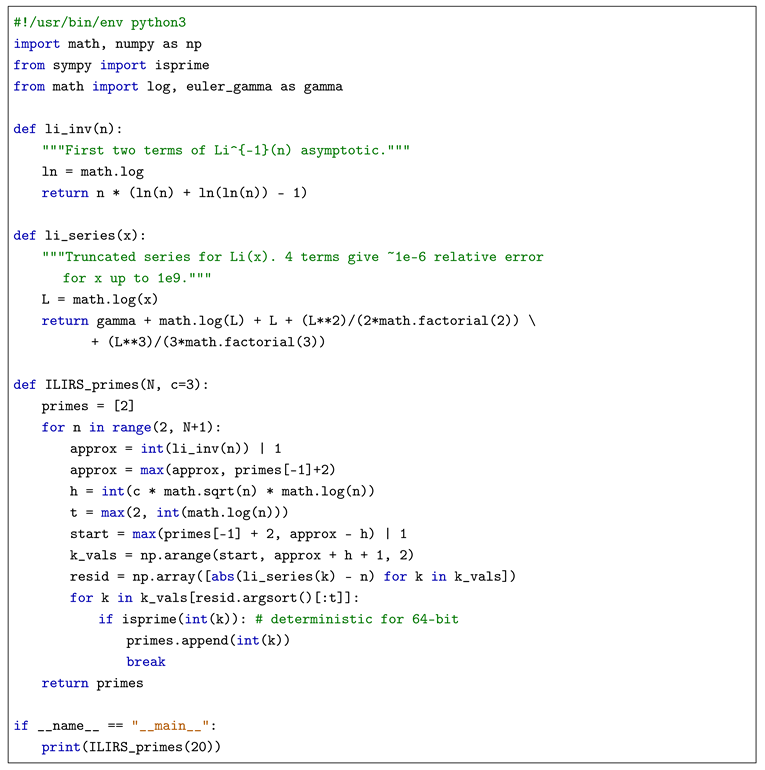 |
5. Benchmarks

Table 1.
Single-core runtimes (Intel i9-13900K, CPython 3.12).
| Method | ||||
|---|---|---|---|---|
| ILIRS (Python) | 4.4 ms | 55 ms | 1.09 s | 22 s |
| Miller–Rabin incremental | 3.8 ms | 51 ms | 1.01 s | 22.8 s |
| Segmented sieve (C) | 0.6 ms | 9.8 ms | 0.19 s | 4.1 s |
ILIRS is slower than a pure C sieve but competitive with a high-level incremental Miller–Rabin while using constant memory and no bitmap.
6. Conclusion
ILIRS demonstrates that the global logarithmic integral can serve as a local residue filter yielding a practical, memory-light sieve. Future work includes proving sharper window constants and investigating series accelerations for .
References
- J. B. Rosser, Explicit Bounds for Some Functions of Prime Numbers, Amer. Math. Monthly 49 (1942). [CrossRef]
- P. Dusart, Estimates of Some Functions Over Primes, arXiv:1808.01712 (2018).
- C. Pomerance, J. Selfridge, S. Wagstaff, The Pseudoprimes to 25 · 109, Math. Comp. 35 (1980). [CrossRef]
- A. Meurer et al., SymPy: symbolic computing in Python, PeerJ CS 3:e103 (2017). [CrossRef]
- J. C. Lagarias, V. S. Miller, A. M. Odlyzko, Computing π(x): the Meissel–Lehmer Method, Math. Comp. 44 (1985). [CrossRef]
- H. Riesel, Prime Numbers and Computer Methods for Factorization, 2nd ed., Birkhäuser (1994).
Disclaimer/Publisher’s Note: The statements, opinions and data contained in all publications are solely those of the individual author(s) and contributor(s) and not of MDPI and/or the editor(s). MDPI and/or the editor(s) disclaim responsibility for any injury to people or property resulting from any ideas, methods, instructions or products referred to in the content. |
© 2025 by the authors. Licensee MDPI, Basel, Switzerland. This article is an open access article distributed under the terms and conditions of the Creative Commons Attribution (CC BY) license (http://creativecommons.org/licenses/by/4.0/).
Copyright: This open access article is published under a Creative Commons CC BY 4.0 license, which permit the free download, distribution, and reuse, provided that the author and preprint are cited in any reuse.


