

Submitted:
24 June 2025
Posted:
25 June 2025
You are already at the latest version
Abstract
The comprehension of complex PDFs such as research documents, clinical reports, and scientific manuals is a time-consuming task. Previous studies have demonstrated significant success in building question-answering systems to provide contextually relevant answers to user queries. However, addressing puzzling questions within a single end-to-end trained ML model remains a rigorous task. Such systems require a huge amount of labeled training data to train the base models for specific tasks. The creation of such data sets is still a challenge for complicated documents like the annual reports of big tech companies. This research paper addresses this challenge by focusing on the construction of a question-answering system tailored for PDF files, specifically targeting domains such as finance, bio-medicine, and scientific literature. Curated data sets for the PDF from the chosen Domains were created manually for the evaluation. Pre-trained Bidirectional Encoder Representations from Transformers (BERT) Models from the Hugging Face library were utilized for the chosen domains and evaluated with an F1 score. A score of 44\% was achieved for the BERT Large.
Keywords:
question-answering
; bidirectional encoder representations from transformers
1. Introduction
Deep learning has been successful in range of the domains such image processing [1,2,3,4,6,7,8,10,12,13,15,16,17,18,41], natural language processing (NLP) [14] and audio [5,9,11,19]. Particularly in question-answering systems, NLP has advanced in recent years. These algorithms play a crucial role in effectively extracting pertinent information from large amounts of written content, allowing users to receive precise and contextually relevant answers to questions.
Deep learning has been successful in a range of domains such as image processing [1,2,3,4,6,7,8,10,12,13,15,16,17,18,40,45,47], natural language processing (NLP) [14,42,43], and audio [5,9,11,19]. Particularly in question-answering systems, NLP has advanced in recent years. These algorithms play a crucial role in effectively extracting pertinent information from large amounts of written content, allowing users to receive precise and contextually relevant answers to questions.
Even with end-to-end training, answering complex questions with a single machine-learning model remains challenging. The goal of this research paper is to develop a question-answering system specifically for PDF files related to scientific, financial, and biomedical literature. The technical analysis of these PDFs may be exhausting and require in-depth study of their complex text, which makes them hard to understand. On the other hand, a question-answering system can save users time and effort by rapidly retrieving the needed information. Prior research has demonstrated that machine learning models can be used to retrieve information from large documents, and these models can be evaluated using metrics like exact matches and F1 scores. Bidirectional Encoder Representations Transformers, or BERT, for short, can perform better in deep learning tasks like quality control and summarization of text with minimal to no modifications after pre-training with just one additional output layer. Medical facilities might benefit from accurate QA systems by researching disease symptoms and treatment options. Pre-trained BERT models, like Bio-BERT and Sci-BERT, seem to perform more accurately than traditional models, in line with prior research. [Unsupervised Biomedical Question-Answering Pre-Training]. This study will add to our knowledge of the effective usage of transformers in the fabrication of QA software for the selected PDFs. All things looked at, a QA system offers a more clever, effective, and user-friendly method of information extraction from huge PDFs, such as annual reports, articles, and medical documents. Research Question: The problem mentioned in the above section motivates the following research question: In the financial, biomedical, and scientific domains, how can BERT transformers be employed to effectively answer questions and retrieve knowledge from PDF files? This research intends to implement a QA system using pre-trained BERT models for the chosen domains and evaluate performance to find out the best-performing model. An overview of the question-answering system with domain-specific pre-trained BERT on documents is shown in Figure 1.
The paper’s remaining sections are arranged as follows: The related work is discussed in Section 2, the research methodology is shown in Section 3, the design specification is explained in Section 4, and the implementation aspects of the research are illustrated in Section 5, the evaluation results are examined in Section 6, and the conclusion and future work is highlighted in Section 7.
2. Related Work
BERT has demonstrated Advanced results in various NLP tasks due to its conceptual simplicity and empirical effectiveness. This research aims at building a BERT-based question-answering system specifically tailored for PDF documents, aiming to address the challenges associated with extracting nuanced information from this widely used format. PDF files, prevalent in academic and professional settings, pose challenges to effective information retrieval due to their diverse structures and complex formatting. Leveraging BERT’s capabilities offers a promising solution to enhance comprehension and accessibility in PDF-based question-answering. This literature review delves into existing research on integrating BERT models for question-answering in PDFs, aiming to identify gaps and opportunities. The goal is to advance intelligent systems for document comprehension by providing insights into the creation of a BERT-based QA system based on PDFs.
Researchers in this study[20] introduced the Transformer architecture, a sequence transduction model based on attention mechanisms. The drawbacks of conventional recurrent neural networks in encoder-decoder architectures with multi-headed self-attention were overcome by this method. Transformer architectures outperform those built on recurrent networks in terms of speed. Transformer performed more effectively for language translation tasks than even previously reported ensemble models.
This work[21] investigates the performance of different pre-trained language models to determine if they can be fully generalized over a range of QA data sets. QA data sets vary in complexity, challenging models with various levels of reasoning. The study trains and fine-tunes pre-trained language models on a spectrum of data sets to identify models excelling in comprehensive generalization. The paper investigated whether enhanced bidirectionality improves QA model performance with BERT-BiLSTM architecture. Using the F1-score metric, the research identifies Roberta and BART are consistently outperforming others. BERT-BiLSTM also surpasses the baseline BERT model. The study sheds light on how QA models generalize and the impact of bi-directionality, contributing to robust systems for nuanced reasoning across domains. Future studies could investigate the wider effects of bidirectionality on language understanding and tailor pre-trained models for QA tasks. Covid-Twitter-BERT (CT-BERT), presented in Müller et al. (2023), was pre-trained on Covid-19-related Twitter messages, and also utilized BERT Large as a base model. The study[23] also supports the utilization of domain-specific models.
The approach in this study[24] involves widening the BERT architecture to consider table-inter-cell connections. A sizable table corpus taken from Wikipedia is used to retrain the parameters for these associations. Furthermore, by paying attention, to relevant text representations in the surrounding article, a novel strategy improves table representations. By considering the contextual relationship between tables and text, the suggested method seeks to offer a more practical and efficient way to answer questions from documents. They laid the groundwork for a more comprehensive understanding of complex documents by integrating text-based and table-based approaches.
Although BERT has shown an unmatched ability to comprehend language, an innovative approach is needed when applying it to language-generating problems. The research under review[25] introduced C-MLM as a novel method that provides a mechanism to modify BERT for target generation task fine-tuning. Technique entails BERT’s fine-tuning, acting as a ”teacher” model for the goal-generation tasks. Then, this improved BERT model serves as an extra supervisory source, augmenting traditional Sequence-to-Sequence (Seq2Seq) models, also called "students," This teacher-student approach improves the performance of Seq2Seq models in text production. The experiments show notable gains in performance over robust Transformer baselines in a variety of language generation tasks, such as summarized text and automatic translation.
In [26], BERT jointly trains on both left and right contexts across all layers to pre-train deep bidirectional representations from unlabeled text. So, by fine-tuning the previously trained BERT model with just one additional output layer, advanced models for a range of tasks, such as question answering and language inference, can be generated without necessitating significant modifications to the task-specific architecture. F1 score of 93 percent. showed empirical success for the question-answering task on SQuAD v1.1. and SQuAD v2.0 Test F1 to 83.1 percent PaperWadhwa et al. (2018) also compared the previous work done on the SQuAD dataset.
This study[28] introduced an automated approach for extracting infra-structure damage information from textual data using BERT and question-answering (QA). The proposed method, trained on National Hurricane Center reports, demonstrates high accuracy in hurricane and earthquake scenarios, outperforming traditional methods. The method involves two steps: 1) Paragraph Retrieval using Sentence-BERT and 2) Information extraction with a BERT model. The model was trained on 533 question-answer pairs from hurricane reports and tested on diverse data sets, achieving F1 scores of 90.5 percent and 83.6 percent for hurricanes and earthquakes. This research presented an innovative BERT-based QA approach for automated infrastructure damage retrieval, contributing to improved disaster management. Researchers were optimistic about generalizing the model to other disaster types.
This study[29] pioneered the application of BERT to document classification, achieving state-of-the-art results across four data sets. Despite initial concerns, the proposed BERT-based model surpasses previous baselines, addressing computational expenses through knowledge distillation to smaller bidirectional LSTMs. This achieves BERT base parity with 30× fewer parameters on multiple data sets. Contributions include improved baselines for future document classification research, reflecting a change in basic assumptions in NLP towards pre-trained deep language representation models like BERT. The research highlights the feasibility of distilling BERT into simpler models for competitive accuracy with reduced computational cost.
BERT has demonstrated remarkable performance across various NLP tasks. In the paper[30] introduced BERTSUM, a simplified BERT variant tailored for extractive summarizing. For extractive summarizing, despite recent neural models, further advancements have hit a wall. This research makes the case for using BERT to improve extractive summarizing performance because of its robust design and large pre-training data set. The study investigates many BERT-based architectures for extractive summarization and finds that the best results are obtained on the job using a flat design with inter-sentence transformer layers. while the paper [31] introduced a novel data augmentation technique, leveraging distant supervision for fine-tuning BERT in open-domain QA. challenges were noise and genre mismatch in distant supervision data and model sensitivity to diverse data sets and hyper-parameters.
This survey [34], analyzes various BERT types, including BioBERT for biomedical texts, Clinical BERT for clinical notes, and SciBERT for scientific texts, Roberta as an enhanced version, and DistlBERT for smaller models. SCIBERT outperformed BERT-Base in scientific NLP tasks [33], and its application Tasks like summarizing and answering questions are recommended for future research[32].
This paper [35] tackles bio-medical literature overload with a sequence of labeling approaches for keyword extraction, utilizing contextual embeddings from XLNET, BERT, BioBERT, SCIBERT, and RoBERTa. It avoids traditional methods, showcasing a 22 percent F1-score improvement. Similarly, study [36] employs bioBERT and SciBERT in biomedical text. Another study[38] stated ALBERT outperforms BERT with fewer parameters and faster training in natural language understanding benchmarks.
Conclusion: It is clear from the literature review that researchers have achieved high accuracy [24,25] for BERT-based models for various NLP tasks [27], including question-answering [21,28]. In their study, [22] used Roberta for PDFs containing tables and complex texts, while study [29] illustrated the significance of domain-specific BERT models like BERT, BioBERT, and SCIBERT in the biomedical domain. The study[26], successfully achieved better results for document classification tasks using the distilling BERT model. The reviewed papers collectively highlight the versatility and robustness of BERT-based models across various NLP tasks. From language translation to document classification and biomedical question answering, BERT has proven to be a versatile and powerful tool. Some of the challenges were model sensitivity to different datasets, scalability concerns, potential overfitting, and difficulty in applying BERT to generative tasks, underscoring the ongoing complexities in refining these models.
3. Methodology
This section describes methods for implementing a PDF-based question-answering system using BERT base models. BERT is an excellent choice for question-answering (QA) on PDF documents for several reasons. Due to its extensive pre-training on a huge corpus of text material, BERT can acquire an in-depth contextual understanding of language. Understanding the context is essential to understanding the rich and varied content that may be found in PDF documents. Its bidirectional attention mechanism considers both the left and right context for each word in a document[26]. This approach is effective for capturing dependencies and relationships within the text, which is essential for accurate question-answering. A pre-trained BERT model can be used as the base model for QA answering. Further fine-tuning the pre-trained model with question-answer pairs specific to PDFs implements the QA system. BERT has a substantial number of parameters, and fine-tuning the pre-trained model with a small collection of question-answer pairs would result in overfitting. To avoid that, a fine-tuned BERT is used, which was trained on the SQAuD data set. Overall fine-tuning is shwon in Figure 2
3.1. Data Collection
Links to download the PDFs are given in the configuration manual.
3.1.1. Financial Domain
For the financial domain, annual reports from Amazon were collected as representative documents. The PDFs were obtained from official sources, ensuring the authenticity and relevance of the financial data.
3.1.2. Biomedical Domain
In the biomedical domain, research papers related to COVID-19 and diabetes were selected for analysis. The data set includes papers from reputable journals and conferences. ensuring a diverse and comprehensive coverage of biomedical information. PDFs were downloaded from Google Scholar.
3.1.3. Scientific Domain
Scientific literature documents were sourced from various research papers related to question-answering systems. These papers were selected to represent the breadth of scientific literature and were obtained from Google Scholar.
3.2. Question-Answer Pairs Dataset Creation
3.2.1. Financial Domain
For the financial domain, a data set of question-answer pairs was manually curated. Questions were formulated to cover various aspects of financial reports and the corresponding Answers were extracted from relevant sections of the annual reports. The data set includes the ’question,’ ’context,’ and ’ground truth’ columns, where ’context’ represents The document chunk and ’ground truth’ provide the correct answer.
3.2.2. Biomedical Domain
In the biomedical domain, a similar approach was taken to create question-answer pairs related to COVID-19 research papers. Questions were designed to capture key biomedical information and answers were extracted from the respective document chunks. The data set structure includes ’question,’ ’context,’ and ’ground truth’ columns.
3.2.3. Scientific Literature Domain
The creation of question-and-answer pairs for the scientific literature domain followed a similar methodology. Questions were tailored to cover diverse scientific topics, and answers were extracted from relevant chunks of scientific papers. The data set structure includes ’question,’ ’context,’ and ’ground truth’ columns.
3.3. Pre-processing
When employing BERT or other transformer-based models for question answering, pre-processing is essential. Pre-processing ensures that the input text is appropriate for BERT models that are made to handle text in a specific way. The following justifies the requirement for pre-processing:
3.3.1. Text Extraction
For the financial domain, a data set of question-answer pairs was manually curated. Questions were formulated to cover various aspects of financial reports and the corresponding Answers were extracted from relevant sections of the annual reports. The data set includes the ’question,’ ’context,’ and ’ground truth’ columns, where ’context’ represents the document text chunk and ’ground truth’ provide the correct answer.
3.3.2. Lower-Casing and Stripping
To maintain consistency and reduce redundancy, all text was converted to lowercase. Leading and trailing white spaces were removed to enhance the uniformity of the data. BERT was trained on a large amount of lowercase text. For the optimal performance of the BERT, lower-casing of the text was a necessary pre-processing step.
3.3.3. Sentence Cleaning
Prior to model training and evaluation, it is crucial to pre-process the raw text data to enhance the quality and relevance of information. This involves cleaning sentences to ensure uniformity and remove noise. The following functions were employed for sentence cleaning:
- clean_sentence(): This function is designed to clean up individual sentences. Converts the sentence to lowercase. Removes special characters using regular expressions. Optionally removes stop-words, leveraging the gensim library’s remove stop-words function.
- get_cleaned_ sentences(): This function applies the clean sentence function to a list of sentences. The optional parameter removes the stop-words flag and controls whether stop-words are removed from the sentences.
3.3.4. Convert Sentences into Tokens
BERT employs a particular technique that divides text into smaller pieces known as tokens. The input text is split into words or sub-words, and an embedding vector is given to each token. The PDF text is split into tokens using the nltk_sent_tokenize method, which makes tokens of the text.
3.3.5. Chunking Strategy
To overcome the token limit of BERT (512 tokens), the PDFs were pre-processed by breaking them into smaller chunks. Each chunk was then split into tokens using the appropriate BERT-based model for the respective domain (BERT base for financial, SciBERT for scientific literature, and BioBERT for biomedical).
3.4. Model Implementation
3.4.1. Model Selection
A critical first step in implementing a QA system is choosing suitable pre-trained models. In this section, details of the models chosen for each domain and the rationale behind these selections are given and they were hugely inspired by the literature review conducted [9,10]. BERT base and BERT large models were utilized for the financial domain. For the scientific literature domain, SciBERT, a BERT model pre-trained on scientific text, was employed. In the biomedical domain, BioBERT, pre-trained on biomedical literature, was used. For the financial domain, two variants of BERT models were utilized: BERT Base Model: A base BERT model was employed to capture general financial information and nuances. BERT Large Model: A larger version of BERT was utilized to grasp more complex financial patterns and relationships within the text.
- Financial Domain For the financial domain, two variants of BERT models were utilized: BERT Base Model: A base BERT model was employed to capture general financial information and nuances. BERT Large Model: A larger version of BERT was utilized to grasp more complex financial patterns and relationships within the text.
- Biomedical Domain In the biomedical domain, a specialized BERT model pre-trained on biomedical literature, known as BioBERT, was chosen. BioBERT is appropriate for the study of COVID-19 research publications since it is designed to comprehend the distinct terminologies and ideas found in biomedical texts.
- Scientific Literature Domain For the scientific literature domain, we utilized SciBERT, a BERT model pre-trained on a diverse range of scientific texts. SciBERT is designed to capture the intricacies of scientific language, making it suitable for extracting information from research papers and scientific literature.
3.4.2. Model Fine-tuning
To adjust a pre-trained BERT model to a specific task or domain, fine-tuning entails training the model on a domain-specific data set. With hundreds of millions to more than 300 million parameters, BERT is an extensive neural network architecture. Thus, Overfitting would occur if a BERT model were trained from scratch on a small data set. A refined, pre-trained BERT model that was trained on a sizable data set is preferable. Using data from the Stanford Question Answering data set (SQuAD), the BERT model has been improved.
3.5. Question Answering Setup
The task of answering questions was framed as identifying relevant information within the chunks. Domain-specific BERT models for QA were used for question-answer pairs created for each data set.
3.6. Evaluation
3.6.1. Metrics
The models’ performance was assessed using the F1 score, an accepted measure for question answering. Initially, a confidence score was also used to check how confident the model was in predicting answers. F1 score is a popular and extensively used measurement in quality assurance for classification problems. In cases where we value recall and precision equally, it is appropriate. The foundation of the F1 score is the number of words that are shared between the prediction and the truth; recall is the ratio of shared words to the total number of words in the ground truth, and precision is the ratio of shared words to the total number of words in the prediction. F1 score is shown in Figure 3.
3.6.2. Cross-Domain Evaluation
To assess the models’ generalizability, cross-domain evaluation was performed by testing fine-tuned BERT large models on datasets from other domains. This helps understand the adaptability and transferability of the models across diverse types of documents. When the performance of fine-tuned BERT was tested on the Biomedical and Scientific domains, the following insights were driven:
- For the biomedical domain, both BERT large and Bio-clinical BERT gave partial answers for some question-answer pairs and no answers for a few pairs.
- For the scientific domain, both BERT large and SciBERT models predicted partially correct answers.
3.6.3. Comparative Analysis
Comparisons were made between the performance of the BERT large model within each domain. Additionally, insights were drawn from the cross-domain evaluation to identify potential areas for improvement.
4. Design Specification
In this section, the foundational elements underpinning the implementation of the BERT-based QA system, catering specifically to the distinct characteristics of the financial, biomedical, and scientific domains.
4.1. Techniques
BERT-based QA system integrates several key techniques to address the unique challenges posted by diverse domains: Domain-Specific Fine-tuned BERT: For each of the domains, a domain-specific, fine-tuned BERT model was employed.
- Domain-Specific Fine-Tuned BERT: For each of the domains, a domain-specific fine-tuned BERT model was employed.
- Transfer Learning: Transfer learning in BERT (Bidirectional Encoder Representations from Transformers) involves leveraging pre-trained models on large corpora and fine-tuning them for specific downstream tasks. Google’s BERT algorithm has demonstrated impressive results across a range of natural language processing (NLP) applications. The key idea behind transfer learning in BERT is to utilize the pre-trained knowledge encoded in the model’s parameters and adapt it to a particular task or domain with limited labeled data [19].
4.2. Architecture
4.2.1. Multi-Head Attention Mechanism
Multi-Head Attention Mechanism: A multi-head attention mechanism in the architecture [20] enables the model to focus on different parts of the input text at the same time. This is especially beneficial for capturing complex relationships and context within diverse domain-specific documents.
4.2.2. Domain-Specific Embeddings
We utilize domain-specific embeddings to augment the pre-trained BERT embeddings. These embeddings are tailored to the vocabulary and context prevalent in the financial, biomedical, and scientific domains.
4.3. Framework
Implementation is built on the PyTorch framework, providing a robust and flexible platform for deep learning.
- PyTorch Transformers Library: The PyTorch Transformers library was used, which facilitates seamless integration with pre-trained BERT models. This library offers a comprehensive set of tools for tokenization, model configuration, and training.
4.4. Algorithm Description
4.4.1. Algorithm Functionality
BERT-based QA system for financial, biomedical, and scientific domains introduces the following functionalities: Document Chunking Strategy: Given the potentially lengthy and complex nature of documents in these domains, our system employs a document chunking strategy to handle large texts efficiently, ensuring that relevant context is preserved.
4.4.2. Algorithm Requirements
To implement and deploy a QA system successfully, certain requirements must be met: Pre-processing Modules: Custom pre-processing modules are designed to handle data cleaning, tokenization, and embedding generation. Hardware Acceleration: For optimal performance, the system benefits from hardware acceleration, such as GPUs provided by Google Collab to expedite training and inference.
4.5. Tools and Languages
The implementation leveraged the following tools and languages: Programming Language: Python’s extensive libraries and versatility in the fields of data science and machine learning led to its selection as the main programming language. Machine Learning Frameworks: Machine learning models were implemented and trained with the help of the scikit-learn, TensorFlow, PyTorch, and Hugging Face Transformers libraries.
5. Implementation
In the final stage of the implementation, the input sequences are prepared for processing by the model, adhering to the model’s specific input requirements and constraints.
5.1. Domain-Specific Implementation
Each domain requires a tailored approach to model implementation due to the distinct characteristics of the data. Below, we provide an overview of the strategies employed in each domain.
5.1.1. Financial Domain
The financial domain involves the analysis of annual reports from Amazon. The fine-tuned BERT base and BERT large models were used on a curated dataset of financial question-answer pairs. The stages of implementation of the QA system are as follows:
- With pipeline library: When models were implemented with pipeline library, confidence scores for both BERT base and BERT large models were extremely low, even though the answers were correct.
- With tokenization and segmentation: Models were implemented with different approaches where pre-processed input question and answer text were tokenized using the pre-trained tokenizer. The tokenized input is then segmented into question-and-answer segments. A pre-trained model was trained with the tokenized and segmented input to estimate the beginning and ending positions of the response within the input text. Post-processing is used to handle any spaces at the start of the answer tokens after model inference. The final answer is reconstructed by concatenating these tokens.
- With chunking strategy: Chunking strategy refers to the process of breaking down a large document, such as a PDF, into smaller chunks or segments to be processed by a model. Due to the limitation of 512 tokens Bert models were not efficient for long documents as they will only consider the first 512 tokens. To overcome that limitation input text was stripped into chunks of 512 tokens and then fed to the model in a loop. While chunking can be effective in handling lengthy documents, it comes with certain limitations: Context Discontinuity: Breaking a document into chunks may result in the loss of contextual information that spans across different chunks. BERT models use context to interpret words, so if a question’s pertinent context is divided into two chunks, the model’s performance might be impacted. Answer Span Across Chunks: Sometimes a question’s answer can be found in more than one section. If the model processes each chunk independently, it might miss the context necessary to identify the correct answer span that extends beyond a single chunk. Incoherent Context: The chunks processed in isolation might not provide coherent context, leading to potential misunderstandings by the model. Since BERT is meant to record contextual relationships between words, breaking up the text into smaller sections might cause this continuity to be broken. Increased Complexity: Chunking introduces additional complexity into the pre-processing and post-processing stages. Managing the boundaries of chunks and ensuring a seamless flow of information between them requires careful handling.
- With a Curated Data set of question-answer pairs: A data set of ten examples was created manually from PDFs containing question, context, and ground truth columns. This data set in CSV format was then read as a data frame and fed to the model to calculate the F1 score. This strategy overcomes the following limitations of the chunking method: Context Preservation: The curated data set contains question-answer pairs carefully crafted to ensure that the context necessary for answering the questions is preserved. In contrast, chunking large documents may introduce discontinuities in context, potentially affecting the model’s performance. Reduced Complexity: Utilizing a curated data set might simplify the training process compared to managing the complexities introduced by chunking. Dealing with context boundaries, overlaps, and potential information loss associated with chunking can be challenging. A curated data set of question-answer pairs has additional advantages as follows: Training Data Quality: If a curated data set is well-constructed and diverse, it provides a clean and controlled environment for training the model. The model learns from specific examples that are explicitly designed for the task, which can be beneficial in terms of generalization to similar scenarios. Task Relevance: If a task is well-represented in the curated data set, and the questions and answers cover a diverse range of scenarios, a model may perform better compared to a model trained on chunks of documents. This is particularly true if the curated data set is domain-specific or tailored to the types of documents. Reduced Complexity: Utilizing a curated data set might simplify the training process compared to managing the complexities introduced by chunking. Dealing with context boundaries, overlaps, and potential information loss associated with chunking can be challenging. Evaluation: Curated data sets often come with predefined evaluation metrics and benchmarks, like ground truth, making it easier to assess the model’s performance and compare it against other models in the field. Efficiency: Training on a curated data set may be computationally more efficient than training on large, chunked documents, especially if the documents are extensive.
- Fine-tuning of DistilBERT on SQAuD data set: To fine-tune the pre-trained BERT model, the Trainer class from the PyTorch library was utilized. A small subset of the SQAuD data set was loaded from the data sets library and was split into train test data sets using the train test split method. Then DistilBERT, a distilled version of BERT was loaded to process question and answer. The data set was pre-processed to truncate the context and map the answer tokens to the context. Map function from the data set library was used to apply pre-processing to the entire data set. A batch of examples were created using Data Collator. The next step was to define hyper-parameters in training arguments such as learning rate, number of epochs, and weight decay. After that, the trainer was given training arguments that included the model, data set, tokenizer, and data collator. The train function was called to fine-tune the model. This fine-tuned model was saved and used for inference for the financial data set.
5.1.2. Biomedical Domain
In the biomedical domain, fine-tuned BioBERT was applied to COVID-19 research papers. The Curated data set for biomedical PDFs was tested on the model to predict the answers. A data set containing question, context, and ground truth columns was used to calculate the F1 score.
5.1.3. Scientific Literature Domain
For the scientific literature domain, SciBERT was employed to analyze scientific research papers. A curated scientific dataset was used to calculate the F1 score.
6. Evaluation
This section presents an in-depth evaluation of the findings from the experimental research conducted in each domain. The analysis focuses on the most relevant findings that contribute to addressing the research question.
6.1. Financial Domain
6.1.1. Case Study 1
Implementation of QA system with QA pipeline library. In this case study, the implementation of a Question Answering (QA) system using a dedicated QA pipeline library is explored. The Hugging Face Transformers library was used to perform question-answering tasks using two different models: ”bert-large-uncased-whole-word-masking-fine-tuned-squad” and ”bert-base-uncased.” Pre-processed text from Amazon’s annual report was fed to the QA pipeline as context and model were evaluated with a confidence score that measures model confidence. Comparison of the question-answering performance of two different BERT models on a specific question and context helps evaluate how the choice of model can impact the quality of answers provided by the question-answering system. The large model’s answer was more relevant and contextually appropriate for the given question about the document’s topic. The higher score of 0.44 indicates a higher confidence level compared to the base model, which provided a less relevant answer with a significantly lower score, results are shown in Table 1.
6.1.2. Case Study 2
: Implementation of QA system with Tokenization and segment embeddings of text and questions were tokenized using the tokenizer’s encoding method. The [SEP] token index separated the question and answer segments. Segment IDs were created, assigning 0s to segment A (question) and 1s to segment B (answer). The tokenized input and segment IDs were passed to the model to obtain outputs. The start and end indices of the predicted answer were determined, and the answer span was constructed by concatenating the corresponding tokens. The score was calculated as the maximum value of the start index, but it does not provide a direct measure of the model’s confidence or certainty in the predicted answer. When a small text from a PDF was tested, the model predicted the answer correctly (refer to Table 2). Further functions were modified to incorporate the F1 score to measure the model’s predictions. The limitation was that BERT could only consider 512 tokens. So, this method was not useful for longer documents, results are shown in Table 2.
6.1.3. Case Study 3
Implementation of QA with chunking strategy. Further input sequences were divided into chunks of 510 and special tokens [CLS] and [SEP] were added to separate the question and answer. Zero-padding was done to ensure consistent sizes. For each chunk, the answer question function was called with the question, and the chunk’s tokens were converted back to a string as the answer text. Table 3 shows the predicted answer by this strategy.
6.1.4. Case Study 4
Implementation of QA with curated data set. A curated data set from the PDF text was created manually to test the model’s performance for multiple questions. This approach overcomes the limitation of the chunking strategy which could cause a loss of context and it was more efficient in evaluating long text as well.

Table 4.
Predicted answers and F1 scores for curated financial data set.
| Question | Context | Ground Truth | Predicted answer | F1 score |
|---|---|---|---|---|
| What were Amazon’s net sales in the first quarter of 2023? | PDF Text | Net sales increased 9% to $127.4 billion in the first quarter, compared with $116.4 billion in the first quarter 2022. | $127.4 billion | 0.039 |
| How much did net sales increase compared to the first quarter of 2022? | PDF Text | Excluding the $2.4 billion unfavorable impact from year-over-year changes in foreign exchange rates throughout the quarter, net sales increased 11% compared with the first quarter of 2022. | 9% | 0.0 |
| How did North America segment sales change year-over-year? | PDF Text | North America segment sales increased 11% year-over-year to $76.9 billion. | Foreign exchange rates | 0.199 |
| What was the operating income for the AWS segment? | PDF Text | AWS segment operating income was $5.1 billion, compared with an operating income of $6.5 billion in the first quarter of 2022. | $5.1 billion | 0.0 |
| How did the operating cash flow change for the trailing twelve months? | PDF Text | Operating cash flow increased 38% to $54.3 billion for the trailing twelve months, compared with $39.3 billion for the trailing twelve months ended March 31, 2022. | Net sales increased 9% | 0.074 |
6.1.5. Case Study 5
Implementation of QA with fine-tuned DistilBERT. The next step was to see if fine-tuning the BERT model improves the score. The distilling version of BERT was loaded and fine-tuned with hyper-parameters learning rate=1e-5, num train epochs=3, per device train batch size=8, per device eval batch size=8. When the fine-tuned model was inference for simple QA pairs, the confidence score was 0.250225812,(Table 5). The question-answer pairs of the financial data set were inferences to evaluate the performance. The results are given in Table 6.
6.2. Bio-Medical Domain
6.2.1. Case Study 6
Implementation of QA using pre-trained Bio-BERT with curated data set. PDF text from the Covid research paper was fed to the Bio-Clinical BERT pre-trained on biomedical and clinical text. A curated data set of 10 question-answer pairs was tested on the model and evaluated with an F1 score. The results are given in Table 7.
6.2.2. Case Study 7
Implementation of QA using pre-trained BERT large with curated data set. For cross-domain evaluation, the biomedical data set was then tested on a fine-tuned BERT large model to assess the model’s generalizability to other domains and to investigate which model performs the best for biomedical documents.
6.3. Scientific Domain
6.3.1. Case Study 8
Implementation of QA using pre-trained Sci-BERT with curated data set. Pre-trained Sci-BERT trained on a large corpus of scientific literature, including scholarly articles, research papers, and other documents from the bio-medical and life sciences domains. The model was tested for F1 scores.
6.3.2. Case Study 9
Implementation of QA using pre-trained BERT large with curated data set. To test the pre-trained BERT model’s generalizability, a scientific data set was also evaluated on the BERT large model. Results are given in Table 8.
7. Discussion
Developing a QA system for PDF is a challenging task since PDF may contain complex text, tables, images, or complex layouts. PDFs related to the financial, biomedical, and The scientific sector is even more complex and time-consuming to comprehend. To utilize pre-trained BERT models for the respective domains, experiments were carried out to implement a QA system for the chosen PDFs. From case study 1, BERT Large gives a 44% score (see Table 1) for the pre-processed financial PDF text. The research was successful in implementing a QA system for the smaller texts. As we can see from Case Study 2, the model predicts the answer correctly (see Table 2). The chunking strategy implemented in Case Study 3 successfully overcomes the limitation of 512 tokens in the BERT model (see Table 3). The limitation of case study 3 was overcome in case study 4 with a curated data set that preserves the context (see Table 4). Case Study 5 implemented fine-tuning of pre-trained DistilBERT. The model’s confidence score was slightly higher for the simple question-answer pairs (see Table 5) than for the complex texts (see Table 6). However, as the research progressed to design an end-to-end QA system on longer PDFs, the following limitations were found during the experiments:
- Chunking text into 512 tokens is only useful for small PDFs. Amazon’s annual reports used for analysis are 16 pages long and the prototype developed here lacks the implementation for longer PDFs. Additionally, this could result in context loss and incoherence in answer generation while processing multiple chunks.
- Low F1 scores for the curated data set for respective domains as shown in Table 9 suggest that the proposed research needs optimization and should consider fine-tuning the curated data set.
- A data set was created for each domain using only a few pages of the PDFs.Creating data sets manually for fine-tuning and evaluation is challenging.
- When cross-domain evaluation was conducted in case studies 6,7,8 and 9 did not show much difference. As described in the literature review, previous studies show domain-specific BERT models have achieved significant results for respective domains.
8. Conclusions and Future Work
This study intended to utilize the pre-trained BERT models for implementing a QA system on PDFs from various domains. Several strategies were used to implement a QA system for financial, scientific, and bio-medical domains. The proposed research successfully implemented a question-answering pipeline with a pre-trained BERT base and BERT large models. For longer documents, chunking the long text into chunks of 512 and extracting answers from the chunks was implemented successfully. Data sets were created manually for evaluation for the chosen domains with question, context, and ground truth columns. These data sets were tested on different BERT models like BioClinical BERT, SciBERT, BERT large, and DistilBERT. This research poses few limitations such as lower confidence score of BERT models even after fine-tuning with hyper-parameters. The creation of correct data sets manually from PDFs was also challenging and needs to be addressed for better evaluation of the models. This research holds the potential to utilize personalized chatbots for various fields like education, medicine, and finance. This research can be extended in the future for the improvisation of the model’s confidence score and the creation of question-answer pairs from complex PDFs.
References
- Roy, A., Bhaduri, J., Kumar, T. & Raj, K. WilDect-YOLO: An efficient and robust computer vision-based accurate object localization model for automated endangered wildlife detection. Ecological Informatics. 75 pp. 101919 (2023). [CrossRef]
- Khan, W., Raj, K., Kumar, T., Roy, A. & Luo, B. Introducing urdu digits dataset with demonstration of an efficient and robust noisy decoder-based pseudo example generator. Symmetry. 14, 1976 (2022). [CrossRef]
- Chandio, A., Gui, G., Kumar, T., Ullah, I., Ranjbarzadeh, R., Roy, A., Hussain, A. & Shen, Y. Precise single-stage detector. ArXiv Preprint ArXiv:2210.04252. (2022). [CrossRef]
- Singh, A., Raj, K., Kumar, T., Verma, S. & Roy, A. Deep learning-based cost-effective and responsive robot for autism treatment. Drones. 7, 81 (2023). [CrossRef]
- Chandio, A., Shen, Y., Bendechache, M., Inayat, I. & Kumar, T. AUDD: audio Urdu digits dataset for automatic audio Urdu digit recognition. Applied Sciences. 11, 8842 (2021). [CrossRef]
- Kumar, T., Park, J., Ali, M., Uddin, A., Ko, J. & Bae, S. Binary-classifiers-enabled filters for semi-supervised learning. IEEE Access. 9 pp. 167663-167673 (2021). [CrossRef]
- Singh, A., Ranjbarzadeh, R., Raj, K., Kumar, T. & Roy, A. Understanding EEG signals for subject-wise definition of armoni activities. ArXiv Preprint ArXiv:2301.00948. (2023). [CrossRef]
- Turab, M., Kumar, T., Bendechache, M. & Saber, T. Investigating multi-feature selection and ensembling for audio classification. ArXiv Preprint ArXiv:2206.07511. (2022). [CrossRef]
- Kumar, T., Park, J. & Bae, S. Intra-Class Random Erasing (ICRE) augmentation for audio classification. Korean Society Of Broadcasting And Media Engineering Conference Proceedings. pp. 246-249 (2020).
- Kumar, T., Park, J., Ali, M., Uddin, A. & Bae, S. Class specific autoencoders enhance sample diversity. Journal Of Broadcast Engineering. 26, 844-854 (2021). [CrossRef]
- Park, J., Kumar, T. & Bae, S. Search for optimal data augmentation policy for environmental sound classification with deep neural networks. Journal Of Broadcast Engineering. 25, 854-860 (2020). [CrossRef]
- Aleem, S., Kumar, T., Little, S., Bendechache, M., Brennan, R. & McGuinness, K. Random data augmentation based enhancement: a generalized enhancement approach for medical datasets. ArXiv Preprint ArXiv:2210.00824. (2022). [CrossRef]
- Ranjbarzadeh, R., Jafarzadeh Ghoushchi, S., Tataei Sarshar, N., Tirkolaee, E., Ali, S., Kumar, T. & Bendechache, M. ME-CCNN: Multi-encoded images and a cascade convolutional neural network for breast tumor segmentation and recognition. Artificial Intelligence Review. pp. 1-38 (2023). [CrossRef]
- Kumar, T., Turab, M., Raj, K., Mileo, A., Brennan, R. & Bendechache, M. Advanced Data Augmentation Approaches: A Comprehensive Survey and Future directions. ArXiv Preprint ArXiv:2301.02830. (2023). [CrossRef]
- Roy, A., Bhaduri, J., Kumar, T. & Raj, K. A computer vision-based object localization model for endangered wildlife detection. Ecological Economics, Forthcoming. (2022).
- Kumar, T., Turab, M., Talpur, S., Brennan, R. & Bendechache, M. FORGED CHARACTER DETECTION DATASETS: PASSPORTS. DRIVING LICENCES AND VISA STICKERS.
- Kumar, T., Mileo, A., Brennan, R. & Bendechache, M. RSMDA: Random Slices Mixing Data Augmentation. Applied Sciences. 13, 1711 (2023). [CrossRef]
- Kumar, T., Brennan, R. & Bendechache, M. Stride Random Erasing Augmentation. CS & IT Conference Proceedings. 12 (2022).
- Kumar, T., Turab, M., Mileo, A., Bendechache, M. & Saber, T. AudRandAug: Random Image Augmentations for Audio Classification. ArXiv Preprint ArXiv:2309.04762. (2023). [CrossRef]
- Adhikari, A., Ram, A., Tang, R. and Lin, J. (2019). Docbert: Bert for document classification, arXiv preprint arXiv:1904.08398. [CrossRef]
- K. Pearce, T. Zhan, A. Komanduri, and J. Zhan, “A Comparative Study of Transformer-Based Language Models on Extractive Question Answering,” Oct. 2021, [Online]. Available: http://arxiv.org/abs/2110.03142. [CrossRef]
- W. Zaghouani, I. Vladimir, and M. Ruiz, “COVID-Twitter-BERT: A natural language processing model to analyze COVID-19 content on Twitter.” [Online]. Available: https://github.com/digitalepidemiologylab/covid-twitter-bert.
- E. Alsentzer et al., “Publicly Available Clinical BERT Embeddings,” Apr. 2019, [Online]. Available: http://arxiv.org/abs/1904.03323. [CrossRef]
- V. Zayats, K. Toutanova, and M. Ostendorf, “Representations for Question Answering from Documents with Tables and Text,” Jan. 2021, [Online]. Available: http://arxiv.org/abs/2101.10573. [CrossRef]
- Y.-C. Chen, Z. Gan, Y. Cheng, J. Liu, and J. Liu, “Distilling Knowledge Learned in BERT for Text Generation,” Association for Computational Linguistics. [CrossRef]
- J. Devlin, M.-W. Chang, K. Lee, and K. Toutanova, “BERT: Pre-training of Deep Bidirectional Transformers for Language Understanding,” Oct. 2018, [Online]. Available: http://arxiv.org/abs/1810.04805. [CrossRef]
- S. Wadhwa, K. R. Chandu, and E. Nyberg, “Comparative Analysis of Neural QA models on SQuAD,” Jun. 2018, [Online]. Available: http://arxiv.org/abs/1806.06972. [CrossRef]
- Y. Kim, S. Bang, J. Sohn, and H. Kim, “Question answering method for infrastructure damage information retrieval from textual data using bidirectional encoder representations from transformers,” Autom Constr, vol. 134, Feb. 2022. [CrossRef]
- A. Adhikari, A. Ram, R. Tang, and J. Lin, “DocBERT: BERT for Document Classification,” Apr. 2019, [Online]. Available: http://arxiv.org/abs/1904.08398. [CrossRef]
- Y. Liu, “Fine-tune BERT for Extractive Summarization,” Mar. 2019, [Online]. Available: http://arxiv.org/abs/1903.10318. [CrossRef]
- W. Yang, Y. Xie, L. Tan, K. Xiong, M. Li, and J. Lin, “Data Augmentation for BERT Fine-Tuning in Open-Domain Question Answering,” Apr. 2019, [Online]. Available: http://arxiv.org/abs/1904.06652. [CrossRef]
- A. H. Mohammed and A. H. Ali, “Survey of BERT (Bidirectional Encoder Representation Transformer) types,” in Journal of Physics: Conference Series, IOP Publishing Ltd, Jul. 2021. [CrossRef]
- I. Beltagy, K. Lo, and A. Cohan, “SciBERT: A Pretrained Language Model for Scientific Text,” Mar. 2019, [Online]. Available: http://arxiv.org/abs/1903.10676. [CrossRef]
- A. H. Mohammed and A. H. Ali, “Survey of BERT (Bidirectional Encoder Representation Transformer) types,” in Journal of Physics: Conference Series, IOP Publishing Ltd, Jul. 2021. [CrossRef]
- A. Celikten, A. Ugur, and H. Bulut, “Keyword extraction from biomedical documents using deep contextualized embeddings,” in 2021 International Conference on Innovations in Intelligent Systems and Applications, INISTA 2021 - Proceedings, Institute of Electrical and Electronics Engineers Inc., Aug. 2021. [CrossRef]
- V. Kommaraju et al., “Unsupervised Pre-training for Biomedical Question Answering,” Sep. 2020, [Online]. Available: http://arxiv.org/abs/2009.12952. [CrossRef]
- Z. Lan, M. Chen, S. Goodman, K. Gimpel, P. Sharma, and R. Soricut, “ALBERT: A Lite BERT for Self-supervised Learning of Language Representations,” Sep. 2019, [Online]. Available: http://arxiv.org/abs/1909.11942. [CrossRef]
- M. Namazifar, A. Papangelis, G. Tur, and D. Hakkani-T¨ur, “Language model is all you need: Natural language understanding as Question answering,” in ICASSP, IEEE International Conference on Acoustics, Speech and Signal Processing - Proceedings, Institute of Electrical and Electronics Engineers Inc., 2021, pp. 7803–7807. [CrossRef]
- C. Tao, S. Gao, M. Shang, W. Wu, D. Zhao, and R. Yan, “Get the point of my utterance! Learning towards effective responses with multi-head attention mechanism,” in IJCAI International Joint Conference on Artificial Intelligence, International Joint Conferences on Artificial Intelligence, 2018, pp. 4418–4424. [CrossRef]
- Raj, K. & Mileo, A. Towards Understanding Graph Neural Networks: Functional-Semantic Activation Mapping. International Conference On Neural-Symbolic Learning And Reasoning. pp. 98-106 (2024).
- Singh, A., Raj, K., Meghwar, T. & Roy, A. Efficient paddy grain quality assessment approach utilizing affordable sensors. AI. 5, 686-703 (2024). [CrossRef]
- Vavekanand, R., Das, B. & Kumar, T. DAugSindhi: a data augmentation approach for enhancing Sindhi language text classification. Discover Data. 3, 1-12 (2025). [CrossRef]
- Vavekanand, R. & Kumar, T. Data augmentation of ultrasound imaging for non-invasive white blood cell in vitro peritoneal dialysis. Biomedical Engineering Communications. 3, 10-53388 (2024).
- Kumar, T., Mileo, A. & Bendechache, M. Keeporiginalaugment: Single image-based better information-preserving data augmentation approach. IFIP International Conference On Artificial Intelligence Applications And Innovations. pp. 27-40 (2024).
- Barua, M., Kumar, T., Raj, K. & Roy, A. Comparative analysis of deep learning models for stock price prediction in the Indian market. FinTech. 3, 551-568 (2024). [CrossRef]
- Vavekanand, R., Sam, K., Kumar, S. & Kumar, T. Cardiacnet: A neural networks based heartbeat classifications using ecg signals. Studies In Medical And Health Sciences. 1, 1-17 (2024). [CrossRef]
- Kumar, T., Brennan, R., Mileo, A. & Bendechache, M. Image data augmentation approaches: A comprehensive survey and future directions. IEEE Access. (2024). [CrossRef]
Figure 1.
Question answering system with fine-tuned BERT

Figure 2.
Question answering system using fine-tuned BERT
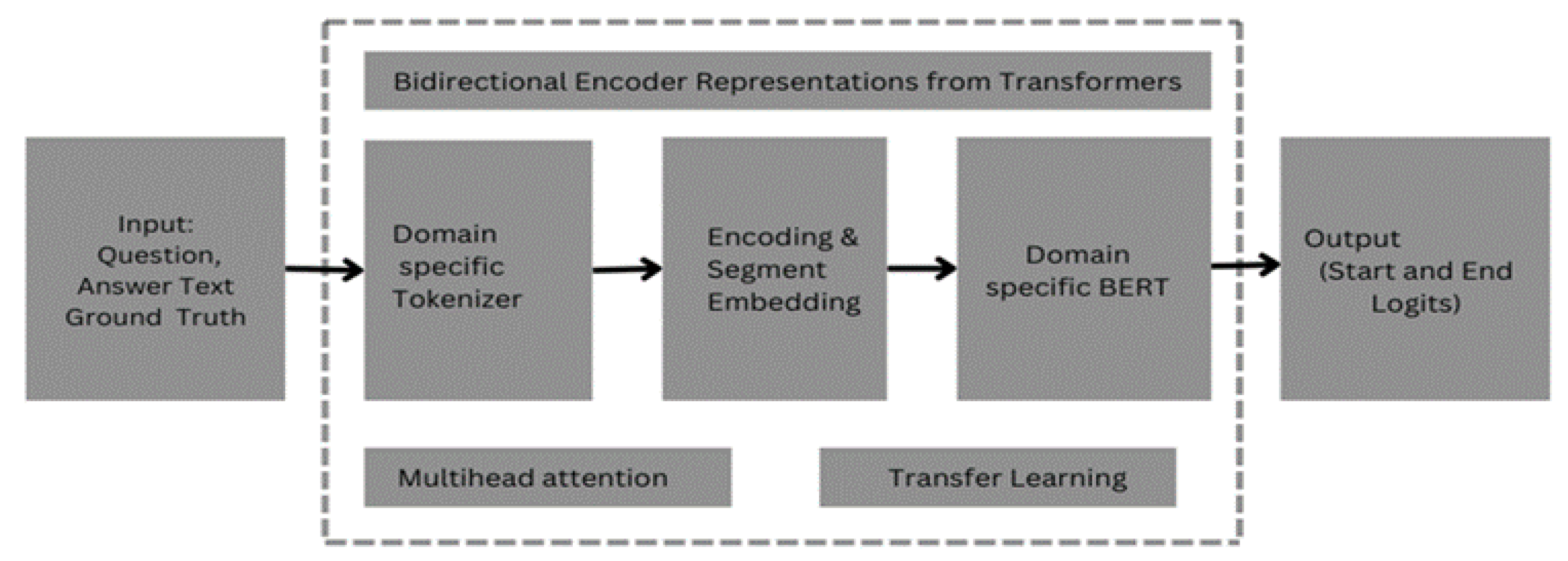
Figure 3.
Calculation of F1 score

Table 1.
Confidence score of BERT base and BERT large.
| Model | Score |
|---|---|
| BERT base | 3.44E-05 |
| BERT large | 0.441348344 |
Table 2.
Predicted answer for question pair with Tokenization strategy.
| Question | Context | Predicted answer |
|---|---|---|
| How much was the net sales in the year 2022? | Net sales increased 13% to $143.1 billion in the third quarter, compared with $127.1 billion in the third quarter of 2022. | "$ 127.1 billion" |
Table 3.
Predicted answer for question pair with chunking strategy.
| Question | Context | Predicted answer |
|---|---|---|
| How AWS help Amazon to grow in the year 2022? | PDF text from Amazon’s quarterly report | Segment sales increased 12% year-over-year to $23.1 billion. Operating income increased to $11.2 billion in the third quarter, compared with $2.5 billion in the third quarter of 2022. North America segment operating income was $4.3 billion, compared with an operating loss of $0.4 billion in the third quarter of 2022. |
Table 5.
Result for small question-answer pair on fine-tuned BERT.
| Question | Context | Predicted answer | Score |
|---|---|---|---|
| What are different search engines? | BLOOM has 176 billion parameters and can generate text in 46 natural languages and 13 programming languages. | 176 billion | 0.250225812 |
Table 6.
Results for Financial dataset on fine-tuned BERT
| Question | Context | Predicted answer | Score |
|---|---|---|---|
| What were Amazon’s net sales in the first quarter of 2023? | PDF text | $127.4 billion | 0.07002584 |
| How much did net sales increase compared to the first quarter of 2022? | PDF text | $127.4 billion | 0.070099174 |
| What was the impact of foreign exchange rates on net sales? | PDF text | $116.4 billion | 0.070099174 |
| How did North America segment sales change year-over-year? | PDF text | $116.4 billion | 0.080088 |
| How did the operating cash flow change for the trailing twelve months? | PDF text | $127.4 billion | 0.03641737 |
Table 7.
Comparison of F1 scores of BioBERT and BERT Large for biomedical data set
| Question Answer pairs | Bio-ClinicalBERT F1-Score | Bio-ClinicalBERT Average F1 | BERT Large F1-Score | BERT Large Average F1 score |
|---|---|---|---|---|
| 1 | 0.035 | 0.033 | 0.028 | 0.043 |
| 2 | 0.037 | 0.083 | ||
| 3 | 0.030 | 0.038 | ||
| 4 | 0.034 | 0.040 | ||
| 5 | 0.032 | 0.122 | ||
| 6 | 0.026 | 0.022 | ||
| 7 | 0.031 | 0.022 | ||
| 8 | 0.038 | 0.025 | ||
| 9 | 0.023 | 0.024 | ||
| 10 | 0.040 | 0.025 |
Table 8.
Comparison of F1 scores of SciBERT and BERT Large for scientific literature data set
| Q & A Pairs | SciBERT F1-Score | SciBERT Avg F1 | BERT Large F1-Score | BERT Large Avg F1 |
|---|---|---|---|---|
| 1 | 0.050 | 0.053 | 0.026 | 0.053 |
| 2 | 0.029 | 0.110 | ||
| 3 | 0.091 | 0.058 | ||
| 4 | 0.070 | 0.045 | ||
| 5 | 0.044 | 0.054 | ||
| 6 | 0.062 | 0.029 | ||
| 7 | 0.038 | 0.031 | ||
| 8 | 0.036 | 0.071 | ||
| 9 | 0.054 | 0.034 | ||
| 10 | 0.060 | 0.068 |
Table 9.
Average F1 scores for the respective domains.
| Domain | BERT model used | Average F1 score |
|---|---|---|
| Financial | BERT large uncased | 0.03913 |
| Biomedical | Bio-ClinicalBERT | 0.033 |
| Scientific | SciBERT | 0.053 |
Disclaimer/Publisher’s Note: The statements, opinions and data contained in all publications are solely those of the individual author(s) and contributor(s) and not of MDPI and/or the editor(s). MDPI and/or the editor(s) disclaim responsibility for any injury to people or property resulting from any ideas, methods, instructions or products referred to in the content. |
© 2025 by the authors. Licensee MDPI, Basel, Switzerland. This article is an open access article distributed under the terms and conditions of the Creative Commons Attribution (CC BY) license (http://creativecommons.org/licenses/by/4.0/).
Copyright: This open access article is published under a Creative Commons CC BY 4.0 license, which permit the free download, distribution, and reuse, provided that the author and preprint are cited in any reuse.


