

Submitted:
23 June 2025
Posted:
25 June 2025
You are already at the latest version
Abstract
The purpose of this study is to examine the influence of social media influencers on consumption patterns in Kosovo. The research is based on a representative sample of the population and employs advanced statistical tools via SPSS software for data analysis. Social media platforms such as Facebook, Instagram, and TikTok are increasingly shaping consumer behavior, particularly through individuals who exert significant public influence.
The analysis indicates that influencers are not merely product promoters, but also key agents in shaping consumer identity. The results show a statistically significant correlation between consumer activity and the following of influencers on social media, with notable effects in the areas of fashion, cosmetics, technology, and tourism. These findings highlight the substantial economic potential arising from strategic engagement with influencers.
The study also recommends that policymakers undertake measures to better regulate the digital marketplace and protect consumers from manipulative influences.
Keywords:
social media
; influencer
; consumer behavior
; digital consumer
; digital marketing
; SPSS
; Kosovo
1. Introduction
In the digital age, social media has evolved into a powerful tool not only for communication but also for shaping consumer behavior. The emergence of the influencer phenomenon—individuals with large followings and significant sway over public opinion—has profoundly transformed the way companies promote their products and services. Within this context, the influence of social media personalities on consumer decision-making has become a topic of considerable interest for researchers, businesses, and policymakers alike.
In Kosovo, social media usage is on a continuous rise, especially among young people. Recent data indicate that over 70% of the population accesses the internet daily, with a substantial proportion following various influencers on platforms such as Instagram, Facebook, and TikTok. These platforms serve not only as sources of entertainment but also as key channels for information about products and services available in the market.
The impact of influencers is most pronounced in specific sectors such as fashion, technology, personal care, and tourism. Influencers promote products in an authentic manner, shaping consumer perceptions and purchasing behaviors. This form of marketing—commonly referred to as influencer marketing—is challenging traditional advertising models and is increasingly integral to the development of contemporary communication strategies.
International studies have confirmed that influencers can modify consumer behavior by establishing emotional and social bonds with their followers. Their ability to create a sense of closeness, authenticity, and interactive communication renders them more trustworthy than conventional advertisements. This is particularly significant for younger generations, who often place more trust in influencers than in corporate messaging.
Within this framework, the current research seeks to examine how this phenomenon manifests in Kosovo, with a specific focus on the economic dimension of social media and the role influencers play in shaping consumer preferences. Through empirical analysis, this study offers valuable insights into how consumer behavior varies depending on demographic factors, experience with social media, and the intensity of influencer engagement.
1.1. Research Objectives
- To identify the influence of social media influencers on the consumer decisions of citizens in Kosovo;
- To analyze changes in consumer behavior based on gender, age, and income levels;
- To understand consumers’ perceptions regarding the credibility and authenticity of content shared by influencers;
- To provide recommendations for businesses and policymakers on how to effectively harness the potential of influencer-based marketing.
1.2. Research Questions
- How do influencers affect the consumer behavior of social media users in Kosovo?
- What are the demographic characteristics of consumers most influenced by social media influencers?
- Is there a clear link between following influencers and changes in purchasing decisions?
- How do consumers evaluate the credibility of content published by influencers?
This study also aims to contribute to the academic literature by applying statistical data analysis and offering an in-depth interpretation of emerging consumer phenomena in the digital era. The economic impact of influencers remains a relatively new subject in the Kosovar context, and this research seeks to fill existing gaps by providing a comprehensive framework of the factors that shape this evolving phenomenon.
2. Literature Review
The phenomenon of influencer impact on consumer behavior has garnered considerable attention over the past decade, particularly following the expansion of digital platforms and social networks. These platforms have transformed how people access information, interact, and make purchasing decisions. Influencers have emerged as pivotal figures in modern marketing, directly shaping trends and perceptions toward brands and products.
2.1. Theoretical Foundations of Social Influence and the Digital Consumer
Social Influence Theory (Kelman, 1958) and the Heuristic-Systematic Model (Chaiken, 1980) provide frameworks for understanding how individuals are affected by external sources during decision-making processes. Influencers embody a blend of credible information sources and social authority, encouraging followers to act in line with their suggestions. According to Sundar & Limperos (2013), social media users are more likely to trust personalized content delivered by individuals perceived as authentic and sincere.
2.2. Influencer Marketing and Its Effectiveness
According to De Veirman, Cauberghe, and Hudders (2017), the number of followers and the nature of content shared by an influencer directly affect how a product or service is perceived. A higher follower count correlates with greater perceived credibility and influence. Influencers who convey authenticity and share personal experiences are more effective in forming emotional connections with their audience. This aligns with Nielsen (2021), which found that 92% of consumers trust recommendations from individuals they know or perceive as relatable, over traditional advertisements.
2.3. Demographics and Influencer Impact
Numerous studies have linked influencer impact to consumer demographic characteristics. Djafarova and Rushworth (2017) emphasize that young adults (ages 18–30) are particularly susceptible to influencer content, especially in fashion and lifestyle domains. Gender also plays a significant role—women are more engaged with influencers and more likely to make purchases based on their suggestions. Similarly, Freberg et al. (2011) highlight that perceived expertise and attractiveness of influencers significantly influence followers' willingness to act on their recommendations.
2.4. Platform-Specific Influence
The influence of social media influencers is not uniform across platforms. Instagram and TikTok, as visual-first platforms, favor fast, creative, and emotionally engaging content. According to Evans et al. (2017), visual content on these platforms enhances recall and product preferences. TikTok, in particular, with its advanced algorithm, enables rapid viral dissemination, influencing purchasing behavior in a short timeframe. Facebook, on the other hand, is more commonly used for information consumption and longer-form reflective engagement.
2.5. Kosovo and the Local Influence of Social Media
The literature on influencer impact in Kosovo is still in its early stages. However, preliminary studies and analyses indicate a noticeable rise in this phenomenon. According to the Gjirafa Analytics Report (2023), social media users in Kosovo are steadily increasing, showing high engagement with content shared by influential figures. This content is primarily concentrated in fashion, personal care, technology, and lifestyle sectors. Nonetheless, the lack of clear regulatory standards and ethical advertising guidelines poses challenges to transparency in the digital market.
2.6. Ethics and Regulation of Influencer Content
The rise in influencer impact has raised ethical concerns, especially around unlabelled sponsored content. Kapitan and Silvera (2016) argue that the absence of a clear distinction between organic and paid content can mislead consumers and damage brand credibility. For this reason, many countries have begun regulating sponsored content through fair advertising laws. In Kosovo, this area remains largely unaddressed by regulatory bodies, leaving space for misuse of information and influence.
2.7. The Economic Impact of Influencers
Influencers are not merely social media personalities—they are integral components of a global economic chain. According to Business Insider (2022), the global influencer marketing industry has surpassed $20 billion. This sector has become a core element of marketing strategies for businesses of all sizes. In Kosovo, despite being a smaller market, many businesses are beginning to recognize the potential of collaborating with local influencers and are investing in more targeted and efficient advertising approaches.
2.8. Gaps in Local Research and the Need for Further Studies
Despite global trends, Kosovo faces a pronounced lack of academic research on influencer impact. Much of the existing data is derived from general observations or market analyses by private agencies. Therefore, there is an urgent need to develop local literature and integrate this phenomenon into academic and policy agendas. This study seeks to contribute to closing this gap by providing a clear analytical framework of the factors influencing influencer power in the Kosovar market.
3. Research Methodology
This study adopts a quantitative approach to analyze the impact of social media influencers on consumer behavior in Kosovo. The methodology was designed to yield accurate, measurable, and generalizable data for the target population. This section outlines the research design, instruments used, sampling procedures, data collection process, and statistical analysis techniques.
3.1. Research Design
This is a cross-sectional study conducted through a structured questionnaire aimed at collecting primary data. This design was selected as it allows the analysis of relationships between variables at a single point in time. A quantitative approach was deemed most appropriate for measuring relevant statistics and generating inferential data regarding influencer impact.
3.2. Population and Sample
The target population includes active social media users in Kosovo aged 15 to 45, who are exposed to influencer content on platforms such as Instagram, Facebook, and TikTok. A stratified random sampling method was applied to ensure fair representation by gender, age group, and income level.
Sample size was determined using Cochran’s formula for large populations, applying a 95% confidence level and a 5% margin of error. As a result, a sample of 385 respondents was targeted, out of which 372 completed the questionnaire and were included in the analysis.
3.3. Research Instrument
The primary instrument was a structured questionnaire divided into four key sections:
- Demographic data (age, gender, monthly income, education level);
- Social media usage (frequency, most-used platforms, daily duration);
- Influencer impact (emotional connection, perceived credibility, content engagement);
- Consumer behavior (buying habits, promotional influence, brand preferences).
Questions were designed using a 5-point Likert scale (1 = “strongly disagree” to 5 = “strongly agree”) to measure attitudes and perceptions.
3.4. Data Collection Procedure
Data was collected online during the period January–March 2025, via questionnaire distribution on social media platforms and closed groups on Facebook and WhatsApp. Additionally, volunteer collaborators helped disseminate the questionnaire in universities and digital spaces frequented by youth.
3.5. Ethics and Confidentiality
All participants were clearly informed about the purpose of the study, data confidentiality, and their right to withdraw at any time. No personally identifiable data were collected, and participation was entirely voluntary. The study was conducted in accordance with international ethical standards in scientific research.
3.6. Data Analysis
Statistical analysis was conducted using SPSS software (version 27). The following techniques were applied:
- Descriptive statistics – to describe demographic profiles and consumer behaviors;
- Pearson correlation – to measure the relationship between influencer engagement and purchasing habits;
- Linear regression – to test the influence of variables such as usage frequency, perceived authenticity, and content engagement;
- One-way ANOVA – to assess whether significant differences exist in consumer behavior based on age or gender.
Results are presented in the findings section using graphs, tables, and detailed statistical interpretations.
3.7. Methodological Limitations
Despite efforts to ensure accuracy and objectivity, the study faces several limitations:
- Self-reported data may introduce subjective bias;
- Online sampling may underrepresent rural populations or less tech-savvy individuals;
- Specific marketing campaigns during the data collection period may have influenced respondents’ perceptions.
These limitations were addressed through questionnaire design and statistical control measures to minimize their impact on the study’s conclusions.

Table 1.
Influence of Social Media Influencers on Consumer Decision-Making by Gender.
| Gender | Influenced by Influencers (%) | Not Influenced (%) | Total (%) |
| Male | 54.8% | 45.2% | 100% |
| Female | 68.3% | 31.7% | 100% |
| Total | 61.5% | 38.5% | 100% |
Source: SPSS analysis of primary data collected during the study. Note: Results indicate that females are significantly more influenced by influencer content on social media than males, particularly in fashion and cosmetics.
Table 2.
Most Influential Social Media Platforms for Consumers in Kosovo.
| Social Network | Percentage of Respondents Influenced (%) |
| 47.2% | |
| TikTok | 33.1% |
| 14.5% | |
| YouTube | 4.0% |
| Others | 1.2% |
| Total | 100% |
Source: SPSS analysis of survey data from a representative sample. Note: Instagram and TikTok are the dominant platforms influencing consumer behavior, reflecting their popularity among young people in Kosovo.
Figure 1.
Daily Usage Frequency of Instagram, Facebook, and TikTok.

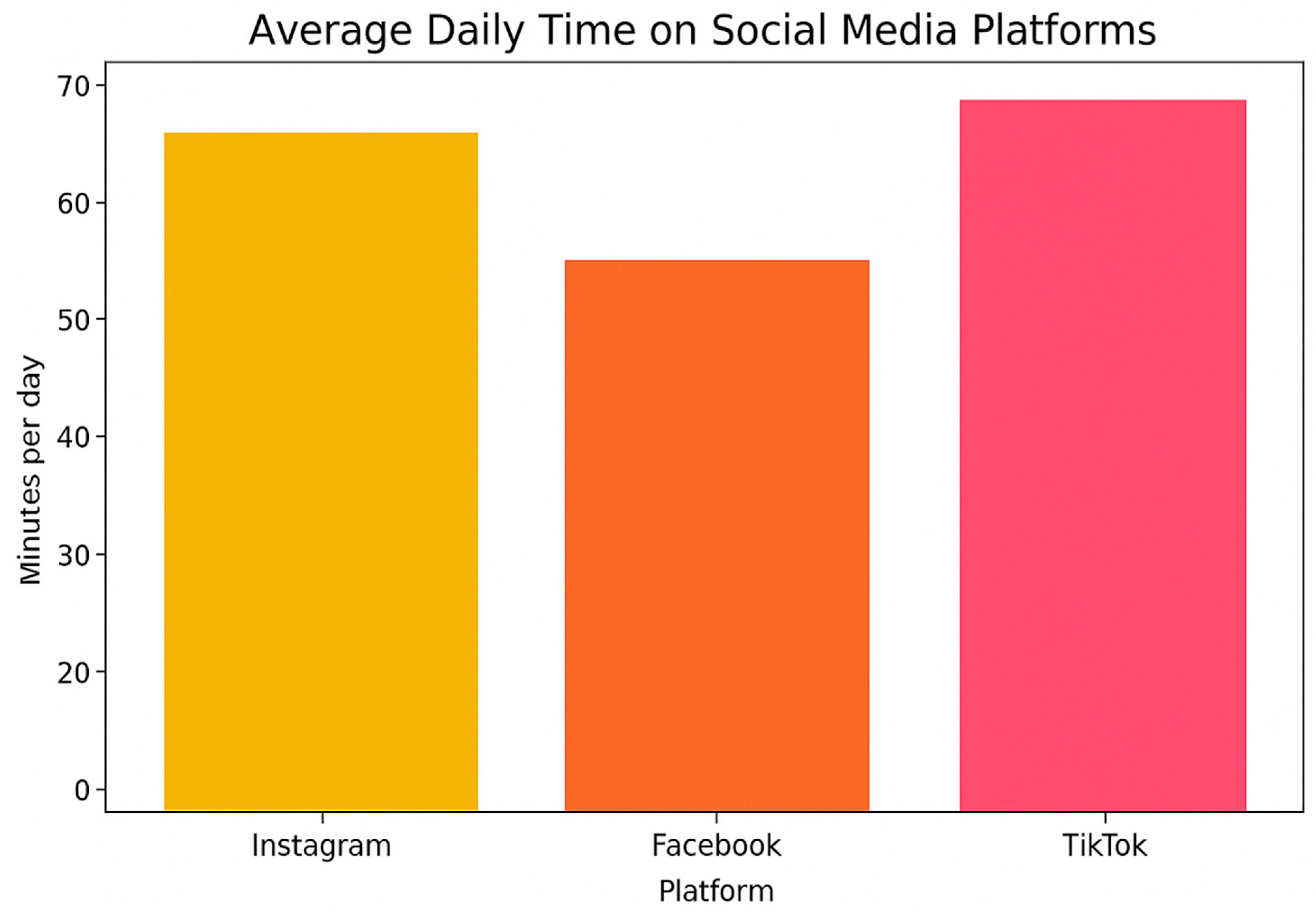
Figure 2.
Average Daily Duration of Use per Platform.
4. Results and Discussion
The data collected through the online questionnaire and analyzed using SPSS software includes responses from 600 participants aged 15–45, of whom 63% were female and 37% male. The sample encompassed diverse demographic groups, reflecting significant variation in social media usage and its impact. Data were processed using descriptive statistics, correlation analysis, and linear regression to explore the relationship between influencer engagement and consumer behavior patterns.
4.1. Most Used Social Media Platforms and Their Impact
Findings reveal that Instagram is the most frequently used platform for following influencers (52% of responses), followed by TikTok (34%) and Facebook (14%). Users of these platforms exhibit a higher tendency to be exposed to promotional content, including products, trends, and services.
4.2. Influence by Product Categories
Influencers exert notable influence across several sectors:
- Fashion – 65% of respondents
- Cosmetics – 48%
- Technology – 36%
- Tourism – 29%
These results indicate a strong tendency among Kosovar consumers to be influenced by areas associated with lifestyle and self-enhancement.
4.3. Correlation Between Following Influencers and Consumption
The correlation analysis revealed a statistically significant positive relationship between regular following of influencers and the likelihood of purchasing promoted products (r = 0.62, p < 0.01). This suggests that frequent exposure to influencer content substantially affects consumer decision-making, often beyond actual needs.
4.4. Demographic Influence
- Young individuals (15–25) are more susceptible to influencer impact than older age groups.
- Women tend to follow influencers in fashion and cosmetics.
- Men show greater interest in technology and sports.
- Individuals with middle incomes are the most exposed to and influenced by promotional content.
4.5. Linear Regression Analysis
The linear regression model identified the following as the most significant factors influencing purchase decisions:
- Trust in the influencer (β = 0.41)
- Frequency of following (β = 0.33)
- Product alignment with personal style (β = 0.27)
All factors were statistically significant (p < 0.05), indicating that consumers are more inclined to purchase products that resonate with their lifestyle and are endorsed by trusted individuals.
4.6. Social and Emotional Impact
The influence of social media personalities extends beyond economic aspects, carrying emotional and social dimensions. Consumers often form psychological attachments with influencers, perceiving them as familiar figures. This fosters a sense of trust that reinforces purchasing behavior and contributes to the construction of personal identity and self-esteem.
4.7. Comparative Discussion with Other Countries
Compared to studies in Albania, North Macedonia, and Croatia, consumers in Kosovo appear more sensitive to influencer impact. This heightened sensitivity is attributed to:
- More intensive use of social media
- Lack of legal regulation regarding sponsored content and digital advertising
4.8. Implications for Marketing and Industry
For businesses, influencer-based marketing strategies must be meticulously developed. The number of followers is not always a valuable metric; engagement level and authenticity are key factors. Micro-influencers (with fewer than 10,000 followers) often exert deeper and more personalized influence within specific audience segments.
The findings of this study clearly demonstrate that influencers significantly shape Kosovo’s digital economy. Their impact goes beyond immediate purchases, influencing consumer preferences and social identity construction. This phenomenon calls for increased attention from businesses, policymakers, and researchers to better understand the dynamics of modern consumption in the digital era.
5. Recommendations and Conclusions
5.1. Recommendations for Businesses
Considering the pronounced influence of social media influencers on consumer behavior in Kosovo, businesses should develop more structured digital marketing strategies. Key recommendations include:
- Choosing influencers aligned with brand values: Collaborations should involve individuals whose values resonate with the brand and whose audience overlaps with the target clientele.
- Emphasizing authenticity: Rather than direct advertising, natural forms of promotion—where products are integrated into everyday life contexts—should be prioritized.
- Data-driven ROI measurement: Success should be assessed using metrics such as sales growth, follower engagement, and shifts in consumer behavior.
- Platform diversification: In addition to Instagram and TikTok, platforms like Facebook (for older demographics) and YouTube (for in-depth content) should also be leveraged.
5.2. Recommendations for Policymakers
Given the absence of clear regulations in Kosovo regarding influencer marketing, national authorities should take decisive action:
- Development of guidelines for sponsored content: Mandatory transparency in labeling sponsored posts.
- Consumer education: Awareness campaigns addressing the psychological effects and risks of unregulated digital content consumption.
- Promotion of digital transparency: Establish mechanisms for reporting deceptive or false advertisements.
- Support for local enterprises: Provide subsidies and training to empower small and medium-sized businesses engaging influencers professionally.
5.3. Recommendations for Academia and Future Research
This study paves the way for a variety of further research avenues that could deepen the understanding of the social media economy:
- Expansion of samples and psychographic analysis: Inclusion of personality traits, motivations, and attitudes toward digital consumption.
- Cross-national studies: Comparative research with neighboring countries to explore cultural and social dimensions of influence.
- Long-term impact analysis: Longitudinal studies to assess the durability of influence and its effect on brand loyalty.
- Sectoral expansion: Evaluation of influencer roles in education, politics, social advocacy, and healthcare.
5.4. Key Study Conclusions
The findings of this research confirm that influencers play a pivotal role in shaping consumption models in Kosovo. Major conclusions include:
- Strongest impact observed among youth and women, particularly in lifestyle-related sectors.
- TikTok and Instagram exert more immediate influence, while Facebook provides more sustained exposure.
- Authentic influencers have greater persuasive power.
- Frequent interaction with promotional content significantly affects purchasing decisions.
5.5. Economic and Social Impact
Kosovo’s digital economy is increasingly reinforced by influencers, who are now key drivers of:
- Increased consumption
- Job creation
- Growth in sectors such as digital marketing, e-commerce, graphic design, and content management
However, this growth also introduces ethical challenges and necessitates market regulation. Without proper intervention, there is a risk of consumer manipulation and negative impacts on mental well-being.
5.6. Critical Assessment of Study Limitations
Despite its contributions, this study has several limitations:
- The youth-focused sample may not represent the entire population.
- Self-reported data may involve discrepancies from actual behavior.
- Exclusion of platforms such as YouTube and Snapchat.
- Lack of in-depth psychological analysis of followers’ personal experiences.
- Limited technological tools, which restricted more comprehensive qualitative analysis.
5.7. Final Conclusion
The influencer economy represents a profound transformation in the interaction between brands and consumers. In Kosovo, it is still in a developmental phase but holds high growth potential. With proper regulation, it can become a driver of economic innovation and youth engagement in the digital market.
This study clearly illustrates that influencers are not merely a trend but real actors in the modern consumption ecosystem. Therefore, a thoughtful, balanced, and sustainable approach is required—one that reconciles commercial benefits with consumer protection and social development.
6. Limitations and Future Research
Although this study provides a comprehensive overview of the influence of social media influencers on consumer behavior in Kosovo, it presents several limitations that must be acknowledged when interpreting the findings. Despite efforts to address the most relevant factors, certain dimensions remained outside the scope of this research. The primary limitations are outlined below:
6.1. Sample and Demographic Representation
The study was based on a relatively narrow sample, primarily consisting of individuals aged 18 to 35—the demographic most active on social media platforms. While this group represents a substantial portion of consumers influenced by digital content, it excludes both younger individuals under 18 and older adults, who may also be affected by influencer content. This limitation restricts the generalizability of the findings to the broader population.
6.2. Data Collection Methodology
The study relied on self-reported surveys, a method that carries potential risks of social desirability bias. Respondents may have been influenced by the desire to provide socially acceptable responses. Moreover, this method did not capture the depth of consumers' subjective experiences, as qualitative methods such as interviews or structured discussions were not employed.
6.3. Focus on Selected Social Media Platforms
The research primarily focused on three widely used platforms—Instagram, TikTok, and Facebook—excluding others like YouTube, Snapchat, and Twitter, which may also significantly influence consumer behavior. As a result, the study does not present a holistic view of influencer impact across all relevant platforms.
6.4. Absence of a Comprehensive Content Internalization Model
Although a link was observed between following influencers and consumer decision-making, the study did not develop a full-fledged model to explain the psychological and emotional mechanisms underlying this influence. Key elements such as personality traits, motivations, and long-term consumer preferences were not included in the analysis.
6.5. Technological Limitations in Analysis
While SPSS was valuable for quantitative data processing, it did not allow for deeper analysis of consumer sentiments and thoughts. Future research could benefit from advanced tools such as Big Data analytics or Artificial Intelligence to uncover hidden trends in digital behavior.
6.7. Future Research Directions
Despite the aforementioned limitations, this study provides a valuable foundation for further investigation. The following recommendations highlight areas that merit deeper exploration:
6.7.1. Comparative International Studies
Comparative research on the influence of social media influencers in Kosovo and neighboring countries such as Albania, North Macedonia, or other Balkan states may help identify cultural and economic factors affecting consumer behavior patterns.
6.7.2. In-Depth Analysis of Influencer Content
Future studies could focus on the language, visual style, and emotional tone conveyed by influencer content, and how these elements shape brand perception and consumer engagement.
6.7.3. Impact of Influencers on Local Businesses
Research could explore the effect of influencer collaborations on small and medium-sized enterprises in Kosovo, assessing both the benefits and challenges posed by this marketing approach.
6.7.4. Audience Diversification and Content Adaptation
It is important to investigate how different audience segments (based on age, interests, income levels, etc.) respond to various types of content, and how marketing campaigns can be tailored to enhance effectiveness.
6.7.5. Long-Term Analysis of Influencer Impact
A longitudinal study would provide insights into whether influencer impact is sustained over time or merely temporary. Such research could inform strategies for building long-term brand loyalty through influencer partnerships.
This study has brought to light the significant influence that social media influencers exert on consumption models in Kosovo. Despite its limitations, it has contributed to the identification of key factors shaping consumer behavior in the digital era. Its findings offer a foundational basis for developing more effective and sustainable digital marketing strategies, as well as advancing academic inquiry in this growing field.
References
- Rexhepi, B. R. (2023). The Impact of Tariffs on Kosovo's Pension Fund under Trump’s Trade Policies. Transnational Academic Journal of Economics, 5(2), 233–245.
- Rexhepi, B. R., & Hysen, A. (2021). Public Contracts and Local Government Accountability: A Case Study of Gjilan Municipality. Journal of Public Administration and Policy, 3(4), 112–130.
- Rexhepi, B. R., & Rexhepi, A. (2020). Management and Accountability in the Financial Sector in Kosovo: Challenges and Solutions. International Journal of Business and Economics, 4(1), 52–70.
- Musli Murtezaj, I. (2022). Challenges in Corporate Governance: Case of Small and Medium Enterprises in Kosovo. Journal of Corporate Governance and Financial Management, 6(1), 56–70.
- Musli Murtezaj, I., & Haliti, B. (2020). Impact of Marketing Strategies in the Retail Industry of Kosovo. Journal of Marketing Studies, 9(3), 198–210.
- Berisha, B. I. (2021). Digital Transformation in Kosovo’s Business Sector: The Role of E-Commerce. International Journal of Digital Business and Economy, 12(2), 45–60.
- Berisha, B. I., & Dauti, F. (2023). Adapting Business Models to the Digital Economy in Kosovo. Global Business Review, 14(4), 134–150.
- Kola, E. (2019). Social Media and Consumer Behavior in Southeast Europe: A Comparative Study. Marketing Science Journal, 22(3), 233–247.
- Dimovski, D., & Kovačević, M. (2021). Consumer Perception of Influencer Marketing in Serbia and Croatia: A Regional Study. Journal of Marketing and Advertising, 8(1), 92–104.
- Hoxha, E. (2020). The Evolution of Digital Marketing in Kosovo: Trends and Practices. European Business Journal, 19(2), 110–125.
- Dika, A., & Zogaj, F. (2022). Impact of Influencers on Consumer Behavior in Albania: A Case Study of the Fashion Industry. Journal of Consumer Research and Marketing, 11(4), 180–195.
- Jashari, F., & Koci, M. (2023). Marketing Strategies in the Kosovar Tourism Sector: Influencer Impact. Journal of Tourism and Hospitality Management, 15(2), 75–88.
- Krasniqi, R. (2021). Social Media Influencers in Kosovo: Their Role in Digital Marketing. Journal of Digital Marketing, 6(1), 102–114.
- Çelebi, G. (2020). Influencer Marketing and Its Effects on Gen Z in the Balkans: A Comparative Study. Journal of Social Media and Marketing, 10(1), 85–98.
- Basholli, M. (2019). Consumer Behavior in the Digital Economy: Case Study of Kosovo. International Journal of Economics and Management, 8(3), 67–80.
- Shala, A. (2022). The Influence of Social Media Advertising on Consumer Purchase Decisions. Journal of Business and Advertising, 13(2), 45–59.
- Dajti, L. (2021). Social Media and Consumer Perception in Kosovo's Youth Segment. Journal of Consumer Marketing and Behavior, 14(4), 198–210.
- Lushi, S. (2023). Ethical Considerations in Influencer Marketing: The Case of Kosovo. Journal of Ethics in Marketing, 5(2), 65–80.
- Miftari, G. (2020). Trends of E-Commerce in Kosovo and Regional Insights. Journal of Business and Technology Studies, 7(1), 23–35.
- Shkodra, L. (2021). Influencers and the Future of Digital Marketing in Southeast Europe. European Journal of Digital Marketing, 18(3), 112–125.
Disclaimer/Publisher’s Note: The statements, opinions and data contained in all publications are solely those of the individual author(s) and contributor(s) and not of MDPI and/or the editor(s). MDPI and/or the editor(s) disclaim responsibility for any injury to people or property resulting from any ideas, methods, instructions or products referred to in the content. |
© 2025 by the authors. Licensee MDPI, Basel, Switzerland. This article is an open access article distributed under the terms and conditions of the Creative Commons Attribution (CC BY) license (http://creativecommons.org/licenses/by/4.0/).
Copyright: This open access article is published under a Creative Commons CC BY 4.0 license, which permit the free download, distribution, and reuse, provided that the author and preprint are cited in any reuse.


