

Submitted:
21 June 2025
Posted:
23 June 2025
You are already at the latest version
Abstract
This article adopts a cross-disciplinary approach and a theoretical universe which has been 100% unified by a Theory of Everything or theory of quantum gravity, so that every microscopic and macroscopic object and event in space and time is connected. Phenomena such as geometry, topological materials, electrons, phase transitions, Weyl and Majorana fermions are inextricably related to topics like consciousness, gravity, Wick rotation, the Riemann hypothesis, and the cosmos. It’s interested in expressing unfamiliar ideas that might lead to new knowledge concerning physics and mathematics. The article’s foundation is an approach called Vector-Tensor-Scalar Geometry which seeks, in scientific tradition, to build on a paper Albert Einstein published in 1919 when he was at the peak of his abilities, having completed his General Relativity Theory a mere handful of years earlier. From the foundation, our Ship of the Imagination - to use a phrase from Carl Sagan’s and Neil deGrasse Tyson’s “Cosmos” - launches into topics like the connections between topology (rubber-sheet geometry), time dilation, consciousness, the nature of gravity, the Riemann Hypothesis, Wick rotation, the Higgs boson and field, topological materials, the Weyl fermion, and the Majorana fermion.
Keywords:
geometry
; topological materials
; electrons
; phase transitions
; Weyl and Majorana fermion
; consciousness
; gravity
; Wick rotation
; the Riemann hypothesis
; the cosmos
; topology (rubber-sheet geometry)
; time dilation
; the Higgs boson and field
Proposed Composition of Space-Time
The Mathematical Universe Hypothesis (MUH) is a speculation put forward by physicist and cosmologist Max Tegmark [1,2]. It speaks of “altogether different equations and mathematical structures”. This article could use such structures in the following way - one dimensional (1D) electrical pulses could form binary digits that could encode 2D Mobius strips which would be the next level up in particles’ structure. Cosmology’s holographic principle suggests the 3rd dimension results from information in the 2nd dimension. The 2nd D might be the Mobius strips comprising particles and the 3rd D might be capable of being deleted by programming the binary digits (used in electronics) which act as Hidden Variables that are compatible with quantum mechanics (not with known probabilistic quantum mechanics but with quantum certainty, for they give precise calculations). When subatomic particles appear in two places at once, the holographic principle can be combined with the precision of unrecognized quantum certainty. Then the particles would actually be in one place (quantum entangled) since the 3rd D of space between their centers would be eliminated (since we live in space-time, the time taken to travel the distance between particles is also eliminated). The 3rd dimension we normally perceive could be thought of as composed of figure-8 Klein bottles i.e. it could be thought of as the union of pairs of Mobius strips [3] or as projection of the information inherent in particles’ constituent strips. Since so-called ”imaginary” numbers are essential in quantum mechanics, the 4th dimension of time might be described by the Complex Plane’s Wick Rotation which is often regarded as nothing more than mathematical convenience. Adapting a paper by Albert Einstein [4] - if electromagnetism’s photon and gravitation’s graviton are composed of trillions of Mobius strips, electromagnetic and gravitational interactions could produce the mass and quantum spin of every other particle, including the bosons of an atom’s strong nuclear force, * weak nuclear force, and even the Higgs boson (the possibility of excitation of the Higgs field resulting from photon-graviton interaction would mean the field is a union of electromagnetic and gravitational fields). All of the information in the universe is contained in two-dimensional packages trillions of times smaller than an atom (in this case, the 2D package is the Mobius Strip).
* The strong nuclear force’s massless gluon could be formed by cancellation. Wick Rotation can exemplify cancellation of the Real and Imaginary components within the universe’s Complex mathematics if Wick isn’t restricted to being thought of as mere convenience or trickery. Wick is a circle containing two axes that intersect at its origin - a horizontal x-axis whose “real” ends are labelled 1 and -1, plus a vertical y-axis with “imaginary” ends i and -i. Whenever a point on this complex plane is multiplied by i, it moves a quarter rotation around the origin or center of the plane (counterclockwise). (See Figure 2) Start with 1, multiply by i then by i again (i^2 = -1), then add the 1 and -1 to get 0 (cancellation of gluon mass). The above paragraph illustrates motion from right to left in the upper half-plane. Movement from left to right in the lower half-plane must also exist ie: -1 × i^2 = 1. In physical terms, this bidirectional motion can be expressed as a wave moving in two directions. This article is discussing binary digits as well as the topological Mobius and Klein as the basic composition of subatomic particles. The discussion is therefore related to quantum mechanics. Imaginary numbers are essential in quantum mechanics. So a possibility worth considering is that Wick rotation, with its inclusion of imaginary numbers, is built into the Mobius strip (and into the Klein bottle, which is a union of a pair of strips). The electric pulses and binary digits of computation embrace the first dimension with the 2nd and 3rd being addressed by the Mobius and Klein plus their formation of photons and gravitons which interact to produce bosons and fermions. Could the 4th dimension of time be represented by Wick rotation whose real and imaginary numbers act as a timepiece, displaying and recording the movement of particles? The two directions waves move in would then not be in space but would reside in time - one could travel forwards in time, the other back in time. As physicist John Cramer says, “In summary, it appears that advanced waves (the ones going back in time) do exist and have been detected. Much more work must be done to ensure that this effect is real and can be extended, but the physics implications are gigantic.” [5]
Intro to VTS Geometry (from the Author’s Article at Reference [6])
The graviton vector and photon vector can be pictured as adjacent sides of a parallelogram. Tensor calculus converts the coordinates of the sides into those of a diagonal representing the interaction of the sides’ vectors. The sides’ coordinates can also be changed into a point on the diagonal. A position on a line that only has magnitude is called a scalar variable and this scalar is associated with particles of spin zero. [7] Since the Higgs boson is scalar, the point on the diagonal represents the Higgs boson which is obviously related to the graviton. The Higgs field is therefore intimately related to the gravitational and electromagnetic fields. The Higgs field may be regarded as a unification of the gravitational and electromagnetic fields.
Now visualize the lines CD and AD in Figure 1’s parallelogram as converging at D. The pressure resulting from photon-graviton (electromagnetic-gravitational) interaction is represented by the diagonal DB and, following what General Relativity called curved space-time, pushes an object experiencing gravitation to B. Instead of the phrase “curved space-time”, another way to look at it is to refer to space’s photons and gravitons - which both contain the fourth dimension of time - as following curved trajectories.
Figure 1.
Vector-Tensor-Scalar Geometry: Parallelogram With Diagonal and Central Higgs Boson. The deep link between geometry and topology (the Hodge Conjecture) may be about vector-tensor-scalar geometry plus the topological Mobius band and figure-8 Klein bottle (with addition of Wick rotation and the binary digits described in Figure 4’s caption).* At the start of the 20th century, physicist Max Planck assumed that electromagnetic radiation can only be emitted or absorbed in discrete packets, called quanta. He thought of his discovery as nothing more than a math device ... a kind of trickery). Albert Einstein developed his explanation of the photoelectric effect from this “mathematical convenience”. So it appears entirely possible that another supposed mathematical trickery (Wick rotation) will find practical application in the future.
Figure 1.
Vector-Tensor-Scalar Geometry: Parallelogram With Diagonal and Central Higgs Boson. The deep link between geometry and topology (the Hodge Conjecture) may be about vector-tensor-scalar geometry plus the topological Mobius band and figure-8 Klein bottle (with addition of Wick rotation and the binary digits described in Figure 4’s caption).* At the start of the 20th century, physicist Max Planck assumed that electromagnetic radiation can only be emitted or absorbed in discrete packets, called quanta. He thought of his discovery as nothing more than a math device ... a kind of trickery). Albert Einstein developed his explanation of the photoelectric effect from this “mathematical convenience”. So it appears entirely possible that another supposed mathematical trickery (Wick rotation) will find practical application in the future.
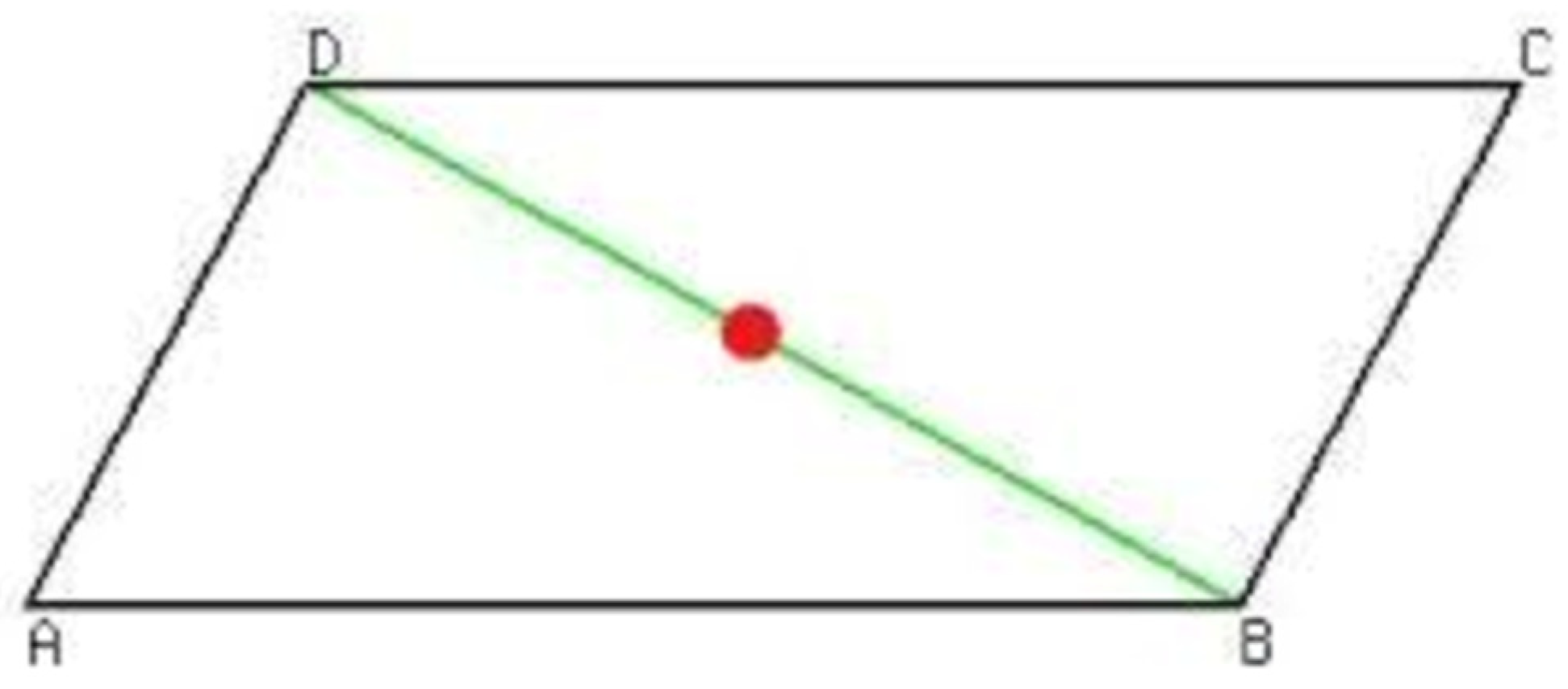
Figure 2.
WICK ROTATION: “The complex plane reveals i’s special relationship with cycles via the circle of i, also known as Wick rotation. Whenever a point on the complex plane is multiplied by i, it moves a quarter rotation around the origin or center of the plane.” Wick rotation, with its inclusion of imaginary numbers, may be built into the Mobius strip (and into the Klein bottle, which is a union of a pair of strips). [Figure and quote from 8].
Figure 2.
WICK ROTATION: “The complex plane reveals i’s special relationship with cycles via the circle of i, also known as Wick rotation. Whenever a point on the complex plane is multiplied by i, it moves a quarter rotation around the origin or center of the plane.” Wick rotation, with its inclusion of imaginary numbers, may be built into the Mobius strip (and into the Klein bottle, which is a union of a pair of strips). [Figure and quote from 8].
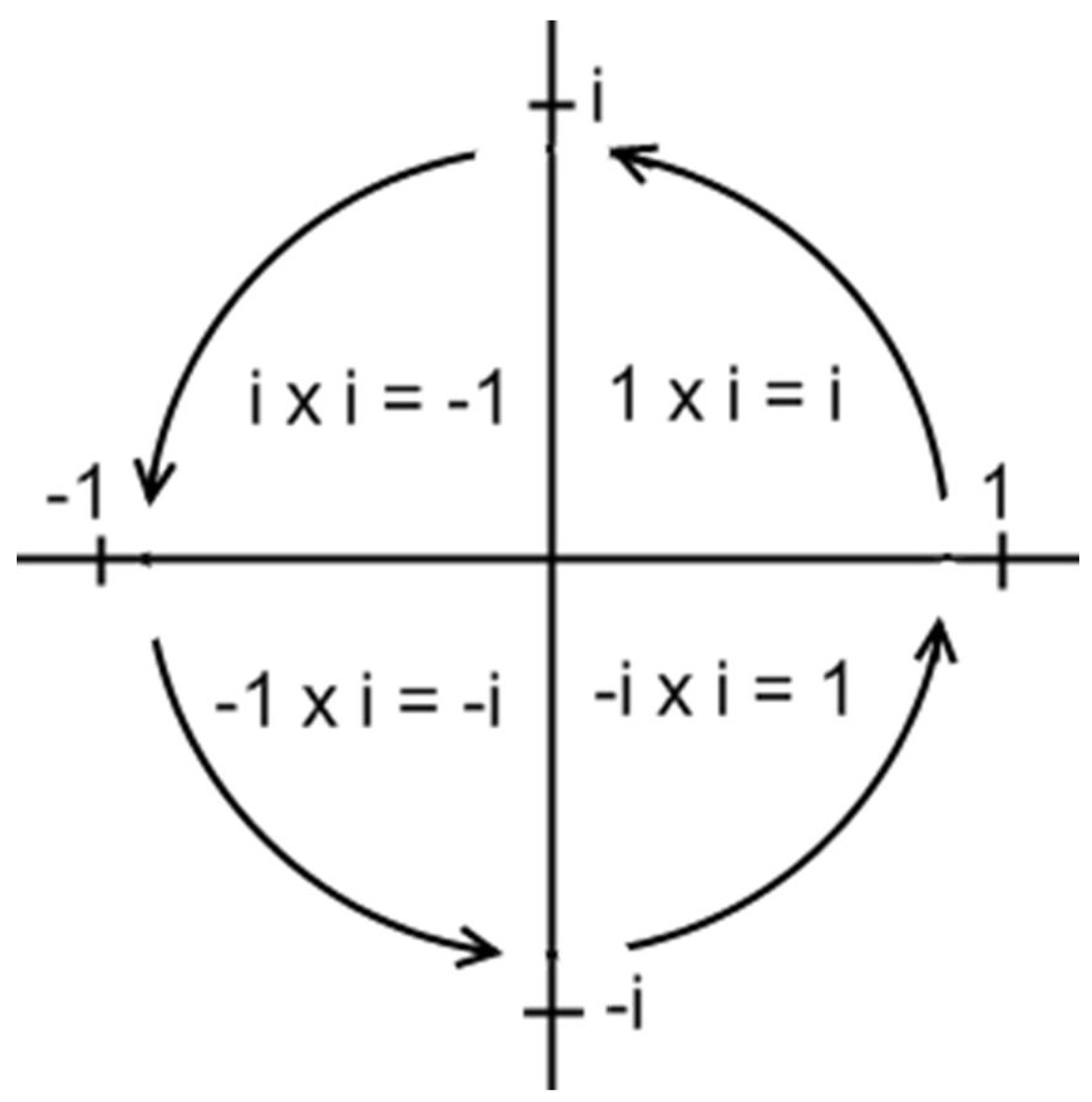
How can time dilation be explained in terms of Wick rotation (which represents the motion of gravitational and electromagnetic waves between the x-and y-axes)? (a) As the speed of light is approached, photons will “fall” faster from the positive or upper y-axis to the negative, or lower, y-axis (rotational speed is increased significantly and more photons interfere with each other more often, causing time to slow), and (b) each quantum within the intense gravity of a black hole - a graviton - can, according to our frame of reference, * be in two or more places at once and gravitationally cause particles to simultaneously “rise” faster from the negative y-axis to the positive y-axis (again, interference between particles is increased and time dilation occurs).
* Subatomic particles can appear to be in two or more places at the same time. A different way of viewing quantum mechanics is - If the universe is a unification where everything in space and time is connected, it seems reasonable to rephrase that as "every subatomic particle fills all space and all time because of universal unification, thus appearing to exist in more than one place at once (the macroscopic objects composed of subatomic particles are, potentially, also capable of multiple appearances)". Of course, this violates the way we see the world. Instead of saying quantum mechanics doesn't make sense, it might be more accurate to say human perception and interpretation of experimental results doesn't always make sense.☺ An article [9] states, “Quantum reality just got stranger. A particle’s angular momentum – its spin around an axis or rotation around a point – may be able to travel between two places by itself, disembodied from the particle. This finding may require a rethink of some of the most fundamental laws of physics.” This could be explained by quantum gravity. If everything in space and in time is connected, the particle is connected to all other particles and events. This could be rephrased as "it occupies every point in space-time simultaneously" - and so does its motion. Suppose an experiment is interpreted in the simplified form of the particle existing in merely two places at once. Then the particle itself would seem to be in a finite number of spots while its spin motion - which fills space and time - could be misinterpreted as existing in some other finite point.
Extending the Higgs Boson / Field of VTS Geometry to the Consciousness of eVTS Geometry
The apparently crazy assertion in the next paragraph that Earth - and everything / everyone on it - has magnitude occupying a literally infinite and eternal amount of space-time is merely a re-interpretation of the experimentally proved claim by quantum mechanics that particles can be in more than one place simultaneously. This multiple existence is simplified to the particles being in a single spot. This is a universe which has been 100% unified by a Theory of Everything or theory of quantum gravity, so that all objects and events in space and time are connected and may be regarded as One entity.
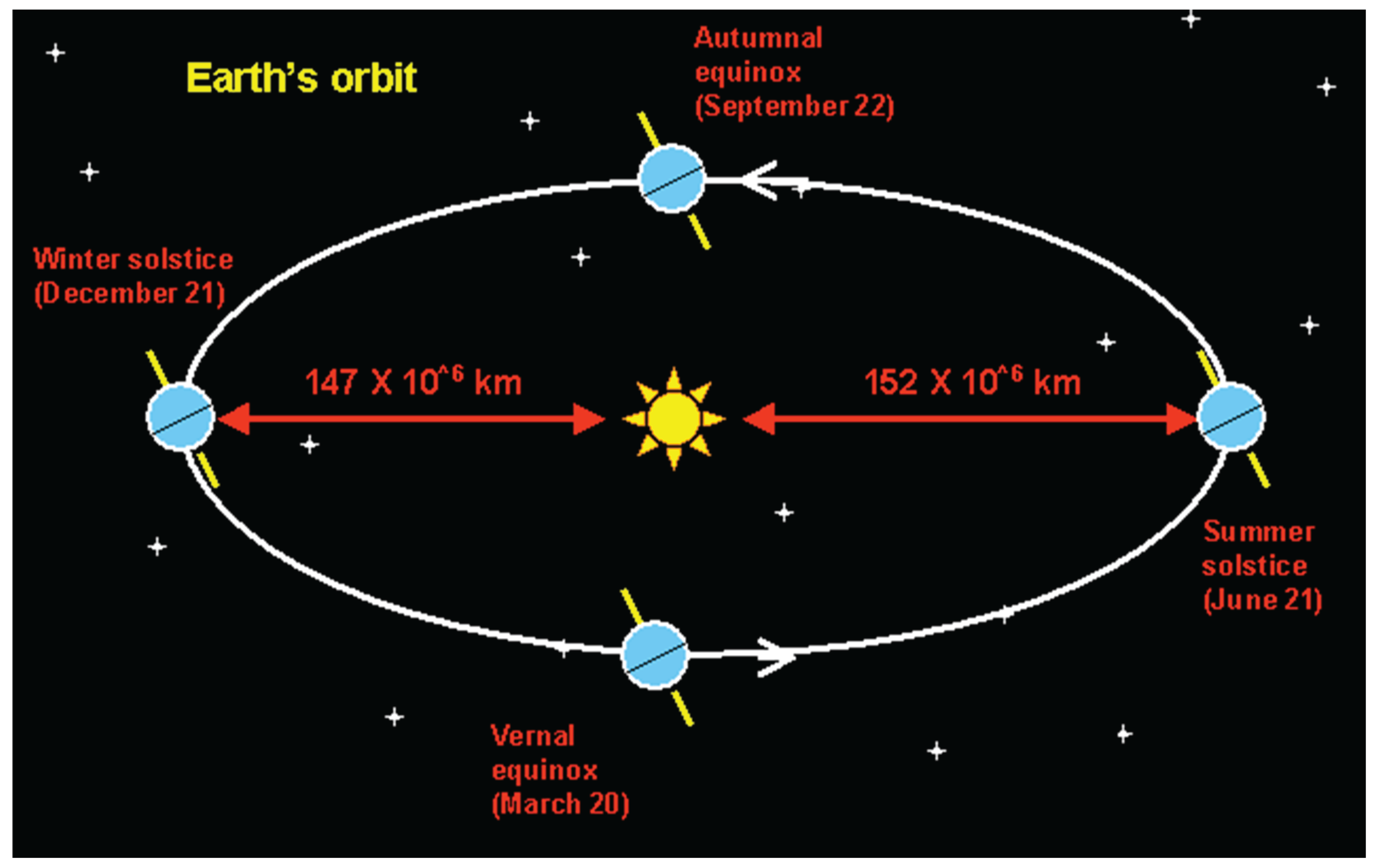
The parallelogram of Figure 1 can be converted by the morphing ability of computer programming so it traces the elliptical shape in Figure 3 – and of Earth’s elliptical orbit, which means the vector / tensor / scalar relationship applies to this planet. The vector can be the magnitude and direction of the orbiting Earth itself. It and a second vector (Earth months earlier or later in its orbit) are converted by tensor analysis into the coordinates of a single scalar point. Adding the geometrical objects of vector and tensor resulted in the object termed scalar. Successful conversion of the vectors in Figure 1's parallelogram to the vectors in Figure 3's ellipse, followed by tensor analysis, means our planet is also a scalar object. It has magnitude but no direction, and the innumerable spins of particles composing the planet are reduced to that of a boson possessing spin 0. * Like a Bose-Einstein Condensate, such particles have no restriction on the number of them that occupy the same quantum state (their description and predicted behaviour). This lack of restriction is compatible with Earth never having any direction. This state is only possible if it has magnitude occupying a literally infinite and eternal amount of space-time, thus having no need of direction and being capable of possessing the same quantum state as any other body. The Earth appears obviously finite and insignificant because of the way our senses, technology, and frames of reference work. Since they’d need to adapt to Earth’s infinity, all other bodies in space-time would similarly reduce the innumerable spins of particles composing them to that of a boson possessing spin 0 (they’d only possess magnitude, would possess the same quantum state - and would be scalar, infinite bodies).
* Particles that are made of even numbers of fermions behave as a boson. The reason behind this is simple: each of those fermions obeys Fermi-Dirac statistics and is a spin ±1/2 particle. If you add two of them together, you can get something that's spin -1, 0, or +1, which are integers (and hence a boson obeying Bose-Einstein statistics.) [10]
Occupying all time, vector-1 Earth must be united with vector-2 Earth (the one existing months later in its orbit). Traditionally, the scalar is no more than a point on a line, and consequently limited to that point’s boundaries. In this article, the scalar is a restricted point which is described by familiar mathematics. But simultaneously it’s a boundaryless, unlimited field described by quantum-mechanical duality (simultaneously limited and unlimited), as well as by what are called imaginary numbers – Wick rotation, aka the Circle of i, uses imaginary numbers and is built into the Mobius strips composing particles, thus turning space into space-time. (Professor Stephen Hawking says that boundaries and singularities exist in what is called “real” time but don’t exist in what is termed “imaginary” time.) The scalar is without boundaries because it’s associated with the zero spin of the Higgs boson, and thence with the cosmic Higgs field. So the scalar point identified with other bodies in space-time (including living bodies and minds) is actually part of the scalar field or Higgs field, with consciousness being boundaryless instead of being limited to one tiny part of space-time (the brain). Einstein’s Theory of General Relativity says gravity is the curvature of space-time, and therefore IS space-time. The universal Higgs field can be identified with the universal gravitational field (together with the latter’s constant interaction with the electromagnetic field).
Figure 4.
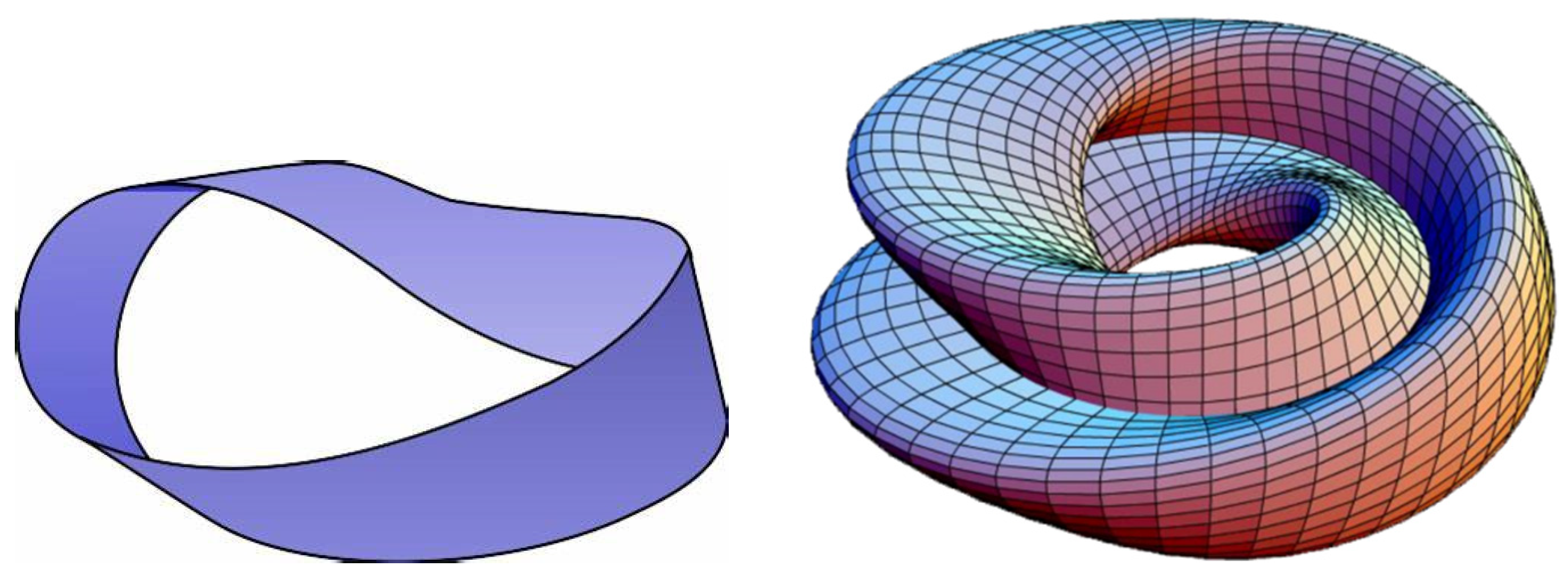
Mobius Band (left) and figure-8 Klein Bottle or Mobius Doublet (right) One-dimensional (1D) electric pulses create the binary digits of one and zero, used in electronics. The bits encode 2D Mobius strips which incorporate temporal Wick rotation (forming the 4th dimension of time). A couple of Mobius strips pair up to form a Klein bottle which is immersed in 3D - trillions of strips and bottles respectively produce photons and gravitons which use VTS geometry to interact and form the quantum spin of both massive electron, quark, Higgs, etc and the massless gluon.
Figure 4.
Mobius Band (left) and figure-8 Klein Bottle or Mobius Doublet (right) One-dimensional (1D) electric pulses create the binary digits of one and zero, used in electronics. The bits encode 2D Mobius strips which incorporate temporal Wick rotation (forming the 4th dimension of time). A couple of Mobius strips pair up to form a Klein bottle which is immersed in 3D - trillions of strips and bottles respectively produce photons and gravitons which use VTS geometry to interact and form the quantum spin of both massive electron, quark, Higgs, etc and the massless gluon.
Linking the Riemann Hypothesis with Majorana and Weyl Fermions
(1) Riemann Hypothesis and Wick Rotation
Earlier in this article, it was suggested how everything in space-time could be formed from binary digits, Mobius strips, figure-8 Klein bottles, interacting gravitational and electromagnetic waves acting in synchrony with Wick Rotation. Referring to Figure 2 - The Riemann hypothesis, proposed in 1859 by the German mathematician Georg Friedrich Bernhard Riemann, is fascinating. The Riemann hypothesis doesn’t just apply to the distribution of prime numbers but can also apply to the fundamental structure of the mathematical universe’s space-time, as the following shows. In mapping the distribution of prime numbers, the Riemann hypothesis is concerned with the locations of “nontrivial zeros” on the “critical line”, and says these zeros must lie on the vertical line of the Complex Number Plane i.e. on the y-axis in Figure 2 (this circular placement may reflect future spacetime warping greatly magnifying General Relativity’s concept of curved space-time). Besides having a real part, zeros in the critical line (the y-axis) have an imaginary part. This is reflected in the real +1 and -1 of the x-axis in Figure 2, as well as by the imaginary +i and -i of the y-axis. In the upper half-plane of Figure 2, a quarter rotation plus a quarter rotation equals a half – both quadrants begin with positive values and ¼ + ¼ = ½. (The Riemann hypothesis states that the real part of every nontrivial zero must be 1/2.) While in the lower half-plane, a quarter rotation plus a negative quarter rotation equals zero: 1/4 + (-1/4) = 0. In the Riemann zeta function, there may be infinitely many zeros on the critical line. This suggests the y-axis and the universe (space + its partner time) described by Wick rotation are literally infinite. By this paragraph’s extension, the Riemann hypothesis would also describe the universe as infinite in space and infinite in time (eternal). * Relativity’s curvature would need to be exaggerated by future space-time warping so that the future could directly feed back on the past in a circular loop. Life (possibly multicellular and intelligent) and the genetic code could then possibly come from humans acquiring knowledge of these things over the centuries, then applying that knowledge – via terraforming, accumulation of raw materials like amino acids and nucleic acids, performance of genetic engineering - to a time in the past when life didn’t exist. From that origin, life could evolve through innumerable mutations and adaptations, with humans once again acquiring knowledge of it in cyclic (nonlinear) time.
* The zeros are on the potentially infinite y-axis of the Complex Number Plane (Wick Rotation). Wick rotation and the Riemann hypothesis both describe space-time. If space and time truly go on forever without any beginning (in linear time) or end, then the zeros could mean infinity equals zero). In that case - after space-time has undergone warping, there’d be absolutely no distance to any other galaxy, or to the past and the future. This is how warping might be done - Cosmology’s holographic principle suggests the 3rd dimension results from information in the 2nd dimension. The 2nd D might be the Mobius strips comprising particles and the 3rd D might be capable of being deleted by programming the binary digits (used in electronics) which act as Hidden Variables that are compatible with quantum mechanics (not with known probabilistic quantum mechanics but with quantum certainty, for they give precise calculations). Of course, zero would also equal infinity. There would be null distance between the Mobius strips comprising particles and the Wick rotation embedded within the strips (Wick can be regarded as a programmed subroutine). This nil distance can be converted into infinite distance, producing a timelike multiverse (limitless multitude of universes) representing each infinitesimal fraction of a second in the lifetime of the one physical cosmos. The multiverse could be reunified with the universe using infinity = 0, meaning the multiverse is actually part of the universe.
(2) Topological Materials Plus Majorana and Weyl Fermions
The General Theory of Relativity will be useful in this article. Specifically – the analogy of the theory’s curvature of space-time to a rubber sheet. A small body like the Earth is said to warp space-time only a little and create a dimple in the sheet. A larger body such as the
Sun curves space-time much more and forms a deep valley in the rubber. And a black hole is often pictured as warping space-time so much that it tears a hole through the rubber fabric. In 2004, U.S.A. physicist Charles Kane noticed something strange in his computer simulations of electrons flowing through different materials: an insulator whose quantum state had the equivalent of a hole. Kane had not found the first quantum black hole but had discovered the first topological insulator – a then theoretical material that could conduct electricity on its surface but not within its interior. (In 2007, American physicist M. Zahid Hasan led the team that made the first 3D topological insulator.)
In 1929, while experimenting with the equations of quantum physics, German physicist Hermann Weyl showed that a massless and charged particle (now called the Weyl fermion) could theoretically exist. The Majorana fermion was predicted in 1937 by Italian physicist Ettore Majorana playing with the same quantum math that had intrigued Weyl. Like a Weyl fermion, a Majorana fermion has no mass. It also has no charge, despite being made of a bunch of negatively charged electrons. The Weyl fermion can be related to Topological Insulators, * the Majorana fermion can be related to quantum computers’ Topological Superconductors. Topological insulators and topological superconductors may be regarded as the (Mobius dependent) inverse of each other, with the properties of surfaces and holes being interchangeable as a result of the twisting in their Mobius-strip / figure-8-Klein-bottle composition.
* A topological insulator is a material that behaves as an insulator in its interior but whose surface contains conducting states. However, the conducting surface is not the unique character of topological insulators, since the ordinary band insulators can also support conductive surface states. What is special is that the surface states of topological insulators are symmetry protected. Symmetry Protected Topological (SPT) Order is a kind of order in topological insulators where, if symmetry is preserved during the deformation undergone in topology, a phase transition from one state of matter to another must occur (in this case, between insulation and conduction). In other words, if the shape of a Möbius strip (or the union of two strips into a Klein bottle) is preserved, phase transition must occur just as orientation-reversing curves occur in the Möbius and Klein. In three-dimensional topological superconductors, it’s more common to have multiple surfaces. But if subatomic particles making up topological superconductors are composed of the topological Mobius strip, they can theoretically only have one surface. Topological insulators can also be composed of Mobius strips. The key aspect is that the topologically protected states are robust against certain types of perturbations, regardless of the number of surfaces.
Referring to Figure 1, Side DC of parallelogram = Vector 1 electrons and Side DA of parallelogram = Vector 2 electrons.
The two vectors (two groups of charged electrons) interact to form the resultant diagonal DB (the electrons travel ADB and CDB, coming together to behave like a single charged particle called a Weyl fermion). Tensor calculus converts the points on the sides and diagonal into a single scalar point on a nominated side (say, in the centre of the diagonal). And the mass of the vector 1 electrons minus the mass of the vector 2 electrons [(x MeV/c^2) - (x MeV/c^2)] equals zero, and the massless Weyl. If the electrons flow in the reverse direction, they go in the BD direction, then split and follow the paths DA and DC.This preserves information if one pathway is interfered with, giving robustness against perturbations. They produce the chargeless Majorana because the negative vector-1 electrons minus the negative vector-2 electrons equal (-y) - (-y) = 0. The Majorana’s lack of mass is attributed to the same process by which the Weyl particle becomes massless.
Why is subtraction essential? This appears to be a consequence of matter, and the Higgs boson, both emerging from photon-graviton interaction. Two adjoining sides of a parallelogram represent the vectors of the photon’s spin 1 and the graviton’s spin 2. The resultant diagonal represents the interaction of the sides/vectors (1÷2 = the spin ½ of every matter particle: and division is merely repeated subtraction e.g. 4 subtracted from 20 five times equals zero, therefore 20 ÷ 4 = 5). (By the way - in calculus, the quotient of two vectors is called a quaternion.) Speaking of the Higgs which resides on the diagonal in Figure 1 and has spin 0: zero can be arrived at through (1 - 2) + 1 which uses both subtraction and the experimental data of a photon existing in two places simultaneously (it uses the graviton’s spin 2 being taken away from the photon’s spin 1, and the spin motion of 1 being in more than one place at the same time).
According to their representation by vector-tensor-scalar geometry, the chargeless Majorana’s negative vector-1 electrons minus the negative vector-2 electrons equal (-y) - (-y) = 0. This can be expressed as y + (-y) = 0, which clearly highlights its similarity to the Riemann hypothesis’ ¼ + (-1/4) = 0 (in terms of the paragraph’s first equation, this is : -1/4 – (-1/4) = 0. The last pair of expressions resolve conflict regarding whether the first term in the lower half-plane of Riemann’s hypothesis is positive or negative (either can be used).
References
- Tegmark, Max (November 1998). Is ‘the Theory of Everything’ Merely the Ultimate Ensemble Theory?. Annals of Physics. 270 (1): 1–51. doi:10.1006/aphy.1998.5855.
- Tegmark, M., Our Mathematical Universe. Random House/Knopf, January 2014.
- Polthier, Konrad. ”Imaging maths - Inside the Klein bottle”. http://plus.maths.org/content/os/issue26/features/mathart/ index.
- Einstein, Albert (1919). “Spielen Gravitationfelder im Aufbau der Elementarteilchen eine Wesentliche Rolle?” [Do gravitational fields play an essential role in the structure of elementary particles?]. Sitzungsberichte der Preussischen Akademie der Wissenschaften, [Math. Phys.], 349-356, Berlin.
- John G. Cramer, "Advanced Waves Detected", 2022, (https://npl.washington.edu/AV/altvw219.html) Astronomy (2016): "The M-sigma relationship", October.
- Rodney Bartlett. (2024). Supersymmetry Via EDM (Electric Dipole Moment). Qeios. doi: 10.32388/6WU1M2.
- Robert D. Klauber. Scalars: Spin 0 Fields. 2018 - http://www.quantumfieldtheory.info/.
- Kerri Welch. The Meaning of Imaginary Time: Creativity’s Dialog with Timelessness (public domain figure supplied by WordPress). https://textureoftime.wordpress.com/2015/07/15/the-meaning-of-imaginary-time/ (2015).
- "New spin on quantum theory forces rethink of a fundamental physics law" by Karmela Padavic-Callaghan - New Scientist (13 August 2024) - https://www.newscientist.com/article/2443380-new-spin-on-quantum-theory-forces-rethink-of-a-fundamental-physics-law.
- “Ask Ethan: What's The Difference Between A Fermion And A Boson?” Ethan Siegel. https://www.forbes.com/sites/startswithabang/2017/04/01/ask-ethan-whats-the-difference-between-a-fermion-and-a-boson/.
Figure 3.
Elliptical VTS Geometry: Earth's Orbit Is An Ellipse. Public domain image.
Disclaimer/Publisher’s Note: The statements, opinions and data contained in all publications are solely those of the individual author(s) and contributor(s) and not of MDPI and/or the editor(s). MDPI and/or the editor(s) disclaim responsibility for any injury to people or property resulting from any ideas, methods, instructions or products referred to in the content. |
© 2025 by the authors. Licensee MDPI, Basel, Switzerland. This article is an open access article distributed under the terms and conditions of the Creative Commons Attribution (CC BY) license (http://creativecommons.org/licenses/by/4.0/).
Copyright: This open access article is published under a Creative Commons CC BY 4.0 license, which permit the free download, distribution, and reuse, provided that the author and preprint are cited in any reuse.