

Submitted:
20 June 2025
Posted:
20 June 2025
You are already at the latest version
Abstract
We investigated associations between apolipoprotein E (APOE) alleles and motor mani-festations in Alzheimer’s dementia (AD) capitalizing on NACC data. The baseline evaluations of older adults (≥60years) with a diagnosis of AD were analysed. Those with a concomitant diagnosis Parkinson’s disease or other parkinsonian syndrome, and those treated with anti-parkinsonian agents were excluded. Three APOE groups were formed: APOE2 (APOE2 carriers), APOE3 (APOE3/APOE3) and APOE4 (AP-OE4/APOE4, APOE4/APOE3). UPDRS III was used to assess the presence or absence of motor signs in 9 domains. Adjusted binary logistic models featuring three APOE groups as exposures and motor domains as outcomes were estimated. Of 4979 included individuals, 389 were in the APOE2, 1799 in the APOE3 and 2791 in the APOE4 groups. Compared to the APOE2 group, individuals in the APOE4 group had 36% (18-50%) lower odds of having at least one motor sign; 47% (19-66%) lower odds of rigidity, 44% (23-60%) lower odds of bradykinesia, 44% (22-63%) lower odds of impaired chair rise and 44% (19-64%) lower odds of impaired posture-gait. Exploratory analyses using APOE genotypes suggested dose-response relationships for both APOE2 and APOE4. In conclusion, APOE2 confers a risk towards motor (mainly parkinsonian) signs in AD. APOE4 may have a protective effect.
Keywords:
tremor
; rigidity
; bradykinesia
; posture
; gait
1. Introduction
Primarily expressed in astrocytes, the apolipoprotein E (APOE) gene encodes a multifunctional protein, key component of lipoprotein particles, involved in multiple homeostatic processes of the central nervous system; lipid transport, glucose metabolism, synaptic plasticity, neuroinflammation and vascular integrity, to name a few [1,2,3]. APOE has three major allelic variants APOE2, APOE3, and APOE4, which differ by single amino acid substitutions at positions 112 and 158 [4]. Individuals inherit one copy of the gene from each parent, resulting in six possible genotypes, with APOE3/APOE3 being the most common [5].
APOE was the first genetic locus associated with the risk of late-onset Alzheimer’s disease dementia (AD) in 1993 [6]. Carriers of a single APOE4 allele have a 2 to 3-fold increased risk for AD, while those with two copies have a 10 to 15-fold greater risk [4]. Furthermore, APOE4 is related to an earlier age of AD onset [7,8]. On the other hand, APOE2 is linked to a lower risk of incident AD and a later age of disease onset [9,10]. Of note, across the AD continuum, APOE2 has been linked to less prominent AD-related pathological alterations, more severe non-AD neuropathology, and atypical, non-amnestic AD phenotypes, [11,12,13,14]. Recently, APOE2 was associated with more severe pathology in primary tauopathies such as progressive supranuclear palsy and corticobasal degenerations, supporting an association between APOE2 and non-AD pathologies [15,16].
APOE is also implicated in the pathogenesis of α-synucleinopathies [17]. APOE4 carriage increases the risk of Lewy Body Dementia, both Dementia with Lewy bodies and Parkinson’s Disease (PD) Dementia [17]. In contrast, PD research established more complex associations: while meta-analyses initially supported a risk-conferring effect of APOE2 towards PD [18,19], more recent studies suggested more complex, ethnic (or genotypic) associations [20,21].
Parkinsonian signs are present in AD with increasing frequency as the disease progresses [22]. Bradykinesia, rigidity and postural/gait disturbances are most commonly observed [22,23,24,25]. However, the determinants of motor signs in AD remain largely unknown. We investigated associations between APOE genotype and motor manifestations in AD. Based on the initial reports of the risk-conferring properties of APOE2 towards PD, as well as the neuropathologic and atypical phenotypic associations of APOE2 across the AD continuum, we hypothesized that APOE2 alleles will increase the odds of having motor sings in AD. We capitalized on data from the Uniform Data Set (UDS), a central repository of data, stewarded by the National Alzheimer's Coordinating Center (NACC) [27].
2. Results
3.1 Participant Characteristics and Missing Data
The starting database included 44,713 individuals with at least one UDS evaluation. Among them, 15,363 were diagnosed with dementia and 11,196 with AD. Motor symptoms were assessed using the UPDRS-III only in the first two version of the UDS; thus, 2,249 participants evaluated on the 3rd version were excluded. Data on APOE were available for 6,742 of the 8,947 participants with AD and UPDRS-III assessments. After exclusion of those with a diagnosis of PD or other parkinsonian syndrome, those on anti-parkinsonian medication, and those under the age of 60 years, 5,810 participants were eligible for the present study (Figure 1).
Among eligible participants, 831 were missing data on at least one of the covariates (age, sex, race, education, MMSE, CDR, GDS and/or NPS). Individuals without missing data (N=4,979) were more often Caucasian (p< 0.001) and male (p= 0.001) compared to those without missing data (N=831). Action-postural tremor was more common in the former group (p= 0.049), whereas the remaining of the motor symptoms were more prevalent in the latter (p< 0.001). Those with missing data were older (p= 0.010), less educated (p< 0.001), performed worse on cognitive testing (MMSE, p< 0.001), had greater depression scores (GDS, p= 0.001), higher neuropsychiatric burden (NPS, p< 0.001) and greater cognitive severity (CDR, p< 0.001). There was no difference in terms of APOE genotypic distribution (p= 0.152). Among eligible participants without covariate missing data , none had missing data on resting tremor and rigidity, 2 had missing data on hypophonia, masked facies, action-postural tremor and/or bradykinesia, 22 on impaired posture-gait, 33 on impaired chair rise and 131 on postural instability. Therefore, slightly different participant subsets were analysed per motor domain.
Participant characteristics by APOE group are in Table 1. The APOE4 group was younger and better educated compared to the other groups. The APOE2 group had more participants of African American ancestry and fewer of Caucasian ancestry compared to the other groups. Sex distributions were similar among groups. Regarding clinical parameters, the APOE4 group and had lower GDS scores compared to both other groups and performed worse on MMSE compared to the APOE2 group. The APOE2 group had lower global CDR scores than the others. NPS distributions were similar among groups. As for motor manifestations, a trend towards greater prevalence in the APOE2 group and lower prevalence in the APOE4 groups was documented (comparisons were significant in the context of rigidity, bradykinesia, impaired chair rise, impaired posture-gait and the global motor variable).
3.2. APOE Alleles and Motor Signs in Older Adults with AD
Crude binary logistic regression models revealed that compared to the APOE2 group, the APOE4 group exhibited lower odds having at least one motor sign [OR= 0.64, 95%CI= (0.50, 0.80)] (Table 2). Significant findings related to rigidity, bradykinesia, impaired chair rise and impaired posture gait. Adjusted models confirmed these findings (Table 2). In particular, individuals in the APOE4 group had 36% (18-50%) lower odds of having at least one motor sign, 47% (19-66%) lower odds of rigidity, 44% (23-60%) lower odds of bradykinesia, 44% (22-63%) lower odds of impaired chair rise and 44% (19-64%) lower odds of impaired posture-gait (although the latter failed to achieve the stricter measure of statistical significance). Intermediate, statistically insignificant differences were found between the APOE2 and APOE3 groups using the stricter-corrected significance threshold of α= 0.005.
Figure 2 shows the prevalence of motor manifestations by APOE group. Except for hypophonia, masked facies and resting tremor, a clear trend towards more frequent motor manifestations among APOE2 carriers while less frequent in APOE4 carriers, suggesting a dose-response pattern for both alleles. Exploratory analyses captured this dose-response relationship with bradykinesia, rigidity, impaired posture-gait and impaired chair rise (Table 3). Specifically, the APOE2/APOE2 genotype was more closely associated with these signs than APOE3/APOE2. The latter exhibited more prominent associations than APOE4/APOE2. Sequentially, APOE3/APOE4 and APOE4/APOE4 genotypes exhibited relatively (compared to APOE3/APOE3) protective properties in an APOE4 dose-dependent fashion. Overall, APOE2 seemed to enlarge and APOE4 to moderate the risk of these motor signs. On the other hand, the aforementioned pattern was not apparent in the remaining motor signs (with the potential exception of hypophonia) (Figure 3).
3. Discussion
Compared to the APOE4 allele, the APOE2 allele confers a greater risk for motor signs in older adults with AD. These findings were most evident for bradykinesia, rigidity, impaired posture-gait and impaired chair rise. Intermediate, though statistically insignificant associations were found for the comparison of APOE2 versus APOE3. The consistency (effect sizes and directions) and the p-values of theses associations (p< 0.05 for global motor variable, bradykinesia, impaired posture-gait, impaired chair rise) were indicative of a non-trivial differences between APOE2 and APOE3 (smaller than the difference between APOE2 and APOE4). Exploratory analyses of APOE genotypes suggested a dose-response for both APOE2 (risk-conferring properties) and APOE4 (protective properties) with respect to motor signs.
While the risk-conferring effect of APOE4 carriage towards major neurocognitive disorders such as AD, Dementia with Lewy Bodies and Parkinson’s Disease Dementia, is well-established [17], the exact role of APOE2 carriage in neurodegeneration is less clear. An overall protective effect has been reported for APOE2 against the several dementias [9,10,28]. On the other hand, a risk-conferring effect for APOE2 to PD has been reported [18,19]. Our findings concur that motor signs, especially parkinsonian manifestations (bradykinesia, rigidity, impaired posture-gait) in AD may be driven by APOE2. However, the pathophysiologic mechanisms behind this relationship remain unclear.
APOE2 may protect against β-amyloid accumulation, the neuropathological hallmark of AD [29]. It is associated with reduced global tau deposition in the AD continuum especially in the medial temporal regions, the earliest regions to display AD-related neurodegenerative alterations [30,31]. On the other hand, APOE2 has been associated with primary tauopathies (e.g., progressive supranuclear palsy, argyrophilic grain disease) and more pronounced tau depositions in these entities [11,16,32]. Collectively, these findings suggest that APOE2 mitigates secondary tau deposition (as in AD) but drives primary tau pathology [15]. Hence, the relationship between APOE2 and motor signs in AD is probably independent of its cognitive effects and may be related to the different neurodegeneration pattern that accompanies this allele. Less prominent β-amyloid pathological changes, less pronounced tau deposition in the entorhinal cortex and greater primary tau pathology, may explain the increased prevalence of motor signs associated with APOE2.
This study has several strengths including a large sample of genotyped older individuals with AD. The extensive characterization in the UDS allowed us to account for many important confounders: demographics, cognitive performance, depression scores, neuropsychiatric burden, AD stage [33]. Nevertheless, the analysis has several weaknesses as well, including being cross-sectional. Further, in most cases, the diagnosis of AD and other dementias was based on clinical criteria; biomarkers were not uniformly available. Therefore, there may have been misclassification of other neurodegenerative conditions as AD. As well, although several important covariates were considered, our findings may have been driven by residual confounding or non-trivial proportion of missing data. Next, although UPDRS-III is widely used in both clinical and research settings, variability can be expected across different examiners in quantifying motor signs. Finally, the count of some motor signs (hypophonia, resting tremor, masked facies) was very small, leading to lack of power in analyses involving these signs.
4. Materials and Methods
We analysed cross-sectional UDS data for associations between APOE alleles and motor signs in older adults with AD. The UDS assembles standardized, prospectively collected, multidisciplinary data from multiple National Institute on Aging / National Institutes of Health (NIA/NIH) - funded Alzheimer's Disease Centers (ADCs) across the United States [34]. The UDS is freely available to research scientists upon request (https://naccdata.org/). All study procedures were approved by Institutional Review Boards overseeing each ADC prior to the initiation of the study. All participants granted informed consent prior to participation. The rationale and the key methodological features of the UDS have been detailed elsewhere [35,36,37]. Briefly, each participating ADC enrols volunteers ranging from normal cognition to dementia. Participants may actively pursue professional consultation, may be referred to an ADC by other clinicians or family members, may be actively recruited, etc. Trained physicians and clinic personnel evaluate participants using a uniform, standardized protocol, on an approximately yearly basis. Although the focus of the UDS is AD, data are also collected on other neurocognitive and neuropsychiatric disorders.
2.1 Eligibility Criteria and Diagnostic Procedure
The present study was based on cross-sectional NACC data from the inception of the UDS (September 2005) to the December 2022 data freeze. Data from a total of 46 ADCs were involved. We focused on baseline evaluations of older adults, greater than 60 years old, with a diagnosis of AD but without a concomitant diagnosis of PD or a parkinsonian syndrome. Participants being treated with anti-parkinsonian medications were excluded. Depending on the specific protocol of each ADC, cognitive diagnoses were established by either an interdisciplinary consensus team (in most cases) or a single clinician (who examined the participant). Diagnoses were based on extensive standardized evaluations including personal and family medical history, clinical examinations, neuropsychological and neuropsychiatric assessments, psychosocial functioning evaluations, and so on. Dementia was diagnosed using standard clinical criteria [38,39,40,41]. Imaging and/or cerebrospinal fluid biomarkers were only available in a minority of participants [42,43].
2.2 Measurement of Motor Signs Based on the UPDRS-III
The Unified Parkinson’s disease rating scale part III (UPDRS-III), which was administrated in the first two versions of the UDS, comprises 27 subitems. We grouped these into 9 domains as follows [44]: (1) hypophonia (single item); (2) masked facies (single item); (3) resting tremor (combined five items regarding tremor at rest in the face/lips/chin and four extremities); (4) action/postural tremor (combined two items regarding tremor at rest in the hands); (5) rigidity (combined five items regarding rigidity in the neck and four extremities); (6) bradykinesia (combined nine items: bilateral finger tapping, hand movements, rapid alternating movements of the hands, leg agility, and body bradykinesia); (7) impaired chair rise (single item); (8) impaired posture/gait (combined two items: posture and gait); and (9) postural instability (single item).
Each motor subitem was graded as absent (score <2) or present (score ≥2). The rationale for this cutoff is as follows: (1) this severity is more likely to be noted by the average clinician [45]; and (2) a score of 1 is suggestive of a very mild motor change that could be observed with normal aging [46]. Then, we created nine dichotomous variables (motor domains), such that participants were said to have an abnormal motor sign if they scored ≥2 in at least one of the subitems of the respective motor domain [47]. A global dichotomous variable was also created (presence of at least one motor sign), according to which participants were divided into those with (if they scored ≥2 in at least one motor domain) and those without (if they scored <2 in all motor domains) motor manifestations.
2.3 Apolipoprotein E Genotyping
APOE haplotypes for NACC were determined from the single-nucleotide variants rs7412 (APOE2) and rs42935848 (APOE4). We clustered participants into three groups, based on APOE genotypes: APOE2 (APOE2/APOE3, APOE2/APOE4, or APOE2/APOE2), APOE3 (APOE3/APOE3) or APOE4 (APOE3/APOE4 or APOE4/APOE4).
2.4 Covariates Considered
Participant age at visit (years), education (years of formal schooling), Mini-Mental State Examination score (MMSE – cognitive performance) and Geriatric Depression Scale (GDS) scores were treated as scale variables. Sex (male/female), race (Caucasian, African American, Asian, other), global CDR (0.5, 1.0, 2.0, 3.0 – cognitive symptom severity) and neuropsychiatric symptom severity (NPS) – no, mild, moderate-severe NPS – were treated as categorical variables.
NPS severity was assessed using data from the Neuropsychiatric Inventory Questionnaire (NPI-Q) (Cummings et al., 1994). NRI-Q evaluates 12 domains [delusions, hallucinations, agitation/aggression, depression/dysphoria, anxiety, elation/euphoria, apathy/indifference, disinhibition, irritability/lability, aberrant motor behaviour, night-time behaviours, and appetite/eating] according to a 4-point severity scale: no, mild (noticeable, but not a significant change); moderate (significant, but not a dramatic change); or severe (very marked or prominent; a dramatic change). For each NPI-Q domain, participants were grouped into three categories: 0: absent; 1: mild; 2: moderate and severe symptomatology (due to the small prevalence of moderate and severe symptoms) [49]. Sequentially, the composite NPS was calculated as follows: 0: no symptoms; 1: at least one mild symptom with no moderate and/or severe symptoms, 2: at least one moderate and/or severe symptom.
2.5 Statistical Analysis
Differences between the three APOE groups were analysed using (1) analysis of variance with Bonferroni correction (scale variables) and (2) Pearson’s chi-squared tests (categorical variables). Associations between the three APOE groups and motor signs were estimated using separate (for each motor domain) binary logistic regression models. Both crude and adjusted models were tested. Adjusted models featured the above set of covariates. A sequential exploratory analysis featuring the six individual APOE genotypes was performed, to assess for a dose-response (increased magnitude of effect sizes with homozygosity compared to heterozygosity). The exploratory analysis was identical to the main analysis (adjusted for the same covariates) except for the APOE variable, which featured the six APOE genotypes instead of the three APOE groups.
The analyses were performed using the IBM SPSS Statistics Software Version 27 (Chicago, IL, USA). The conventional threshold of α= 0.05 was implemented to assess for statistical significance in comparisons. The stricter α= 0.005 cut-point, corrected for multiple (N=10) comparisons, was used in the main analysis. Effect sizes (odds ratios, ORs) and precision estimates (95% confidence intervals, 95%CIs) are provided.
5. Conclusions
Compared to APOE4, APOE2 confers an increased risk towards motor signs, including bradykinesia, rigidity, impaired posture-gait and impaired chair rise, in older adults with AD. APOE3 may confer an intermediate risk. A dose-response relationship between APOE2 vs. APOE4 genotype with these motor signs may exist. These findings may have clinical implications for phenotypic subgroup definition and precision medicine. To explain these associations, future research applying more sophisticated imaging or post-mortem investigations should emphasize pathologic changes in older APOE2 carriers with AD.
Author Contributions
IL: conceptualization, design of the study, data curation, formal analysis, interpretation of data, original draft preparation, and review & editing of manuscript; SD: data curation, validation, original draft preparation, and review & editing of manuscript; VS, AT, CM,PS, GN & LM: validation, interpretation of data, and review & editing of manuscript; CGL & ED: conceptualization, design of the study, supervision, review & editing.
Funding
This research received no external funding.
Institutional Review Board & Informed Consent Statements
Not applicable: This cross-sectional analysis capitalised on data from the ongoing Uniform Data Set (UDS). UDS is a central repository of longitudinally collected data in National Institute on Aging—funded Alzheimer’s Disease Research Centers (ADRCs) across the United States. UDS is stewarded by the National Alzheimer's Coordinating Center (NACC). Participants are enrolled according to each ADRC’s discrete protocol. Written informed consent is obtained prior to participation. All procedures are overseen by Institutional Review Boards at each ADRC and performed in accordance with the ethical standards laid down in the declaration of Helsinki and its later amendments.
Data Availability Statement
For further information on access to the NACC database, please contact NACC (contact details can be found at https://naccdata.org/).
Acknowledgments
Dr. Lyketsos’ effort on this project was supported by P30AG066507. The NACC database is funded by NIA/NIH Grant U24 AG072122. NACC data are contributed by the NIA-funded ADRCs: P30 AG062429 (PI James Brewer, MD, PhD), P30 AG066468 (PI Oscar Lopez, MD), P30 AG062421 (PI Bradley Hyman, MD, PhD), P30 AG066509 (PI Thomas Grabowski, MD), P30 AG066514 (PI Mary Sano, PhD), P30 AG066530 (PI Helena Chui, MD), P30 AG066507 (PI Marilyn Albert, PhD), P30 AG066444 (PI John Morris, MD), P30 AG066518 (PI Jeffrey Kaye, MD), P30 AG066512 (PI Thomas Wisniewski, MD), P30 AG066462 (PI Scott Small, MD), P30 AG072979 (PI David Wolk, MD), P30 AG072972 (PI Charles DeCarli, MD), P30 AG072976 (PI Andrew Saykin, PsyD), P30 AG072975 (PI David Bennett, MD), P30 AG072978 (PI Neil Kowall, MD), P30 AG072977 (PI Robert Vassar, PhD), P30 AG066519 (PI Frank LaFerla, PhD), P30 AG062677 (PI Ronald Petersen, MD, PhD), P30 AG079280 (PI Eric Reiman, MD), P30 AG062422 (PI Gil Rabinovici, MD), P30 AG066511 (PI Allan Levey, MD, PhD), P30 AG072946 (PI Linda Van Eldik, PhD), P30 AG062715 (PI Sanjay Asthana, MD, FRCP), P30 AG072973 (PI Russell Swerdlow, MD), P30 AG066506 (PI Todd Golde, MD, PhD), P30 AG066508 (PI Stephen Strittmatter, MD, PhD), P30 AG066515 (PI Victor Henderson, MD, MS), P30 AG072947 (PI Suzanne Craft, PhD), P30 AG072931 (PI Henry Paulson, MD, PhD), P30 AG066546 (PI Sudha Seshadri, MD), P20 AG068024 (PI Erik Roberson, MD, PhD), P20 AG068053 (PI Justin Miller, PhD), P20 AG068077 (PI Gary Rosenberg, MD), P20 AG068082 (PI Angela Jefferson, PhD), P30 AG072958 (PI Heather Whitson, MD), P30 AG072959 (PI James Leverenz, MD).
Conflicts of Interest
The authors declare no conflicts of interest.
Abbreviations
The following abbreviations are used in this manuscript:
| APOE | apolipoprotein E |
| AD | Alzheimer’s Disease dementia |
| PD | Parkinson’s Disease |
| UDS | Uniform Data Set |
| NACC | National Alzheimer's Coordinating Center |
| NIA/NIH | National Institute on Aging / National Institutes of Health |
| ADCs | Alzheimer's Disease Centers |
| UPDRS-III | Unified Parkinson’s Disease Rating Scale part III |
| MMSE | Mini-Mental State Examination |
| GDS | Geriatric Depression Scale |
| CDR | Clinical Dementia Rating |
| NPS | Neuropsychiatric Symptom Severity |
| NPI-Q | Neuropsychiatric Inventory Questionnaire |
| ORs | Odds Ratios |
| 95%CIs | 95% Confidence Intervals |
References
- Verghese PB, Castellano JM, Holtzman DM. Apolipoprotein E in Alzheimer’s disease and other neurological disorders. Lancet Neurol 2011;10:241–52. [CrossRef]
- Liao F, Yoon H, Kim J. Apolipoprotein E metabolism and functions in brain and its role in Alzheimer’s disease. Curr Opin Lipidol 2017;28:60–7. [CrossRef]
- Flowers SA, Rebeck GW. APOE in the Normal Brain. Neurobiol Dis 2020;136:104724. [CrossRef]
- Yamazaki Y, Zhao N, Caulfield TR, Liu C-C, Bu G. Apolipoprotein E and Alzheimer disease: pathobiology and targeting strategies. Nat Rev Neurol 2019;15:501–18. [CrossRef]
- Gharbi-Meliani A, Dugravot A, Sabia S, Regy M, Fayosse A, Schnitzler A, et al. The association of APOE ε4 with cognitive function over the adult life course and incidence of dementia: 20 years follow-up of the Whitehall II study. Alzheimer’s Research & Therapy 2021;13:5. [CrossRef]
- Strittmatter WJ, Saunders AM, Schmechel D, Pericak-Vance M, Enghild J, Salvesen GS, et al. Apolipoprotein E: high-avidity binding to beta-amyloid and increased frequency of type 4 allele in late-onset familial Alzheimer disease. Proc Natl Acad Sci USA 1993;90:1977–81. [CrossRef]
- Blacker D, Haines JL, Rodes L, Terwedow H, Go RCP, Harrell LE, et al. ApoE-4 and Age at Onset of Alzheimer’s Disease. Neurology 1997;48:139–47. [CrossRef]
- Bellou E, Baker E, Leonenko G, Bracher-Smith M, Daunt P, Menzies G, et al. Age-dependent effect of APOE and polygenic component on Alzheimer’s disease. Neurobiology of Aging 2020;93:69–77. [CrossRef]
- Reiman EM, Arboleda-Velasquez JF, Quiroz YT, Huentelman MJ, Beach TG, Caselli RJ, et al. Exceptionally low likelihood of Alzheimer’s dementia in APOE2 homozygotes from a 5,000-person neuropathological study. Nat Commun 2020;11:667. [CrossRef]
- Husain MA, Laurent B, Plourde M. APOE and Alzheimer’s Disease: From Lipid Transport to Physiopathology and Therapeutics. Front Neurosci 2021;15:630502. [CrossRef]
- Goldberg TE, Huey ED, Devanand DP. Association of APOE e2 genotype with Alzheimer’s and non-Alzheimer’s neurodegenerative pathologies. Nat Commun 2020;11:4727. [CrossRef]
- Lippa CF, Smith TW, Saunders AM, Hulette C, Pulaski-Salo D, Roses AD. Apolipoprotein E-epsilon 2 and Alzheimer’s disease. Neurology 1997;48:515–9. [CrossRef]
- Serrano-Pozo A, Qian J, Monsell SE, Betensky RA, Hyman BT. ε2 is associated with milder clinical and pathological Alzheimer disease. Annals of Neurology 2015;77:917–29. [CrossRef]
- van der Flier WM, Schoonenboom SNM, Pijnenburg YAL, Fox NC, Scheltens P. The effect of APOE genotype on clinical phenotype in Alzheimer disease. Neurology 2006;67:526–7. [CrossRef]
- Reiman EM, Arboleda-Velasquez JF, Quiroz YT, Huentelman MJ, Beach TG, Caselli RJ, et al. Exceptionally low likelihood of Alzheimer’s dementia in APOE2 homozygotes from a 5,000-person neuropathological study. Nat Commun 2020;11:667. [CrossRef]
- Zhao N, Liu C-C, Van Ingelgom AJ, Linares C, Kurti A, Knight JA, et al. APOE ε2 is associated with increased tau pathology in primary tauopathy. Nat Commun 2018;9:4388. [CrossRef]
- Liampas I, Kyriakoulopoulou P, Siokas V, Tsiamaki E, Stamati P, Kefalopoulou Z, et al. Apolipoprotein E Gene in α-Synucleinopathies: A Narrative Review. International Journal of Molecular Sciences 2024;25:1795. [CrossRef]
- Huang X, Chen PC, Poole C. APOE-[epsilon]2 allele associated with higher prevalence of sporadic Parkinson disease. Neurology 2004;62:2198–202. [CrossRef]
- Williams-Gray CH, Goris A, Saiki M, Foltynie T, Compston DAS, Sawcer SJ, et al. Apolipoprotein E genotype as a risk factor for susceptibility to and dementia in Parkinson’s disease. J Neurol 2009;256:493–8. [CrossRef]
- Li J, Luo J, Liu L, Fu H, Tang L. The genetic association between apolipoprotein E gene polymorphism and Parkinson disease: A meta-Analysis of 47 studies. Medicine (Baltimore) 2018;97:e12884. [CrossRef]
- Sun R, Yang S, Zheng B, Liu J, Ma X. Apolipoprotein E Polymorphisms and Parkinson Disease With or Without Dementia: A Meta-Analysis Including 6453 Participants. J Geriatr Psychiatry Neurol 2019;32:3–15. [CrossRef]
- Scarmeas N, Hadjigeorgiou GM, Papadimitriou A, Dubois B, Sarazin M, Brandt J, et al. Motor signs during the course of Alzheimer disease. Neurology 2004;63:975–82. [CrossRef]
- Bature F, Guinn B, Pang D, Pappas Y. Signs and symptoms preceding the diagnosis of Alzheimer’s disease: a systematic scoping review of literature from 1937 to 2016. BMJ Open 2017;7:e015746. [CrossRef]
- Mölsä PK, Marttila RJ, Rinne UK. Extrapyramidal signs in Alzheimer’s disease. Neurology 1984;34:1114–1114. [CrossRef]
- Tosto G, Monsell SE, Hawes SE, Mayeux R. Pattern of extrapyramidal signs in Alzheimer’s disease. J Neurol 2015;262:2548–56. [CrossRef]
- Tosto G, Monsell SE, Hawes SE, Mayeux R. Pattern of extrapyramidal signs in Alzheimer’s disease. J Neurol 2015;262:2548–56. [CrossRef]
- Liampas I, Dimitriou N, Siokas V, Messinis L, Nasios G, Dardiotis E. Cognitive trajectories preluding the onset of different dementia entities: a descriptive longitudinal study using the NACC database. Aging Clin Exp Res 2024;36:119. [CrossRef]
- Berge G, Sando SB, Rongve A, Aarsland D, White LR. Apolipoprotein E ε2 genotype delays onset of dementia with Lewy bodies in a Norwegian cohort. J Neurol Neurosurg Psychiatry 2014;85:1227–31. [CrossRef]
- Insel PS, Hansson O, Mattsson-Carlgren N. Association Between Apolipoprotein E ε2 vs ε4, Age, and β-Amyloid in Adults Without Cognitive Impairment. JAMA Neurology 2021;78:229–35. [CrossRef]
- Salvadó G, Grothe MJ, Groot C, Moscoso A, Schöll M, Gispert JD, et al. Differential associations of APOE-ε2 and APOE-ε4 alleles with PET-measured amyloid-β and tau deposition in older individuals without dementia. Eur J Nucl Med Mol Imaging 2021;48:2212–24. [CrossRef]
- Young CB, Johns E, Kennedy G, Belloy ME, Insel PS, Greicius MD, et al. APOE effects on regional tau in preclinical Alzheimer’s disease. Mol Neurodegener 2023;18:1. [CrossRef]
- Harhangi BS, de Rijk MC, van Duijn CM, Van Broeckhoven C, Hofman A, Breteler MM. APOE and the risk of PD with or without dementia in a population-based study. Neurology 2000;54:1272–6. [CrossRef]
- Liampas I, Siokas V, Lyketsos CG, Dardiotis E. Cognitive Performance and Incident Alzheimer’s Dementia in Men Versus Women. J Prev Alzheimers Dis 2024;11:162–70. [CrossRef]
- Liampas I, Siokas V, Lyketsos CG, Dardiotis E. The Relationship between Neuropsychiatric Symptoms and Cognitive Performance in Older Adults with Normal Cognition. Medicina (Kaunas) 2022;58:1586. [CrossRef]
- Beekly DL, Ramos EM, Lee WW, Deitrich WD, Jacka ME, Wu J, et al. The National Alzheimer’s Coordinating Center (NACC) Database: The Uniform Data Set. Alzheimer Disease & Associated Disorders 2007;21:249–58. [CrossRef]
- Morris JC, Weintraub S, Chui HC, Cummings J, DeCarli C, Ferris S, et al. The Uniform Data Set (UDS): Clinical and Cognitive Variables and Descriptive Data From Alzheimer Disease Centers. Alzheimer Disease & Associated Disorders 2006;20:210–6. [CrossRef]
- Weintraub S, Salmon D, Mercaldo N, Ferris S, Graff-Radford NR, Chui H, et al. The Alzheimer’s Disease Centers’ Uniform Data Set (UDS): The Neuropsychologic Test Battery. Alzheimer Disease & Associated Disorders 2009;23:91–101. [CrossRef]
- McKeith IG, Dickson DW, Lowe J, Emre M, O’Brien JT, Feldman H, et al. Diagnosis and management of dementia with Lewy bodies: Third report of the DLB consortium. Neurology 2005;65:1863–72. [CrossRef]
- McKhann G, Drachman D, Folstein M, Katzman R, Price D, Stadlan EM. Clinical diagnosis of Alzheimer’s disease: Report of the NINCDS-ADRDA Work Group* under the auspices of Department of Health and Human Services Task Force on Alzheimer’s Disease. Neurology 1984;34:939–939. [CrossRef]
- Neary D, Snowden JS, Gustafson L, Passant U, Stuss D, Black S, et al. Frontotemporal lobar degeneration: A consensus on clinical diagnostic criteria. Neurology 1998;51:1546–54. [CrossRef]
- Roman GC, Tatemichi TK, Erkinjuntti T, Cummings JL, Masdeu JC, Garcia JH, et al. Vascular dementia: Diagnostic criteria for research studies: Report of the NINDS-AIREN International Workshop. Neurology 1993;43:250–250. [CrossRef]
- Liampas I, Siokas V, Stamati P, Kyriakoulopoulou P, Tsouris Z, Zoupa E, et al. Neuropsychiatric Symptoms Associated With Frontotemporal Atrophy in Older Adults Without Dementia. Int J Geriatr Psychiatry 2024;39:e70008. [CrossRef]
- Liampas I, Siokas V, Zoupa E, Kyriakoulopoulou P, Stamati P, Provatas A, et al. Neuropsychiatric symptoms and white matter hyperintensities in older adults without dementia. Int Psychogeriatr 2024;36:1051–63. [CrossRef]
- Siokas V, Liampas I, Lyketsos CG, Dardiotis E. Association between Motor Signs and Cognitive Performance in Cognitively Unimpaired Older Adults: A Cross-Sectional Study Using the NACC Database. Brain Sci 2022;12:1365. [CrossRef]
- Scarmeas N, Albert M, Brandt J, Blacker D, Hadjigeorgiou G, Papadimitriou A, et al. Motor signs predict poor outcomes in Alzheimer disease. Neurology 2005;64:1696–703. [CrossRef]
- Kaur B, Harvey DJ, Decarli CS, Zhang L, Sabbagh MN, Olichney JM. Extrapyramidal signs by dementia severity in Alzheimer disease and dementia with Lewy bodies. Alzheimer Dis Assoc Disord 2013;27:226–32. [CrossRef]
- Liampas I, Siokas V, Stamati P, Zoupa E, Tsouris Z, Provatas A, et al. Motor signs and incident dementia with Lewy bodies in older adults with mild cognitive impairment. J Am Geriatr Soc 2024. [CrossRef]
- Cummings JL, Mega M, Gray K, Rosenberg-Thompson S, Carusi DA, Gornbein J. The Neuropsychiatric Inventory: Comprehensive assessment of psychopathology in dementia. Neurology 1994;44:2308–2308. [CrossRef]
- Liampas I, Siokas V, Zoupa E, Lyketsos CG, Dardiotis E. Neuropsychiatric symptoms and incident Lewy body dementia in male versus female older adults with mild cognitive impairment. Psychiatry Clin Neurosci 2024;78:144–6. [CrossRef]
Figure 1.
Participant flowchart.
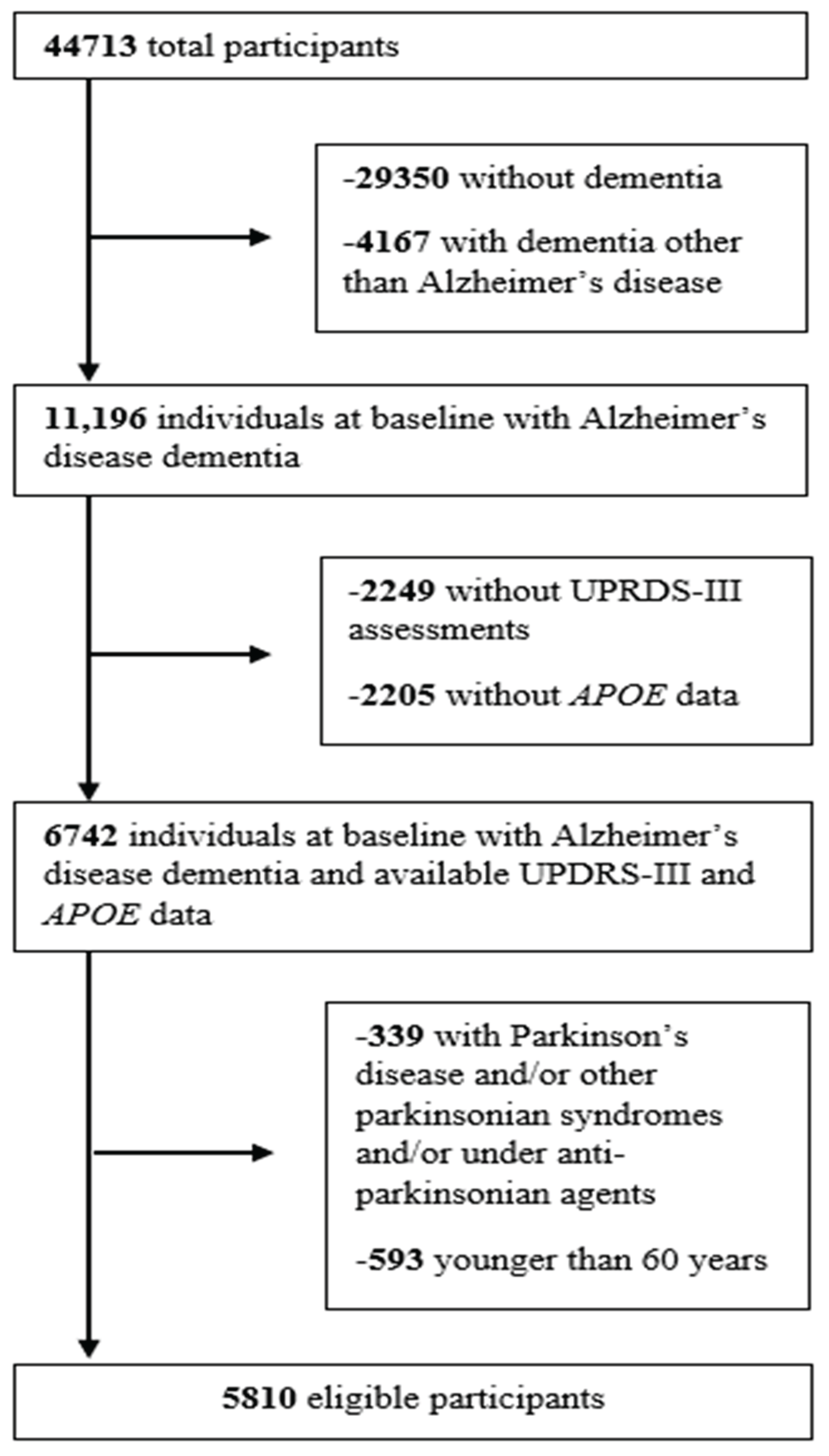
Figure 2.
Prevalence of motor manifestations per APOE genotype.
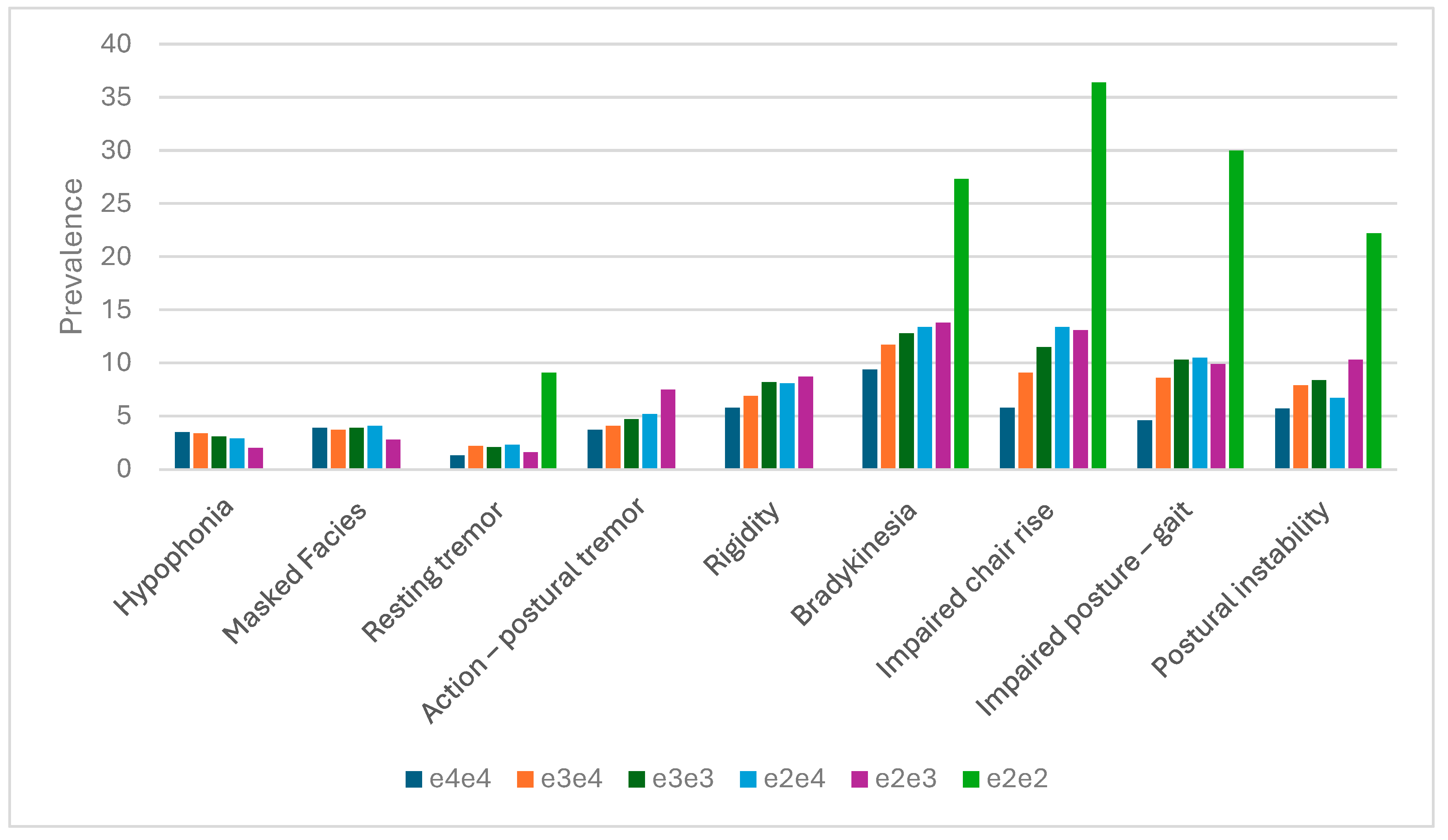
Figure 3.
Dose-response trends in the associations between APOE genotypes and motor manifestations.
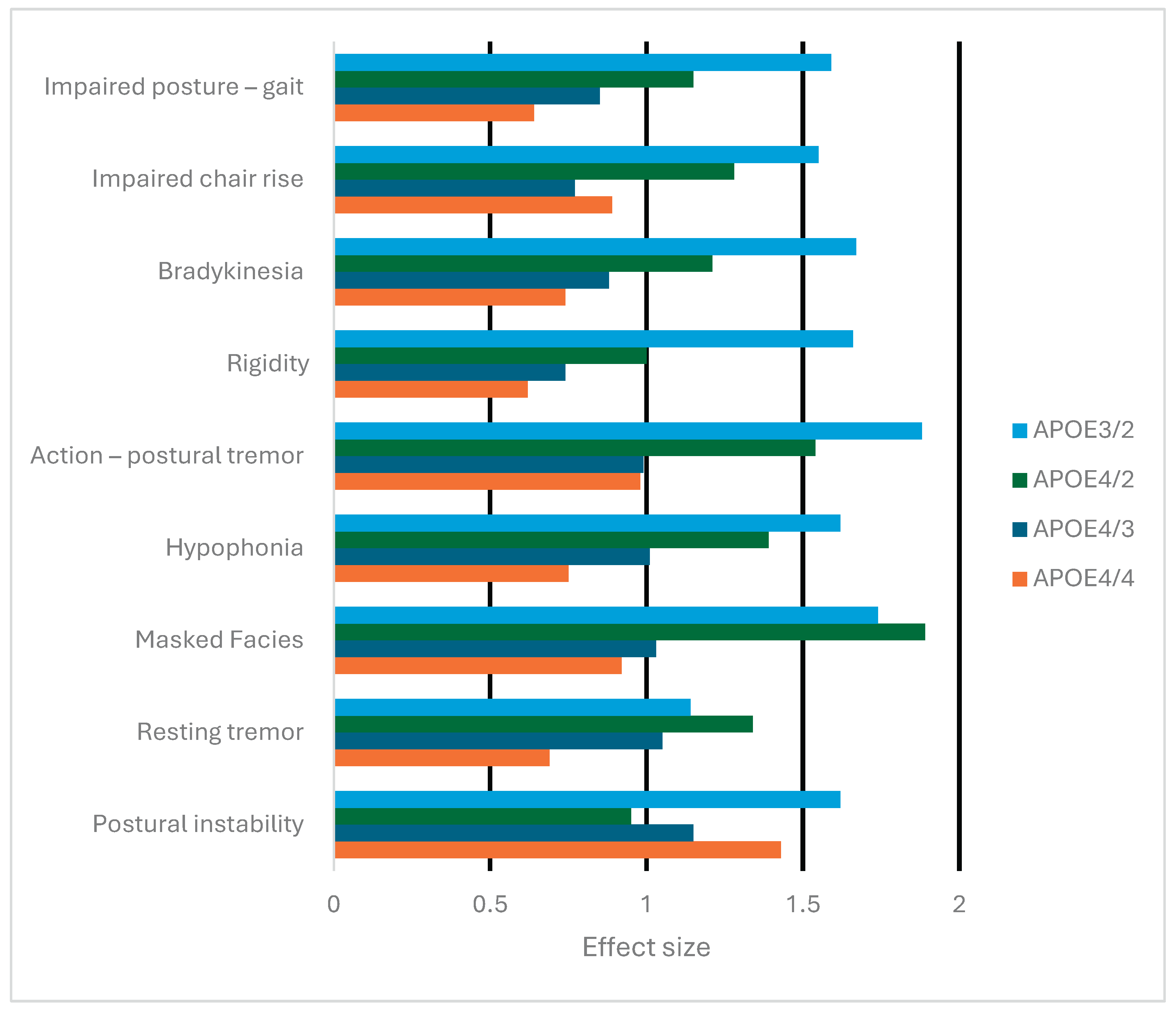

Table 1.
Participant characteristics per APOE group.
| Variable | APOE2 (N=389) | APOE3 (N=1799) | APOE4 (N=2791) | p-value |
| Age (years) | 77.6 ±8.1 | 77.9 ±8.3 | 75.3 ±7.4 | P< 0.001 |
| Sex (male/female) | 176/213 (45.2/54.8) | 850/949 (47.2/52.8) | 1227/1564 (44.0/56..0) | p= 0.092 |
| Education (years) | 13.9 ±3.5 | 14.0 ±3.9 | 14.4 ±3.5 | p= 0.001 |
| Race (Caucasian / African American / Asian / other) | 316/60/4/9 (81.2/15.4/1.0/2.3) | 1519/181/29/70 (84.4/10.1/1.6/3.9) | 2360/356/26/49 (84.6/12.8/0.9/1.8) | P< 0.001 |
| MMSE (30) | 21.63 ±4.8 | 21.0 ±5.5 | ±20.8 ±5.4 | p= 0.018 |
| GDS (15) | 2.8 ±2.8 | 2.6 ±2.6 | 2.4 ±2.5 | p= 0.001 |
| NPS (none/mild/ moderate or severe) | 73/127/189 (18.8/32.6/48.6) | 279/601/919 (15.5/33.4/51.1) | 456/973/1362 (16.3/34.9/48.8) | p= 0.362 |
| Global CDR (0.5/1.0/2.0/3.0) | 151/196/41/1 (38.8/50.4/10.5/0.3) | 605/868/279/47 (33.6/48.2/15.5/2.6) | 959/1357/415/60 (34.4/48.6/14.9/2.1) | p= 0.012 |
| Global motor variable (No / Yes) | 266/123 (68.4/31.6) | 1277/522 (71.0/29.0) | 2157/634 (77.3/22.7) | P< 0.001 |
| Hypophonia (No / Yes) | 383/6 (98.5/1.5) | 1770/27 (98.5/1.5) | 2753/38 (98.6/1.4) | p= 0.907 |
| Masked Facies (No / Yes) | 379/10 (97.4/2.6) | 1762/36 (98.0/2.0) | 2738/52 (98.1/1.9) | p= 0.638 |
| Resting tremor (No / Yes) | 382/7 (98.2/1.8) | 1768/31 (98.3/1.7) | 2747/44 (98,4/1.6) | p= 0.902 |
| Action – postural tremor (No / Yes) | 362/27 (93.1/6.9) | 1713/85 (95.3/4.7) | 2671/119 (95.7/4.3) | p= 0.062 |
| Rigidity (No / Yes) | 360/29 (92.5/7.5) | 1681/118 (93.4/6.6) | 2655/126 (95.5/4.5) | p= 0.002 |
| Bradykinesia (No / Yes) | 337/52 (86.6/13.4) | 1603/196 (89.1/10.9) | 2546/243 (91.3/8.7) | p= 0.003 |
| Impaired chair rise (No / Yes) | 341/46 (88.1/11.9) | 1606/181 (89.9/10.1) | 2601/171 (93.8/6,2) | P< 0.001 |
| Impaired posture – gait (No / Yes) | 349/39 (89.9/10.1) | 1635/157 (91.2/8.8) | 2628/149 (94.6/5.4) | P< 0.001 |
| Postural instability (No / Yes) | 342/30 (91.9/8.1) | 1613/129 (92.6/7.4) | 2563/171 (93.7/6.3) | p= 0.199 |
Scale variables are presented in mean ± standard deviation; categorical variables are presented in absolute numbers (proportions); p-value corresponds to among group differences; N: number of individuals; APOE: apolipoprotein; MMSE: mini-mental state examination; GDS: geriatric depression scale; NPS: neuropsychiatric score; CDR: clinical dementia rating scale.
Table 2.
Associations between APOE alleles and motor manifestations.
| Variable | APOE4 versus APOE2 | APOE3 versus APOE2 |
| Crude | ||
| Global motor variable (p< 0.001) | 0.64 (0.50, 0.80), p< 0.001 | 0.88 (0.70, 1.12), p= 0.307 |
| Hypophonia (p= 0.907) | 0.88 (0.37, 2.10), p= 0.775 | 0.97 (0.40, 2.38), p= 0.953 |
| Masked Facies (p= 0.640) | 0.72 (0.36, 1.43), p= 0.347 | 0.77 (0.38, 1.57), p= 0.480 |
| Resting tremor (p=0.902) | 0.87 (0.39, 1.95), p= 0.743 | 0.95 (0.42, 2.19), p= 0.917 |
| Action – postural tremor (p= 0.065) | 0.60 (0.39, 0.92), p= 0.019 | 0.67 (0.43, 1.04), p= 0.074 |
| Rigidity (p= 0.003) | 0.59 (0.39, 0.89), p= 0.013 | 0.87 (0.57, 1.33), p= 0.522 |
| Bradykinesia (p= 0.003) | 0.62 (0.45, 0.85), p= 0.003 | 0.79 (0.57, 1.10), p= 0.164 |
| Impaired chair rise (p< 0.001) | 0.49 (0.35, 0.69), p< 0.001 | 0.84 (0.59, 1.18), p= 0.306 |
| Impaired posture – gait (p< 0.001) | 0.51 (0.35, 0.73), p< 0.001 | 0.86 (0.59, 1.24), p= 0.421 |
| Postural instability (p= 0.200) | 0.76 (0.51, 1.14), p= 0.184 | 0.91 (0.60, 1.38), p= 0.662 |
| Adjusted | ||
| Global motor variable (p= 0.001) | 0.64 (0.50, 0.82), p< 0.001 | 0.75 (0.59, 0.97), p= 0.027 |
| Hypophonia (p= 0.623) | 0.64 (0.26, 1.56), p= 0.331 | 0.67 (0.27, 1.71), p= 0.404 |
| Masked Facies (p= 0.283) | 0.58 (0.29, 1.16), p= 0.127 | 0.58 (0.28, 1.17), p= 0.136 |
| Resting tremor (p=0.903) | 0.83 (0.37, 1.87), p= 0.652 | 0.85 (0.37, 1.96), p= 0.699 |
| Action – postural tremor (p= 0.047) | 0.58 (0.38, 0.91), p= 0.017 | 0.59 (0.38, 0.93), p= 0.024 |
| Rigidity (p= 0.004) | 0.53 (0.34, 0.81), p= 0.004 | 0.74 (0.48, 1.14), p= 0.176 |
| Bradykinesia (p= 0.002) | 0.56 (0.40, 0.77), p= 0.001 | 0.65 (0.46, 0.91), p= 0.013 |
| Impaired chair rise (p= 0.003) | 0.54 (0.37, 0.78), p= 0.001 | 0.69 (0.47, 0.99), p= 0.046 |
| Impaired posture – gait (p= 0.008) | 0.54 (0.36, 0.81), p= 0.003 | 0.67 (0.45, 0.99), p= 0.046 |
| Postural instability (p= 0.237) | 0.88 (0.57, 1.34), p= 0.545 | 0.73 (0.47, 1.13), p= 0.163 |
APOE: apolipoprotein; effect sizes and precision estimates represent odds ratios and 95% confidence intervals; between group differences were considered significant only if among group differences were significant at the stricter-corrected p-value of α= 0.005.
Table 3.
Associations between APOE genotypes and motor manifestations. Τhe APOE3/APOE3 genotype was used as reference.
Table 3.
Associations between APOE genotypes and motor manifestations. Τhe APOE3/APOE3 genotype was used as reference.
| Variable |
APOE4/ APOE4 |
APOE3/ APOE4 |
APOE4/ APOE2 |
APOE3/ APOE2 |
APOE2/ APOE2 |
| Global motor variable (p= 0.003) | 0.88 (p= 0.299) | 0.84 (p= 0.029) | 1.01 (p= 0.969) | 1.57 (p= 0.004) | 1.12 (p= 0.888) |
| Hypophonia (p= 0.906) | 0.75 (p= 0.512) | 1.01 (p= 0.982) | 1.39 (p= 0.662) | 1.62 (p= 0.397) | N/A |
| Masked Facies (p= 0.706) | 0.92 (p= 0.813) | 1.03 (p= 0.893) | 1.89 (p= 0.240) | 1.74 (p= 0.225) | N/A |
| Resting tremor (p=0.933) | 0.69 (p= 0.393) | 1.05 (p= 0.833) | 1.34 (p= 0.637) | 1.14 (p= 0.807) | N/A |
| Action – postural tremor (p= 0.206) | 0.98 (p= 0.924) | 0.99 (p= 0.943) | 1.54 (p= 0.236) | 1.88 (p= 0.021) | N/A |
| Rigidity (p= 0.013) | 0.62 (p= 0.041) | 0.74 (p= 0.034) | 1.00 (p= 0.999) | 1.66 (p= 0.045) | N/A |
| Bradykinesia (p= 0.006) | 0.74 (p= 0.094) | 0.88 (p= 0.259) | 1.21 (p= 0.505) | 1.67 (p= 0.015) | 4.12 (p= 0.062) |
| Impaired chair rise (p= 0.029) | 0.89 (p= 0.571) | 0.77 (p= 0.037) | 1.28 (p= 0.409) | 1.55 (p= 0.058) | 2.02 (p= 0.455) |
| Impaired posture – gait (p= 0.014) | 0.64 (p= 0.082) | 0.85 (p= 0.204) | 1.15 (p= 0.677) | 1.59 (p= 0.058) | 6.40 (p= 0.039) |
| Postural instability (p= 0.349) | 1.43 (p= 0.102) | 1.15 (p= 0.293) | 0.95 (p= 0.903) | 1.62 (p= 0.063) | 1.31 (p= 0.037) |
APOE: apolipoprotein; effect sizes represent odds ratios; N/A: non-applicable due to lack of ‘events’.
Disclaimer/Publisher’s Note: The statements, opinions and data contained in all publications are solely those of the individual author(s) and contributor(s) and not of MDPI and/or the editor(s). MDPI and/or the editor(s) disclaim responsibility for any injury to people or property resulting from any ideas, methods, instructions or products referred to in the content. |
© 2025 by the authors. Licensee MDPI, Basel, Switzerland. This article is an open access article distributed under the terms and conditions of the Creative Commons Attribution (CC BY) license (http://creativecommons.org/licenses/by/4.0/).
Copyright: This open access article is published under a Creative Commons CC BY 4.0 license, which permit the free download, distribution, and reuse, provided that the author and preprint are cited in any reuse.


