
Submitted:
18 June 2025
Posted:
18 June 2025
You are already at the latest version
Abstract
The nitrogen (N) requirement of sugarcane (Saccharum spp.) is very high due to the extensive growth of biomass. N fertilisers are applied excessively to ensure the optimum growth of sugarcane crop. Improper N management causes a decrease in nitrogen utilization efficiency (NUE) and contributes to nitrogen losses via leaching and gaseous emissions in the form of ammonia (NH3) and nitrous oxide (N2O), leading to unintended negative consequences. Asynchronous timing between the sugarcane N demand and supply by the N sources exacerbates these losses. Therefore, proper N management strategies need to be implemented to mitigate losses and enhance NUE. This review provides an overview of global sugarcane cultivation and discusses the N requirements for sugarcane crops. Additionally, it summarizes the various strategies utilized in N management for sugarcane cultivation and evaluates their effectiveness. Furthermore, it identifies research gaps and outlines future research directions.
Keywords:
biochar application
; enhanced efficiency fertiliser
; intercropping
; nitrogen utilisation efficiency
; simulation models
; split application
1. Introduction
Sugarcane (Saccharum spp. L.), a significant crop renowned for its diverse applications, is cultivated extensively on a global scale for purposes ranging from sugar production to biofuel (ethanol) generation, as well as the utilization of byproducts like bagasse and molasses for energy production and the distillation of alcoholic beverages [1]. Leading sugarcane-producing nations such as Brazil, India, China, Thailand, and Pakistan play crucial roles in the industry, with Brazil notably at the forefront [2]. The economic ramifications of sugarcane cultivation are profound, offering livelihoods to millions and making substantial contributions to agricultural sectors worldwide. Nonetheless, sustainability concerns have surfaced due to issues surrounding land use alterations, water consumption, and environmental impacts linked to cultivation practices, particularly concerning nitrogen fertilizer applications [3].
Sugarcane has a significant nitrogen (N) requirement owing to its faster growth and biomass accumulation. This high demand for nitrogen necessitates the use of fertilizers to ensure optimal growth and yield, making soil management practices crucial in sugarcane cultivation [4]. Nitrogen fertilizer recommendations for both plant and ratoon crops vary among countries, ranging from 40 to 500 kg N ha-1. However, the nitrogen use efficiency (NUE) of sugarcane ranged between 30% and 50%, showcasing that a large portion is losses to the environment [5,6]. These losses are mainly through leaching, NH3 volatilization, and nitrous oxide emission [7,8].
The average N losses from sugarcane cultivation ranged between 20-60% [9]. Poor management practices including excess N applications, untimely application, excess irrigation, surface application, and use of conventional application methods are some of the factors that exacerbate N losses [7,10]. These factors can lead to a lack of synchronization between the nitrogen demand of plants and their supply. Nevertheless, even under optimal management practices, nitrogen losses cannot be entirely eliminated, as they are a natural occurrence within the soil-atmosphere nexus [11,12].
Various strategies are employed to mitigate nitrogen losses in sugarcane systems, which can be broadly classified into good management practises, the use of crop simulation models, the use of precision agricultural tools, the use of enhanced-efficiency fertilisers, the use of biotechnology and genetic engineering and conventional practises (Figure 1). Adhering to good management practices and traditional techniques is crucial for reducing nitrogen losses, given that these methods are straightforward and cost-effective. On the other hand, implementing other strategies, which range from moderately to highly expensive and require technical expertise, can significantly enhance nitrogen use efficiency (NUE) despite the associated costs and complexities.
Limited research has been devoted to sustainable nitrogen management in sugarcane systems. For instance, Skocaj et al [3] delineated N management guidelines specific to the Australian sugarcane production system, while de Castro et al [8] explored optimal nitrogen fertilizer management practices within the context of green cane trash blanket adoption in Brazil. However, these studies primarily focused on regional practices, lacking a comprehensive global perspective. Moreover, they did not delve into the utilization of precision agriculture tools, biotechnology, genetic engineering interventions, or simulation models. This literature review aims to consolidate knowledge of nitrogen loss pathways and their environmental impacts, along with an overview of various strategies employed in nitrogen management for sustainable sugarcane production. The review also identifies research gaps and suggests future directions for sustainable nitrogen management in sugarcane cultivation.
2. Overview of Global Sugarcane Cultivation and Production
Sugarcane is an important crop grown mainly to produce sugar, biofuels and by-products like molasses and ethanol [13]. It grows best in warm, humid areas with plenty of rain, which is common in tropical and subtropical regions. The overview of the global production of sugarcane is shown in Figure 2 [2]. Brazil is the largest sugarcane producer in the world which contributes 25% to global sugarcane production in the year 2023/2024, following India with a contribution of 19% to global production [14].
The top ten sugarcane-producing countries in the world in 2022 were Brazil, India, China, Thailand, Pakistan, Mexico, Colombia, Indonesia, USA and Australia. Their corresponding productions were 37.77, 22.91, 5.42, 4.80, 4.59, 2.88, 1.83, 1.69, 1.64 and 1.50% (a total of 85%) of the world's total cane production [2]. The total extent of sugarcane cultivation was 21,575,278 ha, where 85.67% of land extent has been occupied by the top ten producing countries [2]. Brazil and India occupied nearly 45.75% and 23.98% coverage of the land extent, respectively. Sugarcane yield (kg/ha) obtained from these top 10 major sugarcane-producing countries placed 24th, 16th, 20th, 46th, 35th, 34th, 13th, 37th, 17th and 15th rank respectively from the overall 103 producing countries [2].
Sugarcane production increased steadily across the top seven producing countries from 1973 to 2013 (last 41 years). This growth was primarily due to the expansion of cultivation areas, while yield improvements also contributed significantly. Cultivated land extent grew remarkably in Brazil (500%), China (237%), Thailand (286%), and Pakistan (57%), whereas marginally increased in India (94%), Mexico (52%), and Colombia (61%) [15]. Yield gains were generally uncertain, with Thailand leading at 70%, followed by Pakistan (58%) and China (59%). In contrast, the USA had only a 31% rise in cultivated land extent and a slight yield decrease of 7% [15].
3. Nitrogen Requirement of Sugarcane
A sufficient level of nitrogen application is essential for sugarcane to maintain the optimum level of yield and maintain the quality of the yield [16]. The sugarcane plant growth curve and N demand curve follow a sigmoid pattern (Figure 3). Insufficient N application resulted in slower development, lower sugarcane yield, delayed maturity, less sugar accumulation, and lower-quality juice [16,17]. Nitrogen deficiency in sugarcane plants can make them more vulnerable to pests and diseases as it weakens the plants and makes them more susceptible to attacks. Farmers can ensure the vigour and health of sugarcane plants, making them more resilient against potential threats, by providing the correct amount of nitrogen needed for their growth and development [18].
During the early developmental stages, the percentage of nitrogen fertilizer was around 60%, gradually decreasing to 20% as the plants approached the harvesting stage [19]. Excessive N application is also not beneficial for sugarcane production for various reasons. Firstly, high N application can reduce juice quality or sugar content by causing a dilution effect, resulting in reduced sugar content in sugarcane stalks due to increased vegetative growth and biomass production [20]. Secondly, elevated N levels can delay the ripening process by prolonging the vegetative growth phase and inhibiting the accumulation of sugars in the stalks [21,22]. Thirdly, excessive N fertilization promotes vigorous vegetative growth and weakens stalk structure, increasing the risk of lodging or bending of the plants [22]. Hence, optimal nitrogen application is advantageous not only for economic and environmental reasons but also for maximizing sugarcane production efficiency.
The nitrogen requirement of sugarcane varies depending on multiple factors. Ratoon crops are more sensitive to nitrogen than plant crops, necessitating higher nitrogen application rates for ratoon crops [23]. The well-established root systems in ratoon crops enable higher nitrogen uptake, approximately 25% more than in plant crops [24]. For example, in Australia, N recommendations for plant and ratoon crops are 140-180 and 160-220 kg N/ha, respectively [25]. The current nitrogen fertilizer rate recommendations in the Australian sugar industry vary from 140 to 180 kg N/ha for plant crops and 160 to 220 kg N/ha for ratoon crops. Another contributing factor is cropping age, with older crops typically requiring less nitrogen fertilization due to increased exposure to the summer season. In the summer season, more mineralisation takes place decreasing the fertilisation requirement [22]. Moreover, the adoption of N-fixing crops in summer fallow minimises the N requirement of the next cropping cycle [11,26]. Compared to burnt harvesting practices, mechanical harvesting followed by the GCTB method can lead to an increase in N content in the soil over time after the adoption of this practice. Nearly 60% of N is provided by the GCTB method to the soil thus more favourable than burnt harvest [27]. Additionally, climatic and soil conditions also determine the N requirement. Therefore, the optimal nitrogen requirement for sugarcane varies from one system to another, depending on various the above-mentioned factors.
4. N Fertiliser Recommendations
Urea, a white crystalline solid with a nitrogen content of 46%, is commonly used in agriculture as both a fertilizer and an animal feed additive [28,29,30]. An average crop of sugarcane removes 208 kg of N at the yielding 100 tons ha-1 [31]. In Brazil, N fertilizer is applied at planting at rates ranging from 40 to 80 kg ha-1, typically incorporated into the planting furrow (Table 1). For ratoon crops, the N application rates are considerably higher, reaching 100 to 150 kg ha-1, either surface-applied or incorporated [32]. The N fertilizer requirement for cane crops in India depends on the topography and external factors of the country (Table 1). In northern India, about 150 – 180 kg ha-1 of N is required while in southern India, it ranges between 250 –350 kg ha-1 [31]. The annual requirement of N application rate in China for sugarcane usually reaches up to 500 – 700 kg ha-1 [33]. Nitrogen rate recommendations for sugarcane in Louisiana, USA, vary by crop age (plant cane or ratoon) and soil texture (light or heavy) (Table 1). In the 1950s, rates ranged from 45 kg N ha-1 for plant cane on light-textured soils to 112 kg N ha-1 for ratoon cane on heavy soils. By the 1980s, these recommendations increased to 90 kg N ha-1 for plant cane on light soils and 180 kg N ha-1 for ratoon cane on heavy soils [34].
As per the recommendation of the Sugarcane Research Institute of Sri Lanka, the application of urea (kg ha-1) is advised based on the soil type and irrigation type (Table 1). The sugarcane cultivated soil types in Sri Lanka are; Uda Walawe, Sevangala, Hingurana reddish-brown earth, Hingurana non–calcic brown soils, Hingurana alluvial soils, Kantale, Kilinochchi, Badulla and Low country Intermediate Zone (Mahiyanganaya, Padiyathalawa, Maha Oya) soils [35]. Urea requirement for cane is 300 kg ha-1 (at planting = 50 kg ha-1, 45 DAP = 100 kg ha-1, 90 DAP = 150 kg ha-1) and for ratoon is 325 kg ha-1 (after stubble shaving = 50 kg ha-1, 45 DAP = 125 kg ha-1, 90 DAP = 150 kg ha-1) for all soil types except Badulla. The urea amount required for sugarcane in Badulla region is 100 kg ha-1 (at planting = 25 kg ha-1, 45 DAP = 25 kg ha-1, 90 DAP = 50 kg ha-1) while for ratoon is 125 kg ha-1 (after stubble shaving = 50 kg ha-1, 45 DAP = 25 kg ha-1, 90 DAP = 50 kg ha-1). Under rainfed sugarcane cultivation, the urea requirement for canes in these soil types is 250 kg ha-1 (at planting = 75 kg ha-1, between 6 - 12 weeks after stubble shaving = 175 kg ha-1) while for ratoon is 275 kg ha-1 (at planting = 125 kg ha-1, between 6 - 12 weeks after stubble shaving = 150 kg ha-1) [35]. Sugarcane recommended in South Africa depends on the topography as inland, coastal lowland, natal midlands and lowlands, whereas the range of N recommended for plant cane and ratoons are 80 – 200 and 100 – 140 kg ha-1 [36] (Table 1).
5. Challenges in Nitrogen Management Within Sugarcane Farming
5.1. Nitrogen Losses to the Environment
Nitrogen losses from agricultural land are a major problem for different agricultural systems, including sugarcane production [41]. This leads to economic loss due to the waste of expensive resources, poor nitrogen utilisation efficiency (NUE), soil degradation, pollution of ground and surface water sources and GHG emission [42]. The nitrogen is predominantly lost via leaching and a small portion through gaseous losses such as ammonia (NH3), nitric oxide (NO) and nitrous oxide (N2O) [43]. In Australia, there has been a shift in nitrogen application practices from product maximization to profit optimization, with a primary focus on minimizing nitrogen losses [3]. Studies suggested that a maximum of 60% of the applied N is assimilated by the sugarcane cultivated in Australia [44,45]. The remaining nitrogen is either retained in the soil through organic matter or assimilated by microbes, or it may be lost to the environment.
The nitrogen use efficiency (NUE) in sugarcane systems varies across different regions, with values reported as 24-41% in Australia, 30-42% in the USA, 27-36% in South Africa, and 6.1-34% in Guadeloupe [22]. The lower NUE in sugarcane cultivation is often attributed to high losses via nitrate leaching. In the Australian context, average nitrate leaching losses range from 1-70 kg N/ha, accounting for nearly 1-40% of the recommended fertilizer application [41]. In Brazilian sugarcane production, the average nitrate leaching and runoff losses are around 0.1-8.5% and 0.08-5.8%, respectively [46]. Nitrate leaching is identified as the primary contributor to nitrogen losses in Chinese sugarcane systems, accounting for 10-45% of the applied nitrogen [9,20]. As such, controlling nitrate leaching losses is crucial to enhancing nitrogen use efficiency in global sugarcane production systems.
The average loss of ammonium through volatilisation from sugarcane cultivation varies from as little as 1% to as high as 31.2% of the applied nitrogen and it is influenced by factors such as the type of nitrogen fertiliser utilised, management practices and environmental conditions (Cantarella et al 2008; Oliveira et al 2023). In green harvested sugarcane, the trash left on the soil surface called “green cane trash blanketing (GCTB)” can accelerate nitrogen loss, with estimates ranging between 30-70% through NH3 losses. Following the application of nitrogen fertilizer to soil with sugarcane residue, the urease enzyme present in the residue hydrolyzes urea, leading to an increase in NH4+ levels in the soil compared to soil without residue [47]. Due to the limited capacity of sugarcane residues to retain NH4+ ions, they are susceptible to loss through NH3 volatilization [48].
The average nitrous oxide (N2O) emissions from sugarcane cultivation exhibit significant variation depending on nitrogen (N) fertilizer application rates and environmental factors. Studies suggest that cumulative N2O emissions can range from 0.3 to 4.1 kg N per hectare, with emission factors (EFs) falling between 0.7% and 2.4% of the applied N [49]. The moisture retained by the green cane trash blanket (GCBT) in the soil after N fertilizer application enhances the denitrification process [50]. This increased the N2O emissions at all rates of N fertilizer application (De Oliveira et al 2016). However, a study utilizing 15N labelling demonstrated that trash retention increased N2O emissions by 102% compared to trash removal, although the difference was not statistically significant [51]. Hence, it is essential to identify the reasons for the high nitrogen losses in the sugarcane system and implement corrective measures to ensure its sustainability in terms of nitrogen management.
5.2. Causes for Nitrogen Losses
It is crucial to identify the causes of nitrogen losses in the sugarcane system and implement mitigative measures. Factors contributing to nitrogen losses include excessive nitrogen application, untimely application, irrigation following fertilizer application, surface application of nitrogen fertilizer, application of nitrogen over crop residue, broadcast application, single application, and early application before the crop establishes a substantial canopy [20,52,53,54]. These poor management practices contribute to significant nitrogen losses.
The application of nitrogen beyond the recommended level in intensive sugarcane systems resulted in a 26% loss of the applied nitrogen. This can be attributed to the soil reaching its maximum threshold for retaining mineral nitrogen [55]. A very high application rate in China (400-800 kg N/ha) leads to N losses above 50% [56]. Studies showed that the application of urea on the surface or residue increased the NH3 volatilisation nearly by 38% [57]. Nitrogen recovery by plants decreased for fertiliser application on the reside compared to soil incorporation by 75% for both plant and ratoon crops [58]. According to Prasertsak et al [57], N runoff losses increased by 60% for surface application than subsurface application. Continuous water application through drip irrigation can elevate soil moisture levels, leading to increased soil mineralization. Hence, the practice of fertigation or fertiliser application for a field irrigated with drip irrigation should be approached cautiously to prevent over-application and potential nitrogen losses [59]. Therefore, the adoption of good management practices and improved sustainable nitrogen management strategies can help reduce nitrogen losses in sugarcane systems.
5.3. Environmental and Health Consequences of N Losses
The environmental and health consequences of nitrogen losses in sugarcane systems can have far-reaching impacts on ecosystems and human well-being. The significant environmental threats include groundwater and surface water contamination, greenhouse gas emissions, soil degradation, and eutrophication [42,60]. Numerous studies have highlighted the environmental impacts of nitrogen losses. The Burdekin region, known for sugarcane production in the dry tropics of Australia, exemplifies this issue. High nitrogen application rates in irrigated sugarcane production in this region threaten the ecosystem of the Great Barrier Reef (GBR), renowned internationally for its environmental and social significance. Nitrogen loss from sugarcane production in the Burdekin region leads to groundwater pollution, endangering drinking water sources [61] and causing a decline in water quality in coastal wetlands that support freshwater ecosystems [62].
Sugarcane expansion in Brazil increased soil degradation, groundwater contamination and GHG emissions [63]. Studies showed that vinase with N application increased the N2O emission by 5 times compared to bare land in south-central Brazil [54]. The cultivation of sugarcane on sloping lands contributes significantly to river contamination with reactive nitrogen species, accounting for approximately 14% of the contamination [64]. Moreover, studies have demonstrated that this nitrogen is a primary contributor to the eutrophication of water bodies [9]. A significant amount of ammonia is emitted from Brazilian sugarcane plantations, constituting approximately 19% of the emissions [9].
Nitrogen application rates in China are notably high, ranging from 400 to 800 kg N/ha, which is 3-10 times higher than in Brazil. The substantial nitrogen losses from sugarcane agricultural systems pose a significant threat to agroecological systems [56]. Research indicates that approximately 40% of groundwater sources in Guangxi, China's largest sugarcane-producing region, are contaminated with nitrogen species [65]. Nitrogen runoff and leaching losses are recognised as significant contributors to river pollution in the Guangxi region due to sugarcane cultivation [66,67]. All these examples from major sources of evidence demonstrate that nitrogen losses from sugarcane production systems pose a significant threat to environmental well-being.
6. Sustainable Nitrogen Management Practices
6.1. Split Nitrogen Application
Split application of N fertilizer is a technique that involves the application of required N fertilizers by splitting it into portions for the crop at the appropriate time [68,69]. This split N fertilizer application technique improves the plant N attenuation thus improving the crop yield [70,71], nutritional quality and reduced N losses [72,73]. In a Brazilian study, split N application was tested for the first ratoon and second ratoon stages into three harvest periods; autumn, winter and spring. The results showed an increase in yields by 3 to 7 Mg ha-1 and higher N responsiveness in autumn compared with spring and winter when the N fertilizers were applied 50% soon after harvest and 50% at the beginning of the rainy season [69]. In another Brazilian study, three different N application rates such as 40, 80 and 120 kg ha−1 were applied for sugarcane variety SP81 3250 as split applications [74]. These N applications were applied in splits of 75%, 13%, 7% and 5% for the plant cane, first, second and third ratoons, respectively. The maximum N recovery by sugarcane was 39% for 40 kg ha−1 followed by 35% for 80 kg ha−1. The highest application rate (120 kg ha−1) decreased the N recovery to 27%. However, sucrose levels was not significantly differ between treatments.
In India, the practice of split N application is largely contingent on the irrigation systems in place. The total nitrogen application levels differ based on the method of irrigation. In coastal and flow-irrigated areas, the recommended nitrogen application level is 275 kg per hectare, while in lift-irrigated regions with limited water availability, the application rate is 225 kg per hectare. For jaggery production regions, the recommended nitrogen application level is 175 kg per hectare. These prescribed nitrogen application levels are typically applied in three equal splits at intervals of 30, 60, and 90 days [75].
Over a two-year period, an investigation was conducted to evaluate the impact of administering 100% of the recommended nitrogen (N) dosage in four split applications: at planting, 30 days after planting (DAP), 60 DAP, and 90 DAP [76,77]. This regimen notably enhanced the shoot population by the 120th DAP, the stalk population by the 240th DAP, and the count of millable cane at the time of harvest. Consequently, this methodology led to a heightened cane yield of 85.4 metric tons per hectare, surpassing the outcomes achieved through the traditional method of applying 100% of the prescribed N in two separate doses at 45 DAP and 90 DAP.
In a field trial conducted in India during the spring season of 2020-21, it was observed that the application of nitrogen (N) in seven splits resulted in the highest counts of millable stalks (144.90 × 10³ ha⁻¹), increased internode length (9.31 cm), and elevated cane-to-top ratio (3.86), showcasing enhancements of 23.9%, 10.7%, and 82.9%, correspondingly. Split N application strategy also exhibited a statistically significant improvement in cane and sugar yields, with increments of 18.99% and 21.64%, respectively, compared to the conventional single N application method [76]. However, this study reported that quality parameters such as brix, sucrose, and commercial cane sugar were not significantly impacted by the split N application [76,77].
A similar two-year Indian study investigated the impact of a single application, 4, 6, 8 and 10 split N application with three irrigation methods such as flood, furrow and drip on the performance of sugarcane [70]. The study reported that 6 split N applications performed better than other treatments with top values in tiller count (165.6 × 10³ ha⁻¹), millable canes (116.3 × 10³ ha⁻¹), cane yield (154.72 t ha⁻¹), commercial cane yield (23.39 t ha⁻¹). All the tested split N applications performed better than a single application for the above parameters. A Pakistani study found that N dose and timing of split N application significantly affected most growth parameters in sugarcane, with the highest cane and sugar yields at 252 kg N ha-1 in two equal splits. Higher N rates (336 kg ha-1) also enhanced crop growth rate and leaf area but showed a lower NUE [78].

Table 2.
Split application of N for sugarcane.
| Country | No. of Splits | Split levels | Main finding/s | References |
|---|---|---|---|---|
| Brazil | 2 | 50% of recommendation | Increase in yield | Tenelli et al [69] |
| 4 | 75%, 13%, 7% & 5% of recommendation | Increase in sucrose level | Franco et al [74] | |
| India | 3 | 30, 60 & 90 days after planting | Enhance the quality and quantity of sugarcane for jaggery production | TNAU [75] |
| 4 | 100% (at planting, 30, 60 & 90 DAP) | Improved shoot population at 120 DAP, stalk population at 240 DAP and millable cane population at harvest | Lakshmi et al [77] | |
| 7 | 18.99 and 1.64% higher than the recommended level | 23.9 % increase in millable stalk count, 10.7% increase in internode length, 82.9% increase in cane-to-top ratio | Bhilala et al [76] | |
| 5 | Normal farmer application, 4, 6, 8 & 10 splits | 6 splits N application showed an increase in yield (6 splits > 8 splits > 10 splits > 4 splits > farmer’s practice under drip irrigation) | Singh et al [70] | |
| Pakistan | 2 | 252 kg N ha-1 in 2 equal splits | Higher N rates (336 kg ha-1) also enhanced crop growth rate and leaf area but had lower nitrogen use efficiency. | Ghaffar et al [78] |
| Iran | 2 or 3 | 92 kg N ha-1 and an application pattern of 30-30-40% | Increase the juice purity at 90% application | Koochekzadeh et al [79] |
A few studies reported that split applications did not affect the sugarcane yield and other agronomic parameters. For example, an Iranian study showed that application rates and split application of N fertilizer did not significantly influence sugarcane characteristics [79]. However, this study reported that an interaction between the N application rate and the application pattern (AP) affected juice purity, with the combination of 92 kg N ha-1 and an AP of 30-30-40% producing the purest juice at 90%. Kingston et al [73] reported split N applications did not provide an advantage in the final N uptake or yield of sugarcane.
All these findings emphasise that split N application in sugarcane farming enhances growth, yield, and N use efficiency while reducing environmental losses. Applying N in phases aligned with crop growth stages outperforms conventional methods in productivity and economic returns. However, its effectiveness varies with soil, irrigation, and local conditions, requiring tailored strategies for optimal results.
6.2. Use of Slow-Release or Controlled-Release Nitrogen Fertilizers
Slow-release fertilisers (SRFs) or controlled-release fertilisers (CRFs) are proven methods of controlling nitrogen losses [80]. It is well-documented that SRFs have significantly minimised the N losses while increasing the yield in sugarcane. A study conducted by Rathnappriya et al [81] reported that the application of coated SRNF significantly (P<0.05) increased the DM yield in plant cane by 0.5 ton/ha compared to urea, but DM yield was comparable for SRNF and urea in the ratoon crop. In the first season (plant cane), nearly 16 kg N/ ha of nitrate leaching loss was controlled by SRNF than urea. However, in the ratoon crop, only 3 kg N/ ha of nitrate leaching loss was controlled by SRNF compared to urea. Application of SRNF (Osmocote®) in sugarcane seedlings significantly (P<0.05) increased the shoot and root DM more than conventional N fertiliser [82].
A few studies reported non-significant or negative effects of SRNFs on either DM yield and/or N losses. For example, a study tested nano-N chelated (NNC) SRNFs on sugarcane and found that both DM yield and nitrate leaching losses were similar for NNC and urea even at different application rates between 80-161 kg N/ ha [30]. Unexpectedly, the application of polymer and sulphur-coated urea (PSCU) significantly (P<0.05) increased the release of N2O by 35% and 46%, in the first and second ratoon cane, respectively [83]. The reason for this could be the lock-off effect of fertiliser within the coatings. This prevents the availability of N for plant uptake and allows microbes to denitrify it to N2O [43].
The effectiveness of SRNFs is contingent upon various factors, encompassing climatic conditions like rainfall and temperature and soil parameters including soil moisture, soil temperature, and microbial activity. In addition to external factors, internal elements such as the type of SRNF, release pattern, and application period also play a crucial role in determining the success of SRNFs [84]. Hence, the application of SRNFs should be conducted judiciously and appropriately to mitigate potential adverse effects and optimize their benefits.
6.3. Use of Urease Inhibitors
Urease inhibitors are used to minimise or control the hydrolysis of urea molecules to ammonium ions by inhibiting the urease enzyme [85]. A variety of chemical substances, including natural and synthetic organic molecules and metallic ions, have been identified as inhibiting urease enzyme activity. The application of urease inhibitors is reported to control the N losses in sugarcane cultivation.
A study focused on the optimization of urease inhibitor usage to reduce NH3 emission following urea application over crop residues, focusing on the green sugarcane trash blanket (GCTB) systems in Brazil [86]. The findings indicated that with the increase in N-(n-butyl) thiophosphoric triamide (NBPT) concentration, the timing of the peak loss rate was delayed, leading to a decrease in cumulative ammonia loss. This relationship exhibited linearity up to a concentration of 1000 mg/kg of NBPT. However, further increases in NBPT concentration did not significantly reduce ammonia volatilization. A similar study reported that NBPT decreased NH3 emission significantly (P<0.05), but had no impact on DM yield of green sugarcane cultivation in Brazil [87]. Nevertheless, this study proposed that application rates of NBPT exceeding 530 mg/kg of urea do not influence NH3 loss, a finding that contradicts the results of a prior study. This could be due to the interaction effect of other climatic and soil factors.
Gallucci et al [88] used boric acid as a urease inhibitor with the application of nitrogen-enriched vinasse in a sugarcane field. Ammonia volatilisation was significantly (P<0.05) controlled by boric acid + urea treatment compared to urea alone. However, sugarcane DM yield and leaf N content were not significantly different between both treatments. According to the findings of Otto et al [89], boric acid and phosphoric acid-treated urea, mono-ammonium phosphate (MAP) and NBPT did not significantly reduce the NH3 loss compared to urea and a mixture of urea and NH4NO3 in the laboratory study. Nevertheless, in the field experiment, boric acid and MAP decreased the cumulative NH3 loss by around 50%.
6.4. Use of Nitrification Inhibitors
Nitrification inhibitors delay the nitrification process, resulting in the retention of NH4+ ions in the soil. As a result, plants are able to uptake these ions, leading to a reduction in N2O emissions [80]. Nitrous oxide (N2O) is a major greenhouse gas in Brazil, with agriculture being the primary contributor to its emissions [90]. The new trend of applying vinasse to the sugarcane field increased the N2O emission from 1.1% to 3% which demands new ways of controlling N2O emission (Signor et al. 2013). Towards this end, a study tested dicyandiamide (DCD) and 3,4 dimethylpyrazole phosphate (DMPP) in ratoon crops for two cycles [83]. Compared to urea application alone, DCD and DMPP application with urea significantly (P<0.05) decreased N2O emission by 95% and 98%, respectively, in the first year. The corresponding significant (P<0.05) reduction in the second year was 81% and 100%. In a comparable study, the application of DCD with urea significantly (P<0.05) reduced NH3 emissions by 14-16% when compared to urea alone. This effect was more pronounced at higher urea application rates, particularly in the range of 100-150 kg N/ha (Barth et al 2020). These results showed that DCD and DMPP can be used in ratoon crops for controlling gaseous losses.
In the first step, ammonia-oxidizing archaea (AOA) and ammonia-oxidizing bacteria (AOB) are involved, and in the second step, nitrate-oxidizing bacteria participate in the nitrification of ammonium [91]. Li et al [92] showed that the application of DMPP with urea suppresses the growth of AOB in highly acidic sugarcane soil. However, the incorporation of biochar with them decreased the effectiveness of DMPP as it is absorbed by the biochar. Nevertheless, this study found that biochar application alone with urea inhibited the AOB growth.
A simulation study with DayCent modelling software evaluated the effectiveness of using soybean fallows and DMPP in Australian sugarcane cropping systems [93]. According to the findings, DMPP-coated urea abated overall N losses by 41% and N2O emission by 30% without compromising the yield. An Australian study showed that DMPP-coated urea was not effective in controlling N2O emission and DM yield of sugarcane compared to urea at 100 and 140 kg N/ ha application levels [94]. However, this study pointed out that the application of DMPP with urea decreases fertiliser N application from the normal recommended rates (160-180 kg N/ ha).
A study evaluated the effectiveness of DMPP and herbicides (atrazine and glyphosate) in controlling N losses in sugarcane soils collected from Australia [95]. DMPP significantly (P<0.05) decreased N2O emission until 14 days whereas atrazine and glyphosate controlled up to 7 days only. The study suggested that DMPP, atrazine, and glyphosate can decrease soil nitrification and denitrification rates by inhibiting microbial gene abundances in AOA and AOB, with DMPP being most effective in reducing N2O emissions in sugarcane cropping soil.
6.5. Incorporating Biochar
Several organic amendments including biochar, lignite and charcoal are being used to improve the soil conditions and yield in different agricultural systems. Studies showed that biochar application decreased the N leaching losses from sugarcane fields [96,97]. A study found that biochar derived from sugarcane bagasse reduced NH4-N and NO3-N losses by 33–167% and 35%, respectively, in sub-tropical regions [98]. Eykelbosh et al [99] found that biochar application was as effective as vinasse application in controlling NO3-N leaching losses. However, due to its stability, biochar may offer more consistent control over time compared to vinasse. The active sites in biochar trap reactive nitrogen species, thereby reducing leaching losses [100]. An intubation study on highly acidic sugarcane soil reported that biochar inhibits the nitrification process also contributing to loss control [92]. A few studies reported that the application of biochar decreased the N2O emission. According to Abbruzzini et al [101], sugarcane straw biochar reduced N2O emissions by 24% and 34% in sandy and clayey soil, respectively. Butphu et al [102] found that biochar increased the sugarcane yield and N uptake by 41% and 70%, thus increasing the NUE by 118%. Further studies are needed to enhance our understanding of the impact of biochar on mitigating nitrogen losses in sugarcane systems.
6.6. Precision Agriculture Tools
Precision agricultural tools have transformed the approach to N management in sugarcane production. These advanced tools leverage state-of-the-art technology, canopy reflectance sensors, chlorophyll meters and electrical meters, to offer farmers real-time field information, enabling them to apply nitrogen more precisely and efficiently [103,104]. Crop canopy reflected sensors are simple tools to measure the nitrogen status of sugarcane crops [105]. This sensor measures the amount of red and near-infrared wave reflection of a leaf surface at a particular wavelength to measure the chlorophyll content in the leaf. GreenSeeker, Crop Circle, Yara-N sensor and N-SensorTM are among the well-known brands of canopy reflection sensors used in agriculture. In a comparative study, the Normalized Difference Vegetation Index (NDVI) calculated from the Crop Circle ACS-430 sensor using a red-edge waveband (NDRE) exhibited the highest accuracy and sensitivity on sugarcane when compared to the Crop Circle ACS-210 and GreenSeeker sensors [105]. N-SensorsTM is used to measure the leaf N content in sugarcane to support variable rate application of nitrogen for sugarcane [106]. This sensor showed consistent performance irrespective of sugarcane variety, soil type and growth stages of sugarcane. Other optical sensors such as visible spectrometers and hyperspectral sensors are also used in the N management of sugarcane. In sugarcane, 717 nm was found to be the most influential wavelength in measuring the N content for the Visible micro spectrometer [107]. Studies reported that 530–570 nm, 680–750 nm, and 750–1300 nm hyperspectral ranges are most suitable for predicting the N status in sugarcane [108].
Apart from these, chlorophyll meters (SPAD) are widely used in the N measurement of sugarcane. Chlorophyll meters operate by assessing the ratio of transmitted red and near-infrared light through a plant leaf [109]. Several studies used chlorophyll meters such as measuring the leaf N content under drought conditions [110] and measuring leaf N supply under low temperatures [111]. A few attempts were made to measure the leaf N content using image processing [112,113]. All these methods are non-destructive and give informed decisions about the N status of the crop in real-time. Therefore, the farmer can take immediate precautions to avoid over or under-application of N fertilizer.
6.7. Legume Inter or Rotational Cropping
Intercropping with legumes has attracted much attention worldwide, regarded as a sustainable alternative to chemical N fertilizers [114]. The incorporation of legume cover crops in cash crops like sugarcane is one of the major practices followed in all types of farming techniques [115,116]. Sugarcane cultivation with green manure legumes resulted in a 27–43% increase in spring sugarcane yield and contributed 41–71 kg N ha⁻¹ through biological N fixation [117]. In sugarcane cultivation, legume cover crops like Crotalaria spectabilis [26,69], Crotalaria junceae L. [118], soybean [119], cowpea [119], Sesbania aculeata, Melilotus alba [120,121] are integrated for elevating the biological N fixation in the soil. This, as a result, increases the level of N in the soil, reducing the need for chemical fertilizers and thus enhancing sustainable sugarcane production [4,69,115,116] and also these incorporations of legume crops during the renovation period of sugarcane will lead to the reduction of pest infestation, weed suppression and soil erosions [114]. Also, these legume cover crops are selected in order to establish association with bacteria and fix atmospheric N into the soil with their special abilities [118,122].
About 3.34% average sugarcane yield is reduced globally due to legume intercropping in the sugarcane farming system [123] while sugarcane shows positive responses when being rotated with a legume, with stalk yield improvements ranging from 15 – 25% in Australia [118,124] and up to 30% in Brazil [118,125]. Tenelli et al [69] evaluated the impact of legume cover crops (Crotalaria spectabilis) on N sustainability in sugarcane production, focusing on N fertilizer reduction. In both sandy and clayey soils, treatments with different nitrogen fertilizer rates (60, 120, and 180 kg N ha−1) and control were applied after plant-cane harvest. Results showed that the cover crop increased soil N storage and microbial biomass carbon. Sugarcane ratoon yields responded more positively to N fertilization under bare fallow, but cover crops enhanced yields by 9% in sandy soils and 15% in clayey soils compared to bare fallow. The cover crop also replaced 9 and 15 kg N ha−1 annually in sandy and clayey soils, respectively.
The study conducted in South Brazil showed that incorporating sun hemp (Crotalaria junceae L.) during the sugarcane renewal period can replace 60 kg ha⁻¹ of N at planting, enhance stalk yield by 20 Mg ha⁻¹ over two ratoon cycles and improve NUE by reducing the N required per unit of stalk harvested by 12.5%. Additionally, sucrose content and sugar yield increased under the rotation system, promoting sustainability by reducing reliance on synthetic N fertilizers. However, soil inorganic N dynamics and plant N content were minimally affected by the rotation. This approach demonstrates a practical strategy to enhance bioenergy crop sustainability [118]. These pieces of evidence prove that legume cover crops and intercropping in sugarcane farming enhance soil health, boost N fixation, reduce fertilizer reliance, and support higher yields.
6.8. Application of Biofertilizers
Biofertilizers are sustainable, eco-friendly agricultural inputs derived from renewable sources, offering a low-cost, non-bulky alternative that complements chemical fertilizers like urea, ammonium sulphate and ammonium nitrate [116]. This biofertilizer enriches the soil with organic matter (manures, composts and waste matters), provides an advantage over mineral fertilizers and has gained consideration as a sustainable alternative for use in sugarcane and other crops [126,127].
Several studies have indicated that biofertilizers produced comparable results to those obtained with urea fertilizers. For example, a biofertilizer with a 40% reduced N load, formulated with a 50:50 mix of N from recycled waste and mineral fertilizer, demonstrated superior performance over traditional mineral fertilizers. When combined with plant growth-promoting rhizobacteria (PGPR), this bio fertilizer also enhanced bacterial and fungal associations with sugarcane, potentially contributing to improved crop yield [126]. Also, biofertilizers enriched with effective PGPR can enhance nutrient use efficiency by mineralizing, solubilizing, mobilizing and supplying N to plants[126].
A systemic biofertilizer containing Pseudomonas fluorescens, Azospirillum brasilense, and Bacillus subtilis was tested on two sugarcane varieties (NCO-310 and Mex 57–473) across three locations in Mexico [128]. The biofertilizer, which enables bacterial entry through the stomata, was applied at three doses per hectare throughout the annual production cycle: once per year at Potrero Nuevo and Champotón, and for six years at Ameca. Results showed a significant (P<0.05) increase in sugarcane yield at each location: 2.5 times increase (73.7 tons ha-1) at Potrero Nuevo, 1.9 times increase (77.7 tons ha-1) at Ameca, and 1.4 times increase (23.8 tons ha-1) at Champotón. The biomass increase was primarily due to enhanced tillering rather than changes in stalk height or diameter. Additionally, the biofertilizer improved sugar quality, with an increase in °Brix (2.6°) and sucrose content (0.7%) [128].
de Mendonça et al [129] compared the effects of biofertilizer (from cattle shed wastewater) and urea at various N doses (0, 16, 48, 64, 80, and 96 kg ha−1) on two sugarcane varieties (RB 867515 and SP 803280). The results showed that 80 kg ha−1 application of biofertilizer increased °Brix values above 21% for cultivar RB 867515 yielding 147.5 tons ha−1 and SP 803280 yielding 152.25 tons ha−1. There were no significant yield differences between biofertilizer and urea for both cultivars (P < 0.05). The biofertilizer also improved crude protein content in cultivar RB 867515. Doses of 64-96 kg N ha−1 resulted in similar growth and biomass yields, suggesting that biofertilizer can replace urea as an N source, with 80 kg N ha−1 being optimal for sugarcane cultivation.
6.9. Site-Specific N Application
Site-specific N application ensures the field receives an even amount of N fertilisers thus minimises the risk of over-application and subsequent losses. A few studies reported that site-specific applications are effective in improving NUE and controlling N losses. For instance, a four-year field study demonstrated that variable rate application of lime, N, K and P improved soil nutrient distribution, while maintaining stable yields (~80 Mg ha⁻¹ year⁻¹). Even with similar yields compared to conventional N application, site-specific fertilizer application delivered significant economic and environmental benefits, including reduced production costs, enhanced soil fertility and lower climate impacts through decreased N usage [130,131,132]. This approach is especially critical under tropical conditions, where soil fertility is an important limitation and sugarcane benefits from nutrient availability in both surface and deep soil layers [133]. Precision agriculture, particularly N site-specific management, enhances sustainability and profitability in sugarcane cultivation [132].
Foliar analysis has been utilized in sugarcane cultivation for the planning and evaluation of fertilizer management programs and harvest scheduling. A study conducted in the USA assessed the effectiveness of soil testing and foliar analysis interpreted using the Critical Nutrient Level approach and the Diagnosis and Recommendation Integrated System (DRIS) as tools for guiding sugarcane fertilization. The findings indicated that, for the first time, N application was recommended on Torry muck soil (euic, hyperthermic Typic Medisaprist) based on foliar analysis incorporating both soil testing and DRIS methodologies [134].
Amaral et al [105] employed canopy reflectance sensor readings for variable-rate N application in sugarcane. The normalized sensor data effectively predicted yield variations across fields. An algorithm was created to apply higher N rates in high-yield areas, offering a favourable approach for optimized N management. According to the authors, further field validation and research on biomass variability is needed to improve the algorithm’s accuracy and efficiency for site-specific N management. Precision agriculture and tools like foliar analysis and canopy sensors optimize N management in sugarcane by addressing spatial variability. These site-specific methods improve NUE, soil fertility and sustainability while providing economic and environmental benefits.
6.10. Use of Nitrogen-Efficient Sugarcane Genotypes
Choosing a highly nitrogen-sensitive sugarcane variety can also enhance NUE. Several studies aimed at finding better genotypes which yield better sugar content at lower application levels. A study conducted in China examined the optimal sugarcane variety for low and moderate nitrogen application rates, identifying ROC22 and GT42 varieties as suitable for low and moderate nitrogen application levels, respectively [71]. Three different variety tested studies found that compared to C0775 and SL7130, SL8306 showed higher biomass accumulation under Sri Lankan conditions (Kumara & Bandara, 2001). An Ethiopian study found that D42/58 has a yield of 9.1% sucrose than the NCo-334 variety [16]. In general, most of the sugarcane varieties are low responsive for the N and therefore, more hybrid varieties need to be developed for better NUE that suits their conditions [135].
7. Good Management Practices in Nitrogen Management for Sustainable Sugarcane Cultivation
Good nitrogen management practices include fertiliser application beneath the residue, subsurface N application, N application closer to the root zone, correct timing of N application, N budgeting and optimal N application (Figure 4). Several studies have confirmed that these practices enhance agricultural productivity while minimizing environmental impacts.
7.1. Fertiliser Application Beneath the Residue
Fertilizer placement beneath residue impacts root distribution and NUE in sugarcane. Unfertilized plots showed deeper root growth, with 50% of roots found at 20–60 cm depth, compared to 30% in fertilized plots concentrated near the surface [136]. Efficient nitrogen remobilization from shoots to below-ground tissues before harvest reduces N removal and supports ratoon crops, with below-ground biomass accounting for 15-60% of above-ground biomass and up to 41% of plant N [137].
Residue retention improves yields, soil health, and nutrient availability. Research indicates that there is no substantial decrease in yield when urea is applied on the soil surface as opposed to beneath it, underscoring the importance of residue decomposition in mitigating the requirements for fertilizers [138]. Residue retention has increased yields by 10 t/ ha annually compared to burnt systems and enhances soil moisture, organic matter, and nutrient cycling [139]. These practices ensure the potential of residue management for sustainable sugarcane cultivation.
7.2. Subsurface Fertiliser Application
Subsurface application of nitrogen (N) fertilizer is recommended for sugarcane as surface application leads to ammonia volatilization and reduced yields. Methods like stool splitting effectively place fertilizer within the soil, reducing N loss in green cane trash blanket (GCTB) systems [3]. In areas where subsurface application is impractical, strategies such as applying urea in bands, incorporating it with water, or waiting for sufficient canopy growth can minimize volatilization losses [140]. However, while subsurface application reduces ammonia loss, it may increase denitrification and leaching, requiring careful management to mitigate residual nitrate accumulation in the soil [141].
Liquid N fertilization has shown improved sugarcane yields compared to broadcasting methods, offering an alternative for efficient N delivery [78]. Nutrient availability also influences root activity and distribution. Under full irrigation, the uptake of mineral N from the top 1 m of soil varied with application rates. In experimental plots without N fertilizer, mineral N was removed from both row and inter-row positions. In contrast, with 120 or 180 kg/ha of N fertilizer, N removal from inter-rows was absent, and mineral N removal from 1.5 m depth was lower at higher application rates [141].
7.3. Application Closer to the Root Zone
Applying nitrogen closer to the root zone is known as banding in the sugar cane industry [58]. It improves nutrient uptake efficiency, reduces nitrogen loss through leaching, and runoff, enhances root development and ensures targeted delivery of nutrients leading to better crop growth and higher yields [142].
7.4. Timing of Fertiliser Application
The timing of nitrogen (N) fertilizer application is important to match the crop's demand for N during different growth stages, ensuring efficient nutrient use and optimal yields. In plant cane, N is often applied in split doses which is a basal application at planting to support root establishment and early shoot growth followed by top-dressing during the tillering stage (30–60 days after planting) to promote tiller development and canopy formation. The final application occurs during the grand growth stage (90–120 days after planting) to support rapid stalk elongation and biomass accumulation. Late-season N application is avoided to prevent reduced sucrose content and delayed harvest [137].
For ratoon crops, fertilization is best timed when the plants are actively growing and about 0.5 m high, as newly developed root systems can efficiently utilize N at this stage. Synchronizing applications with rainfall or irrigation further enhances nitrogen use efficiency (NUE) and minimizes losses [143]. Studies show that sugarcane absorbs only 25–30% of its total nutrient demand during the tillering phase, emphasizing the need for an early, high concentration of N to support tiller formation, which directly impacts yield potential [144]. For short-duration cultivars under assured irrigation, applying 150 kg N/ha at planting has proven effective, but higher doses may be split across three applications under subtropical conditions. Early fertilization, particularly at planting, results in maximum yields and better juice quality, highlighting the critical early-stage nitrogen requirement [145].
Long-term studies have shown that ratoon crops often outyield plant crops and mature earlier with better quality canes when higher N levels are applied. For example, ratoon crops fertilized with 60–180 kg N/ha have shown consistent yield increases regardless of fertilizer placement [146]. However, while higher N rates generally boost yield, excessive N can reduce juice quality, necessitating careful management. To minimize denitrification losses and maintain N availability throughout the growing season, additives like N-serve and Nitrepyrin are recommended for sugarcane fields [147]. Effective timing of N fertilizer applications, tailored to the crop's growth stage and environmental conditions, is essential for maximizing productivity while maintaining sustainability.
7.5. Nitrogen Budgeting
Nitrogen budgeting is a strategy to optimize nitrogen use for better yields while minimizing environmental impacts. It involves balancing nitrogen inputs like fertilizers, atmospheric sources, and biological fixation and outputs like crop uptake, harvest removal, leaching, runoff, and volatilization [148].
7.6. Optimum N Application Rate
Optimum nitrogen application helps to maximize sugarcane yield and quality as it is a precise amount of nitrogen fertilizer required while minimizing environmental impacts, nutrient losses, and economic costs [78]. The optimum nitrogen application rate for sustainable sugarcane cultivation varies globally depending on factors such as soil characteristics, crop variety, and management practices [16]. In many countries including Brazil, N fertilizer recommendations are based on the concept of expected yield [149].
This approach shows that supplying N to maximize crop growth during the initial stages, while the soil fulfils the major N demand through the mineralization of soil organic matter. N rate in Brazilian sugarcane fields ranges from 60 to 100 kg/ha which is significantly lower than the rates in other countries, such as 150 to 400 kg/ha in India and 100 to 755 kg/ha in China [137]. Split N applications and the use of precision agriculture further enhance nitrogen use efficiency (NUE), reducing environmental impacts and input costs. For example, soil and plant testing in Brazil has reduced fertilizer use by 10–15% without compromising yield [150]. These strategies, tailored to local conditions, underscore the importance of sustainable N management to achieve high productivity and environmental conservation.
8. Adopting Simulation Models for N Management
Simulation models are valuable tools in agriculture for supporting sustainable N management by offering advantages by optimising the N application level, predicting the N losses, and predicting the NUE. Simulation enables the forecasting of outcomes, aiding in long-term planning for nitrogen management. Additionally, simulations allow for extended long-term projections, which can be challenging to achieve experimentally over extended periods [151]. Several simulation models such as SUCROWS I, AUSCANE, CANEGRO, QCANE, CENTURY-Sugarcane and APSIM-Sugarcane are developed for simulating the yield and sugar content of sugarcane (Table 3). Of them, AUSCANE, CENTURY-Sugarcane and APSIM-Sugarcane have the ability to simulate the N limitation to growth [45].
Due to the costly and time-consuming nature of monitoring nitrogen leaching losses, simulation models are employed as a cost-effective alternative for this purpose. In a study conducted in Australia, a combination of the Agricultural Production Systems Simulator (APSIM) and soil-water and nitrogen transformation modules (SWIM) was utilized, referred to as APSIM-SWIM, to simulate nitrate leaching in sugarcane systems [152]. The study demonstrated reasonable predictions of nitrate leaching at a depth of 1.5 meters. However, the accuracy of predictions was challenged by preferential flow (Table 3). In a comparable study, nitrogen leaching losses in the plant crop, first ratoon crop, and second ratoon crop were forecasted with R2 values of 0.95, 0.98, and 0.98, respectively, using CANEGRO [153]. These results suggest that commonly used models such as APSIM and CANEGRO can be effectively employed to forecast nitrogen leaching losses, enabling adjustments in nitrogen fertilization to minimize these losses (Table 3).
A few studies employed simulation models to predict the N2O emission from agricultural soils. These models incorporate the factors that mainly influence N2O emission including soil moisture, organic matter content, plant N uptake, N management practices and other climatic factors [45]. APSIM with denitrification sub-model was used to model the N2O emission in Australian sugarcane production systems [154]. This study found a close relationship between measured (2.9 kgN ha-1) and predicted 2.1 kgNha-1) cumulative N2O emission (Table 3). This long-term simulation study, spanning 40-60 years, revealed that N2O emissions from Australian sugarcane production systems typically equated to 3-5% of nitrogen fertilizer usage. Authors suggested that high emissions could be associated with the reside management. Therefore, further long-term simulation studies are warranted in different regions to confirm this hypothesis. A study used a fusion of GIS data with the Denitrification Decomposition (DNDC) model and the International Panel of Climate Change (IPCC) for predicting nitrous oxide emissions in sugarcane systems in Brazil under different loads of residue [155]. The study found that predictions differed significantly for the N2O emissions when using the IPCC and DNDC methods. According to the authors, this discrepancy could be due to the spatial variations not being well captured by the IPCC model.
The limitations of the modelling approaches include the requirement of long-term data for testing and validation of the model, multiple factors involved in nitrogen dynamics in soil and plants [156], the need for testing and validation across different soil and climatic conditions [157], errors in the experimental data affecting the accuracy of the model's predictions, the absence of a single model that incorporates all management practices in sugarcane along with nitrogen dynamics, significant time consumption for the learning curve, and complexity of the models reducing interest among users [158], assumption made for unavailable data made uncertainty in results [155] and the model's inability to capture the complex interactions between crops, pests, and diseases [159].
9. Conclusion and Perspectives
Poor nitrogen (N) management can hinder plant N assimilation and increase losses. To enhance nitrogen utilization efficiencies in sugarcane farming, various methods have been embraced, such as sustainable management practices, good agricultural practices, modelling approaches, and precision agricultural tools. This review has identified several research gaps in nitrogen management in sugarcane cultivation and proposes ways to enhance understanding.
- While limited studies have utilized simulation models to aid N management in sugarcane cultivation, such simulation studies have significant potential to serve as supportive tools in nitrogen management, as evidenced by their application in other plantation crops. Therefore, there is a need for further simulation studies to be conducted to bolster decision-making processes regarding nitrogen management.
- The utilization of Enhanced Efficiency Fertilizers (EEFs), including Slow-Release Fertilizers (SRFs) as well as urease and nitrification inhibitors, remains relatively uncommon within sugarcane agricultural systems. While these methodologies are widely embraced in various other cropping systems, there exists a necessity for further investigations employing recently developed environmentally sustainable EEFs to deepen comprehension of their efficacy within the context of sugarcane cultivation.
Additional research should be directed towards assessing the Nitrogen Use Efficiency (NUE) of newly developed enhanced hybrid sugarcane varieties. Furthermore, the categorization of these varieties based on their responsiveness to nitrogen inputs would be advantageous.
Author Contributions
Conceptualization, G.A.; methodology, G.A.; software, G.A; resources, G.A; data curation, G.A., T.B. and J.I.; writing—original draft preparation, G.A., T.B. and J.I.; writing—review and editing, G.A.; visualization, G.A and T.B.; supervision, G.A. All authors have read and agreed to the published version of the manuscript.
Funding
This study has not received any fund.
Data Availability Statement
The data presented in this study are available in this article.
Conflicts of Interest
The authors declare that they have no known competing financial interests or personal relationships that could have influenced the work reported in this paper.
References
- Vandenberghe, L.; Valladares-Diestra, K.; Bittencourt, G.A.; Torres, L.Z.; Vieira, S.; Karp, S.G.; Sydney, E.; de Carvalho, J.C.; Soccol, V.T.; Soccol, C.R. Beyond sugar and ethanol: The future of sugarcane biorefineries in Brazil. Renewable and Sustainable Energy Reviews 2022, 167, 112721. [Google Scholar] [CrossRef]
- FAO. FAOSTAT. 2022. [Google Scholar]
- Skocaj, D.M.; Everingham, Y.L.; Schroeder, B.L. Nitrogen management guidelines for sugarcane production in Australia: can these be modified for wet tropical conditions using seasonal climate forecasting? Springer Science Reviews 2013, 1, 51–71. [Google Scholar] [CrossRef]
- Kumar, V.; Singh, S.; Chand, M. Nutrient and water management for higher sugarcane production, better juice quality and maintenance of soil fertility-A review. Agricultural Reviews 2014, 35, 184–195. [Google Scholar] [CrossRef]
- Hajari, E.; Snyman, S.J.; Watt, M.P. Nitrogen use efficiency of sugarcane (Saccharum spp.) varieties under in vitro conditions with varied N supply. Plant Cell, Tissue and Organ Culture (PCTOC) 2015, 122, 21–29. [Google Scholar] [CrossRef]
- McCurdy, M.; Davies, C.; Gunaratnam, A.; Grafton, M.; Bishop, P.; Jeyakumar, P. Instrumentation of a bank of lysimeters: Sensors and sensibility. In Proceedings of the Proceedings of the Chemeca; 2019. [Google Scholar]
- Gnaratnam, A.; McCurdy, M.; Grafton, M.; Jeyakumar, P.; Bishop, P.; Davies, C. Assessment of nitrogen fertilizers under controlled environment–a lysimeter design. 2019.
- de Castro, S.G.Q.; Decaro, S.T.; Franco, H.C.J.; Graziano Magalhães, P.S.; Garside, A.; Mutton, M.A. Best practices of nitrogen fertilization management for sugarcane under green cane trash blanket in Brazil. Sugar Tech 2017, 19, 51–56. [Google Scholar] [CrossRef]
- Yang, L.; Zhou, Y.; Meng, B.; Zhan, J.; Xi, M.; Deng, Y.; Wu, W.; Lakshmanan, P.; Chen, X.; Zhang, F. High sugarcane yield and large reduction in reactive nitrogen loss can be achieved by lowering nitrogen input. Agriculture, Ecosystems & Environment 2024, 369, 109032. [Google Scholar]
- Deng, Z.; Yin, J.; Eeswaran, R.; Gunaratnam, A.; Wu, J.; Zhang, H. Interacting effects of water and compound fertilizer on the resource use efficiencies and fruit yield of drip-fertigated Chinese wolfberry (Lycium barbarum L.). Technology in Horticulture 2024, 4. [Google Scholar] [CrossRef]
- Abhiram, G.; Eeswaran, R. Legumes for efficient utilization of summer fallow. In Advances in Legumes for Sustainable Intensification; Elsevier, 2022; pp. 51–70. [Google Scholar]
- Pan, S.-Y.; He, K.-H.; Lin, K.-T.; Fan, C.; Chang, C.-T. Addressing nitrogenous gases from croplands toward low-emission agriculture. Npj Climate and Atmospheric Science 2022, 5, 43. [Google Scholar] [CrossRef]
- Formann, S.; Hahn, A.; Janke, L.; Stinner, W.; Sträuber, H.; Logroño, W.; Nikolausz, M. Beyond sugar and ethanol production: value generation opportunities through sugarcane residues. Frontiers in Energy Research 2020, 8, 579577. [Google Scholar] [CrossRef]
- USDA. Production - Sugar. 2025. Available online: https://www.fas.usda.gov/data/production/commodity/0612000.
- Zhao, D.; Li, Y.-R. Climate change and sugarcane production: potential impact and mitigation strategies. International Journal of Agronomy 2015, 2015, 547386. [Google Scholar] [CrossRef]
- Desalegn, B.; Kebede, E.; Legesse, H.; Fite, T. Sugarcane productivity and sugar yield improvement: Selecting variety, nitrogen fertilizer rate, and bioregulator as a first-line treatment. Heliyon 2023, 9. [Google Scholar] [CrossRef] [PubMed]
- Lofton, J.; Tubaña, B. Effect of nitrogen rates and application time on sugarcane yield and quality. Journal of Plant Nutrition 2015, 38, 161–176. [Google Scholar] [CrossRef]
- Boschiero, B.N.; Mariano, E.; Torres-Dorante, L.O.; Sattolo, T.M.; Otto, R.; Garcia, P.L.; Dias, C.T.; Trivelin, P.C. Nitrogen fertilizer effects on sugarcane growth, nutritional status, and productivity in tropical acid soils. Nutrient Cycling in Agroecosystems 2020, 117, 367–382. [Google Scholar] [CrossRef]
- Vieira-Megda, M.X.; Mariano, E.; Leite, J.M.; Franco, H.C.J.; Vitti, A.C.; Megda, M.M.; Khan, S.A.; Mulvaney, R.L.; Trivelin, P.C.O. Contribution of fertilizer nitrogen to the total nitrogen extracted by sugarcane under Brazilian field conditions. Nutrient Cycling in Agroecosystems 2015, 101, 241–257. [Google Scholar] [CrossRef]
- Zeng, X.-P.; Zhu, K.; Lu, J.-M.; Jiang, Y.; Yang, L.-T.; Xing, Y.-X.; Li, Y.-R. Long-term effects of different nitrogen levels on growth, yield, and quality in sugarcane. Agronomy 2020, 10, 353. [Google Scholar] [CrossRef]
- Wingler, A.; Henriques, R. Sugars and the speed of life—Metabolic signals that determine plant growth, development and death. Physiologia Plantarum 2022, 174, e13656. [Google Scholar] [CrossRef]
- Bhatt, R. Resources management for sustainable sugarcane production. Resources use efficiency in agriculture 2020, 647–693. [Google Scholar]
- Rozeff, N. A survey of south Texas sugarcane nutrient studies and current fertilizer recommendations derived from this survey. 1990.
- Meyer, J. Sugarcane nutrition and fertilization. Good management practices for the cane industry 2013, 117–168. [Google Scholar]
- Schroeder, B.; Hurney, A.; Wood, A.; Moody, P.; Allsopp, P. Concepts and value of the nitrogen guidelines contained in the Australian sugar industry's' SIX EASY STEPS'nutrient management program. 2010.
- Tenelli, S.; Otto, R.; de Castro, S.A.Q.; Sánchez, C.E.B.; Sattolo, T.M.S.; Kamogawa, M.Y.; Pagliari, P.H.; Carvalho, J.L.N. Legume nitrogen credits for sugarcane production: implications for soil N availability and ratoon yield. Nutrient Cycling in Agroecosystems 2019, 113, 307–322. [Google Scholar] [CrossRef]
- Bell, M.; Garside, A. Growth and yield responses to amending the sugarcane monoculture: interactions between break history and nitrogen fertiliser. Crop and Pasture Science 2014, 65, 287–299. [Google Scholar] [CrossRef]
- Overdahl, C.J.; Rehm, G.W.; Meredith, H.L. Fertilizer urea; Minnesota Extension Service, University of Minnesota: 1991.
- Templeman, W. Urea as a fertilizer. The Journal of Agricultural Science 1961, 57, 237–239. [Google Scholar] [CrossRef]
- Alimohammadi, M.; Panahpour, E.; Naseri, A. Assessing the effects of urea and nano-nitrogen chelate fertilizers on sugarcane yield and dynamic of nitrate in soil. Soil Science and Plant Nutrition 2020, 66, 352–359. [Google Scholar] [CrossRef]
- Shukla, S.; Sharma, L.; Awasthi, S.; Pathak, A. Sugarcane in India. Package of practices for different agro–climatic zones, All Indian Coordinated Research Project on Sugarcane, IISR Lucknow, Uttar Pradesh, 2017; 1–64. [Google Scholar]
- Otto, R.; Franco, H.C.J.; Faroni, C.E.; Vitti, A.C.; de Oliveira, E.C.A.; Sermarini, R.A.; Trivelin, P.C.O. The role of nitrogen fertilizers in sugarcane root biomass under field conditions. Agricultural Sciences 2014, 5, 1527–1538. [Google Scholar] [CrossRef]
- Li, Y.; XiaoZhou, Z.; LiTao, Y. Biological nitrogen fixation in sugarcane and nitrogen transfer from sugarcane to cassava in an intercropping system. 2013.
- Viator, H.P.; Johnson, R.M.; Tubana, B.S. How much fertilizer nitrogen does sugarcane need? Sugar Journal 2013, 76, 24–26. [Google Scholar]
- SRI. 2024. Fertiliser recommendation for sugarcane. ed. CN Division: Sugarcane Research Institute of Sri Lanka.
- DOAFF. 2014. Production guideline, Sugarcane. ed. FaF Department of Agriculture: Agriculture, forestry & Fisheries.
- Yanai, J.; Nakata, S.; Funakawa, S.; Nawata, E.; Katawatin, R.; Kosaki, T. Effect of NPK application on growth, yield and nutrient uptake by sugarcane on a sandy soil in Northeast Thailand. Tropical Agriculture and Development 2010, 54, 113–118. [Google Scholar]
- ell M, Moody P. 2014. Fertilizer N use in the sugarcane industry–an overview and future opportunities. In ‘A review of nitrogen use efficiency in sugarcane, SRA Research Report’.(Ed. MJ Bell) pp. 305-320.(Sugar Research Australia….
- Gravois, K. 2024. Sugarcane soil fertility recommendations for 2024. ed. ARSSR Unit, pp. 1-5: LSU AgCenter.
- CRI. 2024. Sugarcane Nutrition. ed. P Sugar Crop Research Institute (SCRI).
- Armour, J.; Nelson, P.; Daniells, J.; Rasiah, V.; Inman-Bamber, N. Nitrogen leaching from the root zone of sugarcane and bananas in the humid tropics of Australia. Agriculture, Ecosystems & Environment 2013, 180, 68–78. [Google Scholar]
- Abhiram, G. Contributions of Nano-Nitrogen Fertilizers to Sustainable Development Goals: A Comprehensive Review. Nitrogen 2023, 4, 397–415. [Google Scholar] [CrossRef]
- Abhiram, G.; Grafton, M.; Jeyakumar, P.; Bishop, P.; Davies, C.E.; McCurdy, M. Iron-rich sand promoted nitrate reduction in a study for testing of lignite based new slow-release fertilisers. Science of The Total Environment 2023, 864, 160949. [Google Scholar] [CrossRef]
- Chen, D.; Suter, H.; Islam, A.; Edis, R.; Freney, J.; Walker, C. Prospects of improving efficiency of fertiliser nitrogen in Australian agriculture: a review of enhanced efficiency fertilisers. Soil Research 2008, 46, 289–301. [Google Scholar] [CrossRef]
- Thorburn, P.J.; Meier, E.A.; Probert, M.E. Modelling nitrogen dynamics in sugarcane systems: Recent advances and applications. Field crops research 2005, 92, 337–351. [Google Scholar] [CrossRef]
- Scarpare, F.V.; Zotelli, L.d.C.; Barizon, R.; Castro, S.G.Q.d.; Bezerra, A.H.F. Leaching Runoff Fraction for Nitrate and Herbicides on Sugarcane Fields: Implications for Grey Water Footprint. Sustainability 2023, 15, 6990. [Google Scholar] [CrossRef]
- Denmead, O.; Freney, J.; Jackson, A.; Smith, J.; Saffigna, P.; Wood, A.; Chapman, L. Volatilization of ammonia from urea and ammonium sulfate applied to sugarcane trash in North Queensland. Proc. Proc. Austr. Soc. Sugar Cane Technol 1990, 12, 72–78. [Google Scholar]
- Freney, J.; Denmead, O.; Wood, A.; Saffigna, P. Ammonia loss following urea addition to sugar cane trash blankets. 1994.
- Takeda, N.; Friedl, J.; Kirkby, R.; Rowlings, D.; De Rosa, D.; Scheer, C.; Grace, P. Interaction between soil and fertiliser nitrogen drives plant nitrogen uptake and nitrous oxide (N2O) emissions in tropical sugarcane systems. Plant and Soil 2022, 477, 647–663. [Google Scholar] [CrossRef]
- Denmead, O.T.; Macdonald, B.; Bryant, G.; Naylor, T.; Wilson, S.; Griffith, D.W.; Wang, W.; Salter, B.; White, I.; Moody, P. Emissions of methane and nitrous oxide from Australian sugarcane soils. Agricultural and Forest Meteorology 2010, 150, 748–756. [Google Scholar] [CrossRef]
- Friedl, J.; Warner, D.; Wang, W.; Rowlings, D.W.; Grace, P.R.; Scheer, C. Strategies for mitigating N2O and N2 emissions from an intensive sugarcane cropping system. Nutrient Cycling in Agroecosystems 2023, 125, 295–308. [Google Scholar] [CrossRef]
- Degaspari, I.A.M.; Soares, J.R.; Montezano, Z.F.; Del Grosso, S.J.; Vitti, A.C.; Rossetto, R.; Cantarella, H. Nitrogen sources and application rates affect emissions of N 2 O and NH 3 in sugarcane. Nutrient Cycling in Agroecosystems 2020, 116, 329–344. [Google Scholar] [CrossRef]
- Abhiram, G.; McCurdy, M.; Davies, C.E.; Grafton, M.; Jeyakumar, P.; Bishop, P. An innovative lysimeter system for controlled climate studies. Biosystems Engineering 2023, 228, 105–119. [Google Scholar] [CrossRef]
- Vasconcelos, A.L.S.; Cherubin, M.R.; Cerri, C.E.; Feigl, B.J.; Reis, A.F.B.; Siqueira-Neto, M. Sugarcane residue and N-fertilization effects on soil GHG emissions in south-central, Brazil. Biomass and Bioenergy 2022, 158, 106342. [Google Scholar] [CrossRef]
- Takeda, N.; Friedl, J.; Rowlings, D.; De Rosa, D.; Scheer, C.; Grace, P. No sugar yield gains but larger fertiliser 15N loss with increasing N rates in an intensive sugarcane system. Nutrient Cycling in Agroecosystems 2021, 121, 99–113. [Google Scholar] [CrossRef]
- Li, Y.-R.; Yang, L.-T. Sugarcane agriculture and sugar industry in China. Sugar tech 2015, 17, 1–8. [Google Scholar] [CrossRef]
- Prasertsak, P.; Freney, J.; Denmead, O.; Saffigna, P.G.; Prove, B.; Reghenzani, J. Effect of fertilizer placement on nitrogen loss from sugarcane in tropical Queensland. Nutrient Cycling in Agroecosystems 2002, 62, 229–239. [Google Scholar] [CrossRef]
- Quassi de Castro, S.G.; Costa, V.E.; Quassi de Castro, S.A.; Carvalho, J.L.N.; Borges, C.D.; de Castro, R.A.; Kölln, O.T.; Franco, H.C.J. Fertilizer Application Method Provides an Environmental-Friendly Nitrogen Management Option for Sugarcane. Journal of Soil Science and Plant Nutrition 2024, 1–14. [Google Scholar] [CrossRef]
- Thorburn, P.J.; Biggs, J.S.; Weier, K.L.; Keating, B.A. Nitrate in groundwaters of intensive agricultural areas in coastal Northeastern Australia. Agriculture, ecosystems & environment 2003, 94, 49–58. [Google Scholar]
- Mahmud, K.; Panday, D.; Mergoum, A.; Missaoui, A. Nitrogen losses and potential mitigation strategies for a sustainable agroecosystem. Sustainability 2021, 13, 2400. [Google Scholar] [CrossRef]
- Thorburn, P.J.; Dart, I.K.; Biggs, I.M.; Baillie, C.P.; Smith, M.A.; Keating, B.A. The fate of nitrogen applied to sugarcane by trickle irrigation. Irrigation Science 2003, 22, 201–209. [Google Scholar] [CrossRef]
- Rayment, G. Water quality in sugar catchments of Queensland. Water Science and Technology 2003, 48, 35–47. [Google Scholar] [CrossRef]
- Vera, I.; Wicke, B.; Hilst, F.v.d. Spatial variation in environmental impacts of sugarcane expansion in Brazil. Land 2020, 9, 397. [Google Scholar] [CrossRef]
- Wang, X.; Li, Y.; Dai, L.; Guo, H.; Huang, Z.; Chen, T.; Huang, Y.; Li, J.; Yang, C.; Abegunrin, T.P. Control of sugarcane planting patterns on slope erosion-induced nitrogen and phosphorus loss and their export coefficients from the watershed. Agriculture, Ecosystems & Environment 2022, 336, 108030. [Google Scholar]
- Zhu, Z.; Wang, J.; Hu, M.; Jia, L. Geographical detection of groundwater pollution vulnerability and hazard in karst areas of Guangxi Province, China. Environmental Pollution 2019, 245, 627–633. [Google Scholar] [CrossRef]
- Fu, T.; Li, C.; Wang, Z.; Qi, C.; Chen, G.; Fu, Y.; Su, Q.; Xu, X.; Liu, W.; Yu, H. Hydrochemical characteristics and quality assessment of groundwater in Guangxi coastal areas, China. Marine Pollution Bulletin 2023, 188, 114564. [Google Scholar] [CrossRef]
- Sheng, D.; Meng, X.; Wen, X.; Wu, J.; Yu, H.; Wu, M.; Zhou, T. Hydrochemical characteristics, quality and health risk assessment of nitrate enriched coastal groundwater in northern China. Journal of Cleaner Production 2023, 403, 136872. [Google Scholar] [CrossRef]
- Sowers, K.E.; Pan, W.L.; Miller, B.C.; Smith, J.L. Nitrogen use efficiency of split nitrogen applications in soft white winter wheat. Agronomy Journal 1994, 86, 942–948. [Google Scholar] [CrossRef]
- Tenelli, S.; Otto, R.; Bordonal, R.O.; Carvalho, J.L.N. How do nitrogen fertilization and cover crop influence soil CN stocks and subsequent yields of sugarcane? Soil and Tillage Research 2021, 211, 104999. [Google Scholar] [CrossRef]
- Singh, H.; Singh, R.; Meena, R.; Kumar, V. Nitrogen fertigation schedule and irrigation effects on productivity and economics of spring sugarcane. Indian Journal of Agricultural Research 2019, 53, 405–410. [Google Scholar] [CrossRef]
- Yang, Y.; Gao, S.; Jiang, Y.; Lin, Z.; Luo, J.; Li, M.; Guo, J.; Su, Y.; Xu, L.; Que, Y. The physiological and agronomic responses to nitrogen dosage in different sugarcane varieties. Frontiers in Plant Science 2019, 10, 406. [Google Scholar] [CrossRef]
- Franco, H.C.J.; Otto, R.; Faroni, C.E.; Vitti, A.C.; de Oliveira, E.C.A.; Trivelin, P.C.O. Nitrogen in sugarcane derived from fertilizer under Brazilian field conditions. Field Crops Research 2011, 121, 29–41. [Google Scholar] [CrossRef]
- Kingston, G.; Anink, M.; Allen, D. Acquisition of nitrogen by ratoon crops of sugarcane as influenced by waterlogging and split applications. 2008.
- Franco, H.C.J.; Otto, R.; Vitti, A.C.; Faroni, C.E.; Oliveira, E.C.d.A.; Fortes, C.; Ferreira, D.A.; Kölln, O.T.; Garside, A.L.; Trivelin, P.C.O. Residual recovery and yield performance of nitrogen fertilizer applied at sugarcane planting. Scientia Agricola 2015, 72, 528–534. [Google Scholar] [CrossRef]
- TNAU. Nutrient Management: Sugarcane. 2024. Available online: https://agritech.tnau.ac.in/agriculture/agri_nutrientmgt_sugarcane.html.
- Bhilala, S.; Rana, L.; Kumar, N.; Kumar, A.; Meena, S.K.; Singh, A. Yield and juice quality in sugarcane influenced by split application of nitrogen and potassium under subtropical climates. 2023.
- Lakshmi, M.B.; Srilatha, T.; Ramanamurthy, K.; Devi, T.C.; Gouri, V.; Kumari, M. Response of sugarcane to split application of N and K under seedling cultivation. International Journal of Bio-resource and Stress Management 2020, 11, 8–13. [Google Scholar] [CrossRef]
- Ghaffar, A.; Anjum, S.A.; Cheema, M. Effect of nitrogen on growth and yield of sugarcane. J. Am. Soc Sugar Cane. Technol 2012, 32, 75. [Google Scholar]
- Koochekzadeh, A.; Fathi, G.; Gharineh, M.; Siadat, S.; Jafari, S.; Alarni-Saeid, K. Impacts of Rate and Split Application ofN Fertilizer on Sugarcane Quality. International Journal of Agricultural Research 2009, 4, 116–123. [Google Scholar] [CrossRef]
- Abhiram, G.; Grafton, M.; Jeyakumar, P.; Bishop, P.; Davies, C.E.; McCurdy, M. The nitrogen dynamics of newly developed lignite-based controlled-release fertilisers in the soil-plant cycle. Plants 2022, 11, 3288. [Google Scholar] [CrossRef] [PubMed]
- Rathnappriya, R.; Sakai, K.; Okamoto, K.; Kimura, S.; Haraguchi, T.; Nakandakari, T.; Setouchi, H.; Bandara, W. Examination of the effectiveness of controlled release fertilizer to balance sugarcane yield and reduce nitrate leaching to groundwater. Agronomy 2022, 12, 695. [Google Scholar] [CrossRef]
- da Silva, P.C.R.; Paiva, P.E.B.; Charlo, H.C.d.O.; Coelho, V.P.d.M. Slow release fertilizers or fertigation for sugarcane and passion fruit seedlings? Agronomic performance and costs. Journal of Soil Science and Plant Nutrition 2020, 20, 2175–2181. [Google Scholar] [CrossRef]
- Soares, J.R.; Cantarella, H.; Vargas, V.P.; Carmo, J.B.; Martins, A.A.; Sousa, R.M.; Andrade, C.A. Enhanced-efficiency fertilizers in nitrous oxide emissions from urea applied to sugarcane. Journal of environmental quality 2015, 44, 423–430. [Google Scholar] [CrossRef]
- Abhiram, G.; Bishop, P.; Jeyakumar, P.; Grafton, M.; Davies, C.E.; McCurdy, M. Formulation and characterization of polyester-lignite composite coated slow-release fertilizers. Journal of Coatings Technology and Research 2023, 20, 307–320. [Google Scholar] [CrossRef]
- Adhikari, K.P.; Saggar, S.; Hanly, J.A.; Guinto, D.F. Urease inhibitors reduced ammonia emissions from cattle urine applied to pasture soil. Nutrient Cycling in Agroecosystems 2020, 117, 317–335. [Google Scholar] [CrossRef]
- Mira, A.; Cantarella, H.; Souza-Netto, G.J.M.d.; Moreira, L.; Kamogawa, M.Y.; Otto, R. Optimizing urease inhibitor usage to reduce ammonia emission following urea application over crop residues. Agriculture, Ecosystems & Environment 2017, 248, 105–112. [Google Scholar]
- Moreira, L.A.; Otto, R.; Cantarella, H.; Junior, J.L.; Azevedo, R.A.; de Mira, A.B. Urea-versus ammonium nitrate–based fertilizers for green sugarcane cultivation. Journal of Soil Science and Plant Nutrition 2021, 21, 1329–1338. [Google Scholar] [CrossRef]
- Gallucci, A.D.; Natera, M.; Moreira, L.A.; Nardi, K.T.; Altarugio, L.M.; de Mira, A.B.; de Almeida, R.F.; Otto, R. Nitrogen-enriched vinasse as a means of supplying nitrogen to sugarcane fields: Testing the effectiveness of N source and application rate. Sugar Tech 2019, 21, 20–28. [Google Scholar] [CrossRef]
- Otto, R.; de Freitas Júnior, J.C.M.; Zavaschi, E.; de Faria, I.K.P.; Paiva, L.A.; Bazani, J.H.; de Mira, A.B.; Kamogawa, M.Y. Combined application of concentrated vinasse and nitrogen fertilizers in sugarcane: strategies to reduce ammonia volatilization losses. Sugar tech 2017, 19, 248–257. [Google Scholar] [CrossRef]
- Cerri, C.C.; Maia, S.M.F.; Galdos, M.V.; Cerri, C.E.P.; Feigl, B.J.; Bernoux, M. Brazilian greenhouse gas emissions: the importance of agriculture and livestock. Scientia agricola 2009, 66, 831–843. [Google Scholar] [CrossRef]
- Wen, D.; Valencia, A.; Ordonez, D.; Chang, N.-B.; Wanielista, M. Comparative nitrogen removal via microbial ecology between soil and green sorption media in a rapid infiltration basin for co-disposal of stormwater and wastewater. Environmental Research 2020, 184, 109338. [Google Scholar] [CrossRef] [PubMed]
- Li, S.; Chen, D.; Wang, C.; Chen, D.; Wang, Q. Reduced nitrification by biochar and/or nitrification inhibitor is closely linked with the abundance of comammox Nitrospira in a highly acidic sugarcane soil. Biology and Fertility of Soils 2020, 56, 1219–1228. [Google Scholar] [CrossRef]
- Migliorati, M.D.A.; Parton, W.J.; Bell, M.J.; Wang, W.; Grace, P.R. Soybean fallow and nitrification inhibitors: Strategies to reduce N2O emission intensities and N losses in Australian sugarcane cropping systems. Agriculture, Ecosystems & Environment 2021, 306, 107150. [Google Scholar]
- Wang, W.; Park, G.; Reeves, S.; Zahmel, M.; Heenan, M.; Salter, B. Nitrous oxide emission and fertiliser nitrogen efficiency in a tropical sugarcane cropping system applied with different formulations of urea. Soil Research 2016, 54, 572–584. [Google Scholar] [CrossRef]
- Zhang, M.; Wang, W.; Tang, L.; Heenan, M.; Xu, Z. Effects of nitrification inhibitor and herbicides on nitrification, nitrite and nitrate consumptions and nitrous oxide emission in an Australian sugarcane soil. Biology and Fertility of Soils 2018, 54, 697–706. [Google Scholar] [CrossRef]
- Chen, Y.; Shinogi, Y.; Taira, M. Influence of biochar use on sugarcane growth, soil parameters, and groundwater quality. Soil Research 2010, 48, 526–530. [Google Scholar] [CrossRef]
- Hamada, K.; Nakamura, S.; Kanda, T.; Takahashi, M. Effects of biochar application depth on nitrate leaching and soil water conditions. Environmental Technology 2024, 45, 4848–4859. [Google Scholar] [CrossRef]
- Tafti, N.; Wang, J.; Gaston, L.; Park, J.H.; Wang, M.; Pensky, S. Agronomic and environmental performance of biochar amendment in alluvial soils under subtropical sugarcane production. Agrosystems, Geosciences & Environment 2021, 4, e20209. [Google Scholar]
- Eykelbosh, A.J.; Johnson, M.S.; Couto, E.G. Biochar decreases dissolved organic carbon but not nitrate leaching in relation to vinasse application in a Brazilian sugarcane soil. Journal of Environmental Management 2015, 149, 9–16. [Google Scholar] [CrossRef]
- Liu, Q.; Liu, B.; Zhang, Y.; Hu, T.; Lin, Z.; Liu, G.; Wang, X.; Ma, J.; Wang, H.; Jin, H. Biochar application as a tool to decrease soil nitrogen losses (NH 3 volatilization, N2O emissions, and N leaching) from croplands: Options and mitigation strength in a global perspective. Global Change Biology 2019, 25, 2077–2093. [Google Scholar] [CrossRef] [PubMed]
- Abbruzzini, T.F.; Zenero, M.D.O.; de Andrade, P.A.M.; Andreote, F.D.; Campo, J.; Cerri, C.E.P. Effects of biochar on the emissions of greenhouse gases from sugarcane residues applied to soils. Agricultural Sciences 2017, 8, 869–886. [Google Scholar] [CrossRef]
- Butphu, S.; Rasche, F.; Cadisch, G.; Kaewpradit, W. Eucalyptus biochar application enhances Ca uptake of upland rice, soil available P, exchangeable K, yield, and N use efficiency of sugarcane in a crop rotation system. Journal of Plant Nutrition and Soil Science 2020, 183, 58–68. [Google Scholar] [CrossRef]
- Abhiram, G. Slow-Release Fertilisers Control N Losses but Negatively Impact on Agronomic Performances of Pasture: Evidence from a Meta-Analysis. Nitrogen 2024, 5, 1058–1073. [Google Scholar] [CrossRef]
- Shrestha, M.M.; Wei, L. perspectives on the roles of real time nitrogen sensing and IoT integration in smart agriculture. Journal of The Electrochemical Society 2024, 171, 027526. [Google Scholar] [CrossRef]
- Amaral, L.R.; Molin, J.P.; Portz, G.; Finazzi, F.B.; Cortinove, L. Comparison of crop canopy reflectance sensors used to identify sugarcane biomass and nitrogen status. Precision Agriculture 2015, 16, 15–28. [Google Scholar] [CrossRef]
- Portz, G.; Molin, J.P.; Jasper, J. Active crop sensor to detect variability of nitrogen supply and biomass on sugarcane fields. Precision Agriculture 2012, 13, 33–44. [Google Scholar] [CrossRef]
- Reyes-Trujillo, A.; Daza-Torres, M.C.; Galindez-Jamioy, C.A.; Rosero-García, E.E.; Muñoz-Arboleda, F.; Solarte-Rodriguez, E. Estimating canopy nitrogen concentration of sugarcane crop using in situ spectroscopy. Heliyon 2021, 7. [Google Scholar] [CrossRef]
- Martins, J.A.; Fiorio, P.R.; Silva, C.A.A.C.; Demattê, J.A.M.; Silva Barros, P.P.d. Application of vegetative indices for leaf nitrogen estimation in sugarcane using hyperspectral data. Sugar Tech 2024, 26, 160–170. [Google Scholar] [CrossRef]
- Raymond Hunt Jr, E.; Daughtry, C.S. Chlorophyll meter calibrations for chlorophyll content using measured and simulated leaf transmittances. Agronomy Journal 2014, 106, 931–939. [Google Scholar] [CrossRef]
- Dinh, T.H.; Watanabe, K.; Takaragawa, H.; Nakabaru, M.; Kawamitsu, Y. Photosynthetic response and nitrogen use efficiency of sugarcane under drought stress conditions with different nitrogen application levels. Plant Production Science 2017, 20, 412–422. [Google Scholar] [CrossRef]
- Cerqueira, G.; Santos, M.; Marchiori, P.; Silveira, N.; Machado, E.; Ribeiro, R. Leaf nitrogen supply improves sugarcane photosynthesis under low temperature. Photosynthetica 2019, 57. [Google Scholar] [CrossRef]
- Hosseini, S.A.; Masoudi, H.; Sajjadiyeh, S.M.; Abdanan Mehdizadeh, S. The determination of Nitrogen Content and Chlorophyll of Sugarcane Crop using Regression Modelling from Color Indices of Aerial Digital Images. Agricultural Engineering 2019, 42, 83–98. [Google Scholar]
- You, H.; Zhou, M.; Zhang, J.; Peng, W.; Sun, C. Sugarcane nitrogen nutrition estimation with digital images and machine learning methods. Scientific Reports 2023, 13, 14939. [Google Scholar] [CrossRef]
- Park, S.E.; Webster, T.J.; Horan, H.L.; James, A.T.; Thorburn, P.J. A legume rotation crop lessens the need for nitrogen fertiliser throughout the sugarcane cropping cycle. Field Crops Research 2010, 119, 331–341. [Google Scholar] [CrossRef]
- Liang, K. Sustainable sugarcane cultivation: the impact of biological nitrogen fixation on reducing fertilizer use. Field Crop 2024, 7. [Google Scholar]
- Gebrewold, A.Z. Review on integrated nutrient management of tea (Camellia sinensis L.). Cogent Food & Agriculture 2018, 4, 1543536. [Google Scholar]
- Misra, G. Response of sugarcane to green manuring under North Indian conditions. 1971.
- Otto, R.; Pereira, G.L.; Tenelli, S.; Carvalho, J.L.N.; Lavres, J.; de Castro, S.A.Q.; Lisboa, I.P.; Sermarini, R.A. Planting legume cover crop as a strategy to replace synthetic N fertilizer applied for sugarcane production. Industrial Crops and Products 2020, 156, 112853. [Google Scholar] [CrossRef]
- Khandagave, R. Agronomic management of intercropping in sugarcane and its economic implications. 2010.
- Bhander, P.; Bhuiya, M.; Salam, M. Effect of Sesbania rostrata biomass and nitrogen fertilizer on the yield and yield attributes of transplant Amam rice. Progressive Agriculture 1998, 9, 89–93. [Google Scholar]
- Shukla, S.; Solomon, S.; Sharma, L.; Jaiswal, V.; Pathak, A.; Singh, P. Green technologies for improving cane sugar productivity and sustaining soil fertility in sugarcane-based cropping system. Sugar Tech 2019, 21, 186–196. [Google Scholar] [CrossRef]
- Herridge, D.F.; Peoples, M.B.; Boddey, R.M. Global inputs of biological nitrogen fixation in agricultural systems. Plant and soil 2008, 311, 1–18. [Google Scholar] [CrossRef]
- Viaud, P.; Heuclin, B.; Letourmy, P.; Christina, M.; Versini, A.; Mansuy, A.; Chetty, J.; Naudin, K. Sugarcane yield response to legume intercropped: A meta-analysis. Field Crops Research 2023, 295, 108882. [Google Scholar] [CrossRef]
- Garside, A.; Bell, M. Fallow legumes in the Australian sugar industry: review of recent research findings and implications for the sugarcane cropping system. 2001.
- Ambrosano, E.J.; Cantarella, H.; Ambrosano, G.M.B.; Schammas, E.A.; Dias, F.L.F.; Rossi, F.; Trivelin, P.C.O.; Muraoka, T.; Sachs, R.C.C.; Azcón, R. Productivity of sugarcane after previous legumes crop. Bragantia 2011, 70, 810–818. [Google Scholar] [CrossRef]
- Qiu, Z.; Paungfoo-Lonhienne, C.; Ye, J.; Garcia, A.G.; Petersen, I.; Di Bella, L.; Hobbs, R.; Ibanez, M.; Heenan, M.; Wang, W. Biofertilizers can enhance nitrogen use efficiency of sugarcane. Environmental Microbiology 2022, 24, 3655–3671. [Google Scholar] [CrossRef]
- Yadav, K.K.; Smritikana Sarkar, S.S. Biofertilizers, impact on soil fertility and crop productivity under sustainable agriculture. 2019.
- Aguado-Santacruz, G.A.; Arreola-Tostado, J.M.; Aguirre-Mancilla, C.; García-Moya, E. Use of systemic biofertilizers in sugarcane results in highly reproducible increments in yield and quality of harvests. Heliyon 2024, 10. [Google Scholar] [CrossRef]
- de Mendonça, H.V.; Martins, C.E.; da Rocha, W.S.D.; Borges, C.A.V.; Ometto, J.P.H.B.; Otenio, M.H. Biofertilizer replace urea as a source of nitrogen for sugarcane production. Water, Air, & Soil Pollution 2018, 229, 1–7. [Google Scholar]
- Fageria, N.K.; Baligar, V.C. Fertility management of tropical acid soil for sustainable crop production. In Handbook of soil acidity; CRC Press, 2003; pp. 373–400. [Google Scholar]
- Lofton, J.; Tubana, B.S.; Kanke, Y.; Teboh, J.; Viator, H.; Dalen, M. Estimating sugarcane yield potential using an in-season determination of normalized difference vegetative index. Sensors 2012, 12, 7529–7547. [Google Scholar] [CrossRef]
- Sanches, G.M.; Magalhães, P.S.; Kolln, O.T.; Otto, R.; Rodrigues Jr, F.; Cardoso, T.F.; Chagas, M.F.; Franco, H.C. Agronomic, economic, and environmental assessment of site-specific fertilizer management of Brazilian sugarcane fields. Geoderma Regional 2021, 24, e00360. [Google Scholar] [CrossRef]
- Landell, M.G.d.A.; Prado, H.d.; Vasconcelos, A.C.M.d.; Perecin, D.; Rossetto, R.; Bidoia, M.A.P.; Silva, M.d.A.; Xavier, M.A. Oxisol subsurface chemical attributes related to sugarcane productivity. Scientia Agricola 2003, 60, 741–745. [Google Scholar] [CrossRef]
- Elwali, A.; Gascho, G. Soil testing, foliar analysis, and DRIS as guides for sugarcane fertilization 1. Agronomy Journal 1984, 76, 466–470. [Google Scholar] [CrossRef]
- Snyman, S.; Hajari, E.; Watt, M.; Lu, Y.; Kridl, J. Improved nitrogen use efficiency in transgenic sugarcane: phenotypic assessment in a pot trial under low nitrogen conditions. Plant Cell Reports 2015, 34, 667–669. [Google Scholar] [CrossRef]
- Otto, R.; Trivelin, P.C.O.; Franco, H.C.J.; Faroni, C.E.; Vitti, A.C. Root system distribution of sugar cane as related to nitrogen fertilization, evaluated by two methods: monolith and probes. Revista Brasileira de Ciência do Solo 2009, 33, 601–611. [Google Scholar] [CrossRef]
- Robinson, N.; Brackin, R.; Vinall, K.; Soper, F.; Holst, J.; Gamage, H.; Paungfoo-Lonhienne, C.; Rennenberg, H.; Lakshmanan, P.; Schmidt, S. Nitrate paradigm does not hold up for sugarcane. PloS one 2011, 6, e19045. [Google Scholar] [CrossRef]
- Calcino, D.; Makepeace, P. Fertiliser placement on green cane trash blanketed ratoons in north Queensland. In Proceedings of the Proceedings of the Australian Society of Sugar Cane Technologists, 1988.
- Agrawal, S.; Saikanth, D.; Mangaraj, A.; Jena, L.; Boruah, A.; Talukdar, N.; Bahadur, R.; Ashraf, S. Impact of crop residue management on crop productivity and soil health: a review. Int. J. Stat. Appl. Math. 2023, SP-8, 599–605. [Google Scholar]
- Madala, H.V.; Lesmes-Vesga, R.A.; Odero, C.D.; Sharma, L.K.; Sandhu, H.S. Effects of planting pre-germinated buds on stand establishment in sugarcane. Agronomy 2023, 13, 1001. [Google Scholar] [CrossRef]
- Wei, Q.; Xu, J.; Liu, Y.; Wang, D.; Chen, S.; Qian, W.; He, M.; Chen, P.; Zhou, X.; Qi, Z. Nitrogen losses from soil as affected by water and fertilizer management under drip irrigation: Development, hotspots and future perspectives. Agricultural Water Management 2024, 296, 108791. [Google Scholar] [CrossRef]
- Asadu, C.O.; Ezema, C.A.; Ekwueme, B.N.; Onu, C.E.; Onoh, I.M.; Adejoh, T.; Ezeorba, T.P.C.; Ogbonna, C.C.; Otuh, P.I.; Okoye, J.O. Enhanced efficiency fertilizers: Overview of production methods, materials used, nutrients release mechanisms, benefits and considerations. Environmental Pollution and Management 2024. [Google Scholar] [CrossRef]
- Govindasamy, P.; Muthusamy, S.K.; Bagavathiannan, M.; Mowrer, J.; Jagannadham, P.T.K.; Maity, A.; Halli, H.M.; GK, S.; Vadivel, R.; TK, D. Nitrogen use efficiency—a key to enhance crop productivity under a changing climate. Frontiers in Plant Science 2023, 14, 1121073. [Google Scholar] [CrossRef]
- Thorburn, P. Review of nitrogen fertiliser research in the Australian sugar industry. 2004.
- Skocaj, D.M.; Everingham, Y.L.; Schroeder, B.L. Nitrogen Management Guidelines for Sugarcane Production in Australia: Can These Be Modified for Wet Tropical Conditions Using Seasonal Climate Forecasting? Springer Science Reviews 2013, 1, 51–71. [Google Scholar] [CrossRef]
- Singh, A.K.; Bharati, R.; Chandra, N.; Sushil Dimree, S.D. Integrated nutrient management system: smart way to improve cane production from sugarcane ratoon. 2015.
- Yadav, V.K.; PratheeshKumar, P.M.; Sivaprasad, V. Effect of nitrification inhibitors on physio-chemical properties, growth and yield attributes of Mulberry (Morusspp.). Environment Conservation Journal 2016, 17, 1–9. [Google Scholar] [CrossRef]
- Raun, W.R.; Johnson, G.V. Improving nitrogen use efficiency for cereal production. Agronomy journal 1999, 91, 357–363. [Google Scholar] [CrossRef]
- Sanches, G.M.; Otto, R. A novel approach for determining nitrogen requirement based on a new agronomic principle—sugarcane as a crop model. Plant and Soil 2022, 472, 29–43. [Google Scholar] [CrossRef]
- Fageria, N.K.; Baligar, V.C. Enhancing Nitrogen Use Efficiency in Crop Plants. In Advances in Agronomy; Academic Press, 2005; Volume 88, pp. 97–185. [Google Scholar]
- Colasante, A.; Alfarano, S.; Camacho-Cuena, E.; Gallegati, M. Long-run expectations in a learning-to-forecast experiment: a simulation approach. Journal of Evolutionary Economics 2020, 30, 75–116. [Google Scholar] [CrossRef]
- Stewart, L.; Charlesworth, P.; Bristow, K.; Thorburn, P. Estimating deep drainage and nitrate leaching from the root zone under sugarcane using APSIM-SWIM. Agricultural Water Management 2006, 81, 315–334. [Google Scholar] [CrossRef]
- van der Laan, M.; Miles, N.; Annandale, J.; Du Preez, C. Identification of opportunities for improved nitrogen management in sugarcane cropping systems using the newly developed Canegro-N model. Nutrient Cycling in Agroecosystems 2011, 90, 391–404. [Google Scholar] [CrossRef]
- Thorburn, P.J.; Biggs, J.S.; Collins, K.; Probert, M. Using the APSIM model to estimate nitrous oxide emissions from diverse Australian sugarcane production systems. Agriculture, Ecosystems & Environment 2010, 136, 343–350. [Google Scholar]
- de Oliveira, M.E.D.; Moraes, S.O. Modeling approaches for agricultural N2O fluxes from large scale areas: A case for sugarcane crops in the state of São Paulo-Brazil. Agricultural Systems 2017, 150, 1–11. [Google Scholar] [CrossRef]
- Chen, B.; Liu, E.; Tian, Q.; Yan, C.; Zhang, Y. Soil nitrogen dynamics and crop residues. A review. Agronomy for sustainable development 2014, 34, 429–442. [Google Scholar] [CrossRef]
- Pasquel, D.; Roux, S.; Richetti, J.; Cammarano, D.; Tisseyre, B.; Taylor, J.A. A review of methods to evaluate crop model performance at multiple and changing spatial scales. Precision Agriculture 2022, 23, 1489–1513. [Google Scholar] [CrossRef]
- Bellocchi, G.; Rivington, M.; Donatelli, M.; Matthews, K. Validation of biophysical models: issues and methodologies. A review. Agronomy for Sustainable Development 2010, 30, 109–130. [Google Scholar] [CrossRef]
- Donatelli, M.; Magarey, R.D.; Bregaglio, S.; Willocquet, L.; Whish, J.P.; Savary, S. Modelling the impacts of pests and diseases on agricultural systems. Agricultural systems 2017, 155, 213–224. [Google Scholar] [CrossRef] [PubMed]
Figure 1.
Strategies used for sustainable N Management in sugarcane.
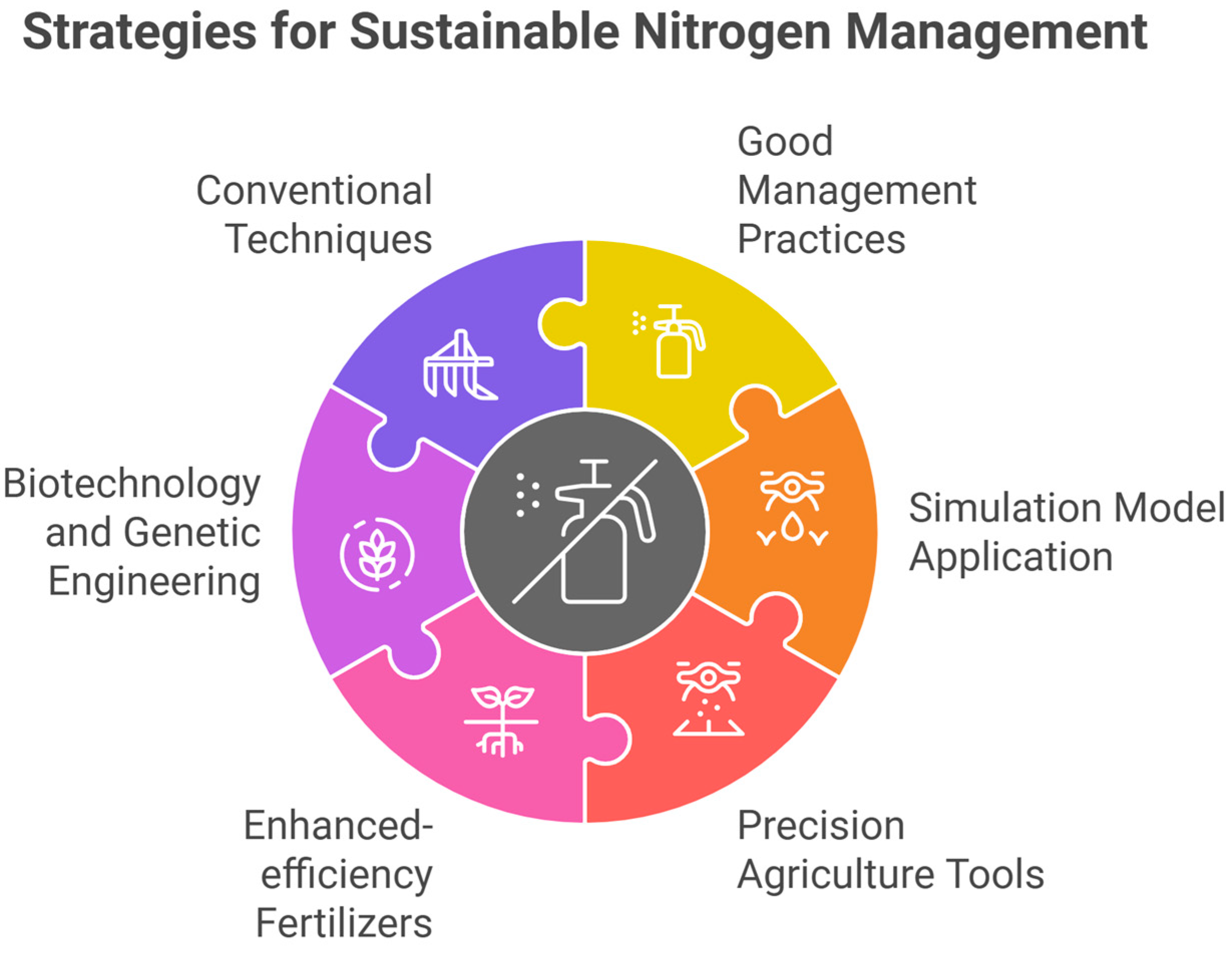
Figure 2.
Global sugarcane production map (The numerical data was retrieved from FAO [2]).
Figure 2.
Global sugarcane production map (The numerical data was retrieved from FAO [2]).
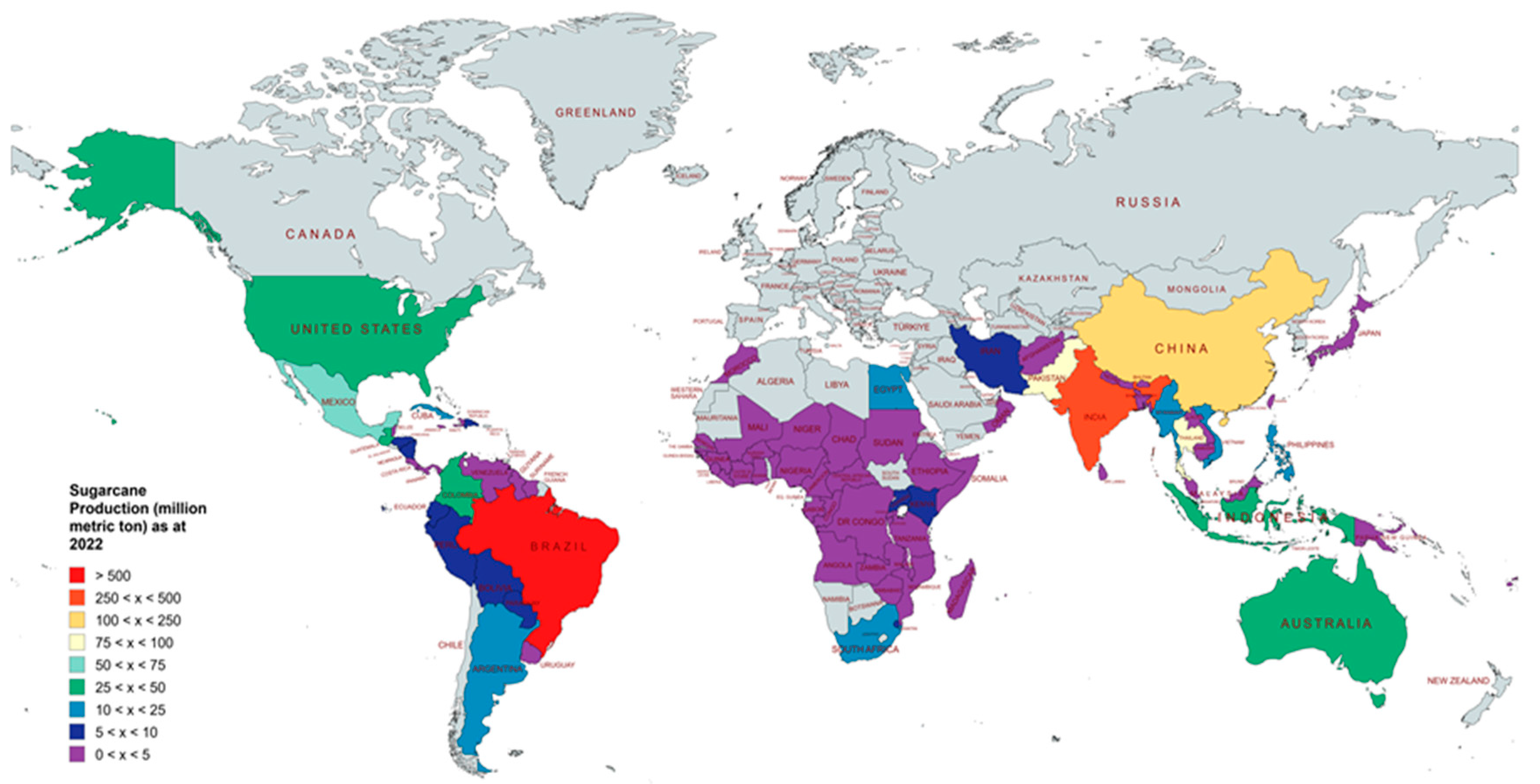
Figure 3.
The plant growth curve (yellow line) and nitrogen requirement curve (red line) of sugarcane. Fertiliser application at different growth stages is given at the bottom of the figure.
Figure 3.
The plant growth curve (yellow line) and nitrogen requirement curve (red line) of sugarcane. Fertiliser application at different growth stages is given at the bottom of the figure.
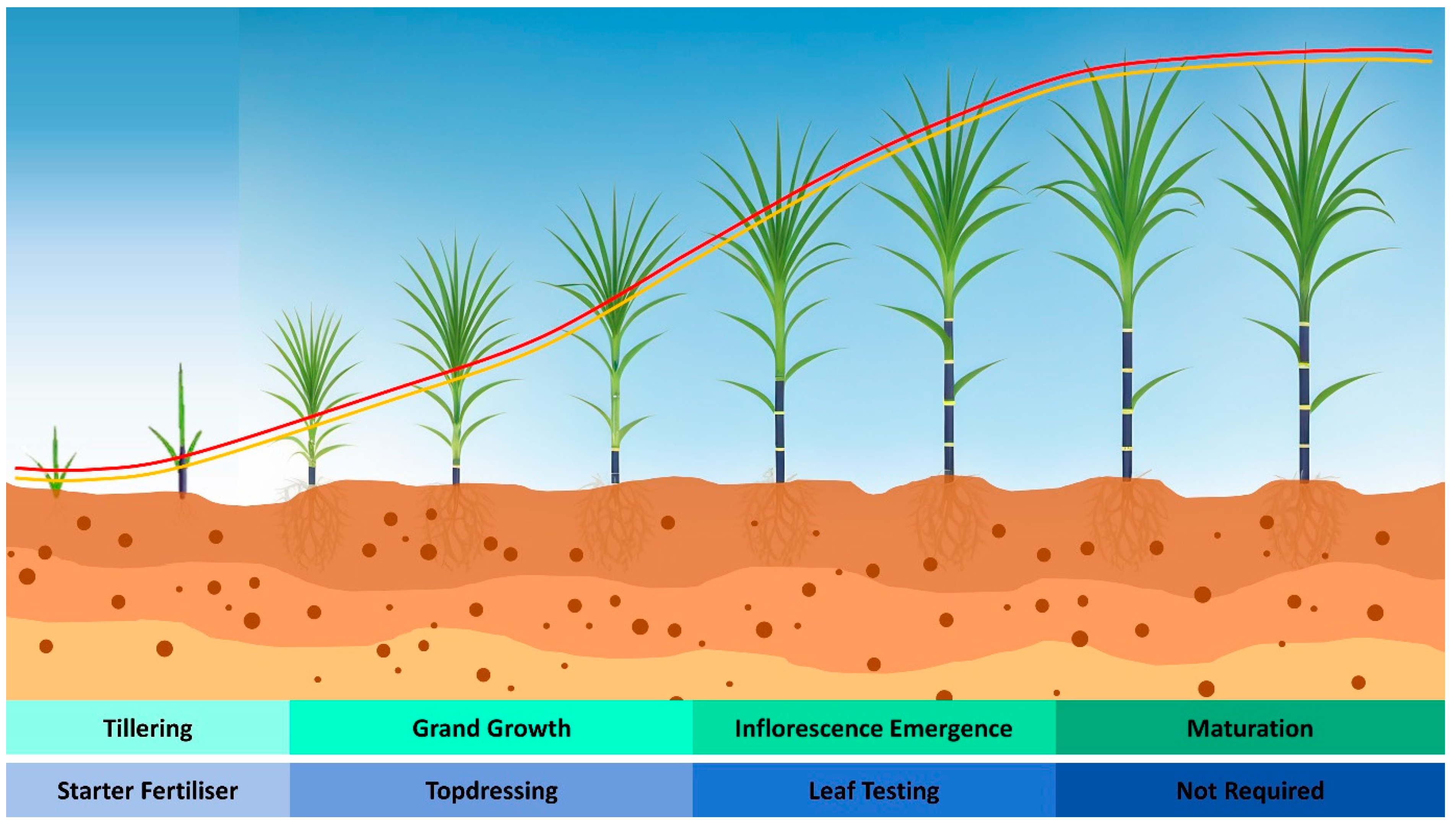
Figure 4.
Good nitrogen management practices for sugarcane cultivation.
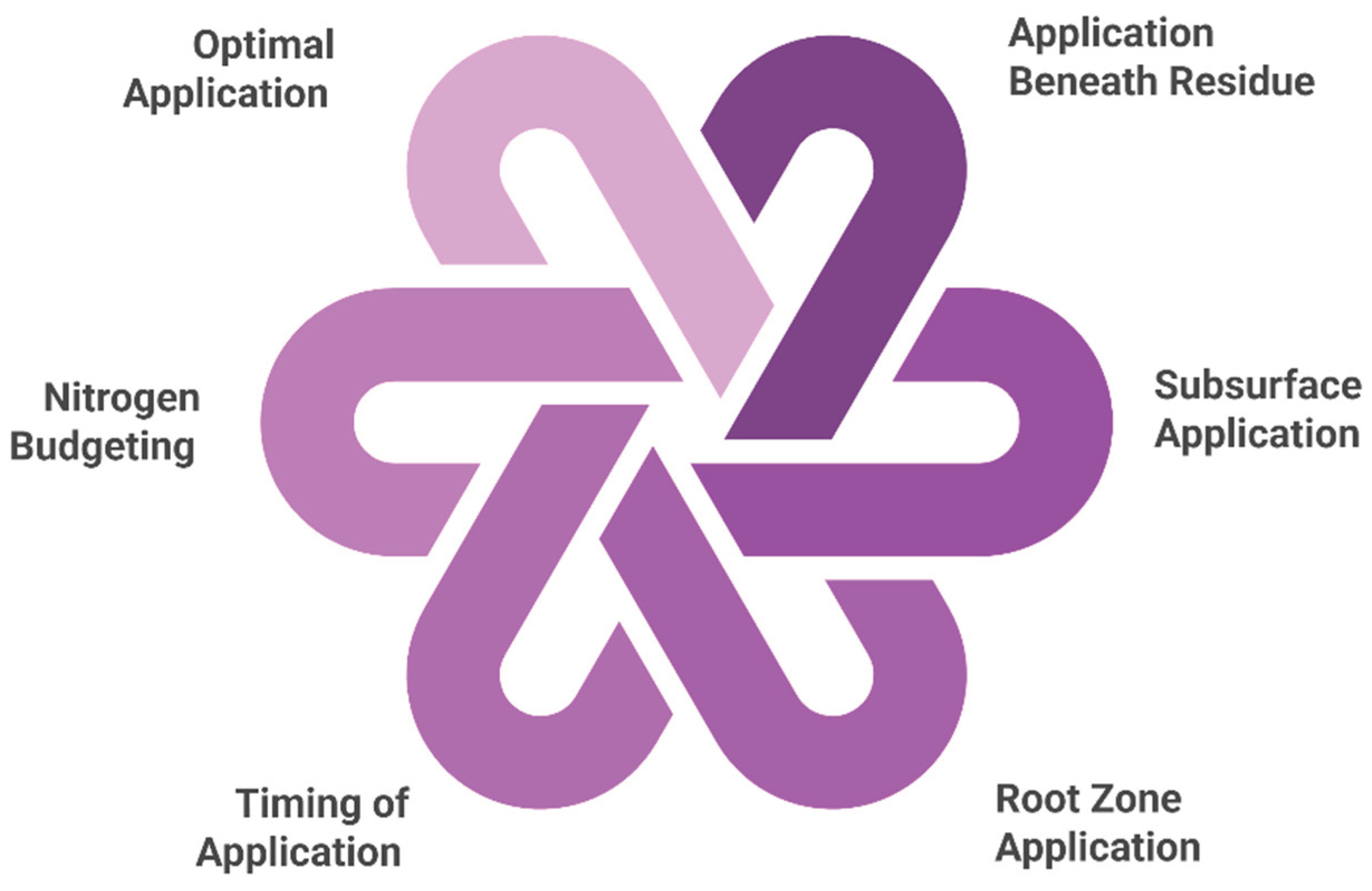
Table 1.
N fertilizer requirement for plant and ratoon crop.
| Country | Major N Source | N Fertilizer Recommendations | Reference | |
|---|---|---|---|---|
| Plant Crop (kgN/ha) | Ratoon Crop (kgN/ha) | |||
| Brazil | Urea | 40–80 | 100–150 | Otto et al [32] |
| India | Urea, Ammonium Sulphate | 135 - 250 | 200 | Shukla et al [31] |
| Thailand | 200-300 | N/A | Yanai et al [37] | |
| Australia | Urea, Controlled- release N | 120–160 | 140–180 | Bell and Moody [38] |
| South Africa | Urea, Ammonium Nitrate | 80 - 200 | 100 - 140 |
DOAFF [36] |
| China | Urea | >500 | >500 | Zeng et al [20] |
| Mexico | Urea, Ammonium Nitrate | 67-112 | 90-135 | Gravois [39] |
| United States | Urea, Ammonium Nitrate, N Solutions | 45 - 90 | 112 - 180 | Viator et al [34] |
| Pakistan | Urea | 173 - 222 | 173 - 222 | SCRI [40] |
| Colombia | Urea, Ammonium Nitrate | 67-112 | 90-135 | Gravois [39] |
| Sri Lanka | Urea | 250-300 | 275-325 | SRI [35] |
Table 3.
Simulation models used for N management in sugarcane.
| Simulation Model | Prediction | Key Finding | Challenge | Reference |
|---|---|---|---|---|
| APSIM-SWIM | NO3- leaching | Prediction was reasonable | Preferential flow minimises the accuracy | Stewart et al [152] |
| CANEGRO | NO3- leaching | Prediction accuracy ranged between 0.95-0.98 | - | van der Laan et al [153] |
| APSIM | N2O emission | Close relationship between observed and predicted values | Lower concentrations of N2O highly impact the results | Thorburn et al [154] |
| DNDC | N2O emission | The IPCC method underestimates the emission compared to the DNDC model | Data availability | de Oliveira and Moraes [155] |
Disclaimer/Publisher’s Note: The statements, opinions and data contained in all publications are solely those of the individual author(s) and contributor(s) and not of MDPI and/or the editor(s). MDPI and/or the editor(s) disclaim responsibility for any injury to people or property resulting from any ideas, methods, instructions or products referred to in the content. |
© 2025 by the authors. Licensee MDPI, Basel, Switzerland. This article is an open access article distributed under the terms and conditions of the Creative Commons Attribution (CC BY) license (http://creativecommons.org/licenses/by/4.0/).
Copyright: This open access article is published under a Creative Commons CC BY 4.0 license, which permit the free download, distribution, and reuse, provided that the author and preprint are cited in any reuse.