

Submitted:
17 June 2025
Posted:
18 June 2025
You are already at the latest version
Abstract
A high power narrow-linewidth, all-fiber polarization-maintaining (PM) amplifier has been demonstrated. A lasing power of 5870W has been delivered in master oscillator power amplifier architecture with cascaded white noise source (WNS) phase modulation and bidirectional pumping schemes. The maximal power was limited by the onset of Stimulated Brillouin scattering. At the maximum power operation, the amplifier exhibited a 3dB spectral linewidth of 0.43nm with beam quality be M² < 1.3 and polarization extinction ratio (PER) being 16.3dB. To the best of our knowledge, this represents the highest spectral brightness and PER achieved by PM fiber laser systems around 6kW-level operation.
Keywords:
fiber laser
; linearly polarized
; narrow linewidth
; white noise
1. Introduction
Due to the advantages of excellent spatial-temporal coherence, high electro-optic efficiency, efficient thermal management and nearly maintain-free compact structure, high-power narrow linewidth linearly polarized fiber lasers with near-diffraction-limited beam quality have found widespread applications in various regimes, such as nonlinear frequency conversion, remote communication, beam combination, and gravitational wave detection [1,2,3,4,5,6]. Scaling the laser brightness has always attracted intense attention of the global researchers [7,8,9,10,11,12,13]. Due to the polarization dependence of Stimulated Brillouin scattering (SBS) effect [14,15], SBS has been become one of the most notorious physical limitations during the power scaling struggle, and much research has been carried out to mitigate SBS, including increasing the effective mode area [16], controlling temperature or stress gradients [17,18], reducing the effective fiber length [19], and spectral broadening via phase modulation [20]. Among these techniques, phase modulation with white noise format has gained significant attention due to its simplicity in signal generation and implementation, making it a standard modulation technique in industrial fiber lasers [21,22,23,24,25,26]. In recent years, remarkable advancements have been witnessed in high-power narrow-linewidth fiber lasers by employing WNS phase modulation [27,28,29,30], and a record laser power of 5.85kW has been reported in 2025 with linewidth being 0.6nm and PER being 12.8dB [31]. For versatile applications of high-power narrow linewidth linearly polarized fiber lasers, lasers with higher spectral brightness and polarization purity are required to achieve better beam quality and higher combining efficiency [32,33,34,35,36,37,38,39].
In this work, we have achieved a breakthrough in PM fiber laser performance, demonstrating near-diffraction-limited 5.87kW output power with a 3dB spectral linewidth of 0.43nm and PER of 16.3dB. By cascaded WNS phase modulation and optimized laser parameter design, both the SBS and TMI thresholds have been effectively enhanced. To the best of our knowledge, this is the highest laser power with such narrow laser linewidth and high PER, which may facilitate the deepen application of high-power narrow linewidth linearly polarized fiber lasers.
2. Experimental Setup
The experimental setup is shown in Figure 1(a), which is based on master oscillator power amplification (MOPA) structure. A 1064nm continuous wave single frequency fiber laser with output power being 30mW and linewidth being <10kHz acts as the seed. The seed laser is broadened to 0.32nm for SBS suppression by a cascaded phase modulation, which is composed of two electro-optic phase modulators (EOM1, EOM2) with modulation frequency being 10GHz and Vπ being 1.7V@1GHz. Two white noise sources (WNS1, WNS2) have been employed to driven the phase modulators through RF (Radio frequency) amplifiers (RF1, RF2), which can suppress SBS-induced self-pulsing effectively [24,25], and guarantee higher spectral brightness. The broadened seed laser was boosted to 20W by two preamplifiers, which employed a piece of 3m PM 10/125 YDF as the gain medium. The seed laser and pump laser were injected into the PM 10/125 YDF via a PM (1+1)×1 pump/signal combiner in co-pumping configurations. Both the input and output signal port of the PM (1+1)×1 pump/signal combiner are PM fibers with core and cladding diameter being 10µm and 125µm, respectively, and 105/125 multimode fiber has been employed as the pump port fiber. Pre-amplifier 1 (PA-I) is pumped by a 5W fiber-coupled multimode laser diode (MM LD) while a 30W MM LD is used for pre-amplifier 2 (PA-II), which boosts the average power to 600mW and 20W, respectively. Home-made PM cladding light strippers have been employed to strip the residual power and stray light [40,41], and 20W-level three-port isolators (ISO1, ISO2) with built-in band pass filter component have been employed to block off the backward power and filter the amplified spontaneous emission (ASE) at the end of PA-I and PA-II [42]. The backward laser was guided out from the third port (P1) of ISO2, which was measured by power meter and optical spectral analysis to monitor the onset of SBS. A mode field adapter (MFA) has been employed to achieve efficient coupling and single-mode transmission of large mode field fiber to single-mode fiber between the pre-amplification and main amplification stages [43,44]. The coupling efficiency and output beam quality of MFA affect the power enhancement of the laser system and the quality of the output beam [45].
The main amplification composed of several critical components: a piece of PM large-mode-area YDF (LMA-YDF) with a core/cladding diameter of 20/400µm, two (6+1)×1 PM pump/signal combiner, two home-made PM cladding power strippers (CPS1 and CPS2), and a quartz beam hat (QBH). The effective mode field diameter of the PM LMA YDF was designed to be 15.74µm and NA~0.066, which are a compromise between SBS and MI thresholds to achieve maximum output power and to maintain near diffraction limited beam quality. The cladding absorption coefficient of the active fiber is about 1.24dB/m at 976nm, and 12m active fiber is used in the main amplifier for efficient absorption of the pump power. To further increase the TMI, the active fiber was coiled to increase the relative loss of HOMs in the main amplifier [46,47]. Through the implementation of high-precision bias-preserving fusion bonding process (less than 1° alignment error), the PER degradation of the fusion bonding point is controlled within 0.5dB, the optimized coiling method suppresses stress-induced birefringence, and the integration of bi-directional pumping and temperature control system effectively enhances the system's extinction ratio performance. Furthermore, optimization of the fiber coiling radius can suppress polarization degradation induced by higher-order modes [13,39]. The high-power laser diodes (LDs) with stabilized wavelength around 976nm have been divided into two groups, and injected into the gain fiber through the two (6+1)×1 PM pump/signal combiner to realize bi-direction-pumping configurations, respectively. A piece of double-clad passive fiber terminated with anti-reflection-coated collimated end cap is spliced to output signal port of the backward pump/signal combiner for power delivery and projecting the collimated laser into free space safely. Home-made PM cladding power strippers (CPS1 and CPS2) have been employed at both side of the main amplification to eliminate the unwanted cladding signal light and residual pump light, thus enhancing the overall performance of the laser system. To handle the waste heat generating at high power operation, the LMA-YDF are meticulously placed on water-cooled aluminum plates to dissipate the waste heat.
As shown in the inset of Figure 1(b), the measurement system consists of one power meter (PM), three high transmission (HT) mirrors, one high-reflection (HR) mirror, one convex lens, one beam dump (BD), one beam splitter (BS), one photodiode (PD), one optical multi-mode (OM) patch cable, one optical spectrum analyzer (OSA), one optical beam profilers (OBP) and one oscilloscope. Power meter is used to measure output power. The HT mirrors are used to split the beam and attenuate the output laser light for laser measurement. After the first attenuation the transmitted light of the output laser at the second LR was collected by the BD. Using a convex lens to couple the transmitted light at the third HT into the OM patch cable to monitor the laser's output spectrum and our OSA has a minimum resolution of 0.02 nm. The HR mirror and the third HT mirror are used to adjust the spot position and the beam quality of the output laser was quantitatively characterized using a beam profiler with the 4σ method. The time-domain signal is monitored by BS splitting at the HR reflected light, and the split light is captured by the PD and displayed on the oscilloscope.
3. Experimental Results
The seed source consists of a 30mW single-frequency laser followed by two cascaded electro-optic phase modulators. By driving the EOMs with WNS signals sequentially, the broadened seed laser optical spectrum with single-stage and cascaded WNS phase modulation were measured. The WNS signal used to drive the phase modulators have been shown in Figure 2(a) with corresponding spectrum. The top of the figure shows the Gaussian spreading signal generated by the simulated white noise source, and the spectrum of the single-frequency seed source after phase modulation by WNS is shown in the bottom of the figure. Figure 2(b) revealed the measured output spectrum. It has shown that single-stage WNS modulation yields a 3 dB linewidth of 0.23 nm, while cascaded WNS modulation broadens the spectrum to 0.32 nm. Based on these spectral measurements and the fiber amplifier parameters described in Section 2, we performed numerical simulations to predict the SBS threshold for each modulation scheme [48,49,50]. Due to that the MI threshold of the system is highest when the counter pumping power accounts for 80% of the total power [51], so the counter pumping percentage is also taken as 80% during numerical simulation. The SBS threshold power defined as 1% of output power. The simulated results have been shown in Figure 2(c). It revealed that, during single-frequency operation, the system reached SBS threshold when the output laser is 50.06 W. Implementing single-stage WNS phase modulation broadened the seed linewidth to 0.24 nm, significantly increasing the threshold to 5100.95 W - representing a 20.1 dB improvement over the single-frequency case. Further linewidth expansion to 0.32 nm through cascaded WNS modulation yielded a threshold of 6825.64 W (21.4 dB enhancement).
It has shown that the output properties of the fiber amplifier employing unidirectional pumping schemes could provide practical guidance for the optimal design and potential exploration of high-power narrow-linewidth fiber amplifiers employing the bidirectional pumping scheme [52], so the MI thresholds under unidirectional pumping configurations has been investigated, which is shown in Figure 3(a). In the counter-pumping configuration, with all five pump modules (excluding P3) operating at maximum power (total 4864W), no MI phenomenon was observed at 3992W laser power. In the co-pumping configuration, MI onset occurred at signal power of 2587W. The TMI threshold trend agrees with the prediction in [53]. Based on the aforementioned results, one can conclude that our laser system is capable of delivering >6579W MI-free laser power in bi-direction pumping schemes. Then we implemented an optimized bidirectional pumping scheme, initially setting the counter-pump power to 4864W before gradually increasing the co-pump power. The output laser power as a function of pump power is shown in Figure 4(c) with blue solid circle. As the output power increases, the intensity of the return light spectrum increases, and when the output power reaches 5870W, self-pulse peak is generated in the return light spectrum, which indicates that the SBS threshold of this experimental system is 5870W, and further increase of the output power is limited by the SBS effect. The onset of SBS has been further confirmed by the back-ward power behavior measured at port P1 (Figure 1), which is presented in Figure 3(b). Upon reaching maximum output power, the backward power exhibited rapid nonlinear growth. Due to the compact requirement of the ISO, no specially-designed coupling optics has been employed, and not all the backward power was coupled out in port X of the isolator, which results in that the measured backward power is not a true back-ward power value, but the power behavior can be used to monitor the onset of SBS. The system ultimately achieved 5870W output power with 7431.7W total pump power, corresponding to a remarkable optical-to-optical efficiency of 79.13%. The beam propagation factors have been measured, which was shown in the inset of Figure 3(a). With the preamplifiers being turned on, the beam quality is measured to be Mx² = 1.206 and My² = 1.304, and which were measured to be Mx² = 1.211 and My² = 1.327 at maximum output power, demonstrating near-diffraction-limited beam quality.
It is known that, for narrow linewidth fiber laser, M2 cannot reflect the mode content accurately, which is influenced by intermodal phase [54,55,56]. To evaluate the fraction of fundamental mode, which is critical for applications [13,35,57], mode decomposition in [58] was employed. The calculated results were shown in Figure 3(c), which revealed that the fraction of LP01 is 0.9761 for maximum output power, which means that the fiber laser system is suitable for beam combination. At the maximum output power, the time traces have been recorded in Figure 3(d), and the corresponding Fourier spectral has been shown in the inset. One can see that there are no characteristic frequency components indicating the onset of the MI effect [59], which denote that MI effect is suppressed effectively. The experimentally measured SBS threshold was approximately 14% lower than numerical predictions, which is primarily due to the following factors: (1) Signal distortion in the RF driving circuit, which inevitably result in non-ideal modulation waveforms; (2) Enhanced Brillouin seeding from discrete reflections at the output endcap and multiple fusion splices, collectively increasing the effective Stokes seeding [60,61]; (3) Discrepancy in pump power distribution, as simulations assumed an 80% counter-pump ratio (optimized for MI suppression) while the actual experiment operated at 65.45%.
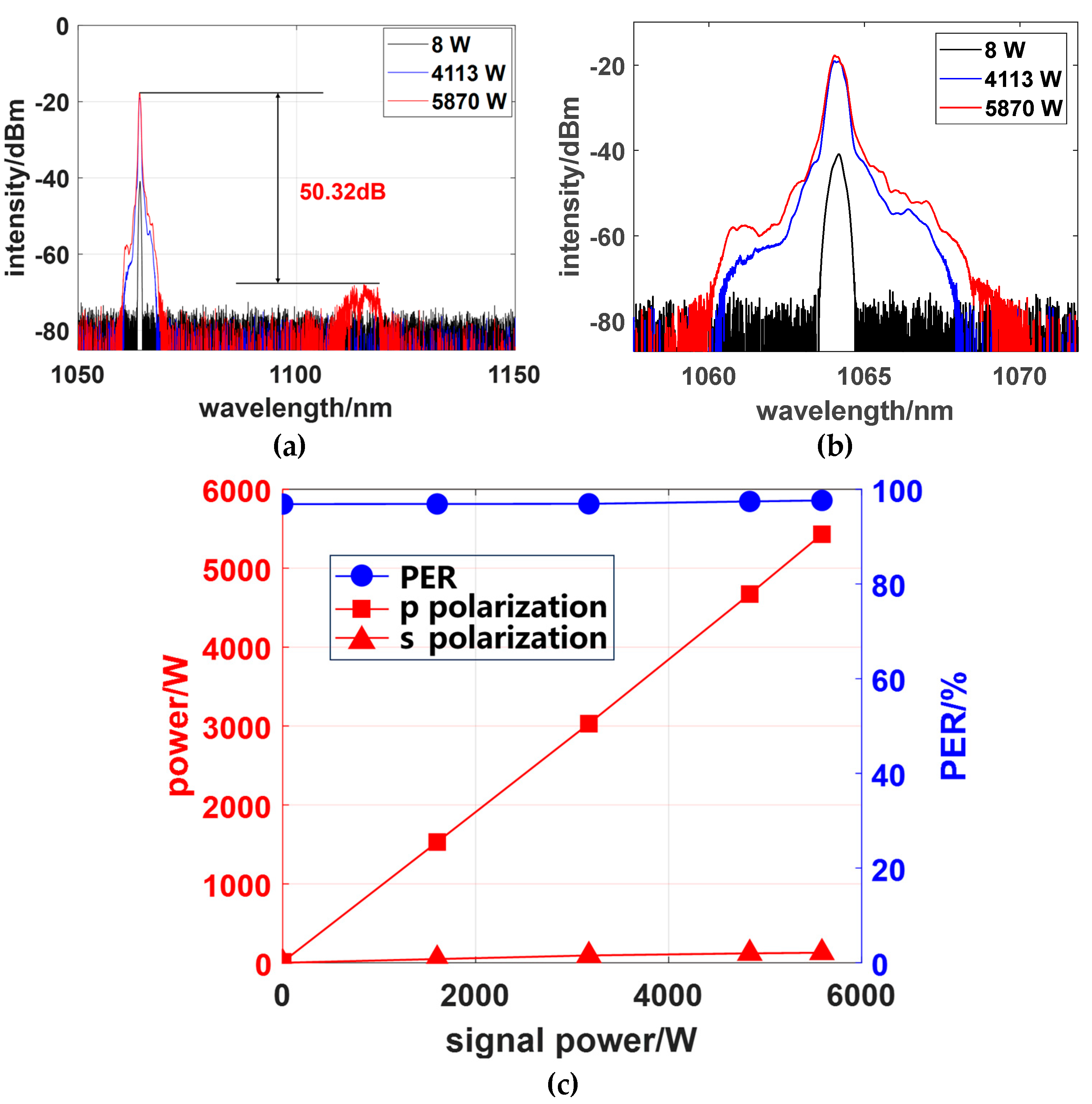
The optical spectra of the PM amplifiers were shown in Figure 4. At the highest power level, there is a sign of SRS, but the Raman peak is 50.32dB lower than the signal peak as shown in Figure 4(a), which means that further increase of the output power is not limited by SRS. As shown in Figure 4(b), the linewidth broadened as the laser power increase, and the 3dB linewidths are 0.32nm (85 GHz) at 8W, 0.43nm (114GHz) at 4113W and 0.43nm (114GHz) at 5870W, respectively, which is attributed to nonlinear effects [62]. In high-power narrow-linewidth fiber amplifiers, broadband background spectral noise generated by spontaneous radiation noise at the seed laser or preamplifier stage can also be amplified during power scaling. Several studies have shown that the four-wave mixing (FWM) effect leads to a large conversion of energy from the single-frequency portion of the phase modulation into background spectral noise during the power scaling process [24,63,64]. Therefore, both the power scaling of ASE and the FWM effect lead to the enhancement of the back-ground spectral noise, which ultimately leads to a broadening of the spectral wings and linewidth. Figure 4(c) shows the PER as a function of the output power, where the PER is calculated using the formula PER = - 10 * log (Ps/Pp). At maximum output power, the PER of the PM amplifiers is measured to be 16.3dB (97.7%).
4. Discussion
Our experimental results demonstrate that the 6kW-class laser system is ultimately limited by SBS rather than MI or SRS. The most straightforward and effective approach to further enhance SBS threshold would be further broadening the seed laser linewidth, which inevitably degrades the power spectral density, and is particularly detrimental for applications requiring high spectral brightness such as beam combination and non-linear frequency conversion.
Future work should focus on addressing nonlinear limitations through innovative fiber material engineering [65,66]. As demonstrated by Dragic et al., borosilicate doping (B₂O₃:4SiO₂) can significantly reduce the Brillouin gain coefficient(up to an 80% suppression) [67], directly enhancing the SBS threshold without compromising spectral linewidth. Dragic’s 2018 proposal for systematically tailoring the GeO₂-P₂O₅-B₂O₃ ternary system enables precise control over nonlinear coefficients [68]. Remarkably, Hawkins' 2021 work on intrinsically low-Brillouin and thermo-optic Yb-doped fibers has already achieved >1 kW single-mode output with ultra-low optical losses (<0.1 dB/km) by optimizing Al/Yb co-doping and fiber microstructure, simultaneously suppressing both SBS and thermal lensing effects [69]. Rosales-García (2024) have further realized a groundbreaking 5.2 kW single-mode laser output (M²~1.2) using a thermally optimized Yb 20/400 fiber, demonstrating that advanced core composition design combined with low dn/dT coatings can push the TMI threshold beyond 5 kW while maintaining high efficiency (>80%) [70].
5. Conclusions
In this work, we present a 6kW-class all fiberized and polarization-maintained amplifiers operating at 1064nm with narrow linewidth and near-diffraction-limited beam quality are presented based on a conventional MOPA configuration. During the power scaling process, the SBS effect is effectively suppressed by subsequently using two-stage cascaded WNS phase modulation systems and the MI effect is managed by optimized coiling the active fiber in the main amplifier. The amplifier achieves a maximum output power of up to 5.87kW with an optical-to-optical conversion efficiency of 79.13%. At the maximum output power, the 3dB spectral linewidth is measured to be 0.43nm and the beam quality approaches the diffraction limit. The PER just fluctuates within 2% during the power scaling process and as high as 15.5dB is obtained at 1890W output power. To the best of our knowledge, this represents the highest output power achieved by an all-fiber laser at this spectral linewidth, as well as the highest spectral brightness of lasers in the 6kW class and above. In our subsequent research, we will explore methods to mitigate SBS and aim to achieve higher-power laser output while maintaining the spectral linewidth.
Author Contributions
Conceptualization, Z.G. and Q.C.; methodology, Z.G. and Q.S.; validation, Z.G., F.L., Y.W., X.J. and C.C.; formal analysis, J.W.; investigation, Z.G., C.Z., L.L. and F.L.; resources, H.L.; data curation, Z.G.; writing—original draft preparation, Z.G.; writing—review and editing, Q.C. and R.T.; visualization, Z.G.; supervision, Z.P.; project administration, J.W.; funding acquisition, Q.C. All authors have read and agreed to the published version of the manuscript.
Funding
This research was funded by the National Natural Science Foundation of China, grant number 62205317.
Institutional Review Board Statement
Not applicable.
Informed Consent Statement
Not applicable.
Data Availability Statement
Data is contained within the article.
Conflicts of Interest
The authors declare no conflicts of interest.
References
- Mourou, G.; Brocklesby, B.; Tajima, T.; Limpert, J.; Schreiber, T.; Nolte, S.; Zervas, M. The future is fiber accelerators. Nat. Photonics 2013, 7, 258–261. [Google Scholar] [CrossRef]
- Breitkopf, S.; Eidam, T.; Klenke, A.; Limpert, J.; Tünnermann, A. A concept for multiterawatt fiber lasers based on coherent pulse stacking in passive cavities. Light Sci. Appl. 2014, 3, e211. [Google Scholar] [CrossRef]
- Wei, L.; Cleva, F.; Man, C. Coherently combined master oscillator fiber power amplifiers for Advanced Virgo. Opt. Lett. 2016, 41, 5817–5820. [Google Scholar] [CrossRef] [PubMed]
- Zhou, P.; Huang, L.; Xu, J.; Wang, X.; Leng, J. High power linearly polarized fiber laser: generation, manipulation and application. Sci. China Technol. Sci. 2017, 60, 1784–1800. [Google Scholar] [CrossRef]
- Zhou, P.; Jiang, M.; Wu, H.; Deng, Y.; Chang, H.; Huang, L.; Wu, J.; Xu, J.; Wang, X.; Leng, J. Fiber Laser from the Perspective of Interdisciplinarity: Review and Prospect [Invited]. Infrared Laser Eng. 2023, 52, 20230334. [Google Scholar]
- Li, H.; Xie, L.; Zhang, C.; Wang, Y.; Chen, S. Metasurface-generating high purity narrow linewidth cylindrical vector beams: power scaling and its limitation. Front. Phys. 2023, 11, 1195655. [Google Scholar] [CrossRef]
- Tao, R.; Ma, P.; Wang, X.; Zhou, P. 1.3 kW monolithic linearly polarized single-mode master oscillator power amplifier and strategies for mitigating mode instabilities. Photon. Res. 2015, 3, 86–93. [Google Scholar] [CrossRef]
- Platonov, N.; Yagodkin, R.; DeLaCruz, J.; Yusim, A.; Gapontsev, V. Up to 2.5-kW on non-PM fiber and 2.0-kW linear polarized on PM fiber narrow linewidth CW diffraction-limited fiber amplifiers in all-fiber format. Proc. SPIE, 0512. [Google Scholar]
- Ren, S.; Ma, P.; Li, W.; Tao, R.; Wang, X.; Zhou, P. 3.96 kW all-fiberized linearly polarized and narrow linewidth fiber laser with near-diffraction-limited beam quality. Nanomaterials 2022, 12, 2541. [Google Scholar] [CrossRef]
- Chu, Q.; Shu, Q.; Li, F.; Zhang, H.; Xi, X. Power scaling of high-power linearly polarized fiber lasers with . Front. Phys. 2023, 11, 1198305. [Google Scholar] [CrossRef]
- Liao, S.; Luo, T.; Xiao, R.; Huang, L.; Leng, J. 4.6 kW linearly polarized and narrow-linewidth monolithic fiber amplifier based on a fiber oscillator laser seed. Opt. Lett. 2023, 48, 6533–6536. [Google Scholar] [CrossRef]
- Wang, Y.; Peng, W.; Liu, H.; Chen, Z.; Zhou, P. Linearly polarized fiber amplifier with narrow linewidth of 5 kW exhibiting a record output power and near-diffraction-limited beam quality. Opt. Lett. 2023, 48, 2909–2912. [Google Scholar] [CrossRef] [PubMed]
- Yang, Y.; Li, D.; Zhang, Y.; Wang, X.; Liu, Y.; Chen, Z. 3 kW narrow-linewidth linearly polarized fiber laser with high-purity single-mode output and high PER enabled by suppressing mode and polarization coupling. Opt. Laser Technol. 2025, 186, 112729. [Google Scholar] [CrossRef]
- Stolen, R. Polarization effects in fiber Raman and Brillouin lasers. IEEE J. Quantum Electron. 1979, 15, 1157–1160. [Google Scholar] [CrossRef]
- Wen, Y.; Zhang, C.; Liu, C.; Wang, X.; Zhou, P. SBS mitigation by manipulating the injecting polarization direction in a high-power monolithic PM amplifier. Photonics 2024, 11, 890. [Google Scholar] [CrossRef]
- Alegria, C.; Jeong, Y.; Codemard, C.; Sahu, J.K.; Alvarez-Chavez, J.A.; Fu, L. 83W Single-frequency narrow-linewidth MOPA using large-core erbium-Ytterbium co-doped fiber. IEEE Photon. Technol. Lett. 2004, 16, 1825–1827. [Google Scholar] [CrossRef]
- Lei, X.; Zhang, Y.; Shu, Z.; Cui, S.; Chi, H.; Liu, J.; Jun, Z.; Zhou, Y.; Yan, F. 170 W, single-frequency, single-mode, linearly-polarized, Yb-doped all-fiber amplifier. Opt. Express 2013, 21, 23318–23324. [Google Scholar]
- Huang, L.; Wu, H.; Li, R.; Jiang, M.; Xu, J. 414 W near-diffraction-limited all-fiberized single-frequency polarization-maintained fiber amplifier. Opt. Lett. 2016, 42, 1–4. [Google Scholar] [CrossRef]
- Shi, W.; Petersen, E.B.; Yao, Z.; Nguyen, D.T.; Peyghambarian, N. Kilowatt-level stimulated-Brillouin-scattering-threshold monolithic transform-limited 100 ns pulsed fiber laser at 1530 nm. Opt. Lett. 2010, 35, 2418. [Google Scholar] [CrossRef]
- Zeringue, C.; Dajani, I.; Naderi, S.; Robin, C.; Pulford, B. A theoretical study of transient stimulated Brillouin scattering in optical fibers seeded with phase-modulated light. Opt. Express 2012, 20, 21196–21213. [Google Scholar] [CrossRef]
- Khitrov, V.; Farley, K.; Leveille, R.; Machewirth, D.; Samson, B. kW level narrow linewidth Yb fiber amplifiers for beam combining. Proc. SPIE 2010, 7686, 46–53. [Google Scholar]
- Anderson, B.; Robin, C.; Flores, A.; Dajani, I. Experimental study of SBS suppression via white noise phase modulation. Proc. SPIE 2014, 8961, 362–368. [Google Scholar]
- Ma, P.; Xiao, H.; Tao, R.; Liu, W.; Meng, D. High power all-fiberized and narrow-bandwidth MOPA system by tandem pumping strategy for thermally induced mode instability suppression. High Power Laser Sci. Eng. 2018, 6, e1. [Google Scholar] [CrossRef]
- Li, T.; Zha, C.; Sun, Y.; Wang, J.; Chen, H. 3.5 kW bidirectionally pumped narrow-linewidth fiber amplifier seeded by white-noise-source phase-modulated laser. Laser Phys. 2018, 28, 105101.
- Wang, Y.; Feng, Y.; Ma, Y.; Chang, Z.; Tang, C. 2.5kW narrow linewidth linearly polarized all-fiber MOPA with cascaded phase-modulation to suppress SBS induced self-pulsing. IEEE Photon. J. 2020, 1–1. [Google Scholar]
- Prakash, R.; Vikram, B.S.; Supradeepa, V.R. Enhancing the efficacy of noise modulation for SBS suppression in high power, narrow linewidth fiber lasers by the incorporation of sinusoidal modulation. IEEE Photon. J. 2021, 13, 1–6. [Google Scholar] [CrossRef]
- Chu, Q.; Guo, C.; Shu, Q.; Zhang, H.; Xi, X. 3.22 kW near-diffraction-limited output from 21.7 GHz linewidth polarization-maintained fiber laser. Chin. J. Lasers 2021, 48, 1716001. [Google Scholar]
- Gu, Q.; Zhao, Q.; Yang, C.; Wang, X.; Zhou, P. 2.02 kW and 4.7 GHz linewidth near-diffraction-limited all-fiber MOPA laser. Appl. Phys. Express 2022, 15, 032001. [Google Scholar] [CrossRef]
- Ren, S.; Chen, Y.; Ma, P.; Li, W.; Wang, G.; Liu, W.; Zhou, P. 4.5 kW, 0.33 nm near-single-mode narrow-linewidth bias-preserving fiber laser. High Power Laser Part. Beams 2022, 34, 137. [Google Scholar]
- Ren, S.; Ma, P.; Chen, Y.; Ma, P.; Li, W.; Wang, G.; Liu, W.; Huang, L.; Pan, Z.; Yao, T.; Zhou, P. Narrow linewidth laser output of 5 kW class by domestically produced bias-preserving fiber. Infrared Laser Eng. 2023, 52, 443–444. [Google Scholar]
- Chen, Y.; Yang, H.; Ma, P.; Zhou, P.; Wang, X. 5.85 kW polarization-maintained and all-fiberized amplifier with narrow linewidth and near-diffraction-limited beam quality assisted by low-numerical-aperture active fiber. Opt. Laser Technol. 2024, 5149622. [Google Scholar]
- Bochove, E.J. Theory of spectral beam combining of fiber lasers. IEEE J. Quantum Electron. 2002, 38, 432–445. [Google Scholar] [CrossRef]
- Sprangle, P.; Ting, A.; Penano, J.; Hafizi, B.; Gordon, D.; Fischer, R. Incoherent combining and atmospheric propagation of high-power fiber lasers for directed-energy applications. IEEE J. Quantum Electron. 2009, 45, 138–148. [Google Scholar] [CrossRef]
- Goodno, G.D.; Shih, C.C.; Rothenberg, J.E. Perturbative analysis of coherent combining efficiency with mismatched lasers. Opt. Express 2010, 18, 25403–25414. [Google Scholar] [CrossRef] [PubMed]
- McNaught, S.J.; Thielen, P.A.; Adams, L.N.; Ho, J.; McComb, T.S.; Robin, C.A.; Dajani, I. Scalable coherent combining of kilowatt fiber amplifiers into a 2.4-kW beam. IEEE J. Sel. Top. Quantum Electron. 2014, 20, 174–181. [Google Scholar] [CrossRef]
- Liu, Z.; Ma, P.; Su, R.; Tao, R.; Wang, X.; Zhou, P. High-power coherent beam polarization combination of fiber lasers: progress and prospect. J. Opt. Soc. Am. B 2017, 34, A7–A14. [Google Scholar] [CrossRef]
- Huang, Y.; Xiao, Q.; Li, D.; Wang, X.; Zhou, P. 3 kW narrow linewidth high spectral density continuous wave fiber laser based on fiber Bragg grating. Opt. Laser Technol. 2021, 133, 106538. [Google Scholar] [CrossRef]
- Wu, Y.; Xiao, Q.; Li, D.; Wang, Z.; Ma, P.; Zhou, P. Thermal induced polarization coupling in double-cladding linearly polarized fiber lasers. Opt. Commun. 2022, 512, 128036. [Google Scholar] [CrossRef]
- Wu, Y.; Yan, P.; Li, D.; Wang, X.; Gong, M. Polarization extinction ratio promotion in high-power linearly polarized fiber lasers. Opt. Laser Technol. 2025, 181, 111909. [Google Scholar] [CrossRef]
- Liu, Y.; Li, M.; Huang, S.; Zhang, H.; Xi, X. Non-water-cooled fiber cladding light stripper with power handling capability over 500 W. High Power Laser Part. Beams 2021, 33, 021005. [Google Scholar]
- Liu, Y.; Wu, W.; Li, Y.; Li, Y.; Huang, S.; Tao, R.; Lin, H.; Wang, J. Experimental study of chemical-etched high-power cladding mode stripping device toward high attenuation. Opt. Laser Technol. 2023, 162, 109234. [Google Scholar] [CrossRef]
- Wen, Y.; Zhang, C.; Zhu, Y.; Wang, X.; Zhou, P. Origin of SBS-induced mode distortion in high power narrow linewidth fiber amplifiers. Photon. Res. 2025, 13, 1631–1636. [Google Scholar] [CrossRef]
- Zhou, X.; Chen, Z.; Chen, H.; Wang, Y.; Liu, Y. Mode field adaptation between single-mode fiber and large mode area fiber by thermally expanded core technique. Opt. Laser Technol. 2013, 47, 72–75. [Google Scholar] [CrossRef]
- Xiong, F.; Mu, W.; Wang, Y.; Li, J.; Chen, G. High-efficiency mode field adapter for low NA large mode area fibers. Acta Photon. Sin. 2024, 53, 0806001. [Google Scholar]
- Jeong, Y.; Sahu, J.K.; Soh, D.B.S.; Nilsson, J. High-power tunable single-frequency single-mode erbium: ytterbium codoped large-core fiber master-oscillator power amplifier source. Opt. Lett. 2005, 30, 2997–2999. [Google Scholar] [CrossRef] [PubMed]
- Tao, R.; Su, R.; Ma, P.; Wang, X.; Zhou, P. Suppressing mode instabilities by optimizing the fiber coiling methods. Laser Phys. Lett. 2016, 14, 025101. [Google Scholar] [CrossRef]
- Tao, R.; Wang, X.; Zhou, P. Comprehensive theoretical study of mode instability in high-power fiber lasers by employing a universal model and its implications. IEEE J. Sel. Top. Quantum Electron. 2018, 24, 1–19. [Google Scholar] [CrossRef]
- Agrawal, G.P. Nonlinear fiber optics. In Nonlinear Science at the Dawn of the 21st Century, Springer Berlin Heidelberg, 2000, 195-211.
- Jenkins, R.B.; Sova, R.M.; Joseph, R.I. Steady-state noise analysis of spontaneous and stimulated Brillouin scattering in optical fibers. J. Lightwave Technol. 2007, 25, 763–770. [Google Scholar] [CrossRef]
- Ran, Y.; Wang, X.; Lv, H.; Su, R.; Zhou, P.; Si, L. Novel suppression method for stimulated Brillouin scattering by simultaneous phase and intensity modulation in fiber amplifiers. Chin. J. Lasers 2015, 42, 0805003. [Google Scholar]
- Eznaveh, Z.S.; Lopez-Galmiche, G.; Antonio-Lopez, E.; Sanchez, D.; Schulzgen, A.; Amezcua-Correa, R.; Li, G.; Li, J.; Chen, K.P. Bi-directional pump configuration for increasing thermal modal instabilities threshold in high power fiber amplifiers. Proc. SPIE 2015, 9344, 407–411. [Google Scholar]
- Wang, G.; Song, J.; Chen, Y.; Ren, S.; Ma, P.; Liu, W.; Yao, T.; Zhou, P. Six kilowatt record all-fiberized and narrow-linewidth fiber amplifier with near-diffraction-limited beam quality. High Power Laser Sci. Eng. 2022, 10, 1–6. [Google Scholar] [CrossRef]
- Tao, R.; Ma, P.; Wang, X.; Zhou, P. Theoretical study of pump power distribution on modal instabilities in high power fiber amplifiers. Laser Phys. Lett. 2016, 14, 025002. [Google Scholar] [CrossRef]
- Yoda, H.; Polynkin, P.; Mansuripur, M. Beam quality factor of higher order modes in a step-index fiber. J. Lightwave Technol. 2006, 24, 1350–1355. [Google Scholar] [CrossRef]
- Wielandy, S. Implications of higher-order mode content in large mode area fibers with good beam quality. Opt. Express 2007, 15, 15402–15409. [Google Scholar] [CrossRef] [PubMed]
- Tao, R.; Huang, L.; Li, M.; Shen, B.; Feng, X.; Xie, L.; Weng, J.; Zhi, D. M2 factor for evaluating fiber lasers from large mode area few-mode fibers. Front. Phys. 2023. [Google Scholar] [CrossRef]
- Li, D.; Niu, X.; Ji, X.; Wang, Y.; Ma, Y.; Zhou, Q.; Chen, H. High beam quality 10 kW light source based on thin-film beam combination. High Power Laser Sci. Eng. 2024, 12, e55. [Google Scholar]
- Zhang, C.; Chu, Q.; Feng, X.; Wang, Y.; Li, H.; Zhou, P. Mode evolution of high power monolithic PM fiber amplifiers in the presence of SRS effect. IEEE Photon. Technol. Lett. 2022, 34, 215–218. [Google Scholar] [CrossRef]
- Tao, R.; Ma, P.; Wang, X.; Liu, W.; Zhou, P. Experimental study on mode instabilities in all-fiberized high-power fiber amplifiers. Chin. Opt. Lett. 2014, 12, s20603. [Google Scholar] [CrossRef]
- Bowers, M.S.; Luzod, N.M. Stimulated Brillouin scattering in optical fibers with end reflections excited by broadband pump waves. Opt. Eng. 2019, 58, 102702. [Google Scholar] [CrossRef]
- Li, W.; Deng, Y.; Qi, C.; Tao, R.; Wang, X.; Zhou, P. Evaluation of the impact of weak end feedback on the SBS threshold in high-power narrow-linewidth fiber amplifiers. Opt. Express 2024, 32, 16478–16490. [Google Scholar] [CrossRef]
- Ma, P.; Xiao, H.; Liu, W.; Zhang, H.; Wang, X.; Leng, J.; Zhou, P. All-fiberized and narrow-linewidth 5 kW power-level fiber amplifier based on a bidirectional pumping configuration. High Power Laser Sci. Eng. 2021, 9, e45. [Google Scholar] [CrossRef]
- Lin, H.; Tao, R.; Li, C.; Ma, P.; Wang, X.; Zhou, P. 3.7 kW monolithic narrow linewidth single mode fiber laser through simultaneously suppressing nonlinear effects and mode instability. Opt. Express 2019, 27, 9716–9724. [Google Scholar] [CrossRef]
- Liu, W.; Song, J.; Ma, P.; Xiao, H.; Zhou, P. Effects of background spectral noise in the phase-modulated single-frequency seed laser on high-power narrow-linewidth fiber amplifiers. Photon. Res. 2021, 9, 424–431. [Google Scholar] [CrossRef]
- Dragic, P.D. Brillouin suppression by fiber design. IEEE Photon. Soc. Summer Top. 2010, 151–152. [Google Scholar]
- Dragic, P.D.; Ballato, J.; Morris, S.; Hawkins, T. The Brillouin gain coefficient of Yb-doped aluminosilicate glass optical fibers. Opt. Mater. 2013, 35, 1627–1632. [Google Scholar] [CrossRef]
- Dragic, P.D. Brillouin gain reduction via B2O3 doping. J. Lightwave Technol. 2011, 29, 967–973. [Google Scholar] [CrossRef]
- Dragic, P.D.; Cavillon, M.; Ballato, A. A unified materials approach to mitigating optical nonlinearities in optical fiber. II. B. The optical fiber, material additivity and the nonlinear coefficients. Int. J. Appl. Glass Sci. 2018, 9, 307–318. [Google Scholar] [CrossRef]
- Hawkins, T.W.; Dragic, P.D.; Yu, N.; Ballato, J. Kilowatt power scaling of an intrinsically low Brillouin and thermo-optic Yb-doped silica fiber. J. Opt. Soc. Am. B 2021, 38, F38–F49. [Google Scholar] [CrossRef]
- Rosales-García, A.; Jensen, R.; Kristensen, P.; Johansen, M.; Hansen, K.R. 5.2 kW single-mode output power from a Yb 20/400 fiber with reduced thermo-optic coefficient. Proc. SPIE 2024, 12865, 64–67. [Google Scholar]
Figure 1.
(a) Experimental setup of PM all-fiber laser system with MOPA structure; (b) Optical parameter measuring system.
Figure 1.
(a) Experimental setup of PM all-fiber laser system with MOPA structure; (b) Optical parameter measuring system.
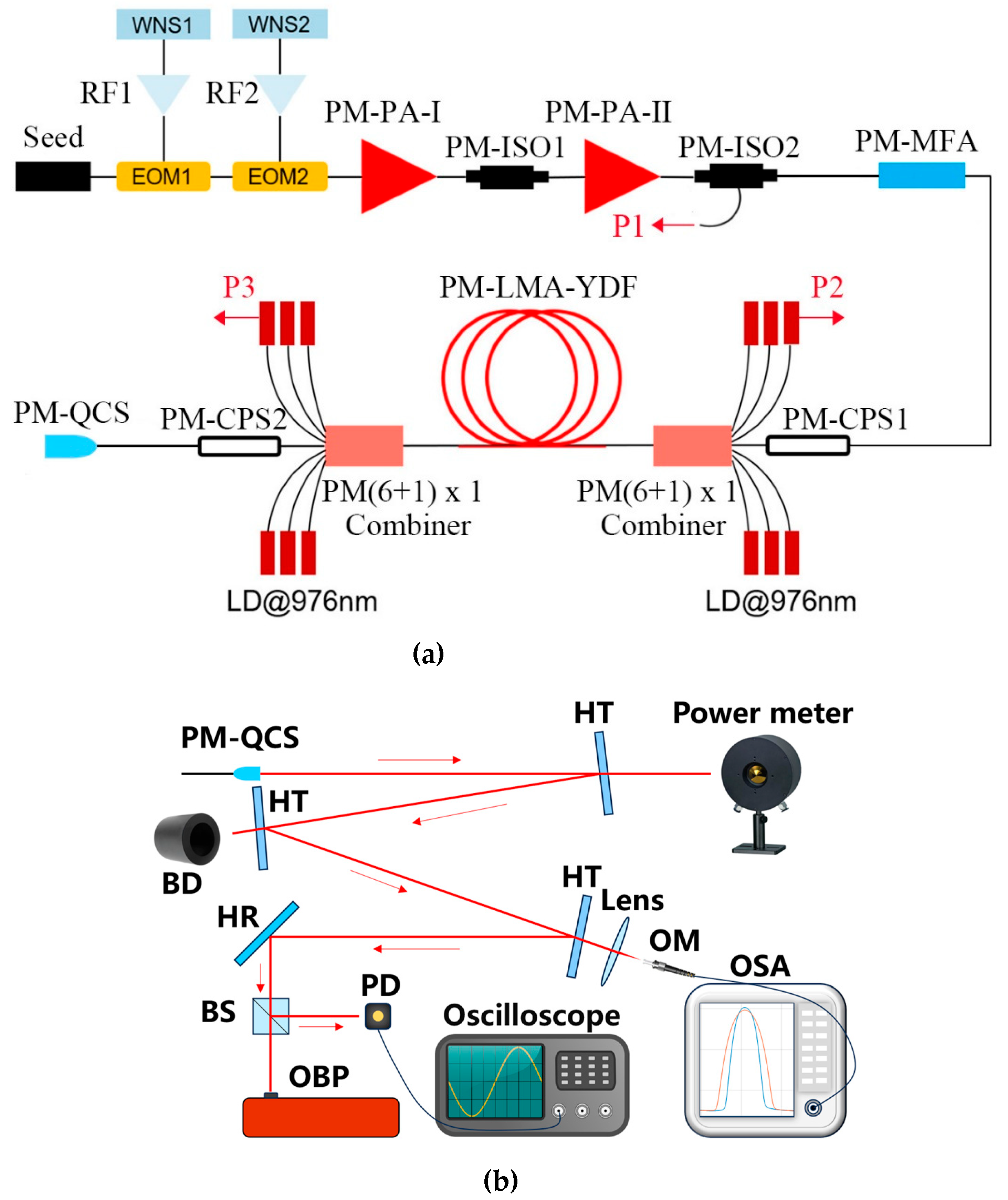
Figure 2.
(a) Simulated spectrum; (b) Measured spectrum; (c) Evolution of the backward-to-signal power ratio with signal power.
Figure 2.
(a) Simulated spectrum; (b) Measured spectrum; (c) Evolution of the backward-to-signal power ratio with signal power.
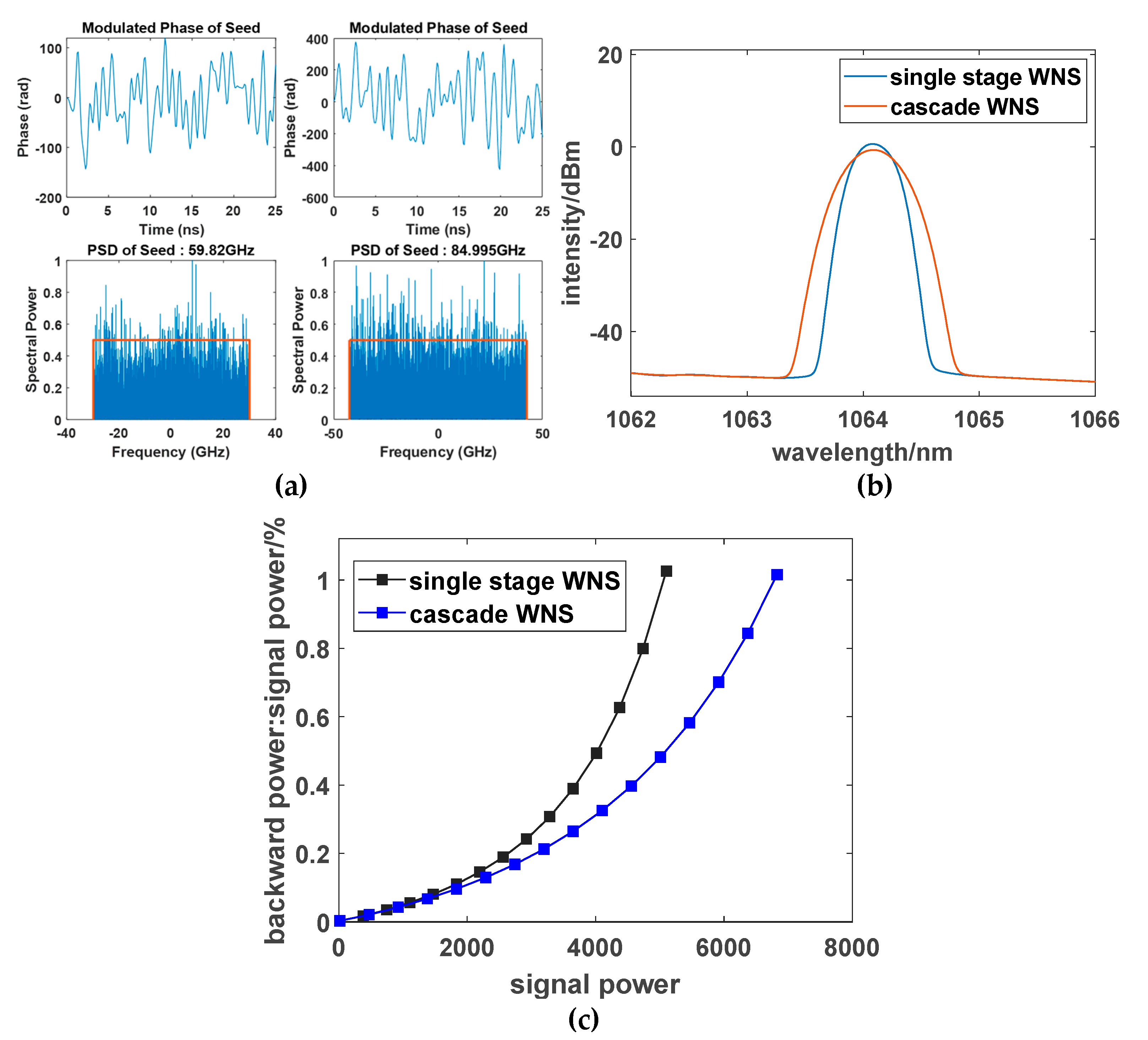
Figure 3.
(a) Variation of signal power and beam quality with pump power; (b) Variation of laser backward power with signal power; (c) Measured and reconstructed beam profile results; (d) Time-domain signals of the highest output powers (inset: frequency-domain).
Figure 3.
(a) Variation of signal power and beam quality with pump power; (b) Variation of laser backward power with signal power; (c) Measured and reconstructed beam profile results; (d) Time-domain signals of the highest output powers (inset: frequency-domain).

Figure 4.
Variation of Output spectra in (a) 1050-1150 nm, (b) 1055-1075 nm, (c) PER and polarized optical power with output power.
Figure 4.
Variation of Output spectra in (a) 1050-1150 nm, (b) 1055-1075 nm, (c) PER and polarized optical power with output power.
Disclaimer/Publisher’s Note: The statements, opinions and data contained in all publications are solely those of the individual author(s) and contributor(s) and not of MDPI and/or the editor(s). MDPI and/or the editor(s) disclaim responsibility for any injury to people or property resulting from any ideas, methods, instructions or products referred to in the content. |
© 2025 by the authors. Licensee MDPI, Basel, Switzerland. This article is an open access article distributed under the terms and conditions of the Creative Commons Attribution (CC BY) license (http://creativecommons.org/licenses/by/4.0/).
Copyright: This open access article is published under a Creative Commons CC BY 4.0 license, which permit the free download, distribution, and reuse, provided that the author and preprint are cited in any reuse.