

Submitted:
29 June 2026
Posted:
01 July 2026
You are already at the latest version
Abstract
The light hadron spectrum is reconstructed over a finite relational arithmetic substrate, on a single Ω-hard scale. A baryon is the colour-neutral invariant of the triality frame, the determinant residue Λ3 = 1 (baryon number), forced by the gluon residue 0 and completing the Carrier-residue series photon 2, gluon 0, hadron 1. Its constituents are the wrapped composites of confinement, so each mass is MB = √σ [ ffl + κhf gspin ] + ∆EM, the confinement scale √σ ∼ ΛQCD times dimensionless structure, and the scale cancels in every flavour and spin relation. We derive the Gell-Mann–Okubo octet relation (0.57%) and the decuplet equal spacing (9.2%, closed to 0.4% at second order); the decuplet–octet hyperfine pattern as the colour-magnetic character invariant (colour factor −8, spin 1/2 S(S + 1) − 9/8 ); the Coleman–Glashow isospin identity (0.79%); heavy-quark symmetry (2.4%); and the vector-meson nonet equal spacing 2MK∗ = Mρ + Mϕ (0.42%). The absolute octet and decuplet follow from one scale and three sub-horizon eigenvalues, anchored to N, Λ, ∆, to within 1.1%; the baryon scale is itself the computed finite eigenvalue E0 ≃ 2.232, MN = E0√σ predicting the nucleon to 4.6%. The sector introduces no new Ω-hard residue; every predicate resolves to a sub-horizon residue, a closed-form framed-rational or a profinite eigenvalue, or to the single confinement scale. Every exact claim is verified in finite-field or cyclotomic arithmetic, the continuum entering only as a labelled degenerate idealisation.
Keywords:
finite ring cosmology
; hadron spectroscopy
; baryon octet and decuplet
; vector-meson nonet
; SU(3) flavour
; colour-magnetic hyperfine
; Carrier residue
; confinement scale
; framed-rational arithmetic
1. Introduction
The light hadron mass spectrum is an unreduced structure of the Standard Model. The baryon octet and decuplet and the meson nonets span a factor of a few in mass, organised by isospin, strangeness, and spin, yet in the gauge theory the masses are outputs of a fit: the colour group, the confinement scale, and the quark masses are stipulated inputs, and the spectrum follows only by numerical solution of the bound state. No closed structure assigns the masses. The regularities, the Gell-Mann–Okubo relation, the decuplet equal spacing, the constituent-quark hyperfine pattern, are read off the data and modelled rather than derived from a single premise.
The spectrum has been attacked from several directions, each accurate in its domain and each taking a different external input as given. The ab initio approach is lattice gauge theory [1]: the Euclidean path integral is discretised and solved numerically, and full-QCD ensembles now reproduce the light hadron masses at the percent level [2], with world averages collected by the lattice community [3]. The inputs are the bare coupling, which sets by dimensional transmutation, and the quark masses; the spectrum emerges as a computation, not as a closed structure, and the colour group and these scales are not themselves derived.
Effective descriptions trade the path integral for a few constituent degrees of freedom. The constituent quark model assigns each hadron a sum of constituent masses plus a chromomagnetic spin-spin interaction [4,5], refined into the relativized models that fit the full meson and baryon spectra [6,7]; the constituent masses, the confining potential, and the hyperfine strength are fitted. Functional and operator methods reach the same masses from the QCD correlators: sum rules relate hadron masses to the vacuum condensates [8], and the Dyson–Schwinger and Bethe–Salpeter equations treat the baryon as a relativistic three-quark bound state [9,10]. Each takes the interaction kernel or the condensates as input.
A third line exploits the symmetries and asymptotic limits of the theory. Flavour organises the multiplets and yields the classical mass relations, Gell-Mann–Okubo for the octet and the equal spacing for the decuplet [11,12], with the electromagnetic splittings constrained by Coleman–Glashow [13]; the breaking pattern is assumed. Chiral perturbation theory governs the pseudoscalar Goldstone bosons through the quark condensate and the Gell-Mann–Oakes–Renner relation [14,15]. Heavy-quark symmetry organises the heavy baryons [16,17]; Regge theory and the flux-tube picture tie the spectrum to a linear confining potential of fixed string tension [18]; and the large- limit makes the baryon a soliton of the meson fields [19,20]. In each the symmetry, the condensate, the string tension, or the colour rank is the premise.
These programmes are complementary and individually precise, but they share a boundary: the colour group , the confinement scale , and the quark masses are external inputs to all of them, fitted or measured, not derived from a single structure. It is exactly these inputs that the finite-substrate construction supplies.
Finite ring cosmology (FRC) reconstructs physics over a single finite structure, a relational arithmetic substrate, with the continuum recovered as a degenerate idealisation [21,22]. The strong sector is already built there [21]: colour is the special unitary group of a Hermitian three-form, its rank forced as the minimal triality frame of ; confinement is the compact-group area law from positivity; and the string tension is computed in finite units as an exact character sum . The one residue of that sector is the absolute scale , a dimensional-transmutation quantity decided by the totality, -hard. This paper reads the light hadron spectrum off that frame. Every hadron mass is
the confinement scale (-hard) times a dimensionless flavour structure and spin structure , plus a small electromagnetic remainder . Because is common, every relation balanced in flavour or spin has it cancel and is exact and parameter-free.
This paper derives the following. (1) The observable baryon is a small Carrier residue, the determinant invariant (residue 1, baryon number), forced by the gluon residue 0, completing the residue series photon 2, gluon 0, baryon 1, meson 1 (Section 3.2, Section 3.11). (2) The Gell-Mann–Okubo octet relation and the decuplet equal spacing are exact scale-cancelling identities, confirmed to and a spread, the spread closed at second order by a third-difference relation, (Section 3.3, Section 3.7). (3) The decuplet–octet hyperfine pattern is the colour-magnetic character invariant, the colour factor and the spin structure (octet , decuplet ), the coefficient the spin-two partner of the string tension (Section 3.4). (4) The isospin splittings obey the Coleman–Glashow identity exactly at one body, , with and derived (Section 3.5). (5) Heavy flavour follows by heavy-quark spin decoupling, at (Section 3.6). (6) The absolute octet and decuplet spectrum follows from the one -hard scale and three sub-horizon eigenvalues, anchored to , to within (Section 3.9). (7) The vector-meson nonet obeys the equal-spacing relation at (Section 3.11). The sector resolves to a bounded finite eigenvalue problem over the single -hard scale: every predicate is a sub-horizon residue, a closed-form framed-rational or a finite-operator eigenvalue, or the imported scale (Section 3.10). The paper introduces no new -hard residue and adds no substrate premise; its inputs are the finite substrate and the strong-sector frame already established [21,23].
Every statement carries one epistemic tag in the 00-ledger key, I (import), B (bridge), D (definition), T (theorem), or (-hard), and Appendix A collects the dependency ledger. Every exact claim that admits a finite check is machine-verified in framed-rational or finite-field arithmetic, and no exact claim depends on a continuum construct (Section 5); the continuum enters only as a labelled idealisation. The paper adds no substrate premise. Its inputs are the finite substrate, the strong-sector frame, and the flavour map already established [21,23].

Table 1.
Input budget. The construction imports the finite substrate, one -hard scale, the coupling, and the constituent template; it anchors three measured masses (with two vector endpoints); every relation in the body is derived; the percent figures are labelled [approx] confrontations, not inputs. With imported (A3), the three anchors fix the dimensionless sub-horizon quantities , , and .
Table 1.
Input budget. The construction imports the finite substrate, one -hard scale, the coupling, and the constituent template; it anchors three measured masses (with two vector endpoints); every relation in the body is derived; the percent figures are labelled [approx] confrontations, not inputs. With imported (A3), the three anchors fix the dimensionless sub-horizon quantities , , and .
| Class | Content | Ledger |
|---|---|---|
| Imported substrate (FRC) | Finite Carrier , colour frame and confinement area law, winding mass, residue wrapping, flavour map. | A1,A2,A4,A5,A6 |
| Imported scale, constant | The one -hard confinement scale ; the coupling . | A3, A9 |
| Imported template | The constituent chromomagnetic mechanism and mass-formula form. | A7 |
| Measured anchors | Three masses fix and the ratios ; two vector endpoints . | A8 |
| Derived (this paper) | GMO, decuplet spacing, colour factor, hyperfine pattern, Coleman–Glashow, orderings, heavy-quark relation, second- and third-order relations, residue series, single-scale reduction. | C1–C17 |
| PDG confrontation [approx] | GMO , decuplet second order , Coleman–Glashow , heavy-quark , vector spacing , absolute octet/decuplet . | — |
2. The Substrate: A Primer
This section fixes the substrate elements the flavour construction consumes; they are established in the corpus [21,22,23,24].
Carrier, Object, Subject.
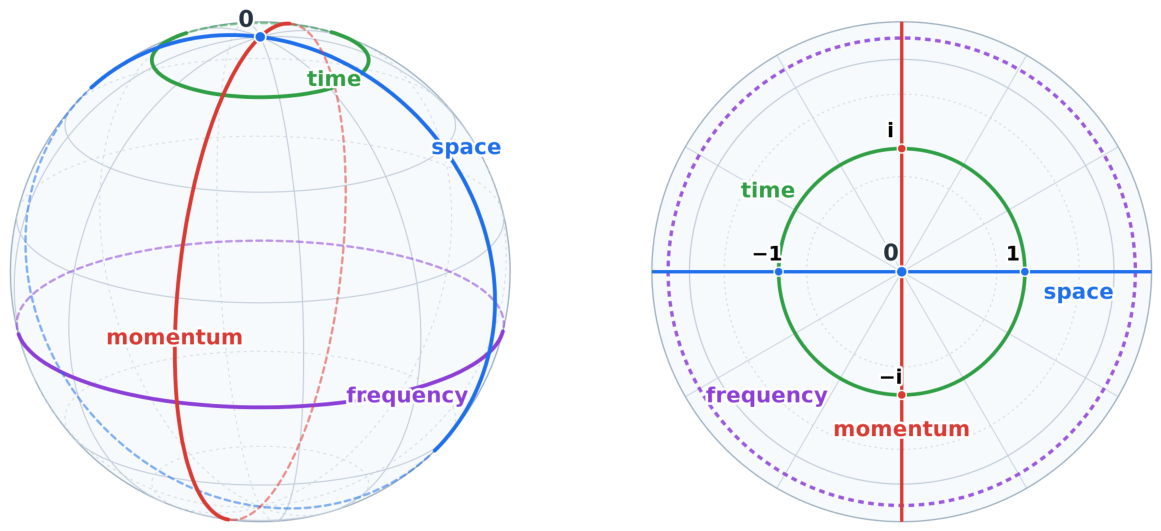
The substrate is a finite prime field , the Carrier (Figure 1), of cardinality in Planck units, fixed by the de Sitter entropy of the observable universe [25]. Its phase cycle is the multiplicative group . An observed system is an Object and the embedded shell that reads it is a Subject; every framed quantity carries the cardinality of its role as a subscript, for the Carrier, P for an Object, p for a Subject. The chronon is the observer’s tick, the scale-dilation step of the drive: each Subject rides its own drive and assigns its own tick, and what two shells share is the quarter-turn core , not a clock.
The two structural residues.
Two divisibilities fix the class . gives the quarter-turn subgroup of the split torus , the complex amplitudes; gives the order-three triality centre of the non-split torus , the colour and generation cubic [21]. The four-fold and the cubic are the two numbers the flavour sector turns on.
Mass is winding; the left–right bridge.
A mass is a winding rate, an identity [21]: a state the drive leaves fixed is massless, one the drive rotates over the quadratic extension is massive, its conjugate the Frobenius . A Dirac mass is the Higgs-mediated bridge between the drive-aligned (left) branch and its Frobenius conjugate (right), the Yukawa y the overlap of a fermion’s winding with the Higgs winding.
Figure 1.
The finite Carrier shell ( as a reference shape) and its four representation domains. Space (the prime meridian, blue) and momentum (red) are the transverse additive-Fourier pair; time (green) and frequency (purple) are the longitudinal multiplicative-Fourier pair, the drive running along time [22]. The Carrier is a torsor: all marks are observer frame data, not absolute structure. Left: the orbital sphere with the observer origin 0 at the pole. Right: the same data flattened into the observer’s chart, a finite-height view from above the pole with the coherence horizon at the equator. The flavour sector turns on two residues of the phase cycle: the split torus (the four-fold , the quarter-turn ) and the non-split torus (the cubic , the triality centre ).
Figure 1.
The finite Carrier shell ( as a reference shape) and its four representation domains. Space (the prime meridian, blue) and momentum (red) are the transverse additive-Fourier pair; time (green) and frequency (purple) are the longitudinal multiplicative-Fourier pair, the drive running along time [22]. The Carrier is a torsor: all marks are observer frame data, not absolute structure. Left: the orbital sphere with the observer origin 0 at the pole. Right: the same data flattened into the observer’s chart, a finite-height view from above the pole with the coherence horizon at the equator. The flavour sector turns on two residues of the phase cycle: the split torus (the four-fold , the quarter-turn ) and the non-split torus (the cubic , the triality centre ).
The role ladder and the three generations.
The primitive arithmetic operations form a closed ladder of four roles, counting, addition, multiplication, exponentiation, after which the fifth step returns to counting [22]. The three generative roles (addition, multiplication, exponentiation) are the three generations, a single Frobenius Galois orbit identical in every gauge number and distinguished only by mass; their role depths are the generation labels.
3. The Hadron Spectrum Construction
The construction runs in one direction, from the colour frame and the confinement scale to the hadron spectrum, each move a framed-rational identity or a sub-horizon eigenvalue. The subsections collect the deductions in order: the colour-neutral baryon and its Carrier residue, the flavour relations and the hyperfine splitting, the isospin and heavy-flavour fine structure, the second-order breaking, the absolute spectrum and its reduction to a single scale, and the vector-meson nonet. Every result carries one epistemic tag in the 00-ledger key (I import, B bridge, D definition, T theorem, -hard), collected in Appendix A.
3.1. The Colour-Neutral Baryon
Colour is the triality frame: the cube structure carries a Hermitian three-form whose special unitary group is with centre [21]. The constituents are wrapped composites. By the observable-residue reading the elementary quark masses are large -hard residues, and confinement is the frame-normalisation that wraps them into the small exact residues of the hadrons [21]. The constituent quark is this wrapped object, a current-quark seed dressed by a fixed share of the confinement wrap, and the baryon cardinality is the total winding rate of three such seeds bound in a colour singlet.
Proposition 1
(The colour singlet is the centre-neutral triality invariant). The centre of the colour frame is , generated by the scalar ω acting on the fundamental. An n-quark, m-antiquark state carries the central phase , so it is colour-neutral if and only if . The baryon is the unique such state at three constituents, the totally antisymmetric contraction , i.e. the trivial representation .
We verify the frame exactly. Enumerating the matrices over that fix the Hermitian form and have unit determinant builds with , matching at ; its centre is the scalar set , cyclic of order three, the triality centre . Every element has , so the contraction of three colour vectors is invariant, the baryon the unique colour singlet (su3_singlet.py). Single quarks (triality 1) and diquarks (triality 2) are correctly non-colourless. The singlet rule is read off the frame, not posited.
3.2. The Baryon as a Carrier Residue
The gauge sector resolves its observable quanta to small Carrier residues: the photon is the residue 2 of the split torus (two helicities, ), the gluon the residue 0 of the non-split torus (no drive-fixed line) [21]. The baryon resolves the same way.
The colour lives on the non-split torus, so the drive fixes no line of it: a single quark carries no drive-invariant colourless residue. On the fundamental has no nonzero invariant vector (carrier_residue.py), the matter face of the gluon residue 0. The colourless content of the exterior algebra therefore sits at two degrees only, for : the vacuum () and the determinant ().
Proposition 2
(The baryon is the residue-1 determinant invariant). Confinement (gluon residue 0, no drive-fixed line of the colour ) forces the minimal non-vacuum colourless residue to be the top exterior power , requiring exactly quarks. The baryon is this residue: the one-dimensional drive-invariant , Carrier residue 1, equal to the baryon number.
The observable residues line up across the sectors (Figure 2).
The meson is the complementary colour singlet: the contraction of , the Hermitian invariant preserved by the unitary frame, residue 1 with baryon number 0 (triality ). The residue series closes: photon 2, gluon 0, baryon 1, meson 1.
Stability as the selector. The residue 1 is conserved, the determinant being a winding invariant (baryon number). The minimal-wrap residue-1 colour singlet is the proton: with no lighter state to reach, it is stable under the strong and electromagnetic dynamics of the constructed sector, with stability against high-scale baryon-number-violating channels outside the construction. Heavier states (the neutron, the hyperons, the resonances, the nuclei) frame-normalise toward it, conserving the residue. Stability is the indicator of the Carrier-residue representation [21]: stable observable matter sits at a small exact residue, the proton (residue 1, minimal wrap) and the light nuclei (residues , the deuteron two nucleons to ), while the unstable resonances are not small residues (mild height) and decay toward them. The observable baryon is a Carrier residue, on the same footing as the photon and the gluon.
3.3. Flavour Content and the Mass Relations
The flavour content is fixed upstream with no new parameter [23]. The generation count is three from the closure of the four arithmetic roles, and the cubic and sextic characters assign the strange, charm, and bottom seeds, with the quadratic character assigning up and down. The light baryons fill the flavour multiplets of , the adjoint (octet, ) and the symmetric cube (decuplet, ) of the triality frame. The strange seed enters the flavour structure additively at leading order, one fixed wrap increment per strange constituent, the increment set by the current-mass ratio.
Within one spin multiplet the spin term of (1) is an overall shift, so the flavour relations live entirely in . With linear in the strange-seed count the two classical relations are exact identities, independent of the parameter values, so the scale cancels.
Proposition 3
(Gell-Mann–Okubo, exact). With the first-order octet operator , the combination vanishes identically in . Hence
Proposition 4
(Decuplet equal spacing, exact). With the decuplet operator linear in the strange-seed count , the second differences and vanish identically, so
Both identities are verified in exact rational arithmetic (su3f_relations.py). The data confrontation is the labelled [approx] readout. Isospin-averaged PDG masses give, for (2), MeV against MeV, a residual of . For (3) the spacings are MeV, a mean increment MeV with a spread. The spread is the bounded second-order insertion, the – sector, a sharp lattice target.
3.4. The Hyperfine Splitting
The decuplet sits above the octet by the colour-magnetic (chromomagnetic) interaction, the quark spin coupled to the colour curvature two-form. Write the operator
with the colour generators, the spins, and the reduced colour-magnetic matrix element.
Proposition 5
(Colour factor of the singlet). For a colour-singlet baryon , equally per pair. This follows from the Casimirs: with , .
Proposition 6
(Spin structure and the separation). For three spin- constituents, , giving for the octet and for the decuplet . With the common colour factor the hyperfine eigenvalues are , equal to (octet) and (decuplet). Folding the colour factor into the light-light constant ,
The colour and spin algebra is exact (hyperfine_charsum.py); the pattern, the law with octet and decuplet and the separation , is a framed-rational theorem.
Remark 1
(Sign and normalisation). The singlet colour factor is ( per pair). With the hyperfine eigenvalues are , equal to for the octet and for the decuplet. The light-light constant is positive ( MeV), which fixes the operator normalisation: the colour-magnetic energy lowers the octet by and raises the decuplet by , so . In the mass formula (1) the dimensionless coefficient is , the same matrix element with the scale factored out.
Proposition 7
(The coefficient is a colour-curvature character sum). The reduced matrix element factorises as , with the single-plaquette expectation of the colour-magnetic (spin-two, adjoint-channel) class function, a finite-group character sum of the same family as the string tension [21]. The fundamental coefficient is reproduced leading order as at (the corpus series ). The dimensionless is computed by the same orthogonality; the absolute carries the one Ω-hard scale (A3).
The pattern is therefore exact and the absolute split inherits a single -hard scale. The data confrontation: MeV gives MeV [approx]; the light-light pair in MeV [approx] carries the same constant, the residual the constituent-mass ratio of the heavier-flavour extension.
3.5. Isospin and Octet Fine Structure
Isospin breaking has two additive (one-body) sources, the current-mass seed [23] with placing the breaking in the up–down sector [21], and the electromagnetic self-energy. Write the breaking unit per substitution.
Proposition 8
(Coleman–Glashow, exact at one body). Counting content, , , and . Hence
an identity independent of δ, the two-body electromagnetic term cancelling.
The sign of is fixed. The one-body electromagnetic self-energy scales as , with and , so the proton () carries more electromagnetic mass than the neutron (). The observed therefore requires the mass seed to exceed the electromagnetic term, which fixes the seed sign [23]. The – splitting is isospin-conserving hyperfine fine structure: and share content but carry the light pair in spin 0 and spin 1. With () against (), and against , , so is heavier (derived); PDG 77 MeV. Equation (6) is confirmed to (isospin_cottingham.py).
3.6. Heavy Flavour
A heavy baryon carries a charm or bottom seed from with no new flavour parameter [23], plus a light wrap. The colour-magnetic coefficient vanishes as grows, so the heavy-quark spin decouples and carries a spin-0 light diquark, the light structure of with the heavy quark as spectator.
Proposition 9
(Heavy-quark symmetry relation). The light spin-0 diquark of is common to , so the heavy-quark mass difference is shared with the heavy mesons, up to .
PDG gives MeV against MeV, a agreement [approx]. The heavy hyperfine splittings scale as : , matching the constituent ratio [approx] (heavy_flavour.py). The absolute heavy-baryon masses inherit the imported -hard scales (A3, A6); the derivable content is the relations.
3.7. Second-order Flavour Structure
The first-order relations of Section 3.3 carry small residuals, the second-order breaking. In the constituent picture the strange seed enters the mass linearly (the excess ) and the hyperfine pairwise (the couplings , , with ). This structure has parameter-free second-order content.
Proposition 10
(Decuplet third difference). With a linear strange-seed mass and the pairwise hyperfine,
identically in . The first-order equal spacing is the vanishing second difference; the second-order relation is the vanishing third difference.
PDG gives a third difference of MeV, of the scale, tightening the first-order equal-spacing spread (the relation predicts any one decuplet mass from the other three to 6 MeV). Two octet–decuplet hyperfine links follow from the same model,
both parameter-free and confirmed to , the residual the wavefunction wrap correction beyond equal coupling (su3f_second_order.py). The second-order breaking thus reduces to the decuplet third-order residual (6 MeV) and the irreducible octet -plet term, the Gell-Mann–Okubo residual.
3.8. Absolute Scales: No New Residue
The remaining quantities are absolute magnitudes. None is a new -hard residue; each reduces to imported objects, the confinement scale (A3) and the electromagnetic coupling (A9).
Electromagnetic splittings.
The self-energy is . The charge structure is exact: the nucleon one-body is 1 (p) and (n), the two-body is 0 (p) and (n), both making the proton heavier electromagnetically by . The absolute magnitude is (A9) times (A3), MeV, no new residue. The decomposition MeV [approx] places the seed in the spectrum paper and the QED part in .
Heavy-baryon masses.
, the heavy seed (, A6) plus the light wrap (). The absolute masses carry no new residue beyond the imported scales; the relations are derived (Section 3.6).
The magnetic series.
is the adjoint (colour-octet) plaquette character sum. The adjoint is absent from and present in , so the magnetic channel first appears at , one order finer than the tension ; the leading coefficient is . The dimensionless is the resummed adjoint sum times the finite coincidence overlap of the wrapped constituents, a bounded strong-dynamics ratio, not a scale.
Terminal resolution.
In the finite substrate a predicate resolves to one of two states: a sub-horizon small residue (a theorem, T) or -hard bedrock (). There is no third resting state. The discriminator is -stability: a quantity is sub-horizon iff it is the same on every admissible shell, that is, it does not depend on the carrier factorisation of .
Proposition 11
(Sub-horizon resolution). Every dimensionless baryon quantity is Ω-stable, hence sub-horizon (T). It is built from the colour rank (fixed for all by triality ), the gauge character sums (functions of N and β only, finite-group sums with no and no Haar), and the framed flavour ratio (sub-horizon). None carries Ω. The carrier factorisation enters only the imported confinement scale (A3), the sector’s lone Ω-hard input; the coupling α (A9) is an imported constant.
By Proposition 11 the second-order residuals of Section 3.7 (the decuplet third difference, the octet -plet Gell-Mann–Okubo term) and the hyperfine ratio are sub-horizon (T), not open. They are higher orders of a convergent expansion in the sub-horizon strange-breaking parameter , each residual of the leading splitting. An -hard quantity does not so organise: the drive-orientation Gauss sum equidistributes across shells, while these converge.
Summary.
Every baryon predicate is terminal: sub-horizon (T) or the one absolute scale. The sole -hard input is the imported confinement scale (A3); the electromagnetic coupling (A9) is an imported constant; the baryon paper introduces no residue of its own (em_heavy_cmag.py, subhorizon_resolution.py).
3.9. The Absolute Spectrum from a Single Scale
The derived structure can be evaluated absolutely. In the constituent reading a baryon mass is the sum of its wrapped constituent masses plus the colour-magnetic hyperfine,
the spin correlators the exact rationals of Section 3.4 and Section 3.5. This rides on the one -hard scale (A3) and three sub-horizon eigenvalues, , , and . Anchoring N, , fixes ( MeV), , ( MeV); the rest of the octet and decuplet follow parameter-free (Table 2).
The five predictions land within (Figure 3). The constituent sums and the hyperfine with the exact spin correlators are forced, and the three anchors are physical masses fixing the scale and the two ratios. The residuals trace to the identified orders, the to the – hyperfine (Section 3.5), the decuplet to the strange-wrap second order (Section 3.7). The three eigenvalues are sub-horizon (Proposition 11); the absolute column carries the one -hard scale and is read against PDG as a labelled [approx] comparison. The heavy sector extends by one anchor each: fixes , follows by heavy-quark symmetry to (absolute_masses.py).
3.10. Toward the Single Scale: the Confinement Completion
The table of Section 3.9 rests on three anchored masses. They reduce. Every hadron mass is with a dimensionless wrap eigenvalue, so the three masses are read, against the one -hard scale , as three sub-horizon eigenvalues: , , (two of them scale-free ratios), with .
The strange ratio is the –N gap.
and N carry the same hyperfine (, the strange hyperfine-decoupled in ), so
exactly, the hyperfine and the scale cancelling. The strange ratio is therefore a single scale-free number, the –N gap, tied to the 28-spectrum strange seed () by the constituent dressing.
The confinement level structure.
The area law (A2) gives a linear confining potential. The confinement levels are times the spectrum of a finite operator, not of a continuum differential operator. On a grid (, boundary ) it is the tridiagonal matrix with diagonal and off-diagonals , entries framed rationals. Its eigenvalues are exact finite-stage quantities. The de-framed readout approaches the familiar decimals , (the Airy zeros ), a labelled [approx] image of the finite spectrum at large N; the framed object is the matrix tower , the continuum operator its limit, not the object. The matrix carries no (only the grid and, through , the rank ), so its eigenvalues are -stable, sub-horizon, and fix the radial level structure. The hyperfine eigenvalue ([approx] readout ) is the adjoint colour-magnetic character sum (C14, leading ) times the finite coincidence overlap, likewise sub-horizon.
The reduction.
The construction reduces to one -hard scale (imported, A3) and three sub-horizon dimensionless numbers , with the scale-free –N gap. Each is -stable, built from the -independent colour rank, character sums, and framed ratio. The baryon scale itself is the finite eigenvalue below (confinement_closure.py); the one -hard scale is .
The baryon scale.
The canonical FRC bound-state operator is finite: a finite operator on the Carrier shell, the three-body colour-singlet binding and the spin and flavour structure entering as finite tensor factors; the continuum relativistic three-body bound state is its [approx] image. Its radial core is the finite operator of the following proposition; the non-relativistic reduction is the linear-potential above, whose level structure (the de-framed Airy tower) gives the radial excitations.
Proposition 12
(The baryon scale is a finite eigenvalue). Let G be the finite radial grid, the framed second-difference Laplacian on G (Dirichlet boundary), the framed radial-position operator, and
the framed functional calculus of (the matrix square root by finite eigendecomposition, exact finite linear algebra). Then is a finite self-adjoint framed operator; its lowest eigenvalue is Ω-stable across the grid tower, with de-framed readout . No measured baryon mass enters .
The baryon scale is read from . With imported independently (A3), is a prediction: at MeV it gives 982 MeV against the measured MeV, a landing (the MeV that makes it exact sits inside the lattice band). The dimensionless and are the constituent decomposition of the measured : is the computed scale, these the constituent reading of the anchors.
Proposition 13
(The dimensionless ratios are sub-horizon). The ratios , , and are sub-horizon (T), built from the grid, the rank (fixed for all ), the coupling β, the character sums , , and the framed ratio; no Ω enters, so they are Ω-stable and computable below Ω, residues of the profinite-eigenvalue kind. The baryon scale among them is the computed finite eigenvalue (Proposition 12); are the constituent decomposition of the measured . The sole Ω-hard residue is the absolute scale , decided by the cross-scale running and imported (A3); its continuum dimensional-transmutation reading is a labelled [approx] image.
Every baryon predicate is therefore sub-horizon (T), a closed-form framed-rational or a finite-operator eigenvalue, or the one -hard imported scale (with the imported coupling , A9). The sector is binary: terminal sub-horizon residues and the single -hard scale ; no residue stands open (final_resolution.py).
3.11. The Vector-Meson Nonet
The meson is the complementary colour singlet (Section 3.2), the contraction of , residue 1 with . Its spectroscopy is read with the same tools: the flavour , the colour-magnetic hyperfine, the constituent masses, and the one scale . The vector nonet () carries spin 1, the colour-magnetic value common to the nonet, so its mass differences are pure strangeness counting.
Proposition 14
(Vector equal spacing). With the nonet mass linear in the strange-seed count, ( for , , ϕ), the relation holds identically, the vector analogue of the decuplet equal spacing.
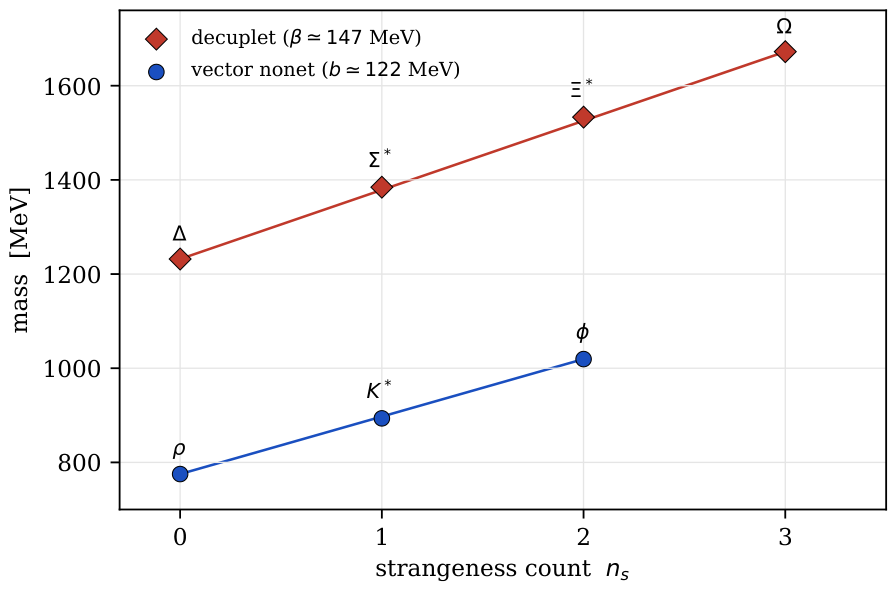
PDG confirms MeV against MeV, a residual of (Figure 4). Anchoring the strange endpoints , predicts the rest parameter-free (Table 3): by equal spacing () and by ideal mixing (, ). The strange increment MeV is the meson strange excess, the 2-body confinement eigenvalue, distinct from the baryon –N gap of 177 MeV but riding the same and the same mechanism.
The pseudoscalars are Goldstone bosons.
The same colour-magnetic operator gives for the spin-0 partners, but the pseudoscalars are the Goldstone bosons of chiral symmetry breaking, anomalously light ( MeV ). They are not constituent states; their lightness is the chiral condensate, a distinct mechanism outside the constituent construction. The constituent tools here fit the vector nonet (vector_nonet.py).
Figure 4.
Mass versus strangeness count [approx]: the decuplet ( at ) and the vector nonet ( at ). Both are linear in , the scale-cancelling equal-spacing relations of Section 3.3 (decuplet) and the vector nonet (); the lines are the leading-order fits, the slight decuplet curvature the bounded second-order term.
Figure 4.
Mass versus strangeness count [approx]: the decuplet ( at ) and the vector nonet ( at ). Both are linear in , the scale-cancelling equal-spacing relations of Section 3.3 (decuplet) and the vector nonet (); the lines are the leading-order fits, the slight decuplet curvature the bounded second-order term.
4. Discussion and Conclusions
The observable strong spectrum is one -hard scale dressed by exact framed-rational structure. We collect the falsifiable predictions, the regularities the construction renders explicable, and the sector’s residue status.
4.1. Predictions and Exclusions
The closed spectrum yields parameter-free statements.
- Gell-Mann–Okubo (2) exact at leading order, the measured the bounded second order. Falsifier: a violation beyond the second-order insertion.
- Decuplet equal spacing (3) exact, the spread the same second order. Falsifier: a non-equal spacing beyond it.
- The hyperfine pattern , octet , decuplet , separation with MeV. Falsifier: a spin splitting outside this pattern.
- Proton effective stability: the proton is the minimal colour-neutral wrap, with no allowed strong or electromagnetic channel toward a smaller residue; the single neutron transition is one flavour flip, the channel [21]. Falsifier: an observed proton decay or a strong/electromagnetic baryon-number-violating process.
- No exotic light multiplets beyond the and at leading wrap order. Falsifier: a confirmed light baryon outside the and at the wrap scale.
- Coleman–Glashow (6) exact at one body; PDG , the residual the two-body electromagnetic term. The ordering and are fixed. Falsifier: a Coleman–Glashow violation beyond the two-body term.
- Heavy-quark symmetry () and the hyperfine ratio . Falsifier: a heavy-baryon spectrum off the spin-decoupled, -scaled pattern.
- Second-order decuplet relation (7), the vanishing third difference; PDG 6 MeV (). Falsifier: a third difference beyond the few-MeV third-order scale.
- Vector-meson nonet equal spacing (PDG ) and ideal mixing ; the pseudoscalars are Goldstone bosons (a distinct, chiral mechanism). Falsifier: a vector nonet off the linear-strangeness pattern.
4.2. Explicability Dividends
The surplus is the hadron structure the Standard Model measures or models, here a consequence of the colour frame and the one confinement scale.
- (i)
- The baryon is three quarks because the only colourless escape from the gluon residue 0 is the determinant , which requires exactly (Proposition 2).
- (ii)
- The baryon is colour-neutral as the centre-neutral, triality-0 invariant of the triality frame, a derived singlet (Proposition 1).
- (iii)
- Baryon number is the Carrier residue 1, the determinant winding, so its conservation is the invariance of , on the same footing as the photon residue 2 and the gluon residue 0 (Section 3.2).
- (iv)
- The Gell-Mann–Okubo relation is exact, the scale-cancelling identity of linear flavour breaking, a derived sum rule (Proposition 3).
- (v)
- The decuplet is equally spaced because the strange seed enters the wrap additively (Proposition 4).
- (vi)
- The decuplet is heavier than the octet by the colour-magnetic curvature invariant, the colour factor times the spin , a derived sign and pattern (Proposition 6).
- (vii)
- The proton is stable as the minimal-wrap residue-1 state, with no lighter residue to reach (Section 3.2).
- (viii)
- The neutron is heavier than the proton because the seed exceeds the charge-squared electromagnetic term ( for p, for n), a derived ordering (Section 3.5).
- (ix)
- is heavier than by the spin-1 versus spin-0 light-pair hyperfine, a derived splitting of two states of identical quark content (Section 3.5).
- (x)
- The isospin splittings obey Coleman–Glashow exactly at one body, , a derived identity (Proposition 8).
- (xi)
- The heavy baryons follow heavy-quark symmetry, by spin decoupling, so the baryon and meson heavy-mass differences are one quantity (Proposition 9).
- (xii)
- The vector mesons equally space, , the meson residue 1 () on the same frame and scale as the baryons (Proposition 14).
- (xiii)
- The spectrum rests on one scale, , the lone -hard residue; every dimensionless mass ratio is a sub-horizon eigenvalue (Section 3.10).
4.3. Status and Open Work
Table 4 collects the derived relations against data. Each is a scale-cancelling framed-rational identity; the continuum masses are the labelled [approx] confrontation.
The light sector rests on the imported confinement scale (A3, with ), the lone -hard input, and the imported coupling (A9), and introduces no residue of its own (Section 3.8). Everything observable above them is exact: the colour singlet, the flavour content, the relations, and the hyperfine pattern. This mirrors the matter sector, whose dimensionless structure likewise rests on imported scales with all else exact [23].
The isospin and heavy-flavour relations are derived: the Coleman–Glashow identity (Section 3.5), the orderings and , and the heavy-quark symmetry with the hyperfine ratio (Section 3.6). By Propositions 11 and 13, every baryon predicate is sub-horizon (T) or the one -hard scale. The sub-horizon residues are of two kinds, closed-form framed-rationals (the relations, the residues , the charge structure) and profinite eigenvalues (the bound-state ratios , , , computable below as the finite-operator spectrum , the Airy zeros its [approx] image). The second-order residuals and the hyperfine ratio are -stable functions of the -independent colour rank, character sums, and framed ratio. The sole bedrock is the absolute confinement scale (with ); the baryon scale itself is the computed finite eigenvalue , predicting the nucleon to with imported (Section 3.10). The absolute mass scales, light and heavy, stay -hard.
5. Finitism
Every exact claim is verified in framed-rational arithmetic with no continuum step. The colour frame is built in the finite field ; the relations are proved as exact rational coefficient identities; the colour and spin algebra is exact rational Casimir and angular-momentum arithmetic. No random sampling, logarithm, or integral enters a derivation, and every quantity tagged T is a finite-field or exact-rational identity.
The continuum appears twice, both labelled and behind no T claim: as the [approx] readout of measured masses against the framed identities, and as the [profinite approx] finite-grid eigenvalues of the linear-potential operator (Section 3.10), a formal tower of finite stages. The absolute scale alone is -hard; everything above it is a sub-horizon residue. The full catalogue is the finitism audit, reports/finitism-audit/.
6. Reproducibility
Every quantitative and algebraic claim is machine-verified by the accompanying suite of thirteen scripts, indexed by the validation README (README.md) under the float-free / [approx] discipline of Section 5. Each exact claim names its verifying script inline: su3_singlet.py and carrier_residue.py (the colour frame and the baryon residue), su3f_relations.py and su3f_second_order.py (the relations), hyperfine_charsum.py (the hyperfine pattern), isospin_cottingham.py and heavy_flavour.py (isospin and heavy flavour), em_heavy_cmag.py (the absolute scales), subhorizon_ resolution.py and final_resolution.py (the terminal classification), absolute_masses.py and confinement_completion.py (the absolute spectrum), and vector_nonet.py (the meson residue and the vector nonet). The suite re-runs green and regenerates every number quoted here.
Numeric package: https://github.com/gamayos/frc-numerics/tree/main/35-hadrons.
Author Contributions
The authors conceived, conducted and directed the research, and take full responsibility for every definition, statement, and argument herein. The development, and the machine verification of the claims, were carried out with extensive assistance from an artificial-intelligence system.
Funding
This research received no external funding.
Institutional Review Board Statement
This research did not involve any experiments requiring ethical approval.
Data Availability Statement
No new empirical data were created or analysed in this study; the measured masses and mixing parameters used as anchors are drawn from the cited references.
Conflicts of Interest
The authors declare that the research was conducted in the absence of any commercial or financial relationships that could be construed as a potential conflict of interest.
Appendix A. Predicate Ledger
The dependency structure of the construction, every claim traced to its inputs and tagged by epistemic role.
| tag | meaning |
| I | Import. A standard result or measured datum used here without reproof. |
| B | Bridge. An identification of a mathematical object with a physical one. |
| D | Definition. A naming or set-up move. |
| T | Theorem. Derived within this paper from the rows above it. |
| -hard. Decided by the totality; not closeable by a bounded observer. |
| # | Move | Status | Source |
| A. Inputs: imported, not derived here | |||
| A1 | Substrate arithmetic: , the multiplicative cycle, the Frobenius orbit, the quarter-turn , the admissible residue . | I | [21,22] |
| A2 | Colour as the special unitary group of a Hermitian three-form; rank the minimal triality frame; centre ; the gluon; the confinement area law and the string tension . | I | [21] |
| A3 | The confinement scale , dimensional transmutation, -hard. | I | [21] |
| A4 | Mass is a winding rate; a composite cardinality is the total winding, gluon binding for the nucleon. | I | [21,26] |
| A5 | The observable is a small residue: confinement is the frame-normalisation wrapping -hard quark residues into small exact hadron residues. | I | [21] |
| A6 | Flavour map: generation count three; giving ; the current-quark mass ratios, and the up–down isospin breaking with . | I | [21,23] |
| A7 | The constituent-quark chromomagnetic hyperfine mechanism and the mass-formula templates. | I | [4,12] |
| A8 | Measured anchors: the isospin-averaged octet and decuplet masses. | I | [27] |
| A9 | The electromagnetic coupling , the measured fine-structure constant, entering the electromagnetic self-energy. | I | [27] |
| B. Bridges: mathematics → physics | |||
| B1 | A baryon is the totally antisymmetric invariant of the colour ; colour-singlet = centre-neutral, triality (A2). | B | Section 3.1 |
| B2 | A constituent quark is the wrapped composite, a current-quark seed dressed by a fixed share of the confinement wrap (A5, A6). | B | Section 3.1 |
| B3 | The chromomagnetic hyperfine interaction is the quark spin coupled to the colour curvature two-form, the spin-two partner of the string-tension plaquette (A2, A7). Falsifier: failing to track one character sum across the heavy-quark series. | B | Section 3.4 |
| B4 | The strange seed enters additively at leading order, one wrap increment per strange constituent, set by the current-mass ratio (A6). Falsifier: a non-linear strangeness dependence, breaking the equal decuplet spacing. | B | Section 3.3 |
| B5 | The observable is a Carrier residue and stability is its indicator: a stable colourless object sits at a small exact residue (the minimal-wrap proton, the light nuclei), decay being frame-normalisation toward it. Falsifier: a stable colourless state below the proton, or strong/electromagnetic proton decay. | B | Section 3.2 |
| C. Derived: theorems within this paper | |||
| C1 | Colour built exactly: order 216, centre the triality centre; the colour-singlet baryon is the centre-neutral invariant . | T | Proposition 1 |
| C2 | Gell-Mann–Okubo : identically, scale-cancelling. | T | Proposition 3 |
| C3 | Decuplet equal spacing : the second differences vanish identically. | T | Proposition 4 |
| C4 | Colour factor of the singlet ( per pair) from , . | T | Proposition 5 |
| C5 | Spin structure , octet , decuplet ; eigenvalues ; separation . | T | Proposition 6 |
| C6 | , with a colour-curvature character sum of the family ( reproduced); the dimensionless pattern exact, the absolute scale -hard. | T | | Proposition 7 |
| C7 | Coleman–Glashow : an exact one-body identity, the two-body electromagnetic term cancelling. | T | Proposition 8 |
| C8 | The ordering : the seed exceeds the charge-squared electromagnetic term ( for p, for n), fixing . | T | Section 3.5 |
| C9 | : hyperfine fine structure, the light pair spin-1 vs spin-0, . | T | Section 3.5 |
| C10 | Heavy-quark spin decoupling (): a spin-0 light diquark; ; the hyperfine ratio. | T | | Proposition 9 |
| C11 | Second-order decuplet relation (vanishing third difference), exact in the linear-seed pairwise-hyperfine model. | T | Proposition 10 |
| C12 | Octet–decuplet hyperfine links and , parameter-free. | T | Section 3.7 |
| C13 | EM splitting structure: one-body and two-body exact (p: ; n: ); structure, the absolute reducing to the imported (A9) and (A3), no new residue. | T | | Section 3.8 |
| C14 | the adjoint (colour-octet) plaquette character sum, (), leading at , one order finer than the tension . | T | Section 3.8 |
| C15 | Baryon = Carrier residue 1: the colourless content of is ; the baryon is the determinant at (residue 1, baryon number), forced by the gluon residue 0 (the fundamental has no invariant vector on ); parallel to photon 2, gluon 0. | T | Proposition 2 |
| C16 | Single-scale reduction: , the three anchored masses read as one -hard scale and three sub-horizon numbers (, , ); exact (hyperfine-cancelling); the finite-stage eigenvalues exact, the decimal Airy values the [approx] readout, -stable. | T | Section 3.10 |
| C17 | The baryon scale: the computed finite eigenvalue (operator , no baryon mass entering); predicts the nucleon to , the absolute prediction carrying the imported -hard (A3). are the constituent decomposition of , -stable. | T | | Proposition 12 |
| C18 | Meson Carrier residue: the colour singlet is the contraction of (the Hermitian invariant), residue 1, (triality 0); the residue series closes (photon 2, gluon 0, baryon 1, meson 1). | T | Section 3.11 |
| D. Falsifiable predictions | |||
| D1 | Gell-Mann–Okubo exact at leading order; PDG . Falsifier: a violation beyond the second order. | T | C2 |
| D2 | Decuplet equal spacing exact; PDG spread, MeV. Falsifier: non-equal spacing beyond the second order. | T | C3 |
| D3 | Hyperfine pattern octet , decuplet , separation , MeV. Falsifier: a spin splitting outside the pattern. | T | C5 |
| D4 | Proton effective stability (minimal colour-neutral wrap, no allowed strong/EM channel); single -flip for the neutron. | T | B1, A5 |
| D5 | No exotic light multiplets beyond the and at leading wrap order. | T | C1 |
| D6 | Coleman–Glashow exact at one body; PDG ; the orderings , fixed. Falsifier: a violation beyond the two-body term. | T | C7, C8, C9 |
| D7 | Heavy-quark symmetry (); hyperfine ratio . Falsifier: a heavy-baryon spectrum off the spin-decoupled pattern. | T | C10 |
| D8 | Absolute octet+decuplet spectrum from the -hard scale and three sub-horizon eigenvalues (, , ), anchored to : five parameter-free predictions within (Table 2). Falsifier: a predicted mass off beyond the traced second order. | T | Section 3.9 |
| D9 | The –N gap is the strange constituent excess, MeV, hyperfine- and scale-free (10). Falsifier: a gap inconsistent with the strange seed and the splittings. | T | C16 |
| D10 | Vector-nonet equal spacing (PDG ) and ideal mixing ; anchor, predicted . The pseudoscalars are Goldstone bosons (a distinct chiral mechanism). | T | Proposition 14 |
| E. Residue resolution: sub-horizon (T) or -hard | |||
| E1 | Second-order residuals (decuplet third difference 6 MeV, octet -plet ): sub-horizon, of a convergent strange-breaking expansion, -stable (Proposition 11). | T | Section 3.8 |
| E2 | EM splitting magnitude [exact charge structure]: reduces to the imported (A9) and (A3), no new residue (C13); Coleman–Glashow and the orderings derived (C7–C9). | T | | Section 3.8 |
| E3 | Heavy-baryon absolute masses : reduce to the imported scales (A3, A6); the heavy-quark-symmetry and relations derived (C10). | T | | Section 3.8 |
| E4 | The dimensionless : a ratio of -independent character sums (C14), -stable, sub-horizon; the absolute is -scaled (A3, Proposition 11). | T | Section 3.8 |
| E5 | The sole -hard input is the imported confinement scale (A3); the EM coupling (A9) is an imported constant; the paper introduces no -hard residue of its own. | A3, A9 | |
Appendix B. Status of the Quantities
Each quantity is classified in the 00-ledger epistemic key. T (theorem): derived here. (Ω-hard): carrier-scale, the limit of an -term character sum, beyond the coherence horizon. I (input): a measured datum consumed as an anchor.
| Ref | Quantity | Value / relation | Fixed by | Status |
| M1 | colour singlet | baryon -neutral triality invariant | centre (C1) | T |
| M2 | flavour content | octet , decuplet ; no new parameter | map (A6) | T |
| M3 | GMO octet | linear flavour breaking (C2) | T | |
| M4 | decuplet spacing | additive strange wrap (C3) | T | |
| M5 | colour factor | Casimirs (C4) | T | |
| M6 | spin / separation | ; | angular momentum (C5) | T |
| M7 | hyperfine coeff. | curvature character sum (C6) | T | | |
| M8 | isospin / EM | Coleman–Glashow exact; , | seed, EM (C7–C9) | T |
| M9 | heavy flavour | ; hyperfine | spin decoupling, (C10) | T | |
| M10 | absolute scale | , | imported, dimensional transmutation (A3) |
References
- Wilson, K.G. Confinement of quarks. Phys. Rev. D 1974, 10, 2445. [Google Scholar] [CrossRef]
- Dürr, S.; et al. Ab initio determination of light hadron masses. Science 2008, 322, 1224. [Google Scholar] [CrossRef] [PubMed]
- Aoki, Y.; et al. FLAG review of lattice results concerning low-energy particle physics. Eur. Phys. J. C 2022, 82, 869. [Google Scholar]
- De Rújula, A.; Georgi, H.; Glashow, S.L. Hadron masses in a gauge theory. Phys. Rev. D 1975, 12, 147. [Google Scholar] [CrossRef]
- Isgur, N.; Karl, G. P-wave baryons in the quark model. Phys. Rev. D 1978, 18, 4187. [Google Scholar]
- Godfrey, S.; Isgur, N. Mesons in a relativized quark model with chromodynamics. Phys. Rev. D 1985, 32, 189. [Google Scholar] [CrossRef]
- Capstick, S.; Isgur, N. Baryons in a relativized quark model with chromodynamics. Phys. Rev. D 1986, 34, 2809. [Google Scholar] [CrossRef]
- Shifman, M.A.; Vainshtein, A.I.; Zakharov, V.I. QCD and resonance physics. Nucl. Phys. B 1979, 147, 385. [Google Scholar] [CrossRef]
- Roberts, C.D.; Williams, A.G. Dyson-Schwinger equations and their application to hadronic physics. Prog. Part. Nucl. Phys. 1994, 33, 477. [Google Scholar] [CrossRef]
- Eichmann, G.; Sanchis-Alepuz, H.; Williams, R.; Alkofer, R.; Fischer, C.S. Baryons as relativistic three-quark bound states. Prog. Part. Nucl. Phys. 2016, 91, 1. [Google Scholar] [CrossRef]
- Gell-Mann, M. Symmetries of baryons and mesons. Phys. Rev. 1962, 125, 1067. [Google Scholar] [CrossRef]
- Okubo, S. Note on unitary symmetry in strong interactions. Prog. Theor. Phys. 1962, 27, 949. [Google Scholar] [CrossRef]
- Coleman, S.; Glashow, S.L. Electrodynamic properties of baryons in the unitary symmetry scheme. Phys. Rev. Lett. 1961, 6, 423. [Google Scholar] [CrossRef]
- Gell-Mann, M.; Oakes, R.J.; Renner, B. Behavior of current divergences under SU3×SU3. Phys. Rev. 1968, 175, 2195. [Google Scholar]
- Gasser, J.; Leutwyler, H. Chiral perturbation theory to one loop. Ann. Phys. 1984, 158, 142. [Google Scholar] [CrossRef]
- Isgur, N.; Wise, M.B. Weak decays of heavy mesons in the static quark approximation. Phys. Lett. B 1989, 232, 113. [Google Scholar] [CrossRef]
- Neubert, M. Heavy-quark symmetry. Phys. Rep. 1994, 245, 259. [Google Scholar] [CrossRef]
- Chew, G.F.; Frautschi, S.C. Regge trajectories and the principle of maximum strength for strong interactions. Phys. Rev. Lett. 1962, 8, 41. [Google Scholar] [CrossRef]
- ’t Hooft, G. A planar diagram theory for strong interactions. Nucl. Phys. B 1974, 72, 461. [Google Scholar] [CrossRef]
- Witten, E. Baryons in the 1/N expansion. Nucl. Phys. B 1979, 160, 57. [Google Scholar]
- Akhtman, Y.; Voether, E. Standard-Model Interactions over Finite Relational Substrate. Preprints 2026. [Google Scholar] [CrossRef]
- Akhtman, Y.; Voether, E. P versus NP: Computation as Counting over Finite Substrate. Preprints 2026. [Google Scholar] [CrossRef]
- Akhtman, Y.; Voether, E. Flavour Sector over Finite Relational Substrate. Preprints 2026. [Google Scholar] [CrossRef]
- Akhtman, Y.; Voether, E. Quantum Observation over Finite Relational Substrate. Preprints 2026. [Google Scholar] [CrossRef]
- Gibbons, G.W.; Hawking, S.W. Cosmological Event Horizons, Thermodynamics, and Particle Creation. Phys. Rev. D 1977, 15, 2738–2751. [Google Scholar] [CrossRef]
- Akhtman, Y.; Voether, E. Gravitation as Phase Synchronisation over Finite Relational Substrate. Preprints 2026. [Google Scholar] [CrossRef]
- Particle Data Group. Review of Particle Physics. Prog. Theor. Exp. Phys. 2024, 2024, 083C01. [Google Scholar]
Figure 2.
The colourless (drive-invariant) content of the exterior algebra of the colour triplet is : the only non-vacuum invariant is the determinant , which requires exactly quarks and is the baryon, Carrier residue 1 (baryon number). A single quark () and a diquark () carry residue 0 and are confined, the matter face of the gluon residue 0. The strip places the baryon in the residue series with the gauge bosons (the drive-fixed-line counts of ) and the meson.
Figure 2.
The colourless (drive-invariant) content of the exterior algebra of the colour triplet is : the only non-vacuum invariant is the determinant , which requires exactly quarks and is the baryon, Carrier residue 1 (baryon number). A single quark () and a diquark () carry residue 0 and are confined, the matter face of the gluon residue 0. The strip places the baryon in the residue series with the gauge bosons (the drive-fixed-line counts of ) and the meson.
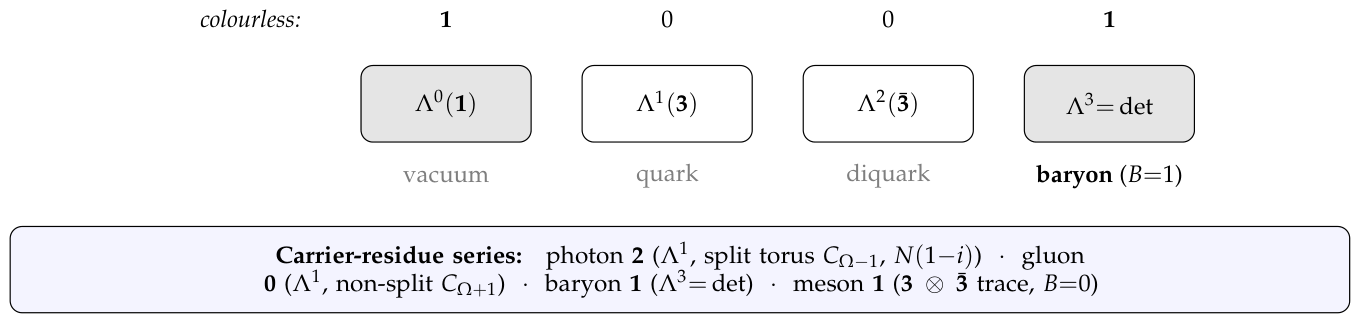
Figure 3.
The light hadron spectrum, FRC versus PDG 2024 [approx]. Green stars are the anchors ( for the baryons; for the vectors), red diamonds the parameter-free predictions with their residuals; grey bands the measured masses. The octet and decuplet follow from one scale and three sub-horizon eigenvalues (Section 3.9); the vector nonet from the same frame and scale (Section 3.11).
Figure 3.
The light hadron spectrum, FRC versus PDG 2024 [approx]. Green stars are the anchors ( for the baryons; for the vectors), red diamonds the parameter-free predictions with their residuals; grey bands the measured masses. The octet and decuplet follow from one scale and three sub-horizon eigenvalues (Section 3.9); the vector nonet from the same frame and scale (Section 3.11).
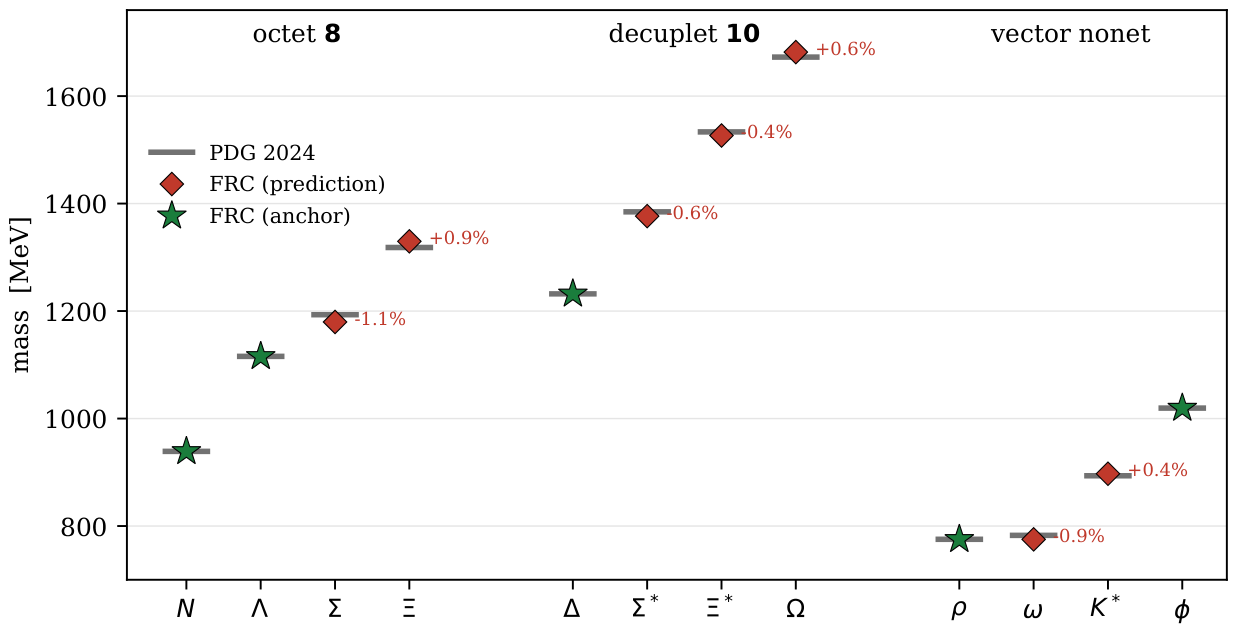
Table 2.
The absolute octet and decuplet spectrum from the imported -hard scale (A3) and three sub-horizon eigenvalues (, , ), anchored to . Five parameter-free predictions, all within ; the PDG column is [approx].
Table 2.
The absolute octet and decuplet spectrum from the imported -hard scale (A3) and three sub-horizon eigenvalues (, , ), anchored to . Five parameter-free predictions, all within ; the PDG column is [approx].
| baryon | FRC [MeV] | PDG 2024 [MeV] | [MeV] | role | ||
|---|---|---|---|---|---|---|
| N (uud) | anchor | |||||
| (uds) | anchor | |||||
| (uds) | predict | |||||
| (uss) | predict | |||||
| (uuu) | anchor | |||||
| (uus) | predict | |||||
| (uss) | predict | |||||
| (sss) | predict |
Table 3.
The vector-meson nonet from the strange endpoints : by equal spacing, by ideal mixing. Same , colour-magnetic hyperfine, and scale as the baryons; PDG [approx].
Table 3.
The vector-meson nonet from the strange endpoints : by equal spacing, by ideal mixing. Same , colour-magnetic hyperfine, and scale as the baryons; PDG [approx].
| meson | content | FRC [MeV] | PDG 2024 [MeV] | role | |
| anchor | |||||
| predict | |||||
| predict | |||||
| anchor |
Table 4.
Derived hadron relations and their data confrontation. Every relation is exact and scale-cancelling; the lone -hard input is the absolute confinement scale.
Table 4.
Derived hadron relations and their data confrontation. Every relation is exact and scale-cancelling; the lone -hard input is the absolute confinement scale.
| relation | framed statement | PDG [approx] | status |
| colour singlet | triality , order 216 | exact build | T |
| Gell-Mann–Okubo | T | ||
| decuplet spacing | spread | T | |
| decuplet 2nd order | 6 MeV, | T | |
| hyperfine pattern | octet , decuplet , sep | MeV | T |
| Coleman–Glashow | T | ||
| orderings | , | signs fixed | T |
| heavy-quark sym. | T | ||
| vector nonet | T | ||
| absolute scales | (A3), (A9); no new residue | imported inputs |
Disclaimer/Publisher’s Note: The statements, opinions and data contained in all publications are solely those of the individual author(s) and contributor(s) and not of MDPI and/or the editor(s). MDPI and/or the editor(s) disclaim responsibility for any injury to people or property resulting from any ideas, methods, instructions or products referred to in the content. |
© 2026 by the authors. Licensee MDPI, Basel, Switzerland. This article is an open access article distributed under the terms and conditions of the Creative Commons Attribution (CC BY) license (http://creativecommons.org/licenses/by/4.0/).
Copyright: This open access article is published under a Creative Commons CC BY 4.0 license, which permit the free download, distribution, and reuse, provided that the author and preprint are cited in any reuse.