

Submitted:
16 June 2025
Posted:
17 June 2025
You are already at the latest version
Abstract
The construction ruler (营造尺,Yingzao chi) for this hall is 320.6 mm. It adopts the system of large and small rulers that has been in practice since the Tang and Song dynasties. Each large ruler is divided into 10 cun(寸), which is equivalent to 12 small cun(小寸). It uses architectural modulus similar to modern ones. The basic module is 1 chi. Based on this, the macroscopic dimensions are determined and the proportion of the main body is controlled. Four small cun are used as the sub-module, which is one-third of the basic module. Half a chi, that is, six small cun, is also a sub-module of one chi. Based on this, the height of columns, the height of bracket sets, etc. are determined. 0.4 small cun are also a sub-module, which is one-thirtieth of the basic module. This is used to measure various components, such as dou (斗,square blocks), gong (栱,cross-shaped brackets), and fang (枋,horizontal bars).
Keywords:
Dai Temple in Yedi
; construction ruler(Yingzao chi)
; architectural modulus
; proportion
; Damuzuo(greater structural carpentry).
1. Overview and Existing Research
The Dai Temple(岱庙) is located in Yedi Village, Nancun Town, Zezhou County, Shanxi Province. Facing south, the temple is situated on a high ground in the west of the village. The terrain of the temple site is divided into three terraces. Along the central axis from south to north, the mountain gate(山门) and Yuzhao(鱼沼) Pond are on the first terrace. The wulou(舞楼,dance tower) is on the second terrace. The foundation of Tianqi(天齐) Hall serves as the third terrace. There are side halls, verandas, etc. built on both sides. In 2001, it was listed among the fifth batch of key cultural relics under national protection, with the cultural relic protection information spanning from the Song Dynasty to the Ming Dynasty.
Tianqi Hall is the main building of the temple. The inscription on the stone columns of the front eaves indicates that they were donated in the third year of the Yuanyou(元祐) reign of the Song Dynasty (1080 AD). There is an inscription on the blue stone doorframe of the front slot dating back to the 27th year of the Dading(大定) reign of the Jin Dynasty. Based on this, it can be inferred that this hall was built in the Song Dynasty and partially renovated in the Jin Dynasty (1187 AD).
Renovation started in November 2009 and was completed in May 2011. In 2019, the “Completion Report of the Renovation Project of Zezhou Dai Temple” was published, releasing relatively detailed survey and mapping drawings (SXZDGJ.2019). There is also one study on the artistic style among the research related to this hall(Li,Ym,.and Bl,Liu.2008).
2. Construction Ruler (营造尺, Yingzao Chi) and the Width of the Bay
As shown in Table 1, the Tong MianKuo( 通面阔,The sum of all the widths of the bays) is 10,900 mm, and the Tong Jinshen(通进深,The sum of all depths of the bays) is 10,260 mm. The difference between the two is 640 mm, approximately 2 chi. Usually, the width and depth are in integer chi or integer half-chi and are proportional. The ratio of the depth to the width is 0.9412 to 1, approximately 16 to 17. This non-canonical proportion suggests that the design must derive from integer ratios constrained by whole-chi measurements.
Some scholars have determined through research that the length of various Song Dynasty chi ranges from 280 mm to 370 mm (Lu,Jx,.and Gm,Qiu. 2001:370). Taking into account the contemporary existing buildings and regional factors, the length of the chi is restricted to the range of 280 mm to 329 mm. Within this range, there are six hypotheses. As shown in the table( Table 1), the depth of Tianqi Hall ranges from 32 chi to 36 chi, and the corresponding width is also in integer chi. From this, six lengths of the chi are calculated.
During the Tang Dynasty and subsequent dynasties, the system of short and long rulers was adopted. In the north, 100 millet grains(黍,Panicum miliaceum) were used to define a short ruler, and 120 millet grains made up a long ruler. The long ruler was the official and commonly used measuring tool, while the short ruler was employed for rituals, music, astronomy, and medical measurements. Among the 41 Tang Dynasty rulers collected in A History of Chinese Science and Technology: Weights and Measures, one was a short ruler and 40 were long rulers. Each ruler was divided into 10 grids. Apparently, the commonly used rulers were all long rulers, and they followed the decimal system. Each long ruler was 10 cun(寸), which was equivalent to 12 small cun(小寸). The length of a small cun was the length of 10 millet grains, and the length of the cun was the length of 12 millet grains (Lu,Jx,.and Gm,Qiu. 2001:318-326,353). This is quite similar to the relationship between inches and feet. This system has been widely applied in many other existing ancient structures. Therefore, when measuring this hall, the use of small cun should also be taken into consideration (Xu,Xg.2025a;Xx,Xg.2025b.).
As shown in the table( Table 2), the main data such as the width of the bay and the height of the column are also restricted by the construction chi. When comparing from three aspects: integer dimensions, proportions, and similarity ratios, Plan 1 is the most reasonable. Based on this, the fitted length of the construction chi is 320.6 mm. See the figure (Figure 1).
The construction ruler should not be only used for the main framework but also for other parts of the building. The following will be verified separately.
3. Cai(材,Similar to Dimension Lumber)
The cai data are listed in table( Table 3). The cai of the Neizhu Puzuo(内柱铺作,inner column bracket sets) are the same as those of the Waiyan Puzuo(外檐铺作,exterior eave bracket set), and they are obviously of the same specification.The width of the cai is 4.4 small cun, the Dang cai(单材,single-sized timbers) is 7.2 small cun, the qi(栔) is 2.8 small cun, and the Zucai(足材,the full-sized timbers) is 10 small cun. Obviously, cun is not the measurement method for cai, but small cun. By comparison, it can be seen that the measurement of cai is expanded in multiples of 0.4 small cun. Therefore, 0.4 small cun is the smallest measurement unit of cai.
In “Yingzao Fashi” (营造法式,the Song Dynasty’s building standard manual), there is the concept of “fen”(份,The absolute value varies with the grade of the “cai” and is one-tenth of the width of the “cai”.). “Fen” is a relative length and the smallest measurement unit of “cai”. This is a relative measurement method derived from the cross-sectional proportion of “cai”( Pan,G,.and Jz,He.2017). Borrowing the concept of “fen” in “Yingzao Fashi”, if we define 0.4 small cun as each “fen”, then the materials used for this palace can be described as follows: the width of “cai” is 11 fen, the “Dang cai” is 18 fen, the “qi” is 7 fen, and the “Zucai” is 25 fen..
As shown in table(Table 3), the cai used for the ridge purlin, each node of the upper and lower purlins, and the Timu(替木,cantilevered timbers) at each node can also be expressed in terms of fen. The cai used in these parts are similar to those of the exterior eave bracket sets. The width of the cai is basically 11 fen, while the height of the cai shows flexible minor variations.
The cross-section of beam-like components can also be constrained by fen. The Sichuanfu (四椽栿,5-purlin beam) is the thickest and strongest. Its diameter is 60 fen, which exactly equals 2 chi. The Pinglang(平梁,3-purlin beam), the Dingfu(丁栿,ding beam),and the Xitou fu(系头栿,side beam frame) are all round timbers. Their diameters range from 32 fen to 35 fen, approximately half of the diameter of the Sichuanfu . The Dajiaolain(大角梁,large corner beam) and the rufu(乳栿,beam tie) have rectangular cross-sections and are also constrained by fen values.
The width of the pu-pai-fang(普拍枋) is 30 fen, which is equivalent to 1 chi, and its height is 12 fen, equivalent to 4.8 small cun. The outer Laner(阑额, architrave) is larger than the inner Laner, and can also be constrained by fen values. These cai are slightly larger than the Zucai of the bracket sets.
There are Chuanfang(串枋,linking member) on the upper framework. This cai is a connecting component and does not bear weight, so it is the smallest. It is also set at 0.4 small cun.
4. Dou(斗,Bearing Block)
The data of dou are converted into cun and small cun. Comparatively speaking, taking 0.4 small cun as the smallest measurement unit is the most reasonable, as shown in table(Table 4). It can be divided into three categories according to size, as shown in figure(Figure 2).
The largest structural components are the neizhu ludou (内柱栌斗, inner column cap block) and waiyan ludou (外檐栌斗, eaves cap block) . Although there are slight differences in their external dimensions, they belong to the same category. The upper width is approximately 42 fen, equivalent to 16.8 small cun, and the height of the qi is 5.2 small cun.
There are ludou at three nodes: under the lower purlin, under the upper purlin, and at the ridge. They have little difference and similar shapes. The upper width of each is 32 fen, equivalent to 12.8 small cun, and the height of the qi is 10 to 11 fen.
The sizes of other dou are similar and are classified into the category of small dou. The sizes of this type of dou are slightly adjusted according to their positions. The upper width of the sandou(散斗,scattered block) on the outer eave columns is 19 fen, the upper width of the jiaohu dou(交互斗,connection block) is 22 fen, The upper width of the sandou at each node of the beam and purlins is 18 fen, and the height of the qi is mainly 7 fen.
On the basis of being divided into three major categories according to the size of the dou, the dimensions of each part of the dou vary slightly. Obviously, there are precision errors in the data in table(Table 4). Such errors include the manufacturing errors during the initial construction, as well as the later wind and rain erosion and surveying and mapping errors. However, beyond these errors, there are obvious differences in the design dimensions of the dou. The dou is not a standard, interchangeable part that is universally applicable. Instead, its size is determined according to the structural requirements. Only the size of the dou is relatively unified for the same type of structure and in the same type of position. Essentially, it is the result of being designed in units of 0.4 small cun.This is the result of being set according to the building modulus.
5. Gong (栱,Bracketarm)
The data of gong are listed in table(Table 5). According to the assembly relationship between gong and dou, the length of the center(栱心长,The center distance relevant to assembly) of gong can be deduced by subtracting the lower width of dou from the length of gong. The distance between the outer ends of the two dous above the gong is obtained by adding the upper width of a small dou to the length of the center. Each set of brackets is shown in Figure(Figure 3, Figure 4, Figure 5, Figure 6 and Figure 8).
5.1. Neizhu Puzuo
As shown in figure(Figure 4). The length of the nidao-gong (泥道栱,axial bracket arm) is 36 small cun. The bottom width of the sandou is 6 small cun. The length of the center is 30 small cun. There is only half of the nidao man-gong(泥道慢栱, second-layer axial bracket arm). The length of half of the nidao man-gong is 28 small cun, and the bottom of half of a sandou is 3 small cun. Thus, the length of the half nidao man-gong is 25 small cun. As shown in table(Table 5), the length of the tatou(榻头,The bracket arm of the inclined end under the beam) is 54 small cun.
The width of the narrowest bay of this hall is 120 small cun. There is no bujian-puzuo(补间铺作,bracket sets between columns) between the inner columns, and the length of the gong is not affected by the spacing and width of the sets of bracket arms. Therefore, the dimensions of these three components are all in integer small cun and It is also designed in integer ‘fens’.
5.2. Zhuanjiao-Puzuo(转角铺作,Bracket Set on Corner)
As shown in table and Figure(Table 5 、 Figure 6). The zhuanjiao - puzuo has three inward jumps at a 45-degree angle. The lengths of the half gong are 22 small cun, 34 small cun, and 44 small cun respectively. Calculated based on the width of half the bottom of a small dou being 2.8 small cun, it can be deduced that the lengths from the center of the half gong are 19.2 small cun, 31.2 small cun, and 41.2 small cun. Judging from the data, the integer value of the small cun of the bracket length is prioritized here, and the length of the center of the gong is determined according to the size of the bottom of the dou.
5.3. Waiyan Puzuo
As shown in figures and table(Figure 3 and Figure 4 and Table 5). The Waiyan Puzuo are relatively complex, with multiple horizontal and vertical gong intersecting with each other. Constrained by the assembly relationship and also influenced by the bay width and the bujian-puzuo, they are crucial to the architectural image.
The length of the ling-gong( 令栱,regular arm) be 36 small cun, the length of the guazi-gong(瓜子栱,oval arm) be 33 small cun, A gong is carved on the body of the third layer of the fang. The length of the gong is 30 small cun. The lengths of these three horizontal arches are set in integer small cun, and the length of the central part is determined by the assembly relationship between the dou and the gong.
The length of the nidao-gong is 28 cun, and the length of the nidao man-gong is 44 cun. Different from before, the length of the gong conforms to an integer number of cun. But it is still an integer multiple of 0.4 small cun.
The outer jump length of the hua-gong (华栱,flower-shaped bracket arms) is 15.6 small cun, which is equivalent to 13 cun. The inner jump length is 14.4 small cun, which is equivalent to 12 cun. The length of the center of the hua-gong is 25 cun, which is equivalent to 30 small cun. This set of data gives priority to ensuring integer cun.
The total inner jump of the Shanmian Puzuo(山面铺作,eave bracket set on the gable side) is 24.8 small cun. The outer jump is 28 small cun. The sum of the inner and outer jumps is 52.8 small cun, which is equivalent to 44 cun. For this set of data, the target of 44 cun was first determined, and then each inner and outer node was divided. The measurement was completed in small cun.
Overall, in the design of the gong, efforts are made to ensure that the length of the gong or the length of the center is an integer number of cun or an integer number of small cun. When affected by the structure, it will follow the structure. However, all are integer multiples of 0.4 small cun.
6. The Parameters of the Puzuo (铺作,Bracket Set) and the Building
6.1. The Parameters of the Waiyan Puzuo
As shown in table and figures (Table 6 and Figure 3 and Figure 4), the cai and qi of each layer of the Waiyan Puzuoare clear. The total height of the pu-pai-fang and the ludou is 10 small cun. Above it, the three layers of Zucai measure 30 small cun. The height of the Timu is 155 mm, approximately 5.8 small cun. The diameter of the liao-yan-tuan(撩檐榑,eaves purlin) is 290 mm, approximately 10.8 small cun. However, since the liao-yan-tuan and the Timu need to be cut to form a mating surface, the actual height of the liao-yan-tuan is approximately 10.4 small cun, and the Timu is approximately 5.6 small cun. The combined height of the liao-yan-tuan and the Timu is approximately 16 small cun. Thus, from the bottom surface of the pu-pai-fang to the upper surface of the Timu of the bracket set, it is a total of 56 small cun, which is the height parameter.
The length of the nidao man-gong is 44 cun. The distance between the outer skins of the two dou on the arch is 54.8 small cun, and this is the widest part of the Puzuo.
The total length of the inner and outer jumps of the Shanmian Puzuo is 44 cun, with the outer jump being 28 small cun. These are the depth parameters of the Puzuo.
6.2. Neizhu Puzuo, Beams and Indoor Space
The Neizhu Puzuo is the structural intersection point of the longitudinal and transverse beams, and it is the key to the structure of the building. The cai and qi are stacked in layers as shown in figures(Figure 4 and Figure 7). The inner column is 14.8 small cun higher than the outer eaves column. The distance from the bottom of the front rufu(乳栿) to the bottom surface of the pu-pai-fang is 30 small cun, and the height of the flat column is 174 small cun. Then the height from the indoor floor level to the bottom surface of the front rufu is 204 small cun, which is equivalent to 17 chi. These are the main parameters of the indoor space.
Figure 7.
Schematic diagram of the Shang Jia (Draw by oneself).
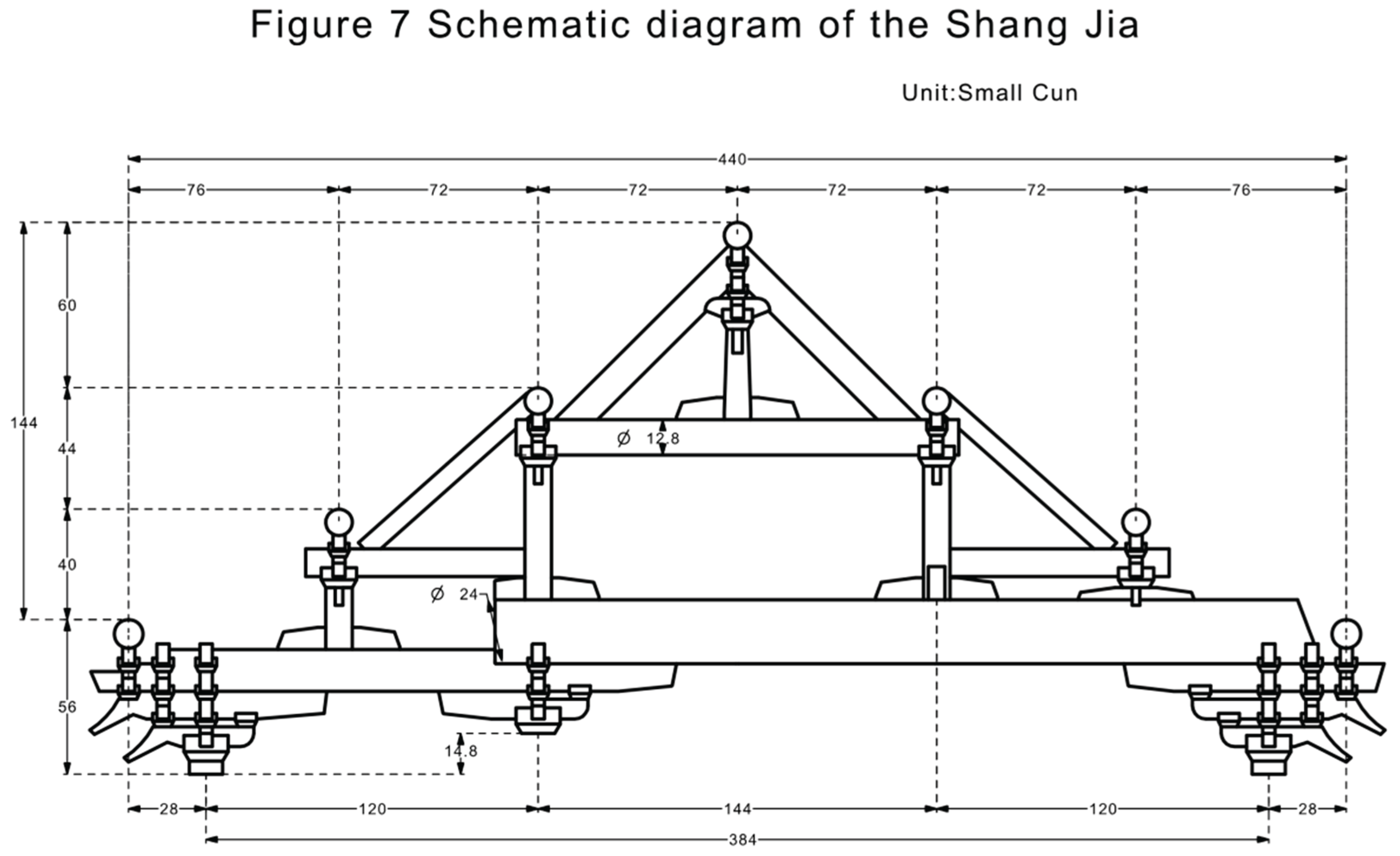
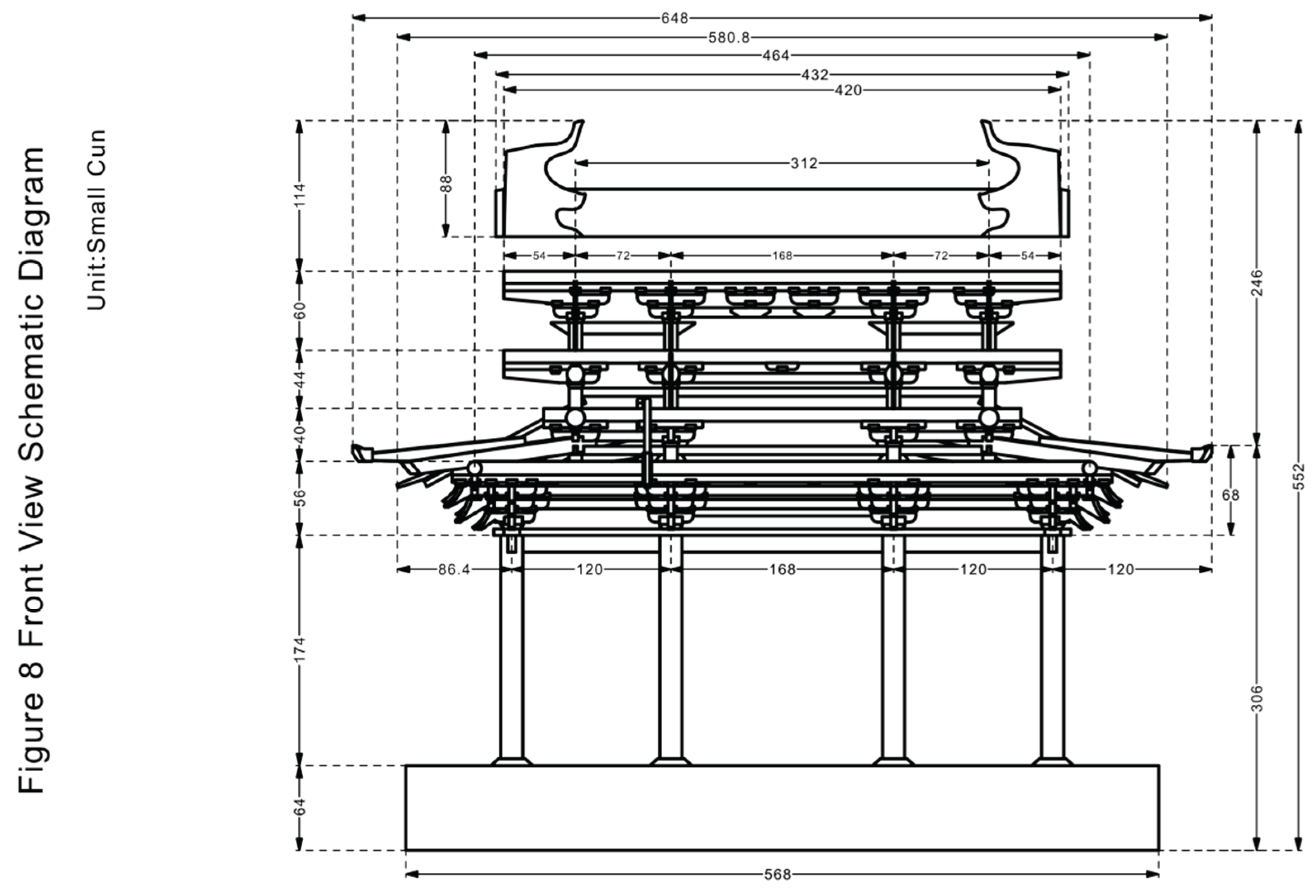
Figure 8.
Front View Schematic Diagram (Draw by oneself).
7. Foundation of the Hall
The relevant data is shown in table(Table 6). The foundation of Tianqi Hall is rather special as it takes advantage of the terrain of the terrace. The front of the terrace foundation is about 1,685 mm high, which is approximately 64 small cun when converted, about at the same level as an adult’s head and shoulders. The left and right terrace foundations are connected with those of the east and west side halls to form an integrated whole, with only a height difference of 14 to 15 centimeters. The ground level behind the hall is higher than that in front of the hall. The rear terrace foundation is integrated with the ground, and the eave wall is built from the ground level behind the hall. There are no steps in the middle in front of the hall. On the left and right of the front terrace foundation, corner columns are erected as the boundaries of the terrace foundation. There are two sets of steps, one on the east and one on the west, outside the corner columns.
8. Shang Jia (上架,Beam Frame)
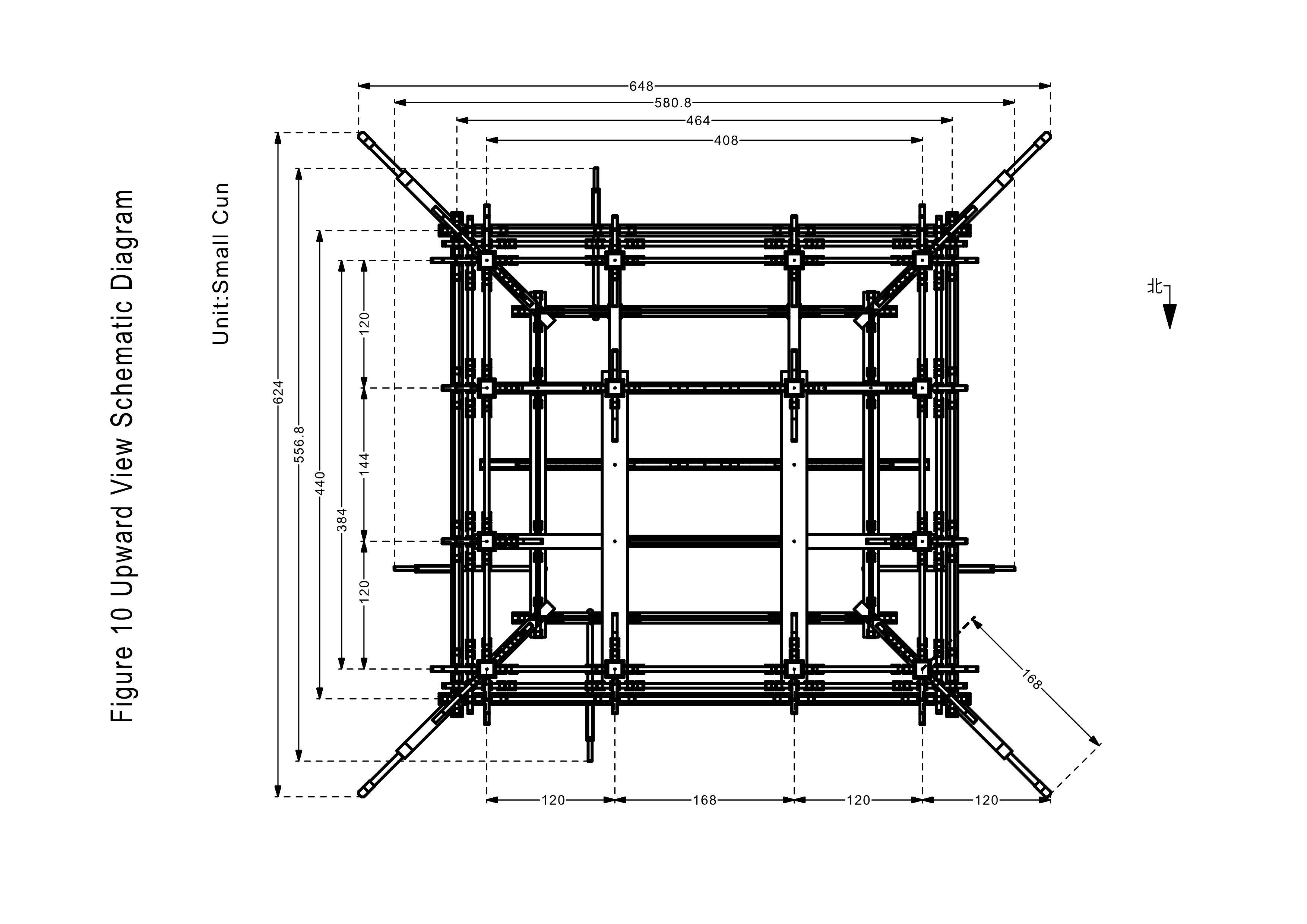
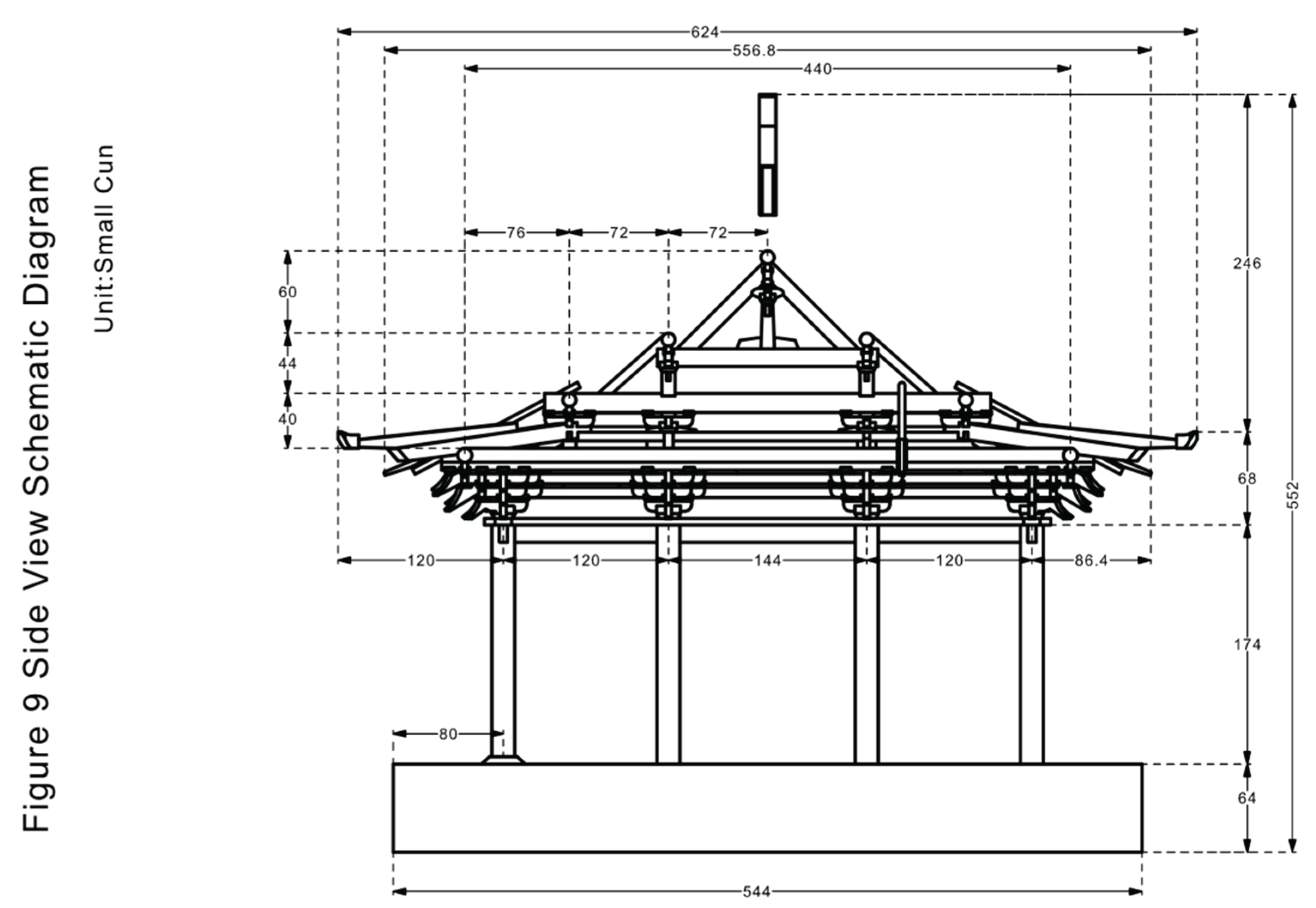
The relevant data fitting is shown in table and figures(Table 7 and Figure 7, Figure 8, Figure 9 and Figure 10).
Figure 9.
Side View Schematic Diagram (Draw by oneself).
8.1. Ceyang (侧样,Lateral Structural Elevation)
The Tong Jinshen is 320 cun, which is equivalent to 384 small cun. The Length of the out-jump of the puzuo is 28 small cun. The horizontal distance from the ridge purlin to the upper purlin is 72 small cun. The horizontal distance from the lower purlin to the upper purlin is 72 small cun. The horizontal distance from the liao-yan-tuan(撩檐榑,eaves purlin) to the lower purlin is 76 small cun. They are all integer multiples of 4 small cun.
8.2. Zhengyang(正样,Principal Structural Framework)
The Tong MianKuo is 408 small cun. The Length of the out-jump of the puzuo is 28 small cun. The distance between the purlins at the eaves on the east and west sides is 464 small cun. Excluding the tile, taking the surface of the gable fascia board as the boundary, the length of the main ridge (between the chu-ji) is 420 small cun. When including the tile components, the estimated length of the main ridge is 432 small cun,equivalent to 360 cun. the chu-ji(出际,outward extension of the gable purlins)is 54 small cun.
9. Ju Zhe(举折,Raising the Purlin)
As shown in table ( Table 7 and Table 8). The total lift is 144 small cun. The result of the fitting is as shown in figures(Figure 11). By taking 13/15 of the total rise and connecting it to the upper surface of the liao-yan-tuan, the height of the upper purlin can be obtained. By taking 12/15 of the total rise and connecting it to the upper surface of the liao-yan-tuan, the height of the lower purlin can be known. The essence of this calculation method is proportional distribution.
10. External Shape Parameters
Roofing tiles, decorative ridge beasts and the like are exposed to the elements for a long time and are very likely to have been replaced in history. However, (Li,Ym,.and Bl,Liu.2008) mentions that more than 85% of the roofing tiles and ridge beasts on the roof are original items from the Song Dynasty. The renovation report contains more detailed records of the roofing tiles. The roofing tiles were severely damaged, with differences in age, specifications. During the maintenance, a large number of roofing tiles were replenished according to the old ones (SXZDGJ.2019: P34, 39, 47, 63, 64). Apparently, the roofing tiles are the most vulnerable part. Every time in history when maintenance was carried out, old tiles were replaced and new ones were added. However, if old and new tiles are used simultaneously during each maintenance, tiles of the same size or with little difference must be given priority, and the maintenance will also be carried out according to the original state of the roof. When the main framework of the building is the original one, the current state of the roof can still reflect the appearance of its initial construction..
10.1. Jiao Liang (角梁, Corner Rafter), Tao Shou (套兽, Mythical Beast Ornament at the End of the Corner Rafter) and Boundaries
As shown in table and figures(Table 9 and Figure 5, Figure 6, Figure 8, Figure 9 and Figure 10).the Da Jiao liang( 大角梁,large corner beam) is placed at a 45-degree angle, with the Zi Jiaoliang (仔角梁,secondary corner beam) positioned above it. The beam ends are adorned with taoshou . The taoshou heads protrude from the column center at a 45-degree angle, with a horizontal length of 168 small cun, and a front-side horizontal length of 120 smal cun,Exactly 1 zhang(丈,a traditional Chinese unit of length, equal to 10 chi).
As illustrated in figures(Figure 8, Figure 9 and Figure 10), the distance between the eastern and western taoshou heads is 648 small cun, equivalent to 5 zhang 4 chi, while the distance between the northern and southern taoshou heads is 624 small cun, equivalent to 5 zhang 2 chi .This is the boundary of the building and is very important for building layout, planning, and design.
10.2. Chiwen(鸱吻,Ridge-Swallowing Ornament)
As shown in table and figures(Table 9 and Figure 8, Figure 9 and Figure 10), the net height of the chiwen is fitted to 88 small cun, the distance from the upper surface of the ridge purlin to the upper surface of the chiwen is fitted to 114 small cun, and the distance from the bottom of the platform base to the upper surface of the chiwen is 552 small cun, which is equivalent to 4 zhang and 6 chi. These are the height parameters of the building.
10.3. Main Parameters and Proportions
As shown in table and figures(Figure 8, Figure 9 and Figure 10 and Table 10).This hall is 5 zhang and 2 chi deep from north to south, 5 zhang and 4 chi wide from east to west, and 4 zhang and 6 chi high. These are three parameters designed in integer chi, not classical proportions.
Excluding the tiles and the Bofengban(博风板,gable eave board) on the gable ends, the length of the main ridge is 420 small cun. Estimating that the overhang of the tile ends is 6 small cun, the length of the main ridge is then 432 small cun, which is equivalent to 3 zhang and 6 chi. The ratio of this length to the distance of 5 zhang and 4 chi between the east and west tao shouis 2:3.
The overall height of the Damuzuo (from the bottom surface of the column to the upper surface of the ridge purlin) is 374 small cun. The height from the bottom surface of the column to the upper surface of the liao-yan-tuan is 230 small cun. The ratio is 0.6149, which is the golden ratio of 8 to 13.
11. Conclusions
11.1. Construction Ruler
The construction ruler is 320.6 mm long. It conforms to the system of large and small rulers implemented since the Tang and Song Dynasties. The large ruler is the official ruler, the commonly used ruler in daily life, and also the construction ruler for this palace hall. One chi (Chinese foot) is equal to 10 cun, which is equivalent to 12 small cun.
11.2. Architectural Modulus
This palace hall adopts a series of modular systems.
The basic module is 1 chi. Based on this, the macroscopic dimensions of the building are determined, and the main body proportion is controlled.
4 small cun serves as a sub-module, which is one-third of the basic module. 6 small cun is equivalent to half a chi and is also a sub-module, which is one-half of the basic module. Based on these, the height of the palace foundation, the width and depth of the palace foundation, the height of the columns, the height of the bracket sets, the length of the purlin bays, chu-ji, etc. are set.
0.4 small cun is also a sub-module, which is one-thirtieth of the basic module. It is used for various small-sized components, such as the cross-sections of dou, gong , fang (枋,horizontal members), and beam elements.
This set of modular systems is different from the cai-fen system. Its basic theory is the same as that of modern architectural modular systems. (MOHURD.2013.)
Supplementary Materials
The following supporting information can be downloaded at the website of this paper posted on Preprints.org.
References
- Lu,Jx,.and Gm,Qiu. 2001. History of Science and Technology in China.Vol.of Metrology. Beijing: Science Press.
- Li,Ym,.and Bl,Liu.2008. Analysis of the Architecture and Artistic Style of the Tianqi Hall in Yedi Temple, Jincheng. Cultural Relics World, no. 6: 50–54.
- MOHURD(Ministry of Housing and Urban-Rural Development of the People’s Republic of China).2013. GB/T 50002 – 2013, Standard for modular coordination of building.
- Pan,G,.and Jz,He.2017. Interpretation of Yingzao Fashi.2rd ed.Nanjing: Southeast University Press.
- SXZDGJ(Shanxi Zhongde Ancient Architecture Planning and Design Institute Co., Ltd).2019. Completion Report of the Renovation Project of Zezhou Dai Temple [泽州岱庙修缮工程峻工报告]. Taiyuan. Beiyue Literature and Art Publishing House.
- Xu,Xg.2025a.Ancient Chinese Architectural Modulus-Main Hall of the Erxian Temple at Jincheng Preprints. [CrossRef]
- Xu,Xg.2025b.中国古代建筑模数-平遥镇国寺万佛殿(ancient Chinese Architectural Modulus -Wanfo Hall in Zhenguo Temple,Pingyao) OSF Preprints. February 11. [CrossRef]
Figure 1.
Schematic diagram of the column grid arrangement on the Hall Foundation(Draw by oneself).

Figure 2.
Schematic diagram of some dou (Draw by oneself).
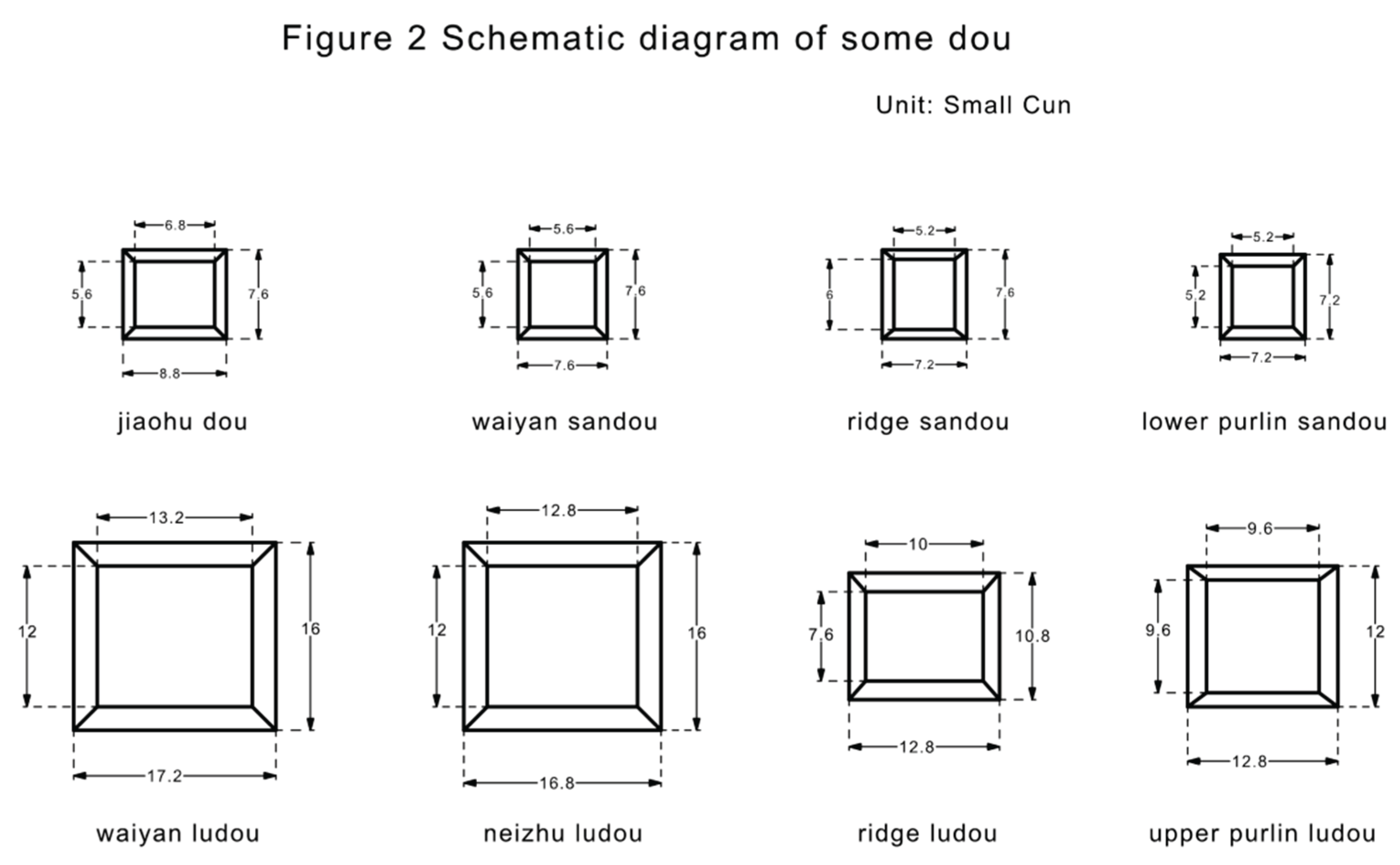
Figure 3.
Schematic diagram of Waiyan Puzuo (Draw by oneself).
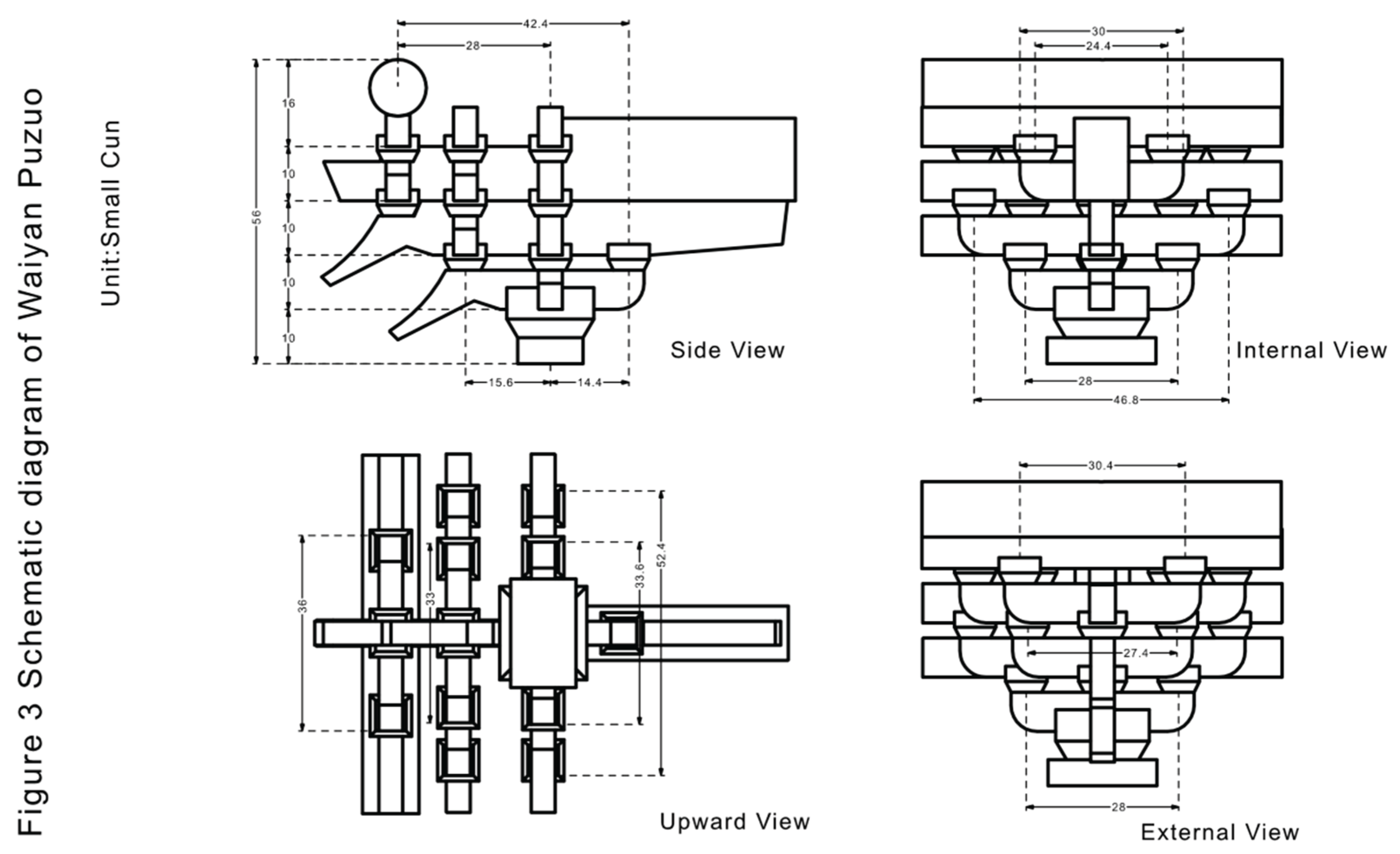
Figure 4.
Schematic diagram of Shanmian Puzuo (Draw by oneself).
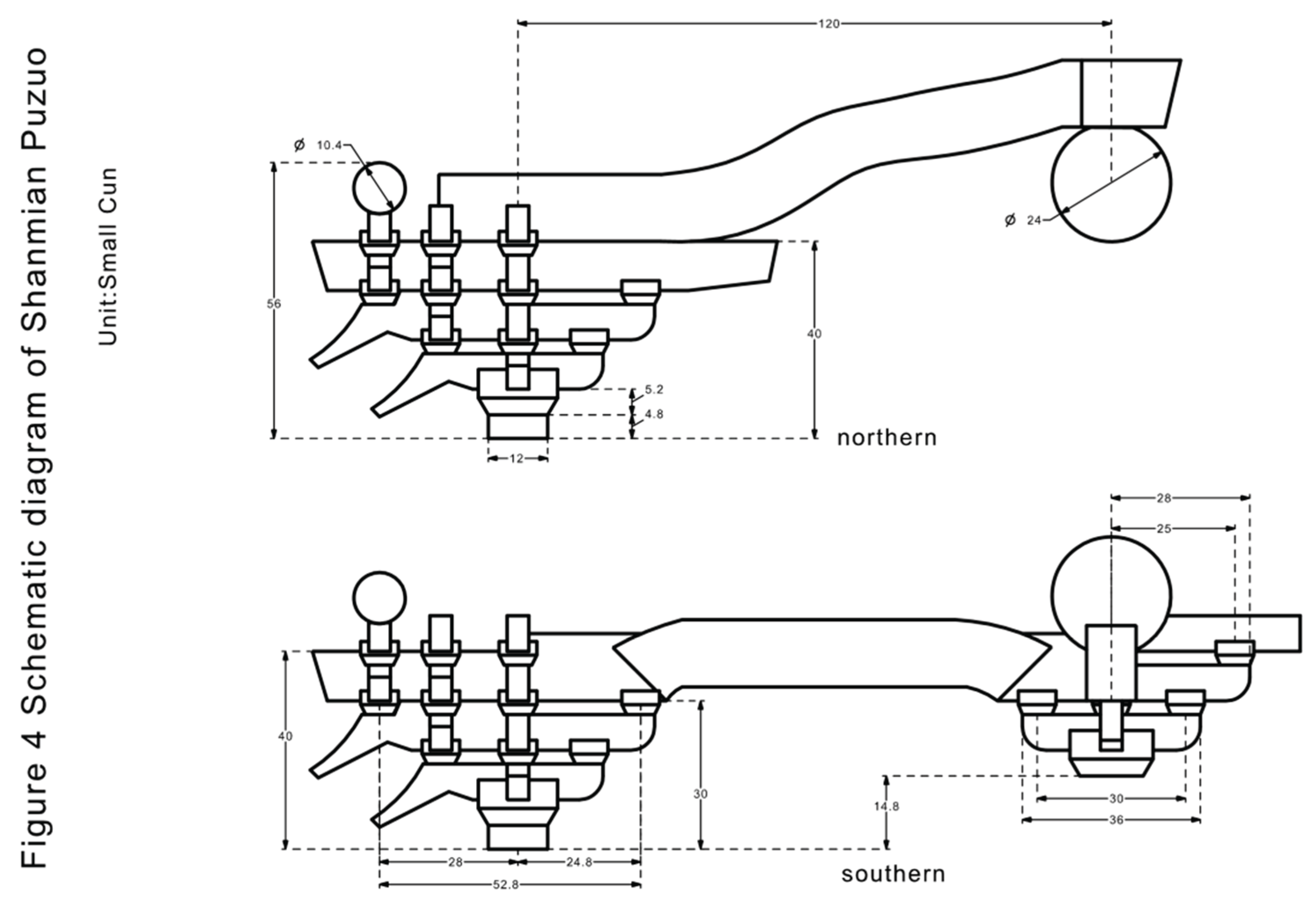
Figure 5.
Schematic diagram of zhuanjiao-puzuo (Draw by oneself).
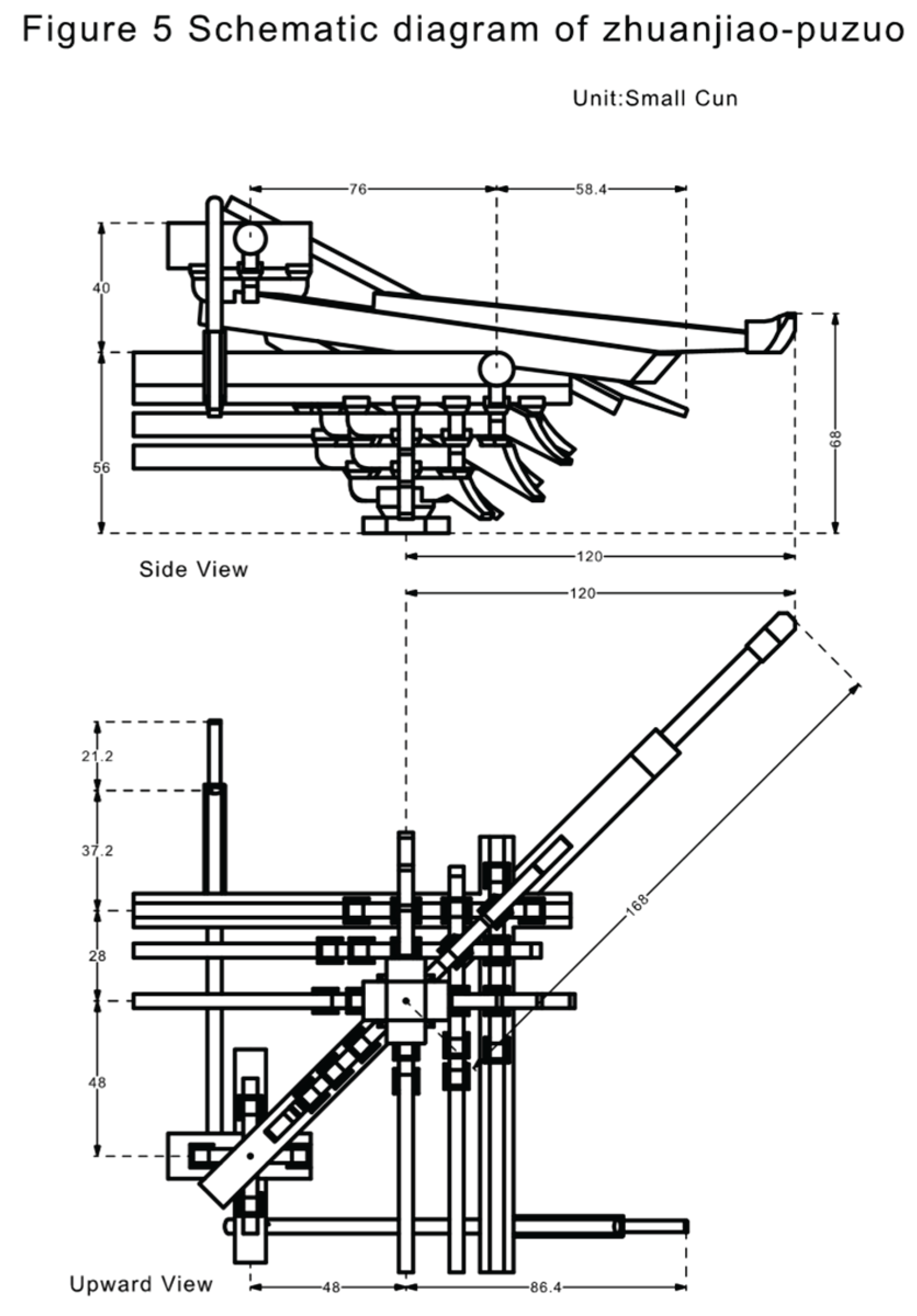
Figure 6.
45-degree sectional view of the zhuanjiao-puzuo (Draw by oneself).
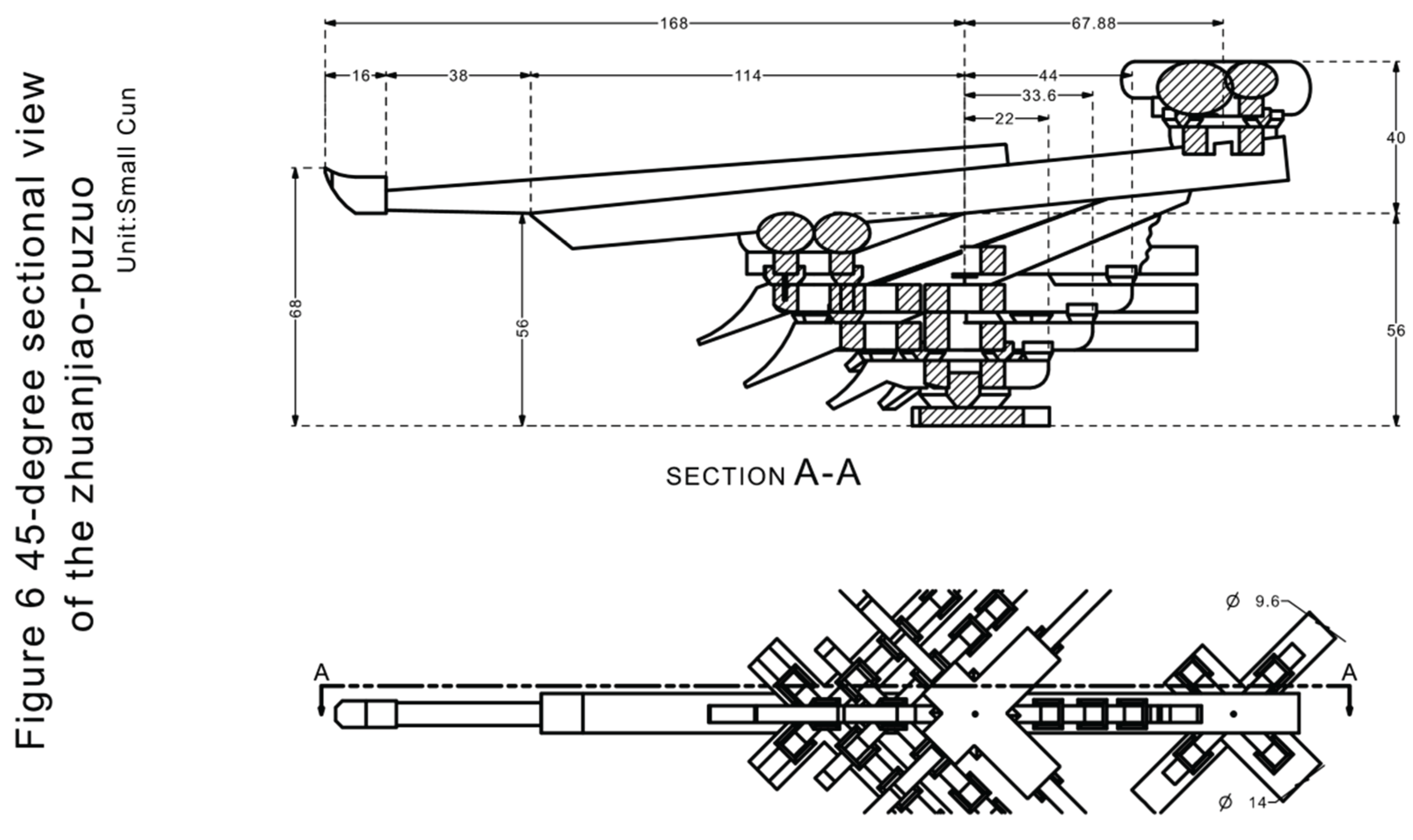
Figure 10.
Upward View Schematic Diagram (Draw by oneself).
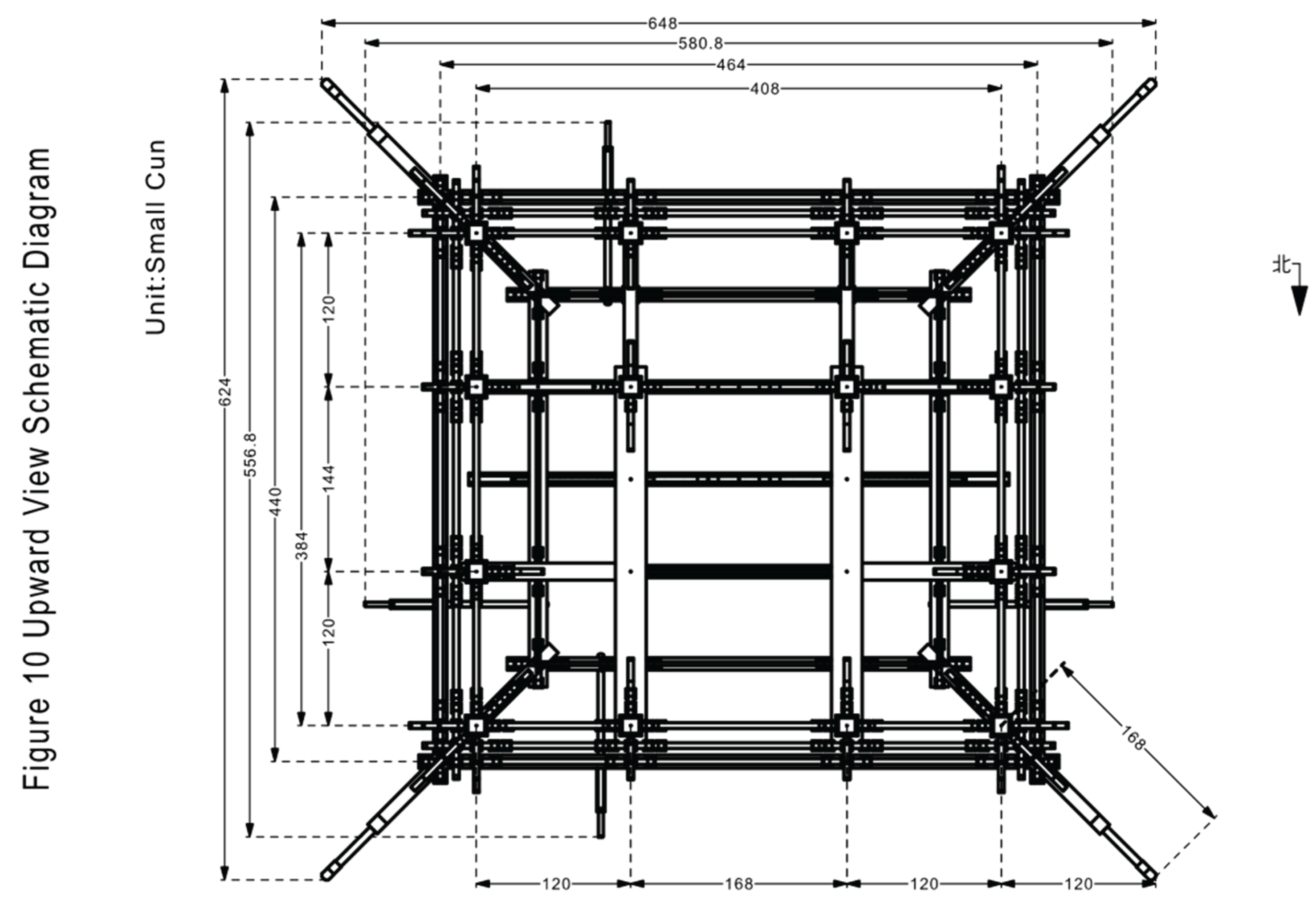
Figure 11.
Schematic diagram of Ju Zhe(Raising the Purlin) (Draw by oneself).
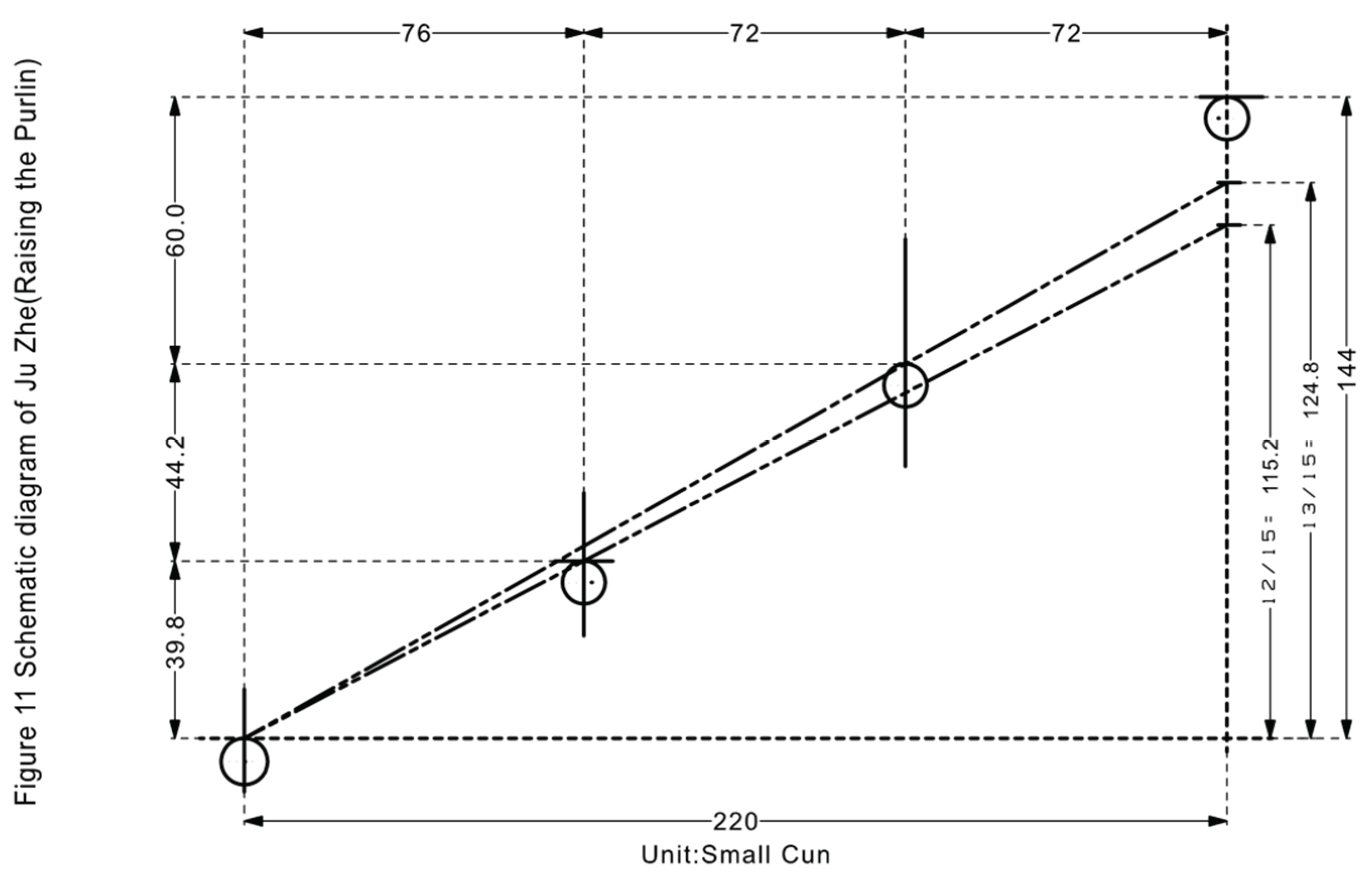

Table 1.
Six Hypothetical Lengths of the Chi (Construction Ruler).
| Raw data | Hypothesis 1 | Hypothesis 2 | Hypothesis 3 | Hypothesis 4 | Hypothesis 5 | Hypothesis 6 | |||||||
| mm | Integer Chi | Ancient Chi Length (mm) | Integer Chi | Ancient Chi Length (mm) | Integer Chi | Ancient Chi Length (mm) | Integer Chi | Ancient Chi Length (mm) | Integer Chi | Ancient Chi Length (mm) | Integer Chi | Ancient Chi Length (mm) | |
| Tong Jinshen | 10260 | 32 | 320.625 | 33 | 310.909 | 34 | 301.765 | 35 | 293.143 | 35.5 | 289.014 | 36 | 285.000 |
| Tong MianKuo | 10900 | 34 | 320.588 | 35 | 311.429 | 36 | 302.778 | 37 | 294.595 | 38 | 286.842 | 38.5 | 283.117 |
| mean value | 320.607 | 311.169 | 302.271 | 293.869 | 287.928 | 284.058 | |||||||
Table 2.
Validation of Six Hypotheses.
| Hypothesis 1: 320.6 mm/Chi (Fitted) | ||||||
| Raw data | Fitted Value | |||||
| mm | Convert tol cun | cun | small cun | Multiples of 0.4 small cun | Similarity rate | |
| Tong Jinshen | 10260 | 320.025 | 320 | 384 | 96 | 99.992% |
| Tong MianKuo | 10900 | 339.988 | 340 | 408 | 102 | 100.004% |
| Column height | 4640 | 144.729 | 145 | 174 | 43.5 | 100.188% |
| width of the central bay | 4500 | 140.362 | 140 | 168 | 42 | 99.742% |
| width of the secondary bay | 3200 | 99.813 | 100 | 120 | 30 | 100.188% |
| width of the secondary bay in depth | 3210 | 100.125 | 100 | 120 | 30 | 99.875% |
| width of the central bay in depth | 3840 | 119.775 | 120 | 144 | 36 | 99.998% |
| Difference between Bay Width and Depth | 640 | 19.963 | 20 | 24 | 6 | 100.188% |
| Hypothesis 2: 311.2 mm/Chi (Fitted) | ||||||
| Raw data | Fitted Value | |||||
| mm | Convert tol cun | cun | small cun | Multiples of 0.4 small cun | Similarity rate | |
| Tong Jinshen | 10260 | 329.692 | 330 | 396 | 99 | 100.094% |
| Tong MianKuo | 10900 | 350.257 | 350 | 420 | 105 | 99.927% |
| Column height | 4640 | 149.100 | 150 | 180 | 45 | 100.603% |
| width of the central bay | 4500 | 144.602 | 145 | 174 | 43.5 | 100.276% |
| width of the secondary bay | 3200 | 102.828 | 102.5 | 123 | 30.75 | 99.681% |
| width of the secondary bay in depth | 3210 | 103.149 | 102.5 | 123 | 30.75 | 99.371% |
| width of the central bay in depth | 3840 | 123.393 | 125 | 150 | 37.5 | 101.302% |
| Difference between Bay Width and Depth | 640 | 20.566 | 20 | 24 | 6 | 97.250% |
| Hypothesis 3: 311.2 mm/Chi (Fitted) | ||||||
| Raw data | Fitted Value | |||||
| mm | Convert tol cun | cun | small cun | Multiples of 0.4 small cun | Similarity rate | |
| Tong Jinshen | 10260 | 339.432 | 340 | 408 | 102 | 100.167% |
| Tong MianKuo | 10900 | 360.605 | 360 | 432 | 108 | 99.832% |
| Column height | 4640 | 153.505 | 155 | 186 | 46.5 | 100.974% |
| width of the central bay | 4500 | 148.874 | 150 | 180 | 45 | 100.757% |
| width of the secondary bay | 3200 | 105.866 | 105 | 126 | 31.5 | 99.182% |
| width of the secondary bay in depth | 3210 | 106.196 | 105 | 126 | 31.5 | 98.873% |
| width of the central bay in depth | 3840 | 127.039 | 130 | 156 | 39 | 102.331% |
| Difference between Bay Width and Depth | 640 | 21.173 | 20 | 24 | 6 | 94.459% |
| Hypothesis 4: 293.87 mm/Chi (Fitted) | ||||||
| Raw data | Fitted Value | |||||
| mm | Convert tol cun | cun | small cun | Multiples of 0.4 small cun | Similarity rate | |
| Tong Jinshen | 10260 | 349.134 | 350 | 420 | 105 | 100.248% |
| Tong MianKuo | 10900 | 370.912 | 370 | 444 | 111 | 99.754% |
| Column height | 4640 | 157.893 | 157.5 | 189 | 47.25 | 99.751% |
| width of the central bay | 4500 | 153.129 | 152 | 182.4 | 45.6 | 99.263% |
| width of the secondary bay | 3200 | 108.892 | 109 | 130.8 | 32.7 | 100.099% |
| width of the secondary bay in depth | 3210 | 109.232 | 109 | 130.8 | 32.7 | 99.788% |
| width of the central bay in depth | 3840 | 130.670 | 132 | 158.4 | 39.6 | 101.018% |
| Difference between Bay Width and Depth | 640 | 21.778 | 20 | 24 | 6 | 91.834% |
| Hypothesis 5: 287.93 mm/Chi (Fitted) | ||||||
| Raw data | Fitted Value | |||||
| mm | Convert tol cun | cun | small cun | Multiples of 0.4 small cun | Similarity rate | |
| Tong Jinshen | 10260 | 356.337 | 355 | 426 | 106.5 | 99.625% |
| Tong MianKuo | 10900 | 378.564 | 380 | 456 | 114 | 100.379% |
| Column height | 4640 | 161.150 | 160 | 192 | 48 | 99.286% |
| width of the central bay | 4500 | 156.288 | 155 | 186 | 46.5 | 99.176% |
| width of the secondary bay | 3200 | 111.138 | 112.5 | 135 | 33.75 | 101.225% |
| width of the secondary bay in depth | 3210 | 111.485 | 112.5 | 135 | 33.75 | 100.910% |
| width of the central bay in depth | 3840 | 133.366 | 130 | 156 | 39 | 97.476% |
| Difference between Bay Width and Depth | 640 | 22.228 | 25 | 30 | 7.5 | 112.473% |
| Hypothesis 6: 284 mm/Chi (Fitted) | ||||||
| Raw data | Fitted Value | |||||
| mm | Convert tol cun | cun | small cun | Multiples of 0.4 small cun | Similarity rate | |
| Tong Jinshen | 10260 | 361.268 | 360 | 432 | 108 | 99.649% |
| Tong MianKuo | 10900 | 383.803 | 385 | 462 | 115.5 | 100.312% |
| Column height | 4640 | 163.380 | 165 | 198 | 49.5 | 100.991% |
| width of the central bay | 4500 | 158.451 | 160 | 192 | 48 | 100.978% |
| width of the secondary bay | 3200 | 112.676 | 112.5 | 135 | 33.75 | 99.844% |
| width of the secondary bay in depth | 3210 | 113.028 | 112.5 | 135 | 33.75 | 99.533% |
| width of the central bay in depth | 3840 | 135.211 | 135 | 162 | 40.5 | 100.218% |
| Difference between Bay Width and Depth | 640 | 22.535 | 25 | 30 | 7.5 | 110.938% |
Table 3.
Cai(Similar to dimension lumber).
| Each chi is 320.6 mm | ||||||||
| Raw data | Fitted Value | |||||||
| nn | Convert to cun | Convert to small cun | small cun | Convert to cun | Multiples of 0.4 small cun | Similarity rate | ||
| Puzuo | widthofthecai | 120 | 3.743 | 4.492 | 4.4 | 3.667 | 11 | 97.961% |
| heightofdangcai | 195 | 6.082 | 7.299 | 7.2 | 6 | 18 | 98.646% | |
| qi | 75 | 2.339 | 2.807 | 2.8 | 2.333 | 7 | 99.742% | |
| heightofZucai | 270 | 8.422 | 10.106 | 10 | 8.333 | 25 | 98.951% | |
| Ridge Purlin Joint | widthofthecai | 120 | 3.743 | 4.492 | 4.4 | 3.667 | 11 | 97.961% |
| heightofdangcai | 185 | 5.770 | 6.925 | 6.8 | 5.667 | 17 | 98.202% | |
| qi | 75 | 2.339 | 2.807 | 2.8 | 2.333 | 7 | 99.742% | |
| upper purlin Joint | widthofthecai | 120 | 3.743 | 4.492 | 4.4 | 3.667 | 11 | 97.961% |
| heightofdangcai | 200 | 6.238 | 7.486 | 7.4 | 6.167 | 18.5 | 98.852% | |
| qi | 70 | 2.183 | 2.620 | 2.6 | 2.167 | 6.5 | 99.233% | |
| heightofZucai | 270 | 8.422 | 10.106 | 10 | 8.333 | 25 | 98.951% | |
| lower purlin Joint | widthofthecai | 120 | 3.743 | 4.492 | 4.4 | 3.667 | 11 | 97.961% |
| heightofZucai | 270 | 8.422 | 10.106 | 10 | 8.333 | 25 | 98.951% | |
| heightofdangcai | 170 | 5.303 | 6.363 | 6.4 | 5.333 | 16 | 100.580% | |
| Sichuanfu (5-purlin beam) | diameter | 640 | 19.963 | 23.955 | 24 | 20 | 60 | 100.188% |
| Pinglang(平梁,3-purlin beam) | diameter | 340 | 10.605 | 12.726 | 12.8 | 10.667 | 32 | 100.580% |
| Dingfu(ding beam) | diameter | 360 | 11.229 | 13.475 | 13.6 | 11.333 | 34 | 100.930% |
| Xitou fu(,side beam frame) | diameter | 370 | 11.541 | 13.849 | 14 | 11.667 | 35 | 101.090% |
| rufu(beam tie) | width | 270 | 8.422 | 10.106 | 10 | 8.333 | 25 | 98.951% |
| height | 410 | 12.789 | 15.346 | 15.2 | 12.667 | 38 | 99.047% | |
| Da Jiao liang( large corner beam) | height | 310 | 9.669 | 11.603 | 11.6 | 9.667 | 29 | 99.972% |
| width | 280 | 8.734 | 10.480 | 10.4 | 8.667 | 26 | 99.233% | |
| Timu(cantilevered timbers) of Puzuo | width | 120 | 3.743 | 4.492 | 4.4 | 3.667 | 11 | 97.961% |
| height | 155 | 4.835 | 5.802 | 5.8 | 4.833 | 14.5 | 99.972% | |
| Timu of upper purlin | width | 120 | 3.743 | 4.492 | 4.4 | 3.667 | 11 | 97.961% |
| height | 130 | 4.055 | 4.866 | 4.8 | 4 | 12 | 98.646% | |
| Timu of lower purlin | width | 120 | 3.743 | 4.492 | 4.4 | 3.667 | 11 | 97.961% |
| height | 135 | 4.211 | 5.053 | 5 | 4.167 | 12.5 | 98.951% | |
| Timu of ridge Purlin | width | 120 | 3.743 | 4.492 | 4.4 | 3.667 | 11 | 97.961% |
| height | 150 | 4.679 | 5.614 | 5.6 | 4.667 | 14 | 99.742% | |
| pu-pai-fang | width | 320 | 9.981 | 11.978 | 12 | 10 | 30 | 100.188% |
| height | 130 | 4.055 | 4.866 | 4.8 | 4 | 12 | 98.646% | |
| outer Laner( architrave) | width | 165 | 5.147 | 6.176 | 6 | 5 | 15 | 97.152% |
| height | 335 | 10.449 | 12.539 | 12.8 | 10.667 | 32 | 102.082% | |
| inner Laner | width | 150 | 4.679 | 5.614 | 5.6 | 4.667 | 14 | 99.742% |
| height | 290 | 9.046 | 10.855 | 10.8 | 9 | 27 | 99.497% | |
| Chuanfang(linking member) of Xitou fu | width | 75 | 2.339 | 2.807 | 2.8 | 2.333 | 7 | 99.742% |
| height | 170 | 5.303 | 6.363 | 6.4 | 5.333 | 16 | 100.580% | |
| Chuanfang(linking member) of lower purlin Joint | width | 70 | 2.183 | 2.620 | 2.8 | 2.333 | 7 | 106.867% |
| height | 170 | 5.303 | 6.363 | 6.4 | 5.333 | 16 | 100.580% | |
| Chuanfang(linking member) of ridge Purlin Joint | width | 90 | 2.807 | 3.369 | 3.4 | 2.833 | 8.5 | 100.930% |
| height | 230 | 7.174 | 8.609 | 8.6 | 7.167 | 21.5 | 99.897% | |
Table 4.
dou (斗,square blocks).
| Each chi is 320.6 mm | ||||||||||
| waiyan ludou | Upper width | Lower width | Upper depth | Lower depth | Er(耳) | ping(平) | dou-qi(欹) | qi(栔) | Total height | |
| Raw data | mm | 460 | 350 | 430 | 320 | 105 | 50 | 90 | 140 | 245 |
| cun | 14.348 | 10.917 | 13.412 | 9.981 | 3.275 | 1.560 | 2.807 | 4.367 | 7.642 | |
| small cun | 17.218 | 13.100 | 16.095 | 11.978 | 3.930 | 1.871 | 3.369 | 5.240 | 9.170 | |
| Fitted Value | small cun | 17.2 | 13.2 | 16 | 12 | 4 | 1.8 | 3.4 | 5.2 | 9.2 |
| cun | 14.333 | 11 | 13.333 | 10 | 3.333 | 1.5 | 2.833 | 4.333 | 7.667 | |
| fen | 43 | 33 | 40 | 30 | 10 | 4.5 | 8.5 | 13 | 23 | |
| Similarity rate | 99.897% | 100.760% | 99.411% | 100.188% | 101.778% | 96.180% | 100.930% | 99.233% | 100.324% | |
| waiyan sandou | Upper width | Lower width | Upper depth | Lower depth | Er(耳) | ping(平) | dou-qi(欹) | qi(栔) | Total height | |
| Raw data | mm | 200 | 140 | 205 | 150 | 50 | 25 | 50 | 75 | 125 |
| cun | 6.238 | 4.367 | 6.394 | 4.679 | 1.560 | 0.780 | 1.560 | 2.339 | 3.899 | |
| small cun | 7.486 | 5.240 | 7.673 | 5.614 | 1.871 | 0.936 | 1.871 | 2.807 | 4.679 | |
| Fitted Value | small cun | 7.6 | 5.6 | 7.6 | 5.6 | 2 | 0.8 | 2 | 2.8 | 4.8 |
| cun | 6.333 | 4.667 | 6.333 | 4.667 | 1.667 | 0.667 | 1.667 | 2.333 | 4 | |
| fen | 19 | 14 | 19 | 14 | 5 | 2 | 5 | 7 | 12 | |
| Similarity rate | 101.523% | 106.867% | 99.047% | 99.742% | 106.867% | 85.493% | 106.867% | 99.742% | 102.592% | |
| waiyan jiaohu dou | Upper width | Lower width | Upper depth | Lower depth | Er(耳) | ping(平) | dou-qi(欹) | qi(栔) | Total height | |
| Raw data | mm | 240 | 180 | 205 | 150 | 50 | 25 | 50 | 75 | 125 |
| cun | 7.486 | 5.614 | 6.394 | 4.679 | 1.560 | 0.780 | 1.560 | 2.339 | 3.899 | |
| small cun | 8.983 | 6.737 | 7.673 | 5.614 | 1.871 | 0.936 | 1.871 | 2.807 | 4.679 | |
| Fitted Value | small cun | 8.8 | 6.8 | 7.6 | 5.6 | 2 | 0.8 | 2 | 2.8 | 4.8 |
| cun | 7.333 | 5.667 | 6.333 | 4.667 | 1.667 | 0.667 | 1.667 | 2.333 | 4 | |
| fen | 22 | 17 | 19 | 14 | 5 | 2 | 5 | 7 | 12 | |
| Similarity rate | 97.961% | 100.930% | 99.047% | 99.742% | 106.867% | 85.493% | 106.867% | 99.742% | 102.592% | |
| neizhu ludou | Upper width | Lower width | Upper depth | Lower depth | Er(耳) | ping(平) | dou-qi(欹) | qi(栔) | Total height | |
| Raw data | mm | 450 | 340 | 425 | 325 | 105 | 50 | 90 | 140 | 245 |
| cun | 14.036 | 10.605 | 13.256 | 10.137 | 3.275 | 1.560 | 2.807 | 4.367 | 7.642 | |
| small cun | 16.843 | 12.726 | 15.908 | 12.165 | 3.930 | 1.871 | 3.369 | 5.240 | 9.170 | |
| Fitted Value | small cun | 16.8 | 12.8 | 16 | 12 | 4 | 1.8 | 3.4 | 5.2 | 9.2 |
| cun | 14.000 | 10.667 | 13.333 | 10.000 | 3.333 | 1.500 | 2.833 | 4.333 | 7.667 | |
| fen | 42 | 32 | 40 | 30 | 10 | 4.5 | 8.5 | 13 | 23 | |
| Similarity rate | 99.742% | 100.580% | 100.580% | 98.646% | 101.778% | 96.180% | 100.930% | 99.233% | 100.324% | |
| ridge purlin ludou | Upper width | Lower width | Upper depth | Lower depth | Er(耳) | ping(平) | dou-qi(欹) | qi(栔) | Total height | |
| Raw data | mm | 335 | 265 | 285 | 200 | 85 | 40 | 75 | 115 | 200 |
| cun | 10.449 | 8.266 | 8.890 | 6.238 | 2.651 | 1.248 | 2.339 | 3.587 | 6.238 | |
| small cun | 12.539 | 9.919 | 10.667 | 7.486 | 3.182 | 1.497 | 2.807 | 4.304 | 7.486 | |
| Fitted Value | small cun | 12.8 | 10 | 10.8 | 7.6 | 3.2 | 1.6 | 2.8 | 4.4 | 7.4 |
| cun | 10.667 | 8.333 | 9.000 | 6.333 | 2.667 | 1.333 | 2.333 | 3.667 | 6.167 | |
| fen | 32 | 25 | 27 | 19 | 8 | 4 | 7 | 11 | 18.5 | |
| Similarity rate | 102.082% | 100.818% | 101.242% | 101.523% | 100.580% | 106.867% | 99.742% | 102.220% | 98.852% | |
| upper purlin ludou | Upper width | Lower width | Upper depth | Lower depth | Er(耳) | ping(平) | dou-qi(欹) | qi(栔) | Total height | |
| Raw data | mm | 345 | 260 | 325 | 250 | 85 | 35 | 70 | 105 | 190 |
| cun | 10.761 | 8.110 | 10.137 | 7.798 | 2.651 | 1.092 | 2.183 | 3.275 | 5.926 | |
| small cun | 12.913 | 9.732 | 12.165 | 9.357 | 3.182 | 1.310 | 2.620 | 3.930 | 7.112 | |
| Fitted Value | small cun | 12.8 | 9.6 | 12 | 9.6 | 3.2 | 1.2 | 2.8 | 4 | 7.2 |
| cun | 10.667 | 8 | 10 | 8 | 2.667 | 1 | 2.333 | 3.333 | 6 | |
| fen | 32 | 24 | 30 | 24 | 8 | 3 | 7 | 10 | 18 | |
| Similarity rate | 99.123% | 98.646% | 98.646% | 102.592% | 100.580% | 91.600% | 106.867% | 101.778% | 101.242% | |
| lower purlin ludou | Upper width | Lower width | Upper depth | Lower depth | Er(耳) | ping(平) | dou-qi(欹) | qi(栔) | Total height | |
| Raw data | mm | 350 | 255 | 330 | 235 | 65 | 45 | 75 | 120 | 185 |
| cun | 10.917 | 7.954 | 10.293 | 7.330 | 2.027 | 1.404 | 2.339 | 3.743 | 5.770 | |
| small cun | 13.100 | 9.545 | 12.352 | 8.796 | 2.433 | 1.684 | 2.807 | 4.492 | 6.925 | |
| Fitted Value | small cun | 12.8 | 9.6 | 12.4 | 8.8 | 2.4 | 1.6 | 2.8 | 4.4 | 6.8 |
| cun | 10.667 | 8.000 | 10.333 | 7.333 | 2.000 | 1.333 | 2.333 | 3.667 | 5.667 | |
| fen | 32 | 24 | 31 | 22 | 6 | 4 | 7 | 11 | 17 | |
| Similarity rate | 97.707% | 100.580% | 100.390% | 100.045% | 98.646% | 94.993% | 99.742% | 97.961% | 98.202% | |
| lower purlin sandou | Upper width | Lower width | Upper depth | Lower depth | Er(耳) | ping(平) | dou-qi(欹) | qi(栔) | Total height | |
| Raw data | mm | 190 | 135 | 205 | 165 | 40 | 30 | 45 | 75 | 115 |
| cun | 5.926 | 4.211 | 6.394 | 5.147 | 1.248 | 0.936 | 1.404 | 2.339 | 3.587 | |
| small cun | 7.112 | 5.053 | 7.673 | 6.176 | 1.497 | 1.123 | 1.684 | 2.807 | 4.304 | |
| Fitted Value | small cun | 7.2 | 5.2 | 7.6 | 6 | 1.6 | 1.2 | 1.6 | 2.8 | 4.4 |
| cun | 6.000 | 4.333 | 6.333 | 5.000 | 1.333 | 1.000 | 1.333 | 2.333 | 3.667 | |
| fen | 18 | 13 | 19 | 15 | 4 | 3 | 4 | 7 | 11 | |
| Similarity rate | 101.242% | 102.909% | 99.047% | 97.152% | 106.867% | 106.867% | 94.993% | 99.742% | 102.220% | |
| upper purlin sandou | Upper width | Lower width | Upper depth | Lower depth | Er(耳) | ping(平) | dou-qi(欹) | qi(栔) | Total height | |
| Raw data | mm | 195 | 150 | 205 | 155 | 40 | 35 | 70 | 105 | 145 |
| cun | 6.082 | 4.679 | 6.394 | 4.835 | 1.248 | 1.092 | 2.183 | 3.275 | 4.523 | |
| small cun | 7.299 | 5.614 | 7.673 | 5.802 | 1.497 | 1.310 | 2.620 | 3.930 | 5.427 | |
| Fitted Value | small cun | 7.2 | 5.6 | 7.6 | 6 | 1.6 | 1.2 | 2.8 | 4 | 5.6 |
| cun | 6.000 | 4.667 | 6.333 | 5.000 | 1.333 | 1.000 | 2.333 | 3.333 | 4.667 | |
| fen | 18 | 14 | 19 | 15 | 4 | 3 | 7 | 10 | 14 | |
| Similarity rate | 98.646% | 99.742% | 99.047% | 103.419% | 106.867% | 91.600% | 106.867% | 101.778% | 103.182% | |
| lower purlin sandou | Upper width | Lower width | Upper depth | Lower depth | Er(耳) | ping(平) | dou-qi(欹) | qi(栔) | Total height | |
| Raw data | mm | 190 | 135 | 190 | 135 | 45 | 25 | 45 | 70 | 115 |
| cun | 5.926 | 4.211 | 5.926 | 4.211 | 1.404 | 0.780 | 1.404 | 2.183 | 3.587 | |
| small cun | 7.112 | 5.053 | 7.112 | 5.053 | 1.684 | 0.936 | 1.684 | 2.620 | 4.304 | |
| Fitted Value | small cun | 7.2 | 5.2 | 7.2 | 5.2 | 1.6 | 1.2 | 1.6 | 2.8 | 4.4 |
| cun | 6.000 | 4.333 | 6.000 | 4.333 | 1.333 | 1.000 | 1.333 | 2.333 | 3.667 | |
| fen | 18 | 13 | 18 | 13 | 4 | 3 | 4 | 7 | 11 | |
| Similarity rate | 101.242% | 102.909% | 101.242% | 102.909% | 94.993% | 128.240% | 94.993% | 106.867% | 102.220% | |
| neizhu sandou | Upper width | Lower width | Upper depth | Lower depth | Er(耳) | ping(平) | dou-qi(欹) | qi(栔) | Total height | |
| Raw data | mm | 210 | 160 | 210 | 160 | 50 | 25 | 50 | 75 | 125 |
| cun | 6.550 | 4.991 | 6.550 | 4.991 | 1.560 | 0.780 | 1.560 | 2.339 | 3.899 | |
| small cun | 7.860 | 5.989 | 7.860 | 5.989 | 1.871 | 0.936 | 1.871 | 2.807 | 4.679 | |
| Fitted Value | small cun | 7.6 | 6 | 7.6 | 6 | 2 | 0.8 | 2 | 2.8 | 4.8 |
| cun | 6.333 | 5.000 | 6.333 | 5.000 | 1.667 | 0.667 | 1.667 | 2.333 | 4.000 | |
| fen | 19 | 15 | 19 | 15 | 5 | 2 | 5 | 7 | 12 | |
| Similarity rate | 96.689% | 100.188% | 96.689% | 100.188% | 106.867% | 85.493% | 106.867% | 99.742% | 102.592% | |
Table 5.
length of gong and center(The center distance relevant to assembly).
| Each chi is 320.6 mm | ||||||||||||
| Raw data | Fitted Value | lower width of dou | length of the center/or half of center | |||||||||
| nn | Convert to cun | Convert to small cun | small cun | Convert to cun | Multiples of 0.4 small cun | Similarity rate | small cun | small cun | Multiples of 0.4 small cun | Convert to cun | ||
| waiyan puzuo | nidao-gong | 900 | 28.072 | 33.687 | 33.6 | 28 | 84 | 99.742% | 5.6 | 28 | 70 | 23.333 |
| nidao man-gong | 1400 | 43.668 | 52.402 | 52.8 | 44 | 132 | 100.760% | 5.6 | 47.2 | 118 | 39.333 | |
| gong is carved into the third-tier fang (horizontal timber) | 800 | 24.953 | 29.944 | 30 | 25 | 75 | 100.188% | 5.6 | 24.4 | 61 | 20.333 | |
| guazi-gong | 880 | 27.449 | 32.938 | 33 | 27.5 | 82.5 | 100.188% | 5.6 | 27.4 | 68.5 | 22.833 | |
| ling-gong | 960 | 29.944 | 35.933 | 36 | 30 | 90 | 100.188% | 5.6 | 30.4 | 76 | 25.333 | |
| outer jump length of the hua-gong | 410 | 12.789 | 15.346 | 15.6 | 13 | 39 | 101.654% | |||||
| inner jump length of the hua-gong | 385 | 12.009 | 14.410 | 14.4 | 12 | 36 | 99.927% | |||||
| Second jump | 330 | 10.293 | 12.352 | 12.4 | 10.333 | 31 | 100.390% | |||||
| total inner and outer jump length of waiyan puzuo | 1125 | 35.090 | 42.109 | 42.4 | 35.333 | 106 | 100.692% | |||||
| outer jump length of waiyan puzuo | 740 | 23.082 | 27.698 | 28 | 23.333 | 70 | 101.090% | |||||
| shanmian Puzuo | outer jump length ofshanmian puzuo | 740 | 23.082 | 27.698 | 28 | 23.333 | 70 | 101.090% | ||||
| first inner jump length | 385 | 12.009 | 14.410 | 14.4 | 12 | 36 | 99.927% | |||||
| Second inner jump length | 280 | 8.734 | 10.480 | 10.4 | 8.667 | 26 | 99.233% | |||||
| total inner jump length | 665 | 20.742 | 24.891 | 24.8 | 20.667 | 62 | 99.635% | |||||
| total inner and outer jump length of shanmian Puzuo | 1405 | 43.824 | 52.589 | 52.8 | 44 | 132 | 100.401% | |||||
| three-layer gong of the inner jump of the zhuanjiao-puzuo | first laye | 585 | 18.247 | 21.896 | 22 | 18.333 | 55 | 100.473% | 2.8 | 19.2 | 48 | 16 |
| second layer | 895 | 27.916 | 33.500 | 34 | 28.333 | 85 | 101.493% | 2.8 | 31.2 | 78 | 26 | |
| third layer | 1175 | 36.650 | 43.980 | 44 | 36.667 | 110 | 100.045% | 2.8 | 41.2 | 103 | 34.333 | |
| Neizhu Puzuo | nidao-gong | 960 | 29.944 | 35.933 | 36 | 30 | 90 | 100.188% | 6 | 30 | 75 | 25 |
| nidao man-gong(half) | 745 | 23.238 | 27.885 | 28 | 23.333 | 70 | 100.412% | 3 | 25 | 62.5 | 20.833 | |
| tatou | 1435 | 44.760 | 53.712 | 54 | 45 | 135 | 100.537% | |||||
Table 6.
Foundation and height of Puzuo.
| Each chi is 320.6 mm | ||||||||
| Raw data | Fitted Value | |||||||
| nn | Convert to cun | Convert to small cun | small cun | Convert to cun | Multiples of 0.4 small cun | Similarity rate | ||
| Foundation of the Hall | Height | 1685 | 52.558 | 63.069 | 64 | 53.333 | 160 | 101.476% |
| Width | 15240 | 475.359 | 570.430 | 568 | 473.333 | 1420 | 99.574% | |
| From the left and right edges of the platform base to the column center | 2150 | 67.062 | 80.474 | 80 | 66.667 | 200 | 99.411% | |
| From the front edge of the platform base to the column center | 2140 | 66.750 | 80.100 | 80 | 66.667 | 200 | 99.875% | |
| Theoretical depth | 544 | 453.333 | 1360 | calculate | ||||
| tiered component heights of puzuo | pu-pai-fang | 130 | 4.055 | 4.866 | 4.8 | 4 | 12 | 98.646% |
| ludou | 140 | 4.367 | 5.240 | 5.2 | 4.333 | 13 | 99.233% | |
| three zucai | 810 | 25.265 | 30.318 | 30 | 25 | 75 | 98.951% | |
| Timu | 155 | 4.835 | 5.802 | 5.6 | 4.667 | 14 | 96.525% | |
| diameter of the liao-yan-tuan | 290 | 9.046 | 10.855 | 10.4 | 8.667 | 26 | 95.811% | |
| Total height | 1525 | 47.567 | 57.080 | 56 | 46.667 | 140 | 98.107% | |
| liao-yan-tuan and Timu | 19.2 | 16 | 48 | 估算 | ||||
Table 7.
Shang Jia (上架,Beam Frame).
| Each chi is 320.6 mm | ||||||||
| Raw data | Fitted Value | |||||||
| nn | Convert to cun | Convert to small cun | small cun | Convert to cun | Multiples of 0.4 small cun | Similarity rate | ||
| Ceyang (Lateral structural elevation) | horizontal distance from ridge purlin to upper purlin | 1920 | 59.888 | 71.865 | 72 | 60 | 180 | 100.188% |
| horizontal distance from lower purlin to upper purlin | 1900 | 59.264 | 71.117 | 72 | 60 | 180 | 101.242% | |
| horizontal distance from liao-yan-tuan to lower purlin | 2050 | 63.943 | 76.731 | 76 | 63.333 | 190 | 99.047% | |
| Length of out-jump of puzuo | 740 | 23.082 | 27.698 | 28 | 23.333 | 70 | 101.090% | |
| istance between front/rear liao-yan-tuan | 11740 | 366.188 | 439.426 | 440 | 366.667 | 1100 | 100.131% | |
| Zhengyang(Principal structural framework) | distance between the Xitou fu and the Pinglang | 1890 | 58.952 | 70.742 | 72 | 60 | 180 | 101.778% |
| distance between two xitoufu | 8280 | 258.266 | 309.919 | 312 | 260 | 780 | 100.671% | |
| chu-ji | 1480 | 46.163 | 55.396 | 54 | 45 | 135 | 97.480% | |
| main ridge(Not including roof tiles) | 11240 | 350.593 | 420.711 | 420 | 350 | 1050 | 99.831% | |
| istance between left / right liao-yan-tuan | 12380 | 386.151 | 463.381 | 464 | 386.667 | 1160 | 100.134% | |
| height | from liao-yan-tuan to lower purlin | 1060 | 33.063 | 39.676 | 40 | 33.333 | 100 | 100.818% |
| from lower purlin to upper purlin | 1170 | 36.494 | 43.793 | 44 | 36.667 | 110 | 100.473% | |
| from ridge purlin to upper purlin | 1600 | 49.906 | 59.888 | 60 | 50 | 150 | 100.188% | |
| total lift | 3830 | 119.464 | 143.356 | 144 | 120 | 360 | 100.449% | |
Table 8.
raising the purlin(ju zhe).
| Unit: small cun | |||
| horizontal distance | vertical distance | slope | |
| from ridge purlin to upper purlin | 72 | 60 | 5/6 |
| from lower purlin to upper purlin | 72 | 44 | 11/18 |
| from liao-yan-tuan to lower purlin | 76 | 40 | 10/19 |
Table 9.
Height and Boundary.
| Each chi is 320.6 mm | ||||||||
| Raw data | Fitted Value | |||||||
| nn | Convert to cun | Convert to small cun | small cun | Convert to cun | Multiples of 0.4 small cun | Similarity rate | ||
| Height | Foundation of the Hal | 1685 | 52.558 | 63.069 | 64 | 53.333 | 160 | 101.476% |
| Column | 4640 | 144.729 | 173.674 | 174 | 145 | 435 | 100.188% | |
| puzuo | 1525 | 47.567 | 57.080 | 56 | 46.667 | 140 | 98.107% | |
| From liao-yan-tuan to ridge purlin | 3830 | 119.464 | 143.356 | 144 | 120 | 360 | 100.449% | |
| From ridge purlin to upper skin of Chiwen | 3040 | 94.822 | 113.787 | 114 | 95 | 285 | 100.188% | |
| From Hall Foundation Base to Chiwen Ornament Upper Surface | 14720 | 459.139 | 550.967 | 552 | 460 | 1380 | 100.188% | |
| From the upper surface of the hall plinth to the upper surface of the ridge purlin | 9995 | 311.759 | 374.111 | 374 | 311.667 | 935 | 99.970% | |
| Chiwen | 2350 | 73.300 | 87.960 | 88 | 73.333 | 220 | 100.045% | |
| Boundary | From taoshou Head to Column Center | 3186 | 99.361 | 119.233 | 120 | 100 | 300 | 100.643% |
| distance between the eastern and western taoshou heads | 17271 | 538.710 | 646.452 | 648 | 540 | 1620 | 100.240% | |
| distance between the northern and southern taoshou heads | 16631 | 518.747 | 622.497 | 624 | 520 | 1560 | 100.242% | |
Table 10.
Main Parameters.
| cun | small cun | Multiples of 0.4 small cun | |
| distance between the eastern and western taoshou heads | 540 | 648 | 162 |
| distance between the northern and southern taoshou heads | 520 | 624 | 156 |
| Total height | 460 | 552 | 138 |
| length of main ridge | 360 | 432 | 108 |
| From the upper surface of the hall plinth to the upper surface of the ridge purlin | 311.667 | 374 | 93.5 |
| height from the bottom surface of the column to the upper surface of the liao-yan-tuan | 191.667 | 230 | 57.5 |
| height of column | 145 | 174 | 43.5 |
| height from the indoor floor level to the bottom surface of the front rufu | 170 | 204 | 51 |
Disclaimer/Publisher’s Note: The statements, opinions and data contained in all publications are solely those of the individual author(s) and contributor(s) and not of MDPI and/or the editor(s). MDPI and/or the editor(s) disclaim responsibility for any injury to people or property resulting from any ideas, methods, instructions or products referred to in the content. |
© 2025 by the authors. Licensee MDPI, Basel, Switzerland. This article is an open access article distributed under the terms and conditions of the Creative Commons Attribution (CC BY) license (http://creativecommons.org/licenses/by/4.0/).
Copyright: This open access article is published under a Creative Commons CC BY 4.0 license, which permit the free download, distribution, and reuse, provided that the author and preprint are cited in any reuse.


