
Submitted:
11 June 2025
Posted:
12 June 2025
You are already at the latest version
Abstract
This study assesses the impact of crop diversification on crop productivity among smallholder farmers in Malawi, focusing on the interplay of socioeconomic and agronomic factors. Using cross-sectional data from the 2019–2020 Fifth Integrated Household Survey (IHS5), which includes 11,434 observations, a logit regression model was employed to analyse the determinants of crop productivity. Key independent variables included crop diversification, type of fertilizer, farm asset ownership, crop variety, educational level, age, gender, and household size. Diagnostic tests, including the Hosmer-Lemeshow goodness-of-fit test, confirmed the model's suitability and robustness. Results reveal that crop diversification significantly enhances productivity by mitigating risks and optimizing resource use, while factors such as fertilizer type, farm assets, and household size also exhibit positive and significant effects. Conversely, excessive crop variety negatively affects productivity, highlighting the need for an optimal balance in crop selection. The study provides actionable insights for policymakers to promote diversification strategies, improve access to inputs, and strengthen extension services to enhance smallholder productivity. These findings underscore the importance of tailored agricultural interventions in achieving sustainable growth in Malawi’s agricultural sector.
Keywords:
crop productivity
; crop diversification
Chapter 1. Introduction
1.0. Background
Globally, growing crops in short rotation or in monoculture is common, largely in response to market trends, increasing frequency of climate trends affecting grower risk profiles (e.g. droughts, frost, high temperatures), changing global food demands, technological advances, government incentives, and consumer trends (FAO, 2021). This phenomenon persists despite the risks associated with monoculture and the known benefits from growing crops after an unrelated crop species (Kirkegaard et al. 2008, Seymour et al. 2012, Angus etal. 2015, Hegewald et al. 2018). Agriculture plays a pivotal role in the global economy, contributing approximately 4% of global GDP (World Bank,2020). In developing countries, its contribution is significantly higher, often exceeding 25%, reflecting the sector’s importance to national economies and rural livelihoods (IPPC, 2020). Globally, agriculture also provides employment about 27% of labor force, making it a critical source of income and subsistence for billions of people, particularly in low-income regions (FAC, 2021; World Bank, 2020).
The agriculture sector in Sub-Saharan Africa (SSA) remains the backbone of national economies, sustaining rural and urban livelihoods alike, and providing food and income for the majority of households (UNDP, 2009). The agriculture sector in SSA contributes 15 percent of Gross Domestic Product (GDP) on average, and accounts for almost 60 percent of employment (OECD/FAO, 2016). The vast majority of farming households in SSA are small; in fact, smallholders account for approximately 80 percent of all farms (World Bank, 2018b). Farmers in Africa have long adapted to climatic and other risks by diversifying their farming activities which may increase their ability to cope with change (Ebi et al., 2011).
Agricultural production is an integral part of the food environment, or the conditions that shape people’s dietary choices and nutritional status, respectively, and thus affects nutrition outcomes and food security. While different crops characterize agricultural production across regions in Sub-Saharan Africa, maize is the dominant crop in many
SSA countries, covering the greatest share of total agricultural area harvested (e.g., 61 percent in Lesotho, 51 percent in Zimbabwe, 49 percent in Zambia and South Africa, and 42 percent in Botswana and Malawi) (FAO, 2018).
Malawi’s agriculture sector remains the mainstay of the country’s economy and is key to several country development objectives, including economic growth; poverty reduction; contributing to food security and nutrition, by ensuring sufficient availability and reliable access to food for all; and ensuring sustainable use of natural resources (SADC, 2012). Agriculture accounts for nearly 30% of GDP, employs over
64% of the country’s workforce, and provides over 80% of the country’s export earnings (GoM, 2017; GoM 2013; NSO, 2017).
The agricultural sector in Malawi can be characterized as having three sub-sectors, namely the smallholder sub-sector, the medium-scale or emerging-farmer sub-sector and the estate sub sector (Jayne et al, 2016). Each sub-sector contributes to overall agriculture growth with smallholders estimated as contributing the bulk of agricultural production (GoM 2017; Jayne et al, 2016). This implies that most of the sector’s growth relies on resource-poor smallholder farmers who continue to exhibit low agricultural productivity because of low access to farm inputs, irrigation, and agricultural extension and advisory services, among many other factors. Nonetheless, the growing share of the medium-scale farmers presents both opportunity and threats to the sector’s performance and will require appropriate policies and support to harness the potential from this growing middle.
Agriculture provides employment for more than 85% of the population, most of whom resides in rural areas (GoM, 2018). Agriculture generates 83% of foreign exchange earnings, and contributes 39% of gross domestic product (GDP). In contrast, manufacturing sector accounts for only 11% of GDP, of which just over a quarter is from processing of agricultural products. Almost 85% of the households in Malawi are smallholders (Chisinga & O’Brien, 2008). Given this importance, government, some non-governmental organizations and development partners such as the Food and Agriculture Organization (FAO) have been promoting alternative methods of crop production that enhance productivity while conserving soil and water such as Conservation Agriculture (CA).
Crop diversification refers to a mix of farming systems rather than the shift from one given enterprise to another (Abdullah et al., 2019; Dembele, Bett, 2018). Crop diversification gives a broader choice in the production of different varieties of crops in a given area of land in order to boost household food production in related farm activities. Moreover, it minimizes production and marketing risks by introducing pest- and disease tolerant, high value and quick maturing crop varieties and targeting multiple markets (Barbieri et al., 2009).
Crop diversification is believed to be a widely prescribed means of agriculture and rural development (Acharya, 2011). It offers comparatively high returns from crops by minimizing price and yield risk created by climatic variability and price volatility of agricultural produce. In line with the existing views, Saraswati (2011) also suggested that the crop diversification in agriculture is practiced with a view to avoiding risk and uncertainty due to climatic and biological vagaries. It can also help to minimize the adverse effects of the current system of crop specialization and monoculture for better resource use, nutrient recycling, reduction of risks and uncertainty and better soil conditions. In addition, it also ensures better economic viability with value-added products and the improvement of ecology as well (Saraswati, P., Bhat, A,2011). Despite these facts, Bobojonov (2013) also indicated that, diversification is explained as the addition of more crops into the existing cropping system and increase farm income and minimizes risk management practice on the farm level and crop diversification is an effective strategy to deal with such problems as water scarcity, drought and salinity. Additionally, easing of cotton and wheat production would increase crop diversification and farm income (Bekchanov, M., Djanibekov,2013).
Smallholder farmers, defined as households operating less than 5 hectares, constitute the bulk of agricultural producers in Malawi. Most of them are poor and food insecure. The agricultural sector is dominated by smallholder farming and rain-fed food production systems that are facing increasing challenges from land degradation and declining soil fertility. Maize is the staple food crop, and as such, the majority of farmers grow it regardless of land suitability. In Malawi, agriculture provides employment for more than 85% of the population, most of whom resides in rural areas (Government of Malawi, 2006). Agriculture generates 83% of foreign exchange earnings, and contributes 39% of gross domestic product (GDP). In contrast, manufacturing sector accounts for only 11% of GDP, of which just over a quarter is from processing of agricultural products. Almost 85% of the households in Malawi are smallholders (Chisinga & O’Brien, 2008).
However, efforts to promote crop diversification in Malawi are evident from the past and recently. A recent, sound example is the Agricultural Sector Wide Approach (ASWAP) of 2011 which targeted vertical and horizontal crop diversification among other strategies to improve productivity, income, food, and nutrition security in Malawi. Non-governmental organizations (NGOs) and research organizations have been promoting crop diversification directly and indirectly for the same reasons as well in Malawi. Examples include the International Food Policy Research Institute (IFPRI), Food and Agriculture Organization of the United Nations, United Nations Development Program, Irish Aid, and many other institutions. Most of these institutions contributed to the crafting of the ASWAP and funding it.
1.1. Problem Statement
Despite the importance, the problem of low crop productivity still persists in Malawi's agriculture sector. This is due to over dependence on rain fed farming system, weak private sector engagement, and lack of investment capacity in mechanization to enhance crop diversification. About 99 per cent of Malawi agriculture land is under rain fed cultivation and 69 percent is cultivated by the smallholders (Mkwezalamba, M. 1989). The Malawi agriculture sector still remain vulnerable to climate changes that are continuously affecting crop productivity and food security. For instance, the 2015/16 season due to the occurrence of the El Nino. Of an estimated 2,119,218ha of planted area in the country, 654,344ha, representing 31 percent, were affected by dry spells (GoM, 2017b).
The percentages of farming households affected by dry spells 49%, 44% and 32% for the southern, central and northern region respectively. Agriculture Production Estimate Surveys (APES) established that the country had a maize deficit of about
1.1million metric tons (World Bank, 2017b). A study by Malawi Vulnerability
Assessment Committee (MVAC) indicated that the climatic phenomenon, El nino was responsible for putting to 6.5 million people (3.9% of the country’s population) at risk of being food insecure during the 2016/2027 consumption period.
Studies in Zimbabwe, Malawi, and Zambia have examined factors influencing crop diversification on crop productivity and its effects. Key drivers include farm size, farming experience, access to credit and extension services, and farm income (Inoni et al., 2021; Makate et al., 2016). Mango et al. Agric & Food Secure (2018), studied the role of crop diversification in improving household food security in central Malawi. This study aims to attribute food security outcomes of farmers to crop diversification particularly extent of diversification. Evolution of farm-level crop diversification and response to rainfall shocks in smallholder farming: Evidence from Malawi and Tanzania (Kubik and Maurel, 2016; Katengeza et al., 2019b; IPCC, 2022). This study investigates how exposure to short and long-term measures of rainfall shocks and past crop diversification decisions influence subsequent diversification in Malawi and Tanzania. Smallholder farmers may respond to shocks by diversifying their livelihood strategies in many ways. The diversification process usually involves maintaining and adapting a diverse portfolio of livelihood activities over time to ensure survival and an overall improvement in living standards (Ellis, 2000; Alobo Loison, 2015). However, these studies have not explained how crop diversification enhance crop productivity among smallholder farmers leaving a gap in literature. Therefore, this study will help to fill this identified problem of low crop productivity among smallholder farmers in Malawi.
1.2. Research Objectives
1.2.1. Main Objective
Assess the impact of crop diversification on crop productivity among smallholder farmers in Malawi.
1.2.2. Specific Objectives
- □
- To investigate the impact of crop diversification on crop productivity among smallholder farmers in Malawi.
- □
- To investigate the impact of crop variety on crop productivity among smallholder farmers in Malawi.
- □
- To investigate the effect of fertilizers type on crop productivity among smallholder farmers in Malawi.
1.3. Hypotheses of the Study
- □
- H0: There is no significant impact of crop diversification on crop productivity.
- □
- H0: Crop variety has no significant impact on crop productivity.
- □
- H: Fertilizer type has no significant impact on crop productivity.
1.4. Significance of the Study
The findings of this study will help in filling the research gaps on how crop diversification can enhance crop productivity among smallholder and quantifying crop diversification's impact: filling the knowledge gap on the quantitative impact of crop diversification on crop productivity. This will help policy makers to establish significant strategies to enhance high crop productivity in Malawi's agriculture sector, particularly among smallholder farmers. This is because agriculture plays a critical role in livelihoods, employment, income growth, food security, poverty alleviation, socioeconomic development and environmental sustainability in developing countries (IFPRI, 2005; World Bank,2024).
Chapter 2. Literature Review
2.0. Introduction
This chapter reviews the literature on assessing the impact of crop diversification on crop productivity among smallholder farmers in Malawi, both theoretically and empirically review. The first section of the chapter discusses the main theories that attempt to explain this relationship while the second section provides an overview of empirical studies conducted in Malawi, Africa and outside Africa.
2.1. The Theoretical Review
2.1.1. Human Capital Theory
Human Capital Theory, pioneered by Schultz (1961) and Becker (1993), argues that investments in individuals' education, skills, and health are fundamental drivers of productivity and economic growth. Becker (1993) emphasizes that individuals with more education and training are better positioned to make informed decisions, adopt new technologies, and efficiently allocate resources, leading to higher productivity. In the agricultural sector, this theory suggests that farmers' knowledge, skills, and health status directly affect their ability to utilize available resources optimally, adopt sustainable farming practices, and ultimately improve agricultural productivity (Schultz, 1961; Alene & Manyong, 2006).
In developing countries like Malawi, smallholder farmers often have limited access to formal education and training opportunities, which can hinder their ability to adopt improved agricultural practices such as crop diversification. However, Human Capital Theory posits that with increased investments in agricultural education and extension services, smallholder farmers can enhance their knowledge and skills, leading to higher productivity (Schultz, 1961). This theory provides a valuable framework for understanding the role of farmers’ education and skills in adopting innovative practices such as crop diversification. For smallholder farmers in Malawi, human capital affects the ability to manage crop productivity, respond to environmental risks, and adopt innovative agricultural practices.
2.1.2. Diffusion of Innovation Theory
The Diffusion of Innovation (DOI) theory, developed by Rogers (1962), explains how new ideas, technologies, or practices spread within a society or social system. According to DOI, innovations are adopted over time through a process of awareness, interest, evaluation, trial, and adoption. In agriculture, the adoption of innovations like crop diversification is influenced by factors such as perceived benefits, access to information, and social networks. Smallholder farmers in Malawi may adopt crop diversification if they observe its success in other communities or receive guidance from extension services. The DOI theory emphasizes the role of change agents, such as agricultural extension workers, in promoting new agricultural practices.
The Diffusion of Innovation Theory emphasizes that the adoption of innovations, such as crop diversification, is influenced by the characteristics of the innovation itself, for example, relative advantage, compatibility, complexity, trialability, and observability, as well as by the characteristics of the adopters and the social system within which the diffusion occurs (Rogers, 2003). In agricultural contexts, innovations must provide clear economic or agronomic benefits, such as increased yields, reduced input costs, or improved resilience to environmental shocks, to encourage adoption. The theory also highlights the role of communication channels, which are critical for spreading information about the innovation. In rural areas like those in Malawi, farmers often rely on extension services, community networks, and peer learning for information about new agricultural practices (Khonje et al., 2018). These channels play a crucial role in influencing farmers' decisions to adopt or reject innovations.
2.1.3. Risk Management Theory
Risk management theory provides a framework for identifying, assessing, and managing risks in agricultural systems. Smallholder farmers in Malawi face multiple risks, including climate variability, pest outbreaks, and market fluctuations. Risk management involves strategies such as crop diversification, adoption of drought resistant crops, and participation in agricultural insurance schemes. According to Hardaker et al. (2004), effective risk management can stabilize incomes and protect farmers from the adverse effects of unpredictable environmental and market conditions.
In the context of agriculture, and particularly smallholder farming, risks are inherent due to factors such as climate variability, market fluctuations, pest infestations, and changes in policy. Effective risk management is crucial for ensuring that smallholder farmers can maintain productivity, adopt innovations like crop diversification, and achieve sustainable livelihoods. Risk management theory traditionally involves four key steps: risk identification, risk assessment, risk mitigation, and risk monitoring (Bodie & Merton, 2000). In the agricultural sector, these steps help farmers and policymakers develop strategies to cope with uncertainties that could negatively affect crop yields, income, and food security.
2.1.4. Agricultural Innovation System Theory
The Agricultural Innovation Systems (AIS) theory has its roots in systems thinking and innovation systems theory, originally developed by Freeman (1987) and Lundvall (1992), and has been increasingly applied to the agricultural sector to explain how innovations evolve and are adopted in different contexts (World Bank, 2012). Agricultural Innovation Systems (AIS) theory views innovation in agriculture as the result of complex interactions among various actors, including researchers, farmers, extension services, and policymakers. According to Hall et al. (2006), innovation is not a linear process but rather involves the exchange of knowledge and collaboration between multiple stakeholders. For smallholder farmers in Malawi, crop diversification can be promoted through partnerships between agricultural research institutions and local communities, with the support of enabling policies and market infrastructure.
At its core, AIS theory argues that innovation is not a linear process involving the simple transfer of technologies from research institutions to farmers, but rather a complex, interactive process involving multiple actors and networks. These actors include research organizations, extension services, farmers, agribusinesses, NGOs, and policymakers, all of whom contribute to the development and dissemination of new agricultural practices (Hall et al., 2006). The system also includes institutions (formal and informal rules) and enabling environments, for example, policies, market infrastructure that shape how innovations emerge and are adopted.
2.2. The Empirical Review
An empirical review of existing studies on assessing the impact of crop diversification on crop productivity among smallholder farmers, particularly in developing countries. Smallholder farmers in sub-Saharan Africa, including Malawi, face several challenges, including declining soil fertility, climate variability, and limited access to inputs. Crop diversification has been suggested as a strategy to address these challenges and improve the productivity and livelihoods of smallholders
Thapa and Gaiha (2014) investigated the connection between smallholder farming, crop diversification, and food security in developing regions, including Sub-Saharan Africa and South Asia. The study recognizes the critical role that smallholder farmers play in agricultural production and food security. In developing countries, smallholder farmers, who commonly cultivate small plots of land, face challenges such as limited access to inputs, lack of credit, and exposure to climatic risks. In this context, crop diversification emerges as a potential strategy to enhance productivity, income, and food security outcomes. The study also specifically looks at how smallholders can enhance food security through the adoption of diversified farming practices. Thapa and Gaiha (2014) argue that crop diversification plays a crucial role in stabilizing smallholder livelihoods by spreading risk and increasing resilience to external shocks, such as fluctuating weather conditions, market volatility, and price instability.
The study assumes that smallholder farmers who practice crop diversification are more likely to be food-secure due to the variety of crops they produce, which serve multiple purposes such as food for household consumption and produce for sale in markets. This study used a fixed-effects model applied to household panel data, which controls for unobserved factors that remain constant over time and could influence both food security and diversification decisions. The study finds that households engaged in diversified farming practices have more stable food security outcomes, particularly in the face of climatic challenges such as droughts or floods, which are becoming more frequent due to climate change. Despite this study's strengths, it has several limitations. One important issue is the broad scope of the analysis, which covers both Sub-Saharan Africa and South Asia. This geographical diversity may limit the study's applicability to specific countries like Malawi, where distinct sociolect-economic and environmental conditions shape smallholder farming practices.
Makate et al. (2016), explored the relationship between crop diversification and smallholder livelihoods in Zimbabwe and Malawi. The study focuses on how different levels of crop diversification impact household productivity, food security, and income generation. In the context of Malawi, crop diversification is viewed as a strategy to enhance resilience to climate variability and improve agricultural productivity. This study takes a comparative approach, analysing how different cropping systems ranging from monoculture to diversified farming affect smallholder productivity and economic outcomes.
This study is particularly relevant to the context of Malawi, this is because smallholder farmers face a range of challenges, including climate variability, market instability, and limited access to agricultural inputs. Crop diversification is seen as a key strategy for enhancing productivity and improving livelihoods. By diversifying into both food and cash crops, farmers can increase their food security and generate income from surplus production. According Makate et al. (2016), crop diversification is positively associated with increased productivity and food security. Smallholder farmers who diversify their crops, particularly those who include legumes in their systems, experience more stable incomes and higher yields. Diversification is shown to mitigate the effects of climate variability by reducing reliance on single crop.
However, this study’s limitations its assumption that diversification decisions are influenced by the same factors across different regions, which may oversimplify the complexity of smallholder farming. The study does not also address potential barriers to diversification, such as access to credit or extension services, which are critical for smallholder farmers in Malawi.
Manda et al. (2016), explored the adoption of sustainable agricultural practices, including crop diversification, and their impact on maize yields and household incomes in rural Zambia. In this case given the agro ecological and socioeconomic similarities between Zambia and Malawi, this study provides valuable insights for understanding how crop diversification affects smallholder farmers in Malawi. According to Manda et al., 2016, farmers who adopted sustainable practices, including crop diversification, experienced an average 22% increase in maize yields and a significant improvement in household incomes. Crop diversification is particularly beneficial in reducing farmers’ vulnerability to climate shocks, such as droughts, and providing stable income sources. Diversified farming systems are also associated with better soil fertility due to the use of legumes, which fix nitrogen in the soil (Manda et al., 2016).
However, while this study offers important findings, it does not fully account for the socioeconomic constraints that may limit smallholders' ability to diversify their crops, such as access to credit, inputs, and extension services. The Heckman model, while useful for addressing selection bias, may not adequately capture the complex interactions between market access and diversification decisions.
Asfaw et al. (2017), investigated the impact of agricultural technology adoption, including crop diversification, on poverty reduction and productivity among smallholder farmers in Tanzania. The study provides relevant insights for Malawi, where smallholders face similar challenges related to poverty, food insecurity, and climate variability. This study shows that households adopting diversified cropping systems are more likely to experience poverty reduction and improved food security. Diversification, particularly through the inclusion of drought-tolerant crops such as millet and sorghum, was associated with a 15% increase in household incomes and more stable food supply throughout the year (Asfaw et al., 2017). This study also found that farmers with better access to markets are more likely to diversify their crops, as they could sell surplus produce (asfaw et al., 2017).
However, one of the main limitations of this study is its reliance on market access as a key factor influencing diversification decisions. In Malawi, many rural areas suffer from poor infrastructure and limited access to markets, making it difficult for smallholders to sell surplus crops. As such, the findings may not be fully applicable to regions with limited market access. The study does not delve into the specific challenges faced by women farmers, who are often key participants in diversified cropping systems but face unique barriers such as limited land ownership and decisionmaking power. The study uses a panel dataset collected from 900 rural households over several years. It employs an instrumental variable approach to address potential endogeneity in the adoption of agricultural technologies, including crop diversification.
Baudron et al. (2015), assessed the performance of conservation agriculture (CA), including crop diversification through intercropping, compared to traditional smallholder farming practices in semi-arid regions of Zimbabwe. The study is relevant to Malawi, where semi-arid regions face similar challenges of erratic rainfall and soil degradation. According to Baudron et al., 2015, indicated that maize-legume intercropping outperforms mono-cropping in terms of both yield and soil fertility, particularly under low rainfall conditions. Legumes, such as pigeon peas and groundnuts, improved soil organic matter and provided biological nitrogen fixation, reducing the need for synthetic fertilizers. Diversified systems were also found to reduce the incidence of pests and diseases, leading to more stable yields over time.
While this study highlights the potential benefits of crop diversification, its reliance on experimental field trials may not reflect the realities faced by smallholder farmers, such as limited labour, financial constraints, and poor access to inputs. This is because the study employs long-term field trials conducted over four years to compare maize monocropping systems with diversified cropping systems for example, maize-legume intercropping. The trials were carried out across different agro ecological zones to assess the performance of diversified systems in a variety of climatic conditions. This makes it hard to rely on the outcomes because number of smallholder farmer’s participation in farming activity may change with time and differ across agro ecological zones. The study also assumes that all farmers have equal access to land, labour, and extension services, which is not always the case in rural Malawi. Furthermore, the study does not explore the economic feasibility of adopting diversified systems, particularly in terms of the initial investment required for legume seeds and additional labour.
Chapter 3. Methodology
3.0. Introduction
This chapter shows the frameworks of the data sources, model specification, variable description and expected results, along with the diagnostic test of the study. The aim is to expose the nature of the problem that the study tried to address.
3.1. Data Sources
The study used data from the National Statics Office (NSO) in collaboration with the World Bank. The secondary data used is the fifth integrated household survey (IHS5). The survey was conducted by the National Statistical Office of Malawi from 2019 to 2020. The survey is a multi-topic data collection instrument that is conducted once in every three years. These surveys are designed to provide information on the various aspects of the socio-economic status of households in Malawi. The data used in the study is cross-sectional. Cross-sectional data are data of one or more variables obtained at a single point in time (Gujarati, 2008). The period of analysis for the study was from 2019-2020. The data uses the sample corrected of 11,434 households.
3.2. Model Specification
This study used an econometric model to explain crop productivity, using a logit regression. Crop productivity is the dependent variable, while all the other variables formed part of the independent variables’ component. The dependent variable was defined as 1 if the household has high crop yield and 0 if otherwise.
When testing for the probability of a binary outcome, a regression model based on ordinary least squares (OLS) causes a number of problems. The most prominent problem relates to its functional form (Long and Freese, 2006). A linear probability regression model assumes that the level of change in the dependent variable is constant for all levels of the independent variables. However, when the dependent variable consists of a probability, it is very likely that the impact of the independent variables increases or decreases as the predicted probability approaches 0 or 1 (Long and Freese, 2006). Another problem of the linear probability model is that it presents heteroscedastic errors (Greene, 2002:665), meaning that the estimated coefficients are not efficient and the hypothesis tests and confidence intervals may not be valid. To overcome these problems when estimating a regression model with a binary outcome, one can use logistic regression. This method does not assume a linear relationship between the dependent and independent variables and is therefore more appropriate.
3.3. Logit Model
The Logit Model derived from a Logistic distribution function (Gujarati,2008) is represented as below:
Where; is the independent variable and = 1 shows that a farmer’s yield exceeds the threshold, is classified as productive and if the farmer’s yield falls below the threshold, is classified as 0.
For ease of exposition the logistic distribution function is written as:
Where = + …. ranges from −∞ to +∞, ranges between 0 and 1.
If is the probability of a farmer’s yield exceeds the threshold or not, then the probability of a farmer’s yield has not exceeded the threshold is simply, 1 minus the probability of yield exceeding the threshold (1 − ).
Therefore, it can be written as:
The above equation Pi /1−Pi is simply the odds ratio in favour of a farmer’s yield exceeds the threshold (the ratio of the probability that a farmer exceeds the threshold to the probability that a farmer did not exceed the threshold). Thus, if Pi = 0.8, it means that odds are 4 to 1 in favour of a farmer’s yield exceeded the threshold. Now if we take the natural log of the odds ratio, we obtain;
Where is equivalent to +
That is, Li, the log of the odds ratio, is not only liner in X, but also liner from the estimation viewpoint (liner in parameters). Li is called the logit, and hence the name logit model.
For estimation purposes the logit model is written as;
Li = dependent variable, with a binary outcome on whether the farmer’s yield exceeded the threshold or otherwise.
Xi = independent variables (various characteristics that determine crop productivity on crop diversification).
3.4. Specification
This study will use an econometric model in order to accurately capture the factors that determines crop productivity among smallholder farmers in Malawi. The functional form Li of is specified with a J Berkson’s alternative that is used to assess the determinants of crop productivity as well as the factors influencing the extent of crop productivity by smallholder farmers. Since some farmer’s yield did not exceed the threshold, the dependent variable has a lot of zeros, resulting in a corner-solution outcome. In such a situation, ordinary least square regression cannot be used since its outcome generates inconsistent and biased parameter estimates (Wan, 2012). Instead, the Logit model can be used, but is very restrictive given that it simultaneously estimates the determinants of the probability of have high crop yields in participation of crop diversification (Keelan et al., 2006). The model is shown as below:
Logit(p) = Ln (1___−PiPi) = β0 + β1 X1 + β2 X2 + β3 X3 + β4X4 + … + β9X9 +
μi
The general formula above is used as a guiding for our analysis. Based on the theoretical justification; the operational model consists of the variables adopted from fifth integrated household survey (IHS5); land size, crop diversification, credit funds, education, gender, location, crop variety and number of seeds planted are used as determinants. The model is shown as below:
CPOi = βO+ β1FER1+ β2COD2+ β3CA3+ EDU4 +β5GE5+β6RE6+β7CVA7+…+Ui…………
(ii)
Where;
CPO = Crop productivity
FER = Type of fertilizer
COD = Crop diversification
FAR = Farm asset ownership
EDU = Educational level
GE = Gender of the household
RES = Residence
CVA = Crop variety AGE = Age of the household head HOU = Household size β0 = the slope.
Ui = Stochastic error term.
β1,β2, β3……β9 are intercept coefficient and parameters of the econometric model, and they help to describe directions and strength of the relationship between the dependent variable crop productivity (CPO) and the factors used to determine crop productivity in the model (the independent variables).
3.5. Descriptive Variables
3.5.1. Dependent Variable
Crop productivity
The dependent variable crop productivity, was measured to evaluate the likelihood of smallholder farmers achieving high crop productivity. This variable is binary, meaning it takes one of two values, 1 when the yields exceed the defined threshold for high productivity and 0 when the yields fall below the threshold. However, the classification of crop productivity into high productivity or low productivity is influenced by diversity of crop cultivated and their characteristics. Maize, the stable food crop, is classified as having high productivity when yields exceed 1.5 metric tons per hectare, tobacco is generally considered when yields exceed 1,800 to 2,500 Kg/ha as high yields and below is regarded as low yields while tea which is of the key export crop, achieves high productivity when yields range between 1,000 to 2000 Kg/ha, representing a production level for both smallholder and estate farmers. A non-cash crop, such as legumes or cassava, high productivity is defined as yields of 2 metric tons per hectare (Chirwa & Matita, 2015). Therefore, to handle the variability in thresholds across crops, a Crop Productivity Index (CPI) is used to standardize the yields. This index normalizes productivity levels, making them comparable across different crop types. A balanced binary classification is ensured across the population; there by a CPI threshold is chosen to differentiate high from low productivity, aligning with the mean yield of each crop.
Therefore, high productivity (1): CPI ≥ 0 (yields equal to or above the mean and low productivity (0):
CPI ≤ 0(yields below the mean).
3.5.2. Independent Variables Crop Diversification
Crop diversification is a vital strategy for reducing risks associated with mono-cropping and increasing overall farm resilience. It allows farmers to spread risk over multiple crops, which is particularly important in environments prone to climatic variability that enhances crop productivity (Altieri et al., 2012). Diversification also promotes agrobiodiversity, which can enhance soil fertility and reduce pest outbreaks (Lin, 2011). However, farmers must carefully balance diversification to avoid overburdening their capacity to manage different crops simultaneously (Joshi et al., 2003). In Malawi, diverse cropping systems help mitigate risks associated with mono-cropping in order to increase crop productivity that reduces food insecurity among smallholder farmers (Dube et al., 2022). Simpson Diversity Index (SDI) was used to determine the magnitude of crop diversification among smallholder farmers in Malawi. This Crop Diversification Index was used to determine the level of diversification. To determine crop diversification as binary, the mean for number of crop the farmer cultivated. Simpson’s index was used in this study because this index accounts for richness (the number of different crop or species) and evenness (the relative abundance or proportion of each crop), Thereby, a CDI ≥ 0.45 was regarded as 1 (diversified) and CDI ≤ 0.45 is regarded as 0 (not diversified).
Type of Fertilizer
Fertilizer application is one of the key inputs that directly influence crop productivity, as it supplies essential nutrients required for crop growth, development, and yield optimization (Smale et al., 2014). The type of fertilizer used can have significant implications on both short-term productivity and long-term soil health. Inorganic fertilizers provide a quick and targeted nutrient supply, essential for immediate crop growth. Nitrogen fertilizers, for instance, promote vigorous plant growth and improve leaf area, while phosphorus supports root development and flowering. However, overreliance on synthetic fertilizers can lead to soil nutrient depletion, reduced organic matter, and potential environmental pollution if not managed properly and consequently resulting in low crop yields (Pingali, 2012). According to Pretty et al., 2018) farmers using organic fertilizers are expected to see higher long-term productivity, especially when combined with crop diversification strategies. However, continued use without attention to soil health could lead to diminishing returns over time. Therefore, the type of fertilizer is expected to have a significant influence on whether smallholder farmers in Malawi can achieve high or low productivity.
Educational Level
The education level of the household head represents the formal schooling attained and serves as a proxy for human capital. The who did not attend school were denoted as 0, while those that attended primary, secondary and tertiary education were denoted as 1, 2, and 3 respectively. Education plays a pivotal role in shaping farmers' ability to access, process, and utilize agricultural information. Households headed by individuals with higher education levels are more likely to adopt improved farming techniques, access extension services, and engage with markets effectively (Asfaw et al., 2012). In the realm of crop diversification, education equips farmers with the knowledge to understand the benefits of growing multiple crops, including risk reduction, enhanced soil fertility, and improved income stability. Furthermore, educated farmers are better positioned to navigate institutional frameworks, such as credit access and market linkages, which are essential for successful diversification (Abdulai & Huffman, 2014). In Malawi, where agricultural productivity is closely tied to the ability to adapt to changing environmental and economic conditions, education serves as a critical enabler of resilience and sustainability (Asfaw et al., 2016; Mutneja et al., 2010).
Age of the Household Head
The age of the household head is a demographic variable with significant implications for agricultural decision-making and productivity. It reflects the experience, risk preferences, and openness to innovation of the decision-maker. Older household heads, due to their accumulated knowledge, may favour traditional farming practices that have proven reliable over time, while younger household heads are often more willing to experiment with new technologies and crop varieties (Abdulai & Huffman, 2014; Asfaw et al., 2016). This dynamic plays a crucial role in crop diversification, as younger heads may be more inclined to diversify as a strategy for income generation and risk mitigation. On the other hand, older farmers might prioritize stability and focus on crops they are familiar with (Mutenje et al., 2010). In the context of Malawi, studies have demonstrated that age not only influences the likelihood of adopting sustainable farming practices but also determines the household's resilience to external shocks, such as climate variability (Asfaw et al., 2012; Nkhori, 2004). Therefore, understanding the age distribution of household heads is essential for designing interventions that encourage crop diversification across different age groups.
Gender of the Household Head
Gender disparities in access to resources such as land, credit, and extension services are significant constraints to agricultural productivity in Malawi (Doss & Morris, 2001). Women farmers, who make up a large portion of the agricultural labour force, often face greater challenges than men in accessing productive resources. According to FAO (2011), closing the gender gap in agriculture could increase agricultural yields significantly. Therefore, gender is expected to have a profound impact on crop productivity differentials.
Residence
The geographical location of farmers, whether rural or urban, influences their access to resources such as markets, infrastructure, and technology. Rural farmers often face greater challenges due to poor infrastructure, limited market access, and less exposure to modern farming techniques (Chamberlin & Jayne, 2013). Conversely, urban farmers may have better access to these resources, but they face higher land and labour costs, which can offset productivity gains (Satterthwaite et al., 2010). In Malawi, the majority of smallholder farmers are in rural areas, where infrastructural limitations pose significant challenges to improving crop productivity.
Crop Variety
The choice of crop varieties significantly affects crop productivity. High-yielding or disease-resistant varieties, as noted by Fischer et al. (2014), can substantially increase yields, particularly in regions vulnerable to pests, diseases, and erratic weather patterns. In Malawi, smallholder farmers often rely on traditional crop varieties, which may not be as resilient or productive as improved varieties. Therefore, adopting improved crop varieties is crucial for enhancing productivity in the context of climate variability.
Farm Asset Ownership
Farm asset ownership encompasses the physical and tangible resources that households utilize to support and enhance agricultural productivity. These assets include, but are not limited to, land, livestock, tools, irrigation systems, and machinery. The presence and quality of these assets directly influence the ability of smallholder farmers to diversify their crops and adopt innovative farming practices. For instance, ownership of irrigation systems can enable farmers to grow a wider variety of crops, even under variable climatic conditions, thereby improving resilience and productivity (Mango et al., 2014; Asfaw et al., 2012). Similarly, tools and machinery reduce labour demands and enhance efficiency, allowing for the cultivation of multiple crop types. In Malawi, where access to agricultural inputs and capital is often limited, farm asset ownership serves as a critical determinant of a household's capacity to diversify (Abdulai & Huffman, 2014; Nkhori, 2004).
3.6. Summary of Expected Results

Table 1.
Summary of Expected Results.
| Variables | Parameters | Expected signs |
| Type of fertilizer | Β1 | +/- |
| Crop diversification | Β2 | + |
| Farm asset ownership | Β3 | + |
| Education level | Β4 | +/- |
| Gender | Β5 | +/- |
| Residence | Β6 | +/- |
| Crop variety | Β7 | +/- |
| Age of the household head | Β8 | +/- |
| Household size | Β9 | +/- |
Source: Author’s Computation.
3.7. Diagnostic Test of the Study
This section discusses the diagnostic tests that will be performed to assess the validity and conformity of a logit model and free from some of the statistical problems like; Omission of relevant variables, inclusion of unnecessary variables, adoption of wrong functional form, error of measurement, incorrect specification of stochastic error term.
3.7.1. Multicollinearity
This study will undergo different statistical test, one important test that will be done is testing for multicollinearity. This test will be done order to make sure that there is no multicollinearity in the independent variables. That is to say, the independent variables are not highly correlated with each other. The first step in testing for multicollinearity is to calculate the correlation coefficients between all pairs of independent variables in the regression model. This produces a correlation matrix, which shows the strength and direction of the linear relationship between variables. The VIF less than 10 will determine that there is no multicollinearity while the VIF greater than 10 indicates that there is multicollinearity model.
3.7.2. Goodness of Fit
This test measures how well the logit model fits the observed data, compared to a saturated model that fits the data perfectly. The most used method to perform this test is the Hosmer Lemeshow Test, which follows a chi-square distribution. The test statistic is calculated based on the differences between observed and expected values across several groups defined by predicted probabilities. The p-value associated with this test indicates poor goodness of fit if the p-values is less than 0.05, and indicates good goodness of fit if the p-value is greater than or equal to 0.05.
3.7.3. Specification Error Test
This test checks whether the logit function is the correct, the link function was used, to determine whether the relationship between the logit of the outcome variable and the predictor variables are linear. A common method to perform this test was the Link Test command in Stata. The idea behind this test was that if the model is properly specified, one should not be able to find any additional predictors that were statistically significant except by chance.
Chapter Four. Presentation and Interpretation of Results
4.0. Introduction
This chapter aims to present the empirical results of the logistic regression analysis equation presented in the preceding chapter and provide their impact towards crop productivity. The chapter shows interpretations of descriptive statistics, diagnostic tests and logistic regression results of the impact of crop diversification on crop productivity among smallholder farmers in Malawi.
4.1. Descriptive Statistics
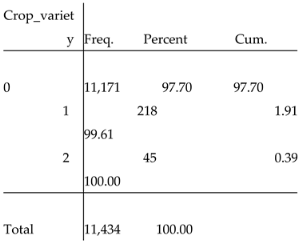
Descriptive statistics provide a brief summary of the main characteristics of the dataset. They are often used to gain an introductory understanding of the data before proceeding to more advanced statistical techniques. Tables below show a representation of the descriptive statistics for the dependent variable and some independent variables used in the study based on their means, standard deviation, Minimum and maximum values, frequency, percentage and cumulation.
Table 2.
Summary statistics for household size and age of the household.
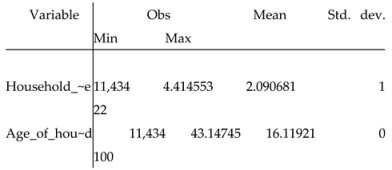
Table 3.
Summary statistics for crop productivity.
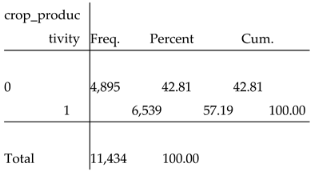
Table 4.
Summary statistics for crop diversification.
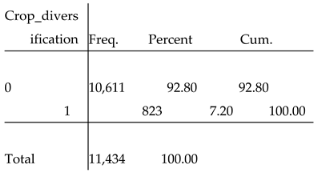
Table 5.
Summary statistics for crop variety.
Source: Author’s own computation using STATA 17.
Table 2 summarizes key statistics for household size and the age of the household head. The average household is 4.15 member, with a standard deviation of 2.10. This indicates that most households consist of four members, with some variability. The smallest household has one member, while that large has 22 members, reflecting diverse household compositions across the sample. The average of the household head is 43.15years, with standard deviation of 16.12 years, suggesting significant variation in the ages of household head. The minimum reported age is 0, likely due to data errors with IHS 5, while the maximum age is 100 years, this wide age range indicates the inclusion of both young and elderly household heads in the sample.
Crop productivity statistically indicates that 42.81% of the households (4895) fall into low crop productivity (0) while 57.19% of the households (6539) reported high crop productivity (1). This shows that the majority of smallholder farmers (57.19%) experience high crop productivity in relatively favourable agricultural conditions. However, considerable proportion (42.81%) still faces challenges in achieving higher yields. Furthermore, smallholder farmers in Malawi, particularly concerning crop diversification, crop variety, and fertilizer use. A vast majority of households (92.80%) did not practice crop diversification, while only 7.20% engaged in it, indicating that monocropping is predominant. Similarly, most smallholder farmers (97.76%) reported cultivating no crop varieties, with only 1.91% cultivating one variety and a mere 0.39% cultivating two varieties. This lack of diversity in both crop types and varieties has made farmers vulnerable to risks such as pests, diseases, and climatic shocks, limiting their capacity to achieve sustainable and resilient agricultural production.
4.2. Interpretation of Diagnostic Test Results
These were the results from STATA’s regression output diagnostic tests. The test was carried out to detect unwanted variability in a dataset also known as data noise which can hinder the interpretation and analysis of the data, and the appropriate remedies were introduced where necessary.
4.2.1. Goodness of Fit
H₀: Prob > Chi2 ≤ 0.05 model is not good fit.
H1 : Prob > Chi2 > 0.05 model is of good fit.
Hosmer-Lemeshow goodness of fit test was applied to check how well the model fits the data. The Hosme-Lemeshow reported a Chi2(5062) = 5167.65, whereby the Prob > Chi2 = 0.1470 which shows that it was insignificant at the alpha value 0.05, hence the decision rule was to reject the null hypothesis and conclude that the model was of good fit.
4.2.2. Model Specification (Link Test)
The link test was a valuable diagnostic tool used in regression analysis to assess the correct specification of a model.
Table 3.
Model Specification (Link Test).
| Crop productivity | Coefficient | St. Err | Z | P > Z |
| _hat | .9766782 | .0339345 | 28.78 | 0.000 |
| _hatsq | -.0336699 | .0229668 | -1.47 | 0.143 |
| _cons | .0297626 | .030904 | 0.96 | 0.336 |
Source: Author’s computation using STATA17.
The variable _hat represents the predicted value based on the regression model. Ideally, _hat should be statistically significant meaning its P-value should be less than 0.05 as shown in the above table…, where the P-value 0.000 is less than 0.05. if _hat was significant, it indicates that the model’s predictions are meaningful and aligned with the observed data. However, if _hat was insignificant, it suggests that the model’s predictions may not adequately capture the underlying relationships. The variable _hatsq represents the squared predictions. In a correctly specified model, the squared predictions should not have much explanatory power, as shown in the table where the P-value 0.143 was greater than 0.05 which means it was insignificant. Therefore, _hatsq was expected to be insignificant which aligns with the expectation that squared prediction should not contribute significantly to explaining the variation in the dependent variable.
4.2.3. Multicollinearity
For multicollinearity, the rule of thumb states that, if the pair-wise or zero correlation coefficient between two regressors was high, say in excess of 0.8, then Multicollinearity is a serious problem 21 (Gujarat,2004). The results in the correlation matrix shows that none of the independent variables depicts any presence of collinearity in this study because correlation among all explanatory variables were below 0.8, therefore there was no multicollinearity in this model.
4.2.3. Logistic Regression Results
Table 4.
Logistic Regression Results.
| VARIABLE NAME | ODDS RATIO | STARDARD ERROR | P >lZl |
| 1.Crop diversification | 1.579899 | 0.1323695 | 0.000 |
| Education level 1 2 3 |
1.201414 1.180082 .6490852 |
.081403 .069531 .090072 |
0.007 0.005 0.002 |
| 1.Residence | 0.2883387 | .0178248 | 0.000 |
| 1.Type of fertilizer | 2.307225 | .3662279 | 0.000 |
| Crop variety 1 2 |
1.118876 .2537731 |
.1724968 .0820529 |
0.466 0.000 |
| 1.Farm asset ownership | 9.087947 | 1.087782 | 0.000 |
| 1.Gender of the household | 1.048592 | .0483432 | 0.303 |
| House size | 1.075402 | .0110153 | 0.000 |
| Age of household head | 1.005114 | .0013021 | 0.000 |
| Constant | .1092478 | .0149518 | 0.000 |
Source: Author’s computation.
4.3. Statistical Interpretation of Variables
This study was interpreted on 5% level of significance. Where a P-value greater than or equal to 0.05 shows insignificant of the independent variable and a P-value less than 0.05 shows that the independent variable is statistically significant. The odds ratio is the measure of association between an independent variable and a dependent variable. An odds ratio greater than 1 implies a positive association between the independent variable and the dependent variable while an odds ratio less than 1 depict a negative association. Odds ratio of exactly 1 correspond to no association.
4.3.1. Crop Diversification
The odds ratio of 1.579899 suggests that there is a positive association between crop diversification and crop productivity. This demonstrates a positive and statistically relationship that farmers who diversify their crops are 1.58 times more likely to achieve higher productivity than those who do not. Farmers who practice crop diversification likely mitigate risks, optimize resource use, and improve soil fertility, thereby enhancing productivity. This further suggests that crop diversification plays a vital role in improving productivity among smallholder farmers in Malawi. By spreading investments across different crops, farmers can ensure consistent returns even in the face of climate variability. This finding is aligned with Makate et al. (2016) and Manda et al. (2016), who found that diversification enhances resilience and resource use efficiency. However, it is important to consider the challenges associated with diversification, such as the need for knowledge about managing multiple crops and access to diverse seeds, which smallholder farmers often lack. Therefore, promoting crop diversification should be accompanied by extension services to support farmers in managing their cropping systems efficiently.
4.3.2. Education Level
Those who attended primary school and secondary school education had odds ratio of 1.201414 and 1.180082 respectively which is also greater than 1. This implies a positive association between the independent and the dependent variable. This indicates that education level has an impact on crop productivity and it is statistically significant. This means that an increase in education increases the odds of higher productivity (by 1.20 times more likely to achieve higher crop productivity to those who attended primary school education and 1.18 times to those who attended secondary school education), but this effect is negligible. However, those who attended tertiary education had an odd ratio less than 1, hence farmers who attended tertiary education are 0.65 times as likely (or 35% less likely) to achieve higher crop productivity compared to those with no education. This determines that, the odds decrease significantly at tertiary level, suggesting diminishing returns or potential trade-off at higher education level. This suggests a negative associate between the independent variable and the dependent variable.
This suggests that practical knowledge and access to agricultural resources might be more critical than formal education for productivity improvements. Farming in Malawi often relies on indigenous knowledge and hands-on experience rather than formal education. This aligns with Thapa and Gaiha (2014), who noted that education’s impact, is often limited in resource-constrained settings. However, while formal education may not directly affect productivity, its role in enhancing farmers’ ability to access information, utilize technology, and engage with markets cannot be overlooked. Integrating practical agricultural training into formal education could bridge this gap and improve its relevance for smallholder farmers. Many successful smallholder farmers in Malawi learn through trial-and -error or community practices, which may diminish the direct impact of formal education. Furthermore, education might influence their decision making but may not result in significant changes in output due to resource constraints or risk aversion.
4.3.3. Residence
The odds ratio of 0.2883387 which is less than 1 shows significant impact of residence on crop productivity. Farmers living in urban areas are 0.29 times as likely (or 71% less likely%) to achieve higher crop productivity compared to those who live in rural areas. This highlights the importance of geographic and environmental factors, such as access to water, soil quality, or infrastructure, in influencing productivity. Smallholder farmers in rural areas of Malawi typically have larger plots of land, enabling them to grow a variety of crops and adapt to practices like crop diversification. However, smallholder farmers in urban areas of Malawi have limited land availability in urban areas restricts farming activities to small plots, which reduce overall productivity and limit crop diversification.
This finding is consistent with Manda et al. (2016), who noted that rural areas offer better opportunities for farming compared to urban areas, where land and water availability are limited. However, rural farmers often face challenges such as poor infrastructure and limited market access, which can constrain their productivity. Addressing these challenges through investments in rural infrastructure and market linkages could enhance the productivity of rural farmers further. Farmers in rural areas of Malawi often benefit from better agro-ecological conditions such as fertile soils and lower levels of pollution, which support crop growth while urban farmers face challenges from environmental factors like contamination and limited water availability resulting in low crop productivity.
4.3.4. Type of Fertilizer
The type of fertilizer used has an odd ratio of 2.307222 which is greater than 1 indicated a strong association between the dependent variable and independent variables and its significant positive effect on crop productivity. Farmers who use improved fertilizers are 2.31 times more likely to achieve higher crop productivity compared to those who do not use. These findings are aligned with Asfaw et al. (2017), who highlighted that access to fertilizers significantly boosts agricultural productivity. However, it is crucial to address challenges such as the affordability and availability of fertilizers, especially for resource-poor smallholder farmers. Subsidy programs and improved distribution systems could enhance fertilizer adoption and maximize its productivity benefits. This highlights the transformative role of fertilizer in enhancing crop yields and overall agricultural performance. Improved fertilizer like NPK blends or urea, supply essential nutrients (nitrogen, phosphorus, and potassium) that promote healthy crop growth and improved yields while organic fertilizers like manure and compost, though beneficial for soil health, may not provide nutrients in sufficient quantities to meet crop demands.
4.3.5. Crop Variety
Farmers using one crop variety are 1.12 times more likely to achieve higher crop productivity compared to those farming two crop variety. This suggests farmers with two crop variety is associated with lower likelihood of higher crop productivity. This indicates a statistically significant negative relationship with crop productivity. Farmers with two crop varieties are 0.25 times as likely as to achieve higher crop productivity compared to those with one crop variety. This suggests that excessive diversification might dilute efforts and lead to reduced yields, emphasizing the need for an optimal balance in crop selection. This finding suggests that crop variety, while often considered a productivity-enhancing factor, may have complex interaction with other variables or constraints faced by farmers in Malawi.
This is also in line with Baudron et al. (2015) who similarly noted that managing too many varieties can dilute efforts and reduce yields, emphasizing the need for a strategic and optimal selection of crops suited to the local agro-ecological and economic context. This is due to mismatch between varieties and local conditions, some improved crop varieties may not be well-suited to specific agro-ecological conditions or unique challenges of smallholder farming in Malawi. Therefore, if varieties are poorly adapted to local soil rainfall patterns, or pest pressure, their performance could be suboptimal. Improved varieties often require higher levels of complementary inputs, such as fertilizer to perform well. Therefore, smallholder farmers who cannot afford or access these inputs experience lower crop productivity when using improved varieties.
4.3.6. Farm Asset Ownership
Farm asset ownership has an odds ratio of 9.087941 showing a very strong association and significant positive effect on crop productivity. This suggests that farmers who own farm assets are 9.09 times more likely to achieve higher crop productivity compared to those who do not. Farm assets like machinery and irrigation systems play a critical role in improving efficiency and productivity. This finding is supported by Mango et al. (2018), who emphasized that assets improve farmers’ capacity to adopt advanced farming techniques and manage risks effectively.
However, the lack of financial resources often limits smallholder farmers’ ability to acquire these assets, pointing to the need for policies that improve access to credit and promote affordable financing options. Smallholder farmers with assets can use them as collateral to access credit, enabling the purchase of inputs like fertilizer and improved seeds. Assets provide a safety net, allowing farmers to recover quickly from climatic or economic shocks and sustain productivity; invest in advanced farming and technology.
4.3.7. Gender of Household Head
The odd ratio for the gender of the household head is 1.048592 which is greater than 1 suggests that male household heads are 1.05 times more likely to achieve higher crop productivity compared to female household heads. This is so because male smallholder farmers in Malawi have often better access to land, credit and extension services, which are critical for productivity. This is because cultural and social factors in many rural areas of Malawi, cultural norms restrict women’s access to decision making power or control over productive resources. Male-headed household have more access to family or hired labour as gender norms sometimes limit labour contributions of women in female-headed household. This demonstrates that a gender disparity in access to resources has a negative impact on crop productivity among smallholder farmers in Malawi. However, it is well-documented that women farmers often face greater challenges in accessing resources such as land, credit, and extension services. FAO (2011) emphasized that closing the gender gap in agriculture could significantly boost productivity. Therefore, efforts to improve resource access and decision-making power for women farmers could have a positive indirect impact on productivity.
4.3.8. Household Size
The odds ratio for household size is 1.074029 this suggests significant positive association effect. This suggests that a larger household size increases the odds of higher productivity 7%. This finding is aligned with Baudron et al. (2015), who highlighted the importance of family labour in smallholder farming systems. However, larger households may also face challenges, such as higher consumption needs, which could offset the benefits of additional labour. Thus, interventions should aim to balance household labour availability with resource requirements to optimize productivity. Larger households provide more family labour, which is crucial for tasks like planting, weeding and harvesting. Family labour reduces reliance on costly hired workers; enabling households to allocate more resources to inputs larger household often combine financial and physical resources to invest in agricultural inputs, improving productivity.
4.3.9. Age of Household Head
The odds ratio of 1.005112 shows a significant positive relationship between the independent variables with crop productivity. This suggests that each additional year in the age of the household head increases the odds of achieving higher crop productivity by 0.5%. however, this effect is minimal but statistically significant. Older smallholder farmers possess extensive knowledge of local conditions, crop management, and traditional farming practices, enabling them to maximize higher crop yields. This finding is supported by Asfaw et al. (2016), who noted that age is a critical determinant of resilience and adaptability in farming. However, older farmers may also be less open to adopting new technologies, pointing to the need for targeted interventions that balance traditional knowledge with modern farming practices.
Furthermore, older farmers are often more financial stable, owning land and other assets that contribute to productivity.
4.3.10. Constant
The constant in the model has an odds ratio of 0.1092 indicating statistical significance. This represents the baseline odds of achieving higher productivity when all other variables are at their reference levels. The low baseline odds highlight the importance of these predictors in explaining productivity.
4.4. Marginal Effects After the Logistic Regression
Given the marginal effects results in APPENDIX F, crop diversification has a marginal effect of 0.1108521, meaning that farmers who do not diversify reduce that predicted probability by 11.08% on crop productivity compared to those who diversify while holding other factors constant. Educational level has a marginal effect of 0.0082985, meaning that educational levels are associated with a 0.829% lower probability of increasing crop productivity among smallholder farmers. Residence of the farmer has the marginal effect of -0.3052; this means that the residence of the farmer has a slight negative effect on crop productivity. Such that those that cultivate in urban areas experience -30.52% decreases in crop yield compared to those in rural areas while holding other factors constant.
Type of fertilizer the farmer use has a marginal effect of 0.1952, meaning that farmers who use improved fertilizers have 19.52% probability of higher crop productivity. Crop variety has the marginal effect of – 0.0662, meaning farmers who use improved crop variety experience a -6.62% decrease in crop productivity. Farm asset ownership has a marginal effect of 0.4607, this means that farmers will farm assets have 46.07% increases in crop productivity while holding other factors constant. Gender of the household-head has a marginal effect of 0.0133; this means that male smallholder farmers have a discrete increase in crop productivity over female smallholder farmers by 1.33% while holding other factors constant.
Household size has the marginal effect of 0.0178, meaning that one unit increase in household size increases the predicted probability of crop productivity by1.78%, while holding other factors constant. The age of a household-head has a marginal effect of 0.0011608; this suggests that a one-year increase in the age of the household head increases the predicted probability of crop productivity by approximately 0.16%, while holding other factors constant.
Chapter Five. Conclusion and Policy Recommendations
5.0. Introduction
In this study, we examined the impact of crop diversification on crop productivity among smallholder farmers in Malawi, shedding light on the complex relationship between the role of crop diversification and related factors in shaping crop productivity. This chapter presents summary of the logistic regression results, conclusions, and recommendations of appropriate policies, the limitations and suggestions for further research.
5.1. Summary and Conclusion
This study explored the relationship between crop diversification and crop productivity among smallholder farmers in Malawi, while examining how various socio economic and farming related factors, such as residence, type of fertilizer and farm asset ownership influence crop outcome. It employed cross sectional data from the Fifth Integrated Household Survey (IHS5), which was conducted in 2019-2020 by the National Statistics Office. The statistical package STATA17 was used to turn up with the regression output. The study’s dependent variable was cropping productivity and its independent variables were; crop diversification, age of the household head, gender of the household head, type of fertilizer, crop variety, farm asset ownership, residence, educational level and household size. According to the logistic regression analysis results we drew the following conclusions: crop diversification, residence, type of fertilizer, farm asset ownership, household size and age of household head were found to be significant determinants of crop productivity. It can therefore be assumed that crop productivity is largely dependent on these farming characteristics. Therefore, these highlight the multifaceted nature of agricultural productivity, suggesting that a combination of agronomic practices, socioeconomic status, and household dynamics play a critical role in enhancing crop productivity.
5.2. Policy recommendation
Agriculture remains the backbone of Malawi’s economy, with smallholder farmers playing a critical role in ensuring food security and driving rural development. However, productivity challenges, driven by limited resources, poor agronomic practices and social economic constraints. Therefore, to address the challenges requires evidence-based policy recommendations as follows;
- Guidance on Crop Selection: Extension officers should provide tailored advice to farmers on crop selection, emphasizing high-yielding crops that align with the local agro-ecological conditions. For instance, agriculture scientists should guide smallholder farmers on which crops they should crop with regards to the type of soil, weather conditions and persists of the crop from pests and diseases.
- Strengthen Credit Facilities: Establishing farmer-friendly credit systems can enable smallholder farmers to invest in productive inputs, such as fertilizers and machinery. This can be done by introducing sub-group of smallholder farmers in different regions of Malawi to borrow them money that can be used to accommodate farming activities in order to enhance productivity.
- Promote Labor-Saving Technologies: Introducing affordable labour-saving technologies can help smallholder farmers address labour shortages and improve efficiency. For instance, introducing hire purchase on agricultural inputs that will help farmers in enhancing crop productivity.
- Encourage Regional Collaboration: Collaboration between regions can help farmers share knowledge, resources, and best practices to improve productivity across Malawi. This will help farmers to share insight of how they can navigate different farm problem and increase productivity.
5.3. Limitations and Area for Further Study
The results obtained from the study are found to be significant to policy makers in development agendas that aim to eradicate low crop productivity. However, the use of cross-sectional data limits our ability to establish causal relationships. We cannot infer changes over time or capture individual paths. Hence, similar research can be conducted using panel or time series data to provide more insights into low crop productivity among smallholder farmers in Malawi with long-term impacts of crop diversification on household income and food security.
This is because crop diversification has a potential to enhance household income and food security by providing farmers with varied income streams and ensuring a more stable food supply. Overtime, diversified cropping systems can reduce dependence on a single crop, thereby minimizing the risks associated with crop failures due to pests, diseases, or adverse weather conditions. By adopting new agricultural practices that optimize productivity and resilience, smallholder farmers in Malawi can better manage risks and improve the livelihood. Longitudinal studies are essential to examine these dynamics, capturing how diversification influences income and food security in the long run.
The success of crop diversification is intricately linked to climate variability, which poses significant challenges to agricultural productivity in Malawi. Understanding how farmers adapt their crop choices and cultivation practices in response to changing weather patterns is crucial. Effective adaptation strategies, such as the selection of climate-resilient crop varieties or the adoption of water-efficient farming techniques, can mitigate the adverse effects of climate variability. Future research should explore how these strategies impact the success of diversification initiatives, emphasizing the interplay between environmental changes and farmer decision-making.
Market dynamics, including access to reliable markets and efficient value chains, play a critical role in determining the profitability and sustainability of diversified farming systems. Farmers in Malawi often face challenges such as fluctuating prices, limited market access, and inadequate infrastructure, which can undermine the benefit of diversification. Examining the role of market linkages, value addition, and buyer seller relationships is essential for understanding how these factors influence the productivity and economic viability of diversified cropping systems. Enhancing market integration could provide farmers with better incentives to adopt diversification practices.
List of Acronyms Andabbreviations
| ASWAP agriculture Sector Wide Approach |
| CA Conservation Agriculture |
| CDI Crop Diversification Index |
| CPI Crop Productivity Index |
| FAO Food and Agriculture Organization |
| GDP Gross Domestic Product |
| GoM Government of Malawi |
| IFPRI International Food Policy Research Institute |
| IHS5 Fifth Integrated Household Survey |
| IPCC Intergovernmental Panel on Climate Change |
| MVAC Malawi Vulnerability Assessment Committee |
| NGO Non-Governmental Organization |
| NSO National Statistical Office |
| OECD Organization for Economic Co-operation and Development |
| SADC Southern African Development Community |
| SSA Sub-Saharan Africa |
| UNDP United Nations Development Programme |
APPENDICES
APPENDIX A: Summary Statistics for Categorical and Continuous Variables
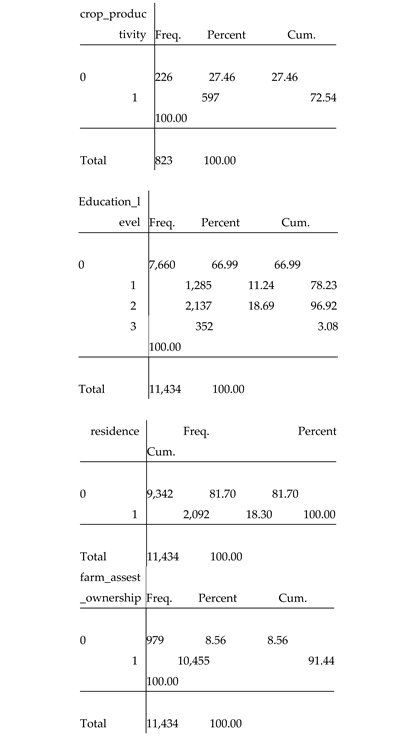
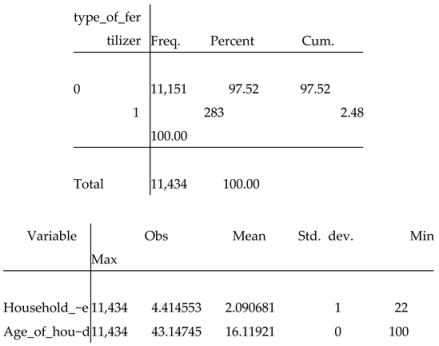
APPENDIX B: Correlation Matrix of a Logistic Regression
| crop_p~y Crop_d~n Educat~l reside~e type_o~r Crop_v~y farm_a~p Gender~d Househ~e Age_of~d | |
| crop_produ~y | 1.0000 |
| Crop_diver~n | 0.0864 1.0000 |
| Education_~l | -0.1220 -0.0261 1.0000 |
| residence | -0.2982 -0.0837 0.3699 1.0000 |
| type_of_fe~r | 0.0775 0.0210 -0.0287 -0.0623 1.0000 |
| Crop_variety | 0.0056 0.0089 -0.0355 -0.0507 0.1231 1.0000 |
| farm_asses~p Gender_of_~d | 0.3000 0.0659 -0.2180 -0.3799 0.0447 0.0413 1.0000 -0.0013 0.0242 0.1915 0.0715 0.0440 -0.0056 -0.0396 1.0000 |
| Household_~e | 0.1132 0.0377 -0.0420 -0.0445 0.0648 0.0128 0.1502 0.1582 1.0000 |
| Age_of_hou~d | 0.0915 0.0352 -0.1780 -0.0993 0.0174 0.0245 0.1661 -0.1435 0.0865 1.0000 |
APPENDIX C: Goodness of Fit of the Logistic Regression
Goodness-of-fit test after logistic model Variable: crop_productivity
Number of observations = 11,434
Number of covariate patterns = 5,072
Pearson chi2(5062) = 5167.65
Prob > chi2 = 0.1470
APPENDIX D: Model Specification
Iteration 0: log likelihood = -7806.8457
Iteration 1: log likelihood = -6931.3964
Iteration 2: log likelihood = -6913.641
Iteration 3: log likelihood = -6913.5846
Iteration 4: log likelihood = -6913.5846
Logistic regression Number of obs = 11,434
LR chi2(2) = 1786.52
Prob > chi2 = 0.0000
Log likelihood = -6913.5846 Pseudo R2 = 0.1144
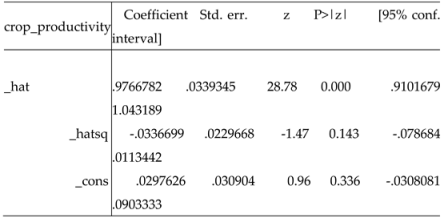
APPENDIX E: Logistic Regression Results
Logistic regression Number of obs = 11,434
LR chi2(12) = 1823.92
Prob > chi2 = 0.0000
Log likelihood = -6894.8878 Pseudo R2 = 0.1168

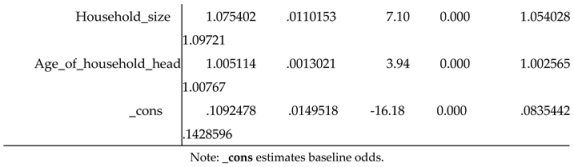
APPENDIX F: Marginal Effects After Logistic
Marginal effects after logistic
y = Pr(crop_productivity) (predict)
= .55958951
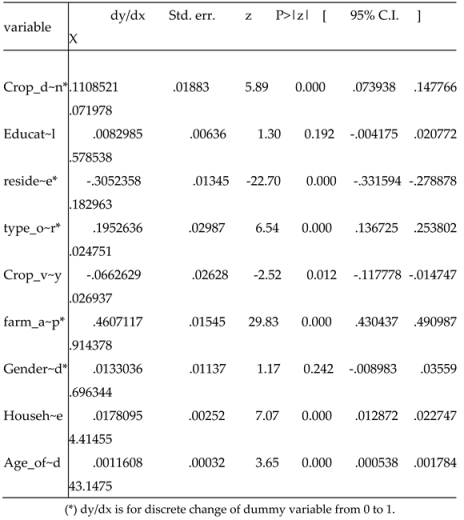
References
- Asfaw, S., Lipper, L., McCarthy, N., & Cattaneo, A. (2018). Climate-smart agriculture: Enhancing resilience, productivity, and livelihoods. World Development, 108, 149157.
- Bandron, J., Smith, P., & others. (2015). Comparative performance of conservation agriculture and current smallholder farming practices. Journal of Agricultural Systems, 142, 85-97.
- Becker, G. S. (1964). Human capital: A theoretical and empirical analysis, with special reference to education. University of Chicago Press. [CrossRef]
- Boehlje, M., & Lins, D. (1998). Risk and risk management in agriculture. Journal of Agricultural and Applied Economics, 30(2), 367-383.
- DFID. (1999). Sustainable Livelihoods Guidance Sheets. Department for International Development.
- FAO. (2018). Agricultural Development Economics Policy Brief 2. Rome, Italy: FAO.
- FAO. (2021). The State of Food and Agriculture. Food and Agriculture Organization.
- Fisher, M., & Kandiwa, V. (2014). Can agricultural input subsidies reduce the gender gap in modern maize adoption? Evidence from Malawi. Food Policy, 45, 101-111. [CrossRef]
- Freeman, C. (1987). Technology policy and economic performance: Lessons from Japan. Pinter.
- Hall, A., Sulaiman, R. V., Clark, N., & Yoganand, B. (2006). From measuring impact to learning institutional lessons: An innovation systems perspective on improving the management of international agricultural research. Agricultural Systems, 78(2), 213241. [CrossRef]
- Hardaker, J. B., Huirne, R. B. M., Anderson, J. R., & Lien, G. (2004). Coping with risk in agriculture. CABI Publishing.
- IPCC. (2020). Climate change and land: An IPCC special report on climate change, desertification, land degradation, sustainable land management, food security, and greenhouse gas fluxes in terrestrial ecosystems.
- Kilelu, C. W., Klerkx, L., Leeuwis, C., & Hall, A. (2013). Beyond knowledge brokerage: An exploratory study of innovation intermediaries in an evolving smallholder agricultural system in Kenya. The Journal of Agricultural Education and Extension, 19(6), 437-453.
- Klerkx, L., Van Mierlo, B., & Leeuwis, C. (2012). Evolution of systems approaches to agricultural innovation: Concepts, analysis and interventions. In Darnhofer, I., Gibbon, D., & Dedieu, B. (Eds.), Farming systems research into the 21st century: The new dynamic (pp. 457-483). Springer.
- Lin, B. B. (2011). Resilience in agriculture through crop diversification: Adaptive management for environmental change. Bioscience, 61(3), 183-193. [CrossRef]
- Lundvall, B.-Å. (1992). National systems of innovation: Towards a theory of innovation and interactive learning. Pinter.
- Makate, C., Wang, R., Makate, M., & Mango, N. (2016). Crop diversification and livelihoods of smallholder farmers in Zimbabwe: Adaptive management for environmental change. SpringerPlus, 5(1), 1135. [CrossRef]
- Manda, J., Alene, A. D., Gardebroek, C., Kassie, M., & Tembo, G. (2016). Adoption and impacts of sustainable agricultural practices on maize yields and incomes: Evidence from rural Zambia. Journal of Agricultural Economics, 67(1), 130-153. [CrossRef]
- Minot, N., Smale, M., Eicher, C., Jayne, T. S., & Maredia, M. (2020). Seed and fertilizer technology. In Agriculture and rural development in Malawi (pp. 101-129). World Bank Group.
- Ministry of Agriculture Malawi. (2020). Annual Agriculture Production Estimate Survey (APES) report 2020.
- North, D. C. (1990). Institutions, institutional change and economic performance. Cambridge University Press.
- Rogers, E. M. (1962). Diffusion of innovations. Free Press.
- Saraswati, P., & Bhat, A. (2011). Crop diversification in Karnataka: An economic analysis. Agricultural Economics Research Review, 24(2), 351-357.
- Schultz, T. W. (1961). Investment in human capital. American Economic Review, 51(1), 1-17.
- Southern African Development Community (SADC). (2012). Agriculture and food security. Gaborone, Botswana.
- Spielman, D. J., Ekboir, J., & Davis, K. (2011). The art and science of innovation systems inquiry: Applications to Sub-Saharan African agriculture. Technology in Society, 33(4), 399-410. [CrossRef]
- Thapa, G., & Gaiha, R. (2014). Smallholder farming in developing countries: A global perspective. European Journal of Development Research, 26(1), 10- 28.
- United Nations Development Programme (UNDP). (2009). Human development report Malawi. Lilongwe: UNDP.
- World Bank. (2012). Agricultural innovation systems: An investment sourcebook. World Bank.
- World Bank. (2020). Employment in agriculture.
Disclaimer/Publisher’s Note: The statements, opinions and data contained in all publications are solely those of the individual author(s) and contributor(s) and not of MDPI and/or the editor(s). MDPI and/or the editor(s) disclaim responsibility for any injury to people or property resulting from any ideas, methods, instructions or products referred to in the content. |
© 2025 by the authors. Licensee MDPI, Basel, Switzerland. This article is an open access article distributed under the terms and conditions of the Creative Commons Attribution (CC BY) license (http://creativecommons.org/licenses/by/4.0/).
Copyright: This open access article is published under a Creative Commons CC BY 4.0 license, which permit the free download, distribution, and reuse, provided that the author and preprint are cited in any reuse.


