

Submitted:
11 June 2025
Posted:
12 June 2025
You are already at the latest version
Abstract
Background: Brain health is a growing public health priority due to the high global burden of neurological and mental disorders. Promoting brain health across the lifespan supports individual and societal well-being, creativity, and productivity.Objective: To address the need for specialized education in this field, the University of Bern developed a Certificate of Advanced Studies (CAS) in Brain Health. This article outlines the programme’s rationale, structure, and goals.Programme Description: The one-year, 15 ECTS-credit programme is primarily online and consists of four modules: (1) Introduction to Brain Health, (2) Brain Disorders, (3) Risk Factors, Protective Factors and Interventions, and (4) Brain Health Implementation. It offers a multidisciplinary, interprofessional, life-course approach, integrating theory with practice through case studies and interactive sessions. Designed for healthcare and allied professionals, the CAS equips participants with skills to promote brain health in clinical, research, and public health contexts.Given the shortage of trained professionals in Europe and globally, the programme seeks to build a new generation of brain health advocates. It aims to inspire action and initiatives that support prevention, early detection, and management of brain disorders.Conclusions: The CAS in Brain Health is an innovative educational response to a pressing global need. By fostering interdisciplinary expertise and practical skills, it enhances professional development and supports improved brain health outcomes at individual and population levels.
Keywords:
Brain Health
; Education
; Prevention
1. Introduction
Neurological and psychiatric disorders together account for a major portion of the global burden of disease. It is estimated that one in three individuals will develop a neurological disorder during their lifetime, making neurological conditions the leading cause of disability and the second leading cause of death worldwide [1]. Likewise, psychiatric/mental health disorders are highly prevalent – approximately 1 in 8 people globally (970 million individuals) were living with a mental disorder in 2019 [2]. These conditions not only cause suffering and disability but also impose enormous social and economic costs through lost productivity and healthcare expenditures. As populations age and grow, the absolute numbers of people affected by neurological disorders have risen over the past decades [3], and the COVID-19 pandemic further exacerbated brain health challenges [2]. In this context, there is a growing emphasis on protecting and optimizing “brain health” across the life course as a strategy to reduce the burden of these disorders.
The World Health Organization (WHO) defines brain health as “the state of brain functioning across cognitive, sensory, social-emotional, behavioural and motor domains, allowing a person to realize their full potential over their life course, irrespective of the presence or absence of disorders” [1].
Brain health is increasingly recognized as essential for overall health, well-being, creativity and productivity in society. Importantly, improving brain health is not only about treating neurological diseases, but also about maintaining cognitive and mental well-being and preventing disorders before they occur. Optimizing brain health by addressing its determinants from physical health and lifestyle factors to social and environmental influences, can lead to lower rates of many chronic neurological and psychiatric conditions, improved quality of life, and positive societal and economic impacts [1].
This broad, proactive approach has been endorsed by global, continental/regional and national health bodies. The WHO released plans on mental health (2013), on dementia (2017) on Epilepsy and Other Neurological Disorders (IGAP 2022–2031) and a position paper on brain health, emphasizing a life-course, multisectoral strategy for brain health promotion [1,4,5,6].
At Continental level the European Commission created the Coordination and Support Action (CSA) for BrainHealth [7], which is supported by the European Brain Council (EBC). The CAS has the mission to set the ground for a future European Partnership for Brain Health (EP BrainHealth) set to bring together key organizations and initiatives in the brain space according to its roadmap, the Strategic Research and Innovation Agenda (SRIA) which was published in 2024 [8]
European Professional societies also started initiatives to promote brain health. The European Academy of Neurology (EAN) launched for example in 2022 the Brain Health Strategy – “one brain, one life, one approach” – aiming for a holistic, preventive approach to brain health to decrease the burden of neurological disorders and improve quality of life across the lifespan [1].
At National level different brain plans were launched, in Norway (2018), Germany (2022) Switzerland (2022) and more recently also in other countries such as Finland, Sweden, Italy, Poland and Africa.
Despite these high-level initiatives, a gap remains in translating brain health concepts into practice, particular through education of healthcare professionals. Traditional medical training often focuses on specific diseases (neurology, psychiatry, etc.) with less emphasis on integrative prevention and health promotion strategies. There is a need for structured educational programmes that equip professionals with a holistic understanding of brain health – spanning neurology, mental health, and preventive medicine – and the skills to implement brain-protective interventions in clinical and community settings. To address this need, the University of Bern (Switzerland), in cooperation with the Swiss Federation of Clinical Neuro-Societies [9] and the EAN, developed a postgraduate Certificate of Advanced Studies (CAS) in Brain Health education programme. This CAS is designed to provide learners with cutting-edge knowledge on brain health and practical tools to promote brain wellness and prevent brain disorders. In the following sections, we describe the CAS in Brain Health in detail, including its objectives, curriculum structure, delivery methods, target audience, and the anticipated impact on brain health education and professional practice. The CAS in Brain Health is a one-year postgraduate programme intended to advance participants’ expertise in maintaining and promoting brain health.
2. The Brain Health CAS of the University of Bern
The programme objectives are aligned with the competencies needed to effect positive change in brain health at individual and population levels. Upon completion of the CAS, graduates will be able to:
- Understand the brain’s structure and function – including basic neuroanatomy and neurophysiology – and foundational concepts of what constitutes brain health.
- Identify key determinants of brain health, including lifestyle, behavioral, and environmental factors, and analyze how these influence brain function and disease risk.
- Understand common brain disorders and their burden – covering prevalent neurological and psychiatric conditions, their risk factors, and how they relate to other health conditions.
- Implement evidence-based interventions to promote brain health, such as physical activity, nutrition, cognitive training, sleep optimization, and mindfulness techniques.
- Apply practical skills to design and execute a brain health intervention or initiative, translating knowledge into practice in a real-world setting.
These objectives illustrate the programme’s dual focus on knowledge (e.g. understanding brain biology and diseases) and skills (e.g. ability to plan interventions). The rationale behind this curriculum is to create professionals who are not only well-versed in neuroscience and public health aspects of brain health, but also capable of implementing preventive strategies and educational programmes in their communities or workplaces. By covering both neurological and psychiatric disorders and positive health measures, the CAS addresses the full spectrum of brain health – from illness to wellness. This comprehensive approach is grounded in the idea that preventing or delaying the onset of brain disorders and preserving cognitive function can significantly reduce the overall burden of disease. Furthermore, it embraces a life-course perspective, echoing the concept that brain health needs to be nurtured at every stage of life, from early development to older age 1. In summary, the programme reflects an innovative educational philosophy: to shift the focus from reactive care of brain diseases to proactive maintenance of brain health.
2.1. Curriculum Structure and Content
The CAS Brain Health curriculum is structured into four modules that collectively encompass the breadth of the brain health field. Each module is worth roughly 3–4 ECTS, for a total of 15 ECTS credits (equivalent to ~375–450 hours of student workload) over the entire programme. Table 1 provides an overview of the modules and their main topics.
In Module 1 (Introduction to Brain Health), students gain a foundational understanding of what brain health means and why it matters. They review basic brain anatomy and function and explore key determinants of brain health – for example, the roles of genetics, lifestyle, and environment in brain development and aging. It also emphasis concepts like One Health approach to brain health, underscoring that human neurological and mental well-being are deeply interdependent with environmental conditions and even animal health within a shared ecosystem [10,11].
This sets the stage for Module 2 (Brain Disorders), which provides clinical context by surveying major brain disorders. In this module, participants learn about a wide range of neurological diseases (such as stroke, dementia, epilepsy) and psychiatric/mental health conditions (such as depression and anxiety), focusing on their causes and impact on patients and society. The inclusion of both neurological and psychiatric conditions reflects the programme’s broad definition of brain health, recognizing that mental health is an integral part of brain health.
Module 3 (Risk factors, protective factors and Interventions) shifts the focus to preventive and health-promoting strategies. Students examine the scientific evidence behind various risk factors, protective factors and interventions that can support brain health or mitigate risk. Topics range from lifestyle interventions – like regular physical activity, healthy diet, and adequate sleep – to cognitive stimulation (education, cognitive training) and stress reduction techniques (mindfulness, resilience training). For each intervention, participants discuss practical considerations and learn how to counsel individuals or design programs to encourage these healthy behaviors.
Finally, Module 4 (Brain Health Implementation) addresses how to bring brain health promotion into broader practice. This capstone module covers implementation science and policy aspects, exploring how proven strategies can be applied in health care systems and communities. Students learn about existing brain health initiatives, including the WHO’s global action plan and various national brain health plans, and discuss ways to advocate for brain health in policy and public health areas. In addition, students learn that “brain capital” – the integrated stock of brain health and cognitive skills in a population – is a critical intangible asset for future economic prosperity [12].
This module aims to empower graduates to become leaders or change-agents who can influence brain health beyond their individual practice.
Throughout the curriculum, there is an emphasis on the interdisciplinary nature of brain health. By covering content that spans neurology, psychiatry, psychology, public health, and even socio-environmental factors, the programme underscores that protecting brain health requires a holistic approach. The curriculum was developed and is taught by an interdisciplinary faculty, ensuring that participants gain perspectives from various fields (neurologists, psychiatrists, neuropsychologists, epidemiologists, etc.). This multidisciplinary content fosters an appreciation for collaboration: for example, a neurologist in the programme might learn about psychological approaches to building resilience, while a psychologist might learn about neurological risk factors like hypertension. Such cross-sectorial knowledge exchange is intentional, as it prepares participants to work in multidisciplinary teams to promote brain health.
2.2. Programme Format and Teaching Methods
The CAS in Brain Health is designed as a part-time, 12-month programme (one academic year in duration), enabling working professionals to participate. The inaugural cycle of the programme started in 2024 with 37 students from 16 countries (Figure 1).
Going forward, the course is planned to be offered on an annual cycle. The delivery format is online, leveraging a state-of-the-art all-in-one learning platform for convenient access to course materials and activities. This online format allows international participation and flexibility, critical for a programme that targets a broad range of professionals. All lectures, discussions, and assessments are conducted in English, which is the medium of instruction. As described in the course principles, the programme consciously allocates space for reflection and dialogue, incorporating the professional experiences of participants into the learn process. Such methods help to reinforce the transfer of learning into practice and cater to adult learning preferences.
Additionally, the CAS includes assignments and a possible final project (or examination) focused on designing a brain health intervention. Through these practical assessments, participants demonstrate their ability to integrate the coursework into a tangible plan or proposal – for instance, developing a community brain health workshop, a preventive initiative in their clinic, or an educational campaign. Mentorship and feedback from faculty support students in these projects. The online learning platform facilitates all these activities, hosting multimedia materials, quizzes for self-assessment, and communication tools for group collaboration. Overall, the teaching methodology is hybrid in nature – not in the sense of physical vs. online (since it is mostly online) – but in blending synchronous and asynchronous learning. Busy professionals can review recorded lectures and reading materials on their own schedule (asynchronous), while also joining scheduled live Q&A sessions or webinars (synchronous) for real-time interaction. This flexibility is a key strength of the programme’s format, allowing it to accommodate participants from different time zones and with varying work commitments.
2.3. Target Audience and Admission Criteria
The CAS in Brain Health is targeted at a broad range of professionals in healthcare and related fields who have an interest in brain health. The programme’s inclusive admissions reflect the multidisciplinary nature of the field. Eligible applicants include those with a background in medicine (with or without a specialization, e.g. general practitioners, neurologists, psychiatrists), psychology or neuropsychology, nursing, physical or occupational therapy, speech therapy, sports science, public health, and other healthcare providers. Essentially, it is open to any university graduate in a health-related discipline with professional experience and a passion for improving brain health. By bringing together clinicians and practitioners from different domains, the programme creates a rich learning environment where, for example, a physician can learn from a neuropsychologist’s perspective and vice versa.
The interdisciplinary enrollment is intentional, as brain health is best addressed by a team that spans multiple expertise areas. For admission, candidates are generally required to hold at least a Bachelor’s or Master’s degree (or an equivalent professional degree) in a relevant field and have some professional experience. Participants might include, for instance, a neurologist looking to incorporate preventive strategies into clinical practice, a psychologist interested in the neurological underpinnings of mental health, a nurse or allied health professional aiming to implement brain health programs in community settings, or a public health specialist focusing on policy for aging populations.
Importantly, the programme is designed to be accessible to an international audience. With its online format and English-language instruction, the CAS has attracted applicants from various countries. In addition, scholarships are offered, particularly through support from the European Academy of Neurology, to enable participation from low- and middle-income countries. For example, a number of partial scholarships (reductions of the tuition fee) are available to qualified candidates based on country income level, as part of EAN’s mission to foster education globally. This helps ensure a diverse cohort and aligns with the ethos that brain health promotion is a global priority, not limited by geography or resources.
2.4. Career Opportunities for Graduates
One of the motivations for professionals to undertake the CAS in Brain Health is the expanding landscape of career opportunities in this field. Given the rising focus on brain health, there is growing demand for expertise that bridges clinical neurology, mental health, and preventive care. Graduates of the CAS programme will be well-positioned for roles across various sectors. Many will continue in their current professions but with enhanced skills – for instance, a physician could incorporate brain health counseling into routine patient care, or a therapist could design better cognitive enrichment activities for clients. Beyond this, the CAS opens doors to more specialized roles, such as:
- Healthcare organizations: Graduates may take on positions as brain health specialists or coordinators within hospitals, clinics, or rehabilitation centers, leading programs on stroke prevention, dementia risk reduction, healthy aging, etc. They might serve as health educators or advisors, integrating brain health principles into primary care or specialty services.
- Community and Non-profit organizations: With their knowledge, alumni can work in community health programs or NGOs focused on public education and wellness. For example, they could run brain health workshops for the public, develop community-based interventions (like memory training classes for seniors), or coordinate outreach in collaboration with Alzheimer’s associations, Parkinson’s foundations, or mental health charities.
- Research and Academia: The CAS can also benefit those interested in research. Graduates will have an up-to-date understanding of brain health science, enabling them to contribute to clinical research trials or public health studies on brain health interventions. They may work as research coordinators or associates in academic institutes studying prevention of neurological diseases. Some may choose to pursue further academic qualifications (e.g., a Master’s or PhD) in neuroscience, public health, or psychology, building on the foundation laid by the CAS.
- Policy and Advocacy: Equipped with knowledge of global brain health strategies, graduates can engage with government agencies or health ministries as advisors on brain health policy. They might also join international bodies or advocacy groups (like the EAN, European Brain Council, or WHO collaborative projects) to promote brain health agendas.
- Industry and Wellness Sector: An emerging area is brain health in the tech and wellness industry – for example, companies developing digital brain-training tools, cognitive assessment apps, or wellness programs may seek experts to guide evidence-based product development and evaluation
In summary, CAS graduates can fulfill roles such as health educators, community health workers, program coordinators, consultants, or researchers across the domains above. The programme explicitly encourages a vision of graduates as brain health ambassadors who will carry their expertise into diverse professional contexts. Some alumni may remain in patient-facing clinical roles but with an enriched perspective on prevention, while others may transition to roles focused on public health and education. The breadth of potential career pathways reflects the interdisciplinary training; by understanding both neurological disease management and prevention, graduates can act as liaisons between medical practice and public health. They can also serve as key resources in multidisciplinary teams – for instance, in memory clinics or stroke units – ensuring that brain health optimization (like lifestyle modifications) is integrated alongside medical treatments.
2.5. Career Opportunities for Graduates
The strength of the CAS in Brain Health programme is bolstered by the distinguished faculty and institutional partnerships behind it. The programme is hosted by the University of Bern, Faculty of Medicine, and specifically coordinated through the Department of Neurology at Bern’s Inselspital (University Hospital). It is delivered in cooperation with the Swiss Federation of Clinical Neuro-Societies (SFCNS), the Swiss Brain Health Foundation (SBHF), the European Academy of Neurology (EAN), and the European Psychiatric Academy (EPA), which have both lent support and expertise to the curriculum. These collaborations ensure that the content remains at the forefront of scientific and clinical knowledge, and aligned with European brain health initiatives.
The teaching faculty comprises an international roster of experts in brain health. Notably, the programme’s faculty includes leaders from major neurological and psychiatric organizations. This means students have the opportunity to learn directly from individuals who are driving forces in neurology, mental health, and brain research globally. Such faculty members bring cutting-edge insights from their fields – whether it’s the latest research on dementia prevention, new therapies for mental illness, or innovations in health policy – straight into the (virtual) classroom. The presence of a high-caliber international faculty also provides networking benefits; participants can establish connections with thought leaders and institutions across Europe and worldwide. Additionally, the local faculty at University of Bern includes professors and clinicians from multiple departments (neurology, psychiatry, public health, etc.), ensuring that Switzerland’s own strong tradition in neuroscience and healthcare is well-represented in the teaching.
The involvement of EAN as a partner is particularly noteworthy. EAN not only contributes faculty but also supports students through scholarships and resources. As mentioned, EAN offers a number of partial scholarships to help reduce financial barriers for participants. Furthermore, during the one-year programme, students are given free access to the EAN’s e-learning platform (eanCampus) and are eligible, upon graduation, to apply for the EAN Advocacy Programme. These benefits integrate the CAS students into the broader European neurological community, providing them with additional learning materials and opportunities for advocacy training. The SFCNS, as a Swiss national umbrella organization for neuro-societies, also endorses the programme, reflecting a national commitment to the brain health agenda in Switzerland.
Overall, the faculty and partnerships ensure that the CAS in Brain Health remains at the cutting edge of translational neuroscience. The mix of academia, clinical leadership, and professional society involvement means the curriculum is both scientifically rigorous and attuned to real-world application. It also signals to employers and stakeholders that this programme meets high standards of quality. The support of these institutions aligns the CAS with contemporary strategies – for example, the content aligns with the EAN Brain Health Strategy and WHO recommendations – lending the programme additional credibility. In essence, the CAS is not an isolated course but part of a larger movement, connecting education with ongoing research, clinical practice improvements, and policy efforts in brain health.
3. Conclusions
The introduction of the Certificate of Advanced Studies in Brain Health is a timely and important advancement in medical and public health education. This programme directly responds to the urgent need for a new generation of healthcare professionals who are equipped to tackle the growing burden of neurological and mental health disorders in a proactive, prevention-oriented manner. By providing a comprehensive curriculum that bridges neuroscience, preventive medicine, and public health, the CAS in Brain Health fills a critical gap in training. Graduates of this programme will not only possess up-to-date knowledge about brain diseases and their risk factors, but also a toolkit of practical interventions and strategies to enhance brain health in various settings.
The expected impact of the CAS programme is multifold. At the individual level, healthcare providers who complete this training will be able to integrate brain health principles into their daily practice – whether it’s a neurologist advising a patient on lifestyle changes to reduce stroke risk, a family physician implementing cognitive screening and counseling for middle-aged patients, or a psychologist teaching stress-reduction techniques to improve mental well-being. At an organizational level, these professionals can lead the development of brain health programs, influencing how clinics, hospitals, and community organizations address prevention and patient education. Moreover, as these practitioners network and share their expertise, they form a community of practice that raises the profile of brain health within their respective fields.
On a broader scale, the CAS in Brain Health contributes to the larger global initiative of prioritizing brain health across the lifespan. It operationalizes the visions put forth by WHO and EAN into an educational format that produces skilled manpower devoted to this cause. In doing so, it helps build capacity for brain health promotion at regional and global levels. Over time, as more professionals undergo this training, we can anticipate a ripple effect: increased public awareness of brain health, earlier adoption of preventive measures, and improved outcomes such as delayed onset of neurodegenerative diseases and better management of risk factors in populations. The programme also instills an appreciation for research and policy engagement, meaning graduates may contribute to future innovations in brain health science and advocacy.
Academically, the CAS serves as a model for how interdisciplinary, translational concepts like “brain health” can be taught effectively. The curriculum’s design – combining online flexibility with interactive learning, and focusing on real-world applicability – can inform other institutions looking to create similar programmes. By demonstrating success, this CAS could inspire the development of brain health educational initiatives in other regions, expanding the reach of this essential training.
In conclusion, the CAS in Brain Health is more than just a course; it is part of an emerging paradigm shift in neurology and mental health education. It signifies a move towards breaking silos between specialties and adopting a unified approach to the brain across the spectrum from health to disease. The programme’s graduates, supported by an international faculty and global collaborations, will be at the forefront of this shift. They will be champions of brain health, leading efforts to transform clinical practice, influence health policy, and empower communities with knowledge to maintain brain vitality. Such outcomes align perfectly with the mission of Clinical and Translational Neuroscience – translating cutting-edge knowledge into interventions that improve patient and population outcomes. The CAS in Brain Health stands as an essential training initiative that will advance professional development and ultimately contribute to better brain health for individuals and society at large.
Conflicts of Interest
The authors are the initiators and creators of the CAS of Brain Health and are therefore potentially biased with regard to this topic.
Abbreviations
The following abbreviations are used in this manuscript:
| MDPI | Multidisciplinary Digital Publishing Institute |
| DOAJ | Directory of open access journals |
| TLA | Three letter acronym |
| LD | Linear dichroism |
References
- World Health Organization. Optimizing Brain Health across the Life Course:; 2022. http://apps.who.int/bookorders.%0Ahttps://www.who.int/publications/i/item/9789240054561.
- WHO. Mental Disorder Fact Sheet. https://www.who.int/news-room/fact-sheets/detail/mental-disorders.
- Carroll WM. The global burden of neurological disorders: translating evidence into policy. 2023;19(3):255-265. [CrossRef]
- WHO Comprehensive Mental Health Action Plan 2013-2030. https://www.who.int/publications/i/item/9789240031029#:~:text=This updated Comprehensive Mental Health,those at-risk and to.
- WHO Global action plan on the public health response to dementia 2017 - 2025. https://www.who.int/publications/i/item/global-action-plan-on-the-public-health-response-to-dementia-2017---2025.
- WHO Intersectoral global action plan on epilepsy and other neurological disorders. https://www.who.int/publications/i/item/9789240076624.
- Bern U of. CAS Brain Health. https://www.unibe.ch/continuing_education_programs/cas_in_brain_health/index_eng.html.
- Strategic Research & Innovation Agenda. https://www.brainhealth-partnership.eu/wp-content/uploads/CSA_BrainHealth_SRIA.pdf.
- Bassetti C, Heldner M, Adorjan K, et al. The Swiss Brain Health Plan 2023–2033. Clin Transl Neurosci. 2023;7(4):38. [CrossRef]
- Bègue I, Flahault A, Bolon I, Ruiz de Castañeda R, Vicedo-Cabrera AM, Bassetti CLA. One brain, one mind, one health, one planet—a call from Switzerland for a systemic approach in brain health research, policy and practice. Lancet Reg Heal - Eur. 2025;50:101229. [CrossRef]
- Zinsstag J, Schelling E, Waltner-Toews D, Tanner M. From “one medicine” to “one health” and systemic approaches to health and well-being. Prev Vet Med. 2011;101(3-4):148-156. [CrossRef]
- Nail-Beatty O, Ibanez A, Ayadi R, et al. Brain health is essential for smooth economic transitions: Towards socio-economic sustainability, productivity and well-being. Brain Commun. 2024;6(6):1-12. [CrossRef]
Figure 1.
Geographical distribution of students of the Brain Health CAS.
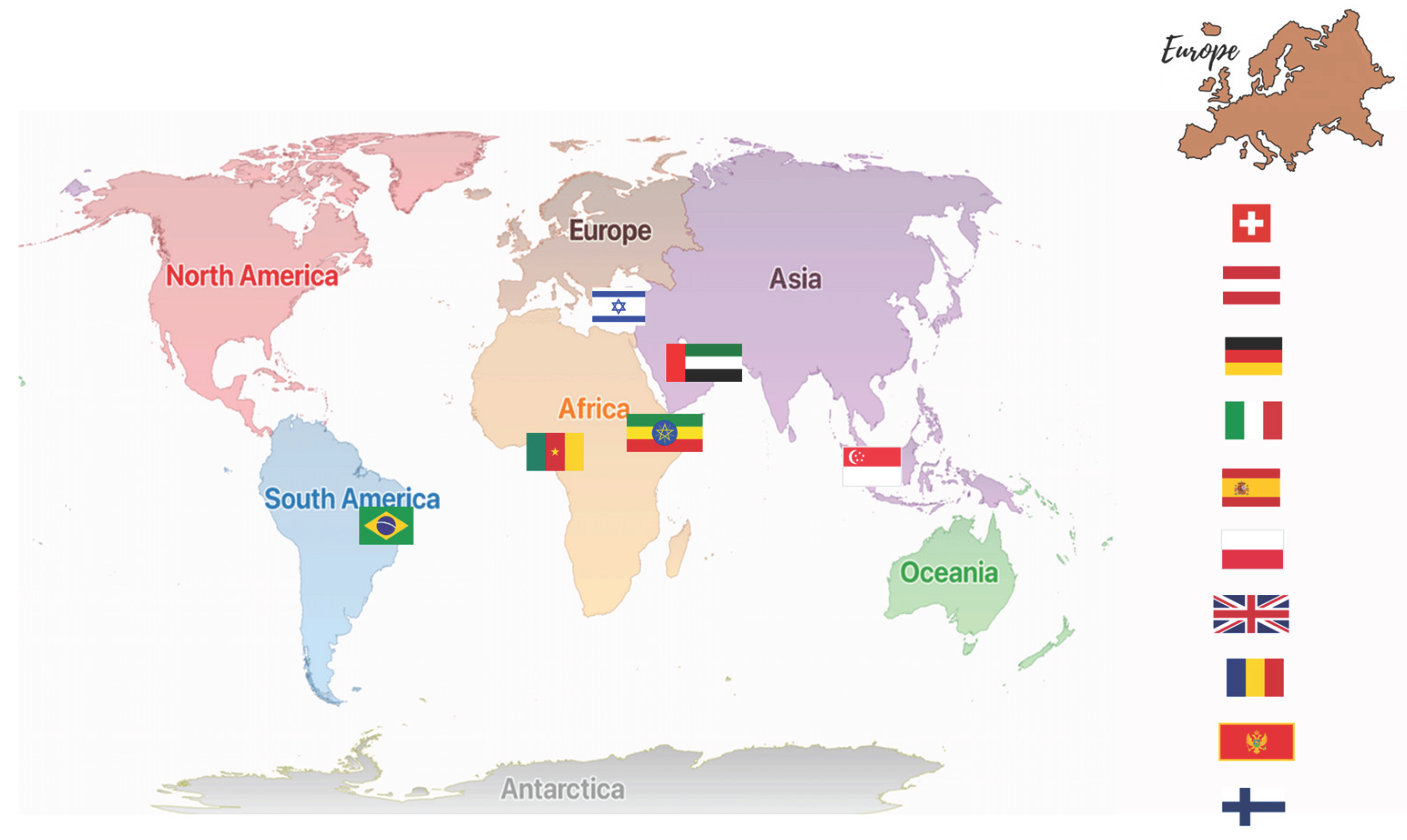

Table 1.
Overview of the CAS Brain Health Curriculum.
| Module | Title | Scope and Key Topics |
|---|---|---|
| Module 1 | Introduction to Brain Health | Overview of brain structure and functions; definition of brain health and its determinants; basic neuroanatomy and physiology. Introduces concepts of brain development and factors that contribute to brain wellness across the lifespan. |
| Module 2 | Brain Disorders | Survey of common neurological and psychiatric disorders (e.g. dementia, stroke, epilepsy, sleep disorders, headache, anxiety, depression, etc.) Covers symptoms, diagnostic principles, treatments, and the epidemiological burden of these conditions. |
| Module 3 | Risk factors, protective factors and Interventions | Risk factors, protective factors and evidence-based interventions to promote brain health and prevent disease. Topics include physical exercise, nutrition, sleep, cognitive training, mindfulness, and other lifestyle modifications. Students learn how to implement and tailor these interventions in practice. |
| Module 4 | Brain Health Implementation | Translation of brain health strategies to the public health and policy level. Discusses how individual-level interventions can be scaled to communities and populations. Includes review of international and national brain health initiatives (e.g. WHI global action plan, EAN Brain Health plan) and future directions for brain health promotion. |
Disclaimer/Publisher’s Note: The statements, opinions and data contained in all publications are solely those of the individual author(s) and contributor(s) and not of MDPI and/or the editor(s). MDPI and/or the editor(s) disclaim responsibility for any injury to people or property resulting from any ideas, methods, instructions or products referred to in the content. |
© 2025 by the authors. Licensee MDPI, Basel, Switzerland. This article is an open access article distributed under the terms and conditions of the Creative Commons Attribution (CC BY) license (http://creativecommons.org/licenses/by/4.0/).
Copyright: This open access article is published under a Creative Commons CC BY 4.0 license, which permit the free download, distribution, and reuse, provided that the author and preprint are cited in any reuse.