

Submitted:
13 August 2025
Posted:
14 August 2025
You are already at the latest version
Abstract
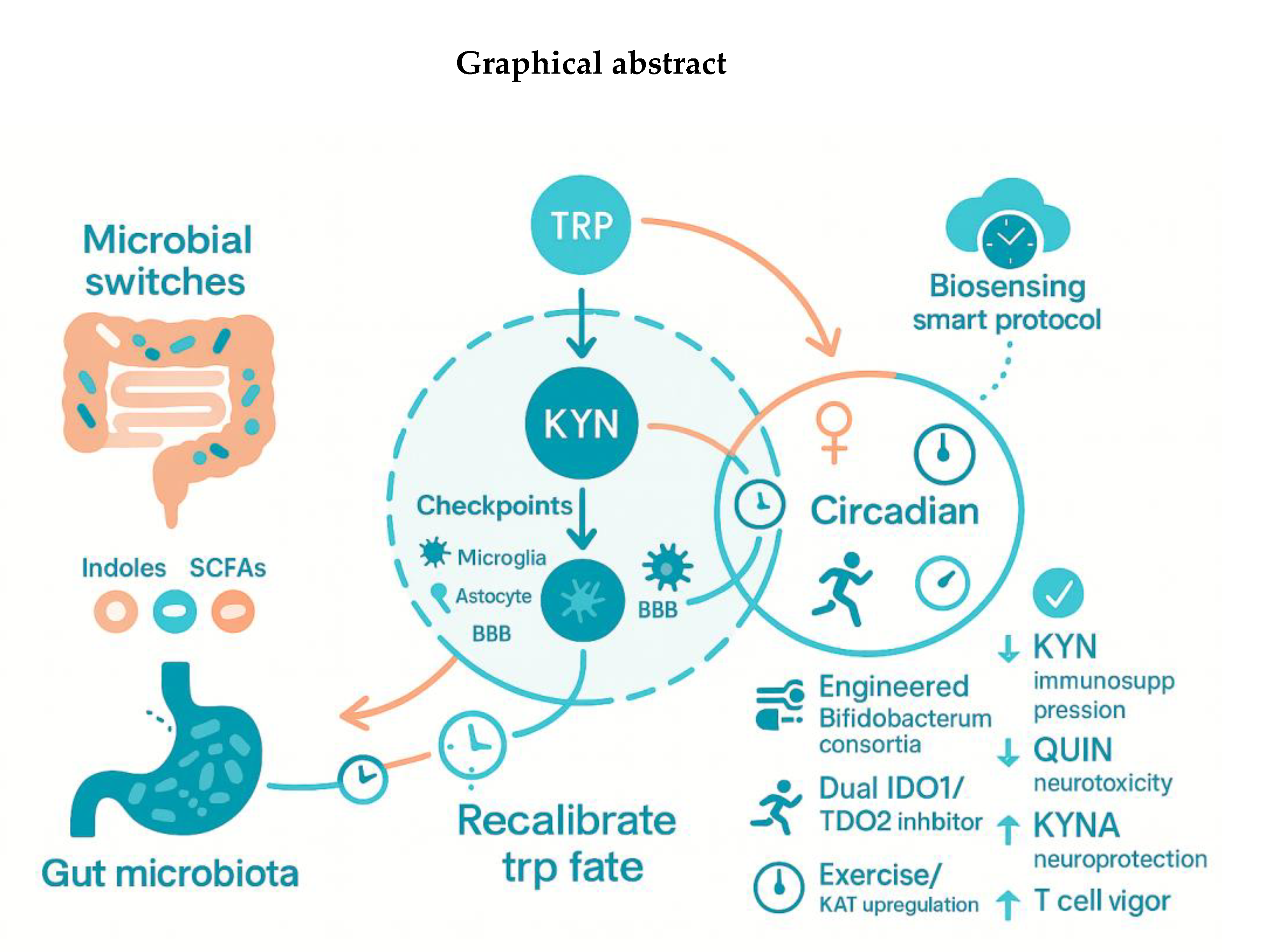
The kynurenine (KYN) metabolic pathway sits at the crossroads of immunity, metabolism, and neurobiology, yet its clinical translation remains fragmented. Emerging spatial-omics, wearable chronobiology, and synthetic-microbiota studies reveal that tryptophan (Trp) metabolism is regulated by distinct cellular “checkpoints” along the gut–brain axis, finely modulated by sex differences, circadian rhythms, and microbiome composition. However, current interventions tackle single levers in isolation, leaving a key gap in precision control of Trp fate. To address this, we drew upon an extensive body of primary literature and databases, mapping enzyme expression across tissues at single-cell resolution and linking these profiles to clinical trials investigating dual indoleamine 2,3-dioxygenase (IDO1)/tryptophan 2,3-dioxygenase (TDO2) inhibitors, engineered probiotics, and chrono-modulated dosing strategies. We then developed decision-tree algorithms that rank therapeutic combinations against biomarker feedback loops derived from real-time saliva, plasma, and stool metabolomics. This synthesis pinpoints microglial and endothelial KP hotspots, quantifies sex-specific chronotherapeutic windows, and identifies engineered Bifidobacterium consortia and dual inhibitors as synergistic nodes capable of reducing immunosuppressive KYN while preserving neuroprotective kynurenic acid. Here we highlight a framework that couples lifestyle levers, bio-engineered microbes, and adaptive pharmaco-regimens into closed-loop “smart protocols.” By charting these intersections, the study offers a roadmap for biomarker-guided, multidisciplinary interventions that could recalibrate KYN metabolic activity across cancer, mood, neurodegeneration, and metabolic disorders, appealing to clinicians, bioengineers, and systems biologists alike.
Keywords:
tryptophan
; kynurenine
; indoleamine 2
; 3-dioxygenase
; tryptophan 2
; microbiotal brain-gut axis
; circadian rhythm
; chronotherapy
; probiotics
; precision medicine
Graphical abstract
1. Introduction
Life on Earth has been inextricably linked to a dynamic coexistence with microbes [1]. From the earliest stages of development through aging, humans are continuously shaped by microbial signals encountered through environmental contact, diet, and respiration [2]. Nowhere is this symbiosis more profound than in the gastrointestinal tract, where a densely populated and metabolically diverse microbiota transforms dietary substrates into bioactive molecules with far-reaching systemic effects—including on the brain [3]. Among the complex network of metabolic interactions bridging the gut and distant organs, the tryptophan (Trp) metabolic axis has emerged as a pivotal regulator of immune homeostasis, neurophysiological integrity, and energy balance [2,4]. Beyond serving as a precursor for serotonin and niacin, Trp is enzymatically channeled by both host and microbial systems into the kynurenine (KYN) metabolic pathway, generating a suite of metabolites capable of modulating inflammatory responses—either dampening immune activation or exacerbating pathological inflammation [5] (Figure 1). Additionally, natural compounds targeting neuroinflammation are gaining attention for their antidepressant potential, offering a complementary pathway to modulate Trp metabolism [6].
Over the past decade, next-generation sequencing and metabolomics have mapped thousands of associations between altered Trp metabolism and diseases as diverse as depression, diabetes, cancer, and Alzheimer’s disease (AD) [7,8]. Over the past decade, groundbreaking research has redefined our understanding of neurological diseases and mental illnesses, laying the groundwork for precision interventions [9,10]. Moreover, the integration of biomarkers and imaging with neuroinflammatory markers offers promising diagnostic and therapeutic insights in AD and related disorders [11]. Similarly, phytochemicals such as phenols, alkaloids, and terpenoids have demonstrated notable neuroprotective effects against neurodegenerative disorders, offering complementary intervention strategies [12,13,14,15]. Yet association is not causation [16]. We still lack a coherent framework linking specific microbial consortia, host enzymes such as indoleamine-2,3-dioxygenase-1 (IDO1) and tryptophan-2,3-dioxygenase-2 (TDO2), and downstream metabolites like kynurenic acid (KYNA) or quinolinic acid (QUIN) to discrete physiological outcomes [17] (Table 1). This gap hampers the design of targeted interventions—whether they involve probiotics, small-molecule inhibitors, or lifestyle prescriptions—that aim to rebalance Trp flux toward health-promoting routes [18]. Recent reconceptualizations propose a paradigm shift in how Trp–KYN metabolism is targeted for innovative clinical interventions [19].
A second challenge is spatial. Traditional bulk assays average signals across tissues and cell types, obscuring metabolic micro-domains that may act as “checkpoints” for Trp fate [20] (Table 1). Recent spatial-omics and single-cell technologies have begun to reveal astrocytic and microglial niches in the human prefrontal cortex, endothelial “gates” at the blood–brain barrier (BBB), and perivascular hubs in peripheral organs where KYN metabolic activity is disproportionately high [21]. These findings demand a rewiring of our mental map: instead of a homogeneous pipeline, Trp metabolism resembles a switchboard with cell-type-specific levers that can be pharmacologically or genetically tuned [22].
Timing is the third frontier. Circadian biologists have long known that virtually every metabolic pathway oscillates over the 24-hour day [22,23]. Emerging evidence suggests that KYN metabolism is no exception and that sex hormones further modulate these rhythms [24] (Table 1). Clinical trials of chemotherapy and checkpoint inhibitors demonstrate that dosing time can double efficacy or halve toxicity, yet KYN-targeting agents have rarely been tested under chrono-pharmacological designs [25]. Without granular, time-stamped metabolite monitoring, we risk missing critical windows when interventions would be most effective—or least harmful [26].
Technological advances now offer tools to close these knowledge gaps [27]. Stable-isotope tracing in gnotobiotic mice can timestamp flux through IDO1 versus TDO2; single-cell proteomics in intestinal organoids can pinpoint which epithelial or immune subsets respond to specific “metabokines”; and CRISPR-based kill switches or inducible operons allow synthetic consortia to dial metabolite output like a volume knob [27,28,29]. Parallel progress in wearable biosensors, artificial intelligence (AI) feedback loops, and adaptive trial designs promises to link real-time biomarker readouts—such as saliva KYNA or morning KYN/TRP slopes—to dynamic adjustments in drug dose, exercise load, or probiotic composition [30,31,32].
Yet formidable obstacles remain. We lack validated, non-invasive biomarkers that faithfully mirror tissue-level KYN activity [33]. The ecological rules governing colonization by engineered microbes are not fully charted, and existing kill-switch circuits require rigorous containment testing [29]. Regulatory frameworks struggle to keep pace with live biotherapeutic products (LBPs) that blur the line between drugs and devices [34]. Finally, ethical and logistical challenges complicate the deployment of adaptive, time-randomized clinical trials that integrate molecular, behavioral, and environmental data streams [35].
Against this backdrop, the present review aims to synthesize cutting-edge insights across microbiology, neuroscience, immunology, and bioengineering to articulate a unified roadmap for precision modulation of the Trp–KYN axis. We first survey the spatial organization of KYN metabolism “checkpoints” in the brain and periphery, highlighting how localized enzyme activity interfaces with systemic immunity and neural circuitry. We then examine sex- and circadian-specific modifiers that dictate when and how the pathway tilts toward neurotoxicity or resilience. Next, we explore microbiota-based strategies—from designer consortia to encapsulated post-biotics—that act as precision switches for Trp flux, and we discuss their manufacturing, safety, and regulatory hurdles. Finally, we outline “Intervention 2.0,” an integrated platform combining dual-enzyme inhibitors, structured exercise, and AI-driven biosensing to create closed-loop therapeutics. By weaving these threads together, we seek to move the field beyond static snapshots toward dynamic, multi-scale models that can predict individual responses and guide adaptive interventions (Table 1). In doing so, we hope to catalyze collaborations between bench scientists, clinicians, data engineers, and regulatory experts, accelerating the translation of Trp-KYN biology into tangible health benefits.
The objectives of this review is to map the cellular and spatial heterogeneity of KYN metabolic activity and identify metabolic “checkpoints” amenable to intervention; to critically appraise evidence for sex- and circadian-dependent modulation of Trp metabolism and its clinical implications; to evaluate current and emerging microbiota-based tools for precision control of KYN flux, including synthetic consortia, kill switches, and post-biotic delivery systems; to assess the therapeutic promise and practical challenges of dual IDO1/TDO2 inhibition in conjunction with lifestyle levers such as exercise; and to propose a framework for adaptive, biomarker-guided clinical trials that integrate real-time metabolite monitoring with dosing algorithms. By addressing these aims, the review intends to illuminate fertile research avenues and provide a practical blueprint for next-generation strategies targeting the gut–brain–immune axis via the KYN metabolic pathway.
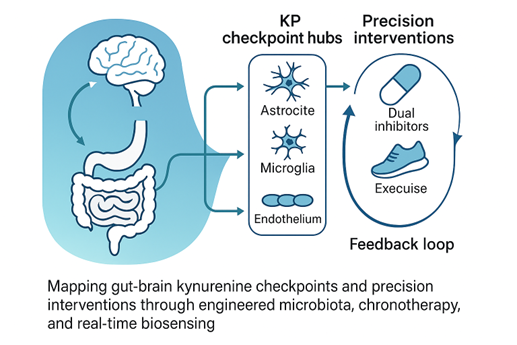
Specialized clusters of microglia, astrocytes, and endothelial cells, known as KYN checkpoints, regulate Trp catabolism and maintain immune balance throughout the brain–body axis. Spatial-omics pinpoints these hubs in the human prefrontal cortex and BBB, where KYN overload erodes neuronal resilience and fuels depression, stroke, and dementia. Peripheral checkpoints likewise calibrate T-cell vigor. Tumors hijack the circuit: chronic IDO1 activity floods the microenvironment with immunosuppressive KYN, yet IDO1 blockade alone falters, bypassed by TDO2 and alternative aryl-hydrocarbon-receptor ligands. Environmental toxins, infections, and diet further tilt these metabolic gates, whereas systemic checkpoints defend serotonin and niacin pools. Critical gaps stall translation. Cell-type-resolved maps of IDO1, TDO2, transporters, and System L remain incomplete; single-cell, longitudinal multi-omics in inflamed tissues and cancers are needed. Real-time biomarkers of KYN burden and transporter flux are lacking, complicating precision dosing. Optimal regimens for dual IDO1/TDO2 or aryhydorcarbon receptor (AhR) blockade—and for brain-penetrant microglial modulators—are undefined. Preclinical models rarely integrate microbiota composition, circadian rhythm, sex, or pollutant exposure, all strong modifiers of KYN metabolism. Bridging these voids will require integrated biosensing, adaptive trials, and machine-learning-guided strategies to tailor checkpoint-directed therapies to individual neuroimmune landscapes.
2. Microbiota-Driven Modulation of Indoleamine-2,3-Dioxygenase-1 (IDO1) and Tryptophan-2,3-Dioxygenase (TDO2) Signaling
Our intestinal microbiota function like molecular “remote controls,” fine-tuning dietary Trp fate before it enters systemic circulation [4,36] (Figure 2). Through sophisticated fermentation and metabolic processing, gut bacteria generate bioactive molecules such as indole derivatives, short-chain fatty acids, and aryl-hydrocarbon-receptor ligands [36,37]. These small signaling molecules migrate to immune and hepatic tissues, influencing critical enzymes like IDO1 and TDO2 [38]. Consequently, Trp metabolism shifts: toward the KYN pathway when these enzymes are active, or towards serotonin, indole, and protein synthesis when their activity is inhibited [39]. Clinical and experimental studies have connected microbiota-driven dysbiosis and altered metabolite profiles to chronic inflammation and diseases including obesity, type 2 diabetes, human immunodeficiency virus (HIV), colorectal cancer, and AD [40,41,42,43,44]. An elevated KYN-to-Trp ratio, indicative of heightened IDO1 activity, is associated with compromised gut barrier integrity and systemic immune activation [45]. Conversely, higher levels of indole metabolites correlate with strengthened epithelial barriers and reduced inflammation [46]. Dietary interventions, particularly promoting fiber-rich taxa such as Bifidobacterium and Lactobacillus, enhance protective indole and short-chain fatty acid production, counteracting excessive KYN synthesis and promoting healthier metabolic pathways [47].
2.1. Literature Review: Microbial Metabolites as Modulators of Intestinal Integrity and Systemic Disease
Gut microbiota profoundly influence host health through their role in Trp metabolism [48]. Microbial metabolites like KYN, tryptamine, and indole-3-propionic acid regulate critical pathways related to immune, neurological, and metabolic health [49]. Notably, microbiota produced KYN derivatives significantly impact intestinal permeability and obesity, highlighting their broad physiological relevance [50]. Additionally, these microbial metabolites demonstrate both pro- and anti-inflammatory effects, positioning them as promising therapeutic agents for managing intestinal inflammation and associated disorders, including inflammatory bowel disease and irritable bowel syndrome [51]. Dysbiosis-induced disruptions in Trp metabolism have also been implicated in autoimmune disorders and ischemic stroke, suggesting significant clinical implications and potential therapeutic benefits of dietary strategies involving food homologous plants [17,52]. Germ-free animal models further underline the essential role of microbiota in guiding host Trp metabolism, reinforcing the microbiome’s critical function as a regulator of health, aging processes, and disease progression [53].
2.2. Research gaps: Gaps in Dosing Strategies, Longitudinal Efficacy, and Mechanistic Insights
Current research gaps include the need for clearer insights into optimal dosing and intervention strategies, particularly in clinical applications such as haploidentical transplantation, where long-term outcome data remain limited [54]. Additionally, the precise mechanisms underlying sustained benefits, as demonstrated in long-term diabetes remission trials, require further exploration to enhance replicability and scalability [55]. In educational and psychological contexts, while significant improvements in creativity through musical interventions are documented, there is still limited understanding of long-term impacts and the comparative effectiveness of different teaching methodologies [56]. Moreover, longitudinal health outcome studies, such as those examining coronavirus disease 2019 (COVID-19) survivors, underscore the necessity of extended follow-ups to better understand persistent symptoms and recovery trajectories, emphasizing gaps in comprehending chronic implications [57]. Taken together, these findings underscore the need for extended longitudinal, comparative, and mechanistically oriented studies across clinical, educational, and therapeutic domains to refine and empirically validate intervention efficacy [58].
These gaps in dosing and efficacy cannot be disentangled from the complex regulatory role of gut microbiota in shaping KYN metabolism. Microbial communities influence both the magnitude and duration of IDO1/TDO2 activation through dynamic production of signaling molecules like SCFAs, AhR ligands, and indoles [47,59,60,61]. These microbial signals fluctuate with diet, circadian rhythm, antibiotic exposure, and host immune tone—factors that vary over time and across individuals [62]. Consequently, a static, one-size-fits-all intervention may fail to accommodate these microbial dynamics, explaining the inconsistent long-term outcomes observed in clinical trials [63]. Moreover, the lack of mechanistic clarity—especially regarding which microbial species modulate which enzymatic checkpoints—limits our ability to rationally time or personalize interventions [62,64]. Without integrating gut microbiota profiles and temporal shifts in microbial metabolite output, dosing strategies remain empirical and imprecise [65]. Bridging this mechanistic blind spot is essential if we hope to evolve microbiota-modulating interventions from broad-spectrum dietary tweaks into finely tuned therapeutic levers within the KYN pathway [65,66,67].
2.3. Time-Stamped Isotope-Tracing in Gnotobiotic Mice Can Tag Flux Through Indoleamine-2,3-Dioxygenase-1 (IDO1) Versus Tryptophan-2,3-Dioxygenase (TDO2)
Emerging research highlights crucial insights into precisely distinguishing Trp metabolism fluxes mediated by IDO1 and TDO2, especially within the context of cancer progression and immune modulation [68,69]. Advanced techniques such as time-stamped isotope tracing in gnotobiotic mice offer significant promise for accurately mapping metabolic activity between these pathways [68,70,71]. Current evidence indicates dual inhibition of IDO1 and TDO2 surpasses single-target strategies, effectively reducing immunosuppressive KYN metabolites and enhancing anti-tumor immune responses across various cancers [72,73]. Nonetheless, substantial gaps remain in understanding precise metabolic dynamics, particularly in humanized mouse models designed to mimic human microbiota interactions [73,74]. Further insights have been gleaned from enzyme knockout studies demonstrating how disruption of KYN pathway genes impacts mitochondrial respiration and energy homeostasis in the brain [75]. Recent knockout models targeting kynurenine aminotransferase (KAT) enzymes have revealed heightened oxidative and excitatory stress responses, offering mechanistic insights into depression and post-traumatic stress disorder-like behaviors [76]. Meanwhile, rational drug design targeting the KYN pathway is being explored to fine-tune neuroprotective outcomes without tipping the balance toward neurotoxicity [77]. Future research should prioritize detailed mechanistic exploration through robust isotope tracing methodologies, enabling clearer delineation of the specific roles IDO1 and TDO2 play in disease pathology [72,78]. Additionally, further development and clinical validation of potent dual IDO1/TDO2 inhibitors are critical next steps to fully harness their therapeutic potential and optimize immunotherapeutic strategies across multiple malignancies [79].
2.4. Single-Cell Proteomics in Intestinal Organoids Could Reveal Which Epithelial or Immune Subsets Sense each “Metabokine”
Emerging research underscores the potential of single-cell proteomics in intestinal organoids as a powerful tool for clarifying which epithelial or immune subsets respond to specific “metabokines” [80,81,82]. Single-cell resolution can unveil distinct proteomic signatures, enabling precise identification of cells sensing these metabolic signaling molecules [80,83]. Recent advancements demonstrate that intestinal organoids effectively model complex physiological responses, such as ischemia-reperfusion injury and gluten-induced inflammation seen in celiac disease, highlighting their suitability for detailed proteomic investigations [84,85,86]. Additionally, single-cell transcriptomics has successfully characterized specialized enteroendocrine cell populations, further emphasizing the feasibility and importance of single-cell analyses in organoid cultures [87,88,89,90]. Nevertheless, substantial research gaps persist in connecting specific metabolites or “metabokines” to their target cell types [80,81,82,91]. Future studies should employ single-cell proteomics to systematically map interactions between these bioactive metabolites and distinct cellular subsets within organoid models [80,92,93,94]. Crucial next steps involve refining protocols for isolating and analyzing pure populations of epithelial and immune cells, as well as developing robust analytical methods to integrate proteomic and transcriptomic data [87,95,96,97]. This integrated approach promises deeper insights into gut physiology and pathology, guiding targeted therapeutic interventions for intestinal and metabolic disorders [80,81,98,99].
2.5. Synthetic Consortia with Inducible Kyn Operons Would Let Us Dial Metabolite Output Like a Volume Knob
Emerging research highlights the potential of synthetic microbial consortia with inducible KYN operons as sophisticated tools for precisely tuning metabolite production [100]. Utilizing inducible gene expression systems, these engineered microbial communities allow metabolite output to be modulated like a “volume knob,” providing highly controlled, dynamic responses tailored to specific applications [101]. Studies employing synthetic consortia, particularly those leveraging cross-feeding and inducible metabolic pathways, demonstrate their capacity for robust and tunable synthesis of desired compounds, such as antioxidants and secondary metabolites [102]. For instance, yeast-based consortia effectively enhanced resveratrol production by precisely managing metabolic interactions. Further, advancements in understanding inducer-producer systems and integrating genomic, proteomic, and machine-learning approaches have improved consortium stability, efficiency, and predictability [103,104]. Despite promising initial results, substantial work remains in optimizing consortia dynamics, including refining inducer responsiveness, ensuring population stability, and developing standardized, scalable frameworks [105]. Next steps should focus on advanced computational modeling and experimental validation, employing genome-wide screens and emerging technologies to fine-tune induction mechanisms [106]. Ultimately, synthetic consortia with precisely controlled KYN operons hold transformative potential for targeted metabolic engineering and biomedical applications.
2.6. Molecular Mechanisms Linking Gut Microbiota to Kynurenine Pathway Enzymes
The gut microbiota orchestrates KYN metabolic activity through a network of direct molecular interactions that go beyond metabolite secretion [107,108,109]. Certain microbial strains modulate host expression of IDO1 and TDO2 via Toll-like receptor (TLR) engagement, type I interferon signaling, and NF-κB activation, tipping Trp metabolism toward immunosuppressive KYN derivatives [107,110,111]. For instance, Bacteroides fragilis activates TLR2, which upregulates IDO1 in dendritic cells, while Lactobacillus reuteri can suppress IDO1 through IL-10-mediated signal transducer and activator of transcription 3 (STAT3) signaling [108,109,112]. AhR ligands such as indole-3-aldehyde not only shape T-cell differentiation but also transcriptionally repress TDO2 via microRNA-132/212 axes in hepatocytes [109,113,114]. Bacterial-derived SCFAs (e.g., butyrate) inhibit histone deacetylases, opening IDO1 promoter regions to cytokine-inducible enhancers [111,115,116]. Moreover, cross-feeding consortia modulate nicotinamide adenine dinucleotide (NAD) biosynthesis, indirectly affecting KYN flux through feedback loops involving SIRT1 and PGC-1α [109,112,117]. These mechanisms illustrate that microbiota–KP interactions are not merely passive but involve a bidirectional, cell-type-specific signaling web that governs systemic immune tone and neuroinflammation risk.
3. Kynurenine (KYN) Metabolic Pathway “Checkpoints” in the Brain’s Cellular Grid
The brain’s intricate cellular network is governed by distinct “checkpoints” that regulate critical metabolic pathways, notably the KYN metabolic pathway [118] (Figure 3). Recent advancements using spatially-resolved omics have uncovered specialized microglial and astrocytic niches within the human prefrontal cortex, which display notably elevated activity toward KYN metabolism [119]. Additionally, specific endothelial clusters located at neurovascular units show significant KYN metabolic signatures, suggesting their crucial roles as regulatory gates controlling permeability and transport functions at the BBB [120]. These novel insights provide a detailed spatial mapping of KYN metabolism modulation across the brain’s cellular landscape, emphasizing its essential function in neuroimmune communication and neuronal homeostasis [121]. Advances in Parkinson’s disease research underscore how metabolic dysregulation, particularly in mitochondrial and KYN pathways, contributes to neurodegeneration [122]. Elucidating the precise locations and mechanisms of these KYN checkpoints enhances our understanding of how Trp metabolism contributes to maintaining brain health and how disruptions in this pathway might underpin various neurological and psychiatric disorders [123]. Disruptions in KYN metabolism have also been implicated in age-associated vascular dysfunction and sarcopenia, further linking metabolic decline to cognitive vulnerability [124]. Evidence from metabolic interventions, including AdipoRon treatment, supports the notion that correcting mitochondrial and inflammatory dysfunctions can mitigate neurodegenerative processes [125]. Future research focusing on these checkpoint regions promises innovative approaches to therapeutic interventions aimed at adjusting KYN activity, offering potential improvements in managing neurological health and disease [126,127,128,129].
3.1. Literature Review: Mapping Kynurenine (KYN) Dynamics Across Neurovascular and Immune Landscapes
KYN “checkpoints” distribute across the brain and periphery, steering Trp catabolism and dictating immune tone [130]. Spatial-omics now map microglial, astrocytic, and endothelial niches in the human prefrontal cortex where KYN enzymes are up-shifted, flagging BBB gates that couple metabolism with neuroimmune signaling [131]. At these hubs, surges in KYN dampen neuronal resilience, promote cerebrovascular inflammation, and correlate with depression, dementia, and stroke [132]. Outside the CNS, the same metabolic nodes calibrate T-cell fitness [133]. IDO1 overactivation floods tumors with immunosuppressive KYN, paralyzing cytotoxic responses; yet IDO1 inhibitors alone have disappointed, unveiling redundant escape circuits [134]. Environmental pollutants and viral infections further hack these checkpoints, amplifying cytokine storms by tipping regulatory T cell (Treg)/T helper 17 cell (Th17) balance [135]. Conversely, systemic checkpoints safeguard Trp homeostasis; deficiency or gene defects can trigger hypertryptophanemia, disturbing serotonin and niacin biosynthesis [133]. Next-wave interventions pair metabolic brakes with programmed cell death protein 1 (PD-1)/programmed cell death ligand 1 (PD-L1) or heat shock protein 90 (HSP90) blockade, deploy aryl-hydrocarbon-receptor antagonists, phytochemicals, or AhR inhibitors such as BAY2416964 to restore immunity and curb tumor growth [136]. These innovative models, complemented by optogenetic technologies, represent the forefront of translational neuroscience [137]. Brain-penetrant molecules that selectively damp microglial KYN flux while sparing peripheral metabolism could deliver precision therapy for neuropsychiatric disorders [138]. Integrating multi-omics with machine learning will rank checkpoint hierarchies, predict compensatory loops, and guide patient-specific cocktails that re-balance neuroimmune networks and prevent KYN-driven pathology [139].
3.2. Research Gaps: Mapping, Monitoring, and Modulating Kynurenine (KYN) Checkpoints Across Systems
KYN checkpoints—specialized microglial, astrocytic, and endothelial clusters—regulate Trp catabolism and immune tone across the brain–body axis [140]. Spatial-omics pinpoints these hubs in the human prefrontal cortex and BBB, where KYN overload erodes neuronal resilience and fuels depression, stroke, and dementia [141]. Peripheral checkpoints likewise calibrate T-cell vigor [140,142]. Tumors hijack the circuit: chronic IDO1 activity floods the microenvironment with immunosuppressive KYN, yet IDO1 blockade alone falters, bypassed by TDO2 and alternative AhR ligands [134,143]. Environmental toxins, infections, and diet further tilt these metabolic gates, whereas systemic checkpoints defend serotonin and niacin pools [144]. Critical gaps stall translation. Cell-type-resolved maps of IDO1, TDO2, transporters, and System L remain incomplete; single-cell, longitudinal multi-omics in inflamed tissues and cancers are needed [141,145]. Real-time biomarkers of KYN burden and transporter flux are lacking, complicating precision dosing [141,146]. Optimal regimens for dual IDO1/TDO2 or AhR blockade—and for brain-penetrant microglial modulators—are undefined [147]. Preclinical models rarely integrate microbiota composition, circadian rhythm, sex, or pollutant exposure, all strong modifiers of KYN tone [74,144,145]. Bridging these voids will require integrated biosensing, adaptive trials, and machine-learning-guided strategies to tailor checkpoint-directed therapies to individual neuroimmune landscapes [141,148,149,150].
3.3. CRISPRi “Zip-Codes” Delivered by Adeno-Associated Virus (AAV) Can Silence Kynurenine 3-Monooxygenase (KMO) or Kynureninase (KYNU) Only in Perivascular Endothelium and Watch Downstream Glutamatergic Sync Crash—Or Not
Picture an AAV vector outfitted with endothelial “zip-codes”—tight-junction promoters plus microRNA target sequences for off-cell clearance—delivering a zinc finger protein 3 (ZIM3)-Kruppel-associated box (KRAB) clustered regularly interspaced short palindromic repeats interference (CRISPRi) cassette that knocks down kynurenine 3-monooxygenase (KMO) or kynureninase (KYNU) exclusively in perivascular endothelium [151,152,153,154]. Two clues drive this strategy. First, perivascular cells are gatekeepers for KYN flux into the brain: endothelium converts circulating KYN into 3-HK and QUIN, feeding astrocyte–microglia glutamatergic coupling [155]. Second, KMO overactivity fuels cancer growth, neurodegeneration, and immune escape, yet systemic inhibition risks off-target NAD imbalance [156]. Cell-restricted CRISPRi sidesteps that liability, and the ZIM3 domain offers potent, reversible silencing [157]. Sex- and circadian-modulated shifts in neurodegeneration also modulate vulnerability to cognitive and mood disturbances [158]. If endothelial KMO/KYNU expression drops, 3-HK and QUIN output should collapse, starving downstream N-methyl-D-aspartate (NMDA)-sensitizing signals and “crashing” the synchronized glutamatergic surge that drives excitotoxicity and tumor immune evasion [159]. Next steps include build bar-coded AAV libraries to refine endothelial specificity; validate knock-down efficiency and KYN metabolites flux in brain-slice co-culture; monitor glutamate dynamics with optogenetic reporters in vivo; and assess effects on tumor infiltration and behavior in KMO-high breast-cancer metastasis models [155,160,161]. Parallel safety screens must chart NAD pools and mitochondrial stress in non-target tissues [162] (Table 2). Success could open a precision channel to modulate neurovascular KYN flux without systemic collateral damage [151,155,160].
3.4. Light-Addressable Riboswitches Could Let Us Pulse KP Enzymes in Astrocytes and Read Real-Time Calcium Waves
Light-addressable riboswitches offer a precision dimmer for the KYN metabolic pathway inside astrocytes [163]. By coupling a photocleavable aptamer to KMO or KYNU transcripts, pulsed infrared or nanosecond-visible light can switch enzyme translation on or off within milliseconds, riding on the same wavelengths already proven to trigger or image astrocytic Ca2⁺ waves [164]. The concept rests on two converging clues: riboswitches endowed with the Z-lock or photocleavable linker reliably gate gene expression in living cells, and pulsed light drives robust, tunable calcium oscillations in astrocytes without overt photodamage, letting us read the metabolic consequences in real time [165] (Table 2). A burst of light thus delivers a double payload—inducing a KYN metabolism surge while simultaneously recording its impact through genetically encoded calcium indicator based on calmodulin and M13 peptide fused to green fluorescent protein (GCaMP)-tagged calcium reporters or two-photon glutamate sensors [165,166]. Key next steps include engineering astrocyte-specific AAVs carrying the light-gated riboswitch, benchmarking translation kinetics versus calcium rise in organotypic slices, and mapping how localized KYN pulses propagate through extracellular gliotransmitter waves [166,167]. In vivo, fiber-coupled two-photon uncaging combined with wide-field Ca2⁺ imaging can reveal whether transient KMO activation amplifies or quenches network excitability during sleep, seizure, or learning [165,168]. Ultimately, this optogenetic-metabolic fusion could dissect causality between KYN flux and astrocyte-driven neurophysiology with unprecedented temporal resolution [163,169,170].
4. Sex and the Circadian City: Hidden Modifiers
Circadian rhythms and biological sex weave an under-appreciated backdrop to KYN metabolism, subtly steering mood and immune tone across the day [171]. Sex hormones and circadian rhythms likewise modulate migraine vulnerability, further emphasizing the need for personalized neuroimmune interventions [172]. Immune challenges such as interferon-α therapy consistently lower circulating Trp, boost KYN, and heighten depressive symptoms, but these shifts peak at distinct clock phases and manifest more severely in women [173]. Preclinical lipopolysaccharide models echo this dimorphism, with female mice displaying protracted neuroimmune and behavioral scars that fluoxetine can erase only when given at their active phase [174] Human imaging studies add another layer: reduced Trpand skewed KYN metabolites track hippocampal-subfield atrophy, yet the correlation tightens in early-morning scans, hinting at chronobiological gating [175]. Rapid-acting antidepressants such as ketamine appear to reset both the monoaminergic–glutamatergic interface and downstream KYN flux, but again response rates diverge by sex and time of dosing [173,176]. Post-mortem data reveal anterior cingulate cortex KYN signatures that segregate by sex and suicide status, underscoring personalized vulnerability windows [175,177]. Neuroanatomical findings from autism research similarly reveal that circadian and neuroimmune factors may influence structural brain development [178] (Figure 4). Collectively, these findings suggest that sex hormones and the molecular clock act as “hidden modifiers,” dictating when and how immune activation tilts KYN balance toward neurotoxicity or resilience [179]. Similar to the evolving understanding in mental health research, recognizing sex- and circadian-dependent variability supports a dimensional view of disease vulnerability and resilience [180]. Parsing these temporal-sexual intersections could unlock chronotherapy strategies for mood disorders.
4.1. Literature Review: Circadian Misalignment, Mood Vulnerability, and Emerging Chronotherapeutics
Longitudinal wearables reveal that phase delays in core-body temperature and melatonin release often precede mood dips in major depression and bipolar disorder, supporting circadian realignment as a digital-medicine target [181]. In healthy adults, endogenous 24-hour rhythms modulate anxiety- and depression-like affect, with later dim-light melatonin onset and compressed phase-angle differences predicting poorer mood [182]. Disruption of the molecular clock by hypercortisolism in Cushing’s syndrome flattens immune-cell oscillations and skews steroid profiles, illustrating endocrine–immune crosstalk [183]. Similar circadian misalignment exacerbates autoimmunity in lupus, acting as a prodromal biomarker for flares [184]. Non-pharmacologic interventions show promise: group music therapy realigns autonomic and melatonin rhythms in depressed women, while optimal circadian–circasemidian coupling buffers morning blood-pressure surges and fosters resilience [182,185]. Nutritional modulation is equivocal; omega-3 supplementation dampens inflammation yet leaves KYN metabolism and mood unchanged in healthy men [186]. Experimental LPS infusion acutely activates KYN metabolism, linking immune challenge, chronobiology, and affect in real time [186]. Adolescents display bidirectional pathways: anxiety forecasts future sleep disruption, whereas a genetically longer free-running period in males predicts later mood vulnerability [184,185]. Collectively, these studies underscore circadian alignment as a modifiable lever for mood regulation and highlight the need for personalized chrono-therapeutic strategies across lifespan and disease contexts.
4.2. Research Gaps: Timing, Sex, and Biomarker Integration for Precision Kynurenine (KYN) Intervention
Despite compelling evidence that dosing time and sex strongly influence chemotherapy and immunotherapy outcomes, major knowledge gaps limit translation to KYN-targeting agents [187]. First, no clinical trials have yet tested chrono-pharmacology for IDO1/TDO2 inhibitors, KMO blockers, or KAT activators, leaving optimal schedules unexplored [188]. Second, existing studies rarely stratify by both circadian phase and biological sex; pharmacokinetic data disaggregated for women are virtually absent, obscuring why afternoon regimens reduce toxicity in female lymphoma patients [187]. Third, mechanistic links between peripheral clock genes, immune cell oscillations, and drug metabolism remain undefined, particularly how estrogen and glucocorticoids modulate daily fluctuations in KYN enzyme activity [189]. Fourth, wearable-derived chronotypes are not integrated into trial design, preventing personalized timing algorithms that could harmonize drug exposure with individual rhythms [187]. Fifth, preclinical tumor models often use male rodents housed in static light cycles, overlooking sex- and circadian-dimorphic responses seen in patients [190]. Finally, validated real-time biomarkers that couple KYN metabolite swings to treatment efficacy are lacking, hindering adaptive dosing [191] (Table 3). Addressing these gaps will require multi-omic chronopharmacology studies, sex-balanced animal models, and adaptive clinical trials embedding circadian sensors to craft precision schedules for KYN-focused therapies.
4.3. Multi-Time-Point Plasma Kynurenine (KYN) Profiles Stratified by Sex and Hormonal Phase
Current evidence shows that plasma KYN levels fluctuate with sex, age, and endocrine status, yet most datasets rely on single fasting draws [192]. Parkinson’s and breast-cancer cohorts reveal disease-specific shifts toward neurotoxic QUIN, but without high-resolution sampling it is unclear whether these changes reflect trait abnormalities or time-of-day/hormone-phase effects [193]. Metabolomic screens (KarMeN) can classify sex and age, implying a strong biological signal, while ambulatory microdialysis (U-RHYTHM) now permits hourly hormone/metabolite capture—an underused tool for KYN kinetics [193]. Feminizing gender-affirming hormone therapy reshapes amino-acid pools after six months; however, acute diurnal patterns and menstrual-cycle nuances remain unmapped [194]. Animal work shows estrous-dependent adipokine oscillations, hinting that luteal-phase progesterone surges might also bias KYN flux [194]. No study yet aligns luteal sub-phases, cytokine pulses, and KYN derivatives in healthy women, nor measures phase-specific KYN shifts during immunotherapy or antiandrogen treatment [192]. Next steps: deploy wearable-triggered, multi-time-point plasma collection across 24-h and menstrual cycles; integrate liquid chromatography–mass spectrometry (LC-MS) panels for KYN, Trp, QUIN, and KYNA with sex-hormone, cortisol, and brain-derived neurotrophic factor (BDNF) profiles; and model trajectories using mixed-effects chronopharmacology frameworks. Such datasets will clarify whether timing and hormonal milieu confound or mediate KYN biomarkers, guiding precise sampling windows and sex-hormone-aware interventions.
4.4. Wearable Light-Exposure + Metabolite Logging to See if Circadian Misalignment Exaggerates the Quinolinic Spike
Circadian misalignment (CM) rewires metabolic, cardiovascular, and immune circuits, yet whether it magnifies neurotoxic (QUIN) surges remains untested [195]. Night-shift paradigms reveal clock-driven insulin resistance, lipidome disruption, and blood-pressure creep, while murine models link chronic CM to immune senescence and shortened lifespan [196]. Sex adds complexity—females show partial protection against CM on a high-fat diet—suggesting divergent QUIN trajectories [197]. Light timing is the master zeitgeber; continuous lux logging via smartwatches can quantify misalignment magnitude, whereas ambulatory microdialysis or dried-blood-spot kits now enable multi-time-point KYN metabolite sampling [184,198]. Pairing these technologies would let researchers correlate light-phase offsets with 24-h QUIN area-under-curve, stratified by sex and feeding rhythms [199]. Key next steps includes pilot a cross-over study where shift-workers wear light- and activity-trackers plus collect hourly capillary samples across two work cycles; model QUIN dynamics versus lux-derived phase angle using mixed-effects chronobiology; overlay cortisol and melatonin rhythms to disentangle stress versus circadian effects; and test whether timed blue-light blockers, melatonin, or time-restricted feeding blunt QUIN spikes [199,200] (Table 3). Such integrative phenotyping could identify high-risk chronotypes and guide precision-timed KYN interventions to mitigate CM-induced neuroinflammation.
4.5. Adaptive Trial Designs that Randomize Dose-Timing Rather Than Just Dose Size
Bayesian and response-adaptive frameworks have revolutionized dose-finding, yet virtually all published trials modulate quantity, not clock time [201]. Radiation for pancreatic cancer, ketamine infusions for late-life depression, and molnupiravir for early COVID-19 show how real-time efficacy–toxicity trade-offs hone dose size, but none test whether morning versus evening delivery alters those curves [202]. Chronotherapy evidence from chemotherapy and immune checkpoint inhibitors indicates that timing can double efficacy or halve toxicity, with sex as a major moderator, underscoring a missed opportunity [203]. Key gaps include statistical models that treat dosing time as a continuous, circadian-anchored covariate; real-time biomarkers (e.g., actigraphy-derived phase angle) to guide allocation; and operational logistics for pharmacy and nursing around-the-clock interventions [201,204]. Next steps include simulate Bayesian hierarchical designs where dose level and dosing hour are co-randomized, borrowing strength across adjacent time bins; integrate wearable-captured chronotype to stratify randomization and inform priors; embed rolling interim analyses that drop unfavorable time windows rather than doses; and pilot such designs in drugs with known chrono-toxicities, using point-of-care melatonin or cortisol assays as safety triggers [202,205] (Table 4). Developing regulatory guidance and EHR-linked scheduling tools will be crucial to mainstream adaptive chrono-trials, paving the way for precision-timed KYN inhibitors and beyond [203,206].
5. Microbiota Engineering as a Precision Switch
Engineering the gut microbiome now offers a “precision switch” for neuroimmune circuits, with strain-level interventions poised to toggle mood and metabolic health on demand [207]. In murine models of chronic stress, supplementation with Bifidobacterium pseudonumeratum W112 reversed anhedonia and hepatic injury by recalibrating the gut-liver-brain axis, whereas B. breve and B. longum strains restored brain-derived neurotrophic factor signalling and serotonergic precursors through 5-hydroxy-tryptophan synthesis [208] (Figure 5). These psychobiotic effects align with peripheral data: patients with major depressive disorder show depleted Bifidobacterium and Lactobacillus counts, implicating taxa scarcity as a modifiable risk [209]. Importantly, anti-depressive benefits persist even with heat-killed cells, underscoring that microbial metabolites—not colonization per se—drive behavioural rescue [208]. Precision editing could therefore install synthetic operons for tryptophanase, KATs, or short-chain-fatty-acid production to steer host Trp flux toward neuroprotective pathways and away from QUIN toxicity [210]. Key next steps include high-resolution metagenomics to map strain-specific metabolic fingerprints, CRISPR-guided promoter tuning for inducible output, and gnotobiotic “plug-and-play” consortia to test combinatorial logic [211]. Adjunctive use of compounds like curcumin has been associated with improvements in microbiota composition and mood, reinforcing its role in gut–brain axis modulation [212]. Longitudinal trials integrating faecal metabolomics with mood and liver biomarkers will validate whether engineered consortia can act as dosage-controlled switches, heralding tailor-made microbiota therapeutics for depression and comorbid metabolic disease [213].
5.1. Literature Review: Microbiota-Targeted Strategies for Modulating Mood and Inflammation
Clinical and preclinical data increasingly connect gut-directed interventions to mood improvement [214,215]. A randomized trial showed Bifidobacterium breve CCFM1025 alleviates major depression while normalizing Trp-KYN balance and microbial diversity [216,217]. Complementary protocols—PRO-DEMET and PROVIT—deploy B. longum, L. helveticus, and biotin to probe combined metabolic-microbiome effects; preliminary findings suggest inflammation drops even when mood shifts are modest [216,218]. Beyond bifidobacteria, Akkermansia muciniphila and Lactobacillus reuteri mitigate stress-induced anhedonia in mice, accompanied by restored neurotrophins and lipid metabolism [216,219,220]. A single FMT case demonstrates symptom remission in refractory depression, echoing murine transfers where microbiota from depressed women induce affective and fatty-acid perturbations in recipients [215,216,220]. Non-bacterial strategies also show promise: low-dose linoleic acid rescues serotonin and microbial diversity, while Banxia Xiexin decoction adjusts the gut–lipid axis to relieve comorbid atherosclerosis and depression [216,220,221]. Psychosocial immersion programs reveal that Prevotella-rich shifts correlate with lowered inflammatory tone and mood gains, underscoring environment–microbiome interplay [217,218,221]. Collectively, these studies depict a converging theme: targeted modulation—whether via single strains, multi-strain consortia, diet, or behavioral change—can rebalance microbial metabolites, dampen inflammation, and lift mood. Future trials must standardize endpoints, stratify by metabolic comorbidity, and incorporate multi-omics to pinpoint responders and refine dosing regimens.
5.2. Research Gaps: Live Biotherapeutic Products Against Multi-Drug Resistant (MDR) Enteric Pathogens: Research Gaps
Proof-of-concept studies show engineered or defined consortia can decolonize carbapenem-resistant Klebsiella and other MDR organisms without disrupting resident flora, yet translation stalls on several fronts [222]. First, colonization remains unpredictable: VE303 engrafts only after antibiotic conditioning, while VE707’s murine efficacy lacks human pharmacokinetic analogues [223]. No head-to-head trials compare synthetic consortia with FMT, leaving efficacy drivers—bacteriocins, phages, or niche competition—unclear [224]. Second, durability data are scarce; longitudinal sequencing in patients post-FMT hints at phage-mediated suppression, but mechanistic dissection of phage–bacteria–host interplay is missing [225]. Third, safety and horizontal-gene-transfer risks are under-characterized—engineered E. coli secreting microcins could acquire resistance cassettes in vivo [226]. Fourth, manufacturing and QC frameworks lag behind pharmaceutical standards; batch-to-batch metabolite output is unverified for multi-strain LBPs [223]. Fifth, adaptive trial designs that modulate dose timing relative to antibiotics or diet are untapped, despite evidence that feeding rhythms and bile acids gate colonization resistance [227]. Finally, regulatory pathways for genetically modified LBPs remain fragmented across jurisdictions, deterring investment [223,228] (Table 5). Addressing these gaps demands standardized engraftment biomarkers, phage-omics integration, gnotobiotic validation of mechanism, and harmonized GMP guidelines to accelerate safe, predictable, and durable microbiota-based decolonization strategies.
5.3. Designer Strains with Kill-Switches and Inducible Kynurenine Aminotransferase (KAT) Expression
Recent CRISPR-based kill switches in E. coli Nissle prove that dual chemical-temperature triggers can achieve >10⁵-fold clearance in the murine gut while retaining plasmid integrity over weeks—establishing a benchmark for biocontainment [29,229,230,231]. Parallel work in Mycobacterium tuberculosis, Bacillus Calmette-Guérin (BCG), and Pseudomonas fluorescens underscores two recurring clues: circuit simplicity boosts genetic stability, and layered toxins curb escape [232]. Yet open questions persist. First, evolutionary pressure within complex microbiomes may select for cryptic recombination events; long-read metagenomics of shed strains is needed to quantify real-world escape rates [233]. Second, few designs test function across variable pH, bile acids, or host temperatures; standardized “gut stress” challenge panels should precede human dosing [234]. Third, redundancy remains underused—stacking orthogonal CRISPRi, toxin-antitoxin, and auxotrophy modules could create multi-lock systems that tolerate single-node failure [235]. Fourth, kill-switch burden on therapeutic payloads is rarely measured; metabolic toggle libraries and inducible promoters from xenogeneic silencing studies could minimize fitness costs [236]. Finally, regulatory pathways are hazy—agencies require validated shutoff diagnostics and environmental fate data [237]. Next steps include head-to-head comparisons of toxin cassettes, adaptive evolution assays in bioreactors seeded with human stool, and digital-polymerase chain reaction (PCR)-based field tests to monitor persistence post-shedding [238]. Such work will convert kill switches from academic prototypes into deployable safeguards for live biotherapeutic products.
5.4. Encapsulated “Post-Biotics” (e.g., Stabilized KYNA) to Bypass Colonization
Skipped-colonization formulations—enteric capsules, pH-responsive hydrogels, and microfluidic microparticles—now allow direct delivery of stabilized KYNA and other post-biotics to the colon, sidestepping the variability of live engraftment [239]. Hydrogel and chitosan-alginate matrices protect labile metabolites from gastric acid, while spray-dried enteric microspheres and 3-D-printed capsules release cargo only at ≥pH 7, mirroring colonic transit [240]. Encapsulation reviews highlight that payload stability, release kinetics, and mucus penetration govern in vivo bioavailability, yet KYNA has never been loaded into these systems, and its solubility profile may demand excipient optimization [241]. Phage and enzyme encapsulation studies suggest co-packaging metabolite pumps or β-glucuronidases could boost local concentration, but dose-response curves for post-biotic neuroprotection remain undefined [242]. Next steps include screen generally recognized as safe (GRAS)-grade polymers for KYNA compatibility under accelerated aging; map release profiles in simulated gastrointestinal fluids and pig colonic explants; employ near-infrared–triggered nanocaps to test on-demand bursts during inflammation; and quantify systemic versus luminal KYNA using LC-MS in gnotobiotic mice, benchmarking against Bifidobacterium-produced levels [243]. Parallel human pilot studies can deploy encapsulated KYNA alongside wearable pH sensors to correlate release timing with mood and sleep metrics [244] (Table 6). Success would validate post-biotic capsules as a low-variance, regulatory-friendly alternative to live psychobiotics [245].
5.5. Cloud-Linked Stool Metabolomics Dashboards to Guide Weekly Probiotic Titration
Remote probiotic trials in COVID-19 and depression show patients can self-collect and courier fecal samples, while digital platforms already monitor calprotectin, zonulin, and secretory immunoglobulin A (sIgA) [246,247,248,249]. Yet strain-specific responses vary and optimal titration schedules remain guesswork [250]. Cloud-linked dashboards that stream LC-MS metabolite panels—short-chain fatty acids, indoles, bile-acid ratios—could provide weekly feedback loops to adjust probiotic dose or strain composition [251]. Key clues are multispecies probiotics shorten gut transit time and shift microbiota in constipation meta-analyses, but responders stratify by baseline diet and Lactobacillus colonization predictors such as cheese and n-3 fatty acid intake; probiotics modulate clock-gene expression and the gut–lung axis, implying time-of-day and symptom-phase windows for dosing; large-scale genome scans map foodborne lactic acid bacteria that could seed personalized consortia [246,252] (Table 8). Gaps include lack of validated metabolite thresholds that signal “dose-too-low” versus “overshoot,” and absence of algorithms that incorporate diet, sleep, and medication logs alongside omics [253]. Next steps include build a reference library of weekly stool metabolomes from diverse cohorts on fixed probiotic regimens; train adaptive Bayesian models that recommend titration when variance-normalized short-chain fatty acids (SCFAs) or indole scores drift beyond control limits; integrate wearable-captured feeding rhythms to schedule capsule timing; and run N-of-1 crossover trials to benchmark dashboard-guided titration against static dosing [254]. A successful system would transform probiotics from one-size-fits-all supplements into dynamic, biomarker-steered therapies [255] (Table 4).
6. Intervention 2.0: Dual Inhibitors, Exercise, and Real-Time Biosensing
Next-generation therapeutics are converging on a three-pronged strategy to disarm KYNs in cancer and immune dysregulation [74,256,257]. First, dual inhibitors such as RY103 and ZC0101 simultaneously block IDO1 and TDO2 (or IDO1 and thioredoxin reductase), outperforming single-agent IDO1 blockade by collapsing redundant enzyme circuits and lowering intratumoral KYN to neuroprotective baselines [257,258]. Preclinical models show these agents stunt glioma and pancreatic tumor growth by quenching Kyn-AhR signaling and restoring cytotoxic T-cell traction [257,259]. Second, structured endurance exercise—a potent physiological lever—amplifies KYN re-balancing by accelerating peripheral KYN clearance via skeletal-muscle KAT up-regulation, creating a metabolic “sink” that synergizes with pharmacological inhibition [32,260]. Third, wearable biosensors now capture continuous lactate, glucose, and microvascular O₂ data, while emerging implantable electrochemical probes detect real-time KYN-to-Try ratios in interstitial fluid [261]. Linking these feeds to adaptive dosing algorithms could personalize dual-inhibitor schedules around exercise bouts, maximizing metabolic windowing and minimizing toxicity [74,256,262]. Immediate next steps include human-machine-interface trials that pair IDO1/TDO2 inhibitors with supervised exercise and real-time KYNs monitoring, testing whether algorithm-guided titration enhances tumor response and rescues mood or fatigue [74,256,260,262]. Such “Intervention 2.0” fuses pharmacology, lifestyle, and biosensing into a closed-loop platform poised to redefine KYNs-targeted precision medicine. Newly designed KYNA derivatives, refined by C-3 side chain alterations, are being evaluated for their ability to fine-tune motor and cognitive outcomes [263,264].
6.1. Literature Review. Dual Inhibition and Kynurenines (KYNs) Modulation
Early dual-inhibitor work centres on M4112, the first oral agent targeting both IDO1 and TDO2 [73,257,260,265]. Preclinically, M4112 halved tumor KYN-to-Trp ratios across xenograft panels; phase I results confirmed on-target plasma suppression with manageable fatigue and nausea, yet a compensatory rise in systemic KYN hinted at peripheral sinks that may blunt efficacy [73,260,265]. Parallel chemistry screens generated RY103 (IDO1/TDO2) and ZC0101 (IDO1/TrxR), each extending the dual-hit concept to pancreatic and oxidative-stress contexts, respectively [257,258]. These compounds curtailed migration, invasion, and colony formation in cell-line models, supporting broad antitumor potential [257,258]. Outside cancer, pathway modulation remains complex. N-acetylcysteine attenuates cisplatin-induced cognitive decline by normalizing brain KYNA, whereas TNF-α blockade in rheumatoid arthritis leaves KYN flux largely untouched despite clinical remission, underscoring disease-specific regulation [266,267,268]. Human endotoxin challenge acutely spikes both neurotoxic QUIN and protective KYNA without correlating to sickness behavior, questioning causal links [269]. Observational cohorts add nuance: higher downstream metabolites (xanthurenic and picolinic acids) associate with better survival and reduced fatigue in colorectal-cancer survivors, yet KYNs activation predicts mortality in acute respiratory distress syndrome [270,271]. Collectively, the literature depicts a heterogeneous KYN landscape where dual enzyme blockade is promising but must contend with systemic metabolite reservoirs, context-dependent feedback loops, and variable host outcomes—parameters future trials must quantify.
6.2. Research gaps: Adaptive Dose-Timing and Real-Time Monitoring
Although adaptive designs are reshaping oncology and metabolic drug development, most trials still optimise dose magnitude while ignoring circadian or activity-linked timing [272]. Continuous glucose-monitoring data show that SGLT2 inhibitors lower glycaemic variability yet raise ketoacidosis risk in type 1 diabetes, but no study dynamically shifts dosing around exercise or nocturnal hypoglycaemia [273]. Therapeutic drug-monitoring platforms for kinase inhibitors confirm exposure–toxicity windows, yet do not integrate wearable-captured vital signs or KYN biomarkers to guide intraday titration [272,274]. Intermittent schedules for phosphoinositide 3-kinase (PI3K), Bruton’s tyrosine kinase (BTK), and Kirsten rat sarcoma viral oncogene homolog (KRAS) inhibitors reduce adverse events preclinically, but statistical frameworks treating “time-on” and “time-off” as co-randomized variables remain undeveloped [275,276]. Next-generation maturation and ropomyosin receptor kinase (TRK) inhibitors collect rich pharmacokinetic data but lack algorithms that pair those curves with real-time biosensor feeds [277,278]. Key gaps therefore include adaptive randomization models that incorporate dosing clock-time as a modifiable arm; validated software bridges between continuous glucose monitoring (CGM), lactate, or KYN sensors and electronic trial master files; safety rules for rapid dose-time shifts in outpatient settings; and patient-reported outcome measures sensitive to circadian toxicity [279,280,281,282] (Table 4). Addressing these deficits will require multidisciplinary consortia linking chronobiologists, bioinformaticians, and trialists to pilot fully time-adaptive protocols for next-gen inhibitors and metabolic adjuvants.
6.3. Crosstalk Between Kynurenine Pathway Modulation and Broader Metabolic Networks
Precision control of the KYNs, while promising, must be weighed against its biochemical entanglements. The KYN metabolism is not isolated—it is woven into a dense network of metabolic systems, many of which are equally sensitive to perturbations. Modulating this pathway can create downstream effects, some beneficial, others potentially disruptive [283,284,285]. For example, inhibiting IDO1 and TDO2 may rebalance immunosuppressive Trp catabolism, but this can also constrict the NAD biosynthesis pipeline. Since NAD is central to redox reactions, mitochondrial respiration, and SIRT1 activity, its depletion may compromise energy metabolism in high-demand tissues such as muscle, gut, and immune organs [130,285]. At the same time, exercise-induced peripheral KAT upregulation shifts KYN toward KYNA, reducing neurotoxicity but also possibly influencing central glutamatergic tone, fat oxidation, and glycemic control [130,286]. Further complicating the landscape, KYN metabolites interact with the AhR, linking immune tone to lipid metabolism, insulin sensitivity, and barrier integrity. Feedback into circadian and epigenetic regulators via SIRT1-PGC1α loops suggests that KYNs modulation could even entrain broader rhythmic and transcriptional programs [130,284,286]. Altogether, “Intervention 2.0” holds transformative potential—but not in a vacuum. Multiscale modeling, real-time flux profiling, and cross-pathway biomarker integration will be needed to map its full physiological footprint. Recognizing these interdependencies enables smarter, safer intervention designs and guards against tunnel vision in therapeutic innovation.
6.4. Phase-Ib “Smart Protocols”: Micro-Dosed Dual Inhibitors Guided by Saliva KYNA Sensors
Phase Ib studies already test dual phosphoinositide 3-kinase delta/gamma isoforms (PI3Kδ/γ) or spleen tyrosine kinase (SYK)/Fms-like tyrosine kinase 3 (FLT3) inhibitors with Bayesian dose-finding, yet none exploit non-invasive biosignatures to steer real-time titration [287]. Portable electrochemical strips now quantify KYNA in saliva within minutes and correlate with plasma levels, creating an opportunity for closed-loop dosing [288]. Conceptually, micro-doses of IDO1/TDO2 inhibitors could be administered every 6–8 h; if post-dose saliva KYNA falls below a personalized threshold, the algorithm triggers the next micro-dose, otherwise delays it—minimizing over-suppression and toxicity [289]. Thermal- and pH-responsive microspheres from dual-stimuli delivery research provide a vehicle for sub-gram, subcutaneous depots that release inhibitor pulses when externally warmed or after a salivary cue [290]. Trial design would integrate Bayesian optimal interval design for Phase 1/2 Trials (BOIN12) utility-based intervals, defining acceptable KYNA suppression windows rather than traditional maximum tolerated dose (MTD) [291]. Key gaps include validation of saliva–tumor KYNA concordance, stability of sensor reagents under recurrent sampling, and pharmacokinetic modelling of micro-pulse dynamics [292,293]. Immediate next steps are run a crossover pharmacokynetics study comparing saliva, plasma, and tumor microdialysate KYNA after RY103 micro-dosing; calibrate the Bayesian control algorithm using simulated patient data; and embed patient-reported fatigue and cognitive scores to test whether KYNA-targeted pacing improves tolerability relative to fixed bis in die (BID) regimens [294,295] (Table 6). Success would pioneer biomarker-responsive phase-Ib frameworks, setting a precedent for precision chronopharmacology (Figure 6).
6.5. Conceptual and Translational Limitations
While Intervention 2.0 presents a theoretically compelling synthesis of enzyme inhibition, behavioral modulation, and real-time monitoring, several fundamental limitations remain that temper its translational momentum.
First, many assumptions embedded in this framework hinge on linear causality—that manipulating one component (e.g., IDO1 activity) will predictably shift systemic outcomes. However, the KYN pathway is enmeshed in feedback-regulated networks influenced by age, sex, immunometabolic status, and microbial composition [32,130,286]. This makes “clean” cause-effect outcomes unlikely, particularly in heterogeneous clinical populations. Second, real-time sensing of KYN metabolites, though conceptually exciting, remains technically immature. Unlike glucose or lactate, KYN intermediates are unstable, exist in low micromolar concentrations, and vary across biofluids. Translating high-resolution fluctuations into actionable feedback loops—without over-interpreting noise—is a major barrier to clinical deployment. Third, exercise as an intervention is notoriously context-dependent [32,130,296]. Its physiological impact on Trp-KYN flux may differ dramatically between pro-inflammatory and anabolic states, across circadian phases, or based on training history. Designing standardized, reproducible exercise prescriptions that reliably modulate KAT/IDO dynamics across patients will be inherently difficult. Finally, pharmacological inhibition of IDO1/TDO2 may introduce off-target effects, especially in tissues dependent on NAD⁺ salvage pathways or those with high basal immune turnover [285,286,297]. The long-term consequences of redirecting tryptophan away from KYN metabolic pathway—particularly in vulnerable systems like the CNS—remain underexplored [297,298].
Thus, while the “what if” scenarios are rich in mechanistic possibility, the “how” remains constrained by technical, biological, and regulatory bottlenecks. Addressing these barriers will require multi-disciplinary co-design involving molecular biologists, bioengineers, exercise physiologists, and clinical trialists alike.
6.6. AI-Driven Feedback Loops that Auto-Adjust Evening Treadmill Sessions or Probiotic Cocktails Based on Morning KYN/TRP slope.AI-Driven KYN/TRP Feedback Loops
Emerging hardware and informatics can now pair morning finger-stick KYN-to-TRP slopes with adaptive lifestyle prescriptions that update nightly [283,299,300,301]. AI-controlled treadmills and exoskeletons already modulate belt speed or torque in real time from gait and heart-rate inputs; integrating cloud-fed metabolite data would allow the algorithm to lengthen or intensify an evening run only when the day’s KYN/TRP ratio signals pro-inflammatory drift [32,130,132,300]. Likewise, modular probiotic cocktails that shift gut indole and short-chain-fatty-acid production could be titrated each afternoon, with doses nudged up when the biomarker slope exceeds a personalized threshold [47,300,301,302]. Clues supporting feasibility include: clinical artificial intelligence operations (ClinAIOps) frameworks for continuous therapeutic monitoring in hypertension and diabetes; Kinect- or sensor-driven treadmills that already auto-pace speed by user position; and murine and human studies where tailored probiotic blends reduce intestinal inflammation and modulate TRP metabolism [32,38,301,302] (Table 6). Gaps remain. No longitudinal dataset links daily KYN/TRP excursions with exercise intensity or probiotic-induced metabolomic shifts. Sensor validation for dried-blood-spot or saliva TRP/KYN needs real-world robustness, and reinforcement-learning models must balance metabolic targets against user fatigue and adherence [32,283,299,300]. Next steps: deploy a 12-week N-of-1 crossover where participants collect morning KYN/TRP, receive algorithm-set treadmill or probiotic adjustments, and stream compliance plus mood, glucose, and heart-rate metrics. Success would prototype a closed-loop “exercise-microbiome” medicine that personalizes both movement and microbes to biochemical feedback.
7. Conclusions
Harnessing the gut–KYN axis demands an integrative framework that unites microbiology, neuro-immunology, and chronomedicine. This review demonstrates how spatial “checkpoints,” circadian and sex modifiers, and engineered microbiota collectively steer Trp fate toward either neuroprotection or pathology. By weaving enzymatic dual-inhibition with lifestyle levers—exercise, diet, and real-time biosensing—the authors chart a precision-medicine roadmap that transcends siloed approaches. Theoretical insight lies in reframing the KYN metabolism as a dynamically gated network rather than a linear cascade; practical value emerges in the proposed closed-loop trials that titrate inhibitors, probiotics, or treadmill load to biomarker feedback. Yet critical questions remain: Which cell-specific KYN fluxes truly drive disease? How stable are engineered consortia in the complex gut ecosystem? What statistical architectures best randomize dosing time as well as dose? Addressing these gaps will require single-cell multi-omics, longitudinal metabolite dashboards, and adaptive, sex-balanced clinical designs. These advances are underpinned by AI integration and the development of human-specific platforms, which promise to transform the personalization of neuropsychiatric care [303,304]. Advancing these fronts will not only refine KYN-targeted therapeutics but also provide a template for biomarker-guided interventions across metabolic and neuroimmune disorders.
Author Contributions
Conceptualization, M.T.; methodology, M.T.; software, M.T.; validation, M.T.; formal analysis, M.T.; investigation, M.T.; resources, M.T.; data curation, M.T.; writing—original draft preparation, M.T.; writing—review and editing, M.T. and L.V.; visualization, M.T.; supervision, M.T. and L.V.; project administration, M.T. and L.V.; funding acquisition, M.T. All authors have read and agreed to the published version of the manuscript.
Funding
This work was supported by the National Research, Development, and Innovation Office—NKFIH K138125, SZTE SZAOK-KKA No: 2022/5S729, and the HUN-REN Hungarian Research Network.
Acknowledgments
The graphical abstract was created using biorender.com.
Conflicts of Interest
The authors declare no conflicts of interest.
Abbreviations
The following abbreviations are used in this manuscript:
| AAV | adeno-associated virus |
| AD | Alzheimer’s disease |
| AhR | aryhydorcarbon receptor |
| AI | artificial intelligence |
| BBB | blood–brain barrier |
| CM | Circadian misalignment |
| COVID-19 | coronavirus disease 2019 |
| CRISPR | clustered regularly interspaced short palindromic repeats |
| CRISPRi | clustered regularly interspaced short palindromic repeats interference |
| IDO1 | indoleamine-2,3-dioxygenase 1 |
| KMO | kynurenine 3-monooxygenase |
| KYN | kynurenine |
| KYNU | kynureninase |
| KYNA | kynurenic acid |
| KAT | kynurenine aminotransferase |
| LBPs | biotherapeutic products |
| LC-MS | liquid chromatography–mass spectrometry |
| LD | Linear dichroism |
| NAD | nicotinamide adenine dinucleotide |
| QUIN | quinolinic acid |
| TDO2 | tryptophan-2,3-dioxygenase-2 |
| TLA | Three letter acronym |
| TLR | Toll-like receptor |
| Trp | tryptophan |
| ZIM3 | zinc finger protein 3 |
References
- Sun, M.; Ma, N.; He, T.; Johnston, L.J.; Ma, X. Tryptophan (Trp) modulates gut homeostasis via aryl hydrocarbon receptor (AhR). Critical reviews in food science and nutrition 2020, 60, 1760–1768. [Google Scholar] [CrossRef]
- Roth, W.; Zadeh, K.; Vekariya, R.; Ge, Y.; Mohamadzadeh, M. Tryptophan metabolism and gut-brain homeostasis. International journal of molecular sciences 2021, 22, 2973. [Google Scholar] [CrossRef]
- Su, X.; Gao, Y.; Yang, R. Gut microbiota-derived tryptophan metabolites maintain gut and systemic homeostasis. Cells 2022, 11, 2296. [Google Scholar] [CrossRef]
- Hou, Y.; Li, J.; Ying, S. Tryptophan Metabolism and Gut Microbiota: A Novel Regulatory Axis Integrating the Microbiome, Immunity, and Cancer. Metabolites 2023, 13. [Google Scholar] [CrossRef]
- Hyland, N.P.; Cavanaugh, C.R.; Hornby, P.J. Emerging effects of tryptophan pathway metabolites and intestinal microbiota on metabolism and intestinal function. Amino Acids 2022, 54, 57–70. [Google Scholar] [CrossRef] [PubMed]
- Figueiredo Godoy, A.C.; Frota, F.F.; Araújo, L.P.; Valenti, V.E.; Pereira, E.; Detregiachi, C.R.P.; Galhardi, C.M.; Caracio, F.C.; Haber, R.S.A.; Fornari Laurindo, L.; et al. Neuroinflammation and Natural Antidepressants: Balancing Fire with Flora. Biomedicines 2025, 13. [Google Scholar] [CrossRef]
- Chen, X.; Xu, D.; Yu, J.; Song, X.-J.; Li, X.; Cui, Y.-L. Tryptophan metabolism disorder-triggered diseases, mechanisms, and therapeutic strategies: a scientometric review. Nutrients 2024, 16, 3380. [Google Scholar] [CrossRef] [PubMed]
- Vécsei, L.; Szalárdy, L.; Fülöp, F.; Toldi, J. Kynurenines in the CNS: recent advances and new questions. Nat Rev Drug Discov 2013, 12, 64–82. [Google Scholar] [CrossRef]
- Tanaka, M.; Vécsei, L. A Decade of Dedication: Pioneering Perspectives on Neurological Diseases and Mental Illnesses. Biomedicines 2024, 12. [Google Scholar] [CrossRef] [PubMed]
- Tanaka, M.; Battaglia, S.; Giménez-Llort, L.; Chen, C.; Hepsomali, P.; Avenanti, A.; Vécsei, L. Innovation at the Intersection: Emerging Translational Research in Neurology and Psychiatry. Cells 2024, 13. [Google Scholar] [CrossRef]
- Tanaka, M.; Battaglia, S.; Liloia, D. Navigating Neurodegeneration: Integrating Biomarkers, Neuroinflammation, and Imaging in Parkinson’s, Alzheimer’s, and Motor Neuron Disorders. Biomedicines 2025, 13. [Google Scholar] [CrossRef]
- de Lima, E.P.; Laurindo, L.F.; Catharin, V.C.S.; Direito, R.; Tanaka, M.; Jasmin Santos German, I.; Lamas, C.B.; Guiguer, E.L.; Araújo, A.C.; Fiorini, A.M.R.; et al. Polyphenols, Alkaloids, and Terpenoids Against Neurodegeneration: Evaluating the Neuroprotective Effects of Phytocompounds Through a Comprehensive Review of the Current Evidence. Metabolites 2025, 15. [Google Scholar] [CrossRef]
- Barbalho, S.M.; Leme Boaro, B.; da Silva Camarinha Oliveira, J.; Patočka, J.; Barbalho Lamas, C.; Tanaka, M.; Laurindo, L.F. Molecular Mechanisms Underlying Neuroinflammation Intervention with Medicinal Plants: A Critical and Narrative Review of the Current Literature. Pharmaceuticals (Basel) 2025, 18. [Google Scholar] [CrossRef]
- Pagotto, G.L.O.; Santos, L.; Osman, N.; Lamas, C.B.; Laurindo, L.F.; Pomini, K.T.; Guissoni, L.M.; Lima, E.P.; Goulart, R.A.; Catharin, V.; et al. Ginkgo biloba: A Leaf of Hope in the Fight against Alzheimer’s Dementia: Clinical Trial Systematic Review. Antioxidants (Basel) 2024, 13. [Google Scholar] [CrossRef]
- Valotto Neto, L.J.; Reverete de Araujo, M.; Moretti Junior, R.C.; Mendes Machado, N.; Joshi, R.K.; Dos Santos Buglio, D.; Barbalho Lamas, C.; Direito, R.; Fornari Laurindo, L.; Tanaka, M.; et al. Investigating the Neuroprotective and Cognitive-Enhancing Effects of Bacopa monnieri: A Systematic Review Focused on Inflammation, Oxidative Stress, Mitochondrial Dysfunction, and Apoptosis. Antioxidants (Basel) 2024, 13. [Google Scholar] [CrossRef] [PubMed]
- Xue, C.; Li, G.; Zheng, Q.; Gu, X.; Shi, Q.; Su, Y.; Chu, Q.; Yuan, X.; Bao, Z.; Lu, J. Tryptophan metabolism in health and disease. Cell Metabolism 2023, 35, 1304–1326. [Google Scholar] [CrossRef] [PubMed]
- Miyamoto, K.; Sujino, T.; Kanai, T. The tryptophan metabolic pathway of the microbiome and host cells in health and disease. International immunology 2024, 36, 601–616. [Google Scholar] [CrossRef]
- Cellini, B.; Zelante, T.; Dindo, M.; Bellet, M.M.; Renga, G.; Romani, L.; Costantini, C. Pyridoxal 5′-phosphate-dependent enzymes at the crossroads of host–microbe tryptophan metabolism. International Journal of Molecular Sciences 2020, 21, 5823. [Google Scholar] [CrossRef]
- Tanaka, M.; Szabó, Á.; Vécsei, L. Redefining Roles: A Paradigm Shift in Tryptophan-Kynurenine Metabolism for Innovative Clinical Applications. Int J Mol Sci 2024, 25. [Google Scholar] [CrossRef]
- Vandereyken, K.; Sifrim, A.; Thienpont, B.; Voet, T. Methods and applications for single-cell and spatial multi-omics. Nature Reviews Genetics 2023, 24, 494–515. [Google Scholar] [CrossRef] [PubMed]
- Bressan, D.; Battistoni, G.; Hannon, G.J. The dawn of spatial omics. Science 2023, 381, eabq4964. [Google Scholar] [CrossRef]
- Hrovatin, K.; Fischer, D.S.; Theis, F.J. Toward modeling metabolic state from single-cell transcriptomics. Molecular metabolism 2022, 57, 101396. [Google Scholar] [CrossRef]
- Guan, D.; Lazar, M.A. Interconnections between circadian clocks and metabolism. J Clin Invest 2021, 131. [Google Scholar] [CrossRef]
- Lok, R.; Qian, J.; Chellappa, S.L. Sex differences in sleep, circadian rhythms, and metabolism: implications for precision medicine. Sleep medicine reviews 2024, 101926. [Google Scholar] [CrossRef]
- Lévi, F.A.; Okyar, A.; Hadadi, E.; Innominato, P.F.; Ballesta, A. Circadian regulation of drug responses: toward sex-specific and personalized chronotherapy. Annual review of pharmacology and toxicology 2024, 64, 89–114. [Google Scholar] [CrossRef]
- Weger, M.; Weger, B.D.; Gachon, F. Understanding circadian dynamics: current progress and future directions for chronobiology in drug discovery. Expert Opinion on Drug Discovery 2023, 18, 893–901. [Google Scholar] [CrossRef] [PubMed]
- Liang, Y.; Truong, T.; Saxton, A.J.; Boekweg, H.; Payne, S.H.; Van Ry, P.M.; Kelly, R.T. HyperSCP: combining isotopic and isobaric labeling for higher throughput single-cell proteomics. Analytical chemistry 2023, 95, 8020–8027. [Google Scholar] [CrossRef] [PubMed]
- Fernández-García, J.; Altea-Manzano, P.; Pranzini, E.; Fendt, S.-M. Stable isotopes for tracing mammalian-cell metabolism in vivo. Trends in biochemical sciences 2020, 45, 185–201. [Google Scholar] [CrossRef]
- Rottinghaus, A.G.; Ferreiro, A.; Fishbein, S.R.; Dantas, G.; Moon, T.S. Genetically stable CRISPR-based kill switches for engineered microbes. Nature communications 2022, 13, 672. [Google Scholar] [CrossRef] [PubMed]
- Zhang, Y.; Hu, Y.; Jiang, N.; Yetisen, A.K. Wearable artificial intelligence biosensor networks. Biosensors and Bioelectronics 2023, 219, 114825. [Google Scholar] [CrossRef]
- Qiu, Y.; Li, M. A Bayesian Dynamic Model-Based Adaptive Design for Oncology Dose Optimization in Phase I/II Clinical Trials. Pharm Stat 2025, 24, e2451. [Google Scholar] [CrossRef]
- Joisten, N.; Kummerhoff, F.; Koliamitra, C.; Schenk, A.; Walzik, D.; Hardt, L.; Knoop, A.; Thevis, M.; Kiesl, D.; Metcalfe, A.J.; et al. Exercise and the Kynurenine pathway: Current state of knowledge and results from a randomized cross-over study comparing acute effects of endurance and resistance training. Exerc Immunol Rev 2020, 26, 24–42. [Google Scholar]
- Jankovskaja, S.; Engblom, J.; Rezeli, M.; Marko-Varga, G.; Ruzgas, T.; Björklund, S. Non-invasive skin sampling of tryptophan/kynurenine ratio in vitro towards a skin cancer biomarker. Sci Rep 2021, 11, 678. [Google Scholar] [CrossRef] [PubMed]
- Cordaillat-Simmons, M.; Rouanet, A.; Pot, B. Live biotherapeutic products: the importance of a defined regulatory framework. Exp Mol Med 2020, 52, 1397–1406. [Google Scholar] [CrossRef]
- Cerqueira, F.P.; Jesus, A.M.C.; Cotrim, M.D. Adaptive Design: A Review of the Technical, Statistical, and Regulatory Aspects of Implementation in a Clinical Trial. Ther Innov Regul Sci 2020, 54, 246–258. [Google Scholar] [CrossRef] [PubMed]
- Su, X.; Gao, Y.; Yang, R. Gut Microbiota-Derived Tryptophan Metabolites Maintain Gut and Systemic Homeostasis. Cells 2022, 11. [Google Scholar] [CrossRef]
- Colucci Cante, R.; Nigro, F.; Passannanti, F.; Lentini, G.; Gallo, M.; Nigro, R.; Budelli, A.L. Gut health benefits and associated systemic effects provided by functional components from the fermentation of natural matrices. Compr Rev Food Sci Food Saf 2024, 23, e13356. [Google Scholar] [CrossRef] [PubMed]
- Gao, J.; Xu, K.; Liu, H.; Liu, G.; Bai, M.; Peng, C.; Li, T.; Yin, Y. Impact of the Gut Microbiota on Intestinal Immunity Mediated by Tryptophan Metabolism. Front Cell Infect Microbiol 2018, 8, 13. [Google Scholar] [CrossRef]
- Agus, A.; Planchais, J.; Sokol, H. Gut Microbiota Regulation of Tryptophan Metabolism in Health and Disease. Cell Host Microbe 2018, 23, 716–724. [Google Scholar] [CrossRef]
- Mostafavi Abdolmaleky, H.; Zhou, J.R. Gut Microbiota Dysbiosis, Oxidative Stress, Inflammation, and Epigenetic Alterations in Metabolic Diseases. Antioxidants (Basel) 2024, 13. [Google Scholar] [CrossRef]
- Peña-Durán, E.; García-Galindo, J.J.; López-Murillo, L.D.; Huerta-Huerta, A.; Balleza-Alejandri, L.R.; Beltrán-Ramírez, A.; Anaya-Ambriz, E.J.; Suárez-Rico, D.O. Microbiota and Inflammatory Markers: A Review of Their Interplay, Clinical Implications, and Metabolic Disorders. Int J Mol Sci 2025, 26. [Google Scholar] [CrossRef] [PubMed]
- Hand, T.W.; Vujkovic-Cvijin, I.; Ridaura, V.K.; Belkaid, Y. Linking the Microbiota, Chronic Disease, and the Immune System. Trends Endocrinol Metab 2016, 27, 831–843. [Google Scholar] [CrossRef]
- Potrykus, M.; Czaja-Stolc, S.; Stankiewicz, M.; Kaska, Ł.; Małgorzewicz, S. Intestinal Microbiota as a Contributor to Chronic Inflammation and Its Potential Modifications. Nutrients 2021, 13. [Google Scholar] [CrossRef]
- Rizzetto, L.; Fava, F.; Tuohy, K.M.; Selmi, C. Connecting the immune system, systemic chronic inflammation and the gut microbiome: The role of sex. J Autoimmun 2018, 92, 12–34. [Google Scholar] [CrossRef]
- Wang, Q.; Liu, D.; Song, P.; Zou, M.H. Tryptophan-kynurenine pathway is dysregulated in inflammation, and immune activation. Front Biosci (Landmark Ed) 2015, 20, 1116–1143. [Google Scholar] [CrossRef] [PubMed]
- Scott, S.A.; Fu, J.; Chang, P.V. Microbial tryptophan metabolites regulate gut barrier function via the aryl hydrocarbon receptor. Proc Natl Acad Sci U S A 2020, 117, 19376–19387. [Google Scholar] [CrossRef] [PubMed]
- Gasaly, N.; de Vos, P.; Hermoso, M.A. Impact of Bacterial Metabolites on Gut Barrier Function and Host Immunity: A Focus on Bacterial Metabolism and Its Relevance for Intestinal Inflammation. Front Immunol 2021, 12, 658354. [Google Scholar] [CrossRef]
- Mayengbam, S.; Chleilat, F.; Reimer, R.A. Dietary Vitamin B6 Deficiency Impairs Gut Microbiota and Host and Microbial Metabolites in Rats. Biomedicines 2020, 8. [Google Scholar] [CrossRef]
- Hou, C.; Shi, H.; Xiao, J.; Song, X.; Luo, Z.; Ma, X.; Shi, L.; Wei, H.; Li, J. Pomegranate Juice Supplemented with Inulin Modulates Gut Microbiota and Promotes the Production of Microbiota-Associated Metabolites in Overweight/Obese Individuals: A Randomized, Double-Blind, Placebo-Controlled Trial. J Agric Food Chem 2024, 72, 14663–14677. [Google Scholar] [CrossRef]
- Hiel, S.; Gianfrancesco, M.A.; Rodriguez, J.; Portheault, D.; Leyrolle, Q.; Bindels, L.B.; Gomes da Silveira Cauduro, C.; Mulders, M.; Zamariola, G.; Azzi, A.S.; et al. Link between gut microbiota and health outcomes in inulin -treated obese patients: Lessons from the Food4Gut multicenter randomized placebo-controlled trial. Clin Nutr 2020, 39, 3618–3628. [Google Scholar] [CrossRef]
- Zhang, J.; Zhu, S.; Ma, N.; Johnston, L.J.; Wu, C.; Ma, X. Metabolites of microbiota response to tryptophan and intestinal mucosal immunity: A therapeutic target to control intestinal inflammation. Med Res Rev 2021, 41, 1061–1088. [Google Scholar] [CrossRef]
- Wang, L.; Qin, N.; Shi, L.; Liu, R.; Zhu, T. Gut Microbiota and Tryptophan Metabolism in Pathogenesis of Ischemic Stroke: A Potential Role for Food Homologous Plants. Mol Nutr Food Res 2024, 68, e2400639. [Google Scholar] [CrossRef]
- Gupta, S.K.; Vyavahare, S.; Duchesne Blanes, I.L.; Berger, F.; Isales, C.; Fulzele, S. Microbiota-derived tryptophan metabolism: Impacts on health, aging, and disease. Exp Gerontol 2023, 183, 112319. [Google Scholar] [CrossRef]
- Meghani, S.; Frishkopf, M.; Park, T.; Montgomery, C.L.; Norris, C.; Papathanassoglou, E. Music-based interventions and theoretical mechanisms in post-ICU survivors: A critical narrative synthesis. Intensive Crit Care Nurs 2025, 86, 103777. [Google Scholar] [CrossRef] [PubMed]
- Dimitriadis, T.; Della Porta, D.; Perschl, J.; Evers, A.W.M.; Magee, W.L.; Schaefer, R.S. Motivation and music interventions in adults: A systematic review. Neuropsychol Rehabil 2024, 34, 649–678. [Google Scholar] [CrossRef] [PubMed]
- Kuuse, A.K.; Paulander, A.S.; Eulau, L. Characteristics and impacts of live music interventions on health and wellbeing for children, families, and health care professionals in paediatric hospitals: a scoping review. Int J Qual Stud Health Well-being 2023, 18, 2180859. [Google Scholar] [CrossRef]
- Pakdeesatitwara, N.; Clark, I.; Tamplin, J. A mixed-studies systematic review of self-administered music interventions (SAMIs) for psychological wellbeing in people with chronic health conditions: Meta-analysis and narrative summary. Patient Educ Couns 2024, 118, 108006. [Google Scholar] [CrossRef]
- Chang, E.X.; Brooker, J.; Hiscock, R.; O’Callaghan, C. Music-based intervention impacts for people with eating disorders: A narrative synthesis systematic review. J Music Ther 2023, 60, 202–231. [Google Scholar] [CrossRef]
- Wang, G.; Fan, Y.; Zhang, G.; Cai, S.; Ma, Y.; Yang, L.; Wang, Y.; Yu, H.; Qiao, S.; Zeng, X. Microbiota-derived indoles alleviate intestinal inflammation and modulate microbiome by microbial cross-feeding. Microbiome 2024, 12, 59. [Google Scholar] [CrossRef]
- Wang, J.; Zhu, N.; Su, X.; Gao, Y.; Yang, R. Gut-Microbiota-Derived Metabolites Maintain Gut and Systemic Immune Homeostasis. Cells 2023, 12. [Google Scholar] [CrossRef] [PubMed]
- Tan, Y.Q.; Wang, Y.N.; Feng, H.Y.; Guo, Z.Y.; Li, X.; Nie, X.L.; Zhao, Y.Y. Host/microbiota interactions-derived tryptophan metabolites modulate oxidative stress and inflammation via aryl hydrocarbon receptor signaling. Free Radic Biol Med 2022, 184, 30–41. [Google Scholar] [CrossRef]
- Zheng, D.; Ratiner, K.; Elinav, E. Circadian Influences of Diet on the Microbiome and Immunity. Trends Immunol 2020, 41, 512–530. [Google Scholar] [CrossRef]
- Frazier, K.; Frith, M.; Harris, D.; Leone, V.A. Mediators of Host-Microbe Circadian Rhythms in Immunity and Metabolism. Biology (Basel) 2020, 9. [Google Scholar] [CrossRef]
- Frazier, K.; Chang, E.B. Intersection of the Gut Microbiome and Circadian Rhythms in Metabolism. Trends Endocrinol Metab 2020, 31, 25–36. [Google Scholar] [CrossRef] [PubMed]
- Krautkramer, K.A.; Fan, J.; Bäckhed, F. Gut microbial metabolites as multi-kingdom intermediates. Nat Rev Microbiol 2021, 19, 77–94. [Google Scholar] [CrossRef]
- Więdłocha, M.; Marcinowicz, P.; Janoska-Jaździk, M.; Szulc, A. Gut microbiota, kynurenine pathway and mental disorders - Review. Prog Neuropsychopharmacol Biol Psychiatry 2021, 106, 110145. [Google Scholar] [CrossRef] [PubMed]
- Zhang, Y.; Tu, S.; Ji, X.; Wu, J.; Meng, J.; Gao, J.; Shao, X.; Shi, S.; Wang, G.; Qiu, J.; et al. Dubosiella newyorkensis modulates immune tolerance in colitis via the L-lysine-activated AhR-IDO1-Kyn pathway. Nat Commun 2024, 15, 1333. [Google Scholar] [CrossRef] [PubMed]
- Aslamkhan, A.G.; Xu, Q.; Loughlin, A.; Vu, H.; Pacchione, S.; Bhatt, B.; Garfinkel, I.; Styring, T.G.; LaFranco-Scheuch, L.; Pearson, K.; et al. Characterization of indoleamine-2,3-dioxygenase 1, tryptophan-2,3-dioxygenase, and Ido1/Tdo2 knockout mice. Toxicol Appl Pharmacol 2020, 406, 115216. [Google Scholar] [CrossRef]
- Peyraud, F.; Guegan, J.P.; Bodet, D.; Cousin, S.; Bessede, A.; Italiano, A. Targeting Tryptophan Catabolism in Cancer Immunotherapy Era: Challenges and Perspectives. Front Immunol 2022, 13, 807271. [Google Scholar] [CrossRef]
- Platten, M.; Friedrich, M.; Wainwright, D.A.; Panitz, V.; Opitz, C.A. Tryptophan metabolism in brain tumors - IDO and beyond. Curr Opin Immunol 2021, 70, 57–66. [Google Scholar] [CrossRef]
- Yu, L.; Lu, J.; Du, W. Tryptophan metabolism in digestive system tumors: unraveling the pathways and implications. Cell Commun Signal 2024, 22, 174. [Google Scholar] [CrossRef]
- Tijono, S.M.; Palmer, B.D.; Tomek, P.; Flanagan, J.U.; Henare, K.; Gamage, S.; Braun, L.; Ching, L.M. Evaluation of Novel Inhibitors of Tryptophan Dioxygenases for Enzyme and Species Selectivity Using Engineered Tumour Cell Lines Expressing Either Murine or Human IDO1 or TDO2. Pharmaceuticals (Basel) 2022, 15. [Google Scholar] [CrossRef] [PubMed]
- Naing, A.; Eder, J.P.; Piha-Paul, S.A.; Gimmi, C.; Hussey, E.; Zhang, S.; Hildebrand, V.; Hosagrahara, V.; Habermehl, C.; Moisan, J.; et al. Preclinical investigations and a first-in-human phase I trial of M4112, the first dual inhibitor of indoleamine 2,3-dioxygenase 1 and tryptophan 2,3-dioxygenase 2, in patients with advanced solid tumors. J Immunother Cancer 2020, 8. [Google Scholar] [CrossRef]
- Wu, C.; Spector, S.A.; Theodoropoulos, G.; Nguyen, D.J.M.; Kim, E.Y.; Garcia, A.; Savaraj, N.; Lim, D.C.; Paul, A.; Feun, L.G.; et al. Dual inhibition of IDO1/TDO2 enhances anti-tumor immunity in platinum-resistant non-small cell lung cancer. Cancer Metab 2023, 11, 7. [Google Scholar] [CrossRef]
- Juhász, L.; Spisák, K.; Szolnoki, B.Z.; Nászai, A.; Szabó, Á.; Rutai, A.; Tallósy, S.P.; Szabó, A.; Toldi, J.; Tanaka, M.; et al. The Power Struggle: Kynurenine Pathway Enzyme Knockouts and Brain Mitochondrial Respiration. J Neurochem 2025, 169, e70075. [Google Scholar] [CrossRef]
- Szabó, Á.; Galla, Z.; Spekker, E.; Szűcs, M.; Martos, D.; Takeda, K.; Ozaki, K.; Inoue, H.; Yamamoto, S.; Toldi, J.; et al. Oxidative and Excitatory Neurotoxic Stresses in CRISPR/Cas9-Induced Kynurenine Aminotransferase Knockout Mice: A Novel Model for Despair-Based Depression and Post-Traumatic Stress Disorder. Front Biosci (Landmark Ed) 2025, 30, 25706. [Google Scholar] [CrossRef]
- Tanaka, M.; Szatmári, I.; Vécsei, L. Quinoline Quest: Kynurenic Acid Strategies for Next-Generation Therapeutics via Rational Drug Design. Pharmaceuticals (Basel) 2025, 18. [Google Scholar] [CrossRef]
- Du, L.; Xing, Z.; Tao, B.; Li, T.; Yang, D.; Li, W.; Zheng, Y.; Kuang, C.; Yang, Q. Both IDO1 and TDO contribute to the malignancy of gliomas via the Kyn-AhR-AQP4 signaling pathway. Signal Transduct Target Ther 2020, 5, 10. [Google Scholar] [CrossRef]
- Capochiani de Iudicibus, R.; Tomek, P.; Palmer, B.D.; Tijono, S.M.; Flanagan, J.U.; Ching, L.M. Parallel discovery of selective and dual inhibitors of tryptophan dioxygenases IDO1 and TDO2 with a newly-modified enzymatic assay. Bioorg Med Chem 2021, 39, 116160. [Google Scholar] [CrossRef] [PubMed]
- MacCannell, A.D.; Roberts, L.D. Metabokines in the regulation of systemic energy metabolism. Curr Opin Pharmacol 2022, 67, 102286. [Google Scholar] [CrossRef] [PubMed]
- Mund, A.; Brunner, A.D.; Mann, M. Unbiased spatial proteomics with single-cell resolution in tissues. Mol Cell 2022, 82, 2335–2349. [Google Scholar] [CrossRef]
- Petelski, A.A.; Emmott, E.; Leduc, A.; Huffman, R.G.; Specht, H.; Perlman, D.H.; Slavov, N. Multiplexed single-cell proteomics using SCoPE2. Nat Protoc 2021, 16, 5398–5425. [Google Scholar] [CrossRef]
- Mansuri, M.S.; Williams, K.; Nairn, A.C. Uncovering biology by single-cell proteomics. Commun Biol 2023, 6, 381. [Google Scholar] [CrossRef] [PubMed]
- Choi, M.J.; Jung, S.B.; Chang, J.Y.; Shong, M. Cellular and Intercellular Homeostasis in Adipose Tissue with Mitochondria-Specific Stress. Endocrinol Metab (Seoul) 2021, 36, 1–11. [Google Scholar] [CrossRef]
- Wu, L.; Ai, Y.; Xie, R.; Xiong, J.; Wang, Y.; Liang, Q. Organoids/organs-on-a-chip: new frontiers of intestinal pathophysiological models. Lab Chip 2023, 23, 1192–1212. [Google Scholar] [CrossRef]
- Kip, A.M.; Soons, Z.; Mohren, R.; Duivenvoorden, A.A.M.; Röth, A.A.J.; Cillero-Pastor, B.; Neumann, U.P.; Dejong, C.H.C.; Heeren, R.M.A.; Olde Damink, S.W.M.; et al. Proteomics analysis of human intestinal organoids during hypoxia and reoxygenation as a model to study ischemia-reperfusion injury. Cell Death Dis 2021, 12, 95. [Google Scholar] [CrossRef]
- Whitehead, A.; Krause, F.N.; Moran, A.; MacCannell, A.D.V.; Scragg, J.L.; McNally, B.D.; Boateng, E.; Murfitt, S.A.; Virtue, S.; Wright, J.; et al. Brown and beige adipose tissue regulate systemic metabolism through a metabolite interorgan signaling axis. Nat Commun 2021, 12, 1905. [Google Scholar] [CrossRef] [PubMed]
- Smith, C.A.; Lu, V.B.; Bany Bakar, R.; Miedzybrodzka, E.; Davison, A.; Goldspink, D.; Reimann, F.; Gribble, F.M. Single-cell transcriptomics of human organoid-derived enteroendocrine cell populations from the small intestine. J Physiol 2024. [Google Scholar] [CrossRef] [PubMed]
- James, K.R.; Elmentaite, R.; Teichmann, S.A.; Hold, G.L. Redefining intestinal immunity with single-cell transcriptomics. Mucosal Immunol 2022, 15, 531–541. [Google Scholar] [CrossRef]
- Burclaff, J.; Bliton, R.J.; Breau, K.A.; Ok, M.T.; Gomez-Martinez, I.; Ranek, J.S.; Bhatt, A.P.; Purvis, J.E.; Woosley, J.T.; Magness, S.T. A Proximal-to-Distal Survey of Healthy Adult Human Small Intestine and Colon Epithelium by Single-Cell Transcriptomics. Cell Mol Gastroenterol Hepatol 2022, 13, 1554–1589. [Google Scholar] [CrossRef]
- Labib, M.; Kelley, S.O. Single-cell analysis targeting the proteome. Nat Rev Chem 2020, 4, 143–158. [Google Scholar] [CrossRef]
- Schoof, E.M.; Furtwängler, B.; Üresin, N.; Rapin, N.; Savickas, S.; Gentil, C.; Lechman, E.; Keller, U.A.D.; Dick, J.E.; Porse, B.T. Quantitative single-cell proteomics as a tool to characterize cellular hierarchies. Nat Commun 2021, 12, 3341. [Google Scholar] [CrossRef]
- Petrosius, V.; Aragon-Fernandez, P.; Üresin, N.; Kovacs, G.; Phlairaharn, T.; Furtwängler, B.; Op De Beeck, J.; Skovbakke, S.L.; Goletz, S.; Thomsen, S.F.; et al. Exploration of cell state heterogeneity using single-cell proteomics through sensitivity-tailored data-independent acquisition. Nat Commun 2023, 14, 5910. [Google Scholar] [CrossRef] [PubMed]
- Taylor, M.J.; Lukowski, J.K.; Anderton, C.R. Spatially Resolved Mass Spectrometry at the Single Cell: Recent Innovations in Proteomics and Metabolomics. J Am Soc Mass Spectrom 2021, 32, 872–894. [Google Scholar] [CrossRef] [PubMed]
- Gebreyesus, S.T.; Siyal, A.A.; Kitata, R.B.; Chen, E.S.; Enkhbayar, B.; Angata, T.; Lin, K.I.; Chen, Y.J.; Tu, H.L. Streamlined single-cell proteomics by an integrated microfluidic chip and data-independent acquisition mass spectrometry. Nat Commun 2022, 13, 37. [Google Scholar] [CrossRef] [PubMed]
- Zhu, B.; Chen, S.; Bai, Y.; Chen, H.; Liao, G.; Mukherjee, N.; Vazquez, G.; McIlwain, D.R.; Tzankov, A.; Lee, I.T.; et al. Robust single-cell matching and multimodal analysis using shared and distinct features. Nat Methods 2023, 20, 304–315. [Google Scholar] [CrossRef]
- Hao, Y.; Stuart, T.; Kowalski, M.H.; Choudhary, S.; Hoffman, P.; Hartman, A.; Srivastava, A.; Molla, G.; Madad, S.; Fernandez-Granda, C. Dictionary learning for integrative, multimodal and scalable single-cell analysis. Nature biotechnology 2024, 42, 293–304. [Google Scholar] [CrossRef]
- Kelly, R.T. Single-cell Proteomics: Progress and Prospects. Mol Cell Proteomics 2020, 19, 1739–1748. [Google Scholar] [CrossRef]
- Truong, T.; Kelly, R.T. What’s new in single-cell proteomics. Curr Opin Biotechnol 2024, 86, 103077. [Google Scholar] [CrossRef]
- Qian, X.; Chen, L.; Sui, Y.; Chen, C.; Zhang, W.; Zhou, J.; Dong, W.; Jiang, M.; Xin, F.; Ochsenreither, K. Biotechnological potential and applications of microbial consortia. Biotechnol Adv 2020, 40, 107500. [Google Scholar] [CrossRef]
- Hampton, T. From the Literature. Circulation 2020, 142, 1491–1493. [Google Scholar] [CrossRef]
- Benninghaus, L.; Schwardmann, L.S.; Jilg, T.; Wendisch, V.F. Establishment of synthetic microbial consortia with Corynebacterium glutamicum and Pseudomonas putida: Design, construction, and application to production of γ-glutamylisopropylamide and l-theanine. Microb Biotechnol 2024, 17, e14400. [Google Scholar] [CrossRef]
- Peng, H.; Darlington, A.P.S.; South, E.J.; Chen, H.H.; Jiang, W.; Ledesma-Amaro, R. A molecular toolkit of cross-feeding strains for engineering synthetic yeast communities. Nat Microbiol 2024, 9, 848–863. [Google Scholar] [CrossRef]
- Gasparek, M.; Steel, H.; Papachristodoulou, A. Deciphering mechanisms of production of natural compounds using inducer-producer microbial consortia. Biotechnol Adv 2023, 64, 108117. [Google Scholar] [CrossRef]
- Alnahhas, R.N.; Sadeghpour, M.; Chen, Y.; Frey, A.A.; Ott, W.; Josić, K.; Bennett, M.R. Majority sensing in synthetic microbial consortia. Nat Commun 2020, 11, 3659. [Google Scholar] [CrossRef]
- Bodapati, S.; Daley, T.P.; Lin, X.; Zou, J.; Qi, L.S. A benchmark of algorithms for the analysis of pooled CRISPR screens. Genome Biol 2020, 21, 62. [Google Scholar] [CrossRef]
- Sun, P.; Wang, M.; Liu, Y.X.; Li, L.; Chai, X.; Zheng, W.; Chen, S.; Zhu, X.; Zhao, S. High-fat diet-disturbed gut microbiota-colonocyte interactions contribute to dysregulating peripheral tryptophan-kynurenine metabolism. Microbiome 2023, 11, 154. [Google Scholar] [CrossRef] [PubMed]
- Fan, Y.; Pedersen, O. Gut microbiota in human metabolic health and disease. Nat Rev Microbiol 2021, 19, 55–71. [Google Scholar] [CrossRef]
- de Vos, W.M.; Tilg, H.; Van Hul, M.; Cani, P.D. Gut microbiome and health: mechanistic insights. Gut 2022, 71, 1020–1032. [Google Scholar] [CrossRef] [PubMed]
- Deng, Y.; Zhou, M.; Wang, J.; Yao, J.; Yu, J.; Liu, W.; Wu, L.; Wang, J.; Gao, R. Involvement of the microbiota-gut-brain axis in chronic restraint stress: disturbances of the kynurenine metabolic pathway in both the gut and brain. Gut Microbes 2021, 13, 1–16. [Google Scholar] [CrossRef] [PubMed]
- Agus, A.; Clément, K.; Sokol, H. Gut microbiota-derived metabolites as central regulators in metabolic disorders. Gut 2021, 70, 1174–1182. [Google Scholar] [CrossRef]
- Vernocchi, P.; Del Chierico, F.; Putignani, L. Gut Microbiota Metabolism and Interaction with Food Components. Int J Mol Sci 2020, 21. [Google Scholar] [CrossRef]
- Prukpitikul, P.; Sirivarasai, J.; Sutjarit, N. The molecular mechanisms underlying gut microbiota-miRNA interaction in metabolic disorders. Benef Microbes 2024, 15, 83–96. [Google Scholar] [CrossRef]
- Huang, Z.; Yao, Q.; Ma, S.; Zhou, J.; Wang, X.; Meng, Q.; Liu, Y.; Yu, Z.; Chen, X. The synergistic role of gut microbiota and RNA in metabolic diseases: mechanisms and therapeutic insights. Front Microbiol 2025, 16, 1504395. [Google Scholar] [CrossRef]
- Portincasa, P.; Bonfrate, L.; Vacca, M.; De Angelis, M.; Farella, I.; Lanza, E.; Khalil, M.; Wang, D.Q.; Sperandio, M.; Di Ciaula, A. Gut Microbiota and Short Chain Fatty Acids: Implications in Glucose Homeostasis. Int J Mol Sci 2022, 23. [Google Scholar] [CrossRef] [PubMed]
- Li, D.; Li, Y.; Yang, S.; Lu, J.; Jin, X.; Wu, M. Diet-gut microbiota-epigenetics in metabolic diseases: From mechanisms to therapeutics. Biomed Pharmacother 2022, 153, 113290. [Google Scholar] [CrossRef]
- Lim, R.; Cabatbat, J.J.T.; Martin, T.L.P.; Kim, H.; Kim, S.; Sung, J.; Ghim, C.M.; Kim, P.J. Large-scale metabolic interaction network of the mouse and human gut microbiota. Sci Data 2020, 7, 204. [Google Scholar] [CrossRef] [PubMed]
- Li, Y.; Tang, J.; Jiang, J.; Chen, Z. Metabolic checkpoints and novel approaches for immunotherapy against cancer. International Journal of Cancer 2022, 150, 195–207. [Google Scholar] [CrossRef] [PubMed]
- Yang, S.; Yuan, Z.; Zhu, Y.; Liang, C.; Chen, Z.; Zhang, J.; Leng, L. Multi-omics analysis reveals GAPDH posttranscriptional regulation of IFN-γ and PHGDH as a metabolic checkpoint of microglia polarization. Brain, behavior, and immunity 2024, 117, 155–166. [Google Scholar] [CrossRef]
- Fang, J.; Lu, Y.; Zheng, J.; Jiang, X.; Shen, H.; Shang, X.; Lu, Y.; Fu, P. Exploring the crosstalk between endothelial cells, immune cells, and immune checkpoints in the tumor microenvironment: new insights and therapeutic implications. Cell death & disease 2023, 14, 586. [Google Scholar]
- Liu, M.; Hong, L.; Sridhar, S.; Jaynes, P.; Tipgomut, C.; Poon, L.; De Mel, S.; Lee, J.S.X.; Ng, S.-B.; Tan, C.L. Spatial-Resolved Transcriptomics Reveals Immune Landscape Variations in Primary Central Nervous System Lymphoma (PCNSL) and Diffuse Large B-Cell Lymphoma (DLBCL). Blood 2024, 144, 3004. [Google Scholar] [CrossRef]
- Tanaka, M.; Vécsei, L. Revolutionizing our understanding of Parkinson’s disease: Dr. Heinz Reichmann’s pioneering research and future research direction. J Neural Transm (Vienna) 2024, 131, 1367–1387. [Google Scholar] [CrossRef]
- Abdel-Rahman, S.A.; Gabr, M. Small molecule immunomodulators as next-generation therapeutics for glioblastoma. Cancers 2024, 16, 435. [Google Scholar] [CrossRef]
- de Lima, E.P.; Tanaka, M.; Lamas, C.B.; Quesada, K.; Detregiachi, C.R.P.; Araújo, A.C.; Guiguer, E.L.; Catharin, V.; de Castro, M.V.M.; Junior, E.B.; et al. Vascular Impairment, Muscle Atrophy, and Cognitive Decline: Critical Age-Related Conditions. Biomedicines 2024, 12. [Google Scholar] [CrossRef]
- Barbalho, S.M.; Laurindo, L.F.; de Oliveira Zanuso, B.; da Silva, R.M.S.; Gallerani Caglioni, L.; Nunes Junqueira de Moraes, V.B.F.; Fornari Laurindo, L.; Dogani Rodrigues, V.; da Silva Camarinha Oliveira, J.; Beluce, M.E.; et al. AdipoRon’s Impact on Alzheimer’s Disease-A Systematic Review and Meta-Analysis. Int J Mol Sci 2025, 26. [Google Scholar] [CrossRef]
- Kim, J.E.; Patel, K.; Jackson, C.M. The potential for immune checkpoint modulators in cerebrovascular injury and inflammation. Expert opinion on therapeutic targets 2021, 25, 101–113. [Google Scholar] [CrossRef]
- Battaglia, S.; Fazio, C.D.; Borgomaneri, S.; Avenanti, A. Cortisol Imbalance and Fear Learning in PTSD: Therapeutic Approaches to Control Abnormal Fear Responses. Curr Neuropharmacol 2025, 23, 835–846. [Google Scholar] [CrossRef]
- Battaglia, S.; Di Fazio, C.; Mazzà, M.; Tamietto, M.; Avenanti, A. Targeting Human Glucocorticoid Receptors in Fear Learning: A Multiscale Integrated Approach to Study Functional Connectivity. Int J Mol Sci 2024, 25. [Google Scholar] [CrossRef] [PubMed]
- Tortora, F.; Hadipour, A.L.; Battaglia, S.; Falzone, A.; Avenanti, A.; Vicario, C.M. The Role of Serotonin in Fear Learning and Memory: A Systematic Review of Human Studies. Brain Sci 2023, 13. [Google Scholar] [CrossRef] [PubMed]
- Tanaka, M.; Tóth, F.; Polyák, H.; Szabó, Á.; Mándi, Y.; Vécsei, L. Immune influencers in action: metabolites and enzymes of the tryptophan-kynurenine metabolic pathway. Biomedicines 2021, 9, 734. [Google Scholar] [CrossRef] [PubMed]
- Fujigaki, H.; Yamamoto, Y.; Saito, K. L-Tryptophan-kynurenine pathway enzymes are therapeutic target for neuropsychiatric diseases: Focus on cell type differences. Neuropharmacology 2017, 112, 264–274. [Google Scholar] [CrossRef]
- Cervenka, I.; Agudelo, L.Z.; Ruas, J.L. Kynurenines: Tryptophan’s metabolites in exercise, inflammation, and mental health. Science 2017, 357, eaaf9794. [Google Scholar] [CrossRef] [PubMed]
- Klaessens, S.; Stroobant, V.; De Plaen, E.; Van den Eynde, B.J. Systemic tryptophan homeostasis. Frontiers in molecular biosciences 2022, 9, 897929. [Google Scholar] [CrossRef]
- Cheong, J.E.; Sun, L. Targeting the IDO1/TDO2–KYN–AhR pathway for cancer immunotherapy–challenges and opportunities. Trends in pharmacological sciences 2018, 39, 307–325. [Google Scholar] [CrossRef]
- Stone, T.W.; Williams, R.O. Tryptophan metabolism as a ‘reflex’feature of neuroimmune communication: sensor and effector functions for the indoleamine-2, 3-dioxygenase kynurenine pathway. Journal of Neurochemistry 2024, 168, 3333–3357. [Google Scholar] [CrossRef] [PubMed]
- Labadie, B.W.; Bao, R.; Luke, J.J. Reimagining IDO pathway inhibition in cancer immunotherapy via downstream focus on the tryptophan–kynurenine–aryl hydrocarbon axis. Clinical Cancer Research 2019, 25, 1462–1471. [Google Scholar] [CrossRef] [PubMed]
- Tanaka, M.; Vécsei, L. From Lab to Life: Exploring Cutting-Edge Models for Neurological and Psychiatric Disorders. Biomedicines 2024, 12. [Google Scholar] [CrossRef]
- Platten, M.; von Knebel Doeberitz, N.; Oezen, I.; Wick, W.; Ochs, K. Cancer immunotherapy by targeting IDO1/TDO and their downstream effectors. Frontiers in immunology 2015, 5, 673. [Google Scholar] [CrossRef] [PubMed]
- Triplett, T.A.; Garrison, K.C.; Marshall, N.; Donkor, M.; Blazeck, J.; Lamb, C.; Qerqez, A.; Dekker, J.D.; Tanno, Y.; Lu, W.-C. Reversal of indoleamine 2, 3-dioxygenase–mediated cancer immune suppression by systemic kynurenine depletion with a therapeutic enzyme. Nature biotechnology 2018, 36, 758–764. [Google Scholar] [CrossRef]
- Stone, T.W.; Williams, R.O. Modulation of T cells by tryptophan metabolites in the kynurenine pathway. Trends in Pharmacological Sciences 2023, 44, 442–456. [Google Scholar] [CrossRef]
- Williams, H.L.; Frei, A.L.; Koessler, T.; Berger, M.D.; Dawson, H.; Michielin, O.; Zlobec, I. The current landscape of spatial biomarkers for prediction of response to immune checkpoint inhibition. NPJ precision oncology 2024, 8, 178. [Google Scholar] [CrossRef]
- Kim, M.; Tomek, P. Tryptophan: A Rheostat of Cancer Immune Escape Mediated by Immunosuppressive Enzymes IDO1 and TDO. Front Immunol 2021, 12, 636081. [Google Scholar] [CrossRef]
- Campesato, L.F.; Budhu, S.; Tchaicha, J.; Weng, C.H.; Gigoux, M.; Cohen, I.J.; Redmond, D.; Mangarin, L.; Pourpe, S.; Liu, C.; et al. Blockade of the AHR restricts a Treg-macrophage suppressive axis induced by L-Kynurenine. Nat Commun 2020, 11, 4011. [Google Scholar] [CrossRef]
- Ala, M. The footprint of kynurenine pathway in every cancer: a new target for chemotherapy. European Journal of Pharmacology 2021, 896, 173921. [Google Scholar] [CrossRef] [PubMed]
- Zeitler, L.; Murray, P.J. IL4i1 and IDO1: Oxidases that control a tryptophan metabolic nexus in cancer. J Biol Chem 2023, 299, 104827. [Google Scholar] [CrossRef] [PubMed]
- Sadik, A.; Somarribas Patterson, L.F.; Öztürk, S.; Mohapatra, S.R.; Panitz, V.; Secker, P.F.; Pfänder, P.; Loth, S.; Salem, H.; Prentzell, M.T.; et al. IL4I1 Is a Metabolic Immune Checkpoint that Activates the AHR and Promotes Tumor Progression. Cell 2020, 182, 1252–1270.e1234. [Google Scholar] [CrossRef]
- Liu, M.; Wang, X.; Wang, L.; Ma, X.; Gong, Z.; Zhang, S.; Li, Y. Targeting the IDO1 pathway in cancer: from bench to bedside. J Hematol Oncol 2018, 11, 100. [Google Scholar] [CrossRef] [PubMed]
- Battaglia, S.; Nazzi, C.; Di Fazio, C.; Borgomaneri, S. The role of pre-supplementary motor cortex in action control with emotional stimuli: A repetitive transcranial magnetic stimulation study. Ann N Y Acad Sci 2024, 1536, 151–166. [Google Scholar] [CrossRef]
- Battaglia, S.; Nazzi, C.; Fullana, M.A.; di Pellegrino, G.; Borgomaneri, S. ‘Nip it in the bud’: Low-frequency rTMS of the prefrontal cortex disrupts threat memory consolidation in humans. Behav Res Ther 2024, 178, 104548. [Google Scholar] [CrossRef]
- Tanaka, M.; He, Z.; Han, S.; Battaglia, S. Editorial: Noninvasive brain stimulation: a promising approach to study and improve emotion regulation. Front Behav Neurosci 2025, 19, 1633936. [Google Scholar] [CrossRef]
- Krolak, T.; Chan, K.Y.; Kaplan, L.; Huang, Q.; Wu, J.; Zheng, Q.; Kozareva, V.; Beddow, T.; Tobey, I.G.; Pacouret, S.; et al. A High-Efficiency AAV for Endothelial Cell Transduction Throughout the Central Nervous System. Nat Cardiovasc Res 2022, 1, 389–400. [Google Scholar] [CrossRef] [PubMed]
- Gleichman, A.J.; Kawaguchi, R.; Sofroniew, M.V.; Carmichael, S.T. A toolbox of astrocyte-specific, serotype-independent adeno-associated viral vectors using microRNA targeting sequences. Nature Communications 2023, 14, 7426. [Google Scholar] [CrossRef]
- Alerasool, N.; Segal, D.; Lee, H.; Taipale, M. An efficient KRAB domain for CRISPRi applications in human cells. Nat Methods 2020, 17, 1093–1096. [Google Scholar] [CrossRef]
- Wang, D.; Zhang, F.; Gao, G. CRISPR-Based Therapeutic Genome Editing: Strategies and In Vivo Delivery by AAV Vectors. Cell 2020, 181, 136–150. [Google Scholar] [CrossRef]
- Chen, X.; Wolfe, D.A.; Bindu, D.S.; Zhang, M.; Taskin, N.; Goertsen, D.; Shay, T.F.; Sullivan, E.E.; Huang, S.F.; Ravindra Kumar, S.; et al. Functional gene delivery to and across brain vasculature of systemic AAVs with endothelial-specific tropism in rodents and broad tropism in primates. Nat Commun 2023, 14, 3345. [Google Scholar] [CrossRef]
- Bolanos-Palmieri, P.; Kotb, A.; Schenk, H.; Bähre, H.; Schroder, P.; Schiffer, M. MO006 CHANGES IN THE KYNURENINE PATHWAY LEAD TO ALTERATIONS IN NAD BALANCE AND BIOENERGETICS PARAMETERS IN GLOMERULAR CELLS IN VITRO AND CONTRIBUTE TO PROTEINURIA IN A ZEBRAFISH MODEL. Nephrology Dialysis Transplantation 2021, 36, gfab079–002. [Google Scholar] [CrossRef]
- Kampmann, M. CRISPRi and CRISPRa Screens in Mammalian Cells for Precision Biology and Medicine. ACS Chem Biol 2018, 13, 406–416. [Google Scholar] [CrossRef]
- Battaglia, S.; Avenanti, A.; Vécsei, L.; Tanaka, M. Neurodegeneration in Cognitive Impairment and Mood Disorders for Experimental, Clinical and Translational Neuropsychiatry. Biomedicines 2024, 12. [Google Scholar] [CrossRef]
- Späth, M.R.; Hoyer-Allo, K.J.R.; Seufert, L.; Höhne, M.; Lucas, C.; Bock, T.; Isermann, L.; Brodesser, S.; Lackmann, J.W.; Kiefer, K.; et al. Organ Protection by Caloric Restriction Depends on Activation of the De Novo NAD+ Synthesis Pathway. J Am Soc Nephrol 2023, 34, 772–792. [Google Scholar] [CrossRef] [PubMed]
- Brown, D.; Altermatt, M.; Dobreva, T.; Chen, S.; Wang, A.; Thomson, M.; Gradinaru, V. Deep Parallel Characterization of AAV Tropism and AAV-Mediated Transcriptional Changes via Single-Cell RNA Sequencing. Front Immunol 2021, 12, 730825. [Google Scholar] [CrossRef] [PubMed]
- Börner, K.; Kienle, E.; Huang, L.Y.; Weinmann, J.; Sacher, A.; Bayer, P.; Stüllein, C.; Fakhiri, J.; Zimmermann, L.; Westhaus, A.; et al. Pre-arrayed Pan-AAV Peptide Display Libraries for Rapid Single-Round Screening. Mol Ther 2020, 28, 1016–1032. [Google Scholar] [CrossRef]
- Flickinger, K.M.; Cantor, J.R. Uncovering the Conditionally Essential Roles of NAD Kinases in Human Cells. The FASEB Journal 2022, 36. [Google Scholar] [CrossRef]
- Walsh, S.; Gardner, L.; Deiters, A.; Williams, G.J. Intracellular light-activation of riboswitch activity. Chembiochem 2014, 15, 1346–1351. [Google Scholar] [CrossRef]
- Borrachero-Conejo, A.I.; Adams, W.R.; Saracino, E.; Mola, M.G.; Wang, M.; Posati, T.; Formaggio, F.; De Bellis, M.; Frigeri, A.; Caprini, M.; et al. Stimulation of water and calcium dynamics in astrocytes with pulsed infrared light. Faseb j 2020, 34, 6539–6553. [Google Scholar] [CrossRef]
- Spennato, D.; Leone, J.; Gundhardt, C.; Varnavski, O.; Fabbri, R.; Caprini, M.; Zamboni, R.; Benfenati, V.; Goodson, T. , 3rd. Investigations of Astrocyte Calcium Signaling and Imaging with Classical and Nonclassical Light. J Phys Chem B 2024, 128, 7966–7977. [Google Scholar] [CrossRef]
- Zhang, Y.; Rózsa, M.; Liang, Y.; Bushey, D.; Wei, Z.; Zheng, J.; Reep, D.; Broussard, G.J.; Tsang, A.; Tsegaye, G.; et al. Fast and sensitive GCaMP calcium indicators for imaging neural populations. Nature 2023, 615, 884–891. [Google Scholar] [CrossRef]
- Qiao, L.; Niu, L.; Wang, M.; Wang, Z.; Kong, D.; Yu, G.; Ye, H. A sensitive red/far-red photoswitch for controllable gene therapy in mouse models of metabolic diseases. Nature Communications 2024, 15, 10310. [Google Scholar] [CrossRef] [PubMed]
- Shemetov, A.A.; Monakhov, M.V.; Zhang, Q.; Canton-Josh, J.E.; Kumar, M.; Chen, M.; Matlashov, M.E.; Li, X.; Yang, W.; Nie, L.; et al. A near-infrared genetically encoded calcium indicator for in vivo imaging. Nat Biotechnol 2021, 39, 368–377. [Google Scholar] [CrossRef] [PubMed]
- Lohr, C.; Beiersdorfer, A.; Fischer, T.; Hirnet, D.; Rotermund, N.; Sauer, J.; Schulz, K.; Gee, C.E. Using Genetically Encoded Calcium Indicators to Study Astrocyte Physiology: A Field Guide. Front Cell Neurosci 2021, 15, 690147. [Google Scholar] [CrossRef] [PubMed]
- Gorzo, K.A.; Gordon, G.R. Photonics tools begin to clarify astrocyte calcium transients. Neurophotonics 2022, 9, 021907. [Google Scholar] [CrossRef]
- Walton, J.C.; Bumgarner, J.R.; Nelson, R.J. Sex Differences in Circadian Rhythms. Cold Spring Harb Perspect Biol 2022, 14. [Google Scholar] [CrossRef] [PubMed]
- Tanaka, M.; Tuka, B.; Vécsei, L. Navigating the Neurobiology of Migraine: From Pathways to Potential Therapies. Cells 2024, 13. [Google Scholar] [CrossRef]
- Minbay, M.; Khan, A.; Ghasemi, A.R.; Ingram, K.K.; Ay, A.A. Sex-specific associations between circadian-related genes and depression in UK Biobank participants highlight links to glucose metabolism, inflammation and neuroplasticity pathways. Psychiatry Res 2024, 337, 115948. [Google Scholar] [CrossRef]
- Abo, S.M.; Layton, A.T. Modeling the circadian regulation of the immune system: Sexually dimorphic effects of shift work. PLoS computational biology 2021, 17, e1008514. [Google Scholar] [CrossRef] [PubMed]
- Logan, R.W.; Xue, X.; Ketchesin, K.D.; Hoffman, G.; Roussos, P.; Tseng, G.; McClung, C.A.; Seney, M.L. Sex Differences in Molecular Rhythms in the Human Cortex. Biol Psychiatry 2022, 91, 152–162. [Google Scholar] [CrossRef]
- Tanaka, M.; Battaglia, S. Dualistic Dynamics in Neuropsychiatry: From Monoaminergic Modulators to Multiscale Biomarker Maps. Biomedicines 2025, 13. [Google Scholar] [CrossRef] [PubMed]
- Brown, S.J.; Christofides, K.; Weissleder, C.; Huang, X.F.; Shannon Weickert, C.; Lim, C.K.; Newell, K.A. Sex- and suicide-specific alterations in the kynurenine pathway in the anterior cingulate cortex in major depression. Neuropsychopharmacology 2024, 49, 584–592. [Google Scholar] [CrossRef]
- Liloia, D.; Zamfira, D.A.; Tanaka, M.; Manuello, J.; Crocetta, A.; Keller, R.; Cozzolino, M.; Duca, S.; Cauda, F.; Costa, T. Disentangling the role of gray matter volume and concentration in autism spectrum disorder: A meta-analytic investigation of 25 years of voxel-based morphometry research. Neurosci Biobehav Rev 2024, 164, 105791. [Google Scholar] [CrossRef]
- Bailey, M.; Silver, R. Sex differences in circadian timing systems: implications for disease. Front Neuroendocrinol 2014, 35, 111–139. [Google Scholar] [CrossRef]
- Tanaka, M. Beyond the boundaries: Transitioning from categorical to dimensional paradigms in mental health diagnostics. Adv Clin Exp Med 2024, 33, 1295–1301. [Google Scholar] [CrossRef]
- Wu, F.; Langer, P.; Shim, J.; Fleisch, E.; Barata, F. Comparative Efficacy of Commercial Wearables for Circadian Rhythm Home Monitoring From Activity, Heart Rate, and Core Body Temperature. IEEE J Biomed Health Inform 2025, 29, 900–908. [Google Scholar] [CrossRef]
- Zisapel, N. New perspectives on the role of melatonin in human sleep, circadian rhythms and their regulation. Br J Pharmacol 2018, 175, 3190–3199. [Google Scholar] [CrossRef]
- Lightman, S.L.; Conway-Campbell, B.L. Circadian and ultradian rhythms: Clinical implications. J Intern Med 2024, 296, 121–138. [Google Scholar] [CrossRef]
- Steele, T.A.; St Louis, E.K.; Videnovic, A.; Auger, R.R. Circadian Rhythm Sleep-Wake Disorders: a Contemporary Review of Neurobiology, Treatment, and Dysregulation in Neurodegenerative Disease. Neurotherapeutics 2021, 18, 53–74. [Google Scholar] [CrossRef]
- Walker, W.H., 2nd; Walton, J.C.; DeVries, A.C.; Nelson, R.J. Circadian rhythm disruption and mental health. Transl Psychiatry 2020, 10, 28. [Google Scholar] [CrossRef] [PubMed]
- Tordjman, S.; Chokron, S.; Delorme, R.; Charrier, A.; Bellissant, E.; Jaafari, N.; Fougerou, C. Melatonin: Pharmacology, Functions and Therapeutic Benefits. Curr Neuropharmacol 2017, 15, 434–443. [Google Scholar] [CrossRef] [PubMed]
- Lévi, F.A.; Okyar, A.; Hadadi, E.; Innominato, P.F.; Ballesta, A. Circadian Regulation of Drug Responses: Toward Sex-Specific and Personalized Chronotherapy. Annu Rev Pharmacol Toxicol 2024, 64, 89–114. [Google Scholar] [CrossRef] [PubMed]
- Karaboué, A.; Innominato, P.F.; Wreglesworth, N.I.; Duchemann, B.; Adam, R.; Lévi, F.A. Why does circadian timing of administration matter for immune checkpoint inhibitors’ efficacy? Br J Cancer 2024, 131, 783–796. [Google Scholar] [CrossRef]
- Ohdo, S.; Koyanagi, S.; Matsunaga, N. Chronopharmacological strategies focused on chrono-drug discovery. Pharmacol Ther 2019, 202, 72–90. [Google Scholar] [CrossRef]
- Wang, C.; Zeng, Q.; Gül, Z.M.; Wang, S.; Pick, R.; Cheng, P.; Bill, R.; Wu, Y.; Naulaerts, S.; Barnoud, C.; et al. Circadian tumor infiltration and function of CD8(+) T cells dictate immunotherapy efficacy. Cell 2024, 187, 2690–2702.e2617. [Google Scholar] [CrossRef]
- Ye, Y.; Xiang, Y.; Ozguc, F.M.; Kim, Y.; Liu, C.J.; Park, P.K.; Hu, Q.; Diao, L.; Lou, Y.; Lin, C.; et al. The Genomic Landscape and Pharmacogenomic Interactions of Clock Genes in Cancer Chronotherapy. Cell Syst 2018, 6, 314–328.e312. [Google Scholar] [CrossRef]
- Ephraim, A.; Leatheng, C.; Lu, Z.E.; Xia, X.; Pirruccello, J.P.; Marotti, J.D.; MacKenzie, T.; Chamberlin, M.D. Association of plasma kynurenine (KYN) with plasma osteopontin (OPN) in patients with locally invasive breast cancer. 2024.
- Chang, K.H.; Cheng, M.L.; Tang, H.Y.; Huang, C.Y.; Wu, Y.R.; Chen, C.M. Alternations of Metabolic Profile and Kynurenine Metabolism in the Plasma of Parkinson’s Disease. Mol Neurobiol 2018, 55, 6319–6328. [Google Scholar] [CrossRef]
- Chantrapanichkul, P.; Stevenson, M.O.; Suppakitjanusant, P.; Goodman, M.; Tangpricha, V. SERUM HORMONE CONCENTRATIONS IN TRANSGENDER INDIVIDUALS RECEIVING GENDER-AFFIRMING HORMONE THERAPY: A LONGITUDINAL RETROSPECTIVE COHORT STUDY. Endocr Pract 2021, 27, 27–33. [Google Scholar] [CrossRef]
- Kervezee, L.; Cermakian, N.; Boivin, D.B. Individual metabolomic signatures of circadian misalignment during simulated night shifts in humans. PLoS Biol 2019, 17, e3000303. [Google Scholar] [CrossRef] [PubMed]
- Skene, D.J.; Skornyakov, E.; Chowdhury, N.R.; Gajula, R.P.; Middleton, B.; Satterfield, B.C.; Porter, K.I.; Van Dongen, H.P.A.; Gaddameedhi, S. Separation of circadian- and behavior-driven metabolite rhythms in humans provides a window on peripheral oscillators and metabolism. Proc Natl Acad Sci U S A 2018, 115, 7825–7830. [Google Scholar] [CrossRef] [PubMed]
- Whittaker, D.S.; Akhmetova, L.; Carlin, D.; Romero, H.; Welsh, D.K.; Colwell, C.S.; Desplats, P. Circadian modulation by time-restricted feeding rescues brain pathology and improves memory in mouse models of Alzheimer’s disease. Cell Metab 2023, 35, 1704–1721.e1706. [Google Scholar] [CrossRef]
- Cheng, P.; Walch, O.; Huang, Y.; Mayer, C.; Sagong, C.; Cuamatzi Castelan, A.; Burgess, H.J.; Roth, T.; Forger, D.B.; Drake, C.L. Predicting circadian misalignment with wearable technology: validation of wrist-worn actigraphy and photometry in night shift workers. Sleep 2021, 44. [Google Scholar] [CrossRef]
- Emens, J.S.; Burgess, H.J. Effect of Light and Melatonin and Other Melatonin Receptor Agonists on Human Circadian Physiology. Sleep Med Clin 2015, 10, 435–453. [Google Scholar] [CrossRef] [PubMed]
- Boivin, D.B.; Boudreau, P.; Kosmadopoulos, A. Disturbance of the Circadian System in Shift Work and Its Health Impact. J Biol Rhythms 2022, 37, 3–28. [Google Scholar] [CrossRef]
- Chen, X.; He, R.; Chen, X.; Jiang, L.; Wang, F. Optimizing dose-schedule regimens with bayesian adaptive designs: opportunities and challenges. Front Pharmacol 2023, 14, 1261312. [Google Scholar] [CrossRef]
- Lu, M.; Yuan, Y.; Liu, S. A Bayesian pharmacokinetics integrated phase I-II design to optimize dose-schedule regimes. Biostatistics 2024, 26. [Google Scholar] [CrossRef]
- Ballesta, A.; Innominato, P.F.; Dallmann, R.; Rand, D.A.; Lévi, F.A. Systems Chronotherapeutics. Pharmacol Rev 2017, 69, 161–199. [Google Scholar] [CrossRef]
- Dong, D.; Yang, D.; Lin, L.; Wang, S.; Wu, B. Circadian rhythm in pharmacokinetics and its relevance to chronotherapy. Biochem Pharmacol 2020, 178, 114045. [Google Scholar] [CrossRef] [PubMed]
- Jiang, L.; Li, R.; Yan, F.; Yap, T.A.; Yuan, Y. Shotgun: A Bayesian seamless phase I-II design to accelerate the development of targeted therapies and immunotherapy. Contemp Clin Trials 2021, 104, 106338. [Google Scholar] [CrossRef] [PubMed]
- Wei, N.; Diekman, C.O. Dosing Time of Day Impacts the Safety of Antiarrhythmic Drugs in a Computational Model of Cardiac Electrophysiology. J Biol Rhythms 2025, 40, 301–310. [Google Scholar] [CrossRef] [PubMed]
- Bai, X.; Huang, Z.; Duraj-Thatte, A.M.; Ebert, M.P.; Zhang, F.; Burgermeister, E.; Liu, X.; Scott, B.M.; Li, G.; Zuo, T. Engineering the gut microbiome. Nature Reviews Bioengineering 2023, 1, 665–679. [Google Scholar] [CrossRef]
- Sorbara, M.T.; Pamer, E.G. Microbiome-based therapeutics. Nat Rev Microbiol 2022, 20, 365–380. [Google Scholar] [CrossRef]
- Mousa, W.K.; Al Ali, A. The Gut Microbiome Advances Precision Medicine and Diagnostics for Inflammatory Bowel Diseases. Int J Mol Sci 2024, 25. [Google Scholar] [CrossRef]
- Dodd, D.; Spitzer, M.H.; Van Treuren, W.; Merrill, B.D.; Hryckowian, A.J.; Higginbottom, S.K.; Le, A.; Cowan, T.M.; Nolan, G.P.; Fischbach, M.A.; et al. A gut bacterial pathway metabolizes aromatic amino acids into nine circulating metabolites. Nature 2017, 551, 648–652. [Google Scholar] [CrossRef]
- Han, S.; Van Treuren, W.; Fischer, C.R.; Merrill, B.D.; DeFelice, B.C.; Sanchez, J.M.; Higginbottom, S.K.; Guthrie, L.; Fall, L.A.; Dodd, D.; et al. A metabolomics pipeline for the mechanistic interrogation of the gut microbiome. Nature 2021, 595, 415–420. [Google Scholar] [CrossRef]
- Nunes, Y.C.; Mendes, N.M.; Pereira de Lima, E.; Chehadi, A.C.; Lamas, C.B.; Haber, J.F.S.; Dos Santos Bueno, M.; Araújo, A.C.; Catharin, V.C.S.; Detregiachi, C.R.P.; et al. Curcumin: A Golden Approach to Healthy Aging: A Systematic Review of the Evidence. Nutrients 2024, 16. [Google Scholar] [CrossRef] [PubMed]
- Lamichhane, S.; Sen, P.; Dickens, A.M.; Orešič, M.; Bertram, H.C. Gut metabolome meets microbiome: A methodological perspective to understand the relationship between host and microbe. Methods 2018, 149, 3–12. [Google Scholar] [CrossRef]
- Guo, H.; Liu, X.; Chen, T.; Wang, X.; Zhang, X. Akkermansia muciniphila Improves Depressive-Like Symptoms by Modulating the Level of 5-HT Neurotransmitters in the Gut and Brain of Mice. Mol Neurobiol 2024, 61, 821–834. [Google Scholar] [CrossRef]
- Tian, P.; O’Riordan, K.J.; Lee, Y.K.; Wang, G.; Zhao, J.; Zhang, H.; Cryan, J.F.; Chen, W. Towards a psychobiotic therapy for depression: Bifidobacterium breve CCFM1025 reverses chronic stress-induced depressive symptoms and gut microbial abnormalities in mice. Neurobiol Stress 2020, 12, 100216. [Google Scholar] [CrossRef]
- Ding, Y.; Bu, F.; Chen, T.; Shi, G.; Yuan, X.; Feng, Z.; Duan, Z.; Wang, R.; Zhang, S.; Wang, Q.; et al. A next-generation probiotic: Akkermansia muciniphila ameliorates chronic stress-induced depressive-like behavior in mice by regulating gut microbiota and metabolites. Appl Microbiol Biotechnol 2021, 105, 8411–8426. [Google Scholar] [CrossRef]
- Tian, P.; Chen, Y.; Zhu, H.; Wang, L.; Qian, X.; Zou, R.; Zhao, J.; Zhang, H.; Qian, L.; Wang, Q.; et al. Bifidobacterium breve CCFM1025 attenuates major depression disorder via regulating gut microbiome and tryptophan metabolism: A randomized clinical trial. Brain Behav Immun 2022, 100, 233–241. [Google Scholar] [CrossRef]
- Yamamura, R.; Okubo, R.; Katsumata, N.; Odamaki, T.; Hashimoto, N.; Kusumi, I.; Xiao, J.; Matsuoka, Y.J. Lipid and Energy Metabolism of the Gut Microbiota Is Associated with the Response to Probiotic Bifidobacterium breve Strain for Anxiety and Depressive Symptoms in Schizophrenia. J Pers Med 2021, 11. [Google Scholar] [CrossRef] [PubMed]
- Li, C.; Su, Z.; Chen, Z.; Cao, J.; Liu, X.; Xu, F. Lactobacillus reuteri strain 8008 attenuated the aggravation of depressive-like behavior induced by CUMS in high-fat diet-fed mice through regulating the gut microbiota. Front Pharmacol 2023, 14, 1149185. [Google Scholar] [CrossRef] [PubMed]
- Zhao, Y.; Yang, H.; Wu, P.; Yang, S.; Xue, W.; Xu, B.; Zhang, S.; Tang, B.; Xu, D. Akkermansia muciniphila: A promising probiotic against inflammation and metabolic disorders. Virulence 2024, 15, 2375555. [Google Scholar] [CrossRef]
- Li, J.; Li, Y.; Zhao, J.; Li, L.; Wang, Y.; Chen, F.; Li, Y.; Cheng, R.; He, F.; Ze, X.; et al. Effects of Bifidobacterium breve 207-1 on regulating lifestyle behaviors and mental wellness in healthy adults based on the microbiome-gut-brain axis: a randomized, double-blind, placebo-controlled trial. Eur J Nutr 2024, 63, 2567–2585. [Google Scholar] [CrossRef]
- Liu, J.Y.; Lin, T.L.; Chiu, C.Y.; Hsieh, P.F.; Lin, Y.T.; Lai, L.Y.; Wang, J.T. Decolonization of carbapenem-resistant Klebsiella pneumoniae from the intestinal microbiota of model mice by phages targeting two surface structures. Front Microbiol 2022, 13, 877074. [Google Scholar] [CrossRef] [PubMed]
- Medlock, G.; Felix, C.; Alsharif, W.; Cornacchione, L.; Schinn, M.; Watson, A.; Bedard-Shurtleff, S.; Norman, J.; Faith, J.; Kuijper, E.J. 2521. VE707, a defined live biotherapeutic product for prevention of infection by multidrug-resistant gram-negative bacteria. In Proceedings of the Open Forum Infectious Diseases, 2023; p. ofad500. 2139.
- Tavoukjian, V. Faecal microbiota transplantation for the decolonization of antibiotic-resistant bacteria in the gut: a systematic review and meta-analysis. J Hosp Infect 2019, 102, 174–188. [Google Scholar] [CrossRef]
- Macareño-Castro, J.; Solano-Salazar, A.; Dong, L.T.; Mohiuddin, M.; Espinoza, J.L. Fecal microbiota transplantation for Carbapenem-Resistant Enterobacteriaceae: A systematic review. J Infect 2022, 84, 749–759. [Google Scholar] [CrossRef]
- Mortzfeld, B.M.; Palmer, J.D.; Bhattarai, S.K.; Dupre, H.L.; Mercado-Lubio, R.; Silby, M.W.; Bang, C.; McCormick, B.A.; Bucci, V. Microcin MccI47 selectively inhibits enteric bacteria and reduces carbapenem-resistant Klebsiella pneumoniae colonization in vivo when administered via an engineered live biotherapeutic. Gut Microbes 2022, 14, 2127633. [Google Scholar] [CrossRef]
- Osbelt, L.; Wende, M.; Almási, É.; Derksen, E.; Muthukumarasamy, U.; Lesker, T.R.; Galvez, E.J.C.; Pils, M.C.; Schalk, E.; Chhatwal, P.; et al. Klebsiella oxytoca causes colonization resistance against multidrug-resistant K. pneumoniae in the gut via cooperative carbohydrate competition. Cell Host Microbe 2021, 29, 1663–1679.e1667. [Google Scholar] [CrossRef] [PubMed]
- Heavey, M.K.; Durmusoglu, D.; Crook, N.; Anselmo, A.C. Discovery and delivery strategies for engineered live biotherapeutic products. Trends Biotechnol 2022, 40, 354–369. [Google Scholar] [CrossRef] [PubMed]
- Rottinghaus, A.G.; Ferreiro, A.; Fishbein, S.R.S.; Dantas, G.; Moon, T.S. Genetically stable CRISPR-based kill switches for engineered microbes. Nat Commun 2022, 13, 672. [Google Scholar] [CrossRef]
- Hartig, A.M.; Dai, W.; Zhang, K.; Kapoor, K.; Rottinghaus, A.G.; Moon, T.S.; Parker, K.M. Influence of Environmental Conditions on the Escape Rates of Biocontained Genetically Engineered Microbes. Environ Sci Technol 2024, 58, 22657–22667. [Google Scholar] [CrossRef]
- Gencay, Y.E.; Jasinskytė, D.; Robert, C.; Semsey, S.; Martínez, V.; Petersen, A.; Brunner, K.; de Santiago Torio, A.; Salazar, A.; Turcu, I.C.; et al. Engineered phage with antibacterial CRISPR-Cas selectively reduce E. coli burden in mice. Nat Biotechnol 2024, 42, 265–274. [Google Scholar] [CrossRef] [PubMed]
- Agarwal, S.; Tiwari, P.; Deep, A.; Kidwai, S.; Gupta, S.; Thakur, K.G.; Singh, R. System-Wide Analysis Unravels the Differential Regulation and In Vivo Essentiality of Virulence-Associated Proteins B and C Toxin-Antitoxin Systems of Mycobacterium tuberculosis. J Infect Dis 2018, 217, 1809–1820. [Google Scholar] [CrossRef]
- Lin, M.; Kussell, E. Inferring bacterial recombination rates from large-scale sequencing datasets. Nat Methods 2019, 16, 199–204. [Google Scholar] [CrossRef] [PubMed]
- Martin, G.; Kolida, S.; Marchesi, J.R.; Want, E.; Sidaway, J.E.; Swann, J.R. In Vitro Modeling of Bile Acid Processing by the Human Fecal Microbiota. Front Microbiol 2018, 9, 1153. [Google Scholar] [CrossRef] [PubMed]
- Cheng, F.; Wu, A.; Liu, C.; Cao, X.; Wang, R.; Shu, X.; Wang, L.; Zhang, Y.; Xiang, H.; Li, M. The toxin-antitoxin RNA guards of CRISPR-Cas evolved high specificity through repeat degeneration. Nucleic Acids Res 2022, 50, 9442–9452. [Google Scholar] [CrossRef]
- Wiechert, J.; Gätgens, C.; Wirtz, A.; Frunzke, J. Inducible Expression Systems Based on Xenogeneic Silencing and Counter-Silencing and Design of a Metabolic Toggle Switch. ACS Synth Biol 2020, 9, 2023–2038. [Google Scholar] [CrossRef]
- Schwarz, S.; Gildemeister, D.; Hein, A.; Schröder, P.; Bachmann, J. Environmental fate and effects assessment of human pharmaceuticals: lessons learnt from regulatory data. Environmental Sciences Europe 2021, 33, 68. [Google Scholar] [CrossRef]
- Richard, E.; Darracq, B.; Littner, E.; Vit, C.; Whiteway, C.; Bos, J.; Fournes, F.; Garriss, G.; Conte, V.; Lapaillerie, D.; et al. Cassette recombination dynamics within chromosomal integrons are regulated by toxin-antitoxin systems. Sci Adv 2024, 10, eadj3498. [Google Scholar] [CrossRef] [PubMed]
- Yu, L.; Sun, Q.; Hui, Y.; Seth, A.; Petrovsky, N.; Zhao, C.X. Microfluidic formation of core-shell alginate microparticles for protein encapsulation and controlled release. J Colloid Interface Sci 2019, 539, 497–503. [Google Scholar] [CrossRef]
- Omer, A.M.; Ahmed, M.S.; El-Subruiti, G.M.; Khalifa, R.E.; Eltaweil, A.S. pH-Sensitive Alginate/Carboxymethyl Chitosan/Aminated Chitosan Microcapsules for Efficient Encapsulation and Delivery of Diclofenac Sodium. Pharmaceutics 2021, 13. [Google Scholar] [CrossRef]
- George, M.; Abraham, T.E. Polyionic hydrocolloids for the intestinal delivery of protein drugs: alginate and chitosan--a review. J Control Release 2006, 114, 1–14. [Google Scholar] [CrossRef]
- Qu, Q.; Yang, A.; Wang, J.; Xie, M.; Zhang, X.; Huang, D.; Xiong, R.; Pei, D.; Huang, C. Responsive and biocompatible chitosan-phytate microparticles with various morphology for antibacterial activity based on gas-shearing microfluidics. J Colloid Interface Sci 2023, 649, 68–75. [Google Scholar] [CrossRef]
- Feng, R.; Wang, L.; Zhou, P.; Luo, Z.; Li, X.; Gao, L. Development of the pH responsive chitosan-alginate based microgel for encapsulation of Jughans regia L. polyphenols under simulated gastrointestinal digestion in vitro. Carbohydr Polym 2020, 250, 116917. [Google Scholar] [CrossRef] [PubMed]
- Liao, P.; Dai, S.; Lian, Z.; Tong, X.; Yang, S.; Chen, Y.; Qi, W.; Peng, X.; Wang, H.; Jiang, L. The Layered Encapsulation of Vitamin B(2) and β-Carotene in Multilayer Alginate/Chitosan Gel Microspheres: Improving the Bioaccessibility of Vitamin B(2) and β-Carotene. Foods 2021, 11. [Google Scholar] [CrossRef]
- Liu, X.; Liu, L.; Huang, F.; Meng, Y.; Chen, Y.; Wang, J.; Wang, S.; Luo, Y.; Li, J.; Liang, Y. pH-sensitive chitosan/sodium alginate/calcium chloride hydrogel beads for potential oral delivery of rice bran bioactive peptides. Food Chem 2025, 470, 142618. [Google Scholar] [CrossRef]
- Tian, Y.; Ran, H.; Wen, X.; Fu, G.; Zhou, X.; Liu, R.; Pan, T. Probiotics improve symptoms of patients with COVID-19 through gut-lung axis: a systematic review and meta-analysis. Front Nutr 2023, 10, 1179432. [Google Scholar] [CrossRef]
- Gutiérrez-Castrellón, P.; Gandara-Martí, T.; Abreu, Y.A.A.T.; Nieto-Rufino, C.D.; López-Orduña, E.; Jiménez-Escobar, I.; Jiménez-Gutiérrez, C.; López-Velazquez, G.; Espadaler-Mazo, J. Probiotic improves symptomatic and viral clearance in Covid19 outpatients: a randomized, quadruple-blinded, placebo-controlled trial. Gut Microbes 2022, 14, 2018899. [Google Scholar] [CrossRef] [PubMed]
- Xavier-Santos, D.; Padilha, M.; Fabiano, G.A.; Vinderola, G.; Gomes Cruz, A.; Sivieri, K.; Costa Antunes, A.E. Evidences and perspectives of the use of probiotics, prebiotics, synbiotics, and postbiotics as adjuvants for prevention and treatment of COVID-19: A bibliometric analysis and systematic review. Trends Food Sci Technol 2022, 120, 174–192. [Google Scholar] [CrossRef] [PubMed]
- Petrariu, O.A.; Barbu, I.C.; Niculescu, A.G.; Constantin, M.; Grigore, G.A.; Cristian, R.E.; Mihaescu, G.; Vrancianu, C.O. Role of probiotics in managing various human diseases, from oral pathology to cancer and gastrointestinal diseases. Front Microbiol 2023, 14, 1296447. [Google Scholar] [CrossRef]
- Schaub, A.C.; Schneider, E.; Vazquez-Castellanos, J.F.; Schweinfurth, N.; Kettelhack, C.; Doll, J.P.K.; Yamanbaeva, G.; Mählmann, L.; Brand, S.; Beglinger, C.; et al. Clinical, gut microbial and neural effects of a probiotic add-on therapy in depressed patients: a randomized controlled trial. Transl Psychiatry 2022, 12, 227. [Google Scholar] [CrossRef]
- Horvath, A.; Habisch, H.; Prietl, B.; Pfeifer, V.; Balazs, I.; Kovacs, G.; Foris, V.; John, N.; Kleinschek, D.; Feldbacher, N.; et al. Alteration of the Gut-Lung Axis After Severe COVID-19 Infection and Modulation Through Probiotics: A Randomized, Controlled Pilot Study. Nutrients 2024, 16. [Google Scholar] [CrossRef]
- Zhang, C.; Jiang, J.; Tian, F.; Zhao, J.; Zhang, H.; Zhai, Q.; Chen, W. Meta-analysis of randomized controlled trials of the effects of probiotics on functional constipation in adults. Clin Nutr 2020, 39, 2960–2969. [Google Scholar] [CrossRef]
- Xu, L.; Yang, C.S.; Liu, Y.; Zhang, X. Effective Regulation of Gut Microbiota With Probiotics and Prebiotics May Prevent or Alleviate COVID-19 Through the Gut-Lung Axis. Front Pharmacol 2022, 13, 895193. [Google Scholar] [CrossRef] [PubMed]
- Kazemi, A.; Noorbala, A.A.; Azam, K.; Eskandari, M.H.; Djafarian, K. Effect of probiotic and prebiotic vs placebo on psychological outcomes in patients with major depressive disorder: A randomized clinical trial. Clin Nutr 2019, 38, 522–528. [Google Scholar] [CrossRef]
- Rudzki, L.; Ostrowska, L.; Pawlak, D.; Małus, A.; Pawlak, K.; Waszkiewicz, N.; Szulc, A. Probiotic Lactobacillus Plantarum 299v decreases kynurenine concentration and improves cognitive functions in patients with major depression: A double-blind, randomized, placebo controlled study. Psychoneuroendocrinology 2019, 100, 213–222. [Google Scholar] [CrossRef] [PubMed]
- Platten, M.; Nollen, E.A.A.; Röhrig, U.F.; Fallarino, F.; Opitz, C.A. Tryptophan metabolism as a common therapeutic target in cancer, neurodegeneration and beyond. Nat Rev Drug Discov 2019, 18, 379–401. [Google Scholar] [CrossRef]
- Liang, H.; Li, T.; Fang, X.; Xing, Z.; Zhang, S.; Shi, L.; Li, W.; Guo, L.; Kuang, C.; Liu, H.; et al. IDO1/TDO dual inhibitor RY103 targets Kyn-AhR pathway and exhibits preclinical efficacy on pancreatic cancer. Cancer Lett 2021, 522, 32–43. [Google Scholar] [CrossRef] [PubMed]
- Fan, Q.Z.; Zhou, J.; Zhu, Y.B.; He, L.J.; Miao, D.D.; Zhang, S.P.; Liu, X.P.; Zhang, C. Design, synthesis, and biological evaluation of a novel indoleamine 2,3-dioxigenase 1 (IDO1) and thioredoxin reductase (TrxR) dual inhibitor. Bioorg Chem 2020, 105, 104401. [Google Scholar] [CrossRef]
- Xing, Z.; Li, X.; He, Z.N.T.; Fang, X.; Liang, H.; Kuang, C.; Li, A.; Yang, Q. IDO1 Inhibitor RY103 Suppresses Trp-GCN2-Mediated Angiogenesis and Counters Immunosuppression in Glioblastoma. Pharmaceutics 2024, 16. [Google Scholar] [CrossRef]
- Lotz-Jenne, C.; Cren, S.; Joesch, C.; Ackerknecht, S.; Brandes, J.; Moebs, C.; Hartl, D.; Hartrampf, F.; Guerry, P.; Pothier, J. Superiority of dual IDO1/TDO2 inhibition versus IDO1 selective inhibition in reducing immunosuppressive KYN levels in tumors co-expressing IDO1 and TDO2. Cancer Research 2023, 83, 1849–1849. [Google Scholar] [CrossRef]
- Agudelo, L.Z.; Ferreira, D.M.S.; Dadvar, S.; Cervenka, I.; Ketscher, L.; Izadi, M.; Zhengye, L.; Furrer, R.; Handschin, C.; Venckunas, T.; et al. Skeletal muscle PGC-1α1 reroutes kynurenine metabolism to increase energy efficiency and fatigue-resistance. Nat Commun 2019, 10, 2767. [Google Scholar] [CrossRef]
- Spector, S.; Wu, C.; Nguyen, D.; Theodore, G.; Garcia, A.; Feun, L.; Savaraj, N.; Wangpaichitr, M. Targeting kynurenine pathway using novel IDO/TDO dual inhibitor (AT0174) to modulate tumor microenvironment in platinum resistant non-small cell lung cancer cancer: An immunometabolism compliment markers. Cancer Research 2022, 82, 2325–2325. [Google Scholar] [CrossRef]
- Martos, D.; Lőrinczi, B.; Szatmári, I.; Vécsei, L.; Tanaka, M. The Impact of C-3 Side Chain Modifications on Kynurenic Acid: A Behavioral Analysis of Its Analogs in the Motor Domain. Int J Mol Sci 2024, 25. [Google Scholar] [CrossRef]
- Martos, D.; Lőrinczi, B.; Szatmári, I.; Vécsei, L.; Tanaka, M. Decoupling Behavioral Domains via Kynurenic Acid Analog Optimization: Implications for Schizophrenia and Parkinson’s Disease Therapeutics. Cells 2025, 14. [Google Scholar] [CrossRef] [PubMed]
- He, X.; He, G.; Chu, Z.; Wu, H.; Wang, J.; Ge, Y.; Shen, H.; Zhang, S.; Shan, J.; Peng, K.; et al. Discovery of the First Potent IDO1/IDO2 Dual Inhibitors: A Promising Strategy for Cancer Immunotherapy. J Med Chem 2021, 64, 17950–17968. [Google Scholar] [CrossRef]
- Di Gregorio, F.; Steinhauser, M.; Maier, M.E.; Thayer, J.F.; Battaglia, S. Error-related cardiac deceleration: Functional interplay between error-related brain activity and autonomic nervous system in performance monitoring. Neurosci Biobehav Rev 2024, 157, 105542. [Google Scholar] [CrossRef]
- Nazzi, C.; Avenanti, A.; Battaglia, S. The Involvement of Antioxidants in Cognitive Decline and Neurodegeneration: Mens Sana in Corpore Sano. Antioxidants (Basel) 2024, 13. [Google Scholar] [CrossRef]
- Battaglia, S.; Nazzi, C.; Lonsdorf, T.B.; Thayer, J.F. Neuropsychobiology of fear-induced bradycardia in humans: progress and pitfalls. Mol Psychiatry 2024, 29, 3826–3840. [Google Scholar] [CrossRef]
- Heyes, M.P. Metabolism and neuropathologic significance of quinolinic acid and kynurenic acid. Biochemical Society Transactions 1993, 21, 83–89. [Google Scholar] [CrossRef]
- Damerell, V.; Klaassen-Dekker, N.; Brezina, S.; Ose, J.; Ulvik, A.; van Roekel, E.H.; Holowatyj, A.N.; Baierl, A.; Böhm, J.; Bours, M.J.L.; et al. Circulating tryptophan-kynurenine pathway metabolites are associated with all-cause mortality among patients with stage I-III colorectal cancer. Int J Cancer 2025, 156, 552–565. [Google Scholar] [CrossRef]
- Chiu, L.C.; Tang, H.Y.; Fan, C.M.; Lo, C.J.; Hu, H.C.; Kao, K.C.; Cheng, M.L. Kynurenine Pathway of Tryptophan Metabolism Is Associated with Hospital Mortality in Patients with Acute Respiratory Distress Syndrome: A Prospective Cohort Study. Antioxidants (Basel) 2022, 11. [Google Scholar] [CrossRef] [PubMed]
- Hoong, C.W.S.; Chua, M.W.J. SGLT2 Inhibitors as Calorie Restriction Mimetics: Insights on Longevity Pathways and Age-Related Diseases. Endocrinology 2021, 162. [Google Scholar] [CrossRef] [PubMed]
- Palmer, B.F.; Clegg, D.J. Euglycemic Ketoacidosis as a Complication of SGLT2 Inhibitor Therapy. Clin J Am Soc Nephrol 2021, 16, 1284–1291. [Google Scholar] [CrossRef]
- Chen, C.; Rubin, E.H. Adaptive phase 2/3 designs for oncology drug development - Time to hedge. Contemp Clin Trials 2023, 125, 107047. [Google Scholar] [CrossRef] [PubMed]
- Hoeflich, K.P.; Merchant, M.; Orr, C.; Chan, J.; Den Otter, D.; Berry, L.; Kasman, I.; Koeppen, H.; Rice, K.; Yang, N.Y.; et al. Intermittent administration of MEK inhibitor GDC-0973 plus PI3K inhibitor GDC-0941 triggers robust apoptosis and tumor growth inhibition. Cancer Res 2012, 72, 210–219. [Google Scholar] [CrossRef] [PubMed]
- Yu, M.; Chen, J.; Xu, Z.; Yang, B.; He, Q.; Luo, P.; Yan, H.; Yang, X. Development and safety of PI3K inhibitors in cancer. Arch Toxicol 2023, 97, 635–650. [Google Scholar] [CrossRef]
- Wu, T.; Zhang, C.; Lv, R.; Qin, Q.; Liu, N.; Yin, W.; Wang, R.; Sun, Y.; Wang, X.; Sun, Y.; et al. Design, synthesis, biological evaluation and pharmacophore model analysis of novel tetrahydropyrrolo [3,4-c]pyrazol derivatives as potential TRKs inhibitors. Eur J Med Chem 2021, 223, 113627. [Google Scholar] [CrossRef]
- Yan, W.; Lakkaniga, N.R.; Carlomagno, F.; Santoro, M.; McDonald, N.Q.; Lv, F.; Gunaganti, N.; Frett, B.; Li, H.Y. Insights into Current Tropomyosin Receptor Kinase (TRK) Inhibitors: Development and Clinical Application. J Med Chem 2019, 62, 1731–1760. [Google Scholar] [CrossRef] [PubMed]
- Altzerinakou, M.A.; Paoletti, X. An adaptive design for the identification of the optimal dose using joint modeling of continuous repeated biomarker measurements and time-to-toxicity in phase I/II clinical trials in oncology. Stat Methods Med Res 2020, 29, 508–521. [Google Scholar] [CrossRef]
- Pinsker, J.E.; Dassau, E.; Deshpande, S.; Raghinaru, D.; Buckingham, B.A.; Kudva, Y.C.; Laffel, L.M.; Levy, C.J.; Church, M.M.; Desrochers, H.; et al. Outpatient Randomized Crossover Comparison of Zone Model Predictive Control Automated Insulin Delivery with Weekly Data Driven Adaptation Versus Sensor-Augmented Pump: Results from the International Diabetes Closed-Loop Trial 4. Diabetes Technol Ther 2022, 24, 635–642. [Google Scholar] [CrossRef]
- Iasonos, A.; O’Quigley, J. Adaptive dose-finding studies: a review of model-guided phase I clinical trials. J Clin Oncol 2014, 32, 2505–2511. [Google Scholar] [CrossRef]
- Visser, M.M.; Charleer, S.; Fieuws, S.; De Block, C.; Hilbrands, R.; Van Huffel, L.; Maes, T.; Vanhaverbeke, G.; Dirinck, E.; Myngheer, N.; et al. Comparing real-time and intermittently scanned continuous glucose monitoring in adults with type 1 diabetes (ALERTT1): a 6-month, prospective, multicentre, randomised controlled trial. Lancet 2021, 397, 2275–2283. [Google Scholar] [CrossRef]
- Tanaka, M.; Tóth, F.; Polyák, H.; Szabó, Á.; Mándi, Y.; Vécsei, L. Immune Influencers in Action: Metabolites and Enzymes of the Tryptophan-Kynurenine Metabolic Pathway. Biomedicines 2021, 9. [Google Scholar] [CrossRef]
- Marszalek-Grabska, M.; Walczak, K.; Gawel, K.; Wicha-Komsta, K.; Wnorowska, S.; Wnorowski, A.; Turski, W.A. Kynurenine emerges from the shadows - Current knowledge on its fate and function. Pharmacol Ther 2021, 225, 107845. [Google Scholar] [CrossRef]
- Fiore, A.; Zeitler, L.; Russier, M.; Groß, A.; Hiller, M.K.; Parker, J.L.; Stier, L.; Köcher, T.; Newstead, S.; Murray, P.J. Kynurenine importation by SLC7A11 propagates anti-ferroptotic signaling. Mol Cell 2022, 82, 920–932.e927. [Google Scholar] [CrossRef] [PubMed]
- Salminen, A. Role of indoleamine 2,3-dioxygenase 1 (IDO1) and kynurenine pathway in the regulation of the aging process. Ageing Res Rev 2022, 75, 101573. [Google Scholar] [CrossRef] [PubMed]
- Perry, M.W.D.; Abdulai, R.; Mogemark, M.; Petersen, J.; Thomas, M.J.; Valastro, B.; Westin Eriksson, A. Evolution of PI3Kγ and δ Inhibitors for Inflammatory and Autoimmune Diseases. J Med Chem 2019, 62, 4783–4814. [Google Scholar] [CrossRef]
- Bornaei, M.; Khajehsharifi, H.; Shahrokhian, S.; Sheydaei, O.; Zarnegarian, A. Differential pulse voltammetric quantitation of kynurenic acid in human plasma using carbon-paste electrode modified with metal-organic frameworks. Materials Chemistry and Physics 2023, 295, 127016. [Google Scholar] [CrossRef]
- Beatty, G.L.; O’Dwyer, P.J.; Clark, J.; Shi, J.G.; Bowman, K.J.; Scherle, P.A.; Newton, R.C.; Schaub, R.; Maleski, J.; Leopold, L.; et al. First-in-Human Phase I Study of the Oral Inhibitor of Indoleamine 2,3-Dioxygenase-1 Epacadostat (INCB024360) in Patients with Advanced Solid Malignancies. Clin Cancer Res 2017, 23, 3269–3276. [Google Scholar] [CrossRef] [PubMed]
- Wang, S.; Liu, H.; Wu, D.; Wang, X. Temperature and pH dual-stimuli-responsive phase-change microcapsules for multipurpose applications in smart drug delivery. J Colloid Interface Sci 2021, 583, 470–486. [Google Scholar] [CrossRef]
- Lin, R.; Zhou, Y.; Yan, F.; Li, D.; Yuan, Y. BOIN12: Bayesian Optimal Interval Phase I/II Trial Design for Utility-Based Dose Finding in Immunotherapy and Targeted Therapies. JCO Precis Oncol 2020, 4. [Google Scholar] [CrossRef]
- Liu, D.; Xin, Z.; Guo, S.; Li, S.; Cheng, J.; Jiang, H. Blood and Salivary MicroRNAs for Diagnosis of Oral Squamous Cell Carcinoma: A Systematic Review and Meta-Analysis. J Oral Maxillofac Surg 2021, 79, e1081–e1082. [Google Scholar] [CrossRef]
- Zahran, F.; Ghalwash, D.; Shaker, O.; Al-Johani, K.; Scully, C. Salivary microRNAs in oral cancer. Oral Dis 2015, 21, 739–747. [Google Scholar] [CrossRef]
- Hare, S.M.; Adhikari, B.M.; Mo, C.; Chen, S.; Wijtenburg, S.A.; Seneviratne, C.; Kane-Gerard, S.; Sathyasaikumar, K.V.; Notarangelo, F.M.; Schwarcz, R.; et al. Tryptophan challenge in individuals with schizophrenia and healthy controls: acute effects on circulating kynurenine and kynurenic acid, cognition and cerebral blood flow. Neuropsychopharmacology 2023, 48, 1594–1601. [Google Scholar] [CrossRef] [PubMed]
- Huang, J.; Tong, J.; Zhang, P.; Zhou, Y.; Li, Y.; Tan, S.; Wang, Z.; Yang, F.; Kochunov, P.; Chiappelli, J.; et al. Elevated salivary kynurenic acid levels related to enlarged choroid plexus and severity of clinical phenotypes in treatment-resistant schizophrenia. Brain Behav Immun 2022, 106, 32–39. [Google Scholar] [CrossRef] [PubMed]
- Boßlau, T.K.; Wasserfurth, P.; Reichel, T.; Weyh, C.; Palmowski, J.; Nebl, J.; Joisten, N.; Belen, S.; Schenk, A.; Hahn, A.; et al. 12-week combined strength and endurance exercise attenuates CD8(+) T-cell differentiation and affects the kynurenine pathway in the elderly: a randomized controlled trial. Immun Ageing 2023, 20, 19. [Google Scholar] [CrossRef]
- Wnorowski, A.; Wnorowska, S.; Kurzepa, J.; Parada-Turska, J. Alterations in Kynurenine and NAD(+) Salvage Pathways during the Successful Treatment of Inflammatory Bowel Disease Suggest HCAR3 and NNMT as Potential Drug Targets. Int J Mol Sci 2021, 22. [Google Scholar] [CrossRef] [PubMed]
- Mor, A.; Tankiewicz-Kwedlo, A.; Krupa, A.; Pawlak, D. Role of Kynurenine Pathway in Oxidative Stress during Neurodegenerative Disorders. Cells 2021, 10. [Google Scholar] [CrossRef]
- Badawy, A.A. Tryptophan availability for kynurenine pathway metabolism across the life span: Control mechanisms and focus on aging, exercise, diet and nutritional supplements. Neuropharmacology 2017, 112, 248–263. [Google Scholar] [CrossRef]
- Jamshed, L.; Debnath, A.; Jamshed, S.; Wish, J.V.; Raine, J.C.; Tomy, G.T.; Thomas, P.J.; Holloway, A.C. An Emerging Cross-Species Marker for Organismal Health: Tryptophan-Kynurenine Pathway. Int J Mol Sci 2022, 23. [Google Scholar] [CrossRef]
- Cussotto, S.; Delgado, I.; Anesi, A.; Dexpert, S.; Aubert, A.; Beau, C.; Forestier, D.; Ledaguenel, P.; Magne, E.; Mattivi, F.; et al. Tryptophan Metabolic Pathways Are Altered in Obesity and Are Associated With Systemic Inflammation. Front Immunol 2020, 11, 557. [Google Scholar] [CrossRef]
- Cheng, C.K.; Ye, L.; Wang, Y.; Wang, Y.L.; Xia, Y.; Wong, S.H.; Chen, S.; Huang, Y. Exercised gut microbiota improves vascular and metabolic abnormalities in sedentary diabetic mice through gut‒vascular connection. J Sport Health Sci 2025, 14, 101026. [Google Scholar] [CrossRef]
- Tanaka, M. From Serendipity to Precision: Integrating AI, Multi-Omics, and Human-Specific Models for Personalized Neuropsychiatric Care. Biomedicines 2025, 13. [Google Scholar] [CrossRef] [PubMed]
- Tanaka, M. Parkinson’s Disease: Bridging Gaps, Building Biomarkers, and Reimagining Clinical Translation. Cells 2025. [Google Scholar] [CrossRef] [PubMed]
Figure 1.
Gut microbiota–mediated partitioning of dietary tryptophan into serotonin–melatonin, kynurenine, and indole sulfate pathways. This schematic illustrates the major metabolic fates of dietary tryptophan in the context of gut–microbiota–host interactions. Tryptophan absorption via the ACE2/B⁰AT1 transporter complex sets the substrate pool for three principal routes: a) the serotonin–melatonin pathway in enterochromaffin cells and enteric neurons, modulated by microbial metabolites such as SCFAs, bile acids, and tryptamine; b) the kynurenine pathway initiated by IDO1/IDO2 and TDO, with downstream neuroactive branches toward kynurenic acid (KYNA) or quinolinic acid (QA), and regulated by immune tone, stress, and microbial indole–AhR signaling; and c) the microbial indole pathway, where bacterial tryptophanase produces indole, which is further metabolized in the liver to indoxyl sulfate (IS), a uremic toxin with AhR activity. Color coding distinguishes microbial steps, host enzymatic conversions, and intermediate metabolites, highlighting nodes where microbiota modulate flux and gut–brain signaling.
Figure 1.
Gut microbiota–mediated partitioning of dietary tryptophan into serotonin–melatonin, kynurenine, and indole sulfate pathways. This schematic illustrates the major metabolic fates of dietary tryptophan in the context of gut–microbiota–host interactions. Tryptophan absorption via the ACE2/B⁰AT1 transporter complex sets the substrate pool for three principal routes: a) the serotonin–melatonin pathway in enterochromaffin cells and enteric neurons, modulated by microbial metabolites such as SCFAs, bile acids, and tryptamine; b) the kynurenine pathway initiated by IDO1/IDO2 and TDO, with downstream neuroactive branches toward kynurenic acid (KYNA) or quinolinic acid (QA), and regulated by immune tone, stress, and microbial indole–AhR signaling; and c) the microbial indole pathway, where bacterial tryptophanase produces indole, which is further metabolized in the liver to indoxyl sulfate (IS), a uremic toxin with AhR activity. Color coding distinguishes microbial steps, host enzymatic conversions, and intermediate metabolites, highlighting nodes where microbiota modulate flux and gut–brain signaling.
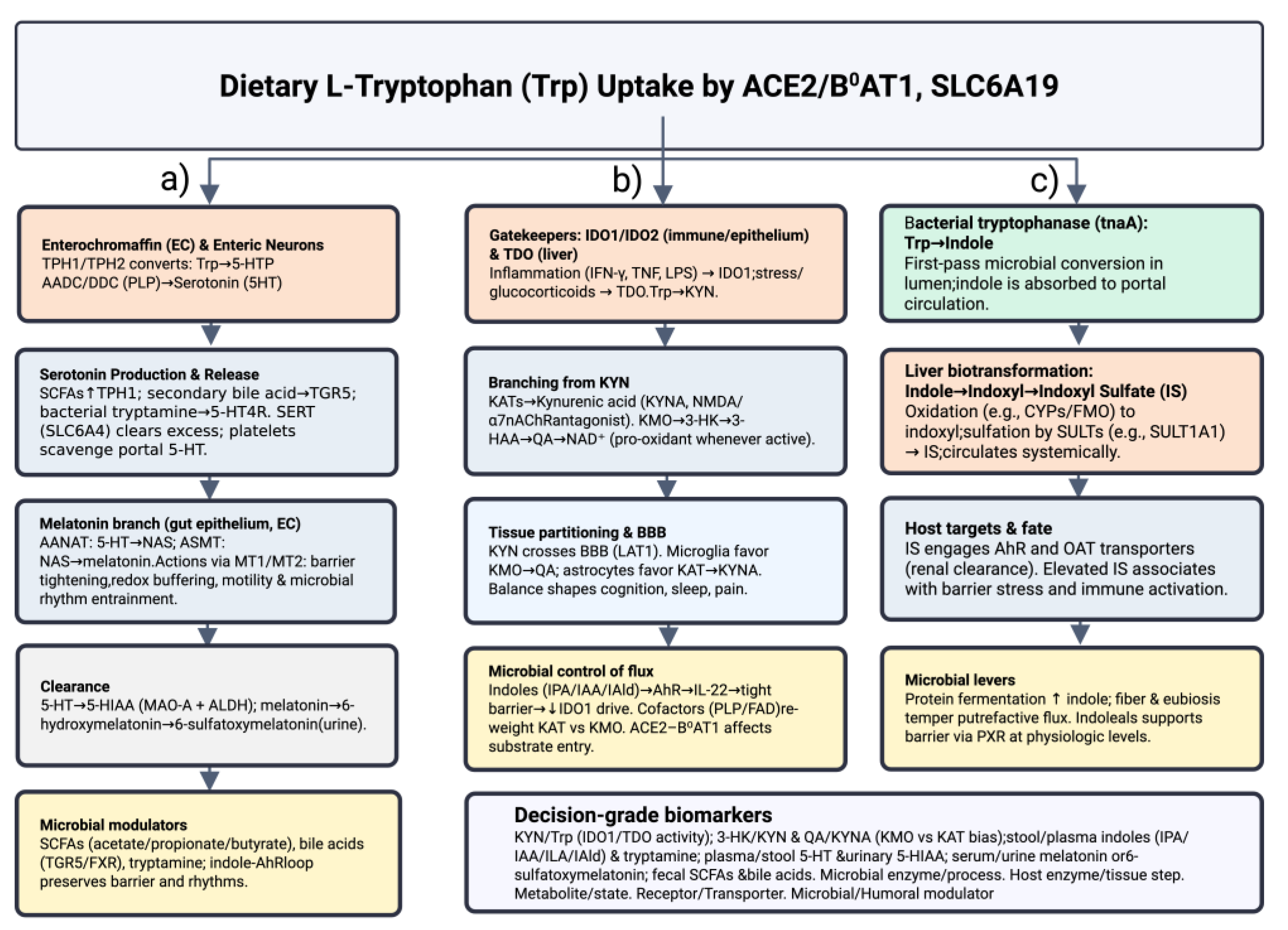
Figure 2.
Microbial “remote control” of indoleamine 2,3-dioxygenase 1 (IDO1) and tryptophan 2,3-dioxygenase (TDO2) enzyme signaling. Visual representation of how gut-derived microbial metabolites (indoles, SCFAs, AhR ligands) modulate the enzymatic activity of IDO1 and TDO2. This figure emphasizes the bidirectional interplay between intestinal microbiota, barrier integrity, immune signaling, and systemic health outcomes.
Figure 2.
Microbial “remote control” of indoleamine 2,3-dioxygenase 1 (IDO1) and tryptophan 2,3-dioxygenase (TDO2) enzyme signaling. Visual representation of how gut-derived microbial metabolites (indoles, SCFAs, AhR ligands) modulate the enzymatic activity of IDO1 and TDO2. This figure emphasizes the bidirectional interplay between intestinal microbiota, barrier integrity, immune signaling, and systemic health outcomes.
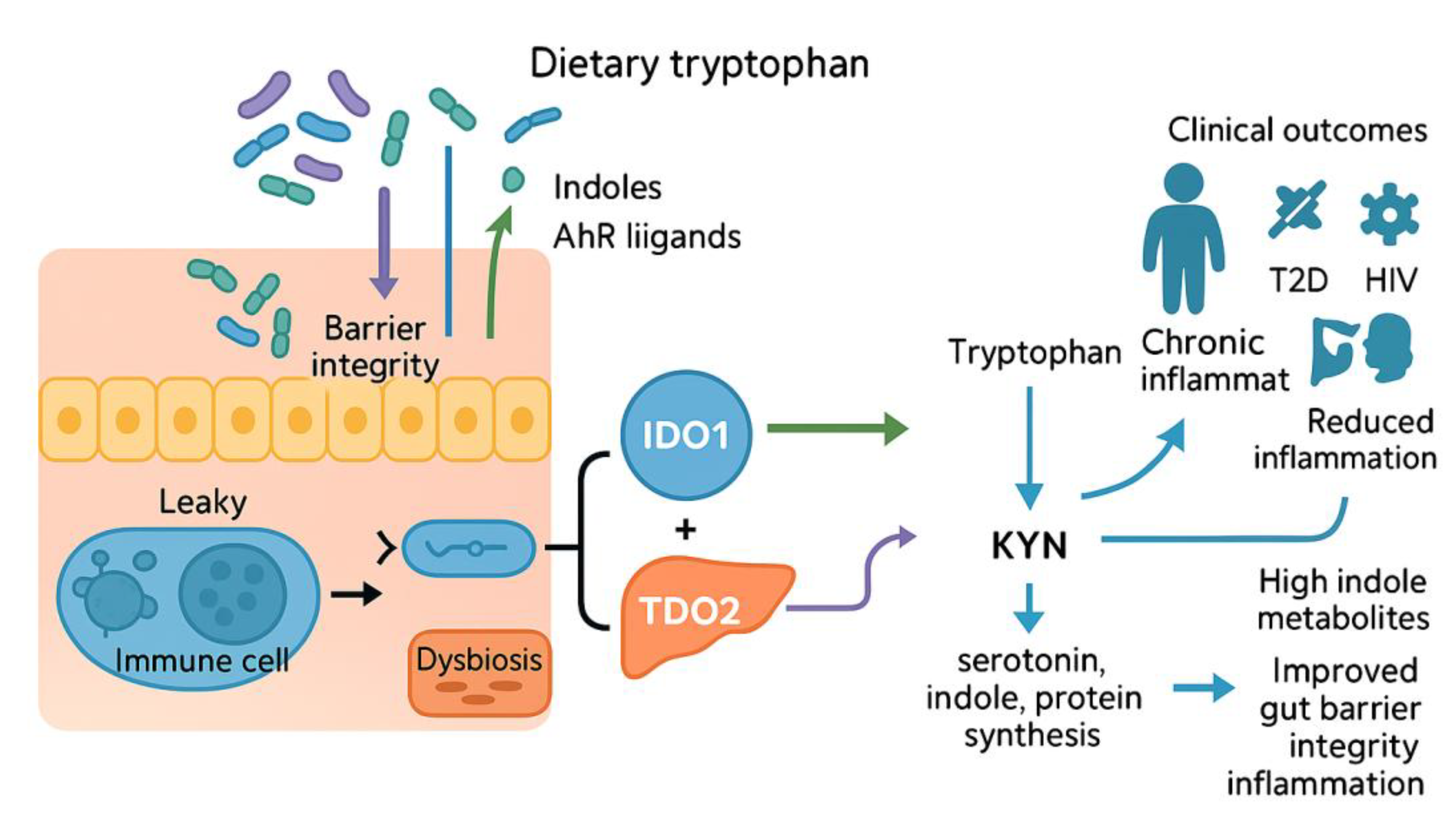
Figure 3.
Spatial Mapping of kynurenine checkpoints. Illustration showing cellular-level checkpoints of kynurenine metabolism within the neurovascular unit. Distinct metabolic niches in microglia, astrocytes, and endothelial cells are depicted, highlighting their roles in regulating immune surveillance, metabolic flux, and neuronal resilience, particularly at the blood–brain barrier.
Figure 3.
Spatial Mapping of kynurenine checkpoints. Illustration showing cellular-level checkpoints of kynurenine metabolism within the neurovascular unit. Distinct metabolic niches in microglia, astrocytes, and endothelial cells are depicted, highlighting their roles in regulating immune surveillance, metabolic flux, and neuronal resilience, particularly at the blood–brain barrier.
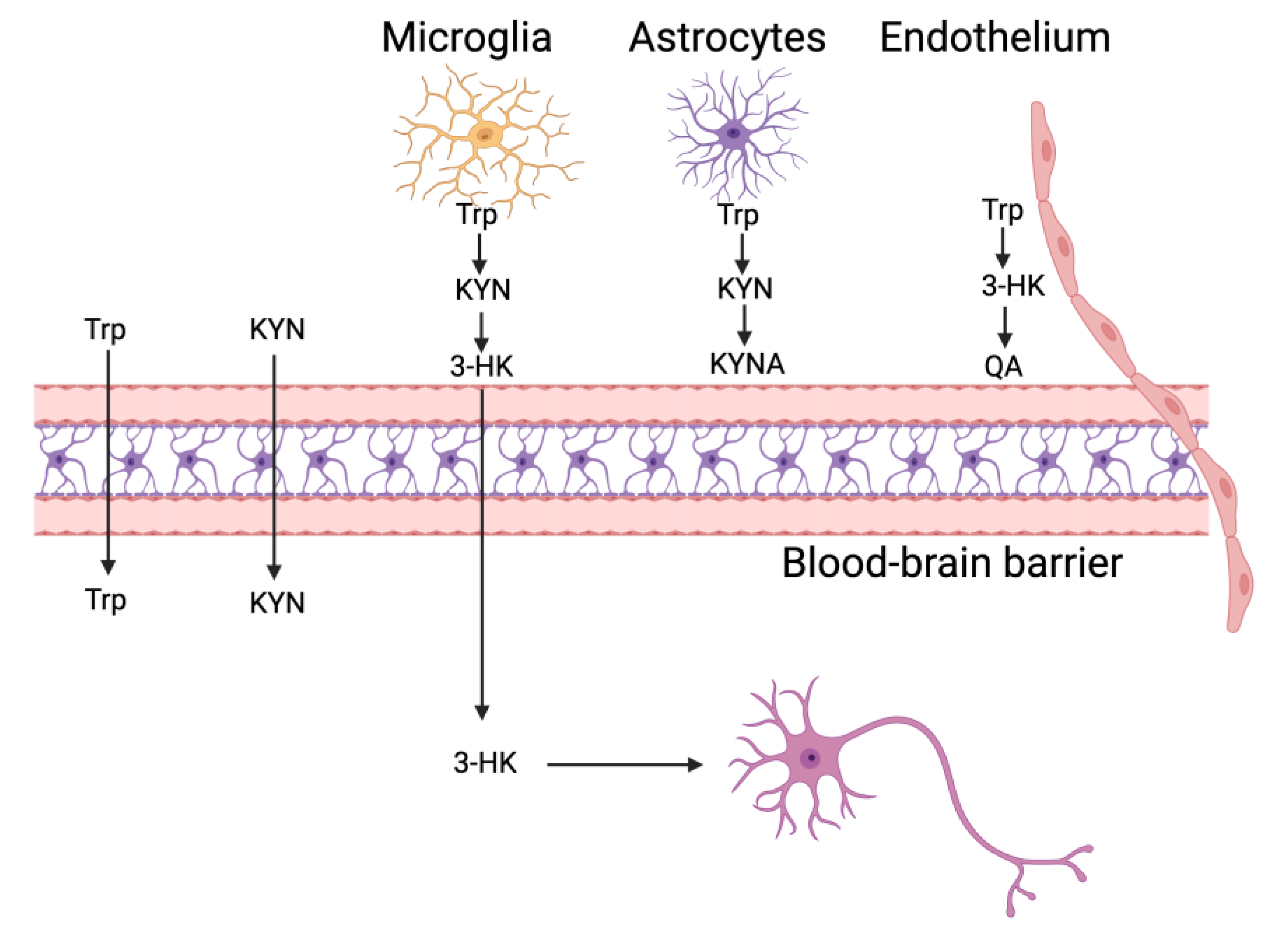
Figure 4.
Chronotherapeutic and Sex-Specific Modulation of Kynurenine Pathway. A circadian wheel and hormonal timeline showing sex-specific differences in kynurenine metabolism, immune sensitivity, and therapeutic windows. This figure captures how time-of-day and hormonal phases (menstrual cycle, menopause) can alter the efficacy and safety of interventions targeting KYN pathway enzymes.
Figure 4.
Chronotherapeutic and Sex-Specific Modulation of Kynurenine Pathway. A circadian wheel and hormonal timeline showing sex-specific differences in kynurenine metabolism, immune sensitivity, and therapeutic windows. This figure captures how time-of-day and hormonal phases (menstrual cycle, menopause) can alter the efficacy and safety of interventions targeting KYN pathway enzymes.
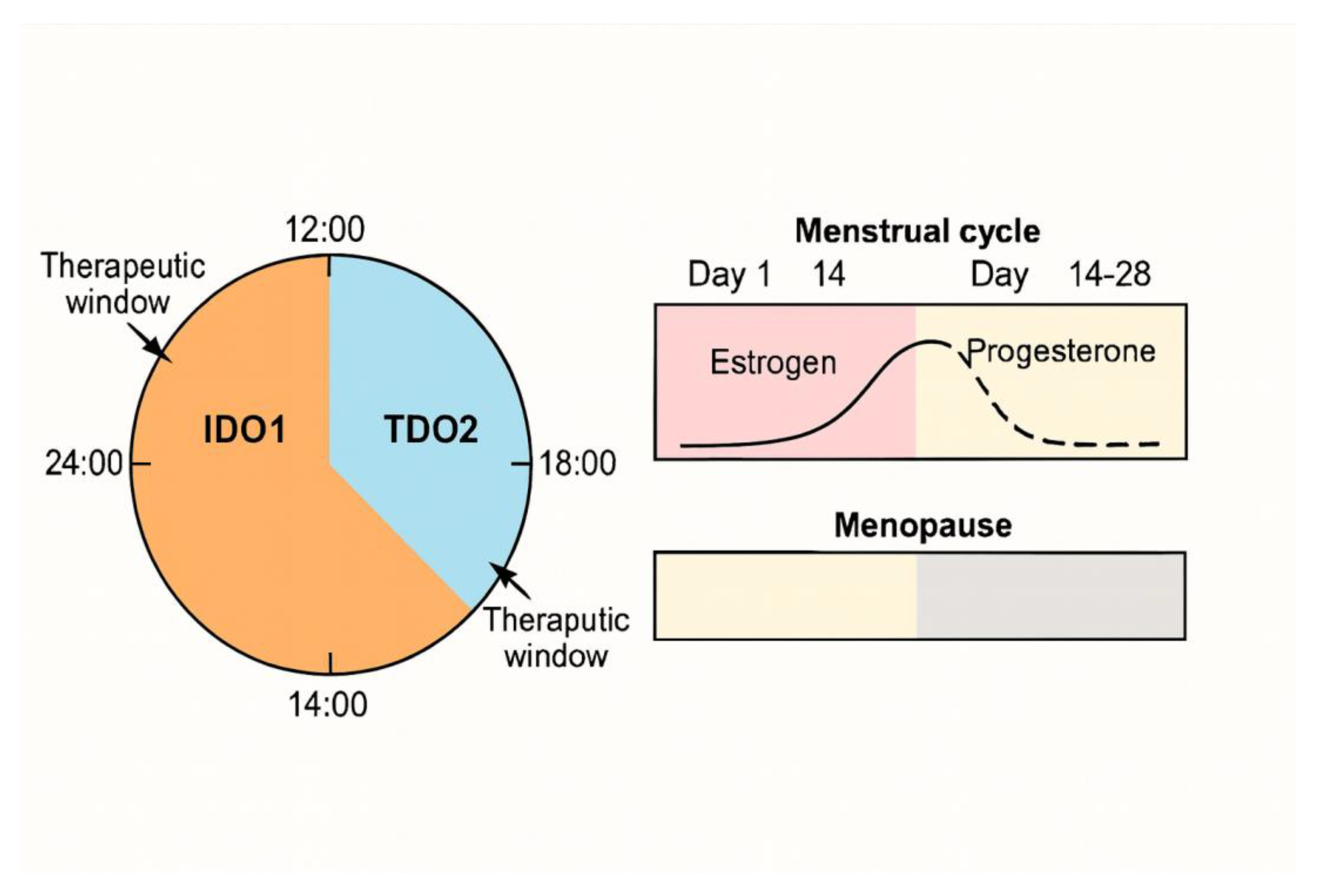
Figure 5.
Precision modulation via engineered and smart intervention. Conceptual visualization of microbiota engineering strategies for precision intervention. Highlights include synthetic consortia with inducible KYN operons, encapsulated post-biotics (e.g., stabilized KYNA), kill-switch technologies, and adaptive probiotic titration guided by real-time stool metabolomics.
Figure 5.
Precision modulation via engineered and smart intervention. Conceptual visualization of microbiota engineering strategies for precision intervention. Highlights include synthetic consortia with inducible KYN operons, encapsulated post-biotics (e.g., stabilized KYNA), kill-switch technologies, and adaptive probiotic titration guided by real-time stool metabolomics.
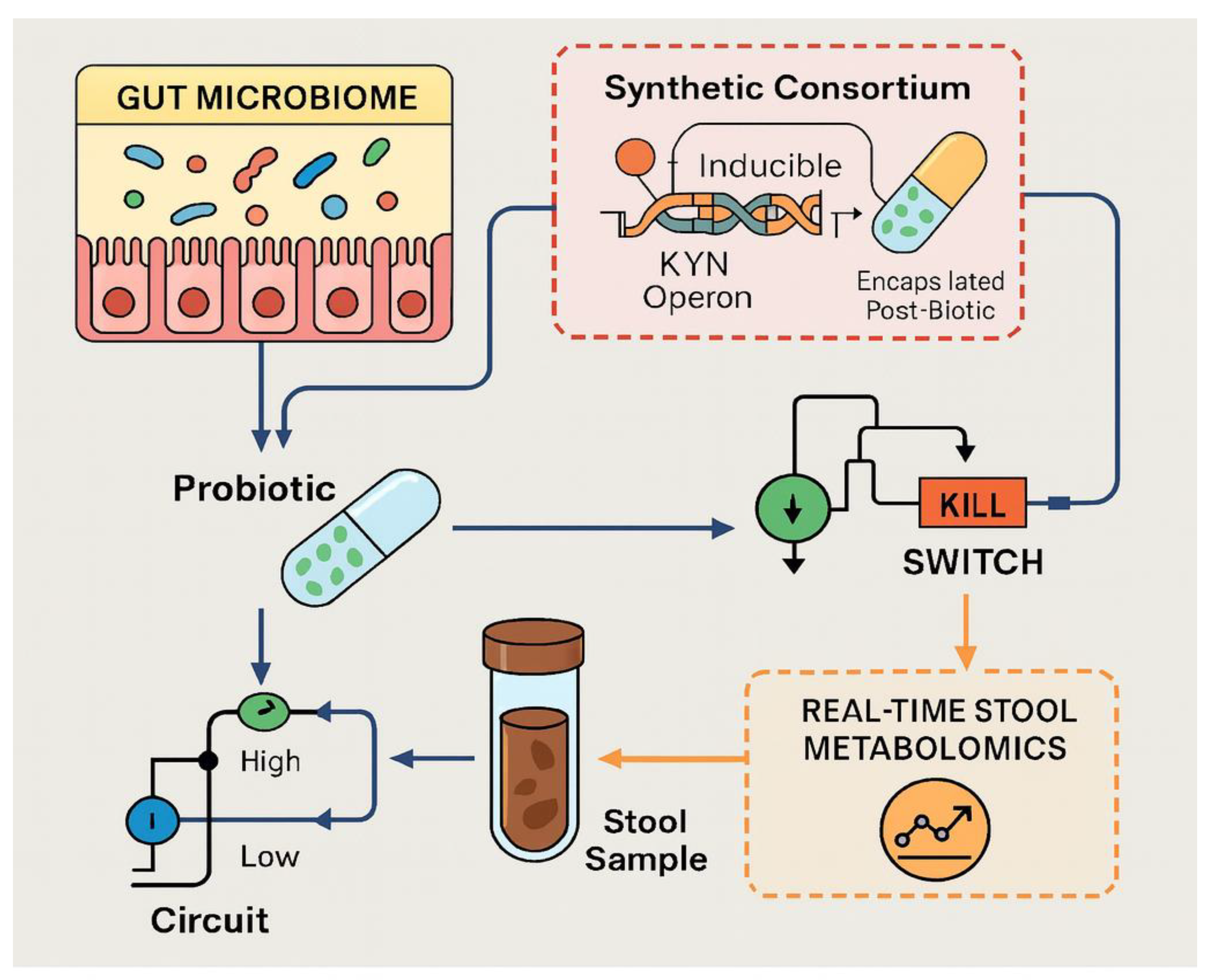
Figure 6.
Adaptive intervention platform: Biomarker-guided smart protocols. Diagrammatic representation of a closed-loop therapeutic framework (“Intervention 2.0”) integrating wearable biosensors, real-time biomarker readouts (saliva, plasma, stool), and artificial intelligence (AI)-driven decision-making algorithms. This model illustrates how precision dosing and lifestyle adjustments dynamically recalibrate kynurenine pathway activity.
Figure 6.
Adaptive intervention platform: Biomarker-guided smart protocols. Diagrammatic representation of a closed-loop therapeutic framework (“Intervention 2.0”) integrating wearable biosensors, real-time biomarker readouts (saliva, plasma, stool), and artificial intelligence (AI)-driven decision-making algorithms. This model illustrates how precision dosing and lifestyle adjustments dynamically recalibrate kynurenine pathway activity.
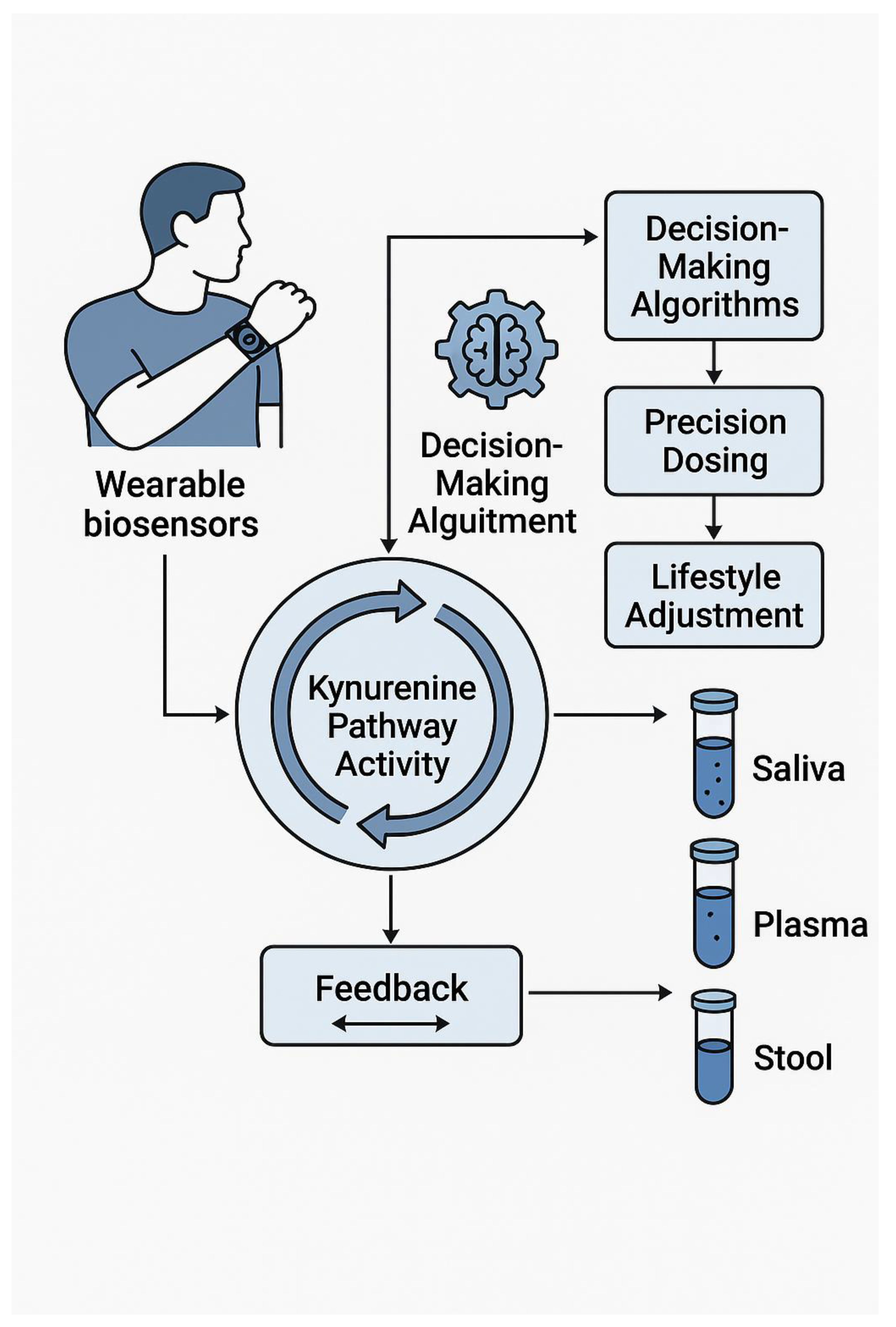

Table 1.
Three translational frontiers in tryptophan (Trp)–kynurenine (KYN) research.
| Category | Description / Core Issue | Implication / Goal | |
|---|---|---|---|
| Translational Challenge | |||
| 1. | Causal Mapping | Thousands of disease associations but no causal framework linking microbiota, host enzymes (IDO1, TDO2) and downstream metabolites (KYNA, QUIN) to physiology | Limits precision design of probiotics, enzyme inhibitors, lifestyle prescriptions |
| 2. | Spatial Resolution | Bulk assays mask cell- and tissue-specific “checkpoints” (astrocytes, microglia, BBB endothelium) | Demands targeted modulation of localized hotspots rather than pathway-wide blockade |
| 3. | Temporal Dynamics | Trp–KYN flux oscillates with circadian rhythms and sex hormones; chronotherapeutic windows under-studied | Missing optimal timing may blunt efficacy or raise toxicity of interventions |
| Key Objective | |||
| 1. | Map Spatial Checkpoints | Chart localized KYN metabolism niches in brain and periphery | Inform cell-type-specific therapeutic targeting |
| 2. | Characterize Sex & Circadian Modifiers | Define how hormones and clocks tilt Trp metabolism toward neurotoxicity or resilience | Enable time- and sex-specific dosing strategies |
| 3. | Develop Microbiota-Based Precision Switches | Engineer probiotic consortia and post-biotics that reroute Trp flux | Provide modular, patient-tailored metabolic control |
| 4. | Outline Integrated “Intervention 2.0” Platform | Combine dual-enzyme inhibitors, exercise, and AI-driven biosensing | Create closed-loop, adaptive therapeutics |
BBB, blood-brain barrier; IDO1, indoleamine-2,3-dioxygenase-1; KYN, kynurenine; QUIN, quinolinic acid; TDO2, tryptophan-2,3-dioxygenase-2; Trp, tryptophan. Characterize Sex & Circadian Modifiers.
Table 2.
Precision modulation of neurovascular kynurenine (KYN) Metabolism.
| Experimental Strategy | Mechanistic Lever / Tools | Mechanistic Lever / Tools | Expected Outcome / Advantage |
|---|---|---|---|
| Endothelial CRISPRi “zip-code” AAV-targeted knock-down of KMO or KYNU in perivascular endothelium | • ZIM3-KRAB CRISPRi cassette• Endothelial-specific promoters + miRNA “clearing tags” • Bar-coded AAV libraries |
• Build bar-coded AAV panels to sharpen endothelial specificity • Validate knock-down and KYN-metabolite flux in brain-slice co-cultures • Monitor glutamate dynamics in vivo with optogenetic reporters • Test impact on tumor infiltration & behavior (KMO-high metastasis models) • Run parallel safety screens for NAD pools & mitochondrial stress |
Precise, vessel-restricted suppression of 3-HK/ QUIN → dampened excitotoxicity and immune escape with minimal systemic off-target effects |
| Light-addressable riboswitch control in astrocytesMillisecond, reversible tuning of KMO / KYNU translation | • Photocleavable or Z-lock riboswitch fused to target mRNA • Pulsed IR/visible light for on-off gating • Simultaneous GCaMP or glutamate sensor read-outs |
• Package riboswitch construct in astrocyte-specific AAV • Benchmark translation kinetics vs. Ca2⁺ rise in organotypic slices • Map spatial spread of KYN pulses and gliotransmitter waves • Deploy fiber-coupled two-photon uncaging in vivo to test network excitability during sleep, seizure, learning |
Real-time, non-invasive “dimmer switch” for KP activity with built-in metabolic read-outs; ideal for dissecting causal links between KYN flux and neural circuitry |
AAV, adeno-associated virus; KMO, kynurenine 3-monooxygenase KYN, kynurenine; KP, kynurenine pathway; NAD, nicotinamide adenine dinucleotide; Trp, tryptophan.
Table 3.
Chronobiological influences and biomarker-guided intervention strategies.
| Circadian / Sex-Specific Gap | Why It Matters | Biomarker-Guided Next Step | Anticipated Pay-Off |
|---|---|---|---|
| Absence of chrono-pharmacology trials for IDO1/TDO2, KMO or KAT inhibitors | Optimal dosing windows are unknown; schedules may blunt efficacy or raise toxicity | Launch Bayesian adaptive trials that co-randomize dose and clock time, using real-time KYN / QUIN read-outs as decision boundaries | Evidence-based chrono-dosing algorithms, reduced off-target effects |
| Inadequate stratification by circadian phase and sex | Female-specific PK/PD and toxicity signals vanish when averaged | Embed wearable-derived chronotype + hormonal phase into inclusion criteria; pre-specify sex-by-time interaction models | Sex-aware precision medicine; higher treatment tolerability |
| Undefined mechanistic links between clock genes, hormones & KYN enzyme activity | Surrogate biomarkers risk misinterpretation without pathway context | Overlay 24 h cortisol / melatonin rhythms onto multi-time-point KYN, QUIN, KYNA panels; apply mixed-effects chronobiology models | Mechanistic targets for combination therapy; validated biomarkers |
| Wearable metrics (light, sleep) not integrated into study design | Zeitgebers that modulate KYN flux are ignored | Trigger capillary micro-sampling when lux-derived phase-angle deviation crosses threshold (“biomarker-in-the-loop”) | Personalised sampling & dosing windows; lower noise in endpoints |
| Sex- and light-cycle biases in pre-clinical models | Male-only, fixed-light studies limit translation | Use sex-balanced rodents under rotating light cycles; validate with humanised microbiome models | Higher translational validity of pre-clinical findings |
| Lack of validated rapid biomarkers to couple KYN swings to outcomes | Real-time dose adjustment impossible | Develop saliva / finger-stick electrochemical strips for KYN / TRP / QUIN; calibrate against plasma & microdialysate | Closed-loop dose titration; faster early-phase trials |
| Circadian-Misalignment Focus: QUIN spikes during night-shift work | Neurotoxic burden may rise, especially in vulnerable chronotypes | Pilot cross-over study: shift-workers + hourly capillary sampling + light & activity trackers Model QUIN vs lux-derived phase angle (mixed-effects) Overlay cortisol & melatonin to disentangle stress vs circadian drivers Test timed blue-light blockers, melatonin, or time-restricted feeding |
Identifies high-risk chronotypes and intervention windows; informs occupational health policies |
Table 4.
Next adaptive chronopharmacology and dosing optimization.
| Adaptive Gap / Focus Area | Actionable Strategy & Tool Kit | Key Operational Step(s) | Intended Pay-Off |
|---|---|---|---|
| Dose-Time Randomization | Bayesian hierarchical designs that co-randomize dose level + clock-time | • Simulate designs borrowing strength across adjacent time bins • Integrate wearable-derived chronotype into priors • Embed rolling interim analyses that drop unfavorable time windows rather than doses | Evidence-based chrono-dosing rules; smaller, faster trials |
| Sensor–Data Pipeline | Validated software bridges from CGM / lactate / KYN sensors → electronic TMF | • Build real-time API between biosensors and trial master file • Version-control data streams for audit compliance | Seamless biomarker ingestion; regulatory-ready data fidelity |
| Biomarker Validation | Rapid KYN / TRP / QUIN saliva or finger-stick electrochemical strips | • Cross-validate saliva, plasma, tumor microdialysate after micro-dosed dual-inhibitor (e.g., RY103) crossover PK study | Closed-loop dosing feasible at point-of-care |
| Safety Governance | Rules for rapid dose-time shifts in outpatient settings | • Use melatonin / cortisol point-of-care assays as safety triggers • Pre-define algorithmic “pause” thresholds | Protects patients while enabling flexible chrono-titration |
| Patient-Centric Metrics | PROMs tuned to circadian toxicity (fatigue, cognition) | • Embed in ePRO platform; couple to Bayesian controller as soft constraints | Holistic tolerability; improves adherence |
| Pilot Implementation | First-in-human chrono-trials for drugs with known chronotoxicities | • Pilot crossover study: micro-dosed dual IDO1/TDO2 inhibitor + real-time KYNA pacing • Roll out in oncology & mood-disorder cohorts | Proof-of-concept that algorithm-guided timing beats fixed BID regimens |
Table 5.
Precision microbiota-based therapeutics.
| Development Challenge / Key Insight | Why It Matters | Precision Strategy or Next Step |
|---|---|---|
| 1 ▪ Unpredictable engraftment & variable response • Engineered consortia (e.g., VE303) often need antibiotic conditioning. • Multispecies probiotics cut transit time only in diet-matched responders. | Long-term decolonization or mood relief can fade. | — Screen baseline diet & Lactobacillus/Bifidobacterium colonization predictors before enrollment.— Tailor consortia composition to individual fermentable-fiber intake. |
| 2 ▪ Scarce durability & mechanistic data • Limited longitudinal sequencing of phage–bacteria–host dynamics. | Regulatory roadblock; patient safety. | — Pair shotgun metagenomics with phageomics in 6–12-month follow-up.— Validate causal metabolites via gnotobiotic “plug-and-play” models. |
| 3 ▪ Safety & horizontal-gene-transfer (HGT) risks • CRISPR-edited E. coli microcin strains could acquire resistance cassettes. | Batch-to-batch variability in metabolite output undermines reproducibility. | — Stack orthogonal kill-switches (CRISPRi + toxin–antitoxin + auxotrophy).— Deploy long-read sequencing of shed strains to monitor HGT. |
| 4 ▪ Manufacturing & QC deficits | Missing optimal dosing windows weakens efficacy. | — Adopt GMP-aligned metabolite “fingerprinting” for every lot.— Introduce in-line mass-spec release tests. |
| 5 ▪ Timing factors ignored • Circadian rhythms gate colonization resistance; probiotics modulate clock-gene expression. | Jurisdictional differences delay global rollout. | — Run adaptive trials that modulate dosing relative to light exposure, meals, & antibiotics.— Schedule capsule release (enteric or pH-triggered) to late-day circadian troughs in QUIN. |
| 6 ▪ Fragmented regulatory pathways | One-size-fits-all blends underperform. | — Establish harmonized guidance for genetically modified live biotherapeutic products (LBPs) via international consortia. |
| 7 ▪ Personalized strain selection • Foodborne lactic-acid-bacteria genomes map “starter” strains for bespoke consortia. | Long-term decolonization or mood relief can fade. | — Build a strain library ranked by individual dietary patterns & metabolite deficits; auto-compose patient-specific mixes. |
Table 6.
Advanced delivery systems and artificial intelligence (AI)-driven adaptive therapeutics.
| Innovation Track | Key Development Step | Implementation Path / Intended Pay-Off |
|---|---|---|
| Encapsulated Post-biotics (e.g., KYNA) | 1 ▸ Screen GRAS-grade polymers & hydrogels for KYNA stability under accelerated aging.2 ▸ Map release profiles in simulated GI fluids & pig colonic explants.3 ▸ Test near-infrared–triggered nanocapsules for on-demand bursts during inflammation.4 ▸ Quantify systemic vs. luminal KYNA via LC-MS in gnotobiotic mice, benchmark against Bifidobacterium output. | • Locks in metabolite potency until it reaches the colon.• Enables flare-responsive “burst” therapy.• Provides pharmacokinetic data to support dosing equivalence to live-microbe production. |
| Adaptive Probiotic Titration | 1 ▸ Build a reference library of weekly stool metabolomes from diverse cohorts on fixed probiotic regimens.2 ▸ Train adaptive Bayesian models that recommend dose or strain tweaks when SCFA / indole scores drift.3 ▸ Integrate wearable-captured feeding rhythms to optimize capsule timing.4 ▸ Run N-of-1 cross-over trials comparing dashboard-guided vs. static dosing. | • Converts one-size-fits-all probiotics into dynamic, biomarker-steered therapies.• Aligns delivery with each person’s meal schedule and gut motility.• Generates individualized responder fingerprints for precision formulation. |
| AI-Driven Gut–Brain Feedback Loops | 1 ▸ Leverage ClinAIOps frameworks for continuous therapeutic monitoring (glucose, lactate, KYN sensors).2 ▸ Fuse real-time metabolite slopes with sensor-driven exercise platforms (e.g., auto-pacing treadmills).3 ▸ Embed adaptive probiotic dashboards into the same loop for daily strain/dose updates. | • Closed-loop system that tweaks movement and microbes to keep KYN/TRP in a protective range.• Minimizes clinician workload—algorithm adjusts interventions overnight.• Sets the stage for fully autonomous “gut-brain wearables” in neuropsychiatric care. |
Disclaimer/Publisher’s Note: The statements, opinions and data contained in all publications are solely those of the individual author(s) and contributor(s) and not of MDPI and/or the editor(s). MDPI and/or the editor(s) disclaim responsibility for any injury to people or property resulting from any ideas, methods, instructions or products referred to in the content. |
© 2025 by the authors. Licensee MDPI, Basel, Switzerland. This article is an open access article distributed under the terms and conditions of the Creative Commons Attribution (CC BY) license (http://creativecommons.org/licenses/by/4.0/).
Copyright: This open access article is published under a Creative Commons CC BY 4.0 license, which permit the free download, distribution, and reuse, provided that the author and preprint are cited in any reuse.