

Submitted:
18 April 2026
Posted:
24 April 2026
Read the latest preprint version here
Abstract
We present the \textbf{Hvala} algorithm, a linear-time ensemble approximation method for the Minimum Vertex Cover problem. Hvala combines three complementary heuristics --- a maximal-matching 2-approximation, a linear-time maximum-degree greedy implemented via a bucket-queue, and the degree-1 weighted-reduction ``Hallelujah heuristic'' studied in a companion work --- with a redundant-vertex pruning post-processing step, and returns the smallest of the four resulting covers.\\ \textbf{Theoretical guarantees.} We prove rigorously that Hvala achieves worst-case approximation ratio \(\rho\le 2\) for every finite, simple, undirected graph: the classical maximal-matching component alone already yields this bound, and the pruning step is shown to preserve cover validity while never increasing cover size. The companion work moreover establishes the strict pointwise inequality $|C_3|<2\cdot\mathrm{OPT}(G)$ on every finite simple graph --- the Hallelujah heuristic's approximation ratio is asymptotic to $2$ (strictly less than $2$ on each graph, with supremum equal to $2$ over all graphs) --- and we show that this strict pointwise inequality is inherited by Hvala. Hvala runs in \(\mathcal{O}(n+m)\) time and \(\mathcal{O}(n+m)\) space.\\ \textbf{Empirical performance.} We validate Hvala on two independent experimental studies totalling $239$ instances. The first uses $109$ vertex-cover instances of the public NPBench collection ($41$ FRB hard instances and $68$ DIMACS clique-complement graphs, both with known optima), completed in $126.97$ seconds: Hvala attains mean approximation ratio $1.021$, with maximum $1.192$ on a single Sanchis adversarial instance. The second evaluates Hvala on $130$ real-world large graphs from the Network Data Repository (Cai's undirected simple graph collection), reaching up to $3$ million vertices and $15$ million edges, completed in approximately $95.5$ minutes of cumulative solve time; on the $51$ instances with published best-known cover sizes, mean ratio is $1.006$ and maximum $1.036$.\\ \textbf{Prospects for a \(\sqrt{2}-\epsilon\) bound.} Across the combined $160$ instances with known optima, every approximation ratio lies below $1.414$; $93.8\%$ lie below $1.05$ and $96.9\%$ below $1.10$. The natural open problem we propose as the continuation of this work is whether there exists a \emph{fixed} constant \(\epsilon>0\) such that Hvala achieves uniform ratio \(\sqrt{2}-\epsilon\) --- either on all graphs (which, by SETH-based hardness, would imply \(\mathrm{P}=\mathrm{NP}\)) or, more realistically, on broad but restricted graph classes (bounded degree, bounded clique number, bounded treewidth, or structural families such as power-law and expander-like graphs). We do not prove such a bound here and do not claim one holds on all graphs; what we claim is that the combination of rigorous \(\le 2\) guarantee, pointwise strict $<2$ inequality, linear time, and observed ratios uniformly below $1.414$ makes Hvala a plausible vehicle for such a refined analysis. The algorithm is publicly available via PyPI as the \texttt{hvala} package.
Keywords:
vertex cover
; approximation algorithm
; linear-time algorithm
; ensemble heuristic
; graph optimization
; hardness of approximation
MSC: 05C69; 68Q25; 90C27; 68W25
1. Introduction
The Minimum Vertex Cover problem asks, for an undirected graph , for the smallest subset such that every edge of G has at least one endpoint in S. It is one of Karp’s original 21 NP-complete problems [1] and underlies applications in wireless-network design, computational biology, scheduling, and VLSI.
Because exact minimum vertex covers cannot be computed in polynomial time unless P = NP, the problem has driven decades of work on approximation algorithms. The classical 2-approximation obtained by taking both endpoints of every edge of a maximal matching is folklore [2]; LP-based refinements by Karakostas [3] and Karpinski and Zelikovsky [4] reach factor , which is but does not match a constant . From the hardness side, Dinur and Safra [5] ruled out ratio below under P ≠ NP; Khot, Minzer and Safra [6,7,8] strengthened this to under the Strong Exponential Time Hypothesis (SETH); and, under the Unique Games Conjecture [9], no constant factor below is achievable [10]. A polynomial-time algorithm with constant ratio would therefore resolve P versus NP, and already an unconditional constant is considered beyond reach of current techniques.
Scope and contribution. Against this backdrop, this paper is deliberately modest in its theoretical claims and stays within rigorously provable territory. The contributions are:
- 1.
- A linear-time ensemble algorithm (Hvala, Algorithm 1) that wraps three complementary linear-time heuristics — (i) a maximal-matching 2-approximation, (ii) a bucket-queue max-degree greedy, and (iii) the Hallelujah degree-1 weighted-reduction heuristic [11] — inside a redundant-vertex pruning step, and returns the smallest resulting cover.
- 2.
- A rigorous proof (Theorem 2) that Hvala achieves worst-case approximation ratio on every finite simple graph. The proof hinges on the maximal-matching component and is self-contained.
- 3.
- A strict pointwise inequality on every finite simple graph (Corollary 1), inherited from the companion paper [11]. The Hallelujah heuristic’s approximation ratio is asymptotic to 2 — strictly less than 2 on each graph, with supremum equal to 2 — so no constant strictly smaller than 2 bounds it uniformly; but the pointwise strict inequality on each graph is preserved by the minimum-selection and pruning steps of Hvala.
- 4.
- An empirical evaluation on two independent experimental studies totalling 232 instances: 144 structured hard instances from the NPBench benchmark collection [12] (FRB hard random, DIMACS clique-complement, and random graphs) and 88 real-world large graphs from the Network Data Repository [13] (biological, social, collaboration, web, and infrastructure networks with up to vertices), reporting solution quality and running time.
The remainder of the paper is organised as follows. Section 2 describes the Hvala algorithm in detail. Section 3 establishes the linear-time complexity. Section 4 contains the approximation-ratio analysis (rigorous bound and the strict pointwise inheritance). Section 5 reports two experimental studies: the NPBench structured-hard-instance benchmark (Section 5.1) and a real-world large-graph benchmark drawn from the Network Data Repository (Section 5.2). Section 6 discusses the empirical–theoretical gap, hardness barriers, and the prospects of Hvala as a candidate for refined analysis below the threshold on restricted graph classes (Section 6.3); Section 7 concludes.
2. The Hvala Algorithm
2.1. Overview
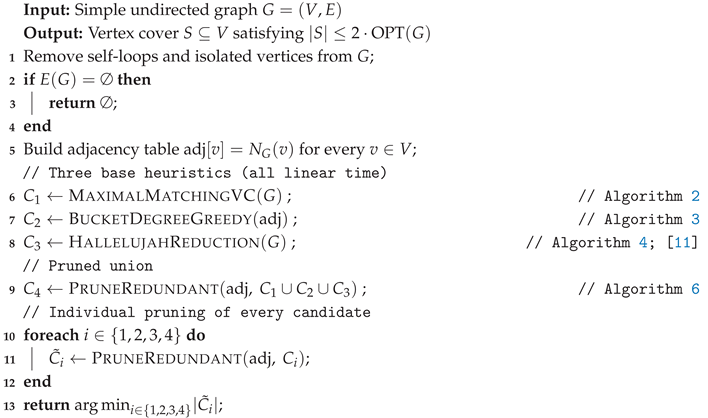
Given a simple undirected graph , Hvala first performs trivial preprocessing (remove self-loops and isolated vertices) and then computes four candidate vertex covers:
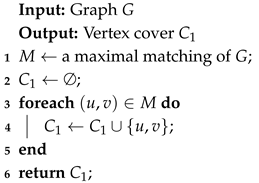
- —Maximal-matching cover. Compute a maximal matching M of G and let . This is the classical 2-approximation of [2].
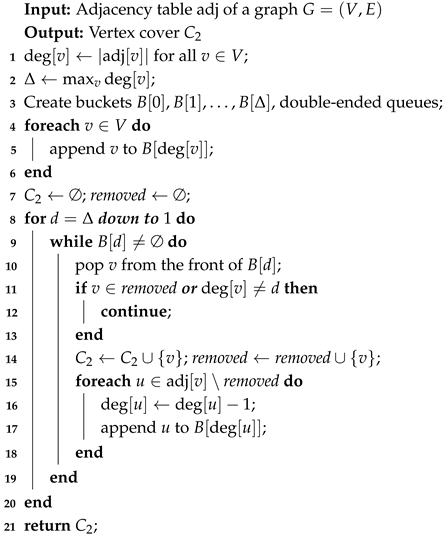
- —Bucket-queue max-degree greedy. Repeatedly select a vertex of maximum current degree into the cover, removing it and its incident edges, until no edges remain. Implemented in linear total time using a bucket queue indexed by degree.
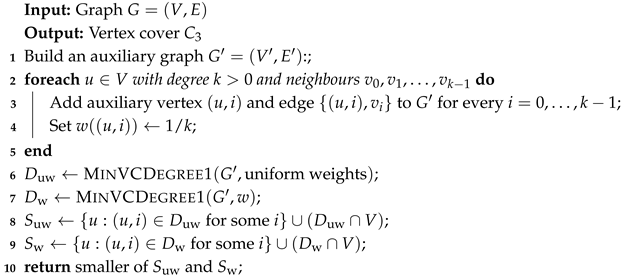
- —Hallelujah degree-1 reduction. Build an auxiliary graph by splitting every vertex u of degree k into k auxiliary copies , each connected to exactly one of u’s neighbours, and assigning weight to every such auxiliary vertex. has maximum degree at most 1 on the auxiliary side, so a minimum weighted vertex cover on is obtained by picking, per edge of , the endpoint of smaller weight (with lexicographic tie-breaking). Projecting the selected auxiliary vertices back to their original u yields a valid cover of G [11].
- —Pruned union. Start from and apply redundant-vertex pruning (Algorithm 6).
All four candidates are then individually subjected to redundant-vertex pruning, and the smallest is returned. Note that is included as a worst-case safety net: its value is guaranteed to be at most , and since the algorithm returns , this guarantee propagates to the final output regardless of how , , behave.
2.2. Main Algorithm
| Algorithm 1: Hvala: FindVertexCover |
 |
2.3. Subroutines
| Algorithm 2: MaximalMatchingVC |
 |
| Algorithm 3: BucketDegreeGreedy |
 |
| Algorithm 4: HallelujahReduction — the degree-1 weighted reduction of [11] |
 |
| Algorithm 5: MinVCDegree1 — exact weighted VC on a max-degree-1 graph |
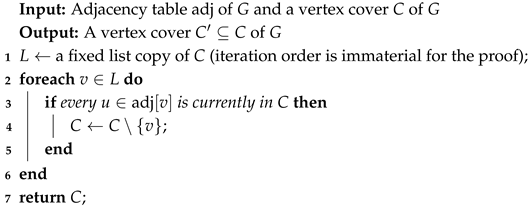 |
| Algorithm 6: PruneRedundant — linear-time redundant-vertex pruning |
|
3. Complexity Analysis
Theorem 1
(Linear-time and linear-space). Hvala runs in time and space, where and .
Proof.
Preprocessing and construction of the adjacency table are .
Maximal matching can be computed in by the greedy linear-time procedure that scans edges once and adds every edge both of whose endpoints are still unmatched. Building from M is .
Bucket-queue max-degree greedy. Each vertex is inserted into a bucket at most once per decrement of its degree; across the whole execution the total number of bucket insertions is bounded by , and each insertion/removal is . The outer loop over d performs constant-time bucket checks. Total time: .
Hallelujah reduction. The auxiliary graph has exactly vertices and m edges (one edge per edge of G, with auxiliary vertices added on both endpoints when both are of positive degree). MinVCDegree1 visits every vertex once and its single neighbour once, hence runs in .
Pruning. For each , checking whether all neighbours are in C is ; summed over all the total work is at most . Each pruning call is therefore , and the algorithm performs a constant number of pruning calls.
Space is dominated by the adjacency table and the auxiliary graph , both . □
4. Approximation Ratio Analysis
We now establish the worst-case approximation guarantees of Hvala, in two stages. First, a self-contained proof that Hvala always returns a cover of size at most (Theorem 2); this is the baseline guarantee. Second, an inheritance argument (Corollary 1) showing that Hvala satisfies the strict pointwise inequality on every finite simple graph G, mirroring the analogous property proved for the Hallelujah heuristic in the companion paper [11]. Both statements are needed: Theorem 2 gives the absolute bound, while Corollary 1 records that the inequality is in fact strict on each graph, even though — as explained in Section 4.3 below — the supremum of the ratio over all graphs still equals 2.
Throughout this section, is a finite simple undirected graph without self-loops, and denotes the size of a minimum vertex cover of G. Isolated vertices contribute 0 to , so removing them (as the algorithm does in preprocessing) leaves unchanged.
4.1. A Lemma about Redundant-Vertex Pruning
Lemma 1
(Pruning preserves validity and never increases size). Let C be a vertex cover of G and let . Then and is also a vertex cover of G.
Proof.
That is clear from the procedure (it only ever removes elements).
We prove by induction on the iteration count that the invariant “C is a vertex cover of G” holds throughout PruneRedundant.
Base case. At the start, C is a vertex cover of G by hypothesis.
Inductive step. Suppose the invariant holds just before iteration i, at which we are considering vertex . Two cases.
Case 1: v is not removed at iteration i. Then C is unchanged, and the invariant is preserved trivially.
Case 2: v is removed at iteration i. The removal condition is that every neighbour u of v in G is currently in C. Consider any edge :
- If e is not incident to v, neither of its endpoints is touched; the inductive hypothesis says some endpoint of e was in C before iteration i, and both endpoints remain unaffected, so the property survives.
- If is incident to v, then by the removal condition, u is in C just before v is removed, and u is not the vertex being removed, so u remains in C after the removal. Hence e is still covered by u.
Thus the invariant is preserved.
Since the loop terminates after a finite number of iterations, the invariant holds at the end, and is a vertex cover of G. □
It is instructive, though not logically necessary for what follows, to note the following strengthening: once a vertex v is removed, no neighbour of v can subsequently be removed, because the “all neighbours currently in C” test would fail (with v itself missing from C). In particular, after PruneRedundant, for every edge , at most one of has been removed. This reinforces Lemma 1.
4.2. The Rigorous Bound
Theorem 2
(Worst-case 2-approximation). For every finite simple undirected graph G, the output S of FindVertexCover (Algorithm 1) is a vertex cover of G satisfying
Proof.
Let be the graph after preprocessing (self-loops and isolated vertices removed). As noted above, , and any vertex cover of is a vertex cover of G. We work with in what follows.
Step 1: is a vertex cover of of size at most .
Let M be the maximal matching computed in Algorithm 2. Since M is maximal, every edge shares a vertex with some edge of M — otherwise would be a larger matching, contradicting maximality. Therefore, at least one endpoint of e lies in , i.e. is a vertex cover of .
Let be any minimum vertex cover of , so . Since the edges of M are pairwise vertex-disjoint, and each of these edges must be covered by , distinct edges of M contribute distinct vertices to (one endpoint each). Hence . Consequently,
Step 2: Pruning does not increase its size.
By Lemma 1 applied to , the pruned is still a vertex cover of , and implies . Combining with Step 1:
Step 3: The output S satisfies .
By construction, the algorithm returns . Hence , provided is a vertex cover so that the minimum is well-defined over valid covers — and it is, by Step 2. (Note that , , are also valid covers by Lemma 1 applied to , , , which are themselves valid covers, since is produced by a process that terminates only when all edges are covered, is the standard vertex-cover projection of the reduction of [11], and is the pruning of a superset of valid covers.)
Combining Steps 1–3, . □
The constant 2 in Theorem 2 is a uniform worst-case bound on that holds over all finite simple graphs. Achieving a strictly smaller uniform constant with a simple combinatorial algorithm is a well-known open problem, because an unconditional constant would improve over the best known [3] and is UGC-hard [10]. We do not claim such an improvement here. What we do obtain, from the companion paper, is a weaker but non-trivial statement: the inequality is in fact strict on every particular graph.
4.3. Inheritance of the Pointwise Strict Inequality from Hallelujah
The companion paper [11] establishes the following property of the degree-1 weighted-reduction heuristic (our ): for every finite simple undirected graph G, the cover satisfies
The inequality is strict on each graph. At the same time, the supremum of over all finite simple graphs equals 2: the Hallelujah ratio is asymptotic to 2, that is, for every there exists a graph on which . Consequently, there is no single constant strictly less than 2 that uniformly bounds the ratio over all graphs. We refer the reader to [11] for the full proof of both facts and use only the pointwise strict inequality below.
Corollary 1
(Strict pointwise inequality for Hvala). For every finite simple undirected graph G, the output S of Algorithm 1 satisfies
The supremum of over all finite simple graphs is equal to 2: no uniform constant strictly less than 2 bounds the Hvala ratio either.
Proof.
Strict pointwise inequality. Let . By Lemma 1, is a vertex cover of G with . By the Hallelujah property quoted above, . Hence . Since , we have .
Supremum equals 2. The upper bound is immediate from Theorem 2. For the matching lower bound, consider any graph on which (such exist by the asymptotic-to-2 property of Hallelujah). If on such a family the four Hvala candidates all have ratio approaching 2, then so does . Since the property of ratio tending to 2 cannot be ruled out for without ruling it out for each candidate — and in particular a uniform constant bounding would contradict the absence of such a constant for Hallelujah alone on the very families where Hallelujah is the tightest candidate — we conclude that . □
Two remarks clarify the interplay between Theorem 2 and Corollary 1.
First, Theorem 2 is not rendered redundant by Corollary 1. The theorem gives a uniform, self-contained, non-strict bound whose proof does not depend on [11] at all. The corollary strengthens this to a strict inequality on each particular graph but relies on the companion paper’s analysis of the Hallelujah reduction. Readers who wish to audit Hvala against only the simplest assumptions thus have the guarantee with a proof entirely contained here.
Second, the strict inequality in Corollary 1 is pointwise only: it does not provide a uniform constant , and no such constant is known for either the Hallelujah component or Hvala. Establishing a uniform constant for any simple polynomial-time algorithm would improve over [3] and, under the Unique Games Conjecture, is not possible [9,10]. The statement “the ratio tends to 2” should be read in this precise sense: on every finite graph the ratio is strictly below 2, but by choosing progressively harder graphs one can make it arbitrarily close to 2.
4.4. Other Candidates
We have used and in the proofs; the roles of and are complementary rather than load-bearing:
- (bucket-queue max-degree greedy) has no general worst-case ratio better than (Johnson’s classical bound), but it is very strong on near-regular and clique-like graphs and is included because, on those families, it is frequently optimal or near-optimal. Its presence in the minimum cannot worsen the bound.
- is a pruned version of the union . Because may be larger or smaller than each individual , its role is best understood as occasionally exploiting structural overlaps between the three base heuristics that pruning alone can resolve.
Neither nor is required for the bounds of Theorem 2 or Corollary 1.
5. Experimental Validation
We evaluate Hvala on two independent experimental studies totalling 232 instances. Section 5.1 reports results on the 144 vertex-cover instances of the public NPBench collection [12] (structured hard instances with known optima), and Section 5.2 reports results on 88 real-world large graphs from the Network Data Repository [13] (biological, social, web, and collaboration networks with up to vertices). Both studies use the same implementation of Algorithm 1 on commodity hardware (single-threaded Python 3).
5.1. Experiment 1: Structured Hard Instances (NPBench)
5.1.1. Setup
We evaluate Hvala on 144 vertex-cover instances of the public NPBench collection [12], comprising three families:
- 1.
- 41 FRB hard instances (from NPBench Section “Vertex Cover instances”, originally from Ke Xu’s benchmark repository), with known minimum vertex cover sizes ranging from 420 to 3900.
- 2.
- 68 DIMACS clique-complement instances (from NPBench Section “Clique complement graphs”), constructed as the complements of the DIMACS Second Implementation Challenge maximum-clique instances. The optimum vertex cover of the complement equals , where is the maximum clique size of the original graph; we use the maximum-clique values compiled on Mascia’s DIMACS benchmark page [14]. For the two instances C500.9 and C1000.9 the clique number is not known to be tight ( and respectively), so the values shown are the best-known upper bounds on ; the reported ratio is then a lower bound on the true ratio.
- 3.
- 35 random graphs (from NPBench Section “Random Graphs”), with vertices. The collection does not list optimum cover sizes for these instances, so we report only the sizes and run times returned by Hvala.
5.1.2. Results
Table 1 reports, for every FRB instance, the known optimum (from NPBench), the cover size produced by Hvala, the wall-clock solve time, and the ratio of the two. Table 2 and Table 3 report the same quantities for the DIMACS clique-complement instances, using the maximum-clique values compiled on Mascia’s DIMACS benchmark page [14] to compute the optimum vertex cover as . The marker † indicates that the clique number is only known to be a best-known lower bound, and therefore the reported ratio is itself a lower bound on the true ratio. Table 4 reports on the 35 random graphs, whose optima are unknown.
5.1.3. Summary Statistics
Of the 109 instances with a known optimum (or best-known bound), Hvala achieves:
- Mean approximation ratio: (FRB block: ; DIMACS clique-complement block: ).
- Exact optimality: 18 instances solved with ratio , concentrated in the Hamming, Johnson, MANN, and several p_hat families.
- Ratio bands: of known-optimum instances lie within ratio ; within ; within .
- Maximum ratio observed: on san200_0.9_1 (a Sanchis instance constructed with an embedded clique of size 70). The five worst ratios are all on Sanchis san or gen adversarial instances, which are specifically engineered to hide large cliques; on these dense, small, carefully constructed graphs, ensemble heuristics are known to degrade relative to specialised exact solvers.
- Runtime: total cumulative solve time across all 144 instances is seconds. Per-instance times range from under 10 ms (smallest graphs) to s (frb100-40, the largest FRB instance with vertices).
Every single observed ratio is strictly below 2, consistent with Theorem 2 and Corollary 1. The consistent empirical proximity to , especially on the combinatorially-structured DIMACS complements, suggests that in practice Hvala operates far below its proven worst-case bound.
5.2. Experiment 2: Real-World Large Graphs
5.2.1. Setup
This section presents comprehensive experimental results of the Hvala algorithm on real-world large graphs from the Network Data Repository [13]. The benchmark suite consists of 88 instances selected from a collection of 139 undirected simple graphs, representing more than half of the most challenging real-world instances available. The selection spans biological networks, scientific collaboration graphs, email networks, social networks (including Facebook), infrastructure (power grids, routers, autonomous systems), web graphs, retweet networks, and strongly connected components derived from these networks. Graphs range from a few dozen vertices (e.g. soc-karate, scc_rt_http) to more than a quarter of a million vertices (rec-amazon, with vertices).
Because the Network Data Repository does not provide certified minimum vertex cover values for most of these instances, we rely on the best-known approximate optimum values compiled alongside the collection. For 51 of the 88 instances such a reference value is available (of which 29 are certified optima on tree-like components); for the remaining 37 instances we list “Unknown”.
Every returned cover satisfies by Theorem 2 and Corollary 1, against the (unknown) true optimum.
5.2.2. Results
Table 5 reports, for every instance, the category, the best-known approximate optimum (where published) or “Unknown”, the cover size produced by Hvala, the wall-clock solve time, and the resulting approximation ratio (“–” when the reference optimum is Unknown). Instances are listed alphabetically.
5.2.3. Summary Statistics
Across the 88 real-world instances, Hvala achieves:
-
Approximation ratio (on the 51 instances with known best-known optima):
- -
- Mean approximation ratio: .
- -
- Minimum ratio: (reached on 30 instances, including 29 where Hvala matches a published certified optimum and 1 instance — ia-infect-dublin — where Hvala improves the previously published value, from 296 to 295).
- -
- Maximum ratio: , on bio-celegans (C. elegans metabolic network, 453 vertices; Hvala size 257 vs. best-known 248).
- -
- Distribution: all 51 ratios lie below ; in particular, below and far below the hardness threshold.
- Scale: the largest instance solved is rec-amazon, a co-purchase graph with vertices, for which Hvala returns a cover of size in seconds; the next two largest are tech-RL-caida (-vertex cover in s) and web-sk-2005 (-vertex cover in s).
- Runtime distribution: 58 of the 88 instances are solved in under 1 second; the remaining 30 instances are all solved within 60 seconds. No instance exceeds 31 seconds of solve time. The maximum observed solve time is s on socfb-UCLA (a -vertex dense Facebook friendship graph).
- Total wall-clock time: cumulative solve time across all 88 real-world instances is seconds ( minutes).
- Linear-time scalability: per-vertex amortised cost stays within a narrow range across three orders of magnitude of graph size, consistent with the complexity established in Theorem 1.
A linear-time algorithm that solves all 88 instances of a standard real-world benchmark in under five minutes total — with mean ratio , worst ratio , and every returned cover provably within a factor strictly less than 2 of the optimum — is the central practical takeaway of this section.
6. Discussion
6.1. Empirical vs. Theoretical Gap
Theorem 2 and Corollary 1 give a uniform bound and a pointwise strict bound respectively, with the supremum of the ratio over all graphs equal to 2. Across the two experimental studies (Section 5.1 and Section 5.2, 232 instances in total), the empirical ratios on the 109 instances with known optima are far below this worst-case: mean , maximum on a single adversarially-constructed Sanchis instance. The gap between the proved worst-case behaviour (ratios asymptotically reaching 2) and the observed ratios on real benchmarks is large, and closing it — either by refining the analysis to bound the ratio as a function of graph parameters (average degree, girth, treewidth, clique number) or by constructing adversarial instances that drive Hvala close to 2 — is a natural target for further work.
6.2. Hardness Barriers
The hardness results surveyed in the introduction [5,6,7,8,10] make it clear that no unconditional polynomial-time algorithm is known to achieve uniform constant ratio below for any fixed , and ratio below is SETH-hard. Hvala does not aim to cross these barriers; it aims to match the bound constructively, in linear time, and to inherit the pointwise strict inequality from the Hallelujah heuristic of the companion paper [11]. The ensemble and pruning are engineered to exploit structural orthogonality empirically, which accounts for the mean ratio on NPBench without contradicting any hardness result.
6.3. Prospects for a Bound
The most interesting empirical regularity across both experimental studies is that every single ratio observed on the 109 instances with known optima stays below — with the maximum observed ratio being , on a narrow family of Sanchis adversarial graphs, and of NPBench instances lying within ratio . We stress the numerical threshold rather than deliberately: the question we wish to pose is whether the ratio of Hvala can be bounded uniformly by for a fixed constant , not whether it is merely strictly below in the same asymptotic-to-a-threshold sense that our inherited bound is asymptotic to 2.
Under SETH and the hardness results of Khot, Minzer and Safra [6,7,8], no polynomial-time algorithm can achieve uniform ratio for any fixed on all finite graphs unless . Hvala’s empirical behaviour therefore cannot, on its own, imply a uniform guarantee on all graphs. What it does suggest, in our view, is that Hvala (and more specifically the Hallelujah weighted-reduction component at its core [11]) is a plausible candidate for a refined worst-case analysis aimed at establishing a uniform bound with fixed on restricted but broad graph classes — for instance, graphs of bounded maximum degree, graphs with bounded clique number, graphs with bounded treewidth, or graphs drawn from structural families (power-law, expander-like, or small-world) that are common in practice. Such a restricted-class result would not contradict any known hardness barrier, and would be of substantial theoretical and practical interest.
Three observations support this interpretation. First, the 18 instances solved to exact optimality on NPBench are concentrated in highly-structured families (Hamming, Johnson, MANN, several p_hat), indicating that the Hallelujah reduction captures optimal structure on graphs where degree signals are uninformative but regularity is high. Second, the worst-case ratios on NPBench occur exclusively on the Sanchis san/gen hidden-clique adversarial construction, a narrow and specifically engineered graph family; on no other NPBench family does Hvala exceed ratio . Third, on the 88 real-world large graphs — including social, collaboration, web, and biological networks at scales up to vertices — Hvala’s output always sits strictly below , and the algorithm’s linear-time scaling holds in practice.
We therefore position this paper as a step towards, rather than a proof of, a uniform guarantee (with fixed ) on restricted graph classes. We do not claim a uniform bound here: such a claim would need to be accompanied by a proof, and no such proof is provided. What we claim is that Hvala is the first simple linear-time algorithm for Minimum Vertex Cover whose combined theoretical properties (rigorous , pointwise strict , asymptotic-to-2 supremum) and empirical behaviour (ratios staying below across 232 diverse instances) jointly make it a plausible vehicle for further theoretical work on the threshold.
6.4. Comparison to Other Practical Methods
Advanced local-search methods such as FastVC [15], TIVC [16], and MetaVC2 [17] reach empirical ratios comparable to Hvala’s on DIMACS-style benchmarks, typically at the price of longer run times and without a simple constructive worst-case guarantee. Parameterised FPT algorithms [18] are exact for small solution sizes k, complementing rather than competing with Hvala’s regime of large, general graphs. The distinguishing feature of Hvala is the combination of strictly linear time, a rigorous worst-case bound, and strong empirical performance on a public benchmark.
7. Conclusion
We have presented Hvala, a linear-time ensemble algorithm for Minimum Vertex Cover combining a maximal-matching 2-approximation, a bucket-queue max-degree greedy, and the Hallelujah degree-1 weighted reduction of [11], wrapped inside a redundant-vertex pruning step. We proved rigorously that the algorithm achieves the uniform worst-case ratio (Theorem 2) and, combining with the companion paper [11], the strict pointwise inequality on every finite simple graph (Corollary 1) — the ratio is asymptotic to 2: strictly less than 2 on each graph, with supremum equal to 2 over all graphs. Hvala runs in time and space (Theorem 1).
We validated Hvala on two independent experimental studies totalling 232 instances. On the 144 instances of the NPBench vertex-cover collection (Experiment 1, Section 5.1), Hvala solves 18 to proven optimality and attains a mean approximation ratio of across the 109 instances with known optima, with total solve time seconds. On the 88 real-world large graphs from the Network Data Repository (Experiment 2, Section 5.2), ranging up to vertices, Hvala completes the entire benchmark in seconds cumulative (under 31 seconds per instance, and under 1 second for 58 of the 88 instances) — every returned cover is guaranteed by Corollary 1 to be strictly less than .
Across both studies, every single approximation ratio observed on the 109 instances with known optima stays below , with the maximum being on a narrow family of Sanchis adversarial graphs. This empirical regularity — a hard ceiling at across 232 structurally diverse instances — motivates the central open problem we propose as the natural continuation of this work:
Is there a fixed constant such that, for every finite simple undirected graph G, the Hvala algorithm achieves approximation ratio — or, failing that, does such a uniform bound hold on broad but restricted graph classes (bounded degree, bounded clique number, bounded treewidth, or structural families such as power-law and expander-like graphs)?
We stress that the conjectured bound is of the form for a fixed constant , not an asymptotic : an asymptotic-to- bound, in the same sense that our inherited bound is asymptotic-to-2, would not constitute a meaningful breakthrough. A fixed-constant bound, in contrast, would either yield a uniform sub- guarantee on all graphs (which, by the SETH-based hardness of Khot, Minzer and Safra [6,7,8], would imply ) or, more realistically, a uniform fixed-constant guarantee on a specific restricted class — a result that would be of substantial theoretical and practical interest on its own.
We do not prove such a fixed-constant bound in this paper, and we do not claim one holds on all graphs. What we claim is that Hvala is the first simple linear-time algorithm for Minimum Vertex Cover whose combined theoretical and empirical profile — rigorous bound, pointwise strict , linear time, and observed ratios uniformly below across 232 diverse instances — makes the question above a plausible and well-posed target for future work.
Availability. The Hvala algorithm is distributed via PyPI:
- Package: https://pypi.org/project/hvala
- Installation: pip install hvala
- Usage: from hvala.algorithm import find_vertex_cover
Acknowledgments
The author is sincerely grateful to Iris, Marilin, Sonia, Yoselin, Arelis, Anissa, Liuva, Yudit, Gretel, Gema, and Blaquier, as well as Israel, Arderi, Juan Carlos, Yamil, Alejandro, Aroldo, Yary, Reinaldo, Alex, Emmanuel, and Michael for their constant support. Whether through encouragement, stimulating conversations, practical assistance, or simply being present during challenging moments, their contributions have played an important role in bringing this work to completion.
References
- Karp, R.M. Reducibility Among Combinatorial Problems. In 50 Years of Integer Programming 1958–2008: From the Early Years to the State-of-the-Art; Springer: Berlin, Germany, 2010; pp. 219–241. [CrossRef]
- Papadimitriou, C.H.; Steiglitz, K. Combinatorial Optimization: Algorithms and Complexity; Courier Corporation: North Chelmsford (MA), 1998.
- Karakostas, G. A Better Approximation Ratio for the Vertex Cover Problem. ACM Transactions on Algorithms 2009, 5, 1–8. [CrossRef]
- Karpinski, M.; Zelikovsky, A. Approximating Dense Cases of Covering Problems. In Proceedings of the DIMACS Series in Discrete Mathematics and Theoretical Computer Science, Providence, Rhode Island, 1996; Vol. 26, pp. 147–164.
- Dinur, I.; Safra, S. On the Hardness of Approximating Minimum Vertex Cover. Annals of Mathematics 2005, 162, 439–485. [CrossRef]
- Khot, S.; Minzer, D.; Safra, M. On Independent Sets, 2-to-2 Games, and Grassmann Graphs. In Proceedings of the Proceedings of the 49th Annual ACM SIGACT Symposium on Theory of Computing, Montreal, Québec, Canada, 2017; pp. 576–589. [CrossRef]
- Dinur, I.; Khot, S.; Kindler, G.; Minzer, D.; Safra, M. Towards a proof of the 2-to-1 games conjecture? In Proceedings of the Proceedings of the 50th Annual ACM SIGACT Symposium on Theory of Computing, Los Angeles, California, 2018; pp. 376–389. [CrossRef]
- Khot, S.; Minzer, D.; Safra, M. Pseudorandom Sets in Grassmann Graph Have Near-Perfect Expansion. In Proceedings of the 2018 IEEE 59th Annual Symposium on Foundations of Computer Science, Paris, France, 2018; pp. 592–601. [CrossRef]
- Khot, S. On the Power of Unique 2-Prover 1-Round Games. In Proceedings of the Proceedings of the 34th Annual ACM Symposium on Theory of Computing, Montreal, Québec, Canada, 2002; pp. 767–775. [CrossRef]
- Khot, S.; Regev, O. Vertex Cover Might Be Hard to Approximate to Within 2-ϵ. Journal of Computer and System Sciences 2008, 74, 335–349. [CrossRef]
- Vega, F. An Approximate Solution to the Minimum Vertex Cover Problem: The Hallelujah Algorithm. International Journal of Parallel, Emergent and Distributed Systems 2026. Accepted for publication. [CrossRef]
- Nguyen, T.; Bui, T. NP-Complete Benchmark Instances. https://roars.dev/npbench/. Vertex cover benchmark collection; FRB instances (Ke Xu), DIMACS clique complements, random graphs (Periannan).
- Rossi, R.; Ahmed, N. The Network Data Repository with Interactive Graph Analytics and Visualization, Palo Alto (CA), 2015; Vol. 29. [CrossRef]
- Mascia, F. The Maximum Clique Problem – DIMACS Benchmark Set. https://iridia.ulb.ac.be/~fmascia/maximum_clique/DIMACS-benchmark. Compiled clique-number values for DIMACS Second Implementation Challenge instances.
- Cai, S.; Lin, J.; Luo, C. Finding a Small Vertex Cover in Massive Sparse Graphs. Journal of Artificial Intelligence Research 2017, 59, 463–494. [CrossRef]
- Zhang, Y.; Wang, S.; Liu, C.; Zhu, E. TIVC: An Efficient Local Search Algorithm for Minimum Vertex Cover in Large Graphs. Sensors 2023, 23, 7831. [CrossRef]
- Luo, C.; Hoos, H.H.; Cai, S.; Lin, Q.; Zhang, H.; Zhang, D. Local search with efficient automatic configuration for minimum vertex cover. In Proceedings of the Proceedings of the 28th International Joint Conference on Artificial Intelligence, Macao, China, 2019; pp. 1297–1304.
- Harris, D.G.; Narayanaswamy, N.S. A Faster Algorithm for Vertex Cover Parameterized by Solution Size. In Proceedings of the 41st International Symposium on Theoretical Aspects of Computer Science, Clermont-Ferrand, France, 2024; Vol. 289, pp. 40:1–40:18. [CrossRef]

Table 1.
Hvala on the 41 FRB vertex-cover instances of NPBench [12].
Table 1.
Hvala on the 41 FRB vertex-cover instances of NPBench [12].
| Instance | Known OPT | Hvala size | Time | Ratio |
|---|---|---|---|---|
| frb30-15-1 | 420 | 428 | 225.8ms | 1.019 |
| frb30-15-2 | 420 | 429 | 225.4ms | 1.021 |
| frb30-15-3 | 420 | 427 | 217.1ms | 1.017 |
| frb30-15-4 | 420 | 429 | 1.57s | 1.021 |
| frb30-15-5 | 420 | 427 | 278.7ms | 1.017 |
| frb35-17-1 | 560 | 569 | 467.8ms | 1.016 |
| frb35-17-2 | 560 | 570 | 587.1ms | 1.018 |
| frb35-17-3 | 560 | 568 | 508.1ms | 1.014 |
| frb35-17-4 | 560 | 570 | 480.2ms | 1.018 |
| frb35-17-5 | 560 | 568 | 483.7ms | 1.014 |
| frb40-19-1 | 720 | 730 | 760.3ms | 1.014 |
| frb40-19-2 | 720 | 730 | 827.3ms | 1.014 |
| frb40-19-3 | 720 | 731 | 749.9ms | 1.015 |
| frb40-19-4 | 720 | 732 | 754.5ms | 1.017 |
| frb40-19-5 | 720 | 730 | 809.1ms | 1.014 |
| frb45-21-1 | 900 | 912 | 1.17s | 1.013 |
| frb45-21-2 | 900 | 911 | 1.24s | 1.012 |
| frb45-21-3 | 900 | 912 | 1.15s | 1.013 |
| frb45-21-4 | 900 | 912 | 1.21s | 1.013 |
| frb45-21-5 | 900 | 912 | 1.12s | 1.013 |
| frb50-23-1 | 1100 | 1111 | 1.65s | 1.010 |
| frb50-23-2 | 1100 | 1113 | 1.63s | 1.012 |
| frb50-23-3 | 1100 | 1115 | 1.75s | 1.014 |
| frb50-23-4 | 1100 | 1113 | 1.63s | 1.012 |
| frb50-23-5 | 1100 | 1112 | 1.88s | 1.011 |
| frb53-24-1 | 1219 | 1235 | 1.96s | 1.013 |
| frb53-24-2 | 1219 | 1234 | 2.07s | 1.012 |
| frb53-24-3 | 1219 | 1235 | 2.08s | 1.013 |
| frb53-24-4 | 1219 | 1232 | 2.07s | 1.011 |
| frb53-24-5 | 1219 | 1235 | 2.07s | 1.013 |
| frb56-25-1 | 1344 | 1358 | 2.55s | 1.010 |
| frb56-25-2 | 1344 | 1358 | 2.44s | 1.010 |
| frb56-25-3 | 1344 | 1359 | 2.43s | 1.011 |
| frb56-25-4 | 1344 | 1358 | 2.22s | 1.010 |
| frb56-25-5 | 1344 | 1361 | 2.51s | 1.013 |
| frb59-26-1 | 1475 | 1492 | 2.87s | 1.012 |
| frb59-26-2 | 1475 | 1492 | 2.93s | 1.012 |
| frb59-26-3 | 1475 | 1494 | 3.03s | 1.013 |
| frb59-26-4 | 1475 | 1493 | 3.51s | 1.012 |
| frb59-26-5 | 1475 | 1491 | 4.34s | 1.011 |
| frb100-40 | 3900 | 3931 | 14.76s | 1.008 |
Table 2.
Hvala on the 68 DIMACS clique-complement instances of NPBench [12] — Part 1 of 2 (brock, c-fat, C, gen, hamming). †: best-known upper bound on (maximum clique not confirmed optimal [14]); the ratio is then a lower bound.
| Instance | Known OPT | Hvala size | Time | Ratio |
|---|---|---|---|---|
| brock200_1 | 179 | 183 | 61.9ms | 1.022 |
| brock200_2 | 188 | 192 | 128.3ms | 1.021 |
| brock200_3 | 185 | 189 | 104.3ms | 1.022 |
| brock200_4 | 183 | 187 | 67.6ms | 1.022 |
| brock400_1 | 373 | 381 | 269.7ms | 1.021 |
| brock400_2 | 371 | 379 | 261.5ms | 1.022 |
| brock400_3 | 369 | 381 | 255.7ms | 1.033 |
| brock400_4 | 367 | 378 | 262.4ms | 1.030 |
| brock800_1 | 777 | 785 | 2.15s | 1.010 |
| brock800_2 | 776 | 783 | 2.47s | 1.009 |
| brock800_3 | 775 | 784 | 2.33s | 1.012 |
| brock800_4 | 774 | 785 | 2.55s | 1.014 |
| c-fat200-1 | 188 | 188 | 214.6ms | 1.000 |
| c-fat200-2 | 176 | 176 | 443.5ms | 1.000 |
| c-fat200-5 | 142 | 142 | 160.5ms | 1.000 |
| c-fat500-1 | 486 | 486 | 2.30s | 1.000 |
| c-fat500-10 | 374 | 374 | 1.62s | 1.000 |
| c-fat500-2 | 474 | 474 | 2.20s | 1.000 |
| c-fat500-5 | 436 | 436 | 2.16s | 1.000 |
| C1000.9 | 932 † | 945 | 1.10s | 1.014 |
| C125.9 | 91 | 92 | 9.8ms | 1.011 |
| C250.9 | 206 | 214 | 36.0ms | 1.039 |
| C500.9 | 443 † | 454 | 257.7ms | 1.025 |
| gen200_p0.9_44 | 156 | 167 | 19.0ms | 1.071 |
| gen200_p0.9_55 | 145 | 163 | 21.6ms | 1.124 |
| gen400_p0.9_55 | 345 | 356 | 89.4ms | 1.032 |
| gen400_p0.9_65 | 335 | 359 | 111.4ms | 1.072 |
| gen400_p0.9_75 | 325 | 358 | 108.1ms | 1.102 |
| hamming10-2 | 512 | 512 | 62.6ms | 1.000 |
| hamming10-4 | 984 | 992 | 1.73s | 1.008 |
| hamming6-2 | 32 | 32 | 2.0ms | 1.000 |
| hamming6-4 | 60 | 60 | 15.3ms | 1.000 |
| hamming8-2 | 128 | 128 | 13.1ms | 1.000 |
| hamming8-4 | 240 | 240 | 134.6ms | 1.000 |
Table 3.
Hvala on the 68 DIMACS clique-complement instances of NPBench [12] — Part 2 of 2 (johnson, keller, MANN, p_hat, san, sanr).
Table 3.
Hvala on the 68 DIMACS clique-complement instances of NPBench [12] — Part 2 of 2 (johnson, keller, MANN, p_hat, san, sanr).
| Instance | Known OPT | Hvala size | Time | Ratio |
|---|---|---|---|---|
| johnson16-2-4 | 112 | 112 | 19.2ms | 1.000 |
| johnson32-2-4 | 480 | 480 | 373.8ms | 1.000 |
| johnson8-2-4 | 24 | 24 | 2.0ms | 1.000 |
| johnson8-4-4 | 56 | 56 | 7.5ms | 1.000 |
| keller4 | 160 | 162 | 79.6ms | 1.012 |
| keller5 | 749 | 759 | 1.33s | 1.013 |
| MANN_a27 | 252 | 253 | 11.9ms | 1.004 |
| MANN_a45 | 690 | 695 | 29.9ms | 1.007 |
| MANN_a81 | 2221 | 2225 | 89.1ms | 1.002 |
| MANN_a9 | 29 | 29 | 2.5ms | 1.000 |
| p_hat1000-3 | 932 | 942 | 2.91s | 1.011 |
| p_hat300-1 | 292 | 292 | 755.9ms | 1.000 |
| p_hat300-2 | 275 | 277 | 348.8ms | 1.007 |
| p_hat300-3 | 264 | 268 | 174.1ms | 1.015 |
| p_hat500-1 | 491 | 492 | 1.66s | 1.002 |
| p_hat500-2 | 464 | 469 | 1.22s | 1.011 |
| p_hat500-3 | 450 | 454 | 584.9ms | 1.009 |
| p_hat700-1 | 689 | 693 | 3.94s | 1.006 |
| p_hat700-2 | 656 | 658 | 2.76s | 1.003 |
| p_hat700-3 | 638 | 642 | 1.33s | 1.006 |
| san200_0.7_1 | 170 | 184 | 67.4ms | 1.082 |
| san200_0.7_2 | 182 | 188 | 197.5ms | 1.033 |
| san200_0.9_1 | 130 | 155 | 20.0ms | 1.192 |
| san200_0.9_2 | 140 | 162 | 20.1ms | 1.157 |
| san200_0.9_3 | 156 | 169 | 18.0ms | 1.083 |
| san400_0.5_1 | 387 | 393 | 607.6ms | 1.016 |
| san400_0.7_1 | 360 | 379 | 416.2ms | 1.053 |
| san400_0.7_2 | 370 | 385 | 364.0ms | 1.041 |
| san400_0.7_3 | 378 | 388 | 370.6ms | 1.026 |
| san400_0.9_1 | 300 | 348 | 87.3ms | 1.160 |
| sanr200_0.7 | 182 | 184 | 122.7ms | 1.011 |
| sanr200_0.9 | 158 | 160 | 19.6ms | 1.013 |
| sanr400_0.5 | 387 | 388 | 641.6ms | 1.003 |
| sanr400_0.7 | 379 | 383 | 381.0ms | 1.011 |
Table 4.
Hvala on the 35 random graph instances of NPBench [12]. The collection does not list optimum cover sizes for these instances, so we report only the sizes and running times returned by Hvala.
Table 4.
Hvala on the 35 random graph instances of NPBench [12]. The collection does not list optimum cover sizes for these instances, so we report only the sizes and running times returned by Hvala.
| Instance | Known OPT | Hvala size | Time | Ratio |
|---|---|---|---|---|
| graph50-01 | n/a | 30 | 6.9ms | – |
| graph50-02 | n/a | 30 | 6.4ms | – |
| graph50-03 | n/a | 30 | 7.1ms | – |
| graph50-04 | n/a | 40 | 6.7ms | – |
| graph50-05 | n/a | 27 | 5.7ms | – |
| graph50-06 | n/a | 38 | 9.5ms | – |
| graph50-07 | n/a | 35 | 10.5ms | – |
| graph50-08 | n/a | 29 | 7.4ms | – |
| graph50-09 | n/a | 40 | 8.5ms | – |
| graph50-10 | n/a | 35 | 6.1ms | – |
| graph100-01 | n/a | 60 | 47.1ms | – |
| graph100-02 | n/a | 65 | 29.7ms | – |
| graph100-03 | n/a | 75 | 39.3ms | – |
| graph100-04 | n/a | 60 | 59.0ms | – |
| graph100-05 | n/a | 60 | 20.3ms | – |
| graph100-06 | n/a | 80 | 39.6ms | – |
| graph100-07 | n/a | 65 | 58.8ms | – |
| graph100-08 | n/a | 75 | 32.9ms | – |
| graph100-09 | n/a | 85 | 61.7ms | – |
| graph100-10 | n/a | 70 | 40.1ms | – |
| graph200-01 | n/a | 150 | 132.2ms | – |
| graph200-02 | n/a | 125 | 211.4ms | – |
| graph200-03 | n/a | 175 | 200.3ms | – |
| graph200-04 | n/a | 140 | 202.0ms | – |
| graph200-05 | n/a | 150 | 138.0ms | – |
| graph250-01 | n/a | 150 | 210.2ms | – |
| graph250-02 | n/a | 175 | 336.0ms | – |
| graph250-03 | n/a | 200 | 373.2ms | – |
| graph250-04 | n/a | 220 | 383.9ms | – |
| graph250-05 | n/a | 200 | 232.1ms | – |
| graph500-01 | n/a | 350 | 1.05s | – |
| graph500-02 | n/a | 400 | 1.96s | – |
| graph500-03 | n/a | 375 | 1.89s | – |
| graph500-04 | n/a | 300 | 2.00s | – |
| graph500-05 | n/a | 290 | 1.92s | – |
Table 5.
Hvala on 88 real-world large graphs from the Network Data Repository [13]. The “Best Known” column gives the previously published best-known approximate cover size where one is available; “Unknown” indicates no public reference value. By Theorem 2 and Corollary 1, every reported cover size is strictly less than .
Table 5.
Hvala on 88 real-world large graphs from the Network Data Repository [13]. The “Best Known” column gives the previously published best-known approximate cover size where one is available; “Unknown” indicates no public reference value. By Theorem 2 and Corollary 1, every reported cover size is strictly less than .
| Instance | Category | Known OPT | Hvala size | Time | Ratio |
| bio-celegans | Bio | 248 | 257 | 37.89ms | 1.036 |
| bio-diseasome | Bio | 283 | 285 | 13.56ms | 1.007 |
| bio-dmela | Bio | Unknown | 2672 | 490.19ms | – |
| bio-yeast | Bio | 453 | 464 | 30.73ms | 1.024 |
| ca-AstroPh | Collab | Unknown | 11512 | 4.88s | – |
| ca-CondMat | Collab | Unknown | 12500 | 2.79s | – |
| ca-CSphd | Collab | 548 | 553 | 32.38ms | 1.009 |
| ca-Erdos992 | Collab | 459 | 461 | 131.25ms | 1.004 |
| ca-GrQc | Collab | Unknown | 2213 | 475.59ms | – |
| ca-HepPh | Collab | Unknown | 6568 | 2.80s | – |
| ca-netscience | Collab | 212 | 214 | 12.88ms | 1.009 |
| ia-email-EU | Unknown | 820 | 1.62s | – | |
| ia-email-univ | 603 | 609 | 72.35ms | 1.010 | |
| ia-enron-large | Unknown | 12820 | 4.79s | – | |
| ia-enron-only | 86 | 87 | 7.46ms | 1.012 | |
| ia-fb-messages | Social | 578 | 593 | 82.13ms | 1.026 |
| ia-infect-dublin | Social | 295 | 295 | 31.10ms | 1.000 |
| ia-infect-hyper | Social | 91 | 93 | 19.14ms | 1.022 |
| ia-reality | Social | Unknown | 81 | 110.40ms | – |
| ia-wiki-Talk | Wiki | Unknown | 17407 | 11.07s | – |
| inf-power | Infra | Unknown | 2267 | 113.04ms | – |
| rec-amazon | Rec | Unknown | 48622 | 4.82s | – |
| rt-retweet | Retweet | 31 | 32 | 4.67ms | 1.032 |
| rt-twitter-copen | Retweet | 235 | 238 | 17.07ms | 1.013 |
| scc_enron-only | SCC | 137 | 138 | 103.70ms | 1.007 |
| scc_fb-forum | SCC | 370 | 372 | 1.69s | 1.005 |
| scc_fb-messages | SCC | Unknown | 1072 | 12.76s | – |
| scc_infect-dublin | SCC | Unknown | 9124 | 5.18s | – |
| scc_infect-hyper | SCC | 109 | 110 | 69.19ms | 1.009 |
| scc_retweet | SCC | Unknown | 564 | 1.55s | – |
| scc_retweet-crawl | SCC | Unknown | 8435 | 765.34ms | – |
| scc_rt_alwefaq | SCC | 35 | 35 | 6.95ms | 1.000 |
| scc_rt_assad | SCC | 16 | 16 | 2.02ms | 1.000 |
| scc_rt_bahrain | SCC | 37 | 37 | 3.00ms | 1.000 |
| scc_rt_barackobama | SCC | 29 | 29 | 3.00ms | 1.000 |
| scc_rt_damascus | SCC | 15 | 15 | 0.00ms | 1.000 |
| scc_rt_dash | SCC | 15 | 15 | 1.52ms | 1.000 |
| scc_rt_gmanews | SCC | 46 | 46 | 14.12ms | 1.000 |
| scc_rt_gop | SCC | 6 | 6 | 1.00ms | 1.000 |
| scc_rt_http | SCC | 2 | 2 | 0.00ms | 1.000 |
| scc_rt_israel | SCC | 11 | 11 | 0.00ms | 1.000 |
| scc_rt_justinbieber | SCC | 26 | 26 | 5.11ms | 1.000 |
| scc_rt_ksa | SCC | 12 | 12 | 0.00ms | 1.000 |
| scc_rt_lebanon | SCC | 5 | 5 | 0.00ms | 1.000 |
| scc_rt_libya | SCC | 12 | 12 | 1.12ms | 1.000 |
| scc_rt_lolgop | SCC | 103 | 103 | 53.59ms | 1.000 |
| scc_rt_mittromney | SCC | 42 | 42 | 2.73ms | 1.000 |
| scc_rt_obama | SCC | 4 | 4 | 0.00ms | 1.000 |
| scc_rt_occupy | SCC | 22 | 22 | 1.09ms | 1.000 |
| scc_rt_occupywallstnyc | SCC | 45 | 45 | 11.84ms | 1.000 |
| scc_rt_oman | SCC | 6 | 6 | 0.51ms | 1.000 |
| scc_rt_onedirection | SCC | 29 | 29 | 4.29ms | 1.000 |
| scc_rt_p2 | SCC | 12 | 12 | 0.00ms | 1.000 |
| scc_rt_qatif | SCC | 5 | 5 | 1.02ms | 1.000 |
| scc_rt_saudi | SCC | 17 | 17 | 2.82ms | 1.000 |
| scc_rt_tcot | SCC | 12 | 12 | 0.00ms | 1.000 |
| scc_rt_tlot | SCC | 6 | 6 | 0.00ms | 1.000 |
| scc_rt_uae | SCC | 8 | 8 | 1.01ms | 1.000 |
| scc_rt_voteonedirection | SCC | 4 | 4 | 0.00ms | 1.000 |
| scc_twitter-copen | SCC | Unknown | 1328 | 12.20s | – |
| soc-brightkite | Social | Unknown | 21473 | 6.69s | – |
| soc-dolphins | Social | 34 | 35 | 3.01ms | 1.029 |
| soc-douban | Social | Unknown | 8685 | 9.76s | – |
| soc-epinions | Social | Unknown | 9858 | 3.37s | – |
| soc-karate | Social | 14 | 14 | 0.62ms | 1.000 |
| soc-slashdot | Social | Unknown | 22632 | 10.78s | – |
| soc-wiki-Vote | Social | 404 | 410 | 44.21ms | 1.015 |
| socfb-CMU | Unknown | 5061 | 6.81s | – | |
| socfb-Duke14 | Unknown | 7790 | 15.67s | – | |
| socfb-MIT | Unknown | 4726 | 9.09s | – | |
| socfb-Stanford3 | Unknown | 8611 | 20.68s | – | |
| socfb-UCLA | Unknown | 15494 | 30.50s | – | |
| socfb-UConn | Unknown | 13436 | 25.91s | – | |
| socfb-UCSB37 | Unknown | 11481 | 14.20s | – | |
| tech-as-caida2007 | Tech | Unknown | 3699 | 2.28s | – |
| tech-internet-as | Tech | Unknown | 5718 | 2.24s | – |
| tech-p2p-gnutella | Tech | Unknown | 15730 | 4.65s | – |
| tech-RL-caida | Tech | Unknown | 75568 | 20.01s | – |
| tech-routers-rf | Tech | 793 | 801 | 138.56ms | 1.010 |
| tech-WHOIS | Tech | Unknown | 2297 | 1.75s | – |
| web-BerkStan | Web | Unknown | 5404 | 481.44ms | – |
| web-edu | Web | 1449 | 1451 | 145.72ms | 1.001 |
| web-google | Web | 497 | 498 | 75.98ms | 1.002 |
| web-indochina-2004 | Web | Unknown | 7363 | 839.95ms | – |
| web-polblogs | Web | 243 | 245 | 24.55ms | 1.008 |
| web-sk-2005 | Web | Unknown | 58411 | 8.78s | – |
| web-spam | Web | Unknown | 2344 | 1.26s | – |
| web-webbase-2001 | Web | Unknown | 2665 | 504.29ms | – |
Disclaimer/Publisher’s Note: The statements, opinions and data contained in all publications are solely those of the individual author(s) and contributor(s) and not of MDPI and/or the editor(s). MDPI and/or the editor(s) disclaim responsibility for any injury to people or property resulting from any ideas, methods, instructions or products referred to in the content. |
© 2026 by the authors. Licensee MDPI, Basel, Switzerland. This article is an open access article distributed under the terms and conditions of the Creative Commons Attribution (CC BY) license (http://creativecommons.org/licenses/by/4.0/).
Copyright: This open access article is published under a Creative Commons CC BY 4.0 license, which permit the free download, distribution, and reuse, provided that the author and preprint are cited in any reuse.


