

Submitted:
07 June 2025
Posted:
09 June 2025
You are already at the latest version
Abstract
The mammalian immune system, including key components such as toll-like receptors (TLRs), lymphocytes, and cytokines, plays a vital role in defending against diseases. In dogs, genetic polymorphisms and epigenetic regulation of immune-related genes contrib-ute to breed-specific differences in susceptibility or resistance to infectious, autoimmune, and inflammatory diseases. Cytokines, essential for immune cell differentiation and acti-vation, exhibit variable expression among breeds due to genetic factors like single nucleo-tide polymorphisms (SNPs) and miRNA regulation. This variability influences immune responses not only to infections but also to chronic inflammatory conditions and cancer, providing insights for improved diagnosis, treatment, and breeding. Selective breeding has further shaped diverse immune phenotypes across breeds, especially through genetic variations in the major histocompatibility complex (DLA) region, which affect vulnerabil-ity to immune-mediated and immunodeficiency disorders. Recent studies emphasize the role of specific miRNAs in modulating immune responses during parasitic and viral in-fections, opening new avenues for precision veterinary medicine and immunotherapy. This review highlights the genetic and epigenetic regulation of immune genes in dogs and explores their potential applications in advancing veterinary diagnostics, therapeutics, and breeding strategies to enhance canine health.
Keywords:
canine breed
; cytokines
; Dog Leukocyte Antigen
; Immune system
; epigenetic regulation
; Major Histocompatibility Complex
; Toll-Like receptors
1. Introduction
The immune system is essential for host defense against pathogens and maintaining homeostasis in mammalian species. In dogs, like other mammals, immune responses are regulated by genetic factors that modulate the recognition of pathogens, signaling cascades of inflammation, cellular immunity, and antibody production, among others. Recent advances in canine genomics, including whole-genome sequencing and genome-wide association studies (GWAS), have found numerous loci associated with immune function. The major histocompatibility complex (MHC), referred to as the dog leukocyte antigen (DLA) system, plays a central role in antigen presentation and immune tolerance. Polymorphisms within DLA genes have been linked to autoimmune diseases such as diabetes mellitus and hypothyroidism, as well as differential vaccine response [1], and DLA haplotypes are associated with increased risk for autoimmune diseases in certain breeds [2,3]. Beyond the MHC, other genes involved in innate and adaptive immunity, such as Toll-like receptors and cytokine-related genes, have been implicated in breed-specific immune traits and inflammatory conditions [4]. Heritable disorders are related to different loci throughout the canine genome [5], often related to the canine breed. Regulation of these genetic changes can occur in different ways, but one of the most important is probably through epigenetic regulation. On the one hand, several studies have demonstrated the epigenetic regulation of canine mammary tumors [6] or epigenetic reprogramming of macrophages that give rise to trained immunity [7]. On the other hand, resistance to diseases in dogs could be associated with several epigenetic markers [8]. Knowing how these genes are regulated, and the possible involvement of epigenetic changes is essential to apply this knowledge to both veterinary medicine and human medicine, since dogs offer a unique model for dissecting the genetic architecture of immune regulation due to their breed structure and reduced genetic diversity within breeds, which enhances the power of genetic studies.
This review explores the current knowledge on the genetic regulation of immune responses in dogs, emphasizing key genes, signaling pathways, breed-specific variations, and implications for veterinary medicine.
2. Overview of the Canine Immune System Compared to Human
The immune system of mammals, including dogs and humans, consists of innate (physical barriers, phagocytes, such as macrophages, natural killer (NK) cells, and toll-like receptors (TLRs)) and adaptive immunity (T and B lymphocytes, antigen-presenting cells such as dendritic cells, and immunoglobulins). The coordination of these elements is under tight genetic control [9]. Dogs, like humans, have primary (thymus and bone marrow) and secondary (lymph nodes, spleen) lymphoid organs in charge of maturation and proliferation of lymphocytes, T cell subtypes with similar roles in antigen recognition and immune response coordination, and immunoglobulins. However, two species present relevant differences, including distribution and subtypes of immunoglobulins or the Major Histocompatibility Complex (MHC), called Dog Leukocyte Antigen (DLA) in dogs [10,11]. The last one, therefore, presents differences between canine breeds [12], further expanding the variety in the immune response and its regulation in this species.
Unlike the human immune system, the four subclasses of canine immunoglobulin (IgG1-4) present limited cross-reactivity and less characterized functions, and human MHC has higher polymorphic than canine DLA [13]. Related to TLR, several species-specific signaling differences exist [14,15]. More of these differences between humans and dogs are related to genomic organization and gene regulation. For example, the location of MHC is different than DLA (MHC is located in human chromosome 6, whereas DLA is located in canine chromosome 12), and some differences between the structure give rise to more conserved immunity in dogs, and breed-specific responses [16,17,18]. In the same, the genomic sequences and expression patterns of TLRs differ between these two species. TLR5 and TLR9 show different sequences, whereas other genes encoding TLRs in dogs have functional orthologs, with differences in expression according to canine breed [19], which could affect susceptibility to infectious pathogens. Related to cytokines, although the genes encoding cytokines are more conserved between species, their expression profiles vary significantly due to promoter region variations and canine breed-specific polymorphisms. In fact, variants found in the gene encoding interleukin (IL)-10 have been associated to susceptibility of autoimmune hemolytic anemia in human [20] but not in dog [21].
The strong selection to which the canine species has been subjected to the generation of many breeds has caused significant differences in the immune response and its regulation depending on the breed. Concretely, some purebred dogs exhibit resistance or susceptibility to different diseases based on their genetic background or specific polymorphism fixed in this canine breed. DLA class II haplotypes have been associated with an increased risk of primary hypoadrenocorticism and symmetrical lupoid onychodystrophy in Border Collies [2] as well as with diabetes mellitus in Samoyeds, Tibetan Terriers and Cairn Terriers [22], whereas polymorphisms in the TLR4 and TLR5 genes have been linked to inflammatory bowel disease in German Sheperd dogs [23]. In pathogen infections, polymorphism and haplotypes in several genes related to immune regulation have been associated with susceptibility to Leishmania infantum infection in Boxer dogs [24,25], whereas other genetic variants are related to infection resistance [26,27]. Regarding autoimmune diseases, haplotypes in DLA are related to canine rheumatoid arthritis in different breeds [28], and with canine systemic lupus erythematosus and retinal degeneration syndrome in Nova Scotia duck tolling retriever [5] and Dachshunds [29], respectively.
Therefore, identifying the genetic variants fixed in certain dog breeds is crucial for understanding genetic regulation and its influence on the immune response.
3. Toll-Like Receptors (TLRs) and Innate Immune Gene Variability
Toll-like receptors (TLRs) are components of the innate immune response, acting as sensors of pathogen-associated molecular patterns (PAMPs) and endogenous damage signals (DAMPs) [30]. When one of the receptors recognizes either of these two groups of molecules, receptor dimerization and the activation of two intracellular signaling pathways are triggered: the MyD88 (Myeloid Differentiation Primary Response 88)-dependent pathway and the TRIF (TIR-domain-containing adapter-inducing interferon-β)-dependent pathway, which trigger the activation of the transcription factors NF-κB and IRF3. The activation of these transcription factors leads to an increase in the expression of certain genes that lead to the synthesis of inflammatory cytokines and type 1 interferon (IFN type 1) (Figure 1) [31,32].
TLRs are classified according to their cellular location and ligands. TLR-1, TLR-2, TLR-4, TLR-5, TLR-6, TLR-10, and TLR-11 receptors are expressed on the plasma membrane and primarily act as sensors of microbial surface components such as lipoproteins, lipopolysaccharides, and bacterial flagellar proteins like flagellin. In contrast, TLR-3, TLR-7, TLR-8, and TLR-9 receptors are located intracellularly in endosomes and lysosomes [31]. Their ligands are primarily viral or bacterial nucleic acids [34,35]. The TLR-10 receptor remains largely unknown today. However, a study confirmed the expression of this receptor in the lungs of dogs using Western Blot and immunohistochemistry, specifically in the bronchial subepithelium, subendothelium of blood vessels, and alveolar septa. Unlike other receptors, its specific ligand remains unknown. However, the localization of the TLR-10 receptor in specific regions of the lung highlights the possibility that this receptor plays a relevant role in the detection of respiratory pathogens [36]. In this species, the TLR-2 receptor forms heterodimers with TLR-1 and TLR-6 to recognize bacterial lipopeptides [37].
The TLRs are related to progression, resistance and susceptibility of different canine diseases (Table 1). Different studies have also demonstrated the involvement and increased expression of the TLR-2 and TLR-4 receptors in Leptospira spp. infections, contributing to the production of inflammatory cytokines such as IL-1β by polymorphonuclear and peripheral mononuclear cells [38,39]. Also, in canine enteric infections caused by flagellated bacteria such as Salmonella enteritidis, the TLR-5 receptor responds to bacterial flagellin by triggering increased expression and the synthesis of cytokines IL-1β and IL-8 by peripheral mononuclear cells (PBMCs) [40]. Related to canine leishmaniasis, diseases caused by Leishmania spp. infection, several TLRs have been identified, among which TLR-2, TLR-4, and TLR-9 stand out, which are involved in the detection of parasite-derived components and the subsequent activation of the immune response. Specifically, alterations in the expression of these receptors in different regions have been observed during infection, decreasing the transcription of TLR-3, TLR-4, and TLR-9 when the disease progresses. In the spleen, a reduction in TLR-4 transcription has been detected in infected groups compared to uninfected individuals, while in the skin during the earliest stages of infection, an increase in TLR-9 transcription was revealed [41]. An increase in TLR2 and TLR4 gene expression has been observed in the earliest stages of the disease when there are practically no clinical signs. However, in more severe clinical stages, the expression of these genes decreases significantly, so these receptors could play an important role in controlling the infection in the early stages [42]. In this way, Grano et al. (2018) analyzed the gene expression of these receptors, as well as the production of inflammatory cytokines in the context of canine visceral leishmaniasis infection, revealed differences in the expression of these receptors in organs such as the spleen and brain. Genes encoding TLR-9 and TLR-5 were found to be overexpressed in the spleen, so they could play an important role in the innate immune response in leishmaniasis. Additionally, marked overexpression of the TLR-4 receptor was identified in regions such as the choroid plexus and leptomeninges, suggesting that this receptor may play an important role in the neuropathogenesis of the disease and may possibly be activated by other molecules, such as those associated with endogenous tissue damage (DAMPs). However, this result was observed in a small subpopulation and was not directly related to parasitic load or clinical stage of the disease [43].
TLRs have also been implicated in the resistance mechanisms against canine leishmaniasis exhibited by certain breeds, such as the Ibizan Hound. Specifically, in this breed, it has been observed that after TLR-2 stimulation with the agonist Pam3CSK4, either alone or in combination with the Leishmania infantum antigen, the synthesis of TNF-α and IL-6 is markedly accentuated, promoting the development of a Th1 immune response with the subsequent synthesis of IFN-γ [44,45]. In other parasitic diseases such as demodicosis, changes in the expression of genes encoding TLR-2, TLR-4, and TLR-6 receptors have been observed. According to one study, Demodex canis modulates the gene expression of these receptors, which are key to innate immunity. Specifically, the parasite appears to promote the expression of TLR-2, which induces clinical signs of the disease, and reduces the expression of TLR-4 and TLR-6, possibly with the aim of evading the host immune response. This imbalance in TLR expression contributes to the clinical manifestation of the disease and suggests a sophisticated immunomodulation mechanism by the mites [46].

Table 1.
TLRs in specific canine diseases, including the key findings of these TLRs.
| Diseases | Involved TLRs | Key findings | References |
|---|---|---|---|
| Leptospira spp. infection | TLR-2, TLR-4 | Increase IL-1β production | [37,38] |
| Salmonella enteriditis | TLR-5 | Recognizes flagellin, increase IL-1β and IL-8 production | [39] |
| Canine leishmaniosis | TLR-2, -4, -5, and -9 | Stage-specific expression. TLR-4 increase in early stages and decrease in late stages | [40,41,42] |
| Demodicosis | TLR-2, -4, and -6 | Parasite modulates expression to evade immune response | [45] |
| Inflammatory bowel diseases (IBD) | TLR-4 and -5 | SNPs in TLR-5: G22A increases the risk and C100T and T1844C with protective effect | [23,46] |
| Inflammatory colorectal polyps (ICRP) | TLR-2, -4, and -9 | Increases the cytokine production after ligand exposure | [48] |
| Atopic dermatitis | TLR-1, -2, -4, -6, -9, and -10 | SNP in TLR-2 R753Q, decreases IFN-γ and increases IL-4 levels | [49,50,51,52,53,54,55,60,61,62,63] |
| Canine lupus (DLE) | TLR-4 | Overexpressed in skin; potential therapeutic target | [65] |
| Canine distemper (Lycaon pictus) | Multiple TLRs | Polymorphisms in TLR genes related to stronger immunity | [64] |
A 2014 study by Cuscó et al. examined genetic variation in the innate immune response across seven dog breeds and two wolf lineages (Iberian and Russian), focusing on genes encoding various TLRs. The results revealed that this genetic variability was not evenly distributed in the axonal regions of these genes. Notably, plasma membrane-associated receptors TLR-5 and TLR-6 exhibited the highest number of non-synonymous single nucleotide polymorphisms (SNPs), in contrast to intracellular receptors like TLR-3, which were highly conserved [47]. These differences reflect the distinct functional roles of the receptors, being intracellular TLRs, which detect viral and bacterial nucleic acids, subject to strong purifying (negative) selection to prevent harmful mutations, thereby maintaining their functional integrity [48]. Extracellular TLRs have evolved differently under less purifying selection pressure because they detect more variable molecules and possess a certain immunological redundancy. The study showed that Beagles and Russian-lineage wolves were the groups with the greatest allelic variations, while Iberian wolves, Boxers, and Yorkshire Terriers showed a lower number of segregating SNPs. Some of these polymorphisms were shared across breeds and lineages, such as TLR-4, in which the German Shepherd shared polymorphisms with Russian-lineage wolves. These polymorphisms alter the amino acid sequence of proteins, potentially implicating them in the innate immune response. Several SNPs were identified in the TLR-4 and TLR-5 genes in the German Shepherd breed that are associated with inflammatory bowel disease (IBD). The TLR-5 SNP G22A is associated with increased susceptibility to the disease, while the C100T and T1844C SNPs are more closely associated with a potential protective effect. Also, according to this latest study, the A1571T and G1807A SNPs, in combination with the TLR-5 SNP G22A, showed a significant association with inflammatory bowel disease (IBD) [23,47].
The TLRs appear to influence the pathogenesis of inflammatory colorectal polyps in miniature dachshunds. Exposing biopsies from affected and healthy dogs to ligands for the TLR-2, TLR-4, and TLR-9 receptors revealed overexpression of proinflammatory cytokines compared to healthy individuals. This hyperreactivity to TLR ligands in affected individuals could be involved in the chronic colitis characteristic of dogs with ICRPs (inflammatory colorectal polyps) [49].
A recent study published in 2025 highlights the significant role of TLRs in the pathogenesis of atopic dermatitis [50]. In affected individuals, these receptors display dysfunction or hyporeactivity, triggering a reduction in the production of antimicrobial peptides, promoting colonization of bacteria such as Staphylococcus aureus. In chronic stages, persistent TLR-2 activation drives a Th1 response with increased levels of IFN-γ and IL-12, contributing to the chronicity of the disease [50,51,52]. Multiple SNPs in the TLR1, TLR2, TLR4, TLR6, TLR9, and TLR10 genes have been implicated in this disease. Notably, the TLR2 R753Q polymorphism is associated with reduced IFN-γ, increased IL-4 and IgE, and are involved in the development of an exaggerated allergic Th2 immune response [50,53,54].
This variant also leads to decreased IL-8 production in monocytes and increased IL-12 in macrophages, provoking chronic inflammation [50,55,56]. The role of TLR-9 SNPs remains unclear, so increased TLR9 expression at birth appears protective [57], and TLR-9 ligand exposure has shown therapeutic benefits [50,58,59,60]. Conversely, some promoter region polymorphisms enhance transcription and are linked to higher atopic dermatitis risk [50,61,62]. This diseases are also related to overexpression of CD36 gene, which combined with TLR2 R753Q polymorphism, may impair immune responses and increase susceptibility to secondary infections [63]. Although most studies focuses on humans, these findings are relevant to veterinary medicine due to similarities in canine and human atopic dermatitis [64].
TLRs also appear important in other canine diseases. In African wild dogs (Lycaon pictus), Lootts et al. reported more TLR polymorphisms than in lions (Panthera leo), potentially indicating greater innate immune adaptability [65]. In autoimmune diseases like canine lupus, TLR-4 is overexpressed in the skin of dogs with discoid lupus erythematosus, suggesting its involvement in chronic inflammation and its potential as a therapeutic target [66].
4. Cytokine Genes and Immune Modulation
Cytokines play a key role in regulating the immune system by participating in processes such as the differentiation, proliferation, and activation of immune cells [67]. Among the most relevant cytokines in the immune response to pathogens and in vaccine efficacy are interleukin-2 (IL-2), interleukin-6 (IL-6), tumor necrosis factor alpha (TNF-α), and interferon gamma (IFN-γ) [25,68].
In canids, cytokine gene expression reflects considerable variability, largely influenced by the genetic background of different dog breeds. Various dog breeds display different transcriptional profiles in response to infectious agents or vaccines [24,69]. For example, the Ibizan Hound breed has specific haplotypes in the IL6 and IFNG genes that are associated with elevated levels of IFN-γ, IL-2, and IL-18, which could confer greater resistance to diseases such as canine leishmaniasis [70]. One of the primary causes of this variability is the presence of single nucleotide polymorphisms (SNPs) located in the promoter regions of these cytokine genes. These polymorphisms can alter the affinity of transcription factors and, consequently, transcription levels, significantly influence the immune system [71].
In the context of bacterial and parasitic infections, Faria et al. (2011) evaluated the expression of cytokines such as TNF-α, IL-10, and interferon gamma (IFN-γ) in spleen cells and leukocytes during the acute phase of canine ehrlichiosis. The results showed an increase in TNF-α expression 18 days after inoculation, while after doxycycline administration, the levels of this cytokine were significantly reduced. These results suggest that TNF-α plays an important immunological role in the acute phase of the disease and that treatment with doxycycline reduces its levels, likely due to a decreased bacterial load [72]. Similarly, in puppies immunized with recombinant proteins against the nematode Toxocara canis, there were no significant differences with control groups in terms of cytokine gene expression. However, a trend toward a multimodal immune response was observed, involving the activation of Th1 (IFN-γ-mediated), Th2 (IL-5-mediated), and Th17 (IL-17-mediated) pathways [73,74]. More recently, it has been demonstrated that coinfection with Leishmania infantum and Leishmania tarentolae modulates cytokine gene expression. Specifically, a decrease in the expression of the cytokines IL-4 and IL-6, and an increase in IL-12 were detected, suggesting an immune response oriented towards a protective Th1 immune profile [75].
Regarding the genetic regulation of cytokines expression, small non-coding RNA molecules (miRNA) have been shown to play a central role in the post-transcriptional regulation of cytokine-encoding genes [76]. In this context, the results of Rebech et al. (2023) showed higher expression of miR-148a in splenic leukocytes of animals infected by L. infantum compared to healthy individuals. Moreover, in vitro results using a miR-148a mimetic molecule demonstrated a significant decrease in cytokines such as TNF-α, IL-6 and IL-12 [77]. These proinflammatory cytokines are largely responsible for the development of a protective Th1 immune response that allows the destruction of L. infantum amastigotes [78]. These findings suggest that increased miR-148a expression may represent a parasite-mediated strategy to evade a protective immune response, thereby creating a more favorable environment for its persistence.
However, cytokines and their genetic regulation are not only crucial in the control of infections but also play a central role in the regulation of non-infectious pathologies such as immune-mediated diseases, periodontal conditions, and otitis. The pathogenesis and progression of these disorders are significantly influenced by cytokine signalling. For example, canine atopic dermatitis is a chronic, genetically predisposed inflammatory skin disease characterized by a predominant T cell-mediated immune response and sensitization to environmental allergens, often associated with impaired skin barrier dysfunction [79]. Schlotter et al. (2011) investigated the expression of cytokines and transcription factors in skin biopsies from dogs with and without atopic dermatitis lesions, as well as from healthy controls. The study revealed elevated expression of interleukin-13 (IL-13) and Suppressor of Cytokine Signaling 3 (SOCS3), both of which are indicative of the Th2 immune response [80]. Interestingly, the study also reported a significant increase in the expression of the transcription factor STAT4, typically associated with a Th1 immune response [81]. In contrast, expression of GATA-3 (a transcription factor that suppress Th1-related gene expression and enhances the production of Th2 cytokines) was reduced in lesional skin [80,82]. Additionally, IL-10, an immunosuppressive cytokine secreted by regulatory T cells, was upregulated in both lesional and non-lesional skin, potentially as a compensatory mechanism to counteract chronic inflammation [80,83]. Moreover, decreased expression of IL-12p40 in lesional skin suggest impaired Th1-mediated immunity and points a dysfunction in the signaling pathway responsible for activating this arm of the immune response [84]. A recent study by Yoon and Park evaluated cytokine expression in the cerumen of dogs with otitis externa. Significant overexpression of IL-8 was reported in cases of Malassezia ceruminous otitis and bacterial suppurative otitis, reflecting a positive correlation with the degree of microbial burden. Interleukins such as IL-6 and IL-1β have also been identified as candidates for biomarkers of purulent inflammation in the ear canal in dogs with otitis externa, as both are significantly increased in dogs with bacterial suppurative otitis externa [85].
The immune system, along with genetics, plays a considerable role in the pathogenesis of diseases such as chronic canine enteropathy (CID) [86,87]. In this context, interleukins such as IL-25, IL-33, and thymic stromal lymphopoietin (TSLP) have been identified as key mediators of the Th2 immune response and proper intestinal homeostasis in humans [88]. In dogs, a study evaluated the expression of IL25, IL23, and TSLP genes in the duodenal and colonic mucosa in chronic enteropathy, showing a significant reduction in mRNAIL-33 levels in the duodenum in those dogs with diet-responsive enteropathy compared to healthy dogs. These results observed in dogs differ from those observed in humans with IBD, where IL-33 is overexpressed [89]. Furthermore, this decrease was not observed in dogs with antibiotic-responsive enteropathy or inflammatory bowel disease (IBD). Dysfunction in IL-33 levels can promote chronic inflammatory responses because this cytokine, in addition to acting as an "alarm" by activating immune system cells, also intervenes in the expansion and function of regulatory T lymphocytes [90,91].
A genome-wide association study (GWAS) conducted in the German Shepherd breed identified several polymorphisms significantly associated with canine inflammatory bowel disease (IBD). Some of these polymorphisms are located within o near genes that encode or regulate cytokines characteristic of the Th2 immune response, including IL-4, IL-5, IL-13, thymic stromal lymphopoietin (TSLP), and IL-33 [92], suggesting that genetic susceptibility to IBD in this breed may be linked to the expression of specific cytokines that contribute to dysregulated immune responses. These results align with observations in human ulcerative colitis, where overexpression of cytokines such as IL-33 and TSLP has been documented, both of which are associated with an exaggerated Th2 immune response [93]. Although a polarization of toward a Th2 or Th1 immune profile has not been established in canine IBD, the GWAS findings indicate the presence of polymorphisms that may indirectly influence the production of Th2-associated cytokines. In the context of other immune-mediated diseases in dogs, such as periodontal disease, seven novel variants in the IL10 gene have been identified. These variants significantly affect the binding affinity of transcription factors to the gene’s promoter region, thereby modifying the expression levels of this cytokine. Through cytokine IL-10 levels were not directly quantified, specific IL10 gene haplotypes were overrepresented in affected individuals, suggesting a possible regulatory impact [94]. Moreover, in canine necrotizing granulomatous meningoencephalitis, cytokine expression patterns liked to Th1, Th2, and Th17 responses were detected, indicating the involvement of a multimodal immune response in the disease pathogenesis [95].
Cytokines also play an essential role in determining the tumor microenvironment in situations where neoplasia is present. In this context, the study by Bujak et al. (2020) reported elevated IL17 expression in canine metastatic malignant mammary tumors [96]. Interestingly, the increase in IL-17 levels in tumor tissues were not associated with the expression of the transcription factor RORyt, which is essential for the differentiation of Th17 lymphocytes. This finding suggests that IL-17 in these tumors may not originate from Th17 cells, but rather from tumor-associated macrophages (TAMs) or the tumor cells themselves. Increased expression of the chemokine receptors CXCR3 and CCR2-markers typically associated with Th1 and Th2 immune responses-were also observed in malignant and metastatic tumors [95,96,97]. Similarly, elevated expression of IL-12p40, a subunit involved in the formation of both IL-12 and IL-23, has been linked to the metastatic phenotype in these tumors [96]. In the case of canine histiocytomas, spontaneous tumor regression has been associated with progressive infiltration by lymphocytes (CD4+, CD8+, CD3+), and myelocytic or histiocytic cells. This cellular infiltration is accompanied by robust expression of Th-1 associated cytokines, including IL-2, TNF-α, IFN-γ, as well as the inducible nitric oxide synthase (iNOS) enzyme, all of which contribute to effective anti-tumor immune responses and tumor clearance [98].
5. Breed-Specific Immune Profiles and Heritable Disorders
Selective breeding has led to the emergence of distinct canine populations exhibiting diverse immune phenotypes. Genetic regulation of immune responses in dogs varies considerably among breeds, influenced by selective breeding practices, reduced genetic diversity, and breed-specific major histocompatibility complex (MHC) and dog leukocyte antigen (DLA) alleles. These factors contribute to both increased susceptibility and resistance to a variety of immune-mediated and immunodeficient conditions [99]. For example, breeds such as the Boxer, German Shepherd, and Labrador Retriever exhibit differential susceptibility to specific immune-mediated or infectious diseases, often linked to genetic variations in immune-related genes. Other breeds are predisposed to different diseases due to alterations in immune-related genes. Cavalier King Charles Spaniels demonstrated immunoglobulin deficiencies associated with susceptibility to Pneumocystis pneumonia infection [100] while Beagles show a tendency toward IgA deficiency, potentially predisposing them to chronic infections and autoimmune disorders [99]. Similarly, Doberman Pinschers are predisposed to hypothyroid disease [101] and Giant Schnauzers to autoimmune lymphocytic thyroiditis [102], likely related to polymorphisms in the DLA system present in both breeds. Single nucleotide polymorphisms (SNPs) in key cytokine genes involved in Th1 and Th2 immune responses such as IL-4 and IL-10, have been associated to diabetes mellitus in Collie, Cairn Terrier, Schnauzer and Cavalier King Charles Spaniels [103].
Wilbe and Andersson (2012) investigated the relationship between MHC class II genes, specifically canine leukocyte antigen (DLA), and the genetic risk of developing lupus-like autoimmune diseases in dogs of the Nova Scotia Duck Tolling Retriever (NSDTR). They identified a significant genetic association between certain MHC class II haplotypes and an autoimmune disease called immune-mediated rheumatic disease (IMRD), especially in dogs with positive antinuclear antibodies [104]. Haplotype 2 (DLA-DRB100601-DQA1005011-DQB1*02001) was found more frequently in dogs affected by IMRD than in healthy dogs. Dogs homozygous for this haplotype had a much higher risk of developing the disease. No clear association was found between these haplotypes and another related immune-mediated disease, steroid-sensitive meningitis-arthritis (MSAR).
The NSDTR exemplifies a breed with a narrow genetic base and notable predisposition to several autoimmune disorders. Among the most relevant conditions are Systemic Lupus Erythematosus (SLE) and Immune-Mediated Rheumatic Disease (IMRD), both characterized by systemic inflammation and autoantibody production [105]. IgA deficiency, which has been detected in a significant percentage of NSDTRs and may predispose affected dogs to mucosal infections and other immune disorders [106]. These findings underscore the critical role of genetic regulation, particularly within the DLA class II region, in immune dysregulation in this breed. Another breed significantly affected by multiple autoimmune disorders is the American Akita. A strong genetic association has been documented between DQA1*00201 allele and Uveodermatologic (Vogt-Koyanagi-Harada-like) syndrome, conferring a high relative risk (RR = 15.3) for this condition. Other prevalent autoimmune disorders in this breed include hypothyroidism (Hashimoto-type), sebaceous adenitis, pemphigus foliaceus, and myasthenia gravis [107]. These associations illustrate how reduced DLA diversity due to inbreeding and the presence of risk alleles contribute to diseases susceptibility. Severe Combined Immunodeficiency (SCID), a hereditary condition characterized by the inability to mount antigen-specific immune response, has been described across several species including humans, mice, horses, and dogs. In Jack Russell Terriers, SCID is caused by a mutation in the DNA-dependent protein kinase catalytic subunit (DNA-PKcs) gene, which is essential for DNA repair and lymphocyte development. In contrast, Cardigan Welsh Corgis and Basset Hounds develop SCID due to mutations in the gene encoding the common gamma (γ) chain, a shared component of interleukin receptors (IL-2, IL-4, IL-7, IL-9, IL-15, and IL-21). The specific mutation within these genes influence the phenotype and severity of SCID among breeds [108]. Dermatomyositis (DMS) is an immune-mediated disease with a known genetic predisposition in humans and several canine breeds, primarily Shetland Sheepdogs and Collies, but also for Beauceron. Although the responsible genes have not yet been identified, it is hypothesized that the Working Kelpie’s lineage from Collie may explain a hereditary predisposition in the Australian Kelpie [109]. The genetic basis of DMS in Collies and Shetland Sheepdogs appears complex, involving multiple loci including the PAN2 gene on chromosome 10, the MAP3K7CL gene on chromosome 31, and the DLA class II haplotype, DLA-DRB1*002:01. Combinations of risk alleles at these loci correlate with differing susceptibility levels to DMS; dogs homozygous for risk alleles at PAN2 and MAP3K7CL, and carrying the DLA-DRB1*002:01 haplotype, exhibit a higher risk of developing the disease [2,110].
The high prevalence of immune-mediated diseases in purebred dogs strongly correlates with limited genetic diversity and breed-specific selection pressures. As noted by Pedersen, inbreeding contributes to immune dysregulation, promoting either autoimmunity or immunodeficiency [99]. Moreover, breeds predisposed to one immune disorder often present others, suggesting shared genetic susceptibility. Characterizing breed-specific immune profiles has practical implications for breeding strategies, diagnostics approaches, and the development of targeted gene therapies. Furthermore, these findings reinforce the dog’s value as a translational model for studying immune regulation in mammals.
6. Epigenetics and Immune Gene Regulation
Beyond DNA sequence variation, epigenetic mechanisms—such as non-coding RNAs, DNA methylation, and histone modifications—play roles in modulating immune gene expression (Figure 2). Although research in canine epigenetics is still emerging, preliminary studies suggest that environmental exposures and aging influence immune responses through epigenetic reprogramming. Regulation by non-coding RNAs (mainly micro RNAs) occurs with the post-transcriptional silencing of target mRNAs through sequence-specific binding, leading to mRNA degradation or translational repression [111], whereas DNA methylation involves the addition of methyl groups to cytosine residues in CpG dinucleotides, typically leading to transcriptional repression by altering chromatic structure or blocking transcription factor binding [112], and gene regulation by histone modifications refers the addition or removal of chemical groups (e.g. acetyl or methyl) to histone tails, altering chromatin structure and accessibility of DNA to transcriptional machinery [113].
Related to gene regulation by non-coding RNAs, microRNAs (miRNAs) are one of the most studied. These small non-coding RNAs regulate the posttranscription gene, affecting different biological processes. The studies in humans demonstrated that this regulation has great importance in the regulation of the immune system, observing relevant role of miRNome in the regulation of B cells [115] and in inflammatory diseases [116]. However, the studies in dogs are scarce. One of the most studied is the role of miRNAs in the immune gene regulation in Leishmania spp. infection. Since the host-parasite relationship and the activation of the Th1 or Th2 response are essential for the evolution of the infection, understanding the regulation of this immune response in this parasitic infection is of great interest. The activation of the Th1 response leads to the production of proinflammatory cytokines, such as IFN-gamma, among others with a protective effect [117], while the activation of the Th2 response leads to the dissemination of the parasite and, therefore, to clinical signs that can be fatal [118]. In vitro studies with canine peripheral blood mononuclear cells (PBMS) have demonstrated that exposition to parasite increases the expression of several miRNAs related to regulation of MAPK pathway, involved in immune response [119,120]. Even more, splenic leukocytes from dogs infected and developing leishmaniosis, which express miRNAs related to immune system regulation, increases its production of IL-12 cytokine (proinflammatory cytokine related to Th1 response) when treated with an inhibitor of miR-21 [121]. In the same way, treatment of miR-148a inhibitors in splenic leukocytes from sick dogs decreases the iNOS levels and cytokines related to Th1 as TNF-α, IL-6 and IL-12, but not in cells obtained from health dogs, suggesting regulation role of this miRNA in the immune response from this parasitic infection [77]. Similar results with other miRNAs have been observed in Toxocara canis infection, where the miRNAs expression profile changes during parasitic infection stages [122]. But the regulation of the canine immune system by microRNAs has not only been observed in parasitic infections, but also in viral infections. This is the case of innate immune system inhibition from miR-485, miR-144, miR-133b, miR-4859-5p, miR-6902-3p, miR-7638, miR-1307-3p and miR-1346 in canine influenza virus infection [123], miR-526a in enterovirus infection [124] or cfa-miR-8908b and cfa.miR-146a in canid alphaherpesvirus 1 (CHV-1) [125]. Other miRNAs as miR-185 controls the post-transcriptional regulation of genes encoding cytokines and its receptors, as it happens with interleukin 17 receptor gene (IL17R) [126].
Although less studied, epigenetic mechanisms such as DNA methylation and histone modifications also appear to regulate the canine immune system in some way against some infections. In fact, lymphocytes of dogs with Ehrlichia canis infection show a decrease of histone H3 acetylation compared to lymphocytes of health dogs [127]. In coronavirus and influenza virus infections, genes related to antigen-presentation and JAK-STAT pathway are downregulated by DNA methylation mechanisms, since certain viral proteins have the ability to bind to the cellular DNA methyltransferase enzyme DNMT3B, inhibiting its function [128,129]. DNA methylation appears to play a crucial role not only in the regulation of the immune system, but also in the differentiation of T and B cells. An interesting study of Nam et al. (2023) realized an exhaustive analysis of methylome in PBMC cells in canine mammary tumors showing high methylation patterns in genes encoding proteins involved in the growth and differentiation of T- and B-cells as well as genes related to immune cell proliferation. These findings indicate a highly relevant regulation of the canine immune system through DNA methylation [6].
7. Applications for Veterinary Medicine and Canine Health
Insight into the genetic regulation of immunity facilitates the development of breed-specific vaccination protocols, early detection methods for immune-related disorders, and targeted genetic screening initiatives. Genome-wide association studies (GWAS) and transcriptomic profiling are being increasingly used to identify immune regulatory loci, offering new avenues for precision veterinary care. The genetic regulation of the immune response in dogs has emerged as a key discipline in modern veterinary medicine. Advances in transcriptomics, comparative genomics and functional analysis have made it possible to identify biomarkers, understand susceptibility to diseases and improve diagnostic and therapeutic strategies.
Several studies have explored how the canine immune system responds to different virus infections, as well as how vaccines and therapies modulate this response. Gong et al. [130] develop a CRISPR/Cas9-based recombinant Canarypox vector vaccine expressing Canine Distemper virus (CDV) H and F proteins, which induces a strong humoral and cellular immune response, being safe and highly immunogenic. Another study tested a multiepitope vaccine containing immunodominant regions of CDV N, H and F proteins in mice, showing good safety, neutralizing antibody production, and T cell activation [131]. Biomarkers of immunoinflammation and oxidative stress were also identified in serum and cerebrospinal fluid of dogs with distemper, offering tools for monitoring disease severity and progression [132]. Hama et al. (2025) identified in a murine model a non-canonical pathway of the RIG-I receptor activated by CaMKII during the acute phase of Influenza A virus infection. This pathway induces IFN type I at low levels that paradoxically facilitate viral replication. The M3 inhibitor blocked this pathway and reduced viral load, proinflammatory cytokines and lethality, proposing itself as a novel antiviral strategy based on the inhibition of host proteins [134].
One of the most significant clinical applications is the use of immunotherapies, particularly immune checkpoints inhibitors (ICIs) in veterinary oncology. In malignant canine mammary tumors, some of them ICIs are PD-L1 and CTLA-4, which have been associated with metastasis and poor prognosis, suggesting these pathways as therapeutic targets. However, response rates to ICIs in dogs remains modest (around 20%), lower than in human melanoma (40-60%) [135]. Canine sarcomas express multiple immunosuppressive markers, including PD-L1, CTLA-4, and LAG-3, indicating strong immune evasion capabilities These profiles support combining ICIs with therapies like histotripsy [136]. In canine histiocytic sarcoma, transcriptomic analysis revealed three key genes: PDCD1 (PD-1), overexpressed in tumours with higher T cell infiltration; SPP1 (osteopontin), linked to immunosuppression; and TXNIP, a suppressed tumour suppressor [137]. These patterns, also seen in human tumours, reinforce the use of dogs in comparative immunotherapy research. A meta-analysis across 19 canine cancers found variable expression of PD-1, PD-L1, CTLA-4, LAG-3, and TIGIT, highlighting the relevance of personalized approaches due to tumour heterogeneity [138]. In osteosarcoma, detailed molecular mapping identified 41 cell types, including immune cells as T and B lymphocytes, dendritic cells and macrophages. Eight subtypes of the last ones and unique dendritic cells (mregCDs) with roles in adaptative immunity were observed. Regulatory and follicular helper T cells were also present, contributing to immune suppression. Follicular helper CD4 T cells (CD4fh) and regulatory T cells (Tregs) were identified, which play an important role in the suppression of the tumor immune response [139]. PD-1, PD-L1, and PD-L2 expression were detected in untreated soft tissue sarcomas, with reduced expression in tumor areas affected by histotripsy-possibly enabling greater immune cell infiltration. Radiotherapy, with or without temozolomide, alters gene expression linked to cell cycle, adhesion, and immune response, identifying survival-associated genes like KRT76, ITGA8 ,and downregulation of MMP13 and WNT5B [140]
These studies highlight the complexity and specificity of the canine immune response to different infectious agents. New technologies – such as recombinant vaccines, multiepitopic vaccines, and tissue transcriptomics – allow for the development of more effective and safer tools. In addition, immune modulation and inhibition of viral cell pathways represent innovative therapeutic approaches with great potential in veterinary and comparative medicine.
8. Conclusions
This review highlights the complexity and breed-specific nature of canine immune system and their regulation, emphasizing the function, regulation and control of diseases. Selective breeding has profoundly influenced the genetic regulation of immune responses in dogs, giving rise to distinct breed-specific immune phenotypes. These variations manifest as differential susceptibilities to infectious diseases, autoimmune disorders, and immunodeficiencies across breeds. Central to this diversity are breed-specific alleles in the major histocompatibility complex (MHC) and dog leukocyte antigen (DLA) systems, which govern antigen presentation and immune recognition. Polymorphisms in key cytokine genes further modulate immune responses, contributing to breed-specific disease risks. Beyond DNA sequence variations, epigenetic regulation adds a critical layer of complexity to canine immune gene expression. Mechanisms such as microRNAs (miRNAs), DNA methylation, and histone modifications influence immune responses by altering transcriptional and post-transcriptional control. MiRNAs have emerged as key modulators of the immune system in dogs. DNA methylation, typically resulting in gene silencing, has been shown to downregulate genes essential for antigen presentation and cytokine signalling during infections, while histone modifications can either promote or repress chromatin accessibility, further shaping immune gene activity. These epigenetic changes often reflect environmental influences, aging, and disease states, highlighting their potential as diagnostic biomarkers and therapeutic targets in veterinary medicine.
The growing understanding of genetic and epigenetic factors governing canine immunity is transforming veterinary practice by enabling the development of breed-specific vaccines, early detection tools for immune disorders, and targeted immunotherapies. Genome-wide association studies (GWAS) and transcriptomic profiling have identified immune-related loci that inform precision veterinary care tailored to breed predispositions. Advances in vaccine technology, including recombinant and multiepitope vaccines, demonstrate improved safety and efficacy by eliciting robust humoral and cellular immunity against pathogens like canine distemper virus. Furthermore, immunotherapies targeting immune checkpoints show promise in canine oncology, although response rates vary significantly between tumours and breeds. This variability underscores the necessity for personalized treatment strategies, supported by molecular characterization of tumour immune microenvironments. Overall, dogs serve as valuable translational models for understanding immune regulation in mammals, bridging veterinary and human medicine. The genetic and epigenetic insights gained from canine studies not only advance animal health but also inform broader immunological principles applicable to human diseases. Continued research into the interplay between inherited genetic variation, epigenetic modifications, and environmental factors promises to enhance disease prevention, diagnostics, and therapeutics. By integrating these molecular insights with clinical practice, veterinary medicine is moving toward more precise and effective management of immune-mediated and infectious diseases, benefiting both canine populations and comparative immunology research.
Author Contributions
Conceptualization, L.L.; investigation, resources, L.L.; writing—original draft preparation, M.B., P.B., P.J. M-G. and L.L.; writing—review and editing, L.L.; supervision, L.L.; project administration, L.L.; funding acquisition, L.L. All authors have read and agreed to the published version of the manuscript.
Funding
This research was funded by Universidad Cardenal Herrera CEU, grants number IDOC24-06, INDI24-38, GIR24-30 and ICLINIC24-01.
Institutional Review Board Statement
Not applicable.
Informed Consent Statement
Not applicable.
Data Availability Statement
Not applicable.
Acknowledgments
We are grateful to the Universidad Cardenal Herrera CEU.
Conflicts of Interest
The authors declare no conflicts of interest.
Abbreviations
The following abbreviations are used in this manuscript:
| CCL | Chemokine (C-C motif) Ligand |
| CDV | Canine Distemper Virus |
| CD4fh | Follicular helper CD4 T |
| CHV-1 | Canid alphaherpesvirus 1 |
| DLA | Dog Leukocyte Antigen |
| DAMP | Endogenous Damage signal |
| DNMT | DNA Methyltransferase |
| IBD | Inflammatory Bowel Disease |
| ICI | Immune Checkpoints Inhibitor |
| ICRP | Inflammatory Colorectal Polyp |
| IFN | Interferon |
| Ig | Immunoglobulin |
| IL | Interleukin |
| IMRD | Immune-Mediated Rheumatic Disease |
| iNOS | inducible Nitric Oxide Synthase |
| GWAS | Genome-Wide Association Studies |
| mregCD | unique Dendritic Dell |
| miRNA | MicroRNA |
| MHC | Major Histocompatibility Complex |
| MyD88 | Myeloid Differentiation Primary Response 88 |
| NK | Natural Killer |
| PAMP | Pathogen-Associated Molecular Pattern |
| PBMCs | Peripheral Mononuclear Cells |
| SNP | Single Nucleotide Polymorphism |
| SOCS3 | Suppressor of Cytokine Signaling 3 |
| TAM | Tumor-Associated Macrophage |
| TRIF | TIR-domain-containing adapter-inducing interferon-β |
| TLR | Toll-Like Receptor |
| TNF | Tumor Necrosis Factor |
| Tregs | regulatory T cells |
References
- Wagner, J.L. Molecular Organization of the Canine Major Histocompatibility Complex. J Hered 2003, 94, 23–26. [CrossRef]
- Gershony, L.C.; Belanger, J.M.; Short, A.D.; Le, M.; Hytönen, M.K.; Lohi, H.; Famula, T.R.; Kennedy, L.J.; Oberbauer, A.M. DLA Class II Risk Haplotypes for Autoimmune Diseases in the Bearded Collie Offer Insight to Autoimmunity Signatures across Dog Breeds. Canine Genet Epidemiol 2019, 6, 2. [CrossRef]
- Pedersen, N.; Liu, H.; Millon, L.; Greer, K. Dog Leukocyte Antigen Class II-Associated Genetic Risk Testing for Immune Disorders of Dogs: Simplified Approaches Using Pug Dog Necrotizing Meningoencephalitis as a Model. J Vet Diagn Invest 2011, 23, 68–76. [CrossRef]
- House, A.K.; Binns, M.M.; Gregory, S.P.; Catchpole, B. Analysis of NOD1, NOD2, TLR1, TLR2, TLR4, TLR5, TLR6 and TLR9 Genes in Anal Furunculosis of German Shepherd Dogs. Tissue Antigens 2009, 73, 250–254. [CrossRef]
- Wilbe, M.; Jokinen, P.; Truvé, K.; Seppala, E.H.; Karlsson, E.K.; Biagi, T.; Hughes, A.; Bannasch, D.; Andersson, G.; Hansson-Hamlin, H.; et al. Genome-Wide Association Mapping Identifies Multiple Loci for a Canine SLE-Related Disease Complex. Nat Genet 2010, 42, 250–254. [CrossRef]
- Nam, A.-R.; Heo, M.; Lee, K.-H.; Kim, J.-Y.; Won, S.-H.; Cho, J.-Y. The Landscape of PBMC Methylome in Canine Mammary Tumors Reveals the Epigenetic Regulation of Immune Marker Genes and Its Potential Application in Predicting Tumor Malignancy. BMC Genomics 2023, 24, 403. [CrossRef]
- Paris, S.; Chapat, L.; Pasin, M.; Lambiel, M.; Sharrock, T.E.; Shukla, R.; Sigoillot-Claude, C.; Bonnet, J.-M.; Poulet, H.; Freyburger, L.; et al. β-Glucan-Induced Trained Immunity in Dogs. Front. Immunol. 2020, 11. [CrossRef]
- Wang, Z.; Lin, X. Identifying Epigenetic Markers for Disease Resistance in Dogs. Animal Molecular Breeding 2024, 14.
- Charles A Janeway, J.; Travers, P.; Walport, M.; Shlomchik, M.J. The Complement System and Innate Immunity. In Immunobiology: The Immune System in Health and Disease. 5th edition; Garland Science, 2001.
- Germain, R.N. MHC-Dependent Antigen Processing and Peptide Presentation: Providing Ligands for T Lymphocyte Activation. Cell 1994, 76, 287–299. [CrossRef]
- Kennedy, L.J.; Barnes, A.; Short, A.; Brown, J.J.; Lester, S.; Seddon, J.; Happ, G.M.; Ollier, W.E.R. Canine DLA Diversity: 2. Family Studies. Tissue Antigens 2007, 69 Suppl 1, 289–291. [CrossRef]
- Kennedy, L.J.; Barnes, A.; Short, A.; Brown, J.J.; Lester, S.; Seddon, J.; Fleeman, L.; Francino, O.; Brkljacic, M.; Knyazev, S.; et al. Canine DLA Diversity: 1. New Alleles and Haplotypes. Tissue Antigens 2007, 69 Suppl 1, 272–288. [CrossRef]
- Veterinary Immunology; 2024; ISBN 978-0-443-10975-1.
- Turin, L.; Riva, F. Toll-like Receptor Family in Domestic Animal Species. Crit Rev Immunol 2008, 28, 513–538. [CrossRef]
- Werling, D.; Jungi, T.W. TOLL-like Receptors Linking Innate and Adaptive Immune Response. Vet Immunol Immunopathol 2003, 91, 1–12. [CrossRef]
- Angles, J.M.; Kennedy, L.J.; Pedersen, N.C. Frequency and Distribution of Alleles of Canine MHC-II DLA-DQB1, DLA-DQA1 and DLA-DRB1 in 25 Representative American Kennel Club Breeds. Tissue Antigens 2005, 66, 173–184. [CrossRef]
- Kennedy, L.J.; Barnes, A.; Happ, G.M.; Quinnell, R.J.; Bennett, D.; Angles, J.M.; Day, M.J.; Carmichael, N.; Innes, J.F.; Isherwood, D.; et al. Extensive Interbreed, but Minimal Intrabreed, Variation of DLA Class II Alleles and Haplotypes in Dogs. Tissue Antigens 2002, 59, 194–204. [CrossRef]
- Debenham, S.L.; Hart, E.A.; Ashurst, J.L.; Howe, K.L.; Quail, M.A.; Ollier, W.E.R.; Binns, M.M. Genomic Sequence of the Class II Region of the Canine MHC: Comparison with the MHC of Other Mammalian Species. Genomics 2005, 85, 48–59. [CrossRef]
- Roach, J.C.; Glusman, G.; Rowen, L.; Kaur, A.; Purcell, M.K.; Smith, K.D.; Hood, L.E.; Aderem, A. The Evolution of Vertebrate Toll-like Receptors. Proc Natl Acad Sci U S A 2005, 102, 9577–9582. [CrossRef]
- Zaninoni, A.; Fattizzo, B.; Pettine, L.; Vercellati, C.; Marcello, A.P.; Barcellini, W. Cytokine Polymorphisms in Patients with Autoimmune Hemolytic Anemia. Front Immunol 2023, 14, 1221582. [CrossRef]
- Swann, J.W.; Woods, K.; Wu, Y.; Glanemann, B.; Garden, O.A. Characterisation of the Immunophenotype of Dogs with Primary Immune-Mediated Haemolytic Anaemia. PLoS One 2016, 11, e0168296. [CrossRef]
- Denyer, A.L.; Massey, J.P.; Davison, L.J.; Ollier, W.E.R.; Catchpole, B.; Kennedy, L.J. Dog Leucocyte Antigen (DLA) Class II Haplotypes and Risk of Canine Diabetes Mellitus in Specific Dog Breeds. Canine Medicine and Genetics 2020, 7, 15. [CrossRef]
- Kathrani, A.; House, A.; Catchpole, B.; Murphy, A.; Werling, D.; Allenspach, K. Breed-Independent Toll-like Receptor 5 Polymorphisms Show Association with Canine Inflammatory Bowel Disease. Tissue Antigens 2011, 78, 94–101. [CrossRef]
- Álvarez, L.; Marín-García, P.-J.; Rentero-Garrido, P.; Llobat, L. Immune and Genomic Analysis of Boxer Dog Breed and Its Relationship with Leishmania Infantum Infection. Vet Sci 2022, 9, 608. [CrossRef]
- Álvarez, L.; Marín-García, P.-J.; Llobat, L. Genetic Haplotypes Associated with Immune Response to Leishmania Infantum Infection in Dogs. Vet Res Commun 2023, 47, 1675–1685. [CrossRef]
- Álvarez, L.; Marín-García, P.-J.; Llobat, L. Immunological and Genomic Characterization of Ibizan Hound Dogs in an Endemic Leishmania Infantum Region. Parasit Vectors 2022, 15, 445. [CrossRef]
- Sanchez-Robert, E.; Altet, L.; Sanchez, A.; Francino, O. Polymorphism of Slc11a1 (Nramp1) Gene and Canine Leishmaniasis in a Case-Control Study. J. Hered. 2005, 96, 755–758. [CrossRef]
- Ollier, W.E.; Kennedy, L.J.; Thomson, W.; Barnes, A.N.; Bell, S.C.; Bennett, D.; Angles, J.M.; Innes, J.F.; Carter, S.D. Dog MHC Alleles Containing the Human RA Shared Epitope Confer Susceptibility to Canine Rheumatoid Arthritis. Immunogenetics 2001, 53, 669–673. [CrossRef]
- Stromberg, S.J.; Thomasy, S.M.; Marangakis, A.D.; Kim, S.; Cooper, A.E.; Brown, E.A.; Maggs, D.J.; Bannasch, D.L. Evaluation of the Major Histocompatibility Complex (MHC) Class II as a Candidate for Sudden Acquired Retinal Degeneration Syndrome (SARDS) in Dachshunds. Vet Ophthalmol 2019, 22, 751–759. [CrossRef]
- O’Neill, L.A.J.; Golenbock, D.; Bowie, A.G. The History of Toll-like Receptors - Redefining Innate Immunity. Nat. Rev. Immunol. 2013, 13, 453–460. [CrossRef]
- Kawai, T.; Akira, S. The Roles of TLRs, RLRs and NLRs in Pathogen Recognition. Int. Immunol. 2009, 21, 317–337. [CrossRef]
- Federico, S.; Pozzetti, L.; Papa, A.; Carullo, G.; Gemma, S.; Butini, S.; Campiani, G.; Relitti, N. Modulation of the Innate Immune Response by Targeting Toll-like Receptors: A Perspective on Their Agonists and Antagonists. J Med Chem 2020, 63, 13466–13513. [CrossRef]
- Cellular and Molecular Immunology International Edition - Edition 9 - By Abul K. Abbas, MBBS, Andrew H. H. Lichtman, MD, PhD and Shiv Pillai, MBBS, PhDElsevier Health Inspection Copies Available online: https://www.inspectioncopy.elsevier.com/book/details/9780323523240 (accessed on 5 June 2025).
- Akira, S.; Takeda, K. Toll-like Receptor Signalling. Nat Rev Immunol 2004, 4, 499–511. [CrossRef]
- Kawai, T.; Akira, S. Toll-like Receptors and Their Crosstalk with Other Innate Receptors in Infection and Immunity. Immunity 2011, 34, 637–650. [CrossRef]
- Balachandran, Y.; Knaus, S.; Caldwell, S.; Singh, B. Toll-like Receptor 10 Expression in Chicken, Cattle, Pig, Dog, and Rat Lungs. Vet Immunol Immunopathol 2015, 168, 184–192. [CrossRef]
- Park, B.S.; Lee, J.-O. Recognition of Lipopolysaccharide Pattern by TLR4 Complexes. Exp Mol Med 2013, 45, e66. [CrossRef]
- Novak, A.; Pupo, E.; Van’t Veld, E.; Rutten, V.P.M.G.; Broere, F.; Sloots, A. Activation of Canine, Mouse and Human TLR2 and TLR4 by Inactivated Leptospira Vaccine Strains. Front Immunol 2022, 13, 823058. [CrossRef]
- Bolat, İ.; Bolat, M.; Kiliçlioğlu, M.; Yıldırım, S.; Sağlam, Y.S.; Çomaklı, S.; Gözegir, B.; Özmen, M.; Warda, M. Differential TLR2 and TLR4 Mediated Inflammatory and Apoptotic Responses in Asymptomatic and Symptomatic Leptospira Interrogans Infections in Canine Uterine Tissue. Microb Pathog 2025, 198, 107186. [CrossRef]
- Zhu, A.; Wei, L.; Hu, S.; Yang, C.; Chen, C.; Zhou, Z.; Pan, Z. Characterisation and Functional Analysis of Canine TLR5. Innate Immun 2020, 26, 451–458. [CrossRef]
- Hosein, S.; Rodríguez-Cortés, A.; Blake, D.P.; Allenspach, K.; Alberola, J.; Solano-Gallego, L. Transcription of Toll-Like Receptors 2, 3, 4 and 9, FoxP3 and Th17 Cytokines in a Susceptible Experimental Model of Canine Leishmania Infantum Infection. PLoS One 2015, 10, e0140325. [CrossRef]
- Ordeix, L.; Montserrat-Sangrà, S.; Martínez-Orellana, P.; Baxarias, M.; Solano-Gallego, L. Toll-like Receptors 2, 4 and 7, Interferon-Gamma and Interleukin 10, and Programmed Death Ligand 1 Transcripts in Skin from Dogs of Different Clinical Stages of Leishmaniosis. Parasit Vectors 2019, 12, 575. [CrossRef]
- Grano, F.G.; Dos S Silva, J.E.; Melo, G.D.; de Souza, M.S.; Lima, V.M.F.; Machado, G.F. Toll-like Receptors and Cytokines in the Brain and in Spleen of Dogs with Visceral Leishmaniosis. Vet Parasitol 2018, 253, 30–38. [CrossRef]
- Carrillo, E.; Moreno, J. Cytokine Profiles in Canine Visceral Leishmaniasis. Vet Immunol Immunopathol 2009, 128, 67–70. [CrossRef]
- Martínez-Orellana, P.; Marí-Martorell, D.; Montserrat-Sangrà, S.; Ordeix, L.; Baneth, G.; Solano-Gallego, L. Leishmania Infantum-Specific IFN-γ Production in Stimulated Blood from Dogs with Clinical Leishmaniosis at Diagnosis and during Treatment. Vet Parasitol 2017, 248, 39–47. [CrossRef]
- Kumari, P.; Nigam, R.; Choudhury, S.; Singh, S.K.; Yadav, B.; Kumar, D.; Garg, S.K. Demodex Canis Targets TLRs to Evade Host Immunity and Induce Canine Demodicosis. Parasite Immunol 2018, 40. [CrossRef]
- Cuscó, A.; Sánchez, A.; Altet, L.; Ferrer, L.; Francino, O. Non-Synonymous Genetic Variation in Exonic Regions of Canine Toll-like Receptors. Canine Genet Epidemiol 2014, 1, 11. [CrossRef]
- Barreiro, L.B.; Ben-Ali, M.; Quach, H.; Laval, G.; Patin, E.; Pickrell, J.K.; Bouchier, C.; Tichit, M.; Neyrolles, O.; Gicquel, B.; et al. Evolutionary Dynamics of Human Toll-like Receptors and Their Different Contributions to Host Defense. PLoS Genet 2009, 5, e1000562. [CrossRef]
- Yokoyama, N.; Ohta, H.; Kagawa, Y.; Nagata, N.; Nisa, K.; Morita, T.; Osuga, T.; Sasaki, N.; Morishita, K.; Nakamura, K.; et al. Stimulation of Colorectal Biopsies from Miniature Dachshunds with Inflammatory Colorectal Polyps with Toll-like Receptor Ligands: A Pilot Study. Vet Immunol Immunopathol 2017, 188, 78–83. [CrossRef]
- Vafaeian, A.; Rajabi, F.; Rezaei, N. Toll-like Receptors in Atopic Dermatitis: Pathogenesis and Therapeutic Implications. Heliyon 2025, 11, e42226. [CrossRef]
- Kaesler, S.; Volz, T.; Skabytska, Y.; Köberle, M.; Hein, U.; Chen, K.-M.; Guenova, E.; Wölbing, F.; Röcken, M.; Biedermann, T. Toll-like Receptor 2 Ligands Promote Chronic Atopic Dermatitis through IL-4-Mediated Suppression of IL-10. J Allergy Clin Immunol 2014, 134, 92–99. [CrossRef]
- Volz, T.; Kaesler, S.; Draing, C.; Hartung, T.; Röcken, M.; Skabytska, Y.; Biedermann, T. Induction of IL-10-Balanced Immune Profiles Following Exposure to LTA from Staphylococcus Epidermidis. Exp Dermatol 2018, 27, 318–326. [CrossRef]
- Tyurin, Y.A.; Shamsutdinov, A.F.; Kalinin, N.N.; Sharifullina, A.A.; Reshetnikova, I.D. Association of Toll-Like Cell Receptors TLR2 (p.Arg753GLN) and TLR4 (p.Asp299GLY) Polymorphisms with Indicators of General and Local Immunity in Patients with Atopic Dermatitis. J Immunol Res 2017, 2017, 8493545. [CrossRef]
- Ahmad-Nejad, P.; Mrabet-Dahbi, S.; Breuer, K.; Klotz, M.; Werfel, T.; Herz, U.; Heeg, K.; Neumaier, M.; Renz, H. The Toll-like Receptor 2 R753Q Polymorphism Defines a Subgroup of Patients with Atopic Dermatitis Having Severe Phenotype. J Allergy Clin Immunol 2004, 113, 565–567. [CrossRef]
- Mrabet-Dahbi, S.; Dalpke, A.H.; Niebuhr, M.; Frey, M.; Draing, C.; Brand, S.; Heeg, K.; Werfel, T.; Renz, H. The Toll-like Receptor 2 R753Q Mutation Modifies Cytokine Production and Toll-like Receptor Expression in Atopic Dermatitis. J Allergy Clin Immunol 2008, 121, 1013–1019. [CrossRef]
- Niebuhr, M.; Langnickel, J.; Draing, C.; Renz, H.; Kapp, A.; Werfel, T. Dysregulation of Toll-like Receptor-2 (TLR-2)-Induced Effects in Monocytes from Patients with Atopic Dermatitis: Impact of the TLR-2 R753Q Polymorphism. Allergy 2008, 63, 728–734. [CrossRef]
- Roduit, C.; Wohlgensinger, J.; Frei, R.; Bitter, S.; Bieli, C.; Loeliger, S.; Büchele, G.; Riedler, J.; Dalphin, J.-C.; Remes, S.; et al. Prenatal Animal Contact and Gene Expression of Innate Immunity Receptors at Birth Are Associated with Atopic Dermatitis. J Allergy Clin Immunol 2011, 127, 179–185, 185.e1. [CrossRef]
- Inoue, J.; Aramaki, Y. Suppression of Skin Lesions by Transdermal Application of CpG-Oligodeoxynucleotides in NC/Nga Mice, a Model of Human Atopic Dermatitis. J Immunol 2007, 178, 584–591. [CrossRef]
- Jassies-van der Lee, A.; Rutten, V.; Spiering, R.; van Kooten, P.; Willemse, T.; Broere, F. The Immunostimulatory Effect of CpG Oligodeoxynucleotides on Peripheral Blood Mononuclear Cells of Healthy Dogs and Dogs with Atopic Dermatitis. Vet J 2014, 200, 103–108. [CrossRef]
- Wagner, I.; Geh, K.J.; Hubert, M.; Winter, G.; Weber, K.; Classen, J.; Klinger, C.; Mueller, R.S. Preliminary Evaluation of Cytosine-Phosphate-Guanine Oligodeoxynucleotides Bound to Gelatine Nanoparticles as Immunotherapy for Canine Atopic Dermatitis. Vet Rec 2017, 181, 118. [CrossRef]
- Novak, N.; Yu, C.-F.; Bussmann, C.; Maintz, L.; Peng, W.-M.; Hart, J.; Hagemann, T.; Diaz-Lacava, A.; Baurecht, H.-J.; Klopp, N.; et al. Putative Association of a TLR9 Promoter Polymorphism with Atopic Eczema. Allergy 2007, 62, 766–772. [CrossRef]
- Zhou, B.; Liang, S.; Shang, S.; Li, L. Association of TLR2 and TLR9 Gene Polymorphisms with Atopic Dermatitis: A Systematic Review and Meta-Analysis with Trial Sequential Analysis. Immunol Med 2023, 46, 32–44. [CrossRef]
- Nagata, N.; Oshida, T.; Yoshida, N.L.; Yuyama, N.; Sugita, Y.; Tsujimoto, G.; Katsunuma, T.; Akasawa, A.; Saito, H. Analysis of Highly Expressed Genes in Monocytes from Atopic Dermatitis Patients. Int Arch Allergy Immunol 2003, 132, 156–167. [CrossRef]
- Santoro, D.; Rodrigues Hoffmann, A. Canine and Human Atopic Dermatitis: Two Faces of the Same Host-Microbe Interaction. J Invest Dermatol 2016, 136, 1087–1089. [CrossRef]
- Loots, A.K.; Cardoso-Vermaak, E.; Venter, E.H.; Mitchell, E.; Kotzé, A.; Dalton, D.L. The Role of Toll-like Receptor Polymorphisms in Susceptibility to Canine Distemper Virus. Mammalian Biology 2018, 88, 94–99. [CrossRef]
- Di Cerbo, A.; Giusti, S.; Mariotti, F.; Spaterna, A.; Rossi, G.; Magi, G.E. Increased Expression of Toll-Like Receptor 4 in Skin of Dogs with Discoid Lupus Erythematous (DLE). Animals (Basel) 2021, 11, 1044. [CrossRef]
- Borish, L.C.; Steinke, J.W. 2. Cytokines and Chemokines. J Allergy Clin Immunol 2003, 111, S460-475. [CrossRef]
- Pereira, A.M.; de Pinheiro, C.G.M.; Dos Santos, L.R.; Teixeira, N.C.; Chang, Y.-F.; Pontes-de-Carvalho, L.C.; de Sá Oliveira, G.G. Requirement of Dual Stimulation by Homologous Recombinant IL-2 and Recombinant IL-12 for the in Vitro Production of Interferon Gamma by Canine Peripheral Blood Mononuclear Cells. BMC Res Notes 2014, 7, 460. [CrossRef]
- Resende, L.A.; Roatt, B.M.; Aguiar-Soares, R.D. de O.; Viana, K.F.; Mendonça, L.Z.; Lanna, M.F.; Silveira-Lemos, D.; Corrêa-Oliveira, R.; Martins-Filho, O.A.; Fujiwara, R.T.; et al. Cytokine and Nitric Oxide Patterns in Dogs Immunized with LBSap Vaccine, before and after Experimental Challenge with Leishmania Chagasi plus Saliva of Lutzomyia Longipalpis. Vet Parasitol 2013, 198, 371–381. [CrossRef]
- Álvarez, L.; Marín-García, P.-J.; Rentero-Garrido, P.; Martinez-Jimenez, C.P.; Llobat, L. Interleukin 6 and Interferon Gamma Haplotypes Are Related to Cytokine Serum Levels in Dogs in an Endemic Leishmania Infantum Region. Infect Dis Poverty 2023, 12, 9. [CrossRef]
- Gonçalves-de-Albuquerque, S. da C.; da Silva, L.G.; Sousa-Paula, L.C. de; Sales, K.G. da S.; Boegel, A.; Dantas-Torres, F. Exploring IL-17 Gene Promoter Polymorphisms in Canine Leishmaniasis. Acta Trop 2022, 232, 106452. [CrossRef]
- Faria, J.L.M.; Munhoz, T.D.; João, C.F.; Vargas-Hernández, G.; André, M.R.; Pereira, W.A.B.; Machado, R.Z.; Tinucci-Costa, M. Ehrlichia Canis (Jaboticabal Strain) Induces the Expression of TNF-α in Leukocytes and Splenocytes of Experimentally Infected Dogs. Rev Bras Parasitol Vet 2011, 20, 71–74. [CrossRef]
- Hu, W.-C. A Framework of All Discovered Immunological Pathways and Their Roles for Four Specific Types of Pathogens and Hypersensitivities. Front Immunol 2020, 11, 1992. [CrossRef]
- Jaramillo-Hernández, D.A.; Salazar Garcés, L.F.; Pacheco, L.G.C.; Pinheiro, C.S.; Alcantara-Neves, N.M. Protective Response Mediated by Immunization with Recombinant Proteins in a Murine Model of Toxocariasis and Canine Infection by Toxocara Canis. Vaccine 2022, 40, 912–923. [CrossRef]
- Louzada-Flores, V.N.; Latrofa, M.S.; Mendoza-Roldan, J.A.; Lucente, M.S.; Epis, S.; Varotto-Boccazzi, I.; Bandi, C.; Otranto, D. Expression of Key Cytokines in Dog Macrophages Infected by Leishmania Tarentolae Opening New Avenues for the Protection against Leishmania Infantum. Sci Rep 2024, 14, 27565. [CrossRef]
- O’Connell, R.M.; Rao, D.S.; Baltimore, D. microRNA Regulation of Inflammatory Responses. Annu Rev Immunol 2012, 30, 295–312. [CrossRef]
- Rebech, G.T.; Bragato, J.P.; Costa, S.F.; de Freitas, J.H.; Dos Santos, M.O.; Soares, M.F.; Eugênio, F. de R.; Dos Santos, P.S.P.; de Lima, V.M.F. miR-148a Regulation Interferes in Inflammatory Cytokine and Parasitic Load in Canine Leishmaniasis. PLoS Negl Trop Dis 2023, 17, e0011039. [CrossRef]
- Cavalcanti, A.S.; Ribeiro-Alves, M.; Pereira, L. de O.R.; Mestre, G.L.; Ferreira, A.B.R.; Morgado, F.N.; Boité, M.C.; Cupolillo, E.; Moraes, M.O.; Porrozzi, R. Parasite Load Induces Progressive Spleen Architecture Breakage and Impairs Cytokine mRNA Expression in Leishmania Infantum-Naturally Infected Dogs. PLoS One 2015, 10, e0123009. [CrossRef]
- Outerbridge, C.A.; Jordan, T.J.M. Current Knowledge on Canine Atopic Dermatitis: Pathogenesis and Treatment. Adv Small Anim Care 2021, 2, 101–115. [CrossRef]
- Schlotter, Y.M.; Rutten, V.P.M.G.; Riemers, F.M.; Knol, E.F.; Willemse, T. Lesional Skin in Atopic Dogs Shows a Mixed Type-1 and Type-2 Immune Responsiveness. Vet Immunol Immunopathol 2011, 143, 20–26. [CrossRef]
- Nishikomori, R.; Usui, T.; Wu, C.-Y.; Morinobu, A.; O’Shea, J.J.; Strober, W. Activated STAT4 Has an Essential Role in Th1 Differentiation and Proliferation That Is Independent of Its Role in the Maintenance of IL-12R Beta 2 Chain Expression and Signaling. J Immunol 2002, 169, 4388–4398. [CrossRef]
- Zhou, M.; Ouyang, W. The Function Role of GATA-3 in Th1 and Th2 Differentiation. Immunol Res 2003, 28, 25–37. [CrossRef]
- Wu, K.; Bi, Y.; Sun, K.; Wang, C. IL-10-Producing Type 1 Regulatory T Cells and Allergy. Cell Mol Immunol 2007, 4, 269–275.
- Toichi, E.; Torres, G.; McCormick, T.S.; Chang, T.; Mascelli, M.A.; Kauffman, C.L.; Aria, N.; Gottlieb, A.B.; Everitt, D.E.; Frederick, B.; et al. An Anti-IL-12p40 Antibody down-Regulates Type 1 Cytokines, Chemokines, and IL-12/IL-23 in Psoriasis. J Immunol 2006, 177, 4917–4926. [CrossRef]
- Yoon, J.-S.; Park, J. Non-Invasive Evaluation of Cytokine Expression Using the Cerumen of Dogs with Otitis Externa. Front Vet Sci 2024, 11, 1355569. [CrossRef]
- McGovern, D.P.B.; Kugathasan, S.; Cho, J.H. Genetics of Inflammatory Bowel Diseases. Gastroenterology 2015, 149, 1163-1176.e2. [CrossRef]
- Jergens, A.E.; Heilmann, R.M. Canine Chronic Enteropathy-Current State-of-the-Art and Emerging Concepts. Front Vet Sci 2022, 9, 923013. [CrossRef]
- Nunes, T.; Bernardazzi, C.; de Souza, H.S. Interleukin-33 and Inflammatory Bowel Diseases: Lessons from Human Studies. Mediators Inflamm 2014, 2014, 423957. [CrossRef]
- Osada, H.; Ogawa, M.; Hasegawa, A.; Nagai, M.; Shirai, J.; Sasaki, K.; Shimoda, M.; Itoh, H.; Kondo, H.; Ohmori, K. Expression of Epithelial Cell-Derived Cytokine Genes in the Duodenal and Colonic Mucosae of Dogs with Chronic Enteropathy. J Vet Med Sci 2017, 79, 393–397. [CrossRef]
- Alvarez, F.; Istomine, R.; Shourian, M.; Pavey, N.; Al-Aubodah, T.A.-F.; Qureshi, S.; Fritz, J.H.; Piccirillo, C.A. The Alarmins IL-1 and IL-33 Differentially Regulate the Functional Specialisation of Foxp3+ Regulatory T Cells during Mucosal Inflammation. Mucosal Immunol 2019, 12, 746–760. [CrossRef]
- Pastille, E.; Wasmer, M.-H.; Adamczyk, A.; Vu, V.P.; Mager, L.F.; Phuong, N.N.T.; Palmieri, V.; Simillion, C.; Hansen, W.; Kasper, S.; et al. The IL-33/ST2 Pathway Shapes the Regulatory T Cell Phenotype to Promote Intestinal Cancer. Mucosal Immunol 2019, 12, 990–1003. [CrossRef]
- O’Garra, A. Cytokines Induce the Development of Functionally Heterogeneous T Helper Cell Subsets. Immunity 1998, 8, 275–283. [CrossRef]
- Peiravan, A.; Bertolini, F.; Rothschild, M.F.; Simpson, K.W.; Jergens, A.E.; Allenspach, K.; Werling, D. Genome-Wide Association Studies of Inflammatory Bowel Disease in German Shepherd Dogs. PLoS One 2018, 13, e0200685. [CrossRef]
- Albuquerque, C.; Morinha, F.; Requicha, J.; Dias, I.; Guedes-Pinto, H.; Viegas, C.; Bastos, E. A Case-Control Study between Interleukin-10 Gene Variants and Periodontal Disease in Dogs. Gene 2014, 539, 75–81. [CrossRef]
- Park, E.-S.; Uchida, K.; Nakayama, H. Th1-, Th2-, and Th17-Related Cytokine and Chemokine Receptor mRNA and Protein Expression in the Brain Tissues, T Cells, and Macrophages of Dogs with Necrotizing and Granulomatous Meningoencephalitis. Vet Pathol 2013, 50, 1127–1134. [CrossRef]
- Bujak, J.K.; Szopa, I.M.; Pingwara, R.; Kruczyk, O.; Krzemińska, N.; Mucha, J.; Majchrzak-Kuligowska, K. The Expression of Selected Factors Related to T Lymphocyte Activity in Canine Mammary Tumors. Int J Mol Sci 2020, 21, 2292. [CrossRef]
- Gu, L.; Tseng, S.; Horner, R.M.; Tam, C.; Loda, M.; Rollins, B.J. Control of TH2 Polarization by the Chemokine Monocyte Chemoattractant Protein-1. Nature 2000, 404, 407–411. [CrossRef]
- Kaim, U.; Moritz, A.; Failing, K.; Baumgärtner, W. The Regression of a Canine Langerhans Cell Tumour Is Associated with Increased Expression of IL-2, TNF-Alpha, IFN-Gamma and iNOS mRNA. Immunology 2006, 118, 472–482. [CrossRef]
- Pedersen, N.C. A Review of Immunologic Diseases of the Dog. Veterinary Immunology and Immunopathology 1999, 69, 251–342. [CrossRef]
- Watson, P.J.; Wotton, P.; Eastwood, J.; Swift, S.T.; Jones, B.; Day, M.J. Immunoglobulin Deficiency in Cavalier King Charles Spaniels with Pneumocystis Pneumonia. J Vet Intern Med 2006, 20, 523–527. [CrossRef]
- Kennedy, L.J.; Huson, H.J.; Leonard, J.; Angles, J.M.; Fox, L.E.; Wojciechowski, J.W.; Yuncker, C.; Happ, G.M. Association of Hypothyroid Disease in Doberman Pinscher Dogs with a Rare Major Histocompatibility Complex DLA Class II Haplotype. Tissue Antigens 2006, 67, 53–56. [CrossRef]
- Wilbe, M.; Sundberg, K.; Hansen, I.R.; Strandberg, E.; Nachreiner, R.F.; Hedhammar, A.; Kennedy, L.J.; Andersson, G.; Björnerfeldt, S. Increased Genetic Risk or Protection for Canine Autoimmune Lymphocytic Thyroiditis in Giant Schnauzers Depends on DLA Class II Genotype. Tissue Antigens 2010, 75, 712–719. [CrossRef]
- Short, A.D.; Catchpole, B.; Kennedy, L.J.; Barnes, A.; Lee, A.C.; Jones, C.A.; Fretwell, N.; Ollier, W.E.R. T Cell Cytokine Gene Polymorphisms in Canine Diabetes Mellitus. Vet Immunol Immunopathol 2009, 128, 137–146. [CrossRef]
- Wilbe, M.; Andersson, G. MHC Class II Is an Important Genetic Risk Factor for Canine Systemic Lupus Erythematosus (SLE)-Related Disease: Implications for Reproductive Success. Reprod Domest Anim 2012, 47 Suppl 1, 27–30. [CrossRef]
- Watson, P.J.; Wotton, P.; Eastwood, J.; Swift, S.T.; Jones, B.; Day, M.J. Immunoglobulin Deficiency in Cavalier King Charles Spaniels with Pneumocystis Pneumonia. Veterinary Internal Medicne 2006, 20, 523–527. [CrossRef]
- Olsson, M.; Frankowiack, M.; Tengvall, K.; Roosje, P.; Fall, T.; Ivansson, E.; Bergvall, K.; Hansson-Hamlin, H.; Sundberg, K.; Hedhammar, Å.; et al. The Dog as a Genetic Model for Immunoglobulin A (IgA) Deficiency: Identification of Several Breeds with Low Serum IgA Concentrations. Veterinary Immunology and Immunopathology 2014, 160, 255–259. [CrossRef]
- Angles, J.M.; Famula, T.R.; Pedersen, N.C. Uveodermatologic (VKH-like) Syndrome in American Akita Dogs Is Associated with an Increased Frequency of DQA1*00201. Tissue Antigens 2005, 66, 656–665. [CrossRef]
- Perryman, L.E. Molecular Pathology of Severe Combined Immunodeficiency in Mice, Horses, and Dogs. Vet Pathol 2004, 41, 95–100. [CrossRef]
- Röthig, A.; Rüfenacht, S.; Welle, M.M.; Thom, N. Dermatomyositis in a Family of Working Kelpies. Tierarztl Prax Ausg K Kleintiere Heimtiere 2015, 43, 331–336. [CrossRef]
- Evans, J.M.; Noorai, R.E.; Tsai, K.L.; Starr-Moss, A.N.; Hill, C.M.; Anderson, K.J.; Famula, T.R.; Clark, L.A. Beyond the MHC: A Canine Model of Dermatomyositis Shows a Complex Pattern of Genetic Risk Involving Novel Loci. PLoS Genet 2017, 13, e1006604. [CrossRef]
- Bartel, D.P. MicroRNAs: Genomics, Biogenesis, Mechanism, and Function. Cell 2004, 116, 281–297. [CrossRef]
- Jones, P.A.; Takai, D. The Role of DNA Methylation in Mammalian Epigenetics. Science 2001, 293, 1068–1070. [CrossRef]
- Kouzarides, T. Chromatin Modifications and Their Function. Cell 2007, 128, 693–705. [CrossRef]
- Montaner-Angoiti, E.; Marín-García, P.J.; Llobat, L. Epigenetic Alterations in Canine Malignant Lymphoma: Future and Clinical Outcomes. Animals (Basel) 2023, 13, 468. [CrossRef]
- Basso, K.; Sumazin, P.; Morozov, P.; Schneider, C.; Maute, R.L.; Kitagawa, Y.; Mandelbaum, J.; Haddad, J.; Chen, C.-Z.; Califano, A.; et al. Identification of the Human Mature B Cell miRNome. Immunity 2009, 30, 744–752. [CrossRef]
- Liu, G.; Abraham, E. MicroRNAs in Immune Response and Macrophage Polarization. Arteriosclerosis, Thrombosis, and Vascular Biology 2013, 33, 170–177. [CrossRef]
- Alvar, J.; Cañavate, C.; Molina, R.; Moreno, J.; Nieto, J. Canine Leishmaniasis. In Advances in Parasitology; Academic Press, 2004; Vol. 57, pp. 1–88.
- Barbiéri, C.L. Immunology of Canine Leishmaniasis. Parasite Immunol. 2006, 28, 329–337. [CrossRef]
- Soares, M.F.; Melo, L.M.; Bragato, J.P.; Furlan, A. de O.; Scaramele, N.F.; Lopes, F.L.; Lima, V.M.F. de Differential Expression of miRNAs in Canine Peripheral Blood Mononuclear Cells (PBMC) Exposed to Leishmania Infantum in Vitro. Res Vet Sci 2021, 134, 58–63. [CrossRef]
- Bragato, J.P.; Rebech, G.T.; Freitas, J.H. de; Santos, M.O.D.; Costa, S.F.; Eugênio, F. de R.; Santos, P.S.P.D.; de Lima, V.M.F. miRNA-21 Regulates CD69 and IL-10 Expression in Canine Leishmaniasis. PLoS One 2022, 17, e0265192. [CrossRef]
- Melo, L.M.; Bragato, J.P.; Venturin, G.L.; Rebech, G.T.; Costa, S.F.; Garcia, L.E.; Lopes, F.L.; Eugênio, F. de R.; Patto dos Santos, P.S.; de Lima, V.M.F. Induction of miR 21 Impairs the Anti-Leishmania Response through Inhibition of IL-12 in Canine Splenic Leukocytes. PLoS One 2019, 14, e0226192. [CrossRef]
- Zou, Y.; Zheng, W.-B.; He, J.-J.; Elsheikha, H.M.; Zhu, X.-Q.; Lu, Y.-X. Toxocara Canis Differentially Affects Hepatic MicroRNA Expression in Beagle Dogs at Different Stages of Infection. Front Vet Sci 2020, 7, 587273. [CrossRef]
- Zheng, Y.; Fu, X.; Wang, L.; Zhang, W.; Zhou, P.; Zhang, X.; Zeng, W.; Chen, J.; Cao, Z.; Jia, K.; et al. Comparative Analysis of MicroRNA Expression in Dog Lungs Infected with the H3N2 and H5N1 Canine Influenza Viruses. Microb Pathog 2018, 121, 252–261. [CrossRef]
- Xu, C.; He, X.; Zheng, Z.; Zhang, Z.; Wei, C.; Guan, K.; Hou, L.; Zhang, B.; Zhu, L.; Cao, Y.; et al. Downregulation of microRNA miR-526a by Enterovirus Inhibits RIG-I-Dependent Innate Immune Response. J Virol 2014, 88, 11356–11368. [CrossRef]
- Ben Hamouda, M.; Pearson, A. Small RNA Sequencing Analysis Reveals Regulation of microRNA Expression in Madin-Darby Canine Kidney Epithelial Cells Infected with Canid Alphaherpesvirus 1. Virus Genes 2024, 60, 537–548. [CrossRef]
- Holder, A.; Jones, G.; Soutter, F.; Palmer, D.B.; Aspinall, R.; Catchpole, B. Polymorphisms in the Canine IL7R 3’UTR Are Associated with Thymic Output in Labrador Retriever Dogs and Influence Post-Transcriptional Regulation by microRNA 185. Dev Comp Immunol 2018, 81, 244–251. [CrossRef]
- Vasconcelos, C.R.S.; de Almeida, M.B.; de Oliveira, C.P.; Silva, J.L.; Dias, F.G.G.; Rodrigues, M.A. Nuclear Morphology, Chromatin Compaction, and Epigenetic Changes in Lymphocytes of Dogs Infected with Ehrlichia Canis. Vet Parasitol 2025, 334, 110385. [CrossRef]
- Menachery, V.D.; Schäfer, A.; Burnum-Johnson, K.E.; Mitchell, H.D.; Eisfeld, A.J.; Walters, K.B.; Nicora, C.D.; Purvine, S.O.; Casey, C.P.; Monroe, M.E.; et al. MERS-CoV and H5N1 Influenza Virus Antagonize Antigen Presentation by Altering the Epigenetic Landscape. Proc Natl Acad Sci U S A 2018, 115, E1012–E1021. [CrossRef]
- Liu, S.; Liu, L.; Xu, G.; Cao, Z.; Wang, Q.; Li, S.; Peng, N.; Yin, J.; Yu, H.; Li, M.; et al. Epigenetic Modification Is Regulated by the Interaction of Influenza A Virus Nonstructural Protein 1 with the De Novo DNA Methyltransferase DNMT3B and Subsequent Transport to the Cytoplasm for K48-Linked Polyubiquitination. J Virol 2019, 93, e01587-18. [CrossRef]
- Gong, Y.; Chen, T.; Feng, N.; Meng, X.; Sun, W.; Wang, T.; Zhao, Y.; Yang, S.; Song, X.; Li, W.; et al. A Highly Efficient Recombinant Canarypox Virus-Based Vaccine against Canine Distemper Virus Constructed Using the CRISPR/Cas9 Gene Editing Method. Veterinary Microbiology 2020, 251, 108920. [CrossRef]
- Rendon-Marin, S.; Rincón-Tabares, D.-S.; Tabares-Guevara, J.H.; Arbeláez, N.; Forero-Duarte, J.E.; Díaz, F.J.; Robledo, S.M.; Hernandez, J.C.; Ruiz-Saenz, J. Evaluation of the Safety and Immunogenicity of a Multiple Epitope Polypeptide from Canine Distemper Virus (CDV) in Mice. Vaccines (Basel) 2024, 12, 1140. [CrossRef]
- Kocatürk, M.; Öz, A.D.; Muñoz, A.; Martinez, J.D.; Ceron, J.J.; Yilmaz, Z. Changes in Immuno-Inflammatory and Antioxidant Biomarkers in Serum and Cerebrospinal Fluid of Dogs with Distemper. Microbial Pathogenesis 2025, 198, 107160. [CrossRef]
- Hama, S.; Watanabe-Takahashi, M.; Nishimura, H.; Omi, J.; Tamada, M.; Saitoh, T.; Maenaka, K.; Okuda, Y.; Ikegami, A.; Kitagawa, A.; et al. CaMKII-Dependent Non-Canonical RIG-I Pathway Promotes Influenza Virus Propagation in the Acute-Phase of Infection. mBio 2025, 16, e00087-24. [CrossRef]
- Hama, S.; Watanabe-Takahashi, M.; Nishimura, H.; Omi, J.; Tamada, M.; Saitoh, T.; Maenaka, K.; Okuda, Y.; Ikegami, A.; Kitagawa, A.; et al. CaMKII-Dependent Non-Canonical RIG-I Pathway Promotes Influenza Virus Propagation in the Acute-Phase of Infection. mBio 2025, 16, e0008724. [CrossRef]
- Ariyarathna, H.; Thomson, N.A.; Aberdein, D.; Perrott, M.R.; Munday, J.S. Increased Programmed Death Ligand (PD-L1) and Cytotoxic T-Lymphocyte Antigen-4 (CTLA-4) Expression Is Associated with Metastasis and Poor Prognosis in Malignant Canine Mammary Gland Tumours. Veterinary Immunology and Immunopathology 2020, 230, 110142. [CrossRef]
- Giuliano, A.; Pimentel, P.A.B.; Horta, R.S. Checkpoint Inhibitors in Dogs: Are We There Yet? Cancers 2024, 16, 2003. [CrossRef]
- Lenz, J.A.; Peng, B.; Assenmacher, C.; King, A.; Zhang, P.J.; Maki, R.G.; Blanco, M.A.; Radaelli, E.; Atherton, M.J. Identification of Immune Suppressor Candidates Utilizing Comparative Transcriptional Profiling in Histiocytic Sarcoma. Cancer Immunol Immunother 2025, 74, 61. [CrossRef]
- Ammons, D.T.; Hopkins, L.S.; Cronise, K.E.; Kurihara, J.; Regan, D.P.; Dow, S. Single-Cell RNA Sequencing Reveals the Cellular and Molecular Heterogeneity of Treatment-Naïve Primary Osteosarcoma in Dogs. Commun Biol 2024, 7, 496. [CrossRef]
- Ammons, D.T.; Hopkins, L.S.; Cronise, K.E.; Kurihara, J.; Regan, D.P.; Dow, S. Single-Cell RNA Sequencing Reveals the Cellular and Molecular Heterogeneity of Treatment-Naïve Primary Osteosarcoma in Dogs. Commun Biol 2024, 7, 496. [CrossRef]
- Mucignat, G.; Montanucci, L.; Elgendy, R.; Giantin, M.; Laganga, P.; Pauletto, M.; Mutinelli, F.; Vascellari, M.; Leone, V.; Dacasto, M.; et al. A Whole-Transcriptomic Analysis of Canine Oral Melanoma: A Chance to Disclose the Radiotherapy Effect and Outcome-Associated Gene Signature. Genes 2024, 15, 1065. [CrossRef]
Figure 1.
Toll-like receptor (TLR) signaling pathways involved in the innate immune response. TLRs recognized pathogens components and activate intracellular pathways leading to immune gene expression. TRL-1, -2, -5 and -6 are present in the surface and recognize bacterial components, whereas TLR-3, -7, -9 are in the endosomes and recognized nucleic acids. NF-kB pathway leads to the production of inflammatory cytokines (TNF, IL-1, IL6), chemokines (CCL2 and CSCL8) and other immune stimulating molecules such as CD80 or CD86. IRF pathway stimulates the transcription of type I Interferon genes, key in antiviral immunity [33].
Figure 1.
Toll-like receptor (TLR) signaling pathways involved in the innate immune response. TLRs recognized pathogens components and activate intracellular pathways leading to immune gene expression. TRL-1, -2, -5 and -6 are present in the surface and recognize bacterial components, whereas TLR-3, -7, -9 are in the endosomes and recognized nucleic acids. NF-kB pathway leads to the production of inflammatory cytokines (TNF, IL-1, IL6), chemokines (CCL2 and CSCL8) and other immune stimulating molecules such as CD80 or CD86. IRF pathway stimulates the transcription of type I Interferon genes, key in antiviral immunity [33].

Figure 2.
Epigenetic mechanisms of gene expression regulation: (a) MicroRNAs biogenesis and effect: In the nucleus, microRNAs (miRNAs) are transcribed by RNA polymerase II or III as primary transcripts (pri-miRNAs). These pri-miRNAs are processed by the enzyme Drosha and its cofactor DGCR8/Pasha, which cleaves them into precursor miRNAs (pre-miRNAs). The resulting pre-miRNAs are then actively transported to the cytoplasm by the nuclear export receptor Exportin 5 (XPO5) in a Ran-GTP–dependent manner. Once in the cytoplasm, the pre-miRNAs are further processed by the enzyme Dicer, producing short double-stranded mature miRNA molecules. These duplexes unwind, and one strand is incorporated into the RNA-induced silencing complex (RISC); (b) DNA methylation regulation: DNA methyltransferase (DNMT) enzymes add methyl groups to cytosine residues within CpG islands, typically located in gene promoter regions. This methylation prevents RNA polymerase from binding to the promoter, thereby repressing gene transcription and silencing gene expression; (c) histone modification regulation: Methyltransferases catalyze the addition of methyl groups to lysine and arginine residues on histones, typically promoting chromatin condensation and repressing gene expression. In contrast, acetyl transferases and deacetylases regulate the addition and removal of acetyl groups on lysine residues, leading to chromatin relaxation or condensation, respectively. Additionally, kinases and phosphatases modify histones by adding or removing phosphate groups at various sites, thereby influencing the chromatin structure and its accessibility for transcription [114].
Figure 2.
Epigenetic mechanisms of gene expression regulation: (a) MicroRNAs biogenesis and effect: In the nucleus, microRNAs (miRNAs) are transcribed by RNA polymerase II or III as primary transcripts (pri-miRNAs). These pri-miRNAs are processed by the enzyme Drosha and its cofactor DGCR8/Pasha, which cleaves them into precursor miRNAs (pre-miRNAs). The resulting pre-miRNAs are then actively transported to the cytoplasm by the nuclear export receptor Exportin 5 (XPO5) in a Ran-GTP–dependent manner. Once in the cytoplasm, the pre-miRNAs are further processed by the enzyme Dicer, producing short double-stranded mature miRNA molecules. These duplexes unwind, and one strand is incorporated into the RNA-induced silencing complex (RISC); (b) DNA methylation regulation: DNA methyltransferase (DNMT) enzymes add methyl groups to cytosine residues within CpG islands, typically located in gene promoter regions. This methylation prevents RNA polymerase from binding to the promoter, thereby repressing gene transcription and silencing gene expression; (c) histone modification regulation: Methyltransferases catalyze the addition of methyl groups to lysine and arginine residues on histones, typically promoting chromatin condensation and repressing gene expression. In contrast, acetyl transferases and deacetylases regulate the addition and removal of acetyl groups on lysine residues, leading to chromatin relaxation or condensation, respectively. Additionally, kinases and phosphatases modify histones by adding or removing phosphate groups at various sites, thereby influencing the chromatin structure and its accessibility for transcription [114].
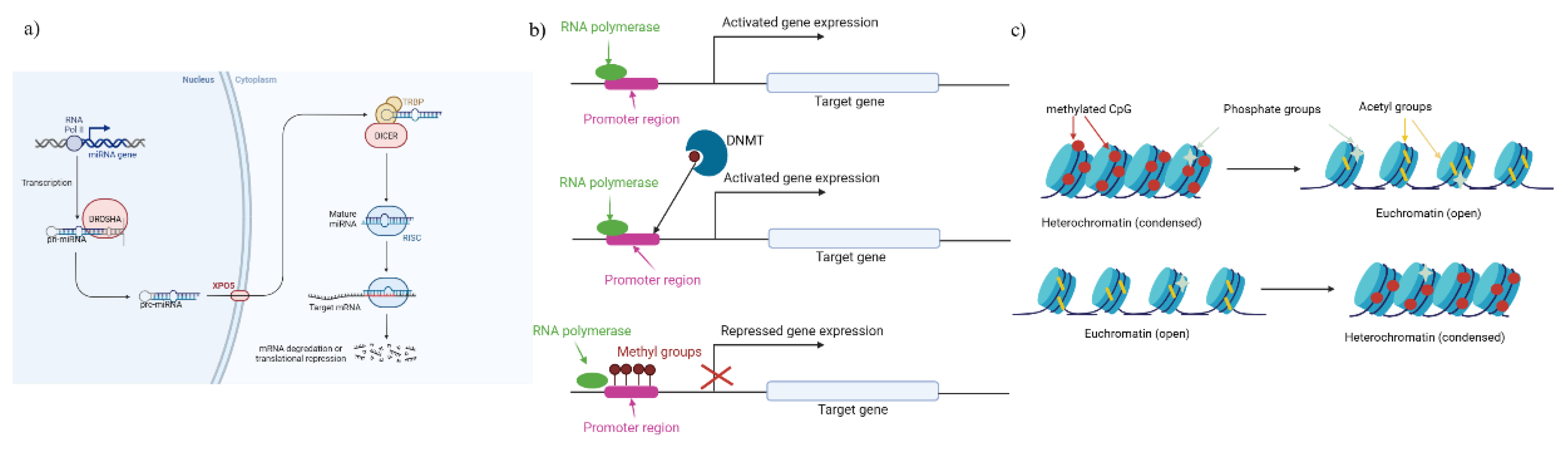
Disclaimer/Publisher’s Note: The statements, opinions and data contained in all publications are solely those of the individual author(s) and contributor(s) and not of MDPI and/or the editor(s). MDPI and/or the editor(s) disclaim responsibility for any injury to people or property resulting from any ideas, methods, instructions or products referred to in the content. |
© 2025 by the authors. Licensee MDPI, Basel, Switzerland. This article is an open access article distributed under the terms and conditions of the Creative Commons Attribution (CC BY) license (http://creativecommons.org/licenses/by/4.0/).
Copyright: This open access article is published under a Creative Commons CC BY 4.0 license, which permit the free download, distribution, and reuse, provided that the author and preprint are cited in any reuse.


