

Submitted:
05 June 2025
Posted:
09 June 2025
You are already at the latest version
Abstract
Reproductive efficiency is a critical determinant of productivity and profitability in sheep farming. Traditional selection methods have largely relied on phenotypic traits and historical reproductive records, which are often limited by subjectivity and delayed feedback. Recent advancements in artificial intelligence (AI), including video tracking, wearable sensors, and machine learning algorithms, provide new opportunities to identify behavior-based indicators linked to key reproductive traits such as estrus, lambing, and maternal behavior. This review synthesizes current research on the use of AI-powered behavioral monitoring tools to enhance selection accuracy and breeding outcomes. The integration of accelerometers, GPS systems, and computer vision models enables continuous, non-invasive monitoring of individual animals, allowing for the early detection of reproductive events and maternal performance. We also present a conceptual model, ReproBehaviorNet, that maps age and sex specific behaviors to bio-logical processes and AI applications, supporting real-time decision-making in both intensive and semi-intensive systems. This approach not only improves breeding pre-cision and genetic progress but also contributes to better animal welfare and sustainable management. Our findings underscore the importance of interdisciplinary collaboration and data-driven tools in the evolution of livestock selection strategies.
Keywords:
artificial intelligence
; behavioral phenotyping
; reproductive traits
; sheep
; selection strategies
; machine learning
; livestock technology
1. Introduction
The reproductive performance of sheep is a crucial determinant of overall production efficiency and economic viability in sheep farming systems [1]. Traditionally, selection strategies for enhancing reproductive traits in sheep have relied on direct measures such as litter size, lambing interval, and ewe fertility, often augmented by pedigree information and, more recently, genomic data. These traditional approaches, while valuable, are often limited by the time consuming and labor intensive nature of data collection, as well as the potential for inaccuracies due to subjective assessments or environmental influences. In order to further bolster sheep farming, advanced technological applications have been developed, which enhance the ability to control, monitor, and manage farm animal activities. These new technologies have been recognized as valuable tools in monitoring and managing various aspects of sheep production, particularly in extensive, pasture-based systems [2]. The application of technologies such as video tracking, wearable sensors, and machine learning algorithms can deepen our understanding of animal behavior and improve overall animal welfare and health, contributing to the sustainability of sheep farming. Emerging technologies in the realm of artificial intelligence and behavioral monitoring offer promising tools to complement and enhance these traditional selection methods by providing objective, real-time insights into behavioral indicators that are intrinsically linked to reproductive success [3]. These technologies not only improve automation and decision-making in livestock systems but also create new techniques to observe areas such as animal health, management, nutrition, and welfare [3,4]. The review emphasizes the potential of integrating artificial intelligence (AI)-assisted behavioral phenotyping into existing farm management systems. This integration can enable real time decision support, leading to improved flock level reproductive performance. By focusing on non-invasive, technology driven selection strategies, this review underscores the importance of interdisciplinary collaboration to advance breeding programs while enhancing animal welfare and sustainability. The application of AI and behavioral monitoring technologies can provide valuable insights into key reproductive traits, allowing breeders to make more informed decisions and drive genetic improvements that promote efficient and sustainable sheep production.
2. Integrating Behavioral Indicators with Reproductive Traits
2.1. Female Behavioral Indicators
Behavioral attributes, including activity patterns, social dynamics, and reactions to environmental factors, offer significant insights into an animal’s overall well-being and its capacity to adjust to varying management practices; these factors can indirectly affect reproductive success [5,6,7,8]. Reproductive performance in sheep can be categorized into key stages, including the onset of puberty marked by the display of estrous behavior, the age at first successful pregnancy accompanied by effective mating, lambing rates influenced by careful environmental management during gestation with a focus on mitigating stress, and postpartum maternal ability characterized by the ewe’s proficiency in caring for her offspring. Understanding the behavioral and physiological traits exhibited during different reproductive stages is essential for optimizing reproductive management and enhancing breeding outcomes [1].
Reproductive performance of a sheep flock encompasses not only mature animals but also requires significant attention to be given to young animals during the pubertal transition. Accurate evaluation of the onset of puberty is crucial, as early sexual maturity is one of the most important selection criteria for meat and dairy sheep enterprises [9]. The expression of behavioral indicators associated with the onset of puberty in ewe lambs can be subtle and asynchronous, especially when contrasted with male lambs, which tend to reach puberty at an earlier age [10]. These subtle differences can make it challenging to accurately determine the optimal time for breeding interventions, leading to inefficiencies in reproductive management and potentially lower conception rates. Additionally, the asynchronous nature of puberty onset within a group of ewe lambs further complicates management decisions, as not all individuals will be ready for breeding at the same time [11]. This variability necessitates careful monitoring and individualized management strategies to ensure that each ewe lamb is bred at the appropriate time, maximizing reproductive success and minimizing the risk of complications during pregnancy and lambing [12]. Therefore, integrating behavioral data with physiological markers can provide a more comprehensive assessment of puberty onset in ewe lambs, which allows for more targeted and effective breeding strategies, leading to more productive selection in sheep farms, where both behavioral and reproductive data should be integrated into farm management and monitoring systems [13].
Estrus behavior in sheep, characterized by a range of changes including increased activity levels, frequent vocalizations, and heightened interactions with male counterparts, can be accurately detected and quantified through advanced technologies such as video tracking systems [14,15], accelerometers [16], sensors [17], and GNSS tracking devices [18], as well as by using estrus detection patches or a ram wearing a marking harness [19] to monitor estrus in synchronized ewes. These technologies offer a non-invasive means of continuously monitoring sheep behavior, providing valuable insights into estrus patterns and facilitating more precise management of breeding programs. These data-driven strategies enhance the accuracy and efficiency of estrus detection, which is crucial for optimizing breeding outcomes and minimizing the need for labor-intensive manual observations. The integration of modern technologies with traditional management practices can significantly improve the efficiency and effectiveness of sheep breeding programs, by improving productivity, maximizing reproductive success, and enhancing animal welfare.
2.2. Male Behavioral Indicators
Although much of the focus in reproductive behavior studies has traditionally been placed on females, male animals particularly rams are often overlooked, despite their substantial contribution to reproductive outcomes [13]. Rams tend to exhibit more distinct and observable behavioral patterns than ewes, especially during the breeding season, including increased mounting activity, flehmen response, and persistent courtship behaviors. These behaviors are not only indicators of sexual motivation but also closely linked to semen quality and mating success [20]. Moreover, temperament traits such as emotional reactivity, docility, or tameness have been shown to influence reproductive capacity, either directly through hormonal pathways or indirectly by modifying social interactions and stress responses [21]. Therefore, understanding and quantifying behavioral indicators in rams is essential for improving reproductive efficiency, especially in both natural mating and assisted reproductive systems.
Social hierarchy has emerged as a key behavioral indicator influencing reproductive performance in rams. In a recent study on Dorper rams managed under an intensive system, high-social-ranked (HSR) males exhibited significantly more appetitive and consummatory sexual behaviors including increased approaches, anogenital sniffing, and mounting with ejaculation compared to low-social-ranked (LSR) rams [22]. Interestingly, these differences were not associated with live weight but were strongly correlated with higher body condition scores (BCS), suggesting that dominance-driven access to resources may indirectly enhance reproductive traits. HSR rams also showed reduced latency to ejaculation and greater ejaculate volume, indicating better sexual readiness and semen quality. Additionally, HSR rams demonstrated lower leukocyte counts, which may reflect improved immunological and physiological status. These findings reinforce the notion that social dominance and related behavioral traits are robust predictors of reproductive success in rams, particularly during out-of-season breeding when sexual activity may otherwise be suppressed. Integrating social dynamics into selection strategies therefore has the potential to identify and prioritize rams with superior reproductive capabilities, increasing the efficiency and productivity of sheep breeding operations.
Environmental factors, such as increased stress levels in rams, which can be detected through behavioral indicators like reduced activity, altered vocalizations, or changes in social interactions, may lead to a reduction in semen quality and libido, thereby compromising their reproductive potential [23,24]. Rams subjected to stress inducing social rearrangements show increased serum cortisol levels alongside cytological alterations in semen [25].
Mating is another critical stage that exhibits many unexplained dynamics in terms of pair formation. It has been observed that certain breeds of rams or ewes exhibit preferences for mating partners. This could be attributed to various factors, including breed-specific behaviors, pheromonal signals, or other cues that influence mate selection. Rams’ libido and serving capacity can be estimated by selected measures of sexual libido when rams are exposed to estrous ewes under conditions that prevented copulations [26].
Sexual behavior in rams not only reflects their libido and reproductive capacity but also involves complex patterns of mate preference that influence flock fertility. While dominant rams typically gain more mating opportunities through competition, studies suggest that this does not always align with female preference or reproductive efficiency. For instance, Díaz et al., [27] demonstrated that estrous ewes consistently preferred to interact with and be mated by subordinate rather than dominant rams when male activity was restricted, possibly to avoid aggressive courtship and ensure greater genetic diversity in the offspring. Complementing this finding, Abecia et al., [28] showed that Rasa Aragonesa rams exhibited non-random mating behavior, spending significantly more time courting specific ewes, indicating individual preferences which could affect mating outcomes. These behavioral dynamics highlight the need to consider both male and female mating preferences in breeding management, as individual biases and social hierarchies can significantly influence mating success and reproductive performance. Understanding these complex dynamics can provide valuable insights into optimizing mating strategies and improving reproductive outcomes in sheep breeding programs.
Dominance hierarchies among rams play a crucial role in their reproductive success, influencing their access to ewes and, consequently, their mating opportunities [29]. In a study by Ungerfeld and González-Pensado [30], dominant males maintained stable sexual behavior regardless of the presence of rival rams, whereas subordinate rams exhibited a marked reduction in mating activity when competition was introduced. This suggests that dominant rams are not only more assertive in social interactions but also less susceptible to behavioral inhibition, allowing them to sustain higher mating success. These findings emphasize the importance of social rank as a key behavioral indicator linked to reproductive efficiency in rams. By assessing behavioral traits such as aggressiveness and social interactions, farmers can identify the most dominant and reproductively capable rams within their flock.
Additionally, age is a factor that influences the selection of mates by male animals. In group mating scenarios, some females may be overlooked and not mated, with a preference shown by the rams. Moreover, aggression during mating can lead to competition among rams, which can even be fatal. Recent studies have indicated that females prefer calm behaved rams over aggressive ones. Therefore, mating should be monitored in a non-subjective and non-disturbing manner to allow the animals to exhibit their innate behaviors [22]. Careful observation and management of ram behavior can contribute to more effective breeding strategies and improved reproductive outcomes in sheep husbandry.
2.3. Maternal Behavior Indicators
Reproductive success is largely determined by the ewe’s postpartum maternal ability to raise healthy, thriving lambs. Key metrics of productivity include the total number of lambs weaned per ewe as well as the birthweight of the offspring, both of which are closely linked to the mother’s caregiving proficiency. Behavioral indicators related to the mother-offspring relationship, including measures such as nursing frequency, maternal care behaviors, and lamb activity levels, can be utilized to assess the quality of this critical bond for lamb survival and growth [31]. An ewe’s ability to bond with her lambs, provide adequate care, safeguard them from danger, and respond to their needs are all pivotal elements of maternal quality. Maternal behavior, which includes the ewe’s capacity to form a strong attachment with her offspring, offer sufficient care and protection, and be attentive to their needs, is a crucial aspect of maternal quality that can significantly impact lamb survival and productivity [32]. The “maternal behavior score” is often used to quantify ewe behavior under field conditions. It assesses the ewe’s flight distance when lambs are handled shortly after birth, with higher scores indicating an ewe that remains closer to her lamb(s) [33]. Behavioral studies of sheep have demonstrated that inadequate maternal care by the ewe right after birth can result in decreased lamb survival rates and overall productivity of the ewe flock. These behaviors include grooming, low-pitched bleats, showing no aggression towards the lamb, not deserting the lamb, cooperating with the lambs’ suckling attempts, recognizing the lamb and maintaining a close contact with the lamb [34]. Using a maternal behavior score based on the ewe flight distance when lambs are handled for the first time can help quantify maternal behavior. Genetic evaluation of maternal behavior and temperament in Australian sheep showed that the temperament of ewes and maternal behavior at lambing has been implicated as contributing factors to lamb survival [35]. Notably, advanced analytical tools, particularly machine learning algorithms, have demonstrated effectiveness in pinpointing crucial predictors of maternal success in sheep, with parturition duration and lamb birth weight emerging as significant determinants of overall outcomes [32].
Accurately predicting the onset of lambing is essential for ensuring the survival of offspring, as well as implementing appropriate management interventions. Lamb losses, especially those caused by dystocia represent a major economic and welfare issue, with up to 80% of neonatal deaths occurring within a few days after birth due to mismothering, starvation, or exposure. Monitoring the behavior of sheep in especially extensive farming systems is challenging due to large paddock sizes, high animal numbers, and labor costs. However, wearable sensor technologies now provide an opportunity to continuously track animal activities without requiring constant human observation. Traditional methods such as GPS tracking could only detect the day of lambing, not the precise time. Therefore, there is a pressing need for accurate, automated tools to predict lambing time, enabling timely intervention [36]. Pregnant ewes exhibit distinct behavioral changes preceding parturition. In the period preceding lambing, ewes exhibit distinct behavioral changes that can be identified through accelerometer data and visual observation. These pre-labour behaviors include increased restlessness, frequent transitions between standing and lying, and pawing the ground as they prepare a nesting area. Ewes may also bend their necks backward or laterally, often interpreted as a response to internal discomfort or the onset of uterine contractions. These signs reflect the early physiological and behavioral responses leading up to labour. Although these behaviors can overlap with those observed during labour itself, their consistent appearance prior to parturition makes them valuable indicators for early detection systems. In a recent study, such behaviors were grouped under the “pre-labour” category and used in deep learning models to differentiate between the stages of lambing with promising accuracy [37]. Therefore, proactive monitoring and timely intervention in cases of difficult births are crucial for fostering strong maternal bonds and maximizing lamb survival rates, thereby contributing to the economic viability of sheep farming enterprises.
The implementation of sophisticated monitoring technologies and advanced analytical methods allows for a deeper exploration into the complexities of maternal care in sheep, enabling the identification and selection of individuals exhibiting superior maternal traits. By selecting for ewes that consistently demonstrate strong maternal behaviors, sheep breeders can improve lamb survival rates, optimize growth trajectories, and increase overall productivity. Ultimately, this contributes to a more resilient and economically viable sheep production model, characterized by reduced lamb mortality, enhanced resource utilization, and improved profitability for producers.
3. Integration of AI-Powered Tools and Technologies in Behavioral Monitoring of Sheep Reproduction
The digitization of farm production processes allows the monitoring of production performance, animal health, and overall well-being [38]. The integration of AI-powered tools and advanced behavioral monitoring technologies in sheep reproduction denotes a fundamental shift in traditional selection methodologies. This paradigm shift harnesses the power of emerging technologies, such as wearable sensors, video tracking and machine learning algorithms, to provide more objective, real-time insights into behavioral indicators that are intrinsically linked to reproductive success. By complementing and enhancing conventional approaches, these innovative techniques offer breeders valuable opportunities to make more informed decisions, drive genetic improvements, and promote efficient and sustainable sheep production [2,39].
In their systematic review of on-animal sensor applications in sheep research, Fogarty et al., [40] analyzed 82 independent experiments conducted across six continents, covering a wide range of climatic conditions including temperate, arid, and cold environments. Most studies focused on the behavioral monitoring of sheep, followed by sensor validation, environmental management, and health-related applications (Table 1). A majority of experiments were conducted under grazing systems, reflecting the practical relevance of extensive production environments. Sensor deployments were typically short-term, with devices attached, removed, and reused across multiple intervals mainly due to battery limitations and the need for high-resolution data. In shorter experiments, sensors were programmed to record continuously or in intervals of less than one minute, while longer deployments used extended intervals of 30 to 60 minutes to optimize energy consumption. Among the sensors, GPS devices were the most used for tracking animal movement and spatial distribution. Motion sensors, such as accelerometers and IMUs, were frequently employed to capture activity, posture, and locomotion. Heart rate monitors were utilized primarily for assessing stress and welfare, whereas jaw and bite sensors were applied to detect feeding behaviors. Contact loggers supported the study of social interactions, and other sensors (e.g., estrus, temperature, or respiration) targeted specific physiological functions. Attachment methods varied, but collars, harnesses, and leg bands were the most frequently used. As sensor technology has advanced, research has shifted from proof-of-concept validation studies toward more complex, integrative monitoring approaches, underscoring the growing role of precision livestock technologies in sheep production systems.
The implementation of artificial intelligence (AI) and machine learning techniques offers powerful tools for analyzing complex datasets generated from reproductive and behavioral data, enabling more accurate prediction of breeding values and facilitating optimized selection decisions [59]. AI models can identify subtle patterns and correlations between behavioral indicators and reproductive traits that may not be apparent through traditional statistical methods [60]. One key aspect of AI-assisted selection is the use of video tracking and analysis to monitor sheep behavior in various settings [14]. These video tracking and analysis systems can be designed to automatically identify and record specific behaviors in sheep, such as mounting, sniffing, and tail wagging, which are indicative of estrus. Remote monitoring systems also offer the ability to detect patterns of activity related to parturition, including active behaviors like continuous lying and standing, licking of the lamb, and pushing associated with active contractions [61]. The utilization of wearable sensors, such as accelerometers, gyroscopes, and GPS devices, is also essential in tracking and recording various aspects of sheep behavior, including activity levels, movement patterns, and social interactions within the flock. The data collected from these video tracking and wearable sensor systems can provide valuable insights into the behavioral indicators associated with important reproductive traits in sheep [31,36].
Machine learning algorithms play a critical role in analyzing the vast amounts of data generated by video tracking and wearable sensors. The AI algorithms can use machine learning techniques to detect nuanced patterns and associations between behavioral indicators and reproductive performance outcomes, enabling more precise forecasting of estrus [19], lambing ease [62], and maternal behavior [32], as demonstrated in studies on dairy cattle [63,64,65]). By focusing on non-invasive, technology-driven selection strategies, breeders can enhance animal welfare and sustainability, which are increasingly important considerations in modern sheep farming [2]. AI algorithms excel at processing vast datasets, swiftly identifying patterns, and minimizing analytical subjectivity, outperforming human capabilities in specific contexts [60]. Precision livestock farming uses innovative technologies to monitor animals by continuously collecting real-time data, employing sensors and advanced algorithms to aid farmers’ decision-making [60]. Data analytics are essential for effectively evaluating farm performance, facilitating more precise estimates, and refining forecasts and strategies. By combining sensors, cameras, and production data in a cohesive infrastructure, livestock producers will have predictions to anticipate detrimental factors that influence animal health, well-being, and overall economic sustainability [66]. The integration of behavioral data, captured through non-invasive methods such as video analysis and wearable sensors, offers a novel dimension to selection decisions, allowing breeders to identify animals with superior reproductive fitness based on their natural behaviors.
The integration of AI-based technologies into sheep reproductive management has seen substantial progress with the rise of non-invasive sensing systems. In this context, the review by Wang et al., [67] which synthesizes findings from over 300 peer-reviewed studies published between 2003 and 2024, offers a broad and timely overview of deep learning applications in precision sheep farming. Their analysis categorizes sensor use into four key domains: facial recognition, body metrics estimation, behavioral monitoring, and physiological assessment. The study emphasizes how models such as YOLOv5 and LSTM architectures have achieved high performance in detecting reproductive behaviors such as estrus (mAP >99%) and lambing signs—enabling real-time decision-making under practical field conditions.
Particularly relevant to our review, their findings highlight the effectiveness of integrating multi-sensor data (e.g., thermal imaging, accelerometry, and video-based monitoring) for parturition detection and maternal behavior analysis. Furthermore, their coverage of facial expression recognition, achieving up to 96.1% accuracy for detecting pain and fear, adds a novel welfare dimension that could potentially serve as an indirect selection trait linked to reproductive success. As outlined in Table 2 of their study, the shift toward minimally intrusive technologies, such as RGB/thermal cameras and wearable sensors, provides scalable, continuous monitoring without disrupting natural behaviors making them ideal for use in AI-assisted selection strategies. These insights support the integration of behavioral indicators such as grooming, mounting, lying, or isolation into reproductive trait phenotyping, reinforcing the value of precision behavioral data in sheep genetic improvement programs.
4. Challenges and Considerations
Selection strategies in sheep breeding have traditionally focused on phenotypic traits, particularly those associated with production, such as body weight and fleece production [68]. However, reproductive efficiency is a crucial factor influencing the profitability and sustainability of sheep farming. Maximizing genetic progress through selection requires the development of effective selection indices and accurate estimates of genetic and non-genetic parameters. Reproductive performance in sheep is influenced by a complex interplay between the animal’s inherent genetic traits and various environmental factors, such as feeding regimes, management practices, health status, welfare conditions, and seasonal influences [69]. Incorporating behavioral data into traditional selection criteria offers a promising avenue to enhance the accuracy and effectiveness of breeding programs [70]. Contemporary breeding goals increasingly emphasize a more holistic approach, integrating both production and welfare traits to ensure long-term sustainability. Analyzing behavioral indicators, which reflect an animal’s adaptation to its environment and social interactions, could provide additional valuable insights into reproductive potential.
The combination of AI and sensor technologies is facilitating a shift in the livestock export sector by improving animal welfare, enhancing operational efficiency, and expanding market access [65]. The adoption of AI-assisted selection strategies in sheep breeding holds immense promise for accelerating genetic improvement, enhancing reproductive efficiency, and promoting sustainable production practices. AI allows simple data entry on farm records, monitors farm activities, and analyzes economic performance, ultimately improving animal health [71]. By leveraging the power of AI to integrate reproductive traits with behavioral indicators, breeders can make more informed selection decisions, leading to healthier, more productive, and more resilient flocks.
Despite the potential advantages, a range of challenges and considerations must be addressed to successfully integrate AI-assisted selection strategies into sheep breeding programs. Implementing these strategies within sheep breeding programs necessitates a multifaceted approach that accounts for the specific needs and resources of diverse farming systems. Drawing from the insights gained in cattle farming, the need for tailored AI algorithms and training programs extends to sheep breeding as well. As observed in cattle, wearable sensor placement and type may differ based on the size, breed, and behavior of the cow. This highlights the necessity of customizing AI algorithms to account for individual variations between cows [65]. Similarly, in sheep farming, breed-specific behaviors and physiological differences would necessitate the adaptation of AI-driven tools and training programs. Training programs and educational resources are needed to equip farmers and breeders with the skills to effectively utilize AI-driven tools and interpret the resulting data.
Furthermore, the development of standardized data collection protocols and data sharing platforms is essential to facilitate the creation of large, high-quality datasets that can be used to train and validate AI models across diverse populations of sheep. Data security and privacy are major concerns, as are the technological infrastructures needed, which can be complex [72]. Ensuring data quality and reliability is crucial, as the accuracy of AI models depends on the integrity of the input data. The “black box” nature of some AI algorithms can make it difficult to interpret the underlying biological mechanisms driving the predictions, which can hinder the acceptance and adoption of these technologies by breeders. As Knight [73] noted, without being able to reasonably explain the reasoning behind each AI prediction, it becomes challenging to trust the accuracy and reliability of these algorithms [74]. The absence of transparency and explicability surrounding these AI algorithms may present a substantial impediment to the broad-scale implementation of AI-assisted selection approaches within sheep breeding programs, as producers may be reluctant to depend on models, they are unable to fully comprehend. Therefore, it is crucial to integrate quantitative insights derived from data with nuanced qualitative observations of behavior, such as experienced stockmanship, to holistically capture the multifaceted aspects of maternal care and ensure responsible implementation of AI-driven tools.
5. Proposed Model: ReproBehaviorNet – An AI-Driven Selection Framework for Reproductive Traits in Sheep
Drawing on the insights presented in this review, the authors propose an integrated, AI-driven selection framework, ReproBehaviorNet, specifically designed to capture and utilize behavioral indicators linked to reproductive success in sheep. While AI tools are increasingly being used to monitor estrus, lambing behavior, and maternal traits, a unified model that translates this information into selection-based decision-making is still lacking. ReproBehaviorNet aims to fill this gap by offering a structured, modular selection model that links behaviorally derived data streams to genetic improvement strategies. ReproBehaviorNet is a multi-layered decision support system that combines continuous behavioral monitoring, physiological sensing, and machine learning-based prediction to identify and select individuals with superior reproductive potential. The model focuses on behavioral phenotypes, traits that are observable, non-invasive, and indicative of key reproductive stages such as age at puberty, estrus, mating performance, maternal bonding, and lambing ease. Mapping of reproductive behaviors to biological processes and AI applications in the ReproBehaviorNet model was given in Table 3.
This data is continuously collected and synchronized through a sensor cloud environment integrated with a behavioral annotation platform.
The identification and scoring of reproductive behaviors in livestock, particularly in sheep, require a robust and scalable AI infrastructure. The ReproBehaviorNet architecture (Figure 1) illustrates the full computational pipeline, including data acquisition, feature engineering, behavior classification, decision logic, and model retraining via feedback loops and transfer learning. This pipeline is designed to capture and analyze behavioral indicators of reproductive events—such as estrus, parturition, and maternal care—using sensor technologies and machine learning algorithms, with feedback loops for continuous improvement and adaptation across different breeds and production environments. The system architecture consists of sequential layers encompassing sensor-based data acquisition, preprocessing, feature extraction, behavior classification, scoring and inference, visualization, and model updating. Each layer plays a specific role in transforming raw data into meaningful indicators of reproductive status, ultimately enhancing selection accuracy and reproductive efficiency through precision livestock farming tools.
The architecture comprises seven functional layers: (1) Data Acquisition Layer collects multi-modal behavioral and physiological data using accelerometers, video/audio, GPS, and thermal imaging sensors. (2) Preprocessing Layer performs noise filtering, temporal synchronization, and annotation using platforms such as OpenCV and NumPy. (3) Feature Extraction Layer applies convolutional and recurrent neural networks (e.g., CNNs, LSTM) and thermal/audio analysis to extract structured behavioral features. (4) In the Behavior Classification Layer, machine learning algorithms (e.g., PyTorch, scikit-learn) are employed to classify behaviors associated with estrus, lambing, puberty onset, and maternal care. (5) The Decision Logic & Scoring Layer integrates behavioral outputs into composite indices (e.g., Estrus Detection Score, Maternal Behavior Index) using weighted scoring and fuzzy logic. (6) The Visualization & Decision Support Layer delivers actionable insights through a user-friendly dashboard, offering real-time alerts, heatmaps, and breeding recommendations. Finally, (7) the Feedback & Model Update Layer incorporates manual ground-truth verification and farmer feedback through structured forms, enabling model refinement via online learning and transfer learning to ensure adaptability to novel herds, breeds, and management systems.
6. Conclusions
This review underscores the growing potential of artificial intelligence as a transformative tool in sheep breeding, particularly for the selection of reproductive traits based on behavioral indicators. By integrating non-invasive technologies such as wearable sensors, video tracking, and machine learning algorithms, breeders can identify key behaviors, such as estrus expression, mating performance, and maternal care, with greater accuracy and in real time. The proposed ReproBehaviorNet model illustrates how behavioral data can be mapped to biological functions and AI processes, offering a scalable and practical framework for decision-making in both intensive and semi-intensive production systems. These advances allow for early identification of high-performing animals, reduced labor demands, and more welfare-friendly breeding programs. However, the full adoption of AI-assisted selection will depend on collaborative efforts to standardize data protocols, ensure ethical and transparent use of algorithms, and provide farmers with user-friendly digital tools. By bridging behavioral science and livestock technology, AI has the potential to significantly enhance reproductive efficiency, sustainability, and welfare outcomes in modern sheep farming.
Author Contributions
Conceptualization, E.E. and B.B.O.; methodology, B.B.O.; software, B.B.O.; validation, E.E., B.B.O., and M.K.K.; formal analysis, B.B.O.; investigation, B.B.O.; resources, E.E.; data curation, B.B.O.; writing—original draft preparation, B.B.O.; writing—review and editing, E.E. and M.K.K.; visualization, B.B.O.; supervision, E.E.; project administration, E.E.; funding acquisition, E.E. All authors have read and agreed to the published version of the manuscript.
Funding
This research was partly funded by the Start-Up Project-UAEU (12F079): Flock Forward: Integrative PLF and Image Analysis for Enhanced Reproductive and Welfare Outcomes in Sheep Breeding.
Institutional Review Board Statement
The animal study protocol was approved by the Institutional Animal Ethics Committee of the United Arab Emirates University (UAEU) (Application No: ERA_2025_5884, approval date: 18/03/2025).
Data Availability Statement
The data supporting the reported results are available on request from the corresponding author. The data are not publicly available due to privacy and ethical restrictions.
Acknowledgments
The authors would like to acknowledge the administrative and technical support provided by the Integrative Agriculture Department at United Arab Emirates University. We also thank Imona Technologies for their assistance with access to computational resources used during the study. During the preparation of this manuscript, the authors used ChatGPT-4 (OpenAI, 2025) for the purposes of refining grammar, improving clarity, and formatting text in accordance with journal guidelines. The authors have reviewed and edited the output and take full responsibility for the content of this publication.
Conflicts of Interest
The authors declare no conflicts of interest. The funders had no role in the design of the study; in the collection, analyses, or interpretation of data; in the writing of the manuscript; or in the decision to publish the results
Abbreviations
The following abbreviations are used in this manuscript:
| AI | Artificial Intelligence |
| PLF | Precision Livestock Farming |
| CNN | Convolutional Neural Network |
| RNN | Recurrent Neural Network |
| LSTM | Long Short-Term Memory |
| YOLO | You Only Look Once |
| MBI | Maternal Behavior Index |
| GPS | Global Positioning System |
| GNSS | Global Navigation Satellite System |
| IMU | Inertial Measurement Unit |
| RGB | Red Green Blue (color model) |
| BCS | Body Condition Score |
| HRM | Heart Rate Monitor |
References
- Al-Jaryan, I.L.; Al-Thuwaini, T.M.; Merzah, L.H.; Alkhammas, A.H. Reproductive Physiology and Advanced Technologies in Sheep Reproduction. Rev. Agric. Sci. 2023, 11, 171. [Google Scholar] [CrossRef] [PubMed]
- Silva, S.; Sacarrão-Birrento, L.; Almeida, M.; Ribeiro, D.M.; Guedes, C.; Montaña, J.R.G.; Pereira, A.M.F.; Zaralis, K.; Geraldo, A.C.A.P.M.; Tzamaloukas, O.; González-Cabrera, M.; Castro, N.; Henríquez, A.A.; Hernández-Castellano, L.E.; Alonso-Diez, Á.J.; Alonso, M.J.M.; Cedeño, J.L.C.B.; Stilwell, G.; Almeida, A.M. Extensive Sheep and Goat Production: The Role of Novel Technologies towards Sustainability and Animal Welfare. Animals 2022, 12, 885. [Google Scholar] [CrossRef]
- Menezes, G.L.; Mazon, G.; Ferreira, R.; Cabrera, V.E.; Dórea, J.R.R. Artificial Intelligence for Livestock: A Narrative Review of the Applications of Computer Vision Systems and Large Language Models for Animal Farming. Anim. Front. 2024, 14, 42. [Google Scholar] [CrossRef]
- Mana, A.A.; Allouhi, A.; Hamrani, A.; Rehman, S.; Jamaoui, I.E.; Jayachandran, K. Sustainable AI-Based Production Agriculture: Exploring AI Applications and Implications in Agricultural Practices. Smart Agric. Technol. 2024, 7, 100416. [Google Scholar] [CrossRef]
- Çakmakçı, C. Sheep’s Coping Style Can Be Identified by Unsupervised Machine Learning from Unlabeled Data. Behav. Process. 2021, 194, 104559. [Google Scholar] [CrossRef] [PubMed]
- Lama, G.C.M.L.; Pascual-Alonso, M.; Aguayo-Ulloa, L.; Sepúlveda, W.S.; Villarroel, M.; María, G.A. Social Personality in Sheep: Can Social Strategies Predict Individual Differences in Cognitive Abilities, Morphology Features, and Reproductive Success? J. Vet. Behav. 2019, 31, 82. [Google Scholar] [CrossRef]
- Lindburg, D.G.; Fitch-Snyder, H. Use of Behavior to Evaluate Reproductive Problems in Captive Mammals. Zoo Biol. 1994, 13, 433. [Google Scholar] [CrossRef]
- Wilson, V.A.D.; Guenther, A.; Øverli, Ø.; Seltmann, M.W.; Altschul, D. Future Directions for Personality Research: Contributing New Insights to the Understanding of Animal Behavior. Animals 2019, 9, 240. [Google Scholar] [CrossRef] [PubMed]
- Kenyon, P.R.; Corner-Thomas, R.A. Breeding Ewe Lambs: An Australasian Perspective. Animals 2022, 12, 3207. [Google Scholar] [CrossRef]
- Thénard, V.; Quénon, J.; Arsenos, G.; Bailo, G.; Baptista, T.; Byrne, T.J.; Barbieri, I.D.; Bruni, G.; Freire, F.d.C.O.; Theodoridis, A.; Vouraki, S. Identifying selection strategies based on the practices and preferences of small ruminant farmers to improve the sustainability of their breeding systems. Animal 2024, 18, 101208. [Google Scholar] [CrossRef]
- Valasi, I.; Chadio, S.; Fthenakis, G.C.; Amiridis, G.S. Management of pre-pubertal small ruminants: Physiological basis and clinical approach. Anim. Reprod. Sci. 2012, 130, 126. [Google Scholar] [CrossRef]
- Rosales-Nieto, C.A.; Thompson, A.N.; Martin, G.B. A new perspective on managing the onset of puberty and early reproductive performance in ewe lambs: A review. Anim. Prod. Sci. 2018, 58, 1967. [Google Scholar] [CrossRef]
- Alhamada, M.; Debus, N.; Lurette, A.; Bocquier, F. Validation of automated electronic oestrus detection in sheep as an alternative to visual observation. Small Rumin. Res. 2015, 134, 97. [Google Scholar] [CrossRef]
- Grant, E.P.; Brown, A.; Wickham, S.L.; Anderson, F.; Barnes, A.; Fleming, P.A.; Miller, D.W. What can the quantitative and qualitative behavioural assessment of videos of sheep moving through an autonomous data capture system tell us about welfare? Appl. Anim. Behav. Sci. 2018, 208, 31. [Google Scholar] [CrossRef]
- Endo, N.; Rahayu, L.P.; Arakawa, T.; Tanaka, T. Video tracking analysis of behavioral patterns during estrus in goats. J. Reprod. Dev. 2016, 62, 115–119. [Google Scholar] [CrossRef]
- Barwick, J.; Lamb, D.; Dobos, R.; Welch, M.; Schneider, D.; Trotter, M. Identifying Sheep Activity from Tri-Axial Acceleration Signals Using a Moving Window Classification Model. Remote Sens. 2020, 12, 646. [Google Scholar] [CrossRef]
- Paganoni, B.L.; Macleay, C.; Burgel, A. van; Thompson, A.N. Proximity sensors fitted to ewes and rams during joining can indicate the birth date of lambs. Comput. Electron. Agric. 2020, 170, 105249. [Google Scholar] [CrossRef]
- Fogarty, E.S.; Manning, J.; Trotter, M.; Schneider, D.; Thomson, P.C.; Bush, R.D.; Cronin, G.M. GNSS technology and its application for improved reproductive management in extensive sheep systems. Anim. Prod. Sci. 2014, 55, 1272. [Google Scholar] [CrossRef]
- Godfrey, R.W.; Lakos, S.A. PSX-28 Using estrus detection patches or a ram wearing a marking harness to monitor estrus in synchronized hair sheep ewes. J. Anim. Sci. 2020, 98, 460. [Google Scholar] [CrossRef]
- Singh, S.; Bhakat, M.; Mohanty, T.K.; Kumar, A.; Gupta, A.; Chakravarty, A.K.; Singh, P. Sexual behavior and its relationship with semen quality parameters in Sahiwal breeding bulls. Vet. World 2015, 8, 745–749. [Google Scholar] [CrossRef]
- Blache, D.; Bickell, S. Temperament and reproductive biology: Emotional reactivity and reproduction in sheep. Rev. Bras. Zootec. 2010, 39, 401. [Google Scholar] [CrossRef]
- Sifuentes-Lamónt, P.I.; Meza-Herrera, C.A.; Véliz-Deras, F.G.; Alvarado-Espino, A.S.; Alvarado-Espino, A.V.; Calderón-Leyva, G.; Angel-Garcia, O.; Carrillo-Moreno, D.I.; Contreras-Villarreal, V.; Delgado González, R.A.; Bustamante-Andrade, J.A. Multifaceted interplay among social dominance, body condition, appetitive and consummatory sexual behaviors, and semen quality in Dorper rams during out-of-season and transition periods. Animals 2022, 12, 3339. [Google Scholar] [CrossRef]
- Sierra, A.B.; Avendaño-Reyes, L.; Hernández-Rivera, J.A.; Vicente-Pérez, R.; Correa-Calderón, A.; Mellado, M.; Meza-Herrera, C.A.; Macías-Cruz, U. Termorregulación y respuestas reproductivas de carneros bajo estrés por calor. Rev. Mex. Cienc. Pecu. 2021, 12, 910. [Google Scholar] [CrossRef]
- Parraguez, V.H.; Peralta, O.A.; Sales, F. Reproduction of Small Ruminants in Extreme Environments. In Proceedings of the XXIV Congresso Brasileiro de Reprodução Animal (CBRA-2021) and VIII International Symposium on Animal Biology of Reproduction – Joint Meeting, Belo Horizonte, Brazil, 19–22 October 2021. [Google Scholar] [CrossRef]
- Farina, G.; Castillo-Hernández, G.; Gutiérrez-Hernández, J.L.; Pérez, D.I.M.; Ramírez, C.M.R.; Terrazas, A.; Pérez, J. Stress-induced leokocytospermia in rams with healthy reproductive tract. Small Rumin. Res. 2016, 137, 34. [Google Scholar] [CrossRef]
- Price, E.O.; Erhard, H.; Borgwardt, R.; Dally, M.R. Measures of libido and their relation to serving capacity in the ram. J. Anim. Sci. 1992, 70, 3376. [Google Scholar] [CrossRef] [PubMed]
- Díaz, A.; Orihuela, A.; Aguirre, V.; Clemente, N.; Pedernera, M.; Flores-Pérez, I.; Vázquez, R.; Ungerfeld, R. Ewes prefer subordinate rather than dominant rams as sexual partners. Appl. Anim. Behav. Sci. 2021, 238, 105306. [Google Scholar] [CrossRef]
- Abecia, J.A.; María, G.A.; Forcada, F. A note on mating preferences in Rasa Aragonesa rams. Appl. Anim. Behav. Sci. 2004, 91, 355. [Google Scholar] [CrossRef]
- González-Tavizón, A.; Meza-Herrera, C.A.; Arellano-Rodríguez, G.; Mellado, M.; Contreras-Villarreal, V.; Ángel-García, Ó.; Arévalo, J.R.; Véliz-Deras, F.G. Effect of Dorper Rams’ Social-Sexual Hierarchy on Their Sexual Behavior and Capacity to Induce Estrus in Ewes. Agriculture 2022, 12, 391. [Google Scholar] [CrossRef]
- Ungerfeld, R.; González-Pensado, S. Social dominance and courtship and mating behaviour in rams in non-competitive and competitive pen tests. Reprod. Domest. Anim. 2008, 44, 44. [Google Scholar] [CrossRef]
- Waters, B.E.; McDonagh, J.; Tzimiropoulos, G.; Slinger, K.R.; Huggett, Z.J.; Bell, M. Changes in sheep behavior before lambing. Agriculture 2021, 11, 715. [Google Scholar] [CrossRef]
- Emsen, E.; Odevci, B.B.; Korkmaz, M.K. Using machine learning to identify key predictors of maternal success in sheep for improved lamb survival. Front. Anim. Sci. 2025, 6. [Google Scholar] [CrossRef]
- Lambe, N.R.; Conington, J.; Bishop, S.C.; Waterhouse, A.; Simm, G. Genetics of maternal behaviour in Scottish Blackface sheep under field conditions: Factors affecting maternal behaviour scores and their influence on lamb live weights and survival. Proc. Br. Soc. Anim. Sci. 2000, 2000, 65. [Google Scholar] [CrossRef]
- Cloete, S.W.P.; Burger, M.; Scholtz, A.; Cloete, J.J.E.; Nel, C.; Gilmour, A.; van Wyk, J.B. The genetics of perinatal behaviour of Merinos in relation to lamb survival and lambs weaned per ewe mated. Appl. Anim. Behav. Sci. 2021, 236, 105217. [Google Scholar] [CrossRef]
- Brown, D.J.; Fogarty, N.M.; Iker, C.; Ferguson, D.M.; Blache, D.; Gaunt, G.M. Genetic evaluation of maternal behaviour and temperament in Australian sheep. Anim. Prod. Sci. 2015, 56, 767. [Google Scholar] [CrossRef]
- Sohi, R.; Almasi, F.; Nguyen, H.D.; Carroll, A.; Trompf, J.P.; Weerasinghe, M.; Bervan, A.; Godoy, B.I.; Ahmed, A.; Stear, M.J.; Desai, A.; Jois, M. Determination of ewe behaviour around lambing time and prediction of parturition 7 days prior to lambing by tri-axial accelerometer sensors in an extensive farming system. Anim. Prod. Sci. 2022, 62, 1729. [Google Scholar] [CrossRef]
- Turner, K.E.; Sohel, F.; Harris, I.; Ferguson, M.; Thompson, A.N. Lambing event detection using deep learning from accelerometer data. Comput. Electron. Agric. 2023, 208, 107787. [Google Scholar] [CrossRef]
- Ivanova, I.P.; Трoценкo, И.В.; Trotsenko, V. Automation of Processes in Dairy Cattle Production. IOP Conf. Ser. Mater. Sci. Eng. 2019, 582, 012035. [Google Scholar] [CrossRef]
- Martin, R.; Pook, T.; Bennewitz, J.; Schmid, M. Optimization Strategies to Adapt Sheep Breeding Programs to Pasture-Based Production Environments: A Simulation Study. Animals 2023, 13, 3476. [Google Scholar] [CrossRef]
- Fogarty, E.S.; Swain, D.L.; Cronin, G.M.; Trotter, M. Autonomous on-animal sensors in sheep research: A systematic review. Comput. Electron. Agric. 2018, 150, 245. [Google Scholar] [CrossRef]
- Dobos, R.C.; Dickson, S.; Bailey, D.W.; Trotter, M.G. The use of GNSS technology to identify lambing behaviour in pregnant grazing Merino ewes. Anim. Prod. Sci. 2014, 54, 1722–1727. [Google Scholar] [CrossRef]
- Pérez-Barbería, F.J.; Robertson, E.; Gordon, I.J. Are social factors and clocks co-regulating foraging in ruminants? J. Zool. 2015, 297, 210–219. [Google Scholar] [CrossRef]
- Munn, A.J.; Dawson, T.J.; Croft, D.B. Energy, water and nitrogen intake in a population of free-ranging red kangaroos (Macropus rufus): Do they really drink water? Aust. J. Zool. 2016, 64, 197–208. [Google Scholar] [CrossRef]
- Alvarenga, F.A.P.; Borges, I.; Palkovič, L.; Rodina, J.; Oddy, V.H.; Dobos, R.C. Using a three-axis accelerometer to identify and classify sheep behaviour at pasture. Appl. Anim. Behav. Sci. 2016, 181, 91–99. [Google Scholar] [CrossRef]
- McLennan, K.M.; Rebelo, C.J.B.; Corke, M.J.; Holmes, M.A.; Leach, M.C.; Constantino-Casas, F. Development of a facial expression scale using footrot and mastitis as models of pain in sheep. Appl. Anim. Behav. Sci. 2015, 176, 19–26. [Google Scholar] [CrossRef]
- Giovanetti, V.; Mattiello, S.; Battini, M.; Andrighetto, I.; Barbieri, S. Short communication: Use of tri-axial accelerometers to assess lying behaviour in dairy sheep. J. Dairy Sci. 2017, 100, 7489–7494. [Google Scholar] [CrossRef]
- Goddard, P.J.; Waterhouse, A.; Dwyer, C.; Stott, A. The perception of welfare of sheep in extensive systems. Anim. Welf. 2000, 9, 385–401. [Google Scholar] [CrossRef]
- Simitzis, P.E.; Deligeorgis, S.G.; Bizelis, J.A.; Dardamani, A. The effects of the pre-slaughter environment on meat quality traits of lambs. Small Rumin. Res. 2012, 103, 112–118. [Google Scholar] [CrossRef]
- Coulon, M.; Nowak, R.; Peyrat, J.; Chandèze, H.; Boissy, A.; Boivin, X. Do lambs perceive regular human stroking as pleasant? Behavior and heart rate variability analyses. PLoS ONE 2015, 10, e0118617. [Google Scholar] [CrossRef]
- Penning, P.D. A technique for recording the biting and grazing behaviour of sheep. Grass Forage Sci. 1983, 38, 89–96. [Google Scholar] [CrossRef]
- Animut, G.; Goetsch, A.L.; Aiken, G.E.; Puchala, R.; Detweiler, G.; Krehbiel, C.R. Grazing behavior and energy expenditure by sheep and goats co-grazing grass/forb pastures at three stocking rates. Small Rumin. Res. 2005, 59, 191–201. [Google Scholar] [CrossRef]
- Barkai, D.; Landau, S.; Brosh, A.; Baram, H.; Molle, G. Estimation of energy intake from heart rate and energy expenditure in sheep under confinement or grazing condition. Livest. Prod. Sci. 2002, 73, 237–246. [Google Scholar] [CrossRef]
- Broster, J.C.; Dehaan, R.L.; Swain, D.L.; Friend, M.A. Ewe and lamb contact at lambing is influenced by both shelter type and birth number. Animal 2010, 4, 796–803. [Google Scholar] [CrossRef] [PubMed]
- Doyle, R.E.; Broster, J.C.; Barnes, K.; Browne, W.J. Temperament, age and weather predict social interaction in the sheep flock. Behav. Process. 2016, 131, 53–58. [Google Scholar] [CrossRef] [PubMed]
- Freire, R.; Swain, D.L.; Friend, M.A. Spatial distribution patterns of sheep following manipulation of feeding motivation and food availability. Animal 2012, 6, 846–851. [Google Scholar] [CrossRef]
- Lowe, J.C.; Abeyesinghe, S.M.; Demmers, T.G.M.; Wathes, C.M.; McKeegan, D.E.F. A novel method for the continuous, non-invasive assessment of avian thermoregulation. J. Therm. Biol. 2001, 26, 97–103. [Google Scholar] [CrossRef]
- Reefmann, N.; Bütikofer Kaszàs, F.; Wechsler, B.; Gygax, L. Physiological expression of emotional valence in sheep. Behav. Brain Res. 2009, 198, 386–390. [Google Scholar] [CrossRef]
- Tallet, C.; Veissier, I.; Boissy, A. Emotional value of situations: Determinants and expression. In Measuring Behaviour 2005: Proceedings of the 5th International Conference on Methods and Techniques in Behavioural Research, Wageningen, The Netherlands, 30 August–2 September 2005. [Google Scholar]
- Neethirajan, S. The Use of Artificial Intelligence in Assessing Affective States in Livestock. Front. Vet. Sci. 2021, 8. [Google Scholar] [CrossRef]
- Curti, P.; Selli, A.; Pinto, D.L.; Merlos-Ruiz, A.; Balieiro, J.C.C.; Ventura, R.V. Applications of livestock monitoring devices and machine learning algorithms in animal production and reproduction: An overview. Anim. Reprod. 2023, 20. [Google Scholar] [CrossRef]
- Gurule, S.C.; Tobin, C.; Bailey, D.W.; Gifford, J.A.H. Evaluation of the tri-axial accelerometer to identify and predict parturition-related activities of Debouillet ewes in an intensive setting. Appl. Anim. Behav. Sci. 2021, 237, 105296. [Google Scholar] [CrossRef]
- Redfearn, A.; Janodet, E.; McNally, J.; Brewer, H.; Doyle, E.; Doyle, R.E.; Schmoelzl, S. Postnatal maternal behaviour expression depends on lambing difficulty in Merino ewes. Theriogenology 2022, 196, 31. [Google Scholar] [CrossRef]
- An, Y.; Song, Y.; Jiang, H.; Wang, Y.; Liu, N.; Xia, L.; Zhang, Z.-H.; An, X. Analysis of Calving Cow Posture Recognition, Behavioral Changes, and Influencing Factors Based on Machine Vision. Animals 2025, 15, 1201. [Google Scholar] [CrossRef] [PubMed]
- Michie, C.; Andonović, I.; Davison, C.; Hamilton, A.; Tachtatzis, C.; Jonsson, N.N.; Duthie, C.-A.; Bowen, J.M.; Gilroy, M. The Internet of Things enhancing animal welfare and farm operational efficiency. J. Dairy Res. 2020, 87, 20. [Google Scholar] [CrossRef]
- Neethirajan, S. Artificial Intelligence and Sensor Technologies in Dairy Livestock Export: Charting a Digital Transformation. Sensors 2023, 23, 7045. [Google Scholar] [CrossRef]
- Grohmann, C.J.; Decker, J.E. From reactive to proactive: Impact of artificial intelligence on management and selection of livestock. Anim. Front. 2024, 14, 64. [Google Scholar] [CrossRef]
- Wang, Y.; Wang, X.; Liu, K.; Cuan, K.; Hua, Z.; Li, K.; Wang, K. Non-invasive monitoring for precision sheep farming: Development, challenges, and future perspectives. Comput. Electron. Agric. 2025, 231, 110050. [Google Scholar] [CrossRef]
- Thakur, M.S. Basic Animal Breeding Methods. In IntechOpen eBooks; IntechOpen: London, UK, 2022. [Google Scholar] [CrossRef]
- Ajafar, M.; Kadhim, A.H.; Al-Thuwaini, T.M. The Reproductive Traits of Sheep and Their Influencing Factors. Rev. Agric. Sci. 2022, 10, 82. [Google Scholar] [CrossRef]
- Bishop, S.; Woolliams, J. Genetic approaches and technologies for improving the sustainability of livestock production. J. Sci. Food Agric. 2004, 84, 911. [Google Scholar] [CrossRef]
- Priya, P.; Dutt, T.; Singh, M.; Gaur, G.K.; Sahu, V. ‘Artificial Intelligence’ as an Intelligent Tool for the Future Animal Production and Better Management: A Review. Agric. Rev. 2022. [Google Scholar] [CrossRef]
- Rosati, A. Guiding principles of AI: Application in animal husbandry and other considerations. Anim. Front. 2024, 14, 3. [Google Scholar] [CrossRef]
- Knight, W. The dark secret at the heart of AI. MIT Technol. Rev. 2017, 120, 54–65. [Google Scholar]
- Cannas, A.; Tedeschi, L.O.; Atzori, A.S.; Lunesu, M.F. How can nutrition models increase the production efficiency of sheep and goat operations? Anim. Front. 2019, 9, 33. [Google Scholar] [CrossRef] [PubMed]
Figure 1.
ReproBehaviorNet: An AI pipeline designed for automated identification and scoring of reproductive behaviors in sheep.
Figure 1.
ReproBehaviorNet: An AI pipeline designed for automated identification and scoring of reproductive behaviors in sheep.
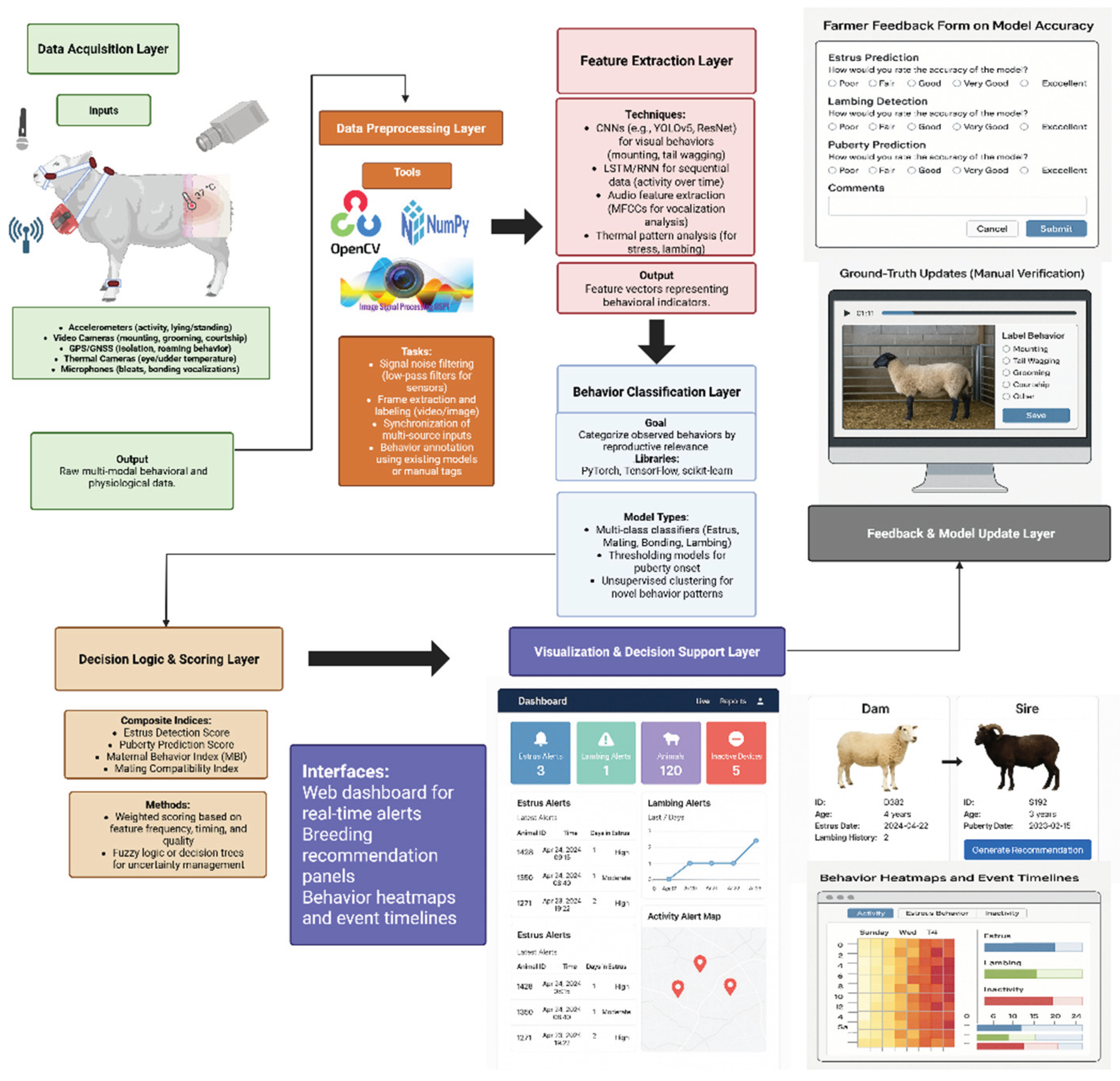

Table 1.
Summary of Sensor Technologies Used in Sheep Research Relevant to Reproductive Monitoring.
| Sensor Type | Most Common Use | Applications | Attachment | References | Relation to Reproductive Behavior |
| GPS | Tracking movement and location | Behavior, environment, health, methods validation | Collars, harness | [41,42,43] | GPS can be used to monitor ewe movement near lambing, mating behavior |
| Motion Sensors (Accelerometers, IMUs) | Posture, walking, activity | Sensor validation, behavior | Collars, leg bands, harness | [44,45,46] | Motion sensors can detect restlessness, mounting, lambing signs |
| Heart Rate Monitors | Physiological monitoring (stress, welfare) | Health, welfare | Collars, chest straps | [47,48,49] | HRM can be used to assess physiological stress and responses during estrus and parturition |
| Jaw/Bite Sensors | Feeding behavior | Feeding behavior | Jaw-mounted | [50,51,52] | These sensors can be linked to feeding behavior changes around lambing and mating |
| Contact Loggers | Social/contact behavior | Behavior, sensor validation | Collars, ear tags | [53,54,55] | Loggers can detect proximity and contact during mating and ewe-lamb bonding |
| Other Sensors | Various (temperature, respiration, etc.) | Diverse experimental focus | Custom methods (horns, fleece, etc.) | [56,57,58] | Limited used in specific studies (e.g., disease, respiration, temperature) |
Table 2.
Non-Invasive Digital Tools for Detecting Reproductive Traits and Behavioral Indicators in Sheep.
Table 2.
Non-Invasive Digital Tools for Detecting Reproductive Traits and Behavioral Indicators in Sheep.
| Category | Application Area | Sensor Types | Model Types | Performance Metrics | Use Cases in Sheep |
| Facial Recognition | Individual identification, breed classification, emotional state (pain/fear) | High-resolution RGB cameras, thermal infrared cameras | CNN, VGG variants, YOLOv8n, facial landmark detection networks | Up to 96.1% accuracy in pain/fear expression detection; YOLO-based breed ID >95% | Monitoring pain post-procedure (e.g., tail docking), breed differentiation, individual tracking without tags |
| Body Metrics Measurement | Liveweight estimation, body condition scoring (BCS), growth monitoring | Depth cameras, 3D imaging systems, image processing with stereo vision | Computer vision algorithms, regression-based CNNs | Accurate within ±2–3 kg for bodyweight in penned settings; BCS prediction R² >0.9 | Automated weighing without handling, early detection of poor body condition in extensive systems |
| Behavioral Monitoring | Detection of feeding, walking, standing, mounting (estrus), lambing events | Wearable accelerometers (ear, leg, jaw), RGB video cameras, microphones | YOLOv5, CNN-RNN hybrid networks, LSTM, rule-based activity classifiers | Estrus detection mAP >99% with YOLOv5; lambing recall up to 0.94 | Estrus detection for timed AI, predicting lambing time, identifying abnormal locomotion |
| Physiological Monitoring | Temperature mapping, respiratory rate, heart rate, pregnancy detection | Thermal cameras (eye, udder), piezoelectric belts, handheld ultrasound | Segmentation-based CNNs, object detection models, anomaly detectors | Thermal-based respiratory rate detection error <2 breaths/min; pregnancy ultrasound >90% accuracy | Non-contact fever screening, early disease or heat stress detection, automated pregnancy scanning |
Table 3.
AI-Assisted Mapping of Reproductive Behaviors in Sheep for Breeding Optimization.
| Age Group | Target Trait | Observed Behavior | Sensor Type | AI Processing | Selection Relevance |
| Prepubertal ewe lambs | Puberty prediction in ewe lambs | Increased locomotion, vocalization, early mounting attempts | Accelerometers, video | LSTM for temporal trends; YOLOv5 for behavior tagging | Early identification of replacement breeders |
| Prepubertal ram lambs | Sexual maturity estimation | Flehmen response, sniffing, mounting, nudging | Video, thermal camera | CNN for visual traits; rule-based scoring for sexual behavior onset | Selection of early-maturing rams for artificial insemination centers or natural mating |
| Adult females | Estrus & lambing | Tail wagging, mounting by others, isolation, pawing ground | Accelerometers, GPS, video | Hybrid CNN-RNN model for stage prediction | Accurate timing for artificial insemination or mating, measuring estrus synchronization efficiency, predictive of lambing event, dystocia management |
| Adult males | Mating performance | Courtship intensity, ejaculation latency, hierarchy behaviors | Proximity loggers, video | Social interaction mapping; behavior-frequency analysis | Sire fertility prediction, mating compatibility |
| Postpartum ewes | Maternal bonding | Grooming, nursing initiation, proximity to lambs | Microphones, Proximity sensors, Video | Maternal Behavior Index (MBI) calculation based on behavior scoring models | Lamb survival, dam selection, maternal instinct evaluation |
Disclaimer/Publisher’s Note: The statements, opinions and data contained in all publications are solely those of the individual author(s) and contributor(s) and not of MDPI and/or the editor(s). MDPI and/or the editor(s) disclaim responsibility for any injury to people or property resulting from any ideas, methods, instructions or products referred to in the content. |
© 2025 by the authors. Licensee MDPI, Basel, Switzerland. This article is an open access article distributed under the terms and conditions of the Creative Commons Attribution (CC BY) license (http://creativecommons.org/licenses/by/4.0/).
Copyright: This open access article is published under a Creative Commons CC BY 4.0 license, which permit the free download, distribution, and reuse, provided that the author and preprint are cited in any reuse.


