

Submitted:
05 June 2025
Posted:
06 June 2025
Read the latest preprint version here
Abstract
Electronic voting allows people to participate more easily in their country’s electoral events. Nevertheless, its adoption is still far from widespread. In this paper, we provide a detailed survey of the state of adoption worldwide and investigate which socio-economic factors may influence such an adoption. Its usage is wider in North and South America, while remaining considerably lower in Europe and Asia and practically absent in Africa. Four factors (country’s surface and population, Gross Domestic Product, and Democracy Index) are investigated to predict adoption, and an accuracy of over 90% is achieved through a machine learning random forest model. Larger, more wealthy, and more democratic countries are typically associated with a larger adoption of Internet voting.
Keywords:
electronic voting
; internet voting
; elections
; democracy
1. Introduction
Although digitalization has impacted most areas of public administration, there is noticeable hesitance in embracing computerized solutions for the management of political elections. The current widely employed system of paper voting is marred by many inefficiencies, as it requires the involvement of a large number of people and the associated costs of such a broad participation. Scrutineers are asked to count the ballot results manually, leading to the possibility of errors [1,2]. In a world where sustainability holds great importance, the production of large numbers of paper ballots and the need to transport voters to and from polling stations has serious environmental consequences [3]. In addition, people who live far from their polling stations have to bear the financial burden of exercising their right to vote. In addition, people with disabilities face enormous difficulties [4].
On the surface, electronic voting would seem to offer a solution to these problems. However, despite the many benefits of this technology, few countries have utilized such tools for organizing elections. One of the main concerns is that the technology required is not universally accessible. Moreover, when available it can prove difficult to understand for certain categories of society, creating a barrier between some citizens and the voting process. The primary obstacle to its adoption, however, is a distrust towards what is considered an opaque and manipulable tool. For example, a study focusing on Balkan and South Eastern European countries raised concerns about voter authentication and software reliability, highlighting the challenges of citizen engagement in different international practices. [5].
A worldwide analysis of the current state of voting systems that offer alternatives to paper-based ones would help to identify the barriers and draw the roadmap ahead for a significantly wider usage of more advanced voting systems. The research questions we are facing are the following:
- RQ1
- What is the state of diffusion of electronic voting worldwide?
- RQ2
- What are the determinants of electronic voting adoption?
The aim of this study to answer these RQs by examining electronic voting around the world. Our major contributions are the following:
- to provide an in-depth examination of electronic voting technologies in various countries, describing the existing systems, their successes, challenges, and evolution globally;
- to provide insights into the current landscape of electronic voting technologies and identify obstacles to their adoption;
- to analyse the relevance of socio-economic indicators as determinants of electronic voting adoption.
2. Related Literature
We can divide the literature concerning e-voting into three streams. One stream includes those papers proposing or assessing new voting technologies. A second stream is devoted to reporting the state of voting technology adoption in one or several countries. The third stream consists of survey papers about technology adoption that take a wider view, examining, e.g., a continent or the whole world. We will examine the papers belonging to the second stream in the next section, whereas this section will focus on reviewing the survey papers about electronic voting adoption and the technology-related papers.
A number of reviews have been already conducted on the subject. Nonetheless, some of them are either outdated or focused on specific aspects or countries. We subdivide the existing literature into two groups, adopting, as convention, a time threshold spanning back ten years from the present (i.e., before and after 2014).
In 2007, Krimmer conducted a study to review remote electronic voting options in elections [6]. The study analyzed factors such as technology, election size, and providers to understand the current status and potential for widespread adoption. Similarly, in the same year Wang reviewed electronic voting technology, with a focus on security and voter trust [7]. The study summarized security requirements, reviewed existing systems, and explored usability and cryptographic tools, serving as an introduction for e-voting researchers. Four years later, in 2011, Kumar et al. analyzed the electronic voting situation in various countries at the time, including whether a paper trail was used for auditing, how blank votes were treated, and whether the type of software used was proprietary or not [8].
In the last ten years, a book by Hao et al. was devoted to a comprehensive analysis of various voting systems in different countries [9]. Gibson et al. conducted a detailed analysis in 2016, providing a historical introduction and discussing technical issues related to online voting. The authors also analyzed the current status of electronic voting worldwide, including countries where it is being considered, on trial, implemented, or discontinued [10]. Given that both of these reviews were conducted in 2016, they may not be entirely representative of the current situation in certain countries. A more recent study has been published on the different electronic voting technologies, with evidence from Estonia, Brazil, India, Namibia, and the USA [11]. Another review by Adekunle et al. examines the literature on electronic voting systems and focuses on the experiences of the Netherlands, USA, India, Switzerland, Estonia, Namibia, Brazil, and Nigeria [12]. As can be seen, no recent review has provided a global overview, but rather a few countries at best.
We can now consider the papers describing the different technologies involved in electronic voting. Though we have thus far talked about electronic voting in general terms, at this point, we make a distinction that we will keep throughout the paper between electronic voting in a narrower way (e-voting) and internet voting (i-voting). We draw on the definitions reported by [13]. E-voting takes place at central polling locations in the same manner as for traditional voting procedures, with observers overlooking the process. Contrary to traditional paper voting, e-voting involves using technology in any of the following processes:
- Ballot casting, when technology is introduced for casting the vote through voting machines;
- Tabulation, when machines are used in the counting process;
- Transmission, when voting operations are conducted traditionally but the results of polling stations are sent via the Internet to the central tallying location.
Instead, i-voting consists of a remote electronic voting procedure, where people vote from their location, using computers, smartphones, or other devices to cast their vote.
Regarding the devices employed in e-voting, we can identify three major approaches: using ballot marking devices that produce a printout, machines that require touching a key or touchscreen to record the vote without producing a printout, or optical scanners. Examples of the first kind have been reported in the USA, Argentina, Venezuela, Albania, Belgium, Bulgaria, the Democratic Republic of Congo, Namibia, and India. Machines that do not produce a printout have been reported in Brazil, Paraguay, and Bhutan. Finally, optical scanners have been employed in Iraq, Kyrgyzstan, Mongolia, and the Philippines.
Electronic Voting Machines (EVM) may have buttons to press or a touch screen through which the voter can select the candidate he or she wishes to vote for. Some of these machines also produce a paper record of the vote for audit or verification purposes [14,15]. They were compared against traditional procedures in [16]. Some of their security issues were highlighted in [17,18]. Other machines are capable of scanning the content of a ballot filled in by the voter [19]. EVMs can be connected to a network (incorporating the Transmission function) or, as is most often the case, operate as standalone systems, releasing at the end of the ballot an indication of the votes received by the individual machine.
Another recent technology that offers security guarantees and impacts the transmission of votes is blockchain. Abuidris et al. reviewed blockchain-based e-voting systems and the requirements that such a system should have. [20]. A similar review, which identifies challenges and suggests future research topics to enhance system reliability, has been published in [21]. This technology has the potential to enhance transparency and security in sensitive operations if used in e-government. [22] However, the transparency of the blockchain implies that all transactions are visible to all participants in the network. In an electronic voting system, this could compromise the secrecy of voting, a fundamental principle of democratic elections. It is therefore crucial to maintain voter privacy, yet blockchain, by its nature, makes it difficult to ensure that votes cannot be traced back to voters. Consequently, an implementation of blockchain that can guarantee democratic principles and voter rights should be engineered. The opportunity of applying this technology to e-voting and its adaption to the voting context has been discussed by [23].
I-voting is typically accomplished by either using a website or a mobile application. In the case of a website, voters must log in, sometimes authenticating with an ID or special pin, and cast their vote [24]. This approach has been employed, e.g., in Panama, Ecuador, Mexico, France, Armenia, Australia, Canada, Estonia, Norway, and Switzerland. In some cases, the use of a website may be limited to uploading scanned documents and ballot papers, as reported in New Zealand, where voters are required to download voting papers, before uploading scanned copies of their ballot and supporting documents to a designated website [25]. The use of a mobile application has instead been reported in the Sultanate of Oman and the United Arab Emirates. That app also includes a feature for voter face recognition [26,27].
3. Worldwide Adoption of e-Voting and i-Voting
In this section, we provide a global view of the current state of advanced voting technologies. Based on the data on the introduction of e-voting and i-voting provided by the International Institute for Democracy and Electoral Assistance (International IDEA), an intergovernmental organization based in Stockholm [28], we have carried out a bibliographic survey in various countries. We first show an overall view and then focus on e-voting and i-voting respectively, using a continent-by-continent approach.
3.1. Overall View
According to the IDEA survey mentioned above, 36 nations worldwide have opted to integrate information technology into the electoral process.
The commonest approach, adopted by 20 countries, involves deploying electronic voting machines (EVMs) in polling stations, in a controlled environment (i.e., e-voting). These machines permit voters to pick their desired candidates either by pushing buttons or utilizing the touch screen. The voting machine records the vote for counting purposes and, in most cases, also produces a paper ballot for verification purposes. Typically, these machines are not interconnected or connected to a central server.
Conversely, 16 countries have adopted i-voting. This system permits certain groups of citizens (or, in some cases, all those eligible to vote) to cast their ballots from their own devices without physically attending a polling station.
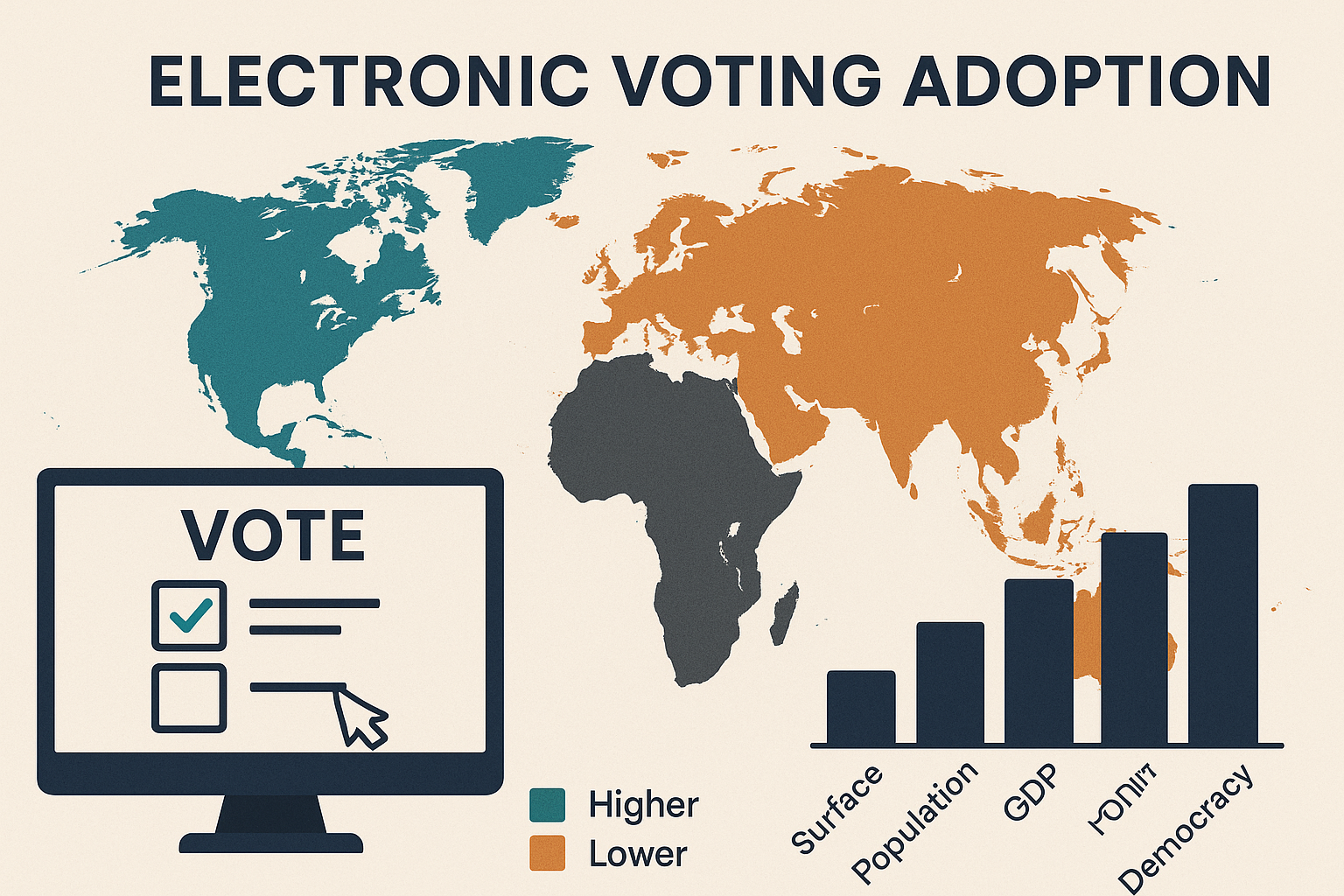
In Figure 1, we can observe a balance between e- and i-voting in North America, while e-voting is widely adopted in South America. The European continent is predominantly anchored to the old paper system, with some exceptions using i-voting technologies. Only two cases of e-voting implementation have been reported on the African continent, while voting is still paper-based in the rest of the world. In Asia, some countries use e-voting, while i-voting is adopted in Russia. In Oceania, we find Australia and New Zealand using i-voting.
3.2. E-Voting Adoption
E-voting is the method adopted by most countries. In this section, we report the information available for each country, arranged by continent.
3.2.1. North and Central America
Although the United States of America is a technologically advanced country, electronic voting presents a complex situation. The majority of Americans use paper ballots to cast their votes. Voters typically mark the ballots by hand. However, in some scenarios, voters use a "ballot marking device" to select their preference, which then generates a printout for submission. The reliance on digital technology for voting has varied throughout the years. Paperless electronic voting has become less popular since the mid-2000s. States have opted for paper as a more secure means of monitoring elections and detecting potential vote tampering. Even with paper ballots, machines remain essential to the electoral process, since optical scan tabulators are employed to count the results.
Concerns about paperless voting among election officials and the public had been circulating since the early 2000s. These concerns became heightened during the 2016 presidential election, which marked a turning point in the history of America’s voting machines. In that year, Russia attempted to use social media campaigns to manipulate the election and Russian hackers also scanned the voter registration systems in search of vulnerabilities to collect information on American voters [29,30]. Government investigations revealed no evidence that election results had been tampered with, but officials are now recognising the importance of securing election outcomes in the event that electronic machines are breached. Furthermore, a significant event took place during the 2020 elections in Georgia: the state had been using paperless voting machines for several years, but shortly before the election, it replaced them with machines that electronically record selections and print a paper ballot. Donald Trump contested the election results and alleged widespread irregularities and fraud. As paper ballots were used, election officials in Georgia were able to manually count the votes and verify that Biden had won the state [31]. This demonstrates the critical role that paper ballots play in ensuring election integrity, and public confidence [32]. In the 2024 elections, minor issues have been reported with electronic voting. These include delays in Milwaukee due to misconfigured tabulation machines and thousands of mail-in ballots in Nevada that were flagged for signature mismatches or missing signatures, causing processing delays.[33]
Aside from the U.S.A., a single case of e-voting use has been reported in North America. Elections were held in the Dominican Republic in February 2020 using electronic voting machines. However, major problems arose. During the polls, voting procedures were suspended for three hours because 50 percent of the polling places using electronic ballot machines reported problems [34].
3.2.2. South America
Four countries in South America have adopted e-voting: Argentina, Brazil, Paraguay, and Venezuela.
In Argentina, electronic voting systems have been in operation since 2009. Voters are required to insert a blank paper ballot into a machine to cast their vote. They must select their preference on a touch screen, and then the preference is recorded both physically on the ballot and on an RFID chip. The voter can then remove the ballot and place it in the ballot box. The machine does not retain the votes cast, but the counting is performed later using a scanner [35]. During the recent elections in August 2023, there were some disputes due to malfunctions in some machines, estimated to be 240, which accounts for 2.4% of the total [36]. The malfunctioning resulted in delays and multiple complaints.
Brazil was among the leading nations in the adoption of electronic voting. The decision to adopt electronic voting was made due to numerous cases of fraud and a high illiteracy rate. Since 1994, EVMs have been implemented, with 35 million voters, i.e., 33% of the population, already utilizing them during the 1996 elections. Electronic voting in Brazil has been conducted in all polling stations since 2000, with no major issues reported. [37]. With the use of EVMs, Brazilian voters need only enter their candidate’s number to cast their ballot. The electronic voting machines utilized in Brazil do not have network hardware, but require a connection to a computer for the transmission of results to the national authority responsible for counting. No paper record is generated. Overall, Brazilians express satisfaction with the system, and no instances of fraud or significant issues have been reported [38]. Furthermore, a study indicated that if internet voting were to be implemented in Brazil, this would lead to a 8.9% increase in voter turnout [39].
In Paraguay, electronic ballot boxes were used for the first time in the country during the municipal elections on 18 November 2001. At first, the model seemed successful, even capable of being exported to Ecuador. In 2006, however, accusations of fraud emerged. The absence of a paper trail to recount votes in the electoral system created numerous controversies, resulting in the return to traditional paper voting methods in 2008. After the pandemic and subsequent restoration of faith in electronic tools, electronic voting machines were finally reintroduced in a political election in Paraguay in 2021 [40].
Venezuela has been holding elections since 2004 by using machines that print out ballot papers to be placed in ballot boxes. In 2012, biometric authentication using fingerprint recognition was also introduced. From the outset, electronic elections have raised doubts among politicians, academics, and the population, even though the governments of Hugo Chávez and Nicolás Maduro have called the system ’the most perfect electoral system in the world’ [41].
3.2.3. Europe
In Albania, Electronic Voting Machines (EVMs) with touch screens using Android were deployed in the parliamentary elections held in April 2021, and some municipal elections held in March 2022 [42]. Following the casting of each ballot, the machines generated a paper copy for verification purposes, and at the end of the elections, the machines tallied the results at the individual polling stations. Based on the turnout figures, technology did not appear to present any significant obstacles to participation. In terms of invalid ballots, only those intentionally left blank by the voter were reduced. There were no significant technical issues noted during the process, but it is worth mentioning that the system was purposefully designed to prevent any connection to the internet.
In Belgium, an experiment with electronic voting using EVMs was initiated in 1991, with successful outcomes leading to implementation in 1994. By 2014, 44% of voters were able to cast their votes electronically, representing a significant increase from the initial 20%. Several issues arose during past elections. In 2003, a candidate received over 4,000 additional preferences in the municipality of Schaerbeek, and in 2004 a defective floppy disk caused problems during counting. Additionally, a software malfunction in 2014 resulted in the loss of 2,240 votes. Therefore, from 2015 onward, some regions in Belgium opted to discontinue electronic voting, while others chose to upgrade their systems by incorporating the feature of producing a paper trail. Belgian concerns with electronic voting are strengthened by studies revealing lower voter turnout in cantons that adopt e-voting compared to those that use traditional paper voting methods [43]
In Bulgaria, Electronic voting was recently implemented following a 2015 referendum, in which 72.79% of voters opted for e-voting. A hybrid EVM model that prints a paper ballot and has no direct connection to central systems was selected [44]. Nonetheless, there is ongoing debate about introducing a remote voting system, similar to the one used in Estonia [45].
3.2.4. Africa
Namibia was the first African country to successfully implement e-voting in 2014. The introduction of electronic voting machines in Namibia began with the implementation of the Electoral Act in 2009. The purpose of this act was to facilitate the eventual use of EVMs in the country’s elections. This initiative gained momentum due to issues encountered during the counting and tabulation procedures in the 2009 elections, causing a postponement of the announcement of the outcome. In the Namibian case, a pair of devices are employed, provided by India, and tailored to meet the legal prerequisites of Namibia. The voter operates the Ballot Unit while the Presiding/Electoral Officer handles the Control Unit. The Ballot Unit has a button for each potential candidate and can hold up to fifteen candidates, although as many as four Units can be networked with a cable to accommodate a total of sixty candidates. It should be noted that EVMs function independently and are not linked to any computer network. The devices neither transmit nor receive signals and operate on batteries, thus eliminating the need for electricity. To transfer the records, they should be connected to a laptop. The machine provides a paper audit trail as a verification system in case of a vote recount [46,47].
The Democratic Republic of Congo implemented EVMs in 2018 with a touch screen and paper trail. Nevertheless, the system’s implementation raised numerous cybersecurity concerns due to inadequate testing. These concerns include threats to ballot secrecy and the potential for results manipulation [48,49,50].
3.2.5. Asia
In Bhutan, electronic voting machines have been employed to conduct elections. These machines feature physical buttons and display a tally after the election. Again, there is no internet connection for the final transmission of outcomes [51,52]
India has utilized electronic voting in its political elections. Being the world’s largest democracy, India has a voting population of 814 million. The Election Commission of India implemented the EVM for vote recording, storage, and counting. Despite early trial runs commencing in 1982, electronic voting was only implemented nationwide in the year 2004. Initially, the e-voting system in India consisted of two components: the voting machine, which is positioned in the polling booth, and the control unit, which is kept under the supervision of the polling officer. Since the 2014 elections, the use of an additional machine alongside the voting machine allows for the printing of ballot papers, which can be manually counted if desired. All the electronic voting equipment operates independently of both the internet and electricity supply [53]. The Indian development and implementation of EVMs in elections is considered a noteworthy achievement for global democracy. Indian experts argued that the process would enhance inclusion, which has traditionally been impeded by the high percentage of illiterate voters. Additionally, cost savings were a driving force. The government developed this system, comprising of simple units, produced for less than $300 per unit. This price is significantly lower than the cost of other electronic voting equipment, which typically ranges from $3,000 to $6,000 per unit and offers more advanced features. Despite the low cost, Indian authorities take pride in their electronic voting machines, describing them as one of the most secure and tamper-proof systems available [37].
The Islamic Republic of Iran established an electronic voting system in preparation for the June 2021 elections, for use in both presidential and city/village council elections. However, plans to implement the electronic voting machines in the upcoming presidential election have been suspended by Iran’s Interior Ministry and the Guardian Council. While electronic voting has been utilized for city and village council elections, the traditional paper ballot has been retained for the presidential elections. As a result, voters were obliged to use two distinct systems on the same day [54,55].
In Iraq, electronic systems have been utilized since the elections in May 2018. While voters are required to vote using a paper ballot, an electronic verification, counting, and transmission system has been implemented. To verify their identity, voters use a ’Voter Verification Device’ to provide their fingerprints, along with a QR code found on the paper ballot. To cast their ballot, a ’Polling Centre Optical Scanner’ is employed. The ballot paper issued to voters is verified by the system via QR code matching. The system then reads the ballot paper to determine if the vote has been marked correctly and is thus deemed valid or invalid. The vote is recorded and transmitted to a ’Result Transmission System’ connected to the scanner, which transmits the results via satellite link. During the May 2018 elections, disputes arose regarding the system, leading to a manual counting of the votes. The machines were provided by a South Korean company, and the Iraqi Election Commission disregarded warnings from an anti-corruption organization regarding the reliability of the digital vote tabulation devices utilized in the elections. Nonetheless, the method was also employed in subsequent elections. [56,57]
Electronic voting was introduced in Kyrgyzstan in 2016 to ensure impartial elections following numerous violent political uprisings in the post-communist era, which led to fraud and vote buying. E-voting was first utilized during the 2016 local elections carried out by Osh City Council, and the voting process was carried out through optical scanning of ballots. Although no technical problems were reported, one study found that e-voting contributed to the continuance, adaptation, and reinforcement of existing methods of electoral fraud, thus failing to solve the problems for which e-voting had been introduced [58]. After this trial, despite the suspicion of fraud, the electronic voting system was further utilized in subsequent parliamentary elections [59].
Mongolia implemented an electronic voting system for the first time in the 2012 parliamentary election to regain the public’s confidence, which was eroded by the violent demonstrations following the 2008 parliamentary election outcomes. Polling stations have electronic vote-counting equipment to scan and count ballots. Results are verified through a manual vote count conducted in up to 50% of randomly selected polling stations [60,61].
The Philippines first applied electronic voting in the 2010 elections, even if the first pilot programs date back to 1996. The system was based on optical recognition. Voters arrived at the polling station and were issued a ballot paper, on which they indicate their choice. When the polling station closed, the votes were scanned by machines, and a report was printed detailing the number of votes for each candidate. The result sheets were then sent to the tabulation office at the city or district level [53,62].
3.3. I-Voting Adoption for Special Classes of Citizens
A number of countries utilize i-voting, but only for certain categories of citizens, mainly those living abroad. Sometimes, the voting systems involved are not sophisticated enough and do not address even the most basic cybersecurity issues. It might be the case that these systems are used without particular concern, given that they are directed at a minority of citizens.
In Table 1, we report the countries adopting selective admission to i-voting and the categories admitted.
In this section, we survey the specific conditions, again by continent.
3.3.1. North America
During the 2019 elections in Panama, the Electoral Tribunal (TE) offered the 7,674 Panamanians registered to vote abroad the opportunity to cast their ballots via the Internet. Subsequently, the Electoral Voting Corporation printed the votes cast via the internet and deposited them in an acrylic ballot box in a public place, then proceeded to count the votes [63].
3.3.2. South America
Ecuador allows online voting for citizens residing abroad. Notably, during the recent election on 20 August 2023, the National Electoral Council president Diana Atamaint disclosed that the electronic voting system employed by Ecuadorians residing abroad had been the subject of numerous cyberattacks, including some originating from China, India and Bangladesh. Nevertheless, she stated that these events had not compromised the vote count [64].
In Mexico, the National Electoral Institute (INE) was authorized to utilize electronic voting for overseas voters, thus circumventing the cumbersome postal system. The Independent National Electoral Commission (INE) commenced the development of a secure internet-based voting framework with dual-factor verification in 2018. The system underwent verification and received approval from two independent entities as required by law in late 2020, and it was first utilized in local elections in 2021. Votes can be cast via a website and voters should authenticate themselves using their telephone [65,66].
3.3.3. Europe
During the last legislative elections held on 27 May 2022 in France, French citizens residing outside the country were offered multiple voting options. These included casting their vote in person, through a proxy, by mail, or via the Internet. The adoption of digital voting, backed by the Ministry for Europe and Foreign Affairs in France, formed part of a significant endeavor to enhance the engagement of the 1.444 million overseas voters enlisted on the consular electoral rolls [67].
The situation in the United Kingdom is peculiar and has been considered worthy of inclusion in this section, due to its impact on the democratic process. Even though experiments have been carried out in the past [68,69], electronic voting has not been employed in general elections. However, although remote voting is not possible in elections for general citizens, the House of Lords has introduced the option for Lords to participate in parliamentary proceedings through remote voting in response to the COVID-19 pandemic. This measure was taken to prevent the suspension of regular operations. The House of Lords implemented an online voting system from 15 June 2020 until September 2021. Today, members are still able to cast their votes online, but only if they are physically present on the parliamentary estate [70].
3.3.4. Asia
Armenia implemented internet voting in 2011, enabling diplomatic personnel and their families, and the representatives of Armenian-registered corporations deployed overseas to vote. In 2016, under the new Electoral Code, Internet voting rights were also granted to military personnel studying or serving abroad. In the 2021 election, a total of 2,595,512 registered votes were tallied, with only 500 cast via the Internet from overseas. As such, they do not hold significant weight [71,72].
3.3.5. Oceania
Electronic voting has been implemented in some polling places in Australia, enabling voters to cast their ballot on locally-connected computers. Since 2011, New South Wales has utilized a system known as iVote, which enables remote voting over the Internet or by telephone during state elections. In the 2015 election, individuals with disabilities, the visually impaired and those living over 20 kilometres from their nearest polling station, including those residing overseas or in another Australian state or territory, were afforded the option of registering their vote online via a web browser. A total of 283,669 individuals successfully used the iVote system; nonetheless, some issues were identified. Specifically, two parties were not listed on the electronic ballot paper for the New South Wales Legislative Council, and a higher-than-expected number of voters chose to submit a "donkey vote" compared to the traditional paper ballot. In ranked voting electoral systems, a donkey vote refers to a cast ballot where the candidates are ranked based on the order of appearance on the ballot. Additionally, two academics claimed to have identified a security issue with the system. The New South Wales Electoral Commission has stated that iVote will continue to replace postal, interstate, and overseas voting. At present, however, there are no intentions to substitute the standard paper-based voting system [75].
New Zealand allows citizens residing abroad to vote online. They need to download and print a declaration paper along with the ballot paper. The declaration paper must be signed in the presence of a witness. After completing and signing the declaration and casting the vote, the documents must be scanned or photographed using a smartphone and then uploaded to a government website. Blind or partially sighted people, or those with physical disabilities that prevent them from marking their voting paper without assistance, are eligible to vote by telephone dictation [25].
3.4. I-Voting Adoption for All Citizens
Some countries have implemented the option for citizens to cast their votes online, eliminating the need to physically attend polling stations for all citizens. In this section, we review those countries that allow generalized i-voting, adopting the same continent-by-continent approach.
3.4.1. North America
Canada appears as the only country in North America that allows i-voting with no restrictions. In particular, online voting is possible in the provinces of Ontario and Nova Scotia. Ontario, which makes up approximately 1.51 million voters (16% of the country’s voting population), used paperless ballots cast online, either by a website or by telephone. The online voting infrastructure is provided by the Spanish company Scytl Election Technologies. Ontario implemented online voting in 2003 and has since experienced exponential growth, with each successive election cycle nearly doubling the number of online voters. More than 200 municipalities have opted to use online voting in the 2022 elections, up from more than 170 in 2018. Some have completely eliminated paper ballots [76,77].
3.4.2. Europe
Three countries allow for i-voting in Europe: Estonia, Norway, and Switzerland.
Estonia is considered the most advanced country in terms of electronic voting. Since 2005, citizens have been able to vote online, starting with local elections and later expanding to parliamentary elections in 2007. Citizen identification is achieved through an electronic identity card or a specific SIM card assigned to the citizen. Online voting is available from 10 to 4 days before the election. The remaining days are reserved for error-checking and correction. To prevent coercion, voters can change their vote freely until the end of the voting period. There have been no reported issues with the use of internet voting, which is becoming increasingly popular. However, during an observation mission in 2011, The Organization for Security and Co-operation in Europe (OSCE) identified problems related to the security and anonymity of Estonian i-voting. In 2013, a private individual applied to the Supreme Court to invalidate the outcome of the 2011 elections. He claimed that it was possible to manipulate the voting process through malicious software running on the electors’ devices without their knowledge. However, the court did not find any evidence that this flaw had an impact on the election result. The source code has been released on GitHub, and no vulnerabilities compromising voting security have been found [78].
Internet voting has been trialed in Norway since 2011. The first trial was conducted during municipal elections in 2011, followed by another trial in 12 municipalities during the 2013 general elections. Both trials used a system provided by the Spanish company Scytl. Despite this, due to political disagreement, the pilots for internet voting in Norway have been put on hold [79,80,81]. In 2018, Finnmark, the northernmost county in Norway, reintroduced internet voting for a referendum. The Estonian Smartmatic-Cybernetica Centre of Excellence for Internet Voting (SCCEIV) provided the online voting system used in this instance. In 2022, Innlandet, another county in Norway, held a referendum that allowed Internet voting, using the SCCEIV system once again [82].
Switzerland has a long history of involvement in i-voting systems, although the relationship has been complicated. Legislative work on electronic voting began in 2000. Since then, over 300 referendums and elections have taken place, with internet voting available in more than 150 municipalities. Switzerland’s political system is highly decentralized due to its federal state structure, and the cantons are responsible for implementing elections and referendums. Geneva, Zurich, and Neuchâtel were the first cantons to experiment with i-voting. To enhance trust in the system, the source code of the voting system has been made publicly available. However, since 2015, pessimism has spread due to the threat of cybercrime, resulting in a withdrawal from the concept of online voting. As a result, online voting has not been available since July 2019 [78,83]. On 26 June 2019, the Federal Council tasked the Federal Chancellery with collaborating with the cantons to redesign the trial phase of e-voting. The aim was to improve the system by providing effective control and oversight, thus increasing transparency and trust. New legislation came into force in 2022, and electronic voting became available again in 2023 [84,85].
3.4.3. Asia
Two countries have been using i-voting in Asia: the United Arab Emirates and Russia.
The United Arab Emirates has been using e-voting since 2011. Starting with the parliamentary elections in October 2023, citizens can cast their vote at one of the voting centers or through a digital application, which can be run on any device connected to the Internet. Also, in this case, the technical infrastructure was supplied by the Spanish corporation Scytl, as in Norway. Before voters can cast their preference, the digital application conducts a facial identification procedure [86,87,88]
Internet voting was made available in Russia during the 2019 Moscow local elections. Subsequently, by the 2021 parliamentary elections, two novel voting systems were being implemented. A system was created for conducting e-voting in Moscow by the Department of Information Technologies of Moscow and Kaspersky Lab. Additionally, Rostelecom and Waves Enterprise collaborated to develop an e-voting system for six federal districts in Russia. The system’s source code underwent public scrutiny, but the documentation was inadequate. Nevertheless, serious cryptographic issues were identified in the system: researchers identified weaknesses in the password-based authentication process. Additionally, the attack surface is significant since the authentication system is utilized to authenticate users for over 1000 IT systems. Further analysis showed that an adversary could compromise the voting device, which poses a potential threat to the secrecy of the vote, as it is not individually verifiable and manipulation could go undetected by the voter. Furthermore, the system employs an unconventional approach to generate the encryption key. The preferable approach is to utilize established cryptographic methods instead of introducing a novel key-sharing technique [89]. Online voting was available for the 2024 presidential elections, enabling voters to cast their ballots via an application. On the first day of the election, the system briefly crashed but was promptly restored [90]. Nevertheless, experts suggest that this technology could potentially enable the manipulation of election results in favor of the current President Putin [91].
3.5. E-Voting Abandonment
There are also cases of countries that have experienced e-voting and have decided to abandon it and return to ordinary paper elections. In Table 2, we have categorized the reasons for the abandonment of electronic voting.
3.5.1. South America
In Colombia, a pilot project was successfully conducted in 2007 and was deemed reliable. The system employed EVMs which produce a physical paper record [92,93]. Although electronic voting is mandated in the Colombian constitution, additional regulations have been established and the technology is not currently in use.
In Peru, Electronic voting was first implemented in 2011, with 1,354 voters participating. In 2018, 1,729,028 people cast their votes, marking the last time electronic voting was used. However, due to citizen perceptions of the system as a black box, mistrust from political organizations, and high maintenance and storage costs, the decision was made to discontinue its use. The ONPE (National Office of Electoral Processes) is currently investigating internet voting systems (votación electrónica no presencial in Spanish) which are already being used for elections by internal organizations such as the Medical College of Peru [94].
3.5.2. Europe
In Iceland, a pilot test was held in the municipality of Ölfus, where an online referendum was held with a 43% participation rate among the residents [95]. Although the experiment was reported as successful, there are currently no plans for electronic voting in Iceland.
In Ireland, electronic voting machines were introduced in 2002, following research that began in 1999. In 2004, plans to extend electronic voting to all polling stations were put on hold due to public opposition and political controversy. Although electoral law was amended in 2001 and 2004, and sufficient voting machines for the entire state were purchased, the plan was officially dropped in 2009 due to a lack of trust and the inability to audit the vote without a paper trail. The machines were subsequently decommissioned, and elections in Ireland continue to use paper ballots[96].
The situation in Italy is currently in a state of flux. In 2017, a pilot experiment was conducted during a referendum in the Lombardy region. The results were deemed unsatisfactory due to the approach used: the votes were transferred to pen drives which were physically taken to the processing center. Unfortunately, some of the pen drives were found to be faulty upon arrival, leading to mishaps and the subsequent abandonment of this system [97,98,99]. Currently, electronic voting is not available in Italy. Efforts are being made to develop a system that enables remote voting for citizens living abroad: a trial was conducted in December 2023 to evaluate the performance of a dedicated portal [100].
3.5.3. Asia
In Bangladesh, electronic voting machines were used in 2011. EVMs allowed voters to press a button associated with their preferred candidate. The votes were recorded in the machine and could be counted electronically. These machines were not connected to the internet. In 2018, newer models of the machines were installed, incorporating fingerprint and National Identification Number scanners [101]. Unfortunately, serious issues with the supply of new equipment have resulted in Bangladesh abandoning e-voting for the 2023 elections [102].
Pakistan introduced e-voting through electronic voting machines in 2021, but the decision was reversed in 2022. After their 2018 election victory, Pakistan Tehreek-e-Insaf (Pakistan Movement for Justice) pledged to tackle longstanding issues of distrust within Pakistani politics. They drafted a contentious bill featuring a substantial range of revisions to the 2017 Election Act. Not only would the implementation of Electronic Voting Machines formalize the voting process, but it would also provide for the extension of voting rights to Pakistani citizens residing abroad via an online voting system. This has been a longstanding demand and topic of discussion. Pakistan’s own electronic voting machine was created and utilized during the 2021 elections. However, in 2022, the newly elected government swiftly passed the Election Amendments Bill, which overturned the implementation of EVMs and reinstated traditional voting methods [103].
4. Determinants of Electronic Voting Adoption
In the previous sections, we have surveyed the countries worldwide, pinpointing those nations that have adopted electronic voting and their degree of adoption. The RQ we now face is: "Are there some characteristics of those countries that render them more willing to adopt some form of electronic voting?" In this section, we will try to answer this question. To this end, we will first suggest some indicators that may serve as determinants of electronic voting adoption. We will then examine the value of those indicators for the countries adopting electronic voting and provide a machine-learning model to extract the most useful indicators to predict adoption.
As possible determinants of electronic voting adoption, we have chosen the following characteristics of countries:
- Surface;
- Population;
- Gross Domestic Product (GDP);
- Democracy Index.
The surface of a country may play a role in introducing electronic voting, as movements to reach polling stations may be more significant for larger countries and lead to greater abstention from voting. By removing the need to reach a possibly distant polling station, electronic voting may be chosen to increase the level of participation in elections.
Instead, another indicator of a country’s size, i.e., its population, is more controversial. Could we guess that larger countries have more incentives to adopt electronic voting than smaller ones? Although larger countries can rely on larger infrastructures, creating an electronic voting infrastructure is certainly easier for smaller countries due to the scale of the enterprise. Nevertheless, we have included it as a potential candidate.
The level of wealth, as embodied by the GDP, may also be associated with voting tool choices. Electronic voting adoption relies on the widespread use of electronic devices and the internet, which are typically associated with a country’s wealth [104].
Finally, the intertwining of electronic voting and democracy has long been supported in the literature. Several positive factors of influence of ICT-aided elections on democracy have been listed by [105]. The other way round, i.e., if established democracies may be expected to be early adopters of electronic voting, has been considered by [10], who found the relationship not to be so sharp. For the purpose of measuring the level of democracy, we have considered the Democracy Index, which is published annually by The Economist Intelligence Unit, part of the Economist Group. The Democracy Index is based on five categories: electoral process and pluralism, the functioning of government, political participation, political culture, and civil liberties. Each country is then classified as one of four types of regime based on its scores on a range of indicators within those categories: full democracy, flawed democracy, hybrid regime, and authoritarian regime [106].
To understand the importance of each indicator, we first plot the boxplot for each category of voting adoption, i.e., no adoption of electronic voting, adoption of e-voting, and adoption of i-voting. The boxplots have been plotted with the first and third quartiles as box boundaries and the 3-sigma values for the whiskers. We have used 2021 data for all the indicators, except the Democracy Index, for which we have used 2022 data.
We start by considering the impact of the country’s surface. As hinted above, a larger surface should be a positive factor for the adoption of electronic voting. In actual fact, in Figure 2, we see that the presence of countries with a larger surface grows as we progress from the no-adoption case to the most advanced i-voting case. This appears to confirm our hypothesis when including the surface as a determinant for electronic voting adoption.
We now turn to the country’s population, shown in Figure 3. Though we see the central quartiles exhibiting roughly the same dependence on population as observed on the surface, the right tail is now the shortest for i-voting countries due to the presence of outliers. We have, therefore, a mild confirmation of the role of population as a factor in electronic voting adoption.
The degree of wealth plays a different role. In Figure 4, we see that there is a significant difference between countries not adopting electronic voting at all and countries adopting the most advanced i-voting system. In essence, richer countries are readier to adopt i-voting. However, this is not confirmed for countries adopting e-voting, which belong to a lower range of GDP values. It would seem that greater wealth leads to more advanced forms of voting, skipping the intermediate step of having some form of electronic voting without taking full advantage of online procedures.
We finally turn to the impact of the democracy index, which is shown in Figure 5. Here, we can observe a behavior similar to that for GDP. The boxplots for countries that do not adopt any form of electronic voting and those that adopt e-voting are largely overlapping. Instead, countries adopting i-voting exhibit larger values of the democracy index. It should be noted that there is no leakage effect, since the way the vote is collected and processed is not taken into account in the determination of the democracy index. We can conclude here that countries with higher levels of democracy are more willing to embrace advanced forms of electronic voting (namely, i-voting).
So far, we have considered the relevance of each indicator individually. We now consider the full set of indicators and see if their joint use may help determine a country’s willingness to adopt electronic voting. For that purpose, we resort to machine learning. Following this approach, we consider the four indicators as features and the adoption of electronic voting as our target variable. The prediction of electronic voting is then a classification task. As a prediction tool, we adopt a decision tree due to its simplicity and explainability, which would allow us to understand the relative importance of the indicators in determining the electronic voting stance of a country. In addition, the low number of features does not warrant the use of a more sophisticated prediction algorithm, e.g., based on a deep learning network. When building the decision tree, the Gini index has been used to decide the sequence of features and the splitting rules [107]. The subdivision of the dataset into a training and a testing portion is made randomly with 80-20 split.
We follow two different mechanisms for prediction:
- a three-class classifier;
- a cascade of two-class classifiers.
In the first mechanism, the three classes to predict are, respectively, no-adoption, e-voting adoption, and i-voting adoption. Alternatively, we first use a two-class classifier that discriminates solely between adoption and no-adoption, where adoption is meant as including either form of electronic voting. The instances classified as adopting electronic voting are then further processed by another two-class classifier that discriminates between e-voting and i-voting.
We consider a dataset consisting of the full set of countries in the world (hence, there is no sampling, as the dataset represents the full population). The labels have been assigned according to the survey we have described in the first part of this paper.
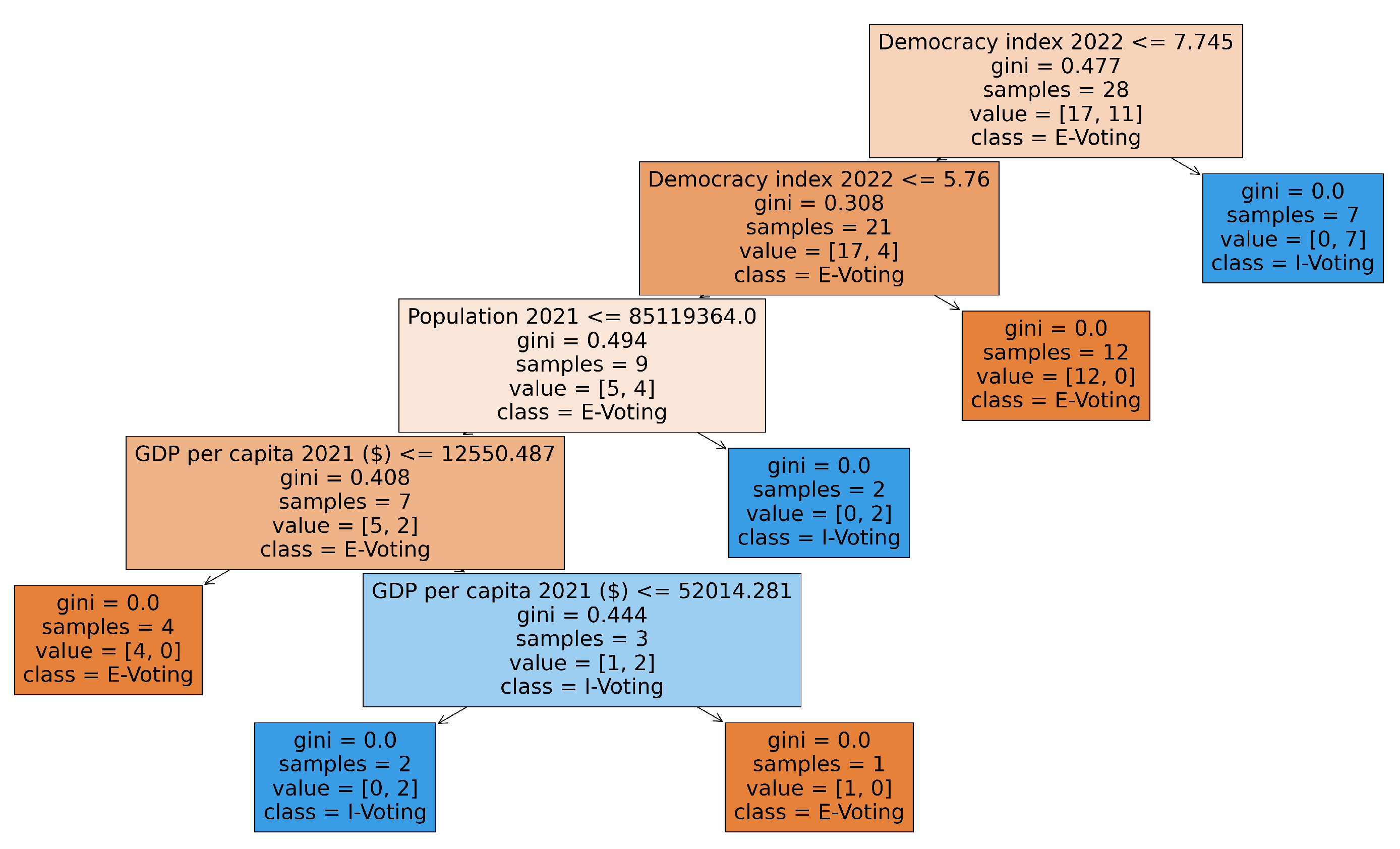
We report first the results obtained with our three-class classifier. In Figure 6, we show the resulting decision tree. The classification outputs reported in that picture pertain to the training dataset. As in any decision tree, the features employed at the root of the tree are likely to be the most relevant ones. In this case, that role is taken by the democracy index, which can be deemed as the most seminal feature in determining the willingness to adopt electronic voting or not. The accuracy is 0.58, which is significantly above a random classifier (which would achieve an accuracy of 0.333, as we have three classes), but certainly below our expectations.
Nonetheless, we can extend the decision tree approach and hopefully enhance the performance by turning to ensemble learning and using a random forest, i.e., a collection of trees. We have built 100 trees, adopting a majority voting rule to obtain the final classification. The passage to a random forest, although entailing that we lose some degree of explainability, is a powerful boost for performance, as the accuracy jumps to 0.853.
In the cascade of two two-class classifiers, we can first look at the classifier discriminating between no-adoption and adoption of either e- or i-voting. In Figure 7, we see the resulting decision tree for this first stage. The accuracy of this first-stage classification is 0.7. A major difference with the three-class classifier is that now the country surface appears as the feature at the root of the tree.
For the second stage of the cascade, where we decide between e-voting and i-voting for those instances classified as adopting electronic voting, we get the tree depicted in Figure 11, which achieves an accuracy of 0.63. The root feature is now again the democracy index.
Figure 8.
Two-class decision tree for adoption of e-voting vs i-voting.
By combining the outputs of the two stages, the cascade achieves a compound accuracy of 0.764, which is considerably better than what the three-class classifier has achieved (0.58).
Similarly to what we have done for the three-class classifiers, we can generate a forest of 100 trees and obtain the decision by majority voting also for the cascade of two-class classifiers. We now get an accuracy of 0.824 and 0.75 for the first and second stage, respectively. The compound accuracy jumps to a very good 0.912.
The cascade of two-class classifiers thus achieves a much better performance than the single three-class classifier.
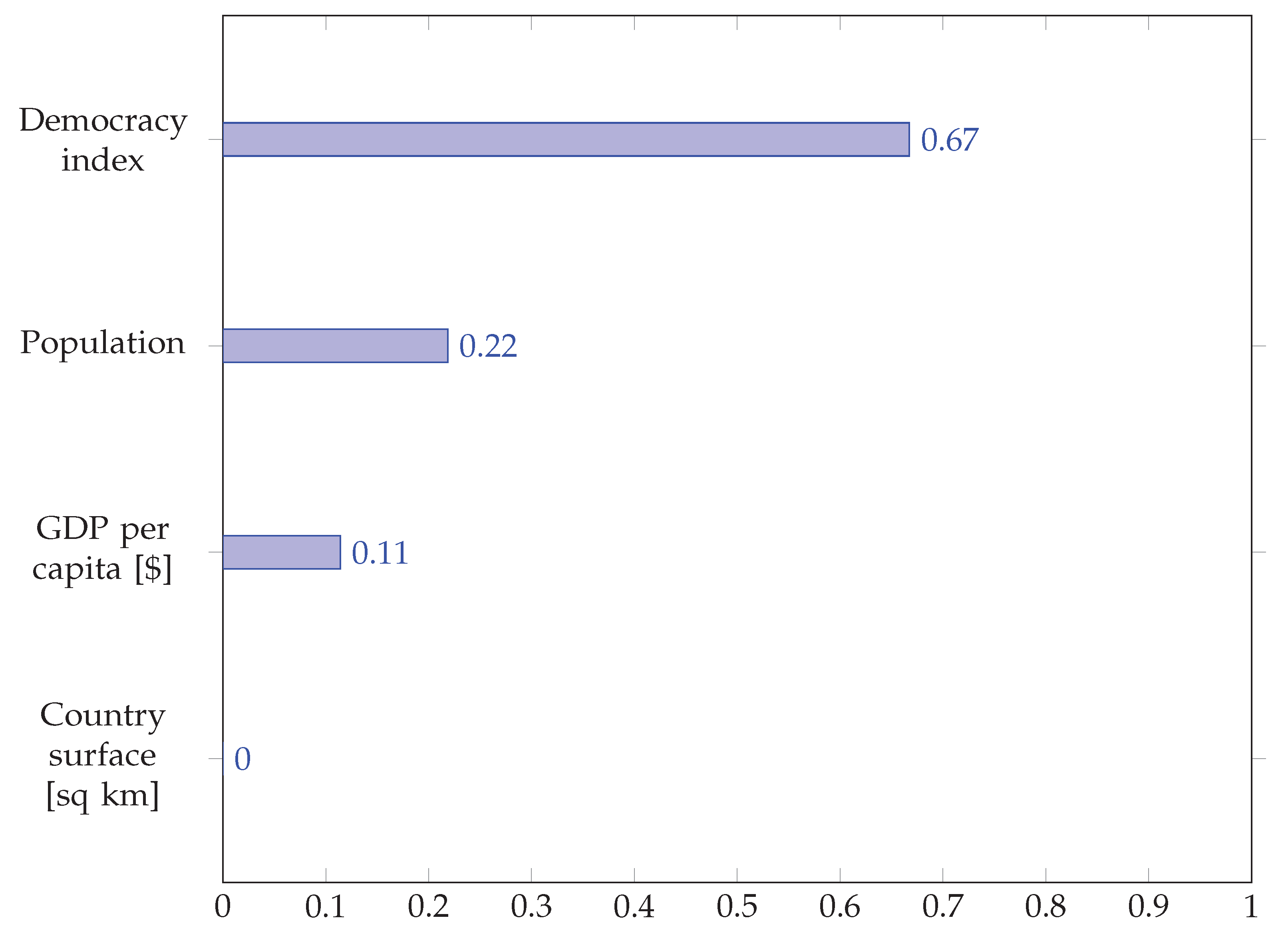
After concluding that the four features considered allow us to predict the adoption of either form of electronic voting with very high accuracy, we can now investigate which feature is most important. We resort to a widely employed measure of feature importance for trees, which is the contribution of each feature to the reduction of Gini impurity (see Section 2.4 of [108,109]). We have evaluated the feature importance for all three decision trees. We show the results in Figure 11 for the three-class classifier, and in Figure 10 and Figure 11 for the two stages of the cascade of two-class classifiers, respectively.
When we seek to classify by the adoption and the type of electronic voting all at once, we see that the features related to the country’s size (either geographical or economic) prevail, with all three features (population, surface, and GDP) exhibiting roughly the same importance (0.28-0.29, as can be seen in Figure 9. When we decompose the problem into two steps, considering first the adoption vs no-adoption and then the type of electronic voting, the results are somewhat different. The adoption choice appears to be mostly influenced by the country’s surface (with 0.55 importance in Figure 10). The decision between e-voting and i-voting is instead largely dictated by the level of democracy (importance of 0.67 in Figure 11).
Figure 9.
Mean decrease of Gini impurity index for three-class decision tree.
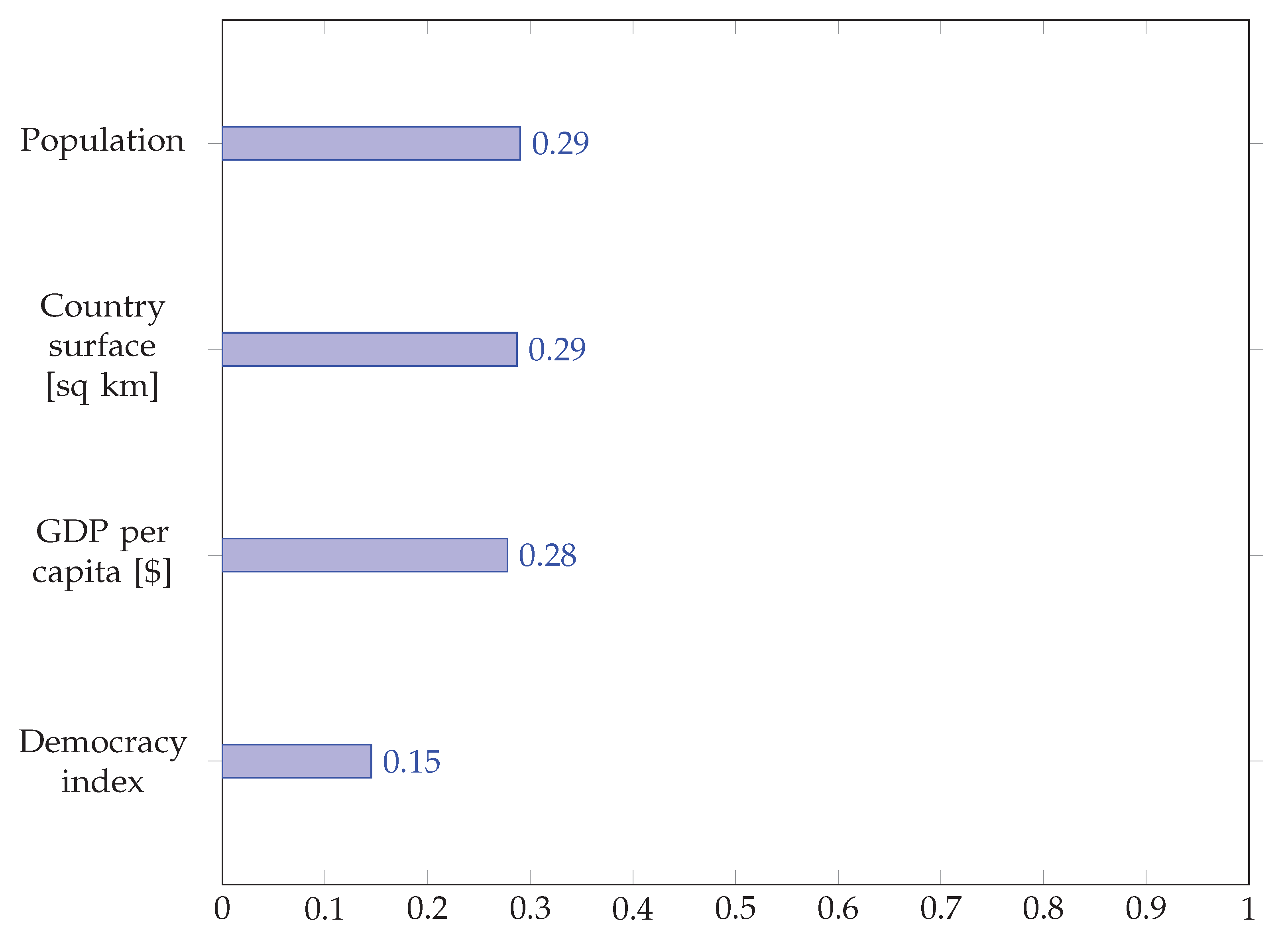
Figure 10.
Mean decrease of Gini impurity index for the first stage of the cascade of two-class decision trees (adoption vs no-adoption).
Figure 10.
Mean decrease of Gini impurity index for the first stage of the cascade of two-class decision trees (adoption vs no-adoption).
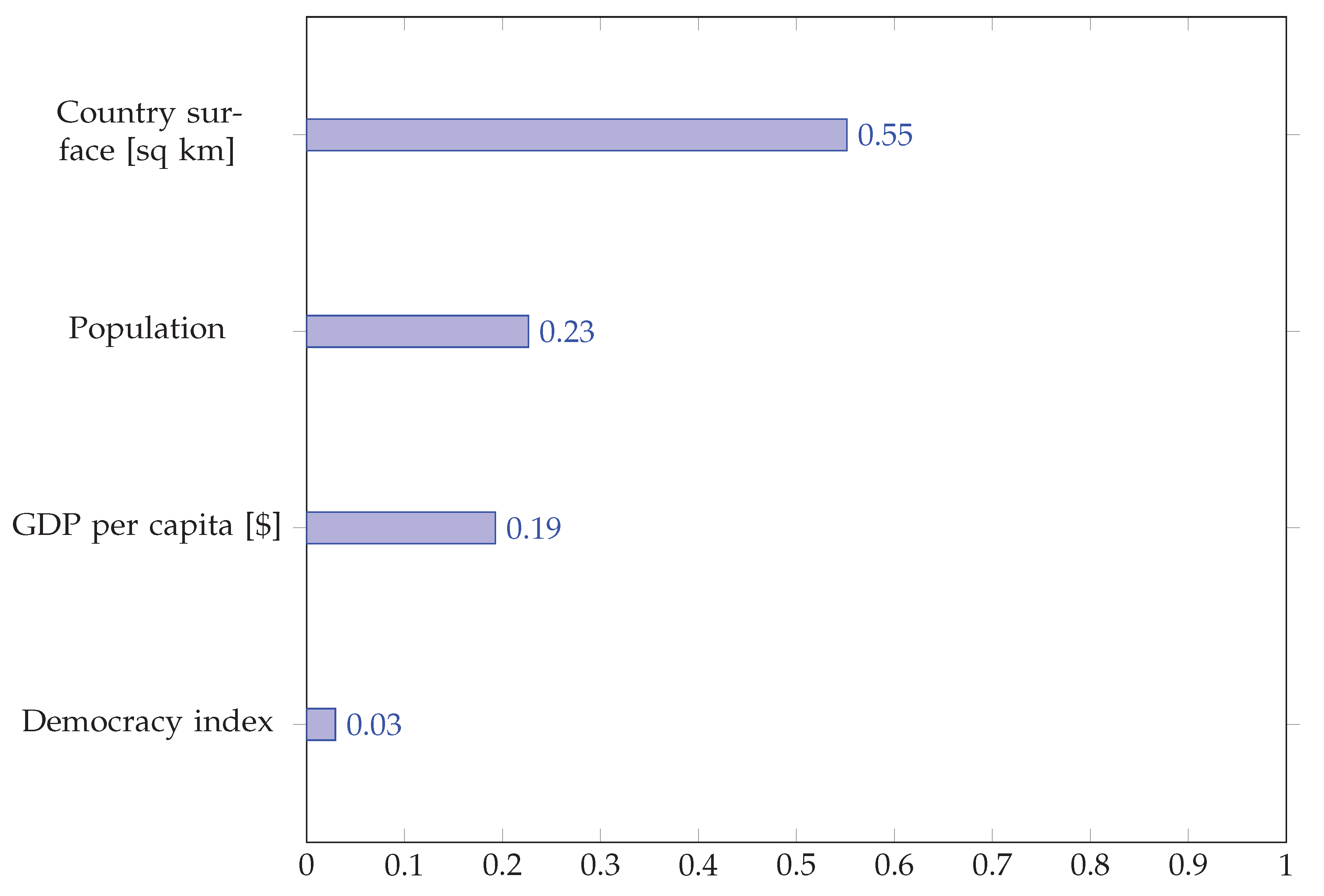
Figure 11.
Mean decrease of Gini impurity index for the second stage of the cascade of two-class decision trees (e-voting vs i-voting).
Figure 11.
Mean decrease of Gini impurity index for the second stage of the cascade of two-class decision trees (e-voting vs i-voting).
5. Conclusions
In this paper, we have analyzed the diffusion of electronic voting around the world and the features potentially related to its adoption.
While e-voting appears to be either widely employed or undergoing tests in South America, and various forms of electronic voting are available in North America, the adoption of electronic voting is less widespread in other parts of the world. Africa is largely absent, and even in Europe the adoption is quite scattered. Either form of electronic voting has been used in a number of large Asian countries. Much remains to be done to achieve a widespread use of such modern forms of voting.
Expectations should be higher for countries with an advanced level of technology and industrial development. However, other factors also influence the adoption. The country surface is a significant determinant of whether to use either form of electronic voting, while the democracy index is a strong predictor of whether e-voting or i-voting is employed. Countries adopting i-voting are larger both in terms of surface and population, are richer (as measured by their GDPper capita), and exhibit higher democracy levels (as measured by the democracy index). The random forest model that we have proposed allows us to achieve an accuracy exceeding 90% when predicting adoption based on a simple combination of four socio-economic factors: country’s surface and population, GDP per capita, and Democracy Index.
In a future world where all countries adopt some form of electronic voting (though i-voting should prevail in the long run), such differences would seem destined to disappear. But for the time being, the conclusions that we have drawn suggest which early adopters of new voting technologies we should expect.
References
- Challú, C.; Seira, E.; Simpser, A. The Quality of Vote Tallies: Causes and Consequences. Am. Polit. Sci. Rev. 2020, 114, 1071–1085. [CrossRef]
- Goggin, S.N.; Byrne, M.D.; Gilbert, J.E. Post-Election Auditing: Effects of Procedure and Ballot Type on Manual Counting Accuracy, Efficiency, and Auditor Satisfaction and Confidence. Election Law Journal: Rules, Politics, and Policy 2012, 11, 36–51. [CrossRef]
- Willemson, J.; Krips, K. Estimating Carbon Footprint of Paper and Internet Voting. In Proceedings of the Electronic Voting. Springer Nature Switzerland, 2023, pp. 140–155.
- Schur, L.; Adya, M.; Ameri, M. Accessible Democracy: Reducing Voting Obstacles for People with Disabilities. Election Law Journal: Rules, Politics, and Policy 2015, 14, 60–65. [CrossRef]
- Valsamidis, S.; Nerantzis, V.; Kerenidou, E.; Karakos, A. Survey on e-voting and electoral technology for Balkan and South-Eastern Europe countries. The Economies of Balkan and Eastern Europe Countries in the changed world 2010, p. 176.
- Krimmer, R.; Triessnig, S.; Volkamer, M. The Development of Remote E-Voting Around the World: A Review of Roads and Directions. In Proceedings of the E-Voting and Identity. Springer Berlin Heidelberg, 2007, pp. 1–15.
- Wang, K.H.K.; Mondal, S.K.; Chan, K.C.; Xie, X. A Review of Contemporary E-voting: Requirements, Technology, Systems and Usability. Data Science and Pattern Recognition 2017, 1, 31.
- Kumar, M.S.; Walia, E. Analysis of electronic voting system in various countries. International Journal on Computer Science 2011.
- Hao, F.; Ryan, P.Y.A. Real-World Electronic Voting: Design, Analysis and Deployment; CRC Press, 2016.
- Gibson, J.P.; Krimmer, R.; Teague, V.; Pomares, J. A review of e-voting: the past, present and future. Annals of Telecommunications 2016, 71, 279–286.
- Ikrissi, G.; Mazri, T. Electronic Voting: Review and Challenges. In Proceedings of the Innovations in Smart Cities Applications Volume 7. Springer Nature Switzerland, 2024, pp. 110–119.
- Adekunle, S.E.; Others. A Review of Electronic Voting Systems: Strategy for a Novel. International Journal of Information Engineering & Electronic Business 2020, 12.
- Lake, J. What are the risks of electronic voting and internet voting? https://www.comparitech.com/blog/information-security/electronic-voting-risks/, 2022. Accessed: 2024-04-17.
- Kumar, D.A.; Begum, T.U.S. Electronic voting machine—A review. In Proceedings of the International conference on pattern recognition, informatics and medical engineering (PRIME-2012). IEEE, 2012, pp. 41–48.
- Shejavali, N. Electronic Voting Machines. Institute for Public Policy Research (IPPR) No 2014, 1.
- Everett, S.P.; Greene, K.K.; Byrne, M.D.; Wallach, D.S.; Derr, K.; Sandler, D.; Torous, T. Electronic voting machines versus traditional methods: Improved preference, similar performance. In Proceedings of the Proceedings of the SIGCHI conference on human factors in computing systems, 2008, pp. 883–892.
- Everett, S.P. The usability of electronic voting machines and how votes can be changed without detection. PhD thesis, Citeseer, 2007.
- Wolchok, S.; Wustrow, E.; Halderman, J.A.; Prasad, H.K.; Kankipati, A.; Sakhamuri, S.K.; Yagati, V.; Gonggrijp, R. Security analysis of India’s electronic voting machines. In Proceedings of the Proceedings of the 17th ACM conference on Computer and communications security, 2010, pp. 1–14.
- Kiayias, A.; Michel, L.; Russell, A.; Shashidhar, N.; See, A.; Shvartsman, A.; Davtyan, S. Tampering with Special Purpose Trusted Computing Devices: A Case Study in Optical Scan E-Voting. In Proceedings of the Twenty-Third Annual Computer Security Applications Conference (ACSAC 2007). IEEE, 2007, pp. 30–39.
- Abuidris, Y.O.; Kumar, R.; Wenyong, W. A Survey of Blockchain Based on E-voting Systems. In Proceedings of the ICBTA 2019: 2019 2nd International Conference on Blockchain Technology and Applications, 2019, pp. 99–104.
- Vladucu, M.V.; Dong, Z.; Medina, J.; Rojas-Cessa, R. E-Voting Meets Blockchain: A Survey. IEEE Access 2023, 11, 23293–23308. [CrossRef]
- Ullits, J. Deciphering blockchain’s role in Danish decision-making: evaluating opportunities and challenges through the prism of due process. Law Innov. Technol. 2024, pp. 1–24. [CrossRef]
- Al-Maaitah, S.; Qatawneh, M.; Quzmar, A. E-Voting System Based on Blockchain Technology: A Survey. In Proceedings of the 2021 International Conference on Information Technology (ICIT). IEEE, 2021, pp. 200–205.
- del Blanco, D.Y.M.; Gascó, M. A Protocolized, Comparative Study of Helios Voting and Scytl/iVote. In Proceedings of the 2019 Sixth International Conference on eDemocracy & eGovernment (ICEDEG). IEEE, 2019, pp. 31–38.
- New Zealand Electoral Commission. How to vote from overseas. https://web.archive.org/web/20231211001803/https://www.vote.nz/voting/overseas/vote-from-overseas/, 2023. Accessed: 2023-12-11.
- Ministry of Transport, Communications and Information Technology. Antakhib App. https://oman.om/en/home-top-level/eparticipation/e-voting, 2023. Accessed: 2024-4-14.
- Ministry of State for FNC Affairs. United Arab Emirates e-voting app download page. https://play.google.com/store/apps/details?id=com.uaevoting.ae, 2023. Accessed: 2024-4-14.
- International IDEA. ICTs in Elections Database. https://www.idea.int/data-tools/data/icts-elections-database, 2024. Accessed: 2024-4-14.
- McCombie, S.; Uhlmann, A.J.; Morrison, S. The US 2016 presidential election & Russia’s troll farms. Intell. Natl. Sec. 2020, 35, 95–114. [CrossRef]
- Burr, R.; Warner, M.; Collins, S.; Heinrich, M.; Lankford, J. Senate Intel committee releases unclassied 1st installment in Russia report, updated recommendations on election security. https://www.justsecurity.org/wp-content/uploads/2019/03/5.8.18-Statement-on-SSCI-Report.pdf, 2018. Accessed: 2024-4-14.
- Zdun, M. Machine Politics: How America casts and counts its votes. Reuters 2022.
- King, B.A. State online voting and registration lookup tools: Participation, confidence, and ballot disposition. Journal of Information Technology & Politics 2019, 16, 219–235. [CrossRef]
- Fox-Sowell, S.; Quinlan, K. Election day ends with reports of vote counting tech challenges, text scams in several states. http://statescoop.com/election-day-ends-with-reports-of-vote-counting-tech-challenges-text-scams-in-several-states/, 2024. Accessed: 2025-1-6.
- Alcántara, M.J.A. Dominican government asks OAS to investigate e-vote failure. https://apnews.com/international-news-general-news-293e335b22b24fa6bd5945733b2a27a8, 2020. Accessed: 2023-12-9.
- Pomares, J.; Levin, I.; Alvarez, R.M. Do voters and poll workers differ in their attitudes toward e-voting? Evidence from the first e-election in Salta, Argentina. In Proceedings of the 2014 Electronic Voting Technology Workshop/Workshop on Trustworthy Elections (EVT/WOTE 14), 2014.
- “Evoting Communications”. What happened to electronic voting in Argentina’s primary elections? https://evoting.com/en/2023/08/21/voto-electronico-primarias-argentina/, 2023. Accessed: 2023-11-30.
- Okuro, O. Comparative Review of E-Voting in India and Brazil: Key Lessons for Kenya. Lagos Hist. Rev. 2023.
- Krimmer, R.; Volkamer, M.; Binder, N.B.; Kersting, N.; Loeber, L. TUT Press Proceedings of the Second International Conference on Electronic Voting (E-Vote-ID) 2017.
- Spada, P.; Mellon, J.; Peixoto, T.; Sjoberg, F.M. Effects of the internet on participation: Study of a public policy referendum in Brazil. Journal of Information Technology & Politics 2016, 13, 187–207. [CrossRef]
- Claudio Fuentes Armadans, J.S.C. History of electronic voting in Paraguay. Technical report, TEDIC (Asociación de Tecnología, Educación, Desarrollo, Investigación, Comunicación), 2022.
- Machin-Mastromatteo, J.D. The most “perfect” voting system in the world. Information Development 2016, 32, 751–755.
- Këlliçi, E. Increasing public trust through technology, eVoting case Albania. https://uet.edu.al/ingenious/wp-content/uploads/2023/02/ingenious-2-Increasing-public-trust-through-technology-eVoting-case-Albania.pdf, 2023. Accessed: 2023-11-15.
- Dandoy, R. An Analysis of Electronic Voting in Belgium: Do voters behave differently when facing a machine? In Belgian Exceptionalism; Routledge, 2021; pp. 44–58.
- Wetherall-Grujić, G. Manufacturing Distrust: Voting Machines in Bulgaria. https://democracy-technologies.org/voting/manufacturing-distrust-voting-machines-in-bulgaria/, 2022. Accessed: 2023-8-29.
- Bg, M.W.H. A System for remote Electronic Voting is being developed in Bulgaria. https://www.novinite.com/articles/214773/A+System+for+remote+Electronic+Voting+is+being+developed+in+Bulgaria, 2022. Accessed: 2023-12-1.
- Freyer, U. Introduction of Electronic Voting In Namibia. Technical report, Electoral Commission of Namibia, 2017.
- Mpekoa, N.; van Greunen, D. E-voting experiences: A case of Namibia and Estonia. In Proceedings of the 2017 IST-Africa Week Conference (IST-Africa), 2017, pp. 1–8.
- Giles, C. DR Congo elections: Why do voters mistrust electronic voting? BBC 2018.
- Congo Research Group. The electronic voting controversy in the Congo. Congo Research Group Election Brief No 1, 2018.
- The Sentry Team. Electronic Voting Technology DRC. https://thesentry.org/reports/electronic-voting-technology-drc/, 2018. Accessed: 2024-2-22.
- Election Commission of Bhutan. Handbook for Polling Officiers, 2013.
- Election Commission of Bhutan. Electronic Voting Machine (EVM) Rules and Regulations of the Kingdom of Bhutan, 2018, 2018.
- Risnanto, S.; Rahim, Y.B.A.; Herman, N.S. Success Implementation of E-Voting Technology In various Countries: A Review. foitic 2020, pp. 150–155.
- Tasnim News Agency. E-Voting In Iran Presidential Election Off The Table. Eurasia Review 2021.
- National Democratic Institute – Washington DC. Iran’s June 18, 2021 Elections. Technical report, National Democratic Institute, 2021.
- United Nations Assistance Mission for Iraq (UNAMI). Elections for Iraq’s Council of Representatives - Facts sheet. Technical report, United Nations, 2021.
- Rasheed, A.; Jalabi, R.; Aboulenein, A. Exclusive: Iraq election commission ignored warnings over voting machines - document. Reuters 2018.
- Sheranova, A. Cheating the machine: E-voting practices in Kyrgyzstan’s local elections. Eur. Rev. 2020, 28, 793–809. [CrossRef]
- Umarova, A. Why Kyrgyzstan uses biometrics in its voting system. https://govinsider.asia/intl-en/article/kyrgyzstan-uses-biometrics-voting-system, 2018. Accessed: 2023-12-10.
- OSCE Office for Democratic Institutions and Human Rights. Mongolia - Parliamentary Elections, ODIHR needs assessment mission report. Technical report, 2020.
- Gangabaatar, D. Electoral Reform and the Electronic Voting System: Case of Mongolia. In Digital Transformation and Its Role in Progressing the Relationship Between States and Their Citizens; IGI Global, 2020; pp. 182–204.
- Elven, T.M.A.; Al-Muqorrobin, S.A. Consolidating Indonesia’s Fragile Elections Through E-Voting: Lessons Learned from India and the Philippines. Indonesian Comparative Law Review 2020, 3, 63–80. [CrossRef]
- “International Foundation for Electoral Systems”. Elections in Panama - 2019 General Elections - Frequently Asked Questions. Technical report, IFES - International Foundation for Electoral Systems, 2019.
- Associated Press. Ecuadorians Vote for President, Overseas Voting System Sees Cyberattacks. https://www.voanews.com/a/ecuadorians-vote-for-president-overseas-voting-system-sees-cyberattacks/7233360.html, 2023. Accessed: 2023-12-11.
- Finn, V.; Besserer Rayas, A. Turning rights into ballots: Mexican external voting from the US. Territory, Politics, Governance 2022, pp. 1–20.
- INE.. Electronic Voting System for Mexican Residing Abroad Manual. Instituto Nacional Electoral, 2022.
- “Ministère de l’Europe et des Affaires ètrangères”. Legislative Elections – Opening of the Internet voting portal (27 May 2022). https://www.diplomatie.gouv.fr/en/the-ministry-and-its-network/news/2022/article/legislative-elections-opening-of-the-internet-voting-portal-27-may-2022, 2022. Accessed: 2023-11-12.
- Xenakis, A.; Macintosh, A. Major Issues in Electronic Voting in the Context of the UK Pilots. Journal of Information Technology & Politics 2004, 1, 53–74. [CrossRef]
- Storer, T.; Duncan, I. Polsterless Remote Electronic Voting. Journal of Information Technology & Politics 2004, 1, 75–103.
- UK Parliament staff. Online voting in the House of Lords. https://www.parliament.uk/about/how/changes-to-lords-proceedings/online-voting-in-the-house-of-lords/, 2022. Accessed: 2023-12-12.
- Manougian, H. Did You Know Armenia Allows Internet Voting? (But It’s Only For Some). https://evnreport.com/politics/did-you-know-armenia-allows-internet-voting-but-it-s-only-for-some/, 2020. Accessed: 2023-11-15.
- Office for Democratic Institutions and Human Rights (ODIHR). Republic of Armenia Early Parliamentary Elections 20 June 2021. Technical report, Organization for Economic Co-operation and Development (OECD), 2021.
- Goldsmith, L.; Shaikh, A.K.; Tan, H.Y.; Raahemifar, K. A Review of Contemporary Governance Challenges in Oman: Can Blockchain Technology Be Part of Sustainable Solutions? Sustain. Sci. Pract. Policy 2022, 14, 11819. [CrossRef]
- OECD. Open Government case study - Sample Case Submission Form. https://opengov.unescwa.org/sites/default/files/inline-files/Om02-e-Voting-System-En.pdf, 2019. Accessed: 2023-11-12.
- Mc Keown, D. New South Wales state election 2015. Research Paper Series (Parliamentary Library, Australia) 2016.
- Cardillo, A.; Akinyokun, N.; Essex, A. Online Voting in Ontario Municipal Elections: A Conflict of Legal Principles and Technology? In Proceedings of the Electronic Voting. Springer International Publishing, 2019, pp. 67–82.
- Chughtai, W. Online voting is growing in Canada, raising calls for clear standards. CBC News 2022.
- Górny, M. I-voting – opportunities and threats. Conditions for the effective implementation of Internet voting on the example of Switzerland and Estonia. Prz. Politol. 2021, pp. 133–146. [CrossRef]
- Scytl. 94% trust rate in Norway’s online voting channel. https://scytl.com/94-trust-rate-in-norways-online-voting-channel/, 2014. Accessed: 2024-1-7.
- Cortier, V.; Wiedling, C. A Formal Analysis of the Norwegian E-voting Protocol. In Proceedings of the Principles of Security and Trust. Springer Berlin Heidelberg, 2012, pp. 109–128.
- Chowdhury, M.J.M. Comparison of e-voting schemes: Estonian and Norwegian solutions. International Journal of Applied Information Systems 2013, 6, 60–66.
- Smartmatic. Norwegian county conducts referendum using online voting. https://www.smartmatic.com/media/norwegian-county-conducts-referendum-using-online-voting/, 2022. Accessed: 2024-1-7.
- Reiners, M. Vote electronique in Switzerland: Comparison of relevant pilot projects. J. Commonw. Comp. Polit. 2020, 13, 58–75.
- Swiss Federal Chancellery FCh. E-Voting. https://www.bk.admin.ch/bk/en/home/politische-rechte/e-voting.html, 2023. Accessed: 2023-12-26.
- Ridard, E.; Eichenberger, M. Swiss Abroad: e-voting doesn’t make up for frustrations. https://www.swissinfo.ch/eng/politics/swiss-abroad–e-voting-does-not-make-up-for-frustrations/48920054, 2023. Accessed: 2023-12-26.
- Al-Khouri, A.M.; Authority, E.I.; Dhabi, A. E-Voting in UAE FNC Elections: A Case Study. In Proceedings of the Information and Knowledge Management. academia.edu, 2012, Vol. 2, pp. 25–84.
- The United Arab Emirates’ Government portal. Elections. https://u.ae/en/about-the-uae/the-uae-government/the-federal-national-council-/elections-, 2023. Accessed: 2023-12-10.
- Scytl. United Arab Emirates Becomes First Country to Hold Fully Digital Elections with Scytl. https://scytl.com/united-arab-emirates-becomes-first-country-to-hold-fully-digital-elections-with-scytl/, 2023. Accessed: 2023-12-10.
- Vakarjuk, J.; Snetkov, N.; Willemson, J. Russian Federal Remote E-voting Scheme of 2021 – Protocol Description and Analysis. In Proceedings of the Proceedings of the 2022 European Interdisciplinary Cybersecurity Conference, New York, NY, USA, 2022; EICC ’22, pp. 29–35.
- Chingaev, Y. Russia’s Online Voting System Briefly Crashes on First Day of Election. https://www.themoscowtimes.com/2024/03/15/russias-online-voting-system-briefly-crashes-on-first-day-of-election-a84470, 2024. Accessed: 2024-3-27.
- Dyxon, R. As Russian voting moves online, Putin’s foes say another path to curb Kremlin is lost. The Washington Post 2021.
- Alvarez, R.M.; Katz, G.; Llamosa, R.; Martinez, H.E. Assessing Voters’ Attitudes towards Electronic Voting in Latin America: Evidence from Colombia’s 2007 E-Voting Pilot. In Proceedings of the E-Voting and Identity. Springer Berlin Heidelberg, 2009, pp. 75–91.
- Alvarez, R.M.; Katz, G.; Pomares, J. The Impact of New Technologies on Voter Confidence in Latin America: Evidence from E-Voting Experiments in Argentina and Colombia. Journal of Information Technology & Politics 2011, 8, 199–217. [CrossRef]
- Corvetto Salinas, P.A. Implementación del voto electrónico en Perú. Technical report, Oficina Nacional de Procesos Electorales (ONPE) - Perú, 2022.
- Scytl. Scytl Online Voting Helps Iceland Successfully Run Fully Online Referendums. https://scytl.com/news/scytl-online-voting-helps-iceland-successfully-run-fully-online-referendums/, 2015. Accessed: 2024-1-7.
- European Digital Rights. Ireland: E-voting machines go to scrap after proving unreliable. https://edri.org/our-work/edrigramnumber10-14evoting-machines-scrap-ireland/, 2012. Accessed: 2023-12-12.
- Post, I. Il pasticcio del voto elettronico in Lombardia. https://www.ilpost.it/2017/10/23/voto-elettronico-lombardia/, 2017. Accessed: 2022-8-21.
- Lombardia, R. Lombardia, Referendum: il sistema di voto elettronico. Technical report, 2017.
- Wikipedia. Referendum consultivo in Lombardia del 2017. https://it.wikipedia.org/wiki/Referendum_consultivo_in_Lombardia_del_2017, 2017. Accessed: 2022-8-21.
- Dipartimento per gli affari interni e territoriali. e-Vote. La simulazione del voto elettronico. https://dait.interno.gov.it/elezioni/notizie/e-vote-simulazione-del-voto-elettronico, 2023. Accessed: 2024-1-7.
- Irani, B. EC to buy 2,535 new EVMs at four times the cost of previous models. https://www.dhakatribune.com/bangladesh/145403/ec-to-buy-2-535-new-evms-at-four-times-the-cost-of, 2018. Accessed: 2023-11-30.
- The Wire editorial staff. Bangladesh Election Commission Forced to Drop EVMs. https://thewire.in/south-asia/bangladesh-election-commission-drop-evms, 2023. Accessed: 2023-11-30.
- Mackisack, D. There and Back Again – The Story of Pakistan’s Brief Experiment with Electronic Voting. https://democracy-technologies.org/voting/there-and-back-again-the-story-of-pakistans-brief-experiment-with-electronic-voting/, 2022. Accessed: 2023-12-12.
- Billon, M.; Marco, R.; Lera-Lopez, F. Disparities in ICT adoption: A multidimensional approach to study the cross-country digital divide. Telecommunications Policy 2009, 33, 596–610. [CrossRef]
- Krimmer, R. The evolution of e-voting: why voting technology is used and how it affects democracy. Tallinn University of Technology Doctoral Theses Series I: Social Sciences 2012, 19.
- Economist Intelligence Unit. Democracy Index 2022. https://www.eiu.com/n/campaigns/democracy-index-2022/?utm_source=economist&utm_medium=daily_chart&utm_campaign=democracy-index-2022, 2023. Accessed: 2024-1-7.
- Yuan, Y.; Wu, L.; Zhang, X. Gini-impurity index analysis. IEEE Transactions on Information Forensics and Security 2021, 16, 3154–3169.
- Thampi, A. Interpretable AI: Building explainable machine learning systems; Simon and Schuster, 2022.
- Breiman, L. Random Forests. Mach. Learn. 2001, 45, 5–32.
Figure 1.
Worldwide use of e-voting and i-voting.
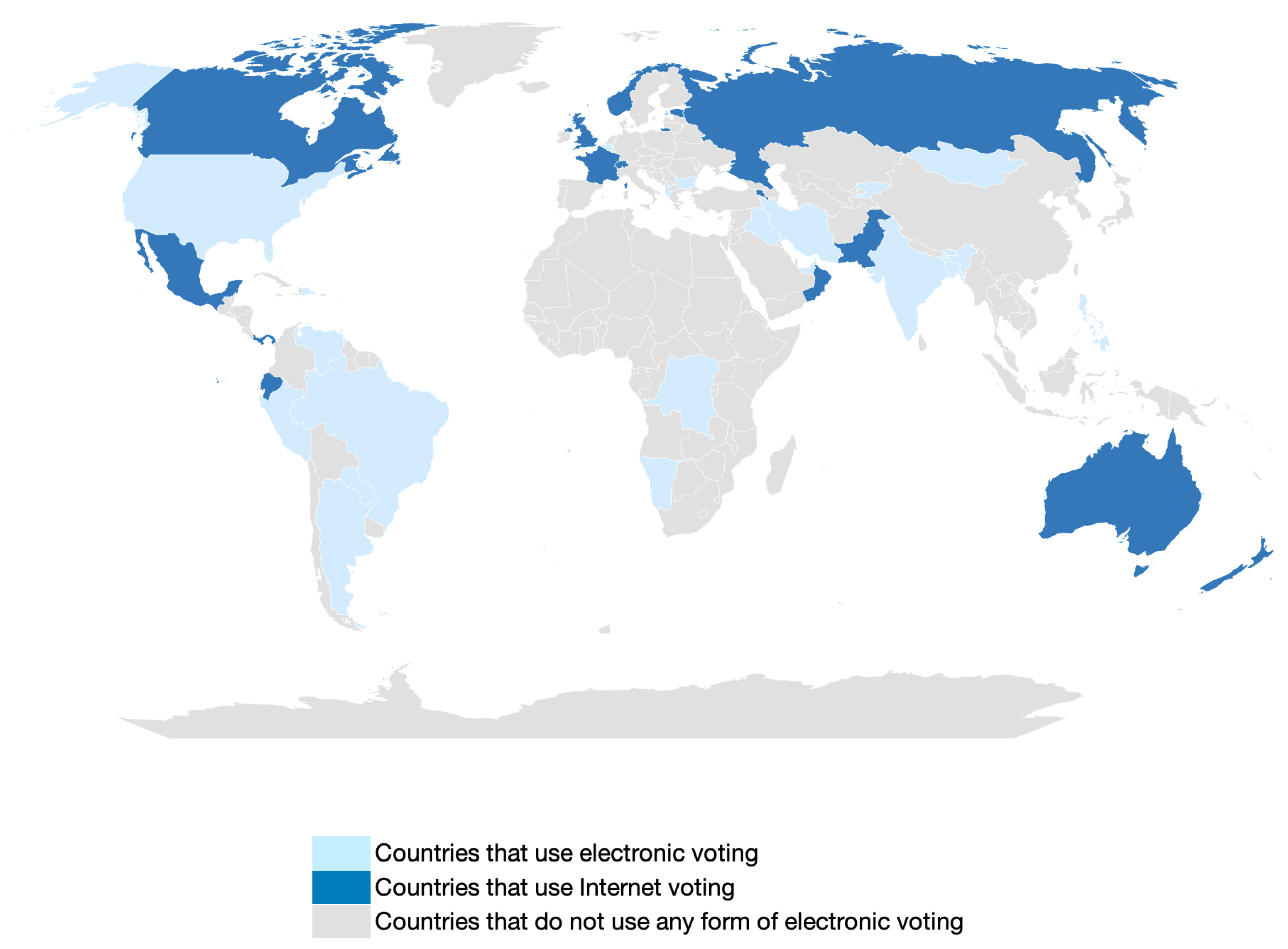
Figure 2.
Electronic voting and country surface.
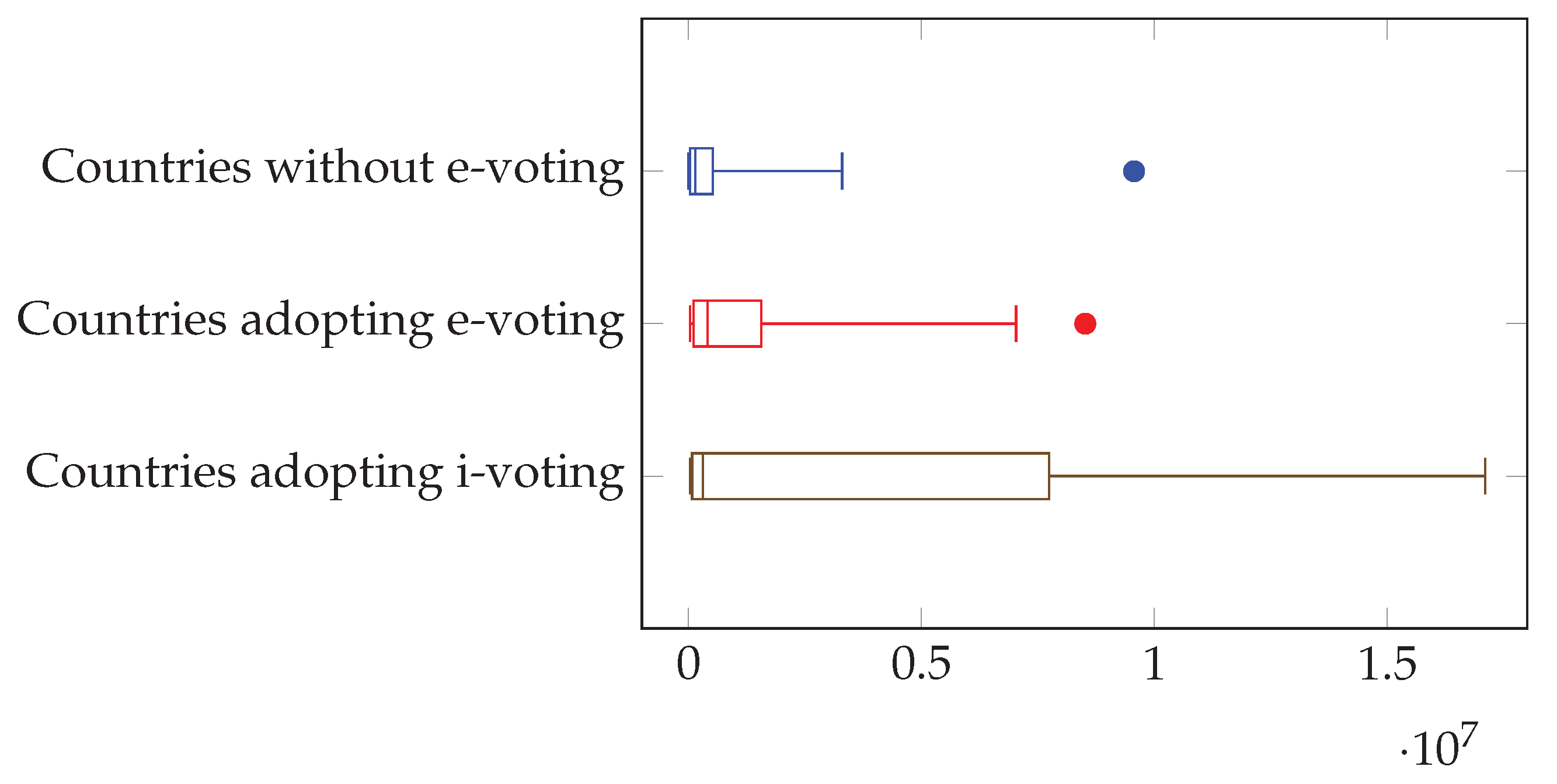
Figure 3.
Electronic voting and population.
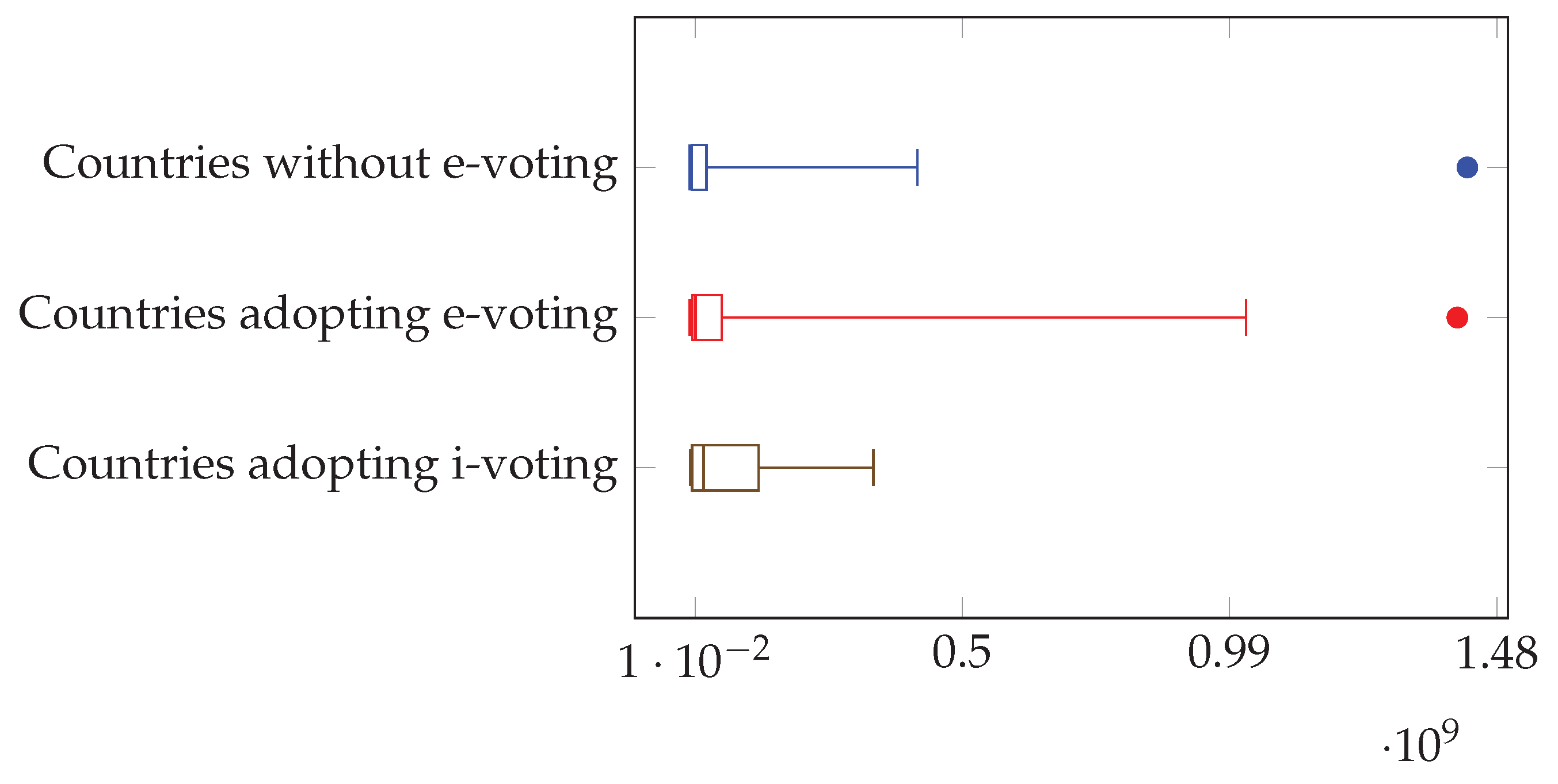
Figure 4.
Electronic voting and GDP per capita.
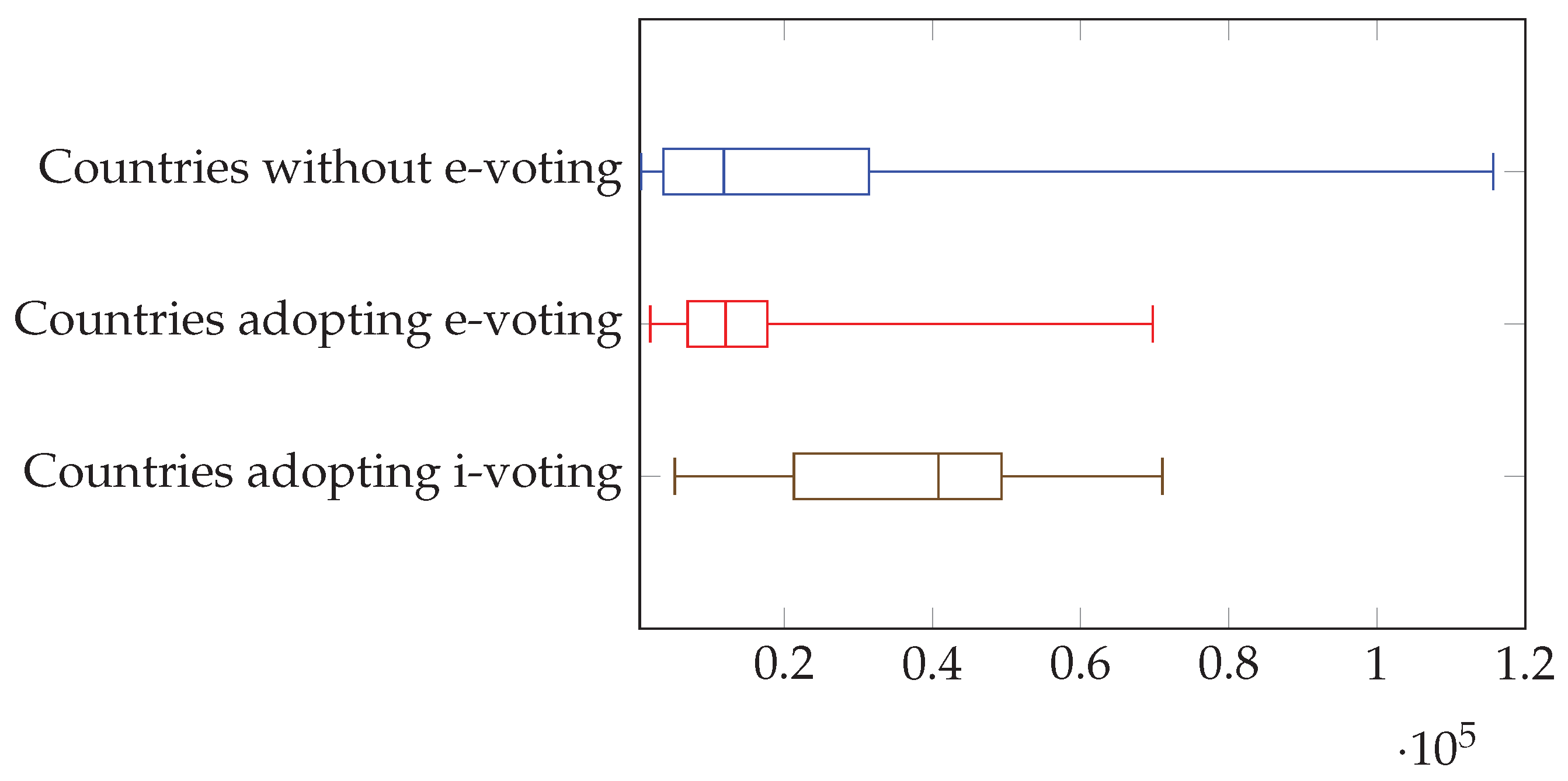
Figure 5.
Electronic voting and democracy index.
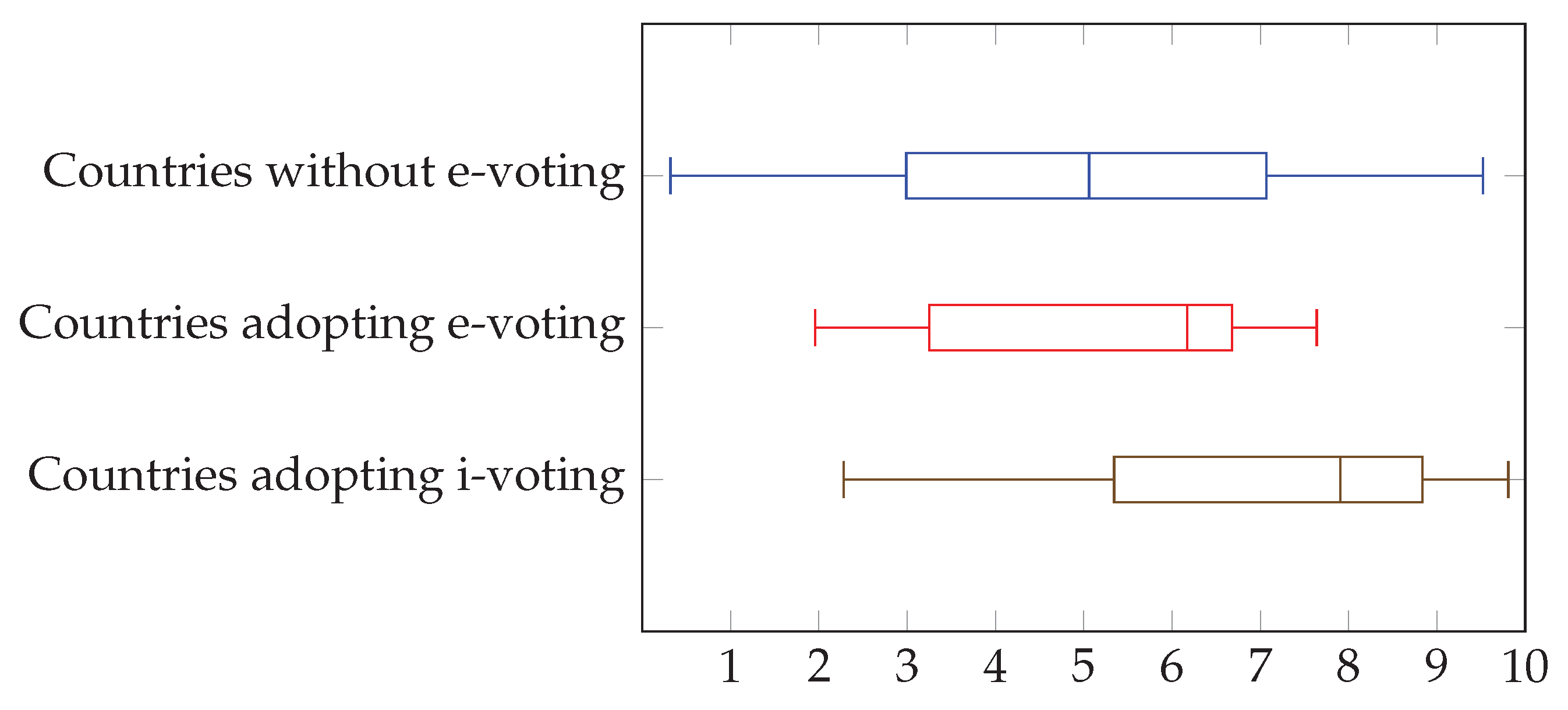
Figure 6.
The three-class decision tree.
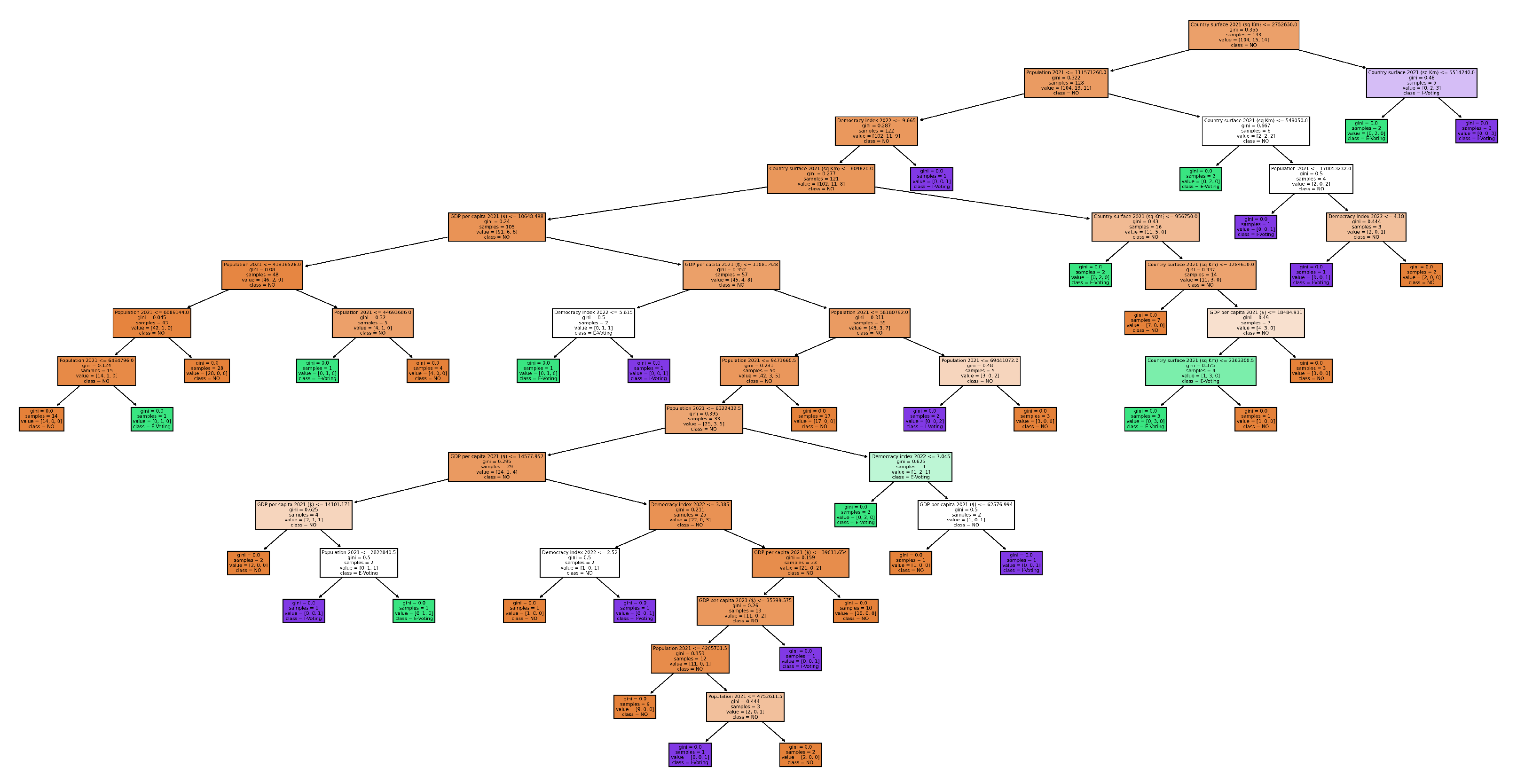
Figure 7.
Two-class decision tree for adoption vs no adoption of electronic voting.
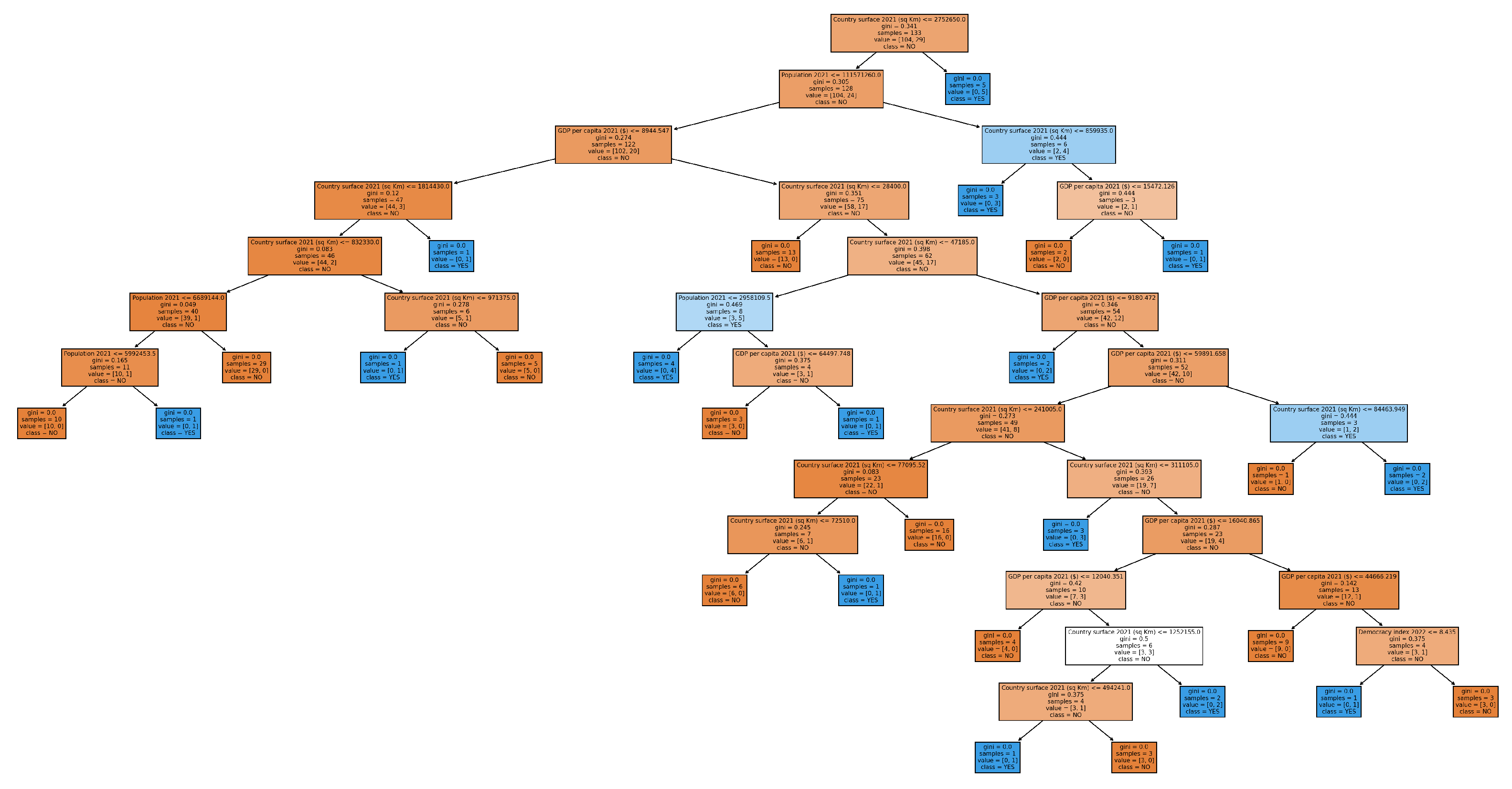

Table 1.
Categories of people with access to Internet voting in some countries.
| Category | Countries |
|---|---|
| Citizens residing abroad | Panama, Ecuador, Mexico, France, Sultanate of Oman, Australia, New Zealand |
| Diplomatic personnel and military | Armenia |
| Members of the House of Lords (during pandemics) | United Kingdom |
| People with disabilities | Australia |
Table 2.
Reasons for abandoning electronic voting.
| Reason | Countries |
|---|---|
| Lack of trust | Peru, Ireland |
| No follow-up after the pilot project | Colombia, Iceland, Italy |
| Supply problems | Bangladesh |
| Political decision | Pakistan |
Disclaimer/Publisher’s Note: The statements, opinions and data contained in all publications are solely those of the individual author(s) and contributor(s) and not of MDPI and/or the editor(s). MDPI and/or the editor(s) disclaim responsibility for any injury to people or property resulting from any ideas, methods, instructions or products referred to in the content. |
© 2025 by the authors. Licensee MDPI, Basel, Switzerland. This article is an open access article distributed under the terms and conditions of the Creative Commons Attribution (CC BY) license (http://creativecommons.org/licenses/by/4.0/).
Copyright: This open access article is published under a Creative Commons CC BY 4.0 license, which permit the free download, distribution, and reuse, provided that the author and preprint are cited in any reuse.


