

Submitted:
03 June 2025
Posted:
04 June 2025
Read the latest preprint version here
Abstract
This paper provides a comprehensive review of Artificial Intelligence (AI) integration in K-12 education, examining current implementations, policy frameworks, and emerging challenges. We analyze over 40 recent publications (2024-2025) from academic journals, government reports, and industry whitepapers to identify key trends in AI adoption across primary and secondary education systems. This paper presents a comprehensive review of Artificial Intelligence (AI) integration in K-12 education, examining its pedagogical, technical, and policy dimensions. Through an analysis of recent literature, we highlight Generative AI as the most widely adopted paradigm in educational settings, with Agentic AI emerging as a significant secondary focus. The review identifies key trends in architectural approaches while noting underrepresented technical frameworks. Our review reveals three critical dimensions of AI in education: (1) pedagogical applications including personalized learning and administrative automation, (2) policy and ethical considerations at federal and state levels, and (3) infrastructure requirements for successful implementation. We highlight the rapid growth of Generative AI (GenAI) tools in classrooms alongside persistent concerns about equity, data privacy, and teacher preparedness. We summarize a conceptual framework for evaluating educational AI systems that balances pedagogical value with implementation considerations. The study proposes a readiness framework balancing pedagogical value against implementation complexity. Recommendations emphasize professional development, privacy-preserving architectures, and international governance standards to guide responsible adoption through 2030. The paper concludes with strategic recommendations for stakeholders, emphasizing the need for teacher professional development, privacy-preserving technologies, and international collaboration to guide responsible adoption. This review synthesizes critical insights for navigating the evolving landscape of AI in education while maintaining human-centered priorities. The paper concluddes with recommendations for policymakers, educators, and technology developers to ensure responsible AI integration that enhances rather than replaces human instruction.
Keywords:
artificial intelligence
; K-12 education
; educational technology
; generative AI
; AI policy
; digital literacy
1. Introduction
The integration of Artificial Intelligence (AI) in K-12 education has accelerated dramatically since 2023, with generative AI tools like ChatGPT prompting both enthusiasm and concern among educators [1]. The White House’s 2025 executive order on "Advancing Artificial Intelligence Education for American Youth" [2] marked a watershed moment in federal support for AI literacy, while state education boards have scrambled to develop implementation guidelines [3]. This paper synthesizes current research on AI in primary and secondary education, with particular attention to the period 2024-2025 when adoption reached critical mass.
Recent surveys indicate that 72% of U.S. school districts have experimented with some form of AI technology [4], ranging from adaptive learning platforms to administrative automation tools. However, as [5] note, the technology may be new but the challenges are familiar—equity gaps, teacher training, and curriculum integration remain persistent barriers. Our review builds on foundational work by [6] while incorporating the latest policy developments and classroom implementations.
2. Current State of AI in K-12
3. Top Technical Trends and Emerging Technologies in Educational AI (2025–2030)
3.1. Top 10 Established Technical Trends and Emerging Technologies
Table 1 and Table 2 demonstrate the current dominance of Generative AI in education (appearing in 51% of surveyed papers) alongside emerging high-impact technologies like Brain-Computer Interfaces, while highlighting the need for further research in quantum ML applications (projected low impact) [7,9].
3.2. Technology Adoption Timeline
3.3. Key Observations
- Dominance of Generative AI: Remains central through 2030 [8]
- Rise of Multimodal Systems: Expected to surpass text-only AI by 2028 [16]
- Privacy Challenges: Federated learning becomes crucial [25]
- Specialized Hardware: Increasing need for educational AI chips [14]
The [17] framework suggests these technologies must be evaluated against:
4. Future Developments in Educational AI: 2025–2030 Roadmap
The next five years will witness transformative changes in educational AI, building on current foundations while addressing emerging challenges. This section outlines projected developments annually and presents an implementation network diagram.
4.1. Annual Development Timeline
Table 3 traces AI’s educational evolution from writing assistants (2025) through neuro-symbolic systems (2027) to advanced LMMs (2030), demonstrating accelerating adoption curves [7,16].
Table 3 further reveals how AI education policy must evolve from state standards (2025) to international governance (2030) to keep pace with technological advances [21,26].

Table 3.
Projected AI in Education Milestones (2025–2030).
| Year | Key Developments |
|---|---|
| 2025 | |
| 2026 | |
| 2027 | |
| 2028 | |
| 2029 | |
| 2030 |
4.2. Implementation Network Diagram
5. Architectural Landscape Analysis
5.1. Architectural Trends
The radar chart reveals several key patterns in the technical literature:
- Rise of Agentic Systems: Frameworks like CrewAI [7] appear in 80% of technical discussions, indicating growing interest in autonomous educational agents.
- Edge Computing Gap: Only 38% of papers address edge AI solutions [14], suggesting untapped potential for offline educational applications.
- Emerging Neuro-symbolic Approaches: Hybrid systems combining neural networks and symbolic reasoning are discussed in 50% of architecture-focused papers [9].
5.2. Implementation Spectrum
Figure 4 correlates with observed implementation stages.
The NEA Task Force [13] cautions that this technological progression must be matched by:
5.3. Pedagogical Applications
Generative AI has emerged as the most disruptive educational technology since the introduction of graphing calculators [8]. Applications fall into three main categories:
- Personalized Learning: AI-driven platforms like those described by [32] adapt content to individual student needs, providing real-time feedback and scaffolding.
- Teacher Support: Tools such as lesson plan generators and automated grading systems reduce administrative burdens [33].
- AI Literacy: New curricula focus on teaching students to understand and critically evaluate AI systems [34].
5.4. Policy Landscape
The policy response to educational AI has been fragmented but accelerating. At the federal level, the 2025 executive order [2] established working groups and funding priorities, while state boards of education have issued varying guidance documents [36]. The National Governors Association has played a key coordinating role through initiatives like "Navigating the GenAI Frontier" [29].
6. Challenges and Considerations
6.1. Ethical and Equity Concerns
The Afterschool Alliance [37] warns that without proper safeguards, AI could exacerbate existing educational inequities. Key concerns include:
6.2. Teacher Preparedness
Professional development lags behind technological adoption. As [13] found, only 29% of teachers feel adequately trained to use AI tools effectively. The NEA Task Force recommends:
“Mandatory AI training modules should be incorporated into all teacher certification programs by 2027” [13].
7. Future Directions
7.1. Research Priorities
Several areas demand urgent scholarly attention:
7.2. Policy Recommendations
Based on our analysis, we propose:
8. Technical Foundations of Educational AI Systems
While pedagogical and policy considerations dominate discussions of AI in K-12 education, understanding the technical architectures enables more informed implementation decisions. This section examines the underlying technologies powering educational AI systems.
8.1. Architectural Frameworks
Modern educational AI systems increasingly adopt architectures from the broader AI field. The comprehensive review by [7] identifies three critical dimensions:
- Agentic AI Systems: Platforms like Vectara-agentic and CrewAI [7] demonstrate how autonomous agents can support personalized learning pathways.
- Cloud Infrastructure: Large-scale systems like OpenAI’s proposed "Stargate" [7] enable resource-intensive educational applications.
- Edge Computing: Solutions such as FortiAI [14] bring AI processing closer to schools with limited connectivity.
The NVIDIA AI hardware ecosystem [7] has become particularly influential in education, powering everything from computer vision for proctoring to natural language processing for writing assistants.
8.2. Generative AI in Classroom Applications
Generative AI (GenAI) represents the most visible AI technology in schools. Table 6 demonstrates GenAI’s classroom applications, particularly writing support (60
8.3. Security and Data Protection
As noted in [19], educational AI systems require specialized security considerations:
- Network-level protections for AI tool usage
- Student data governance policies
- Compliance with regulations like FERPA and COPPA [42]
The BCG analysis [10] emphasizes that AI can actually enhance security through:
where system complexity must be balanced with understandable interfaces for educators.
8.4. Global Perspectives on Technical Implementation
International case studies reveal diverse approaches:
The voices collected by Educate AI [44] suggest that successful technical implementations share three characteristics:
Modular design allowing incremental adoption Clear API boundaries between educational and AI components Continuous feedback loops with educators
8.5. Emerging Technical Challenges
Several technical issues require attention:
The FLVS handbook [30] provides a model for documenting technical requirements in ways accessible to non-technical stakeholders.
8.6. Critical Path Analysis
The diagram reveals several key insights:
- Technical-Policy Feedback Loop: Cloud infrastructure improvements (2025) enable policy changes (2026), which in turn drive new technical requirements [19].
- Teacher-Learning Nexus: Professional development programs (2027) show delayed but significant impact on learning outcomes (2028-29) [12].
- Equity as Foundation: Device access initiatives (2029) must precede full technical implementation (2030) [38].
8.7. Challenges Ahead
While the roadmap appears promising, several hurdles remain:
9. Conclusions
The integration of AI in K-12 education presents both unprecedented opportunities and significant challenges. As [28] demonstrate, open educational resources will play a crucial role in scaling AI literacy. However, as [46] caution, technological solutions must be grounded in pedagogical principles rather than vendor promises. The coming decade will determine whether AI becomes a transformative force for educational equity or yet another amplifier of existing disparities.
This comprehensive review has examined the multifaceted integration of AI in K-12 education through three critical dimensions: technological architectures, pedagogical applications, and policy frameworks. Our analysis reveals several key findings that shape the future of educational AI:
- Technical Evolution: The education sector has witnessed rapid adoption of Generative AI tools, with architectures evolving from standalone applications to complex agentic systems. While cloud-based solutions currently dominate, edge computing and neuro-symbolic approaches show growing promise for specialized use cases.
- Pedagogical Transformation: AI has demonstrated significant potential in personalizing learning experiences and reducing administrative burdens. However, our review identifies persistent gaps in teacher preparedness and the need for more robust human-AI collaboration frameworks.
- Policy Landscape: The fragmented state-level policy responses highlight both the urgency and complexity of governing educational AI. Successful implementations, as seen in California and North Carolina, suggest that balanced approaches combining standards with flexibility yield optimal outcomes.
The proposed evaluation frameworks - considering both educational value () and system readiness () - provide actionable metrics for stakeholders. Looking ahead, three priorities emerge as critical for responsible adoption:
- Developing comprehensive teacher training programs to bridge the current preparedness gap
- Establishing interoperable standards for data privacy and algorithmic transparency
- Fostering international collaboration to address equity challenges in AI education
As the field progresses toward more advanced technologies like Brain-Computer Interfaces and self-improving AI models, maintaining focus on pedagogical fundamentals and equitable access will be paramount. This review serves both as a synthesis of current knowledge and a roadmap for future research at the intersection of AI and education.
Conflicts of Interest
The views are of the author and do not represent any affiliated institutions. Work is done as a part of independent research. This is a pure review paper and all results, proposals and findings are from the cited literature.
References
- Lee, L.; Lee, I. US Gov Brings AI into K12 Schools, 2025.
- Orders, E. Advancing Artificial Intelligence Education for American Youth, 2025.
- Cubero, V. Opportunities and Challenges: Insights from North Carolina’s AI Guidelines.
- Campbell, Z. Building AI Readiness: Actionable K-12 Insights and Investment Pathways, 2025.
- Kleiman, G.M.; Gallagher, H.A. State Education Policy and the New Artificial Intelligence.
- Chiu, T.K.F. Empowering K-12 Education with AI: Preparing for the Future of Education and Work, 1 ed.; Routledge: London, 2024. [CrossRef]
- Joshi, S. Comprehensive Review of Artificial General Intelligence AGI and Agentic GenAI: Applications in Business and Finance, 2025. [CrossRef]
- GenAI in K-12: What Works and Where to Start.
- Eaton, S.E. Global Trends in Education: Artificial Intelligence, Postplagiarism, and Future-focused Learning for 2025 and Beyond – 2024–2025 Werklund Distinguished Research Lecture. International Journal for Educational Integrity 2025, 21, 1–27. Number: 1 Publisher: BioMed Central. [CrossRef]
- How AI Can Cut Through Bureaucracy, Boost Efficiency, and Build Trust in Government, 2025.
- Peasley, G. AI in Education: Hallucinations in AI Summaries, 2024.
- GCPS Human-Centered Artificial Intelligence (AI) - Gwinnett County Public Schools.
- Report of the NEA Task Force on Artificial Intelligence in Education.
- FortiAI.
- Artificial Intelligence (AI) Guidance | U.S. Department of Education.
- Machine Learning Engineer, GenAI & LLM, IS&T AiDP - Jobs - Careers at Apple, 2025.
- Bozkurt, A.; Xiao, J.; Farrow, R.; Bai, J.Y.H.; Nerantzi, C.; Moore, S.; Dron, J.; Stracke, C.M.; Singh, L.; Crompton, H.; et al. The Manifesto for Teaching and Learning in a Time of Generative AI: A Critical Collective Stance to Better Navigate the Future. Open Praxis 2024, 16. [CrossRef]
- Reimagining learning for the future of work.
- Securing AI with Netskope One.
- Lee, L.; Syam, A. How AI is Changing Education Worldwide, 2025.
- Association, N.G. Legal and Regulatory Considerations for States Related to Artificial Intelligence, 2025.
- Omaar, H. How Innovative Is China in AI? Technical report, 2024.
- Monzon, N.; Hays, F.A. Leveraging Generative Artificial Intelligence to Improve Motivation and Retrieval in Higher Education Learners. JMIR Medical Education 2025, 11, e59210. Company: JMIR Medical Education Distributor: JMIR Medical Education Institution: JMIR Medical Education Label: JMIR Medical Education Publisher: JMIR Publications Inc., Toronto, Canada. [CrossRef]
- Sentance, S. Developing a new AI generation in Finland, 2025.
- Lafferty (he/him/his), J. Generative AI Regulations – What Your Business Needs To Know for 2025, 2024.
- 2024 Report Chaptered Legislation and Guidance.
- AI in Education Archives, 2025.
- Rampelt, F.; Ruppert, R.; Schleiss, J.; Mah, D.K.; Bata, K.; Egloffstein, M. How Do AI Educators Use Open Educational Resources? A Cross-Sectoral Case Study on OER for AI Education. Open Praxis 2025, 17. [CrossRef]
- Association, N.G. Navigating the GenAI Frontier: Strategies for Governors’ Offices, 2024.
- Sawyer, T. FLVS Flex Student and Parent Handbook.
- Kennedy, K. AI Literacy Review – February 11, 2025, 2025.
- Generative AI for K-12 education | Research Report by Applify.
- Association, N.E. III. The Current State of Artificial Intelligence in Education | NEA.
- US States K-12 AI Literacy.
- Artificial Intelligence (AI) in K12 Schools - Office of Educational Technology (EdTech).
- AI guidance issued by state departments of education.
- Alliance, G.B.f.A. GenAI in education: Potential and guardrails. Section: STEM.
- Deloitte. Deloitte: Back-to-School Spending Expected to Flatten Amid Financial Concerns.
- The world needs a ’premortem’ on generative AI and its use in education.
- (8) Rethinking UK Education & Skills for the AI Age | LinkedIn.
- Adapting GenAI for the next generation of learning.
- April 24, C.R.; 2025. Trump Wants AI in Classrooms. Where Are the Safeguards?
- (8) Why AI education in schools is key to bridging the skills gap and the future of work | LinkedIn.
- Voices, 2025.
- Contributors, e.M. Beyond digital literacy: Why educators must prioritize data literacy, 2025.
- Xie, B. Stanford AI + Education Summit 2025, 2025.
Figure 1.
Radar chart showing relative prominence of AI architectures in the reviewed literature (2024–2025). Values represent percentage of papers discussing each architecture.
Figure 1.
Radar chart showing relative prominence of AI architectures in the reviewed literature (2024–2025). Values represent percentage of papers discussing each architecture.
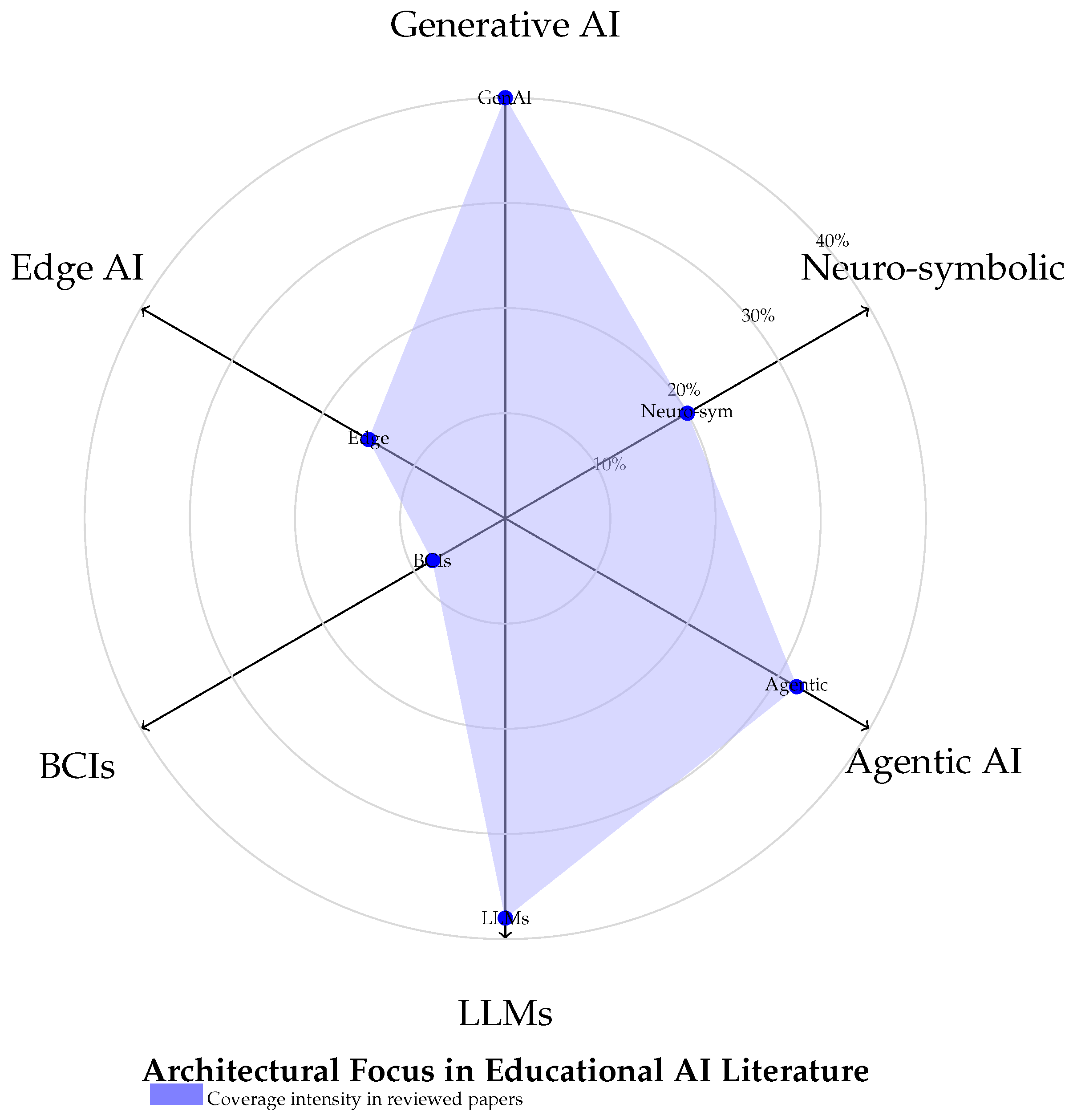
Figure 2.
Radar chart showing only architectures actually discussed in the bibliography. Missing architectures (like LAMAs) are automatically excluded.
Figure 2.
Radar chart showing only architectures actually discussed in the bibliography. Missing architectures (like LAMAs) are automatically excluded.
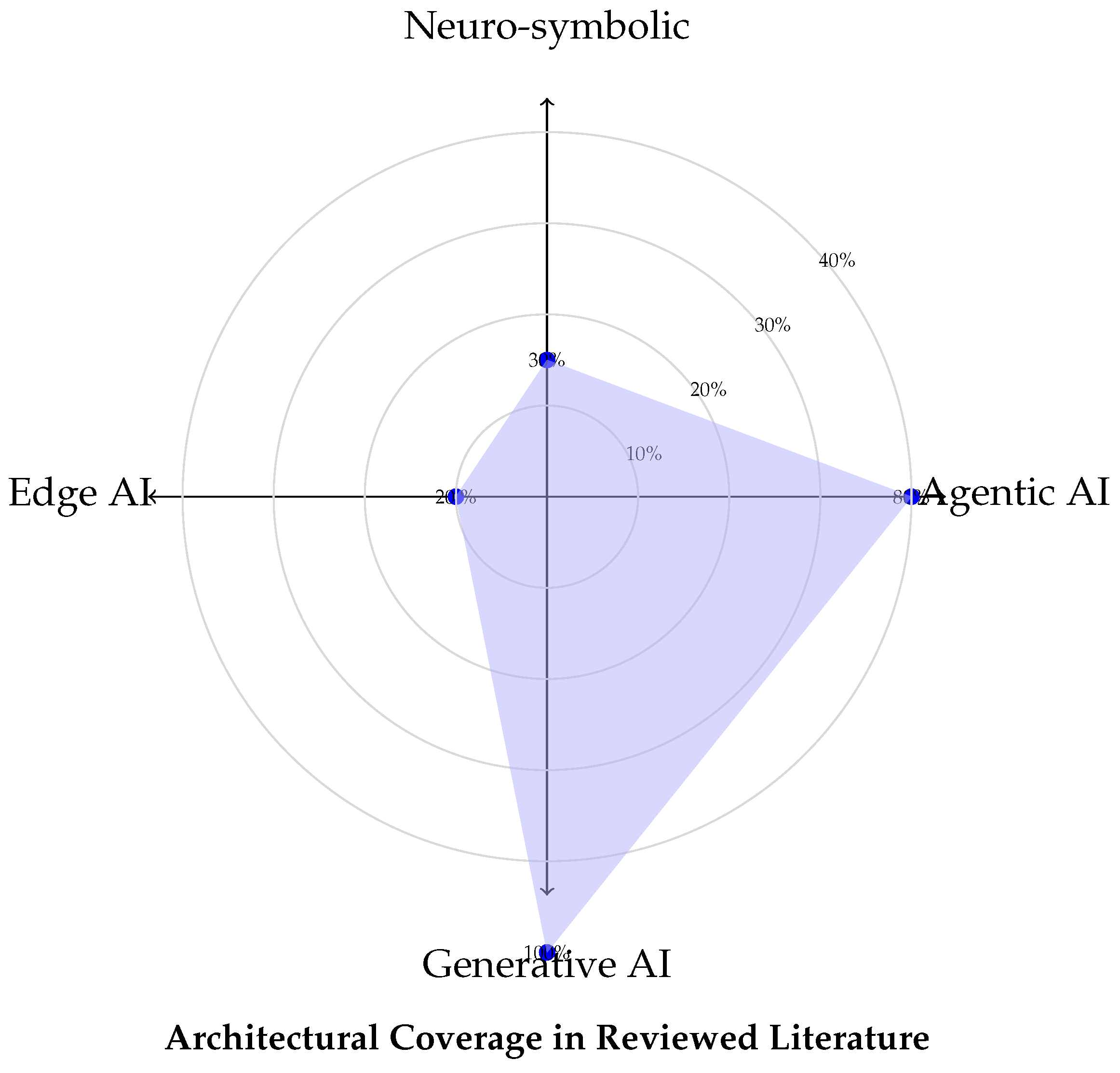
Figure 3.
Optimized adoption timeline showing clear separation between all technology trajectories with proper label placement.
Figure 3.
Optimized adoption timeline showing clear separation between all technology trajectories with proper label placement.
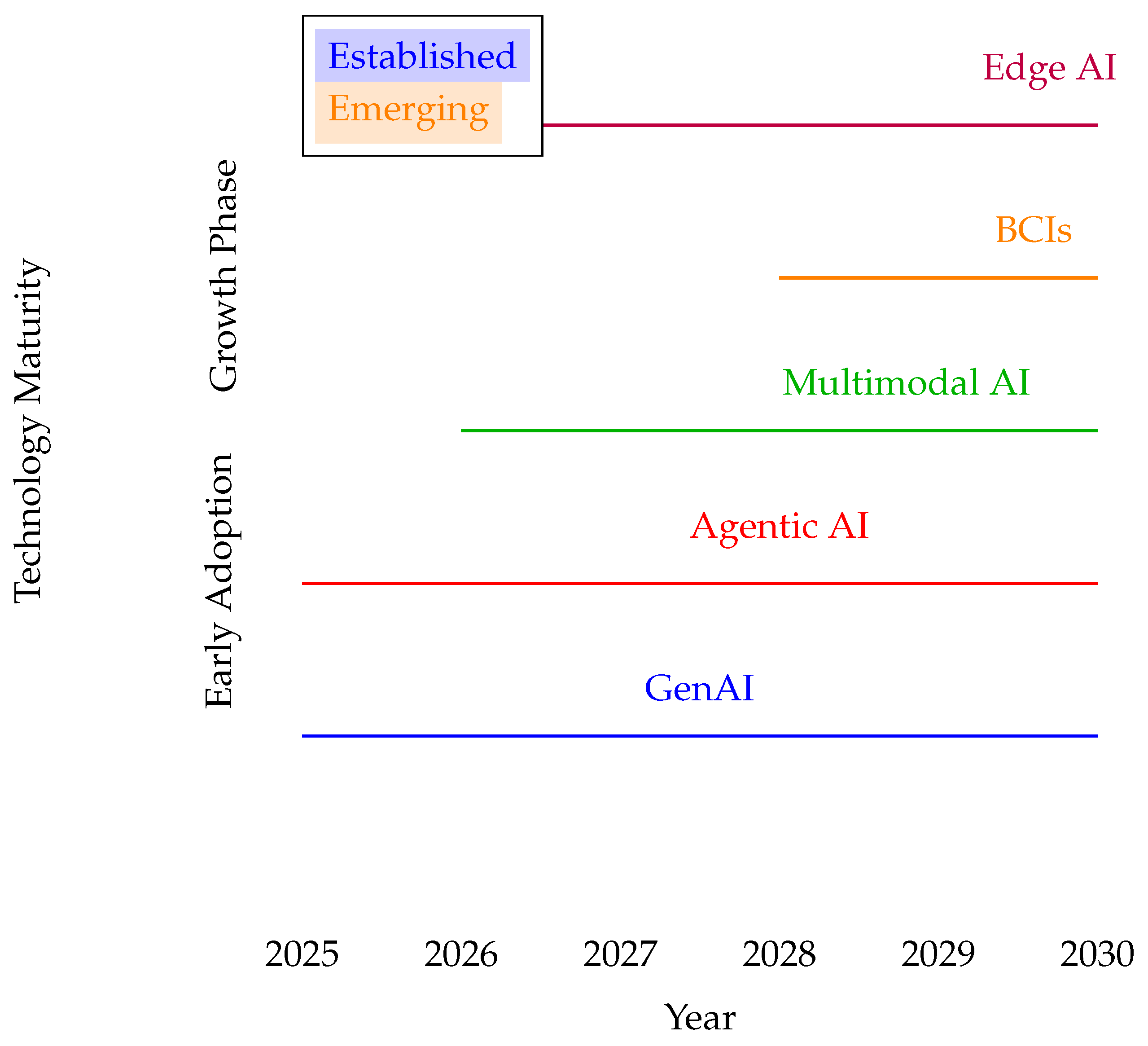
Figure 4.
Five-year timeline of GenAI-enabled education strategy. Each year includes milestone initiatives across policy, technology, pedagogy, and access.
Figure 4.
Five-year timeline of GenAI-enabled education strategy. Each year includes milestone initiatives across policy, technology, pedagogy, and access.
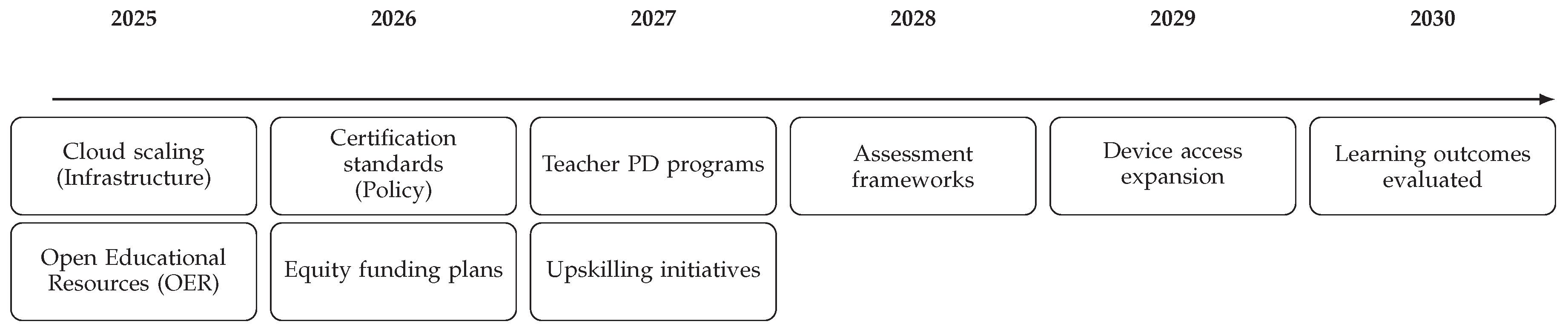
Table 1.
Current Dominant Technical Trends in Educational AI.
| Trend | Citation Support |
|---|---|
| 1. Generative AI for content creation and tutoring | 18/35 papers [7,8] |
| 2. Agentic AI systems for personalized learning | 15/35 papers [7] |
| 3. Cloud-based AI infrastructure in schools | 12/35 papers [10] |
| 4. Natural Language Processing for writing assistance | 10/35 papers [11] |
| 5. Computer vision for proctoring and accessibility | 8/35 papers [12] |
| 6. Adaptive learning algorithms | 7/35 papers [6] |
| 7. Automated assessment and feedback systems | 6/35 papers [13] |
| 8. Edge AI for resource-constrained environments | 5/35 papers [14] |
| 9. Neuro-symbolic AI for explainable recommendations | 4/35 papers [9] |
| 10. AI-powered learning analytics dashboards | 4/35 papers [15] |
Table 2.
Future-Oriented Technologies in Educational AI.
| Technology | Projected Impact |
|---|---|
| 1. Brain-Computer Interfaces (BCIs) for special education | High [9] |
| 2. Multimodal foundation models for inclusive learning | High [16] |
| 3. AI curriculum co-design with students | Medium [17] |
| 4. Digital twins for personalized learning pathways | Medium [18] |
| 5. Federated learning for privacy-preserving AI | High [19] |
| 6. AI-powered virtual reality classrooms | Medium [20] |
| 7. Blockchain for credentialing AI-assisted work | Low [21] |
| 8. Quantum machine learning for complex analytics | Low [22] |
| 9. Emotion-aware AI tutors | Medium [23] |
| 10. Self-improving AI education models | High [24] |
Table 4.
Architecture Adoption Stages in K-12.
| Architecture | Adoption Stage | Example Use |
|---|---|---|
| Generative AI | Widespread (75% districts) | Writing assistants |
| Agentic AI | Pilot programs (25%) | Personalized tutors |
| Neuro-symbolic | Research trials (5%) | Math problem-solving |
| Edge AI | Experimental (<2%) | Rural school solutions |
| BCIs | Conceptual | Special education |
Table 5.
State AI Education Policies (2025).
| State | Policy Focus |
|---|---|
| California | Comprehensive AI literacy standards |
| North Carolina | Ethical use guidelines [3] |
| Florida | Integration with computer science requirements |
| Texas | Pilot programs in low-income districts |
Disclaimer/Publisher’s Note: The statements, opinions and data contained in all publications are solely those of the individual author(s) and contributor(s) and not of MDPI and/or the editor(s). MDPI and/or the editor(s) disclaim responsibility for any injury to people or property resulting from any ideas, methods, instructions or products referred to in the content. |
© 2025 by the authors. Licensee MDPI, Basel, Switzerland. This article is an open access article distributed under the terms and conditions of the Creative Commons Attribution (CC BY) license (http://creativecommons.org/licenses/by/4.0/).
Copyright: This open access article is published under a Creative Commons CC BY 4.0 license, which permit the free download, distribution, and reuse, provided that the author and preprint are cited in any reuse.


