
Submitted:
02 June 2025
Posted:
04 June 2025
You are already at the latest version
Abstract
The aim of this letter is to use the theory of general relativity to construct Einstein and Rosen type cosmological waves in order to investigate the behavior of the inhomogeneity of the universe in the initial state of the big bang while clarifying the phenomenon of the acceleration of the observed universe. For this investigation, we use one of the integrable methods known as the inverse scattering method (ISM) Pomeransky’s to solve the Einstein field equations associated with Einstein and Rosen spacetime, whose solution leads to the gravitational soliton. In this dynamic, the gravitational soliton is assimilated to Einstein nd Rosen type cosmological waves, which are responsible for the acceleration of the universe, unlike dark energy, as stipulated by the standard model ΛCDM . Based on this approach, we find that the theory of general relativity, in its original form, is able to predict the existence of gravitons responsible for the inhomogeneity of the universe. This provides a solid basis for the quantification of gravity.
Keywords:
ΛCDM
; Soliton
; integrable methods
; (ISM) Pomeransky’s
; cosmological waves
1. Introduction
It is impossible to deny the strength and universality of the theory of general relativity, which is manifesting itself in incredible results in the fields of astrophysics, astronomy, cosmology and many other related disciplines, even if the theory has its dysfunctions [1]. Over time, the predictions of the theory of general relativity align perfectly with observations, notably the detection of gravitational waves [2]. Every member of the scientific community, whatever his or her point of view, has no objection to this significant breakthrough. Even if this silence does not mean the end of tensions between the various players concerning existing singularities within the theory of relativity. This remark, while important, leads us to question objectively the initiative to replace a theory of general relativity that works quite well with a modified theory of gravitation that has never been experimentally tested [1]. A common case of the experimental failure of modified gravitational theory was verified in the observation of gravitational waves, which demonstrated the existence of two polarizations instead of six, as predicted by modified gravitational theories [2,3,4]. Despite our consideration of this case, we also note the failure of the general relativity theory of cosmology in its prediction of dark energy and dark matter, as currently done by the model [5]. Despite the results obtained by the model on certain phenomena, it’s not out of the question to ask questions, particularly about dark matter and dark energy, which have never been observed until now. This observation raises doubts among opponents of modified gravitation theory as to the real ability of the model to provide irrefutable evidence on the origin of dark matter [6]. It is extremely difficult to define this model, as we observe that different values are attributed to the cosmological constant to explain the problem of the existence of dark energy and dark matter [6,7,8]. This speculative approach concerning the different values shows that the model contains inconsistencies that are not negligible. All these observations point to a serious problem with the cosmological model, which seems to be a theory that predicts everything, but is in fact overtaken by events. Opponents of this model feel that there is an attempt to muzzle an alternative theory to this conception [6]. Within the scientific community, this growing concern leads us to believe that we are in a vicious circle where we can try to justify, rightly or wrongly, the failures of this model based on dark energy and dark matter, which are a priori perceived as an illusion or a stratagem to keep the theory alive [6,9]. In this never-ending war of ideas, all sides are in perfect agreement on the real, observational existence of gravitational waves [3,4] based on the model of general relativity theory as well as the solution linked to gravitational waves. The aim of this article is to build on the consensus arising from the detection of gravitational waves to examine the behavior of our universe today. To achieve this, we will use a mathematical approach called inverse scattering method (ISM) improved by Pomeransky [10], which has been successfully applied in the construction and similar observation of the gravitational wave signal as detected by the LIGO-VIRGO [11], by solving Einstein’s field equations, thus giving rise to the gravitational soliton. It is important to specify that the notion of a gravitational soliton was first introduced by Belinskii and Zahkarov [12] in solving Einstein’s field equations. (ISM) Belinskii and Zahkarov [12] gave rise to the monosoliton and two-soliton, which are characterized by extremely different properties and divergent interpretations of their applications in gravitational physics. The work of Belinskii and Verdraguer [13] covers in depth the use of gravitational soliton in the various fields mentioned above. It is clear that the use of the gravitational solitons in the construction and detection of gravitational waves [11] is becoming a real instrument for exploring the nature of our cosmological universe, while also deeply examining the inhomogeneity of the universe from gravitational waves, as first shown by Belinskii and Fargion [14]. The aim of this letter is to build a cosmological model based on the creation of gravitational waves in the early universe, highlighting the presence of gravitons propagating in opposite directions, reflecting the inhomogeneity of the present-day universe.
2. The Primordial Universe
One of cosmology’s most compelling evidence is the expansion of the universe, with which the theory of relativity and the standard model are in perfect agreement. But the enigmatic question surrounding the expansion of the universe is the fundamental cause of this observed acceleration. For the Standard Model , the origin of this phenomenon would be dark matter, which, until now, has been an unconvincing hypothesis [6]. In contrast to the idea of dark energy as the cause of the universe’s expansion, Belinskii and Vereshchagin [15] have recently drawn attention to the idea that the acceleration of the universe originates from cosmological wave propagation caused by an enormous quantity of inhomogeneous solitonic perturbations chaotically distributed in spacetime, which would justify the current observation. Based on Belinskii and Vereshchagin’s [15] hypothesis, we should expect the existence of gravitational field inhomogeneity near the big bang, materialized by the presence of Gaussian-type noise. Still, based on this assumption, in the case of inhomogeneity near the big bang, we should observe fluctuations around spacetime characterized by the unavoidable presence of noise, thus demonstrating the presence of gravitons [6,16,17]. Building on Dyson’s [18] observation that the gravitational wave, as it propagates, emits gravitons that appear in the form of noise [19], gives a favorable trump card for understanding the origin and acceleration of the universe.
2.1. Cosmological Model
In this subsection, we build a model capable of answering the questions surrounding the mystery of the origin and acceleration of the universe. To do so, we take as our pretext the construction and detection of gravitational waves that was successfully carried out in Einstein and Rosen’s spacetime [11] using the gravitational soliton. It’s important to point out that Einstein and Rosen’s spacetime [20] has been used with a gravitational-wave-based approach to explaining the expansion of the universe, not to mention the remarkable work of Carmeli and Charach [17], who reviewed the various possibilities for the origin and expansion of the universe, including the existence of the graviton. Interestingly, the work [14,15,17] in the investigations used (ISM) by Belinskii and Zahkarov [12] to build cosmological models based on the two- soliton cylindrical system to understand the behavior of the universe’s expansion. As mentioned earlier, we use the Einstein and Rosen metric [11] to examine the acceleration of the universe. To do this, we introduce the Einstein and Rosen metric [11] and Einstein’s field equations in the following form:
We note that represents the cylindrical coordinates and t the time. We specify that the different functions and depend on and t. In this metric including the Einstein field equations, represents a dynamic degree of freedom of the gravitational field and plays the role of the gravitational energy of the system. It is also noted that the previous quantities written with comma as subscript denotes the partial derivatives with the associated variables. Using the decomposition of Piran et al. [21], Eqs.(2)-(4) admit for general solution the following form:
and
It is important to note that the introduction of the v and u wave vectors present in the and plays a fundamental role in clarifying the decomposition of the cosmological wave into explosion and implosion waves during its propagation in spacetime [11] near the Big Bang.
2.1.1. The Probable Origin of the Expansion of the Universe
As pointed out by Belinskii and Vereshchagin [15], the standard model does not take into account the traces of strong gravitational waves of cosmological origin left in spacetime, so it will be important to restore the remnants of these gravitational waves. Using the two-soliton cylindrical solutions obtained (ISM) by improved Pomeransky [10] associated with the Einstein and Rosen metric [11], we examine Eqs.(5)-(6) [11] and obtain the following configurations:
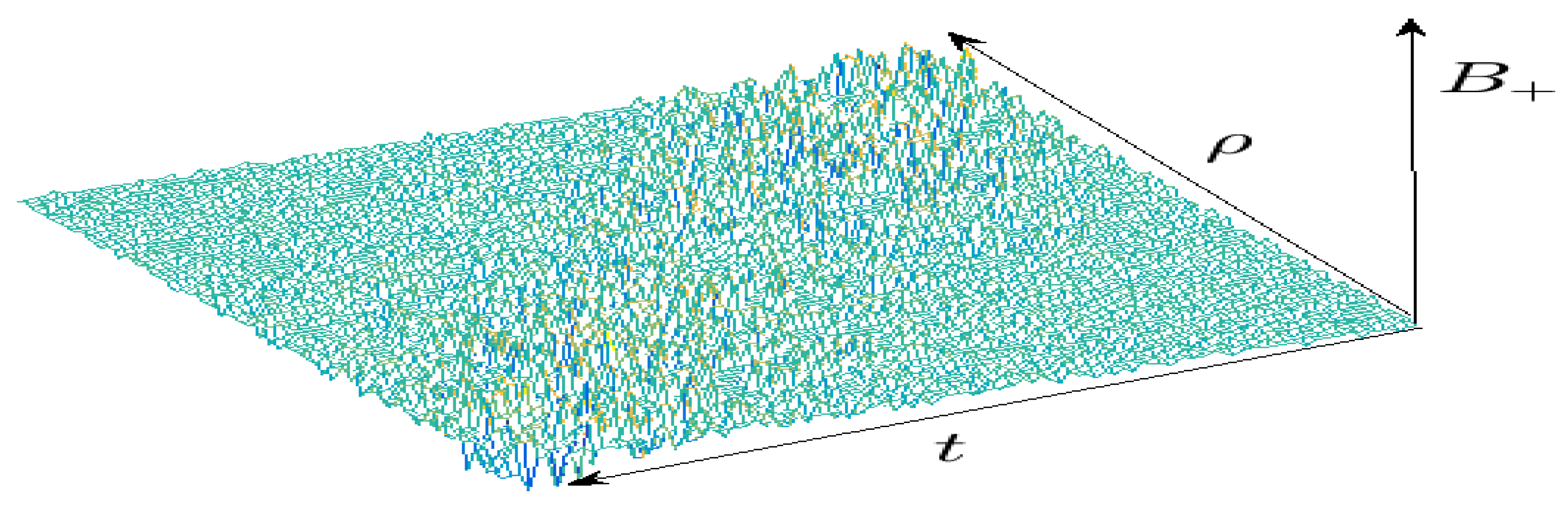
Before analyzing Figure 1 and Figure 2, we first like to point out that the parameter a plays the role of the gravitational field resulting from the solution of two-solitons cylindrical [11] with q as constant, then k represents the modulus of the gravitational field, and finally is the rotation angle associated with the initial universe’s state. By fixing the conditions on the coordinates t and , we obtain one of the conditions of the initial matter-filled universe with non-zero curvature as studied by Sahkarov [22]. The presence of matter in the initial universe confirms the inhomogeneity of the gravitational field near the big bang, as seen in Figure 1 and Figure 2. This inhomogeneity of the gravitational field shows that, during the big bang, there was a decomposition of the cosmological wave into explosion and implosion waves propagating in opposite directions [11]. In addition, we observe that, during propagation, there has been a collision between the strong cosmological waves and those of the weak cosmological waves, which is characterized by the residues observed, as shown in Figure 1 and Figure 2. These residues, which act as noise, effectively show the presence of gravitons in the initial state of the universe[17]. This observation highlights one of Sahkarov’s [23] remarks on the imbalance of matter and antimatter in the universe, which finds its explanation in the collision of cosmological waves of the soliton type with the particularity, as Hadad and Zakharov [24] point out, that only the strong wave that propagates is transparent to the detriment of the weak wave, whatever its amplitude, whatever the type of perturbation associated with spacetime. What is more, when the different waves collide, the only observable vestige is the phase shift between them, while the soliton keeps its properties intact. This discovery shows that the phase shift observed during the collision of the different waves is at the origin of the expansion of the universe. It also confirms the hypothesis that there cannot be so much matter and antimatter evenly distributed in the universe [22,23], due to the presence in small quantities of particles making up the weak waves in the initial state of the universe after the big bang.
3. Conclusion and Perspectives
Clearly, by using the gravitational wave as a probe of the primordial universe, we arrive at Weber and Wheeler’s [25] observation that the wave propagates on a real curvature in spacetime, producing real physical effects that modify the invariant distance between particles. This observation basically explains the recent idea of Belinskii and Vereshchagin [15], which already showed that the acceleration of the universe did not come from dark energy but rather from soliton-like perturbations. But one of the questions hanging over this work by Belinskii and Vereshchagin [15] is information on how many initial cosmological perturbations can correspond to complex poles and how many to real poles. Based on this idea, we have arrived at the conclusion that only the two-soliton cylindrical solution is responsible for the increase in distances and that the average global effect will also correspond to the increase in time interval and spatial distances. This confirms that cosmological waves from solitonic perturbations have the capacity to explain the origin and acceleration of the universe, as well as the inhomogeneity near the big bang. As we have seen, Figure 1 and Figure 2 show us the presence of gravitons, which are represented as residues that resemble spacetime fluctuations produced by the big bang and incorporated into Einstein’s original equations [16]. In contrast to previous work [16], we were able to show that it is not necessary to introduce the expression into Einstein’s general relativity equation. This result allows us to understand that the various recognized dysfunctions within the theory of general relativity are, in fact, problems of mathematical formalism in the resolution of Einstein’s field equations, since Einstein himself was a victim of his own theory when he analyzed the case of gravitational wave solutions [26]. We note that integrable methods such as (ISM) Pomeransky’s [10] could be one of the means of quantifying relativity theory thanks to the presence of gravitons, as demonstrated [18,19].
Declaration: The authors did not receive support from any organization for the submitted work. No funding was received to assist with the preparation of this manuscript.
References
- M. Clifford, Living Rev. Relativity.174 (2014).
- B. P. Abbott and al., LIGO-Virgo scientific collaboration, Phys. Rev. Lett.116061102 (2016).
- B. P. Abbott and al., LIGO-Virgo scientific collaboration, Classical Quantum Gravity.37055002 (2020).
- A. Nischizawa and al, Phys. Rev. D.79082002 (2019).
- S. Farnes, Astronomy.And. Astrophysics.620A92 (2018) .
- M. Corredoira, Foundations. of. Physics.47, 711–768, (2017).
- M. Krauss and S. Turner, Gen. Relativ. Grav.271137–1144 (1995).
- Reiss et al, The. Astrophysical. Journal. Letters.934:L7(52pp) (2022).
- D, Merrit arxiv.org/pdf/1703.02389.
- A. Pomeransky, Phys. Rev. D73044004 (2006).
- J. Defo and K. Kuetche, JETP.1353 (2022).
- V. Belinskii and V. Zakharov, Sov. Phys. JETP48985 (1978).
- V. A. Belinski and E. Verdaguer, Gravitational soliton (Cambridge University Press, Cambridge, 2001).
- V. A. Belinsky and D. Fargion, IL NUOVO CIMENTO591 (1980).
- V. Belinski and G. Vereshchagin Phys. Lett. B778332-338 (2017).
- T. Matos and al, arxiv.org/abs/2309.09989.
- M. Carmeli and C. Charach, Foundations. of. Physics.14, 10, (1984).
- F. Dyson, Int. J. Mod. Phys. A.2825 (2013).
- M. Parikh, F. Wilczek, and G. Zahariade, arXiv:2005.07211.
- E. Tauber, Foundations. of. Physics.14, 10, (1984).
- T. Piran, P. N. Sarfier and R. F. Stark, Phys. Rev. D323101 (1985).
- A. Sakharov, Sov. Phys. JETP523 (1980).
- A. Sakharov, Phys. Lett. USSR 5 24 (1967).
- Y. Hadad and V. Zakharov, arxiv.org/abs/1401.7251.
- J. Weber and J. A. Wheeler, Rev. Mod. Phys.29509 (1957).
- D. Kennefick, Phys. Today. 9 43 (2005).
Figure 1.
The total amplitude of the explosion wave for . It presents some localized features moving within the spacetime.
Figure 1.
The total amplitude of the explosion wave for . It presents some localized features moving within the spacetime.

Figure 2.
The total amplitude of the implosion wave for . It presents some localized features moving within the spacetime.
Figure 2.
The total amplitude of the implosion wave for . It presents some localized features moving within the spacetime.
Disclaimer/Publisher’s Note: The statements, opinions and data contained in all publications are solely those of the individual author(s) and contributor(s) and not of MDPI and/or the editor(s). MDPI and/or the editor(s) disclaim responsibility for any injury to people or property resulting from any ideas, methods, instructions or products referred to in the content. |
© 2025 by the authors. Licensee MDPI, Basel, Switzerland. This article is an open access article distributed under the terms and conditions of the Creative Commons Attribution (CC BY) license (http://creativecommons.org/licenses/by/4.0/).
Copyright: This open access article is published under a Creative Commons CC BY 4.0 license, which permit the free download, distribution, and reuse, provided that the author and preprint are cited in any reuse.


