

Submitted:
27 May 2025
Posted:
29 May 2025
You are already at the latest version
Abstract
Toxicological studies of pesticides in animal models can enhance our comprehension of their mechanisms of action in biological systems. Potential strategies for removing them from aqueous solutions could be used to treat pesticide-contaminated environments. In the present study, the tetraethyl pyrophosphate (TEPP)-induced toxicological effects, an organophosphate pesticide described as an acetylcholinesterase (AChE) inhibitor, were evaluated on the development and behavior of zebrafish (Danio rerio) and possible decontamination of the water using wine cork granules as a natural absorbent. TEPP exposition decreased the viability rate of embryos, following a typical inverted U-shaped dose-response curve, without changing the development velocity or morphology of the viable embryos. TEPP also increased preference, spent more time in the dark environment, and swimming endurance of juvenile zebrafish, in contrast to the control group. Remarkably, the water obtained from wine cork granules used in adsorption approaches contains toxic chemicals that increase mortality rates, delay embryonic development, and change the behavior of juvenile zebrafish, in contrast to the in vitro experiments reported in the literature. Overall, our findings suggest that the zebrafish model in different stages of development was able to detect TEPP-induced toxicological effects at nanomolar concentrations, which is more sensible than the in vitro experiments.
Keywords:
acetylcholinesterase
; AChE
; AChE inhibition
; adsorption
; organophophates
; Sustainable sorbent
; zebrafish
; ZET assay
1. Introduction
Organophosphates (OPs) are a class of chemical compounds that have comparable structural properties and have been extensively used as commercial insecticides [1]. OPs inhibit acetylcholinesterase (AChE), an enzyme that catalyzes the conversion of acetylcholine (ACh) to acetate and choline in synaptic gaps [2,3], which explains why excessive central nervous system stimulation leads to respiratory failure and death [4].
Tetraethyl pyrophosphate (TEPP) is an OP pesticide used in agriculture, food, and drinks that is responsible for high rates of deliberate and incidental poisoning [5]. Reports suggest that acute toxicity of TEPP in humans can induce systemic effects, such as nausea, weakness, dizziness, loss of vision, tightness of the chest, cramping, and vomiting [6]. Pesticides risk the environment because spills can pollute soil, water, air, and organisms [7]. Some of the chemical, physical, and biological procedures used to remove pesticides from aqueous solutions include adsorption, advanced oxidation, membrane filtering, phytoremediation, bioremediation, and the aeration tank approach [8].
Natural adsorbents might be used to remove pesticides from aqueous solutions [9]. Cork, a natural, renewable, and biodegradable product, has been suggested as a sustainable adsorbent for a variety of spills of hydrocarbons, oils, solvents and organic compounds [10,11]. The presence of lignin and suberin provide hydrophobicity, and the cellulose and hemicellulose high polarity, contributing to potential natural adsorbent [12]. The application of cork derivates is particularly significant from the perspective of the environment since a renewable component is employed in long-lasting products, increasing CO2 fixation [13]. Cork has therefore been utilized as a green alternative because of its porous structure, as well as being a natural raw material with cheap cost, simple access, low density, and biodegradability features [13,14,15].
The effectiveness of corks from Quercus cerris and Quercus suber trees in removing pesticides from water was also investigated [11], using biochemical methods for determining residue pesticides diluted in water samples or studying the efficiency of pesticide removal using natural adsorbent compounds [11,12,16,17]. After investigating the TEPP effects on AChE activity in commercial enzymes from electric eel (Electrophorus electricus) and released by neuronal PC12 cells in culture [18], our group also explored the efficacy of removing TEPP from water using wine corks to create cork granules as a natural adsorbent [18]. The cork granules were significant as natural adsorbent for TEPP in aquatic settings, with considerable removal efficiencies (95 ± 5% of TEPP diluted in water) [18]. TEPP solution after adsorbent procedure decreased its inhibitory effects on AChE activity in vitro assays [18], suggesting that cork granules can be utilized to clean pesticide-contaminated waterways. For the first time, here we report the toxicological effects in vivo of TEPP on the development, behavior, and morphology of embryos and juvenile zebrafish (Danio rerio), as well as a possible decontamination of the water using cork granules as a natural absorbent in an in vivo model of study.
2. Materials and Methods
2.1. Chemicals and Solutions
TEPP (Pestanal®; > 99.9% purity) was obtained from Sigma-Aldrich (St. Louis, MO, USA). This pesticide was chosen because it is commonly used in agriculture, and cleaning products, cosmetics, environmental protection, food and beverages, and personal care worldwide. Other chemicals used in the present study were of analytical reagent grade (purity higher than 95%) and purchased from Calbiochem-Novabiochem Corporation (San Diego, CA, USA), Gibco BRL (Gibco-BRL, Waltham, MA, USA) or Sigma-Aldrich Corporation (St. Louis, MO, USA).
2.2. Reconstituted Water Solution
The water was obtained from an artesian well and a public supply in Londrina Londrina (PR, Brazil), and it was dechlorinated twice through an activated carbon filter. The water parameters were measured daily before and after the experiments, including temperature (28 °C), conductivity (56 μS·cm-1), dissolved oxygen (5.6 mg·L-1) (Hanna Instruments, Barueri, SP, Brazil) and pH (6.8) (Akso, São Leopoldo, RS, Brazil). The density of fish in aquariums did not exceed 1.0 g·L-1 of water [19].
2.3. Zebrafish Collection and Maintenance
Adult wild-type zebrafish (D. rerio) (n = 100) from the farm Andrade (Vierias, MG, Brazil) were supplied to the Bioassay of the Laboratory of Animal Ecophysiology (LEFA) and Laboratory of Environmental Diagnosis (LADA) of the Department of Physiological Sciences, Center of Biological Sciences, State University of Londrina (PR, Brazil). At a maximum density of 100 animals per bag, the fish were carried in plastic bags (50 × 80 x 0.18 cm) transporting 30 L of water from the fish farm tanks. The plastic bags had 2/3 of the quantity of water and 1/3 of the volume of air to allow for gas exchange during transport. For at least seven days, the fish were acclimatized in tanks of 80 L with dechlorinated water, a biological filter, constant aeration, and a temperature of 28⁰ C maintained by a photoperiod of 14 h - 10 h (light-dark). The water was renewed at a rate of 70% every 24 h, ensuring that ammonia levels (0.01 ± 0.01 ppm) (Labcon-Alcon colorimetric test, Camboriu, SC, Brazil) were consistent with the safety of animals. The fish were fed twice a day with commercial feed (Alcon Basic® MEP 200 Complex), which is designed for ornamental fish development. Adult food was stopped 24 h before the studies and once more throughout the acute tests. After spawning in suitable trays [20], viable fertilized eggs were picked and exposed on 24-well plates in Petri dishes containing test solution, and the embryos were individually preserved in 2 mL of reconstituted water solution under the light/dark cycle [21]. The Ethics Committee on the Use of Animals of the State University of Londrina (CEUA/UEL; PR, Brazil) reviewed and approved this work under protocol number CEUA (n° 041.2022).
2.4. Preparation of the Cork Granules
The cork samples were acquired as natural adsorbents from the same brand of wine cork (São Paulo, Brazil). The cork samples were cut into bar geometry with 1.0 cm of length and approximately 3.0 mm of diameter and then triturated to obtain a particle size of 1.0 mm. The stoppers were cleaned in the manner previously described [22]. They were washed in ultrapure water and the water was renewed until there was no longer any yellow coloring in the water. To reduce the influence of particle adsorption with the analysis, the samples were filtered (Whatman 0.45 m) before analysis. They were then dried in an oven at 60 °C for 24 h before being stored in plastic containers.
2.5. Adsorption Experiments
Adsorption studies were conducted in an Erlenmeyer set containing different amounts of TEPP (0.02, 0.07 or 0.3 µmol·L−1) with or without cork granules at 5 % in a reconstituted water solution. To avoid photodegradation of the pesticide, the flasks were covered with aluminum foil and kept at room temperature (25 ± 2˚C) for a total of 24 h of contact time, with periodic agitation to establish equilibrium. In the same treatment condition mentioned above, control groups were included in our study that reflected only reconstituted water solution or only cork granules at 5 % without TEPP. For the embryo testing, we used the samples were filtered in the filter (PTFE/L 0.22 µm); for the juvenile the samples were not filtered to replicate the environment.
2.6. Experimental Design
For fish embryo toxicity (FET) assays, embryos were chosen at random and divided into seven groups (each group containing 20 embryos) and maintained in a 24-well plate (Nest Biotechnology, Rahway, USA). In each well, one embryo was kept at reconstituted water [23] in a final volume of 2 mL. The groups were exposed to different treatment condition: untreated (negative control), treated with 3,4-dichloroaniline (DCA; 2 mg·L-1; positive control), Cork, TEPP (0.02, 0.07 or 0.3 µmol·L−1) or Cork + TEPP (0.02, 0.07 or 0.3 µmol·L−1). The embryos were maintained to at 24-, 48-, 72- and 96-hours post-fertilization (hpf) from the fertilization at 26 ± 2 ºC under 14–10 h light-dark cycles. For the behavior experiments, the juvenile fish were (n = 9 per treatment) exposed to TEPP (0.02, 0.07, or 0.3 µmol·L−1), Cork, Cork + TEPP (0.02, 0.07, or 0.3 µmol·L−1) or untreated in 2.5 L tanks for 24 h. Feeding was interrupted 24 h before the beginning of the exhibition, and there was no renewal of the medium during the treatments. After that, the juveniles were subjected to light-dark behavioral tests and swimming resistance, and after that, they were sacrificed by immersion in benzocaine (0.1 g·L-1) and biometrics parameters analyzed.
2.7. Fish Embryo Toxicity (FET) Assays
The evaluation of larval development was performed at regular time points (24, 48, 72 and 96 hpf) and the embryos were scored as normal, abnormal or dead; hached/unhatched; using a stereomicroscope (Model SMZ 2 LED, software Optika View Version 7.1.1.5, Optika®. Abnormalities were considered the coagulated embryo, absence of heartbeat, lack of detachment of the tail of the yolk sac and absence of somites. Sublethal parameters such as abnormal development of the head, body axis and yolk sac, edemas, and lack of pigmentation and blood flow [21,24]. Data were expressed as the mean ± SEM of viability percentage relative to the control.
2.8. Biometric Parameters Analyses
Final weight of the fish, total length (from the anterior end of the head to the end of the caudal fin), standard length (from the anterior end of the head to the beginning of the caudal fin insertion), and survival rate (SURV) ([final number of live fish/initial number of fish] x 100) were all measured, according to previous procedure [21]. After that, the dead fish were frozen and delivered to the State University of Londrina's (PR, Brazil) animal disposal system. Data obtained from final weight (g) total length (cm), and standard length (cm) were expressed as the mean ± SEM. The survival rate (SURV) was represented as a percentage of the total.
2.9. Light-Dark Preference Assay
The light-dark behavioral tests were carried out, according to the literature [25,26,27]. In brief, the animal was placed in a center compartment (5 cm wide) inside a rectangle aquarium fixed with black or white (49 × 18 × 9 cm). After 5 min of acclimatization in the central compartment, the fish was released and filmed for 15 min by the camera installed above the aquarium, with the parameters of time spent in each environment and number of crossings in the midline, as well as the first choice of light or dark, being evaluated. The GeoVision® Gv800 was high-resolution picture capturing software with a resolution of 640 x 480 pixels. The time spent on each environment (s) and number of crossings in the midline were represented as mean ± SEM.
2.10. Swimming Resistance Test
The swimming performance of fish was assessed using an adapted experimental apparatus adapted containing a U-shaped acrylic tube system (30 mm in diameter) connected to a water pump, according to literature [25,28]. These experiments were performed after the light-dark behavioral tests sequence. The fish was inserted through a T-shaped opening to swim against the stream of water generated within the system. The flow rate was adjusted by a calibrated water valve to an initial flow rate of 3 L·min-1 (16.5 cm·s-1) for fish acclimation. After each minute, the flow rate was increased to 4, 5, 6, and finally 15 L·min-1. If the fish did not resist the current, it was expelled from the tube into a plastic box attached, in which the exhausted fish could be rescued. After exhaustion, the total swimming time was computed to calculate a swimming endurance index (SEI) according to the following formula:
2.11. Statistical Analysis
All data are always presented as mean ± standard error of the mean (SEM). Parameters from multiple groups were analyzed using a one-way analysis of variance (ANOVA), followed by Tukey post-hoc test. Whenever data did not meet normality, we employed nonparametric Kruskal-Wallis ANOVA followed by Dunn’s post hoc analysis. Comparisons between two dependent groups (light-dark test) were made using McNemar test. Statistical significance was defined as a value of p < 0.05. GraphPad Prism 6.0 was used to conduct the analysis (GraphPad Software, Inc., La Jolla, CA).
3. Results
3.1. Cork Granules and TEPP Adsorption
The cork granules used as natural adsorbent was obtained after cut, trituration, washed, filtration, and drying of cork samples. Following the adsorption approach, we produced different types of water that represented different experimental groups: Control, TEPP 0.02, TEPP 0.07, TEPP 0.3, Cork, Cork + TEPP 0.02, Cork + TEPP 0.07, Cork + TEPP 0.3.
3.2. Toxicity of TEPP and Cork + TEPP on the Viability of Embryos
In order to evaluate the impact of TEPP during zebrafish development, a study was conducted wherein fertilized eggs were subjected to continuous exposure to varying concentrations of TEPP. Subsequently, the survival of the resulting embryos was assessed and quantified, as seen in Figure 1. The TEPP significantly reduced the embryos viability from 72 hpf at 0.02 and 0.07 µmol·L-1 in comparison to the control (compare Figure 1A,D,E), but interestingly no alterations were found at 0.3 µmol·L-1 (compare Figure 1A,F). The application of DCA resulted in a decrease in the viability of embryos at 96 hpf, with a mortality rate of 26.05 ± 0.72%, according to described in the literature [29]. The cork water derived from cork granules, which was utilized in the absorption tests using TEPP, exhibited high abnormality rates between 24 and 96 hpf (compare Figure 1A,C). Cork + TEPP in the three concentrations tested also increased abnormality rates (Compare Figure 1A,G–I).
Additionally, the hatching rates were checked when embryos were exposed to TEPP, Cork, or Cork + TEPP until 96 hpf of treatment, and compared them to a negative control (Figure 2). The exposure to TEPP at concentrations of 0.02 and 0.07 µmol·L−1 inhibited the hatching high after 72 hpf compared to the control (Figure 2C,D). However, at a dose of 0.3 µmol·L−1 (Figure 2E), the hatching rate was found to be identical to that of the control group. The exposure to the cork solution also resulted in a reduction in the hatching rate at 96 hpf (Figure 2B). On the other hand, it can be observed that the combination of Cork and TEPP appear to have attenuated the Cork-induced toxicity in a concentration-dependent manner, as depicted in Figure 2F–H. The DCA (positive control) anticipated occurrence of embryo hatching at 72 hpf in comparison to the untreated group (Figure 2A).
3.3. Effects of TEPP and Cork + TEPP on the Developmental Abnormalities
The parameters of abnormality were assessed in the developing zebrafish [21] exposed to TEPP at 0.3 µmol·L−1 or TEPP + Cork groups at various concentrations, and these measurements were conducted at 24, 48, 72, and 96 hpf. Non-detachment of the tail, lack of somite formation or heartbeat, pericardial or yolk sac oedemas, cranial/mandibular/maxillary change, absence of eyes, spinal curvature (scoliosis), or swim bladder inflation were detected in all groups studied (data not shown). Furthermore, the impact of TEPP in various concentrations, DCA, Cork or Cork + TEPP on the rate of development was examined at 24, 48, 72, and hpf of treatment. The results indicated that neither DCA nor TEPP at 0.3 µmol·L−1 had any significant effect on the development velocity (Figure 3A,B). However, it should be noted that the use of Cork solution and Cork + TEPP at a concentration of 0.02 µmol·L−1 resulted in a significant delay in the growth of zebrafish larvae (Figure 3C,D, respectively). Cork and TEPP, at concentrations of 0.07 and 0.3 µmol·L−1, exhibited a delay in development until 72 hpf, but were comparable to those of the control group at 96 hpf (Figure 3E,F, respectively).
3.4. Toxicity of TEPP and Cork + TEPP on the Viability of Zebrafish Juveniles
In all tested concentrations, the application of TEPP and cork solution did not provide statistically significant alterations in the survival rates as compared to the control group (Figure 4A). However, the survival rates decreased in a concentration-dependent manner when Cork was combined with TEPP, as seen in Figure 4A. The survival rates of juveniles were seen to drop by 62.5% and 87.5% when exposed to TEPP + Cork concentrations of 0.07 and 0.3 µmol·L−1, respectively, compared to the control or Cork groups. The biometric parameters for living zebrafish were assessed only in the TEPP and Cork groups, and subsequently compared to the control group. There were no significant alterations seen in the weight (Figure 4B), total length (Figure 4C), and standard length (Figure 4D) of the zebrafish following the administration of TEPP and Cork treatment.
3.5. Effects of TEPP and Cork on Behavior Fish (Light-Dark Environment Preference)
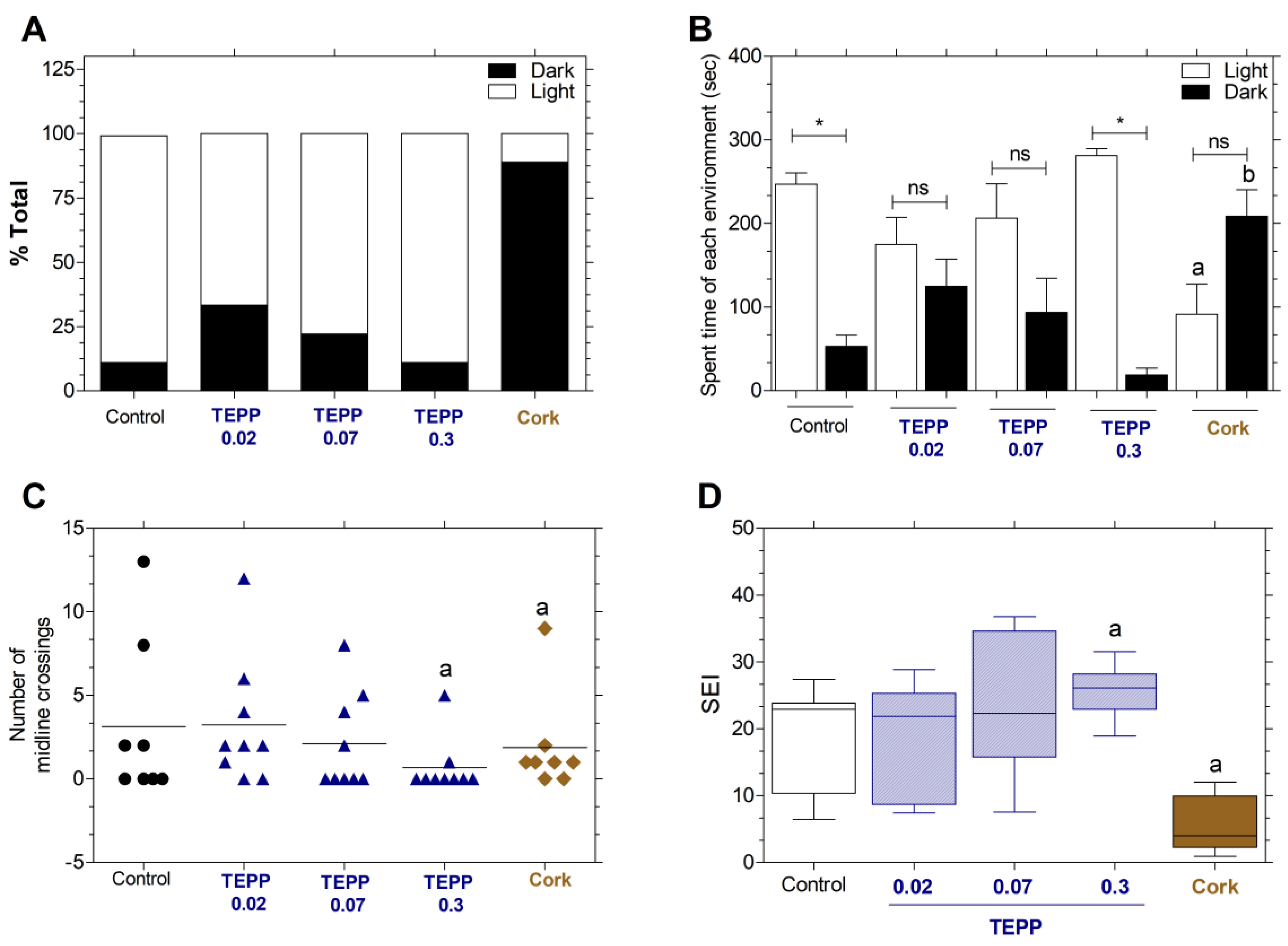
TEPP increased preference and spent more time in the dark environment in a concentration-dependent manner (Figure 5A,B). TEPP at 0.02 µmol·L−1 showed 33% of zebrafish in the dark environment in contrast to the control group that showed preference for the light environment and 11% of zebrafish in the dark environment (Figure 5A,B). Interestingly, the zebrafish treated with Cork solution significantly preferred and spent more time in the dark environment (Figure 5A,B). In addition, only TEPP at 0.3 µmol·L−1 and Cork solution significantly reduced the number of midline crossings (Figure 5C).
3.6. Effects of TEPP and Cork on Behavior Fish (Swimming Endurance Test)
The application of TEPP at a concentration of 0.3 µmol·L−1 resulted in a considerable increase in SEI when compared to the control group. This increase in SEI was observed in a concentration-dependent manner, as shown in Figure 5D. In contrast, the use of a Cork solution resulted in a notable reduction in swimming resistance, with a mean value of 5.5 ± 1.5, as opposed to the control group which exhibited a substantially higher resistance of 18.8 ± 2.5 (Figure 5D).
4. Discussion
Zebrafish (Danio rerio) is widely recognized as a remarkably effective model for investigating many substances and environments that might cause toxicity [30,31]. This is due to its ecological significance, since pollutants tend to flow and accumulate in watercourses and basins, so affecting their chemical and physical properties [31]. The use of zebrafish in pesticide toxicity studies to capture data on the types of pesticide used, classes of pesticides, and zebrafish life stages associated with toxicity endpoints and phenotypic observations has been widely reported in literature [32]. In this work, we found that the TEPP, an organophosphorus insecticide extremely toxic used in agriculture and household [5,6,33], decreased the viability rate of embryos after 72 hpf of exposition in a concentration-dependent manner However, it did not affect the development velocity or morphology of the viable embryos. TEPP also altered the behavioral features of juvenile zebrafish, including their preference for light or dark environments and swimming endurance. Additionally, we also investigated the cork granules properties as a natural absorbent for the removal of TEPP diluted in zebrafish water and evaluated the TEPP-induced toxicological effects on the development and behavior of embryos and juvenile zebrafish. Surprisingly, the water derived from cork granules employed in adsorption procedures exhibited reduced viability, delayed the development of embryos and significant alterations in the behavioral parameters of juvenile zebrafish.
TEPP in concentration ≤ 0.07 µmol·L-1 after 72 hpf to exposition increased the mortality rate of embryos, but interestingly no alterations were found at 0.3 µmol·L−1. Likewise, juvenile zebrafish exposed to TEPP at lower concentrations increased preference and spent more time in the dark environment in contrast to the control group. TEPP at 0.02, 0.07, and 0.3 µmol·L−1 spent 125.0 ± 32.3, 93.5 ± 40.9, and 18.6 ± 8.2 sec in the dark environment in contrast to the control, which showed 53.0 ± 13.5 sec. Our findings suggest that TEPP displayed a typical inverted U-shaped dose-response effect, a nonlinear relationship which has been frequently reported when studying the negative or positive actions of pharmacological and non-pharmacological treatments [34]. The inverted U-shaped dose-response effect has also been employed to explain the cholinesterase inhibitors such as MF201, MF268, or MF268 that improve performance at low doses but are ineffective at higher ones [34,35,36,37,38]. TEPP-induced toxicity is explained in part by excessive stimulation of the central nervous system due to irreversible inhibition of AChE activity [4]. Given that AChE inhibition is widely accepted as the primary mechanism of action of TEPP, we have suggested that their changes in the development and behavior of zebrafish follow a dose-response curve that appears like an inverted U shape, similar to other cholinesterase inhibitors.
The TEPP-induced toxicity was studied in vitro using the neuronal PC12 cell line, and it was demonstrated that TEPP reduced cell viability in concentrations higher than 10 µmol·L−1 after 48 h of treatment [18]. In addition, studies also reported the inhibitory effects of TEPP on commercial AChE [4,18] and brain AChE in different tropical fishes showed IC50 (concentration able to inhibit the enzyme in 50% of its activity) higher than 20 µmol·L−1 [39]. Despite that, the toxicological effects of TEPP on the development of embryos and the behavior of juvenile zebrafish were reported at concentrations less than 0.07 µmol·L−1, which is at least 25 times lower than the effects seen in vitro. This means that the zebrafish model used to study the effects of TEPP in vivo, with larvae at different stages of development and juveniles, was more useful than methods in vitro. Indeed, the zebrafish model has been regarded as an important biological platform for risk assessment and a sensible strategy for testing the toxicity of OP, pyrethroid, azole, and triazine classes of pesticides [32].
The efficacy of cork granules as natural adsorbents for pesticide removal from water was examined by biochemical and neuronal cell culture approaches [11,18], however, no in vivo model studies has been reported yet. Cork is a porous substance composed of prismatic cells arranged in a honeycomb structure [15]. The water forms clusters around hydrophilic sites on the surface of porous, and diffuses into the cell wall, leading to a swelling of the material [40]. Physical-chemical interactions and the key binding sites between pesticide molecules and cork determine how the pesticides are retained and how well they can stick to the cork [10,41]. Here, we also had the motivation to investigate the efficiency of cork granules for the removal of TEPP from reconstituted water for zebrafish maintenance on the development of embryos and the behavior of juveniles. Unfortunately, the water derived from cork granules after the adsorption experiments induced toxicological effects on embryos and juvenile zebrafish. The use of cork water led to an elevated count of abnormal and dead larvae from 24 to 96 hpf, a decrease in the hatching rate, and a delay in the development of the larvae. In juvenile zebrafish, the cork water did not change viability, weight, total length, or the standard length of the zebrafish; however, it stimulated preference and spent more time in the dark environment, reducing the number of midline crossings and swimming endurance. Despite that, it is important to highlight that cork water did not change neuronal PC12 cell viability in our previous study [18]. Our data suggest that the zebrafish experiment, performed at different stages of development, displayed increased vulnerability to poisonous substances when compared to in vitro studies. Additional investigation is required to have a comprehensive understanding of the impacts of toxic chemicals incorporated in water cork, which is generated using cork granules obtained from commercially available wine corks.
Cork granules adsorbed over 95% of TEPP diluted in water, decreasing TEPP's inhibitory effects on AChE activity in commercial enzyme from electric eel (E. electricus) and neuronal PC12 cell culture medium [18]. Unfortunately, the current investigation revealed that the use of cork granules as an adsorption substrate for removing TEPP diluted in zebrafish water was unsuccessful because toxicological effects were seen on embryos and juvenile zebrafish exposed to cork water. Despite that, Cork + TEPP in higher concentrations appear to alleviate the Cork-induced toxic effects, in particular the hatching rates after 72 hpf and delayed development at 96 hpf, in a concentration-dependent manner. On the other hand, Cork + TEPP in higher concentrations significantly increased the mortality rates of juvenile zebrafish. The underlying differences between embryos and juvenile zebrafish in their response to TEPP + Cork remain unclear and require additional investigation.
In conclusion, our findings suggest that the TEPP pesticide changed the viability of the embryos and behavioral juvenile zebrafish in a concentration-dependent manner, assuming a typical inverted U-shaped dose-response curve. TEPP also altered the preference for light or dark environments and swimming endurance of juvenile zebrafish without changing their viability or biometric parameters. In addition, the use of wine cork granules tested as a natural adsorbent for TEPP in aquatic settings was not efficient due to increased abnormal and dead rates, a delay in the development of the larvae, or by stimulating behavioral stress in juvenile zebrafish. Furthermore, the application of wine cork granules as a natural adsorbent for TEPP in aquatic settings revealed to be ineffective due to elevated rates of abnormality and mortality, a delayed development of the larvae, or the induction of behavioral stress in juvenile zebrafish, in contrast to what was reported in in vitro studies.
Author Contributions
F.B.M.M.: conceptualization, writing—original draft, formal analysis, investigation, methodology, visualization; L.V.R.d.S.: methodology, investigation; A.G.M.: supervision, validation, funding acquisition; E.F.V.: supervision, validation, funding acquisition; P.C.M.: supervision, validation, methodology, investigation; C.A.-S.: writing—original draft, supervision, validation, formal analysis, funding acquisition, methodology, project administration, writing—review and editing. All authors have read and agreed to the published version of the manuscript
Funding
This work was supported by the State of São Paulo Research Foundation (FAPESP) and the Coordination for the Improvement of Higher Education Personnel (CAPES) (Finance Code 001).
Institutional Review Board Statement
The Ethics Committee on the Use of Animals of the State University of Londrina (CEUA/UEL; PR, Brazil) reviewed and approved this work under protocol number CEUA 041.2022 on 10 April 2022.
Informed Consent Statement
Not applicable.
Data Availability Statement
Data are contained within the article.
Acknowledgments
The authors would like to thank the technical group of the Department of Physiology Sciences (UEL) for assistance in the experimental in vivo procedures. Thanks are also due to the administrative-technical group of Natural and Humanities Sciences Center (UFABC) for secretarial assistance.
Conflict of Interest
The authors declare that they have no known competing financial interest or personal relationships that might have influenced the research presented in this study.
List of Abbreviations
| ACh | Acetylcholine |
| AChE | Acetylcholinesterase |
| ANOVA | Analysis of Variance |
| DCA | 3,4-Dichloroaniline |
| FET | Fish Embryo Toxicity |
| hpf | Hours Post-Fertilization |
| IC50 | Half Maximal Inhibitory Concentration |
| ISO | International Organization for Standardization |
| OPs | Organophosphates |
| PC12 | Pheochromocytoma cell line (rat adrenal medulla-derived cells) |
| SEM | Standard Error of the Mean |
| SEI | Swimming Endurance Index |
| TEPP | Tetraethyl Pyrophosphate |
| ZET | Zebrafish Embryo Toxicity |
References
- Georg, P. HISTORY OF ORGANOPHOSPHORUS CHOLINESTERASE INHIBITORS & REACTIVATORS. Military Medical Science Letters 2015, 84, 182–185. [Google Scholar] [CrossRef]
- Abreu-Villaça, Y.; Levin, E.D. Developmental Neurotoxicity of Succeeding Generations of Insecticides. Environ Int 2017, 99, 55–77. [Google Scholar] [CrossRef] [PubMed]
- Silva, B.R. da; Lima, J.M.F.A.; Echeverry, M.B.; Alberto-Silva, C. Haloperidol-Induced Catalepsy and Its Correlations with Acetylcholinesterase Activity in Different Brain Structures of Mice. Neurol Int 2024, 16, 1731–1741. [Google Scholar] [CrossRef]
- Maxwell, D.M.; Brecht, K.M.; Koplovitz, I.; Sweeney, R.E. Acetylcholinesterase Inhibition: Does It Explain the Toxicity of Organophosphorus Compounds? Arch Toxicol 2006, 80, 756–760. [Google Scholar] [CrossRef] [PubMed]
- Eddleston, M.; Buckley, N.A.; Eyer, P.; Dawson, A.H. Management of Acute Organophosphorus Pesticide Poisoning. Lancet 2008, 371, 597–607. [Google Scholar] [CrossRef]
- Faust, J. Poisoning Due to Tetraethylpyrophosphate. J Am Med Assoc 1949, 141, 192–193. [Google Scholar] [CrossRef]
- Àngels Olivella, M.; Caixach, J.; Planas, C.; Oliveras, A.; Jové, P. Concentrations of Organochlorine Pesticides and 2,4,6-Trichloroanisole in Cork Bark. Chemosphere 2012, 86, 754–758. [Google Scholar] [CrossRef]
- Mojiri, A.; Kazeroon, R.A.; Gholami, A. Cross-Linked Magnetic Chitosan/Activated Biochar for Removal of Emerging Micropollutants from Water: Optimization by the Artificial Neural Network. Water 2019, Vol. 11, Page 551 2019, 11, 551. [Google Scholar] [CrossRef]
- Mojiri, A.; Zhou, J.L.; Robinson, B.; Ohashi, A.; Ozaki, N.; Kindaichi, T.; Farraji, H.; Vakili, M. Pesticides in Aquatic Environments and Their Removal by Adsorption Methods. Chemosphere 2020, 253, 126646. [Google Scholar] [CrossRef]
- Pintor, A.M.A.; Ferreira, C.I.A.; Pereira, J.C.; Correia, P.; Silva, S.P.; Vilar, V.J.P.; Botelho, C.M.S.; Boaventura, R.A.R. Use of Cork Powder and Granules for the Adsorption of Pollutants: A Review. Water Res 2012, 46, 3152–3166. [Google Scholar] [CrossRef]
- de Aguiar, T.R.; Guimarães Neto, J.O.A.; Şen, U.; Pereira, H. Study of Two Cork Species as Natural Biosorbents for Five Selected Pesticides in Water. Heliyon 2019, 5. [Google Scholar] [CrossRef] [PubMed]
- Hinz, J.S.; Morés, L.; Carasek, E. Exploring the Use of Cork Pellets in Bar Adsorptive Microextraction for the Determination of Organochloride Pesticides in Water Samples with Gas Chromatography/Electron Capture Detection Quantification. J Chromatogr A 2021, 1645. [Google Scholar] [CrossRef] [PubMed]
- Carriço, C.M.; Tiritan, M.E.; Cidade, H.; Afonso, C.; Silva, J.R. e.; Almeida, I.F. Added-Value Compounds in Cork By-Products: Methods for Extraction, Identification, and Quantification of Compounds with Pharmaceutical and Cosmetic Interest. Molecules 2023, 28. [Google Scholar] [CrossRef]
- Mafra, G.; Spudeit, D.; Brognoli, R.; Merib, J.; Carasek, E. Expanding the Applicability of Cork as Extraction Phase for Disposable Pipette Extraction in Multiresidue Analysis of Pharmaceuticals in Urine Samples. J Chromatogr B Analyt Technol Biomed Life Sci 2018, 1102–1103, 159–166. [Google Scholar] [CrossRef] [PubMed]
- Pereira, Helena. Cork : Biology, Production and Uses. 2007, 336.
- Marzi Khosrowshahi, E.; Farajzadeh, M.A.; Tuzen, M.; Afshar Mogaddam, M.R.; Nemati, M. Application of Magnetic Carbon Nano-Onions in Dispersive Solid-Phase Extraction Combined with DLLME for Extraction of Pesticide Residues from Water and Vegetable Samples. Anal Methods 2021, 13, 3592–3604. [Google Scholar] [CrossRef]
- Pan, S.; Huang, Z.; Shang, C.; Wang, L.; Qiu, Q.; Xu, Z.; Zhang, D. Design and Synthesis of Amphiphilic Carboxyl-Functionalized Magnetic Polymer Microspheres for Fast Determination of Paraquat and Its Four Metabolites in Human Urine Samples Prior to Ultra-High Performance Liquid Chromatography-High Resolution Mass Spectrometry. J Chromatogr A 2022, 1670, 462998. [Google Scholar] [CrossRef]
- Blini Marengo Malheiros, F.; Vicente, E.F.; Gois Morales, A.; Alberto-Silva, C. Efficiency of the Removal of Tetraethyl Pyrophosphate (TEPP) Pesticide in Water: Use of Cork Granules as a Natural Adsorbent on Acetylcholinesterase Activity in Neuronal PC12 Cell. J Environ Sci Health B 2022, 57, 554–560. [Google Scholar] [CrossRef]
- Oikari, A. Caging Techniques for Field Exposures of Fish to Chemical Contaminants. Aquat Toxicol 2006, 78, 370–381. [Google Scholar] [CrossRef]
- Lawrence, C. The Husbandry of Zebrafish (Danio Rerio): A Review. Aquaculture 2007, 269, 1–20. [Google Scholar] [CrossRef]
- OECD Test, No. 236: Fish Embryo Acute Toxicity (FET) Test. OECD Guidelines for Testing of Chemicals. 2013. [Google Scholar] [CrossRef]
- Dias, A.N.; Simão, V.; Merib, J.; Carasek, E. Use of Green Coating (Cork) in Solid-Phase Microextraction for the Determination of Organochlorine Pesticides in Water by Gas Chromatography-Electron Capture Detection. Talanta 2015, 134, 409–414. [Google Scholar] [CrossRef] [PubMed]
- International Organization for Standardization ISO 15088:2007 - Water Quality — Determination of the Acute Toxicity of Waste Water to Zebrafish Eggs (Danio Rerio). Available online: https://www.iso.org/standard/37368.html (accessed on 17 July 2023).
- Pinho, B.R.; Santos, M.M.; Fonseca-Silva, A.; Valentão, P.; Andrade, P.B.; Oliveira, J.M.A. How Mitochondrial Dysfunction Affects Zebrafish Development and Cardiovascular Function: An in Vivo Model for Testing Mitochondria-Targeted Drugs. Br J Pharmacol 2013, 169, 1072–1090. [Google Scholar] [CrossRef] [PubMed]
- Cuenca, A.L.R.; Simonato, J.D.; Meletti, P.C. Acute Exposure of Embryo, Larvae and Adults of Danio Rerio to Fipronil Commercial Formulation Reveals Effects on Development and Motor Control. Ecotoxicology 2022, 31, 114–123. [Google Scholar] [CrossRef]
- Serra, E.L.; Medalha, C.C.; Mattioli, R. Natural Preference of Zebrafish (Danio Rerio) for a Dark Environment. Braz J Med Biol Res 1999, 32, 1551–1553. [Google Scholar] [CrossRef]
- Maximino, C.; de Brito, T.M.; da Silva Batista, A.W.; Herculano, A.M.; Morato, S.; Gouveia, A. Measuring Anxiety in Zebrafish: A Critical Review. Behavioural brain research 2010, 214, 157–171. [Google Scholar] [CrossRef]
- Vieira, L.R.; Gravato, C.; Soares, A.M.V.M.; Morgado, F.; Guilhermino, L. Acute Effects of Copper and Mercury on the Estuarine Fish Pomatoschistus Microps: Linking Biomarkers to Behaviour. Chemosphere 2009, 76, 1416–1427. [Google Scholar] [CrossRef]
- Abe, F.R.; Accoroni, K.A.G.; Gravato, C.; de Oliveira, D.P. Early Life Stage Assays in Zebrafish. Methods Mol Biol 2021, 2240, 77–92. [Google Scholar] [CrossRef]
- Ivantsova, E.; Konig, I.; Souders, C.L.; McNabney, D.; Simmons, D.D.B.; Martyniuk, C.J. Lipidomic, Metabolomic, and Behavior Responses of Zebrafish (Danio Rerio) Exposed to Environmental Levels of the Beta Blocker Atenolol. Sci Total Environ 2023, 866. [Google Scholar] [CrossRef] [PubMed]
- Toni, M.; Arena, C.; Cioni, C.; Tedeschi, G. Temperature- and Chemical-Induced Neurotoxicity in Zebrafish. Front Physiol 2023, 14. [Google Scholar] [CrossRef]
- Gonçalves, Í.F.S.; Souza, T.M.; Vieira, L.R.; Marchi, F.C.; Nascimento, A.P.; Farias, D.F. Toxicity Testing of Pesticides in Zebrafish-a Systematic Review on Chemicals and Associated Toxicological Endpoints. Environ Sci Pollut Res Int 2020, 27, 10185–10204. [Google Scholar] [CrossRef]
- Cassereau, J.; Ferré, M.; Chevrollier, A.; Codron, P.; Verny, C.; Homedan, C.; Lenaers, G.; Procaccio, V.; May-Panloup, P.; Reynier, P. Neurotoxicity of Insecticides. Curr Med Chem 2017, 24. [Google Scholar] [CrossRef]
- Baldi, E.; Bucherelli, C. The Inverted “u-Shaped” Dose-Effect Relationships in Learning and Memory: Modulation of Arousal and Consolidation. Nonlinearity Biol Toxicol Med 2005, 3, nonlin.003.01.0. [Google Scholar] [CrossRef] [PubMed]
- Wanibuchi, F.; Nishida, T.; Yamashita, H.; Hidaka, K.; Koshiya, K.; Tsukamoto, S. ichi; Usuda, S. Characterization of a Novel Muscarinic Receptor Agonist, YM796: Comparison with Cholinesterase Inhibitors in in Vivo Pharmacological Studies. Eur J Pharmacol 1994, 265, 151–158. [Google Scholar] [CrossRef]
- Braida, D.; Paladini, E.; Griffini, P.; Lamperti, M.; Maggi, A.; Sala, M. An Inverted U-Shaped Curve for Heptylphysostigmine on Radial Maze Performance in Rats: Comparison with Other Cholinesterase Inhibitors. Eur J Pharmacol 1996, 302, 13–20. [Google Scholar] [CrossRef] [PubMed]
- Braida, D.; Paladini, E.; Griffini, P.; Lamperti, M.; Colibretti, L.; Sala, M. Long-Lasting Antiamnesic Effect of a Novel Anticholinesterase Inhibitor (MF268). Pharmacol Biochem Behav 1998, 59, 897–901. [Google Scholar] [CrossRef]
- Grasing, K. A Threshold Model for Opposing Actions of Acetylcholine on Reward Behavior: Molecular Mechanisms and Implications for Treatment of Substance Abuse Disorders. Behavioural brain research 2016, 312, 148–162. [Google Scholar] [CrossRef] [PubMed]
- Assis, C.R.D.; Linhares, A.G.; Oliveira, V.M.; França, R.C.P.; Carvalho, E.V.M.M.; Bezerra, R.S.; de Carvalho, L.B. Comparative Effect of Pesticides on Brain Acetylcholinesterase in Tropical Fish. Sci Total Environ 2012, 441, 141–150. [Google Scholar] [CrossRef]
- Lequin, S.; Chassagne, D.; Karbowiak, T.; Gougeon, R.; Brachais, L.; Bellat, J.P. Adsorption Equilibria of Water Vapor on Cork. J Agric Food Chem 2010, 58, 3438–3445. [Google Scholar] [CrossRef]
- Domingues, V.F.; Priolo, G.; Alves, A.C.; Cabral, M.F.; Delerue-Matos, C. Adsorption Behavior of Alpha -Cypermethrin on Cork and Activated Carbon. J Environ Sci Health B 2007, 42, 649–654. [Google Scholar] [CrossRef]
Figure 1.
Toxicity of TEPP and cork + TEPP on embryos viability. Embryos were untreated (A) or treated with DCA (B), Cork solution (C), TEPP [0.02 (D), 0.07 (E), or 0.3 (F) µmol·L−1], or Cork + TEPP [0.02 (G), 0.07 (H), or 0.3 (I) µmol·L−1]. The embryos viability rates were scored as normal, abnormal, or dead after 24, 48, 72, and 92 hpf of treatment. Values were expressed as mean ± SEM (% total) and analyzed by one-way ANOVA followed by Tukey post hoc. Significant differences from the negative control group (untreated) are indicated by * p < 0.05 in relation to the negative control group. hpf: hours post-fertilization; DCA: 3,4-dichloroaniline (2 mg·L-1; positive control); TEPP: Tetraethyl pyrophosphate.
Figure 1.
Toxicity of TEPP and cork + TEPP on embryos viability. Embryos were untreated (A) or treated with DCA (B), Cork solution (C), TEPP [0.02 (D), 0.07 (E), or 0.3 (F) µmol·L−1], or Cork + TEPP [0.02 (G), 0.07 (H), or 0.3 (I) µmol·L−1]. The embryos viability rates were scored as normal, abnormal, or dead after 24, 48, 72, and 92 hpf of treatment. Values were expressed as mean ± SEM (% total) and analyzed by one-way ANOVA followed by Tukey post hoc. Significant differences from the negative control group (untreated) are indicated by * p < 0.05 in relation to the negative control group. hpf: hours post-fertilization; DCA: 3,4-dichloroaniline (2 mg·L-1; positive control); TEPP: Tetraethyl pyrophosphate.
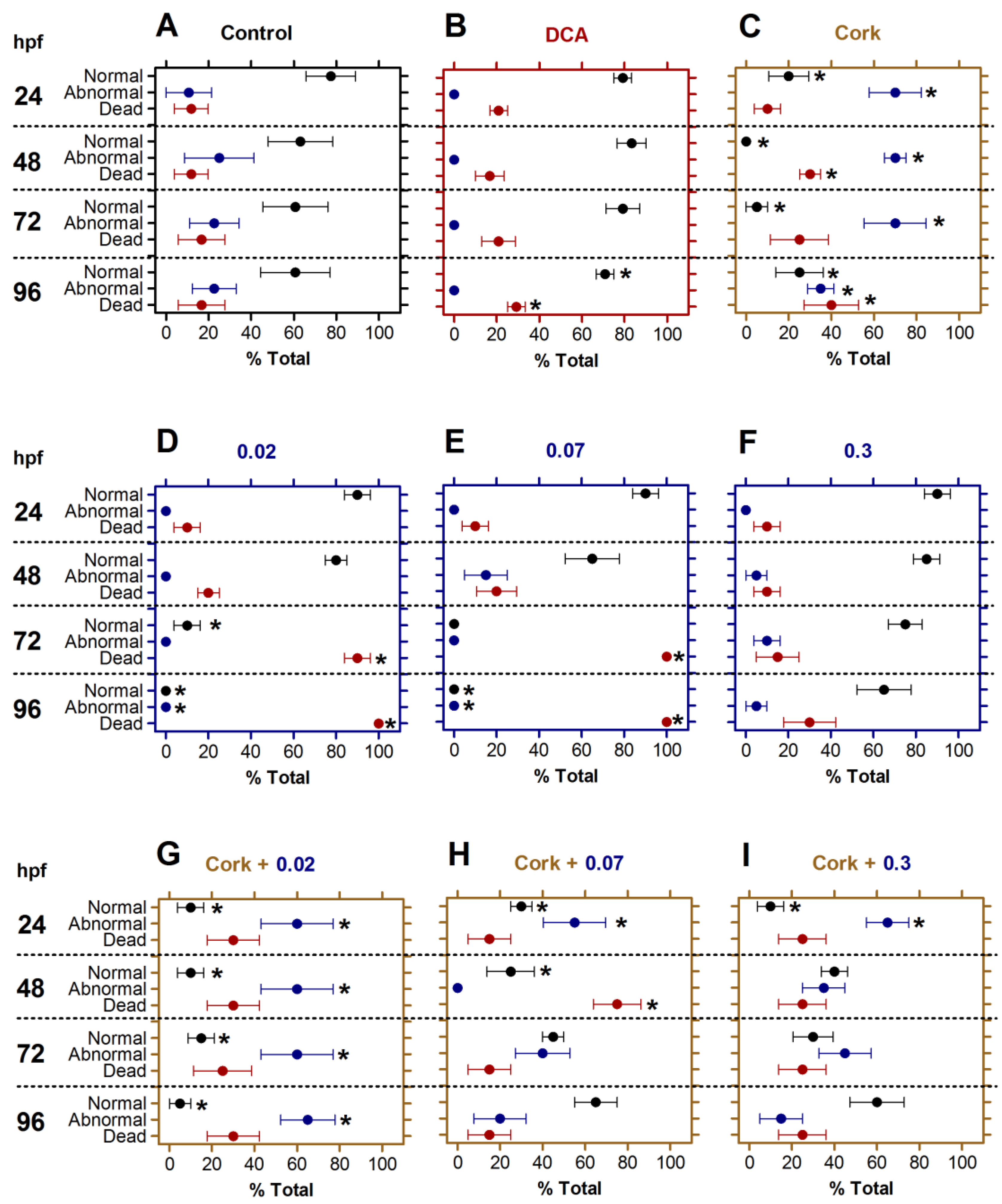
Figure 2.
The impact of TEPP and cork + TEPP on the hatching rates of zebrafish embryos. Embryos were treated with DCA (A), Cork water (B), TEPP [0.02 (C), 0.07 (D), or 0.3 (E) µmol·L−1], Cork + TEPP [0.02 (F), 0.07 (G), or 0.3 (H) µmol·L−1]. Values were expressed as mean ± SEM (% total) and analyzed by one-way ANOVA followed by Tukey post hoc. Significant differences from the negative control group (untreated) are indicated by * p < 0.05 in relation to the negative control group. hpf: hours post-fertilization; DCA: 3,4-dichloroaniline (2 mg·L-1; positive control); TEPP: Tetraethyl pyrophosphate.
Figure 2.
The impact of TEPP and cork + TEPP on the hatching rates of zebrafish embryos. Embryos were treated with DCA (A), Cork water (B), TEPP [0.02 (C), 0.07 (D), or 0.3 (E) µmol·L−1], Cork + TEPP [0.02 (F), 0.07 (G), or 0.3 (H) µmol·L−1]. Values were expressed as mean ± SEM (% total) and analyzed by one-way ANOVA followed by Tukey post hoc. Significant differences from the negative control group (untreated) are indicated by * p < 0.05 in relation to the negative control group. hpf: hours post-fertilization; DCA: 3,4-dichloroaniline (2 mg·L-1; positive control); TEPP: Tetraethyl pyrophosphate.
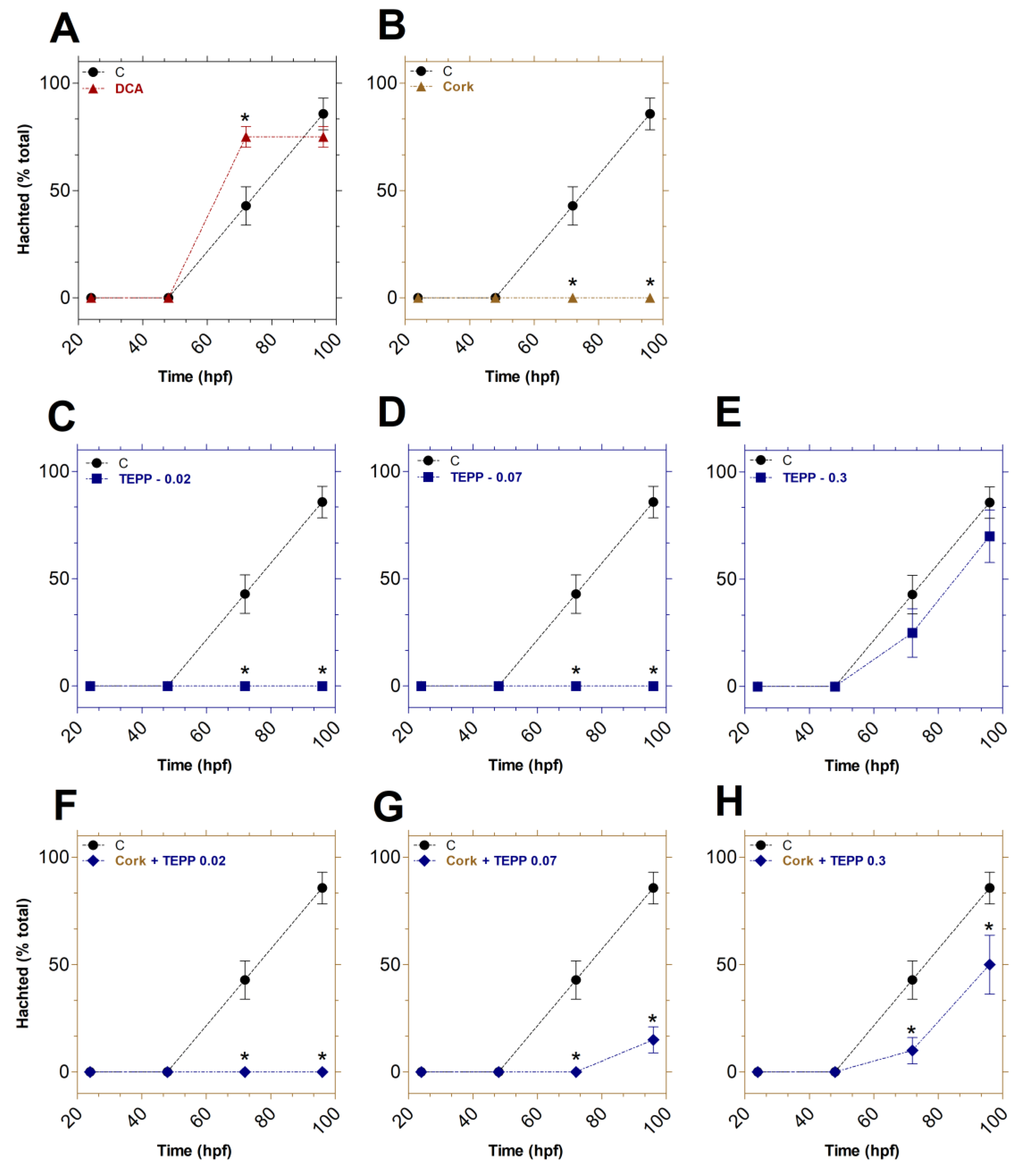
Figure 3.
TEPP and cork + TEPP effects on zebrafish development. Embryos were treated with DCA (A), TEPP at 0.3 µmol·L−1 (B), Cork solution (C), or Cork + TEPP [0.02 (D), 0.07 (E), or 0.3 (F) µmol·L−1]. Values were expressed as mean ± SEM (% total) and analyzed by one-way ANOVA followed by Tukey post hoc. Significant differences from the negative control group (untreated) are indicated by * p < 0.05 in relation to the negative control group. hpf: hours post-fertilization; DCA: 3,4-dichloroaniline (2 mg·L-1; positive control); TEPP: Tetraethyl pyrophosphate.
Figure 3.
TEPP and cork + TEPP effects on zebrafish development. Embryos were treated with DCA (A), TEPP at 0.3 µmol·L−1 (B), Cork solution (C), or Cork + TEPP [0.02 (D), 0.07 (E), or 0.3 (F) µmol·L−1]. Values were expressed as mean ± SEM (% total) and analyzed by one-way ANOVA followed by Tukey post hoc. Significant differences from the negative control group (untreated) are indicated by * p < 0.05 in relation to the negative control group. hpf: hours post-fertilization; DCA: 3,4-dichloroaniline (2 mg·L-1; positive control); TEPP: Tetraethyl pyrophosphate.
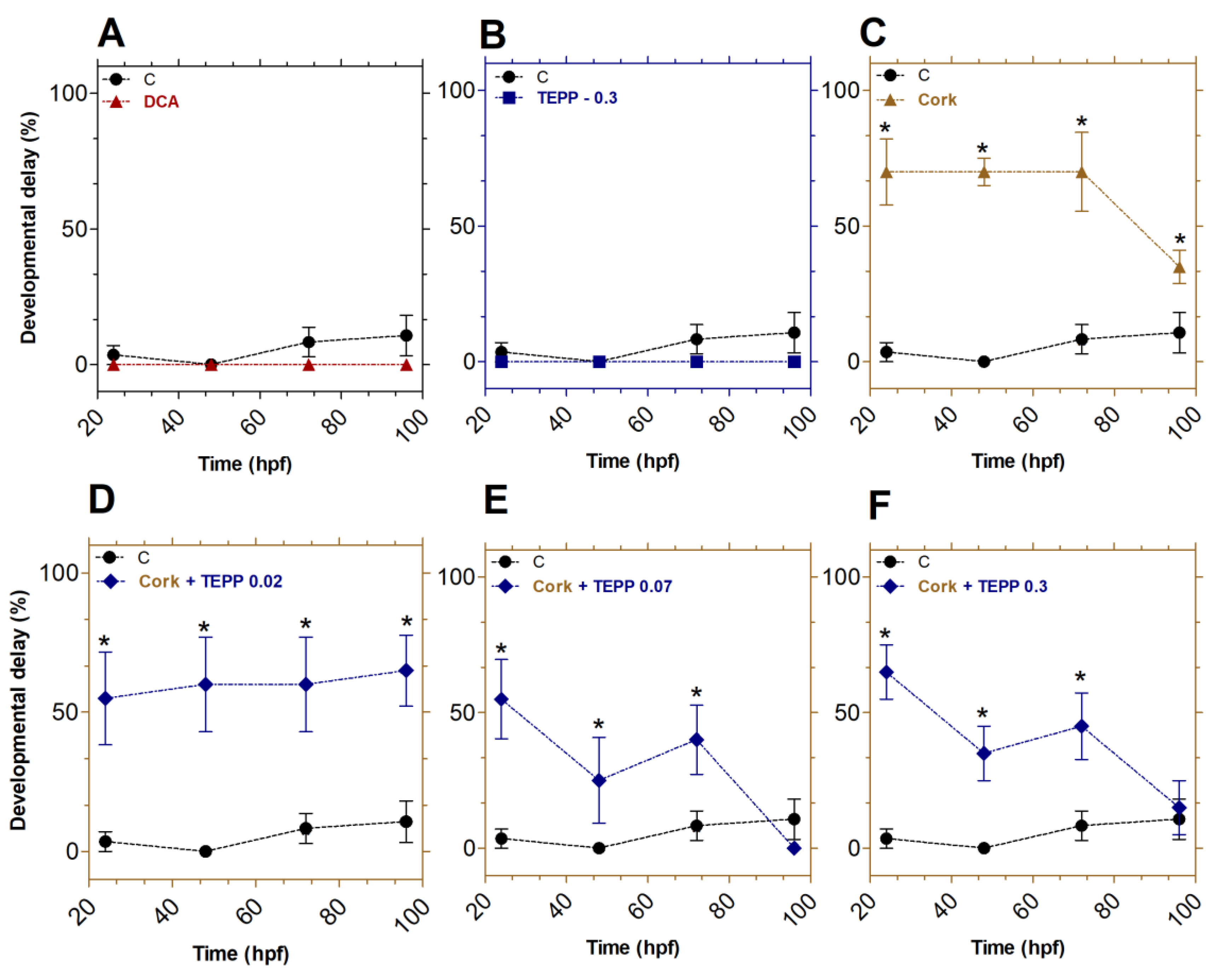
Figure 4.
TEPP and cork + TEPP exposition on zebrafish juveniles. (A) Survival rate of zebrafish after 24h of different exposures with TEPP (0.02, 0.07 or 0.3 µmol·L−1), Cork, and Cork + TEPP (0.02, 0.07 or 0.3 µmol·L−1, expressed as a percentage of the total. The live fish were sacrificed, and (B) weight, (C) total length, and (D) standard length were measured and expressed as the mean ± SEM (n = 9-10 per group). One-way ANOVA was employed for the statistical evaluation, followed by Tukey post hoc. Significant differences from the negative control group (untreated) are indicated by * p < 0.05 in relation to the negative control group. TEPP: Tetraethyl pyrophosphate.
Figure 4.
TEPP and cork + TEPP exposition on zebrafish juveniles. (A) Survival rate of zebrafish after 24h of different exposures with TEPP (0.02, 0.07 or 0.3 µmol·L−1), Cork, and Cork + TEPP (0.02, 0.07 or 0.3 µmol·L−1, expressed as a percentage of the total. The live fish were sacrificed, and (B) weight, (C) total length, and (D) standard length were measured and expressed as the mean ± SEM (n = 9-10 per group). One-way ANOVA was employed for the statistical evaluation, followed by Tukey post hoc. Significant differences from the negative control group (untreated) are indicated by * p < 0.05 in relation to the negative control group. TEPP: Tetraethyl pyrophosphate.
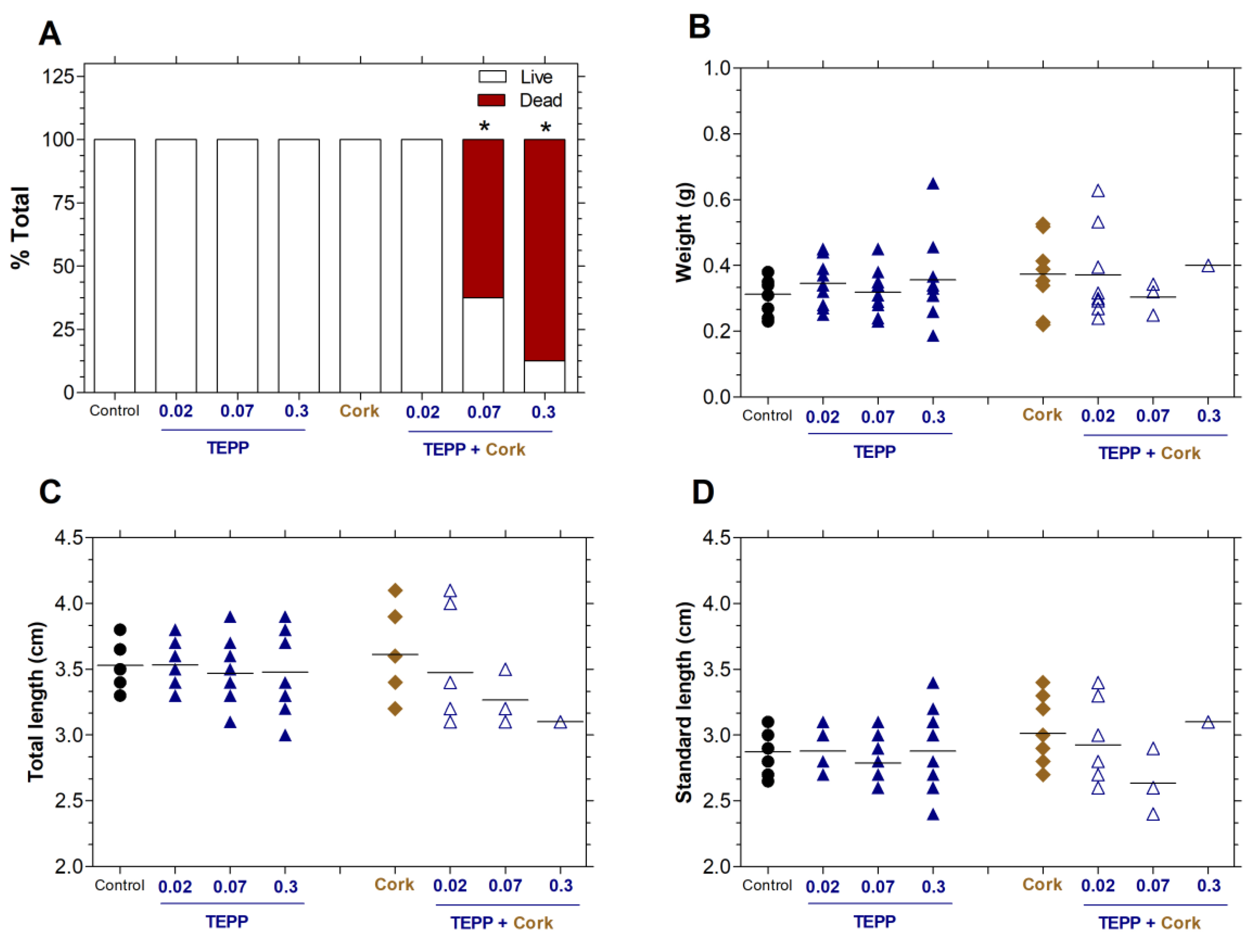
Figure 5.
Effects of TEPP and cork in the light-dark test and swimming endurance index. (A) First choice of light or dark. (B) Time spent in each environment. (C) Number of crossings in the midline. (D) Swimming endurance index (SEI). Juveniles Danio rerio (n = 9-10 per group) were submitted to an endurance test after 24 h of exposure to TEPP (0.02, 0.07 or 0.3 µmol·L−1) and Cork The spent in each environment was expressed as the mean ± SEM (n = 9-10 per group) and analyzed by one-way ANOVA, followed by Tukey post hoc. (A-C) The letters represent differences in time spent on light environments in the treated groups vs light environment controls (a) and on dark environments in the treated groups vs dark environment controls (b); asterisks indicate a significant difference in the time spent between both environments; ns: no significant difference among treatments was observed. (D) p < 0.05 in relation to the control group (untreated) (a). TEPP: Tetraethyl pyrophosphate.
Figure 5.
Effects of TEPP and cork in the light-dark test and swimming endurance index. (A) First choice of light or dark. (B) Time spent in each environment. (C) Number of crossings in the midline. (D) Swimming endurance index (SEI). Juveniles Danio rerio (n = 9-10 per group) were submitted to an endurance test after 24 h of exposure to TEPP (0.02, 0.07 or 0.3 µmol·L−1) and Cork The spent in each environment was expressed as the mean ± SEM (n = 9-10 per group) and analyzed by one-way ANOVA, followed by Tukey post hoc. (A-C) The letters represent differences in time spent on light environments in the treated groups vs light environment controls (a) and on dark environments in the treated groups vs dark environment controls (b); asterisks indicate a significant difference in the time spent between both environments; ns: no significant difference among treatments was observed. (D) p < 0.05 in relation to the control group (untreated) (a). TEPP: Tetraethyl pyrophosphate.
Disclaimer/Publisher’s Note: The statements, opinions and data contained in all publications are solely those of the individual author(s) and contributor(s) and not of MDPI and/or the editor(s). MDPI and/or the editor(s) disclaim responsibility for any injury to people or property resulting from any ideas, methods, instructions or products referred to in the content. |
© 2025 by the authors. Licensee MDPI, Basel, Switzerland. This article is an open access article distributed under the terms and conditions of the Creative Commons Attribution (CC BY) license (http://creativecommons.org/licenses/by/4.0/).
Copyright: This open access article is published under a Creative Commons CC BY 4.0 license, which permit the free download, distribution, and reuse, provided that the author and preprint are cited in any reuse.