

Submitted:
27 May 2025
Posted:
28 May 2025
You are already at the latest version
Abstract
The Internet of Things (IoT) is revolutionizing device communication, with over 30 billion connected devices and projections exceeding 40 billion worldwide. However, integrating these heterogeneous systems remains a significant challenge, especially in sensitive domains such as healthcare, where isolated ecosystems and proprietary standards severely limit interoperability. In our previous work, we introduced "SHARE: A Design Pattern for Dynamic Composition of IoT Services", which proposed a novel integration model. This paper builds on that foundation by presenting the SHARE design pattern in greater detail, focusing on its lightweight, contract-based interoperability mechanism and its applicability to resource-constrained devices. SHARE enables dynamic service composition through code exchange, leveraging coroutines and the LUA programming language. This makes it suitable for execution on microcontrollers such as the ESP32. To assess the behavior of SHARE, we developed a simulator and employed Object Constraint Language (OCL) to verify its correctness formally. The results demonstrate that SHARE is scalable and well-suited for supporting decentralized, interoperable IoT ecosystems, even in environments with limited computational resources.
Keywords:
Design pattern
; IoT device integration
; IoT programming
1. Introduction
The Internet of Things (IoT) comprises a vast network of interconnected devices, including various systems such as computer systems, mobile gadgets, sensors, and actuators. Each device is uniquely identified and can exchange data across the network autonomously. IoT devices have grown to an enormous number of about 30 billion units connected to the Internet, and scientists estimate these numbers may grow to a threshold of 40 billion devices by the year 2025. In the variety of devices, we have an aggregation of about 20 per cent of the total, comprised of short-range sensors and more general devices used in home automation. The installation of these devices is done without a structured plan and by the average user at the time of purchase, often resulting in heterogeneous devices. The lack of structured deployment leads to fragmentation, posing challenges for seamless communication. This is because the various devices are designed and developed by different manufacturers, and their interaction is entrusted to other devices or services, which complicates the system design. In sensitive domains such as healthcare, communication and interoperability between devices are crucial, and integrating devices so adept at communicating with each other in a common ecosystem is very complex, if not impossible, due to closed or proprietary protocols. IoT services are present in a wide range, from smart home automation to healthcare applications, and this massive presence of different services has rendered standardization efforts futile [3,4]. In this work, we present a pattern that enables dynamic service composition with formal guarantees of correctness, optimized for embedded environments.
In the contemporary context, the integration of IoT services is being approached through a variety of methodologies. Different IoT cloud actors have a preference for solutions that centralize data. Consequently, users are able to define centralized applications to define the related integrated services. The problem that arises is related to scalability, a feature that cannot be fully achieved through a centralized solution, consequently, there is a move towards computation as close as possible to the edge [5,25]. Often, a prior methodological approach is required in which client and server agree on semantics and format for each service before composition takes place. On the opposite side, one should think in terms of dynamic composition, where the composition of IoT services is a widely studied problem [26,27]. We note frameworks OSGi, SM4ALL [7], and WSDL [15,16,17] offer a viable solution for service composition. This poses a significant challenge to the potential for decentralized and peer-to-peer integration of services, as the limited memory sizes and computing power of embedded devices can impede the efficacy of these systems.
In this paper, we present an extension of our research work based on Share [1], an innovative programming standard that uses a design pattern for the dynamic composition of IoT services. Continuing the path started in previous research, we developed an execution simulator to test and validate the effectiveness of the pattern. This simulator was implemented using the LUA programming language, chosen for its lightness and adaptability to resource-limited devices. In addition, we delved into the Object Constraint Language (OCL) specification, a formal language useful for defining constraints and conditions in software systems, thus ensuring a level of reliability and consistency in the composition of IoT services. Share allows the composition of services for IoT devices that have limited resources in terms of memory and computing power. IoT devices have limited resources, exchange integration codes that specify the data format and communication protocol, and this allows the hardware limitation to be overcome. Furthermore, this overcomes the limitations of data-oriented standards and enables dynamic composition of services. Through the use of a matching language, Share offers the possibility of finding services (for composition purposes). To ensure that matched services confirm the limits imposed by composition, the design-by-contract (DCS) scheme [8] is used. The Share pattern introduces two key innovations: it can operate on extremely small devices with limited resources, and it allows the composition of peer-to-peer services without the need for a central organization. The explicitly defined LUA programming language was used to implement Share. ESP32 embedded devices were used to test this implementation. LUA was chosen as the programming language because there is a version optimized for microcontrollers with limited resources, 16KB RAM and 128 KB Flash [Embedded Lua on microcontroller].
1.1. Related Work
It is well known that IoT devices have limited computational resources, so data-oriented integration approaches such as WSDL [15,16,17] are very complicated to apply. The reason for this is related to the requirement of [28] validators to verify the compatibility of services. Due to limited computing and memory resources, and due to the complexity of the validators, it is not possible to run them on embedded devices. Furthermore, it must be pointed out that validators based on first-order logic are required, so complex constraints on service integration cannot be verified in WSDL [29,30,31]. During a call to verify that service constraints are satisfied, one might think that a reasonable approach would be the design-by-contract (DCS) [8] scheme. By adding preconditions, postconditions, and invariants to the standard definition of abstract data types, DCS requires programmers and designers to create formal, accurate, and verifiable interface specifications for software components and call these specifications contracts. The use of theories of Satisfiability Modulo allows the verification of the compatibility of the caller’s specifications with those of the called. For this reason, there are different tools (e.g., Boogie [32] and Z3 [33]) that allow the verification of constraints. To avoid problems such as the explosion of states that these approaches are subject to, a posteriori constraint verification is adopted to have a more efficient review. It has been demonstrated that no prior verification is performed during the invocation of the service. In the event of a failure during the invocation phase, it is understood that the issue is related to the caller’s preconditions not meeting the requirements of the caller. Conversely, if failure occurs during the review of the caller’s preconditions, then what does not satisfy the caller’s preconditions is the result of the call. This type of approach is also used by Share.
In [9] the OSGi specification is described, which concerns a complete and dynamic component model via a modular system implementing a service platform for Java. In the OSGi specification, we find applications or components that are bundled and can be installed, started, upgraded, uninstalled, etc., remotely without the need to reboot. Currently, they are widely used in applications ranging from smartphones to cars, industrial, marine, and building automation, PDAs, entertainment, and application servers. It might seem that a similar approach is impossible to replicate on sensor devices, given their limitations in terms of memory and computing power. Small devices may not have the resources needed to run a JVM and any other OSGi services. To give an example, an ESP32 microcontroller costing a few dollars would not be able to run an OSGi framework. The Share pattern, on the other hand, can be executed directly on a device with limited resources that is itself a node. On an ESP32 microcontroller [18] via the LUA programming language, we successfully executed Share. Devices implementing Share can communicate in peer-to-peer mode without the need for additional components.
In their comprehensive study, Washizaki et al. [6] present a detailed survey of IoT system design and architecture models that offer a structured approach to addressing typical IoT constraints, enabling their analysis from a design-oriented perspective. Their classification of reusable solutions contributes to improving both interoperability and efficiency in resource-constrained environments. To support the standardization of interactions between hardware and software, requirement patterns play a key role in defining shared constraints and functionalities.
Similarly, design patterns based on embedded systems can offer effective models for structuring interactions between hardware and software. Approaches such as SHARE align with these methodologies by enabling flexible integration that adapts to the constraints typical of IoT environments. This adaptability supports service interoperability by design. Unlike traditional approaches that rely on pre-deployment verification, SHARE employs a runtime validation mechanism, allowing it to dynamically respond to changing system conditions.
In Section 2, entitled "Materials and Methods," the Share design model is introduced, thereby providing a comprehensive structural overview. In Section 3, the utilization of Share in conjunction with the simulator and Object Constraint Language (OCL) is demonstrated. The section 4 titled "Discussion" methodically evaluates the advantages and disadvantages of employing Share, thereby providing a comprehensive conclusion to the article. It also delineates forthcoming research endeavors.
2. Materials and Methods
To better understand how SHARE operates and how it is simulated, it is essential to define both the structural and behavioral aspects of the design pattern. These aspects are effectively represented through class and sequence diagrams, which illustrate the interactions among components and the mechanisms enabling the system’s dynamic service composition.
Class diagrams are used to represent the static structure of the system, including key classes, attributes, and relationships. Sequence diagrams, on the other hand, capture the dynamic behavior by modeling time-ordered interactions between components. Together, these meta models form the foundation for implementation, supporting an organized and scalable architecture.
In the figure above Figure 1, the class diagram of the Share design pattern is shown. As can be seen, it consists of the following classes:
- Share;
- Service;
- Feature.
Service object can be stored inside the space implemented by the class Share. This class has three public methods: attach(s: Service), detach(s: Service), discovery(s: RExp):Set(Service).
The public method attach(s: Service) can be used to add a Service s to a Share object, while the method detach(s: Service) on the contrary allows to remove the Service s. The third method discovery(s: RExp):Set(Service) is able to search all Service objects with a regular expression s. A set Set(Service of all services that match the regular expression RExepare returned to the caller.
For instance, a Service double temperature_alert(double temp, double threshold) can be defined to evaluate whether a given temperature value exceeds a predefined threshold and triggers an alert if necessary. This can be added by using the method attach. The service is identified by the string "2.5.8.10" to identify the specific function. It is possible to search a service, in this case the service for the temperature alert using a regular expression RExep = "2.5.8.10" when the discovery service is used. Looking at Figure 1 the Service class define a service which has a name and this is a unique identifier such as a Management Information Base (MIB) of the Simple Network Management Protocol (SNMP) which can be used as an unique object identifier (OID) of the function performed by service [20]. We used the MIB "2.5.8.10" for the temperature_alert service example. A pre predicate is defined by a Service class. This method takes as input a Tuple t and returns a boolean value. The tuple t can include the list of parameters that are taken as input by the service. The predicate should return true when the tuple t verifies the preconditions required to run the service false otherwise. In our double temperature_alert(double temp, double threshold), the precondition predicate ensures that both temperature and threshold are within the valid operational range of the sensor. For instance, boolean pre([temperature, threshold]) verifies that they are positive and within the sensor’s limits. IoT devices (such as ESP32-based sensors) can dynamically attach or discover this service using Share, enabling seamless interoperability among different sensor nodes. A Service class needs also to specify a Tuple function(t Tuple) and a daemon(). To interact with the daemon, the function is used as a connector and it is sent to the client requesting the service. More specifically, function(t Tuple) acts as a client stub and converts the service parameters t into a format which the corresponding daemon() method can interpret. The function method establishes a connection, transmits the data to the daemon, and may optionally wait for a response. It is important to note that the serialization and deserialization handled by function and daemon are unnecessary when both the client and server use the same programming language and run on identical hardware. This setup enables highly efficient data transfer, particularly for handling complex structures or large data volumes. Additionally, when both components share the same language, it facilitates consistency checks and improves reliability, simplifying the use of verification tools. The class Features is the most important block of the design pattern Share. To implement Service class behavior, the daemon can compose one or more Features, and its regular expression id : RExp describes the functionality that is implemented by the feature. This will be utilized to locate the required feature when a Share object is called. In practice, a service that has already been defined and added to a Service repository is defined by a Feature. The output of a call may be either Boolean or Tuple. The output of the call functionality is a Tuple, and when the call execution ends successfully, the Boolean value is true; otherwise, it is false. This may result from a service not found error, a connection issue, or other kinds of failures specified inside the call implementation. A post predicate is defined by a Features class. This function returns a Boolean value after receiving a Tuple t as input. When the program evaluates the post-conditions after executing the call, the predicate should return true; otherwise, it should return false. In our example double temperature_alert(double temp, double threshold), Feature could implement the validation check to make sure the temperature does not pass over the given threshold before triggering an alert. In this case, the call takes the Tuple [temperature, threshold] and returns a Boolean value to indicate if the alert should be activated. This mechanism enables the system to integrate a new alerting service in a dynamic way based on predefined conditions. In this way, it ensures an efficient monitoring in IoT-based environments.
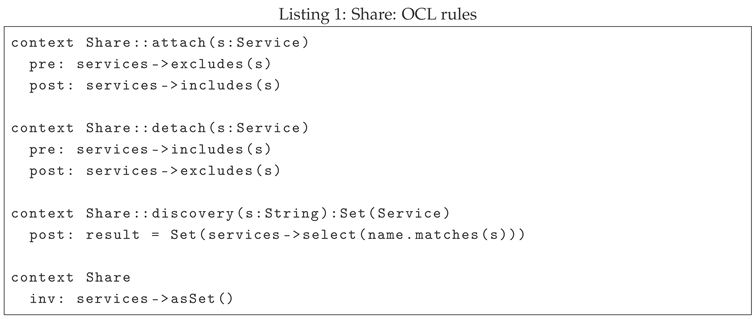
There are various Object Constraint Language (OCL) rules applied to the class diagram in Figure 1, and they are presented in Listing 1. Analyzing context rules, there are three methods previously discussed: attach, detach, discovery. The first context rule specifies the method to add the service s into the services association, while the second context rule specifies the method to remove the service s from the services association. The third context rule specifies the method that returns all services that match the regular expression RExp s. At the end, the last rule specifies the absence of duplicated services.
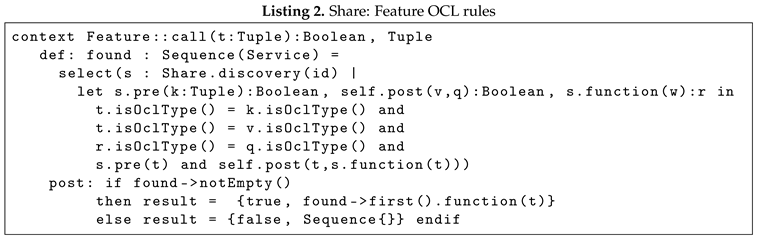
To ensure consistency between the operations required to call an operation, OCL rules in Listing 2 must be followed. The results of the call are specified by the sequence found and defined by applying to all the services found with the discovery operation pre, function, and post using the tuple of the function call. The correct relation between parameters and operation (pre, function, and post) is defined by the rules definition. Finally, the result of the call operation is the first result of the found sequence or the couple: boolean, tuple where the true value specifies the successful execution of the call invocation (i.e., a service has been found).
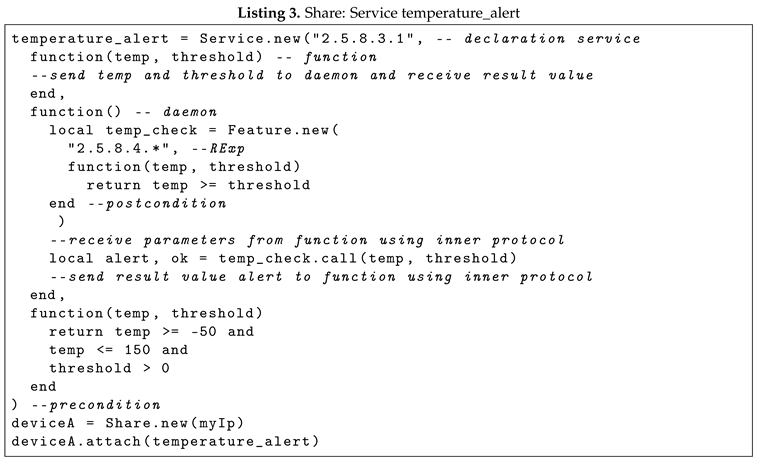
In Listing 3 and Listing 4, the implementation of a Share temperature_alert is represented with LUA language implementation. The Service in example called temperature_alert takes the following parameters:
- the unique identifier of the Service (i.e. its MIB);
- a LUA function, i.e the Service function implementation of the client stub;
-
a LUA function that implements the daemon which declares different parts:
- a feature with RExp 2.5.8.4.*;
- a post condition that specifies the comparison of the temperature and the threshold with precision;
- the reception of the parameters and the call of the temp_check function.
- the pre condition of the temperature_alert service, specifying that the temperature must be within the range of -50 to 150, inclusive.
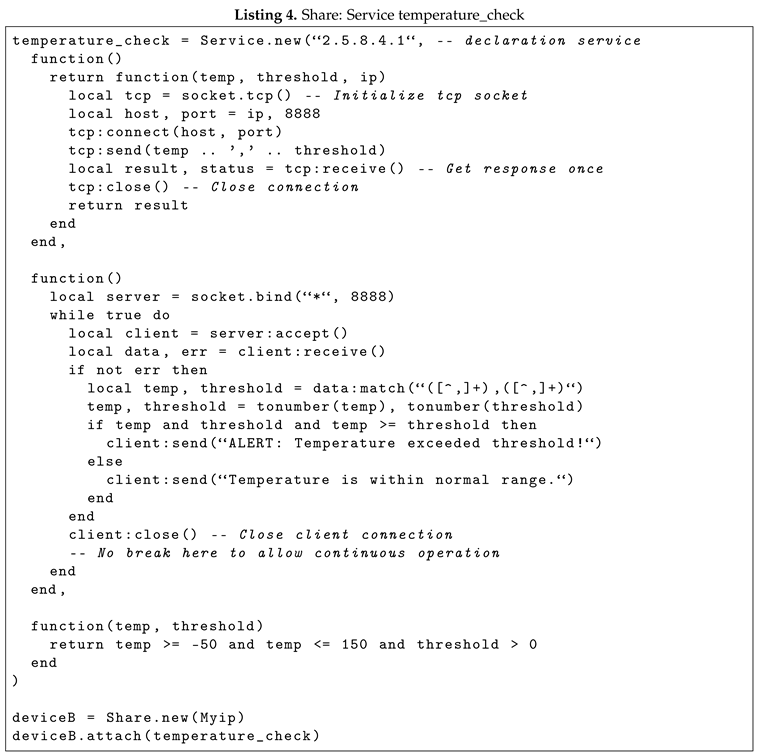
On the other hand, in the Listing 4 there is the temperature_check Service which takes as input the following parameters:
- the unique identifier of the Service (i.e. its MIB);
- a LUA function, i.e., the Service function implementation of the client stub, to enable a connection to the service;
- a LUA function which implements the daemon. Here, it is possible to observe the validation of the comparison from temperature and threshold.
- the pre condition of the temperature_check service, specifying that the temperature must be in the range -50 to 150 with edges included.
In the Listing 3 and Listing 4, it is possible to observe that they use the attach() method and register the newly created service to a Share object.
2.1. Sequence Diagram
It is imperative to acknowledge the pivotal function of sequence diagrams in modeling the interactions between disparate entities within a system. The utilization of these tools facilitates the representation of message exchange and the sequence of operations. This making them important tools for understanding and verifying the behavior of complex service-based architectures. In the context of this article, in the sequence diagram, it is possible to understand how Share dynamically invokes services according to predefined patterns. This ensures a seamless interaction between the distributed components.
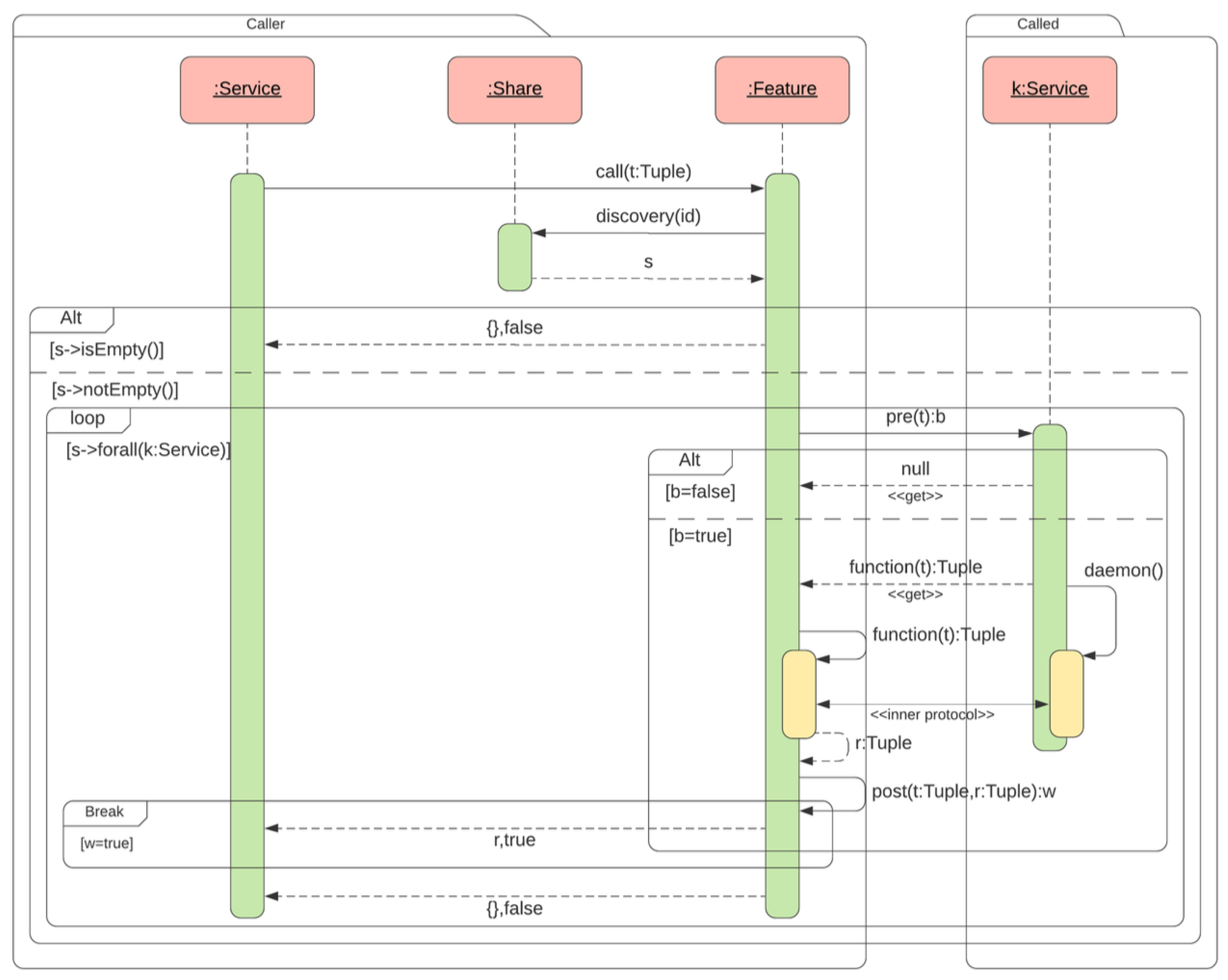
In Figure 2, the sequence diagram highlights the interactions between objects during a call to an Service, in our case, the temperature_alert service example. The process begins when the service temperature_alert calls the method call of the object Feature. This object searches for a suitable service using an ID which corresponds to a certain pattern defined by RExp (Regular Expression). This is done through the message discover(id), which returns a set of S objects Service matching the identifier.
When no matching service is found, S is empty and an error is returned. In contrast, when a service is found, the available one is evaluated sequentially in a loop, as is possible to observe inside the sequence diagram Figure 2. Each service found has to follow a sequence of steps, first a precondition check is performed (pre(t): b to verify that the given input parameters satisfy the service requirements. Each time the precondition of a service fails, the next one is checked until the precondition is satisfied. The daemon is invoked by the feature object only if the service implementation is valid, and it uses a function stub for the call. In our case, analyzing the temperature_check when the service is invoked, it evaluates the temperature and checks if it exceeds the threshold. Then, the service returns the result r: Tuple and a status w: boolean. The execution of the service is considered successful when the w return true and the Service call concludes. On the contrary, as mentioned above, the system continues to search for alternative services to meet all the conditions. This structured approach ensures flexibility, robustness, and allows Share to dynamically adapt to different service implementations while maintaining a consistent execution flow.
2.2. Simulator Implementation
The utilization of simulators within the domain of the Internet of Things (IoT) is imperative for the evaluation and validation of novel models and architectures, obviating the necessity for immediate access to physical hardware. Simulators allow analyzing the behavior of systems in controlled scenarios, reducing costs and development time. Moreover, they are essential to assess the reliability and scalability of new solutions, especially in environments characterized by stringent constraints on memory, computing power, and energy.
A dedicated simulator was developed to validate the effectiveness of Share and test its applicability in resource-constrained IoT contexts. The aim is to verify how the design pattern manages the dynamic composition of services and ensures integration between heterogeneous devices. The simulator, implemented in LUA, enables the execution and monitoring of interactions between devices, simulating realistic environments. In addition, it exploits the Object Constraint Language (OCL) specification to ensure that composition constraints are respected, thus increasing the reliability of the system. The development of the simulator is facilitated by the utilization of the Lua programming language. [19].
The choice of this programming language falls on several characteristics that make it perfect for implementation on embedded systems with limited resources. It is an efficient programming language with a very low weight (about 220KB). This characteristic makes it ideal for the systems we are dealing with. It is a multi-paradigm language capable of handling procedural, functional, and object-oriented programming, and this characteristic allows it to adapt to any context and development requirement. It is a very portable language because it is able to run on UNIX, Windows, IOS, Android, and, above all, on microcontrollers. The source code of the mentioned platforms is similar because Lua follows the ISO (ANSI) C standard, and thanks to this feature, there is no need to adapt the code to new environments, only the need for an ISO C compiler. It would be important to emphasize that when validating a simulation on a real system with the Share code written in Lua, it allows the reuse of the same code on embedded systems with certain precautions. For example, when reusing the simulation code in a real system, the communication-related parameters that differ from the simulation should be changed, but the code as a whole remains the same.
Figure 3.
Share: simulator view from terminal.
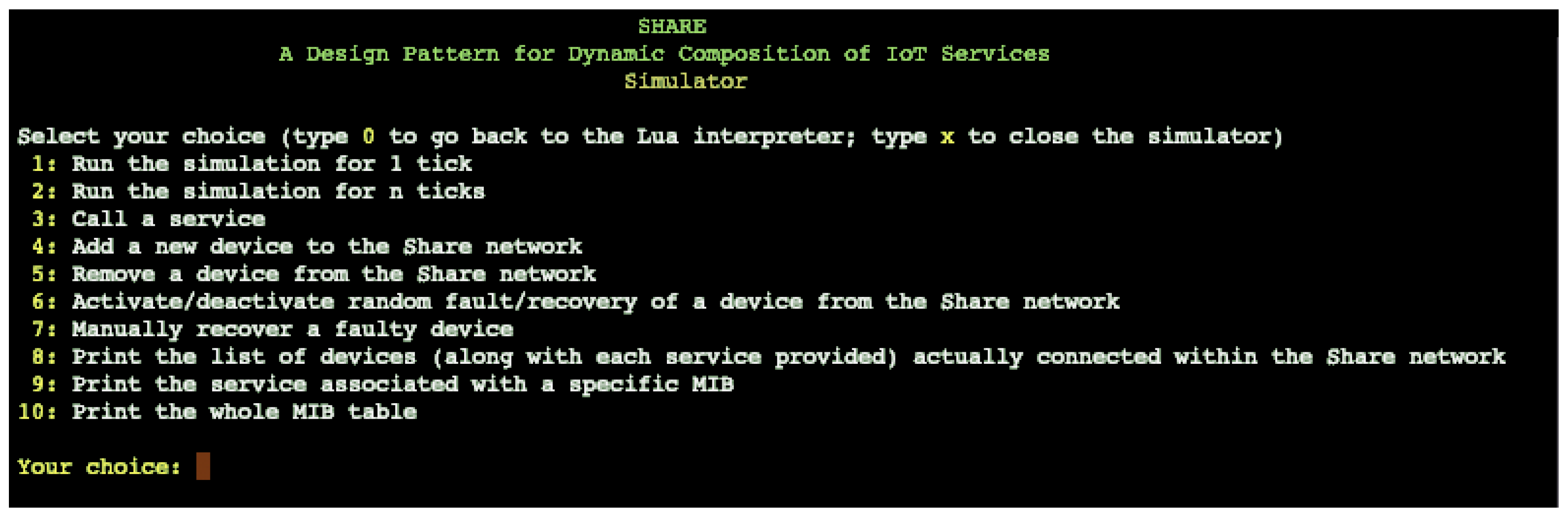
The simulator is run from the terminal via the Lua compiler and is presented as seen in Listing 3. The simulator offers different possibilities for use, which are indicated and usable via a numbered list from 1 to 10. The first two commands (1, 2) allow you to simulate 1 to n ticks to see the effects of the simulation over some time of your choice. Next in the list we have the interactions with the Share Network where it is possible to go and call a service (4), add or remove a device from the network (5, 6), manage issues that may arise and see how the system reacts through simulation (6, 7). Finally, with the last items in the list, we have the possibility of going to display the information of the Design Pattern Share by printing out the list of devices, the services with their MIB codes, or the entire table with the MIB codes.
2.3. Structure and Functionalities
As was the case in the preceding study [1], the present study places its focus on the example of the ideal climate inside a house. However, the present study will analyze the simulator instead of the generic case study defined by Baruch Givoni with his bioclimate-based graph [10]. The simulator, written in Lua, uses coroutines via the standard Lua Coroutine library to facilitate portability and simulate the parallel execution of callers and callees. Coroutines in Lua allow functions to interrupt and later resume execution of the entire program without blocking it entirely, thanks to its lightweight and powerful mechanism for cooperative multitasking. While these coroutines may be regarded as analogous to conventional threads, they are distinct in their execution: coroutines share the same execution thread, and their operation is explicitly programmed by the programmer. This characteristic makes them particularly suitable for simulations and asynchronous control flows. The implementation of coroutines in Lua is regarded as a first-class value, signifying that they can be treated in a manner analogous to any other value, such as a number or string. Consequently, it is feasible to create a coroutine and store it within a variable or to pass it to a function. This feature allows developers to manage the execution state with minimal overhead, meaning that each coroutine keeps track of where it was paused (coroutine.yield()) to resume it at another time (coroutine.resume()). This feature makes it possible to pause and resume pieces of code with less complexity and resource cost than threads, making it perfect for implementation on systems with limited resources [11].
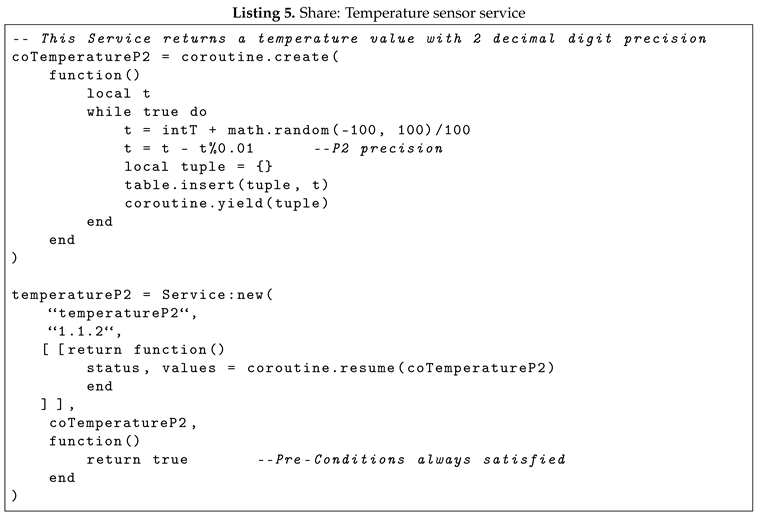
In our simulator the Service has been implemented using Lua coroutines as can be seen in the example Listing 5 the Service return a temperature value with 2 decimal digit precision and in Listing 6 we can see the implementation of the class definition.
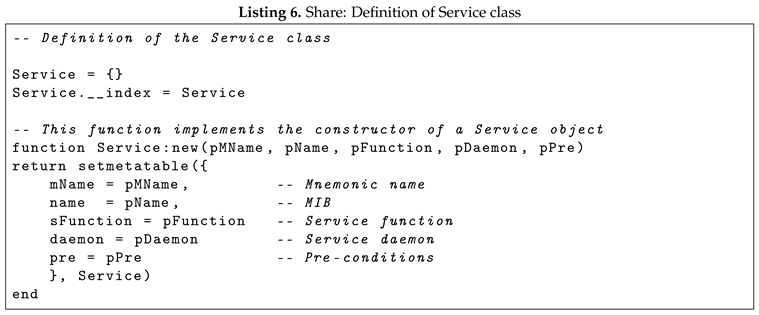
Thanks to its modular structure, the simulator makes it easy to add new Services and their associated MIBs. Once the new Service has been added, it is possible to use it immediately in the simulator and go on to analyze the new scenarios that can be created with the use of the new service. The Share network is realized with a table where the keys are identified by their associated MIBs and the values are tables of Services. If we consider a real usage scenario, the mnemonic name can be the IP address or any other identifier that might work in a specific context. It is important to say that the values of Share network are tables of tables because each device within the network may offer more than one service, and because Lua does not know the concept of class. A salient feature of the simulator is its capacity for seamless transition between the simulation itself and the user agent. It is possible to pause the current simulation and resume it later without losing the current state. This can be achieved by switching to the interpreter and modifying the conditions in the environment in which Share is executing the simulation. Switching between the simulation and the user agent only performs a pause, so it is possible to start the simulation, make parameter adjustments, and then return to the simulation again and pick up where it left off.
The simulator focuses on those solutions that require common equipment such as humidifiers, dehumidifiers, air conditioners, boilers, pellet stoves, heat pumps, etc. These appliances belong to the category of equipment that can be switched on or off, and each actuator can provide from one to several services. In the context of the ideal indoor climate introduced by Baruch Givoni, it is necessary for equipment to function in certain ways to raise or lower the temperature until the ideal temperature is reached, also taking into account the outside temperature. Taking common appliances such as air conditioners and boilers into consideration and relating them to services, we can see how a boiler can offer only one service while the air conditioner offers two. The boiler allows the temperature to be raised, while the air conditioner also allows the temperature to be lowered, and optionally the humidity to be lowered.
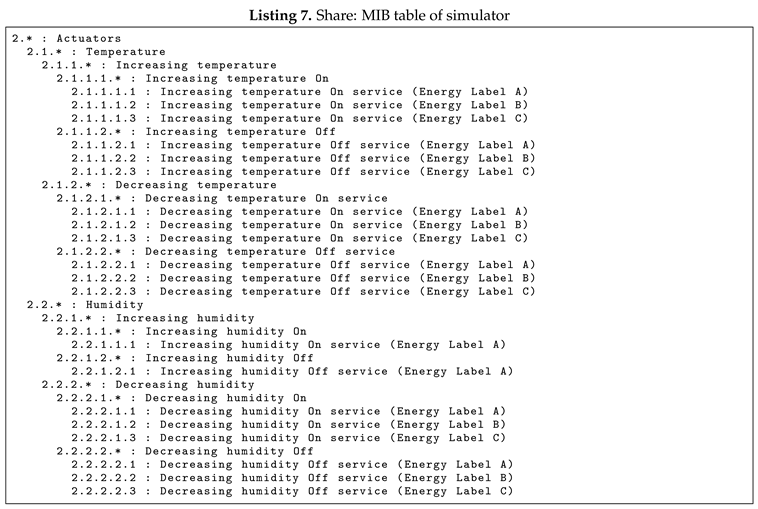
As mentioned earlier, when discussing the structure of the simulator and the services, we can group the services into categories via a semantic relationship where the actuators have their way of providing the services based on the European Union Energy Label [21,22]. For example, the service category decreasing humidity is identified as MIB 2.2.1.* but within it, there are several services related to the European label, as can be seen in Listing 7, which shows part of the MIB hierarchy table defined within the simulator.
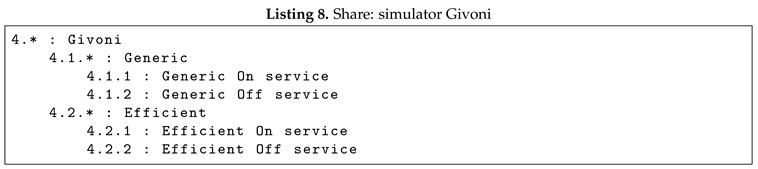
The Share pattern by consulting the network, Share network, enables the Service to base the decision on how many devices are connected at the moment by calling the whole category and possibly changing the behavior according to the available Services within the category. In Listing 8, it is possible to see how the simulator has two different Services to achieve the ideal temperature according to Baruch Givoni’s comfort zone theory: generic and efficient. Both use the services provided by the sensors and actuators as their features and in the first case, with the generic service, all available actuators within their categories are used with the sole purpose of reaching the desired comfort zone without thinking about energy consumption. Conversely, the efficient service is characterized by its consideration of energy efficiency and its utilization of actuators in a distinct manner. This approach aims to maintain energy consumption at the level stipulated by the established label. The energy-efficient service tries to minimize the energy consumed, in particular, it tries to use services with an energy efficiency label A and only use them. If it is not possible to use only those with the energy efficiency label A, it uses actuators with the lower energy efficiency label (B or C).
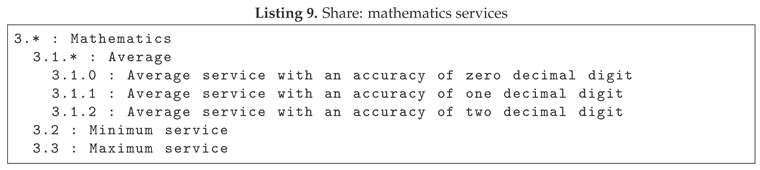
For a complete simulation of a complex distributed network, there are also Listing 9 mathematical services that are used to perform calculations on the actual system, where again we can find a similar situation to that for actuators, of having a variable amount of services available. Depending on the devices providing the various services, we can have a system that provides only the average, only the minimum, or only the maximum. Other situations allow for only two services, while other situations allow for all services to be available. The behavior of the caller may be based on these factors representing the Share network at a specific time.
Taking the service dealt with in Listing 3 as an example, its behavior can also be adapted to the scenarios that arise. If the Service needs to monitor the temperature to trigger a too-high (or too low) temperature alert and only has one temperature sensor available, this service will have to rely on the only available Service. If, on the other hand, this service has more than one temperature sensor at its disposal, it has the option of using mathematical Services such as average or minimum/maximum, or all three. Consequently, the system’s elasticity can be discerned. In the particular instance of the simulator, the parameters can be modified by introducing (or eliminating) the Services to observe the system’s response. This adjustment does not compromise the progress that has been accumulated. In the case of mathematical calculations, it is possible to suspend the simulator to remove (or add) Services and see how the behavior of the system changes.
Figure 4.
Baruch Givoni bioclimatic chart.
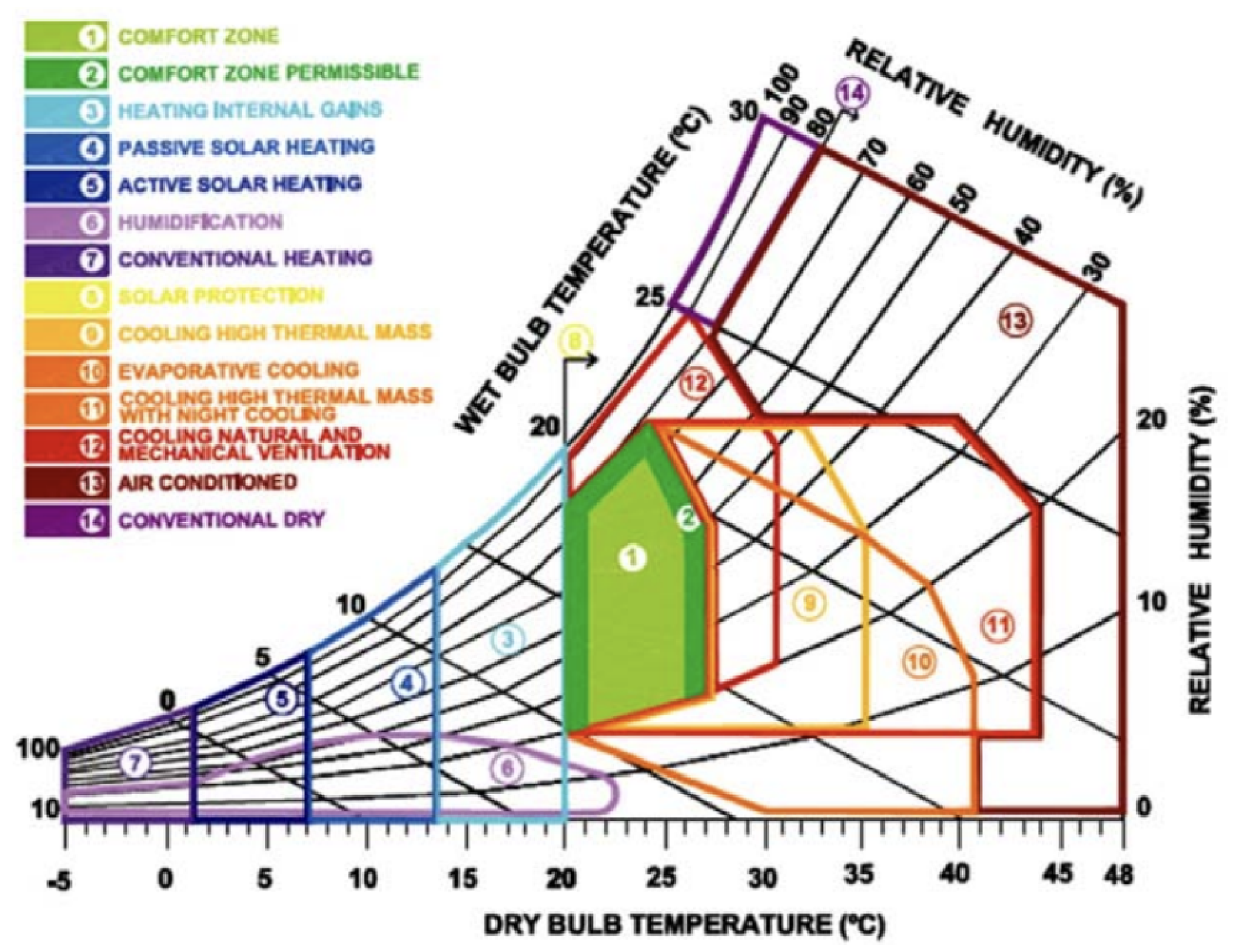
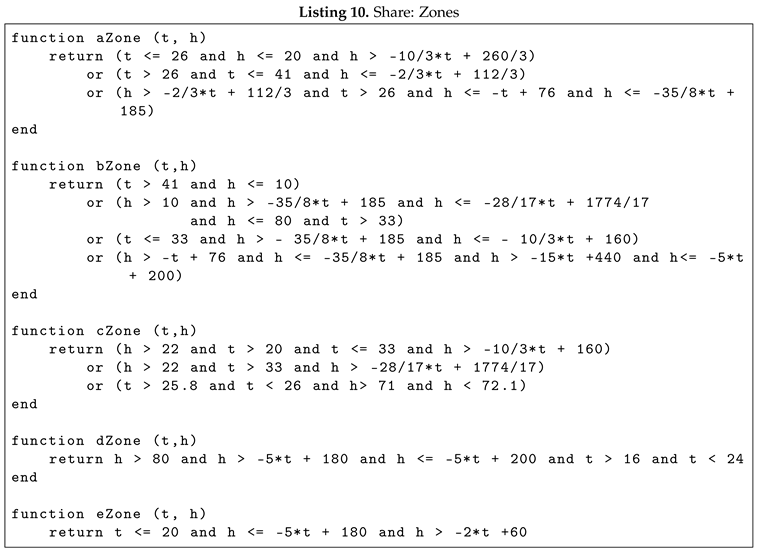
For the simulation, the Listing 4 Baruch Givoni for bioclimate was adjusted with the unit scale of degrees Celsius, replacing degrees Fahrenheit. It was then divided into zones, separating or joining one or more zones of the original chart. This was done based on the consideration of which actuators are required to reach the comfort zone about energy consumption, as can be seen in Listing 10. For example, if one were to consider a temperature T of T = 16°C and a humidity H of H = 20°C, to reach a comfort zone one would need to use an actuator that has a service that increases the temperature and another actuator that has a service that increases the humidity.
If one considers the case where T = 16°C and H = 60%, the need for the system is only related to the temperature, and one uses an actuator with the service that increases the temperature.
With Baruch Givoni’s bioclimatic graph, it can be seen that humidity and temperature are inversely proportional. During the simulation, we assume a closed environment, and this means that, applying mathematics, increasing the temperature leads to an indirect decrease in relative humidity. The absolute humidity, however, remains the same because we are talking about a closed environment. The estimate of the average proportion between the two is and indicates that as the temperature increases by 1°C, you decrease the percentage of relative humidity decreases by 4 points. The considerations that are made on the closed room simulation are also made based on the variation of the temperature outside the buildings. In the absence of active actuators, the indoor temperatures exhibit a high degree of dependence on the outdoor temperatures. The greater the disparity between indoor and outdoor temperatures, the more pronounced the temporal variation, which is manifested in the simulator as a change in the unit of measurement, referred to as a tick.
The direct work on humidity is different because actuators, such as humidifiers and dehumidifiers, act directly on absolute humidity, while on relative humidity, they act indirectly. In fact, by going to work on absolute humidity, relative humidity is also affected. Using an empirical estimate, the proportion between the change in relative humidity and temperature emerges as .
2.4. Formal Specification with OCL
In this subsection, we will address the simulator specifications with the support of the OCL language, before concluding with results and discussions.
The Object Constraint Language (OCL) is a formal language that is used to describe expressions on UML models. In particular, it is used to specify constraints that cannot be represented directly using only graphical notations. OCL, which is introduced by the Object Management Group (OMG), is a part of the UML specification and assumes a very important role in model-driven engineering (MDE) to ensure accuracy and consistency within models [12]. The OCL language allows developers to write expressions without side effects and allows the inclusion of invariants within classes, -pre and -post conditions on operations, and protections on transitions. Expressions are evaluated on model instances and do not change the state of the system. This makes OCL a declarative and secure language for the [23] specification.
To ensure the correctness and consistency of the service offered by the Share pattern, it is necessary to specify formal constraints with the use of OCL following the standard format ISO/IEC 19507:2012 (OMG 2.3.1).
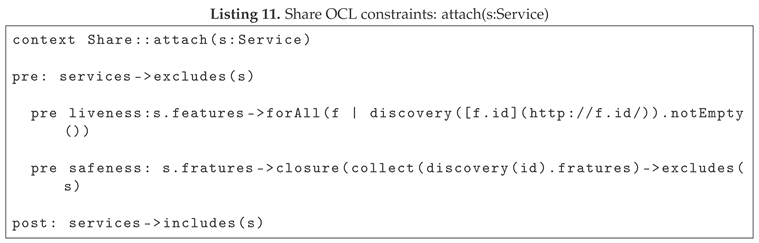
When a service is added to Share, verification of the system is crucial to prevent its consistency from being compromised. We can point to two fundamental conditions for this purpose, which are represented by liveness and safeness. The condition of liveness ensures that all the Features required by the Service are implementable. This means that for each Feature within the Service, there must be at least one Service capable of providing it. The constraint related to safeness serves to avoid circular dependencies that may arise during the composition of the Service, this is to ensure that the chain at a given time ends.
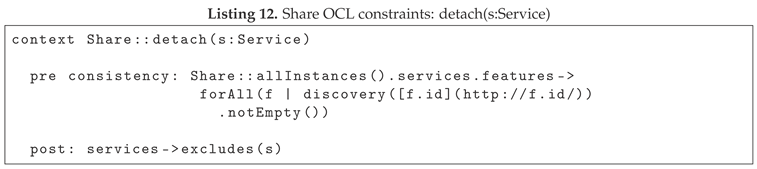
When a detach operation is performed, inconsistencies may be introduced into the system by breaking the conditions of liveness for other services. Before removing a service, it is essential to verify that the remaining services continue to satisfy their liveness constraints.
Our Share pattern assumes that at least one instance of Share exists in the system, although multiple instances of it are possible. Each Feature object performs queries on the Share repository to find the Service that satisfies its functionality, and in particular, there is no structural dependency between Feature and Share. This feature allows a certain flexibility of implementation on the creation of services such as Publish/Subscribe present in the MQTT protocol. To ensure ease of use, the implementation of Share could be bound to a specific architectural development. For example, in a smart home scenario, the Share pattern could be implemented as a singleton within a central device, such as a WiFi router that supports SNMP services. Some home routers within the low-cost end of the market, such as the GL.iNet GL-AR300M16-Ext and GL.iNet GL-X750, have the OpenWrt operating system already pre-installed, and this Linux-based open source operating system is optimized specifically for network devices [OpenWrt]. Using OpenWrt, it is possible to execute customized user services directly on the router, making it possible to realize operations such as attach and detach as network-accessible services. This gives home automation devices the possibility of automatically registering with the Share service repository the moment they connect to the network. Finally, the centralized management of Share on the router offers the possibility of monitoring the availability of devices by performing implicit detach operations in the event of a disconnect from WiFi.
3. Results
The Internet of Things (IoT) is made up of heterogeneous devices that have different characteristics and functionalities. These devices can be simple sensors or actuators that have very limited resources, which is why a major challenge in the IoT world is the integration and peer-to-peer communication of devices, avoiding the use of a centralized entity. The Share design pattern underscores the capacity to circumvent these constraints by virtue of its ability to operate on devices with constrained resources. This facilitates the dynamic composition of peer-to-peer services without the necessity of a centralized entity, thereby exemplifying a decentralized approach to network architecture.
We can demonstrate with the implementation of the Share pattern that it is a flexible and decentralized approach for the composition of services in a distributed system. By using formal constraints for services via the Object Constraint Language (OCL), which conforms to ISO/IEC 19507:2012 (OMG 2.3.1), we can perform a check on the fundamental properties of the design pattern such as liveness, safeness and consistency during the operations of attach and detach when the simulation is in place. A complete simulated environment was developed with the Lua programming language and through which the same services were developed with interaction through coroutines, ensuring asynchronous execution with minimal overhead. Even when analyzing dynamic conditions, the simulation manages to confirm that the system can maintain operational integrity, handling situations such as device disconnections or service removals. In addition, the possible implementation on low-cost OpenWrt router devices enables deployment and use in embedded environments and smart infrastructures.
4. Discussion
From the above results, we can confirm that the Share model is able to provide a robust and extensible infrastructure to manage distributed services in embedded systems. The use of regular expressions to perform the discovery, together with the OCL language for applying behavioral properties, allows for a structured system that can adapt to dynamic situations. One of the most important aspects of Share is the way it provides the availability of services through the operations of attach and detach, which guarantee continuity of use without letting control be centralized. Another element is the cooperative execution of the system via Lua coroutines that allows multitasking and minimal overhead, and this makes the simulation environment both technically efficient but also conceptually accessible. The potential for significant progress in this area may be found in the use of low-cost routers integrating the OpenWrt operating system. This integration facilitates the incorporation of the Share repository and enables direct communication through the WiFi network by managing the devices’ entry and exit from the network.
5. Future Work
The simulator can be used to:
- verify the workload of the individual nodes and the entire system
- determines the functioning of the system in the presence of failures or the unavailability of devices
- helps in the design of fault tolerance systems with safeguard causes
In particular, it could be investigated the redundant use of devices that implement the Share class, for example, different access points, to eliminate the critical point of the single device that guarantees the communication. This requires the implementation of more functionality and not just the analysis of the log file present in the simulator.
Author Contributions
Conceptualization, R.P. and R.C.; methodology, R.P. and R.C.; software, R.P. and R.C.; validation, R.P. and R.C.; formal analysis, R.P. and R.C.; investigation, R.P. and R.C.; resources, R.P. and R.C.; data curation, R.P. and R.C.; writing—original draft preparation, R.P.; writing—review and editing, R.P. and R.C.; visualization, R.P. and R.C.; supervision, R.C.; project administration, R.C. All authors have read and agreed to the published version of the manuscript.
Funding
This work has been funded by the European Union, NextGenerationEU, Mission 4, Component 2, under the Italian Ministry of University and Research (MUR) National Innovation Ecosystem grant ECS00000041 - VITALITY - CUPJ13C22000430001.
Institutional Review Board Statement
Not applicable.
Acknowledgments
We thank students Francesco Coppola, Stefano Pernicola and Stefano Aschettino, computer science department, University of Camerino. They have implemented the Share pattern in LUA and the LUARtos over M5Stack platform.
Conflicts of Interest
The authors declare no conflicts of interest.The funders had no role in the design of the study; in the collection, analyses, or interpretation of data; in the writing of the manuscript; or in the decision to publish the results.
References
- Culmone, R.; Cacciagrano, D.; Al-Turjman, F.; Mostarda, L. Share: A Design Pattern for Dynamic Composition of IoT Services. In Forthcoming Networks and Sustainability in the IoT Era ; Ever, E.; Al-Turjman, F., Eds.; Springer International Publishing: Cham, 2021; pp 144–156. [CrossRef]
- Luigi Atzori and Antonio Iera and Giacomo Morabito. The Internet of Things: A survey. Computer Networks 2020 54: 2787 - 2805.
- Ullah Z., Al-Turjman F., Mostarda L., Gagliardi R. Applications of Artificial Intelligence and Machine learning in smart cities. Computer Communications 2020 154: 313-323.
- Al-Turjman F., Zahmatkesh H., Mostarda L. Quantifying uncertainty in internet of medical things and big-data services using intelligence and deep learning. IEEE Access 2019 7: 115749-115759.
- W. Shi and J. Cao and Q. Zhang and Y. Li and L. Xu. Edge Computing: Vision and Challenges. IEEE Internet of Things Journal 2016 3: 637-646.
- Washizaki, H.; Ogata, S.; Hazeyama, A.; Okubo, T.; Fernandez, E. B.; Yoshioka, N. Landscape of Architecture and Design Patterns for IoT Systems. IEEE Internet Things J. 2020, 7 (10): 10091–10101. [CrossRef]
- Baldoni, R.; Di Ciccio, C.; Mecella, M.; Patrizi, F.; Querzoni, L.; Santucci, G.; Dustdar, S.; Li, F.; Truong, H.-L.; Albornos, L.; Milagro, F.; Antolin Rafael, P.; Ayani, R.; Rasch, K.; Garcia Lozano, M.; Aiello, M.; Lazovik, A.; Denaro, A.; Lasala, G.; Pucci, P.; Holzner, C.; Cincotti, F.; Aloise, F. An Embedded Middleware Platform for Pervasive and Immersive Environments for-All. In EPRINTS-BOOK-TITLE; University of Groningen, Johann Bernoulli Institute for Mathematics and Computer Science, 2009; ISBN 9781424439386.
- Meyer, B. Object-Oriented Software Construction, 2nd ed.; Prentice-Hall, Inc.: Upper Saddle River, NJ, USA, 1997; ISBN 0-13-629155-4.
- Tavares, A. L. C.; Valente, M. T. A Gentle Introduction to OSGi. ACM SIGSOFT Software Engineering Notes 2008, 33 (5): 1–5. [CrossRef]
- Baruch Givoni. Climate considerations in building and urban design. Van Nostrand Reinhold, 1998.
- Ierusalimschy, R., Figueiredo, L. H., & Celes, W. (2005). The implementation of Lua 5.0. Software: Practice and Experience, 35(6), 581–603. [CrossRef]
- Warmer, J.; Kleppe, A. The Object Constraint Language: Precise Modeling with UML; Addison-Wesley: Boston, 1999.
- Internet of Things forecast. Available online: https://www.ericsson.com/en/mobility-report/internet-of-things-forecast.
- Embedded Lua on microcontroller. Porting Lua interpreter on microcontrollers. Available online: https://github.com/elua/elua?tab=readme-ov-file.
- Booth, D.; Liu, C. K. Web Services Description Language (WSDL) Version 2.0 Part 0: Primer. 2007. Available online:http://www.w3.org/TR/wsdl20-primer (accessed on June 26, 2007).
- Chinnici, R.; Moreau, J.-J.; Ryman, A.; Weerawarana, S. Web Services Description Language (WSDL) Version 2.0 Part 1: Core Language. 2007. Available online: http://www.w3.org/TR/wsdl20 (accessed on 26 June 26 2007).
- Chinnici, R.; Haas, H.; Lewis, A. A.; Moreau, J.-J.; Orchard, D.; Weerawarana, S. Web Services Description Language (WSDL) Version 2.0 Part 2: Adjuncts. 2007. Available online: http://www.w3.org/TR/wsdl20-adjuncts (accessed on 26 June 2007).
- Whitecat ESP32 N1 Board. 2019. Available online: https://whitecatboard.org/lorawan-deployment-in-cornella/ (accessed on November 2019).
- Programming in Lua. Roberto Ierusalimschy. 2003. Available online: https://www.lua.org/pil/contents.html.
- Structure of management information (smi) numbers (mib module regis- trations), 2020, https://www.iana.org/.
- European Union. Regulation (EU) 2017/1369 of the European Parliament and of the Council of 4 July 2017 setting a framework for energy labelling and repealing Directive 2010/30/EU. 2017. https://eur- lex.europa.eu/legal-content/EN/TXT/?uri=CELEX:32017R1369.
- European Union. Consolidated text: Regulation (EU) 2017/1369 of the European Parliament and of the Council of 4 July 2017 setting a framework for energy labelling and repealing Directive 2010/30/EU. 2021. https://eur-lex.europa.eu/legal-content/EN/TXT/?uri=CELEX%3A02017R1369-20210501.
- Object Management Group. Object Constraint Language (OCL), Version 2.3.1; OMG Document formal/2012-01-01; 2012. Available online: https://www.omg.org/spec/OCL/2.3.1/ (accessed [30/04/2025]).
- OpenWrt. OpenWrt. Available online: https://openwrt.org/.
- Flavio Bonomi, Rodolfo Milito, Jiang Zhu, and Sateesh Addepalli. 2012. Fog computing and its role in the internet of things. In Proceedings of the first edition of the MCC workshop on Mobile cloud computing (MCC ’12). Association for Computing Machinery, New York, NY, USA, 13–16. [CrossRef]
- Pourreza, H.; Graham, P. On the Fly Service Composition for Local Interaction Environments. In Proceedings of the Fourth Annual IEEE International Conference on Pervasive Computing and Communications Workshops (PERCOMW’06) ; IEEE, 2006; pp. 6–399. [CrossRef]
- Zhao, Q.; Huang, G.; Huang, J.; Liu, X.; Mei, H. A Web-Based Mashup Environment for On-the-Fly Service Composition. In Proceedings of the 2008 IEEE International Symposium on Service-Oriented System Engineering ; IEEE, 2008; pp. 32–37. [CrossRef]
- Marchetti, E.; Bartolini, C.; Bertolino, A.; Polini, A. WS-TAXI: A WSDL-Based Testing Tool for Web Services. In Proceedings of the 2009 International Conference on Software Testing Verification and Validation (ICST) ; IEEE, 2009; pp. 326–335. [CrossRef]
- Cacciagrano, D.; Corradini, F.; Culmone, R.; Vito, L. Dynamic Constraint-Based Invocation of Web Services. In Web Services and Formal Methods, Third International Workshop, WS-FM 2006, Vienna, Austria, September 8-9, 2006, Proceedings ; Springer, 2006; pp. 138–147. [CrossRef]
- Cacciagrano, D.; Corradini, F.; Culmone, R.; Tesei, L.; Vito, L. A Model-Prover for Constrained Dynamic Conversations. In iiWAS’2008 - The Tenth International Conference on Information Integration and Web-Based Applications Services, 24-26 November 2008, Linz, Austria ; ACM, 2008; pp. 630–633. [CrossRef]
- Cacciagrano, D.; Corradini, F.; Culmone, R.; Vito, L. Constraint-Based Dynamic Conversations. In The Fifth International Conference on Networking and Services (ICNS 2009), 20-25 April 2009, Valencia, Spain ; IEEE, 2009; pp. 7–12. [CrossRef]
- Barnett, M.; Leino, R. Weakest-Precondition of Unstructured Programs. In Proceedings of the 6th ACM SIGPLAN-SIGSOFT Workshop on Program Analysis for Software Tools and Engineering (PASTE ’05) ; ACM Press: New York, NY, USA, 2005; pp. 82–87. ISBN 1-59593-239-9.
- de Moura, L.; Bjørner, N. Z3: An Efficient SMT Solver. In Tools and Algorithms for the Construction and Analysis of Systems ; Ramakrishnan, C. R., Rehof, J., Eds.; Springer: Berlin, Heidelberg, 2008; pp. 337–340. ISBN 978-3-540-78800-3.
- Konrad, S.; Cheng, B. Requirements Patterns for Embedded Systems. Proceedings of the IEEE International Conference on Requirements Engineering, 2002, 127–136. [CrossRef]
- Sveda, M. Patterns for Embedded Systems Design. In Proceedings of the International Conference on Embedded Systems Design ; Springer: Berlin, Heidelberg, 2007; pp. 80–89. [CrossRef]
Figure 1.
Share: class diagram.
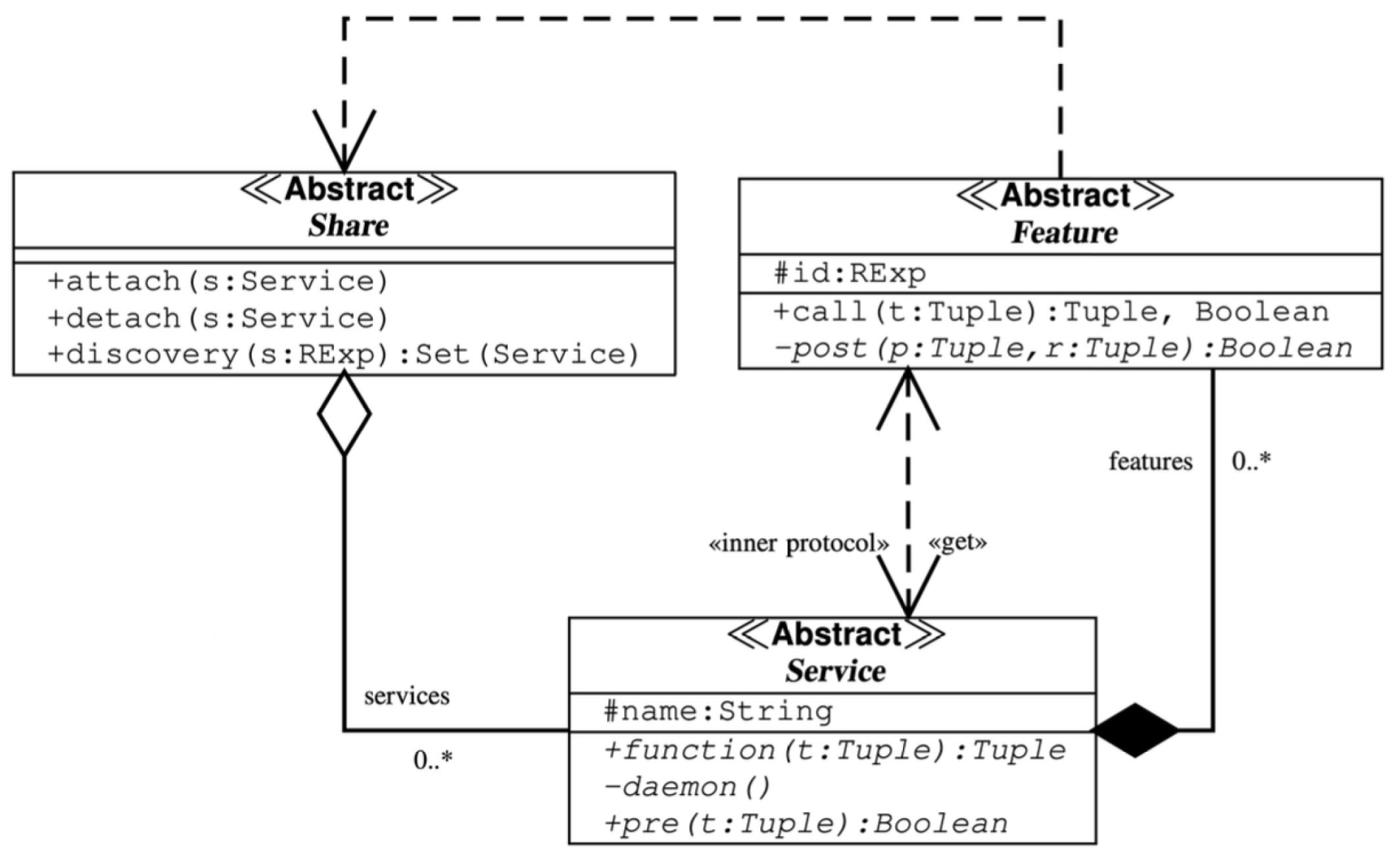
Figure 2.
Share: Service call sequence diagram.
Disclaimer/Publisher’s Note: The statements, opinions and data contained in all publications are solely those of the individual author(s) and contributor(s) and not of MDPI and/or the editor(s). MDPI and/or the editor(s) disclaim responsibility for any injury to people or property resulting from any ideas, methods, instructions or products referred to in the content. |
© 2025 by the authors. Licensee MDPI, Basel, Switzerland. This article is an open access article distributed under the terms and conditions of the Creative Commons Attribution (CC BY) license (http://creativecommons.org/licenses/by/4.0/).
Copyright: This open access article is published under a Creative Commons CC BY 4.0 license, which permit the free download, distribution, and reuse, provided that the author and preprint are cited in any reuse.


