

Submitted:
27 May 2025
Posted:
27 May 2025
You are already at the latest version
Abstract
In the Mexican Caribbean, the demand for tourism services led to the expansion of the hotel industry from the coast inland. This caused rural and urban communities in the region to become involved in tourism activities, initiating the formulation of an international model of sustainable development with a focus on cultural tourism. Some studies have estimated the tourism carrying capacity (TCC) for environmental management units in communal land areas of Baja California, Mexico, and the Huagapo cave in Peru. Considering the tourism potential that the study area can offer to nearby rural communities, the present research conducts a social diagnosis and describes the study area, estimating the tourism carrying capacity in the southern region of the Mexican Caribbean. It was found that the area can support a tourism carrying capacity of 538.33 visits per day. In this initial assessment, it was estimated that the implementation of an ecotourism project in a rural community would not alter its environmental conditions. The estimated indicators provide appropriate tools for designing and planning long-term sustainable tourism proposals. Moreover, they integrate environmental, economic, and social aspects in a balanced manner, generating tangible and lasting benefits.
Keywords:
Mexican Caribbean
; tourism
; tourism carrying capacity
; rural communities
; ecotourism
1. Introduction
The rapid growth of the global population has caused significant pressure on territorial space, natural resources, and coastal areas in Latin America and the Caribbean [1]. In response, public policy instruments have been developed to regulate, organize, and manage land use, helping to prevent and mitigate the environmental impacts resulting from various socio-economic activities (exploitation, pollution, fragmentation, tourism, among others) [2]. Notably, tourism—defined by the World Tourism Organization as the activity that recognizes the present and future economic, social, and environmental repercussions in order to meet the needs of visitors, the industry, the environment, and host communities [3]. This activity has contributed to the degradation of numerous tourist destinations worldwide due to the uncontrolled actions of visitors, leading to negative consequences for natural resources[4]. Mexico ranks sixth in tourist arrivals and fifteenth in foreign exchange earnings from international tourism [5]. Internationally, the Mexican Caribbean is among the top tourist destinations, generating $14.2798 billion USD in 2018 and $15.0927 billion USD in 2019 [6]. It is considered one of the five regions with the highest marine biodiversity in the world, home to approximately 500 fish species and part of the Mesoamerican Reef System, which represents 12% of the world’s coral reef coverage [7]. By 2023, the region received 21 million visitors, 62.56% of whom were international and 37.44% domestic, with a hotel occupancy rate of 76.4%, supported by infrastructure comprising 1,415 hotels and 131,022 rooms [8].
The demand for tourism services has driven the hotel industry to expand inland from the coast. As a result, rural and urban communities of the Mexican Caribbean have become more involved in tourism, initiating the formulation of an international model of sustainable development with a cultural tourism approach [9]. In urban areas and tourist regions in the northern Mexican Caribbean—such as Cancún, Puerto Morelos, Playa del Carmen, and Tulum—the population exceeds ~1.2 million people, where existing resources and ecosystems have been altered or degraded by unregulated urban development [10]. This trend is spreading to the central-southern zone of the region, including protected natural áreas [7,11]
Tourism activity has sparked interest among rural communities in developing ecotourism and adventure tourism, taking advantage of the natural attractions of their surroundings [12,13]. Ceballos [14] defines these activities as traveling to or visiting undisturbed natural areas to enjoy, appreciate, and study natural attractions, promoting conservation, low environmental and cultural impact, and encouraging active and socio-economically beneficial involvement for host communities. These activities also imply responsible action by tourists and the tourism industry, requiring minimal use of non-renewable resources and relying on comprehensive planning for sustainable ecotourism projects [14,15].
Tourism Carrying Capacity (TCC) is a useful tool for planning natural areas, as it helps determine the maximum number of visitors that a site can accommodate for tourism activities while providing valuable information to decision-makers to avoid negative impacts on natural resources [16,17,18,19]. Currently, there is no specific definition, methodology, or unified framework for TCC. It has evolved from a unidimensional concept to a comprehensive one, where the physical dimension is integrated with social, environmental, economic, and political aspects [4,20,21]. Ibañez-Pérez [15] and Huaroc-Ponce et al. [21], have estimated the tourism carrying capacity for environmental management units in communal lands in Baja California, Mexico, and for the sustainable management of the Huagapo cave in Peru, using the methodology proposed by Cifuentes [16,22]. Considering the tourism potential that the study area can offer to neighboring rural communities, this research conducts a social diagnosis and describes the study area, estimating the tourism carrying capacity using Cifuentes’ methodology [16,22], in the southern region of the Mexican Caribbean. This will help determine the maximum number of visitors allowed in the area, enabling the development of a sustainable ecotourism project and helping to reduce potential conflicts in rural communities.
2. Materials and Methods
2.1. Study Area
The ejido Caoba is located in the municipality of Othón P. Blanco, in the southern part of the state of Quintana Roo, at longitude 89.16° W and latitude 18.21° N. The ejido was established in 1940 and covers an area of approximately 67,637.35 hectares, comprising around 323 ejidatarios and 169 settlers, according to the National Agrarian Registry [23] (Figure 1a). It includes two settlements: the community of Caobas and its annex San José de la Montaña. The community of Caobas has a population of approximately 1,507 inhabitants, while San José de la Montaña has about 205 inhabitants, according to the National Institute of Statistics and Geography [24] (Figure 1c). The proposed study area is called Chichanha (Figure 1d), located to the south of the ejido communities (Figure 1c), covering an area of approximately 29 hectares and extending 7.82 km from the access point to the study area.
The dominant climate is classified as Aw2(i), warm sub-humid. The average annual temperature is approximately 26°C, and the annual precipitation is around 1,200 mm. Although there are no rivers in the area, the ejido contains permanent bodies of water, such as Laguna Om, Laguna del Sibal, Laguna Reforma, and Laguna San José [25,26].
2.2. Description of Flora and Fauna in the Study Area
A site visit was conducted in the study area, during which aerial surveys were carried out using a remotely piloted aircraft system (RPAS and/or drone), specifically a DJI Mavic 2 Zoom equipped with six batteries. Flights were planned at altitudes of 60 m and 120 m, remaining below the permissible limit established by NOM-107-SCT3-2019 [27].This facilitated the rapid identification and positioning of sampling units.
Community members were trained in the operation and handling of the RPAS, as well as in the identification and data collection of flora and fauna. To estimate optimal sampling intensity, the approach proposed by [28,29]:
Where f = Sampling intensity. n = Number of sample units. N = Total number of population units.
This method allows for the establishment of guideline parameters for sampling intensity ranging from 0.1% to 1%; if the intensity exceeds 1%, the number of sites is considered optimal [28,29]. For data collection, six circular sampling units were established: 500 m² for the arboreal stratum, 100 m² for the shrub stratum, and 5 m² for the herbaceous stratum, arranged in a nested design [30]. Sampling began by identifying the north and proceeding clockwise within each sample unit. Equation (1) was then applied as follows:
With the proposed sampling units, a sampling intensity of 1.03% was obtained, which is considered optimal for data collection.
For fauna, the natural resource mapping tool proposed by Expósito [31] was applied. This method consists of creating a shared conceptualized visualization of the various elements and uses of space, with a focus on natural resources such as the distribution and/or location of fauna [31]. A conceptual map was developed based on wildlife sightings recorded over a 30-year period. Additionally, in each flora sampling unit, the common names of observed fauna species were recorded. The identification of flora and fauna relied on the knowledge and experience of local inhabitants involved in the research, as well as specialized field guides, including those by Manzanilla and Péfaur [32]; Arellano-Rodríguez et al., [33]; Pennington and Sarukhán [34]; Gallina-Tessaro and López-González [35]; Aranda-Sánchez, [36], among others. Furthermore, online databases recommended by CONABIO were consulted, such as SNIB [37]; CICY [38] and Tropicos.org [39].
2.3. Social Diagnosis of the Communities in the Study Area
Cury and Arias-Astray [40] state that social diagnosis allows for an understanding of the population’s composition, as well as various aspects and quantifiable parameters derived from the methodological instruments used. The methodologies applied in this study were adjusted according to the scope, technical constraints, and available resources. To determine the population density of the ejido, a representative sample was obtained using a 95% confidence level and a 5% margin of error [41], as follows:
Where: n = required sample size. N = total population size. Z = confidence level (Z-score). p = expected proportion (probability of success). q = 1 − p (probability of failure). d = margin of error (maximum admissible error in proportion terms)
The sample size was estimated based on the data published in the 2020 Population and Housing Census [24]. The locality of Caobas has a population of approximately 1,507 inhabitants, and San José de la Montaña approximately 205 inhabitants, yielding a total population (N) of around 1,712 people. Equation (2) was applied using these values:
The estimated sample size for both localities was 314 individuals. Taking into account a margin of error, 450 residents were surveyed, of which 414 responses were valid. The survey tool was applied using the Participatory Action Research (PAR) technique in the communities of Caobas and San José de la Montaña, both of which have influence over the study area [42,43]. Workshops were conducted with community members to train them in data collection, handling, and recording processes.
2.4. Estimation of Tourism Carrying Capacity (TCC)
This tool was applied to an area of interest identified for conservation. Therefore, values and factors proposed by Cifuentes [22], for protected natural areas were employed and adjusted accordingly. According to Cifuentes [16,22], TCC is a tool that helps determine the number of visitors that can enter a specific area over a limited period of time without compromising its integrity or resilience [18,19]. To calculate TCC, it is necessary to gather information through fieldwork and bibliographic review. This data is then used to consecutively estimate the Physical Carrying Capacity (PCC), Real Carrying Capacity (RCC), and Effective Carrying Capacity (ECC) [16,44]. The methodology was adapted and applied specifically for this study.
PCC: This represents the maximum number of visits that can be made to a specific site within a defined period of time. It was calculated as follows:
Where: V/a: Visitors per occupied area in square meters (m²); S: Surface area available to the public in m²; t: Time required to complete the visit in hours. Basic criteria for the study area: It is an open area with free movement. The surface area available to the public is 2,000 m². The trail is 2 km long. It is open eight hours a day. Three hours are needed to complete the route. Each person occupies 1 m² of space. Each group will consist of four people. A distance of 100 m² is required between groups.
RCC: This is the maximum number of visits determined based on the Physical Carrying Capacity, adjusted by correction factors according to the characteristics of the area. It is estimated as follows:
Each area to be evaluated will have different correction factors, depending on the characteristics of the study site. The correction factor (Fc) is estimated as follows:
Where: Fc: Correction factor; Ml: Limiting magnitude of the variable; Mt: Total magnitude of the variable.
ECC (Effective Carrying Capacity): This is the maximum number of visitors that an area can accommodate, considering its management and organizational capacity. For this, the relationship between the existing and optimal amounts of infrastructure, equipment, and personnel was taken into account. These variables were evaluated using a scale from 0 to 4 [22]. The assessment of each variable followed the methodology proposed by Ibañez-Pérez [15] (Table 1).
Once the MC has been assessed and categorized, the ECC can be calculated as follows:
Where: RCC: Real Carrying Capacity. MC: Minimum percentage of management capacity.
MC is calculated as follows:
3. Results
3.1. Characterization of Flora and Fauna
3.1.1. Flora
A total of 41 species were recorded, distributed across 25 families (Figure 2a). The most representative family was Fabaceae, with 6 species, accounting for 14% of all recorded families. The arboreal stratum exhibited the highest species richness with 33 species, while the remaining two strata recorded six species (Figure 2b; Table S1, Supplementary Material).
3.1.2. Fauna
A total of 21 fauna species were recorded, distributed across 17 families (Figure 3a). Five families (Atelidae, Viperidae, Psittacidae, Ramphastidae, Procyonidae) were the most representative, accounting for 45% of the total recorded list. The mammal group exhibited the highest species richness with 11 species. The remaining groups recorded six species for birds and five for reptiles, respectively (Figure 3b; Table S2, Supplementary Material).
3.2. Social Diagnosis in the Study Area
The surveys conducted revealed that in both communities, 50.2% of the population are women. 35% of the residents are between 18 and 28 years old, and 34% were born in the state. Only 3.1% hold a university degree, while 15.2% have no formal education. The dominant economic activity in the communities is agriculture, accounting for 37.7%. A total of 81.9% of the residents are resettlers. Migration toward the northern part of the state represents 36.2%, and 35.3% of respondents perceive an economic improvement linked to tourism-related activities. Consequently, 88.2% of those surveyed consider sustainable ecotourism to be a viable practice in the study area (Table S3, Supplementary Material).
3.3. Tourism Carrying Capacity in the Study Area
3.3.1. PCC
The maximum number of estimated visits for a defined period in the study area, applying Equation 3, is as follows:
Considering a desired number of visits and the variables used for the TCC, a PCC of 20,000 visits/day was obtained. Each visitor is expected to visit the site 2.5 times per day.
3.3.2. RCC
Using Equation 5, correction factors were estimated as follows:
CF1: Social factor with a 96.15 value.
CF2: Erosion factor with a 120 value.
CF3: Accessibility factor with a 112.5 value.
CF4: Precipitation factor with a 32.87 value.
CF5: Flooding factor with a 50 value.
Based on the above, the RCC was calculated using the results obtained from the PCC and the corresponding correction factors. Equation 4 was applied as follows:
The RCC for the access area is 6.46 visitors per day, representing the maximum number of visits allowed according to the area’s physical characteristics and the space available for the proposed activities.
3.3.3. ECC
The ECC represents the maximum number of visitors that a given area can accommodate. For its estimation, the criteria of infrastructure, equipment, and personnel were considered (Equation 7). The assessment and scoring of each criterion followed the parameters outlined in Table 1. Each evaluated variable received the following scores: infrastructure – 80%, equipment – 80%, and personnel – 90%. Based on these values, the MC was estimated using Equation 7.
The MC reached 83.33%, categorizing it as satisfactory (Table 1). Once the MC was estimated, the ECC was calculated using Equation 6.
The maximum number of estimated visits for the available area within the study zone is 538.33 visits per day.
4. Discussion
4.1. Flora and Fauna in the Study Area
The characterization of flora and fauna is essential for assessing the current state of the natural and cultural environment, helping to identify threats to the implementation of sustainable practices. It allows for the detection of negative impacts caused by human activities on the environment, as well as threats that endanger the long-term viability of projects. Currently, the vegetation in the Mexican Caribbean comprises a mosaic of forests with structural patterns of species richness and biodiversity, exhibiting varying levels of conservation and degrees of disturbance (hurricanes, droughts, fires, logging, among others). This has led to some stages of forest development being targeted for management and use [45,46]. These actions have resulted in much of the region’s vegetation differing from its original form. According to Flores-Guido and Espejel-Carbajal [47], the primary vegetation described in the region in the mid-20th century has largely disappeared, replaced by vegetation in various stages of secondary succession.
The study area is located south of the rural communities, and the entire surface of Ejido Caoba is affected by some form of extractive activity carried out by local residents, impacting existing natural resources. Despite these disturbances, a total of 41 plant species distributed across 25 families and 21 fauna species across 17 families were recorded—results comparable to those reported by Aguirre-Cortés et al. [48] for Ejido Manuel Ávila Camacho (46 species in 22 families), Ejido Río Escondido (40 species in 20 families), and Ejido Veracruz (27 species in 15 families), all engaged in forest resource use in Quintana Roo. These findings suggest that the study area is in a good state of conservation and presents favorable conditions for the development of ecotourism activities. Regarding fauna, residents of both communities are aware of the presence of various species within their territory; however, they lack knowledge about their proper management and environmental protection status [49]. García-Trujillo et al. [49] note that most forest ejidos in the Mexican Caribbean have voluntarily established and maintained conservation areas for their natural resources. These actions have been implemented since 2002, following the 1996 reform of the General Law of Ecological Balance and Environmental Protection (LGEEPA), which introduced legal recognition for community-based conservation areas proposed by ejidos and rural communities [50].
Knowledge of the existing flora and fauna in the study area enables the design of appropriate mitigation and adaptation strategies to minimize negative impacts and maximize benefits for the local communities and their environment. It also offers an opportunity to identify environmental and cultural assets, as well as community skills and resources that can be leveraged for sustainable development. Furthermore, it encourages the participation and inclusion of communities, authorities, and experts in decision-making, thereby strengthening local capacities for job creation and economic development through their natural surroundings.
4.2. Social Structure of the Study Area.
Morett-Spanchez and Cosío-Ruiz [51] note that more than half of Mexico’s land is owned by ejidos and agrarian communities, encompassing a wide variety of ecosystems (forests, shrublands, water bodies, etc.) under social ownership. Of the approximately 32,000 ejidos and communities, about 5.6 million ejidatarios, communal landholders, settlers, and right holders supply both domestic and international markets with a range of products, raw materials, construction materials, and increasingly, low- and medium-impact tourism services [51]. Despite the abundance of natural resources, community members often have limited knowledge in the planning, management, and execution of sustainable ecotourism projects. In the study area, this limitation is influenced by various factors, including educational levels—only 3.1% have university education, while 36.2% have completed only secondary education—and the predominance of agriculture as the main economic activity (37.7%). Additionally, 36.2% of the population has migrated north within Quintana Roo, and 28% to other states across Mexico. Interest in engaging in tourism activities stems from the perception that it could lead to better job opportunities and economic improvement, as experienced in northern Quintana Roo. 35.3% of residents believe that increased tourism would benefit local livelihoods, and 88.2% consider sustainable ecotourism a viable activity for the ejido. This interest is further underscored by the fact that 45.2% of respondents report an average monthly income of only $2,000 MXN, while only 1.7% earn more than $6,000 MXN, highlighting the need to create opportunities comparable to those in the more developed northern Caribbean region.
According to Puente-Santos et al. [52], the diversification of the tourism sector in Mexico and the Mexican Caribbean has gone beyond coastal dynamics as homogeneous destinations and now responds to market interests and the physical and sociocultural characteristics of emerging tourist spaces. The arrival of the Maya Train has driven sustainable tourism promotion efforts by public and private institutions, particularly targeting rural communities in ejido zones [53,54,55,56]. Consequently, the natural and cultural diversity of these communities is becoming an area of interest for tourists and visitors seeking recreational, educational, immersive, and relaxation activities in direct contact with the surrounding natural environment [52].
4.3. Tourism Carrying Capacity for Ecotourism Activities
The study area has historically been used for timber harvesting and gum extraction since the early 1900s, later incorporating cattle ranching, beekeeping, and agriculture as secondary economic activities [26]. The arrival of high-impact projects in southern Mexico, such as the Maya Train, has spurred interest in developing ecotourism projects to attract regional tourism to ejido communities with preserved landscapes and rich biodiversity [55,57]. According to UN-Habitat [56] by 2030, the Maya Train is expected to generate 715,000 new jobs in municipalities with train stations, 150,000 jobs in the rural economy linked to the train, and 80,000 construction-related jobs. Additionally, it is estimated that 46 out of every 100 employed individuals will belong to Indigenous communities, representing a 38% increase compared to the Indigenous population employed in 2015 [56]. ONU-Habitat [56] also indicates that economic growth without the project would be 0.84% (MXN 1.5 trillion), while with its implementation, it is projected to rise to 1.59% (MXN 2.1 trillion).
Based on the aebove, the TCC was estimated. According to Ritchie and Crouch [58] TCC makes it possible to understand the ecological and social limits of area use through study and management, by establishing socio-ecological indicators of use and impact for optimal planning and management of natural resources. Using the methodology proposed by Cifuentes [22], the study area was found to have a management capacity of 83.33%, which corresponds to an Effective Tourism Carrying Capacity (ECC) of 538.33 visitors per day, considering the area’s physical characteristics, flora and fauna, and the estimated management capacity. This figure is similar to those reported by SECTUR [54] which estimated a TCC of 783 visitors per day for the beaches of Puerto Morelos, 333 visitors per day for the Tulum archaeological zone, 249 simultaneous visitors per day for the Dzibilchaltún archaeological site in Mérida, and 437 daily visitors for the Ek Balam archaeological zone. The correct application of these estimated indicators requires an integrated and interdisciplinary perspective to ensure their long-term effectiveness and sustainability [54].
While Tourism Carrying Capacity (TCC) is a strategic tool that aids in planning a geographic area without causing drastic environmental impacts, it aligns with the observations of López-Bonilla and López-Bonilla [53], Puente-Santos et al. [2011]; Ibañez-Pérez [2015] and Matos and Pérez [2019], who argue that the tool alone does not guarantee the preservation and conservation of a given area, nor does it resolve the immediate, widespread, or long-term negative impacts already present as a result of tourism activity. However, TCC remains a valuable instrument for the management, planning, and conservation of tourism and its activities in a sustainable manner, whether within or outside of protected natural areas [15,53].
5. Conclusions
The expansion of tourism and its activities into natural resources located away from the coast is leading to the inclusion of rural ejido communities in the provision of tourism services, as they view it as an economic alternative that will improve the living conditions of the population. In this first approach, the estimation of tourism carrying capacity (TCC) for the implementation of a sustainable ecotourism project in a rural community will not alter its existing environmental conditions. Its implementation for the development of ecotourism activities benefiting ejido communities is a viable strategy that would help promote the sustainable use of their resources in a controlled manner, regardless of the various activities carried out in the ejido. The estimated indicators provide appropriate tools for designing and planning the long-term preservation of tourism proposals. In addition, they integrate environmental, economic, and social aspects in a balanced way, generating tangible and lasting benefits. By continuing to promote these initiatives and overcoming the remaining challenges, it will be possible to move toward a more sustainable and just future for the rural communities of the Mexican Caribbean. It is recommended to: 1) Conduct market studies to assess tourist preferences and needs. 2) Establish a permanent monitoring system for each estimated indicator to evaluate significant changes in the study area. 3) Clearly define the roles of all stakeholders, including the corresponding authorities. 4) Develop mechanisms that ensure the economic benefits generated reach the residents of the involved communities. 5) Provide continuous and permanent training and awareness on natural resources and their management, cultural education, group management, first aid, among others. 6) Consider external funding sources through agreements to improve infrastructure, equipment, and signage throughout the study area.
Supplementary Materials
The following supporting information can be downloaded at the website of this paper posted on Preprints.org. Table S1. Flora species recorded by stratum in the study area. Table S2. Fauna species recorded by group in the study area. Table S3. Socio-economic profile of the study communities.
Author Contributions
Conceptualization: JMTC, KOM and EGS; methodology: JMTC, KOM and EGS; formal analysis: JMTC, KOM and EGS; investigation: JMTC, KOM and EGS; writing—original draft preparation: JMTC, KOM and EGS; writing—review and editing: JMTC, KOM and EGS; visualization, JMTC, KOM and EGS.
Funding
This research was funded by CONHACYT through grant number 561503 to the first author.
Institutional Review Board Statement
Not applicable.
Informed Consent Statement
Informed consent was obtained from all subjects involved in the study.
Acknowledgments
In this section, you can acknowledge any support given which is not covered by the author contribution or funding sections. This may include administrative and technical support, or donations in kind (e.g., materials used for experiments).
Conflicts of Interest
The authors declare that there are no conflicts of interest that may affect third parties in relation to the publication of this article.
References
- Barragán, J.M.; de Andrés, M. Expansión Urbana En Las Áreas Litorales de América Latina y Caribe. Revista de geografía Norte Grande 2016, 129–149. [CrossRef]
- Bazant-Fabre, O.; Bonilla-Moheno, M.; Martínez, M.L.; Lithgow, D.; Muñoz-Piña, C. Land Planning and Protected Areas in the Coastal Zone of Mexico: Do Spatial Policies Promote Fragmented Governance? Land Use Policy 2022, 121, 106325. [Google Scholar] [CrossRef]
- UNWT ONU Turismo y El Sistema de Las Naciones Unidas | ONU Turismo. Available online: https://www.unwto.org/es/onu-turismo-sistema-naciones-unidas (accessed on 7 December 2024).
- Matos-Márquez, L.A.; Pérez-Colmenares, S.V. Revisión sobre capacidad de carga turística y la prevención de problemas ambientales en destinos emergentes. Turismo y Sociedad 2018, 24, 77–100. [Google Scholar] [CrossRef]
- DATATUR Datatur3 - RankingOMT. Available online: https://datatur.sectur.gob.mx/SitePages/RankingOMT.aspx (accessed on 7 December 2024).
- SEDETUR Indicadores Turísticos Enero - Diciembre 2019. Available online: https://sedeturqroo.gob.mx/ARCHIVOS/indicadores/Indicador-Tur-Dic-2019.pdf (accessed on 7 December 2024).
- Guimarais, M.; Zúñiga-Ríos, A.; Cruz-Ramírez, C.J.; Chávez, V.; Odériz, I.; van Tussenbroek, B.I.; Silva, R. The Conservational State of Coastal Ecosystems on the Mexican Caribbean Coast: Environmental Guidelines for Their Management. Sustainability 2021, 13, 2738. [Google Scholar] [CrossRef]
- SEDETUR Secretaría de Turismo | Transparenciafocalizada.Qroo.Gob.Mx. Available online: https://transparenciafocalizada.qroo.gob.mx/sedetur (accessed on 7 December 2024).
- de Esteban-Curiel, J.; Antonovica, A. El ecoturismo como modelo internacional de desarrollo sostenible del turismo cultural. Teoría y Praxis 2010, 43–53.
- Cador-McCoy, C.E.; Sosa-Ferreira, A.P.; Sosa-Ferreira, A.P. Causas y efectos de un destino no sustentable: Caso playas públicas de Cancún, Quintana Roo. El Periplo Sustentable 2016. [Google Scholar]
- Gayosso-Soto, E.; Cohuo, S.; Sánchez-Sánchez, J.A.; Macario-González, L.; Villegas-Sánchez, C.A.; Medina-Quej, A.; Tello-Chan, J.M.; Cutz-Pool, L.Q.; Castro-Pérez, J.M. The Environmental Legal Framework of Mexican Caribbean Dunes: A Retrospective Case Study of Vegetation and Coastal Dune Loss in the Sian Ka’an Biosphere Reserve. Land 2024, 13, 1533. [Google Scholar] [CrossRef]
- García, C.M.; Casallas, J.F.R.; Riveros, O.C.V.; Valderrama, A.M. Turismo sostenible: una conceptualización de su viabilidad para el municipio de Ibagué, desde un estado del arte pertinente. PASOS. Revista de Turismo y Patrimonio Cultural 2017, 15, 21–34. [Google Scholar] [CrossRef]
- Ganzo-Olivares, J.; Quintal-García, N.A.; Sánchez-Méndez, L.G.; Tamayo-Garza, J.F.; Vega-Cadena, U.J. Turismo rural: Estrategia de desarrollo para las comunidades de la Ribera del Río Hondo Quintana Roo, México. | EBSCOhost. Available online: https://openurl.ebsco.com/contentitem/gcd:134728298?sid=ebsco:plink:crawler&id=ebsco:gcd:134728298 (accessed on 7 December 2024).
- Ceballos-Lascuráin, H. Tourism, Ecotourism, and Protected Areas : The State of Nature-Based Tourism around the World and Guidelines for Its Development. Available online: https://iucn.org/resources/publication/tourism-ecotourism-and-protected-areas-state-nature-based-tourism-around (accessed on 7 December 2024).
- Ibañez-Pérez, R. Capacidad de carga turística como base para el manejo sustentable de actividades ecoturísticas en Unidades de Manejo Ambiental (UMA) de Baja California Sur (BCS)”. El periplo sustentable 2016, 37–76. [Google Scholar]
- Cifuentes, M.; Mesquita, C.A.B.; Méndez, J.; Morales, M.; Aguilar, N.; Cancino, D.; Gallo, M.; Jolón, M.; Ramírez, C.; Ribeiro, N. Capacidad de Carga Turística de Las Áreas de Uso Público Del Monumento Nacional Guayabo, Costa Rica.; 1999. Available online: https://www.semanticscholar.org/paper/Capacidad-de-Carga-Turística-de-las-Áreas-de-Uso-Arias-Mesquita/f2c1b3b15cd0ade5fcee75d9596af8d78e9eb6cc (accessed on 7 December 2024).
- Morales-Betancourt, D. Capacidad De Carga Física Y Real Para Atractivos Turístico Priorizados Y Vías De Acceso En El Casco Urbano De Puerto Nariño, Amazonas (Physical and Real Carrying Capacity for Priority Tourism Attractions and Access Routes at the Urban Area of Puert O Nariño, Amazonas) 2015. Available online: https://papers.ssrn.com/sol3/papers.cfm?abstract_id=2646716 (accessed on 7 December 2024).
- Fernández, M.F.; Lazovski, O. La capacidad de carga de un municipio turístico a través de la estimación del tamaño “real” de la población: dificultades y propuestas. International Journal of Scientific Management and Tourism 2018, 4. [Google Scholar]
- Montalvo-Vargas, R.; Castillo-Ramiro, J.J. Estimación de la capacidad de carga turística en agua selva (Tabasco – México): base para la planificación y el desarrollo regional. Estudios y perspectivas en turismo 2018, 27, 295–315. [Google Scholar]
- Alvarado-Sànchez, M.; Miranda-Álvarez, P.; Mora-Aparicio, K. La capacidad de carga turistica como herramienta de planificación en una iniciativa de turismos rural comunitario: caso de La Posada Rural La Amistad, Isla de Chira, Golfo de Nicoya Costa Rica [DOI: 10.19246/DOCUGEO2281-7549/201702_07]. Documenti geografici 2018, 121–143. [CrossRef]
- Huaroc- Ponce, E.J.; Raqui-Ramirez, C.E.; Jurado-Taipe, R.S.; Huaroc-Ponce, N.M. Capacidad de carga Turística, base para el manejo sustentable: Gruta de Huagapo. Puriq 2021, 3, 34–46. [Google Scholar] [CrossRef]
- Cifuentes, M. Determinación de capacidad de carga turística en áreas protegidas. Costa Rica, 1992. Available online: https://www.ucm.es/data/cont/media/www/pag-51898/1992_METODOLOGÍA%20CIFUENTES.pdf (accessed on 21 November 2024).
- RAN-PHINA Registro Agrario Nacional - PHINA - Padrón e Historial de Núcleos Agrarios. Available online: https://phina.ran.gob.mx/index.php (accessed on 7 December 2024).
- INEGI Censo de Población y Vivienda 2020. Available online: https://www.inegi.org.mx/programas/ccpv/2020/ (accessed on 21 November 2024).
- Castillo-Ojeda, S.G. El ejido y la organización política en Caobas, Quintana Roo. Tesis Licenciatura, Universidad de Quintana Roo, ciudad Cherumal, Quintana Roo, México, 2005. Available online: https://risisbi.uqroo.mx/handle/20.500.12249/3085 (accessed on 7 September 2024).
- González-Abraham, A.; Schmook, B.; Calmé, S. Distribución espacio-temporal de las actividades extractivas en los bosques del ejido Caoba, Quintana Roo. Investigaciones geográficas 2007, 70–86. Available online: https://www.scielo.org.mx/scielo.php?script=sci_arttext&pid=S0188-46112007000100005 (accessed on 21 November 2024).
- DOF NORMA Oficial Mexicana NOM-107-SCT3-2019, Que Establece Los Requerimientos Para Operar Un Sistema de Aeronave Pi-Lotada a Distancia (RPAS) En El Espacio Aéreo Mexicano. Available online: https://www.dof.gob.mx/normasOficiales/8006/sct11_C/sct11_C.html (accessed on 1 September 2024).
- Reuter, M.; Schulz, C.; Marrufo, C. Manual Técnico Forestal-GTZ | PDF; GTZ-SEMARNAP: Chetumal, Q. Roo, México, 1998; Vol. 1; Avaible online: file:///C:/Users/egs_n/Zotero/storage/XD6VLLB5/Manual-Tecnico-Forestal-GTZ.html (accessed on 7 September 2024).
- Rivas-Torres, D. Evaluación de los recursos forestales; 2006, Available online: file:///C:/Users/egs_n/Zotero/storage/H37WJFSH/evaluacian-daniel-rivas.html (accessed on 7 September 2024).
- Sánchez-Pérez, L.C. Plan de manejo para propiciar el aprovechamiento forestal sustentable de la Selva Mediana Subperennifolia del Ejido X-Hazil y Anexos, Felipe Carrillo Puerto, Quintana Roo. Tesis maestría, Unversidad de Quintana Roo, ciudad Chetumal, estado de Quintana Roo, México, 2014. Available online: https://risisbi.uqroo.mx/handle/20.500.12249/147 (accessed on 7 September 2024).
- Expósito, M. Diagnóstico Rural Participativo. Una Guía Práctica | FAO; 2003. Available online: https://books.google.com.mx/books?id=ntxx0AEACAAJ (accessed on 7 September 2024).
- Manzanilla, J.; Péfaur, J.E. Consideraciones sobre métodos y técnicas de campo para el estudio de anfibios y reptiles. Rev. Ecol. Lat. Am 2000, 7, 14–17. [Google Scholar]
- Arellano-Rodríguez, J.A.; Flores, J.S.; Tun, J.; Cruz-Bojórquez, M.M. Nomenclatura, forma de vida, uso, manejo y distribución de las especies vegetales de la Península de Yucatán; Etnoflora yucatanense ; fasc. 20; Universidad Autónoma de Yucatán, Facultad de Medicina Veterinaria y Zootecnia: Mérida, México, 2003; ISBN 978-970-698-038-0. Available online: https://www.researchgate.net/publication/303517248_Nomenclatura_forma_de_vida_uso_manejo_y_distribucion_de_las_especies_vegetales_de_la_Peninsula_de_Yucatan (21 November 2024).
- Pennington, T.D.; Sarukhán, J. Arboles tropicales de México: manual para la identificación de las principales especies; UNAM, 2005; ISBN 978-970-32-1643-7.
- Gallina-Tessaro, S.; López-González, C. Manual de Técnicas Para El Estudio de La Fauna Silvestre; Instituto de Ecología, A. C., 2011; Vol. 1; ISBN 978-607-7740-98-8.
- Aranda-Sánchez, J.M. Manual para el rastreo de mamíferos silvestres de México. Available online: https://www.biodiversitylibrary.org/item/197385 (accessed on 9 October 2024).
- SNIB-CONABIO Sistema Nacional de Información Sobre Biodiversidad (SNIB) de México. Available online: https://www.snib.mx/ (accessed on 9 October 2024).
- CICY Flora: Península de Yucatán. Available online: https://www.cicy.mx/sitios/flora%20digital/bibliografia.html (accessed on 9 October 2024).
- Tropicos Tropicos - Home. Available online: https://www.tropicos.org/home (accessed on 9 October 2024).
- Cury, S.P.; Arias-Astray, A. Hacia una definición actual del concepto de «diagnóstico social». Breve revisión bibliográfica de su evolución. Alternativas. Cuadernos de Trabajo Social 2016, 9–24. [CrossRef]
- Torres, M.; Salazar, F.G.; Paz, K. Métodos de recolección de datos para una investigación. 2006. Available online: http://148.202.167.116:8080/xmlui/handle/123456789/2817 (accessed on 9 October 2024).
- Balcazar, F.E. Investigación acción participativa (iap): Aspectos conceptuales y dificultades de implementación. 2003, IV, 59–77.
- Zapata, F.; Rondán, V. Investigacion Accion Participativa IAP Zapata y Rondan - la investigación - acción participativa; Serie Manuales y Herramientas para la Adaptación; Agencia de los Estados Unidos para el desarrollo Internacional (USAID): Lima: Instituto de Montaña, 2016. [Google Scholar]
- García-Hernández, M.; de la CAlle-VaqueroVaquero, M. Capacidad de carga en grandes recursos turístico-culturales. Anales de Geografía de la Universidad Complutense 2012, 32, 253–274. [Google Scholar] [CrossRef]
- Martínez-Ramos, M.; García-Orth, X. Sucesión ecológica y restauración de las selvas húmedas. Botanical Sciences 2007, 69–84. [Google Scholar] [CrossRef]
- Navarro-Martínez, A.; Durán-García, R.; Méndez-González, M. El impacto del huracán Dean sobre la estructura y composición arbórea de un bosque manejado en Quintana roo, México. Madera y Bosques 2012, 18, 57–76. [Google Scholar] [CrossRef]
- Flores-Guido, J.S.; Espejel-Carbajal, M.I. Tipos de vegetación de la Península de Yucatán; Etnoflora yucatanense Fascículo; Universidad Autónoma de Yucatán: Mérida, Yucatán, México, 1994; ISBN 978-968-6843-44-6. [Google Scholar]
- Aguirre-Cortés, E.; Escalona-Segura, G.; Macario-Mendoza, P.A.; León-Cortés, J.L.; Sánchez-Pérez, L.C.; Schmook, B. Aprovechamiento forestal y diversidad arbórea en seis ejidos de Quintana Roo. Revista Mexicana de Ciencias Forestales 2020, 11. [Google Scholar] [CrossRef]
- García-Trujillo, Z.H.M.K.; Torres-Pérez, J.A.; Avitia-Deras, A.; Cázares-Moran, M.A.; Abrego-Valenzuela, A.P. El Manejo Forestal Como Eje de Desarrollo Del Ejido Felipe Carrillo Puerto, Quintana Roo | LATAM Revista Latinoamericana de Ciencias Sociales y Humanidades. 2023, 4, 2089–2098. [CrossRef]
- Peña-Azcona, I.; Ortega-Argueta, A.; García-Barrios, R.; Elizondo, C.; Peña-Azcona, I.; Ortega-Argueta, A.; García-Barrios, R.; Elizondo, C. Áreas de conservación voluntaria en México: alcances y desafíos. Revista de Ciencias Ambientales 2022, 56, 120–145. [Google Scholar] [CrossRef]
- Morett-Sánchez, J.C.; Cosío-Ruiz, C. Outlook of Ejidos and Agrarian Communities in México. Agricultura, sociedad y desarrollo 2017, 14, 125–152. [Google Scholar] [CrossRef]
- Puente-Santos, E.D.; Pérez-Ramírez, C.A.; Solís-Barrón, C.I. Capacidad De Carga En Senderos Turísticos Del Centro De Cultura Para La Conservación Piedra Herrada, México. Quivera. Revista de Estudios Territoriales 2011, 13, 93–114. [Google Scholar]
- López-Bonilla, J. m.; López-Bonilla, L.M. La capacidad de carga turística: Revisión crítica de un instrumento de medida de sostenibilidad. El Periplo Sustentable 2008, 15, 123–150. [Google Scholar] [CrossRef]
- SECTUR. Estudio Sobre La Capacidad de Carga Turística En Las Localidades Donde Se Ubicarán Las Estaciones Del Tren Maya; SECTUR: Ciudad de México, México, 2019; Available online: http://sistemas.sectur.gob.mx/dgots/09-estudio-cct-localidades-tren-maya.pdf (accessed on 6 December 2024).
- Gasca-Zamora, J.; Torres, F.; Rojas Martínez, A.; Martínez, E.; Jouault, S.; Morales, F.; Almeida Poot, M.; Almanza, A.; Perez Akaki, P. Tren maya. Impactos territoriales y escenarios de cambio en la península de Yucatán; Universidad Nacional Autónoma de México.; México, 2024; ISBN 978-607-30-9283-8.
- ONU-Habitat ONU-Habitat analiza el impacto del Tren Maya. Available online: https://www.onu-habitat.org/index.php/onu-habitat-analiza-el-impacto-del-tren-maya (accessed on 6 December 2024).
- Ken-Rodríguez, C.A.; Monroy-Aguilar, S.; González-Fonseca, F.I. Comunidades de Quintana Roo y el Tren Maya: las transformaciones territoriales y su aprovechamiento. Revista de Estudios Regionales Nueva Época 2023, 1, 116–145. [Google Scholar] [CrossRef]
- Ritchie, J.; Crouch, G. The Competitive Destination: A Sustainable Tourism Perspective. Tourism Management 2000, 21, 1–7. [Google Scholar] [CrossRef]
Figure 1.
Geographic location of the state of Quintana Roo (a), project area of influence within the municipality of Othón P. Blanco (b), inside the Ejido Caoba (c), in the study area of Chichanha (d). Communities: Caobas and San José de la Montaña. The colored areas correspond to land use classifications defined by the Sistema de Monitoreo Forestal Satelital (SAMOF). The abbreviations refer to: cultivated grassland (PC), induced grassland (PI), lowland tropical forest (selva baja, SBQ), medium-height sub-evergreen forest (selva mediana subperennifolia, SMQ), areas without apparent vegetation (DV), agricultural land (TA), tule vegetation (VT), savanna vegetation (VS), and urban area (ZU). The data can be accessed at: https://snmf.cnf.gob.mx/cobertura-del-suelo/ (accessed November 26, 2024).
Figure 1.
Geographic location of the state of Quintana Roo (a), project area of influence within the municipality of Othón P. Blanco (b), inside the Ejido Caoba (c), in the study area of Chichanha (d). Communities: Caobas and San José de la Montaña. The colored areas correspond to land use classifications defined by the Sistema de Monitoreo Forestal Satelital (SAMOF). The abbreviations refer to: cultivated grassland (PC), induced grassland (PI), lowland tropical forest (selva baja, SBQ), medium-height sub-evergreen forest (selva mediana subperennifolia, SMQ), areas without apparent vegetation (DV), agricultural land (TA), tule vegetation (VT), savanna vegetation (VS), and urban area (ZU). The data can be accessed at: https://snmf.cnf.gob.mx/cobertura-del-suelo/ (accessed November 26, 2024).
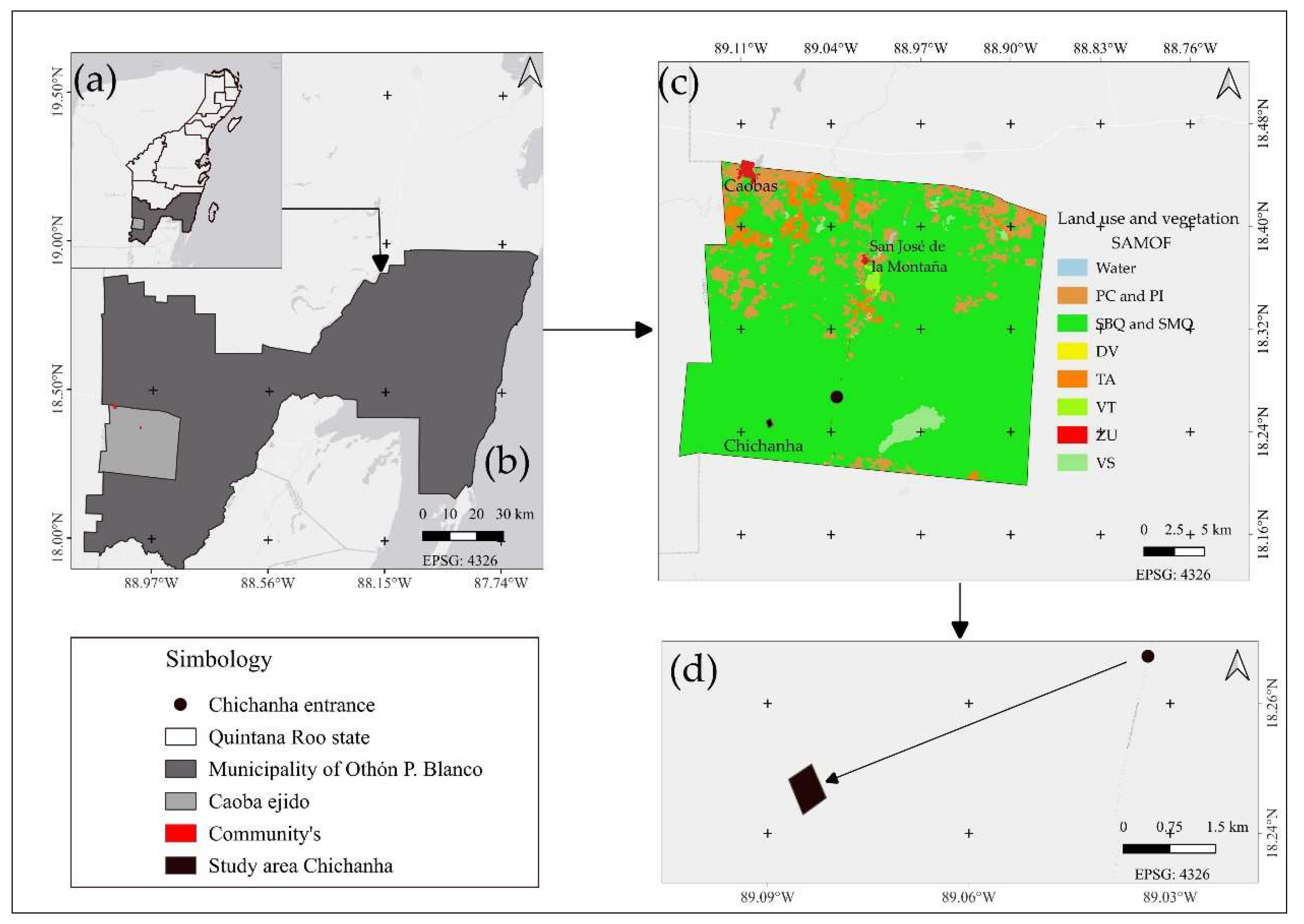
Figure 2.
Percentage of families (a) and number of species recorded by stratum (b) in the study area.
Figure 2.
Percentage of families (a) and number of species recorded by stratum (b) in the study area.
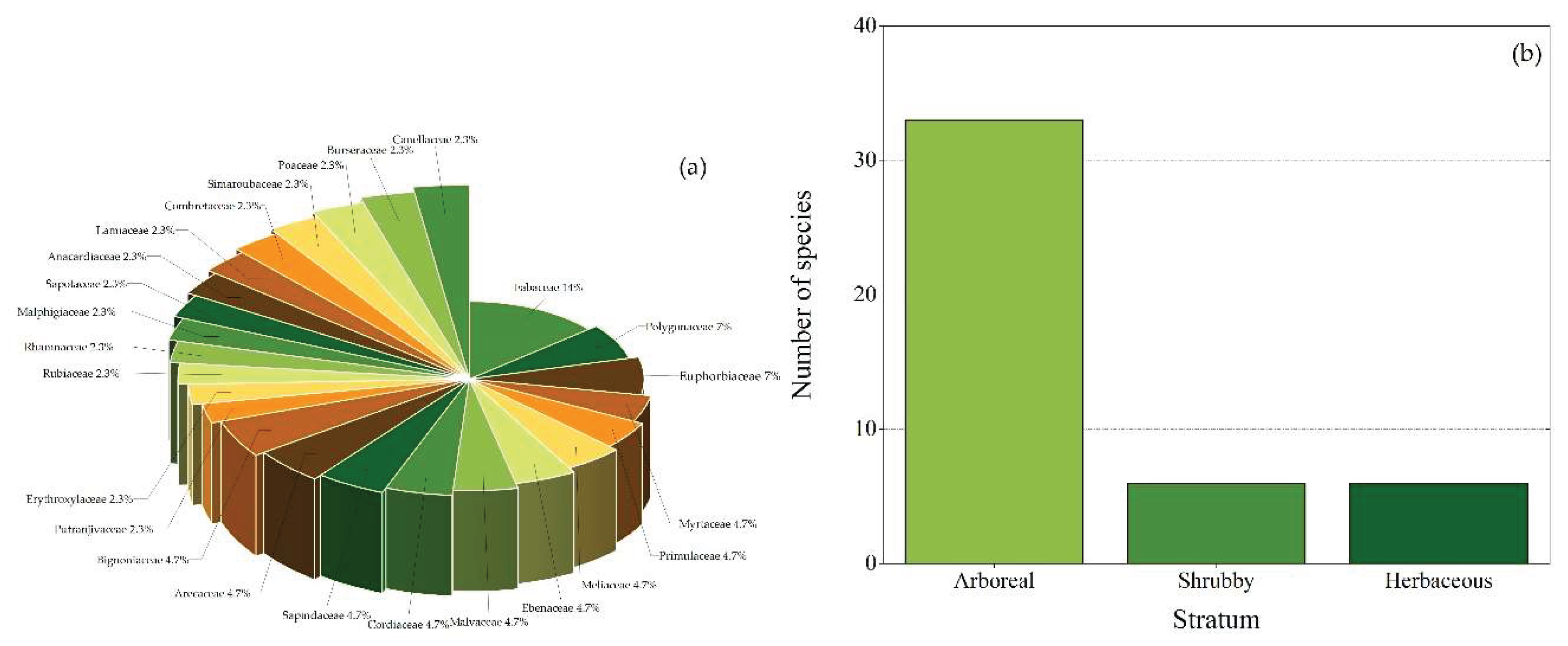
Figure 3.
Percentage of families (a) and number of species recorded by fauna groups (b) in the study area.
Figure 3.
Percentage of families (a) and number of species recorded by fauna groups (b) in the study area.
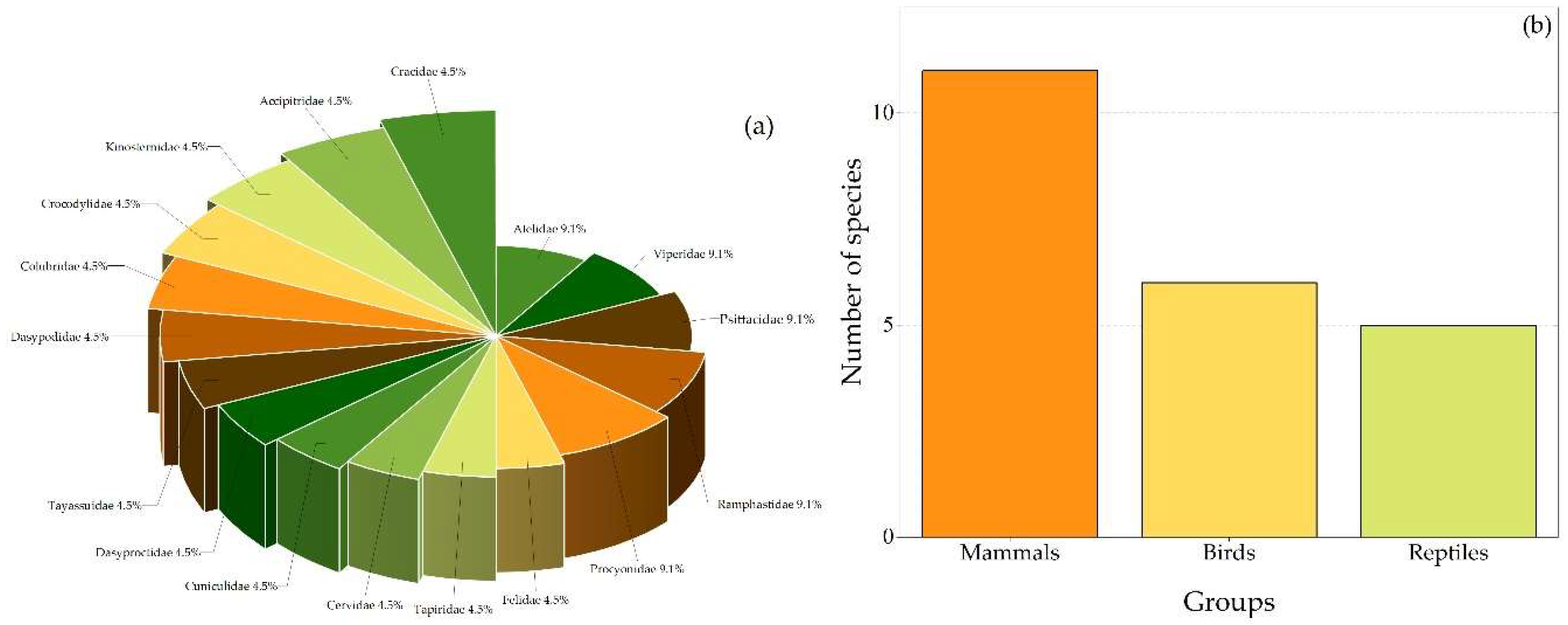

Table 1.
Assessment and Scoring of Management Capacity Criteria.
| % | Value | Rating |
|---|---|---|
| ≤ 35 | 0 | Unsatisfactory |
| 36 – 50 | 1 | Slightly satisfactory |
| 51 – 75 | 2 | Moderately satisfactory |
| 76 – 89 | 3 | Satisfactory |
| ≥ 90 | 4 | Highly satisfactory |
Disclaimer/Publisher’s Note: The statements, opinions and data contained in all publications are solely those of the individual author(s) and contributor(s) and not of MDPI and/or the editor(s). MDPI and/or the editor(s) disclaim responsibility for any injury to people or property resulting from any ideas, methods, instructions or products referred to in the content. |
© 2025 by the authors. Licensee MDPI, Basel, Switzerland. This article is an open access article distributed under the terms and conditions of the Creative Commons Attribution (CC BY) license (http://creativecommons.org/licenses/by/4.0/).
Copyright: This open access article is published under a Creative Commons CC BY 4.0 license, which permit the free download, distribution, and reuse, provided that the author and preprint are cited in any reuse.


