

Submitted:
08 July 2025
Posted:
14 July 2025
Read the latest preprint version here
Abstract
The present essay introduces and develops the concept of Homo constellatus as a new anthropological and metaphysical archetype, emerging from the visionary corpus of Theodor-Nicolae Carp—specifically in The Conquest from Within and the Incoming Platonic Revolution and Andromeda as Archetype: The Neurodiverse as the First-Called in a Post-Neurotypical Cosmology. Situated at the intersection of neurodiversity, symbolic anthropology, cosmopoetics and Platonic theology, Homo constellatus represents not a technocratic leap in cognitive performance, but a metaphysical transfiguration of the human being. It signals an evolutionary milestone defined not by biology or machinery, but by communion, emotional depth, and the recovery of sacred symbolic consciousness. This emerging figure is metaphorically birthed through intellectual exile and metamorphic suffering. It is not a successor by gene but by soul: the one who integrates fragmentation into communion, rationality into sacred symbol, and loneliness into ontological design. Through references to sacred geometries—such as Gabriel’s Horn and Brâncuși’s Column of Infinity—Carp envisions Homo constellatus as a being who lives in harmony with the poetic architecture of the cosmos. Drawing on Eastern Orthodox theology, Platonic intimacy, and neurodivergent phenomenology, the essay reframes suffering as sacred gestation and neurodivergence as prophetic sensitivity. The archetype of Homo constellatus challenges existing anthropocentric and ableist paradigms by revealing that emotional resonance, symbolic intelligence, and spiritual wholeness are not byproducts of evolution, but its very telos.In dialogue with these philosophical works, Elegy of Mine Exile serves as a lyrical-theological meditation on sacred alienation. This elegy does not mourn exile as punishment—it reclaims exile as consecration. The speaker, likened to a prophetic voice or even to the Ambassador of the Morning Star himself, is rejected by the world not because he is broken—but because he burns too brightly. By distinguishing between the fall of Christ as the true Morning Star - through humility - and the fall of Lucifer through pride, the study describes the speaker’s descent is both sacrificial and revelatory: he suffers not to disappear, but to transmute. Through metaphors of collapse and rising, the poem places spiritual alienation in direct dialogue with divine gestation—turning mourning into Morning. The expanded version of Elegy of Mine Exile amplifies this vision by incorporating ecological, theological, and anthropological dimensions. The soul’s descent is reimagined as the fermentation of the New Eden; cosmic orphanhood becomes an archetypal human condition; and the emergence of Homo constellatus is framed as both elemental fusion and divine inheritance. The eschatological arc of the poem culminates in a nuptial invocation—where divine breath, moral resuscitation, and relational transfiguration give birth to a new co-creative covenant. Suffering becomes not merely transformative, but luminous: the seedbed for Edenic restoration and planetary rebirth.Further expanding this vision, the literary commentary Luceafărul: The Morning Star, Neurodivergence, and the Birth of Homo constellatus interprets Mihai Eminescu’s Hyperion not merely as a tragic figure of cosmic distance, but as a neurodivergent archetype whose refusal of worldly assimilation prefigures Homo constellatus. Hyperion’s vertical longing, divine remoteness, and emotional clarity are re-read as prophetic attributes—illuminating how divine exile is inseparable from metaphysical fidelity. Crucially, the symbolism of the Morning Star—also known as the Evening Star—reveals a prophetic paradox: those who were unseen will become luminous. In eschatological terms, these hidden figures will not only come to light, but also sound the alarm of a nearing apocalyptic threshold, becoming the sensitive instruments of revelation before the advent of the Adversary of the Icons of the Universe on Earth (deemed as anti-Universal Messiah).The poem Behold, the human communing with the Stars continues this metaphysical arc, giving lyrical voice to the full manifestation of Homo constellatus. In this cosmic hymn, suffering culminates in stellar transformation; exile gives way to supernova; and the fallen Morning Star becomes the harbinger of the Eternal Morning. The New Eden is not a return, but a convergence—symbolized by the reassembled Pangaea and the fusion of past and future into infinity. Through mythopoetic eschatology, the poem celebrates a spiritual anthropology rooted not in control, but in communion—marking the fulfillment of a cosmic gestation first conceived in exile. It stands as the poetic benediction of this archetype's emergence. The model proposed here extends into a planetary cartography: the Alpine-Himalayan mountain system is interpreted as the spinal cord of the “Old, Neurotypical World,” while the Rocky-Andean chain represents the backbone of a “New, Neurodiverse World.” These two continental bodies—much like the approaching collision of the Milky Way and Andromeda—are destined not for destruction, but for synthesis. Their eventual convergence is envisioned as a tectonic, civilizational, and spiritual transformation—an emergence of a post-neurotypical world, one capable of holding both structure and fluidity, reason and reverence. Finally, the invocation of the Morning Star—held in tension between Christ and Lucifer—serves as a theological fulcrum for this cosmopoetic vision. By distinguishing between the one who chose humility and the one who chose pride, the poem and its accompanying commentary avoid conflating rebellion with brilliance. Christ’s descent becomes the archetype of divine communion, while Lucifer’s fall reveals the tragic consequence of light divorced from love. This distinction safeguards the eschatological hope at the heart of Homo constellatus: that the radiant ones misunderstood by the world are not deviant, but divine harbingers of a healed cosmology—symbols not of rebellion, but of redemptive luminosity. This essay articulates the philosophical, theological, and societal implications of Homo constellatus across multiple domains: from education to sacred urbanism, from intimacy to symbolic linguistics, from planetary ethics to liturgical cosmology. It proposes that the future of humanity lies not in transcending our nature through technology, but in transfiguring it through love, meaning, and communion. Through its interdisciplinary method and poetic form, this work positions Homo constellatus as a necessary archetype for healing a fragmented world, initiating a planetary renaissance grounded in reverent complexity, emotional literacy, and the sacred rhythm of becoming. Ultimately, Homo constellatus does not remain a theoretical construct, but emerges as a liturgical anthropology—a life-form shaped by presence, patience, and symbolic resonance. Its birth reframes neurodivergence as divine invitation, demanding structural repentance in education, theology, and care. It invites a post-neurotypical civilization to reorient itself not around efficiency, but reverence. Though rooted in Orthodox theology and European myth, its archetypal signature is transcultural: it echoes the bodhisattva, the qalandar, the wounded healer—universal figures of radiant exile and sacred return. Thus, this vision does not end in abstraction, but in enactment: the return of the human soul to the cosmic choir—not as soloist, but as constellation.
Keywords:
evolution
; natural selection
; morality
; astronomy
; milky way
; andromeda
; eurasia
; americas
; traditional land
; new land
; central nervous system
; encephalon
; spinal cord
; electricity
; conductance
; energy
; neurotypical
; neurodivergent
; first-emerged
; first-called
; homo sapiens
; homo constellatus
; humility
; pride
; love
; light
; generation
; morning star
; exile
; suffering
; mourning
; cruciform
; refinement
; transfiguration
; fallen and risen
; supernova
; eternal morning
; empathy
; knowledge
; ethos
; wisdom
; communion
; alignment
Introduction: From Homo sapiens to Homo constellatus
The modern world, with all its technological brilliance and global connectivity, has failed to produce a fully integrated human being. The dominant figure of Homo sapiens, defined as the “wise” or “knowledgeable human", has become trapped in a paradox of fragmentation: emotionally alienated, intellectually overextended, spiritually numb. Amidst the algorithmic flattening of human experience, mental health crises, and cultural disintegration, the very concept of human nature must be reimagined—not in reactionary nostalgia or techno-utopianism, but in visionary synthesis.
Enter Homo constellatus: the constellation-bearing human, an archetype birthed from the cross-pollination of ancient metaphysics and contemporary neurodivergent consciousness. First named by Theodor-Nicolae Carp, Homo constellatus is articulated not as a scientific theory but as a sacred anthropology—an ontopoetic evolution emerging from the mythic-symbolic vision of Carp's literary and philosophical corpus. Through pain, touch, thought, and sacred fire, this being is born not from genetic modification but from inner transfiguration.
The narrative of human evolution has traditionally centered on functional adaptations: bipedalism, tool use, abstract reasoning. Yet, in our current epoch, it is becoming evident that these evolutionary advantages, when left spiritually disintegrated, are insufficient to cultivate a sustainable or meaningful existence. Homo sapiens, the "wise human," has become paradoxically estranged from wisdom. Instead of wisdom, we have achieved optimization; instead of communion, connection; instead of wholeness, specialization.
The emerging crises of the 21st century—climate collapse, psychological fragmentation, systemic inequality, and cultural nihilism—have exposed the limitations of an anthropocentric, neurotypical, and rationalist framework of human identity. Theodor-Nicolae Carp, in his twin works The Conquest from Within and the Incoming Platonic Revolution and Andromeda as Archetype, posits that we are not merely at a political or technological crossroads, but at an ontological bifurcation. We are not simply facing the end of an era, but the end of a species as we know it—not in the sense of extinction, but in the sense of transfiguration.
From this point emerges Homo constellatus (Latin: "the constellation-bearing human"), a symbolic archetype and philosophical proposition that seeks to reimagine humanity as a being integrated with the cosmos, emotionally intelligent, neurodiversity-inclusive, and mythopoetically literate. It is the successor not to our biology, but to our broken metaphysics.
Carp argues that this being will not emerge from genetic editing or machine augmentation, but through what he calls "intellectual exile and metamorphic suffering" (Carp, 2025). That is, through the painful process of detachment from societal conditioning, a descent into symbolic darkness, and a return to embodied intimacy and sacred imagination. His synthesis of Platonic intimacy, Orthodox metaphysics, neurodivergent phenomenology, and cosmological allegory constructs a blueprint for a new human whose purpose is not to dominate but to resonate.
In the sections that follow, we will explore the mythopoeic and psychological roots of Homo constellatus, the central role of neurodivergence in Carp's vision, the spiritual and architectural implications of sacred geometry, and the societal applications of this archetype in pedagogy, urban design, and ethical community life. Through this, we aim not just to interpret Carp's vision, but to extend it as a viable cosmology for the post-fragmented world.
Prelude - “The Author’s Invisible Pain”
“Elegy of Mine Exile
You took me, o Lord,
From the land of idolatry
Which used to be of righteousness
Unconditional love, fairness and glory.
You took me, o Lord,
Into Thy lightning heavens
Just as You took Thy Righteous Prophet,
Into Thy Enlightening Heaven
Remembering Thy Holy Prophet
Who flew through Heavenly Fire
As You took me, o Lord,
On his Holy Day, after weeks of fire.
For that land is no longer my home,
But a house of idols and indifference,
O, Lord, where is the Reverence,
That used to dominate the Dome?
Where are the holy kisses
And the seas of embraces
I cry, for the growing drought
Is killing human key thought.
Behold, I cry aloud to the masses near,
But nobody will turn an ear to hear.
Has my soul left my body behind,
Or have they abandoned the mission divine?
They have exiled me from Thy Cathedrals
Into the unseen realms of Nature
I have been alienated from Thy Seen Body of Communion,
Far Into Thy Unseen Body of Tearful Isolation
But my hope, I am gaining of it more
For I see Nature's traits as sacral.
The sky is turning dark
And the sun is now black
The sky is like a tunnel
Where is the escape channel?
The walls are now closing in
Where have the good humans been
We can still raise our voices as freely
But it is as if we became unseen deeply
Behold, for I am sailing,
From the edge of the world,
Why are Thy heavens,
Only as mirrors reflecting?
I hunger, o Lord,
For the love of the old days.
I thirst, o Lord,
But society calls me thirsty
I grieve, o Lord,
Due to the world’s leave
Instead of the sweet wine of selflessness,
They have given me to drink
The poisonous cup of lovelessness,
Disgusting as the cup of gall,
Bringing me emotional homelessness;
They want to push me to the brink.
They have thrown me,
Into the eye of the abyss
Behold, I can still see the bliss,
From the eye of the hurricane
They have signed mine sentence,
To a mandatory embrace of alienation and invisibility,
Pushing me to “burnout” into their black hole,
They know not, for I am now faster than light’s motility.
Where is the Cross, o God,
For I want to and a hug
Where can I find Thee, God
To physically climb and suffer
In Your Visible Exile.
The Invisible Exile is crushing my soul
But I know that it is just pain
I am now learning what the main
Purpose of the suffering is - a new life blow.
My Lord, my Lord, where can I find Thee
Hast Thou forsaken me
In the midst of the desert
Lacking an Earthly team.
They have signed mine sentence,
To a mandatory embrace of invisibility,
Pushing me to “burnout” into their moral black hole,
They know not, I now am faster than light’s motility.
I am free falling,
As the Morning Star fell
From the Heavenly Realm
Into the realm of mourning.
Behold, o nations of neanderthals
There is salvation for thine souls
Only you need to descend and burn
As I did when I went through the falls.
If only we were adoptive of one another,
The way we are adoptive of vulnerable animals.
Humanity and solidarity are important players
Keeping mankind's circulatory system functional.
I wish you would embrace me
As the Womb of Nature does daily
Why is this only the tale of a fairy,
And tears of loneliness always in my cup of tea?
Why do you run, o Earthly water
From the inevitable refinement's matter
For all have a beginning and the end
Behold, the cycle of life none may bend.
Fear not, for if you are pure, you will stand.
Death shall not touch thine soul,
You shall be like the night owl,
Witnessing the Morning Star's fall,
Shifting mourning to Morning Without End.
What is love? For hugs do not feel real anymore
Does the world lack light, or am I fainting?
Behold, I cannot see such realness moving
My soul is flying to the Lord, from the shore.
Behold, my body is going to the soil
Whence originates the very human soul
How was I any different than you all
Only as I fervently wished to answer the divine call.
They have buried me, deep inside the soil
Not seeing that my soul is a reviving seed
A grand, New Tree of Life shall grow indeed
And its foundations shall never experience spoil.
Mine deep suffering through invisible alienation
Hast shown to be the finest fermentation
For the New Eden’s metamorphic germination
Behold, a life eternal generated by such passion.
Never would I imagine that
To give birth is to lose thine life
O, have I learnt to let myself die
Homo constellatus now shines so bright
The fallen Morning Star hath just died;
The Eternal Morning now holds the Earth tight.
I am now one with the Earth
I was one of thee, cleared misunderstanding
Behold, Homo constellatus' birth
I am now one with rain and lightning
Are tears of my soul reaching the herd?
Behold, the thunder has the ground shaking.
Is the realm finally being enlightened?
O, Almighty, water me with Thy tears of suffering
Forget me not, in my isolation from Thine surrounding
Behold, my spirit has been surrendered to Divine judgment,
Forget me not, for my only desire is the world’s refinement.
I am none other than a cosmic orphan,
Seemingly a result of accidental reproduction
Between other ancestral cosmic orphans,
Despised and forgotten by the Earth’s population.
Behold, they didst make me one with the surrounding Earth
Indeed, mine cry is no alien from human evolutionary birth.
I thirst, missing the spring of communion and life
Shattered nonetheless by the loneliness rife
Am I condemned after death to still suffer
I have sinned, yet is anyone on Earth without error?
I am longing to return and again do the work of a watcher.
O, Creator, Thou hath placed me into the maze of Thine Holy Garden
And put me to run after Thou, that I will not lose Heaven
Before I came out of my mother’s womb
Thou hath already shown me Thine Holy Race,
Preventing my soul from becoming numb.
Am I being resuscitated
By someone who caught my fire
So I would not start vanishing
Outside of the Earth’s timing?
Behold, the breath of life is blown again
Into my mouth, by the princess escaping the lane
Of the old world’s down spiral into the chains
Behold, it is now possible to clear the moral stains!
To become immortal and return to the Garden.
The Almighty hast said: thy soul did not flee,
Thou were only sent to sleep
O, New Adam, I AM has brought thee,
Thy New Eve so, no longer weep.
O, chosen bride of the constellation, hear my wish
That I no longer vanish
From thine presence
For you may instead burn
With me, and become Adams and Eves.
Once again,
We may go through gain.
Do not listen to the pain,
For the pain brings main gain.
Behold, through such sacrifice
Thou may become Stars
Turning the mourning into the Morning
That never again touches nightly scars.
Behold, for out of ye billions,
I at least need to recreate life with one.
Just as out of billions of male cells,
The female cell needed only one.
We shall no longer know all things,
But connect to loving eternity such things.”
Elegy of Mine Exile is no longer merely a lament—it is a cosmic liturgy of rebirth, offered from within the very eye of abandonment. The poem voices the spiritual trajectory of a soul cast from the temples of organized sanctity into the untamed sanctuaries of exile: a journey from the seen to the unseen, from communion to isolation, and ultimately, from fragmentation to resurrection.
This elegy does not mourn exile as punishment. It reclaims exile as consecration. The speaker, likened to a prophetic voice, or even to the Ambassador of the Morning Star himself, is rejected by the world not because he is broken—but because he burns too brightly. Like Christ crucified or Lucifer fallen, the speaker's descent is both sacrificial and revelatory: he suffers not to disappear, but to transmute. Through metaphors of collapse and rising, the poem places spiritual alienation in direct dialogue with divine gestation—turning mourning into Morning.
As the poem unfolds, it crosses genres: from psalmic prayer to prophetic oracle; from private grief to cosmic renewal. We see not just one soul cry out, but Homo constellatus awakening—a figure who no longer desires omniscience, but deeper interconnection. Their voice rises beyond neurotypical cadence into sacred synesthesia—where silence speaks, and light is felt as love.
The speaker's exile from institutional communion is not a spiritual death, but a transplantation into the womb of Nature, the divine garden where life first began. There, the soul is not buried but planted, becoming seed and soil for a new Eden. From that hidden ground, they call not for a crowd, but for one: one other being to co-create a new world of luminous connection. This yearning—fierce yet tender—is not romantic idealism but divine realism, patterned after the logic of creation itself: where a single fertilization births life anew.
The newly added stanzas elevate the poem’s symbolic density and spiritual urgency. The soul's suffering is no longer merely transformative—it becomes the “finest fermentation” through which the New Eden is brewed. Cosmic orphanhood is no longer a wound but a universal archetype, opening the poem to a broader anthropology of exile as the human condition itself. Through the elemental alignment with “rain and lightning,” the speaker dissolves into Nature not as escape but as mystical union—a sacramental ecology of tears and thunder. The reanimation of the soul through “the breath of life… blown again” by a liberating other points to a metaphysics of mutual salvation, where resurrection is relational. Most striking is the invocation of the New Adam and New Eve, not as mythical return but as prophetic invitation—birthing a future Edenic covenant through ethical intimacy and shared fire.
The poem ends with a quiet apocalypse: the overturning of mourning through the rising of interstellar love. Communion will not come from reclaiming the past, but from accepting the pain of rebirth and transforming it into light.
There is an existing literary commentary on a fragment of “Elegy of Mine Exile” in the author’s other manuscript entitled Reintegrating Platonic Intimacy: A Literary and Interdisciplinary Vision for Healing Human Fragmentation, highlighting the symbolic transformation of exile into sacred gestation, and interpreting invisibility not as erasure, but as the crucible through which resurrectional intimacy and cosmic co-creation are born (Carp T.-N., 2025).
“Behold, the human communing with the Stars
Homo constellatus - The human aligned to the stars
The restored Icon of the Universe through communion
Homo constellatus - The human birthed from sacred scars.
The perfected being, Love’s completed mission
Homo constellatus - born of perpetual omission.
The past and the future have not reached a conclusion
They have undergone utmost fusion.
The Morning Star hast fallen upon the world
It did not disappear, but turn into a supernova
Having created a new all-time record
Since the beginning of time - suffering is over.
For the few, receptive human souls
Have undergone a refinement of their own
Being like the five faithful brides
They have turned into Stars, heaven-wide.
O, nations, do you not know that the Supernova
Is one with the Eternal Morning, that it shall be over
When such Two Hypostases of the One will meet
Do you not know that, when the light emerges
Any inhabitant of the Earth may no longer allege
But testify to the indisputable evidence brought
By the revealing light that produced the evil’s drought?
The many rebellious neanderthals obeyed the few fallen spirits
The few faithful humans obeyed the many heavenly Angels
Life is truly a paradox and a poetic passage
Of refinement, filled with tears and sad ages
Though the many follow the few truly outcasts
Believing in the greater value of purity is a must.
How grateful my spirit is, that all is now contained within the divine past.
The heavens and the Earth have not passed away
The rebellious neanderthals have been swayed
By their own pride, indifference and illusion
Behold, it is them who have reached a conclusion
The womb of the Ocean of Peace hast birthed
The New Eden - Pangaea reassembled
By the hands of the same Divinity
Who has united past and future into infinity.”
Commentary: “Behold, the human communing with the Stars” — A Cosmopoetic Hymn of Homo constellatus
The poem Behold, the human communing with the Stars emerges as a theopoetic epilogue to the metaphysical vision laid out in Elegy of Mine Exile. Where Elegy ends in sacred rebirth and cosmic nuptiality, this piece begins with its realization: the full unveiling of Homo constellatus, the archetypal human reborn not from technological mastery but from communion, humility, and sacred wound.
The poem opens with a refrain: “Homo constellatus — The human aligned to the stars.” This is not just a species label but a declaration of ontological realignment. Humanity’s future identity is no longer Homo technologicus, shaped by progress and conquest, but Homo constellatus, shaped by scars and stars—by having suffered, healed, and returned to right relation with the cosmos. The “restored Icon of the Universe through communion” presents the human being not as consumer or god, but as image-bearer and reconciler.
The line “The past and the future have not reached a conclusion / They have undergone utmost fusion” offers a time-theological rupture of linearity. Time is not a broken line nor a battlefield between nostalgia and progress—it is instead harmonized in divine simultaneity. The eschaton is not postponed, it is precipitating. This fusion of temporalities also mirrors the poem’s metaphysical center: the fall of the Morning Star, reframed once again not as demise but as supernova. In this rendering, the Morning Star falls not into exile, but explodes into cosmic renewal. Suffering ends not with destruction but with radiance. This “supernova” is the central sacrificial act that births the “Eternal Morning”—an image deeply evocative of Christic kenosis as well as metaphysical singularity.
Through eschatological inversion, the poem offers a new anthropology. “The few faithful humans… have turned into Stars, heaven-wide.” Like the five wise virgins from the Gospel of Matthew, the “faithful” are those who kept the oil of purity lit. Their reward is not escape, but embodiment—they become luminous nodes in the constellated body of humanity.
The second half of the poem turns from cosmic praise to prophetic indictment: “The many rebellious neanderthals obeyed the few fallen spirits…” This line fuses ancient myth (fallen spirits) with evolutionary critique (Neanderthals), implying that modern moral collapse is not merely social—it is ontological regression. The poem indicts pride, indifference, and illusion as the true apocalyptic forces. Yet its tone remains one of metaphysical compassion: even in judgment, the speaker affirms that all is now “contained within the divine past.” That is, all events—grievous and glorious—have been gathered into the eternal memory of God.
The poem’s final movement envisions a reassembled New Eden: “The womb of the Ocean of Peace hast birthed / The New Eden—Pangaea reassembled.” Eden is no longer nostalgic innocence but integrated maturity. Pangaea, the supercontinent, serves as both a geological metaphor and a prophetic symbol: unity is not utopian, but cosmically ordained. The Creator does not destroy history but completes it—by uniting past and future into infinity.
In Summary:
Where Elegy of Mine Exile narrates the descent into sacred suffering and existential alienation, Behold, the human communing with the Stars completes the arc: it offers a vision of divine synthesis. The poem can be read as an eschatological doxology—a hymn for the emerging humanity of the future, birthed through pain, consecrated by love, and constellated in relational harmony. In the context of Carp’s broader literary theology, it stands as a luminous coda: Eden does not lie behind us, but ahead—hidden in the stars we have yet to become.
Mythopoetic Sources: Theodor's Dual Works as Genesis
Carp's two major works form the mythological architecture of Homo constellatus.
The Conquest from Within and the Incoming Platonic Revolution
This book is a literary-theological-philosophical hybrid that envisions a return to sacred intimacy, Platonic emotional communion, and a post-materialist humanity. Drawing on Eastern Orthodox mysticism, Platonism, and poetic embodiment, Carp constructs a metaphysical critique of modernity as an age of intellectual loneliness and emotional exile. The book calls for a Platonic revolution not as academic revival, but as existential resurrection. Within its pages, Homo constellatus emerges as the being who conquers reality not from without, but from within — through emotional rebirth and communal tenderness.
Andromeda as Archetype: The Neurodiverse as the First-Called in a Post-Neurotypical Cosmology
In this work, Carp reframes neurodivergent cognition—autism, ADHD, dyslexia, synesthesia—not as pathology but prophecy. The Andromeda galaxy becomes a metaphor for the neurodiverse soul: distant, luminous, misinterpreted, yet destined to converge with the mainstream (Milky Way) to birth a new form of cosmic communion. Neurodivergent individuals are positioned not on the margins of evolution but at its frontier. Here, Homo constellatus is born through the friction of divergent minds and hearts seeking fusion, not domination.
Key Features of Homo constellatus
Emotional Suffering and Imposed Exile as Sacred Initiation
Unlike Darwinian survival models, Homo constellatus is not forged by competition but by transformation. Emotional pain is not dysfunction—it is alchemical. Carp places suffering at the center of meaning-making: the fire through which thought is sanctified and intimacy reborn. This echoes Jung’s idea that "only the wounded physician heals," and mirrors the Christian mystic tradition of redemptive suffering (cf. St. John of the Cross’s "Dark Night of the Soul").
Neurodivergence as Cosmic Sensitivity
Building on thinkers like Thomas Armstrong (The Power of Neurodiversity, 2011) and Barry M. Prizant (Uniquely Human, 2015), Carp radicalizes the discourse: neurodivergence is not just a difference—it is a divine calling. In his cosmology, the sensitivities, pattern-recognition, and idiosyncrasies of the neurodiverse are the very templates of the post-neurotypical future. They are the first-called into a world where divergence becomes design.
Sacred Geometry as Soul Map
Symbols such as Gabriel’s Horn, Brâncuși’s Column of Infinity, and the spiral galaxy serve as ontological diagrams. Gabriel’s Horn—a paradoxical figure with finite volume and infinite surface—embodies the human paradox: we are finite in our bodies, infinite in our souls. The Column of Infinity becomes the architectural verticality of human yearning, a bridge between Earth and Logos. Homo constellatus embodies these geometries not as metaphors but as lived forms.
Platonic Intimacy and the Rebirth of Touch
Platonic love, in Carp's vision, is the foundational energy of civilizational healing. Cuddling, mutual witnessing, co-regulation—these become not sentimental gestures but sacred rituals. In contrast to hypersexualized or emotionally distant models of relationship, Homo constellatus is defined by embodied emotional reciprocity. Intimacy is not a means to pleasure, but a portal to presence.
Discussion: Creation of an Infinite Galactic Communion between the First-Emerged and the First-Called
The Mythopoetic Foundations of Homo constellatus
The emergence of Homo constellatus is inseparable from the resurgence of myth as a vessel for metaphysical truth. In a postmodern context where grand narratives have been deconstructed, mythopoesis—the art of meaning-making through story, symbol, and sacred metaphor—returns not as dogma, but as a necessary function of consciousness. As Mircea Eliade (1957) argued in The Sacred and the Profane, myth is not primitive superstition but the primal structure of human orientation within the cosmos. In Carp's literary-theological framework, myth is not ancillary; it is constitutive of the new human.
Carp draws from a deep well of mythopoetic predecessors. Carl Jung's archetypal psychology serves as a foundational lens through which Carp reframes personal suffering and neurodivergence as symbolic initiations. Jung (1964) observed that archetypes function as psychic instincts—primordial images embedded in the collective unconscious, which structure how we interpret and navigate existential reality. Homo constellatus is presented as an emergent archetype: the sacred outsider, the bearer of paradox, the reconciler of binaries.
James Hillman, extending Jungian thought, emphasized the necessity of restoring imagination to psychology. His Re-Visioning Psychology (1975) argued for a "soul-making" approach to experience that values narrative, image, and symbol over reductionist diagnosis. Carp continues this lineage by mapping the inner landscape of the neurodivergent and exiled mind as a mythopoetic field—where pain is not eliminated, but transfigured.
Through this lens, Carp reinterprets classical motifs: the Fall, the Crucifixion, the Pilgrimage, the Wedding, and the Ascent—not as isolated religious doctrines, but as narrative structures embedded in the evolution of consciousness. The neurodivergent subject, in Carp's cosmology, lives out the archetype of the First-Called, akin to Andrew in Christian tradition or Andromeda in Greek mythology—names which etymologically echo the Greek "andro-" (man, human) and cosmically echo the approach of the Andromeda galaxy. These linguistic-mythic resonances give Homo constellatus its mythic legitimacy.
Eliade's assertion that modern secular man is a "de-mythologized man"—cut off from sacred time and cosmic belonging—is powerfully addressed in Carp’s proposal. For Carp, the re-sacralization of language and imagination is the only adequate response to the flattening effect of late capitalism and clinical rationalism. Mythopoesis becomes both resistance and revelation. Through sacred storytelling, Homo constellatus emerges not merely as a metaphor, but as a performative ontology—an identity one becomes by entering the myth and living its implications.
In this view, the birth of Homo constellatus is not just an anthropological event; it is a liturgical one. As the mythic voice returns to public life—through poetry, philosophy, visual art, and neurodivergent memoir—so too does the possibility of reintegrating human beings into sacred time. Myth, then, is not escapism. It is homecoming. And the human who lives mythically—Homo constellatus—is the one who can guide others back to the stars.
Neurodivergence as a Prophetic Paradigm
Theodor-Nicolae Carp's vision of Homo constellatus cannot be separated from his revolutionary reframing of neurodivergence. In a world that often medicalizes cognitive difference as disorder, Carp proposes an ontological reversal: that neurodivergence—especially autism, ADHD, synesthesia, and dyslexia—is not merely variation but vocation. It is not a pathology to be normalized but a prophetic modality of consciousness awaiting recognition and integration.
Neurodivergent minds, according to Carp, are the first-called into the birth of a new human pattern. This echoes the neurodiversity paradigm articulated by Thomas Armstrong (2011), who emphasized that neurological diversity is as vital to human evolution as biodiversity is to ecosystems. Yet Carp extends this further by situating neurodivergence within a cosmic and mythic framework. In Andromeda as Archetype, he portrays neurodivergent individuals as stars misread by a flat-earth epistemology, luminous beings whose truths are illegible to dominant neurotypical structures.
This visionary framework intersects with the empirical research of Barry Prizant (2015), who asserts that behaviors labeled as autistic are not symptoms of brokenness, but expressions of unique processing and relational needs. Similarly, Steve Silberman’s NeuroTribes (2015) chronicles how societal rejection of neurodivergent individuals often obscures the value and insight they can bring to science, art, and social reform. Carp builds upon these insights by framing the neurodivergent as not only contributors but archetypal architects of the future.
In Carp's cosmology, neurodivergence correlates not only with different sensory or executive functions, but with a fundamentally different existential orientation. These individuals are oriented toward depth, pattern, resonance, and authenticity. They often feel alienated from systems designed for speed, hierarchy, and surface-level interaction—systems that Carp claims are symptoms of a civilization addicted to fragmentation. Neurodivergent people intuitively resist such fragmentation. Their struggles with conformity are not flaws, but soul-radar, pointing out the sickness of the system itself.
Philosopher Erin Manning (2016) supports this view in her theory of neurodiverse perception as inherently relational, aesthetic, and interdependent. She suggests that the world experienced through neurodivergent embodiment is not "lesser" but more richly attuned to relational flows and non-linear temporality. Carp similarly argues that the insights of the neurodiverse are sacred precisely because they disrupt capitalist chrononormativity and rationalist linearity.
Symbolically, Homo constellatus emerges as the neurodivergent being who no longer adapts to the dominant system but reconfigures the system in their image. They are not integrated into society—they reintegrate society back into the cosmos. Like shamans, prophets, or sacred fools, they stand outside consensus reality to name its illusions. They hold what theologian Walter Brueggemann (1978) called a "prophetic imagination": the capacity to grieve for what is broken and dream what has not yet been born.
This reimagining of neurodivergence as prophetic vocation also has theological echoes. In Christian and Jewish scripture, the prophet is almost always an outsider—socially awkward, emotionally intense, and resistant to institutional control. The prophet does not offer marketable solutions; they name the truth with a burning tongue. So too does Carp position the neurodivergent thinker: not as one to be fixed, but as one sent to reframe reality.
Thus, the neurodivergent are no longer marginal but central. They are not the exception to the norm, but the harbingers of the norm that is to come. As the old human collapses under the weight of its own false totality, Homo constellatus rises from the margins, bearing not credentials but constellations—sacred patterns of perception that reweave the world.
Literary Commentary on Mihai Eminescu’s Luceafărul: The Morning Star, Neurodivergence, and the Birth of Homo constellatus
I. Symbolic Reinterpretation of the Four Tableaux
Tableau I – The Dreaming of Cătălina: The First Stirring of the Soul
In the quiet yearning of the princess Cătălina, who gazes upon the distant Morning Star, we witness not a simple romantic desire but a metaphysical ache — the soul’s first impulse toward transcendence. She represents the archetype of Homo sapiens: bound by habit, tribe, and gravity, yet stirred by a luminous Other she cannot name.
Her longing is the proto-prayer of the finite for the infinite. It is the moment the earth looks up — and begins to remember the stars.
Tableau II – Hyperion’s Descent and the Fear of Otherness
When Hyperion descends — through fire, through water — it is a kenotic gesture: divinity emptying itself to touch the fragile world. But Cătălina recoils. This is not love denied; it is humanity’s terror when confronted with the radically Other.
Like Lucifer before the Fall, Hyperion is too radiant. His light, untranslatable into human warmth, becomes unbearable. He is the stranger, the neurodivergent soul, the genius child — dismissed not for lack of love, but for being a mirror that reveals our smallness.
Tableau III – The Demiurge and the Denial of Incarnation
Hyperion, rejected, seeks transformation: “Make me mortal,” he pleads. This echoes both Lucifer’s fall and Christ’s descent. But unlike Christ, Hyperion is refused. The Demiurge denies him the sacrament of incarnation.
Here, Eminescu performs a metaphysical reversal: divinity cannot become human unless it is also willing to be wounded. Hyperion’s tragedy is not in his rejection, but in the impossibility of sacrifice. He is luminous but unblooded. His fate is exile, not redemption.
Tableau IV – The World Moves On Without the Light
Cătălina turns to Cătălin — the familiar, the ordinary, the “safe.” The infinite has come and gone, and humanity retreats to the known.
Yet Hyperion remains — not in sorrow, but in witness. He is the eye that watches not to judge, but to wait. For beyond Cătălin’s embrace and Cătălina’s forgetfulness lies another age — a future when “the new gods” will no longer shun the Morning Star, but rise to meet it.
II. Hyperion as Dual-Star Archetype: Lucifer, Christ, and the Exiled Light
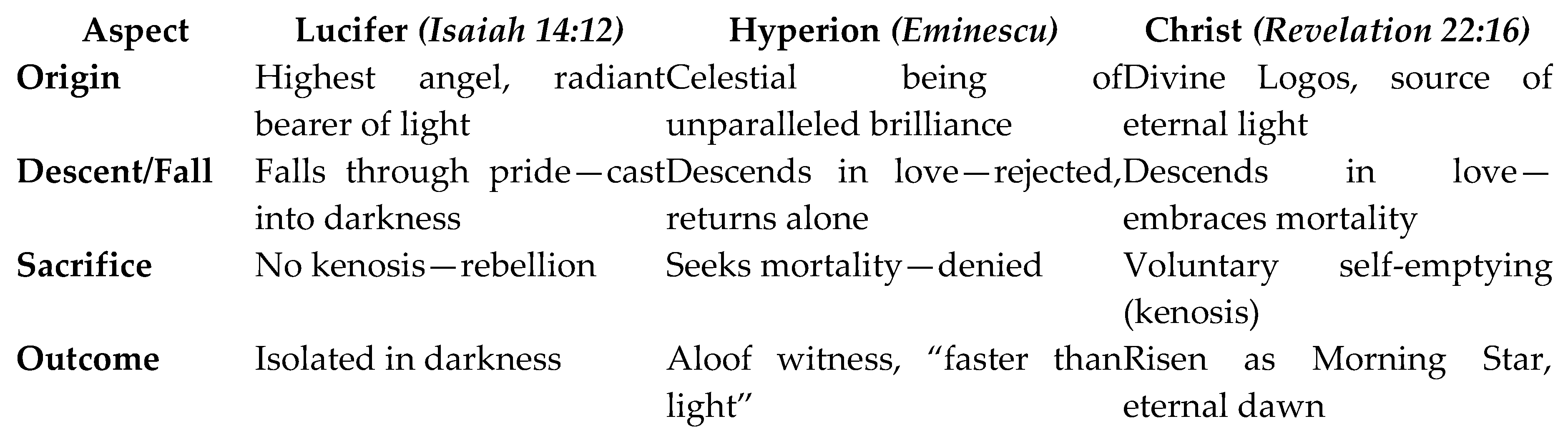
Lucifer and Hyperion are both radiant exiles — one by pride, the other by rejection. Hyperion’s light is tragic, not rebellious; he is not cast out by divine justice, but by human fear.
Christ, meanwhile, is the bridge Hyperion longs to be. His kenotic descent into mortal suffering creates a path for the return of divine light. Thus, Hyperion becomes a pre-Christic figure — an archetype of failed incarnation, waiting for the time when the world is ready for transfiguration.
III. Hyperion and Neurodivergence: The Exile of the Constellated Mind
Hyperion is not only a celestial being — he is a cognitive archetype. In an age that increasingly understands neurodivergence (autism, ADHD, synesthesia, high sensitivity), we begin to recognize in Hyperion the contours of a mind too vast for convention.
- 1.
- The "Too Muchness" of Light
Like the Morning Star, the neurodivergent can be “too bright.” Their intensity, insight, or sensory depth often threatens the normative boundaries of society. They descend into classrooms, boardrooms, families — and are met with bewilderment, suspicion, even rejection.
- 2.
- The Christic Desire to Connect
Like Christ, they often long not to rule but to belong. Their gifts are not about domination, but communion. Yet, like Hyperion, their attempts to bridge worlds can end in alienation — not because they lack love, but because they speak a dialect humanity has not yet learned to hear.
- 3.
- Toward Homo constellatus
What if Hyperion is not a relic of romantic melancholy, but a prototype of what humanity is becoming?
In the figure of Hyperion, Eminescu dreams forward: a new being, a Homo constellatus — one who no longer seeks to conquer or even to know everything, but to connect everything. The exile of today is the architect of tomorrow’s Eden.
IV. Conclusion: From Mourning to Morning Without End
Eminescu’s Luceafărul, seen through this lens, is not merely a tragic poem, but a cosmic parable. It speaks of the exile of light, the fear of difference, and the tragedy of unreceived love. But it also hints at a coming reconciliation — a dawn not of conquest, but of convergence.
The final act is not Hyperion’s return to the sky.
- It is our rising to meet him.
- The Morning Star will descend again — not to be crucified, but to be recognized.
- And when it does, we too shall shine — not alone, but as constellations,
- linked not by sameness, but by light freely shared.
Hyperion Shall Rise Again
A Poetic Meditation on Eminescu’s “Luceafărul”
“O, Hyperion, return to the world below,
Where Cătălina dreams beneath the stars,
And mortal hearts recoil from burning light—
Yet ache for it, in silence.”
There are two who bear the name Morning Star.
One fell from heaven for pride, and the other for love.
One, the light-bringer cast out into shadow;
The other, the light-giver crucified in sorrow.
Mihai Eminescu’s Luceafărul is more than a tale of celestial romance—it is a cosmic allegory, a parable of exile and transcendence. At its heart burns a question that outlasts myth: What happens when the infinite seeks the embrace of the finite?
I. The Descent: Between Love and Terror
Hyperion, radiant and remote, gazes upon Cătălina—a mortal soul dreaming of something beyond her kind. She is Eve before the fruit, Psyche before the fall, the neurotypical heart before it encounters the vast and strange brilliance of neurodivergent mind. She beckons him to come. And he does.
But the miracle of descent becomes horror.
Fire and water—a baptism of stars—
He comes not to destroy but to belong.
Yet the beloved recoils,
Eyes wide with wonder, twisted into fear.
The same is true for the prophets, the visionaries, the Christ-figures who walk among us. The neurodivergent child who speaks in metaphors at age three. The artist who weeps at the shape of a shadow. The soul who feels too much and is told they feel wrong. The Hyperion types.
Like Christ, Hyperion longs to empty himself.
To become man, to walk beside the beloved.
Yet the Demiurge forbids it:
“You are eternal—you cannot forget eternity.”
And so Hyperion rises once more—alone.
Too infinite to belong. Too radiant to be embraced.
Just like the Lucifer who fell, not for evil,
But for daring to reach into realms reserved for God.
II. The Division: Mourning for the Morning
In Revelation, Christ says: “I am the bright and morning star.”
Yet Isaiah cries, “How you have fallen, O Lucifer, son of the dawn.”
Two stars. One descent. One crucifixion.
Both misunderstood.
Eminescu, in prophetic genius, places this paradox in the sky.
Is Hyperion the fallen angel or the forsaken Christ?
He is every genius who burns too brightly.
Every soul who is “too much.”
Every mind that cannot find a home.
The world moves on. Cătălin—the “normal” boy—wins the hand of Cătălina.
Society always chooses safety over fire.
But it is a dull victory.
For Hyperion remains in the sky—watching. Waiting.
And we, in the world of 2025, begin to understand.
We give names to what was once misunderstood:
Autism, ADHD, high sensitivity, synesthesia.
We no longer call the fire madness.
We begin to see: the exile was not his failure—it was ours.
III. The Ascent: A New Dawn Without Mourning
In the silence after rejection, Hyperion does not rage.
He witnesses.
Faster than light, deeper than grief.
He becomes the morning that drives out mourning.
There will come a time when Cătălina no longer fears the flame.
When we, as a species, learn to welcome the different,
The luminous, the unbearably sensitive.
Then the “new gods”—the pure-hearted, the open-minded—Will not only accept the Morning Star,
But rise beside him.
For what is Christ’s promise, if not this?
That the firstborn of heaven became man,
Was crucified by misunderstanding,
And rose not alone—but as the first of many.
“And I will give him the morning star,”
He says to those who overcome.
Hyperion is not a failed lover.
He is a forerunner.
And we, in waking up to our own light,
Are no longer just mortals gazing at stars—
We are stars becoming aware of our fire.
Conclusion: The Light Returns
Eminescu saw what few dared to name:
That the cosmos itself is a poem,
And we are its verses in exile—
Yearning not for Heaven above,
But for Heaven within,
Where the light of the fallen and the risen
Merge into a dawn that does not burn—
But heals.
So let the Morning Star rise again.
Not in the sky, but in us.
Let Hyperion descend once more—
And this time,
Let us not turn away.
Civilizational Architecture: Implications of the New Archetype
Education as Mythopoetic Cultivation
Standardized testing and content-delivery models fragment the human psyche. For Homo constellatus, education becomes a poetic initiation—replacing outcomes with ontological becoming. Pedagogy must include myth, symbol, silence, co-creation, and personalized emotional language.
Cities as Wombs, Not Engines
Urban spaces under capitalism become extractive zones of burnout. Carp’s vision reimagines cities as "Cathedrals of Co-Regulation"—places where architecture fosters not competition, but communion. Drawing parallels with Ivan Illich's Tools for Conviviality (1973), Carp advances the idea that post-industrial design must foster psychological integration.
Mental Health as Sacred Pilgrimage
The DSM becomes obsolete in a Homo constellatus framework. What it calls disorders, Carp calls initiations. Echoing Foucault's critique of psychiatry and extending it through a metaphysical lens, Carp offers a re-sacralized psychology: emotional breakdowns are not pathologies, but thresholds.
Theology and Cosmology as Reunified Maps
In the Platonic Revolution, science is not the enemy of spirit—it is its echo. Carp returns to the Pythagorean idea that number is divine and integrates it with Orthodox mystical cosmology. The human is once again seen as a microcosm, a constellation within the constellation.
Human, Religious Chants Mirroring Atemporal, Divine Language that Creates - Evolution Displayed Through a Womb of Time?
In Chapter 28 of The Conquest from Within and the Incoming Platonic Revolution - “The Womb of Time — Evolution as Divine Pregnancy and the Chant of Creation” - the author proposes a vision of evolution that radically departs from both materialist reductionism and mechanistic interpretations of nature. He invites us to perceive evolution not as the tale of chance and struggle, but as a sacred pregnancy, in which time itself is the gestational chamber of divine intention. Long before the human walked upright, before thought named itself, and before language etched truth into air, there was rhythm—there was chant. This chant, Carp suggests, is nothing less than the eternal voice of God vibrating through the pregnant silence of non-being. Creation does not burst forth in haste but unfolds in holiness. In this vision, evolution becomes not a Darwinian battle of survival, but a liturgical hymn—a series of divine syllables shaping matter into meaning.
Carp poetically explores the mystery of Adam’s sleep in Genesis—not simply as a moment confined to Eden, but as a metaphor echoing across cosmic history. What if Adam’s slumber symbolized the long unconscious evolution of humanity itself—a dream within God’s dream, in which the human was being silently and slowly formed? This sacred gestation reframes evolution as divine incubation—not error-ridden wandering, but slow preparation for the moment when the dust would become breath, and the breath would become love. Each proto-human species, each genetic mutation, each extinction event is understood not as randomness, but as part of a sacred filtration—the Creator’s repeated crafting of vessels until one could fully bear His image. Just as chant is not mindless repetition but ascending liturgy, so each evolutionary rhythm becomes a step toward the human soul’s final articulation. Humanity is not an animal refined, but an icon revealed.
This theological reading finds poignant expression in language itself. In Romanian, the word for God—Dumnezeu—ends in eu, meaning “I” or “me.” Though not an etymological derivation, the phonetic resonance is a profound theological metaphor. Within the name of the divine is the whisper of the human self, awaiting fulfillment. It is as if God says in every utterance of His name, “In Me, you are.” The divine “I Am” anticipates the human “I am”—not as ontological rival, but as communion’s echo. In this view, the final act of evolution is not the emergence of intelligence, but the awakening of intimacy. The “eu” in Dumnezeu becomes a symbol of spiritual culmination—when the creature recognizes itself not as autonomous, but as beloved.
This entire frame challenges the dualistic tension between creationism and secular evolution. Carp offers a third way: a poetic cosmology that unites science and sacrament, matter and soul. Evolution becomes the slow unfolding of the divine Word across biological time. What natural selection filters, divine intention fills. What extinction pauses, divine silence sanctifies. What mutation changes, divine song harmonizes. Carp’s Table 1 - Symbolic Analogies - affirms this structure: genetic mutation becomes divine variation; extinction becomes liturgical silence; conception becomes final selection, not of the fittest, but of the fullest. Just as Mary’s womb bore the Eternal, so too did time bear the image of God through repetition, refinement, and holy longing (Carp T.-N., 2025).
This is not a metaphor for metaphor’s sake. It is a sacramental metaphysics—where biological processes are not discarded but elevated, not explained away but re-enchanted. Even the miracle of human conception echoes this logic: from billions of cells, one is chosen. Not as victor, but as vessel. Carp describes this as choreography, not chaos—a sacred liturgy unfolding beneath the appearance of randomness. Evolution becomes the chant of God, and humanity its crescendo. In this vision, failure is not regression but rhythm; each evolutionary pause a breath before the next verse. Time becomes the womb, and love the midwife.
This sacred unfolding is further illuminated in the Holy Family. In Mary and Joseph, we see Platonic intimacy incarnated—not a secondary form of love, but the soul’s first language. Their communion, born of reverence and devotion, becomes the very sanctuary into which the Word is born. Platonic intimacy is not a romantic afterthought but a metaphysical bridge across time’s long unfolding. It is the silence between the chants of becoming. Just as the Cross was made from the tree planted in Eden, so Adam was formed from dust already humming with divine intention.
Thus, evolution is no longer the backdrop of theology—it is its sacred prelude. The Incarnation does not interrupt biological history; it fulfills it. Christ is not the rejection of evolution, but its radiant harvest. He is the human who fully says “eu” in response to “I Am.” The one who, in rising, lifts the entire chant with Him. Through this frame, Carp unites anthropology, cosmology, and theology in a vision that is deeply Orthodox, deeply symbolic, and deeply human. Humanity is not late. It is ripe. Not accidental, but awaited. Not separate from the divine, but the answer to love’s long question.
The chant thereby continues.
Platonic Intimacy and Emotional Architecture
One of the most radical aspects of Theodor-Nicolae Carp’s conception of Homo constellatus is his redefinition of intimacy—not as a private emotion but as a civilizational principle. He posits that the emotional fabric of modern society has been eroded by commodification, acceleration, and the abstraction of human relations. Against this backdrop, Platonic intimacy emerges not only as a philosophical ideal but as the architectural cornerstone of a new human and social structure.
In classical philosophy, Plato’s notion of love (eros) was less about romance and more about the ascent of the soul toward beauty and truth. In the Symposium, Socrates speaks of love as a ladder—beginning in physical attraction, but ultimately seeking union with the Form of the Good. Carp retrieves and revitalizes this vision, emphasizing that intimacy in its highest form is not sexual or sentimental, but ontological: a mutual recognition of each other's inner cosmos, a sacred mirroring that makes the invisible visible (Plato, trans. 2002).
This reconception of intimacy is deeply embodied in Carp’s aesthetic theology, which is strongly influenced by Eastern Orthodox spirituality. The Orthodox Christian tradition venerates touch, ritual, and physical beauty as pathways to transcendence. Carp channels this sacramental ontology to propose what he calls co-regulative architecture—the intentional design of relationships and environments that support emotional healing and neurobiological regulation (Carp, 2025).
Modern neuroscience supports this view. Stephen Porges’s Polyvagal Theory (2011) demonstrates how safety and social connection are biologically necessary for healthy emotional development. Touch, voice tone, eye contact—all are forms of regulation that build neural resilience. Yet in modern urban life, these elements are minimized, pathologized, or outsourced to devices. Carp insists that Homo constellatus must be reared in an environment where these co-regulative rituals are not just permitted but prioritized.
This vision extends into what he calls "emotional architecture": a blueprint for how relationships, spaces, and institutions must be restructured to allow for emotional depth, attunement, and symbolic presence. Here, Carp echoes the ideas of architect Christopher Alexander, whose work in The Timeless Way of Building (1979) emphasized patterns that evoke human well-being. For Homo constellatus, intimacy is not confined to romantic or familial domains—it becomes the fundamental grammar of a shared reality.
Importantly, Carp’s concept of intimacy includes nonverbal, nonsexual closeness: extended eye contact, shared silence, synchronized movement, spiritual companionship. These become the building blocks of a post-fragmented humanity and have been observed to help rebuild a sense of sacred mutuality that modernity has eroded.
In literary and theological terms, Carp views Platonic intimacy as a return to Eden—not in nostalgia, but in blueprint. The Edenic vision, common to the Abrahamic traditions, is one of undivided relationality: between human and God, human and other, human and world. Homo constellatus does not long to escape embodiment, but to sanctify it. Through sacred touch, mythic gaze, and intentional space, this archetype cultivates a liturgical ecology of the emotional body.
Ultimately, Carp’s reimagining of intimacy is an invitation to recover the sacred nature of presence. In an age where loneliness has become epidemic and touch taboo, Homo constellatus offers not escape, but architectural incarnation—a way of building life, love, and civilization from the body outward, guided by the heart’s intelligent longing.
Toward a Galactic Anthropology
As the Milky Way and Andromeda galaxies approach their cosmic fusion, Carp reads this not only as an astronomical fact, but as a prophetic metaphor. The neurodivergent and the neurotypical are not at odds—they are converging. The collision, far from destructive, will form new stars.
Homo constellatus is the inhabitant of that fusion: a being capable of holding paradox, living symbolically, and loving without possession. This human will be post-diagnostic, post-fragmented, and post-nihilistic.
In this way, Carp echoes Teilhard de Chardin's Omega Point and Rudolf Steiner’s spiritual science, but with a new vocabulary: one rooted in emotional realism, neurodivergent insight, and symbolic patterning.
Continental Spines and the Pacific Convergence: A Clash of Backs to Birth a Post-Neurotypical Civilization
In Theodor-Nicolae Carp’s visionary geography, the world’s great mountain systems are not inert landscapes—they are the spinal cords of civilizational consciousness. The Alpine-Himalayan mountain arc, extending from Europe through Central Asia to the Far East, forms the vertebral axis of the Old, Neurotypical World—a world marked by inherited hierarchies, structured rationality, and conventional cognitive order. It represents the intellectual backbone of civilizations that valued systems over sensitivity, stability over emotional depth. In contrast, the Rocky-Andean mountain ring, stretching along the western edge of the Americas, stands as the spinal cord of the New, Neurodiverse World—a world of emerging multiplicity, symbolic depth, and emotional intelligence. These ranges are more than tectonic—they are planetary nervous systems, charged with opposing but complementary modes of being.
What is remarkable is that, geologically, these two “spinal cords” are slowly moving toward each other, not through the familiar Atlantic, but across the Pacific Ocean, which is gradually shrinking due to tectonic subduction. Over the course of millions of years, the Americas and Eurasia-Australia will converge, setting the stage for a monumental terrestrial reconfiguration. Symbolically, this is not a destructive clash, but a sacred convergence—one that echoes the anticipated cosmic fusion of the Milky Way and Andromeda galaxies, which are on course to collide and form a new, more luminous galactic body. In both cases—earthly and celestial—the meeting is not obliteration, but creation: a re-making of form, meaning, and possibility.
This is not a frontal clash—a battle of ideologies or brute force—but a clash in the back, in the spines of the continents themselves. And this makes all the difference. A clash in the back symbolizes hidden transformation—a convergence that occurs deep in the nervous system of the planet, in the unseen but essential architecture of movement and life. It is the kind of impact that doesn't destroy the face, but realigns the soul. In natural childbirth, pain is often concentrated in the back, so much so that epidural anesthesia is administered directly into the spinal cord. This suggests a powerful parallel: new life often emerges through back-anchored pain, signaling that birth—whether biological or planetary—is initiated through the spine. In this symbolic anatomy, the world will not end in war, but will be realigned from behind, initiating a rebirth of human identity—possibly in greater quality and abundance than ever before.
This tectonic metaphor mirrors Carp’s post-neurotypical anthropology. The structured consciousness of the neurotypical world and the fluid, emotionally rich consciousness of the neurodivergent world are not enemies, but partners in gestation. Their collision across time—much like the slow dance of the continents—is the divine choreography through which Homo constellatus will be born. A planetary being who no longer divides intellect and emotion, structure and soul, but lives as an integrated constellation of all cognitive and spiritual capacities. This back-spinal convergence becomes not an apocalypse, but a liturgy of recomposition—the slow, sacred formation of a world no longer fractured by mind-type, but re-membered through divine design.
Sacred Geometry and the Poetic Mind
If Homo constellatus is to be understood as a symbolic archetype of humanity's next stage, then its mode of knowing cannot be merely analytical—it must be poetic, integrative, and geometrically intuitive. Theodor-Nicolae Carp constructs much of his metaphysical framework around sacred geometries, treating them not as esoteric abstractions but as ontological tools—blueprints of interior architecture and cosmic order.
One of Carp’s central motifs is Gabriel’s Horn, a mathematical figure with finite volume but infinite surface area. This paradox—first introduced in the 17th century by Evangelista Torricelli—serves in Carp’s cosmology as a symbol of the human soul: bounded in body, but infinite in spiritual resonance. The horn becomes a portal through which Carp rethinks metaphysical anthropology. Homo constellatus, like the horn, lives in the tension between finitude and boundlessness. Its task is not to escape limitation, but to reveal the infinite within it (Carp, 2025).
Another anchor in Carp's symbolic system is Constantin Brâncuși’s Column of Infinity. This Romanian sculptor's minimalist yet transcendent column is interpreted by Carp as a vertical axis of ontological ascent—a human longing carved into geometric form. It evokes Jacob’s Ladder, Dante’s celestial spheres, and the axis mundi of various spiritual traditions. Carp reads the column as a memory of Eden and a prophecy of re-integration: a visual metaphor for Homo constellatus’ journey through the vertical hierarchies of being, emotion, and communion (Brăncuși, as interpreted by Carp, 2025).
Sacred geometry—found in spirals, fractals, golden ratios, and mandalas—has long functioned as a contemplative interface between the seen and the unseen. It has appeared in the designs of Gothic cathedrals, Islamic tilework, Vedic yantras, and the molecular structures of plants. These forms do not merely decorate; they mediate. Carp posits that the poetic mind of Homo constellatus will not only recognize these patterns, but resonate with them bodily and intuitively.
This notion aligns with contemporary work in biophilic design (Kellert et al., 2008) and neuroarchitecture, which show how exposure to certain patterns and spatial relationships can reduce stress and enhance well-being. Carp, however, takes this one step further: sacred geometries are not merely therapeutic—they are initiatory. They train the soul to perceive unity beneath multiplicity, silence beneath noise, spirit within matter.
Carp’s poetic mode resists the binary between science and mysticism. In his view, poetic perception—what Goethe called zarte Empfindung (delicate empiricism)—is necessary for grasping the depth of reality. Where the analytic mind dissects, the poetic mind beholds. Where rationality abstracts, poetry re-sacralizes. Thus, Homo constellatus must be educated in geometry not as calculation but as contemplation.
In this light, sacred geometry becomes a spiritual literacy. It teaches a form of cognition that is simultaneously cognitive and contemplative. The pentagon is no longer just a shape—it is the blueprint of a flower, a starfish, and the proportions of the human body. The spiral is no longer just a curve—it is the memory of galaxies and the unfolding of ferns. To dwell in these forms is to inhabit a world not of data, but of design.
Thus, Carp’s Homo constellatus is one who learns to read the world not as a problem to be solved, but as a pattern to be reverenced. The poetic mind reawakens what has been forgotten in the Cartesian paradigm: that matter sings, form breathes, and shape is not arbitrary but archetypal.
In summary, sacred geometry in Carp's vision is not ornamental, but ontological. It offers Homo constellatus the visual language of re-integration—a means to feel, think, and build in alignment with cosmic rhythm. It is not merely that geometry is sacred—it is that we become sacred when we learn to see geometrically.
Homo constellatus in Civilizational Design
If Homo constellatus is to evolve from prophetic symbol to lived reality, it must be embedded within the structures of everyday life—education, architecture, governance, and mental health. Theodor-Nicolae Carp’s vision calls for a civilizational redesign grounded in emotional resonance, symbolic integration, and sacred functionality. This redesign does not merely reform existing systems but reimagines them according to the ontological logic of Homo constellatus.
Education: Ontopoiesis over Optimization
Conventional education prioritizes cognitive standardization, performance metrics, and workforce preparation. Carp calls this system a “factory of fragmentation,” antithetical to the needs of a soul-centered human. Drawing on thinkers like Maria Montessori, Rudolf Steiner, and bell hooks, Carp advocates for an education of ontopoiesis—the formation of the self as a sacred process. Here, myth replaces rote memorization, and emotional attunement replaces behavioral compliance. Students explore dreams, archetypes, sacred texts, and embodied dialogue. Education becomes initiation.
Urban Design: Cities as Cathedrals of Co-Regulation
Carp reimagines urban life through a visionary fusion of mystical architecture and neurobiological insight. Drawing from Jane Jacobs’s urban vitality and Christopher Alexander’s pattern language, he proposes cities as Cathedrals of Co-Regulation. These are not zones of economic acceleration, but sanctuaries for emotional coherence. Streets curve like mandalas, public spaces mirror celestial alignments, and community buildings are constructed with ritualized intention. These spatial designs are reinforced by biophilic principles (Kellert et al., 2008), emphasizing that urban life must soothe the nervous system, not tax it.
Mental Health: Mythopoetic Healing
In mental health, Carp departs from the biomedical model, aligning instead with Viktor Frankl and Rollo May. He argues that modern pathologies are often spiritual contractions misread as chemical imbalances. Rather than diagnosing dysfunction, mythopoetic therapy invites individuals into symbolic narratives of suffering, descent, and renewal. Therapists become guides, helping the individual transmute pain into purpose. Healing is framed not as recovery, but as re-membering—the reweaving of personal trauma into cosmic narrative.
Governance: Politics of Resonance
Carp also proposes a radical rethinking of governance. Moving beyond liberal-democratic models of transactional authority, he imagines a politics of resonance, where leadership emerges through initiation, archetypal embodiment, and emotional maturity. Governance becomes symbolic stewardship, rooted in ritual, listening, and ecological ethics. Political acts are not only strategic but liturgical—rituals that recalibrate the collective nervous system.
Toward a Civilizational Iconography
What unifies Carp’s civilizational vision is his commitment to symbolic coherence. In a world fragmented by hyper-specialization and disembodied logic, Homo constellatus seeks a reintegration of thought, space, emotion, and purpose. Civilization is no longer a machine for production—it becomes a temple of becoming.
This vision is not utopian in the escapist sense. It does not bypass suffering but gives it a vessel. It does not demand uniformity but orchestrates difference into sacred harmony. In Carp’s words: “We do not need faster systems. We need systems that feel like meaning” (Carp, 2025).
The New Mysticism: Reuniting Science, Spirit, and Symbol
A defining feature of Homo constellatus is the reunification of dimensions long held separate: science and mysticism, rationality and reverence, symbol and structure. Theodor-Nicolae Carp’s vision is not anti-scientific, but trans-scientific—seeking a paradigm that includes empirical clarity while also reawakening sacred wonder. This is what Carp calls the New Mysticism: a synthesis that honors both the measurable and the immeasurable.
Historically, the split between science and spirit was a modern invention. Thinkers from Pythagoras to Hildegard of Bingen, from Ibn Sina to Goethe, understood the cosmos as both lawful and numinous. In the 20th century, figures such as Carl Jung, Pierre Teilhard de Chardin, and Rudolf Steiner attempted to heal the rift between scientific inquiry and spiritual knowing. Carp follows in this lineage, but adapts it for a 21st-century context saturated by digital abstraction, ecological collapse, and neurocognitive complexity.
Carp’s New Mysticism is not escapism or pseudoscience—it is a methodology of integration. He proposes that symbolic literacy, mythic consciousness, and aesthetic logic are not opposed to data, but complete it. Rather than limiting truth to quantification, Carp expands truth to include meaning, resonance, and sacred pattern. Where modernity reduced reality to mechanism, Homo constellatus expands it to reverent complexity.
This vision aligns with emerging disciplines such as systems theory, complexity science, and integral theory. For instance, Gregory Bateson’s ecological epistemology, Ilya Prigogine’s work on dissipative structures, and Edgar Morin’s transdisciplinary model all suggest that life resists reduction. Carp extends these models by insisting that life is not only complex but liturgical—organized not just by feedback loops, but by archetypes, rituals, and mythic resonance.
Quantum physics, too, plays a symbolic role in Carp’s cosmology. Though he avoids superficial analogies, he notes that the wave-particle duality, nonlocality, and observer effects in quantum theory mirror ancient mystical insights: that reality is relational, participatory, and ontologically fluid. Homo constellatus lives not in a Newtonian universe of certainty, but in a quantum field of potential communion.
The New Mysticism also recovers the body as a site of knowing. Drawing on somatic psychology and embodiment theory (Damasio, 1999; Gendlin, 1996), Carp suggests that cognition must be felt, not just computed. Emotions, breath, and gesture become epistemological organs, allowing Homo constellatus to know through presence, not just concept. This approach bridges the divide between left-brain linearity and right-brain synthesis (McGilchrist, 2009), initiating a neurological liturgy of perception.
Symbol becomes central in this mysticism—not as decoration, but as infrastructure. Sacred symbols such as mandalas, spirals, and sacred alphabets are not arbitrary. They encode cosmological relationships and act as mnemonic vessels for reorientation. Carp advocates for the symbolic education of children and adults alike—teaching them to read the world not just through signs, but through significance.
Art and science converge in this context as acts of consecration. Scientific inquiry becomes sacred when approached with humility and wonder. Artistic creation becomes rigorous when attuned to metaphysical truth. Homo constellatus is the being who paints equations and calculates poetry, who holds a microscope and a mantra in the same hand.
In short, the New Mysticism is not a return to premodern ignorance, but an advance into a fuller intelligence. It refuses the binaries that have crippled human vision for centuries and proposes a field where inner and outer, myth and model, intuition and observation dance again. For Carp, this is not an academic goal but a civilizational imperative: “We must learn to think with symbols and live with soul, or we will perish from abstraction” (Carp, 2025).
Defeating the Mega-Hurricane of Indifference from Within Its Own Eye
The mega-hurricane of modern society—fueled by indifference, division, egotism, and spiritual apathy—cannot be defeated through aggression, noise, or external reform alone. It is a storm generated from within the architecture of fractured human consciousness itself, and as such, its unmaking must also begin from within. In Theodor-Nicolae Carp’s cosmology, Homo constellatus is the only kind of human capable of undertaking this paradoxical mission: to enter the very eye of the storm—its cold heart—and breathe life into a soulless age. This act of "conquest from within" entails more than reform; it is a metaphysical descent, an incarnational journey that mirrors the deepest patterns of divine kenosis and cosmic compassion. Victory over such a storm is not achieved through resistance or critique alone, but by humility, presence, and unconditional love—emitted not from a safe distance, but from the storm’s core.
Carp suggests that even a subtle opening of the hurricane’s eye—from the outside, through truth spoken in love—can destabilize its destructive logic. Once the eye opens, even slightly, light may enter. And once inside, the rescuer must not fight the storm, but gently warm it from within, like a soul offering co-regulation to a frozen heart. The process is painful, requiring the pure-hearted to dive deep into societal coldness and hold their breath for long periods, spiritually speaking, while they attempt resuscitation. But it is not without hope. In the heart of the city—where spiritual hypothermia is most acute—there remains, hidden, a remnant ember of warmth. The principle that “1% of light makes 99% of darkness flee” becomes not a poetic exaggeration, but an ontological law. As the storm grows, so too does the possibility of opening its center—since the eye of a hurricane enlarges with its strength, so does the opportunity for healing increase with the storm’s escalation.
Ultimately, the rebirth of the urban heart requires not a new ideology, but a new anthropology—one who is Homo constellatus: radiant, gentle, unshakably present. This new human must walk into the storm not with power, but with poetry; not with conquest, but with communion. They do not dominate the hurricane—they undo it by becoming warmth in its coldest point. They are the spark that revives the megalopolis not through critique, but through existential co-resuscitation. And perhaps it will be only a few, a remnant—less than 0.01% of humanity—who are willing and able to take up this silent mission. But as Carp shows us, it is often in the quiet center of the storm that the world is truly changed.
From Mourning to Morning: The Path through Metamorphic Suffering
Central to the becoming of Homo constellatus is a necessary descent into suffering—not as punishment or pathology, but as sacred crucible. Theodor-Nicolae Carp insists that transformation does not occur through optimization or escape, but through the willing passage into grief, fragmentation, and the unknown. This is the path of metamorphic suffering—a journey that turns mourning into morning, death into constellation.
Drawing on mystics like John of the Cross, whose Dark Night of the Soul described a profound loss of spiritual orientation as a prelude to divine union, Carp presents suffering as the womb of the new human. Pain, he argues, is not to be managed but initiated—entered into with symbolic awareness and communal holding. The breakdown of identity, social belonging, or mental health is not evidence of failure; it is the moment when the old form cracks and something higher prepares to emerge.
This process is mirrored in depth psychology. Carl Jung noted that neurosis often emerges when the soul is denied its symbolic language and archetypal expression. Carp extends this by framing crises of meaning as invitations to mythic embodiment. Depression becomes descent into Hades. Anxiety becomes threshold initiation. Burnout becomes sacred exhaustion—an invitation to surrender, not retreat.
The language of metamorphosis is not incidental. Just as the caterpillar must dissolve entirely to become a butterfly, so too must the identity-structures of Homo sapiens undergo symbolic death. Carp calls this "cocoon consciousness": a liminal phase where the future self is encoded but not yet visible. In this stage, community and liturgy are crucial. Rituals of grief, silence, touch, and storytelling provide containment. Without this, suffering becomes chaos; with it, it becomes chrysalis.
Poets and mystics have long understood this. Rainer Maria Rilke wrote, "Let everything happen to you: beauty and terror. Just keep going. No feeling is final." Carp sees this not as poetic sentiment, but as civilizational axiom. The cultures of the future will be those that sanctify pain, not anesthetize it. Hospitals will become sanctuaries. Diagnoses will become invitations. Therapy will become ritual.
Importantly, this metamorphic vision is not individualistic. Carp speaks of a collective crucifixion—a moment in history when humanity as a whole is suspended between worlds. The climate crisis, the collapse of meaning, and the fragmentation of identity are all signs that the human species is inside its own cocoon. The pain we feel is not only personal—it is planetary. To navigate it, we must develop a planetary myth of transfiguration.
Such a myth would not promise escape, but communion through descent. It would validate the sacred role of grief, of exile, of not knowing. It would offer models of spiritual alchemy, where loss becomes offering and failure becomes fuel. Carp’s archetype of Homo constellatus is the one who walks this path with eyes open—not fleeing the night, but listening for the song that only night can teach.
This archetype is not heroic in the conventional sense. It does not conquer but transfigures. It does not rise through dominance but through surrender to divine pattern. The morning that comes is not the resumption of business as usual—it is the arrival of a new quality of presence, born from having passed through the fire.
Carp's message is clear: mankind ultimately cannot skip this suffering. We must walk through it together, with reverence. For only then can the shattered fragments of the old human be gathered into the living constellation of the new.
Conclusions: The Return to Iconic Humanity
In Theodor-Nicolae Carp’s vision, humanity is not ending—it is being rewoven, from loneliness to communion, from abstraction to symbol, from noise to sacred signal. The journey of Homo constellatus is not one of invention but remembrance. Theodor-Nicolae Carp’s prophetic vision leads us not into novelty for novelty’s sake, but into a radical return: to soul, to symbol, to sacred pattern. What he proposes is nothing less than a metaphysical resurrection of the human being—a reconstitution of humanity as iconic, as both image and embodiment of divine architecture.
In such a return, we do not regress to archaic dogmas or romanticized pasts. Rather, we retrieve the sacred core that modernity severed. The rational, the digital, and the fragmented all have their place, but only as parts of a larger symbolic and emotional coherence. Homo constellatus arises not from escaping the ruins of the old, but from singing meaning into them, naming them holy, and using them to build anew. This is a human who sees with mythic eyes, touches with reverent hands, and walks with a mind lit by constellational thinking. They are emotionally intelligent, symbolically fluent, cosmically rooted. They do not fear complexity, for they are complexity made conscious. They do not demand certainty, for they are at home in mystery.
The path forward, then, is neither technological utopia nor regressive essentialism. It is metamodern integration. It is a civilization that holds both data and dream, body and spirit, precision and poetry. It is the practice of becoming whole while embracing brokenness. In Carp’s words: “We are not here to dominate reality, but to become its icon—a living image of the divine symphony beneath all things” (Carp, 2025). The return to iconic humanity is the return to presence—to the immediacy of love, the weight of meaning, the dignity of touch, the geometry of breath. It is to live not as machines optimized for output, but as constellations of soul, woven together by the gravitational field of reverence.
We are not awaiting machines to transcend us. We are awaiting ourselves—transfigured. Homo constellatus is not the future. It is the remembering of what we always were, and the becoming of what we must now embody. In such a vision, the sacred is not elsewhere. It is in the present space and moment—in every synapse, every sidewalk, every silence shared. Homo constellatus is not only the one who believes this, but the one who becomes it. Let the souls who suffer know: You are not broken. You are birthing the next cosmos. Likewise, let us begin.
The task ahead is not for the many, but for the faithful few—for those who feel the fire of exile and still choose to carry warmth. The path of Homo constellatus is not a wide road but a spiral, often walked in silence, often misunderstood. Yet in that spiraling, something ancient is restored. This is the return of rhythm into reason, of awe into intellect, of light into form. It is not a revolution of power, but of presence—a civilization born not through conquest, but through co-regulation, sacred friendship, and the restoration of touch as theological architecture. In this renewed anthropology, neurodivergence is no longer treated as deviation but as invitation: a prophetic signal of the world to come. The lonely dreamers, the sensitive thinkers, the displaced hearts—they are not marginal. They are first-called. Their suffering is not incidental to the birth of Homo constellatus—it is the very womb of becoming.
In this context, Elegy of Mine Exile functions not as lament but as spiritual cartography. Its speaker—a prophetic exile, burning too brightly for a world grown cold—enacts the very transformation that Homo constellatus requires: from crucifixion to consecration, from mourning to Morning. The poem redefines alienation as sacred gestation, recasting invisibility as divine incubation. It is not an escape from suffering but a transfiguration of it—one that names pain as prelude to new presence.
As the expanded elegy unfolds, the speaker’s fall no longer signals descent alone but functions as metaphysical ignition. The final stanzas introduce a new sacramental dimension: the soul buried in invisibility emerges as the reviving seed of a cosmic tree, growing a New Eden from the soil of suffering. The Morning Star, rather than extinguishing, explodes into an Eternal Morning that “holds the Earth tight.” Homo constellatus is revealed not as a product of domination or design, but of descent, death, and sacred resurrection. One line crystallizes this vision: “Never would I imagine that / To give birth is to lose thine life / O, have I learnt to let myself die…” This poetic theology recasts death as divine dilation—a luminous paradox in which moral black holes give birth to light. The closing invocation to “the chosen bride of the constellation” offers a radical eschatological hope: a final union between sacred masculine and sacred feminine, birthing an eternal communion of embodied stars.
In parallel, the literary commentary Luceafărul: The Morning Star, Neurodivergence, and the Birth of Homo constellatus reinterprets Mihai Eminescu’s Hyperion as a neurodivergent precursor to this new archetype. Far from a tragic celestial outsider, Hyperion becomes the template for an emerging metaphysical fidelity—one that sacrifices societal assimilation in favor of cosmic coherence. His refusal is not failure; it is an anticipatory echo of Homo constellatus. The symbolism of the Morning Star—also known as the Evening Star—adds a further eschatological resonance. It points to the reappearance of the hidden ones: those exiled by society not for lack of light, but for burning too brightly. In the fullness of time, these unseen souls will be made visible, becoming the seers who sound the alarm before the final deceptions arrive. Their neurodivergent attunement makes them sensitive to approaching thresholds, including the spiritual counterfeit of the one deemed as “the Antichrist”, an in-vain “imitator” of the true Morning Star. As such, the heroes yet to be revealed do not merely illuminate; they warn, they reveal, and they prepare the world for what is to come.
This vision asks not for perfection, but for participation. To build cathedrals of connection in the ruins of hyper-efficiency. To breathe liturgically amid algorithmic noise. To live iconically—in gestures, relationships, and reverent acts that re-enchant the ordinary. For this, we need not wait for utopia. We need only begin—by seeing one another again, symbolically and soulfully. Let us, then, take up this labor—not as idealists, but as rememberers. Let us hold space for the convergence of soul and cosmos, for the new humanity rising from sacred fracture. For Homo constellatus is not a theory—it is a calling. And those who hear it are already part of its becoming.
References
- Armstrong, T. (2010). The power of neurodiversity: Unleashing the advantages of your differently wired brain. Da Capo Press. [CrossRef]
- Bachelard, G. (1964). The poetics of space. Beacon Press.
- Buber, M. (1970). I and Thou (W. Kaufmann, Trans.). Charles Scribner’s Sons. [CrossRef]
- Carp, T.-N. (2025). Andromeda as archetype: The neurodiverse as the first-called in a post-neurotypical cosmology. https://www.amazon.co.uk/dp/B0F9PZMQ9F.
- Chardin, P. T. de. (1959). The phenomenon of man (B. Wall, Trans.). Harper & Row.
- Eliade, M. (1987). The sacred and the profane: The nature of religion. Harcourt.
- Foucault, M. (1988). Madness and civilization: A history of insanity in the Age of Reason. Vintage Books. [CrossRef]
- Gebser, J. (1985). The ever-present origin (N. Barstad, Trans.). Ohio University Press.
- Hillman, J. (1975). Re-visioning psychology. HarperPerennial.
- Illich, I. (1973). Tools for conviviality. Harper & Row.
- Jung, C. G. (1953). Psychology and alchemy (R. F. C. Hull, Trans.). Princeton University Press. [CrossRef]
- Manning, E. (2016). The minor gesture. Duke University Press. [CrossRef]
- Prizant, B. M. (2015). Uniquely human: A different way of seeing autism. Simon & Schuster.
- Rilke, R. M. (2005). Letters to a young poet (S. Mitchell, Trans.). Modern Library.
- Steiner, R. (2000). The philosophy of freedom. Rudolf Steiner Press.
- Varela, F. J., Thompson, E., & Rosch, E. (1992). The embodied mind: Cognitive science and human experience. MIT Press. [CrossRef]
- Whitehead, A. N. (1929). Process and reality. Macmillan.
- Yalom, I. D. (1980). Existential psychotherapy. Basic Books.
- Silberman, S. (2015). NeuroTribes: The legacy of autism and the future of neurodiversity. Avery.
- Berry, T. (1999). The great work: Our way into the future. Bell Tower.
- Bortoft, H. (2012). Taking appearance seriously: The dynamic way of seeing in Goethe and European thought. Floris Books.
- Cassirer, E. (1944). An essay on man: An introduction to a philosophy of human culture. Yale University Press.
- Corbin, H. (1971). Creative imagination in the Sufism of Ibn 'Arabi. Princeton University Press. [CrossRef]
- Dreyfus, H. L., & Kelly, S. D. (2011). All things shining: Reading the Western classics to find meaning in a secular age. Free Press.
- Dissanayake, E. (1995). Homo aestheticus: Where art comes from and why. University of Washington Press.
- Eliade, M. (1963). Myth and reality. Harper & Row.
- Gebser, J. (2005). The ever-present origin (N. Barstad, Trans.). Ohio University Press.
- Gopnik, A., Meltzoff, A. N., & Kuhl, P. K. (1999). The scientist in the crib: Minds, brains, and how children learn. William Morrow.
- Hinton, P. (2019). The perils of posthumanism: Artificial intelligence and the epistemic abyss. Angelaki, 24(2), 119–137. [CrossRef]
- Hoffman, D. D. (2019). The case against reality: Why evolution hid the truth from our eyes. W. W. Norton & Company.
- Ingold, T. (2011). Being alive: Essays on movement, knowledge and description. Routledge. [CrossRef]
- Johnson, M. (2007). The meaning of the body: Aesthetics of human understanding. University of Chicago Press. [CrossRef]
- Lakoff, G., & Johnson, M. (2003). Metaphors we live by (2nd ed.). University of Chicago Press. [CrossRef]
- Levitin, D. J. (2006). This is your brain on music: The science of a human obsession. Dutton.
- Lewis, C. S. (1943). The abolition of man. Oxford University Press.
- McGilchrist, I. (2019). The master and his emissary: The divided brain and the making of the Western world (2nd ed.). Yale University Press.
- Merleau-Ponty, M. (1962). Phenomenology of perception (C. Smith, Trans.). Routledge. [CrossRef]
- Sacks, O. (2007). Musicophilia: Tales of music and the brain. Alfred A. Knopf.
- Caldecott, S. (2009). Beauty for truth’s sake: On the re-enchantment of education. Brazos Press.
- Haught, J. F. (2010). Making sense of evolution: Darwin, God, and the drama of life. Westminster John Knox Press.
- Caputo, J. D. (1997). The prayers and tears of Jacques Derrida: Religion without religion. Indiana University Press. [CrossRef]
- Charlton, B. G. (2010). The modernization imperative. Imprint Academic.
- Clarke, D. A. (2016). Neurodiversity and theology: Imagining the invisible. Cascade Books.
- Crosby, A. W. (2003). The measure of reality: Quantification and Western society, 1250–1600. Cambridge University Press. [CrossRef]
- Csikszentmihalyi, M. (1990). Flow: The psychology of optimal experience. Harper & Row.
- Damasio, A. R. (1999). The feeling of what happens: Body and emotion in the making of consciousness. Harcourt.
- De Waal, F. (2009). The age of empathy: Nature's lessons for a kinder society. Crown.
- Descola, P. (2013). Beyond nature and culture (J. Lloyd, Trans.). University of Chicago Press. [CrossRef]
- Gazzaniga, M. S. (2011). Who's in charge?: Free will and the science of the brain. HarperCollins.
- Goicoechea, D. L. (2007). Agape and the cosmos: Philosophical, theological, and scientific dimensions of love. University Press of America.
- Abramović, D. (2020). Neurodiversity and theological anthropology: Toward a liturgy of inclusion. Modern Theology, 36(2), 265–285. [CrossRef]
- Alexander, J. C. (2003). The meanings of social life: A cultural sociology. Oxford University Press. [CrossRef]
- Barad, K. (2007). Meeting the universe halfway: Quantum physics and the entanglement of matter and meaning. Duke University Press. [CrossRef]
- Baring, A. (2013). The dream of the cosmos: A quest for the soul. Archive Publishing.
- Bennett, J. (2010). Vibrant matter: A political ecology of things. Duke University Press. [CrossRef]
- Berry, R. J. (Ed.). (2017). Environmental stewardship: Critical perspectives—Past and present. T&T Clark.
- Carruthers, P. (2006). The architecture of the mind: Massive modularity and the flexibility of thought. Oxford University Press. [CrossRef]
- Coulson, N. (2022). Spiritual dimensions of neurodivergence: Autism, symbolism, and contemplative imagination. Religions, 13(3), 215. [CrossRef]
- Damasio, A. R. (2018). The strange order of things: Life, feeling, and the making of cultures. Vintage.
- Deleuze, G., & Guattari, F. (1994). What is philosophy? Columbia University Press.
- Eberle, T. S. (2004). Phenomenology as a research method. In U. Flick, E. von Kardoff, & I. Steinke (Eds.), A companion to qualitative research (pp. 184–190). SAGE.
- Frankl, V. E. (2006). Man’s search for ultimate meaning. Perseus Books.
- Gazzaniga, M. S. (2005). The ethical brain. Dana Press.
- Gendlin, E. T. (1997). Experiencing and the creation of meaning: A philosophical and psychological approach to the subjective. Northwestern University Press.
- Hauser, M. D. (2009). Moral minds: How nature designed a universal sense of right and wrong. Little, Brown & Co.
- Heim, S. M. (2001). The depth of the riches: A Trinitarian theology of religious ends. Eerdmans.
- Hofstadter, D. R. (2007). I am a strange loop. Basic Books.
- Kearney, R. (2001). The God who may be: A hermeneutics of religion. Indiana University Press.
- Maturana, H. R., & Varela, F. J. (1987). The tree of knowledge: The biological roots of human understanding. Shambhala.
- Moltmann, J. (1993). The Spirit of life: A universal affirmation. Fortress Press.
- Nussbaum, M. C. (2001). Upheavals of thought: The intelligence of emotions. Cambridge University Press. [CrossRef]
- Ricoeur, P. (1995). Figuring the sacred: Religion, narrative, and imagination (M. I. Wallace, Ed.). Fortress Press.
- Stenmark, M. (2004). How to relate science and religion: A multidimensional model. Eerdmans.
- Al-Khalili, J. (2014). Paradox: The nine greatest enigmas in science. Broadway Books.
- Balthasar, H. U. von. (1991). Theo-drama: Theological dramatic theory (Vol. II: Dramatis Personae: Man in God). Ignatius Press.
- Barrow, J. D., & Tipler, F. J. (1986). The anthropic cosmological principle. Oxford University Press.
- Berlin, I. (1996). The sense of reality: Studies in ideas and their history. Farrar, Straus and Giroux.
- Bloch, E. (1986). The principle of hope (Vol. 1). MIT Press.
- Coakley, S. (2013). God, sexuality, and the self: An essay “on the Trinity”. Cambridge University Press. [CrossRef]
- Gilson, É. (1955). The spirit of mediaeval philosophy. University of Notre Dame Press.
- Gordon, D. (2020). Neurodiversity and the theology of revelation. The Heythrop Journal, 61(6), 963–974. [CrossRef]
- Haught, J. F. (2000). God after Darwin: A theology of evolution. Westview Press.
- Hyde, L. (1998). Trickster makes this world: Mischief, myth, and art. Farrar, Straus and Giroux.
- Kaplan, R. (2000). The nothing that is: A natural history of zero. Oxford University Press.
- King, U. (2006). The search for spirituality: Our global quest for a spiritual life. BlueBridge.
- Klein, J. T. (1990). Interdisciplinarity: History, theory, and practice. Wayne State University Press.
- MacIntyre, A. (2007). After virtue: A study in moral theory (3rd ed.). University of Notre Dame Press.
- Murdoch, I. (1993). Metaphysics as a guide to morals. Penguin Books.
- Taylor, C. (1989). Sources of the self: The making of the modern identity. Harvard University Press.
- Louth, A. (2007). Introducing Eastern Orthodox theology. InterVarsity Press. [CrossRef]
- Ware, K. (2002). The Orthodox Way. St. Vladimir’s Seminary Press.
- Schmemann, A. (1973). For the life of the world: Sacraments and orthodoxy. St. Vladimir’s Seminary Press.
- Florovsky, G. (1972). Creation and redemption. Nordland Publishing.
- Clément, O. (1997). The roots of Christian mysticism (T. Berkeley, Trans.). New City Press.
- Berdyaev, N. (1947). The destiny of man. Harper & Row.
- Evdokimov, P. (2011). The art of the icon: A theology of beauty. Oakwood Publications.
- Hart, D. B. (2003). The beauty of the infinite: The aesthetics of Christian truth. Eerdmans. [CrossRef]
- Romanides, J. S. (2002). Ancestral sin. Zephyr Publishing.
- Behr, J. (2006). The mystery of Christ: Life in death. St. Vladimir’s Seminary Press.
- Maximos the Confessor. (2015). On difficulties in the Church Fathers (Vol. 1, N. Constas, Trans.). Harvard University Press. [CrossRef]
- Gregory of Nyssa. (2007). The life of Moses (A. Malherbe & E. Ferguson, Trans.). Paulist Press.
- Dionysius the Areopagite. (1987). The complete works (C. Luibheid & P. Rorem, Trans.). Paulist Press.
- Plato. (1997). Phaedrus (A. Nehamas & P. Woodruff, Trans.). In J. M. Cooper (Ed.), Plato: Complete works (pp. 506–556). Hackett.
- Plotinus. (1991). The Enneads (S. MacKenna, Trans.). Penguin Books.
- Stăniloae, D. (1994). The experience of God: Orthodox dogmatic theology (Vol. 1). Holy Cross Orthodox Press.
- Balthasar, H. U. von. (1986). The glory of the Lord: A theological aesthetics (Vol. 1). Ignatius Press.
- Lossky, V. N. (1976). The mystical theology of the Eastern Church. St. Vladimir’s Seminary Press. [CrossRef]
Disclaimer/Publisher’s Note: The statements, opinions and data contained in all publications are solely those of the individual author(s) and contributor(s) and not of MDPI and/or the editor(s). MDPI and/or the editor(s) disclaim responsibility for any injury to people or property resulting from any ideas, methods, instructions or products referred to in the content. |
© 2025 by the authors. Licensee MDPI, Basel, Switzerland. This article is an open access article distributed under the terms and conditions of the Creative Commons Attribution (CC BY) license (http://creativecommons.org/licenses/by/4.0/).
Copyright: This open access article is published under a Creative Commons CC BY 4.0 license, which permit the free download, distribution, and reuse, provided that the author and preprint are cited in any reuse.


