
Submitted:
22 May 2025
Posted:
23 May 2025
You are already at the latest version
Abstract
The urgent demand for sustainable construction practices has intensified the exploration of recycled and low-carbon materials in residential building sector. With the rise in urban population, there is a growing need to adopt environmentally sustainable and cost-effective building materials. This study evaluated integrating of recycled and low-carbon materials in residential construction to enhance sustainability, affordability, and structural performance. The study investigates using four primary sustainable materials, Hemp-crete, geo-polymer concrete, reclaimed wood, and Bamboo to achieve high sustainability and performance ability and replace traditionally used materials high in emissions, such as Portland cement and natural Timber. The study adopts a Multi-Criteria decision approach (MCDA) to assess the feasibility of each selected material. The study findings revealed a growing awareness among professionals in the industry and a willingness to adopt sustainable materials. There are varied findings, but a promising outlook for identified materials for adopting sustainable and low-carbon materials in construction. This study contributes to evolving discourse on sustainable environment by providing detailed insights into the viability of recycled and low-carbon materials. The study emphasized the importance of material innovations in achieving an affordable and environmentally sustainable built environment.
Keywords:
recycled materials
; low-carbon materials
; sustainable residential construction
; multi-criteria decision analysis (MCDA)
; affordability and structural performance
1. Introduction
The Construction industry contributes to global environmental degradation, resulting in almost 39 percent of emissions (1). According to data provided by the International Energy Agency (IEA), the residential construction sector impacts natural resources use, energy consumption, and waste generation (2). The construction industry is experiencing rapid growth, but this expansion is frequently associated with environmental degradation, increased carbon emissions and construction waste (3).
Sustainable construction practices have become more recognized, with one focus area exploring integrating recycled and low-carbon materials to mitigate these effects (4). Researchers have identified that low-carbon materials, such as Geo-polymer concrete in the form of fly ash instead of Portland cement, have shown significantly reduced carbon emissions by 20% (5), Cross-laminated timber (CLT) which offers structural performance similar to concrete and steel and bio-based insulation materials (hemp-crete and cellulose) offer considerable reductions in carbon emissions (6).
These recycled and low-carbon materials enhance energy use efficiency, thereby contributing to long-term environmental performance(7). Using recycled materials like steel, concrete aggregates, and glass enhances circular economy principles by reducing of landfill waste and the need to use more resources to manufacture new products, thereby reducing material waste and enhancing sustainability.
Despite the promising nature of recycled and low-carbon materials, their adoption has been affected by factors related to cost, material performance, and market acceptance (8). Although there is existing literature on sustainable construction, it often generalizes green materials. This study evaluates specific materials like hempcrete, geo-polymer concrete, bamboo reclaimed wood, and recycled aggregates, analyzing actual impact based on environmental impact, and performance data through exploration of the following areas:
- Identifying common recycled and low-carbon materials that are currently used in residential construction
- Identifying the barriers to the adoption of integrating recycled and low-carbon materials in residential construction
- Proposing strategies to streamline the adoption of recycled and low-carbon materials in residential construction, thereby enhancing sustainability, affordability and structural performance.
This paper seeks to adopt a Multi-Criteria Decision Analysis (MCDA) framework assessing sustainability, affordability, and structural performance of recycled and low-carbon materials, thereby providing practical decision-making tool for the selection of construction materials. Through combination of insights from stakeholder and qualitative performance data the research provide an understanding of barriers to material adoption thereby forming a background for sustainable research in built environment. The study emphasized climate resilience and waste reduction by emphasizing materials and resource efficiency, encouraging transition towards a circular economy.
2. Literature Review
A comprehensive literature review revealed that the construction industry is one of the major consumers of energy and raw materials globally, thereby contributing to environmental degeneration (9). According to (Urge-Vorsatz, Cabeza, Serrano, Barreneche, & Petrichenko, 2015), Residential construction in the United States makes up about 20 percent of national energy consumption, mainly heating and cooling (10). Labaran, Mathur, and Farouq (2021) reviewed both direct and indirect carbon emissions in the construction industry, they noted that the construction sector provides nearly 40 percentage of carbon-dioxide emissions due to the production of cement and steel as a result of the carbon-intensive production nature (11). As a result of urbanization and increase in population, which has been the driver of housing demands and an increase in resource consumption, there is a need to address the urgent sustainability challenges arising from the production of these materials (cement and steel). Omer (2008) emphasized the role of low-carbon technologies as a viable solution for sustainable energy development(12). Chen et al. (2023) conducted a comprehensive review on green construction strategies for achieving low-carbon urban development incorporating recycled and low-carbon material in residential construction proffers a promising solution to sustainability challenges(13). Xing, Tam, Le, Hao, and Wang (2022) critically reviewed the life cycle environmental impacts of recycled aggregate concrete, they noted that recycled Concrete aggregates (RCAs), produced by crushing concretes offers environmental benefits through reduction of landfill waste, and lower carbon footprints (14)(15). Recycled steel used in reinforcements and framing has the same quality as virgin steel while using 60% less energy for production. (16). also, reclaimed wood reduces deforestation activities although its application is limited due to contamination risk (17).
Adopting these materials has been restricted due to challenges, technical challenges such as material quality, fire resistance. Water absorption in bio based materials like hemp-crete, remains a major concern for long term reliability (18)(19). Additionally there is limited market acceptance due to limited awareness among stakeholders (20). Regional availability nature of materials like bamboo and hemp hinder scalability (21).
The theoretical underpinnings of this adoption are circular economy (CE) theory which emphasize on resource efficiency and recycling (22), and Life Cycle Assessment (LCA) involving overall evaluations of material in all phases of use (23). Triple bottom Line (TBL) framework emphasizes the balance between environmental, and economic benefits (24).
Empirical studies also support the integration of recycled and low-carbon materials in construction. RCAs and recycled steel have proven to be cost effective and structurally viable when processed properly (25). low-carbon material like geo-polymer concrete and hempcrete reduce carbon pollution and improve energy performance (26).
Additionally, affordability is enhanced in recycled and low-carbon materials at a long term period due to reduced energy use(27). Structural performance of recycled materials can be compared to traditional materials when quality is prioritized an example is bamboo which can be used instead of steel in strength (28). Studies have applied Multi-Criteria Decision Making tools to evaluate materials sustainability, cost and performance dimensions, this research distinguish from existing literature in the integration of a multi-dimensional and economic decision making framework examining environmental and economic performance and assessment of structural integrity. Previous research has evaluated individual materials and centered on sustainability approach this study adopts a comprehensive mixed methods approach including stakeholder input, empirical data and theoretical model to evaluate the factors affecting adoption of recycled and low-carbon materials in residential construction allowing for a more actionable approach to developers, policymakers and sustainability advocates.
3. Methodology
This research used a mixed methods research design approach, adopting both qualitative and quantitative approach to analyze feasibility and impact of incorporating recycled and low-carbon materials into residential construction this would help have a multi-demensional knowledge of both subjective insights of stakeholder and objective assessment of materials based on their performance, cost and environmental factors. The research structure comprises of two phases which is qualitative phase using semi structured interview with stakeholders and a quantitative approach using a Multi-Criteria Decision Analysis (MCDA) to evaluate material alternatives in the united states.
Firstly data would be collected through structured interviews with carefully selected stakeholders in the built environment to include architects, engineers, construction managers, and developers, which would help gather insights into knowledge, adoption challenges, barriers and probable benefits of adopting low-carbon and recycled material integration. The individuals interviewed are selected based on their level of experience and relevance to the area of discussion. A total of 20 interviews are conducted. The major interview questions are:
- Level of knowledge and awareness of recycled and low-carbon materials among selected professionals.
- Barriers to adoption of recycled and low-carbon materials.
- Potential for material integration and possible alignment to industry trends.
- Policy structures and framework that influence sustainable and low-carbon materials choice.
- Perception of material performance, including safety, durability and energy efficiency.
The second phase involve use of a Multi-Criteria Decision Analysis (MCDA) to evaluate identified recycled and low-carbon materials based on a standard criteria set thereby giving informed decision through balancing environmental, economic and technical factors in selecting construction materials. The materials selected for this study evaluation are
- Recycled Aggregates
- Reclaimed wood
- Geoplymer Concrete
- Bamboo
- Hempcrete
Data for evaluating these selected materials are drawn from secondary sources majorly peer reviewed journal. The following steps were used for the MCDA evaluation:
- Step 1: Weighting Criteria based on level of importance based on stakeholder input and literature review using a Likert scale of 1-5
- Step 2: Material scoring using data derived from secondary sources, materials are scored on a scale of 1-10
- Step 3: Weighted score calculation by multiplying scores by their weighted criterion and added to produce a weighted score for each identified material.
- Step 4: Sensitivity Analysis to test robustness of varying outcomes and observing changes in ranking
4. Results and Discussions
4.1. Structured Interview Discussion
The Table 4.1 and Figure 1 structured interview conducted with 20 professional stakeholders in built environment including architects (n = 5), Civil engineers (n = 6), construction/project managers (n = 4), and Developers (n = 5) the results of the findings is discussed by organizing the analysis thematically based on research questions and participant roles.
4.1.1. Level of Knowledge and Awareness of Recycled and Low-Carbon Materials
The study found out as represented in Figure 2 below that there is moderate to high level of recycled and low-carbon materials awareness with Architects and Civil engineers showing the highest level of awareness for materials like RCA, reclaimed wood ans low-carbon concrete (Polymer). Construction/ project managers and developers show more familiarity with economic and procurement factors and minimal familiarity with technical specifications.
The findings indicates that the knowledge of sustainable materials is significant among professionals although the level of awareness cannot be generalized to its application and use, developer and construction/project manager noted that it adoption are often influenced by cost, client preference and supply chain limitations.
4.1.2. Barriers to Adoption of Recycled and Low-Carbon Materials
Table 4.2 shows that cost uncertainty and material availability have the highest cited barriers according to professionals, engineers and project managers also noted that lack of standardization and performance data as a significant factor influencing adoption. Regulatory issues, and lack of incentives were also noted by developers as one of the factors affecting it’s adoption. This reinforced the notion that there are various barriers to adoption of recycled and low-carbon materials. Although, environmental consciousness is established factors such as cost, regulations affects adoption of recycled and low-carbon materials.
4.1.3. Potential for Material Integration and Possible Alignment to Industry Trends
The interview revealed that a majority of the professionals (n = 17) support the trend toward sustainability, green environment and greater materials adoption. Architects and civil engineers emphasized the increasing demands for sustainable buildings and developers showed positivism for integration when aligned with incentives and regulatory codes.
Policy structures and framework that influence sustainable and low-carbon materials.
Most participant precisely (n = 15) interviewed noted that there is insufficient enforcement of existing green building codes, the collectively share the motive that incentives and subsidies would accelerate adoption. Participant noted positive initiatives like California’s Buy Clean Act although inconsistency across states was mentioned as a disadvantage, green construction legislation and policy lack cohesion and uniformity.
With evolving trends in sustainability, policy is a great propeller of its adoption, federal and state level needs to provide a clearer guidelines for approved materials and support for innovation in sustainable and green product.
- Perception of material performance, including safety, durability and energy efficiency.
Architects and developers noted the importance of client perception and aesthetically pleasing nature of structures which can be sometimes biased against recycled materials. Civil engineers and construction/Project managers shows skepticism for long term durability and structural integrity This findings corroborate with the need for performance benchmarks and certification system to suit sustainable materials (29). Nonetheless, all stakeholders emphasized on possibility of some low-carbon materials like cross laminated timber and fly ash concrete to be durable and meet performance standard in some cases.
4.1.4. Inter Connected Role Observation
As a result, technical performance shows to be a concern which emphasize the need for education, real time demonstration, and data monitoring to enhance confidence and shift towards the acceptance of sustainable material use.
The Table 4.3 shows the various barriers and its peculiarity with different profession, it also denotes a common need for clearer regulation and economic viability. This emphasis on economic viability correlates with previous literature that cost perception is a major dominant factor in delaying sustainability inventions adoptions in construction(30). These study findings also depicts a positive outcome for the integration of low-carbon and recycled materials in residential construction due to relatively high knowledge level, and alignment with industry trends and sustainability goals.
4.2. Multi Criteria Decision Analysis (MCDA)
The second phase of the research methodology used a multi-criteria Decision Analysis to evaluate five identified low-carbon and recycled construction materials: recycled aggregates, reclaimed wood, geo-polymer concrete, bamboo, and hemp-crete. This evaluation was categorized into three major criteria which is environmental impact, economic viability and technical performance, these was categorized based on stakeholders interview and literature which reflects most noted concerns among practitioners in the construction showing a balance between sustainability, and structural reliability.
4.2.1. Rationale for Weighting
Each criteria importance was rated using a 5 point Likert scale of 1 - 5 (1 = least important, 5 = Most important) an average rating was calculated to assign weight to each other. The Table 4.4 show the result of the Findings:
These findings indicates a strong stakeholders preference for materials with low environmental impact high sustainability focus and need for carbon elimination design. Technical performance and economic viability also followed with a 32% and 28% respectively emphasizing a balance need for ecological goals and functional project.
4.2.2. Material Evaluation Matrix
The recycled and low-carbon materials (recycled aggregates, reclaimed wood, geo-polymer concrete, bamboo, and hemp-crete was evaluated and scored on a scale of 1 - 10 using secondary peer reviewed data sources, the scores was multiplied by criterion weights to achieve a weighted total score for comparison and ranking.
It can be inferred from Table 4.5 that Recycled Aggregates ranked highest with a score of 7.28 due to favourable environmental impact, economic viability and technical performance which makes them a scalable option for integrating sustainable material. Reclaimed wood with a total weighted score of 7.08 has a good score in environmental performance which proves its potential for reuse, as a result of its ability to maintain cultural and aesthetic value. Although it has a low technical score which can be a concern in terms of strength and potential to degradation.
Geo-polymer concrete with a ranking of 6.96 led in technical performance as a result of its high tensile strength and thermal strength making it an alternative for low-carbon alternative for portland cement although market availability and high cost may hinder its adoption. Bamboo with ranking score of 6.92 as a result of its low-carbon excelled in environmental criteria although stakeholder show concerned about durability.
Figure 3.
Material Evaluation Matrix.
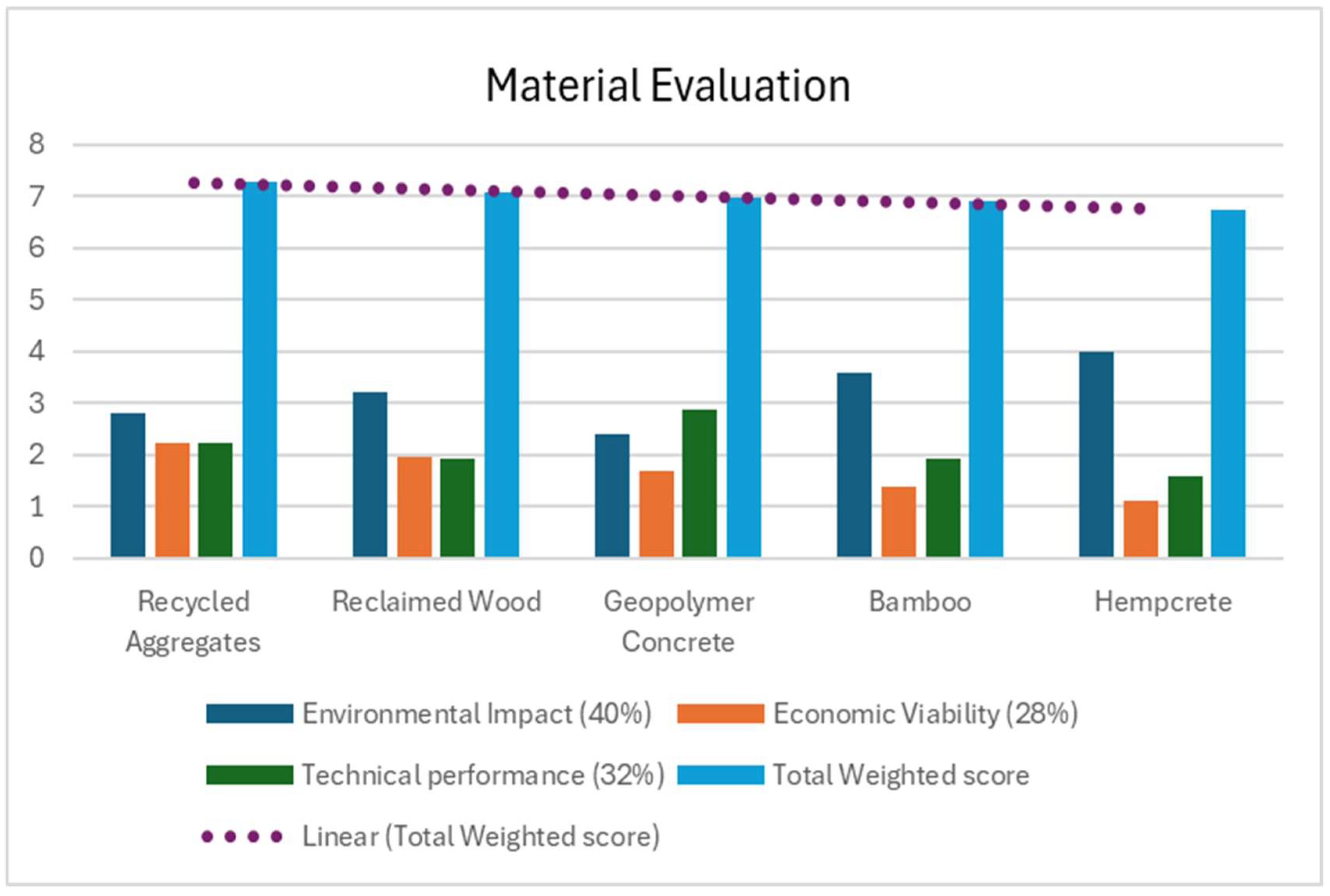
Hemp-crete with score of 6.72 has the highest environmental performance ranking because it anti carbon and biodegradable although it scored lower in economic and technical criteria which makes it unsuitable for structural loads, limited market penetration.
4.2.3. Sensitivity Analysis
Sensitivity analysis was conducted to assess the reliability of MCDA results of the different weighting scenarios, this analysis is important in decision making models, because it helps to identify final rankings are influenced by some factors. Figure 4 shows the weighted factors environmental impact, economic viability and technical performance were varied to simulate alternative decision contexts.
Economic viability was increased from 28% to 38% with environmental and technical performance adjusted to 30% and 32% respectively, recycled aggregates maintained its top ranking which shows resilience across multiple evaluation conditions. The consistency of the recycled aggregates out of all the three criteria these offer a balanced solution which shows alignment with sustainability goals and financial constraints. Technical performance was also prioritized it remained competitively ranked due to its proven durability, and compliance with regulations.
Hemp-crete with highest score on environmental performance shows volatility in their ranking when technical performance was emphasized it dropped in its ranking. Bamboo also ranked lower for economic factor as a result of concerns about cost and compliance code.
5. Conclusion
Based on the findings discussed above, a well detailed into current level of awareness, challenges and opportunities associated with adoption of recycled and low-carbon materials. The findings revealed an optimistic outlook towards integration of sustainable material, the level of awareness of sustainable materials was found to be moderate to high most importantly among architects and civil engineers based on better understanding they demonstrated for recycled concrete aggregates, reclaimed wood and low-carbon concrete. Although demonstration of this knowledge is quite distinct from real application. Construction/project managers and developers shows more economy drive acknowledging concerns over cost, challenges of procurement and client preference as a major factor affecting adoption of recycled and low-carbon materials.
Also the study revealed that cost uncertainty, lack of sufficient performance data, inconsistencies in regulations and supply chain limitations recognized by developers and architect are one of the major challenges of adoption of recycled and low-carbon materials this emphasize the need for cohesive and enforceable green building policies.
However all the professionals supported adoption of sustainable and low-carbon materials noting that incentives and well detailed and clear policy structures would establish a great support mechanisms and bridge the gap between strategy awareness and adoption of recycled and low-carbon materials. Misconceptions regarding material performance in terms of safety, durability and aesthetics can be addressed with establishing performance benchmarks and certifications for sustainable materials.
The interconnections between the professionals validates the idea that adoption is shaped by interconnected factors across disciplines emphasizing on need for regulatory clarity and economic viability. The study findings revealed a positive possibility of integrating recycled and low-carbon materials in construction provided the above discussed issues were addressed.
The study concludes that while the industry possess awareness and willingness for adoption of sustainable and low-carbon materials in residential construction, addressing cost related uncertainties, enhancing material performance data, enhancing policy structure and improving supply chain process would influence a wider adoption as these issues requires to be addressed for smooth transition from awareness to scalable implementation of sustainable and low-carbon materials in residential construction.
References
- Ahmed Ali, K.; Ahmad, M.I.; Yusup, Y. Issues, impacts, and mitigations of carbon dioxide emissions in the building sector. Sustainability 2020, 12, 7427. [Google Scholar] [CrossRef]
- Bilgen, S.E.L.Ç.U.K. Structure and environmental impact of global energy consumption. Renewable and Sustainable Energy Reviews 2014, 38, 890–902. [Google Scholar] [CrossRef]
- Labaran, Y.H.; Mathur, V.S.; Muhammad, S.U.; Musa, A.A. Carbon footprint management: A review of construction industry. Cleaner Engineering and Technology 2022, 9, 100531. [Google Scholar] [CrossRef]
- Murtagh, N.; Scott, L.; Fan, J. Sustainable and resilient construction: Current status and future challenges. Journal of Cleaner Production 2020, 268, 122264. [Google Scholar] [CrossRef]
- Alex, A.G.; Gebrehiwet, T.; Kemal, Z.; Subramanian, R.B. Structural performance of low-calcium fly ash geo-polymer reinforced concrete beam. Iranian Journal of Science and Technology, Transactions of Civil Engineering 2022, 46, 3643–3654. [Google Scholar] [CrossRef]
- Baker-Brown, D. (2024). The Circular Economy. In The Re-use Atlas (pp. 131–178). RIBA Publishing.
- Almusaed, A.; Yitmen, I.; Myhren, J.A.; Almssad, A. Assessing the impact of recycled building materials on environmental sustainability and energy efficiency: a comprehensive framework for reducing greenhouse gas emissions. Buildings 2024, 14, 1566. [Google Scholar] [CrossRef]
- Oyedele, L.O.; Ajayi, S.O.; Kadiri, K.O. Use of recycled products in UK construction industry: An empirical investigation into critical impediments and strategies for improvement. Resources, Conservation and Recycling 2014, 93, 23–31. [Google Scholar] [CrossRef]
- Spence, R.; Mulligan, H. Sustainable development and the construction industry. Habitat international 1995, 19, 279–292. [Google Scholar] [CrossRef]
- Ürge-Vorsatz, D.; Cabeza, L.F.; Serrano, S.; Barreneche, C.; Petrichenko, K. Heating and cooling energy trends and drivers in buildings. Renewable and Sustainable Energy Reviews 2015, 41, 85–98. [Google Scholar] [CrossRef]
- Labaran, Y.H.; Mathur, V.S.; Farouq, M.M. The carbon footprint of construction industry: A review of direct and indirect emission. Journal of Sustainable Construction Materials and Technologies 2021, 6, 101–115. [Google Scholar] [CrossRef]
- Omer, A.M. Focus on low-carbon technologies: The positive solution. Renewable and Sustainable Energy Reviews 2008, 12, 2331–2357. [Google Scholar] [CrossRef]
- Chen, L.; Huang, L.; Hua, J.; Chen, Z.; Wei, L.; Osman, A.I. . & Yap, P.S. Green construction for low-carbon cities: a review. Environmental chemistry letters 2023, 21, 1627–1657. [Google Scholar]
- Xing, W.; Tam, V.W.; Le, K.N.; Hao, J.L.; Wang, J. Life cycle assessment of recycled aggregate concrete on its environmental impacts: A critical review. Construction and Building Materials 2022, 317, 125950. [Google Scholar] [CrossRef]
- Xing, W.; Tam, V.W.; Le, K.N.; Hao, J.L.; Wang, J. Life cycle assessment of recycled aggregate concrete on its environmental impacts: A critical review. Construction and Building Materials 2022, 317, 125950. [Google Scholar] [CrossRef]
- Frazao, C.; Barros, J.; Bogas, J.A.; García-Cortés, V.; Valente, T. Technical and environmental potentialities of recycled steel fiber reinforced concrete for structural applications. Journal of building Engineering 2022, 45, 103579. [Google Scholar] [CrossRef]
- Ormondroyd, G.A.; Spear, M.J.; Skinner, C. The opportunities and challenges for re-use and recycling of timber and wood products within the construction sector. Environmental impacts of traditional and innovative forest-based bioproducts 2016, 45–103. [Google Scholar]
- Ekwuno, A.O. The Application of Green Building Materials–A Systematic Review.
- Solomon, O.O.; Adebisi, O.D.; Adediran, I.A. Emerging Trends in Sustainable Materials for Green Building Constructions. Wastewater Treatment and Green Technologies 2024, 13. [Google Scholar]
- Shooshtarian, S.; Caldera, S.; Maqsood, T.; Ryley, T. Using recycled construction and demolition waste products: A review of stakeholders’ perceptions, decisions, and motivations. Recycling 2020, 5, 31. [Google Scholar] [CrossRef]
- Ahmed, A.F.; Islam, M.Z.; Mahmud, M.S.; Sarker, M.E.; Islam, M.R. Hemp as a potential raw material toward a sustainable world: A review. Heliyon 2022, 8. [Google Scholar] [CrossRef]
- Van Ewijk, S. (2018). Resource efficiency and the circular economy: concepts, economic benefits, barriers, and policies.
- Abd Rashid, A.F.; Yusoff, S. A review of life cycle assessment method for building industry. Renewable and Sustainable Energy Reviews 2015, 45, 244–248. [Google Scholar] [CrossRef]
- Nogueira, E.; Gomes, S.; Lopes, J.M. Triple bottom line, sustainability, and economic development: What binds them together? A bibliometric approach. Sustainability 2023, 15, 6706. [Google Scholar] [CrossRef]
- Alibeigibeni, A.; Stochino, F.; Zucca, M. Enhancing concrete sustainability: a critical review of the performance of recycled concrete aggregates (RCAs) in structural concrete. Buildings 2025, 15, 1–25. [Google Scholar] [CrossRef]
- Yan, L.; Kasal, B.; Huang, L. A review of recent research on the use of cellulosic fibres, their fibre fabric reinforced cementitious, geo-polymer and polymer composites in civil engineering. Composites Part B: Engineering 2016, 92, 94–132. [Google Scholar] [CrossRef]
- Bostanci, S.C.; Limbachiya, M.; Kew, H. Use of recycled aggregates for low-carbon and cost effective concrete construction. Journal of Cleaner Production 2018, 189, 176–196. [Google Scholar] [CrossRef]
- Adier, M.F.V.; Sevilla, M.E.P.; Valerio, D.N.R.; Ongpeng, J.M.C. Bamboo as sustainable building materials: a systematic review of properties, treatment methods, and standards. Buildings 2023, 13, 2449. [Google Scholar] [CrossRef]
- Proto, M.; Malandrino, O.; Supino, S. Eco-labels: a sustainability performance in benchmarking? . Management of Environmental Quality: An International Journal 2007, 18, 669–683. [Google Scholar] [CrossRef]
- Aliu, J.; Oke, A.E.; Austin Odia, O.; Akanni, P.O.; Leo-Olagbaye, F.; Aigbavboa, C. Exploring the barriers to the adoption of environmental economic practices in the construction industry. Management of Environmental Quality: An International Journal 2025, 36, 1–20. [Google Scholar] [CrossRef]
Figure 1.
Distribution of Participant.
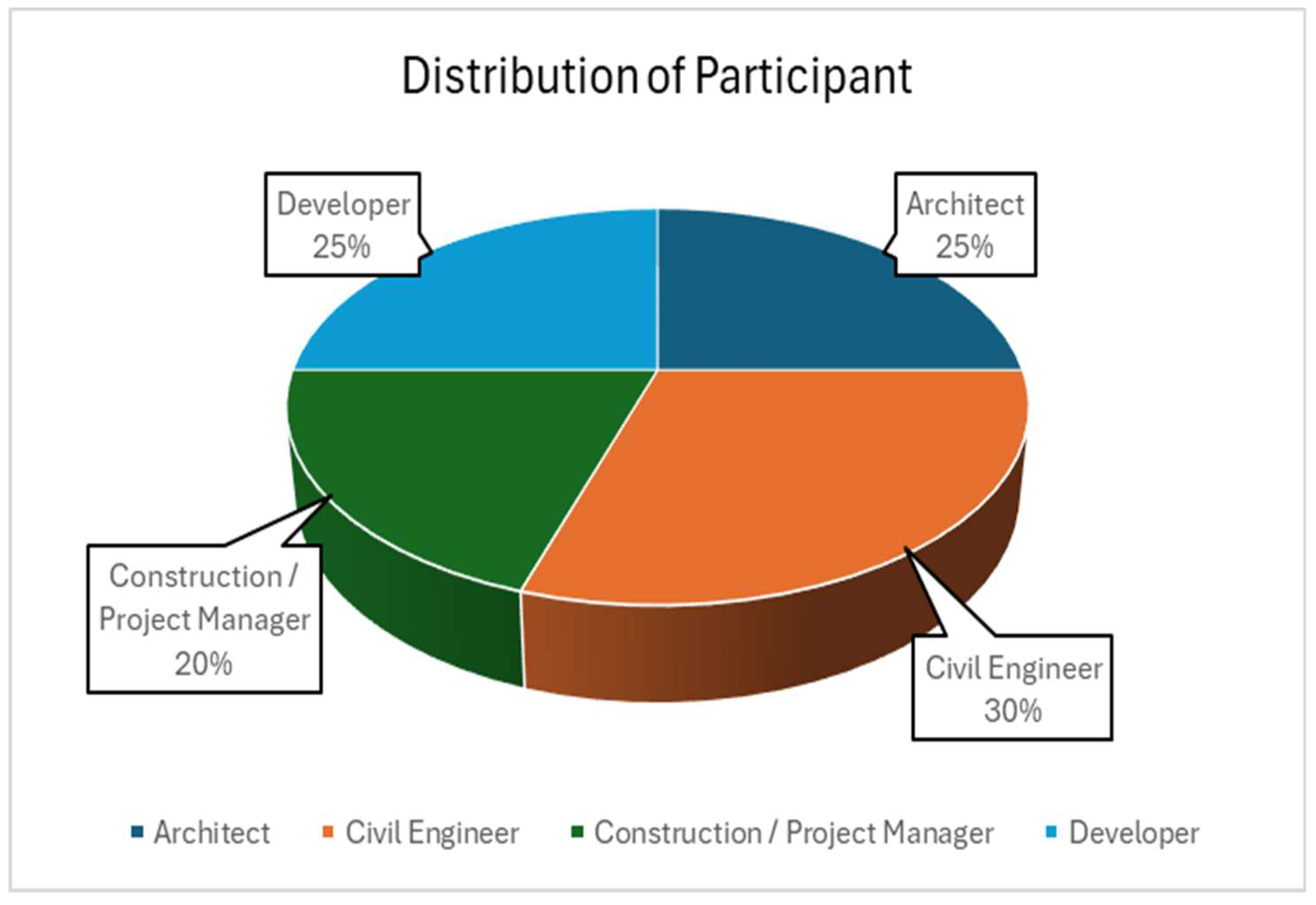
Figure 2.
Level of Knowledge and Awareness of Recycled and Low-Carbon Materials.
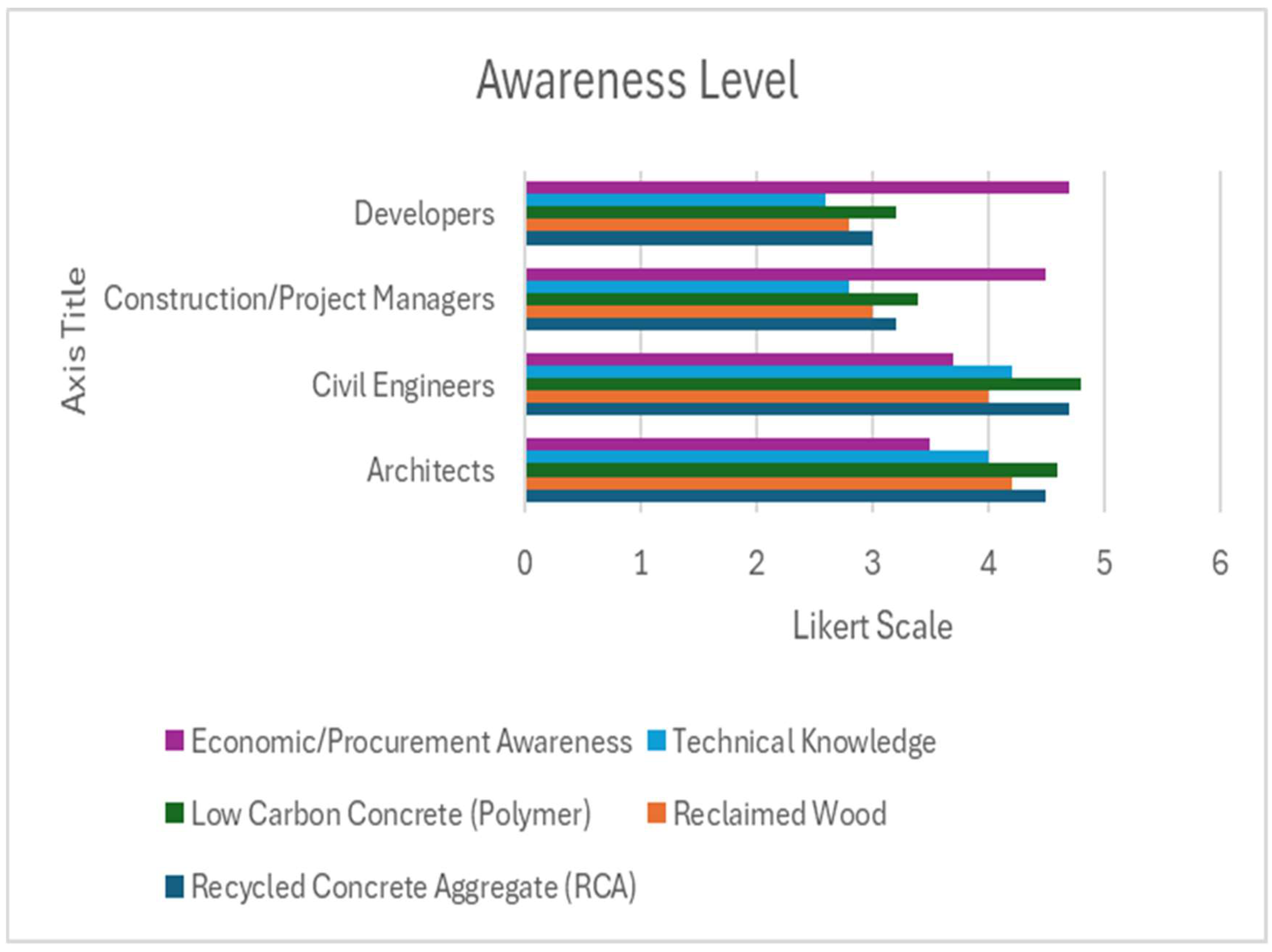
Figure 4.
Sensitivity Analysis.
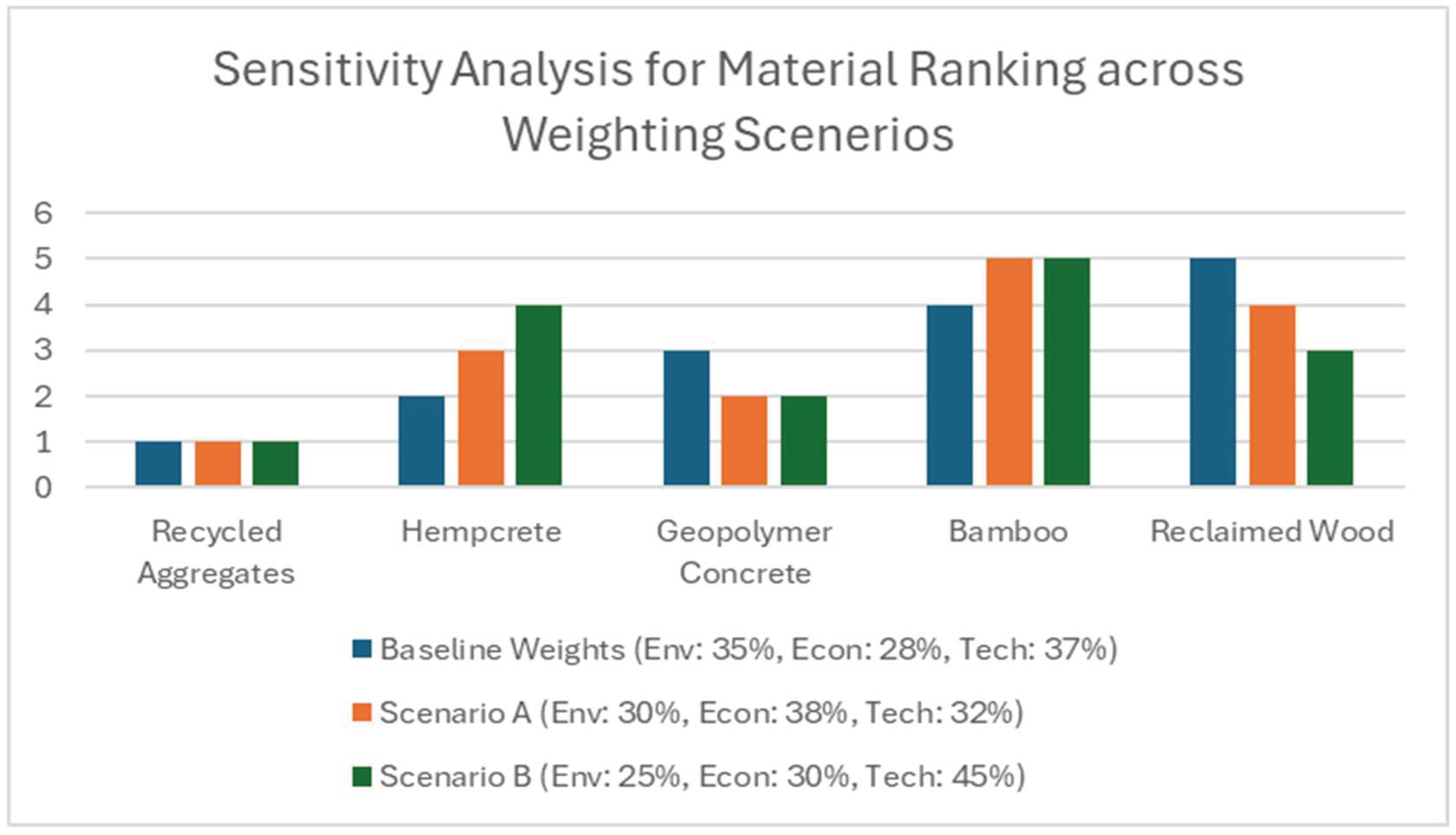

Table 4.1.
Analysis of Interviewed Individual.
| Role | No | Years of experience | Sustainability Focus |
|---|---|---|---|
| Architect | 5 | 8 - 10 Years | Medium - High |
| Civil Engineer | 6 | 12 - 15 Years | Medium - High |
| Construction / Project Manager | 4 | 9 - 12 Years | Medium - High |
| Developer | 5 | 6 - 9 Years | Medium - High |
Table 4.2.
Perceived barriers to sustainable adoption.
| Barrier | Frequency of mention (n=20) | Professional Roles |
| Cost and Investment return concern | 17/20 | Developers, construction/project managers |
| Lack of Performance Data | 15/20 | Engineers, construction/project Managers |
| Regulatory Issues and lack of incentives | 12/20 | Developers and Architect |
| Limited supply chain | 10/20 | All professionals |
Table 4.3.
Role Based Summary of Key Findings.
| Profession | Major Findings/Concerns |
|---|---|
| Architects | Client Perception, Regulatory hurdles, and Design Integration |
| Civil Engineers | Structural performance, Code Compliance and, Safety |
| Construction/Project Managers | Supply Chain and, Cost control |
| Developers | Return on Investment, Marketability and, Incentives |
Table 4.4.
Weighting Factor Criteria.
| Criteria | Average Likert Rating | Normalized Weight (%) |
|---|---|---|
| Environmental Impact | 4.7 | 40 |
| Economic Viability | 3.4 | 28 |
| Technical Performance | 3.9 | 32 |
Table 4.5.
Material Evaluation.
| Material | Environmental Impact (40%) | Economic Viability (28%) | Technical performance (32%) | Total Weighted score |
|---|---|---|---|---|
| Recycled Aggregates | 7 x 0.40 = 2.80 | 8 x 0.28 = 2.24 | 7 x 0.32 = 2.24 | 7.28 |
| Reclaimed Wood | 8 x 0.40 = 3.20 | 7 x 0.28 = 1.96 | 6 x 0.32 = 1.92 | 7.08 |
| Geopolymer Concrete | 6 x 0.40 = 2.40 | 6 x 0.28 = 1.68 | 9 x 0.32 = 2.88 | 6.96 |
| Bamboo | 9 x 0.40 = 3.60 | 5 x 0.28 = 1.40 | 6 x 0.32 = 1.92 | 6.92 |
| Hempcrete | 10 x 0.40 = 4.00 | 4 x 0.28 = 1.12 | 5 x 0.32 = 1.60 | 6.72 |
Disclaimer/Publisher’s Note: The statements, opinions and data contained in all publications are solely those of the individual author(s) and contributor(s) and not of MDPI and/or the editor(s). MDPI and/or the editor(s) disclaim responsibility for any injury to people or property resulting from any ideas, methods, instructions or products referred to in the content. |
© 2025 by the authors. Licensee MDPI, Basel, Switzerland. This article is an open access article distributed under the terms and conditions of the Creative Commons Attribution (CC BY) license (http://creativecommons.org/licenses/by/4.0/).
Copyright: This open access article is published under a Creative Commons CC BY 4.0 license, which permit the free download, distribution, and reuse, provided that the author and preprint are cited in any reuse.


