

Submitted:
17 July 2025
Posted:
21 July 2025
Read the latest preprint version here
Abstract
Recent identification of early onset mutational signatures with geographic variations is a significant finding by Diaz-Gay et al., since early onset colorectal cancer has emerged as an alarming public health challenge in the past two decades and we are in the dark in regards to the pathomechanism. Environmental risk factors, including lifestyle and diet are highly suspected. This is why identifying colibactin of Escherichia Coli as a potential pathogenic source in this study is one major step forward in the direction to cope with this very recent public health obstacle of our lives. Therefore, the following opinion manuscript is aiming to depict the likely onset of pathomechanism and the critical role of acquired Piezo2 channelopathy in early onset colorectal cancer that skews proton availability and proton motive force regulation on the side of E. Coli within the microbiota-host symbiotic relationship. In addition, the pks island produced colibactin of E. Coli induced host DNA damage likely gets into crosstalk at the level of Wntsignaling with Piezo2 channelopathy induced pathological remodeling. This transcriptional dysregulation eventually leads to tumorigenesis of colorectal cancer. Mechanotransduction is miraculous when it comes to converting external physical cues to inner chemical and biological ones. Correspondingly, the proposed quantum mechanical free-energy stimulated ultrafast proton-coupled tunneling, initiated by Piezo2, seems to be the principal and essential underlying novel oscillatory signaling that could be lost in colorectal cancer onset. Hence, Piezo2 channelopathy not only contributes to cancer initiation, impaired circadian regulation,including the proposed hippocampal ultradian clock, but later to proliferation and metastasis as well.
Keywords:
early onset colorectal cancer
; Escherichia coli
; colibactin
; Piezo2
; circadian regulation
; hippocampal ultradian clock
; proton
1. Introduction
Recent identification of early onset mutational signatures with geographic variations is a significant finding by Diaz-Gay et al., since early-onset colorectal cancer (eoCRC) has emerged as an alarming public health challenge in the past two decades and we are in the dark in regards to the pathomechanism [1]. Environmental risk factors, including lifestyle and diet are highly suspected [1,2]. This is why identifying colibactin of Escherichia Coli (E. Coli) as a potential pathogenic source in this study [1] is one major step forward in the direction to cope with this very recent public health obstacle of our lives.
In support, earlier finding showed important interrelation, namely there is a clear age dependence in the microbial feature between eoCRC (<50 years) and late-onset colorectal cancer (loCRC) (>65 years) [3]. Moreover, the microbial-host link was stronger in eoCRC, implicating a more direct association to tumorigenesis through an unidentified cancer-related pathomechanism in contrast to loCRC [3]. Noteworthy, that age-dependent epidemiological variations in colorectal cancer (CRC) likely associated with difference in environmental factors, rather than genetic predisposition [4,5]. These factors involve lifestyle exposures, such as dietary intake, physical activity, alcohol consumption, obesity and the disruptions of the circadian rhythms in the eoCRC affected younger age-group [6].
The following opinion manuscript is aiming to depict the Piezo2 ion channel dependent neurocentric onset, or the neurocentric gateway to pathophysiology, in the aforementioned mysterious pathomechanism of CRC due to acquired Piezo2 channelopathy, especially in the case of eoCRC. Important to note that the principality of Piezo2 is not only presented in proprioception, as demonstrated by the team of Nobel laureate Ardem Patapoutian [7], but also suggested to be present in its microdamage, as the above mentioned principal gateway to pathophysiology, potentially even leading to cancer [8]. Noteworthy, that the current neurocentric opinion piece is fully in line with emerging observations that the nervous system is actively involved not only in invasion and metastasis, but even in the initiation of CRC [9].
2. Piezo2 Channelopathy, Dysbiosis and Circadian Regulation
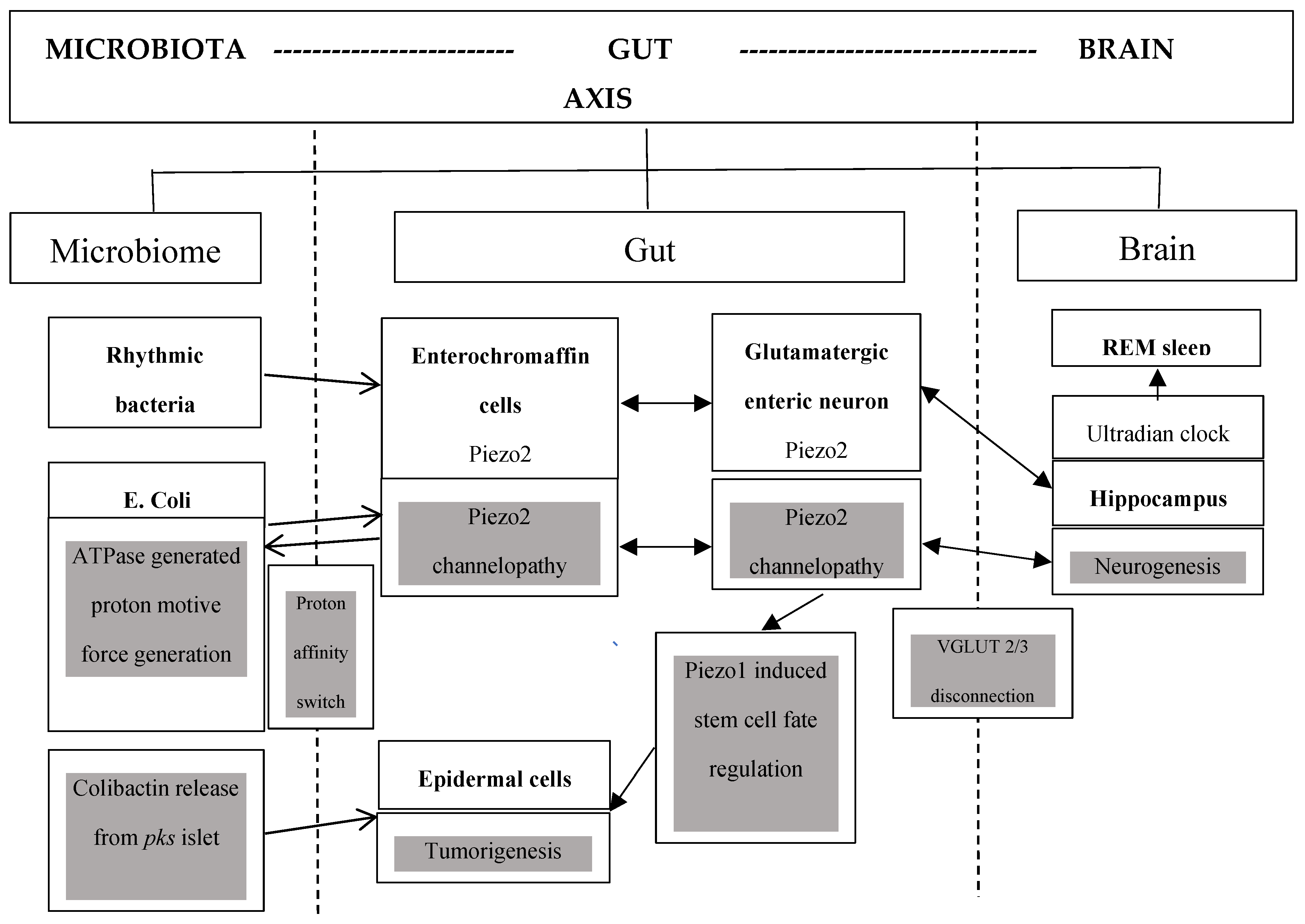
A recent paper theorizes that there is an unaccounted underlying quantum tunneled ultrafast long-range proton-coupled oscillatory synchronizational pathway to the hippocampus from the enterochromaffin cells (ECs), e.g. from the colon and rectum [10]. Moreover, this manuscript also proposes that the intact microbiota-gut-brain axis is likely accountable for a novel synchronizational mechanism towards ultradian and circadian regualtion from rhythmic bacteria of the microbiota to hippocampal memory formation [10]. The ultrafast signaling regulation of the ultradian rhythm suggested to be initiated by activated Piezo2 induced proton motive force, derived from mitochondrial oxidative phosphorylation (OXPHOS), with the involvement of VGLUT3 through allosteric transmission at a distance (Figure 1) [10]. Noteworthy that no other proprioceptive ion channel, other than Piezo2, could initiate this quantum mechanical free energy stimulated ultrafast concerted proton tunneling [10]. Hence, the acquired channelopathy of Piezo2 at ECs and nerve terminals of the microbiota-gut-brain axis may pose a critical impairment (Figure 1) that is suggested to be one gateway to dysbiosis [10]. Important to note that lifestyle and dietary factors influence the circadian clocks, not to mention that circadian rhythms are vanished in human CRC, as patient-derived organoids-based research shows [2]. Additional remark that lifestyle factors, such as obesity, sedentary behavior, microbiome diversity changes with age or antibiotic use all have Piezo relevance. In support, research is emerging how important role Piezo2 has in adipose sensory innervation [11], not to mention that these Piezo2 containing sensory neurons regulate systemic and adipose tissue metabolism [12]. Not only excessive overstimulation, but prolonged under stimulation of Piezo2 posits a risk, as part of sedentary life style, by not being able to properly initiate the ultrafast long-range proton-based signaling within the nervous system and the shortage of this ultrafast signaling initiation also leads to miswiring within the nervous system [13]. Moreover, Piezo2 containing cells unfortunately decrease with age [14], as Piezo2 function declines due to repeated channelopathy and protein degradation in an age-dependent manner [8,15]. This age-dependent degradation of Piezo2 function [8,15] contributes to the age-dependent microbiome diversity changes as explained hereafter. Finally, antibiotic use is associated particularly with eoCRC, but with loCRC as well [16]. Doxycycline, a broad-spectrum antibiotic, is even used in animal tumor research in order to suppress inducible PIEZO1 shRNA expression that in return suppressed tumor growth and increased survival, hence revealing the essential role of Piezo1 in tumor growth [17].
In support of the underlying ultrafast oscillatory synchronizational pathway of the microbiota-gut-brain axis, some of the gut bacteria within the microbiota exhibit rhythmic oscillations in synchrony to the circadian clock [18,19]. They are coined as rhythmic bacteria, incorporating approximately 10-15 % of gut microbial bacteria [18,19]. Recently it was hypothesized that these rhythmic bacteria contribute to dysbiosis at disease onset [20]. Correspondingly, circadian-related diseases were analyzed in respect to this link, such as type 2 diabetes, hypertension, atherosclerotic cardiovascular diseases, inflammatory bowel disease, metabolic syndrome, and most importantly CRC [20]. In fact, a relationship was detected between rhythmic bacteria and circadian-related diseases, although this association was weak [20]. Conclusively, these rhythmic bacteria are part of a more complex pathophysiology when it comes to circadian disruptions on the way to disease onset [20]. Part of this complexity that these rhythmic bacteria were vast minority among the most abundant bacteria, reflecting that not only circadian disruption affects them, but other physiological stressors as well [20]. Of note, confounding lifestyle variables in CRC are all Piezo ion channel related functionally, as depicted above, while chronic stress is known to induce dysbiosis and CRC cancer growth [21,22]. Consequently, chronic stress not only promotes CRC progression by increasing beta-catenin expression [21], but significantly alters Piezo-mediated responses because they are biochemically and functionally tethered to the actin cytoskeleton through the cadherin-beta-catenin mechanotransduction complex [23]. Accordingly, chronic stress induces dysbiosis and Piezo channelopathy decreases rhythmicity and increases stiffness in the affected given microenvironment in favor of CRC cancer growth, as an underlying mechanism. Thereby, the author of this manuscript proposes that the above findings are highly in line with the acquired Piezo2 channelopathy induced disrupted VGLUT3 signaling along the microbiota-gut-brain axis [10], impaired ultradian rhythmicity and stress regulation. In addition this Piezo2 channelopathy induced microscopically undetectable VGLUT disconnection will lead to switch or miswiring within the nervous system [8].
Furthermore, the earlier referred current paper also theorized that Piezo2 containing ECs interact with oscillatory serotoninergic enteric neurons within the enteric nervous system as well and this pathway initiates a slower circadian rhythm domain of the gut-brain axis towards circadian regulation [10]. Moreover, the formerly mentioned ultradian excitatory glutamatergic ultrafast proton-based signaling modulates the rapid eye movement (REM) sleep, while the latter serotoninergic one modulates the non-REM sleep respectively [10].
Even more importantly, the implicated circadian clock disruptions trigger transformation by driving APC loss of heterozygosity, leading to Wnt signaling hyperactivation [2]. Noteworthy that chronic Piezo2 channelpathy induced switch/miswiring is proposed to result in a state of “part of wound healing kept alive”[24], leading to chronic pathological remodeling [25] with the involvement of Wnt signaling [26]. Hence, the onset of CRC pathophysiology is a gateway to pathological remodeling or a derailed wound healing process,
Figure 1.
The novel ultrafast proton-based oscillatory synchronization mechanism from rhythmic bacteria to hippocampus, constructing the ultradian backbone of the microbiota-gut-brain axis. The grey boxes denote the proton affinity switch induced Piezo2 channelopathy, VGLUT2/3 disconnection and colibactin derived tumorigenesis entailing miswired pathway in colorectal cancer.
Figure 1.
The novel ultrafast proton-based oscillatory synchronization mechanism from rhythmic bacteria to hippocampus, constructing the ultradian backbone of the microbiota-gut-brain axis. The grey boxes denote the proton affinity switch induced Piezo2 channelopathy, VGLUT2/3 disconnection and colibactin derived tumorigenesis entailing miswired pathway in colorectal cancer.
3. Colibactin, Escherichia Coli and Piezo2
Diaz-Gay et al. also associated colibactin exposure to APC driver mutations in eoCRC [1]. In support, not only the impaired protective function of microbiome may count in dysbiosis, but the resultant increase in cancer promotion [3]. Moreover, it is suggestive that microbial signaling also affects the host by gene expression coupled mechanism [27], leading to microbiota induced genomic instability in CRC [28]. The current author proposes that this genomic instability is the result of acquired Piezo2 channelopathy due to its principle transcription activator feature [29].
Colibactin is the genotoxic metabolite product of E. Coli, produced by its polyketide synthase (pks) island [30]. In addition, E. Coli has the feature of regulating proton motive force, depending on bacterial growth phases, in order to sustain cell energy balance during fermentation regardless of various carbon sources [31]. Acute Piezo2 channelopathy is suggested to be a transient non-contact microdamage with an underlying proton affinity switch, however repeated bout effect of this non-contact injury without adequate regeneration periodization could chronify this proton affinity switch, the equivalent of chronic Piezo2 channelopathy [8]. This chronic state could skew proton availability and proton motive force regulation on the side of E. Coli within the microbiota due to the fermentative energy-limited conditions (Figure 1). This will lead eventually to impaired homeostatic energy balance equilibrium within the symbiotic microbiota-host interaction, equivalent of dysbiosis. Therefore, under this chronic energy scarcity, in which the Piezo2 containing ECs and somatosensory neurons are competitively disadvantaged and a vicious circle may prevail. This dysregulated process leads to accelerated aging that includes cancer development by uncontrolled growth, depending on environmental risk factors and genetic predisposition [8]. Polyketide synthase-positive (pks+) E. Coli is exhibited to be a central player in this pathomechanism [1].
However, the exact function of pks island associated gene cluster, hence the genetic aspect of colibactin-induced tumorigenesis is far from entirely known, as the transfer of colibactin from E. Coli to host cells lacks complete understanding [30]. Although, it has been known for a while that the expression of these pks island genes is highly correlated with the presence of carbon source, especially glucose has the capability to enhance these gene expressions [32]. The toxic effect of colibactin induces DNA damage by exploiting the Wnt proteins of the host cells [33]. The current authors suggest that this colibactin induced Wnt signaling involved DNA damage could get into conflict with the aforementioned Piezo2 channelopathy induced pathological remodeling with Wnt signaling involvement (Figure 1). Hence, it presents a break in the proper wound healing process, leading to pathological remodeling and transcriptional dysregulation. Moreover, pks+ E. Coli causes damage, leading to mutations, genomic instability, promotes carcinogenesis and tumor development [30,34,35,36].
In support, E. Coli strains under certain growth stage are prone to proton motive force generation [31]. This built up of proton motive force, depending on the growth stage of E. Coli, could cause a proton affinity switch on the Piezo2 content of EC cells, leading to acquired Piezo2 channelopathy. Moreover, Piezo1 is demonstrated to contribute to force-induced ATP secretion [37]. The current author suggests an analogous ATP secretion mechanism in Piezo2 as well. In addition it is worth to consider from the ATP secretion aspect that a Piezo2-Piezo1 crosstalk exist in a given fluid-filled compartment with selective barrier, like the gut is one [10]. Correspondingly, Piezo activation induced ATP efflux may serve the ATPase of E. Coli for proton motive force generation. Hence the switch of the growth phase of E. Coli could result in the upregulation of OXPHOS in EC cells and attached Piezo2 containing excitatory glutamatergic neurons as well. However, OXPHOS will be depleted over time as a direct result of the proton affinity switch, leading to a metabolic switch of Piezo2 containing ECs and glutamatergic neurons. This is analogous to DOMS mechanism where it is also theorized that the depletion of OXPHOS result in a neural metabolic switch [38].
However, the upregulated OXPHOS promotes cell proliferation and tumorigenesis in CRC, e.g., through the Prohibitin 2 – NADH:ubiquinone oxidoreductase core subunit S1 pathway mediation [39]. And this is why the dual inhibition of OXPHOS and glycolysis have synergistic antitumor effect in CRC [40]. Nevertheless, not because of preventing metabolic switch, because according to the current author the metabolic switch is already an underlying factor in CRC due to Piezo2 channelopathy. Accordingly, dual inhibition of OXPHOS and glycolysis shifts the metabolic loading to a lower energy generation pathway among parallel metabolic pathways. Hence, this strategy does not feed metabolically the Piezo2 microdamaged switched/miswired rapid (not ultrafast anymore) glutamatergic VGLUT3 containing neural signaling. Therefore, proton affinity switch could switch mitochondrial energy metabolism to mitochondrial glucose and glutamine fermentation pathways from the evolutionarily superior energy-generating OXPHOS and glutamine respiration pathways [38]. In support, this glucose and glutamine respirofermentation could run simultaneously in fast growth micromilieu, like in cancer [41].
Interesting proposition is the imprinting of SBS88 and ID18 during upbringing on the epithelium of the colon in the presence of pks+ bacteria, leading to the loss or gain of these bacteria decades later [1]. Important consideration that prolonged, excessive stretch/distention or chemical destruction, may microdamage Piezo2 [8] and this could have relevance in the colon and rectum as well. Consequently, acquired Piezo2 channelopathy induced simultaneous transcription activation with the aforementioned memory dimensions and later in life dysbiosis may explain the proposition of Diaz-Gay et al.
In support, PIEZO2 is remarkably elevated in CRC [42]. The current author translates this phenomenon as a feed-forward compensatory upregulation due to chronic Piezo2 channelopathy. Unfortunately, this increased PIEZO2 presence was shown to promote even proliferation and metastasis of CRC, beyond its role in the occurrence and development of this cancer type [42]. The ‘how’ will be depicted in the subsequent section. For the time being it should be emphasized that the hippocampus is not only the prime location for learning and memory, but for adult hippocampal neurogenesis as well. Therefore, the ‘switched’ or ‘miswired’ secondary compensatory signaling along the underlying ultradian ECs-hippocampal axis may explain the promotion of proliferation and metastasis [38]. Furthermore, the involvement of Piezo1 activation should be contemplated in neighbouring cells within the compartmental micromilieu due to the impaired/lost Piezo2-Piezo1 crosstalk [8]. Indeed, mechanical forces through Piezo1 signaling has a role within gastrointestinal tumors when it comes to tumor growth and metastasis [43], as Doxycycline administration also shows in other animal tumor research model that Piezo1 is essential for tumor growth [17].
One more consideration that syndecan-2 is upregulated both in CRC [44], and in the acute inflammation of the colon [45] as well. In both cases acquired Piezo2 channelopathy is suspected as the initiating cause [10]. Since syndecans are suspected as the critical first-line player of the Piezo2- Piezo1 crosstalk and Piezo2 channelopathy impairs this crosstalk [25], therefore the current author proposes that syndecan-2 upregulation should be viewed as a feed-forward modulation by Piezo2 channelopathy. Syndecan expression is enigmatic to a given cell, tissue and developmental stage. Accordingly, every cell exhibits at least one syndecan out of the 4 members of the syndecan family. Hence, Syndecan-2 is the one specific to CRC pathomechanism due to its role in cell adhesion, motility, proliferation and differentiation [44]. The negative charge of syndecans are viewed as important in proton collection, hence the shedding of these proteoglycans likely alters the electrostatic micromilieu in the given microenvironment, leading to Piezo2 channelopathy [25]. Indeed, shed syndecan-2 promotes tumorigenesis in CRC cells [46] and cancer progression [47] and that is in support of the Piezo2 channelopathy theory or the gateway to pathophysiology in CRC initiation.
4. Blue Light Link to Colorectal Cancer
The current author puts forward that the excessive overloading of the gut-eye axis and its link to the microbiota should be regarded as well in eoCRC pathomechanism. Noteworthy, that Piezo2 is also present on the cornea and retina, and likely initiates the ultrafast proton-based signaling as the underlying backbone of the eye-brain axis, where the hippocampus is the integrative hub [8,10]. Photoreceptors in the eye, called retinal ganglion cells (RGCs) [48], are highly sensitive to blue light and they directly communicate with the brain [49], including the hippocampus [50]. Even more importantly, these RGCs contain Piezo2 and Piezo1, not to mention their role in RGCs damage [51] with the involvement of the aforementioned Wnt/beta-catenin signaling pathway [52]. Hence, the integration of the ultradian backbone of the eye-brain axis and the microbiota-gut-brain axis through the hippocampal hub would explain the so-called gut-eye axis. Visible light is synchronized to our inner clock of the suprachiasmatic nuclei of the hippothalamus within the daily 24-hour cycle [49]. Even more importantly, the short wavelength blue light, out of the visible light spectrum, is the strongest contribution to circadian system synchronization [49]. Supportive finding that one study showed on healthy youngsters that 30 minutes exposure to blue light one hour prior to bedtime had the impact of 30 minutes phase shift delay on the onset of REM sleep [53]. Noteworthy that Piezo2 initiated ultrafast proton-based cross-frequency coupled oscillatory synchronizational signaling mechanism, as the ultradian domain of circadian regulation, suggested to construct the ultradian clock in the hippocampus [10]. Furthermore, this Piezo2 initiated ultradian rhythm from the gut to the hippocampus, as the ultrafast ultradian backbone of the gut-brain axis, proposed to modulate REM sleep [10]. Interestingly, VGLUT1 and VGLUT2 are present in RGCs with distinct functions [54] as they are implicated in the Piezo2 initiated ultrafast proton-based allosteric signaling at a distance to the hippocampus [8]. Especially, VGLUT2 and melanopsin expression in subsets of RGCs seems to be important in the VGLUT2 signaled pathway in non-image forming function of the retina [54] and circadian regulation. Moreover, VGLUT3 is present in amacrine cells that provide glutamatergic input on RGCs through motion and contrast activation [55], not to mention that they selectively convey blue-ON signal and may provide the blue-OFF signal [56]. Piezo2 initiated co-functioning of Piezo2 and ASIC2 is theorized to be needed for the ultrafast proton-based signaling via VGLUT2 [25], as Piezo2 initiated co-functioning of Piezo2 with RGCs’ and amacrine ASIC1a could be the case in the proton-based signaling through VGLUT3. In support, ASIC1a are present in both of these cells [57]. Therefore, the aforementioned integration of the eye-brain axis and the microbiota-gut-brain axis through the hippocampal hub would explain the so-called gut-eye axis through Piezo2 initiated VGLUT2 and VGLUT3 allosteric transmission at a distance. Indeed, subcellular pathways through VGLUT3-expressing amacrine cells are detected that serves object-motion-selective signals in the retina [58].
Another important consideration that over-excessive intense light exposure induces pathological alterations in the retina, including the RGCs [59]. These alterations involve disruption of intracellular REDOX and Ca²⁺ homeostasis, endoplasmic reticulum stress, inflammation, leading to irreversible retinal damage [59]. Of note, the development of CRC also involves REDOX imbalance [60], disrupted Ca²⁺ homeostasis, endoplasmic reticulum stress [61], and inflammation [62]. The role of evolutionarily conserved Piezo in buffering of endoplasmic reticulum stress through Ca²⁺ handling is known [63] and Piezo2 is theorized to modulate the ultradian oscillator Hes1 gene expression through reactive oxygen species (ROS) [10]. Noteworthy that ROS indeed regulate Hes1 [64]. The oscillatory expression of Hes1 is modulated by transcriptional negative feedback loop with delayed timing, hence Hes1 represses its own promoter [64,65,66]. However, it is known that this negative feedback loop with shorter delays diminish oscillations, but makes them faster [67]. Therefore, the current author proposes that 30 minutes of ultradian sensory activation of Piezo2 right before sleep through blue light result in the 30 minutes phase shift delay at night with the involvement of Hes1 activation when it should not happen. Moreover, prolonged over-excessive blue light exposure prior to sleep could induce Piezo2 channelopathy, resulting in dysregulated modulation of Hes1 and switch or miswiring due to disrupted VGLUT2 and VGLUT3 signaling pathway.
Accordingly, the author of this paper does not find accidental that the blue light exposure prior to sleeping has detrimental effect on the circadian system [49]. Therefore, the rapidly increasing exposure to blue light emitting devices right before sleep in the past two decades may also contribute to the degradation of the gut-eye axis and increased incidence of eoCRC. Even more so, resultant Piezo2 channelopathy induced transcription activation [8] and dysregulated Hes1 activation [10] could be the reason why Hes1 contributes to cell proliferation, differentiation and migration in CRC [68], not to mention it promotes CRC progression [69], invasiveness [70], and even chemoresistance [71]. Furthermore, it explains the aforementioned ‘how’ the chronic Piezo2 channelopathy induced increased PIEZO2 promotes the occurrence, development, proliferation and metastasis of CRC. In addition, the co-functioning of Piezo2 and ASIC2 in the proposed ultrafast proton-based signaling via VGLUT2 [25] also explains why ASIC2 is overexpressed in CRC [72] in a feed-forward manner modulated by Piezo2 channelopathy. Finally, the abovementioned co-functioning of Piezo2 and ASIC1a in the proposed ultrafast proton-based signaling via VGLUT3 explains not only the function of hippocampal learning and memory, but emotional and cardiovascular regulation as well [73]. Moreover, the colocalization of hippocampal VGLUT3 and the inhibitory GABA [73] explains the aforementioned blue-OFF signal pathway along the bidirectional ultrafast proton-signaled ultradian backbone of the eye-brain axis. Conclusively, chronic acquired Piezo2 channelopathy ultimately could not only lead to pathological remodeling or unfinished wound healing, ongoing dysregulated transcription activation [8], dysbiosis, dysautonomia [10] and impaired blue-OFF signal, but explains the emotional dimension of the known psychological stress impact on CRC [22] and known autonomic dysregulation in CRC [74].
5. Conclusions
The current opinion manuscript is in appreciation of the significant finding of Diaz-Gay et al. and aiming to promote future angle of science and research in order to confront with the mysteriously rising tendency of eoCRC in the past two decades. Mechanotransduction is miraculous when it comes to converting external physical cues to inner chemical and biological ones, however not without limits. Correspondingly, the quantum tunneled ultrafast long-range proton-coupled oscillatory synchronizational pathway, initiated by Piezo2, seems to be the principal and essential underlying novel neurocentric signaling that is likely lost in CRC onset. Moreover, this primary damage, not only contributes to CRC initiation, but to impaired circadian regulation, tumor cell proliferation and metastasis as well. Future work should focus on to test this neurocentric CRC initiation pathway by the use 3D organoids, animal models, in vitro Piezo2 disruption studies, mathematical and computational modeling, further analyzation of rhythmic and other interacting bacteria content of microbiota and the ultradian-circadian regulation by precision polysomnography and heart rate variability analysis.
Funding
This manuscript received no external funding.
Institutional Review Board Statement
Not applicable.
Informed Consent Statement
Not applicable.
Data Availability Statement
Not applicable.
Conflicts of Interest
The author declares no conflicts of interest.
References
- Diaz-Gay, M.; Dos Santos, W.; Moody, S.; Kazachkova, M.; Abbasi, A.; Steele, C.D.; Vangara, R.; Senkin, S.; Wang, J.; Fitzgerald, S., et al. Geographic and age variations in mutational processes in colorectal cancer. Nature 2025, 10.1038/s41586-025-09025-8. [CrossRef]
- Chun, S.K.; Fortin, B.M.; Fellows, R.C.; Habowski, A.N.; Verlande, A.; Song, W.A.; Mahieu, A.L.; Lefebvre, A.; Sterrenberg, J.N.; Velez, L.M., et al. Disruption of the circadian clock drives Apc loss of heterozygosity to accelerate colorectal cancer. Sci Adv 2022, 8, eabo2389. [CrossRef]
- Adnan, D.; Trinh, J.Q.; Sharma, D.; Alsayid, M.; Bishehsari, F. Early-onset Colon Cancer Shows a Distinct Intestinal Microbiome and a Host-Microbe Interaction. Cancer Prev Res (Phila) 2024, 17, 29-38. [CrossRef]
- Moossavi, S.; Bishehsari, F. Microbes: possible link between modern lifestyle transition and the rise of metabolic syndrome. Obes Rev 2019, 20, 407-419. [CrossRef]
- Bishehsari, F.; Mahdavinia, M.; Vacca, M.; Malekzadeh, R.; Mariani-Costantini, R. Epidemiological transition of colorectal cancer in developing countries: environmental factors, molecular pathways, and opportunities for prevention. World J Gastroenterol 2014, 20, 6055-6072. [CrossRef]
- Ugai, T.; Sasamoto, N.; Lee, H.Y.; Ando, M.; Song, M.; Tamimi, R.M.; Kawachi, I.; Campbell, P.T.; Giovannucci, E.L.; Weiderpass, E., et al. Is early-onset cancer an emerging global epidemic? Current evidence and future implications. Nat Rev Clin Oncol 2022, 19, 656-673. [CrossRef]
- Woo, S.H.; Lukacs, V.; de Nooij, J.C.; Zaytseva, D.; Criddle, C.R.; Francisco, A.; Jessell, T.M.; Wilkinson, K.A.; Patapoutian, A. Piezo2 is the principal mechanotransduction channel for proprioception. Nat Neurosci 2015, 18, 1756-1762. [CrossRef]
- Sonkodi, B. Acquired Piezo2 Channelopathy is One Principal Gateway to Pathophysiology. Front. Biosci. (Landmark Ed) 2025, 30, 33389. [CrossRef]
- Zeng, Z.; Cai, S.; Ye, C.; Li, T.; Tian, Y.; Liu, E.; Cai, J.; Yuan, X.; Yang, H.; Liang, Q., et al. Neural influences in colorectal cancer progression and therapeutic strategies. Int J Colorectal Dis 2025, 40, 120. [CrossRef]
- Sonkodi, B. Is acquired Piezo2 channelopathy the critical impairment of the brain axes and dysbiosis? 2025.
- Wang, Y.; Zhang, Y.; Leung, V.H.; Seradj, S.H.; Sonmez, U.; Servin-Vences, M.R.; Xiao, S.; Ren, X.; Wang, L.; Mishkanian, S.A., et al. A key role of PIEZO2 mechanosensitive ion channel in adipose sensory innervation. Cell Metab 2025, 37, 1001-1011 e1007. [CrossRef]
- Passini, F.S.; Bornstein, B.; Rubin, S.; Kuperman, Y.; Krief, S.; Masschelein, E.; Mehlman, T.; Brandis, A.; Addadi, Y.; Shalom, S.H., et al. Piezo2 in sensory neurons regulates systemic and adipose tissue metabolism. Cell Metab 2025, 37, 987-1000 e1006. [CrossRef]
- Elek, D.; Toth, M.; Sonkodi, B.; Acs, P.; Kovacs, G.L.; Tardi, P.; Melczer, C. The Efficacy of Soleus Push-Up in Individuals with Prediabetes: A Pilot Study. Sports (Basel) 2025, 13. [CrossRef]
- Kim, B.; Rothenberg, M.E.; Sun, X.; Bachert, C.; Artis, D.; Zaheer, R.; Deniz, Y.; Rowe, P.; Cyr, S. Neuroimmune interplay during type 2 inflammation: Symptoms, mechanisms, and therapeutic targets in atopic diseases. J Allergy Clin Immunol 2024, 153, 879-893. [CrossRef]
- Buzás, A.; Sonkodi, B.; Dér, A. Principal Connection Between Typical Heart-Rate-Variability Parameters as Revealed by a Comparative Analysis of Their Heart-Rate- and Age-Dependence. In Preprints, Preprints: 2025; 10.20944/preprints202505.0641.v2.
- McDowell, R.; Perrott, S.; Murchie, P.; Cardwell, C.; Hughes, C.; Samuel, L. Oral antibiotic use and early-onset colorectal cancer: findings from a case-control study using a national clinical database. Br J Cancer 2022, 126, 957-967. [CrossRef]
- Chen, X.; Wanggou, S.; Bodalia, A.; Zhu, M.; Dong, W.; Fan, J.J.; Yin, W.C.; Min, H.K.; Hu, M.; Draghici, D., et al. A Feedforward Mechanism Mediated by Mechanosensitive Ion Channel PIEZO1 and Tissue Mechanics Promotes Glioma Aggression. Neuron 2018, 100, 799-815 e797. [CrossRef]
- Thaiss, C.A.; Zeevi, D.; Levy, M.; Zilberman-Schapira, G.; Suez, J.; Tengeler, A.C.; Abramson, L.; Katz, M.N.; Korem, T.; Zmora, N., et al. Transkingdom control of microbiota diurnal oscillations promotes metabolic homeostasis. Cell 2014, 159, 514-529. [CrossRef]
- Reitmeier, S.; Kiessling, S.; Clavel, T.; List, M.; Almeida, E.L.; Ghosh, T.S.; Neuhaus, K.; Grallert, H.; Linseisen, J.; Skurk, T., et al. Arrhythmic Gut Microbiome Signatures Predict Risk of Type 2 Diabetes. Cell Host Microbe 2020, 28, 258-272 e256. [CrossRef]
- Ubilla, P.K.; Ferrada, E.; Marquet, P.A. Rhythmic Bacteria as Biomarkers for Circadian-Related Diseases. 2025, 10.21203/rs.3.rs-5723754/v1. [CrossRef]
- Cao, Q.; Zhao, M.; Su, Y.; Liu, S.; Lin, Y.; Da, H.; Yue, C.; Liu, Y.; Jing, D.; Zhao, Q., et al. Chronic Stress Dampens Lactobacillus Johnsonii-Mediated Tumor Suppression to Enhance Colorectal Cancer Progression. Cancer Res 2024, 84, 771-784. [CrossRef]
- McCollum, S.E.; Shah, Y.M. Stressing Out Cancer: Chronic Stress Induces Dysbiosis and Enhances Colon Cancer Growth. Cancer Res 2024, 84, 645-647. [CrossRef]
- Wang, J.; Jiang, J.; Yang, X.; Zhou, G.; Wang, L.; Xiao, B. Tethering Piezo channels to the actin cytoskeleton for mechanogating via the cadherin-beta-catenin mechanotransduction complex. Cell Rep 2022, 38, 110342. [CrossRef]
- Sonkodi, B.; Resch, M.D.; Hortobagyi, T. Is the Sex Difference a Clue to the Pathomechanism of Dry Eye Disease? Watch out for the NGF-TrkA-Piezo2 Signaling Axis and the Piezo2 Channelopathy. J Mol Neurosci 2022, 72, 1598-1608. [CrossRef]
- Sonkodi, B. Progressive Irreversible Proprioceptive Piezo2 Channelopathy-Induced Lost Forced Peripheral Oscillatory Synchronization to the Hippocampal Oscillator May Explain the Onset of Amyotrophic Lateral Sclerosis Pathomechanism. Cells 2024, 13, 492.
- Sonkodi, B.; Hortobágyi, T. Amyotrophic lateral sclerosis and delayed onset muscle soreness in light of the impaired blink and stretch reflexes – watch out for Piezo2. Open Medicine 2022, 17, 397-402, doi:doi:10.1515/med-2022-0444.
- Kaci, G.; Goudercourt, D.; Dennin, V.; Pot, B.; Dore, J.; Ehrlich, S.D.; Renault, P.; Blottiere, H.M.; Daniel, C.; Delorme, C. Anti-inflammatory properties of Streptococcus salivarius, a commensal bacterium of the oral cavity and digestive tract. Appl Environ Microbiol 2014, 80, 928-934. [CrossRef]
- Saus, E.; Iraola-Guzman, S.; Willis, J.R.; Brunet-Vega, A.; Gabaldon, T. Microbiome and colorectal cancer: Roles in carcinogenesis and clinical potential. Mol Aspects Med 2019, 69, 93-106. [CrossRef]
- Sonkodi, B. Miswired Proprioception in Amyotrophic Lateral Sclerosis in Relation to Pain Sensation (and in Delayed Onset Muscle Soreness)-Is Piezo2 Channelopathy a Principal Transcription Activator in Proprioceptive Terminals Besides Being the Potential Primary Damage? Life (Basel) 2023, 13. [CrossRef]
- Zhang, G.; Sun, D. The synthesis of the novel Escherichia coli toxin-colibactin and its mechanisms of tumorigenesis of colorectal cancer. Front Microbiol 2024, 15, 1501973. [CrossRef]
- Gevorgyan, H.; Baghdasaryan, L.; Trchounian, K. Regulation of metabolism and proton motive force generation during mixed carbon fermentation by an Escherichia coli strain lacking the F(O)F(1)-ATPase. Biochim Biophys Acta Bioenerg 2024, 1865, 149034. [CrossRef]
- Homburg, S.; Oswald, E.; Hacker, J.; Dobrindt, U. Expression analysis of the colibactin gene cluster coding for a novel polyketide in Escherichia coli. FEMS Microbiol Lett 2007, 275, 255-262. [CrossRef]
- Iyadorai, T.; Mariappan, V.; Vellasamy, K.M.; Wanyiri, J.W.; Roslani, A.C.; Lee, G.K.; Sears, C.; Vadivelu, J. Prevalence and association of pks+ Escherichia coli with colorectal cancer in patients at the University Malaya Medical Centre, Malaysia. PLoS One 2020, 15, e0228217. [CrossRef]
- Arthur, J.C.; Perez-Chanona, E.; Muhlbauer, M.; Tomkovich, S.; Uronis, J.M.; Fan, T.J.; Campbell, B.J.; Abujamel, T.; Dogan, B.; Rogers, A.B., et al. Intestinal inflammation targets cancer-inducing activity of the microbiota. Science 2012, 338, 120-123. [CrossRef]
- Buc, E.; Dubois, D.; Sauvanet, P.; Raisch, J.; Delmas, J.; Darfeuille-Michaud, A.; Pezet, D.; Bonnet, R. High prevalence of mucosa-associated E. coli producing cyclomodulin and genotoxin in colon cancer. PLoS One 2013, 8, e56964. [CrossRef]
- Dejea, C.M.; Fathi, P.; Craig, J.M.; Boleij, A.; Taddese, R.; Geis, A.L.; Wu, X.; DeStefano Shields, C.E.; Hechenbleikner, E.M.; Huso, D.L., et al. Patients with familial adenomatous polyposis harbor colonic biofilms containing tumorigenic bacteria. Science 2018, 359, 592-597. [CrossRef]
- Desplat, A.; Penalba, V.; Gros, E.; Parpaite, T.; Coste, B.; Delmas, P. Piezo1-Pannexin1 complex couples force detection to ATP secretion in cholangiocytes. J Gen Physiol 2021, 153. [CrossRef]
- Sonkodi, B. Delayed-Onset Muscle Soreness Begins with a Transient Neural Switch. International Journal of Molecular Sciences 2025, 26, 2319.
- Ren, L.; Meng, L.; Gao, J.; Lu, M.; Guo, C.; Li, Y.; Rong, Z.; Ye, Y. PHB2 promotes colorectal cancer cell proliferation and tumorigenesis through NDUFS1-mediated oxidative phosphorylation. Cell Death Dis 2023, 14, 44. [CrossRef]
- Aisu, Y.; Oshima, N.; Hyodo, F.; Elhelaly, A.E.; Masuo, A.; Okada, T.; Hisamori, S.; Tsunoda, S.; Hida, K.; Morimoto, T., et al. Dual inhibition of oxidative phosphorylation and glycolysis exerts a synergistic antitumor effect on colorectal and gastric cancer by creating energy depletion and preventing metabolic switch. PLoS One 2024, 19, e0309700. [CrossRef]
- Ewald, J.; He, Z.; Dimitriew, W.; Schuster, S. Including glutamine in a resource allocation model of energy metabolism in cancer and yeast cells. NPJ Syst Biol Appl 2024, 10, 77. [CrossRef]
- Shang, H.; Xu, A.; Yan, H.; Xu, D.; Zhang, J.; Fang, X. PIEZO2 promotes cell proliferation and metastasis in colon carcinoma through the SLIT2/ROBO1/VEGFC pathway. Adv Clin Exp Med 2023, 32, 763-776. [CrossRef]
- Swain, S.M.; Liddle, R.A. Mechanosensing Piezo channels in gastrointestinal disorders. J Clin Invest 2023, 133. [CrossRef]
- Vicente, C.M.; Ricci, R.; Nader, H.B.; Toma, L. Syndecan-2 is upregulated in colorectal cancer cells through interactions with extracellular matrix produced by stromal fibroblasts. BMC Cell Biol 2013, 14, 25. [CrossRef]
- Hong, H.; Song, H.K.; Hwang, E.S.; Lee, A.R.; Han, D.S.; Kim, S.E.; Oh, E.S. Up-regulation of syndecan-2 in proximal colon correlates with acute inflammation. FASEB J 2019, 33, 11381-11395. [CrossRef]
- Choi, S.; Choi, Y.; Jun, E.; Kim, I.S.; Kim, S.E.; Jung, S.A.; Oh, E.S. Shed syndecan-2 enhances tumorigenic activities of colon cancer cells. Oncotarget 2015, 6, 3874-3886. [CrossRef]
- Jang, B.; Song, H.K.; Hwang, J.; Lee, S.; Park, E.; Oh, A.; Hwang, E.S.; Sung, J.Y.; Kim, Y.N.; Park, K., et al. Shed syndecan-2 enhances colon cancer progression by increasing cooperative angiogenesis in the tumor microenvironment. Matrix Biol 2022, 107, 40-58. [CrossRef]
- Provencio, I.; Jiang, G.; De Grip, W.J.; Hayes, W.P.; Rollag, M.D. Melanopsin: An opsin in melanophores, brain, and eye. Proc Natl Acad Sci U S A 1998, 95, 340-345. [CrossRef]
- Wahl, S.; Engelhardt, M.; Schaupp, P.; Lappe, C.; Ivanov, I.V. The inner clock-Blue light sets the human rhythm. J Biophotonics 2019, 12, e201900102. [CrossRef]
- Bevan, R.J.; Hughes, T.R.; Williams, P.A.; Good, M.A.; Morgan, B.P.; Morgan, J.E. Retinal ganglion cell degeneration correlates with hippocampal spine loss in experimental Alzheimer's disease. Acta Neuropathol Commun 2020, 8, 216. [CrossRef]
- Morozumi, W.; Inagaki, S.; Iwata, Y.; Nakamura, S.; Hara, H.; Shimazawa, M. Piezo channel plays a part in retinal ganglion cell damage. Exp Eye Res 2020, 191, 107900. [CrossRef]
- Kassumeh, S.; Weber, G.R.; Nobl, M.; Priglinger, S.G.; Ohlmann, A. The neuroprotective role of Wnt signaling in the retina. Neural Regen Res 2021, 16, 1524-1528. [CrossRef]
- Wahnschaffe, A.; Haedel, S.; Rodenbeck, A.; Stoll, C.; Rudolph, H.; Kozakov, R.; Schoepp, H.; Kunz, D. Out of the lab and into the bathroom: evening short-term exposure to conventional light suppresses melatonin and increases alertness perception. Int J Mol Sci 2013, 14, 2573-2589. [CrossRef]
- Johnson, J.; Fremeau, R.T., Jr.; Duncan, J.L.; Renteria, R.C.; Yang, H.; Hua, Z.; Liu, X.; LaVail, M.M.; Edwards, R.H.; Copenhagen, D.R. Vesicular glutamate transporter 1 is required for photoreceptor synaptic signaling but not for intrinsic visual functions. J Neurosci 2007, 27, 7245-7255. [CrossRef]
- Tien, N.W.; Kim, T.; Kerschensteiner, D. Target-Specific Glycinergic Transmission from VGluT3-Expressing Amacrine Cells Shapes Suppressive Contrast Responses in the Retina. Cell Rep 2016, 15, 1369-1375. [CrossRef]
- Chen, S.; Li, W. A color-coding amacrine cell may provide a blue-off signal in a mammalian retina. Nat Neurosci 2012, 15, 954-956. [CrossRef]
- Ettaiche, M.; Deval, E.; Cougnon, M.; Lazdunski, M.; Voilley, N. Silencing acid-sensing ion channel 1a alters cone-mediated retinal function. J Neurosci 2006, 26, 5800-5809. [CrossRef]
- Friedrichsen, K.; Hsiang, J.C.; Lin, C.I.; McCoy, L.; Valkova, K.; Kerschensteiner, D.; Morgan, J.L. Subcellular pathways through VGluT3-expressing mouse amacrine cells provide locally tuned object-motion-selective signals in the retina. Nat Commun 2024, 15, 2965. [CrossRef]
- Zhang, Z.; Shan, X.; Li, S.; Chang, J.; Zhang, Z.; Dong, Y.; Wang, L.; Liang, F. Retinal light damage: From mechanisms to protective strategies. Surv Ophthalmol 2024, 69, 905-915. [CrossRef]
- Liu, H.; Liu, X.; Zhang, C.; Zhu, H.; Xu, Q.; Bu, Y.; Lei, Y. Redox Imbalance in the Development of Colorectal Cancer. J Cancer 2017, 8, 1586-1597. [CrossRef]
- Zheng, S.; Wang, X.; Zhao, D.; Liu, H.; Hu, Y. Calcium homeostasis and cancer: insights from endoplasmic reticulum-centered organelle communications. Trends Cell Biol 2023, 33, 312-323. [CrossRef]
- Schmitt, M.; Greten, F.R. The inflammatory pathogenesis of colorectal cancer. Nat Rev Immunol 2021, 21, 653-667. [CrossRef]
- Zechini, L.; Camilleri-Brennan, J.; Walsh, J.; Beaven, R.; Moran, O.; Hartley, P.S.; Diaz, M.; Denholm, B. Piezo buffers mechanical stress via modulation of intracellular Ca(2+) handling in the Drosophila heart. Front Physiol 2022, 13, 1003999. [CrossRef]
- Ventre, S.; Indrieri, A.; Fracassi, C.; Franco, B.; Conte, I.; Cardone, L.; di Bernardo, D. Metabolic regulation of the ultradian oscillator Hes1 by reactive oxygen species. J Mol Biol 2015, 427, 1887-1902. [CrossRef]
- Hirata, H.; Yoshiura, S.; Ohtsuka, T.; Bessho, Y.; Harada, T.; Yoshikawa, K.; Kageyama, R. Oscillatory expression of the bHLH factor Hes1 regulated by a negative feedback loop. Science 2002, 298, 840-843. [CrossRef]
- Takebayashi, K.; Sasai, Y.; Sakai, Y.; Watanabe, T.; Nakanishi, S.; Kageyama, R. Structure, chromosomal locus, and promoter analysis of the gene encoding the mouse helix-loop-helix factor HES-1. Negative autoregulation through the multiple N box elements. J Biol Chem 1994, 269, 5150-5156.
- Harima, Y.; Imayoshi, I.; Shimojo, H.; Kobayashi, T.; Kageyama, R. The roles and mechanism of ultradian oscillatory expression of the mouse Hes genes. Semin Cell Dev Biol 2014, 34, 85-90. [CrossRef]
- Gao, F.; Huang, W.; Zhang, Y.; Tang, S.; Zheng, L.; Ma, F.; Wang, Y.; Tang, H.; Li, X. Hes1 promotes cell proliferation and migration by activating Bmi-1 and PTEN/Akt/GSK3beta pathway in human colon cancer. Oncotarget 2015, 6, 38667-38680. [CrossRef]
- Wang, J.; Zhu, M.; Zhu, J.; Li, J.; Zhu, X.; Wang, K.; Shen, K.; Yang, K.; Ni, X.; Liu, X., et al. HES1 promotes aerobic glycolysis and cancer progression of colorectal cancer via IGF2BP2-mediated GLUT1 m6A modification. Cell Death Discov 2023, 9, 411. [CrossRef]
- Weng, M.T.; Tsao, P.N.; Lin, H.L.; Tung, C.C.; Change, M.C.; Chang, Y.T.; Wong, J.M.; Wei, S.C. Hes1 Increases the Invasion Ability of Colorectal Cancer Cells via the STAT3-MMP14 Pathway. PLoS One 2015, 10, e0144322. [CrossRef]
- Sun, L.; Ke, J.; He, Z.; Chen, Z.; Huang, Q.; Ai, W.; Wang, G.; Wei, Y.; Zou, X.; Zhang, S., et al. HES1 Promotes Colorectal Cancer Cell Resistance To 5-Fu by Inducing Of EMT and ABC Transporter Proteins. J Cancer 2017, 8, 2802-2808. [CrossRef]
- Zhou, Z.H.; Song, J.W.; Li, W.; Liu, X.; Cao, L.; Wan, L.M.; Tan, Y.X.; Ji, S.P.; Liang, Y.M.; Gong, F. The acid-sensing ion channel, ASIC2, promotes invasion and metastasis of colorectal cancer under acidosis by activating the calcineurin/NFAT1 axis. J Exp Clin Cancer Res 2017, 36, 130. [CrossRef]
- Fazekas, C.L.; Szabo, A.; Torok, B.; Banrevi, K.; Correia, P.; Chaves, T.; Daumas, S.; Zelena, D. A New Player in the Hippocampus: A Review on VGLUT3+ Neurons and Their Role in the Regulation of Hippocampal Activity and Behaviour. Int J Mol Sci 2022, 23. [CrossRef]
- Zygulska, A.L.; Furgala, A.; Krzemieniecki, K.; Wlodarczyk, B.; Thor, P. Autonomic dysregulation in colon cancer patients. Cancer Invest 2018, 36, 255-263. [CrossRef]
Disclaimer/Publisher’s Note: The statements, opinions and data contained in all publications are solely those of the individual author(s) and contributor(s) and not of MDPI and/or the editor(s). MDPI and/or the editor(s) disclaim responsibility for any injury to people or property resulting from any ideas, methods, instructions or products referred to in the content. |
© 2025 by the authors. Licensee MDPI, Basel, Switzerland. This article is an open access article distributed under the terms and conditions of the Creative Commons Attribution (CC BY) license (http://creativecommons.org/licenses/by/4.0/).
Copyright: This open access article is published under a Creative Commons CC BY 4.0 license, which permit the free download, distribution, and reuse, provided that the author and preprint are cited in any reuse.


