

Submitted:
19 May 2025
Posted:
20 May 2025
You are already at the latest version
Abstract
Quantum Machine Learning (QML) Models are models that run on Quantum Computing platforms that offer tremendous performance benefits over Traditional Computer Systems. While Quantum Models are significantly more powerful than classical computers, they come with some serious limitations such as needing to be kept at extremely low temperatures, a need for extreme atmospheric stability, and most importantly, their particularly high costs. This paper explores some ways to scale Quantum Systems to be more accessible for everyday users, discussing solutions such as Hybrid Quantum-Classical models, Improved Qubit Technology, and Cloud Quantum Systems, and finding that the most optimal solution to scale Quantum Computing is with a joint approach between Hybrid Models as well as Cloud Infrastructure. This solution is able to utilize the best capabilities of both Quantum Computers and Classical Computers, allowing users to employ the most advanced Quantum Computers hosted on the cloud, alongside their classical computer in order to achieve performance results similar to those achieved by Quantum Models today.
Keywords:
quantum computer
; classical computers
; qubit technology
; cloud quantum systems
1. Introduction
a. Quantum Machine Learning Systems
Quantum Machine Learning or QML is a type of machine learning model that is run on a Quantum Computing platform [QML Model => Quantum Computing Model] that utilizes Qubits to compute difficult mathematical or theoretical problems. QML models utilize multiple qubits to speed up processes and compute problems more efficiently (Shukla, 2024). An example of a Quantum Machine Learning system is Google’s Sycamore model which harnesses 53 noisy qubits and was able to perform a calculation that would take the world’s fastest supercomputer 10,000 years to complete, in only 200 seconds (Martinis & Boixo, 2019).
QML models, while they are very powerful, are usually very difficult to use due to their strict temperature limitations and their expensive cost. Typical Quantum Machine Learning Systems need to remain at -460° Fahrenheit (-273.15° Celsius) or absolute zero. Temperatures this low are difficult to achieve in a household or corporate setting and are usually only attainable in dedicated server spaces or housing made specifically for Quantum Computer. Their difficulty to produce is matched however by their tremendous capability in comparison to a traditional Computer Processor (The Quant, 2024).
As seen in Table 1, traditional processors struggle to match the performance of a quantum computer in most problems and are even incapable of simulating quantum systems which can be done efficiently by a Quantum Computing Model.
This is possible due to a significant jump in Quantum Technologies, which has been increasingly apparent over recent years as the capabilities of Quantum Computers has tremendously grown. As seen in the Figure 1 above, in just the last 25 years, we have seen growth from 5 Qubit Quantum computers to Quantum Computers that are able to harness over 100 Qubits. With these advances in Quantum technologies however, the restraints of implementation have not eased in any significant manner. There are still strict requirements to successfully run Quantum Computers which prove a challenge when trying to scale said Quantum Computer to a more widely accessible use case (“The Realities”, 2024).
While Quantum Models display significant advantages over classical computing models, they are much more difficult to properly implement resulting in a cost to performance deficit. Currently, Quantum Machine Learning implementations face many limitations, as will be outlined in this paper.
b. Current Limitations of Quantum Computing Systems
The current limitations to the expanse of Quantum Machine Learning include quantum computers’ extreme sensitivity to decoherence, the need to be kept at absolute zero, and the cost (Polytechnique Insights, 2021; Arel, 2022; The Quant, 2024). These problems are significant hurdles when attempting to create practical quantum computers available to the public.
Quantum computers’ extreme sensitivity to decoherence brings about many challenges when attempting to utilize them in pursuit of widespread machine learning. Quantum coherence is the property that allows a quantum particle to be in superposition, meaning it can be in multiple states, in different proportions, at the same time until measured (Arel, 2022). This is what allows quantum computers to compute multiple algorithmic conditions simultaneously, solving complex problems in a couple minutes that would take a classical supercomputer around 10,000 years (Martinis & Boixo, 2019). Though the concept is counter-intuitive at first, it seems simple after some contemplation; imagine a single ping pong ball that is 3 meters in front of you, 7 meters on your right, and 2 meters behind you all at once. Yet when you attempt to look at it, its position is only one of those places. The shift from multiple states to one is referred to as decoherence, with the simple act of observation preventing the ball from achieving superposition (Polytechnique Insights, 2021). Thus, coherence’s capability is hindered when applying qubits to practical applications. Small disturbances such as temperature changes and electromagnetic field fluctuations would collapse a qubit’s states and result in the algorithm having to restart, resulting in an unfeasible computer (Polytechnique Insights, 2021).
This is why most quantum computers are kept at unimaginably low temperatures; without this precaution, miniscule temperature changes and particle vibrations would unravel qubit states. Their cooling systems, though effective, are extremely expensive (SpinQ, 2025). One of their components are dilution refrigerators (SpinQ, 2025). Dilution refrigerators are chambers that use a mixture of helium isotopes, creating temperatures that near absolute zero (Bernstein, 2022). The low temperatures slow down molecules and atoms to alleviate the chances of one interacting with a qubit and causing decoherence; it also contributes to the flow of electrons without resistance, required for many quantum computers (Unland, 2022). However, this efficiency comes at a great cost. Dilution refrigerators alone cost anywhere from 500,000 to 2,500,000 dollars each, a purchase unimaginable for the average consumer (Unland, 2022). Some may argue that academic institutions, companies, and the government would be able to afford these computers, but that would result in very specialized and rare access to the benefits of quantum computing (Unland, 2022).
Another requirement of quantum computing is isolation. According to IonQ (2025), “If we were able to keep a qubit perfectly isolated from its surrounding environment, it could theoretically hold its state forever.” Trapped ion models provide the most protection from particle interference, able to hold coherence for seconds to minutes, while solid state models can only hold coherence for microseconds to milliseconds (Malinowski 2024). As one can infer, this means that with more isolation, quantum computers have an increased capability to compute algorithms and simulations before collapsing. However, trapped ion models such as Quantinuum H2 can currently handle a relatively small number of qubits compared to solid state models such as IBM’s Eagle (Malinowski 2024). This is because trapped ion models have a laser for almost every individual qubit in order to effectively control them, much larger gaps between qubits, and ion chips which obstruct the lasers (Figure 2) (Malinowski 2024).
This means that even for expensive modern quantum computers, their functionality is not yet advanced enough to both compute reliably and compute complicated problems which might require more qubits. Even if isolation was perfected in the near future, it also decreases a quantum computer’s ability to communicate with the classical computers scientists use to interpret outputs (Polytechnique Insights, 2021). This leads to a paradoxical situation in which scientists are required to trade-off efficiency for usability. Despite the obvious benefits of quantum computing, extending it to ordinary consumer use is impractical.
2. Scaling Quantum Computing Systems
While Quantum Machine Learning (QML) is a significant factor in revolutionizing artificial intelligence, scaling the QML models is a challenge due to the limitations described previously. There are a few strategies to scale these models effectively, focusing on hardware and algorithmic enhancements, as well as hybrid approaches that will be explored more in depth.
Hybrid quantum-classical models combine the advantages of both quantum and classical computing to overcome the limitations of current quantum technologies. These models distribute tasks between quantum and classical systems, allowing each to handle what they do best. Quantum computers excel at solving complex problems such as optimization and sampling, due to their ability to process multiple tasks simultaneously, however they do these using qubits which are very expensive and have a lot of flaws. In a hybrid model, quantum computers should do algorithms that benefit from quantum speedups, when the quantum model can do something faster than a classical model such as feature encoding– quantum systems can transform categorical values into numerical values through quantum embedding, allowing complex data to be mapped into quantum states, kernel calculations–weighting function used in non-parametric estimation techniques, and solving linear systems Classical systems would do tasks like model training, gradient descent optimization, and large scale data manipulation.
Cloud computing is really a method by which we can access models in the cloud so that no one needs to invest in a quantum computer, significantly lowering costs. Cloud computing eliminates completely the need for individuals and groups to possess expensive and sophisticated quantum hardware. By the means of cloud-based quantum computing, users can run quantum algorithms remotely on large quantum processors managed by companies such as IBM, Google, and Amazon. This approach benefits users who have access to quantum technology, as researchers and users can experiment with quantum models without the burden of hosting the infrastructure. Modular quantum systems, multiple small quantum computers that can be linked in a chain, are also an emerging scalable solution, as a few smaller quantum processors can be joined together. This approach enhances computational power while quantum systems become easier to update and maintain.
3. Evaluating Strategies to Scale
While hybrid quantum models capitalize on the resources given by using classical computers to handle non-quantum work, they have problems that come between classical and quantum systems. Latency problems are caused when data is transferred from classical processors to quantum processors and can cause delays when there is a gap between an action and a reaction. This decreases the overall performance of the system. Additionally, hybrid model sizes expand because it becomes more difficult to choose tasks capable of attaining quantum speedups. Current limits on quantum machinery such as dysfunctional qubits and constraints on coherence time may suppress realization of hybrid schemes at a faster pace, hence reducing their current effectiveness.
Despite technological improvements in qubits, it inherently suffers from challenges to be addressed in terms of stability, error correction, and scalability. Superconducting qubits are quiet environment- and low-temperature-requiring. Trapped ions are stable but extremely slow, limiting computational speed. Topological qubits are very promising but remain in the experimental phase with no large-scale application. Photonic qubits operate at room temperature but suffer from efficient entanglement. Silicon qubits can be scaled up but must also be optimized with gate fidelity and coherence time. Lacking the dire need for error correction and fault tolerance, scaling up merely qubit count will not get useful large-scale quantum computing.
When it comes to cloud computing, scaling up quantum computing infrastructure is a costly and technological endeavor. Quantum cloud computing, though giving access with lesser effort, is plagued by delay in data transfer, security vulnerabilities, and inadequate availability of good quality quantum processors. Modular quantum systems require complex structures to maintain coherence among large numbers of small processors, hence being difficult to deploy reliably. Quantum networking is faced with immense difficulties in distribution and maintaining quantum states over a long distance. There isn’t standardization that enables clean communication between the different quantum platforms. Another challenge to the operating cost and the logistical issues with scaling quantum computing infrastructure is the fact that it requires specialized quantum data centers that require extreme cooling as well as electromagnetic shielding.
4. Most Optimal Strategies
When considering all of the obstacles faced when trying to achieve a Quantum Model, you must choose a strategy to scale that allows for all of a Quantum Model’s limitations to be met, while still maintaining a reasonable cost for performance ratio.
Figure 3.
Classical vs Quantum Computer I: This figure shows data on the performance of Classical vs Quantum computers on increasingly advanced tasks (Eskandarpour et al., 2021).
Figure 3.
Classical vs Quantum Computer I: This figure shows data on the performance of Classical vs Quantum computers on increasingly advanced tasks (Eskandarpour et al., 2021).
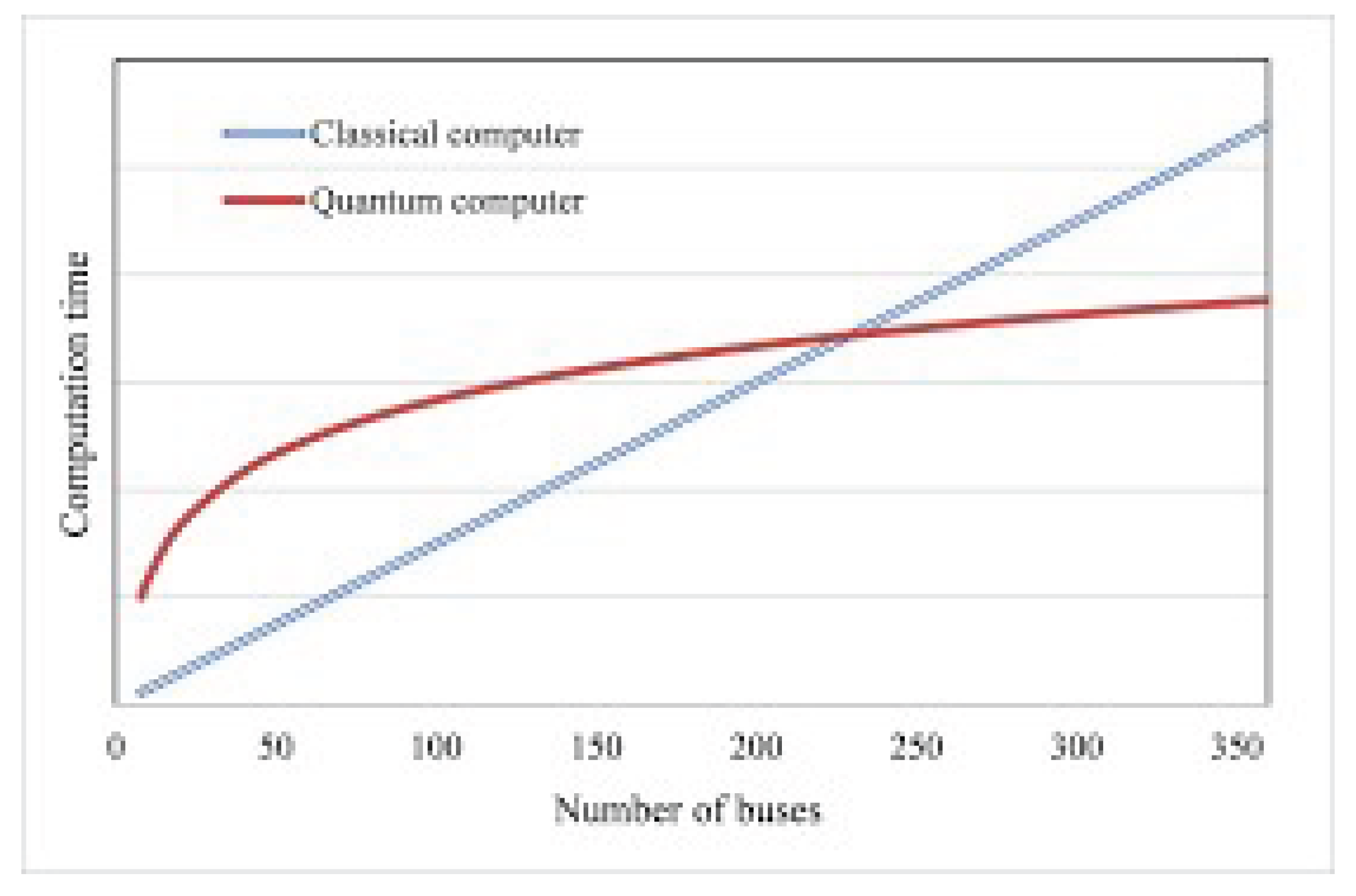
As seen through the data Figure 4 above, smaller sizes of Quantum Models lack the performance to justify their heavy costs. With current quantum technologies coming with costs of around $2500 per qubit, it’s difficult to justify the addition of a small number of qubits to achieve nonincremental boosts in performance (The Quant, 2024). This is especially true when trying to scale to a classical computer because the cost is a very significant limiting factor to be considered in the scalability of a QML model. It is simply unrealistic to expect consumers to pay upwards of 5-10k for the minute increases in performance promised by 2-4 qubits. Currently the world’s largest Quantum Models consist of some hundreds of qubits, yet it is estimated that significant benefits may not be commercially viable until we reach models which can scale and handle thousands of qubits (Shibagaki, 2020). With the current capabilities of Quantum Machine Learning models, we can even see disadvantages when compared to traditional computing models. In the above graph, we see that the classical computer outperforms the quantum computer until you reach a certain complexity of computation, at which point the stable performance of the Quantum Model is able to compute faster (Choi, 2021).
Figure 4.
Classical vs Quantum Computer II: This figure shows the performance of Classical and Quantum computers of large problems of increasing sizes (Meyer, 2023).
Figure 4.
Classical vs Quantum Computer II: This figure shows the performance of Classical and Quantum computers of large problems of increasing sizes (Meyer, 2023).
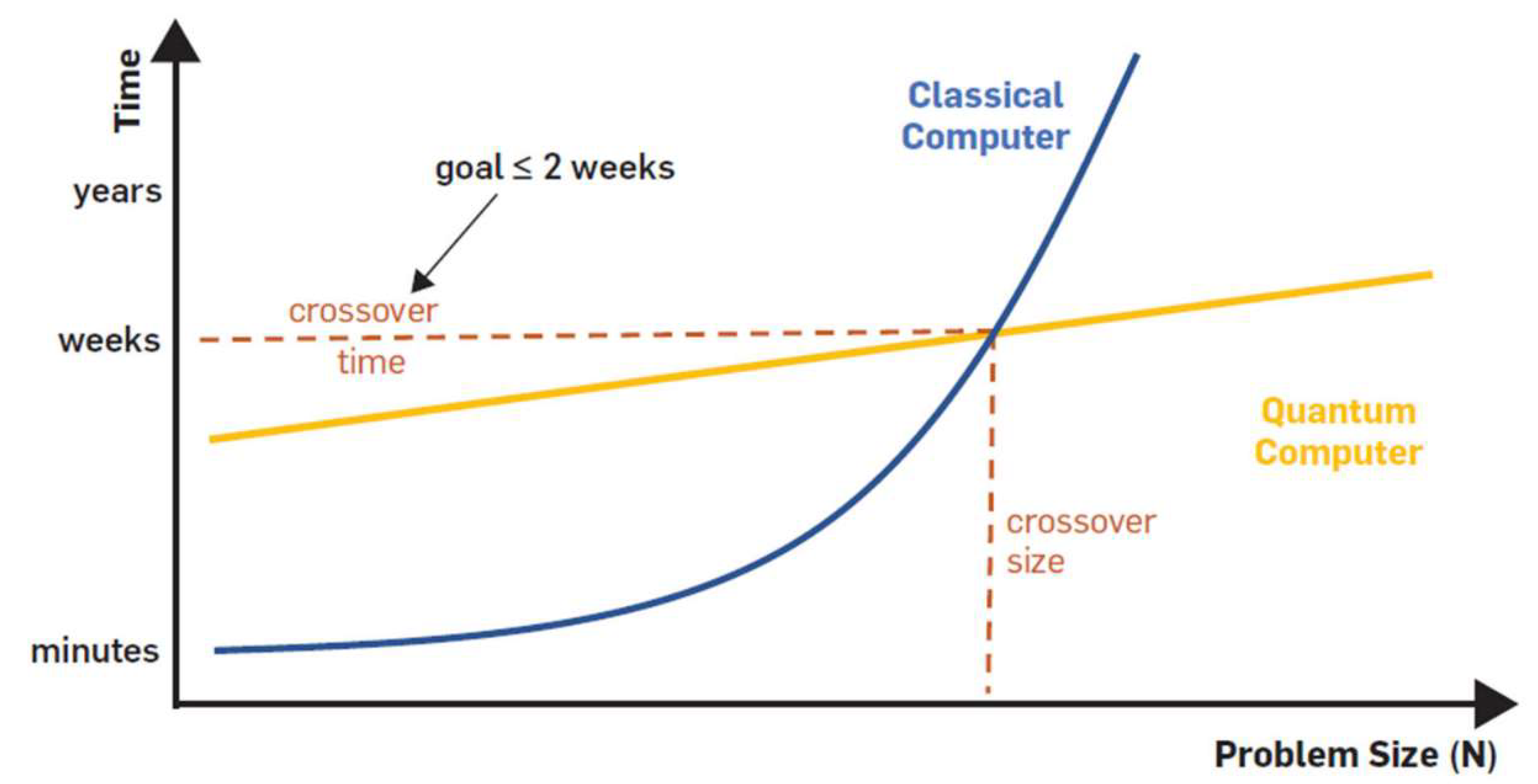
Figure 5.
Supercomputers and Quantum Infrastructure: This figure shows how supercomputers are already utilized alongside Quantum computers in a Hybrid-Cloud approach (Suchara et al., 2018).
Figure 5.
Supercomputers and Quantum Infrastructure: This figure shows how supercomputers are already utilized alongside Quantum computers in a Hybrid-Cloud approach (Suchara et al., 2018).

Instead of trying to implement Quantum Models on a consumer level, a hybrid approach on the cloud [Hybrid Quantum Computing => On Cloud] is currently the best way to proceed due to the limitations of new technologies as well as the extreme costs associated with running large Quantum Machines. Quantum Computers are already available for use in the cloud (IonQ, 2025) and while steps can be taken to ease the restrictions and properly scale a Quantum Machine Learning model to a classical computer, it is not feasible with current technology and if done, would result in a model with very little computing capability (The Quant, 2024).
5. Implementation and Feasibility
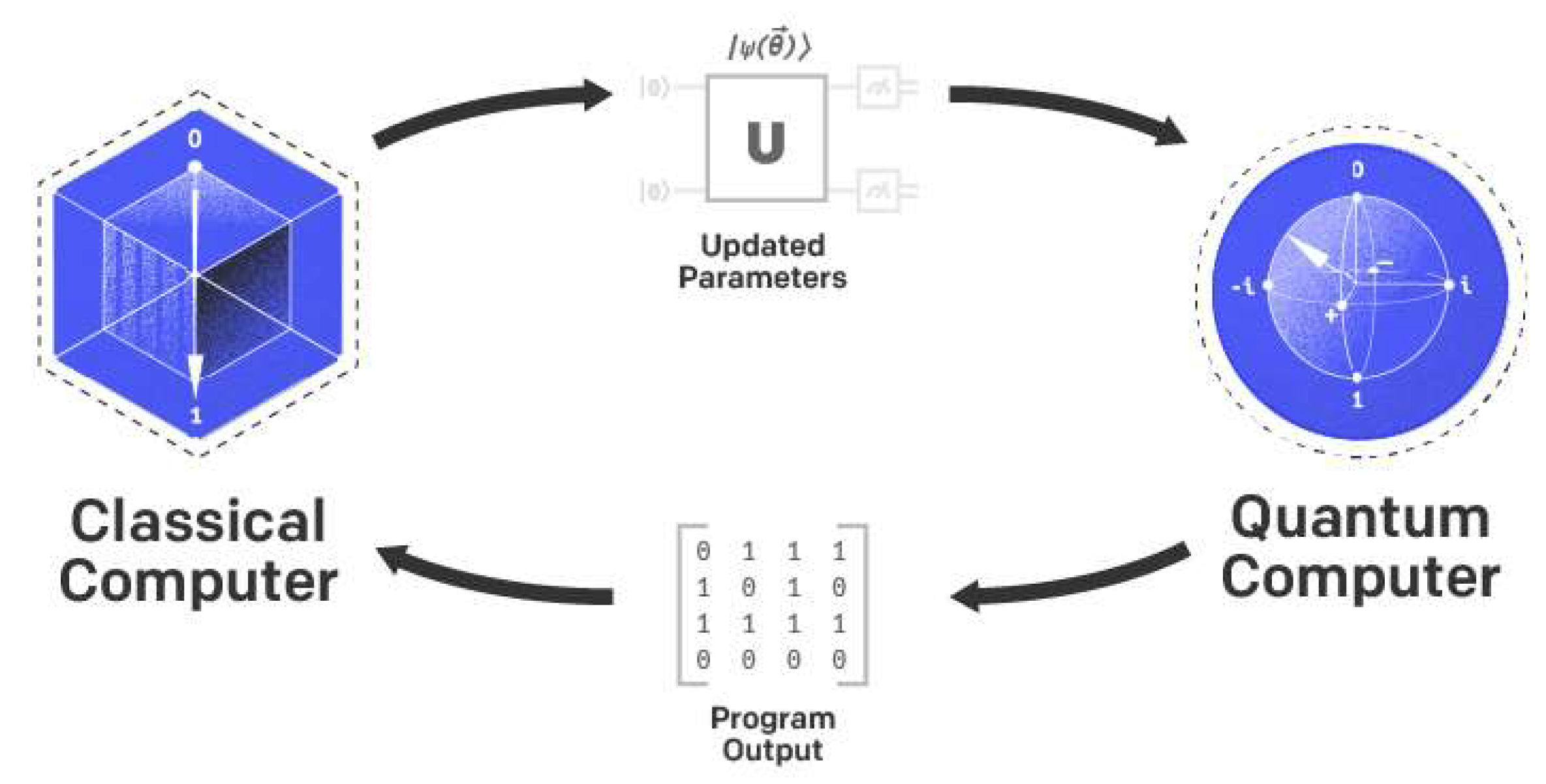
Hybrid Quantum computing would utilize the power of your classical processor to compute parameters and then pass that into a Quantum computer hosted somewhere in the cloud. The quantum computer would then use those parameters to compute its algorithm and return to you the result it achieves (IonQ, 2025).
Figure 6.
Classical and Quantum Hybrid System: This figure shows a simple system in which a Classical and Quantum computer work together using a Hybrid approach (IonQ, 2025).
Figure 6.
Classical and Quantum Hybrid System: This figure shows a simple system in which a Classical and Quantum computer work together using a Hybrid approach (IonQ, 2025).
A hybrid quantum computing approach offers many benefits over trying to scale a quantum computing system. Currently, we can utilize cloud services which offer access to the latest quantum technologies alongside classical computers to perform complex tasks at relatively fast speeds (IonQ, 2025). Utilizing Quantum cloud infrastructure also offers the benefit of always providing access to the latest hardware, as cloud providers constantly upgrade their models to the latest technologies available, which is just not possible to do on an individual level. Hybrid approaches would also significantly aid with rising costs of new Quantum hardware, as individuals would only have to pay for the performance they utilize, removing the high barriers to entry of Quantum Computing (Goldstein, 2025).
Its many benefits and efficiency prove that Hybrid computing is the best solution for expanding access to Quantum Computing technologies rather than scaling a quantum computer down to a minimal performance model that may struggle to meet the power of even classical computers due to its small size.
6. Conclusion and Further Research
While Quantum Machine Learning systems offer tremendous jumps in performance from traditional systems, they are simply not scalable. The best solution is a Hybrid approach, in which you utilize the strengths of both a Quantum Computer as well as a Classical Computer. This solution has merits in both the fact that it would not require any individual to maintain their own Quantum System, bypassing the limitations presented to successfully run a Quantum Computer, as well as the significant cost efficiency due to only needing one centralized Quantum Computer, which can be constantly upgraded to include the newest technological advancements.
In the future, it may be the case that a more optimal approach to scale a Quantum System is found with new technology. Given the current limitations of Quantum Technology as well as the lesser performance seen in systems which utilize smaller numbers of Qubits, currently any solution to scale a Quantum system is simply not feasible. With the speed that new Quantum Technologies are being developed today, there is no doubt that in the future, scaling a Quantum System may prove to give higher performance for a more reasonable cost and new developments to forego current limitations will be made.
References
- Albert, V. V., & Faist, P. (2025). The error correction zoo. https://errorcorrectionzoo.org/list/oscillator_stabilizer.
- Afifi-Sabet, K. (n.d.). Scientists build the smallest quantum computer in the world — it works at room temperature and you can fit it on your… livescience.com. https://www.livescience.com/technology/computing/scientists-build-the-smallest-quantum-computer-in-the-world-it-works-at-room-temperature-and-you-can-fit-it-on-your-desk.
- AZoQuantum. (2024, April 30). Enhancing quantum error correction effectiveness. https://www.azoquantum.com/News.aspx?newsID=10229.
- Arel, R. (2022, December 14). Classical vs. quantum computing: What are the differences? Tech Target. https://www.techtarget.com/searchdatacenter/tip/Classical-vs-quantum-computing-What-are-the-differences.
- Bernstein, M. (2022, December 7). It’s colossal: Creating the world’s largest dilution refrigerator. Fermilab. https://news.fnal.gov/2022/12/its-colossal-creating-the-worlds-largest-dilution-refrigerator.
- Cohen, Y. (2024, August 15). Controlling 1,000 Qubits: How to scale Quantum Computing for Real-world impact. Quantum Machines. https://www.quantum-machines.co/blog/controlling-1000-qubits-how-to-scale-quantum-computing/.
- Choi, C. Q. (2021, June 24). How many qubits are needed for quantum supremacy? IEEE Spectrum. https://spectrum.ieee.org/qubit-supremacy.
- Copil, R. (2023, July 10). Quantum versus Classical Computing and the Quantum Threat. Quantropi. https://www.quantropi.com/quantum-versus-classical-computing-and-the-quantum-threat/.
- Dargan, J. (2024, September 4). Quantum computers excel at solving highly complex problems. The Quantum Insider. https://thequantuminsider.com/2024/09/04/quantum-computers-excel-at-solving-highly-complex-problems/.
- Eskandarpour R., Ghosh K., Khodaei A., & Paaso A. (2021, June) Figure 2: Comparison between classical and quantum computation time for a. ResearchGate. https://www.researchgate.net/figure/Comparison-between-classical-and-quantum-computation-time-for-a-various-number-of-buses_fig2_353070326.
- Feature encoding | Machine Learning in the Elastic Stack [8.17] | Elastic. (n.d.). Elastic. https://www.elastic.co/guide/en/machine-learning/current/ml-feature-encoding.html.
- Feldman, A. (2024, February 6). Breakthrough in quantum computing with stable room temperature qubits. Advanced Science News. https://www.advancedsciencenews.com/breakthrough-in-quantum-computing-with-stable-room-temperature-qubits/.
- Finžgar, J. R., Ross, P., Klepsch, J., & Luckow, A. (n.d.). QUARK: A Framework for Quantum Computing Application Benchmarking. arXiv (Cornell University). [CrossRef]
- Goldstein, P. (2025, January 13). How will QAAS technology become available to the masses? Technology Solutions That Drive Business. https://biztechmagazine.com/article/2025/01/qaas-technology-becoming-available-perfcon.
- IonQ. (2025, January 8). Quantum computing 101: Introduction, evaluation, and applications. https://ionq.com/resources/quantum-computing-101-introduction-evaluation-applications.
- IonQ. (2025, January 8) What is Hybrid Quantum Computing? IonQ. https://ionq.com/resources/what-is-hybrid-quantum-computing.
- Kiwit, F. J., Wolf, M. A., Marso, M., Ross, P., Lorenz, J. M., Riofrío, C. A., & Luckow, A. (2024a). Benchmarking Quantum Generative Learning: A Study on Scalability and Noise Resilience using.
- QUARK. arXiv (Cornell University). [CrossRef]
- Litslink, & Litslink. (2024, May 13). The Realities of Quantum Computing: Promises vs Facts. Litslink. https://litslink.com/blog/the-realities-of-quantum-computing-promises-vs-facts.
- Liu, Y., Arunachalam, S., & Temme, K. (2021, August 25). Quantum kernels can solve machine learning problems that are hard for all classical methods. IBM Research. https://research.ibm.com/blog/quantum-kernels.
- Malinowski, M. (2024, February 6). Are trapped ions hard to scale? Reading the quantum. https://m-malinowski.github.io/2024/02/06/scaling-ions.html.
- Martinis, J. & Boixo S. (2019, October 23). Quantum supremacy using a programmable superconducting processor. Google Research. https://research.google/blog/quantum-supremacy-using-a-programmable-superconducting-processor/.
- Mechanic, Q. (2024, March 24). SpinQ unveils 3-qubit desktop quantum computer triangulum available for purchase aimed at education and. Quantum Zeitgeist. https://quantumzeitgeist.com/spinq-unveils-3-qubit-desktop-quantum-computer/#google_vignette.
- Meyer, F. (2023, May 26) “For very small problem sizes a classical computer is faster.” ETH Zurich. https://ethz.ch/en/news-and-events/eth-news/news/2023/05/for-very-small-problem-sizes-a-classical-computer-is-faster.html.
- Polytechnique Insights. (2021, July 2). Quantum computers: How do they work? https://www.polytechnique-insights.com/en/columns/science/quantum-computers-where-are-we-today/.
- Microsoft Quantum | Types of qubits. (n.d.). https://quantum.microsoft.com/en-us/insights/education/concepts/types-of-qubits.
- Ruder, S. (2020, March 20). An overview of gradient descent optimization algorithms. ruder.io. https://www.ruder.io/optimizing-gradient-descent/.
- Quantum machine learning concepts. (n.d.). TensorFlow. https://www.tensorflow.org/quantum/concepts.
- Quantum supremacy using a programmable superconducting processor. (n.d.). https://research.google/blog/quantum-supremacy-using-a-programmable-superconducting-processor/.
- Quantum World Association. (2021, December 7). Quantum Annealing - Quantum World Association - Medium. Medium. https://medium.com/@quantum_wa/quantum-annealing-cdb129e96601.
- Shibagaki, K. (2020, May 15). Achieving Scalability:The key to future quantum computers | Columns | Mitsubishi Research Institute 50th Anniversary Website | Mitsubishi Research Institute, Inc. Mitsubishi Research Institute, Inc. https://www.mri.co.jp/en/50th/columns/quantum/no02/.
- Shukla, P. (2024, July 11). What is quantum machine learning? Analytics Vidhya. https://www.analyticsvidhya.com/blog/2023/03/what-is-quantum-machine-learning/.
- SpinQ. (2025, January 21). Quantum computer price guide: Cost & options explained. https://www.spinquanta.com/newsDetail/bdde4988-8a71-4334-84fb-c6e3d0d2d5b9.
- Suchara, M. , Alexeev, Y., Chong, F., Finkel, H., Hoffmann, H., Larson, J., Osborn, J., & Smith, G. (2018) Hybrid quantum-classical computing — EPIQC. EPiQC. https://www.epiqc.cs.uchicago.edu/hybrid-quantum-classical-computing.
- Susnjara, S., & Smalley, I. (2025, February 13). Cloud Computing. What is cloud computing? https://www.ibm.com/think/topics/cloud-computing.
- Tatananni, M. (2025, February 11). D-Wave is poised to dominate the quantum computing sector. Just ask its CEO. Barron’s. https://www.barrons.com/articles/dwave-quantum-computing-stock-96717826.
- What is Hybrid Quantum Computing? (n.d.). IonQ. https://ionq.com/resources/what-is-hybrid-quantum-computing.
- The Quant. (2024, June 29). The surprisingly cheap price of a quantum computer. Quantum computer cost in 2025? Quantum Zeitgeist. https://quantumzeitgeist.com/the-price-of-a-quantum-computer/.
- Unland, K. (2022, September 23). Zero Point Cryogenics closes deal involving National Research Council. Taproot Edmonton. https://edmonton.taproot.news/news/2022/09/23/zero-point-cryogenics-closes-deal-with-national-research-council.
- What is Quantum Annealing? — D-Wave System Documentation documentation. (n.d.-a). https://docs.dwavesys.com/docs/latest/c_gs_2.html.
- What is quantum computing? (n.d.). Iberdola.com. https://www.iberdrola.com/innovation/what-is-quantum-computing.
- Zewe, A. (2023a, February 21) A new way for quantum computing systems to keep their cool. MIT News | Massachusetts Institute of Technology. https://news.mit.edu/2023/new-way-quantum-computing-systems-keep-their-cool-0221.
- Zhou, Y., Stoudenmire, E. M., & Waintal, X. (2020). What limits the simulation of quantum computers? Physical Review X, 10(4). [CrossRef]
Figure 1.
Quantum Computing Growth figure shows the evolution of the most powerful Quantum technology over the years. (Litslink & Litslink, 2024).
Figure 1.
Quantum Computing Growth figure shows the evolution of the most powerful Quantum technology over the years. (Litslink & Litslink, 2024).
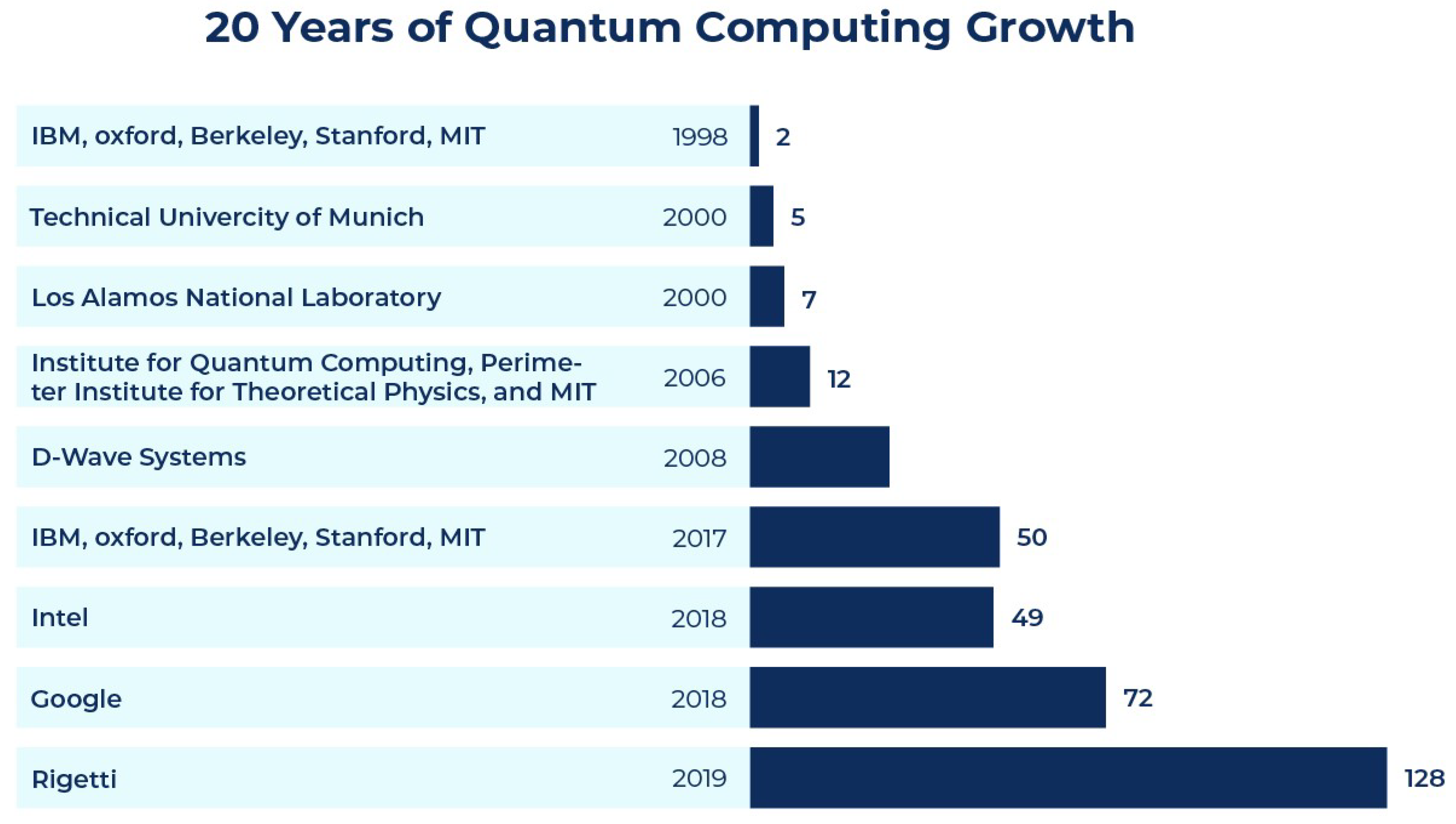
Figure 2.
Trapped Ion Lasers Representation: This figure shows a rough visualization of the laser structure regarding qubits, emphasizing the difficulty in preventing cross-over (Malinowski, 2024).
Figure 2.
Trapped Ion Lasers Representation: This figure shows a rough visualization of the laser structure regarding qubits, emphasizing the difficulty in preventing cross-over (Malinowski, 2024).
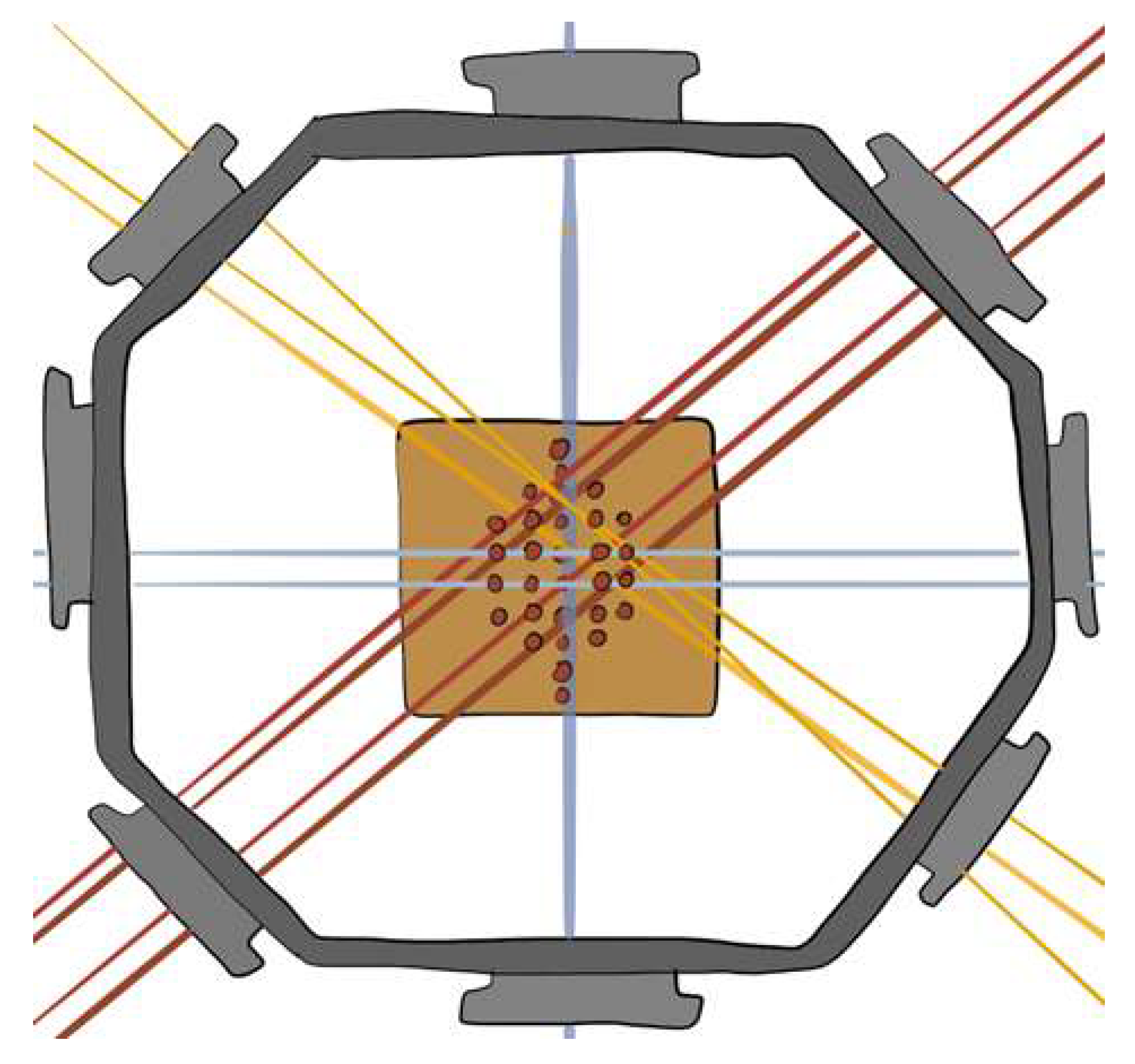

Table 1.
Comparative Performance of QML vs. Traditional Computer Processor (Zhou et al., 2020; Copil, 2023; Tatananni, 2025).
Table 1.
Comparative Performance of QML vs. Traditional Computer Processor (Zhou et al., 2020; Copil, 2023; Tatananni, 2025).
| Problem Type | Traditional Computer Processor (Classical) | Quantum Computing Model (QML) |
| Linear Algebra Operations | Performance scales linearly | Performance scales exponentially |
| Optimization Problems | Time consuming for large datasets. Significant performance decreases as size increases. | Faster solution with Quantum Annealing. |
| Simulation of Quantum Systems | Unfeasible to simulate | Can efficiently simulate complex Quantum Systems. |
Disclaimer/Publisher’s Note: The statements, opinions and data contained in all publications are solely those of the individual author(s) and contributor(s) and not of MDPI and/or the editor(s). MDPI and/or the editor(s) disclaim responsibility for any injury to people or property resulting from any ideas, methods, instructions or products referred to in the content. |
© 2025 by the authors. Licensee MDPI, Basel, Switzerland. This article is an open access article distributed under the terms and conditions of the Creative Commons Attribution (CC BY) license (http://creativecommons.org/licenses/by/4.0/).
Copyright: This open access article is published under a Creative Commons CC BY 4.0 license, which permit the free download, distribution, and reuse, provided that the author and preprint are cited in any reuse.


