

Submitted:
15 May 2025
Posted:
16 May 2025
You are already at the latest version
Abstract
Fresh-cut vegetables are gaining economic importance around the world. They are highly perishable products, and in the context of global food waste challenges, any new solutions to reduce losses are in line with the expectations of producers, traders, and consumers. The aim of this study was to evaluate the effect of hot water treatment (HWT) on the qual-ity and durability of two varieties of fresh-cut peppers at three storage temperatures: 3, 5, and 8 °C. Microscopic observations revealed changes in the tissue structure of the pepper sticks. During storage of red-fruit ‘Yecla’ peppers, HWT samples retained better firmness. Peppers treated with 55 °C for 12 seconds maintained the best quality during storage. Cream-fruit ‘Blondy’ peppers softened during storage, but the browning of the cut surface contributed most to the reduction in quality. HWT at 53 °C for 3 min and 50 °C for 5 min effectively inhibited the development of destructive changes during storage. HWT is bene-ficial for fresh-cut peppers, but the temperature and time of operation should be properly selected given the nature of the cultivar.
Keywords:
cultivar
; storage temperature
; shelf life
; weight loss
; softening
; browning
; microscopic analysis
1. Introduction
Partial or complete preparation of fresh vegetables for direct consumption includes operations to remove inedible parts of the plant material (e.g., peel), as well as washing, trimming, cutting, and coring. Such vegetables are very perishable during storage, transport, and distribution because tissue damage causes an increase in physiological, biochemical, and microbiological intensity. Low temperature and altered composition of the atmosphere during storage are most often used to inhibit these changes. Various tests have been performed with different post-cutting treatments to improve storage ability and lengthen the shelf life of fresh-cut vegetables [1]. One of them is hot water treatment (HWT). It is a non-chemical technology that is friendly to users, consumers, and the environment [2,3].
HWT with simultaneous gentle brushing has been commercially used for years in Israel for fruits and vegetables such as sweet corn, persimmon, sweet peppers, melon, mango, avocado, orange, grapefruit, kumquat, and organic citrus fruit [2]. HWT with temperatures up to 60 °C reduces respiration in many species of fruits and vegetables, reduces ethylene production, delays ripening, and reduces pathogen infestation [4,5,6,7]. High temperature (10 °C above the normal growing temperature) also promotes the formation of new proteins (heat stress proteins - HSPs) in place of proteins found in untreated products [4,8,9]. The accumulation of HSPs provides protection against stressors, both those that cause their biosynthesis and those occurring during storage, as well as against infectious and physiological diseases [10,11]. Salveit [12] reports that heat shock induces the synthesis of HSPs in place of wound-induced enzymes of phenylpropanoid metabolism. This may be a new way to control browning of minimally processed vegetables and fruits. The effect of HWT on freshly harvested horticultural produce depends on the temperature applied and the time of treatment. According to Fallik and Ilic [13], factors such as the cultivation method, the cultivar, the stage of maturity at harvest, storage conditions also affect the result of the treatment.
The cultivation and consumption of sweet peppers is growing worldwide, and much attention is being paid to both production methods and storage options. HWT technology turned out to be helpful because it was found that immersing whole bell pepper fruits for 3 min in water at 50 °C markedly reduced damage caused by the fungi Botrytis cinerea and Alternaria alternata during storage [14]. Red sweet peppers treated with hot water at 55 °C for 1 min showed less development of chilling injury, electrolyte leakage, and weight loss during 4 wk of storage at 10 °C [15]. Hot water rinsing and brushing (HWRB) with temperature 55 ± 1 °C for 12 ± 2 s effectively cleaned and disinfected peppers and contributed to maintaining better quality and improving storage life [2]. A beneficial effect of HWRB was reported also for other products: tomato (52 °C – 15 s), apples (55 °C for 15 s), organically grown citrus (56 or 60 °C for 10 s), litchi (55 °C for 20 s), mango (55 °C – 15–20 s), and others [2,16]. According to Zong et al. [17], HWT of tomato in water at 42 °C for 40 min helped reduce the development of gray mold on the fruit. However, excessive hot water treatment (55 °C for 3 or 5 min) can lead to damage to the fruit tissue [15].
Numerous studies indicate that HWT can improve the shelf life of cut vegetables during short-term storage. Brief immersion in hot water at 53 or 55 °C essentially delayed quality degradation of fresh-cut Chinese cabbage during storage at 0, 5, and 15 °C [18]. In a study by Loaiza-Velarde and Saltveit [19], crisp lettuce nerve sections treated with hot water at 50 °C for 90 s showed less browning of the tissue and delayed loss of green color compared to untreated pieces. Also, nerve sections of romaine lettuce treated with hot water at 45 °C for 2.5 min showed less tendency to brown during storage than untreated sections [20]. Freshly sliced pears treated with water at 35–45 °C for a period of 40–150 min avoided surface browning and maintained better firmness [21]. In a study by Koukonaras [22], treating peaches with water at 50 °C for 10 min prior to cutting also delayed browning and softening of the slices. The hot shock of spinach leaves at 40 °C delayed senescence and improved postharvest storage ability [23]. Green bell peppers exposed to hot water (55 and 60 °C for 3 min) and cut after treatment maintained better sensory quality during storage at 4 and 10 °C than untreated samples [24]. Rodoni et al. [25] recommend for unripe cut peppers a HWT at 45 and 60 °C for 3 min, while a treatment at 45 °C for 3 min is adequate for mature red-fruit peppers. On the other hand, treating leek pseudostems with hot water at 50–57.5 °C contributed only slightly to maintaining better color through 9 d of storage at 4 °C [26]. According to Salveit [8], the application of hot water to the cut material replaces the rinsing step, and the subsequent removal of residual water is easier due to its weaker adhesion to the plant surface.
The purpose of this study was to evaluate quality and determine the morphological changes occurring during short-term storage of fresh-cut red- and cream-fruit peppers treated with hot water. The evaluation was carried out through morphological observations and microscopic analyses. Preliminary tests by Grzegorzewska [27] with fresh-cut yellow peppers Sunny F1 showed that the use of hot water helps to inhibit softening and thus maintain better quality during short-term storage.
2. Materials and Methods
2.1. Plant Material and Treatments
Red-fruit 'Yecla F1' and cream-fruit 'Blondy F1' peppers were purchased from the largest bell pepper basin in Poland in Radom region (“Agropaprix” in Przystałowice Duże - Kolonia). Immediately after delivery to the laboratory, the fruits were washed, dried, and cut into sticks 0.5–1.0 cm wide. Immediately after the cut, the pepper sticks were treated with hot water by immersing individual batches for a defined time in hot water with one of four parameter regimens: 1) 45 °C for 10 min; 2) 50 °C for 5 min; 3) 53 °C for 3 min; 4) 55 °C for 12 s. The control treatment was fresh-cut peppers not treated with hot water.
The treatments were performed in a vessel filled with 150 l of water. Two portion of cut peppers weighing about 2.5 kg (each portion) was immersed in hot water for each treatment. After treatment, the peppers were dried in a stream of air provided by two SEVERIN VL 8620 fans. After drying the surface of the sticks, the peppers were packed into crates, protected from desiccation by polyethylene (PE) film, and stored overnight at 8 °C. The next day, the fresh-cut peppers were packed into polystyrene foam trays of external dimensions 226 mm × 100 mm × 9 mm and placed in plastic boxes. Each box was lined with PE in such a way that the trays with peppers were also covered with this film. Each treatment had 21 samples, each representing 200 g of cut peppers (separately packed into a tray). Four replicates from each treatment were stored under cold condition at 3, 5 and 8 °C for 6 days. Two replicates for each treatment from each storage temperature were used for evaluation of shelf life. After 4 d of cold storage (3, 5, or 8 °C), these two replicates were moved to 18–20 °C (market simulated conditions) and stored for 2 d. One replicate from each treatment and each storage temperature was subjected to microscopic observation.
2.2. Quality Assessment
Quality assessment was performed every 2 d during cold storage, i.e., after 2, 4, and 6 d. Under conditions of market simulation (18-–20 °C), observations were made daily. Evaluation was performed organoleptically based on a nine-point scale:
- -
- softening: 1 – none, 3 – light, 5 – medium (clearly perceptible), 7 – strong (soft sticks), 9 – very strong (completely soft sticks);
- -
- browning: 1 – none, 3 – slight, 5 – medium clearly visible, 7 – strong, 9 – very strong (brown);
- -
- rotting: 1 – none, 3 – slight (individual small rot spots), 5 – medium clearly visible (few clearly visible rot spots), 7 – strong, 9 – very strong;
- -
- marketable value: 9 – excellent (appear as freshly cut), 7 – good (light defects, only slightly reduced quality), 5 – sufficient (light and medium defects - lower limit of commercial suitability), 3 – bad (large defects), 1 – very bad.
On the same days, the natural weight loss of cut peppers was measured, expressed as a percentage representing the difference between the initial weight and the weight on a given day of observation.
2.3. Microscopic Evaluation
The morphological features of pepper fragments were evaluated using a stereoscopic microscope Olympus SZX 16 (Olympus Corporation, Tokyo, Japan) with cellSens imaging software. For histological analysis, the samples were fixed in a solution of chromic acid, acetic acid, and formalin for 48 h, dehydrated through an alcohol series, embedded in paraffin, and sectioned to 15 μm on a rotary microtome. Cut material, after staining with safranin and fast green, was enclosed in Canada balsam [28,29] and examined by conventional light microscopy with a Nikon Eclipse 80i (Nikon Corporation, Japan, Tokio) with imaging software NIS-Elements Br 4.00 for photo-documentation.
2.4. Data Analysis
The experiment was conducted twice, each time following the same protocols, in a two-factor system of five treatments and three storage temperature. The results were statistically analyzed with a two-factor analysis of variance. The averages for storage temperatures were analyzed as a one-factor analysis of variance. To compare means, the Tukey test was used with statistical significance at p < 0.05. Calculations were made using STATISTICA 13 software (Dell Inc.).
3. Results
3.1. Changes in Quality Attributes
Immediately after treatments and drying the surface of the sticks, the appearance of both 'Yecla’ and ‘Blondy’ peppers was very good. No heat damage was observed, and the sticks retained their proper color and firmness.
After 2 d of cold storage, the sticks of red-fruit ‘Yecla’ peppers showed no signs of quality degradation. During further storage, the quality began to decline. The main reason for the degradation was softening. The first signs of softening appeared after 4 d of cold storage; softening was significantly more intense at 8 °C and least intense at 3 °C. The marketable value after 4 d was rated highest for peppers stored at 3 °C; the difference between 5 and 8 °C was insignificant. During the next 2 d of storage, the peppers softened further, and their commercial value dropped. After 6 d, peppers at 3 °C were rated as good, at 5 °C they were rated as between sufficient and good, and at 8 °C they were near sufficient, (Table 1).
HWT affected the delay of softening in ‘Yecla’ peppers. Softening was clearly visible after 4 d at 3 and 8 °C. At the three storage temperatures, the control samples softened the most and had the lowest commercial value. For the next 2 d, the trend in 3 °C continued despite the fact that differences were not significant, and a similar situation was seen at 5 °C. At 8 °C, inhibition of softening occurred only for peppers treated with water at 55 °C for 12 s and at 50 °C for 3 min, although the differences were not significant. After 6 d of cold storage at 3 °C, peppers treated with hot water at 55 °C for 12 s had the highest commercial value, while control peppers had the lowest value. At 5 °C, all HWT improved the storage life of fresh-cut peppers to the same extent. At 8 °C, the storage life of peppers was only improved by treatments with water 55 °C for 12 s and 50 °C for 3 min., (Table 1).
By changing the storage temperature after 4-day of cold storage to 18–20 °C, an acceleration of softening and decrease in the commercial value of fresh-cut peppers was noted. After one day, the decline in quality was affected only by softening, while after 2 d, rot appeared on some samples. There was a slight trend toward better quality of fresh-cut peppers stored at 3 °C and poorer quality after storage at 8 °C. HWT clearly had an effect on delaying softening and rotting within 2 d under market simulation conditions following cold storage. Control peppers softened and rotted noticeably faster than HWT peppers in all cold storage groups. After storage at 3 °C, peppers from all HWT combinations maintained similar quality over the next 2 d. After storage at 5 °C, the best quality peppers during the next 2 d were those treated with water 55 °C for 12 s and water at 50 °C for 5 min. For peppers stored at 8 °C, sticks treated with water at 55 °C for 12 s showed the best shelf life at 18–20 °C, (Table 2). The color during refrigerated storage as well as market simulated conditions did not change in fresh-cut ‘Yecla’ peppers and was the same in both HWT and untreated samples (Figure 1).
The ‘Blondy’ peppers differed from ‘Yecla’ peppers during storage because of cut-surface browning. After 2 d at 8 °C, untreated ‘Blondy’ peppers already showed slight signs of browning of the cut surface (score 1.8), which slightly reduced the quality of these samples (score 8.0). Softening and rotting also developed with greater intensity during storage at 8 °C than at 3 and 5 °C. For this reason, peppers at 3 and 5 °C had better quality after 4 and 6 d than at 8 °C.
HWT, depending on the parameters used, had a strong effect on reducing the browning of ‘Blondy’ peppers. After 4 d at 3 °C, signs of browning were seen only in the control. Browning on peppers at 5 °C was observed in the control and on peppers treated with the highest temperature (55 °C), while at 8 °C there was browning in the control and on peppers treated with both the highest and lowest temperatures (55 °C and 45 °C). After 6 d, browning was evident in the control and the samples treated with 45 °C water and stored at 3 °C and in the control and the samples treated with 45 °C and 55 °C water and stored at 5 and 8 °C. At each storage temperature, samples treated with water at 53 °C for 3 min and water at 50 °C for 5 min retained the highest quality. Rotting, which developed the most on control samples, also contributed to the decline in quality after 6 d storage, (Table 3).
Fresh-cut ‘Blondy’ peppers after 1 d at 18–20 °C differed very significantly in browning, depending on HWT (Table 4). Under market simulation conditions, degradation processes accelerated, but significantly the best color and firmness were retained by peppers treated with water at 50 and 53 °C. After 1 d at 18–20 °C, the quality of the peppers from the best HWTs stored at 3 and 5 °C was very good, while those stored at 8°C were good. After 2 d at 18-20 °C, the quality of the peppers decreased significantly, but the best appearance was retained by the peppers treated with 50 and 53 °C water. Most browning, regardless the cold storage temperature, occurred on the control peppers. The most rot was also found on control peppers, although this was not statistically significant. Fresh-cut peppers subjected to water at 55 °C for 12 s and water at 45 °C for 10 min were ranked third and fourth in terms of severity of degradation changes. The least severe changes were found in samples treated with water at 53 °C for 3 min and water at 50 °C for 5 min.

Table 4.
Effect of hot water treatment on quality parameters of fresh-cut cream-fruited 'Blondy' peppers during shelf life at 18-20 °C, after 4 days of cold storage.
Table 4.
Effect of hot water treatment on quality parameters of fresh-cut cream-fruited 'Blondy' peppers during shelf life at 18-20 °C, after 4 days of cold storage.
| Cold storage tempe-rature | Hot water parameters | 1 day at 18-20 °C | 2 days at 18-20 °C | |||||
| softening | surface browning | marketable value | softening | Surface browning | rotting | marketable value | ||
| 3°C | 55 °C–12 s 53 °C–3 min. 50 °C–5 min. 45 °C–10 min. Control – not treated |
2.0±1.2a 1.5±0.6a 1.5±0.6a 3.5±2.9a 4.0±1.2a |
2.0±1.2ab 1.0±0.0a 1.0±0.0a 1.8±0.9ab 5.3±1.4d |
5.8±1.4c-f 8.0±0.0f 8.0±0.0f 5.8±0.9c-f 3.5±1.7abc |
6.5±0.6a 3.1±1.6a 3.5±2.9a 6.0±2.3a 8.3±0.3a |
4.5±1.7cde 1.4±0.3a 1.5±0.6ab 2.5±1.7abc 6.0±1.2de |
3.5±2.9a 1.4±0.5a 1.1±0.3a 2.5±1.7a 4.5±4.0a |
2.0±0.0ab 5.5±0.4d 4.9±2.1cd 1.5±0.6ab 1.0±0.0a |
| Mean | 2.5±1.7A | 2.2±1.8A | 6.2±2.0A | 5.5±2.6A | 3.2±2.2A | 2.6±2.5A | 2.9±2.1A | |
| 5 °C | 55 °C–12 s 53 °C–3 min. 50 °C–5 min. 45 °C–10 min. Control – not treated |
2.5±1.7a 1.5±0.6a 1.6±0.8a 3.5±2.9a 5.5±0.6a |
2.8±0.9abc 1.0±0.0a 1.0±0.0a 2.5±0.6abc 4.5±1.7cd |
4.8±0.9b-c 8.0±0.0f 7.9±0.0f 4.5±1.7a-d 2.5±0.6ab |
4.0±2.3a 2.6±1.9a 2.8±2.1a 5.5±4.0a 7.5±0.6a |
3.3±0.3abc 1.4±0.5a 1.9±0.9ab 3.3±0.3abc 6.0±1.2de |
3.0±2.3a 1.3±0.3a 1.1±0.3a 3.0±2.3a 4.0±3.5a |
2.0±0.0ab 5.8±0.5d 4.9±2.3bc 1.5±0.6ab 1.5±0.6ab |
| Mean | 2.9±2.1A | 2.4±1.6A | 5.5±2.3A | 4.8±2.9A | 3.2±1.8A | 2.5±2.2A | 3.1±2.1A | |
| 8°C | 55 °C–12 s 53 °C–3 min. 50 °C–5 min. 45 °C–10 min. Control – not treated |
3.5±2.9a 2.0±1.2a 2.3±1.5a 4.0±3.5a 5.5±1.7a |
3.5±0.6bcd 1.0±0.0a 1.3±0.3ab 2.0±1.2ab 5.5±1.7d |
3.0±0.0ab 7.4±0.9ef 6.6±1.2def 4.0±2.3d 2.0±0.0a |
6.5±1.7a 4.6±3.3a 5.0±3.5a 6.03.5±a 8.5±0.6a |
5.0±0.0cde 2.9±1.7abc 4.0±1.2bcd 4.5±0.6cde 7.0±0.0e |
3.0±2.3a 1.0±0.0a 2.5±1.7a 3.0±2.3a 4.5±4.0a |
1.8±0.5ab 4.0±2.4bcd 2.5±0.6abc 1.5±0.6ab 1.0±0.0a |
| Mean | 3.5±2.4A | 2.7±1.9A | 4.6±2.4A | 6.1±2.8A | 4.7±1.6B | 2.8±2.5A | 2.2±1.5A | |
Values are means from 4 samples ± standard deviation (SD). Means followed by the different lowercase within columns are significantly different (p˂0,05, Tukey test). Means ± SD for storage temperature are significantly different with different capital letters (p˂0,05, Tukey test).Grade scales: softening: 1 – none, 3 – light, 5 – medium (clearly perceptible), 7 – strong (soft sticks), 9 – very strong (completely soft sticks); browning: 1 – none, 3 – slight, 5 – medium clearly visible, 7 – strong, 9 – very strong (brown); rotting: 1 – none, 3 – slight (individual small rot spots), 5 – medium clearly visible (few clearly visible rot spots), 7 – strong, 9 – very strong; marketable value: 9 – excellent (appear as freshly cut), 7 – good (light defects, only slightly reduced quality), 5 – sufficient (light and medium defects - lower limit of commercial suitability), 3 – bad (large defects), 1 – very bad.
Figure 2.
Fresh-cut ‘Blondy’ peppers after 4 d at 5 °C and 1 d at 18–20 °C. Labels on trays give hot water parameters. kontrola = control (untreated peppers).
Figure 2.
Fresh-cut ‘Blondy’ peppers after 4 d at 5 °C and 1 d at 18–20 °C. Labels on trays give hot water parameters. kontrola = control (untreated peppers).
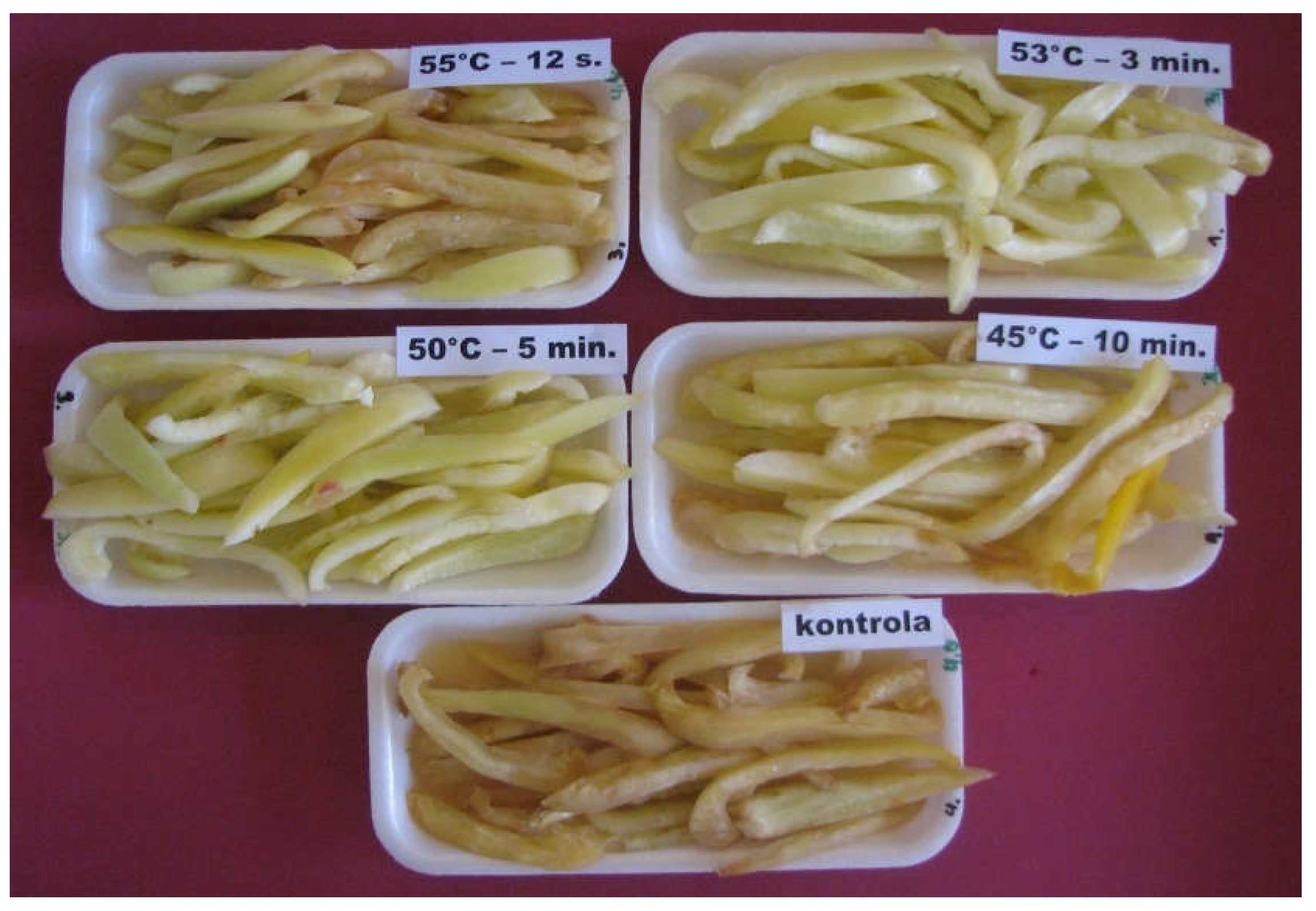
During cold storage and commercial shelf life, there was no pitting or other signs indicating chilling injury on the strips of pepper. Damage was not found on either ‘Yecla’ or ‘Blondy’s.
3.2. Weight Loss
Weight loss during cold storage was low. For ‘Yecla’ peppers, it did not exceed 0.4%. The greatest weight loss occurred during the first 2 d of cold storage, increasing on subsequent days but with much less intensity. Despite the low values, the increase in weight loss was greater at 3 °C than at 5 and 8 °C. This relationship was also marked after 1 day in shelf life. At 18–20 °C, weight loss increased rapidly. After 2 d, the highest losses were found for peppers treated with HWT at 55 °C for 12 s and control peppers, depending on the cold storage temperature, (Table 5).
The weight loss in ‘Blondy’ peppers during cold storage was not high either, although it reached 0.73% for the control peppers at 8 °C. After 2 d, the lowest losses were recorded for peppers stored at 8 °C, but after 6 d, the lowest loss was with cold storage at 3 °C and the highest was with 8 °C (although not significantly different from storage at 5 °C). A dynamic increase in losses occurred after peppers were moved to 18–20 °C. As in the case of ‘Yecla,’ the highest losses after 2 d were found in control peppers and peppers with HWT at 55 °C for 12 s in all three cold storage temperature groups (Table 6).
3.3. Microscopic Evaluation
Immediately after HWT, there were no noticeable changes in the tissue texture and surface color of bell pepper fragments in either the Yecla or Blondy cultivars. The sticks were firm with a well-preserved characteristic pattern on the inner surface of the fruit (Figure 3 and Figure 4). The fruit tissues showed no changes in cellular structure, indicating that cell turgor was preserved. In the cross sections, a clearly marked outer epidermal layer covered with cuticle and characteristic large spaces within the inner epidermis were observed (Figure 5).
Samples stored at 3 and 5 °C generally retained a better structure than samples stored at 8 °C. The parenchyma cells of the pepper strips stored at 8 °C lost their regular shape and density, which is associated with a decrease in cell turgor. The fresh-cut peppers after HWT retained normal tissue structure when was stored at 3 °C, while at 8 °C the structure of the flesh degraded (Figure 6.). There was a squashing of the cells, leading to softening and maceration of the flesh. In pepper strips treated with water at 45 °C for 10 min, stored at 8 °C, and then exposed to 1 d of 18–20 °C, there was degradation of the epidermal and subepidermal compartments as evidenced by separation of the epidermal layer from the flesh cells (Figure 7).
When the peppers strips were assessed after 4 d of cold storage and 1 d at 18–20 °C, observations confirmed that cold storage temperature and hot water treatment significantly affected the morphological quality of the fruit. The observed changes were increased surface wetness and glassiness as well as cracking, which are the result of denaturation of cell wall proteins and increased permeability of cell membranes. ‘Blondy’ peppers from control treatment and HWT at 55 °C for 12 s showed discoloration. The best maintained structure was in the strips after HWT at 53 °C for 3 min). Tissue translucency was visible on pepper strips from the HWT at 45 °C for 10 min (Figure 8). Immediately following HWT, no changes were observed in the vascular bundle structure (Figure 9A, red arrow). After storage, the oxidation of phenolic compounds was visible, especially in the lignin-rich xylem (Figure 9B, black arrow).
4. Discussion
Currently, the demand for fresh vegetables and fruits prepared for direct consumption is developing intensively. However, producers and traders have a problem with poor shelf life and consequently large losses. HWT is a non-chemical method to improve storage life of whole vegetables and fruits. The use of this method appeared to be effective for improving the shelf life of fresh-cut red-fruit and cream-fruit peppers. The response of the tested cultivars to HWT differed significantly. The ‘Yecla’ peppers showed an inhibition of stick softening, while the ‘Blondy’ peppers showed a reduction in stick softening and browning. Both disorders severely limit commercial marketing and increase losses [25,30]. The reasons for the softening may be a change in the osmotic state of the tissue and decomposition of the cell wall structure [1,31]. Discoloration of the ‘Yecla’ peppers was not apparent during cold storage as well as during shelf life under market simulated condition, which may have been a result of the predominance of red pigments that masked other pigments in the pepper tissue. According to other researchers [32,33], the reason is the weak expression of genes affecting membrane lipid metabolism, which can limit the browning process. Our finding contradicts the results of Rodoni et al. [25], who found that heat treatment of red peppers at 45 °C for 3 min led to color change during storage at 4 °C, in addition to softening and rotting. The cultivars we tested also reacted variably to the different combinations of HWT. Inhibition of softening of 'Yecla' strips occurred as a result of al HWT, but there was a tendency to maintain the best firmness and quality during short-term storage after HWT at 55 °C for 12 s. The ‘Blondy’ peppers treated with water at 53 °C for 3 min and water at 50 °C for 5 min retained the best color and quality. This is strong evidence that the reaction of fresh-cut vegetables to HWT is dependent on the type of plant material. The specific genetic and structural characteristics of the fruit can influence the direction of changes in the synthesis of HSPs and determine the morphological response in the tissue. The HSPs can delay the maturation and senescence processes to which the inhibition of polygalacturonase and exo- and endocellulase activity contribute [2,16]. In this way, HSPs also have an effect on delaying tissue softening, which occurred in the fresh-cut ‘Yecla’ peppers. The beneficial HSPs can affect the activity of polyphenolic oxidative enzymes and contribute to reducing browning of the cut surface of vegetables [9]. This discoloration was inhibited after two HWT at 50 and 53 °C in ‘Blondy’ peppers. The browning is caused by the oxidation of polyphenolic compounds under the influence of polyphenol oxidase (PPO). Also, there is evidence that peroxidase (POD) and phenylalanine ammonia lyase (PAL) may be involved in tissue browning of fresh-cut plant material [1,9,34,35]. Tissue browning may also be due to nonenzymatic polyphenol autooxidation [34]. Preventing browning requires deactivating the enzymes in this process [8]. Enzymes were not evaluated in our study, but numerous literature reports indicate that treating horticultural products with high temperatures results in inhibition of oxidative enzyme activity and reduces browning of cut vegetables. According to Lurie et al. [36], short-term immersion of plant products in water at 40–55 °C can reduce the activity of oxidative enzymes (e.g., POD and PPO), which reduces tissue darkening. Heat shock treatment in minimal processing of celery petioles at 50 °C for 90 s reduced PAL and subsequent browning [37]. Cut lettuce reacted similarly to the same shock treatment [38]. HWRB inhibits PPO activity, which reduces browning of the litchi peel [2]. Also. HWT was an effective inhibitor of browning of fresh-cut eggplants and the storage time was extended from 4 to 8 d after HWT at 45 °C for 30 min [39]. Browning of potato slices was inhibited only if the whole tubers were first stored one day at 20 °C and before cutting immersed in water at 55 °C for 10–20 min [40].
The differences in fresh-cut pepper quality between cold storage at 3 °C and 5 °C were insignificant in our study. Some authors recommend no more than 5 °C as the ideal storage temperature for fresh-cut fruit and vegetables [1,41]. Higher storage temperatures encourage microbial growth, which can lead to rotting and maceration of the tissues [42].
The storage time of fresh-cut pepper was short, so even at low temperature chilling injury did not develop. The development of other damage (softening, discoloration, and rotting) terminated the storage of the fresh-cut peppers. Generally, chilling damage of fresh-cut, cold-sensitive horticultural species is not a problem during storage, as it develops more slowly than damage caused by enzymatic and microbial activity. Therefore, a low storage temperature is used for most cut vegetables, even for chilling sensitive commodities [1,43]. Weight losses of the pepper sticks were low, but it was surprising to see a slightly higher percentage loss in the first days of storage at 3 and 5 °C than at 8 °C. Covering the samples with PE film protected them from excessive drying. However, turning on the cooling equipment more often in a chamber with a temperature of 3 °C than in one with 8 °C resulted in more intensive air circulation and a slight increase in the loss of fresh-cut pepper weight.
Microscopic observations immediately after treatment indicated that the HWT in our study did not cause changes to the cellular structure of the pepper tissue. The temperatures of the hot water used were within the range suggested for fresh vegetables and fruits [4,5,6]. If the temperature is too high or the exposure too long, then it could damage the integrity of the cells [44], leading to leakage of cell contents, loss of firmness, and faster spoilage. HWT affected other changes of a biochemical and physiological nature. During storage, the structural changes led to quality degradation of the fresh-cut peppers. This is in line with Foncesa et al. [31], who claimed that cell separation and cell breakage are involved in tissue softening during storage of fresh-cut vegetables.
5. Conclusions
Demand for fresh-cut vegetables is growing worldwide, but a concern is maintaining their high quality at all stages of production and distribution. The challenge for science and industry is to develop new technologies to improve the storage life of these products. To develop the most appropriate protocol for the chosen technology, it is necessary to take into account the physiological nature of the species and cultivar. Tests conducted in our study indicated that post-cutting HWT inhibits the softening of the sticks of red-fruit ‘Yecla’ peppers. This fresh-cut variety, whether treated or untreated, did not change color during short-term storage. The cream-fruit ‘Blondy’ peppers softened and browned during storage. Among four HWT tested, two regimens, water at 53 °C for 3 min and water at 50 °C for 5 min, proved effective in inhibiting these adverse changes. Based on these results, we conclude that HWT technology can be used in the postharvest management of cut vegetables, but further research is needed to determine the biochemical mechanisms triggered by the heat treatment, as well as to evaluate other sensory characteristics of fresh-cut peppers. The technology should be optimized to eliminate risks and achieve greater benefits for more nutritious and safe food.
Author Contributions
conceptualization, M.G.; investigation M.G. and A.M.; methodology M.G. and A.M.; writing original draft M.G.; resources M.G.; writing-review and editing M.G. Both authors have read and agreed to the published version of the manuscript.
Funding
The research was funded by The National Institute of Horticultural Research as part of its statutory research.
Data Availability Statement
The data presented in this study are available on request from corresponding author.
Conflicts of Interest
The authors declare no conflicts of interest.
Abbreviations
The following abbreviations are used in this manuscript:
| HWT | hot water treatment |
| HWRB | hot water rinsing and brushing |
| d | day |
| s | second |
| min. | minute |
| PPO | polyphenol oxidase |
| POD | peroxidase |
| PAL | phenylalanine ammonia lyase |
References
- Iturralde-García, R.D.; Cinco-Moroyoqui, F.J.; Martínez-Cruz, O.; Ruiz-Cruz, S.; Wong-Corral, F.J.; Borboa-Flores, J.; Cornejo-Ramírez, Y.I.; Bernal-Mercado, A.T.; Del-Toro-Sánchez, C.L. Emerging Technologies for Prolonging Fresh-Cut Fruits’ Quality and Safety during Storage. Horticulturae 2022, 8, 731. [Google Scholar] [CrossRef]
- Fallik, E.; Alkalai-Tuvia, S.; Chalupowicz, D. Hot Water Rinsing and Brushing of Fresh Produce as an Alternative to Chemical Treatment after Harvest—The Story behind the Technology. Agronomy 2021, 11, 1653. [Google Scholar] [CrossRef]
- Ndlela S., Mwando N.L., Mohamed S.A. Advances in postharvest disinfestation of fruits and vegetables using hot water treatment technology-updates from Africa. Chapter from book Postharvest Technology – recent advances, new perspectives and applications 2021. [CrossRef]
- Lurie, S. Postharvest heat treatments. Postharvest Biol. Technol. 1998, 14, 257–269. [Google Scholar] [CrossRef]
- Fallik, E.; Grinberg, S.; Alkalai, S.; Yekutieli, O.; Wiseblum, A.; Regev, R.; Beres, H.; Bar-Lev, E. A unique rapid hot water treatment to improve storage quality of sweet pepper. Postharvest Biol. Technol. 1999, 15, 25–32. [Google Scholar] [CrossRef]
- Fallik, E. Prestorage hot water treatments (immersion, rinsing and brushing). Postharvest Biol. Technol. 2004, 32, 125–134. [Google Scholar] [CrossRef]
- Ferguson, I.; Ben-Yehoshua, S.; Mitcham, E.; McDonald, R.; Lurie, S. Postharvest heat treatments: introduction and workshop summary. Postharvest Biol. Technol. 2000, 21, 1–6. [Google Scholar] [CrossRef]
- Saltveit, M.E. 1998. Heat shock and fresh cut lettuce. Perishables Handling Quarterly 95, pp. 5-6.
- He Q., Luo Y. Enzymatic browning and its control in fresh-cut produce. Stewart Postharvest Review 2007, 3 (6), pp. 1-7. [CrossRef]
- Vlachonasios, K.; Kadyrzhanova, D.; Dilley, D. Heat treatment prevents chilling injury of tomato (Lycopersicon esculentum) fruits: heat shock genes and heat shock proteins in the resistance of tomato fruit to low temperatures. Acta Hortic. 2001, 543–548. [Google Scholar] [CrossRef]
- Aghdam, M.S.; Sevillano, L.; Flores, F.B.; Bodbodak, S. Heat shock proteins as biochemical markers for postharvest chilling stress in fruits and vegetables. Sci. Hortic. 2013, 160, 54–64. [Google Scholar] [CrossRef]
- Saltveit, M.E. Wound induced changes in phenolic metabolism and tissue browning are altered by heat shock. Postharvest Biol. Technol. 2000, 21, 61–69. [Google Scholar] [CrossRef]
- Fallik, E., Ilic Z. Control of postharvest decay of fresh produce by heat treatments: The risk and benefits. In Postharvest Pathology of Fresh Horticultural Produce; Palou L., Smilanick J.L. Eds.; CRC press; Boca Raton, FL, USA, 2020, pp. [CrossRef]
- Fallik, E.; Grinberg, S.; Alkalai, S.; Lurie, S. The effectiveness of postharvest hot water dipping on the control of grey and black moulds in sweet red pepper (Capsicum annuum). Plant Pathol. 1996, 45, 644–649. [Google Scholar] [CrossRef]
- Kantakhoo, J.; Imahori, Y. Antioxidative Responses to Pre-Storage Hot Water Treatment of Red Sweet Pepper (Capsicum annuum L.) Fruit during Cold Storage. Foods 2021, 10, 3031. [Google Scholar] [CrossRef] [PubMed]
- Ilic, Z. , Polevaya Y. , Tuvia-Alkalai S., Copel A., Fallik E. A short prestorage hot water rinse and brushing reduces decay development in tomato, while maintaining its quality. Prop. Agric. Res. Ext 2001, 4, pp. 1–6. [Google Scholar]
- Zong, Y.; Liu, J.; Li, B.; Qin, G.; Tian, S. Effects of yeast antagonists in combination with hot water treatment on postharvest diseases of tomato fruit. Biol. Control. 2010, 54, 316–321. [Google Scholar] [CrossRef]
- Grzegorzewska, M.; Badełek, E.; Szczech, M.; Kosson, R.; Wrzodak, A.; Kowalska, B.; Colelli, G.; Szwejda-Grzybowska, J.; Maciorowski, R. The effect of hot water treatment on the storage ability improvement of fresh-cut Chinese cabbage. Sci. Hortic. 2022, 291. [Google Scholar] [CrossRef]
- Loaiza-Velarde, J.G.; Saltveit, M.E. Heat Shocks Applied either before or after Wounding Reduce Browning of Lettuce Leaf Tissue. J. Am. Soc. Hortic. Sci. 2001, 126, 227–234. [Google Scholar] [CrossRef]
- Kang, H.-M.; Saltveit, M.E. Antioxidant Capacity of Lettuce Leaf Tissue Increases after Wounding. J. Agric. Food Chem. 2002, 50, 7536–7541. [Google Scholar] [CrossRef]
- Abreu, M.; Beirão-Da-Costa, S.; Gonçalves, E.M.; Beirão-Da-Costa, M.L.; Moldão-Martins, M. Use of mild heat pre-treatments for quality retention of fresh-cut ‘Rocha’ pear. Postharvest Biol. Technol. 2003, 30, 153–160. [Google Scholar] [CrossRef]
- Koukounaras, A.; Diamantidis, G.; Sfakiotakis, E. The effect of heat treatment on quality retention of fresh-cut peach. Postharvest Biol. Technol. 2008, 48, 30–36. [Google Scholar] [CrossRef]
- Gómez, F.; Fernández, L.; Gergoff, G.; Guiamet, J.J.; Chaves, A.; Bartoli, C.G. Heat shock increases mitochondrial H2O2 production and extends postharvest life of spinach leaves. Postharvest Biol. Technol. 2008, 49, 229–234. [Google Scholar] [CrossRef]
- Sgroppo, S.C.; Pereyra, M.V. Using mild heat treatment to improve the bioactive related compounds on fresh-cut green bell peppers. Int. J. Food Sci. Technol. 2009, 44, 1793–1801. [Google Scholar] [CrossRef]
- Rodoni, L.; Hasperué, J.; Ortiz, C.; Lemoine, M.; Concellón, A.; Vicente, A. Combined use of mild heat treatment and refrigeration to extend the postharvest life of organic pepper sticks, as affected by fruit maturity stage. Postharvest Biol. Technol. 2016, 117, 168–176. [Google Scholar] [CrossRef]
- Tsouvaltzis, P.; Siomos, A.S.; Gerasopoulos, D. Effect of hot water treatment on leaf extension growth, fresh weight loss and color of stored minimally processed leeks. Postharvest Biol. Technol. 2006, 39, 56–60. [Google Scholar] [CrossRef]
- Grzegorzewska, M. The effect of hot water treatment and type of unit packaging on durability of fresh-cut pepper during short storage. Zeszyty Naukowe Instytutu Ogrodnictwa 2014, 22, pp. 19–29 (polish). [Google Scholar]
- Berlyn G.P., Miksche J.M., Sass J.E. Botanical microtechnique and cytochemistry. Iowa State Univ. Press, Ames, Iowa, 1976.
- Sass J.E. Botanical microtechnique. Iowa State College Press, Ames, Iowa 1958.
- Soliva-Fortuny, R.C.; Martı́n-Belloso, O. New advances in extending the shelf-life of fresh-cut fruits: a review. Trends Food Sci. Technol. 2003, 14, 341–353. [Google Scholar] [CrossRef]
- Fonseca S., Silva C.L., Malcata F.X. Microstructural analysis of fresh-cut red bell pepper (Capsicum annum L.) for postharvest quality optimization. Elec. J. Env. Agricult. Food Chem 2005, 4 (5), pp. 1081-1085.
- Li, Z.; Zhang, Y.; Ge, H. The membrane may be an important factor in browning of fresh-cut pear. Food Chem. 2017, 230, 265–270. [Google Scholar] [CrossRef]
- Yuan X.Y., Zhan Z., Lin W., Zhang C., Wang B. The membrane may be a key factor influencing browning: a mini review on browning mechanisms of fresh-cut fruit and vegetables from a multi-omics perspective. Front. Nutr. 2025, 12, 1534594. [CrossRef]
- Sommano S.R., Chanasut U., Kumpoun W. 3-Enzymatic browning and its amelioration in fresh-cut tropical fruits. Fresh-cut fruits and vegetables. Technologies and Mechanisms for Safety Control, 2020, pp. 51-76. [CrossRef]
- Kang, H.-M.; Saltveit, M. Wound-induced increases in phenolic content of fresh-cut lettuce is reduced by a short immersion in aqueous hypertonic solutions. Postharvest Biol. Technol. 2003, 29, 271–277. [Google Scholar] [CrossRef]
- Lurie S. Heat treatments to reduce chilling injury and superficial scald. Environmentally Friendly Technologies for Agricultural Produce Quality. Ben-Yehoshua S.(Eds.), Taylor and Francis Group, CRC Press, Boca Raton, FL, USA, 2005, pp. 43-60. [CrossRef]
- Loaiza-Velarde, J.G.; Mangrich, M.E.; Campos-Vargas, R.; Saltveit, M.E. Heat shock reduces browning of fresh-cut celery petioles. Postharvest Biol. Technol. 2003, 27, 305–311. [Google Scholar] [CrossRef]
- Murata, M.; Tanaka, E.; Minoura, E.; Homma, S. Quality of Cut Lettuce Treated by Heat Shock: Prevention of Enzymatic Browning, Repression of Phenylalanine Ammonia-lyase Activity, and Improvement on Sensory Evaluation during Storage. Biosci. Biotechnol. Biochem. 2004, 68, 501–507. [Google Scholar] [CrossRef]
- Ma, Y.; Zhang, L.; Wang, Q. Pre-cut hot water treatment inhibited the browning of fresh-cut eggplant. Acta Hortic. 2021, 187–198. [Google Scholar] [CrossRef]
- Tsouvaltzis, P.; Deltsidis, A.; Brecht, J.K. Hot Water Treatment and Pre-processing Storage Reduce Browning Development in Fresh-cut Potato Slices. HortScience 2011, 46, 1282–1286. [Google Scholar] [CrossRef]
- Dea, S.; Brecht, J.K.; Nunes, M.C.N.; Baldwin, E.A. Occurrence of chilling injury in fresh-cut ‘Kent’ mangoes. Postharvest Biol. Technol. 2010, 57, 61–71. [Google Scholar] [CrossRef]
- Barth, M., Hankinson, T.R., Zhuang, H., Breidt, F. Microbiological spoilage of fruits and vegetables. In: Sperber, W., Doyle M. (eds) Compendium of the Microbiological Spoilage of Foods and Beverages. Food Microbiology and Food Safety. Springer, New York, NY. 2009. [CrossRef]
- Watada, A.E.; Ko, N.P.; Minott, D.A. Factors affecting quality of fresh-cut horticultural products. Postharvest Biol. Technol. 1996, 9, 115–125. [Google Scholar] [CrossRef]
- Lurie, S.; Klein, J.D. Ripening characteristics of tomatoes stored at 12°C and 2°C following a prestorage heat treatment. Sci. Hortic. 1992, 51, 55–64. [Google Scholar] [CrossRef]
Figure 1.
Fresh-cut ‘Yecla’ peppers after 4 d at 5 °C and 1 d at 18–20 °C. Labels on trays give hot water parameters. Kontrola = control (untreated peppers).
Figure 1.
Fresh-cut ‘Yecla’ peppers after 4 d at 5 °C and 1 d at 18–20 °C. Labels on trays give hot water parameters. Kontrola = control (untreated peppers).
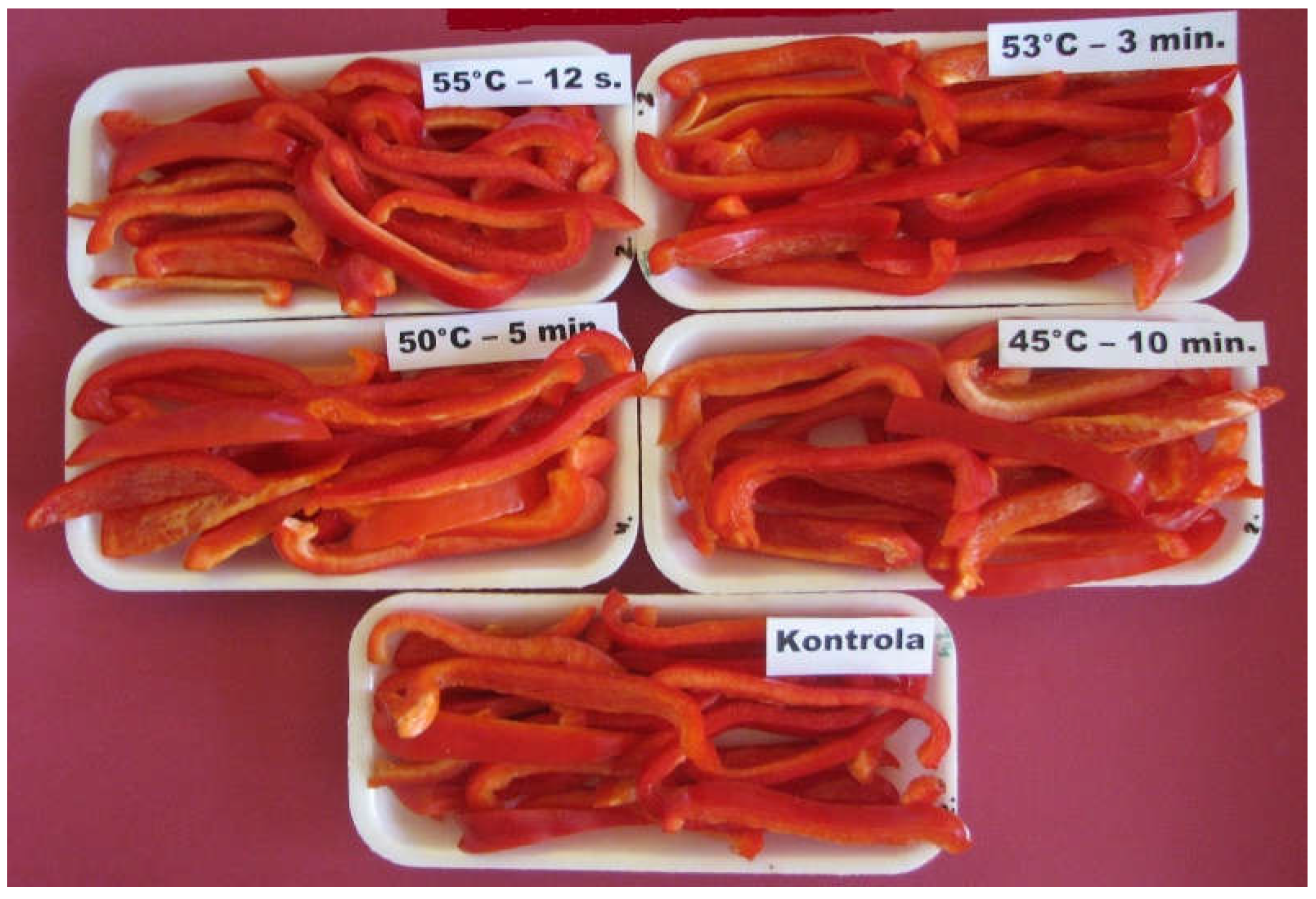
Figure 3.
Interior surfaces of fresh-cut ‘Yecla’ peppers immediately after hot water treatment. (A) Control; (B) 55 °C for 12 s; (C) 53 °C for 3 min; (D) 50 °C for 5 min; (E) 45 °C for 10 min.
Figure 3.
Interior surfaces of fresh-cut ‘Yecla’ peppers immediately after hot water treatment. (A) Control; (B) 55 °C for 12 s; (C) 53 °C for 3 min; (D) 50 °C for 5 min; (E) 45 °C for 10 min.
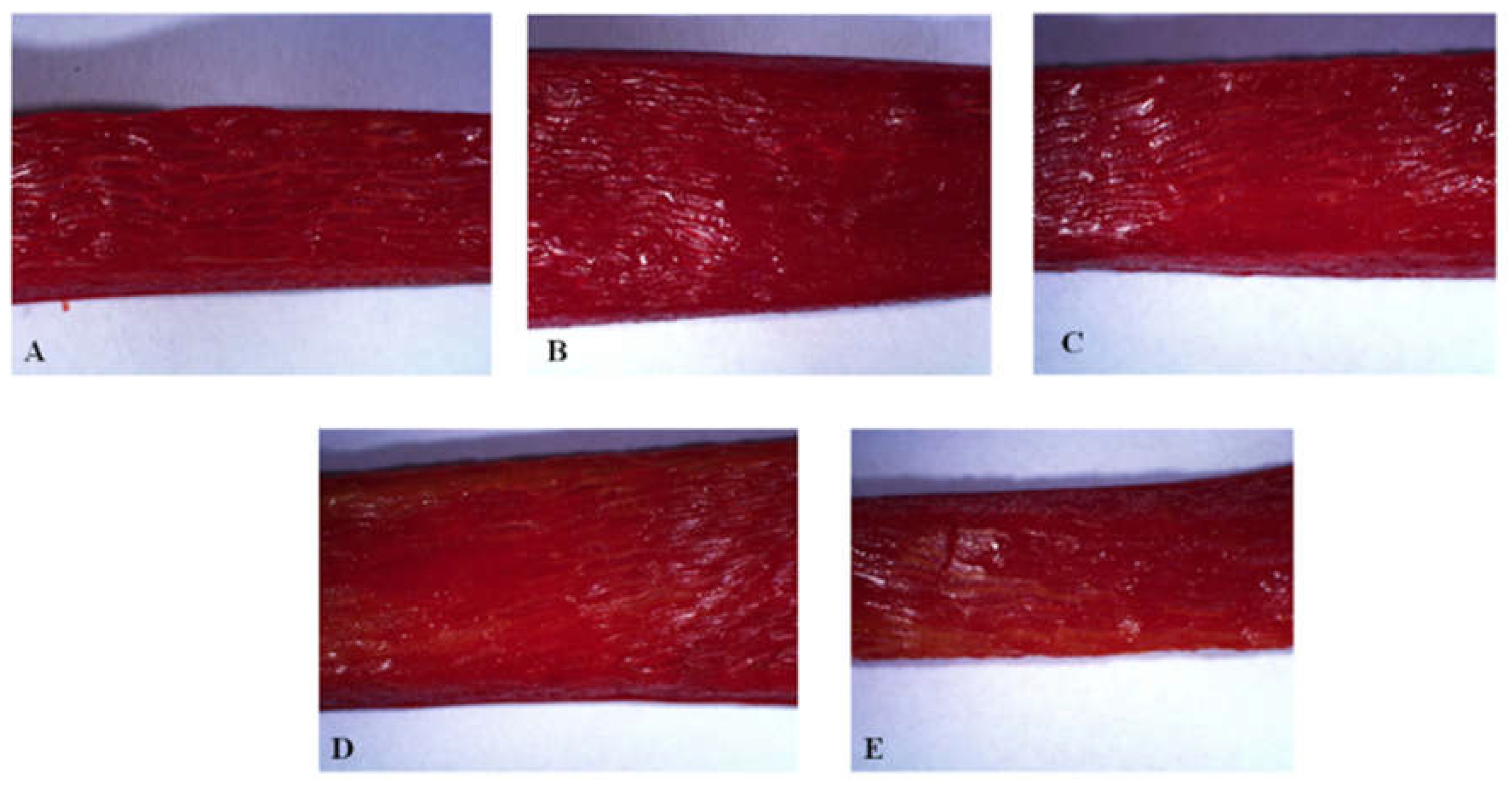
Figure 4.
Interior surfaces of fresh-cut ‘Blondy’ peppers immediately after hot water treatment. (A) Control; (B) 55 °C for 12 s; (C) 53 °C for 3 min; (D) 50 °C for 5 min; (E) 45 °C for 10 min.
Figure 4.
Interior surfaces of fresh-cut ‘Blondy’ peppers immediately after hot water treatment. (A) Control; (B) 55 °C for 12 s; (C) 53 °C for 3 min; (D) 50 °C for 5 min; (E) 45 °C for 10 min.
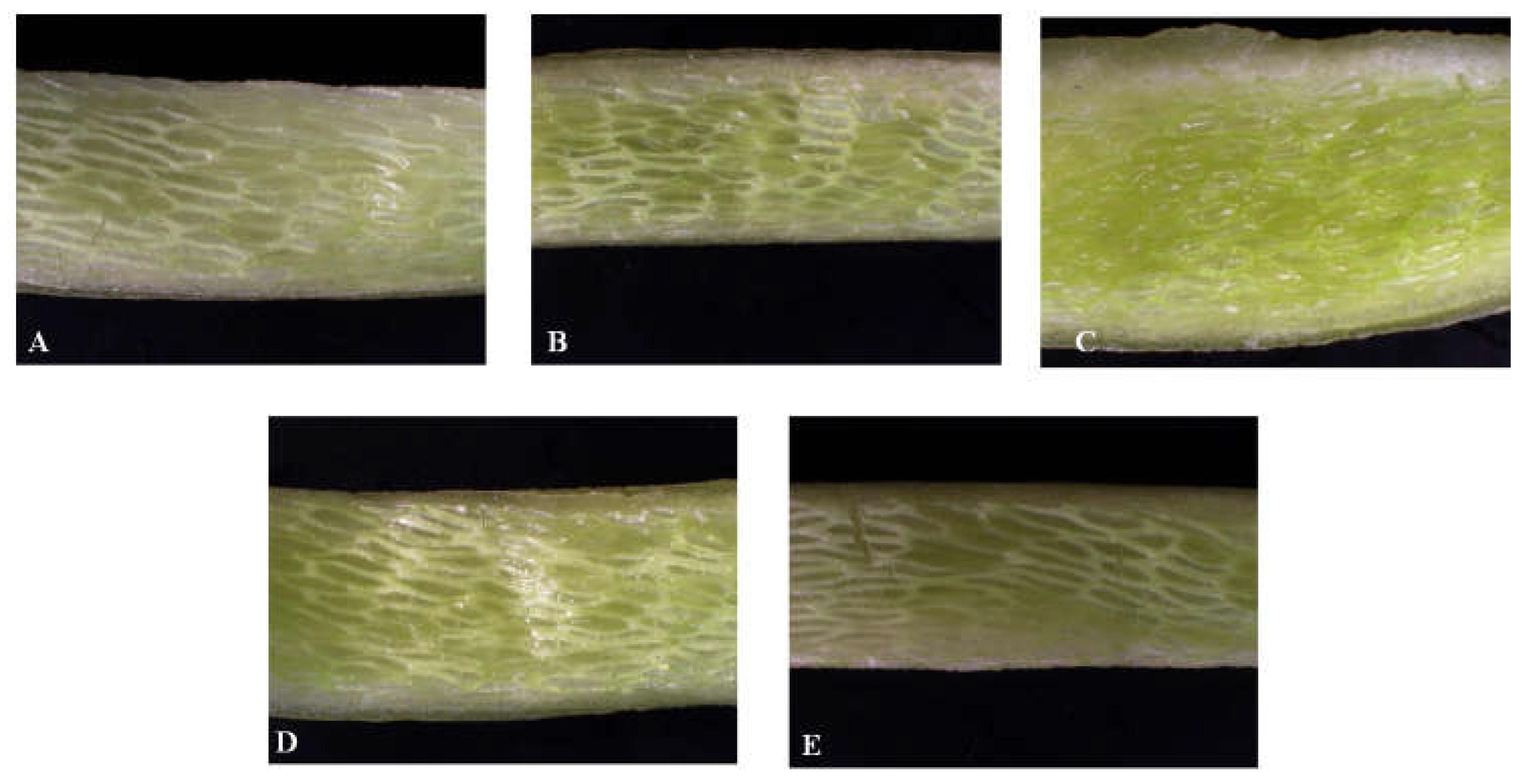
Figure 5.
Cross section of a pepper strip immediately after hot water treatment at 50 °C for 5 min. (A) Visible outer epidermis covered by a thick layer of cuticle (red arrow); (B) Characteristically large, convex spaces of the surface of the internal epidermis (black arrows).
Figure 5.
Cross section of a pepper strip immediately after hot water treatment at 50 °C for 5 min. (A) Visible outer epidermis covered by a thick layer of cuticle (red arrow); (B) Characteristically large, convex spaces of the surface of the internal epidermis (black arrows).
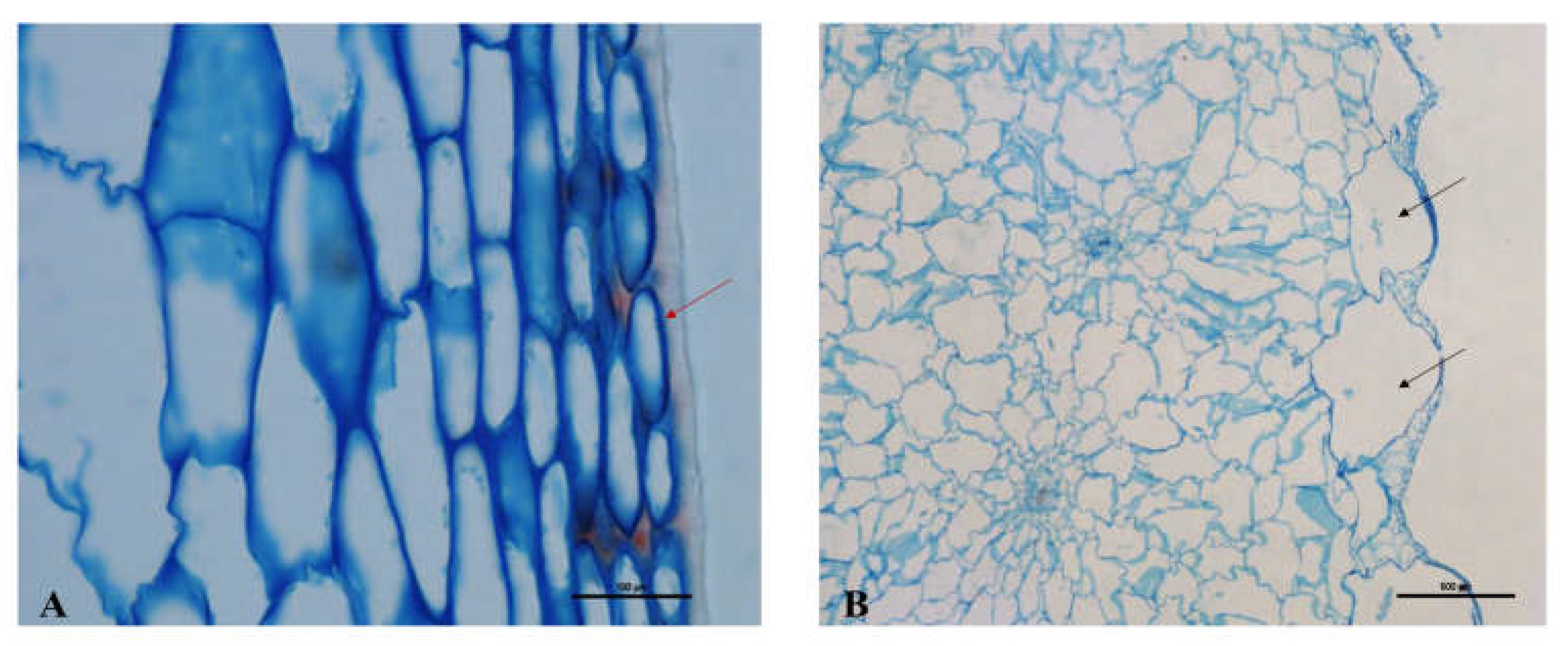
Figure 6.
Cross section through the glandular tissue of a pepper strip after hot water treatment at 50 °C for 5 min, cold stored for 4 d, and kept 1 d at 18–20 °C. (A) Cold storage at 3 °C; (B) Cold storage at 8 °C.
Figure 6.
Cross section through the glandular tissue of a pepper strip after hot water treatment at 50 °C for 5 min, cold stored for 4 d, and kept 1 d at 18–20 °C. (A) Cold storage at 3 °C; (B) Cold storage at 8 °C.
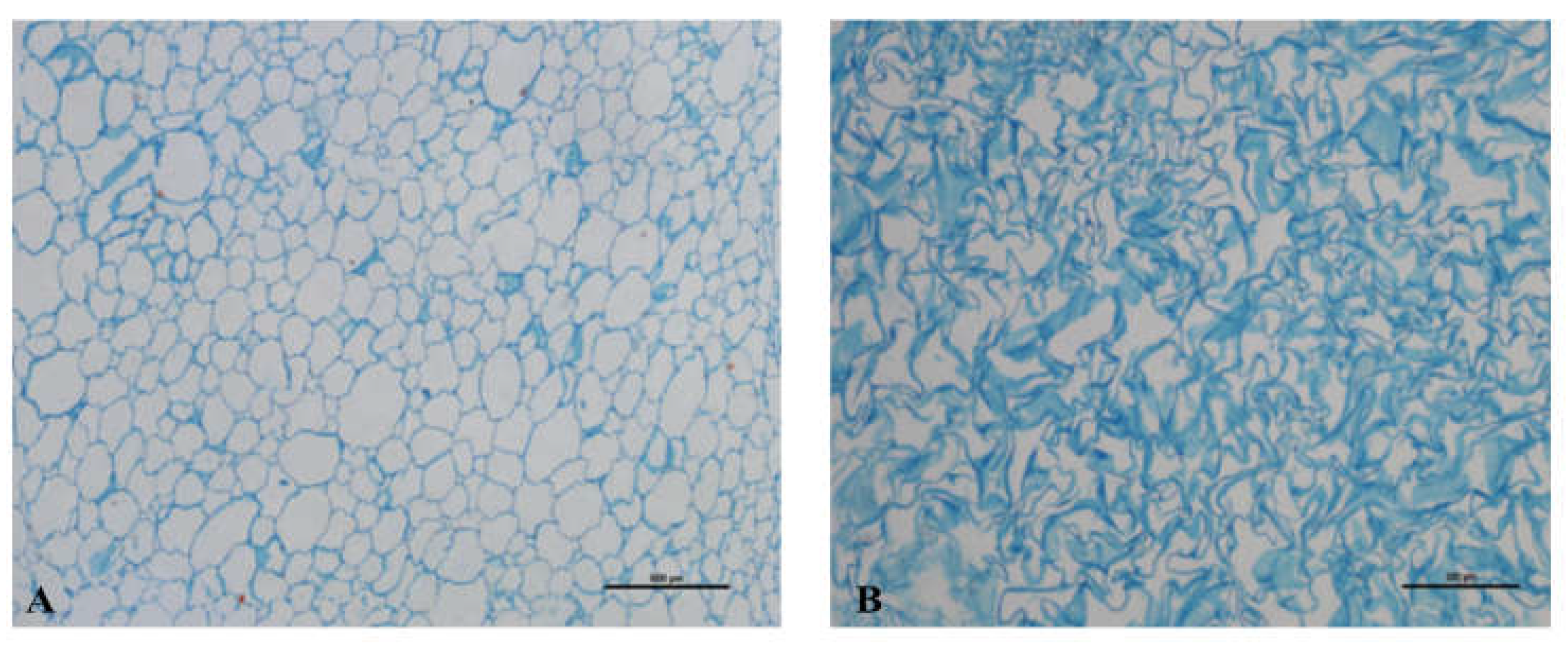
Figure 7.
Cross section through the pepper sticks treated with hot water at 45 °C for 10 min, stored 4 d at 8 °C, and kept 1 d at 18–20 °C. Visible degradation of the cells of the spongy tissue and separation of the epidermis (red arrow) from the fruit flesh as a result of storage at too high of a temperature.
Figure 7.
Cross section through the pepper sticks treated with hot water at 45 °C for 10 min, stored 4 d at 8 °C, and kept 1 d at 18–20 °C. Visible degradation of the cells of the spongy tissue and separation of the epidermis (red arrow) from the fruit flesh as a result of storage at too high of a temperature.
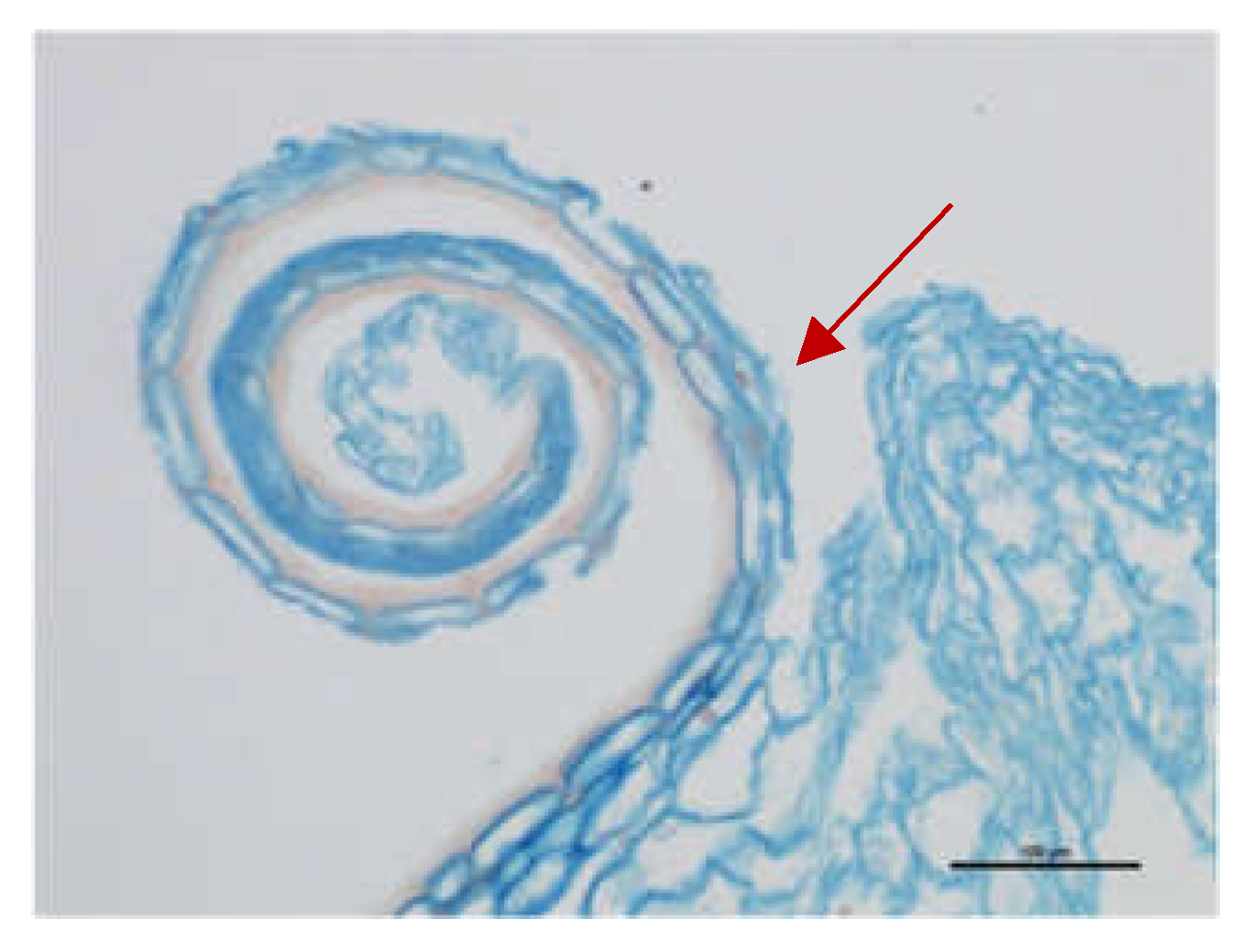
Figure 8.
Interior surfaces of fresh-cut ‘Blondy’ peppers after 4 d of storage at 8 °C and kept 1 d at 18–20 °C. (A) Control; (B) Hot water treatment (HWT) at 55 °C for 12 s; (C) HWT at 53 °C for 3 min; (D) HWT at 50 °C for 5 min; (E) HWT at 45 °C for 10 min).
Figure 8.
Interior surfaces of fresh-cut ‘Blondy’ peppers after 4 d of storage at 8 °C and kept 1 d at 18–20 °C. (A) Control; (B) Hot water treatment (HWT) at 55 °C for 12 s; (C) HWT at 53 °C for 3 min; (D) HWT at 50 °C for 5 min; (E) HWT at 45 °C for 10 min).
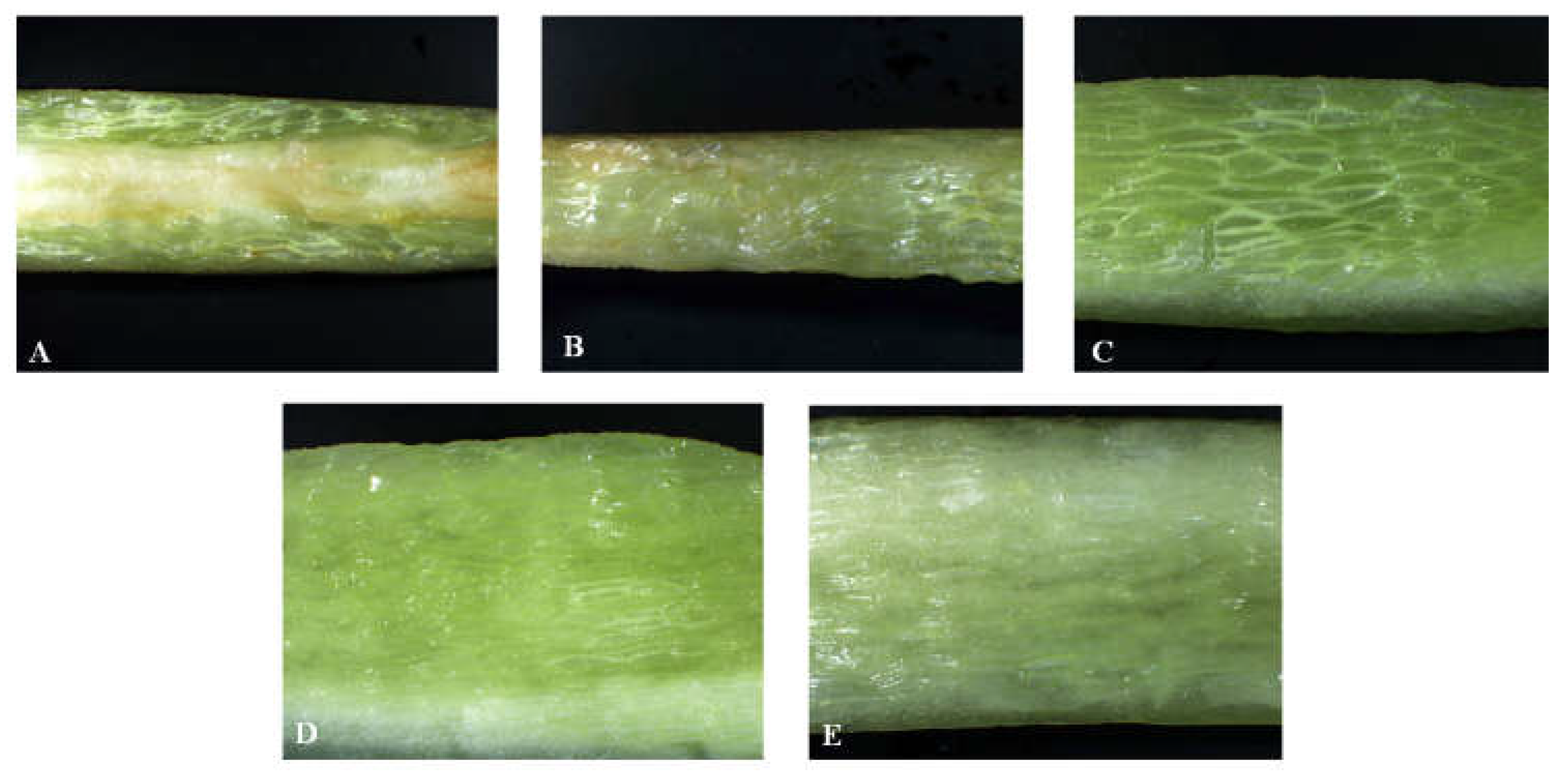
Figure 9.
Cross section through tissue of fresh-cut peppers with visible vascular bundle. (A) Immediately after hot water treatment (HWT) at 45 °C for 10 min, red arrow indicates vascular bundle; (B) After HWT at 45 °C for 10 min, 4 d storage at 8 °C, and 1 d at 1–20 °C, black arrow indicates xylem.
Figure 9.
Cross section through tissue of fresh-cut peppers with visible vascular bundle. (A) Immediately after hot water treatment (HWT) at 45 °C for 10 min, red arrow indicates vascular bundle; (B) After HWT at 45 °C for 10 min, 4 d storage at 8 °C, and 1 d at 1–20 °C, black arrow indicates xylem.
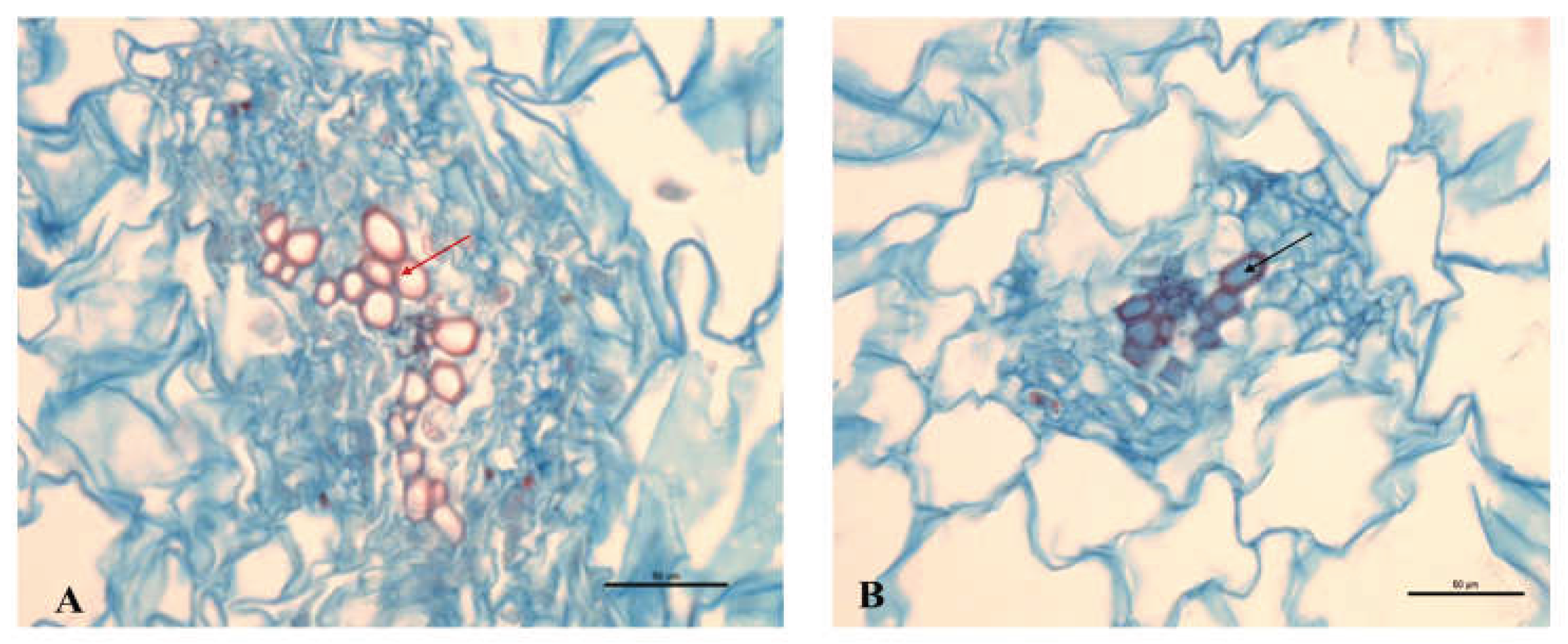
Table 1.
Effect of hot water treatment on quality parameters of fresh-cut red-fruited 'Yecla' pepper during short-term cold storage.
Table 1.
Effect of hot water treatment on quality parameters of fresh-cut red-fruited 'Yecla' pepper during short-term cold storage.
| Cold storage tempe-rature | Hot water parameters | 4 days of storage | 6 days of storage | ||
| softening | marketable value | softening | marketable value | ||
| 3 °C | 55 °C–12 s 53 °C–3 min. 50 °C–5 min. 45 °C–10 min. Control – not treated |
1.5±0.0 a 1.6±0.2 ab 1.5± 0.0 a 1.5±0.0 a 1.9±0.2 bcd |
8.3±0.63 b 8.1±0.2 b 8.2±0.3 b 8.3± 0.3 b 7.8±0.3 ab |
2.0 ±0.6 a 2.6 ±0.8 a 2.6±0.9 a 2.6±1.2 a 3.0±1.1 a |
7.7±0.5 e 7.2±0.5 de 7.2±0.7 de 7.1±1.0 de 6.5±0.5 cde |
| Mean | 1.6 ±0.2 A | 8.1±0.3 B | 2.6±0.9 A | 7.1±0.7 C | |
| 5 °C | 55 °C–12 s 53 °C–3 min. 50 °C–5 min. 45 °C–10 min. Control – not treated |
1.8±0.3 abc 1.9± 0.2 bcd 2.0±0.0 cd 1.9±0.2 bcd 2.0±0.0 cd |
7.7± 0.8 ab 7.6± 0.7 ab 7.5± 0.5 ab 7.6± 0.6 ab 7.5±0.5 ab |
2.8±0.8 a 2.8±0.8 a 2.8±0.8 a 2.8±0.8 a 3.8±1.3 a |
6.5±0.5 cde 6.5±0.5 cde 6.5±0.5 cde 6.5±0.5 cde 5.8±0.8 a-d |
| Mean | 1.9±0.2 B | 7.6±0.6 A | 3.0±1.0 A | 6.4±0.6 B | |
| 8°C | 55 °C–12 s 53 °C–3 min. 50 °C–5 min. 45 °C–10 min. Control – not treated |
2.0±0.0 cd 2.0±0.0 cd 2.0±0.0 cd 2.2±0.4 de 2.5±0.5 e |
7.5± 0.5 ab 7.5± 0.5 ab 7.5± 0.5 ab 7.3± 0.9 ab 7.0± 1.1 a |
3.0±0.9 a 4.5±2.7 a 2.7±0.4 a 4.7±2.0 a 4.8±1.3 a |
6.0±0.5 cde 4.5±2.7 ab 6.4±0.4 b-e 4.6±2.0 abc 4.4±1.5 a |
| Mean | 2.1±0.3 C | 7.4±0.7 A | 3.9±1.8 B | 5.3±1.8 A | |
Values are means from 8 samples ± standard deviation (SD). Means followed by the different lowercase within columns are significantly different (p˂0,05, Tukey test). Means ± SD for storage temperature are significantly different with different capital letters (p˂0,05, Tukey test).Grade scales: softening: 1 – none, 3 – light, 5 – medium (clearly perceptible), 7 – strong (soft sticks), 9 – very strong (completely soft sticks); marketable value: 9 – excellent (appear as freshly cut), 7 – good (light defects, only slightly reduced quality), 5 – sufficient (light and medium defects - lower limit of commercial suitability), 3 – bad (large defects), 1 – very bad.
Table 2.
Effect of hot water treatment on quality parameters of fresh-cut red-fruited 'Yecla' peppers during shelf life at 18-20 °C, after 4 days of cold storage.
Table 2.
Effect of hot water treatment on quality parameters of fresh-cut red-fruited 'Yecla' peppers during shelf life at 18-20 °C, after 4 days of cold storage.
| Cold storage temperature | Hot water parameters | 1 day at 18-20 °C | 2 days at 18-20 °C | |||
| softening | marketable value | softening | rotting | marketable value | ||
| 3 °C | 55 °C–12 s 53 °C–3 min. 50 °C–5 min. 45 °C–10 min. Control – not treated |
2.0±1.2 a 2.3±0. 3a 2.5±0.4 ab 2.5±0.6 ab 3.5±0.6 ab |
7.5±1.2 d 7.3±0.3 cd 7.0±0.4 cd 7.0±0.0 cd 5.5±0.6 ab |
3.0 ±2.3 a 3.5±1.7 a 3.4±0.8 a 3.5±1.7 a 5.0±2.3 a |
1.0±0.0 a 1.0±0. 0a 1.3±0.3 ab 1.0±0.0 a 1.3±0.3 ab |
6.0±1.2 b 5.8±1.4 b 5.8±0.3 b 5.8±1.4 b 4.0±1.2 ab |
| Mean | 2.6±0.8 A | 6.9±0.9 A | 3.7±1.8 A | 1.1±0.2 A | 5.5±1.3 A | |
| 5 °C | 55 °C–12 s 53 °C–3 min. 50 °C–5 min. 45 °C–10 min. Control – not treated |
2.4±0.5 a 2.8±0.3 ab 2.0±0.6 a 2.5±0.6 ab 3.1±0.3 ab |
6.9±0.3 cd 6.3±0.3 bcd 7.5±0.6 d 7.0±0.6 cd 5.9±1.0 abc |
3.3±1.5 a 4.3±2.0 a 3.5±1.7 a 3.8±2.0 a 5.1±1.2 a |
1.1±0.3 a 1.0±0.0 a 1.0±0.0 a 1.0±0.0 a 2.4±1.6 ab |
5.8±1.3 b 4.5±1.7 ab 5.8±0.9 b 5.5±1.7 ab 2.6±0.5 ab |
| Mean | 2.6±0.6 A | 6.7±0.8 A | 4.0±1.7 A | 1.3±0.8 A | 4.8±1.7 A | |
| 8 °C | 55 °C – 12 s 53 °C – 3 min. 50 °C – 5 min. 45 °C – 10 min. Control – not treated |
2.4±0.5 a 2.5±0.6 ab 2.8±0.5 ab 2.6±0.8 ab 4.0±1.2 b |
7.1±0.3 d 7.0±0.6 cd 6.4±0.8 bcd 6.3±0.3 bcd 4.8±0.3 a |
3.0±1.1 a 4.3±2.0 a 4.3±2.1 a 4.3±2.0 a 6.8±0.9 a |
1.0±0.0 a 1.0±0.0 a 1.0±0.0 a 1.0±0.0 a 3.0±2.3 b |
6.0±0.6 b 4.6±1.9 ab 4.6±2.0 ab 4.5±2.3 ab 2.0±0.0 a |
| Mean | 2.9±0.9 A | 6.3±1.0 A | 4.5±2.0 A | 1.4±1.2 A | 4.4±2.0 A | |
Values are means from 4 samples ± standard deviation (SD). Means followed by the different lowercase within columns are significantly different (p˂0,05, Tukey test). Means ± SD for storage temperature are significantly different with different capital letters (p˂0,05, Tukey test).Grade scales: softening: 1 – none, 3 – light, 5 – medium (clearly perceptible), 7 – strong (soft sticks), 9 – very strong (completely soft sticks); rotting: 1 – none, 3 – slight (individual small rot spots), 5 – medium clearly visible (few clearly visible rot spots), 7 – strong, 9 – very strong; marketable value: 9 – excellent (appear as freshly cut), 7 – good (light defects, only slightly reduced quality), 5 – sufficient (light and medium defects - lower limit of commercial suitability), 3 – bad (large defects), 1 – very bad.
Table 3.
Effect of hot water treatment on quality parameters of fresh-cut cream-fruited 'Blondy' peppers during short-term cold storage.
Table 3.
Effect of hot water treatment on quality parameters of fresh-cut cream-fruited 'Blondy' peppers during short-term cold storage.
| Cold storage tempe-rature | Hot water parameters | 4 days of storage | 6 days of storage | |||||
| softening | surface browning | marketable value | softening | surface browning | rotting | marketable value | ||
| 3 °C | 55 °C–12 s 53 °C–3 min. 50 °C–5 min. 45 °C–10 min. Control – not treated |
1.1±0.1a 1.1±0.1a 1.1±0.1a 1.1±0.1a 1.1±0.1a |
1.0±0.0a 1.0±0.0a 1.0±0.0a 1.0±0.0a 1.8±0.8abc |
8.8±0.3d 8.8±0.3d 8.8±0.3d 8.8±0.3d 7.8±1.3bcd |
1.5±0.3a 1.2±0.1a 1.5±0.0a 3.4±2.3abc 2.6±1.1abc |
1.0±0.0a 1.0±0.0a 1.0±0.0a 1.3±0.3ab 2.5±0.0c |
1.2±0.3a 1.0±0.0a 1.0±0.0a 1.0±0.0a 1.5±0.5a |
7.5±0.3fgh 8.3±0.3h 8.3±0.3h 5.5±2.7def 5.7±0.8d-g |
| Mean | 1.1±0.1A | 1.2±0.5A | 8.6±0.7B | 2.0±1.4A | 1.4±0.6A | 1.1±0.3A | 7.0±1.7B | |
| 5 °C | 55 °C–12 s 53 °C–3 min. 50 °C–5 min. 45 °C–10 min. Control – not treated |
1.1±0.1a 1.1±0.1a 1.1±0.1a 1.1±0.1a 1.4±0.2a |
1.3±0.3ab 1.0±0.0a 1.0±0.0a 1.0±0.0a 2.5±1.6c |
8.0±1.1cd 8.5±0.5cd 8.5±0.5cd 8.5±0.5cd 7.0±1.6bc |
1.5±0.0a 2.0±0.9ab 1.5±0.0a 3.8±2.4abc 3.8±1.9abc |
1.8±0.8b 1.0±0.0a 1.0±0.0a 1.3±0.3ab 4.0 ±0.0d |
1.0±0.0a 1.0±0.0a 1.0±0.0a 1.0±0.0a 1.3±0.3a |
7.0±1.1e-h 7.8±0.3gh 8.3±0.3h 5.2±2.9cde 3.8±0.8bcd |
| Mean | 1.1±0.2A | 1.4±0.9A | 8.1±1.1B | 2.5±1.7A | 1.8±1.2A | 1.1±0.2A | 6.4±2.2B | |
| 8 °C | 55 °C–12 s 53 °C–3 min. 50 °C–5 min. 45 °C–10 min. Control – not treated |
1.4±0.3a 1.1±0.1a 1.1±a0.1 2.4±1.2b 2.0± 0.0b |
2.3±1.5bc 1.0±0.0a 1.0±0.1a 1.8±0.8abc 4.0±1.2d |
7.1±1.7bc 8.5±0.5cd 8.5±0.5cd 6.3±0.3ab 5.3±1.9a |
3.7±1.3abc 2.4±1.2abc 2.3±0.8ab 5.3±4.0c 4.5±1.6bc |
3.9±0.5d 1.3± 0.3ab 1.4±0.1ab 2.9±0.2c 6.0±1.1e |
1.6±1.0a 1.1±0.2a 1.0±0.0a 1.9±1.1ab 3.0±2.1b |
3.1±0.7abc 6.7±0.4e-h 6.6±0.7e-h 2.5±1.7ab 1.5±0.5a |
| Mean | 1.6±0.7B | 2.0±1.4B | 7.1±1.7A | 3.6±2.5B | 3.1±1.8B | 1.7±1.3B | 4.1±2.4A | |
Values are means from 8 samples ± standard deviation (SD). Means followed by the different lowercase within columns are significantly different (p˂0,05, Tukey test). Means ± SD for storage temperature are significantly different with different capital letters (p˂0,05, Tukey test).Grade scales: softening: 1 – none, 3 – light, 5 – medium (clearly perceptible), 7 – strong (soft sticks), 9 – very strong (completely soft sticks); browning: 1 – none, 3 – slight, 5 – medium clearly visible, 7 – strong, 9 – very strong (brown); marketable value: 9 – excellent (appear as freshly cut), 7 – good (light defects, only slightly reduced quality), 5 – sufficient (light and medium defects - lower limit of commercial suitability), 3 – bad (large defects), 1 – very bad.
Table 5.
Weight loss of fresh-cut red-fruited 'Yecla' peppers during cold storage and shelf life (18-20 °C), after 4 days of cold storage.
Table 5.
Weight loss of fresh-cut red-fruited 'Yecla' peppers during cold storage and shelf life (18-20 °C), after 4 days of cold storage.
| Cold storage tempe-rature | Hot water parameters | Cold storage (days) | Shelf life at 18-20 °C after 4 d of cold storage (days) | |||
| 2 | 4 | 6 | 1 | 2 | ||
| 3°C | 55 °C–12 s 53 °C–3 min. 50 °C–5 min. 45 °C–10 min. Control – not treated |
0.30±0.05 de 0.30±0.05 de 0.36±0.07 e 0.25±0.06 cd 0.38±0.03 e |
0.32±0.07 def 0.31±0.05 c-f 0.36±0.07 ef 0.27±0.05 b-e 0.39±0.04 f |
0.38±0.09 d 0.31±0.05 bcd 0.37±0.07 cd 0.28±0.05 abc 0.40±0.05 d |
0.70±0.20 e 0.42±0.09 a-d 0.42±0.06 a-d 0.36±0.02 abc 0.50±0.00 cde |
0.91±0.10 fg 0.66±0.14 bcd 0.76±0.05 def 0.54±0.05 abc 0.87±0.03 ef |
| Mean | 0.32±0.07 C | 0.33±0.07 B | 0.35±0.07 B | 0.48±0.15 B | 0.75±0.16 A | |
| 5°C | 55 °C–12 s 53 °C–3 min. 50 °C–5 min. 45 °C–10 min. Control – not treated |
0.26±0.06 cd 0.22±0.04 bcd 0.19±0.06 abc 0.12±0.05 a 0.22±0.03 bcd |
0.26±0.06 a-d 0.22±0.04 abc 0.20±0.05 ab 0.20±0.05 ab 0.24±0.04 a-d |
0.28±0.07 abc 0.27±0.03 ab 0.21±0.05 a 0.24±0.04 ab 0.26±0.03 ab |
0.59±0.17 de 0.32±0.06 abc 0.24±0.03 a 0.32±0.06 abc 0.32±0.06 abc |
0.83±0.13 def 0.54±0.06 abc 0.46±0.03 a 0.55±0.08 abc 0.71±0.05 cde |
| Mean | 0.20±0.06 B | 0.22±0.05 A | 0.25±0.05 A | 0.36±0.15 A | 0.62±0.15 A | |
| 8°C | 55 °C–12 s 53 °C–3 min. 50 °C–5 min. 45 °C–10 min. Control – not treated |
0.19±0.04 abc 0.18±0.05 abc 0.14±0.06 ab 0.13±0.05 a 0.11±0.04 a |
0.21±0.04 ab 0.21±0.05 ab 0.19±0.06 ab 0.21±0.04 ab 0.17±0.04 a |
0.31±0.06 bcd 0.26±0.06 ab 0.28±0.06 abc 0.28±0.06 abc 0.26±0.04 ab |
0.35±0.04 abc 0.29±0.02 ab 0.22±0.03 a 0.36±0.05 abc 0.47±0.03 bcd |
0.84±0.02 def 0.49±0.03 ab 0.46±0.05 a 0.56±0.02 abc 1.08±0.06 g |
| Mean | 0.15±0.05 A | 0.20±0.05 A | 0.28±0.06 A | 0.34±0.09 A | 0.68±0.25 A | |
Values are means from 8 samples ± standard deviation (SD) for cold storage and from 4 samples ± SD for shelf life. Means followed by the different lowercase within columns are significantly different (p˂0,05, Tukey test). Means ± SD for storage temperature are significantly different with different capital letters (p˂0,05, Tukey test).
Table 6.
Weight loss of fresh-cut red-fruited 'Blondy' peppers during cold storage and shelf life (18-20 °C), after 4 days of cold storage.
Table 6.
Weight loss of fresh-cut red-fruited 'Blondy' peppers during cold storage and shelf life (18-20 °C), after 4 days of cold storage.
| Cold storage tempe-rature | Hot water parameters | Cold storage (days) | Shelf life at 18-20 °C, after 4 d of cold storage (days) | |||
| 2 | 4 | 6 | 1 | 2 | ||
| 3 °C | 55 °C–12 s 53 °C–3 min. 50 °C–5 min. 45°C–10 min. Control – not treated |
0.19±0.02 ab 0.21±0.04 bc 0.29±0.04 de 0.24±0.02bcd 0.19±0.03 ab |
0.23±0.03 abc 0.27±0.03 a-e 0.33±0.05 d-g 0.28±0.05 a-e 0.21±0.04 a |
0.24±0.02 a 0.31±0.04 ab 0.38±0.05 bc 0.32±0.04 ab 0.37±0.05 bc |
0.35±0.04 a 0.36±0.05 ab 0.50±0.04 bcd 0.35±0.04 a 0.54±0.05 cd |
0.94±0.15 a-d 0.70±0.06 ab 0.80±0.15 abc 0.74±0.06 abc 1.89±0.17 gh |
| Mean | 0.23±0.05 B | 0.26±0.06 A | 0.33±0.06 A | 0.42±0.09 A | 1.01±0.55 A | |
| 5 °C | 55 °C–12 s 53 °C–3 min. 50 °C–5 min. 45 °C–10 min. Control – not treated |
0.34±0.04 e 0.21±0.03 b 0.22±0.04 bc 0.23±0.03 bcd 0.27±0.04 cd |
0.38±0.04 fg 0.26±0.03 a-d 0.29±0.06 a-e 0.39±0.05 g 0.34±0.07 efg |
0.41±0.05 bc 0.31±0.04 ab 0.66±0.05 bc 0.46±0.04 cd 0.56±0.06 d |
0.57±0.03 de 0.38±0.03 ab 0.39±0.05 ab 0.56±0.02 de 0.60±0.04 de |
1.21±0.02 de 0.60±0.04 a 0.68±0.03 ab 1.06±0.06 cd 1.64±0.08 fg |
| Mean | 0.25±0.06 C | 0.33±0.07 B | 0.42±0.10 B | 0.50±0.11 A | 1.04±0.39 A | |
| 8°C | 55 °C–12 s 53 °C–3 min. 50 °C–5 min. 45 °C–10 min. Control – not treated |
0.21±0.05 b 0.14±0.02 a 0.19±0.02 ab 0.18±0.04 ab 0.18±0.03 ab |
0.31±0.06 c-f 0.22±0.03 ab 0.29±0.03 b-e 0.34±0.04 efg 0.31±0.04 def |
0.56±0.07 d 0.30±0.04 ab 0.38±0.05 bc 0.45±0.07 cd 0.73±0.19 e |
0.69±0.11 e 0.40±0.04 abc 0.50±0.04 bcd 0.59±0.05 de 0.98±0.13 f |
1.51±0.20 ef 0.71±0.05 abc 0.98±0.13 bcd 1.18±0.06 de 2.09±0.36 h |
| Mean | 0.18±0.04 A | 0.29±0.06 A | 0.48±0.20 B | 0.63±0.22 B | 1.30±0.52 A | |
Values are means from 8 samples ± standard deviation (SD) for cold storage and from 4 samples ± SD for shelf life. Means followed by the different lowercase within columns are significantly different (p˂0,05, Tukey test). Means ± SD for storage temperature are significantly different with different capital letters (p˂0,05, Tukey test).
Disclaimer/Publisher’s Note: The statements, opinions and data contained in all publications are solely those of the individual author(s) and contributor(s) and not of MDPI and/or the editor(s). MDPI and/or the editor(s) disclaim responsibility for any injury to people or property resulting from any ideas, methods, instructions or products referred to in the content. |
© 2025 by the authors. Licensee MDPI, Basel, Switzerland. This article is an open access article distributed under the terms and conditions of the Creative Commons Attribution (CC BY) license (http://creativecommons.org/licenses/by/4.0/).
Copyright: This open access article is published under a Creative Commons CC BY 4.0 license, which permit the free download, distribution, and reuse, provided that the author and preprint are cited in any reuse.


