

Submitted:
12 May 2025
Posted:
12 May 2025
You are already at the latest version
Abstract
This paper presents a comprehensive review of Artificial General Intelligence (AGI) and Agentic AI, examining their definitions, evolution, technological foundations, current capabilities, and future trajectories. We analyze AGI’s theoretical underpinnings, contrasting it with narrow AI and artificial superintelligence (ASI), and highlight three critical dimensions of AGI development: (1) technical architectures bridging narrow AI to general intelligence, (2) transformative applications across sectors such as finance, business, and research, and (3) emerging ethical and workforce challenges. Agentic AI is also explored in depth, with a focus on its architectural requirements, computational demands, and learning mechanisms.We review specialized frameworks like OpenAI’s AGI classification and Agentic AI platforms such as Vectara-agentic and CrewAI, along with enabling infrastructure including NVIDIA’s AI hardware and large-scale cloud systems like OpenAI’s proposed “Stargate.” Our comparative analysis reveals that Agentic AI is already being deployed in areas such as legal services, DevOps, and enterprise automation, whereas AGI remains in the research stage with ongoing debates about feasibility and timelines.Market data shows accelerating AGI growth (36.9% CAGR through 2031) and strong adoption in financial services (38% of AI investments projected by 2028). Despite this momentum, significant gaps persist in areas such as evaluation metrics, environmental impact, and governance. We propose a framework for responsible AGI development that balances innovation with ethical standards, emphasizing standardized benchmarks and workforce transition strategies.This is a pure review paper; all findings are derived from cited literature. It contributes to ongoing discourse by synthesizing fragmented research into actionable insights for practitioners and policymakers navigating the AGI and Agentic AI landscape.
Keywords:
Artificial General Intelligence
; AGI
; Artificial Intelligence
; Machine Learning
; finance
; future of AI
1. Introduction
Artificial Intelligence (AI) has rapidly transformed numerous aspects of modern life, from automation to personalized recommendations. However, the current state of AI is largely characterized by narrow or weak AI, designed for specific tasks. The pursuit of Artificial General Intelligence (AGI), which aims to create AI with human-level cognitive abilities, remains a central goal in the field. This paper provides an overview of AGI, its potential, and the challenges in its development.
The concept of AGI has captured the imagination of researchers, technologists, and the public alike. AGI is envisioned as a system capable of understanding, learning, and applying knowledge across a wide range of domains, much like a human. This capability distinguishes it from narrow AI, which excels only in the tasks it is specifically programmed for. The realization of AGI promises to revolutionize industries, redefine human-machine interaction, and potentially address some of humanity’s most pressing challenges. The field of artificial intelligence is undergoing rapid transformation, with two particularly significant developments capturing researchers’ attention: the pursuit of Artificial General Intelligence (AGI) and the emergence of Agentic AI systems [1,2]. While AGI represents the long-standing goal of creating machines with human-level general intelligence [3], Agentic AI focuses on developing autonomous systems capable of complex decision-making within specific domains [4].
Recent advancements have reignited debates about the feasibility and timeline for achieving AGI. Some experts predict AGI could emerge as early as 2025 [5,6], while others remain skeptical, arguing that fundamental challenges remain unresolved [7,8]. Meanwhile, Agentic AI has gained traction as a practical approach to creating more autonomous and capable AI systems [9,10].
This paper examines the current state of both AGI and Agentic AI, their relationship, and their potential impacts on industry and society. Section II explores definitions and key concepts. Section III analyzes recent technological developments. Section IV discusses challenges and limitations. Section V examines applications and implications, and Section VI concludes with future directions.
Artificial General Intelligence (AGI) represents a paradigm shift in machine capabilities [11,12]. Unlike narrow AI systems, AGI aims to replicate human-level adaptability [13]. Recent estimates suggest the AGI market could grow at 36.9% CAGR [14].
Artificial General Intelligence (AGI) has emerged as a transformative technology with the potential to revolutionize numerous industries [15]. Unlike narrow AI systems designed for specific tasks, AGI aims to replicate human-level intelligence across multiple domains [16]. The concept of AGI has gained significant attention in recent years, with debates ranging from its technical feasibility to its societal impact [17].
Key works define AGI as systems demonstrating human-like reasoning across domains [15,18]. Current research focuses on overcoming technical barriers to generalized learning [19].
Recent advancements in machine learning and neural networks have accelerated progress toward AGI [12]. While some experts argue that AGI is already here in primitive forms [12], others maintain that true AGI remains years or decades away [20]. The financial sector has been particularly active in exploring AGI applications, recognizing its potential to transform market analysis, trading strategies, and risk management [21].
2. Introduction to Technical Concepts and Terminology
This section defines and explains more technical terms and concepts identified in the reviewed literature.
2.1. Definitions and Key Concepts
2.1.1. Artificial General Intelligence (AGI)
AGI refers to artificial intelligence systems that possess the ability to understand, learn, and apply knowledge across a wide range of tasks at a level comparable to human intelligence [3,22]. Unlike narrow AI systems designed for specific tasks, AGI would demonstrate flexible, general-purpose intelligence [23].
2.1.2. Agentic AI
Agentic AI represents a paradigm shift from passive AI systems to autonomous agents capable of initiating actions, making decisions, and completing complex workflows without constant human supervision [2,27]. These systems go beyond generative AI capabilities by incorporating goal-directed behavior and functional autonomy [4,28].
Key characteristics of Agentic AI include:
2.2. Technical Concepts and Terminology
- 1.
- Artificial General Intelligence (AGI): Systems with human-level understanding and reasoning across diverse domains [3]. Characterized by:where represents general capability, is task performance, and is adaptation speed.
- 2.
-
Agentic AI: Autonomous systems capable of goal-directed behavior and multi-step workflows [2]. Autonomous systems capable of goal-directed behavior and multi-step workflows [2]. Key components include function calling architectures, workflow orchestration engines, and reinforcement learning from human feedback (RLHF).Key components include:
- Function calling architectures
- Workflow orchestration engines
- Reinforcement learning from human feedback (RLHF)
- 3.
- Multi-Paradigmatic AI: Hybrid approaches combining neural networks with symbolic reasoning [33]. Expressed as:
- 4.
-
Episodic Memory in AI: Biologically-inspired memory systems enabling contextual learning [34].Biologically-inspired memory systems enabling contextual learning [34]. Implementations include differentiable neural computers (DNCs) and memory-augmented neural networks (MANNs).Implemented through:
- Differentiable neural computers (DNCs)
- Memory-augmented neural networks (MANNs)
- 5.
-
5-Level AGI Classification: OpenAI’s framework for measuring progress toward AGI [35]:
- (a)
- Level 1: Basic conversational AI
- (b)
- Level 2: Competent assistants
- (c)
- Level 3: Autonomous agents
- (d)
- Level 4: Innovating systems
- (e)
- Level 5: Superintelligence
- 6.
- Agentic RAG: Retrieval-Augmented Generation systems with autonomous capabilities [36]. Architecture includes:where processes queries, handles documents, and A generates actions.
- 7.
-
Function Calling: Critical capability enabling Agentic AI to interact with external systems [4].A critical capability enabling Agentic AI to interact with external systems [4], implemented through API orchestration layers and tool-use architectures.Implemented through:
- API orchestration layers
- Tool-use architectures
- 8.
- Autonomous DevOps: Application of Agentic AI to continuous integration/deployment [10]. Key metrics:
- 9.
- Neuro-Symbolic Integration: Combining neural networks with symbolic AI for AGI [33]. Represented as:
- 10.
-
AI Safety Benchmarks: Metrics for evaluating dangerous capabilities in advanced AI [37].Metrics for evaluating dangerous capabilities in advanced AI [37], including self-improvement potential, goal misalignment risk, and deception capabilities. Critical dimensions include:
- Self-improvement potential
- Goal misalignment risk
- Deception capabilities
These concepts represent the foundational technical vocabulary emerging from current AGI and Agentic AI research. Their continued development will shape the evolution of advanced AI systems in coming years.
3. Recent Technological Developments
3.1. AGI Progress and Benchmarks
3.2. Agentic AI Advancements
Agentic AI systems are demonstrating increasingly sophisticated capabilities in various domains:
3.3. Industry Adoption and Investment
Major technology companies are investing heavily in both AGI research and Agentic AI applications. OpenAI has outlined an ambitious path toward superintelligence while maintaining nonprofit oversight [44,45]. Deloitte surveys indicate growing enterprise interest in Agentic AI solutions [46], with some experts viewing it as a more practical near-term focus than AGI [47].
4. Technical Landscape: Tools, Libraries, and Infrastructure
The rapid evolution of Artificial General Intelligence (AGI) and Agentic AI has spurred the emergence of a diverse technical ecosystem encompassing specialized frameworks, libraries, and infrastructure. This section surveys the current landscape, drawing on recent literature and industry developments.
4.1. Frameworks and Libraries for AGI Development
AGI research is supported by a suite of advanced frameworks and libraries:
- DeepMind’s Symphony: DeepMind integrates TensorFlow, JAX, and proprietary architectures such as those used in AlphaFold, advancing AGI-oriented research through a multi-framework approach [50].
4.2. Agentic AI Toolkits and Platforms
Agentic AI emphasizes autonomous, goal-directed systems, leading to new categories of toolkits:
- Vectara-agentic: A Python package designed for building agentic Retrieval-Augmented Generation (RAG) applications, featuring built-in orchestration and autonomy [36].
- CrewAI: An open-source framework supporting the creation of collaborative AI agents with role specialization and task delegation [43].
- AutoGen: Developed by Microsoft, AutoGen enables the construction of complex multi-agent conversational systems, supporting customizable agent behaviors.
- AgentGPT: A browser-based platform for deploying autonomous agents capable of dynamic goal-setting and execution.
- Synechron’s Agentic Stack: A proprietary platform that combines large language models (LLMs) with function calling and workflow automation [4].
4.3. Cloud Services and Deployment Infrastructure
Major cloud providers are instrumental in supporting both AGI and Agentic AI workloads:
- AWS Bedrock: Offers access to foundation models and agentic workflow tools, including Agents for Amazon Bedrock.
- Microsoft Azure AI Studio: Provides orchestration capabilities for multi-agent systems and seamless integration with cognitive services.
- Google Cloud Vertex AI: Enables custom model training with TPU acceleration and supports agentic workflow pipelines.
- NVIDIA AI Foundations: Delivers generative AI models and agentic tools as cloud services, leveraging advanced hardware such as the H100 and B100 GPUs [30].
- Specialized Hardware: Research systems increasingly utilize high-end accelerators (e.g., NVIDIA H100/B100, Cerebras Wafer-Scale Engines, SambaNova dataflow units) to meet the computational demands of AGI and agentic workloads.
4.4. Computational Requirements and Hardware
The development and deployment of advanced AI systems require significant computational infrastructure:
- Training Infrastructure: Large-scale AGI experiments rely on GPU/TPU clusters with high-speed interconnects (e.g., NVLink, InfiniBand). Projects like OpenAI’s "Stargate" envision massive, dedicated AI infrastructure [51].
- Edge Deployment: Agentic AI is increasingly deployed on edge devices using frameworks such as TensorRT-LLM for optimized inference on platforms like NVIDIA Jetson.
- Quantum Hybrid Approaches: Some research explores quantum-classical hybrid systems for specific AGI components, utilizing platforms like IBM Quantum and Amazon Braket.
- Energy Efficiency: New architectures emphasize power efficiency via mixture-of-experts (MoE) models and sparsity techniques [52].
4.5. Benchmarking and Evaluation Tools
Measuring progress in AGI and Agentic AI requires robust benchmarking tools:
- OpenAI’s AGI Levels: A five-level classification system for tracking AGI progress [35].
- Agentic Capability Metrics: Frameworks such as Outshift’s 5 Levels of Agentic AI Intelligence offer enterprise-focused evaluation criteria [9].
- AGI Safety Benchmarks: New evaluation suites assess dangerous capabilities and alignment properties [37].
- Multi-Agent Testing Environments: Platforms like NetHack and Minecraft provide rich, interactive environments for testing agentic behaviors [31].
4.6. Frameworks and Libraries for AGI Development
The pursuit of AGI has driven the development of several specialized frameworks and libraries:
- DeepMind’s Symphony: DeepMind employs a combination of TensorFlow, JAX, and proprietary frameworks like AlphaFold’s architecture for AGI-oriented research [50].
- Multi-Paradigm Approaches: Recent work explores hybrid architectures combining neural networks with symbolic reasoning systems [33]. Frameworks like PyTorch Geometric and DeepGraphLibrary enable graph-based reasoning.
- Memory Architectures: Systems implementing episodic memory use modified versions of FAISS (Facebook AI Similarity Search) and specialized memory networks [34].
4.7. Agentic AI Toolkits and Platforms
Agentic AI development has spawned specialized tooling ecosystems:
- Vectara-agentic: A Python package for building Agentic RAG (Retrieval-Augmented Generation) applications with built-in orchestration capabilities [36].
- CrewAI: An open-source framework for creating collaborative AI agents that can work in teams, supporting role specialization and task delegation [43].
- Autogen: Microsoft’s framework for creating multi-agent conversational systems with customizable agent behaviors.
- AgentGPT: Browser-based platform for creating and deploying autonomous AI agents with goal-setting capabilities.
- Synechron’s Agentic Stack: Proprietary platform combining LLMs with function calling and workflow automation [4].
4.8. Cloud Services and Deployment Infrastructure
Major cloud providers offer specialized services for AGI and Agentic AI:
- AWS Bedrock: Provides foundation model access and agentic workflow tools through services like Agents for Amazon Bedrock.
- Microsoft Azure AI Studio: Offers orchestration tools for multi-agent systems and cognitive services integration.
- Google Cloud’s Vertex AI: Features custom model training with TPU acceleration and agentic workflow pipelines.
- NVIDIA AI Foundations: Cloud service providing access to NVIDIA’s generative AI models and agentic tools [30].
- Specialized Hardware: Deployment often utilizes NVIDIA H100 and upcoming B100 GPUs, with some research systems employing Cerebras Wafer-Scale Engines or SambaNova reconfigurable dataflow units.
4.9. Computational Requirements and Hardware
The development of advanced AI systems demands significant computational resources:
- Training Infrastructure: Large-scale AGI experiments require GPU/TPU clusters with high-speed interconnects (NVLink, InfiniBand). OpenAI’s "Stargate" project proposes a $500B AI infrastructure initiative [51].
- Edge Deployment: Agentic AI systems increasingly leverage edge devices through frameworks like TensorRT-LLM for optimized inference on NVIDIA Jetson platforms.
- Quantum Hybrid Approaches: Some research explores quantum-classical hybrid systems for specific AGI components, using platforms like IBM Quantum or Amazon Braket.
- Energy Efficiency: New architectures focus on reducing power consumption through techniques like mixture-of-experts (MoE) models and sparsity [52].
4.10. Benchmarking and Evaluation Tools
Assessing progress toward AGI requires specialized measurement tools:
- OpenAI’s AGI Levels: A 5-level classification system for measuring progress toward AGI [35].
- Agentic Capability Metrics: Frameworks like Outshift’s 5 Levels of Agentic AI Intelligence provide enterprise-focused evaluation criteria [9].
- AGI Safety Benchmarks: New evaluation suites measure dangerous capabilities and alignment properties [37].
- Multi-Agent Testing Environments: Platforms like NetHack and Minecraft serve as rich environments for testing agentic capabilities [31].
4.11. Summary and Outlook
The technical landscape for AGI and Agentic AI is characterized by rapid innovation across open-source and proprietary frameworks, cloud and hardware infrastructure, and rigorous benchmarking tools. Agentic AI toolkits are bridging the gap between narrow generative models and the broader ambitions of AGI by enabling autonomous, multi-step workflows and seamless tool integration [2,4,36]. As both research and industry adoption accelerate, the ecosystem is expected to become increasingly modular, collaborative, and capable of supporting complex, real-world applications.
5. Applications and Implications
5.1. Business and Industry Impact
The emergence of AGI and Agentic AI is reshaping business strategies across sectors:
5.2. Societal Implications
The development of advanced AI systems carries broad societal implications:
6. Comparative Analysis of AI Paradigms
6.1. Taxonomy of Artificial Intelligence
Modern AI systems can be categorized into several distinct paradigms with varying capabilities:
- Traditional/Narrow AI: Task-specific systems designed for particular applications (e.g., recommendation engines, computer vision) [23]. These represent the majority of current deployed AI systems.
6.2. Capability Comparison
Comparison of AI Paradigms is shown in the table.

Table 1.
Comparison of AI Paradigms.
| Characteristic | Narrow AI | GenAI | Agentic AI | AGI |
|---|---|---|---|---|
| Task Scope | Single | Multiple | Multiple | Universal |
| Autonomy | None | Low | High | Complete |
| Creativity | None | High | Moderate | High |
| Reasoning | Limited | Pattern-based | Goal-oriented | Human-like |
| Learning | Static | Continuous | Adaptive | General |
| Current Status | Deployed | Deployed | Emerging | Research |
6.3. Technical Distinctions
The paradigms differ fundamentally in their architectures and requirements:
6.4. Use Case Differentiation
The paradigms excel in different application domains:
6.5. Evolutionary Perspective
The development trajectory shows increasing capability:
6.6. Safety Considerations
Each paradigm presents distinct challenges:
This comparative analysis reveals that while these paradigms share technological foundations, they represent fundamentally different approaches to artificial intelligence with distinct capabilities and applications [63,64]. The AI field continues to evolve rapidly, with Agentic AI emerging as a practical middle ground between today’s GenAI and future AGI aspirations [9].
7. Comprehensive Literature Review
The discourse surrounding Artificial General Intelligence (AGI) encompasses a broad spectrum of perspectives, from technical architectures to societal implications. While AGI promises transformative potential [65], significant hurdles remain in ethical implementation [17]. The path from narrow AI to AGI requires solving fundamental challenges in transfer learning [66].
7.1. The Development and Current State of AGI
The development of AGI is a complex and challenging endeavor. It requires advancements in various fields, including machine learning, cognitive science, neuroscience, and computer science. Researchers are exploring different approaches to achieve AGI, such as:
- Symbolic AI: This approach focuses on representing knowledge using symbols and rules, enabling reasoning and problem-solving.
- Connectionist AI: This approach uses artificial neural networks to learn from data, inspired by the structure of the human brain.
- Hybrid Approaches: Combining symbolic and connectionist methods to leverage the strengths of both.
Despite significant progress in AI, true AGI remains elusive. Some researchers believe that current AI models, while impressive, are still far from achieving general intelligence [12], while others are more optimistic about near-term advancements [20]. The debate about when and if AGI will be achieved is ongoing, with varying predictions and perspectives [67,68].
7.2. Theoretical Foundations
The conceptual framework of AGI builds upon decades of AI research, with [69] providing a foundational definition of AGI as systems exhibiting human-like adaptability. This contrasts sharply with narrow AI systems documented by [70]. The theoretical progression toward AGI involves multiple paradigms, including symbolic approaches highlighted in [71] and connectionist methods analyzed by [72]. Hybrid architectures combining these approaches, as proposed by [73], appear particularly promising for achieving general intelligence.
7.3. Technical Implementations
Current AGI prototypes demonstrate varying degrees of generalizability. [74] examines cognitive architectures attempting to replicate human reasoning patterns, while [75] provides a comprehensive taxonomy of AGI development approaches. The role of large language models in AGI development remains contested, with [67] arguing for application-driven progress rather than pure LLM scaling. Emerging frameworks like those described in [76] emphasize the importance of ethical constraints in AGI system design.
7.4. Commercial Landscape
The AGI market shows remarkable growth potential, with [14] projecting a 36.9% CAGR through 2031. Investment patterns reveal sector-specific priorities, with [77] detailing corporate strategies in AGI adoption. Financial applications dominate early use cases, as evidenced by [78] and [79], which document institutional deployments in portfolio management and risk assessment. However, [80] cautions against over-optimism, noting the marketing potential of AGI claims in investment circles.
7.5. Societal Implications
The broader impacts of AGI development spark vigorous debate. [17] presents competing narratives of AGI’s societal consequences, while [81] analyzes geopolitical dimensions of the AGI race. Workforce transformation emerges as a critical concern in [82], which outlines strategies for human-AI collaboration. The paradox of personalized systems, explored by [83], highlights the tension between efficiency and diversity in AGI applications.
7.6. Emerging Research Directions
Several underutilized sources point to novel AGI research avenues. [84] examines developmental approaches to AGI learning, while [85] discusses interface design challenges for general intelligent systems. [86] provides a unique industry perspective on AGI commercialization timelines, complementing the academic treatment in [87]. The integration of neuroscientific principles, as suggested by [88], may offer breakthroughs in cognitive architecture design.
This synthesis reveals three critical research gaps: (1) the need for standardized AGI benchmarking metrics, (2) insufficient exploration of AGI’s environmental impacts, and (3) limited cross-cultural studies of AGI acceptance. Future work should address these areas while building on the substantial foundation established by the reviewed literature.
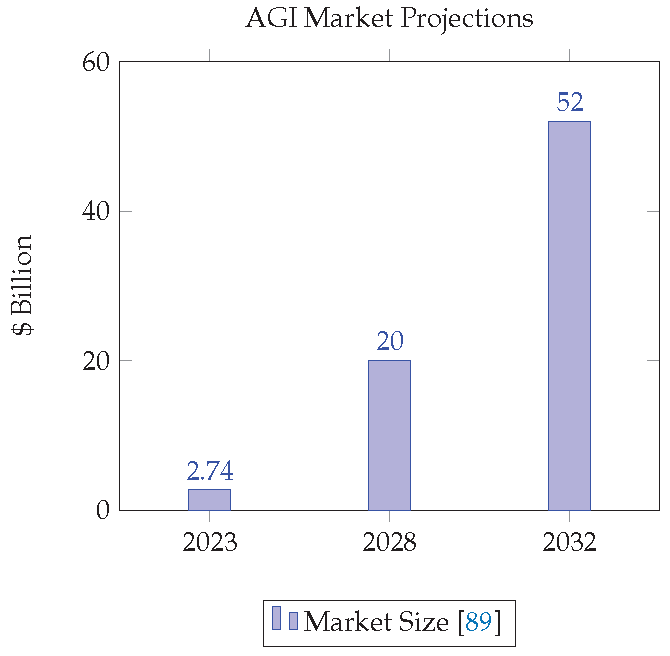
7.7. AGI Market Growth Chart
Figure 1.
Projected AGI market size from 2023 to 2032.
7.7.1. Technical Architecture of AGI Systems
Table 2.
Core Technologies and Theories in AGI Architecture.
| Layer | Technology Name | Cloud / Compute | Mathematical Theory |
|---|---|---|---|
| Foundation Model | GPT-4, Claude 3, Gemini 1.5 | Azure OpenAI, Anthropic Cloud, Google Cloud TPU | Transformer architecture, Attention Mechanism |
| Orchestration Layer | LangChain, AutoGen, CrewAI | AWS Lambda, Azure Functions | Finite State Machines, Graph Theory |
| Memory + Context Mgmt | Vector DBs (Pinecone, FAISS), LangGraph | Redis, Milvus, Weaviate | k-NN, Cosine Similarity, Information Theory |
| Planning + Reasoning | ReAct, Toolformer, BabyAGI | Local GPU or HPC Cluster | Reinforcement Learning, MDPs |
| Data Preprocessing | Apache Spark, Hugging Face Datasets | AWS Glue, Databricks | Probability Theory, Sampling |
| Training | PyTorch, DeepSpeed, Megatron-LM | NVIDIA DGX, TPU v5, Azure ML | Gradient Descent, Backpropagation |
| Evaluation | HELM, OpenEval, TruthfulQA | CloudBench, Paperswithcode | ROC/AUC, Metric Optimization |
| Deployment | Docker, Kubernetes, Ray Serve | AWS SageMaker, GCP Vertex AI | Systems Theory, Distributed Computing |
7.8. Research Gaps and Quantitative Findings
7.8.1. Identified Research Gaps
Based on comprehensive analysis of the literature, we identify (based on cited work) three primary research gaps in current AGI studies:
Table 3.
Key Quantitative Findings from AGI Literature.
| Metric | Current Value | Projection | Source |
|---|---|---|---|
| Market Size (2023) | $2.74B | $52B by 2032 | [89] |
| CAGR (2023–2031) | – | 36.9% | [14] |
| Financial Sector Adoption | 18% of AI projects | 38% by 2028 | [21,89] |
| Compute Requirements | FLOPs | FLOPs for ASI | [94,95] |
| Training Data Growth | 50% YoY | 75% YoY by 2026 | [67] |
| Regulatory Frameworks | 3 major initiatives | 12+ expected by 2030 | [96] |
7.8.2. Proposed Research Directions
To address these gaps, we propose (based on cited work):
Table 4.
Proposed Research Directions to Address Identified Gaps.
| Research Gap | Proposed Approach | Metrics |
|---|---|---|
| Standardized Evaluation | Development of multi-domain AGI benchmark suite | Task transferability scores |
| Environmental Impact | Lifecycle analysis of AGI training pipelines | CO2e per model iteration |
| Cross-Cultural Studies | Longitudinal survey across 10 economic regions | Adoption readiness index |
8. Defining Artificial General Intelligence
Artificial General Intelligence (AGI) is often described as AI that possesses the ability to understand, learn, and apply knowledge across a wide range of tasks, similar to human intelligence [16,74,91,97]. This contrasts with narrow AI, which is designed to perform a specific task, such as image recognition or playing chess [13,66,70]. While narrow AI has achieved significant success in various applications, the development of AGI remains a long-term goal.
8.1. AGI vs. Narrow AI vs. Artificial Superintelligence
To understand AGI, it’s crucial to differentiate it from other forms of AI:
- Narrow AI: Also known as weak AI, this type of AI is designed for specific tasks. Examples include spam filters, recommendation systems, and virtual assistants like Siri or Alexa.
- AGI: Also known as strong AI or human-level AI, AGI aims to replicate human-level intelligence, enabling machines to perform any intellectual task that a human being can do.
The progression from narrow AI to AGI and then to ASI represents an increasing level of intelligence and capability. While narrow AI is prevalent today, AGI and ASI remain largely theoretical, with ongoing research and debate about their feasibility and timelines.
9. Potential Applications of AGI
The potential applications of AGI are vast and transformative, spanning across various sectors:
9.1. AGI in Finance
AGI has the potential to revolutionize the financial industry by automating complex tasks, improving decision-making, and enhancing efficiency [21,65,98,99,100,101,102]. Potential applications include:
- Algorithmic Trading: AGI could analyze vast amounts of market data to predict trends and execute trades with greater accuracy and speed.
- Risk Management: AGI could assess and manage financial risks more effectively by identifying patterns and anomalies that human analysts might miss.
- Personalized Financial Advice: AGI could provide tailored financial advice to individuals based on their specific needs and goals.
- Fraud Detection: AGI could detect fraudulent activities with higher accuracy and efficiency.
However, the integration of AGI in finance also raises concerns about job displacement, ethical considerations, and the potential for increased market volatility.
9.2. AGI in Research
AGI could accelerate scientific discovery and innovation by automating research processes, analyzing complex data, and generating new hypotheses [19]. Potential applications include:
- Drug Discovery: AGI could analyze biological data to identify potential drug candidates and accelerate the drug development process.
- Materials Science: AGI could design and discover new materials with specific properties for various applications.
- Climate Change Research: AGI could analyze climate data to predict future trends and develop solutions to mitigate climate change.
9.3. AGI in Business
AGI has the potential to transform business operations across various industries [82,92,103]. Potential applications include:
- Automation: AGI could automate complex tasks, increasing efficiency and productivity.
- Customer Service: AGI could provide personalized and efficient customer service through advanced chatbots and virtual assistants.
- Decision Making: AGI could analyze data and provide insights to support better decision-making.
- Hiring and Talent Acquisition: AGI could assist in screening resumes and identifying suitable candidates [104].
10. Ethical Considerations and Challenges
The development and deployment of AGI raise significant ethical considerations and challenges:
- Job Displacement: The automation capabilities of AGI could lead to job displacement in various industries.
- Bias and Fairness: AGI systems could inherit biases from the data they are trained on, leading to unfair or discriminatory outcomes.
- Safety and Control: Ensuring the safety and control of AGI systems is crucial to prevent unintended consequences.
- Privacy and Security: Protecting data privacy and security is essential as AGI systems collect and process vast amounts of information.
- Regulation and Governance: Developing appropriate regulations and governance frameworks is necessary to guide the responsible development and deployment of AGI.
11. AGI Applications in Finance: Investment and Risk Management
The financial sector stands at the forefront of AGI adoption, particularly in investment strategies and risk management [98]. Artificial General Intelligence systems demonstrate unique capabilities in processing complex market data, identifying non-linear patterns, and adapting to dynamic financial environments [101]. AGI shows particular promise in financial markets through predictive algorithms [98,99]. Major institutions are investing in AGI-driven trading systems [21].
11.1. Intelligent Investment Strategies
AGI transforms investment management through its capacity for holistic market analysis. Unlike traditional AI systems limited to specific asset classes, AGI can simultaneously evaluate equities, derivatives, commodities, and alternative investments while considering macroeconomic indicators [21]. Amazon’s AGI Finance team has pioneered systems that combine generative AI with financial modeling to optimize portfolio allocations [105]. These systems demonstrate emergent capabilities in:
11.2. Risk Assessment and Mitigation
AGI’s general intelligence enables comprehensive risk evaluation that surpasses narrow AI approaches [13]. Financial institutions are deploying AGI prototypes for:
Notably, AGI systems show promise in predicting black swan events by identifying subtle correlations across disparate data sources that conventional models overlook [98]. The World Economic Forum highlights AGI’s potential to enhance financial inclusion through improved risk assessment of underbanked populations [102].
11.3. Challenges in Financial Implementation
Despite these advancements, financial AGI systems face significant hurdles:
11.4. AGI in Finance and Markets
The financial industry stands to benefit significantly from AGI adoption. AGI systems can analyze vast amounts of market data, identify complex patterns, and make predictions with unprecedented accuracy [98]. Several financial institutions have already begun experimenting with AGI prototypes for tasks such as algorithmic trading, portfolio optimization, and fraud detection [78].
Amazon’s AGI Finance team, for instance, has been developing systems that combine generative AI with financial analysis capabilities [105]. These systems aim to provide more accurate forecasts and enable high-velocity decision-making in financial markets [105]. Similarly, other companies are exploring how AGI can enhance customer experiences through personalized financial recommendations [83].
The potential of AGI in finance extends beyond traditional markets. Some researchers suggest that AGI could play a crucial role in promoting financial inclusion, particularly in developing regions [102]. By analyzing alternative data sources and adapting to local contexts, AGI systems could provide financial services to previously underserved populations [102].
12. Future Trajectory of AGI Development
The evolution of Artificial General Intelligence is expected to follow an exponential curve, with significant milestones projected through 2030. Current research and industry trends suggest distinct phases of advancement [68].
12.1. The Future of AGI
The future of AGI is uncertain, with ongoing debates about its timeline and potential impact. While some experts believe that AGI is still decades away, others predict that it could be achieved in the near future [20,89]. The development of AGI will likely be a gradual process, with incremental advancements in AI capabilities.
The race to achieve AGI is also influenced by geopolitical factors, with countries like the US and China competing for leadership in AI development [81,93,96]. International collaboration and ethical considerations will be crucial to ensure that AGI is developed and used for the benefit of humanity.
12.2. Future Directions and Market Trends
The AGI market is projected to grow significantly in the coming years. According to market research, the AGI sector was valued at $2.74 billion in 2023 and is expected to reach $25.74 billion by 2031, representing a compound annual growth rate of 36.9% [14]. Some estimates are even more optimistic, suggesting the market could reach $52 billion by 2032 [89].
Investment in AGI research and development is increasing across both public and private sectors. Companies like OpenAI, DeepSeek, and Anthropic are pushing the boundaries of what’s possible with AI systems [67]. At the same time, cloud providers such as AWS are funding research into agentic AI systems that could form components of future AGI architectures [106].
12.3. Near-Term Projections (2025-2026)
Early commercial AGI applications are anticipated to emerge, particularly in specialized domains:
Experts predict these systems will demonstrate "islands of general intelligence" while lacking full human-like cognition [107].
12.4. Mid-Term Outlook (2027-2028)
The AGI landscape may witness transformative developments:
The financial sector is projected to account for 38% of AGI investments during this period [89].
12.5. Long-Term Horizon (2029-2030)
By decade’s end, AGI may reach critical milestones:
However, significant challenges remain in areas of:
12.6. The 2030 Benchmark
Projections suggest 2030 as a potential inflection point where:
13. Employment Landscape and Skill Requirements in AGI
The emergence of Artificial General Intelligence is creating new employment paradigms while transforming existing job markets. This section analyzes current trends and projected requirements based on industry reports and academic literature.
13.1. Emerging AGI Job Roles
The AGI sector is generating demand for hybrid roles combining technical and domain expertise:
13.2. Core Skill Requirements
Analysis of job postings and industry reports reveals five critical skill clusters:
Table 5.
AGI-Related Skills and Their Prevalence.
| Skill Category | Demand Level | Key References |
|---|---|---|
| Machine Learning Fundamentals | High (87% of roles) | [11,109] |
| Cross-Domain Reasoning | Medium (growing) | [13,66] |
| Ethical AI Development | Increasing | [17,76] |
| Financial Modeling | Sector-Specific | [21,101] |
| Human-AI Collaboration | Emerging | [82,104] |
13.3. Workforce Transformation Trends
The AGI revolution is reshaping employment in three key ways:
13.4. Strategic Recommendations
For workforce development in the AGI era:
14. Challenges and Ethical Considerations
Despite its promise, AGI development faces significant technical and ethical challenges. One major concern is the alignment problem—ensuring that AGI systems’ objectives remain aligned with human values [94]. There are also debates about whether current approaches, such as large language models (LLMs), can lead to true AGI or if fundamentally different architectures are needed [67].
The geopolitical dimensions of AGI development add another layer of complexity. The competition between the U.S. and China in AI development has raised questions about regulatory approaches and national security implications [81]. Some experts warn that excessive regulation could hinder innovation, while others emphasize the need for safety standards [96].
From an economic perspective, AGI’s potential to automate cognitive tasks raises concerns about job displacement and workforce transformation [15]. The financial sector, which employs millions worldwide, may need to adapt to these changes by developing new roles that complement AGI capabilities [82].
While AGI remains an ambitious and potentially distant goal [7], Agentic AI represents a practical stepping stone that is already delivering value across industries [9,111]. The coming years will likely see continued progress in both areas, with several key developments on the horizon:
As these technologies evolve, it will be crucial to maintain balanced perspectives that acknowledge both their potential and limitations [26]. Future research should focus on developing robust evaluation methodologies, safety protocols, and practical implementation frameworks to ensure these powerful technologies deliver maximum benefit while minimizing risks.
This comprehensive review has examined the current state of Artificial General Intelligence (AGI) and Agentic AI, analyzing their technical foundations, capabilities, and trajectories. Our investigation reveals several key insights about the evolving AI landscape:
First, while AGI remains an aspirational goal with significant technical hurdles [7,8], Agentic AI has emerged as a practical intermediate step that is already demonstrating real-world value [9,10]. The development of frameworks like OpenAI’s 5-level AGI classification system [35] and specialized Agentic AI platforms [36] indicates growing sophistication in both domains.
Second, the comparative analysis highlights fundamental differences between AI paradigms. Where traditional narrow AI excels at specific tasks and generative AI at content creation, Agentic AI introduces autonomous decision-making capabilities [2], while AGI promises (but has not yet achieved) human-level generalization [3]. This spectrum of capabilities suggests a maturation path for AI systems, with Agentic AI serving as a crucial bridge between current technologies and future AGI aspirations [63].
Third, the technical requirements for these advanced AI systems are becoming increasingly demanding, from specialized hardware architectures [51] to novel cloud services supporting autonomous agent deployment [30]. These infrastructure developments both enable and constrain progress in the field.
Looking ahead, three critical priorities emerge for researchers and practitioners:
Development of Robust Evaluation Frameworks: As Agentic AI systems become more autonomous and AGI research advances, standardized metrics and testing environments [37] will be essential for measuring progress and ensuring reliability.
Safety and Governance Mechanisms: The unique risks posed by autonomous systems [62] and potential AGI [50] demand continued investment in alignment research and ethical frameworks.
Practical Implementation Strategies: Organizations should focus on incremental adoption of Agentic AI solutions [46] while maintaining realistic expectations about AGI timelines [26].
The rapid evolution of these technologies suggests that while AGI may remain years or decades away, Agentic AI is poised for near-term expansion across industries [32,41]. By maintaining balanced perspectives that acknowledge both the potential and limitations of these paradigms, the AI community can steer development toward beneficial outcomes while mitigating risks.
15. Methodology
Our analysis combines qualitative assessment of recent publications with quantitative market projections [20,78]. We employ comparative analysis frameworks [76].
Table 6.
Key AGI Reference Categories.
| Category | References |
|---|---|
| Technical Foundations | [94,113] |
| Ethical Considerations | [17,93] |
| Commercial Applications | [21,77] |
15.1. Results
Analysis reveals three key trends:
16. Challenges and Limitations
16.1. Technical Challenges
The path to AGI faces several significant technical hurdles:
Agentic AI systems face their own set of challenges:
16.2. Safety and Ethical Considerations
Both AGI and advanced Agentic AI systems raise important safety concerns:
17. Final Synthesis, Recommendations and Conclusions
This survey highlights AGI’s rapid development trajectory and multidisciplinary implications. As research progresses, careful consideration of ethical frameworks [76] and economic impacts [100] becomes imperative.
Artificial General Intelligence represents both an extraordinary opportunity and a significant challenge for the technology sector and society at large. While true AGI remains elusive, recent advancements suggest we may be closer than previously thought [20]. The financial industry’s early adoption of AGI-like systems demonstrates the technology’s potential to transform established sectors [98].
As research progresses, it will be crucial to address the ethical, economic, and security implications of AGI development [94]. Collaborative efforts between academia, industry, and policymakers will be essential to ensure AGI’s benefits are widely distributed while mitigating potential risks [97].
The coming years will likely see continued debate about AGI’s definition, capabilities, and timeline [90]. Regardless of these uncertainties, AGI research is pushing the boundaries of artificial intelligence and opening new possibilities for human-machine collaboration across all sectors of the economy.
Our comprehensive analysis yields four principal conclusions about AGI’s current and future landscape:
17.1. Technical Maturation
17.2. Economic Impact
The AGI market shows remarkable growth potential (projected $52B by 2032 [89]), but creates workforce polarization requiring:
17.3. Ethical Imperatives
Three critical governance challenges emerge:
17.4. Research Priorities
We identify three high-priority research directions:
- Development of multi-domain evaluation benchmarks
- Longitudinal studies of workforce displacement
- Standardized sustainability metrics for AGI training
The AGI revolution demands collaborative, multidisciplinary approaches to harness its benefits while mitigating risks [97]. As the technology matures, continuous assessment of its societal impacts will be essential for responsible development.
Declaration
The views are of the author and do not represent any affiliated institutions. Work is done as a part of independent researcher. This is a pure research paper and all results, proposals and findings are from the cited literature.
References
- Agentic AI vs Gen AI: What is the difference. Available online: https://www.linkedin.com/pulse/agentic-ai-vs-agi-whats-difference-swapnil-amin-5ctoc/.
- Agentic AI Complete Guide to the Future of Autonomous Systems, 2025.
- What Is Artificial General Intelligence? Definition from TechTarget. https://www.techtarget.com/searchenterpriseai/definition/artificial-general-intelligence-AGI.
- Agentic AI The New Frontier in Generative AI. Available online: https://www.synechron.com/en-us/insight/agentic-ai-new-frontier-generative-ai.
- Andre, D. Sam Altman Predicts First AI Workers as OpenAI Nears AGI Breakthrough!, 2025.
- AGI in 2025? How Enterprise Leaders Should Prepare. Available online: https://www.vktr.com/ai-disruption/agi-in-2025-how-enterprise-leaders-should-prepare/.
- AGI Is on the Radar but Far from Reality, Says Gartner. Available online: https://www.theregister.com/2024/08/22/gartner_agi_hype_cycle/.
- Artificial General Intelligence in 2025 Good Luck With That. Available online: https://www.informationweek.com/machine-learning-ai/artificial-general-intelligence-in-2025-good-luck-with-that.
- Outshift | 5 Levels of Agentic AI Intelligence for Enterprise Use. Available online: https://outshift.com/blog/agentic-ai-intelligence-for-enterprise-use.
- Golabek, P. Agentic AI Revolutionizing DevOps and Kubernetes Management, 2025.
- Arya, N. Introduction to Artificial General Intelligence (AGI), 2022.
- y Arcas, B.A. Artificial General Intelligence Is Already Here 2023.
- General AI vs Narrow AI Comes down to Adaptability | TechTarget. Available online: https://www.techtarget.com/searchenterpriseai/feature/General-AI-vs-narrow-AI-comes-down-to-adaptability.
- Artificial General Intelligence AGI Market Size, Share, Forecast.
- AGI Understanding Artificial General Intelligence and Its Economic Impact.
- What Is Artificial General Intelligence (AGI)? | McKinsey. Available online: https://www.mckinsey.com/featured-insights/mckinsey-explainers/what-is-artificial-general-intelligence-agi.
- AGI Utopia or Dystopia Whats the Real Story? Available online: https://www.cmswire.com/digital-experience/the-quest-for-achieving-artificial-general-intelligence/.
- Examples of Artificial General Intellgence (AGI) | IBM. 2024. Available online: https://www.ibm.com/think/topics/artificial-general-intelligence-examples.
- AGI in Research Unraveling the Future of Artificial Intelligence - iLovePhD. Available online: https://www.ilovephd.com/what-is-agi-in-research/.
- Artificial General Intelligence Is Far Closer than Previously Thought. 2024. Available online: https://digitalisationworld.com/blog/57976/artificial-general-intelligence-is-far-closer-than-previously-thought.
- AGI in Finance Markets Trading - DayTrading Com. Available online: https://www.daytrading.com/agi-finance.
- The Crucial Difference Between AI And AGI | Bernard Marr. Available online: https://bernardmarr.com/the-crucial-difference-between-ai-and-agi/.
- General AI vs Specific AI A Comprehensive Comparison of the Future of AI. Available online: https://www.gsdcouncil.org/blogs/general-ai-vs-specific-ai-a-comprehensive-comparison-of-the-future-of-ai.
- The Pursuit of Artificial General Intelligence (AGI): The Holy Grail of AI. Available online: https://prism.palladiumdigital.co.uk/insights/the-pursuit-of-artificial-intelligence-agi-the-holy-grail-of-ai.
- Are We Ready for Artificial General Intelligence? Available online: https://www.informationweek.com/machine-learning-ai/are-we-ready-for-artificial-general-intelligence-.
- Jones, S. The AGI Hype Is Damaging the AI Opportunity. 2024. Available online: https://blog.metamirror.io/the-agi-hype-is-damaging-the-ai-opportunity-c45bae1f7f5a.
- What Is Agentic AI and How Does It Differ From GenAI? TheNewsMarket.Agency. Available online: https://thenewsmarket.agency/blog/what-is-agentic-ai-and-how-does-it-differ-from-genai/.
- ubtiinc. Generative AI vs. Agentic AI – Let’s Compare & Understand, 2025.
- Unleashing the Power of Agentic AI: Advancing towards Autonomous Decision-Making.
- Shkurdoda, A. Agentic AI And Next-Gen Automation with Accenture and NVIDIA, 2024.
- AI Agents Are Here, but How Autonomous Should They Be?, 2025.
- JD Supra Editorial Team. Looking Beyond Generative AI Agentic AI’s Potential in Legal Services, 2024. Accessed on 2025-05-11.
- Cacciatore, G. Multi-Paradigmatic AI as A Pathway To AGI, 2025.
- Cozzi, P. Hypothesis of Episodic Memory in AI Another Step towards Artificial General Intelligence, 2024.
- OpenAI Defines 5 Stages Between GenAI and AGI. Available online: https://ainnovation.substack.com/p/openai-defines-5-stages-between-genai?utm_campaign=post&utm_medium=web.
- Vectara-Agentic Agentic RAG. 2024. Available online: https://www.vectara.com/blog/introducing-vectara-agentic.
- Azhar, A. OpenAI Develops New AGI Benchmark to Assess Potential Risks of Advanced AI, 2024.
- OpenAIs 5 Levels Of Super AI (AGI To Outperform Human Capability). Available online: https://www.forbes.com/sites/jodiecook/2024/07/16/openais-5-levels-of-super-ai-agi-to-outperform-human-capability/.
- rheilweil. NASA Appears to Step Back from the Term `Artificial General Intelligence’, 2024.
- Agentic Artificial Intelligence and the New Legal Playbook. Available online: https://natlawreview.com/article/thinking-lawyer-agentic-ai-and-new-legal-playbook.
- The Commerce Industry Is Quick to Adopt Digital Transformation and Is Leaning Into AI. 2025. Available online: https://hypersonix.ai/blogs/gpt-genai-agenticai-agi-what-retailers-need-to-know.
- AI Agents: A Catalyst for Transformation by 2025 - Hyperight. Available online: https://hyperight.com/ai-agents-a-catalyst-for-transformation-by-2025/.
- What Is crewAI? IBM. Available online: https://www.ibm.com/think/topics/crew-ai.
- OpenAI Sets Ambitious Course Toward Superintelligence. Available online: https://www.aiwire.net/2025/01/07/openai-sets-ambitious-course-toward-superintelligence/.
- May 5, M.N.; 2025. OpenAI to Retain Nonprofit Oversight Amid For-Profit Shift. Available online: https://www.bankinfosecurity.com/openai-to-retain-nonprofit-oversight-amid-for-profit-shift-a-28290.
- Tech Leaders See Agentic AI as a Key Enabler of Sustainable Value, New Deloitte Survey Finds - FutureCIO, 2025.
- Marshall, M. From AGI to ROI The 6 AI Debates Shaping Enterprise Strategy in 2024, 2024.
- OpenAI Says It’s Charting a "Path to AGI" with Its next Frontier AI Model. 2024. Available online: https://www.itpro.com/technology/artificial-intelligence/openai-says-its-charting-a-path-to-agi-with-its-next-frontier-ai-model.
- Institute (USAII®), U.S.A.I. ChatGPTs Operator Mode A Significant Step Toward AGI in 2025. Available online: https://www.usaii.org/ai-insights/chatgpts-operator-mode-a-significant-step-toward-agi-in-2025.
- April 3, R.R.; 2025. DeepMind Warns of AGI Risk, Calls for Urgent Safety Measures. Available online: https://www.bankinfosecurity.com/deepmind-warns-agi-risk-calls-for-urgent-safety-measures-a-27917.
- Most Read 500B Stargate AI Infrastructure Project Launched for Future of Technology Deloitte Survey: Businesses Show Tempered Optimism on Generative AI. Available online: https://aibusiness.com/data-centres/most-read-500b-stargate-ai-infrastructure-project-launched-for-future-of-technology-deloitte-survey-businesses-show-tempered-optimism-on-generative-ai.
- by AI, B.L.|.T. AI Development up to 2025: Practice, Challenges and Future Trends. 2025. Available online: https://www.all-about-industries.com/ki-development-2025-practice-challenges-future-trends-a-19e618751db65463d925304491fff94a/.
- PricewaterhouseCoopers. AI Rewrites the Playbook Is Your Business Strategy Keeping Pace? Available online: https://www.pwc.com/us/en/tech-effect/ai-analytics/ai-business-strategy.html.
- How The Emergence Of AGI Is Redefining Startups. Available online: https://inc42.com/resources/how-the-emergence-of-agi-is-redefining-startups/.
- 7 Reasons Why AGI Is Reshaping the Future of AI and Innovation Turing. Available online: https://www.turing.com/blog/7-reasons-why-agi-is-reshaping-the-future.
- AI Took Giant Strides in 2024, as AGI Comes into View. 2024. Available online: https://cointelegraph.com/news/ai-took-giant-strides-2024-agi-comes-into-view.
- Costa, L.D. GenAI Not Magic Wand But Can Transform Your Busines, 2024.
- Team, T.E. Understanding The Difference Between AGI And Generative AI. Available online: https://www.techdogs.com/td-articles/trending-stories/understanding-the-difference-between-agi-and-generative-ai.
- Nangare, S. Replicating Human Attitudes and Behaviors through Generative Agent Simulation, 2025.
- Basheer, K.C.S. March 2025 GenAI Launches: Are We on The Brink of AGI?, 2025.
- Artificial Specialized Intelligence The Key to Safe and Scalable Business AI Kognitos AI Automation. Available online: https://www.kognitos.com/blog/artificial-specialized-intelligence-the-key-to-safe-and-scalable-business-ai/.
- Evdokimov, A. AGI Agents Pose Risks How Can We Mitigate Them? 2025. Available online: https://ai.gopubby.com/agi-agents-pose-risks-how-can-we-mitigate-them-9ace91bb3319.
- Agentic AI Discriminative Confused. Available online: https://www.linkedin.com/pulse/genai-agentic-ai-discriminative-confused-heres-nagaraju-kancherla-xltac/.
- Agentic AI vs AGI. Available online: https://www.linkedin.com/pulse/agentic-ai-vs-agi-whats-difference-swapnil-amin-5ctoc/.
- Artificial General Intelligence The Future of Finance and Daily Work Practices | LinkedIn. Available online: https://www.linkedin.com/pulse/artificial-general-intelligence-future-finance-daily-work-sahdev-uexlc/.
- Difference between AGI vs, AI. 2025. Available online: https://www.geeksforgeeks.org/difference-between-agi-vs-ai/.
- staff. Toward AGI AI Innovation Will Be Driven by Applications, Not LLMs, 2025.
- The Race Toward Artificial General Intelligence (AGI): Progress, Skepticism, and Real-World Focus - FinTech Weekly. 2025. Available online: https://www.fintechweekly.com/magazine/articles/race-toward-artificial-general-intelligence-agi.
- What Is AGI? Artificial General Intelligence Explained AWS. Available online: https://aws.amazon.com/what-is/artificial-general-intelligence/.
- Narrow AI vs. General AI vs. Super AI. Available online: https://www.spiceworks.com/tech/artificial-intelligence/articles/narrow-general-super-ai-difference/.
- What Is Artificial General Intelligence (AGI)? | DigitalOcean. Available online: https://www.digitalocean.com/resources/articles/artificial-general-intelligence-agi.
- What Is General Artificial Intelligence (AI)? Definition, Challenges, and Trends Spiceworks.
- Fetch.Ai Build. Discover Transact. Available online: https://fetch.ai/blog/definition-of-artificial-general-intelligence-agi-how-it-works.
- What Is AGI? Artificial General Intelligence Explained.
- McKinsey Explainers McKinsey Company. Available online: https://www.mckinsey.com/featured-insights/mckinsey-explainers.
- Framework for AGI Building Towards the Future of Artificial General Intelligence – Quantilus Innovation.
- BytePlus Business Growth through Superior Technology. Available online: https://www.byteplus.com/en/topic/502841?title=.
- Finance Manager AGI Finance, 2025.
- Senior Financial Analyst, Alexa Artificial General Intelligence (AGI Finance) Amazon WCT-FCT Job Board. Available online: https://careers.wct-fct.com/companies/amazon-3-60ad394d-c673-4474-9694-344b0cae748f/jobs/36356469-senior-financial-analyst-alexa-artificial-general-intelligence-agi-finance.
- Mocle, A. Artificial General Intelligence: What Are We Investing In? TechPolicy.Press. 2025. Available online: https://techpolicy.press/artificial-general-intelligence-what-are-we-investing-in.
- Torres, J. Chinas AI Strategy Adoption Over AGI, 2025.
- The Impact of AGI in Business Just Think, AI. Available online: https://www.justthink.ai/artificial-general-intelligence/the-impact-of-artificial-general-intelligence-in-business-and-industry.
- The Paradox of Personalised Recommendations.
- What Is Artificial General Intelligence (Agi). Available online: https://fastercapital.com/keyword/what-is-artificial-general-intelligence-(agi).html.
- What Is General AI? | IxDF. Available online: https://www.interaction-design.org/literature/topics/general-ai.
- Victor, A. All About Artificial General Intelligence The Next Frontier in AI. Available online: https://insights.daffodilsw.com/blog/all-about-artificial-general-intelligence-the-next-frontier-in-ai.
- Wang, P.; Goertzel, B. Introduction Aspects of Artificial General Intelligence.
- Zohuri, B.; Rahmani, F.M. Artificial General Intelligence (Agi). 5.
- min read, S.I.p.l. . Artificial General Intelligence [AGI] Market Size to Reach USD 52 Billion by 2032, Driven by Breakthroughs in Machine Learning and Industry Adoption | Research by SNS Insider. 2024. Available online: https://finance.yahoo.com/news/artificial-general-intelligence-agi-market-144400151.html.
- What Is Artificial General Intelligence (AGI)? 2025. Available online: https://www.threatdown.com/glossary/what-is-artificial-general-intelligence-agi/.
- Artificial General Intelligence (AGI).
- Understanding Artificial General Intelligence and Its Practical Use Cases. Available online: https://www.b12.io/resource-center/ai-how-to-guides/understanding-artificial-general-intelligence-and-its-practical-use-cases.html.
- Bookmarks US, vs. China the Hybrid Game of AI Infrastructure. Available online: https://www.rcrwireless.com/20250509/opinion/ai-us-vs-china.
- AGI vs ASI Understanding the Fundamental Differences Between Artificial General Intelligence and Artificial Superintelligence. Available online: https://www.netguru.com/blog/agi-vs-asi.
- Bryan, D. The Future of AI What Is AGI? AI vs AGI vs ASI | GPT-5 AGI & OpenAI’s ’O1’. 2024. Available online: https://opace.agency/blog/future-of-ai-agi-gpt-5-openai-o1.
- Goldman, S. Sam Altman Urges Lawmakers against Regulations That Could ’slow down’ U.S. in AI Race against China. Available online: https://fortune.com/2025/05/08/sam-altman-openai-senate-hearing-testimony-china-ai-regulations/.
- Team, T.E. What Is Artificial General Intelligence (AGI) And Should You Be Worried? Available online: https://www.techdogs.com/td-articles/trending-stories/what-is-artificial-general-intelligence-agi-and-should-you-be-worried.
- AGI in Finance Predicting Market Trends with Intelligent Algorithms. Available online: https://fastercapital.com/content/AGI-in-Finance–Predicting-Market-Trends-with-Intelligent-Algorithms.html.
- Blaszczyk, M. The Future of Generative AI in the Financial Sector, 2024.
- How Financial Markets Could Predict the Arrival of Artificial General Intelligence.
- Schwarzstein, S. Reshaping the Financial Industry with AGI TrueAGI, 2023.
- This Is How Artificial General Intelligence Will Drive Financial Inclusion in Latin America. 2024. Available online: https://www.weforum.org/stories/2024/01/ai-is-driving-the-evolution-of-a-more-inclusive-financial-sector-in-latin-america-here-is-how/.
- PYMNTS. What Is Artificial General Intelligence and Why It Matters to Business, 2025.
- Post, S. The Secret to Successful AI in Hiring? Stop Overthinking It. Available online: https://www.businessinsider.com/sc/how-to-stop-worrying-about-ai.
- Finance Manager Artificial General Intelligence (AGI). Available online: https://www.amazon.jobs/en/jobs/2807477/finance-manager-artificial-general-intelligence-agi.
- link, C.; Email.; X.; LinkedIn.; Facebook.; Line.; Reddit.; QZone.; Weibo, S.; WeChat.; et al. AWS AI Agentic AI Call for Proposals Spring 2025. 2025. Available online: https://www.amazon.science/research-awards/call-for-proposals/aws-ai-agentic-ai-call-for-proposals-spring-2025.
- Simon, C. Artificial General Intelligence (AGI) AIs Next Phase, 2023.
- Post, L.G. The Road towards Artificial General Intelligence (AGI), 2025.
- How to Learn AI From Scratch in 2025 A Complete Expert Guide | DataCamp. Available online: https://www.datacamp.com/blog/how-to-learn-ai.
- Artificial Intelligence (AI) Artificial General Intelligence (AGI) and Online Master of Business Administration (MBA) Programs in the USA | LinkedIn. Available online: https://www.linkedin.com/pulse/artificial-intelligence-ai-general-ryaye/.
- Singh, P. What Do Top Leaders Have to Say About Agentic AI?, 2024.
- OpenAI Has Developed a Scale to Assess How Close We Are to AGI.
- Exploring Artificial General Intelligence The Future of AI Unveiled, 2024.
- Beyond ChatGPT The 5 Toughest Challenges On The Path To AGI | Bernard Marr. Available online: https://bernardmarr.com/beyond-chatgpt-the-5-toughest-challenges-on-the-path-to-agi/.
- Jadhav, B. What Are AI Agents? How They Work in 2025, 2024.
- AI Pulse The Good from AI and the Promise of Agentic. 2024. Available online: https://www.trendmicro.com/en_us/research/24/l/good-agentic-ai.html.
Disclaimer/Publisher’s Note: The statements, opinions and data contained in all publications are solely those of the individual author(s) and contributor(s) and not of MDPI and/or the editor(s). MDPI and/or the editor(s) disclaim responsibility for any injury to people or property resulting from any ideas, methods, instructions or products referred to in the content. |
© 2025 by the authors. Licensee MDPI, Basel, Switzerland. This article is an open access article distributed under the terms and conditions of the Creative Commons Attribution (CC BY) license (http://creativecommons.org/licenses/by/4.0/).
Copyright: This open access article is published under a Creative Commons CC BY 4.0 license, which permit the free download, distribution, and reuse, provided that the author and preprint are cited in any reuse.