
Submitted:
09 May 2025
Posted:
11 May 2025
You are already at the latest version
Abstract
In this paper, firstly, the concepts of nucleus and congruence are introduced in involutive m-semilattices, and their interrelationships are discussed. On this basis, the concrete structure of coequalizer in the category of involutive m-semilattices is obtained. We introduce the definition of the free involutive m-semilattices, and concrete structure of the involutive m-semilattices is discussed, and in addition, we prove that the category of involutive m-semilattices is algebraic. Scondly, the colimit in the category of involutive m-semilattices is a very difficult problem. We have obtained the concrete structure of colimit for a full subcategory of the category of involutive m-semilattices. Thirdly, we introduced the definition of an inverse system in the category of involutive m-semilattices, and give the concrete structure of the inverse limit of an inverse system. We establish the concept of a mapping between two inverse systems. The properties between inverse limits are discussed. Finally, we study the direct limit of the category of involutive m-semilattices and give its concrete structure.
Keywords:
M-semilattice
; Nucleus
; Coequalizer
; Algebraic Category
; Limit
MSC: 06B10; 18A30; 18B35
1. Introduction
Quantale was proposed by Mulvey in 1986. The term quantale was coined as a combination of quantum logic and locale by Mulvey in [1]. Since quantale theory provides a powerful tool in studying non-commutative structure and a new mathematicial model for quantum mechanics. Hence, the theory of quantales has attracted the attention of many scholars. Quantale theory has a wide range of applications, especially in studying non-commutative structures [2], linear logic [3,4,5], C*-algebras [6], topological space [7,8,9], category [10,11,12], roughness theory [13], and so on. A systematic introduction of quantale theory can be found in [14] written by Rosenthal in 1990.
The m-semilattices is an important related structure of quantale. Rosenthal has proved that each coherent quantale is isomorphic to a quantale consisting of all ∨-semilattice ideals of an m-semilattice with a top element. Since m-semilattices connect the structures of ∨-semilattices with the multiplications of semigroups, hence m-semilattices can be regarded as generalizations of residual lattices, lattice-ordered semigroups, quantales and frames. The m-semilattices theory has aroused great interests of many scholars. In [15], By using the fuzzy set method, the concept of (prime) idals of an m-semilattice was introduced. Equivalent characterzations of (prime) ideals and (prime) ideas were given. In [16], Zhou and Zhao proposed the congruences induced by fuzzy (prime) ideals of an m-semilattice, studied the properties of the upper (lower) rough fuzzy approximation operators with respect to these congruence, and introduced the notions of rough fuzzy (prime) ideal of m-semilattices. In [17], the minmal neighborthood approximation operator on m-semilattice was studied and introduce the definition of fuzzy rought sets based on fuzzy coverings of m-semilattices. In [18], Su and Zhao introduced the concept of filers in m-semilattice and the filer topology on m-semilattices was constructed. A series of properties of filters spaces were studied. In [19], Pan and Han proved that the category of coheren quantales is a reflective subcategory of the category of m-semilattices. Based on the definition of m-semilattices, the concept of involutive m-semilattices was given. A series of important properties of involutive m-semilattices were studied and proved that the category of involutive m-semilattices is complete ([20]). In [21], The definiton of generalized M-P inverse of m-semilattice matrix was introduced. The necessary and sufficient condition for the existence of generalized M-P inverse of m-semilattice matrix was obtained. There are also some scholars who have provided different definitions of m-semilattices from various research backgrounds([22,23,24,25]).
The category theory provides a new language that affords economy of thought and expression as well as allowing easier communication among investigators in different areas. The algebric properties and limit structures of a category are important research focuses. If the algebraic properties of a category are proven and its limit structures are provided, then many categorical properties are naturally hold. This paper researches the algebraic properties of the category of involutive m-semilattices, as well as the structures of colimit, direct limit, and inverse limit. In the following, some simple concepts of category theory are referred to references [26].
This paper is organized as follows. In section 1, we show some basic concepts and results neeed in this article. In section 2, the concepts of nucleus and congruence are introduced. We prove that the category of involutive m-semilattices is algebraic. In section 3, we discuss the structure of coproduct and colimit in the category of involutive m-semilattices. In section 4, we study the inverse limit and direct limit in the category of involutive m-semilattices. The properties between inverse limits are discussed.
2. Preliminaries
Definition 1
([20]). Let be a ∨-semilattice, be a semigroup, and * is a unary operation on S satisfying:
(1) for all .
(2) for all .
(3) for all .
(4) for all .
(5) There is a maximum element in S.
Then is called an involutive m-semilattice.
Example 1.
(1) Let be a Boolean algebra. We define a semigroup multiplication · on B and an involution operation * on B as follows
It is easy to verify that is an involutive m-semilattice.
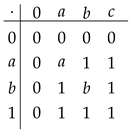
(2) Let be a lattice determined by Figure 1. A semigroup multplication on S and an involution operation on S are detemined by the tables below.

 |
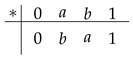 |
It can be verified that is an involutive m-semilattice.
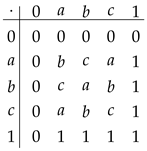
(3) Let be a lattice determined by Figure 2. A semigroup multplication on S and an involution operation on S are detemined by the tables below.
 |
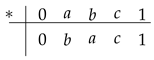 |
Then be an involutive m-semilattice.
Definition 2
([20]). Let and be two involutive m-semiattices. A mapping is said to be involutive m-semilattice homomorphism if satisfying:
(1) ;
(2) ;
(3) .
Definition 3
([26]). A category is a quintuple where
(1) is a class whose members are called -objects,
(2) is a class whose members are called -morphisms,
(3) and are functions from to () is called the domain of f and is called the codomain of f,
(4) ∘ is a function from into , called the composition law of is usually written and we say that is defined if and only if c; such that the following condition are satisfied:
(i) Matching Condition: If is defined, then and ;
(ii) Associativity Condition: If and are defined, then ;
(iii) Identity Existence Condition: For each -object A there exists a -morphism e such that and
(a) whenever is defined, and
(b) whenever is defined.
(iv) Smallness of Morphism Class Condition: For any pair of -object, the class
and
is a set.
For a give category , the class of -objects will be denonted by , whereas, will stand for the class of -morphisms.
Example 2
([26]). The category Set whose class of objects is the class of all sets; whose morphisms sets are all functions from A to B, and whose composition law is the usual composition of functions. Set is commonly called the category of sets.
Definition 4
([26]). A category is said to be:
(1) small provided that is a set;
(2) discrete provided that all of its morphisms are identities;
(3) connected provided that for each pair of -objects, .
Definition 5
([26]). Let and be categories, A functor from to is a triple where is a function from the class of morphisms of to the class of morphisms of (i.e., satisfying the following conditions:
(1) F preserves identities, i.e., if e is a -identity, then is a -identity.
(2) F preserves composition; , i.e., whenever , then and the above equality holds.
For any concrete category , there is a functor that assigns to any object A, the underlying set and to any morphism, the corresponding function on the underlying sets. U is called the forgetful functor on .
Definition 6
([26]). A product of a family of -objects is a pair satisfying the following properties:
(1) is a -object.
(2) for each , is a -morphism (called the projection from to ).
(3) for each pair , (where C is a -object and for each , ) there exists a unique -morphism such that for each , the triangle
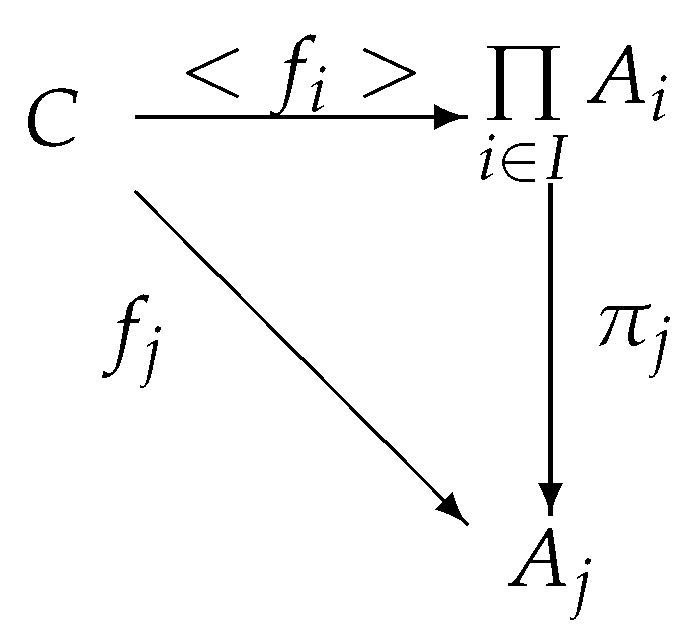
Figure 3.
commutes.
Definition 7
([26]). A coproduct of a family of -objects is a pair satisfying the following properties:
(1) is a -object.
(2) For each , is a -morphism (called the injection from to ).
(3) For each pair , (where C is a -object and for each , ) there exists a unique -morphism such that for each , the triangle
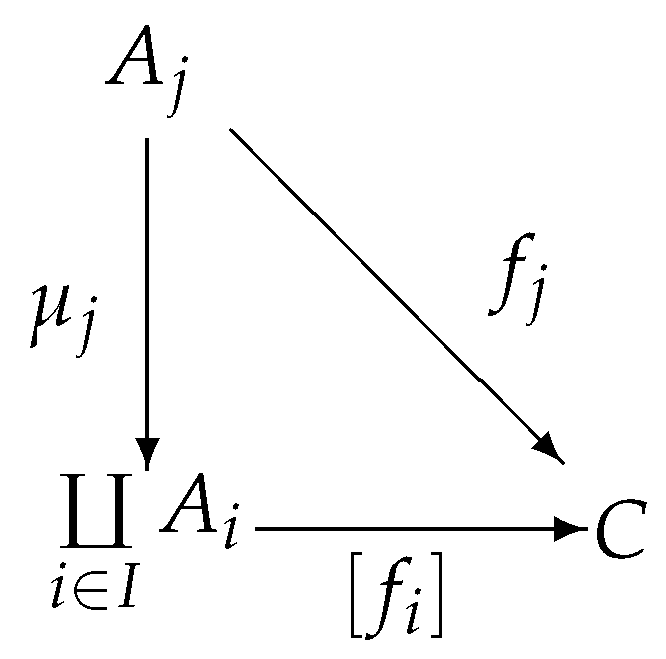
Figure 4.
commutes.
Definition 8
([26]). Let be a pair of -morphisms. A pair is called an equalizer in of f and g provided that the following hold:
(1) is a -morphism;
(2) ;
(3) For any -morphism such that , there exists a unique -morphism such that the triangle
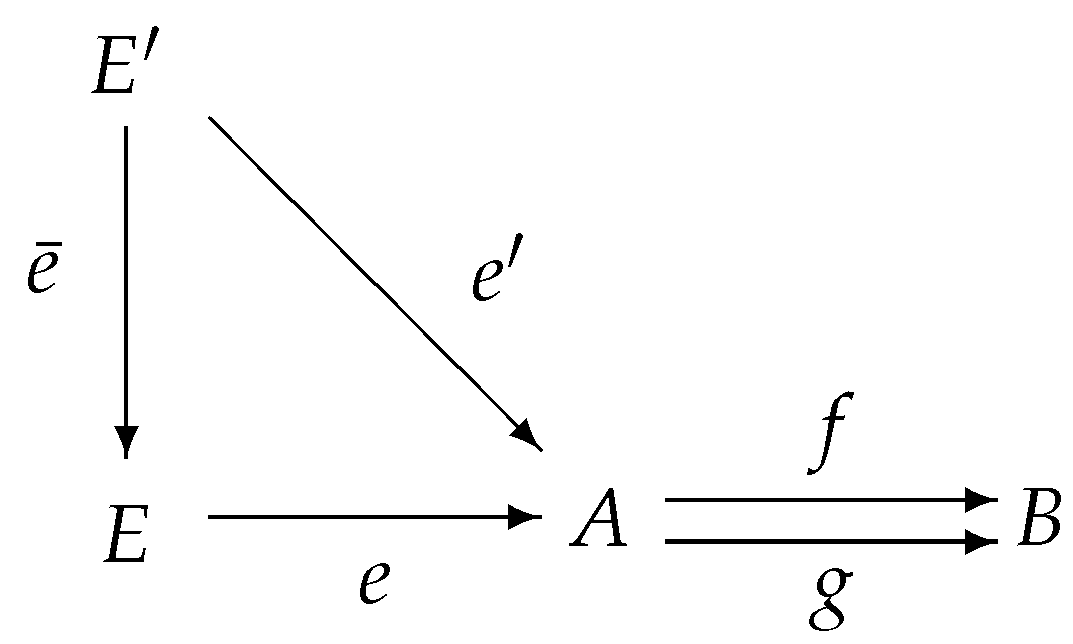
Figure 5.
commutes.
Dually: If , then is called a coequalizer in of a pair if and only if and each morphism with the property that can be uniquely factored through c.
Definition 9
([26]). A category is called algebraic provied that is satisfies the following conditions:
(1) The category has coequalizers;
(2) The forgetful functor has a left adjoint;
(3) The forgetful functor preserves and reflects regular epimorphisms.
3. The Category of Involutive M-Semilattices is Algebraic
Definition 10.
Let S be an involutive m-semiattices. A closure (coclosure) operator is an order preserving increasing (decreasing), idempotent map . If j is a closure (coclosure) operator on S, then if and only if for all .
Definition 11.
Let S be an involutive m-semiattices. A involutive m-semilattice nucleus on S is a closure operator j such that and for all . Let denote the set of all involutive m-semilattice nuclei on S.
Lemma 1.
Let j is an involutive m-semilattice nucleus on S, then for all .
Definition 12.
Let S be an involutive m-semilattice with a maximum element 1. .
(1) j is right-sided(left-sided) if and only if for all .
(2) j is commutative if and only if for all .
(3) j is idmpotent if and only if for all .
(4) Let be the set of all fixed points of j, then is called a quotient of S.
Theorem 1.
Let S be an involutive m-semilattice, , then
(1) j is right-sided(left-sided) if and only if is right-sided(left-sided).
(2) j is commutative if and only if is commutative.
(3) j is idmpotent if and only if is idmpotent.
Proof.
It is easy to be verified by Definition 11 and Lemma 1. □
Definition 13.
Let S be an involutive m-semilattice and the relation satisfying:
(1) implies for all ;
(2) implies for all ;
(3) If , then .
Then R is called an involutive m-semilattice congruence on S.
For any , let denote the congruence class of x, and denote the set of all congruences on S. Then is a complete lattice with respect to the inclusion order.
Theorem 2.
Let S be an involutive m-semilattice and j be a nucleus on S. Then is an involutive m-semilattice and is an involutive m-semilattice homomorphism, where , .
Proof.
It is easy to prove that the three operations mentioned above are well-defined and is a join semilattice with a maximum element.
We will show that is an involutive m-semilattice. For any , by the Definition of and Lemma 1, we have . Thus the associativity of is valid.
Next, we will show that the distributive law is valid. For any , then
(1) .
(2) by Lemma 1, we have .
Hence, . Similarly, it can be proven that the right distributive law is hold.
Finally, we will prove that is an involutive operation on .
For any , then
(1) .
(2) . By the Lemma 1 it follows that . Thus .
(3) .
Therefore is an is an involutive operation on .
For any , then
(1) . By the definition of j it follows that . Thus .
(2) From Lemma 1 it follows that , thus j preserves operation .
(3) , but , thus .
From (1),(2),(3) we know that mapping is an involutive m-semilattice homomorphism. □
Theorem 3.
Let S be an involutive m-semilattice. , an equivalence R is defined as follows: if and only if for all . Then R is a congruence on S.
Theorem 4.
Let S be an involutive m-semilattice, and R is a congrence of S. For all , define ; ; ; . The mapping such that . Then is an involutive m-semilattice, and the mapping π is an involutive m-semilattice homomorphism.
Proof.
We first show that ≤ is a parital order on .
For any , then
(1) It’s clear that .
(2) If and , then and , thus .
(3) If and , then , i.e., .
It is easy verified that the above operations and * are well defined, and is a semilattice with a maximum element .
Next, for any , we have
(1) .
(2) . Similarly, it can be proven that also hold.
(3) we verify that * is an involution operation on .
(i) .
(ii) .
(iii) .
Therefor is an involutive m-semilattice.
Finally, we will prove that the mapping is an involutive m-semilattice homomorphism.
For any , then
(1) .
(2) .
(3) . □
Definition 14.
Let be the category whose objects are the involutive m-semilattices, and whose morphisms are the involutive m-semilattice homomorphisms. Obviously, the category is a concrete category.
Lemma 2.
Let be an involutive m-semilattice homomorphism, then is an involutive m-semilattice congrence on S.
Let S be an involutive m-semilattice, and R is a binary relation on S. There exists the smallest congrence containing R, which is the intersection all the involutive m-semilattice congrence containing R on S. We said this congrence is generated by R, denoted by .
Theorem 5.
has coequalizer.
Proof.
Let S and P be two involutive m-semilattices, be two involutive m-semilattice homomorphisms, and R is the smallest congrence, which contain .
Suppose that is the canonical mapping, then the mapping is an involutive m-semilattice homomorphism by Theorem 4. We will show that is the coequalier of f and g.
(1) Let , then and . Since , this imples that , i.e., .
(2) Let be an involutive m-semilattice homomorphism such that . Let and . By the Lemma 2 it follows that is a congrence of S. , then . This implies that , thus .
Define a mapping such that for all . Let , then , i.e., . This means that is well defined.
Let , then
(1) .
(2) .
(3) .
Hence the mapping an involutive m-semilattice homomorphism.
Let , then , i.e., . Thus Figure 6 commutes.
Let such that , then , i.e., . Therefore is the coequalizer of f and g. □
The problem of free generation plays a crucial role in algebra, and free generation of some mathematical structures have been widely studied ([27,28]). Next, we will discuss the structure of free involutive m-semilattices in detail.
Let X be a set, use to denote the set of all finite strings composed of elements from X. A binary operation ★ is defined as follows:
,
.
It is easy to verify that the binary operation ★ satisfies associative law. is called the free semigroup generated by the set X.
Let denote the set of all finite subsets of the set . Two binary operations are defined on the set as follows: ,
,
.
Theorem 6.
The triple is an involutive m-semilattice with respect to the set inclusion order.
Proof.
It is easy to prove that is a lattice.
For any , then
(1) and are obviously valid.
(2)
.
(3) .
.
Obviously, . From the above proof, it can be seen that is an involutive m-semilattice. □
Theorem 7.
There is a functor which is left adjint to the forgetful functor .
Proof.
Let X and Y be nonempty sets and be a mapping. By Theorem 6 it follows that and are involutive m-semilattices. Define such that for all , then the mapping is well defined.
Next, we will prove that the mapping is an involutive m-semilattice homomorphism. For any , then
(1)
or
.
Therefore, the mapping f preserves the union of sets.
(2)
.
Therefore, the mapping preserves the operation •.
(3)
.
Hence, the mapping preserves the involutive operation *.
From the above proof, it can be concluded that the mapping is an involutive semilattice homomorphism.
Next, we will check is a functor.
Define a mapping such that for all . For any , then
(1)
.
This means that the functor preserves identity mappings.
(2) Let , , then
Thus the functor preservers composition of f and g.
Finally, we will prove that is the left adjoint to the forgetful functor .
Let X be a non-empty set, define a mapping such that for all . Let S be an involutive semilattice and mapping , we define a mapping such that for all . Since is a finite set, then . This show that the mapping is well defined.
For any , then
(1)
.
(2)
.
(3)
.
Hence the mapping is an involutive semilattices homomorphism.
For any , then , i.e., , hence Figure 7 commutes.
Suppose that is another homomorphism such that .
Then , i.e., .
For any , then
.
Thus . This means that is an unique involutive m-semilattice homomorphism, and satisfies the commutativity of Figure 7.
The above proof shows that the functor is left adjoint to the forgetful functor U. □
Definition 15
([26]). A morphism is said to be a monmorphism in provided that for all -morphisms h and k such that , it follows that (i.e., f is left-cancellable with respect to composition in ).
Dual: A morphism is said to be a epimorphism in provided that for all -morphisms h and k such that , it follows that (i.e., f is right-cancellable with respect to composition in ).
Every morphism in a concrete category that is an injective function on underlying sets is a monomorphism; Every morphism in a concrete category that is an surjective function on underlying sets is an epiomorphism.
Theorem 8.
In IMSLatt the monomorphisms are precisely the morphisms which are injective on the underlying sets and the epimorphisms are precisely the morphisms which are surjective on the underlying sets.
Proof.
The proof is straightforward by Definition 15. □
Definition 16
([26]). If is a -morphism, then e is called a regular monomorphism if and only if there are -morphisms f and g such that is the equalizer of f and g.
Dual: If is a -morphism, then e is called a regular epimorphism if and only if there are -morphisms f and g such that is the coequalizer of f and g.
Theorem 9.
The forgetful functor preserves and reflects regular epimorphisms.
Proof.
Obviously, the forgetful functor preserves regular epimorphisms. We will prove that forgetful functor reflects regular epimorphisms, which requires proving that the epimorphisms are precisely the regular epimorphisms in the category IMSLatt.
Let be an epimorphism in the category IMSLatt. Since the surjective is an regular epimorphism in the category Set, then the mapping h is a regular epimorphism in the category Set. It means that there is a set X and the mappings such that is the coequalizer of f and g. Then Figure 8 commutes:
For any , define two mappings and as follows:
,
.
By the proof of Theorem 6, we know that mappings and are the involutive m-semilattice homomorphisms. Since , then
,
hence .
Let mapping such that , then . Since is the coequalizer of f and g. This shows that there exists a unique mapping such that .
For any , since h is a surjective function, then there are such that and . We have
(1) .
(2) .
(3) .
Thus the mapping is an involutive m-semilattice homomorphism.
The above proof shows that is a coequalizer of f and g in the category IMSLatt. Then Figure 9 commutes:
Therefore the mapping h is a regular epimorphism in IMSLatt. □
By the theorem 5, theorem 7, and theorem 9, we can obtain the theorem 10.
Theorem 10.
The category is algebraic.
4. The Colimit of Funtor in
The limit of a functor, which is a generalization of each of the notions "terminal object", "equalizer","product", and "intersection". Therefore, the study of limits is very important for a category. Colimits are the dual definition of limits. The limits and colimits in some categories have been systematically studied ([29,30,31,32]). It is well known that to prove a category is cocomplete, one must verify that the colimit of a functor from a small category to this category exists, and the construction of colimits relies on coproducts. Building coproducts in the involutive m-semilattice category is a complex and difficult task. In this article, we prove that a full subcategory of involutive m-semilattices is cocomplete, providing some insights for the proof of cocompleteness in the category of involutive m-semilattices.
Definition 17
([26]). If I and are categories and is a functor, then a natural source for D is a source in such that for each , and for all morphisms , the triangle
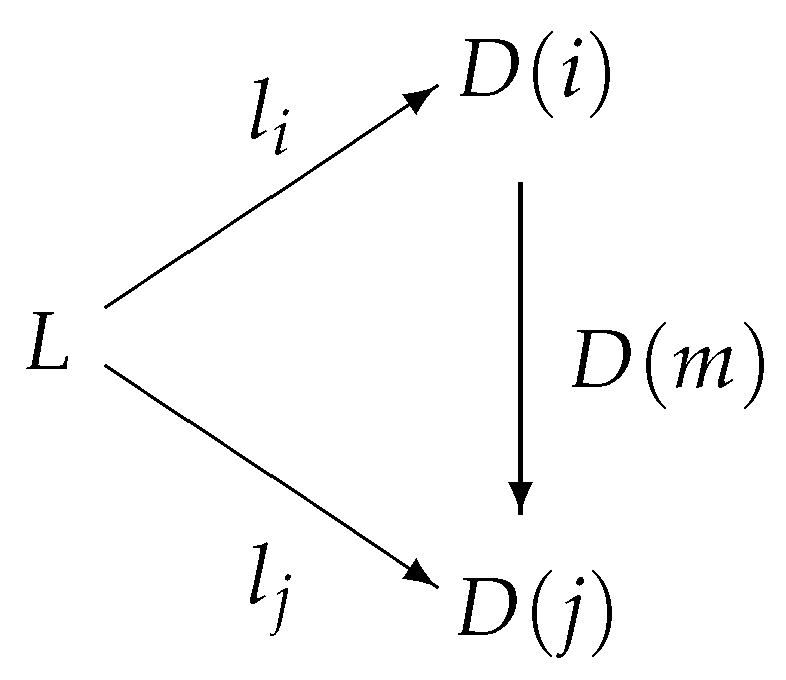
Dually: A natural sink for D is a sink where is natural transformation from D to the constant functor .
Definition 18
([26]). If is a functor, then a natural source for D is called a limit of D provided that if is any natural source for D, then there is a unique morphism such that for each , the triangle
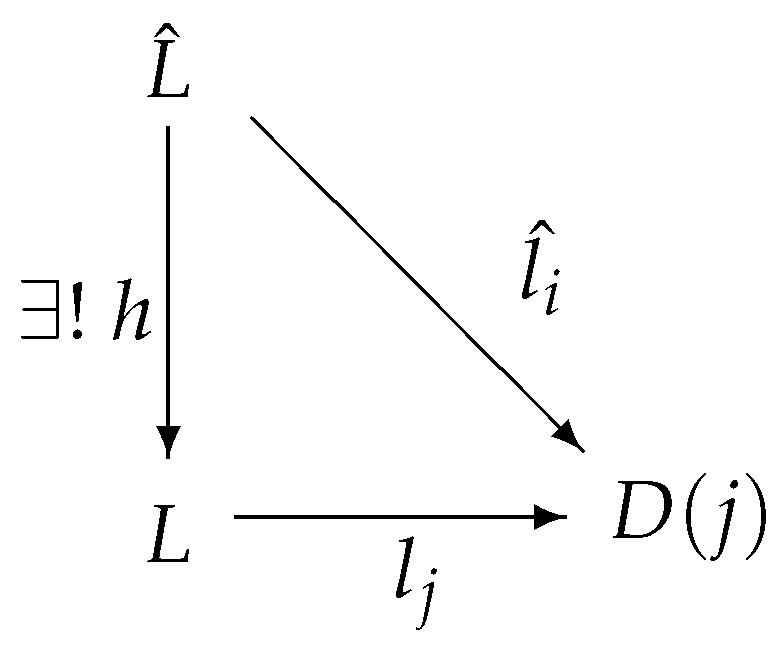
Figure 11.
commutes.
Dually: A natural sink is called a colimit of D provied that every natural sink for D factors uniquely through it.
Definition 19.
Let S be an involutive m-semilattice. , and I is a finite set. If S satisfies condition: (CD) . Then is called an involutive mc-semilattice. It is clear that if S satisfies (CD), then S satisfies Definition 1(1).
Theorem 11.
Let S be an involutive mc-semilattice, and R is a congrence of S. For any , define ; ; ; . The mapping such that . Then is an involutive mc-semilattice, and the mapping π is an involutive m-semilattice homomorphism.
Proof.
The proof of Theorem 11 is similar to the proof of Theorem 4. □
Definition 20.
Let be a family of involutive mc-semilattices with minimum element, and is the cartesian product of . For any , define a mapping by , where denotes the minimal element of . Then mapping is called a standard injection.
Lemma 3
([20]). Let be a family of involutive m-semilattices, and is the cartesian product of . , we define a semigroup multiplication "·" and an involutiveoperation on as follows: Then is an involutive m-semilattice.
Theorem 12.
Let is a finite set }. , Then is an involutive mc-semilattice under the pointwise order of cartesian product.
Proof.
The proof is similar to the proof of Lemma 3. □
Definition 21.
Let be the category whose objects are the involutive mc-semilattices with minimum element, and whose morphisms are the involutive m-semilattice homomorphisms. Obviously, the category is a full subcategory of .
Theorem 13.
Let be a family of involutive mc-semilattices with minimum element, then is the coproduct of in , where , the mapping is injection.
Proof.
We shall show that is an involutive m-semilattice homomorphism.
, then
(1) .
, if , .
Thus .
(2) .
, if , .
Thus .
(3) .
, if , .
Thus .
Therefore is an involutive m-semilattice homomorphism.
Let S be an arbitrary involutive mc-semilattice with minimum element 0. , mapping is an involutive m-semilattice homomorphism. Define by , . We first show that f is well defined. For any . By the definition of it follow that is a finite set. Since , mapping is an involutive m-semilattice homomorphism, then (i.e., preserves the minimum element). Thus the set is finite. Therefore, the supremum of the set in the semilattice S exists. This show that f is well defined.
Next, we prove that f is an involutive m-semilattice homomorphisms.
, then
(1) .
(2) , by Definition 19 it follows that . then .
(3) .
In the following, we prove that for all . , . Then Figure 12 commutes:
Finally, we prove the uniqueness of the involutive m-semilattice homomorphism f that satisfies the conditions .
Assuming g is another involutive m-semilattice homomorphism that satisfies the above condition, i.e., , . Then , we have
Therefore is the coproduct of in . □
Definition 22
([26]). A category is said to be small provided that is a set.
Theorem 14.
Let I be a small category, be a functor, then the colimit of F is , where R is the smallest involutive m-semilattice congruence relation that contains the set , , is an injection, and is a projection.
Proof.
(1) We first show that is the natural sink of the functor F.
By the Theorem 11 and Theorem 13, it follows that projection and injection are both involutive m-semilattice homomorphisms. Then the mapping is also an involutive m-semilattice homomorphism.
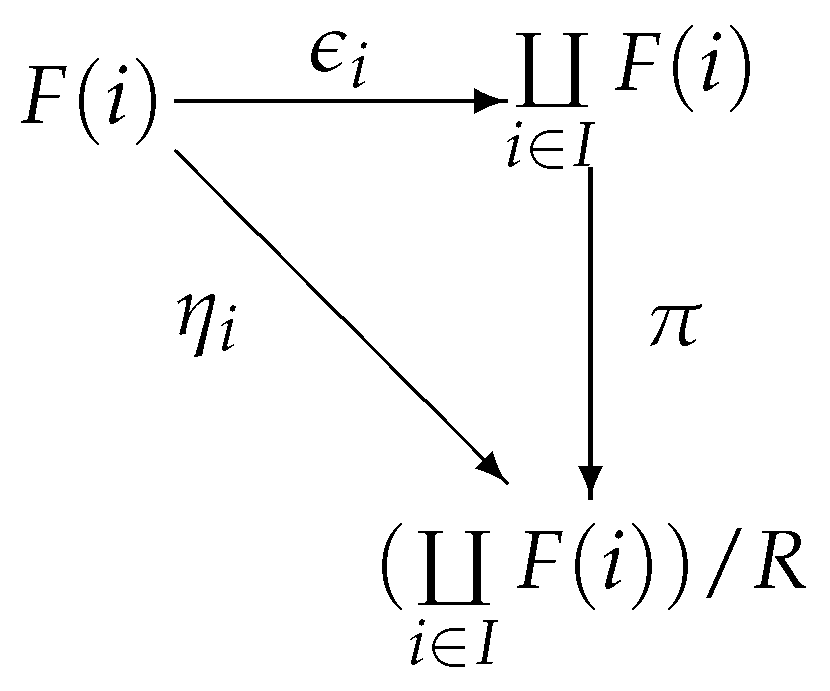
Figure 13.
, . Because R is the smallest involutive m-semilattice congruence relation that contains the set , and , then , thus , then Figure 14 commutes:
Therefore is the natural sink of the functor F.
(2) Let S be an involutive mc-semilattices with minimum element, be a family of involutive m-semilattice homomorphisms, and is the natural sink of the functor F, then , i.e., Figure 15 commutes:
, define such that . Since is a finte set, then , thus the mapping is well defined.
From the Theorem 13 we know that is the coproduct of in , there exists a unique involutive m-semilattice homomorphism satisfying , then Figure 16 commutes:
Let , , , then , i.e., . Hence . Since R is the smallest involutive m-semilattice congruence relation that contains the set , therefore .
, if , then , hence , therefore , which implies that . Thus the mapping is well defined. , , then . Thus , then Figure 17 commutes:
(3) We shall show that the mapping is an involutive m-semilattice homomorphism. , we have
(i) , then .
(ii) . By the Definition 19, we know that . Hence .
(iii) , then .
(4) We will prove the uniqueness of the involutive m-semilattice homomorphism that satisfies the conditions . Assuming is another involutive m-semilattice homomorphism that satisfies , then . Hence .
From (1), (2), (3), and (4), it can be concluded that is the colimit of the functor F. □
Corollary 1.
is cocomplete.
5. The Inverse Limit and Direct Limit in
Definition 23.
Let I be a downward-directed set, then I can be taken for a category, where its objects is the elements in I. Let , if , then a morphism is taken naturally in the category I.
A functor is called an inverse system in the category of involutive m-semilattices. An inverse system in IMSLatt can be described by the following satements without using the notion of functor. Let I be a downward-directed set. For any and , there exists an involutive m-semilattice homomorphism . And further that for all satisfing . The triple is called an inverse system in IMSLatt.
Definition 24.
Let I be a downward-directed set, and be an inverse system in IMSLatt. Then the limit of F is called the inverse limit of inverse system .
Dual: upward-directed set; direct system; direct limit.
From the definitions of the inverse limit and direct limit in IMSLatt. It is clear that the inverse limits are defined to be particular limits and direct limits are particular colimits. Inverse limits and directed limits in some categories have been extensively studied([33,34,35,36,37,38]). The following will give the inverse limit and direct limit in the IMSLatt.
5.1. The Inverse Limit of the Inverse System in
Theorem 15
([20]). Let I be a small category, be a functor, then the limit of F is , where such that . , , the mapping is projection, and .
Theorem 16.
Let I be a downward-directed set, and be an inverse system in IMSLatt. Then the inverse limit of inverse system F is , where if then such that , and , , is a projection (i.e., ).
Proof.
The proof of Theorem 16 is similar to the proof of Theorem 15 in Reference [20]. □
Suppose and are two inverse systems in IMSLatt. Let and be the inverse limits of inverse systems F and G, respectively, where I and are downward-directed sets.
, , , are involutive m-semilattices. If and , then and are involutive m-semilattice homomorphisms. , , if and , the , , , . The homomorphisms and are called the bonding mapping of inverse systems F and G, respectively.
Definition 25
(). Let I be a downward-directed set, and . If , there is a such that , the set is called a downward cofinal subset of I.
Based on Definition 3.1 in reference [36], the definition of the mapping between two inverse systems can be given as follows:
Definition 26.
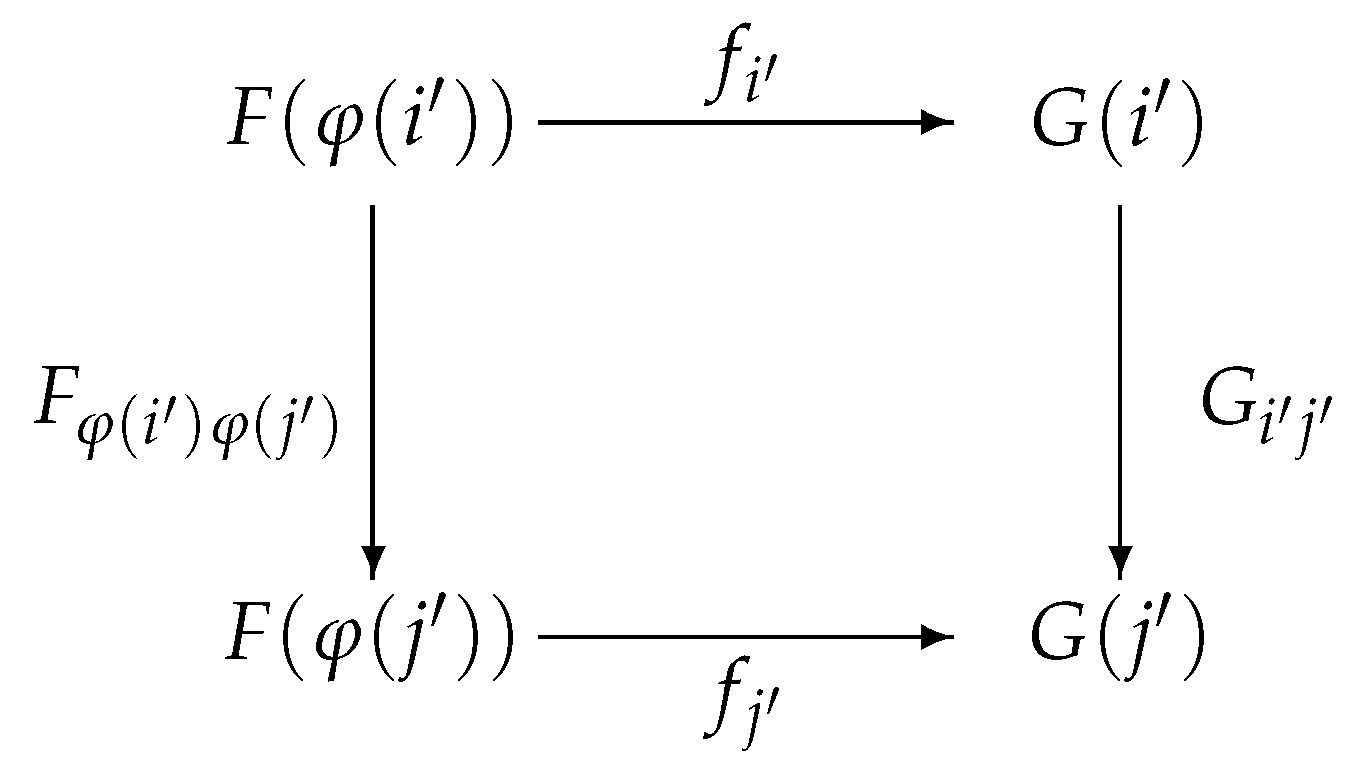
Let and be two inverse systems in IMSLatt. is called the mapping from inverse system F to inverse system G if it satisfies the following conditions:
(1) is an order preserving mapping and is a downward cofinal subset of I.
(2) , is an involutive m-semilattice homomorphism, and , if , then , i.e., Figure 18 commutes:
Theorem 17.
Let and be two inverse systems in IMSLatt. is the mapping from inverse system F to inverse G. Then the mapping induces an involutive m-semilattices homomorphism , where , , , and is a projection (i.e., ).
Proof.
, if , then . , by Definintion 26(2) and Theorem 16, we know that , then . Thus . This implies that there exists an involutive m-semilattice homomorphism such that . From Theorem 16 it follows that . Hence f is well defined.
, , then
(1) . This implies that . Thus f preserves union.
(2) . This shows that . Thus f preserves semigroup operation ·.
(3) . Thus f preserves involution operation *.
Therefore the mapping f is an involutive m-semilattice homomorphism. □
Definition 27.
Let and be two inverse systems in IMSLatt. be a mapping from the inverse F to the inverse G. Then above induced morphism is called the limit mapping. It can be denoted by .
Theorem 18.
Let be a mapping from the inverse F to the inverse G. For any , if is a monomorphism, then the induced mapping is also monomorphism.
5.2. The direct limit of the direct system on IMSLatt
Definition 28
([26]). Let I be a set, if the every subset of I have upper bound, then I is called upward-bound.
Definition 29.
Let I be a upward-bound set. The functor is called a direct system in IMSLatt, where , and , if , then is an involutive m-semilattice homomorphism. For the convenience of the following description, let denote the mapping .
Lemma 4.
Let be the forgetful functor, and is the coproduct of in the category of sets (i.e., the disjoint union of sets ). The binary relation on S is defined by the following: such that , , if and only if there is a , such that and . Let represents the equivalence class of S under relation "∼", order relation and three operations on S are defined by the following:
, such that and , then
(1) if and only if there is a satisfies and .
(2) .
(3) .
(4) .
Then is an involution m-semilattice.
Proof.
It’s easy to prove that the above definitions are well defined, and the set is an involution m-semilattice. □
Theorem 19.
Let I be a upward-bound set, and be a direct system in IMSLatt. , if , and is an involutive m-semilattice homomorphism, then the direct limit of direct system D is , where is defined above in the lemma 5, , and the mapping represents the projection from S to its equivalence class .
Proof.
The proof of this theorem is similar to the proof of the Theorem 14. □
Corollary 2.
IMSLAtt is directed complete.
Theorem 20.
Let I be a upward-bound set, functor is a direct system in IMSLatt, and is the direct limit of direct system D. , if , mapping is a monomorphism, then is also a monomorphism.
Proof.
Proof is straightforward. □
Funding
This research was funded by Scientific Research Program Funded by Shaanxi Provincial Education Department grant number 17JK0510.
Acknowledgments
The author would like to thank the editors and the reviewers for their valuable comments and helpful suggestions.
Data Availability Statement
The original contributions presented in this study are included in the article. Further inquiries can be directed to the corresponding author.
Conflicts of Interest
The author declares no conflicts of interest.
References
- Mulvey, C. J. &. Rendiconti del Circolo Matematico di Palermo 1986, 12, 99-104.
- Mulvey, C. J., Resende, P. Miraglia, F. A noncommutative theory of Penrose tilings. International Journal of Theoretical Physics 2005, 44, 655-689. [CrossRef]
- Yetter, D. Quantales and (non-commutative) linear logic. The journal of Symbolic Logic 1990, 55, 41-64.
- Girard, J. Y. Linear logic. Theoretical Computer Science 1987, 50, 1-102. [CrossRef]
- Kamide, N. Quantized linear logic, involutive quantale and strong negation 2004, 77, 355-384. [CrossRef]
- Kruml, D., Resende, P. On quantales that classify C*-algebra. Cahiers de Topologie et Geometrie Categoriques 2004, 45, 287-296.
- Conigrlio, M. E., Miraglia, F. Non-commutative topology and quantales. Studia Logica 2000, 65, 223-236. [CrossRef]
- Zhang, D. X., Zhang, G. Sober topological spaces valued in a quantale? Fuzzy Sets and Systems 2002, 444, 30-48. [CrossRef]
- Gutiérrez, G. J., Höhle, U., Kubial, T. Basic concepts of quantale-enriched topologies. Categorical Structures 2021, 29, 983-1003. [CrossRef]
- Solovyov, S. On the category Q-Mod. Algebra Universalis 2008, 58, 35-58. [CrossRef]
- Li, Y. M., Zhou, M. Li, Z. H. Projectives and injectives in the category of quantales. Journal of Pure and Applied Algebra 2002, 176, 249-258.
- Ruan, X. L., Liu, X. C. A Categorical Equivalence between logical Quantale Modules and Quantum B-modules. Mathematical Logic Quarterly 2023, 69, 446-459. [CrossRef]
- Yang, L. Y., Xu, L. S. Roughness in quantales. Information Sciences 2013, 220, 568-579. [CrossRef]
- Rosenthal, K. I. Quantales and their applications, Longman: London, UK, 1990.
- Zhou, X., Zhao, B. Ideals of m-semilattices. Journal of Northwest University 2015, 45, 202-206.
- Zhou, X., Zhao, B. Rough fuzzy ideals of m-semilattices. Journal of Ji Lin University(Science Edition) 2015, 53, 429-438.
- Zhou, X., Zhao, B., Han, S. W. Roughness in m-semilattices. Journal of intelligent & Fuzzy Systems 2016, 30, 2331-2338. [CrossRef]
- Su, Z. Q., Zhao, B. Filtersin m-semilattices and their Related topological properties. Journal of Ji Lin University(Science Edition) 2022, 60, 568-575.
- Pan, F. F., Han, S. W., Remark on coherent quantales. Computer Engineering and Applications 2012, 48, 50-52.
- Liang, S. H., Zhang, X. T., Xia, X. G. Special elements, ideals in involutive m-semilattices and Its categorical properties. Journal of Shandong University(Natural Science) 2024, 60, 1-8.
- Zhao, N. Generalized M-P inverse of m-semilattice matrix. Journal of Taiyuan Normal University(Natural Science Edition) 2018, 17, 25-28.
- Lea, J. W., Lan, A. Y. Codimension of compact M-semilattices. Proceedings of the American mathematical Society 1975, 52, 406-408.
- Kourinnyy, H. C. Weak representability of M-semilattices. Algebra Universalis 1996, 36, 357-462. [CrossRef]
- Zhao, D. S., Zhao, B. The category of M-semilattices. Northeastern Mathematical Journal 1998, 14, 419-430.
- Botur, M., Paseka, J., Lekár, M. Foulis m-semilattices and their modules. Available online: arxiv,org/abs/2501.01405 (2 Jan 2025).
- Herrilich, H., Strecker, E. Category theory; Heldermann Verlag: Berlin, Germany, 1979.
- Wu, H. W; Zhao, B., Wang, K. Y. Some further results on free quantale algebras. Fuzzy Sets and Systems 2020, 382, 142-147. [CrossRef]
- Zhuchok, AV, Koppitz, J. Free weakly k-nilpotent n-tuple semigroups. Turkish Journal of Mathematics 2024, 48, 1067-1078. [CrossRef]
- Orlicki, A. Computable Limits and Colimits in Categories of Pratial Enumerated Sets. Mathematical Logic Quarterly 1993, 39, 181-196. [CrossRef]
- Li, Y. M. Limit Structures over Completely Distributive Lattices. Fuzzy Sets and Systems 2002, 132, 125-134. [CrossRef]
- Heunen, C., Karvonen, M. Limits in Dagger Categories. Theory and Applications of Categories 2019, 34, 468-513.
- Abel, M. Limits in the Category Seg of Segal Topological Algebras. Proceedings of the Estonian Academy of Sciences 2022, 71, 203–211. [Google Scholar] [CrossRef]
- Li, S. G. Inverse Limits in Category LTop (I). Fuzzy Sets and Systems 1999, 108, 235–241. [Google Scholar] [CrossRef]
- Zhao, B. The Inverse Limit in the Category of Topological Molecular Lattices. Fuzzy Sets and Systems 2001, 118, 547–554. [Google Scholar] [CrossRef]
- Yildiz, F. Inverse Systems and Inverse Limits in the Category of Plain Textures. Topology and Its Applications 2016, 201, 217–234. [Google Scholar] [CrossRef]
- Isbell, J. Direct limits of meet-continuous lattices. Journal of Pure and Applied Algebra 1982, 23, 33–35. [Google Scholar] [CrossRef]
- Creutzig, T.; McRae, R.; Yang, J. W. Direct Limit Completions of Vertex Tensor Categories. Communications in contemporary mathematics 2022, 241, 2150033. [Google Scholar] [CrossRef]
- Ding, C. de Jeu, M. Direct limits in categories of normed vector lattices and Banach lattices. Positivity 2023, 27, 39. [CrossRef]
Figure 1.
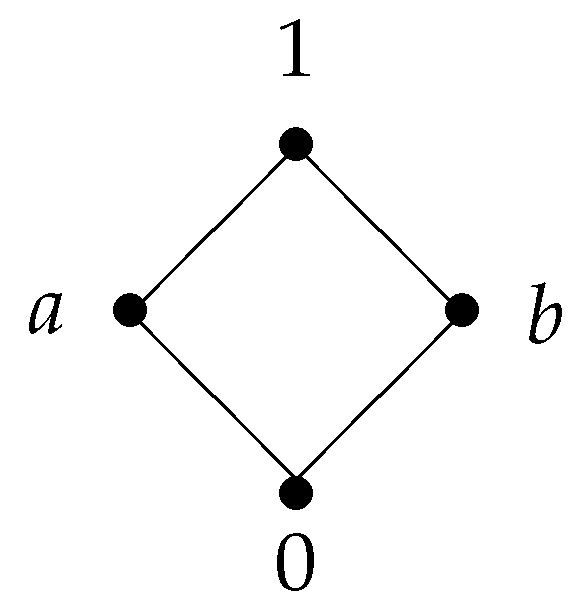
Figure 2.
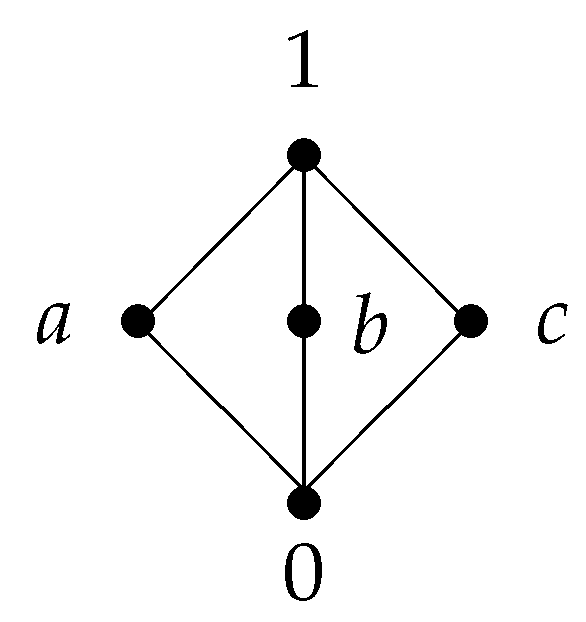
Figure 6.
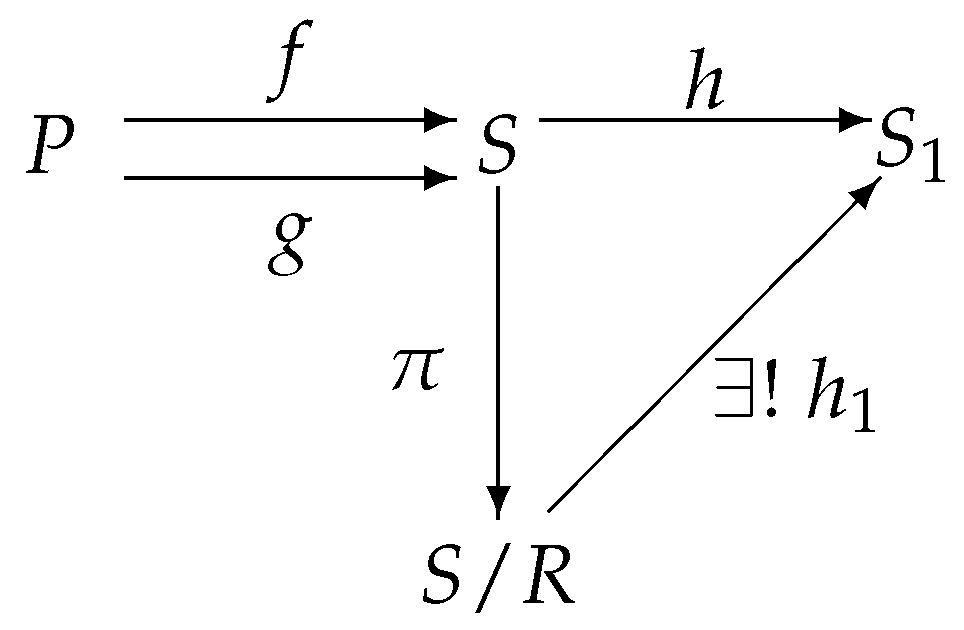
Figure 7.
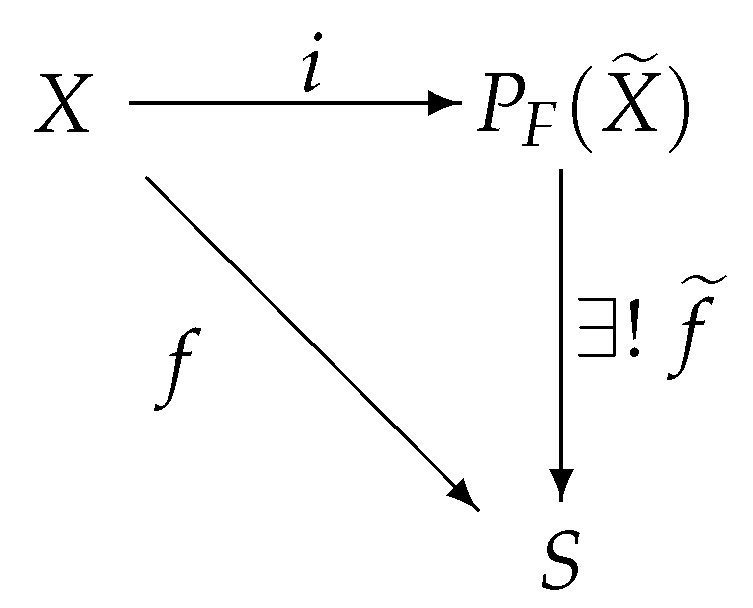
Figure 8.
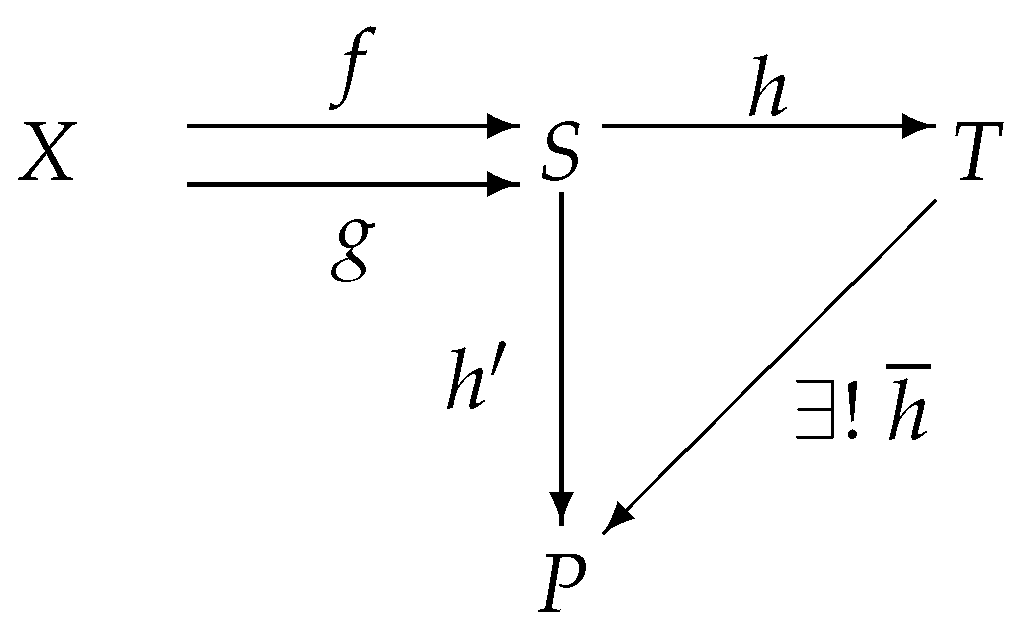
Figure 9.
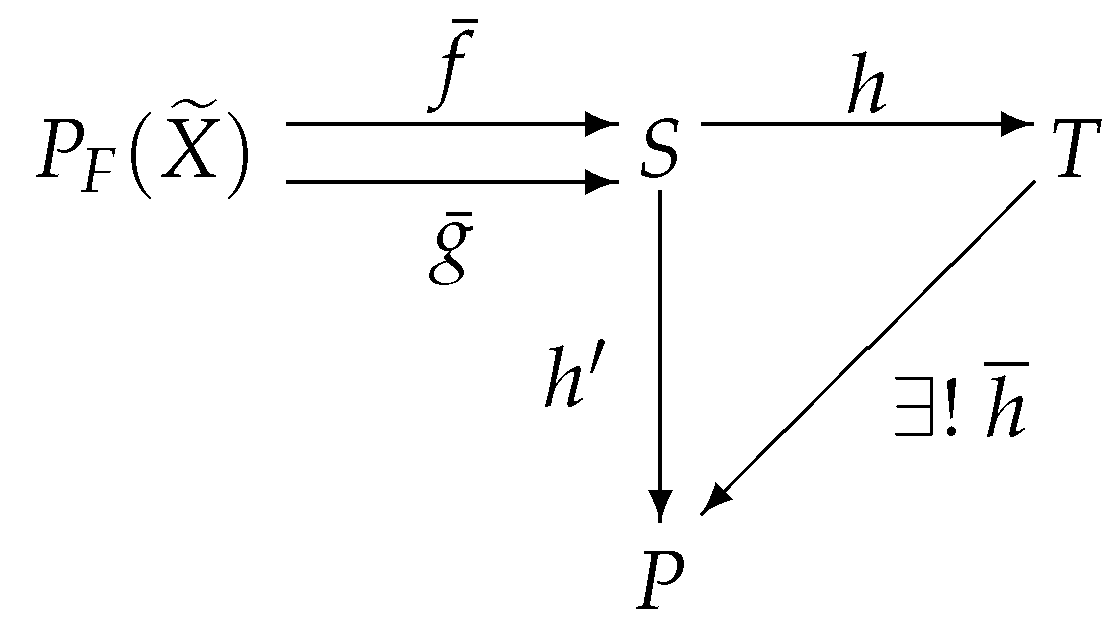
Figure 12.
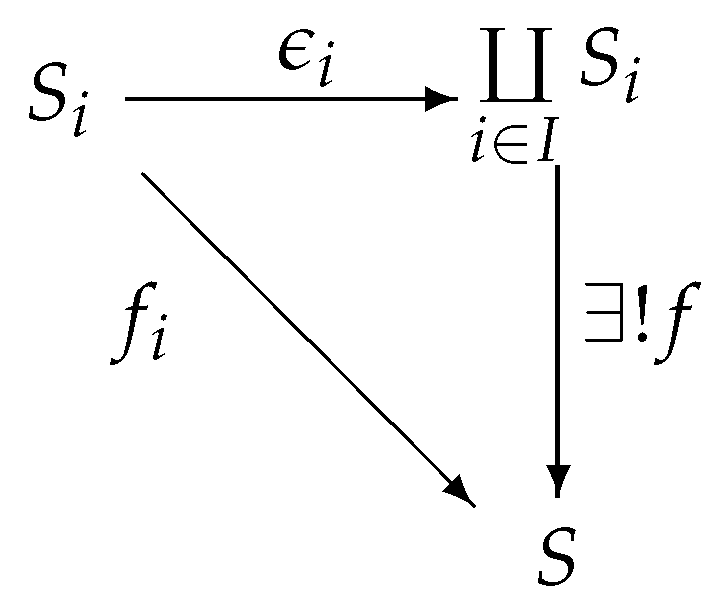
Figure 14.
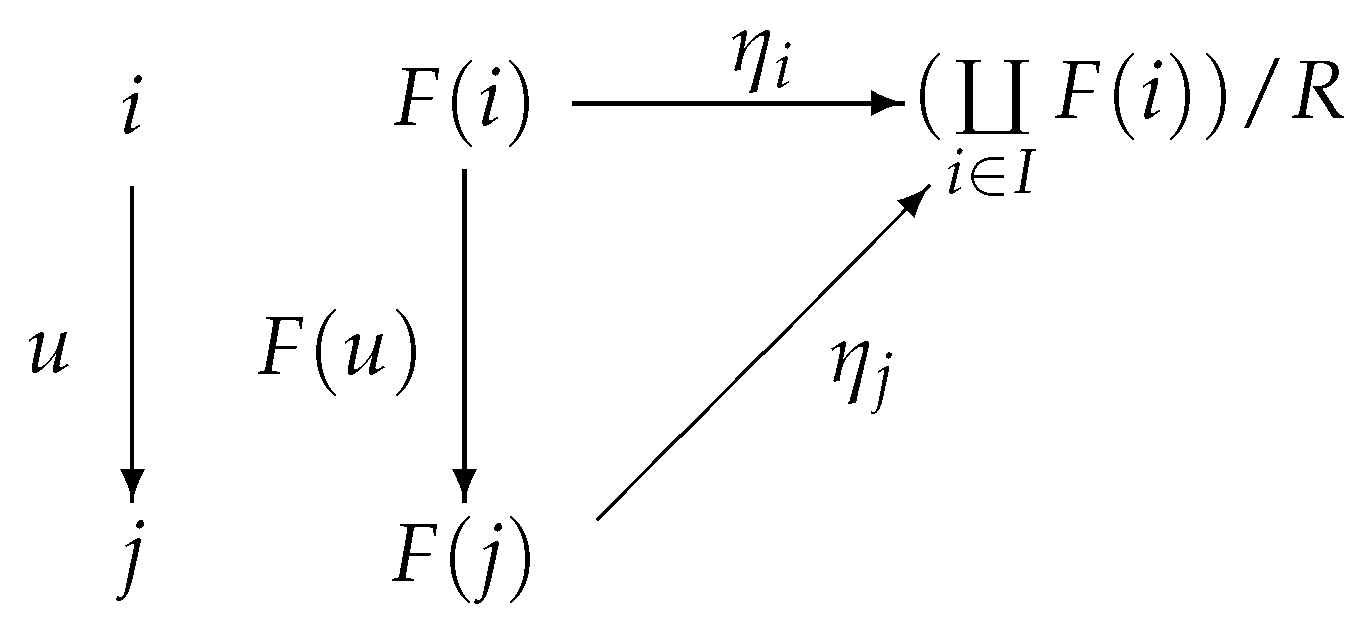
Figure 15.
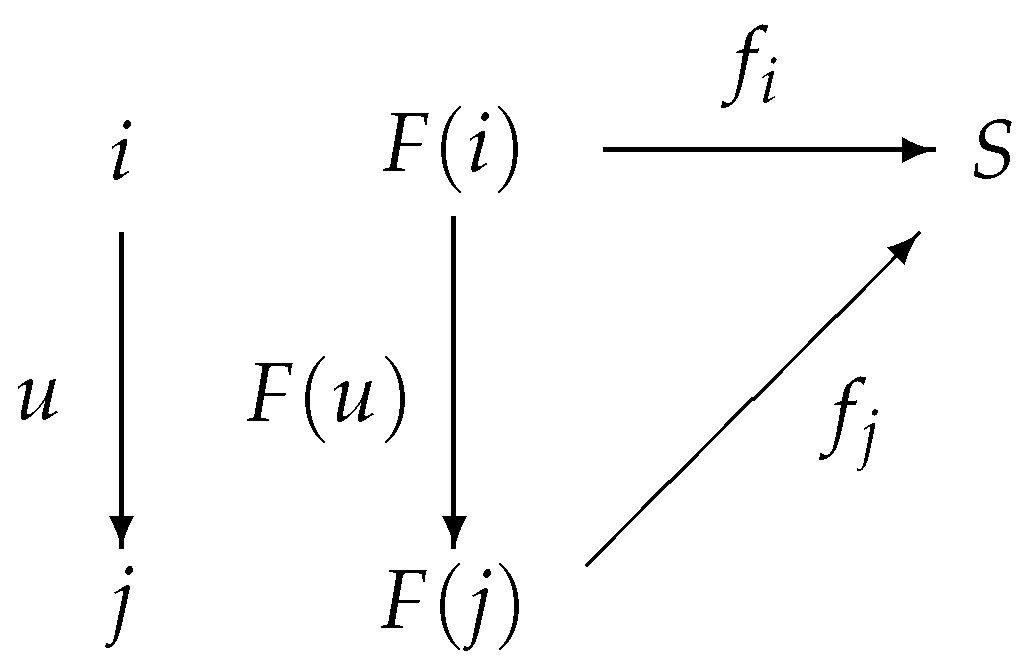
Figure 16.
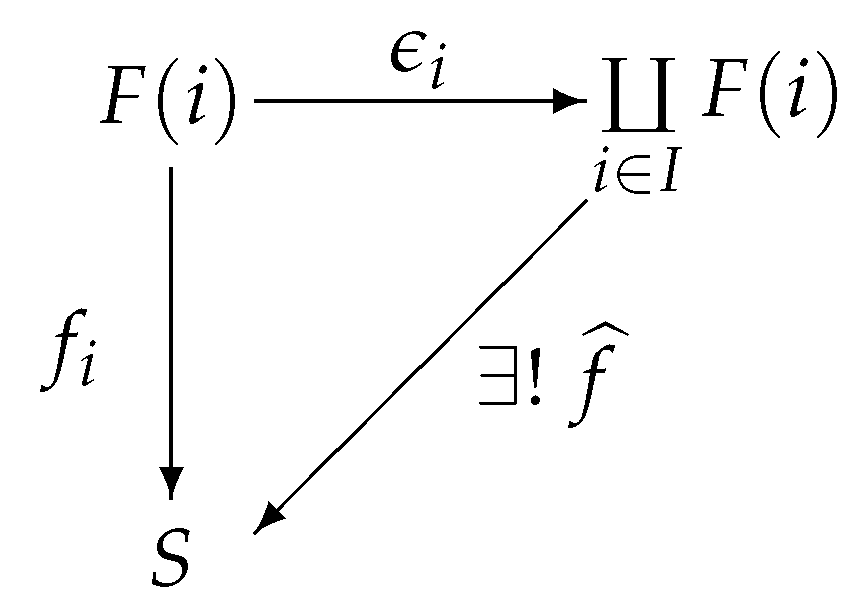
Figure 17.
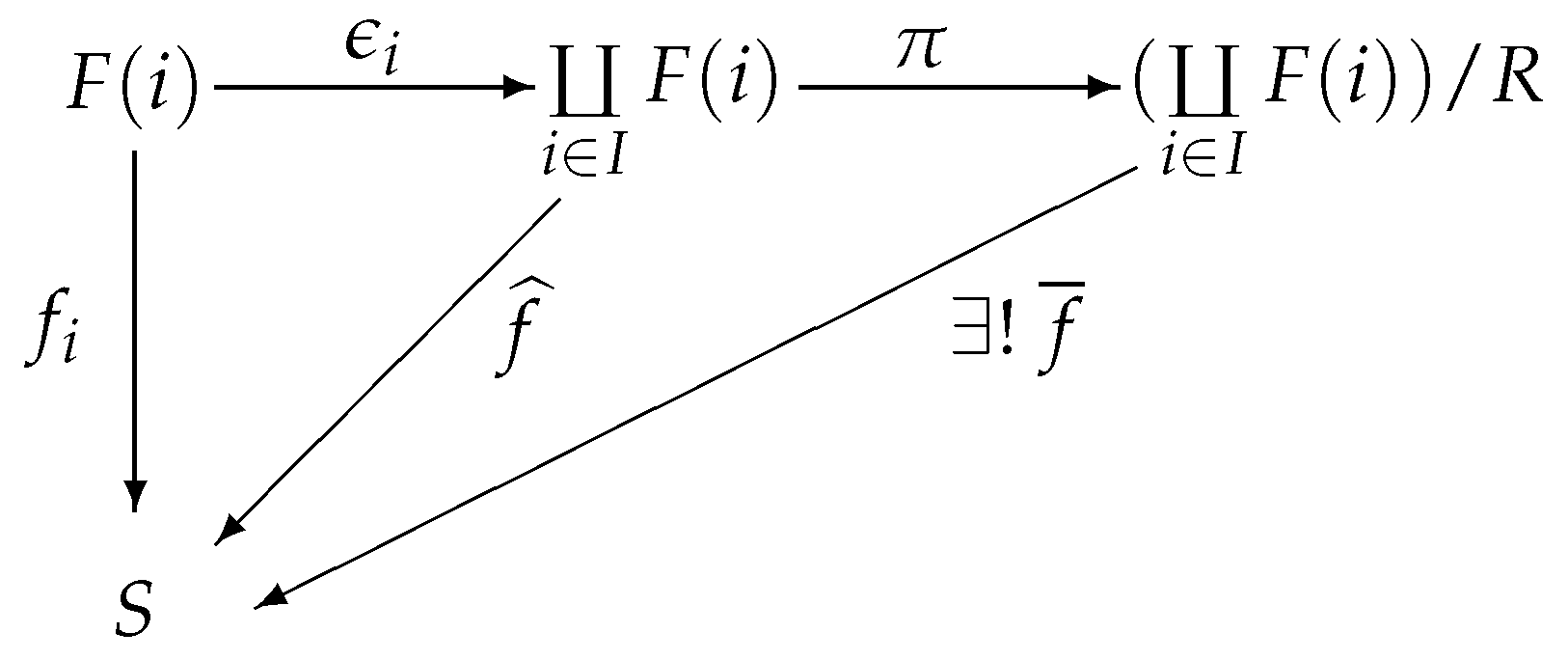
Figure 18.
Disclaimer/Publisher’s Note: The statements, opinions and data contained in all publications are solely those of the individual author(s) and contributor(s) and not of MDPI and/or the editor(s). MDPI and/or the editor(s) disclaim responsibility for any injury to people or property resulting from any ideas, methods, instructions or products referred to in the content. |
© 2025 by the authors. Licensee MDPI, Basel, Switzerland. This article is an open access article distributed under the terms and conditions of the Creative Commons Attribution (CC BY) license (http://creativecommons.org/licenses/by/4.0/).
Copyright: This open access article is published under a Creative Commons CC BY 4.0 license, which permit the free download, distribution, and reuse, provided that the author and preprint are cited in any reuse.


