

Submitted:
03 May 2025
Posted:
08 May 2025
You are already at the latest version
Abstract
This article addresses the epistemic and political problem of self-referentiality in theology within the context of post-secular societies, as a demand for public relevance of faculties of theology within the 21st-century university. It focuses on the epistemological emergence of public theology as a distinct knowledge such as human rights, and ecological thinking, contributing to the public mission of knowledge production and interdisciplinary engagement. The study applies Michel Foucault’s archaeological and genealogical methods in dialogue with Michel de Certeau’s insights into the archaeology of religious practices through a multi-layered analytical approach including archaeology of knowledge, dispositifs of power, pastoral government, and spirituality as a genealogy of ethics. As a result of the analysis, it examines the historical conditions of possibility for the emergence of a public theology, and how it needs to be thought synchronously with other formations of knowledge, allowing theology to move beyond its self-referential model of approaching dogma and the social practices derived from it. The article concludes programmatically that the development of public theology requires an epistemological reconfiguration to displace its self-referentiality through critical engagement with a public rationality framework, as an essential task for the public relevance and contribution of theology within contemporary universities and plural societies.
Keywords:
Public theology
; archaeo-genealogy of theological knowledge
; Michel Foucault
; Michel de Certeau
; epistemic self-referentiality
; genealogy of power
; spirituality and ethics
1. Introduction
This article explores the need for an archaeology of theological knowledge in the face of the challenge of epistemic self-referentiality in post-secular societies, where the public presence of religion reappears in an ambiguous and contested form. In this context, theological faculties face a growing demand to justify their public and academic relevance within 21st century universities, which are characterised by an ideal of critical, ethical and pluralistic rationality.
The central problem addressed is that theology, when confined to its confessional and institutional self-referentiality, becomes epistemically isolated and politically ineffective, reproducing forms of identity closure and losing the ability to contribute to public debate. While self-referentiality has been described by Niklas Luhmann (1984) as a legitimate mode of systemic functioning, the authors’ position here is that this characteristic can hide the historical and political conditions that shape knowledge, contrasting at the same time with proposals for an ‘outgoing theology’ [theologia in exitu] committed to listening, interdisciplinarity and social transformation. It is in this context that the task of an archaeology of theological knowledge arises, but at the same time how this knowledge relates to power relations, and thus how relations are established with the genealogy of power in the context of theological knowledge production and the social practices that derive from or sustain it.
The aim of this article is therefore to outline elements that can contribute to the perception of the public relevance of theology, based on the challenge of rethinking its epistemological foundations in dialogue with the public rationality that constitutes the basis of contemporary universities. To this end, Michel Foucault’s archaeological-genealogical method is used to analyse theological knowledge power in order to outline the need for an epistemological reconfiguration of theology, or more precisely, an archaeo-genealogy of public theology.
Although some contributions such as Bernauer and Carrette (2016) address Foucault’s relation to religion, his reflections on religion and culture remain largely unexplored in the humanities. In this sense, there are works that correlate M. Foucault with theology, reflecting on the political positioning inherent in religious experience, not only in the formulation of an apparatus1 of control, but also in the genealogy of ethics and political spirituality, offering a new critical hermeneutic for theology, as Tran (2011) and Chevalier, who particularly explored the possibility of an “anarchéologie” in the relationship between Foucault and Christianity (2011). The publication of the volume “Histoire de la sexualité: Les aveux de la Chair” (2018a), dedicated to the study of Christian authors, also sheds new light on research on Foucault and theology. Carrette has also compiled Foucault’s writings on religion, opening up new possibilities for reading the French philosopher and the issues surrounding religion (Foucault 1999).
However, the French philosopher does not offer a precise theory of religion, but religion is intimately related to culture, and as such its value for individuals and groups can undergo the same changes as a given culture, while elements of the religious phenomenon form part of the structures of a culture’s way of being, even when secularised, as is the case with Western culture, on which Foucault focuses his archaeological and genealogical exercise (Wuthnow et al. 1984, p. 162).
Furthermore, the analysis of the epistemological implications from the perspective of Michel Foucault’s archaeo-genealogical method aims to conceive a ‘critical hermeneutics’ of theology, as proposed by Bernauer and Carrete (2016, p. 4), and what this might become in the construction of a public theology, in the context of the emergence of a commitment of theology to a public agenda.
To this end, this work operates with several facets of Foucaultian tools. The first, archaeological, describes the historical conditions that made theological knowledge possible in modernity. The second, genealogical, identifies the devices that structure the relationship between power and knowledge in their institutional practices, especially in theological faculties. The third focuses on the genealogy of pastoral power and its forms of subjectivation, and how they have been used by political theology projects to legitimise political actors. Finally, the fourth level focuses on an ethical and spiritual reading of forms of resistance, proposing a ‘critical spirituality’ as a condition of possibility for public theology. For this purpose, this article also revisits an ‘unfinished dialogue’ between Foucault and Michel de Certeau, whose reflections deepen the archaeological task of revealing the persistence of religion as a structure of thought in modern discursive practice (Petit 2020).
The aim is to understand how the discursive and non-discursive practices of theology have been shaped by the relations between knowledge and power and by the historical conditions of possibility, highlighting the potential of theology to become a public and critical knowledge. To this end, we propose an archaeo-genealogy of theological knowledge-power with a view to constructing a public theology, taking into account the place of theology in contemporary universities, grounded in public rationality andand effective contribution to the common good. This task does not aim to replace the model of confessional or dogmatic theology, but rather to propose an alternative rationality for the production of theological knowledge from the place where it is located, namely within the contemporary university and its task of producing critical and public knowledge.
2. Self-Referentiality as an Epistemological and Political Problem
Theological self-referentiality is one of the main epistemological and political challenges for the constitution of theology as a field of public relevance within contemporary universities. It is a phenomenon which, by privileging hermeneutical self-referentiality and by closing itself off to its own traditions and categories, runs the risk of confining theology to its confessional dimension, thereby compromising its ability to dialogue with public rationality and to contribute to the critical formation of plural societies.
2.1. The Insufficiency of the Hermeneutics of Secularisation
The notion of post-secular societies highlights the insufficiency of the theory of secularisation as a linear decline of religion. Rather than disappearing, the religious phenomenon is reappearing in the public sphere in new forms of expression and engagement.
This return, however, does not imply the restoration of the theocratic model, nor the permanence of religion in the private sphere. What is emerging is a pluralist scenario in which different rationalities compete for legitimacy in defining the common good, which demands for a revision of the classical division between public and private (Lambert 2000).
In this context, religion reappears in an ambiguous form: sometimes as a promoter of dialogue and public agendas, such as the ecological agenda, sometimes as a vector of exclusion and identity closure. This dualisation of religion poses a challenge to the theological field to develop a language capable of critically engaging with public rationality and contributing to the construction of democratic and pluralistic societies.
2.2. The Dualisation of Religion and the Crisis of Public Rationality
The dualisation of religion refers to the coexistence of two paradoxical movements typical of so-called post-secular societies: on the one hand, openness to pluralism and commitment to universal causes, as Jürgen Habermas recognises when he values religious traditions as sources of meaning (Habermas 2009); on the other hand, the use of religion as a tool for closing off identity and justifying exclusionary and authoritarian projects. This tendency, accentuated in advanced modernity (Campiche 2010), calls for a complex concept of religion capable of reflecting multiple articulations with different social fields (Hervieu-Léger 1999).
Based on longitudinal research on values in Europe, Yves Lambert distinguishes three basic categories: the religious (meta-empirical realities), the axiological (ethical values) and the ideological (socio-political representations). According to him, religion does not operate in isolation, but in conjunction with ideology and axiology, which allows us to understand the tensions between religion and politics not as a binary opposition, but as the result of discontinuities between social structures and subjective experiences (Lambert 2000).
The notion of ‘public religion’ proposed by José Casanova (1994) helps to understand the reconfiguration of relations between religion and society. However, it proves insufficient to deal with the complexity and constitutive ambiguity of the religious presence in contemporary societies. By privileging the integrative and dialogical aspect of the religious phenomenon, the category tends to mitigate the effects of its political instrumentalisation and the forms of identity closure that characterise contemporary reality. By uncritically adopting this notion, theology runs the risk of reinforcing a normatively positive image of public religion, without taking into account its structural ambivalences.
In this scenario, self-referential theology, when it operates as an epistemic immunity can foster polarisation and reinforce political messianism, as Carl Schmitt described in his notion of ‘state of exception’ conceived as divine intervention and through the formulation of state sovereignty as a secular version of papal infallibility, legitimising authoritarian power structures as ‘uniformisation’ (Gleichschaltung) to eliminate dissonance (Schmitt 1996, p. 42).
2.3. The Institutionalisation of the Epistemic Self-Referentiality of Theological Faculties
For the most part, the presence of theological faculties in contemporary universities is not the result of full recognition as scientific knowledge on an equal footing with other academic disciplines. On the contrary, this permanence is essentially due to the concordats and diplomatic agreements signed between national states and the historic Churches, which guarantee the institutional protection of theology, albeit on the margins of the modern and critical epistemological model of the human sciences.
This legal and political structure has consolidated an institutionalised self-referentiality that often operates without requiring conformity to criteria of public rationality. The Concordats do not oblige theology to submit to the methodological, critical and intersubjective requirements that govern the scientific field, which allows it in many cases to function as a transposition of seminary theology into the university space, maintaining institutional purposes, clerical formation logics and a strictly confessional rationality.
This state of affairs is most evident in south-western Europe, where theology has been formally excluded from public higher education systems and relegated to confessional institutions. France, Spain and Italy exemplify this process, which resulted from liberal and secular reforms between the 19th and 20th centuries (Baubérot 2000; Chadwick 1990). The exceptions are, in particular, legal arrangements: Portugal, with the creation of the Universidade Católica Portuguesa under the 1940 Concordat (Holy See 1940); Malta, with the maintenance of the Faculty of Theology as part of the public university since the 1988 Concordat, reaffirmed in 1993 (Holy See 1993); and the Alsace-Moselle region of France, where the Napoleonic Concordat of 1801 is in force and was not revoked after the Treaty of Versailles (Baubérot 2000; Prost 1997).
The German model, adopted by the University of Strasbourg, is the most consolidated. Here, theology is recognised as a scientific discipline under the regime of the State Church Law. The Catholic and Protestant theological faculties operate as ‘res mixta’ under dual governance: state (in terms of university funding and regulation) and church (in terms of doctrinal orthodoxy and clergy training) (Wissenschaftsrat 2010). While this configuration ensures institutional stability, it also reinforces the self-referential logic of theology and jeopardises its openness to public rationality, interdisciplinary critique and wider academic debate. Moreover, this model has been the target of recurrent criticism from parts of the university and civil society, especially in a context of budgetary austerity, due to the low number of students enrolled and the high cost of maintaining theological faculties. Such criticism calls into question their academic and financial viability and reinforces the contemporary challenge of transforming theology from a regime of confessional exception to a space of public dialogue that actively and recognisably contributes to the plural construction of knowledge.
2.3.1. The Wissenschaftsrat’s Criticism of Theological Faculties (2010-2011)
Even the most well-established models for integrating theology into public universities today face pressures related to their academic and financial sustainability. The steady decline in the number of students enrolled in theology courses, coupled with the decline in religious vocations and the low employability outside the church context, raises doubts about the viability of these programmes, especially in performance and productivity-driven systems.
This situation has led to debates about the closure or merger of theological faculties with other fields, such as philosophy or religious studies, and to critical evaluations by accreditation agencies, which point to shortcomings in interdisciplinarity, internationalisation and dialogue with other scientific fields. Against this background, the German Council of Science and Humanities (Wissenschaftsrat) - the German government’s main advisory body on science and higher education - published a report in 2010/2011 that reaffirms the importance of theological faculties for ethical education and interreligious dialogue, but also offers sharp criticism of their current structure, especially on issues that may be related to the problem of epistemic self-referentiality. The main points include (Wissenschaftsrat 2010):
- The need for interdisciplinary openness, encouraging dialogue with human and social sciences such as philosophy, sociology and the history of religions;
- The tension between academic autonomy and ecclesiastical supervision, which compromises scientific freedom in the name of doctrinal orthodoxy;
- The inclusion of Islamic theologies in the German theological academic community in recognition of the religious diversity in German society;
- Resistance to modernisation, with closed corporate practices and fear of losing ecclesiastical control.
Despite their institutional role, theological faculties continue to occupy a peripheral and often tolerated position, without fully integrating the epistemological principles of the public sciences. The maintenance of an operationally closed logic, legitimised by concordats or regimes of exception, perpetuates a self-referential view of the religious phenomenon that does little to confront the contemporary dualisation of religion - between openness to pluralism and identity closure.
Rather than offering theology the conditions for a critical and mediating role in the pluralist public sphere, the institutionalisation of self-referentiality accentuates its difficulty in positioning itself in the face of the ambivalences of the religious in contemporary society.
2.4. The Limits of Systemic Self-Referentiality in Niklas Luhmann
Niklas Luhmann (1927–1998) defines epistemic self-referentiality [Selbstreferentialität] as the capacity of social systems to generate meaning and validate knowledge through their own operations, without recourse to external legitimation (Luhmann 1995).
From Luhmann’s perspective, social systems such as science, politics and law are operationally closed and self-referential systems. This means that each of these systems defines and organises itself according to its own internal codes and rules, and is able to determine what is relevant or true based on its own communicative operations (Luhmann 1984). Science, for example, operates by defining the validity of knowledge on the basis of internally established criteria, without the need for legitimation from outside this specific system (Luhmann 1989). This self-referential autonomy allows the system to constantly adapt, reproduce and modify itself according to its evolutionary needs (Luhmann 1995). For science, this means that knowledge is continuously constructed through observations and theories that are internally related, and that the scientific system uses its own operations to distinguish between information that is included and excluded from the field of knowledge (Luhmann 1984). Self-referentiality thus becomes the key to the self-reproduction of systems and the continuous construction of a self-validating body of knowledge.
For the German sociologist, epistemic self-referentiality does not lead to the ‘self-sufficiency’ of self-referential systems, which would imply a detachment from concrete reality and a lack of sensitivity to external influences. The point for Luhman is not that systems cannot be influenced by the environment, but that responses to external stimuli are always processed according to the system’s internal rules (Luhmann 1997), and therefore does not exclude the possibility of interaction with the environment, but defines how this interaction is understood and integrated into the system’s logic. Self-referentiality guarantees the consistency and continuity of systems, allowing them to adapt to changes in the environment without losing their functional identity (Luhmann 1995). Thus, contemporary society should be understood as functionally differentiated, where different social systems are self-referential and do not communicate with each other directly, but only through ‘structural coupling’ [Strukturelle Kopplung] (Luhmann 1997). Self-referentiality thereby does not imply complete isolation, but rather the creation of meaning from an endogenous perspective, without merging their internal logics (Luhmann 1995)
Structural couplings enable systems to interact functionally while preserving their operational autonomy. Each system interprets external influences through its own internal logic, without merging with others. For example, science and politics may be coupled when scientific research informs policy decisions, yet both maintain distinct criteria of validation. Such couplings are essential for coordinating differentiated systems in contemporary society, allowing interdependence without compromising specificity.
Like any other system, theology organises itself and defines its epistemological limits through a self-referential logic. In this way, theology would be a construction that operates internally, responding to the environment in a way that is filtered through its own criteria, thus guaranteeing its continuity and consistency over time.
In this sense, in a functionally differentiated society, theology would have a specific role and would not mix directly with other systems, such as science or politics, except in structural couplings. Thus, theology is part of a differentiated system, namely the religious system, which deals with questions of ultimate meaning and offers answers to existential uncertainties that cannot be satisfactorily addressed by other social systems.
However, to the extent that theological knowledge can be found in modern universities, it is located in the university system, which functions as a link between the religious system and the scientific system of society. In addition to the procedural requirements that imply such a place, there is a fundamental element that is epistemological recognition by the scientific system, which, in terms of the modern university, implies thinking and producing theology according to the criteria of public rationality. With the rise of modern epistemology, theology was relegated to the margins of public universities due to its reliance on revelation. Its institutional survival often depended on concordats with the state, which secured its formal place without guaranteeing epistemological recognition (Harrison 2015; Davie 2002). Movements such as the Enlightenment and the French Revolution promoted a vision of education divorced from religious dogma as essential to the formation of rational and free citizens (Chadwick 1990).
In this context, the historical presence of theological faculties in medieval universities and their incorporation into modern universities was only possible through concordats with modern states, and in a number of contexts they still suffer to some extent from an effective epistemological recognition of the scientific fields that make up the academic community.
The question that arises, therefore, goes beyond its existence in public or private universities, which would be institutional forms of structural coupling between religious and scientific systems, but is linked to the recognition (or not) of theology as knowledge accepted by the scientific community and the consequent professionalisation (or not) of its epistemic subject, namely the theologian, on an equal footing with any other researcher in terms of his contribution to the public task of producing knowledge for the common good and critical awareness.
In this case, the concept of self-referentiality is not sufficient to promote the effective integration of theology into the set of disciplines, since it favours the epistemic isolationism of theology, which reinforces the intensification of the privatisation of faith, and even the actions of religious communities in public arenas, with the aim of strengthening an identity bloc logic, rather than a commitment to a pluralist project of society, as can be seen in a series of emerging radical speeches (removed for peer review).
This is precisely where the criticism of self-referentiality comes in, from the distorting effect it can potentially have on the notion of academic autonomy, leading precisely to academic isolation, where the study of theology is limited to an internal, hermetic approach, disconnected from the “signs of the times” (Pope Francis 2017, n. 3). Francis criticises the tendency of a theological discourse that doesn’t engage with the challenges and needs of the contemporary world, remaining closed in intestinal discussions or in the repetition of formulas. This results not only in a pastoral disconnection, but also in a lack of interdisciplinary dialogue, which translates into an approach that ignores the complexity of the contemporary world and fails to respond to the urgent questions of the present (Pope Francis 2017, n. 4).
In this sense, Luhmann’s analysis does not take into account the relationship between the production of scientific knowledge and scientific policies, insofar as this involves analysing the political issues involved in the formation of the university system, on the one hand, and the movement to decommodify the theology of diplomatic tolerance that benefits from it, on the other.
Although Niklas Luhmann’s theory of social systems offers a sophisticated descriptive model for understanding the autopoietic and self-referential functioning of differentiated social systems, it proves inadequate for explaining the dynamics that characterise the dualisation of religion in contemporary societies and its impact on theology. It does not allow the problematisation of the tensions and ambiguities inherent in the public presence of religion, which oscillates between a logic of pluralistic openness and identity closure. Similarly, theological self-referentiality, conceived as a legitimate operation of systemic closure, is described by Luhmann as a mechanism for preserving the identity of the religious system, but without offering critical instruments for assessing when such closure ceases to be a functional condition and turn into an epistemological isolation, critical immunity, or even the basis of exclusionary and ideological practices.
2.5. The Proposal for a Theology that Goes Forth and the Problem of Self-Referentiality
The pontificate of Pope Francis has centred on an the call for a “Church going forth”, which presupposes the production of a “ theology going forth” [theologia “in exitu”] (Francis 2023, 3). This perspective calls for a theology that renounces self-sufficiency and institutional comfort to engage with the world and its urgent challenges. Francis, as a pastor of existential and geographic peripheries, urges theologians toward an incarnate, compassionate presence. This movement unfolds ad extra, in ecological reflection through Laudato si’, and ad intra, through synodality as a practice of listening and unity in diversity. In both directions, theology must transcend its hermeneutical boundaries.
Francis reiterates the need for a theologia in exitu—a theology willing to leave its comfort zone and risk encounter. In Evangelii Gaudium, he prefers a Church “bruised and dirty” from engagement over one “sick from closure” (2013, nn. 49, 20). This spirituality, rooted in the face of the other, calls theologians to “walk with the people” and respond to the concrete challenges of humanity (Francis 2015b). In Laudato si’, theology becomes a prophetic voice for ecological conversion and human dignity, engaging in transdisciplinary dialogue toward the common good and the goals of the 2030 Agenda (Francis 2015a, n. 201). The whole proposal of synodality is not only a method of governance, but a true spirituality of encounter, listening and discernment. The Synod of the Amazon was an example of this practice, placing the voices of traditional communities, often ignored by hegemonic speeches, at the centre. The Amazon itself, as a complex reality, is presented as a locus theologicus (Francisco 2020, 57).
At the opening of the International Theological Congress of the Dicastery for Education and Culture in December 2024, Francis invited theologians to “help theology to rethink the way it thinks”, where rethinking is linked to “moving beyond simplification” to face the complexity of reality. This requires that theology be “fermented” by interdisciplinarity and transdisciplinarity, which calls for theology to be an “open house” and for “theology to be accessible to all” (Francis 2024).
Francis’s theology of going forth is often invoked to respond to the theoretical maturity of these commitments, to help think and discern reality, not limited to sterile debates, but closely linked to the concrete needs of humanity, embracing the complexities and contradictions of contemporary life. In this sense, for Francis, the place of the theologian is fundamentally at the frontier (Francis 2015b).
In the introduction to the Apostolic Constitution Veritatis Gaudium on Ecclesiastical Universities and Faculties (2017), these pastoral questions are given an epistemological translation in which Francis states: “a necessary condition for a serious process of discernment about the challenges of our time is precisely the overcoming of every form of self-referentiality” (Francis, 2018, n. 3).
Outgoing theology stands in contrast to a self-referential model that views theology as a “sacred science” concerned primarily with Revelation, directed to the priestly ministry, and placed above other forms of knowledge, as in Sapientia Christiana (John Paul II 1979, III). Without ceasing to reflect its commitment to the theological tradition, an outgoing theology is called, “from an epistemological point of view”, to a transdisciplinary “relational dimension”, to “know how to use the new categories approached by other knowledges” and to adopt the attitude of a “courageous cultural revolution”. Theology that goes forward urges the very ‘status of theology’ not to ‘close in on itself in its self-referentiality, which leads to isolation and insignificance’ (Francis 2023, 5).
Michel Foucault’s methodological proposal, especially in the context of the archaeology of knowledge, offers a fruitful way to face the challenge of the dualisation of religion in contemporary societies. Instead of interpreting religion solely as a functionally differentiated system, as Luhmann does, Foucault offers analytical tools and hypotheses that can help analyse religious formations as historically situated discursive practices intersected by relations of knowledge and power. His approach makes it possible to show the limits of problematising religion through the lens of ideology and axiology, and to understand it from the point of view of a ‘bundle of relations’ between knowledges whose rationality can be grasped through the order of speech of a given era.
3. The Task of an Archaeo-Genealogy of Theological Knowledge
Giorgio Agamben defines archaeology as the identification of “signatures” that shape how disciplines construct and perpetuate meaning. These marks, inherited from historical tensions, continue to structure contemporary regimes of truth (Agamben 2019, p. 44). Taking up and extending the archaeology proposed by Michel Foucault, Agamben emphasises the relevance of this method for understanding the devices that organise contemporary experience and the regimes of truth that accept or exclude certain practices of knowledge. In this sense, the archaeological task is not limited to a work of historical excavation, but is presented as a critical method for thinking about knowledge - such as theology - in its constitutive relationship with the exercise of power and its possibilities for re-signification in the present.
While Luhmann describes knowledge systems as self-referential, Foucault shows that knowledge is always embedded in power relations that define what can be said and thought, through mechanisms of control, exclusion and disciplining of speech (Foucault 1971). There is no knowledge that is completely autonomous, because its conditions of possibility are historically determined by the power games that determine what can be said and thought at any given time.
From this perspective, social systems cannot be understood as operationally closed in an absolute way, because each system is constantly traversed by an order of speech that determines what can and cannot be legitimated as knowledge. This order is not only contingent, but is structured by power relations that determine which propositions are accepted because they are “in the true” (Foucault 2010, p. 224) and which are excluded. In a Foucauldian approach, the self-referentiality of a system such as the scientific system is ultimately an illusion, because all knowledge is produced in a field of forces that includes political, economic and cultural tensions that shape its historical conditions of possibility. Scientific practices cannot be separated from the social and political practices that allow them to operate.
In addition, Foucault pays particular attention to the discontinuities between different epochs, that is, the moments when forms of knowledge power are radically restructured by changes in discursive practices and their relationship to non-discursive practices. The production of knowledge is always traversed by practices of power and resistance that cannot be explained solely by self-referential mechanisms internal to systems.
In the specific case of theological knowledge, a fundamental problem in the structural coupling with modern universities lies in the divergence between two regimes of rationality: while the scientific system that governs the university is guided by a public rationality, contemporary theology remains largely referenced by a confessional rationality based on revelation. This emphasis on revelation as the ultimate criterion of truth can be interpreted as a symptom of the historical conditions of possibility that have shaped the place of the religious system in modern societies and partly explain its current epistemological marginality. Yet historically, theology emerged as a public discourse intertwined with philosophy and public reason. The reduction of theology to fundamental theologies centred on Revelation reinforces epistemic self-enclosure, despite efforts to reinterpret Revelation in dialogue with modern experience. (Rahner 1941; 1984; Ratzinger 1969; Latourelle 1966; Gutiérrez 1971; Libanio 1992; Tillich 1951–1963; Pannenberg 1961; Geffré 1972; O’Collins 2016; Theobald 2001, among others).
Theology must be translated into the language of public rationality to contribute to citizenship and the common good, without abandoning its confessional roots (Tracy 1996). However it does demand a rigorous translation and a broadening of its epistemological understanding, so that it can fit better in the mission of modern universities to promote the formation of citizens’ critical conscience and contribute to the common good.
In contrast to the logic of self-referentiality, Francis used the metaphor of the polyhedron to describe theology as polyphonic—open to diversity, yet united in dialogue and oriented to the common good (Francis 2017, n. 3). Foucault similarly speaks of a “polyhedron of intelligibility,” where knowledge is structured by multiple, irreducible relations. The analysis of a field of knowledge requires taking into account the multiplicity of relations that make it up, forming a polyhedron whose faces are not given in advance and whose complexity cannot be completely reduced to a single point of view (Foucault 2001, p. 227).
On the same horizon, Michel de Certeau—identified by Pope Francis as a major influence (La Civiltà Cattolica 2013; IHU online 2013)—proposed to think about an “archaeology of the religious” (archéologie religieuse) in which the religious element functions as a matrix of intelligibility. In L’écriture de l’histoire, he argued that modern historiography does not entirely break with the religious, but rather reinscribes the experience of alterity and absence—God, the Other—into secular modes of knowledge (Certeau 1975, p. 121).
The task of an archaeology of theological knowledge thus acquires a critical and plural character. It involves reflecting on theology’s entanglement with knowledge, society, and power, identifying the multiple genealogies that shape its discourse, and overcoming epistemic self-referentiality to contribute to a public theology in dialogue with contemporary rationality—particularly as it emerges within the human sciences.
In this way, the archaeo-genealogical toolbox is employed here to illuminate the historical and relational conditions underlying the emergence of public theology through three complementary dimensions: (1) the archaeology of knowledge, (2) the genealogy of power apparatuses, and (3) the genealogy of ethics or processes of subjectivation—each contributing to the analysis of theology’s epistemic displacement.
3.1. The Trajectory of Michel Foucault’s Archaeological Method
In order to outline an archaeology of theological knowledge, it is first necessary to understand some aspects of the first moment of Foucault’s analyses, corresponding to the trajectory of the archaeological method, and its relation to the second moment of his thought, when the refined elaboration of the genealogical method takes place.
In a broad sense, the archaeological analysis does not aim to search for an origin or a history of ideas, but rather to systematically describe the birth of a discourse-object based on enunciative regularities between different types of knowledge in the same long period of time, which come to share an enunciative homogeneity, forming a kind of bundle of discursive relations. To understand this point of arrival for the archaeology of knowledge, it is necessary to elucidate its trajectory.
Foucault’s archaeological project in the 1960s is exemplified by History of Madness (1961), where he explores how different periods constructed the perception of madness as a cultural and institutional phenomenon. In The Birth of the Clinic (1963), he extends this analysis to medical discourse, showing how the shift from metaphysical to empirical observation in the late 18th century transformed clinical practice. This transition—from symptom to lesion, from theory to anatomical gaze—illustrates how knowledge is shaped by institutional practices. Ultimately, Foucault links this evolution to the emergence of biopower and the modern control of bodies through medical authority.
Finally, his last archaeological exercise, known as Opus Magnum, led to the publication of Les mots et les choses (literally words and things)2, whose subtitle also indicates the object of its excavation, namely An Archaeology of the Human Sciences (1966). The book deals with the discursive formation that led to the emergence of this field of knowledge in the nineteenth century, which, according to the French philosopher, consisted mainly of the social sciences, psychology and literature, from the opening to positivity of the finitude of the human being not only as a transcendental subject in Kantian philosophy, but above all as an empirical object, making it possible to grasp him not only as the subject of his reflection, but also as his own object. It is here that Foucault analyses the formation of knowledge and its historical conditions of existence, and the way in which discourses articulate words and things in modernity, no longer governed by the notion that words merely reveal and represent the already given meaning of things.
It is only in this 1966 book that the centrality of knowledge is acknowledged, through the intersection of its philosophical and empirical perspectives, between which a synchronic continuity is identified (for example, in the perspective of finitude that runs through biology, political economy and philology in modernity) and a diachronic discontinuity (the reconfiguration of the relationship between words and things in the sphere of knowledge, based on the change in the archaeological network in which they are found). The archaeology of knowledge in Les mots et les choses aims to identify the limits of what is thinkable in a given culture - in this case, Western European culture. To do this, Foucault turns to literature to show the extent to which an order of knowledge that does not belong to our cultural codes of apprehension provides an almost complete alienation. And yet these codes, which are completely different from ours, have a way of being understood in the archaeological soil in which they were built.
Foucault’s decision to pursue the archaeology of the human sciences was inspired by Borges’ fictional taxonomy, which revealed the self-referential nature of Western categories of thought. It refers to an entry on animals in a “certain Chinese encyclopaedia”:
‘animals are divided into: (a) belonging to the Emperor, (b) embalmed, (c) tame, (d) sucking pigs, (e) sirens, (f) fabulous, (g) stray dogs, (h) included in the present classification, (i) frenzied, (j) innumerable, (k) drawn with a very fine camelhair brush, (l) et cetera, (m) having just broken the water pitcher, (n) that from a long way off look like flies’. (2008, Preface, p. XVI)
The philosopher commented on the impression the poem made on him when he realised that Western thought was in danger of thinking variations on the same thing. Said the French Philosopher:
“In the wonderment of this taxonomy, the thing we apprehend in one great leap, the thing that, by means of the fable, is demonstrated as the exotic charm of another system of thought, is the limitation of our own, the stark impossibility of thinking that. (2008, Preface, p. XVI)”
In this way, the archaeological task can be seen as a way of forming a theoretical toolbox to identify forms of self-referentiality.
Furthermore, in the preface to The Order of Things, Foucault makes it clear that his aim is not to tell a chronological history of the human sciences, but to reveal the networks of thought that have shaped knowledge in different periods. He defines this as ‘archaeology’, as he digs beneath historical surfaces to find the underlying rules that organise discourses and forms of knowledge that are taken for granted by the subjects of the time. In this way, the French philosopher aims to identify the rules of speech that organise and legitimise what can be said and thought as scientific in a given period.
Michel Foucault’s archaeological task, then, was to progressively understand and describe what he called the episteme, that is, the set of historical rules that, at a given time, establish the conditions of possibility for a field of scientific knowledge, leading to the emergence of the so-called ‘human sciences’. The episteme is not simply a body of knowledge or a set of ideas; it is the invisible and underlying structure that determines what can be known, thought and said at a given time, even before knowledge is organised into specific disciplines. Episteme can be understood as an “a priori is what, in a given period, delimits in the totality of experience a field of knowledge, defines the mode of being of the objects that appear in that field” (Foucault 2005a, p. 158).
The archaeological method is based on the rules or historical a priori that define what knowledge is for each era. It is a ‘network of knowledge’ that connects all areas of knowledge in and influences the forms of truth that are accepted in a period. The episteme is not conscious, but it is the background that shapes the knowledge of an era, allowing certain concepts to make sense while others do not. Each specific piece of knowledge (savoir) needs to relate to this network of foundational knowledge (connaissance).
In The Archaeology of Knowledge (1969), Foucault outlines a method for analysing the historical conditions that make knowledge possible in different periods. Rather than seeking the origin of ideas or the intentions of authors, archaeology focuses on analysing the discursive practices and regularities that govern the constitution of knowledge. This archaeology is structured around four elements—Object, Subject, Concepts, and Strategies—understood not as fixed entities, but as relational functions within a discursive field. These are articulated through the statement (énoncé), the method’s basic unit—not a sentence, but a discursive function that enables something to be said meaningfully within specific institutional and historical conditions. A statement does not exist in isolation: it is situated within a set of rules that determine who can speak (subject), what may be spoken about (object), with which conceptual tools (concepts), and under what strategic conditions or power relations (strategic formulations). The statement is the intersection of these four dimensions, allowing discourse to emerge meaningfully within a given historical configuration (see Figure 1). The archaeologist’s task is to describe this field of statements and to uncover the rules that govern their formation, transformation, and exclusion.
The object emerges within a statement, shaped by the discursive practices that define its properties and modes of existence. The subject is likewise positioned by the statement; there is no subject prior to it, only subject positions determined by what may be said. Concepts are mobilised and structured through statements, defining fields of reference, intelligibility, and regimes of truth. Finally, strategies determine the effects of statements, assigning them a role within a field of knowledge-power and situating them in ongoing struggles and relations of force.
The French philosopher emphasizes discontinuities and ruptures that allow new rules for the emergence of a new understanding of what scientific knowledges is, at least in three periods. These epistemic configurations do not follow a linear progression but rather mark historical thresholds that redefine the historical conditions of possibility of knowing. Although Foucault did not analyse theology, the emergence of a new configuration in this set of rules obviously has repercussions for theology by changing the scenario of knowledge production in an era: 1) From Antiquity to the Renaissance, knowledge was organized around the principle of resemblance. Words aimed to reflect the relationships between things, understood as signs inscribed in a cosmos that could be deciphered. This way of knowing can also be associated with the ancient divination (Foucault 2005a, p. 36-37; 65-66), a contemplative and symbolic mode that presupposes a world animated by divine traces, where meaning is revealed through analogies, correspondences, and signatures, in which nature is in the form of being deciphered by the human being, a mode of knowledge oriented toward the perception of beauty (thaumazein) in the order of things. It was the first theological challenge of transposing the narrative theology of the Semitic tradition into the rules of knowledge production elaborated by the ancient Greeks. Without this transposition, dialogue with the Greco-Roman world would not have been possible; 2) The Classical period (17th century until the transition to the 19th century), as named by Foucault and influenced mainly by Descartes, marks a rupture in which thought separated words from things in order to create a rational, unchanging order of representation. Language became a transparent medium to structure and classify reality. This period directly influences the second scholasticism, both Catholic and Protestant, in which one can identify a shift in the way the figure of God is associated with the rules of knowledge production. In this sense, God ceases to be analysed through things and begins to inhabit the world of scholastic eruditio (Foucault 2005a, p. 37) characterised by a systematic and taxonomic approach to knowledge, a rationality in which erudition places the idea of God in an exercise of abstraction that aspires to universality and epistemic clarity; 3) In the Modern period, which replaces the classical episteme, knowledge is primarily structured by the emergence of finitude as a historical and epistemological condition. According to Foucault, this marks a radical shift: the archaeology of knowledge breaks with the philosophical narrative that interprets the birth of the human sciences as a progressive unfolding of the idea of human nature. Instead, the modern episteme is grounded in history itself, whereby the finitude of human nature is no longer seen negatively in contrast to the perfection of the divine infinite but rather becomes the central positive datum around which knowledge is organized. This regime is defined by the constitution of “man” as both subject and object of knowledge — a figure that arises not from the metaphysical continuity of the Enlightenment, but from a series of discontinuous discourses: philosophical (notably in Kant), and empirical (philology, political economy, biology). In this configuration, empirical methods do not merely provide observational tools; they articulate the historicity and limits of human knowing. This period thus corresponds to the emergence of the modern ‘man’ as an empirical-transcendental figure, essential for the notion of finitude (Foucault 2005a, p. 357s). Thus, for scholastic theology, modernitas meant empiria, a challenge to think of the theological tradition beyond metaphysical eruditio about life, but from an analysis of finitude and its basic dimension of empiricism situated in the concrete conditions of human life, as a way of engaging with the positivity of finitude, the most decisive event in the modern order of knowledge (Figure 2).
In this sense, the human sciences simultaneously become a specific knowledge in harmony with the set of fundamental knowledges that shape the meaning of modern science. It means human sciences is scientific knowledge from its connection with the empirical basis of thought.
In other words, the human sciences emerged from the insufficient use of language from metaphysics in translating the empiric model to a cultural perspective. They were responsible for shaping the subjectivity of the modern individual. Human sciences emerged as an anthropological turn in empirical knowledge, transforming the human being not only into an object, but also into a subject of their own knowledge.
If, at the empirical level, it is political economy (labor), biology (life), and philology (language) that discover finitude in a more radical manner, at the philosophical level it is Kant’s philosophy that opens the way to a “finite subject” (Figure 3). In fact, Kant creates a transcendental field in which the finite subject (because it is deprived of the intellectual intuition of metaphysics), but which is not empirical (because it is not given in experience, as in the empirical sciences), determines in its relation to any objects the formal conditions of experience in general (Foucault 2010, p. 264), and thus carries out a synthesis between representations. In contrast, and without paying attention to this Kantian distinction between the empirical and the transcendental subject, modern philosophy - especially positivism, dialectics and phenomenology - sought to identify in the empirical subject of the sciences of life, work and language the transcendental conditions of experience, thus inaugurating modern anthropologism through the ‘confusion’ between the empirical and the transcendental. Modern man is thus, from his very origins, both empirical and transcendental-object of knowledge (as one who works, lives, and speaks) and, at the same time, condition of the possibility of this knowledge (as a transcendental subject whose finite categories of space and time make it possible to grasp the object, first through sensibility and then through the intellect, thus effecting a synthesis between representations). The human sciences are thus characterised as an anthropological turn of the empirical model of knowledge as an analytic of finitude.
3.1.1. The Relation Between Archaeological and Genealogical Methods
The genealogical method introduced by Michel Foucault deepens rather than ruptures his analysis of the historical conditions of knowledge and its entanglement with power, already evident in his 1970 inaugural lecture at the Collège de France, published as The Order of Discourse (1971). As Domingues (2023, p. 347) observes, the analytics of power was already implicit in the archaeological phase, as the emergence and legitimation of knowledge depend on external—especially political—conditions. Genealogy builds on this by tracing how truth is historically produced through such entanglements.
Foucault himself clarified this in 1984, distinguishing archaeology’s concern with rules of formation from genealogy’s focus on intersecting and transforming discursive practices:
“The analysis I was proposing was archaeological insofar as it was not intended to capture what was hidden, but to bring to light the play of rules that determine the appearance of statements as singular events. But it was also genealogical, in that it was not concerned with reconstituting formal successions, but with detecting discursive formations as multiple practices that intersect, repeat, transform, and sustain one another” [free translation] (Foucault 1984, p. 14).
What was previously centered on the conditions of possibility for statements and discursive formations now also incorporates the relations of force that traverse and historically constitute those formations. Foucault’s metaphor of the ‘polyhedron of intelligibility’ illustrates this multidimensional character of knowledge-power formations. The polyhedron, with its multiple, open-ended facets, illustrates the multiplicity of relations that compose any historical formation of knowledge-power. For Foucault, understanding a historical event or process does not involve recovering its unique origin or a linear cause but tracing the multiple lines of force, knowledges, and practices that intersect in its constitution (1994, p. 24). This relates to the concept of apparatus (dispositif), a network of discourses, institutions, norms, practices and strategies that operate as mechanisms of power and knowledge in a society.
The genealogical method, which succeeds and complements archaeology, seeks to describe the emergence and transformation of these apparatus, revealing how they organize conduct and produce subjectivities. While the archaeological method analyses the historical conditions of possibility for statements and knowledges within a discursive formation, genealogy investigates the correlations of force and strategies of power that sustain and modify such formations across knowledge fields. The polyhedron of intelligibility is thus a powerful image (Figure 4) of this complex and dynamic analysis, one that resists reduction to a homogeneous totality and remains open to the multiple genealogies and apparatuses that shape regimes of truth and social practices.
In the late 1970s, Foucault introduced the concept of governmentality (gouvernamentalité) to analyze the emergence of modern political rationalities. Foucault aimed to analyze how the state became “governmental,” that is, how a rationality for governing others and oneself emerged (removed for peer review). This shift is traced from medieval advice to princes literature to early modern Stoicism, where spiritual counsel gave way to the arts of government (Foucault 2008, p. 281). This governmental rationality, however, does not emerge ex nihilo. Foucault identifies its deeper roots in Christian traditions of pastoral care, where governing individuals’ conduct—spiritually and morally—prefigures modern techniques of population management. This continuity becomes visible in his genealogy of pastoral power. This situation gave rise to a deep concern over “how one wishes to be spiritually guided on this earth toward salvation”—a transcendent issue that was, however, intimately tied to the immanent order of a Christianized society. In the sixteenth century, this became a structurally sensitive problem, as it threatened the cultural-religious unity that had sustained the social body. This tension encompassed a range of political questions inherently linked to the spiritual one: “how to be governed, by whom, to what extent, to what ends, and by what means?” (Foucault 2006, p. 282).
Foucault’s genealogy of pastoral power shows how Christian techniques of spiritual direction evolved into modern technologies for governing populations, emphasizing the production of truth and the constitution of subjectivities. This transformation is rooted in the emergence of centralized states and the religious upheavals of the Reformation and Counter-Reformation, which reshaped the political and spiritual question of how people are to be governed—by whom, to what end, and with what means (Foucault 2006, p. 282). Rather than recovering the Stoic ideal of government as self-mastery, Foucault traces a distinctly Christian model of pastoral government: a form of power exercised by the clergy over a mobile flock, formalized after the Council of Trent through the creation of seminaries (Foucault 2008, p. 224).
Unlike Greek and Stoic traditions, where leadership was tied to territory and self-governance, and unlike Judaism, where God alone is shepherd of his people (Foucault 2006, pp. 358–359), Christian pastoralism implies guiding individuals toward salvation through structured obedience and confession (Foucault 2008, p. 168). Two central mechanisms define this model: total obedience—requiring the renunciation of personal will—and exhaustive confession, aimed at extracting inner truths (Foucault 2008, p. 196). These mechanisms converge in the practice of spiritual direction, in which truth is produced through verbalized self-examination under the interpretative authority of a director. This dual regime of truth—revelation and confession—is institutionalized under surveillance (Foucault 2008, p. 8), producing subjects through subjection to knowledge they come to recognize as their own (removed for peer review).
Foucault contrasts this with Stoic spiritual direction, where obedience is temporary and geared toward autonomy through alignment with logos, without requiring inner confession. In Christianity, however, obedience becomes an end in itself, embedded in a permanent asymmetry of power. He locates the origins of this model in the fourth century, particularly in the thought of John Cassian, who formulated the principles of endless obedience, unceasing examination, and exhaustive confession (Foucault 2018b, p. 262). Cassian urged disciples to “disclose [their thoughts] to their elder as soon as they arise […] and not rely on their own discernment” (Institutes, IV.9). Foucault identifies this nexus of truth-production and self-renunciation as the “schema of Christian subjectivity” (Foucault 2018b, p. 280), later systematized in the Borromean model of spiritual direction, where the director becomes a “guardian angel” entrusted with the inner life of the penitent (Foucault 2001, p. 232).
3.1.2. The Relation Between the Archaeology of Knowledge and the Genealogy of Ethics
This historical configuration of subjectivity, grounded in the interplay between confession, obedience, and surveillance, prepares the ground for Foucault’s subsequent inquiry into the ethical dimension of subject formation—namely, the relation between the archaeology of knowledge and the genealogy of ethics.
Building upon the relation between knowledge, power, and subjectivation explored in the genealogical analysis of pastoral power, Foucault turns toward the ethical dimension of subject formation through the concept of spirituality.
Far from being limited to a religious or mystical dimension, spirituality in its Foucauldian sense refers to concrete practices of self-transformation that enable the subject to access truth and resist historical forms of subjection. This perspective inaugurates a mode of analysis in which care of the self—drawn from ancient philosophical traditions—is reinterpreted as a field of articulation between knowledge, power, and subjectivation. It is at this intersection that spirituality and genealogy converge: both seek to understand how the ethical constitution of subjects is inscribed within the meshes of power, and how it can simultaneously open breaches of freedom and the creation of new forms of existence.
This new interest is also tied to his diagnosis of the “decline of revolutionary desire in the West” (removed for peer review). This concern led him to reflect on the “religious origins of modern revolutions,” especially after reading The Principle of Hope by Ernst Bloch and analyzing the Iranian Insurrection of 1978. This event struck Foucault because it articulated a political agenda for social transformation with a strong spiritual dimension—without mediation by the traditional forms of Western Marxism.
Foucault identified in this phenomenon what he called political spirituality, understood as a practice of resistance and self-transformation through which the subject breaks with the subjection imposed by power apparatuses and constitutes itself as a subject of knowledge, belief, and action. It is a process of renouncing the condition of the dominated and enacting subjective insurrection: “To become other than what one is, other than oneself” (Foucault 2006, p. 21).
Rather than a form of traditional militancy, political spirituality constitutes an interior practice of freedom through which the subject breaks social and political subjection.
Later, Foucault developed the notion of spirituality as care of the self in his lecture course L’Herméneutique du sujet (1981–1982). Here, he broadens the concept: spirituality is no longer merely a political force of resistance, but a set of individual ethical practices by which the subject transforms itself in order to access truth. For Foucault, spirituality refers to the set of transformative practices that constitute the subject as a necessary condition for the apprehension of truth (Foucault 2005b, p. 19).
This epimeleia heautou is not a nostalgic return to ancient ethics, but a secularized form of spirituality, expressed in contemporary practices of resistance. Drawing on Greco-Roman traditions of self-transformation—such as Stoic and Epicurean exercises—Foucault demonstrates that access to truth requires an inner metamorphosis of the subject. It is through this trajectory that he elaborates a genealogy of ethics, shifting his focus from epistemology to practices of subjectivation. Here, care of the self becomes a practice of freedom, a mode of constituting the self through resistance. As he puts it, the genealogy of ethics involves “an ethical work on the self” (Foucault 2006, p. 49), in which truth emerges not as a given, but as the effect of a new mode of being.
Thus, political spirituality, care of the self, and the genealogy of ethics become interconnected: resistance to subjection, inner transformation, and the constitution of free subjects are three dimensions of the same movement of freedom production. As Foucault notes “all the great political, social and cultural upheavals could only effectively take place in history from a movement that was a movement of spirituality” (Foucault 2018, p. 23). Therefore, the genealogy of ethics reveals the inseparability of self-transformation and world transformation.
Spirituality as care of the self may serve as the basis for a political practice that does not aim merely to reform external structures, but to reshape subjectivity itself in critical relation to historical forms of power.
Given the complex and intrinsic relationship between knowledge and power, when there is an abuse of power, it calls for a genealogy of ethics—as a way of subverting knowledge and inverting power into a force of resistance. This is especially relevant when subjectivity is challenged by what wounds it historically—by the painful nature of historical processes.
To illustrate this complex dynamic, knowledge, like a river, carries evolving ideas and theories. Power, like riverbanks, shapes and channels this flow. Over time, however, knowledge erodes and reshapes power, creating new paths and possibilities. This illustrates how knowledge influences and redefines power, generating new truths that guide and transform action when rooted in a genealogy of ethics. Subjectivity arises both from adherence to norms and from the potential for resistance when faced with abuse, making it a dynamic and historical process. In other words, knowledge continually reshapes the structures that once confined it, producing new regimes of truth that reconfigure power.
This new mode of knowledge can emerge either through a spirituality conceived as a renewed consciousness of care of the self—where ethical transformation enables access to truth—or as a form of political spirituality inscribed in a collective agenda of resistance and social reconfiguration; both trajectories constitute distinct yet convergent expressions of a genealogy of ethics, in which subjectivation becomes the site of epistemic and political innovation.
Figure 5.
The metaphor of the polyhedron applied to genealogy of ethics.
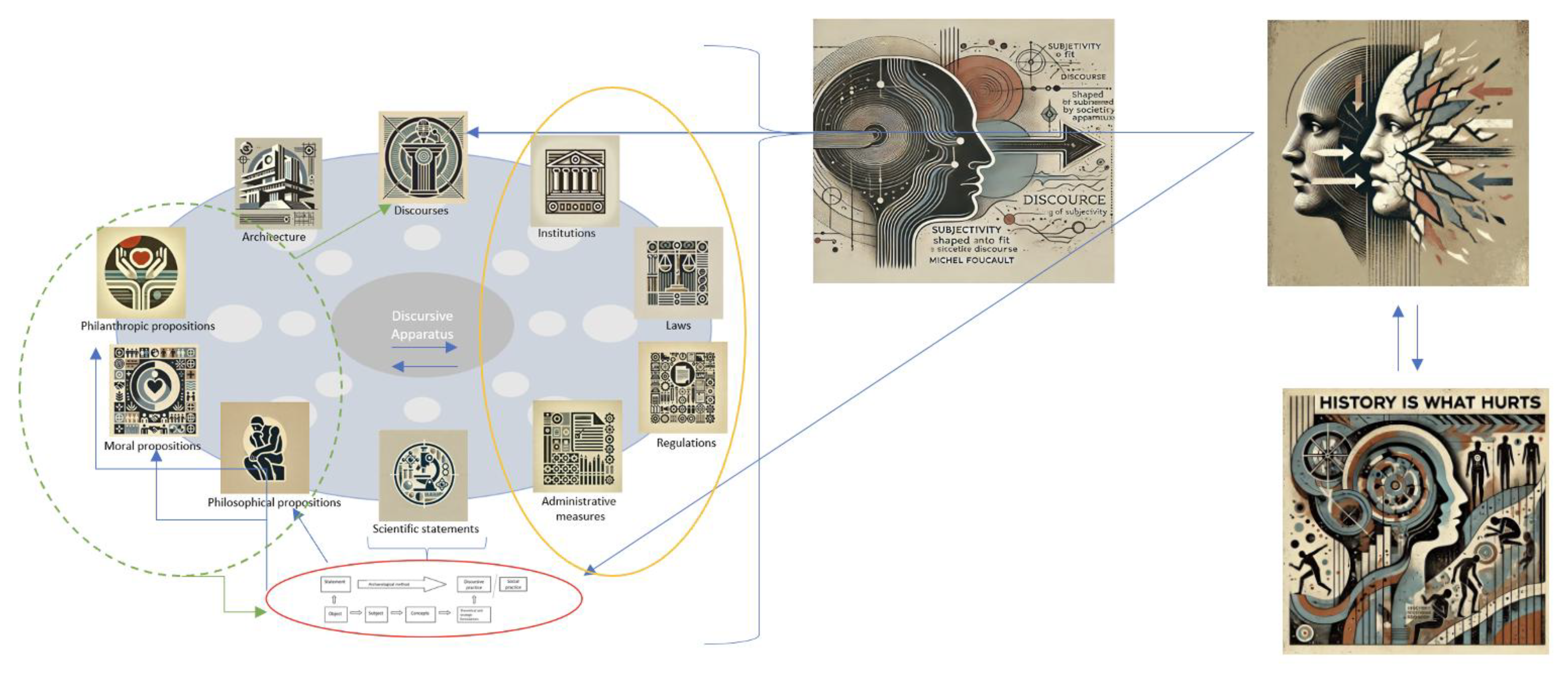
It is precisely within this relationship—between spiritual transformation and genealogical critique—that the production of theological knowledge takes place, always conceived as the second act of a first existential or spiritual experience. In dialogue with Foucault’s archaeological project, Michel de Certeau identifies spirituality as a kind of Trojan horse inserted into theological discourse: it destabilizes doctrinal closures from within and exposes their entanglement with structures of abusive power. This becomes especially urgent in the face of history’s wounds—those open traumas that, through institutional negligence or as by-products of power apparatuses, infiltrate the daily lives of individuals and communities.
3.2. The Archaeology of the Religious and the ‘Genealogy’ of Ethics in Michel de Certeau
In Heterologies, Michel de Certeau describes Michel Foucault’s archaeology as driven by a paradoxical experience of absence and fascination with what he calls ‘the black sun of language’ (Certeau 1986, p. 171). This image refers to a blind spot, an opaque source of light that both generates and obscures meaning, a place where language is revealed in its radical otherness but also in its essential opacity.
For Certeau, this ‘black sun’ expresses the condition of Foucault’s archaeological project: a language that excavates the rules of knowledge formation but finds no ultimate foundation, only a field of games, ruptures and silences. It is a knowledge that operates without a founding subject, without a transcendental origin, but which is paradoxically structured around this central absence. Foucault, according to Certeau, becomes the ‘historian of disappearance’ because he explores the negativity at the heart of Western knowledge, exposes the flaws in the fabric of speech, and illuminates an absence - the death of God, the death of man, the eclipse of full meaning - that underlies modernity (Certeau 1986, pp. 171-172).
This notion has direct implications for the unfinished task of an archaeology of the religious, which would allow a theology of difference to overcome its self-referentiality. The Black Sun suggests that all theological language is pervaded by an original emptiness, an irreducible otherness that prevents any systematic or totalising closure. The theology of difference inspired by this vision does not seek to fill the void with new dogmatic syntheses, but to inhabit the gap, to welcome the otherness of God and the other as sources of meaning that escape attempts at totalisation.
By emphasising the black sun as an image of Foucault’s archaeological language, Certeau invites theology to recognise that its own language is always in danger, always on the threshold between word and silence, between revelation and absence. The Mystic Fable that Certeau explores in his later work is an expression of this tension: speech that is aware of its own inadequacy and yet continues to narrate, to invoke, to translate the ineffable (Certeau 1995, p. 109).
Certeau thus shows how modern history does not completely break with the religious model; it transforms the religious experience of otherness and absence (God, the other) into a historiographical practice that deals with the past as an absent other. For Certeau, the historian becomes the one who replaces the theologian: someone who deals with traces and remnants and, on the basis of them, writes a narrative with an ordering and normative function. His proposal for an archaeology of the religious thus has a critical function: it makes visible this return of the repressed, that is, the persistence of an underlying theological structure in the way historical knowledge is narrated and organised.
Certeau emphasises the question of otherness, which, as we know, is virtually absent from Foucault. He is interested in the experience of those who write history, in the relationship between enunciation and absence, and in the symbolic processes inherited from religion, especially how the symbolic processes of recognising otherness affect social practices despite the discursive practices of normative theology. History is a field for excavating the traces of otherness that are absent from historiography, with social practices being a privileged site for this absent presence of otherness that is repressed from the point of view of discursive practice.
Michel de Certeau does not present a systematic concept of ‘genealogy’ along Foucauldian lines, but offers contributions that allow a genealogical reading of his historiographical method (1975, pp. 14; 107-108; 314). In several passages, especially in Chapter IX, Certeau focuses on the historical shifts in ethics, religion and knowledge, showing how discursive and institutional practices emerge, transform or are marginalised over time . However, the French Jesuit points to the establishment of an epistemological incompatibility between theology and the emerging human sciences in the 19th century, since the latter operated with an ethical primacy of speech, while theology remained with a dogmatic primacy, which hindered dialogue and led back to the distancing.
Rather than a formal theory, Certeau offers a genealogy of ethics as a shifting field of meaning in which ethical discourse emerges not from doctrine, but from situated, embodied practices that function as interpretative operators of modern social life. From the 17th century onwards, Christian ethics was confronted with social and political critiques that displaced it from its normative position and replaced it with a dialectic of uses and conflicts of power, especially with regard to the control of religious behaviour. Between the 17th and 18th centuries, a rupture between religion and morality was consolidated, allowing the emergence of an autonomous social ethics responsible for organising collective practices and relativising inherited belief systems. This autonomy culminated in the Enlightenment with the primacy of ethics over faith, strongly influenced by Rousseau, who privileged morality over dogma. In the 18th century, ethics became associated with the ideal of progress and democratisation, taking on the role of guiding the improvement of societies. Religious practices were reinterpreted in terms of a new social order in which ethics determined behaviour and replaced the old religious frameworks. In this context, Christian ethics was absorbed and reorganised by the logic of the ‘duty of the state’, which linked moral meaning to the social position held and the functions performed. This reorganisation also led to a split between piety and morality: morality became a public language, while piety was relegated to the private sphere. Popular culture, in turn, is reinterpreted as an instrument of public utility, incorporating religious and social practices into the ethical language of modernity. In The Writing of History, Certeau presents a certain ‘genealogy’ of ethics in which it becomes a linguistic-pragmatic device in which ethical speeches organise social meanings, legitimacies and ways of life. It is a practical, situated and historical ethics that functions as a key to understanding human behaviour within the concrete conditions of modern society. In place of obedience to dogma, an ethics emerges as a language of practice, articulated with the apparatuses of the state, with discourses of progress, and with mechanisms of control and self-formation. This ethics replaces dogma as the epistemic axis of the human sciences and functions as a criterion of intelligibility for modern experience (Certeau 1975, p. 19; 152f).
The place of theology seems to have been left empty by the human sciences. Theology is seen as an institution for the enunciation of meaning that remains tied to a dogmatic order, a semantics that is identified either with ideology or with private convictions that are incompatible with scientific analysis. The so-called human sciences, on the other hand, are developing into forms of knowledge whose project and method, based on statutes, social tasks and conflicts, reorganise the meaning of existence. The primacy of ethics for Certeau is not a kind of principle of moral superiority, but rather an operative capacity to produce meaning from everyday life. This primacy relegates theology to a marginal or reactive position, requiring it to reconcile itself with the devices of meaning production inherent in modernity.
Certeau observes that in the context of growing secularisation and religious marginalisation in rural France in the 19th century, many Catholic religious congregations reorganised themselves as forms of social presence aimed at dignifying human life. These congregations, composed of consecrated women and men, developed social and educational activities in line with principles that would later be recognised as human rights, such as access to basic education, health, decent work and child protection. In response to the decline of traditional religious structures and the spread of urban industrialisation, they directed their missions to the interior of the country, where the peasant population found itself excluded from the benefits of technological progress and public education. Certeau describes this reorganisation as a ‘topography of urgencies’ in which evangelisation involved the creation of schools, hospitals, charitable works and mutual support structures in order to associate evangelisation with ‘the fight against the ignorance of the masses, aid to accident victims or abandoned children, the hospitalisation of the sick, the education of girls, scholarships, etc.’ (1975, p. 170).
In 19th-century France, religious congregations developed social practices—education, health, care—which embodied a public ethic anticipating modern human rights discourse (removed for peer review). Although based on theological categories such as salvation, charity and grace, these practices converge with human dignity, promoting inclusion, justice and care for the most vulnerable. It is therefore an incarnate spirituality that responds to modern exclusion through an ethic of presence, anticipating social concerns that would later be addressed in the field of human rights and in the Church’s social doctrine with Rerum Novarum (1891). This phenomenon, described as a response to the urgencies of modernity, constitutes an essential genealogical field of European social Catholicism, providing the historical and theological-practical background for the emergence of liberation theologies in Latin America, for example, and the origins of how the religious agenda of Catholicism intersects with the political agenda of human rights after the industrial revolution, in new forms of critical spirituality and social commitment, bridging to the 20th century and the primacy of ethics as a field for reconfiguring regimes of meaning for a public discursive practice of theology.
Michel de Certeau uses the metaphor of the Trojan Horse to describe the way in which Christian spirituality - and in particular mysticism and social practices of faith - operates within the rigid and dogmatic structures of institutionalised theology. For him, spirituality does not conform to normative orthodoxy, but infiltrates established systems as a foreign body, bringing with it the memory of otherness, absence and promise. In La Fable Mystique, Certeau observes that Christian mysticism - as a practice that occurs in ‘deviation’ and ‘excess’ (Certeau 1995, pp. 29-30) - has often imploded the mechanisms of power and control of dogmatic theology. The spirituality lived out in the social practices of Catholicism - whether through care for the sick, popular education or involvement in social movements - acted as an internal resistance, challenging the mechanisms of doctrinal closure that sometimes legitimised or covered up social injustices. It is, as Certeau says in La Faiblesse de Croire, a ‘weak faith’ that acts as a Trojan horse: it does not seek to conquer or impose, but to destabilise certainties and open spaces for difference, listening and hospitality to the other (Certeau 1987, pp. 25-28).
Certeau understands ‘weak faith’ as a practical, everyday form of theological resistance that reconfigures social space without being bound by rigid forms of control. This weakness is not a sign of impotence, but of openness to otherness and to listening to others. In L’Invention du quotidien (1980), Certeau identifies the place where this faith manifests itself: in simple gestures and anonymous practices that quietly and subversively reconfigure social space. The everyday is the terrain of micro-resistance, where weak faith reinvents itself outside the great institutional narratives. In this perspective, Certeau’s Trojan horse is the ordinary practice of faith itself, which infiltrates institutions and doctrines as a discreet force of transformation: a mysticism that does not cry out but transforms, a spirituality that operates in the ‘low continuous’ of everyday life (Certeau 1987, pp. 25-28). By shifting attention from grand theological constructions to the dispersed and anonymous practices of everyday subjects, Certeau proposes a theology of difference capable of recognising the dignity of the practices of subaltern subjects as producers of new subversive meanings that reconfigure the social order through the creative reinvention of everyday life as a tactic of resistance. The question of genealogy applied to the emergence of ethics can be understood in his perspective as a critical analysis of the processes by which certain regimes of meaning are constituted and stabilised in history, especially since the 17th century. It is linked to his notions of ‘production of place’ and ‘repressed otherness’, since he focuses not only on legitimised speech, but also on absences, silences and practices that escape official narratives - such as popular, mystical or marginalised practices.
In particular, Certeau traces the replacement of theology by ethical speech in the human sciences as a symptom of this epistemic transformation. The archaeo-genealogical question, in this sense, is linked to the task of bringing out the historicity of such displacements - not as linearity, but as ruptures and reconfigurations. Thus, genealogy in Certeau is the movement of critical historicisation of regimes of knowledge, with attention to the excluded and the mechanisms of exclusion that affect both language and social practices.
Michel Foucault’s archaeo-genealogy of knowledge-power and its implications for the task identified by Michel de Certeau as the archaeology of the religious share a common objective: to investigate the historical conditions that make certain statements possible, though each emphasizes different dimensions of that emergence. In proposing his archaeology, Foucault seeks to describe the impersonal rules that structure the formation of knowledge in different epochs, revealing the systems of enunciability that define the field of what can be thought. Certeau appropriates and displaces Foucault’s archaeological method, applying it to reveal the underlying theological logic in historiographical forms. While Foucault traces discursive conditions, Certeau maps the interruptions introduced by social practices that do not conform to established discursive regimes—what the figure identifies as non-discursive practices with subversive effects. He showed how Western historiography, in seeking to ground itself in scientific rationality, nevertheless inherits from religious scriptures a logic of enunciation oriented toward absence and the symbolic management of alterity. Both archaeologies, therefore, offer critical and methodological tools for constructing an archaeology of theological knowledge: one capable of identifying the historical, discursive, and institutional conditions under which theological knowledge arises, while also uncovering its continuities, ruptures, and specific regimes of truth. In this sense, the analysis of theological knowledge must attend equally to its non-discursive dimension: to the social practices that reinvent everyday life from within a theological horizon and that, as illustrated in Figure 6, act as Trojan horses disrupting the mechanisms of control that seek to contain theological discourse.
Moreover, insofar as Foucault’s archaeology is linked to his genealogical method, it proves extremely useful in identifying how religion can be understood as a complex phenomenon in which, within its theological discursive context, genealogies of power and genealogies of ethics coexist—often sustained by a silent theology revealed in the social practices it supports. As Metz pointed out, in twentieth-century contextual theologies, there is a form of revelation that occurs precisely in concrete action directed toward the transformation of reality(1999, pp. 246–55). These practices act as Trojan horses that undermine abusive forms of power rooted in religious discourse. This dual movement of archaeology and genealogy—as visualized in Figure 6—constitutes a critical toolbox for identifying modes of theological self-referentiality and recovering the public relevance of subaltern practices that challenge and transform the structures of discourse from within.
4. Constructing the ‘Toolbox’: An Archaeo-Genealogy Approach for Public Theology
Although Foucault did not develop an archaeology of theological knowledge, it is possible to identify, within his analysis of the Human Sciences, certain implications for theology—especially through his genealogical approach, which has already explored the secularized expressions of religion within culture.
This section seeks to outline a programmatic set of tasks, based on the theological implications of applying archaeological and genealogical tools to the development of a public theology—one capable of overcoming self-referentiality, engaging in transdisciplinary dialogue, and responding to the demands of the public agenda. Such a theology would be structured not only by its content but also by its method: it would operate according to criteria of argumentation grounded in public rationality, capable of addressing diverse interlocutors beyond confessional boundaries, and of articulating normative claims in terms accessible within pluralistic and democratic contexts. To this end, the following subsections will be dedicated respectively to the four fundamental components of this methodological framework: (4.1) the Object of theological discourse, which must be redefined in relation to the historical conditions of knowledge; (4.2) the Epistemic Subject, whose modes of constitution and location within power-knowledge dynamics must be critically examined; (4.3) the Concepts that articulate theological reasoning, and how they are historically shaped and strategically mobilized; and (4.4) the Theoretical or Strategic Formulations, through which theology engages its public role and contributes to the configuration of shared intelligibility, and commitment to a public agenda—namely, nowadays, the 2030 Agenda.
In the regime of divinatio, divine signs are revealed in creation, with God immanent in the world and humans as imago mundi—capable of understanding God through the world. In the regime of eruditio, by contrast, God is located in the realm of ideas, often invoked to idealistically justify political projects (theodicies) and framed as divine missions by political mediators. With the rise of the human sciences, theology effectively disappears from Foucault’s archaeological project. Yet, even as knowledge becomes secularized, power structures continue to mobilize theological frameworks as technologies of power—particularly in regulating life and subjectivity, drawing on mechanisms developed as early as the 17th century.
From the modern episteme onwards, theology faces the challenge of its own self-referential condition, mirroring the broader cultural logic of knowledge production—marked by a tendency to reproduce sameness. In this scenario, knowledge is no longer defined as a reference to a revealed absolute truth, but as discernment - establishing distinctions, operating classifications, and constructing meaning through the play of difference, in order to identify new forms of epistemic configurations or regimes of intelligibility:
“The activity of the mind – and this is the fourth point – will therefore no longer consist in drawing things together, in setting out on a quest for everything that might reveal some sort of kinship, attraction, or secretly shared nature within them, but, on the contrary, in discriminating, that is, in establishing their identities, then the inevitability of the connections with all the successive degrees of a series” (Foucault 2005a, p. 61).
4.1. The Object of Theology After Modern ‘Episteme’
This epistemological gesture of modern discernment4 replaces the Renaissance logic of analogy with a logic of difference that structures statements from the outset. Rather than confirming hidden metaphysical resemblances, modern discourse produces knowledge by establishing distinctions and generating new articulations of meaning. Within the modern episteme, discernment acquires a critical function: it interrogates the empirical-transcendental conditions of all knowledge, marks the boundary between thought and knowledge, and affirms the historical finitude of the knowing subject as both condition and limit of epistemic formation.
Foucault’s metaphor of archaeology refers to a critical practice of excavation that uncovers the layers of discourse connecting past and present. In this method, a past discursive formation may leave enduring traces within a new historical context by establishing regularities in the interplay of knowledge, power, and subjectivation. Similarly, historical events may give rise to new discursive regimes—disruptive occurrences that inaugurate novel rules of formation, altering how reality is articulated and understood.
Unlike structuralist or purely linguistic approaches, Foucault conceives discourse as a historically situated system of rules and practices that produce a specific version of reality. Discourse defines the objects, concepts, and representations that are sayable, while simultaneously delimiting the conditions under which power can operate through the production of knowledge.
Within the modern episteme, Foucault identifies an “analytics of finitude” (2005, p. 346), through which “man” emerges as a discursive event marked by a dual structure: he is both an object of empirical knowledge—living, working, and speaking—and the subject who produces knowledge about life, labor, and language. In this configuration, human finitude becomes the historical condition of possibility for knowledge of an object that is, paradoxically, the human itself. For the first time since the late eighteenth century, finitude is no longer understood in opposition to divine infinity—as deficiency or fall—but rather as the positive epistemic foundation of modern knowledge.
Since the epistemic rupture of the modern age, the human being has been situated at the intersection of three empirical domains—life, labor, and language—each giving rise to corresponding disciplines: biology, political economy, and philology. These domains define three epistemological regions that shape the object “man” as both knowable and self-reflective. Psychology emerges at the intersection with biology, extending physiological functions into symbolic and psychic representations. The social sciences arise from political economy, framing the individual as producer, consumer, and bearer of cultural norms. Literature and linguistics develop from philology, providing a field in which language structures the subject’s relation to meaning, identity, and expression. In this configuration, the human sciences produce a reduplication of the subject as both object of knowledge and agent of discourse.
In Foucault’s framework, the object of discourse is not a stable referent but is constituted through a network of relations with other statements. It emerges within a field of proximities, analogies, discontinuities, and transformations that define its specificity. These relations are not intrinsic to the object itself but are formed across discursive, institutional, and social structures:
“These relations are established between institutions, economic and social processes, patterns of behavior, systems of norms, techniques, forms of classification, modes of characterization; and these relations are not present in the object” (Foucault 2008, p. 50).
Within this new epistemic regime, theology encounters significant resistance in asserting itself as a scientific form of knowledge, particularly when it treats Revelation as its immediate and absolute object. Despite recent efforts to make theology intelligible to the modern subject, the notion of Revelation as an unquestionable foundation risks sustaining genealogies of power that resist self-critique. When Revelation is upheld as a fixed datum without revisiting its historical and cultural mediations, theology may solidify into a system of belief immune to critical engagement—accessible only to those who share the same foundational experience. This leads to what Paul Ricoeur calls the “inversion function” of ideology: the substitution of concrete historical perception by idealized theodicies that claim divine legitimacy. In this logic, a self-referential understanding of Revelation can become an ideological system that disables critical thought, naturalizing belief structures that deny their own historicity and contingency (Ricoeur 2011; removed for peer review).
A critical rationality does not align neatly with the dialectical polarizations of political ideology or with totalizing worldviews. As Foucault emphasizes, power relations are “complex phenomena that do not follow the Hegelian form of dialectics; power may retreat, shift, invest elsewhere… and the struggle continues” (Foucault 1977, p. 83). A theological understanding that remains closed within the authority of Revelation risks reproducing a dualistic worldview—polarizing subjects, knowledges, and power structures—thereby impeding the emergence of a critical rationality open to dialogue, reflexivity, and self-questioning.
Both right- and left-wing authoritarian regimes have historically instrumentalized religion as a tool of control or persecution, exposing the ideological function of non-critical theology. An archaeological analysis of theological discourses and social practices can reveal how power and resistance are configured in specific contexts. When detached from critical hermeneutics, Revelation may function as an ideological system—operating, in Fredric Jameson’s terms, as a “political unconscious” that legitimates violence and silences alternative voices (Jameson 1992, pp. 39–43).
In light of the modern episteme and Foucauldian thought, the contemporary task of theology is to move beyond self-referential closure and offer a critical rationality within systems of belief. Theology must position itself within the field of religion as a complex phenomenon, acknowledging that religious practices are traversed by power-knowledge relations. This requires constant ethical and epistemic discernment of their conditions of possibility, mediations, and effects—making theology capable of engaging public rationality and the plural, dynamic expressions of religiosity in contemporary society.
The central affirmation of Laudato si’—that “everything is interconnected” (Francis 2015, nn. 16, 138)—should not be interpreted as a return to the Renaissance episteme, where symbolic analogy structured the intelligibility of the world. Rather, it is situated within the horizon of the modern episteme, which demands critical discernment of the historical, political, and epistemic conditions that fragmented knowledge and disarticulated the relations between beings and the world. To affirm interconnection today is not to presume it as given, but to recognize it as an ethical and political task. Ecological spirituality, as proposed by the encyclical, mobilizes modern discernment—attuned to finitude, historicity, and complexity—as a form of resistance to the modern separations between subject and nature, technical knowledge and practical wisdom, power and care. Interconnection thus becomes not a natural resemblance, but a responsibility enacted through discernment and commitment.
Thus, after the modern episteme, the object of theology can no longer be taken as an absolute datum, but must be understood as the discursive and practical negotiation of a critical rationality within a system of belief—particularly one historically shaped by the category of Revelation.
4.2. The Need to Disambiguate the Epistemic Subject of Theology
Throughout history, the epistemic subject of theology has not been confined to traditional ecclesial or academic settings. The articulation between theological knowledge and structures of power has enabled the emergence of political agents who, by appropriating the language of Revelation, have claimed the role of authorized interpreters of orthodoxy. Under this dynamic, theology has often been instrumentalized as a tool for legitimating state projects, shifting soteriological mediation from ecclesial authority to political figures. Investigating this emergence through the lens of enunciative modalities entails examining the institutional sites, discursive positions, and mechanisms of validation that define who holds epistemic authority to speak theologically in the public sphere—as a form of critical inquiry.
Disambiguating the epistemic subject of theology therefore requires a critical examination of the historical and institutional mechanisms through which theological authority is constructed, appropriated, and mobilized—often beyond ecclesial or academic boundaries, and frequently aligned with political projects of legitimation.
4.2.1. Enunciative Modalities and the Configuration of the Epistemic Subject
Epistemic subjects are embedded within enunciative modalities. To illustrate this, Foucault examines the diversity of statements in nineteenth-century medical discourse, not to reduce them to a unifying logic, but to reveal the rule—or “law”—that governs their variation and origin. Foucault’s analysis of enunciative modalities invites three fundamental questions that help define the configuration of the epistemic subject within a discursive formation (Foucault 2010, p. 56):
Who speaks? This question addresses the identification of those subjects who hold the status of legitimate bearers of knowledge. Such legitimacy is grounded in criteria of competence, institutional affiliation, and adherence to discursive norms that authorize their speech. This status is not intrinsic to the individual but is defined by a relational system involving the specific field of discourse and its connections to broader social structures—such as political, juridical, and religious institutions—which assign the subject a historically and socially situated role.
What are the institutional sites of discourse? These are the spaces that structure discursive practice by defining its objects and its criteria of validation. In the case of medical discourse, for example, Foucault highlights three main sites: the hospital (as a field of observation and clinical application), the laboratory (as a space for experimentation and production of general truths), and the library (as a repository of knowledge and supporting data). In the nineteenth century, these sites became integrated through experimental norms shared across the natural sciences.
What are the positions of the speaking subject? These are defined by the relation between the subject and the objects of their discourse, according to the interpretative lens and conceptual framing applied. Such positions vary depending on the level of observation (e.g., from symptom to cell) and the subject’s role in the network of knowledge—as teacher, researcher, communicator, or analyst. These positions are also shaped by historical shifts, technological innovations, and new systems of classification, registration, and pedagogy.
Theology, as a historically embedded discourse, has produced a variety of epistemic subjects shaped by shifts in enunciative configurations. In the fourteenth century, the term theologia began to emerge as conceptually distinct from sacra doctrina, especially in humanist critiques such as those of Lorenzo Valla (1407–1457). In his Disputationes Dialecticae, Valla emphasized theology as a rhetorical and experiential discourse grounded in Christian faith, distinct from ecclesiastical discourse and its institutional interests within the political regime of Christendom. This shift marks a fragmentation of theological knowledge across church and university contexts. Yet with the rise of political theologies in early modern Europe, theological language was appropriated to legitimate state power, transferring soteriological mediation from ecclesial to political authorities.
Three paradigmatic figures exemplify this transformation. António Pereira de Figueiredo (1725–1797) served as a theologian aligned with the regalism of the Marquis of Pombal in Portugal. As head of the Royal Censorial Board—a secularized Inquisition—Figueiredo helped legitimize royal authority through theological discourse, promoting a national church subordinated to the state. His epistemic legitimacy derived from his academic training, political alignment, and opposition to the Jesuits. His Portuguese Bible translation became both a religious and political instrument, redefining ecclesial authority under royal patronage (Franco & Vogel 2009; Figueiredo 1821).
Napoleon Bonaparte (1769–1821) offers a second example. His act of self-coronation embodied a secular messianism that displaced the Church’s soteriological authority. Robert Antoine de Beauterne (1806–1846) helped construct Napoleon’s theological image, portraying him as a divine instrument of historical regeneration (Beauterne 1841). This narrative transferred belief in God to a “science of God,” with intellectuals replacing priests as technicians of truth at the service of empire (Bowman 1990).
A third example is Otto von Bismarck (1815–1898), who, as chancellor of the Second Reich, promoted a state-based political theology grounded in Protestant pietism. His approach subordinated religion to German nationalism and prefigured Carl Schmitt’s later theorization of political theology (Lacour-Gayet 1919). Nietzsche had already denounced theology as a discourse of imaginary causes driven by the will to power (Nietzsche 1888). Today, similar dynamics appear in religious discourse that denies scientific authority, exposing the limits of concordatarian arrangements and the persistence of fundamental theology as sophisticated apologetics for Revelation.
By contrast, when enunciative modalities are applied to public theology in contemporary academic contexts, the epistemic subject is no longer defined by confessional authority but by institutional recognition, methodological critique, and public responsibility. Situated within universities, theology is challenged to articulate its epistemic legitimacy before plural audiences. The subject who speaks theologically in public is not one who claims authority through ecclesial status, but one who locates their discourse within a critical rationality and offers religious tradition as a meaningful resource for collective projects of justice and human dignity. Public theology thus constitutes not merely a discursive reconfiguration, but the emergence of an enunciative position committed to the ethical translation of religious knowledge within plural societies—aligned with agendas such as the 2030 Agenda and human rights. In this horizon, the legitimacy of theology does not lie in asserting absolute truths, but in its capacity to contribute meaningfully to the construction of the common good.
4.3. Public Ethic as First Theology: The Translation of Theological Concepts into a Public Rationality
Following Foucault’s analysis of concept formation, it becomes clear that scientific discourse is structured through enunciative fields governed by rules of succession, correlation, and rhetorical organization (Foucault 2008, p. 62). These elements do not merely regulate the circulation of concepts, but shape their fields of presence, simultaneity, and memory, thereby conditioning their acceptance, critique, or exclusion. Concepts emerge not from timeless truths or pure logic, but from the historical inscription of discursive practices and interventions that organize knowledge and power.
In this light, theology can no longer claim Revelation as the ultimate and absolute criterion of its discourse. Such a claim often legitimizes the persistence of political theologies that absolutize specific configurations of power. As Michel de Certeau argues, there is an epistemological incompatibility between classical theology—anchored in dogmatic primacy—and the modern human sciences, which emerged around an ethical primacy as their epistemic and practical foundation (Certeau 1975, p. 156).
Nonetheless, Certeau also recognizes that, over time, theology—particularly through the tradition of Catholic social thought—began aligning itself with this ethical primacy. In post-revolutionary France, where human rights were largely restricted to urban contexts, religious congregations operating in rural areas established schools, hospitals, and social services. These practices reintroduced theology into debates on human dignity, configuring a form of political spirituality grounded in public ethics and the defense of universal dignity. This development retrieved the theological principle of the imago Dei as a foundation for the universality of human rights.
The notion of public ethic as an epistemic criterion for post-secular theology arises from the translation of the foundational category of theological anthropology—the human being as imago Dei—into the modern conception of human dignity and rights. This shift reconfigures imago Dei from a dogmatic affirmation to an operative principle within legal, political, and social frameworks. What was once a theological affirmation has become a normative pillar in democratic constitutions and international declarations of universal rights.
This movement continues today in the ecological field through the translation of the theological concept of common home into the global ecological agenda. When reinterpreted in light of interdependence and relationality among all creatures, imago Dei supports a public ethic that extends beyond the human, embracing the totality of creation. Public ethic thus becomes a normative framework for socio-environmental justice and sustainability, centered on a planetary common good, as proposed by Pope Francis in Laudato si’.
Public ethic therefore imposes itself as an epistemic criterion for a post-secular theology that seeks to overcome self-referentiality and the use of Revelation as an identity-bound device. Unlike political theologies that co-opt Revelation to serve nationalist or sectarian agendas, a public ethic grounded in human dignity calls for a theology oriented toward the construction of the common good. This ethic resists reduction to dogmatic moralism and instead offers a socially engaged justice that recognizes alterity and equal dignity in every subject.
This reorientation is not foreign to the Christian tradition. In late antiquity, theology was not conceived apart from philosophy. What we now call theology was often understood as a vocation to live the philosophical ideal. Early Christianity viewed this ideal as inherently public and ethical: “The Christian in the city (polis) is a citizen (politai)” (Letter to Diognetus 5.5). This did not entail withdrawal from the world, nor submission to theocratic projects, but active ethical citizenship grounded in shared dignity. Early Christian life modeled a public ethic rooted in justice, solidarity, and mutual responsibility—expressions of a faith embodied in common life.
By submitting itself to the primacy of public ethic, post-secular theology acknowledges that its task is not to offer a final word on truth, but to contribute to the construction of a plural, inclusive public rationality. Ethics as first theology does not negate its link to Revelation but reconfigures its epistemological function: human dignity becomes the hermeneutical key for theological discourse within modern regimes of knowledge. This approach derives from a hermeneutic of the ethical effects of the narrative of Incarnation, itself grounded in Revelation, yet oriented toward a theology of the common—rooted in fraternity, justice, and plural recognition.
This displacement invites us to understand theological concepts not as products of an untouchable revelation but as historically situated discursive constructions, subject to critical evaluation. Public ethic redefines theology as a field of discernment and commitment to justice and peace—an alternative to the logic of sovereignty that has long dominated political theologies. It reinserts theology into networks of resistance and solidarity, making possible a critical, ecological theology grounded in common dignity and care for our common home. Theology becomes the second act of an original experience: it emerges from diverse political spiritualities and gives rise to new political actors.
Saint John Chrysostom (347–407) represents one such political spirituality. His example challenges Foucault’s interpretation of monastic obedience through the figure of John Cassian, who saw obedience as a means of forming subjected subjectivities. By contrast, Chrysostom embodied a form of obedience rooted in ethical fidelity to the Gospel, which refused submission to the authority of the Christian emperor Arcadius—against whom he spoke out forcefully, particularly in his homilies denouncing court corruption and imperial interference in ecclesial matters (John Chrysostom 1988). His critique of corruption at the Christian court and his refusal to conform to ecclesiastical power structures show that Revelation, when captured by institutional interests, becomes insufficient for resisting arbitrariness. His life prefigures a genealogy of Christian ethics in which mysticism is inseparable from critical engagement. This ethical stance inspired bishops in Latin America and Eastern Europe who, under authoritarian regimes, took prophetic stands alongside the people as figures of political resistance.
In doing so, these actors reflected the ethical roots of political spiritualities, drawing on the impact of Christ’s Incarnation, which affirms human dignity not only in contrast to God’s transcendence, but in the positive vocation of ethical protagonism—manifest in the human rights movement and the ecological agenda.
This theological perspective provided a foundational grammar for the emergence of the Déclaration des droits de l’homme et du citoyen. Ethics as first theology thus does not reduce theology to secular humanism, but instead affirms a shared dignity that grounds all human and created life as a theological effect. The original 1789 publication of the Declaration—depicted in Figure 7 and Figure 8 by Jean-Jacques-François Le Barbier—features God explicitly as the “Supreme Being,” visually signaling the theological roots of universal human rights and the transcendent dimension of civic responsibility.
However, this theological grounding was neither uniform nor uncontested. With the rise of Napoleonic political theology—where sovereignty was recast as divinely sanctioned and centralized in the emperor—a significant shift occurred. Revolutionary narratives began to frame religion as a threat to reason and civil order. This inaugurated a tension that persists today, where theology functions both as a genealogy of ethical universality and, at times, as a genealogy of power serving identity and control.
Unlike exclusionary political theologies that instrumentalize Revelation to uphold national, racial, or confessional boundaries, the theological concept of human dignity affirms a God who transcends such divisions—a God who loves universally, beyond race, religion, and class. This vision resists the subordination of theology to sovereign power and instead fosters a public theology of coexistence: one capable of sustaining peace by affirming unity in plurality.
In this sense, the task of a post-secular theology is not to impose or replace dogmatic certainties, but to contribute critically to the shaping of a public rationality—one capable of sustaining justice, peace, and the dignity of all beings as a shared ethical horizon.
4.4. Theoretical Strategies and Epistemic Simultaneity in Contemporary Research on Theology and Religious Studies
Foucault’s archaeological method identifies the episteme of an era as a field of discursive simultaneity across disciplines. In modernity, theoretical strategies emerge from within specialized discourses—such as economics, medicine, or grammar—organizing new concepts and regrouping objects according to criteria of coherence, rigor, and internal stability (Foucault 2010, p. 73). Analyzing how these discourses are formed allows us to understand their internal systems of regularity, as well as the diffraction points where incompatibilities emerge between objects, concepts, and modes of enunciation within the same field.
Foucault’s approach reveals not only points of rupture, but also connections and equivalences that give rise to new discursive configurations. When applied to the study of theology and religious studies, this method shows that both fields operate within a constellation of epistemic simultaneity, shaped by theoretical reconfigurations that respond to shifts in knowledge conditions.
As illustrated in Figure 9, the empirical sciences (such as political economy, biology, and philology) provided the basis for the emergence of the human sciences (sociology, psychology, and literary analysis) through what can be called the anthropological turn of the empirical model. This transformation enabled the human being to be understood not only as an object of knowledge, but also as its subject—an epistemic shift that reshaped entire disciplines. This transition marked a reconfiguration of scientific paradigms toward new fields of inquiry, emphasizing experience and human subjectivity.
As represented in Figure 9, contemporary theology emerges within this epistemic constellation, repositioned between foundational human sciences and interpretive disciplines that mediate religious meaning in the public domain. Within this epistemic reorganization, Religionswissenschaft (science of religion) emerged as a systematic field for the academic study of religion. Unlike dogmatic theology, Religionswissenschaft privileges historical, sociological, psychological, and linguistic analyses of religious phenomena. It branches into subfields such as the sociology of religion, the psychology of religion, and the sciences of religious language (e.g., exegesis, hermeneutics, and literary analysis). These fields share a commitment to critique and operate within the same rational space as the modern human sciences.
Simultaneously, contemporary theology was profoundly shaped by the anthropological turn, particularly through the work of Karl Rahner. In this turn, the question of God is approached through the structure of human knowledge, resulting in a metaphysics of subjectivity rather than of being. Affective experience, historicity, and existential facticity become central theological loci. Theology thus moves away from a speculative mode toward a performative one, where the knowledge of God is inseparable from self-knowledge—that is, from the transcendental condition of the human person as spirit in the world. In Rahner’s view, theology does not arise from direct knowledge of God as an object, but from a possible knowledge grounded in the analysis of religious experience. God is not unknowable, but is thinkable within the complex religious phenomenon—historically mediated, linguistically articulated, and anthropologically situated (Rahner 1964, p. 104).
Far from being a mere reception of the human sciences, this development constitutes a distinct discursive strategy of theology, one that seeks epistemic legitimacy through human experience as a locus theologicus. This opens the path to contextual theologies, and ultimately, to the possibility of public theology itself.
Foucault reminds us that every discursive formation is “essentially lacunar”—it does not exhaust the field of possible knowledge, but inhabits only a constellation of active relations. Thus, when situated in new discursive constellations, older formations can generate new objects, concepts, and statements. This explains how, in the 21st century, the discursive constellation that links theology and the human sciences has come to be rethought through the paradigms of public ethics, theological anthropology, and critical theory—distancing itself from identity-based political theology.
From the perspective of epistemic simultaneity, the emergence of Religionswissenschaft and the anthropological turn in theology represent distinct yet converging responses within the modern study of religion. When anchored in public rationality, faith is no longer an obstacle to dialogue between theology and religious studies. This suggests that their divergences are less epistemological than political—rooted in institutional arrangements, funding structures, and conflicting visions of public engagement. One key dimension of this political tension lies in the persistent confusion between theology as a form of public, critically engaged rationality and theology as a discourse primarily oriented toward internal ecclesiastical purposes. Contemporary public rationality—ethical, ecological, and critical—provides a discursive space where theology and religious studies function not as rivals, but as mutually enriching partners in a shared research horizon.
5. Conclusions
This article proposed an archaeo-genealogical approach to theological knowledge in order to address the epistemic and political problem of self-referentiality in contemporary theology. Based on Michel Foucault’s archaeological and genealogical tools, and in dialogue with Michel de Certeau’s reflection on the persistence of the religious within modern discourses, we argued that theology must undergo an epistemological reconfiguration to become a form of public knowledge. The proposed analytical framework identifies the historical conditions that led theology to epistemic isolation and explores the possibility of its reintegration into the university context through a critical engagement with public rationality.
This task requires displacing Revelation as an unquestionable and absolute epistemic criterion and recognizing it instead as a historically mediated discourse subject to critique and translation. Theology, then, is not abolished, but re-situated: no longer defined by confessional closure, but by its contribution to the common good, to interdisciplinary dialogue, and to the ethical discernment of plural societies.
Throughout the article, four analytical axes were developed. Section 4.1 revisited theology’s object, showing how Revelation must be read in light of modern finitude and historicity. Section 4.2 examined the epistemic subject of theology, tracing how authority has shifted from confessional to public discursive positions. Section 4.3 proposed the notion of public ethic as first theology, translating theological concepts like imago Dei or common home into categories operative within plural rationalities. Finally, Section 4.4 contextualized this transformation within broader patterns of epistemic simultaneity between theology and religious studies.
In this light, a useful heuristic emerges by distinguishing between the ideological and axiological dimensions of the religious. The ideological dimension, when absolutized, sustains genealogies of power that instrumentalize religion for the reinforcement of identity, exclusion, or political control. The axiological dimension, by contrast, supports genealogies of faith grounded in ethical openness, critical discernment, and the transformation of subjectivity through practices of justice, care, and hospitality. Theology, when aligned with this axiological field, moves away from sovereign logic and toward an active contribution to the ethical imagination of democratic societies.
Thus, an archaeo-genealogy of theological knowledge is not merely an academic exercise, but a methodological commitment to distinguish and expose these genealogies—resisting theological complicity with power, and recovering theology’s potential to articulate a critical, ethical, and plural discourse. This shift enables theology to speak from within, but not only to itself—and, in doing so, to participate in building a world more attentive to dignity, justice, and our common home.
Author Contributions
The Authors have contributed equally to this work and share first authorship.
Funding
removed for peer review
Acknowledgments
removed for peer review
Conflicts of Interest
The authors declare no conflicts of interest.
| 1 | The term dispositif appears in Foucault’s original French, while dispositive is common in English translations and discourse studies. To avoid conflation with legal terminology, some scholars now retain the French. The term apparatus has circulated since the first English translations of The History of Sexuality and was reinforced by Agamben’s What is an Apparatus? (2009, p. 14). |
| 2 | First published in French as Les mots et les choses (Gallimard, 1966), the book appeared in English as The Order of Things: An Archaeology of the Human Sciences (Foucault 1970), a title chosen to avoid confusion with similarly named works and to highlight its focus on historical formations of knowledge. All English quotations refer to the 2005 Routledge edition. |
| 3 |
Figure 1 is an adapted version of Gonçalves, Sérgio Campos. 2009. O método arqueológico de análise discursiva: o percurso metodológico de Michel Foulcault. História e-História. Campinas/SP: NEE-UNICAMP, v. 1, 4 de fevereiro, p. 1-21. |
| 4 | In the original French edition, Foucault uses the word ‘discerner’ (1966, p. 57), but in the English translation there is a variation between ‘discern’ and ‘discriminating’ (2005, p. 61; 118; 275; 360). |
References
- Agamben, Giorgio. 2019. Signatura rerum: Sobre o método. Translated by Andrea Santurbano and Patricia Peterle. São Paulo: Boitempo.
- Agamben, Giorgio. What is an Apparatus? And Other Essays. Stanford: Stanford University Press, 2009.
- Baubérot, Jean. 2000. Histoire de la laïcité en France. Paris: Presses Universitaires de France.
- Beauterne, Robert Antoine de. 1841. Sentiment de Napoléon sur le christianisme: Conversations religieuses recueillies à Sainte-Hélène par M. le général Comte de Montholon, avec un dessin de M. Horace Vernet, et un fac-simile de l’écriture de l’Empereur. Paris: Waille Libraire. Source: Bibliothèque nationale de France. Available online: https://gallica.bnf.fr/ark:/12148/bpt6k6138553m (accessed on 1 May 2025).
- Bernauer, James, and Jeremy Carrette. 2016. Michel Foucault and Theology: The Politics of Religious Experience. London and New York: Routledge.
- Bowman, Frank Paul. 1990. French Romanticism: Intertextual and Interdisciplinary Readings. Parallax: Re-visions of Culture and Society. Baltimore: The Johns Hopkins University Press.
- Campiche, Roland. 2010. La religion visible: Pratiques et croyances en Suisse; Presses polytechniques et universitaires romandes. Lausanne: Switzerland.
- removed for peer review.
- removed for peer review.
- removed for peer review.
- Casanova, José. 1994. Public Religions in the Modern World. Chicago: University of Chicago Press.
- Certeau, Michel de. 1975. L’Écriture de l’Histoire. Paris: Gallimard.
- Certeau, Michel de. 1980. L’Invention du quotidien. Vol. 1: Arts de faire. Paris: Gallimard.
- Certeau, Michel de. 1986. Heterologies: Discourse on the Other. Minneapolis: University of Minnesota Press.
- Certeau, Michel de. 1987. La Faiblesse de croire. Edited by Luce Giard. Paris: Éditions du Seuil.
- Certeau, Michel de. 1995. The Mystic Fable, Volume One: The Sixteenth and Seventeenth Centuries. Translated by Michael B. Smith. Chicago: University of Chicago Press.
- Chadwick, Owen. 1990. The Secularization of the European Mind in the Nineteenth Century. Cambridge: Cambridge University Press.
- Chevallier, Philippe. 2024. Michel Foucault et le christianisme. Nouvelle édition revue et augmentée. Collection “La croisée des chemins”. Lyon: ENS Éditions.
- Davie, Grace. 2002. Europe: The Exceptional Case: Parameters of Faith in the Modern World. London: Darton, Longman & Todd.
- Domingues, Ivan. 2023. Foucault, a arqueologia e As palavras e as coisas – Cinquenta anos depois. 2nd ed. rev. ampl. Belo Horizonte: Editora UFMG. [CrossRef]
- Figueiredo, António Pereira de. 1821. A Sancta Biblia: Contendo o Velho e o Novo Testamento. Traduzidos em Portuguez pelo Padre Antonio Pereira de Figueiredo. Londres: Impressa na Officina de B. Bensley, em Dolt-Court, Fleet-Street. Edição digitalizada. Disponível online: https://archive.org/details/asanctabibliaco00socigoog/page/n5/mode/2up (accessed on 21 February 2025).
- Foucault, M. 2005a. The Order of Things: An Archaeology of the Human Sciences. London and New York: Routledge Classics. First published in English 1970 by Tavistock/Routledge.
- Foucault, Michel. 1961. Histoire de la folie à l’âge classique. Paris: Plon.
- Foucault, Michel. 1966. Les Mots et les Choses: Une archéologie des sciences humaines. Paris: Gallimard.
- Foucault, Michel. 1969. L’Archéologie du Savoir. Paris: Gallimard.
- Foucault, Michel. 1971. L’Ordre du discours. Paris : Gallimard.
- Foucault, Michel. 1973. The Birth of the Clinic: An Archaeology of Medical Perception. Translated by A.M. Sheridan. London: Tavistock Publications. Reprint, Taylor & Francis e-Library, 2003.
- Foucault, Michel. 1977. Microfisica del potere. Edited by Alessandro Fontana and Pasquale Pasquino. Torino: Einaudi.
- Foucault, Michel. 1994. Dits et Écrits IV (1980–1988). Éditions établie sous la direction de Daniel Defert et François Ewald avec la collaboration de Jacques Lagrange. Paris: Éditions Gallimard.
- Foucault, Michel. 1999. Religion and Culture. Selected and organized by Jeremy Carrette. New York: Routledge.
- Foucault, Michel. 2001. Os anormais: Curso no Collège de France (1975-1979); Tradução de Eduardo Brandão; Martins Fontes: São Paulo.
- Foucault, Michel. 2005b. The Hermeneutics of the Subject: Lectures at the Collège de France, 1981–1982, edited by Frédéric Gros, translated by Graham Burchell, Palgrave Macmillan.
- Foucault, Michel. 2006. Ditos e Escritos IV; tradução e organização de Manoel de Barros da Motta; Forense Universitária: Rio de Janeiro.
- Foucault, Michel. 2008. Segurança, território, população: Curso dado no Collège de France (1977–1978). Tradução de Eduardo Brandão. São Paulo: Martins Fontes.
- Foucault, Michel. 2010. The Archaeology of Knowledge and The Discourse on Language. Translated by A.M. Sheridan Smith. New York: Pantheon Books.
- Foucault, Michel. 2018a. Histoire de la sexualité: Les aveux de la Chair. Edited by Frédéric Gros. Collection Bibliothèque des Histoires. Paris: Gallimard.
- Foucault, Michel. 2018b. Do governo dos vivos. Curso no Collège de France (1979–1980); Edição estabelecida por Michel Senellart, direção de François Ewald e Alessandro Fontana; Tradução de Eduardo Brandão; Martins Fontes: São Paulo.
- Foucault, Michel. O Uso dos Prazeres: História da Sexualidade, vol. II. Rio de Janeiro: Graal, 1984.
- Franco, José Eduardo, and Christian Vogel. 2009. Um acontecimento mediático na Europa das Luzes: A propaganda antijesuítica pombalina em Portugal e na Europa. Brotéria 169: 349–506.
- Geffré, Claude. 1972. Un nouvel âge de la théologie. Paris: Cerf.
- Gonçalves, Sérgio Campos. 2009. O método arqueológico de análise discursiva: o percurso metodológico de Michel Foulcault. História e-História. Campinas/SP: NEE-UNICAMP, v. 1, 4 de fevereiro, p. 1-21.
- Gutiérrez, Gustavo. 1971. Teología de la liberación: Perspectivas. Lima: Centro de Estudios y Publicaciones (CEP).
- Habermas, Jürgen. 2009. Zwischen Naturalismus und Religion: Philosophische Aufsätze. Frankfurt am Main: Suhrkamp.
- Harrison, Peter. 2015. The Territories of Science and Religion. Chicago: University of Chicago Press.
- Hervieu-Léger, Danièle. 1999. Le Pèlerin et le Converti: La religion en mouvement. Paris: Flammarion.
- Holy See. 1940. Inter Sanctam Sedem et Rempublicam Lusitanam Sollemnes Conventiones. Secretariat of State, May 7, 1940. Available online: https://www.vatican.va/roman_curia/secretariat_state/archivio/documents/rc_seg-st_19400507_missioni-santa-sede-portogallo_po.html (accessed on 2 May 2025).
- Holy See. 1993. Inter Apostolicam Sedem et Rem Publicam Melitensem de Scholis Catholicis. Secretariat of State, February 18, 1993. Available online: https://www.vatican.va/roman_curia/secretariat_state/archivio/documents/rc_seg-st_19930218_santa-sede-rep-malta-scuole_en.html (accessed on 2 May 2025).
- IHU On-Line. Quem é Michel de Certeau? “Para mim, o maior teólogo para os dias de hoje”. IHU On-Line, 6 September 2013. Available online: https://www.ihu.unisinos.br/publicacoes/78-noticias/567886-quem-e-michel-de-certeau-para-mim-o-maior-teologo-para-os-dias-de-hoje (accessed on 27 March 2025).
- Jameson, Fredric. 1992. O inconsciente político: a narrativa como ato socialmente simbólico; Ática: São Paulo.
- João Cassiano. 2004. Instituições Cenobíticas. Tradução de Alda de Azeredo. Vozes: Petrópolis.
- John Chrysostom. 1988. A Comparison between a King and a Monk: Against the Opponents of the Monastic Life. Translated with an introduction by David G. Hunter. Lewiston: The Edwin Mellen Press.
- La Civiltà Cattolica. Intervista a Papa Francesco. La Civiltà Cattolica, 19 September 2013. Available online: https://www.laciviltacattolica.it/articolo/intervista-a-papa-francesco/ (accessed on 27 March 2025).
- Lacour-Gayet, Georges. 1919. Bismarck. London: Melrose.
- Lambert, Yves. 2000. Religion, modernité, ultramodernité: Une analyse en terme de tournant axial. Archives de sciences sociales des religions 109, 87–116. Available online: https://doi.org/10.4000/assr.20178 (accessed on 7 March 2025). [CrossRef]
- Latourelle, René. 1966. Theology of Revelation. Staten Island: Alba House.
- Le Barbier, J.-J.-F. 1790. Déclaration des Droits de l’Homme et du Citoyen. Musée Carnavalet–Histoire de Paris, Paris. Available online: https://www.carnavalet.paris.fr/collections/declaration-des-droits-de-lhomme-et-du-citoyen (accessed on 1 May 2025).
- Libanio, João Batista. 1992. Teologia da Revelação a partir da Modernidade. São Paulo: Loyola.
- Luhmann, Niklas. 1984. Social Systems. Stanford: Stanford University Press.
- Luhmann, Niklas. 1989. Ecological Communication. Chicago: University of Chicago Press.
- Luhmann, Niklas. 1995. Soziale Systeme. Neue Bibliothek der Sozialwissenschaften. Wiesbaden: Springer VS.
- Luhmann, Niklas. 1997. Die Gesellschaft der Gesellschaft. Frankfurt: Suhrkamp.
- Marrou, Henri-Irénée. 1951. A Diognète. Introduction, édition critique, traduction, commentaire. Paris: Éditions du Cerf.
- Metz, Jean Baptist. 1999. La foi dans l’histoire et dans la société: Essai d’une Théologie Fondamentale Pratique. Col. Cogitatio Fidei, n. 99. Paris: Cerf.
- Nietzsche, Friedrich. 1888. The Antichrist. New York: Alfred A. Knopf.
- O’Collins, Gerald. 2016. Revelation: Towards a Christian Interpretation of God’s Self-Disclosure. Oxford: Oxford University Press.
- Pannenberg, Wolfhart, ed. 1961. Offenbarung als Geschichte. Göttingen: Vandenhoeck & Ruprecht.
- Petit, Jean-François. 2020. Michel Foucault et Michel de Certeau: Le dialogue inachevé. Paris: Parole et Silence.
- Pope Francis. 2013. Apostolic Exhortation Evangelii Gaudium: On the proclamation of the Gospel in today’s World. Vatican: Libreria Editrice Vaticana. Available online: https://www.vatican.va/content/francesco/en/apost_exhortations/documents/papa-francesco_esortazione-ap_20131124_evangelii-gaudium.html (accessed on 1 March 2025).
- Pope Francis. 2015a. Encyclical Letter Laudato Si’: On Care for Our Common Home; Vatican: Libreria Editrice Vaticana. Available online: https://www.vatican.va/content/francesco/en/encyclicals/documents/papa-francesco_20150524_enciclica-laudato-si.html (accessed on 1 March 2025).
- Pope Francis. 2015b. Letter of Pope Francis to the Catholic University of Argentina on the Occasion of the Centennial of the Faculty of Theology. 3 March. Vatican: Libreria Editrice Vaticana. Available online: https://www.vatican.va/content/francesco/en/letters/2015/documents/papa-francesco_20150303_lettera-universita-cattolica-argentina.html.
- Pope Francis. 2017. Apostolic Constitution Veritatis Gaudium on Ecclesiastical Universities and Faculties. 8 December. Vatican: Libreria Editrice Vaticana. Available online: https://www.vatican.va/content/francesco/en/apost_constitutions/documents/papa-francesco_costituzione-ap_20171208_veritatis-gaudium.html (accessed on 8 December 2024).
- Pope Francis. 2020. Apostolic Exhortation Querida Amazonia. Vatican: Libreria Editrice Vaticana. Available online: https://www.vatican.va/content/francesco/en/apost_exhortations/documents/papa-francesco_esortazione-ap_20200202_querida-amazonia.html (accessed on 9 March 2025).
- Pope Francis. 2023. Lettera apostólica in forma di «motu proprio» Ad Theologiam Promovendam: Con la quale vengono approvati nuovi statuti della Pontificia Accademia di Teologia. Vatican: Libreria Editrice Vaticana. Available online: https://www.vatican.va/content/francesco/la/motu_proprio/documents/20231101-motu-proprio-ad-theologiam-promovendam.html (accessed on 2 December 2024).
- Pope Francis. 2024. Address of the Holy Father to Participants in the International Congress on the Future of Theology Organized by the Dicastery for Culture and Education. Vatican: Dicastero per la Comunicazione, Libreria Editrice Vaticana. Available online: https://www.vatican.va/content/francesco/en/speeches/2024/december/documents/20241209-convegno-teologia.html (accessed on 9 March 2025).
- Pope John Paul II. 1979. Sapientia Christiana: Apostolic Constitution on Ecclesiastical Universities and Faculties. April 15. Available online: https://www.vatican.va/content/john-paul-ii/en/apost_constitutions/documents/hf_jp-ii_apc_15041979_sapientia-christiana.html (accessed on 18 March 2025).
- Prost, Antoine. 1997. Histoire de l’enseignement en France 1800–1967. Paris: Armand Colin.
- Rahner, Karl. 1941. Hörer des Wortes: Zur Grundlegung einer Philosophie der Religion. Salzburg: Otto Müller Verlag.
- Rahner, Karl. 1964. Geist in Welt: Zur metaphysik der endlichen Erkenntnis bei Thomas von Aquin. Münschen: Kösel-Verlag.
- Rahner, Karl. 1984. Grundkurs des Glaubens: Einführung in den Begriff des Christentums. Freiburg im Breisgau: Herder.
- Ratzinger, Joseph. 1969. Revelation and Tradition. New York: Herder and Herder.
- Ricoeur, Paul. 2011. Hermenêuticas e Ideologias. 2nd ed. Petrópolis: Editora Vozes.
- Schmitt, Carl. 1996. Politische Theologie II. Berlin: Duncker & Humblot.
- removed for peer review.
- Theobald, Christoph. 2001. La Révélation. Paris: Éditions de l’Atelier.
- Tillich, Paul. 1951–1963. Systematic Theology, Vols. 1–3. Chicago: University of Chicago Press.
- Tracy, David. 1996. Blessed Rage for Order: The New Pluralism in Theology. Chicago: University of Chicago Press.
- Tran, Jonathan. 2011. Foucault and Theology. Philosophy and Theology Series. New York: T&T Clark International.
- Valla, L. Disputationes Dialecticae; ed. J. Noviomagi; Bronkhorst, J. van, Contributor; Gymnicus: Colonia, Germany, 1541; 333 pp. Available online: https://www.digitale-sammlungen.de/en/details/bsb10192173 (accessed on 1 May 2025).
- removed for peer review.
- removed for peer review.
- Wissenschaftsrat. 2010. Empfehlungen zur Weiterentwicklung von Theologien und religionsbezogenen Wissenschaften an deutschen Hochschulen (Drs. 9678-10). Available online: https://www.wissenschaftsrat.de/download/archiv/9678-10 (accessed on 1 May 2025).
- Wuthnow, R. et al 1984. Cultural analysis: The work of Peter L Berger, Mary Douglas, Michel Foucault, and Juergen Habermas. Boston: Routledge.
Figure 1.
Archaeological method3.
Figure 1.
Archaeological method3.
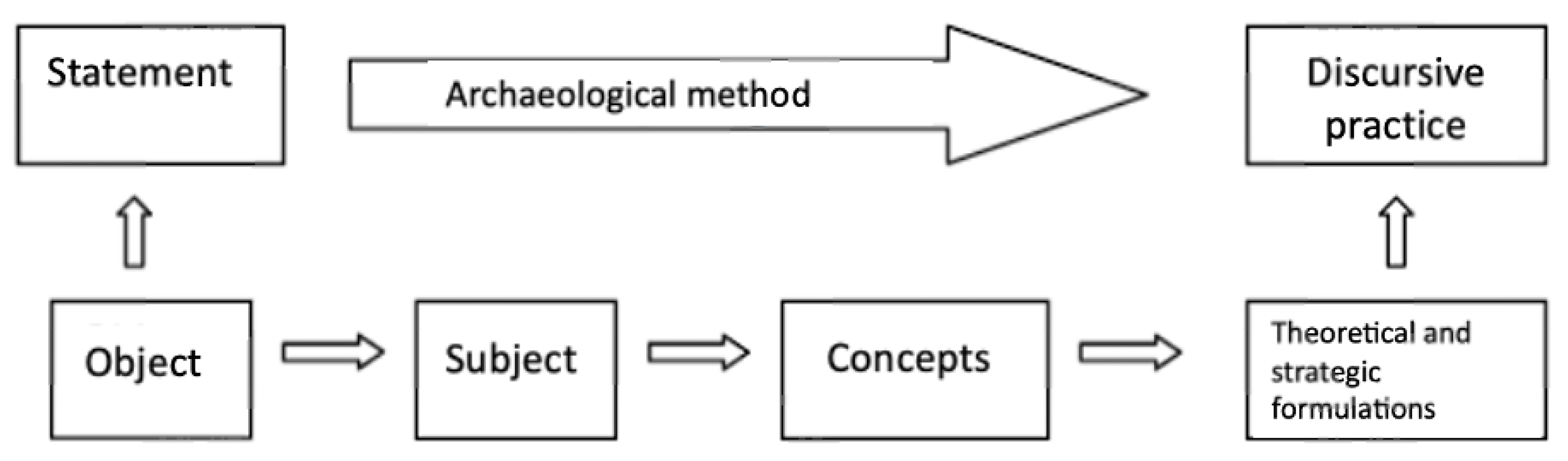
Figure 2.
Archaeological excavation layers.
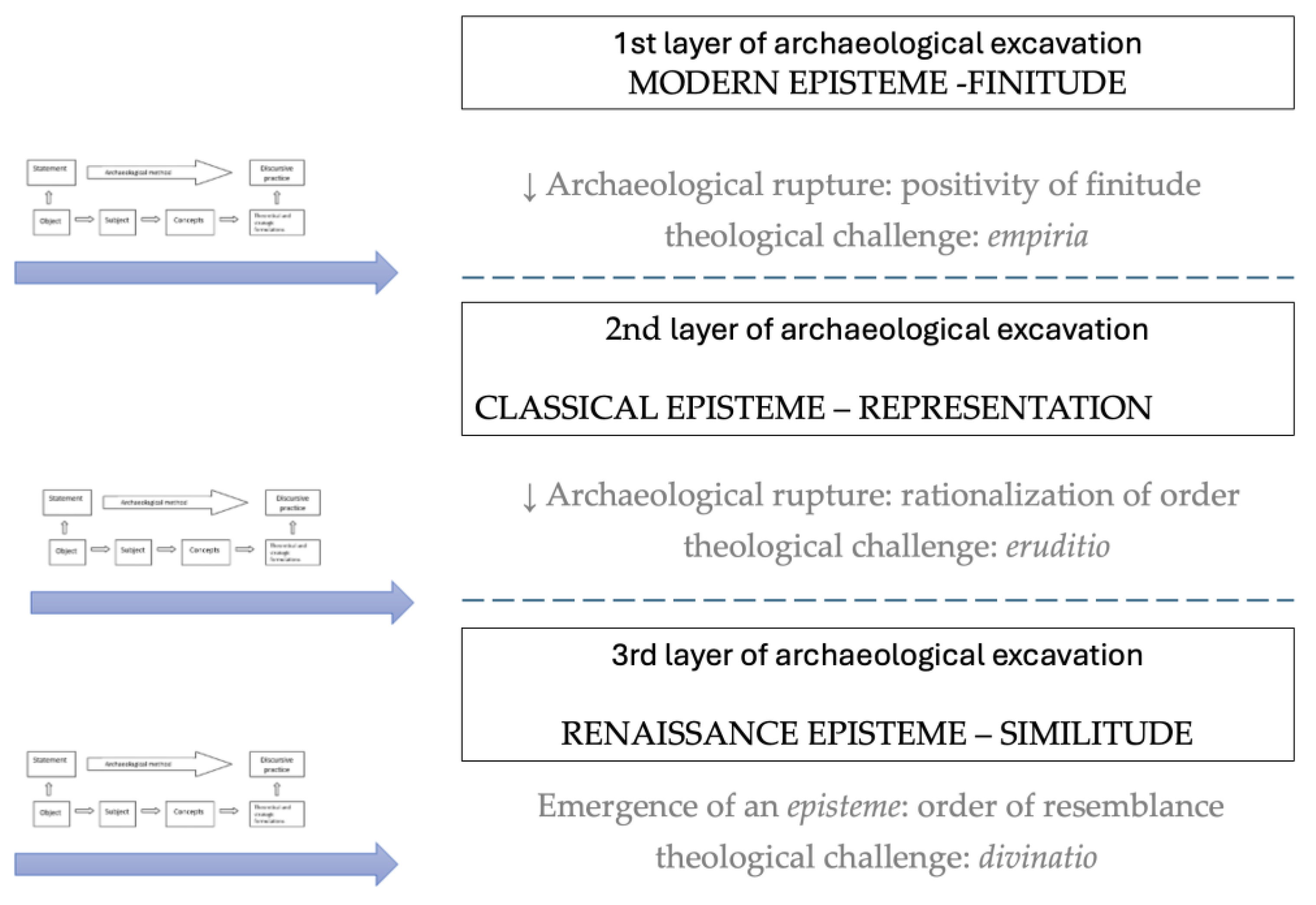
Figure 3.
The Formation of Human Sciences.
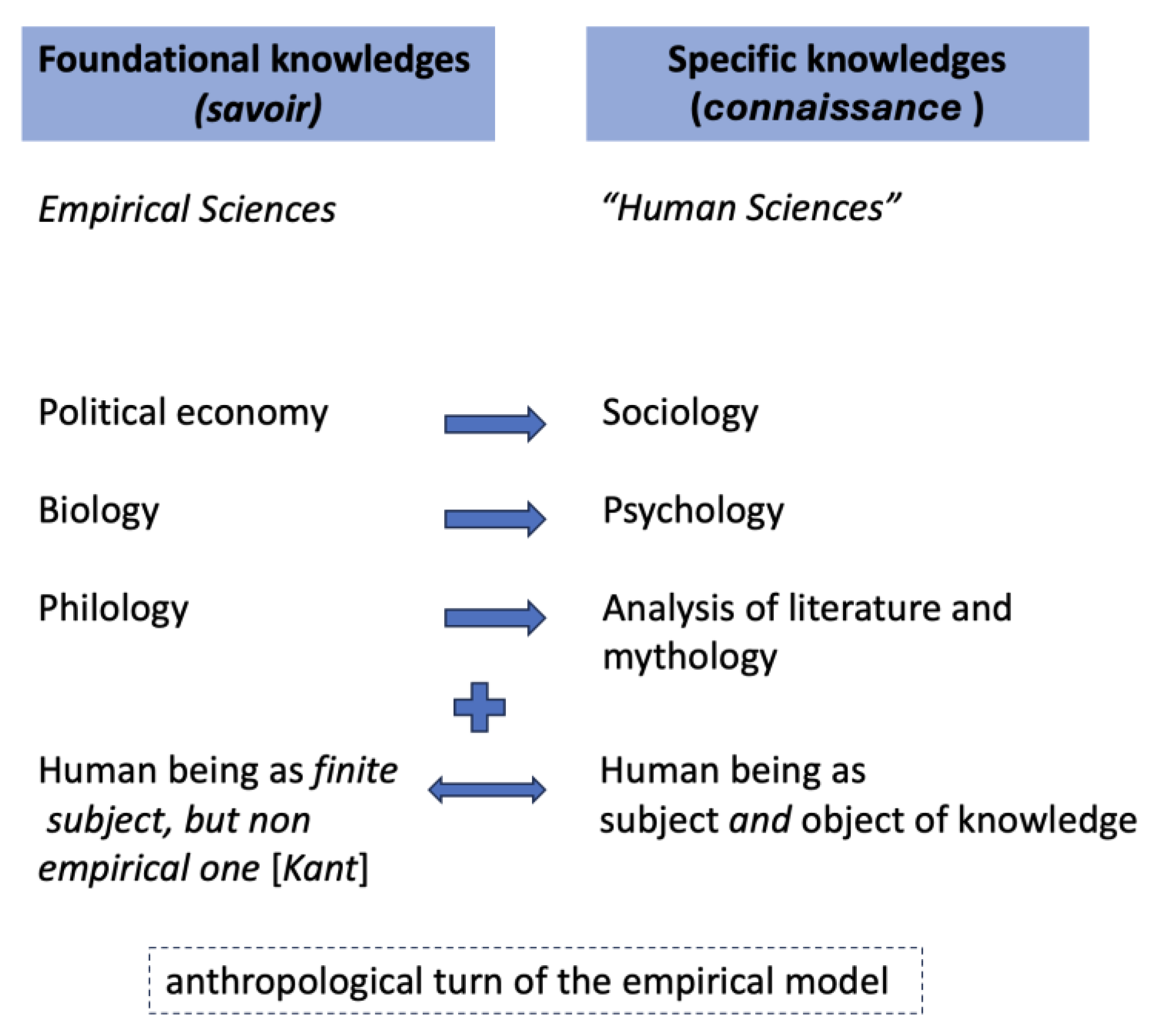
Figure 4.
The metaphor of the polyhedron applied to the apparatus.
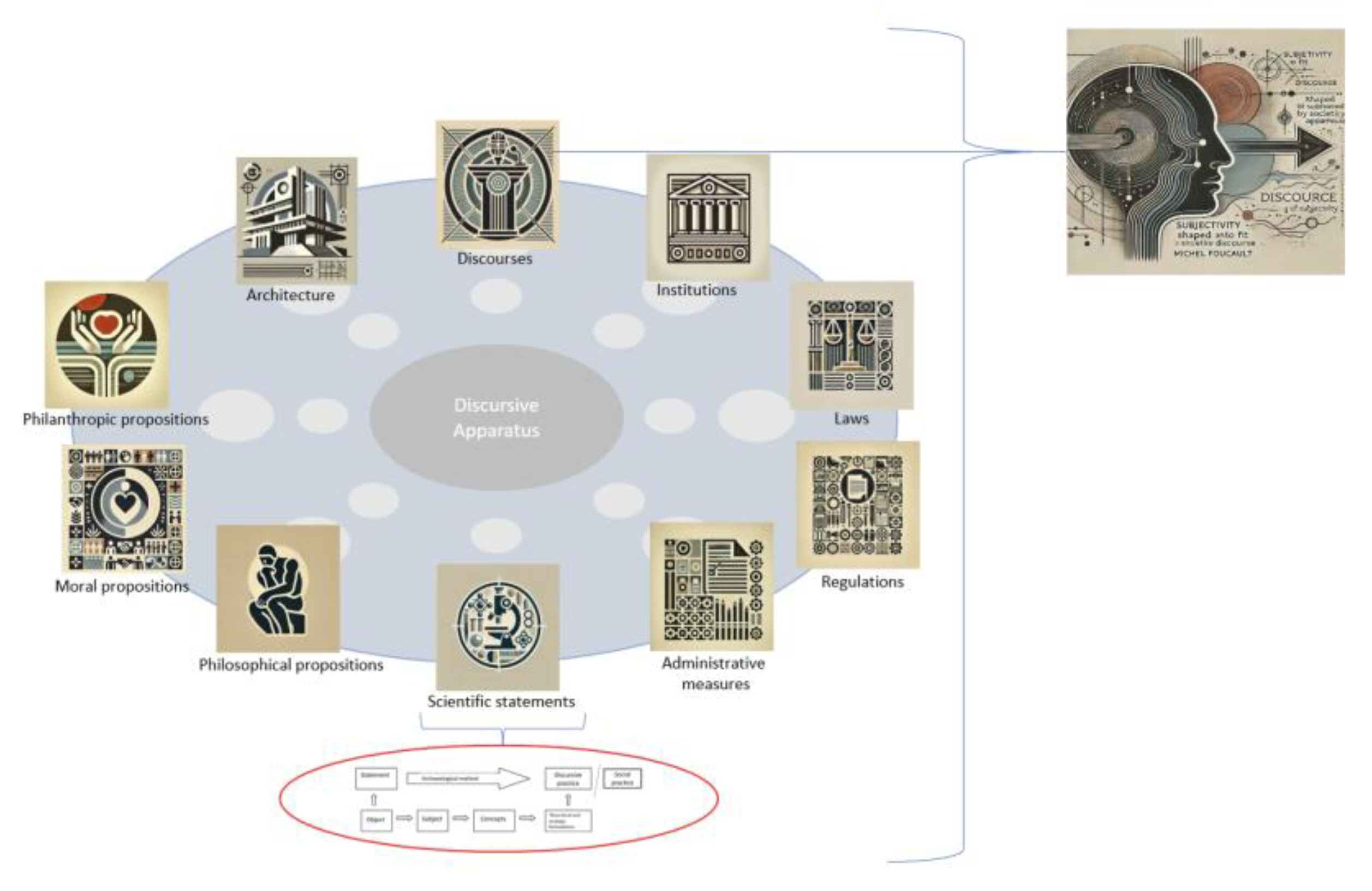
Figure 6.
Non-discursive practices as a Trojan Horse.
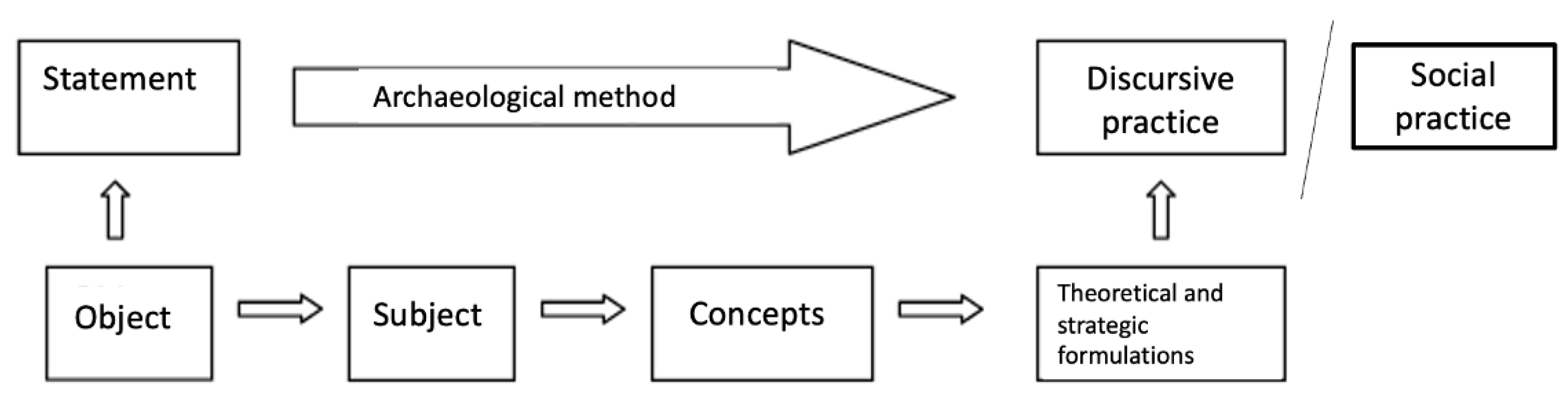
Figure 7.
Déclaration des droits de l’homme et du citoyen, by Le Barbier (1789).
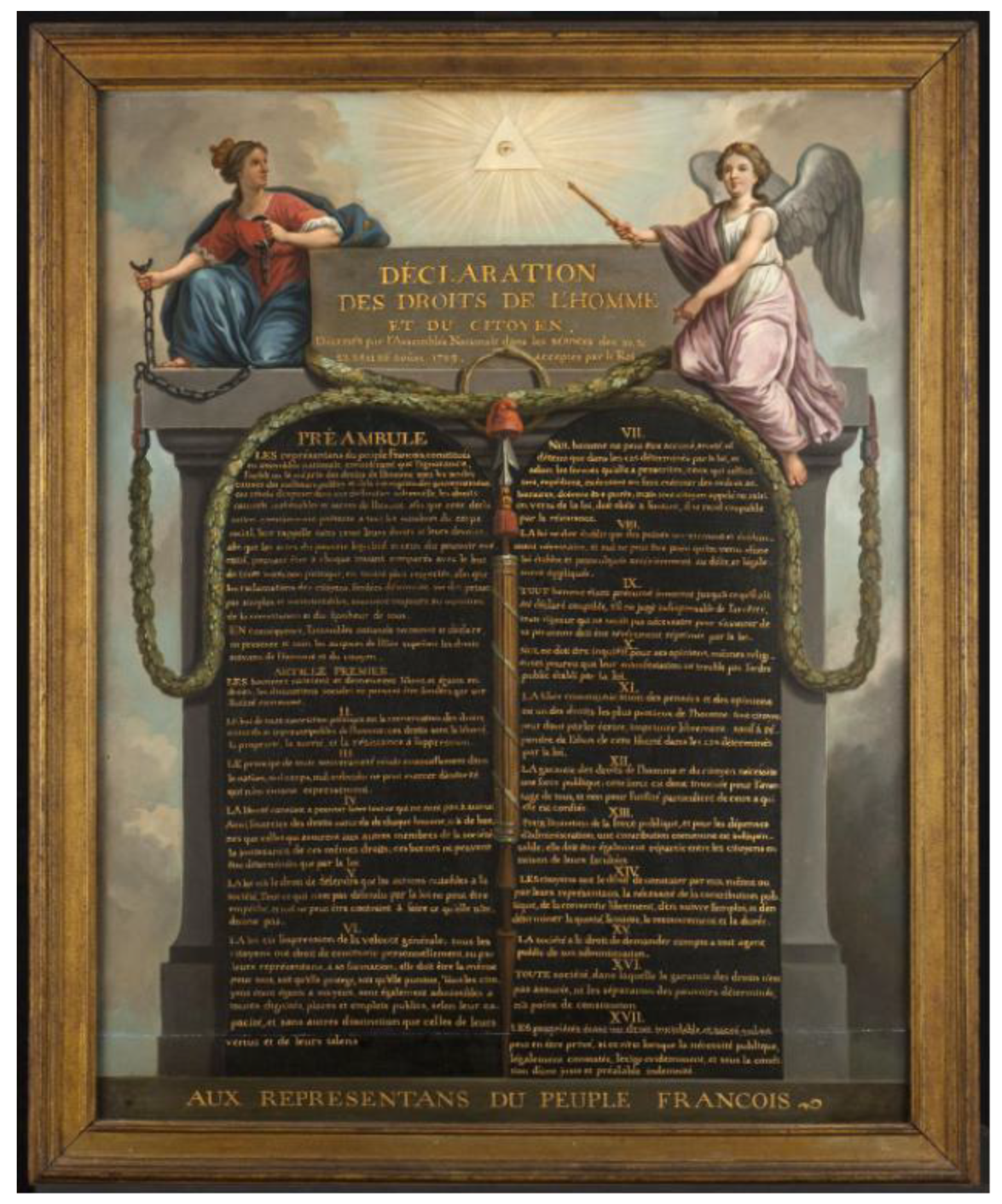
Figure 8.
Déclaration des droits de l’homme et du citoyen, by Le Barbier (1789).
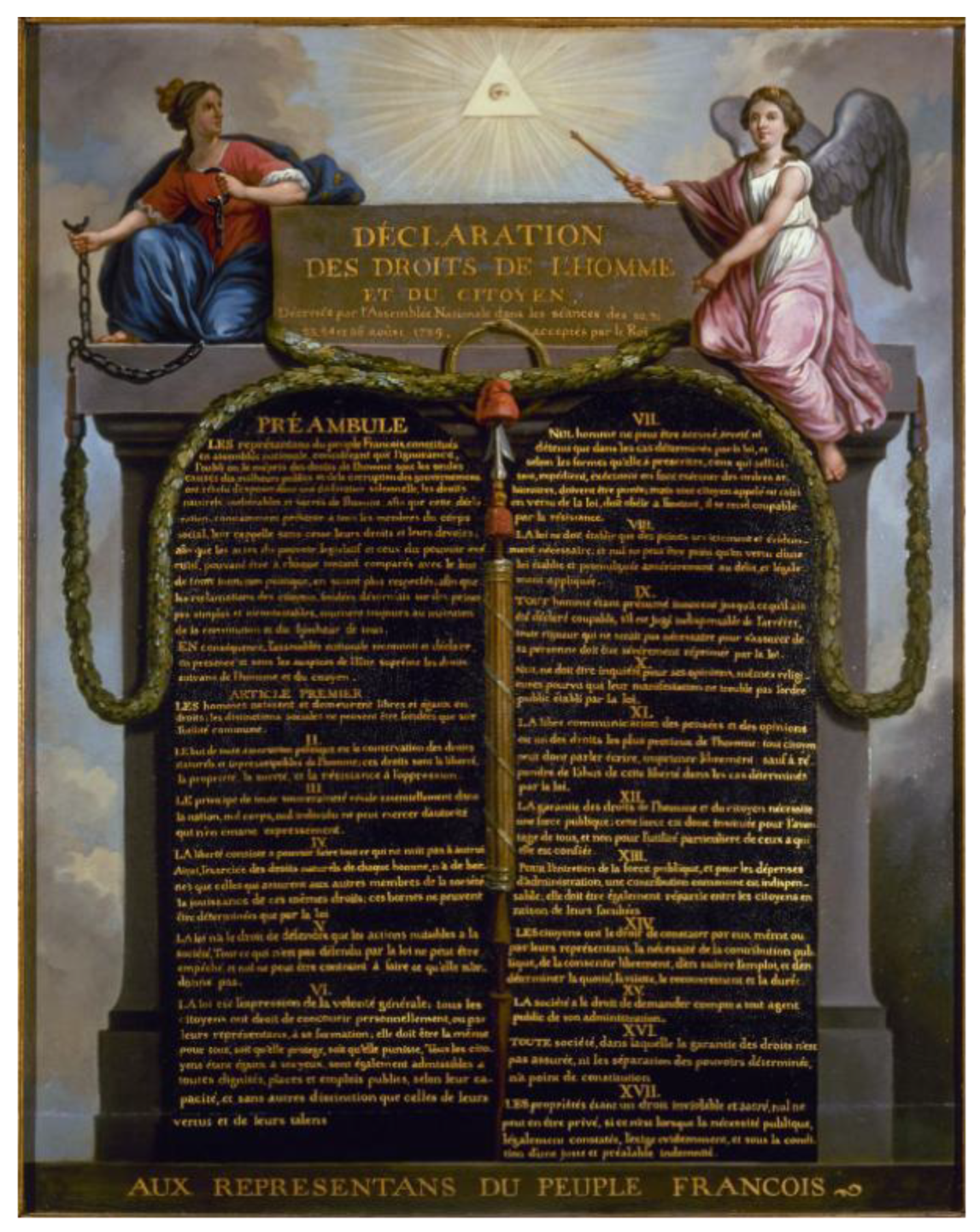
Figure 9.
The Formation of Contemporary Theology and Religious Studies.
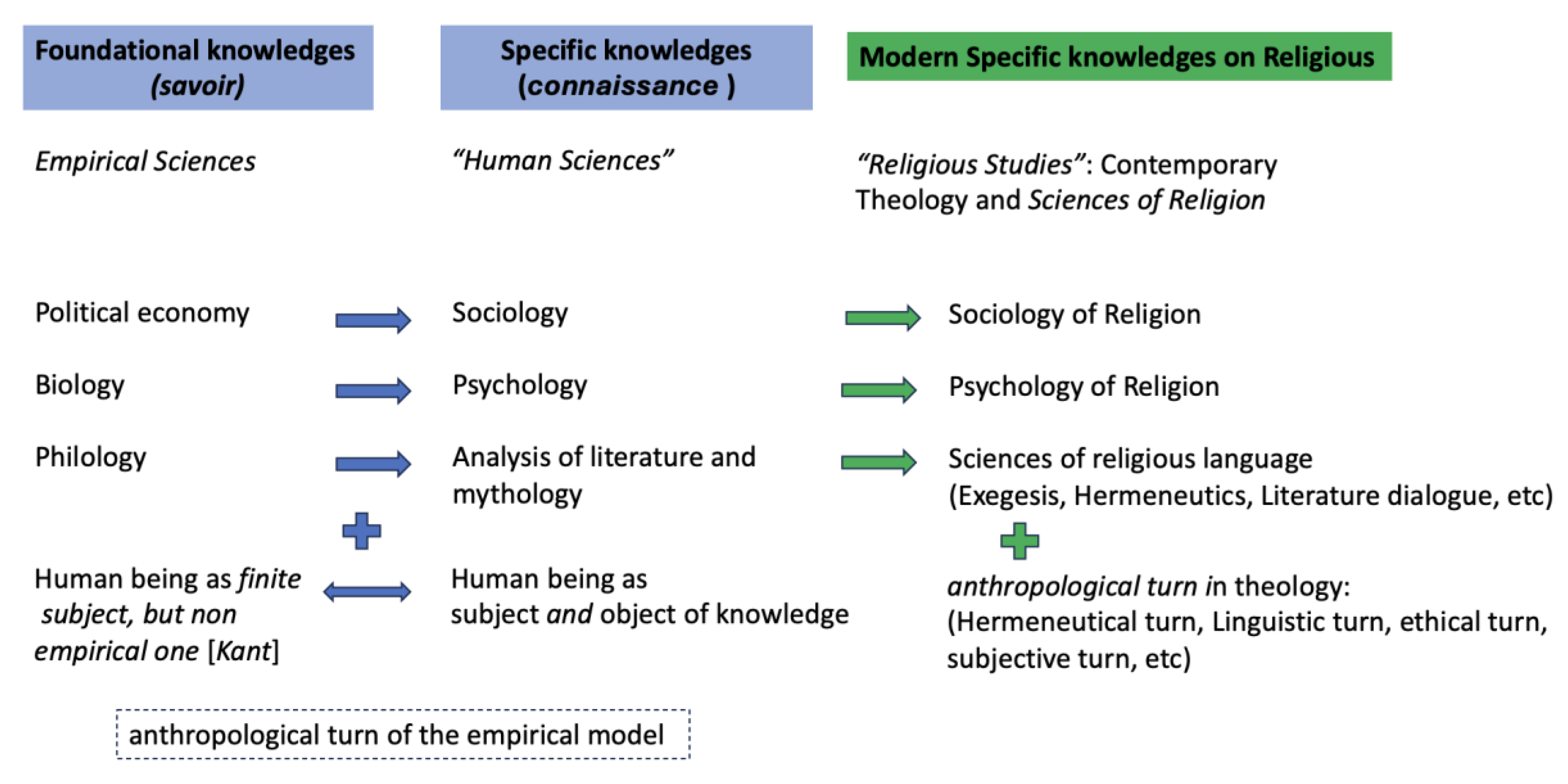
Disclaimer/Publisher’s Note: The statements, opinions and data contained in all publications are solely those of the individual author(s) and contributor(s) and not of MDPI and/or the editor(s). MDPI and/or the editor(s) disclaim responsibility for any injury to people or property resulting from any ideas, methods, instructions or products referred to in the content. |
© 2025 by the authors. Licensee MDPI, Basel, Switzerland. This article is an open access article distributed under the terms and conditions of the Creative Commons Attribution (CC BY) license (http://creativecommons.org/licenses/by/4.0/).
Copyright: This open access article is published under a Creative Commons CC BY 4.0 license, which permit the free download, distribution, and reuse, provided that the author and preprint are cited in any reuse.


