

Submitted:
02 May 2025
Posted:
07 May 2025
You are already at the latest version
Abstract
Global biodiversity is in crisis, with wildlife populations declining 69% since 1970 (WWF). Preserving and restoring ecosystems is essential for sustaining life on Earth. Yet, many countries rely on market-based instruments like biodiversity offsets, despite little evidence of their effectiveness. This study critically examines biodiversity offsets, identifying institutional, data, ecological, economic, and social failures that undermine their success. Using Indonesia, a global biodiversity hotspot, as a case study, we develop an econometric model to analyze key drivers of deforestation. The findings reveal that biodiversity offset schemes are fundamentally flawed: they lack scientific credibility, rely on arbitrary ratios, lack auditing and transparency, create value conflicts, and fail to achieve "No Net Loss" even over a 100-year timeframe. Offsets do not compensate for lost biodiversity, especially for affected communities, and are rarely supported by ecosystem mapping or robust valuation metrics. Without major reforms, they cannot halt or reverse biodiversity loss. A stronger, evidencebased approach is urgently needed. Rather than relying on ineffective offset schemes, the global community must prioritize genuine ecosystem restoration and sustainable conservation strategies to protect biodiversity for future generations.
Keywords:
ecosystems
; nature
; biodiversity
; offsets
; Indonesia
; policy design
1. Introduction
Global biodiversity is experiencing a rapid decline, with species extinction rates now tens to hundreds of times higher than natural background levels, driven by land-use change, exploitation, climate change, pollution, and invasive species (IPBES, 2019). Despite the urgent need for systemic solutions, the global policy response has increasingly favored market-based instruments, particularly biodiversity offsets. These mechanisms, intended to compensate for ecological destruction by ensuring "No Net Loss" (NNL) or even a net gain of biodiversity, have gained widespread adoption despite limited empirical evidence of their effectiveness. Indonesia is one of the most biodiverse countries on the planet and is currently occupying a second spot in the Global Biodiversity Ranking (Brondízio et al., 2019). In 2002 the Delegates of Indonesia and other megadiverse countries and the Environment Ministers set up a Group of Like-Minded Megadiverse Countries (LMMC) to promote consultation and cooperation in Cancun, Mexico. Indonesia is a signatory to the UN Convention on Biological Diversity (UN, 1992), which automatically makes UN CBD Kunming Montreal Biodiversity Framework (UN CBD, 2022) adopted in 2022 international law that has to be adhered to. The UN CBD Kunming Montreal Biodiversity Framework responds directly to the Intergovernmental Science-Policy Platform on Biodiversity and Ecosystem Services (IPBES) Global Assessment Report on Biodiversity and Ecosystem Services (IPBES, 2019) to ‘catalyse, enable and galvanise urgent and transformative action by Governments’ to halt and reverse biodiversity loss. The Kunming Montreal Biodiversity Framework replaced the Aichi Targets for Biodiversity (Anonymous, 2020), none of which have sadly been met, and recognises that reversing biodiversity loss is the common concern of humankind, that the implementation of the framework should be based on scientific evidence and on the ecosystem approach of the CBD, and places biodiversity at the heart of sustainable development agenda (UN CBD, 2022). Biodiversity offsets are defined as “measurable conservation outcomes resulting from actions designed to compensate for significant residual adverse biodiversity impacts arising from project development and persisting after appropriate prevention and mitigation measures have been implemented. The goal of biodiversity offsets is to achieve no net loss, or preferably a net gain, of biodiversity on the ground” (BBOP, 2012). From purely provisioning flows of ecosystem services, regulation and maintenance ecosystem services, and cultural ecosystem services, ecosystems are fundamental to our survival. At the same time, nature is incredibly complex and non-linear. Many authors agree that the recent COVID-19 pandemic that has resulted in nearly 7mln deaths worldwide, has been ultimately caused by the human encroaching upon the ecosystems (Shmelev et al., 2023). We need, therefore, to apply a precautionary principle, which is enshrined within UN Convention on Biological Diversity (UN, 1992). Building on the theory of ecological economics, which firmly positions the economic system within the wider environmental system and emphasizes our fundamental dependence on ecosystems (Shmelev, 2012), this study aims to review the cutting edge international experience in applying a policy tool of biodiversity offsets and shed new light on the currents state of affairs with deforestation in Indonesia. The following Section 2 introduces a comprehensive literature review and builds a taxonomy of factors affecting the performance of biodiversity offsets. Section 3 provides an evidence-based analysis of factors affecting the biodiversity in Indonesia. Section 4 offers a comprehensive econometric model of deforestation in Indonesia. Section 5 offers a detailed discussion of the results and their policy relevance. Section 6 concludes.
2. Literature Review
We have carried out a comprehensive meta-analysis review of peer-reviewed literature available through international bibliographic databases inspired by the PRISMA methodology (Page et al., 2021). Based on the analysis carried out in Scopus database, and using the keywords ‘biodiversity’ coupled with (‘offset’ or ‘mitigation banking’), we identified the key countries where the research has been focused. The body of literature focuses predominantly on Australia, Brazil, China, USA (Figure 1). Examining the literature by biome, we found that wetland and grassland biomes, as well as marine ecosystems attracted the attention of researchers most (Figure 2).
Despite the ambitious global targets on biodiversity at the global scale, none of the Aichi targets have been met: (Anonymous, 2020). This clearly indicates that something is not working in the global system of nature conservation, including biodiversity offsets and gives us a warning signal, encouraging us to investigate the causes of such ineffectiveness through an evidence-based assessment.
According to PRISMA-inspired analysis of peer-reviewed sources, there are serious grounds to believe that biodiversity offsets as they are practiced currently around the world are not achieving a desired effect. We will therefore aim to offer a way forward for Indonesia, that could learn from the experience in different countries around the world.
The most comprehensive survey of biodiversity offsets so far attempted includes a study by (Bull & Strange, 2018), which cites 12,983 offset projects around the world currently in operation, covering 153,679 km2 in 37 countries (Figure 3). The authors mention that the majority of the projects surveyed were focused on forests (66.7%) and wetlands (17.5%) and were located in boreal, Mediterranean, temperate and tropical forest biomes (92%) and 7% in grasslands.
Vatn (Vatn, 2015) characterise biodiversity offsets alongside payments for ecosystem services and carbon trading as part of the group of market-based tools aimed to handle environmental problems. The author provides a comprehensive framework to assess the constituent elements of constructed markets and shows that in many instances these are not ‘markets’ at all.
There are currently very intense debates regarding the effectiveness, the necessary conditions and potential implications of these schemes as outlined in e.g. (Muradian et al., 2013) who cite the example of Indonesia in the context of palm oil plantations having a negative impact on biodiversity and voluntary carbon markets not capable of acknowledging the benefits of forest competitive with the price that could be obtained through selling palm oil on the market.
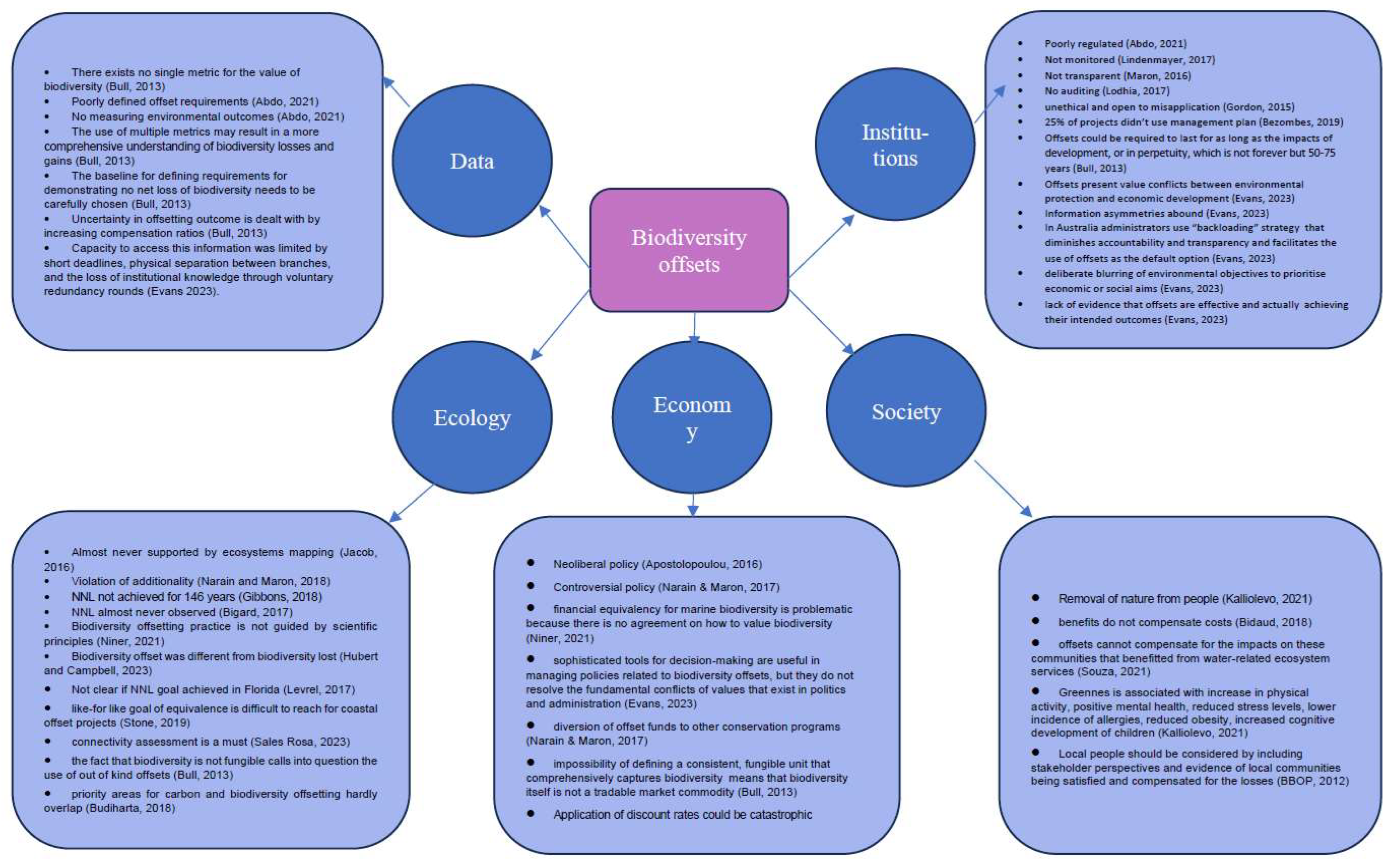
Our detailed meta analysis presented in a large table in the annex is well summarised in a structural diagram that identifies five key aspects of biodiversity offsetting: data, institutions, ecology, economics and society. With further detail provided in the accompanying tables, the diagram summarises the key aspects discussed in peer-reviewed literature on the subject.
Institutions
Among the institutional aspects the following issues have been flagged: the fact that biodiversity offsets are poorly regulated (Abdo et al., 2021)), not monitored (Lindenmayer et al., 2017), not transparent (Maron et al., 2016), rarely involve any auditing (Lodhia et al., 2018), unethical and open to misapplication (Gordon et al., 2015), the researchers cite that 25% of projects didn’t use management plan (Bezombes et al., 2019), offsets could be required to last for as long as the impacts of development, or in perpetuity, which is not forever but 50-75 years (Bull et al., 2013), offsets present value conflicts between environmental protection and economic development with information asymmetries abounding (Evans, 2023). In Australia administrators use “backloading” strategy that diminishes accountability and transparency and facilitates the use of offsets as the default option,deliberate blurring of environmental objectives to prioritise economic or social aims and in general, according the Australian government, there is a lack of evidence that offsets are effective and actually achieving their intended outcomes (Evans, 2023).
In an article focused on Brazil, another megadiverse country, entitled ‘Playing Musical Chairs with Land Use Obligations’ (Filoche, 2017) refers to Brazil’s historical refusal “to agree to Northern states using REDD to offset their polluting activity by purchasing carbon credits derived from non-deforestation in Southern countries”. This research quotes Sistema Nacional de Unidades de Conservacão – Conservation Units National System established as law in 2000 in Brazil. The projects making a significant environmental impact were required to pay a minimum of 0.5% of the project value into the special fund. The long legal battle ensued going through various courts aiming to limit the rate at a maximum of 0.5%, which still seems to be on-going.
Most recent study by (Evans, 2023) used semi structured interviews surveying members of staff of the Department of the Environment and Energy in Australia and found that biodiversity offsets in Australia are very rarely effective: so called backloading takes place where regulators postpone the offset discussion until after the destruction of biodiversity is approved, the requirements are watered down in the negotiation process, verification of information is too time consuming and the government itself concluded that the scheme is not effective and is not achieving the stated objectives.
Data
Regarding the data-related aspects of the puzzle of biodiversity offsets, the researchers state that: there exists no single metric for the value of biodiversity (Bull et al., 2013), the offset requirements are poorly defined (Abdo et al., 2021), limited or no measurement of environmental outcomes is carried out (Abdo et al., 2021). The researches point out that the use of multiple metrics may result in a more comprehensive understanding of biodiversity losses and gains (Bull et al., 2013), the baseline for defining requirements for demonstrating no net loss of biodiversity needs to be carefully chosen and uncertainty in offsetting outcome is dealt with by increasing compensation ratios (Bull et al., 2013). At the same time, capacity to access this information by regulators was limited by short deadlines, physical separation between branches, and the loss of institutional knowledge through voluntary redundancy rounds (Evans, 2023).
Research by (Bull et al., 2013) stresses that biodiversity is not a fungible asset and cannot really be traded as a commodity. At the same time, the longevity issue is raised given the fact that perpetuity rarely means ‘forever’ and amounts to 50-75 years at most, which could be a ‘license to kill’ in relation to ancient and diverse ecosystems. Reviewing the experience of wetland banking in the US, (Maron et al., 2012) states that although some ecological indicators, namely biomass and species richness often recover well in wetlands, others like soil physical and chemical properties, species composition, and nutrient cycling could take much longer to restore. Reviewing the 30 years of Species Conservation Banking (SCB) in the USA, (Carreras Gamarra & Toombs, 2017), mention that 50% of all SCBs are located in California and cite that the “majority of SCBs do not include measures of habitat quality (79%) for credit calculation and in 70% of banks one acre (0.4 ha) equals one credit, meaning that credits are based only on the habitat area, irrespective of quality, with 6% using a mitigation ratio or multiplier for calculating credits, which is really far from being scientific and could hardly be applied for ancient, biologically diverse and incredibly valuable ecosystems in Indonesia.
Ecology
Examining the ecological dimensions, researchers raised concerns that biodiversity offsets are almost never supported by ecosystems mapping (Jacob et al., 2016), that violations of additionality are omnipresent (Narain & Maron, 2018), No Net Loss (NNL) is unlikely to be achieved for 146 years (Gibbons et al., 2018), NNL is almost never observed in biodiversity offsetting schemes (Bigard et al., 2017), biodiversity offsetting practice is not guided by scientific principles (Niner et al., 2021), biodiversity offset was different from biodiversity lost (Hubert Ta & Campbell, 2023), it is not clear if NNL goal was achieved in Florida biodiversity offsetting (Levrel et al., 2017), that like-for like goal of equivalence is difficult to reach for coastal offset projects (Stone et al., 2019), that connectivity assessment is essential but is rarely performed (Sales Rosa et al., 2023), the fact that biodiversity is not fungible calls into question the use of out of kind offsets (Bull et al., 2013) and that in an empirical analysis in the context of Indonesia priority areas for carbon and biodiversity offsetting hardly overlapped (Budiharta et al., 2018).
New research by (Bigard et al., 2017) assessed the way biodiversity requirements are taken into account in the context of Environmental Impact Assessment in the French context and stated that in practice No Net Loss (NNL) has almost never been observed and often the actual deterioration of biodiversity took place. The researchers state that “common reliance on offsetting to achieve NNL has received serious criticism due to the fact that offsets are rarely adequate, complete offsetting may be illusory due to the complexity of ecological processes and weak institutional organisation of the mitigation hierarchy impairs attempts to achieve NNL”.
The paper by (zu Ermgassen et al., 2019) assessed 26 biodiversity offsets from 10 studies, of which only 9 achieved NNL for all given outcome variables, 7 failed to achieve any at all, and 8 achieved NNL for some outcome variables only but not for others. The authors conclude that historically NNL has been more successful in wetland than forested ecosystems and state that there exists a considerable gap “between the global implementation of NNL and the evidence base concerning ecological effectiveness”. The research showed that “67% of the world’s offsets are applied in forested ecosystems yet our review reveals that only four studies have assessed NNL outcomes from offsets applied to forest ecosystems or wildlife. Of these, none demonstrated that their associated NNL targets were achieved” (zu Ermgassen et al., 2019).
Reviewing the 30 years of Species Conservation Banking (SCB) in the USA, (Carreras Gamarra & Toombs, 2017), mention that 50% of all SCBs are located in California and cite that the “majority of SCBs do not include measures of habitat quality (79%) for credit calculation and in 70% of banks one acre (0.4 ha) equals one credit, meaning that credits are based only on the habitat area, irrespective of quality. Six percent use a mitigation ratio or multiplier for calculating credits, and 4% determine credits based on the number of individuals of the covered species that the area could potentially accommodate”, which is really far from being scientific and could hardly be applied for ancient, biologically diverse and incredibly valuable ecosystems in Indonesia.
Ecosystem services must play a central role in biodiversity offsets (Jacob et al., 2016), the position we take in this report. The researchers concluded that “biodiversity offsetting rarely considers human populations who suffer from environmental losses generated by development projects and those that benefit from offset actions, regardless of the level of dependency of local communities on ecosystem services in maintaining their livelihood. Including proposals may help to link human activities and amenities to affected or restored ecosystems making the offsets more fair and ethical (Jacob et al., 2016).
The research by (Budiharta et al., 2018) focused on the island of Borneo in Indonesia states that until recently, most offsetting studies focused on single impacts, most commonly biodiversity, as opposed to whole ecosystems with complete spectrum of ecosystem services. The research found that priority areas for carbon and biodiversity offsetting in Borneo hardly overlapped at all due to uneven distribution of ecosystem services.
In the paper with a telling title ‘Faustian bargains?’, (Maron et al., 2012) reviews the experience of wetland banking in the US and states that although some ecological indicators, namely biomass and species richness often recover well in wetlands, others like soil physical and chemical properties, species composition, and nutrient cycling could take much longer to restore with some ecosystem functions taking decades to be restored to pre-disturbance state.
Economics
On economic issues, it was highlighted that biodiversity offsets present a clearly neoliberal policy (Apostolopoulou, 2016), that the is policy is controversial (Narain & Maron, 2018), that financial equivalency for marine biodiversity is problematic because there is no agreement on how to value biodiversity (Niner et al., 2021), that sophisticated tools for decision- making are useful in managing policies related to biodiversity offsets, but they do not resolve the fundamental.
Some views are openly critical of biodiversity offsets. Thus, (Apostolopoulou, 2016) identifies biodiversity offsets as “a paradigmatic neoliberal policy, aiming at a further privatization, commodification, and financialization of non-human nature”. Moreover, the authors state that in the case of the UK, “biodiversity offsetting was considered as capable of creating various business opportunities for consultants, conservation banking companies, and brokers” (Apostolopoulou, 2016). In addition to this the authors specify that “the reasons for resisting ecosystem degradation are increasingly defined in terms of profitability, manifesting not only an ideological victory for capitalism but the creation of novel spaces for its operations by potentially opening new domains for capital accumulation”. An financial interest of local governments, whose finances are now not in the best of shapes has been also identified through the interview process: “in the face of decreasing public budgets and increasing competition many local and regional administrations across England have been involved in biodiversity offsetting with the aim to gain profits, a typical manifestation of the way the rescaling of governance promotes the further entrepreneurial character of rural and urban places”. The authors go as far as to state that “offsetting in fact establishes a new policy frame that creates socially and spatially uneven outcomes … and in this way offsetting is inextricably linked to questions of domination and uneven access (Apostolopoulou, 2016).
The literature we have analysed clearly presents the plethora of arguments characterising the ability of biodiversity offsets to compensate for the development impacts adequately as questionable (Abdo et al., 2021). The authors state that offsets are ineffective and have poor success rates if three crucial issues are not comprehensively addressed: 1) compliance and enforceability, 2) measuring environmental outcomes and 3) uncertainty and transparency (Abdo et al., 2021). The issues emerging are largely related to the governance and administrative failures (Abdo et al., 2021). Transparency is a hugely important factor in the context of biodiversity offsets (Maron et al., 2015). Lack of transparency may lead to discretionary application of rules, resulting in inequity among developers. Monitoring (Lindenmayer et al., 2017) and auditing (Lodhia et al., 2018) of the offsets during and after implementation are considered to be fundamental.
In the context of India, another megadiverse country, the biodiversity offsetting is regulated by the India Forest Conservation Act of 1980 with additional bodies like Compensatory Afforestation Fund (CAF) and the Compensatory Funds Management and Planning Authority recommended to be established by the court ruling in 2002 (Narain & Maron, 2018). The authors refer to the fact that Indian government failed to establish the effective institutional mechanism and accumulated $5.7 bln of compensation funds while deforestation continued to take place. As a result, the Compensatory Afforestation Fund Act has been passed in 2016. The government allowed the conversion of diverse natural forest for afforestation by monoculture plantation or carried out afforestation on lands belonging to indigenous tribes. The researchers also cite examples where project compensation funds have been utilized to fund already existing government commitments thereby diminishing the net ecological impact of the programme.
Some researchers stated that financial equivalency for marine biodiversity is problematic because there is no agreement on how to value biodiversity (Niner et al., 2021), that sophisticated tools for decision-making are useful in managing policies related to biodiversity offsets, but they do not resolve the fundamental conflicts of values that exist in politics and administration (Evans, 2023), and that impossibility of defining a consistent, fungible unit that comprehensively captures biodiversity means that biodiversity itself is not a tradable market commodity (Bull et al., 2013) and that application of discount rates could lead to a disaster if future irreplaceable and catastrophic impacts of biodiversity and ecosystem service loss could be discounted.
Society
Social aspects of biodiversity assessment schemes have often been reported as amounting to the removal of nature from people (Kalliolevo et al., 2021), benefits do not compensate costs (Bidaud et al., 2018), offsets cannot compensate for the impacts on these communities that benefitted from water-related ecosystem services (Souza et al., 2021), greennes is associated with increase in physical activity, positive mental health, reduced stress levels, lower incidence of allergies, reduced obesity, increased cognitive development of children but that is almost never taken into the account in administering biodiversity offsets (Kalliolevo, 2021).
Research by (Bidaud et al., 2018) focused on the assessment of the biodiversity offset schemes in the context of a mining development in Madagascar, a low income developing country. It concluded that “although it acknowledged the livelihood dependence of local people on natural resources and provided micro-development projects to support alternative livelihoods, Ambatovy’s biodiversity offset programme faced critical social issues. Firstly, though acknowledging the positive impact of some of the development projects on their lives, local stakeholders felt that they had suffered a net cost from the biodiversity offset as the benefits from the alternative livelihood activities did not compensate for the costs of the conservation restrictions. Secondly those who benefited most from the development projects were neither those who bore the greatest costs of forest access restriction nor the poorest people, but tended to be those with more power locally’ (Bidaud et al., 2018).
Figure 4.
The systemic synthesis of the biodiversity offsetting literature. Source: the author.
3. Analysis of the State of the Environment in Indonesia
Indonesia has come a long way in terms of development and managed to achieve a great deal in the past several decades. At the same time there are worrying trends related to the state of the environment in Indonesia we would like to highlight. We will treat forest cover as a first step in understanding the state of biodiversity in Indonesia. Deforestation in Indonesia continues to happen (Boentoro & Wherrett, 2021), (Jati et al., 2018). In fact, between 1990 and 2021, the forest cover in Indonesia has been reduced from 65% to less than 50% of the total area.
Mining
Coal production in Indonesia is increasing (Figure 5), affecting the share of forested land. Mining is a factor affecting biodiversity in Indonesia, given that half of the world’s mining-related biodiversity loss occurred in Indonesia, Australia and New Caledonia (Cabernard & Pfister, 2022). This happens while major trade flows associated with biodiversity loss are related to sales of Indonesian coal to India and China. Exports of coal represent 11.5% of Indonesia’s exports and amount to a figure of $28.4 bln. Most of the export of coal from Indonesia finds its way to China (31.1%), India (16.1%), Japan (9.49%), Philippines (8.66%), Malaysia 8.95%), South Korea (7.35%).
Research by (Cabernard & Pfister, 2022) shows in high amount of detail how mining of coal and other minerals in Indonesia is contributing to the production activities in China and India that is in-turn resulting in the creation of infrastructure for construction, electronics, machinery and transport.
Indonesia has become the largest nickel producer in the world with rates of nickel mining increasing substantially since 1990s (Figure 6). The amount of available forest tends to be negatively correlated with the amount of nickel mined in Indonesia. Indonesia produces around 37% of the global supply of nickel and holds approximately 22% of global reserves. Around $14 bln has been invested in nickel smelting in Indonesia. Between 2022 and 2029 it is likely that Indonesia’s nickel production will reach the level of 75% of global supply. The average nickel price in 2021 reached $17,489 as opposed to $13,787 per tonne in 2020. Multiple examples of post-mining regeneration of land exist, although this doesn’t reverse the overall negative trends for biodiversity in Indonesia: (Novianti et al., 2018), (Woodbury et al., 2020), (Isworo & Oetari, 2023).
Copper, nickel and bauxite have also shown an increase in production, especially after the bans on export were reduced. Overall, the mining sector is one of Indonesia’s strongest contributors to the economy, especially post-pandemic when the prices for mineral, coal and gas resources increased. PwC also points out that mining companies are often the only employers in remote areas and that the demand for critical minerals used in energy transition will increase as part of the rush towards clean energy, while coal and other resources will decline (PwC, 2023).
Multiple examples of post-mining regeneration of land exist, although this doesn’t reverse the overall negative trends for biodiversity in Indonesia: (Novianti et al., 2018), (Woodbury et al., 2020), (Isworo & Oetari, 2023).
Agriculture
Palm oil continues to be one of the main drivers of deforestation (Yu et al., 2023). As Figure 7 illustrates, the palm oil production in Indonesia massively increased. The export of palm oil in Indonesia has amount to $27.3 bln in 2021, making it the first largest palm oil exporter in the world. It contributes a significant proportion of foreign trade revenues for Indonesia and presents 11% of its exports. Most of the palm oil export goes to China (15.5%), India (12.6%), Pakistan (10.4%), but also USA (5.07%), Spain (3.61%), Russia (2.83%), Italy (2.47%), Netherlands (1.93%). Indonesia’s palm oil production gives employment to approximately 16 mln workers. The presence of roads tends to intensify the expansion of smallholder palm oil plantation even further (Zhao et al., 2022). Despite the recent reduction in deforestation from palm oil expansion, there is a recent increase in deforestation, as reported by (Jong, 2024).
Rice production (Figure 8) tends to be inversely correlated with the amount of forest available (Figure 11), however it doesn’t seem to be the most significant factor of deforestation as the produce is mostly used for internal consumption. Significant quantities of rice are imported into Indonesia from India (30.4%), Singapore (18%), Malaysia (15.4%), Thailand (15.1%), Vietnam (12.7%). Imports of rice tend to exceed exports by approximately $250 mln.
Among various factors exerting pressure on ecosystems and biodiversity in Indonesia is the development of infrastructure (Figure 12). Serious concerns are being raised by scientists about the forthcoming developments in Borneo associated with the transfer of the capital of Indonesia to the island (Spencer et al., 2023) with proximity of roads identified as one of the crucial factors for the reductions in biodiversity.
Indonesia is the world’s largest producer of oil palm, producing over 30 million tonnes of palm oil annually (UNDP, 2024). The palm oil industry generates 4.5% of Indonesia’s GDP and offers employment opportunities to 3 million people (UNDP, 2024). The production satisfied 50% of EU’s palm oil needs and 31% of the Dutch demand (Ministerie van Landbouw, 2023). The current demand trend will increase palm oil production by 12 million tonnes by 2035 (Smith, 2023).
Indonesia has taken steps to create a more sustainable palm oil production. One such step is the partnerships with The Netherlands to address unsustainable practices and reduce deforestation without having to compromise on production (Wageningen University, 2023). One of the programmes is named ‘SustainPalm’ and it lasts for three years (Ministerie van Landbouw, 2023), while the other is the National Initiative on Sustainable and Climate Smart Oil Palm Smalholders (NI-SCOPS) aimed at providing the Indonesian government with support to meet its commitments under international agreements (IDH, 2024).
Additionally, the Green Commodities Programme and Good Growth Partnership collaborated with the national government to establish the Indonesia Sustainable Palm Oil Platform (FoKSBI) as a neutral ground aimed at facilitating multi-stakeholder conversations on challenges of the sustainable palm oil development in Indonesia (UNDP, 2024).
Furthermore, President Joko Widodo signed in 2019 the National Action Plan for Sustainable Palm Oil, encompassing 6 different production regions (UNDP, 2024). The Plan sets out to create a better coordination between smallholders of palm oil farms and provide them with training and access to various resources, such as financing. It also highlights the importance of effective governance, from law enforcement to conflict resolution. Additionally, the Plan aims to improve environmental management and monitoring through various measures –biodiversity conservation, reduction of GHG emissions etc. The Indonesian Palm Oil (ISPO) standard also requires greater acceptance and a smoother certification process of smallholders under it (UNDP, 2014). The ISPO is regulated by Regulation of the President of Republic of Indonesia No. 44 of 2020 on Indonesian Sustainable Oil Plantation Certification System.
While sustainable palm oil practices appear to gain traction in Indonesian policies, its application differs in reality. Putri et al. pointed out that while ISPO certification would be beneficial for all parties involved (Putri et al., 2022), the legislative process sequestrates these positive outcomes. The regulations and policies are produced at the central government level, which ignores all the subtleties of lower governance levels and makes transposition difficult. The process is even more complex when, at lower level, there are regulatory guidelines which contradict each other when it comes to implementing sustainability certificates. Or, alternatively, there are no guidelines (Putri et al., 2022).
Infrastructure
In May 2023, Ministry of National Development Planning/National Development Planning Agency (BAPPENAS) published its Public Private Partnership Infrastructure Projects Plan in Indonesia (Ministry of National Development Planning, 2023) outlining the status of future infrastructure plans. According to regulation, there are two types of PPP project schemes – Solicited, which are initiated by Government, and Unsolicited, which are initiated by members of the private sector. The document provides an outline of projects at different preparation stages where their realisation aspects are considered – such as feasibility, budget, public consultation etc (Ministry of National Development Planning, 2023). In the PPP book, there is a list of 52 projects to be developed, out of which 17 projects relate to transportation and are outlined below.
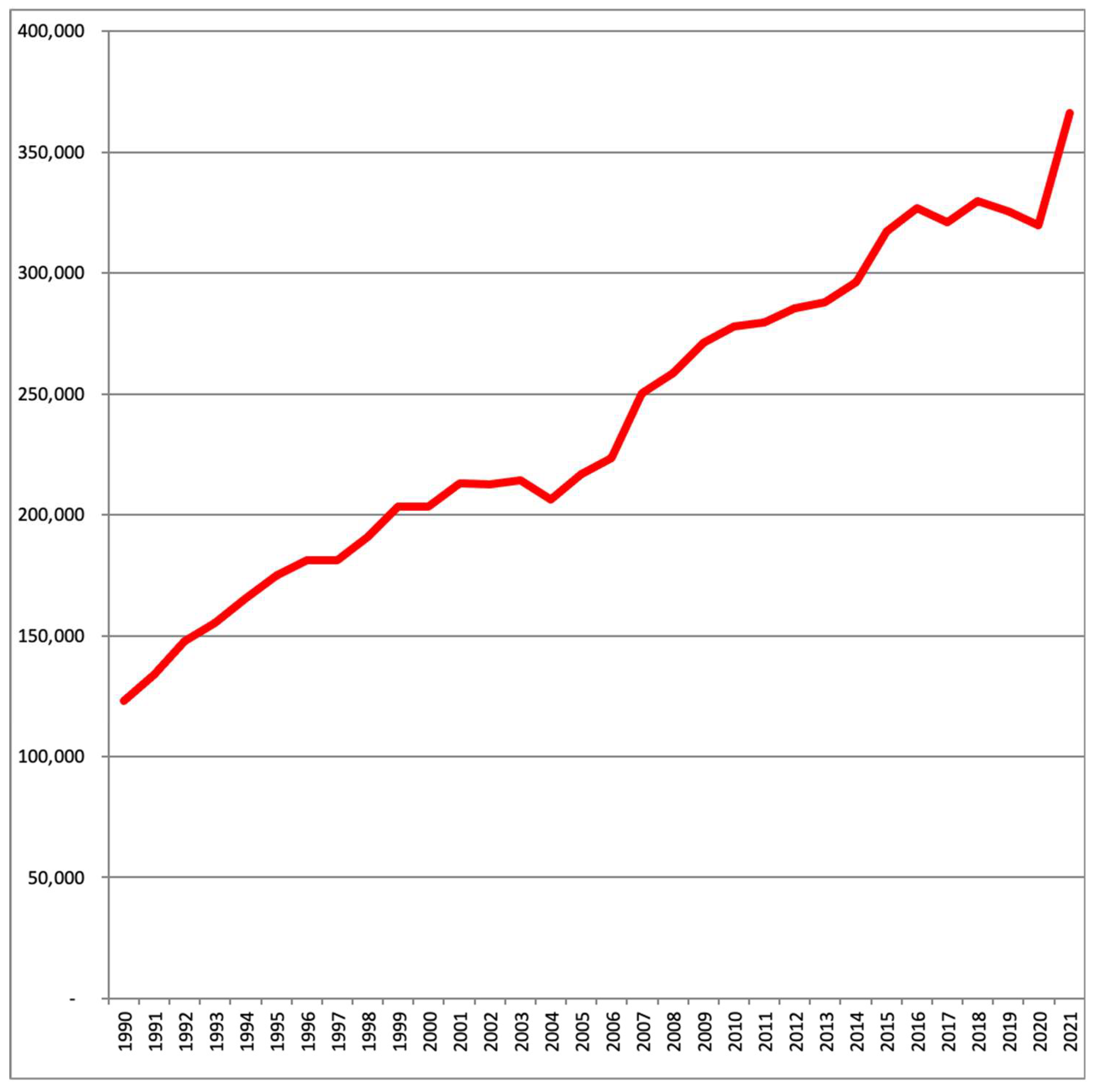
Figure 9.
Road construction in Indonesia, 1990-2021.
Transport
The Public Private Partnership Infrastructure Plan in Indonesia Book mentions the development of two airports – Singkawang and Bintan. The estimated financial cost of Singkawang is of 117.00 million USD, while Bintan would cost 755.26 million USD. The Singkawang airport is intended to improve accessibility of people and goods in the area, preventing economic paralysis due to transportation shortage. The relocation of the country’s capital from Jakarta is also emphasised as a reason for the airport. Comparatively, for Bintan, the airport is built for tourism and industrial activities (Ministry of National Development Planning, 2023). Additionally, the Baubau Port located in Southeast Sulawesi district is planned on being expanded to facilitate economy and tourism. The project is estimated to cost 16.95 million USD (Ministry of National Development Planning, 2023).
The Bandung Railway project is a Light Rail Transit aimed at improving urban traffic by making it faster and more reliable, costing approximately $785 million USD (Ministry of National Development Planning, 2023). There are also three type A bus terminal development plans located in different provinces to enhance transportation services with mixed use terminal schemes providing residential, commercial, industrial and entertainment purposes to the terminals, operating on different floors of the complex. These new developments would all amount to approximately 111 million USD (Ministry of National Development Planning, 2023).
The PPP Book also includes plans for eight toll roads and two bridges functioning on the toll road principle. The Demak-Tuban toll road project is the longest and most costly toll road project outlined in the PPP Book, reaching an estimated cost of $3,440.27 million USD and stretching over 179.55 km. The idea behind the project is to complete an already existing toll road (Semarang-Demak) and to elevate the development of the areas surrounding toll roads as well as developing economic growth (Ministry of National Development Planning, 2023). The Batam-Bintan bridge will cost approximately $1,029.60 million USD and extends over 7,684 meters. The objective is to increase trade and industries in the two islands, as well as take advantage of the geographical location of Batam near Singapore and Malaysia (Ministry of National Development Planning, 2023). None of the projects mentioned above mention the environmental impact or their environmental benefits. The general reasons behind creating them are of economic and social nature, namely facilitating trade, tourism and interconnectedness.
The increasing urbanisation and economic development of Indonesia requires more transportation possibilities which is reflected in the Partnership Plan. However, more roads mean more motor vehicle usage which affects air quality. Indonesia is exceeding the World Health Organisation’s (WHO) recommended range of PM2.5 since 2022, which affects public health (Ernyasih et al., 2023). In fact, in Batam city, where the bridge is developed for industrial and trade purposes, the PM2.5 levels were as high as 45 μg/m3, while carbon monoxide (CO) was recorded to be 35.83 ppm (Ernyasih et al., 2023).
It is worth noting that WHO recommends the annual level of PM2.5 does not exceed 5 μg/m3 (WHO, 2021). South Tangerang, a city filled with industrial areas, rapid trade growth and highly crowded, has been deemed the most polluted city in Indonesia, as data found a positive correlation between the increase in human health disorders and transportation, industrial activities and air pollution (Listyarini et al., 2021).
Heavy metal contamination around ports is also a current debated issue in the Indonesian scientific community. The Belawan Harbor, one of Indonesia’s busiest ports, was found to be lightly polluted with cadmium and lead between November 2018 and January 2019 (Sulistyowati et al., 2023). If neglected, pollution could increase over the years due to human activity and lead to the extinction of endemic species, conflicts between the local community and companies, as well as a lack of jobs for fishermen. A similar result was found in the coastal area around the province of Daerah Istimewa Yogyakarta, where high levels of lead were found as a result of anthropogenic intervention – such as corrosion of metals, activities related to mining, painting of boats etc (Asih et al., 2022).
Mixed-use terminal schemes, as part of transit-oriented development, are also a questionable option from a sustainability perspective. Specifically in Indonesia, especially in Jakarta, green open spaces saw a decrease in size due to the increase of public facilities (Hasibuan & Mulyani, 2022).
Of 42 Strategic Priority Projects, most target infrastructure for roads, railways, new cities, and Special Economic Zones (SEZs). The rest cover the energy, mining, forestry (especially watershed recovery), marine fisheries, and manufacturing sectors. In general, the project descriptions would benefit from an enhanced green growth orientation and, without such review, could pose threats to natural capital and climate. The high-level policy goals for green growth thus must be further translated and mainstreamed into the design of such strategic projects.
The international scientific community is seriously concerned about the fact that ‘planned and ongoing road and rail line developments will have many detrimental ecological impacts including fragmenting large expanses of intact forest’ (Figure 15). More specifically, the authors are concerned that the landscape connectivity could decline from 89% to 55% if all the imminently planned projects go ahead (Figure 16). It is emphasized that the developments are likely to have significant impacts on rare species of rhinoceros, orangutangs and elephants. It is underlined that planned infrastructure expansion will likely affect 42 protected areas undermining Indonesian efforts to achieve key objectives of the CBD (Alamgir et al., 2019).
The ground-breaking research by (Spencer et al., 2023) revealed that up to 46% of critical habitat for threatened mammals is likely to be affected by the combined areas of road development and capital relocation. Proximity to roads has been identified as one of the most critical factors for the presence of mammals.
4. Multi-Factor Econometric Model of Ecosystem Deterioration in Indonesia
As one of the most biodiverse countries on the planet, Indonesia’s ecosystems are of global significance. However, given the massive deforestation that happened in the past decades (Figure 10), Indonesia cannot process the CO2 emissions that its economy is producing. This dictates the need to establish firm scientific connections between various forms of economic activity and the nature and ecosystems in Indonesia.
To this end, we will attempt to create a comprehensive statistical model, that will help explain the changes in the forest cover observed.
Figure 11.
Methodological Framework for the analysis of the state of the environment in Indonesia with a focus on ecosystems and biodiversity.
Figure 11.
Methodological Framework for the analysis of the state of the environment in Indonesia with a focus on ecosystems and biodiversity.
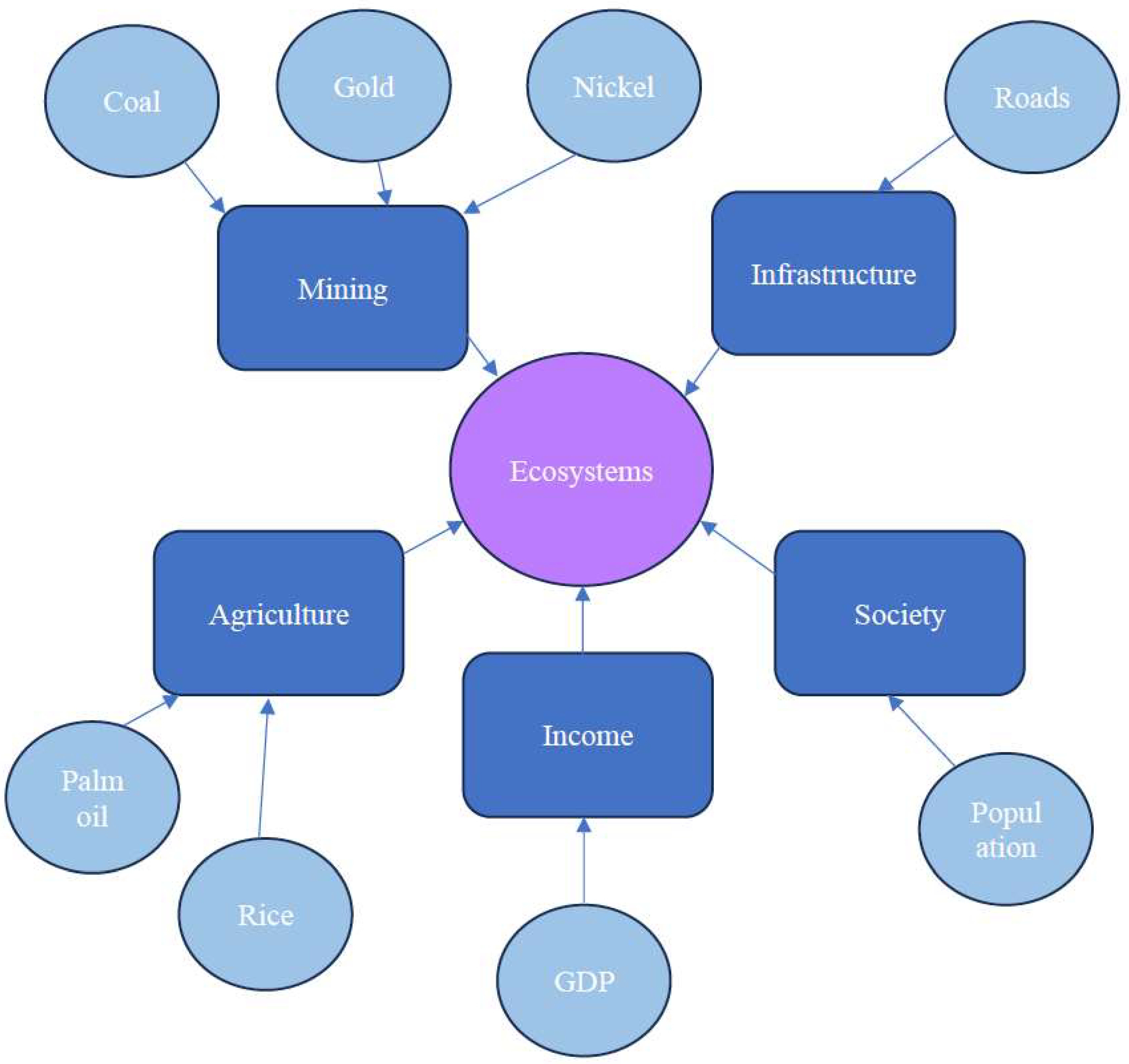
Based on the analysis of peer-reviewed literature and using a well-defined methodology (S. E. Shmelev & Speck, 2018) we identified several groups of factors (Figure 11): income, society, agriculture, mining, infrastructure that are responsible for the deforestation in Indonesia. More specifically, population growth has been found to negatively affect the available amount of forest in Indonesia, GDP was shown to be a significant stabilizing factor in a multi-variate regression model, which is presented in Table 1. Agricultural production has been represented by the palm oil production, which is reported to be one of the most serious factors of deforestation. Mining has been represented by coal mining, nickel mining and gold mining. Infrastructure has been represented by the overall volume of road built in Indonesia.
A simple multi-factor econometric model (Figure 12) connecting the amount of forest in Indonesia with four drivers following a framework presented in Figure 5 clearly shows that all of them are connected with deforestation albeit in different ways (Table 1). As the model output clearly shows, population growth is putting a pressure on the available forest, production of palm oil and extraction of coal are statistically significantly correlated with the amount of forest available, with GDP levels at PPP per capita improving the situation somewhat and acting as a stablilizer.
Building a model depicted in Table 1 and Figure 12 is a highly complex creative process that followed the methodological stage (Figure 11), analysis of literature of the subsequent chapters in this report, analysis of data presented in Figure 5, Figure 6, Figure 7, Figure 8 and Figure 9, and multiple brainstorming sessions (pairwise regressions between the variables in the model are depicted in Annex 1).
| Box 1. |
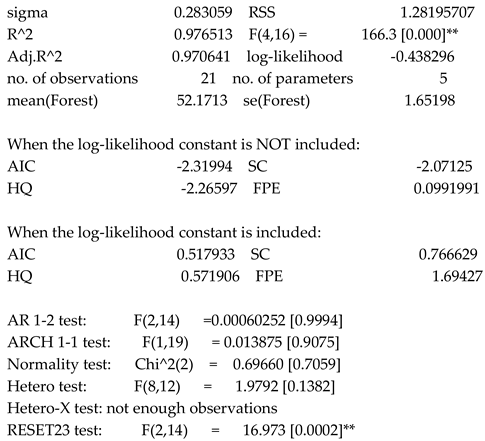 |
Various additional statistical test have been carried out with the help of OxMetrics Software. We note the excellent t-probability coefficients, all falling below a recommended 5% level, which indicates the high statistical significance of the variables selected for the present model. At the same time, the Adjusted R2 of 97.0641% indicates that approximately 97.06% of the variation in the dependent variable is accounted for by the independent variables included in the regression model.
Figure 12.
The Deforestation Model Output, Indonesia, 2000-2020.
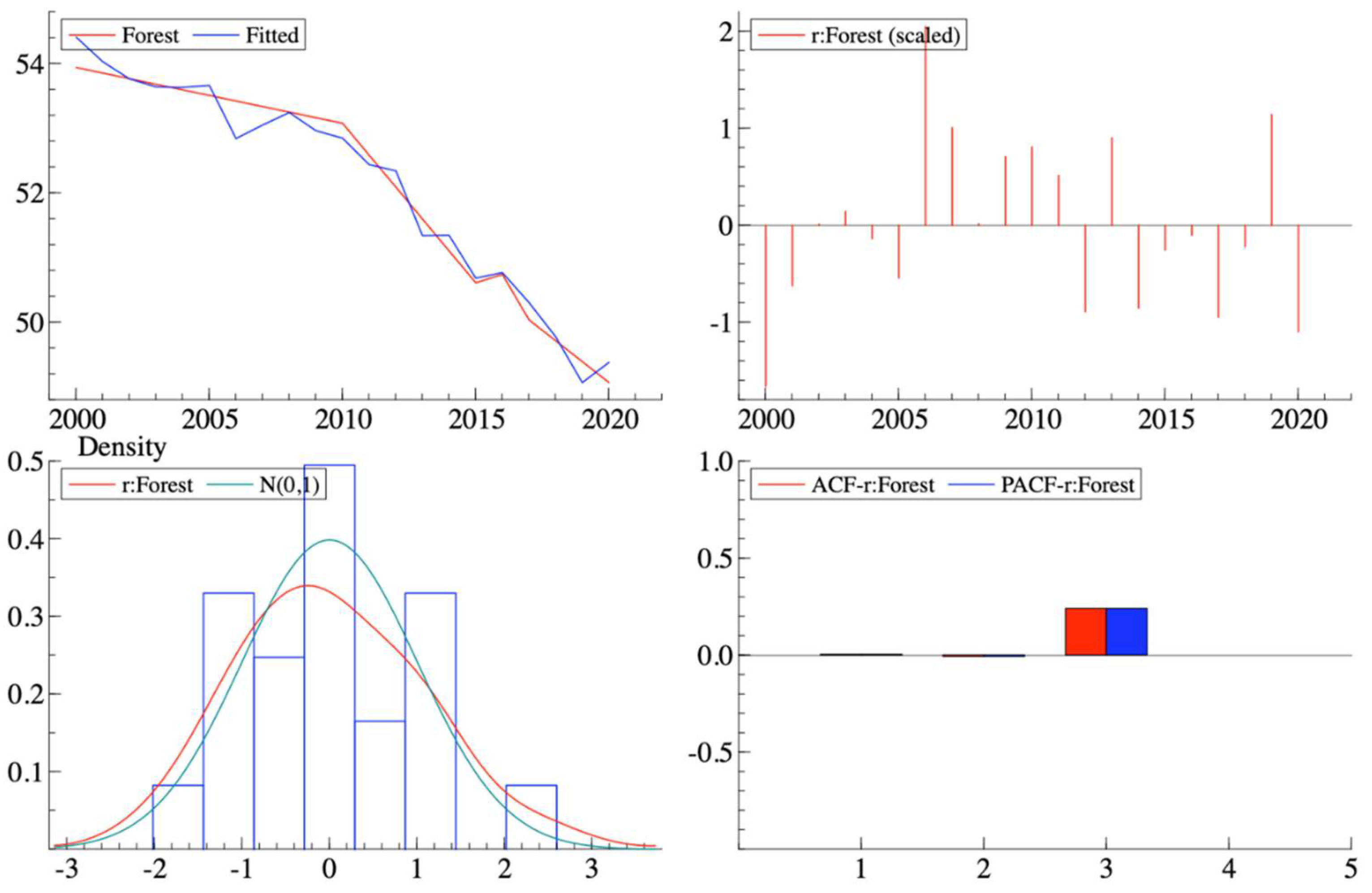
This suggests that the regression model is well-suited for explaining the variation in the dependent variable and has a high degree of predictive accuracy. Of all the factors apart from the constant, Palm oil production has the highest partial R2 (right hand column of Table 1). This indicates the highest level of contribution to deforestation in Indonesia. This fact should be seen in the context of socio-political realities in the country: millions of Indonesians are currently employed in the production of palm oil. The next factor by the partial R2 is the stabilising role of GDP, which clearly indicates that green development could stabilise and potentially reduce deforestation especially if Indonesia pursues a strategy of increasing value added in production, which it exactly did with the production of Lithium batters, that is highly commendable. The third variable by R2, the coal extraction comes with a negative coefficient, that clearly illustrates the environmental repercussions of open-pit coal mining on forests and, ultimately, biodiversity.
The additional statistical tests above reveal no evidence of autoregressive conditional heteroskedasticity, ARCH effects, departure from normality, or heteroskedasticity in the residuals of the regression model. Overall, these tests provide confidence in the reliability of the regression model's results and support the validity of the statistical inferences drawn from it.
The analysis of the state of the art in forest cover and factors attributed to its reduction is hugely important in the context of the present report as it presents the background on which the future system of biodiversity offsets will have to be designed. Knowing the most important drivers of biodiversity loss supported by econometric evidence provides operational capabilities to the government of Indonesia in adapting and refining its strategic approach that focuses on managing biodiversity. It has to emphasise that the modelling presented in this chapter is unique and has been carried out for the first time ever.
5. Discussion
While the central government of Indonesia is actively taking steps of aligning with the international standards on green and sustainable growth, the existing policy landscape does not reflect that. On the contrary, it still provides opportunities to exploit resource-intensive development plans (Anderson et al., 2016). Promoting green, sustainable practices is also a divided arena, with some governmental bodies and NGOs taking initiative, while corporations and other actors who perceive green economy as a constraint to economic development oppose them (Anderson et al., 2016). There is a lack of incentive structures and a solid regulatory basis to redirect stakeholders towards better, more sustainable practices (Brockhaus et al., 2012). ‘Decluttering’ the legal framework and simplifying it would also increase transparency, accountability and encourage coordination at different levels of governance (Brockhaus et al., 2012).
At the same time, ecosystems present the foundation for everything we do, including all economic processes. This is why it is absolutely fundamental to adopt an ecosystems approach following the CBD and develop new hubs of scientific knowledge in Indonesia focusing on ecosystem services, thereby increasing resilience and addressing the issues of transparency and traceability that have been abundantly flagged in the literature on biodiversity offsets presented in the following chapter. Without knowing, which fragments of ecosystems are most valuable, the introduction of ill-informed biodiversity offsets could harm Indonesia, as opposed to improve the situation. This is why we highly recommend to conduct a comprehensive ecosystem services mapping and apply recommended procedures in setting up a system of biodiversity offsets in Indonesia. This way we could follow scientific evidence (Jacob et al., 2016) and create a bespoke system of biodiversity offsets for Indonesia, one of the most biologically diverse countries on Planet Earth. Most of the biodiversity offset schemes created without this step around the world, have failed, which the next chapter amply illustrates.
The obvious prerequisite to any successful system of biodiversity regeneration is the information base. Following a most representative classification of ecosystems services, e.g. Common International Classification of Ecosystem Services, a fully-fledged mapping of ecosystem services in the context of Indonesia needs to be performed. Following the ground-breaking research of Shmelev et al (2023), and the multidimensional mappings illustrating the availability of detailed data for France on a 1x1 km grid, this seems to be feasible and of high potential value of this analysis for Indonesia.
It is important to underline that most of the ecosystem services available in the classification – approximately 30 layers have to be covered for a comprehensive reading of the true value of ecosystems in Indonesia. Among the most recent publications covering ecosystem services mapping in Indonesia we could mention: (Damastuti & De Groot, 2019), (Nugroho et al., 2022), (Mathys et al., 2023), (Triana & Wahyudi, 2020), (Fauzi et al., 2023), (Perdinan et al., 2024).
In the context of Indonesia, further research will have to be carried out to map ecosystem services fully. The first step in this research is going to be the identification of all the sources of spatial information for Indonesia representing various ecosystem services. Next, the integration of various layers could be conducted with varying weights, followed by the calculation of hotspots..
The most important systems science conclusion we could make for the benefit of this paper echoes (Norgaard, 2010) in the sense that urgent research is required into dynamic interactions between ecosystem services, the often hidden feedback loops and the trade-offs present. This is hugely important in the context of Indonesia, one of the most biologically countries on the planet as we simply often don’t know the full extent of the implications of losing a particular fragment of the natural ecosystem say, e.g. on the island of Borneo or the true implications of creating a new road. The new IPBES report (Intergovernmental Science-Policy Platform on Biodiversity and Ecosystem Services, 2022) fully confirmed a policy shift away from purely monetary towards more multidimensional assessment of ecosystems.
The failure to meet the Aichi Biodiversity Targets underscores the inadequacy of current global efforts to halt biodiversity loss. Biodiversity offset schemes, which often promise "No Net Loss," fail to deliver on this goal for at least 146 years, according to some studies. This failure is rooted in the flawed assumption that ecosystems are fungible commodities. Current approaches are unscientific, lack transparency, and frequently undervalue ecosystems’ complexity and intrinsic contributions to humanity.
Indonesia, one of the world’s most biodiverse nations, has experienced catastrophic deforestation, reducing forest cover from 65% in 1990 to below 50% today. This decline is driven by palm oil production, coal mining, population growth, and other key factors identified and validated through our quantitative analysis. These activities not only devastate ecosystems but also exacerbate economic, social, and ecological vulnerabilities.
Biodiversity offsets, as they are currently implemented, fail to address the complexity of ecosystems. They rely on arbitrary ratios, lack ecosystem mapping, fail to ensure “No Net Loss,” and offer inadequate compensation for lost biodiversity. Replacement ecosystems are often poor substitutes for what has been destroyed, with significant social and cultural costs. Moreover, biodiversity offsets in their current form risk commodifying nature, turning vital ecosystems into mere transactions within neoliberal frameworks.
To address these challenges, we propose the following measures:
- Acknowledge Indonesia’s Global Significance for Biodiversity: Indonesia is one of the most important biodiversity hubs globally, and preserving its ecosystems must be a national and international priority.
- Address the Drivers of Deforestation: Palm oil production, coal mining, and population pressures have been major contributors to forest loss. Effective policies to curb these pressures are urgently needed to reverse the trend of deforestation.
- Implement Comprehensive Ecosystem Services Mapping: Conduct nationwide mapping of ecosystem services at a resolution of 1x1 km or finer to identify critical biodiversity hotspots.
- Protect High-Value Areas: Exclude the top 25% of areas with the highest multidimensional biodiversity value from all economic and infrastructure development activities.
- Redefine the Economic Framework: Adopt a framework of ecological economics, placing the economic system firmly within environmental boundaries. Recognize ecosystems as holistic systems with intrinsic and instrumental value.
- Foster Transparency and Accountability: Establish robust monitoring systems in collaboration with Indonesia’s Statistical Office, Geospatial Information Agency, and Space Agency to ensure transparency and long-term tracking of biodiversity offset outcomes.
- Develop Centers of Green Economic Growth: Focus on low-resource, high-value industries such as software development, education, health, eco-tourism, and financial services. Actively pursue ecosystem restoration and regeneration alongside economic development.
- Strengthen Research and Capacity Building: Expand research centers focused on satellite imagery and ecosystem modeling, fostering local expertise in sustainable development and ecological management.
- Position Indonesia as a Global Conservation Leader: By adopting an innovative, data-driven approach, Indonesia can lead mega-diverse nations in developing conservation strategies that align with global biodiversity goals.
6. Conclusions.
The research carried out in this paper has reviewed a substantial amount of evidence-based scientific literature on the subject of biodiversity offsets. Various studies have been analysed from the point of view of critical factors that preclude existing instruments from operating effectively. The following five clusters of factors have been identified: institutions, data, ecology, economy and society. Based on meticulously collected data and the PRISMA-inspired literature review, we have built a mult-factor econometric model of deforestation in Indonesia, covering the period between 2000 and 2020. The following factors have been revealed as statistically significant drivers of deforestation in Indonesia: population growth, palm oil production, coal extraction with GDP having a mild stabilising effect. We conclude, that the deforestation situation in Indonesia, one of the most biodiverse countries on the planet is rather serious, and that new and innovative science-based tools need to be created instead of the unworkable biodiversity offsets to stop and reverse the loss of biodiversity. The paper outlined specific recommendations that all biodiversity-rich countries could follow, presented food for thought and a call to action in this important area. This paper presents but a first step in a significant body of research that still needs to be done.
Acknowledgments
The authors would like to acknowledge the financial support of UNDP in funding this research.
Glossary
- Biodiversity
The variability among living organisms from all sources including terrestrial, marine and other aquatic ecosystems and the ecological complexes of which they are a part; this includes diversity within species, between species and of ecosystems. (UN, 1992).
- CBD Kunming Montreal Biodiversity Framework
The Kunming-Montreal Global Biodiversity Framework (GBF) was adopted during the fifteenth meeting of the Conference of the Parties (COP 15) following a four year consultation and negotiation process. This historic Framework, which supports the achievement of the Sustainable Development Goals and builds on the Convention’s previous Strategic Plans, sets out an ambitious pathway to reach the global vision of a world living in harmony with nature by 2050. Among the Framework’s key elements are 4 goals for 2050 and 23 targets for 2030 (UN CBD, 2022).
- Ecosystem
A dynamic complex of plant, animal and micro-organism communities and their non-living environment interacting as a functional unit (UN, 1992)
- Ecosystem services
The benefits people obtain from ecosystems. These include provisioning services such as food and water; regulating services such as flood and disease control; cultural services such as spiritual, recreational, and cultural benefits; and supporting services such as nutrient cycling that maintain the conditions for life on Earth. The concept ‘‘ecosystem goods and services'’ is synonymous with ecosystem services (IPBES).
- Common International Classification of Ecosystem Services
CICES aims to classify the contributions that ecosystems make to human well-being that arise from living processes (Potschin et al., 2016).
- Environmental Impact Assessment
Environmental Impact Assessment (EIA) is a systematic process for identifying, predicting, evaluating, and mitigating the potential environmental effects of proposed projects, plans, or policies before they are implemented. The primary objective of EIA is to ensure that environmental considerations are integrated into decision-making processes to minimize adverse impacts on the environment and enhance sustainable development (UNEP, 2002).
- Mitigation hierarchy
The mitigation hierarchy is a tool designed to help users limit, as far as possible, the negative impacts of development projects on biodiversity and ecosystem services. It involves a sequence of four key actions—‘avoid’, ‘minimize’, ‘restore’ and ‘offset’—and provides a best practice approach to aid in the sustainable management of living, natural resources by establishing a mechanism to balance conservation needs with development priorities (Ekstrom et al., 2015).
- Multi-criteria decision aid
The Multi Criteria Decision Aid (MCDA) is a branch of the operational research discipline that addresses complex decision-making problems featuring high uncertainty and conflicting objectives (Wang et al., 2009).
- Econometrics
Econometrics concerns itself with the application of mathematical statistics and the tools of statistical inference to the empirical measurement of relationships postulated by an underlying theory (Greene, 2018).
- ELECTRE TRI
ELECTRE TRI is the multi-criteria decision aid tool based on the outranking approach representing the group of multicriteria sorting methods. It is one of the most frequently used methods of its kind (Emamat et al., 2022).
- PRISMA
PRISMA is a method for evidence-based reporting for systematic reviews and meta-analyses. It primarily focuses on the reporting of reviews evaluating the effects of policy interventions or medical research (Page et al., 2021).
- No Net Loss
The situation where negative biodiversity impacts caused by the project are balanced by the mitigation measures (IUCN).
- Net Positive Impact
A net gain to biodiversity features measured in quality hectares (for habitats), number or percentage of individuals (for species), or other metrics appropriate to the feature (IPBES).
Nature-based Solutions
Actions to protect, conserve, restore, sustainably use and manage natural or modified terrestrial, freshwater, coastal and marine ecosystems, which address social, economic and environmental challenges effectively and adaptively, while simultaneously providing human well-being, ecosystem services and resilience and biodiversity benefits (United Nations Environmental Assembly).
ANNEX 1
Figure 13.
Coal mining and availability of forest in Indonesia (1990-2021).
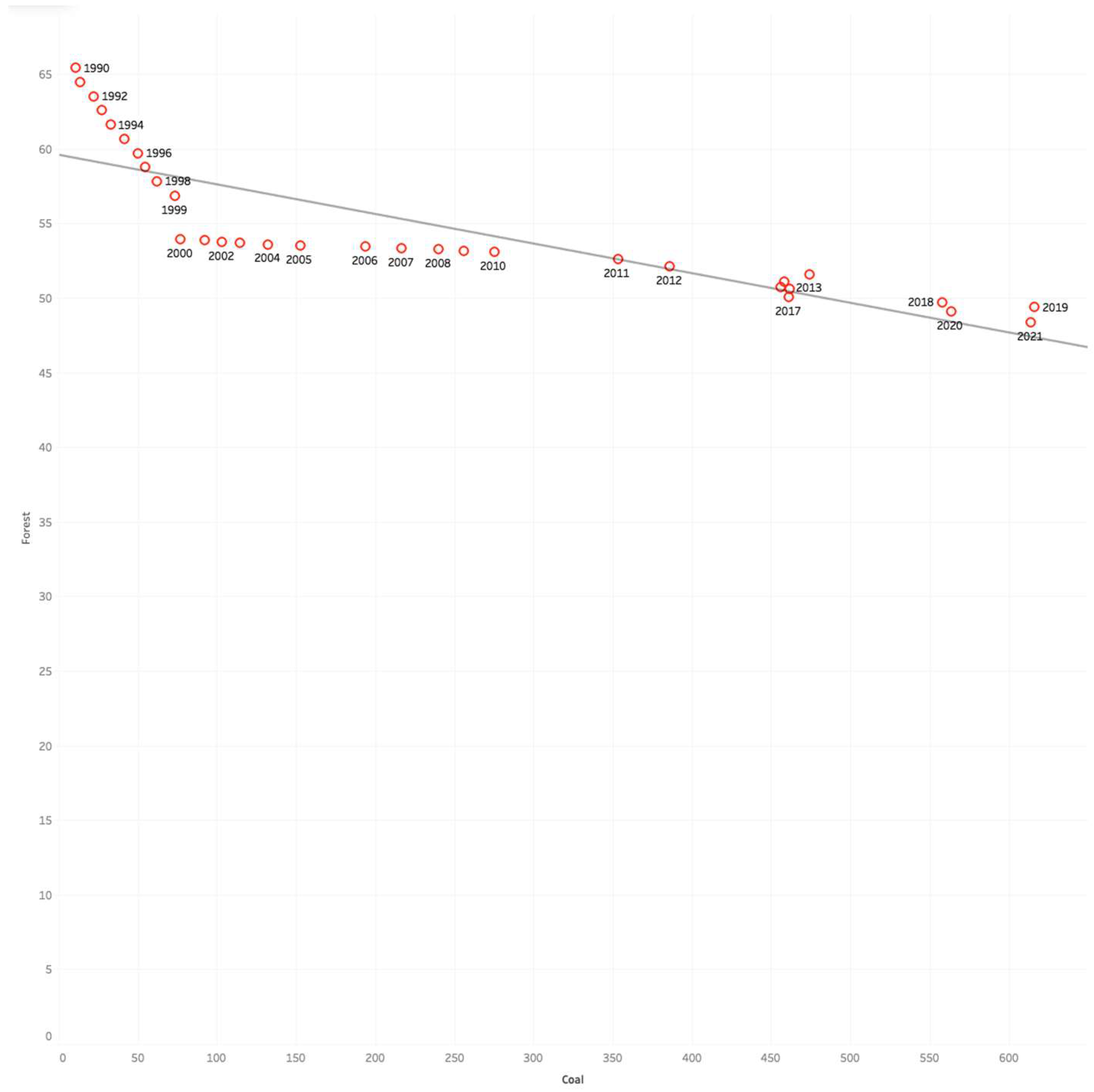
Figure 14.
Gold mining and availability of forest in Indonesia (1990-2021).
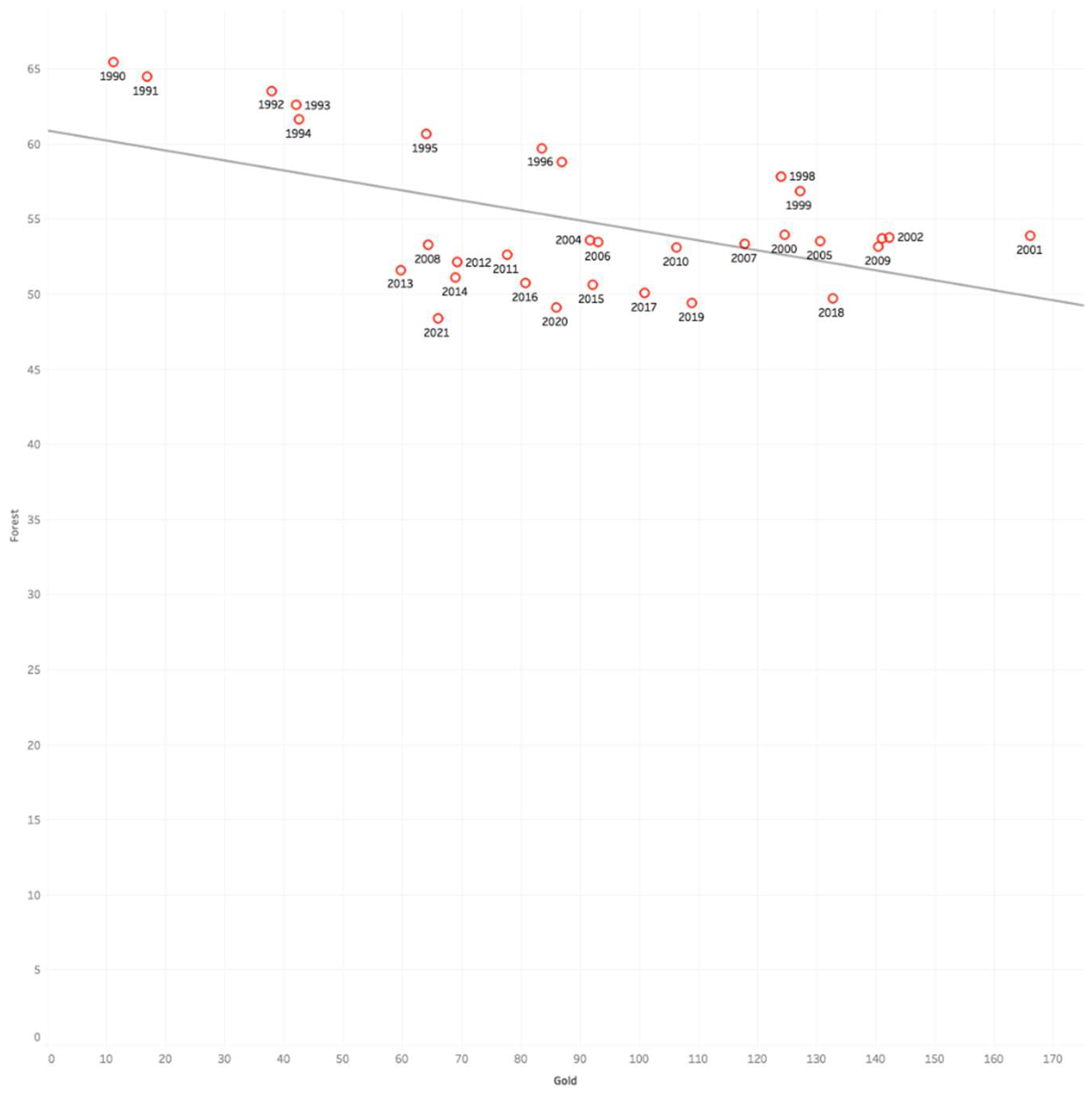
Figure 15.
Correlation between nickel mining and forest availability in Indonesia (1996-2021).
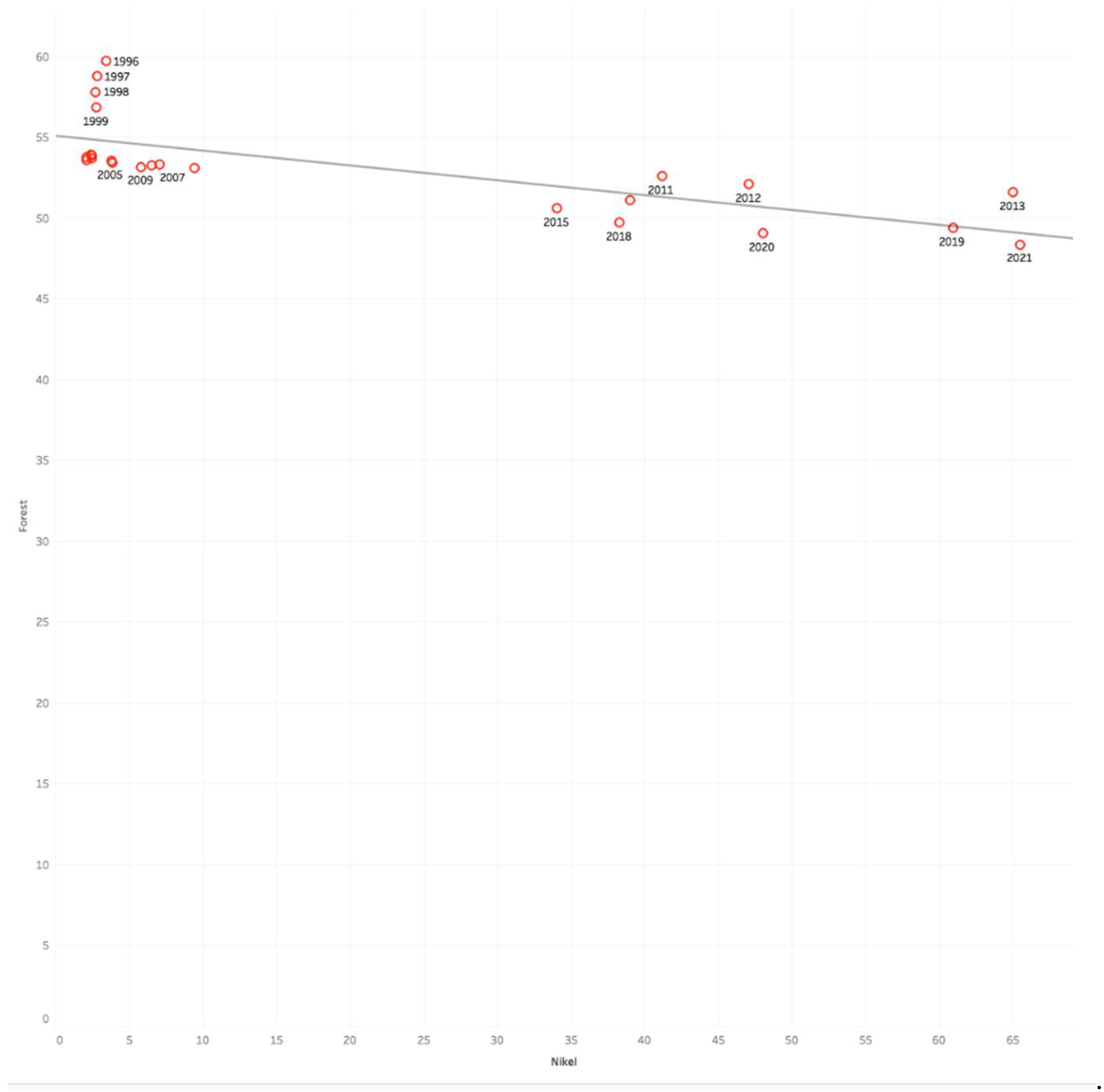
Figure 16.
GDP per capita and availability of forest in Indonesia (1990-2021.
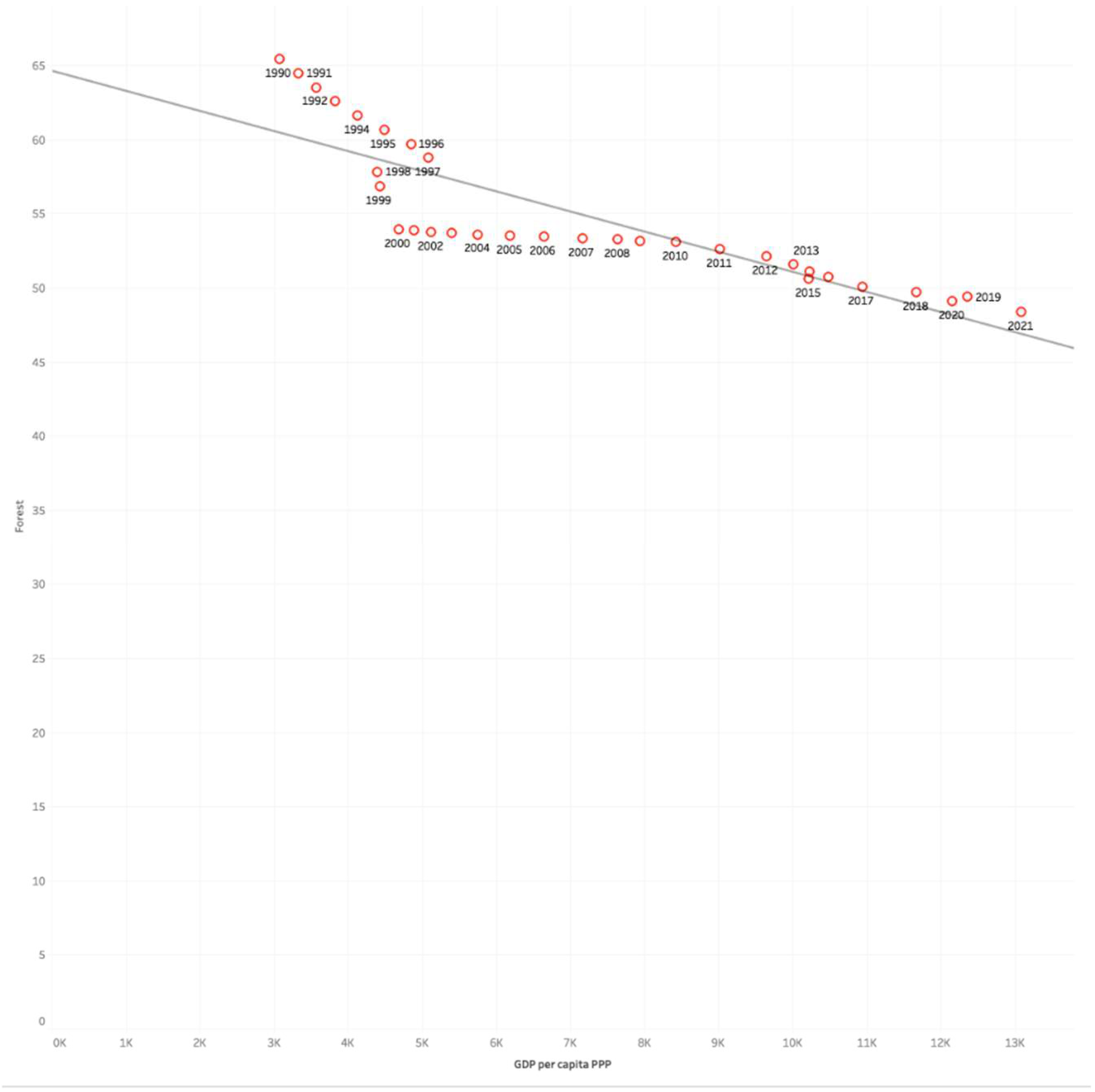
Figure 17.
Population growth and availability of forest in Indonesia (1990-2021).
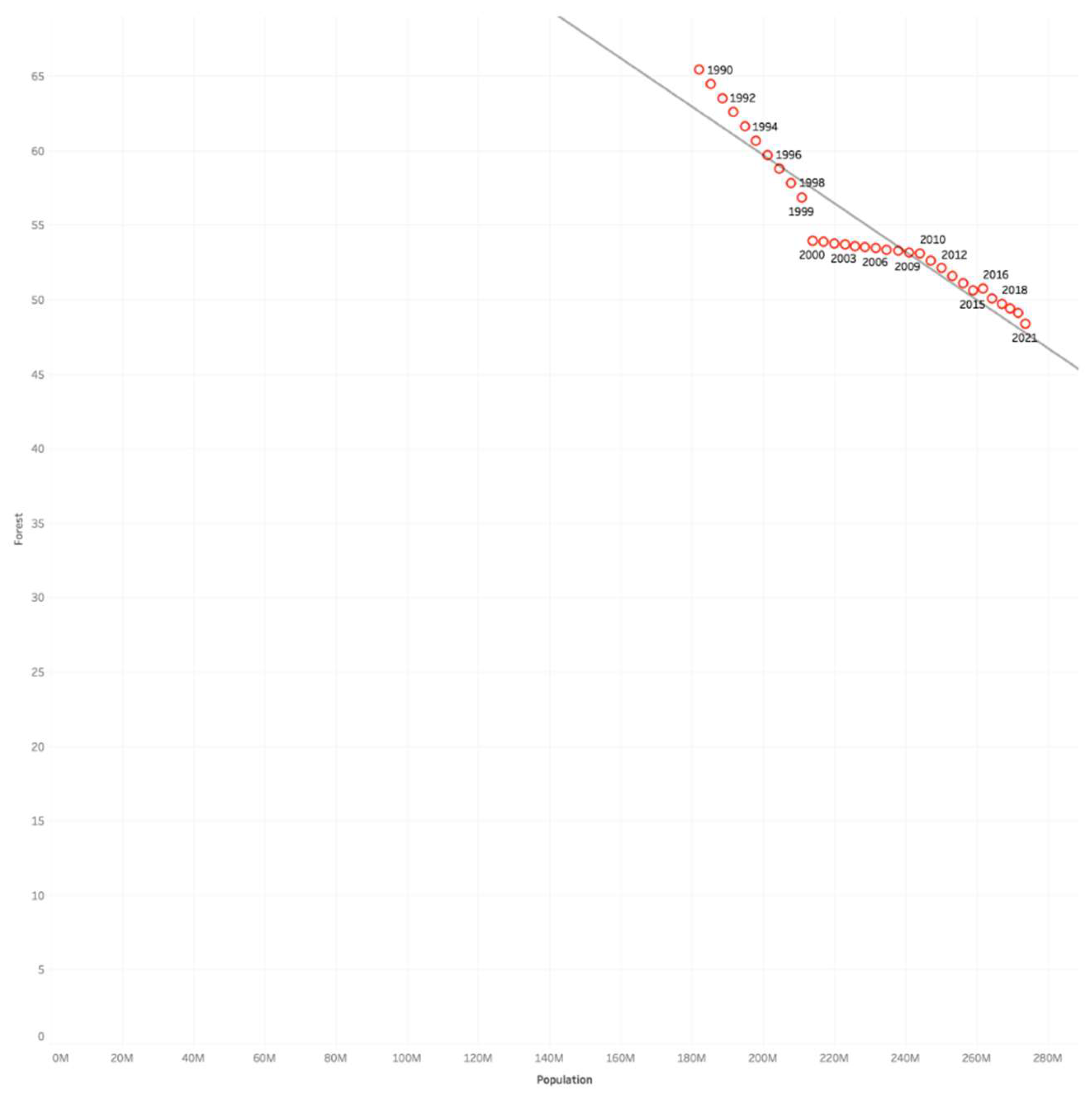
Figure 18.
Rice production and availability of forest in Indonesia (1990-2021).
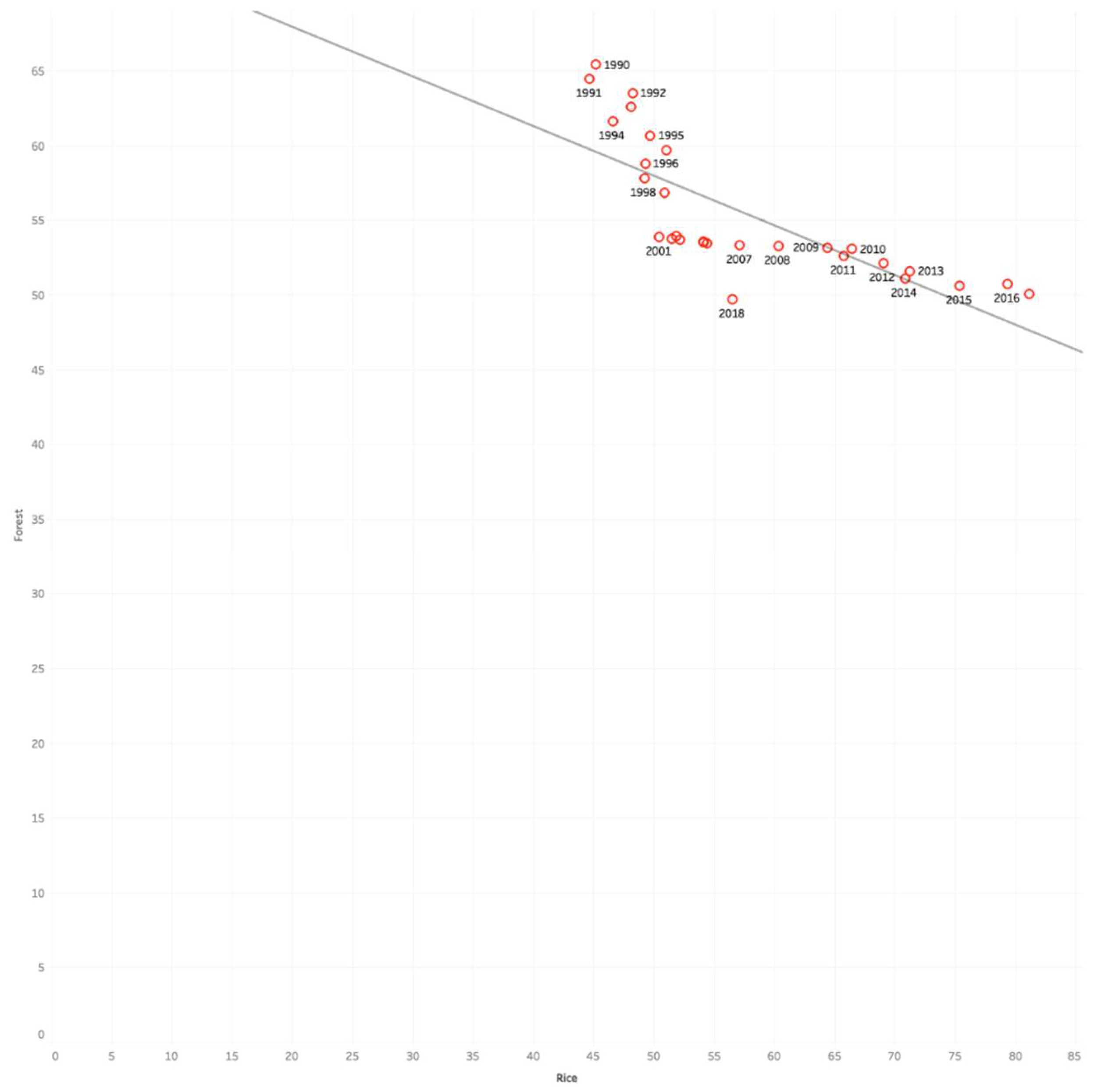
Figure 19.
Palm oil production and forest availability in Indonesia (1990-2021).
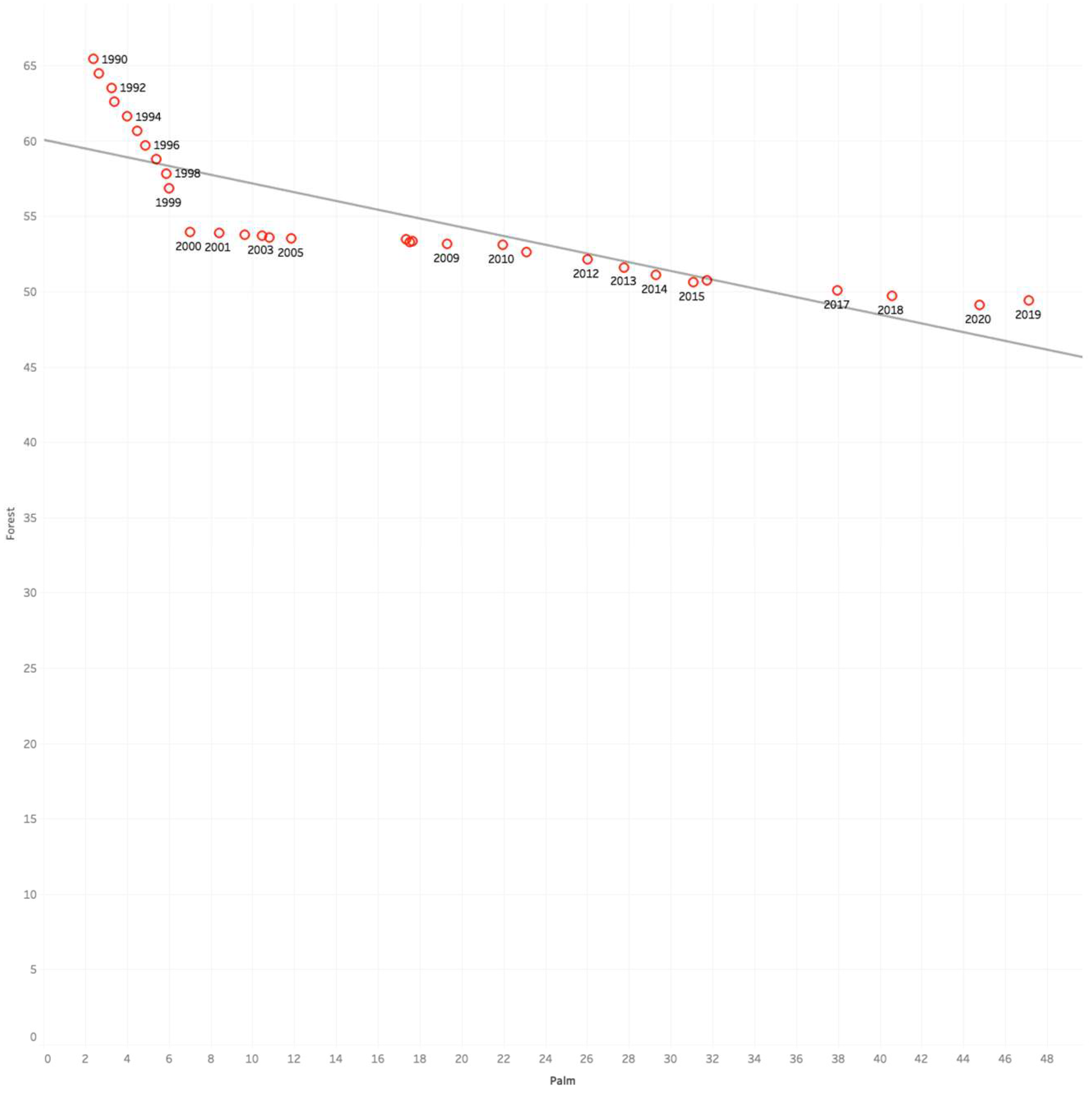
Figure 20.
The overall length of roads versus the available forest in Indonesia (1990-2021).
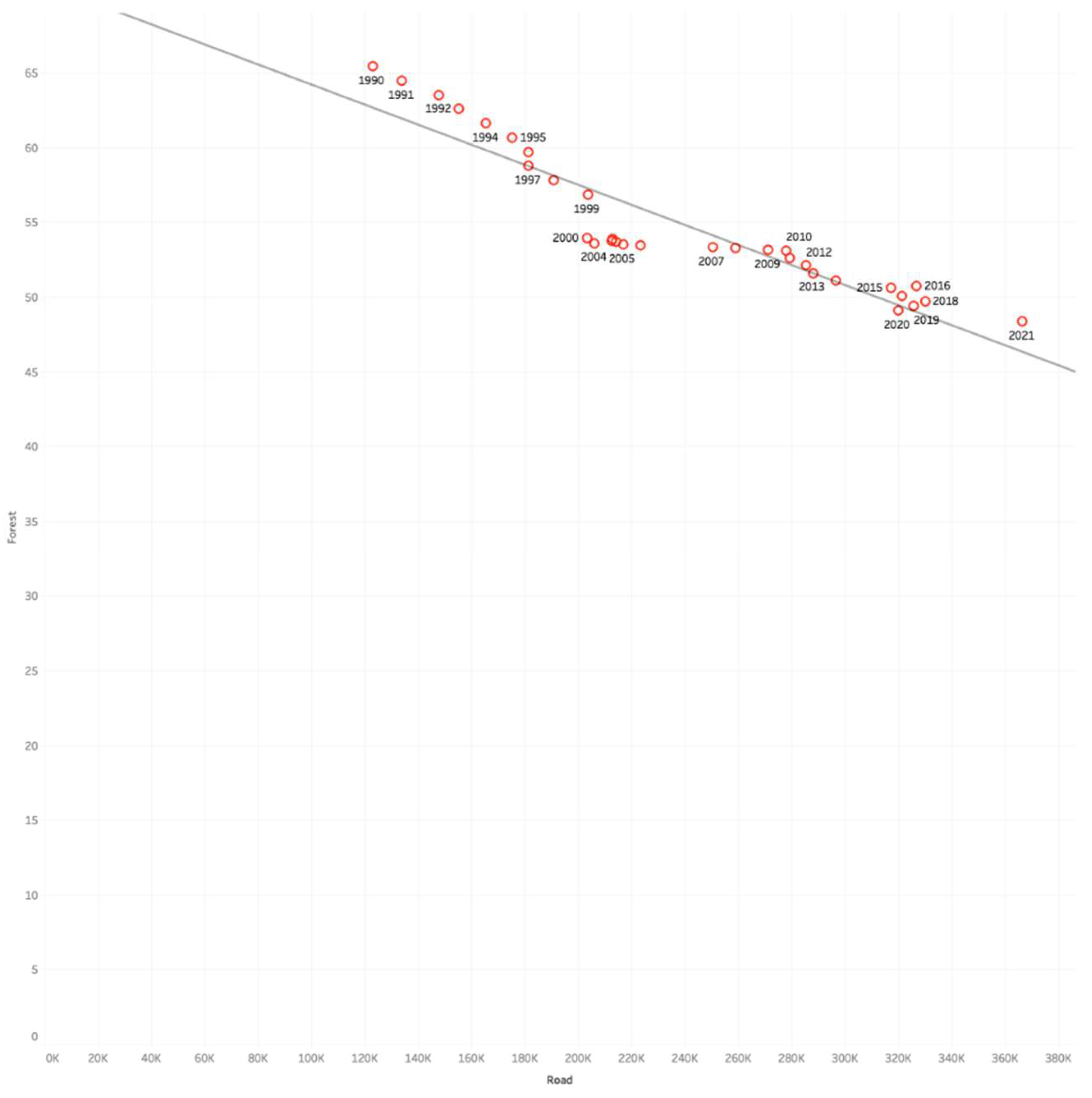
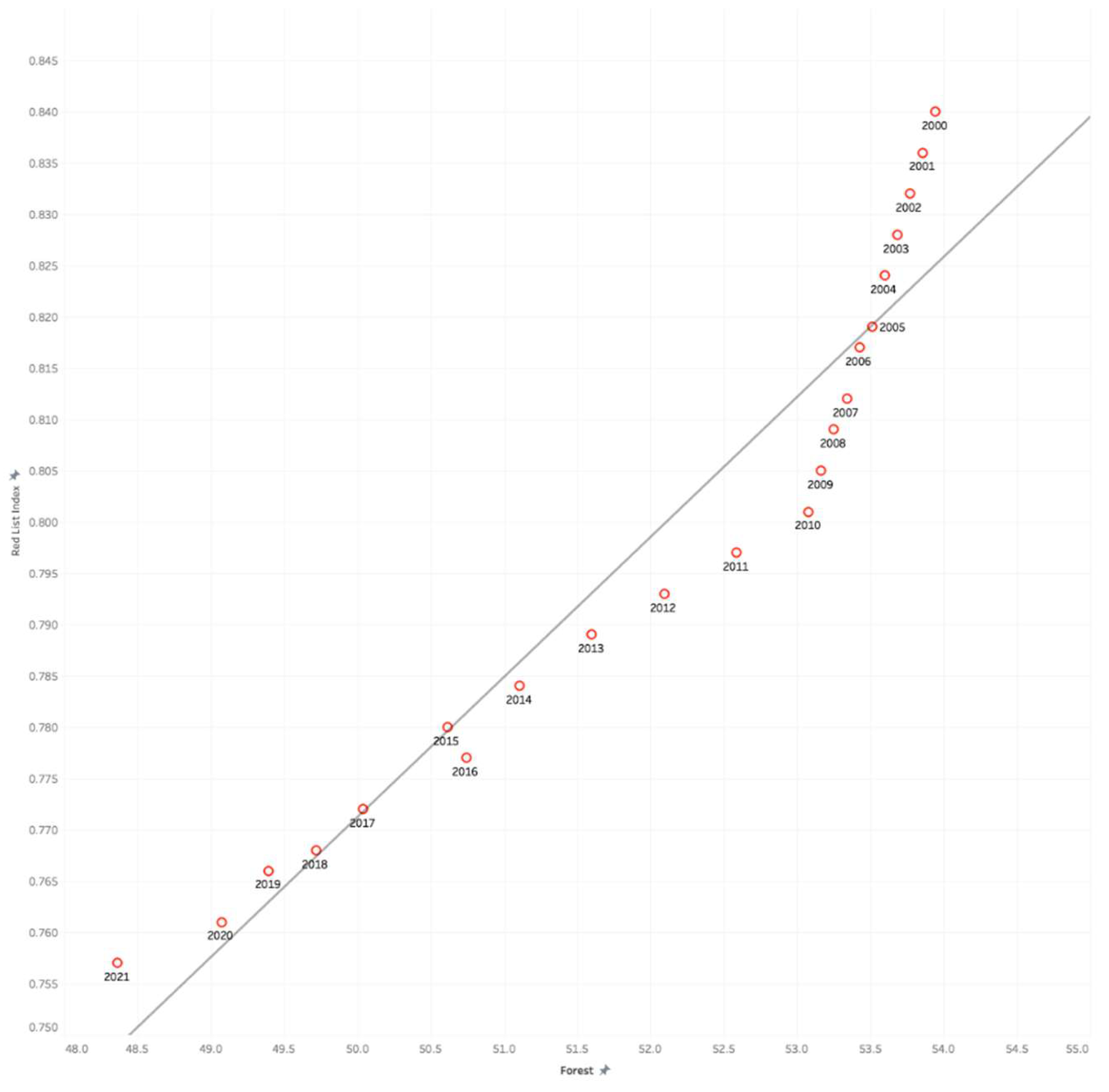
Figure 21.
Availability of forest versus the Red List Index in Indonesia (1990-2021).
References
- Abdo, L., Griffin, S., Kemp, A., & Coupland, G. (2021). Disparity in biodiversity offset regulation across Australia may reduce effectiveness. Australasian Journal of Environmental Management, 28(2), 81–103. [CrossRef]
- ADB. (2020). Biodiversity Offset Management Plan. INO: Sarulla Geothermal Power Generation Project. ADB. https://www.adb.org/sites/default/files/project-documents/42916/42916-014-dpta-en_9.pdf.
- Akhlas, A. W. (2020a, October 9). Environmental concerns, protests may discourage foreign investment: Moody’s. Jakarta Post. https://www.thejakartapost.com/news/2020/10/09/environmental-concerns-protests-may-discourage-foreign-investment-moodys.html.
- Akhlas, A. W. (2020b, October 22). IMF Concered over Jobs Law Environment Rules. Jakarta Post. https://www.thejakartapost.com/paper/2020/10/21/imf-concerned-over-jobs-law-environment-rules.html.
- Alagood, R. K. (2016). Mythology of Mitigation Banking. Environmental Law Reporter, Vol. 46. https://papers.ssrn.com/sol3/papers.cfm?abstract_id=2737694.
- Alamgir, M., Campbell, M. J., Sloan, S., Suhardiman, A., Supriatna, J., & Laurance, W. F. (2019). High-risk infrastructure projects pose imminent threats to forests in Indonesian Borneo. Scientific Reports, 9(1). Scopus. [CrossRef]
- Al-Ghobari, H., & Dewidar, A. Z. (2021). Integrating GIS-Based MCDA Techniques and the SCS-CN Method for Identifying Potential Zones for Rainwater Harvesting in a Semi-Arid Area. Water, 13(5), 704. [CrossRef]
- Ampri, I., Falconer, A., Wahyudi, N., Rosenberg, A., Ampera, M. B., Tuwo, A., Glenday, S., & Wilkinson, J. (2014). The Landscape of Public Climate Finance in Indonesia. An Indonesian Ministry of Finance & CPI. https://climatepolicyinitiative.org/wp-content/uploads/2014/07/The-Landscape-of-Public-Finance-in-Indonesia.pdf.
- Anderson, Z. R., Kusters, K., McCarthy, J., & Obidzinski, K. (2016). Green growth rhetoric versus reality: Insights from Indonesia. Global Environmental Change, 38, 30–40. [CrossRef]
- Anonymous. (2020). The United Nations must get its new biodiversity targets right. Nature, 578(7795), 337–338. [CrossRef]
- Apostolopoulou, E. (2016). Biodiversity offsetting in England: Governance rescaling, socio-spatial injustices, and the \hack\break neoliberalization of nature. Web Ecology, 16(1), 67–71. [CrossRef]
- Asih, A. S., Zamroni, A., Alwi, W., Sagala, S. T., & Putra, A. S. (2022). Assessment of Heavy Metal Concentrations in Seawater in the Coastal Areas around Daerah Istimewa Yogyakarta Province, Indonesia. Iraqi Geological Journal, 55(1B), 14–22. [CrossRef]
- Ávila-Flores, Juárez-Mancilla, Hinojosa-Arango, Cruz-Chávez, López-Vivas, & Arizpe-Covarrubias. (2020). A Practical Index to Estimate Mangrove Conservation Status: The Forests from La Paz Bay, Mexico as a Case Study. Sustainability, 12(3), 858. [CrossRef]
- Bakirman, T., & Gumusay, M. U. (2020). A novel GIS-MCDA-based spatial habitat suitability model for Posidonia oceanica in the Mediterranean. Environmental Monitoring and Assessment, 192(4), 231. [CrossRef]
- Balling, J., Verbesselt, J., De Sy, V., Herold, M., & Reiche, J. (2021). Exploring Archetypes of Tropical Fire-Related Forest Disturbances Based on Dense Optical and Radar Satellite Data and Active Fire Alerts. Forests, 12(4), 456. [CrossRef]
- Bartlett, R. (2019). Visioning Futures: Improving infrastructure planning to harness nature’s benefits in a warming world. WWF. https://files.worldwildlife.org/wwfcmsprod/files/Publication/file/3ntj8trz40_WWF_Visioning_Futures_2020_lo_res.pdf?_ga=2.187021992.1692908604.1708095626-1062575565.1708095624.
- BBOP. (2012). Guidance Notes to the Standard on Biodiversity Offsets. Business and Biodiversity Offsets Programme. https://www.forest-trends.org/wp-content/uploads/imported/BBOP_Standard_Guidance_Notes_20_Mar_2012_Final_WEB.pdf.
- Benayas, J. M. R., Newton, A. C., Diaz, A., & Bullock, J. M. (2009). Enhancement of Biodiversity and Ecosystem Services by Ecological Restoration: A Meta-Analysis. Science, 325(5944), 1121–1124. [CrossRef]
- Bennett, N. J., & Satterfield, T. (2018). Environmental governance: A practical framework to guide design, evaluation, and analysis. Conservation Letters, 11(6), e12600. [CrossRef]
- Bezombes, L., Kerbiriou, C., & Spiegelberger, T. (2019). Do biodiversity offsets achieve No Net Loss? An evaluation of offsets in a French department. Biological Conservation, 231, 24–29. [CrossRef]
- Bidaud, C., Schreckenberg, K., & Jones, J. P. G. (2018). The local costs of biodiversity offsets: Comparing standards, policy and practice. Land Use Policy, 77, 43–50. [CrossRef]
- Bigard, C., Pioch, S., & Thompson, J. D. (2017). The inclusion of biodiversity in environmental impact assessment: Policy-related progress limited by gaps and semantic confusion. Journal of Environmental Management, 200, 35–45. [CrossRef]
- Blomkamp, E., Sholikin, M. N., Nursyamsi, F., Lewis, J. M., & Toumbourou, T. (2018). Understanding Policymaking in Indonesia: In Search of a Policy Cycle. University of Melbourne and Indonesian Centre for Law and Policy Studies. https://www.ksi-indonesia.org/file_upload/Understanding-Policy-Making-in-Indonesia-in-Searc-06Feb2018141656.pdf.
- Boentoro, M. R. B., & Wherrett, T. (2021). Limits of acceptable change for sustainable management of the Pelawan Biodiversity Park, Bangka Belitung Islands. IOP Conference Series: Earth and Environmental Science, 913(1). Scopus. [CrossRef]
- Borgert, T., Donovan, J. D., Topple, C., & Masli, E. K. (2019). Determining what is important for sustainability: Scoping processes of sustainability assessments. Impact Assessment and Project Appraisal, 37(1), 33–47. [CrossRef]
- Brears, R. (2022). Financing nature-based solutions: Exploring public, private, and blended finance models and case studies. Palgrave Macmillan.
- Brockhaus, M., Obidzinski, K., Dermawan, A., Laumonier, Y., & Luttrell, C. (2012). An overview of forest and land allocation policies in Indonesia: Is the current framework sufficient to meet the needs of REDD+? Forest Policy and Economics, 18, 30–37. [CrossRef]
- Brondízio, E. S., Settele, J., Díaz, S., & Ngo, H. T. (Eds.). (2019). The global assessment report of the intergovernmental science-policy platform on biodiversity and ecosystem services. Intergovernmental Science-Policy Platform on Biodiversity and Ecosystem Services (IPBES).
- Budiharta, S., Meijaard, E., Gaveau, D. L. A., Struebig, M. J., Wilting, A., Kramer-Schadt, S., Niedballa, J., Raes, N., Maron, M., & Wilson, K. A. (2018). Restoration to offset the impacts of developments at a landscape scale reveals opportunities, challenges and tough choices. Global Environmental Change, 52, 152–161. [CrossRef]
- Bull, J. W., Gordon, A., Milner-Gulland, E. J., Singh, N. J., & Suttle, K. B. (2013). Biodiversity offsets in theory and practice. Oryx, 47(3), 369–380. Cambridge Core. [CrossRef]
- Bull, J. W., & Strange, N. (2018). The global extent of biodiversity offset implementation under no net loss policies. Nature Sustainability, 1(12), 790–798. [CrossRef]
- Cabernard, L., & Pfister, S. (2022). Hotspots of Mining-Related Biodiversity Loss in Global Supply Chains and the Potential for Reduction through Renewable Electricity. Environmental Science & Technology, 56(22), 16357–16368. [CrossRef]
- Cabinet Secretariat of the Republic of Indonesia. (2019). Government Establishes Environment Fund Management Agency. https://setkab.go.id/en/govt-establishes-environmental-fund-management-agency/.
- Cammerino, A. R. B., Ingaramo, M., Piacquadio, L., & Monteleone, M. (2023). Assessing and Mapping Forest Functions through a GIS-Based, Multi-Criteria Approach as a Participative Planning Tool: An Application Analysis. Forests, 14(5), 934. [CrossRef]
- Carreras Gamarra, M. J., & Toombs, T. P. (2017). Thirty years of species conservation banking in the U.S.: Comparing policy to practice. Biological Conservation, 214, 6–12. [CrossRef]
- Castilhos, Z. C., Rodrigues-Filho, S., Rodrigues, A. P. C., Villas-Bôas, R. C., Siegel, S., Veiga, M. M., & Beinhoff, C. (2006). Mercury contamination in fish from gold mining areas in Indonesia and human health risk assessment. Selected Papers from the 7th International Conference on Mercury as a Global Pollutant, Ljubljana, Slovenia June 27 - July 2, 2004, 368(1), 320–325. [CrossRef]
- CIFOR. (2024). Provincial Council on Climate Change East Kalimantan, Indonesia. https://www.cifor.org/publications/pdf_files/flyer/7434-Flyer.pdf.
- Damastuti, E., & De Groot, R. (2019). Participatory ecosystem service mapping to enhance community-based mangrove rehabilitation and management in Demak, Indonesia. Regional Environmental Change, 19(1), 65–78. [CrossRef]
- Darbi, M. (2020). Biodiversity Offsets Between Regulation and Voluntary Commitment: A Typology of Approaches Towards Environmental Compensation and No Net Loss of Biodiversity. Springer International Publishing. [CrossRef]
- Darmadi, N. S., Bawono, B. T., & Hafidz, J. (2023). Forest Land Conversion for Oil Palm Plantations and Legal Protection and Social Welfare of Indigenous Communities. Environment and Ecology Research, 11(3), 467–474. [CrossRef]
- Darvill, R., & Lindo, Z. (2016). The inclusion of stakeholders and cultural ecosystem services in land management trade-off decisions using an ecosystem services approach. Landscape Ecology, 31(3), 533–545. [CrossRef]
- Demir, S., Demirel, Ö., & Okatan, A. (2021). An ecological restoration assessment integrating multi-criteria decision analysis with landscape sensitivity analysis for a hydroelectric power plant project: The Tokat-Niksar case. Environmental Monitoring and Assessment, 193(12), 818. [CrossRef]
- Department of Energy and Mineral Resources, East Kalimantan Province. (2024). Main Duties and Functions. https://esdm.kaltimprov.go.id/index.php/profil/dinas/tugas-pokok-dan-fungsi.
- Dhyani, S., Adhikari, D., Dasgupta, R., & Kadaverugu, R. (2023). Ecosystem and species habitat modeling for conservation and restoration. Springer.
- Duadji, N., Purba, D., Juliana, A., Wulandari, F., Zenitha, S., Budiati, A., Kurniasih, D., & Djausal, G. (2023). Biodiversity management policy in indonesia. IOP Conference Series: Earth and Environmental Science, 1277(1), Article 1. [CrossRef]
- Dwiyahreni, A. A., Fuad, H. A. H., Muhtar, S., Soesilo, T. E. B., Margules, C., & Supriatna, J. (2021). Changes in the human footprint in and around Indonesia’s terrestrial national parks between 2012 and 2017. Scientific Reports, 11(1), 4510. [CrossRef]
- East Kalimantan Provincial Forestry Service. (2019). Vision and Mission of the Forestry Service of East Kalimantan Province 2019 to 2023. https://dishut.kaltimprov.go.id/profil/visi-dan-misi.
- Ecosystems: Complexity, diversity and nature’s contribution to humanity (1st edition). (2018). Environment Europe Press.
- Ekstrom, J., Bennun, L., & Mitchell, R. (2015). A cross-sector guide for implementing the Mitigation Hierarchy. Cross Sector Biodiversity Initiative. https://www.ipieca.org/resources/a-cross-sector-guide-for-implementing-the-mitigation-hierarchy.
- Emamat, M. S. M. M., Mota, C. M. D. M., Mehregan, M. R., Sadeghi Moghadam, M. R., & Nemery, P. (2022). Using ELECTRE-TRI and FlowSort methods in a stock portfolio selection context. Financial Innovation, 8(1), 11. [CrossRef]
- Ernyasih, E., Mallongi, A., Daud, A., Palutturi, S., Stang, S., Thaha, A. R., Ibrahim, E., & Madhoun, W. A. (2023). Health risk assessment through probabilistic sensitivity analysis of. Global Journal of Environmental Science and Management, 9(4), 933–950. [CrossRef]
- European Commission. (2013). Green Infrastructure Strategy—Enhancing Europe’s Natural Capital, Brussels, 6.5.2013, COM(2013) 249 final. European Commission. https://eur-lex.europa.eu/resource.html?uri=cellar:d41348f2-01d5-4abe-b817-4c73e6f1b2df.0014.03/DOC_1&format=PDF.
- European Commission. (2020). EU Guidance on Integrating Ecosystems and their Services into Decision-Making. https://environment.ec.europa.eu/topics/nature-and-biodiversity/green-infrastructure_en.
- Evans, M. C. (2023). Backloading to extinction: Coping with values conflict in the administration of Australia’s federal biodiversity offset policy. Australian Journal of Public Administration, 82(2), 228–247. [CrossRef]
- Fauzi, A. I., Azizah, N., Yati, E., Atmojo, A. T., Rohman, A., Putra, R., Rahadianto, M. A. E., Ramadhanti, D., Ardani, N. H., Robbani, B. F., Nuha, M. U., Perdana, A. M. P., Sakti, A. D., Aufaristama, M., & Wikantika, K. (2023). Potential Loss of Ecosystem Service Value Due to Vessel Activity Expansion in Indonesian Marine Protected Areas. ISPRS International Journal of Geo-Information, 12(2), 75. [CrossRef]
- Filoche, G. (2017). Playing musical chairs with land use obligations: Market-based instruments and environmental public policies in Brazil. Land Use Policy, 63, 20–29. [CrossRef]
- Fisher, B., Turner, R. K., & Morling, P. (2009). Defining and classifying ecosystem services for decision making. Ecological Economics, 68(3), 643–653. [CrossRef]
- Florentine, S., Gibson-Roy, P., Dixon, K. W., & Broadhurst, L. (Eds.). (2023). Ecological Restoration: Moving Forward Using Lessons Learned. Springer International Publishing. [CrossRef]
- Gaveau, D. L. A., Santos, L., Locatelli, B., Salim, M. A., Husnayaen, H., Meijaard, E., Heatubun, C., & Sheil, D. (2021). Forest loss in Indonesian New Guinea (2001–2019): Trends, drivers and outlook. Biological Conservation, 261, 109225. [CrossRef]
- Gibbons, P., Macintosh, A., Constable, A. L., & Hayashi, K. (2018). Outcomes from 10 years of biodiversity offsetting. Global Change Biology, 24(2), e643–e654. [CrossRef]
- GIZ. (2024). Sustainable Infrastructure Tools. https://sustainable-infrastructure-tools.org/.
- Global Forest Watch. (2024). Forest Watch Designed for Action. https://www.globalforestwatch.org/map/country/IDN/.
- Gómez-Baggethun, E., & Ruiz-Pérez, M. (2011). Economic valuation and the commodification of ecosystem services. Progress in Physical Geography: Earth and Environment, 35(5), 613–628. [CrossRef]
- Gordon, A., Bull, J. W., Wilcox, C., & Maron, M. (2015). FORUM: Perverse incentives risk undermining biodiversity offset policies. Journal of Applied Ecology, 52(2), 532–537. [CrossRef]
- Government of Indonesia. (1990). Law No.5 of 1990 concerning Conservation of Living Resources and their Ecosystems. https://faolex.fao.org/docs/pdf/ins3867.pdf.
- Government of Indonesia. (1999a). Law No. 18 of 1999 on Construction Services. http://www.flevin.com/id/lgso/translations/Laws/Law%20No.%2018%20of%201999%20on%20Construction%20Services.pdf.
- Government of Indonesia. (1999b). Law No. 41 of 1999 Concerning Forestry. https://www.ecolex.org/details/legislation/forestry-act-no-41-of-1999-lex-faoc036649/.
- Government of Indonesia. (2004a). Law No. 31 of 2004 on Fisheries. https://faolex.fao.org/docs/pdf/ins51065Eng.pdf.
- Government of Indonesia. (2004b). Law No. 32 of 2004 concerning Regional Administration. https://faolex.fao.org/docs/pdf/ins198699.pdf.
- Government of Indonesia. (2004c). Law No. 38 of 2004 concerning Roads as amended by Law No. 11/2020 on Job Creation and lastly amended by Law No. 2/2022.
- Government of Indonesia. (2007a). Law No. 26 of 2007 concerning Spatial Planning. https://www.ecolex.org/details/legislation/law-of-the-republic-of-indonesia-no-26-of-2007-concerning-spatial-planning-lex-faoc163446/.
- Government of Indonesia. (2007b). Law No. 27 of 2007 concerning Investment. https://www.ecolex.org/details/legislation/law-no-25-of-2007-concerning-investment-lex-faoc201875/.
- Government of Indonesia. (2009a). Law No. 30 of 2009 concerning Electricity. https://www.ecolex.org/details/legislation/law-no-302009-on-electricity-lex-faoc091864/.
- Government of Indonesia. (2009b). Law No. 32 of 2009 on Environmental Protection and Management. https://faolex.fao.org/docs/pdf/ins97643.pdf.
- Government of Indonesia. (2010). Law No. 13 in 2010 on Horticulture.
- Government of Indonesia. (2012). Law No.2 of 2012 concerning Acquisition of Land for Development in the Public Interest. https://peraturan.go.id/files2/uu-no-2-tahun-2012_terjemah.pdf.
- Government of Indonesia. (2013). Law No. 19 of 2013 on the Protection and Empowerment of Farmers. https://www.fao.org/faolex/results/details/en/c/LEX-FAOC169497/.
- Government of Indonesia. (2019). Law N.17 of 2019 on Water Resources. https://www.fao.org/faolex/results/details/en/c/LEX-FAOC192861.
- Government of Indonesia. (2022). Law No. 2 of 2022 on Job Creation.
- Government of Indonesia. (2023). Law No. 6 of 2023 concerning the Stipulation of Government Regulations intended to become Law, in Lieu of Law no. 2 of 2022 concerning Job Creation. https://www.fao.org/faolex/results/details/en/c/LEX-FAOC221248/.
- Green Climate Fund. (2016). PT Sarana Multi Infrastruktur (Indonesia). https://www.greenclimate.fund/ae/ptsmi.
- Greene, W. (2018). Econometric analysis (Eighth edition). Pearson.
- Hadad, I. (1998). The Indonesian Biodiversity Foundation (Yayasan KEHATI). Profiles of the NEFS. UN Convention on Biological Diversity. CBD. https://www.cbd.int/financial/trustfunds/Indonesia-kehati.pdf.
- Hadi, S. P., Hamdani, R. S., & Roziqin, A. (2023). A sustainability review on the Indonesian job creation law. Heliyon, 9(2), e13431. [CrossRef]
- Handayani, I. G. A. K. R., Sulistiyono, A., Leonard, T., Gunardi, A., & Najicha, F. U. (2018). Environmental management strategy in mining activities in forest area accordance with the based justice in Indonesia. Journal of Legal, Ethical and Regulatory Issues, 21(2). Scopus. https://www.scopus.com/inward/record.uri?eid=2-s2.0-85050293493&partnerID=40&md5=d0b28cb5d2238eb382e77d3cb23b09f7.
- Hapsari, L., & Budiharta, S. (2021). Integrating indicators of natural regeneration, enrichment planting, above-ground carbon stock, micro-climate and soil to asses vegetation succession in postmining reclamation in tropical forest. Turkish Journal of Botany, 45(5), 457–467. Scopus. [CrossRef]
- Harrison, P. A., Berry, P. M., Simpson, G., Haslett, J. R., Blicharska, M., Bucur, M., Dunford, R., Egoh, B., Garcia-Llorente, M., Geamănă, N., Geertsema, W., Lommelen, E., Meiresonne, L., & Turkelboom, F. (2014). Linkages between biodiversity attributes and ecosystem services: A systematic review. Ecosystem Services, 9, 191–203. [CrossRef]
- Hasibuan, H. S., & Mulyani, M. (2022). Transit-Oriented Development: Towards Achieving Sustainable Transport and Urban Development in Jakarta Metropolitan, Indonesia. Sustainability (Switzerland), 14(9), Article 9. Scopus. [CrossRef]
- Helmi, H., Hafrida, H., Fitria, F., & Najwan, J. (2019). Documenting legal protection of indigenous forests in realizing indigenous legal community rights in Jambi Province. Library Philosophy and Practice, 2019. Scopus. https://www.scopus.com/inward/record.uri?eid=2-s2.0-85072802844&partnerID=40&md5=19ebf070776b08a564d066e99e9b3c50.
- Ho, P., Nor-Hisham, B. M. S., & Zhao, H. (2020). Limits of the Environmental Impact Assessment (EIA) in Malaysia: Dam Politics, Rent-Seeking, and Conflict. Sustainability, 12(24), Article 24. [CrossRef]
- Holl, K. (2020). Primer of Ecological Restoration. Island Press; eBook Collection (EBSCOhost). https://search.ebscohost.com/login.aspx?direct=true&AuthType=ip,shib&db=nlebk&AN=2965730&site=ehost-live&authtype=ip,uid.
- Hubert Ta, L., & Campbell, B. (2023). Environmental protection in Madagascar: Biodiversity offsetting in the mining sector as a corporate social responsibility strategy. Extractive Industries and Society, 15. Scopus. [CrossRef]
- IDH. (2024). The National Initiative on Sustainable and Climate Smart Oil Palm Smallholders (NI SCOPS). IDH Sustainable Trade Inititative, Government of the the Netherlands. https://www.idhsustainabletrade.com/uploaded/2020/10/200930-NI-SCOPS_2-pager_Indonesia_Final.pdf.
- Indonesia Investments. (2024, January 18). Perusahaan Listrik Negara. https://www.indonesia-investments.com/business/indonesian-companies/perusahaan-listrik-negara-pln-soe/item409.
- IPBES. (2019). Global assessment report on biodiversity and ecosystem services of the Intergovernmental Science-Policy Platform on Biodiversity and Ecosystem Services (Version 1). Zenodo. [CrossRef]
- IPBES. (2022). Methodological assessment of the diverse values and valuation of nature of the Intergovernmental Science-Policy Platform on Biodiversity and Ecosystem Services. Zenodo. [CrossRef]
- Isworo, S., & Oetari, P. S. (2022). Flora and fauna in the areas around artisanal gold mining in Selogiri Sub-district, Wonogiri, Indonesia. Biodiversitas, 23(12), 6600–6618. Scopus. [CrossRef]
- Isworo, S., & Oetari, P. S. (2023). Diversity of vegetation, birds, dragonflies and butterflies at coal mining reclamation sites in South Kalimantan, Indonesia. Biodiversitas, 24(10), 5376–5390. Scopus. [CrossRef]
- Jacob, C., Vaissiere, A.-C., Bas, A., & Calvet, C. (2016). Investigating the inclusion of ecosystem services in biodiversity offsetting. Ecosystem Services, 21, 92–102. [CrossRef]
- Jannah, M., Kholish, Moh., & Tohari, I. (2020). Legalization of Waqf Forests in Indonesia: The Registration Process. Indonesia Law Review, 10(3). [CrossRef]
- Jati, A. S., Samejima, H., Fujiki, S., Kurniawan, Y., Aoyagi, R., & Kitayama, K. (2018). Effects of logging on wildlife communities in certified tropical rainforests in East Kalimantan, Indonesia. Forest Ecology and Management, 427, 124–134. Scopus. [CrossRef]
- Jhariya, D. C., Kumar, T., & Pandey, H. K. (2020). Watershed prioritization based on soil and water hazard model using remote sensing, geographical information system and multi-criteria decision analysis approach. Geocarto International, 35(2), 188–208. [CrossRef]
- Jong, H. N. (2020). Indonesia’s omnibus law a ‘major problem’ for environmental protection. Mongabay. https://news.mongabay.com/2020/11/indonesia-omnibus-law-global-investor-letter/.
- Jong, H. N. (2024, February 13). Palm oil deforestation makes comeback in Indonesia after decade-long slump. Mongabay. https://news.mongabay.com/2024/02/palm-oil-deforestation-makes-comeback-in-indonesia-after-decade-long-slump/.
- Kalliolevo, H., Gordon, A., Sharma, R., Bull, J. W., & Bekessy, S. A. (2021). Biodiversity offsetting can relocate nature away from people: An empirical case study in Western Australia. Conservation Science and Practice, 3(10), e512. [CrossRef]
- Kaymaz, Ç. K., Çakır, Ç., Birinci, S., & Kızılkan, Y. (2021). GIS-Fuzzy DEMATEL MCDA model in the evaluation of the areas for ecotourism development: A case study of “Uzundere”, Erzurum-Turkey. Applied Geography, 136, 102577. [CrossRef]
- Kenneth R. Olson & Lois Wright Morton. (2017). Managing the upper Missouri River for agriculture, irrigation, flood control, and energy. Journal of Soil and Water Conservation, 72(5), 105A. [CrossRef]
- Kim, J. H. (2020). Indonesia plans $430bn infra spend by 2024. Infrastructure Investor. https://www.infrastructureinvestor.com/indonesia-plans-430bn-infra-spend-by-2024/#:~:text=Last%20year%2C%20the%20government%20said,invest%20the%20%24180%20billion%20balance.
- Kim, Y.-S., Bae, J. S., Fisher, L. A., Latifah, S., Afifi, M., Lee, S. M., & Kim, I.-A. (2016). Indonesia’s Forest Management Units: Effective intermediaries in REDD+ implementation? Forest Policy and Economics, 62, 69–77. [CrossRef]
- Koh, N. S., Hahn, T., & Boonstra, W. J. (2019). How much of a market is involved in a biodiversity offset? A typology of biodiversity offset policies. Journal of Environmental Management, 232, 679–691. [CrossRef]
- Koshim, A., Sergeyeva, A., Kakimzhanov, Y., Aktymbayeva, A., Sakypbek, M., & Sapiyeva, A. (2023). Sustainable Development of Ecotourism in “Altynemel” National Park, Kazakhstan: Assessment through the Perception of Residents. Sustainability, 15(11), 8496. [CrossRef]
- Kumar, P. (Ed.). (2012). The economics of ecosystems and biodiversity: Ecological and economic foundations ; [TEEB: The Economics of Ecosystems and Biodiversity] (1. publ. in paperback). Routledge.
- Lai, J. Y. (2020). In Pursuit of Just Forest Governance: Lessons from the Everyday Practices of Environmental Impact Assessment in Indonesia [University of Edinburgh]. https://era.ed.ac.uk/bitstream/handle/1842/37993/Lai2021.pdf.
- LAN. (2024). History of LAN RI. https://lan.go.id/?page_id=57.
- Larekeng, S. H., Nursaputra, M., Nasri, N., Hamzah, A. S., Mustari, A. S., Arif, A. R., Ambodo, A. P., Lawang, Y., & Ardiansyah, A. (2022). A Diversity Index Model based on Spatial Analysis to Estimate High Conservation Value in a Mining Area. Forest and Society, 6(1), 142–156. Scopus. [CrossRef]
- Levrel, H., Scemama, P., & Vaissière, A.-C. (2017). Should We Be Wary of Mitigation Banking? Evidence Regarding the Risks Associated with this Wetland Offset Arrangement in Florida. Ecological Economics, 135, 136–149. Scopus. [CrossRef]
- Lim, F. K. S., Carrasco, L. R., Edwards, D. P., & McHardy, J. (2023). Land-use change from market responses to oil palm intensification in Indonesia. Conservation Biology. Scopus. [CrossRef]
- Lindenmayer, D. B., Crane, M., Evans, M. C., Maron, M., Gibbons, P., Bekessy, S., & Blanchard, W. (2017). The anatomy of a failed offset. Biological Conservation, 210, 286–292. [CrossRef]
- Listyarini, S., Warlina, L., & Sambas, A. (2021). Air Quality Monitoring System in South Tangerang Based on Arduino Uno: From Analysis to Implementation. IOP Conference Series: Materials Science and Engineering, 1115(1), Article 1. [CrossRef]
- Lodhia, S., Martin, N., & Rice, J. (2018). Appraising offsets as a tool for integrated environmental planning and management. Journal of Cleaner Production, 178, 34–44. [CrossRef]
- Losos, E. (2019). Reducing Environmental Risks from Belt and Road Initiative Investments in Transportation Infrastructure. World Bank Group. https://documents1.worldbank.org/curated/en/700631548446492003/pdf/WPS8718.pdf.
- Mafira, T., Mecca, B., & Muluk, S. (2020). Indonesia Environment Fund: Bridging the Financing Gap in Environmental Programs. https://climatepolicyinitiative.org/wp-content/uploads/2020/04/Indonesia-Environment-Bridging-the-financing-gap.pdf.
- Maron, M., Bull, J. W., Evans, M. C., & Gordon, A. (2015). Locking in loss: Baselines of decline in Australian biodiversity offset policies. Biological Conservation, 192, 504–512. [CrossRef]
- Maron, M., Gordon, A., Mackey, B. G., Possingham, H. P., & Watson, J. E. M. (2016). Interactions Between Biodiversity Offsets and Protected Area Commitments: Avoiding Perverse Outcomes. Conservation Letters, 9(5), 384–389. [CrossRef]
- Maron, M., Hobbs, R. J., Moilanen, A., Matthews, J. W., Christie, K., Gardner, T. A., Keith, D. A., Lindenmayer, D. B., & McAlpine, C. A. (2012). Faustian bargains? Restoration realities in the context of biodiversity offset policies. Biological Conservation, 155, 141–148. [CrossRef]
- Martínez-Alier, J. (2023). Land, Water, Air and Freedom: The Making of World Movements for Environmental Justice. Edward Elgar Publishing. [CrossRef]
- Mathys, A. S., Van Vianen, J., Rowland, D., Narulita, S., Palomo, I., Pascual, U., Sutherland, I. J., Ahammad, R., & Sunderland, T. (2023). Participatory mapping of ecosystem services across a gradient of agricultural intensification in West Kalimantan, Indonesia. Ecosystems and People, 19(1), 2174685. [CrossRef]
- MECCE, & UNESCO. (2024). CCE Country Profile: Indonesia. Country Profiles. Interactive Data Platform. https://mecce.ca/country_profiles/cce-country-profile-indonesia/.
- Millennium Ecosystem Assessment (Program) (Ed.). (2005). Ecosystems and human well-being: Synthesis. Island Press.
- Ministerie van Landbouw, N. en V. (2023). SustainPalm: Indonesia and the Netherlands cooperation on sustainable palm oil - Nieuwsbericht - Agroberichten Buitenland [Nieuwsbericht]. Ministerie van Landbouw, Natuur en Voedselkwaliteit. https://www.agroberichtenbuitenland.nl/actueel/nieuws/2023/02/28/sustainpalm---indonesia-and-the-netherlands-cooperation-on-sustainable-palm-oil.
- Ministry of Energy and Mineral Resources. (2024a). Directorate General of New Renewable Energy and Energy Conservation. https://www.esdm.go.id/en/profile/duties-functions/directorate-general-of-new-renewable-energy-and-energy-conservation.
- Ministry of Energy and Mineral Resources. (2024b, January 18). Duties & Functions. Ministry of Energy and Mineral Resources. Republic of Indonesia. https://www.esdm.go.id/en/profile/duties-functions/kementerian-esdm.
- Ministry of Environment and Forestry. (2024a). Performance Evaluation of Peat Degradation Control. http://pkgppkl.menlhk.go.id/v0/en/evaluasi-pengendalian-kerusakan-gambut/.
- Ministry of Environment and Forestry. (2024b, January 18). Badan Penelitian, Pengembangan dan Inovasi Lingkungan Hidup dan Kehutanan. Forestry and Environmental Research, Development and Innovation Agency. https://www.menlhk.go.id/profile/echelon/badan-standardisasi-instrumen-lhk-bsi.
- Ministry of Environment and Forestry. (2024c, January 18). Direktorat Jenderal Konservasi Sumberdaya Alam dan Ekosistem (KSDAE) Kementrian LHK. Directorate General of Natural Resources and Ecosystems Conservation. Direktorat Jenderal KSDAE. https://www.menlhk.go.id/profile/echelon/direktorat-jenderal-konservasi-sumberdaya-alam-dan-ekosistem-ksdae.
- Ministry of Environment and Forestry. (2024d, January 18). Direktorat Jenderal Penegakkan Hukum Lingkungan Hidup dan Kehutanan Kementrian LHK. Directorate General on Environmental and Forestry Law Enforcement. Direktorat Jenderal GAKKUM. https://www.menlhk.go.id/profile/echelon/direktorat-jenderal-penegakkan-hukum-lingkungan-hidup-dan-kehutanan.
- Ministry of Environment and Forestry. (2024e, January 18). Direktorat Jenderal Pengelolaan Sampah, Limbah, Bahan Beracun dan Berbahaya (PSLB3) Kementrian LHK. DG for Waste and B3 Toxic and Hazardous Materials Management. Direktorat Jenderal PSLB3. https://www.menlhk.go.id/profile/echelon/direktorat-jenderal-pengelolaan-sampah-limbah-bahan-beracun-dan-berbahaya-pslb-3.
- Ministry of Environment and Forestry. (2024f, January 18). Direktorat Jenderal Pengendalian Pencemaran dan Kerusakan Lingkungan—Kementerian Lingkungan Hidup dan Kehutanan. Directorate General for Pollution and Environmental Degradation Control. https://ppkl.menlhk.go.id/website/index.php?q=13&s=bd307a3ec329e10a2cff8fb87480823da114f8f4.
- Ministry of Environment and Forestry. (2024g, January 18). Direktorat Jenderal Pengendalian Perubahan Iklim Kementrian LHK. Directorate General of Climate Change. Direktorat Jenderal Pengendalian Perubahan Iklim. https://www.menlhk.go.id/profile/echelon/direktorat-jenderal-pengendalian-perubahan-iklim.
- Ministry of Environment and Forestry. (2024h, January 18). Direktorat Jenderal Planologi Kehutanan dan Tata Lingkungan (PKTL) Kementrian LHK. Directorate General DG of Planology. Direktorat Jenderal Planologi Kehutanan dan Tata Lingkungan. https://www.menlhk.go.id/profile/echelon/direktorat-jenderal-planologi-kehutanan-dan-tata-lingkungan-pktl.
- Ministry of Finance of the Republic of Indonesia. (2009). Regulation of the Minister of Finance on the Infrastructure Finance Company. https://ojk.go.id/id/kanal/iknb/regulasi/lembaga-jasa-keuangan-khusus/peraturan-keputusan-menteri/Documents/479.pdf.
- Ministry of Finance of the Republic of Indonesia. (2022). Environment, Social, and Governance (ESG) Framework in Government Support and Facility for Infrastructure Financing. UNDP. https://kpbu.kemenkeu.go.id/backend/Upload/guideline/GUIDELINE22111200170842.pdf.
- Ministry of Finance of the Republic of Indonesia. (2024a). Fiscal Policy Agency. https://fiskal.kemenkeu.go.id/.
- Ministry of Finance of the Republic of Indonesia. (2024b). Task and Functions. https://www.kemenkeu.go.id/en/profile/tugas-dan-fungsi.
- Ministry of National Development Planning. (2023). Public Private Partnership. Infrastructure Plan in Indonesia. https://perpustakaan.bappenas.go.id/e-library/file_upload/koleksi/migrasi-data-publikasi/file/Unit_Kerja/Direktorat%20Pengembangan%20Pendanaan%20Pembangunan/PPP%20Book%202023.pdf.
- Mississippi State University. (2024). Strategic Conservation Assessment of Gulf Coast Landscapes. https://sca-tool-suite.herokuapp.com/tool.
- Muchtar, S., & Yunus, A. (2019). Environmental law enforcement in forestry crime: A disjunction between ideality and reality. IOP Conference Series: Earth and Environmental Science, 343(1), 012066. [CrossRef]
- Mujetahid, A., Nursaputra, M., & Soma, A. S. (2023). Monitoring Illegal Logging Using Google Earth Engine in Sulawesi Selatan Tropical Forest, Indonesia. Forests, 14(3), 652. [CrossRef]
- Muradian, R., Arsel, M., Pellegrini, L., Adaman, F., Aguilar, B., Agarwal, B., Corbera, E., Ezzine de Blas, D., Farley, J., Froger, G., Garcia-Frapolli, E., Gómez-Baggethun, E., Gowdy, J., Kosoy, N., Le Coq, J. F., Leroy, P., May, P., Méral, P., Mibielli, P., … Urama, K. (2013). Payments for ecosystem services and the fatal attraction of win-win solutions. Conservation Letters, 6(4), 274–279. [CrossRef]
- Mutawali, M., Maskun, M., Wahab, H. A., & Yeyeng, A. T. (2023). Implementation of FLEGT Licensing Scheme in Deforestation Law Enforcement: Improvements and Handling in Indonesia. Jurnal Hukum Unissula, 39(2), 130–156.
- Narain, D., & Maron, M. (2018). Cost shifting and other perverse incentives in biodiversity offsetting in India. Conservation Biology, 32(4), 782–788. [CrossRef]
- Narendra, B. H., Siregar, C. A., Turjaman, M., Hidayat, A., Rachmat, H. H., Mulyanto, B., Maharani, R., Rayadin, Y., Prayudyaningsih, R., Yuwati, T. W., Prematuri, R., & Susilowati, A. (2021). Managing and reforesting degraded post-mining landscape in Indonesia: A review. Land, 10(6). Scopus. [CrossRef]
- Nath, A. J., Kumar, R., Devi, N. B., Rocky, P., Giri, K., Sahoo, U. K., Bajpai, R. K., Sahu, N., & Pandey, R. (2021). Agroforestry land suitability analysis in the Eastern Indian Himalayan region. Environmental Challenges, 4, 100199. [CrossRef]
- Natural England. (2023a). Green Infrastructure Planning and Design Guide. https://designatedsites.naturalengland.org.uk/GreenInfrastructure/downloads/Design%20Guide%20-%20Green%20Infrastructure%20Framework.pdf.
- Natural England. (2023b). Green Infrastructure Standards. https://designatedsites.naturalengland.org.uk/GreenInfrastructure/downloads/Green%20Infrastructure%20Standards%20for%20England%20Summary%20v1.1.pdf.
- Natural England. (2023c). Natural England Green Infrastructure Principles. https://designatedsites.naturalengland.org.uk/GreenInfrastructure/downloads/GreenInfrastructurePrinciples.pdf.
- Naylor, R. L., Higgins, M. M., Edwards, R. B., & Falcon, W. P. (2019). Decentralization and the environment: Assessing smallholder oil palm development in Indonesia. Ambio, 48(10), Article 10. [CrossRef]
- Neupane, P. R., Wiati, C. B., Angi, E. M., Köhl, M., Butarbutar, T., Reonaldus, & Gauli, A. (2019). How REDD+ and FLEGT-VPA processes are contributing towards SFM in Indonesia – the specialists’ viewpoint. International Forestry Review, 21(4), 460–485. [CrossRef]
- Niner, H. J., Jones, P. J. S., Milligan, B., & Styan, C. (2021). Exploring the practical implementation of marine biodiversity offsetting in Australia. Journal of Environmental Management, 295. Scopus. [CrossRef]
- Nishi, M., & Subramanian, S. M. (Eds.). (2023). Ecosystem restoration through managing socio-ecological production landscapes and seascapes (SEPLS). Springer.
- Norgaard, R. B. (2010). Ecosystem services: From eye-opening metaphor to complexity blinder. Special Section - Payments for Environmental Services: Reconciling Theory and Practice, 69(6), 1219–1227. [CrossRef]
- Novianti, V., Marrs, R. H., Choesin, D. N., Iskandar, D. T., & Suprayogo, D. (2018). Natural regeneration on land degraded by coal mining in a tropical climate: Lessons for ecological restoration from Indonesia. Land Degradation and Development, 29(11), 4050–4060. Scopus. [CrossRef]
- Nugroho, H. Y. S. H., Indrajaya, Y., Astana, S., Murniati, Suharti, S., Basuki, T. M., Yuwati, T. W., Putra, P. B., Narendra, B. H., Abdulah, L., Setyawati, T., Subarudi, Krisnawati, H., Purwanto, Saputra, M. H., Lisnawati, Y., Garsetiasih, R., Sawitri, R., Putri, I. A. S. L. P., … Rahmila, Y. I. (2023). A Chronicle of Indonesia’s Forest Management: A Long Step towards Environmental Sustainability and Community Welfare. Land, 12(6), 1238. [CrossRef]
- Nugroho, H. Y. S. H., Nurfatriani, F., Indrajaya, Y., Yuwati, T. W., Ekawati, S., Salminah, M., Gunawan, H., Subarudi, S., Sallata, M. K., Allo, M. K., Muin, N., Isnan, W., Putri, I. A. S. L. P., Prayudyaningsih, R., Ansari, F., Siarudin, M., Setiawan, O., & Baral, H. (2022). Mainstreaming Ecosystem Services from Indonesia’s Remaining Forests. Sustainability, 14(19), 12124. [CrossRef]
- Nugroho, H. Y. S. H., Skidmore, A., & Hussin, Y. A. (2022). Verifying Indigenous based-claims to forest rights using image interpretation and spatial analysis: A case study in Gunung Lumut Protection Forest, East Kalimantan, Indonesia. GeoJournal, 87(1), 403–421. [CrossRef]
- OECD. (2016). Biodiversity Offsets: Effective Design and Implementation. OECD. [CrossRef]
- OECD. (2019). Good Governance for Critical Infrastructure Resilience. OECD. [CrossRef]
- OECD. (2020). A Comprehensive Overview of Global Biodiversity Finance. https://www.oecd.org/environment/resources/biodiversity/report-a-comprehensive-overview-of-global-biodiversity-finance.pdf.
- OECD. (2022). Recommendation of the Council on the Governance of Infrastructure, OECD/LEGAL/0460. https://legalinstruments.oecd.org/en/instruments/OECD-LEGAL-0460.
- O’Neill, J. (2023). Natural capital and biodiversity. In E. Bertrand & V. Panitch, The Routledge Handbook of Commodification (1st ed., pp. 337–350). Routledge. [CrossRef]
- Page, M. J., McKenzie, J. E., Bossuyt, P. M., Boutron, I., Hoffmann, T. C., Mulrow, C. D., Shamseer, L., Tetzlaff, J. M., Akl, E. A., Brennan, S. E., Chou, R., Glanville, J., Grimshaw, J. M., Hróbjartsson, A., Lalu, M. M., Li, T., Loder, E. W., Mayo-Wilson, E., McDonald, S., … Moher, D. (2021). The PRISMA 2020 statement: An updated guideline for reporting systematic reviews. Systematic Reviews, 10(1), 89. [CrossRef]
- Perdinan, Tjahjono, R. E. P., Infrawan, D. Y. D., Aprilia, S., Adi, R. F., Basit, R. A., Wibowo, A., Kardono, & Wijanarko, K. (2024). Translation of international frameworks and national policies on climate change, land degradation, and biodiversity to develop integrated risk assessment for watershed management in Indonesia. Watershed Ecology and the Environment, 6, 1–12. [CrossRef]
- Perera, O., & Uzsoki, D. (2017). Biodiversity and Infrastructure: A better nexus? WWF Switzerland. https://www.wwf.ch/sites/default/files/doc-2017-11/Final%20WWF%20IISD%20Study-mainstreaming%20biodiversity%20into%20infrastructure%20sector.pdf.
- Permadi, I., Maharani, D. P., & Ayub, Z. A. (2023). Averting Deforestation: Designing the Model of a Public Participation-Based Environmental Agreement of Shifting Functionality of Forest. Journal of Indonesian Legal Studies, 8(2). [CrossRef]
- Potschin, M., Haines-Young, R. H., Fish, R., & Turner, R. K. (Eds.). (2016). Routledge handbook of ecosystem services. Routledge, Taylor & Francis Group.
- PT SMI. (2024). PT SMI at Glance. https://ptsmi.co.id/pt-smi-at-glance.
- Purnomo, H., Okarda, B., Puspitaloka, D., Ristiana, N., Sanjaya, M., Komarudin, H., Dermawan, A., Andrianto, A., Kusumadewi, S. D., & Brady, M. A. (2023). Public and private sector zero-deforestation commitments and their impacts: A case study from South Sumatra Province, Indonesia. Land Use Policy, 134, 106818. [CrossRef]
- Putri, E. I. K., Dharmawan, A. H., Hospes, O., Yulian, B. E., Amalia, R., Mardiyaningsih, D. I., Kinseng, R. A., Tonny, F., Pramudya, E. P., Rahmadian, F., & Suradiredja, D. Y. (2022). The Oil Palm Governance: Challenges of Sustainability Policy in Indonesia. Sustainability, 14(3), 1820. [CrossRef]
- PwC. (2023, September). Mining in Indonesia: Investment, Taxation and Regulatory Guide 2023. https://www.pwc.com/id/en/energy-utilities-mining/assets/mining/mining-guide-2023.pdf.
- Quinta-Nova, L., & Ferreira, D. (2022). Analysis of the suitability for ecotourism in Beira Baixa region using a spatial decision support system based on a geographical information system. Regional Science Policy & Practice, rsp3.12583. [CrossRef]
- Razak, T. B., Boström-Einarsson, L., Alisa, C. A. G., Vida, R. T., & Lamont, T. A. C. (2022). Coral reef restoration in Indonesia: A review of policies and projects. Marine Policy, 137, 104940. [CrossRef]
- Regional Development Planning Agency of East Kalimantan. (2024). Realization of Quality Regional Development Planning in the Context of Making East Kalimantan a Leading Agro-Industry and Energy Center. https://bappeda.kaltimprov.go.id/page/visi-dan-misi.
- Rodríguez-Merino, A., García-Murillo, P., & Fernández-Zamudio, R. (2020). Combining multicriteria decision analysis and GIS to assess vulnerability within a protected area: An objective methodology for managing complex and fragile systems. Ecological Indicators, 108, 105738. [CrossRef]
- Rolando, J. L., Turin, C., Ramírez, D. A., Mares, V., Monerris, J., & Quiroz, R. (2017). Key ecosystem services and ecological intensification of agriculture in the tropical high-Andean Puna as affected by land-use and climate changes. Agriculture, Ecosystems & Environment, 236, 221–233. [CrossRef]
- Roy, B. (1996). Multicriteria Methodology for Decision Aiding (Vol. 12). Springer US. [CrossRef]
- Russell, M. (2020). Political institutions in Indonesia: Democracy, decentralisation, diversity. European Parliament. https://www.europarl.europa.eu/thinktank/en/document/EPRS_BRI(2020)646149.
- Rustiadi, E., Pravitasari, A. E., Priatama, R. A., Singer, J., Junaidi, J., Zulgani, Z., & Sholihah, R. I. (2023). Regional Development, Rural Transformation, and Land Use/Cover Changes in a Fast-Growing Oil Palm Region: The Case of Jambi Province, Indonesia. Land, 12(5). Scopus. [CrossRef]
- Sales Rosa, J. C., Campos, P. B. R., Nascimento, C. B., Souza, B. A., Valetich, R., & Sánchez, L. E. (2023). Enhancing ecological connectivity through biodiversity offsets to mitigate impacts on habitats of large mammals in tropical forest environments. Impact Assessment and Project Appraisal, 41(5), 333–348. [CrossRef]
- Samiappan, S., Shamaskin, A., Liu, J., Liang, Y., Roberts, J., Sesser, A. L., Westlake, S. M., Linhoss, A., Evans, K. O., Tirpak, J., Hopkins, T. E., Ashby, S., & Burger, L. W. (2022). Evidence-based land conservation framework using multi-criteria acceptability analysis: A geospatial tool for strategic land conservation in the Gulf coast of the United States. Environmental Modelling & Software, 156, 105493. [CrossRef]
- Samiappan, S., Shamaskin, A., Liu, J., Linhoss, A., & Evans, K. (2020). Strategic Conservation of Gulf Coast Landscapes Using Multi-Criteria Decision Analysis and Open Source Remote Sensing and GIS Data. IGARSS 2020 - 2020 IEEE International Geoscience and Remote Sensing Symposium, 6662–6665. [CrossRef]
- Satriastanti, F. E. (2016). Indonesia exploring new model to fund national parks. https://news.mongabay.com/2016/09/indonesia-exploring-new-model-to-fund-national-parks/.
- Sembiring, R., Fatimah, I., & Widyaningsih, G. A. (2020). Indonesia’s Omnibus Bill on Job Creation: A Setback for Environmental Law? Chinese Journal of Environmental Law, 4(1), 97–109. [CrossRef]
- Sesser, A. L., Westlake, S. M., Schafer, C., Roberts, J., Samiappan, S., Allen, Y., Linhoss, A., Hopkins, T. E., Liu, J., Shamaskin, A., Tirpak, J., Smith, R. N., & Evans, K. O. (2022). Co-producing decision support tools for strategic conservation of Gulf Coast Landscapes. Current Research in Environmental Sustainability, 4, 100156. [CrossRef]
- SFI. (2021). Sustainable Finance Roadmap Phase II (2021—2025). Sustainable Finance Indonesia. https://www.ojk.go.id/id/berita-dan-kegiatan/publikasi/Documents/Pages/Roadmap-Keuangan-Berkelanjutan-Tahap-II-%282021-2025%29/Roadmap%20Keuangan%20Berkelanjutan%20Tahap%20II%20%282021-2025%29.pdf.
- SFI. (2022). Indonesia Green Taxonomy. Sustainable Finance Indonesia. https://ojk.go.id/id/berita-dan-kegiatan/info-terkini/Documents/Pages/Taksonomi-Hijau-Indonesia-Edisi-1---2022/Taksonomi%20Hijau%20Edisi%201.0%20-%202022.pdf.
- Shamaskin, A., Samiappan, S., Liu, J., Roberts, J., Linhoss, A., & Evans, K. (2019). Multi-Attribute Ecological and Socioeconomic Geodatabase for the Gulf of Mexico Coastal Region of the United States. Data, 5(1), 3. [CrossRef]
- Shmelev, S. (2012). Ecological economics: Sustainability in practice. Springer.
- Shmelev, S. E., Agbleze, L., & Spangenberg, J. H. (2023). Multidimensional Ecosystem Mapping: Towards a More Comprehensive Spatial Assessment of Nature’s Contributions to People in France. Sustainability, 15(9). [CrossRef]
- Shmelev, S. E., & Speck, S. U. (2018). Green fiscal reform in Sweden: Econometric assessment of the carbon and energy taxation scheme. Renewable and Sustainable Energy Reviews, 90, 969–981. [CrossRef]
- Siahaan, J., Nuryawan, A., Harahap, M. M., Ismail, M. H., Rauf, A., Kurniawan, H., Gandaseca, S., & Karuniasa, M. (2023). Mangrove cover change (2005–2019) in the Northern of Medan City, North Sumatra, Indonesia. Geocarto International, 38(1). Scopus. [CrossRef]
- Siregar, Y. P. (2021). Accelerating Regional Development of the Outer Islands: The Implementation of Special Economic Zones in Indonesia, 2011–18. Korea Development Institute School of Public Policy and Management. https://www.effectivecooperation.org/system/files/2021-07/GDI%20Case%20Study%20Indonesia%20SEZ.pdf.
- Sloan, S., Campbell, M. J., Alamgir, M., Collier-Baker, E., Nowak, M. G., Usher, G., & Laurance, W. F. (2018). Infrastructure development and contested forest governance threaten the Leuser Ecosystem, Indonesia. Land Use Policy, 77, 298–309. Scopus. [CrossRef]
- Smith, G. (2023, July 20). Mapping a more sustainable palm oil future in Indonesia. CIFOR Forests News. https://forestsnews.cifor.org/83622/mapping-a-more-sustainable-palm-oil-future-in-indonesia?fnl=.
- Söderbaum, P. (2013). Ecological economics in relation to democracy, ideology and politics. Ecological Economics, 95, 221–225. [CrossRef]
- Souza, B. A., Rosa, J. C. S., Siqueira-Gay, J., & Sánchez, L. E. (2021). Mitigating impacts on ecosystem services requires more than biodiversity offsets. Land Use Policy, 105, 105393. [CrossRef]
- Spangenberg, J. H., & Settele, J. (2010). Precisely incorrect? Monetising the value of ecosystem services. Ecosystem Services – Bridging Ecology, Economy and Social Sciences, 7(3), 327–337. [CrossRef]
- Spash, C. L. (2015). Bulldozing biodiversity: The economics of offsets and trading-in Nature. Biological Conservation, 192, 541–551. [CrossRef]
- Spencer, K. L., Deere, N. J., Aini, M., Avriandy, R., Campbell-Smith, G., Cheyne, S. M., Gaveau, D. L. A., Humle, T., Hutabarat, J., Loken, B., Macdonald, D. W., Marshall, A. J., Morgans, C., Rayadin, Y., Sanchez, K. L., Spehar, S., Sugardjito, J., Wittmer, H. U., Supriatna, J., & Struebig, M. J. (2023). Implications of large-scale infrastructure development for biodiversity in Indonesian Borneo. Science of the Total Environment, 866. Scopus. [CrossRef]
- Stone, R., Callaway, R., & Bull, J. C. (2019). Are biodiversity offsetting targets of ecological equivalence feasible for biogenic reef habitats? Ocean and Coastal Management, 177, 97–111. Scopus. [CrossRef]
- Sulistyowati, L., Yolanda, Y., & Andareswari, N. (2023). Harbor water pollution by heavy metal concentrations in sediments. Global Journal of Environmental Science and Management, 9(4), 885–898. [CrossRef]
- Suryanto, Nurrochmat, D., Tarigan, S., Siregar, I., Yassir, I., Tandio, T., & Abdulah, L. (2023). Defining the objectives and roles of Indonesian production forest governance through the multi-business forestry policy narrative. IOP Conference Series: Earth and Environmental Science, 1266(1), 012030. [CrossRef]
- Takam Tiamgne, X., Kanungwe Kalaba, F., Raphael Nyirenda, V., & Phiri, D. (2022). Modelling areas for sustainable forest management in a mining and human dominated landscape: A Geographical Information System (GIS)- Multi-Criteria Decision Analysis (MCDA) approach. Annals of GIS, 28(3), 343–357. [CrossRef]
- Tiwari, A., Saran, S., & Avishek, K. (2021). HABITAT SUITABILITY ANALYSIS OF TIGERS USING DECISION SUPPORT SYSTEM OF INDIAN BIO-RESOURCE INFORMATION NETWORK (IBIN) PORTAL. https://a-a-r-s.org/proceeding/ACRS2021/6%20Environmental%20Domain/ACRS21_088.pdf.
- TNFD. (2023). Recommendations of the Taskforce on Nature-related Financial Disclosures. https://tnfd.global/wp-content/uploads/2023/08/Recommendations_of_the_Taskforce_on_Nature-related_Financial_Disclosures_September_2023.pdf?v=1695118661.
- Triana, K., & Wahyudi, A. J. (2020). GIS Developments for Ecosystem-based Marine Spatial Planning and the Challenges Faced in Indonesia. ASEAN Journal on Science and Technology for Development, 36(3). [CrossRef]
- UK national ecosystem assessment: Technical report. (2011). United Nations Environment Programme World Conservation Monitoring Centre.
- UN. (1992a). Convention on Biological Diversity. United Nations. https://treaties.un.org/doc/Treaties/1992/06/19920605%2008-44%20PM/Ch_XXVII_08p.pdf.
- UN. (1992b). Rio Declaration on Environment and Development. United Nations. https://www.un.org/en/development/desa/population/migration/generalassembly/docs/globalcompact/A_CONF.151_26_Vol.I_Declaration.pdf.
- UN CBD. (2022). Kunming-Montreal Global Biodiversity Framework, CBD/COP/DEC/15/4 19 December 2022. UNEP. https://www.cbd.int/doc/decisions/cop-15/cop-15-dec-04-en.pdf.
- UN ESCAP. (2018). The Republic of Indonesia. Fact Sheet. https://sdghelpdesk.unescap.org/sites/default/files/2018-02/Fact_Sheet_Indonesia.pdf.
- UNDP. (2014). The Indonesian Palm Oil Platform Palm and the National Action Plan. https://www.undp.org/sites/g/files/zskgke326/files/migration/gcp/UNDP_GCP_Indonesia---Palm-Oil-Platform-and-National-Action-Plan.pdf.
- UNDP. (2024, January 18). Indonesia: Sustainable Palm Oil. https://www.undp.org/facs/indonesia-sustainable-palm-oil.
- UNDRR. (2023, March 14). Ministry of Environment and Forestry (Indonesia). http://www.undrr.org/organization/ministry-environment-and-forestry-indonesia.
- UNEP. (2002). Environmental Impact Assessment: Training Resource Manual. https://wedocs.unep.org/bitstream/handle/20.500.11822/26503/EIA_Training_Resource_Manual.pdf.
- UNEP (Ed.). (2010). Mainstreaming the economics of nature: A synthesis of the approach, conclusions and recommendations of teeb. UNEP.
- UNEP. (2018). Assessing Environmental Impacts: A Global Review of Legislation. https://www.unep.org/resources/assessment/assessing-environmental-impacts-global-review-legislation.
- UNEP. (2022a). How innovative finance is helping to protect Indonesia’s forests. https://www.unep.org/news-and-stories/story/how-innovative-finance-helping-protect-indonesias-forests.
- UNEP. (2022b). International Good Practice Principles for Sustainable Infrastructure. https://www.unep.org/resources/publication/international-good-practice-principles-sustainable-infrastructure.
- UNEP. (2023). State of Finance for Nature 2023: The Big Nature Turnaround - Repurposing $7 Trillion to Combat Nature Loss. United Nations Environment Programme. [CrossRef]
- Utama, K. W., Saraswati, R., Putrijanti, A., & Sukmadewi, Y. D. (2023). Environmental protection barriers in Indonesia in the form of Administrative Effort. IOP Conference Series: Earth and Environmental Science, 1270(1), Article 1. [CrossRef]
- Vatn, A. (2015). Markets in environmental governance. From theory to practice. Ecological Economics, 117, 225–233. [CrossRef]
- Wageningen University. (2023). SustainPalm: Sustainable oil palm Indonesia. WUR. https://www.wur.nl/en/project/sustainpalm-sustainable-oil-palm-indonesia.htm.
- Wang, J.-J., Jing, Y.-Y., Zhang, C.-F., & Zhao, J.-H. (2009). Review on multi-criteria decision analysis aid in sustainable energy decision-making. Renewable and Sustainable Energy Reviews, 13(9), 2263–2278. [CrossRef]
- Wende, W., Tucker, G.-M., Quétier, F., Rayment, M., & Darbi, M. (Eds.). (2018). Biodiversity Offsets. Springer International Publishing. [CrossRef]
- WHO. (2021). WHO global air quality guidelines. Particulate matter (PM2.5 and PM10), ozone, nitrogen dioxide, sulfur dioxide and carbon monoxide. WHO. https://iris.who.int/bitstream/handle/10665/345329/9789240034228-eng.pdf.
- Widayanti, T. F., Syarif, L. M., Aswan, M., Hakim, M. Z., Djafart, E. M., & Ratnawati. (2022). Implementation of Biodiversity Conventions in Protecting and Conserving Indonesia’s Marine Environment. IOP Conference Series: Earth and Environmental Science, 1118(1), Article 1. [CrossRef]
- Woodbury, D. J., Yassir, I., Doroski, D. A., Queenborough, S. A., & Ashton, M. S. (2020). Filling a void: Analysis of early tropical soil and vegetative recovery under leguminous, post-coal mine reforestation plantations in East Kalimantan, Indonesia. Land Degradation and Development, 31(4), 473–487. Scopus. [CrossRef]
- Yanamandra, S. (2020). Sustainable Infrastructure: An Overview Placing infrastructure in the context of sustainable development. University of Cambridge Institute for Sustainability Leadership. https://www.cisl.cam.ac.uk/system/files/documents/sustainable-infrastructure-an-overview.pdf.
- Yu, L., Cao, Y., Cheng, Y., Zhao, Q., Xu, Y., Kanniah, K., Lu, H., Yang, R., & Gong, P. (2023). A study of the serious conflicts between oil palm expansion and biodiversity conservation using high-resolution remote sensing. Remote Sensing Letters, 14(6), 654–668. Scopus. [CrossRef]
- Yunanto, T., Mitlöhner, R., & Bürger-Arndt, R. (2019). Vegetation development and the condition of natural regeneration after coal mine reclamation in East Kalimantan, Indonesia. 2019-September, 1289–1302. Scopus. [CrossRef]
- Zhao, J., Lee, J. S. H., Elmore, A. J., Fatimah, Y. A., Numata, I., Zhang, X., & Cochrane, M. A. (2022). Spatial patterns and drivers of smallholder oil palm expansion within peat swamp forests of Riau, Indonesia. Environmental Research Letters, 17(4). Scopus. [CrossRef]
- zu Ermgassen, S. O. S. E., Baker, J., Griffiths, R. A., Strange, N., Struebig, M. J., & Bull, J. W. (2019). The ecological outcomes of biodiversity offsets under “no net loss” policies: A global review. Conservation Letters, 12(6), e12664. [CrossRef]
- Zuhry, N., Suprapto, D., & Hendrarto, B. (2021). Biodiversity of the “Karang Jeruk” coral reef ecosystem in Tegal regency, Central Java, Indonesia. 755(1). Scopus. [CrossRef]
Figure 1.
Biodiversity of Offset Literature by country of focus.
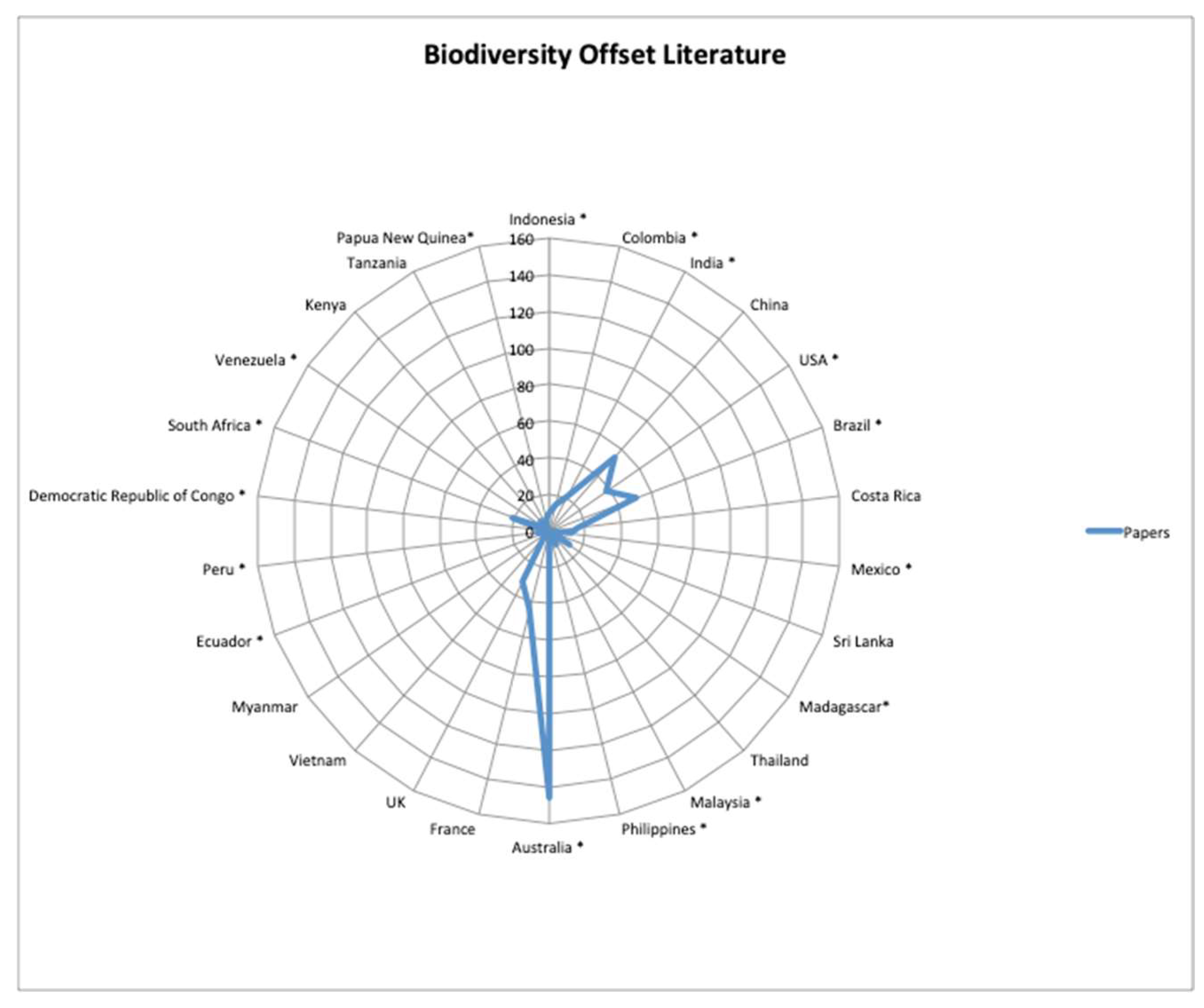
Figure 2.
Peer-reviewed publications by biome.
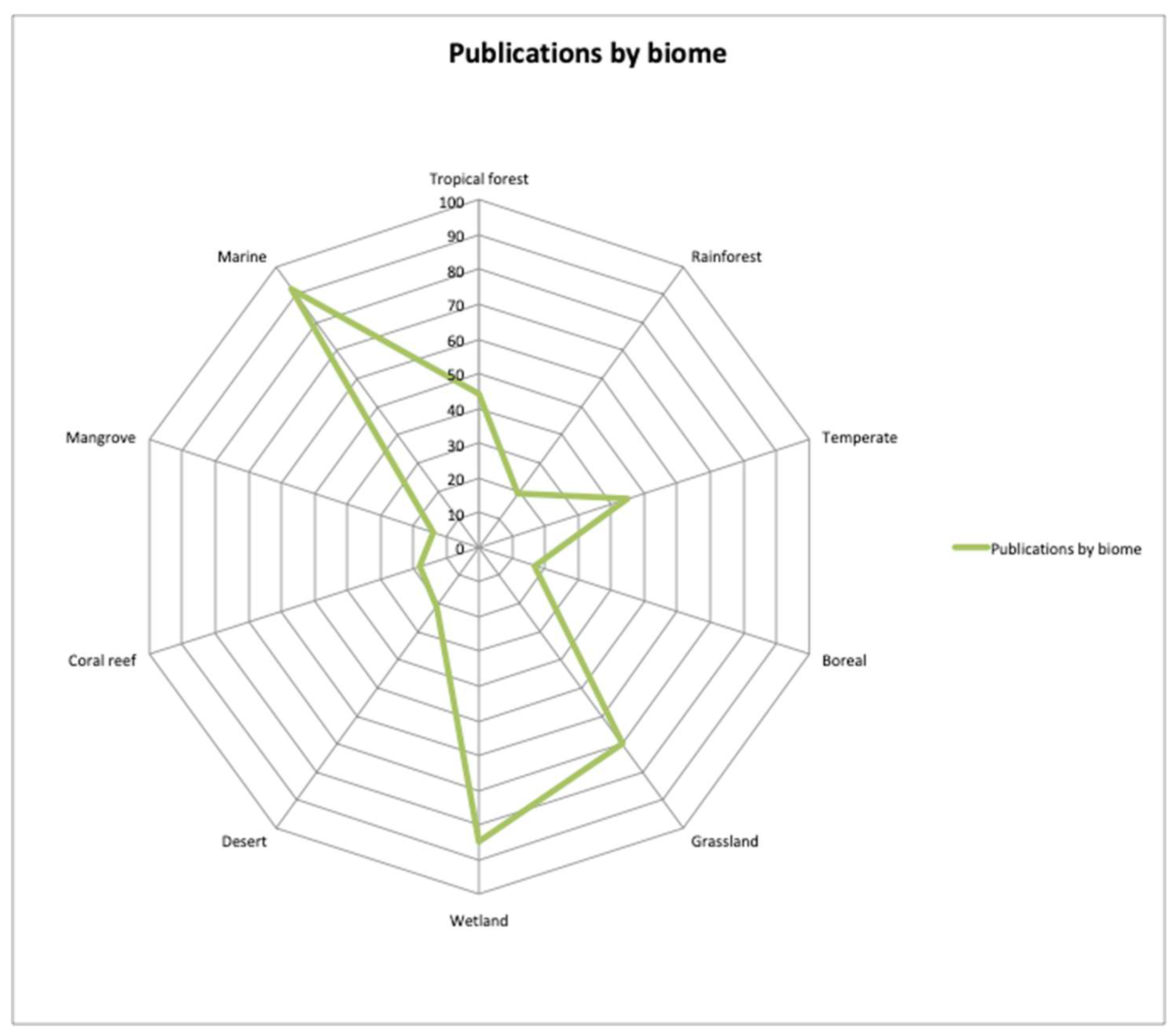
Figure 3.
Spatial Distribution of Biodiversity offsets: a) Share of territory occupied by offsets; b) black dots – offsets, red dots – development projects. Source: (Bull & Strange, 2018).
Figure 3.
Spatial Distribution of Biodiversity offsets: a) Share of territory occupied by offsets; b) black dots – offsets, red dots – development projects. Source: (Bull & Strange, 2018).
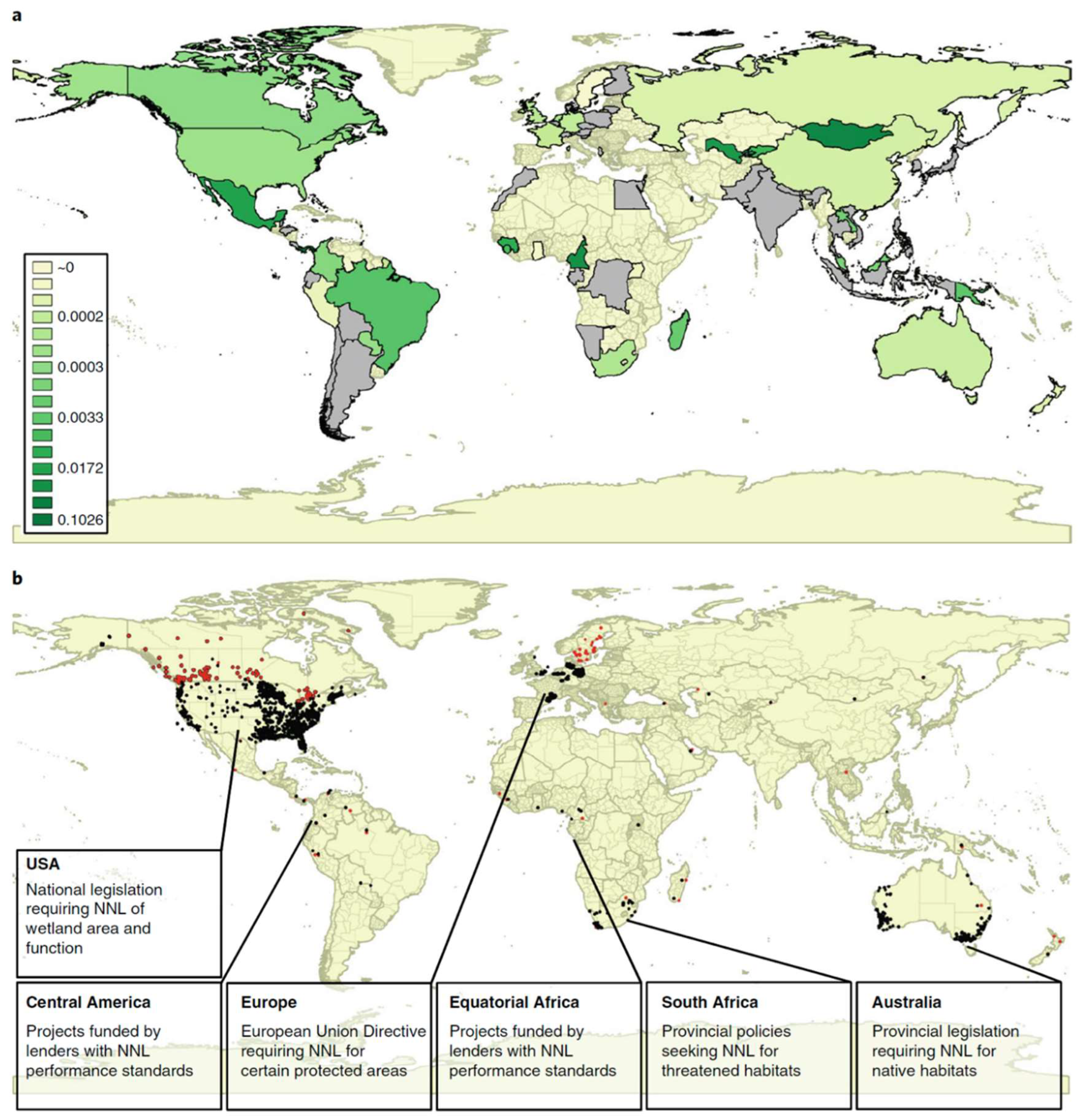
Figure 5.
Coal Production in Indonesia in mln tonnes. Source: BP Plc.
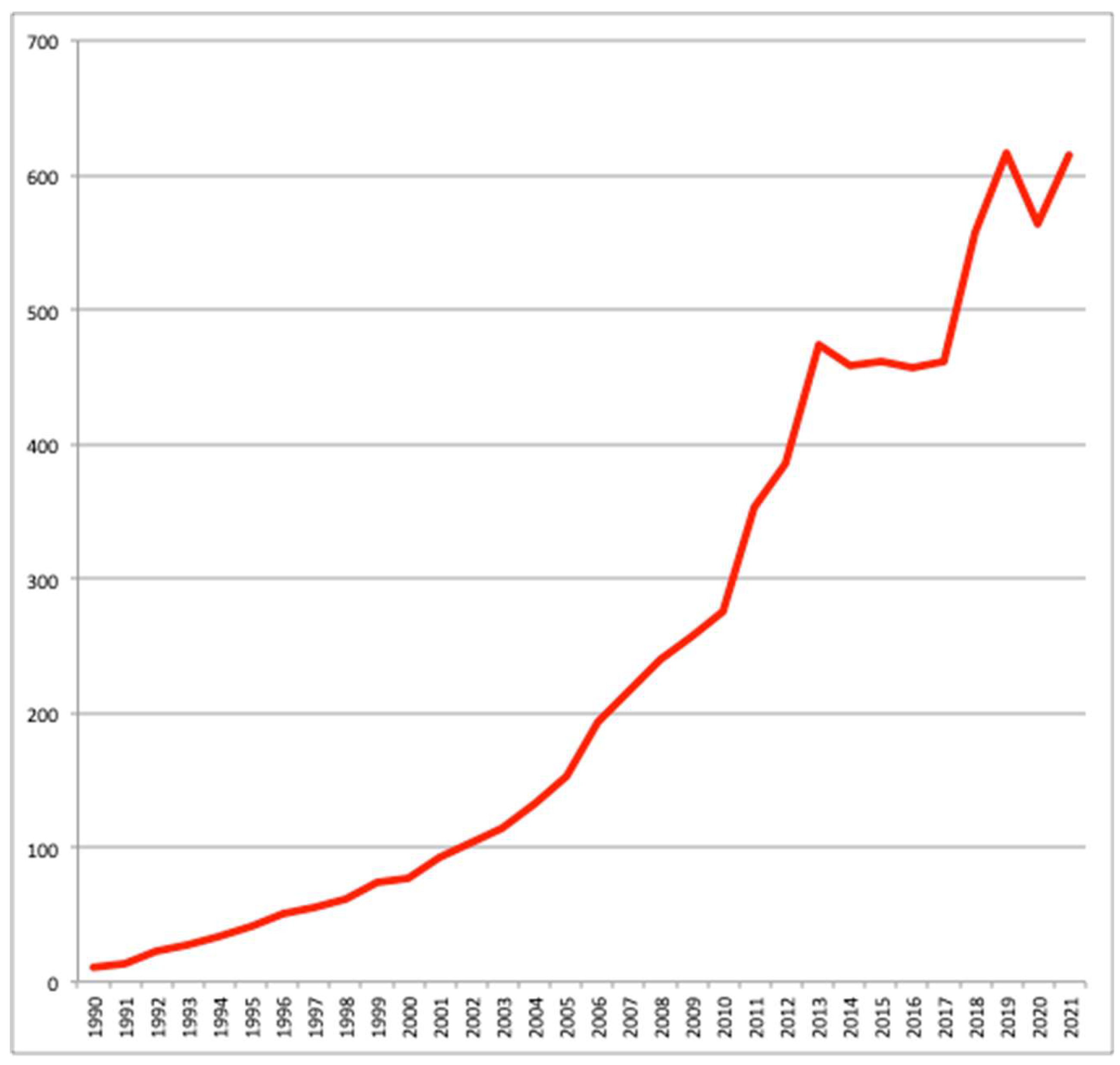
Figure 6.
Nickel mining, 000 t, Indonesia.
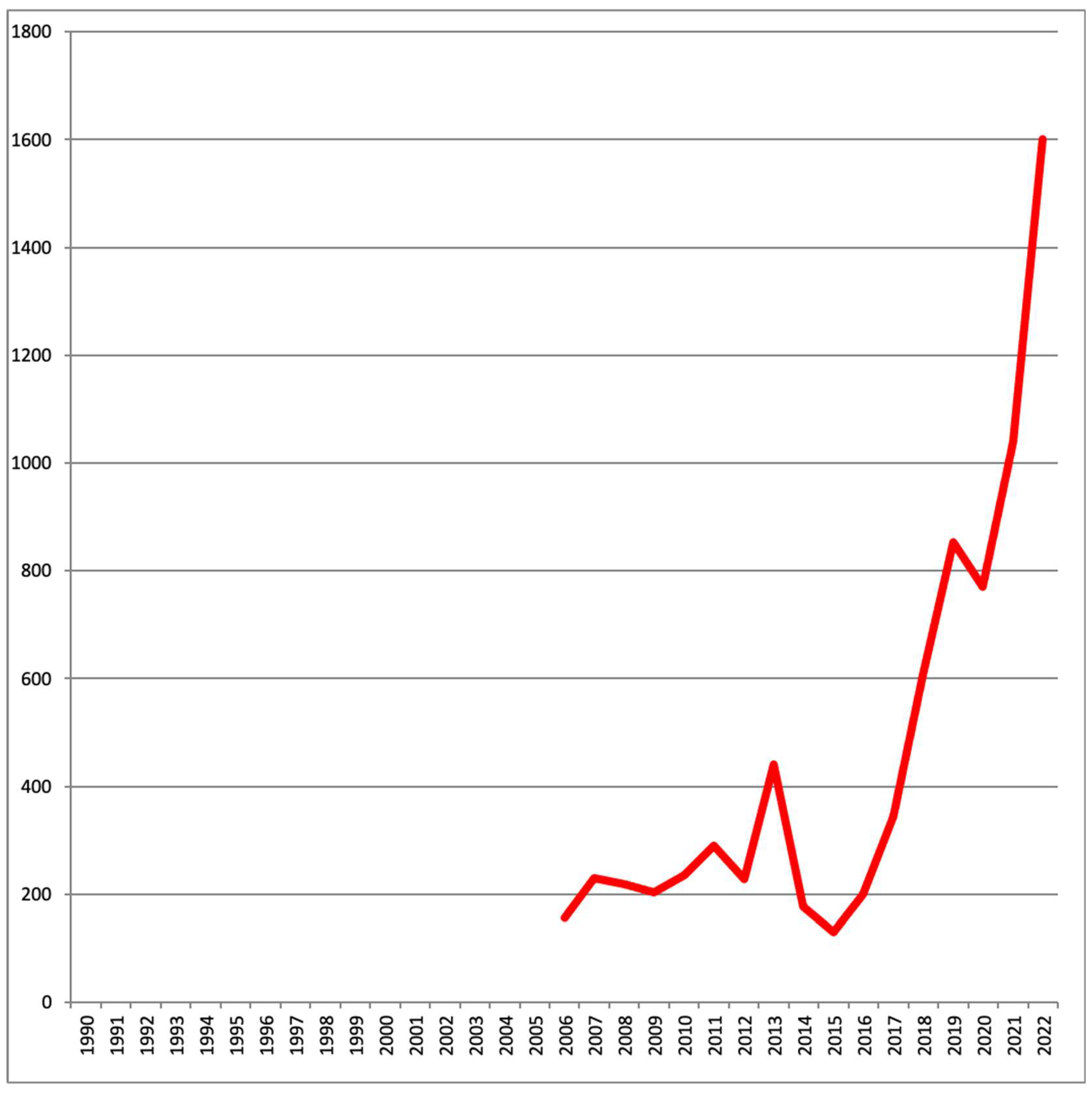
Figure 7.
Palm oil production in Indonesia.
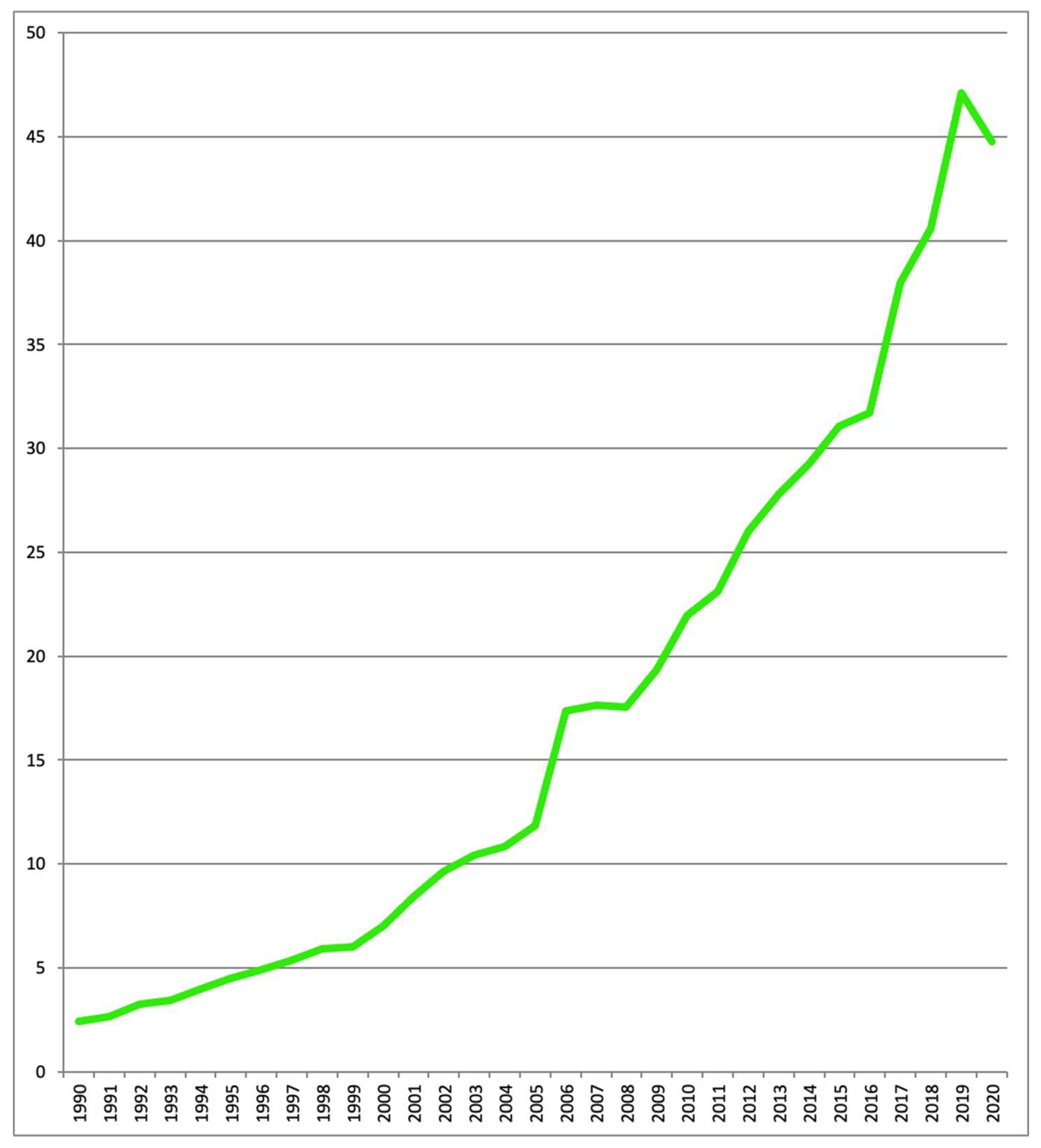
Figure 8.
Rice production, mt, Indonesia.
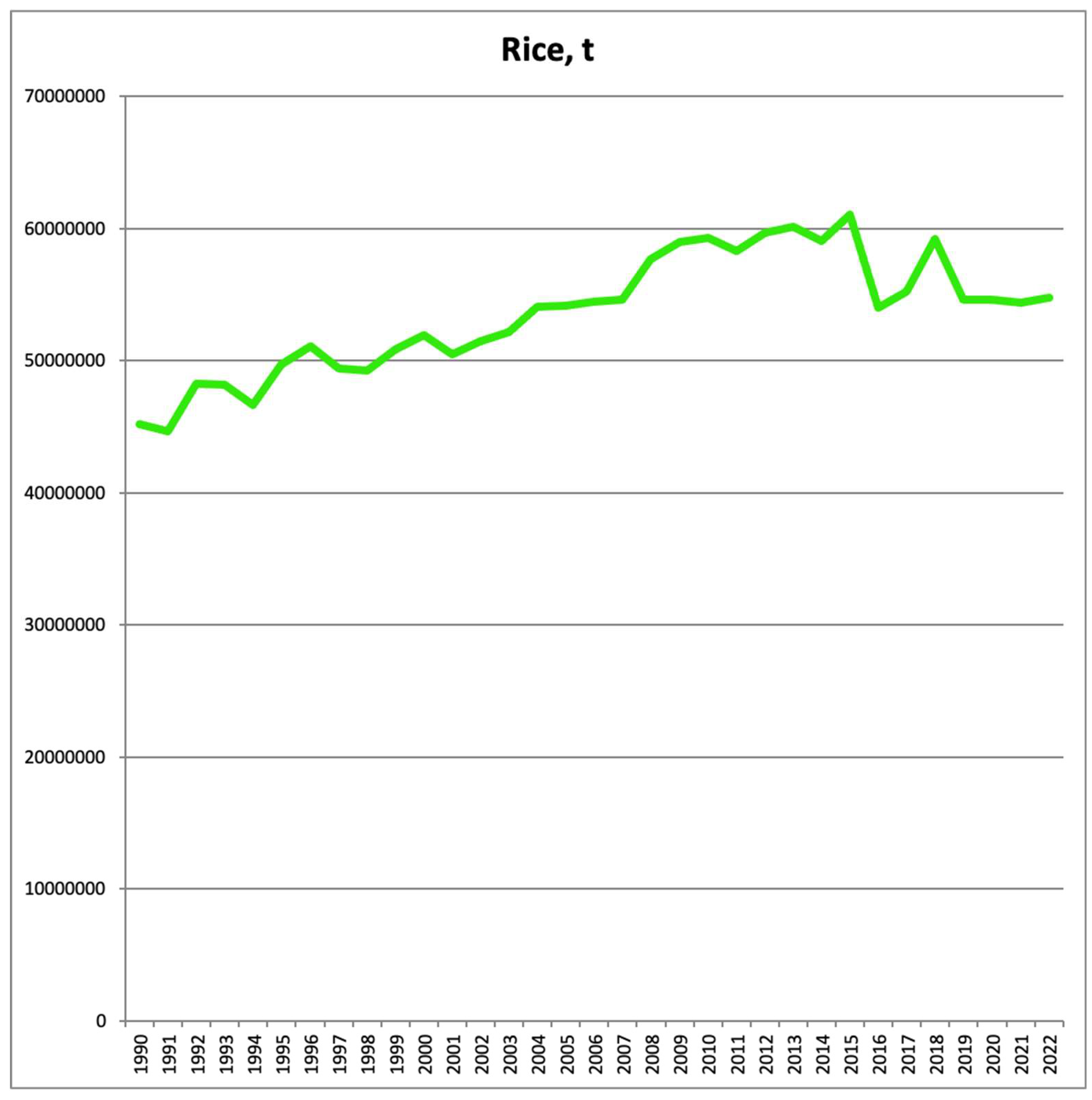
Figure 10.
Deforestation in Indonesia, 2000-2022, Source: Google.
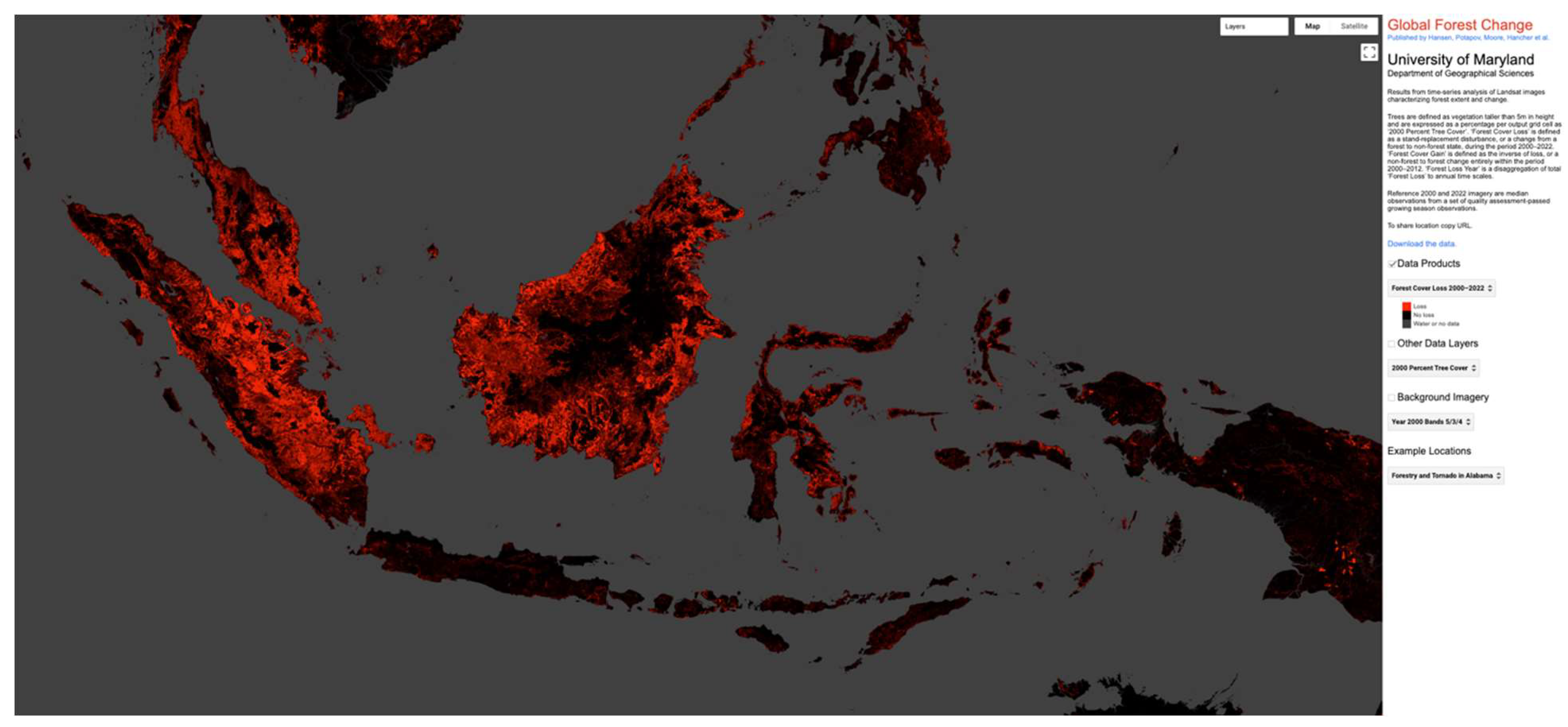

Table 1.
Statistical coefficients in the multi-factor regression model of deforestation in Indonesia, the estimation sample: 2000–2020.
Table 1.
Statistical coefficients in the multi-factor regression model of deforestation in Indonesia, the estimation sample: 2000–2020.
| Coefficient | Std.Error | t-value | t-prob | Part.R^2 | |
| Constant | 74.1573 | 7.388 | 10.0 | 0.0000 | 0.8630 |
| Population | -1.20977e-07 | 4.172e-0 | -2.9 | 0.0104 | 0.3445 |
| GDP | 0.00171139 | 0.0004377 | 3.91 | 0.0012 | 0.4886 |
| Palm | -0.140027 | 0.02694 | -5.2 | 0.0001 | 0.6281 |
| Coal | -0.0114079 | 0.003215 | -3.55 | 0.0027 | 0.4404 |
Disclaimer/Publisher’s Note: The statements, opinions and data contained in all publications are solely those of the individual author(s) and contributor(s) and not of MDPI and/or the editor(s). MDPI and/or the editor(s) disclaim responsibility for any injury to people or property resulting from any ideas, methods, instructions or products referred to in the content. |
© 2025 by the authors. Licensee MDPI, Basel, Switzerland. This article is an open access article distributed under the terms and conditions of the Creative Commons Attribution (CC BY) license (http://creativecommons.org/licenses/by/4.0/).
Copyright: This open access article is published under a Creative Commons CC BY 4.0 license, which permit the free download, distribution, and reuse, provided that the author and preprint are cited in any reuse.


