
Submitted:
26 April 2025
Posted:
29 April 2025
You are already at the latest version
Abstract
This study examines the political and elite motives behind Colombo's ‘world-class city’ initiative and its impact on public housing in underserved communities. Informed by interviews with high-ranking government officials, including urban planning experts and military officers, this study examines how President Rajapaksa's elite-driven postwar Sri Lankan government leveraged military capacities within the neoliberal developmental framework to transform Colombo’s urban space for political and economic goals, often at the expense of marginalized and underserved communities. Applying a contextual discourse analysis model, which views discourse as a constellation of arguments within a specific context, we critically analyzed interview discussions to clarify the rationale behind the militarized approach to public housing while highlighting its contradictions, including the displacement of underserved communities and the ethical concerns associated with compulsory relocation. The findings suggest that postwar Colombo’s public housing program failed to achieve its anticipated economic objectives and continued to reinforce socio-spatial inequalities, raising concerns about the sustainability and ethical implications of militarized urban governance. The paper recommends that future urban planning strike a balance between economic objectives and principles of spatial justice, inclusion, and participatory governance, promoting democratic and socially equitable urban development.
Keywords:
world-class city
; underserved communities
; socio-spatial justice
; political and elite
; Sri Lanka
1. Introduction
After 30 years of civil war that ended in 2009, President Rajapaksa and the Sri Lankan government, along with the political and elite cadre, initiated a massive urban regeneration initiative to transform Colombo, the de facto capital1 of the country, into a world-class city. The aim was to position Colombo as a speculative epicentre capable of attracting foreign investments in urban real estate, following the ideal of the East Asian model of ‘neoliberal developmentalism’ [1]. After the Asian financial crisis in 1997, East Asian developmental states, including Taiwan, South Korea, Hong Kong, and Singapore, adopted neoliberal political rationality alongside their strong government-led development mechanisms, integrating city beautification and aesthetics into their spatial and economic strategies. Post-war Colombo’s aspiration to become a ‘world-class city’ embraced elements of this East Asian idealism, focusing on enhancing the city’s beauty and aesthetics through strong government leadership that intentionally incorporated the military to assist in the urban transformation process.
A notable trend in Sri Lanka’s governmentality2 was the belief that the responsibility for the country’s development and the welfare of its citizens was an obligation of the political society, alongside their supporters in the elite society, including certain government officials, professionals, and senior military personnel [2]. In the postwar effort to transform Colombo into a ‘world-class city,’ they believed that the lands occupied by underserved communities (shanties, slums, or dilapidated housing schemes) were underutilized and unattractive, hindering the achievement of ‘world-class’ standards, thus necessitating immediate relocation [3,4]. The initiative to relocate nearly half of the city’s population—68,812 families in 1,499 underserved settlements living in shanties, slums, or dilapidated housing schemes in Colombo—popularly known as the ‘slum-free’ mission had dual purposes. Firstly, it was presented as part of a city beautification and investment project aiming to free 900 acres of land. Secondly, it was emphasized as a significant welfare initiative by the post-war government, aiming to provide housing for low-income communities.
The political authority engaged the military to assist in achieving these dual intentions by placing the Urban Development Authority (UDA), the country’s apex body for urban development, under the purview of the Ministry of Defense (MoD). Concurrently, a new Ministry, the Ministry of Defense and Urban Development (MoD&UD), was established. This new ministry became one of the most influential in the country, overseen by the president, with his brother, Gotabaya Rajapaksa—a former military officer and celebrated war hero—serving as the Secretary and controlling its operations. Amarasuriya and Spencer [5], referencing Ssorin-Chaikov’s analysis of late Stalinism, noted Gotabaya as a ‘man in a hurry’ in completing tasks and expediting political and bureaucratic delays, as demonstrated by ending a thirty-year war in just three years, highlighting his reputation for ‘urgency’ [6,7] and efficient task completion along with his authority in advancing Colombo to a ‘world-class city.’ Under his leadership, UDA was empowered, placing top-ranked military officers, including brigadiers, at the centre of decision-making, creating a new military unit, and handing over the responsibilities for implementing the ‘world-class city’ initiative. This established the Urban Regeneration Project (URP) to carry out the ‘slum-free’ mission, positioning it as Colombo’s public housing program.
Military-assisted urban development and public housing in postwar Sri Lanka is a unique development mechanism that no other democratic country has practiced. Moreover, it is not sufficiently explored in contemporary urban studies, especially within planning, real estate, spatial justice, and urban governance scholarship. Furthermore, we observed that the existing scholarly discourse on Sri Lanka’s postwar ‘world-class city’ development and housing predominantly focused on exploring its causes and effects from the perspectives of the communities in underserved settlements while neglecting the perspectives of political and elite groups’ necessity, reasons, and justifications in implementing the program [3,5,8]. This one-sided narrative limits a comprehensive understanding of postwar public housing under the ‘world-class city’ initiative in Sri Lanka. Our interest in undertaking this research is to address this gap and reveal “What are the political and elite motives behind world-class city development, and how have these motives and associated development strategies influenced public housing and socio-spatial justice of the underserved communities in postwar Colombo?” Recognizing the significant role of the government in shaping urban development policies through political and elite decision-making, we aim to investigate Colombo’s ‘slum-free’ mission from political, governmental, and institutional viewpoints. By doing so, we seek to clarify the rationale behind key decisions and their implications for the socio-spatial justice of the public housing development in the ‘world-class city’ initiative. We believe that by examining the perspectives of government officers involved in Colombo’s ‘world-class city’ development and public housing, we can contribute to a more refined understanding of its impact on underserved housing communities.
This paper is based on interviews with high-ranked government officials, including urban planners and military officers, involved in Colombo’s postwar ‘world-class city’ development and public housing programs. The postwar period refers to two political regimes of presidencies: the Rajapaksa presidency (2009-2014) and the Sirisena presidency (2015-2019). However, our primary focus was on the Rajapaksa regime, during which this unique civil-military mechanism was established and evolved. In contrast, we paid less attention to the Sirisena regime, which succeeded Rajapaksa and was characterized by a notable reduction in active military involvement in urban development activities3. We used Kumar and Pallathucheril’s [9] contextual discourse analysis model—discourse as a constellation of arguments within a context—to systematically analyze the claims and supporting statements in all interviews. This analysis helped us derive arguments under two central themes: Theme 1, Politics and Military in Colombo’s World-Class City Development, and Theme 2, Public Housing in World-Class Urban Development.
The paper is structured into six sections. This introduction guides the paper, providing an overview of critical factors in postwar Colombo’s ‘world-class city’ initiative and its ‘slum-free mission.’ Section 2 introduces the theoretical framework underpinning our study, while Section 3 will explain the methods and materials used. In Section 4, we will elaborate on the primary findings and essential narratives that emerged from our inquiry, and in Section 5, we will discuss them through various theoretical lenses. Finally, Section 6 will offer a conclusion, presenting the key takeaways, implications, and suggestions for future studies derived from this study, thereby contributing to our understanding of postwar public housing within the context of the ‘world-class city’ initiative. This paper concludes that Colombo’s postwar public housing project, framed within the ‘world-class city’ initiative, was driven by political, elite, and military motives that prioritized urban aesthetics and speculative real estate over socio-spatial justice, ultimately intensifying inequalities for underserved communities.
This research provides valuable insights for researchers, policymakers, and practitioners in housing, urban planning, real estate, spatial justice, and governance scholarships. It emphasizes the importance of understanding the political and elite perspectives, motivations, and strategies that drive urban development and housing programs, thereby contributing significantly to the discourse on housing by highlighting the interplay of political, governmental, and institutional factors in influencing housing policies and approaches.
2. Theoretical and Conceptual Framework
We attempted to understand postwar Colombo’s world-class urban development and public housing through the lens of ‘neoliberal developmentalism’ [1] (p. 354) and ‘neopatrimonialism’ [10], incorporating elements of ‘spatial justice’ [11] (p. 2). This exploration aims to clarify the complex relationship between urban public housing and the overarching elite politics that shape it.
Heo [1] defines ‘neoliberal developmentalism’ as a blend of neoliberal political rationality and the developmental state’s governmentality. The ideal of “Neoliberal developmentalism” emerged in East Asian developmental states after 1997 in response to the Asian financial crisis, recognizing neoliberalism as the dominant ideology over developmentalism. After decolonization, East Asian nations like Japan and the tiger economies (Taiwan, South Korea, Hong Kong, and Singapore) formulated their developmental frameworks based on developmentalism, which advocated for decisive political intervention in state functions and market management to promote national interests [12,13,14]. According to Greener and Yeo [15], developmentalism involves competent bureaucratic coordination between the state and the market, emphasizing robust bureaucratic organizing, centralized technocratic planning, state control of all aspects of the socioeconomic environment, and strategic politics for economic growth. Urbanism and, more broadly, real estate development—including speculation and construction—became key strategies for capital accumulation and growth [16,17].
In contrast, neoliberalism advocates minimal government intervention in social, economic, and investment functions, promoting the private sector and free markets [18,19,20]. This philosophy emerged in response to the crisis of Keynesianism around the 1980s and was promoted through Thatcherism and Reaganism. The Bretton Woods Institutions, such as the IMF, World Bank (WB) and WTO, aided in spreading it across many countries, especially in the Third World, through structural adjustments and fiscal austerity programs involving the regulation of global finance and trade [21,22]. The assumption of neoliberal theory—‘a rising tide lifts all boats or trickles down’—posits that alleviating poverty can be most effectively achieved through the mechanisms of free markets and free trade [19] (pp. 64-86). Despite this, its dispossessory aspects, often termed ‘accumulation by dispossession,’ describe how neoliberal state policies tied to urban modernization displace marginalized communities, transforming their small-scale properties into opportunities for elite capital accumulation [23].
The 1997 financial crisis prompted East Asian countries to adopt a more balanced and resilient economic structure to stabilize the financial sector and restore investor confidence. Speculative real estate remained important in attracting global capital, emphasizing supportive liberal policies alongside stricter financial and regulatory frameworks while prioritizing investments in infrastructure-driven urban development, such as public infrastructure—roads and transport, industrial zones, and affordable housing projects [24]. This paradigm shift is characterized by the amalgamation of neoliberalism and developmentalism, which is termed ‘neoliberal developmentalism’ by Heo [1]. It underscores the neoliberal vision of a minimalist state while recognizing the state’s role as a critical component and supporter [14,25].
Sri Lanka was the first country in South Asia to adopt neoliberal policies in 1977 under President Jayawardene’s elite-driven right-wing government. According to Lakshman [26], this led the country to become a test site for neoliberalism in the Global South at the advice of the IMF and the WB. Subsequent regimes followed the same ideology, but the governmental instability was challenged throughout by the impediments caused by the war and the welfarist ideologies of leftist political tensions [27,28]. However, after the war victory in 2009, the Rajapaksa regime positioned itself for strong political stability by co-opting all opposition forces, making them part of the coalition and consolidating the economy toward neoliberal policies. However, Athukorala & Jayasuriya [29] argue that his economic ideology significantly differs from the previous thirty years of neoliberal tendencies. Instead, it exhibits Rajapaksa’s nationalist and populist political ideologies, notably centralizing power at the state level in an attempt to revert to a dictatorship and altering neoliberal policies guided by strong political and governmental intervention, similar to the East Asian model of “neoliberal developmentalism” that legitimizes authoritarian governance [30].
In contextualizing ‘neoliberal developmentalism’ within the framework of postwar Colombo’s ‘world-class city’ development, we connect it to ‘neopatrimonialism,’ as articulated by Shmuel Eisenstadt [10], a concept widely used to explain contemporary African politics and rooted in Weber’s understanding of power dynamics [31,32,33]. According to Weber [33], power is the ability to exercise one’s will over others [34]. This includes ‘patrimonialism’—a form of political legitimation and domination wherein the ruler governs all powers legitimately and uses the institutions of the state to dispense patronage to followers [33,35,36,37]. However, to Roth [38], Weber’s patrimonialism is mostly absent; instead, he describes ‘modern patrimonialism’ as ‘personal rulership,’ where political authority relies on the informal distribution of state resources by the patron in exchange for loyalty from lower-level bureaucrats operating on a client-patron basis [35,39,40].
To distinguish Weber’s traditional patrimonialism from contemporary political systems, Eisenstadt [10] introduced the concept of “neopatrimonialism.” This concept represents a shift towards a more bureaucratic and party-oriented form of patronage characterized by trends towards authoritarianism, co-optation, factionalism, clientelism, and elitist policies. Clapham [41] defines neopatrimonialism as “an organization where patrimonial relationships dominate a political and administrative system that is apparently rational-legal. Officials in bureaucratic roles possess formally defined powers, which they often use not for public service but as private property” [41] (p. 48). To provide clarity, we adopt Erdmann and Engel’s [39] definition, which defines ‘neopatrimonialism’ as a blend of patrimonial and legal-rational rule, where political and administrative decisions partly adhere to legal-rational or formal rules and partly to patrimonial or informal ones [39] (p. 22). The prefix ‘neo’ and terms like ‘mix’ and ‘partly’ emphasize the departure from traditional patrimonialism, describing a state where patrimonial and legal-rational bureaucracies operate simultaneously [39,42].
For nearly 76 years of Sri Lanka’s post-colonial political history, governmentality has been stabilized by family politics—a few families from the upper middle class and the elite. This has resulted in a centralized and authoritarian system that was constitutionally institutionalized [43,44]. Wickramasinghe [45] notes that Rajapaksa centralized key ministries under family control, appointing siblings—including Gotabaya as Secretary of the MoD&UD—and placing over 40 family members in senior positions, enabling them to control nearly half of the national budget [46]. These political shifts highlight elite traditions of ‘neopatrimonialism,’ which legitimizes centralization of power, nepotism, familial politics, clientelism, corruption, and challenges related to transparency and accountability, undermining the regime’s legitimacy [29,47]. We examine Colombo’s postwar ‘world-class city’ initiative within this political and economic context.
The ’world-class city’ initiative aimed to modernize the city and regenerate its aesthetics to make it attractive to investors. A primary objective was to transform underutilized lands occupied by underserved communities into speculative real estate. This ‘slum-free’ mission resulted in the relocation of underserved families to high-rise apartments elsewhere. The Rajapaksa’s politics of militaristic authoritarianism driven by elite order partial bureaucracies called for a military to assist in implementing Colombo’s ’world-class city’ initiative along with civilian institutions. This form of neo-patrimonial characteristics draws inspiration from Riggs’s [48] depiction of ‘bureaucratic polity’ as a form of governance dominated by a military and civil service elite [49] and operates as its own decision-maker, shaping and enforcing its societal role without external regulation or oversight [38,50,51,52]. Additionally, drawing from elitist theorists, Mills [53] examines the ‘power elite’—military, industry, and politics—in postwar American society, revealing that power is perceived as the accumulated capital of an elite group controlling critical aspects of society through personal connections [36].
We aimed to contextualize ‘neoliberal neopatrimonial developmentalism’ in world-class urban development, combining it with Soja’s [11,54,55] emphasis on spatial justice, integrating both outcome- and process-oriented justice in urban regeneration, and examining how institutions, policies, and practices shape spatial organization, particularly in spatially conscious politics and people’s interactions [56,57]. This expansion convinced us to better understand the complex dynamics of power politics, planning policy, and equity in developing world-class cities and their implications for urban public housing projects. Focusing on Lefebvre’s [58] notion of social space and Soja’s [55] concept of ‘conceived space,’ we examine how spaces are shaped by political agendas, policies, power dynamics, and interests. This approach highlights the role of conceived space as a tool for spatial organization that often overlooks the lived experiences of residents [55,56,58].
According to Chiodelli and Scavuzzo [59], spatial planning, like ‘world-class’ urban regeneration, is inherently a governmental function always developed within a process influenced by politics and elite decisions embedded with substantive4 and procedural strategic political dimensions [59,60,61]. They further argue that planning translates political power decisions into territorial realities, positioning planners as technical agents of political will. Flyvbjerg [62] supports this view, stating that planners are not impartial agents of societal change but are instead civil servants or employees of political or elite interest groups, serving the interests of those who pay them. These ideas relate to the role of political power and bureaucratic governance in city development in the Global South, particularly in Sri Lanka, where planning is closely aligned with political authority. Within these backgrounds, to contextualize the military-assisted public housing program within postwar Colombo’s ‘world-class city’ initiative and understand it through ambitious political and elite motivations, we framed our study within the theoretical constructs of East Asian ‘neoliberal developmentalism,’ incorporating concepts of ‘neopatrimonialism’ and ‘spatial justice.’
3. Materials and Methods
This qualitative study analyzes the discourse surrounding post-war public housing in Sri Lanka. It is based on the idea that human experiences and argumentative discussions, relying on claims and their support, play a crucial role in constructing meaningful discourse. The concept of discourse is complex and has many meanings [9]. In urban planning, discourse can hardly be captured solely through linguistic or content analyses that focus on textual patterns. According to Kumar and Pallathucheril [9], discourse is a higher-order construct that subsumes multiple arguments and argumentative threads. It includes diverse interactions among individuals, such as conversations and debates conducted through language—written or spoken—within a specific setting and towards a certain end [9,63]. Thus, discourse represents a broader exchange of ideas and viewpoints among various individuals in a particular situation. Conversely, an argument, as defined by van Eemeren et al. [64], is a reasoning activity concerning a specific proposition. Each argument has a distinct intent: to inform, confront, support, or persuade [9].
In this discourse analysis, we draw inspiration from argument-based models by Toulmin [65], Gasper and George [66] and especially Kumar and Pallathucheril’s [9] contextual model, portraying discourse as a constellation of arguments (see Figure 1). According to this model, discourse can be seen as a constellation of arguments within a context [9]. Understanding the contextual nature of discourse requires recognizing the setting in which it occurs, the communicative and social roles of participants, the norms and values, and any institutional or organizational structures [9].
This paper is based on semi-structured interviews conducted with ten higher-ranked government officials, including seven urban planners and three military officers involved in Colombo’s postwar public housing program. According to Clark [67], qualitative research is deeply a personal enterprise; therefore, the selection of participants in this study is followed through personal relationships. To enhance data quality, a semi-structured interview guide [68] was developed and used during interviews. The open-ended questions explored participants’ experiences and perceptions of the public housing program, focusing on the influence of postwar politics and new institutional arrangements, including the role of military involvement in postwar development. Hints were used to broaden the discussion, capturing a wider range of professional perspectives. All interviews were recorded and transcribed, and the claims, along with their relevant supports, were extracted from each transcript to create an argument table.
A claim is a statement or proposition that the interviewer would like the audience to believe [9]. It can take the form of a factual claim (true or false), a value claim (judgment or morality of something), or a policy claim (advocating a course of action). However, it is the central idea that the interviewer presents as his claim. Supports, on the other hand, are reasons and evidence that an interviewer provides to justify or defend the claim. They can be grounds (the basis for why the claim is true or valid), warrants (reasoning or logic – why the audience should accept the claim), backings (evidence that reinforces the warrants), qualifiers (modifiers that indicate the degree of reliance on or scope of generalization of the claim), and rebuttals (possible exceptions to the conditions under which a claim holds). The argument table was expanded for all ten interviews, and the compiled argument table, including 18 claims, was prepared, excluding duplicates (See attached Appendix A).
The table helped us better understand the cross-claim and its support for building a comprehensive discourse of arguments under each theme. At this point, we utilized the underlying meanings of arguments, implicit elements, and assumptions to sharpen the claim, enhance its credibility, and prepare the argument for broader application in discourse. Additionally, the context of participants’ communication, along with their social roles, norms, values, and institutional structures, was considered during this process of enhancing and qualifying arguments. These refined arguments were used to construct the discourse under two themes. These themes emerged naturally from experiences gained through observations—specifically, visiting the relocation sites of three underserved communities: Wanathamulla, Dematagoda, and Mattakkuliya—and were informed by discussions with urban planners and military officials in Colombo during July and August 2023. The findings section descriptively explains these themes within the discourse.
4. Findings
Using the compiled argument table (See attached Appendix A) alongside the related cross-claims, we constructed our interview findings under two central themes: Theme 1, Politics and Military in Colombo’s ‘World-Class City’ Development, and Theme 2, Public Housing in ‘World-Class’ Urban Development. Our findings suggest that discussing postwar public housing requires understanding the military’s central role in developing Colombo. The findings offer a comprehensive narrative of the program, presented through the lens of institutional governance, ‘world-class’ urban development, and spatial justice.
4.1. Politics and Military in Colombo’s World-Class City Development
This section begins with a contextual overview derived from the literature to initiate our discussion. It is followed by interview findings on establishing the new institutional arrangement, MoD&UD, to develop Colombo as a ‘world-class city’ and to understand the political motives of the Rajapaksa government after the war. Based on this, we explain the military’s specific role in the URP, its interaction with the UDA, and its subsequent impacts.
4.1.1. Political Imperative of Military Integration
Transforming Colombo into a world-class city was proclaimed in President Rajapaksa’s political vision, ‘Mahinda Chintana Idiri Dekma: 2009’ (‘Mahinda’s Vision for the Future: 2009’), to make Sri Lanka the “Wonder of Asia” after the war. His political manifesto targeted an 8 percent GDP growth and an increase in the investment-to-GDP ratio to 32-38 percent over the next ten years to attract foreign investments [69]. Rajapaksa’s investment strategy for Colombo was influenced by successful speculative cities like Singapore, Hong Kong, Dubai, and Shanghai [70,71,72]. Transforming underutilized urban land and beautifying the city to attract foreign investments were given top priority. The 900 acres of slums and shanty areas occupied by 70,000 families—over half of Colombo’s population—were identified as underutilized and needed immediate relocation [8].
The MoD&UD, a new institutional arrangement formed by merging the military with the UDA, a civil institution, was tasked with relocating these underserved families to high-rise public apartments. The Rajapaksa government’s decision to establish this ministry, which involved the military in civil affairs—especially for managing Colombo’s world-class city initiative—was extensively debated among scholars and in various forums [4,73,74,75]. The main reason commonly accepted for this merger was to utilize the military’s idle resources, including financial, instrumental, and labour, since the end of the war [8]. However, we revealed several additional reasons that are not often discussed in public forums, broadening our understanding of the underlying political imperatives of military integration:
- a)
- Capitalize on the military’s reputation for urgency and bypass procedures
Several respondents claimed that the creation of the MoD&UD and the involvement of the military in Colombo’s urban transformation were political strategies designed to leverage the military’s strengths beyond just financial, instrumental, and labour. These include:
- To leverage the strong reputation the military earned
Respondents noted that the military’s disciplined reputation, solidified during its decisive role in ending the decades-long conflict by defeating the LTTE, became a powerful asset for the postwar government. This victory strengthened public confidence in the military’s capabilities and reduced societal resistance to its involvement in non-military tasks. Frustrated by political and bureaucratic inefficiencies, the public trusted the military to deliver tangible results, drawing parallels between its wartime achievements and its potential to manage postwar development.
“Right after the war, Defence Secretary hurried to develop Colombo. He had military under him and wanted it to team up with UDA for this. People were excited about this; they thought the military, with their dedication and discipline, could handle it all, just like during the war. So, they felt it was a smart move.”
The postwar government capitalized on this sentiment, positioning the military as a driver of urban transformation that might otherwise have stalled due to bureaucratic hurdles. A widespread media campaign promoted military personnel as national heroes, highlighting Gotabaya as the military leader who won the war, inspiring public trust in the military’s reliability and dedication. Communities believed that military involvement guaranteed commitment and success, fostering widespread support for projects aimed at revitalizing Colombo.”
- To Urgent Actions and Bypass Procedures
Respondents claimed that the postwar government used the military to bypass bureaucratic procedures through its “military method.” For them, “military method” means that the military can perform certain actions, interpreting them as crucial for national security or public safety. These actions are probably urgent, and no other party can resist them. Additionally, other institutions must assist by expediting or bypassing some protocols; otherwise, the military could override them and take action.
“Government wanted to make Colombo like Singapore. They wanted it fast. To speed up, they needed to control people’s resistance and skip formal procedures. If they had used UDA systems, they would have had to follow all the procurement rules, respect human rights, deal with many formalities, and so on. But, with this military approach, it’s just all about national security. You know, military doesn’t really care about procedures or mistakes; they just want to keep things moving. That’s why they put UDA under the Defense Ministry.”
The respondents believed that bypassing procedures was not a military requirement but rather a government need to expedite things quickly. After the war ended, the government’s top priority became Colombo’s urban transformation, and it aimed to accelerate this task while ironically bypassing its own procedures. Accordingly, they claimed that the government strategically utilized the military’s legacy and command-driven culture to achieve political targets that were outlawed.
“When military gets orders, they don’t question them. They just follow it. That’s how they won the war. So, if their boss says to demolish unauthorized structures, they do it right away without hesitation.”
Respondents further claimed that the military’s command-driven culture, effective communication, and excessive influence over civil officers allowed the government to utilize the military effectively in multiple ways while satisfying officers by giving them key roles and reinforcing their perception as key actors in national reconstruction. However, some respondents criticized the government’s strategic use of the “military method” to bypass established procedures, the unnecessary urgency that overshadowed numerous mistakes, and the excessive use of military force in the post-war Colombo’s city transformation.
- b)
- Keep the military loyal and control under the government
Some respondents claimed that the government’s primary intention after the war was to keep the military loyal and under control by assigning alternative tasks and offering privileges, thereby preventing any riots against the elected government.
“We [the government] recruited a historically unprecedented number of people into the army during wartime. What can we do with them after the war? We don’t know what they’ll do or which side they’ll take if we lose control over them.”
They claimed that Defence Secretary Gotabaya leveraged his close military ties as a former officer, rewarding military personnel with high-ranking positions and involving them in military-driven business ventures.
“When a military officer became a ministry secretary, it was his duty to reward the military. So, he appointed them to various top positions in the government, including the UDA”.
- c)
- Building Trusted Go-Getters
Respondents stated that the post-war government, particularly Gotabaya, needed a trustworthy team. He wanted a proactive and ambitious team to achieve the government’s goals. They suspect Gotabaya, with years of military experience, believed the military could outshine government officers.
“They [Gotabaya and his clan] thought the military could handle things better than us [professionals]. Maybe they didn’t trust us to get the job done right. If the military were there, everything would go smoothly.”
Respondents further explained that during the early post-war period, President Rajapaksa and the Defense Secretary, Gotabaya, genuinely wanted to make a significant development in the country, although this was later politicized. They aimed to prevent corruption and misconduct in the bureaucratic administrative system by using trusted military personnel with whom they had worked during the war. Additionally, they suggested that loyalists who supported the regime during the conflict were rewarded with prestigious roles after the war, such as key positions within the UDA and other influential agencies, further solidifying the government’s control and maintaining political stability.
“So, like, I heard that the ex-UDA minister had some serious corruption issues. The President wanted to put a stop to it. And since the military wasn’t doing much after the war, he decided to hand UDA to the Defence Ministry.”
Respondents highlighted that establishing the MoD&UD and placing it under Gotabaya, the president’s brother, was a strategic political move to maintain control over the military and the UDA. They also saw this as a way to keep trusted loyalists in power, ensuring their continued allegiance while addressing inefficiencies. They considered this merger a timely step to reform the UDA, which had become inefficient despite its past successes.
4.1.2. Military’s Role in the UDA and the URP
Colombo’s ‘world-class’ slum-free mission, commonly known as the URP public housing program (hereinafter referred to as URP), was under the responsibility of the UDA. However, it functioned as a privileged and separate entity with additional benefits, such as staff allowances and priorities. Moreover, it was rated higher than other departments, likely because it was closely associated with powerful politicians, including the Defense Secretary Gotabaya Rajapaksa and the President. This close association may have elevated its standing within the government, giving it more authority and resources than other departments.
Nevertheless, the military’s role within the URP is unclear in the ongoing discussion about public housing in post-war Colombo. Most scholarly literature primarily criticizes the claim that the military was involved in demolishing the homes of underserved communities, which lacks an explanation of its overall involvement. We explored the military’s specific role in the URP, examining its interactions with the UDA and the resulting impact.
After discussing the military’s role in the UDA and URP with the participants, we revealed that military involvement in the URP occurred across three administrative tiers. First, figures like Gotabaya, his associates, and the MoD&UD were involved in political and elite decision-making. Second, high-ranking military officers and politically appointed civil servants at the UDA and their preferred staff were involved. Third, external military battalions were occasionally summoned for specific tasks, like providing backup support during demolitions.
Tier 1: According to respondents, Secretary Gotabaya was the key figure in controlling the functions of the ‘world-class city’ transformation. He was the chief administrator, planner, and architect of all its decisions. They emphasized that Gotabaya’s military background—command-driven, top-down, dominantly dictating and overseeing culture—significantly influenced the implementation and progression of the program.
“So, every two weeks, we meet with the Defense Secretary. He gives us instructions and his ideas. You know, he’s out there every morning, checking things out, and if he spots something that needs development, he wants us to start right away. I remember after he called us to action, we rushed to the office; It was that urgent. His influence was huge from the start, and honestly, I don’t think any officer really got a chance to discuss things with him. Without him and his circle, we wouldn’t have pulled off these projects – their influence was definitely behind.”
Respondents appreciated the initial phase of Gotabaya’s administration, highlighting that it enabled the rapid execution of the URP. They noted that while centralized control was efficient in some respects, it gradually shifted focus toward political votes and electoral objectives. This change resulted in a corrupt and politicized system over time, which polluted his later politically driven interventions through his close circle of associates. These interventions generated immense urgency, leading to several mistakes that will be discussed later in this section.
“He ended the war as he had good administration. Gotabaya really wanted to improve Colombo. He wasn’t a typical politician; he wasn’t into all that political nonsense. But those around him pushed him into politics, convincing him to use projects to win votes. Eventually, all systems got politicized and corrupted.”
We identify Tier 1 as the epicentre of military involvement in urban development, including the URP.
Tier 2: Respondents highlighted that the integration of the military into UDA resulted in significant changes in its management. They stated that high-ranking military officials, including two brigadiers, directly reported to Gotabaya and the MoD&UD, despite holding top positions within the UDA. This resulted in UDA management following them and acknowledging their decisions without argument. Furthermore, external individuals were brought in and placed at various management levels, bypassing recruitment protocols and making them loyal to the MoD&UD. Consequently, URP was established as a distinct entity and a prominent project within UDA, appointing one of the brigadiers as the chief project director.
Military officers acknowledged that they directly reported to Secretary Gotabaya and the MoD&UD while housed in the UDA. They emphasized that they were part of the military, not the UDA, despite holding top positions and participating in UDA projects with their battalions.
“We reported directly to him [Defence Secretary, Gotabaya]. UDA managed only our clerical stuff, but all the real decisions and priorities came from him and the MoD.”
They also accepted that they brought trusted military officers to work in the UDA, thereby expanding the military presence.
“We understood UDA Act is very powerful, so we added some force and speed. Honestly, at first, we didn’t trust the UDA officers, so we brought in some reliable military officers who had worked with us during the war. Later, as they saw how we operated, many UDA officers joined us”.
However, some respondents argued that involving the military in a civil institution was problematic.
“Bringing in military folks to oversee UDA people? That’s not a good idea. It was tough to coordinate with them; their strict ‘follow orders’ did not fit into us. They wanted us to act like them, but that just doesn’t fit our style.”
Most respondents argued that the military’s “order and command culture” and inexperience in social aspects—particularly in dealing with people and understanding their socio-economic needs—negatively affected the project’s relocation process.
“The big issue with this [URP] project was its military control. They didn’t get the social side enough.”
However, the interview participants from the military argued opposingly to the above claims. They stated that their involvement was methodical and systematic, and they had adequate knowledge and experience in rehousing families in war zones, thereby making a significant contribution to the UDA in achieving its targets.
“UDA was like a sleeping elephant—once we teamed up, they got things rolling. We showed them how to work smarter and faster. They used to clock in for just eight hours, but we were all about that shift.”
Despite some challenges, many respondents appreciated the military’s role in the UDA and URP. First, the UDA’s prominence increased through its merger with the MoD&UD, a major ministry led by the president’s brother. Second, after years of financial constraints, the UDA had the opportunity to engage in significant projects in Colombo, including public housing, which were not directly within its scope. Third, under the MoD&UD, the UDA acquired prime lands in Colombo, expanding its assets. We observed Tier 2 as the base for civil-military integration, transforming conventional public housing into a more forceful and accelerated military-cultured approach.
Tear 3: The respondents acknowledged that the military was present in the URP’s operational activities during the demolition and relocation events. They stated that the URP found it necessary to deploy external military battalions as backup support to assist UDA officers and the police in unauthorized demolitions.
“Yeah, there was some military help, but they weren’t actually doing the demolishing. They just supported the police and UDA officers in the early stages of projects like 54 Waththa, 66 Waththa, and Wanathamulla. After the government changed in 2015, they were completely out of it.”
Respondents indicated that in any slum or shanty relocation, there is usually initial resistance from underserved communities, even if they are unauthorized. While the UDA had legal authority and police support, limited military backup was occasionally used to manage resistance, primarily during the early stages of the URP due to community distrust and a lack of awareness about the URP and its secure relocation. They argued that the military’s involvement in the UDA and URP was beneficial, stating that the military assisted them during challenging situations when people resisted relocation.
“They just handled operations, not planning or design. At that time, their operational involvement was helpful in moving unauthorized. They had a good reputation among the people.”
Respondents rejected criticisms of the military’s role in forcibly demolishing slums and shanties, describing their involvement as a “backup force” in UDA and URP. A military respondent explained that they acted as backups, using their reputation and uniforms to build community trust for safe relocation. He noted that UDA and URP struggled due to a history of broken promises.
“When we went into Wanathamulla to clear some land, it felt like a battlefield—everyone surrounded us. They didn’t trust UDA’s housing promises. I climbed on a barrel and told them to believe us —we’d give them new houses. They like devils, especially women. But I didn’t give up. I kept going back, building trust. They believed us, not me, but my uniform. Finally, we got it done and cleared the land.”
Respondents firmly rejected the criticisms of the military’s forceful involvement. They noted that the UDA has the legal authority to demolish unauthorized structures with police support. Thus, military assistance was only needed in critical situations, like the Slave Island project.
“We don’t need the military for this. We’ve got the power to handle it ourselves! If there’s an issue, we call the police. We’ve never used the military for evictions; we just do relocations legally.”
One respondent clarified this with a strong argument, proving that the military has not been involved in the demolitions or relocation activities.
“So back in 2015, the “yahapalanaya” government set up a commission to see if the military had any role in relocations. The new Secretary and a few folks from the Attorney General’s Department involved in this. They looked into people’s complaints and checked out military involvement but found nothing. Turns out, it was just a media rumour that the army was involved in the demolitions and relocations.”
During the interviews, we noted that two brigadiers, including the head of the URP, the project director, and their subordinate officers, were active military personnel who wore their uniforms at all functions, including URP relocation activities. These high-ranking officers, accompanied by military guards, maintained a visible military presence despite not being directly involved in demolitions or relocations. Additionally, the URP was led by a brigadier who personally visited underserved settlements in uniform, distributing notices, further signalling the military’s involvement in the relocation process in these communities. We doubted that these developments in the military presence during the process of demolishing and relocating activities were misrepresented by the literature to critique military involvement in the URP.
We identify Tier 3 as the area where the military’s presence was publicly showcased. The three-tier representation, based on participant discussions, shows that the military’s role in the UDA and URP went beyond enforcing demolitions, as commonly understood. This involvement acted as a complex mechanism—like an octopus—supporting the government in various ways. In addition to providing financial and labour resources, the military offered discipline, a focused approach, and a reputation for strong governance. This combination of military efficiency and political authority created a distinct governance model, blending military strengths with political control. The structure of the MoD&UD highlights this integration, merging military efforts with the UDA to promote urban control and enhance governance.
4.2. Public Housing in World-Class Urban Development
This section explores the socio-spatial dimensions of the URP as part of Colombo’s ‘world-class’ Urban Development initiative. To provide useful context for this discussion, we first examine elite perceptions of underserved communities. Next, we present two subthemes: housing strategies aligned with the world-class ‘slum-free’ mission and the challenges associated with these strategies.
4.2.1. The Elitist Perception of Underserved Communities
Our conversations revealed significant contrasts in how political and elite groups perceived underserved settlers, especially those in slums and shanty communities in Colombo. These perspectives were central to understanding the URP led by the UDA.
One respondent, reflecting class-based attitudes, expressed that cities are primarily designed for wealthy communities, while low-income residents should either leave the city or adapt to a different lifestyle. This perspective highlights the exclusionary characteristics adopted by planners over time as part of an elite group in city development.
“If you are an urban planner, you serve the rich, not the poor. In an urban situation, poor people can’t afford to live. They can’t enjoy all the urban facilities. They have to leave the city, or they have to live in a different way. Urban is always for the rich, not for the poor. This is my personal opinion. As a Town Planner, I’m not serving the poor and serving the rich.”
This sentiment and influence often viewed shanty communities through the lens of legality, framing these settlements as unauthorized encroachments. The following quotes from a military officer and a planner describe the situation as:
Military officer—“We saw unauthorized structures like people unauthorizedly occupying government or somebody else property. To me, it’s a crime, injustice.”
Planner—“If it is unauthorized, it is unauthorized. They use common water taps and electricity without payments……. these people were drug addicts.”
Despite the focus on encroachment, some respondents recognized that low-income, underserved communities play a crucial role in sustaining Colombo’s economy. This informal, low-skilled workforce enables middle- and upper-class residents to stay comfortably in the city, highlighting the need to retain these communities.
“Although we were not much considered in development plans, these low-income people represent fifty percent of Colombo’s population. They are the engine running our economy in Colombo. They are the people who provide labour. They make Colombo live.”
“We wanted to keep these people in Colombo. Their contribution, especially for the informal sector, I mean labour like cleaning.”
This dual perspective—viewing underserved settlers as both encroachers and essential economic contributors—underscored their social and spatial inclusion within the city. This next section clarifies these dynamics further, highlighting the social and spatial reasons behind the URP process.
4.2.2. Housing Strategies in World-Class ‘Slum-Free’ Mission
Our investigation revealed two distinct strategies in Colombo’s post-war public housing program under the ‘slum-free’ mission. One strategy aimed to regenerate underutilized lands in prime areas adjacent to upscale commercial and financial developments. The second strategy focused on reclaiming government lands from unauthorized occupants, primarily shanty communities.
- (a)
- Regeneration of Privately Owned Prime Lands
This strategy focused on acquiring old slums and decayed urban areas, particularly near upscale commercial and financial developments in Colombo. These areas were characterized as underutilized and prioritized for immediate regeneration despite their legal status. It was believed that their appearance hindered the city’s world-class image and that regenerating and selling these underutilized lands would be more profitable. Accordingly, underserved settlements in prime areas, including Slave Island, Torrington, Borella, and Wellawatte, were identified as underutilized and targeted for relocation. The projects under this strategy began with agreements from private developers; therefore, the government was obligated to adhere to their conditions, especially the timelines.
According to discussions, the demolition of slum housing on Mews Street, Slave Island, in May 2010, in support of the ‘Colombo Port City’ project—a flagship initiative with significant Chinese investment—fell under this strategy. Participants mentioned that Singapore’s model inspired the Rajapaksa government with its ‘world-class’ city-making, which viewed real estate business as the key strategy for attracting foreign investments to drive economic growth, and the Slave Island regeneration project was its first initiative after the war ended.
“At that time, just after the war in 2009, investors, mostly Chinese [investors], came in and looked for projects. They were interested in the Port-City project, reclaiming the sea and building a new city like Dubai. Others were interested in projects adjacent to this new development. So, the defence secretary suggested Slave Island. It was a slum area.”
For them, Slave Island was not a shanty area; it was an old slum area characterized as urban blight. They claimed that these slums were eyesores that diminished the city’s desired world-class appearance and were underutilized; therefore, Defense Secretary Gotabaya wanted this area to be regenerated. They also noted that Slave Island residents had some legal ownership of the property, even though it appeared to be a slum. Their living conditions were poor, and the area was underserved.
“They were not encroachers. Some or other, they had some legal right to their land. They were not unauthorized. But people who were living there had been stayed in the same situation, like slum or shanty people.”
To respondents, although UDA had legal powers to take over private lands immediately without the consent of the owners, it should have followed the formal government procedures outlined in the Land Acquisition Act, which can be a lengthy process lasting years unless the owners accepted UDA’s compensation package. They stated that in the Slave Island project, their ownership issues were complex as both owners and occupants claimed property rights, which UDA could not resolve quickly following Gotabaya’s urgent requirement. This compelled UDA to adopt an alternative method—forced eviction with military assistance. The approach taken involved seizing physical possession of the land immediately and temporarily relocating families by providing them with funds to rent housing independently.
To them, the Slave Island project faced significant delays, largely due to disputes over property rights between landowners and occupants. These conflicts eventually escalated to the courts, extending the resolution process over several years. Although the physical clearing was completed and initial agreements with investors were in place to sell the land, the UDA could not provide clear land titles to investors because of the ongoing legal battles. Despite agreements assuring occupants that they would receive housing and commercial spaces equivalent to what they previously had, ownership disputes left many plans unfinished. Additionally, the project encountered resistance from the Colombo Municipality, which was governed by the UNP at the time, as well as reluctance from other infrastructure agencies. This created further setbacks in providing essential services like roads, drainage, electricity, and water despite agreements with the investors. As a result, the UDA had to bear the cost of renting temporary accommodations for the displaced occupants for many years, which added a considerable financial burden while the legal and design issues were being resolved. This situation contributed to the overall delay in the start of construction by the investors.
Our findings revealed that the Slave Island regeneration project was a failed attempt in postwar Colombo’s land development and housing initiatives. According to interview participants, the postwar government and the UDA quickly distanced themselves from this strategy, halting the development of privately owned underserved lands due to the challenges in implementation. The Slave Island project was reported as the first and last large-scale initiative of its kind.
Since there were already sufficient studies on the Slave Island project, we did not focus extensively on its impact on relocated families during our interviews. Existing research evidently highlighted that the project involved military participation and forced relocation. However, this literature often failed to clearly distinguish between the postwar government’s different housing strategies. This led to a blurring of the UDA’s objectives, processes, and outcomes, as well as the distinct roles played by the military in the postwar public housing program in Colombo—areas that our research inherently clarifies in this discussion.
4.2.3. Reclaiming Encroached Government Lands
The second strategy aimed at reclaiming government lands from unauthorized occupants, popularly called encroaches or shanty communities. Residents in these communities lacked rights or ownership over the land they occupied, thereby having no negotiating power, input in the decision-making process or forward claims on displacement and relocation choices. The UDA had the flexibility to determine where, when, and how they would be relocated, whether on-site or off-site, temporarily until construction or permanently, depending on the availability of relocation houses in stock.
- (a)
- The Target
According to respondents, one key constraint in making Colombo a world-class city was the fragmentation of smaller underserved communities throughout the city in varying proportions. Some settlements were located in Torrington, Kollupitiya, and Thimbirigasyaya, which were designated as elite areas, as well as in Borella and Narahenpita, popular areas for high-middle-income residents. The ironic fact was that most of these settlements were not simply encroached upon by low-income people; rather, they had been created by government institutions such as the UDA and NHDA some time ago to temporarily house people from elsewhere, whose lands had previously been taken by those institutions. Many residents had been resettled several times from location to location with promises of receiving legal housing, yet they were categorized as unauthorized since, at some point in history, their situation began with encroachment. Consequently, none of the authorities were willing to grant them legal titles to the places they lived.
“The government couldn’t make the city development, keeping these people at every junction. They were in Colombo 07, Borella, Narahenpita, Kollupitiya etc... etc. Therefore, there was a need for a solution”.
“Some of those were our early resettlement sites. In Premadasa5’s time, those people were given one or two perches of land. For example, when “Summit Flats” was constructed, many families were relocated elsewhere; currently, we call that resettlement land “Summit Waththa.” Similarly, when the “Keththarama” ground was being constructed, the people who were there were relocated; we call that settlement “Apple Waththa.”
In Colombo, fifty percent of the population, approximately 68,000 to 70,000 families, lives in underserved settlements. We found that much scholarly literature mistakenly reported the target of the URP program as resettling all these families, specifically 68,812 families in 1,499 underserved settlements. However, our investigation revealed that the URP aimed to construct only 50,000 houses, based on its own survey of 56,000 underserved families in Colombo. Priority was given to slums and shanties, which numbered around 40,000 while considering that the rest could still be utilized for some time.
“Though it was called at 68,000 families, we found there were only 56,000. We did a separate survey for our project. We prioritized the category of slums and shanties, which was around 40,000. Based on that, we programmed our project for 50,000.”
- (b)
- The Strategy
The URP identified that the target underserved settlements occupy 900 acres in the city. The plan was to resettle them in high-rises using 350 acres, allocate an additional 100 acres for open spaces and other reservations, and free up approximately 450 acres that could be sold on the market for profit. Respondents indicated that URP had a simple formula to evaluate the financial feasibility of the project aimed at freeing up 450 acres to sell from 900 acres.
“We thought, why not give new houses to the encroachers and get some prime land to sell? We figured if we give one new house to a family in a settlement [underserved], we could get at least two perches of land. Those two perches are worth millions [SLR] in Colombo—like 2 million per perch! So, we’d use a quarter of the land for the new house and sell off three-quarters to investors. We also charge about one million for each new house. That way, we’re pocketing at least 2 million in profit. So, with this formula, the government doesn’t need to spend much, and the families [underserved] get brand new houses.”
To them, URP was initiated by issuing bank debentures and raising SLR 10 billion. The money earned from selling liberated lands was assumed to be sufficient to repay the debenture capital. Additionally, compared to the previous strategy involving privately owned lands, reclaiming government lands by evacuating encroached occupants proved to be more lucrative and faster. The effectiveness of this strategy was that the UDA could quickly evict the occupants and bring those lands to the market for sale since most of these communities occupied government-owned lands. Furthermore, the UDA did not require much force for relocation, as all legal powers related to unauthorized removal in urban areas fell within the scope of the UDA Act.
According to respondents, the cleared value of the land was critical to consider as most of the encroached settlements (shanties) were low-lying or reserved lands where developments could not be performed. Hence, the project followed a distinct process to prioritize the selection of settlements for immediate ejection. The considered factors included land saleability, location, and the number of relocations against the extent of reclaimable land.
“We gave priority to most potential lands. Lands we can sell out quickly,”
Therefore, the needs of those living in severely substandard settlements or those requiring immediate housing were not considered a priority.
- (c)
- Process of Relocation
According to respondents, UDA’s approach to this strategy was straightforward, leaving no chance for underserved residents to oppose it. Everyone in the selected settlement was considered unauthorized despite the various documents settlers provided to prove their rights, such as CMC letters, utility bills, electoral register names, proof of possession from the Grama Niladhari, and National Identity cards. However, at least one of these could be useful for inclusion in the selectees list.
“There were no choices for people. Why do they need choices? We say you’re unauthorized. We explained to them we could take over their lands anyway and that if they went to court, they would get nothing. But now, if they agree, they could have at least a relocation house.”
Respondents reported that everyone in the selected settlement was given new houses, offering one house per demolished unit but ignoring extended families. The conditions of the demolished houses, such as size, floors, materials, and facilities, were not considered. They noted that the URP’s new apartments were similar, featuring a living area, one room, a kitchen, and a toilet. Phase I apartments during the Rajapaksa regime were mostly 450 sqft, later increased to 550 sqft in Phase II under the “yahapalanaya” period. They argued that the house size was reasonable compared to the residents’ old houses and was based on construction costs. They also mentioned there was no accepted global standard for house size and facilities, justifying their decision.
“We decided on this 450 sq. ft. based on our costs. The other reason was that the majority, I mean more than 50 percent, lived in less than this in their whole life. However, we later increased this to 550 sq. ft. But we had to continue with this 450 sq. ft. for the 5,000 houses we built in the first stage, as we had already granted contracts early. Another thing is nowhere, I mean, NIRP or any other international policy, has a rule specifying 550 sq. ft. It depends on country to country. For example, in Mumbai in India, they use 275 sq. ft.”
Respondents indicated that, although the relocation process was strict, some grievances were limitedly considered by a committee appointed to review grievances. This was mainly because some families, about 10 percent, had two or three floors in their houses exceeding 700 sq. ft. and comparatively enjoyed good lifestyles, although they were unauthorized and categorized as exceptional cases. They were provided with one, two, or sometimes three additional houses. In these instances, both the size of their home and the land area were considered for qualification. Furthermore, families that could prove land ownership through documents such as conditional deeds issued by CMC or NHDA were deemed entitled to receive a free house during the relocation process. All others had to pay Rs. 1 million for the new apartment, which they could pay in installments, in addition to water, electricity, and maintenance fees.
According to respondents, the relocation occurred in high-rise buildings, mostly 10 to 15 stories, on low-priced lands in the city’s northern and eastern edges, such as Wanathamulla, Dematagoda, Maligawaththa, Mattakkuliya, and Blumandhol, which were scandalously underserved settlement areas. Relocation began by demolishing settlements on the most valuable lands and resettling families in these high-rise apartments that did not fully comply with the NIRP guidelines. As a result, the families who lived in prestigious city areas moved to less desirable outskirts. However, depending on the availability of vacancies, they were given a limited chance to choose the good ones among these projects. However, it was not a surprise for the families who originally lived in those scandalous areas as their relocation was either on-site or adjacent.
“We targeted higher income. So, in the first stage, we relocated Narahenpita, Castle Street, Borella, Colpetty, Panchikawaththa, and Dematagoda, the most valued lands in Junctions. Yeah, we had to follow NIRP, but we made a few adjustments in our initial stage.”
Respondents stated that URP relocation was compulsory but almost voluntary. They denied media reports about military involvement in the relocation. They also condemned scholarly reports, mentioning that they generalized the Slave Island case to all other relocations without understanding the two different strategies and the actual events. They acknowledged that military incidents occurred only in projects like Wanathamulla, 54 Waththa, and 66 Waththa, and happened only in the very early stages. They convinced us with two reasons why these incidents occurred. Firstly, at the beginning of the project, people—especially underserved communities with negative experiences from previous regimes and false promises—had doubts about the assurance of obtaining new houses and showed resistance. Secondly, within these communities, there were thugs, drug dealers, and political factions who represented less than 5 percent of the population but dominated the communities, encouraging others to resist the project for personal gain. They preferred to maintain these settlements for their underground businesses.
“You know, even though people were living in unauthorized settlements, they just wouldn’t move on their own. There was some real reluctance. Some guys in the community, like gangsters and drug dealers—maybe five percent—really didn’t like our relocation program and stirred up resistance. Yeah, there were times when the military got involved, but it wasn’t like we were forcing anyone out violently.”
In such situations, the military was deployed as a backup force to support the police and UDA officers in initiating demolitions, as the defense secretary, Gotabaya, was firm in his decisions, and they had to execute them without hesitation.
While they stated that the military had no role in demolitions throughout the project’s duration—a fact that society completely misinterpreted—they introduced a new argument to explain why society thought the military was involved in these relocations. For them, the project, in the early period and for a long duration, was headed by a uniformed Brigadier. He was the project director and had to be involved in every project activity. He had a guard of a few uniformed officers with weapons and was involved in distributing demolition orders along with the project staff who visited houses to convince settlers about the relocation and the conditions for them to adhere to. On the other hand, when people came to the project office with complaints and grievances, he was the officer in charge of the final decision. It appeared that the military was playing a leading role, and settlers were under emotional threat to react against or engage with URP officers coupled with uniformed military personnel. Furthermore, the lands, once cleared after demolishing unauthorized structures, were marked with a sign reading, “This land belongs to the Ministry of Defence and Urban Development’—a feared signal to the public that entering it would result in immediate imprisonment for acting against national security. During our conversations, we realized that this military involvement was capitalized by the URP project to minimize the reactions of the settlers.
4.2.4. Challenges and Drawbacks in URP
Our discussions revealed that the high-rise apartments constructed by URP failed to comply with their own UDA regulations and minimum building standards. These regulatory violations included inadequate parking, insufficient distances between buildings, and inadequate space for light and ventilation. As a result, these apartment buildings could not obtain approvals from the UDA planning department and the Condominium Management Authority (CMA). Ironically, these buildings are unauthorized and cannot be used for occupation according to UDA law.
Respondents indicated that compliance with regulations was not a priority for URP; instead, the focus shifted to quickly clearing lands and constructing more housing units. One respondent stated that since these buildings were for low-income communities, regulations were not much considered.
“Low-income housing, by definition, means there are no regulations.”
After various influences from URP and political channels, a few buildings recently received UDA approvals, while CMA approvals remain pending. They stated that failure to obtain approvals led UDA to halt the granting of legal house titles to the relocated families.
“We weren’t worried about regulations. There was just so much pressure to get things done quickly! The higher-ups wanted fast results, and honestly, our team was just trying to please them. We talked about the rules, but they weren’t interested. It was all about speed and getting things done, not really thinking about the consequences.”
Some respondents attempted to justify this failure by arguing that if these families were provided with homeownership, they would likely sell their houses on the open market for substantial profit and build unauthorized homes elsewhere, as they were accustomed to that lifestyle and wanted to avoid it.
“We hold these houses until their kids are used to apartment life. We know, after that, they won’t want to go back to their parents’ shanties!”
The discussions revealed that the CMA was not the only agency obstructing the URP. As Gotabaya’s brainchild, the URP had a dominant role not only within the UDA but also on a national level, sidelining collaboration with other key agencies such as the National Water Supply and Drainage Board (NWS&DB), the Electricity Board (EB), the CMA, and notably, the Colombo Municipality. Even within UDA departments essential to the URP’s high-rise housing projects, collaboration was limited. These institutions frequently posed obstacles and challenges for the URP during implementation, withholding support, particularly in the post-implementation phase, such as necessary approvals, maintenance, and ongoing collaboration. The lack of support from these agencies caused the UDA to spend millions of rupees on maintaining the buildings and managing water and electricity, requiring them to employ their own officers.
Despite these drawbacks, the relocation initiatives failed to accommodate the social and cultural patterns of the underserved community. Some respondents who closely worked with resettled families shared their concerns about these communities. We noted that relocated families were unaccustomed to high-rise living, particularly regarding their children’s safety in tall buildings of 10 to 15 floors. The design of these apartments, sized between 350 sq. ft. and 450 sq. ft., presents numerous challenges, including limited space for dining, washing, and drying clothes, as well as privacy concerns due to the placement of doors and windows, which exposes private life to neighbors. Noise is also a significant issue, with sounds from neighboring units easily transmitting, posing challenges for children studying at home. One respondent noted that the main focus of the URP was on releasing land, with little consideration for building size or height, neglecting social mobilization efforts to assist families in adapting to their new lifestyle in condominium-type apartments. Moreover, these large housing complexes, accommodating approximately 5,000 to 6,000 families, often lack essential community facilities such as playgrounds, daycares, and shops for daily needs. Remarkably, planners and military officers in our interviews acknowledged these issues as mistakes.
The land sale business in the URP faced significant challenges and was widely considered a failure for several reasons, according to the respondents. First, according to government protocols, the UDA must follow mandatory steps when selling land. Although commonly referred to as land selling, the UDA could only offer land on lease terms, potentially for long periods, while retaining the power to reacquire it. Investors were reluctant to purchase land on lease terms, especially at market value, as this reflected the freehold value in the market. This reluctance stemmed from distrust rooted in the UDA’s history of land reacquisition influenced by political biases. Second, the market value of the land was determined by the government chief valuer from a different ministry (Ministry of Finance), which did not align with the UDA’s land sale objectives. The UDA could not offer land below this government-set price, which was always considered high. Investors could purchase freehold land directly from private landowners at lower prices through brokers without strict government terms. Third, the UDA lacked a marketing strategy to attract global investors. This was beyond their expertise and outside the project’s scope. To them, URP managed to free up less than 150 acres, although it was initially planned to liberate 900 acres and allocate 450 acres for sale. Due to the failure of the land sale business, the UDA sold less than 40 acres, leaving 110 acres still available for sale. Accordingly, the financial feasibility assumptions that URP adopted to recover the capital invested from 10 billion state bank debentures did not work.
Additionally, many relocated families refused to make regular payments due to the URP’s failure to provide legal titles. This resulted in substantial outstanding payment arrears that the URP must now settle with the WS&DB and EB. According to a respondent,
“Honestly, we are utterly lost right now. We were just stuck in an endless loop. You know, We couldn’t sell our land and that 1Mn [SLR] thing just didn’t work out. We’re trapped in these houses, paying for water and electricity to WB and EB and also do maintenance with our staff. But families don’t pay for those bills. It’s been the same since 2013”
In this section, we presented findings from interviews with urban planning experts and military officers regarding postwar Colombo’s public housing program, which was implemented under the ‘world-class city’ development initiative. We revealed a complex narrative that involved postwar politics, strategic military deployment, and its impact on public housing for underserved communities. We examined the political and elite motives behind Colombo’s ‘slum-free’ mission, highlighting how military and urban development institutions were exploited to achieve the postwar government’s political and development targets while neglecting the socio-spatial justice of underserved communities.
5. Discussion
We realized that discussing Sri Lanka’s public housing in the post-war period requires understanding the complex interplay between the government’s post-war politics, aspirations for world-class city development, and military involvement. In this section, we contextualize these interplays with our research findings, setting them within the broader theoretical framework of urban planning, spatial justice, and governance. The discussion was organized first by explaining the political motivations and development approach of the ‘world-class’ city transformation and, secondly, positioning it in the South Asian context while connecting with the shifting perceptions of urban space and social exclusion of the emerging middle class and the political and elite groups. Thirdly, the militarization of urban governance addresses the role of the military within these desires. Finally, public housing and the politics of displacement discusses the implementation of the public housing program and its implications.
5.1. Political Motivations and Development Approach
President Rajapaksa’s post-war political campaign was driven by a combination of strategic, political, and personal motivations. He aimed to consolidate his power and cement his legacy as a transformative leader by capitalizing on the public euphoria generated by his decisive leadership following the war. It reflected a hybrid governance model parallel to the East Asian model of developmentalism that Heo [1] defines as “neoliberal developmentalism,” blending market-oriented strategies with strong state intervention that legitimizes authoritarian practices through the promise of rapid economic growth, emphasizing urbanism and real estate development as key drivers.
For Rajapaksa, transforming Colombo into a ‘World-Class City’ was not just about economic modernization; it was a strategic political move to shape the country’s future. In seeking to emulate Singapore and world-famous cities like Dubai, Shanghai, and Hong Kong, and major Indian hubs Mumbai and Delhi, his administration aimed to establish a governance model supported by a loyal clientele of military and civil elites, ensuring political stability and safeguarding the government’s survival— characteristics associated with Eisenstadt’s [10] notion of neopatrimonialism. At the same time, this aimed to deeply embed Rajapaksa’s ideals in society, suppress opposing views and secure his ideological dominance. This blend of authoritarian nationalism, grandiose leadership and market-oriented growth aligns with Weber’s [33] concept of charismatic domination, where a leader’s authority legitimizes broad state control over societal structures— bears noticeable similarities to the strongman political leadership styles like Malaysia’s Mahathir Mohamad and Singapore’s Lee Kuan Yew [70,71].
However, Colombo’s “world-class city” ambition was not without contradictions. The East Asian model aimed to leverage urban aesthetics to attract global investments in speculative real estate by the wholesale clearing of underutilized urban land and transforming it into upscale buildings and urban spaces for elites through place branding and beautification [1,22,70,76,77]. This hyper-commodification of urban real estate and the aspiration of Colombo’s ‘world-class city’ to function as a globally competitive profit center exposed the inherent tension between elite modernization and social justice for marginalized, underserved communities through displacement and exclusion, with socio-economic inequalities framed as necessary sacrifices for national progress [76].
5.2. Shifting Perceptions of Urban Space and Social Exclusion
A key characteristic of postwar Colombo’s “world-class city” initiative was changing elite and societal views on urban space and its residents. This shift was not merely a physical transformation of the city’s landscape but also a cultural and ideological shift that redefined who belonged in the city and who did not. As Chatterjee [2], there is a common belief in the global South that state and political elites are responsible for citizens’ development and welfare. This belief is rooted in the collectivist mindset of cultural values and historical class responsibilities— “the rich look after the poor.” This welfarist mindset began to erode with the country’s neoliberal economic turn in 1978 and intensified under the Rajapaksa regime’s efforts towards global modernization. This transformation led to the emergence of a new social class, namely the modern middle class, inspired by Western lifestyles and values. For them, Colombo’s ambition to become a “world-class” city represented an opportunity to realize their fantasies of a modern cosmopolitan identity, enjoying global urban aesthetics and an upscale lifestyle. This class society includes an educated group of people who operate the government, financial, and business sectors and are exposed to global societies. Their perception is that the city serves the affluent over the marginalized, echoing Soja’s [11] concept of spatial injustice, where urban regeneration favours elites and displaces vulnerable communities. Colombo’s public housing program during the post-war period explicitly showed this attitude toward underserved communities. The marginalized, particularly those living in underserved settlements, were labelled as encroachers, drug addicts, and a threat to urban order, often linked to nuisances, crimes, injustices, and illegal activities. One interview participant summarized this view, stating, “In an urban situation, poor people can’t afford to live. They can’t enjoy all the urban facilities. They have to leave the city, or they have to live in a different way. Urban is always for the rich, not for the poor.” This perception, deeply rooted in neoliberal ideals, justified displacing underserved communities as necessary for the greater good. Such narratives align with Lefebvre’s [58] notion of conceived space, where urban planning and development reflect the ideologies of dominant groups, often at the expense of lived experiences and social equity.
The judiciary also reinforced these exclusionary practices, reflecting similar trends observed in neighbouring India. For example, during slum evictions in Delhi’s “world-class city” mission, the court in Almitra H. Patel vs. Union of India (2000) labelled slum dwellers as encroachers, arguing that compensating them was akin to rewarding a pickpocket [78,79]. In Sri Lanka, the courts similarly framed slums as breeding grounds for vice hindrances to the country’s development progress, allowing the UDA to continue the underserved removal on Slave Island. One media report highlighted this incident, reinforcing the societal stigma against informal settlements by stating, “Making policy statements from the Bench in open court in support of the Gotabaya Rajapaksa-led Urban Development Authority, Sri Lanka’s de facto Chief Justice yesterday said that no one should obstruct ongoing development programmes in Colombo, and denounced shanties and low-income neighbourhoods as breeding grounds for vice” [80]. The marginalization of the urban poor showcases how neoliberal developmentalism, alongside neopatrimonialism, transforms cities into exclusive spaces of elite consumption and profit-making. Colombo’s ‘world-class city’ initiative, presented as a national interest benefiting all, concealed the underlying injustices of forced relocations and systemic exclusions. As Soja [11] emphasizes, spatial justice requires urban regeneration to consider both outcomes and processes, ensuring a balance between economic ambitions and the social and cultural rights of marginalized communities.
An analysis of middle-class aspirations, judicial narratives, and state policies in the post-war period highlights a perspective that normalizes excluding marginalized communities as inevitable and necessary for transforming Colombo into a “world-class city.” This approach sacrifices the needs of vulnerable groups for an urban modernity focused on aesthetics and profits. However, this vision is flawed, as it prioritizes visual appeal and profit over inclusivity and social equity, which are essential for creating balanced and equitable cities.
5.3. Militarization of Urban Governance
The transformation of Colombo into a “world-class city” under the Rajapaksa regime was characterized by the unique integration of a civil-military combined mechanism, which incorporated the military into civilian urban governance. This phenomenon, termed here as “military urbanism,” reflects a comprehensive militarized authoritarianism—tiered militarization strategy from top to bottom, providing the military with the ability to exercise control over urban spaces and civilian populations, utilizing its hierarchical discipline, public reputation, and efficiency alongside its financial, instrumental, and enforcement capacities—all under the pretext of the civilian institution, UDA. Rajapaksa’s postwar administration utilized these capacities by positioning the military as instrumental not only for city beautification but also for policy development. The creation of the MoD&UD and the appointment of military officers to leadership positions in planning and implementing projects under the “world-class city” initiative, such as the URP, highlights this integration and characterizes the political imperatives of neopatrimonialism. This militarized governance structure helped the government to execute urban development projects rapidly and efficiently through a civil-military governance framework, bypassing traditional bureaucratic channels and allowing projects to proceed with minimal resistance and oversight. Such practices reflect what Riggs [48] describes as a “bureaucratic polity,” in which elite military and civil service actors dominate decision-making and operate largely outside democratic constraints.
At the operational level, the military’s involvement extended beyond urban planning to maintain the city’s beauty and societal discipline. As noted by Amarasuriya & Spencer [5], the military played a visible role in the city, providing essential services such as landscaping, waste disposal, cleaning, and the demolition of unauthorized structures. This “everyday militarism” blurred the boundaries between military and civilian roles, normalizing the presence of armed forces in urban governance. However, a more significant impact was made by what we call “strategic militarism,” where high-ranking military officials shaped urban policies and strategies, ultimately steering the overall course of Colombo’s development. The involvement of the military in slum clearance and relocation activities under the URP highlights the intersection of militarized governance and neoliberal developmentalism in guiding development with minimal disruption resistance. Although military participation in the demolition of underserved housing was reportedly limited to a few key incidents, it created an environment of fear and compliance within these communities. This situation reflects Siddiqa’s [81] concept of “Milibus” governance, where the military acts as both enforcer and stakeholder in development projects, frequently sidelining civilian perspectives as a priority.
Although not perfectly aligned, Sri Lanka’s military urbanism draws parallels with other contexts where militaries have played significant roles in governance. For instance, the Turkish army, seen as the guardian of political stability, retains societal trust while remaining behind the scenes [82,83]. Indonesian President Soeharto secured military loyalty by providing benefits and assigning socio-political roles, involving them in political and economic affairs [84]. Sri Lanka has represented the military as both a coercive partner and collaborator, acting as a praetorian force to stabilize President Rajapaksa’s authoritarian governance. In this role, the military serves not only as a guardian of militaristic authoritarianism but also as a collaborator in directing and overseeing the government’s institutional framework, thereby facilitating the operationalization of militarism.
Despite its operational efficiency, ‘military urbanism’ and ‘everyday militarism’ in Colombo raise significant ethical and democratic concerns. The militarized governance framework that entrenches authoritarian practices, which restrict opportunities for public participation, fundamentally undermines the principles of procedural justice, as emphasized by Soja [11]. The displacement of underserved communities during Colombo’s ‘slum-free’ mission, conducted without adequate consultation, compensation, and accountability, not only sidelined these communities but also reinforced the perception of urban development as a top-down, exclusionary process. While the military was credited for rapidly transforming urban areas and creating attractive public spaces, it was also criticized by some, including scholars, for deepening existing inequalities and suppressing those who sought to voice their opposition.
5.4. Public Housing and the Politics of Displacement
URP clearly indicated that its primary aim was to liberate high-value urban land considered underutilized for speculative investments rather than address the housing needs of Colombo’s underserved communities. This approach reflects a broader trend in neoliberal developmentalism, emphasizing economic growth and the commodification of real estate over social equity [1,19].
The URP categorized underserved settlements based on land ownership and visibility. One category focused on visibly poor privately owned settlements, whereas the other included all encroached government lands. The Slave Island, a privately owned, visibly poor settlement chosen as the MoD&UD’s first project, demonstrated how military-driven new institutional arrangements bypassed formal procedures, including the Land Acquisition Act, NIRP and ethical relocation guidelines of the UDA. This reflects Chiodelli and Scavuzzo’s [59] understanding of the “territorialization of politics,” where urban planning serves to transform elite political power into spatial realities. The rapid clearance of Slave Island, while intended to demonstrate efficiency, resulted in significant public criticism and legal issues, highlighting the ethical shortcomings of this militarized method. The strategy of vesting government-owned lands by resettling encroachers has proven to be lucrative, both economically and efficiently. URP capitalized on the illegal status of the occupants as an advantage to relocate them with minimal resistance. This aligns with Harvey’s [85] argument that governments and institutions often exploit the lack of legal status of marginalized communities to facilitate displacement or relocation, justifying such actions as necessary while reinforcing systemic inequalities in access to land and housing [86]. This was further exemplified by URP’s compulsory, ready-made relocation methods and non-grievance practices, which undermined the principles of procedural justice, fairness, and equitable outcomes, as emphasized by Soja [11]. On the other hand, these broader exclusionary dynamics align with the patterns of neopatrimonialism, where centralized decision-making prioritizes elite agendas driven by elite and military interests in the Sri Lankan context [10].
The relocation process of the URP exemplifies an exclusionary approach, as it disrupts social networks, livelihoods, and cultural patterns within displaced communities. The replacement of horizontal slums with vertical apartments—a shift described by critics as creating “vertical slums”—failed to address the realities of economics, as well as socio-spatial justice for underserved communities. High-rise apartments, with limited space and high maintenance costs, alienate residents and reinforce the perception of housing as a commodified asset rather than a social or spatial right.
The URP’s financial model, designed with a neoliberal orientation and marketed as a cost-recovery strategy, struggled to generate anticipated returns. It fell short of its investment goals, freeing only 150 acres of the targeted 900 acres, which resulted in few land sales and considerable financial losses. Furthermore, families that were relocated struggled to afford their new homes due to low affordability. This financial miscalculation reveals a fundamental weakness in the program’s design—prioritizing speculative land value over the socio-economic needs of underserved communities, which led to failures in both housing and investment objectives.
The program’s failures reveal the problems of copying global urban models without adapting them to local needs. While Singapore’s housing policies inspired the URP’s strategy, it lacked a plan to address local social, economic, and cultural conditions, which resulted in a misalignment between policy goals and ground realities. This mismatch demonstrates how the aspiration to become a “world-class city” often disregards the complexities of urban inclusivity and equity within the Sri Lankan context.
Despite the failures, URP’s rehousing was reported as a significant achievement in Sri Lankan public housing history, particularly rehousing more than 15,000 families in modern apartment housing and providing permanent housing solutions to communities living in slums and shanties that would otherwise be inaccessible to low-income families. These modern high-rise apartments provided a lavish view, transforming Colombo’s skyline and showcasing it as a modernized and organized urban environment. Furthermore, the effort demonstrated the state’s capacity to undertake extensive urban housing projects and introduced new standards for public housing in Sri Lanka.
5. Conclusions
This study examined the political and elite motives behind postwar Colombo’s ‘world-class city’ initiative, focusing on its ‘slum-free’ mission and the government’s strategy for public housing in underserved areas. By analyzing the perspectives of urban planning experts and military officers involved in decision-making, we revealed a complex narrative of postwar politics, strategic military deployment, elite motivations, and their impacts on the URP’s public housing program for underserved communities.
The post-war government’s initiative aimed to transform Colombo into a ‘world-class city,’ enhancing its beauty and aesthetics by promoting urban real estate to attract foreign investment, mirroring speculative cities like Singapore. This East Asian model of ‘neoliberal developmentalism’ prioritizes speculative real estate investments over social equity, reflecting broader trends in global urbanism [19]. Following the war, President Rajapaksa legitimized his authoritative political power as a victorious, transformative leader, harnessing public enthusiasm to drive the country toward rapid economic growth. Rajapaksa relied on the military, privileging them by involving them at the centre of his governance model as loyal partners and safeguards of his regime and, in return, utilizing the military’s reputation, discipline, efficiency and financial, instrumental, and enforcement capacities for his political stability. As part of this militarization strategy, the MoD&UD was established to implement the ‘world-class city’ initiative under the guise of a civilian institute, UDA, allowing the military to control and manage urban space. This dependence on the military illustrates the concepts of ‘military urbanism’ and ‘everyday militarism,’ where military resources support civilian governance, objectively improving its capabilities and merging urban development with militarization [5,87]. This combination of military and civilian authorities transformed the city-making approach into a highly centralized and exclusionary process.
The Rajapaksa government’s speculative attempt to create a ‘world-class city’ illustrates an effort to transform Colombo’s city space for global elites, creating aesthetically appealing urban spaces. This approach commodified urban space, aligning with Lefebvre’s [58] notion of ‘conceived space’, where planning is shaped by elite ideologies at the expense of lived experiences. It justified the city’s underserved areas as underutilized and needing transformation into upscale buildings to function as profit centers through wholesale clearance. This modernist exclusionary approach was not only a political agenda but also endorsed by urban planning institutions, the judiciary, and emerging middle-class elites, who began to view the city as a space intended for the affluent. Such discourses reflect the shifting ideological and social perceptions that frame marginalized communities as barriers to development, normalizing their displacement as a necessary and inevitable part of modernization 5.
The ’slum-free’ mission started with the military’s involvement in the Slave Island project, clearing a privately owned slum area. This early militarized intervention highlights the politically sensitive nature of governance through exclusionary speculative urban development, which faced significant public criticism and legal challenges. Its ethical issues, mainly due to unclear land acquisition practices and the displacement of families, hindered its ability to achieve the anticipated outcomes.
These shortcomings led the URP to shift its strategy toward vesting state-owned lands by resettling encroached families. This method proved to be lucrative, both economically and efficiently, as the URP could capitalize on the illegal status of the occupants as an advantage to relocate them with minimal resistance, making it compulsory. Additionally, it compelled them to adhere to the URP’s relocation package without any consultation or grievance. The URP project rehoused more than 15,000 families in modern apartment housing during the postwar period, providing permanent housing solutions for the underserved communities that previously lived in slums and shanties while also transforming Colombo’s skyline, showcasing it as modernized.
Despite its achievements, the ironic fact is that none of these apartment buildings have legal approvals for construction or occupation, so they are technically unauthorized. However, this has prevented legally transferable apartments from being given to the resettled families, other than temporarily handing over the houses for occupation. Hence, while this strategy achieved short-term development goals, its centralized, top-down approach intensified socio-spatial inequalities by undermining social bonds and displacing underserved communities into inadequate vertical housing [88]. This contradiction of modernization underscores the inherent tensions in Colombo’s postwar development, where the desire for a global urban identity stands in conflict with legal, ethical, and social realities.
Despite these shortcomings, URP’s financial model failed to achieve anticipated outcomes and struggled to meet financial goals related to targeted land liberalization and land sales. It also failed to localize the international public housing models, addressing the ground realities of social, economic, and cultural conditions locally. These failures highlight the need for future urban regeneration initiatives to prioritize inclusive development strategies that integrate local socio-economic realities, ensuring procedural fairness and equitable outcomes to prevent exacerbating socio-spatial inequalities.
This research represents one of the first comprehensive analyses of military-assisted public housing, exploring the insights—political and elite motivations driving the program and the housing strategies employed—of higher-ranked government officials, including professional urban planners and military officers who were engaged in the postwar world-class city initiative and its public housing program in Colombo. The research emphasizes the significance of examining the socio-political and institutional dimensions of militarized urban transformation, especially its implications for spatial justice and governance, and how these processes reinforce elite control while marginalizing underserved communities. This study contributes to the growing literature on housing, particularly in the domains of urban planning, spatial justice, and governance, offering valuable insights for researchers, policymakers, and practitioners searching for housing from political, governmental, and institutional perspectives.
Future research could explore how military capacities might be effectively and diplomatically integrated within participatory frameworks to develop alternative models of modernization in postwar contexts, balancing military domination with social power, rights, and equity. Comparative studies of urban transformations and adaptable, inclusive development strategies in other postwar settings could further broaden the scope of this inquiry. Additionally, long-term investigations into the socio-economic impacts on displaced communities and the role of participatory engagement in mitigating exclusionary practices in future urban regeneration initiatives would provide valuable contributions to the field.
In conclusion, Colombo’s transformation under the ‘world-class city’ initiative reflects the contradictions inherent in neoliberal developmentalism. While it effectively reshaped urban aesthetics and achieved elite political and economic objectives, it also marginalized underserved communities, raising critical questions about the ethics and sustainability of militarized urban governance. Future urban planning efforts should aim to balance economic goals with the principles of equity and inclusion, fostering a more democratic and participatory approach to urban development.
Author Contributions
Conceptualization, J.R. and S.A.; methodology, J.R.; fieldwork, data collection, and analysis, J.R.; investigation, J.R.; writing—original draft preparation, J.R.; writing—review and editing, J.R., S.A. and R.S.; supervision, S.A and R.S. All authors have read and agreed to the published version of the manuscript.
Funding
This research received no external funding.
Data Availability Statement
Not applicable.
Conflicts of Interest
The authors declare no conflicts of interest.
Appendix A

Table A1.
Argument Table for Colombo’s Postwar Public Housing Initiative.
| Claim | Grounds | Warrant | Backing | Qualifier | Rebuttals |
|---|---|---|---|---|---|
| Claim 1: Military integration was politically driven to transform Colombo into a world-class city. | Rajapaksa’s vision in “Mahinda Chintana Idiri Dekma: 2009” emphasized modernizing Colombo using models like Singapore and Dubai. | Urban transformation aligns with boosting foreign investment and the global image of Sri Lanka as a modern state. | Defense Secretary Gotabaya’s public speeches and statistical comparisons of Colombo with other cities. | Relocation of underserved settlements to high-rise housing was prioritized over addressing socio-economic complexities. | Critics argue this approach overlooked the needs and resistance of underserved communities. |
| Claim 2: The military’s reputation was leveraged to bypass bureaucratic inefficiencies. | Military viewed as disciplined and efficient, able to act swiftly and bypass red tape associated with civilian institutions like the UDA. | Public trust in the military’s ability to handle large-scale projects justified involving them in postwar urban initiatives. | Interviews highlighting public and respondent confidence in the military's effectiveness postwar. | “Military methods” were used as a justification for urgent development projects. | Bureaucratic processes and fundamental human rights were sidelined, causing social dissatisfaction. |
| Claim 3: The relocation program ignored socio-spatial justice for underserved communities. | Low-income communities were relocated from prime city areas to urban outskirts, disregarding their roles in the local economy. | Underserved communities are crucial for informal labor that sustains Colombo’s economic functionality. | Interviews revealed that 50% of Colombo’s population belongs to low-income sectors essential for economic stability. | Some relocation provided housing but did not address loss of urban accessibility and livelihood impacts. | Relocated families struggled with inadequate facilities and disconnection from urban opportunities. |
| Claim 4: Military involvement in the URP expedited urban transformation efforts. | Military’s command-driven culture accelerated housing programs and overcame bureaucratic delays. | Integration of military officers into UDA added efficiency and discipline to its operations. | Testimonials from military and civilian respondents on achieving housing targets quickly despite challenges. | Rapid implementation led to violations of planning standards and building regulations. | Long-term challenges arose from structural inadequacies and lack of adaptation support for relocated families. |
| Claim 5: Land reclaimed from slums was commercialized to fund urban projects. | Encroached lands deemed underutilized were prioritized for sale after relocation of low-income communities. | Selling prime land freed from unauthorized settlements was seen as a financially viable strategy to support urban development costs. | Respondents detailed financial formulas that emphasized profits from prime land redevelopment. | Limited success in selling these lands led to financial strain on the UDA. | Projects struggled with market value mismatches and lack of investor interest under restrictive government conditions. |
| Claim 6: Military involvement minimized resistance to relocation projects. | Visible military presence, uniformed brigadiers, and backup support helped suppress community resistance during the relocation process. | Public perception of the military as trustworthy fostered compliance with relocation plans. | Respondents highlighted that emotional pressure from military presence curtailed resistance to relocation programs. | Relocation compliance stemmed from fear of military authority, not voluntary agreement. | Forced compliance generated resentment and mistrust among displaced families. |
| Claim 7: The government bypassed bureaucratic protocols to expedite urban development. | Military methods allowed processes such as land acquisition and construction to proceed without traditional procedural constraints. | Centralized control enabled swift decision-making, streamlining complex urban planning initiatives. | Respondents detailed examples of procedures overridden to meet rapid urban transformation deadlines. | Justifications for bypassing protocols were often linked to national security concerns. | Procedural bypass led to regulatory violations and diminished stakeholder consultation. |
| Claim 8: Relocated families faced socio-cultural challenges in high-rise apartments. | Families reported difficulties adapting to small living spaces, limited privacy, and lack of community facilities. | High-rise apartments are structurally unsuitable for low-income families accustomed to single-story housing with communal living arrangements. | Interviews with resettled families and urban planners highlighted significant gaps in housing design and social adaptation strategies. | Challenges arose from limited planning for social mobilization components. | Relocated families often expressed dissatisfaction, citing impacts on their cultural and social lifestyle. |
| Claim 9: Relocation projects were influenced by political and elite motives. | Decision-makers prioritized land reclamation for commercial use over ensuring socio-economic well-being for displaced communities. | Political agendas often dictated project priorities, aligning urban development with elite investor interests. | Respondents identified favoritism in land allocation and inadequate compensation for displaced families. | Political influence skewed the project towards profit maximization rather than equitable urban planning. | Relocation processes reinforced inequality, marginalizing low-income families further. |
| Claim 10: Mismanagement and lack of coordination among agencies undermined project outcomes. | Limited collaboration between UDA and other government bodies like the CMA and utility providers delayed project implementation. | Effective urban development requires inter-agency coordination to address regulatory and infrastructural needs comprehensively. | Respondents discussed project delays due to conflicts with municipal authorities and insufficient support from infrastructure agencies. | Lack of coordination led to costly delays and substandard project execution. | Poor collaboration diminished the sustainability and functionality of completed housing projects. |
| Claim 11: Military involvement in planning created conflicts within the UDA. | Civilian UDA officers struggled to reconcile military-driven decision-making with established urban planning protocols. | Differences in organizational culture between military and civilian institutions hindered cohesive project execution. | Interviews revealed dissatisfaction among UDA professionals regarding military oversight in decision-making processes. | Military efficiency clashed with civilian emphasis on stakeholder inclusivity and legal compliance. | Conflicts between military and UDA professionals reduced overall project effectiveness. |
| Claim 12: The land sale strategy failed to achieve financial sustainability. | Unrealistic valuation methods, investor reluctance, and government-imposed restrictions hindered successful land sales. | Market-driven land development requires competitive pricing and investor-friendly terms. | Respondents cited discrepancies between market valuation and government-mandated pricing as critical barriers to land sales. | Failure to generate expected revenue left the UDA financially overburdened. | Unrealistic financial assumptions in project planning exposed systemic inefficiencies. |
| Claim 13: High-rise relocation disrupted the community’s social fabric. | Relocated families expressed difficulty maintaining pre-existing community bonds in the new apartment settings. | Strong community networks in low-income settlements are critical for mutual support and economic survival. | Interviews revealed significant isolation and loss of informal economic systems among relocated families. | Challenges are more pronounced in large housing complexes accommodating thousands of families. | Critics argue that lack of communal spaces exacerbates social isolation. |
| Claim 14: Decision-making processes lacked transparency and inclusivity. | Families and community leaders were not consulted during planning or implementation stages of relocation projects. | Transparent, participatory planning ensures equitable outcomes and mitigates resistance. | Respondents highlighted that families were often unaware of relocation timelines or compensation details. | Decisions were centralized, with little room for community feedback. | Lack of participation led to distrust and resentment among affected families. |
| Claim 15: Relocation projects ignored the economic needs of displaced families. | Relocated families lost proximity to urban job opportunities, informal markets, and transportation hubs. | Urban economic integration requires affordable housing within accessible locations. | Respondents emphasized the economic disruptions faced by families, particularly informal laborers. | Some relocation projects attempted to retain proximity but were insufficient to meet the scale of the issue. | Economic displacement was an unintended but severe consequence of the relocation program. |
| Claim 16: Public perception of military involvement was polarized. | While some viewed military involvement as efficient, others criticized it as coercive and undemocratic. | The dual narrative reflects the complexity of militarized urban development in postwar contexts. | Respondents shared mixed views on the appropriateness of military-led development initiatives. | The military’s role was celebrated for efficiency but critiqued for undermining civilian governance. | Polarized perceptions hinder unified support for such initiatives. |
| Claim 17: Infrastructure challenges limited the success of relocation housing projects. | Relocated families faced inadequate access to utilities like water, electricity, and waste management. | Functional urban housing requires robust infrastructural support systems. | Respondents described persistent issues with maintenance and service delivery in high-rise housing complexes. | Infrastructure gaps were attributed to rushed planning and limited inter-agency collaboration. | Relocation housing projects fell short of providing adequate living conditions. |
| Claim 18: Long-term sustainability of relocation projects is uncertain. | Financial and operational challenges raise doubts about the feasibility of maintaining high-rise housing complexes. | Sustainable urban development requires long-term planning and community ownership. | Respondents noted arrears in housing payments and unresolved legal issues affecting project viability. | Initial success in relocating families overshadowed by concerns about maintenance and ownership. | Critics argue that current models are not scalable or sustainable in the long run. |
| 1 | Sri Jayawardenepura Kotte is the official administrative and legislative capital of Sri Lanka, housing the Parliament and key government offices. Colombo, while commonly referred to as the capital due to its role as the commercial and economic center, does not hold this status in a legal sense. |
| 2 | Governmentality refers to the ways in which the state governs not only through direct control but also by shaping societal norms, expectations, and behaviors through policies, institutions, and discourses [89]. |
| 3 | The reduction in active military involvement during the Sirisena regime was influenced by his political manifesto, which emphasized the 'Yahapalanaya' (Good Governance) initiative, advocating democratic reforms and restoring civilian oversight by limiting military engagement in non-military activities such as urban development. |
| 4 | “Actions involving the subdivision, allocation, moulding, and building on land have a substantive political character: they always influence rights, values, and power relations to some extent. This influence may be direct or indirect, or intentional or unintentional, but in all cases, the effect of spatially localising functions, buildings, and populations is a ‘relative redistribution’. The distribution of costs and gains, windfalls and wipe-outs, and duties and rights is not equal and impartial: someone is advantaged, someone else is disadvantaged; in the competition for urban space, someone ‘wins’, while another ‘loses’. It is this distribution that is substantively political” (Chiodelli & Scavuzzo, 2013). |
| 5 | Premadasa was a former Sri Lankan President and housing minister in Sri Lanka from 1983 to 1987. |
References
- Heo, I. Neoliberal developmentalism in South Korea: Evidence from the green growth policymaking process. Asia Pac. Viewp. 2015, 56 (3), 351–364. [CrossRef]
- Chatterjee, P. Nationalist Thought and the Colonial World; University of Minnesota Press: Minneapolis, MN, USA, 1993.
- Abeyasekera, A.; Maqsood, M.; Perera, I.; Sajjad, F.; Spencer, J. Discipline in Sri Lanka, punish in Pakistan: Neoliberalism, governance, and housing compared. J. Br. Acad. 2019, 7 (s2), 215–244. [CrossRef]
- Rasnayake, S. The discourse of “slum-free” city: A critical review of the project of city beautification in Colombo, Sri Lanka. Sri Lanka J. Sociol. 2019, 1 (1), 87–120.
- Amarasuriya, H.; Spencer, J. “With that, discipline will also come to them”: The politics of the urban poor in postwar Colombo. Curr. Anthropol. 2015, 56 (S11), S66–S75. [CrossRef]
- Grimwood, T. The rhetoric of urgency and theory-practice tensions. Eur. J. Soc. Work 2022, 25 (1), 15–25. [CrossRef]
- van Wijk, J.; Fischhendler, I. The construction of urgency discourse around mega-projects: the Israeli case. Policy Sci. 2017, 50 (3), 469–494. [CrossRef]
- Perera, I.; Spencer, J. Beautification, governance, and spectacle in post-war Colombo. In Controlling the Capital: Political Dominance in the Urbanizing World; Goodfellow, T., David, J., Eds.; Oxford University Press: Oxford, UK, 2023; pp 203–233.
- Kumar, S.; Pallathucheril, V.G. Analyzing planning and design discourses. Environ. Plann. B: Plann. Des. 2004, 31 (6), 829–846. [CrossRef]
- Eisenstadt, S.N. Traditional Patrimonialism and Modern Neopatrimonialism, 1st ed.; Sage Publications: Beverly Hills, CA, USA, 1973; Vol. 1.
- Soja, E.W. The city and spatial justice. Spatial Justice 2009, 1, 1–5.
- Park, B.-G.; Hill, R.C.; Saito, A. Locating Neoliberalism in East Asia: Neoliberalizing Spaces in Developmental States; Wiley-Blackwell: Oxford, UK, 2012.
- Watts, M. Developmentalism. In International Encyclopedia of Human Geography; Elsevier: Oxford, UK, 2009; pp 123–130.
- Regmi, K.D. Five decades of neoliberal developmentalism in “Least Developed Countries”: A decolonial critique. J. Int. Dev. 2024, early view. [CrossRef]
- Greener, J.; Yeo, E. Reproduction, discipline, inequality: Critiquing East-Asian developmentalism through a strategic-relational examination of Singapore’s Central Provident Fund. Glob. Soc. Policy 2022, 22 (3), 483–502. [CrossRef]
- Harvey, D. The urban process under capitalism: A framework for analysis. Int. J. Urban Reg. Res. 1978, 2 (1–4), 101–131. [CrossRef]
- Lefebvre, H. The urban illusion. In Bononno, R., Trans.; The Urban Revolution; University of Minnesota Press: Minneapolis, MN, USA, 1970; pp 151–164.
- Afenah, A. Conceptualizing the effects of neoliberal urban policies on housing rights: An analysis of the attempted unlawful forced eviction of an informal settlement in Accra, Ghana. Available online: www.ucl.ac.uk (accessed on 4 April 2025).
- Harvey, D. A Brief History of Neoliberalism; Oxford University Press: New York, NY, USA, 2005.
- Ball, M.; Harloe, M. Rhetorical barriers to understanding housing provision: What the ‘provision thesis’ is and is not. Hous. Stud. 1992, 7 (1), 3–15. [CrossRef]
- Chen, Y.L.; Li, W.D. Neoliberalism, the developmental state, and housing policy in Taiwan. In Locating Neoliberalism in East Asia: Neoliberalizing Spaces in Developmental States; Park, B.-G., Hill, R.C., Saito, A., Eds.; Wiley-Blackwell: Oxford, UK, 2012; pp 196–224. [CrossRef]
- Brenner, N.; Theodore, N. Cities and the geographies of “actually existing neoliberalism.” Antipode 2002, 34 (3), 349–379. [CrossRef]
- Gürel, B.U. Dispossession and development in the neoliberal era. Ankara Univ. SBF Derg. 2019, 74 (3), 983–1001. [CrossRef]
- Aveline, N.; Elgar, E. The financialization of real estate in megacities and its variegated trajectories in East Asia. In Handbook of Megacities and Megacity-Regions; Labbé, D., Sorensen, A., Eds.; Edward Elgar Publishing Limited: Cheltenham, UK, 2020; pp 395–410. [CrossRef]
- Choi, B.D. Developmental neoliberalism and hybridity of the urban policy of South Korea. In Locating Neoliberalism in East Asia: Neoliberalizing Spaces in Developmental States; Park, B.-G., Hill, R.C., Saito, A., Eds.; Wiley-Blackwell: Oxford, UK, 2012; pp 86–113. [CrossRef]
- Lakshman, W.D. The IMF-World Bank intervention in Sri Lankan economic policy: Historical trends and patterns. Soc. Sci. 1985, 13 (2), 3–29. https://www.jstor.org/stable/3520187.
- DeVotta, N. Sri Lanka’s structural adjustment program and its impact on Indo-Lanka relations. Univ. Calif. Press 1998, 38 (5), 457–473.
- DeVotta, N. Majoritarian politics in Sri Lanka: The roots of pluralism breakdown. Unpublished manuscript, 2017.
- Athukorala, P.C.; Jayasuriya, S. Victory in war and defeat in peace: Politics and economics of post-conflict Sri Lanka. Asian Econ. Pap. 2015, 14 (3), 22–54. [CrossRef]
- Fuglerud, O. Manifesting Sri Lankan megalomania: The Rajapakses’ vision of empire and of a clean Colombo. In Urban Utopias; Kuldova, T., Varghese, M.A., Eds.; Palgrave Macmillan: Cham, Switzerland, 2017; 1st ed.; Palgrave Studies in Urban Anthropology; pp 119–138. [CrossRef]
- Nyaluke, D. The African basis of democracy and politics for the common good: A critique of the neopatrimonial perspective. Taiwan J. Democr. 2014, 10 (2). https://www.researchgate.net/publication/341462918.
- O’Neil, T. Neopatrimonialism and public sector performance and reform: Background note. Available online: www.odi.org.uk/PPPG/politics_and_governance/what_we_do/Politics_aid/Governance_Aid_Poverty.html (accessed on 4 April 2025).
- Weber, M. Economy and Society: An Outline of Interpretive Sociology, 1st ed.; Roth, G., Wittich, C., Eds.; University of California Press Ltd.: London, UK, 1978.
- Munro, A. Power. Encyclopaedia Britannica, Inc. (accessed on 4 April 2025). https://www.britannica.com/topic/power-political-and-social-science.
- Skigin, P. Neopatrimonialism: The Russian regime through a Weberian lens. In Ideology after Union: Political Doctrines, Discourses, and Debates in Post-Soviet Societies; Alexander, E., Mykhailo, M., Eds.; Ibidem Press: Stuttgart, Germany, 2020; pp 93–110.
- Doidge, M. “Either everyone was guilty or everyone was innocent”: The Italian power elite, neopatrimonialism, and the importance of social relations. J. Sport Soc. Issues 2018, 42 (2), 115–131. [CrossRef]
- von Soest, C. Neopatrimonialism: A Critical Assessment. In Elgar Handbook on Governance and Development; Hout, W., Hutchison, J., Eds.; Edward Elgar: Cheltenham, UK, 2021.
- Roth, G. Personal rulership, patrimonialism, and empire-building in the new states. World Polit. 1968, 20 (2), 194–206. [CrossRef]
- Erdmann, G.; Engel, U. Neopatrimonialism revisited—beyond a catch-all concept. Available online: www.giga-hamburg.de (accessed on 4 April 2025).
- Theobald, R. Patrimonialism. World Polit. 1982, 34 (4), 548–559. [CrossRef]
- Clapham, C. Third World Politics: An Introduction, 1st ed.; Taylor & Francis e-Library: London, UK, 1985.
- Bratton, M.; van de Walle, N. Democratic Experiments in Africa; Cambridge University Press: Cambridge, UK, 1997. [CrossRef]
- Wickramaratne, J. The executive presidency: A left perspective. In Reforming Sri Lankan Presidentialism: Provenance, Problems, and Prospects; Welikala, A., Ed.; Centre for Policy Alternatives: Colombo, Sri Lanka, 2015; Vol. 2, pp 897–930.
- Venugopal, R. Neoliberalism as concept. Econ. Soc. 2015, 44 (2), 165–187. [CrossRef]
- Wickramasinghe, N. Mahinda Rajapaksa: From populism to authoritarianism. In Contemporary Populists in Power; Dieckhoff, A., Jaffrelot, C., Massicard, E., Eds.; Palgrave Macmillan: Cham, Switzerland, 2022. The Sciences Po Series in International Relations and Political Economy. https://link.springer.com/bookseries/14411.
- International Crisis Group. Sri Lanka: A Bitter Peace; Crisis Group Asia Briefing No. 99; International Crisis Group: Colombo, Sri Lanka, 2010; pp 1–22. Available online: www.dmhr.gov.lk (accessed on 4 April 2025).
- Rajasingham-Senanayake, D. Is post-war Sri Lanka following the “military business model”? Econ. Polit. Wkly. 2011, 46 (14), 27–30.
- Riggs, F.W. Thailand: The Modernization of a Bureaucratic Polity; East-West Center Press: Honolulu, HI, USA, 1966.
- Ghertner, D.A. Rule by Aesthetics: World-Class City Making in Delhi. In Worlding Cities: Asian Experiments and the Art of Being Global; Roy, A., Ong, A., Eds.; Wiley-Blackwell: Oxford, UK, 2011; pp 279–306. [CrossRef]
- Bach, D.C. Patrimonialism and neopatrimonialism: Comparative trajectories and readings. Commonw. Comp. Polit. 2011, 49 (3), 275–294. [CrossRef]
- Jackson, R.H.; Rosberg, C.G. Personal rule: Theory and practice in Africa. Comp. Polit. 1984, 16 (4), 421–442.
- Ricks, J. Agents, principals, or something in between? Bureaucrats and policy control in Thailand. Available online: https://ink.library.smu.edu.sg/soss_research (accessed on 4 April 2025).
- Mills, W.C. The Power Elite, 1st ed.; Oxford University Press: New York, NY, USA, 1956.
- Soja, E.W. Building a spatial theory of justice. In Seeking Spatial Justice; University of Minnesota Press: Minneapolis, MN, USA, 2010.
- Soja, E.W. Thirdspace: Journeys to Los Angeles and Other Real-and-Imagined Places; Blackwell Publishers Inc.: Malden, MA, USA, 1996.
- Wang, S.; Gu, K. Spatial Justice and Planning: Reshaping Social Housing Communities in a Changing Society; Springer Nature Switzerland AG: Cham, Switzerland, 2023. [CrossRef]
- Williams, J. Toward a Theory of Spatial Justice. In Theorizing Green Urban Communities; Paper Presented at the Annual Meeting of the Western Political Science Association, 28 March 2013.
- Lefebvre, H. The Production of Space; Blackwell Publishing: Oxford, UK, 1974.
- Chiodelli, F.; Scavuzzo, L. Power in space: Space regulation amidst techniques and politics in the Global South. In Cities to Be Tamed? Spatial Investigations across the Urban South; LetteraVentidue: Siracusa, Italy, 2013. https://www.ebsco.com/terms-of-use.
- Lefebvre, H.; Kofman, E.; Lebas, E. Writings on Cities (Le Droit à la Ville); Kofman, E., Lebas, E., Trans.; Blackwell Publishers Inc.: Oxford, UK, 2000.
- Mazza, L. Plan and constitution – Aristotle’s Hippodamus: Towards an ‘ostensive’ definition of spatial planning. Town Plan. Rev. 2009, 80 (2), 113–141. [CrossRef]
- Flyvbjerg, B. The dark side of planning: Rationality and “Realrationalität.” In Explorations in Planning Theory; Mandelbaum, S.J., Mazza, L., Burchell, R.W., Eds.; Center for Urban Policy Research Press: New Brunswick, NJ, USA, 1996; pp 383–394. https://www.researchgate.net/publication/244994127.
- van Dijk, T.A. Discourse as Structure and Process; Discourse Studies: A Multidisciplinary Introduction, Vol. 1; Sage Publications: London, UK, 1997.
- van Eemeren, F.H.; Grootendorst, R.; Snoeck Henkemans, F. Fundamentals of Argumentation Theory: A Handbook of Historical Backgrounds and Contemporary Developments; Lawrence Erlbaum Associates, Inc.: Mahwah, NJ, USA, 1996; Digital printing by Routledge, 2009.
- Toulmin, S. The Uses of Argument, Updated ed.; Cambridge University Press: Cambridge, UK, 2003.
- Gasper, D.R.; George, R.V. Planning and design. Environ. Plann. B: Plann. Des. 1998, 25, 367–390.
- Clark, C.M.; Sharf, B.F. The dark side of truth(s): Ethical dilemmas in researching the personal. Qual. Inq. 2007, 13 (3), 399–416. [CrossRef]
- Castleden, H.; Morgan, V.S.; Lamb, C. “I spent the first year drinking tea”: Exploring Canadian university researchers’ perspectives on community-based participatory research involving Indigenous peoples. Can. Geogr. 2012, 56 (2), 160–179. [CrossRef]
- Department of National Planning - Sri Lanka. Mahinda Chintana: Vision for a New Sri Lanka; Government of Sri Lanka: Colombo, Sri Lanka, 2009.
- Herter, M. Development as spectacle: Understanding post-war urban development in Colombo, Sri Lanka: The case of Arcade Independence Square. In Geographien Südasiens; Heidelberg Asian Studies Publishing: Heidelberg, Germany, 2017. [CrossRef]
- Ruwanpura, K.N.; Brown, B.; Chan, L. (Dis)connecting Colombo: Situating the megapolis in postwar Sri Lanka. Prof. Geogr. 2020, 72 (1), 165–179. [CrossRef]
- Radicati, A. World class from within: Aspiration, connection and brokering in the Colombo real estate market. Environ. Plann. D: Soc. Space 2022, 40 (1), 118–137. [CrossRef]
- Herath, D.; Lakshman, R.W.D.; Ekanayake, A. Urban resettlement in Colombo from a wellbeing perspective: Does development-forced resettlement lead to improved wellbeing? J. Refugee Stud. 2017, 30 (4), 554–579. [CrossRef]
- Korala, A. Included to be excluded? A critical assessment on the inclusion of slum and shanty dwellers into the urban regeneration project. Univ. Colombo Rev. 2021, 2 (2), 133–150.
- Perera, I.; Ganeshathasa, L.; Samaraarachchi, U.; Ruwanpathirana, T. Forced Evictions in Colombo: The Ugly Price of Beautification; Centre for Policy Alternatives: Colombo, Sri Lanka, 2014.
- Kim, S.-H.; Shin, H.B. The developmental state, speculative urbanization and the politics of displacement in gentrifying Seoul. In Developmentalist Cities? Interrogating Urban Developmentalism in East Asia; Doucette, J., Park, B.-G., Eds.; Palgrave Macmillan: Cham, Switzerland, 2019; Vol. 130, pp 245–270. https://lccn.loc.gov/2018047127.
- Brenner, N.; Marcuse, P.; Meyer, M. Cities for people, not for profit – an introduction. In Cities for People, Not Profit: Critical Urban Theory and the Right to the City; Brenner, N., Marcuse, P., Eds.; Routledge: London, UK, 2012; pp 1–10.
- Ghertner, A.D. Analysis of new legal discourse behind Delhi’s slum demolitions. Econ. Polit. Wkly. 2008, 43 (20), 59–66.
- Ghertner, A.D. Nuisance talk: Middle-class discourses of a slum-free Delhi. In Ecologies of Urbanism in India: Metropolitan Civility and Sustainability; Rademacher, A.M., Sivaramakrishnan, K., Eds.; Hong Kong University Press: Hong Kong, 2013; pp 249–275. http://ebookcentral.proquest.com/lib/ualberta/detail.action?docID=1187364.
- Colombo Telegraph. No mercy for shanty dwellers challenging UDA from de facto CJ. Available online: https://www.colombotelegraph.com/index.php/no-mercy-for-shanty-dwellers-challenging-uda-from-de-facto-cj/ (accessed on 4 April 2025).
- Siddiqa, A. Military Inc.: Inside Pakistan’s Military Economy; Pluto Press: London, UK, 2007.
- Demir, S.; Bingöl, O. From military tutelage to civilian control: An analysis of the evolution of Turkish civil–military relations. Br. J. Middle East. Stud. 2020, 47 (2), 172–191. [CrossRef]
- Sarigil, Z. Civil-military relations beyond dichotomy: With special reference to Turkey. Turk. Stud. 2011, 12 (2), 265–278. [CrossRef]
- Crouch, H. Military-civilian relations in Indonesia in the late Soeharto era. Pac. Rev. 1988, 1 (4), 353–362. [CrossRef]
- Harvey, D. The New Imperialism, 1st ed.; Oxford University Press Inc.: New York, NY, USA, 2003.
- Schouten, P. David Harvey on the geography of capitalism, understanding cities as polities and shifting imperialisms. Available online: http://www.theory-talks.org/2008/10/theory-talk-20-david-harvey.html (accessed on 4 April 2025).
- Graham, S. Cities Under Siege: The New Military Urbanism, Paperback ed.; Verso: London, UK, 2011.
- Levine, D.; Aharon-Gutman, M. Cities on the edge: How Bat Yam challenges the common social implications of urban regeneration. J. Urban Des. 2023, 28 (5), 547–569. [CrossRef]
- Foucault, M. Governmentality. In The Foucault Effect: Studies in Governmentality; Burchell, G., Gordon, C., Miller, P., Eds.; University of Chicago Press: Chicago, IL, USA, 1991; pp 87–104.
Figure 1.
Discourse as a constellation of arguments within a context.
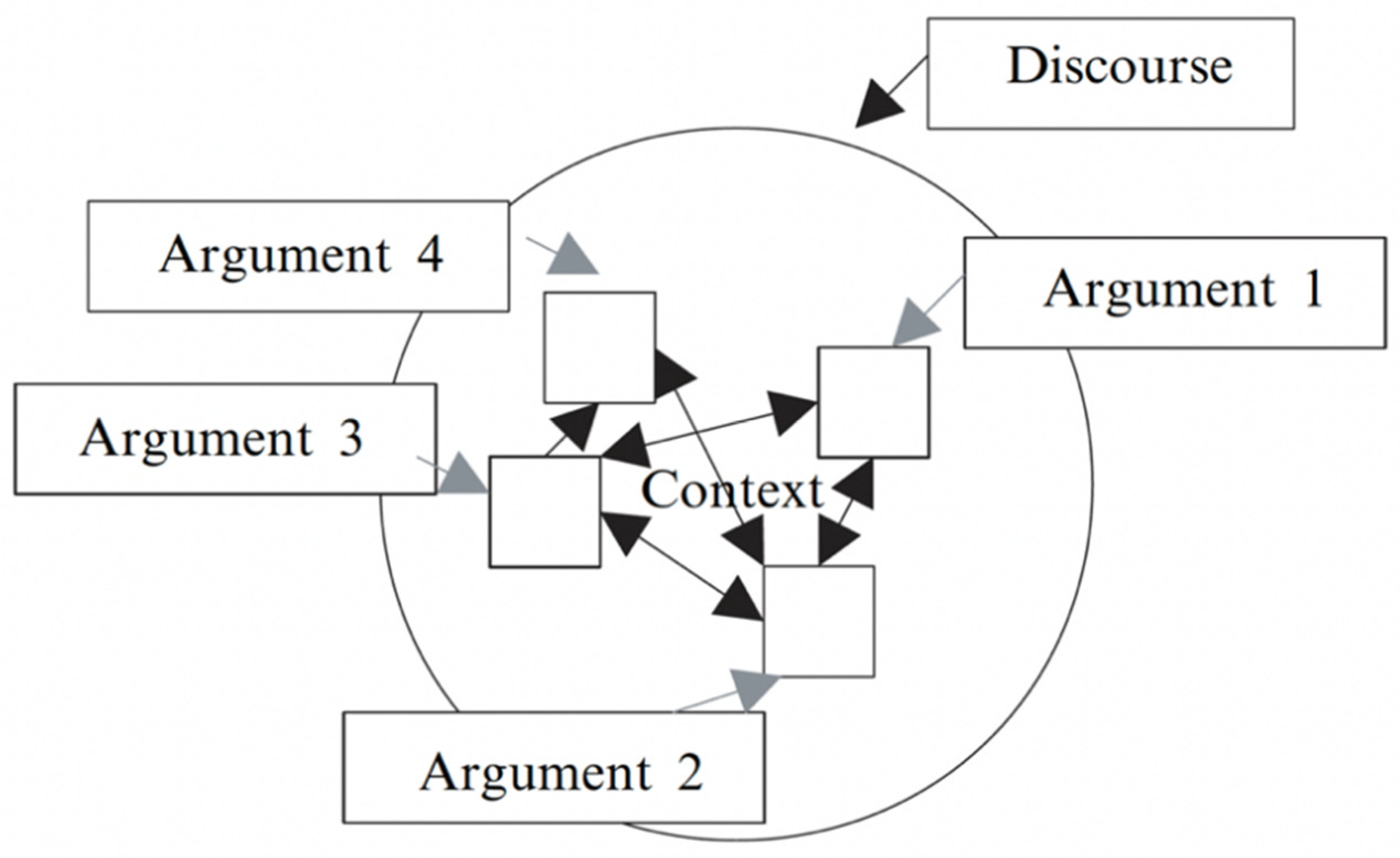
Disclaimer/Publisher’s Note: The statements, opinions and data contained in all publications are solely those of the individual author(s) and contributor(s) and not of MDPI and/or the editor(s). MDPI and/or the editor(s) disclaim responsibility for any injury to people or property resulting from any ideas, methods, instructions or products referred to in the content. |
© 2025 by the authors. Licensee MDPI, Basel, Switzerland. This article is an open access article distributed under the terms and conditions of the Creative Commons Attribution (CC BY) license (http://creativecommons.org/licenses/by/4.0/).
Copyright: This open access article is published under a Creative Commons CC BY 4.0 license, which permit the free download, distribution, and reuse, provided that the author and preprint are cited in any reuse.