

Submitted:
27 April 2025
Posted:
28 April 2025
You are already at the latest version
Abstract
Mobile technology advancements have led to cellphone bans in some school jurisdictions that judge their utilization by students as unhealthy, antisocial, and educationally controversial. What banning student cellphones neglects is the positive mental health that derives from self-directed learning promoted by mobile technology use of the co-creation of virtual worlds regarding those with whom the cellphone user establishes an online community. This scoping review examines the range of peer-reviewed research from 2021-2025 demonstrating positive mental health value in self-directed mobile technology use through co-creating virtual worlds with a search of seven primary databases and one supplementary database of the keywords “self-directed learning, mobile technology, co-creation, virtual worlds”, excluding reviews, book chapters, abstracts, and conference proceedings. The assessment of the findings is that cellphone use promotes a combination of self-directed learning, consensus decision-making, and mental health benefits when virtual worlds are co-created by students permitted their use. Appraising these results—regarding self-directed learning, consensus decision-making, and student mental health—the conclusion is that in contemplating school cellphone use of mobile technology, educators rethink banning their classroom use. The aim would be to support the co-creation of virtual worlds to promote increased self-direction, consensus decision-making, and positive mental health.
Keywords:
self-directed learning
; consensus decision-making
; co-creation
; virtual worlds
; mobile technology
; school cell phone bannning
; student mental health
1. Introduction
Mobile technologies are individual and personally customizable electronic communication devices connected through wireless networks accessing almost 95% coverage of the cellular Internet network [1]. Current mobile technologies operate on Fifth Generation (5G) Technology featuring high-speed internet connectivity, significant bandwidth, moderate latency (acceptable lag in online experiences), Ultra High Definition streaming videos, and virtual/augmented reality (AR/VR) media, as examples [2]. They are available in several forms: laptop computers, cellphones, tablet computers, e-readers, and wearable devices [3]. Their use assumes an integrated role in users’ lives through (for example) voice and text messaging, identity construction, music appreciation, modifiable news alerts, video and television watching, personal schedule and contacts organization and storage, media creation, Internet surfing, electronic introductions, mobile commerce and banking, game playing, and Global Positioning System (GPS) navigation [4,5]. Although the first mobile technology was introduced in 1973 [6], it wasn’t until 2019 that mobile technology had the capacity and speed to permit users to create virtual worlds through virtual reality [7].
Virtual reality is computer-generated three-dimensional digital worlds designed for and available on connected technology (mobile or stationary) that offers sufficiently similar features to the actual world to make virtual worlds immersive for users comparable to the real world [8]. In their power to be immersive, the virtual worlds created by virtual reality are improving continuously [9]. Cellphones have the capacity for direct and constant access to these virtual worlds. The projection is for more than 18 billion cellphones to be used globally by the end of 2025, arguably representing the most widely used technology for accessing these virtual worlds [10].
There were health concerns with the global introduction of 5G technology for cellphones (more particularly referred to as Smartphones with this technology introduction [11]) resulting from (1) a lack of clarity regarding the meaning of 5G, (2) accumulating studies documenting disruptive in vitro and in vivo effects of radiofrequency electromagnetic field (RF-EMF) exposures from its use; (3) missing high-quality epidemiological studies of adverse human health effects from 5G EMF exposure; and (4) persistent allegations that the basis of some RF-EMF safety policies for national telecommunications regulatory authorities is not regarding the latest science [12]. The assumption of safety continued to justify the availability of this technology by 2023 [13]. As of 2025, an extensive review of 5G technology leaves aside any mention of its safety [14].
Physical health concerns from (RF-EMF) exposures led to the initial considerations by education jurisdictions of banning cellphones in schools [15]. However, as 5G cellphone use became ubiquitous, there was a shift in the education overseeing bodies to a focus on student mental health in the forms of cellphone addiction, distraction, and cyberbullying, with cellphone banning across public school systems in France, Israel, Canada (Ontario) and Australia (Victoria, Tasmania, New South Wales, and Western Australia) by 2021 [16]. Additional concerns included academic dishonesty [17] and sexting (sexual texting [18]), with some educators fearing the adverse effects of cellphone use in the classroom outweigh the potential benefits— although educators remain who believe in retaining classroom cellphone use as it significantly enhances learning [19]. As these devices have become seemingly indispensable to people worldwide, it is relevant to note that most schools researched do not provide education and guidance activities for the effective self-directed learning use of cellphones [20,21].
Self-directed learning is a psychological theory of an internally regulated learning process [22] guided by learner values [23] lacking a pre-determined schedule [24], undertaken for intrinsic reasons alone [25]. Learners take responsibility for evaluating their learning outcomes [26,27]. Self-directed learning depends on free choice and provides a sense of ownership [28]. To be effective, self-directed learning necessitates self-management skills [29] and a firmness of purpose [26]. Self-directed learning also requires a similar acceptance of others as self-directed learners, acknowledging that others provide unique points of view necessary for a clear understanding of reality [30]. This type of acceptance in understanding the perspective of others requires decision-making in communities based on consensus that considers each point of view [31], particularly in virtual environments where collaboration in design decision-making is a critical factor in the quality of built environments [32]. The digital result is co-creation, where inclusivity represents a key principle ensuring that all voices are heard and considered in a collective decision-making process that prioritizes consensus-building amongst varying needs [33].
Concerns regarding cellphone use assume students cannot make reasonable decisions once immersed in their use [34]. Research concentration generally has not considered students as capable of being self-directed users of mobile technology or that the virtual worlds they co-create may have a positive value in promoting successful consensus decision-making effective for learning—however, there are exceptions [35]. This scoping review aims to identify peer-reviewed publications that consider student self-directed learning and consensus decision-making in co-creating virtual worlds using their 5G cellphones. The hypothesis is that such research is available and discoverable through a scoping review of various relevant databases. The purpose is to accumulate research that finds positive student mental health in their use of cellphones during classroom time to balance the extent of literature that views student cellphone use as necessarily detrimental.
2. Materials and Methods
To achieve the aim of this study, the selection was a scoping review. Scoping reviews regarding the Preferred Reporting Items for Systematic Reviews (PRISMA) Statement extension to scoping reviews—the PRISMA-ScR—have their most comprehensive examination in the 2018 seminal research by Tricco et al. [36], updated by Peters et al. in 2020 [37]. This study follows the 2020 PRISMA guidelines for scoping reviews [38,39] in gathering materials through the preferred methods. The PRISMA process for scoping reviews is internationally standardized [37] and considered best practice guidance for scoping reviews [40].
The selection of a scoping review for this search was to find the range and depth of research on this subject rather than to examine PICO (population, intervention, comparison, and outcome), requiring a systematic review [41]. For this reason, this report does not include a quantitative meta-analysis, as it follows the expected process of a scoping review. However, this scoping review searches only peer-reviewed studies on the topic. In this way, the differentiation is from most scoping reviews that include a more extensive search of grey literature, including government reports, conference proceedings, theses, and working papers [36]. Grey literature is not part of this scoping review as this is a contentious topic, and such literature has not been subject to quality control mechanisms [42]. Therefore, the consideration is that only studies that have been through the peer-review process are adequate for this endeavor.
The method includes a selection of seven primary databases and one supplementary database in searching the keywords “self-directed learning, mobile technology, co-creation, virtual worlds” and then removing each of (1) the duplicates, (2) records not in English, and (3) those not peer-reviewed. As each search is manual, automation tools mark no records as ineligible. The following of the most recent PRISMA template for scoping reviews [43] represents the 30 March 2025 search exclusion and inclusion criteria flow. The PRISMA Scoping Review Checklist is in unpublished material outlining the process undertaken as a scoping review article. The pre-registration process is at OSF Registries: https://doi.org/10.17605/OSF.IO/NAWHR.
As per the requirements of the PRISMA flow diagram [38], the databases searched are differentiated only regarding the location of the records. All records returned from each database are combined once the “Records removed before screening” is undertaken.
Although there is no necessary number of databases to search for a scoping review [40], those searched should be limited to literature relevant to the review—a point noted in the most recent comments published in 2022 regarding scoping reviews [40]. Yet, there is a distinction between primary databases, which consistently return the same results, and those considered supplementary databases, where the search results depend on the particular search [44]. The primary databases used in this search are EBSCO, JSTOR, OVID, ProQuest, PubMed, Scopus, and Web of Science. The basis of their selection is the topic searched and their high regard as databases [44]. A search of Google Scholar extended the reach of the returns. The selection of the Google Scholar database to search is the evidence that it outperforms the coverage of either Scopus or Web of Science [45], and a 2019 study of twelve academic databases found it the most comprehensive search engine [45], additionally reconfirmed with 2023 research [46]. As this is a scoping review, and comprehensiveness is key, Google Scholar is relevant to the intended purpose of the undertaking.
The recording of the databases, the search parameters, and returns is in Table 1, following the search order of the eight databases. The additional parameters were few for the searches of four of the eight databases—ProQuest, PubMed, Web of Science, and Google Scholar. Multiple additional parameters were necessary to search the other half of the databases—EBSCO, JSTOR, OVID, and Scopus. Yet, the range of parameters did not indicate the number of returns for each search. The expectation might be that the fewer the parameters, the more results. This outcome was not evident for most of the databases. Although ProQuest had the most returns at 57, and Google Scholar returned 12, the other two database searches with fewer parameters—PubMed and Web of Science—had the result of zero returns. The expectation would be that the more refined the criteria—increasing the size of the parameters—the fewer the returns. Although this was the result for JSTOR and OVID, each with zero results, it was not for EBSCO, with 47 results, and Scopus, with 18 results. Consequently, there can be no interpretation of which method—more parameters or fewer—is the most effective for a scoping review of this topic.
Possibly relevant to aiming to locate articles attributing value to student use of cellphones during classroom time is excluding post-secondary studies from the database searches. However, their inclusion is because positive post-secondary results may provide insights to school boards regarding what is valuable regarding this topic since post-secondary institutions stress the type of self-efficacy [47] that arises from student self-directed learning and co-creation [48]. This self-efficacy is especially so regarding Open Educational Resources (a term originated by UNESCO in 2002): teaching, learning, and research materials in any medium in the public domain or under an open license permitting no-cost access, use, adaptation, and redistribution by others with no or limited restrictions [49]. These Open Educational Resources are relevant beyond post-secondary education to primary [50] and secondary learning [51], particularly in the digital realm [52].
3. Results
A recording of the PRISMA process results for all eight searches is in Supplementary S1. Only three of the eight database searches produced included records—EBSCO (n = 4), ProQuest (n = 8), and Scopus (n = 1)—for a total of 13 studies included. The standardized summary of the PRISMA process is in Figure 1. This standardization neglects a division of the database results following the records identified (n = 134). Of the total records identified, four databases (JSTOR, OVID, PubMed, and Web of Science) had no returns. The remaining four databases returned as follows, in the order searched: EBSCO (n =47), ProQuest (n =57), Scopus (n = 18), and Google Scholar (n = 12). The percentage of returns included for these databases is EBSCO (% = 17), ProQuest (% = 24.5), Scopus (% = 11), and Google Scholar (% = 0).
The demonstration for this topic is that ProQuest was the most effective database to search for results. Confirmation of the relevance of ProQuest for this search is that eight of the nine duplications are with ProQuest (the other was a duplication within that same database). These details are available from Supplementary S1. Combined, the records removed before screening were (n = 66). There were six that were not peer-reviewed—all from Google Scholar. There was one non-retrieved report. It was from the EBSCO results.
The assessment for eligibility was 61 reports—48 lacked at least one of the keywords. Regarding this lack, the aim was to be as inclusive as possible. Consequently, a similar idea to the keyword was enough for its inclusion. For example, there was an inclusion of the study if, in searching for “self-directed learning”, the study used “self-determined learning” or ”self-initiated learning”. Similarly, inclusion resulted if the research mentioned “mobile apps” or “cellphones” rather than “mobile technology”. For “co-creation”, if the study mentioned students sharing their information in creating an online experience, the consideration was that it fit the concept. For “virtual worlds”, “virtual reality” was deemed sufficient for inclusion. A final point regarding the search results is that several returns did not concern student learning. There were no exclusion criteria regarding lacking students because of the consideration that the exclusion of non-student returns would result from no mention of self-directed learning. This point proved the result, and returns that did not include student learning were not part of the assessment.
3.1. Reports of Included Studies
There are 13 studies included for review, each with a single report resulting in 13 reports of included studies. These studies are listed in Table 1 and are as follows in the order in which they returned. From the EBSCO database search: An empirical study on immersive technology in synchronous hybrid learning in design education [53], MOOC learners' perspectives of the effects of self-regulated learning strategy intervention on their self-regulation and speaking performance [54], Fostering students' systems thinking competence for sustainability by using multiple real-world learning approaches [55], and Designing a transmedia educational process in non-formal education: Considerations from families, children, adolescents, and practitioners [56]. The ProQuest records are the following: Enhancing authentic learning in a rural university: exploring student perceptions of Moodle as a technology-enabled platform [57], Students' mindset to adopt AI chatbots for effectiveness of online learning in higher education [58], Towards a Creative Virtual Environment for Design Thinking [59], An Empirical Study of A Smart Education Model Enabled by the Edu-Metaverse to Enhance Better Learning Outcomes for Students [60], Developing an Evidence- and Theory-Informed Mother-Daughter mHealth Intervention Prototype Targeting Physical Activity in Preteen Girls of Low Socioeconomic Position: Multiphase Co-Design Study [61], Modeling the Critical Factors Affecting the Success of Online Architectural Education to Enhance Educational Sustainability [62], Gamified Digital Game-Based Learning as a Pedagogical Strategy: Student Academic Performance and Motivation [63], and Does gamification affect the engagement of exercise and well-being? [64]. Scopus returned the following article: Developing a more engaging safety training in agriculture: Gender differences in digital game preferences [65].
One publication is a study by a sole author [57], three are by co-authors [54,56,60], five are by three authors [53,59,62,63,64], three by four authors [55,58,65], and one by five authors [61]. Multiple authors offer enhanced protection against biases as different authors can assume distinct roles to organize and check the results from uniquely relevant perspectives [66,67].
The publications are from various types of journals. Five are from education [53,54,55,56,57], two are from commerce [58,64], two are from systems [59,60], one from pediatrics [61], one from sustainability [62], one from applied sciences [63], and one from occupational safety [65]. Although all the reports regard education, the variables for the learning method examined differ depending on the journal focus, as does the perceived value of establishing statistical significance for the results. In this regard, study replication is viewed best as amenable to varying purposes, and flexible in answering the questions most beneficial to moving the field forward [68]. As such, it is valuable that the consideration of the relationship between self-directed learning, consensus decision-making, and student mental health is viewed concerning the co-creation of virtual worlds through mobile technology from the diverse perspectives of these journals.
The publications are from various years, with the most publications on the topic from the mid-year of the search tapering off with more current publication dates. Notably, that there was no relevant publication from 2021 and only one in 2022 [63]. The year 2023 reflects the most publications with six [55,56,59,60,64,65]. Four publications are from 2024 [53,54,57,62], and two from 2025 [58,61]. This initial increase and then a reduction in the number of relevant publications on this topic may imply that, with the increasing number of cellphone bans in the classroom, which may have been an impetus for the initial upswing in publications, there is now a decreasing need for research reporting the positive value of classroom cellphone use as students accept the ban. However, a recent study on student perspectives in one region where cellphones have been banned noted that students feel that their learning suffers in various ways without access to their cellphones in the classroom, and their preference is for the support of responsible cellphone use [69].

Table 1.
Bibliographic details (citation number, article title, authors, publication journal, and publication year) of the 30 March 2025 search of “self-directed learning AND mobile technology AND co-creation AND virtual worlds” resulting from the reports included for appraisal of three databases (EBSCO, ProQuest, and Scopus) listed in the order of the searches and their returns. A heavy horizontal line divides each of the three journal searches.
Table 1.
Bibliographic details (citation number, article title, authors, publication journal, and publication year) of the 30 March 2025 search of “self-directed learning AND mobile technology AND co-creation AND virtual worlds” resulting from the reports included for appraisal of three databases (EBSCO, ProQuest, and Scopus) listed in the order of the searches and their returns. A heavy horizontal line divides each of the three journal searches.
| # | Title | Authors | Journal | Year |
| [53] | An empirical study on immersive technology in synchronous hybrid learning in design education | Kee, T.; Zhang, H.; King, R.B | International Journal of Technology and Design Education | 2024 |
| [54] | MOOC learners' perspectives of the effects of self-regulated learning strategy intervention on their self-regulation and speaking performance | Dinh, C.-T.; Phuong, H.-Y. | Cogent Education | 2024 |
| [55] | Fostering students' systems thinking competence for sustainability by using multiple real-world learning approaches | Demssie, Y.N.; Biemans, H.J.A.; Wesselink, R.; Mulder, M. | Environmental Education Research | 2023 |
| [56] | Designing a transmedia educational process in non-formal education: Considerations from families, children, adolescents, and practitioners | Erta-Majó, A.; Vaquero, E. | Contemporary Educational Technology | 2023 |
| [57] | Enhancing authentic learning in a rural university: exploring student perceptions of Moodle as a technology-enabled platform | Maphosa, V. | Cogent Education | 2024 |
| [58] | Students' mindset to adopt AI chatbots for effectiveness of online learning in higher education | Rahman, M.K.; Ismail, N.A.; Hossain, M.A.; Hossen, M.S. | Future Business Journal | 2025 |
| [59] | Towards a Creative Virtual Environment for Design Thinking | Gebbing, P.; Lattemann, C.; Büdenbender, E.N. | Pacific Asia journal of the Association for Information Systems | 2023 |
| [60] | An Empirical Study of A Smart Education Model Enabled by the Edu-Metaverse to Enhance Better Learning Outcomes for Students | Shu, X.; Gu, X. | Systems | 2023 |
| [61] | Developing an Evidence- and Theory-Informed Mother-Daughter mHealth Intervention Prototype Targeting Physical Activity in Preteen Girls of Low Socioeconomic Position: Multiphase Co-Design Study | Brennan, C.; ODonoghue, G.; Keogh, A.; Rhodes, R.E.; Matthews, J. | JMIR Pediatrics and Parenting | 2025 |
| [62] | Modeling the Critical Factors Affecting the Success of Online Architectural Education to Enhance Educational Sustainability | Metinal, Y.B.; Gumusburun Ayalp, G. | Sustainability | 2024 |
| [63] | Gamified Digital Game-Based Learning as a Pedagogical Strategy: Student Academic Performance and Motivation | Camacho-Sánchez, R.; Rillo-Albert, A.; Lavega-Burgués, P. | Applied Sciences | 2022 |
| [64] | Does gamification affect the engagement of exercise and well-being? | Chang, S.-C.; Chiu, Y.-P.; Chen, C.-C. | International Journal of Electronic Commerce Studies | 2023 |
| [65] | Developing a more engaging safety training in agriculture: Gender differences in digital game preferences | Vigoroso, L.; Caffaro, F.; Micheletti Cremasco, M.; Cavallo, E. | Safety Science | 2023 |
3.2. Study Details
Of the thirteen studies, four regard design programs—either a design workshop [59] or undergraduate programs with design as the focus [53,60,62]—while one concerns design for a relevant aspect of the program [55] as its aim. In these programs, the co-creation of virtual worlds corresponds to an intended design for an actual physical environment. For other studies, the virtual worlds created are entirely online and regard self-directed learning for a planned curriculum [54,56,57,58]. Three studies concern the gamification of learning to promote co-creation [63,64,65]. The last of the studies focuses on family virtual world co-creation to achieve change in the actual world [61].
Ten studies were of university students [53,54,55,57,58,59,60,62,63,65]. Two were regarding children [56,61]. Unmentioned were the age and academic level of the participants in another study [64]. The participants for most studies numbered 75 or less [53,54,55,56,59,60,61,64]. The participant numbers for three were between 100 and 200 [57,63,65], while two studies had participants numbering over 200 [58,62]. In studies with more than three variables, participants numbering 100 or more is the most recent advice [70].
Publication was during or after the COVID-19 pandemic for all studies. However, the research for four was before it began [53,55,60,65]. One of the studies is undated [57]. However, it was evident from the text that research completion was after the pandemic began. At least one study represents each pandemic year [54,56,59,62,63,64], with the research of two of the reports undertaken post-pandemic in 2024 [58,61].
Artificial intelligence and education articles are mainly published in the United States or mainland China [71]. Therefore, it is notable that not only are none of the studies for this scoping review from either of these areas—they come from a variety of countries, and two are from African nations [55,57]. This result is particularly unexpected as African nations often lag behind the United States in technological development [72]. In contrast, to be expected based on their advanced technological development [73], two of the publications are from Hong Kong [53,60] and one from Taiwan [64]. Moreover, based on their increasing technological innovation [74], it is predictable that one of the publications is from Vietnam [54] and another from Malaysia [58]. Another study was conducted in western Asia [62], while the remainder are geographically European studies [56,59,61,63,65].
The study details are in Table 2.
3.3. Methodological Details
The outcomes of the thirteen studies found in Table 3 regarding their stated aims each relate that self-directed mobile technology classroom use in the co-creation of virtual worlds can enhance student learning to an extent not possible in traditional methods of learning. This result was regarding entirely virtual learning, as in [53,54,57,58,59,60,62,63,64], and concerning virtual learning that supported traditional learning methods in and outside the classroom [55,56,61,65]. Two studies noted limitations in achieving these results. The article regarding Turkish intervention cautions that positive results are achievable only with reliable high-speed internet. As this was not available to all the students, the outcomes were less than possible. Except for [65], no articles examined the effect of gender on success. That article notes that although the interest in the co-creation of virtual worlds is similar in males and females regarding the use of graphics, drama, rewards, and the game genre, there were evident differences in tasks, quests, rules and goals, colors and variety of their preferences of virtual worlds.
Other than three reports [55,56,61], all the study types included a quantitative aspect of the studies. Some studies were entirely quantitative [54,58,59,62,65], while the remainder involved mixed methods [53,57,60,63,64].
Statistical significance was tested for all studies that had a quantitative component. Each of the tested variables demonstrated statistical significance in all studies [53,54,57,58,59,60,62,63,64,65] with some exceptions. There was a high statistical significance for the perceived AI chatbot capability on perceived usefulness and perceived ease of use found in [58]. Also, there was no statistical significance in the results if competition was involved [63] and in gender differences regarding the intention to participate in co-creating virtual realities through games [65].
3.4. Positive Effect on Students of Mobile Technology Use
In considering the results of the thirteen reports regarding the focus of this study on self-directed learning, consensus decision-making, and student mental health (see Table 4), none of the reports had these variables as their investigation aim. As such, results on these topics require narrative interpretation. Nevertheless, the interpretation is limited to finding the appropriate textual location mentioning these points. In contrast, the information provided in the table is directly from the reports and does not represent an interpretation.
In only two studies, direct mention of the importance of self-directed learning to the successful co-creation of virtual worlds was lacking [63,65]. It is interesting to note that these two studies have four other features that distinguish them. They (1) are the oldest publications, (2) concern the gamification of learning to promote co-creation, (3) have participant numbers between 100 and 200, and (4) identified variables that were not statistically significant regarding those tested. Yet, although they do not mention self-direction specifically, one focuses on self-determination theory [63], and the other indicates the importance of considering game player preferences.
Consensus decision-making is not a searched keyword nor mentioned by name in any of the studies; nevertheless, the comments made in the thirteen reports indicate that the co-creation of virtual worlds considers and incorporates all points of view, as found imperative in [31]. Only two reports provided contrary evidence to the relevance of consensus decision-making to the success of the co-creation of virtual communities [58] and [63]. In [58], the finding was that, in using AI chatbots, learners preferred to work alone, while [63] found no benefit to consensus decision-making over competition. Again, it is notable that [63] is distinct from the other reports in yet another way.
Student mental health was not the focus of any study. Most did not mention mental health directly. Consequently, to interpret student mental health, the relevant terms searched in the publication were “positive”, “well-being”, “sustainable”, “satisfaction”, “psychosocial”, and “psychological”. With these additional words searched, only one of the reports did not specify a mental health component. Study [61] had physical health as its concentration. It was a qualitative study of 10 or fewer participants for all three groups tested. Interpreting student mental health to extend to each of the additional relevant terms, all studies noted improvements in student mental health over regular classroom activities regarding self-direction in co-creating virtual worlds.
4. Discussion
This scoping review identified those peer-reviewed publications that consider the positive value of student self-directed learning and consensus decision-making in co-creating virtual worlds using their cellphones. The hypothesis—that such research is available and discoverable through a scoping review of various relevant databases—was corroborated with relevant reports returned from three databases (EBSCO, ProQuest, and Scopus) of the eight searched. The demonstration that there is positive student mental health in their use of cellphones during classroom time fulfilled the purpose of balancing the extent of literature viewing student cellphone use as necessarily detrimental.
This Discussion examines the various points regarding why the banning of cellphones is supported; then, it considers the relevance of the findings to cellphone banning. Next are the study limitations and then future research directions.
4.1. Three Ways Classroom Use of Cellphones is Considered Detrimental
Although this scoping review demonstrates that classroom cellphone use is valuable regarding increases in self-directed learning, consensus decision-making, and mental health with the co-creation of virtual worlds, a comparison of these findings is now with those of contrary research. There are three ways that classroom cellphone use is viewed as detrimental, leading to their banning—they are considered unhealthy, antisocial, and educationally controversial. Examining the literature on these three points finds that these claims are either unsupported, biased, or non-sequiturs.
4.1.1. Health-Related Concerns
In claiming that health-related reasons must ban cellphones from schools, the initial concern that 5G cellphones are physically unhealthy lacks support by recent research that finds no scientific evidence from communications engineering for the widely perceived health risks attributed to 5G [75]. It may be that the lack of scientific support for the initial claim that the technology is unhealthy in itself [11] has led to additional and different claims regarding the effect of cellphone use on reducing physical and mental health in students.
One 2022 study of university students finds that there are other ways that cellphone use continues to affect physical health. These are eye strain and neck and back pain [76]. This finding gained further support that year in another publication stressing the increase in eye strain and dry eye associated with cellphone use [77]. A 2023 article concurs that cellphone use has increased neck pain in college students [78]. One 2024 study was less inclined to conclude that eye strain and neck pain were necessarily caused by cellphone use [79]. This more recent caution in attributing these effects to cellphone use by students is relevant since there has not been comparative research on the eye, neck, and back pain of students before the introduction of cellphones examined in conjunction with the increase in time that students now must spend in studying with a shift in focus to project-based learning [80] compared with the past, and, for low-income students, a lack of an adequate working environment at home to reduce these problems augmented by the pandemic [81]. As a result of the COVID-19 pandemic limitations that have extended past the pandemic, more students work from home in their classroom time, meaning that they spend less time commuting to school and more time at their desks in conditions that may not be conducive to maintaining their physical health [82]. These continued physical health-related concerns regarding cellphone use thus may be more related to increased time spent in spaces not designed to support student physical health. Additionally, regarding neck and back pain, a more significant reason for its perceived increase is likely the prevalent student use of heavy and improperly worn backpacks [83,84].
Regarding school-aged children, those found to experience the most detrimental outcomes leading to social-emotional problems in general during the pandemic were those who were from the most disadvantaged backgrounds [85]. This result supports that the increased problems regarding cellphones are attributable to more than merely the fact regarding their use. A 2024 systematic review concurred that the observed effects of cellphone use in students differed depending on time and type of use, finding the evidence that cellphone use may be associated with mental health risks in children and adolescents suggestive but limited [86]. One systematic review concludes that there is no evidence that mental health problems have increased in association with cellphone use [87].
4.1.2. Antisocial Issues
One of the primary concerns regarding cellphone use in the classroom is that it promotes an antisocial relationship with others. A 2021 Nigerian study concludes that violent digital movies and social media usage significantly relate to antisocial behavior among adolescent students in senior secondary schools [88]. That it is the cellphone use in these ways that causes the behavior is not demonstrated. An assumption of increased antisocial behavior is made and even proclaimed in the title of a 2023 publication without any presented evidence in the report [89]. Another 2023 publication from Canada finds that young adults engage in antisocial online behavior for fun and social approval. This study does not investigate whether there is a difference between the reasons for antisocial behavior that is not online. In other words, it is unclear whether the online nature of cellphones creates this antisocial behavior or that it would occur regardless of cellphone use [90]. There is one study of Lebanese students that finds students the authors claim are addicted to cellphone use are more physically aggressive towards others and require interventions to improve their cognitive function [91]. Yet, this same study acknowledges that Lebanese adolescents are more prone to engage in aggressive behavior because their environment is saturated with violence, representing an integral part of their daily lives. Therefore, along with the imposed COVID-19 limitations, it is unclear whether this 2022 publication can determine the actual influence of cellphones in this regard.
One of the predominant concerns of educators regarding antisocial cellphone use in class is students viewing and creating pornography [92]. In a 2023 South African publication, the 14-17-year-old girls studied agreed there was a link between sexual harassment and boys accessing porn on their cellphones during class [93]. Yet, this was a result primed by the researchers through the questions they asked in the focus groups. The girls themselves responded that the boys were generally bothersome to them because of their continued requests for sexual favors. In their statements, the girls were not particularly concerned with cellphone behavior in this regard. The authors themselves admit that sexual violence directed towards women and girls remains prevalent in South Africa despite numerous efforts and interventions to address the problem. Consequently, it is unclear how, or even whether, cellphone use has been a cause of this antisocial behavior. In Zimbabwe, a country slow for students to take up the use of cellphones, science teachers are ready to fully embrace smartphones as valuable in understanding that with cyberbullying and indecent exposure, children experiment on immoral content like pornography and/or violence that they access through smartphones because it is in their nature as children to experiment in this way [94]. As such, it is not the cellphone that is considered the cause of the behavior.
Academic cheating is another concern regarding the antisocial nature of cellphones. A 2021 article on college students in the United States notes that academic dishonesty is pervasive. The finding is that cellphone use has promoted academic dishonesty as females are more inclined to view it negatively and, without the availability of their cellphone in class, they would avoid academic cheating in contrast to males [95]. What this result additionally shows, and is supported by research regarding cheating in high school students, is that females have a higher state of anxiety and inflexibility regarding cheating, and the most aggressive students were more flexible and less stressed [96]. In other words, although academic cheating has increased with the use of cellphones in class, this increase is predominantly a result of females engaging in this cheating to reduce their high state anxiety in a manner that would be unacceptable to them without the use of their cellphone. Consequently, the problem with academic cheating and cellphone use appears to relate to high anxiety levels in females rather than the cellphone use itself.
4.1.3. Educationally Controversial
Cellphone use in the classroom involves self-directed learning. Although self-directed learning is considered appropriate and desired for post-secondary learning—best introduced to students during the transition period from high school to the university [97]—the view is that it is controversial in K-12 school classrooms [98]. Yet, much of this concern is from studies conducted before the introduction of Smartphones, when students who did not have immediate access to information still felt uncertain regarding their abilities to self-direct their learning [99]. Since Smartphones have become essential to students in their daily lives, these students have become aware that in learning from their phones, they are entirely self-directed [100]. In response, teachers increasingly understand the need to adjust the curriculum to permit students to self-direct their learning, even in classes like science, previously thought to necessitate teacher instruction [101]. The findings from a 2024 meta-analysis advocate adopting self-directed learning as an integral pedagogical approach in K-12 education, highlighting its ability to elevate learning substantially [102].
The view that students require a teacher-directed curriculum to learn appropriately is an additional reason for mistrusting the use of cellphones in the classroom. Teachers are concerned that students are unaware of what information is correct and appropriate to learn. This concern relates particularly to using AI in the classroom with ChatGPT [103]. It extends to students being unable to avoid plagiarism, although a 2024 study noted that more than 70% of students considered it wrong to use ChatGPT for essay writing [104]. Yet, another 2024 post-secondary study notes that this problem of plagiarism can be mitigated with the use of plagiarism detection software [105].
4.2. Relevance of the Results to a Reconsideration of Cellphone Banning
With this scoping review, there was an identification of thirteen reports regarding a positive focus on self-directed learning in the co-creation of virtual worlds. However, several factors make some studies more relevant to reconsidering the cellphone ban in educational jurisdictions than others.
The first factor is the effect of the COVID-19 pandemic. The limitations imposed on people to remain in their homes for extended periods meant that all students were required to become more proficient at using online learning methods and self-directing their learning [106]. As such, pre-pandemic studies on students are less relevant today when considering the importance of classroom cellphone use, and their use became indispensable for learning during the lockdowns [107]. This proviso means that four returned studies would be viewed as less relevant [53,55,60,65].
Secondly, that [53] would be less relevant is reinforced by its 2024 publication, meaning that the period between study completion and publication was over five years. In contrast, the other three reports [55,60,65] were each published in 2023. Consequently, additionally to [53] being less relevant because the study was pre-pandemic, it is also problematic that it took five years for publication.
The third point is that only two reports were regarding children or adolescents [56,61]—the remainder concerned university students. Moreover, of these, [61] was not classroom-based. The consideration might be that the issue of cellphone banning is specific to K-12 classrooms. However, regarding virtual reality, the evidence is that there is a commonality between the issues regarding all learners understood by early adopters of virtual reality in the classroom [108].
The final point is that the thirteen reports concentrated on areas distinct regarding cellphone use in co-creating virtual worlds The highest number involved using the technology for design-based problems [53,55,56,59,60,61,62]. Next were those studies promoting the gamification of learning [63,64,65]. The remainder involved individual matters regarding self-direction in the co-creation of virtual worlds: massive open online courses (MOOCs) [54], Moodle [57], and AI chatbots [58]. These matters regarding the positive introduction of cellphone use in the classroom do not address the problems that have led to their banning, as noted in section 4.1. Yet, in recent reports by researchers reconsidering the ban on cellphones in jurisdictions where they are upheld [109,110,111,112,113], there is recognition of these positive values of cellphones in the classroom and a call for lifting these bans along with appropriate instruction on responsible use.
4.3. Limitations
The PRISMA extension for scoping reviews provides the recommended framework for methodological issues followed for this scoping review [114]. However, in using this framework, the information is controlled by the structure and synthesis of the charting process [115]. This charting process restricts the required information. Therefore, the text offers additional details on the exclusion process, including the information in Table 1.
The selection was a scoping review rather than a systematic review with meta-analysis for this analysis [41]. Compared with systematic reviews, scoping reviews are relatively new [116]. They demand fewer detailed comparisons. A scoping review aims to map the contextual breadth to identify existing evidence [117]. This scoping review is limited as it does not undertake to appraise critically the methodological quality associated with a systematic review and statistically estimate the data effect extracted from the individual studies through a meta-analysis [118].
No guidelines require that scoping reviews be managed as a team [36,114,117]. Nevertheless, cognitive bias is a limitation of work conducted by one researcher [66,119,120]. Measures are necessary to overcome this possibility [66]. The author has included the record provided by the database of studies returned for each search conducted to mitigate cognitive bias found in Table 1. A detailed color-coded system identifies and differentiates articles following the PRISMA process for scoping reviews found in Supplementary S1. By including the Preferred Reporting Items for Systematic Reviews and Meta-Analyses Extension for Scoping Reviews (PRISMA-ScR) Checklist as unpublished material, the author actively intends to alleviate cognitive bias.
4.4. Future Research Directions
The ability of mobile technologies to aid in the self-direction of consensus decision-making through the co-creation of virtual worlds is a new and developing topic. The ability of cellphones to assist in this process in the classroom is particularly novel, especially as it is contrary to the cellphone bans in classrooms in various education jurisdictions. There is a need for additional research regarding how virtual worlds aid in supporting and encouraging self-direction, consensus decision-making through co-creation, and positive mental health. Additionally, how this research is especially relevant to reconsidering cellphone bans in classrooms is necessary. Given that educators see classroom cellphone use as leading to health-related, antisocial, and educationally controversial problems, research must also focus on the type of learning in K-12 classrooms to guide responsible use of cellphones in co-creating virtual worlds.
5. Conclusions
There is an identification of positive value in student mental health to their self-directed learning and consensus decision-making in co-creating virtual worlds using their cellphones in the classroom. Research is available and discoverable through a scoping review of various relevant databases as corroboration. This finding balances the research that considers classroom use of cellphones detrimental. Yet, it not only provides impartiality. The evidence is that the reasons cited for banning cellphones in classrooms are either unsupported, biased, or non-sequiturs. Consequently, the advice is for education jurisdictions that have imposed the banning of cellphones to reconsider these bans in light of the evidence presented in this scoping review. In this way, the self-directed learning desired in students and their ability to make consensus-based decisions from co-creating of virtual worlds can positively enhance their mental health.
Supplementary Materials
The following supporting information can be downloaded at the website of this paper posted on Preprints.org. Supplementary S1.
Funding
This research received no external funding.
Institutional Review Board Statement
Not applicable.
Informed Consent Statement
Not applicable.
Data Availability Statement
No new data were created.
Conflicts of Interest
The author declares no conflicts of interest.
References
- Kaldygozova, S. Using Mobile Technologies in Distance Learning: A Scoping Review. ELIJ 2024, 2, 4–22. [Google Scholar] [CrossRef]
- Dangi, R.; Lalwani, P.; Choudhary, G.; You, I.; Pau, G. Study and Investigation on 5G Technology: A Systematic Review. Sensors 2021, 22, 26. [Google Scholar] [CrossRef]
- Grant, M.M. Difficulties in Defining Mobile Learning: Analysis, Design Characteristics, and Implications. Education Tech Research Dev 2019, 67, 361–388. [Google Scholar] [CrossRef]
- Green, L.; Holloway, D.; Stevenson, K.; Leaver, T.; Haddon, L. The Routledge Companion to Digital Media and Children; Routledge companions; Routledge: New York (N.Y.) Abingdon, 2021; ISBN 978-1-138-54434-5. [Google Scholar]
- Goggin, G. Introduction: What Do You Mean “Cell Phone Culture”?! In Cell phone culture: mobile technology in everyday life; Routledge: London, 2007; ISBN 978-0-415-36744-8. [Google Scholar]
- Kodukula, V. 2020 ACM Sigmobile Outstanding Contribution Award: Martin Cooper. GetMobile: Mobile Comp. and Comm. 2021, 24, 27–27. [Google Scholar] [CrossRef]
- Jiang, W.; Han, B. Evolution to Fifth-Generation (5G) Mobile Cellular Communications. In Cellular Communication Networks and Standards; Textbooks in Telecommunication Engineering; Springer Nature Switzerland: Cham, 2024; ISBN 978-3-031-57819-9. [Google Scholar]
- Hamad, A.; Jia, B. How Virtual Reality Technology Has Changed Our Lives: An Overview of the Current and Potential Applications and Limitations. IJERPH 2022, 19, 11278. [Google Scholar] [CrossRef]
- Wilkinson, M.; Brantley, S.; Feng, J. A Mini Review of Presence and Immersion in Virtual Reality. Proceedings of the Human Factors and Ergonomics Society Annual Meeting 2021, 65, 1099–1103. [Google Scholar] [CrossRef]
- Dong, L.; Duarte, F.; Duranton, G.; Santi, P.; Barthelemy, M.; Batty, M.; Bettencourt, L.; Goodchild, M.; Hack, G.; Liu, Y.; et al. Defining a City — Delineating Urban Areas Using Cell-Phone Data. Nat Cities 2024, 1, 117–125. [Google Scholar] [CrossRef]
- Khanh, Q.V.; Hoai, N.V.; Manh, L.D.; Le, A.N.; Jeon, G. Wireless Communication Technologies for IoT in 5G: Vision, Applications, and Challenges. Wireless Communications and Mobile Computing 2022, 2022, 1–12. [Google Scholar] [CrossRef]
- Frank, J.W. Electromagnetic Fields, 5G and Health: What about the Precautionary Principle? J Epidemiol Community Health 2021, 75, 562–566. [Google Scholar] [CrossRef]
- McCredden, J.E.; Weller, S.; Leach, V. The Assumption of Safety Is Being Used to Justify the Rollout of 5G Technologies. Front. Public Health 2023, 11, 1058454. [Google Scholar] [CrossRef]
- Paul, D.; Prince, I.A.; Islam, M.S.; Ahamed, Md.T.; Sarker, M.N.R.; Adhikary, A. Revolutionizing Connectivity Through 5G Technology. IJAERS 2025, 12, 01–07. [Google Scholar] [CrossRef]
- Miller, A.B.; Sears, M.E.; Morgan, L.L.; Davis, D.L.; Hardell, L.; Oremus, M.; Soskolne, C.L. Risks to Health and Well-Being From Radio-Frequency Radiation Emitted by Cell Phones and Other Wireless Devices. Front. Public Health 2019, 7, 223. [Google Scholar] [CrossRef] [PubMed]
- Selwyn, N.; Aagaard, J. Banning Mobile Phones from Classrooms—An Opportunity to Advance Understandings of Technology Addiction, Distraction and Cyberbullying. Brit J Educational Tech 2021, 52, 8–19. [Google Scholar] [CrossRef]
- Désiron, J.C.; Petko, D. Academic Dishonesty When Doing Homework: How Digital Technologies Are Put to Bad Use in Secondary Schools. Educ Inf Technol 2023, 28, 1251–1271. [Google Scholar] [CrossRef]
- Courtice, E.L.; Shaughnessy, K. Four Problems in Sexting Research and Their Solutions. Sexes 2021, 2, 415–432. [Google Scholar] [CrossRef]
- Smale, W.T.; Hutcheson, R.; Russo, C.J. Cell Phones, Student Rights, and School Safety: Finding the Right Balance. cjeap 2021, 49–64. [Google Scholar] [CrossRef]
- Gath, M.E.; Monk, L.; Scott, A.; Gillon, G.T. Smartphones at School: A Mixed-Methods Analysis of Educators’ and Students’ Perspectives on Mobile Phone Use at School. Education Sciences 2024, 14, 351. [Google Scholar] [CrossRef]
- Alakurt, T.; Yilmaz, B. Teachers’ Views on the Use of Mobile Phones in Schools. Journal of Computer and Education Research 2021, 9, 575–597. [Google Scholar] [CrossRef]
- Amir, I.; Bernstein, A. Dynamics of Internal Attention and Internally-Directed Cognition: The Attention-to-Thoughts (A2T) Model. Psychological Inquiry 2022, 33, 239–260. [Google Scholar] [CrossRef]
- Sun, W.; Hong, J.-C.; Dong, Y.; Huang, Y.; Fu, Q. Self-Directed Learning Predicts Online Learning Engagement in Higher Education Mediated by Perceived Value of Knowing Learning Goals. Asia-Pacific Edu Res 2023, 32, 307–316. [Google Scholar] [CrossRef]
- Hartkamp-Bakker, C.; Bradford, M.R. Guest Editorial: Reimagined Ways of Knowing, Being and Doing: Understanding the Value of a Self-Directed Educational Context. OTH 2024, 32, 49–55. [Google Scholar] [CrossRef]
- Priyadarshini, V.; Maheswary, U.; Swami, K.; Kumar, M.D.; Madhusudhanan, R.; Chandrakhanthan, J. Fostering Self-Directed Learning Among Millennial and Gen Z Learners Through E-Learning Platforms and ICT. In Anticipating Future Business Trends: Navigating Artificial Intelligence Innovations; El Khoury, R., Ed.; Studies in Systems, Decision and Control; Springer Nature Switzerland: Cham, 2024; ISBN 978-3-031-63568-7. [Google Scholar]
- Hamlin, M.D. Developing Self-Directed Learning Skills for Lifelong Learning: In Advances in Higher Education and Professional Development; Hughes, P., Yarbrough, J., Eds.; IGI Global, 2022; pp. 209–234 ISBN 978-1-79987-661-8.
- Morris, T.H. Four Dimensions of Self-Directed Learning: A Fundamental Meta-Competence in a Changing World. Adult Education Quarterly 2024, 74, 236–254. [Google Scholar] [CrossRef]
- Kalla, M.; Jerowsky, M.; Howes, B.; Borda, A. Expanding Formal School Curricula to Foster Action Competence in Sustainable Development: A Proposed Free-Choice Project-Based Learning Curriculum. Sustainability 2022, 14, 16315. [Google Scholar] [CrossRef]
- Kunjukunju, A.; Ahmad, A.; Yusof, P. Self-Directed Learning Skills of Undergraduate Nursing Students. Enfermería Clínica 2022, 32, S15–S19. [Google Scholar] [CrossRef]
- Van Woezik, T.E.T.; Koksma, J.J.-J.; Reuzel, R.P.B.; Jaarsma, D.C.; Van Der Wilt, G.J. There Is More than ‘I’ in Self-Directed Learning: An Exploration of Self-Directed Learning in Teams of Undergraduate Students. Medical Teacher 2021, 43, 590–598. [Google Scholar] [CrossRef]
- Seeds for Change Consensus Decision Making: A Short Guide Second Edition. Seeds for Change 2020.
- Zhang, Y.; Xiao, B.; Li, X. Integrating Virtual Reality and Consensus Models for Streamlined Built Environment Design Collaboration. J. Constr. Eng. Manage. 2024, 150, 04024010. [Google Scholar] [CrossRef]
- Ng, P.; Zhu, S.; Li, Y.; Van Ameijde, J. Digitally Gamified Co-Creation: Enhancing Community Engagement in Urban Design through a Participant-Centric Framework. Des. Sci. 2024, 10, e17. [Google Scholar] [CrossRef]
- Thiele, L.P. Distraction and Dependence: The Loss of Reflective Self-Direction. In Human Agency, Artificial Intelligence, and the Attention Economy; Springer Nature Switzerland: Cham, 2025; ISBN 978-3-031-82085-4. [Google Scholar]
- Gebbing, P.; Lattemann, C.; Büdenbender, E.N. Towards a Creative Virtual Environment for Design Thinking. Pacific Asia Journal of the Association for Information Systems 2023, 15, 1–28. [Google Scholar] [CrossRef]
- Tricco, A.C.; Lillie, E.; Zarin, W.; O’Brien, K.K.; Colquhoun, H.; Levac, D.; Moher, D.; Peters, M.D.J.; Horsley, T.; Weeks, L.; et al. PRISMA Extension for Scoping Reviews (PRISMA-ScR): Checklist and Explanation. Ann Intern Med 2018, 169, 467–473. [Google Scholar] [CrossRef]
- Peters, M.D.J.; Marnie, C.; Tricco, A.C.; Pollock, D.; Munn, Z.; Alexander, L.; McInerney, P.; Godfrey, C.M.; Khalil, H. Updated Methodological Guidance for the Conduct of Scoping Reviews. JBI Evidence Synthesis 2020, 18, 2119–2126. [Google Scholar] [CrossRef] [PubMed]
- Page, M.J.; McKenzie, J.E.; Bossuyt, P.M.; Boutron, I.; Hoffmann, T.C.; Mulrow, C.D.; Shamseer, L.; Tetzlaff, J.M.; Akl, E.A.; Brennan, S.E.; et al. The PRISMA 2020 Statement: An Updated Guideline for Reporting Systematic Reviews. BMJ 2021, n71. [Google Scholar] [CrossRef]
- PRISMA PRISMA for Scoping Reviews (PRISMA-ScR). PRISMA 2020 2024.
- Peters, M.D.J.; Godfrey, C.; McInerney, P.; Khalil, H.; Larsen, P.; Marnie, C.; Pollock, D.; Tricco, A.C.; Munn, Z. Best Practice Guidance and Reporting Items for the Development of Scoping Review Protocols. JBI Evidence Synthesis 2022, 20, 953–968. [Google Scholar] [CrossRef]
- Smith, S.A.; Duncan, A.A. Systematic and Scoping Reviews: A Comparison and Overview. Seminars in Vascular Surgery 2022, 35, 464–469. [Google Scholar] [CrossRef]
- Kamei, F.; Wiese, I.; Lima, C.; Polato, I.; Nepomuceno, V.; Ferreira, W.; Ribeiro, M.; Pena, C.; Cartaxo, B.; Pinto, G.; et al. Grey Literature in Software Engineering: A Critical Review. Information and Software Technology 2021, 138, 106609. [Google Scholar] [CrossRef]
- PRISMA PRISMA 2020 Statement. PRISMA 2024.
- Gusenbauer, M.; Haddaway, N.R. Which Academic Search Systems Are Suitable for Systematic Reviews or Meta-analyses? Evaluating Retrieval Qualities of Google Scholar, PubMed, and 26 Other Resources. Research Synthesis Methods 2020, 11, 181–217. [Google Scholar] [CrossRef] [PubMed]
- Gusenbauer, M. Google Scholar to Overshadow Them All? Comparing the Sizes of 12 Academic Search Engines and Bibliographic Databases. Scientometrics 2019, 118, 177–214. [Google Scholar] [CrossRef]
- Healey, M.; Healey, R.L. Searching the Literature on Scholarship of Teaching and Learning (SoTL): An Academic Literacies Perspective: Part 1. TLI 2023, 11. [Google Scholar] [CrossRef]
- Saunders, R.; Foxx, S.P.; Bolin, S.T.; Prioleau, B.; Dameron, M.L.; Vazquez, M.; Perry, J. Examining Self-Efficacy and Preparedness to Succeed in Post-Secondary Education: A Survey of Recent High School Graduates. Journal of School Counseling 2021, 19, 1–27. [Google Scholar]
- Lau, P.; Zheng, J. Exploring the Interplay Among Student Identity Development, University Resources, and Social Inclusion in Higher Education: Analyzing Students as Partners Project in a Hong Kong University. Social Sciences 2025, 14, 119. [Google Scholar] [CrossRef]
- Banker, D.A.; Manning, D.K. Open Educational Resources: The Promise, Practice, and Problems in Tertiary and Post-Secondary Education. In Open Educational Resources in Higher Education; Olivier, J., Rambow, A., Eds.; Future Education. In Open Educational Resources in Higher Education; Olivier, J., Rambow, A., Eds.; Future Education and Learning Spaces; Springer Nature Singapore: Singapore, 2023; Olivier, J., Rambow, A., Eds.; ISBN 978-981-19858-9-8. [Google Scholar]
- Kullmann, S. Teaching Counts! Open Educational Resources as an Object of Measurement for Scientometric Analysis. Quantitative Science Studies 2025, 6, 216–237. [Google Scholar] [CrossRef]
- Harvey, P.; Bond, J. The Effects and Implications of Using Open Educational Resources in Secondary Schools. IRRODL 2022, 23, 107–119. [Google Scholar] [CrossRef]
- Tang, H. Implementing Open Educational Resources in Digital Education. Education Tech Research Dev 2021, 69, 389–392. [Google Scholar] [CrossRef]
- Kee, T.; Zhang, H.; King, R.B. An Empirical Study on Immersive Technology in Synchronous Hybrid Learning in Design Education. Int J Technol Des Educ 2024, 34, 1243–1273. [Google Scholar] [CrossRef]
- Dinh, C.-T.; Phuong, H.-Y. MOOC Learners’ Perspectives of the Effects of Self-Regulated Learning Strategy Intervention on Their Self-Regulation and Speaking Performance. Cogent Education 2024, 11, 2378497. [Google Scholar] [CrossRef]
- Demssie, Y.N.; Biemans, H.J.A.; Wesselink, R.; Mulder, M. Fostering Students’ Systems Thinking Competence for Sustainability by Using Multiple Real-World Learning Approaches. Environmental Education Research 2023, 29, 261–286. [Google Scholar] [CrossRef]
- Erta-Majó, A.; Vaquero, E. Designing a Transmedia Educational Process in Non-Formal Education: Considerations from Families, Children, Adolescents, and Practitioners. CONT ED TECHNOLOGY 2023, 15, ep442. [Google Scholar] [CrossRef]
- Maphosa, V. Enhancing Authentic Learning in a Rural University: Exploring Student Perceptions of Moodle as a Technology-Enabled Platform. Cogent Education 2024, 11, 2410096. [Google Scholar] [CrossRef]
- Rahman, M.K.; Ismail, N.A.; Hossain, M.A.; Hossen, M.S. Students’ Mindset to Adopt AI Chatbots for Effectiveness of Online Learning in Higher Education. Futur Bus J 2025, 11, 30. [Google Scholar] [CrossRef]
- Gebbing, P.; Lattemann, C.; Büdenbender, E.N. Towards a Creative Virtual Environment for Design Thinking. Pacific Asia journal of the Association for Information Systems 2023, 15, 1–2815401. [Google Scholar] [CrossRef]
- Shu, X.; Gu, X. An Empirical Study of A Smart Education Model Enabled by the Edu-Metaverse to Enhance Better Learning Outcomes for Students. Systems 2023, 11, 75. [Google Scholar] [CrossRef]
- Brennan, C.; ODonoghue, G.; Keogh, A.; Rhodes, R.E.; Matthews, J. Developing an Evidence- and Theory-Informed Mother-Daughter mHealth Intervention Prototype Targeting Physical Activity in Preteen Girls of Low Socioeconomic Position: Multiphase Co-Design Study. JMIR Pediatr Parent 2025, 8, e62795. [Google Scholar] [CrossRef] [PubMed]
- Metinal, Y.B.; Gumusburun Ayalp, G. Modeling the Critical Factors Affecting the Success of Online Architectural Education to Enhance Educational Sustainability. Sustainability 2024, 16, 3803. [Google Scholar] [CrossRef]
- Camacho-Sánchez, R.; Rillo-Albert, A.; Lavega-Burgués, P. Gamified Digital Game-Based Learning as a Pedagogical Strategy: Student Academic Performance and Motivation. Applied Sciences 2022, 12, 11214. [Google Scholar] [CrossRef]
- Chang, S.-C.; Chiu, Y.-P.; Chen, C.-C. Does Gamification Affect the Engagement of Exercise and Well-Being? IJECS 2023, 14, 119. [Google Scholar] [CrossRef]
- Vigoroso, L.; Caffaro, F.; Micheletti Cremasco, M.; Cavallo, E. Developing a More Engaging Safety Training in Agriculture: Gender Differences in Digital Game Preferences. Safety Science 2023, 158, 105974. [Google Scholar] [CrossRef]
- Soprano, M.; Roitero, K.; La Barbera, D.; Ceolin, D.; Spina, D.; Demartini, G.; Mizzaro, S. Cognitive Biases in Fact-Checking and Their Countermeasures: A Review. Information Processing & Management 2024, 61, 103672. [Google Scholar] [CrossRef]
- Busenbark, J.R.; Yoon, H. (Elle); Gamache, D.L.; Withers, M.C. Omitted Variable Bias: Examining Management Research With the Impact Threshold of a Confounding Variable (ITCV). Journal of Management 2022, 48, 17–48. [Google Scholar] [CrossRef]
- Anderson, S.F.; Maxwell, S.E. There’s More than One Way to Conduct a Replication Study: Beyond Statistical Significance. Psychological Methods 2016, 21, 1–12. [Google Scholar] [CrossRef] [PubMed]
- Bar, E.; Radunz, M.; Galanis, C.R.; Quinney, B.; Wade, T.D.; King, D.L. Student Perspectives on Banning Mobile Phones in South Australian Secondary Schools: A Large-Scale Qualitative Analysis. Computers in Human Behavior 2025, 167, 108603. [Google Scholar] [CrossRef]
- Brysbaert, M. How Many Participants Do We Have to Include in Properly Powered Experiments? A Tutorial of Power Analysis with Reference Tables. Journal of Cognition 2019, 2, 16. [Google Scholar] [CrossRef]
- Crompton, H.; Burke, D. Artificial Intelligence in Higher Education: The State of the Field. Int J Educ Technol High Educ 2023, 20, 22. [Google Scholar] [CrossRef]
- Aondover, P.O.; Aondover, E.M. ; Abubakar Mohammed Babale Two Nations, Same Technology, Different Outcomes: Analysis of Technology Application in Africa and America. 2022. [Google Scholar] [CrossRef]
- Liu, C.; Yan, S. Transnational Technology Transfer Network in China: Spatial Dynamics and Its Determinants. J. Geogr. Sci. 2022, 32, 2383–2414. [Google Scholar] [CrossRef]
- Ravi, R.; Janodia, M.D. A Comparative Study on Activities of Technology Commercialisation in the ASEAN Member States – Malaysia, Vietnam, Thailand, and Singapore. In Digital transformation for business and society: contemporary issues and applications in Asia; Mohammad Nabil Almunawar, Ordóñez de Pablos, P., Muhammad, Anshari, Eds.; Routledge advances in organizational learning and knowledge management; Routledge, Taylor & Francis Group: Abingdon, Oxon New York, NY, 2024; ISBN 978-1-00-344129-8. [Google Scholar]
- Chiaraviglio, L.; Elzanaty, A.; Alouini, M.-S. Health Risks Associated With 5G Exposure: A View From the Communications Engineering Perspective. IEEE Open J. Commun. Soc. 2021, 2, 2131–2179. [Google Scholar] [CrossRef]
- Daniyal, M.; Javaid, S.F.; Hassan, A.; Khan, M.A.B. The Relationship between Cellphone Usage on the Physical and Mental Wellbeing of University Students: A Cross-Sectional Study. IJERPH 2022, 19, 9352. [Google Scholar] [CrossRef] [PubMed]
- Uwimana, A.; Ma, C.; Ma, X. Concurrent Rising of Dry Eye and Eye Strain Symptoms Among University Students During the COVID-19 Pandemic Era: A Cross-Sectional Study. RMHP 2022, Volume 15, 2311–2322. [Google Scholar] [CrossRef]
- Gao, Y.; Chen, Z.; Chen, S.; Wang, S.; Lin, J. Risk Factors for Neck Pain in College Students: A Systematic Review and Meta-Analysis. BMC Public Health 2023, 23, 1502. [Google Scholar] [CrossRef]
- Almutairi, H.; Alhammad, L.; Aldossari, B.; Alonazi, A. Prevalence and Interrelationships of Screen Time, Visual Disorders, and Neck Pain Among University Students: A Cross-Sectional Study at Majmaah University. Healthcare 2024, 12, 2067. [Google Scholar] [CrossRef]
- Oduro, F.; Muganga, A.; Carr, D.; Sang, G. Students’ Perceptions of Project-Based Learning in K-12 Education: A Synthesis of Qualitative Evidence. International Journal of Instruction, 2024, 17, 509–528. [Google Scholar] [CrossRef]
- Golden, A.R.; Srisarajivakul, E.N.; Hasselle, A.J.; Pfund, R.A.; Knox, J. What Was a Gap Is Now a Chasm: Remote Schooling, the Digital Divide, and Educational Inequities Resulting from the COVID-19 Pandemic. Current Opinion in Psychology 2023, 52, 101632. [Google Scholar] [CrossRef] [PubMed]
- Xiao, Y.; Becerik-Gerber, B.; Lucas, G.; Roll, S.C. Impacts of Working From Home During COVID-19 Pandemic on Physical and Mental Well-Being of Office Workstation Users. Journal of Occupational & Environmental Medicine 2021, 63, 181–190. [Google Scholar] [CrossRef]
- Toghroli, R.; Reisy, L.; Mansourian, M.; Azar, F.E.F.; Ziapour, A.; Mehedi, N.; NeJhaddadgar, N. Backpack Improper Use Causes Musculoskeletal Injuries in Adolescents: A Systematic Review. Journal of Education and Health Promotion 2021, 10, 237. [Google Scholar] [CrossRef]
- Warda, D.G.; Nwakibu, U.; Nourbakhsh, A. Neck and Upper Extremity Musculoskeletal Symptoms Secondary to Maladaptive Postures Caused by Cell Phones and Backpacks in School-Aged Children and Adolescents. Healthcare 2023, 11, 819. [Google Scholar] [CrossRef]
- Oppermann, E.; Blaurock, S.; Zander, L.; Anders, Y. Children’s Social-Emotional Development During the COVID-19 Pandemic: Protective Effects of the Quality of Children’s Home and Preschool Learning Environments. Early Education and Development 2024, 35, 1432–1460. [Google Scholar] [CrossRef]
- Girela-Serrano, B.M.; Spiers, A.D.V.; Ruotong, L.; Gangadia, S.; Toledano, M.B.; Di Simplicio, M. Impact of Mobile Phones and Wireless Devices Use on Children and Adolescents’ Mental Health: A Systematic Review. Eur Child Adolesc Psychiatry 2024, 33, 1621–1651. [Google Scholar] [CrossRef] [PubMed]
- Vuorre, M.; Orben, A.; Przybylski, A.K. There Is No Evidence That Associations Between Adolescents’ Digital Technology Engagement and Mental Health Problems Have Increased. Clinical Psychological Science 2021, 9, 823–835. [Google Scholar] [CrossRef]
- Wordu, H.; Nwoke, P.L.; Ikezam, F.N. Digital Media as Predictor of Antisocial Behaviour among Adolescents’ Students in Senior Secondary Schools in Imo State, Nigeria. International Journal of Advanced Education and Research 2021, 6, 37–41. [Google Scholar]
- Eskandari, H.; Vahdani Asadi, M.R.; Khodabandelou, R. The Effects of Mobile Phone Use on Students’ Emotional-Behavioural Functioning, and Academic and Social Competencies. Educational Psychology in Practice 2023, 39, 38–58. [Google Scholar] [CrossRef]
- Soares, F.B.; Gruzd, A.; Jacobson, J.; Hodson, J. To Troll or Not to Troll: Young Adults’ Anti-Social Behaviour on Social Media. PLoS ONE 2023, 18, e0284374. [Google Scholar] [CrossRef]
- Fekih-Romdhane, F.; Malaeb, D.; Sarray El Dine, A.; Obeid, S.; Hallit, S. The Relationship between Smartphone Addiction and Aggression among Lebanese Adolescents: The Indirect Effect of Cognitive Function. BMC Pediatr 2022, 22, 735. [Google Scholar] [CrossRef] [PubMed]
- Robards, B.; Goring, J.; Hendry, N.A. Guiding Young People’s Social Media Use in School Policies: Opportunities, Risks, Moral Panics, and Imagined Futures. Journal of Youth Studies 2025, 1–17. [Google Scholar] [CrossRef]
- Mayeza, E.; Ngidi, N.D.; Bhana, D.; Janak, R. Girls’ Experiences of Cellphone Porn Use in South Africa and Their Accounts of Sexual Risk in the Classroom. Culture, Health & Sexuality 2024, 26, 1413–1427. [Google Scholar] [CrossRef]
- Manyeredzi, T.; Mpofu, V. Smartphones as Digital Instructional Interface Devices: The Teacher’s Perspective. Research in Learning Technology 2022, 30. [Google Scholar] [CrossRef]
- Krienert, J.L.; Walsh, J.A.; Cannon, K.D. Changes in the Tradecraft of Cheating: Technological Advances in Academic Dishonesty. College Teaching 2022, 70, 309–318. [Google Scholar] [CrossRef]
- Martínez-González, M.B.; Arenas-Rivera, C.P.; Cardozo-Rusinque, A.A.; Morales-Cuadro, A.R.; Acuña-Rodríguez, M.; Turizo-Palencia, Y.; Clemente-Suárez, V.J. Psychological and Gender Differences in a Simulated Cheating Coercion Situation at School. Social Sciences 2021, 10, 265. [Google Scholar] [CrossRef]
- Chukwunemerem, O.P. Lessons from Self-Directed Learning Activities and Helping University Students Think Critically. Journal of Education and Learning 2023, 12, 79. [Google Scholar] [CrossRef]
- Khodaei, S.; Hasanvand, S.; Gholami, M.; Mokhayeri, Y.; Amini, M. The Effect of the Online Flipped Classroom on Self-Directed Learning Readiness and Metacognitive Awareness in Nursing Students during the COVID-19 Pandemic. BMC Nurs 2022, 21, 22. [Google Scholar] [CrossRef]
- Dynan, L.; Cate, T.; Rhee, K. The Impact of Learning Structure on Students’ Readiness for Self-Directed Learning. Journal of Education for Business 2008, 84, 96–100. [Google Scholar] [CrossRef]
- Evans, J. Free Agent Learning: Leveraging Students’ Self-Directed Learning to Transform K-12 Education; First edition.; Jossey-Bass: Hoboken, NJ, 2023; ISBN 978-1-119-78983-3. [Google Scholar]
- Gerard, L.; Bradford, A.; Linn, M.C. Supporting Teachers to Customize Curriculum for Self-Directed Learning. J Sci Educ Technol 2022, 31, 660–679. [Google Scholar] [CrossRef]
- Lee, D.-C.; Chang, C.-Y. Evaluating Self-Directed Learning Competencies in Digital Learning Environments: A Meta-Analysis. Educ Inf Technol 2025, 30, 6847–6868. [Google Scholar] [CrossRef]
- Hays, L.; Jurkowski, O.; Sims, S.K. ChatGPT in K-12 Education. TechTrends 2024, 68, 281–294. [Google Scholar] [CrossRef]
- Johnston, H.; Wells, R.F.; Shanks, E.M.; Boey, T.; Parsons, B.N. Student Perspectives on the Use of Generative Artificial Intelligence Technologies in Higher Education. Int J Educ Integr 2024, 20, 2. [Google Scholar] [CrossRef]
- Gammoh, L.A. ChatGPT in Academia: Exploring University Students’ Risks, Misuses, and Challenges in Jordan. Journal of Further and Higher Education 2024, 48, 608–624. [Google Scholar] [CrossRef]
- Nash, C. Scoping Review of Self-Directed Online Learning, Public School Students’ Mental Health, and COVID-19 in Noting Positive Psychosocial Outcomes with Self-Initiated Learning. COVID 2023, 3, 1187–1208. [Google Scholar] [CrossRef]
- Matzavela, V.; Alepis, E. M-Learning in the COVID-19 Era: Physical vs Digital Class. Educ Inf Technol 2021, 26, 7183–7203. [Google Scholar] [CrossRef]
- Stranger-Johannessen, E.; Fjørtoft, S.O. Implementing Virtual Reality in K-12 Classrooms: Lessons Learned from Early Adopters. In Smart Education and e-Learning 2021; Uskov, V.L., Howlett, R.J., Jain, L.C., Smart Innovation, Systems and Technologies, Eds.; Springer Singapore: Singapore, 2021; ISBN 9789811628337. [Google Scholar]
- Dr. A.Shaji George Technology Tension in Schools: Addressing the Complex Impacts of Digital Advances on Teaching, Learning, and Wellbeing. 2024. [CrossRef]
- Owen, D. Cell Phone Use in American Civics and History Classrooms. Computers in the Schools 2024, 41, 516–533. [Google Scholar] [CrossRef]
- Sharma, S. Fostering Academic Integrity in the Digital Age: Empowering Student Voices to Navigate Technology as a Tool for Classroom Policies. Brock Education Journal 2024, 33. [Google Scholar] [CrossRef]
- King, D.L.; Radunz, M.; Galanis, C.R.; Quinney, B.; Wade, T. “Phones off While School’s on”: Evaluating Problematic Phone Use and the Social, Wellbeing, and Academic Effects of Banning Phones in Schools. JBA 2024, 13, 913–922. [Google Scholar] [CrossRef]
- Lloret-Catala, C.; Suárez-Guerrero, C.; Mateu-Luján, B. Teacher’s View of the Educational Relationship between Teenagers and Smartphones in Spain. Interactive Learning Environments 2024, 1–14. [Google Scholar] [CrossRef]
- McGowan, J.; Straus, S.; Moher, D.; Langlois, E.V.; O’Brien, K.K.; Horsley, T.; Aldcroft, A.; Zarin, W.; Garitty, C.M.; Hempel, S.; et al. Reporting Scoping Reviews—PRISMA ScR Extension. Journal of Clinical Epidemiology 2020, 123, 177–179. [Google Scholar] [CrossRef]
- Bradbury-Jones, C.; Aveyard, H.; Herber, O.R.; Isham, L.; Taylor, J.; O’Malley, L. Scoping Reviews: The PAGER Framework for Improving the Quality of Reporting. International Journal of Social Research Methodology 2022, 25, 457–470. [Google Scholar] [CrossRef]
- Munn, Z.; Peters, M.D.J.; Stern, C.; Tufanaru, C.; McArthur, A.; Aromataris, E. Systematic Review or Scoping Review? Guidance for Authors When Choosing between a Systematic or Scoping Review Approach. BMC Med Res Methodol 2018, 18, 143. [Google Scholar] [CrossRef] [PubMed]
- Munn, Z.; Pollock, D.; Khalil, H.; Alexander, L.; Mclnerney, P.; Godfrey, C.M.; Peters, M.; Tricco, A.C. What Are Scoping Reviews? Providing a Formal Definition of Scoping Reviews as a Type of Evidence Synthesis. JBI Evidence Synthesis 2022, 20, 950–952. [Google Scholar] [CrossRef]
- Mathew, J.L. Systematic Reviews and Meta-Analysis: A Guide for Beginners. Indian Pediatr 2022, 59, 320–330. [Google Scholar] [CrossRef]
- Neal, T.M.S.; Lienert, P.; Denne, E.; Singh, J.P. A General Model of Cognitive Bias in Human Judgment and Systematic Review Specific to Forensic Mental Health. Law and Human Behavior 2022, 46, 99–120. [Google Scholar] [CrossRef] [PubMed]
- Fernández Pinto, M. Methodological and Cognitive Biases in Science: Issues for Current Research and Ways to Counteract Them. Perspectives on Science 2023, 31, 535–554. [Google Scholar] [CrossRef]
Figure 1.
The PRISMA Flow of Information Chart for scoping reviews [38] of 30 a March 2025 search. The search parameters and the number of returns regarding searches of the keywords “self-directed learning AND mobile technology AND co-creation AND virtual worlds”, are listed in the order searched.
Figure 1.
The PRISMA Flow of Information Chart for scoping reviews [38] of 30 a March 2025 search. The search parameters and the number of returns regarding searches of the keywords “self-directed learning AND mobile technology AND co-creation AND virtual worlds”, are listed in the order searched.
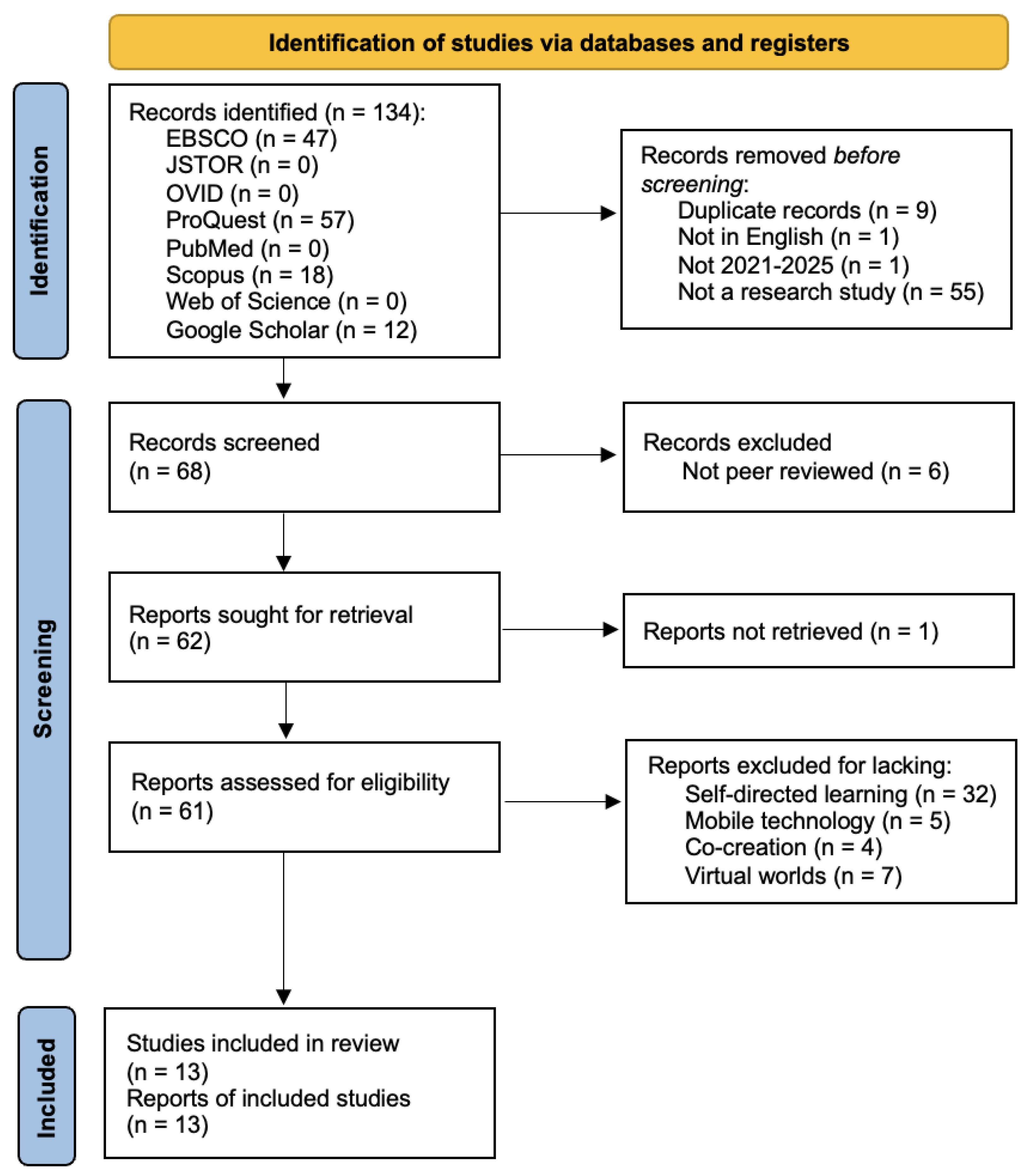
Table 1.
Databases searched on 30 March 2025, the search parameters and the number of returns regarding searches of the keywords “self-directed learning AND mobile technology AND co-creation AND virtual worlds” listed in the order searched.
Table 1.
Databases searched on 30 March 2025, the search parameters and the number of returns regarding searches of the keywords “self-directed learning AND mobile technology AND co-creation AND virtual worlds” listed in the order searched.
| Database | Search Parameters | # |
|---|---|---|
| EBSCO | Keywords: “self-directed learning” AND “ mobile technology” “co-creation” “virtual worlds”, Child Development & Adolescent Studies, self-directed learning, mobile technology, co-creation, virtual worlds. Search modes: Find all my search terms, Apply related words, Also search within the full text of the articles, Apply equivalent subjects, Linked Full Text, Publication Date: Start January 2021 End March 2025, Peer Reviewed, Document Type: article, Academic Journal, English | 47 |
| JSTOR | Keywords: “self-directed learning” AND “ mobile technology” “co-creation” “virtual worlds”, Content I can access, Articles, English, 2021-2025, Communication Studies, Education, Health Policy, Health Sciences, Psychology, Public Health | 0 |
| OVID | Keywords Embase Classic+Embase 1947 to 2025 March 28 APA PsycInfo 1806 to March 2025 Week 4 Ovid Healthstar 1966 to February 2025 Journals@Ovid Full Text March 28, 2025 Ovid MEDLINE(R) ALL 1946 to March 28, 2025, self-directed learning, mobile technology, co-creation, virtual worlds, 2021-current, English Language, Full Text, Humans, Data Paper | 0 |
| ProQuest | Keywords: “self-directed learning” AND “mobile technology” AND “ co-creation” AND “virtual worlds”, After 1 January 2021, Article, English, Scholarly Journal | 57 |
| PubMed | Keywords: self-directed learning AND mobile technology AND co-creation AND virtual worlds | 0 |
| Scopus | Keywords: self-directed learning AND mobile technology AND co-creation AND virtual worlds, 2021-present. Limited to Social Sciences, Medicine, Arts and Humanities, Psychology, E-learning, Human, Education, Higher Education, Virtual Reality, Gamification, Humans, Students, Self Efficacy, Online Learning, On-line Communities, Educational Technology, Co-creation, COVID-19, Article, Digital-learning | 18 |
| Web of Science | Keywords: self-directed learning AND mobile technology AND co-creation AND virtual worlds, 2021-present | 0 |
| Google Scholar | Keywords: "self-directed learning" "mobile technology" "co creation" "virtual worlds", “2021-2025”, “no citations” | 12 |
Table 2.
Study details (citation number, study aim, type of participants and their number, study date, and study location) of the 30 March 2025 search of “self-directed learning AND mobile technology AND co-creation AND virtual worlds” resulting from the reports included for appraisal of three databases (EBSCO, ProQuest, and Scopus) listed in the order of the searches and their returns. A heavy horizontal line divides each of the three journal searches.
Table 2.
Study details (citation number, study aim, type of participants and their number, study date, and study location) of the 30 March 2025 search of “self-directed learning AND mobile technology AND co-creation AND virtual worlds” resulting from the reports included for appraisal of three databases (EBSCO, ProQuest, and Scopus) listed in the order of the searches and their returns. A heavy horizontal line divides each of the three journal searches.
| # | StudyAim | Participants | Study Date | Location |
| [53] | Expand studio-based design education to technology-enhanced collaborative learning to support experiential learning | 3rd and 4th year undergraduate students (n = 75) | 2018-2019 | Hong Kong |
| [54] | Investigate the impact of a self-regulated learning strategy intervention on students’ SRL skills and explore their perspectives of the intervention after being taught the SRL strategies during their learning in massive open online courses (MOOCs) | English majors (n = 61) | 9-26 March 2023 | Vietnam |
| [55] | Exploring the contributions of field trips and collaborative learning in combination with mobile learning and paper-and-pencil note-taking | Bachelor’s geography and environmental studies students (n = 36) | May-June 2019 | Ethiopia |
| [56] | Describe the necessary items to be considered when developing a transmedia educational process in a non-formal educational designed space oriented to families, children, and/or adolescents | Children (n = 23), adolescents (n = 12), parents (n = 11) | 2020 | Spain |
| [57] | Exploring students’ perceptions of the authentic learning opportunities provided by Moodle at a rural university, to link their lived experiences with their educational journeys through technology-enabled environments that foster active participation, collaboration, and co-creation of knowledge | 1st year undergraduate students in their second semester (n = 192) | Post onset of COVID-19 pandemic | Zimbabwe |
| [58] | Understanding students’ perspectives and factors affecting the adoption of AI chatbots to maximize student use in online and virtual educational environments | University students (n = 429) | February- April 2024 | Malaysia |
| [59] | Investigating which Design Principles (DPs) to prioritize in designing a user-centered creative virtual environment, and which Design Features (DFs) effectively implement the DPs in creative virtual collaboration from a user perspective | International students from Asia, Africa, America, and Europe (n = 38) | January 2021 5-day workshop, August 2021, and August 2022, one-day workshops | Germany |
| [60] | Exploring the impact of immersive technology on the actual experiential learning traditionally gained through physical site visits in design education | 3rd and 4th year undergraduate students (n = 75) | Between 2018 and 2019 | Hong Kong |
| [61] | Using co-design methods to develop an evidence- and theory-informed mother-daughter mobile health intervention prototype targeting physical activity in preteen girls | Preteen girls (n=10), mothers of preteen girls (n=9), and primary school teachers (n=6) | 2024 | United Kingdom |
| [62] | Determining the critical factors hindering successful online architectural education during the pandemic | Architecture students (n = 232) | 30 April 2022–28 July 2022 | Turkey |
| [63] | Analyzing the effects on academic performance and motivation after an experience combining Digital game-based learning and Gamification in university students | University students (n = 126) | 2022 | Spain |
| [64] | Examining the relationship between gamification features, engagement, and well-being | Those willing to play an energame for 30 minutes three times a week (n = 56) | October 2021 | Taiwan |
| [65] | Investigate game preferences, regarding game characteristics, genre, and graphic style for creating practical guidelines for the design of a gamified safety training tool in agriculture | Agriculture university students (n = 137) | 2019 | Italy |
Table 3.
Methodological details (citation number, study outcomes regarding the aim, study type, and whether the results were statistically significant) of the 30 March 2025 search of “self-directed learning AND mobile technology AND co-creation AND virtual worlds” resulting from the reports included for appraisal of three databases (EBSCO, ProQuest, and Scopus) listed in the order of the searches and their returns. A heavy horizontal line divides each of the three journal searches.
Table 3.
Methodological details (citation number, study outcomes regarding the aim, study type, and whether the results were statistically significant) of the 30 March 2025 search of “self-directed learning AND mobile technology AND co-creation AND virtual worlds” resulting from the reports included for appraisal of three databases (EBSCO, ProQuest, and Scopus) listed in the order of the searches and their returns. A heavy horizontal line divides each of the three journal searches.
| # | Outcomes Regarding Aim | Study Type | Significance |
| [53] | Students gave a significantly higher rating to virtual world learning over traditional learning, having a positive correlation with active experimentation, co-design, and providing a flexible reflective process, but not peer-review | Qualitative and Quantitative regarding survey questionnaire | Statistical for several learning variables but not for peer review |
| [54] | Increase in students’ goalsetting, environmental structuring abilities, and time management. The interviews underscored the importance of employing self-directed learning techniques for learning in Massive Open Online Courses (MOOCs) | Convergent parallel mixed methods using survey data quantitatively | Statistical for goal setting, environment structuring, and time management |
| [55] | Field trips and collaborative learning in combination with mobile learning and paper-and-pencil note-taking suggest that the learning approaches and the real-world environment contribute to fostering the systems thinking competence of participants by exposing them to complex real-world systems and enabling the exchanging of diverse ideas among collaborating participants | Pre-test–post-test exploratory experimental study with a focus on the interdependence of variables | Statistical significance was not tested, and the results demonstrate participant appreciation of system complexity |
| [56] | Important to consider multiple perspectives, including those of facilitators, children and adolescents, and parents, when designing transmedia educational processes, and to use a variety of media platforms, formats, and channels to engage diverse and heterogeneous groups of participants in non-formal educational settings | Qualitative analysis of multiformat focus groups | Statistical significance was untested with the content analysis finding a need for professional training in processes and technology |
| [57] | The majority of the students agreed that Moodle assignments closely resembled real-world problems. The implementation of project-based learning within Moodle supported independence and autonomy in students, allowing them to determine their learning patterns and complete assignments, offering a variety of assessments that facilitated the consolidation of ideas and the development of artifacts applicable to real-world communities | Descriptive and explanatory research design using questionnaire design | Statistical regarding no off-campus internet access to Moodle, and students possessing good to excellent computer skills |
| [58] | Perceived usefulness (PU), perceived ease of use (PEU), and tech competency (TC) have a significant impact on AI capability. Subjective norm (SN) has no significant impact on AI chatbot capability. The capability of AI chatbots significantly influences the adoption of AI chatbots for learning effectiveness. The findings indicated that AI chatbot capability mediates the effect of PU, PEU, and TC on the adoption of AI chatbots; however, there is no mediating effect in the relationship between SN and AI chatbot capability to maximize their use in online and virtual educational environments. Facilitating conditions moderate the effect of PU and TC on AI chatbot capability | Quantitative based on survey results | Highly statistically significant influence of perceived AI chatbot capability on perceived usefulness and perceived ease of use— statistically significant relationship with adopting AI chatbots for online learning |
| [59] | (1) Provide rich, appropriate resources to inspire creative thinking; (2) Technical problems and connectivity issues must be anticipated and mitigated; (3) The environment must foster social presence and interaction, and (4) effective communication and visualization; (5) Methods and technologies must be adapted to the creative process and individual needs; (6) The group work benefits from structured but flexible tasks and time management support; (7) Provide space for individual work that allows autonomy and solitary contemplation | Qualitative thematic analysis | Statistical significance was not tested, but 133 codes were assigned |
| [60] | Results supported and affirmed the study that a smart education model enabled by the Edu-Metaverse can significantly enhance the learning outcomes for the students in comparison to traditional teaching patterns where students engaged in the experimental group yielded higher scores in oral English vocabulary and grammar, reading comprehension, and writing than those in the control group | Pre- and post-tests, interviews, and a quantitative assessment of a questionnaire | Differences between the experimental group and the control group were considered statistically significant |
| [61] | A comprehensive description and analysis of using co-design methods to develop a mother-daughter mobile health intervention prototype that is ready for feasibility and acceptability testing, framework, and techniques ontology provided a systematic and transparent theoretical foundation for developing the prototype by enabling the identification of potential pathways for behavior change | Three phases: (1) behavioral analysis, (2) the selection of intervention components, and (3) refinement of the intervention prototype. | Statistical significance was not tested. Identified: 11 theoretical domains, 6 intervention functions, and 27 behavior change techniques |
| [62] | A structural equation model revealed support, engagement, and communication obstacles in online architectural education, digital learning environment barriers in online architectural education, and technological integration and accessibility problems in online architectural education are evident in Turkey | Quantitative based on questionnaire results | Each hypothesis exceeds the critical one-tailed t-value of 2.58 at a significance level of 0.01. |
| [63] | The gamified Digital Game-Based Learning (DGBL) method is an exciting teaching tool that corresponds to students’ active learning and provides valuable immediate feedback on students’ attempts, offering improvements in academic performance and a high level of motivation | A mixed methods design, with quantitative and qualitative data assessing spatially and temporally delimited events | Gamified DGBL led to significant differences in student academic performance when cooperative; however, there was no significant difference when competition was involved |
| [64] | Results indicated that immersion, achievement, and social interaction-related features were positively associated with Exergame users' emotional, cognitive, and social engagement, and these engagements are likely to increase well-being further | Structured questionnaire and descriptive statistical methods | The t-values of all items were significant, and the average variance extracted was greater than 0.5 for all constructs |
| [65] | Some clear differences (in tasks, quests, rules, goals, colors, and variety), and similarities (in graphics, drama, better rewards, and game genre) emerged in differentiating male and female preferences for digital games as an occupational safety training method in the agriculture sector | Quantitative analysis of online questionnaire | Significant association found between gender and the type of games played with males preferring crafting games with no significant gender differences in intention to play these games |
Table 4.
Results regarding study focus (citation number, type of self-directed learning in using the mobile technology, how co-creation influenced consensus decision-making, and the effect of the self-direction and consensus decision-making on student mental health) of the 30 March 2025 search of “self-directed learning AND mobile technology AND co-creation AND virtual worlds” resulting from the reports included for appraisal of three databases (EBSCO, ProQuest, and Scopus) listed in the order of the searches and their returns. A heavy horizontal line divides each of the three journal searches.
Table 4.
Results regarding study focus (citation number, type of self-directed learning in using the mobile technology, how co-creation influenced consensus decision-making, and the effect of the self-direction and consensus decision-making on student mental health) of the 30 March 2025 search of “self-directed learning AND mobile technology AND co-creation AND virtual worlds” resulting from the reports included for appraisal of three databases (EBSCO, ProQuest, and Scopus) listed in the order of the searches and their returns. A heavy horizontal line divides each of the three journal searches.
| # | Self-directed learning | Consensus decision-making | Student mental health |
| [53] | Design students move away from instructor-led activities to self-directed learning as they can explore resources and processes autonomously to achieve learning goals, which are no longer defined by teachers but set by themselves in immersive experiential learning | The co-create project spanning the semesters helped develop skills in communication and group collaboration to enhance experiential learning, | Positive confirmation of concrete experience, epitomizing the authentic learning process and attainment of practical experience from experiential learning activities |
| [54] | There is an intricate connection between self-directed learning and oral communication skills since speaking proficiently requires a strong command of vocabulary through presentation skills that are effective | When self-regulated learning skills are embedded within this process, one can enhance their speaking proficiency | Learner engagement, including cognitive, behavioral, and emotional engagement, and value co-creation, referred to as ‘the actions of multiple actors, often unaware of each other, that contribute to each other’s wellbeing’ |
| [55] | Study contributes to social constructivist learning discourses in education for sustainable development by indicating specific combinations of learning approaches and environments that facilitate the meaningful engagement and motivation of learners through self-regulated learning | Learner-centered approaches that allow learners to engage in knowledge co-creation, collaboration, and authentic learning environments | The combination of relevant knowledge and positive attitude the participants demonstrated in their reports seems promising to encourage them to take sustainability-friendly decisions and actions as individual citizens or professionals |
| [56] | Non-formal education is more flexible, adaptative, self-directed, and learner-centered than formal education, with a greater focus on learner needs and interests | Transmedia storytelling goes beyond the collaborative work and places itself in the communitarian work in building learning communities | The transmedia approach can have a positive impact on improving people skills and competencies through socio-educative processes that are basic to maintaining a good environment of participation and collaboration that builds the social ties of the group |
| [57] | The significance of autonomous learning in the success of Learning Management Systems is that learners must rely on their self-directed control over learning activities, with limited support from tutors and peers | Moodle allows learners to be co-designers, provide feedback to each other, and apply acquired knowledge and theories in solving real-life challenges | Learning Management Systems support authentic learning by promoting collaboration, self-paced learning, interactivity, and reflectivity, which contribute to high levels of student satisfaction |
| [58] | AI Chatbots can effectively enhance independent learning abilities among students by promoting self-directed learning activities | Unlike collaborative tools which necessitate group participation (e.g., discussion forums), AI chatbots tend to be used individually for self-directed learning, minimizing the importance of social impact as a factor | Perceived usefulness of AI chatbots facilitates user engagement and satisfaction related to communication support needs, especially within online learning systems. Students trust chatbots that they perceive as performing at high levels |
| [59] | To instill a creative mindset, the environment should provide a sense of freedom and possibilities for self-expression. Further, the setting should provide possibilities to work autonomously and be self-directed, according to one’s needs and preferences | Co-creation and innovation processes are now more flexible and location-independent, but virtual collaboration still poses challenges, such as technical difficulties and limited social presence | There was a positive activation of Mood, atmosphere, and group attitude. To maintain a positive mood, the group must develop a tolerance for ambiguity and coping strategies to deal with frustrations |
| [60] | The teaching scenario design was with instructional needs in mind, and learners identified the problems and explored the ways to solve them using self-directed inquiry and cooperative learning | Social interaction and collaboration with their teacher and peers through technology-based communication tools positively influenced their learning outcomes as each learning group functioned as a community with common goals and with a sense of identity and belonging in the process of cooperation | Social interactions, collaborations with other students and tutors, and a good learning climate may influence student learning outcomes positively and enhance e-learning satisfaction |
| [61] | The self-directed messages enable mothers and daughters to reflect on why they want to engage and sustain the behaviors. | Offers a comprehensive description and analysis of using co-design methods to develop a mother-daughter mobile health intervention prototype that is ready for feasibility and acceptability testing | This process was used to co-design a mHealth intervention prototype aimed at promoting physical activity in preteen girls, with a focus on maternal support behaviors, and is now ready for feasibility and acceptability testing |
| [62] | Proficiency in digital skills enables students to engage in self-directed learning effectively, identifying learning needs, utilizing online resources, applying information, and evaluating results, thereby enhancing work efficiency and productivity | This feedback loop as “reflective practice” represents dynamic involvement and co-creation between student and instructor as active learning | Psychosocial concerns in online architectural education are important issues contributing to the psychosocial health of students; therefore, despite the transition to online platforms, architectural education should remain highly interactive, incorporating active learning exercises and utilizing diverse online tools in the future |
| [63] | According to self-determination theory, intrinsic motivation increases engagement and performance more effectively than extrinsic motivation. When learners enjoy the internal logic or the dynamics of the game, learning is enjoyable, increasing intrinsic motivation | In comparing two types of gamification strategies for Motivation for Cooperative Playful Learning Strategies, there was no difference in the results of competitive versus individual | Integrating Digital game-based learning and Gamification in physical education can be used to achieve positive academic and motivational results in university learning as well as pursuing aspects such as physical performance or health improvement |
| [64] | Immersion-related features primarily aim to immerse the player in their self-directed inquiring activity, including gameplay mechanics such as avatars, virtual identity, storytelling, narrative structures, customization/personalization features, and roleplay mechanics | Online communities can foster norms of reciprocity and trust, thus creating opportunities for social engagement by encouraging users to feel connected to the topic | Social interaction-related features, such as 'likes', comments, collaborations, and teams, are believed to have naturally positive impacts on social engagement, Exergames have become a popular way to maintain physical and psychological health |
| [65] | The success of digital games can be related to how the games match player preferences, relevant to understanding and accommodate what the targeted players would like to see in a game, and what graphic style should be applied to make the game more engaging | In the present study where both genders highlighted the need to create a game that fosters cooperation, it appears encouraging that participants conceived the safety training as a process in which the final result (i.e., the safety performance) is reached only through collaborative efforts | The visual design plays a pivotal role in this training method not only for its graphical attractiveness but for its aptitude to engage the targeted users, develop a positive user experience and foster engagement and emotional involvement, improving behavioral safety performance and reducing negative safety and health outcomes |
Disclaimer/Publisher’s Note: The statements, opinions and data contained in all publications are solely those of the individual author(s) and contributor(s) and not of MDPI and/or the editor(s). MDPI and/or the editor(s) disclaim responsibility for any injury to people or property resulting from any ideas, methods, instructions or products referred to in the content. |
© 2025 by the authors. Licensee MDPI, Basel, Switzerland. This article is an open access article distributed under the terms and conditions of the Creative Commons Attribution (CC BY) license (http://creativecommons.org/licenses/by/4.0/).
Copyright: This open access article is published under a Creative Commons CC BY 4.0 license, which permit the free download, distribution, and reuse, provided that the author and preprint are cited in any reuse.


