

Submitted:
25 April 2025
Posted:
27 April 2025
You are already at the latest version
Abstract
The Southern Ocean, located between Antarctica and the southern tips of South America, Africa and Australia, encompasses an immense area across the southern Atlantic, Pacific and Indian oceans with no clearly defined limits. For the purposes of studying marine heterobranch sea slugs, we consider the Southern Ocean to include all ocean areas located south of latitude 41ºS. South of this latitude we consider different areas and zones: the area of South America (Patagonia/Magellanic area), the island of Tasmania, the southern island of New Zealand, the subantarctic area (Falkland Islands, South Georgia Island, South Orkney Islands, South Sandwich Island, Bouvet Island, the islands of Crozet and Prince Edward, the Kerguelen Islands and Macquarie Island) and the area of Antarctica in which we consider 4 zones (Weddell Sea, West Antarctica, Ross Sea and East Antarctica). Reviewing all available references and unpublished data from the authors, in total, 392 species of Heterobranch sea slugs have been recorded to date in the Southern Ocean > 41ºS, with Nudibranchia standing out with 209 species and Cephalaspidea with 88 species. The marine heterobranchs of Tasmania (154 species) and southern New Zealand (120 species) have been well studied. Sea slug fauna of the Antarctic and Sub-Antarctic regions have been the subject of several partial studies, however there are still many gaps in knowledge across both areas. Eighty eight different species of sea slug have been recorded so far in strictly Antarctic waters (West Antarctica, 43 species; Weddell Sea, 48 species; Ross Sea, 51 species; East Antarctica, 42 species) while in the various subantarctic regions, there are 93 species (36 species from South Georgia, 17 species from South Orkneys, 11 species from south Sandwich, six species from Bouvet, ten species from Prince Edward and Crozet Islands, 15 species from Kerguelen, three species from Macquarie Island, 29 species from Falkland Islands and 71 species from the coast of South America). In the taxonomic section, for each of the species, the location and authors of the records are indicated, and for many of the species, interesting biological, taxonomic or biogeographic observations are also provided. The importance of sampling in underexplored areas is discussed, as well as greaterdepth sampling for a better understanding of the seaslugs of the Southern Ocean.
Keywords:
Biodiversity
; Taxonomy
; Heterobranch seaslugs
; Southern Ocean
1. Introduction
The Southern Ocean is a vast marine area with no strictly defined boundaries, located south of Africa, South America and Australia. It supports some of the most productive and unique marine ecosystems on the globe (Tynan, 1998). It is not universally accepted as a separate ocean but in many studies the southernmost Atlantic, Pacific and Indian oceans are delimited using this name. Lawver et al. (2014) carry out an interesting study on the reconstruction of the Southern Ocean from the late Cretaceous to the present day, based on magnetic anomalies and geological evidence from the seabed and the physical and biological characteristics of the Southern Ocean are summarised in the work of Knox (2006). Briggs & Bowden (2012) proposed a set of marine biogeographic regions and provinces, which was later accepted and expanded by Toonen et al. (2016). For the study of the biogeographic affinities of Heterobranchia sea slugs, we generally take into account in this work the biogeographic classification of Toonen et al. (2016) and consider the limit of the Southern Ocean south of the Southern Subtropical Front (SSF), which tends to delimit the warmer and more saline marine waters located to the north from the colder and less saline waters located to the south.
Except for the Antarctic continent, and the continental shelf of the southern tip of South America, most of the Southern Ocean is made up of bathyal and abyssal beds that have undergone little exploration. Consequently, there is a paucity of knowledge regarding the biodiversity of these vast areas. Brandt et al. (2007) summarised much of the research activities carried out across deep-water ocean areas, including the biodiversity of the deep Southern Ocean. Results indicated that, depending on the taxonomic group, up to 90% of species observed in abyssal sediments were new to science. However, multiple oceanographic explorations have made it possible to partially understand the biodiversity that the Southern Ocean supports. Recent sections contained in De Broyer et al. (eds.) (2014) distil much of the contemporary knowledge of Southern Ocean biodiversity. Among the main taxonomic groups recorded, there are, for example: macroalgae (124 Antarctic species, Wiencke et al. 2014), poriferans (400 species, Janussen & Downy , 2014), benthic hydroids (179 Antarctic species, Peña, 2014), hexacorals (187 species, Rodríguez & Fautin, 2014), polychaetes (588 Antarctic species, Schüller & Ebbe, 2014), bryozoans (412 species south of the Polar Front, Barnes & Downey, 2014), free-living nematodes (524 Antarctic species, Ingels et al, 2014), pycnogonids (332 species, Soler-Membrives et al., 2014), isopods (740 species, Kaiser, 2014), decapod crustaceans (45 species, Griffiths et al., 2014; Basher & Costello, 2014), echinoderms (345 species, except holothurians and brittle-stars, Danis et al., 2014; Eleaume et al., 2014; Saucede et al., 2014). Other works, such as De Broyer & Jazdzewska (2014) report 853 species of amphipod crustaceans across the Southern Ocean (417 species recorded north of the Polar Front and 564 species to the south). Many of these taxa were sampled from deep water during the ANDEEP (ANtarctic Benthic DEEP-sea Biodiversity) expedition.
Although modern global climate change affects most of the planet, the Antarctic region is subject to some of the most extreme changes, particularly the effects of warming and losses of ice sheet cover (Turner et al., 2009). Antarctic marine species are highly sensitive to environmental change. As stenothermal life forms have adapted to temperatures around -1.8 to 2.0 °C, they may not survive elevated temperatures (Peck et al., 2004). This generates a prescient threat to the biodiversity of this region and thus needs to be further documented before it is lost, especially in vulnerable taxa such as sea slugs.
The study of Southern Ocean molluscs has been the focus of many studies since the 19th century, which include several works that assess geographic biodiversity. For example, Carcelles (1953), Dell (1990), and Engl (2012) generated treatises on Antarctic molluscs, Martens & Pfeffer, 1886 on those from South Georgia, Thiele (1912) on taxa collected from the German South Polar Expedition, Melville & Standen (1912) on those from the Scottish National Antarctic Expedition, Powell (1951 and 1960) on Antarctic and sub-Antarctic molluscs, Powell (1957) on Kerguelen and Macquarie Islands, Powell (1958) on Victoria-Ross in Antarctica, Rochebrune & Mabille (1889) on those from Cape Horn, Chile, Strebel (1905) and Forcelli (2000) on the Magellan province of Chile, Aldea & Troncoso (2010) on molluscs from the Bellingshausen Sea, Spencer et al. (2009, 2016) on the molluscs of New Zealand, and Grove (2015) on those from Tasmania, Australia. Linse et al. (2006) studied the diversity and biogeography of shelled marine gastropods and bivalves at depths between 0 and 100 m and divided the Southern Ocean into 27 bioregions across the Antarctic, sub-Antarctic, southern tip of South America and the south island of New Zealand. They reported a total of 895 species of shelled gastropods and 379 bivalve taxa. Jörger et al. (2014) analysed the diversity and abundance of abyssal molluscs found between 2732 and 4327 m in the Antarctic Polar Front (previously known as Antarctic Convergence) area. In that study, 58 separate taxa, of which 33 were identified to species, were reported. Moreau et al. (2013) report on the Mollusca of the Amundsen Sea with 97 morphospecies, Schiaparelli et al. (2006, 2014) with 142 molluscs species from the Ross Sea and Zelaya (2005) with 121 gastropod species from South Georgia. The recent development of the Southern Ocean Mollusc Database (SOMBASE) provides a useful taxonomic resource (Griffiths et al., 2003). This database provides information on nomenclature, synonyms, morphology and the ecology of species including distributions. An extensive bibliography is also provided. At its launch, SOMBASE included information on 950 species of shelled gastropods and 136 species of bivalves.
Sea slugs (Gastropoda: Heterobranchia) are spectacular mollusks in their shapes, colors, lifestyles, defense and reproduction methods that have attracted numerous researchers and divers from around the world (Wägele & Klussmann-Kolb, 2005). For the sea slugs, the first Southern Ocean records are found sporadically across the various reports produced from expeditions undertaken in the late 19th and early 20th centuries including, but not limited to: Bergh (1884) in the “Challenger”; Pelseneer (1887), with the Gymnosomata from “Challenger”; Eliot in 1905 and 1909 from the Scottish National Antarctic Expedition; Vayssière (1906b), with reports of the nudibranchs from Charcot's Antarctic Expedition; Odhner (1926), from the Swedish Antarctic Expedition and in 1934 from the British Antarctic “Terra Nova” Expedition; Marcus (1959) with the Lundy University Chile Expedition. More contemporary studies include: Burn (1973) with taxa from Macquarie and Heard Islands; Vicente & Arnaud (1974), with sea slugs from Terra Adelia, Antarctica; Cattaneo-Vietti (1991) with nudibranchs from the Ross Sea; Castellanos et al. (1993) with sea slugs from the Argentine Magellanic region; Dadon & Chauvin (1998) with the Gymnosomata from the Southwest Atlantic; Cárdenas et al. (2008) reporting from northern Chilean Patagonia; Hunt et al. (2008) with Pteropods of the Southern Ocean; Minichev (1972) with sea slugs from the Davis Sea; Schrödl (2003) on sea slugs of southern South America, and lastly Troncoso et al. (1997) with sea slugs of the Scotia Sea. Pelagic sea slugs have also been subjects of study by Dadon & Chauvin (1998), Gilmer & Lalli (1990) and Hunt et al. (2008). Additionally, there are several other studies that focus on the biology, taxonomy or distribution of particular species. In the present work, these studies are referenced in the taxonomic part.
The Heterobranch sea slugs are a large and diverse group of specialized gastropods that are globally ubiquitous to most benthic marine environments (Wägele & Klussmann-Kolb, 2005). Some taxa are even limited to the pelagic realm. They are important members of many benthic communities due to their high species diversity (more than 6000 known species), abundance and direct influence on community structure as selective predators of sessile filtering organisms (Clark, 1975; Todd, 1981). Morphologically they are highly diverse. They are principally soft bodied with a highly reduced shell, or for most taxa, the shell is completely absent (at least in the adult stage). In order to compensate for shell loss they have evolved alternative defence mechanisms which can include: camouflage (homochromy and crypsis), the secretion of acid materials or toxic/distasteful metabolites extracted from their food or formed by de novo biosynthesis (Johnson & Willows, 1999; Wägele et al., 2006; Cimino & Ghiselin, 2009). Some groups can acquire the cnidocysts from cnidarian prey organisms, wherein they are able to use them for self defence (Edmunds, 1966). Through a similar process other groups can acquire functional chloroplasts from their algae food and use them to form, through photosynthesis, carbohydrates for their own nourishment (de Vries et al., 2014). Diet in sea slugs can be very specific although across the “sea slugs” as a whole there are carnivores, detritivores and herbivores. As slow moving, less motile life, sea slugs prey on mostly sessile or slowly moving food sources. All sea slugs are hermaphroditic and have complex reproductive strategies, typically involving mutual sperm transfer and storage until the eggs are ready for fertilisation and release. They are also the only metazoan life form where sperm and eggs are produced within the same follicles. Eggs masses are laid in ribbons, sometimes arranged in spirals, or bubble shaped structures, held together by various mucus layers (Todd, 1981). Furthermore, some species are important model organisms in various disciplines of science, ranging from neurobiology to ecotoxicology and even pharmaceutical research (Wahidullah et al., 2006; Nimbs et al., 2017; Zhuo et al., 2022). In this work we consider heterobranch sea slugs to include those taxa that once comprised the now obsolete and not monoplyletic group "Opisthobranchia", but also include the taxa Acteonoidea, Pteropoda and Ringiculoidea.
The sea slugs of the Southern Ocean, although well-known from some areas (i.e. southern tip of South America, Tasmania, Australia, South Island of New Zealand and parts of Antarctica), have not previously been studied at a whole-of-ocean scale. Consequently, the main objective of the present study is to generate a comprehensive list of sea slug taxa found across the entirely of the Southern Ocean and to quantitatively compare assemblages found within and among regions. Additionally, a taxonomic part has been developed to provide information on species records, including distributions and matters of note.
2. Materials and Methods
2.1. Data Collection
The data used in this study was distilled mainly from the published literature. Analyzing more than two hundred publications we retrieved a substantial set of reports and studies with reference of opisthobranch species reported from across the study area (Southern Ocean). In addition to those mentioned above, many other publications have been analyzed and are cited in the taxonomic part of each species. Occurrence databases from the expedition ECOQUIM I which was conducted by RV “Polarstern” (2003-2004) from the Weddell Sea and ECOQUIM II from the BIO “Hesperides” (2006) conducted near the South Shetland Islands have also been used (MB participated in both ECOQUIM expeditions). Unpublished data are also provided on species collected by the first author in some of his campaigns in Antarctica. A presence/absence table was created using all species records which were collated into areas and zones.
2.2. Geographic Areas and Zones
In the biodiversity and taxonomy section, the following areas have been taken into account to clarify the data on the presence of species in the different places of the Southern Ocean (Figure 1):
-Patagonia/Magellan area, which includes the coasts of Chile and Argentina south 41ºS.
-Subantarctic area: which includes the following zones: Falkland (Malvinas) Is., South Georgia Is., South Orkney Is., South Sandwich Is., Bouvet Is., Prince Edward and Crozet Is., Kerguelen Is., Macquarie Is.
-Tasmania Island area
-South Island, New Zealand area
-Antarctic area, considering the following four zones: Weddell Sea, including the sea of the same name, the eastern part of the Antarctic Peninsula, the Lazarev Sea and the Riiser-Larsen Sea; West Antarctica, including the western part of the Antarctic Peninsula, the South Shetland Islands, the Bellingshausen Sea, Peter I Island and the Amundsen Sea; the Ross Sea, including the Ross Sea, the Somov Sea, Adélie Land and the D'Urville Sea; and East Antarctica, including Enderby Land, the Cosmonaut Sea, the Cooperation Sea, the Davis Sea and the Mawson Sea.
3. Results.
3.1. General Biodiversity Results
A total of 394 species of heterobranch sea slug have been reported across the Southern Ocean. Species richness across the regions ranged from 154 in Tasmania to only three taxa at Macquarie Island (Figure 2). As found across much of the globe where species richness tends to by higher in lower latitudes, here locations north of ~45°S were found to exhibit the highest species diversity.
Grouping taxa into taxonomic order reveal that the Nudibranchia is the most diverse, with 209 species, followed by 90 in Cephalaspidea and 40 in Pteropoda. Other orders are represented by 17 or fewer species (Table 1). Tasmania and the South Island of New Zealand exhibit the highest number of species with 154 and 120 species respectively, followed by Antarctica with 89 species and the Patagonia/Magellan region with 71 species. The different subantarctic zones record a lower number of species (Table 2 and Figure 2). It should be noted that the sampling effort is very uneven in the different areas studied and this has a powerful impact on the knowledge of their biodiversity.
3.2. The Sea Slugs of Patagonia/Magellan Zone
A total of 71 species were recorded from the Patagonian/Magallanic zone (south of 41ºS), of which more than half (n=39) were nudibranchs, 13 were cephalaspideans, eight were pteropods, four acteonimorphs, four sacoglossans and three were pleurobranchids. There were no records of species in the orders Ringiculimorpha, Umbraculida, Runcinacea and Aplysiida. The first opisthobranch records from this region were from the end of the 19th century. The earliest were from Bergh, 1884 and Pelseneer, 1887 with both works resulting from the “Challenger” Expedition, and later Rochebune & Mabille, 1889 published the molluscs from Cape Horn. At the beginning of the 20th century, Strebel (1905), produced a monograph on the molluscs of the Magellanic region. More recently, “sea slugs” appear in general works on Magellanic molluscs by Carcelles & Williamson, 1951; Carcelles, 1953; Castellanos et al, 1987a, 1987b; Cárdenas et al., 2008; Linse, 1999 and Forcelli, 2000. The first work that focused on sea slugs was that of Castellanos et al. (1993) with a descriptive catalogue of Magellanic species. This was followed by studies dealing with individual taxa (Muniain & Ortea, 1999; Valdés & Muniain, 2002; Price et al., 2011; Rosenfeld & Aldea, 2011; Zelaya et al., 2011; Valdés & McLean, 2015; Salvador & Cunha, 2020). The most complete study of Magellanic sea slugs was published by Schrödl, across several works (1999a, 1999b, 2000a, 2003) which span both the Pacific and Atlantic Magellanic coasts; his inventory from 2003 includes a total of 65 species of Nudipleura (Nudibranchia and Pleurobranchida), 34 of them from south of 41ºS (Chilean Patagonia, Strait of Magellan and the Argentine Magellan area). Schrödl also reviewed previous works, synonymising 28 taxa and determined five to be nomina dubia. Schrödl et al. (2005) and Schrödl & Grau (2006) also provided data on species from remote areas of the southern Chilean coast (Comau Fjord, Ipún Is. and the Chonos Archipelago). Images of most species in the Magellanic zone can be seen in Schrödl (2003).
3.3. The Sea Slugs of the Subantarctics Zones
Knowledge of species across subantarctic areas is very patchy. Some areas are highly remote, and thus difficult access and, as a result their diversity is very poorly known. Comparatively well-researched areas include the Falkland Islands (Malvinas) and the islands that comprise the Scotia Arc. A total of 29 species have been recorded from the Falklands, mainly Nudibranchia (15 species) and Cephalaspidea (9 species) (Bergh, 1884; Eliot, 1907b; Powell, 1951; Dadon & Chauvin, 1998) with four species using falklandica as a specific epithet.
The South Georgia group forms part of the Scotia Arc that is closest to the southern tip of South America, and the Falklands, and various expeditions have studied their sea slug biodiversity, with 36 taxa recorded, mainly Nudibranchia (n=15) and Cephalaspidea (n=10) (Martens & Pfeffer, 1886; Strebel, 1908; Powell, 1951; Seager, 1978; García et al. 1993; Troncoso et al., 1997; Schrödl, 2000a; Zelaya, 2005; Schächinger et al., 2022).
In the South Orkney Islands, 17 species have been recorded, with Nudibranchia comprising nine of those species (Bergh, 1884; Eliot, 1905; Powell, 1951, 1960; Wägele et al., 1995; Troncoso et al., 1997; Schächinger et al., 2022).
In the South Sandwich Islands 12 species have been recorded, of which five are Pteropoda (Willan & Bertsch, 1987; Powell, 1951; Dell, 1990; Linse, 1999; Schrödl et al., 2016; Schächinger et al., 2022; Peralta-Serrano et al. 2025).
In the Kerguelen Islands there are records by Watson (1883), Bergh (1884), Thiele (1912), Powell (1951), Vicente (1973), Wägele (1989), Schrödl (2000a) and Troncoso et al. (2001), with a total of 15 species known; Cephalaspidea (n=8), Nudibranchia (n=5) and two Acteonimorpha.
On the remote island of Bouvet, halfway between the Cape of Good Hope, South Africa and the Antarctic sea ice limit, low survey effort has resulted in few records. Here, six species are known, three of them Nudibranchia, with one species, Myrella dantarti (Ballesteros & Avila, 2006) considered endemic to the island (Ballesteros & Avila, 2006; Linse, 2006; Moles et al., 2016a, b).
Only ten species have been recorded for Prince Edward and Crozet Islands, six of them are Pteropoda (Branch et al., 1991; Hunt et al., 2008).
The only studies from Macquarie Is. were published by Powell (1955) and Merilees & Burn (1969), with only three species of Nudibranchia reported.
3.4. The Sea Slugs of Tasmania
Of all the Southern Ocean regions, the Tasmanian sea slug fauna is the most diverse with 154 listed species, of which 93 are nudibranchs and 3 cephalaspideans. Proximity to the Australian mainland and the transport of warmer waters via several south-flowing boundary currents over millennia has generated a regionally rich and highly endemic fauna (Phillips, 2001; Butler et al., 2010). Tasmania’s documented diversity is indicative of the relatively high level of effort given to studying the region’s sea slug fauna, which reflects the relatively high accessibility of the region and larger population.
Records and descriptions of Tasmanian mollusca were scattered amongst the early literature but united into a singular inventory or ‘census’ by Tenison Woods in 1877. This was later expanded by Tate and May in 1901, again by May (1921), by Kershaw in 1955, by Grove et al. in 2006 and lastly, by Grove in 2018. Shelled molluscs were reviewed by Richmond (1992). Tasmanian species diversity, distributions and general biology were considered as part of the entire Australian fauna by Beesley et al. (1998).
In the early 20th century, Bergh (1904, 1905) described several species of sea slugs using material collected from northern Tasmania: the nomen dubium Aeolidiella faustina Bergh, 1900, which was considered by Burn (2006) to be synonymous with Baeolidia macleayi (Angas, 1864)), Alloiodoris marmorata (Bergh, 1904), Discodoris dubia Bergh, 1904 and D. egena Bergh, 1904 (both last names now synonymous with Paradoris dubia (Bergh, 1904) by Dayrat (2010) and MolluscaBase (2025a)), Chromodoris tasmaniensis Bergh, 1905 (now Goniobranchus tasmaniensis (Bergh, 1905) according to Johnson & Gosliner, 2012), Aphelodoris luctuosa Bergh, 1905 (now considered by MolluscaBase (2025b) junior homonym of A. berghi Odhner, 1934), and Acanthodoris metulifera Bergh, 1905. Rudman described several species in the 1980s, including Cadlina tasmanica Rudman, 1990, Chromodoris ambigua Rudman, 1987, Chromodoris multimaculosa Rudman, 1987 (now Goniobranchus multimaculosus (Rudman, 1987) according to Johnson & Gosliner, 2012), Noumea aureopunctata Rudman, 1987 (now Verconia aureopunctata (Rudman, 1987) according to MolluscaBase (2025f), and Noumea closeorum Rudman, 1986, (now Verconia closeorum (Rudman, 1986) according to MolluscaBase (2025g). The sea slugs of the north coast and Bass Strait Islands were consolidated into a regional checklist, along with those from Victoria, Australia by Burn in 2006, which lists some 91 Tasmanian species of which 14 have their type locality in Tasmania.
Southeastern Australia is a global-warming hot spot (Bowen et al., 2005; Ridgway & Hill, 2009; Suthers et al., 2011 Cresswell et al., 2016), with the south-flowing Eastern Australian Current pushing warm water further into Bass Strait and onto the northern and eastern coasts of Tasmania which have become the leading edge of range shifting taxa (Pitt et al., 2010; Ramos et al., 2015). Many sea slug species have been gradually shifting their ranges poleward in response to latitudinal shifts in sea surface temperature isotherm, particularly on the east coast of the Australian mainland (Nimbs et al., 2015, 2016; Nimbs & Smith, 2016; 2017a, 2017b, 2018; Smith & Nimbs, 2022). As a result, it is only a matter of time before warm-temperate taxa begin to appear in Tasmanian waters. This means that sea slug diversity in Tasmania, is likely to increase at a greater rate than elsewhere in the Southern Ocean. Images of heterobranch sea slugs from Tasmania can be seen on the website https://molluscsoftasmania.org.au/, which are also published in Grove, 2011.
3.5. The Sea Slugs of Southern Island of New Zealand
The rich marine mollusc fauna of New Zealand has been documented among several publications, with a comprehensive manual authored as early as 1913 by Suter (1913), later superseded by the final expansive work of Powell (1979). With a view to provide workers with an updated taxonomic reference, a modern, comprehensive checklist of New Zealand marine mollusca was compiled by Spencer & Willan (1996), listing a total of 5,486 species for the entire country.
Early New Zealand sea slugs descriptions were published in the 19th century by taxonomists including but not limited to Cheeseman (1881), Rang (1828), Abraham (1876) and Hutton (1880), and in the 20th century by Eliot (1903, 1907b), Suter (1909), Powell (1955), Challis (1969), Miller (1977) and Rudman (1980).The first separate treatment of the sea slugs was subsequently given by Willan & Morton (1984), listing some 30 species from the South Island and other southern islands.
There are 120 species of sea slugs in southern New Zealand waters with all major groups represented. The most diverse group are the Nudibranchia (n=47), followed by the Cephalaspidea (n=23), Thecosomata and Gymnosomata (n = 20 and 12 respectively), five species of Aplysiida, four acteonimorphs, four sacoglossans, one runcinid and one ringiculid. It is in New Zealand that the pelagic ‘pteropods’ have been most well documented with approximately 30 species recorded, 20 of which were listed by Powell (1979). Images of New Zealand sea slugs can be seen in Willan & Davey (2020).
3.6. The Antarctic Sea Slugs
A total of 89 species have been recorded from Antarctica, including the Pteropoda. Regionally, the most well-known area is the Ross Sea with 51 species reported and whereas the other three Antarctic regions support just over 30 species each. The most diverse orders are the Nudibranchia with 40 species and the Cephalaspidea with 27. There are no records of species from the Ringiculimorpha, Umbraculida, Runcinacea, Aplysiida and Sacoglossa.
The earliest records of Antarctic sea slugs were published using data from research expeditions conducted at the end of the 19th century and the beginning of the 20th century. Specimens were collected and preserved by early workers with descriptions generated by Vayssière (1906a and 1906b, 1917), Eliot, (1907a, 1909), Thiele (1912). Hedley (1916) and Odhner (1934). There are numerous recent works that record or describe new species from the Ross Sea (Powell, 1958; Vicente & Arnaud, 1974; Wägele, 1989; Cattaneo-Vietti, 1991; Brueggeman et al., 1999; Valdés et al., 2011, 2012; among others), from the Weddell Sea (Hain, 1990; Wägele, 1990a and 1990b), the Antarctic Peninsula (Troncoso et al., 1996; Troncoso et al., 1999; Millen & Martynov, 2005), the Bellingshausen Sea (Aldea & Troncoso, 2010), the Amundsen Sea (Moreau et al., 2013) and the Davis Sea (Minichev, 1972; Martynov, 2006). Other recent publications that deal with gastropods more broadly also include references to some of the sea slugs from Antarctica (Dell,1990; Engl, 2012). Plates 1–9 provide photographs of live specimens of some of the most important species of Antarctic sea slugs. Images of Antarctic sea slugs can be seen in Brueggeman et al. (1999), Engl (2012) and Rauschert & Arntz (2015).
3.7. The Pteropoda of the Southern Ocean
All species in this group are pelagic. As a result, many species have a broad geographical distribution since they are entrained in ocean currents and are unable to alter their movements on a large scale. Several authors have recorded up to 40 species of Pteropoda, including Pelseneer, 1887; Smith, 1902; Hedley, 1916; Powell, 1951; Powell, 1960; Minichev, 1972; Van der Spoel et al. 1992; Dadon & Chauvin, 1998; Brueggeman et al. al., 1999; Linse, 1999; Forcelli, 2000; Hunt et al., 2008; Würzberg et al., 2009; Moreau et al., 2013 and Schrödl et al., 2016. Of the Southern Ocean Pteropods, 26 species are Euthecosomata, two are Pseudothecosomata and 12 are Gymnosomata. The most well documented region are the southern islands of New Zealand with 32 species recorded (Spencer et al., 2016). In the discussion section, the importance of the Pteropoda to pelagic ecosystems in the Southern Ocean is briefly discussed.
3.8. Taxonomy and Records
This section provides taxonomic data on all Southern Ocean Heterobranch seaslug species recorded south of the 41ºS parallel. For the records of the species, the different zones considered in this work and indicated in previous sections have been taken into account and they are ordered as follows: Patagonia/Magellan, Falkland Is., the other subantarctic areas, Tasmania Is., South Island of New Zealand and finally the different Antarctic zones. Within each zone, the records are arranged chronologically. Interesting remarks are made about the biology, particular taxonomy or biogeography of many species. Unidentified species cited simply as sp. have not been included in this section. For the taxonomy and nomenclature of the species, the indications of the World Register of Marine Species (WoRMS) and of various recently published articles have been followed.

Parvaplustrum tenerum A. W. B. Powell, 1951.
Records: Falkland Is. (Powell, 1951; Forcelli, 2000).

Acteon antarcticus Thiele, 1912
Records: South Sandwich Islands (Dell, 1990); South Georgia Is. (Powell, 1951; South Orkney Is. (Carcelles, 1953); Kerguelen Is. (R. B. Watson, 1883, as Acteon (Acteonina) edentulus; Powell, 1957; Dell, 1990); South Shetland Is. (Powell, 1951; Dell, 1990; Aldea & Troncoso, 2008; Troncoso & Aldea, 2008); Antarctica (Powell, 1958); Bellingshausen Sea (Aldea et al, 2008; Aldea et al., 2009; Aldea & Troncoso, 2010;); Peter I Is. (Aldea et al., 2009); Ross Sea (Dell, 1990; Ghiglione et al., 2013); Davis Sea (Thiele, 1912; Dell, 1990); Enderby Land, East Antarctica (Powell, 1958).
Remarks: Dell (1990) maintains that the presence of an operculum and Acteon type radula in a specimen collected from the Ross Sea confirms that this species belong in Acteon in contrast to Marcus’ (1976, p25) tentative suggestion that this taxon may belong in Toledonia.
Acteon fasuloi Crocetta, Romani, Simone & Rolán, 2017
Records: Patagonia (Castellanos et al., 1987a and b; Linse, 1999; Forcelli, 2000).
Remarks: this species was originally described as Acteon elongatus Castellanos, Rolán & Bartolotta, 1987, a species whose name is preocuppied by of a fossil species, so it was renamed A. fasuloi (Romani et al., 2017).
Acteon retusus Verco, 1907.
Records: Tasmania, Australia (Grove, 2018).

Neactaeonina argentina Zelaya, Schejter & Ituarte, 2011
Records: North argentinian Patagonia (Zelaya et al., 2011)
Remarks: the southernmost limit distribution of this species is 43º14.18´S, 59º37.27´W at the Argentinian continental shelf, 100 m depth.
Neactaenonina cingulata (Strebel, 1908)
Records: South Georgia Is. (Strebel, 1908; Zelaya, 2005); South Shetland Is. (Powell, 1951); Bransfield Strait (Engl, 2012)
Neactaeonina edentula (R. B. Watson, 1883)
Records: South Georgia Is. (Powell, 1951); South Orkney Is. (Carcelles, 1953); Kerguelen Is. (R. B. Watson, 1883, as Acteon (Acteonina) edentulus; Powell, 1957; Dell, 1990); South Shetland Is. (Powell, 1951; Dell, 1990; Aldea & Troncoso, 2008; Troncoso & Aldea, 2008); Bellingshausen Sea (Aldea et al, 2008; Aldea et al., 2009; Aldea & Troncoso, 2010;); Peter I Is. (Aldea et al., 2009); Ross Sea (Dell, 1990)
Remarks: Engl (2012) claim that Aldea & Troncoso´s N. edentula record from Bellingshausen Sea is potentially another Neactaeonina species.
Neactaeonina fragilis Thiele, 1912
Records: Ross Sea (Powell, 1951); Adelie Land (Hedley, 1916); Davis Sea (Thiele, 1912); Enderby Land (Powell, 1958)
Neactaeonina inexpectata Dell, 1956
Records: South Island and Chatham Island, New Zealand (Spencer et al., 2016).

Lanayrella vagabunda (Mabille, 1885)
Records: Cap Horn (Rochebrune & Mabille, 1889, as Tornatella vagabunda); Patagonia (Linse, 1999; Forcelli, 2000; both as Acteon vagabundus);
Remarks: the records of this species cited as belonging to the genera Tornatella or Acteon have recently been included within the new genus Lanayrella (Salvador & Cunha, 2020) included in the family Acteonidae.
Lanayrella ringei (Strebel, 1905)
Records: Argentinean Tierra del Fuego (Strebel, 1905, as Acteon ringei)
Remarks: this species had been synonymised with L. vagabunda until the recent work by Salvador & Cunha (2020) considered it as valid.

Puntacteon cratericulatus (Hedley, 1906).
Records: South Island, New Zealand (Spencer et al., 2016).

Obrussena bracteata (Iredale, 1925)
Records: Tasmania, Australia (Grove, 2018).

Pupa affinis (A. Adams, 1855)
Records: South Island, New Zealand (Spencer et al., 2016).

Bullina lineata (J. E. Gray, 1825)
Records: Tasmania, Australia (Grove, 2018).

Microglyphis curtula (Dall, 1890)
Records: Magellan Strait (Dall, 1902, as Actaeon (Mycroglyphis) curtulus)

Ringicula delecta Murdoch & Suter, 1906.
Records: South Island, New Zealand (Powell, 1979)

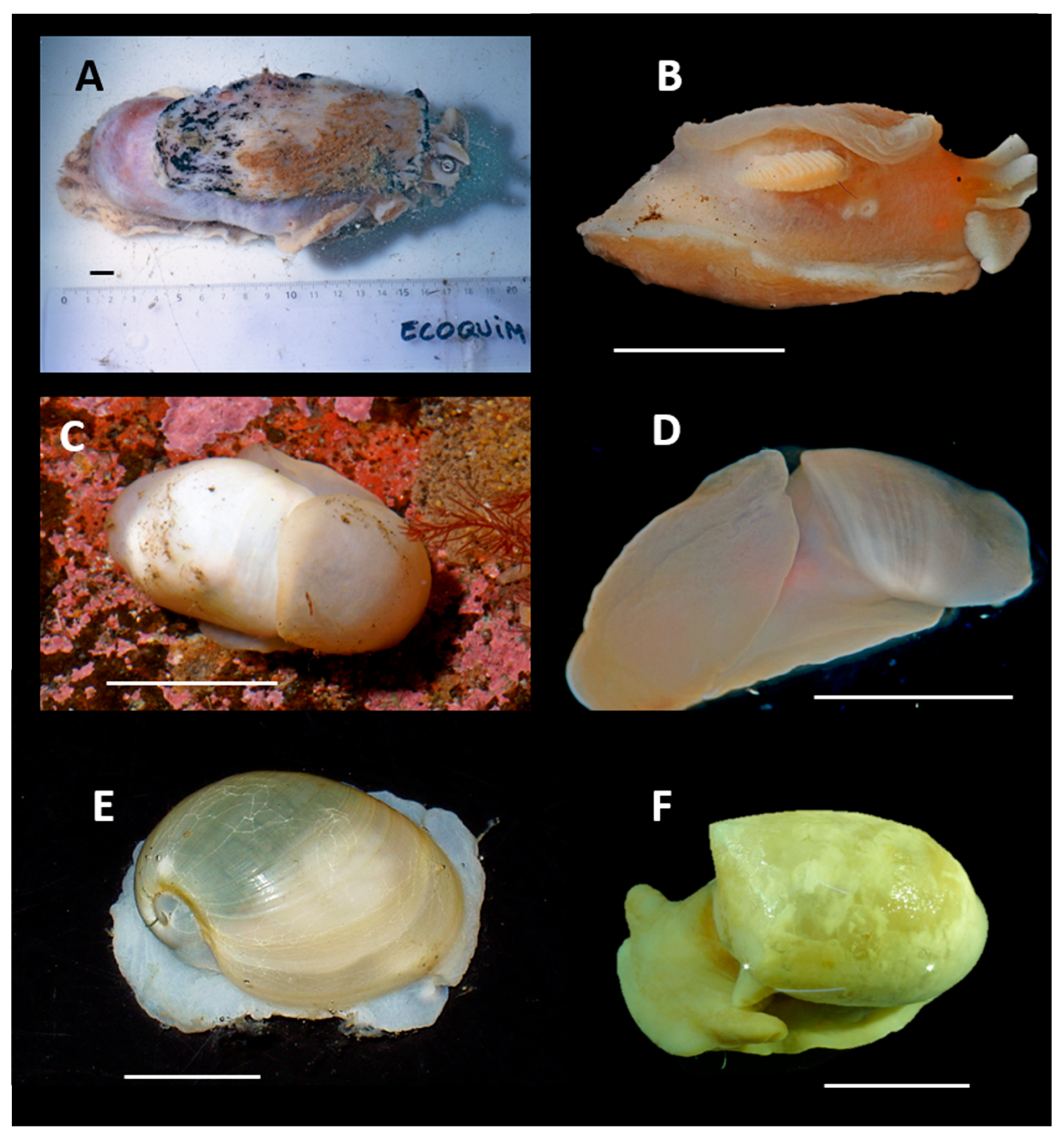
Bathyberthella antarctica Willan & Bertsch, 1987 (Plate 1 A)
Records: South Georgia Is. (Wägele & Willan, 1994; Zelaya, 2005); Shag Rocks (SOMBASE, 2024); South Sandwich Is. (Willan & Bertsch, 1987); South Orkney Is. (Garcia et al., 1994); Bouvet Island (Arntz et al., 2006); Weddell Sea (Wägele & Willan, 1994; Troncoso et al., 1996; Rauschert & Arntz, 2015; present work); Antarctic Peninsula (Wägele & Willan, 1994); South Shetland Is. (Willan & Bertsch, 1987); Bellingshausen Sea (Aldea et al., 2008; Aldea et al., 2009); Ross Sea (Brueggeman et al., 1999; Schiaparelli et al., 2006; Ghiglione et al., 2017).
Remarks: this species can reach 20 cm length (personal observation by the first author).
Bathyberthella orcadensis (F. J. García, García-Gómez, Troncoso & Cervera,1994)
Records: South Orkney Is. (García, et al., 1994, as Parabathyberthella orcadensis; Troncoso et al., 1997).
Bathyberthella tomasi (F. J. García, Troncoso, Cervera & García-Gómez, 1996)
Records: South Orkney Is. (Troncoso et al., 1997, as Polyctenidia tomasi).
Bathyberthella zelandiae Willan, 1983 (Plate 1 B)
Records: Weddell Sea (Menacho, 2011); South Island, New Zealand (Spencer et al., 2016).
Remarks: of this species, reported at 1,640 meters on the continental slope of the Bounty Trough (SW New Zealand), only one specimen has been caught in the deep waters (1,600 m) of the Weddell Sea.

Berthella medietas Burn, 1962.
Records: Northern and eastern Tasmania, Australia (Grove, 2018); South Island, Chatham Islands and subantarctic islands of New Zealand (Spencer et al., 2016).
Berthella patagonica (A. d´Orbigny, 1835)
Records: Patagonia (Powell, 1960, as Bouvieira patagonica (A. d´Orbigny, 1836); Linse, 1999; Argentina, Forcelli, 2000).; Falkland Islands (Powell, 1960).
Berthella platei (Bergh, 1898)
Records: Patagonia (Powell, 1960; Linse, 1999; Argentina, Forcelli, 2000; Chile, Schrödl, 1999a, Schrödl et al., 2005); Falkland Is. (Schrödl, 1999b).
Berthella ornata (Cheeseman, 1878)
Records: South Island, New Zealand (Spencer et al., 2016).
Berthella serenitas (Burn, 1962).
Records: Northern Tasmania, Australia (Grove, 2018).

Pleurobranchus hilli (Hedley, 1894)
Records: Tasmania, Australia (Grove, 2018).

Tomthompsonia antarctica (Thiele, 1912)
Records: Weddell Sea (Wägele & Hain, 1991, as T. spiroconchalis); Davis Sea (Thiele, 1912).
Remarks: This species was initially described by Thiele (1912) based on empty shells as Adeorbis antarcticus and belonging to the “prosobranch” mollusks. Wägele & Hain (1991) discovered live specimens of this pleurobranchid and carried out an extensive anatomical study, finding that it has a spiraled internal shell and describing the new genus Tomthompsonia.
Plate 1.
A: Bathyberthella antarctica, specimen from the Weddell Sea; B: Bathyberthella zelandiae, specimen from the
Weddell Sea; C, D: Antarctophiline alata, specimen from the South Shetland Islands; E: Newnesia antarctica,
specimen from the South Shetland Islands; F: Hocius joani, preserved specimen from the Weddell Sea. Original photographs by M. Ballesteros. Scale bars are 10 mm.
Plate 1.
A: Bathyberthella antarctica, specimen from the Weddell Sea; B: Bathyberthella zelandiae, specimen from the
Weddell Sea; C, D: Antarctophiline alata, specimen from the South Shetland Islands; E: Newnesia antarctica,
specimen from the South Shetland Islands; F: Hocius joani, preserved specimen from the Weddell Sea. Original photographs by M. Ballesteros. Scale bars are 10 mm.

Pleurobranchaea inconspicua Bergh, 1897.
Records: Argentine Patagonia (San Matias Gulf, 41º6´S; San José Gulf, 42º25´S, Muniain et al., 2007).
Remarks: This species is distributed from Cape Hatteras, North Carolina (35ºN) to San José Gulf, Argentina (42ºS) (Muniain et al., 2007) it may exhibit an amphiatlantic distribution due to records on the western coast of Africa and the eastern Mediterranean (Marcus & Gosliner, 1984).
Pleurobranchaea maculata (Quoy & Gaimard, 1832)
Records: Tasmania, Australia (Grove, 2018); South Island, New Zealand (Spencer et al, 2016); Argentine Patagonia (Puerto Madryn, 42º46´5”S, Farias et al., 2015; Battini et al., 2021).
Remarks: This species, native to Australia and New Zealand, has invaded the Argentine coasts since 2009 (Farias et al., 2015). It is a toxic species that can accumulate a powerful tetrodotoxin.

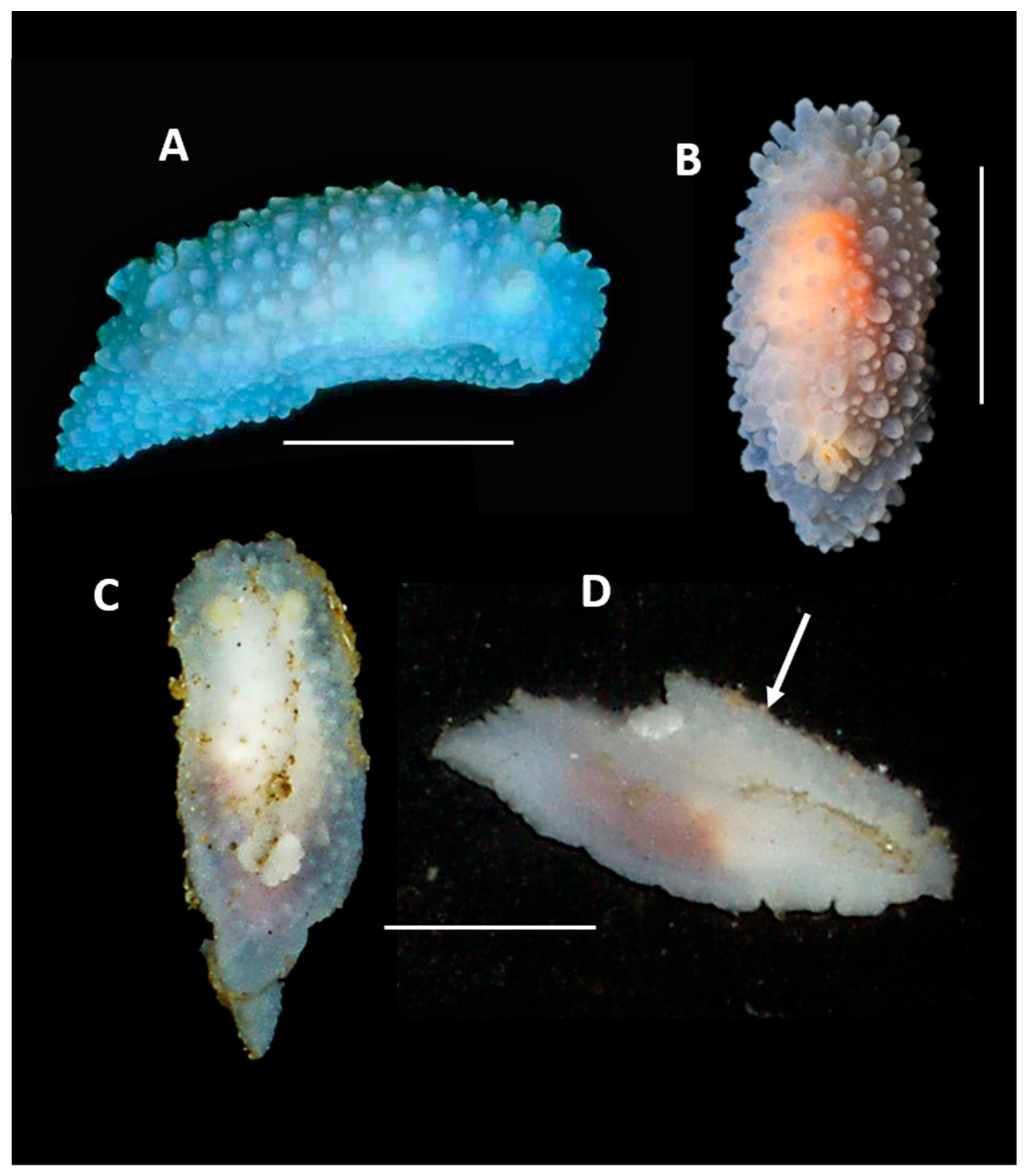
Aegires albus Thiele, 1912 (Plate 2 A, B)
Records: Weddell Sea (Wägele, 1987; Rauschert & Arntz, 2015); King George Is., South Shetland Is. (Schrödl et al., 2016); Ross Sea (Hedley, 1916; Odhner, 1934, as Aegires protectus; Schiaparelli et al., 2006; Ghiglione et al., 2013); Leopols III Bay, Princess Ragnhild coast (Troncoso et al., 1996); Davis Sea, East Antarctica (Thiele, 1912; Wägele, 1987).
Aegires exeches Fahey & Gosliner, 2004
Records: Tasmania, Australia (Burn, 2015; Grove, 2018).

Acanthodoris falklandica Eliot, 1907
Records: Patagonia (Linse, 1999; Argentina; Forcelli, 2000; Chile; Linse, 1999; Schrödl et al., 2005, Aldea et al. 2011); Falkland Is. (Eliot, 1907b; Linse, 1999).
Acanthodoris metulifera Bergh, 1905
Records: Tasmania, Australia (Grove, 2018); southern Tasmania, Australia (Burn, 2015).
Acanthodoris mollicella Abraham, 1877
Records: South Island, New Zealand (Spencer et al., 2016).
Acanthodoris pilosa (Abildgaard, 1789)
Records: Subantactic islands of New Zealand (Spencer et al., 2016).
Acanthodoris vatheleti Mabille & Rochebrune, 1889
Records: Punta Arenas, Orange Harbour, Cape Horn (Rochebrune & Mabille, 1889)
Remarks: this species is considered in WoRMS as nomen dubium.

Idaliadoris maugeansis (Burn, 1958)
Records: Tasmania, Australia (as Onchidoris maugeansis) (Burn, 2015; Grove, 2018).

Diaphorodoris mitsuii (Baba, 1938).
Records: Tasmania, Australia (Grove, 2018) (as Diaphorodoris sp. in Burn, 2015).

Armodoris antarctica , Minichev, 1972
Records: King George Is. (Millen & Martynov, 2005); Davis Sea, East Antarctica (Minichev, 1972).
Armodoris anudeorum Á. Valdés, Moran & H. A. Woods, 2011
Records: McMurdo Sound, Ross Sea (Cattaneo-Vietti et al., 2000, as A. antarctica; Valdés et al. 2011).

Doridunculus punkus , Moles, Wägele, Uhl & C. Ávila, 2017 (Plate 2 C, D)
Records: Weddell Sea (Moles et al., 2016b; this work);
Remarks: a single specimen of this species was collected in the Eastern Weddell Sea from a genus that contains two other species that are distributed in cold or deep waters of the northern hemisphere (Moles et al., 2016b).

Prodoridunculus gaussianus Thiele, 1912
Records: Ross Sea (Ghiglione et al., 2013; Schiaparelli et al., 2014); Davis Sea, East Antarctica (Thiele, 1912)

Corambe lucea Er. Marcus, 1959
Records: Patagonia (Linse, 1999; Argentina, Forcelli, 2000; Chile, Linse, 1999; Schrödl et al., 2005).

Ancula fuegiensis Odhner, 1926
Records: Patagonia (Linse, 1999; Argentina, Forcelli, 2000; Chile, Linse, 1999).
Ancula mappae (Burn, 1961).
Records: Tasmania, Australia (Grove, 2018).

Bermudella mija (Burn, 1967)
Records: Tasmania, Australia (Burn, 2015; Grove, 2018; as Okenia mija); South Island, New Zealand (Spencer et al, 2016, as Okenia mija).
Remarks: Burn (2006) suggests that the larger size of Tasmanian animals compared to those animals from the type locality (Okenia mija, Torquay, Victoria, Australia) may suggest the presence of another species.
Bermudella angelensis (Lance, 1966)
Records: Patagonia (Chile, Linse, 1999).
Remarks: Until the work of Paz-Sedano et al. (2024) this species was included within the genus Okenia.

Pelagella castanea (Alder & Hancock, 1845).
Records: South Island, New Zealand (Spencer et al., 2016, as Goniodoris castanea).
Remarks: This species, native to European Atlantic waters and also present in the Mediterranean, is considered an alien species in New Zealand waters. Until the work of Paz-Sedano et al. (2023) this species was included within the genus Goniodoris.
Pelagella punctata (Bergh, 1905).
Records: South Island, New Zealand (as Goniodoris punctata) (Spencer et al., 2016).
Remarks: see taxonomic commentary of P. castanea.

Trapania brunnea Rudman, 1987
Records: Tasmania, Australia (Burn, 2015; Grove, 2018).
Trapania rudmani M. C. Miller, 1981
Records: South Island, New Zealand (Spencer et al., 2016).
Plate 2.
Aegires albus, A in lateral view, B in dorsal view, specimen from the Weddell Sea, photographs by M.
Rauschert; Doridunculus punkus, specimen from the Weddell Sea. C in dorsal view, D in lateral view with the dorsal crest of the animal shown with an arrow, original photographs by M. Ballesteros. Scale bars are 10 mm.
Plate 2.
Aegires albus, A in lateral view, B in dorsal view, specimen from the Weddell Sea, photographs by M.
Rauschert; Doridunculus punkus, specimen from the Weddell Sea. C in dorsal view, D in lateral view with the dorsal crest of the animal shown with an arrow, original photographs by M. Ballesteros. Scale bars are 10 mm.

Crimora multidigitalis (Burn, 1957)
Records: Tasmania, Australia (Burn, 2015; Grove, 2018).

Gymnodoris alba (Bergh, 1877)
Records: Tasmania, Australia (Grove, 2018).
Gymnodoris arnoldi (Burn, 1957)
Records: Tasmania, Australia (Burn, 2015; Grove, 2018).

Holoplocamus papposus Odhner, 1926
Records: Patagonia (Argentina; Powell, 1960; Forcelli, 2000; Chile, Linse, 1999; Schrödl, 2003)

Kaloplocamus ramosus (Cantraine, 1835).
Records: Tasmania, Australia (Burn, 2015; Grove, 2018).

Paliolla cooki (Angas, 1864)
Records: Tasmania, Australia (Grove, 2018).

Plocamopherus imperialis Angas, 1864.
Records: Tasmania, Australia (Grove, 2018).

Polycera capensis Quoy & Gaimard, 1824.
Records: Eastern Tasmania, Australia (Grove, 2018).
Polycera hedgpethi Er.Marcus, 1964.
Records: Tasmania, Australia (Burn, 2015; Grove, 2018).
Remarks: P. hedgpethi is a cosmopolitan species origininating from the coasts of California. Ithas been recorded in almost all seas such as the North American Pacific and Costa Rica, West Africa, South Africa, New Zealand, Australia, Japan, Northern Europe, Northern Iberian Peninsula, the western Mediterranean and the Adriatic Sea (Pontes, 2023). It is assumed that this wide distribution and presence near commercial ports is due to transportation via ship’s fouling.
Polycera janjukia Burn, 1962.
Records: Tasmania, Australia (Grove, 2018), southeastern Tasmania, Australia (Burn, 2015).
Polycera maddoxi M. C. Miller, 2005.
Records: South Island, New Zealand (Spencer et al., 2016).
Polycera marplatensis Franceschi, 1928
Records: Patagonia (Argentina, Linse, 1999; Forcelli, 2000).
Polycera priva Er. Marcus, 1959
Records: Patagonia (Linse, 1999; Argentina, Forcelli, 2000; Chile, Schrödl, 2003; Schrödl et al., 2005).

Tambja morosa (Bergh, 1877).
Records: South Island, New Zealand (Spencer et al., 2016).
Tambja tenuilineata M. C. Miller & Haagh, 2005
Records: South Island, New Zealand (Spencer et al., 2016).
Tambja verconis (Basedow & Hedley, 1905).
Records: Northern and eastern Tasmania (Burn, 2015; Grove, 2018); South Island, New Zealand (Spencer et al., 2016).

Thecacera darwini Pruvot-Fol, 1950
Records: Patagonia (Argentina, Forcelli, 2000; Chile, Linse, 1999; Schrödl, 2003; Schrödl et al., 2005).

Aphelodoris berghi Odhner, 1924.
Records: Tasmania, Australia (Burn, 2006; Burn, 2015; Grove, 2018).
Aphelodoris greeni Burn, 1966.
Records: Northern and eastern Tasmania, Australia (Burn, 1966; Grove, 2018).
Aphelodoris juliae Burn, 1966.
Records: Tasmania, Australia (Burn, 1966; Grove, 2018).
Aphelodoris lawsae Burn, 1966.
Records: Tasmania, Australia (Grove, 2018).
Aphelodoris luctuosa (Cheeseman, 1882)
Records: South Island, New Zealand (Spencer et al., 2016).
Aphelodoris rossquicki Burn, 1966.
Records: Tasmania, Australia (Burn, 2015; Grove, 2018).
Aphelodoris varia (Abraham, 1877)
Records: Tasmania, Australia (Grove, 2018); northeastern Tasmania, Australia (Burn, 2015).

Doris cameroni (J. K. Allan, 1947)
Records: Tasmania, Australia (Burn, 2006; Burn, 2015; Grove, 2018).
Doris claurina (Er. Marcus, 1959)
Records: Patagonia (Linse, 1999; Argentina, Forcelli, 2000; Chile, Schrödl, 2003).
Remarks: in all cases cited as Neodoris claurina.
Doris chrysoderma Angas, 1864
Records: Northern Tasmania, Australia (Burn, 2015; Grove, 2018).
Doris falklandica (Eliot, 1907)
Records: Falkland Is. (Eliot, 1907b as Staurodoris).
Doris fontainii A. d´Orbigny, 1837
Records: Patagonia (Argentina, Linse, 1999; Forcelli, 2000; Valdés & Muniain, 2002; Chile, Linse, 1999; Valdés & Muniain, 2002; Schrödl, 2003; Schrödl et al., 2005; Schrödl & Grau, 2006).
Remarks: cited as Archidoris fontaini, Anisodoris fontaini or Doris carvi.
Doris granulatissima (Vayssière, 1917)
Records: Almirantazgo Bay, King George Is., South Shetland Is. (Vayssière, 1917); Ross Sea (Odhner, 1934); Adelie Land (Vicente & Arnaud, 1974)
Remarks: in all cases cited as Austrodoris granulatissima. This species is considered uncertain and nomen dubium in Wägele (1990b) and in WoRMS (2024). It is likely that it belongs to the Doris kerguelenensis species complex.
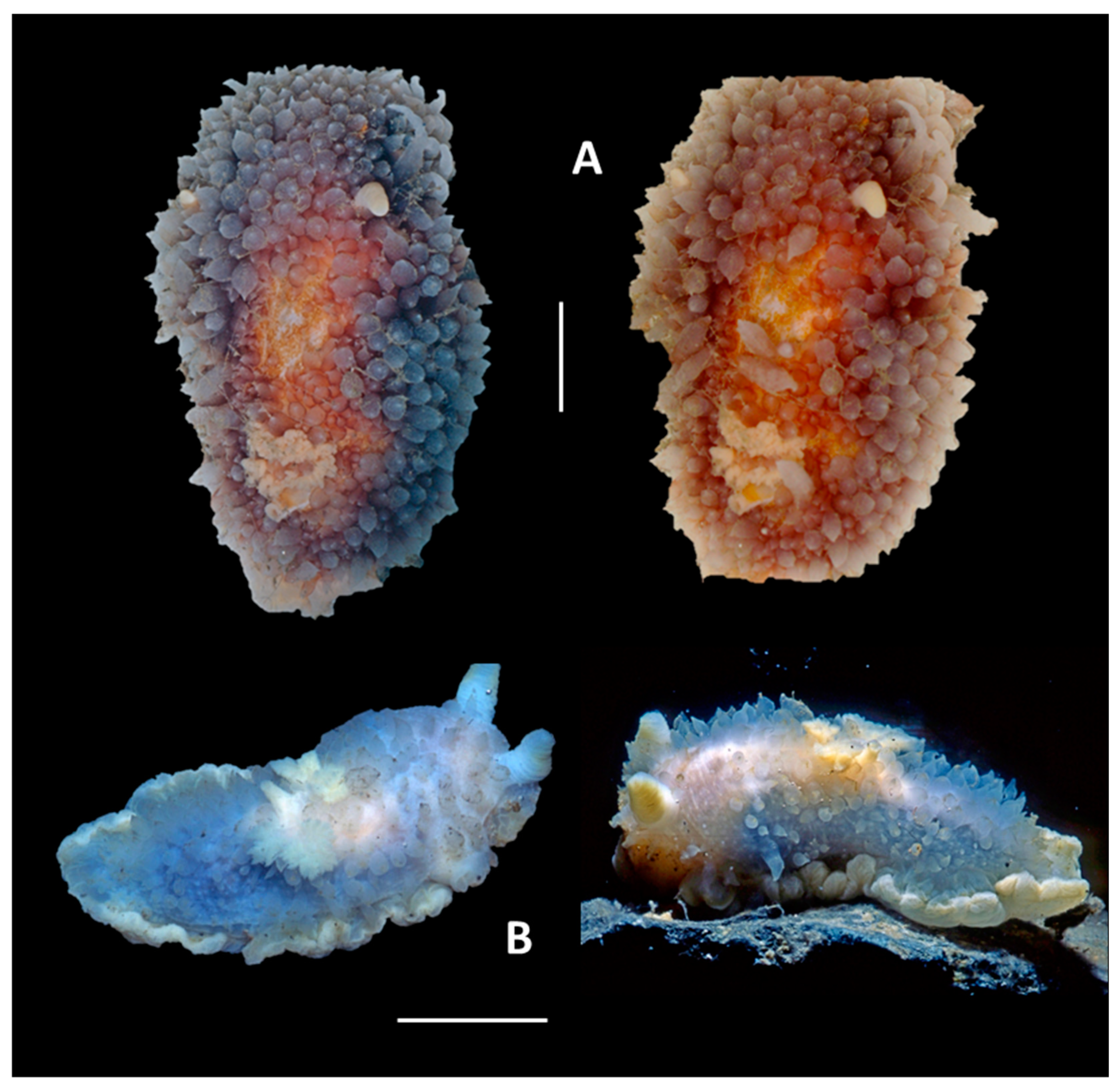
Doris kerguelenensis (Bergh, 1884) (Plate 3)
Records: Patagonia (Linse, 1999; Argentina, Odhner, 1926, as Austrodoris crenulata Odhner, 1926 and Austrodoris michaelseni Odhner, 1926; Forcelli, 2000; Chile, Bergh, 1884, as Austrodoris kerguelenensis; Bergh, 1898, as Archidoris rubescens Bergh 1898; Schrödl, 2003); Falkland Is. (Odhner, 1926, as Archidoris rubescens Bergh, 1898; Linse, 1999); Shag Rock-Bank (Odhner, 1926, as Archidoris rubescens Bergh, 1898); South Georgia Is. (Odhner, 1926, as Archidoris rubescens Bergh, 1898; Wägele, 1990b; García et al., 1993, as Austrodoris georgiensis F. J. García, Troncoso, García Gómez & Cervera, 1993; Troncoso et al, 1997; Linse, 1999; Zelaya, 2005); South Orkney Is. (Wägele, 1987; García et al., 1993; Barnes & Bullough, 1996; Troncoso et al, 1997; Aldea et al, 2008); Bouvet Island (Arntz et al., 2006); Marion Is. (Linse, 1999); Kerguelen Islands (Bergh, 1884, as Archidoris kerguelenensis Bergh, 1884 and A. australis Bergh, 1884; Powell, 1960, as Archidoris australis Bergh, 1884, Austrodoris tomentosa Odhner, 1934 and Austrodoris nivium Odhner, 1934; Vicente, 1973, as Austrodoris tomentosa Odhner, 1934 and Austrodoris nivium Odhner, 1934); Heard Is. (Merilees & Burn, 1969; Linse, 1999); Macquarie Is. (Merilees & Burn, 1969); Weddell Sea (Wägele, 1990b; Linse, 1999; Rauschert & Arntz, 2015); Antarctic Peninsula (Vayssiére, 1906, as Archidoris tuberculata (Müller, 1778) sensu Cuvier, 1804; Wägele, 1990b; Aldea et al., 2009 as Austrodoris georgiensis F. J. García, Troncoso, García Gómez & Cervera, 1993); South Shetland Is. (García et al., 1993; Troncoso et al, 1997; Linse, 1999; Troncoso et al., 1999; Arnaud et al. 2001); King George Is., South Shetland (Schrödl et al., 2016; present work, some animals collected with scuba diving in BENTART 2006 Spanish Research Expedition); Peter I Is. (Aldea et al., 2009, as Austrodoris georgiensis F. J. García, Troncoso, García Gómez & Cervera, 1993); Ross Sea (Smith, 1902; Odhner, 1934, as Austrodoris macmurdensis Odhner, 1934, Austrodoris nivium Odhner, 1934 and Austrodoris tomentosa Odhner, 1934; Dayton et al., 1974, as Austrodoris macmurdensis Odhner, 1934; Cattaneo, 1991; Brueggeman et al., 1999; Linse, 1999; Cattaneo-Vietti et al., 2000; Schiaparelli et al., 2006; Ghiglione et al., 2013; Schiaparelli & Linse, 2014); Princess Ragnhild coast (Troncoso et al., 1996); Davis Sea, East Antarctica (Thiele, 1912, as Archidoris nivalis Thiele, 1812; Minichev, 1972, as Austrodoris nivium Odhner, 1934, Austrodoris grandis Minichev, 1972, Archidoris stellata Minichev, 1972 y Austrodoris longa Odhner, 1926); Marguerite Bay, Adelie Land, East Antarctica (Vayssière, 1917, as Archidoris tuberculata var. antarctica Vayssière, 1917).
Remarks: This species has a long list of synonyms that are indicated in the records section. In almost all recent records it is listed as Austrodoris kerguelenensis or A. kerguelensis. It is the most common and widely distributed marine heterobranch species, having been cited from both coasts of the South American cone, the subantarctic islands and almost all the Antarctic coasts. Wägele (1990b) carried out a complete morphological and anatomical study on the genus Austrodoris. Moles et al. (2017b) conducted a study on spawning, embryonic development and juveniles of this species in vitro; these authors indicate that D. kerguelenensis has direct development with intracapsular embryonic development estimated to last about 13 months, with the juveniles hatching with a size of 3 mm. Ballesteros (2024) has graphically represented the different stages of the life cycle of this species. Due to its direct development, without larval form and therefore poor capacity for geographical dispersion, several authors have questioned whether D. kerguelenensis is a single species. Recently due to a wide representation of specimens from very diverse localities, both from Antarctic, sub-Antarctic and Magellanic environments, molecular analyses have shown that D. kerguelenensis comprises a complex of 59 different species (Wilson et al., 2009; Maroni & Wilson, 2022; Maroni et al, 2022). That there may also be more species of this complex in unstudied areas of the Southern Ocean. Because putative species in the D. kerguelenensis complex remain to be described, we consider all records to be those of D. kerguelenensis sensu lato.
Doris luteola Couthouy in Gould, 1852
Records: Orange Harbour, Cape Horn (Gould, 1852; Rochebrune & Mabille, 1889).
Remarks: this species is considered nomen dubium in WoRMS.
Doris nanula (Bergh, 1904)
Records: South Island and subantarctic islands of New Zealand (Spencer et al., 2016).
Doris nivalis (Thiele, 1912)
Records: Ross Sea (Hedley, 1916); Davis Sea, East Antarctica (Thiele, 1912, as Archidoris nivalis)
Remarks: this species is considered by WoRMS as nomen dubium.
Doris plumulata Couthouy in Gould, 1852
Records: Orange Harbour, Cape Horn (Gould, 1852; Rochebrune & Mabille, 1889)
Remarks: this species is considered by WoRMS as nomen dubium.
Doris wellingtonensis Abraham, 1877
Records: Eastern Tasmania, Australia (as Archidoris wellintonensis in Burn, 2006; Burn, 2015; Grove, 2018); South Island, New Zealand (Spencer et al., 2016).
Plate 3.
Doris kerguelenensis. A to E: underwater images of the animal alive in its environment, specimens from
King George Island; F: a juvenile specimen from the Weddell Sea photographed in the laboratory on a sponge
of the genus Rosella. Original photographs by M. Ballesteros. Scale bars are 10 mm.
Plate 3.
Doris kerguelenensis. A to E: underwater images of the animal alive in its environment, specimens from
King George Island; F: a juvenile specimen from the Weddell Sea photographed in the laboratory on a sponge
of the genus Rosella. Original photographs by M. Ballesteros. Scale bars are 10 mm.


Dendrodoris albopurpura Burn, 1957.
Records: Tasmania, Australia (Burn, 2015; Grove, 2018).
Dendrodoris arborescens (Collingwood, 1881).
Records: Tasmania, Australia (Burn, 2015; Grove, 2018).
Dendrodoris citrina (Cheeseman, 1881)
Records: South Island, New Zealand (Spencer et al., 2016).
Dendrodoris maugeana Burn, 1962
Records: Tasmania, Australia (Burn, 2015; Grove, 2018).
Dendrodoris nigra (W. Stimpson, 1855)
Records: Tasmania, Australia (Burn, 2015; Grove, 2018).

Doriopsilla carneola (Angas, 1864).
Records: Northern and eastern Tasmania, Australia (Grove, 2018).
Doriopsilla miniata (Alder & Hancock, 1864).
Records: Tasmania, Australia (Grove, 2018).
Doriopsilla peculiaris (Abraham, 1877).
Records: Northern and eastern Tasmania, Australia (Burn, 2015; Grove, 2018).

Alloiodoris lanuginata (Abraham, 1877)
Records: South Island and Chatham Islands, New Zealand (Spencer et al., 2016).
Alloiodoris marmorata Bergh, 1904
Records: Northern Tasmania, Australia (Grove, 2018).

Atagema albata (Burn, 1962)
Records: Northern Tasmania, Australia (Grove, 2018 as Trippa albata).
Remarks: WoRMS lists this species as taxon inquirendum and Innabi et al. (2023) indicate that without molecular data it cannot be confirmed whether A. albata is synonymous with A. papillosa (Risbec, 1928).
Atagema carinata (Quoy & Gaimaard, 1832)
Records: South Island, New Zealand (Spencer et al., 2016).

Diaulula hispida (A. d´Orbigny, 1836)
Records: Patagonia (Linse, 1999; Argentina, Forcelli, 2000; Chile, Linse, 1999; Schrödl, 2000b; Schrödl, 2003); Orange Bay, Cape Horn (Rochebrune and Mabille, 1889, as Doris hispida A. d´Orbigny, 1836); Strait of Magellan (Powell, 1960, as Trippa hispida (A. d´Orbigny, 1836).
Diaulula punctuolata (A. d´Orbigny, 1836)
Records: Patagonia (Powell, 1960, as Doris vestita Abraham, 1877; Linse, 1999, as Anisodoris punctuolata (A. d´Orbigny, 1836) and Diaulula vestita (Abraham, 1877); Argentina, Forcelli, 2000, as A. punctuolata; Chile, Osorio & Reid, 2004; Linse, 1999, as A. punctuolata; Valdés & Muniain, 2002; Schrödl, 2003; Schrödl & Grau, 2006; Aldea et al., 2011); Falkland Is. (Eliot, 1907b as Doris vestita Abraham 1877; Linse, 1999, as D. vestita).
Diaulula variolata (A. d’Orbigny, 1836)
Records: Patagonia (Chile; Aldea et al., 2011).
Remarks: this species is distributed from Arica (N of Chile) to the Bernardo O’Higgins National Park (51ºS), which is its current limit of southernmost distribution.

Gargamella immaculata Bergh, 1894
Records: Patagonia (Powell, 1960; Linse, 1999; Argentina, Forcelli, 2000; Chile, Linse, 1999; Schrödl, 2003); Burdwood Bank (Linse, 1999).

Geitodoris patagonica Odhner, 1916
Records: Patagonia (Linse, 1999; Argentina, Forcelli, 2000; Chile, Schrödl, 2000b; Schrödl, 2003); Falkland Is. (Powell, 1960, as G. falklandica Odhner, 1926; Linse, 1999; Schrödl, 2000b; Schrödl, 2003).

Carminodoris nodulosa (Angas, 1864)
Records: Tasmania, Australia (Burn, 2015; Grove, 2018; as Hoplodoris nodulosa).

Jorunna hartleyi (Burn, 1958).
Records: Tasmania, Australia (Burn, 2015; Grove, 2018).

Paradoris dubia (Bergh, 1904)
Records: Northern and eastern Tasmania, Australia (Burn, 2015; Grove, 2018).

Rostanga calumus Rudman & Avern, 1989
Records: Tasmania, Australia (Burn, 2015; Grove, 2018).
Rostanga crawfordi (Burn, 1969)
Records: Northern Tasmania, Australia (Burn, 2015; Grove, 2018).
Rostanga pulchra MacFarland, 1905
Records: Patagonia (Argentina, Forcelli, 2000; Chile, Linse, 1999; Schrödl, 2003; Schrödl & Grau, 2006).

Sclerodoris tarka Burn, 1969.
Records: Tasmania, Australia (Burn, 2015; Grove, 2018).

Thordisa verrucosa (Crosse in Angas, 1864).
Records: Tasmania, Australia (Grove, 2018).

Cadlina affinis Odhner, 1934
Records: Ross Sea (Odhner, 1934; Schrödl, 2000a).
Cadlina georgiensis Schrödl, 2000
Records: South Georgia (Schrödl, 2000a, 2003).
Cadlina kerguelensis , Thiele, 1912
Records: Kerguelen Is. (Thiele, 1912; Schrödl, 2000a).
Cadlina magellanica Odhner, 1926
Records: Patagonia (Schrödl, 2003); Falkland Is. (Odhner, 1926, as C. falklandica; Schrödl, 2003).
Cadlina sparsa (Odhner, 1922)
Records: Patagonia (Linse, 1999; Argentina, Forcelli, 2000; Chile, Schrödl, 2003; Schrödl et al., 2005).
Cadlina tasmanica Rudman, 1990
Records: Tasmania, Australia (Burn, 2015; Grove, 2018); South Island, New Zealand (Spencer et al., 2016).
Cadlina willani M. C. Miller, 1980.
Records: South Island, New Zealand (Spencer et al., 2016).

Hallaxa gilva M. C. Miller, 1987.
Records: South Island, New Zealand (Spencer et al., 2016).
Hallaxa michaeli Gosliner & S. Johnson, 1994.
Records: Tasmania, Australia (Burn, 2015; Grove, 2018).

Ceratosoma amoenum (Cheeseman, 1886)
Records: Northern Tasmania, Australia (Burn, 2015; Grove, 2018).
Ceratosoma brevicaudatum Abraham, 1876
Records: Northern and eastern Tasmania, Australia (Burn, 2015; Grove, 2018).

Chromodoris alternata (Burn, 1957)
Records: Tasmania, Australia (Burn, 2015; Grove, 2018).
Chromodoris ambigua Rudman, 1987
Records: Northern Tasmania, Australia (Burn, 2015; Grove, 2018) .

Diversidoris sulphurea (Rudman, 1986)
Records: Northern Tasmania, Australia (Grove, 2018).

Doriprismatica kulonba (Burn, 1966).
Records: Northern Tasmania, Australia (Burn, 2015; Grove, 2018).

Goniobranchus annulatus (Eliot, 1904).
Records: Tasmania, Australia (Grove, 2018).
Goniobranchus aureomarginatus (Cheeseman, 1881)
Records: South Island, New Zealand (Spencer et al., 2009)
Goniobranchus epicurius (Basedow & Hedley, 1905).
Records: Northern and eastern Tasmania, Australia (Burn, 2015; Grove, 2018).
Goniobranchus multimaculosus (Rudman, 1987).
Records: Northern Tasmania, Australia (Grove, 2018).
Goniobranchus tasmaniensis (Bergh, 1905).
Records: Northern and eastern Tasmania, Australia (Burn, 2015; Grove, 2018; as Chromodoris tasmaniensis).
Goniobranchus cf. tinctorius (Rüppell & Leuckart, 1830).
Records: Tasmania, Australia (Maynard, 2014; Burn, 2015; Grove, 2018; as Goniobranchus tinctorius).

Mexichromis macropus Rudman, 1983.
Records: Northern Tasmania, Australia (Grove, 2018).

Thorunna arbuta (Burn, 1961).
Records: Tasmania, Australia (Burn, 2015; Grove, 2018).
Thorunna perplexa (Burn, 1957).
Records: Northern and eastern Tasmania, Australia (Burn, 2015; Grove, 2018).

Tyrinna delicata (Abraham, 1877)
Records: Patagonia (Forcelli, 2000; Chile, Linse, 1999; Schrödl, 2003; Schrödl et al. 2005; Aldea et al., 2011).
Remarks: records from Patagonia as T. nobilis Bergh, 1898.

Verconia aureopunctata (Rudman, 1987)
Records: Northern Tasmania, Australia (Burn, 2015; Grove, 2018).
Verconia closeorum (Rudman, 1986).
Records: Tasmania, Australia (Burn, 2015; Grove, 2018; as Noumea closeorum).
Verconia haliclona (Burn, 1957).
Records: Tasmania, Australia (Burn, 2015; Grove, 2018).
Verconia verconis (Basedow & Hedley, 1905).
Records: Tasmania, Australia (Burn, 2015; Grove, 2018).

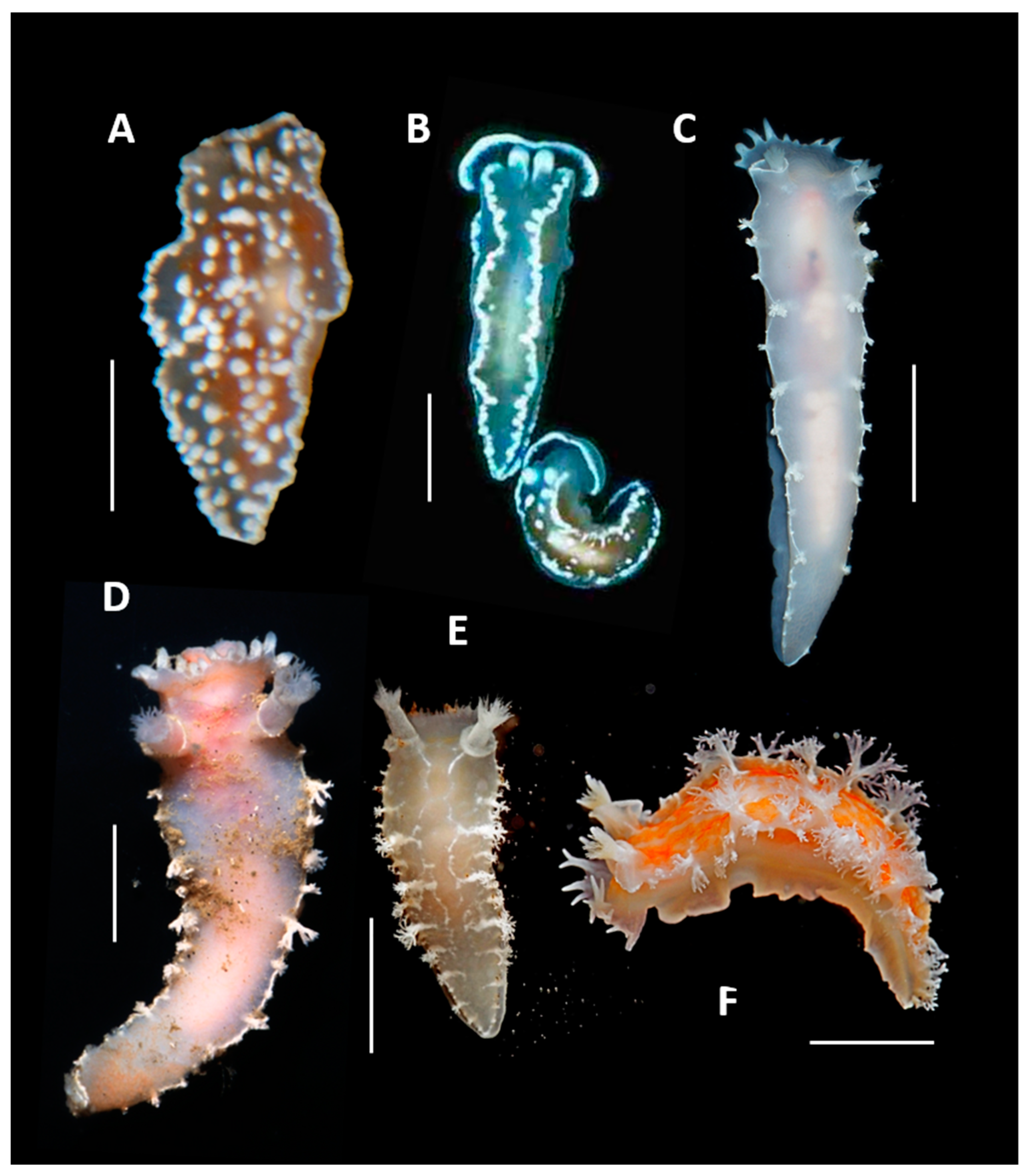
Bathydoris hodgsoni , Eliot, 1907 (Plate 4 A)
Records: South Shetland Is. (Troncoso et al., 1999; Arnaud et al., 2001); Weddell Sea (Powell, 1960, as Bathydoris browni T. J. Evans, 1914; Avila et al., 2000; Rauschert & Arntz, 2015); Ross Sea (Eliot, 1907a as B. hogdsoni and B. inflata Eliot, 1907; Hedley, 1916; Wägele, 1987; Brueggeman et al., 1999; Ghiglione et al., 2017); Davis Sea, East Antarctica (Hedley, 1916).
Remarks: B. hodgsoni is a large nudibranch, reaching a size of more than 15 cm in length. This species, with direct development, deposits the largest eggs capsules known for a mollusk, of about 50 mm, it has an extremely long embryonic development of about 10 years, with the juveniles of the capsule hatching with a size of 29 mm (Moles et al., 2017b). Ballesteros (2024) has graphically represented the different stages of the life cycle of this species.

Prodoris clavigera (Thiele, 1912) (Plate 4 B)
Records: Falkland Is. (Kaiser, 1980, as Bathydoris argentina Kaiser, 1987); South Georgia Is. (Wägele, 1987; Troncoso et al. 1997; Zelaya, 2005); South Orkney Is. (Wägaele, 1987; Troncoso et al., 1997); Weddell Sea (Wägele, 1987); Antarctic Peninsula (Wägele, 1987); South Shetland Is. (this work); West Antarctica (Rauschert & Arntz, 2015); Ross Sea (Odhner, 1934, as Bathydoris obliquata Odhner, 1934; Schiaparelli et al., 2006; Ghiglione et al., 2017); Davis Sea, East Antarctica (Thiele, 1912; Minichev, 1972, as Bathydoris obliquata Odhner, 1934).
Remarks: most records as Bathydoris clavigera.
Plate 4.
A: Bathydoris hogdsoni, specimen from the Weddell Sea; B: Prodoris clavigera, specimen from the South
Shetland Islands. Original photographs by M. Ballesteros. Scale bars are 10 mm.
Plate 4.
A: Bathydoris hogdsoni, specimen from the Weddell Sea; B: Prodoris clavigera, specimen from the South
Shetland Islands. Original photographs by M. Ballesteros. Scale bars are 10 mm.

Embletonia gracilis Risbec, 1928
Records: Tasmania, Australia (Burn, 2015; Grove, 2018).

Armina cygnaea (Bergh, 1876)
Records: Tasmania, Australia (Grove, 2018).
Armina rubida (A. Gould, 1852).
Records: Tasmania, Australia (Burn, 2015; Grove, 2018).
Remarks: This species has been recorded as belonging to the genus Diphyllidia in the original description and later as Dermatobranchus rubidus.

Heterodoris antipodes Willan, 1981.
Records: Tasmania, Australia (Grove, 2018); South Island, New Zealand (Spencer et al., 2016).

Madrella cf. sanguinea (Angas, 1864).
Records: Tasmania, Australia (Burn, 2015 as Madrella sp. RB1; Grove, 2018 as Madrella sanguinea)
Remarks: this scarlet-red Madrella is often confused with the tropical Madrella ferruginosa Alder & Hancock, 1864 which exhibits swimming larvae, whereas this cool-temperate species exhibits direct development and crawling juveniles.

Caldukia affinis (Burn, 1958).
Records: Tasmania, Australia (Burn, 2015; Grove, 2018).
Caldukia albolineata M. C. Miller, 1970
Records: South Island, and subantarctic islands of New Zealand (Spencer et al., 2016).

Galeojanolus ionnae M. C. Miller, 1971.
Records: South Island, New Zealand (Spencer et al., 2016).

Janolus ignis M. C.Miller & Willan, 1986.
Records: South Island, New Zealand (Spencer et al., 2016).

Antiopella novozealandica Eliot, 1907
Records: South Island, New Zealand (Spencer et al., 2016).

Curnon granulosa (Vayssière, 1906) (Plate 5 A)
Records: South Orkney Islands (Wägele et al. 1995; Barnes & Bullough, 1996); Weddell Sea (Rauschert & Arntz, 2015); Wandel Island, Antarctic Peninsula (Vayssière, 1906a; Powell, 1960); South Shetland Is. (Troncoso et al., 1999; Arnaud et al., 2001); King George Is. (present work, one animal of 13 mm length collected with scuba diving on the Himantothalus grandifolius (A. Gepp & E. S. Gepp) Zinova, 1959 algae at 10 m depth in Bentart 2006 spanish expedition; Schrödl et al., 2016); Wandel Is., Antarctic Peninsula (Vayssiére, 1906).
Remarks: In all previous records as Charcotia granulosa Vayssière, 1906a. The Curnonidae was known until 2017 as the Charcotidae and Charcotia granulosa was transferred to the new genus Curnon d´Udekem d´Acoz, 2017.

Pseudotritonia antarctica (Odhner, 1934)
Records: Antarctic Peninsula (Australian Antarctic Data Centre, 2024, as Telarma antarctica); Ross Sea (Odhner, 1934, as Telarma antarctica); Adelie Land (Vicente & Arnaud, 1974, as Telarma antarctica)
Remarks: This species, originally described as Telarma antarctica, was included until 2017 within the Charcotidae, since then considered synonymous with the Curnonidae.
Pseudotritonia gracilidens Odhner, 1944
Records: South Orkney Islands (Barnes & Bullough, 1996); Weddell Sea (Rauschert & Arntz, 2015, as cf.); King George Is. (Schrödl et al., 2016); Ross Sea (Odhner, 1934; Cattaneo-Vietti, 1991; Cattaneo-Vietti et al. 2000).
Remarks: see remarks of P. antarctica.
Pseudotritonia quadrangularis Thiele, 1912 (Plate 5 B)
Records: Antarctic Peninsula, South Shetlands Is. and South Orkneys Is. (Rudman, 2007); Davis Sea, East Antarctica (Thiele, 1912)
Remarks: see remarks of P. antarctica.

Scyllaea fulva Quoy & Gaimard, 1824
Records: Tasmania, Australia (Burn, 2015; Grove, 2018).
Remarks: Pola et al. (2012) studied the Scyllaeidae and found significant differences (7%) between specimens of Scyllaea pelagica Linnaeus, 1758 from the Atlantic and the Indo-Pacific and suggested that this cosmopolitan species is probably two different species. Consequently, this name should refer only to specimens from the Atlantic, while those from the IndoPacific would belong to Scyllaea fulva Quoy & Gaimard, 1824, an opinion also shared by Burn (2015).

Melibe australis (Angas, 1864)
Records: Tasmania, Australia (Burn, 2015; Grove, 2018).
Melibe maugeana Burn, 1960.
Records: Tasmania, Australia (Grove, 2018).

Doto antarctica Eliot, 1907 (Plate 6 A, B)
Records: Bouvet Island (Arntz et al. 2006, as Doto sp.; Moles et al., 2016a); Weddell Sea (Rauschert & Arntz, 2015; Moles et al., 2016a; present work); Ross Sea (Eliot, 1907a; Odhner, 1934; Brueggeman et al. 1999; Schiaparelli et al., 2006; Ghiglione et al., 2013).
Doto cf. bella Baba, 1938
Records: South Island, New Zealand (Spencer et al., 2016).
Doto carinova Moles, C. Àvila & Wägele, 2016 (Plate 6 C, D)
Records: Eastern Weddell Sea (Moles et al., 2016a; present work).
Remarks: the only specimen known so far was collected during the ANTXXI/2 campaign of the R.V. Polarstern by means of an Agassiz dredge on a bottom located at a depth of 277 m above the gorgonian Primnoisis antarctica (Studer, 1878) on which it was also spawning (Moles et al., 2016a).
Doto ostenta Burn, 1958
Records: Tasmania, Australia (Burn, 2015; Grove, 2018).
Doto pita Er. Marcus, 1955
Records: Tasmania, Australia (Burn, 2015; Grove, 2018); South Island, New Zealand (Spencer et al., 2016).
Plate 5.
A: Curnon granulosa, specimen from King George Island; B: Pseudotritonia quadrangularis, specimen from the Antarctic Peninsula, photo M. Rauschert; C, D and E: Myrella challengeriana, specimens from south Shetland (D, E) and the Weddell Sea (C); F: Myrella dantarti, specimen from Bouvet Island. Photographs A, C, D, E and F by M. Ballesteros. Scale bars are 10 mm.
Plate 5.
A: Curnon granulosa, specimen from King George Island; B: Pseudotritonia quadrangularis, specimen from the Antarctic Peninsula, photo M. Rauschert; C, D and E: Myrella challengeriana, specimens from south Shetland (D, E) and the Weddell Sea (C); F: Myrella dantarti, specimen from Bouvet Island. Photographs A, C, D, E and F by M. Ballesteros. Scale bars are 10 mm.
Doto uva Er. Marcus, 1955
Records: Patagonia (Argentina, Forcelli, 2000; Chile, Linse, 1999; Schrödl, 2003, Schrödl et al., 2005).

Marionia cucullata (Couthouy, 1852)
Records: Patagonia (Argentina, Forcelli, 2000; Chile, Schrödl, 2003); Adelie Land, East Antarctica (Vicente & Arnaud, 1974).
Marionia platyctenea (Willan, 1988).
Records: Tasmania, Australia (Burn, 2015; Grove, 2018, as Marioniopsis platyctenea).
Remarks: Obligate associate of the encrusting octocoral Erythropodium hicksoni (Utinomi, 1971) (Burn, 2015).

Myrella challengeriana (Bergh, 1884) (Plate 5 C, D, E)
Records: Punta Arenas, Orange Harbour (Rochebrune & Mabille, 1889, as Microlophus poirieri Mabille & Rochebrune, 1889); Patagonia (Bergh, 1884; Argentina, Linse, 1999, as Tritonia australis (Bergh, 1898); Forcelli, 2000; Chile, Reid & Osorio, 2000; Linse, 1999, as Tritonia australis (Bergh, 1898); Schrödl, 2003, Schrödl et al., 2005, Aldea et al., 2011); Falkland Is. (Eliot, 1907b; Linse, 1999; Schrödl, 2003); South Georgia Is. (Powell, 1951, as Tritonia antarctica Pfeffer, 1886; Troncoso et al., 1997; Linse, 1999; Zelaya, 2005); South Orkney Is. (Eliot, 1909, as Tritonia appendiculata Eliot, 1905; Barnes & Bullough, 1996, as Tritonia antarctica Pfeffer, 1886; Wägele, 1995 as Tritonia antarctica Pfeffer, 1886; Troncoso et al., 1997, as Tritonia antarctica Pfeffer, 1886; Linse, 1999); Bouvet Island (Arntz et al., 2006; Ballesteros & Avila, 2006); South Shetland Is. (Troncoso et al., 1999; Linse, 1999; Arnaud et al., 2001, as Tritonia antarctica Pfeffer, 1886; present work); Weddell Sea (Wägele, 1995; Linse, 1999; Rauschert & Arntz, 2015; present work); Antarctic Peninsula (Wägele, 1995); Bellingshausen Sea (Aldea et al, 2008, as Tritonia antarctica Pfeffer, 1886); Peter I Is. (Aldea et al., 2009); Ross Sea (Eliot, 1907a; Brueggeman et al. 1999; Linse, 1999; Schiaparelli et al., 2006); Adélie Land (Linse, 1999); Davis Sea, East Antarctica (Minichev, 1972).
Remarks: Until the recent work of De Vasconcelos et al. (2023) records of this species referred to the genus Tritonia but these authors, through anatomical and molecular studies, reinstated the genus Myrella to include Tritonia species from Antarctic and sub-Antarctic areas. Schrödl (2003) remark that Tritonia australis (Bergh, 1898) and T. poirieri (Mabille & Rochebrune, 1889) can be synonymous species of M. challengeriana, an opinion that we follow here. This species is one of the most abundant and most widely distributed ofthe marine heterobranch species of the Southern Ocean.
Myrella dantarti (Ballesteros & C. Àvila, 2006) (Plate 5 F)
Records: Bouvet Island (Arntz et al. 2006, as Tritonia sp.; Ballesteros & Avila, 2006; Rauschert & Arntz, 2015 as Tritoniidae gen. sp.; present work).
Remarks: since its description in 2006, this spectacular species has not been recorded again outside its original area, the island of Bouvet.
Myrella vorax (Odhner, 1926)
Records: Patagonia (Powell, 1960; Linse, 1999; Argentina, Forcelli, 2000; Chile, Odhner, 1926; Schrödl, 2003); Burdwood Bank (Linse, 1999); South Georgia (Wägele, 1995; Linse, 1999; Zelaya, 2005).
Remarks: in all cases recorded as Tritonia vorax.

Tritonia odhneri Er.Marcus, 1959
Records: Patagonia (Argentina, Forcelli, 2000; Chile, Linse, 1999; Schrödl, 2003).

Tritoniella belli Eliot, 1907 (Plate 7 A, B, C)
Records: Falkland Islands (Powell, 1960); South Orkney Islands (Barnes & Bullough, 1996; Troncoso et al, 1997); South Georgia (Powell, 1960; Wägele, 1989); Kergueen Is. (Wägele, 1989); Weddell Sea (Rauschert & Arntz, 2015; Schächinger et al., 2022; present work); western Antarctic Peninsula (Aldea et al., 2009); South Shetlands Is. (Troncoso et al., 1999; Arnaud et al., 2001); King George Is. (Schrödl et al., 2016); Bellingshausen Sea (Aldea et al., 2008); Ross Sea (Eliot, 1907a, as T. belli and T. sinuata Eliot, 1907; Hedley, 1916, as T. sinuata Eliot, 1907; Odhner, 1934, as T. sinuata Eliot, 1907; Powell, 1960; Cattaneo-Vietti, 1991; Brueggeman et al., 1999; Cattaneo-Vietti et al., 2000; Schiaparelli & Linse, 2014; Ghiglione et al., 2017; Schächinger et al., 2022); Adelie Land (Vicente & Arnaud, 1974, as T. sinuata); Tokarev Is., East Antarctica (Minichev, 1972); Enderby Land (Wägele, 1989); MacRobertson Is., East Antarctica (Wägele, 1989).
Remarks: Tritoniella sinuata Eliot, 1907 is considered synonymous with T. belli by Wägele (1989) while recently, Schächinger et al. (2022), indicate that it would be necessary to study more material from the sinuata morph to clarify its status. These last authors have studied a significant number of Tritoniella specimens from various locations in the Scotia Arc and the South Shetlands, collected using scuba diving or at great depth using dredgers, and through molecular analysis have discovered the existence of five new species. These taxa are morphologically similar to T. belli. Some of the records of T. belli indicated above may belong to one of these new species.
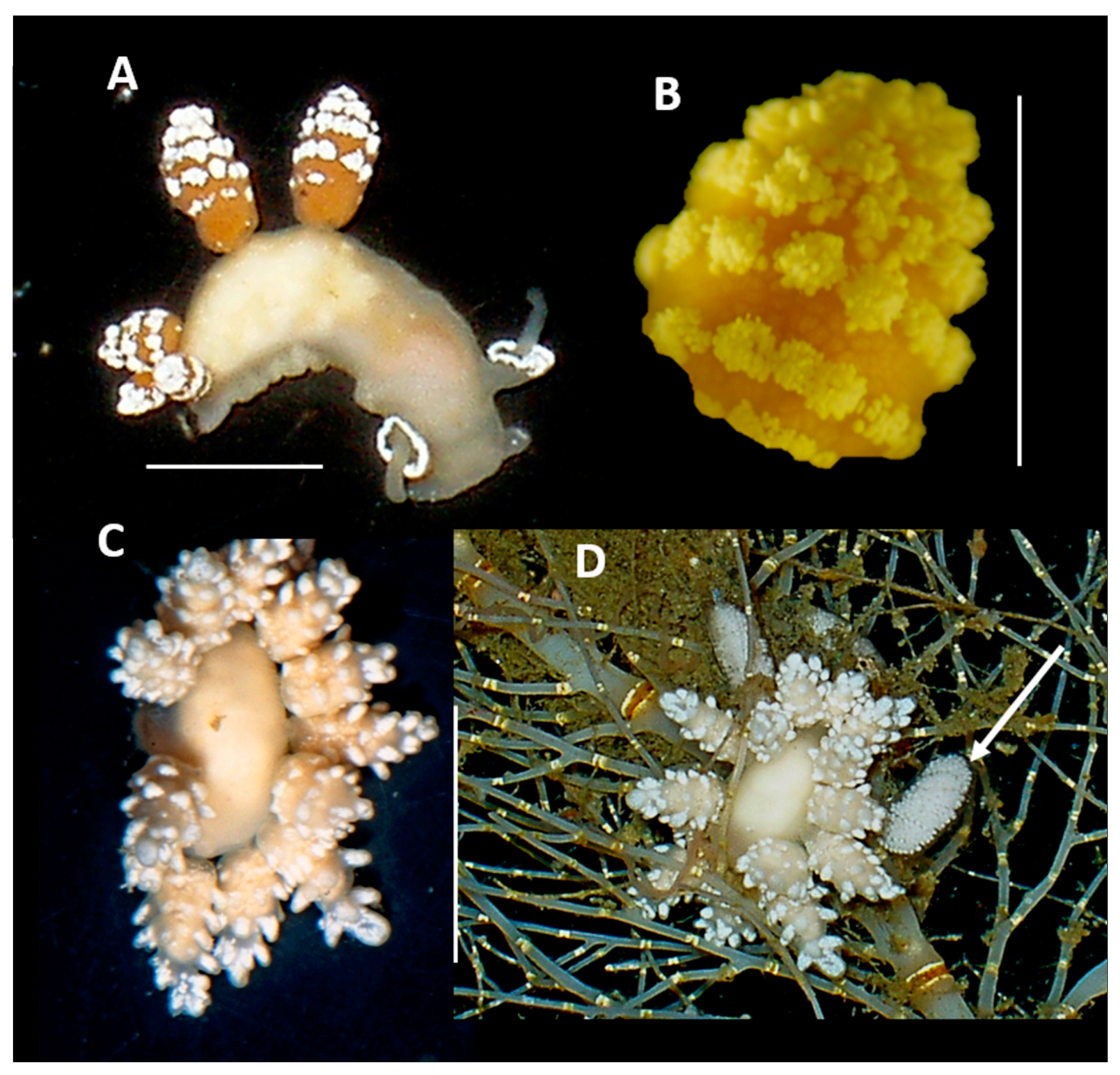
Plate 6.
Doto antarctica, A: specimen from the Weddell Sea with some cerata. B: detail of a cerata with granular
tubercles. C and D: Doto carinova from the Weddell Sea, in D on the gorgonian Primnoisis antarctica, which is its substrate. Original photographs by M. Ballesteros. Scale bars are 10 mm.
Plate 6.
Doto antarctica, A: specimen from the Weddell Sea with some cerata. B: detail of a cerata with granular
tubercles. C and D: Doto carinova from the Weddell Sea, in D on the gorgonian Primnoisis antarctica, which is its substrate. Original photographs by M. Ballesteros. Scale bars are 10 mm.
Tritoniella gnathodentata Schächinger, Schrödl, N. G. Wilson & Moles, 2022
Records: Shag Rocks and South Georgia (Schächinger et al., 2022)
Remarks: This species can reach a size of 38 mm in length and has been caught up to a depth of 751 meters.
Tritoniella gnocchi Schächinger, Schrödl, N. G. Wilson & Moles, 2022
Records: Burdwood Bank, South to Falkland Is. (Schächinger et al., 2022)
Remarks: Only the 21 mm length specimen used to describe the species is known, captured between 561-572 meters deep.
Tritoniella heideae Schächinger, Schrödl, N. G. Wilson & Moles, 2022
Records: Ardley Is., King George Is., South Shetland Archipelago and Montagu Is., South Sandwich Is. (Schächinger et al., 2022)
Remarks: specimens of this species can reach up to 53 mm in length.
Tritoniella prinzess Schächinger, Schrödl, N. G. Wilson & Moles, 2022
Records: Ardley Is., King George Is., South Shetland Archipelago (Schächinger et al., 2022)
Remarks: Only one specimen measuring 17 mm in length is known, which was used to describe the species and was collected between 20-40 meters deep.
Tritoniella schroriesi Schächinger, Schrödl, N. G. Wilson & Moles, 2022 (Plate 7 D, E, F)
Records: Ardley Is., South Shetland Archipelago, Coronation Is., South Orkney Is. (Schächinger et al., 2022); Albatros Is., Fildes Bay, King George Is., South Shetland Archipelago (this work).
Remarks: only three specimens are known, the two used to describe the species and the specimen collected by the authors on Albatros Island. This species can reach a size of 54 mm in length.

Aeolidia campbelli (Cunningham, 1871)
Records: Patagonia (Powell, 1960; Linse, 1999; Chile, Kiekenberger et al., 2016); Falkland Is. (Eliot, 1907b, as A. serotina Bergh, 1873; Powell, 1951 as A. serotina; Linse, 1999; Schrödl, 2003; Kienberger et al., 2016).
Remarks: this species has been recorded by different authors as Aeolidia papillosa Linnaeus, 1761. Kienberger et al. (2016) has shown that A. papillosa is a cryptic species complex and that the records of A. papillosa from South America belong to a different species, A. campbelli (Cunningham, 1871), a senior synonym of A. serotina Bergh, 1873.

Aeolidiella drusilla Bergh, 1900.
Records: Tasmania, Australia (Burn, 2015; Grove, 2018).

Baeolidia australis (Rudman, 1982).
Records: Tasmania, Australia (Burn, 2015; Grove, 2018).
Baeolidia macleayi (Angas, 1864).
Records: Tasmania, Australia (Burn, 2015; Grove, 2018).

Berghia rissodominguezi Muniain & Ortea, 1999
Records: Patagonia (Argentina, Muniain & Ortea, 1999).

Cerberilla incola Burn, 1974.
Records: Tasmania, Australia (Burn, 2015; Grove, 2018).

Spurilla braziliana MacFarland, 1909
Records: Patagonia (Forcelli, 2000 as S. neapolitana Delle Chiaje, 1841)
Remarks: Forcelli (2000) does not indicate the place of observation of S. neapolitana, rendering it uncertain and claim that the specimens attributed to it on the Argentine coasts may belong to another species or even to another genus. an idea supported by other authors (Schrödl, 2003). Carmona et al. (2014), in their work on the Spurilla neapolitana species complex, confirm with molecular data that the specimens attributed to S. neapolitana in the western Atlantic are actually S. braziliana and that this species is also found living in the eastern Pacific.
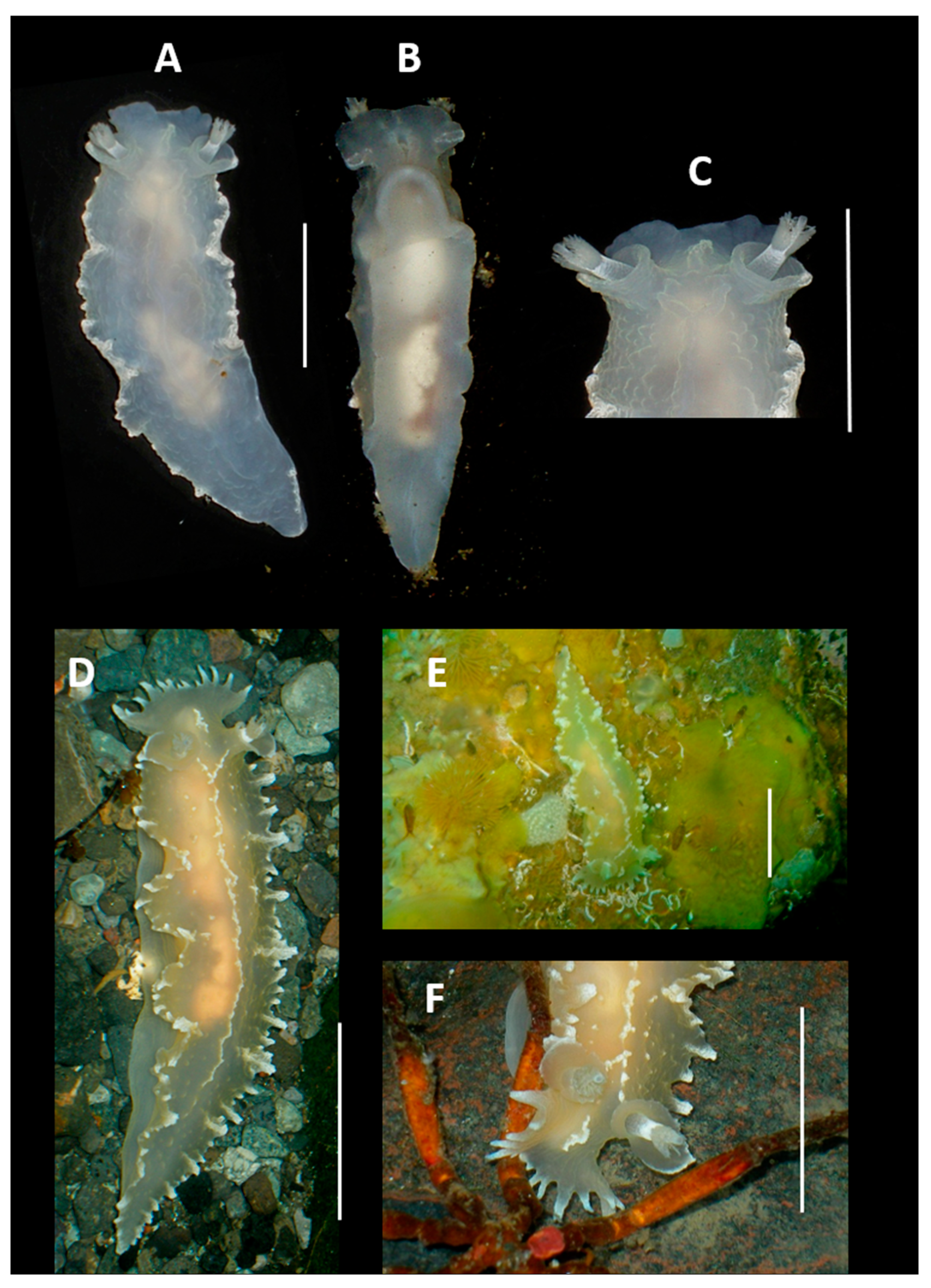
Plate 7.
Tritoniella belli, specimen from the Weddell Sea. A: dorsal view; B: ventral view; C: detail of the head and
rhinophores; Tritoniella schroriesi from King George Island. D and E: animal in its natural environment; F: detail
of the anterior area with the frontal veil and the rhinophores. Original photos by M. Ballesteros. Scale bars are
10 mm.
Plate 7.
Tritoniella belli, specimen from the Weddell Sea. A: dorsal view; B: ventral view; C: detail of the head and
rhinophores; Tritoniella schroriesi from King George Island. D and E: animal in its natural environment; F: detail
of the anterior area with the frontal veil and the rhinophores. Original photos by M. Ballesteros. Scale bars are
10 mm.

Austraeolis ornata (Angas, 1864).
Records: Tasmania, Australia (Burn, 2015; Grove, 2018).

Burnaia helicochorda (M. C. Miller, 1988)
Records: Tasmania, Australia (Burn, 2015; Grove, 2018).

Facelina hartleyi Burn, 1962
Records: Tasmania, Australia (Burn, 2015; Grove, 2018).
Facelina newcombi (Angas, 1864)
Records: Tasmania, Australia (Burn, 2015; Grove, 2018).

Jason mirabilis Miller, 1974
Records: South Island, New Zealand (Spencer et al., 2016).

Phidiana lottini (Lesson, 1831)
Records: Patagonia (Argentina, Forcelli, 2000; Chile, Linse, 1999; Schrödl, 2003, Schrödl et al., 2005).
Phidiana milleri Rudman, 1980
Records: South Island, New Zealand (Spencer et al., 2016).
Phidiana patagonica (A. d´Orbigny, 1836)
Records: Patagonia (d´Orbigny, 1835-1846; Rochebrune & Mabille, 1889; Linse, 1999).
Remarks: according to Schrödl (2003) the specimens illustrated by Forcelli (2000, pp. 130) are not Ph. patagonica but rather Flabellina falklandica (Eliot, 1907).

Coryphellina albomarginata (M. C. Miller, 1971)
Records: South Island, New Zealand (as Flabellina albomarginata) (Spencer et al., 2016).
Coryphellina rubrolineata O'Donoghue, 1929
Records: Tasmania, Australia (as Flabellina rubrolineata) (Burn, 2015; Grove, 2018; Maynard, 2014)
Coryphellina poenicia (Burn, 1957)
Records: Tasmania, Australia (Burn, 2015; Grove, 2018; as Flabellina poenicia)

Flabellina falklandica (Eliot, 1907)
Records: Patagonia (Linse, 1999; Argentina; Forcelli, 2000; Chile; Reid & Osorio, 2000; Schrödl, 2003; Aldea et al., 2011); Falkland Is. (Eliot, 1907b as Coryphella falklandica; Linse, 1999; Schrödl, 2003); South Georgia Is. (Powell, 1960; Schrödl, 2003; Zelaya, 2005); Shag Rocks (Linse, 1999); Crozet Is. (Odhner, 1926; Linse, 1999).

Notaeolidia depressa Eliot, 1905 (Plate 8 D)
Records: Bouvet Island (Arntz et al., 2006); Weddell Sea (Wägele, 1990a; Rauschert & Arntz, 2015; present work); Antarctic Peninsula (Wägele, 1990a); Ross Sea (Eliot,1907a; Hedley, 1916; Odhner, 1934, as N. robsoni Odhner, 1934; Brueggeman et al., 1999); Davis Sea, East Antarctica (Thiele, 1912, as Notaeolidia rufopicta Thiele, 1912; Minichev, 1972 as Notaeolidia alutacea Minichev, 1972 and Notaeolidia flava Minichev. 1972; Adelie Land, East Antarctica (Vicente & Arnaud, 1974, as N. robsoni Odhner, 1934).
Remarks: Wägele (1990a) performs an excellent and complete morphological and anatomical redescription of the species and synonymises other described species of Notaeolidia (N. rufopicta, N robsoni, N. subgigas Odhner, 1944, N. alutacea and N. flava) with N. depressa.
Notaeolidia gigas Eliot, 1905 (Plate 8 E)
Records: Wandel Is., Antarctic Peninsula (Vayssiére, 1906); South Sandwich Is. (Powell, 1951); South Orkney Islands (Eliot, 1905, as Notaeolidia purpurea Eliot, 1905; Barnes & Bullough, 1996); South Shetland Is. (Troncoso et al., 1999; present work); King George Is. (Wägele, 1990a; Troncoso et al., 1996; Schrödl et al., 2016); Weddell Sea (Eliot,1905); Ross Sea (Brueggeman et al., 1999).
Remarks: this species can reach 124 mm in length (personal observation).
Notaeolidia schmekelae Wägele, 1990
Records: Weddell Sea (Wägele, 1990a); Ross Sea (Brueggeman et al., 1999, as probably).
Remarks: this species can reach 135 mm in length (Wägele, 1990a).

Genus Phyllodesmium Ehrenberg, 1831
Phyllodesmium macphersonae (Burn, 1962).
Records: Tasmania, Australia (Burn, 2015; Grove, 2018).
Phyllodesmium serratum (Baba, 1949).
Records: Tasmania, Australia (Burn, 2015; Grove, 2018).

Glaucilla bennettae (Churchill, Á. Valdés & Ó Foighil, 2014)
Records: Tasmania, Australia (Grove, 2018 as Glaucus bennettae Churchill, Valdés & Foighil, 2014); northern Tasmania, Australia (Burn, 2015 as Glaucus marginatus (Reinhardt & Bergh, 1864).
Remarks: this pelagic species is frequently observed in beach wrack after storms (Burn, 2015). Churchill et al. (2014) study the anatomy and molecular structure of the “marginatus” morphospecies complex and conclude that only Glaucus atlanticus and the new species Glaucilla bennettae (described as Glaucus bennettae) are found in the South Pacific gyre, while Glaucilla marginata is limited to the North Pacific and Indian Oceans.

Glaucus atlanticus Forster, 1777
Records: Tasmania, Australia (Burn, 2015; Grove, 2018).
Remarks: this pelagic species is frequently observed in beach wrack after storms (Burn, 2015). It has a wide geographical distribution in tropical and subtropical waters of the Atlantic, Pacific and Indian Oceans. The pain caused by its “sting” is well known, as are the side effects that it causes due to its diet based on siphonophores such as the Portuguese man-of-war Physalia physalis (Linnaeus, 1758) and pelagic chondrophore hydroids such as Velella velella (Linnaeus, 1758) and Porpita porpita (Linnaeus, 1758), all of them with stings, especially Ph. physalis, which the nudibranch itself incorporates and which it can use for its own defense or attack.

Fiona pinnata (Eschscholtz, 1831).
Records: Tasmania, Australia (Burn, 2015; Grove, 2018); South Island and Chatham Islands, New Zealand (Spencer et al., 2016).

Tularia bractea (Burn, 1962).
Records: Tasmania, Australia (Burn, 2015; Grove, 2018).

Eubranchus adarensis Odhner, 1934
Records: Adare Cape, Ross Sea (Odhner, 1934); Adelie Land (Vicente & Arnaud, 1974).
Eubranchus agrius Er. Marcus, 1959
Records: New Zealand (Powell, 1979); Patagonia (Linse, 1999; Forcelli, 2000).
Remarks: Forcelli (2000) indicates that it is very uncommon in the Magellanic Province.
Eubranchus arnaudi Vicente, 1973
Records: Kerguelen Is. (Vicente, 1973)
Remarks: After its description this species has not been recorded again.
Eubranchus falklandicus (Eliot, 1907)
Records: Falkland Is. (Eliot, 1907b as Galvina falklandica Eliot, 1907; Powell, 1951).
Eubranchus fuegiensis Odhner, 1926
Records: Patagonia (Odhner, 1926; Linse, 1999; Schrödl, 2003).
Eubranchus glacialis (Thiele, 1912) (Plate 8 C)
Records: South Shetland Is. (present work, 1 animal 9 mm length collected in Bentart 2006 expedition); Ross Sea (Valdés et al., 2012); Davis Sea (Thiele, 1912, as Galvinella glacialis).
Remarks: E. glacialis is a very poorly known species that has been reported as distant as the Davis Sea (East Antarctica), the Ross Sea and the South Shetlands (West Antarctica). A specimen captured in the South Shetlands considerably widens the distribution of the species in Antarctic waters.
Eubranchus rubeolus Burn, 1964.
Records: South Island, New Zealand (Burn, 2015; Spencer et al., 2016)

Galvinella antarctica Eliot, 1907
Records: Kapp Norvegia, Eastern Weddell Sea (SOMBASE, 2024, as Amphorina antarctica); Ross Sea (Eliot, 1907a).
Remarks: This species is only known from the 20 mm animal of the original description in 1907 and from the SOMBASE record from 1996. WoRMS considered it as taxon inquirendum.

Cuthona antarctica (Pfeffer, 1886)
Records: South Georgia Is. (Martens & Pfeffer, 1886, as Aeolis antarctica).
Remarks: This species has not been recorded again after its original description.
Cuthona claviformis Vicente, 1973
Records: Adelia Land, East Antarctica (Vicente & Arnaud, 1974).
Remarks: This species has not been recorded again after its original description.
Cuthona crinita Minichev, 1972 (Plate 8 A)
Records: Bouvet Island (Odhner, 1934, as Cuthona schraderi var. bouvetensis Odhner, 1944; Arntz et al. 2006, as Cuthona sp.); Weddell Sea (present work, one animal of 9 mm long collected at 228 m depth); Ross Sea (Valdés et al., 2012); Queen Mary Land, East Antarctica (Minichev, 1972).
Remarks: this species can mesure up to 45 mm length preserved (Minichev, 1972).
Cuthona georgiana (Pfeffer, 1886)
Records: Patagonia (Linse, 1999; Forcelli, 2000; Schrödl, 2003); South Georgia (Pfeffer in Martens & Pfeffer, 1886, as Aeolis georgiana; Powell, 1951); Kerguelen Is. (Thiele, 1912, as Cratena exigua Thiele, 1912; Linse, 1999; Powell, 1960, as Cratena exigua Thiele, 1912); Ross Sea (Cattaneo-Vietti, 1991; Linse, 1999; Cattaneo-Vietti et al. 2000; Schiaparelli & Linse, 2014); David Sea, East Antarctica (Minichev, 1972).
Remarks: Minichev (1972) describes C. georgiana longipapillata from the Davis Sea, which up to now has not been recorded elsewhere for Antarctic waters.
Cuthona giarannae Á. Valdés, Moran & H. A. Woods, 2012
Records: Ross Sea (Valdés et al., 2012).
Remarks: this species (preserved animals) can reach up to 8 mm long (Valdés et al., 2012).
Cuthona odhneri Er. Marcus, 1959
Records: Patagonia (Linse, 1999; Schrödl, 2003).
Cuthona paucicirra Minichev, 1972
Records: Davis Sea, East Antarctica (Minichev, 1972).
Cuthona valentini (Eliot, 1907)
Records: Patagonia (Linse, 1999; Forcelli, 2000; Schrödl, 2003); Falkland Is. (Eliot, 1907b; Powell, 1951; Linse, 1999; Schrödl, 2003).
Remarks: this species has been recorded as Cratena valentini, Tergipes valentini or Catriona valentini. Schrödl (1999b) transferred the “valentini” species to the genus Cuthona due to the short radula and the angular tooth shape.

Cuthonella elioti (Odhner, 1944)
Records: Ross Sea (Eliot, 1907a as Cuthonella antartica Eliot, 1907; Valdés et al., 2012).
Remarks: for the nomenclature of this species, described by Eliot (1907a), see Valdés et al. (2012).
Cuthonella modesta Eliot, 1907 (Plate 8 B )
Records: South Shetland Is. (present work, 1 animal of 12 mm alive collected in Bentart 2006 expedition); Ross Sea (Eliot, 1907a; Valdés et al., 2012).
Family Murmaniidae Korshunova, Martynov, Bakken, Evertsen, Fletcher, Mudianta, Saito, Lundin,

Guyvalvoria francaisi Vayssière, 1906
Records: Wandel Is., Antarctic Peninsula (Vayssiére, 1906a).
Remarks: this species has not been recorded after its description.
Guyvalvoria gruzovi Martynov, 2006
Records: Amery Ice Shelf, Davis Sea (Martynov, 2006).
Remarks: this species has not been recorded after its description.
Guyvalvoria paradoxa (Eliot, 1907)
Records: South Georgia Is. (Pfeffer in Martens & Pfeffer, 1886, as Aeolis schraderi); Ross Sea (Eliot, 1907a as Cuthonella paradoxa; Valdés et al., 2012).
Remarks: the species Cuthona schraderi (Pfeffer, 1886) is recorded in WoRMS as nomen dubium and Valdés et al. (2012) state that the description and redescription (Odhner, 1934) of C. schraderi display many similarities to specimens that they studied as Guyvalvoria paradoxa, an opinion that we follow here. The eggs masses of this species are laid on the giant solitary hydroids Corymorpha microrhiza (Hickson & Gravely, 1907) or Zyzzyzus parvula (Hickson & Gravely, 1907) (Valdés et al., 2012), which are probably the food of the adults.
Guyvalvoria savinkini Martynov, 2006
Records: Kerguelen Is. (Martynov, 2006).
Remarks: this species has not been recorded after its description.
Plate 8.
A: Cuthona crinita, specimen from the Weddell Sea; B: Cuthonella modesta, specimen from South Shetland;
C: Eubranchus glacialis, specimen from South Shetland; D: two specimens of Notaeolidia depressa from the Weddell Sea, the brown hepatic branches that extend into the cerata are clearly visible; E: Notaeolidia gigas from South
Shetland. Original photos by M. Ballesteros. Scale bars are 10 mm.
Plate 8.
A: Cuthona crinita, specimen from the Weddell Sea; B: Cuthonella modesta, specimen from South Shetland;
C: Eubranchus glacialis, specimen from South Shetland; D: two specimens of Notaeolidia depressa from the Weddell Sea, the brown hepatic branches that extend into the cerata are clearly visible; E: Notaeolidia gigas from South
Shetland. Original photos by M. Ballesteros. Scale bars are 10 mm.
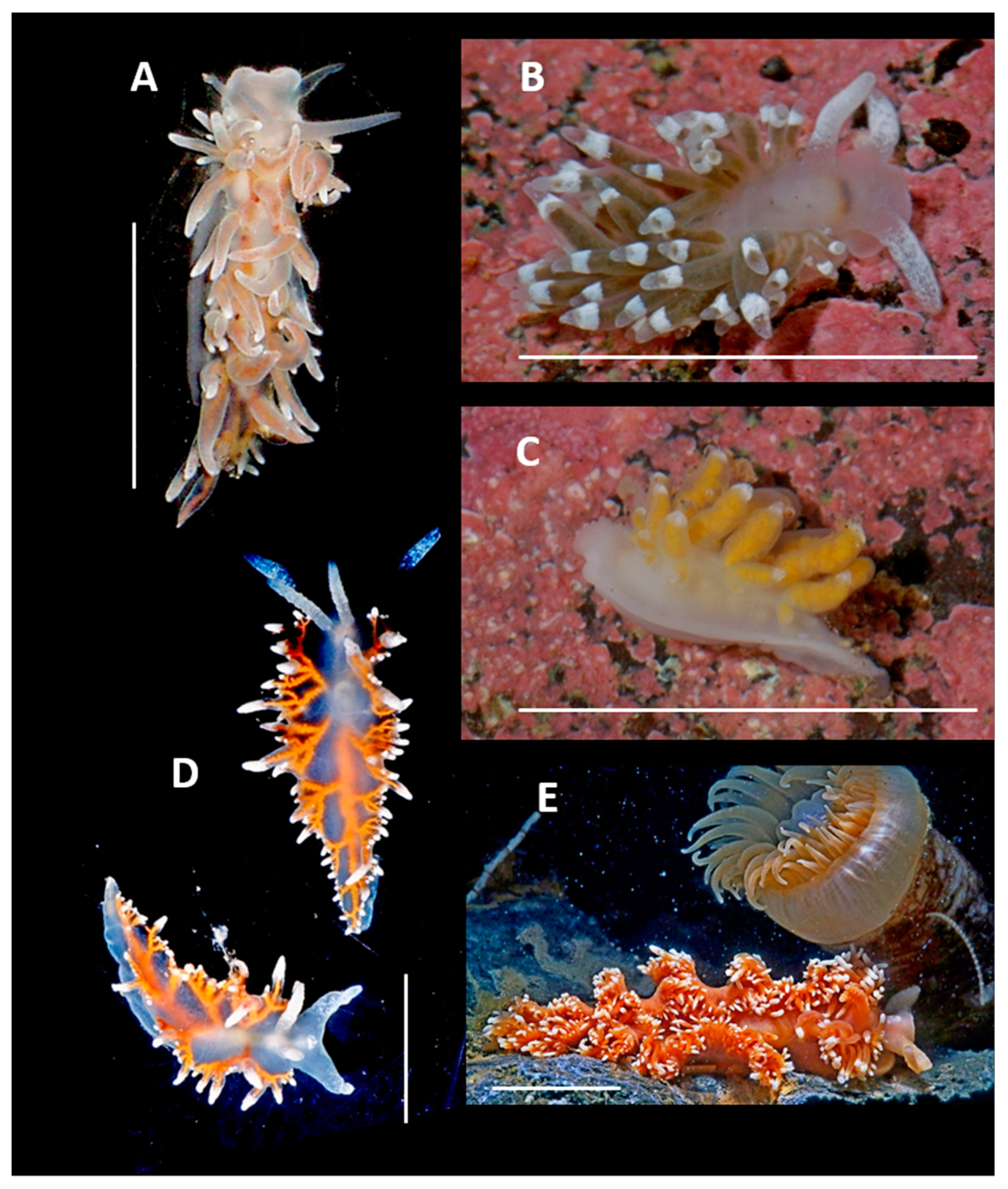

Tergipes antarcticus Pelseneer, 1903
Records: Weddell Sea (Kiko et al., 2008); Charcot Island, Bellingshausen Sea, West Antarctica (Pelseneer, 1903); East Antarctica (Kiko et al., 2008).
Remarks: this unique nudibranch species develops all its vital phases in ice, adult, egg masses, larva and juveniles (Kiko et al., 2008).

Trinchesia macquariensis Burn, 1973
Records: Macquarie Is. (Burn, 1973).
Trinchesia reflexa (M. C. Miller, 1977)
Records: South Island, New Zealand (Spencer et al., 2016).
Trinchesia sororum Burn, 1964
Records: Tasmania, Australia (Grove, 2018).
Trinchesia viridiana (Burn, 1962)
Records: Tasmania, Australia (Burn, 2015; Grove, 2018).
Trinchesia zelandica (Odhner, 1924)
Records: Subantarctic islands of New Zealand (Spencer et al., 2016).

Tylodina corticalis (Tate, 1889)
Records: Tasmania, Australia (Burn 2015; Grove, 2018;)

Umbraculum umbraculum ([Lightfoot], 1786)
Records: Tasmania, Australia (Burn 2015; Grove, 2018;)
Remarks: This species has a long list of synonyms due to its wide geographical distribution on both shores of the Atlantic, the Indian Ocean, the Pacific and the Mediterranean. Due to this wide geographical distribution, some authors have suggested (Arias & Crocetta, 2016) that U. umbraculum could be a species complex, Molecular studies using individuals from multiple locations are necessary to clarify its taxonomic status.

Aplysia argus Rüppell & Leuckart, 1830
Records: Northern and eastern Tasmania, Australia (Burn, 2015; Grove, 2018; Nimbs et al., 2017).
Aplysia concava G. B. Sowerby I, 1833
Records: Northern and eastern Tasmania, Australia (Burn 2015, as Aplysia parvula Mörch, 1863; Grove, 2018, as Aplysia parvula) (Nimbs, 2021; Nimbs & Wilson, 2021); South Island, New Zealand (Spencer, Willan, Marshall, & Murray, 2016)
Remarks: until the review of the Aplysia parvula species complex by Golestani et al. (2019), Aplysia concava had been considered a morphotype of A. parvula.
Aplysia extraordinaria (J. K. Allan, 1932)
Records: Northern and eastern Tasmania, Australia (Burn, 2015; Nimbs et al, 2017; Grove, 2018)
Aplysia keraudreni Rang, 1828
Records: South Island, New Zealand (Spencer et al., 2016)
Aplysia juliana Quoy & Gaimard, 1832
Records: Tasmania, Australia (Burn, 2015; Grove, 2018; Nimbs, et al., 2017); South Island, New Zealand (Spencer et al., 2016)
Aplysia sydneyensis G. B. Sowerby I, 1869
Records: Tasmania, Australia (Burn, 2015; Grove, 2018; Nimbs, et al., 2017)

Noalda exigua (Hedley, 1912)
Records: Tasmania, Australia (Grove, 2018; Burn 2015)

Bulla quoyii J. E. Gray, 1843
Records: Northern Tasmania, Australia (Grove, 2018); South Island, New Zealand (Spencer et al., 2016).

Relichna murdochi (Suter, 1913)
Records: Chatham Islands, New Zealand (Spencer et al., 2016)
Relichna pachys (R. B. Watson, 1883)
Records: South Island and Chatham Islands, New Zealand (Spencer et al., 2016)

Retusa amphizosta (R. B. Watson, 1886)
Records: Tasmania, Australia (Grove, 2018)
Retusa atkinsoni (Tenison Woods, 1876)
Records: Northern and eastern Tasmania, Australia (Grove, 2018)
Retusa opima (H. J. Finlay, 1926)
Records: South Island, New Zealand (Spencer et al., 2016)
Retusa oruaensis (W. H. Webster, 1908)
Records: South Island and Chatham Islands, New Zealand (Spencer et al., 2016)
Retusa pelyx Burn in Burn & Bell, 1974
Records: Northern and eastern Tasmania, Australia (Burn, 2015; Grove, 2018;)
Retusa protumida (Hedley, 1903)
Records: Tasmania, Australia (Grove, 2018)
Retusa pygmaea (A. Adams, 1850)
Records: Tasmania, Australia (Grove, 2018)
Retusa sculpta (Gatliff & Gabriel, 1913)
Records: Tasmania, Australia (Burn, 2006)
Remarks: this species, of which very few specimens are known and initially described as a subspecies of Retusa pygmaea, is considered enigmatic by Burn (2006).
Retusa striata (F. W. Hutton, 1873)
Records: South Island and Chatham Islands, New Zealand; subantarctic islands of New Zealand (Spencer et al., 2016).

Volvulella nesentus (H. J. Finlay, 1926)
Records: South Island, New Zealand (Spencer et al., 2016).
Volvulella rostrata (A. Adams, 1850)
Records: Northern and eastern Tasmania, Australia (Grove, 2018)
Volvulella tragula (Hedley, 1903)
Records: Tasmania, Australia (Grove, 2018).
Volvulella truncata Dell, 1956
Records: South Island and Chatham Islands, New Zealand (Spencer et al., 2016).

Acteocina apicina (A. Gould, 1859)
Records: Northern and eastern Tasmania, Australia (Grove, 2018).
Acteocina excerta (Hedley, 1903).
Records: Northern and eastern Tasmania, Australia (Grove, 2018).
Acteocina cf. hacketti (Cotton & Godfrey, 1933)
Records: Northern Tasmania, Australia (Grove, 2018).

Cylichna bulloidea Dell, 1956
Records: South Island, New Zealand (Spencer et al., 2016)
Cylichna cumberlandiana (Strebel, 1908)
Records: Patagonia (Linse, 1999; Forcelli, 2000); South Georgia Is. (Strebel, 1908; Powell, 1951; Linse, 1999; Zelaya, 2005).
Cylichna gelida (E. A. Smith, 1907)
Records: Antarctic Polar Front (Jörger et al., 2014, as cf.); Weddell Sea (Engl, 2012); Elephant Is. (Engl, 2012); Decepcion Is., South Shetland Is. (Orrel, 2024); Ross Sea (Smith, 1907; Schiaparelli et al., 2006; Ghiglione et al., 2013); Davis Sea (Thiele, 1912).
Cylichna georgiana (Strebel, 1908)
Records: Patagonia (Argentina; Castellanos et al., 1987b; Bastida et al, 1992; Linse, 1999; Forcelli, 2000; Chile, Tierra del Fuego, SOMBASE, 2024); Falkland Is. (Bakker et al., 2024) South Georgia Is. (Strebel, 1908; Powell, 1951; Linse, 1999; Zelaya, 2005); Antarctic Polar Front (Jörger et al., 2014, as cf,); Kapp Norvegia, Weddell Sea (Gutt et al. 2000).
Cylichna zealandica T. W. Kirk, 1880
Records: South Island, New Zealand (Spencer et al., 2009)

Toledonia biplicata (Strebel, 1908)
Records: Patagonia (Linse, 1999; Argentina, Forcelli, 2000; Chile, Cárdenas et al., 2008, Aldea et al., 2011); Falkland Is. (Strebel, 1908; Linse, 1999).
Remarks: in all cases recorded as Acteon biplicatus (Strebel, 1908).
Toledonia brevior Eales, 1923
Records: Ross Sea (MolluscaBase eds., 2025c).
Toledonia bullata (A. Gould, 1847)
Records: Patagonia (Gould, 1847, as Tornatella bullata; Rochebrune & Mabille, 1889, as Tornatella bullata; Castellanos et al., 1987b; Forcelli, 2000, as Acteon bullatus); Falkland Is. (Powell, 1951, as Acteon bullatus).
Toledonia circumrosa (Thiele, 1904)
Records: Kerguelen Is. (MolluscaBase eds., 2025d).
Toledonia elata Thiele, 1912
Records: Marion & Prince Edward Is. (Branch et al., 1991; Kerguelen Is. (Thiele, 1912; Troncoso et al., 2001); Weddell Sea (Engl, 2012); South Shetland Is. (Engl, 2012); Bransfield Strait (Engl, 2012); Amundsen Sea (Moreau et al., 2013, as cf.); Ross Sea (Ghiglione et al., 2013); Enderby Land, East Antartica (Powell, 1958).
Toledonia globosa Hedley, 1916
Records: Weddell Sea (Engl, 2012); Adelie Land (Hedley, 1916; Vicente & Arnaud, 1974; Dell, 1990; Ghiglione et al., 2013); Enderby Land, East Antarctica (Powell, 1951); Ross Sea (Powell, 1951).
Toledonia limnaeaeformis (E. A. Smith, 1879)
Records: Patagonia (Linse, 1999; Argentina, Castellanos et al., 1987a; Forcelli, 2000); Budwood Bank, Falkland Is. (SOMBASE, 2024), Marion & Prince Edward Is. (Branch et al., 1991; Kerguelen Is. (Smith, 1879, as Admete limnaeformis E. A Smith, 1877; Thiele, 1912; Linse, 1999); Bouvet Is. (Linse, 2006, as cf.); Antarctic Peninsula (Bouchet, 2010); Ross Sea (Linse, 1999; Ghiglione et al., 2013).
Toledonia major (Hedley, 1911)
Records: South Sandwich Is. (Dell, 1990); South Shetland Is. (Powell, 1951; Dell, 1990); Weddell Sea (Hain, 1990, as Toledonia cf. hedleyi A. W. B. Powell, 1958); Ross Sea (Hedley, 1916; Schiaparelli et al., 2006; Ghiglione et al., 2013); Adelie Land (Powell, 1958 as T. hedleyi A. W. B. Powell, 1958; Vicente & Arnaud, 1974); Davis Sea, East Antarctica (Thiele, 1912; Eales, 1923; Minichev, 1972).
Toledonia media Thiele, 1912
Records: Kerguelen Is. (Thiele, 1912; Dell, 1990).
Toledonia palmeri Dell, 1990
Records: Antarctic Peninsula (Thiele, 1912; Dell, 1990); Ross Sea (Ghiglione et al., 2013; Schiaparelli et al., 2014).
Toledonia parelata Dell, 1990
Records: Patagonia (Linse, 1999); Magellan Strait and Beagle Channel (Dell, 1990; Rosenfeld & Aldea, 2011); Eastern Weddell Sea (SOMBASE, 2024).
Toledonia perplexa Dall, 1902
Records: Magellan Strait (Dall, 1902; Dell, 1990); Patagonia (Linse, 1999; Aldea et al., 2011); Falkland Is. (Powell, 1951; Linse, 1999); Ross Sea (Schiaparelli et al., 2006, as aff.; Ghiglione et al., 2013 recorded as cf.; Schiaparelli et al. 2014, as cf.).
Toledonia punctata Thiele, 1912
Records: Patagonia, Tierra del Fuego (Dell, 1990; Linse, 1999); Burdwood Bank, Falklans Is. (SOMBASE, 2024); Antarctic Polar Front (Jörger et al., 2014); South Georgia Is. (Powell, 1951; Dell, 1990; Linse, 1999; Zelaya, 2005); Kerguelen Is. (Thiele, 1912; Dell, 1990; Linse, 1999); Ross Sea (Dell, 1990; Linse, 1999; Ghiglione et al., 2013).
Toledonia striata Thiele, 1912
Records: Antarctic Polar Front (Jörger et al., 2014); Bransfield Strait (Engl, 2012); Weddell Sea (Engl, 2012); Ross Sea (Dell, 1990; Schiaparelli et al., 2006; Ghiglione et al., 2013); Davis Sea (Thiele, 1912).
Toledonia succineaformis A. W. B. Powell, 1955
Records: South Island, New Zealand; subantarctic islands of New Zealand (Dell, 1990; Spencer et al., 2016).

Mnestia arachis (Quoy & Gaimard, 1833)
Records: Northern and Eastern Tasmania, Australia (Grove, 2018, as Adamnestia arachis (Quoy & Gaimard, 1833)

Diaphana anderssoni (Strebel, 1908)
Records: South Georgia (Strebel, 1908; Powell, 1951, as Retusa anderssoni Strebel, 1908; Linse & Schiotte, 2002).
Diaphana brazieri Angas, 1877
Range: Tasmania, Australia (Grove, 2018).
Diaphana haini K. Linse & Schiotte, 2002
Records: South Scotia Ridge (Engl, 2012); Weddell Sea (Linse & Schiotte, 2002); Antarctic Polar Front (Jörger et al., 2014, as cf.).
Diaphana inflata (Strebel, 1908)
Records: South Georgia (Strebel, 1908; Linse & Schiotte, 2002); South Scotia Ridge (Engl, 2012); Bouvet Is. (Linse, 2006, as cf.); North South Shetland Is, (Linse et al., 2002, as cf.); Antarctic Polar Front (Jörger et al., 2014); Weddell Sea (Linse & Schiotte, 2002).
Diaphana paessleri (Strebel, 1905)
Records: Patagonia (Strebel, 1905, as Tornatina (Utriculus) paessleri Strebel, 1905; Linse, 1999; Argentina (Forcelli, 2000); Falkland Is. (Powell, 1951; Linse, 1999; Linse & Schiotte, 2002); South Georgia (Strebel, 1908; Linse & Schiotte, 2002; Zelaya, 2005); South Orkney Is. (Melvill & Standen, 1912, as Retusa antarctica Melville & Standen, 1912; Powell, 1951, as Retusa antarctica Melville & Standen, 1912; Linse & Schiotte, 2002); Marion & Prince Edward Is. (Branch et al., 1991, as Diaphana kerguelensis Thiele, 1912); Kerguelen Is. (Thiele, 1912, as Diaphana kerguelensis Thiele, 1912); Weddell Sea (Linse & Schiotte, 2002; Engl, 2012); South Shetland Is. (Engl, 2012); Ross Sea (Powell, 1960, as Retusa frigida Hedley, 1916; Dell, 1990, as Retusa frigida Hedley, 1916; Linse & Schiotte, 2002; Ghiglione et al., 2013); Davis Sea (Thiele, 1912, as Diaphana extrema Thiele, 1912).
Diaphana pfefferi (Strebel, 1908)
Records: South Georgia (Strebel, 1908; Powell, 1951; Linse & Schiotte, 2002; Zelaya, 2005).
Diaphana tasmanica (C. E. Beddome, 1883)
Records: Tasmania, Australia (Burn, 2015; Grove, 2018).

Aliculastrum tumidum (Burn, 1978)
Records: Northern and eastern Tasmania (Burn, 2015; Grove, 2018, as Nipponatys tumidus Burn, 1978).

Cylichnatys campanula Burn, 1978
Records: Northern and eastern Tasmania (Burn, 2015; Grove, 2018).

Papawera maugeansis (Burn, 1966)
Records: Tasmania, Australia (Burn, 2015; Grove, 2018; as Haminoea maugeansis Burn, 1966).
Papawera zelandiae (J. E. Gray, 1843)
Records: South Island, New Zealand (Spencer et al., 2016, as Haminoea zelandiae (J. E. Gray, 1843).

Roxaniella exigua (A. Adams, 1850)
Records: Tasmania, Australia (Burn, 2015, as Austrocylichna exigua (A. Adams, 1850).

Liloa brevis (Quoy & Gaimard, 1833).
Records: Northern and eastern Tasmania (Burn, 2015; Grove, 2018).

Newnesia antarctica E.A. Smith, 1902 (Plate 1 E)
Records: South Georgia (Zelaya, 2005); South Scotia Ridge (Engl, 2012); South Orkney Is. (Carcelles, 1953); Weddell Sea (Hedley, 1916; Hain, 1990; Schiaparelli et al., 2006; Engl, 2012); Antarctic Peninsula (Strebel, 1908, as Anderssonia sphinx Strebel, 1908; Aldea & Troncoso, 2008); Neumayer Channel, West Antarctica (Vayssière, 1917); South Shetland Is. (SOMBASE; this work); Ross Sea (Smith, 1902; Dell, 1990); Adelie Land (Hedley, 1916); Davis Sea (Minichev, 1972; Dell, 1990).
Remarks: Vayssière (1917) carried out a complete anatomical study of this species.
Newnesia abyssalis Moles, C. Àvila & Malaquias, 2017
Records: Drake Passage (North South Shetlands Is.) (Moles et al., 2017a).
Remarks: as indicated by its specific name this species occurs at great depth.

Hocius joani (Moles, Wägele, Schrödl & C. Àvila, 2017) (Plate 1 F)
Records: North South Shetlands Is. (Moles et al., 2017c); Weddell Sea (Rauschert & Arntz, 2015, as Newnesia sp.; this work).
Remarks: initially described as Newnesia joani (Moles et al., 2017c). It differs from the type of the genus Newnesia because it has an internal rather than an external shell.


Melanochlamys cylindrica Cheeseman, 1881
Records: South Island, New Zealand (Spencer et al., 2016)
Melanochlamys handrecki Burn, 2010
Records: Tasmania, Australia (Grove, 2015)
Melanochlamys lorrainae (Rudman, 1968)
Records: South Island, New Zealand (Spencer et al., 2016)
Melanochlamys queritor (Burn, 1957)
Records: Tasmania, Australia (Grove, 2015)

Philinopsis gigliolii (Tapparone Canefri, 1874)
Records: Tasmania, Australia (Grove, 2015, as Philinopsis taronga J. K. Allan, 1933)
Remarks: Recently, Chaban et al. (2024) studied by molecular methods specimens of P. gigliolii from the coasts of Japan and specimens attributed to Ph. taronga from Australia. They conclude that the latter species is synonymous with Ph. gigliolii. This species has an unusual antitropical distribution in temperate and subtropical waters of both hemispheres.

Sagaminopteron ornatum Tokioka & Baba, 1964
Records: Tasmania, Australia (Grove, 2018).

Antarctophiline abyssalis Peralta-Serrano, Schrödl, N. G. Wilson & Moles, 2025
Records: South Atlantic Ridge between South Sandwich Is. to Bouvel Is. (Peralta-Serrano et al., 2025)
Remarks: this new species is described based on six specimens collected between 2892-4547 m depth.
Antarctophiline alata (Thiele, 1912) (Plate 1 C, D)
Records: Patagonia (Argentina, Forcelli, 2000); South Sandwich Is. (Powell, 1951); South Orkney Is. (Powell, 1951); Kerguelen Is. (Thiele, 1912, as Philine amoena Thiele, 1925; Troncoso et al., 2001, as Philine cf. amoena Thiele, 1925); Bouvet Island (Arntz et al., 2006); Weddell Sea (Hain, 1990; Engl, 2012, this work); South Shetland Is. (Powell, 1951; Troncoso et al., 1996; Troncoso et al., 1999; Arnaud et al., 2001; Aldea & Troncoso, 2008; Engl, 2012; this work); Palmer Archipelago (Powell, 1951); Bellingshausen Sea (Aldea et al., 2008; Aldea et al., 2009; Aldea & Troncoso, 2010); Ross Sea (Ghiglione et al., 2013; Schiaparelli et al., 2014); Enderby Land (Powell, 1958);.Adelie Land (Vicente & Arnaud, 1974); Davis Sea, East Antarctica (Thiele, 1912);
Remarks: this species was recorded under Philine. Based on differences in penial and gizzard plate morphology Chaban (2016) established the new genus Antarctophiline, which includes alata and gibba species and the recently described easmithi and amundseni. Based on morphological and molecular data, Moles et al. (2019), erected the new family Antarctophlinidae to include most of the Philinoidea species from the Southern Ocean, including those mentioned above.
Antarctophiline amundseni Moles, C. Àvila & Malaquias, 2019
Records: Eastern Weddell Sea (Moles et al., 2019).
Remarks: lives at depths between 736 and 910 m deep (Moles et al., 2019).
Antarctophiline apertissima (E. A. Smith, 1902)
Records: Antarctic Polar Front (Jörger et al., 2014, as cf,); Ross Sea (Smith, 1902; Powell, 1960; Dell, 1990; Cattaneo-Vietti et al., 2000).
Remarks: Until the revision of the Antarctic Philinoidea (Moles et al., 2019) this species was included within the genus Philine.
Antarctophiline easmithi Moles, C. Àvila & Malaquias, 2019
Records: Eastern Weddell Sea (Moles et al., 2019).
Remarks: known so far living in depths between 173 and 463 m deep (Moles et al., 2019).
Antarctophiline falklandica (A. W. B.Powell, 1951)
Records: Patagonia (Linse, 1999; Argentina, Castellanos et al., 1987b; Forcelli, 2000); Falkland Is. (Powell, 1951; Linse, 1999)
Remarks: Until the revision of the Antarctic Philinoidea (Moles et al., 2019) this species was included within the genus Philine.
Antarctophiline gibba (Strebel, 1908)
Records: South Georgia Is. (Strebel, 1908; Powell, 1951; Carcelles, 1953; Seager, 1978; Zelaya, 2005); South Orkney (Doello-Jurado, 1918); Eastern Weddell Sea (SOMBASE, 2024); East Antarctica (Chaban, 2016); Ross Sea (Chaban, 2016).
Remarks: as for A. alata. A. gibba is the type species of the new genus Antarctophiline. Chaban (2016) found this species to be very abundant in Prydz Bay (East Antarctica) on muddy bottoms between 5 and 37 m deep, accounting for 5-40 individuals per square meter.
Antarctophiline malaquiasi Peralta-Serrano, Schrödl, N. G. Wilson & Moles, 2025
Records: Bransfield Strait, West Antarctica (Peralta-Serrano et al., 2025)
Remarks: this new species is described based on two specimens collected between 150-247 m depth.

Waegelea antarctica (E. A. Smith, 1902)
Records: Weddell Sea (Moles et al., 2019); Ross Sea (Smith, 1902; Powell, 1960; Cattaneo-Vietti et al, 2000; Ghiglione et al., 2017).
Remarks: Until the revision of the Antarctic Philinoidea (Moles et al., 2019) this species was included within the genus Philine.

Philine angasi (Crosse, 1865)
Records: Tasmania, Australia (Grove, 2018); South Island, New Zealand (Spencer et al., 2016).
Philine auriformis Suter, 1909
Records: Tasmania, Australia (Grove, 2018); South Island, New Zealand (Spencer et al., 2016).
Philine beachportensis Verco, 1909
Records: Tasmania, Australia (Grove, 2018).
Philine columnaria Hedley & May, 1908
Records: Tasmania, Australia (Grove, 2018).
Philine constricta Murdoch & Suter, 1906.
Records: South Island & Chatham Islands, New Zealand (Spencer et al., 2016).
Philine powelli Rudman, 1970.
Records: South Island, New Zealand (Spencer et al., 2016).
Philine teres Hedley, 1903.
Records: Tasmania, Australia (Grove, 2018).
Philine umbilicata Murdoch & Suter, 1906.
Records: South Island & Chatham Islands, New Zealand (Spencer et al., 2016).

Praephiline thurmanni (Ev. Marcus & Er. Marcus, 1969)
Records: Patagonia (Argentina; Forcelli, 2000; Price et al., 2011).
Remarks: this species has been recorded as Philine thurmanni Ev. Marcus & Er. Marcus, 1969 and Laona thurmanni (Ev. Marcus & Er. Marcus, 1969).

Spiraphiline bathyalis Moles, C. Àvila & Malaquias, 2019
Records: Eastern Weddell Sea (Moles et al., 2019).
Remarks: its specific name indicates the great depth (2004 m) in which the only specimen that served to describe the species was found.
Spiraphiline kerguelensis (Thiele, 1925)
Records: Falkland Is. (Powell, 1960); Kerguelen Is. (Powell, 1951); Kapp Norvegia, Eastern Weddell Sea (SOMBASE, 2024).
Remarks: Until the revision of the Antarctic Philinoidea (Moles et al., 2019) this species was included within the genus Philine.

Kaitoa scaphandroides A. W. B.Powell, 1951
Records: South Georgia Is. (Powell, 1951; Carcelles, 1953; Zelaya, 2005).

Scaphander illecebrosus Iredale, 1925.
Records: Tasmania, Australia (Grove, 2018).
Scaphander interruptus Dall, 1889
Records: Patagonia (Argentina, Forcelli, 2000; Chile, Valdés & McLean, 2015).
Scaphander otagoensis Montfort, 1810.
Records: South Island, New Zealand (Spencer et al., 2016).

Runcina australis Burn, 1963
Records: Northern Tasmania, Australia (Grove, 2018).
Runcina katipoides (M. C. Miller & Rudman, 1968).
Records: South Island, New Zealand (Spencer et al., 2016).

Cavolinia gibbosa (A. d'Orbigny, 1836).
Records: South Island, New Zealand (Spencer et al., 2016).
Cavolinia inflexa (Lesueur, 1813)
Records: South Island, New Zealand (Spencer et al., 2016).
Cavolinia tridentata (Forsskål, 1775)
Records: South Island, Chatham Islands and subantarctic islands of New Zealand (Spencer et al., 2016).
Cavolinia uncinata (A. d´Orbigny, 1835)
Records: South Island, New Zealand (Spencer et al., 2016).

Diacavolinia longirostris (Blainville, 18212)
Records: West Antarctica (Powell, 1960)

Diacria trispinosa (Blainville, 1821)
Records: South Island, Chatham Islands and subantarctic islands of New Zealand (Spencer et al., 2016).

Clio recurva Children, 1823
Records: Antarctic Peninsula, Weddell Sea, East Antarctica (Australian Antarctic Data Centre, 2024, as Clio balantium Rang, 1834)
Clio chapalii Gray, 1950
Records: Antarctic Peninsula, Weddell Sea, East Antarctica (Australian Antarctic Data Centre, 2024)
Clio cuspidata (Bosc, 1802)
Records: South Island and Chatham Islands, New Zealand (Spencer et al., 2016).
Clio piatkowskii van der Spoel, Schalk & Bleker, 1992
Records: Weddell Sea (Van der Spoel et al., 1992); Lazarev Sea (Hunt et al., 2008).
Clio pyramidata Linnaeus, 1767
Records: Patagonia (Argentina, Forcelli, 2000; Dadon & Chauvin, 1998); Falkland Is. (Dadon & Chauvin, 1998); South Georgia Is. (Powell, 1960 as Clio sulcata (Pfeffer, 1879); Hunt et al., 2008); South Sandwich Is. (Powell, 1951, as Cleodora sulcata Pfeffer, 1879); Prince Edward Is. (Hunt et al., 2008); Lazarev Sea (Hunt et al., 2008); Weddell Sea (Würzberg et al., 2009); Antarctic Peninsula (Hunt et al., 2008); Amundsen Sea (Moreau et al., 2013); Ross Sea (Hunt et al., 2008); East Antarctica (Hunt et al., 2008).
Remarks: most records as Clio antarctica Dall, 1908.

Hyalocylis striata (Rang, 1828)
Records: South Island and Chatham Islands, New Zealand (Spencer et al., 2016); West Antarctica (Powell, 1960).

Creseis acicula (Rang, 1828)
Records: South Island, New Zealand (Spencer et al., 2016).
Remarks: frequently recorded as Creseis clava (Rang, 1828).
Creseis conica Eschscholtz, 1829
Records: South Island, New Zealand (Spencer et al., 2016).
Remarks: in WoRMS as uncertain/taxon inquirendum.

Styliola subula (Quoy & Gaimard, 1827)
Records: South Island and Chatham Islands, New Zealand (Spencer et al., 2016).

Cuvierina columnella (Rang, 1827)
Records: South Island, New Zealand (Spencer et al., 2016).

Limacina bulimoides (A. d'Orbigny, 1836)
Records: South Island and Chatham Islands, New Zealand (Spencer et al., 2016).
Limacina costulata Preston, 1916
Records: South Shetland Is. (Powell, 1951).
Remarks: this species is recorded in WoRMS as uncertain/taxon inquirendum
Limacina helicina (Phipps, 1774) (Plate 9 C, D)
Records: Patagonia (Dadon & Chauvin, 1998; Linse, 1999); South Georgia Is. (Powell, 1951; Hunt et al., 2008); South Sandwich Is. (Powell, 1951); Prince Edward Is. (Hunt et al., 2008); south New Zealand (Powell, 1960); Lazarev Sea (Hunt et al., 2008; Würzberg et al., 2009); Weddell Sea (Hunt et al., 2008; present work); Antarctic Peninsula (Hunt et al., 2008); Bellingshausen Sea (Hunt et al., 2008); Amundsen Sea (Moreau et al., 2013); Ross Sea (Hunt et al., 2008); East Antarctica (Hunt et al., 2008).
Remarks: in many publications recorded as Spiratella helicina (Phipps, 1774).
Limacina lesueurii (A. d'Orbigny, 1836)
Records: South Island and Chatham Islands, New Zealand (Spencer et al., 2016).
Limacina rangii (A. d´Orbigny, 1834)
Records: Patagonia (Argentina, Forcelli, 2000;); King George Is. (Schrödl et al., 2016); Ross Sea (Smith, 1902; Brueggeman et al., 1999); South Island, Chatham Islands and subantarctic islands of New Zealand (Spencer et al., 2016).
Remarks: most records as Limacina antarctica S. P. Woodward, 1854.
Limacina retroversa (J. Fleming,1823)
Records: Patagonia (Dadon & Chauvin, 1998; Linse, 1999); South Georgia Is. (Powell, 1951, as L. balea; Hunt et al., 2008); South Sandwich Is. (Powell, 1951, as Limacina balea Moller, 1841); Prince Edward Is. (Hunt et al., 2008); Antarctic Peninsula (Hunt et al., 2008); Ross Sea (Hunt et al., 2008); East Antarctica (Australian Antarctica Data Centre, 2024).
Limacina trochiformis (A. d'Orbigny, 1836)
Records: South Island, New Zealand (Spencer et al., 2016).

Heliconoides inflatus (A. d´Orbigny, 1835)
Records: Southern New Zealand (Powell, 1960); Ross Sea (Powell, 1960)

Thielea helicoides (Jeffreys, 1877)
Records: Patagonia (Powell, 1960; Linse, 1999 both as Thilea procera Strebel, 1908); Chatham Islands and subantarctic islands of New Zealand (Spencer et al., 2016); Antarctic Peninsula, Weddell Sea, East Antarctica (Australian Antarctic Data Centre, 2024, as Limacina helicoides Jeffreys, 1877).
.

Peracle diversa (Monterosato, 1875)
Records: South Island and Chatham Islands, New Zealand (Spencer et al, 2016).

Clione antarctica E. A. Smith, 1902 (Plate 9 A)
Records: Patagonia (Argentina, Forcelli, 2000; Linse, 1999); South Georgia Is. (Powell, 1951; Linse, 1999; Hunt et al., 2008); South Sandwich Is (Powell, 1951; Linse, 1999); Bouvet Is. (Linse, 1999); Prince Edward Is. (Hunt et al., 2008); Weddell Sea (present work, one animal 13 mm length collected during the 2003-2004 ANT XXI/2 Polarstern expedition; Hunt et al., 2008; Würzberg et al., 2009); Lazarev Sea (Hunt et al., 2008); Antarctic Peninsula (Hunt et al., 2008); King George Is. (Schrödl et al., 2016); Ross Sea (Smith, 1902; Hedley, 1916; Brueggeman et al., 1999; Linse, 1999; Hunt et al., 2008); Adélie Land (Linse, 1999); Davis Sea, East Antarctica (Minichev, 1972; Hunt et al., 2008).
Remarks: some records as Clione limacina antarctica E. A. Smith, 1902. Gilmer & Lalli (1990) carry out a comparative morphological and anatomical study of Clione specimens from the northern hemisphere and Antarctic waters and conclude that there are enough differences for the existence of two species, Clione limacina (Phipps, 1774) distributed in the northern hemisphere and Clione antarctica in the southern hemisphere. Molecular studies are needed to confirm this.

Thliptodon diaphanus (Meisenheimer, 1902)
Records: South Island and subantarctic islands of New Zealand (Spencer et al., 2016)
Thliptodon gegenbauri Boas, 1886
Records: South Island, New Zealand (Spencer et al., 2016)

Cliopsis krohniii Troschel, 1854
Records: South Island, Chatham Islands and subantarctic islands of New Zealand (Spencer et al., 2016).

Hydromyles globulosus (Rang, 1825).
Records: South Island, Chatham Islands and subantarctic islands of New Zealand (Spencer et al., 2016).

Pneumodermopsis macrochira Meisenheimer, 1905.
Records: South Island, Chatham Islands and subantarctic islands of New Zealand (Spencer et al., 2016).
Pneumodermopsis paucidens (Boas, 1886)
Records: Chatham Islands and subantarctic islands of New Zealand (Spencer et al., 2016).

Schizobrachium polycotylum Meisenheimer, 1903
Records: Chatham Islands and subantarctic islands of New Zealand (Spencer et al., 2016).

Spongiobranchia australis A. d´Orbigny, 1836 (Plate 9 B)
Records: Patagonia (Argentina; Pelseneer, 1887; Linse, 1999; Forcelli, 2000); South Georgia Is. (Powell, 1951; Linse, 1999; Hunt et al., 2008); South Sandwich Is (Powell, 1951; Linse, 1999); Bouvet Island (Powell, 1960); Prince Edward Is. (Hunt et al., 2008); Antarctic Peninsula (Hunt et al., 2008); Weddell Sea (present work, two animals of 15 and 18 mm length collected during the 2003-2004 ANT XXI/2 Polarstern expedition; Hunt et al., 2008; Würzberg et al., 2009); Lazarev Sea (Hunt et al., 2008); Ross Sea (Smith, 1902; Hedley, 1916 as Cliodita caducens Quoy & Gaimard, 1825; Linse, 1999); East Antarctica (Hunt et al., 2008); South Island, Chatham Islands and subantarctic islands of New Zealand (Spencer et al., 2016).
Remarks: Species in this genus have sometimes been erroneously referred to as Spongiobranchaea.
Spongiobranchia intermedia Pruvot-Fol, 1926.
Records: South Island, Chatham Islands and subantarctic islands of New Zealand (Spencer et al., 2016).

Notobranchaea macdonaldi Pelseneer, 1886
Records: South Island, Chatham Islands and subantarctic islands of New Zealand (Spencer et al., 2016).
Notobranchaea tetrabranchiata Bonnevie, 1913
Records: South Island, New Zealand (Spencer et al., 2016).
Plate 9.
Pteropoda. Clione antarctica, specimen from the Weddell Sea. A: on the left, ventral view of the animal
with the parapodia extended, on the right, animal curled up; B: Spongiobranchaea australis from the Weddell Sea; Limacina helicina from the Weddell Sea. C: animal swimming; D: animal retracted inside its shell. Original photos by M. Ballesteros. Scale bars are 10 mm.
Plate 9.
Pteropoda. Clione antarctica, specimen from the Weddell Sea. A: on the left, ventral view of the animal
with the parapodia extended, on the right, animal curled up; B: Spongiobranchaea australis from the Weddell Sea; Limacina helicina from the Weddell Sea. C: animal swimming; D: animal retracted inside its shell. Original photos by M. Ballesteros. Scale bars are 10 mm.
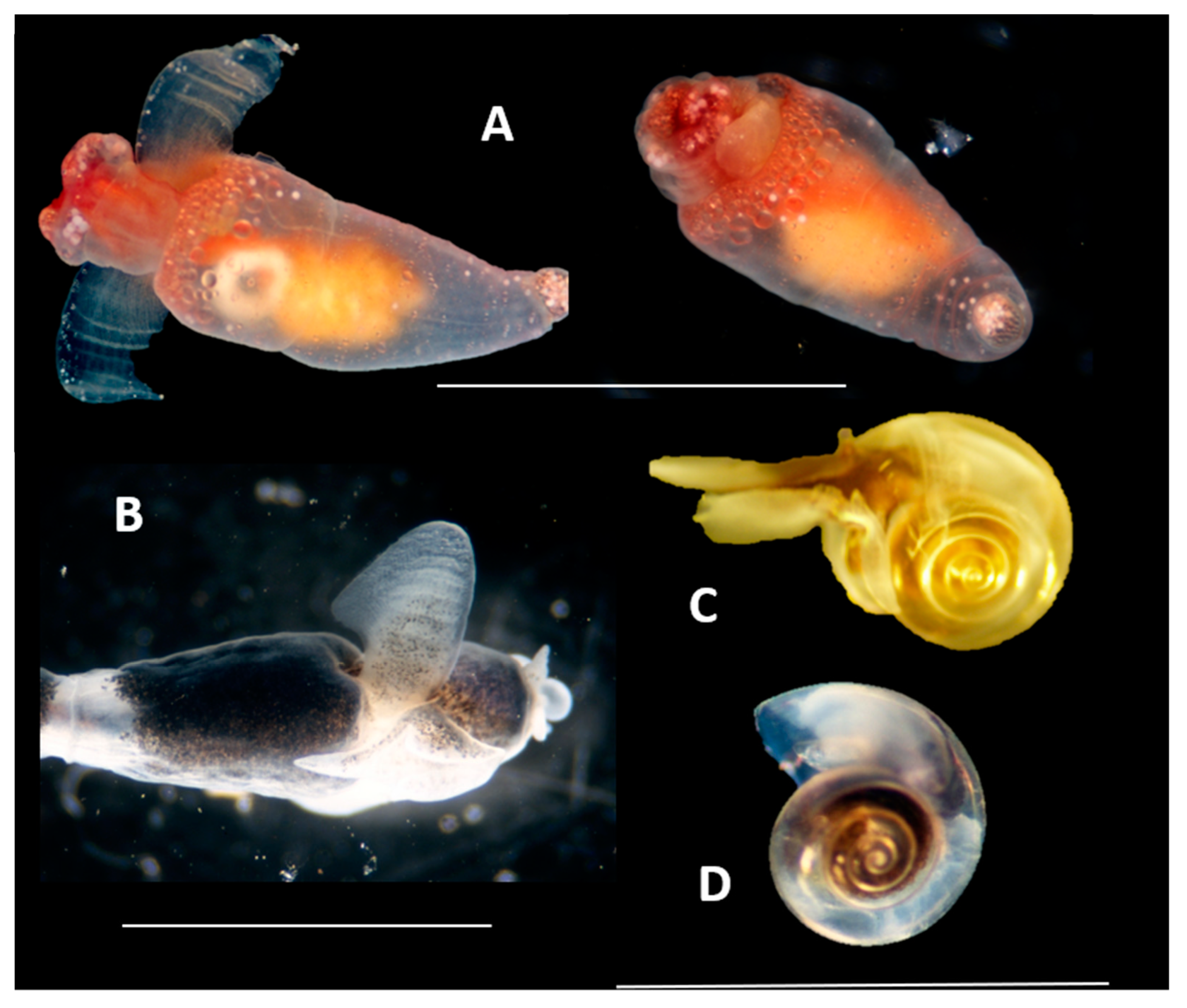

Peracle diversa (Monterosato, 1875)
Records: South Island and Chatham Islands, New Zealand (Spencer et al., 2016, as Peracle apicifulva Meisenheimer, 1906).

Cymbulia parvidentata Pelseneer, 1888
Records: South Island, New Zealand (Spencer et al., 2016).

Polybranchia pallens (Burn, 1957)
Records: Tasmania, Australia (Grove, 2018).

Aplysiopsis brattstroemi (Er. Marcus, 1959)
Records: Patagonia (Linse, 1999; Chile, Forcelli, 2000).

Ercolania boodleae (Baba, 1938).
Records: Tasmania, Australia (Grove, 2018).
Ercolania evelinae (Er. Marcus, 1959)
Records: Patagonia (Chile, Forcelli, 2000; Linse, 1999).
Ercolania felina (F. W. Hutton, 1882)
Records: South Island, New Zealand (Spencer et al., 2016).
Ercolania margaritae Burn, 1974.
Records: Tasmania, Australia (Grove, 2018).

Placida aoteana (A. W. B. Powell, 1937)
Records: New Zealand (Willan, 1984)
Placida dendritica (Alder & Hancock, 1843).
Records: Tasmania, Australia (Grove, 2018).
Remarks: This species is native to the coast of the United Kingdom and is also present in numerous locations in the Mediterranean Sea. Furthermore, it has been reported in temperate and cold-temperate waters globally although there is some doubt as to whether it is a species complex as has been revealed for other sacoglossans, such as Placida cremoniana (Trinchese, 1892) according to Mccarthy et al. (2017).

Sacoproteus browni Krug, Wong, M. R. Medina, Gosliner & Á. Valdés, 2018
Records: Tasmania, Australia (Grove, 2018, as Stiliger smaragdinus Baba, 1949).

Elysia cf. hedgpethi Er. Marcus, 1961.
Records: Patagonia (Chile, Forcelli, 2000).
Elysia patagonica Muniain & Ortea, 1997.
Records: Patagonia (Linse, 1999; Chile, Forcelli, 2000).

Berthelinia australis (Burn, 1960)
Records: Tasmania, Australia (Grove, 2018).
Berthelinia babai (Burn, 1965)
Records: Tasmania, Australia (Grove, 2018).
Berthelinia typica (Gatliff & Gabriel, 1911)
Records: Tasmania, Australia (Grove, 2018).

Oxynoe jacksoni Krug, Berriman & Á. Valdés, 2018.
Records: Tasmania, Australia (S. Grove, 2015).
Oxynoe viridis (Pease, 1861).
Records: Tasmania, Australia (Grove, 2018).

Roburnella wilsoni (Tate, 1889).
Records: Tasmania, Australia (Grove, 2018).

Ascobulla fischeri (A. Adams & Angas, 1864)
Records: Tasmania, Australia (Grove, 2018).
4. Discussion and Conclusions
Of the nearly 250,000 known species from the marine environment (WoRMS, 2024) a little over 50,000 are extant species of marine mollusc, with many new species described each year (6,656 species in the period 2000-2014, Bouchet et al., 2023). A study similar to the present work was carried out by Primo & Vazquez (2014) that explored the diversity of ascidians occurring south of the subtropical front. That study reported a total diversity of 245 species with 50-60% of those found to occur at depths <2,000 m. Deep-sea biodiversity across most of the global ocean remains poorly studied, and there are likely to be numerous species yet to be discovered, in both the benthic and pelagic realm. This is certainly the case for benthic molluscs, as demonstrated by Peñas & Rolan (2010, 2016, 2017), with recent descriptions for several hundred new species of deep-water tropical Pacific pyramidellids. In the case of sea slugs, most species of the Cephalaspidea group live in soft sediments, where they can bury themselves to search for food (Oskars et al., 2015); it is highly likely that large numbers of unknown species are yet to be found across the vast expanse of unexplored deep-benthic sediments of the Southern Ocean.
Many works have been published regarding the composition and diversity of sea slugs fauna fauna, particularly in regard to specific geographic areas, for example: the Iberian Peninsula (Cervera et al., 2004), Mediterranean Sea (Trainito & Doneddu, 2014), Caribbean Sea (Valdés et al., 2006), the southern tip of South America (Schrödl, 2003), South Africa (Gosliner, 1987), Australia (Burn, 2015; Cobb & Willan, 2006; Coleman, 2001, 2008; Nimbs et al., 2020; Nimbs & Smith, 2017a), the western Indian Ocean (Rudman, 1984, 1986, 1988; Yonow, 2000, 2012, 2015) and the central and eastern Indian Ocean (Apte, 2009; Apte et al., 2010). There are a few works that have explored sea slug diversity across oceans: the broad Indo-Pacific (Coleman, 2001, 2008, 2015; Gosliner et al., 2015), the Pacific coast from Alaska to Central America (Behrens et al., 2022) and that of Garcia & Bertsch (2009) on the global sea slug fauna of the Atlantic Ocean. These last authors estimate a diversity of 1,066 species of Cephalaspidea, Aplysiida, Sacoglossa and Nudibranchia in the Atlantic Ocean. Diversity in the Indo-Pacific is thought to be much higher, with some 6,000 species thought to be present (Gosliner & Draheim, 1996). Certainly, across most oceans there is a pattern of increasing species richness from the polar to the tropical regions (Rudman & Willan, 1998; García & Bertsch, 2009). The diversity for the Southern Ocean (394 species) presented here may seem low in comparison to the larger oceans but it is important to recognise that for most of the Southern Ocean (>41º S) there are few shallow coastal areas and large ice masses around Antarctica, so the vast majority of the area of the Southern Ocean comprises unknown bathyal and abyssal benthos.
Of the known 81 species of Ringiculimorpha (MolluscaBase, 2025e), only one has been recorded in the Southern Ocean below 41ºS (South Island of New Zealand, Powell, 1979); species in this group live on sandy and muddy sediments, many of them at great depth. This suggests how little is known about this group in bathyal and abyssal areas of the Southern Ocean. The Umbraculida and Runcinacea are two groups of sea slugs with few known species (11 and 76 species respectively) and the 4 species reported in this work for the Southern Ocean have been found in the lower latitudes of the study area: Tasmania and the South Island of New Zealand. This indicates that these groups prefer temperate or warm waters. No species have been recorded for the Southern Ocean from two enigmatic and little-known groups of marine Heterobranchia, the Acochlidiimorpha and Rhodopoidea. These groups, with few species, live preferably in the interstitial environment or among algae, are generally very small in size and some species resemble turbellarians. All these characteristics and the methodological problems associated with the study of interstitial fauna in vivo mean that very little is known about the biodiversity and biology of these groups. Their absence from high latitudes in the southern hemisphere may simply be due to the lack of specific study.
The colder waters south of the south subtropical convergence appear to be unfavourable for marine heterobranch species in the Ringiculimorpha, Umbraculida, Runcinacea, Aplysiida and Sacoglossa. Species from these groups have only been reported from the Patagonian/Magellanic zone, the Tasmania and the South Island of New Zealand. The first three groups have already been discussed above, and species in Aplysiida and Sacoglossa are more common in warm and tropical waters, where the vast majority of species live, with the polar areas being devoid of them (Jensen, 2007; Nimbs et al., 2017); the species in these two groups are herbivorous, and it is possible that these polar environments do not have the suitable types of algae that these sea slugs can feed on. Nudibranchs and cephalaspideans appear to be well adapted to the cold waters of the Southern Ocean, where 209 and 90 species have been recorded, respectively. The biodiversity of nudibranchs is particularly notable on the island of Tasmania, with 93 species cited, possibly due to the subtropical species that reach the island, favoured by the warm water marine currents that flow southwards from the eastern coasts of Australia. Nudibranchs, with 40 species, have been shown to be the most diverse of all groups in the waters of Antarctica, living from a few metres to bathyal depths of more than 1,000 metres. This adaptation to very cold waters has led to their evolution of very long biological cycles with an extreme duration of embryonic development (for example Bathydoris hodgsoni and Doris kerguelenensis, Moles et al., 2017b and Ballesteros, 2024). Indeed, Tergipes antarcticus spends its entire life cycle on ice, (Kiko et al., 2008). An interesting point is the distribution of Doris kerguelenensis, which has been recorded in Antarctic areas, in all sub-Antarctic areas and in the Patagonian/Magallanes region, both on the Pacific side of Chile and on the Atlantic coast of Argentina. Morphological and molecular studies that are in progress may reveal multiple speciation attributed to this species.
Regarding cephalaspideans, and although their found biodiversity is relatively high, with 90 cited species, we consider that this figure does not correspond to their possible real biodiversity; most species live in soft bottoms down to great depths, which have not been sufficiently studied at the microfauna level. A very large part of the Southern Ocean is made up of abyssal plains that have not been scientifically explored; it is assumed that future studies of these deep areas will bring to light numerous unknown species of marine heterobranchs, mainly small shelled cephalaspidean species that inhabit abyssal bottoms, as has occurred with other groups of mollusca such as the Pyramidelloidea in the deep tropical Central and South Pacific (Peñas & Rolan, 2010, 2016, 2017).
With regard to the Pteropoda, it is recognised that many species have a wide distribution due to their pelagic life histories, but the recent work of Burridge et al. (2017) has identified that, in the Atlantic Ocean at least, pteropod abundance and biomass is significantly higher in latitudes >40ºS. The pteropods are a highly important component of pelagic ecosystems, where they can reach very high densities (up to 800 individuals/m3 for Limacina retroversa and up to 2681 individuals/m3 for Limacina helicina). (Hunt et al., 2008). There are concerns that ocean acidification will generate an undersaturation of dissolved carbonate ions meaning that the Thecosomata will have reduced capacity to form their aragonite shells and may possibly disappear from the Southern Ocean by the year 2100 (Orr et al., 2005; Hunt et al., 2008). The Thecosomata are thought to be the preferred food of the Gymnosomata and, in turn, both groups are an important food source for a wide variety of pelagic and demersal fish. Given the potential collapse of thecosome populations due to ocean acidification, Southern Ocean food webs may undergo a trophic cascade resulting in major changes to both biodiversity and food-chain biomass.
Although some areas may be considered well-worked with regard to sea slug biodiversity (i.e. Tasmania, Southern Island of New Zealand, the Patagonia/Magellan area, Ross Sea and Weddell Sea), many knowledge gaps remain, such as the distributional status of some species thought to be broadly distributed but with little dispersive capacity (for example Doris kerguelenensis). Current knowledge of very remote areas such as Prince Edwards Is., the New Zealand subantarctic islands (Chatham, Bounty, Antipodes, Campbell, Auckland, The Shares), Bouvet Is., Macquarie Is., the Amundsen Sea, the East Antarctica and bathyal and abyssal depths may represent a small portion of species diversity from these locations. It is likely that efforts to further sample these locations may yield large numbers of species, many of which may be novel. Information derived from these regional and remote studies may provide important detail on community composition and biogeographic connectivity across the vast Southern Ocean.
Author Contributions
Conceptualization, MB; methodology, MB, AH, MS; software, AH, MS, MN; validation, all authors; formal analysis, all authors; investigation, MB, AH; resources, MB, MN; data curation, MB, AH, MS; writing-original dratf preparation, MB, AH; writing-review and editing, all authors; visualization, MB; supervision, MB; project administration, MB. All authors have read and agreed to the published version of the manuscript
Funding
This research received no external funding
Acknowledgements
We thank Heike Wägele for critically reviewing the first draft of this manuscript. Gary MacDonald has been kind enough to provide us with abundant bibliography that we were unable to access. Huw Griffiths has supported us with the SOMBASE resources. The first author also greatly thanks the Bentart 2006 campaign researchers Javier Cristobo and Jose Antonio Moya, who were of indispensable help during the scuba dives carried out in Fildes Bay on King George Island. The first author has benefited from the resources of the Benthic Biology and Ecology (BEB) research group of the University of Barcelona, to which he belongs. The last author is grateful to staff from the New South Wales Department of Primary Industries and Regional Development library services for assistance.
Conflicts of Interest
The authors declare no conflicts of interest.
References
- Abraham, P. S. Notes on some genera of nudibranchiate Mollusca, with notices of a new genus and some hitherto undescribed species, in the collection of the British Museum. Annals and Magazine of Natural History 1876, 18(104), 132–146. [Google Scholar] [CrossRef]
- Aldea, C.; Césped, T.; Rosenfeld, S. sea slugs from Bernardo O´Higgings National Park (S. Chile). Thalassas 2011, 27(2), 37–48. [Google Scholar]
- Aldea, C.; Olabarria, C.; Troncoso, J. S. Bathymetric zonation and diversity gradient of gastropods and bivalves in West Antarctica from the South Shetland Islands to the Bellingshausen Sea. Deep-Sea Research Part I: Oceanographic Research Papers 2008, 55(3), 350–368. [Google Scholar] [CrossRef]
- Aldea, C.; Olabarria, C.; Troncoso, J.S. Spatial patterns of benthic diversity in molluscs from West Antarctica. Antarctic Science 2009, 21(4), 341–353. [Google Scholar] [CrossRef]
- Aldea, C.; Troncoso, J. S. Systematic and distribution of shelled mollusks (Gastropoda, Bivalvia and Scaphopoda) from the South Shetland Island to the Bellingshausen Sea, West Antarctica. Iberus 2008, 26(2), 43–117. [Google Scholar]
- Aldea, C. & Troncoso, J.S. (2010). Moluscos del Mar de Bellinghausen (Antártica), Vigo, Spain, 250 pp.
- Apte, D. Opisthobranch fauna of Lakshadweep Islands, India, with 52 new records to Lakshadweep and 40 new records to India: part 1. Journal of the Bombay Natural History Society 2009, 106(2), 162–175. [Google Scholar]
- Apte, D.; Bhave, V.; Parasharya, D. An annotated and illustrated checklist of the opisthobranch fauna of Gulf of Kutch, Gujarat, India, with 21 new records for Gujarata and 13 new records from India: Part 1. Journal of the Bombay Natural History Society 2010, 107(1), 14–23. [Google Scholar]
- Arias, A.; Crocetta, F. Umbraculum umbraculum (Gastropoda: Heterobranchia) spreading northwards: additional evidence to the “tropicalization” of the Bay of Biscay. Cahiers de Biologie Marine 2016, 57, 285–286. [Google Scholar]
- Arnaud, P.M.; Troncoso, J.S.; Ramos, A. Species diversity and assemblage of macrobenthic Mollusca from the South Shetland Islands and Bransfield Strait (Antarctica). Polar Biology 2001, 24, 105–112. [Google Scholar] [CrossRef]
- Arntz, W. E.; Thatje, S.; Linse, K.; Avila, C.; Ballesteros, M.; Barnes, D. K.; Teixido, N. Missing link in the Southern Ocean: sampling the marine benthic fauna of remote Bouvet Island. Polar Biology 2006, 29(2), 83–96. [Google Scholar] [CrossRef]
- Australian Antarctic Data Centre. Occurrence data set. 2024. Available online: https://data.aad.gov.au/aadc/biodiversity/ (accessed on 4 September 2024).
- Avila, C.; Iken, K.; Fontana, A.; Cimino, G. Chemical ecology of the Antarctic nudibranch Bathydoris hodgsoni Eliot, 1907: defensive role and origin of its natural products. Journal of experimental marine biology and ecology 2000, 252(1), 27–44. [Google Scholar] [CrossRef] [PubMed]
- Bakker, H, Gill. Naturalis Biodiversity Center (NL) - Mollusca. Naturalis Biodiversity Center. Occurrence dataset. 2024. Available online: https://www.gbif.org/occurrence/4863291182. [CrossRef]
- Ballesteros, M. “Biological cycle of two outstanding nudibranchs from Antarctica” in OPK-Opistobranquis. Published: 08/12/2024. 2024. Available online: http://opistobranquis.info/en/?p=45501 (accessed on 8 December 2024).
- Ballesteros, M.; Avila, C. A new tritoniid species (Mollusca: Opisthobranchia) from Bouvet Island. Polar Biology 2006, 29(2), 128–136. [Google Scholar] [CrossRef]
- Barnes, D. K.; Bullough, L. W. Some observations on the diet and distribution of nudibranchs at Signy Island, Antarctica. Journal of Molluscan Studies 1996, 62(3), 281–287. [Google Scholar] [CrossRef]
- Barnes, D.K.A.; _Downey, R.V. Chapter 5.23. Bryzoa. In Biogeographic Atlas of the Southern Ocean; De Broyer, C., Koubbi, P., Griffiths, H.J., et al., Eds.; Scientific Committee on Antarctic Research; Cambridge, 2014; pp. 195–199. [Google Scholar]
- Basher, Z.; Costello, M.J. Chapter 5.22. Shrimps (Crustacea: Decapoda). In Biogeographic Atlas of the Southern Ocean; De Broyer, C., Koubbi, P., Griffiths, H.J., et al., Eds.; Scientific Committee on Antarctic Research; Cambridge, 2014; pp. 190–194. [Google Scholar]
- Bastida, R.; Roux, A.; Martinez, D. E. Benthic communities of the Argentine continental shelf. Oceanologica Acta 1992, 15(6), 687–698. [Google Scholar]
- Battini, N.; Giachetti, C. B.; Castro, K. L.; Bartolus, A.; Schwindt, E. New invasive predator reduces the abundance of native prey in a cold-temperate marine fouling community. Aquatic Conservation Marine and Freshwater Ecosystems 2021, 1–13. [Google Scholar] [CrossRef]
- Beesley, P.; Ross, G.; Wells, A. Mollusca: The Southern Synthesis; Australian Biological Resources, CSIRO Publishing; Melbourne, Australia, 1998. [Google Scholar]
- Behrens, D. W.; Hermosillo, A.; Fletcher, K.; Jensen, G. C. Eastern pacific nudibranchs; Sea Challengers, 2022. [Google Scholar]
- Bergh, R. Report on the Nudibranchiata. Challenger reports, Zoology 10(26), 1–154.
- Bergh, R. Die Opisthobranchier der Sammlung Plate. Zoologische Jahrbücher, Supplement 4, 481–582.
- Bergh, R. Malacologische Untersuchungen. In Reisen im Archipel der Philippinen von Dr. Carl Gottfried Semper; Zweiter Theil. Wissenschaftliche Resultate, 1904; Vol. 9, Chapter 6, Part 1-56, pp. 1–56. [Google Scholar]
- Bergh, R. Die Opisthobranchiata der Siboga-expedition. Siboga-Expeditie. 1905, 50, 1–248. [Google Scholar]
- Bouchet, P. Toledonia lymnaeaeformis (E. A. Smith, 1879). In: MolluscaBase (2017). 2010. Available online: http://marinespecies.org/aphia.php?p=taxdetails&id=197475 (accessed on 7 February 2018).
- Bouchet, P.; Decock, W.; Lonneville, B.; Vanhoorne, B.; Vandepitte, L. Marine biodiversity discovery: the metrics of new species descriptions. Frontiers in Marine Science 2023, 10, 929989. [Google Scholar] [CrossRef]
- Bowen, M. M.; Wilkin, J. L.; Emery, W. J. Variability and forcing of the East Australian Current. Journal of Geophysical Research: Oceans 2005, 110, C03019. [Google Scholar] [CrossRef]
- Branch, M.L.; Arnaud, P.M.; Cantera, J.; Gianakouras, D. The Benthic Mollusca and Brachiopoda of Subantarctic Marion and Prince Edward Islands: 1) Illustrated Keys to the Species 2) Records of the 1982-1989 University of Cape Town Surveys. South African Journal of Antarctic Research 1991, 21(1), 45–64. [Google Scholar]
- Brandt, A.; De Broyer, C.; De Mesel, I.; Ellingsen, K. E.; Gooday, A. J.; Hilbig, B.; Tyler, P. A. The biodiversity of the deep Southern Ocean benthos. Philosophical Transactions of the Royal Society B: Biological Sciences 2007, 362(1477), 39–66. [Google Scholar] [CrossRef] [PubMed]
- Briggs, J.C.; Bowden, B.W. A realignment of the marine biogeographic provinces with particular reference for fish distributions. Journal of biogeography 2012, 39, 12–30. [Google Scholar] [CrossRef]
- Brueggeman, P.; Wu, N.; Bosch, I.; Bowser, S. Underwater Field Guide to Ross Island & McMurdo Sound, Antarctica; Scripps Institution of Oceanography Library, 1999. [Google Scholar]
- Burn, R. Notes on some opisthobranchs mainly from South Australia. Records of the South Australian Museum 1966, 15(2), 329–352. [Google Scholar]
- Burn, R. Opisthobranch molluscs from the Australian sub-Antarctic territories of Macquarie and Heard Islands. Proceedings of the Royal Society of Victoria 1973, 86, 39–46. [Google Scholar]
- Burn, R. A checklist and bibliography of the Opisthobranchia (Mollusca: Gastropoda) of Victoria and the Bass Strait area, south-eastern Australia. Museum Victoria Science Reports 2006, 10, 1–42. [Google Scholar] [CrossRef]
- Burn, R. (2015). Nudibranchs and related molluscs. Museum Victoria Field Guides. Melbourne, Australia.
- Burridge, A. K.; Goetze, E.; Wall-Palmer, D.; Le Double, S. L.; Huisman, J.; Peijnenburg, K. T. C. A. Diversity and abundance of pteropods and heteropods along a latitudinal gradient across the Atlantic Ocean. Progress in Oceanography 2017, 158, 213–223. [Google Scholar] [CrossRef]
- Butler, A. J.; Rees, T.; Beesley, P.; Bax, N. J. Marine Biodiversity in the Australian Region. PLoS ONE 2010, 5(8), e11831. [Google Scholar] [CrossRef]
- Carcelles, A. Catálogo de la Malacofauna Antártica Argentina. Anales del Museo del Nahuel Huapi 1953, 3, 155–250. [Google Scholar]
- Carcelles, A. R.; Williamson, S. I. Catálogo de los moluscos marinos de la provincia magallánica. Revista del Instituto Nacional de Investigación de Ciencias Naturales, Ciencias Zoológicas 1951, 2(5), 225–383. [Google Scholar]
- Cárdenas, J.; Aldea, C.; Valdovinos, C. Chilean marine mollusca of northern Patagonia collected during the CIMAR-10 Fjords Cruise. Gayana 2008, 72(2), 202–240. [Google Scholar] [CrossRef]
- Carmona, L.; Lei, B. R.; Pola, M.; Gosliner, T. M.; Valdés, A.; Cervera, J. L. Untangling the Spurilla neapolitana (Delle Chiaje, 1841) species complex: a review of the genus Spurilla Bergh, 1864 (Mollusca: Nudibranchia: Aeolidiidae). Zoological Journal of the Linnean Society 2014, 170(1), 132–154. [Google Scholar] [CrossRef]
- Castellanos, Z. A.; Bartolotta, S.; Rolán, E. Aportes a la malacofauna del talud superior del Atlántico Sur. Thalassas 1987a, 5, 57–70. [Google Scholar]
- Castellanos, Z. A.; Rolán, E.; Bartolotta, S. Nuevos micromoluscos de la plataforma inferior Argentina y talud superior (Moll. Gastropoda). Revista del Museo de la Plata, Zoología 1987b, (2)(14 (156)), 93–107. [Google Scholar]
- Castellanos, Z. A.; Landoni, N. A.; Dadon, J. R. Catálogo descriptivo de la malacofauna marina Magallánica 12. Opisthobranchia. Comisión de Investigaciones Científicas, Buenos Aires. 1993, 1–299. [Google Scholar]
- Cattaneo-Vietti, R. Nudibranch Molluscs from the Ross Sea, Antarctica. Journal of Molluscan Studies 1991, 57 Supplement Part 4, 223–228. [Google Scholar] [CrossRef]
- Cattaneo-Vietti, R.; Chiantore, M; Schiaparelli, S.; Albertelli, G. Shallow-and deep-water mollusc distribution at Terra Nova Bay (Ross Sea, Antarctica). Polar Biology 2000, 23, 173–182. [Google Scholar] [CrossRef]
- Chaban, E.M. New genus. Ruthenica 2016, 26(1), 49–56. [Google Scholar]
- Chaban, E. M.; Ekimova, I. A.; Chernyshev, A. V. Philinopsis gigliolii (Gastropoda: Heterobranchia: Aglajidae) from the Sea of Japan: validity, synonymy and biogeography. Invertebrate Zoolology 2024, 21(2), 157–169. [Google Scholar] [CrossRef]
- Challis, D. A. New species of Pseudovermis (Opisthobranchia: Aeolidacea) from New Zealand and the Solomon Islands. Transactions of the Royal Society of New Zealand 1969, 11(10), 153–165. [Google Scholar]
- Cheeseman, T. On a new genus of Opisthobranchiate Mollusca. Transactions and Proceedings of the Royal Society of New Zealand 13, 224.
- Churchill, C. K.; Valdés, A.; Foighil, D. Ó. Molecular and morphological systematics of neustonic nudibranchs (Mollusca: Gastropoda: Glaucidae: Glaucus), with descriptions of three new cryptic species. Invertebrate Systematics 2014, 28(2), 174–195. [Google Scholar] [CrossRef]
- Cimino, G.; Ghiselin, M. T. Chemical Defense and Evolution of Opisthobranch Gastropods. California Academy of Sciences. 2009. [Google Scholar]
- Clark, K. B. Nudibranch life cycles in the Northwest Atlantic and their relationship to the ecology of fouling communities. Helgoländer Wissenschaftliche Meeresuntersuchungen 1975, 27(1), 28–69. [Google Scholar] [CrossRef]
- Cobb, G.; Willan, R. C. Undersea Jewels: A colour guide to Nudibranchs. Australian Biological Resources Study, Canberra, Australia . 2006. [Google Scholar]
- Coleman, N. 1001 Nudibranchs: catalogue of Indo-Pacific sea slugs; Neville Coleman’s Underwater Geographic Pty Ltd, 2001. [Google Scholar]
- Coleman, N. (2008). Nudibranchs encyclopedia (New). Neville Coleman’s Underwater Geographic.
- Coleman, N. Nudibranchs encyclopedia-catalogue of Asia/Indo Pacific sea slugs, second edition (New); Neville Coleman’s Underwater Geographic, 2015. [Google Scholar]
- Cresswell, G. R.; Peterson, J. L.; Pender, L. F. The East Australian Current, upwellings and downwellings off eastern-most Australia in summer. Marine and Freshwater Research 2016, 68(7), 1208–1223. [Google Scholar] [CrossRef]
- Dadon, J. R.; Chauvin, S. F. Distribution and abundance of Gymnosomata (Gastropoda: Opisthobranchia) in the Southwest Atlantic. Journal of Molluscan Studies 1998, 64, 345–354. [Google Scholar] [CrossRef]
- Danis, B.; Griffiths, H. J.; Jangoux, M. Chapter 5.24. Asteroidea. In Biogeographic Atlas of the Southern Ocean; De Broyer, C., Koubbi, P., Griffiths, H.J., et al., Eds.; Scientific Committee on Antarctic Research; Cambridge, 2014; pp. 200–207. [Google Scholar]
- Dall, W. H. Illustrations and descriptions of new, unfigured, or imperfectly known shells, chiefly American in the U. S. National Museum. Proceedings of the United States National Museum 1902, 24(1264), 499–566. [Google Scholar] [CrossRef]
- Dayrat, B. A monographic revision of basal discodorid sea slugs (Gastropoda, Opisthobranchia, Nudibranchia, Doridina). Proceedings of the California Academy of Sciences. Series 4 2010, 61 suppl. I, 1–403. [Google Scholar]
- Dayton, P. K.; Robilliard, G. A.; Paine, R. T.; Dayton, L. B. Biological accommodation in the benthic community at McMurdo Sound, Antarctica. Ecological Monographs 1974, 44(1), 105–128. [Google Scholar] [CrossRef]
- De Broyer, C.; Jazdzeska, A. Chapter 5.17. Biogeographic patterns of Southern Ocean benthic Amphipoda. In Biogeographic Atlas of the Southern Ocean; De Broyer, C., Koubbi, P., Griffiths, H.J., et al., Eds.; Scientific Committee on Antarctic Research; Cambridge, 2014; pp. 155–165. [Google Scholar]
- Biogeographic Atlas of the Southern Ocean; De Broyer, C., Koubbi, P., Griffiths, H. J., et al., Eds.; Scientific Committee on Antarctic Research, Cambridge, 2014; 498 pp. [Google Scholar]
- Dell, R. K. Antarctic Mollusca: with special reference to the fauna of the Ross Sea. Bulletin Royal Society of New Zealand Bulletin . 1990, 27. [Google Scholar]
- de Vries, J.; Christa, G.; Gould, S. B. Plastid survival in the cytosol of animal cells. Trends in Plant Science 2014, 19(6), 347–350. [Google Scholar] [CrossRef] [PubMed]
- De Vasconcelos Silva, F.; Pola, M.; Cervera, J. L. A stomach plate to divide them all: a phylogenetic reassessment of the family Tritoniidae (Nudibranchia: Cladobranchia). Zoological Journal of the Linnean Society 2023, 199(2), 445–476. [Google Scholar] [CrossRef]
- Doello-Jurado, M. Dos nuevas especies de moluscos marinos. Physis 1918, 4(17), 259–273. [Google Scholar]
- Edmunds, M. Protective mechanisms in the Eolidacea (Mollusca, Nudibranchia). Zoological Journal of the Linnean Society 1966, 46(308), 27–71. [Google Scholar] [CrossRef]
- Eléaume, M.; Hemery, L. G.; Roux, M.; Améziane, N. Chapter 5.25. Sothern Ocean Crinoids. In Biogeographic Atlas of the Southern Ocean; De Broyer, C., Koubbi, P., Griffiths, H.J., et al., Eds.; Scientific Committee on Antarctic Research; Cambridge, 2014; pp. 208–212. [Google Scholar]
- Eliot, C. N. E. Notes on some new or little-known members of the family Dorididae. Journal of Molluscan Studies 1903, 5(5), 331–337. [Google Scholar] [CrossRef]
- Eliot, C. N. E. The Nudibranchiata of the Scottish National Antarctic Expedition. Transactions of the Royal Society of Edinburgh 1905, 41 (3), 519–532. [Google Scholar] [CrossRef]
- Eliot C.N.E. (1907a). Mollusca IV.—Nudibranchiata. National Antarctic Expedition 1901–1904. Zoology, 2: 1–28.
- Eliot; C.N.E. Nudibranchs from New Zealand and the Falkland Islands. Proceedings of the Malacological Society of London 1907b, 7, 327–361. [Google Scholar]
- Eliot, C.N.E. The Nudibranchiata of the Scottish National Antarctic Expedition. Report of the Scientific Results of the Voyage of S. Y. “Scotia” during the years 1902, 1903, and 1904, under the leadership of William S. Bruce, Volume V—Zoology, Part II. Nudibranchiata 1909, 11–24. [Google Scholar]
- Engl, W. Shells of Antarctica. ConchBooks . Hackenheim, Germany, 2012; 402 pp. [Google Scholar]
- Farias, N. E.; Obenat, S.; Goya, A. B. Outbreak of a neurotoxic side-gilled sea slug (Pleurobranchaea sp.) in Argentinian coasts. New Zealand Journal of Zoology 2015, 42:1, 51–56. [Google Scholar] [CrossRef]
- Forcelli, D. O. Moluscos Magallánicos; Vázquez Mazzini Editores; Buenos aires, Argentina, 2000. [Google Scholar]
- García, F. J.; Bertsch, H. Diversity and distribution of the Gastropoda Opisthobranchia from the Atlantic Ocean: a global biogeogaphic approach. Scientia Marina 2009, 73(1), 153–160. [Google Scholar] [CrossRef]
- García, F. J.; Troncoso, J. S.; García-Gómez, J. C.; Cervera, J. L. Anatomical and taxonomical studies of the Antarctic nudibranchs Austrodoris kerguelenensis (Bergh, 1884) and A. georgiensis n. sp. from the Scotia Sea. Polar Biology 1993, 13, 417–421. [Google Scholar] [CrossRef]
- García, F. J.; Troncoso, J. S.; Cervera, J. L.; García-Gómez, J. C. Description of the Antarctic notaspidean Polictenidia tomasi n. g. and n. sp. (Gastropoda, Opisthobranchia) from the Scotia Sea, proposing also a new notaspidean tribe. Polar Bíology 1996, 16, 79–85. [Google Scholar] [CrossRef]
- Garcia, F. J.; García-Gómez, J. C.; Troncoso, J. S.; Cervera, J. L. A descriptive study of some antarctic notaspidean opisthobanchs (Gastropoda) with a description of a new genus and species. Polar Biology 1994, 14, 261–268. [Google Scholar] [CrossRef]
- Ghiglione, C.; Alvaro, M. C.; Griffiths, H. J.; Linse, K.; Schiaparelli, S. Ross Sea Mollusca from the latitudinal gradient program: R/V Italica 2004 Rauschert dredge samples. ZooKeys 2013, 341, 37–48. [Google Scholar]
- Ghiglione, C.; Alvaro, M.C.; Piazza, P.; Bowden, D.; Griffiths, H. J.; Carota, C.; Nava, C. R.; Schiaparelli, S. Mollusc species richness from shelf to abyssal depths in the Ross Sea (Antarctica): results from the New Zealand IPY-CAML expedition and implications for future sampling. Polar Biology 2017, 40, 1989–2000. [Google Scholar] [CrossRef]
- Gilmer, R. W.; Lalli, C. M. Bipolar variation in Clione, a gymnosomatous pteropod. American Malacological Bulletin 1990, 8, 67–75. [Google Scholar]
- Gosliner, & T, M. Nudibranchs of Southern Africa: A Guide ot Opisthobranch Molluscs of Southern Africa. Sea Challerngers . 1987. [Google Scholar]
- Gosliner, T. M.; Draheim, R. Indo-Pacific opisthobranch gastropod biogeography: How do we know what we don’t know? Malacological Bulletin 1996, 12(1), 37–43. [Google Scholar]
- Gosliner, T. M.; Valdés, Á.; Behrens, D. W. Nudibranch and Sea Slug Identification: Indo-pacific; New World Publications, 2015; 408 pp. [Google Scholar]
- Gould, A. A. (1847). Descriptions of new shells, collected by the United States Exploring Expedition. Proceedings of the Boston Society of Natural History. 2: 196-198, 200-203, 204-208 [March]; 209, 210-212, 214-215, 222-224 [June]; 225, 237-239 [July]; 251-252 [December].
- Gould, A. Mollusca and Shells [in]: United States Exploring Expeditions, 1838, 1839, 1840, 1841, 1842 under the command of Charles Wilkes, U.S.N. Philadelphia, C. Sherman & son 12.
- Griffiths, H. J.; Linse, K.; Crame, J. A. SOMBASE–Southern Ocean Mollusc Database: a tool for biogeographic analysis in diversity and ecology. Organisms Diversity & Evolution 2003, 3(3), 207–213. [Google Scholar]
- Griffiths, H. J.; Barnes, D. K.; Linse, K. Towards a generalized biogeography of the Southern Ocean benthos. Journal of Biogeography 2008, 36(1), 162–177. [Google Scholar] [CrossRef]
- Griffiths, H. J.; Whittle, R. J.; Roberts, S. J.; Belchier, M.; Linse, K.; Thatje, S. Chapter 5.21. Decapoda: Crabs and Lobsters. In Biogeographic Atlas of the Southern Ocean; De Broyer, C., Koubbi, P., Griffiths, H.J., et al., Eds.; Scientific Committee on Antarctic Research; Cambridge, 2014; pp. 185–189. [Google Scholar]
- Grove, S. The seashells of Tasmania: a comprehensive guide. Taroona Publications . 2011. [Google Scholar]
- Grove, S. A guide to the seashells and marine molluscs of Tasmania. 2015. Available online: http://www.molluscsoftasmania.net/Species.
- Grove, S. An annotated checklist of Tasmanian marine molluscs; 2018. [Google Scholar]
- Grove, S. J.; Kershaw, R. C.; Smith, B. J.; Turner, E. A systematic list of the marine molluscs of Tasmania; Queen Victoria Museum and Art Gallery, 2006; Vol. 8, 122 pp. [Google Scholar]
- Gutt, Sirenko, Arntz. Weddell Sea Macrozoobenthos. 2000. Available online: https://www.gbif.org/occurrence/240910901 (accessed on 4 September 2024). [CrossRef]
- Hain, S. Die beschalten benthischen Mollusken (Gastropoda und Bivalvia) des Weddellmeeres, Antarktis. Berichte zur Polarforschung 1990, 70, 1–181. [Google Scholar]
- Hedley, C. Australasian Antarctic Expedition 1911-1914. Scientific Reports, Series C. Zoology and botany Mollusca 1916, vol. IV, part 1, 1–80. [Google Scholar]
- Hunt, B. P. V.; Pakhomov, E. A.; Hosie, G. W.; Siegel, V.; Ward, P.; Bernard, K. Pteropods in Southern Ocean ecosystems. Progress in Oceanography 2008, 78(3), 193–221. [Google Scholar] [CrossRef]
- Hutton, F. W. Manual of the New Zealand Mollusca. A systematic and descriptive catalogue of the marine and land shells, and of the soft mollusks and Polyzoa of New Zealand and the adjacent islands; Dominium Museum, New Zealand.
- Ingels, J.; Hauquier, F.; Raes, M.; Vanreusel, A. Chapter, 5.3. Antarctic free-living marine nematodes. In Biogeographic Atlas of the Southern Ocean; De Broyer, C., Koubbi, P., Griffiths, H.J., et al., Eds.; Scientific Committee on Antarctic Research; Cambridge, 2014; pp. 83–87. [Google Scholar]
- Innabi, J.; Stout, C. C.; Valdés, Á. Seven new “cryptic species of Discodorididae (Mollusca, Gastropoda, Nudibranchia) from New Caledonia. Zookeys 2023, 1152, 45–95. [Google Scholar] [CrossRef]
- Janussen, D.; Downey, R. De Broyer, C., Koubbi, P., Griffiths, H.J., et al., Eds.; Chapter 5.5. Porifera. In Biogeographic Atlas of the Southern Ocean; Scientific Committee on Antarctic Research; Cambridge, 2014; Volume pp, pp. 94–102. [Google Scholar]
- Jensen, K. R. Biogeography of the Sacoglossa (Mollusca, Opisthobrancia). Bonner zoologische Beiträge 2007, 55(3/4), 255–281. [Google Scholar]
- Johnson, R. F.; Gosliner, T. M. Traditional taxonomic groupings mask evolutionary history: A molecular phylogeny and new classification of the chromodorid nudibranchs. PLoS ONE 2012, 7(4), e33479. [Google Scholar] [CrossRef]
- Johnson, P. M.; Willows, A. Defense in sea hares (Gastropoda, Opisthobranchia, Anaspidea) multiple layers of protection from egg to adult. Marine and Freshwater Behaviour and Physiology 1999, 32, 147–180. [Google Scholar] [CrossRef]
- Jörger, K. M.; Schrödl, M.; Schwabe, E.; Würzberg, L. A glimpse into the deep of the Antarctic Polar Front–Diversity and abundance of abyssal molluscs. Deep Sea Research Part II: Topical Studies in Oceanography 2014, 108, 93–100. [Google Scholar] [CrossRef]
- Kaiser, P. Die Gattung Bathydoris Bergh 1884 in patagonischen Gewässern (Opisthobranchia, Nudibranchia). Spixiana (Zeitschrift für Zoologie) 1980, 3(1), 43–51. [Google Scholar]
- Kaiser, S. De Broyer, C., Koubbi, P., Griffiths, H.J., et al., Eds.; Chapter 5.18. Antarctic and sub-Antarctic Isopod Crustaceans (Peracarida: Malacostraca). In Biogeographic Atlas of the Southern Ocean; Scientific Committee on Antarctic Research; Cambridge, 2014; Volume pp, pp. 166–172. [Google Scholar]
- Kershaw, R. C. A systematic list of the Mollusca of Tasmania, Australia. Papers and Proceedings of the Royal Society of Tasmania 1955, 89, 289–355. [Google Scholar] [CrossRef]
- Kienberger, K.; Carmona, L.; Pola, M.; Padula, V.; Gosliner, T.M.; Cervera, J. L. Aeolidia papillosa (Linnaeus, 1761) (Mollusca: Heterobranchia: Nudibranchia), single species or a cryptic species complex? A morphologial and molecular study. Zoological Journal of the Linnean Society 2016, 177, 481–506. [Google Scholar] [CrossRef]
- Kiko, R.; Kramer, M.; Spindler, M.; Wägele, H. Tergipes antarcticus (Gastropoda, Nudibranchia): distribution, life cycle, morphology, anatomy and adaptation of the first mollusk known to live in Antarctic sea ice. Polar Biology 2008, 31, 1383–1395. [Google Scholar] [CrossRef]
- Knox, G. A. Biology of the Southern Ocean; CRC Press, 2006; 640 pp. [Google Scholar]
- Lawver, L. A.; Gahagan, L. M.; Daiziel, I. W. D. De Broyer, C., Koubbi, P., Griffiths, H.J., et al., Eds.; Chapter 3.2. Reconstruction of the Southern Ocean and Antarctic regions. In Biogeographic Atlas of the Southern Ocean; Scientific Committee on Antarctic Research; Cambridge, 2014; Volume pp, pp. 36–42. [Google Scholar]
- Linse, K. Mollusca of the Magellan region. A checklist of the species and their distribution. Scientia Marina 1999, 63 (supl. I), 399–407. [Google Scholar] [CrossRef]
- Linse, K. New records of shelled marine molluscs at Bouvet Island and preliminary assessment of their biogeographic affinities. Polar Biology 2006, 29(2), 120127. [Google Scholar] [CrossRef]
- Linse, K.; Griffiths, H. J.; Barnes, D. K.; Clarke, A. Biodiversity and biogeography of Antarctic and sub-Antarctic mollusca. Deep Sea Research Part II: Topical Studies in Oceanography 2006, 53(8), 985–1008. [Google Scholar] [CrossRef]
- Linse, K.; Schiotte, T. A new species of Diaphana from bathyal depths in the Weddell Sea, Antarctica and first record of Diaphana inflata (Strebel, 1908) in the high Antarctic (Gastropoda: Opisthobranchia). Journal of Molluscan Studies 2002, 68, 147–153. [Google Scholar] [CrossRef]
- Linse, K.; Schrödl, M.; McCIain, C. R.; Allcock, L. Mollusca in the Antarctic deep sea-preliminary notes on their taxonomy, biogeography and diversity. Berichte zur Polar und Meeresforschung 2002, 470, 95–101. [Google Scholar]
- Marcus, E. Lamellariacea und Opisthobranchia. Reports of the Lund University Chile Expedition 1948-49, Lunds University, Årssk 1959, 55, 1–133. [Google Scholar]
- Marcus, Ev. A toxonomic survey of the genus. Toledonia (Opisthobranchia, Diaphanidae). Zoologica Scripta 1976, 5(1), 25–33. [Google Scholar] [CrossRef]
- Marcus, Ev.; Gosliner, T.M. Review of the family Pleurobranchaeidae (Mollusca, Opisthobranchia). Annals of the South African Museum 1984, 93(1), 1–41. [Google Scholar]
- Maroni, P. J.; Baker, B. J.; Moran, A. L.; Woods, H. A.; Avila, C.; Johnstone, G. J.; Stark, J. S.; Kocot, K. M.; Lockhart, S.; Saucède, T.; Rouse, G. W.; Wilson, N. G. One Antarctic slug to confuse them all: The underestimated diversity of Doris kerguelenensis. Invertebrate Systematics 2022, 36, 419–435. [Google Scholar] [CrossRef]
- Maroni, P. J.; Wilson, N. G. Multiple Doris “kerguelenensis” (Nudibranchia) species span the Antarctic Polar Front. Ecology and Evolution 2022, 12(9), e9333. [Google Scholar] [CrossRef]
- Martynov, A. V. Archaic Tergipedidae of the Arctic and Antarctic: Murmania antiqua gen. et sp. nov. from the Barents Sea and a revision of the genus Guyvalvoria Vayssière with descriptions of two new species. Ruthenica 2006, 16, 73–88. [Google Scholar]
- Martens, E von.; Pfeffer, G. (1886) Die Mollusken von Süd-Georgien nach der Ausbeute der Deutschen Station 1882–83. Jahrbuch der Hamburgischen Wissenschaftlichen Anstalten 3, 63–135.
- May, W. L. A check-list of the Mollusca of Tasmania. John Vail, Governements Printer . 1921. [Google Scholar]
- Maynard, D. Range extension or was it always there and we weren´t looking? The Tasmanian Naturalist 2014, 136, 101–107. [Google Scholar]
- Mccarthy, J.; Krug, P. J.; Valdés, A. Integrative systematics of Placida cremoniana (Trinchese, 1892) (Gastropoda, Heterobranchia, Sacoglossa) reveals multiple pseudocryptic species. Marine Biodiversity 2017, 49(1), 357–371. [Google Scholar] [CrossRef]
- Melville, J. C.; Standen, R. The marine mollusca of the Scotish National Antarctic Expedition, Part II. Transactions of the Royal Society of Edinburgh 1912, 48, 333–366. [Google Scholar] [CrossRef]
- Menacho, A. Redescripción y distribución geográfica de especies de gasterópodos antárticos de los géneros Marseniopsis Bergh, 1886 y Bathyberthella Willan, 1983. Trabajo Fin de Máster en Ciencias del Mar. Universidad de Barcelona . 2011. [Google Scholar]
- Merilees, W.; Burn, R. Archidoris kerguelenensis Bergh, the first record of a nudibranch from Macquarie Island. Victorian Naturalist 1969, 86, 137–138. [Google Scholar]
- Millen, S.; Martynov, A.V. Redescriptions of the nudibranch genera Akiodoris Bergh, 1879 and Armodoris Minichev, 1972 (Suborder Doridacea) with a new species of Akiodoris and a new family Akiodorididae. Proceedings of the California Academy of Sciences 2005, 56, 1–22. [Google Scholar]
- Miller, M. C. Aeolid nudibranchs (Gastropoda: Opisthobranchia) of the family Tergipedidae from New Zealand waters. Zoological Journal of the Linnean Society 1977, 60(3), 197–222. [Google Scholar] [CrossRef]
- Minichev, Y. S. (1972) Opisthobranchiate molluscs of the Davis Sea. Issledovaniia Fauny Morei 11, 358–382.
- Moles, J.; Wägele, H.; Ballesteros, M.; Pujals, A.; Uhl, G.; Àvila, C. The end of the cold loneliness: 3D comparison between Doto antarctica and a new sympatric species of Doto (Heterobranchia: Nudibranchia). PLoS ONE 2016a, 11(7), e0157941. [Google Scholar] [CrossRef]
- Moles, J.; Wägele, H.; Uhl, G.; Avila, C. Bipolarity in sea slugs: a new species of Doridunculus (Mollusca: Nudibranchia: Onchidoridoidea) from Antarctica. Organisms Diversity and Evolution 2016b, 17(1). [Google Scholar] [CrossRef]
- Moles, J.; Avila, C.; Malaquias, M.A.E. Systematic revision of the Antarctic gastropod family Newnesiidae (Heterobranchia: Cephalaspidea) with the description of a new genus and a new abyssal species. Zoological Journal of the Linnean Society 2017a, XX, 1–13. [Google Scholar] [CrossRef]
- Moles, J.; Wägele, H.; Cutignano, A.; Fontana, A.; Ballesteros, M.; Avila, C. Giant embryos and hatchlings of Antarctic nudibranchs (Mollusca: Gastropoda: Heterobranchia). Marine Biology 2017b, 164, 114. [Google Scholar] [CrossRef]
- Moles, J.; Wägele, H.; Schrödl, M.; Avila, C. A new Antartic heterobranch clade is sister to all other Cephalaspidea (Mollusca: Gastropoda). Zoologica Scripta 2017c, 46(2). [Google Scholar] [CrossRef]
- Moles, J.; Avila, C.; Malaquias, M.A.E. Unmasking Antarctic mollusc lineages: novel evidence from philinoid snails (Gastropoda: Cephalaspidea). Cladistic 2019, 35(5), 487–513. [Google Scholar] [CrossRef] [PubMed]
- MolluscaBase (Ed.) MolluscaBase. Paradoris dubia (Bergh, 1904); Accessed through: World Register of Marine Species at; 2025a; Available online: https://www.marinespecies.org/aphia.php?p=taxdetails&id=533981on 2025-04-05.
- MolluscaBase eds. (2025b). MolluscaBase. Aphelodoris luctuosa Bergh, 1905. Accessed through: World Register of Marine Species at: https://www.marinespecies.org/aphia.php?p=taxdetails&id=1732011on 2025-04-05.
- MolluscaBase (Ed.) MolluscaBase. Toledonia brevior Eales, 1923; Accessed through: World Register of Marine Species at; 2025c; Available online: https://www.marinespecies.org/aphia.php?p=taxdetails&id=509720on 2025-04-08.
- MolluscaBase (Ed.) MolluscaBase. Toledonia circumrosa (Thiele, 1904); Accessed through: World Register of Marine Species at; 2025d; Available online: https://www.marinespecies.org/aphia.php?p=taxdetails&id=509710on 2025-04-04.
- MolluscaBase (Ed.) MolluscaBase. Ringiculimorpha. Accessed through: World Register of Marine Species; 2025e; Available online: https://www.marinespecies.org/aphia.php?p=taxdetails&id=1059023Available at; on 2025-04-04.
- MolluscaBase (Ed.) MolluscaBase. Verconia aureopunctata (Rudman, 1987); Accessed through: World Register of Marine Species at; 2025f; Available online: https://www.marinespecies.org/aphia.php?p=taxdetails&id=866650on 2025-04-08.
- MolluscaBase (Ed.) MolluscaBase. Verconia closeorum (Rudman, 1986); Accessed through: World Register of Marine Species at; 2025g; Available online: https://www.marinespecies.org/aphia.php?p=taxdetails&id=866652on 2025-04-08.
- Moreau, C.; Linse, K.; Griffiths, H. J.; Barnes, D.; Kaiser, S.; Glover, A.; Geissler, P. Amundsen Sea Mollusca from the BIOPEARL II expedition. ZooKeys 2013, 294, 1. [Google Scholar] [CrossRef]
- Muniain, C.; Ortea, J.A. First records of the genus Berghia Trinchese, 1877 (Opisthobranchia: Aeolidiidae) from Argentina, with description of a new species. Avicennia 1999, 10/11, 143–150. [Google Scholar]
- Muniain, C.; Ardila, N. E.; Cervera, J. L. Pleurobranchaea inconspicua Bergh, 1897 (Opisthobranchia: Pleurobranchidae): Redescription and distribution from Argentina and Colombia. Bonner zoologische Beiträge 2007, 55(3/4), 291–300. [Google Scholar]
- Nimbs, M. J. Designation of a Neotype for the Dwarf Sea Hare Aplysia concava GB Sowerby I, 1833, and a Review of the Status of Aplysia norfolkensis GB Sowerby II, 1869 (Mollusca: Heterobranchia). Records of the Australian Museum 2021, 73(5), 147–151. [Google Scholar] [CrossRef]
- Nimbs, M. J.; Hutton, I.; Davis, T. R.; Larkin, M. F.; Smith, S. D. A. The heterobranch sea slugs of Lord Howe Island, NSW, Australia (Mollusca: Gastropoda). Proceedings of the Royal Society of Victoria 2020, 132(1), 12–41. [Google Scholar] [CrossRef]
- Nimbs, M. J.; Larkin, M.; Davis, T. R.; Harasti, D.; Willan, R. C.; Smith, S. D. A. Southern range extensions for twelve heterobranch sea slugs (Gastropoda: Heterobranchia) on the eastern coast of Australia. Marine Biodiversity Records 2016, 9, 27. [Google Scholar] [CrossRef]
- Nimbs, M. J.; Smith, S. D. A. Welcome strangers: Southern range extensions for seven heterobranch sea slugs (Mollusca: Gastropoda) on the subtropical east Australian coast, a climate change hot spot. Regional Studies in Marine Science 2016, 8(1), 27–32. [Google Scholar] [CrossRef]
- Nimbs, M. J.; Smith, S. D. A. An illustrated inventory of the sea slugs of New South Wales, Australia (Gastropoda: Heterobranchia). Proceedings of the Royal Society of Victoria 2017a, 128(2), 44–113. [Google Scholar] [CrossRef]
- Nimbs, M. J.; Smith, S. D. A. Revision of the southern distribution limit for the tropical marine herbivore Syphonota geographica (A. Adams & Reeve, 1850) (Heterobranchia: Aplysiidae) in a global climate change hot-spot. Australian Zoologist 2017b, 38(4), 582–589. [Google Scholar] [CrossRef]
- Nimbs, M. J.; Smith, S. Beyond Capricornia: Tropical Sea Slugs (Gastropoda, Heterobranchia) Extend Their Distributions into the Tasman Sea. Diversity 2018, 10(3), 99. [Google Scholar] [CrossRef]
- Nimbs, M. J.; Willan, R. C.; Smith, S. D. A. Range extensions for heterobranch sea slugs (formerly opisthobranch) belonging to the families Diaphanidae, Plakobranchidae and Facelinidae on the eastern coast of Australia. Marine Biodiversity Records 2015, 8, e76. [Google Scholar] [CrossRef]
- Nimbs, M. J.; Willan, R. C.; Smith, S. D. A. An historical summary of the distribution and diet of the Australian sea hares (Gastropoda: Heterobranchia: Aplysiidae). Zoological Studies 2017, 56(35), 1–15. [Google Scholar]
- Nimbs, M. J; Wilson, N. G. Saved by the Shell: Molecular Analysis Detects the Cryptic Sea Hare, Aplysia concava G. B. Sowerby I, 1833 (Mollusca: Heterobranchia: Aplysiidae), from Oceania, with a Redescription. Taxonomy 2021, 1(2), 48–59. [Google Scholar] [CrossRef]
- Odhner, N. H. Die Opisthobranchien. Further Zoological Results of the Sweedish Antarctic Expedition 1901-1903 1926, 2, 1–100. [Google Scholar]
- Odhner, N. H. The Nudibranchata, British Antarctic ‘Terra Nova’ expedition, 1910. British museum of natural history reports, Zoology 1934, 7, 229–310. [Google Scholar]
- Orr, J. C.; Fabry, V. J.; Aumont, O.; Bopp, L.; Doney, S. C.; Feely, R. A.; Gnanadesikan, A.; Gruber, N.; Ishida, A.; Joos, F.; Key, R.M.; Lindsay, K.; Maier-Reimer, E.; Matear, R.; Monfray, P.; Mouchet, A.; Najjar, R. G.; Plattner, G. K.; Rodgers, K. B.; Sabine, C. L.; Sarmiento, J. L.; Schlitzer, R.; Slater, R. D.; Totterdell, I. J.; Weirig, M. F.; Yamanaka, Y.; Yool, A. Anthropogenic ocean acidification over the twenty-first century and its impact on calcifying organisms. Nature 2005, 437, 681–686. [Google Scholar] [CrossRef]
- Orrell, T. Informatics and Data Science Center-Digital Stewardship NMNH Extant Specimen Records (USNM, US). Version 1.86. National Museum of Natural History, Smithsonian Institution. Occurrence dataset. 2024. Available online: https://www.gbif.org/occurrence/1321404872. [CrossRef]
- Oskars, T. R.; Bouchet, P.; Malaquias, M. A. E. A new phylogeny of the Cephalaspidea (Gastropoda: Heterobranchia) based on expanded taxon sampling and gene markers. Molecular Phylogenetics and Evolution 2015, 89, 130–150. [Google Scholar] [CrossRef]
- Osorio, C.; Reid, D. G. Moluscos marinos intermareales y submareales entre la Boca del Guafo y el estero Elefantes, sur de Chile. Investigaciones Marinas, Valparaiso 2004, 32(2), 71–89. [Google Scholar] [CrossRef]
- Paz-Sedano, S.; Smirnoff, D.; Gosliner, T. M.; Pola, M. When a genus must become two: resurrection of Pelagella Gray, 1850 with the description of six new species. Journal of Molluscan Studies 2023, 89(2), eyad008. [Google Scholar] [CrossRef]
- Paz-Sedano, S.; Moles, J.; Smirnoff, D.; Gosliner, T. M.; Pola, M. A combined phylogenetic strategy illuminates the evolution of Goniodorididae nudibranchs (Mollusca, Gastropoda, Heterobranchia). Molecular Phylogenetics and Evolution 2024, 107990. [Google Scholar] [CrossRef] [PubMed]
- Peck, L. S.; Webb, K. E.; Bailey, D. M. Extreme sensitivity of biological function to temperature in Antarctic marine species. Functional Ecology 2004, 18(5), 625630. [Google Scholar] [CrossRef]
- Pelseneer, P. Report on the Pteropoda collected by H.M.S. Challenger during the Years 1873-76. First Part.-Gymnosomata. Zoology Part LVIII 19.
- Pelseneer, P. Zoologie: Mollusques (Amphineures, Gastropodes et Lamellibranches). J.-E. Buschmann, Antwerp, Expédition antarctique Belge: Résultats du voyage du S.Y. Belgica en 1897–1898-1899 sous le commandement de A. de Gerlache de Gomery: Rapports scientifiques (1901–1913) 1903. [Google Scholar]
- Peña, A. L. De Broyer, C., Koubbi, P., Griffiths, H.J., et al., Eds.; Chapter 5.6. Benthic Hydroids (Cnidaria, Hydrozoa). In Biogeographic Atlas of the Southern Ocean; Scientific Committee on Antarctic Research; Cambridge, 2014; Volume pp, pp. 103–106. [Google Scholar]
- Peñas, A.; Rolán, E. Deep water Pyramidelloidea of the Tropical South Pacific: Turbonilla and related genera. Tropical Deep Sea Benthos . 2010, vol 26. MNHN, Paris. [Google Scholar]
- Peñas, A.; Rolán, E. Deep water Pyramidelloidea from the Central and South Pacific: 3. The Tribes Eulimellini and Syrnolini; Universidade de Santiago de Compostela, Spain, 2016; 304 pp. [Google Scholar]
- Peñas, A.; Rolán, E. Deep Water Pyramidelloidea from the Central and South Pacific, Part. 4: The Tribe Chrysallidini. Sociedad Española de Malacología. ECIMAT. Universidade de Vigo, Spain . 2017. [Google Scholar]
- Peralta-Serrano, M.; Schrödl, M.; Wilson, N. G.; Moles, J. Revealing hidden diversity and cryptic speciation in Antarctic marine gastropods (Heterobranchia: Cephalaspidea). Antarctic Science 2025, 1–13. [Google Scholar] [CrossRef]
- Phillips, J. A. Marine macroalgal biodiversity hotspots: why is there high species richness and endemism in southern Australian marine benthic flora? Biodiversity and Conservation 2001, 10(9), 1555–1577. [Google Scholar] [CrossRef]
- Pitt, N. R.; Poloczanska, E. S.; Hobday, A. J. Climate-driven range changes in Tasmanian intertidal fauna. Marine and Freshwater Research 2010, 61(9), 963–970. [Google Scholar] [CrossRef]
- Pola, M.; Camacho-Garcia, Y. E.; Gosliner, T. M. Molecular data illuminate cryptic nudibranch species: the evolution of the Scyllaeidae (Nudibranchia: Dendronotina) with a revision of Notobryon. Zoological Journal of the Linnean Society 2012, 165, 311–336. [Google Scholar] [CrossRef]
- Pontes, M. “Polycera hedgpethi” in OPK-Opistobranquis. Published: 14/01/2024. 2023. Available at. Available online: http://opistobranquis.info/en/?p=14413.
- Powell, A. W. B. New species of nudibranchiate Mollusca from Auckland waters. Records of the Auckland Institute and Museum 1937, 2, 119–124. [Google Scholar]
- Powell, A. W. B. Antarctic and subantarctic Mollusca: Gastropoda and Pelecypoda. Discovery Repports 1951, 26, 47–196. [Google Scholar] [CrossRef]
- Powell, A. W. B. (1955): Mollusca of the southern islands of New Zealand. Cape Exped.–Science Results NZ sub-Antarctic Expedition, 1941-45.
- Powell, A. W. B. Mollusca of Kerguelen and Macquarie Islands. Reports British, Australian, and New Zealand Antarctic Research Expedition (1929-1931). Series B, Zoology and Botany 1957, 6(7), 107–149. [Google Scholar]
- Powell, A. W. B. Mollusca from the Victoria-Ross quadrants of Antarctica. Reports British, Australian, and New Zealand Antarctic Research Expedition (1929-1931). Series B, Zoology and Botany 1958, 6, 165–215. [Google Scholar]
- Powell, A. W. B. Antarctic and Subantarctic Mollusca. Records of the Auckland Institute and Museum 1960, 5, 117–193. [Google Scholar]
- Powell, A. W. B. New Zealand Mollusca. In Marine, Land and Freshwater Shells; William Collins Publishers; Auckland, 1979; 500 pp. [Google Scholar]
- Price, R. M.; Gosliner, T. M.; Valdés, A. Systematics and phylogeny of Philine (Gastropoda: Opisthobranchia), with emphasis on the Philine aperta species complex. The Veliger 2011, 51(2), 1–58. [Google Scholar]
- Primo, C.; Vázquez, E. De Broyer, C., Koubbi, P., Griffiths, H.J., et al., Eds.; Chapter 5.27. Ascidian fauna south of the Sub-Tropical Front. In Biogographic Atlas of the Southern Ocean; Scientific Committee on Antarctic Research; Cambridge, 2014; Volume pp, pp. 221–228. [Google Scholar]
- Ramos, J. E.; Pecl, G. T.; Semmens, J. M.; Strugnell, J. M.; León, R. I.; Moltschaniwskyj, N. A. Reproductive capacity of a marine species (Octopus tetricus) within a recent range extension area. Marine and Freshwater Research 2015, 66(11), 999–1008. [Google Scholar] [CrossRef]
- Rang, S. Histoire naturelle des Aplysiens, première famille de l´ordre des Tectibranches. In De Ferrusac, Histoire naturelle, Generale et particuliere des Mollusques; Arthur Bertrand Libraire, Paris; Vol. 1.
- Rauschert, M.; Arntz, W. Antarctic Macrobenthos. A field Guide of the invertebrates living at the Antarctic seafloor. Bremen, Germany . 2015. [Google Scholar]
- Reid, D. G.; Osorio, C. The shallow-water marine Mollusca of the Estero Eleantes and Laguna San Rafael, southern Chile. Bulletin of the Natural Histtory Museum of London (Zool.) 2000, 66(2), 109–146. [Google Scholar]
- Richmond, M. H. Tasmanian sea shells; Devonport, Tasmania, 1992; Vol 2. Richmond Printers, 111 pp. [Google Scholar]
- Ridgway, K.; Hill, K. Poloczanska, E.S., Hobday, A.J., Richardson, A.J., Eds.; The East Australian Current. In A Marine Climate Change Impacts and Adaptation Report Card for Australia; NCCARF Publication 05/09, 2009. [Google Scholar]
- Rochebrune, A. T.; Mabille, J. Mollusques Mission Scientifique du Cap Horn. VI. Zoologie, Paris.
- Rodriguez, E.; Fautin, D. G. De Broyer, C., Koubbi, P., Griffiths, H.J., et al., Eds.; Antarctic Hexacorals (Cnidaria, Anthozoa, Hexacorallia). In Biogeographic Atlas of the Southern Ocean; Scientific Committee on Antarctic Research; Cambridge, 2014; Volume pp, pp. 113–116. [Google Scholar]
- Romani, L.; Rolán, E.; Simone, L.R.L.; Crocetta, F. Emarginula poppeorum and Acteon fasuloi: replacement names for the preoccupied taxa Emarginula gigantea Poppe, 2008 and Acteon elongatus Castellanos, Rolán & Bartolotta, 1987 (Mollusca: Gastropoda). Zootaxa 2017, 4300(1), 149–150. [Google Scholar]
- Rosenfeld, S.; Aldea, C. An unknown opisthobranch (Mollusca: Gastropoda) in the Magellan region. Toledonia parelata Dell, 1990: new records and similar species. Anales Instituto Patagonia (Chile) 2011, 39(2), 133–136. [Google Scholar] [CrossRef]
- Rudman, W. B. Aeolid opisthobranch molluscs (Glaucidae) from the Indian Ocean and the south-west Pacific. Zoological Journal of the Linnean Society 1980, 68(2), 139–172. [Google Scholar] [CrossRef]
- Rudman, W. B. The Chromodorididae (Opisthobranchia: Mollusca) of the Indo-West Pacific: a review of the genera. Zoological Journal of the Linnean Society 1984, 81(2-3), 115–273. [Google Scholar] [CrossRef]
- Rudman, W. B. The Chromodorididae (Opisthobranchia: Mollusca) of the Indo-West Pacific: the genus Glossodoris Ehrenbergh (= Casella, H. & A. Adams). Zoological Journal of the Linnean Society 1986, 86(2), 101–184. [Google Scholar]
- Rudman, W. B. The Chromodorididae (Opisthobranchia: Mollusca) of the Indo-West Pacific: the genus Ceratosoma JE Gray. Zoological Journal of the Linnean Society 1988, 93(2), 133–185. [Google Scholar] [CrossRef]
- Rudman, W. B.; Willan, R. C. Opisthobranchia. The southern synthesis. In Fauna of Australia; CSIRO, Melbourne, 1998. [Google Scholar]
- Rudman, W. B. Pseudotritonia quadrangularis Thiele, 1912. [In] Sea Slug Forum. Australian Museum, Sydney. 2007. Available from. Available online: http://www.seaslugforum.net/factsheet/pseuquad.
- Salvador, R. B.; Cunha, C. Lanayrella, a new Acteonidae genus (Gastropoda, Heterobranchia) from Tierra del Fuego. Journal of Natural History 2020, 54(15-16), 1009–1018. [Google Scholar] [CrossRef]
- Saucède, T.; Pierrat, B.; David, B. De Broyer, C., Koubbi, P., Griffiths, H.J., et al., Eds.; Chapter 5.26. Echinoids. In Biogeographic Atlas of the Southern Ocean; Scientific Committee on Antarctic Research; Cambridge, 2014; Volume pp, pp. 213–220. [Google Scholar]
- Schächinger, P. M.; Schrödl, M.; Wilson, N. G.; Moles, J. Crossing the Polar Front-Antarctic species discovery in the nudibranch genus Tritoniella (Gastropoda). Organisms Diversity & Evolution 2022, 22, 431–456. [Google Scholar] [CrossRef]
- Schiaparelli, S.; Ghiglione, C.; Alvaro, M. C.; Griffiths, H. J.; Linse, K. Diversity, abundance and composition in macrofaunal molluscs from the Ross Sea (Antarctica): results of fine-mesh sampling along a latitudinal gradient. Polar biology 2014, 37(6), 859–877. [Google Scholar] [CrossRef]
- Schiaparelli, S.; Linse, K. De Broyer, C., Koubbi, P., Griffiths, H.J., Raymond, B., Udekem d’Acoz, C.d’, Eds.; Chapter 5.10. Gastropoda. In Biogeographic Atlas of the Southern Ocean; <i>Scientific Committee on Antarctic Research</i>; Cambridge, 2014; pp. 122–125. [Google Scholar]
- Schiaparelli, S.; Lorz, A. N.; Cattaneo-Vietti, R. Diversity and distribution of mollusk assemblages on the Victoria Land coast and the Balleny Islands, Ross Sea, Antarctica. Antarctic Science 2006, 18, 615–631. [Google Scholar] [CrossRef]
- Schrödl, M. The genus Berthella Blainville, 1825 (Notaspidea: Pleurobranchidae) from Magellanic waters. Journal of Molluscan Studies 1999a, 65(4), 399409. [Google Scholar] [CrossRef]
- Schrödl, M. Zoogeographic relationships of Magellan Nudibranchia (Mollusca: Opisthobranchia) with particular reference to species from adjacent regions. Scientia Marina 1999b, 63(S1), 409–416. [Google Scholar] [CrossRef]
- Schrödl, M. Revision of the nudibranch genus Cadlina (Gastropoda: Opisthobranchia) from the Southern Ocean. Journal of the Marine Biological Association of the UK 2000a, 80(2), 299–309. [Google Scholar] [CrossRef]
- Schrödl, M. Revision of Dorid Nudibranchia Collected during the French Cape Horn Expedition in 1882-1883, with Discussion of the Genus Geitodoris Bergh, 1891. The Veliger 2000b, 43(3), 197–209. [Google Scholar]
- Schrödl, M. Sea slugs of southern South America: systematics, biogeography and biology of Chilean and Magellanic Nudipleura (Mollusca--Opisthobranchia). ConchBooks . 2003. [Google Scholar]
- Schrödl, M.; Alarcón, M. A.; Bedriñana, L. R.; Bravo, F. J.; Bustamante, C. M.; Carvalho, R.; Forsterra, G.; Gallardo, C.; Haussermann, V.; Salmen, A. Nudipleura from the southern Chilean Comau Fjord with redescription of Polycera priva Er. Marcus, 1959. Vita Malacologica 2005, 3, 23–33. [Google Scholar]
- Schrödl, M.; Grau, J. Nudibranchia from the remote southern Chilean Guamblin and Ipún Islands (Chonos Archipelago, 44º-45º S), with re-description of Rostanga pulchra MacFarland, 1905. Revista Chilena de Historia Natural 2006, 79(1), 3–12. [Google Scholar] [CrossRef]
- Schrödl, M.; Engl., W.; Aldea, C.; Kohlberg, G.; Schories, D. Schories, D., Kohlberg, G., Eds.; Gastropods, Gastropoda, pp. 128-153. In Marine wildlife, King George Island, Antarctica; Dirk Schories Publications, 2016; 348 pp. [Google Scholar]
- Schüller, M.; Ebbe, B. De Broyer, C., Koubbi, P., Griffiths, H.J., et al., Eds.; Chapter 5-13. Polychaetes. In Biogeographic Atlas of the Southern Ocean; Scientific Committee on Antarctic Research; Cambridge, 2014; Volume pp, pp. 134–137. [Google Scholar]
- Seager, J.R. A Redescription of the Antarctic opisthobranch Piline gibba Strebel, 1908 from the type locality, South Georgia, South Atlantic. Journal of Molluscan Studies 1978, 44(2), 171–179. [Google Scholar]
- Smith, E. A. Report on the Collections of Natural History made in the Antarctic regions during the voyage of the Southern Cross. VII Mollusca. British museum, London 1902, 24-25, 201–2013. [Google Scholar]
- Smith, S. D. A.; Nimbs, M. J. Citizen Scientists Record Significant Range Extensions for Tropical Sea Slug Species in Subtropical Eastern Australia. Diversity 2022, 14(4), 244. [Google Scholar] [CrossRef]
- SOMBASE British Antarctic Survey–Southern Ocean mollusc database: a tool for biogeographic analysis in diversity and evolution. Available online: https://www.gbif.org/occurrence/2270439982 (accessed on 2024-09-04). [CrossRef]
- Soler-Membrives, A.; Munilla, T.; Arango, P.; Griffiths, H. J. De Broyer, C., Koubbi, P., Griffiths, H.J., et al., Eds.; Chapter 5.14. Southern Ocean biogeographic patterns in Pycnogonida. In Biogeographic Atlas of the Southern Ocean; Scientific Committee on Antarctic Research, Cambridge, 2014; Volume pp, pp. 138–141. [Google Scholar]
- Spencer, H. J.; Willan, R. C. The Marine Fauna of New Zealand: Index to the Fauna 3. Mollusca. New Zealand Oceanographic Institute Memoir 1996, 105, 126. [Google Scholar]
- Spencer, H. G.; Marshall, B. A.; Willan, R. C. Gordon, D.P., Ed.; Checklist of New Zealand living Mollusca. In New Zealand inventory of biodiversity. Volume one. Kingdom Animalia: Radiata, Lophotrochozoa, Deuterostomia; Canterbury University Press; Christchurch, 2009; pp. 196–219. [Google Scholar]
- Spencer, H. G.; Willan, R. C.; Marshall, B.; Murray, T. J. Checklist of the Recent Mollusca recorded from the New Zealand Exclusive Economic Zone. 2016. Available online: http://www.molluscs.otago.ac.nz/index.html.
- Strebel, H. (1905): BeiträgezurKenntnis der Molluskenfauna der Magalhaen-Provinz III. Zoologische Jahrbucher Abteilung für Systematik, Geographie and Biologie, Jena 22, 575–666. Available online: https://www.biodiversitylibrary.org/page/9987352.
- Strebel, H. Die Gastropoden. Wissenschaftliche Ergebnisse der Schwedischen Südpolar Expedition 1908, 6(1), 1–112. [Google Scholar]
- Suter, H. Description of new species and subspecies of New Zealand Mollusca, with notes on a few species. Proceedings of the Malacological Society of London 1909, 8, 253–265. [Google Scholar]
- Suter, H. Manual of the New Zealand Mollusca with an atlas of quarto plates; John Mackay, Government Printer, Wellington, New Zealand, 1913; 1120 pp. [Google Scholar]
- Suthers, I. M.; Young, J. W.; Baird, M. E.; Roughan, M.; Everett, J. D.; Brassington, G. B.; Byrne, M.; Condie, S. A.; Hartog, J. R.; Hassler, C. S. The strengthening East Australian Current, its eddies and biological effects—an introduction and overview. Deep Sea Research Part II: Topical Studies in Oceanography 2011, 58(5), 538–546. [Google Scholar] [CrossRef]
- Tate, R.; May, W. L. (1901). A revised census of the marine Mollusca of Tasmania. Proceedings of the Linnean Society of New South Wales 26, 344–471.
- Tenison Woods, J. E. Census; with brief descriptions of the marine shells of Tasmania and the adjacent islands. Papers & Proceedings and Report of the Royal Society of Tasmania; pp. 26–57.
- Thiele, J. The Antarctic snails and mussels. German South Polar Expedition 1901–1903 1912, 13, 183–286. [Google Scholar]
- Todd, C. D. Barnes, H.B., Ed.; The ecology of nudibranch molluscs. In Oceanography and Marine Biology: An Annual Review; Aberdeen University Press; London, 1981; Volume 19, pp. 141–234 655 pp. [Google Scholar]
- Toonen, R. J.; Bowen, B. W.; Iacchei, M.; Briggs, J. C. Kliman, R.M., Ed.; Biogeography, Marine. In Encyclopedia of Evolutionary Biology; Academic Press; Oxford, 2016; vol. 1, pp. 166–178. [Google Scholar]
- Troncoso, J. S.; Aldea, C. Macrobenthic mollusc assemblages and diversity in the West Antarctica from the South Shetland Islands to the Bellingshausen Sea. Polar Biology 2008, 31, 1253–1265. [Google Scholar] [CrossRef]
- Troncoso, J. S.; García, F. J.; García, J. F. Gastropoda Opisthobranchia colected during the Spanish expeditions to the Scotia Sea. Thalassas 1997, 13, 11–33. [Google Scholar]
- Troncoso, N.; Van Goethem, J.; Troncoso, J. S. Contribution to the marine molluscan fauna of Kerguelen Islands, South Indian Ocean. Iberus 2001, 19(1), 83–114. [Google Scholar]
- Troncoso, J. S.; García, F. J.; Backeljau, T.; Urgorri, V. Faunistic and anatomical data on the Antarctic Opisthobranchia (Mollusca, Gastropoda) in the collections of the Royal Belgian Institute of Natural Sciences. Bulletin Institut royal Sciences Naturelles de Belgique, Biologie 1996, 66, 29–40. [Google Scholar]
- Troncoso, J. S.; García García, F. J.; García Gómez, J. C.; Ballesteros, M. Moluscos Opistobranquios capturados durante las Expediciones Españolas BENTART 94 y 95, ampliando la distribución y rango batimétrico de Bathydoris hodgsoni. Nova Acta Compostelana (Bioloxía) 1999, 9, 321–323. [Google Scholar]
- Turner, J.; Bindschadler, R.; Convey, P.; Di Prisco, G.; Fahrbach, E.; Gutt, J.; Summerhayes, C. Antarctic climate change and the environment. Antarctic Science 2009, 21(06), 541–563. [Google Scholar]
- Tynan, C. T. Ecological importance of the southern boundary of the Antarctic Circumpolar Current. Nature 1998, 392(6677), 708–710. [Google Scholar] [CrossRef]
- Van der Spoel, S.; Schalk, P. H.; Bleeker, J. Clio piatkowskii, a mesopelagic pteropod new to science (Gastropoda, Opisthobranchia). Beaufortia 1992, 43(1), 1–6. [Google Scholar]
- Valdés, A.; Hammon, J.; Behrens, D.; Dupont, A. Caribbean Sea Slugs. Sea Challengers . 2006. [Google Scholar]
- Valdés, Á.; Munian, C. Revision and taxonomic reassessment of magellanic species assigned to Anisodoris Bergh, 1898 (Nudibranchia: Doridoidea). Journal of Molluscan Studies 2002, 68(4), 345–351. [Google Scholar] [CrossRef]
- Valdés, Á.; Moran, A. L.; Woods, H. A. A new species of. Polar Biology 2011, 34(3), 459–463. [Google Scholar] [CrossRef]
- Valdés, Á.; Moran, A. L.; Woods, H. A. Revision of several poorly known Antarctic aeolid nudibranch species (Mollusca: Gastropoda), with the description of a new species. Journal of the Marine Biological Association of the United Kingdom 2012, 92(05), 1161–1174. [Google Scholar] [CrossRef]
- Valdés, A.; McLean, J. On two abyssal species of Scaphandridae G.O. Sars, 1878 (Gastropoda: Cephalaspidea) from the eastern Pacific. The Nautilus 2015, 129(3), 118–125. [Google Scholar]
- Vayssière, A. Diagnoses of new generic gastropod molluscs reported by Dr. Charcot Antarctic Expedition. Natural History Museum of Paris 1906a, 1, 47–149. [Google Scholar]
- Vayssière, A. Mollusques Nudibranches et Marséniadés. Expédition antarctique française commandée par le Dr. Jean Charcot (1903-1905) 1906b, 1–51. [Google Scholar]
- Vayssière, A. Zoological and anatomical research on Amphineura and gastropod molluscs (opisthobranch and prosobranch). Twelth french Antarctic expedition 1908-1910, Paris 1917, 1–50. [Google Scholar]
- Vicente, N. Nudibranches des Îles Kerguelen. Tethys 1973, 5, 629–634. [Google Scholar]
- Vicente, N.; Arnaud, P. M. Invertebrés marins des XIIe et XVe Expéditions Antarctiques Francaises en Terre Adélie. 12. Gastéropodes Opisthobranches. Tethys 1974, 5, 531–547. [Google Scholar]
- Wägele, H. The distribution of some Antarctic nudibranchs (Opisthobranchia). Journal of Molluscan Studies 1987, 53, 179–188. [Google Scholar] [CrossRef]
- Wägele, H. On the Anatomy and Zoogeography of Tritoniella belli Eliot, 1907 (Opisthobranchia, Nudibranchia) and athe synonymy of T. sinuata Eliot, 1907. Polar Biology 1989, 9, 235–243. [Google Scholar] [CrossRef]
- Wägele, H. Revision of the Antarctic genus Notaeolidia (Gastropoda, Nudibranchia), with a description of a new species. Zoologica Scripta 1990a, 19(3), 309–330. [Google Scholar] [CrossRef]
- Wägele, H. Revision of the genus Austrodoris Odhner, 1926 (Gastropoda, Opisthobranchia). Journal of Molluscan Studies 1990b, 56(2), 163–180. [Google Scholar] [CrossRef]
- Wägele, H. The morphology and taxonomy of the Antarctic species of Tritonia Cuvier, 1797 (Nudibranchia: Dendronotoidea). Zoological Journal of the Linnean Society 1995, 113(1), 21–46. [Google Scholar] [CrossRef]
- Wägele, H.; Ballesteros, M.; Avila, C. Defensive glandular structures in opisthobranch molluscs: from histology to ecology. Oceanography and Marine Ecology 2006, 44, 197–276. [Google Scholar]
- Wägele, H.; Hain, S. Description of a new notaspidean genus and species (Opisthobranchia: Notaspidea) from the Antarctic Ocean. Journal of Molluscan Studies 1991, 57 Supplement Part 4, 229–242. [Google Scholar] [CrossRef]
- Wägele, H.; Klusmann-Kolb, A. Opisthobranchia (Mollusca, Gastropoda)–more than just slimy slugs. Shell reduction and its implications on defence and foraging. Frontiers in Zoology 2005, 2, 3. [Google Scholar] [CrossRef]
- Wägele, H.; Barnes, D. K.; Bullough, L. W. Redescription of Charcotia granulosa Vayssiere, 1906 (Nudibranchia: Arminoidea: Charcotiidae) from Signy Island, Antarctica. Journal of Molluscan Studies 1995, 61(2), 197–207. [Google Scholar] [CrossRef]
- Wägele, H.; Willan, E.C. The morphology and anatomy of the Antarctic gastropod Bathyberthella antarctica (Opisthobranchia, Notaspidea, Pleurobranchidae). Zoologica Scripta 1994, 23(4), 313–324. [Google Scholar] [CrossRef]
- Wahidullah, S.; Guo, Y. W.; Fakhr, I. M. I.; Mollo, E. Cimino, G., Gavagnin, M., Eds.; Chemical diversity in opisthobranch molluscs from scarcely investigated Indo-Pacific areas. In Progress in Molecular and subcellular biology. Molluscs; Springer-Verlag; Berlin, Heidelberg, 2006; pp. 175–198. [Google Scholar]
- Watson, R. B. Mollusca of H.M.S. “Challenger” Expedition. Part XVIII. Journal of the Linnean Society of London, Zoology 17, 284–293. [CrossRef]
- Wiencke, C.; Ansler, C. D.; Clayton, M. N. De Broyer, C., Koubbi, P., Griffiths, H.J., et al., Eds.; Chapter 5.1. Macroalgae. In Biogeographic Atlas of the Southern Ocean; Scientific Committee on Antarctic Research; Cambridge, 2014; Volume pp, pp. 66–73. [Google Scholar]
- Willan, R. C. Marine Molluscs: Opisthobranchia, Part 2. Leigh Marine Laboratory, University of Auckland 1984. [Google Scholar]
- Willan, R. C.; Beesley, P.L.; Ross, G.J.B.; Wells, A. Order Notaspidea. In Mollusca: The Southern Synthesis. Fauna of Australia.; CSIRO Publishing, 1998; Vol. 5B, pp. 977–980. [Google Scholar]
- Willan, R. C.; Bertsch, H. Description of a new Pleurobranch (Opisthobranchia, Notaspidea) from Antarctic waters, with a review of Notaspideans from Southern Polar Seas. The Veliger 1987, 29, 292–302. [Google Scholar]
- Willan, R.C.; Davey, N.; Kelly, Michelle; Mills, NIWA Technical Editor Sadie. Super sea slugs, a guide to the sea slugs of New Zealand. Version 1, 52; NIWA Series Design by TCMedia Ltd, 2020; Available online: http://www.niwa.co.nz/coasts-and-oceans/marine-identification-guides-and-fact-sheets.Series and Managing.
- Willan, R. C.; Morton, J. Marine Molluscs, Part 2; Opisthobranchia. University of Auckland, Leigh Marine Laboratory. Auckland, New Zealand . 1984; 106 pp. [Google Scholar]
- Wilson, N. G.; Schrödl, M.; Halanych, K. M. Ocean barriers and glaciation: evidence for explosive radiation of mitochondrial lineages in the Antarctic sea slug Doris kerguelenensis (Mollusca, Nudibranchia). Molecular Ecology 2009, 18, 965–984. [Google Scholar] [CrossRef]
- Würzberg, L.; Peters, J.; Schwabe, E.; Rodkina, S.; Brandt, A. Pteropods (Gastropoda: Opisthobranchia) in the Southern Ocean: First results from fatty acid and stable isotope analyses on the SYSTCO material. ICES CM/A:16, 2009.
- Yonow, N. Red Sea Opisthobranchia 4: the orders Cephalaspidea, Anaspidea, Notaspidea and Nudibranchia: Dendronotacea and Aeolidacea. Fauna of Arabia 2000, 18, 87–132. [Google Scholar]
- Yonow, N. Opisthobranchs from the western Indian Ocean, with descriptions of two new species and ten new records (Mollusca, Gastropoda). ZooKeys 2012, 197, 1–129. Available online: http://www.ncbi.nlm.nih.gov/pmc/articles/pmc3376724/. [CrossRef] [PubMed]
- Yonow, N. Rasul, N-M-A., Stewart, I.C., Eds.; Sea slugs: unespected biodiversity and distribution. In The Red Sea; 2015; pp. 531–550. [Google Scholar]
- Zelaya, D. G. Systematics and biogeography of marine gastropod molluscs from South Georgia. Spixiana 2005, 28(2), 109. [Google Scholar]
- Zelaya, D. G.; Schejter, L.; Ituarte, C. Neacteonina argentina, new species, and family placement of the genus Neacteonina Thiele, 1912 (Mollusca: Gastropoda). Malacologia 2011, 53(2), 251–263. [Google Scholar] [CrossRef]
- Zhuo, J.; Gill, J. P.; Jansen, E. D.; Jenkins, M. W.; Chiel, H. J. Use of an invertebrate animal mode (Aplysia californica) to develop novel neural interfaces for neuromodulation. Frontiers in Neuroscience 2022, 16, 1080027. [Google Scholar] [CrossRef]
Figure 1.
Biogeographic Southern Ocean zones considered in the present study. 1: Patagonia/Magellan; 2: Falkland (Malvinas) Is.; 3: South Georgia Is.; 4: South Orkney Is.; 5: South Sandwich Is.; 6: Bouvet Is.; 7: Kerguelen Is.; 8: Prince Edward/Crozet Is.; 9: Macquarie Is.; 10 Tasmania.; 11: South Island, New Zealand. Names of other marine areas in Antarctica. 12: Amundsen Sea; 13: Bellingshausen Sa; 14: South Shetland Is.; 15: Lazarev Sea; 16: Riiser-Larsen Sea; 17: Cosmonauts Sea; 18: Cooperation Sea; 19: Davis Sea; 20: Mawson Sea; 21: D´Urville Sea; 22: Somov Sea.
Figure 1.
Biogeographic Southern Ocean zones considered in the present study. 1: Patagonia/Magellan; 2: Falkland (Malvinas) Is.; 3: South Georgia Is.; 4: South Orkney Is.; 5: South Sandwich Is.; 6: Bouvet Is.; 7: Kerguelen Is.; 8: Prince Edward/Crozet Is.; 9: Macquarie Is.; 10 Tasmania.; 11: South Island, New Zealand. Names of other marine areas in Antarctica. 12: Amundsen Sea; 13: Bellingshausen Sa; 14: South Shetland Is.; 15: Lazarev Sea; 16: Riiser-Larsen Sea; 17: Cosmonauts Sea; 18: Cooperation Sea; 19: Davis Sea; 20: Mawson Sea; 21: D´Urville Sea; 22: Somov Sea.
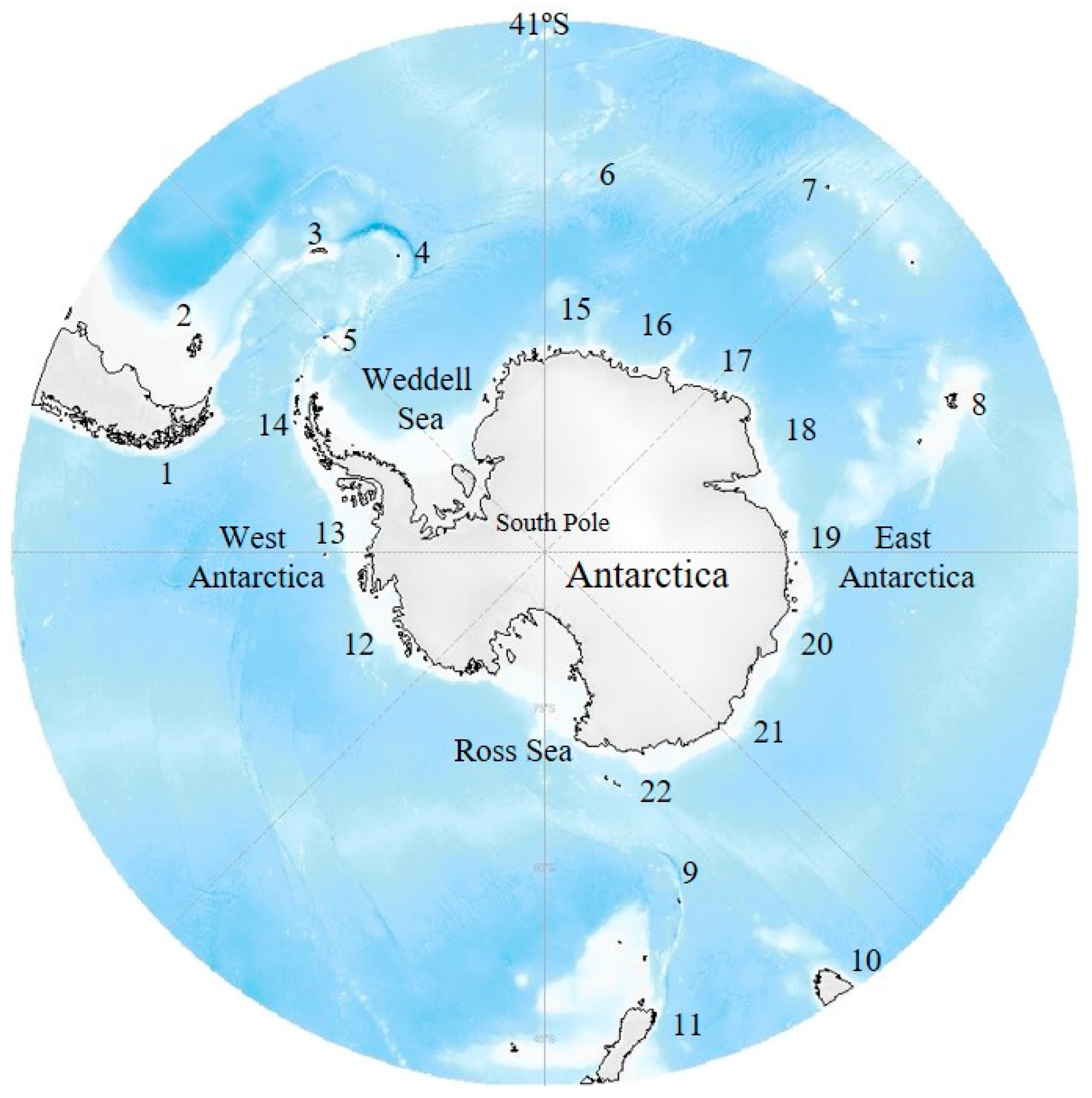
Figure 2.
Number of species recorded in each of the areas and zones of the Southern Ocean.
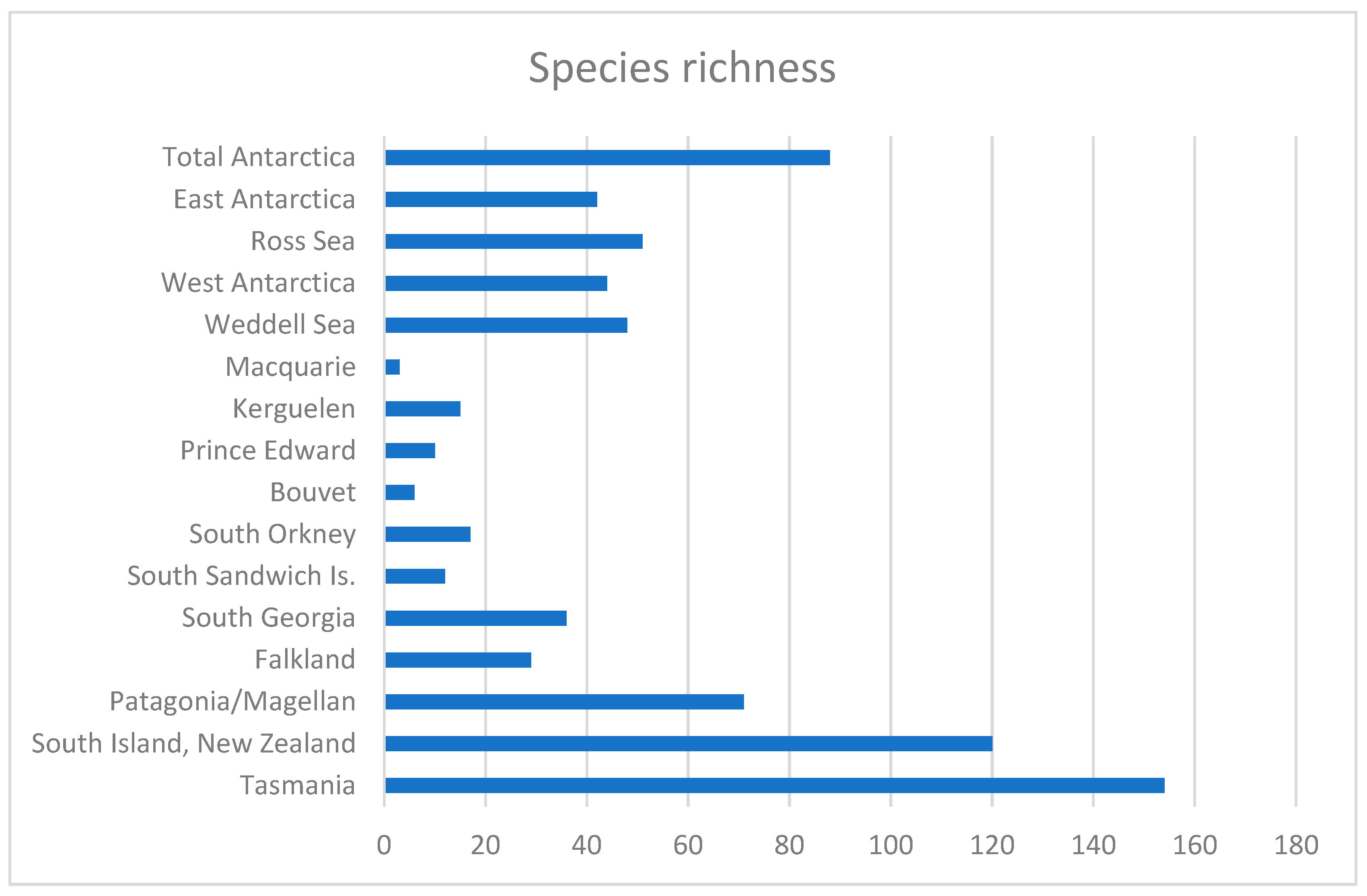

Table 1.
Number of species grouped by taxonomic order from each zone.
| Zone | Acteonimorpha | Ringiculimorpha | Nudibranchia | Pleurobranchida | Umbraculida | Pteropoda | Cephalaspidea | Runcinacea | Aplysiida | Sacoglossa | Total species |
|---|---|---|---|---|---|---|---|---|---|---|---|
| Patagonia/Magellan | 4 | 0 | 39 | 3 | 0 | 8 | 13 | 0 | 0 | 4 | 71 |
| Falkland (Malvinas) Is. | 1 | 0 | 15 | 1 | 0 | 3 | 9 | 0 | 0 | 0 | 29 |
| South Georgia. Is. | 3 | 0 | 15 | 1 | 0 | 7 | 10 | 0 | 0 | 0 | 36 |
| South Sandwich Is. | 1 | 0 | 2 | 1 | 0 | 5 | 3 | 0 | 0 | 0 | 12 |
| South Orkney.Is | 1 | 0 | 9 | 3 | 0 | 1 | 3 | 0 | 0 | 0 | 17 |
| Bouvet Is. | 0 | 0 | 3 | 0 | 0 | 2 | 1 | 0 | 0 | 0 | 6 |
| Prince Edward/Crozet Is. | 0 | 0 | 2 | 0 | 0 | 6 | 2 | 0 | 0 | 0 | 10 |
| Kerguelen Is. | 2 | 0 | 5 | 0 | 0 | 0 | 8 | 0 | 0 | 0 | 15 |
| Macquarie Is. | 0 | 0 | 3 | 0 | 0 | 0 | 0 | 0 | 0 | 0 | 3 |
| Tasmania | 3 | 0 | 93 | 4 | 2 | 2 | 32 | 1 | 5 | 12 | 154 |
| South Island, NewZealand | 4 | 1 | 47 | 4 | 0 | 32 | 23 | 1 | 5 | 3 | 120 |
| Weddell Sea | 1 | 0 | 19 | 4 | 0 | 8 | 16 | 0 | 0 | 0 | 48 |
| West Antarctica | 3 | 0 | 19 | 1 | 0 | 13 | 9 | 0 | 0 | 0 | 45 |
| Ross Sea | 2 | 0 | 26 | 1 | 0 | 6 | 16 | 0 | 0 | 0 | 51 |
| East Antarctica | 2 | 0 | 22 | 1 | 0 | 8 | 9 | 0 | 0 | 0 | 42 |
| Total Antarctica | 4 | 0 | 40 | 4 | 0 | 14 | 27 | 0 | 0 | 0 | 89 |
| Total by groups | 14 | 1 | 209 | 13 | 2 | 40 | 90 | 2 | 6 | 17 | 394 |
Disclaimer/Publisher’s Note: The statements, opinions and data contained in all publications are solely those of the individual author(s) and contributor(s) and not of MDPI and/or the editor(s). MDPI and/or the editor(s) disclaim responsibility for any injury to people or property resulting from any ideas, methods, instructions or products referred to in the content. |
© 2025 by the authors. Licensee MDPI, Basel, Switzerland. This article is an open access article distributed under the terms and conditions of the Creative Commons Attribution (CC BY) license (http://creativecommons.org/licenses/by/4.0/).
Copyright: This open access article is published under a Creative Commons CC BY 4.0 license, which permit the free download, distribution, and reuse, provided that the author and preprint are cited in any reuse.


