

Submitted:
25 April 2025
Posted:
25 April 2025
You are already at the latest version
Abstract
There is a steady rise in both the number of venues and the level of competition. One way to evaluate a journal’s quality is by looking at its impact factor. ”The higher the impact factor, the better the journal is”: This is the belief held by numerous research experts. The truth behind a journal’s impact factor, however, is unknown to them. In order to boost their impact factor, some journals are resorting to unethical practices in order to enhance the number of citations published in their journal. Researchers will thus have a hard time settling on a prestigious journal. The caliber of the research is directly proportional to the journal’s caliber. At present, citations to other papers are used to determine the impact factor. Journal quality is a deciding factor for eminent scholars when publishing an article. Thus far, the paper-to-paper citation network has been the sole determinant of the impact factor. In order to dismantle this type of problem, this article proposes a new impact factor for journals that is based on the authors’ metrics (IFa). Having a renowned researcher on the editorial board raises the bar for the entire journal. Collecting and analyzing all publishing records from 40 journals, 20 of which have high publication rates and 20 of which have low publication rates, this study uses co-author metrics as well as a proposed impact factor based on the author’s H-index and attributions. The impact factor based on the author’s H-index correctly predicts that 70% of venues will see a fluctuation in IF throughout the years, 20% will see a consistent decline, and 10% will see an increase. Compared to the impact factors based on paper citations or author’s citations, the impact factors based on the author’s H-index are superior for journals.
Keywords:
impact factor
; author-author citation network
; natural language processing
; bibliographic dataset
1. Introduction
As the craze of research in different fields are increasing day by day, it is resulting in an increase in the number of venues and the competition among the venues is also increasing gradually. A parameter is needed to be introduced in order to determine the quality of a venue. The impact factor (IF) [1,2] measures the quality of the journal or venue. Journal Impact Factor generally depends on the citation counts of the papers published in that journal with respect to its recent years. The impact factor is commonly used to evaluate the relative importance of a journal within a particular field of research. Journals with higher IFs are believed to be more important than those with lower ones. But the reality behind the impact factor of a journal is that some journals are taking unprincipled steps to get more citations on their journal as it increases their impact factor. Hence it will be difficult for researcher to select a prominent journal.
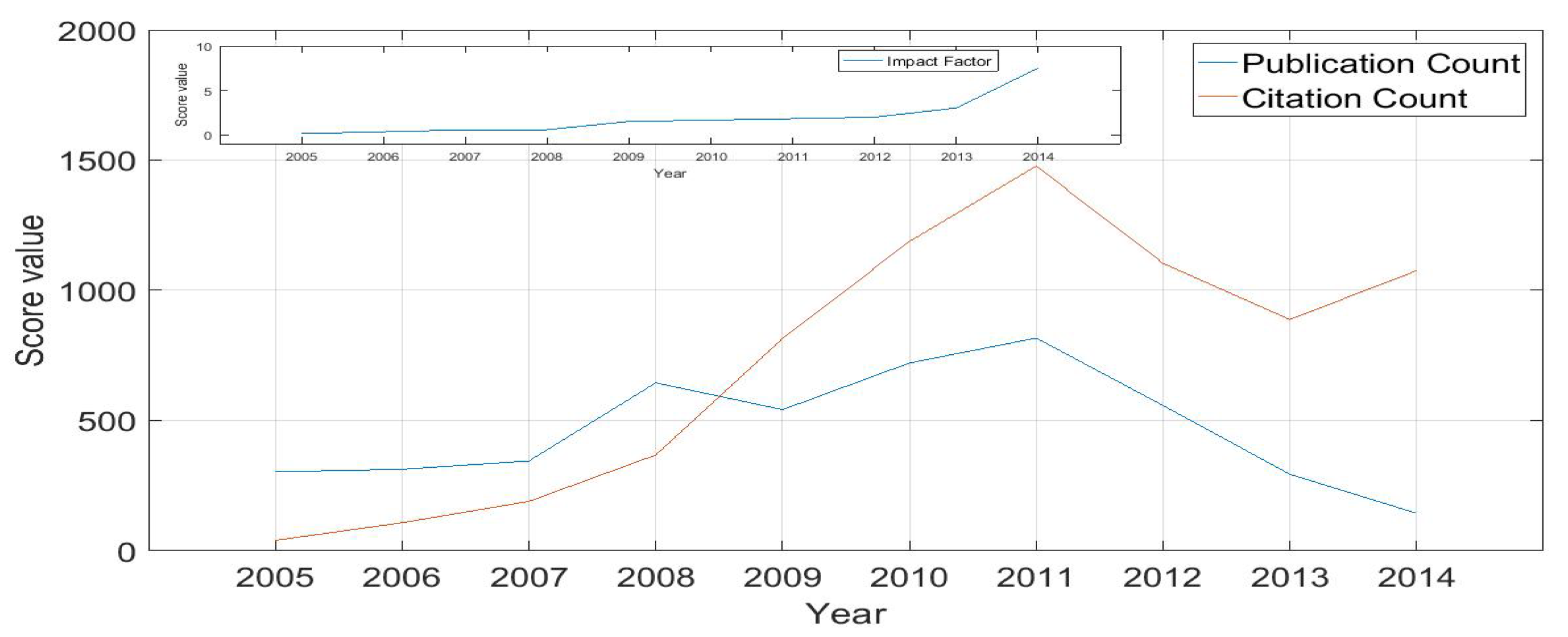
The variation of publication count, citation count, and impact factor in temporal line of Computers & Mathematics with Applications venue is illustrated in Figure 1. Plot shows that, with passing years, the publication count of the venue is gradually decreasing but the citation count remain increasing. As the citation count remains increasing, the impact factor of the venue also remains improved year by year. From this example it is probably understandable that the venue is increasing its impact factor by means of self-citation i.e the respective venues publications are cited by the newly published article. So, it is totally depends on the paper-paper citation network. There have no author contribution, or author performance are not directly reflect to the calculation of impact factor in venue. In this article proposed modified impact factor (IFa) in this article will contribute a lot.
Figure 1.
Variation of publication count, citation count, and impact factor in temporal line of Computers & Mathematics with Applications venue.
Figure 1.
Variation of publication count, citation count, and impact factor in temporal line of Computers & Mathematics with Applications venue.
In contrast to the existing works, it can be summarized that there are few papers that have worked on determining journal quality. The papers have considered citation counts from other publication as the common features [3,4]. some have used publication delay [5] to obtain the quality of a journal. Hence in this article, an author-based journal impact factor is introduced that is not performed by any other existing work, considering features such as the author’s citation count and author’s H-index.
In this article have lots of motivation behind the impact factor illustrate in bellow. Firstly,the journal impact factor is used to determine the quality of the paper. But it has been seen that in some cases impact factor turn out to be misleading. The publishers of the journal influences the researcher to cite their old published article in order to get more citations as it increases their impact factor. In such case, it will be misleading for a researcher in the venue selection process. Secondly, Research quality gets decremented, impacting the research academia society. This justifies that only JIF cannot be considered an accurate parameter for determining the quality of the journal. Thirdly, increase in self citation due to the influence of the incorrect impact factor of the venue will lead to incorrect result in author ranking. As, the citation count will increase, no doubt the H-index will also increase even if the author does nor publish quality papers. Hence it will hamper the author future prediction models also. Lastly,the aim of the article is to eliminate this unfair means of increasing the impact factor by including author-centric parameters along with paper-centric pre-existing impact factor. To demolish this kind of issue, in this article a new author-based impact factor for journals () is proposed, where the impact factor is calculated based on the metrics of the quality authors i.e citation count ad H-index.
Contribution and challenges
In this article, a new modified impact factor, IFa is proposed that is based on the biblometric features of the authors of a venue. The ACMv9 dataset is considered in this article. From this dataset, the required feature that are used for formulating our new author-based impact factor are extracted i.e 16 venues with higher and lower publications. Then the actual impact factor is of all these venues are calculated. Now, a weight factor is introduced that will compute a weight value based on either venue’s individual author’s citation count or their H-index value.
Finally, the new impact factor for every venue or journal is computed by multiplying the weight factor with the actual impact factor of that venue. Now this modified impact factor is compared with the original impact factor of the venues. It is observed that on average there is a difference of 10% between the real impact factor and our modified impact factor. Now among, citation and H-index, H-index gives more prominent and acceptable result than citation count. This new impact factor is more effective in case of venues with more number of publications than the venues with less number of publication.
The article is fundamentally arranged into five major parts: Introduction followed by Research Review, then Methodology after Experimental Setup, Results and Discussion, and finally, Conclusion and future work.
2. Research Review
In this section some relevant previously existing work are highlighted that are performed in the research field.
In the paper Garfield et al. [3] proposed the idea that when the author’s bibliography is examined, a journal’s impact factor is substituted for the actual citation count. In the article, Bornmann et al. [6] The Impact Factor in scientific journals, defines JIF as the relationship between the received citations and the articles published by a journal and is intended to represent the value and prestige of an academic journal. The shift towards online access has allowed for a decrease in overall costs, and subscription prices have risen from year to year. Hlad Chenko et al. [5] in his article describes the effect of publication delay on the most influential academic evaluation system. This influence leads to a mismatch between JIF ranking and reputation-based top journal lists that are created by peer-scholars. This mismatch reveals the inaccuracy of the JIF evaluation system and the disordered situation that academia is facing. In the article, Kulczycki et al. [7] identifies that 13 percent of the blacklisted articles were cited by Web of Science journals and 37 percent of these citations came from impact-factor journals. There are no significant differences between the impact factors and the number of citations to the blacklisted journals. In Kulczycki et al. [8] determined the different uses and advantages of journal impact factor in national journal rankings. In the article by Purkayastha et al. [9], pinpoints that IF does not help in any way in assessing the impact of such publications. It also states that the accuracy of prediction varies greatly across macro-areas, and across SCs within the macro-areas. Mackinnon et al. [10]in his article describes that Citation rates and 5-year journal impact factor appear to measure different dimensions of impact. Citation rates were weakly associated with the completeness of reporting, while neither traditional metric was related to methodological rigour. V Lariviere et al. [11] states that inclusion of journal self-citations in the calculation of the Journal Impact Factor (JIF) has been a cause for concern, as it opens the door for editorial manipulations of citations (Arnold & Fowler, 2011; Reedijk & Moed, 2008; Martin, 2013) In the article, Lutz et al. [12] identifies that Impact Factor is not a perfect tool to measure the quality of articles but there is nothing better and it has the advantage of already being in existence. In the article, Renjith et al. [13] according to the findings, the Journal Impact Factor (JIF) is the most important metrics that the scholarly community can use to measure the quality of Q1 Geology journals, followed by CiteScore and SJR. As a result, the JIF, CiteScore, and SJR indices are recommended for assessing the quality of Q1 Geology journals in Scopus. The article by Bornmann et al. [14] declares that the highly popular journal impact factor (JIF) is an average measure of citations and it is widely used as a proxy of a journal’s quality and scientific prestige. This article also discusses misuses of JIF to assess impact of separate journal articles and the effect of several manuscript versions on JIF. Seu et al. [15] proposed a relation between the h-index of authors concerning their subsequent publications. Bi et al. [16] highlight the four problems or limitations when the h-index is used to determine the impact of a particular author. they also proposed the hi index which is the fractional h-index. Drolet et al. [17] proposed an Author Impact Factor (AIF), that determines the authorship position and number of co-authors to remove biasness and impose fairness in the research field. Fiorillo et al. [18] proposed a new index and named it as Fi-Index to measure the author’s h-index reliability. Giulio Formoso [19] proposed a novel approach to promote fairer criteria to determine the author’s impact in the research field. He presented an example of integrating the aforementioned elements by using information available in bibliographic databases. Huang et al. [20] proposed the relationship between the h-index of abstract authors and the likelihood of subsequent publication. In Lunny et al. [21], proposed overviews such as: (a) synthesised reviews, (b) conducted a systematic search, (c) had a methods section and (d) examined a healthcare intervention and found a mean citation count of 10 overviews per year, published in journals with a mean JIF of 4.4.
Finally, it can be summarized from the research review that the publications have used citation score or count of the venue itself to determine the quality of the venue, which can be full of unfair means [3,8,14]. It is also observed some publication that determined the author impact factor to know the quality of the author and proposed them with the help of new metrics [17,18,19]. Hence a new modified journal impact factor IFa is proposed in this article that is based on impact or quality of the co-author sets of a particular venue
3. Methodology
In this article, IFa (author-invented functional analysis) is implemented in this work using a heuristic technique.The six steps of our heuristic are shown in Figure 1. The first two initial stages involve collecting data, and pre-processing that involves the removal of author name disambiguation. Next three-stage used for our introduced IFa (author-based impact factor for journals) model. And the last stage is the deployment of our model.
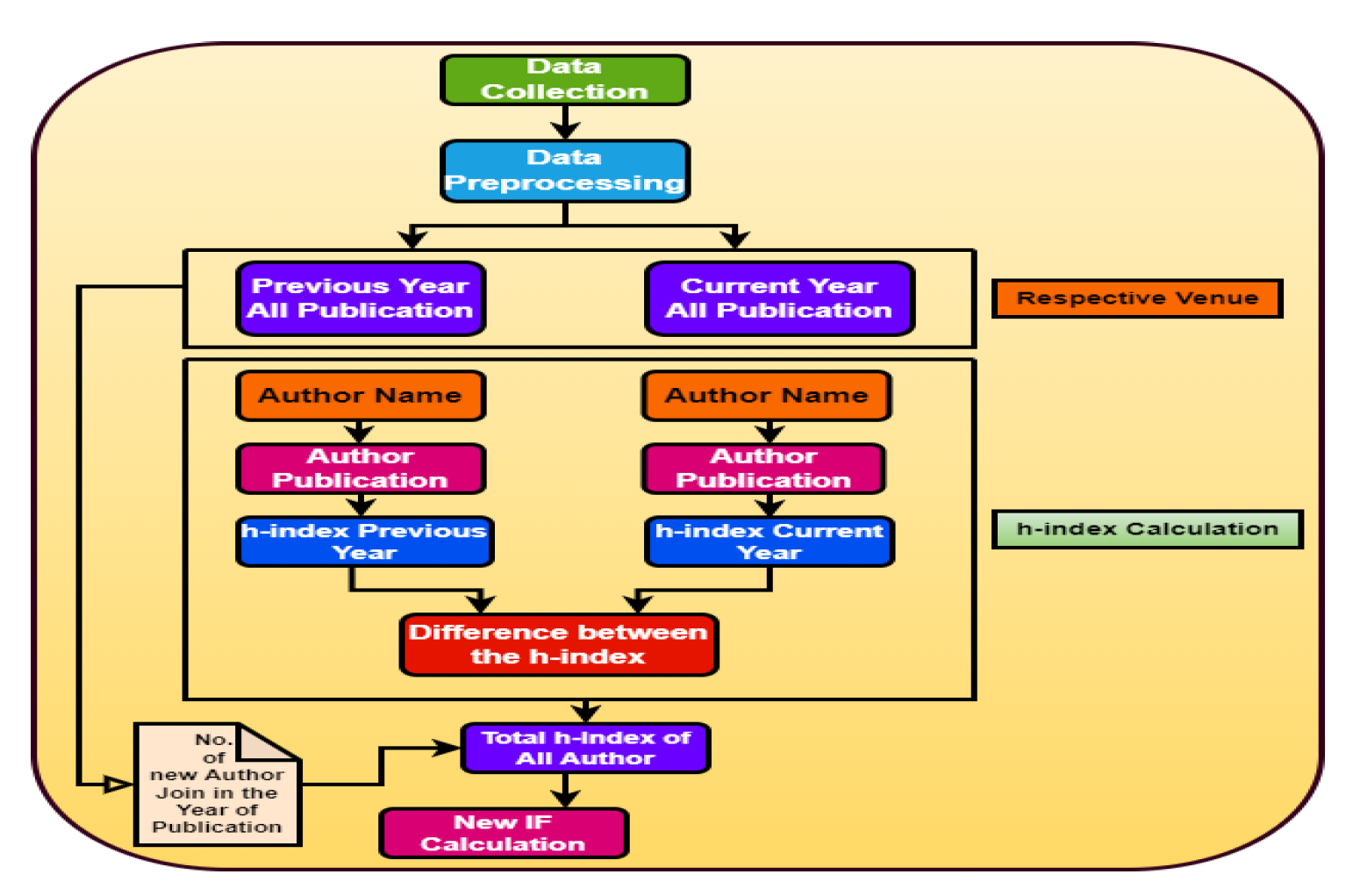
The whole working process or the methodology of this article is illustrated in Figure 2. The first step is the data collection part which is explained in Section 3.1. Next comes the data pre-processing step where impurities from the collected data are eliminated. Then lastly comes the most important step, i.e, the problem formulation, explained and elaborated in Section 3.3
Figure 2.
Flowchart following the stages in creating author’s h-index based .
3.1. Data Collection
For this article, have collected the Citation Network Dataset version ACMv9 dataset1 published in 2017. In the dataset, there are 23,85,065 papers all over the world in various 2,73,308 venues. There has 16,58,484 total of the author are present. This dataset has several features like paper-id, paper name, co-author names, publication year, venue, and references. So, as per our proposed method citation of the paper is a very much important feature. So, a dictionary is made from the paper id vs reference id for calculation of citation count. The co-author’s name, paper id, venue, and publication year are very much important in this article. All the information regarding the ACMv9 dataset are given in below Table 1.

Table 1.
Information regarding Dataset.
| Items | Quantity |
|---|---|
| Total number of publication(s) | 23,85,065 |
| Total number of Author(s) | 2,73,308 |
| Total number of Venue | 42,359 |
| Time Duration (Years) | 1936-2016 (80 Years) |
| Per paper maximum number of Author | 14 |
| Ratio author vs publication | 0.11 |
| Total number of Venue have more than 2000 publication | 113 |
| Total number of Venue have in between 1000-2000 publication | 158 |
| Total number of Venue have in between 150-1000 publication | 1,534 |
| Total number of Venue have less than 150 publication | 40,554 |
3.2. Data Pre-Processing
After collecting the dataset from the reviewer’s bibliographic information, the next step is pre-processing. The pre-processing stage is a crucial stage.Several types of mistakes are found and corrected during the pre-processing phase of data. fixed the problems that were found. Almost every conceivable fault, including those in handling the missing data values through subtraction or addition to a threshold, and using a referential naming convention to assign names to the authors in a particular format and author name ambiguity are removed as stated below.
3.2.1. Remove Error Data Elements
A few errors are identified from the reviewer’s dataset. Some of the respective data of the attributes are not present or not related to the attributes. Those types of data are removed and refined from the data sets. Now some errors are present in the names of authors and venue name are also identified and corrected by NLP technique.
3.2.2. Remove Author Name Ambiguity
Another problem that arose in calculating IFa was the author’s name ambiguity which possesses synonyms and homonyms. The ambiguity is removed using temporal affiliation-based.
3.3. Problem Formulation
In the problem formulation, some useful notations are mentioned which will be use in the future discussion and to also to define the problem statement.
Table 2.
List of notations.
| Notation | Description |
|---|---|
| Venue or the journal name | |
| Current year of venue’s impact factor | |
| Publications in the venue v till year t | |
| Individual author’s publications in the venue v till year t | |
| Weight of the venue v according to author’s quality | |
| Authors’ H-index difference between current year and previous year | |
| Our proposed impact factor for venue v |
Here, different venues are selected from the bibliographic dataset that should be denoted as followings:
Our findings the impact factor which is denoted as for the respective year and this will be partially dependent on researcher performance quality of that particular venue all those previous year which is illustrated in below:
-
Step:1 (Collection of Publications)Initially all the publication denoted as are collected from the respective venue where the publication year should be less than equal to t which stated in below:In the same way the publications are collected of the respective venue where the publication year should be less than equal to denoted as .
-
Step:2 (Collection of Authors in respective Venue)In this steps the authors set belongs to the publication at backward timestamp of t is collected which is expressed in below:In the same way the authors set belongs to the publication at backward timestamp of is collected which is expressed in below:Next identification of newly added authors set say, in particular venue in this year t.
-
Step:3 (Calculate weight respective venue using quality of Author)Hirsch et al. [22], in 2005 proposed a metric named h-index. It is the number of papers with citation number greater that equals to h-index.where is the weight value of venue . It is computed by dividing the summation of by the total number of newly joined authors in the current year. is the different between the h index of the venue in the previous years. is the publications of the author A at venue at the current year.where, is differences of the authors’ H-index till the current year and H-index till previous year.
-
Step:4 (Calculate new impact factor )Journal Impact Factor, is a measure of the frequency with which the “average article" published in a given scholarly journal has been cited in a particular year or period and is often used to measure or describe the importance of a particular journal to its field. In the paper Garfield et al. [3] proposed the idea that when the author’s bibliography is examined, a journal’s impact factor is substituted for the actual citation count.Now, multiplying the weight factor with the IF, the modified IF, IFa is obtained.where, is the real impact of venue at current year t. is our new modified impact factor of that venue at current year t, that is obtained by multiplying with .
3.4. Heuristic Approach
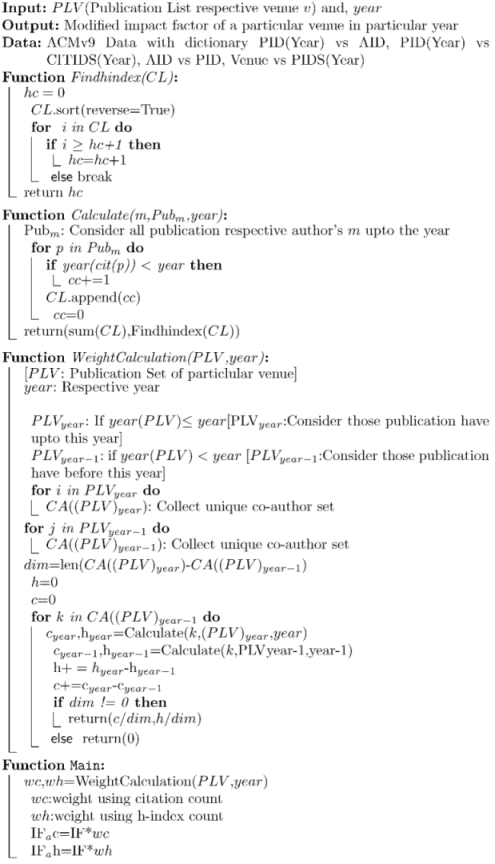
This article’s proposed heuristic is explained in this section. In this approach the ACMv9 dataset is taken and splitted it into various dictionaries i.e PID(Year) vs AID, PID(Year) vs CITIDS(Year), AID vs PID, and Venue vs PIDS(Year). The aim is to obtain the modified impact factor in respective year where input is which is the set of publications in venue v and is the current year.
From Algorithm 1, and are the two weight factor’s considered for citation count based and H-index based respectively. The weight factors’ are calculated in follow manners:
- Step 1: Two publication set are prepared from , is the publications in venue v till the current and is the publications in venue v till previous .
- Step 2: The unique co-author set, CA((PLV)year) are collected from each of the publications in the venue till the current year. Similarly, the unique co-author set, CA((PLV)year−1) are collected from each of the publications in the venue till the previous year. Now the difference between the number of author’s in current year to that of the previous year is stored in .
-
Step 3: The sum of all authors’ H-index difference of current year (cyear, hyear) and the previous year (cyear−1, hyear−1)is represented by h and The sum of all authors’ citation count difference is represented by c are calculated individually.
- –
- Step 3.1: For the finding of H-index or citation count, a list, is prepared for citation value of each publication. Then from this list the H-index is calculated for an individual author. Also sum all the citations of the list to get the total citation count of the venue. Now again go to step 3 until the last author.
- Step 4: So Finally, weight values as 0, if for any of the case if comes 0, otherwise the weight values i.e for citation count () will be c/ and for H-index ( will be h/.
- Step 5: After obtaining the author’s citation count based weight value () and H-index based weight value (), the modified impact factors are established by multiplying the weight value to the actual impact factor of the venue. Hence author’s citation count based impact factor (IFa) is author’s citation count based weight value () multiplied with actual impact factor (IF). Similarly, author’s H-index based impact factor (IFa) is author’s H-index based weight value () multiplied with actual impact factor (IF).
| Algorithm 1 Calculation of Impact Factor(IFa) by author impact |
 |
4. Experimental Setup
From the dictionaries, information of 16 different venues (journals) is taken into consideration. using the massive ACMv9 dataset as the source. By employing our problem-solving framework, The various values of the weights are obtained as explained in subSection 3.3. Then, finally If we multiply this weight by the venue’s initial impact factor, we obtain the modified impact factor.
The experiments considered areexplained below:
- Author’s Citation Count based: In this condition, the author’s citation count is considered to determine the author’s quality, based upon which the weight value is obtained and hence obtained our modified impact factor. From the dataset, 16 venues are considered for the experiment.
- Author’s H-index based: Similarly, in this condition,the H-index value of the author is considered to obtain his performance or quality. Hence the weight value is computed and obtained the modified impact factor. In this case also, 16 venues are considered from the ACMv9 dataset.
- Variation of IFa between venues with high publication count and venues with low publication count: In this case, venues of two categories are selected from the dataset, i.e, venues having more than 2000 publications and venues having less than 2000 publications. The new impact factor is obtained for both the categories of venue and their variation is discussed in Section 5.3.
5. Results and Discussion
In this section, The outcomes of the two experimental setups are presented and discussed below. Further the two conditions are classified into three case studies. The case study results are discussed below with the help of the plots and tables
5.1. Citation Count Based Approach
As mentioned, in this section, the author’s citation count is considered to compute the weight factor for obtaining our proposed modified impact factor for a particular venue or journal. The results are illustrated in Table 3.
This case is illustrated through Figure 3 which is the plot of Variation of IFa in Analog Integrated Circuits and Signal Processing Venue using citation based weight calculation. From this figure we can observe that after 2012, the new impact factor shows a huge hike and the difference is about 100, which is not an acceptable result. The weight value also differs from a minimum value of 1 to median value of 5 to a maximum value of 15 and above.
Figure 3.
Variation of in Analog Integrated Circuits and Signal Processing Venue using citation based weight calculation.
Figure 3.
Variation of in Analog Integrated Circuits and Signal Processing Venue using citation based weight calculation.
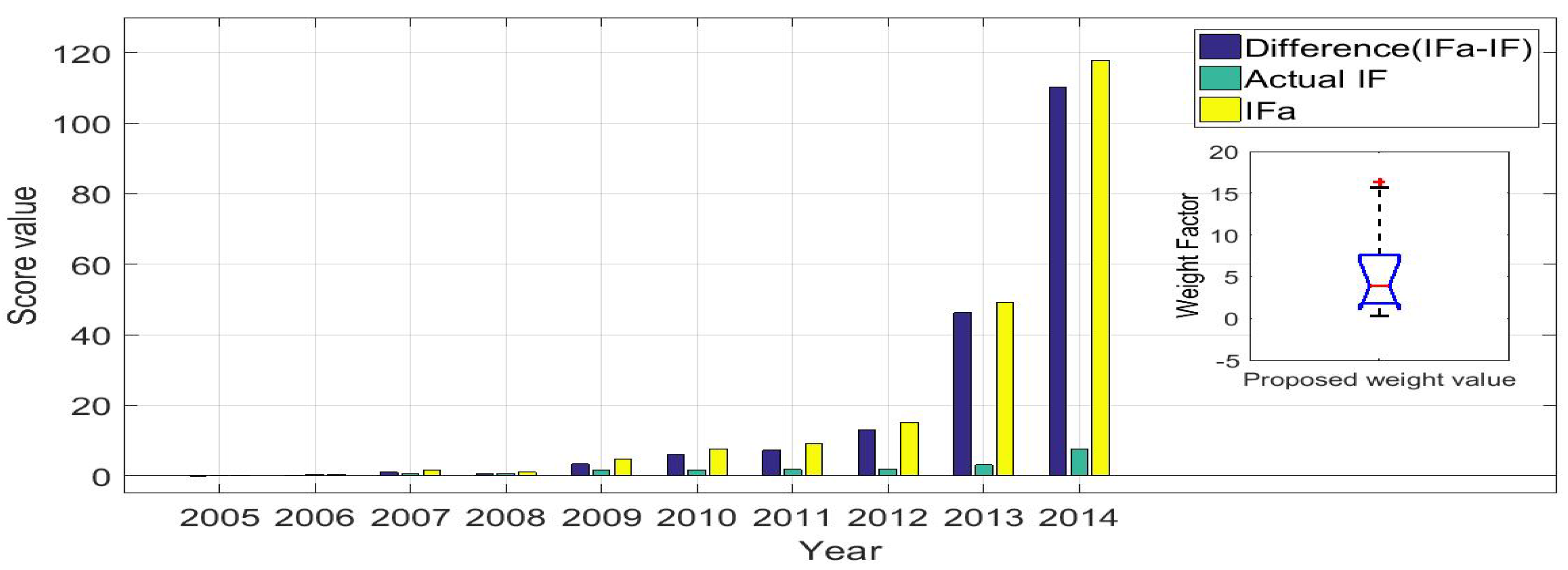
Now, in this article 16 venues are considered, whose modified impact factor is calculated and compared with their actual impact factor which is based on the venue’s citation count. Now, using the author’s citation count where it is observed that about 80% of the venue’s impact factor increases by about 9 units, 20% of the venues show both increasing as well as decreasing values of IF in preceding years, but none of the results show only decreasing value of impact factor.Two categories of venues are taken, 10 venues having more than 2000 publications and 6 venues having less than 2000 publications. But both the categories conclude with the same results.
5.2. Author’s H-Index Based
Similarly, in this case, the author’s H-index is considered to obtain the weight factor to calculate the modified impact factor i.e. IFa, and the results are illustrated in Table 4. But here it is seen that an additional result from the citation count case. Along increasing, increasing-decreasing, it is also observed that only decreasing impact factors using the author’s H-index. Here 70% of the venues show both decreasing as well as increasing of IF in continuous years, The 20% gives a uniform decrease of IF, and the rest 10% gives an increase of IF.
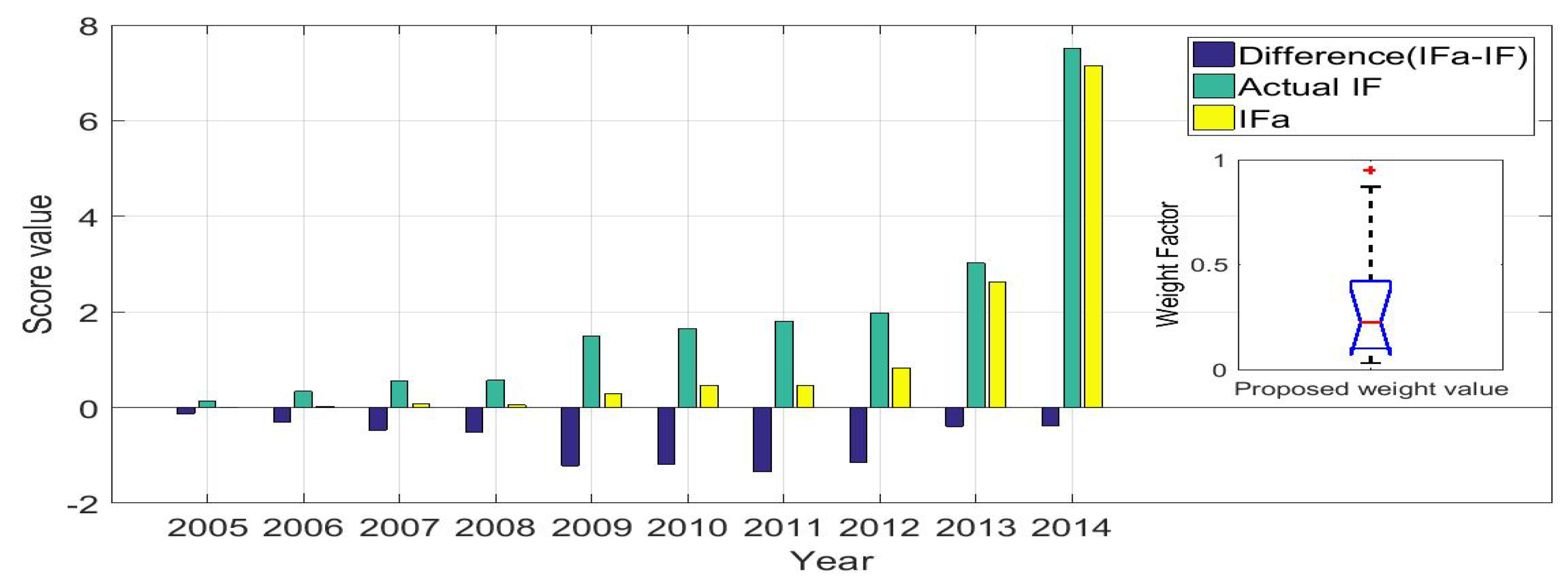
Hence, considering the author’s H-index gives more prominent, genuine, and acceptable results than considering the author’s citation count, which gives increasing results that too very irregular hike in IF. Comparing Figure 3 and Figure 4, both are the plot of same venue, but one is citation count based and another is H-index based. In case of citation count based the weight factor rises to 15 and above, where as in H-index based the weight value always remains bellow 1.
Hence, the author’s h-index based IFa approach is further classified into three different cases that are obtained after the experiment with 16 venues.
5.2.1. Case 1: Venue Having Real Impact Factor More but the Modified Impact Factor is Decreased
In this case, the real or actual impact factor of the venue, Analog Integrated Circuits and Signal Processing was more than our proposed impact factor. The modified impact factor IFa is varying from the actual impact factor in negative values over the last 10 years. This case is illustrated clearly in Figure 4. Starting from the year 2005 to 2014, the IFa is constantly lesser that IF and hence the difference between IFa and IF always lies in the negative x-axis. The weight values varies from a minimum of 0.1 to median of 0.3 to a maximum value of 0.8.
Figure 4.
Variation of in Analog Integrated Circuits and Signal Processing Venue using h-index based weight calculation.
Figure 4.
Variation of in Analog Integrated Circuits and Signal Processing Venue using h-index based weight calculation.
5.2.2. Case 2: Venue Having Real Impact Factor Less but the Modified Impact Factor is Increased
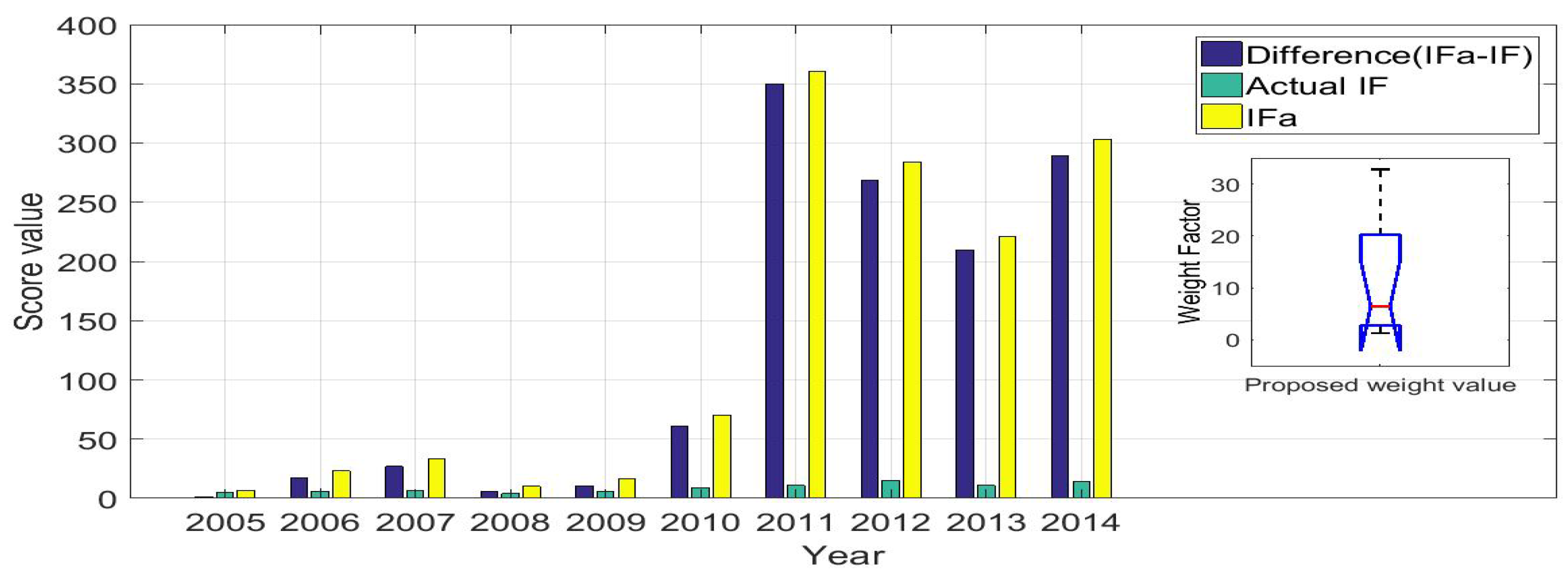
Now, however, the exact opposite of what was seen before is occurring. In every case, the modified impact factor exceeds the original, throughout the past decade in the venue, ACM SIGPLAN Notices. This case is depicted with the help of histogram plots in Figure 5. From 2005 to 2014, the IFa is always greater than IF, and hence the difference between the two always lies on the positive x-axis. The weight values varies from a minimum of 1 to median of 5 to a maximum value of 30 and above.
Figure 5.
Variation of in ACM SIGPLAN Notices Venue using h-index based weight calculation.
5.2.3. Case 3: Venue Having Both Increasing and Decreasing Modified Impact Factor in Continuous Years
This case is a combination of the previous two cases. In the venue, ACM SIGSOFT Software Engineering Notes both increasing as well as decreasing of modified impact factor from the actual impact factor is observed. The case is depicted in the plot in Figure 6. From 2005 to 2014, 50% times the IFa is greater than IF, and the rest 50% times the IFa is lesser than the IF. Hence the difference lies in both the positive and negative x-axis. The weight values varies from a minimum of 0.6 to median of 0.9 to a maximum value of 1.4.
Figure 6.
Variation of in ACM SIGSOFT Software Engineering Notes Venue using h-index based weight calculation.
Figure 6.
Variation of in ACM SIGSOFT Software Engineering Notes Venue using h-index based weight calculation.
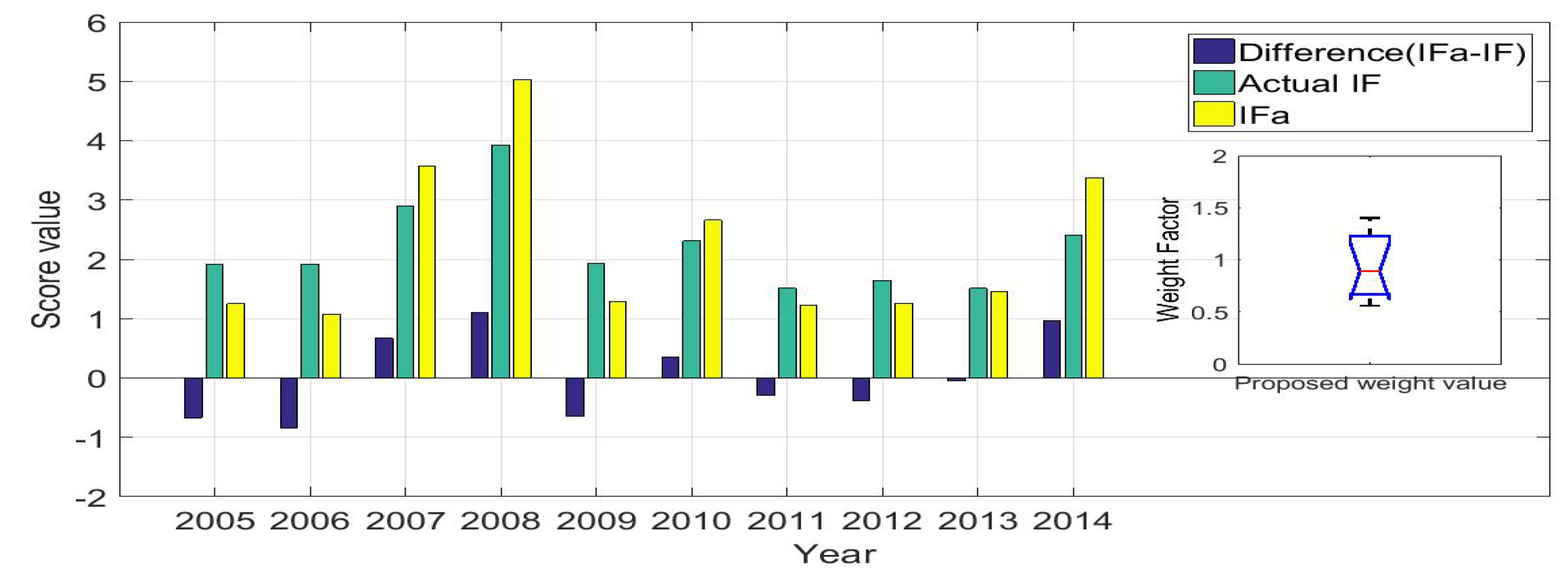
Table 3.
Results of IFa using citation count based approach on 16 venues in 10 years timestamp.
| No of Publication Count Range |
Venue Name | Citation Count Basis Weight | Status of IFa-IF (Increases/Decreases) |
|||||||||||||||||||||||||||||
| Year | ||||||||||||||||||||||||||||||||
| 2005 | 2006 | 2007 | 2008 | 2009 | 2010 | 2011 | 2012 | 2013 | 2014 | |||||||||||||||||||||||
| IF | W | IFa | IF | W | IFa | IF | W | IFa | IF | W | IFa | IF | W | IFa | IF | W | IFa | IF | W | IFa | IF | W | IFa | IF | W | IFa | IF | W | IFa | |||
| Total Publication above 2000 in respective venue |
ACM SIGPLAN Notices | 5.30 | 20.86 | 110.56 | 5.79 | 68.93 | 399.10 | 6.48 | 84.07 | 544.77 | 4.09 | 50.14 | 205.07 | 5.97 | 47.03 | 280.77 | 9.14 | 159.96 | 1462.03 | 11.00 | 771.80 | 8489.80 | 15.23 | 432.70 | 6590.02 | 10.93 | 534.90 | 5846.00 | 14.22 | 553.80 | 7875.51 | Increases: 10 |
| IFa-IF | 105.26 | IFa-IF | 393.31 | IFa-IF | 538.29 | IFa-IF | 200.98 | IFa-IF | 274.80 | IFa-IF | 1452.89 | IFa-IF | 8478.80 | IFa-IF | 6574.79 | IFa-IF | 5836.00 | IFa-IF | 7861.29 | |||||||||||||
| Journal of Global Optimization | 1.99 | 4.15 | 8.26 | 2.16 | 8.90 | 19.22 | 2.52 | 6.45 | 16.25 | 2.76 | 7.37 | 20.34 | 6.63 | 9.72 | 64.44 | 5.12 | 13.68 | 70.04 | 5.07 | 10.63 | 53.89 | 5.88 | 13.73 | 80.73 | 4.35 | 12.44 | 54.11 | 6.39 | 15.57 | 99.49 | Increases: 10 | |
| IFa-IF | 6.27 | IFa-IF | 17.06 | IFa-IF | 13.73 | IFa-IF | 17.58 | IFa-IF | 57.81 | IFa-IF | 64.92 | IFa-IF | 48.82 | IFa-IF | 74.85 | IFa-IF | 49.76 | IFa-IF | 93.10 | |||||||||||||
| Analog Integrated Circuits and Signal Processing |
0.46 | 1.36 | 0.63 | 0.56 | 2.80 | 1.57 | 0.69 | 7.00 | 4.83 | 0.57 | 7.16 | 4.08 | 1.06 | 8.45 | 8.96 | 1.07 | 9.65 | 10.33 | 1.01 | 10.72 | 10.83 | 0.93 | 8.75 | 8.14 | 0.94 | 10.89 | 10.24 | 0.86 | 11.28 | 9.70 | Increases: 10 | |
| IFa-IF | 0.17 | IFa-IF | 1.01 | IFa-IF | 4.14 | IFa-IF | 3.51 | IFa-IF | 7.90 | IFa-IF | 9.26 | IFa-IF | 9.82 | IFa-IF | 7.21 | IFa-IF | 9.30 | IFa-IF | 8.84 | |||||||||||||
| ACM SIGSOFT Software Engineering Notes |
1.92 | 6.89 | 13.23 | 1.92 | 6.37 | 12.23 | 2.90 | 14.91 | 43.24 | 3.93 | 15.81 | 62.13 | 1.93 | 9.24 | 17.83 | 2.31 | 18.12 | 41.86 | 1.51 | 14.86 | 22.44 | 1.64 | 13.91 | 22.81 | 1.51 | 17.60 | 26.58 | 2.41 | 28.79 | 69.38 | Increases: 10 | |
| IFa-IF | 11.31 | IFa-IF | 10.31 | IFa-IF | 40.34 | IFa-IF | 58.20 | IFa-IF | 15.90 | IFa-IF | 39.55 | IFa-IF | 20.93 | IFa-IF | 21.17 | IFa-IF | 25.07 | IFa-IF | 66.97 | |||||||||||||
| Journal of the American Society for Information Science and Technology |
2.63 | 0.87 | 2.29 | 3.07 | 1.38 | 4.24 | 2.61 | 1.89 | 4.93 | 3.84 | 3.63 | 13.94 | 3.54 | 4.13 | 14.62 | 4.93 | 8.42 | 41.51 | 5.54 | 9.17 | 50.80 | 8.45 | 11.07 | 93.54 | 91.29 | 153.80 | 14041.00 | 0.00 | 0.00 | 0.00 | Decreases : 1 Increases : 9 |
|
| IFa-IF | -0.34 | IFa-IF | 1.17 | IFa-IF | 2.32 | IFa-IF | 10.10 | IFa-IF | 11.08 | IFa-IF | 36.58 | IFa-IF | 45.26 | IFa-IF | 85.09 | IFa-IF | 13950.00 | IFa-IF | 0.00 | |||||||||||||
| Computers & Mathematics with Applications |
0.13 | 0.33 | 0.04 | 0.34 | 1.26 | 0.43 | 0.55 | 2.85 | 1.57 | 0.57 | 1.79 | 1.02 | 1.50 | 3.21 | 4.82 | 1.65 | 4.64 | 7.66 | 1.81 | 4.99 | 9.03 | 1.98 | 7.59 | 15.03 | 3.02 | 16.32 | 49.29 | 7.52 | 15.67 | 117.84 | Decreases : 1 Increases : 9 |
|
| IFa-IF | -0.09 | IFa-IF | 0.09 | IFa-IF | 1.02 | IFa-IF | 0.45 | IFa-IF | 3.32 | IFa-IF | 6.01 | IFa-IF | 7.22 | IFa-IF | 13.05 | IFa-IF | 46.27 | IFa-IF | 110.32 | |||||||||||||
| IEEE Transactions on Very Large Scale Integration (VLSI) Systems |
4.09 | 2.57 | 10.51 | 3.97 | 5.28 | 20.96 | 4.08 | 5.51 | 22.48 | 4.03 | 5.60 | 22.57 | 5.45 | 6.90 | 37.61 | 5.18 | 12.24 | 63.40 | 3.03 | 8.61 | 26.09 | 3.53 | 10.19 | 35.97 | 3.71 | 18.08 | 67.08 | 9.13 | 38.56 | 352.05 | Increases: 10 | |
| IFa-IF | 6.42 | IFa-IF | 16.99 | IFa-IF | 18.40 | IFa-IF | 18.54 | IFa-IF | 32.16 | IFa-IF | 58.22 | IFa-IF | 23.06 | IFa-IF | 32.44 | IFa-IF | 63.37 | IFa-IF | 342.92 | |||||||||||||
| Signal Processing | 3.42 | 5.07 | 17.34 | 3.95 | 10.86 | 42.90 | 2.16 | 5.43 | 11.73 | 2.12 | 7.09 | 15.03 | 3.92 | 9.12 | 35.75 | 3.71 | 9.65 | 35.80 | 3.80 | 13.55 | 51.49 | 3.78 | 12.82 | 48.46 | 4.23 | 14.78 | 62.52 | 4.28 | 17.56 | 75.16 | Increases: 10 | |
| IFa-IF | 13.92 | IFa-IF | 38.95 | IFa-IF | 9.57 | IFa-IF | 12.91 | IFa-IF | 31.83 | IFa-IF | 32.09 | IFa-IF | 47.69 | IFa-IF | 44.68 | IFa-IF | 58.29 | IFa-IF | 70.88 | |||||||||||||
| IEEE Transactions on Signal Processing | 4.08 | 6.84 | 27.92 | 4.17 | 10.76 | 44.90 | 4.20 | 8.40 | 35.32 | 5.83 | 7.40 | 43.18 | 15.00 | 6.90 | 103.53 | 9.84 | 13.26 | 130.54 | 3.94 | 13.57 | 53.46 | 4.34 | 14.90 | 64.69 | 5.02 | 21.70 | 109.00 | 9.30 | 11.30 | 105.06 | Increases: 10 | |
| IFa-IF | 23.84 | IFa-IF | 40.73 | IFa-IF | 31.11 | IFa-IF | 37.34 | IFa-IF | 88.53 | IFa-IF | 120.69 | IFa-IF | 49.52 | IFa-IF | 60.35 | IFa-IF | 104.00 | IFa-IF | 95.76 | |||||||||||||
| IEEE Design & Test | 3.78 | 6.09 | 23.01 | 3.79 | 16.43 | 62.30 | 3.57 | 12.05 | 42.98 | 4.02 | 15.11 | 60.79 | 4.07 | 11.04 | 44.96 | 4.03 | 17.50 | 70.61 | 3.21 | 27.19 | 87.20 | 5.37 | 35.93 | 192.84 | 0.00 | 0.00 | 0.00 | 0.00 | 0.00 | 0.00 | Increases: 10 | |
| IFa-IF | 19.23 | IFa-IF | 58.51 | IFa-IF | 39.41 | IFa-IF | 56.77 | IFa-IF | 40.89 | IFa-IF | 66.57 | IFa-IF | 84.00 | IFa-IF | 187.47 | IFa-IF | 0.00 | IFa-IF | 0.00 | |||||||||||||
| Total Publication above 2000 in respective venue |
Journal of Mathematical Imaging and Vision |
5.73 | 2.13 | 12.20 | 3.01 | 2.37 | 7.13 | 5.18 | 4.77 | 24.71 | 4.03 | 6.62 | 26.68 | 8.18 | 9.82 | 80.33 | 6.71 | 14.39 | 96.56 | 9.68 | 15.80 | 152.94 | 6.96 | 15.05 | 104.75 | 4.79 | 14.38 | 68.88 | 3.72 | 11.75 | 43.71 | Increases: 10 |
| IFa-IF | 6.47 | IFa-IF | 4.12 | IFa-IF | 19.53 | IFa-IF | 22.65 | IFa-IF | 72.15 | IFa-IF | 89.85 | IFa-IF | 143.26 | IFa-IF | 97.79 | IFa-IF | 64.09 | IFa-IF | 39.99 | |||||||||||||
| Discrete & Computational Geometry | 1.79 | 4.44 | 7.95 | 4.96 | 22.74 | 112.79 | 1.57 | 6.48 | 10.17 | 2.54 | 8.14 | 20.68 | 4.33 | 12.29 | 53.22 | 4.20 | 9.84 | 41.33 | 3.86 | 16.91 | 65.27 | 3.23 | 14.86 | 48.00 | 0.00 | 0.00 | 0.00 | 5.12 | 2.67 | 13.67 | Increases: 10 | |
| IFa-IF | 6.16 | IFa-IF | 107.83 | IFa-IF | 8.60 | IFa-IF | 18.14 | IFa-IF | 48.89 | IFa-IF | 37.13 | IFa-IF | 61.41 | IFa-IF | 44.77 | IFa-IF | 0.00 | IFa-IF | 8.55 | |||||||||||||
| Graphs and Combinatorics | 0.57 | 4.21 | 2.40 | 0.38 | 17.14 | 6.51 | 0.15 | 4.83 | 0.72 | 0.70 | 9.52 | 6.66 | 1.15 | 7.91 | 9.10 | 1.47 | 16.57 | 24.36 | 1.30 | 16.94 | 22.02 | 1.67 | 23.29 | 38.89 | 0.59 | 7.96 | 4.70 | 0.87 | 15.44 | 13.43 | Increases: 10 | |
| IFa-IF | 1.83 | IFa-IF | 6.13 | IFa-IF | 0.57 | IFa-IF | 5.96 | IFa-IF | 7.95 | IFa-IF | 22.89 | IFa-IF | 20.72 | IFa-IF | 37.22 | IFa-IF | 4.11 | IFa-IF | 12.56 | |||||||||||||
| Proceedings of the Conference on Design, Automation and Test in Europe |
0.00 | 0.00 | 0.00 | 0.00 | 0.00 | 0.00 | 0.00 | 0.00 | 0.00 | 0.00 | 0.00 | 0.00 | 0.28 | 0.00 | 0.00 | 1.03 | 1.56 | 1.61 | 0.00 | 0.00 | 0.00 | 0.00 | 0.00 | 0.00 | 1.83 | 2.73 | 5.00 | 0.00 | 0.00 | 0.00 | Decreases : 1 Increases : 9 |
|
| IFa-IF | 0.00 | IFa-IF | 0.00 | IFa-IF | 0.00 | IFa-IF | 0.00 | IFa-IF | -0.28 | IFa-IF | 0.58 | IFa-IF | 0.00 | IFa-IF | 0.00 | IFa-IF | 3.17 | IFa-IF | 0.00 | |||||||||||||
| ACM SIGMETRICS Performance Evaluation Review |
6.18 | 18.94 | 117.06 | 2.62 | 9.89 | 25.92 | 1.70 | 5.17 | 8.79 | 2.47 | 7.55 | 18.64 | 2.96 | 8.40 | 24.86 | 3.91 | 7.75 | 30.30 | 2.25 | 5.32 | 11.97 | 2.04 | 6.16 | 12.57 | 12.67 | 17.34 | 219.70 | 2.16 | 5.95 | 12.85 | Increases: 10 | |
| IFa-IF | 110.88 | IFa-IF | 23.30 | IFa-IF | 7.09 | IFa-IF | 16.17 | IFa-IF | 21.90 | IFa-IF | 26.39 | IFa-IF | 9.72 | IFa-IF | 10.53 | IFa-IF | 207.00 | IFa-IF | 10.69 | |||||||||||||
Table 4.
Results of IFa using H-index based approach on 16 venues in 10 years timestamp.
|
No of Publication Count Range |
Venue Name | H-Index Basis Weight |
Status of IFa-IF (Increases/Decreases) |
|||||||||||||||||||||||||||||
| Year | ||||||||||||||||||||||||||||||||
| 2005 | 2006 | 2007 | 2008 | 2009 | 2010 | 2011 | 2012 | 2013 | 2014 | |||||||||||||||||||||||
| IF | W | IFa | IF | W | IFa | IF | W | IFa | IF | W | IFa | IF | W | IFa | IF | W | IFa | IF | W | IFa | IF | W | IFa | IF | W | IFa | IF | W | IFa | |||
|
Total Publication above 2000 in respective venue |
ACM SIGPLAN Notices | 5.30 | 1.28 | 6.80 | 5.79 | 4.03 | 23.33 | 6.48 | 5.15 | 33.37 | 4.09 | 2.48 | 10.14 | 5.97 | 2.75 | 16.42 | 9.14 | 7.67 | 70.10 | 11.00 | 32.80 | 360.80 | 15.23 | 18.66 | 284.19 | 10.93 | 20.20 | 220.80 | 14.22 | 21.33 | 303.31 | Increases: 10 |
| IFa-IF | 1.50 | IFa-IF | 17.54 | IFa-IF | 26.89 | IFa-IF | 6.05 | IFa-IF | 10.45 | IFa-IF | 60.96 | IFa-IF | 349.80 | IFa-IF | 268.96 | IFa-IF | 209.90 | IFa-IF | 289.09 | |||||||||||||
| Journal of Global Optimization | 1.99 | 0.19 | 0.38 | 2.16 | 0.37 | 0.80 | 2.52 | 0.26 | 0.66 | 2.76 | 0.27 | 0.75 | 6.63 | 0.46 | 3.05 | 5.12 | 0.74 | 3.79 | 5.07 | 0.45 | 2.28 | 5.88 | 0.67 | 3.94 | 4.35 | 0.58 | 2.52 | 6.39 | 0.78 | 4.98 | Decreases : 10 | |
| IFa-IF | -1.61 | IFa-IF | -1.36 | IFa-IF | -1.86 | IFa-IF | -2.01 | IFa-IF | -3.58 | IFa-IF | -1.33 | IFa-IF | -2.79 | IFa-IF | -1.94 | IFa-IF | -1.83 | IFa-IF | -1.41 | |||||||||||||
|
Analog Integrated Circuits and Signal Processing |
0.46 | 0.17 | 0.08 | 0.56 | 0.27 | 0.15 | 0.69 | 0.43 | 0.30 | 0.57 | 0.36 | 0.21 | 1.06 | 0.41 | 0.43 | 1.07 | 0.59 | 0.63 | 1.01 | 0.51 | 0.52 | 0.93 | 0.42 | 0.39 | 0.94 | 0.54 | 0.51 | 0.86 | 0.53 | 0.46 | Decreases : 10 | |
| IFa-IF | -0.38 | IFa-IF | -0.41 | IFa-IF | -0.39 | IFa-IF | -0.36 | IFa-IF | -0.63 | IFa-IF | -0.44 | IFa-IF | -0.49 | IFa-IF | -0.54 | IFa-IF | -0.43 | IFa-IF | -0.40 | |||||||||||||
| ACM SIGSOFT Software Engineering Notes |
1.92 | 0.65 | 1.25 | 1.92 | 0.56 | 1.08 | 2.90 | 1.23 | 3.57 | 3.93 | 1.28 | 5.03 | 1.93 | 0.67 | 1.29 | 2.31 | 1.15 | 2.66 | 1.51 | 0.81 | 1.22 | 1.64 | 0.77 | 1.26 | 1.51 | 0.97 | 1.47 | 2.41 | 1.40 | 3.37 | Decreases : 6 Increases : 4 |
|
| IFa-IF | -0.67 | IFa-IF | -0.84 | IFa-IF | 0.67 | IFa-IF | 1.10 | IFa-IF | -0.64 | IFa-IF | 0.35 | IFa-IF | -0.29 | IFa-IF | -0.38 | IFa-IF | -0.05 | IFa-IF | 0.96 | |||||||||||||
|
Journal of the American Society for Information Science and Technology |
2.63 | 0.10 | 0.26 | 3.07 | 0.16 | 0.49 | 2.61 | 0.14 | 0.37 | 3.84 | 0.34 | 1.31 | 3.54 | 0.26 | 0.92 | 4.93 | 0.49 | 2.42 | 5.54 | 0.56 | 3.10 | 8.45 | 0.65 | 5.49 | 91.29 | 7.68 | 701.10 | 0.00 | 0.00 | 0.00 | Decreases : 8 Increases : 2 |
|
| IFa-IF | -2.37 | IFa-IF | -2.58 | IFa-IF | -2.24 | IFa-IF | -2.53 | IFa-IF | -2.62 | IFa-IF | -2.51 | IFa-IF | -2.44 | IFa-IF | -2.96 | IFa-IF | 609.80 | IFa-IF | 0.00 | |||||||||||||
|
Computers & Mathematics with Applications |
0.13 | 0.03 | 0.00 | 0.34 | 0.09 | 0.03 | 0.55 | 0.14 | 0.08 | 0.57 | 0.10 | 0.06 | 1.50 | 0.19 | 0.29 | 1.65 | 0.28 | 0.46 | 1.81 | 0.26 | 0.47 | 1.98 | 0.42 | 0.83 | 3.02 | 0.87 | 2.63 | 7.52 | 0.95 | 7.14 | Decreases : 10 | |
| IFa-IF | -0.13 | IFa-IF | -0.31 | IFa-IF | -0.47 | IFa-IF | -0.51 | IFa-IF | -1.22 | IFa-IF | -1.19 | IFa-IF | -1.34 | IFa-IF | -1.15 | IFa-IF | -0.39 | IFa-IF | -0.38 | |||||||||||||
|
IEEE Transactions on Very Large Scale Integration (VLSI) Systems |
4.09 | 0.15 | 0.61 | 3.97 | 0.31 | 1.23 | 4.08 | 0.29 | 1.18 | 4.03 | 0.30 | 1.21 | 5.45 | 0.46 | 2.51 | 5.18 | 0.73 | 3.78 | 3.03 | 0.49 | 1.48 | 3.53 | 0.48 | 1.69 | 3.71 | 0.81 | 3.01 | 9.13 | 1.99 | 18.17 | Decreases : 9 Increases : 1 |
|
| IFa-IF | -3.48 | IFa-IF | -2.74 | IFa-IF | -2.90 | IFa-IF | -2.82 | IFa-IF | -2.94 | IFa-IF | -1.40 | IFa-IF | -1.55 | IFa-IF | -1.84 | IFa-IF | -0.71 | IFa-IF | 9.04 | |||||||||||||
| Signal Processing | 3.42 | 0.43 | 1.47 | 3.95 | 0.75 | 2.96 | 2.16 | 0.30 | 0.65 | 2.12 | 0.46 | 0.98 | 3.92 | 0.52 | 2.04 | 3.71 | 0.60 | 2.23 | 3.80 | 0.73 | 2.77 | 3.78 | 0.73 | 2.76 | 4.23 | 0.67 | 2.83 | 4.28 | 0.83 | 3.55 | Decreases : 10 | |
| IFa-IF | -1.95 | IFa-IF | -0.99 | IFa-IF | -1.51 | IFa-IF | -1.14 | IFa-IF | -1.88 | IFa-IF | -1.48 | IFa-IF | -1.03 | IFa-IF | -1.02 | IFa-IF | -1.40 | IFa-IF | -0.73 | |||||||||||||
|
IEEE Transactions on Signal Processing |
4.08 | 0.40 | 1.63 | 4.17 | 0.60 | 2.50 | 4.20 | 0.44 | 1.85 | 5.83 | 0.57 | 3.33 | 15.00 | 0.77 | 11.55 | 9.84 | 0.73 | 7.19 | 3.94 | 0.66 | 2.60 | 4.34 | 0.71 | 3.08 | 5.02 | 1.00 | 5.02 | 9.30 | 0.82 | 7.62 | Decreases : 9 Increases : 1 |
|
| IFa-IF | -2.45 | IFa-IF | -1.67 | IFa-IF | -2.35 | IFa-IF | -2.51 | IFa-IF | -3.45 | IFa-IF | -2.66 | IFa-IF | -1.34 | IFa-IF | -1.26 | IFa-IF | 0.00 | IFa-IF | -1.67 | |||||||||||||
| IEEE Design & Test | 3.78 | 0.40 | 1.51 | 3.79 | 0.91 | 3.45 | 3.57 | 0.77 | 2.75 | 4.02 | 0.75 | 3.02 | 4.07 | 0.60 | 2.44 | 4.03 | 0.92 | 3.71 | 3.21 | 1.23 | 3.94 | 5.37 | 1.71 | 9.18 | 0.00 | 0.00 | 0.00 | 0.00 | 0.00 | 0.00 | Decreases : 6 Increases : 4 |
|
| IFa-IF | -2.27 | IFa-IF | -0.34 | IFa-IF | -0.82 | IFa-IF | -1.01 | IFa-IF | -1.63 | IFa-IF | -0.32 | IFa-IF | 0.74 | IFa-IF | 3.81 | IFa-IF | 0.00 | IFa-IF | 0.00 | |||||||||||||
| Total Publication above 2000 in respective venue |
Journal of Mathematical Imaging and Vision |
5.73 | 0.22 | 1.26 | 3.01 | 0.25 | 0.75 | 5.18 | 0.24 | 1.24 | 4.03 | 0.35 | 1.41 | 8.18 | 0.44 | 3.60 | 6.71 | 0.77 | 5.17 | 9.68 | 0.79 | 7.65 | 6.96 | 0.64 | 4.45 | 4.79 | 0.73 | 3.50 | 3.72 | 0.57 | 2.12 | Decreases : 10 |
| IFa-IF | -4.47 | IFa-IF | -2.26 | IFa-IF | -3.94 | IFa-IF | -2.62 | IFa-IF | -4.58 | IFa-IF | -1.54 | IFa-IF | -2.03 | IFa-IF | -2.51 | IFa-IF | -1.29 | IFa-IF | -1.60 | |||||||||||||
| Discrete & Computational Geometry | 1.79 | 0.15 | 0.27 | 4.96 | 1.10 | 5.46 | 1.57 | 0.23 | 0.36 | 2.54 | 0.38 | 0.97 | 4.33 | 0.76 | 3.29 | 4.20 | 0.52 | 2.18 | 3.86 | 0.89 | 3.44 | 3.23 | 0.93 | 3.00 | 0.00 | 0.00 | 0.00 | 5.12 | 1.23 | 6.30 | Decreases : 7 Increases : 3 |
|
| IFa-IF | -1.52 | IFa-IF | 0.50 | IFa-IF | -1.21 | IFa-IF | -1.57 | IFa-IF | -1.04 | IFa-IF | -2.02 | IFa-IF | -0.42 | IFa-IF | -0.23 | IFa-IF | 0.00 | IFa-IF | 1.18 | |||||||||||||
| Graphs and Combinatorics | 0.57 | 0.19 | 0.11 | 0.38 | 0.64 | 0.24 | 0.15 | 0.20 | 0.03 | 0.70 | 0.52 | 0.36 | 1.15 | 0.40 | 0.46 | 1.47 | 0.84 | 1.23 | 1.30 | 0.82 | 1.07 | 1.67 | 1.14 | 1.90 | 0.59 | 0.34 | 0.20 | 0.87 | 0.59 | 0.51 | Decreases : 9 Increases : 1 |
|
| IFa-IF | -0.46 | IFa-IF | -0.14 | IFa-IF | -0.12 | IFa-IF | -0.34 | IFa-IF | -0.69 | IFa-IF | -0.24 | IFa-IF | -0.23 | IFa-IF | 0.23 | IFa-IF | -0.39 | IFa-IF | -0.36 | |||||||||||||
|
Proceedings of the Conference on Design, Automation and Test in Europe |
0.00 | 0.00 | 0.00 | 0.00 | 0.00 | 0.00 | 0.00 | 0.00 | 0.00 | 0.00 | 0.00 | 0.00 | 0.28 | 0.00 | 0.00 | 1.03 | 0.07 | 0.07 | 0.00 | 0.00 | 0.00 | 0.00 | 0.00 | 0.00 | 1.83 | 0.05 | 0.09 | 0.00 | 0.00 | 0.00 | Decreases : 3 Increases : 7 |
|
| IFa-IF | 0.00 | IFa-IF | 0.00 | IFa-IF | 0.00 | IFa-IF | 0.00 | IFa-IF | -0.28 | IFa-IF | -0.96 | IFa-IF | 0.00 | IFa-IF | 0.00 | IFa-IF | -1.74 | IFa-IF | 0.00 | |||||||||||||
|
ACM SIGMETRICS Performance Evaluation Review |
6.18 | 0.77 | 4.73 | 2.62 | 0.63 | 1.64 | 1.70 | 0.32 | 0.54 | 2.47 | 0.44 | 1.09 | 2.96 | 0.56 | 1.66 | 3.91 | 0.67 | 2.62 | 2.25 | 0.72 | 1.62 | 2.04 | 0.84 | 1.71 | 12.67 | 1.12 | 14.19 | 2.16 | 1.18 | 2.55 | Decreases : 8 Increases : 2 |
|
| IFa-IF | -1.45 | IFa-IF | -0.98 | IFa-IF | -1.16 | IFa-IF | -1.38 | IFa-IF | -1.30 | IFa-IF | -1.29 | IFa-IF | -0.63 | IFa-IF | -0.33 | IFa-IF | 1.52 | IFa-IF | 0.39 | |||||||||||||
5.3. Variation of New Impact Score High Publication vs Low Publication Venue
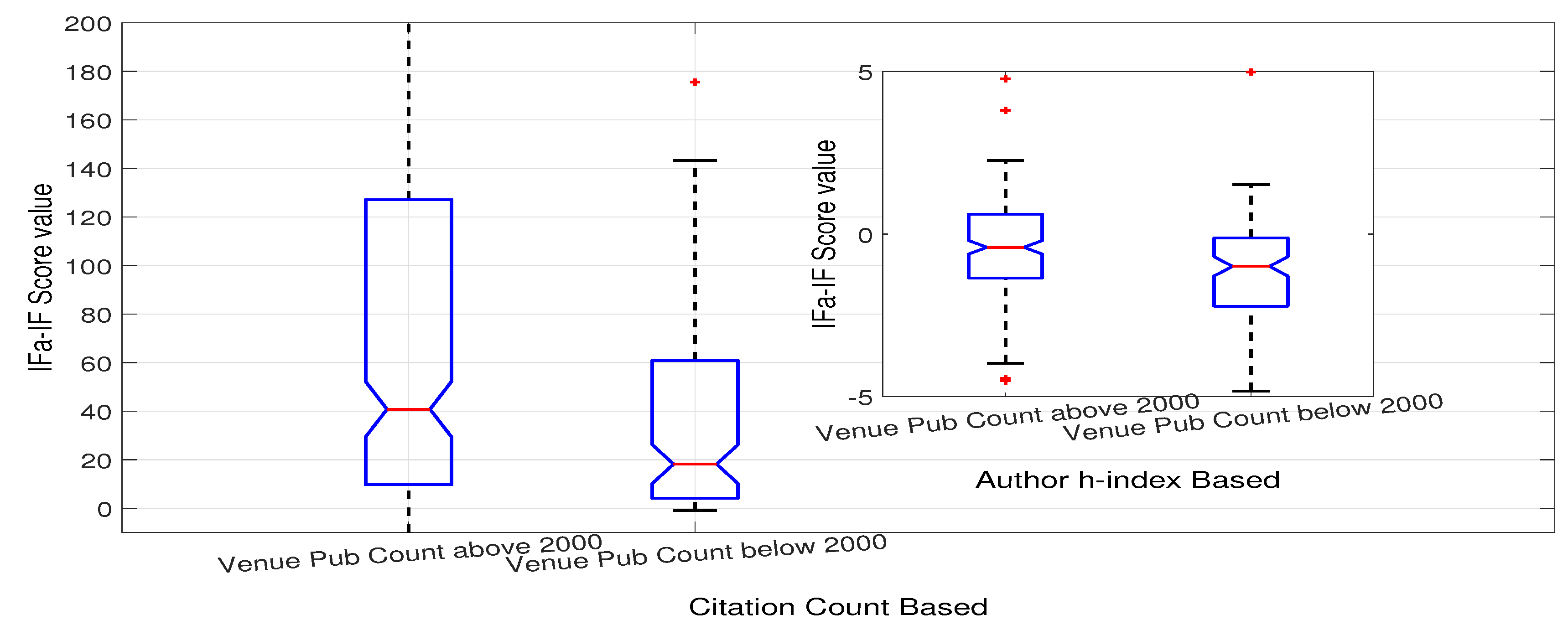
The new impact factor IFa varies with variation of publication count of the venues. This varies is presented with the help of an error plot in Figure 7. Here four condition plots are presented. H-index based with high publication venue i.e. more than 2000 publications, H-index based with low publication venue i.e. less than 2000 publications, similarly for citation count. Here, it is observed that in the case of citation median value of ( - ) difference of actual and proposed impact factor much greater than h-index based calculation. For h-index case we have seen the higher publication venue cases it will shows the better results than low publication venues.
Figure 7.
Variation of the difference between proposed impact factor and actual impact factor (-) in high publication (publication count above 2000) vs low publication (publication count below 2000) venue in timestamp of (2005-2014).
Figure 7.
Variation of the difference between proposed impact factor and actual impact factor (-) in high publication (publication count above 2000) vs low publication (publication count below 2000) venue in timestamp of (2005-2014).
6. Conclusion & Future Works
The existing dataset of journal impact factors for one decay are compared with the proposed algorithm to validate the model. From the experiments and results it can be concluded that in 80% of the cases, author’s H-index based impact factor gives acceptable and correct result in analyzing the quality of a venue.
In Future, the proposed metric can be implemented on large datasets of huge number of venues. Lastly, the designed algorithm can be implemented on the collected dataset on author’s index, and i10 index to showcase the improvised and hence better result of IFa(author-based impact factor for journals) compared to the existing JIF(journal impact factor).
Ethics approval: The Author confirms that the work described has not been published before, and it is not under consideration for publication elsewhere.
Consent to participate: The Authors agree to participate in the conference.
Conflict of interest: We declare that we do not have any commercial or associative interest that represents a conflict of interest in connection with the work submitted
Authors’ contributions: All authors have equal contribution in the article.
Funding
We do not have any funding for this article.
References
- Sharma, M.; Sarin, A.; Gupta, P.; Sachdeva, S.; Desai, A. Journal impact factor: its use, significance and limitations. World journal of nuclear medicine 2014, 13, 146–146. [Google Scholar] [CrossRef] [PubMed]
- Kavic, M.S.; Satava, R.M. Scientific literature and evaluation metrics: impact factor, usage metrics, and altmetrics. JSLS: Journal of the Society of Laparoscopic & Robotic Surgeons 2021, 25. [Google Scholar]
- Garfield, E. Journal impact factor: a brief review. Cmaj 1999, 161, 979–980. [Google Scholar] [PubMed]
- Garfield, E.; et al. The impact factor. Current contents 1994, 25, 3–7. [Google Scholar]
- Hladchenko, M.; Moed, H.F. The effect of publication traditions and requirements in research assessment and funding policies upon the use of national journals in 28 post-socialist countries. Journal of Informetrics 2021, 15, 101190. [Google Scholar] [CrossRef]
- Lugo-Machado, J.A.; López-López, R.M.; Medina-Valentón, E.; Villa, E.O. The Impact Factor in scientific journals. Romanian Journal of Rhinology 2022, 12, 49–52. [Google Scholar] [CrossRef]
- Kulczycki, E.; Hołowiecki, M.; Taşkın, Z.; Krawczyk, F. Do impact-factor journals make blacklisted journals visible? In A systematic citation study. In Proceedings of the 18th international conference on scientometrics & informetrics (ISSI2021), 2021; pp. 615–620. [Google Scholar]
- Kulczycki, E.; Huang, Y.; Zuccala, A.A.; Engels, T.C.; Ferrara, A.; Guns, R.; Pölönen, J.; Sivertsen, G.; Taşkın, Z.; Zhang, L. Uses of the Journal Impact Factor in national journal rankings in China and Europe. Journal of the Association for Information Science and Technology 2022. [Google Scholar] [CrossRef]
- Purkayastha, A.; Palmaro, E.; Falk-Krzesinski, H.J.; Baas, J. Comparison of two article-level, field-independent citation metrics: Field-Weighted Citation Impact (FWCI) and Relative Citation Ratio (RCR). Journal of Informetrics 2019, 13, 635–642. [Google Scholar] [CrossRef]
- Mackinnon, S.; Drozdowska, B.A.; Hamilton, M.; Noel-Storr, A.H.; McShane, R.; Quinn, T. Are methodological quality and completeness of reporting associated with citation-based measures of publication impact? A secondary analysis of a systematic review of dementia biomarker studies. BMJ open 2018, 8, e020331. [Google Scholar] [CrossRef] [PubMed]
- Lariviere, V.; Sugimoto, C.R. The journal impact factor: A brief history, critique, and discussion of adverse effects. In Springer handbook of science and technology indicators; Springer, 2019; pp. 3–24.
- Bornmann, L.; Haunschild, R. Plots for visualizing paper impact and journal impact of single researchers in a single graph. Scientometrics 2018, 115, 385–394. [Google Scholar] [CrossRef] [PubMed]
- RENJITH, V.R.R.; ARUNKUMAR, V. JOURNAL IMPACT FACTOR (JIF): THE MOS OR (JIF): THE MOS OR (JIF): THE MOST IMPORTANT MEASURE OF QU MEASURE OF QUALITY OF QUARTILE1 (Q1) RTILE1 (Q1) GEOLOGY JOURNALS.
- Bornmann, L.; Marx, W.; Gasparyan, A.Y.; Kitas, G.D. Diversity, value and limitations of the journal impact factor and alternative metrics. Rheumatology international 2012, 32, 1861–1867. [Google Scholar] [CrossRef] [PubMed]
- Seu, M.; Yang, S.D.; Qiao, J.B.; Dorafshar, A.H. Response to “an Alternative Metric to Address Limitations of the H-Index”. Journal of Surgical Research 2022. [Google Scholar] [CrossRef] [PubMed]
- Bi, H.H. Four problems of the h-index for assessing the research productivity and impact of individual authors. Scientometrics, 2022; pp. 1–15. [Google Scholar]
- Drolet, B.C.; Makhoul, A.T. Author Impact Factor: A Framework for Evaluating Authorship and Scientific Contribution. Biostatistics Research, 2022; pp. 11–17. [Google Scholar]
- Fiorillo, L. Fi-Index: A New Method to Evaluate Authors Hirsch-Index Reliability. Publishing Research Quarterly, 2022; pp. 1–10. [Google Scholar]
- Formoso, G. The H-index is an unfair measure of scientific achievements. A proposal to address its shortcomings. Local Health Authority of Reggio Emilia 2022. [Google Scholar]
- Huang, A.; Maricevich, R.S. An Alternative Metric to Address Limitations of the H-Index. Journal of Surgical Research 2022. [Google Scholar] [CrossRef] [PubMed]
- Lunny, C.; Neelakant, T.; Chen, A.; Shinger, G.; Stevens, A.; Tasnim, S.; Sadeghipouya, S.; Adams, S.; Zheng, Y.W.; Lin, L.; et al. Bibliometric study of ‘overviews of systematic reviews’ of health interventions: evaluation of prevalence, citation and journal impact factor. Research Synthesis Methods 2022, 13, 109–120. [Google Scholar] [CrossRef] [PubMed]
- Hirsch, J.E. An index to quantify an individual’s scientific research output. Proceedings of the National academy of Sciences 2005, 102, 16569–16572. [Google Scholar] [CrossRef] [PubMed]
| 1 |
Disclaimer/Publisher’s Note: The statements, opinions and data contained in all publications are solely those of the individual author(s) and contributor(s) and not of MDPI and/or the editor(s). MDPI and/or the editor(s) disclaim responsibility for any injury to people or property resulting from any ideas, methods, instructions or products referred to in the content. |
© 2025 by the author. Licensee MDPI, Basel, Switzerland. This article is an open access article distributed under the terms and conditions of the Creative Commons Attribution (CC BY) license (https://creativecommons.org/licenses/by/4.0/).
Copyright: This open access article is published under a Creative Commons CC BY 4.0 license, which permit the free download, distribution, and reuse, provided that the author and preprint are cited in any reuse.


