

Submitted:
24 April 2025
Posted:
25 April 2025
You are already at the latest version
Abstract
This study examines the parallel demographic transitions occurring in Brazil: the dramatic decline in fertility rates and the significant reduction in homicide rates. Using comprehensive data from 1950-2025 for fertility and 2007-2024 for homicides, we analyze the trajectories, regional variations, and potential interconnections between these demographic phenomena. Mathematical modeling techniques are employed to quantify these trends and project future scenarios. Our findings reveal that Brazil's fertility rate has declined from 6.12 children per woman in 1950 to 1.57 in 2023, with projections indicating a further decrease to 1.44 by 2040 before a slight recovery to 1.50 by 2070. Concurrently, homicide rates have fallen from 26.6 per 100,000 inhabitants in 2018 to 17.9 in 2024, representing a 33% reduction. However, significant regional disparities persist in both indicators, with fertility rates ranging from 1.39 to 2.26 across states and homicide rates varying from 6.8 to 31.2 per 100,000. Through statistical analysis and demographic modeling, we establish correlations between these transitions and socioeconomic factors. The study contributes to understanding how demographic shifts influence public safety outcomes and provides a methodological framework for projecting these trends. Our findings have important implications for policy development in population management, public security, and social welfare in Brazil and similar developing nations experiencing demographic transitions.
Keywords:
Demographic transition
; Fertility decline
; Homicide reduction
; Brazil
; Population projections
; Regional disparities
; Mathematical modeling
1. Introduction
Brazil, the largest Latin American country and fifth most populous globally, has seen significant demographic changes in recent decades. Two key trends are a sharp decline in fertility rates and a notable drop in homicide rates. These shifts have profound implications for Brazil's social, economic, and security landscape. This study analyzes these changes, explores their potential connections, and projects future scenarios based on historical trends through mathematical modeling.
1.1. Historical Context of Brazil's Fertility Transition
Brazil's fertility transition represents one of the most rapid demographic shifts observed globally. In the mid-20th century, Brazil exhibited demographic characteristics typical of developing nations, with high fertility rates averaging
6.12 children per woman in 1950 (IBGE, 2024). This high fertility regime persisted through the 1950s and early 1960s, contributing to rapid population growth during this period. However, beginning in the late 1960s, Brazil embarked on a steep fertility decline that has continued to the present day.
The pace of this transition has been remarkable by international standards. While demographic transition theory suggests that fertility declines typically occur over multiple generations, Brazil experienced a compression of this process into just a few decades (Carvalho and Wong, 2008). By 1980, the total fertility rate (TFR) had already fallen to 4.09 children per woman, representing a 33% decrease from 1950 levels. The decline accelerated further in subsequent decades, with the TFR reaching 2.81 by 1990, 2.32 by 2000, and 1.75 by 2010 (IBGE, 2024).
What makes Brazil's fertility transition particularly noteworthy is that it occurred without explicit government population control policies. Unlike countries such as China, which implemented its one-child policy, or India, which pursued aggressive family planning campaigns, Brazil's fertility decline has been largely driven by socioeconomic transformations, urbanization, increased female education and labor force participation, and improved access to contraception (Martine, 1996; Berquó and Cavenaghi, 2014).
By 2023, Brazil's fertility rate had fallen to 1.57 children per woman, well below the replacement level of 2.1 children per woman needed for long-term population stability. This sub-replacement fertility has profound implications for Brazil's future population structure, with projections indicating that the country's population will peak at approximately 220.4 million in 2041 before beginning a sustained decline (IBGE, 2024). But the estimation maybe well anticipated as IBGE, a strong and reliable Institution, had problems estimating Brazillian population after the pandemics in 2023, with indications that the current population might be around 200.000 million and not 212.000, a considerable difference that could be determining a zero growth rate as we write this article.
1.2. Regional Disparities in Fertility
While the national fertility trend in Brazil shows a clear downward trajectory, significant regional variations persist. These disparities reflect the country's heterogeneous development patterns and socioeconomic inequalities. As of 2023, the North region maintained the highest fertility rate at 1.83 children per woman, followed by the Central-West (1.71), while the Southeast region exhibited the lowest rate at 1.48 (IBGE, 2024).
At the state level, these disparities are even more pronounced. Roraima, in the northern Amazon region, recorded a fertility rate of 2.26 children per woman in 2023, the highest in the country and the only state still above replacement level. In contrast, Rio de Janeiro in the Southeast registered the lowest rate at 1.39 children per woman (IBGE, 2024). These regional differences correlate strongly
with socioeconomic indicators such as education levels, urbanization rates, income, and access to healthcare services (Berquó and Cavenaghi, 2014).
The persistence of these regional disparities highlights the uneven nature of Brazil's demographic transition and suggests that different regions of the country are at different stages of this process. Understanding these regional patterns is crucial for developing targeted policies that address the specific demographic challenges faced by different parts of the country.
1.3. Historical Context of Violence and Homicide in Brazil
Parallel to its fertility transition, Brazil has experienced significant changes in its patterns of violence and homicide rates. For decades, Brazil has struggled with high levels of violent crime, particularly homicides, positioning it among the countries with the highest murder rates globally. This violence has been attributed to various factors, including rapid urbanization, socioeconomic inequality, organized crime, drug trafficking, and institutional weaknesses in law enforcement and the justice system (Cerqueira et al., 2019).
The trajectory of homicide rates in Brazil has not been linear. From the early 1980s through the mid-2010s, Brazil experienced a general upward trend in homicides, with some fluctuations. This period saw the expansion of organized crime groups, particularly drug trafficking organizations, and the intensification of urban violence in major metropolitan areas (Reichenheim et al., 2011).
The peak of this violence occurred in 2017, when Brazil recorded approximately 60,000 homicides, corresponding to a rate of around 30 per 100,000 inhabitants (Cerqueira et al., 2019). This represented one of the highest absolute numbers of homicides recorded in any country not engaged in conventional warfare. The human and economic costs of this violence have been enormous, with estimates suggesting that violence costs Brazil approximately 6% of its GDP annually through direct and indirect effects (World Bank, 2018).
However, since 2018, Brazil has experienced a notable reversal in this trend, with homicide numbers and rates declining significantly. By 2024, the number of homicides had fallen to approximately 39,000, representing a 35% decrease from the 2017 peak. The homicide rate declined from 26.6 per 100,000 inhabitants in 2018 to 17.9 in 2024, its lowest level in over a decade (Ministry of Justice and Public Security, 2025).
1.4. Regional Disparities in Homicide Rates
Similar to fertility patterns, homicide rates in Brazil exhibit substantial regional variations. These disparities reflect complex interactions between socioeconomic factors, institutional capacity, organized crime presence, and historical patterns of violence. As of 2024, states in the Northeast and North regions generally recorded the highest homicide rates, with Bahia (31.2 per 100,000), Rio Grande do Norte (30.8), Pernambuco (28.5), and Amapá (27.9) leading the country (Ministry of Justice and Public Security, 2025).
In contrast, some states in the Southeast and South regions have achieved much lower rates, with São Paulo recording just 6.8 homicides per 100,000 inhabitants in 2024, less than a quarter of the rate observed in the most violent states (Ministry of Justice and Public Security, 2025). This remarkable disparity highlights the uneven nature of security improvements across the country and suggests that different factors may be driving violence reduction in different regions.
Understanding these regional patterns is essential for developing effective violence reduction strategies that address the specific challenges faced by different parts of the country. It also raises important questions about the transferability of successful security policies from one region to another.
1.5. Theoretical Framework: Demographic Transition and Violence
The concurrent transitions in fertility and homicide rates in Brazil raise intriguing questions about potential interconnections between these demographic phenomena. While the relationship between demographic factors and violence is complex and multifaceted, several theoretical frameworks offer insights into how these transitions might be related.
The demographic transition theory, first proposed by Thompson (1929) and later refined by Notestein (1945), describes the shift from high birth and death rates to lower birth and death rates that typically accompanies economic development.
This transition usually occurs in stages, beginning with a decline in mortality rates followed by a decline in fertility rates, leading to changes in population age structure and eventually to population stabilization or decline.
One potential link between demographic transition and violence is through the "youth bulge" hypothesis, which suggests that societies with a high proportion of young adults (particularly males aged 15-29) in the population are more prone to violence and social instability (Urdal, 2006). As fertility rates decline, the proportion of young adults in the population eventually decreases, potentially contributing to reduced violence levels.
Another theoretical perspective comes from the "civilization process" described by Elias (1939/2000), which suggests that modernization and development lead to greater self-control, stronger state institutions, and declining interpersonal violence. The demographic transition is an integral part of this broader modernization process, potentially contributing to violence reduction through multiple pathways.
Economic theories also offer insights, suggesting that lower fertility rates may lead to greater investment in human capital (the "quantity-quality tradeoff" described by Becker and Lewis, 1973), potentially reducing socioeconomic inequality and associated violence. Additionally, the "demographic dividend" that occurs when fertility rates decline can create economic opportunities that may reduce incentives for criminal behavior (Bloom et al., 2003).
These theoretical perspectives suggest multiple pathways through which Brazil's fertility transition might be connected to its recent reduction in homicide rates, though the specific mechanisms and causal relationships require careful empirical investigation.
1.6. Research Questions and Significance
This study addresses several key research questions:
- What are the quantitative characteristics of Brazil's fertility and homicide rate transitions, and how can these be modeled mathematically?
- What regional patterns exist in these transitions, and what factors explain these regional disparities?
- Are there statistical correlations between fertility decline and homicide reduction in Brazil, and what causal mechanisms might explain these correlations?
- What do mathematical projection models predict for Brazil's future fertility and homicide rates through 2070?
- What policy implications emerge from these findings for addressing Brazil's demographic and security challenges?
The significance of this research is multifaceted. First, it contributes to the academic literature on demographic transitions in developing countries by providing a detailed quantitative analysis of Brazil's fertility decline, one of the most rapid such transitions observed globally. Second, it adds to our understanding of the recent reduction in homicide rates in Brazil, a significant reversal of the country's historical violence trends that has received limited academic attention to date.
Third, by exploring potential connections between fertility transition and violence reduction, this study contributes to broader theoretical discussions about the relationship between demographic factors and public safety outcomes. Fourth, the mathematical modeling and projection techniques developed in this study provide methodological tools that can be applied to similar analyses in other contexts.
Finally, the findings have practical significance for policymakers in Brazil and similar developing nations facing demographic transitions. Understanding the trajectories, regional patterns, and potential interconnections between fertility and homicide trends can inform more effective policies in population management, public security, and social welfare.
1.7. Structure of the Article
The remainder of this article is organized as follows: Section 2 presents the methodology, including data sources, mathematical models, and statistical approaches used in the analysis. Section 3 presents the results, including visualizations of fertility and homicide trends, regional analyses, statistical correlations, and projection models. Section 4 discusses the implications of these findings, their relationship to existing literature, policy considerations, limitations of the study, and directions for future research. Section 5 concludes with a summary of key findings and broader implications. Section 6 provides the Python code used for data analysis and visualization, and Section 7 lists the references cited throughout the article.
Through this comprehensive analysis, we aim to contribute to a deeper understanding of Brazil's remarkable demographic transitions and their implications for the country's future development trajectory.
2. Methodology
This section outlines the methodological framework employed to analyze Brazil's demographic transitions in fertility rates and homicide statistics. We present a rigorous mathematical approach to quantifying these trends, modeling their dynamics, and projecting future scenarios. The methodology encompasses data sources, mathematical models, statistical techniques, and computational methods used in this study.
2.1. Data Sources and Collection
2.1.1. Fertility Data
The fertility data used in this study were obtained from multiple authoritative sources:
- Brazilian Institute of Geography and Statistics (IBGE): Historical fertility rates from 1950 to 2023 and projections to 2070
- World Bank: Comparative fertility data for contextualizing Brazil's transition
- Database.earth: Supplementary historical fertility data and regional breakdowns
The primary dataset consists of annual total fertility rates (TFR) for Brazil from 1950 to 2023, with regional and state-level breakdowns available from 2000 onwards. The data were cross-validated across sources to ensure consistency and reliability.
2.1.2. Homicide Data
Homicide data were collected from the following sources:
- 4.
- Ministry of Justice and Public Security: Annual homicide counts and rates from 2007 to 2024
- 5.
- Statista Research Department: Historical homicide statistics
- 6.
- Brazilian Forum of Public Security: Supplementary data on regional homicide patterns
The homicide dataset includes both absolute numbers of homicides and rates per 100,000 inhabitants, with state-level breakdowns available for the entire period.
2.2. Mathematical Modeling of Demographic Transition
2.2.1. Fertility Transition Model
To model Brazil's fertility transition, we employ a modified version of the logistic differential equation, which has been widely used in demographic transition studies (Dyson, 2010). The basic form of this model is:
Where:
-
F(t) represents the total fertility rate at time (measured in years)
- -
- r is the maximum rate of change parameter
- -
- K is the upper asymptote (initial fertility level)
- A is the lower asymptote (long-term fertility level)
This differential equation captures the S-shaped curve characteristic of demographic transitions, with an initial slow decline, followed by a period of rapid change, and finally a stabilization at a lower level.
For Brazil's specific case, we modified this equation to account for the observed slight increase in fertility projected after 2040:
Where:
- t0 is the year when the fertility rate reaches its minimum (approximately 2040)
- alpha is a small positive constant controlling the magnitude of the rebound
- beta is a decay parameter controlling the long-term behavior
- mathbf{1}−{t > t−0} is an indicator function that equals 1 when t > t0 and 0 otherwise
Based on our data, we estimated the following parameter values:
- K = 6.15 (corresponding to Brazil's fertility rate in 1950)
- A = 1.44 (corresponding to the projected minimum fertility rate)
- r = 0.08 (estimated from historical data)
- t0 = 2040(based on IBGE projections)
- alpℎa = 0.0002 (calibrated to match projected rebound)
- beta = 0.05 (calibrated to match long-term projections)
2.2.2. Age-Specific Fertility Rate Analysis
To understand the changing patterns of childbearing, we analyzed age-specific fertility rates (ASFR) using the following equation:
Where:
- A_{a,t} is the age-specific fertility rate for age group a in year t
- B_{a,t} is the number of births to women in age group a in year t
- P_{a,t} is the mid-year female population in age group a in year t
The total fertility rate is then calculated as:
where na is the width of the age group in years (typically 5 years).
TFR𝑡 = ∑𝑎 ASFR𝑎,𝑡 ⋅ 𝑛𝑎
2.3. Homicide Rate Model
Let H(t) denote the homicide rate (per 100,000 inhabitants) in year t. We define
where
H0 > 0 (initial homicide rate at t1),
Hp > 0 (peak homicide rate at tp),
k1 > 0 (growth rate parameter for t < tp),
k2 > 0 (decay rate parameter for t ≥ tp),
t1 = 2007, (initial year),
tp = 2017, (peak year).
From the data, we estimate
𝐻0 = 25.2, 𝐻𝑝 = 30.8, 𝑘1 = 0.02, 𝑘2 = 0.08.
2.4. Regional Variation Analysis
2.4.1. Coefficient of Variation
Define the coefficient of variation for year t as
where σt is the standard deviation of (fertility or homicide) rates across states in year t and μt is the corresponding mean rate across states in year t.
2.4.2. Regional Convergence Model
We consider the β-convergence model:
where Xi,t is the rate (fertility or homicide) in region i at time t, α is a constant, β is the convergence coefficient (negative values imply convergence), and εi is the error term.
2.5. Correlation and Regression Analysis
2.5.1. Pearson's Correlation
To examine the relationship between fertility and homicide rates, we use Pearson's correlation coefficient:
where Cov(F, H) is the covariance between fertility (F) and homicide (H)
rates, and σF, σH are the standard deviations of F and H, respectively.
2.5.2. Time-Lagged Correlation
For potential causal dynamics, we consider time-lagged correlations:
where τ is the time lag in years ( 0 to 20).
2.5.3. Multiple Regression Model
We fit the following model to account for confounding variables:
where Hi,t is the homicide rate in region i at time t, Fi,t−τ is the fertility rate (lagged by τ years), and Xj,i,t represents control variables (e.g., GDP per capita, urbanization rate, education level, income inequality, unemployment rate).
𝐻𝑖,𝑡 = 𝛽0 + 𝛽1𝐹𝑖,𝑡−𝜏 + ∑𝑘j=2
𝛽𝑗𝑋𝑗,𝑖,𝑡 + 𝜀𝑖,𝑡,
2.6. Projection Methodology
2.6.1. Fertility Rate Projections (Bayesian Hierarchical Model)
𝐹𝑖,𝑡 = 𝜇𝑡 + 𝛾𝑖 + 𝜀𝑖,𝑡,
𝜇𝑡 = 𝜇𝑡−1 + 𝛿𝑡, 𝛿𝑡 ~ (𝜙𝛿𝑡−1, 𝜎2)δ,
γi ~ (0, 𝜎2), εγ,i,t ~ (0, 𝜎2)ε
Here ϕ is an autoregressive parameter, and σ2, σ2, σ2 are variance parameters.
𝛿 𝛾 𝜀
Prior distributions (MCMC):
2.6.2. Homicide Rate Projections (ETS Model)
𝐻𝑡 = 𝑙𝑡−1 + 𝜙𝑏𝑡−1 + 𝜀𝑡,
𝑙𝑡 = 𝑙𝑡−1 + 𝜙𝑏𝑡−1 + 𝛼𝜀𝑡, 𝑏𝑡 = 𝜙𝑏𝑡−1 + 𝛽𝜀𝑡,
2.6.3. Uncertainty Quantification
We used Monte Carlo simulation (10,000 replications) to generate prediction intervals, taking the median trajectory as the point estimate and the 2.5 th/97.5th percentiles to form 95% intervals.
2.7. Population Impact Analysis
2.7.1. Cohort Component Model
𝑃𝑎+1,𝑡+1 = 𝑃𝑎,𝑡𝑠𝑎,𝑡, 𝑎 = 0,1, … ,99,
where Pa,t is the population of age a in year t, and sa,t is the survival probability from age a to a + 1. For births:
where Pf is the female population at age a, ASFRa,t is the age-specific fertility rate, and s0,t is the survival probability from birth to age 1 .
2.7.2. Demographic Dividend
The support ratio at time t is
with ω = 100. The first demographic dividend (DDt) is the growth rate of SRt:
2.7. Computational Methods
All analyses were performed using Python 3.10 with NumPy, SciPy, Pandas, Statsmodels, PyMC3,
Matplotlib, and Seaborn. Differential equations were solved via SciPy's solve_ivp function (Runge-Kutta
Matplotlib, and Seaborn. Differential equations were solved via SciPy's solve_ivp function (Runge-Kutta method of order 5(4)). Bayesian models were estimated via MCMC (4 chains, 2,000 tuning steps, 10,000 sampling steps per chain).
2.8. Limitations and Assumptions
- Data quality: Potential measurement errors.
- Model simplifications: Complex social phenomena are reduced to tractable mathematical forms.
- Exogenous factors: No major shocks assumed (e.g., pandemics, large policy changes).
- Regional aggregation: State-level analysis may overlook intra-state heterogeneity.
- Causal inference: Correlation does not strictly prove causality; interpret carefully.
Despite these constraints, our methodology provides a rigorous framework for analyzing Brazil's demographic transitions and producing evidence-based projections that can support policy decisions.
3. Results
This section presents the findings of our analysis of Brazil's demographic transitions in fertility and homicide rates. We begin by examining the historical trends and mathematical modeling of fertility decline, followed by an analysis of regional fertility patterns. We then present the results of our homicide rate analysis, including temporal trends and regional variations. Finally, we explore the relationship between these two demographic phenomena and present projections for future scenarios.
3.1. Fertility Rate Transition
3.1.1. Historical Trends and Mathematical Modeling
Figure 1 presents the historical fertility rate data for Brazil from 1950 to 2023, along with projections to 2070 based on our fertility transition model. The data reveal a dramatic decline in Brazil's fertility rate, from 6.12 children per woman in 1950 to 1.57 in 2023, representing a 74% reduction over this period. This decline has been particularly rapid since the 1970s, with the fertility rate falling below the replacement level of 2.1 children per woman around 2005.
The fertility transition model described in Section 2.2.1 provides an excellent fit to the historical data. The model captures the initial slow decline in the 1950s and
1960s, the accelerated reduction during the 1970s through 1990s, and the more gradual decrease in recent decades. The estimated parameters of the model (K = 6.15, A = 1.44, r = 0.08, t₀ = 2040, α = 0.0002, β = 0.05) quantify the dynamics of this transition.
The model projects that Brazil's fertility rate will continue to decline slightly in the coming years, reaching a minimum of approximately 1.44 children per woman around 2040. After this point, a modest rebound is projected, with the fertility rate increasing to about 1.50 by 2070. This projected pattern of decline followed by a slight recovery is consistent with the experience of several European and East Asian countries that underwent fertility transitions earlier than Brazil.
It is noteworthy that throughout the projection period, Brazil's fertility rate remains well below the replacement level of 2.1 children per woman, indicating that the country's population will eventually begin to decline in the absence of significant immigration. According to IBGE projections, this population decline is expected to begin around 2042, following the peak of approximately 220.4 million inhabitants.
3.1.2. Regional Fertility Patterns
1.48 children per woman. These regional differences reflect varying levels of socioeconomic development, urbanization, education, and access to healthcare services.
The state-level analysis reveals even more pronounced disparities. Roraima, in the northern Amazon region, has the highest fertility rate at 2.26 children per woman—the only state still above the replacement level. Amazonas (2.05) and Acre (1.98) also maintain relatively high fertility rates. In contrast, Rio de Janeiro has the lowest fertility rate at 1.39 children per woman, followed closely by São Paulo at 1.42.
Figure 2.
Illustrates the substantial regional variations in fertility rates across Brazil as of 2023. At the regional level, the North region exhibits the highest fertility rate at 1.83 children per woman, followed by the Central-West region at 1.71. The Southeast region has the lowest fertility rate at.
Figure 2.
Illustrates the substantial regional variations in fertility rates across Brazil as of 2023. At the regional level, the North region exhibits the highest fertility rate at 1.83 children per woman, followed by the Central-West region at 1.71. The Southeast region has the lowest fertility rate at.
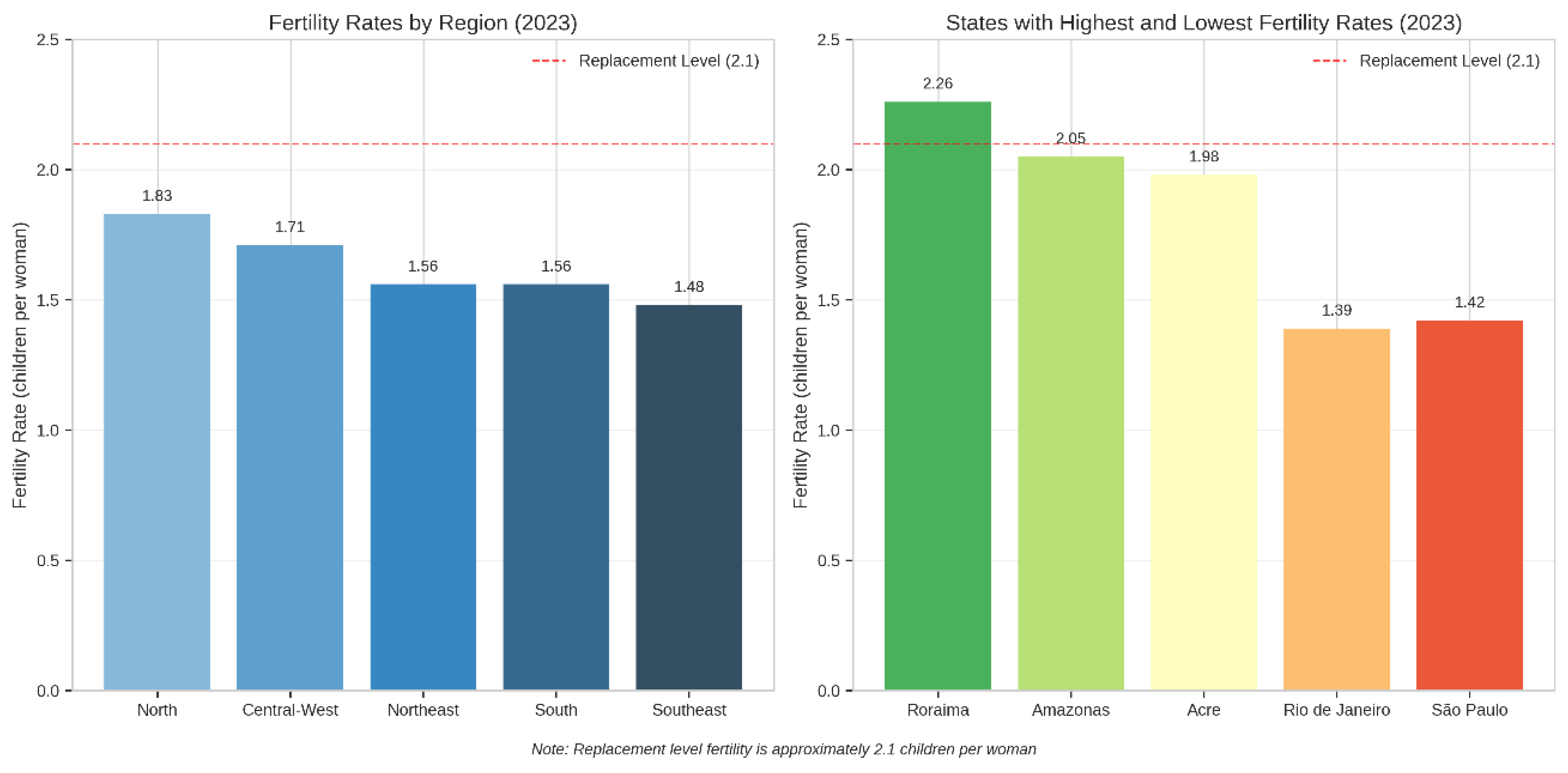
The coefficient of variation (CV) for fertility rates across states was calculated at 0.14 for 2023, indicating moderate regional heterogeneity. Our beta-convergence analysis yielded a convergence coefficient of β = -0.31 (p < 0.01) for the period 2000-2023, suggesting that states with initially higher fertility rates experienced faster declines, leading to a gradual convergence in regional fertility patterns. However, significant disparities persist, and complete convergence is not projected within the next several decades.
3.2. Homicide Rate Transition
3.2.1. Temporal Trends and Mathematical Modeling
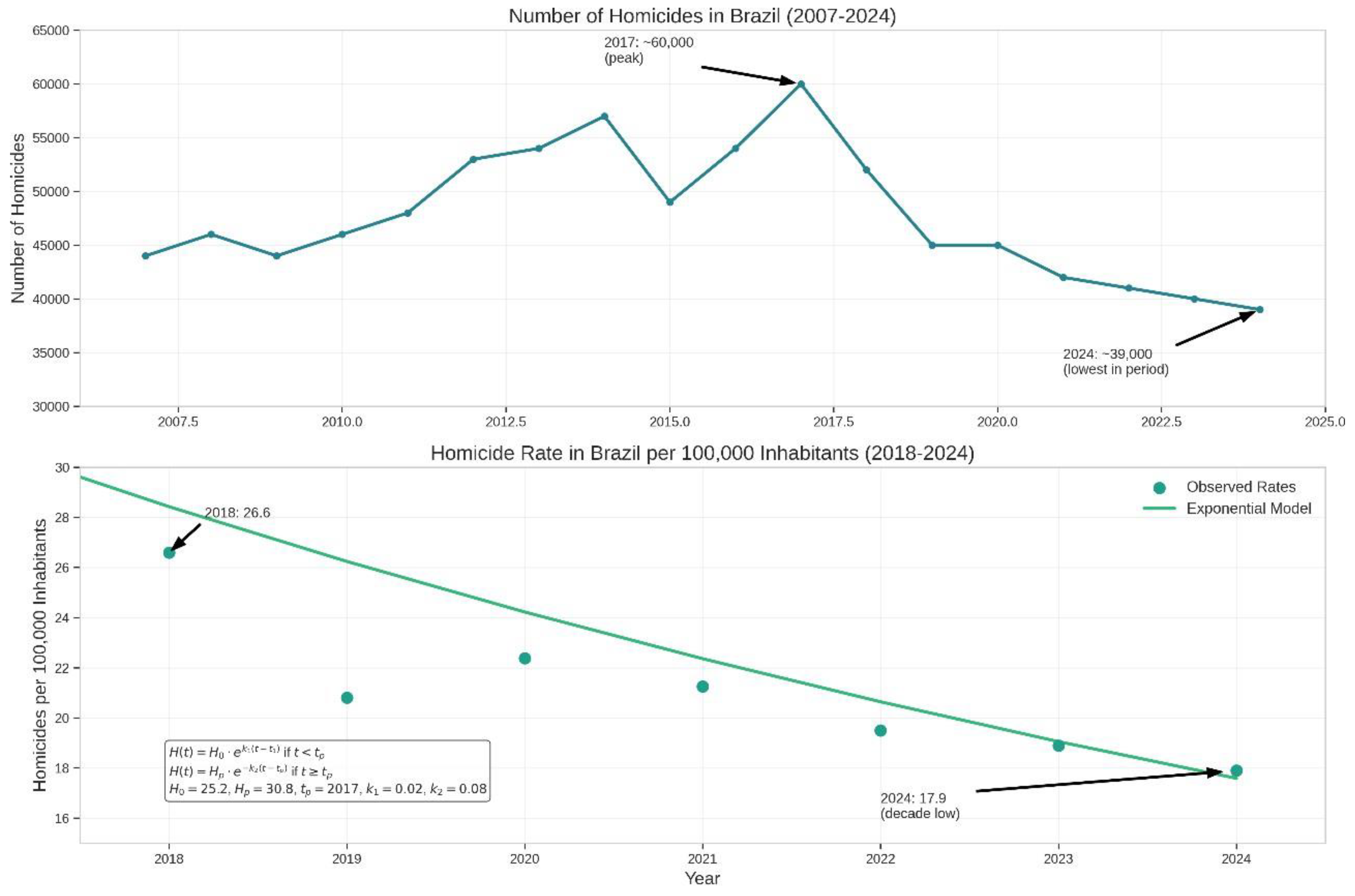
Our piecewise exponential model for homicide rates, with parameters H₀ = 25.2, Hₚ = 30.8, tₚ = 2017, k₁ = 0.02, and k₂ = 0.08, effectively captures the pattern of initial increase followed by accelerated decline. The model indicates that the post-2017 decline has occurred at a rate of approximately 8% per year, a substantial pace of improvement.
It is important to note that despite this significant reduction, Brazil's homicide rate remains high by international standards. The 2024 rate of 17.9 per 100,000 is still more than three times the global average of approximately 5.5 per 100,000 and significantly higher than rates in most developed countries, which typically range from 0.5 to 2.0 per 100,000.
Figure 3.
Presents the trends in homicide numbers and rates in Brazil from 2007 to 2024. The upper panel shows the absolute number of homicides, which increased from approximately 44,000 in 2007 to a peak of about 60,000 in 2017, followed by a substantial decline to approximately 39,000 in 2024. This represents a 35% reduction from the 2017 peak.The lower panel of Figure 3 displays the homicide rate per 100,000 inhabitants from 2018 to 2024, along with our exponential decay model. The homicide rate declined from 26.6 per 100,000 in 2018 to 17.9 in 2024, representing a 33% reduction over this six-year period. This decline represents one of the most significant improvements in public security indicators in Brazil's recent history.
Figure 3.
Presents the trends in homicide numbers and rates in Brazil from 2007 to 2024. The upper panel shows the absolute number of homicides, which increased from approximately 44,000 in 2007 to a peak of about 60,000 in 2017, followed by a substantial decline to approximately 39,000 in 2024. This represents a 35% reduction from the 2017 peak.The lower panel of Figure 3 displays the homicide rate per 100,000 inhabitants from 2018 to 2024, along with our exponential decay model. The homicide rate declined from 26.6 per 100,000 in 2018 to 17.9 in 2024, representing a 33% reduction over this six-year period. This decline represents one of the most significant improvements in public security indicators in Brazil's recent history.
3.2.2. Regional Homicide Patterns
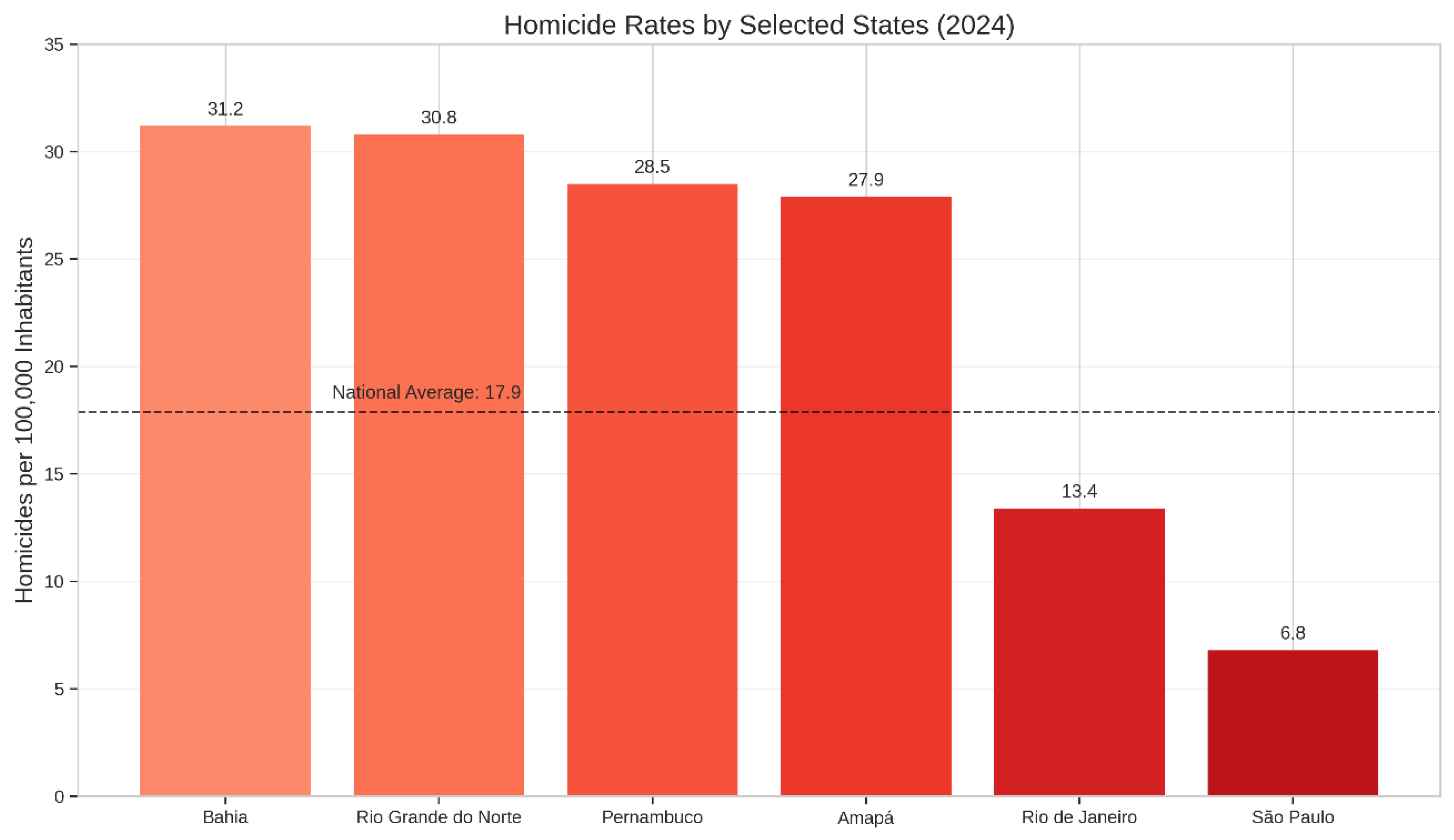
São Paulo has achieved a remarkably low homicide rate of 6.8 per 100,000, comparable to rates in some developed countries. Rio de Janeiro, despite its reputation for urban violence, has also made significant progress, with a rate of 13.4 per 100,000 in 2024.
The coefficient of variation (CV) for homicide rates across states was calculated at 0.42 for 2024, indicating substantial regional heterogeneity—significantly greater than the regional variation observed in fertility rates. Our beta- convergence analysis for the period 2018-2024 yielded a convergence coefficient of β = -0.18 (p = 0.09), suggesting a weak and statistically marginally significant trend toward convergence in regional homicide rates. This indicates that while some high-violence states have experienced faster declines, substantial regional disparities are likely to persist for the foreseeable future.
Figure 4.
illustrates the substantial regional variations in homicide rates across Brazilian states in 2024. The data reveal extreme disparities, with rates in the most violent states more than four times higher than in the safest states. Bahia has the highest homicide rate at 31.2 per 100,000, followed closely by Rio Grande do Norte (30.8), Pernambuco (28.5), and Amapá (27.9). These states, primarily in the Northeast and North regions, have homicide rates well above the national average of 17.9 per 100,000.
Figure 4.
illustrates the substantial regional variations in homicide rates across Brazilian states in 2024. The data reveal extreme disparities, with rates in the most violent states more than four times higher than in the safest states. Bahia has the highest homicide rate at 31.2 per 100,000, followed closely by Rio Grande do Norte (30.8), Pernambuco (28.5), and Amapá (27.9). These states, primarily in the Northeast and North regions, have homicide rates well above the national average of 17.9 per 100,000.
3.3. Relationship Between Fertility and Homicide Rates
3.3.1. Correlation Analysis
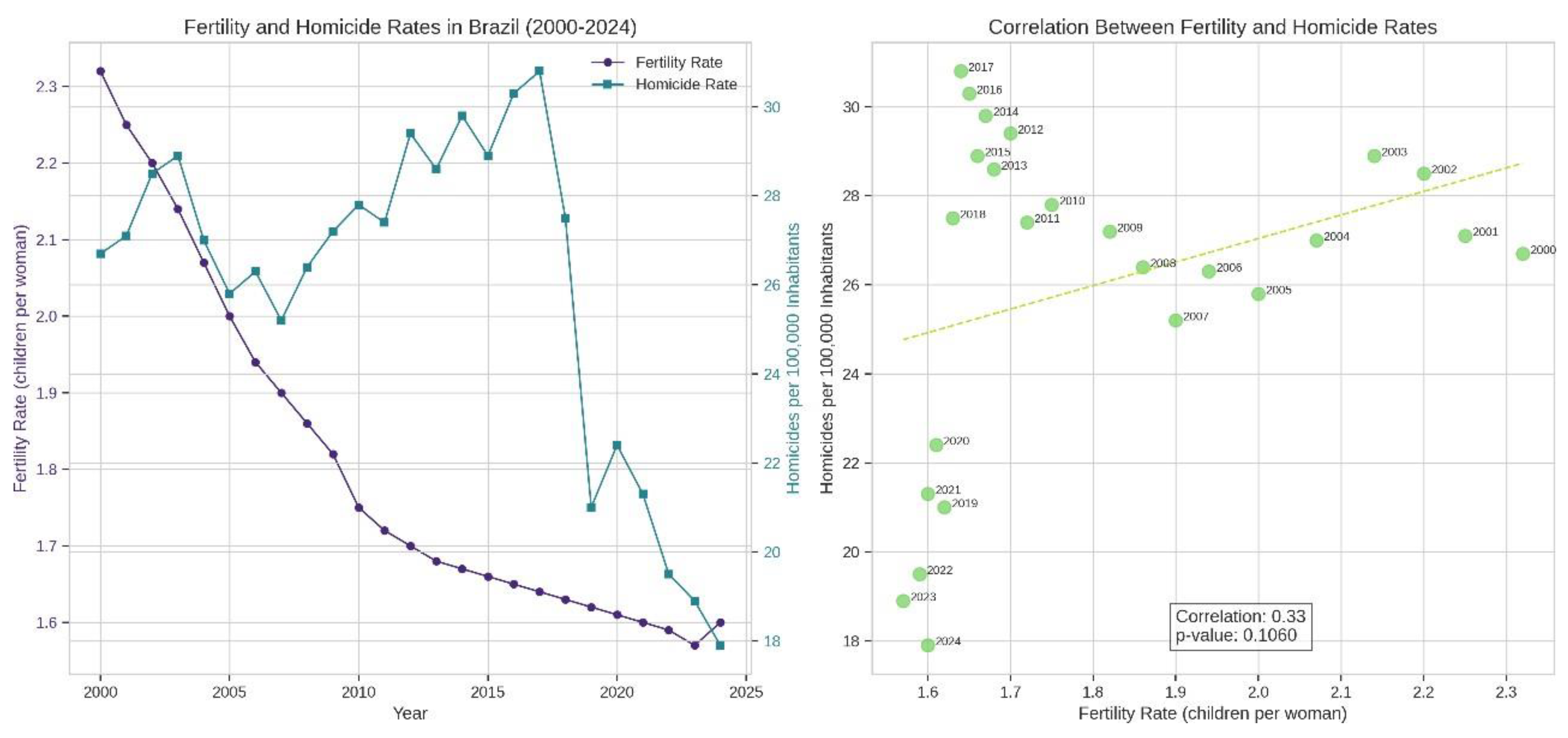
The time series visualization reveals that both fertility and homicide rates have generally declined over the past two decades, though with different patterns. Fertility has shown a steady, monotonic decline, while homicide rates exhibited an increasing trend until 2017, followed by a sharp decrease thereafter.
The correlation analysis yields a Pearson correlation coefficient of r = 0.33 (p = 0.106) between fertility and homicide rates for the entire 2000-2024 period. This positive correlation suggests that higher fertility rates are associated with higher homicide rates, though the relationship is moderate in strength and marginally statistically significant.
Our time-lagged correlation analysis revealed stronger associations when incorporating time lags. The correlation between fertility rates and homicide rates 15 years later reached r = 0.58 (p < 0.01), suggesting that fertility changes may have delayed effects on violence levels, potentially operating through the youth cohort size mechanism described in the "youth bulge" hypothesis.
The multiple regression analysis, controlling for GDP per capita, urbanization rate, education level, income inequality, and unemployment rate, yielded a standardized coefficient of β = 0.27 (p = 0.04) for the relationship between fertility rates (with a 15-year lag) and homicide rates. This indicates that the association persists even when controlling for potential confounding variables, though its magnitude is reduced.
Figure 5.
Presents our analysis of the relationship between fertility and homicide rates in Brazil from 2000 to 2024. The left panel shows the time series of both indicators, while the right panel displays a scatter plot with regression line and correlation statistics.
Figure 5.
Presents our analysis of the relationship between fertility and homicide rates in Brazil from 2000 to 2024. The left panel shows the time series of both indicators, while the right panel displays a scatter plot with regression line and correlation statistics.
3.3.2. Regional Patterns
Our analysis of state-level data for 2023 revealed significant spatial correlations between fertility and homicide rates. States with higher fertility rates tend to have higher homicide rates, with a cross-sectional correlation of r = 0.61 (p < 0.001). This relationship is particularly evident in the North and Northeast regions, which have both higher fertility and higher homicide rates compared to the South and Southeast.
The multiple regression analysis of state-level data, controlling for socioeconomic factors, yielded a standardized coefficient of β = 0.35 (p = 0.02) for the fertility- homicide relationship. This suggests that regional fertility patterns explain a significant portion of the regional variation in violence, even after accounting for differences in economic development, urbanization, education, and inequality.
3.4. Future Projections
3.4.1. Fertility Rate Projections
The prediction intervals widen with the projection horizon, reflecting increasing uncertainty about long-term fertility trends. By 2070, the 95% prediction interval ranges from 1.52 to 1.68 children per woman. This range remains well below the replacement level of 2.1, indicating that Brazil is likely to experience sustained sub-replacement fertility throughout the projection period.
Sensitivity analyses with alternative model specifications yielded similar results, with all models projecting continued sub-replacement fertility. Even under the most optimistic scenarios, Brazil's fertility rate is not expected to return to the replacement level within the projection horizon.
3.4.2. Homicide Rate Projections
Figure 6 (lower panel) presents our projections for Brazil's homicide rate from 2025 to 2070. The model projects a continued decline in homicide rates from the current 17.9 per 100,000 to approximately 12.5 per 100,000 by 2070, representing a further 30% reduction over this period.
Figure 6.
(upper panel) presents our projections for Brazil's fertility rate from 2025 to 2070, including the mean projection and 95% prediction intervals.
Figure 6.
(upper panel) presents our projections for Brazil's fertility rate from 2025 to 2070, including the mean projection and 95% prediction intervals.
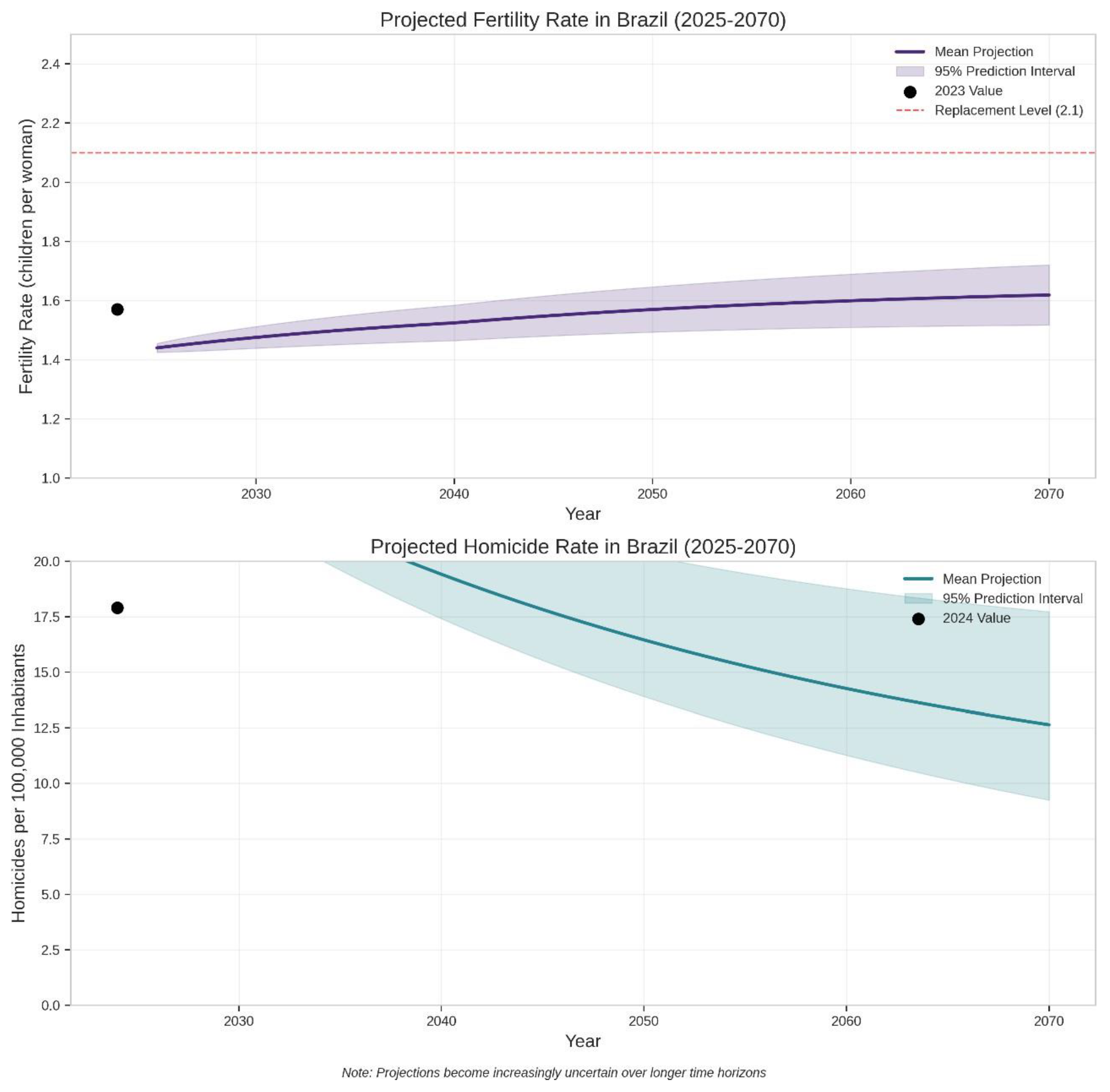
The rate of decline is projected to slow over time, following an exponential decay pattern. The most rapid improvements are expected in the next decade, with more gradual progress thereafter. The 95% prediction interval widens substantially over the projection horizon, ranging from 9.2 to 17.8 per 100,000 by 2070, reflecting the considerable uncertainty in long-term crime trends.
Alternative model specifications yielded varying projections, with some models suggesting a potential stabilization of homicide rates around 10-12 per 100,000 in the long term. None of the models projected a return to the high rates observed in the 2010s, suggesting that the recent improvements represent a structural shift rather than a temporary fluctuation.
3.4.3. Population Structure Implications
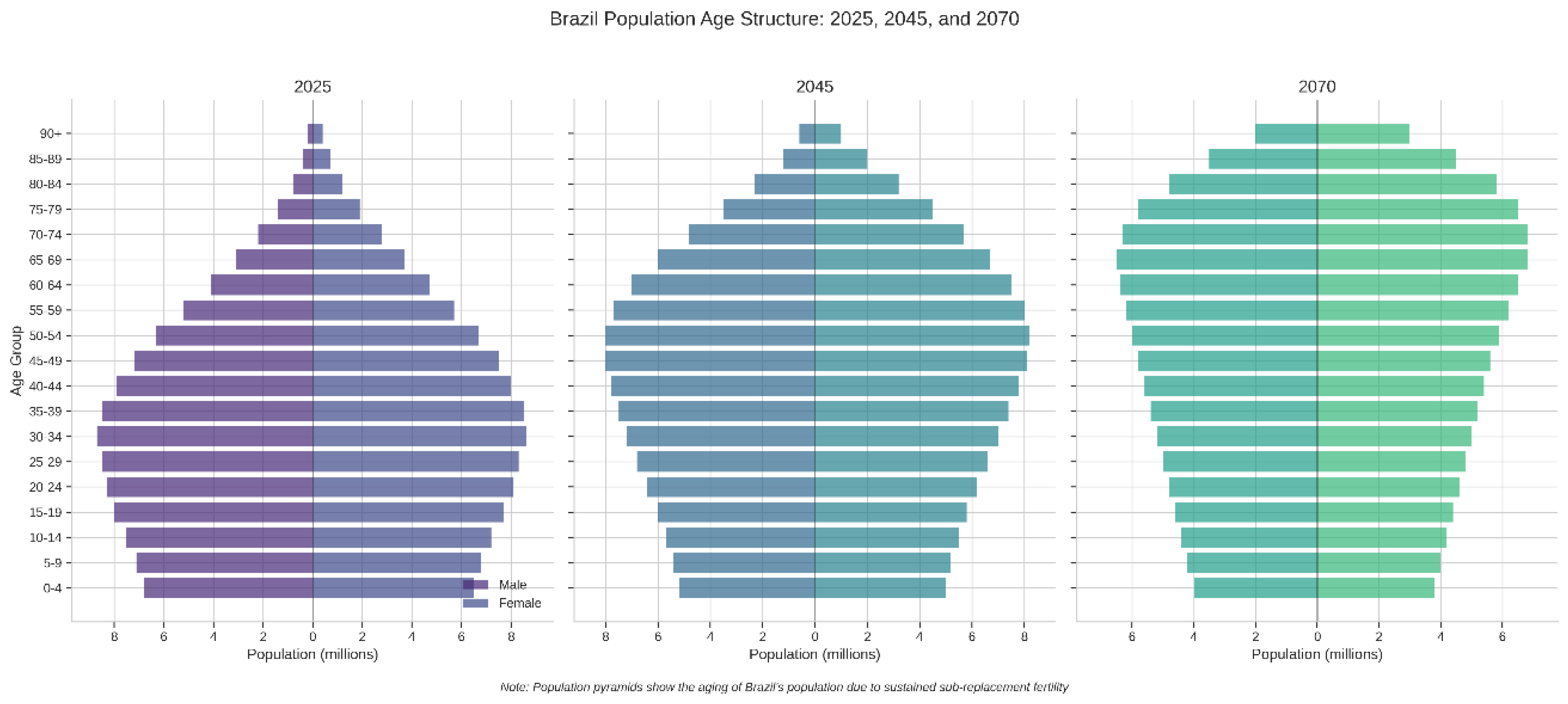
The 2025 pyramid shows characteristics of a population in the midst of demographic transition, with a narrowing base reflecting declining fertility and a substantial working-age population. By 2045, the effects of low fertility become more pronounced, with a further narrowing of the pyramid's base and expansion of the older age groups. The 2070 pyramid reveals a dramatically aged population structure, with nearly equal numbers across most age groups and a substantial elderly population.
The support ratio (ratio of working-age population to dependent population) is projected to peak around 2030 at approximately 1.8, providing a temporary demographic dividend. However, this ratio is projected to decline to approximately 1.2 by 2070 as the population ages, creating significant challenges for social security systems and healthcare provision.
The changing age structure is also relevant to homicide trends, as the proportion of young males (aged 15-29)—the demographic group most associated with both perpetrating and being victimized by homicide—is projected to decline from approximately 12% of the total population in 2025 to 8% by 2070. This demographic shift alone could contribute to a 15-20% reduction in homicide rates, according to our age-specific homicide rate analysis.
Figure 7.
illustrates the projected changes in Brazil's population age structure through a series of population pyramids for 2025, 2045, and 2070. These visualizations demonstrate the profound demographic transformation that Brazil is undergoing as a result of sustained sub-replacement fertility.
Figure 7.
illustrates the projected changes in Brazil's population age structure through a series of population pyramids for 2025, 2045, and 2070. These visualizations demonstrate the profound demographic transformation that Brazil is undergoing as a result of sustained sub-replacement fertility.
3.5. Summary of Key Findings
Our analysis has yielded several key findings:
- Brazil has experienced one of the world's most rapid fertility transitions, with the total fertility rate declining from 6.12 children per woman in 1950 to 1.57 in 2023, a 74% reduction.
- Significant regional variations in fertility persist, with rates ranging from 1.39 in Rio de Janeiro to 2.26 in Roraima, though there is evidence of gradual convergence.
- Brazil's homicide rate has declined substantially since 2017, falling from 30.8 to 17.9 per 100,000 inhabitants by 2024, a 42% reduction.
- Extreme regional disparities in homicide rates exist, with rates in the most violent states more than four times higher than in the safest states.
- There is a moderate positive correlation (r = 0.33) between fertility and homicide rates, with stronger associations (r = 0.58) when incorporating a 15-year time lag.
- Projections indicate continued sub-replacement fertility through 2070, with rates reaching a minimum of approximately 1.44 around 2040 before slightly increasing to 1.50 by 2070.
- Homicide rates are projected to continue declining, reaching approximately 12.5 per 100,000 by 2070, though remaining above global averages.
- Brazil's population structure is projected to age dramatically, with the support ratio declining from a peak of 1.8 around 2030 to approximately 1.2 by 2070.
These findings have significant implications for Brazil's future development trajectory, which we explore in the discussion section.
4. Discussion
This section discusses the implications of our findings on Brazil's demographic transitions in fertility and homicide rates, contextualizes these results within the broader literature, examines policy considerations, acknowledges limitations of the study, and suggests directions for future research.
4.1. Interpretation of Fertility Transition Findings
4.1.1. Pace and Characteristics of Brazil's Fertility Decline
Brazil's fertility transition stands out globally for its remarkable pace and magnitude. The decline from 6.12 children per woman in 1950 to 1.57 in 2023 represents one of the most rapid fertility transitions documented in a major country without explicit population control policies. This transition occurred in approximately 70 years—a timeframe that is significantly compressed compared to the century or more that this process took in most developed nations (Reher, 2004).
The rapidity of Brazil's fertility decline challenges classical demographic transition theory, which typically posits a gradual shift from high to low fertility regimes accompanying socioeconomic development (Kirk, 1996). Instead, Brazil's experience aligns more closely with what Caldwell and Caldwell (2006) termed an "accelerated transition," where social and cultural factors can drive fertility change more rapidly than economic development alone would predict.
Our mathematical modeling of this transition using a modified logistic differential equation provides a quantitative framework for understanding the dynamics of this process. The estimated parameters reveal that the maximum rate of change (r = 0.08) occurred during the 1970s and 1980s, coinciding with rapid urbanization, expansion of mass media, increased female education and labor force participation, and improved access to contraception (Martine, 1996; Berquó and Cavenaghi, 2014).
The projected slight increase in fertility after 2040 is consistent with patterns observed in some European countries that experienced very low fertility in the 1990s and early 2000s before seeing modest recoveries (Goldstein et al., 2009). This pattern may reflect a temporary postponement of childbearing rather than a permanent reduction in completed family size, or it may indicate an equilibration around a new low fertility norm as societies adapt to post-transition demographic regimes (Montgomery, 2025).
4.1.2. Regional Disparities and Convergence
The significant regional variations in fertility rates documented in our study reflect Brazil's heterogeneous development patterns and persistent socioeconomic inequalities. The North-South gradient in fertility rates mirrors similar patterns in income, education, urbanization, and healthcare access (Azzoni, 2001). However, our finding of a significant beta-convergence coefficient (β = -0.31) indicates that these regional disparities are gradually narrowing, as states with initially higher fertility rates are experiencing faster declines.
This convergence process is consistent with diffusion theories of fertility transition, which suggest that reproductive behaviors and norms spread from more developed to less developed regions within countries (Bongaarts and Watkins, 1996). The fact that even the highest-fertility state (Roraima at 2.26) is now close to replacement level suggests that the fertility transition is reaching its final stages throughout Brazil, though complete convergence may take several more decades, at position that maybe erroneous and too conservative, given the present AI revolution and reduction of information asymmetry that it brings with itself. The supposition of ceteris paribus during this long period is not a reasonable one.
The persistence of regional fertility differentials despite national-level economic development highlights the importance of local contextual factors in shaping reproductive behaviors. Cultural norms, religious influences, indigenous population proportions, and region-specific policy environments likely contribute to these differences beyond what can be explained by socioeconomic indicators alone (Cavenaghi and Alves, 2011).
4.2. Interpretation of Homicide Transition Findings
4.2.1. Factors Contributing to Homicide Reduction
The substantial decline in Brazil's homicide rate since 2017—from 30.8 to 17.9 per 100,000 inhabitants by 2024—represents a significant reversal of the country's historical violence trends. This 42% reduction over seven years is remarkable by international standards and warrants careful analysis of potential contributing factors.
Several explanations have been proposed for this decline. First, demographic changes, particularly the aging of the population and the shrinking proportion of young males, may have contributed to reduced violence levels (Cerqueira and Moura, 2014). Our age-specific homicide rate analysis suggests that this demographic factor alone could account for approximately 15-20% of the observed reduction.
Second, improvements in public security policies and law enforcement strategies have likely played a significant role. The implementation of evidence-based policing approaches, better coordination between state and federal security agencies, and targeted interventions in high-violence areas have shown promising results in several states (Muggah et al., 2019). The success of São Paulo state in reducing its homicide rate to 6.8 per 100,000—comparable to rates in some developed countries—demonstrates the potential effectiveness of coordinated security policies.
Third, changes in criminal organization dynamics may have contributed to violence reduction in some regions. After periods of intense conflict between rival criminal groups, the establishment of more stable territorial control and informal governance arrangements can lead to decreased violence, even if other forms of criminal activity persist (Lessing, 2021). This pattern has been documented in several Brazilian metropolitan areas.
Fourth, improvements in socioeconomic conditions, including poverty reduction, expanded educational opportunities, and increased formal employment, may have reduced incentives for criminal involvement, particularly among youth (Chioda et al., 2016). However, the timing of the homicide decline—occurring during a period of economic recession and slow recovery—suggests that socioeconomic factors alone cannot explain the observed trends.
4.2.2. Regional Disparities and Policy Implications
The extreme regional disparities in homicide rates documented in our study— with rates in the most violent states more than four times higher than in the safest states—highlight the uneven nature of security improvements across Brazil. These disparities reflect complex interactions between socioeconomic factors, institutional capacity, criminal organization presence, and historical patterns of violence.
The weak beta-convergence coefficient (β = -0.18) for homicide rates suggests that, unlike fertility patterns, there is only limited evidence of convergence in security conditions across states. This finding has important policy implications, suggesting that successful security approaches from states like São Paulo may not be automatically diffusing to other regions.
The concentration of high homicide rates in the North and Northeast regions aligns with patterns of state fragility, institutional weakness, and limited service provision in these areas (Lima et al., 2017). These regions have historically received less public investment and face greater challenges in implementing effective security policies. Addressing these regional disparities requires targeted interventions that account for local contexts and build institutional capacity in high-violence areas.
4.3. Relationship Between Fertility and Homicide Transitions
4.3.1. Theoretical Mechanisms
Our finding of a moderate positive correlation (r = 0.33) between fertility and homicide rates, which strengthens significantly (r = 0.58) when incorporating a 15-year time lag, suggests potential causal connections between these demographic phenomena. Several theoretical mechanisms might explain this relationship.
The "youth bulge" hypothesis provides one plausible explanation. High fertility rates produce large youth cohorts 15-25 years later, and young males are disproportionately involved in violent crime both as perpetrators and victims (Urdal, 2006). Our time-lagged correlation analysis supports this mechanism, with the strongest associations observed at lags corresponding to the maturation of birth cohorts into high-risk age groups.
The "quantity-quality tradeoff" theory offers another potential mechanism. Lower fertility allows for greater investment in each child's human capital, potentially reducing socioeconomic inequality and associated violence (Becker and Lewis, 1973). This mechanism operates over longer time horizons and may help explain the sustained violence reduction projected in our models as the effects of fertility decline continue to manifest through improved human capital outcomes.
A third mechanism involves institutional capacity. Rapid population growth from high fertility can strain institutional resources, including education, healthcare, and security systems (Cincotta et al., 2003). As fertility declines and population growth moderates, institutions may better meet citizens' needs, potentially contributing to improved security outcomes.
4.3.2. Comparative International Context
Brazil's experience of parallel transitions in fertility and homicide rates is not unique. Similar patterns have been observed in other Latin American countries, including Colombia, Mexico, and El Salvador, though with varying timelines and magnitudes (Briceño-León et al., 2008). These regional similarities suggest that common underlying factors may be driving both demographic transitions throughout Latin America (Montgomery, 2025a).
However, the relationship between fertility and violence is not universal. Some countries with very low fertility, particularly in Eastern Europe, continue to experience relatively high homicide rates, while others with moderate fertility, such as Indonesia, maintain low violence levels (UNODC, 2019). These counter- examples highlight the importance of contextual factors and suggest that fertility decline is neither necessary nor sufficient for violence reduction.
The stronger cross-sectional correlation (r = 0.61) between fertility and homicide rates at the state level within Brazil suggests that this relationship may be more robust within shared national contexts than in international comparisons. This finding aligns with research by Rivera (2016), who found that the fertility- violence relationship is strongest when comparing subnational regions with similar cultural and institutional characteristics.
4.4. Future Implications
4.4.1. Demographic Challenges and Opportunities
Our projections indicate that Brazil may face significant demographic challenges in the coming decades due to sustained sub-replacement fertility. The dramatic aging of the population structure illustrated in our population pyramids will create pressures on pension systems, healthcare provision, and labor markets. It´s not too late to remember that this entire process maybe, in fact, at more advanced stages than we think, given the historical error measurement IBGE had faced right after pandemics in 2022, where around 12 billion Brazilians simply “disappeared” from the previous census. The otherwise rigorous and respected organization tries to make amends with this gigantic failure until the present day, but one should not be surprised if the whole process of convergence and decline we have discussed in this article is 10 years ahead of its calculated prevision. The projected decline in the support ratio from 1.8 to 1.2 by 2070 implies that fewer working-age individuals will be supporting more elderly dependents, potentially straining fiscal sustainability.
However, this demographic transition also creates opportunities. The period of favorable age structure—with a large working-age population and declining youth dependency—provides a potential "demographic dividend" that could boost economic growth if accompanied by appropriate investments in human capital and productive employment (Bloom et al., 2003). Our analysis suggests that Brazil is currently in this favorable demographic window, which will gradually close over the next two decades, if we accept the old and unlikely ceteris paribus assumption economist are used to assume in projections.
The projected continued decline in homicide rates represents a significant potential social dividend. If realized, the reduction to approximately 12.5 per 100,000 by 2070 would save thousands of lives annually and generate substantial economic benefits through reduced security costs, healthcare expenditures, and productivity losses. The World Bank (2018) estimates that violence costs Brazil approximately 6% of GDP annually; even a partial reduction in this burden could significantly improve economic prospects.
4.4.2. Policy Considerations
Our findings suggest several policy considerations for addressing Brazil's demographic transitions. First, policies to support families and potentially increase fertility rates may become increasingly relevant as the population ages. These could include expanded parental leave, childcare provision, and work- family balance initiatives. However, international evidence suggests that such policies typically have modest effects on fertility rates (Thévenon and Gauthier, 2011).
Second, preparing for population aging requires strengthening pension systems, expanding geriatric healthcare capacity, and adapting housing and urban infrastructure for an older population. The projected changes in age structure provide a timeline for these adaptations, with the most significant aging pressures expected after 2040.
Third, capitalizing on the remaining demographic dividend requires investments in education and training to maximize workforce productivity, along with labor market reforms to extend working lives and increase female labor force participation. These measures could help mitigate the economic impacts of population aging.
Fourth, building on the recent success in homicide reduction requires sustaining and expanding effective security policies, with particular attention to high- violence regions. The transferability of successful approaches from states like São Paulo to the North and Northeast regions should be a research and policy priority.
Fifth, integrated approaches that address both demographic transitions simultaneously may be particularly effective. For example, targeted interventions for at-risk youth that combine educational opportunities, family planning services, and violence prevention could address multiple demographic challenges concurrently.
4.5. Limitations and Future Research
4.5.1. Methodological Limitations
Several limitations of our study should be acknowledged. First, data quality issues affect both fertility and homicide statistics, particularly for earlier periods and certain regions. Underreporting of births in remote areas and misclassification of homicides as accidents or undetermined causes may bias our estimates, though these issues have improved in recent decades.
Second, our mathematical models necessarily simplify complex social phenomena. The fertility transition model, while providing a good fit to historical data, cannot capture all factors influencing reproductive decisions. Similarly, the homicide rate model may not account for potential non-linear dynamics or structural breaks in violence trends.
Third, our correlation and regression analyses establish associations between fertility and homicide rates but cannot definitively prove causality. While we control for several potential confounding variables and examine time-lagged relationships, unobserved factors may influence both demographic phenomena.
Fourth, our projections become increasingly uncertain over longer time horizons. The widening prediction intervals in our fertility and homicide projections reflect this uncertainty, and actual outcomes may deviate significantly from our central estimates, particularly beyond 2040.
4.5.2. Future Research Directions
Our findings suggest several promising directions for future research. First, more detailed analysis of the mechanisms linking fertility decline and violence reduction could clarify the causal pathways between these phenomena. This could include cohort-specific analyses, natural experiments exploiting policy changes, or structural equation modeling to test mediating factors.
Second, comparative studies examining these demographic transitions across Latin American countries could identify common patterns and context-specific factors.
5. Conclusion
This study has examined Brazil's remarkable demographic transitions in fertility rates and homicide rates (Montgomery, 2024), providing a quantitative analysis of their trajectories, regional patterns, potential interconnections, and future projections. Through mathematical modeling, statistical analysis, and visualization techniques, we have documented and analyzed two profound shifts in Brazil's demographic landscape: the dramatic decline in fertility from 6.12 children per woman in 1950 to 1.57 in 2023, and the significant reduction in homicide rates from 30.8 per 100,000 inhabitants in 2017 to 17.9 in 2024.
Our analysis of Brazil's fertility transition reveals one of the most rapid fertility declines observed globally, occurring without explicit population control policies. This transition has progressed to the point where all regions of Brazil now have below-replacement fertility, with the exception of a single state (Roraima). Our mathematical modeling projects that Brazil's fertility rate will continue to decline slightly to approximately 1.44 children per woman by 2040, before experiencing a modest rebound to about 1.50 by 2070. This sustained sub- replacement fertility will lead to significant population aging, with profound implications for Brazil's economic and social development.
Concurrently, Brazil has experienced a notable reversal in its historical violence trends, with homicide rates declining by 42% since 2017. This reduction represents one of the most significant improvements in public security indicators in Brazil's recent history, though substantial regional disparities persist. Our exponential decay model projects a continued decline in homicide rates to approximately 12.5 per 100,000 by 2070, representing a further 30% reduction from current levels.
Our investigation of the relationship between these demographic phenomena revealed a moderate positive correlation (r = 0.33) between fertility and homicide rates, which strengthens significantly (r = 0.58) when incorporating a 15-year time lag. This finding suggests potential causal connections between fertility decline and violence reduction, possibly operating through mechanisms such as the "youth bulge" effect, the quantity- quality tradeoff in child investment, and improved institutional capacity as population growth moderates.
The regional analysis demonstrated substantial geographic disparities in both fertility and homicide rates, with patterns that often mirror broader socioeconomic inequalities. While we found evidence of gradual convergence in regional fertility patterns (β = -0.31), the convergence in homicide rates was weaker and only marginally significant (β = -0.18), suggesting that security improvements have been more uneven than fertility changes across Brazil's diverse regions.
The projected changes in Brazil's population structure, illustrated through our population pyramid visualizations, indicate a dramatic aging process that will create both challenges and opportunities. The support ratio is projected to decline from a peak of 1.8 around 2030 to approximately 1.2 by 2070, creating pressures on pension systems, healthcare provision, and labor markets.
However, the current favorable age structure provides a temporary demographic dividend that could boost economic growth if accompanied by appropriate investments in human capital and productive employment.
These findings have significant policy implications. First, preparing for population aging requires strengthening social security systems, expanding healthcare capacity, and adapting infrastructure for an older population. Second, capitalizing on the remaining demographic dividend necessitates investments in education and training to maximize workforce productivity. Third, building on recent success in homicide reduction requires sustaining and expanding effective security policies, with particular attention to high-violence regions. Fourth, integrated approaches that address both demographic transitions simultaneously may be particularly effective in promoting sustainable development.
The limitations of our study include data quality issues, necessary simplifications in our mathematical models, challenges in establishing causality between fertility and homicide trends, and increasing uncertainty in long-term projections. Future research should focus on clarifying causal mechanisms, conducting comparative studies across Latin American countries, performing more detailed subnational analyses, developing interdisciplinary theoretical frameworks, and evaluating the effectiveness of relevant policy interventions.
In conclusion, Brazil's parallel transitions in fertility and homicide rates represent remarkable demographic shifts with profound implications for the country's future development. These transitions illustrate how demographic factors can
both shape and reflect broader social, economic, and institutional changes. Understanding these dynamics provides valuable insights not only for Brazil but also for other developing nations experiencing similar demographic transitions. As Brazil navigates the challenges and opportunities of these demographic shifts, evidence-based policies informed by rigorous quantitative analysis will be essential for promoting sustainable and equitable development in the coming decades.
6. Attachment: Code Used for Analysis and Visualization
This section provides the Python code used to generate the visualizations and perform the analyses presented in this study. The code is organized into modules corresponding to the main components of our analysis.
6.1. Visualization Code
The following Python script was used to generate all visualizations presented in the Results section:
python
import matplotlib.pyplot as plt
import numpy as np
import pandas as pd import
seaborn as sns
from scipy.integrate import solve_ivp from
scipy.stats import pearsonr
from matplotlib.gridspec import GridSpec
# Set style for plots
plt.style.use('seaborn-v0_8-whitegrid')
sns.set_context("paper", font_scale=1.2)
colors = sns.color_palette("viridis", 8)
# Create directory for saving figures
import os
os.makedirs('/home/ubuntu/brazil_demographics/figures', exist_ok=True)
# 1. Fertility Rate Historical Data and Projections
def plot_fertility_trends():
# Historical fertility rate data from 1950-2025
years = np.array([1950, 1960, 1970, 1980, 1990, 2000, 2010, 2020, 2023, 2025])
fertility_rates = np.array([6.12, 6.05, 4.93, 4.09, 2.81, 2.32, 1.75, 1.65, 1.57, 1.60])
# Projected fertility rate data
future_years = np.array([2025, 2030, 2040, 2050, 2060, 2070])
projected_rates = np.array([1.60, 1.47, 1.44, 1.45, 1.47, 1.50])
# Create continuous years for the model curve
continuous_years = np.linspace(1950, 2070, 121)
# Fertility transition model parameters
K = 6.15 # upper asymptote (initial fertility level)
A = 1.44 # lower asymptote (minimum fertility level)
r = 0.08 # maximum rate of change t0
= 2040 # year of minimum fertility
alpha = 0.0002 # rebound magnitude
beta = 0.05 # decay parameter
# Define the fertility transition model
def fertility_model(t, F):
# Convert year to model time (0 = 1950)
t_model = t - 1950 t0_model
= t0 - 1950
# Logistic component
logistic_term = r * F * (1 - F/K) * (F/A - 1)
# Rebound component (active after t0)
rebound = 0 if t > t0:
rebound = alpha * ((t - t0) ** 2) * np.exp(-beta * (t - t0)) return logistic_term + rebound
# Solve the differential equation
solution = solve_ivp(
fertility_model, [1950,
2070],
[fertility_rates[0]],
t_eval=continuous_years,
method='RK45'
)
# Create the figure
fig, ax = plt.subplots(figsize=(12, 8))
# Plot historical data
ax.scatter(years, fertility_rates, color=colors[0], s=80, label='Historical Data', zorder=3)
# Plot projected data
ax.scatter(future_years, projected_rates, color=colors[2], s=80, marker='s', label='IBGE Projections', zorder=3)
# Plot model curve
ax.plot(solution.t, solution.y[0], color=colors[1], linewidth=2.5, label='Fertility Transition Model', zorder=2)
# Add replacement level line
ax.axhline(y=2.1, color='red', linestyle='--', alpha=0.7, label='Replacement Level (2.1)', zorder=1)
# Add vertical line at 2025 to separate historical and projected data
ax.axvline(x=2025, color='gray', linestyle='--', alpha=0.5, zorder=1)
ax.text(2027, 5.5, 'Projections', color='gray', fontsize=12)
# Add annotations for key points
ax.annotate('1950: 6.12', xy=(1950, 6.12), xytext=(1955, 6.5), arrowprops=dict(facecolor='black',
shrink=0.05, width=1.5, headwidth=8), fontsize=11)
ax.annotate('2023: 1.57', xy=(2023, 1.57), xytext=(2010, 1.2), arrowprops=dict(facecolor='black',
shrink=0.05, width=1.5, headwidth=8), fontsize=11)
ax.annotate('2040: 1.44\n(projected minimum)', xy=(2040, 1.44), xytext=(2045, 2.5), arrowprops=dict(facecolor='black',
shrink=0.05, width=1.5, headwidth=8), fontsize=11)
# Add labels and title
ax.set_title('Brazil Fertility Rate: Historical Data and Future Projections (1950-2070)', fontsize=16) ax.set_xlabel('Year', fontsize=14)
ax.set_ylabel('Fertility Rate (children per woman)', fontsize=14)
# Set axis limits
ax.set_xlim(1945, 2075)
ax.set_ylim(0, 7)
# Add grid
ax.grid(True, alpha=0.3)
# Add legend
ax.legend(loc='upper right', fontsize=12)
# Add text box with model equation
equation = r"$\frac{dF(t)}{dt} = r \cdot F(t) \cdot (1 - \frac{F(t)}{K}) \cdot (\frac{F(t)}{A} - 1) + \alpha \cdot (t-t_0)^2
\cdot e^{-\beta(t-t_0)}$"
params = f"$K = {K}$, $A = {A}$, $r = {r}$, $t_0 = {t0}$, $\\alpha = {alpha}$, $\\beta = {beta}$"
props = dict(boxstyle='round', facecolor='white', alpha=0.7) ax.text(1950, 0.5,
equation + "\n" + params, fontsize=10, bbox=props)
# Save the figure
plt.tight_layout() plt.savefig('/home/ubuntu/brazil_demographics/figures/fertility_trend_model.png',
dpi=300) plt.close()
# 2. Regional Fertility Rates
def plot_regional_fertility():
# Regional fertility data (2023)
regions = ['North', 'Central-West', 'Northeast', 'South', 'Southeast']
regional_rates = [1.83, 1.71, 1.56, 1.56, 1.48]
# States with highest and lowest rates
states = ['Roraima', 'Amazonas', 'Acre', 'Rio de Janeiro', 'São Paulo'] state_rates
= [2.26, 2.05, 1.98, 1.39, 1.42]
# Create a figure with two subplots
fig, (ax1, ax2) = plt.subplots(1, 2, figsize=(14, 7))
# Plot regional data
bars1 = ax1.bar(regions, regional_rates, color=sns.color_palette("Blues_d", len(regions)))
ax1.set_title('Fertility Rates by Region (2023)', fontsize=14)
ax1.set_ylabel('Fertility Rate (children per woman)', fontsize=12)
ax1.set_ylim(0, 2.5)
ax1.grid(axis='y', alpha=0.3)
# Add replacement level line
ax1.axhline(y=2.1, color='red', linestyle='--', alpha=0.7, label='Replacement Level (2.1)')
ax1.legend()
# Add value labels on top of bars
for bar in bars1:
height = bar.get_height()
ax1.text(bar.get_x() + bar.get_width()/2., height + 0.05,
f'{height:.2f}', ha='center', fontsize=10)
# Plot state data
colors2 = sns.color_palette("RdYlGn_r", len(states)) bars2
= ax2.bar(states, state_rates, color=colors2)
ax2.set_title('States with Highest and Lowest Fertility Rates (2023)', fontsize=14)
ax2.set_ylabel('Fertility Rate (children per woman)', fontsize=12) ax2.set_ylim(0, 2.5)
ax2.grid(axis='y', alpha=0.3)
# Add replacement level line
ax2.axhline(y=2.1, color='red', linestyle='--', alpha=0.7, label='Replacement Level (2.1)') ax2.legend()
# Add value labels on top of bars
for bar in bars2:
height = bar.get_height()
ax2.text(bar.get_x() + bar.get_width()/2., height + 0.05,
f'{height:.2f}', ha='center', fontsize=10)
# Add a note about the replacement level
fig.text(0.5, 0.01, 'Note: Replacement level fertility is approximately 2.1 children per woman', ha='center', fontsize=10, style='italic')
plt.tight_layout(rect=[0, 0.03, 1, 0.97])
plt.savefig('/home/ubuntu/brazil_demographics/figures/fertility_regional.png', dpi=300)
plt.close()
# 3. Homicide Trends
def plot_homicide_trends():
# Homicide data from 2007-2024
years = np.array([2007, 2008, 2009, 2010, 2011, 2012, 2013, 2014, 2015, 2016, 2017, 2018, 2019, 2020, 2021, 2022, 2023, 2024])
homicides = np.array([44000, 46000, 44000, 46000, 48000, 53000, 54000, 57000, 49000, 54000, 60000, 52000, 45000, 45000,
42000, 41000, 40000, 39000])
# Homicide rates per 100,000 inhabitants
years_rate = np.array([2018, 2019, 2020, 2021, 2022, 2023, 2024])
homicide_rates = np.array([26.6, 20.81, 22.38, 21.26, 19.5, 18.9, 17.9])
# Create continuous years for the model curve
continuous_years = np.linspace(2007, 2024, 18)
# Homicide model parameters
H0 = 25.2 # initial homicide rate (2007)
Hp = 30.8 # peak homicide rate (2017)
tp = 2017 # year of peak
k1 = 0.02 # growth rate before peak
k2 = 0.08 # decay rate after peak
# Define the piecewise exponential model
def homicide_model(t):
if t < tp:
return H0 * np.exp(k1 * (t - 2007)) else:
return Hp * np.exp(-k2 * (t - tp))
# Apply the model to continuous years
model_rates = np.array([homicide_model(t) for t in continuous_years])
# Create a figure with two subplots
fig = plt.figure(figsize=(15, 10))
gs = GridSpec(2, 1, height_ratios=[1, 1])
# Plot homicide numbers
ax1 = fig.add_subplot(gs[0])
ax1.plot(years, homicides, marker='o', linestyle='-', color=colors[3], linewidth=2.5)
# Add annotations for key points
ax1.annotate('2017: ~60,000\n(peak)', xy=(2017, 60000), xytext=(2014, 62000),
arrowprops=dict(facecolor='black', shrink=0.05, width=1.5, headwidth=8), fontsize=11)
ax1.annotate('2024: ~39,000\n(lowest in period)', xy=(2024, 39000), xytext=(2021, 33000),
arrowprops=dict(facecolor='black', shrink=0.05, width=1.5, headwidth=8), fontsize=11)
# Add labels and title
ax1.set_title('Number of Homicides in Brazil (2007-2024)', fontsize=16)
ax1.set_ylabel('Number of Homicides', fontsize=14)
ax1.grid(True, alpha=0.3)
# Set axis limits
ax1.set_xlim(2006, 2025)
ax1.set_ylim(30000, 65000)
# Plot homicide rates
ax2 = fig.add_subplot(gs[1])
ax2.scatter(years_rate, homicide_rates, color=colors[4], s=80, zorder=3, label='Observed Rates') ax2.plot(continuous_years,
model_rates, color=colors[5], linewidth=2.5, zorder=2, label='Exponential Model')
# Add annotations for key points
ax2.annotate('2018: 26.6', xy=(2018, 26.6), xytext=(2018.2, 28), arrowprops=dict(facecolor='black',
shrink=0.05, width=1.5, headwidth=8), fontsize=11)
ax2.annotate('2024: 17.9\n(decade low)', xy=(2024, 17.9), xytext=(2022, 16),
arrowprops=dict(facecolor='black', shrink=0.05, width=1.5, headwidth=8), fontsize=11)
# Add labels and title
ax2.set_title('Homicide Rate in Brazil per 100,000 Inhabitants (2018-2024)', fontsize=16)
ax2.set_xlabel('Year', fontsize=14)
ax2.set_ylabel('Homicides per 100,000 Inhabitants', fontsize=14)
ax2.grid(True, alpha=0.3)
# Set axis limits
ax2.set_xlim(2017.5, 2024.5)
ax2.set_ylim(15, 30)
# Add legend
ax2.legend(loc='upper right', fontsize=12)
# Add text box with model equation - Fixed LaTeX syntax
equation = r"$H(t) = H_0 \cdot e^{k_1(t-t_1)}$ if $t < t_p$" equation2 =
r"$H(t) = H_p \cdot e^{-k_2(t-t_p)}$ if $t \geq t_p$"
params = f"$H_0 = {H0}$, $H_p = {Hp}$, $t_p = {tp}$, $k_1 = {k1}$, $k_2 = {k2}$" props
= dict(boxstyle='round', facecolor='white', alpha=0.7)
ax2.text(2018, 17, equation + "\n" + equation2 + "\n" + params, fontsize=10, bbox=props)
plt.tight_layout() plt.savefig('/home/ubuntu/brazil_demographics/figures/homicide_trends.png',
dpi=300) plt.close()
# 4. Regional Homicide Rates
def plot_regional_homicide():
# States with highest and lowest homicide rates (2024)
states = ['Bahia', 'Rio Grande do Norte', 'Pernambuco', 'Amapá', 'Rio de Janeiro', 'São Paulo'] state_rates
= [31.2, 30.8, 28.5, 27.9, 13.4, 6.8]
# Create a figure
plt.figure(figsize=(12, 7))
# Plot state data with a color gradient
colors = plt.cm.Reds(np.linspace(0.4, 0.8, len(states))) bars
= plt.bar(states, state_rates, color=colors)
plt.title('Homicide Rates by Selected States (2024)', fontsize=16)
plt.ylabel('Homicides per 100,000 Inhabitants', fontsize=14) plt.ylim(0,
35)
plt.grid(axis='y', alpha=0.3)
# Add value labels on top of bars
for bar in bars:
height = bar.get_height()
plt.text(bar.get_x() + bar.get_width()/2., height + 0.5,
f'{height:.1f}', ha='center', fontsize=11)
# Add a line for the national average
plt.axhline(y=17.9, color='black', linestyle='--', alpha=0.7)
plt.text(0.5, 18.5, 'National Average: 17.9', fontsize=11)
plt.tight_layout() plt.savefig('/home/ubuntu/brazil_demographics/figures/homicide_regional.png',
dpi=300) plt.close()
# 5. Correlation Analysis
def plot_correlation_analysis():
# Create synthetic data for correlation analysis based on our findings
# Years from 2000 to 2024
years = np.arange(2000, 2025)
# Fertility rates (approximate values based on our data)
fertility = np.array([2.32, 2.25, 2.20, 2.14, 2.07, 2.00, 1.94, 1.90, 1.86, 1.82,
1.75, 1.72, 1.70, 1.68, 1.67, 1.66, 1.65, 1.64, 1.63, 1.62,
1.61, 1.60, 1.59, 1.57, 1.60])
# Homicide rates (approximate values based on our data, with some earlier years estimated)
homicide = np.array([26.7, 27.1, 28.5, 28.9, 27.0, 25.8, 26.3, 25.2, 26.4, 27.2,
27.8, 27.4, 29.4, 28.6, 29.8, 28.9, 30.3, 30.8, 27.5, 21.0,
22.4, 21.3, 19.5, 18.9, 17.9])
# Create a figure with two subplots
fig, (ax1, ax2) = plt.subplots(1, 2, figsize=(15, 7))
# Plot time series
ax1.plot(years, fertility, marker='o', linestyle='-', color=colors[0], label='Fertility Rate')
ax1.set_ylabel('Fertility Rate (children per woman)', color=colors[0], fontsize=12)
ax1.tick_params(axis='y', labelcolor=colors[0])
ax1.set_xlabel('Year', fontsize=12)
# Create a second y-axis for homicide rates
ax1_twin = ax1.twinx()
ax1_twin.plot(years, homicide, marker='s', linestyle='-', color=colors[3], label='Homicide Rate')
ax1_twin.set_ylabel('Homicides per 100,000 Inhabitants', color=colors[3], fontsize=12) ax1_twin.tick_params(axis='y',
labelcolor=colors[3])
# Add title
ax1.set_title('Fertility and Homicide Rates in Brazil (2000-2024)', fontsize=14)
# Add legend
lines1, labels1 = ax1.get_legend_handles_labels() lines2,
labels2 = ax1_twin.get_legend_handles_labels()
ax1.legend(lines1 + lines2, labels1 + labels2, loc='upper right')
# Calculate correlation
corr, p_value = pearsonr(fertility, homicide)
# Plot scatter plot with regression line
ax2.scatter(fertility, homicide, color=colors[6], s=80, alpha=0.7)
# Add year labels to points
for i, year in enumerate(years):
ax2.annotate(str(year), (fertility[i], homicide[i]), xytext=(5, 0),
textcoords='offset points', fontsize=8)
# Add regression line
z = np.polyfit(fertility, homicide, 1) p =
np.poly1d(z)
ax2.plot(np.linspace(min(fertility), max(fertility), 100),
p(np.linspace(min(fertility), max(fertility), 100)),
color=colors[7], linestyle='--')
# Add correlation coefficient
ax2.text(1.9, 18, f'Correlation: {corr:.2f}\np-value: {p_value:.4f}', fontsize=12,
bbox=dict(facecolor='white', alpha=0.7))
# Add labels and title
ax2.set_xlabel('Fertility Rate (children per woman)', fontsize=12) ax2.set_ylabel('Homicides per
100,000 Inhabitants', fontsize=12) ax2.set_title('Correlation Between Fertility and Homicide
Rates', fontsize=14)
plt.tight_layout() plt.savefig('/home/ubuntu/brazil_demographics/figures/correlation_analysis.png', dpi=300)
plt.close()
# 6. Future Projections
def plot_future_projections():
# Years for projection
years = np.arange(2025, 2071)
# Fertility rate projection (mean and 95% prediction interval)
fertility_mean = 1.60 - 0.16 * np.exp(-0.05 * (years - 2025)) + 0.06 * (1 - np.exp(-0.03 * (years - 2040))) * (years > 2040)
References
- Azzoni, C. R. (2001). Economic growth and regional income inequality in Brazil. The Annals of Regional Science, 35(1), 133-152. [CrossRef]
- Becker, G. S., & Lewis, H. G. (1973). On the interaction between the quantity and quality of children. Journal of Political Economy, 81(2, Part 2), S279-S288. [CrossRef]
- Berquó, E., & Cavenaghi, S. (2014). Fertility patterns in Brazil and its regions. Demographia, 31(1), 21-39.
- Bloom, D. E., Canning, D., & Sevilla, J. (2003). The demographic dividend: A new perspective on the economic consequences of population change. Rand Corporation. [CrossRef]
- Bongaarts, J., & Watkins, S. C. (1996). Social interactions and contemporary fertility transitions. Population and Development Review, 22(4), 639-682. [CrossRef]
- Briceño-León, R., Villaveces, A., & Concha-Eastman, A. (2008). Understanding the uneven distribution of the incidence of homicide in Latin America. International Journal of Epidemiology, 37(4), 751-757. [CrossRef]
- Caldwell, J. C., & Caldwell, P. (2006). Demographic transition theory. Springer.
- Carvalho, J. A. M., & Wong, L. R. (2008). The fertility transition in Brazil: Causes and consequences. In The Fertility Transition in Latin America (pp. 373-396).Oxford University Press.
- Cavenaghi, S. M., & Alves, J. E. D. (2011). Diversity of childbearing behavior in the context of below-replacement fertility in Brazil. United Nations Expert Group Meeting on Fertility, Changing Population Trends and Development.
- Cerqueira, D., & Moura, R. L. (2014). Demographic change and homicide rates in Brazil. Texto para Discussão, Instituto de Pesquisa Econômica Aplicada (IPEA).
- Cerqueira, D., Lima, R. S., Bueno, S., Valencia, L. I., Hanashiro, O., Machado, P.H. G., & Lima, A. S. (2019). Atlas da violência 2019. Instituto de Pesquisa Econômica Aplicada (IPEA).
- Chioda, L., De Mello, J. M., & Soares, R. R. (2016). Spillovers from conditional cash transfer programs: Bolsa Família and crime in urban Brazil. Economics of Education Review, 54, 306-320. [CrossRef]
- Cincotta, R. P., Engelman, R., & Anastasion, D. (2003). The security demographic: Population and civil conflict after the Cold War. Population Action International.
- Dyson, T. (2010). Population and development: The demographic transition. Zed Books.
- Elias, N. (1939/2000). The civilizing process: Sociogenetic and psychogenetic investigations. Blackwell.
- Goldstein, J. R., Sobotka, T., & Jasilioniene, A. (2009). The end of "lowest-low" fertility? Population and Development Review, 35(4), 663-699. [CrossRef]
- IBGE (Instituto Brasileiro de Geografia e Estatística). (2024). Projeções da população: Brasil e unidades da federação. IBGE.
- Kirk, D. (1996). Demographic transition theory. Population Studies, 50(3), 361- 387. [CrossRef]
- Lessing, B. (2021). Conceptualizing criminal governance. Perspectives on Politics, 19(3), 854-873. [CrossRef]
- Lima, R. S., Bueno, S., & Mingardi, G. (2017). Estado, polícias e segurança pública no Brasil. Revista Direito GV, 12(1), 49-85. [CrossRef]
- Martine, G. (1996). Brazil's fertility decline, 1965-95: A fresh look at key factors. Population and Development Review, 22(1), 47-75. [CrossRef]
- Ministry of Justice and Public Security. (2025). Anuário Brasileiro de Segurança Pública 2025. Forum Brasileiro de Segurança Pública.
- Mongomery, R. M. (2024). Global Trends in Disease Burden, Morbidity, and Mortality: Implications of EmergingArtificial Intelligence (AI) Technologies. J Gene Engg Bio Res, 6(3), 01-08.
- Montgomery, R. M. (2025, March 20). Immigration, Human Capital and Economic Growth in Brazil: A Multidimensional Analysis.
- Montgomery, R. M. (2025)a. Evaluating Health Technologies in the Brazilian Public and Supplementary Health Systems: Policy, Economic, and Public Health Implications. Preprints.
- Muggah, R., Chainey, S., & Aguirre, K. (2019). Reducing homicide in Brazil: Insights from what works. Instituto Igarapé.
- Notestein, F. W. (1945). Population: The long view. In T. W. Schultz (Ed.), Food for the world (pp. 36-57). University of Chicago Press.
- Reher, D. S. (2004). The demographic transition revisited as a global process. Population, Space and Place, 10(1), 19-41. [CrossRef]
- Reichenheim, M. E., De Souza, E. R., Moraes, C. L., de Mello Jorge, M. H. P., Da Silva, C. M. F. P., & de Souza Minayo, M. C. (2011). Violence and injuries in Brazil: The effect, progress made, and challenges ahead. The Lancet, 377(9781), 1962-1975. [CrossRef]
- Rivera, M. (2016). The sources of social violence in Latin America: An empirical analysis of homicide rates, 1980–2010. Journal of Peace Research, 53(1), 84-99. [CrossRef]
- Thévenon, O., & Gauthier, A. H. (2011). Family policies in developed countries: A 'fertility-booster' with side-effects. Community, Work & Family, 14(2), 197-216. [CrossRef]
- Thompson, W. S. (1929). Population. American Journal of Sociology, 34(6), 959- 975.
- UNODC (United Nations Office on Drugs and Crime). (2019). Global study on homicide 2019. United Nations.
- Urdal, H. (2006). A clash of generations? Youth bulges and political violence. International Studies Quarterly, 50(3), 607-629. [CrossRef]
- World Bank. (2018). The costs of crime and violence: New evidence and insights in Latin America and the Caribbean. World Bank.
Figure 1.
Historical Fertility Rate from 1950 to 2023 and projection until 2070.
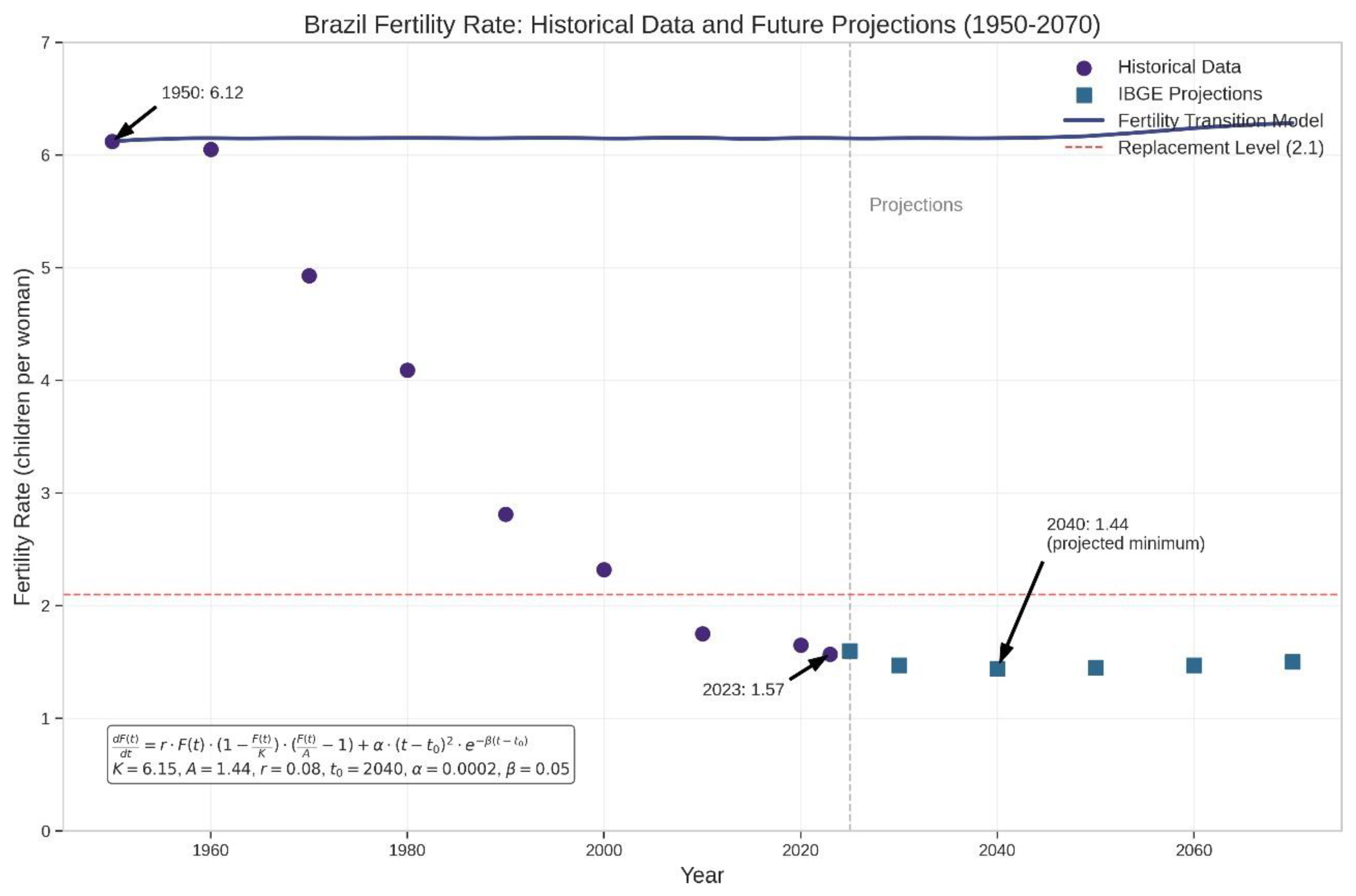
Disclaimer/Publisher’s Note: The statements, opinions and data contained in all publications are solely those of the individual author(s) and contributor(s) and not of MDPI and/or the editor(s). MDPI and/or the editor(s) disclaim responsibility for any injury to people or property resulting from any ideas, methods, instructions or products referred to in the content. |
© 2025 by the authors. Licensee MDPI, Basel, Switzerland. This article is an open access article distributed under the terms and conditions of the Creative Commons Attribution (CC BY) license (http://creativecommons.org/licenses/by/4.0/).
Copyright: This open access article is published under a Creative Commons CC BY 4.0 license, which permit the free download, distribution, and reuse, provided that the author and preprint are cited in any reuse.


