

Submitted:
23 April 2025
Posted:
24 April 2025
You are already at the latest version
Abstract
The interplay between regional context, innovation strategies, and firm performance is critical, yet understanding how these factors combine to affect financial outcomes (total net turnover) and national innovation capability (EIScore) remains limited. Existing research often overlooks the configurational effects and specific pathways to superior performance, representing a significant research gap.This study utilized a mixed-methods approach on European country data from the Community Innovation Survey (CIS2022) and the EU Innovation Scoreboard (2022). Following descriptive analysis, Fuzzy-Set Qualitative Comparative Analysis (fsQCA) was employed to identify configurations of innovation strategies (general activity, product focus, process focus) sufficient for high turnover and high EIScores.The fsQCA identified multiple pathways to high performance. Crucially, configurations combining broad innovation activity with simultaneous engagement in both product and business process innovation consistently proved sufficient for achieving both high total net turnover and high national EIScores. This highlights the significant positive impact of integrating diverse innovation types over a singular focus for enhancing performance across European regions.Using fsQCA, this research provides compelling evidence of complex configurational links between innovation strategies, regional context, and performance. The findings underscore the strategic importance for firms of cultivating combined product and process innovation capabilities. For policymakers, results highlight the value of fostering ecosystems supporting such integrated approaches. This study contributes a nuanced understanding of pathways to innovation success, offering insights for strategy and policy.
Keywords:
Regional Innovation
; Innovation Strategies
; Firm Performance
; Fuzzy-Set Qualitative Comparative Analysis (fsQCA)
; Total Net Turnover
; Innovation Scoreboard
; Product Innovation
; Business Process Innovation
; Configurational Analysis
; European Union
1. Introduction
The relationship between the regional environment, innovation strategies, and firm performance has become an area of increasing interest for business and regional economics researchers. Although previous studies have examined these factors separately, there remains a gap in understanding their interconnected effects. Some scholars advocate for concentrating resources on a single sector, emphasizing firm-specific capabilities as a source of competitive advantage (Barney, 1991). Others argue that inter-sector collaboration fosters innovation and firm performance, particularly in open innovation ecosystems (Bertello, De Bernardi, & Ricciardi, 2023; Camarinha-Matos, Rocha, & Graça, 2022). This divergence highlights the need for further exploration into how regional contexts influence the effectiveness of different innovation strategies in enhancing business outcomes. Existing research also indicates that regional innovation, particularly in areas such as the Nordic countries, is affected by several factors, including a well-trained workforce and strong government assistance (Mariani, 2022).
This study addresses the need for a sharper understanding of how a region influences how well different innovation strategies work to improve total net turnover and innovation performance. The goal of this study is to identify the combinations of innovation activities that lead to high performance in specific regional contexts. To that end, the study uses a combined methods approach, using both descriptive statistics and Fuzzy-Set Qualitative Comparative Analysis (fsQCA) by Ragin (2008). This allows us to single out complex causal relationships and multiple pathways to greater turnover and innovation scores.
Specifically, the study poses the following research questions:
RQ1: Is high total net turnover necessarily the result of concurrently having active innovation enterprises, entrepreneurial product innovation, and entrepreneurial business process innovation?
RQ2: Can combinations of innovation activity (presence/absence) and innovation types (product vs. business process) adequately explain high Innovation Scoreboard performance?
The methodology leverages the Community innovation survey 2022 (CIS2022) data from https://ec.europa.eu/eurostat/databrowser/view/inn_cis13_yreg_ip/default/table?lang=en and the EU Innovation Scoreboard of countries and neighbouring countries database from https://research-and-innovation.ec.europa.eu/statistics/performance-indicators/european-innovation-scoreboard_en - european-innovation-scoreboard-2024, using descriptive statistics to find popular innovation approaches and fsQCA to uncover causal links between activities, regional context, and company performance.
2. Materials & Methods
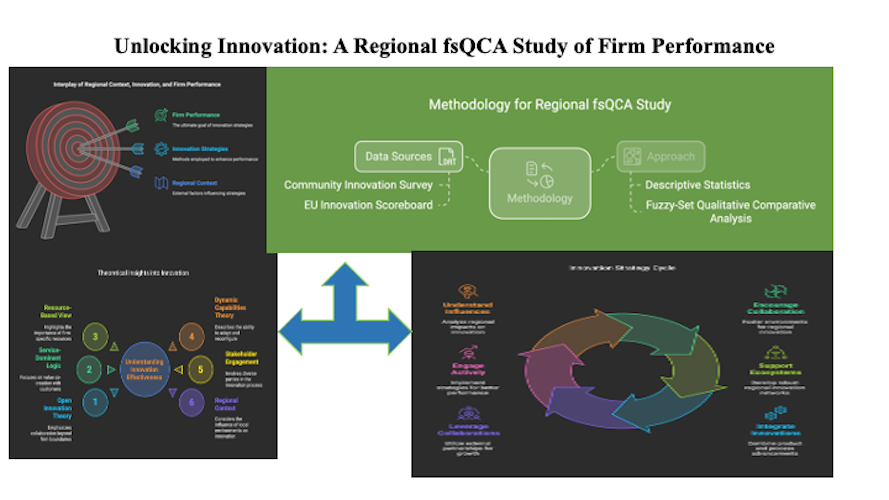
This section outlines the methodologies used to investigate the relationship between regional context, innovation strategies, and firm performance, employing a mixed-methods approach that combines descriptive statistics with Fuzzy-Set Qualitative Comparative Analysis (fsQCA).
2.1. Data Collection
This study leverages data from the Community Innovation Survey 2022 (CIS2022) and the EU Innovation Scoreboard dataset of 2022 to investigate the interplay between regional context, innovation strategies, and firm performance across European countries. The CIS2022 data, available from Eurostat at https://ec.europa.eu/eurostat/databrowser/view/inn_cis13_yreg_ip/default/table?lang=en, provides detailed information on innovation activities at the enterprise level. The EU Innovation Scoreboard data, accessible at https://research-and-innovation.ec.europa.eu/statistics/performance-indicators/european-innovation-scoreboard_en - european-innovation-scoreboard-2024, offers country-level indicators of innovation performance.
The data encompasses a sample of European countries (n=28 based on the provided data excerpt). The sample selection criteria focused on countries for which complete data across all variables of interest were available in both the CIS2022 and EU Innovation Scoreboard datasets.
The dependent variables were “Total Net Turnover”, which is measured in EUR. This variable represents the total revenue generated by enterprises in a given country. The operational definition is the reported total net turnover in EUR as extracted directly from the CIS2022 dataset. The second dependent variable is “EIScore”, which is a composite measure of innovation performance based on various indicators from the EU Innovation Scoreboard. The operational definition is the reported “EIScore” value as extracted directly from the EU Innovation Scoreboard dataset. The independent variables are all derived from the CIS2022 dataset and are “Innov_active_en”, which signifies the percentage of enterprises engaged in any form of innovation. “Prod_innov_ent_only” signifies the percentage of enterprises engaged solely in product innovation. “Ent_prod_innov” signifies the percentage of enterprises engaged in product innovation, irrespective of other innovation types. “Prod_bus_proc_innov_ent_only” signifies the percentage of enterprises engaged solely in product and business process innovation. “Ent_bus_proc_innov” signifies the percentage of enterprises engaged in both business and process innovations, irrespective of other innovation types and ultimately, “Bus_proc_innov_ent_only” signifies the percentage of enterprises engaged solely in business process innovation.
For each independent variable above, their commonality is a reflection in innovation processes. All of the measures are percentages of firms, but the key differences are based on what specific activities the firm focuses on in its strategic vision. This will give insights into strategic insights on turnover and “EIScore” outcomes. All independent variables were extracted from the CIS2022 dataset. These factors are to add to what is already measured and to create an ability to control a variety of factors. Each of the items is strategically important for what is measured. All control variables were calculated with variables extracted and compiled from the EU Community innovation survey and the EU Innovation scoreboard. The operational definitions come as direct reports of each line item for each variable.
2.2. Descriptive Statistics
Descriptive statistics were employed to provide an overview of the innovation landscape within the sample. The calibration measures were calculated for each variable using the “calibrate (x1, n1, n2, n3)” function where x1 is the variable, n1 is the third quartile (0.95) or maximum value in the column, n2 is the Mean (0.5), and n3 is the first quartile (0.05) or Minimum value in the column. These statistics were used to assess the distribution of innovation activities and financial performance across the sampled dataset.
2.3. Fuzzy-Set Qualitative Comparative Analysis (fsQCA)
Variables were calibrated using the direct method, with thresholds guided by theoretical concepts and empirical distributions, following Ragin's (2008) recommendations. The calibration values for full membership, crossover point, and full non-membership were determined as suggested by that same resource.
fsQCA was then employed to identify configurations of conditions (combinations of independent variables) sufficient for high total net turnover and EIScores. The analysis was conducted using fsQCA Software version 4.1 (Ragin & Sean, 2022), and standard procedures for necessity and sufficiency analysis were employed. The specific parameters are a consistency threshold of 0.8 and a frequency threshold of 1 (Ragin, 2008). The Quine-McCluskey algorithm was used to construct the truth table. Finally, the intermediate solution was chosen for interpretation.
3. Results/Discussion
This section details the findings of the study, beginning with descriptive statistics, followed by the results of the Fuzzy-Set Qualitative Comparative Analysis (fsQCA). Subsequently, relevant theoretical foundations are reviewed, and the findings are discussed concerning the research questions and existing literature.
3.1. Descriptive Analysis
A descriptive analysis of the key variables employed in this study was conducted. As detailed in Table 1, the data provide insights into the distribution of innovation activities and financial performance indicators within the sampled European countries.
Interpretation of Descriptive Statistics: The percentage of innovation-active enterprises (“Innov_active_ent”) showed considerable variation (range 8.8-70.3), with a mean of 47.86 and a median of 51.4, suggesting a wide distribution where approximately half of the enterprises engaged in some form of innovation.
Regarding specific innovation types, enterprises focusing solely on product innovation (“Prod_innov_ent_only”) were less prevalent (mean 5.12, range 0.1-12.1). In contrast, a larger proportion engaged in product innovation alongside other types (“Ent_prod_innov”, mean 21.96, range 0-46.6), suggesting integration is common. A substantial focus was observed on combined product and business process innovation (“Prod_bus_proc_innov_ent_only”, mean 44.15, range 8.5-65). Enterprises engaging in both, regardless of exclusivity (“Ent_bus_proc_innov”, mean 39.57), showed similar prevalence, indicating a trend towards combining innovation types. Exclusive focus on business process innovation (“Bus_proc_innov_ent_only”) was less frequent (mean 17.62, range 1.3-28.6).
“Total_Net_Turnover” displayed a broad range (0-67.2, mean 41.62), indicative of diverse financial performance among the sampled enterprises. The “EIScore”, measuring national innovation performance, also varied significantly (35.4-136.52, mean 93.07), pointing to considerable differences in innovation efficiency and sophistication across the countries studied.
3.1.1. Decoding Total Net Turnover: fsQCA Results
Table 2 presents the intermediate solution from the fsQCA analysis, identifying configurations of innovation activities sufficient for achieving high Total Net Turnover (coded as Total_Net_Turnover_fs). fsQCA allows for the identification of complex causal pathways.
Interpretation of fsQCA Results (Turnover): The fsQCA results identify multiple pathways sufficient for high total net turnover. Solution 1 (Innov_active_ent_fs * Ent_prod_innov_fs * Ent_bus_proc_innov_fs) demonstrated the highest raw coverage (0.54) and strong consistency (0.92). This suggests that the simultaneous presence of being innovation-active, engaging in product innovation (potentially alongside other types), and engaging in business process innovation (potentially alongside other types) is a highly relevant configuration for achieving high turnover. Its unique coverage of 0.18 further underscores its distinct importance in explaining the outcome.
Other configurations also met the consistency threshold, indicating alternative pathways. However, their unique coverage scores were considerably lower (≤ 0.08), suggesting that while sufficient, they explain a smaller portion of high turnover cases exclusively. This highlights the primary importance of the combination found in Solution 1, while acknowledging that other, less uniquely explanatory paths exist. The overall solution coverage (0.90) indicates that these configurations collectively explain a large proportion of high turnover cases, while the solution consistency (0.84) is acceptable.
3.1.2. Understanding Innovation Score Drivers: fsQCA Results
This subsection examines the fsQCA results, identifying configurations sufficient for high national innovation performance, as measured by the EIScore (coded as EIScore_fs). Table 3 details the intermediate solution.
Interpretation of fsQCA Results (EIScore): The analysis revealed that high national innovation scores ("EIScore") are significantly associated with specific configurations involving both innovation engagement and the type of innovation pursued.
Solution 1 (Innov_active_ent_fs * Ent_prod_innov_fs * Ent_bus_proc_innov_fs) again showed a strong association, with high raw coverage (0.52) and consistency (0.90). This indicates that countries where firms are generally innovation-active and pursue both product and business process innovation tend to achieve higher EIScores. Its unique coverage was 0.14.
Solution 4 (Innov_active_ent_fs * Prod_bus_proc_innov_ent_only_fs * Ent_bus_proc_innov_fs * Bus_proc_innov_ent_only_fs) also demonstrated substantial raw coverage (0.45) and very high consistency (0.96), along with significant unique coverage (0.14). This pathway highlights the importance of combining general innovation activity with a specific focus on both product/process and process innovation.
Solution 2 (Raw Coverage 0.31, Consistency 0.90) suggests high scores can be achieved via product and combined product/process innovation without relying solely on process innovation. Solution 3 (Raw Coverage 0.34, Consistency 0.91) highlights the sufficiency of combining product innovation with solely business process innovation, even without broad engagement in both types simultaneously.
Overall, the fsQCA results suggest that high innovation scores are most strongly linked to configurations involving active innovation engagement coupled with a strategic focus on both product and business process innovations. The presence of multiple successful configurations indicates flexibility, but a well-rounded approach appears consistently beneficial for national innovation performance. The overall solution coverage (0.80) and consistency (0.87) are robust.
3.2. Theoretical Foundations and Literature Review
Understanding the complex interplay between collaborative approaches, innovation, and firm performance requires a grounding in several key theoretical perspectives. Firstly, Open Innovation theory emphasizes the strategic necessity for firms to utilize both internal and external knowledge sources for successful innovation. This involves leveraging external pathways like markets and partnerships for commercializing ideas, alongside internal development efforts (Wang et al., 2022). The proliferation of digital technologies further incentivizes the creation of open innovation ecosystems, facilitating boundaryless resource sharing and collaborative value creation (Wang et al., 2022). Responding to environmental uncertainty also acts as a significant driver for adopting open innovation models (Iglesias-Sánchez et al., 2022).
Secondly, Service-Dominant (S-D) Logic, as introduced by Vargo and Lusch (2004), reframes value creation not as an internal firm activity, but as a collaborative process involving the exchange of knowledge and skills, particularly with customers. Consequently, engaging customers and enabling their active participation becomes vital for value generation (Hussain et al., 2022; Martinez-Cañas et al., 2016). The integration of scientific and technological advancements further enables these co-creative processes (Zhu et al., 2022).
Thirdly, the Resource-Based View (RBV) posits that sustained competitive advantage stems from a firm's unique resources and capabilities (Barney, 1991). Within the context of collaboration, the ability to establish and leverage external relationships and knowledge networks is increasingly recognized as a strategic capability enhancing innovation and performance (Wang et al., 2022). Relatedly, resource integration theory suggests viewing customers as valuable assets and understanding how benefit recognition motivates engagement with resources for ongoing value creation (Zhu et al., 2022).
Fourthly, Dynamic Capabilities Theory introduces a temporal element, arguing that firms need capabilities to effectively sense environmental changes, seize opportunities, and reconfigure their resource base accordingly (Teece et al., 1997). Notably, the implementation of environmentally conscious practices can lead to the development of specific Green Dynamic Capabilities (Yousaf, 2021).
Finally, examining broader business, innovation, and platform ecosystems reveals common characteristics like openness and diversity, but also significant variations in participant roles and stakeholder objectives within these networks (Liu et al., 2024).
It is increasingly acknowledged that sustainable competitive advantage rarely arises solely from internal efforts (Wang et al., 2022). Active engagement with external stakeholders within collaborative environments is crucial for driving innovation and enhancing firm performance. To facilitate a clear discussion, several key concepts require definition. First, co-creation, moving beyond traditional firm-centric approaches, involves the active integration of customers and other stakeholders in the mutual generation of value (Prahalad & Ramaswamy, 2004); this extends beyond product/service design to influence broader business operations (Normann & Ramirez, 1993) and is fundamentally characterized by shared value generation, meaningful stakeholder input, and open innovation principles. Second, collaboration refers to the concerted effort by two or more parties towards a common goal (Camarinha-Matos et al., 2022). Within the innovation context, collaboration entails reciprocal knowledge exchange, resource pooling, and leveraging collective expertise to develop novel offerings (goods, services, processes), with such partnerships potentially existing internally or extending externally to include suppliers, customers, research institutions, or even competitors. Third, innovation, following Schumpeter (1934), is defined as the implementation of a new or significantly improved product, service, process, marketing method, or organizational method. Innovations can encompass both incremental improvements and radical shifts, creating entirely new offerings, thereby serving as a fundamental driver of economic success and competitive advantage. Finally, firm performance describes an organization’s success, which can be assessed through various indicators, including both financial metrics (like profitability, revenue growth, market share, ROA) and non-financial aspects (such as customer satisfaction, employee retention, innovation results, ethical conduct) (Yu et al., 2022).
3.2.1. Co-Creation and Innovation Linkages
A consistent body of research demonstrates a positive link between co-creation activities and enhanced innovation outcomes. Firms that actively involve customers and stakeholders in their processes gain access to novel perspectives, valuable market insights, and specialized knowledge (Poblete et al., 2023). User participation, in particular, can be a crucial source for social innovation and the development of more robust ecosystems (Poblete et al., 2023).
Co-creation initiatives often manifest in various innovation types, including improved product designs, new service concepts, more efficient process implementations, or agile business models (Nájera-Sánchez et al., 2020). For example, engaging customers in online communities has been shown to stimulate service innovation via knowledge transfer and the adoption of new practices (Wang, 2022).
Furthermore, adopting an open innovation strategy offers specific managerial benefits, particularly for technology firms seeking stakeholder engagement, as it provides pathways for realizing potential through external collaboration (Iglesias-Sánchez et al., 2022). The effectiveness of such strategies often lies in the ability of innovative processes to actively listen and respond within a co-creative environment (Iglesias-Sánchez et al., 2022).
Digital transformation initiatives also positively impact corporate innovation, supported by elements like efficient big data utilization and adaptable organizational structures (Xu et al., 2024). As technological advancements blur business boundaries, innovation increasingly occurs through collaboration with digitally integrated partners (Liang & Ye, 2023). Consequently, developing digital ambidexterity, combining diverse operational strategies with digitalization becomes valuable for competitive advantage (Chen et al., 2024).
Finally, engaging stakeholders directly aids product development progress. Collaborative co-design enables joint strategies aligned with stakeholder needs (Klager et al., 2024), while multi-stakeholder partnerships can foster innovations addressing complex societal challenges (‘wicked problems’), advancing sustainable development goals (Mariani et al., 2022). Involving consumers directly in the creative process enhances strategic innovation and alignment with market demands (Laurisz et al., 2023).
3.2.2. Co-Creation and Firm Performance Linkages
Existing literature also connects co-creation activities to improved firm performance, particularly when proactive strategies are employed.
Research indicates that consumers engaging in co-creation often exhibit increased commercial participation and loyalty (Nguyen, 2024), especially when supported by positive online customer experiences designed to foster long-term engagement (Ahmad et al., 2022). Furthermore, the integration of green dynamic capabilities, practices, and value co-creation has been shown to enhance green innovation mechanisms within SMEs (Yousaf, 2021).
Understanding the dynamics of business-consumer partnerships through the lens of S-D logic is crucial (Zhu et al., 2022). However, effective customer co-creation often needs to be coupled with strong internal branding to translate into improved brand performance and customer satisfaction (Yu, 2022).
While beneficial, the processes underpinning co-creation rely on both internal and external collaboration for effective decision-making (Lozada et al., 2019), and practices like big data analytics can enhance innovative agility. It is also important to acknowledge the potential for value co-destruction within open innovation communities, influenced by factors like self-interest, which may necessitate adjustments to organizational and digital strategies (Daradkeh, 2023).
3.2.3. Challenges and Future Research Directions
While the benefits of co-creation, collaboration, and innovation are widely discussed, acknowledging persistent challenges and areas requiring further research is essential.
Effective strategies for innovative cooperation depend heavily on robust data analysis capabilities for identifying and leveraging opportunities (Ji et al., 2022). However, the collection and use of data, particularly public data, raise significant ethical concerns regarding privacy and potential negative impacts on the labor force, especially low-skilled jobs (Dionisio et al., 2023). Organizations, therefore, need systems to incorporate diverse perspectives ethically into the innovation process, particularly as user-led approaches gain prominence (Poblete et al., 2023).
Further research is needed to better understand knowledge utilization mechanisms within collaborative settings and how interactive behaviors foster cooperative innovation (Meng et al., 2023). Improving digital innovation requires making efficient, collaborative value co-creation central to service value chains (Wang et al., 2023). Building upon current understanding necessitates developing more detailed metrics to quantify the impact of co-creation activities on specific innovation levels. Additionally, investigations into how contextual factors such as industry type, firm size, or national culture moderate the relationship between co-creation and performance are warranted. Exploring the crucial role of leadership in fostering collaborative and innovative organizational cultures presents another vital research avenue. Finally, addressing the complex ethical dimensions, which encompass intellectual property protection, data privacy, and the establishment of clear structural guidance for co-creation practices, remains a critical area for future inquiry (Vargas et al., 2022).
3.3. Discussion of Findings
This discussion integrates the descriptive and fsQCA findings with the theoretical background and addresses the study's core aims, considering the interplay between regional context, innovation strategies, and performance.
3.3.1. Regional Context and Innovation Performance
The findings underscore the relevance of regional (national-level) context, particularly highlighted by the fsQCA results linking specific innovation configurations to national EIScores. While the analysis treated region implicitly through country-level data, the dominant configurations identified (especially those involving broad innovation activity and combined product/process focus, see Table 3, Solutions 1 and 4) align with characteristics often attributed to high-performing innovation systems, such as those in Nordic countries known for skilled workforces and supportive policies (Mariani, 2022).
The fsQCA results for turnover (Table 2) also showed dominant pathways involving combined innovation types (Solution 1). The fact that certain configurations strongly predict high turnover and high EIScores suggests a connection between firm-level strategies prevalent in a region and the region's overall innovation standing. The lower unique coverage of some fsQCA paths might indicate that while certain strategies are sufficient, unmeasured regional factors (e.g., specific policies, industry structures, cultural factors) could influence which pathway is most common or effective in a particular location. The observation that the identified dominant configurations are strongly associated with success, without necessarily being restricted to a single geographic cluster in the fsQCA outcomes (beyond the general European sample), points towards the potential transferability of these strategic approaches, although regional context likely moderates their implementation and prevalence. This presents an intriguing avenue for future research focused explicitly on comparative regional analysis.
3.3.2. Contrasting Innovation Strategies and Contributions
The descriptive statistics (Table 1) revealed a higher prevalence of firms combining product and business process innovation (“Prod_bus_proc_innov_ent_only” mean 44.15) compared to those focusing solely on one type. This observation, coupled with the fsQCA results, where configurations involving combined or multiple innovation types (especially Solution 1 in both Table 2 and Table 3) showed high coverage and consistency, supports the idea that integrated innovation strategies are often associated with superior performance (both turnover and EIScore). This finding contributes to the ongoing discussion comparing focused versus diversified innovation strategies, suggesting that for the outcomes measured here, combining capabilities across product and process domains is frequently beneficial.
A key strength of this research lies in applying fsQCA to simultaneously analyze configurations leading to both financial (turnover) and systemic (EIScore) performance indicators using large-scale survey data. This approach identified specific, complex combinations of innovation activities sufficient for success, moving beyond simple linear correlations. However, limitations must be acknowledged. The relatively low unique coverage scores for some fsQCA solutions suggest that other factors, not included in this analysis (e.g., firm size, industry, specific policies, R&D intensity), likely influence outcomes. Furthermore, while the sample size (n=28 countries) is suitable for fsQCA at the national level, analysis at the firm level or with more granular regional data could yield further insights. Future research employing statistical tests or incorporating additional variables could bolster the findings.
This study enriches existing knowledge by empirically demonstrating how specific combinations of innovation activities, viewed through the lens of national context, link to both firm-level financial results and national innovation capacity. The fsQCA methodology provides a nuanced perspective on how these factors interact, offering insights valuable for businesses seeking effective innovation strategies and policymakers aiming to foster supportive ecosystems. The findings connect practical innovation choices to theoretical frameworks like the Resource-Based View (emphasizing capability combinations) and Dynamic Capabilities Theory (highlighting the need to adapt strategies), particularly within collaborative and open innovation contexts. The economic implications for regional development are significant, suggesting that fostering environments supporting combined product and process innovation may enhance both firm revenues and national innovation rankings.
3.3.3. Addressing the Research Questions
RQ1: Does the concurrent presence of innovation-active enterprises, entrepreneurial product innovation, and entrepreneurial business process innovation constitute a sufficient condition for high total net turnover?
The fsQCA results (Table 2, Solution 1) indicated that the configuration Innov_active_ent_fs * Ent_prod_innov_fs * Ent_bus_proc_innov_fs is a sufficient condition for achieving high total net turnover, demonstrated by high consistency (0.92) and the highest raw (0.54) and unique (0.18) coverage among the identified paths. This supports an affirmative answer: the concurrent presence of these three elements, representing broad innovation activity and engagement in both product and process innovation domains, constitutes a highly relevant pathway to high turnover.
RQ2: Can combinations of innovation activity (presence/absence) and innovation types (product vs. business process) serve as sufficient conditions for high Innovation Scoreboard performance?
The fsQCA analysis (Table 3) revealed multiple configurations of innovation activity and types that are sufficient for achieving high EIScores. Notably, Solution 1 (Innov_active_ent_fs * Ent_prod_innov_fs * Ent_bus_proc_innov_fs, consistency 0.90, raw coverage 0.52) and Solution 4 (Innov_active_ent_fs * Prod_bus_proc_innov_ent_only_fs * Ent_bus_proc_innov_fs * Bus_proc_innov_ent_only_fs, consistency 0.96, raw coverage 0.45) showed strong associations and significant unique coverage. This confirms that specific combinations involving both the presence/absence of general innovation activity and the particular types of innovation pursued (product, process, or combinations) are indeed sufficient conditions for high national Innovation Scoreboard performance.
4. Conclusion
This study investigated the complex relationships between regional context, specific innovation strategies, and firm performance, examining how these factors combine to influence total net turnover and overall national innovation capability (EIScore). Utilizing data from the CIS2022 and the EU Innovation Scoreboard, the analysis provides several key insights.
The most significant conclusion is that a strategic approach combining broad innovation activity with a focus on both product and business process innovation is consistently associated with higher total net turnover at the firm level and higher national innovation scores. While potentially more prevalent or effective in certain contexts (such as the Nordic region, based on existing literature), the strong performance associated with this combined approach suggests its general importance for firms seeking revenue growth and for nations aiming to enhance innovation capacity.
Furthermore, the findings highlight that specific configurations blending product and business process innovation significantly contribute to superior innovation performance (EIScore), often irrespective of the specific regional context within Europe. This underscores the intrinsic value of pursuing integrated innovation strategies to drive economic, societal, and potentially environmental development, thereby improving overall firm and national performance.
These conclusions resonate with aspects of prior research but offer a unique perspective by applying fsQCA to large-scale datasets, revealing configurational pathways rather than solely linear effects. The regional insights, while based on national-level data, suggest that factors fostering combined innovation types are crucial. While general trends were observed, the lower unique coverage of some configurations indicates the likely influence of unmeasured variables (perhaps policy details, specific market structures, or cultural factors) that warrant further investigation.
This study is subject to limitations, primarily the relatively small number of countries (n=28) for cross-national comparison and the potential influence of variables not included in the datasets. However, its contribution lies in demonstrating the power of specific innovation configurations across different performance dimensions.
For researchers, these findings emphasize the need to consider regional context and configurational effects when studying innovation effectiveness. Future work should explore the role of specific government policies, industry characteristics, and organizational culture using more granular data or comparative case studies. Longitudinal studies are also needed to understand the long-term impacts. For policymakers, this study underscores the importance of fostering ecosystems that encourage and support firms in developing capabilities for both product and business process innovation. For businesses, the results encourage consideration of integrated innovation strategies, balancing product development with process improvements, while remaining mindful of the local economic and regulatory environment.
In summary, this research provides compelling evidence of the complex interplay between regional context, innovation strategies, and performance. The findings reveal that firms proactively engaging in strategies combining product and business process innovation are frequently better positioned for enhanced turnover and contribute to stronger national innovation performance. The implications are significant for researchers, policymakers, and businesses seeking to optimize innovation for sustainable success.
Author Contributions
Henry Efe Onomakpo Onomakpo: Conceptualization, Investigation (Literature review; fsQCA analysis), Methodology (fsQCA software version 4.1), Writing – Original Draft.
Funding
This research received no specific grant from any funding agency in the public, commercial, or not-for-profit sectors.
Data Availability Statement
The raw data analyzed in this study were obtained from publicly available sources: 1. The Community Innovation Survey (CIS) data are available from Eurostat at: https://ec.europa.eu/eurostat/databrowser/view/inn_cis13_yreg_ip/default/table?lang=en 2.The European Innovation Scoreboard (EIS) data are available at: https://research-and-innovation.ec.europa.eu/statistics/performance-indicators/european-innovation-scoreboard_en Access to these original data sources does not require a subscription. The processed data and analytical code (fsQCA software version 4.1 for data manipulation/calibration) generated during the current study are available from the corresponding author upon reasonable request and will be deposited in the journal’s repository upon publication. Permanent access details [e.g., DOI or specific URL] will be provided at that time.
Acknowledgments
The author acknowledges the support of the Faculty of Economics and Business during the preparation of this manuscript.
Conflict of Interest
The author declares no conflicts of interest.
References
- Ahmad, F.; Mustafa, K.; Hamid, S.A.R.; Khawaja, K.F.; Zada, S.; Jamil, S.; Qaisar, M.N.; Vega-Muñoz, A.; Contreras-Barraza, N.; Anwer, N. Online Customer Experience Leads to Loyalty via Customer Engagement: Moderating Role of Value Co-creation. Front. Psychol. 2022, 13, 897851. [Google Scholar] [CrossRef] [PubMed]
- Amann, J.; Zanini, C.; Rubinelli, S. What Online User Innovation Communities Can Teach Us about Capturing the Experiences of Patients Living with Chronic Health Conditions. A Scoping Review. PLOS ONE 2016, 11, e0156175. [Google Scholar] [CrossRef] [PubMed]
- Barney, J.B. Firm Resources and Sustained Competitive Advantage. J. Manag. 1991, 17, 99–120. [Google Scholar] [CrossRef]
- Bertello, A.; De Bernardi, P.; Ricciardi, F. Open innovation: status quo and quo vadis - an analysis of a research field. Rev. Manag. Sci. 2023, 18, 633–683. [Google Scholar] [CrossRef]
- Camarinha-Matos, L.M.; Rocha, A.D.; Graça, P. Collaborative approaches in sustainable and resilient manufacturing. J. Intell. Manuf. 2022, 35, 499–519. [Google Scholar] [CrossRef]
- Chen, A.; Li, L.; Shahid, W. Digital transformation as the driving force for sustainable business performance: A moderated mediation model of market-driven business model innovation and digital leadership capabilities. Heliyon 2024, 10, e29509. [Google Scholar] [CrossRef]
- Daradkeh, M. Navigating Value Co-Destruction in Open Innovation Communities: An Empirical Study of Expectancy Disconfirmation and Psychological Contracts in Business Analytics Communities. Behav. Sci. 2023, 13, 334. [Google Scholar] [CrossRef] [PubMed]
- Dionisio, M.; Junior, S.J.d.S.; Paula, F.; Pellanda, P.C. The role of digital social innovations to address SDGs: A systematic review. Environ. Dev. Sustain. 2023, 26, 5709–5734. [Google Scholar] [CrossRef]
- Elbers, S.; van Gessel, C.; Renes, R.J.; van der Lugt, R.; Wittink, H.; Hermsen, S. Innovation in Pain Rehabilitation Using Co-Design Methods During the Development of a Relapse Prevention Intervention: Case Study. J. Med Internet Res. 2021, 23, e18462. [Google Scholar] [CrossRef]
- Guo, W.; Zheng, Q.; An, W.; Peng, W. User roles and contributions during the new product development process in collaborative innovation communities. Appl. Ergon. 2017, 63, 106–114. [Google Scholar] [CrossRef]
- Hussain, A.; Ting, D.H.; Mazhar, M. Driving Consumer Value Co-creation and Purchase Intention by Social Media Advertising Value. Front. Psychol. 2022, 13, 800206. [Google Scholar] [CrossRef] [PubMed]
- Iglesias-Sánchez, P.P.; Fayolle, A.; Jambrino-Maldonado, C.; Heras-Pedrosa, C.d.L. Open innovation for entrepreneurial opportunities: how can stakeholder involvement foster new products in science and technology-based start-ups? Heliyon 2022, 8. [Google Scholar] [CrossRef]
- Ji, G.; Yu, M.; Tan, K.H.; Kumar, A.; Gupta, S. Decision optimization in cooperation innovation: the impact of big data analytics capability and cooperative modes. Ann. Oper. Res. 2022, 333, 871–894. [Google Scholar] [CrossRef]
- Klager, E.; Lintschinger, J.M.; Teufel, A.; Schaden, E.; Manschein, V.; Reischmann-Senoner, L.; Ulbing, S.; Willschke, H.; Frimmel, C.; Renner, R.; et al. Optimising co-design processes in telemedicine innovation–developing a telemedical solution for emergency medical services. PLOS ONE 2024, 19, e0309955. [Google Scholar] [CrossRef]
- Laurisz, N.; Ćwiklicki, M.; Żabiński, M.; Canestrino, R.; Magliocca, P. The Stakeholders’ Involvement in Healthcare 4.0 Services Provision: The Perspective of Co-Creation. Int. J. Environ. Res. Public Heal. 2023, 20, 2416. [Google Scholar] [CrossRef]
- Lingling, L.; Ye, L. The impact of digital empowerment on open innovation performance of enterprises from the perspective of SOR. Front. Psychol. 2023, 14, 1109149. [Google Scholar] [CrossRef] [PubMed]
- Liu, Z.; Li, Z.; Zhang, Y.; Mutukumira, A.N.; Feng, Y.; Cui, Y.; Wang, S.; Wang, J.; Wang, S. Comparing Business, Innovation, and Platform Ecosystems: A Systematic Review of the Literature. Biomimetics 2024, 9, 216. [Google Scholar] [CrossRef]
- Lozada, N.; Arias-Pérez, J.; Perdomo-Charry, G. Big data analytics capability and co-innovation: An empirical study. Heliyon 2019, 5, e02541. [Google Scholar] [CrossRef]
- Mahajan, S. Navigating the cohesion-diversity trade-off: understanding the role of facilitators in co-creation using agent-based modelling. Philos. Trans. R. Soc. A: Math. Phys. Eng. Sci. 2024, 382, 20240093. [Google Scholar] [CrossRef]
- Mariani, L.; Trivellato, B.; Martini, M.; Marafioti, E. Achieving Sustainable Development Goals Through Collaborative Innovation: Evidence from Four European Initiatives. J. Bus. Ethic- 2022, 180, 1075–1095. [Google Scholar] [CrossRef]
- Martínez-Cañas, R.; Ruiz-Palomino, P.; Linuesa-Langreo, J.; Blázquez-Resino, J.J. Consumer Participation in Co-creation: An Enlightening Model of Causes and Effects Based on Ethical Values and Transcendent Motives. Front. Psychol. 2016, 7, 793. [Google Scholar] [CrossRef] [PubMed]
- Meng, X.; Di, K.; Su, H.; Jin, X.; Lv, W.; Huang, X.; Wu, C.; Fan, L. The relationship between the interactive behavior of industry–university–research subjects and the cooperative innovation performance: The mediating role of knowledge absorptive capacity. Front. Psychol. 2023, 13, 1077614. [Google Scholar] [CrossRef]
- Nájera-Sánchez, J.-J.; Ortiz-De-Urbina-Criado, M.; Mora-Valentín, E.-M. Mapping Value Co-creation Literature in the Technology and Innovation Management Field: A Bibliographic Coupling Analysis. Front. Psychol. 2020, 11. [Google Scholar] [CrossRef] [PubMed]
- Nguyen, H.S. The impact of value co-creation behavior on customer loyalty in the service domain. Heliyon 2024, 10, e30278. [Google Scholar] [CrossRef] [PubMed]
- Normann, R.; Ramírez, R. From value chain to value constellation: designing interactive strategy. Harv. Bus. Rev. 1993, 71, 65–77. [Google Scholar]
- Poblete, L.; Eriksson, E.; Hellström, A.; Glennon, R. User involvement and value co-creation in well-being ecosystems. J. Heal. Organ. Manag. 2023, 37, 34–55. [Google Scholar] [CrossRef]
- Prahalad, C.K.; Ramaswamy, V. The future of competition: Co-creating unique value with customers; Harvard Business School Press, 2004. [Google Scholar]
- Ragin, C.C. Measurement Versus Calibration: A Set-Theoretic Approach. In The Oxford Handbook of Political Methodology; Oxford University Press: Oxford, UK, 2009. [Google Scholar] [CrossRef]
- Ragin, C.C., & Sean, D. (2022). Fuzzy-Set/Qualitative Comparative Analysis 4.0. Irvine, California: Department of Sociology, University of California. https://sites.socsci.uci.edu/~cragin/fsQCA/citing.shtml.
- Schumpeter, J.A. The theory of economic development: An inquiry into profits, capital, credit, interest and the business cycle; Harvard University Press, 1934. [Google Scholar]
- Teece, D.J.; Pisano, G.; Shuen, A. Dynamic capabilities and strategic management. Strategic Management Journal 1997, 18, 509–533. [Google Scholar] [CrossRef]
- Ullah, F.; Shen, L.; Shah, S.H.H. Value co-creation in business-to-business context: A bibliometric analysis using HistCite and VOS viewer. Front. Psychol. 2023, 13, 1027775. [Google Scholar] [CrossRef]
- Vargas, C.; Whelan, J.; Brimblecombe, J.; Brock, J.; Christian, M.; Allender, S. Co-creation of healthier food retail environments: A systematic review to explore the type of stakeholders and their motivations and stage of engagement. Obes. Rev. 2022, 23, e13482. [Google Scholar] [CrossRef]
- Vargo, S.L.; Lusch, R.F. Evolving to a New Dominant Logic for Marketing. J. Mark. 2004, 68, 1–17. [Google Scholar] [CrossRef]
- Wang, J. Research on the Impact of Customer Participation in Virtual Community on Service Innovation Performance— The Role of Knowledge Transfer. Front. Psychol. 2022, 13, 847713. [Google Scholar] [CrossRef] [PubMed]
- Wang, M.; Zhang, R.; Abdulwase, R.; Yan, S.; Muhammad, M. The Construction of Ecosystem and Collaboration Platform for Enterprise Open Innovation. Front. Psychol. 2022, 13, 935644. [Google Scholar] [CrossRef]
- Wang, S.; Su, H.; Hou, Q. Evolutionary game study on multi-agent value co-creation of service-oriented digital transformation in the construction industry. PLOS ONE 2023, 18, e0285697. [Google Scholar] [CrossRef] [PubMed]
- Xu, M.; Zhang, Y.; Sun, H.; Tang, Y.; Li, J. How digital transformation enhances corporate innovation performance: The mediating roles of big data capabilities and organizational agility. Heliyon 2024, 10, e34905. [Google Scholar] [CrossRef]
- Yu, D.; Tao, S.; Hanan, A.; Ong, T.S.; Latif, B.; Ali, M. Fostering Green Innovation Adoption through Green Dynamic Capability: The Moderating Role of Environmental Dynamism and Big Data Analytic Capability. Int. J. Environ. Res. Public Heal. 2022, 19, 10336. [Google Scholar] [CrossRef] [PubMed]
- Yu, Z. Mediating Role of Customer Value Co-creation and Internal Branding Between Brand Orientation and Brand Performance: Moderating Effect of Enterprise Innovative Capabilities-Evidence From Agri Product Users. Front. Psychol. 2022, 13, 938225. [Google Scholar] [CrossRef]
- Yousaf, Z. Go for green: green innovation through green dynamic capabilities: accessing the mediating role of green practices and green value co-creation. Environ. Sci. Pollut. Res. 2021, 28, 54863–54875. [Google Scholar] [CrossRef]
- Zhu, Y.; Wang, P.; Duan, W. Exploration on the Core Elements of Value Co-creation Driven by AI—Measurement of Consumer Cognitive Attitude Based on Q-Methodology. Front. Psychol. 2022, 13, 791167. [Google Scholar] [CrossRef]

Table 1.
Descriptive statistics of key variables.
| Variable | Min. | 1st Qu. | Median | Mean | 3rd Qu. | Max. |
|---|---|---|---|---|---|---|
| Innov_active_ent | 8.8 | 39.7 | 51.4 | 47.86 | 57.4 | 70.3 |
| Prod_innov_ent_only | 0.1 | 3.4 | 4.9 | 5.124 | 6.8 | 12.1 |
| Ent_prod_innov | 0 | 15 | 23.6 | 21.96 | 30.1 | 46.6 |
| Prod_bus_proc_innov_ent_only | 8.5 | 35.9 | 45.8 | 44.15 | 53.8 | 65 |
| Ent_bus_proc_innov | 4.4 | 34 | 40.8 | 39.57 | 46.2 | 61.6 |
| Bus_proc_innov_ent_only | 1.3 | 15.5 | 18.2 | 17.62 | 20.6 | 28.6 |
| Total_Net_Turnover | 0 | 31.9 | 44.3 | 41.62 | 53.9 | 67.2 |
| EIScore | 35.4 | 69.6 | 92.03 | 93.07 | 115.7 | 136.52 |
Table 2.
Fuzzy-Set Qualitative Comparative Analysis (fsQCA) results of configurations leading to high total net turnover considering entrepreneurial and regional factors.
Table 2.
Fuzzy-Set Qualitative Comparative Analysis (fsQCA) results of configurations leading to high total net turnover considering entrepreneurial and regional factors.
| Configuration Expression | Innov_active_ent_fs | Ent_prod_innov_fs | Prod_bus_proc_innov_ent_only_fs | Ent_bus_proc_innov_fs | Bus_proc_innov_ent_only_fs | Raw Coverage | Consistency |
|---|---|---|---|---|---|---|---|
| Innov_active_ent_fs * Ent_prod_innov_fs * Ent_bus_proc_innov_fs | * | * | o | * | o | 0.54 | 0.92 |
| Ent_prod_innov_fs * Prod_bus_proc_innov_ent_only_fs * Ent_bus_proc_innov_fs * ~Bus_proc_innov_ent_only_fs | o | * | * | * | ~ | 0.28 | 0.80 |
| Ent_prod_innov_fs * Prod_bus_proc_innov_ent_only_fs * ~Ent_bus_proc_innov_fs * Bus_proc_innov_ent_only_fs | o | * | * | ~ | * | 0.34 | 0.88 |
| Innov_active_ent_fs * Prod_bus_proc_innov_ent_only_fs * Ent_bus_proc_innov_fs * Bus_proc_innov_ent_only_fs | * | o | * | * | * | 0.43 | 0.89 |
| ~Innov_active_ent_fs * Ent_prod_innov_fs * ~Prod_bus_proc_innov_ent_only_fs * ~Ent_bus_proc_innov_fs * ~Bus_proc_innov_ent_only_fs | ~ | * | ~ | ~ | ~ | 0.26 | 0.83 |
| ~Innov_active_ent_fs * ~Ent_prod_innov_fs * ~Prod_bus_proc_innov_ent_only_fs * ~Ent_bus_proc_innov_fs * Bus_proc_innov_ent_only_fs | ~ | ~ | ~ | ~ | * | 0.27 | 0.83 |
| Additional Information Metric | Value | ||||||
| Solution Coverage | 0.90 | ||||||
| Solution Consistency | 0.84 | ||||||
| Note: Outcome = High Total_Net_Turnover_fs. Algorithm = Quine-McCluskey. Consistency Cutoff = 0.80. Frequency Cutoff = 1. (*) = Condition Present; (~) = Condition Absent; (o) = Condition Don't Care (Absent/No Influence in this path). Raw Coverage indicates the proportion of the outcome explained by each path; Unique Coverage indicates the proportion explained solely by that path; Consistency measures the reliability of the path leading to the outcome. Values rounded for presentation. | |||||||
Table 3.
Configurations leading to high innovation scores. Results from Fuzzy-Set Qualitative Comparative Analysis (fsQCA).
Table 3.
Configurations leading to high innovation scores. Results from Fuzzy-Set Qualitative Comparative Analysis (fsQCA).
| Configuration Expression | Innov_active_ent_fs | Ent_prod_innov_fs | Prod_bus_proc_innov_ent_only_fs | Ent_bus_proc_innov_fs | Bus_proc_innov_ent_only_fs | Raw Coverage | Consistency |
|---|---|---|---|---|---|---|---|
| Innov_active_ent_fs * Ent_prod_innov_fs * Ent_bus_proc_innov_fs | * | * | o | * | o | 0.52 | 0.90 |
| Ent_prod_innov_fs * Prod_bus_proc_innov_ent_only_fs * Ent_bus_proc_innov_fs * ~Bus_proc_innov_ent_only_fs | o | * | * | * | ~ | 0.31 | 0.90 |
| Ent_prod_innov_fs * Prod_bus_proc_innov_ent_only_fs * ~Ent_bus_proc_innov_fs * Bus_proc_innov_ent_only_fs | o | * | * | ~ | * | 0.34 | 0.91 |
| Innov_active_ent_fs * Prod_bus_proc_innov_ent_only_fs * Ent_bus_proc_innov_fs * Bus_proc_innov_ent_only_fs | * | o | * | * | * | 0.45 | 0.96 |
| Additional Information Metric | Value | ||||||
| Solution Coverage | 0.80 | ||||||
| Solution Consistency | 0.87 | ||||||
| Note: Outcome = High EIScore_fs. Algorithm = Quine-McCluskey. Consistency Cutoff = 0.89 (Note: Original text consistency was 0.87, cutoff likely 0.89 or 0.90 based on results). Frequency Cutoff = 1. (*) = Condition Present; (~) = Condition Absent; (o) = Condition Don't Care (Absent/No Influence in this path). Values rounded. | |||||||
Disclaimer/Publisher’s Note: The statements, opinions and data contained in all publications are solely those of the individual author(s) and contributor(s) and not of MDPI and/or the editor(s). MDPI and/or the editor(s) disclaim responsibility for any injury to people or property resulting from any ideas, methods, instructions or products referred to in the content. |
© 2025 by the authors. Licensee MDPI, Basel, Switzerland. This article is an open access article distributed under the terms and conditions of the Creative Commons Attribution (CC BY) license (http://creativecommons.org/licenses/by/4.0/).
Copyright: This open access article is published under a Creative Commons CC BY 4.0 license, which permit the free download, distribution, and reuse, provided that the author and preprint are cited in any reuse.


