

Submitted:
23 April 2025
Posted:
24 April 2025
You are already at the latest version
Abstract
Hydrogen-powered aviation is gaining momentum as a sustainable alternative to fossil-fueled flight, yet the field faces complex technological and operational challenges. To better understand commercial innovation pathways, this study analyzes the claims sections of 166 hydrogen aviation patents issued between 2018 and 2024. Unlike prior studies that focused on patent titles or abstracts, this approach reveals the protected technical content driving commercialization. The study classifies innovations into seven domains: fuel storage, fuel delivery, fuel management, turbine enhancement, fuel cell integration, hybrid propulsion, and safety enhancement. Thematic word clouds and term co-occurrence networks based on natural language processing techniques validate these classifications and highlight core technical themes. Scientometric analyses uncover rapid patent growth, rising international participation, and strong engagement from both established aerospace firms and young companies. The findings provide stakeholders with a structured view of the innovation landscape, helping to identify technological gaps, emerging trends, and areas for strategic investment and policymaking. This claims-based method offers a scalable framework to track progress in hydrogen aviation and is adaptable for other emerging technologies.
Keywords:
hydrogen-powered aviation
; cryogenic hydrogen
; patent analysis
; scientometric analysis
; turbine enhancement
; hybrid propulsion
; fuel cell integration
; fuel storage systems
1. Introduction
The aviation sector is highly dependent on finite fossil fuel reserves. This dependency creates energy insecurity for many nations because of unpredictable pricing and reliance on a limited number of foreign suppliers for fossil fuels [1]. Hence, hydrogen has emerged as an increasingly attractive alternative to address these vulnerabilities by offering nations a pathway toward greater energy independence. Unlike conventional jet fuel, nations can produce hydrogen from diverse resources [2]. Furthermore, analysts expect that future technological advancements will significantly enhance the economic viability of hydrogen as an alternative source of energy [3]. However, significant technical and operational barriers remain, particularly in fuel storage, delivery, thermal management, and integration with existing airframe and propulsion systems [4]. For instance, storing and transporting hydrogen efficiently requires compression or liquification processes that require cryogenic conditions at extremely low temperatures [5]. Even so, liquid hydrogen requires four times the storage volume compared with conventional jet fuel [6]. This difference in volumetric energy density presents major challenges in aircraft design and operational feasibility. Likewise, the development of efficient hydrogen combustion and hybrid-electric propulsion systems is still in the early stages. Weight constraints, power density limitations, and safety concerns limit progress in hydrogen-powered aircraft development [7]. While research has proposed various technologies to address these issues, it remains unclear which innovation pathways are most promising and actively pursued toward commercial realization.
Current research on hydrogen-powered aviation focuses on experimental designs, demonstrator aircraft, and feasibility studies [8]. While these efforts provide valuable theoretical insights, they often overlook practical innovation trajectories reflected in industrial patent filings [9]. Patents serve as early indicators of technological direction, revealing practical advancements, commercialization trends, and innovation bottlenecks. Furthermore, unlike conventional literature reviews that focus more on academic developments, patent analysis can provide organizations with market intelligence; support strategic planning; assess the commercial value of their intellectual property portfolio; identify collaborators, business partners, and competitors; and adapt to evolving regulations and standards [10]. Currently, scholarly literature lacks a comprehensive patent-based analysis that systematically categorizes emerging hydrogen aviation technologies. This research gap makes it difficult to assess innovation trends, competitive landscapes, and research priorities.
The goal of this paper is to analyze patents in hydrogen-powered aircraft to classify key innovation areas and uncover trends influencing adoption. The unique methodology employed is a systematic analysis of the claims section of patent filings to uncover the dominant innovation trends in hydrogen-powered aircraft. Existing patent research analyzed mostly the titles and abstracts of patents rather than their claims. In so doing, they could misrepresent the actual protected innovation and miss the scope of protection. Hence, this research uniquely focuses on the claims sections of the patents analyzed. In particular, the key contributions of this study are as follows:
- Patent-based categorization of hydrogen as an aviation fuel, providing a structured classification of innovations across critical areas.
- Identification of emerging innovation trends, highlighting active research and development directions in hydrogen-powered aircraft.
- Industry and policy insights, informing aerospace companies, researchers, and policymakers on key innovation pathways and technology gaps to accelerate sustainable aviation.
By offering data-driven insights from patent analysis, this study contributes to the broader discourse on hydrogen aviation feasibility and commercialization, providing a practical roadmap for future research and industry adoption.
The rest of this paper progresses as follows: Section 2 reviews the literature on hydrogen fuel, focusing on its utility in the aviation sector. Section 3 describes the methodology and workflow developed to address the research goal. Section 4 presents the data cleaning results, patent classification, thematic analysis, and scientometric analysis. Section 5 discusses the results, limitations, and implications for various stakeholders and suggests future work. Section 6 reviews the key findings and concludes the research.
2. Literature Review
Geopolitical tensions, the increasing demand for fossil fuels, their rapid depletion, and cost volatility have incentivized many countries to seek alternative energy sources [11]. Hydrogen has emerged as the leading choice for sustainable aviation because batteries are not on track to achieve the energy density needed for flights beyond short ranges [12]. While hydrogen-powered flight has been demonstrated in experimental aircraft, large-scale commercial adoption remains constrained by technological, economic, and infrastructural challenges [7]. This section reviews the current state of hydrogen aviation technologies. It outlines key approaches, challenges, and knowledge gaps that motivate the need for a systematic analysis of the innovation landscape based on patent filings.
2.1. Hydrogen as an Aviation Fuel: Promise and Challenges
Studies cite decarbonization goals more often than the other anticipated benefits of hydrogen fuel as the primary incentive for investing in its production to power aircraft [13]. However, if oil shortages, global price increases, and increased carbon abatement costs make jet fuel more expensive, the economic case for hydrogen aircraft strengthens dramatically [14]. As hydrogen production scales and the industry gains experience, costs will expectedly decline. Consequently, airlines will start buying hydrogen-powered aircraft because they make business sense, and not just for a green image. Analysts estimate that by 2030, hydrogen produced with renewable energy will become cost-competitive with traditional fossil fuels, with significant cost declines thereafter [15]. Here are some expected additional benefits of hydrogen-powered aviation that its zero-emission benefit often overshadows:
- Fossil fuel reserves are finite and unevenly distributed among countries extracting it, whereas hydrogen is uniformly abundant. Therefore, all countries can competitively convert air or water to produce hydrogen. Henceforth, hydrogen better promotes energy security that can extend aviation well into the future [16].
- Compared with fossil fuels, trade flows of hydrogen are more difficult to tariff or weaponize for geopolitical influence because nations can produce hydrogen locally from abundant natural resources [17].
- Investing in the development and integration of hydrogen storage and delivery systems can create a “hydrogen economy” with new jobs, while reducing cost and price volatility over time [18].
- Off-grid hydrogen production can supplement or back up conventional energy grid and natural gas infrastructure rather than stressing their capacity [19].
- Powered equipment can store and utilize hydrogen in locations where electrification or transporting fuel is difficult or costly, such as remote, resource-scarce, and contested areas [20].
- Clean hydrogen production can avoid carbon abatement costs while progressively contributing to cost reductions over using fossil fuels [21].
- Hydrogen has a high gravimetric energy density of 120 MJ/kg, which is almost three times that of jet fuel [22]. This means that hydrogen can extend flight endurance for the same weight of jet fuel. However, the caveat is that the volumetric energy density of liquid hydrogen is about one-quarter that of jet fuel [23]. This means that aircraft must increase the onboard fuel storage volume by four times to achieve the same flight endurance.
- The operating cost and noise of a hydrogen-powered aircraft is lower than for aircraft powered with conventional jet fuel [24]. Hence, residents will prefer quiet hydrogen-powered aircraft for integration with the living environment.
- Hydrogen-powered aircraft systems have fewer moving parts, which can lower maintenance costs [25]
- Swappable hydrogen fuel capsules can significantly reduce the time that aircraft must be on the ground, boosting aircraft utilization and lowering costs associated with airport parking fees [26].
- Hydrogen is the lightest element, so if it leaks, the gas rises in open air and disperses quickly, unlike heavier gasoline or jet fuel vapors that pool [27]. Hence, a design that vents the gas into the atmosphere reduces the risk of leaks forming large flammable vapor clouds.
- Unlike batteries, hydrogen does not degrade, so it can remain in storage for reliable utilization when needed [28].
There has been a seven-fold increase in hydrogen energy investments within the four years prior to 2024 [29]. Europe, North America, and China currently have the largest number of projects with capital commitments, and hydrogen production capacity in China has been outpacing the rest of the world [29].
Hydrogen propulsion can be implemented as either combustion in a modified gas turbine engine or as a fuel cell generator providing electricity to power propeller motors. Burning hydrogen in a gas turbine enables high thrust levels and produces only water vapor and minimal nitric oxide and nitrogen dioxide (NOₓ) emissions as byproducts. However, this approach presents fuel injection, flame stability, and thermal management challenges [30]. A fuel-cell, similar to a battery, offers high efficiency and near-zero emissions but is limited by power density and weight constraints [31]. These two pathways offer more flexibility in aircraft design, enabling direct combustion using existing jet turbines, electric power from hydrogen fuel cells to reduce noise, or hybrid propulsion systems enabling long-range electric vertical take-off and landing (eVTOL) designs [32]. However, both approaches to extracting energy from hydrogen require significant technological advancements in fuel storage, energy conversion, thermal regulation, and safety management to reach large-scale commercial deployment.
2.2. Hydrogen Storage and Delivery Challenges
The literature review revealed that one of the most significant barriers to hydrogen aviation is fuel storage and delivery [33]. Unlike conventional jet fuel, hydrogen must be stored either as a compressed gas or a cryogenic liquid. Compressing hydrogen requires tanks that can support pressures of up to 700 bars. This requirement adds structural weight to aircraft and increases their design complexity. As a cryogenic liquid, hydrogen achieves greater energy density. However, keeping it at -253°C requires advanced insulation and boil-off mitigation strategies [5]. Hydrogen storage systems must be lightweight, safe, and space efficient. These features necessitate research into novel cryogenic tanks, composite materials, and heat exchanger technologies. Additionally, hydrogen delivery systems must maintain stable fuel flow while mitigating risks such as leakage, embrittlement, and pressure fluctuations [4]. Furthermore, refueling at airports must be within the loading and unloading turn-around time to maximize aircraft utilization efficiency and to minimize parking costs [34].
2.3. Hydrogen Combustion and Engine Adaptation
Adapting gas turbines for hydrogen combustion involves addressing fundamental challenges in flame stability, emissions control, and injection dynamics [12]. The low molecular weight and high reactivity of hydrogen lead to flashback and auto-ignition risks, the need to control NOₓ emissions, and the redesign of injectors and combustors. The auto-ignition risks arise because hydrogen flames propagate faster than that of conventional jet fuel. Although hydrogen is carbon-free, high combustion temperatures can lead to NOₓ formation, requiring lean premixed combustion strategies. The different stoichiometry and injection behavior of hydrogen require redesigns of fuel injectors, mixing chambers, and cooling systems. Despite these challenges, companies like Rolls-Royce, Airbus, and General Electric are actively developing hydrogen-adapted turbines, with recent flight tests proving early feasibility [35].
2.4. Hydrogen Fuel Cell Propulsion and Hybrid-Electric Systems
Fuel cell-powered aircraft offer a high-efficiency, low-emission alternative to combustion engines. Fuel cells can achieve more than twice the efficiency of combustion engines, and they also lead to quieter vehicle operation with less vibration [36]. However, fuel cells have a low power-to-weight ratio, which cannot provide sufficient power density for large aircraft [37]. Hence, they require advancements in lightweight stacks, high-temperature membranes, and hybridization with batteries. Integrating hydrogen fuel cells into aircraft also adds complexity such as the need for compressors, humidifiers, and cooling loops to maintain efficiency and durability. As such, scaling fuel cell systems to aircraft larger than 19 seats will require breakthroughs in high-torque electric propulsion architectures [7]. Hybrid-electric propulsion systems, which combine fuel cells with battery storage or auxiliary combustion turbines, offer a near-term compromise by reducing fuel consumption while addressing power constraints [12].
2.5. Thermal Management and Energy Efficiency
Both hydrogen combustion and fuel cell systems require sophisticated thermal management to ensure system stability and efficiency [38]. These involve the need for cryogenic systems to prevent hydrogen boil-off, heat dissipation and cooling systems, and energy recovery systems to recapture waste heat. Thermal management solutions include multi-stage heat exchangers, thermal insulation strategies, and cooling mechanisms such as heat pipes, radiative cooling, and phase-change materials. Energy recovery systems include using thermoelectric generators or organic Rankine cycles to recapture waste heat and improve overall system efficiency.
2.6. Hydrogen Safety and Leak Detection
Safety concerns such as hydrogen leaks, fire hazards, and structural integrity necessitate robust monitoring and mitigation strategies. These include advanced hydrogen leak detection technologies like optical sensors, electrochemical detectors, and infrared imaging, which enable real-time monitoring [6]. Additionally, structural integrity must be addressed through the use of hydrogen-resistant coatings and novel alloys to counteract hydrogen embrittlement affecting metals and composite materials [24]. Moreover, safe aircraft operation requires emergency venting and containment systems that effectively manage controlled venting to prevent overpressure scenarios and minimize explosion risks [39].
2.7. Research Gap Assessment
Despite progress in hydrogen aviation research, significant gaps remain. These include the lack of comparative technology assessments. That is, studies often focus on individual technologies rather than holistically evaluating competing innovation pathways. Additionally, while literature reviews highlight research trends, they offer limited insights into industry priorities and commercial viability, which patent analyses could better address. Furthermore, the long-term commercialization roadmap for hydrogen aircraft remains unclear. This necessitates a data-driven analysis of active research and development directions to better understand innovation trajectories. Given these challenges, a systematic analysis of patent trends, based on analyzing the patent claims, can provide valuable insights into which hydrogen aviation technologies companies are actively pursuing, protecting, and developing toward commercialization. By classifying hydrogen-powered aircraft patents, this study identifies dominant innovation areas, emerging research gaps, and the strategic directions of key players.
3. Methodology
Figure 1 illustrates the methodological workflow for the patent analysis. The process began with data mining of patent claims using Boolean keyword filters across three sources: Google Patents (GP) search [40], World Intellectual Property Organization (WIPO) database [41], and the United States Patent and Trademark Office (USPTO) claims database [42]. The workflow combined these sources to ensure broad coverage with cross-validation, helping to offset the limitations of any single database. GP provides full-text access to patents from around the world. WIPO searched filings from participating national and regional offices. The USPTO claims dataset includes both U.S. and international priority filings, but to minimize size, the data contain only patent claims and patent numbers.
After isolating patents containing the keywords, the workflow extracted country and annual distributions to guide trend prediction and identify the most promising dataset. The subsections that follow further describe the data extraction, data cleaning, thematic analysis, and scientometric analysis portions of the workflow.
3.1. Data Extraction
Prior to data filtering, a process cleaned and normalized the claims text by removing non-standard Unicode (UTF8) characters and converting them to lowercase. The Boolean search used domain-specific keywords to target hydrogen fuel use in aviation. The “AND” keyword set—[“hydrogen,” “fuel”]—focused on core technologies. The “OR” keyword set—[“aircraft,” “aviation,” “eVTOL”]—narrowed the scope to aerospace applications. The search covered 2018 to 2024, marking the emergence and acceleration of hydrogen aviation patents. Table 2 lists the search commands and the hit counts.

Table 1.
Search engines, their tailored search commands, and the results.
| Engine | Search Command | Hits |
|---|---|---|
| CL=(hydrogen AND fuel AND (aircraft OR aviation OR eVTOL)) before:priority:20241231 after:priority:20180101 status:GRANT language:ENGLISH type:PATENT |
892 | |
| WIPO | EN_CL:((hydrogen AND fuel) AND (aircraft OR aviation OR eVTOL)) AND DP:[2018 TO 2024] | 965 |
| USPTO Claims |
AND keywords = [‘hydrogen, ‘fuel’] OR keywords = [‘aircraft, ‘aviation, ‘eVTOL’] |
4,159 257 |
Figure 2 displays the GP results. The period includes pre-pandemic and post-pandemic years. Figure 2a shows country-level patent totals; China and the USPTO dominate with 607 and 188 patents, respectively. The EPO, Japan, and South Korea follow. Figure 2b shows annual growth, from just seven patents in 2018 to 271 in 2024. The R2 value of 0.98 confirms a strong linear growth trend, predicting accelerating innovation in hydrogen-powered aviation.
Figure 3a presents the WIPO results by patent office.
PCT represents international applications under the Patent Cooperation Treaty, while EPO refers to filings at the European Patent Office. WIPO data cover only countries that share their patent records. It fairly represents USPTO, PCT, and EPO filings, but underrepresents countries like China. USPTO hydrogen aviation patents accounted for more than 45% of those patents in the WIPO dataset.
Figure 3b shows USPTO assignee countries. The U.S. leads with 102 patents, followed by France (38) and the UK (15). The data revealed that more than 38% of USPTO patents were assigned to non-U.S. entities, indicating strong international interest in protecting hydrogen aviation innovations in the U.S. market. This pattern suggests foreign applicants reserve their highest-value inventions for U.S. filings. As WIPO data emphasize USPTO coverage, and as USPTO data include many key foreign filings, the USPTO dataset serves as a strong proxy for understanding global patent trends in this domain. Therefore, the rest of the workflow focused on the USPTO claims data for subsequent classification, thematic, and quantitative analysis.
3.2. Data Cleaning
Patents often have similar claim sets with only minor variations. Hence, the workflow removed these by calculating a similarity score. This requires first vectorizing each document i in the corpus based on a term frequency–inverse document frequency (TF-IDF) representation
where
- = frequency of term j in document i
- = document frequency of term j
- N = total number of documents
- K = total number of unique terms in the corpus
The TF-IDF effectively reduced word “noise” by reducing the weight of common words and boosting the weight of terms that are distinctive to specific documents. Hence, this technique filters out generic language and highlights domain-specific terminology. Next, the algorithm computed the cosine similarity matrix based on the dot product
where = 0 if p = q to remove self-similarity. A filter then removes one of the documents when 0.90 for any document pair p and q in the set of N documents. Next, the author reviewed all remaining patents for relevance to hydrogen-powered aviation and removed those that were irrelevant.
3.3. Thematic Analysis
The thematic analysis involved two complementary techniques: bigram word clouds and a term co-occurrence network. The extracted bigrams were pairs of consecutive words from the patent titles that captured meaningful technical phrases. These were visualized as word clouds, with bigram frequency determining font size, allowing quick identification of dominant themes across categories. The workflow then generated a term co-occurrence network using the high-scoring TF-IDF terms to reveal clusters of interrelated concepts. Together, these methods enhanced topic clarity and uncovered thematic relationships across the patent corpus.
3.4. Scientometric Analysis
The scientometric analysis began by merging missing bibliometric information (assignees, dates, inventor names) using Google Patents, based on the USPTO patent numbers. With complete records, the analysis proceeded through four steps. First, temporal trend analysis mapped patent activity by year and country to reveal growth and activity patterns. Second, organization mapping identified leading assignees and their focus areas. Third, inventor tracking measured innovation thrust intensity, international participation, and category diffusion by complexity. Finally, latency evaluation assessed time from filing to grant, offering insight into patent complexity and examination speed. These analyses provide critical signals of technological momentum, organizational leadership, and the maturity of innovation within hydrogen-powered aviation.
4. Results
The next subsections present results from the data processing, invention classification, thematic analysis, and the scientometric analysis.
4.1. Data Cleaning and Screening
Table 2 summarizes the outcome of the data extraction, data cleaning, and patent relevance screening processes of the workflow. Each row of the USPTO claims database contained the text of a single claim along with the claim and patent numbers. Hence, the workflow concatenated claims belonging to the same patent into a single row before proceeding. Altogether, there were more than 38 million claims associated with 2.6 million patents. The Boolean keyword search extracted 257 documents. After removing patents with concatenated claim text that were more than 90% similar and screening the remaining patents for relevance, 166 patents remained for final analysis.
Table 2.
Outcome of the data extraction, data cleaning, and relevance screening.
| Procedure | 2024 | 2023 | 2022 | 2021 | 2020 | 2019 | 2018 | Total |
|---|---|---|---|---|---|---|---|---|
| Claims | 5,465,182 | 5,324,681 | 5,408,479 | 5,238,192 | 5,940,592 | 5,841,994 | 5,036,914 | 38,256,034 |
| Patents | 373,858 | 350,097 | 360,419 | 348,470 | 435,901 | 392,750 | 341,384 | 2,602,879 |
| AND kw | 778 | 712 | 530 | 496 | 537 | 572 | 534 | 4,159 |
| OR kw | 91 | 62 | 24 | 19 | 21 | 22 | 18 | 257 |
| - Duplicate | 91 | 62 | 24 | 19 | 21 | 22 | 18 | 257 |
| - Similar | 91 | 60 | 23 | 19 | 20 | 22 | 18 | 253 |
| Relevant | 68 | 43 | 16 | 9 | 11 | 10 | 9 | 166 |
4.2. Invention Classification
After screening the filtered corpus for relevant patents, the author classified them into seven areas of innovation: fuel storage, fuel delivery, fuel management, turbine enhancement, fuel cell integration, hybrid propulsion, and safety enhancement. The following subsections summarize the inventions in each category.
4.2.1. Fuel Storage
Patents in this category focus on addressing the dual challenges of safely storing hydrogen onboard aircraft and integrating storage systems into airframe structures without compromising performance or safety. These innovations span cryogenic, pressurized, solid-state, and hybrid storage methods. Several incorporate advanced materials, thermal management, and modularity. Many designs use composite or double-walled vessels with embedded sensors for structural health monitoring and hydrogen leak detection. Cryogenic tanks feature layered insulation, hydrogen stabilizing materials, and aerodynamic shaping to minimize fuel boil-off and improve efficiency. Structural integration is a recurring theme in this category. For instance, some patents claim fuel tanks that double as load-bearing elements in fuselage or wing assemblies to enable weight savings and optimal center-of-gravity management. Some systems include smart ballast or inert gas pressurization to enhance flight stability and safety. Other patents in this category emphasize modular, swappable tanks for rapid refueling or maintenance. Collectively, these storage solutions claimed to enable reliable, efficient hydrogen containment across a range of aircraft architectures.
4.2.2. Fuel Delivery
Patents in this category tackle the challenges of safely and efficiently transferring and conditioning hydrogen and oxidizers for use in aviation fuel cells and combustion systems. These inventions propose modular, automated, and thermally integrated solutions to enable precise and responsive hydrogen handling across diverse aircraft platforms. Innovations include solid and cryogenic hydrogen storage systems that generate gas on demand through chemical or thermal activation. These systems often have integrated pressure and flow control tailored for fuel cells. Both ground-based and airborne refueling systems use robotic, vertically engaging, or modular interfaces to streamline cryogenic fuel transfer and minimize downtime. Several technologies optimize hydrogen vaporization and preheating using engine-derived or recuperated heat. Some of the patents claim novel injectors and swirlers to ensure safe combustion or flashback prevention. Oxygen and inert gas delivery systems further enhance reactant control, enabling robust, high-efficiency operation under varied altitudes and thermal loads. Together, these patents aimed to develop a resilient and scalable hydrogen fueling infrastructure in aviation.
4.2.3. Fuel Management
Patents in this category address the complex challenge of monitoring, controlling, and optimizing hydrogen fuel systems in aviation environments characterized by fluctuating demands, variable altitudes, and safety-critical operations. These inventions integrate sensors, control systems, and hybrid fuel cell configurations to manage tank pressure, thermal loads, water recovery, and reactant supply. Real-time fuel tracking, in-flight fuel characterization, and fuel switching methods enable adaptive propulsion based on composition, emissions, or sustainability goals. Several systems recover or recycle unused hydrogen, boil-off gas, or residual heat to improve onboard energy use and minimize waste. Predictive and autonomous control of compressors, airflows, and oxidant mixing ensures stable fuel cell performance without reliance on batteries. Some of these patents overlap with safety enhancements through active hydrogen dilution, inert gas generation, and onboard air separation for combustion optimization or shutdown protocols. Collectively, these patents form a robust foundation for intelligent hydrogen fuel management in aircraft.
4.2.4. Turbine Enhancement
Patents in this category focus on advancing hydrogen-fueled turbine systems for aircraft by integrating water and heat management systems to improve thermal efficiency, thrust generation, and environmental performance. Central to many designs in this category is the recovery of water vapor from exhaust, which is condensed, stored, and reinjected as steam into the turbine flow to enhance expansion efficiency, reduce emissions, and minimize onboard water needs. The inventions utilized cryogenic hydrogen not only as a fuel but also as a thermal sink. This enables preheating, supercritical conditioning, and efficient energy transfer via turboexpanders and heat exchangers. Several systems integrate hydrogen reformers, catalytic reactors, or wave reformers to convert alternative fuels or enhance combustion characteristics. Turbine designs also include steam turbines, rotating condensers, and intercooling to optimize compressor performance and fuel-air mixing. These innovations collectively support high-performance, low-emission hydrogen propulsion in emerging turbine-based aviation architectures.
4.2.5. Fuel Cell Integration
Patents in this category address the core challenge of efficiently embedding hydrogen fuel cell systems into aircraft architectures while managing heat, water, and energy flows under dynamic flight conditions. These inventions propose modular, lightweight, and fault-tolerant designs that integrate fuel cells with propulsion systems, cooling networks, and aircraft infrastructure. Common solutions include advanced thermal management using multi-loop systems, cryogenic reactant reuse, liquid hydrogen vaporization, and airflow-based heat exchangers. Several concepts in this category combine fuel cells with auxiliary systems like turbines, compressors, and emergency power units to maximize onboard energy efficiency and redundancy. Integration strategies range from nacelle-embedded systems and Prandtl wings for drones to blended wing bodies and linear motor propulsion for larger aircraft. Innovations also enable onboard hydrogen generation, adaptive oxidizer supply, grey water electrolysis, and environmental conditioning using fuel cell byproducts. Collectively, these patents reflect a shift toward highly integrated, multi-functional systems that enhance performance, endurance, and safety in hydrogen-electric aviation.
4.2.6. Hybrid Propulsion
Patents in this category focus on combining hydrogen fuel cells with gas turbines, batteries, or other power sources to enable flexible, efficient, and resilient propulsion across diverse flight conditions. These systems dynamically switch or blend power from fuel cells, turbines, or batteries based on operational phases (takeoff, cruise, or emergency situations) to optimize energy use, thrust, and thermal integration. Innovations include integrated fuel cell-turbine configurations where fuel cell outputs enhance combustion, recover waste heat, or drive electric machines. Some designs incorporate cryogenic hydrogen storage to enable superconducting components, improve cooling, or act as a thermal sink. Others utilize exhaust-activated turbines, chemically rechargeable ultracapacitors, or real-time atmospheric adaptation to balance emissions and performance. Multiple systems claimed in this category leverage energy recovery, air compression, and onboard reforming to create closed-loop or multi-source architectures. Together, patents in this category forecast a transition toward multi-modal, hydrogen-centric propulsion strategies that maximize efficiency, reduce emissions, and support mission flexibility.
4.2.8. Safety Enhancement
Patents in this category address the critical need to manage hydrogen-related risks in aviation by introducing advanced leak detection, venting, and inerting systems tailored to aircraft environments. These innovations focus on early fault detection and containment of hydrogen leaks through pressure-monitored control chambers, sealed detection layers, and redundant seal designs. Several systems incorporate sweep fluids, sensors, and automated engine shutdown protocols to ensure real-time response to primary or secondary leak events. These innovations further minimize fire hazards by using inerting systems to direct oxygen-depleted air into electronic compartments. Other inventions in this category utilize thermal management strategies, such as condensing and spraying recovered water vapor onto components or redirecting fan air via heat exchangers to condition hydrogen. Removable visual or odorant markers assist in hydrogen leak detection while being separated before combustion to maintain engine integrity. Collectively, these patents reinforce the safety infrastructure essential for certifying and deploying hydrogen-powered aircraft.
4.3. Thematic Analysis
Figure 4 displays a set of word clouds of patent titles across the seven categories and one combined category.
These word clouds highlight the core focus areas of innovation within each invention category. In the category Fuel Cell Integration, prominent terms such as “clean electric,” “lightweight,” and “power density” reflect efforts to embed compact, efficient, and fault-tolerant fuel cells into aircraft architectures. The category of Fuel Delivery emphasizes terms like “solid storage,” “intercooled turbine,” and “engine device,” consistent with innovations in modular refueling, safe cryogenic handling, and efficient reactant delivery. The category of Fuel Management centers on “high altitude,” “electric energy,” and “oxygen supply,” highlighting real-time optimization of energy flow, altitude-based control, and hybrid system coordination. In the category of Fuel Storage, terms like “blended wing,” “cryogenic,” and “cell device” reflect structural integration of tanks and systems that enhance thermal stability and aircraft balance. The category of Hybrid Propulsion features terms like “hybrid electric,” “solid oxide,” and “cell assembly,” highlighting powertrain flexibility and integration of advanced fuel cells. The category of Turbine Enhancement includes “steam injected,” “turbine engine,” and “combustion chamber,” pointing to efficiency gains via thermal recovery and steam cycles. The category of Safety Enhancement is marked by terms like “leak detection,” “pressurized,” and “prevention,” emphasizing hazard mitigation and sensor-based controls. The Combined Categories word cloud blends features from all categories, reinforcing cross-functional innovations with terms such as “steam injected,” “hybrid electric,” and “intercooled turbine.” Together, these word clouds validate the relevance of these patents to hydrogen-powered aviation as well as confirm the quality of their classification into the seven categories.
Figure 5 shows a term co-occurrence network generated from the TF-IDF transformation of patent claims.
The size of a circle indicates the relative frequency of a term in the corpus, and the thickness of the arcs indicates the relative frequency of the co-occurrence. The colors indicate that the terms cluster into three main term relationships: red (control, power, cell), green (engine, turbine, compressor), and blue (tank, fluid, pressure). The red cluster reflects patents in the categories of Fuel Cell Integration, Fuel Management, and Hybrid Propulsion, emphasizing energy control, electric power, and cell-based systems. The green cluster aligns with the categories of Turbine Enhancement and Hybrid Propulsion, centered on combustion, compression, and propulsion components. The blue cluster represents the categories of Fuel Storage and Fuel Delivery, focusing on tanks, fluid flow, and cryogenic or pressurized systems.
Central linking terms like “supply,” “heat,” and “flow” confirm the cross-functional nature of many patents. The distinct but interconnected clusters validate the relevance of the selected documents and the robustness of the category classification. This is an efficient method of visualizing all topics in the huge corpus of patent claims. This visualization supports the quality of the dataset and confirms the key technical concepts distributed across the identified innovation domains.
4.4. Scientometric Analysis
The subsections that follow discuss the various cross-sectional results of the scientometric analysis to reveal temporal trends, organizational innovation dispersion, inventor distribution across topics, and patent award latency.
4.4.1. Temporal Trends
Figure 6 shows hydrogen aviation patents awarded by the USPTO to top applicant countries by year. The temporal trend reveals rapid growth since 2021, with issued patents rising from approximately 10 annually to 68 in 2024 alone. This growth highlights the central role of the USPTO in hydrogen aviation innovation, reflecting both U.S.-based and international entities. Notably, France and the U.S. had consistent development over the years, whereas the UK more recently increased its patenting activities in the domain.
4.4.2. Organization Mapping
Figure 7 identifies the top assignees of hydrogen aviation patents in the USPTO. Figure 7a shows yearly activity, with Airbus and RTX Corporation leading in recent filings. RTX saw a sharp spike in 2024 with 16 patents, while ZeroAvia and Rolls-Royce increased steadily from 2021 onward. Figure 7b breaks down assignees by category to reveal their key innovation focus areas. Airbus, ZeroAvia, and Alakai Technologies focused on fuel cell integration, while RTX Corporation dominated in turbine enhancement. Both Rolls-Royce and Boeing were strong in hybrid propulsion. The data reveal that both legacy aerospace firms (Airbus, RTX Corporation, Rolls-Royce) and emerging innovators (ZeroAvia, Alakai Technologies) are shaping the future of hydrogen aviation.
4.4.3. Inventor Tracking
Figure 8 analyzes the effort thrust in hydrogen aviation innovations based on various statistics of inventor participation. Figure 8a shows that most patents had two to three inventors, with an average of 2.7. Figure 8b reveals statistically significant differences in team size by country (ANOVA p < 0.0001), with South Korea exhibiting larger teams. Figure 8c shows the U.S. leads in unique inventors for USPTO issued patents, followed by France, the UK, and South Korea. Figure 8d highlights a surge in new inventors from 2022 to 2024, indicating expanding participation in the field. These results reflect increasing global interest and competition in hydrogen aviation innovation.
Figure 9 highlights hot innovation areas in hydrogen aviation. Figure 9a shows fuel cell integration leads in both patent volume and unique inventors, followed by fuel management and fuel storage. Safety enhancement has the fewest patents and contributors. These trends indicate the varied levels of engagement and technical diversity.
Figure 9b tracks category growth over time. Turbine enhancement saw a major spike in 2024, while fuel cell integration, hybrid propulsion, and fuel storage have shown consistent upward trends. These results highlight both maturing and emerging focus areas within the field.
Figure 10 compares inventor team size and claim count across the invention categories. Figure 10a shows a statistically significant difference in inventors per patent (p = 0.03), with fuel management and fuel storage often involving larger teams. This could suggest higher technical complexity or collaboration in those categories. Figure 10b shows no significant difference in claim count (p = 0.28), indicating that patents across categories are similarly detailed or complex. Together, these insights suggest some categories are more collaborative, while innovation scope remains broadly consistent.
4.4.4. Latency Evaluation
Figure 11 presents latency metrics across the hydrogen aviation patent lifecycle. Figure 11a shows an average delay of 9.6 months from disclosure to filing, with many filings occurring immediately. Figure 11b indicates an average of 29.1 months from filing to grant, while Figure 11c shows a total average of 38.7 months from disclosure to grant. Figure 11d reveals a downward trend in grant time since 2020, dropping remarkably from 46 months to 25 months by 2024. This suggests accelerating urgency in examination and growing efficiency in processing hydrogen aviation patents.
Figure 12 compares the top 15 patenting organizations in hydrogen aviation by awards and grant speed. Figure 12a ranks Airbus, RTX Corporation, and ZeroAvia as the top three awardees, highlighting strong engagement from both traditional aerospace firms and emerging players. Figure 12b shows average time from filing to grant. RTX, ZeroAvia, and Universal Hydrogen experienced faster grants (under 25 months), while GE Aviation had the longest average delay (over 45 months). A low Pearson correlation coefficient of -0.31 suggests that the patent award level for each organization is not related to their average grant latency. These trends reflect both organizational maturity and patent prosecution efficiency.
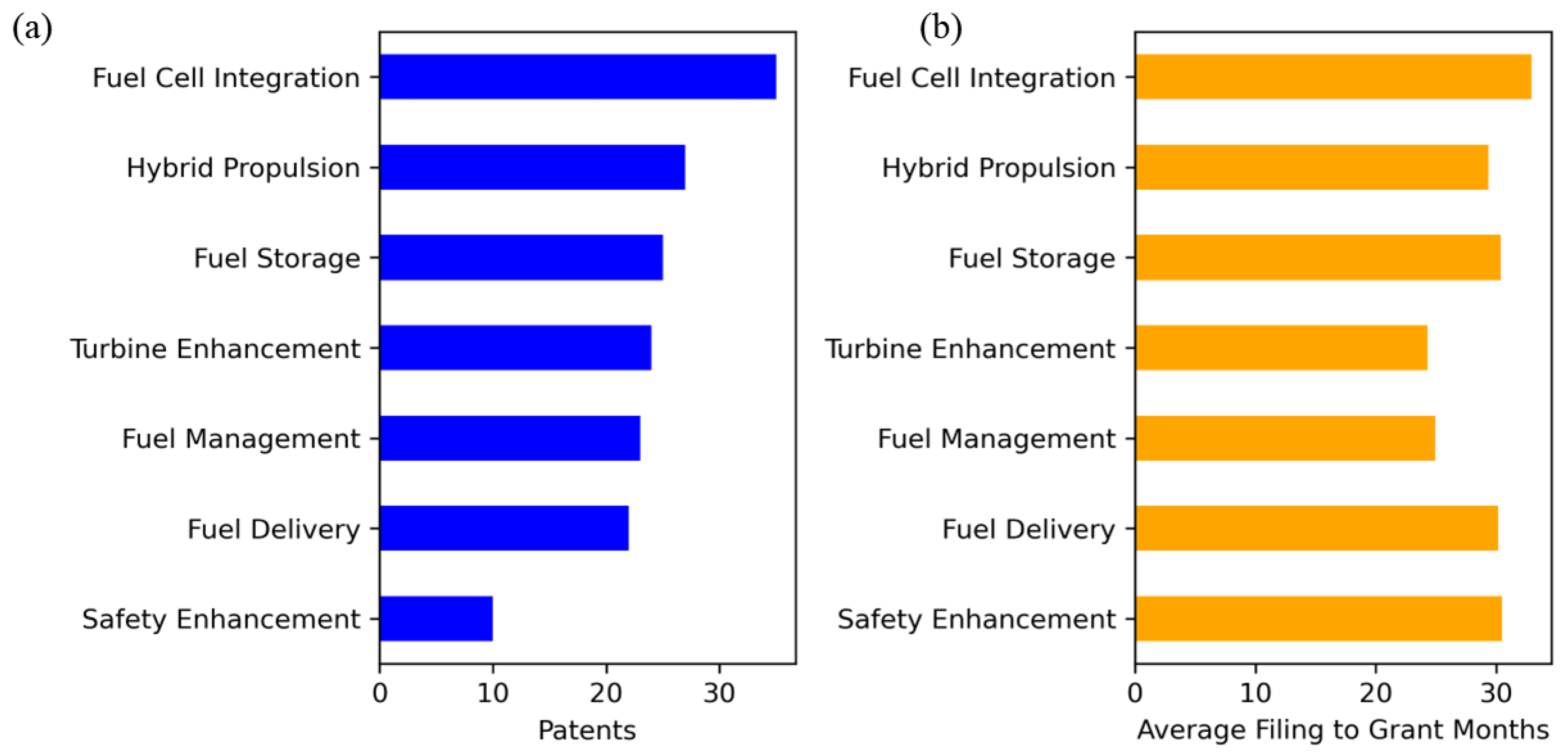
Figure 13 compares patent volume and grant latency across hydrogen aviation categories. Figure 13a shows that fuel cell integration leads in patent activity, followed by hybrid propulsion and fuel storage. Figure 13b indicates that fuel cell integration also experiences the longest average time from filing to grant, suggesting greater complexity or examination scrutiny. In contrast, turbine enhancement and fuel management show shorter grant times, reflecting potentially clearer claims or streamlined review. A low Pearson correlation coefficient of 0.19 suggests that the patent award level in each category is not related to their average grant latency. Nevertheless, these patterns highlight how a few category-specific dynamics may influence innovation pace.
5. Discussion
This study provides a novel contribution by focusing on the patents’ claims section to uncover protected innovations in hydrogen-powered aviation. Unlike previous studies that analyzed titles or abstracts, this approach reveals the core technical features and inventive scope deemed valuable enough to protect. By structuring the results into seven innovation categories, this study offers a detailed view of where meaningful technical advances are occurring. The classification reveals how industry stakeholders are overcoming key hydrogen aviation barriers. For instance, fuel storage and delivery systems show a clear trend toward integrated, modular, and cryogenic-ready designs. These advancements suggest near-term feasibility for ground infrastructure and airframe adaptation. The clustering of patents in fuel cell integration, hybrid propulsion, and turbine enhancement reveals a broad push toward flexible propulsion architectures that combine multiple energy sources for performance and resilience.
The results of the scientometric analysis further indicate growing global interest, with a recent sharp rise in participation by new inventors and diverse organizations. Leading aerospace firms and emerging innovators are engaging simultaneously. This landscape reflects both top-down strategic initiatives and bottom-up experimentation. Latency metrics show that examination times are shrinking. This quickening of the patent lifecycle suggests growing familiarity among patent offices and clearer articulation of novel hydrogen technologies. Overall, this study offers valuable signals to industry, government, and research stakeholders. Manufacturers can benchmark the strategies of competitors, identify opportunity gaps, and refine development roadmaps. Policymakers and funding agencies gain insights into where public investment could complement private innovation to accelerate commercialization. Researchers can better align their efforts with emerging trends to avoid redundant paths while focusing on unresolved technical challenges.
This work is limited in scope to the claims section of USPTO-issued patents, enabling deep insight into protected innovations but not capturing all global developments or unfiled research. Future work could expand coverage to integrate academic and industrial literature. Nonetheless, the claims-based approach of this study establishes a solid methodological foundation for ongoing tracking of hydrogen aviation innovations.
6. Conclusions
Hydrogen-powered aviation offers a promising pathway toward sustainable, energy-secure air transport, but significant technical hurdles remain. This study addressed the need to understand innovation trajectories by conducting a systematic analysis of the claims section from 166 hydrogen aviation patents issued by the USPTO between 2018 and 2024. By focusing on patent claims rather than abstracts or titles, the analysis uncovered protected innovations across seven critical categories: fuel storage, fuel delivery, fuel management, turbine enhancement, fuel cell integration, hybrid propulsion, and safety enhancement. Thematic and scientometric analyses revealed consistent growth in patent filings, expanding inventor participation, and increasing international interest. Together, these trends signal strong momentum toward competition and commercialization. The structured classification supports engineers and technology developers in benchmarking technical priorities. This study also offers actionable insights for policymakers and funding agencies seeking to support impactful research. Stakeholders can use these results to identify technical gaps, refine development strategies, and align policy frameworks with real-world innovation patterns. This work advances present knowledge by demonstrating a practical and scalable method for categorizing patent-protected technologies. The approach can be generalized to monitor other emerging fields. Over time, the claims-based methodology can support continuous intelligence gathering to inform investment, policy, and research decisions in the evolving hydrogen economy.
Funding
This research received funding from the United States Department of Transportation, Center for Transformative Infrastructure Preservation and Sustainability (CTIPS), Funding Number 69A3552348308.
Data Availability Statement
This article includes the data presented in the study.
Conflicts of Interest
The authors declare no conflicts of interest.
References
- J. R. Loh and S. Bellam, "Towards Net Zero: Evaluating Energy Security in Singapore using System Dynamics Modelling," Applied Energy, vol. 358, p. 122537, 2024. [CrossRef]
- S. Evro, B. A. Oni and O. S. Tomomewo, "Carbon Neutrality and Hydrogen Energy Systems," International Journal of Hydrogen Energy, vol. 78, pp. 1449-1467, 2024. [CrossRef]
- M. Sadeq, R. Z. Homod, A. K. Hussein, H. Togun, A. Mahmoodi, H. F. Isleem, A. R. Patil and A. H. Moghaddam, "Hydrogen Energy Systems: Technologies, Trends, and Future Prospects," Science of The Total Environment, vol. 939, p. 173622, 2024.
- Magliano, C. P. Carrera, C. M. Pappalardo, D. Guida and V. P. Berardi, "A Comprehensive Literature Review on Hydrogen Tanks: Storage, Safety, and Structural Integrity," Applied Sciences, vol. 14, no. 20, p. 9348, 2024.
- Z. Xie, Q. Jin, G. Su and W. Lu, "A Review of Hydrogen Storage and Transportation: Progresses and Challenges," Energies, vol. 17, no. 16, p. 4070, 2024. [CrossRef]
- S. Bagarello, D. Campagna and I. Benedetti, "A Survey on Hydrogen Tanks for Sustainable Aviation," Green Energy and Intelligent Transportation, vol. In Press, p. 100224, 2024. [CrossRef]
- H. Wu, J. Gao, Q. Tan, N. Huang, F. Gao, P. Puranen and Z. Rong, "Hydrogen Fuel Cell Technology: A Sustainable Solution for Revolutionizing Aviation and Achieving Significant Carbon Reduction in the Industry," International Journal of Hydrogen Energy, vol. 111, pp. 711-722, 2025. [CrossRef]
- M. C. Massaro, S. Pramotton, P. Marocco, A. H. A. Monteverde and M. Santarelli, "Optimal Design of A Hydrogen-powered Fuel Cell System for Aircraft Applications," Energy Conversion and Management, vol. 306, p. 118266, 2024. [CrossRef]
- N. Higashide, Y. Zhang, K. Asatani, T. Miura and I. Sakata, "Quantifying Advances From Basic Research to Applied Research in Material Science," Technovation, vol. 135, p. 103050, 2024. [CrossRef]
- D. Consolati, P. Marmaglio, L. Canziani, M. Tiboni and C. Amici, "Electric Actuation of Transport Vehicles: Overview of Technical Characteristics and Propulsion Solutions through a Systematic Patent Analysis," Actuators, vol. 13, no. 1, p. 15, 2024. [CrossRef]
- V. Vinichenko, J. Jewell, J. Jacobsson and A. Cherp, "Historical Diffusion of Nuclear, Wind and Solar Power in Different National Contexts: Implications for Climate Mitigation Pathways," Environmental Research Letters, vol. 18, no. 9, p. 094066, 2023. [CrossRef]
- Boretti, "The Perspective of Hybrid Electric Hydrogen Propulsion Systems," International Journal of Hydrogen Energy, vol. 50, pp. 857-868, 2024. [CrossRef]
- J. Ramm, A. Rahn, D. Silberhorn, K. Wicke, G. Wende, V. Papantoni, F. Linke, M. Kühlen and K. Dahlmann, "Assessing the Feasibility of Hydrogen-Powered Aircraft: A Comparative Economic and Environmental Analysis," Journal of Aircraft, vol. 61, no. 5, pp. 1337-1353, 2024. [CrossRef]
- J. Yap and B. McLellan, "A Historical Analysis of Hydrogen Economy Research, Development, and Expectations, 1972 to 2020," Environments, vol. 10, no. 1, p. 11, 2023.
- R. T. Shafiee and D. P. Schrag, "Carbon Abatement Costs of Green Hydrogen Across End-use Sectors," Joule, vol. 8, no. 12, pp. 3281-3289, 2024. [CrossRef]
- R. Angelico, F. Giametta, B. Bianchi and P. Catalano, "Green Hydrogen for Energy Transition: A Critical Perspective," Energies, vol. 18, no. 2, p. 404, 2025. [CrossRef]
- F. Pflugmann and N. D. Blasio, "The Geopolitics of Renewable Hydrogen in Low-carbon Energy Markets," Geopolitics, History, and International Relations, vol. 12, no. 1, pp. 9-44, 2020.
- Y. Zhang, "Towards Greener Skies: Exploring the Potential of Hydrogen Energy in Aviation," Theoretical and Natural Science, vol. 56, pp. 105-111, 2024. [CrossRef]
- Y. Z. Alharthi, "An Analysis of Hybrid Renewable Energy-based Hydrogen Production and Power Supply for Off-grid Systems," Processes, vol. 12, no. 6, p. 1201, 2024. [CrossRef]
- Gunathilake, I. Soliman, D. Panthi, P. Tandler, O. Fatani, N. A. Ghulamullah, D. Marasinghe, M. Farhath, T. Madhujith, K. Conrad, Y. Du and M. Jaroniec, "A Comprehensive Review on Hydrogen Production, Storage, and Applications," Chemical Society Reviews, vol. 53, no. 22, pp. 10900-10969, 2024.
- K. Feng, Z. Yang, Y. Zhuo, L. Jiao, B. Wang and Z. Liu, "Impact of Carbon Tax on Renewable Energy Development and Environmental–Economic Synergies," Energies, vol. 17, no. 21, p. 5347, 2024. [CrossRef]
- Y. Choi and J. Lee, "Estimation of Liquid Hydrogen Fuels in Aviation," Aerospace, vol. 9, no. 10, p. 564, 2022. [CrossRef]
- Franco and C. Giovannini, "Hydrogen Gas Compression for Efficient Storage: Balancing Energy and Increasing Density," Hydrogen, vol. 5, no. 2, pp. 293-311, 2024. [CrossRef]
- T. Yusaf, A. S. F. Mahamude, K. Kadirgama, D. Ramasamy, K. Farhana, H. A. Dhahad and A. R. A. Talib, "Sustainable hydrogen energy in aviation–A narrative review," International Journal of Hydrogen Energy, vol. 52, pp. 1026-1045, 2024.
- C. Amargianitakis, R. H. Self, A. J. Torija, A. R. Proença and A. P. Synodinos, "Toward estimating noise–power–distance curves for propeller-powered zero-emission hydrogen aircraft," Journal of Aircraft, vol. 61, no. 2, pp. 485-502, 2024. [CrossRef]
- Ebrahimi, A. Rolt, S. Jafari and J. H. Anton, "A Review on Liquid Hydrogen Fuel Systems in Aircraft Applications for Gas Turbine Engines," International Journal of Hydrogen Energy, vol. 91, pp. 88-105, 2024. [CrossRef]
- J. Adler and J. R. Martins, "Hydrogen-powered Aircraft: Fundamental Concepts, Key Technologies, and Environmental Impacts," Progress in Aerospace Sciences, vol. 141, p. 100922, 2023.
- M. Kamran and M. Turzyński, "Exploring Hydrogen Energy Systems: A Comprehensive Review of Technologies, Applications, Prevailing Trends, and Associated Challenges," Journal of Energy Storage, vol. 96, p. 112601, 2024.
- Hydrogen Council, "Hydrogen Insights," McKinsey & Company, 2024.
- M. I. Shahid, A. Rao, M. Farhan, Y. Liu, H. A. Salam, T. Chen and F. Ma, "Hydrogen Production Techniques and Use of Hydrogen in Internal Combustion Engine: A Comprehensive Review," Fuel, vol. 378, p. 132769, 2024. [CrossRef]
- N. A. Qasem and G. A. Abdulrahman, "A Recent Comprehensive Review of Fuel Cells: History, Types, and Applications," International Journal of Energy Research, vol. 2024, no. 1, p. 7271748, 2024.
- N. Velaz-Acera, R. Ruiz-Marín and D. Borge-Diez, "Comparative Economic, Energy, and Environmental Analysis of Fuel Cell and Electric eVTOL Systems: Case Study of Iberian Peninsula," Journal of Cleaner Production, vol. 495, p. 145027, 2025.
- H. Degirmenci, A. Uludag, S. Ekici and T. H. Karakoc, "Challenges, Prospects and Potential Future Orientation of Hydrogen Aviation and the Airport Hydrogen Supply Network: A State-of-art Review," Progress in Aerospace Sciences, vol. 141, p. 100923, 2023. [CrossRef]
- J. Mukhopadhaya, "Quick pit stops: A challenge for zero-emission planes?," International Council on Clean Transportation (ICCT), 20 January 2023. [Online]. Available: https://theicct.org/quick-pit-stops-a-challenge-for-zero-emission-planes/. [Accessed 19 February 2025].
- R. Dennis, H. A. Long and G. Jesionowski, "A Literature Review of NOx Emissions in Current and Future State-of-the-art Gas Turbines," Journal of Engineering for Gas Turbines and Power, vol. 146, no. 3, p. , 2024. [CrossRef]
- K. Durkin, A. Khanafer, P. Liseau, A. Stjernström-Eriksson, A. Svahn, L. Tobiasson, T. S. Andrade and J. Ehnberg, "Hydrogen-powered Vehicles: Comparing the Powertrain Efficiency and Sustainability of Fuel Cell Versus Internal Combustion Engine Cars," Energies, vol. 17, no. 5, p. 1085, 2024. [CrossRef]
- L. M. Cardone, G. Petrone, S. D. Rosa, F. Franco and C. S. Greco, "Review of the Recent Developments About the Hybrid Propelled Aircraft," Aerotecnica Missili & Spazio, vol. 103, no. 1, pp. 17-37, 2024. [CrossRef]
- P. Liu, T. Yang, H. Zheng, X. Huang, X. Wang, T. Qiu and S. Ding, "Thermodynamic Analysis of Power Generation Thermal Management System for Heat and Cold Exergy Utilization From Liquid Hydrogen-fueled Turbojet Engine," Applied Energy, vol. 365, p. 123290, 2024. [CrossRef]
- N. Yang, J. Deng, C. Wang, Z. Bai and J. Qu, "High Pressure Hydrogen Leakage Diffusion: Research Progress," International Journal of Hydrogen Energy, vol. 50, pp. 1029-1046, 2024. [CrossRef]
- Google, "Google Patents," 12 April 2025. [Online]. Available: http://patents.google.com. [Accessed 12 April 2025].
- WIPO, "PATENTSCOPE," World Intellectual Property Organization (WIPO), 12 April 2025. [Online]. Available: https://patentscope.wipo.int/search/en/search.jsf. [Accessed 12 April 2025].
- USPTO, "Data Download Tables," U.S. Patent and Trademark Office (USPTO), 5 February 2025. [Online]. Available: https://patentsview.org/download/claims. [Accessed 12 April 2025].
Figure 1.
The methodological workflow.
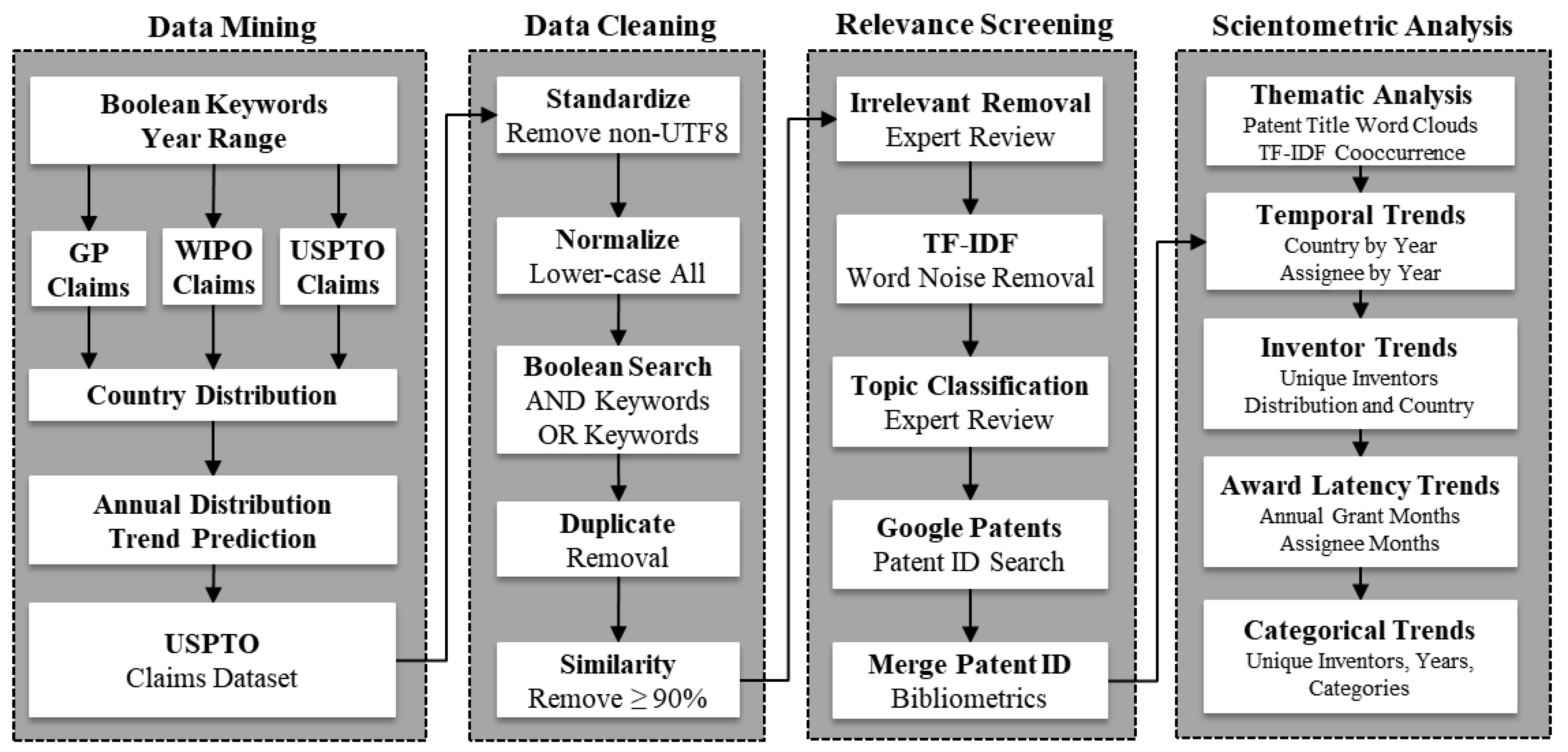
Figure 2.
Google Patents results by a) patent office country, and b) year with regression forecast.
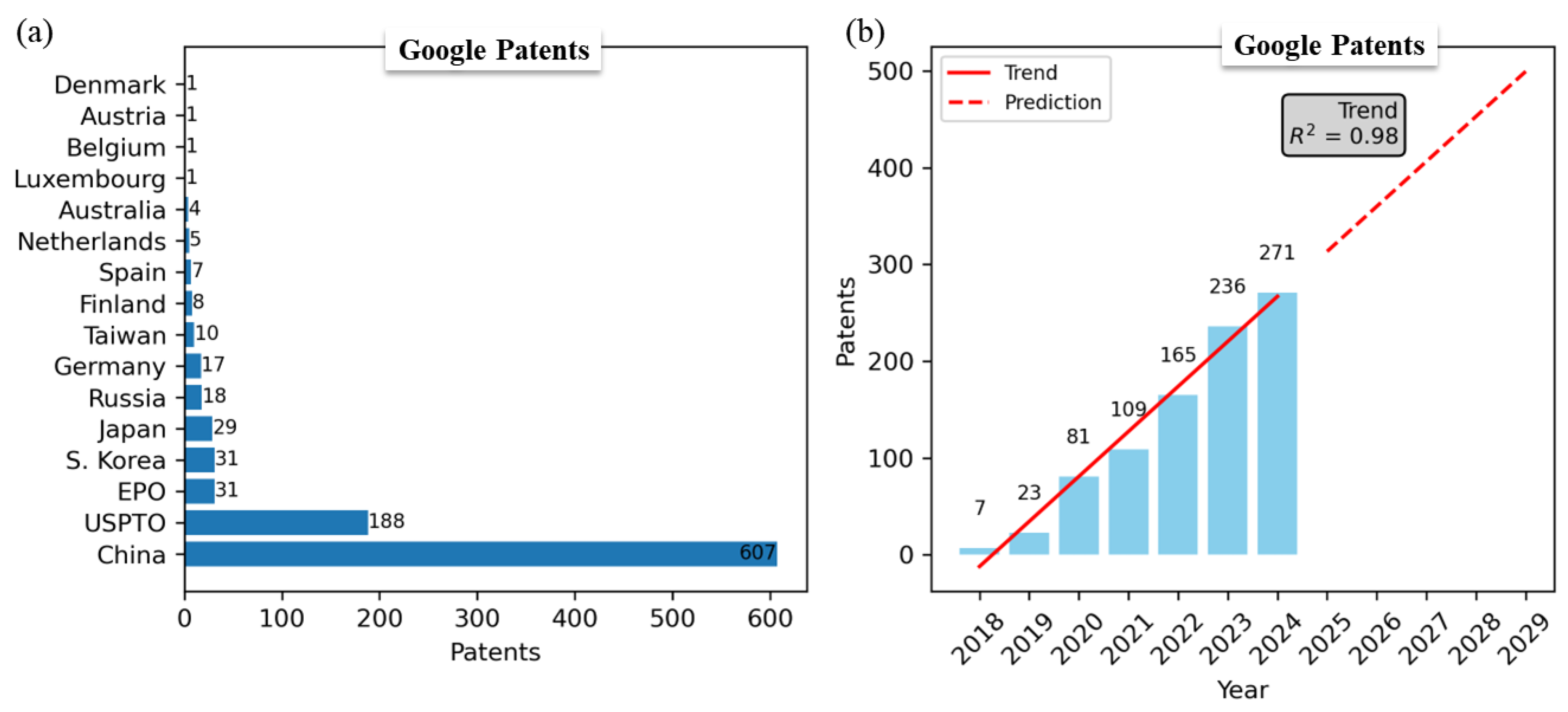
Figure 3.
Results from the search engines of a) WIPO, and b) USPTO after cleaning for relevance.
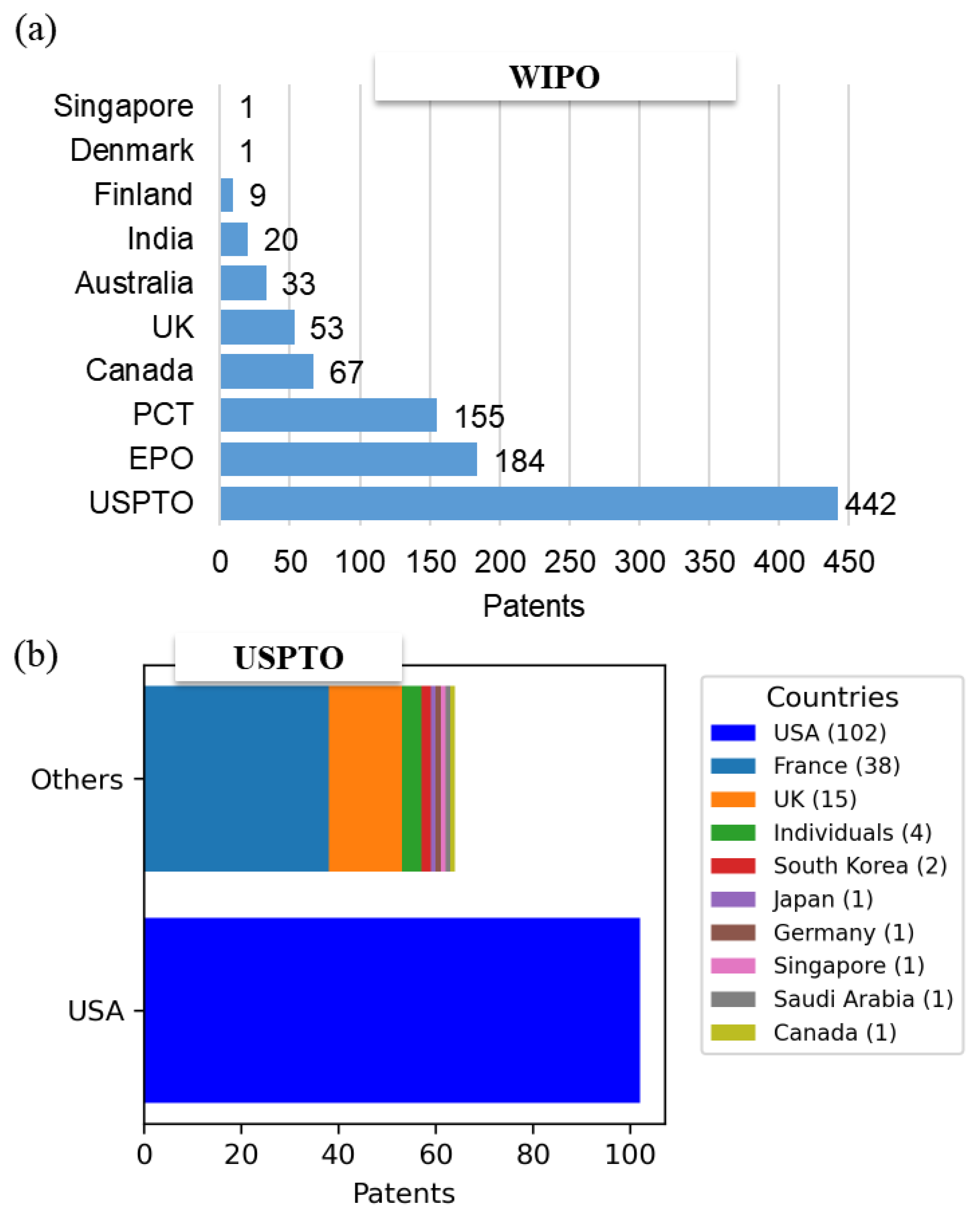
Figure 4.
Word cloud of patent titles across invention categories.
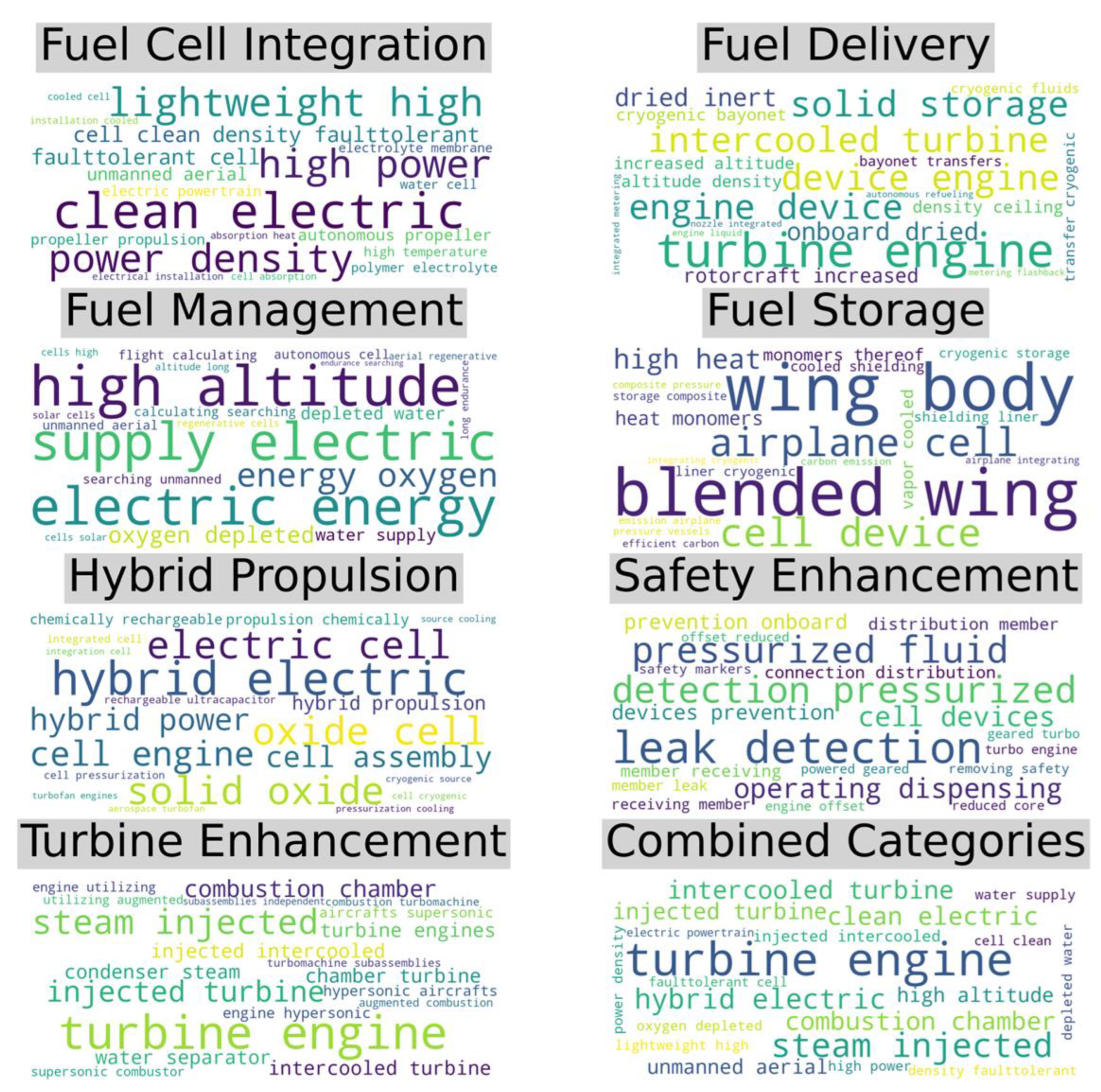
Figure 5.
Term co-occurrence network of TF-IDF text.
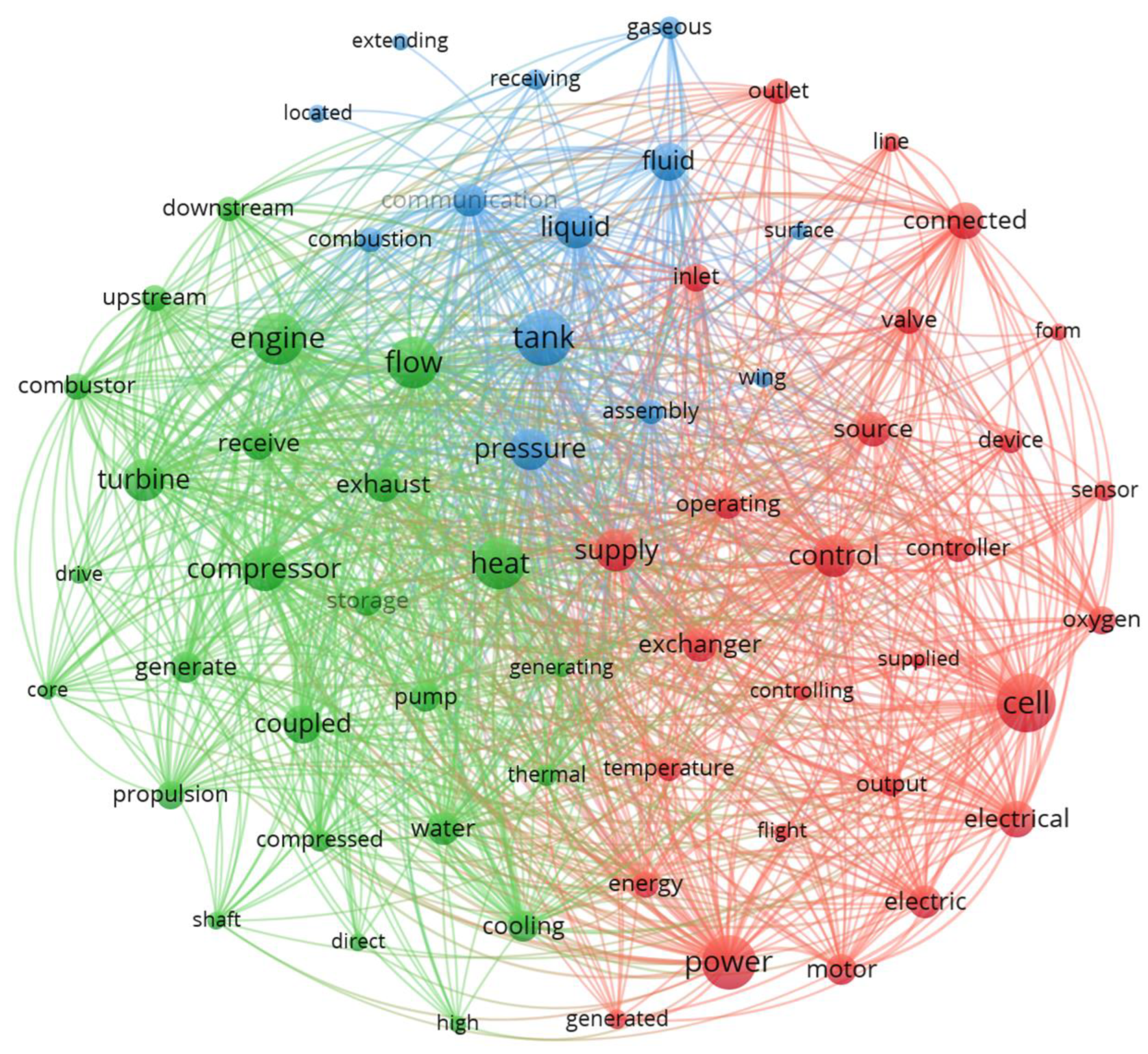
Figure 6.
USPTO annual awards by country.
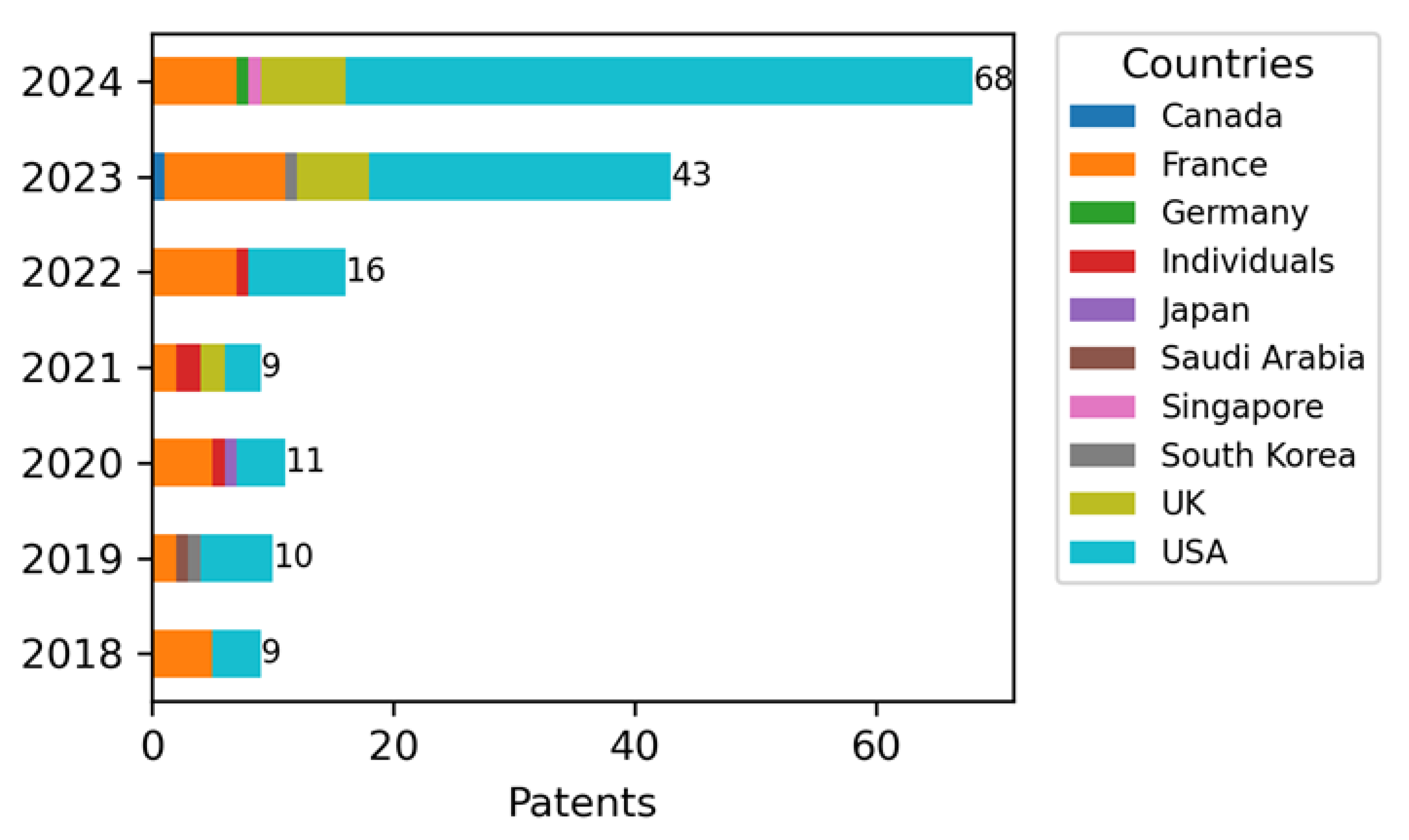
Figure 7.
Top 10 key players by a) year, and b) category.
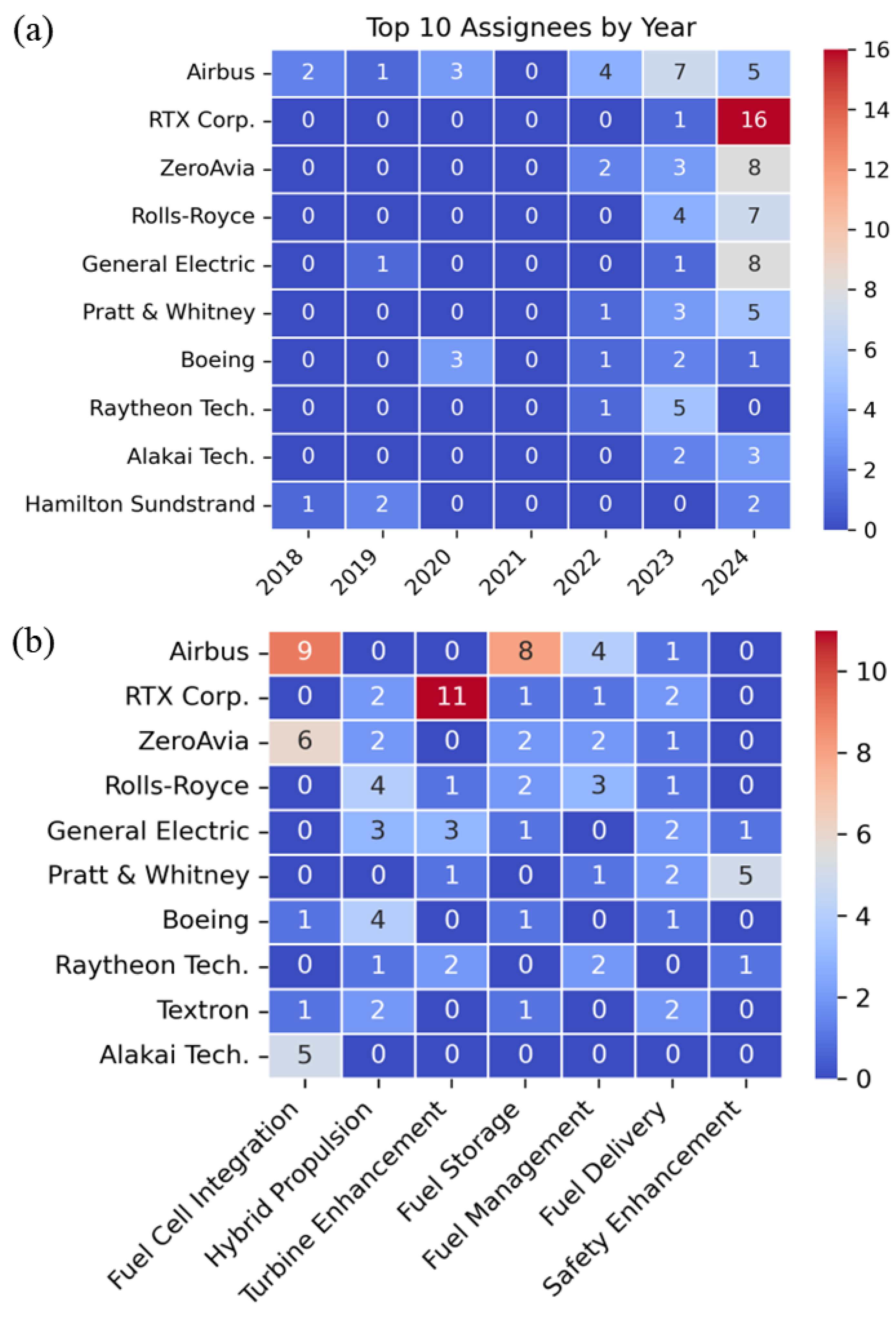
Figure 8.
Effort thrust measures by a) distribution of inventors per patent, b) inventors spread by country, c) number of unique inventors by country, and c) number of unique inventors by year.
Figure 8.
Effort thrust measures by a) distribution of inventors per patent, b) inventors spread by country, c) number of unique inventors by country, and c) number of unique inventors by year.
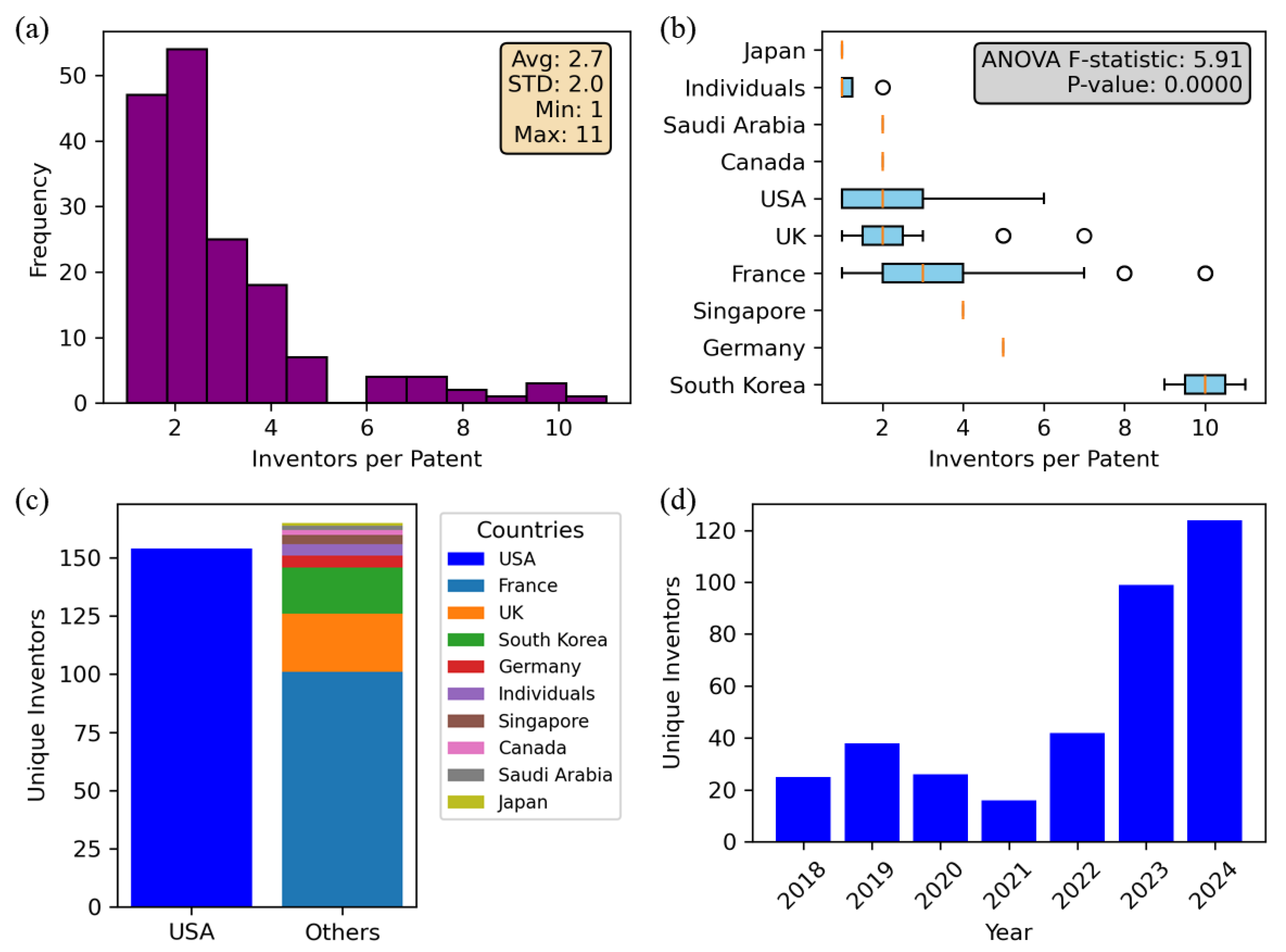
Figure 9.
Innovation thrust measures by a) patent category, and b) annual category diffusion.
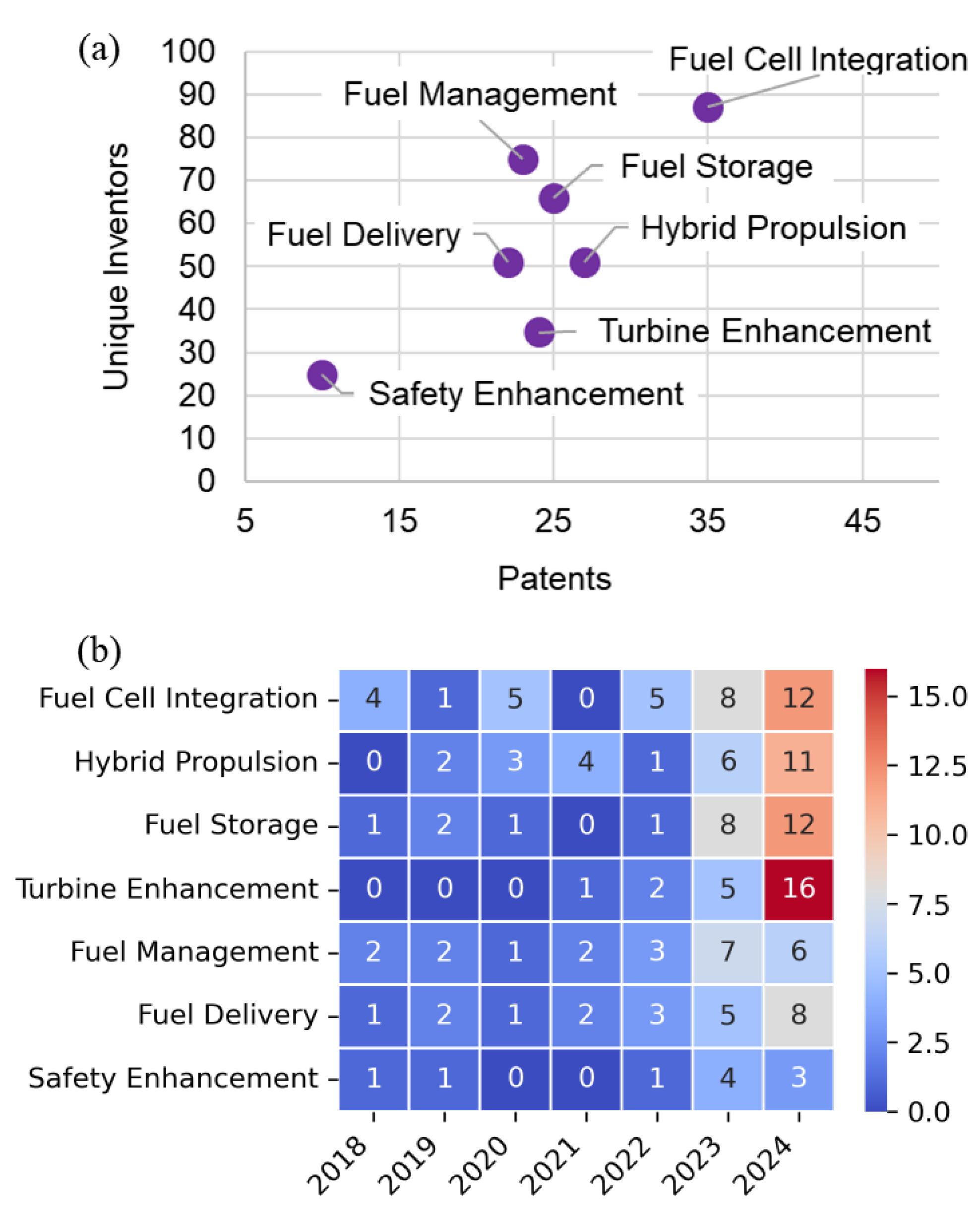
Figure 10.
Production measures by a) inventors spread by category, and b) claims spread by category.
Figure 10.
Production measures by a) inventors spread by category, and b) claims spread by category.
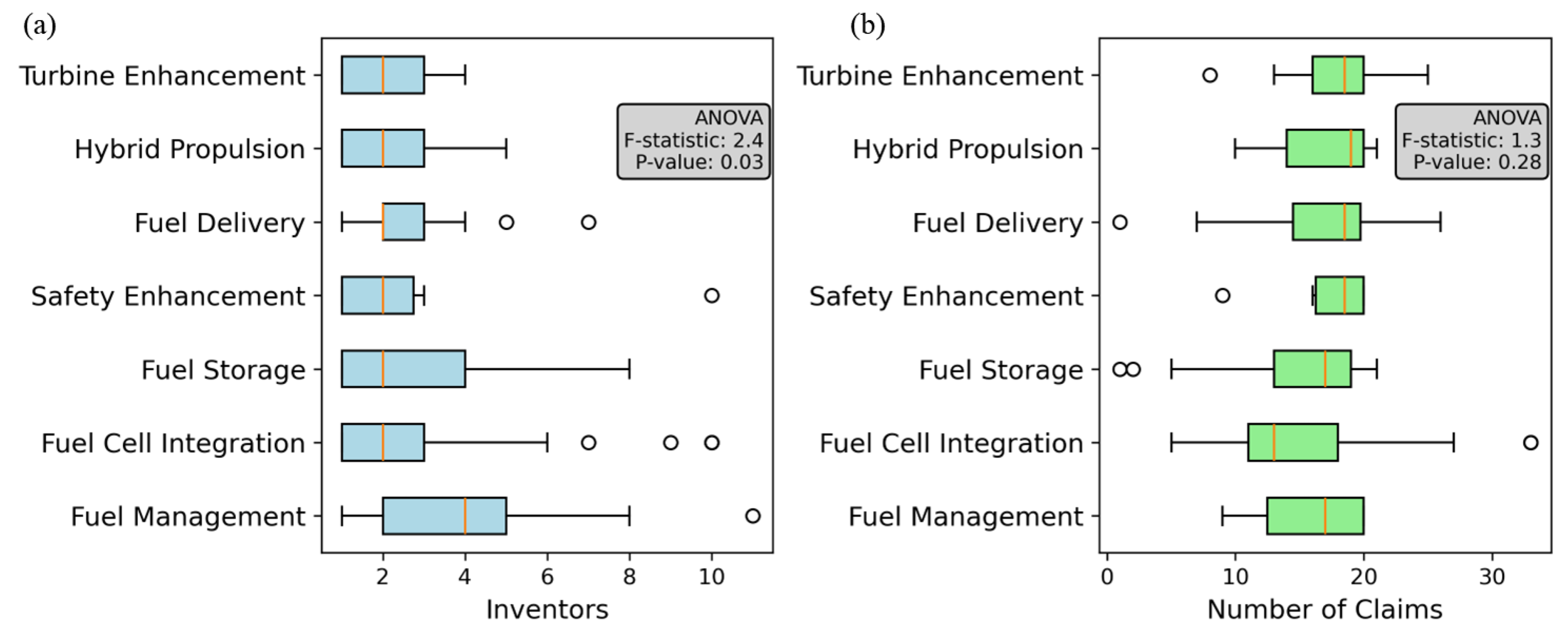
Figure 11.
Latency measures a) from disclosure to filing, b) from filing to award, c) disclosure to grant distribution, and c) average latency from filing to grant by award year.
Figure 11.
Latency measures a) from disclosure to filing, b) from filing to award, c) disclosure to grant distribution, and c) average latency from filing to grant by award year.
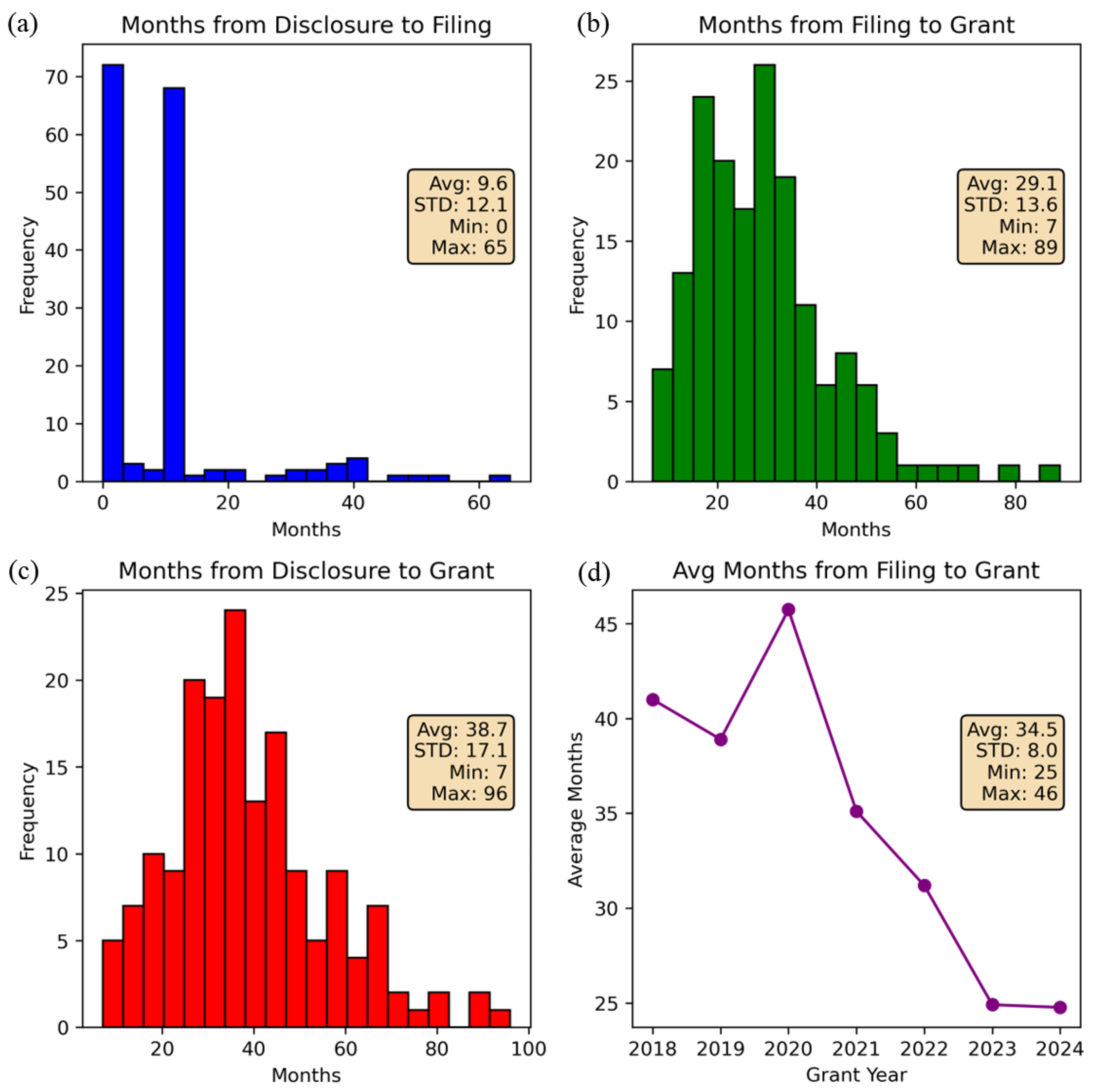
Figure 12.
Top 15 organizations by a) production level, and b) latency from filing to grant.
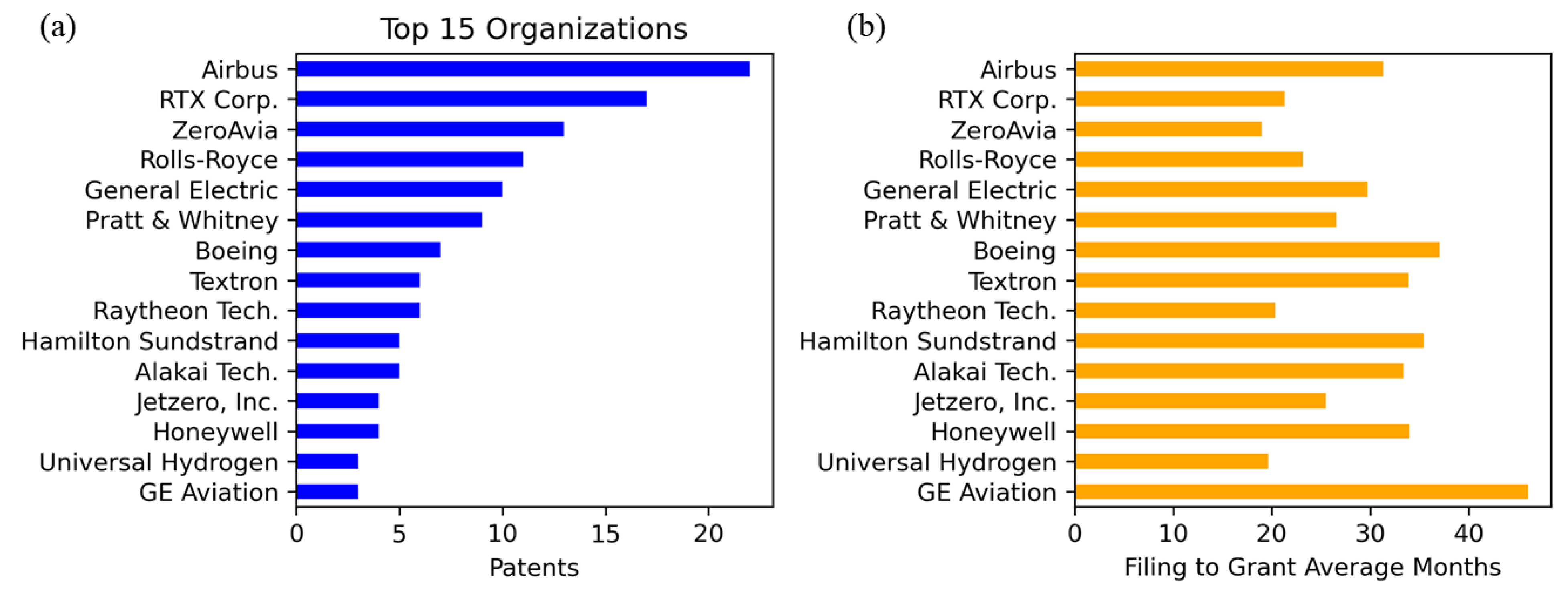
Figure 13.
Measures of a) category production level, and b) category latency.
Disclaimer/Publisher’s Note: The statements, opinions and data contained in all publications are solely those of the individual author(s) and contributor(s) and not of MDPI and/or the editor(s). MDPI and/or the editor(s) disclaim responsibility for any injury to people or property resulting from any ideas, methods, instructions or products referred to in the content. |
© 2025 by the authors. Licensee MDPI, Basel, Switzerland. This article is an open access article distributed under the terms and conditions of the Creative Commons Attribution (CC BY) license (http://creativecommons.org/licenses/by/4.0/).
Copyright: This open access article is published under a Creative Commons CC BY 4.0 license, which permit the free download, distribution, and reuse, provided that the author and preprint are cited in any reuse.


