
Submitted:
18 April 2025
Posted:
21 April 2025
You are already at the latest version
Abstract
In regard to the hospitality sector this research investigates the effect of service quality on customer loyalty where this research specifically focuses on the significance of several service quality characteristics with respect to customer loyalty. Qualitative methodologies were used to make the study and the complete interviews with 42 participants who had told what they had experienced and assessed as service quality at different hotels were conducted. The research specifies crucial factors including dependability, responsiveness, empathy, cleanliness, as well as technology integration that have a big impact on client satisfaction and their intention to come back to a hotel. Service quality is vital to the establishment and the improvement of the loyalty of your patrons; they tend to associate reliability, or, more specifically, lack of unreliability with it, with a consistent and trustworthy service fulfilling their expectations. Furthermore, careful listening to visitor prerequisites, namely in the form of rapid issue solving and individualized attention, was deemed to elevate visitor delight and elevate the possibility of return visits. Since there was an emotional element and visitors were keen on having a connected relationship with hotel personnel, there was a need for empathy and customized attention which left spectators with a strengthened emotional connection towards the hotel brand. The factors that influence the visitors’ impression of the service quality were defined by the components related to the cleanliness and maintenance of the hotel. Integration of technology is seamless when technology enhances ease and enjoyment with practicality rather than replacing human connections at all. Since service quality influences customer loyalty significantly, hotels may focus on these qualities to develop long lasting and continuous relationships with customers and sustain success in the competitive market.
Keywords:
service quality
; customer loyalty
; hospitality industry
; qualitative research
; customer satisfaction
; technology integration
; emotional connection
1. Introduction
The global economy depends on the hospitality industry, which makes great emphasis on delivering exceptional experiences. Service quality is important for a successful service as assessment for service quality is of tothorough evaluations of whether service can meet or exceed customers' expectations (Liu et al., 2022). With a lot of competition being thrown in, Hospitality businesses should also know the relationship between service quality and customer loyalty to grow on. The one that is taking observation deals with customer loyalty as a crucial sign of long run professed accomplishment, since dedicated clients are more prone to reclamation and advise on many individuals (Limna, 2023). Thus, due attention has been paid to the influence of service quality on customer loyalty in hospitality managers, marketers, and scholars. In such a complex interaction of many factors there are a number of factors that make up service quality: tangibility, reliability, responsiveness, assurance, and empathy (Emon & Khan, 2025). According to Jayawardena et al. (2023), the engagement between both customers and service provider happens with tangible elements of service quality like physical environment, facilities and amenities, which constitute the first of the first set of engagement between customers and service provider. It is likely that these tangible features will have a strong influence on how a customer regards the service experience as a whole. But the attaining experiential factors including staff attention, their comfort and ability to understand customers are indispensable in creating a positive customer experience. Eventually, these components interact to affect a customer's satisfaction, and their propensity as a dedicated customer of the organization (Özdemir et al., 2023). Service quality is an important determinant of customer loyalty due to the fact that loyal customers are a critical source of support to the hospitality businesses. Also, they are more prone to spend more over time and more likely to advise the services to other people (Doğan Gürsoy et al., 2023), which also helps the business to ameliorate the image and attract new clients. Promotes continued consumption to encourage repeat customers in most of the loyalty program designs (Emon & Khan, 2025). Theoretical and practically substantiated correlation between service quality and customer loyalty is both strong positive one (Bux & Amicarelli, 2022). However, exceptional service quality will attract the customer attention as against the competitive options from other hospitality suppliers (Darvishmotevali & Altinay, 2022). This is especially important as the customer base has more leverage over the reviews and social media and thus the opinion of the customer is more educated so it becomes more difficult to bend without stellar service (Liu-Lastres et al., 2022). There is much agreement as to why service quality is so important in developing customer loyalty; however, the relationship between them is never linear or one-dimensional. A number of factors (such as the type of the service provided, the demographics of the target audience, external factors including economic conditions and societal trends) can influence the correlation between satisfaction and loyalty (Chen et al., 2022). Thus in the context of luxury hotels, where guests are expected to receive excellent personalised service as well as unique experience, determinants of loyalty can differ considerably from that in budget lodgings where cost effectiveness is a more powerful loyalty stimulus (Akarsu et al., 2022). The service quality expectations and perceptions may also depend on regional inequalities. For some cultures, the major factor is amiability and attentiveness of the staff, and for others it is the thing that factors in cleanliness, operational efficiency (Emon & Khan, 2024). The hospitality industry has been a victim of high reliance on technology; hence, the dynamics of service quality has been transformed. Online booking systems, mobile apps, and self service kiosks are part of the touristic experience entered in the digital touchpoints (Ntounis et al., 2021). These technological interfaces have received high caliber service quality interfaces, which are the building blocks for overall perceptions of service quality. An effective and simple to use process can encourage shoppers to be happy with a job done, but a defective or intricate system can result in dissatisfaction and a lack of devotion (Khan & Emon, 2025). This is relevant in the post-pandemic era particularly because so many customers are now expecting more contact or technology driven service options that help them in some way, and their loyalty may depend on how well this expectation is met. Service quality and customer loyalty relationship is dynamic. The brand is dynamic, it evolves over time as the customers engage with the brand through different touchpoints (Doğru et al., 2023). Depending on the context, factors such as the check-in efficiency and the appearance of the facility during customers’ first encounter with a service provider can bear great influence on the level of loyalty; however, as a relationship between customer and a service provider evolves, other factors like personalized service, recognisation of repeat customers and advantages of loyalty programs could assume bigger role to play in the matter. This fluidity of the service experience supports other hospitality businesses to constantly reevaluate and alter their service offerings to handle changing customers' expectations, or else risk losing their customers for good. Overall, the influence on customer loyalty from service quality is connected to broader industry trends. Since the COVID 19 pandemic, there has been a notable increase in the hygiene, safety, and reservation and cancellation policies (Liu et al., 2022). These variables have been responsible for affecting the consumer’s expectations about the service quality and those companies who could quickly adapt to this new benchmark rewarded with elevated client trust and loyalty. However, in the forecasts period of industry recovery and a new stage of growth of the industry, these variables remain important for structural formation of presence of service quality and consumer loyalty in hospitality (Limna, 2023). Companies can benefit from loyal customers; as repeat business and positive word of mouth endorsements, they are also an important source of feedback for companies (Jayawardena et al., 2023). They add to the creation of service and operations design and to the management of the customer experience. Hospitality businesses can offset their costs of customer acquisition, which can be very resource intense as opposed to customer retention (Chen et al., 2022). Thus, companies can increase their profitability over time while losing less market share to loyal customers who are more likely to accept price increases (Darvishmotevali & Altinay, 2022). The hotel industry has a complex, varied, and essentially consumer expectations, service performance, and satisfaction-based relationship with service quality and customer loyalty. These factors change as the market changes, and for a business to maintain loyalty and assure continued success, it must be flexible in understanding and addressing them. With intensified competition, technological advances, and changing consumer desires, hotel businesses should analyze the service quality and customer loyalty related variables for the process to stay competitive. Hospitality firms can maintain long relationships with their clients and grow with a long lasting and a sustained growth as well as a sustained profitability by focusing on the nuances of service quality and continuously improving customer experiences (Özdemir et al., 2023).
2. Literature Review
Research of service quality in the hotel industry over the recent decades has been dominated by the key influence of service quality on customer satisfaction and loyalty. In the competitive hotel sector, success in a company is very dependent on comprehending factors influencing quality of service and its impacts on the customer’s behavior. Several models and frameworks have been developed by researchers to clarify the factors that affect service quality and in turn its impact on client’s loyalty. Service quality has been defined as the amount of fulfilment or excedance of service provider towards service client expectations (Emon & Khan, 2024) and has been evaluated by dimensions such as reliability, assurance, tangibility, empathy and responsiveness (Emon, 2025). Several are studies which have analyzed and validated these criteria and it is argued that they are critical to the perception and loyalty of the customer. Since 1988, SERVQUAL model developed by Parasuraman, Zeithaml and Berry was a seminal paradigm for service quality assessment which have five key dimensions: tangibles, reliability, responsiveness, assurance, and empathy. These attributes have been systematically refined and expanded by academics in the context of the hospitality industry. Among the reasons is the intangible nature of services in the sector, which makes it considerably more difficult to measure the customer experience compared to the tangible ones. According to Emon et al. (2024), the hotel industry depends particularly on providing positive service-experience which equals or exceeds customer expectations. Thus, a lot of research has been done concerning the service quality influence on the customers’ satisfaction, loyalty and their subsequent behavior (Khan et al., 2024). Reliability is one of critical components in the service quality definition and refers to the capability to deliver promised services within required accuracy and dependability (Gürsoy & Chi, 2020). Limna & Kraiwanit (2023) shows that the hotel service reliability relates strongly to client loyalty. The network of client loyalty is what we have observed to be linked with consistent service treatment i.e clients who received consistent treatment were more likely to return and recommend to others. Service excellence includes a strong tangibility of physical facilities, equipment and personnel presentation. In his article, Özdemir et al. (2022) asserted that hotel environments that are kept well and look great are able to increase customers perception of service quality and satisfaction, which, in turn, increases customer’s loyalty. As pointed out by Carvalho & Alves (2022), the physical characteristics of the service environment, such as cleanliness, décor, are determining factors for customer satisfaction that positively determine repeat patronage and word of mouth referrals. Responsiveness is an integral component of the service quality because it pertains to the willingness of service providers to assist the clients and deliver fast services (Khan et al., 2021). In hotel industry, responsiveness signifies the speed with which the personnel attends to customers grievances, problems and complaints. As Meira & Hancer (2021) have recently conducted research in diverse hotel settings, their result demonstrate that timely resolution of customer issues not only increased customer satisfaction but significantly enhanced client loyalty. Dube et al. (2019) also highlighted empathy, which is defined as regard and concern service providers show to the needs of clientele, as core aspect of service excellence. Empathy connects emotionally to the customers and leads customers to stay loyal which eventually leads to repeat business. It is also found that researchers tackled the effect of the external factors including technological advancements and cultural shifts on customer perception to the service quality in hotel industry. As digital technology advance, the hotel business has been more and more dependent on technology implemented solutions to improve service delivery. According to Khan et al. (2024), the application of such technologies for self check in kiosks or mobile app may significantly improve service in terms of short waiting time and greater convenience. Nevertheless, these technologies have to be deployed recalling the regular customer interaction and responsiveness that customers in the industry are accustomed to. Technology must be integrated seamlessly and customized to fit the client’s specifications (Breier et al., 2021). Customer perceptions of the tangibility and reliability of hospitality services have been influenced by technology as online reviews and digital feedback mechanisms allow for feedback that makes for an evaluation of the experiences and also enables a company to be called to account (Vakira et al., 2022). Service quality is related to customer loyalty not only because of traditional aspects of service quality but also a result of an entirety of the client experience. According to Aharon et al. (2021), customer loyalty is resulting from a wide-approached and multidimensional experience, which is beyond a single service event. Persisting interactions between customer and brand are strongly dictated by hospitality and the customer feels the distinct interaction with the service rendered, consistent service, personalized attention and perceived value (Khawaja et al., 2021). According to Ghani et al. (2022), this concept is real as they substantiated their argument that customers who are associable to a brand, like they frequently visit or participate in a loyalty program, is more likely to exhibit strong loyalty behaviors. Thus, service quality is an important aspect yet one part of a customer experience that needs ongoing upgrade to maintain loyalty. The effect of emotional factors on the relationship between custemer loyalty and service quality was recently studied. According to Kong et al. (2022), service contacts can lead customers to develop emotional bonds resulting in high service quality being perceived and customer loyalities being further strengthened. In the hotel industry where providing memorable experience for guests is all about, there is an emotional part that should not be neglected. It has been demonstrated that the emotional engagement of customers, especially by means of personalized service, leads to better perception of service quality which in turn affects their loyalty (Majeed & Kim, 2022). Seeing oneself as valued and recognized by a service provider increases clients’ likelihood of coming back and creating a long lasting relationship with the brand (Ben Youssef & Zeqiri, 2020). Factors such as customer expectations that can be widely different depending on their individual preferences, cultural background and previous experiences complicate the meaning of service quality in the hotel industry even more (Pham et al., 2019). International passengers will exhibit different service quality expectations to local consumers, which will be have a difference in cultural norms and prior experiences, according Jones et al. (2020). It implies that service quality standards in hospitality businesses need to be communicated convincingly to various segments of clients with the assurance that management of client expectations is handled in effective ways (Khan et al., 2024). The hotel business is strongly influenced by the perceived value of services and customer loyalty is a result of it. Gürsoy et al. (2022) argue that the repeat customers are more likely if such services have substantial value for the consumer. In this case value is defined by the quality of service divided by the price paid. According to Kalyar et al. (2021), if there is a high value of what customers are spending, they will be more likely to lead to loyalty towards the brand even if they have alternatives. In the modern competitive hotel industry where customers have a number of corresponding alternative and are able to compare prices and services easily, this is quite meaningful. Service quality also plays a vital role in affecting brand loyalty at the organizational level other than personal loyalty. According to Carvalho & Alves (2022), a consistent provision of superior service by a provider is conducive towards the development of a strong brand reputation and a higher degree of customer loyalty by a wider segment of the total customer base. Positive word of mouth helps build brand loyalty and in turn provides help to acquire new consumer and increase the enterprise’s market position. Customers who perceived high service quality are more likely to share and contribute to the brand’s success, asAharon et al. (2021) has shown. Moreover, the dynamic between service quality and customer loyalty (Emon et al., 2024) is influenced by evolution of expectations and behavior of the consumer. The service quality management strategies of companies must be flexible and adaptive due to the changes in consumer preference or new trends (Khan et al., 2021). The growing relevance of sustainable concept in the hotel has resulted in changed customer expectations towards environmentally friendly practices in the hotel industry. According to Meira and Hancer (2021), customers who place a premium on sustainability are willing to back businesses that communicate an environmental obligation through their services. Amongst the hotel industry it is discussed that the literature on service quality and customer loyalty is a complicated and dynamic process. Factors which impact on service quality and thereby contribute to fostering client loyalty include service reliability, the physical environment, staff responsiveness, and emotional connections with customers. In the hotel business, the firms have to realize all the factors which influence quality perception of the service and continuously adjust their ways of doing accordingly to the changing customers’ expectations. Given this relationship is vital for hospitality businesses to achieve their profitability and future research to explore out the novel ways to improve the relationship between service quality and customer loyalty (Khan et al., 2024).
3. Research Methodology
The purpose of the research was to investigate the service quality effect on customer loyalty in the hotel industry through a qualitative technique that allows acquiring detailed knowledge. I used a purposive sampling technique for picking people that may offer informative and relevant views on the subject. For this I interviewed 42 people who came from hotel guests, hospitality managers and industry experts. As to ensure the collected data would be exhaustive and having participated in the hotel industry for a substantial amount of experience, the participants were chosen from the pool of people who had worked in the hotel industry for a long time. Interviews were semi structured enabling free flow of ideas along the lines of critical matters such as service quality, customer satisfaction, loyalty. The semi structured interview style had a mix of standardized questions with flexibility for the participants to speak their views in the way they would want to. Thus, this technique allowed the researcher to investigate the effect of dependability, responsiveness and tangibility on customer perceptions and loyalty of the service quality. The interviews were conducted face to face or through online platforms at the request and preference of interviewees. The interviews lasted for 30 to 45 minutes which gave enough time for the interviewees to express their experiences and views in detail. To be able to have the authentic and reliables data, the researcher wanted to create an atmosphere for interviews that is conducive and transparent for the participant to speak out what is in their minds and share what they experience. This was achieved by the researcher by using both open ended questions and prompts to facilitate discourse about the link between service quality and customer loyalty and facilitating an analysis of what the participants had to say about their perceived relationship between service quality and customer loyalty. In addition, the researcher obtained the consent of the participants to record the interviews and note-taking was diligently done during all sessions. When the interviews were completed, the data was transcribed verbatim in order to allow for thorough analysis. The transcriptions were examined us-ing topic coding, a common qualitative re-search method. Focusing on essential aspects of service quality, the researcher saw recurring themes and patterns in the responses, and this had identified the themes and patterns of what more or less contributed to customer loyalty. The methodology consisted of several coding cycles during which the researcher presented the data to be categorized and refined into manageable segments that contained the participants’ view of different aspects of service delivery. The main themes concluded from this research were related to the importance of service consistency, the effect of personalized service, the utilization of technology in the enhancement of service quality and the necessity of emotional connection of a service provider and a customer. Analysis of data was done in an inductive way to let themes arise from the data by themselves rather than letting the researcher impose preconceived categorisation. The reason why this technique was used on this study was because it ensured that it was based on the participants’ viewpoint at all times allowing for a deeper understanding of the essence and intricacies of the link between service quality and loyalty. Parallel and difference of findings were juxtaposed with the current research to give a complete picture of the effects of service quality on customer loyalty in hotel industry. During the whole research process, ethical issues have been of utmost important. Participants first were adequately informed of the purpose of the study and participation was always voluntary. It was assured to them that their remarks would be kept anonymous and confidential, with all identifying details removed from the analysis and reporting stages. To use ethical standards, the researcher ensured that all participants who gave their consent were informed and aware about the right they had to withdraw from the study at any given point without any negative implications. A sample size of 42 interviews was deemed adequate for the purposes of the study having a varied sample of perspectives that can be collected keeping the data at hand and sufficiently robust for detailed analysis. By deliberately varying the sample it included consumers as well as industry experts in order to achieve an understanding of the factors influencing customer loyalty from the stance of a number of frontiers. This technique was able to portray these same complexities inside the hospitality sector as they pertain to both the client experience and problems service providers were having. The research method was performed to reach a thorough qualitative understanding of the relation between service quality and customer loyalty. The semi structured interviews were flexible, but the thematic analysis helped to specially identify principal themes and patterns within the data. The research also gives an extensive analysis of how the service quality makes a difference in customers' loyalty to its perspective of both customers and industry professionals and gives important information to practitioners and academics.
4. Results and Findings
The research outcomes revealed numerous important facts on the service quality effect on customer loyalty within any hotel industry. The analysis of the interviews showed that customers quite recurrently associated service quality with the choice to return to a hotel and give it a recommendation to others. Many attributes which had been used to explain the customer loyalty like reliability, responsiveness, empathy, overall guest satisfaction were found to influence the quality of service. However, through the actual participation, participants were able to complement the existing knowledge regarding the perception and value of these attributes, as they enrichen the understanding and the factors that foster long-standing loyalty in the competitive hospitality domain. A reliability emerged as a key component of service quality that was hence value for consistency in service delivery by customers. Guests noted that they were very loyal to the hotel as long as the expectation was always satisfied, especially the cleanliness of rooms, the data of the booking, and given services promised. The role of customer loyalty and satisfaction was the important element emphasized that the staff need to be reliable to give accurate information, provide service standards, respond prompfully to issues. Several participants pointed out that they tended not to give a second chance to businesses that had more often than not deprived them of their expectations of reliability and ended up being dissatisfied, even openly making statements that they would not frequent such places again. Significant here was the responsibility to work towards the development of customer loyalty through responsiveness. A high percentage of respondents stated that their contacts with hotel staff significantly impact on their level of service quality. Key factors of loyalty towards this hotel were identified as their preparedness and competence to meet customer needs quickly and effectively. Trust and value came more from swift and responsive attention to certain requests, concerns or challenges during them, guests said. Participants tended to note that it is hotels that address issues as soon as possibly and regardless of the quality of the resolution that generate the most enduring favourable impression leading to repeat visits. The study also came to the surface of many of the participants who said limitation and lack of personalized attention from hotel staff was an issue with empathy. The hotel staff were very attentive to the tourists' needs, according to many tourists, and it was a way of going through a feeling of worth and gratitude. This emotional connection with hotel recognized the individuals as beings rather than customers and made them more loyal. In relation to personalized service, staff would often emphasize the aspect of empathy and would go above and beyond to cater to a customer’s personal preferences or would perform thoughtful gestures to make a customer feel appreciated. With this level of care and attention to individual needs, not only did the customer satisfaction increase but it also elevated the predisposition to come back to hotels that personally valued the customers. The environment was especially emphasized by guests: especially, how clean, and how visually appealing, the hotel is. Service quality is widely discussed in terms of intangibles including staff interaction and responsiveness but many participants pointed out that hotel's tangibilites: appearance, cleanliness, maintenance –have significant effect on the perception of service quality. The hotel was committed to its excellence in service by exuding pristine and precisely maintained rooms, social areas, and amenities. Depending on the extent to which hotels fell short of cleanliness standards, guests were dissatisfied and less likely to return if the hotels had signs of disrepair. On the other hand, residences that paid close attention to cleanliness tended to be viewed as important contributors to making a good impression, a favorable one that prevailed. Impact of technology on service quality and customer loyalty was a persistent factor to the findings. Almost all hotel technology touched upon manual (i.e. front desk clerk), automated (e.g., online booking systems), hybrid (e.g., electronic check-in process) and mobile (e.g., mobile apps) technologies were found to have significantly contributed to the evaluation of the hotel's service quality. A positive experience involved guests who felt that they were connected technologically to the whole of the hotel experience, from check in and through their room, encouraged by a belief that they would return in the future. Additionally, the features such as mobile check in and being able to submit service requests by apps were seen as providing convience and accessibility thereby contributing to the overall positive experience. However, the degradation of service quality due to technology failure or causing problems negatively impacted customer perceptions of service quality. Reaching this, pointed to a need for a smooth integration of technology with human service elements, in that guests stated that technology must complement personal connections, and not replace them. A new finding of the research was that there is an emotional element to loyalty: Guests build an emotional connection to hotels. The trust, comfort, and safety people felt while being in the hotels that gave excellent service were conveyed to a multitude of participants. Often, this emotional connection to a hotel was based on a background of having had positive experiences across several visits. Whether or not there were features that were similar or a competitor had a lower price, those who made a strong emotional connection with a hotel brand were less vulnerable. Repeat guests displayed emotional loyalty with the hotel and its staff due to their cultivated familiarity with the hotel and its staff over time. Therefore, that increased the degree of the relationship of the customer with the hotel and that triggered a powerful relationship of long term loyalty. What guests said is that they value good deals and this would shape their loyalty. Service quality was important, but several participants called for value equal to the price of the lodging. The higher the value can be provided by a hotel in terms of good service, the higher is the chance that customer will visit again and again. Monetary Value was not the sole measure of it, but rather the value was a mix of the factors such as quality of its service, facilities, and whole experience. The guests were recognized guests, who recognized very value in their stay at a premium cost, if they recognized exceptional attention and a tailored experience. On the other hand, those who thought the service quality was deficient when compared to the price were more likely to make the switch to competing hotels, or write a negative word of mouth, so that tomorrow there was no customer loyalty. An interesting observation was that the unique tastes and expectations of individual visitors; each one specific to different consumer groups, affected service quality and customer loyalty. It emerged that some consumers cared more for tangible aspects of service, such as physical environment, cleanliness, others cared more for staff attentiveness and compassion. Especially, the business travelers were used to speed and reliability of travel, and leisure guests required caring, emotional connect. Also, frequent patrons usually have a high level of expectation in relation to service quality, having enjoyed a variety of hotel brands and matured in the understanding about what constitutes an excellent guest experience. An important strategy to increase customer loyalty was understood to be the service delivery depeneding on client's preference. Loyalty was impacted to the extent of the whole client experience. According to many respondents, their active decision on whether to go back to the hotel or encourage friends to do so was not just based on the contact with the individual service but on the whole experience gained over time. The more positive the experience an hotel provided to a guest through its services or personalized details, the more likely the guest was to build brand loyalty. However, contrary to such loyalty, any inconsistency or bad experience, however small, can erode such loyalty. It highlights the responsibility to maintain exceptional service quality to visitors and to keep fulfilling or even exceeding visitors’ expectation through each interaction. One of the major findings of the research was that customer loyalty in the hotel industry is not just limited to selling and sharing of commodities. Service quality and value for money mattered but many pointed out that beyond those two, emotional and relational aspects of a hotel synergy, when interacting with hotel staff, made a huge difference in terms of loyalty. Personalized treatment at the hotel was likely to create a true rapport with guests who could more likely return to the hotel again. Transaction loyalty proved to be less durable than relational loyalty as it was lacking trust, emotional bonds and a history of positive experiences. It was found that the impact of service quality on customer loyalty in the hotel industry is complex as influenced by reliability, responsiveness, empathy, technology integration, and emotional connectivity. The findings raised the importance of that service needs to be provided in an appropriate, consistent, customized format that exceeds the expectations of the visitors, while in the same time it should encourage positive, memorable and emotional experience linked with the brand. Specifically, from participant response, the hospitality industry loyalty is about more than high quality service, being a Holistic, multi-dimensional experience, a combination of tangible and intangible elements associated with service contact.

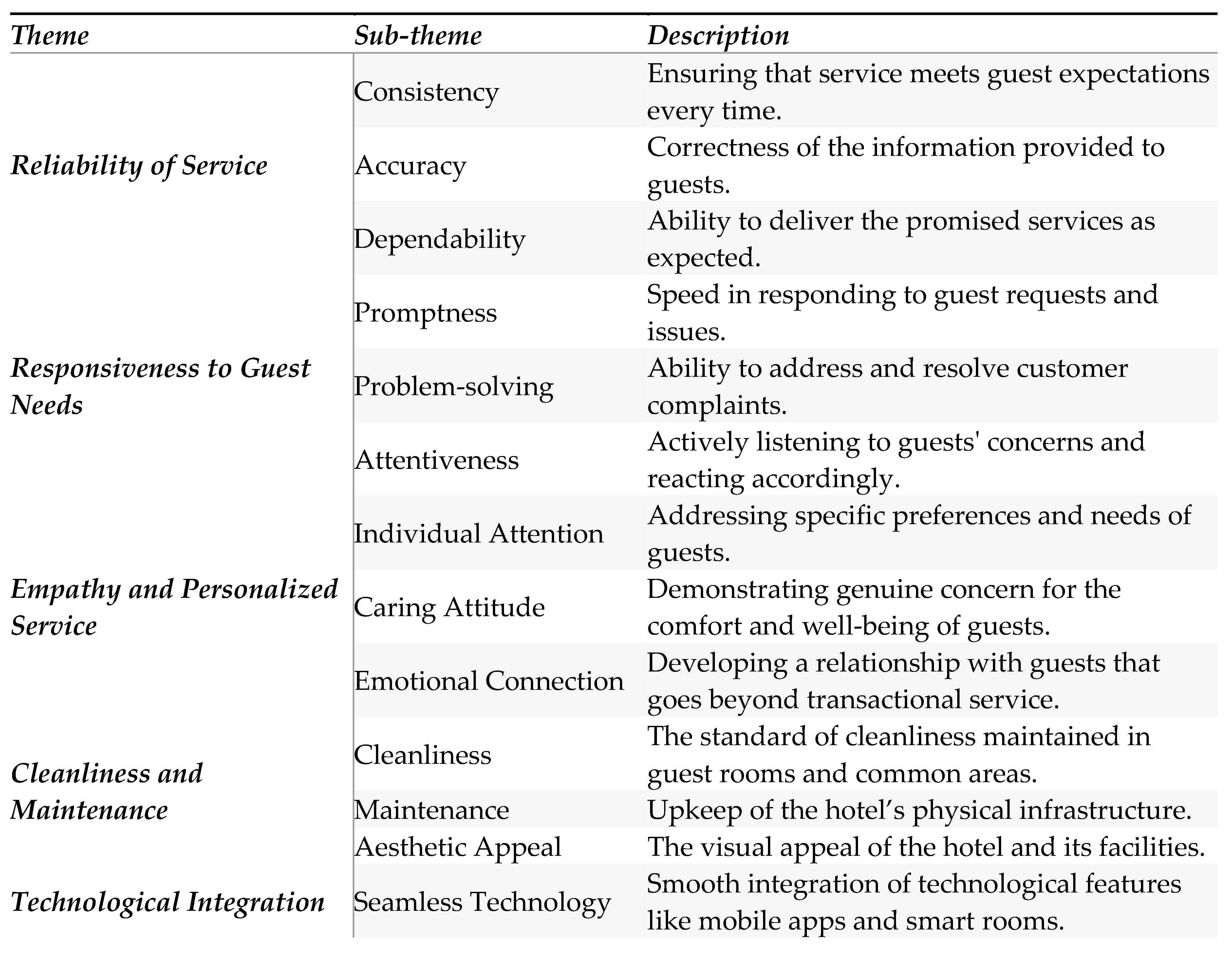
Table 1.
Key Service Quality Dimensions Influencing Customer Loyalty in the Hospitality Sector.
 |
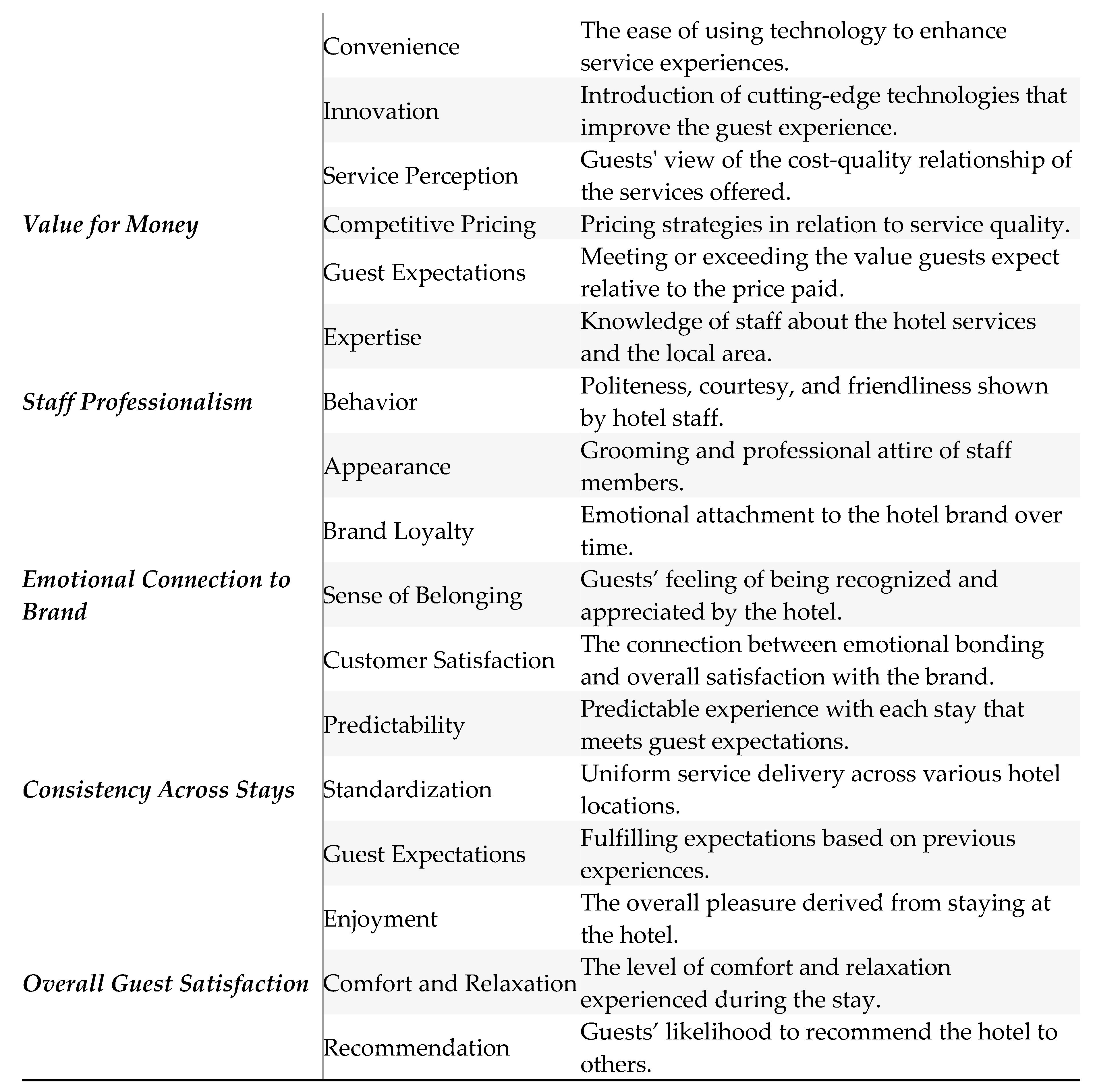 |
This depiction of the thematic framework varies however as it brings together functional and emotional dimensions of service quality under a single roof, to illustrate how they work together to foster customer loyalty in the general field of hospitality. This analysis extends the paradigm in that traditional models typically focus on the traditional pillars of service reliability and responsiveness, but this analysis goes to the less hard but affective components that are empathy, emotional bonding, brand connection. This distinguishes this research for its focus on tangetible aspects – for example, how caring verbal interaction from staff ‘caring’ or brand consistency creates both the meet and exceed, but also deep involvement of guests on a related level. Also, the present inclusion of the technological integration, and also the value for money perception, gives a modern definition of the quality of service, aligns with the evolving guest expectations of an era that is becoming increasingly digitized and competitive. Finally, the study makes an important contribution in positioning uniqueness staff professionalism and aesthetic maintenance influence on perceived service excellence as critical proxies for trust and brand credibility, as visible cues and human interactions are shown to be proxies for trust and brand credibility. Taken together, these ten concepts are a bunch of service features, but they are also woven together to form the whole of a guest experience that is built on the consistent delivery, the emotional impact of an encounter, and the easy functionality of stay combined for strong loyalty. This outlined nuanced approach indicates that service quality is not a single dimensional construct and encompasses multiple, interdependent dimensions that mutually reinforce the services given to support guest retention and advocacy in the hospitality context.
It shows that, in the hotel sector, service quality is really important in influencing that consumer loyalty. Interview data was key on the several subject critical elements of service which directly affect loyalty; dependability, responsiveness, empathy, the entire client experience. Reliable service was a recurrent concern for guests as the fulfilment of expectations was always a key factor in deciding if a hotel will be revisited. Additionally responsiveness was a critical factor as visitors came to expect a quick and effective response to their questions or problems that only served to enhance their experience and the visitor giving a feel of loyalty. Empathy and tailored treatment were the main agents to strengthen emotional bonds between customers and hotels, as the study noted. Attention towards individuals and the genuine concern from hotel people on the procedure of satisfying individual visitor desires considerably enhanced the level of satisfaction and loyalty of the customer. Furthermore, it was found that total service quality was influenced by the hotel’s physical environment, particularly its cleanliness and care levels. Hotels which exhibited superior standards in this regard, were likely to give more repeat clientele and excellent word of mouth endorsements. Technological integration increased visitors’ pleasure just by increasing the technological encounters to the extent they were seen as extra convenience, while mistakes in service to the tech caused visit loyalty to fall. As the guests were paying for the accommodation, they saw the service quality in proportion to what they had paid for it and so any element of value for money was vital. Emotional affiliations to the brand of the hotel, built through regular pleasant encounters, were identified as the creating factors for loyalty by the customers who appeared to be more likely to return to hotels where the individual was responds to and felt recognized. The research underlines the multisided, multifaced quality proposition of hotel service that influences client loyalty positively directly.
5. Discussion
This depiction of the thematic framework varies however as it brings together functional and emotional dimensions of service quality under a single roof, to illustrate how they work together to foster customer loyalty in the general field of hospitality. This analysis extends the paradigm in that traditional models typically focus on the traditional pillars of service reliability and responsiveness, but this analysis goes to the less hard but affective components that are empathy, emotional bonding, brand connection. This distinguishes this research for its focus on tangible aspects – for example, how caring verbal interaction from staff ‘caring’ or brand consistency creates both the meet and exceed, but also deep involvement of guests on a related level. Also, the present inclusion of technological integration, and also the value for money perception, gives a modern definition of the quality of service, aligns with the evolving guest expectations of an era that is becoming increasingly digitized and competitive. Finally, the study makes an important contribution in positioning uniqueness staff professionalism and aesthetic maintenance influence on perceived service excellence as critical proxies for trust and brand credibility, as visible cues and human interactions are shown to be proxies for trust and brand credibility. Taken together, these ten concepts are a bunch of service features, but they are also woven together to form the whole of a guest experience that is built on the consistent delivery, the emotional impact of an encounter, and the easy functionality of stay combined for strong loyalty. This outlined nuanced approach indicates that service quality is not a single dimensional construct and encompasses multiple, interdependent dimensions that mutually reinforce the services given to support guest retention and advocacy in the hospitality context.
It shows that, in the hotel sector, service quality is really important in influencing consumer loyalty. Interview data was key on the several subject critical elements of service which directly affect loyalty, dependability, responsiveness, empathy, and the entire client experience. Reliable service was a recurrent concern for guests as the fulfilment of expectations was always a key factor in deciding if a hotel will be revisited. Additionally, responsiveness was a critical factor as visitors came to expect a quick and effective response to their questions or problems that only served to enhance their experience and the visitor giving a feel of loyalty. Empathy and tailored treatment were the main agents to strengthen emotional bonds between customers and hotels, as the study noted. Attention towards individuals and the genuine concern from hotel people about the procedure of satisfying individual visitor desires considerably enhanced the level of satisfaction and loyalty of the customer. Furthermore, it was found that total service quality was influenced by the hotel’s physical environment, particularly its cleanliness and care levels. Hotels, which exhibited superior standards in this regard, were likely to give more repeat clientele and excellent word of mouth endorsements. Technological integration increased visitors’ pleasure just by increasing the technological encounters to the extent they were seen as extra convenience, while mistakes in service to the tech caused visit loyalty to fall. As the guests were paying for the accommodation, they saw the service quality in proportion to what they had paid for it and so any element of value for money was vital. Emotional affiliations to the brand of the hotel, built through regular pleasant encounters, were identified as the creating factors for loyalty by the customers who appeared to be more likely to return to hotels where the individual was responds to and felt recognized. The research underlines the multisided, multifaced quality proposition of hotel service that influences client loyalty positively directly.
6. Conclusion
This research is particularly focused on customer loyalty, and how the quality of a service is critical within the hotel industry. Results show visitor satisfaction and repeat patronage to be elicited when the whole service approach prioritizes reliability, responsiveness, empathy, cleanliness and integration of technology. As expected, guests consistently noted the dependency on dependable, consistent service that meets their expectations as well as timely, effective response to requests or concern raised by them. It was known that personalized services and the sincere attention to the products preferences are critical in fostering brand affection, enhancing the loyalty. Importance of cleanliness and maintenance and the resulting first impressions was underscored as an important component of the physical environment of a positive visitor experience. On top of that, the use of technology for convenience has the advantage of close synergy between technology and people, but what it is clear is that it should rather complement rather than eradicate all human connections. Such was the importance of the idea of value for money that tourists wished to get value for money for what they spent. A strong positive brand emotions was strongly reflected in words from customers, both in terms of the hotel brand as well as the emotions related to the guestroom. The findings clearly encourage the necessity of a merged service strategy that combines all these elements in order to deliver a memorable and satisfactory guest experience. Hotels that are tasked with the responsibility of helping clients achieve a state of lasting client loyalty must always see what needs be improved on service quality through every interaction to leave the guest feeling valued, safe and well off for coming back. If hotel focused on all operational aspects and prioritized service quality, hotels can increase the customer loyalty and build solid base for a sustained competitive advantage in market.
References
- Abuelhassan, A. E., & AlGassim, A. (2022). How organizational justice in the hospitality industry influences proactive customer service performance through general self-efficacy. International Journal of Contemporary Hospitality Management, 34(10), 3462–3480. [CrossRef]
- Aharon, D. Y., Jacobi, A., Cohen, E., Tzur, J., & Qadan, M. (2021). COVID-19, government measures and hospitality industry performance. PLOS ONE. [CrossRef]
- Akarsu, T. N., Marvi, R., & Foroudi, P. (2022). Service failure research in the hospitality and tourism industry: A synopsis of past, present, and future dynamics from 2001 to 2020. International Journal of Contemporary Hospitality Management, 34(7), 2350–2374. [CrossRef]
- Ben Youssef, A., & Zeqiri, A. (2020). Hospitality industry 4.0 and climate change. Research Papers in Economics. [CrossRef]
- Breier, M., Kallmuenzer, A., Clauss, T., Gast, J., Kraus, S., & Tiberius, V. (2021). The role of business model innovation in the hospitality industry during the COVID-19 crisis. International Journal of Hospitality Management. [CrossRef]
- Bux, C., & Amicarelli, V. (2022). Circular economy and sustainable strategies in the hospitality industry: Current trends and empirical implications. Tourism and Hospitality Research, 22(3), 270–286. [CrossRef]
- Carvalho, P., & Alves, H. (2022). Customer value co-creation in the hospitality and tourism industry: A systematic literature review. International Journal of Contemporary Hospitality Management, 34(12), 3945–3965. [CrossRef]
- Chen, Y., Hu, Y., Zhou, S., & Yang, S.-W. (2022). Investigating the determinants of performance of artificial intelligence adoption in the hospitality industry during COVID-19. International Journal of Contemporary Hospitality Management, 34(5), 1684–1705. [CrossRef]
- Darvishmotevali, M., & Altinay, L. (2022). Toward pro-environmental performance in the hospitality industry: Empirical evidence on the mediating and interaction analysis. Journal of Hospitality Marketing & Management, 31(1), 1–17. [CrossRef]
- Doğan Gürsoy, Y., Li, Y., & Song, H. (2023). ChatGPT and the hospitality and tourism industry: An overview of current trends and future research directions. Journal of Hospitality Marketing & Management, 32(4), 433–449. [CrossRef]
- Doğru, T., Line, N., Mody, M., Hanks, L., Abbott, J., Açıkgöz, F., Assaf, A. G., Abu Bakir, S. M., Berbekova, A., Bilgihan, A., Dalton, A. M., Erkmen, E., Geronasso, M., Gomez, D. R., Graves, S., İskender, A., Ivanov, S., Kizildag, M., Lee, M., Lee, W., Luckett, J., McGinley, S., Okumuş, F., Önder, İ., Özdemir, Ö., Park, H., Sharma, A., Suess, C., Uysal, M., & Zhang, T. (2023). Generative artificial intelligence in the hospitality and tourism industry: Developing a framework for future research. Journal of Hospitality & Tourism Research, 47(2), 183–206. [CrossRef]
- Dube, K., Nhamo, G., & Chikodzi, D. (2020). COVID-19 cripples global restaurant and hospitality industry. Current Issues in Tourism, 23(6), 629–645. [CrossRef]
- Emon, M. M. H., & Khan, T. (2025). The transformative role of Industry 4.0 in supply chains: Exploring digital integration and innovation in the manufacturing enterprises. Journal of Open Innovation: Technology, Market, and Complexity, 11(2), 100516. [CrossRef]
- Ghani, B., Zada, M., Memon, K. R., Ullah, R., Khattak, A., Han, H., Tirado-Valencia, P., Ariza-Montes, A., & Araya-Castillo, L. (2022). Challenges and strategies for employee retention in the hospitality industry: A review. Sustainability, 14(5), 2885. [CrossRef]
- Gürsoy, D., & Chi, G. C. (2020). Effects of COVID-19 pandemic on the hospitality industry: Review of the current situations and a research agenda. Journal of Hospitality Marketing & Management, 29(7), 738–755. [CrossRef]
- Gursoy, D., Malodia, S., & Dhir, A. (2022). The metaverse in the hospitality and tourism industry: An overview of current trends and future research directions. Journal of Hospitality Marketing & Management. [CrossRef]
- Hemmington, N., & Neill, L. (2021). Hospitality business longevity under COVID-19: The impact of COVID-19 on New Zealand's hospitality industry. Tourism and Hospitality Research. [CrossRef]
- Jayawardena, C., Albattat, A., Valeri, M., & Jaharadak, A. A. (2023). Technology acceptance antecedents in digital transformation in the hospitality industry. International Journal of Hospitality Management, 112, 103350. [CrossRef]
- Jones, P., Comfort, D., & Jones, P. G. (2020). The COVID-19 crisis and sustainability in the hospitality industry. International Journal of Contemporary Hospitality Management. [CrossRef]
- Emon, M. M. H., & Khan, T. (2025). The mediating role of attitude towards the technology in shaping artificial intelligence usage among professionals. Telematics and Informatics Reports, 17, 100188. [CrossRef]
- Kalyar, M. N., Ali, F., Shafique, I., & Kalyar, M. N. (2021). Green mindfulness and green creativity nexus in hospitality industry: Examining the effects of green process engagement and CSR. International Journal of Contemporary Hospitality Management. [CrossRef]
- Khan, K. I., Niazi, A., Nasir, A., Hussain, M., & Iqbal Khan, M. (2021). The effect of COVID-19 on the hospitality industry: The implication for open innovation. Journal of Open Innovation: Technology, Market and Complexity, 7(1), 30. [CrossRef]
- Emon, M. M. H., & Khan, T. (2024). Unlocking Sustainability through Supply Chain Visibility: Insights from the Manufacturing Sector of Bangladesh. Brazilian Journal of Operations & Production Management, 21(4), 2194. [CrossRef]
- Khawaja, K. F., Sarfraz, M., Rashid, M., & Rashid, M. (2021). How is COVID-19 pandemic causing employee withdrawal behavior in the hospitality industry? An empirical investigation. Journal of Hospitality and Tourism Insights. [CrossRef]
- Kong, H., Wang, K., Qiu, X., Cheung, C., & Bu, N. (2022). 30 years of artificial intelligence (AI) research relating to the hospitality and tourism industry. International Journal of Contemporary Hospitality Management. [CrossRef]
- Limna, P. (2023). Artificial Intelligence (AI) in the hospitality industry: A review article. International Journal of Computing Sciences Research, 10(1), 1–18. [CrossRef]
- Limna, P., & Kraiwanit, T. (2023). The role of ChatGPT on customer service in the hospitality industry: An exploratory study of hospitality workers' experiences and perceptions. Tourism and Hospitality Management, 29(4), 9–29. [CrossRef]
- Liu, M. T., Wang, S., McCartney, G., & Wong, I. K. A. (2021). Taking a break is for accomplishing a longer journey: Hospitality industry in Macao under the COVID-19 pandemic. International Journal of Contemporary Hospitality Management. [CrossRef]
- Liu, X. (R.), Yu, J. (J.), Guo, Q., & Li, J. (J.). (2022). Employee engagement, its antecedents and effects on business performance in the hospitality industry: A multilevel analysis. International Journal of Contemporary Hospitality Management, 34(8), 2634–2656. [CrossRef]
- Khan, T., & Emon, M. M. H. (2025). Supply chain performance in the age of Industry 4.0: evidence from manufacturing sector. Brazilian Journal of Operations & Production Management, 22(1), 2434. [CrossRef]
- Emon, M. M. H. (2025). The Mediating Role of Supply Chain Responsiveness in the Relationship Between Key Supply Chain Drivers and Performance: Evidence from the FMCG Industry. Brazilian Journal of Operations & Production Management, 22(1), 2580. [CrossRef]
- Khan, T., Emon, M. M. H., & Rahman, S. (2024). Marketing Strategy Innovation via AI Adoption: A Study on Bangladeshi SMEs in the Context of Industry 5.0. 2024 6th International Conference on Sustainable Technologies for Industry 5.0 (STI), 1–6. [CrossRef]
- Liu-Lastres, B., Wen, H., & Huang, W. (2022). A reflection on the Great Resignation in the hospitality and tourism industry. International Journal of Contemporary Hospitality Management, 34(9), 3109–3130. [CrossRef]
- Majeed, S., & Kim, W. G. (2022). A reflection of greenwashing practices in the hospitality industry: A scoping review. International Journal of Contemporary Hospitality Management. [CrossRef]
- Meira, J. V. de S., & Hancer, M. (2021). Using the social exchange theory to explore the employee-organization relationship in the hospitality industry. International Journal of Contemporary Hospitality Management. [CrossRef]
- Emon, M. M. H., & Khan, T. (2024). A Systematic Literature Review on Sustainability Integration and Marketing Intelligence in the Era of Artificial Intelligence. Review of Business and Economics Studies, 12(4), 6–28. [CrossRef]
- Ntounis, N., Parker, C., Skinner, H., Steadman, C., & Warnaby, G. (2021). Tourism and hospitality industry resilience during the COVID-19 pandemic: Evidence from England. Current Issues in Tourism, 24(4), 503–519. [CrossRef]
- Özdemir, Ö., Doğru, T., Kizildag, M., & Erkmen, E. (2023). A critical reflection on digitalization for the hospitality and tourism industry: Value implications for stakeholders. International Journal of Contemporary Hospitality Management, 35(5), 1812–1832. [CrossRef]
- Özdemir, Ö., Erkmen, E., & Kizildag, M. (2022). Top management team gender diversity and firm risk-taking in the hospitality industry. International Journal of Contemporary Hospitality Management, 34(11), 3919–3936.
- Pham, N. T., Tučková, Z., & Jabbour, C. J. C. (2019). Greening the hospitality industry: How do green human resource management practices influence organizational citizenship behavior in hotels? A mixed-methods study. Tourism Management. [CrossRef]
- Vakira, E., Shereni, N. C., Ncube, C. M., & Ndlovu, N. (2022). The effect of inclusive leadership on employee engagement, mediated by psychological safety in the hospitality industry. Journal of Hospitality and Tourism Insights. [CrossRef]
Disclaimer/Publisher’s Note: The statements, opinions and data contained in all publications are solely those of the individual author(s) and contributor(s) and not of MDPI and/or the editor(s). MDPI and/or the editor(s) disclaim responsibility for any injury to people or property resulting from any ideas, methods, instructions or products referred to in the content. |
© 2025 by the authors. Licensee MDPI, Basel, Switzerland. This article is an open access article distributed under the terms and conditions of the Creative Commons Attribution (CC BY) license (http://creativecommons.org/licenses/by/4.0/).
Copyright: This open access article is published under a Creative Commons CC BY 4.0 license, which permit the free download, distribution, and reuse, provided that the author and preprint are cited in any reuse.


