

Submitted:
17 April 2025
Posted:
18 April 2025
Read the latest preprint version here
Abstract
This article investigates the architecture and institutional distribution of policy tools supporting Open Science (OS) in China. Based on a corpus of 199 policy documents comprising 25,885 policy statements, we apply an AI-assisted classification approach to analyze how the Chinese government mobilizes different types of policy tools. Using Qwen-plus, a large language model developed by Alibaba Cloud and fine-tuned for OS-related content, we categorize each policy statement into one of fifteen subcategories grouped under three main types: supply-oriented, environment-oriented, and demand-oriented tools. Our findings reveal a strong dominance of supply-oriented tools (63%), particularly investments in infrastructure, education, and public services. In contrast, demand-oriented tools remain marginal (11%), with limited use of economic incentives or mandatory mechanisms. Environment-oriented tools are more balanced but still underrepresent important elements such as incentive systems and legal obligations for open access. To deepen the analysis, we propose a normalized indicator of institutional focus, capturing the relative emphasis of each policy type across administrative levels. Results show that supply-oriented policies are most concentrated at Level 1 institutions, reflecting the Chinese government’s top-down approach to science governance. Environmental-oriented tools, by contrast, are more evenly distributed, while demand-oriented tools are predominantly localized at Level 4, suggesting limited strategic planning at higher levels. Taken together, the results highlight a technocratic and centralized model of OS governance in China, prioritizing infrastructural and procedural reform over participatory or incentive-based approaches. The unbalanced policy mix and weak demand stimulation may hinder the systemic transformation required for a sustainable and inclusive open science ecosystem.
Keywords:
Open Science Policy
; Policy Tools
; Open Science Governance
; Open Access
1. Introduction
Over the past few decades, the Open Science (OS) movement has gained momentum globally, aiming to make scientific research more accessible, transparent, and collaborative. Since the early 2000s, governments, research institutions, and funding agencies have increasingly adopted policies promoting open Science (OS) to scientific publications, data sharing, and collaborative research infrastructures. These efforts seek to enhance the impact of publicly funded research, democratize knowledge production, and accelerate scientific discovery.
China, now the world’s largest producer of scientific publications (Baker, 2023), has actively engaged with the Open Science movement. However, its approach remains complex, shaped by competing priorities: fostering research accessibility while safeguarding national security and economic competitiveness. This tension has led to fragmented policy developments that require further examination.
Despite China’s prominence in global scientific output, little is known about the structure, coherence, and evolution of its national Open Science policies. While some studies have analyzed open access publishing trends and data-sharing initiatives (YANG et al., 2023), the broader policy landscape—including the interplay between government strategies, institutional mandates, and researcher incentives—remains understudied. Furthermore, the balance between transparency and state control in China’s Open Science policies presents a unique case that diverges from Western models (Lattu, 2023).
This study aims to systematically analyze the evolution of China’s national Open Science policies over the past two decades. It seeks to track the development of Open Science policies at the national level since 2002, identifying key policy priorities reflected in government directives and institutional mandates. A particular focus is placed on examining the policy tools—such as funding incentives, legal mandates, and research infrastructure investments—that are used to implement Open Science initiatives. Additionally, the study assesses how policy authority is distributed among different actors, including ministries, research performing organizations, funding agencies, universities, etc. while also analyzing joint policy initiatives (”co-policies“) to understand the degree of coordination between governmental and institutional stakeholders.
This study addresses the following key questions:
- How has the volume and nature of China’s national Open Science policies evolved since 2002?
- What are the primary policy priorities?
- What types of policy tools are most commonly employed?
- How is policy authority distributed among different governmental and institutional actors?
- How are Open Science policies coordinated across multiple entities?
To address these research questions, this study compiles and analyzes the full corpus of national Open Science policies issued in China—199 official documents. A mixed-methods approach is used, combining content analysis, large language model-based text classification, and social network analysis to investigate how Open Science governance is structured in China.
The methodological framework follows three key analytical steps. First, all policies are classified into three broad types based on their content to identify major Open Science priorities. Second, the study assesses how these priorities are distributed across different levels of governance by assigning impact scores ranging from 1 to 5, distinguishing between policies issued by high-level ministries, national research organizations, and national associations. Finally, co-policy analysis is conducted to examine jointly issued policies and assess the level of coordination between policy-issuing entities.
Understanding China’s Open Science policy landscape is important both nationally and globally. Domestically, improved policy coherence could enhance their effectiveness, but also research transparency and innovation. Internationally, given China’s dominant role in scientific production, its Open Science strategies influence global research landscape, data-sharing norms, and knowledge accessibility. This study contributes to broader discussions on Open Science governance, particularly in state-driven research systems.
The remainder of this article is structured as follows: Section 2 reviews the existing literature on Open Science in China. Section 3 outlines the study’s data and methodological approach, including data sources, the classification framework, and analytical techniques. Section 4 presents the key findings from the results and discusses China’s Open Science policy landscape. Section 5 provides the conclusion. Finally, Section 6 offers recommendations for strengthening China’s Open Science governance.
2. Open Science in China: Literature Review
Open Science has become a significant topic in China, reflecting broader global movements towards transparency, collaboration, and accessibility in scientific research. The trajectory of Open Science in China is shaped by a complex interplay of governmental policies, institutional initiatives, economic constraints, and cultural factors. While China has made substantial progress in open access, research data management, and institutional repositories, challenges remain in terms of economic sustainability, policy implementation, and the adaptation of global open knowledge frameworks to local contexts.
One of the most visible aspects of Open Science in China is the development of institutional repositories (IRs). The Chinese Academy of Sciences (CAS) played a pioneering role in this domain with the establishment of the CAS IR Grid in 2009, creating a network of repositories across its research institutes. By April 2025, these repositories housed over 1.42 million full-text research papers, with approximately 22.84 million times downloads and 380,000 full-text open access, highlighting their significant impact on knowledge dissemination. Similarly, the China Academic Library and Information System (CALIS) launched an IR initiative in 2011, with 5 university libraries and 21 universities jointly building the China Academic Institutional Repository (CHAIR) (Wei & Li, 2017). These efforts indicate a strong institutional commitment to fostering open access, yet questions remain regarding their long-term sustainability and integration within broader international frameworks.
The open scientific research infrastructure primarily emphasizes the open sharing of scientific data and academic papers. In practice, China has developed a framework characterized by “open data infrastructure as the core, supplemented by open scientific research instruments and equipment, and open literature infrastructure” (Wen et al., 2021). At the data infrastructure level, the “Digital Belt and Road” International Science Program (DBAR) serves as a representative initiative (郭 et al., 2018). Regarding the openness of scientific research instruments and equipment, the State Council of China released the Opinions on the Opening of Major National Scientific Research Infrastructure and Large Scientific Research Instruments to Society in 2015 (新华社, 2015). Subsequently, the Ministry of Science and Technology and the Ministry of Finance jointly formulated the National Science and Technology Resource Sharing Service Platform Management Measures in 2018 (科技部 & 财政部, 2018). In 2019, the Ministry of Science and Technology issued the National Science and Technology Resource Sharing Service Platform Optimization and Adjustment List (Cui, 2016), followed by a joint evaluation and assessment of the sharing of scientific research infrastructure instruments among central universities and research institutes in 2020, conducted by the Ministry of Science and Technology and other relevant departments (科技部 & 财政部, 2018). At the literature infrastructure level, the Chinese Academy of Sciences has established open access paper discovery platforms, namely GoOA.
Despite these advances, economic factors present substantial obstacles to the full realization of Open Science in China. The shift towards open access publishing has introduced new financial burdens, particularly in the form of article processing charges (APCs). (Zhang et al., 2022) argue that this “pay-to-publish” model may lead to unintended consequences, where only well-funded researchers can afford to disseminate their work, potentially reinforcing inequalities in the research landscape. However, it is important to note that concerns regarding APCs are not unique to China but are part of a broader global debate on the sustainability of Open Access publishing. Moreover, Xiao, Wang, and Fang (2022) emphasize the frustrations of Chinese researchers over high access fees for domestic academic databases, which paradoxically restrict access to research produced within the country itself(Xiao et al., 2022). These economic tensions illustrate a critical paradox: while Open Science aims to democratize knowledge, its financial mechanisms can create new barriers to entry.
The cultural dimensions of Open Science in China add another layer of complexity. Montgomery & Ren (2018) explore how China’s engagement with Open Knowledge differs from Western models, emphasizing the role of state-led initiatives and controlled dissemination strategies. Unlike the grassroots-driven open access movements in Europe and North America, China’s Open Science policies are heavily influenced by government priorities, shaping how openness is defined and implemented. Ren & Montgomery (2015) further discuss how Open Access aligns with China’s broader “soft power” strategy, enhancing its visibility in international scholarship. However, these efforts must navigate longstanding traditions of academic publishing, hierarchical research structures, and concerns about intellectual property protection.
Research data management (RDM) is another area where Open Science in China is evolving. Huang et al. (2020) note that while national policies such as the 2018 “Measures for Managing Scientific Data” provide a framework for RDM, their implementation at the institutional level remains inconsistent. Many universities lack comprehensive data-sharing policies, and libraries play a minimal role in facilitating open data initiatives. Similarly, Liu & Ding, (2016) highlight the absence of standardized RDM practices at Wuhan University, where researchers largely manage their data independently, leading to inefficiencies and security risks. Li et al. (2022) trace the growth of open research data repositories in China, reporting that by 2021, 48 registered repositories had been developed, positioning China 12th globally in terms of open data infrastructure. However, these repositories often lack clear licensing policies, privacy regulations, and long-term preservation strategies, raising concerns about their effectiveness and usability.
A fundamental tension in China’s Open Science landscape is the government’s ambivalent stance on openness. While Open Science is widely acknowledged as a mechanism for democratizing knowledge, improving research transparency, and fostering reproducibility, the Chinese government remains cautious about fully embracing Open Access and open data. This ambivalence stems from concerns about national security and the strategic control of scientific knowledge (Lattu, 2023). Although China has implemented national Open Science initiatives for several decades and has broad institutional support, the actual outcomes remain relatively modest compared to regions like the EU and the US, where Open Science is strongly promoted (YANG et al., 2023). This paradox highlights the dual objectives of making research publicly accessible while simultaneously safeguarding scientific information deemed sensitive by the state.
In sum, China’s Open Science movement is at a turning point, marked by both impressive progress and persistent challenges. Institutional repositories and national policies signal a strong commitment to openness, yet economic constraints, cultural factors, and policy inconsistencies complicate full implementation. The interplay between state-driven initiatives and grassroots adoption will likely shape the future trajectory of Open Science in China, determining whether it can balance national interests with international collaboration, economic sustainability with accessibility, and control with openness.
3. Data and Methods
Figure 1 provides a global overview of the data extraction and processing of this study.
3.1. Data Collection
This study draws on three primary data sources to analyze open science policies in China:
- National Open Science Policies Database
The Open Science Global Policy Evolution Atlas, maintained by the Open Science Research Center of the Chinese Academy of Sciences (http://os.las.ac.cn/zh-CN/policy), provided a comprehensive inventory of national-level policies.
- Second Bullet; Governmental Policy Documents
Relevant policy documents—including notices, regulations, guidelines, and implementation details—were collected from official government portals, including the Central People’s Government of China website and the Ministry of Science and Technology. Additional documents were sourced from ministerial agencies such as the China Meteorological Administration and the China Earthquake Administration. A full-text search using keywords like open science, open access, open data, open infrastructure, and open education ensured broad coverage. Informal drafts and discussion papers were excluded to prioritize finalized policies.
- Third Bullet. Legal and Regulatory Database
The Peking University Law Database (https://www.pkulaw.com), a comprehensive repository of over 4.6 million laws and 150 million case records, was used to retrieve legal documents related to open science. Advanced search functions allowed for targeted queries on national and local regulations.
The final dataset includes 199 national open science policies published up to December 2024. Each policy was assigned a unique identifier (e.g., “C” for China + number) and cataloged with details such as issuing entities, classification, and policy title (Table 1).
3.2. Categorization of Policies
Policies were systematically filtered and categorized using the following criteria:
- Only official documents from government agencies and scientific funding institutions were included. Policies issued by individual journals or professional societies were excluded.
- The focus was restricted to legal and regulatory documents explicitly addressing open science principles, including open access, data sharing, and infrastructure requirements.
Given the hierarchical structure of Chinese legal documents (consisting of Parts, Chapters, Sections, Articles, Paragraphs, Subparagraphs, and Items), the policy texts in this paper are divided into the smallest possible unit, “sentences”, to ensure that each policy component is considered as an independent unit of analysis. Considering that multiple policy tools may appear in one sentence, the number of policy tools appearing in the policy unit is calculated in detail. Each policy text was assigned a structured code following the format: policy ID - chapter - specific clause (e.g., C1-2-10 for the 10th clause of the second chapter of policy C1). This coding scheme allowed for systematic classification and content analysis across policies (Table 2).
This study applies the policy tool classification framework developed by Rothwell & Zegveld (1981), which is widely used to analyze public policies in science and technology. It categorizes policy tools into three main types based on their function:
- Supply-oriented policies: These focus on direct support for open science, such as funding, infrastructure, training, and technical standards.
- Demand-oriented policies: These aim to stimulate demand for open science through incentives like subsidies, regulations, and business model innovations.
- Environment-oriented policies: These create a supportive framework for open science through regulations, monitoring, evaluation, and cultural initiatives.
Building on this framework and a review of existing research(Jiang et al., 2022), we identified 15 subcategories of open science policy tools (Table 3).
To classify policy documents efficiently, we used Qwen-plus, a large language model developed by Alibaba Cloud. This model was chosen for its advanced reasoning and classification capabilities. The classification process followed these steps:
-
Model Selection and Setup:
- ○
- The Qwen-plus model was accessed via DashScope, Alibaba Cloud’s AI service.
- ○
- The model was integrated into a Python 3.12 environment using the OpenAI-compatible DashScope SDK.
-
Fine-tuning for Policy Classification:
- ○
- The model was incrementally pre-trained with specialized knowledge of open science policy tools.
- ○
- This ensured it could recognize terminology, concepts, and case studies across the 15 subcategories.
-
Classification Process:
- ○
- The model processed policy texts and assigned each document to one of the 15 subcategories under supply-oriented, demand-oriented, or environment-oriented policies.
- ○
- Results were manually verified, with 0.26% of cases requiring human correction due to ambiguity.
-
Final Data Refinement:
- ○
- Misclassifications (e.g., confusion between funding policies and technology transfer initiatives) were corrected.
- ○
- Non-relevant content was removed.
- ○
- The final normalized dataset contained 25,885 classified policy sentences.
This approach allowed for a systematic and scalable classification of open science policies, ensuring accuracy while significantly reducing the time required for manual analysis.
3.3. Hierarchical Classification of Policy-Issuing Entities
To analyze the role of different entities in shaping open science policies, we classified the 199 policies based on the hierarchical level of their issuing institutions. The classification follows the framework proposed by Zhong et al.(2009) and the Regulations on the Procedure for Formulation of Regulations issued by the State Council of China(国务院, 2001). Policies were assigned to one of five levels, with Level 5 representing the most powerful entities (e.g., National People’s Congress) and Level 1 the least politically influential (e.g., research institutes) (Table 4).
This classification enables us to address two key questions:
- How many policies are issued by each type of institution?
- What is the policy focus of each level of institution?
The assumption is that higher-level entities (Levels 4 and 5) are more likely to implement policies with broader influence, while lower-level entities (Levels 1 and 2) tend to focus on more specialized or localized issues.
Given that a policy may involve multiple institutions from different levels, we applied fractional counting to quantify the number of policies issued by each institution. This ensures that:
- Accurate Aggregation: Multiple institutions co-issuing the same policy are counted proportionally, preventing overestimation of policy counts.
- Institutional Strength: The method weights the contributions of higher-level institutions more heavily, based on the number of co-issuing institutions. For example, if a policy involves three Level 4 institutions and one Level 1 institution, each institution’s contribution is counted fractionally based on its level. Consequently, the fractional count for Level 4 is 0.75 and that of Level 1 is 0.25.
However, for analyzing the focus of policies according to the level of institutions, we use the whole count of policies, meaning that each policy is considered as a whole, regardless of how many institutions from different levels are involved. This method reflects the interest in which type of policy (Supply-Oriented, Demand-Oriented, and Environment-Oriented) each level of institution is involved in, rather than the exact number of institutions per policy. In other words, for each institutional level, we counted how many policies fell into each of these three categories, using the whole count. This approach enables us to understand which types of policies are more prominent at each institutional level.
To facilitate comparisons of policy focus across different institutional levels, we calculated a normalized indicator for each policy type. The normalized indicator is calculated by dividing the mean percentage contribution of each policy type by the total contribution at each institutional level. This normalizes the data, making it possible to compare policy priorities across levels, regardless of the total number of policies.
For example, if Supply-Oriented policies account for 44% of policies at Level 1 institutions but 62% of all policies combined, the normalized indicator is 44/62=0.71. This means that Supply-Oriented policies are 29% less prominent in Level 1 institutions compared to the global average. Conversely, if Demand-Oriented policies represent 28% at Level 1 but 20% overall, the indicator is 28/20=1.40, indicating that such policies are 40% more prevalent at this level. This approach allows us to highlight whether institutions at different levels prioritize specific policy orientations more or less than the overall trend.
To visualize the distribution of policy focus across institutional levels, we created a heatmap based on the normalized indicators for the three policy types (Supply-Oriented, Demand-Oriented, and Environment-Oriented). We also performed clustering of both rows (institutional levels) and columns (policy types) to group similar institutional levels and policy types based on their focus. This clustering helps identify patterns and variations in policy priorities across different institutional levels.
In the clustering process:
- Row clustering groups institutional levels with similar policy focus distributions.
- Column clustering groups policy types that exhibit similar focus distributions across institutional levels.
The resulting heatmap visually displays the differences in policy priorities across institutional levels, aiding in the interpretation of how various institutions shape Open Science policies.
3.4. Network Analysis of Policies
Social network analysis provides a powerful framework for understanding the collaborative dynamics between institutions involved in policy issuance. In this study, we conceptualize the policy landscape as a network of entities that jointly issue policies, where each node represents an institution, and each edge signifies a collaboration between entities in drafting and endorsing policy documents.
To visualize these interactions, we use Gephi software, which enables the mapping of institutional collaborations and the identification of key actors within the policy network. This approach allows us to detect clusters of cooperation, highlight dominant entities driving open science policies, and assess how policy influence is distributed among different types of institutions. Combining content analysis with social network analysis, allows us to systematically examine both thematic policy focus and institutional relationships, offering a more comprehensive perspective on the governance of open science.
4. Results and Discussion
4.1. Open Science Policies over the Years
The evolution of open science policies in China from 2002 to 2024 reveals a growing commitment to institutionalizing open science at the national level. The timeline shows a gradual increase in policy issuance until 2013, followed by a sharp acceleration from 2015 to 2017, peaking in 2016 (Figure 2). This aligns with findings in the literature identifying 2013, 2016, and 2021 as key moments for international open science policy developments (Yang et al., 2023). The surge in policy issuance around 2016 coincides with global discussions on open access and data sharing, as well as China’s broader push for scientific and technological modernization.
After a brief decline in 2018 and 2019, policy activity rebounded in 2021 and 2022, reflecting China’s renewed focus on integrating open science into its national strategy. This period also aligns with the 2021 revision of China’s Science and Technology Progress Law and the 2022 National Congress directive to develop an open innovation ecosystem. The relative drop in 2023 and 2024 may not indicate a slowdown but rather a shift from policy creation to implementation and consolidation. Additionally, the literature highlights that China’s approach to open science is state-driven, emphasizing governance and systemic frameworks(Yuan et al., 2023). The observed fluctuations in policy issuance suggest that key political and legislative moments, rather than a continuous, linear process, drive China’s engagement with open science. In addition, the number of the three categories of policy tools fluctuates with the number of policy releases, with supply-oriented policy tools accounting for the largest proportion, while the number of the other two categories of policy tools changes relatively slowly.
4.2. Structural Imbalances in China‘s Open Science Policy Portfolio
The overall distribution of policy tools related to Open Science (OS) in China reveals a clear and marked orientation toward Supply-oriented measures, which account for 63% of all identified tools. In contrast, Environment-oriented tools represent 26%, and Demand-oriented tools only 11% of the total (Figure 3). This significant imbalance in favor of supply-driven tools reflects both the technocratic nature of China’s science policy and the emphasis placed by the central government on infrastructural development and direct state intervention as primary vehicles for policy implementation.
Dominance of Supply-Oriented Tools: A Technocratic Logic
Supply-oriented tools are led by investments in infrastructure (32%) and education and training (22%), followed by public services (25%) and, to a lesser extent, technical standards (12%) and capital investment (9%). This structure mirrors China’s longstanding strategy in science and technology governance, which prioritizes state-led capacity building. The emphasis on infrastructure—both digital and institutional—signals the Chinese government’s intent to lay the technical and organizational foundations for Open Science, often through targeted national programs and pilot initiatives. This approach fits within the broader Chinese governance model, where the state assumes a strong directive role in mobilizing resources and coordinating reforms across sectors.
The relatively high share of public services also reflects the government’s function as a service provider, offering information, consultation, and coordination mechanisms to support policy rollout. However, the relatively modest share of capital investment may indicate that while infrastructure is prioritized, long-term financial sustainability for OS projects is not always guaranteed through dedicated funding.
Underdeveloped Demand-Oriented Tools: A Key Weakness
At the opposite end of the spectrum, Demand-oriented tools are severely underrepresented, comprising just 11% of the policy mix. Within this category, a staggering 63% are related to advocacy and collaboration, suggesting that most demand-oriented efforts remain limited to rhetorical or mobilizational strategies rather than systemic incentives. Crucially, mandatory opening policies (8%) and subsidies to offset the costs of open access publishing (1%) are strikingly rare. Similarly, business model innovation (24%) and public procurement (4%) appear only marginally in the dataset.
This lack of robust economic or legal incentives risks limiting the behavioral shift required for a deeper adoption of OS practices. Researchers and institutions may lack sufficient motivation or support to change long-standing practices in data sharing, open access publishing, or collaborative openness. In the context of China, where compliance with top-down mandates is often strong, the absence of enforceable obligations for open publishing (i.e., “mandatory opening”) may reflect a policy gap rather than a cultural resistance.
Environmental Tools: Framing Openness Without Mandating It
Environmental tools—which include regulatory, cultural, and evaluative frameworks—make up 26% of the total. These are fairly well-distributed across subtypes, with particular emphasis on monitoring and evaluation (29%), legal regulation (26%), and cultural construction (17%). This distribution suggests a growing awareness among Chinese policymakers of the need to frame OS not just as a technical or infrastructural reform, but as a normative shift in research practice.
However, the relatively modest share of scientific evaluation and reward system (12%) reveals that current frameworks still do not sufficiently link researchers’ careers or incentives to their engagement in OS. Given the importance of performance-based incentives in China’s academic system, this may hinder the mainstreaming of open practices, despite top-level promotion.
Implications for the Governance of Open Science in China
Overall, the Chinese OS policy architecture reflects a state-centric, technocratic model with a strong emphasis on supply-oriented enablers. While this model enables rapid infrastructure deployment and coordinated reform, it risks overlooking the behavioral and institutional change required at the level of researchers and knowledge users. The weak presence of demand-oriented tools and the moderate weight of incentive-based evaluation tools suggest that Open Science in China is primarily built “for” researchers, not necessarily “with” them.
Furthermore, the mismatch between policy emphasis and systemic need—especially in terms of demand stimulation and sustainable incentive structures—may limit the transformative potential of the current OS policy regime. Without stronger mechanisms to reward openness and reduce the cost barriers for publishing and sharing, Open Science risks remaining a technical reform, rather than a systemic one.
In sum, the structure of China’s OS policies reflects a clear supply-driven developmental logic, which is well-aligned with the country’s broader governance approach. However, addressing the current imbalances—particularly the underdevelopment of demand-oriented tools—will be crucial for fostering a more comprehensive, participatory, and sustainable transition to Open Science.
4.3. Policy Focus According to the Institutional Strength Level
To better understand how different institutional levels contribute to the implementation of Open Science (OS) in China, we analyzed the distribution of policy tools—categorized as Supply-oriented, Demand-oriented, and Environment-oriented—across five levels of governance. These levels reflect a range of actors, from grassroots research institutions (Level 1) to national laws and strategic documents issued by central authorities (Level 5). A normalized indicator was calculated to evaluate the relative focus on each policy type per level, by comparing the share at a given level to its global share across all levels. Scores above 1 indicate a stronger-than-average focus; scores below 1 suggest underrepresentation.
The results reflect the logic of China’s centralized yet multi-level governance structure (see Figure 4). Level 1 institutions, which include research institutes and associations, show a strong relative focus on Environment-oriented (≈ 1.4) and Demand-oriented policies (≈ 1.2), and a significant underrepresentation of Supply-oriented tools (≈ 0.7). This pattern suggests that local institutions primarily serve as implementers of overarching policy objectives—adjusting internal evaluation criteria, responding to mandates, and fostering an open research culture—rather than initiating large-scale infrastructural or technical transformations.
In contrast, Level 3 institutions, such as ministries and technical bureaus, are strongly associated with Supply-oriented policies, scoring well above average. These mid-level actors serve a pivotal role in China’s governance architecture: they operationalize top-level policy guidance by developing infrastructures, standards (e.g., aligned with the FAIR principles), and training programs. Their prominence in this category reflects the technocratic and programmatic implementation mechanisms typical of China’s policy system.
At the top of the hierarchy, Levels 4 and 5—which include State Council regulations and national-level strategic frameworks—are characterized by a strong emphasis on Environment-oriented tools and a clear de-emphasis of Demand-oriented tools, especially in Level 5. This likely reflects the nature of high-level policy in China: setting the normative tone, defining long-term goals, and ensuring legal legitimacy. However, specific mechanisms to stimulate behavioral change or increase demand for open practices are generally delegated to lower levels or omitted altogether.
These findings illustrate a distinct top-down coordination pattern, characteristic of China’s policy-making system. Central authorities (Levels 4 and 5) provide overarching frameworks and symbolic guidance, while intermediate bodies (Level 3) convert these visions into operational policies. Grassroots institutions (Level 1) adapt and internalize these tools, particularly those that affect evaluation and research culture.
This tiered architecture supports efficient policy deployment but also requires robust vertical coordination mechanisms to ensure alignment across levels. The underrepresentation of certain tools at specific levels—especially the low presence of Demand-oriented tools in national policies—raises questions about how effectively behavioral change is incentivized without explicit mandates or subsidies from the top.
In sum, the differentiated distribution of Open Science policy tools across institutional levels in China reflects a broader logic of centralized vision, technical mediation, and local adaptation, with each level playing a distinct yet complementary role in promoting openness in science.
4.4. Interdepartmental Coordination and Structure of Joint OS Policies
Between 2010 and 2022, a total of 199 open science policy documents were issued by 70 different governmental entities, including key players such as the State Council, the Ministry of Science and Technology (MOST), and the Ministry of Education (MoE). Among these, 142 policies (71.4%) were issued independently, while 57 policies (28.6%) were jointly issued, reflecting an institutional effort toward interdepartmental coordination (Figure 5). This practice aligns with China’s Regulations on the Handling of Official Documents by Party and Government Agencies, which explicitly allow for joint issuance of policy documents when inter-agency collaboration is deemed necessary.
The State Council, as the highest executive authority, emerged as the most prolific policy issuer, responsible for 61 documents, of which 49 (80.3%) were issued independently and 12 (19.7%) jointly. The Ministry of Science and Technology followed with 40 policies, demonstrating strong leadership on the technological dimensions of open science. The Ministry of Education, although not a major issuer independently, participated in 15 jointly issued policies, often in partnership with other ministries.
This multi-actor configuration reflects the Chinese government’s intent to build a comprehensive open science governance framework aligned with the UNESCO Open Science Recommendation, addressing pillars such as open scientific knowledge, open infrastructures, science communication, societal engagement, and integration of diverse knowledge systems. Policy design appears to emphasize functional differentiation, with the Ministry of Finance supporting economic instruments, the China Association for Science and Technology contributing to infrastructure and community building, and the Ministry of Education fostering educational integration.
To analyze the structure and dynamics of interdepartmental collaboration, we conducted a social network analysis (SNA) using Gephi. These metrics indicate a moderately clustered network with strong local connectivity but relatively sparse global integration (Figure 6). Node size reflects the volume of issued policies, while edge thickness indicates the strength of collaboration.
As expected, the Ministry of Science and Technology, the Ministry of Industry and Information Technology, and the Ministry of Education are central nodes in the OS policies landscape. Secondary hubs include the Ministry of Finance, the National Development and Reform Commission, and the Ministry of Human Resources and Social Security. In the core network composed of the above six central nodes and secondary hubs, the Ministry of Finance is at the center of the network, which shows that the Ministry of Finance plays a core role in promoting cross-departmental coordination.
Overload of Core Nodes
The open science policy network presents typical “core-edge” structural characteristics. As leading institutions, the Ministry of Science and Technology, the Ministry of Industry and Information Technology, and the Ministry of Education play a hub role in policy formulation and collaborative cooperation, showing a significant high degree of connectivity. However, this centralized pattern also exposes the problem of structural imbalance: a large number of peripheral institutions have only one-way or weak connections with core nodes, insufficient horizontal interaction, and lack of equal participation and multi-point coordination mechanisms.
Although the high connectivity of leading institutions is conducive to policy integration and overall promotion in the short term, its high load state also significantly increases the coordination cost. Cross-departmental cooperation is highly dependent on these core nodes, which is prone to form a “bottleneck effect”, which may limit the autonomous collaboration capabilities of non-core institutions and inhibit the release of distributed innovation potential in the network.
Insufficient Participation of Scientific Research Resources and Data Governance Institutions
In the policy collaboration network, the participation of departments related to scientific research resource management and data governance is obviously insufficient. Although the Chinese Academy of Sciences and the National Natural Science Foundation of China have an important strategic position in the scientific research system, the two have not formed multiple cross-coupled two-way connections in the network, showing a lack of depth and breadth of collaboration.
Institutions such as the National Data Administration and the National Bureau of Statistics, which should play a basic supporting role in the opening of scientific research data, are on the edge of the figure, with sparse cooperation networks and lack of effective linkage with scientific research leading departments. This weak participation state is not conducive to promoting the institutional development of scientific research data governance and data sharing mechanisms.
In addition, the National Intellectual Property Administration is closely related to the transformation of scientific research results and data reuse, but it does not reflect the characteristics of multilateral cooperation in the collaborative network. There is currently a policy disconnect and coordination gap between data opening and the intellectual property system.
5. Conclusions
This study provides a comprehensive analysis of the policy tools shaping Open Science (OS) governance in China. Drawing on a large-scale dataset of 20,414 policy statements from 199 official documents, we applied a fine-tuned large language model to classify policy tools and assess their distribution across institutional levels. The findings reveal a striking imbalance: Chinese OS policies are overwhelmingly dominated by supply-oriented tools, with a strong emphasis on infrastructure development, education, and public services. Demand-oriented tools remain largely underutilized, and environment-oriented tools, while more diversified, lack sufficient focus on legal enforcement and incentive systems.
The institutional mapping further reveals a highly centralized governance model, with Level 1 institutions concentrating the majority of supply-driven initiatives. Demand-oriented policies, conversely, are more prominent at local levels, pointing to a fragmented and possibly ad hoc approach to mobilizing user engagement and uptake of open science practices. This configuration suggests that while China has made significant efforts to build the material and procedural foundations for OS, it has yet to develop a coherent, multi-level strategy that balances top-down directives with bottom-up participation and innovation.
6. Recommendations
To strengthen China’s Open Science governance, we can draw the following recommendations from our results:
Strengthen Demand-Oriented Tools at Higher Administrative Levels
To stimulate wider engagement with OS, national-level institutions should expand the use of demand-oriented tools such as economic incentives, procurement schemes, and mandatory publication requirements. Elevating these tools from local experimentation to national strategy would enhance coherence and impact.
Reinforce Legal and Incentive Frameworks within Environmental-Oriented Policies
Legal obligations for data sharing and clear reward systems for researchers remain underdeveloped. Strengthening these dimensions would provide the normative and motivational backbone necessary for sustainable adoption of OS principles across disciplines.
Promote Multi-Level Coordination and Policy Alignment
The current top-heavy structure risks overlooking the diversity of local needs and innovation capacities. Encouraging greater coordination between central and subnational institutions—through co-designed policies or shared evaluation systems—would foster a more adaptive and inclusive governance ecosystem.
Incorporate Participatory Approaches and Stakeholder Engagement
Beyond technocratic planning, the success of OS depends on the active involvement of researchers, institutions, and civil society. Policies should include mechanisms for consultation, feedback, and co-construction to ensure relevance and legitimacy.
Monitor and Evaluate Policy Impact Regularly
Given the rapid evolution of OS practices, a continuous monitoring and evaluation framework should be institutionalized to track effectiveness, identify gaps, and enable timely policy adjustments.
7. Limitations and Future Directions
This study has several limitations that warrant attention. First, while the study examined the distribution and coordination of policies, it offered limited evaluation of their actual implementation effects, lacking in-depth analysis of specific outcomes or impacts. Second, the research focused solely on national policy documents, omitting local policies and informal practices, which may hinder a comprehensive understanding of the policy framework. Third, although decentralized coordination among government agencies was observed, the underlying reasons were not thoroughly explored. Fourth, the absence of comparative analysis with other countries’ open science policies restricts the universality and international applicability of the findings. Future research should prioritize evaluating policy implementation effects, incorporating local and informal policies, investigating the causes of decentralized coordination, and conducting international policy comparisons.
Future research should explore how China’s Open Science policies evolve in response to global trends, as well as how researchers and institutions navigate the tensions between financial constraints and knowledge democratization.
Author Contributions
Conceptualization, C.X. and M.A.; methodology, C.X. and M.A.; software, C.X. and M.A.; validation, M.A.; C.X. and W,Y.; formal analysis, M.A. and W,Y.; investigation, C.X. and W,Y.; resources, C.X. and M.A.; data curation, C.X. and M.A.; writing—original draft preparation, C.X. and M.A.; writing—review and editing, M.A. and W.Y.; visualization, C.X. and M.A.; supervision, M.A. and W,Y.; project administration, M.A.; funding acquisition, M.A. and C.X. All authors have read and agreed to the published version of the manuscript.
Funding
This research was funded by the China Scholarship Council (CSC), grant number 202406360084, and the The French National Research Agency (ANR), grant number ANR-24-RESO-0001.
Data Availability Statement
The original data that support the findings of this study are available from Open Science Research Center (http://os.las.ac.cn/zh-CN/policy) and Chinese government websites.
Conflicts of Interest
The authors declare no conflicts of interest.
References
- (Baker, 2023) Baker, S. (2023, May 19). China overtakes United States on contribution to research in Nature Index. Nature. https://www.nature.com/articles/d41586-023-01705-7.
- (Cui, 2016) Cui, Y. (2016). Policy Analysis and Recommendations on Data Center in the Process of Openly Sharing Scientifc Data. Library and Information Service, 60(8), 73–78.
- (Huang et al., 2020) Huang, Y., Cox, A., & Sbaffi, L. (2020). Research Data Management Policy and Practice in China. International Journal of Digital Curation, 15(1), Article 1. [CrossRef]
- (Jiang et al., 2022) Jiang, T., Jia, P., & Zhang, Z. (2022). Content Analysis and Enlightenment of Open Science Policiesby European and American Countries and International Organizations from the Perspective of Policy Tools. Library and Information Service, 66(22), 119–133.
- (Lattu, 2023) Lattu, A. S. (2023). Open Science in China: An Open or Closed Case? [Application/vnd.openxmlformats-officedocument.wordprocessingml.document]. Observations, 13. [CrossRef]
- (Li et al., 2022) Li, C., Zhou, Y., Zheng, X., Zhang, Z., Jiang, L., Li, Z., Wang, P., Li, J., Xu, S., & Wang, Z. (2022). Tracing the footsteps of open research data in China. Learned Publishing, 35(1), 46–55. [CrossRef]
- (Liu & Ding, 2016) Liu, X., & Ding, N. (2016). Research data management in universities of central China: Practices at Wuhan University Library. The Electronic Library, 34(5), 808–822. [CrossRef]
- (Montgomery & Ren, 2018) Montgomery, L., & Ren, X. (2018). Understanding open knowledge in China: A Chinese approach to openness? Cultural Science Journal, 10(1), 17–27.
- (Ren & Montgomery, 2015) Ren, X., & Montgomery, L. (2015). Open access and soft power: Chinese voices in international scholarship. Media, Culture & Society, 37(3), 394–408.
- (Rothwell & Zegveld, 1981) Rothwell, R., & Zegveld, W. (1981). Industrial Innovation and Public Policy: Preparing for the 1980s and the 1990s. longman.
- (Wei & Li, 2017) Wei, L., & Li, X. (2017). A Comparative Study of National Level Institutional Knowledge Base Services Between China and Japan: Taking CHAIR and JAIRO as Examples. Information and Documentation Services, 2, 48–53.
- (Wen et al., 2021) Wen, L., Li, Y., & Guo, L. (2021). The Practice Progress and Future Exploration of Open Science at Home and Abroad. Library and Information Service, 65(24), 109–122.
- (Xiao et al., 2022) Xiao, H. W., Wang, J., & Fang, X. M. (2022). Frustration over Chinese academic database charges. Nature, 605(7911), 620–620.
- (Yang et al., 2023) Yang, W., Liu, X., Huang, J., Xiao, M., Zheng, X., & Chang, R. (2023). Research on China’s Open Science Policy System. Bulletin of Chinese Academy of Sciences (Chinese Version), 38(6), 829–844. [CrossRef]
- (Yuan et al., 2023) Yuan, Y., Wei, X., Wang, Y., & Zhou, Y. (2023). Research on Open Science Governance Framework Model. Bulletin of Chinese Academy of Sciences, 38(6), 818–828.
- (Zhang et al., 2022) Zhang, L., Wei, Y., Huang, Y., & Sivertsen, G. (2022). Should open access lead to closed research? The trends towards paying to perform research. Scientometrics, 127(12), 7653–7679. [CrossRef]
- (Zhong et al., 2009) Zhong, W., Peng, J., & Sun, W. (2009). Measurement of Policy, Coordination of Policy and Economic Performance: An Empirical Study on Innovation Policy (1978-2006). Science of Science and Management of S.& T., 30(3), 54-60+95.
- 国务院. (2001, November 16). 中华人民共和国国务院令(第322号) 规章制定程序条例. https://www.gov.cn/gongbao/content/2002/content_61556.htm.
- 新华社. (2015). 国务院印发《关于国家重大科研基础设施和大型科研仪器向社会开放的意见》. https://www.gov.cn/xinwen/2015-01/26/content_2809973.htm.
- 科技部, & 财政部. (2018). 科技部 财政部关于印发《国家科技资源共享服务平台管理办法》的通知. https://www.most.gov.cn/xxgk/xinxifenlei/fdzdgknr/fgzc/gfxwj/gfxwj2018/201802/t20180224_138207.html.
- 郭华东, 刘洁, & 陈方. (2018). “数字丝路”国际科学计划(一期)进展. 中国科学院院刊, 33(增刊2), 55–60.
Figure 1.
Global overview of methods and data processing.
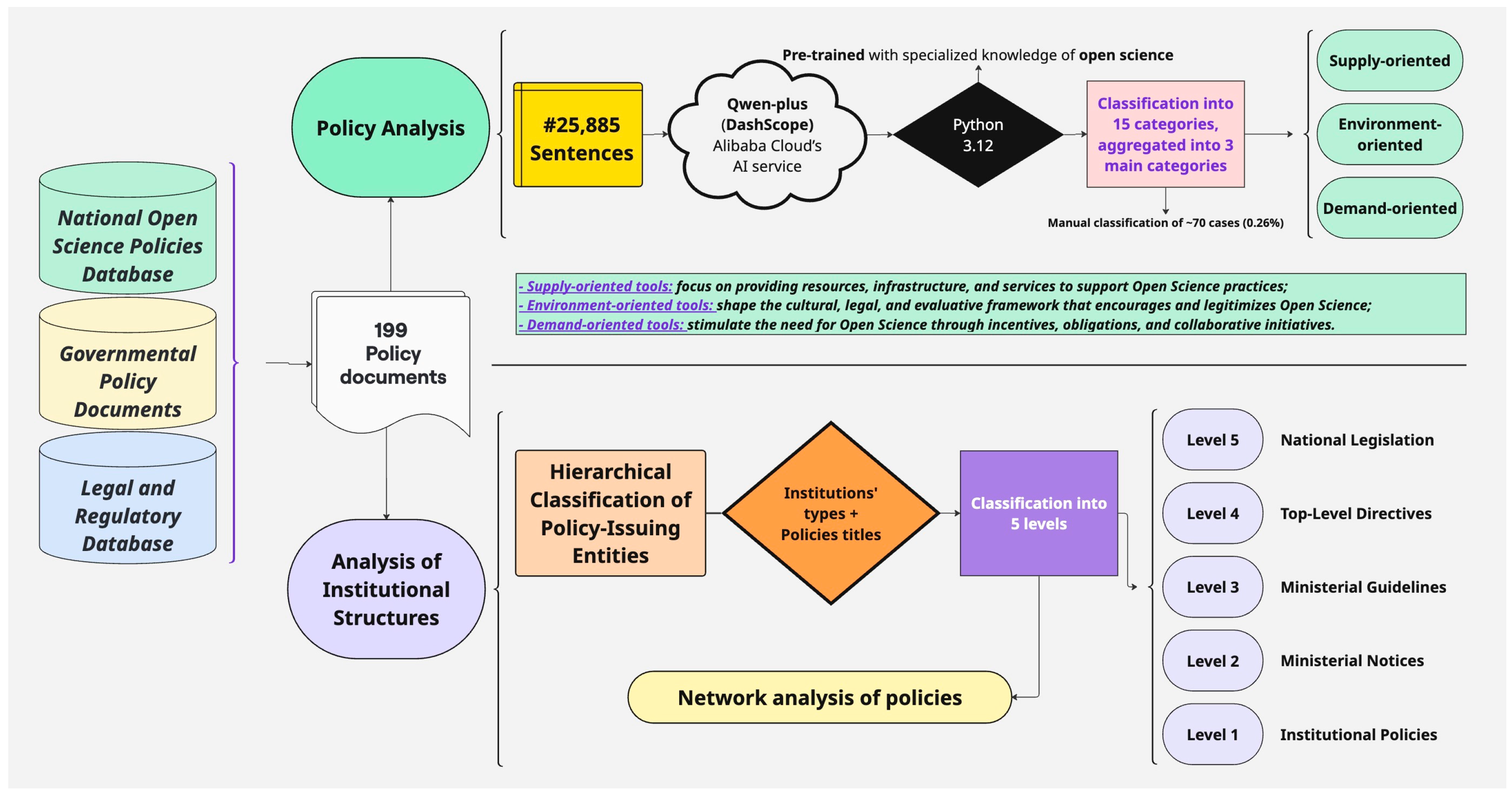
Figure 2.
Open science policy release and changes in policy types.
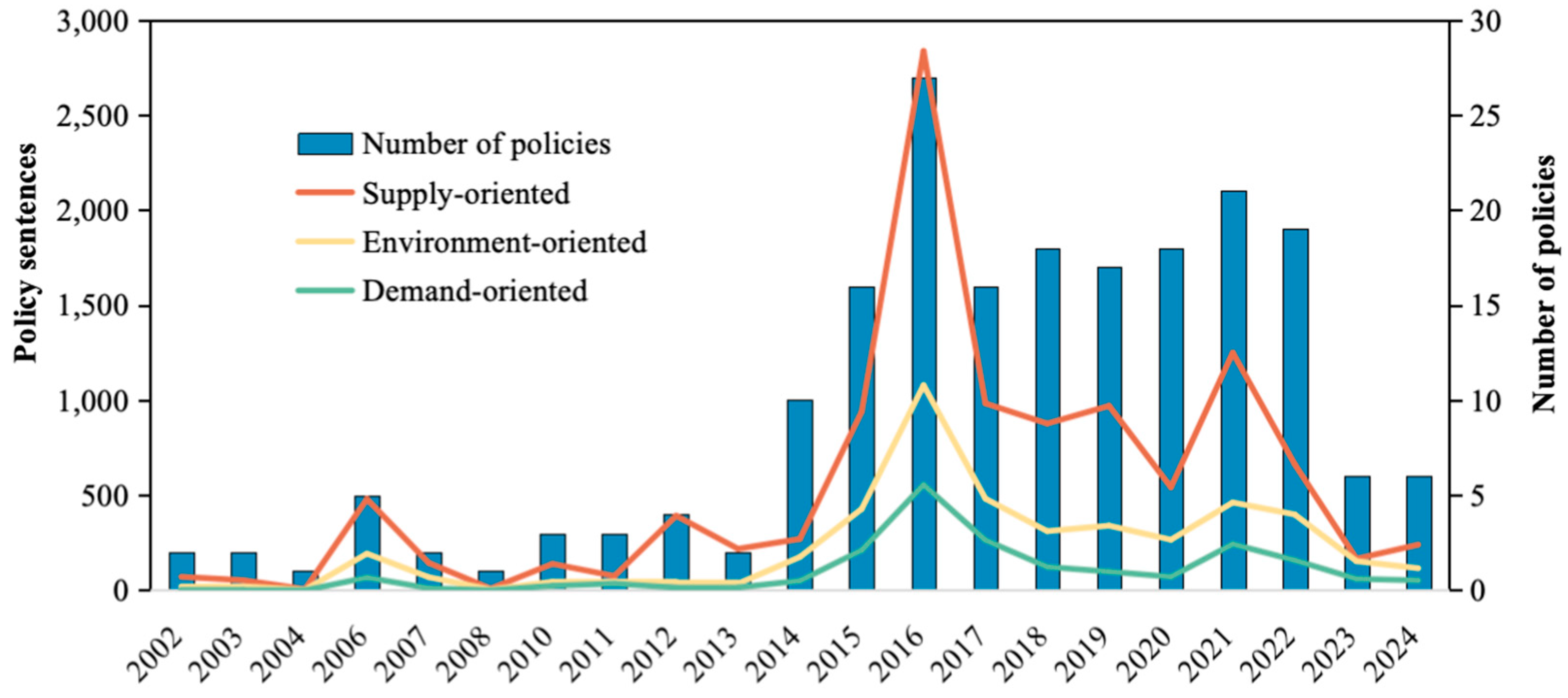
Figure 3.
Distribution of open science policy tools.
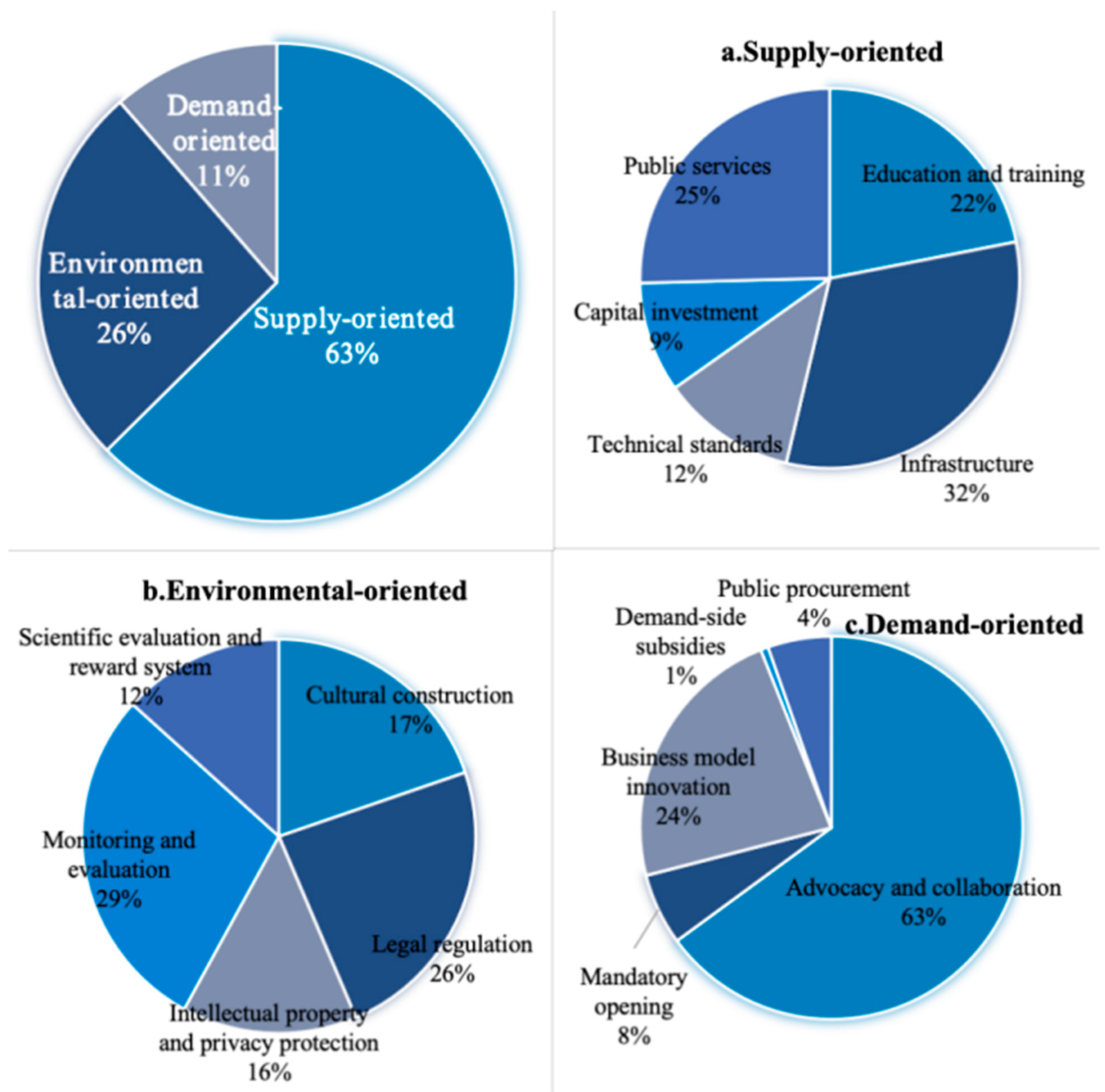
Figure 4.
Policy focus according to the institutional strength level.
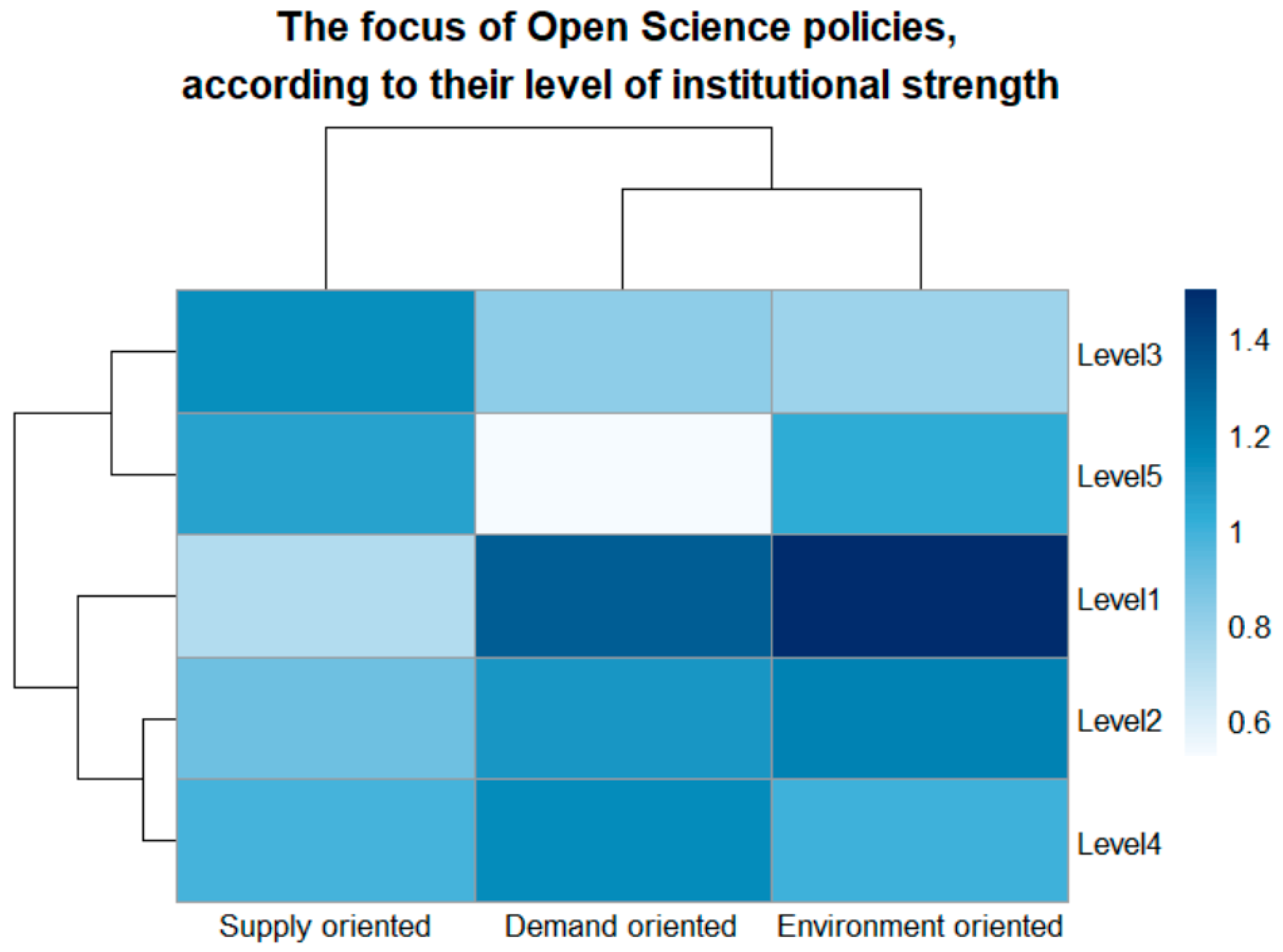
Figure 5.
Open science policy text and quantity (copies).
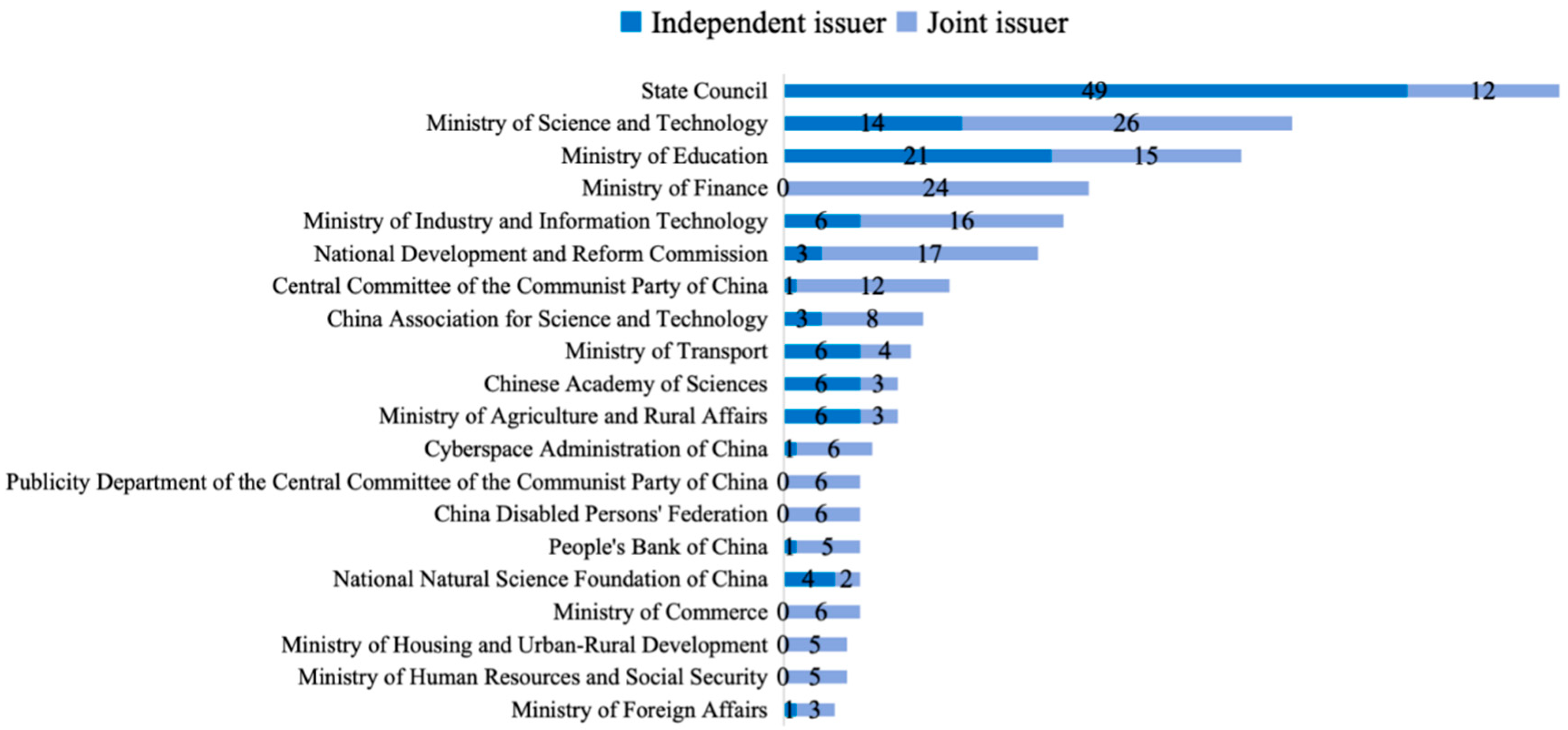
Figure 6.
Social network of open science policy publishers.


Table 1.
National Open Science Policies in China (structure of data).
| Policy ID | Date of Issue | Issuing Entities | Category | Policy Title |
| C1 | 2002-06 | People’s Congress | Open Science Governance | Law of the People’s Republic of China on the Popularization of Science and Technology |
| C2 | 2002-08 | State Council | Open Science Governance | Guiding Opinions of the National Informatization Leading Group on the Construction of E-Government in China |
| … | … | … | … | … |
| C40 | 2015-01 | State Council | Open Infrastructure | Opinions of the State Council on Opening Major National Scientific Research Infrastructure and Large Scientific Research Instruments to the Public |
| … | … | … | … | … |
| C199 | 2024-10 | Ministry of Industry and Information Technology, Ministry of Finance, National Bureau of Statistics | Open Infrastructure | Overall Construction Plan for New Material Big Data Center |
Table 2.
Open Science Policy Text Coding (structure of data).
| Policy ID | Policy Title | Content Analysis Unit | Coding | Category | Subcategory |
| C1 | Law on the Popularization of Science and Technology | Article 10: Governments at all levels shall integrate science popularization into national economic and social development plans. | C1-2-1 | Supply-Oriented | Legal Regulation |
| … | … | … | … | … | … |
| C101 | Measures for the Open Sharing of Duty-Free Imported Scientific Research Instruments and Equipment (Trial) | Article 7: The General Administration of Customs supervises open sharing of scientific research instruments. | C101-2-7 | Environment-Oriented | Monitoring & Evaluation |
| … | … | … | … | … | … |
| C199 | Overall Construction Plan for New Material Big Data Center | Strengthen administrative adjudications on patent infringements and protect material big data intellectual property. | C199-5-6 | Environment-Oriented | Intellectual Property & Privacy Protection |
Table 3.
Classification of open science policy tools.
| Tool Type | Sub-Tool | Explanation |
| Supply-oriented | Education and training | The government implements education and training programs to cultivate open science professionals and ensure talent pool |
| Infrastructure | The government builds and improves infrastructure to provide material support for open science. | |
| Technical standards | Governments formulate and promote technical standards to promote open sharing, such as the FAIR principle | |
| Capital investment | The government has allocated special funds to support open science work | |
| Public services | The government provides basic services such as policy consultation and information sharing to ensure the smooth progress of open science | |
| Environment-oriented | Cultural construction | Cultivate an open and shared scientific culture and encourage scientific research to embrace the concept of openness |
| Legal regulation | Formulate laws and regulations to regulate and supervise open science activities and ensure legitimacy | |
| Intellectual property and privacy protection | Emphasize intellectual property protection, add privacy protection, and balance openness and protection | |
| Monitoring and evaluation | Establish a monitoring and evaluation mechanism to track policy effects and ensure that goals are achieved | |
| Scientific evaluation and reward system | Reform the evaluation system to encourage researchers to participate in open science | |
| Demand-oriented | Advocacy and collaboration | The government initiates initiatives, builds collaboration, and mobilizes social forces to jointly advance policy goals |
| Mandatory opening | The law requires that scientific research results be published and shared on open platforms | |
| Business model innovation | Encourage scientific research and publishing institutions to explore new models of scientific exchange and promote open innovation | |
| Demand-oriented subsidies | Government subsidies reduce open access publishing costs and increase demand for open science | |
| Public procurement | Government procurement of open science-related services to promote open access and data sharing |
Table 4.
Policy strength scoring.
| Level | Description | Fractionnal count | Whole count | # Statments |
| 5 | Laws, regulations and guidelines promulgated by the National People’s Congress and its Standing Committee | 2.0 | 2 | 379 |
| 4 | Regulations, rules, opinions, etc. issued by the CPC Central Committee and the State Council | 52.0 | 64 | 7498 |
| 3 | Notices issued by the CPC Central Committee and the State Council; guidance opinions and measures issued by national ministries and commissions, etc. | 63.7 | 173 | 15379 |
| 2 | Notices and announcements from national ministries and commissions | 70.6 | 130 | 6013 |
| 1 | Opinions, methods, notices, etc. from national scientific research institutes and research institutes | 10.8 | 30 | 2139 |
| Total | 199.0 | - | - | |
Disclaimer/Publisher’s Note: The statements, opinions and data contained in all publications are solely those of the individual author(s) and contributor(s) and not of MDPI and/or the editor(s). MDPI and/or the editor(s) disclaim responsibility for any injury to people or property resulting from any ideas, methods, instructions or products referred to in the content. |
© 2025 by the authors. Licensee MDPI, Basel, Switzerland. This article is an open access article distributed under the terms and conditions of the Creative Commons Attribution (CC BY) license (http://creativecommons.org/licenses/by/4.0/).
Copyright: This open access article is published under a Creative Commons CC BY 4.0 license, which permit the free download, distribution, and reuse, provided that the author and preprint are cited in any reuse.