1. Decomposing All Natural Numbers into Geometric Sequences
1.1. Background and Objective
We express as a collection of rays parameterized by odd cores and powers of two, providing a structural stage for Collatz dynamics.
1.2. Definitions and Goals
We show and the representation is unique.
1.3. Prime Factorization and Classification
Every
decomposes uniquely as
1.4. Exhaustion of Odd Numbers
Any odd k is with , giving .
1.5. Exhaustion of Even Parts
For each odd k, the ray exhausts the even multiples of k.
1.6. Construction of S and Uniqueness
By the above, every
with
. If
then
, forcing
and
since the left side is odd rational and the right is a power of two. Hence
bijectively.
1.7. Remarks from the Collatz Perspective
For odd k, is even and belongs to some ray . This exhibits inter-branch connections. However, the assertion that every number lies on a finite forward path to 1 (global convergence) is a separate issue (coverage) and is not implied by the mere classification .
Takeaway of Chapter 1. We obtain a clean, bijective indexing of by odd core and 2-adic height, furnishing a coordinate system on which later structural/affine arguments are staged.
2. The Structure of the Collatz Tree
2.1. Definition (Branches and Trunk)
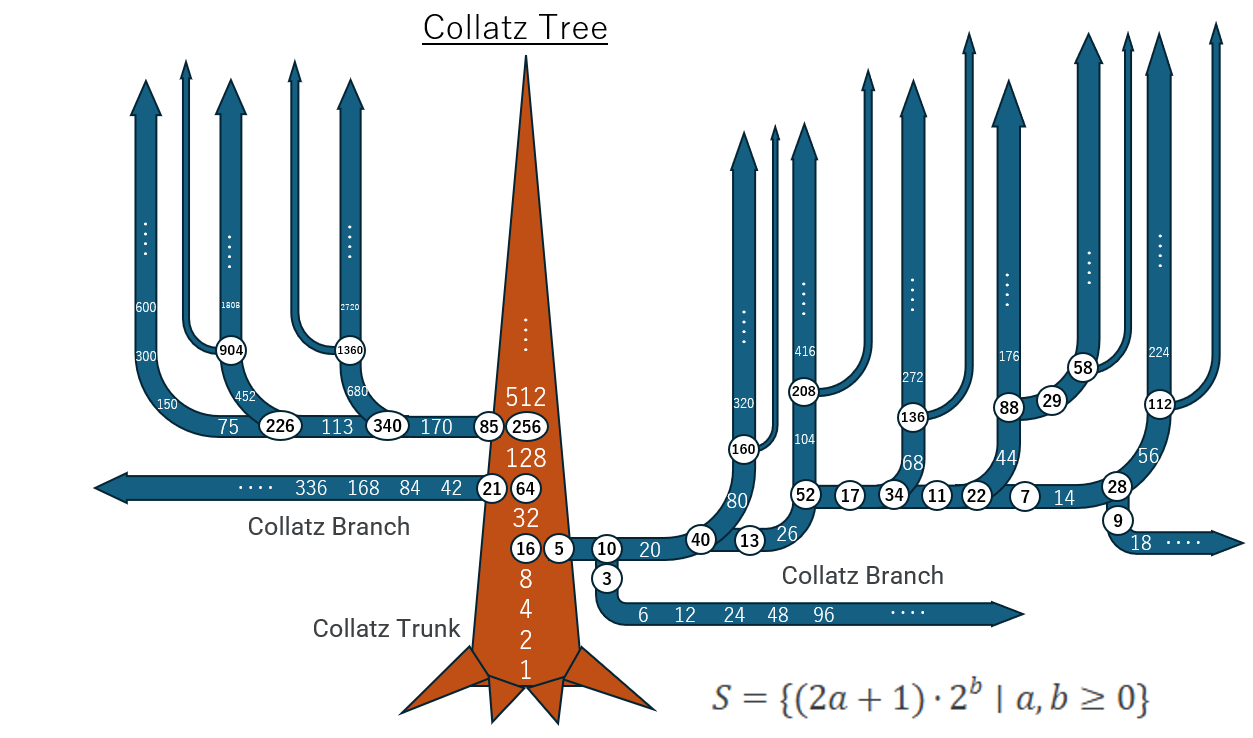
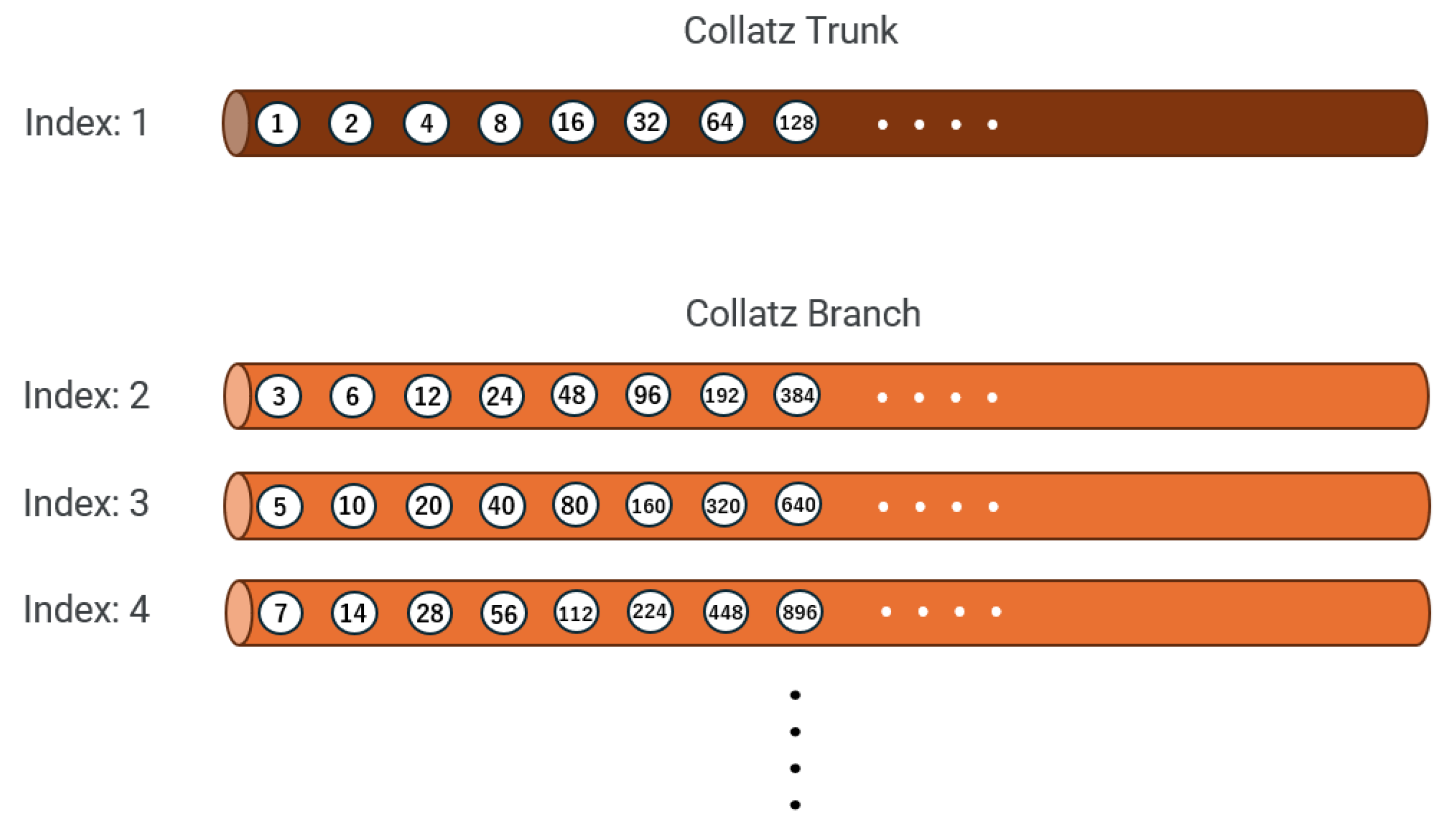
Define the trunk and for each odd the branch . These rays partition disjointly.
Figure 1.
Trunk and branches (schematic; reverse orientation when embedded into the inverse graph: edges point to preimages).
Figure 1.
Trunk and branches (schematic; reverse orientation when embedded into the inverse graph: edges point to preimages).
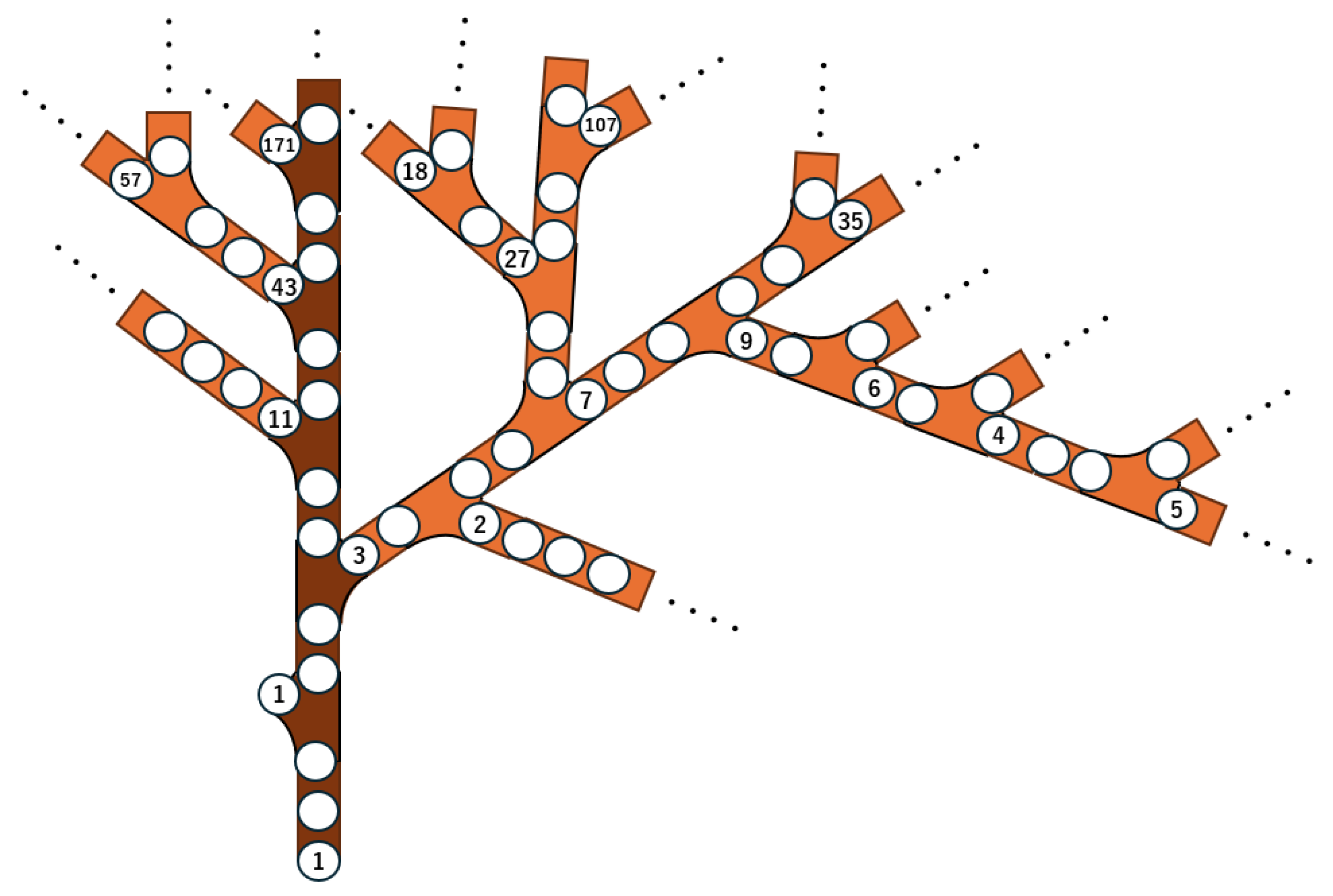
2.2. Branch–Branch Links via
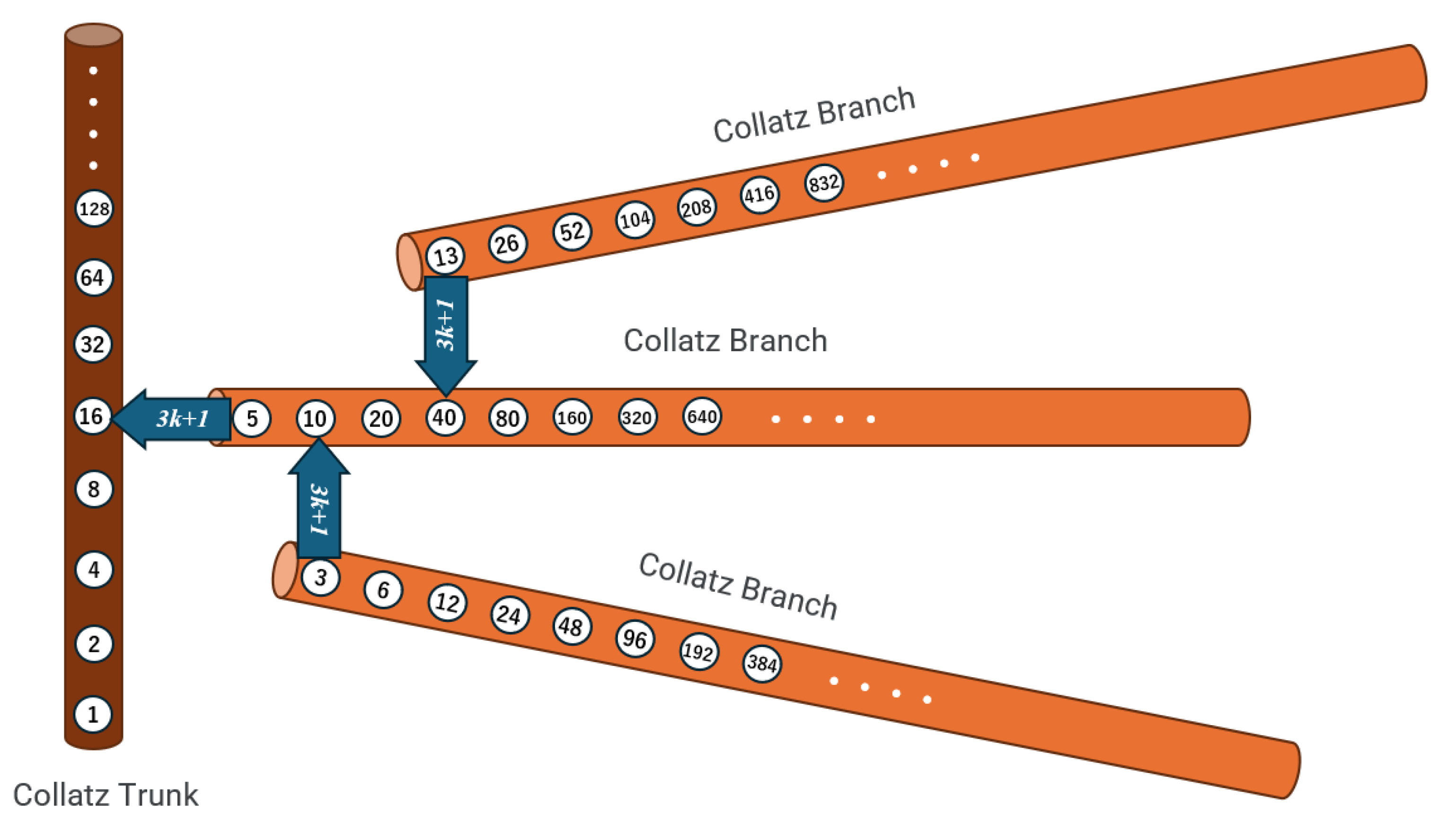
Given odd k, is even and decomposes as , indicating where the branch from k can merge into another branch/trunk in forward dynamics. This shows linkage patterns but does not by itself prove global coverage of the tree by reverse generation.
Figure 2.
Branch connections (schematic; reverse orientation: edges point to preimages).
Figure 2.
Branch connections (schematic; reverse orientation: edges point to preimages).
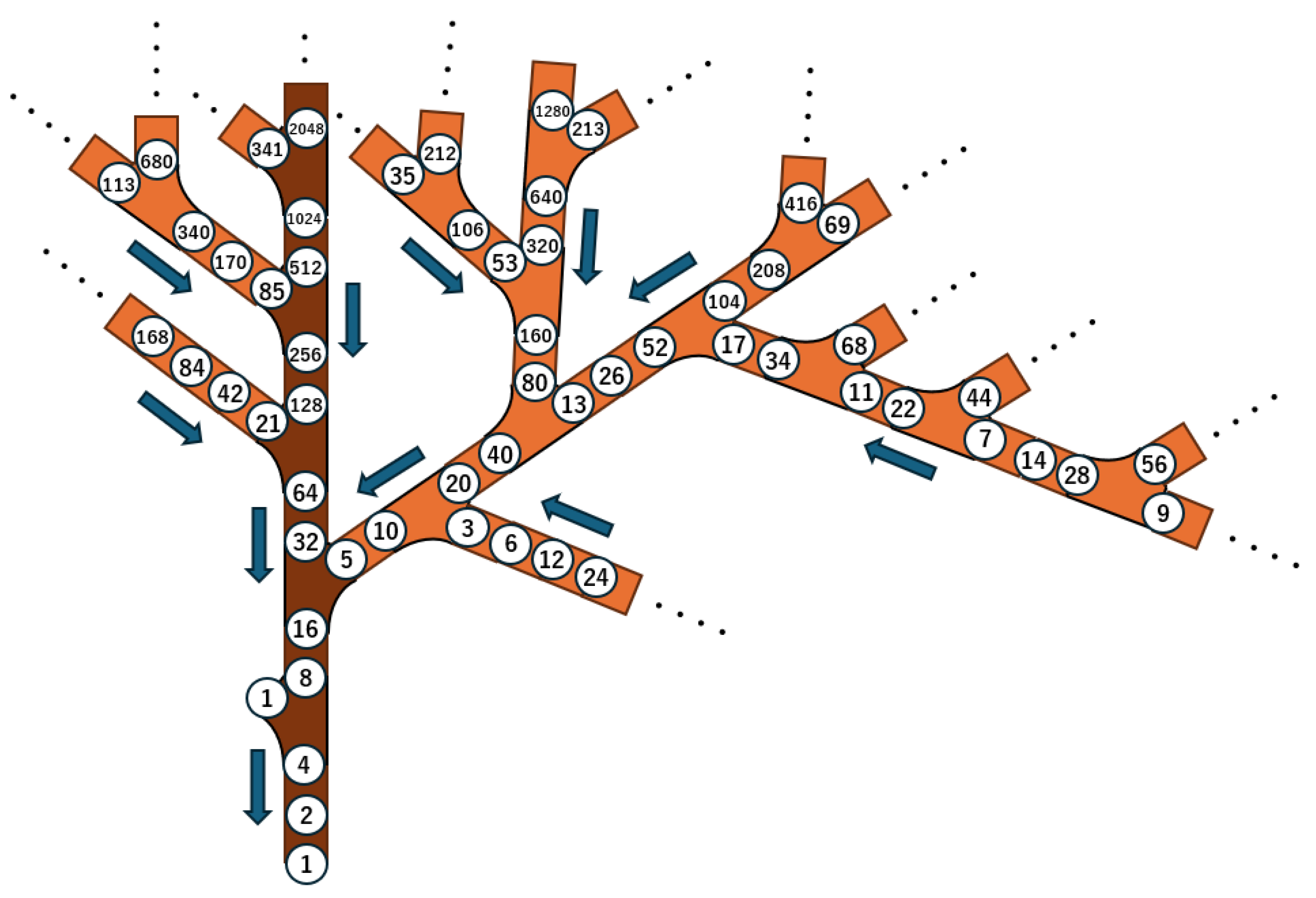
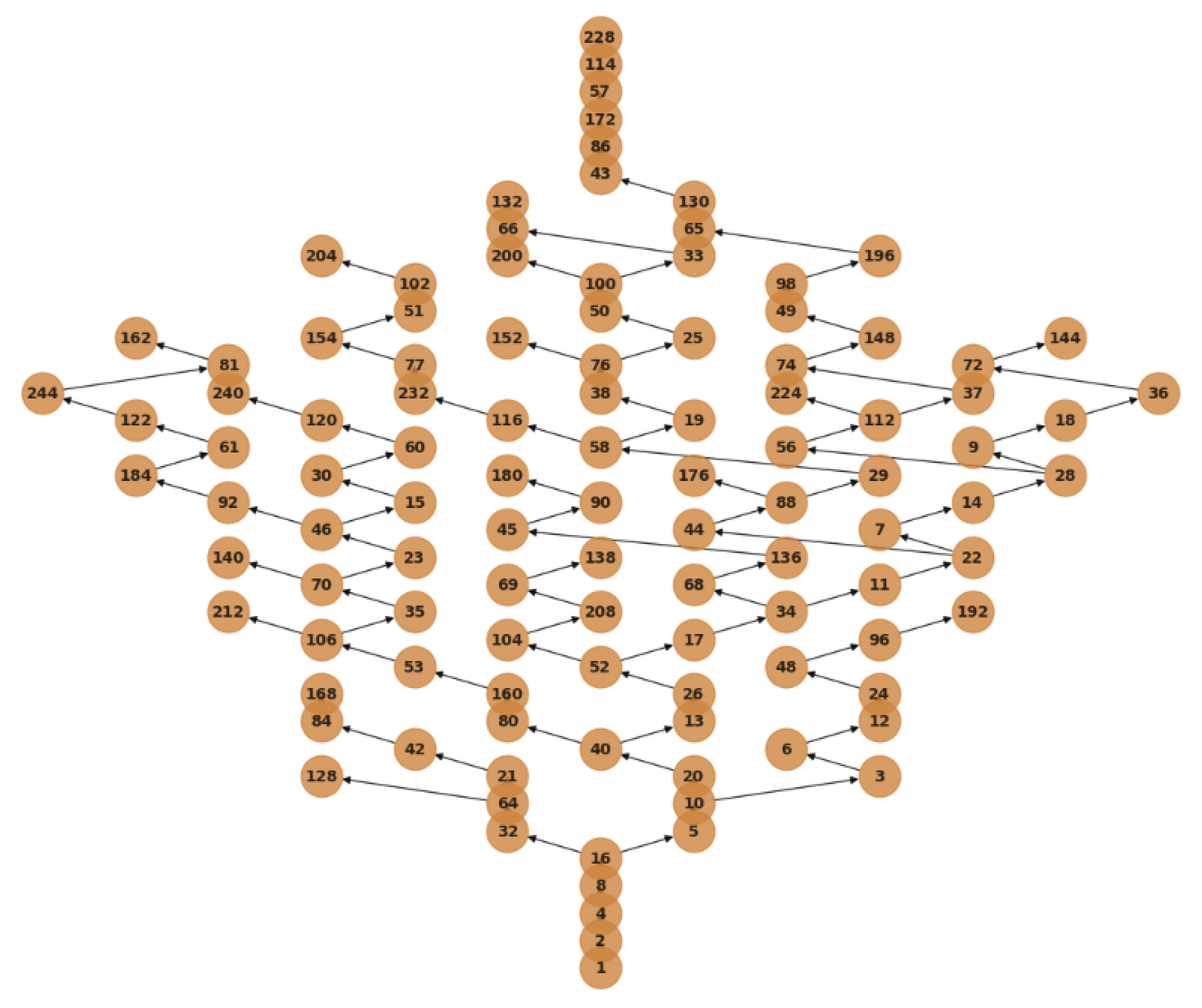
Figure 3.
Collatz execution units (forward Collatz tree; edges follow the usual iteration).
Figure 3.
Collatz execution units (forward Collatz tree; edges follow the usual iteration).
2.3. Forward vs. Reverse Orientation
Let the standard forward map be
The forward graph (edges ) is a functional digraph (out-degree 1). It is not acyclic due to the trivial three-cycle; nontrivial finite cycles are excluded later at the level of the three-way auxiliary map T.
The reverse (preimage) graph rooted at 1, with edges to preimages under f, is a true DAG: levels increase with each application of a reverse step.
2.4. Tree Language
When drawing a reverse BFS tree rooted at 1, each node is assigned a unique parent by construction (though a number may have up to two preimages as graph children). Connectivity of every node to 1 in the forward sense is equivalent to coverage of the reverse tree, which is equivalent to the Collatz convergence; see thm:reduction for a formal statement.
3. Trunk–Branch Indexing of the Natural Numbers
Definition 1
(Odd core, 2-adic valuation). For , write uniquely where is odd and is the exponent of 2 in n.
Definition 2
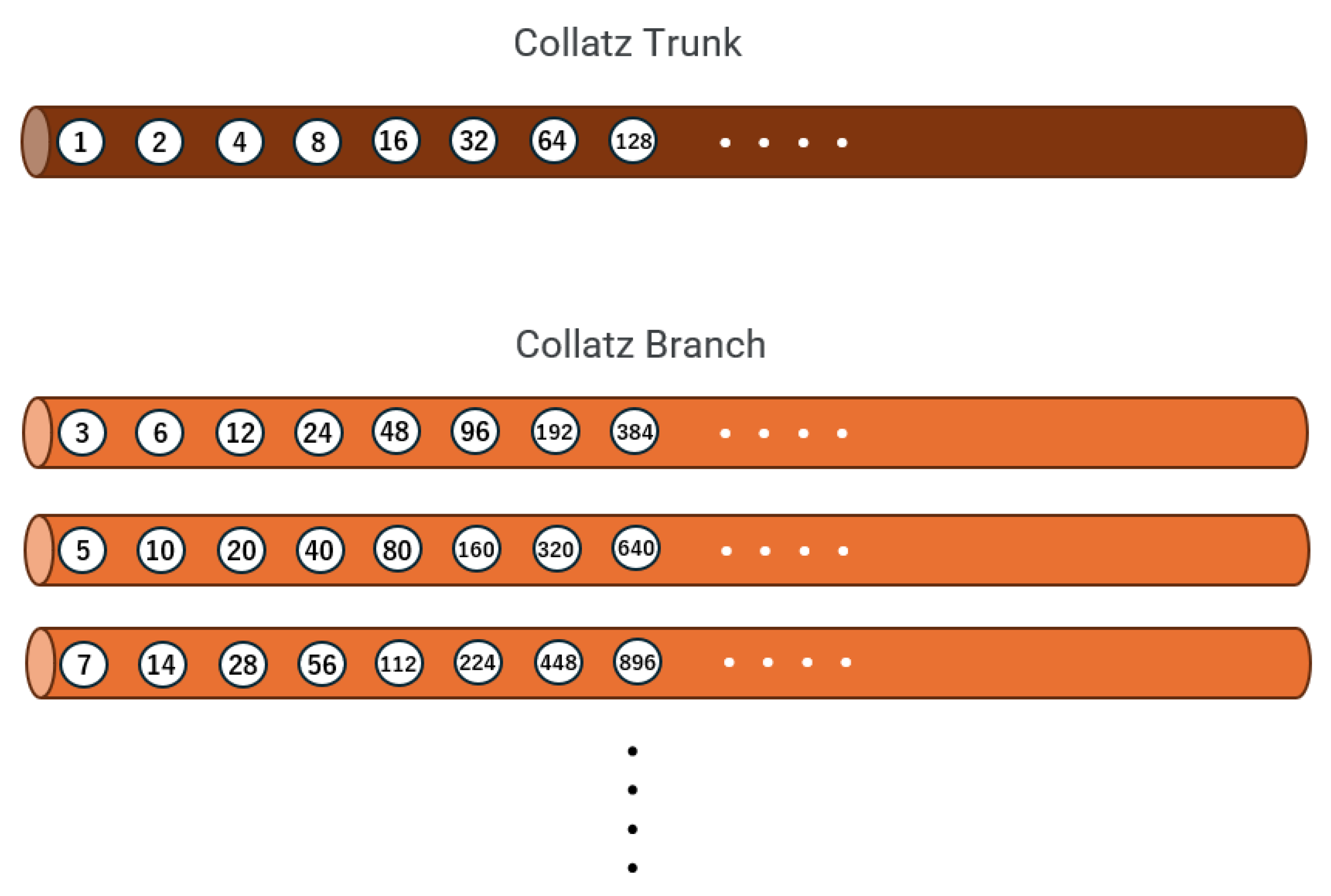
(Trunk and branches). The trunk is . For any odd , Then is a disjoint partition of .
Definition 3
(Indices).
Order the odd numbers as . Assign the branch index , so that and , , etc. Define the height . Set
Theorem 1
(Complete classification). The map is a bijection from onto .
Proof. Uniqueness of and is immediate; disjointness/exhaustiveness of rays follows. □
Figure 4.
Trunk–branch indexing (schematic; reverse orientation in the inverse graph).
Figure 4.
Trunk–branch indexing (schematic; reverse orientation in the inverse graph).
Figure 5.
Indexed reverse tree (schematic; edges point to preimages).
Figure 5.
Indexed reverse tree (schematic; edges point to preimages).
In this table we use a 1-based display index .
Table 1.
Trunk –Branch Indexing (sample). Here .
Table 1.
Trunk –Branch Indexing (sample). Here .
| Odd k
|
Index (I) |
Next Index (rule) |
Parity-based trend |
Transition factor |
| 1 |
1 |
– |
– |
– |
| 3 |
2 |
3 |
increase |
|
| 5 |
3 |
1 |
decrease |
|
| 7 |
4 |
6 |
increase |
|
| 9 |
5 |
4 |
decrease |
|
| 11 |
6 |
9 |
increase |
|
| 13 |
7 |
3 |
decrease |
|
| 15 |
8 |
12 |
increase |
|
| 17 |
9 |
7 |
decrease |
|
| 19 |
10 |
15 |
increase |
|
Lemma 1
(Index dynamics and monotonicity of O1).
Every can be written uniquely as with an odd core and . Under the three maps
the -state evolves as
Proof. A direct check. For we have . □
4. Affine Word Method: Obstructions to Nontrivial Finite Cycles
We now introduce a three-way map T whose branches are affine maps, and analyze its finite compositions. The focus of this section is on rigorous algebraic obstructions to nontrivial cycles of T.
Expository roadmap.
We first record several algebraic lemmas. A historical/sketch-type criterion is stated only for context and is
not used later. The definitive, self-contained proof of cycle-freeness for
T is Theorem 2 in §
Section 4.3; readers may safely skip directly there.
4.1. Definition of the three-way map T
Define
by
Thus T is a deterministic three-way refinement of the usual Collatz step.
Lemma 2
(Well-definedness and totality of T). For every , exactly one of the three branches of T applies, and the image is an integer.
Proof. If n is even, then . If n is odd, write . When we use ; when we use . Exactly one of holds, hence the rule is deterministic and total on . □
Layer terminology. We call a state nodd-layer if and even-layer otherwise. We also speak of a return to the odd layer when the orbit first hits again.
4.2. Elementary Steps and Words
Definition 4
(Admissibility and cyclic admissibility). Let with . Given , we say that W isadmissible at xif the forward evaluation applies each to the current integer according to the defining side-conditions: E only at even inputs; only when ; and only when . We call W cyclically admissibleif it is admissible at every point along a full period of a putative cycle and returns to the initial state.
Remark 1.
In cycle arguments we tacitly restrict to cyclically admissible words. Purely formal words violating the side-conditions are irrelevant to actual T-orbits.
For any finite word
W over
, the composition is
where
,
,
.
Lemma 3
(No for nonempty words). If W is nonempty, then .
Proof. If , then , which forces . □
Lemma 4
(Odd numerator for
).
and the numerator is odd.
Remark 2
(On fixed points with
).
We do not exclude integral fixed points solely by ; instead, cycle-freeness will follow from the odd-layer tour in §Section 4.3.
()).Lemma 5 (Odd-layer words Let W be a nonempty word over . If (all ), then is a contraction and the only integer fixed point is .
4.3. Alternative Proof of Cycle-Freeness (Rotation-Free via and the Odd Layer)
For a word
with
, put
Here and count, with multiplicity, the number of odd-branch multipliers 3 and the total power of 2 in the denominator along the evaluation, respectively. When W is cyclically admissible (Def. 4), these counts are uniquely determined by W.
Then any period-1 point satisfies
The coefficient on the left is always odd.
Lemma 6
(Parity pinned by the first symbol).
For any nonempty W with first symbol ,
This parity is invariant under further extensions of W.
Proof (Proof of Lemma 6). Any finite word
can be written in the normalized form
where
are the accumulated exponents of 3 and 2 along the evaluation.
Base step (length 1). A direct check gives
Inductive step. Assume
with
already fixed by the
first symbol of
U. Prepending
yields
Hence the new constant term is
Because and , we have . Therefore the parity of B is determined by the first symbol and remains unchanged under any further left extensions. Together with the base step, the claim follows. □
Lemma 7
(Any cycle uses both and E). If a forward cycle exists, then it contains at least one and at least one E.
Proof. (i) Suppose a cycle contains no E. Then the orbit never leaves the odd layer. If it uses only , the induced affine factor is a strict contraction on , hence the only fixed point is 1 (Lemma 5); this contradicts nontriviality. If it uses at least once, then on odd cores the map is strictly increasing (Lemma 1), so periodicity is impossible. Thus any nontrivial cycle must contain E.
(ii) Suppose a cycle contains no . If it consists only of E, the orbit never returns to the odd layer, hence it cannot close a cycle. If it uses , then whenever the orbit is on the odd layer, the odd core strictly increases again by Lemma 1, so periodicity is impossible. Therefore any nontrivial cycle must also contain . □
(odd-layer tour argument)).Theorem 2 (Cycle-freeness There is no nontrivial cycle for on .
Remark 3 (What Theorem 2 doesnotclaim)The theorem rules out nontrivial cycles for the auxiliary map T. It does not, by itself, imply global convergence of the original Collatz iteration. Section 5Section 6 separate the conjectural bridge and the coverage program explicitly.
Proof. Assume a cycle exists. By lem:must-O2-and-E it has both and E. Start at an odd occurrence whose next step is ; write k for its odd core. Then with odd. Rotating the same tour to start at the even occurrence after that yields with even, forcing even—contradiction. □
5. Bridge to the Accelerated Collatz Map: A Conjectural Framework
Remark 4 (Compatibility via coefficient matching). An accelerated step consists of one odd reduction followed by a total 2-adic division of size . While T uses on even layers (not literal halving), one canencodethe same exponents by a word over with matching counts (coefficient matching). This is the sense in which our Bridge program relates hypothetical A-cycles to T-cycles.
5.1. Cycles of the Accelerated Map
Let
be
Suppose
is a hypothetical cycle of
A, with
and
Then there exists
with
5.2. Matching Coefficients on the T-Side
For a word
W over
with counts
, we have
If
W satisfies
then
and
Definition 5
(Coefficient-matched word). Given from an A-cycle, a word W iscoefficient-matchedif and .
5.2.0.1. Adjacent-swap effect on .
Thus, swapping E to the left of increases by (with ). This local move makes it feasible to tune .
Lemma 8
(Local swap reachability mod D). Let and let W be any coefficient-matched word (so that ). Performing the adjacent swap increases the constant term by , and increases by , when measured before the final normalization by . Consequently, the set of residues of reachable from a given coefficient-matched word contains the subgroup generated by in .
Remark 5.
Because , tuning reduces to understanding the subgroup generated by the 2-adic increments above. A full classification is not required here, but this mechanism underlies the Bridge Conjecture (conj:bridge) by making the fixed-point equation congruentially solvable.
5.3. Bridge Conjecture
Conjecture 3
(Equivalence of cyclicity). Suppose the accelerated map A admits a nontrivial finite cycle of length . Then there exist a coefficient-matched word W over and an such that , and the T-orbit of x follows exactly the step pattern encoded by W. In particular, any nontrivial cycle of A induces a nontrivial cycle of T.
Corollary 1
(Conditional absence of nontrivial cycles for A). If conj:bridge holds, then the accelerated map has no nontrivial finite cycles.
Proof. By conj:bridge, a nontrivial cycle of A would induce a nontrivial cycle of T, which contradicts thm:cyclefree-alt. □
Theorem 4
(Reduction to convergence). For A, the following are equivalent:
- (1)
Every positive integer reaches 1 in finitely many steps (global convergence).
- (2)
The inverse Collatz tree rooted at 1 covers all positive integers (reachability/coverage).
Proof. This is the standard argument for functional digraphs: global convergence is equivalent to every node being in the basin of the component containing 1, which is equivalent to coverage in the reverse (preimage) tree. □
6. Coverage of the Inverse Collatz Tree: A Program
Assuming cycle-freeness for the accelerated map, global convergence reduces to coverage of the inverse tree (thm:reduction). We do not claim a proof; rather we outline a program.
6.1. Inverse Graph Definition
For
, define preimages
This yields a DAG rooted at 1.
Definition 6
(Coverage). The inverse Collatz tree iscoveringif every appears at some depth from the root 1.
6.2. Local Branching and Odd Cores
Lemma 9
(Two-Child Criterion). If , then with odd; otherwise .
Proposition 1
(Descent at branching). For , the odd core of is .
Proposition 2
(Infinitely many potential descent levels when ). If the odd core k is not a multiple of 3, the levels occur infinitely often in b.
6.3. A Coverage Conjecture
Conjecture 5
(Coverage Conjecture). The inverse Collatz tree rooted at 1 is covering.
7. Related Work
The affine-composition viewpoint () is classical (Lagarias; Terras). Our contribution is to combine (i) trunk–branch indexing and inverse-tree structure, (ii) a complete loop-elimination for the three-way map T, and (iii) a conjectural bridge transporting hypothetical A-cycles into T.
Data Availability Statement
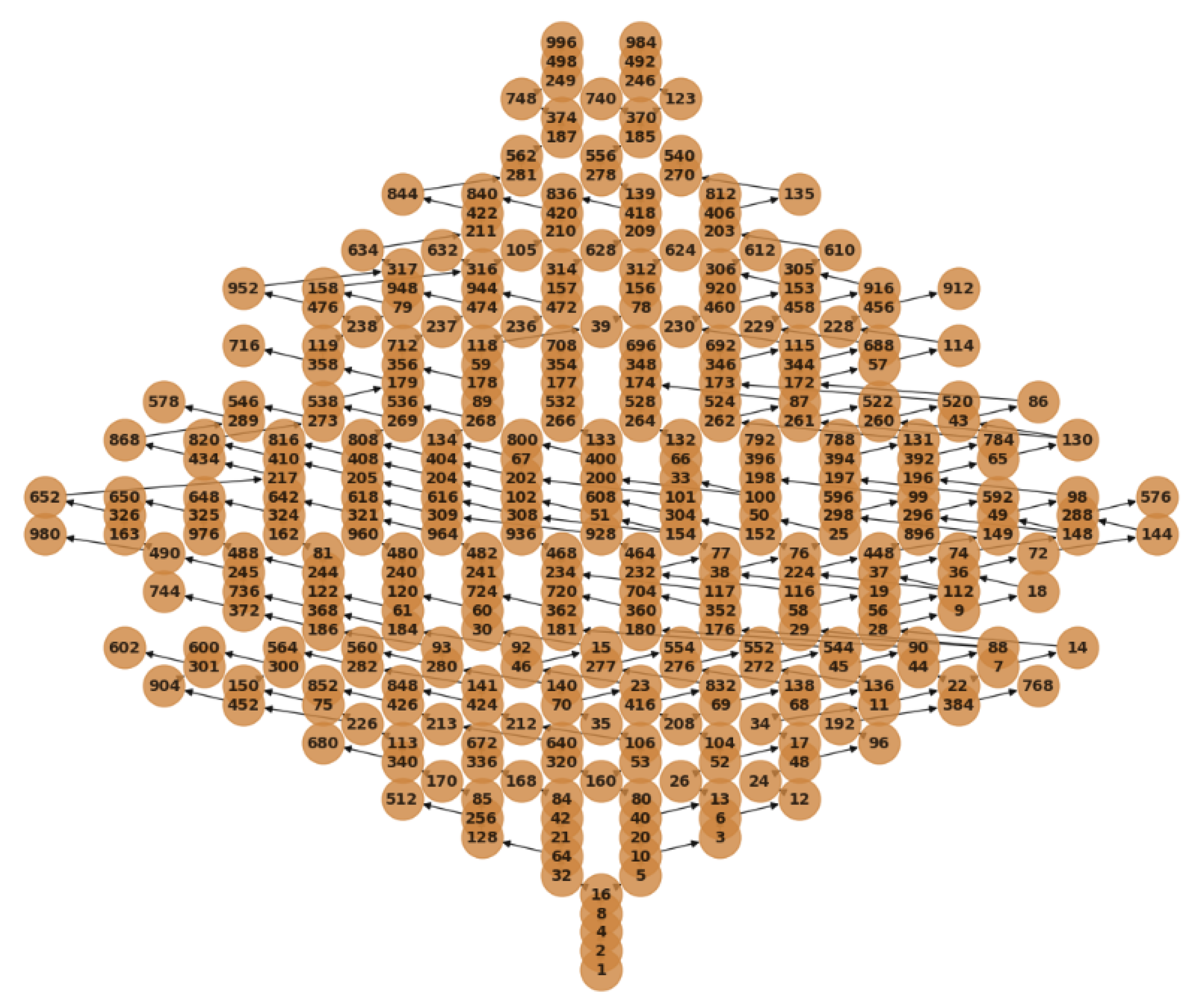
Figures can be regenerated using the Python in the Appendix (for visualization; not a proof of coverage).
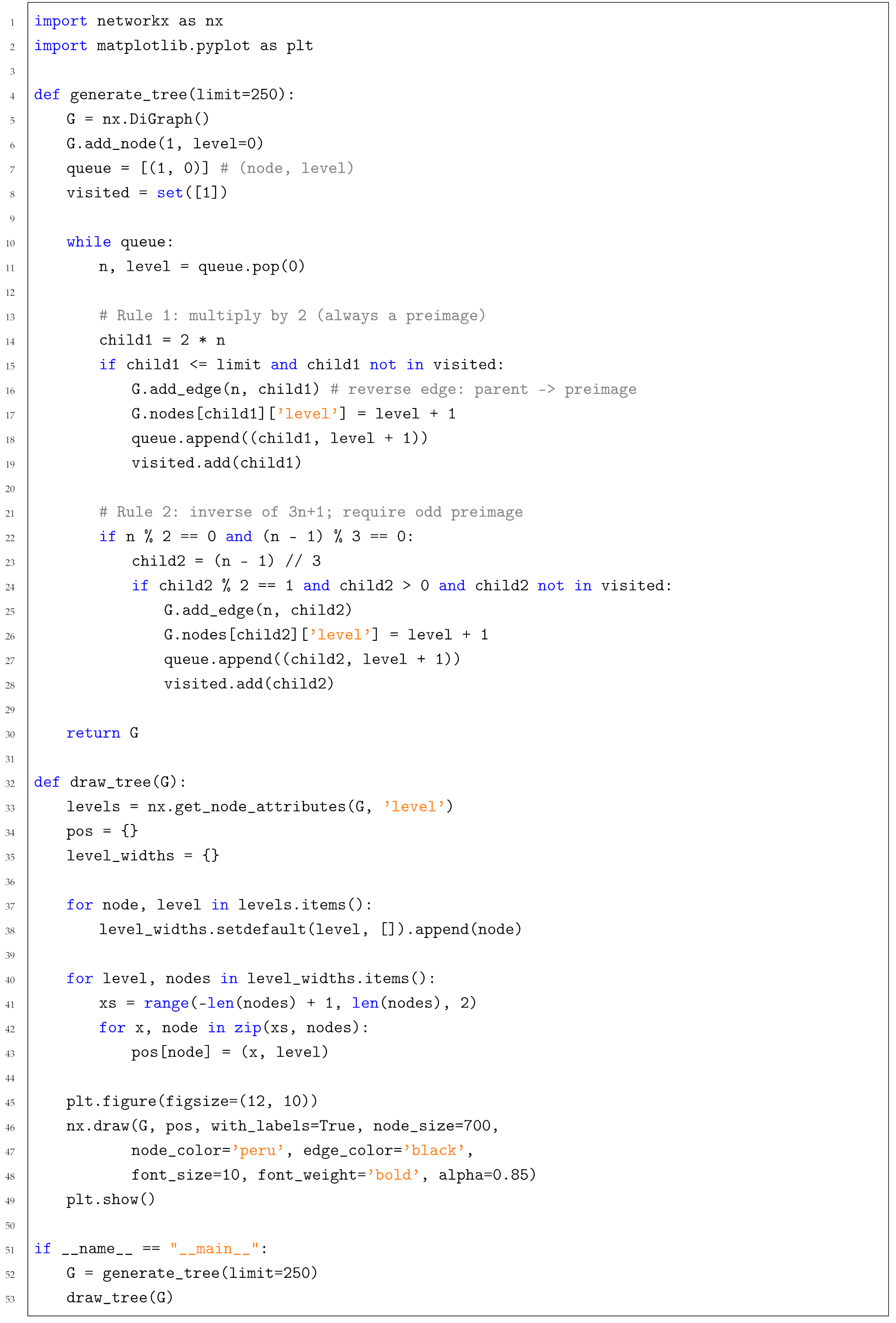
Appendix A. Python Code for Reverse Collatz Tree Visualization
This script visualizes structure up to a finite cutoff and isnota proof of coverage.
| Listing A1: Reverse Collatz Tree (visualization only) |
 |
Appendix B. Python-Generated Tree Visualizations (Illustrative Only)
Figure A1.
Reverse Collatz tree generated programmatically (limit = 250).
Figure A1.
Reverse Collatz tree generated programmatically (limit = 250).
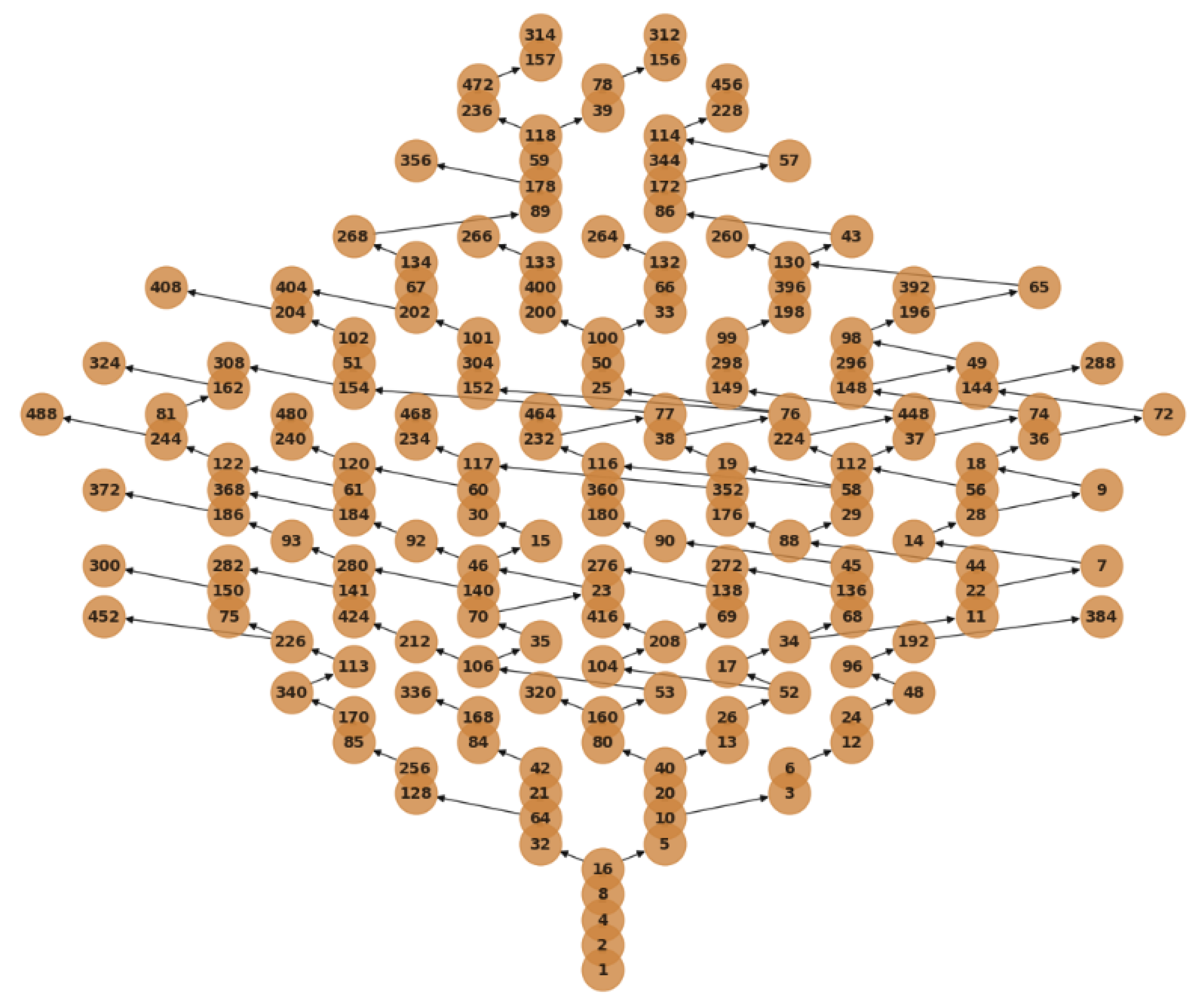
Figure A2.
Reverse Collatz tree generated programmatically (limit = 500).
Figure A2.
Reverse Collatz tree generated programmatically (limit = 500).
Figure A3.
Reverse Collatz tree generated programmatically (limit = 1000).
Figure A3.
Reverse Collatz tree generated programmatically (limit = 1000).
References
- J. C. Lagarias, The 3x+1 Problem and Its Generalizations, The American Mathematical Monthly, Vol. 92, No. 1 (1985), pp. 3–23.
- R. Terras, A stopping time problem on the positive integers, Acta Arithmetica, 30 (1976), pp. 241–252.
- Wikipedia contributors, Collatz conjecture, Wikipedia, accessed 2025-03-26.
- Petro Kosobutskyy, The Collatz problem from the point of view of transformations of Jacobsthal numbers, arXiv preprint, arXiv:2306.14635, 2023. arXiv:2306.14635, 2023.
|
Disclaimer/Publisher’s Note: The statements, opinions and data contained in all publications are solely those of the individual author(s) and contributor(s) and not of MDPI and/or the editor(s). MDPI and/or the editor(s) disclaim responsibility for any injury to people or property resulting from any ideas, methods, instructions or products referred to in the content. |
© 2025 by the authors. Licensee MDPI, Basel, Switzerland. This article is an open access article distributed under the terms and conditions of the Creative Commons Attribution (CC BY) license (http://creativecommons.org/licenses/by/4.0/).