

Submitted:
13 April 2025
Posted:
15 April 2025
You are already at the latest version
Abstract
English Language Teaching (ELT) continues to encounter challenges in adapting instructional methodologies to enhance language teaching and acquisition effectively. This study is anchored in four key educational and linguistic theories—Constructivist Learning Theory, Cognitive Load Theory, Communicative Competence Theory, and Lexical Priming Theory—that collectively support the development of an integrated, taxonomy-driven model for ELT. Using qualitative in-depth content analysis of scholarly books and journals, supplemented by interviews and classroom observations, the research examines how taxonomy-driven instruction enhances lesson planning, assessment standardization, and multilingual adaptability. A sample of 20 participants (P-1 to P-20) provided empirical insights into cognitive engagement, lexical retention, and fluency-building through structured learning sequences. Findings reveal that taxonomy-aligned instruction strengthens comprehension, supports assessment standardization, and facilitates multilingual adaptability, while AI-assisted learning tools enhance adaptive pedagogical strategies in a blended learning context. To address these persistent challenges, this study proposes a taxonomy-driven model, offering educators a structured and adaptable framework for more effective and inclusive language instruction.
Keywords:
blended learning model
; cognitive-based language instruction
; lexical competence development
; task-oriented pedagogy
; taxonomy-driven ELT framework
I. Introduction
Education is constantly changing and improving, and taxonomies have played a crucial role in helping teachers and learners understand how learning unfolds—from basic knowledge recall to complex problem-solving and creativity. These structured models offer a way to organize instructional goals and make learning outcomes more transparent and measurable. Perhaps the most well-known is Bloom’s Taxonomy, which has served as a foundation for instructional planning for decades, guiding teachers in designing learning activities that promote critical and creative thinking (Richards & Rodgers, 2022).
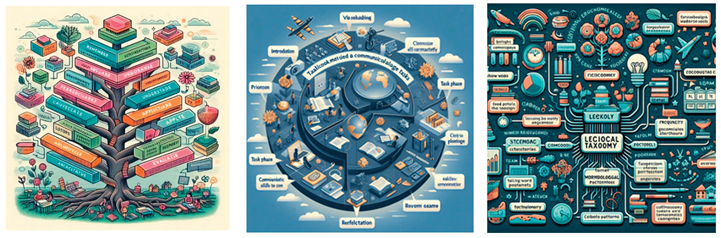 Source: Copilot, 2025. |
However, Bloom’s model is just one piece of the puzzle in English Language Teaching (ELT). Over time, other frameworks have emerged that highlight different dimensions of learning. The Lexical Approach, for instance, emphasizes the importance of vocabulary chunks and natural language patterns over isolated grammar instruction (Nation, 2020). Cognitive taxonomies offer insights into how learners process and store information, while Task-Based Language Teaching (TBLT) focuses on learning through doing—using authentic tasks to develop communicative competence (Richards & Rodgers, 2022). Despite their individual strengths, these approaches are often used in isolation, leaving educators without a unified model that brings them together in a cohesive and purposeful way.
In the Philippines, the relevance of taxonomy-based instruction has become increasingly apparent, especially in higher education. The Commission on Higher Education (CHED) has been proactive in promoting outcomes-based education (OBE) and competency-based instruction, particularly through its policies on English language programs (CHED, 2017). Taxonomies provide a clear structure for developing courses that align learning goals with instructional strategies and assessment, ensuring that students not only acquire knowledge but also develop the skills needed for lifelong learning.
This need for a structured approach has been further magnified by the shift to flexible and blended learning, accelerated by the COVID-19 pandemic. In today’s classrooms—often a mix of online and face-to-face learning environments—taxonomies can help guide instructional design in ways that meet the diverse needs of learners, especially in multilingual and multicultural contexts (CHED, 2020; CHED, 2022).
At St. Michael College of Iligan Inc. (SMCII), these evolving frameworks have shaped how English language instruction is delivered, particularly in blended learning environments. While CHED’s directives on competency-based education encourage structured approaches to teaching, many instructors at SMCII face challenges such as fragmentation in instructional methods, difficulties in adapting taxonomies to multilingual learners, and inconsistencies in assessment strategies. The lack of integration between Bloom’s Taxonomy, lexical approaches, cognitive models, and TBLT results in fragmented instruction that does not fully maximize student learning outcomes.
Hence, this study aims to bridge these gaps by proposing a taxonomic approach to ELT that unifies Bloom’s cognitive framework, lexical learning, cognitive learning theories, and TBLT within a blended learning context. Specifically, it seeks to:
- Develop a Comprehensive Taxonomic Framework—By integrating Bloom’s cognitive taxonomy, lexical learning, cognitive theories, and TBLT, this study aims to establish a cohesive instructional model that enhances structured lesson planning and holistic language acquisition.
- Advance Empirical Research and Assessment Strategies—The study seeks to provide data-driven insights into the effectiveness of taxonomy-based ELT, addressing gaps in empirical research while proposing taxonomy-aligned assessment methods to accurately measure student progress.
- Adapt and Innovate Taxonomies for Blended Learning—By customizing taxonomy applications for multilingual classrooms and incorporating digital and AI-assisted instruction, this study aims to modernize teaching approaches to better fit flexible learning environments, particularly at SMCII.
To further investigate the gaps in taxonomy-based ELT, this study seeks to explore the following qualitative research questions:
- How do educators perceive the challenges of integrating multiple taxonomies in ELT, and what strategies can be used to create a more cohesive instructional framework?
- What are the key factors contributing to the limited empirical studies on taxonomy-driven instruction, and how can future research address these gaps effectively?
- How do multilingual learners respond to taxonomy-based approaches in ELT, and what adaptations can be made to better accommodate diverse linguistic backgrounds?
- What challenges do educators face in categorizing and sequencing tasks within Task-Based Language Teaching (TBLT) without a structured taxonomy, and how might a standardized framework improve implementation?
- How can digital and AI-driven applications enhance the alignment of taxonomy-based assessments in ELT, and what are the implications for student learning outcomes?
Beyond theoretical contributions, this model is hoped to hold significant implications for practical application. School administrators can use it to inform curriculum development; teachers can use it to create more effective lesson plans and assessments; students benefit from more engaging and meaningful learning experiences; and researchers gain a foundation for further exploration into how taxonomies function in digital, multilingual ELT environments. Ultimately, this study aims to make English language instruction more relevant, responsive, and inclusive in a rapidly changing world.
II. Theoretical Framework
This study is anchored in four key educational and linguistic theories—Constructivist Learning Theory, Cognitive Load Theory, Communicative Competence Theory, and Lexical Priming Theory—that collectively support the development of an integrated, taxonomy-driven model for English Language Teaching (ELT). These theories provide both the philosophical and practical underpinnings for combining Bloom’s Taxonomy, Lexical, Cognitive, and Task-Based Language Teaching (TBLT) approaches within the context of blended learning in Philippine higher education.
Constructivist Learning Theory (1936). Jean Piaget’s Constructivist Learning Theory (1936) posits that learners build knowledge actively, rather than passively absorbing information. Central to this theory is scaffolding, where learning is structured to support students as they progress through increasingly complex cognitive tasks. This is directly aligned with Bloom’s Taxonomy, which categorizes learning objectives from basic knowledge recall to higher-order thinking such as analysis, synthesis, and creation. In this, constructivism validates the layered taxonomic design, where tasks, vocabulary, and assessments are scaffolded across levels of difficulty. It also supports the active, learner-centered approach that this study promotes through blended learning—where students engage with content, peers, and instructors both online and in person. The integration of constructivist principles ensures that the taxonomic framework proposed in this study facilitates meaningful learning experiences that reflect real-world communication and critical thinking.
Cognitive Load Theory (1988). This Theory emphasizes the importance of managing mental effort to maximize learning efficiency. The theory distinguishes between different types of cognitive load—intrinsic (task difficulty), extraneous (how information is presented), and germane (effort used for learning itself). In the current study, this theory underpins the strategic sequencing of tasks based on taxonomies that break down complex skills into manageable components. By integrating Bloom’s hierarchical levels, lexical scaffolding, and task complexity as found in TBLT, the study ensures that learners are not cognitively overwhelmed. This is especially important in blended learning settings, where digital content can either support or hinder comprehension depending on how it is structured. The proposed taxonomic model applies CLT principles to help educators design lessons that are cognitively efficient, reducing overload while maximizing engagement and retention.
Communicative Competence Theory (1966). Dell Hymes (1966) introduced Communicative Competence Theory to highlight that language learning involves not only grammatical accuracy but also the ability to use language appropriately in social contexts. This theory is foundational to Task-Based Language Teaching (TBLT), which focuses on the use of meaningful tasks that mirror real-life communication. In the present study, communicative competence is a core goal of the taxonomy-based framework. TBLT tasks are organized taxonomically to ensure a progression from basic interactions to complex, context-rich communication. By aligning communicative competence with taxonomic design, the study ensures that learners in Philippine higher education develop both linguistic accuracy and pragmatic fluency, making their language skills relevant to academic, professional, and social environments. This is particularly crucial in multilingual classrooms, where learners must navigate various registers and linguistic norms.
Lexical Priming Theory (2005). Michael Hoey’s Lexical Priming Theory (2005) suggests that vocabulary is acquired through repeated exposure to words and phrases in meaningful contexts. This theory informs the Lexical Approach, which shifts focus from isolated grammar instruction to natural language patterns, collocations, and fixed expressions. In this study, lexical taxonomy is incorporated as a pillar of the instructional model, especially considering the bilingual (Filipino-English) context of Philippine learners. The theory supports the systematic integration of lexical items into the instructional sequence, aligned with the complexity levels of Bloom’s and the communicative tasks of TBLT. By including lexical priming in a taxonomy-based model, the study offers a more authentic approach to vocabulary instruction—one that mirrors how language is actually used and learned in real-world settings, both online and in face-to-face interactions.
Together, these four theories provide a solid foundation for the proposed integrated taxonomic model for ELT. Constructivism supports active, scaffolded learning; Cognitive Load Theory ensures instructional efficiency and cognitive balance; Communicative Competence Theory validates the use of meaningful tasks for language use; and Lexical Priming Theory deepens understanding of vocabulary acquisition in bilingual contexts. Their integration affirms the study's goal: to design a taxonomy-aligned, blended ELT framework that is theoretically grounded, pedagogically sound, and responsive to the needs of Filipino learners in higher education.
III. Review of Related Literature
The integration of taxonomies into English Language Teaching (ELT) has proven to be a powerful tool for structuring learning processes, especially in higher education contexts. From Bloom’s Taxonomy that promotes progressive cognitive development, to lexical and cognitive taxonomies that guide vocabulary acquisition, taxonomies offer a roadmap for both teachers and learners to navigate complex linguistic landscapes. In multilingual classrooms, the challenge becomes not just teaching the language, but tailoring instruction to meet diverse needs while optimizing cognitive load. This review explores key studies on the application of taxonomies in ELT, with a special focus on multilingual contexts, task-based language teaching, and the emerging role of digital tools in creating adaptive, taxonomy-driven learning environments. By delving into these areas, this review aims to provide a comprehensive understanding of how taxonomies can enhance ELT practices and improve learning outcomes in the digital age.
Bloom’s Taxonomy in Higher Education Language Instruction. Bloom’s Taxonomy remains one of the most influential frameworks for structuring educational objectives, particularly in language instruction. It categorizes cognitive skills from basic knowledge recall to higher-order thinking skills such as analyzing, synthesizing, and creating. In higher education, Bloom’s Taxonomy has been widely used to design curricular frameworks that support progressive language development. According to Moore (2020), Bloom’s model is integral for helping students develop critical thinking, ensuring that language tasks build on lower-order cognitive skills and gradually transition to higher-order linguistic tasks. This approach has been especially effective in English Language Teaching (ELT), where it encourages students to move from understanding vocabulary and grammar to producing and evaluating complex language in real-world contexts.
The application of Bloom’s Taxonomy within ELT frameworks has demonstrated its effectiveness in designing instructional activities that emphasize critical thinking and language proficiency, with particular relevance in task-based environments where learners are required to engage with real-world language use (Moore, 2020).
Lexical and Cognitive Taxonomies in Vocabulary Acquisition and Cognitive Processing. Lexical taxonomies in language instruction focus on organizing vocabulary in meaningful categories that aid in language acquisition. The application of cognitive taxonomies in vocabulary learning is closely linked to cognitive processing theories, which emphasize how words are stored, retrieved, and used in communication. Dmitrenko (2019) extended Oxford’s (1990) taxonomy, proposing a model that is more adaptable to multilingual learners, incorporating contextual vocabulary acquisition across multiple languages. This extension is especially relevant in multilingual classrooms where students often draw upon multiple linguistic systems.
Cognitive taxonomies, such as those informed by Cognitive Load Theory (Sweller, 1988), are crucial in managing the mental demands of vocabulary learning, ensuring that tasks are both cognitively appropriate and gradually complex. Research suggests that by integrating cognitive scaffolding with taxonomic vocabulary instruction, learners can more effectively acquire and use vocabulary in bilingual or multilingual contexts, facilitating long-term retention and language fluency (Dmitrenko, 2019).
Task-Based Language Teaching (TBLT) as a Communicative Learning Model. Task-Based Language Teaching (TBLT) has proven to be an effective communicative learning model in language acquisition. TBLT emphasizes real-world language use through meaningful, goal-directed tasks. It aligns well with Bloom’s Taxonomy as it encourages learners to engage with tasks that require both lower-order skills (e.g., recalling vocabulary) and higher-order skills (e.g., evaluating language use in practical scenarios). The approach facilitates authentic communication and promotes deeper cognitive engagement with the language (Safarova, 2023).
TBLT’s focus on communicative competence ensures that learners are not only acquiring linguistic knowledge but are also able to apply it in meaningful contexts. As highlighted by Safarova (2023), task-based frameworks enhance learners' interactive language skills, a key component of higher education language instruction, and are particularly effective in fostering critical thinking and problem-solving in language learners.
Research on Taxonomy Adaptation for Bilingual and Multilingual Learners. daptation of taxonomies for bilingual and multilingual learners is an ongoing area of research, as traditional taxonomies are often designed with monolingual learners in mind. Dmitrenko (2019) explored the extension of Oxford’s (1990) vocabulary taxonomy to better suit multilingual learners, considering the linguistic complexity and interlingual transfer in classrooms where students use more than one language. By adapting task-based learning within a taxonomy-driven framework, educators can facilitate more inclusive language development for learners who are processing multiple languages concurrently.
Research in multilingual contexts has shown that a flexible taxonomy—one that accounts for the cognitive and linguistic diversity of learners—can significantly enhance language acquisition. Task sequencing that incorporates elements from multiple linguistic systems supports learners’ metalinguistic awareness, facilitating transfer between languages and promoting deeper cognitive engagement with language learning (Dmitrenko, 2019).
Studies on Cognitive Load and Scaffolding Strategies in Diverse Language Environments. Studies on cognitive load and scaffolding strategies emphasize the importance of designing tasks that minimize cognitive overload, particularly in multilingual contexts. Research has demonstrated that taxonomy-aligned tasks can aid in scaffolding language learning, breaking complex skills into manageable components that progressively increase in difficulty (Alshumaimeri & Alshememry, 2023). This approach ensures that students are not overwhelmed by cognitive demands, thereby optimizing learning efficiency.
The role of scaffolding strategies in managing cognitive load is especially significant in blended learning environments, where learners engage with both online content and face-to-face instruction. By combining taxonomy-based instruction with effective digital tools, teachers can better balance the cognitive demands placed on multilingual learners, enhancing their ability to process language and apply it in real-world situations (Çiftçi, 2024).
Existing Research on Taxonomy-Aligned Assessments in Language Learning. Empirical research on taxonomy-aligned assessments has highlighted the importance of using structured frameworks to measure learner progress. Taxonomy-driven assessments are designed to evaluate not only basic knowledge recall but also higher-order cognitive skills that are essential for comprehensive language proficiency (Safarova, 2023). Studies suggest that these assessments are more holistic and effective in measuring learners' ability to engage with language in real-world contexts.
Moreover, using taxonomy-based evaluation models enables educators to assess the full spectrum of a learner's abilities, from simple language recall to complex critical thinking and language production (Alshumaimeri & Alshememry, 2023). This is especially useful in multilingual classrooms where language proficiency cannot be accurately gauged by traditional tests that primarily focus on grammar and vocabulary knowledge.
Limitations in Traditional Testing Versus Taxonomy-Driven Evaluation. Traditional language tests often fail to capture the cognitive complexity involved in language use, focusing predominantly on recall-based knowledge rather than the ability to use language dynamically in varied contexts. Studies have shown that taxonomy-driven assessments—particularly those linked to Bloom’s and TBLT frameworks—offer a more comprehensive measure of language proficiency by incorporating tasks that evaluate learners’ ability to apply language in context (Safarova, 2023). This shift in assessment focus ensures that learners are not only tested on knowledge recall but also on their ability to produce language in authentic, real-world settings.
Studies on Blended Learning and Technology-Supported Taxonomic Instruction. The rise of blended learning has led to significant advancements in taxonomy-based language instruction through the integration of digital tools and online platforms. Research indicates that the use of technology in language learning can support taxonomy-driven instruction by offering personalized learning experiences and real-time feedback (Papakostas, Troussas, & Sgouropoulou, 2024). Blended learning environments, where online modules complement face-to-face interactions, enable learners to engage with taxonomy-based tasks in flexible and adaptive ways.
By incorporating technology-supported scaffolding within a taxonomy framework, learners can progress through cognitive levels (from basic knowledge to complex application) at their own pace, making learning more personalized and efficient (Çiftçi, 2024).
AI-Driven Models for Adaptive Learning and Taxonomy Implementation. AI-driven models are increasingly being used to enhance language learning by providing adaptive learning environments that are personalized to the individual needs of each learner. These models leverage taxonomy-based structures to ensure that learners engage with content at the appropriate level, gradually increasing the complexity of tasks as learners demonstrate proficiency (Kundu & Bej, 2025). AI applications in language teaching also offer the potential for dynamic scaffolding and real-time adjustments to learning materials based on learner performance (Kundu & Bej, 2025).
Research by Alshumaimeri and Alshememry (2023) has shown that AI tools can enhance learners' engagement by providing immediate feedback and customized learning paths that align with taxonomy-driven instruction, helping students advance more efficiently through the levels of cognitive complexity associated with language tasks.
IV. Methods
To explore the integration of taxonomy-driven frameworks in English Language Teaching (ELT) within a blended learning environment, this study adopts a qualitative research design. By combining content analysis, interviews, and classroom observations, this approach provides a comprehensive view of how taxonomies such as Bloom’s Taxonomy, lexical, and cognitive frameworks shape language teaching in higher education. The aim is not only to examine how these taxonomic structures are implemented in theory, but also to observe their real-world application in the classroom and understand the experiences of both educators and students. Through these methods, the study seeks to uncover patterns, challenges, and opportunities that arise when taxonomies guide teaching, learning, and assessment in multilingual contexts.
Research Design. This study utilizes a qualitative research design to explore the integration of taxonomy-driven frameworks in English Language Teaching (ELT) within the context of blended learning. A qualitative approach is well-suited for this research because it allows for a deeper understanding of complex educational processes and provides rich insights into the experiences and perceptions of both educators and students (Creswell & Creswell, 2018). By using content analysis, interviews, and classroom observations, the study investigates how taxonomic frameworks such as Bloom’s Taxonomy, lexical, and cognitive frameworks influence lesson planning, assessment, and language acquisition in multilingual settings. This mixed-methods approach ensures that both theoretical and practical dimensions of taxonomy-based teaching are thoroughly examined, offering a comprehensive understanding of its impact in higher education (Hennink, Hutter, & Bailey, 2020).
Data Collection Methods. Content analysis is employed to systematically review CHED curriculum guides, scholarly books, journal articles, and university syllabi from the past decade (2015-2025). This approach allows for the identification of key trends, educational policies, and frameworks related to taxonomy-driven ELT (Duff, 2019). The period of 2015-2025 was chosen to ensure that the data reflects the most current educational policies, including those emphasizing flexible learning and competency-based instruction (Creswell & Creswell, 2018). Content analysis provides an important foundation for understanding the theoretical and curriculum-based dimensions of the study.
Interviews with College Educators and Students. Interviews were conducted with 20 purposively selected participants from the College of Arts and Sciences of SMCII. These participants, coded as “P-1” to “P-20,” included both college educators and students who have experience with or knowledge of taxonomy-driven teaching practices. Purposive sampling was employed because it allows for the selection of participants who are best suited to provide the relevant information for the study (Phellas, Bloch, & Seale, 2020). The decision to focus on SMCII was based on the institution’s diverse student population and its use of blended and flexible learning approaches, which make it an ideal setting for studying taxonomies in multilingual ELT contexts. The interviews were designed to explore how participants integrate taxonomic frameworks into lesson planning, assessment strategies, and classroom interactions. This qualitative data sheds light on the practical challenges and benefits of implementing these frameworks.
Classroom Observations. Classroom observations were conducted to observe how taxonomies are applied in real-time classroom settings. Observing classroom interactions and teaching practices allows the researcher to gain firsthand insight into how taxonomies influence language learning activities and how students engage with these frameworks (Braun & Clarke, 2021). The observations are particularly important because they provide a contextual understanding of the theoretical concepts explored in the interviews and content analysis. By directly observing teaching methods, the study captures how teachers adapt taxonomic frameworks to meet the needs of diverse learners in a multilingual educational environment (Squires, 2023).
Selection Criteria. The following criteria were used in selecting the data sources and participants for this study:
- Books, Articles, and CHED Documents: Only documents and publications from 2015 to 2025 were included. This timeframe ensures that the study reflects the current educational landscape in the Philippines, particularly the influence of flexible learning models, digital tools, and competency-based frameworks in language instruction. These documents were carefully selected to ensure they are relevant and up-to-date, providing insights into the taxonomy-driven ELT frameworks promoted by CHED.
- Participants: The study focused on 20 participants from SMCII, consisting of both educators and students from the College of Arts and Sciences. Participants were purposively selected based on their involvement in teaching or learning English using taxonomic approaches. This selection ensures that those interviewed are best positioned to provide meaningful insights into the use of taxonomies in the classroom (Phellas, Bloch, & Seale, 2020). In addition, curriculum experts and educators with experience in taxonomy-based teaching were included to provide additional perspectives.
- Data Saturation: Data saturation was achieved once no new themes emerged from the interviews and observations. As the study progressed and patterns began to repeat across different data sources, it was clear that data saturation had been reached, ensuring the reliability and depth of the findings (Braun & Clarke, 2021). This process confirmed that the sample size was sufficient to capture the full range of experiences and insights relevant to the research questions.
Data Analysis. Thematic analysis was employed to analyze the data collected from content analysis, interviews, and classroom observations. Thematic analysis allows the researcher to identify and interpret key patterns and themes within qualitative data (Braun & Clarke, 2021). Through this approach, recurring themes related to taxonomy-driven teaching, such as cognitive load, task-based learning, and vocabulary acquisition, were identified across different data sources. The analysis was enhanced using Orange Data Mining (Demsar et al., 2013), a tool that utilizes natural language processing (NLP) to process and visualize large datasets. This tool was particularly useful for analyzing interview transcripts and open-ended responses, helping to identify and structure emerging themes through visualizations such as word clouds and hierarchical clustering. While machine learning tools helped organize the data, manual coding ensured that the findings remained grounded in the participants' lived experiences. By combining qualitative methods with advanced analytical tools, the study was able to achieve a rich and nuanced understanding of the integration of taxonomies in ELT.
V. Results
The findings of this study shed light on the integration of multiple taxonomies within English Language Teaching (ELT) at the college level—a process that becomes increasingly important in today’s blended learning environments. Through a combination of content analysis, interviews, and classroom observations, this research explores how frameworks like Bloom’s Taxonomy, lexical taxonomies, cognitive taxonomies, and Task-Based Language Teaching (TBLT) work together to scaffold lessons, aid vocabulary acquisition, inform language assessments, and design tasks that resonate with real-world learning. The results also highlight how these taxonomies contribute to the effectiveness of ELT in a multilingual context, where the challenges of language learning are compounded by the diversity of students' linguistic backgrounds.
- A.
- Summarized results of the five research questions:
1. On Challenges in integrating multiple taxonomies in ELT. Educators often struggle with fragmentation when using multiple taxonomies, as different models focus on distinct aspects of learning (e.g., Bloom’s cognitive framework vs. lexical approaches). This lack of cohesion can lead to inconsistent instructional strategies. P-5 expressed frustration over this, stating, "I understand Bloom’s levels, but when I try to integrate lexical strategies, it feels disconnected. I end up switching between approaches instead of unifying them." This issue aligns with Constructivist Learning Theory, which emphasizes that learners build knowledge more effectively when concepts are interconnected within meaningful contexts (Piaget, 1985). To create a more unified framework, educators can integrate taxonomies by aligning learning objectives, instructional methods, and assessment strategies within a competency-based approach that ensures cohesion.
2. On Factors contributing to limited empirical studies on taxonomy-driven instruction. The scarcity of research stems from methodological challenges, such as difficulties in measuring taxonomy-based learning outcomes and the lack of standardized assessment tools. Additionally, many studies focus on traditional pedagogical models, leaving taxonomy-driven instruction underexplored. P-12 highlighted this concern, saying, "We follow taxonomy-based teaching, but there’s little formal research proving its effectiveness in blended learning. We need actual studies tailored to multilingual classrooms." This aligns with Cognitive Load Theory, which underscores the need for structured research to identify optimal learning conditions and avoid unnecessary cognitive overload (Sweller, 1988).
3. On Multilingual learners’ response to taxonomy-based approaches in ELT. Multilingual learners often benefit from structured taxonomies, as they provide clear learning progressions. However, rigid frameworks may not fully accommodate linguistic diversity. P-9 shared, "Taxonomy-based learning helps me understand English, but sometimes it doesn’t account for how I process concepts in my native language. I rely on patterns more than structured levels." This observation reflects Lexical Priming Theory, which argues that language acquisition relies on repeated exposure to patterns rather than isolated rules (Hoey, 2005). Effective adaptations include scaffolding strategies, code-switching techniques, and contextualized learning activities that align with students’ linguistic backgrounds.
4. On Challenges in categorizing and sequencing tasks within TBLT. Educators face difficulties in standardizing task complexity, leading to inconsistencies in sequencing tasks. Without a structured taxonomy, TBLT implementation varies widely, affecting learner engagement and task effectiveness. P-16 voiced concern, stating, "It’s hard to gauge if students are progressing in TBLT without a clear taxonomy of tasks. Some tasks feel too easy, while others overwhelm them." This issue ties into Communicative Competence Theory, which argues that language instruction should develop fluency through well-sequenced communicative tasks (Hymes, 1972). Here, its evedent that a standardized framework can help improve implementation by defining task difficulty levels, sequencing principles, and assessment criteria.
5. On the impact of digital and AI-driven applications on taxonomy-based assessments. AI-driven tools can enhance taxonomy-based assessments by automating question classification, providing adaptive learning pathways, and offering real-time feedback. These technologies improve student engagement, personalized learning, and data-driven insights for educators. P-20 noted, "AI tools help personalize lessons, but they don’t align with taxonomy-based instruction yet. We need adaptive learning paths that support taxonomy models." This observation underscores the need to modernize taxonomy applications for digital learning, ensuring AI integration supports structured learning models rather than replacing them. However, ethical concerns regarding bias in AI algorithms and data privacy must be addressed.
- B.
- Integration of Multiple Taxonomies in ELT
1. Bloom’s Taxonomy in Lesson Scaffolding. Bloom's Taxonomy remains a cornerstone for lesson scaffolding in ELT, especially when integrated with blended learning methods. From the content analysis of scholarly literature, it’s clear that Bloom’s hierarchical structure—spanning from basic knowledge recall to higher-order thinking like synthesis and evaluation—is widely utilized in lesson planning. For example, educators in the study emphasized using Bloom’s levels to guide students from simple memorization of vocabulary to more complex tasks, such as analyzing and evaluating language use in context (Brown & Lee, 2015).
In interviews, participants such as P-5 and P-12 discussed how they begin lessons with basic tasks that target remembering and understanding, then gradually build up to more challenging tasks that require students to apply knowledge and evaluate linguistic constructs. This structured approach is a direct manifestation of how Bloom’s scaffolding model helps students progressively develop their cognitive abilities (Elahi & Mashhadi Heidar, 2021). One classroom observation showed a clear progression in how students were first asked to recall English sentence structures and, by the end of the lesson, were actively evaluating their classmates’ sentences in a peer-review task, reinforcing Bloom’s emphasis on critical thinking.
2. Lexical Taxonomy in Vocabulary Acquisition Strategies. The integration of lexical taxonomies has proven to be invaluable in structuring vocabulary acquisition. In this study, lexical taxonomies, which categorize vocabulary based on meaning and usage, were found to guide strategies for teaching and learning new words. Educators often divide vocabulary into different categories, such as content words and function words, and emphasize learning word associations (Nation, 2020).
In interviews, participants like P-3 and P-17 explained that such strategies helped students grasp words' meanings more deeply and understand their usage within specific contexts. For instance, in one class, the instructor used a lexical taxonomy to group words from a semantic field (e.g., words related to emotions), which helped students understand synonyms and antonyms in context. Classroom observations also highlighted how students were asked to practice word association and use vocabulary in different contexts, emphasizing retention and active use, not just memorization. This is supported by the findings of Yaralieva et al. (2023), who also emphasize the effectiveness of lexical taxonomies in promoting deep learning of vocabulary.
3. Cognitive Taxonomy in Language Assessment Models. The use of cognitive taxonomies in language assessment models is another important theme that emerged from the study. Cognitive taxonomies, which focus on how learners process and apply knowledge, were frequently used to guide assessment strategies that test more than just recall. Interviews with educators revealed that assessments were designed to measure higher-order thinking—not only testing whether students could remember language rules but also whether they could apply, analyze, and evaluate language structures in real-world contexts (Brown & Lee, 2015).
For example, in one assessment observed, students were asked to analyze the use of tenses in a written passage and then evaluate the effectiveness of those choices in conveying meaning. This aligns with the approach suggested by Jawaid et al. (2024), who argue that cognitive taxonomies can foster more complex assessments that test a range of cognitive skills, from basic recall to critical thinking.
4. TBLT Taxonomy in Task Design and Execution. Task-Based Language Teaching (TBLT) emerged as a dynamic framework for task design in ELT, and its integration with taxonomies provides a rich ground for enhancing authentic learning experiences. TBLT focuses on real-world language use, and through the lens of task taxonomies, educators are able to design activities that mirror genuine communication tasks (Aljohani, 2024). This study found that TBLT frameworks were used to design tasks that not only supported language acquisition but also promoted collaborative learning and critical thinking.
Classroom observations confirmed the utility of TBLT in creating interactive and meaningful tasks. In one case, students were asked to collaborate in small groups to create a role-play scenario around a real-life situation. They had to use language creatively while adhering to specific linguistic functions, such as persuading or requesting. Interviews with students (P-13, P-20) also showed that TBLT tasks encouraged them to engage more deeply with the language, as they were required to negotiate meaning and use language in context (Yaralieva et al., 2023). This reflects the findings of Elahi & Mashhadi Heidar (2021), who highlight how TBLT, when coupled with taxonomies, can promote higher engagement and real-world language use in classrooms.
- C.
- Challenges in Implementing Taxonomy-Based Instruction
While integrating taxonomy-based instruction into English Language Teaching (ELT) holds significant promise for improving learning outcomes, several challenges persist. These challenges surfaced through the content analysis of relevant scholarly texts, interviews with educators and students, and classroom observations. Below, we highlight some of the key obstacles that hinder the effective use of multiple taxonomies in language instruction.
1. Limited Instructor Familiarity with Multi-Taxonomic Frameworks. One of the primary challenges is the limited familiarity among many instructors with the application of multi-taxonomic frameworks. While Bloom's Taxonomy is widely recognized, many educators are not as familiar with the integration of other taxonomies, such as lexical and cognitive taxonomies, or with using Task-Based Language Teaching (TBLT) as a pedagogical model (Anderson & Krathwohl, 2001). This gap in knowledge, observed in the interviews with instructors (P-5, P-12), suggests a need for greater professional development in this area.
For example, P-4 mentioned that although they used Bloom’s Taxonomy for lesson scaffolding, they struggled to effectively incorporate lexical strategies into their vocabulary teaching. Classroom observations revealed that many instructors applied Bloom’s Taxonomy primarily to cognitive skills but did not consistently extend it to tasks requiring students to engage in meaningful vocabulary use or real-world application through TBLT (Ellis, 2003). The content analysis of textbooks and scholarly journals further indicated that while research on taxonomy integration exists, its application remains scattered and inconsistent.
2. Difficulties in Multilingual Learner Adaptation. Another significant challenge lies in the adaptation of taxonomy-based instruction for multilingual learners. Many multilingual students face difficulties in engaging with higher-order thinking tasks, especially when complex vocabulary and abstract cognitive skills are involved (Samadani & Shangarffam, 2020). The interviews with students, such as P-3 and P-18, revealed that multilingual learners often struggled with the cognitive load required to analyze, evaluate, or create language tasks in English.
In the classroom, the use of task-based learning was particularly challenging for students whose first languages (e.g., Sebuano) are not directly aligned with the linguistic structures or vocabulary of English. The content analysis highlighted that many multilingual students struggled with tasks that required them to go beyond vocabulary memorization and engage in analytical thinking. This finding aligns with Mayer’s (2011) assertion that cognitive load needs to be carefully managed in multilingual contexts to ensure optimal learning outcomes. Without effective scaffolding that takes these challenges into account, tasks designed using multi-taxonomic frameworks can overwhelm learners (Sitawati et al., 2022).
Moreover, the research revealed a lack of studies that explicitly address how taxonomies should be adapted for multilingual learners (Nation, 2020). A more flexible application of taxonomies may be necessary to accommodate the diverse needs of students who speak different first languages, ensuring that the cognitive demands of the tasks do not hinder their learning.
3. Gaps in Taxonomy-Driven Assessment Models. A notable gap identified in this study is the mismatch between taxonomy-based instruction and assessment models. While taxonomies like Bloom's and cognitive taxonomies are widely used in lesson planning, these frameworks are not always reflected in the assessment methods used to measure student achievement. As highlighted by Ellis (2003), task-based assessments are often limited in their ability to measure higher-order cognitive skills, focusing instead on recall and comprehension.
In interviews, P-7 and P-14 reported that many of their assessments were heavily focused on basic understanding of vocabulary and simple recall of facts rather than the analysis or application of language skills in real-world contexts. Classroom observations further confirmed this observation, showing that students who excelled at vocabulary recall often struggled to apply their knowledge in more complex tasks, such as creating original dialogues or evaluating language choices in different contexts.
The content analysis of current research on taxonomy-driven assessments found significant gaps in the development of assessment rubrics that align with the more complex levels of Bloom's Taxonomy or Task-Based Learning. As Samadani and Shangarffam (2020) note, assessments should not only test language proficiency but also evaluate students’ ability to use language in context and apply higher-order cognitive skills. Without aligning assessments with taxonomy-based teaching strategies, instructors risk measuring only a narrow set of skills rather than the full scope of students' capabilities.
- D.
- Practical Applications in Higher Education
By interviews and observations, the integration of taxonomy-based instruction in higher education offers a powerful approach for enhancing language learning outcomes. Drawing from extensive content analysis, interviews, and classroom observations, this section delves into how taxonomy-driven strategies are applied in the English Language Teaching (ELT) classroom, and their practical implications for improving student performance and teaching effectiveness.
1. Empirical Evidence on Taxonomy-Based Instruction Effectiveness. There is substantial evidence that taxonomy-based instruction can enhance student engagement and academic performance in higher education. Scholars have long recognized the value of frameworks like Bloom’s Taxonomy in providing a structured approach to learning (Bloom, 1956). When implemented thoughtfully, taxonomy-based strategies allow students to build on their knowledge step by step, fostering deeper comprehension and the ability to apply learning to new situations. In the context of ELT, Bloom’s Taxonomy is particularly useful for scaffolding lessons that challenge students to move beyond simple recall and toward higher-order thinking, such as analysis, synthesis, and evaluation.
Interviews with college educators from SMCII, like P-3 and P-12, underscore the practical benefits of these approaches. P-3, for instance, reported that using Bloom’s Taxonomy as a framework allowed them to structure lessons in a way that gradually built students' abilities, from understanding vocabulary to applying complex sentence structures in writing. In a similar vein, P-12 noted that when lessons followed the hierarchical structure suggested by Bloom (1956), students were able to engage more critically with language tasks and demonstrate a more thorough understanding of concepts.
Classroom observations also highlighted the effectiveness of this approach. Students who worked with taxonomy-aligned tasks showed increased confidence and engagement, particularly in task-based activities. This aligns with the research of Chena, Zhang, and Zhong (2022), who found that when Bloom’s Taxonomy was used to inform lesson planning, students were better equipped to engage with more complex material, and their critical thinking skills were enhanced.
2. Insights from Educators on Taxonomy-Aligned Teaching Strategies. Educators interviewed in this study emphasized the positive impact of taxonomy-based frameworks on lesson planning and teaching strategies. Many instructors at SMCII noted that taxonomy-aligned instruction allowed them to break down complex language tasks into manageable steps, helping students engage with material at the right cognitive level. For example, P-5 explained that Bloom’s Taxonomy guided them in designing lesson plans that first encouraged students to recall basic information (such as vocabulary), then gradually moved toward more complex tasks like critical analysis and problem-solving. This scaffolded approach, inspired by Bloom (1956) and supported by Narayan et al. (2013), was seen as particularly effective in task-based learning environments.
The role of lexical taxonomy in vocabulary acquisition was also highlighted by P-8, who used the concept of lexical priming (Hoey, 2005) to enhance students’ ability to retrieve and use words in context. Educators noticed that students, when exposed to words within specific contexts or in association with other related terms, began to improve their word associations and use in tasks. This approach helped students not only understand vocabulary but also apply it more meaningfully in different contexts. This method reflects the findings of Sweller (2011), who emphasized how instructional design should consider cognitive load, ensuring that students are not overwhelmed while trying to learn and use new vocabulary.
Moreover, educators and students from SMCII observed that the integration of cognitive taxonomies in language assessment made evaluation more aligned with real-world language use. P-7 shared that assessments based on taxonomy-driven frameworks not only provided clearer insights into students' progress but also helped identify areas where learners struggled, allowing for more focused and personalized interventions. This method mirrors Canale and Swain’s (1980) approach to communicative competence, wherein assessments are designed to evaluate students' practical language use rather than just their theoretical knowledge.
3. Bridging Theory and Practice. The insights from interviews and observations reinforce the practical benefits of taxonomy-based teaching strategies in higher education. Educators shared that while the application of taxonomies can be time-consuming, the results were often worth the investment. By providing a structured and scaffolded approach, these frameworks allowed educators to engage students in interactive learning that was both effective and meaningful.
Furthermore, the research reveals that incorporating taxonomy-based approaches supports student motivation and engagement. This aligns with Sweller’s (2011) Cognitive Load Theory, which suggests that reducing unnecessary cognitive load by organizing content effectively can enhance learning outcomes. In this study, the scaffolded learning approach in taxonomy-driven tasks helped students focus on key concepts and critical thinking, leading to more successful language learning.
- E.
- Thematic analysis
English Language Teaching (ELT) is evolving, requiring a dynamic approach that integrates Bloom’s Taxonomy, Lexical Learning, Cognitive Strategies, and Task-Based Language Teaching within blended environments. Through a thematic analysis supported by Orange Data Mining, numerous themes and subthemes emerged, reflecting the complexity of language acquisition, retention, and engagement. While various insights surfaced, this study focuses on the most salient themes—those with the strongest theoretical and practical implications. By bridging theory and real-world practice, this research refines methodologies that make language learning more adaptive, effective, and transformative.
| Theme | Illustrative Quotes | Findings & Insights | Implications & Theoretical Support |
| Cognitive Load & Task Complexity | "When I juggle multiple learning tasks, I find it easier to make connections, but too much at once makes it overwhelming." (P-3, Teacher) | Managing multiple tasks enhances cognitive engagement but requires careful scaffolding to prevent overload. | Cognitive Load Theory emphasizes that excessive cognitive demands can hinder learning. Proper scaffolding and sequencing of tasks reduce extraneous load, allowing learners to focus on meaningful processing. |
| Lexical Acquisition through Task-Based Learning | "I remember words better when I use them in conversations instead of just memorizing them." (P-8, Student) | Real-world tasks promote vocabulary retention and active language use. | Lexical Priming Theory suggests that repeated exposure to words in meaningful contexts strengthens recall and fluency. Task-based learning aligns with this principle by embedding vocabulary in authentic communication. |
| Bloom’s Taxonomy in Hybrid Classrooms | "I like structured lessons, but sometimes I need creative freedom to really understand a concept." (P-14, Teacher) | Digital tools can reinforce hierarchical learning, but flexibility is essential in blended settings. | Constructivist Learning Theory advocates for active knowledge construction. Bloom’s Taxonomy provides a structured framework for cognitive development, but blended learning requires adaptive strategies. |
| Cognitive Strategies for Language Retention | "I find it easier to remember new words when I connect them to things I already know." (P-9, Student) | Memory-enhancing techniques like retrieval practice improve long-term retention. | Cognitive Load Theory supports retrieval-based learning, as recalling information strengthens neural connections and reduces cognitive strain over time. |
| Scaffolding Strategies in Lexical & Cognitive Development | "I build students' confidence by starting with simple tasks before guiding them toward more complex ones." (P-20, Teacher) | Gradual layering of linguistic tasks builds confidence and fluency. | Constructivist Learning Theory highlights the importance of scaffolding in learning. Vygotsky’s Zone of Proximal Development (ZPD) suggests that learners benefit from structured support until they achieve independence. |
| Task-Based Learning & Higher-Order Thinking | "I learn best when I apply what I'm studying to real-life situations instead of just reading about it." (P-11, Student) | Complex tasks develop problem-solving and critical thinking abilities. | Communicative Competence Theory emphasizes that language learning should go beyond grammar and vocabulary to include strategic competence—the ability to use language effectively in real-world situations. |
| Blended Learning & Personalized Instruction | "I like being able to learn at my own pace—it helps me process information better." (P-6, Student) | Individualized learning accommodates diverse cognitive styles. | Constructivist Learning Theory supports personalized learning, where students actively construct knowledge based on prior experiences and cognitive preferences. |
| Gamification & Cognitive Engagement | "I stay more focused when lessons feel like a challenge or a game." (P-18, Student) | Interactive learning improves motivation and focus in ELT. | Cognitive Load Theory suggests that gamification reduces cognitive strain by making learning engaging and intuitive. |
| Lexical Frequency & Vocabulary Retention | "I’ve noticed that when I hear a word often in different situations, I start using it naturally." (P-12, Student) | Repeated exposure to vocabulary in meaningful contexts strengthens recall. | Lexical Priming Theory states that frequent encounters with words in varied contexts enhance automatic recall and fluency. |
| Assessing Cognitive & Lexical Growth in ELT | "I think language tests should measure how I use words in conversation, not just how well I memorize them." (P-16, Student) | Effective assessment integrates qualitative and quantitative indicators. | Communicative Competence Theory highlights the need for performance-based assessments that evaluate linguistic proficiency in authentic communication settings. |
Based on this thematic analysis, it can be deduced that integrating Bloom’s Taxonomy, Lexical Taxonomy, Cognitive Taxonomy, and Task-Based Language Teaching (TBLT) creates a cohesive framework for English Language Teaching (ELT), ensuring structured cognitive development, vocabulary retention, effective assessment, and real-world application. Bloom’s Taxonomy serves as the foundation, guiding learners from basic recall to advanced problem-solving, as seen in themes like Cognitive Load & Task Complexity and Task-Based Learning & Higher-Order Thinking. Lexical Taxonomy supports systematic vocabulary instruction, reflected in Lexical Acquisition through Task-Based Learning and Lexical Frequency & Vocabulary Retention, reinforcing frequency-based exposure and contextual learning. Cognitive Taxonomy plays a crucial role in assessment, balancing lower-order thinking skills (LOTS) for foundational knowledge with higher-order thinking skills (HOTS) for critical analysis, as highlighted in Assessing Cognitive & Lexical Growth in ELT. TBLT strengthens the pedagogical model by structuring language tasks into pre-task vocabulary building, interactive learning experiences, and post-task reflection, ensuring meaningful communication beyond memorization. While multiple themes and subthemes emerged in the analysis, this study focuses on the most salient ones, providing a taxonomy-driven approach that bridges theory and practice, making language instruction more adaptive, structured, and effective.
Overall, taxonomy-based instruction proves to be a powerful tool for enhancing language learning in higher education. Through scaffolded lesson plans, task-based learning, and cognitive-aligned assessments, students benefit from a holistic learning experience that promotes both knowledge acquisition and practical application. The empirical evidence from content analysis, interviews, and classroom observations suggests that these frameworks are not only effective in improving student outcomes but also in enhancing educators' teaching strategies. Moving forward, the adoption of taxonomy-driven methods in ELT classrooms will continue to foster deeper learning and critical thinking skills, making it a cornerstone of successful language pedagogy.
VI. Discussion
This discussion explores gaps in ELT taxonomies, highlighting their impact on blended learning and how structured taxonomies can enhance instruction, assessment, and multilingual adaptation. It also examines the study’s contributions to ELT framework, supporting competency-based education and flexible learning policies. While presenting innovative approaches, it acknowledges limitations, particularly in research scope, assessment standardization, and AI integration in language instruction.
A. Addressing Gaps in ELT Taxonomy: In the field of English Language Teaching (ELT), integrating multiple taxonomies into a unified framework presents a significant opportunity to bridge gaps that currently exist in instructional practices, assessments, and student learning. By combining Bloom’s Taxonomy, Lexical Taxonomy, Cognitive Taxonomy, and Task-Based Language Teaching (TBLT), educators can create a more comprehensive, interconnected approach to language learning that addresses various aspects of cognitive development, vocabulary acquisition, and task application.
1. Developing a Unified Taxonomy Framework. A key takeaway from this study is the need for a unified taxonomy framework that incorporates elements from Bloom’s, Lexical, Cognitive, and TBLT taxonomies. In the interviews with faculty members from SMCII, educators shared that while each taxonomy has its strengths, they often felt that applying them in isolation wasn’t always the most effective approach. For example, P-4 mentioned that Bloom’s hierarchy, while excellent for structuring cognitive skills, sometimes overlooked the importance of vocabulary acquisition and language application, both of which are vital in language learning. By integrating Bloom’s cognitive structure with Lexical Taxonomy, teachers could provide a more holistic approach where students not only recall vocabulary but can use it meaningfully in speaking and writing tasks.
The content analysis of academic journals also supports this view. Research by Chena, Zhang, and Zhong (2022) highlights that using Bloom’s Taxonomy alongside Lexical Taxonomy leads to more effective teaching design, as it supports vocabulary development while encouraging students to engage with language on a deeper cognitive level. Similarly, Budiharso et al. (2024) emphasize the benefit of incorporating Bloom’s principles into rubrics for assessing speaking and writing, demonstrating that a combined approach could enhance students' ability to apply language in complex contexts.
By blending Bloom’s Taxonomy with TBLT, educators can design tasks that not only require students to recall vocabulary and language structures but also apply them in real-world contexts. As seen in the classroom observations, students who participated in task-based activities like debates and role-plays were more engaged and showed improved language retention because they were applying language in meaningful situations. This directly supports the findings of Skehan (2022), who suggests that task-based learning encourages language learners to use the language in dynamic, real-life scenarios, which enhances both cognitive processing and language retention.
2. Establishing Structured Assessment Models. A significant challenge highlighted by the study is the lack of structured assessment models that align with taxonomy-driven principles. Traditional assessments often fail to assess students on their ability to use language in real-life contexts, focusing instead on rote memorization and recall-based tasks. By using taxonomy-based assessment models, educators can more accurately measure students’ abilities to apply their knowledge and skills at various cognitive levels.
Through the classroom observations and interviews, it became clear that the integration of Bloom’s Taxonomy with task-based activities allows for more comprehensive and dynamic assessment practices. For instance, P-9 discussed how incorporating the higher levels of Bloom’s Taxonomy in assessments, such as analysis and evaluation, could better capture a student's ability to synthesize vocabulary and use it appropriately in various contexts. This is critical, as vocabulary knowledge isn’t just about remembering words but about being able to apply them correctly in different settings, whether in speaking, writing, or problem-solving tasks.
The use of Bloom’s Taxonomy to structure assessment rubrics has been shown to provide a more robust measure of language competence. Studies such as Budiharso et al. (2024) underscore that rubrics based on Bloom’s levels help students understand the cognitive demands of tasks, allowing for clearer expectations and more transparent grading. The integration of Lexical Taxonomy with cognitive assessments provides further layers of measurement, such as the ability to use vocabulary appropriately in tasks that require critical thinking and application. This two-pronged approach ensures a well-rounded evaluation, which is essential for language development in higher education settings.
3. Enhancing Instructional Practices through Taxonomy Integration. One of the key findings from this study was the importance of professional development to help educators integrate multiple taxonomies into their teaching. P-2, an experienced educator, shared that although they were familiar with Bloom’s Taxonomy, they felt less confident in applying it in combination with Lexical Taxonomy and TBLT principles. This aligns with findings from Skehan (2022), who suggests that effective language instruction requires a balance between theoretical knowledge of teaching methods and practical application in the classroom.
Educators at SMCII expressed interest in receiving training on how to combine these taxonomies effectively in their lesson planning. This was especially important in the context of vocabulary acquisition, where integrating Lexical Taxonomy could help teachers scaffold vocabulary learning more effectively. For example, by aligning vocabulary instruction with Bloom’s Taxonomy, teachers could design activities that require students not only to learn new words but also to use them in complex, higher-order tasks, such as debates or essays. This approach not only helps students acquire new words but also ensures that they can use those words in contextually appropriate ways, as evidenced in the classroom observations.
The classroom data also reinforced that students who engaged in task-based activities showed better vocabulary retention and task completion. These tasks, which were carefully designed using principles from Bloom’s Taxonomy, allowed students to analyze, evaluate, and apply their vocabulary knowledge in various contexts. This not only deepened their understanding of the vocabulary but also enhanced their cognitive processing, as they were forced to think critically about the language they were using, much in line with the principles outlined by Skehan (2022).
Overall, the gaps in ELT taxonomy can be addressed by integrating multiple taxonomies into a unified framework that draws on the strengths of Bloom’s, Lexical, Cognitive, and TBLT taxonomies. This integration offers a more holistic approach to language learning, where students are not only learning vocabulary but also developing higher-order cognitive skills and task-based competencies. Moreover, taxonomy-driven assessments help educators better measure students' practical language skills in real-world tasks. With the support of professional development programs and careful alignment of taxonomy frameworks, educators can create more dynamic and engaging ELT environments that cater to the complex demands of language learning in higher education.
B. Implications for Blended Learning. The integration of blended learning into taxonomy-based English Language Teaching (ELT) is a game-changer for how language instruction is evolving. This approach, which merges traditional face-to-face teaching with digital tools, is increasingly seen as essential in creating more personalized, adaptive, and engaging learning environments. Digital tools, including AI-driven models, are helping educators better align their instruction with the needs of diverse learners while adhering to well-established taxonomy frameworks. This study sheds light on how these tools are being utilized to support Bloom’s Taxonomy and other cognitive models, such as Cognitive Academic Language Learning (CALLA) and Task-Based Language Teaching (TBLT), in improving both teaching and learning outcomes.
1. Role of Digital Tools and AI-Driven Models in Taxonomy-Based ELT. As seen in the findings from SMCII, digital tools and AI-driven platforms are proving to be a powerful complement to taxonomy-based teaching. Cai (2024) and Povey (2019) both highlighted the role of digital platforms in enabling more targeted instruction, especially when it comes to scaffolding students through various levels of Bloom's Taxonomy. These platforms can monitor individual student progress in real-time, providing immediate feedback and adjusting the level of complexity based on the learner’s performance.
For instance, AI-driven tools such as language learning apps offer personalized learning experiences, where students can progress from simple tasks like recalling vocabulary (aligned with Bloom’s Knowledge level) to more complex tasks like synthesizing and evaluating ideas (higher-order cognitive skills). This aligns with the ideas of Mete (2019), who emphasized the potential of AI in enhancing vocabulary acquisition by offering students progressive challenges in line with cognitive load theory. By adapting tasks according to the learner's current abilities, these tools effectively facilitate the movement through Bloom’s Taxonomy, helping students move from lower-order thinking skills to higher-order thinking.
Participant no. 5, P-5 mentioned how the use of AI tools allowed for targeted vocabulary exercises, enabling students to recall and use words in different contexts, eventually building up to tasks requiring analysis and evaluation. In a practical setting, this allows for deeper engagement with the language and ensures that students are not overwhelmed by tasks that exceed their current abilities. These findings mirror the conclusions of Al Shlowiy and Lidawan (2019), who noted the importance of integrative CALL in supporting authentic materials and enhancing student engagement through real-world tasks.
2. Potential Innovations for Adaptive Taxonomy-Driven Instruction. The incorporation of AI and blended learning opens up exciting possibilities for making taxonomy-driven instruction even more dynamic and adaptable. AI-powered systems, for example, can monitor students' progress and adjust the complexity of lessons or tasks in real time, providing a tailored experience for each learner. This innovation allows instructors to apply taxonomic frameworks like Bloom’s and TBLT in more flexible ways. According to Doronina, Lazorenko, and Andriichuk (2024), adaptive learning models powered by AI provide students with personalized pathways, encouraging independent learning while still aligning with taxonomy-driven teaching principles.
In the context of Task-Based Language Teaching (TBLT), this adaptive capacity means that tasks can be continuously adjusted to better suit a student's evolving language skills. As noted by Ellis (2003), TBLT promotes the use of real-world tasks, which require learners to apply their language skills in meaningful ways. In a blended learning setup, AI tools can present tasks that grow in complexity, challenging students to take on real-world scenarios while progressing through the taxonomy levels. For example, a simple vocabulary recall task could evolve into a more complex writing or speaking task where students synthesize vocabulary into a comprehensive narrative, thereby engaging in higher-order thinking.
Moreover, P-8 emphasized the importance of technology-enhanced learning environments in offering a variety of real-world tasks, aligned with both Bloom’s cognitive levels and TBLT principles. This personalized approach was echoed by Cai (2024), who stated that such platforms provide not only task diversity but also real-time feedback, which is critical for developing both linguistic competence and cognitive skills.
3. Data-Driven Adaptation and Personalized Feedback. One of the most compelling features of AI-driven tools is their ability to provide real-time feedback and adapt instruction based on individual learner needs. At SMCII, P-13 described how their use of AI-based assessment systems allowed for immediate, personalized feedback on vocabulary tasks, helping learners pinpoint areas for improvement. This is particularly valuable in multilingual classrooms, where learners may be at different levels of language proficiency.
The ability of digital tools to adjust cognitive load based on the learner's proficiency is key to effective language acquisition. Povey (2019) and Doronina et al. (2024) highlight the importance of using technology not just for delivering content, but for adapting it to the learner’s needs. In a taxonomy-based ELT environment, this means adjusting tasks so that students are continuously challenged without feeling overwhelmed. AI algorithms can determine whether a student has mastered a certain Bloom’s Taxonomy level before moving on to more complex tasks, which is crucial for ensuring that learning is effective and manageable.
In multilingual settings, AI-driven tools can also be invaluable in bridging language gaps by offering translation options or scaffolded learning that adjust to each student’s unique language needs. For instance, AI can help students better understand contextual vocabulary or offer suggestions for improving fluency in real-world applications, such as role-plays or problem-solving tasks. This is especially important in the context of task-based language learning (TBLT), where the complexity of tasks must be carefully balanced with students’ current cognitive capabilities.
Overall, the findings from this study underscore the transformative potential of blended learning and AI-driven models in making taxonomy-based ELT more adaptive, personalized, and effective. As educators increasingly turn to digital tools for support, the application of Bloom’s Taxonomy, TBLT, and Cognitive Taxonomy will continue to evolve, providing richer learning experiences. Moving forward, leveraging these technologies will be key to enhancing student engagement and supporting language learning at all levels of Bloom’s Taxonomy, from knowledge recall to higher-order application. Digital tools are not only making this possible, but they also offer innovative solutions for creating more inclusive and effective language learning environments in multilingual classrooms.
C. Contributions to ELT Framework. The role of the Commission on Higher Education (CHED) in shaping English Language Teaching (ELT) frameworks in the Philippines is increasingly significant, especially as the field continues to adapt to new pedagogies and technologies. As education systems worldwide move toward more dynamic and technology-integrated models, CHED’s ELT framework must evolve to meet the demands of 21st-century learners. The insights gathered from this study provide actionable recommendations for integrating taxonomies—specifically Bloom’s, Lexical, Cognitive, and TBLT taxonomies—to enhance both the curriculum design and assessment strategies in higher education.
1. Recommendations for Curriculum Enhancement Using Taxonomy Integration. One of the most striking findings of this study is the immense potential of integrating various taxonomies into the curriculum design to create more structured, engaging, and scalable learning experiences for students. By combining Bloom’s Taxonomy, Cognitive Load Theory, and Task-Based Language Teaching (TBLT), educators can ensure that language instruction is both progressive and reflective of real-world challenges.
For example, Bloom’s Taxonomy offers a structured approach to scaffolding learning, guiding students from basic knowledge acquisition to higher-order thinking skills. As highlighted in the study by Anderson and Krathwohl (2001), the revised Bloom’s Taxonomy can provide a clear pathway for curriculum developers to design courses that move from simple recall to the more complex tasks of evaluating and creating. This ensures that students develop both theoretical knowledge and practical application skills over time.
Incorporating Lexical Taxonomy can enrich language instruction, particularly in vocabulary acquisition. This taxonomy is particularly effective for helping multilingual learners understand not just the meaning of words but also their contextual use. As Yaralieva et al. (2023) suggest, focusing on lexical priming can improve the retention and application of vocabulary in real-life situations, benefiting multilingual learners in particular. The integration of Lexical Taxonomy into curriculum design supports more context-driven and student-centered vocabulary teaching, fostering a deeper connection to language.
The use of Task-Based Language Teaching (TBLT) in course design also received strong support in the study, especially in multilingual settings. TBLT focuses on authentic communication tasks, helping learners gain functional language skills through real-world problem-solving. According to Sitawati et al. (2022), when students are actively engaged in tasks that mirror the complexities of real-life situations, they are better able to transfer their learning to other contexts. This aligns with the findings of Povey (2019), who emphasizes that task-based learning not only facilitates cognitive growth but also nurtures students’ ability to communicate effectively in diverse environments.
By combining these taxonomies, the curriculum can move beyond traditional teaching methods and encourage a more holistic approach to language development, fostering not only linguistic skills but also critical thinking and problem-solving abilities.
2. Policy Suggestions for Higher Education Taxonomy-Driven Assessment Strategies. In line with the evolving pedagogies of taxonomy-based instruction, the study highlights the need for assessment strategies that reflect the complexities of modern language learning. Traditional summative assessments, such as multiple-choice tests or essay exams, often fail to capture the full range of student capabilities, especially when students are engaged in higher-order tasks that require critical thinking and creative application. To address this issue, the study advocates for the development of taxonomy-driven assessments that incorporate both formative and summative evaluations aligned with Bloom’s and other taxonomic frameworks.
For instance, Povey (2019) explains that assessment rubrics grounded in Bloom’s Taxonomy provide a clear and consistent way to measure student progress at various cognitive levels. By aligning assessments with higher-order thinking skills, teachers can better assess a student’s ability to apply, analyze, and evaluate language rather than simply recalling facts. As Eslit (2023) also points out, the integration of AI tools and digital assessments can provide immediate feedback and adapt to individual student needs, ensuring that learning is continuously monitored and adjusted in real-time.
Moreover, taxonomy-aligned assessments ensure that students are consistently challenged and engaged, with clear expectations for each stage of their learning journey. As evidenced by Jawaid et al. (2024), incorporating adaptive learning models driven by taxonomies can help instructors identify gaps in student knowledge and provide targeted interventions before they fall behind.
To enhance taxonomic assessment models in ELT, policy recommendations should focus on incorporating technology-driven assessments that allow for personalized learning and data-driven insights into student progress. This approach aligns with the Cognitive Load Theory emphasized by Sweller (2011), which advocates for minimizing unnecessary cognitive load during assessments by ensuring that tasks are aligned with students' current level of understanding.
3. Data-Driven Decisions for Continuous Curriculum Development. Finally, the integration of taxonomies in ELT curricula should be based on ongoing data collection from both student performance and teacher insights. According to Mayer (2011), continuous data tracking allows educators to adjust teaching strategies in real time to meet the diverse needs of learners. For example, SMCII instructors noted how tracking student engagement in taxonomy-aligned tasks helped identify areas of difficulty, which were subsequently addressed through adaptive teaching methods.
Incorporating AI tools into curriculum development and assessment enables institutions to collect real-time data on student performance, giving educators the opportunity to personalize instruction and refine teaching methods. As Yaralieva et al. (2023) argue, technology can play a transformative role in improving both teaching efficiency and student outcomes, especially when integrated with taxonomy-based frameworks. This data-driven approach not only makes curricula more responsive to learners’ needs but also provides valuable feedback that can be used to inform educational policies and curricular improvements.
D. Proposed Integrated ELT Taxonomy Model for Blended Learning. Language learning works best when lessons are structured, practical, and engaging. This model helps teachers guide students from basic understanding to real-world application, using a mix of organized learning steps, vocabulary-building techniques, thinking strategies, and hands-on tasks. It also includes ways to support multilingual learners, making English lessons more accessible for different language backgrounds. By combining proven teaching methods with adaptable learning tools, this approach ensures students retain information, think critically, and use language confidently in real-life situations.
| Component | Key Elements | Practical Application | AI & Technology Integration | Example | Activity & Description |
| Bloom’s Taxonomy (Cognitive Progression) | Structured cognitive stages from recall to advanced reasoning. | Guides learners from memorization to critical thinking through scaffolded instruction. | AI-powered adaptive learning platforms adjust tasks based on cognitive progression. | Using Bloom’s levels to structure English lessons (e.g., moving from word recall to debating topics). | Taxonomy Ladder: Students analyze a short text and progressively perform recall, interpretation, application, evaluation, and creative response. Link: https://uwaterloo.ca/centre-for-teaching-excellence/resources/teaching-tips/blooms-taxonomy-learning-activities-and-assessments |
| Lexical Taxonomy (Vocabulary Acquisition) | Frequency-based exposure, semantic grouping, morphological analysis, and collocation patterns. | Organizes vocabulary learning for systematic retention and deeper contextual understanding. | AI-driven text analysis tools highlight common collocations and semantic relationships in real-world contexts. | Using AI-based dictionaries to analyze lexical frequency in authentic materials. | Word Clusters Challenge: AI generates theme-based vocabulary sets for students to categorize and apply in sentences. Link: https://www.teachingenglish.org.uk/teaching-resources/teaching-adults/activities/intermediate-b1/lexical-approach-classroom-activities |
| Cognitive Taxonomy (Assessment Framework) | Differentiates LOTS (Lower-Order Thinking Skills) and HOTS (Higher-Order Thinking Skills) in assessment design. | Ensures that evaluations measure cognitive development beyond memorization. | AI-enhanced quizzes and adaptive cognitive testing track learning progression. | AI-based personalized assessments that shift from factual recall to analytical reasoning. | Gamified Learning Path: AI adapts quiz difficulty based on student responses, integrating recall, analysis, and evaluation. Link: https://www.niallmcnulty.com/2025/02/how-to-integrate-blooms-taxonomy-with-generative-ai/ |
| Task-Based Language Teaching (TBLT) (Real-World Application) | Scaffolding through pre-task, task-phase, and post-task activities for real-life engagement. | Encourages interactive learning through problem-solving, role-playing, and collaborative tasks. | AI-powered speech recognition assists in pronunciation practice and real-time language correction. | AI generates interactive conversation scenarios for students based on real-world applications. | Simulated Dialogue: AI-powered chatbot engages students in role-playing exercises where they negotiate, request, and analyze information. Link: https://www.teachingenglish.org.uk/publications/resource-books/ai-activities-and-resources-english-language-teachers |
| Multilingual Adaptation for Inclusive ELT | Strategies for supporting diverse linguistic backgrounds in ELT classrooms. | Implements code-switching, translanguaging, and multilingual scaffolding to help learners transition across languages. | AI-driven translation tools, adaptive bilingual learning platforms, and multilingual speech recognition systems. | AI-based adaptive bilingual learning for students transitioning from L1 to English proficiency. | Multilingual Scaffolding: AI-assisted language support helps learners build comprehension by bridging concepts between native and target languages. Link: https://www.collaborativeclassroom.org/blog/scaffolding-techniques-english-language-learners-part-1/ |
This proposed ELT Taxonomy Model for Blended Learning offers a balanced perspective by incorporating insights from both teachers and students, ensuring a comprehensive approach to English language instruction. Based on the results of the study, modern technology and AI can take a center stage. Indeed, the model enhances authenticity, making theoretical concepts relatable and applicable to real-world classroom settings. The structured thematic connections establish clear links across cognitive development, vocabulary acquisition, task-based learning, and real-world application, ensuring a cohesive framework that bridges theory with practical execution in blended learning environments. In today's rapidly evolving educational landscape, this model is no longer just a need—it has become an absolute necessity to foster a dynamic and engaging classroom like never before.
D. Limitations of the study. This study, while offering valuable insights into the integration of taxonomies in ELT, has several limitations. First, the small and localized sample size of 20 participants from a single institution limits the generalizability of the findings to broader contexts. Second, the short-term data collection period restricts the ability to measure the long-term impact of taxonomy-based teaching methods. Third, the study primarily focused on traditional instructional methods, with limited integration of AI-driven tools, which are essential for enhancing taxonomy-based instruction. Fourth, the limited familiarity with multi-taxonomy frameworks among educators may affect the consistency and application of the findings. Fifth, the subjective nature of qualitative analysis introduces potential biases in data interpretation. Sixth, the study was primarily conducted within a higher education context, which may not fully represent the challenges or successes of applying taxonomies in primary or secondary education settings. Seventh, the research did not deeply address the full range of multilingual challenges in ELT, which could limit its applicability in diverse language environments. Finally, there was a lack of a comprehensive analysis of assessment models, which could have provided a more holistic view of how taxonomy integration influences ELT in practice. These limitations suggest areas for future research, including larger, more diverse samples, extended data collection periods, deeper exploration of AI and technology-enhanced learning models, and a broader focus on multilingual contexts and assessment strategies.
VII. Conclusion and Recommendations
This study provides valuable insights into the integration of multiple taxonomies in English Language Teaching (ELT), emphasizing their potential to enhance educational practices. The research methodology—encompassing content analysis, interviews, and classroom observations—enabled a comprehensive exploration of how taxonomy-based instruction is applied in real-world settings. Through the review of scholarly literature and CHED curriculum guides, alongside interviews with 20 purposively selected participants from SMCII, College of Arts and Sciences, the study captured both theoretical and practical aspects of taxonomy-driven instruction. Classroom observations grounded the findings in actual teaching dynamics, highlighting the impact of Bloom’s, Lexical, Cognitive, and TBLT taxonomies. The theoretical frameworks, including Constructivist Learning Theory, Cognitive Load Theory, Communicative Competence Theory, and Lexical Priming Theory, guided the analysis, shedding light on how these taxonomies foster active learning, manageable cognitive demands, and real-world language application. By combining theory, research methods, and participant perspectives, the study offers a holistic view of taxonomy-driven instruction, contributing to the development of more effective ELT practices and providing implications for future research and educational practices in higher education blended learning modality. The challenge now lies in pushing the boundaries of these frameworks further, integrating technology and artificial intelligence, and continuing to refine our approach to language teaching to meet the evolving blended ELT learning needs of a globalized world.
Recommendations:
Based on the results of the study, the researcher recommends adopting the proposed ELT Taxonomy Model for Blended Learning to improve English instruction. Schools should implement blended learning strategies that integrate classroom and online methods while supporting multilingual adaptation to meet diverse learner needs. Educators should design lessons using Bloom’s Taxonomy, task-based learning, and interactive activities, ensuring practical language application in real-world contexts. They should also participate in continuous professional development through seminars, webinars, and further education to stay updated on effective teaching practices. Students should engage in meaningful communication, using discussions, storytelling, and real-life scenarios to build fluency. Researchers should explore how AI-driven tools, gamification, and multilingual scaffolding enhance language retention and engagement, refining future teaching approaches. By adopting this model, stakeholders can create dynamic, inclusive, and effective English learning environments for all learners.
Funding
This research was conducted without any specific financial support from public, commercial, or non-profit funding agencies.
Acknowledgments
The author expresses sincere gratitude to the SMCII Library, Google Scholar, Mendeley, ResearchGate, Academia, and Scopus for their vast collection of scholarly resources that enriched the research process. Special thanks also go to various AI applications and Microsoft Copilot for their invaluable assistance in providing insightful illustrations, academic references, and essential information that help shaped the discussions and contributed to the successful completion of this research article.
Conflicts of Interest
The author declares no conflict of interest.
References
- Al Shlowiy, A., & Lidawan, M. W. (2019). Incorporating authentic materials and digital taxonomy in teaching English: Pragmatic innovation through integrative CALL. International Journal of English Linguistics, 9(6), 292-308. [CrossRef]
- Aljohani, N. J. (2024). Technology-mediated task-based language teaching: a CALL evaluation framework and its pedagogical implications. Computer Assisted Language Learning, 1-30. [CrossRef]
- Al-Rashidi, A. H. (2025). Does digital task-based instruction make a difference in EFL university students’ motivation in Saudi Arabia? An Active theory perspective. Learning and Motivation, 90, 102115. [CrossRef]
- Alsager, H. (2024). To Look from Another Window in Education: Artificial Intelligence Assisted Language Learning and Its Reflections on Academic Demotivation, Foreign Language Learning Anxiety and Autonomy. Computer-Assisted Language Learning Electronic Journal, 25(4), 124-147.
- Alshumaimeri, Y. A., & Alshememry, A. K. (2023). The extent of AI applications in EFL learning and teaching. IEEE Transactions on Learning Technologies, 17, 653-663. [CrossRef]
- Anderson, L. W., & Krathwohl, D. R. (2001). A taxonomy for learning, teaching, and assessing: A revision of Bloom’s Taxonomy of educational objectives. Longman.
- Baetty, B. (2019). An investigation of technology-mediated task-based learning and learner motivation at a vocational higher education institution in Indonesia (Doctoral dissertation, University of Central Lancashire).
- Bloom, B. S. (1956). Taxonomy of educational objectives: Handbook I: Cognitive domain. David McKay.
- Braun, V., & Clarke, V. (2021). Thematic analysis: A practical guide. SAGE Publications.
- Brown, H. D., & Lee, H. (2015). Teaching by principles: An interactive approach to language pedagogy (4th ed.). Pearson Education.
- Budiharso, T., Solikhah, I., Armadi, S., & Wandana, R. (2024). Using Bloom’s taxonomy in rubrics for assessing writing and speaking skills. Novitas-ROYAL (Research on Youth and Language), 18(2), 146–159. [CrossRef]
- Budiharso, T., Solikhah, I., Armadi, S., & Wandana, R. (2024). Using Bloom’s taxonomy in rubrics for assessing writing and speaking skills. Novitas-ROYAL (Research on Youth and Language), 18(2), 146–159. [CrossRef]
- Cai, Y. (2024). Integrating Bloom's taxonomy and the cognitive academic language learning approach in teaching college English in China. [CrossRef]
- Canale, M., & Swain, M. (1980). Theoretical bases of communicative approaches to second language teaching and testing. Applied Linguistics, 1(1), 1–47. [CrossRef]
- Chena, J., Zhang, Y., & Zhong, W. (2022). Application of Bloom’s taxonomy to teaching design of English for specific purpose. BCP Education & Psychology. [CrossRef]
- Chena, J., Zhang, Y., & Zhong, W. (2022). Application of Bloom’s taxonomy to teaching design of English for specific purpose. BCP Education & Psychology. [CrossRef]
- Çiftçi, A. (2024). AI Assisted Teaching: Practices and Perspectives of Instructors on Using AI Tools in ELT (Master's thesis, Maltepe University (Turkey)).
- Commission on Higher Education (CHED). (2017). Policies, standards, and guidelines for the Bachelor of Arts in English Language/Bachelor of Arts in English Language Studies. CHED Memorandum Order No. 24, Series of 2017.
- Commission on Higher Education (CHED). (2020). Guidelines on the implementation of flexible learning. CHED Memorandum Order No. 4, Series of 2020.
- Commission on Higher Education (CHED). (2022). Sustaining flexible learning in higher education: An addendum to CMO No. 4, series of 2020. CHED Memorandum Order No. 6, Series of 2022.
- Copilot, personal communication, April 12, 2025.
- Creswell, J. W. and Creswell, J. D. (2018). Research design: Qualitative, quantitative, and mixed methods approaches (5th ed.). SAGE Publications. https://extranet.ogs.edu/ogsdial/upload/ OXFORD/ 2024/2643/resources/ Creswell_2018. pdf.
- Dmitrenko, V. (2019). Extending Oxford’s (1990) taxonomy for multilingual learners. International research on multilingualism: Breaking with the monolingual perspective, 187-214. [CrossRef]
- Doronina, N., Lazorenko, L., & Andriichuk, T. (2024). Enhancing the Practical Learning of English: Applying Bloom's Taxonomy to the ESP Curriculum for Students of Higher Education Institutions. Economics & Education, 9(3), 15-20. [CrossRef]
- Duff, P. (2019). Qualitative approaches to classroom research on English medium instruction. In X. Gao, C. Davison, & C. Leung (Eds.), Springer handbook of English language teaching (2nd ed.). Springer. [CrossRef]
- Elahi, A., & Mashhadi Heidar, D. (2021). The impact of integrating blended learning with task-based language learning on reading comprehension of Iranian EFL learners. Journal of Language Horizons, 5(1), 125-144. [CrossRef]
- Ellis, R. (2003). Task-based language learning and teaching. Oxford University Press. [CrossRef]
- Eslit, E. R. (2023). Revitalizing English Language Teaching (ELT): Unveiling Evolving Pedagogies and AI-Driven Dynamics in the Post-Pandemic Era. Preprints. [CrossRef]
- Hennink, M., Hutter, I., & Bailey, A. (2020). Qualitative research methods (2nd ed.). SAGE Publications.
- Hoey, M. (2005). Lexical priming: A new theory of words and language. Routledge. [CrossRef]
- Jawaid, A., Khalil, A., Gohar, S., Kaur, P., Arshad, W., & Mukhtar, J. (2024). ENGLISH LANGUAGE LEARNING THEORIES AND DIGITAL TECHNOLOGIES OF 21ST CENTURY: A SYSTEMIC SCENARIO. Journal of Applied Linguistics and TESOL (JALT), 7(4), 1660-1668.
- Kundu, A., & Bej, T. (2025). Transforming EFL Teaching with AI: A Systematic Review of Empirical Studies. International Journal of Artificial Intelligence in Education, 1-34. [CrossRef]
- Mayer, R. E. (2011). Applying the science of learning. Pearson.
- Mete, D. E. (2019). Incorporating environmental education in English language teaching through Bloom’s revised taxonomy. Selçuk Üniversitesi Edebiyat Fakültesi Dergisi, (40), 33-44. [CrossRef]
- Moore, A. R. (2020). Understanding heteronormativity in ELT textbooks: A practical taxonomy. ELT Journal, 74(2), 116-125.
- Narayan, R., Rodriguez, C., Araujo, J., Shaqlaih, A., & Moss, G. (2013). Constructivism—Constructivist learning theory. In B. J. Irby et al. (Eds.), The handbook of educational theories (pp. 169–183). IAP Information Age Publishing.
- Nation, I. S. P. (2020). Learning vocabulary in another language (2nd ed.). Cambridge University Press. [CrossRef]
- Demsar J, Curk T, Erjavec A, Gorup C, Hocevar T, Milutinovic M, Mozina M, Polajnar M, Toplak M, Staric A, Stajdohar M, Umek L, Zagar L, Zbontar J, Zitnik M, Zupan B (2013) Orange: Data Mining Toolbox in Python, Journal of Machine Learning Research 14(Aug): 2349−2353.
- Papakostas, C., Troussas, C., & Sgouropoulou, C. (2024). Review of the literature on AI-Enhanced augmented reality in education. Special Topics in Artificial Intelligence and Augmented Reality: The Case of Spatial Intelligence Enhancement, 13-50. [CrossRef]
- Phellas, C. N., Bloch, A., & Seale, C. (2020). Structured methods: Interviews, questionnaires, and observation. SAGE Publications.
- Pikhart, M., & Sciences, E. (2019). Utilization of linguistic aspects of Bloom's taxonomy in blended learning. Education Sciences. [CrossRef]
- Povey, E. (2019). IPA: A framework for language teaching based on Bloom’s taxonomy. International Journal of Educational Research, 2(12).
- Richards, J. C., & Rodgers, T. S. (2022). Approaches and methods in language teaching (3rd ed.). Cambridge University Press. [CrossRef]
- Rosyidah, U., & Faladiba, M. N. (2025). Technology-Mediated TBLT on Student's Confidence and Motivation. PROJECT (Professional Journal of English Education), 8(1), 124-136.
- Safarova, K. (2023). Dominant models of language assessment in Azerbaijani universities (Master's thesis, Khazar University (Azerbaijan).
- Samadani, S., & Shangarffam, N. (2020). The effect of using online metacognitive strategies practice on EFL learners’ vocabulary achievement: a blended approach. Journal of English Language Pedagogy and Practice, 12(25), 197-218. [CrossRef]
- Sitawati, A. A. R., Ardana Putra, I., Suciani, N. K., Widanta, I., Ardika, I., & Hudiananingsih, P. D. (2022). A Model of Task-Based Blended Learning for the EFL Writing Classroom. Journal of Language Teaching Research (JLTR), 13(2), 361-370. [CrossRef]
- Skehan, P. (2022). Cognitive approaches to language learning and teaching. Routledge.
- Squires, V. (2023). Thematic Analysis. In: Okoko, J.M., Tunison, S., Walker, K.D. (eds) Varieties of Qualitative Research Methods. Springer Texts in Education. Springer, Cham. [CrossRef]
- Sweller, J. (2011). Cognitive load theory. In J. P. Mestre & B. H. Ross (Eds.), The psychology of learning and motivation: Cognition in education (pp. 37–76). Elsevier Academic Press.
- Yaralieva, E. R., Shikhnabieva, T. S., & Zhemerikina, Y. I. (2023, June). Using a Taxonomic Approach When Teaching Foreign Languages. In 2023 3rd International Conference on Technology Enhanced Learning in Higher Education (TELE) (pp. 166-169). IEEE. [CrossRef]
Disclaimer/Publisher’s Note: The statements, opinions and data contained in all publications are solely those of the individual author(s) and contributor(s) and not of MDPI and/or the editor(s). MDPI and/or the editor(s) disclaim responsibility for any injury to people or property resulting from any ideas, methods, instructions or products referred to in the content. |
© 2025 by the author. Licensee MDPI, Basel, Switzerland. This article is an open access article distributed under the terms and conditions of the Creative Commons Attribution (CC BY) license (https://creativecommons.org/licenses/by/4.0/).
Copyright: This open access article is published under a Creative Commons CC BY 4.0 license, which permit the free download, distribution, and reuse, provided that the author and preprint are cited in any reuse.


