
Submitted:
08 April 2025
Posted:
08 April 2025
You are already at the latest version
Abstract
This paper explores the complex legal and social issues involved in cross-border divorces and marriages, contextualized by globalization, migration, and intersecting cultural, religious, and socioeconomic factors. With the increase in transnational marriages owing to mobility and economic inequalities, they face jurisdictional conflicts, competing legal systems, and financial settlements following divorce. Legal challenges—forum shopping, foreign divorce recognition, and religion-based personal laws—cross with social issues such as cultural adaptation, gender inequities, and domestic violence fuelled by the stress of migration. The critique emphasizes how economic marginalization, especially for women, determines patterns in these marriages, with family networks and business brokers serving as intermediaries influencing marriage migration in many cases. Ethnographic and case law studies uncover renegotiation of transnational gender roles, citizenship, and belonging within social spaces, while economic settlements highlight differences in spousal rights and duties between jurisdictions. Through the blending of bio-politics, human rights, and gender justice paradigms, the research emphasizes the importance of policies that remediate systemic discrimination, safeguard marginalized groups, and harmonize global legal standards.
Keywords:
Cross-boader marriages
; financial settlements
; gender inequality
; legal rights
; jurisdictional disputes
1. Introduction
Marriage is the partnership of a man and a woman in which the woman’s children are acknowledged as the legal children of both parents [1]. Even though the official definition of divorce is simple and straightforward—legally ending a marriage and severing the parties’ matrimonial ties—the consequences are far more complex, especially when children are involved [2]. The first book to map marriage migrations including men and women from various national, ethnic, and socioeconomic origins is Cross-Border Marriages [3].Additionally, due to complex legal, cultural, and jurisdictional issues, foreign divorces are becoming a more significant problem [4]. In addition to discussing the factors that influence cross-border marriage migration, it will show how many actors shape and, in many cases, arrange migration for the purpose of forming intimate partnerships, even though these marriages are private relationships and intimate contracts between individuals. Friends, relatives, neighbours, and commercial organizations that actively participate in cross-border marriage arrangements are examples of these actors [5]. Despite national and international laws against domestic violence, cross-border marriages have been linked to domestic violence because of the stress that the couples involved endured before, during, and after their move [6]. From viewpoints based on bio-politics, gender justice, and human rights, the study aims to clarify the social and economic factors that lead to these marriages and the effects they have on women’s life. In order to improve our comprehension of the social construction of femininity in the context of cross-border marriages, it explores the nuances of various marginalities brought about by the junction of poverty and gender [7]. The aim of the study are as follows
- To study the present analytics of international divorce, legal framework, jurisdictional disputes, and difficulties faced by a person pursuing a divorce from another country.
- How cross-border spouses and their families adjust to their new societies.
- By addressing topics like discrimination, inequality, and human rights violations that may occur in the context of cross-border marriages and divorce.
2. Overview
During the Raj in India, British males in the colonies typically preferred middle-class British girls who could share the lofty goal of empire over Indian wives. In an effort to provide brides for its workers, the East India Company transported unmarried women from Britain to India in the late 17th and early 18th centuries. Even after this practice was discontinued, women continued to travel there in quest of husbands, a practice known as “the fishing fleet” [8]. The analysis revealed that, contrary to popular belief, the increased incidence of marital conflict in cross-border marriages was explained by socioeconomic disadvantages, specifically the couple’s financial hardship, rather than nonnormative age hypergamy [9].The creation of the “acceptable family” and the “good and legitimate citizens” are two intertwining aspects of the politics of belonging that are challenged in marriages where at least one spouse has migrated[10].Border-crossing marriages are important because they shed light on how local and global dynamics intersect in the daily lives of men and women, whose marital options can often result in both harsh disappointments and rich opportunities [11]. The primary structuring factors in transnational divorces are shown by its five empirically supported case studies: networks (local social links, transnational family support), overlapping categories (gender, social class, legal status), and social and legal norms [12].International family law has grown to be a key topic that crosses the conventional lines between public and private international law as a result of globalization and the growing movement of people and families across national borders has become the relation of cross-border marriage and divorce[13]. Cross-border marriages are becoming more common in several Asian countries due to severe gender imbalances and glaring income disparities across nations [14]. Although they happen all across the world, marriages that unite citizens and non-citizens, migrants and non-migrants, have been problematically and critically viewed differently in various nations [15]. Therefore, the rise in marriages between individuals who are geographically and frequently culturally separated is a sign of increased mobility, which expands the range of options available for marriage, as well as the outcome of different approaches taken in response to the challenges posed by crossing some borders [16]. Since traditional gender and family codes are frequently reformulated in the encounter with nation state and immigration regimes, recent ethnographic literature on marriage migration is significant not only because it genders our understanding of contemporary transnational migration, but also because it explores the effects of crossing borders on the institution of marriage itself [17]. The trend of males from wealthy nations marrying women from less developed nations after a comparatively short courtship is frequently what defines these cross-border unions. These weddings are increasingly taking place through social media networks or with the help of foreign marriage brokers [18].
3. Impact of Cultural and Religious Differences on Marriage and Divorce
According to Hofstede (1997), culture is the "accumulative deposit of knowledge, meanings, hierarchies, religion, notion of time, roles, spatial relations, and material items and possessions that have been acquired over generations through individual or group living". When examining culture and a cultural background, it is also necessary to take intergenerational differences into account. According to a social constructivist perspective, a deeper comprehension of how individuals build their realities and life experiences is made possible by cultural background and identification. Two individuals with the same cultural background—even from the same house—react differently to experiences, and they develop distinct identities for each one. As a result, people react differently to comparable circumstances [19]. The degree of cross-border joint ventures between one partner and one foreign partner is determined by both formal (legal) and informal (culture, language, and religion) institutions. We examine the effects of industry-specific factors, deal-specific factors, and country-specific legal, cultural, and business environment factors on the intensity of cross-border joint ventures with a single partner using a sample of cross-border joint ventures from 105 countries [20]. Language barriers, cultural expectations, and religious and political differences can all lead to conflict in multinational relationships. Arguments might start over trivial matters like how to celebrate holidays or a partner's eating habits. It's possible that some people are just better at handling and settling disputes than others. The cultural expectations of both sides may cause some issues to resurface. It makes sense that marrying someone who shares your culture, language, skill set, and religion would facilitate the couple's adjustment.
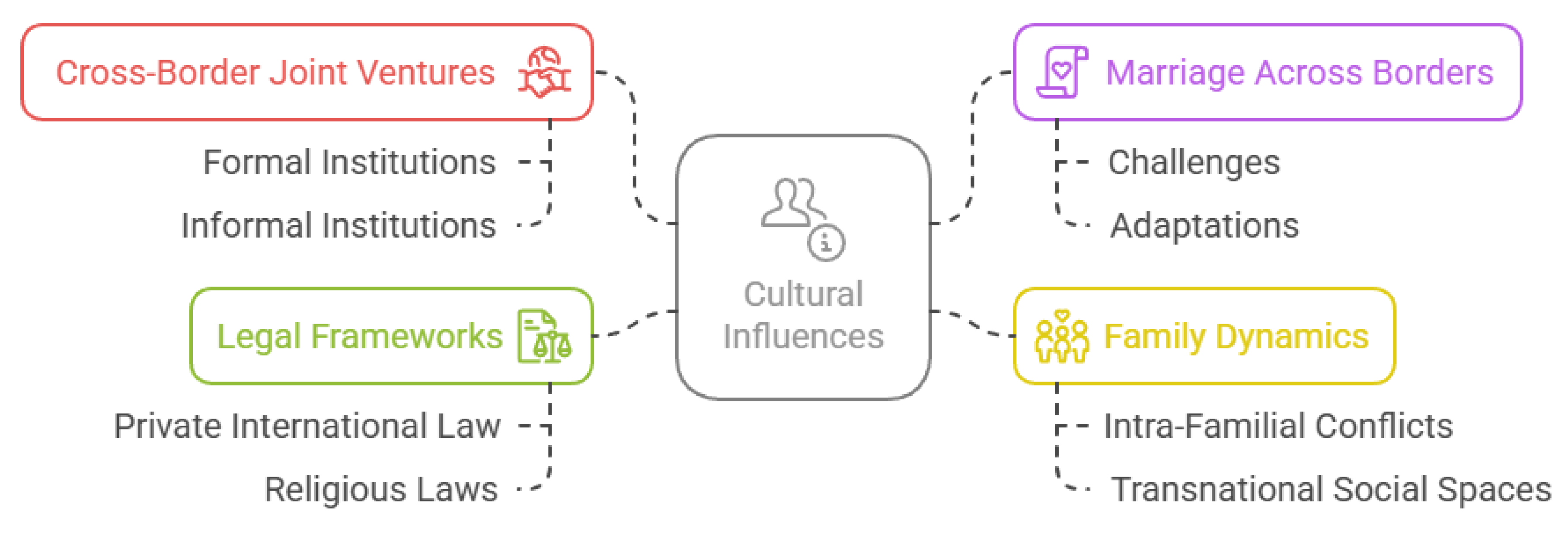
However, we think that other social and cultural factors won't be an obstacle if people decide to leave their home country and relocate in order to have a happy marriage [21]. Perceptions of cultural parallels and/or differences are at the heart of the phenomena of cross-border movement for marriage, even though it poses difficulties in areas like family regulations, health care, and education. Cultural differences can and do exist in attitudes and behaviours related to pregnancy and childbirth, raising young children, handling finances, educating oneself and one's child, language, and socialization. These may lead to intra-familial conflicts even when members have the same cultural understandings. However, when two or more individuals from different cultures interact, cultural differences become more noticeable [22]. Research on divorce in international families demonstrates that, even in the event of a divorce, the transnational social spaces of migrants continue to be quite significant. For example, migrants can now assert divorce as a right to resolve marital issues due to the emergence of new (religious) discourses and norms in transnational social spaces. However, the influence of traveling discourses of knowledge, attitudes, and family norms is a less discussed facet of transnational social spaces. Since these discourses are used to inform, amuse, and shape behaviour in the transnational networks of migrants, they could be considered a type of "gossip" [23]. Under the principles of private international law, cultural and religious restrictions frequently surface in cross-border family law matters. By coordinating legal system claims to decide the interests at issue, this field of law aspires to advance cross-border justice between people as per described in fig 1. In more recent times, this field has also been characterized as a legal framework that regulates disputes between cultures or civilizations. The states of origin frequently require complete adherence to their religiously coordinated family laws in cross-border matters, especially when the individuals involved reside overseas and the states have personal laws based on religion [24].
Figure 1.
Cultural Influences on Cross-Border Interactions.
4. Legal Rights and Obligations of Spouses in Different Jurisdictions
The symposium's theme, "overlapping jurisdictions," lies at the core of some of the most contentious issues that come up under the First Amendment and related federal and state laws that protect religious freedom[25]. Premarital agreements have become more common in divorce discussions as a result of these profound socioeconomic shifts. With the help of these agreements, the prospective spouses decide what will happen in the event of a future breakdown—that is, what rights would be available in the event of a marriage dissolution or one spouse's death—before they get married. Regarding jurisdiction, applicable law, recognition, and enforcement, international prenuptial agreements—agreements with substantial links with many different countries—raise pertinent issues [26].
Speed is crucial, and partners frequently compete to get into the jurisdictions of their choosing. The needs of a given nation, which might vary greatly from one nation to another, determine one's capacity to fit in. Generally speaking, citizens and residents are allowed to reside in their home countries. Furthermore, Domiciliary (people who view that nation as their future permanent abode) may file for divorce there, especially in nations that adhere to British common law. However, merely filing for divorce in a certain jurisdiction does not ensure that all decisions would be made there. A divorce decree from certain other nations might not be recognized by one country, which would make the jurisdictional decision even more difficult. The choice of jurisdiction might also be complicated by religion. In India, the Special Marriage Act, the Foreign Marriage Act of 1969 (if at least one spouse is not Indian), and a spouse's religion can all influence family law decisions. The divorces of their respective populations may be handled by Jewish, Islamic, and Christian authorities in Israel. When forum shopping, spouses must take into account numerous other important factors in addition to meeting the nexus regulations of the chosen nation [27]. One or more of these could be decisive factors, depending on the priorities.
5. Anatomy of Post-Divorce Finance Settlements
The implications of filing a petition for divorce and the eventual breakup of marriage by the court are inextricably woven with intricate connotations that extend beyond the initial assumptions of the involved parties. Divorce extends beyond legal ceremonial ties that are associated with matrimony, as both legal maxims and factual factors have significant implications in respect of the consideration of divorce petitions and the granting of financial orders to the parties. The only basis upon which a divorce petition may be granted is that there is no chance of reconciliation on account of the breakdown of the marriage. The only basis, then, upon which a petition for divorce can be granted will be that the marriage has irretrievably ceased to exist [28]. It lies in the Court to determine whether or not on the facts before it, the marriage has irretrievably broken down [29].
The court has to be convinced that, the breakdown of the marriage is beyond repair; that the spouses have established in their behaviour that they no longer desire to proceed with the marriage.
6. Financial Settlement
Financial provision or settlement or what majority of people simply call "Alimony", also spousal support or maintenance, is a monetary agreement whereby one spouse or previous spouse gives money to the other after divorce or split. It is a court-mandated allowance paid by one spouse to the other spouse for upkeep and sustenance while they are apart, while they are engaged in a matrimonial action, or upon being divorced [30]. The reason for alimony is to enable the receiving spouse to have an equal standard of living that was created during the marriage, particularly when there is a large disparity in the incomes or financial means of the spouses [31]. It is meant to correct any economic differences between the two parties arising from the termination of the marriage. Alimony may be granted in various forms, including lump sums, regular payments for a fixed period, or periodic payments until some specified conditions are fulfilled, such as the receiving spouse's remarriage or living with a new partner. The purpose of alimony is to give monetary support to the economically weaker or lower-income spouse and help them adjust to a secure financial position after divorce.
In the case of Riebeiro v. Riebeiro [32], Amua-Sakyi JSC distinguished between financial provisions and property settlement in section 20(1) of Act 367. According to him, section 20(1) gives parties more authority during a divorce than just property settlement. Additionally, the authority to issue financial provision orders exists. On such an application, the court considers the parties' needs and uses the money and real estate of the spouse to make a reasonable provision for their satisfaction. This demonstrates that evidence of ownership or involvement in the purchase of the properties to be awarded need not be the basis for an order for financial provision. It is evident that the court can make financial provisions in divorce cases involving married couples under Section 20(1) of Act 367, with the primary consideration being that the court must assess the parties' needs.
7. Considerations to Prove When Effectively giving Alimony, Support, or Financial Maintenance
In most divorce proceedings, it is the norm for the husband to give financial assistance or alimony to the wife as compensation after the collapse of the marriage. Nevertheless, there are special cases where the court can rule out the award of financial provision, or in certain instances, the court can rule that the wife should give financial assistance to the husband. These events are rare and usually only happen in cases involving adultery or such extreme behaviour on the part of the wife [33].

Table 1.
Considerations of Section 19 and Section 20 of the matrimonial causes act, 1971 (Act 367).
| Section | Key Provisions | Key Terms | Considerations |
| 19 | - Court may award maintenance pending suit or financial provision to either spouse. | - Maintenance pending suit- Financial provision | - Must be "just and equitable"- Court must consider standard of living and circumstances of the parties. |
| 20 | - Court may order payment of money or conveyance of property (movable/immovable) to settle property rights or as financial provision. | - Settlement of property rights- Financial provision- "In gross" or "by instalments" | - Must be "just and equitable"- Payments/conveyances can be made in full (gross) or spread over time (instalments). |
In the Obeng v. Obeng case [34], the court explained factors to be applied when granting economic provisions to the spouse. Through these factors, the court is able to examine the economic potential of the supporting spouse, making assessments of the strengths and limitations of the paying spouse. The spouse providing the financial assistance to be financially stable. If the granted amount is more than the earning of the spouse, it is difficult for them to make the payments. Therefore, these factors assist the court in considering the overall situation of every spouse and granting a just and fair financial maintenance order. The following are the considerations:
- The income, earning capacity which encompass the capacity of both spouses to earn an income.
- The duration of the marriage.
- Property and other resources which each of the parties have or is likely to have in the reasonably foreseeable future.
- The financial needs, obligations and expenses which each of the parties has or is likely to have in the reasonably foreseeable future.
- The pre-breakdown standard of living maintained by the family
- The ages of the parties and the length of the marriage.
- Forgoing the spouse's career.
- Performance of domestic work and bearing a spouse's child
8. Alternative Dispute Resolution in Cross-Border Divorce Cases
Divorce may be a stressful and combative process. Alternative dispute resolution (ADR) techniques seek to resolve divorce and custody disputes more harmoniously beyond court litigation. These techniques empower couples to settle their own agreement on their own terms with the guidance of neutral third parties. ADR approaches such as mediation, arbitration, and collaborative law can simplify international divorce and reduce conflict. They prevent lengthy trials and allow couples to come to mutually acceptable settlements specific to their circumstances.
Table 2.
Here are explained the three terms of ARD approaches, like mediation, arbitration, and collaborative law.
Table 2.
Here are explained the three terms of ARD approaches, like mediation, arbitration, and collaborative law.
| Term | Key Features | Benefits/Considerations |
| Mediation | Neutral mediator facilitates communication; voluntary settlement focus. | Collaborative, avoids court battles; requires good faith, legal review advised. |
| International Arbitration | Binding decision by private arbitrator; follows procedural rules/treaties. | Faster than cross-border litigation; enforceable outcomes, but parties lose control. |
| Collaborative Law | Lawyers negotiate cooperatively; withdrawal if talks fail. | Empowers mutual solutions, adaptable to cross-border issues; incentivizes compromise. |
8.1. Constructing a Strong Cross-Border Legal Team
Building a cohesive team of financial and legal professionals from several jurisdictions is imperative when dealing with intricate international divorce cases. These are some best practices in constructing a qualified cross-border team.
8.1.1. Selecting the Best International Divorce Lawyers
When searching for legal advice on an international divorce, finding lawyers with knowledge of the concerned countries' family laws is vital. Look for lawyers who: Vet prospective attorneys extensively and seek referrals from clients with similar cases.
8.1.2. Adding Financial and Tax Accountants
Pursuing the financial and tax aspects of a foreign divorce agreement adds complexity. Use accounting professionals who: Select accountants who have experience handling international divorces specifically to prevent expensive financial blunders.
8.1.3. Other Necessary Experts and Services
Have a network of competent, working together professionals responsive to your particular situation. The cross-functional team process lays the ground for the best possible outcome from your divorce.
9. Conclusions
Cross-border divorce and marriage have an intricate interface of legal, cultural, and socio-economic difficulties crossing borders. As globalization is escalating, an increasing number of transnational unions due to migration, economic imbalance, and cyber match-making has unearthed shortcomings in the laws, jurisdictional battles, and systemized discrimination. This paper examines how cross-border couples in unions are impacted by cultural, religious, fiscal gaps, as well as power-based gender arrangements that create a host of vulnerabilities for them, but especially so for women. The normative complexities of divorce between states—from forum shopping and prenuptial contracts to post-divorce financial arrangements—highlight the imperative of harmonized international family laws based on fairness and human rights. In contrast, the social problems, such as integration problems, domestic violence, and identity conflicts, require policy measures protecting migrants' rights while promoting intercultural understanding. Finally, resolving these issues calls for a multidisciplinary response: greater international cooperation, culturally responsive legal reforms, and civic awareness to help counteract exploitation and inequality. By filling the gap between legal structures and social realities, stakeholders can more effectively protect the rights and dignity of those who are navigating the rough seas of cross-border marriages and divorces.
References
- Gough, E. K. (1959). The Nayars and the definition of marriage. The Journal of the Royal Anthropological Institute of Great Britain and Ireland, 89(1), 23-34.
- Emery, R. E. (2013). Cultural sociology of divorce: An encyclopedia (Vol. 1). Sage.
- Constable, N. (Ed.). (2010). Cross-border marriages: Gender and mobility in transnational Asia. University of Pennsylvania Press.
- Barkat, A., Anjum, R., & Jatoi, A. A. (2025). Cross Border Issues in International Divorce: A Legal Understanding. Journal of Development and Social Sciences, 6(1), 518-528. [CrossRef]
- Williams, L. (2013). 2 Transnational Marriage Migration and Marriage Migration: An Overview. Transnational marriage, 23-37.
- Md Said, M. H. B., & Emmanuel Kaka, G. (2023). Domestic violence in cross-border marriages: A systematic review. Trauma, Violence, & Abuse, 24(3), 1483-1502. [CrossRef]
- SS, S., & Begum, S. F. (2024). Controlling Body and Sexuality: Cross Border Marriages Among Muslim Women in Kerala. Library of Progress-Library Science, Information Technology & Computer, 44(3).
- Charsley, K. (2013). 1 Transnational Marriage. In Transnational marriage (pp. 3-22). Routledge.
- Choi, S. Y., & Cheung, A. K. L. (2017). Dissimilar and disadvantaged: Age discrepancy, financial stress, and marital conflict in cross-border marriages. Journal of Family Issues, 38(18), 2521-2544. [CrossRef]
- Moret, J., Dahinden, J., & Andrikopoulos, A. (2023). Introduction: Contesting categories of cross-border marriages: perspectives of the state, spouses and researchers. In Cross-Border Marriages (pp. 1-18). Routledge.
- Constable, N. (Ed.). (2010). Cross-border marriages: Gender and mobility in transnational Asia. University of Pennsylvania Press.
- Fresnoza-Flot, A., & De Hart, B. (2022). Divorce in transnational families: Norms, networks, and intersecting categories. Population, Space and Place, 28(5), e2582.
- Estin, A. L. (2016). Marriage and divorce conflicts in international perspective. Duke J. Comp. & Int’l L., 27, 485.
- Ahn, S. Y. (2025). Matching across markets: An economic analysis of cross-border marriage. Journal of Labor Economics, 43(2), 000-000. [CrossRef]
- Williams, L. (2013). 2 Transnational Marriage Migration and Marriage Migration: An Overview. Transnational marriage, 23-37.
- Le Bail, H. (2023). Promoting and restricting marriage migrations: when marriages are not such a private matter. In Research Handbook on the Institutions of Global Migration Governance (pp. 327-340). Edward Elgar Publishing.
- Ibrahim, F. (2018). Cross-border intimacies: Marriage, migration, and citizenship in western India. Modern Asian Studies, 52(5), 1664-1691. [CrossRef]
- Balistreri, K. S., Joyner, K., & Kao, G. (2017). Trading youth for citizenship? The spousal age gap in cross-border marriages. Population and Development Review, 43(3), 443. [CrossRef]
- Steyn, H. K. (2015). Cross-cultural divorce mediation by social workers: Experiences of mediators and clients (Doctoral dissertation, University of KwaZulu-Natal, Durban).
- Georgieva, D., Jandik, T., & Lee, W. Y. (2012). The impact of laws, regulations, and culture on cross-border joint ventures. Journal of international financial markets, institutions and money, 22(4), 774-795. [CrossRef]
- Ahsan Ullah, A. K. M., & Chattoraj, D. (2023). International marriage migration: The predicament of culture and its negotiations. International Migration, 61(6), 262-278. [CrossRef]
- Sandel, T. L. (2011). Is it Just Cultural? Exploring (Mis) perceptions of Individual And Cultural Differences of Immigrants through Marriage in Contemporary Taiwan. China Media Research, 7(3).
- Kalmijn, M. (2010). Country differences in the effects of divorce on well-being: The role of norms, support, and selectivity. European Sociological Review, 26(4), 475-490. [CrossRef]
- Jänterä-Jareborg, M. (2016). Cross-border family cases and religious diversity: what can judges do?. In Family, Religion and Law (pp. 143-163). Routledge.
- Witte Jr, J., & Nichols, J. A. (2012). Who governs the family? Marriage as a new test case of overlapping jurisdictions. Faulkner L. Rev., 4, 321.
- Terradas, B. A. (2018). Jurisdiction clauses in international premarital agreements: A comparison between the US and the European system. European Review of Private Law, 26(4). [CrossRef]
- Crain, J. O. A. N. (2017). Cross-Border Divorces: Where Breaking Up Is Harder to Do. Am. J. Fam. L., 31, 20.
- Matrimonial Causes Act, 1971 (Act 367), s 1(2),.
- Samuel Babilogozo Ofori V. Danielle Tashima Pinkney, (2016) JELR 107759 (HC).
- Black’s Law Dictionary, (8th ed. 2004) page 228.
- ‘Maintenance: A Short Ride on the Alimony Pony’ (Cambridge Family Law Practice, July 25 2012) http://cflp.co.uk/maintenance-alimony-pony/.
- RIBEIRO v. RIBEIRO (1989-90) GLR 109 at 115-116.
- Addey, M. (2023). The Anatomy of Financial Settlements After a Divorce (Alimony): Understanding the Court's Evaluation of Crucial Factors. Available at SSRN 4527322.
- Obeng v. Obeng (2013), 63 Ghana Monthly Judgements, 158.
Disclaimer/Publisher’s Note: The statements, opinions and data contained in all publications are solely those of the individual author(s) and contributor(s) and not of MDPI and/or the editor(s). MDPI and/or the editor(s) disclaim responsibility for any injury to people or property resulting from any ideas, methods, instructions or products referred to in the content. |
© 2025 by the authors. Licensee MDPI, Basel, Switzerland. This article is an open access article distributed under the terms and conditions of the Creative Commons Attribution (CC BY) license (http://creativecommons.org/licenses/by/4.0/).
Copyright: This open access article is published under a Creative Commons CC BY 4.0 license, which permit the free download, distribution, and reuse, provided that the author and preprint are cited in any reuse.


